Ontdek de Fascinerende Wereld van UFO's en UAP's: Jouw Bron voor Onthullende Informatie!
Ben jij ook gefascineerd door het onbekende? Wil je meer weten over UFO's en UAP's, niet alleen in België, maar over de hele wereld? Dan ben je op de juiste plek!
België: Het Kloppend Hart van UFO-onderzoek
In België is BUFON (Belgisch UFO-Netwerk) dé autoriteit op het gebied van UFO-onderzoek. Voor betrouwbare en objectieve informatie over deze intrigerende fenomenen, bezoek je zeker onze Facebook-pagina en deze blog. Maar dat is nog niet alles! Ontdek ook het Belgisch UFO-meldpunt en Caelestia, twee organisaties die diepgaand onderzoek verrichten, al zijn ze soms kritisch of sceptisch.
Nederland: Een Schat aan Informatie
Voor onze Nederlandse buren is er de schitterende website www.ufowijzer.nl, beheerd door Paul Harmans. Deze site biedt een schat aan informatie en artikelen die je niet wilt missen!
Internationaal: MUFON - De Wereldwijde Autoriteit
Neem ook een kijkje bij MUFON (Mutual UFO Network Inc.), een gerenommeerde Amerikaanse UFO-vereniging met afdelingen in de VS en wereldwijd. MUFON is toegewijd aan de wetenschappelijke en analytische studie van het UFO-fenomeen, en hun maandelijkse tijdschrift, The MUFON UFO-Journal, is een must-read voor elke UFO-enthousiasteling. Bezoek hun website op www.mufon.com voor meer informatie.
Samenwerking en Toekomstvisie
Sinds 1 februari 2020 is Pieter niet alleen ex-president van BUFON, maar ook de voormalige nationale directeur van MUFON in Vlaanderen en Nederland. Dit creëert een sterke samenwerking met de Franse MUFON Reseau MUFON/EUROP, wat ons in staat stelt om nog meer waardevolle inzichten te delen.
Let op: Nepprofielen en Nieuwe Groeperingen
Pas op voor een nieuwe groepering die zich ook BUFON noemt, maar geen enkele connectie heeft met onze gevestigde organisatie. Hoewel zij de naam geregistreerd hebben, kunnen ze het rijke verleden en de expertise van onze groep niet evenaren. We wensen hen veel succes, maar we blijven de autoriteit in UFO-onderzoek!
Blijf Op De Hoogte!
Wil jij de laatste nieuwtjes over UFO's, ruimtevaart, archeologie, en meer? Volg ons dan en duik samen met ons in de fascinerende wereld van het onbekende! Sluit je aan bij de gemeenschap van nieuwsgierige geesten die net als jij verlangen naar antwoorden en avonturen in de sterren!
Heb je vragen of wil je meer weten? Aarzel dan niet om contact met ons op te nemen! Samen ontrafelen we het mysterie van de lucht en daarbuiten.
Zaterdag 24 april 2021
Animation Shows how Saturn’s Rings Move at Different Speeds
Animation Shows how Saturn’s Rings Move at Different Speeds
Saturn’s rings are one of the most recognized and revered celestial objects known to the human race. From a distance, they look like a disk of layered crystal or multicolored disks within disks that wrap around Saturn’s hazy umber face. When viewed up close, we see that these rings are actually particles of water ice (from microns to icebergs), as well as silicates, carbon dioxide, and ammonia.
Saturn's rings, imaged based on radio data from NASA's Cassini spacecraft. Green indicates regions with particles smaller than 5 centimeters; purple is where no particles are that small. The white area is so dense that it blocked radio signals.
We would also noticed that the rings have some interesting orbital mechanics. In fact, each ring has a different orbit that is the result of its proximity to Saturn (i.e., the closer they are, the faster they orbit). To illustrate what this complex system look like, NASA Fellow Dr. James O’Donoghue created a stunning animation that shows how each of Saturn’s major ring segments (A-Ring to F-Ring) orbit together around the planet.
Born in the UK, Dr. O’Donoghue is a planetary researcher and scientist currently working with the Japan Aerospace Exploration Agency (JAXA) who lives outside of Tokyo. Previously, he worked as a NASA Fellow at the NASA Goddard Space Flight Center where he specialized in the research of Saturn (and its ring system), Jupiter, and their atmospheric phenomena (aurorae, the Giant Red Spot, etc.)
Dr. O’Donoghue related what inspired this animation with Universe Today via email:
“Over the years I’ve received a lot of questions about what the rings are made of and how they move. People are often surprised that the rings are made of shards of frozen water ice ranging in size from dust to icebergs and that they orbit the planet at different speeds depending on what “lane” they’re in!By the way, the rings are made of almost pure water. If they were pure water ice though, they’d look white!“
As you can see from the animation, Saturn’s major rings are designated based on the order of their discovery and orbit their parent planet in the order of D, C, B, A, and F (innermost to outermost). Between the A- and F-Rings is the mysterious E-Ring, which orbits between Mimas and Titan and is extremely wide. This ring is composed of microscopic icy particles, which makes it hard to discern among the others.
The recording simulates what takes place around Saturn during the course of 30 hours. “The image of Saturn was made by images collected by the Cassini spacecraft which had been stitched together,” explained O’Donoghue. “Rendering can take a lot of time, so I thought the minimum useful animation would be to show the slowest ring lapping the planet twice.”
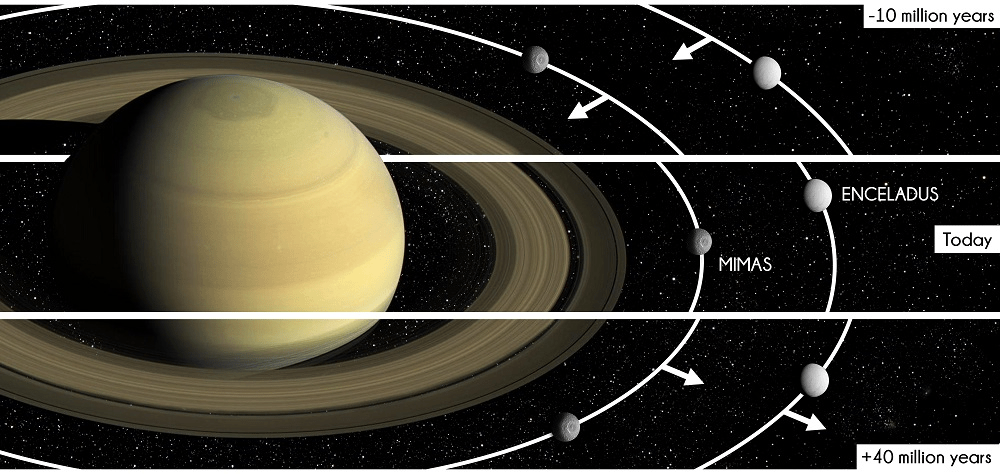
Saturn’s rings and moons have been the subject of scientific debate. A 2019 study showed that the migration of Saturn’s moons has widened the Cassini Division in Saturn’s rings. Credit: Cassini, Dante, Baillié and Noyelles
The orbital velocity and period of each ring is timed to illustrate the resonance the system of the rings. “The Cassini Division, the widest gap within Saturn’s rings, is caused by the resonance between a small moon called Mimas and ring particles,” said O’Donoghue. “Funnily enough, I was looking for some images on that and found something cool at UT.” (shown above).
Saturn’s own spin is indicated in white, which illustrates its rotational velocity relative to its ring system. Also visible is the persistent and rotating hexagonal vortex located around Saturn’s north pole. The animation not only presents a beautiful view of the orbital dynamics of Saturn’s rings. It also honors the Cassini mission, which ended its mission Sep. 15th, 2017, after thirteen years around Saturn.
The data collected by the probe is still being analyzed and leading to exciting new discoveries about Saturn, its rings, and its system of moons. Before plunging into Saturn’s atmosphere, Cassini conducted its “Grande Finale,” where the probe plunged into the unexplored region that lies between Saturn’s atmosphere and its rings.
The footage of Cassini’s final months, and its final descent into Saturn’s atmosphere, earned NASA an Emmy nomination.
In addition to being incredibly fast-moving, Saturn's rings are very long and thin. If you unfurled them — as O'Donoghue did in the image below — all the planets would fit comfortably within their length.
James O'Donoghue
But in total, the rings have just 1/5,000th the mass of our moon.
"In other words, our moon could be used to make 5,000 Saturn ring systems," O'Donoghue told Insider. "This highlights how extremely thin and fragile the rings of Saturn are."
This fragility is a subject of O'Donoghue's scientific research. In studying Saturn's upper atmosphere, he and his colleagues found that the rings are slowly disappearing. Thousands of kilograms of ring material rain onto the planet every second. At that rate, the rings shouldn't last more than 300 million years in their current "full" form, he said.
"Saturn's ring system is not exactly stable, appearing to be more like a temporary debris field of some ancient moon or comet which got too close and broke apart, rather than a permanent feature," O'Donoghue added. "We can count ourselves lucky we live in a time when Saturn's rings have such an enormous presence in the solar system."
The Legacy of Colonel Philip J. Corso - UFO and ET Technology
Over 2-Hours of Amazing Information. One of the most important milestones since the UFO disclosure process began with the publishing of the book “The Day After Roswell” by Lt. Col. Philip J. Corso (ret), with (co-author) UFO Magazine publisher – William Birnes.
The allegations in this book rocked the foundations of the cover-up by revealing how Col. Corso, acting on behalf of the the US government, directly over saw the harvesting and reverse engineering of crashed spacecraft of ET origin, which led to the development of laser technology, fiber optics, polymers and anti-gravity technology.
Lt. Col. Corso was a decorated officer who believed the public should know the truth about the extraterrestrial reality and not long before his death, he documented his experiences with ET and Above Top Secret Technology, for future generations.
MUFON CASE : 114890 Orlando, Florida ( April 23, 2021 )
Mutual UFO Network : MUFON SUBMISSIONS : Long Description of Sighting Report Tv coverage of today's rocket launch showed ufo Date Submitted : 2021-04-23 Date of Event : 2021-04-23 6:01AM MUFON SUBMITTER FILE : trim.EF6EF67F587A4987B957DB13FE964794.MOV
MUFON CASE : 114891 Attapulgus, Georgia ( April 23, 2021 )
Mutual UFO Network : MUFON SUBMISSIONS : Two glowing objects with the smaller object pulsating Long Description of Sighting Report The video doesn’t show the intensity of the smaller objects pulsating to the right in crescent moon shapes and then pulsating toward the ground with same shape Date Submitted : 2021-04-23 Date of Event : 2021-04-23 5:50AM MUFON SUBMITTER FILE : trim.5132595BF28C4810A760275F42DD79D7.MOV
UFOs Sighted By Mexican Air Force Pilots
Mexican Air Force Pilots capture amazing unidentified flying objects or UFOs in Mexico. STATEMENT : OVNIs divisados por pilotos de la fuerza aérea mexicana :
TRANSLATE : UFOs sighted by mexican air force pilots
credit : Adan Eve : Omega Ovnis Ufos
MUFON CASE : 114902 Cookeville, Tennessee ( April 24, 2021 )
Mutual UFO Network : MUFON SUBMISSIONS : UFO? Long Description of Sighting Report Saw this from my backyard a couple years ago; someone told me to post it here. The thing was going very fast, and was out of sight in less than 30 seconds. Date Submitted : 2021-04-24 Date of Event : 2019-04-24 6:40AM MUFON SUBMITTER FILE : trim.9F345D33C4774F669528A7383B0DFB0C.MOV
While searching for anomalies in Antarctica, using Google Earth, I found several unnatural looking structures, including some that resemble possible remnants of ancient settlements.
Coordinates:
Shadow Ancient Settlement: 78°42'19.86"S 86° 4'57.09"W
Metallic gold rotating object filmed over Christchurch, New Zealand 22-Apr-2021
This unknown object was filmed over Christchurch, the largest city in the South Island of New Zealand, on 22nd April 2021.
Witness report:
Object came from the east drifting toward the west. Appeared to have two parts that were rotating kind of like bike pedals. There was no sound that I could hear but it reflected the sunlight as it was a very sunny morning. Eventually it just disappeared from view. If I hadn’t been on my way to work I would’ve chased it for longer. People are saying it’s probably balloons but it didn’t look like balloons to me!
Atlantis and “the ships that made humans fly in ancient times”
For decades, researchers have raised their voices to accept the theory that flying ships existed in ancient times. Different ancient texts and stories would reveal the existence of airships from Atlantis.
Atlantis continues to be a mystery to archeology and science.
The technological level of our ancestors has been discussed by archaeologists and historians. Some claim to have discovered that the technological principles of humanity come from Atlantis , thousands of years ago.
The evidence of flying machines of antiquity, we can find them in the different ancient cultures around the world.
The “Nazca balloons”
The ancient town of Nazca is one of the most important archaeological centers in the world. In its plains you can see in the Nazca lines , gigantic geoglyphs that present different figures.
Among them are huge hot air balloons , which have confused historians. Researcher Jim Woodman is convinced that the construction of these aircraft was possible with the tools that the natives of Nazca had.
Skeptical, Nott listened to Woodman’s theory and helped him build a hot air balloon out of materials that may have been used in ancient times . Against all odds, the balloon flew.
“While I don’t see any evidence that the Nazca civilization will fly, it is beyond question that they could have flown.”
Julian Nott
The Vimanas of India
Perhaps the greatest evidence of flying ships in ancient times comes from ancient Hindu culture . Specifically from the Veda .
The most recent research has yielded evidence of an advanced civilization , which existed before the end of the last Ice Age . This civilization inhabited part of the region that is now India and it is believed that it could have rivaled other equally advanced regions.
Ancient Sanskrit writings suggest that the stories, considered fantasy by experts for hundreds of years, could be true .
Support for this theory is based on the discovery of strange artifacts and additional texts that supplement the records kept in museums and universities.
In these stories you can read detailed descriptions, not only of flying ships , but of complex aeronautical processes and mechanical parts that exist today.
In fact, experts consider it an ancient guide to aerospace engineering .
The Vedas also mention an air war and an atomic war , which took place between a region in northern India and an unknown region, located in the Gobi desert.
It should be noted that there is a section of the Gobi desert , which has shown signs of radioactivity and several sections of the sand are melted, transforming into greenish glass .
The radioactive sands of Mongolia could be yet another proof of this war. In the same way, the remains found of an ancient city in northern India, showing signs of radioactivity .
It is thanks to these findings that the Aiud wedge , discovered in 1973 , was seen from another perspective; a machined piece of metal made from an aluminum alloy.
At first it was believed to be 400 years old . However, the new analyzes determined that it comes from the year 18,000 a. C. , almost 20,000 years before the discovery of aluminum.
Many experts have stated that this artifact could be part of an aircraft landing gear .
William Scott-Eliot and Remote Viewing
William Scott-Eliot was the first person to speak of Atlantean technology.
Atlantis has been one of the most controversial stories of humanity. Many ancient cultures make mention of a lost continent, however, it is thanks to the Greek philosopher Plato , that the legend became known.
He described it as an ancient city , still to his day, similar to a gigantic island that was located beyond the columns of Hercules .
More current researchers suggest that its location was off the coast of Spain , near the Bimini Islands in the Caribbean.
Although some experts believe that Atlantis is located at the South Pole , because this region is located “beyond the columns of Hercules”, as Plato mentioned.
There is no doubt that Atlantis is a mystery, however, nothing worries more than its ancient technology . Many historians assure that this continent had large submarine ships and an enigmatic crystal of power, which supplied electrical energy to the continent.
However, little has been said about the aircraft that traveled the skies, exploring the world .
The first text that touched on this theme was “The History of Atlantis and the lost Lemuria”, by William Scott-Elliot , published in 1909.
Scott-Eliot described a navigation aircraft technology based on a technology lost in ancient times.
Although many experts ignored the writer’s statements, since he was not based on any type of evidence, but on what he calls “Remote Viewing”.
Although historians did not take Remote Viewing into account , this ability was used by the CIA and the Pentagon on different occasions. In fact, these agencies took it into account years before, thanks to the work of experts, such as the genius in electronics, Michael Faraday.
The Aircraft of Atlantis
Using this process, Scott-Eliot was able to observe how society worked in Atlantis and Lemuria. Thus he discovered that both civilizations possessed flying ships . The writer described his experience as follows:
“The material from which the aerial ships were built was made of wood or metal. The previous ones were built of wood.
The platforms used are extremely thin, however the injection of a substance that did not add material to the weight, gave it toughness like leather, provided the necessary combination of lightness and resistance.
When the metal was used it was generally made of an alloy, two white metals and one red were included in its composition. The resultant was white in color, like aluminum and lighter in weight.
A large sheet of this metal was spread over the rough structure of the ship, which was then beaten into shape and electrically welded where necessary.
However, if it was constructed of metal or wood, its outer surface was perfectly smooth and seemingly without problems, and it glowed in the dark as if it were coated with luminous paint.
They were ship-like in shape, but invariably covered, because if she was going full speed it couldn’t have been convenient, even safe, for anyone on board staying on the upper deck. Its propeller and steering mechanism could be set in motion at either end. “
Although William Scott-Eliot did not rely on any evidence or ancient accounts for his research, there is some material that could be considered as evidence.
In the Library of Alexandria there are certain scrolls that survived the destruction, which speak of the lost history of mankind .
Other experts have argued that Atlantis existed at the same time as the “super state” of ancient India, known as the Rama Empire , some 15,000 to 20,000 years ago .
They may even have had commercial agreements through the Vimanas and the airships of Atlantis.
It is obvious that for skeptics, everything related to Atlantis, especially its airships, is nothing more than a myth. However, the evidence indicates that other cultures did possess flying machines which, possibly, were inherited from the lost continent.
On the eighth anniversary of its occurrence, a UFO captured on video over Puerto Rico by a U.S. Homeland Security plane isback in the news because it still hasn’t been resolved, and scientists who think a UAP that is seen traveling at 120 mph through both the air and the ocean before splitting in two should be investigated until it is identified and, if it’s not from Earth, the three-minute video is the “most compelling” evidence in existence of an alien spacecraft. In the wake of statements by Pentagon on other similar UFO videos recorded by military aircraft and the open policies on UFO data by other governments, this seems like a reasonable request.
“The SCU believes that all government data regarding unidentified aerospace objects should be made available to the public to be openly investigated by the broader scientific community, provided that such data does not compromise sources or methods of data collection. A full scientific investigation of such data would be able to uncover valuable information relating to both national security and advancement of our understanding of physics, aerospace engineering, and our world.”
In a letter, signed off by 55 concerned scientists, to Senators Marco Rubio and Mark Warner (read it here), the Scientific Coalition for Unidentified Aerial Phenomena (SCU) urged that the upcoming promised unclassified report on UFOs by the Director of the National Intelligence and the Department for Defense due for release in June contain more evidence on recent military encounters — evidence the SCU has been requesting without success. They hope it will include information on the 2013 UFO recorded on April 25, 2013. According to SCU spokesperson Jonathon Lace, the object was first seen over a runway at Rafael Hernandez airport in Aguadilla, Puerto Rico. Shortly after that, Homeland Security (Customs and Border Protection (CBP)) pilots of a DHC-8 Turboprop spotted a red light over the ocean, were told by air traffic controllers they could not identify it, and too the three-minute video with an infrared camera. That video was later leaked to SCU, which conducted its own investigation.
If only the video were this clear
“They (the pilots) wanted (the video) to be scientifically looked at, not UFO related, because again, the stigma that goes along with UFOs. So we pull the team together.”
“The object witnessed by CBP and tower personnel and recorded on the CBP DHC-8 aircraft’s thermal imaging system is of unknown origin. There is no explanation for an object capable of traveling under water at over 90 mph with minimal impact as it enters the water, through the air at 120 mph at low altitude through a residential area without navigational lights, and finally to be capable of splitting into two separate objects. No bird, no balloon, no aircraft and no known drones have that capability.”
Rich Hoffman, one of the co-founders of SCU and an experienced UFO investigator, told Mystery Wire the SCU investigation was thorough and refuted all of the alternatives proposed by skeptics. (The full SCU report can be seen on their website.) What looks like the ability to travel in both air and water – known as “trans-medium travel” is especially intriguing and sets this UFO video apart from the recently disclosed photos of UFOs seen by Navy ships off the coast of California in 2019 and the Tic Tacs seen by Nimitz pilots and personnel in 2004.
Still image from the footage of the “tic-tac” UFO
“This video is the best documentation of an unknown aerial and submerged nautical object exhibiting advanced technology that the authors of this report have ever seen.”
Why doesn’t the military or the government feel the same? According to Hoffman, the video kept getting passed between departments with none of them wanting to take ownership. Will the SCU Letter to Senators Rubio and Warner help? Both have expressed interest in UOFs/UAPs, but it remains to be seen if they’re able to stand up to whoever internally is applying the longstanding and extremely powerful pressure to conceal this data.
While UFO enthusiasts in the U.S. are applauding the few tidbits coming out from government authorities on sightings by military or commercial pilots, Canadian commercial pilots have been logging them for years in a public database that is searchable in a variety of ways and accessible to anyone with a computer, time and interest. That description fits Vice.com, which recently dug into the data and found many close encounters of the commercial aircraft kind that makes one wonder if Canada is just more open about UFO sightings or if the Great White North is hotspot for aliens looking for beer, polar bears and hockey games. Let’s take a look at a few of the most interesting recent ones.
CADORS (Civil Aviation Daily Occurrence Reporting System) is the Canadian national ATS (Airline Technical Support) safety data reporting system which collects information about operational occurrences within the Canadian National Civil Air Transportation System. Reporting by pilots is mandatory, but details of the occurrences are often brief and leave out details that come up in subsequent investigations.
Nonetheless, it’s an excellent starting point for incidents like the one on January 6, 2019, when the crew of the medical transporter Vanguard Air Care reported “an inexplicable bright light followed them… at the same altitude and speed” over northern Manitoba and “no aircraft were reported in their vicinity.” Civilian air traffic controllers alerted the 21 Aerospace Control and Warning Squadron Air Force unit at the CFB North Bay military base in northeastern Ontario. Their investigation was reported to the Government of Canada, the Royal Canadian Air Force (RCAF), and NORAD (part of their responsibility area). That report shows the incident occurred in the Mystery Lake region (coincidence?) near Thompson, Manitoba, and the analysis was “another A/C” (aircraft). The end result is disappointing UFO-wise, but this shows that the Canadian government has a UFO investigation department that works with their military and that of the U.S. … a department that seems to be thorough and somewhat open to the public.
Another interesting encounter occurred on April 30, 2018, when a Kalitta Charters Boeing 747 cargo flight flying over the Northwest Territories reported “an object flying sporadically, estimated at (60 to 80 thousand feet) and moving at Mach 4” – a speed that exceeds the capability of the Lockheed SR-71 Blackbird. Vice.com notes that the CADORS report wasn’t filed for a year-and-a-half and, while it doubted the crew’s judgement of the speed, could not identify the speedy object.
SR-71
One that made the Canadian news happened on November 14, 2016, over Lake Ontario when a Porter Airlines Dash 8-400 turboprop dove to avoid hitting an unidentified object that “appeared to be solid… and shaped like an upright doughnut or inner tube.” Two flight attendants were injured so the incident was reported by the Toronto Star and other media outlets, forcing the Transportation Safety Board (TSB) to investigate. According to CADORS, it found the object was “approximately 5 to 8 feet in diameter” and implied that the pilot could have just flown past it but chose instead to override the autopilot and take a nosedive evasive action. Vice.com notes that TSB never did identify the object.
More incidents such as these can be found by searching the CADORS database. The amount of unusual events makes clear that there’s unexplained stuff going on in Canadian airspace where thousands of passengers fly (at least until the pandemic) every day – and that means the same thing is occurring in the U.S. UFO investigator Chris Rutkowski told Vice.com that everyone, not just UFO enthusiasts, should be concerned about this. Former Royal Canadian Air Force pilot John “Jock” Williams plainly states the frustration everyone outside of the military or the government has when looking into these events:
“Any aviator who goes through the trouble of reporting something like this deserves to have it investigated. I don’t see that happening in Canada.”
Nor the U.S. … yet. Kudos to Vice.com for bringing this and many other ‘mysterious lights’ to light.
Located on the New England Highway in northern New South Wales, Australia, about 250 miles north of Sydney, is the rural township of Guyra. It is perched high on a volcanic uplift of the Northern Tablelands, and in fact the town is one of the highest in Australia at 4,364 feet above sea level, and is known for being one of the coldest places to live in Australia, comparatively speaking. It is a quaint place full of natural beauty, but not a place where a whole lot typically happens, yet this would change in December of 1999, when a mysterious object fell from the sky to smash right into the local water dam. So would begin a mystery that would cause hysteria in this small town, and which has not ever been concretely explained.
On December 8, a local council employee was carrying out routine maintenance work at the Guyra Water Supply Dam when he noticed an unusual sight. There was a crater at least 6 feet across and area of reeds measuring 50 feet by 20 feet that had been flattened in a semi-circular pattern, as if something had plunged down from the sky to smash into the ground there right at the edge of the dam. When police were notified, it would turn out that locals had been calling in actual sightings of an object coming down, described as a “green light” that had caused a loud boom about 30 seconds after being sighted. However, rather oddly, space agencies and meteorological experts and authorities in Canberra had no record of a meteorite or space junk coming down in the area at that time. No one had a clue what it could have possibly been, but just to be safe, authorities quickly moved to shut down the water supply and carry out an investigation. It was quickly found that radiation levels in the vicinity were normal, but in the absence of any more information the water supply was cut while divers got to work to check out the bottom.
Guyra, New South Wales
As this was going on, the incident was hitting the news in a major way, featured prominently on all of the major television networks, radio stations and newspapers. Newspapers were covered with sensationalist headlines such as “There’s an alien in Guyra’s drink!”, “Guyra hit by mystery flying object,” “UFO splashdown – Divers search dam for mystery object,” “Does Guyra Have a UFO in its Dam?” and others like these. Such headlines stirred up much intense interest, with people flooding into the normally quiet town in droves and rumors going around that a UFO had crashed at the dam. It was a minor hysteria and the theories were flying, with some saying that it was a meteorite or space junk, while others said it was aliens, and this captured the attention of the Australian UFO Research Network, who contacted the RAAF base at Amberley Ipswich. One of the team’s researchers, Martin Studer, would say of this:
I spoke to office staff at Amberley RAAF and they told me they had heard it wasn’t a meteorite, that it was an object of some kind. It was funny they were having a laugh with me saying maybe it was a space ship, ha! I was told that people have been sent to measure radiation. I was asked to hold the line and they would transfer me to someone who could help me with my inquiry. I got transferred to the, RAAF base at William Town NSW. The police divers are in the lake looking for what may have landed. William’s Town RAAF are waiting for the Police to report back before moving. It was still not clear what had come down, it could have been space junk or meteorite or a plane.
In the meantime, police divers were searching the water, and they found a subterranean cavern or tunnel, which was suspected to have been caused by the object drilling deep into the ground, but at first the object itself could not be located. Over several days of searches, the water was found to not be contaminated, and there were some mysterious fragments found on the bottom, but whatever the mystery object was, it could not be retrieved because it was speculated to have buried itself about 13 feet down into the soft granite down in the earth. The official cause of the impact was now being seen as a meteorite, which was thought to have been about the size of a grapefruit, but there were no further efforts to retrieve it. The General Manager of the Guyra Shire Council, Geoff Brooks, dismissed any talk of trying to actually dig up the object, saying:
Bearing in mind its location in the dam, I think it’s unlikely that Council will commit any more resources to it. Certainly it’s difficult to get to and it causes a fair bit of disruption to the water supply. So I think it will actually remain one of life’s marvelous mysteries.
As far as officials were concerned, that was that. It was a meteorite, pure and simple, move along. However, this was not known for sure, and no object had been produced to prove that it had been a meteorite, so conspiracies were going around that officials were trying to cover up what had really gone down, with accusations that the object actually had been dug up and whisked off, and that it was no meteorite but rather a UFO. This was further fueled by the fact that the RAAF base contacted by the Australian UFO Research Network had quite clearly stated that it had not been a meteorite. Things got even more mysterious when two researchers from Phenomena Research Australia (PRA) by the names of John Auchettl and Ron Barnett went to investigate, who also speculated that it might have been a meteorite, but also found some odd details that did not fit into this theory. Auchettl would say:
We did find the site interesting. Normally, we would not travel to such sites, but the information sent to us from DoD warranted a look. So yes, the impact has some strange aspects to it that need to be looked at. For example, the angle of entry to the dam was very shallow less than 45 degrees. The surface has burn marks; this is very unusual for a meteorite impact. I had a good look at the reeds on the bank. They are down in a strange shape not quite like an explosion but have the characteristics of a compression wave. The mud splash is also interesting as it lets us know how much energy was in the impact but the sting in the tail, with this impact, is on the other side [bank], the object may have skipped on the water. There was no witness to the impact.
Indeed, one of the problems is that no one seems to have seen the actual impact, making it hard to tell just what came down to earth here. Also making things more difficult are the discrepancies in some of the reports from eyewitnesses. For instance, some witnesses mentioned a green glow or light before the object apparently came down, while others said it was blue, and some witnesses described a loud boom like an explosion, while others made no mention of a sound. It all makes for a compelling mystery, and while the official explanation is that this was nothing more than a crashed meteorite, there are plenty of people who think it could have been something far more mysterious. What came down at the Guyra Dam that day and what happened to it? We may never know for sure.
Many people with an interest in Ufology will recall how, beginning in November 2005, a controversial stash of UFO-themed papers surfaced. They collectively became known as “The Serpo Documents.” The source of the documentation, to this day, remains unknown. She, he or them chose to use the very appropriate alias of “Anonymous.” For some saucer-sleuths, the papers are leaked, highly secret files. For others, the entire thing is nothing but a big joke that has spun wildly out of control. Others suggest disinformation to muddy the ufological waters. The Serpo papers cover a huge amount of ground, but the primary focus is on controversial claims of an “exchange program” between us and the representatives of an alien race, one which began in the 1960s. Anonymous said: “I am a retired employee of the U.S. Government. I won’t go into any great details about my past, but I was involved in a special program. As for Roswell, it occurred, but not like the story books tell. There were two crash sites: one southwest of Corona, New Mexico and the second site at Pelona Peak, south of Datil, New Mexico.”
Anonymous added: “The crash involved two extraterrestrial aircraft. The Corona site was found a day later by an archaeological team. This team reported the crash site to the Lincoln County Sheriff’s department. A deputy arrived the next day and summoned a state police officer. One live entity was found hiding behind a rock. The entity was given water but declined food. The entity was later transferred to Los Alamos. The information eventually went to Roswell Army Air Field. The site was examined and all evidence was removed. The bodies were taken to Los Alamos National Laboratory because they had a freezing system that allowed the bodies to remain frozen for research. The craft was taken to Roswell and then onto Wright Field, Ohio. The second site was not discovered until August 1949 by two ranchers. They reported their findings several days later to the sheriff of Catron County, New Mexico. Because of the remote location, it took the sheriff several days to make his way to the crash site. Once at the site, the sheriff took photographs and then drove back to Datil.”
There was more to come: “Sandia Army Base, Albuquerque, New Mexico was then notified. A recovery team from Sandia took custody of all evidence, including six bodies. The bodies were taken to Sandia Base, but later transferred to Los Alamos. The live entity established communications with us and provided us with a location of his home planet. The entity remained alive until 1952, when he died. But before his death, he provided us with a full explanation of the items found inside the two crafts. One item was a communication device. The entity was allowed to make contact with his planet. Somehow, I never knew this information, but a meeting date was set for April 1964 near Alamogordo, New Mexico. The Aliens landed and retrieved the bodies of their dead comrades. Information was exchanged. Communication was in English. The aliens had a translation device. In 1965, we had an exchange program with the aliens. We carefully selected 12 military personnel; ten men and two women. They were trained, vetted and carefully removed from the military system. The 12 were skilled in various specialties.”
And, finally, there is this from the man or woman with no known name: “Near the northern part of the Nevada Test Site, the aliens landed and the 12 Americans left. One entity was left on Earth. The original plan was for our 12 people to stay 10 years and then return to Earth. But something went wrong. The 12 remained until 1978, when they were returned to the same location in Nevada. Seven men and one woman returned. Two died on the alien’s home planet. Four others decided to remain, according to the returnees. Of the eight that returned, all have died. The last survivor died in 2002. The returnees were isolated from 1978 until 1984 at various military installations. The Air Force Office of Special Investigations (AFOSI) was responsible for their security and safety. AFOSI also conducted debriefing sessions with the returnees.” Despite the outrageous and unlikely tale that the documents told, Serpo very quickly became a sensation within certain ufological quarters and provoked massive debate – in magazines and journals, on radio shows, and at online forums. There is, however, one issue that has, for the most part, been overlooked, ignored and forgotten. In early 2006, a source that used the named “Chapman,” and who maintained they had a background with the British Ministry of Defense, claimed to know all about the Serpo files and what they really represented.
Chapman explained: “Interesting reading. However, these are NOT real events that are being described here, although the document they come from IS REAL. I saw this information in 1969 or ’70 in Whitehall. Originally it was a CIA document authored by a lady named Alice Bradley Sheldon. Its main purpose, if you will pardon the phrase, was to ‘scare the crap out of the Soviets’ in response to them scaring the crap out of us.” Admittedly, it’s fair to say that “Chapman” was as much an unknown whistleblower as was “Anonymous.” But, what’s the most likely scenario in this strange story? That “Anonymous” told an incredible truth of alien contact? Or that this was all a Cold War-based plot designed to disrupt the Russians? I say the latter. Here’s why: Alice Bradley Sheldon was born in 1915 and, in the immediate aftermath of the horrific events that occurred at Pearl Harbor, Hawaii in December 1941, chose to do whatever she could for her government. It wasn’t long before she was working in the heart of U.S. military intelligence. She ultimately rose to the rank of Major. In 1945, she married Huntington D. Sheldon.
The two decided to relocate to Washington D.C. and both accepted new and exciting careers in the CIA. Alice took part in espionage operations and worked on photo-analysis projects, such as studying imagery of Soviet military installations and then-new Russian aircraft. She remained with the CIA until 1955. As for Huntington, he rose to the position of the Director of the Office of Current Intelligence of the CIA. He held that same position until 1961. In 1967, Alice decided to turn her hand to an area that she had a great love for: that of science-fiction. She did so, however, under the alias of James Tiptree, Jr. In 1973, a collection of her short stories hit the stands. It was entitled Ten Thousand Light Years from Home. Then, in 1975, Warm World and Otherwise were published to high acclaim. More books appeared: 1981’s Out of the Everywhereand Other Extraordinary Visions and 1985’s Brightness Falls from the Air. Barely a handful of people knew, during her lifetime, that Alice and Tiptree were actually one and the very same.
The final years for Alice and her husband were sadly not good; not at all. Both were suffering from ill-health. Huntington finally became bed-ridden. The end was getting closer and closer. It finally arrived. On May 19, 1987, Alice shot and killed her sleeping husband, and then took her own life. Her secrets from that time spent in the employ of the CIA went with her. Unless there is a significant development in the matter of Alice Bradley Sheldon, the Serpo papers, and a plot designed to terrify the Russians, we may never get to see the full picture. But, I cannot think of a better, and more qualified, source than Sheldon –a sci-fi writer and a CIA employee – to have whipped up the saga of Serpo, as a means to freak out the Soviet Union during the Cold War.
Unknown UFO Impacted The International Space Station! NASA What Happened? 2021
Unknown UFO Impacted The International Space Station! NASA What Happened? 2021
Since 2008, THIRDPHASEOFMOON has changed the way people look up at the skies and wonder, “Are we Alone?” With over 773,000 subscribers and millions of views, our goal is simple! We speak with UFO EYE WITNESSES from around the globe, including ground reporting with Experts and Professionals, such as Astronauts, Scientists, Government Officials, ETC. With permission granted, THIRDPHASEOFMOON, will share, discuss, enhance and analyze UFO videos.
And along with our research and opinion of the evidence, THIRDPHASEOFMOON also produces 100% Original Documentaries in regards to the UFO PHENOMENON happening everyday! Our Aim is to bring Truth and Evidence in the field directly to the Public!
Giant Planet is Found at an Extreme Distance From its Star
One of the best things about the sheer number of exoplanets that astronomers are currently finding is how some are just very different. Those differences can sometimes undermine standing theories, and prompt scientists to start considering new theories that account for the new information. That is undoubtedly what will happen to accommodate a new massive planet found by a team led by Dutch scientists. This planet is unique in one very special way – it is about 110 times farther away from its star than the Earth is from the sun.
The star and accompanying planet are located in the southern constellation Musca about 360 light years away from Earth. Known as YSES 2b, the planet was found by the Young Suns Exoplanet Survey (YSES) which uses data from the Very Large Telescope to search for young stars. The one YSES 2b is orbiting is only 14 million years old, but resembles what our own sun would have looked like at that age.
Video discussing the finding. Credit: Learning Academy YouTube Channel
There is no planet like YSES 2b around our current sun though, and its existence has some interesting implications for models of the early solar system. Three potential explanations were put forward as to how such a massive planet could form so far out from the star.
First would be that it simply grew out of the protoplanetary disc, which is the most common method of planetary formation. However, models of those early stage discs suggest that not enough material would be available in the disc to form a planet six times the size of Jupiter that far away from the parent star.
UT Video discussing the search for exoplanets.
Another possible explanation is that there was some gravitational instability in the planetary disc, causing material to collect at the planet’s distant location. For that to be the cause, there would have to be lots of material out in that space in order to cause the instability. Right now there doesn’t appear to be enough of it to do so.
The final explanation is that the planet formed much closer to the star, and then migrated out to its extreme distance over the last few million years. A similar thing is posited to have happened with the gas giants in our own solar system known as the Grand Tack Hypothesis. Scientists would expect some other force to cause that migration though. Most usually that force would be caused by a second planet, but scientists don’t see one that could have caused the gravitational disturbance to send the planet out far enough to end up where it is now.
More raw data from the telescoping showing the YSES 2b exoplanet. Credit: ESO / SPHERE / VLT / Bohn et all
While all three processes have arguments against them, it is still possible that one or more did in fact create YSES 2b. But a more interesting prospect is that there was some other process that created it, and which would be new to science. More study is needed, including seeing if the planet is indeed moving or potentially increasing in mass, which could shed more light on the finding. Until then astronomers, including the ones running the YSES survey, will continue to search out wonderfully bizarre exoplanets.
New Steve Quayle: Human Extinction Accelerated on The Hagmann Report
New Steve Quayle: Human Extinction Accelerated on The Hagmann Report
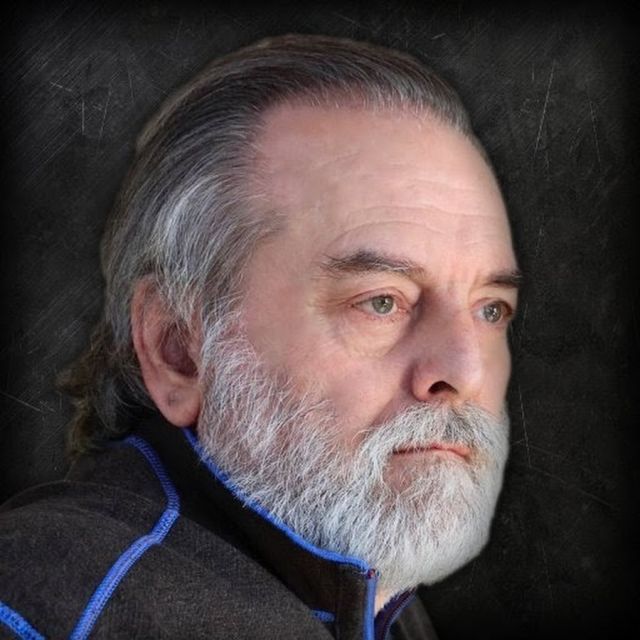
Steve Quayle is a researcher and author of over a dozen books dealing with advanced ancient technology and civilizations. His documentary film production company Gensix Productions films the “True Legends The Series” all over the world in search of the Lost Cities and the giants of history who were the builders of the great megalithic structures of the ancient world.
Steve is a former talk radio show host who has been warning against genetic armageddon and the end of the human race for decades. He claims transhumanism and the hybrid age is the most dangerous advancement in the technological war against humanity in history.
MUFON CASE : 114885 Christchurch, New Zealand ( April 23, 2021 )
Mutual UFO Network : MUFON SUBMISSIONS : Metallic gold rotating object Long Description of Sighting Report Object came from the east drifting toward the west. Appeared to have two parts that were rotating kind of like bike pedals. There was no sound that I could hear but it reflected the sunlight as it was a very sunny morning. Eventually it just disappeared from view. If I hadn’t been on my way to work I would’ve chased it for longer. People are saying it’s probably balloons but it didn’t look like balloons to me! PUBLIC STATEMENT : Whytney Parker : Does anyone know what this is? Filmed yesterday morning in Christchurch at rush hour.
Date Submitted : 2021-04-23 Date of Event : 2021-04-22 8:30AM MUFON SUBMITTER FILE : trim.FC2D4D15C5B846078C22BC1B86E55588.MOV
Cylinder UFO Sighted Over Foz do Iguaçu, Brazil ( April 22, 2021 )
Cylinder UFO sighted over Foz do Iguaçu, Brazil on April 22, 2021 :
STATEMENT : Filmado agora, em Foz do Iguaçu-PR.
TRANSLATE : Filmed now, in Foz do Igua çuu-PR.
credit : Elvio Golin
UFO Sighted Over Gold Coast, Queensland, Australia ( April 20, 2021 )
STATEMENT : ANOTHER “CRAFT” UFO DRONE BURSTING LIGHT same night : Taken just prior to the weird face UFO entry... is this the same craft? : All vids are taken from Gold Coast, Queensland Australia : I honestly do not know what that was, it was there at the same time as the other craft ... too much activity in such a small time
ORIGINAL VIDEO OWNER : Lily White aka Conspiracy Realist
Pentagon’s UFO Investigation Spotlighted In New Photos And Video
New information is emerging about a series of mysterious sightings over U.S. Navy warships in California. Video shows a strange object hovering over one of those ships, and now the Pentagon confirms it was taken by the Navy. NBC’s Gadi Schwartz reports for TODAY.
An instrument on Nasa's Perseverance rover on Mars has made oxygen from the planet's carbon dioxide atmosphere.
It's the second successful technology demonstration on the mission, which flew a mini-helicopter on Monday.
The oxygen generation was performed by a toaster-sized unit in the rover called Moxie - the Mars Oxygen In-Situ Resource Utilization Experiment.
It made 5 grams of the gas - equivalent to what an astronaut at Mars would need to breathe for roughly 10 minutes.
Nasa's thinking is that future human missions would take scaled-up versions of Moxie with them to the Red Planet rather than try to carry from Earth all the oxygen needed to sustain them.
Oxygen (O₂) is also an integral part of the chemistry that propels a rocket. Thrust is achieved by burning a fuel in the presence of an oxidiser, which could be simple oxygen.
IMAGE COPYRIGHTNASA - image caption
The Perseverance rover landed on Mars in mid-February
Mars' atmosphere is dominated by carbon dioxide (CO₂) at a concentration of 96%. Oxygen is only 0.13%, compared with 21% in Earth's atmosphere.
Moxie is able to strip oxygen atoms from CO₂ molecules, which are made up of one carbon atom and two oxygen atoms. The waste product is carbon monoxide, which is vented to the Martian atmosphere.
The Nasa team behind Moxie is running the unit in different modes to discover how well it works.
The expectation is that it can produce up to 10 grams of O₂ per hour.
“Moxie isn’t just the first instrument to produce oxygen on another world, it’s the first technology of its kind that will help future missions 'live off the land', using elements of another world’s environment, also known as in-situ resource utilisation,” said Trudy Kortes, director of technology demonstrations within Nasa’s Space Technology Mission Directorate.
"It’s taking regolith, the substance you find on the ground, and putting it through a processing plant, making it into a large structure, or taking carbon dioxide – the bulk of the atmosphere – and converting it into oxygen. This process allows us to convert these abundant materials into useable things: propellant, breathable air, or, combined with hydrogen, water."
Nasa will attempt to fly its Ingenuity helicopter again on Thursday.
The mini-chopper made history this week by performing the first powered, controlled flight by an aircraft on another world.
For its second sortie, the drone will raise itself to 5m above the ground, move sideways by 2m, swivel and take some pictures, before reversing back to the take-off spot to land.
The huge area of Nevada that now houses Area 51 had decidedly humble origins. In the pre-World War II period, portions of the land were designated to the Department of the Interior. The reason was to create a large reservation and sanctuary for animals. Things all changed, however, not long after crazed Adolf Hitler began flexing his muscles in Europe – something which led to the start of the Second World War in September 1939. America would join the war in 1941, after the terrible, deadly attack on Pearl Harbor by Japanese forces on December 7. The U.S. Government recognized that it was now all but inevitable that the nation would eventually have to enter the war, chiefly because Hitler’s forces were overrunning significant portions of Europe at an alarming pace. And, it was suggested in some quarters, the United States just might be next on Hitler’s list. Only the U.K. – as an island – managed to avoid being invaded, although it suffered massively from nightly bombing missions by German pilots. Pearl Harbor, though, was the key event which quickly set the wheels in motion for the U.S. to enter the Second World War. But, it’s important to note that the fear of potential war had already led the government to take certain, secret steps to ensure that if the worst scenario really did occur – which, as history has shown, it did – America would be ready to strike back in a decisive fashion.
As a result of the above developments in the war, various new facilities of the military were constructed all across the country. One of those very same new facilities was the Tonopah Bombing Range, based in Nevada. Today, there is a great deal of controversy concerning how much land previously in the public domain has now been handed over to Area 51, all in the name of national security. People have been forced to leave their homes. Land that one could once walk and drive through is now government land – and don’t even think about straying onto it. There is a very good reason for mentioning this: as history has shown, there is absolutely nothing new about any of this. In fact, on October 29, 1940, the U.S. Government quietly grabbed a significant amount of Nevada land to allow for the construction of the aforementioned Tonopah Bombing Range. In the immediate years ahead, there were name changes, new designations, and additional facilities: the Tonopah General Range, the Tonopah Gunnery and Bombing Range, and the Las Vegas General Range. In quick-time fashion, the desert land of Nevada was morphing at a startling rate – and it was morphing into what would ultimately become home to one of the most mysterious, notorious and important installations in the world. You know the one.
As the Second World War progressed, and as it became bleakly clear that defeating Adolf Hitler and his Nazi cronies was not going to be achieved overnight, further development of military facilities in Nevada were created. They included the Fourth Air Force Bombing and Gunnery Range, the Tonopah Army Air Field, and the Indian Springs Auxiliary Army Airfield. When the Nazis were finally, and thankfully, defeated in 1945, matters took a turn out in the desert. While some of the facilities that had played significant roles in the Second World War were shut down, or at least trimmed in terms of their work, a new lease of life and a change in direction was ultimately to begin. In the immediate post-war era, both Tonopah Air Force Base, and what was called the Las Vegas Air Force Base, both took on new roles. It was very much thanks to the work of the Atomic Energy Commission, which pushed for the area to become a central hub for the training of personnel in the fields of bombing, gunnery activity and more. The U.S. Government nodded approvingly at the plans of the AEC and, as a direct result of the AEC’s recommendations and forward thinking, it was on December 18, 1950 that the old Nellis Air Force Gunnery and Bombing Range was transformed into the Nevada Proving Grounds. Close to 700-square miles of local land was given to the NPG, to allow for work to go ahead at full-speed, and to ensure that the public had no access to the facility. Thus began the careful and slow confiscation of countless square-miles of the American landscape.
In terms of important events in the history of the development of Area 51, the next time period of note was 1955: that was when Area 51 really began to come to fruition. But, before we get to that, let’s continue with our study of the work of the overall Nevada Test and Training Range. It was also in 1955 – specifically in July of that year – that the legendary U-2 spy-plane flew at the NT&TR’s huge runway at Groom Lake, thus cementing the range’s undeniable role in aviation history. Further land was soon grabbed, such as that which surrounded the Tonopah Test Range. As a result, and just before the dawning of the 1960s, plans were made for what became known as the Tonopah Test Range Airport. They were plans for the construction of a runway close to 20,000-feet in length. Just about anything – terrestrial or maybe even extraterrestrial – could fly out of the facility. And, largely, no-one would ever know.
Area 51 site map, as depicted in declassified CIA documents released via its CREST program
The land-grabbing didn’t end there. In fact, it had barely begun. In this case, the grabbing was internal: in 1961 a wealth of land previously used by the U.S. Air Force was handed over to the Atomic Energy Commission, something which not all of the higher echelons of the Air Force were particularly happy about. They suddenly found out how the locals felt. From the 1960s though to the 1970s, the Nevada Test and Training Range performed a major role in the training of pilots destined to go into battle during the Vietnam War. By the late 1970s, the range’s staff were working on some deeply, secret programs. And “deeply” is a very apt term. One of the primary tasks of the personnel was to bury the wrecks of some of the ill-fated “stealth” aircraft tested out on the range. It was imperative that Soviet space-satellites didn’t take pictures of the crashed planes – and, in the process, secure significant data on America’s growing research into the field of stealth-based technology. So, in many cases, the crashed planes were buried – using bulldozers to ensure the aircraft and their remains were hidden deep below the desert floor. Ironically, given that the Russians were trying to figure out what was going on at the range, one of the aircraft which crashed and was buried – in 1984 – was a captured Russian MiG-23 aircraft.
Today, as well as being home to Area 51, and to the S-4 facility that Bob Lazar claimed he worked at briefly in the late 1980s, the Nevada Test and Training Range houses the Tolicha Peak Electronic Combat Range, the Eastman Airfield Target, and the Point Bravo Electronic Combat Range. That’s quite a history!
Among the many, many UFO reports out there, some of them have truly stood the test of time and proven to be even more unexplainable than most. These are the cases that have come from very credible witnesses, with corroborating evidence to show that they are not making all of this up, and it is cases like these that truly inspire wonder and awe. One such UFO encounter happened in the skies of Australia, and has served to incite debate and discussion to this day.
On August 31, 1954, a Lieutenant J.A. “Shamus” O’Farrell was returning to Royal Australian Navy Air Station Nowra, in New South Wales, aboard his Sea Fury aircraft. It had been a routine standard night-navigation exercise at dusk, and at 7:10 PM O’Farrell contacted the air base with a routine radio communication. Up until that point everything had been going smoothly and without issue, but things were about to get very strange. Shortly after this radio contact with the base, O’Farrell allegedly saw a very bright light closing in on him fast from his 1 o’clock position. This anomalous light then crossed in front of his aircraft to take up a position on his port side, where it appeared to match his speed. He then noticed a second bright light approaching from his 9 o’clock position, which passed the plane about a mile in front of it and then returned to the position of the original light. He would later describe each object as a “vague cigar shape with the bright light situated centrally on top.” He would say of what happened:
I was just over 12,000ft. It was a fine dark night. The stars were all out with no moon, no clouds, no bad weather and good visibility. A pleasant night for night flying. I had been airborne for about two hours and was somewhere in the Goulburn region, near Canberra. When I left Nowra, the radar there was not working, but they were hoping to get it on line by the time I returned. The operators asked me to call so that they could do a check-tune on me as I came in. I was surprised when I saw two aircraft, on either side of me, each with a single bright light above it, but with no navigation lights. In fact, it was quite a shock because everything was going well. I was keeping a lookout, constantly scanning from one side of the aircraft to the other. They came from astern and I looked out to one side and thought, ‘Gee, what is that?’ I continued to look around and there, on the other side, was another one. They were in formation with me, and holding their station with me and they were about the same distance out on either side. And then I thought about it for some time to make sure I wasn’t seeing things that weren’t there. But sure enough, I could see two dark cigar-shaped objects – not very long, about the size of a Dakota – but their central bright lights made their outline quite distinct. I could see no other details, no other lights – just one bright centrally placed light over the top of each mass.
Sea Fury aircraft
The two mysterious objects would be reported as approaching and later leaving extremely fast, much faster than his own aircraft, later estimated as having been moving at 1,000 mph or more, and the shocked O’Farrell contacted Nowra to see if their radar was online yet and whether they were seeing this. After telling the base what had happened they confirmed that they had two objects on their radar that matched the position he described, after which the two lights fell into the 9 o’clock position and sped off to the northeast. The radar team would lose track of the objects after that, and at the time there was no rational explanation for what they could be. In an interview with ufologist Bill Chalker, O’Farrell would later say of the incident and his conversation with the base:
I said, “Nowra, this is 921. Do you have me on radar?” “And a few seconds later they came back and said, “Affirmative 921. We have you coming in from the west. We have another two contacts as well. Which one are you.” “I said, “I think I’m the central one.” And so they said, “Do a 180…for identification.” So I did a quick 180 and then continued on around and made it a 360 back to where I was going. “They said, “Yes, we’ve got you. You’re the centre aircraft.” I said that’s correct. They then said to me, “Who are the other two aircraft,” and I said, “I don’t know. I was hoping you would tell me, because I didn’t think there was anyone up here. They said, “Well there shouldn’t be, and they certainly shouldn’t be that close to you.”
So the conversation went on like this and I was very pleased to be talking to somebody because it gave me a lot of reassurance. With that these two aircraft came in quite close to me and I could really see the dark mass and that they were quite big, but I couldn’t make out any other lights or any other form of an aircraft. With that they took off and headed off to the north east at great speed. I was about to press the button and tell them at Nowra that the two aircraft were departing when Nowra called me up and said, “The other two aircraft appear to be departing at high speed to the north east. Is that correct?” and I said, “Yes!”. And they said, “Roger, we’ll see if we can track them.” They tracked them for a while and then lost them. I came in and landed at 7.30 (1930) and when I got there there were quite a few people waiting for me. I thought it was a bit strange and so they came over, and they said, “You sure you had aircraft out there!” and I said yes.
Upon landing, he was met by the Surgeon Commander, who would give him a full medical check-up to find nothing physically wrong with him. Although the Directorate of Naval Intelligence deemed O’Farrell to be a seasoned, well-respected pilot and “an entirely credible witness,” and despite this and the corroboration from the base radar, he would claim that the main attitude around the base was that no one completely believed it. After this, the case was quietly kept secret until it began to leak into the news in December of that year. Before long there were headlines all over the papers talking about the “Sea Fury Incident,” forcing the Royal Navy to make a statement. Incredibly, the Navy Minister would be quite forthcoming about what had happened, while stopping short of saying that these had been aliens from outer space. He would say:
It is a fact that on a night cross-country flight from Nowra on August 31, at 13,000 feet above Goulburn, a pilot in a Sea Fury observed two lights on his radar, with vague shapes underneath. The lights passed ahead of him at a very fast speed as he flew at 220 knots (just under 250mph). The pilot made contact with Nowra and advised them. It was later ascertained that the only other aircraft in the vicinity was a TAA Convair. This was passed by Naval Intelligence to RAAF Intelligence.
The news brought a great amount of unwanted attention to O’Farrell, who was afraid that this was going to ruin his career. He was approached by numerous news agencies who constantly harassed him, even as the military tried to distance itself from the whole affair and sweep it under the carpet. As this was going on he also faced a good amount of ridicule from those who didn’t believe him, including close colleagues. The other pilots thought he had lost his mind, and it all took its toll of O’Farrell, who continued to insist that he was telling the truth but just wanted to leave it behind him. He would say:
I was bit ashamed about it all. People thought that I had flipped my lid, lost control, done something silly. And it was a bit of a joke by the rest of the aircrew. People would have a few drinks and say to you, ‘Have a drink O’Farrell and tell us more about the flying saucers.’ As the years went by I became more embarrassed and I just wiped it out of my memory and never worried about it again. It has always intrigued me. It has always worried me. To this day I am as certain as I was then that I saw two objects flying in close formation with me. And I am convinced that they weren’t aeroplanes that come from the Navy, Army or the Air Force, or Civil aviation. Whatever they were, they were very fast craft and they very, very good performance. I saw no explanation, but I didn’t see any need to tell anybody else about it or talk about it.
However, he would never really be able to escape it. Over the years, O’Farrell’s case would be pursued by several UFO researchers, including Australian ufologist Bill Chalker and American UFO researcher Dr. Allen Hynek, who interviewed him and could find no rational explanation for what he had experienced. In particular, O’Farrell would remember how when he had met Hynek in 1973, the researcher had been very interested in the case, in that it was in his opinion one of the stronger cases he had come across. O’Farrell would say of this:
The interesting thing he (Hynek) said was that all of these sightings had been made by professional people in aviation. By that he meant they were military pilots, military aircrew, civil aviation operators, air traffic controllers, and the like, or airline pilots. These were the ones he was now (1973) going around meeting the people themselves and investigating. All the others he had written off and had been able to explain down to some other phenomena. It came to the point where he said, “Your sighting cannot be explained away.” And he left it at that. To this day I wouldn’t know where it came from or where it went.
Interestingly, the official files on the case would be classified for decades, and it was only after they were declassified that it would be learned that O’Farrell had not been as nuts as many had made him out to be. It would turn out that there had actually been two further independent witnesses to the event. One was an officer from the Department of Aviation who had been out repairing a navigation beacon when he had visually seen the two lights streak past shortly after the incident, and the objects had also been detected by an air traffic controller in the tower at Sydney’s Mascot Airport, who had logged in two strange fast-moving lights passing to the south of the city. Why had these reports been kept under wraps while O’Farrell was being lambasted by everyone as being a liar or a kook? Also rather odd is that the original tape of O’Farrell’s communication with the base during the incident has disappeared, as have several official files on the matter. Without those files, it is hard to say what is really going on here, but Chalker is convinced that this is a very credible account that deserves serious consideration, saying on the TV program The Extraordinary:
One has to bear in mind the credentials that come with the sighting. You have a highly qualified and experienced pilot, you have confirmation from the ground from the radar operator. You have two separate ground witnesses all confirming the presence of two unidentified aircraft of some description. And doing things that were apparently inexplicable beyond the capabilities apparent at that time.
The Sea Fury case has gone on to be considered one of the most credible unexplained UFO encounters out there, and there are many questions still lingering about it. What did O’Farrell see out there? Was this some kind of experimental aircraft or something else? Why were the other witness accounts covered up and why were the files doomed to be classified or to go missing entirely? It is hard to say that he could have possibly just been seeing things because there are other corroborating reports, such as the radar evidence and the other sightings, so what was going on here? Whatever the case may be, the Sea Fury UFO incident has managed to become a classic case that has continued to elude understanding.
Over the years (decades, in fact) there have been claims to the effect that more than a few people in the UFO field have been murdered for what they knew. We’re talking about those who allegedly got too close to “the truth,” and who just had to be exterminated by the likes of the Men in Black and hired assassins. There’s no doubt this is one of the most controversial angles of Ufology. For that reason, it’s a topic that should be examined carefully. Very carefully. Today, I’m going to share with you a number of such cases that, as I see it, are worth addressing. For example, there was the jump (or, maybe, the ruthless push) of the first Secretary of Defense, James Forrestal from the 16th floor of the Bethesda Naval Hospital, Maryland on May 22, 1949. It has been rumored that it was top secret knowledge of UFOs and aliens that led to Forrestal’s breakdown. Ufologists will tell you that Forrestal – a man with a mind filled with swirling secrets – was overwhelmed by the dark, alien secrets he suddenly found himself burdened with. The only thing we know for sure is that just a couple of months before Forrestal’s life was no more, he told his long-time friend, William O. Douglas, an Associate Justice of the Supreme Court: “Bill, something awful is about to happen to me.” Something awful did happen. Death came for Forrestal. The very first fatal victim of a UFO cover-up? Maybe.
James V. Forrestal
Now, let’s take a look at a now-dead writer, Danny Casolaro. From the late 1980s to the early 1990s, Casolaro claimed he was hot on the trail of what he called “The Octopus.” It was said to have been a worldwide organization with tentacles all across the world (hence the term “Octopus”) that manipulated major events, made murders look like suicides, and even sought to have us all under some kind of “New World Order” in the years ahead. The Octopus also had a connection to the UFO subject, said Casolaro. It was the summer of 1991 – specifically August 1 of that year – when the body of a middle-aged man was discovered in a hotel room in the Martinsburg, West Virginia Sheraton Inn. His body was lying in the shower. It was a grim sight for the maid that made the discovery. The man, it seemed, had committed suicide: his wrists were cut deep, something which effectively meant that without anyone to help him, the man was doomed. And, he was. It didn’t take more than a few moments for hotel staff to figure out who, exactly, the man was. He was identified by the person on the front-desk as none other than Danny Casolaro. He was an investigative journalist of the Woodward and Bernstein variety. Casolaro’s death was a big tragedy for his family and friends. Suicide is always a terrible tragedy – and not just for the victim, but also for those left behind who have to pick up the pieces. But, was Casolaro’s death really just the suicide that it appeared to be?
Danny Casolaro
Many people in the field of conspiracy theorizing doubted the official theory for Casolaro’s death. More were fascinated by the UFO angle to it all. Casolaro said he had proof of the existence of the so-called secret group known as Majestic 12. Supposedly, it oversaw Area 51, and the wreckage and alien bodies said to have been found in New Mexico in the summer of 1947 – the legendary Roswell affair, of course. For the record, the Majestic 12 issue has been an integral one to the field of Ufology for decades. For some UFO investigators, Majestic 12 is the real deal. For others, though, it’s nothing but government disinformation designed to confuse the Roswell incident even further. By early 1991, Casolaro’s head was spinning – which is hardly surprising. Unfortunately, Casolaro did not live to see the truth of the Octopus unveiled – by himself, he hoped. The matter of his death in August 1991 ensured that. While Casolaro’s death could have been due to suicide – certainly, that’s what it looked like – there were solid and valid reasons to suggest that his death was due to something very different. At the time of his passing, Casolaro was certainly not in a state of woe or depression. It was the exact opposite: he was energized by new leads, and new revelations, in his quest to find the truth of the Octopus, its activities, and its motivations.
Now, onto the matter of the infamous Roswell “UFO crash” affair of July 1947. Miriam Bush was someone who knew exactly what happened just outside of Roswell in early July of 1947. Not only that, she may well have paid for that knowledge with her life. Miriam has, at times, been incorrectly described as a nurse who worked at the military hospital at the Roswell Army Air Field. She was not: Miriam was actually an executive secretary at the facility. The distinction may sound small, but the fact is that Bush’s position meant that she would have been in a prime position to see the mangled bodies when they were secretly brought to the base. It’s hardly surprising, given the circumstances and the subsequent warnings issued to Bush and others in the base hospital at the time, that Miriam Bush became deeply paranoid and even in fear of her life. Although she had been told by high-ranking personnel at the base never, ever to discuss what she had seen, Bush secretly chose to confide in her family, but warning them to never tell anyone what had happened and what she knew. For Bush, though, the Roswell affair came to dominate her life: she became even more paranoid, entered into a loveless marriage, and soon started hitting the bottle to a serious degree. Miriam would soon be a full-blown alcoholic. Such were the effects of what can happen when finds oneself tangled in a conspiracy as disturbing and dark as the Roswell event surely was.
For Miriam Bush, matters came to a head – and to a shocking and suspicious end – in the late 1980s. Without warning, and on a particular day in December 1989, she took off for San Jose, California and checked into a local motel under her sister’s name – a strange action, and which further suggests that she was concerned she was being watched. After all, why would she try and obfuscate her real identity, if she had nothing to hide? The very next day, Bush was found dead in that very same motel room: a plastic-bag was around her neck. It had been tied tightly. Marks on her arms were indicative of a scuffle having occurred at some point after she checked in the motel. Despite the evidence suggesting she was murdered, the official conclusion was that Bush had taken her own life.
Morris K. Jessup
In 1955, one of the most controversial of all the many and varied UFO books published in the fifties was released – and, for the UFO field, to a distinct fanfare. Its title was The Case for the UFO. The author was Morris K. Jessup. His book was a detailed study of the theoretical power-sources for UFOs: what was it that made them fly? How could they perform such incredible, aerial feats, such as coming to a complete stop in the skies, hovering at incredible heights? Jessup believed that the vitally important answers lay in the domain of gravity. Or, as he saw it: anti-gravity. Jessup may well have been onto something, as it wasn’t long at all before the world of officialdom was on Jessup’s back – specifically senior figures in the U.S., Navy. And it was one particularly intriguing office of the Navy that was watching Jessup – a “special weapons” division. Clearly, someone in the U.S. Navy was interested in, and perhaps even concerned by, Jessup’s findings and theories. Maybe, that same office of the Navy was worried that Jessup just might stumble onto the same technology that was being used to fly Uncle Sam’s very own UFOs – those UFOs which the military were very happy for the public to perceive them as alien spacecraft, as it all helped their long-term plan to fabricate an alien invasion. Just like Miriam Bush, Jessup became deeply worried – paranoid, even – that he was being spied on by certain elements of the U.S. government. In the early evening of April 20, 1959, the lifeless body of Morris Jessup was found in his car, which was parked in the Matheson Hammock Park in Miami, Florida. The car’s engine was still running and a hosepipe, affixed to the exhaust, had been fed through the driver’s side window. Jessup was dead from the effects of carbon-monoxide. Jessup’s body was found by a man named John Goode, who worked at the park. Shocked at the sight before him, Goode quickly called the police, who arrived in no time at all. The verdict was suicide. Not everyone in the UFO field at that time agreed.
ALL RELATED VIDEOS, selected and posted by peter2011
In any endeavor, the person(s) experiencing it, comes away – usually – with something satisfying (besides their effort).
Whether it’s winning a race, climbing a mountain, drinking an exceptional wine, obtaining a dinosaur bone, obtaining an object (or person) that one loves, growing a tasty, ripe tomato, et cetera, et cetera.
But within the UFO world, what does anyone bring back that is substantive, worthwhile, or satisfying as part of their experience?
Has anyone brought to the UFO table a photo or film/video that provides proof of a tangible thing that removes the “unidentified” label, replacing it with an “identified” sobriquet?
Has a UFO abductee (experiencer) brought home something from their “experience” that convinces others that they were “abducted” (kidnapped) by entities outside our normal reality?
Have UFO researchers/investigators enlightened anyone about a supposed UFO reality?
That is, has anyone made a case for a UFO reality, a case that withstands scrutiny or withering opprobrium of even the faltering kind (like that from obtuse skeptics)?
Nope.
Like the search for The Fountain of Youth or the gold of El Dorado or even Moby Dick, no one with a UFO interest, even a serious interest, has brought anything resembling an explanation or supposition of a tangible UFO reality, even though the circum- stantial overlay indicates that there is something there.
Meer van UFO'S of UAP'S, ASTRONOMIE, RUIMTEVAART, ARCHEOLOGIE, OUDHEIDKUNDE, SF-SNUFJES EN ANDERE ESOTERISCHE WETENSCHAPPEN - DE ALLERLAATSTE NIEUWTJES


 Animation Shows how Saturn’s Rings Move at Different Speeds