Ontdek de Fascinerende Wereld van UFO's en UAP's: Jouw Bron voor Onthullende Informatie!
Ben jij ook gefascineerd door het onbekende? Wil je meer weten over UFO's en UAP's, niet alleen in België, maar over de hele wereld? Dan ben je op de juiste plek!
België: Het Kloppend Hart van UFO-onderzoek
In België is BUFON (Belgisch UFO-Netwerk) dé autoriteit op het gebied van UFO-onderzoek. Voor betrouwbare en objectieve informatie over deze intrigerende fenomenen, bezoek je zeker onze Facebook-pagina en deze blog. Maar dat is nog niet alles! Ontdek ook het Belgisch UFO-meldpunt en Caelestia, twee organisaties die diepgaand onderzoek verrichten, al zijn ze soms kritisch of sceptisch.
Nederland: Een Schat aan Informatie
Voor onze Nederlandse buren is er de schitterende website www.ufowijzer.nl, beheerd door Paul Harmans. Deze site biedt een schat aan informatie en artikelen die je niet wilt missen!
Internationaal: MUFON - De Wereldwijde Autoriteit
Neem ook een kijkje bij MUFON (Mutual UFO Network Inc.), een gerenommeerde Amerikaanse UFO-vereniging met afdelingen in de VS en wereldwijd. MUFON is toegewijd aan de wetenschappelijke en analytische studie van het UFO-fenomeen, en hun maandelijkse tijdschrift, The MUFON UFO-Journal, is een must-read voor elke UFO-enthousiasteling. Bezoek hun website op www.mufon.com voor meer informatie.
Samenwerking en Toekomstvisie
Sinds 1 februari 2020 is Pieter niet alleen ex-president van BUFON, maar ook de voormalige nationale directeur van MUFON in Vlaanderen en Nederland. Dit creëert een sterke samenwerking met de Franse MUFON Reseau MUFON/EUROP, wat ons in staat stelt om nog meer waardevolle inzichten te delen.
Let op: Nepprofielen en Nieuwe Groeperingen
Pas op voor een nieuwe groepering die zich ook BUFON noemt, maar geen enkele connectie heeft met onze gevestigde organisatie. Hoewel zij de naam geregistreerd hebben, kunnen ze het rijke verleden en de expertise van onze groep niet evenaren. We wensen hen veel succes, maar we blijven de autoriteit in UFO-onderzoek!
Blijf Op De Hoogte!
Wil jij de laatste nieuwtjes over UFO's, ruimtevaart, archeologie, en meer? Volg ons dan en duik samen met ons in de fascinerende wereld van het onbekende! Sluit je aan bij de gemeenschap van nieuwsgierige geesten die net als jij verlangen naar antwoorden en avonturen in de sterren!
Heb je vragen of wil je meer weten? Aarzel dan niet om contact met ons op te nemen! Samen ontrafelen we het mysterie van de lucht en daarbuiten.
Donderdag 8 juli 2021
The Cosmic Hoax: What's Coming?
The Cosmic Hoax: What's Coming?
On July 4, Dr. Steven Greer released his latest documentary film - The Cosmic Hoax. In it, he presented evidence of a decades-long plan to stage an alien false flag invasion.
He described multiple aspects of the plan and key figures in its implementation. He asserts that the staged event is imminent given recent developments in the mass media and US politics.
The first video below is Dr. Greer’s answer to the current government and media disinformation campaign promoting 3 big lies:
1. We do not know what these UAPs/ UFOs are. WE DO.
2. Humans cannot make craft that can maneuver like UFOs. WE CAN and WE DO.
3. The UFOs are a threat. THEY ARE NOT.
But according to Dr. Michael Salla, what's missing in Dr Greer's analysis of a Cosmic Hoax is another kind of alien false flag event.
In the second video Exopolitics Today podcast, Dr. Michael Salla examines The Cosmic Hoax, pointing out its strengths and shortcomings as an expose on a future alien psyop, especially when it comes to a very different kind of staged alien event - an 'Alien Rescue' or 'Salvation'.
In 1952 cameras spotted UFOs flying over the White House lawn in Washington D.C. – these sightings eventually lead to Project Blue Book, created by the U.S. government, in this clip from Season 5, “Aliens and Cover-Ups.”
“IF WE HAVEN'T REALLY UNDERSTOOD HUMAN EMOTIONS, CAN WE ACTUALLY ... PUT THEM INTO MACHINES?”
SAY CHEESE - Bilge Mutlu, University of Wisconsin at Madison
ROBOTS ARE LEARNING TO SMILE AND IT'S MAKING HUMANS CRINGE
WHEN IT COMES TO EXPRESSING EMOTIONS, HUMAN FACES HAVE A LOT TO SAY.
Without speaking a word, we can signal our disgust to those around us with pursed lips and a furrowed brow. Our joy is expressed just as fast: Eyes open wide and lips upturned. Like an overturned flag signaling otherwise unnoticeable distress on a ship at sea, our facial expressions act as a bridge between our internal life and the outside world.
While other humans are generally good at picking up on these small signals, we may soon have another group with which to communicate: intelligent robot companions. From service robots delivering our takeout to companion bots bonding with our grandparents, it’s becoming more important to design robots that use emotion-like signaling to efficiently relate to humans.
But achieving this feat is easier said than done, and getting it wrong could doom a robot to reside in the “uncanny valley” — forever ruining their hopes of a true human relationship.
Enter Eva, a blue-skinned, body-less robot designed by Boyuan Chen, a computer science Ph.D. student at Columbia University, and colleagues from Columbia’s Creative Machines Lab. With 12 tiny muscle-like actuators built into its face, Eva is prepared to express a myriad of human emotions — from fear to joy to disgust.
Chen tells Inverse that he and the rest of the team behind Eva aren’t even sure exactly how many emotions it can express.
“Can you tell me how many expressions you can make?” Chen asks me. “It’s a very hard question to answer and it’s the same for the robot. I'm happy to see this happen because if we know the exact number [of emotions], that means there are limits. We do not know the number, [so] there are no limits.”
Eva is made using a 3D printed and assembled skull with a blue, flesh-like face mask placed on top.Faraj et al.
WHY CREATE A SMILING ROBOT
As for why you’d want to create a smiling robot at all, Chen says that developing robots that can hold their own in human-like interactions — such as reading distress in a human companion and responding accordingly with a comforting face — will be essential for improving human-machine interactions in the future.
Using emotions as a stepping stone toward building emotional and physical intelligence will help robots in the future intuitively know how to help humans, Chen explains, instead of needing to be explicitly programmed to do so.
“When robots see that other people may need help, you want a robot to actively help the people instead of me asking for help and programming it to help us,” he says.
Paula Niedenthal is an emotions researcher and professor of psychologist at the University of Wisconsin at Madison. She tells Inverse that working toward emotionally express robots is important as well because humans will read emotions into these robots no matter what. Take, for example, food delivery robots milling the streets around UW Madison.
“The robot's behavior rather than a facial expression can look really emotional because it accelerates when there’s danger,” says Niedenthal. “For example, if a robot is crossing the road and then comes across a car there’s kind of a panicked rearing or running away. That makes you actually feel a kind of relationship with it, both sympathy and wanting to use that agent in the future.”
Eva can show a wide range of expressions, starting from 6 base human emotions: anger, disgust, fear, joy, sadness, and surprise.
Robots that can expertly express these kinds of emotions will have a better chance at building human relationships and even persuading humans to do what they want, i.e. taking their medicine on time.
But having a robot nail this interaction every time is an incredibly difficult task, says Bilge Mutlu, an associate professor of computer science and psychology and UW Madison. Even humans don’t always get it right.
“When you look at the psychology literature, our understanding of emotions is incomplete,” Mutlu says. “And if we haven't really understood human emotions, can we actually simplify them and put them into machines? That's an open question.”
WHAT IS THE UNCANNY VALLEY?
For humans, these mismatched interactions can be uncomfortable or awkward, but with robots, they can be downright creepy, thanks to the uncanny valley.
The concept was proposed by Japanese roboticist Masahiro Mori in the 1970s to describe a humanoid robot that looks close — but not quite close enough — to a real human.
According to the uncanny valley concept, humans are comfortable interacting with a more abstract and cute robot (think, Pixar’s WALL-E) or an incredibly human-like robot (think, Battlestar GalacticaCylons.) However, there exists a so-called valley between these two robotic extremes where robots look neither truly human nor robotic. This feeling of the “uncanny” might be the shiver you get when walking through a wax museum or when looking at a robotic Einstein video.
Psychologically, scholars have theorized that this discomfort with the not-quite-human may stem from an instinctual fear or distrust of dead human bodies, explains Niedenthal.
To steer clear of the uncanny valley altogether researchers will typically try and keep their robots on the cuter, more abstract side of the curve, says Mutlu. However, when it comes to programming emotions into your bot, he says avoiding creepiness altogether is a little impossible.
Does Eva creep you out? You’re not alone.Faraj et al.
HOW DOES IT WORK
The uncanny valley was a challenge that Chen and colleagues were willing to take when designing Eva.
To start, they chose to design Eva as just a disembodied head. While this may instinctually sound creepy, the researchers explain in their April 2021 paper on the project that this design choice was made to help viewers more clearly separate this robot from humans in their minds. For similar reasons, the team also chose to leave Eva’s skull exposed and color its face a distinctly non-human color: blue.
Admittedly, Chen says this decision was influenced partially by the lab's affection for the 2009 movie “Avatar.”
In addition to their 2021 paper published in the journal HardwareX, the team also recently presented a second paper at the 2021 International Conference on Robotics and Automation which further describes Eva’s latest hardware and software developments.
Underneath its blue skin, Eva is equipped with:
42 “muscles”
Expressive, hand-milled eyes
Base knowledge of six basic human emotions (anger, disgust, fear, joy, sadness, and surprise)
Running an off-the-shelf learning framework on a small Raspberry Pi built into its skull, Eva is able to “look” at human expressions in person or through video and realistically mimic them. This is done by mapping the human face using discrete points, similar to the kind of dot arrays used in motion tracking for CGI in movies. Eva then imagines how these patterns of dots would look on its face and then moves its facial actuators to bring the new face to life.
Altogether, the team reports that Eva can be manufactured for just $900.
WHAT’S NEXT
Eva is still in its infancy, but Chen says he’s excited to see how other researchers will use this open-source platform to design their own emotional robots — from changing the skin tone to programming real human interactions for Eva. In the future, Chen hopes that expressive robots like Eva will find a home as educators or in healthcare to help care for humans when others can’t.
And as for whether or not Chen finds Eva’s smile creepy, he says he could never be scared by a smile like that.
“This is hard for me because the robot is like our baby,” says Chen. “I absolutely love every part of it.”
Nikola Tesla was undoubtedly one of the brightest minds of the 20th century. Many of our modern day commodities owe their existence to his brilliant mind. However, he lived most of his life in a constant battle with the energy brokers of his day, namely Thomas Edison backed by General Electric.
On January 7, 1943, Tesla died alone and impoverished in room 3327 of the New Yorker Hotel. Two days after his death, the FBI ordered that all of his belongings be seized.
His lifetime work was confiscated by the Office of Alien Property even though he had been an American citizen for 52 years. It was known at the time that Tesla had been working on several important projects, including wireless communications and limitless free energy.
Last photo of Nikola Tesla
Tesla’s plan was to harness energy from the radiation present in the universe, using the entire planet as a conductor. This would have meant that anybody could have free electricity simply by sticking a metal rod into the ground.
These notions did not go well with the power elite, whose interest was maintaining the status quo, that is keeping their multi-billion dollar businesses running.
After all, what good was free energy if they wouldn’t be able to meter and control it? Therefore, many speculate that the U.S. government acted according to the pressure exerted by these big corporations. They eventually shipped his estate to Belgrade, Yugoslavia but not before taking nine years to go through it.
This situation gave rise to a pervasive notion that is strongly supported by circumstantial evidence: Tesla’s research was considered critical, even dangerous and was confiscated for good measure.
His ideas could have constituted an important advancement for humanity and that’s exactly why they were withheld.
Nikola Tesla
It is believed that the technology behind HAARP is based on Tesla’s research. The U.S. has many top-secret compounds around the world and also has a history of secretly developing technology.
Perhaps this is why Tesla’s papers were seized but we might never know for sure.
After years of fielding questions about possible cover-ups, the FBI finally declassified some 250 pages of Tesla-related documents under the Freedom of Information Act in 2016. The bureau followed up with two additional releases, the latest in March 2018.
But even with the publication of these documents, many questions still remain unanswered—and some of Tesla’s files are still missing.
Shortly after an electrical engineer, Dr. John G. Trump (yes it is current President Donal Trump’s uncle) was assigned to review his papers to discover if any of it was of actual tangible value.
He determined that it was “primarily of a speculative, philosophical and promotional character” and said the papers did “not include new sound, workable principles or methods for realizing such results.”
Tesla’s extended family, including his nephew Sava Kosanovic, tried desperately to have at least his personal effects returned. Their requests were eventually accepted and some of his personal items were returned to the family.
Recently declassified documents reveal that the FBI, at the time, were concerned with his nephew’s intentions. They had even considered arresting him to prevent Tesla’s work falling into enemy hands.
After a long court battle, Kosanovic, the rightful heir to his uncle’s belongings, was finally given them. Tesla’s possessions and files were sent to Belgrade.
But, interestingly, of the 80 trunks or so of Tesla’s effects, only 60 arrived in Belgrade. Whether the U.S. Government had kept some of the information and effects or not is still, today, unknown.
It is also believed that Ronald Reagan’s “Star Wars” Strategic Defense Initiative program in the 1980s was probably inspired by Tesla’s “Death Ray”. But if the government is still using some of Tesla’s material for its Research and Development, this would explain why some, if any, of his original works, are still missing today.
Bill Nelson, the former astronaut who is currently the new head of NASA and who just finished reading the classified Pentagon report on UFOs, should know something about them, right? However, the big question yet to be asked is, “If NASA knows about UFOs and UAPs, would it share that information with the people who pay their salaries – the tax-paying public?” The answer to that may be found on the agency’s own Frequently Asked Questions page on its website. It’s not as long as ‘War and Peace’. In fact, it’s not even as long as the Cliffs Notes for ‘War and Peace’ (which is actually four volumes itself!). it’s more like the jacket flap of ‘War and Peace’. If you’re still interested, NASA’s “FAQ: Unidentified Aerial Phenomena (UAPs/UFOs)“ was updated recently to reflect the latest events in the search for explanations for the military sightings of UAPs. That should make it worth a look while in the bathroom, right?
“One of NASA’s key goals is the search for life in the universe.”
Where have I heard that before?
Right up front is NASA’s Trekkie “To seek out new life and new civilizations” mission statement, which completely ignores its Cold War military purpose from day one. Then the disclaimer:
“To date, NASA has yet to find any credible evidence of extraterrestrial life.”
Did the lawyers make them put that in right up front? More like the scientists, who accept the possibility but need the evidence, which the FAQ again states it hasn’t found … but “We do, however, continue to look.” Isn’t that what they’re paid to do? (Asking for a taxpaying friend.) Speaking of what they DO spend money on …
“NASA does fund research into technosignatures, but not for ground-based, radio-telescope searches due to NASA’s policy of supporting astrophysical research using space-based assets.
We also funded a Topical Workshops, Symposia, and Conference to develop a research agenda to prioritize and guide future theoretical and observational studies of non-radio technosignatures, and to draft a publishable report that can serve as the basis for building a library of technosignatures.”
Boring! There’s astronomers all over the world looking for technosignatures and biosignatures, but you’re the space agency that has put the most people and vehicles in space – vehicles with windows and instruments for watching for UFOs and UAPs. In fact, plenty of people make a point of watching the live International Space Station camera feed for the specific purpose of watching for UFOs as they fly by … and have noticed many times that said feed often mysteriously cuts out when this happens? Coincidence? Is that a frequently-asked question? If not, it should be.
OK, the last FAQ (yes, that’s all there are) is the big one: Does NASA search for or study Unidentified Aerial Phenomena (UAPs)? You can hold your breath if you want because the answer is disappointingly short.
“NASA does not actively search for UAPs. However, through our Earth-observing satellites, NASA collects extensive data about Earth’s atmosphere, often in collaboration with the other space agencies of the world. While these data are not specifically collected to identify UAPs or alien technosignatures, they are publicly available and anyone may use them to search the atmosphere.
While NASA doesn’t actively search for UAPs, if we learn of UAPs, it would open up the door to new science questions to explore. Atmospheric scientists, aerospace experts, and other scientists could all contribute to understanding the nature of the phenomenon. Exploring the unknown in space is at the heart of who we are.”
Sorry, NASA. Figuring out what those UFOs and UAPs are is the heart of who WE are … and we’re the taxpayers! It’s time to shape up. Bill Nelson says he believes we’re not alone. Answer the questions or commit to finding out!
One of the earliest astronomers to ever produce a complete map of the moon, Johann Heinrich von Mädler’s four-quadrant representation of the lunar surface remained an unsurpassed early representation of Earth’s lonely natural satellite for almost half a century.
Known as the Mappa Selenographica, Mädler laboriously poured over the moon on an almost nightly basis through his refractor telescope, not only observing and mapping lunar features but also producing measurements of its various features that included craters and his estimates regarding the height of lunar peaks. Mädler’s collaborations with Berlin banker and fellow astronomer Wilhelm Wolff Beer also resulted in the earliest charts cataloging the surface of Mars.
The map of Mars produced by Johann Heinrich von Mädler and his associate Wilhelm Wolff Beer
(public domain).
While Mädler’s contributions to early astronomy remain of significance today, he is also remembered for one of his curious observations involving the planet Venus. Although documented elsewhere in historical accounts detailing observations of the planet, the anomalous occurrence has since become so closely associated with Mädler that astronomers have given it the apt title of “The Mädler Phenomenon.”
During the spring of 1833, prior even to the publication of his Mappa Selenogra, Mädler had been observing Venus’s approach of an inferior conjunction, a period where both Mercury and Venus are positioned on the same side of the sun. At the time, Mädler was observing Venus through a refractor telescope and had noticed a few minor irregularities in the planet’s appearance which may have been influenced by the planet’s position relative to the Sun. However, Mädler might never have guessed how unusual the planet’s appearance would become in the days ahead.
Johann Heinrich von Mädler
(public domain).
On April 7, as Mädler trained his telescope on Venus, he was surprised by a sudden, significant change in the planet’s appearance. Mädler was able to see long rays or “brushes” of light extending off to the side of the planet, giving it an appearance so curious that had he not known otherwise, the astronomer might have mistaken Earth’s neighbor for being a comet. The observation had not been fleeting either; over the course of the next 20 hours, Mädler was able to continuously observe these unusual beams of luminosity that gave Venus a fan-tailed appearance.
What might have been the cause of this peculiar display? Considering whether the problem had been originating with the telescope itself, Mädler made adjustments but could find no change in the appearance of Venus with adjustments in magnification, angle, or rotation. Mädler also conducted tests to determine if the ghostly rays emanating from Venus could be an illusion, but to no avail; whatever had been producing this curious spectacle appeared to be a real light phenomenon, the likes of which the astronomer had never witnessed before.
Venus photographed on February 5, 1974, during NASA’s Mariner 10 mission
(NASA/Public Domain).
The debate has continued as to what might have been the source of the mystery, although not everyone was convinced by Mädler’s account. In his Celestial Objects, the Reverend T.W. Webb discussed Mädler’s observation, noting that “it is an instructive instance of the oversights which may be incidental even to great philosophers, that it never occurred to [Mädler] to try another telescope.” Of the opposite perspective, R. Baum writing in the Journal of the British Astronomical Association would note in 1988 that “it is difficult to credit the greasy finger hypothesis advanced by one modern astronomer without charging Mädler with gross incompetence, a rather unlikely possibility given his later success.” Baum, however, offered his own take on what could account for the phenomena observed by Mädler, pointing to atmospheric conditions described in the weather diary of John Gadbury as being able to account for the unusual observation.
The likely solution would appear to have been some variety of halo or another effect similar to the atmospheric optical phenomena known as a light pillar. Nonetheless, Mädler’s reputation as a detailed chronicler of astronomical data resulted in the phenomena in question bearing his namesake to this day, being recognized as one of the many curious footnotes in the history of human observation of our planetary neighbors.
Nineteen-eighty-seven was one of the most important years in the field of UFO research. That was the year in which Whitley Strieber’s book, Communion, was published. The alien abduction-themed book became a huge bestseller – even a New York Times bestseller, no less. Strieber’s book was an important one because it didn’t follow the same pathway that so many other abduction books did. Strieber suggested that the black-eyed, dwarfish creatures known as “the Greys” are far from being just entities from another world and who have come to visit us. Strieber’s work suggested something far more than that; something that has deep relevance to the world of robots. Or, maybe, of cyborgs. Some people were excited and intrigued by the story that Strieber told. Others were puzzled, some were appalled by the fact that Strieber brought into Communion matters relative to magic, to the human soul, to immortality, and to life after death – and all in one big mix. Indeed, Strieber put forth the distinct possibility that the Greys may have the ability to operate in both a physical state and a soul-based situation. As for that physical form, Strieber came up with a fascinating theory – based upon his very own experiences with the Greys. He strongly suspected that when not in spirit/soul form, the Greys had the ability to be “downloaded” into physical form. And vice-versa. And, in that particular form, they werefar more like biological robotsthan literal extraterrestrial beings that many of the UFO research community embraced.
Mac Tonnies went down that pathway, too. He said: “Given the vast number of out-of-body and near-death experiences, I find it difficult to reject the prospect of ‘nonlocal’ consciousness; perhaps a sufficiently advanced technology can manipulate the ‘soul’ as easily as we splice genes or mix chemicals in test tubes. If so, encounters with ‘extraterrestrials’ may help provide a working knowledge of how to modify and transfer consciousness – abilities that seem remote to the current terrestrial state-of-the-art, but may prove invaluable in a future where telepresence and virtual reality are integral to communication. Already, the capabilities of brain-machine interfaces are tantalizingly like the popular perception of telepathy, often thought of in strictly ‘paranormal’ or even ‘magical’ terms.’ It should be noted that this is very much like what has become known as Transhumanism. Basically, it’s a case of being in a state of post-human, rather than present-human. Or, post-alien, rather than alien.”
In some respects this parallels what Philip Corso said of the “alien bodies” allegedly found at Roswell, New Mexico in July 1947. Namely, that they weren’t aliens as we understand the term. Rather, they may have been robots designed and “built” to perform specific tasks in relation to alien abduction events – and, quite possibly, that’s just about all they were designed for. If true, it would be highly logical to expect that the Greys still play that robot-like role. If, of course, Corso was telling the truth (and, I should stress that I have massive doubts about anything Corso ever said). Also, if Corso was telling the truth, then the creatures may never have had any degree of self-awareness, and had no knowledge of their place in world history. That provokes another question: who, then, were the creators of the Greys? Corso wasn’t at all sure. Let’s get it right on the target:, he actually had no real clue, at all. The Space Brothers? Cryptoterrestrials? Maybe, no-one – at all – has any idea. And, possibly, no human being has ever seen what we might call “The Controllers” of the Greys. Certainly, I’m only speculating here and musing on matters. As I said, I was not a fan of Corso’s back in 1997 when his book The Day After Roswell was published. I’m still not a fan now. But, now and again, addressing theories outside one’s own conclusions isn’t a bad thing. After all, none of us really knows the truth of Roswell. A bit of speculation doesn’t hurt.
Has the Earth undergone periods of violent change throughout its long history? If so, what had been the result of these changes and, of equal significance, what instigated them in the first place?
Many ancient texts appear to describe great cataclysms that have affected our planet in various ways, although debate remains as to whether all of them describe real phenomena or are in some cases just myths and allegories conjured from the minds of ancient commentators.
Arguably, the most famous of all these is Plato’s account of the destruction of the fabled Atlantis. While modern scholars generally accept that Plato’s dialogues recounting tales of Atlantis had been aimed at having an instructive purpose, even some of Plato’s early followers were said to have considered the story to have historical roots. Chief among these had been Crantor, a Greek philosopher of the Old Academy and one of the earliest scholars to write commentaries on Plato’s works.
Raphael’s depiction of Plato, seen holding a copy of his “Timeaus,” which describes part of the Atlantis legend
(Public Domain).
Modern science holds a different view on the matter, however. To date, there has been little evidence come to light that supports the existence of a literal island continent that sank into the Atlantic some 9000 years or so before Plato’s time. However, this is not to say that there weren’t incredible changes that the Earth underwent during this period which, although they may be coincidental, certainly have caused some academics to wonder about narratives like the ones Plato offered.
Around 12,700 years ago, as Earth was transitioning from the last major ice age into the modern era (or Holocene) several changes were underway, for which there is an abundance of modern geological evidence. As the glacial formations around the polar regions began to melt and the ice sheets that extended over parts of North America and Eurasia began to slowly thaw, meltwater runoff gradually flowed into the Atlantic Ocean, disrupting the circulation of ocean currents and causing temperature changes lasting for hundreds of years.
Some modern evidence—primarily in the form of concentrations of rare-earth elements in geological strata coinciding with this period—points to even more potentially catastrophic phenomena that might have occurred, having possibly instigated some of the other changes Earth underwent around this time. One emergent theory that had once been ridiculed, but in recent years had increasingly gained support among scientists involves a possible impact event that occurred as Earth exited the Pleistocene, which triggered a period of cold reversal known as the Younger Dryas.
Many modern catastrophists point to this not only as possible evidence of a cataclysmic period in the late Pleistocene but also note the similarity in its timing and the period during which Plato said Atlantis sank beneath Atlantic waters. If nothing else, it might be possible that legends that range from Atlantis to the idea of a “great flood” prevalent in mythologies from all over the world could have been born from what were once actual memories of such events in Earth’s past.
Map depicting the location of Atlantis, as depicted in Ignatius Donnelly’s “Atlantis: The Antediluvian World”
(Public Domain).
Over time, catastrophism has seen sympathy from a range of scholars. These include the Harvard-trained professor and one-time member of the Office of Strategic Services Charles Hapgood, who went on to become a proponent of rapid pole shifts, as well as a champion of the idea that the famous Piri Reis map detailed not merely the coastline of the Americas, but perhaps Antarctica too. Most of Hapgood’s theories, while entertaining (and perhaps not all of them entirely without merit) have nonetheless failed to withstand scientific scrutiny over the ensuing decades.
Nonetheless, others have appeared to champion the catastrophist cause. A 1978 paper by P. Warlow titled “Geomagnetic Reversals?” in the Journal of Physics A: Mathematical and General, Volume 11, Number 10, revealed a comparatively fresh take on the matter (at least when compared with earlier theories proposed by the likes of Hapgood).
“The enigma of geomagnetic reversals and their apparent link with other phenomena,” Warlow wrote, “such as faunal extinctions, is shown to be explicable by treating these reversals as a relative rather than an absolute effect.” Rather than to suppose that mere magnetic reversals occur, Warlow posited the idea that an actual shift of the Earth’s rotation might periodically take place. Such an idea, he believed, “is sufficient to account for the behaviour of the field in detail during a reversal, and for explaining the links with the various other phenomena.”
Warlow cited information “not only from modern geological and related investigations, but also from astronomy and from ancient sources.” Among the sources he examined had been peculiar accounts from ancient Egypt that appear to describe the sun rising in the West, rather than in the East, a mystery which has been revisited more recently by author Scott Creighton in books like The Great Pyramid Void Enigma.
Of course, geomagnetic reversals certainly have occurred in the past and are widely recognized phenomena, although ideas about the range of effects they may cause remain varied. Geologists have long understood that changes in Earth’s magnetic field resulting in the reversal of the positions of magnetic north and south occur periodically throughout time, leading to alternating periods (known as chrons) where these polarity reversals occur.
As far as what leads to these changes, there are no definite patterns. While geomagnetic reversals appear to occur randomly, a total of 183 have occurred within the last 83 million years, meaning that on average such reversals occur once every 450,000 years or so. Some geomagnetic shifts appear to be far less widespread, which geologists call excursions. One interpretation is that these excursions could be the result of incomplete or failed geomagnetic shifts. Another possibility is that these shifts are instigated by cataclysmic events, and at least some data appears to correlate geomagnetic phenomena with periods like the Younger Dryas.
Will there be another geomagnetic reversal any time soon? Since the last one occurred around 780,000 years ago, some have noted that we appear to be overdue for the next one, which could occur at almost any time given our limited understanding of the mechanisms that might facilitate such changes. However, one thing that remains clear is that they do occur… and gaining a more complete understanding of why and how could be beneficial both in terms of understanding past changes our planet has undergone, as well as those which may await us in the future.
FOUR Top Leading Experts Explain The Alien Human Abduction, Their Agenda And Who Are The Ones Doing The Abducting Based On Their Vast Research! Must See Videos!!
THE ALIEN-HUMAN ABDUCTION AGENDA EXPLAINED BY DR. KARLA TURNER PH.D. (TOP EXPERT #1)
THE ALIEN-HUMAN HYBRID PROGRAM/AGENDA BY DAVID JACOBS PH.D. (TOP EXPERT #2).
Abductions and Experiencer Cases Investigated by John Mack (TOP EXPERT #3).
Alien Abduction Documentary with Budd Hopkins (TOP EXPERT #4)
UFO was sighted moving slowly across the water then disappearing under the ocean in California : Video surfaced on Tic Tok, July 2021
RELATED VIDEOS
UFOs Sighted Over Olaria, Rio de Janeiro, Brazil ( July 6, 2021 )
STATEMENT:
Gravado hoje 06/07/2021 em torno das 18:56 no bairro de Olaria RJ Desculpem a qualidade do vídeo. Meu celular não é muito bom para filmagens Claro que dentro das possibilidades pode ser algumas coisas que conhecemos Porém o movimento das luzes me chamou a atenção
TRANSLATE :
Recorded today 06/07/2021 around 18:56 in the neighborhood of Olaria RJ Sorry for the video quality. My phone is not very good for filming Of course within possibilities may be some things we know But the movement of lights caught my eye
credit : Jairo F Sampaio
UFOs Sighted Over Houston, Texas ( July 6, 2021 )
UFOs were sighted over Houston, Texas on July 6, 2021
STATEMENT :
The two lights on the lower right end of the screen, Houston today
credit : Luis Bauta
UFOs Sighted Over Phoenix, Arizona ( July 5, 2021 )
UFOs were sighted over the skies of Phoenix, Arizona on July 5, 2021 : STATEMENT : In Phoenix Az
credit : Leonel Mendoza
ISS Camera Gets Cut Capturing UFOs ( July 4, 2021 )
ISS Camera Gets Cut Capturing UFOs on July 4, 2021 : UFOs ? : 23.40 pm : ISS Camera : Nasa Live Feed
UFO Zooms Past Steamship On River Weaver, England ( July 5, 20221 )
UFO Zooms past The Danny - Daniel Adamson a 1903 steamship with a unique story
STATEMENT :And at last... We are underway. Get ready Abandon Normal Devices we are heading our way for your event.
credit :The Danny - Daniel Adamson a 1903 steamship with a unique story
Multiple UFOs Sighted Over Texas ( July 5, 2021 )
Multiple UFOs were Sighted Over Texas in formation on July 5, 2021
A few months ago Ammar heard about an incredibly strange event in Massachusetts on September 1st 1969 where several people that didn’t know each other from the same town claim to have been abducted by aliens on the same evening. The story seemed so surreal and otherworldly that we had to go speak to the people directly… Here are their stories. What do you think?
WAAR ZITTEN DE ALIENS? NEGEN MANIEREN OM DAAR ACHTER TE KOMEN!
Caroline Kraaijvanger
De meeste onderzoekers zijn ervan overtuigd dat er buitenaards leven is. Maar ja.. hoe vind je dat? We zetten negen methoden op een rij.
Zijn we alleen? Het is een vraag die de mensheid al heel lang bezighoudt. En hoe meer onderzoek we binnen en buiten ons zonnestelsel doen, hoe aannemelijker het bestaan van buitenaards leven lijkt te worden. Zo blijken bouwstenen voor leven veelvuldig in het universum voor te komen. Net als aardachtige planeten. En zelfs in ons eigen zonnestelsel zijn dankzij recente studies wel wat kandidaten voor buitenaards leven aan te wijzen. Zo lijken de omstandigheden onder de dikke ijskappen van Jupiters maan Europa bijvoorbeeld niet ongeschikt voor het ontstaan en instandhouden van primitieve levensvormen.
Al met al voldoende reden dus om – hetzij binnen of buiten ons zonnestelsel – actief te gaan zoeken naar aliens. maar ja..hoe doe je dat? We hebben negen methodes voor je op een rijtje gezet!
1. Jagen op radiosignalen…
Misschien wel de bekendste zoekmethode is die van het SETI-project, waarbij met radiotelescopen gezocht wordt naar radiosignalen, verzonden door intelligente aliens. Deze Search for Extraterrestrial Intelligence is al decennialang bezig. Vooralsnog zonder resultaat.
Wow! De zoektocht naar radiosignalen kent één toch wel opvallend resultaat en dat is het in de jaren zeventig waargenomen ‘wow-signaal’. Een sterk, smalbandig signaal dat onderzoekers nog altijd niet goed kunnen verklaren. De meeste wetenschappers zijn het er echter wel over eens dat het signaal waarschijnlijk niet afkomstig is van aliens.
2. …of laserpulsen
Naast radiosignalen kun je ook zoeken naar andere signalen die door intelligente aliens – bewust of onbewust – de ruimte in worden geslingerd. Zo wordt er binnen het Breakthrough Listen-project bijvoorbeeld gezocht naar laserpulsen. Ook die zoektocht heeft tot op heden niets opgeleverd.
3. Ga ter plaatse
De dichtstbijzijnde exoplaneet is Proxima b. De planeet bevindt zich op zo’n 4,2 lichtjaar afstand, wat betekent dat licht al meer dan vier jaar nodig heeft om van de aarde naar Proxima b te reizen. Even op en neer vliegen om te kijken of er leven is, zit er dan ook niet in. Maar in ons eigen zonnestelsel kunnen we wel ter plaatse naar aliens zoeken. Bijvoorbeeld op Mars. Daar rijden nu al een Chinese en Amerikaanse rover rond die actief zoeken naar sporen van (vergaan) leven.
4. Zoek naar biosignaturen
De atmosfeer van de aarde is relatief zuurstofrijk. Maar dat is niet altijd zo geweest. Miljarden jaren geleden herbergde de aardatmosfeer nauwelijks zuurstof. Daar kwam verandering in toen micro-organismen de fotosynthese onder de knie kregen en zuurstof gingen produceren. De zuurstofconcentratie in de atmosfeer steeg gestaag en daarmee werd ook het ontstaan van complexere levensvormen mogelijk. De hoge zuurstofniveaus in onze atmosfeer getuigen dus van de aanwezigheid van leven. Op een vergelijkbare wijze kan ook de atmosfeer van een andere planeet verraden of deze leven herbergt of niet. Het enige wat we moeten doen, is de atmosfeer van zo’n planeet uitpluizen én helder krijgen welke elementen of combinatie van elementen goede indicatoren van leven (oftewel: biosignaturen) zijn. Naar dat laatste wordt volop onderzoek gedaan. En aan een telescoop krachtig genoeg om de atmosfeer van exoplaneten uit te pluizen, wordt as we speak de laatste hand gelegd; de James Webb Space Telescope moet nog dit jaar gelanceerd worden.
5. Zoek de vervuiling
Wanneer we in de atmosfeer van een exoplaneet een hoge concentratie zuurstof aantreffen, kan dat wijzen op de aanwezigheid van leven. Maar dat hoeft geen intelligent leven te zijn. De zuurstof kan net zo goed geproduceerd worden door eenvoudige micro-organismen. Wie aan de hand van buitenaardse atmosferen specifiek wil zoeken naar complexe levensvormen kan het dan ook beter over een iets andere boeg gooien en zoeken naar technosignaturen. Dit zijn bijproducten van grootschalige industriële processen, zoals bijvoorbeeld stikstofdioxide. Dit komt bijvoorbeeld vrij tijdens het verbranden van fossiele brandstoffen en is dan ook zeer geschikt voor het opsporen van aliens met een voorliefde voor benzineauto’s of andere vervuilende vervoersmiddelen.
6. Ga op jacht naar de schaduw
Het meest voorkomende meercellige organisme op aarde is de boom. Het lijkt niet ondenkbaar dat ook op andere planeten zulke grote meercellige, rechtopstaande levensvormen te vinden zijn. En als dat zo is, kunnen we ze volgens recent onderzoek misschien wel opsporen aan de hand van hun schaduw. Het enige wat we nodig hebben, zijn krachtige telescopen die deze schaduw kunnen spotten.
7. Probeer ze zover te krijgen dat ze ons contacteren
We zoeken dus al decennialang naar aliens, maar zonder resultaat. Voor sommige mensen voldoende reden om de rollen om te draaien en in plaats van naar aliens te zoeken, heel luidruchtig aan alle eventuele aliens te laten weten dat we er zijn. Dat wordt ook wel METI – Messaging Extraterrestrial Intelligence – genoemd. Hierbij wordt een boodschap de ruimte ingestuurd, in de hoop dat aliens die oppikken en naar aanleiding daarvan contact met ons opnemen. Niet iedereen is echter heel enthousiast over die aanpak. Zo vertelde radioastronoom Heino Falcke een aantal jaren geleden aan Scientias.nl er heel weinig heil in te zien. “We weten uit de geschiedenis dat een botsing tussen twee beschavingen altijd uitvalt in het voordeel van de beschaving met grotere resources en betere technologieën. In dit geval zou dat de beschaving zijn die de ander kan bezoeken.” En dus lijkt het erop dat we bij voorbaat al aan het kortste eind trekken. “Waarom zou je willen communiceren met iemand die ons wel kan bezoeken, maar waar wij niet naar toe kunnen?”
8. Houd de moederster in de gaten
Als aliens een beetje ambitieus zijn, veranderen ze niet alleen hun atmosfeer, maar ook de nabije ruimte. Zo kun je je voorstellen dat ze satellieten rond hun planeet plaatsen. Of een hitteschild – om klimaatverandering tegen te gaan. Of ze leggen een megastructuur rond de moederster aan om de energie daarvan op te slokken en naar eigen inzicht te kunnen gebruiken. Het zijn allemaal aanpassingen die we zouden kunnen waarnemen als we langdurig naar de moederster turen. Zowel de hitteschilden als satellieten zouden we wellicht kunnen detecteren als de planeet voor die moederster langs beweegt en – door alle toeters en bellen eromheen – voor een wat vreemde dip in de helderheid van de ster zorgt. En ook de megastructuur rond de moederster zou een detecteerbare impact hebben op de helderheid ervan.
Zo zijn er dus behoorlijk wat manieren om aliens te ontdekken. Of we ze binnenkort op één van deze manieren ook daadwerkelijk gaan vinden, blijft afwachten. Maar de meeste onderzoekers zijn optimistisch over onze kansen. Zeker met de komst van de volgende generatie telescopen – zoals de al genoemde James Webb, maar ook de in aanbouw zijnde Extremely Large Telescope – hebben we straks eindelijk instrumenten tot onze beschikking waarmee we gericht naar aliens kunnen gaan zoeken. Het lijkt dan ook niet ondenkbaar dat we ergens in de komende decennia het bewijs vinden waarmee we het vermoeden dat we in dit enorme universum toch niet moederziel alleen zijn, kunnen staven.
TAAI RADERDIERTJE LEEFT NA 24.000 JAAR INGEVROREN TE ZIJN GEWEEST, VROLIJK VERDER
Vivian Lammerse
En met zo’n lange adem stoot hij het weerbarstige beerdiertje van de troon.
Je denkt misschien dat beerdiertjes taaie rakkers zijn. Maar we kennen er nog zo eentje. En wel het raderdiertje. Het raderdiertje uit de orde Bdelloida zijn meercellige dieren die zo klein zijn dat je een microscoop nodig hebt om ze te zien. Net als beerdiertjes zijn ze in staat om de meest krankzinnige omstandigheden te overleven, zoals uitdroging, bevriezing, verhongering en omgevingen met weinig zuurstof. Maar niet alleen zijn ze bestand tegen bevriezing… Wetenschappers hebben namelijk bijzonder kranige exemplaren gevonden die zelfs na 24.000 jaar (!) ingevroren te zijn geweest in Siberisch permafrost, gewoon verder gaan met hun leven.
Beerdiertje versus raderdiertje Op het eerste gezicht lijken beerdiertjes en raderdiertjes behoorlijk wat overeenkomsten te hebben. “Zowel beerdiertjes als raderdiertjes zijn microscopisch kleine meercellige dieren met organen en weefsels,” vertelt onderzoeker Stas Malavin in een interview met Scientias.nl. Bovendien zijn ze beide lastig kapot te krijgen. Zo zijn ze allebei al weleens de ruimte in geschoten en blootgesteld aan de meest gruwelijke experimenten, zoals je al even hierboven kon lezen. Maar er zijn ook verschillen. “Qua morfologie lijken ze niet veel op elkaar,” vervolgt Malavin. “En, nog belangrijker, ze hebben heel verschillende mechanismen van cryptobiose (schijndood).”
Bevroren Enkele jaren geleden ontdekten wetenschappers al dat ingevroren raderdiertjes na tien jaar gewoon weer de draad oppikken. Ook beerdiertjes kunnen dat. Zo wekten wetenschappers beerdiertjes die meer dan 30 jaar ingevroren waren geweest, weer tot leven. Maar daar doet het raderdiertje nu weer een schepje bovenop. In de nieuwe studie reisden de onderzoekers af naar enkele van de meest afgelegen Arctische eilanden en verzamelden de microscopisch kleine organismen uit oeroud permafrost. Radiokoolstofdatering maakte duidelijk dat de raderdiertjes al zo’n 24.000 jaar in het permafrost ingevroren zaten. Nadat de onderzoekers de diertjes ontdooid hadden, leefden ze wonderbaarlijk genoeg vrolijk verder.
Ontdooid Het is een bizarre ontdekking. Want het betekent dat de diertjes dus maar liefst 24.000 jaar ’slapend’ weten te overbruggen, om vervolgens gewoon door te gaan met hun leven. “Ze kunnen tienduizenden jaren in cryptobiose – de toestand van bijna volledig gestopt metabolisme – verkeren,” zegt Malavin. “Het aantal jaar maakt natuurlijk indruk. Dit overtreft alle eerdere bekende gevallen.” Bovendien leken de raderdiertjes weinig door zo’n lange periode in schijndood aangetast. Eenmaal ontdooid, plantte het raderdiertje zich zelfs gewoon voort.
Dat doet het raderdiertje trouwens ook al op een vrij merkwaardige manier. Zo is het raderdiertje aseksueel. Heel concreet betekent dat dat het organisme geen mannetjes nodig heeft om jongen op de wereld te zetten. Omdat er in dit geval geen uitwisseling van genen plaatsvindt, eet het raderdiertje waarschijnlijk DNA. “Ze nemen vreemd DNA in hun genomen op; een eigenaardig mechanisme van horizontale genoverdracht,” vertelt Malavin. “Dit helpt de genetische diversiteit in deze groep te verhogen.”
Je vraagt je misschien af hoe het raderdiertje zoveel jaar in een ingevroren toestand kan overleven. Om dat verder te onderzoeken, bevroren en ontdooiden de onderzoekers tientallen exemplaren in het laboratorium. Deze experimenten suggereren dat de beestjes bestand zijn tegen de vorming van ijskristallen die bij bevriezing ontstaan. Waarschijnlijk beschikken ze over een bepaald mechanisme om hun cellen en organen te beschermen tegen schade bij extreem lage temperaturen. “Raderdiertjes onderbreken hun metabolisme en accumuleren bepaalde verbindingen – zoals chaperonne-eiwitten – die hen van cryptobiose helpen herstellen wanneer de omstandigheden verbeteren,” legt Malavin desgevraagd uit. “Ze hebben ook een uniek mechanisme voor de bescherming tegen reactieve zuurstofsoorten – een van de grootste bedreigingen tijdens schijndood – en zeer sterke DNA-reparatiemechanismen.”
Voordelen Waarom raderdiertjes aan cryptobiose doen? Het is een slimme truc. “Door de rustperiode kunnen ze ontsnappen aan ongunstige omstandigheden en dus op plaatsen wonen die ongeschikt zijn voor de meeste andere dieren,” vertelt Malavin. “Bovendien ontsnappen ze dankzij cryptobiose aan parasieten en worden ze zelfs sterker wakker. Na herstel leven ze namelijk langer en zorgen voor meer nakomelingen dan soortgenoten die de staat van cryptobiose overslaan.”
Meercellige organismen Dankzij de studie kunnen we nu concluderen dat het blijkbaar ook voor meercellige organismen mogelijk is om tienduizenden jaren in bevroren toestand te verkeren, om daarna weer succesvol tot leven te worden gewekt. “Een droom van fictieschrijvers,” zegt Malavin. Tot voor kort werd gedacht dat dit alleen maar het domein was van rondwormen, die zelfs 30.000 tot 40.000 jarige dutjes doen. Maar nu kunnen ook raderdiertjes toegevoegd worden aan de lijst van organismen die over het opmerkelijke vermogen beschikken om schijnbaar voor onbepaalde tijd, in een toestand van schijndood, onder het bevroren landschap te overleven.
Mensen Of dit op een dag ook mogelijk wordt voor mensen? “Ik zie hier geen theoretische beperkingen aan,” beantwoordt de onderzoeker. “Natuurlijk, hoe complexer het organisme, hoe lastiger het is om dat wat bevroren is, levend te houden. Zoogdieren kunnen dit dan ook nog niet. Het lijkt misschien grappig, maar het grootste obstakel hiervoor is waarschijnlijk niet de complexiteit van zoogdieren, maar hun macroscopische afmetingen.” Op dit moment is het nog onduidelijk wat er precies nodig is om zelfs maar een paar jaar in ijs te overleven. Ook is het de vraag of de stap naar duizenden jaren veel verschil maakt. “Dat is een vraag die nadere studie vereist.”
De onderzoekers zijn van plan om Arctische monsters te blijven bestuderen. Op die manier willen ze namelijk ook achterhalen of er misschien naast indrukwekkende raderdiertjes en sommige wormen, ook andere organismen zijn die net zo lang in cryptobiose kunnen verkeren. Daarnaast zijn de onderzoekers van plan om de precieze biologische mechanismen die verantwoordelijk zijn voor de overleving van ingevroren raderdiertjes, volledig te doorgronden. De hoop is dat dit nieuw inzicht verschaft in hoe cellen, weefsels en organen van andere dieren – inclusief mensen – beter kunnen worden ingevroren en bewaard.
The truth is out there, but for now, it doesn’t involve extraterrestrial visitors. It could, however, be a foreign power’s technology.
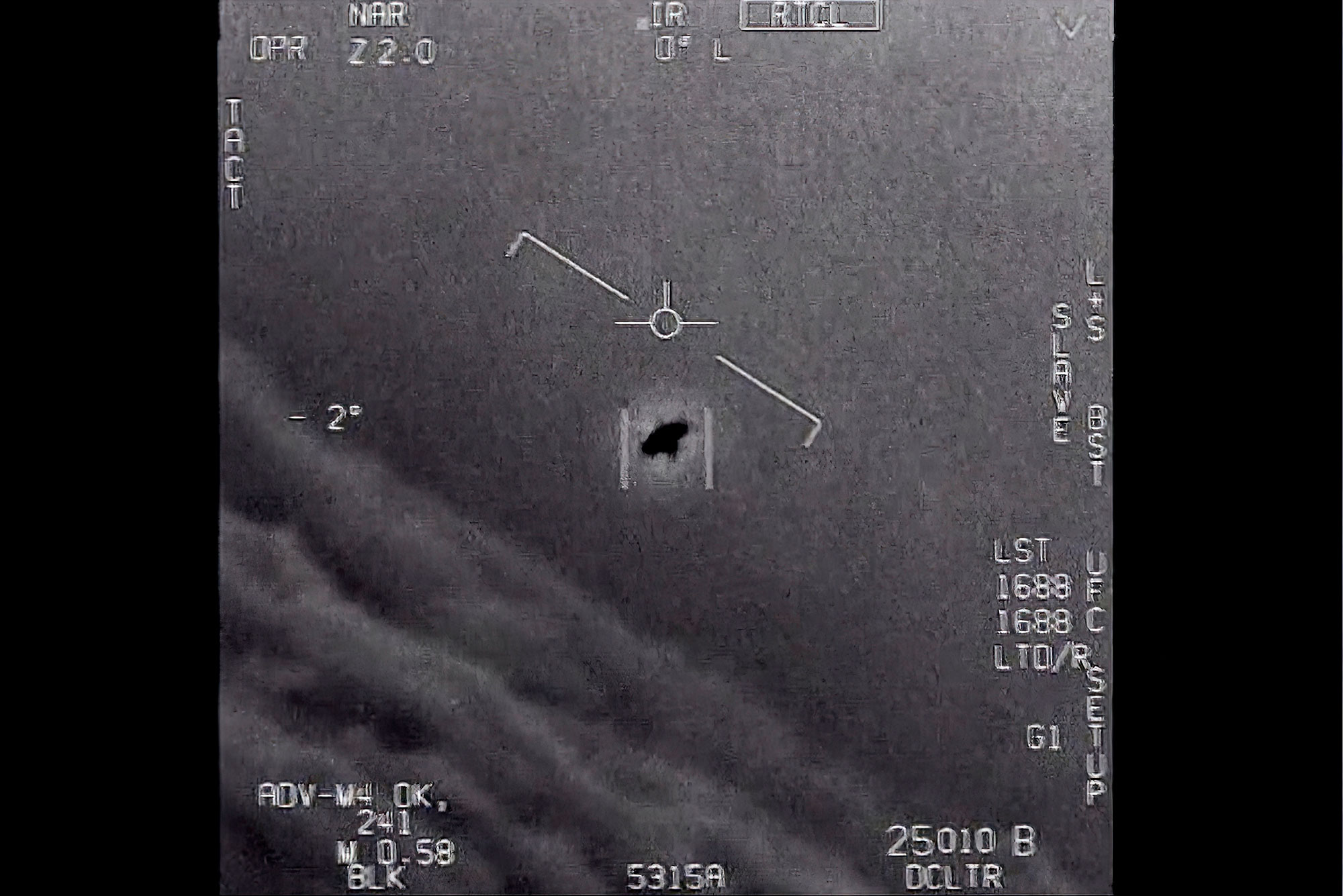
So concludes a forthcoming US government report, whose broad findings leaked earlier this month, on unidentified aerial phenomena (UAP), the current, less X-Files–sounding term for UFOs. The investigation followed sightings and videos recorded in recent years, by fighter aircraft instruments and pilots’ naked eyes, of objects flying at seemingly impossible speed and doing seemingly impossible maneuvers.
UFOs aren’t just the playpen of conspiracy theorists and sci-fi fans: NASA awards grants to reputable scientists seeking real-life ETs, and we’ve been scanning the heavens for signs of artificial signals for decades, says Thomas Bania, a College of Arts & Sciencesprofessor of astronomy. He researches the possibility of life elsewhere, along with many in his field. (“Carl Sagan…owes me money,” he says, a debt he knows he won’t collect, as his celebrity colleague died in 1996.)
Bania and Jack Weinstein, a Pardee School of Global Studies professor of the practice of international security and a retired Air Force lieutenant general, offered their takes on the government’s conclusions for BU Today.
Q&A WITH THOMAS BANIA AND JACK WEINSTEIN
BU Today:Any doubts about the government’s reported conclusion that the recent sightings aren’t extraterrestrials?
Jack Weinstein: I have no expertise in UFOs except for watching Men in Black. I never flew for the Air Force—I was a nuclear and space guy. [Never] did we track something that we thought was a UFO.
My concern with the report is that [it] stated it could be a foreign power’s technology.The UFO sightings dating back into the ’50s and ’60s were never technology that we were able to see later on from a foreign power. That never materialized later into a foreign nation having a capability like that. I can’t comment on whether they’re UFOs or not, because I don’t want to look like a kook, to be blunt. All I’m saying is that if a foreign power developed technology, then later on we’d see technology like that from them, either in operation or testing.
Thomas Bania: Do any of us believe these are actual flying saucers from outer space? No. [But] there really isn’t enough information to evaluate what is going on.
[The government] shows images of these objects, and they have ruled out extraterrestrial technology. Yet they then say these things have enormous speeds and do maneuvers that are impossible to replicate by our technology. All of those claims require that we know the distance to the target. Think of an airplane—if you look at a 747 in the sky, it doesn’t appear to be moving very fast. It’s going 600 miles an hour, but the rate at which a film of that plane would look[like it’s going] depends on the distance. And [the government’s] not telling us whether they know the distance. These are not [reliable] measurements of speed and acceleration unless they know the distance to the object, and they’re not telling us.
Media coverage cited experts who doubt foreign technology could have been invented without our knowing it and that it could have been kept secret.
Weinstein: I won’t go that far. China has developed some good technology much faster than we thought they were going to. To go back: if we think a foreign power has developed a technology, we would have then seen that technology later on in use or in testing.
Bania: I agree with Professor Weinstein that until these recent reports, there has never been any evidence to invoke foreign technology [as UFOs]; 90 percent of UFO reports have always had prosaic, natural explanations.
The point is, how do you interpret what these experts are responding to—the enormous speeds and maneuvers? If that’s the case, I agree we would know if somebody had developed some device that could do those maneuvers. I am questioning that interpretation of the data; without knowing the distance, there would be no evidence for enormous accelerations and avionic capabilities in terms of maneuverability.
No new technology is required here [to explain recent sightings]. We know how to build things, drones, complex electronics. So do our adversaries. You’re talking to someone who’s responsible for more than half of the UFO reports in Bergen County, N. J., in the late 1960s—my Explorers Boy Scouts specialized in creating UFOs.
Vladimir Putin claimed to have developed a super cruise missile. Is it possible he wasn’t blustering?
Weinstein: I don’t trust anything Vladimir Putin says. I put everything in the “bluster” category. If a country has developed a technology that they can use militarily that they don’t want anyone to know anything about, no one is going to ever say anything. We want to surprise the adversary on the battlefield.
Bania: I don’t think you can stealth a cruise missile to radar to the extent that you could a small drone, things the size you could buy at Micro Center in Boston.
What’s your best guess as to what these pilots saw?
Weinstein: It could be truly a UFO. I never want to say something could never be. It could be a phenomenon caused by nature—just a weather phenomenon. We learn something new every day, we’re flying at higher altitude than we’ve ever flown before, so maybe we’re seeing things that would look differently at a lower altitude.
My bottom line is: I think everyone who believes in UFOs will see a conspiracy if the government doesn’t say they are UFOs. I can’t believe we’re the most intelligent life-form in the entire universe, ’cause that means the universe is pretty dumb. If I’m an extraterrestrial and I can travel from other planets, I would think they would be smart enough to evade radar.
Bania: It’s just a pure guess, but I would think these things would be electronic warfare. They’re trying to get intelligence of exactly what our weapons systems are capable of doing, the frequencies they use, the encoding of radar transmissions, things they could use to develop countermeasures to render themselves invisible to radar. It would be either Russia or China. I’m more worried about China.
What it isn’t is little green men. If these were extraterrestrials, and they had the technology to traverse the stars and get to Earth, they would play these games? To what end?Land on the goddamn White House lawn and say hello.
NASA Continues to Try to Rescue Failing Hubble Space Telescope
ByMATT WILLIAMS
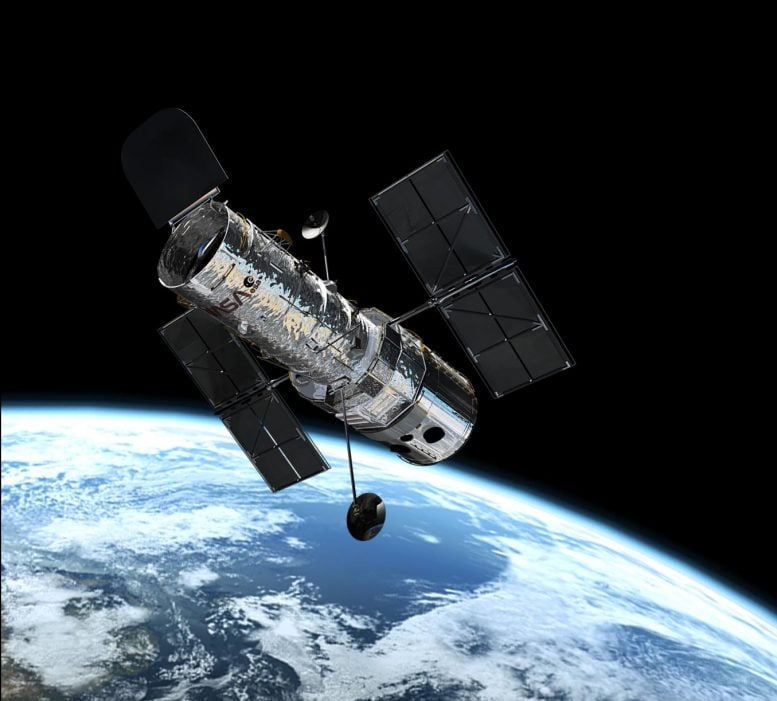
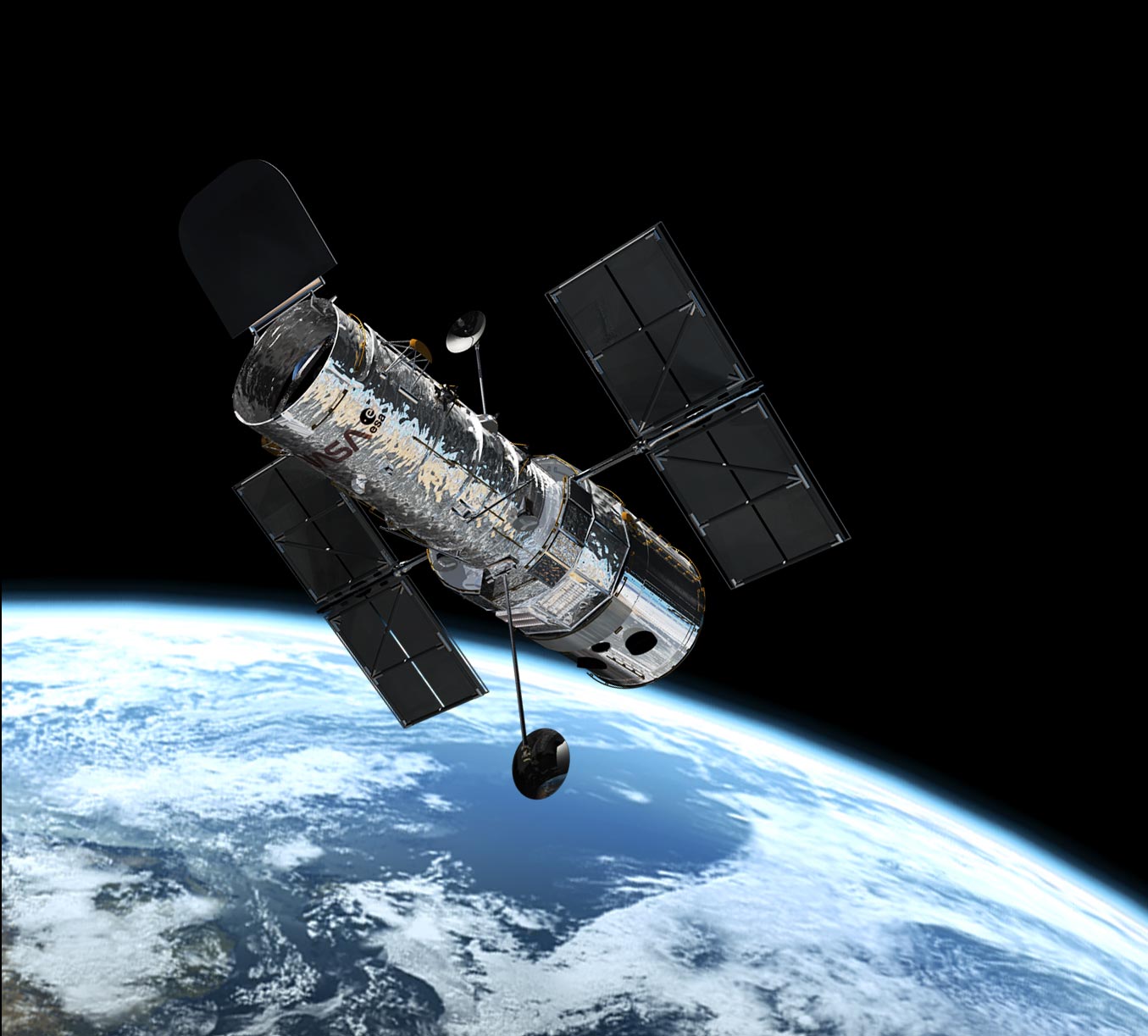
This illustration shows the NASA/ESA Hubble Space Telescope in its high orbit 600 kilometers above Earth.
Credit: European Space Agency
Things are not looking very good for the Hubble Space Telescope right now. On Sunday, June 13th, the telescope’s payload computer suddenly stopped working, prompting the main computer to put the telescope into safe mode. While the telescope itself and its science instruments remain in working order, science operations have been suspended until the operations team can figure out how to get the payload computer back online.
While attempting to restart the computer, the operations team has also tried to trace the issue to specific components in the payload computer and switch to their backup modules. As of June 30th, the team began looking into the Command Unit/Science Data Formatter (CU/SDF) and the Power Control Unit (PCU). Meanwhile, NASA is busy preparing and testing procedures to switch to backup hardware if either of these components are the culprit.
The payload computer is part of the Science Instrument Command and Data Handling (SI C&DH) unit, where it is responsible for controlling and coordinating the scientific instruments aboard the spacecraft. The current issues began when the main computer stopped receiving the “keep-alive” signal from the payload computer – which lets the main computer know that everything is working.
That’s when the operations team began investigating different pieces of hardware on the SI C&DH as the possible source. Based on the available data, the team initially thought that the problem was due to a degrading memory module and tried to switch to one of the module’s multiple backups – but met with failure. On the evening of Thursday, June 17th, another attempt was made to bring both modules back online, but these attempts also led to failure.
At that point, they began looking into other possibles sources of the shutdown, like the Standard Interface (STINT) hardware. This component is responsible for bridging communications between the computer’s Central Processing Module (CPM), which they began investigating as well. Now, the team is investigating the Command Unit/Science Data Formatter (CU/SDF) and a power regulator within the Power Control Unit (PCU).
Whereas the CU/SDF sends and formats commands and data while the PCU is designed to ensure a steady voltage supply to the payload computer’s hardware. If either of these systems is responsible for the shutdown, then the team must once again go through an operations procedure to switch to the backup units. This time, however, the procedure is more complex and risky than the ones the team executed last time.
Mainly, switching to the backup CU/SDF or backup power regulator requires that several other hardware boxes need to be switched to their backups because of the way they are connected to the SI C&DH unit. The last time the operations team performed this task was back in 2008, which was the last time the CU/SDF module failed. This is what prompted the final servicing mission in 2009, which replaced the entire SI C&DH unit.
Given the complexity of switching multiple systems over to their backups, the operations team is currently reviewing and updating all of Hubble‘s operations procedures, commands, and all other items relating to switching to backup hardware. When they are finished (expected for next week) the team will run a high-fidelity simulator to test their plan of execution and see if they can pull it off.
Since Hubble first launched in 1990, it has taken over 1.5 million images, and more than 600,000 of those were taken since its last servicing mission in 2009. These images are some of the most breathtaking views of the Universe ever taken and have led to substantial discoveries about the nature of our Universe. Here at home, it has deepened our understanding of the Kuiper Belt and Trans-Neptunian Objects (TNOs) like Pluto and Eris.
In 2014, it also observed the farthest object to ever be visited by a spacecraft – the Kuiper Belt Object (KBO) Arrokoth, which the New Horizons mission made a close pass with on Jan. 1st, 2019. It also observed aurora in the atmospheres of Jupiter, and Saturn, as well as Jupiter’s moon Ganymede. Hubble is also responsible for providing the data that led astronomers to conclude that Ganymede likely contains a large saltwater ocean in its interior.
Beyond the Solar System, Hubble has aided in the first atmospheric studies of exoplanets, helped constrain the size and mass of the Milky Way, the evolution of galaxies over time, revealed the accelerating expansion of the Universe (leading to the theory of Dark Energy), and aided in the study of Dark Matter. These and other accomplishments are all part of Hubble‘s legacy as it celebrates being in space for 31 years, 2 months, and either days.
I think I speak for everyone when I wish Hubble a speedy recovery and hope it has a few more years left in her!
A multi-day test of procedures that would be used to turn on backup hardware on the Hubble Space Telescope began today. Meanwhile, NASA continues to investigate the cause of the payload computer issue that began on June 13.
For previous updates:
Operations Underway to Restore Payload Computer on NASA's Hubble
NASA is working to resolve an issue with the payload computer on the Hubble Space Telescope.
The US government's release of a report on unidentified aerial sightings has been met with much interest in Germany. Enthusiasts believe UFOs have been sighted here, too.
The occasional sighting of saucer-like objects in the sky regularly give rise to speculation
"We're just a small blue planet in the middle of an infinite universe," UFO researcher Robert Fleischer told DW. "Anything is possible out there."
"We'll see that these aircraft fly around with astounding properties — which we can't explain and are superior to ours," he said.
For Fleischer, Germany is a "valley of cluelessness" when it comes to UFO research. Other countries commit far more resources to researching and reporting unexplained events, he said.
"This only got big in Germany after Barack Obama talked about it," he added.
That is a reference to a May New York Times interview with the former US president, during which he referred to "footage and records of objects in the skies that we don't exactly know what they are. We can't explain how they move, their trajectory. They did not have an easily explainable pattern."
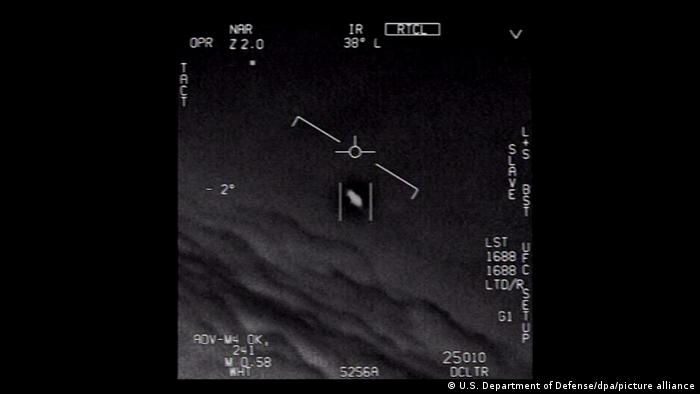
The pentagon has published images of unknown flying objects
Satellites and hotlines
Obama's comments piqued others' curiosity in UFOs, Hansjürgen Köhler told DW. After decades of running the Central Research Network for Extraordinary Aerospace Phenomena (CENAP) outside Frankfurt, the hobby astronomer has gone from believer to skeptic.
"Our hotline gets hundreds of tips every year. Most have natural causes," Köhler said. "We can explain 97% of them. The other 3% are open because we don't have enough data."
Köhler's phone has been ringing even more since the end of 2019, which he attributes to Elon Musk's Starlink satellite network. More than 600 of the nearly 900 reports have been linked to Starlink, he said.
A country of clubs — including for UFOs
In Germany, there seems to be an endless list of hobby clubs and nonprofit associations. The Association for UFO Research (GEP) is one of them. Their databank includes 140,000 entries, and 95% of them can be explained. Aside from satellites, strangely shaped balloons is one common answer, as well as weather phenomena and insects that zoom across photos.
The remaining 5% "perhaps also have natural causes, which we just can't explain yet," Hans-Werner Peiniger, GEP's head, told DW.
Members of Germany's UFO clubs — there are at least three — are not blind alien believers, Leipzig-based Fleischer said. They are rational, engineer types who use limited resources to analyze what curious sky watchers send them. The result, however, can be a great deal of information about what is happening above us.
The really interesting cases "are a matter for the military," Fleischer said. "They control the skies and have instruments and radar."
Do aliens exist?
Suddenly not so secret
No military or intelligence service is known for its transparency, however. That US agencies appear to be more forthcoming recently has taken Fleischer by surprise.
"The Americans have spent decades trying to laugh off these phenomena," he said. "Their reporting now is quite the surprise."
For him, the issue is not about convincing people that aliens are visiting earth, but "giving more space to discuss this topic publicly so it gains the importance that it deserves," Fleischer said. "We want it to be investigated in a scientific way."
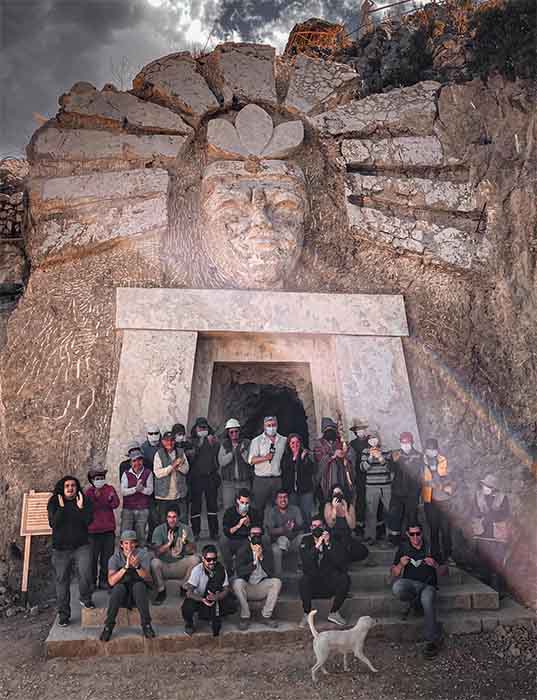
Andean Gods Emerge From the Rock in Peru’s Mythological Sculpture Park!
A sculptor in Peru has assured the future for a range of ancient Andean gods, spirits and myths, by carving them into the face of a mountain just north of the famous ancient tourist city of Cusco.
Cusco near the Urubamba Valley of the Andes mountain range in southeastern Peru, is the ancient capital of the “ Tahuantinsuyo,” or ancient Inca Empire. While this legendary high altitude stone city attracts hundreds of thousands of tourists from all over the world to see its magnificent buildings and streets, it now has a new attraction in the making: Apukunaq Tianan or the "Abode of the Andean Gods .”
Located in Senk, a community of the Poroy district, about 40 minutes by car from Cusco, Apukunaq Tianan features sculptures of Andean gods and figures from various Inca creation myths. While the new attraction is still under construction the public are already flocking to what The Vale Magazine call “a fun and fascinating outdoor recreation space.”
Created by Cusco sculptor Michael de Titan the new artworks are similar to the Mt. Rushmore monument in the United States, just much smaller in scale, with each sculpture work ranging from between 49 and 56 feet (15 and 17 meters) in height.
Two of the sculptures in the process of being created on the mountainside at Senk, near Cusco, Peru.
Apukunaq Tianan: A Modern Home For Andean Gods and Myths
Michael de Titan’s celebration of Andean culture merges art and nature “just like the ancient Inca did.” Therefore, Apukunaq Tianan is like a royal palace of Andean deities and spirits with its own private library of creation stories.
Pachamama or “Mother Earth” is represented at the new site, who was/is the deity who presides over agriculture, controlled earthquakes, and rain. This god was associated with feminine principals relating to the spirit of the Earth.
While Pachamama was associated with the fertile field and rivers on the sides of mountains, the mountains god, or “ Apu Guardian ” governed mountain tops and consorted with the sky gods. A stunning Apu cliffside sculpture is naturally featured in the new sculpture park.
Also represented at the majestic new tourist attraction is Puma, one of the sacred animals of the Andean trilogy of the condor, the puma and the snake or serpent. Puma represented Earth while the serpent represented the underworld, and the condor was associated with the heavens.
The Andean creator god Viracocha is also immortalized in stone at Apakunaq Tianan. This chief deity of Inca mythology is believed to have emerged from Lake Titicaca where he created the entire universe, and everything in it, before vanishing to the east.
Also chiseled in stone in Apakunaq Tianan’s hall of Inca mythological fame, is the last Sapa Inca, " Tupac Amaru ," and mixed in with these massive sculptures are smaller carvings made of wood and stone.
Another of the fantastical Andean god sculptures at Apakunaq Tianan with a log house gallery on top.
It is hoped that Apukunaq Tianan will be completed later this year to coincide with the bicentennial year of Peru ’s independence. While each of the sculptures described so far are exceptionally esoteric in nature, there is one that penetrates the veil more so that all the others.
This work represents the myth of the Ayar Brothers . Inca legends in Cusco say that at the end of the great flood which devastated the land of the mountain “Tampu Tocco, ” four young brothers with their wives, and ten “ayllus” (Inca family groups) ventured in search of fertile lands where they could settle.
After a series of tribulations, the only survivor of the Ayar brothers was Ayar Manco who managed to reach the aforementioned fertile land. There, he took the golden rod that the sun god Inti had given him, and sank it into the moist earth, where it immediately vanished. Such an occurrence could only mean that the sun god had chosen a special spot and it was there that the city of Cusco was founded.
From this ancient Andean center of agriculture, the “Tahuantinsuyo,” would later expand and become the Inca Empire .
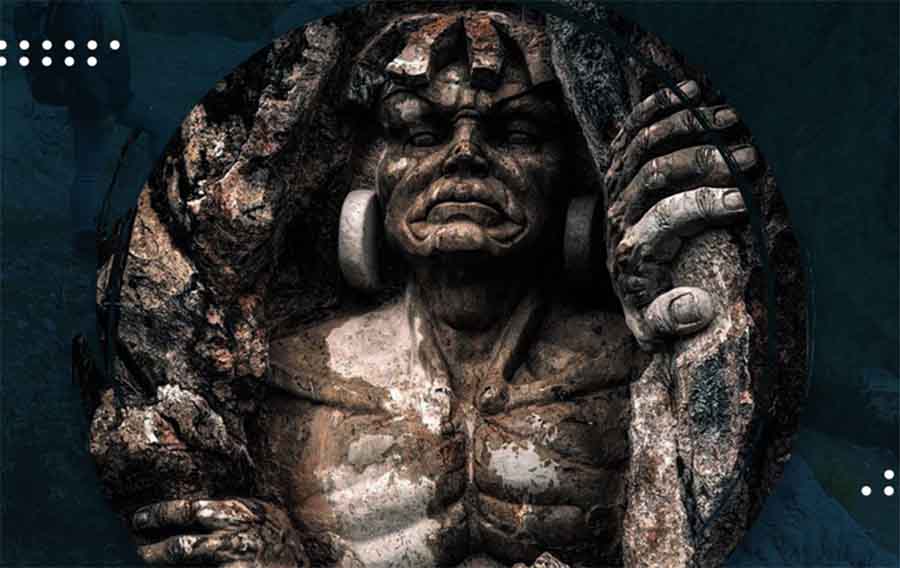
Top image: One of the Andean gods at the Apukunaq Tianan sculpture park, featured on a publicity poster from the site.
Andean Gods Emerge From the Rock in Peru’s Mythological Sculpture Park!
A sculptor in Peru has assured the future for a range of ancient Andean gods, spirits and myths, by carving them into the face of a mountain just north of the famous ancient tourist city of Cusco.
Cusco near the Urubamba Valley of the Andes mountain range in southeastern Peru, is the ancient capital of the “ Tahuantinsuyo,” or ancient Inca Empire. While this legendary high altitude stone city attracts hundreds of thousands of tourists from all over the world to see its magnificent buildings and streets, it now has a new attraction in the making: Apukunaq Tianan or the "Abode of the Andean Gods .”
Located in Senk, a community of the Poroy district, about 40 minutes by car from Cusco, Apukunaq Tianan features sculptures of Andean gods and figures from various Inca creation myths. While the new attraction is still under construction the public are already flocking to what The Vale Magazine call “a fun and fascinating outdoor recreation space.”
Created by Cusco sculptor Michael de Titan the new artworks are similar to the Mt. Rushmore monument in the United States, just much smaller in scale, with each sculpture work ranging from between 49 and 56 feet (15 and 17 meters) in height.
Two of the sculptures in the process of being created on the mountainside at Senk, near Cusco, Peru.
Apukunaq Tianan: A Modern Home For Andean Gods and Myths
Michael de Titan’s celebration of Andean culture merges art and nature “just like the ancient Inca did.” Therefore, Apukunaq Tianan is like a royal palace of Andean deities and spirits with its own private library of creation stories.
Pachamama or “Mother Earth” is represented at the new site, who was/is the deity who presides over agriculture, controlled earthquakes, and rain. This god was associated with feminine principals relating to the spirit of the Earth.
While Pachamama was associated with the fertile field and rivers on the sides of mountains, the mountains god, or “ Apu Guardian ” governed mountain tops and consorted with the sky gods. A stunning Apu cliffside sculpture is naturally featured in the new sculpture park.
Also represented at the majestic new tourist attraction is Puma, one of the sacred animals of the Andean trilogy of the condor, the puma and the snake or serpent. Puma represented Earth while the serpent represented the underworld, and the condor was associated with the heavens.
The Andean creator god Viracocha is also immortalized in stone at Apakunaq Tianan. This chief deity of Inca mythology is believed to have emerged from Lake Titicaca where he created the entire universe, and everything in it, before vanishing to the east.
Also chiseled in stone in Apakunaq Tianan’s hall of Inca mythological fame, is the last Sapa Inca, " Tupac Amaru ," and mixed in with these massive sculptures are smaller carvings made of wood and stone.
Another of the fantastical Andean god sculptures at Apakunaq Tianan with a log house gallery on top.
It is hoped that Apukunaq Tianan will be completed later this year to coincide with the bicentennial year of Peru ’s independence. While each of the sculptures described so far are exceptionally esoteric in nature, there is one that penetrates the veil more so that all the others.
This work represents the myth of the Ayar Brothers . Inca legends in Cusco say that at the end of the great flood which devastated the land of the mountain “Tampu Tocco, ” four young brothers with their wives, and ten “ayllus” (Inca family groups) ventured in search of fertile lands where they could settle.
After a series of tribulations, the only survivor of the Ayar brothers was Ayar Manco who managed to reach the aforementioned fertile land. There, he took the golden rod that the sun god Inti had given him, and sank it into the moist earth, where it immediately vanished. Such an occurrence could only mean that the sun god had chosen a special spot and it was there that the city of Cusco was founded.
From this ancient Andean center of agriculture, the “Tahuantinsuyo,” would later expand and become the Inca Empire .
Top image: One of the Andean gods at the Apukunaq Tianan sculpture park, featured on a publicity poster from the site.
Sacrifice and Destruction: The Apocalyptic Aztec Creation Myths
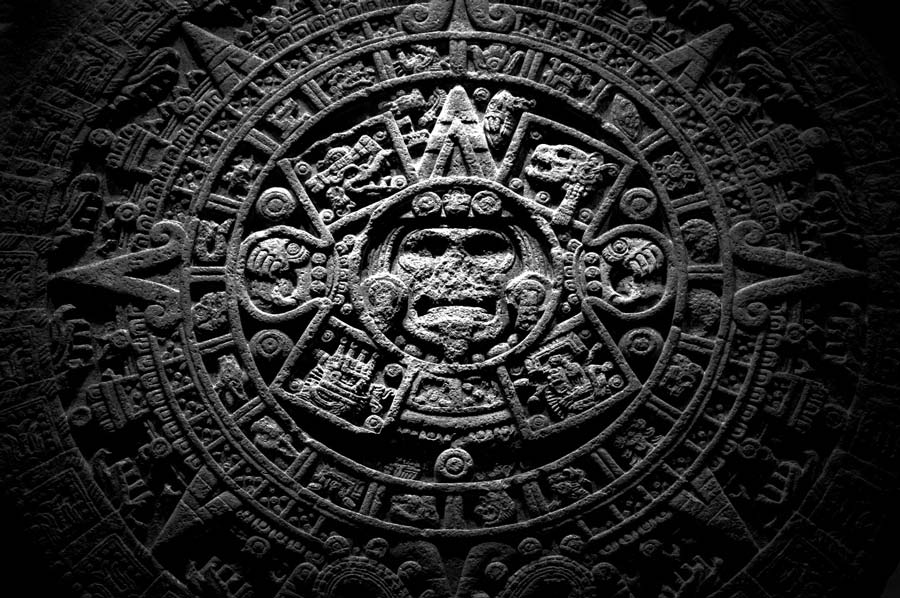
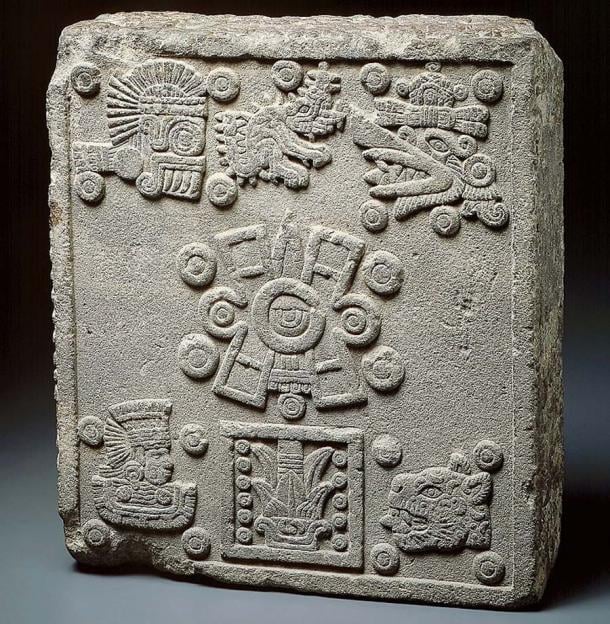
Many ancient cultures around the world have their own creation myth to explain their origins, and how the universe came into being. But few are as vivid, or as apocalyptic as the creation myth of the Aztecs. This myth has been referred to as the “Five Suns” wherein the world is created and destroyed again and again.
As the name given to this myth suggests, the current world is the fifth one, preceded by four cycles of creation and destruction. Whilst the Aztecs believed that we are now living in the fifth cycle of creation, they also believed that destruction would ensue if they neglected their duty of nourishing the sun god.
Different Accounts
Before going into the details of the Aztec creation myth itself, it should be mentioned that there are various versions of the story. In some instances, these different versions even contradict one another. One of the reasons behind the multiple versions of the myth is the way it was transmitted. Since the creation myth was originally passed down orally, different versions emerged. Another reason for this is that the Aztecs incorporated the gods and myths of the peoples they encountered and conquered, thereby modifying the myth.
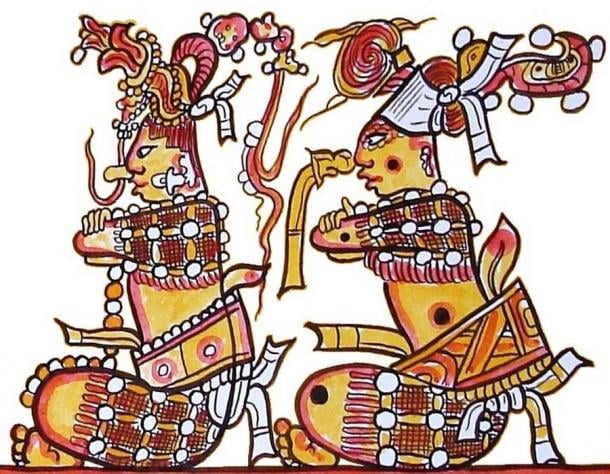
Interestingly, the Aztec creation myth shares similarities with that of the Maya, which is found in the Popol Vuh , their foundational sacred narrative. For instance, both creation myths are cyclical in nature, though the Maya version has four, instead of five, cycles. It may be added that although both myths are cyclical, each cycle is not a mere repetition of the previous one, but rather, an improvement.
The Mayan “Hero Twins” of the Popol Vuh show clear parallels with Aztec mythology
It is believed that the Aztec and Maya creation myths share a common source, and the former has been used to shed light on the latter. A key reason for this is that the Aztec creation myth is much more complete, whereas the Maya one has survived only in fragments.
The Aztec Pantheon
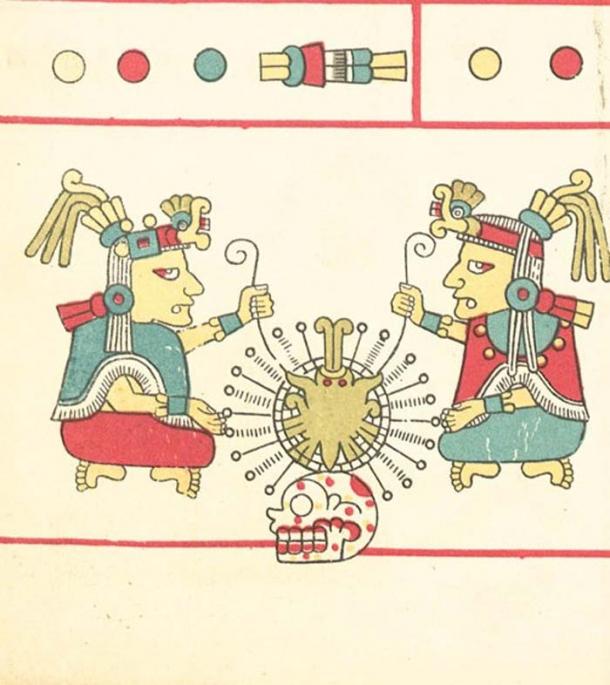
The Aztec creation myth begins with a pair of creator gods known collectively as Ometecuhtl (meaning ‘Two Lords’ in the Aztec language of Nahuatl). Ometecuhtl consisted of Ometecuhtli, the male deity, and Omecihuatl, his female counterpart. The pair of gods are known also as Tonacatecuhtli and Tonacacihuatl.
The Aztecs believed that Ometecuhtl resided in Omeyocan (meaning ‘Two Place’ or ‘Double Heaven’), the 13th and highest heaven in the belief system of the Aztecs. Incidentally, Ometecuhtl was the only Aztec deity with neither a temple dedicated to him, nor any formal cult in his name. Apparently, the Aztecs reasoned that since the deity lived so far away from them, he would never interact with them directly. In spite of Ometecuhtl’s remoteness, the Aztecs believed that he was omnipresent, being in every act of ritual, and in every rhythm of nature.
According to the Aztec creation myth, Ometecuhtl created themself, after which, being both male and female, the god produced four children – Huizilopochtli, Quetzalcoatl, Tezcatlipoca, and Xipe Totec. These four gods represented, amongst other things, the four cardinal directions – south, east, west, and north, respectively.
Gods and Monsters
These four gods existed for some time, 600 years, according to one version of the myth, before they began to create the universe. They created cosmic time, the world, and all the other deities.
In one version of the myth, the four gods created a giant sea monster called Cipactli, which was part crocodile and part fish. As the children of Ometecuhtl continued to create the universe, this great monster became a source of trouble. Cipactli lived in the water, and had an insatiable appetite. For one reason or another, the creations of the gods would fall into the water, and they inevitably ended up being devoured by Cipactli.
Eventually, the four gods decided that enough was enough, and went to war with the sea monster. Cipactli was pulled in four directions, but fought back violently. In the end, however, the ferocious monster was defeated, and destroyed.
Subsequently, the gods used Cipactli’s corpse to create the universe. The 13 heavens were created on the monster’s head, the earth on its body, and the nine underworlds along its tail. Incidentally, this story resembles the Mesopotamian myth of Marduk and Tiamat, in which the latter was slain by the former, and her corpse used to create the universe.
The creation of the universe from the corpse of Cipactli is not only part of the Aztec creation story, but also illustrated the Aztec world view, which the Aztecs depicted in their art. The Aztecs believed that the Templo Mayor at Tenochtitlan occupied the centre of the universe. The Cipactli myth indicates that the earth is sandwiched in between the heavens and the underworld. On the earthly level, the Aztecs believed that universe spread out in four directions from the Temple Mayor.
Reconstruction of the Templo Mayor at Tenochtitlan, Mexico City
The Aztec creation myth, however, does not end with the slaying of Cipactli. Although the universe was created from the sea monster’s corpse, it was still incomplete, and required a source of energy. For the Aztecs, this was the sun.
The sun, however, was such a powerful entity could not simply be created by the gods. Instead, a sacrifice had to be made in order for the sun to be created. Therefore, Tezcatlipoca sacrificed himself by jumping into a fire, thus creating the First Sun, also called “4 Jaguar”. For one reason or another, Tezcatlipoca was only able to produce half a sun, resulting in an incomplete creation.
Tezcatlipoca and Quetzalcoatl
Tezcatlipoca was a major Aztec deity, whose name translates to mean “Smoking Mirror”. He was regarded as the god of magic and night, as well as the patron deity of kings and young warriors. Tezcatlipoca’s arch-rival was Quetzalcoatl, and a quarrel between these two gods ultimately led to the end of the age of the First Sun.
Carving of Quetzalcoatl at the Temple of Quetzalcoatl, Teotihuacan
During this first cycle of creation, the gods made the first humans out of ash. These people, however, were giants, and the Aztecs believed that they ate only acorns.
According to the myth, the first cycle of creation lasted a total of 676 years, and came to an end when a fight broke out between Tezcatlipoca and Quetzalcoatl. It seems that the latter wanted to replace the former as the sun. As a result of the fight, the sun was knocked out from the sky, which infuriated Tezcatlipoca. Therefore, the god sent jaguars, the animal most associated with Tezcatlipoca, to devour the giants.
After the destruction of the giants, Quetzalcoatl sacrificed himself by leaping into a fire, and becoming the Second Sun, also called “4 Wind”. Quetzalcoatl, whose name means “Feathered / Plumed Serpent”, is arguably one of the best-known deities of the Aztec pantheon. Quetzalcoatl was a pan-Mesoamerican deity, and he was worshipped (though under different names) by other Mesoamerican cultures, such as the Maya, and the Toltecs.
Quetzalcoatl was most associated with the wind, and worshipped as the patron god of the arts and knowledge. The Aztecs also believed that Quetzalcoatl was the deity who loved humans the most, and there are numerous myths about how he helped humanity.
The Creation of Man
During the age of the Second Sun, regular-sized humans were created. The people of this age subsisted on pine nuts, and according to one version of the myth, the age of the Second Sun was initially peaceful. In time, however, the humans became corrupt, and were turned into monkeys by Tezcatlipoca, perhaps as revenge for what Quetzalcoatl had done to him. This angered Quetzalcoatl, who sent a hurricane to destroy the monkeys.
According to another version of the myth, Tezcatlipoca longed to become the sun again. Therefore, he transformed himself into a jaguar, and cast Quetzalcoatl off his throne. In retaliation, Quetzalcoatl sent floods and hurricanes to destroy the world. Some humans were able to escape from this destruction by climbing to the top of trees, and these survivors were then turned into monkeys. Like the First Sun, this age also lasted 676 years.
Tlaloc and the Third Sun
The god who became the next sun was Tlaloc, the Aztec god of the rains and fertility. This god was not one of the four sons of Ometecuhtl, but a very important deity, nonetheless. Like Quetzalcoatl, Tlaloc was a god worshipped throughout Mesoamerica, as rain gods are found in many cultures of this region.
Additionally, it is thought that Tlaloc is one of the most ancient Mesoamerican gods, as his origins can be traced all the way back to the Olmecs, the earliest known major Mesoamerican civilisation. Amongst the Maya, Tlaloc was known as Chaac, whilst the Zapotecs called this god Cocijo.
The Third Sun was known also as “4 Rain”, and this age was dominated by rain. The people of this age ate seeds that grew in the water. According to one version of the myth, this world ended when Quetzalcoatl caused fire and ash to rain from the sky. Like the preceding age, there were some who managed to escape from the destruction of the world, and these survivors were transformed into turkeys, butterflies, or dogs.
Another version of the myth blames Tezcatlipoca for the destruction of the third age. This version states that Tezcatlipoca abducted Xochiquetzal, Tlaloc’s wife. The god was grief-stricken, and decided to withhold the rains. Consequently, a drought ensued, causing much suffering.
Despite the pleas of the people, Tlaloc refused to allow the rains to fall. Finally, the furious Tlaloc caused fire, instead of rain, to fall, which engulfed the earth in flames, and brought this age to an end. The age of the Third Sun only lasted for 364 years.
Chalchiuhtlicue and the Fourth Sun
The Fourth Sun, known also as “4 Water”, was created by Chalchiuhtlicue, the sister of Tlaloc, and his second wife. Chalchiuhtlicue, whose name means ‘She of the Jade Skirt’, was worshipped as the goddess of the waters that collect on the earth, i.e. rivers, lakes, oceans, etc. In addition, she was the protectress of childbirths and newborns. The age of the Fourth Sun was one dominated by water, and its people ate maize.
The age of the Fourth Sun lasted 676 years, and ended with a great flood. According to the Aztec creation myth, both Tezcatlipoca and Quetzalcoatl were jealous of Chalchiuhtlicue, and struck her down. As the goddess fell from her throne, the sky opened, and the earth was flooded. All things were destroyed once again, and the people were transformed into fishes.
The Fifth Cycle and the Two Suns
The Aztecs believed that after the fourth destruction of the world, the gods met at Teotihuacan to decide who amongst them would become the next sun. Curiously, none of the gods wanted to sacrifice themselves this time round. Finally, the proud Tecuciztecatl volunteered to jump into the fire. At the last moment, however, the god hesitated, and did not sacrifice himself.
In that moment of hesitation, another god, the humble Nanahuatzin, jumped into the flames, and became the sun. Tecuciztecatl felt ashamed of his cowardice, and jumped in after Nanahuatzin, thereby becoming a second sun.
The existence of two suns simultaneously, however, presented a dilemma to the other gods, as their combined energy would overwhelm the world. They solved this problem by throwing a rabbit at Tecuciztecatl’s face to dim the light, which turned the god into the Moon. According to the Aztecs, this is the reason why there is a rabbit in the moon today.
Another problem that the gods faced was the fact that Nanahuatzin was weak, and so the sun was motionless. Therefore, the rest of the gods gave him their blood to set him in motion. In another version of the myth, the sun was set in motion by Ehecatl, the god of the wind, who blew fiercely at it.
The Age We Live In Today
The Fifth Sun is known also as “4 Movement”, and is the age that we are living in today. The Aztecs believed that this age will be destroyed by a massive earthquake, and its people will be eaten by sky monsters. According to Aztec belief, the sun will disappear if it is not nourished by blood offerings and sacrifices, thereby leading to the end of the present age. Therefore, they believed that it was their duty to ensure the sun was nourished.
The Aztec “Stone of the Five Suns,” clockwise from bottom right: 4 Jaguar, 4 Wind, 4 Rain, 4 Water; 4 Movement in the center
The Aztec creation myth provides some profound insights into the beliefs that this civilization had about the origins of the universe, embedded in the world they saw around them. Additionally, the myth shows us the key pressures on their civilization, as deified in the Aztec pantheon. And finally, the dangers the Aztecs felt in their environment, and their concerns about survival, help to explain what drove them to their more extreme rituals, for example, human sacrifice.
Eleven New Neolithic Hill Sites Discovered Near Göbeklitepe, Turkey
The Turkish government has just announced a major archaeological discovery that could have a serious impact on the study of Neolithic Era culture in the region. On June 27, Turkey’s Culture and Tourism Minister Mehmet Ersoy told reporters gathered in the southeastern Turkish city of Sanliurfa that several new sites had been found in the vicinity of Göbeklitepe, the world’s oldest prehistoric stone monument site. Also written as Gobekli Tepe, the site name translates into "belly hill" in Turkish.
"We have [discovered] 11 more major hills on a 100-kilometer line around Göbeklitepe,” Ersoy declared. “Here, we will give the details for the first time, and now call it 12 hills.”
In fact, Ersoy offered few details about what had been found at these new sites. He explained that a “major study” was on the verge of being completed and said the results of that study would be released in September 2021.
Engaging in what may or may not have been hyperbole, Ersoy said that people may soon be describing the monuments found in the Sanliurfa region as “the pyramids of southeast Turkey.”
If these new sites are on a par with the spectacular remains uncovered at Göbeklitepe, their discovery would represent a significant milestone in prehistoric archaeology in the Mesopotamian region.
An example of one of the many circular stone monolith formations unearthed at Göbeklitepe, Turkey.
The Meaning of Göbeklitepe: What We Know So Far . . .
First unearthed in 1995 by German archaeologist Klaus Schmidt, the Neolithic excavation site at Göbeklitepe has produced the most stunning and impressive collection of standing stone pillar monoliths ever found on Earth.
The biggest monoliths at Göbeklitepe are as tall as 20 feet (six meters) and are estimated to weigh between seven and ten tons (7.7-11 US tons). They were arranged in large circles, with a pair of heavy T-shaped pillars placed in the center of each arrangement. Some were decorated with carved images of animals, and others with obscure shapes and images that have no clear real-world references.
Neolithic hunter-gatherers working in teams built and inscribed these stone circles, over a period of perhaps 1,000 years. The oldest construction work at Göbeklitepe has been dated to about 9,000 BC, meaning that some of the monoliths found there were carved and erected 6,000 years before the rock pillars at Stonehenge.
It is important to realize this feat was accomplished by individuals who had no access to metal tools or wheeled transport carts. They used stone / flint hand tools to carve out and shape huge slabs of limestone from nearby quarries. The massive pillars would then be levered out of their places in the quarry rock walls, and somehow hauled, dragged, or lifted to the Göbeklitepe construction site.
In some instances, the builders placed the circles alongside each other. In other instances, they put them one on top of the other, after the circle on the bottom had been buried. Sometime after construction stopped the entire complex was buried, creating a low-topped artificial mound or hill that was 50 feet (15 meters) high and 1,000 feet (300 meters) in diameter.
The seemingly forgotten landscape around the Göbeklitepe site and likely where the latest 11 hills or artificial mounds have recently been discovered. So far photographs of the newest discovery area have not been released.
Culture and Tourism Minister Mehmet Ersoy’s statement about the “12 hills” implies that new monolithic sites have been found buried beneath similar artificial mounds. If stone pillar circles have been unearthed at these locations, it remains to be seen if they were built to the same specifications and in the same style as the circles at Göbeklitepe, or if they are as old (or even older).
Archaeologists have already found other sites in the region where stone pillars have been carved out of quarries and arranged in standing circles. None of the other sites are as ancient as Göbeklitepe, however, which was apparently in use 11,000 years ago. They do all feature the distinctive T-shaped central pillars found at Göbeklitepe, a type of monolith that has only been discovered in ancient sites built close to the city and province of Sanliurfa.
This suggests they all were created by the same stone-monument-building culture, which presumably would also be responsible for making whatever has been found during excavations at the 11 newly discovered hills.
A Neolithic totem pole from Göbeklitepe from Layer II, dated to 8800-8000 BC.
Uncovering the Many Remaining Secrets of Göbeklitepe
Unsurprisingly, Ersoy’s primary interest in the new discoveries is how they might affect tourism in the region.
"When you look at Mesopotamia, this region has a unique culture,” the Minister said at his press announcement. “It has its own registered gastronomy. It has many products. And when you combine that with its unique archaeological value, it's a wonderful thing.”
The Turkish government’s priorities are understandable. But the interests of the archaeological community are quite different.
With respect to the incredible monuments at Göbeklitepe, perhaps the biggest question left unanswered is, why were they built?
The general consensus is that Göbeklitepe was a religious or spiritual mecca, sought out by ancient worshippers looking to commune with their gods or with the spirits of their ancestors. The site has often been referred to as the world’s oldest temple. Schmidt, the site’s original discoverer, believed that one day graves would be found beneath the monolithic circles, proving they were built as monuments to the dead.
This monolithic pillar at Göbeklitepe is decorated with pictograms of animals. Surprisingly, the meaning of these pictograms is still a mystery that archaeologists and anthropologists are hoping to solve.
Pictograms were carved into many of the pillars. But unfortunately, scholars have been unable to interpret them, as either pictures or as symbols. Many of the pillars are decorated with images of animals, of dozens of different species including gazelles, lions, bears, foxes, bulls, snakes, birds, spiders, and a variety of insects. While arid now, during the Neolithic era Turkey was part of the Fertile Crescent , a region blessed with abundant rainfall, fertile soil, dense grasslands, and wildlife of all types.
The imagery on the pillars may relate to worshipping practices or religious rituals in some way. The same can be said about the shapes of the stone circles, which may have been arranged to reflect astronomical alignments . But since Göbeklitepe was constructed by prehistorical peoples, there is no written record to guide archaeologists and historians in a useful direction, as they attempt to comprehend what they’ve found.
Assuming they were built by the same ancient people, the remains at the newly discovered sites will likely be similar to those found at Göbeklitepe. If so, their ultimate purpose may be just as mysterious.
But if the stone pillars in these new locations contain different imagery than those at Göbeklitepe, or if they feature clearer pictograms that can be successfully interpreted, their discovery may be a game-changer. Having more remains to examine may increase understanding about the motivations of the builders. It could reveal whether they were inspired by religious sentiments, or by some other type of ancient or universal motivation.
Top image: Göbeklitepe is so important that it has been completely covered to protect it from rain. To date, it is the oldest place of worship ever found on Earth, dating to 12000 BC. Archaeologists are expecting more amazing finds and insights from the recently discovered 11 new hills (or artificial mounds) near the site for which details will be released in September 2021.
Meer van UFO'S of UAP'S, ASTRONOMIE, RUIMTEVAART, ARCHEOLOGIE, OUDHEIDKUNDE, SF-SNUFJES EN ANDERE ESOTERISCHE WETENSCHAPPEN - DE ALLERLAATSTE NIEUWTJES


 The Cosmic Hoax: What's Coming?