Jeff Bezos Launches into Space on Blue Origin’s First Astronaut Flight

Jeff Bezos Launches into Space on Blue Origin’s First Astronaut Flight
Amazon founder and executive chairman Jeff Bezos launched into space on Tuesday, carried aboard Blue Origin’s New Shepard spacecraft in its first human flight. Bezos, the richest person in the world, was joined by his brother, Mark Bezos, female aviation pioneer Wally Funk, and a Dutch student, Oliver Daemen.
RELATED VIDEOS, selected and posted by peter2011
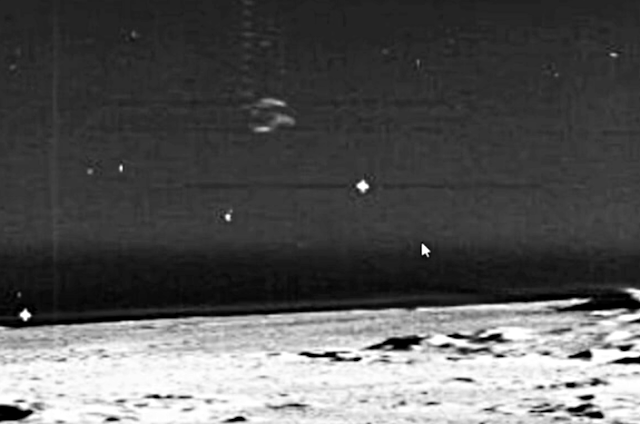
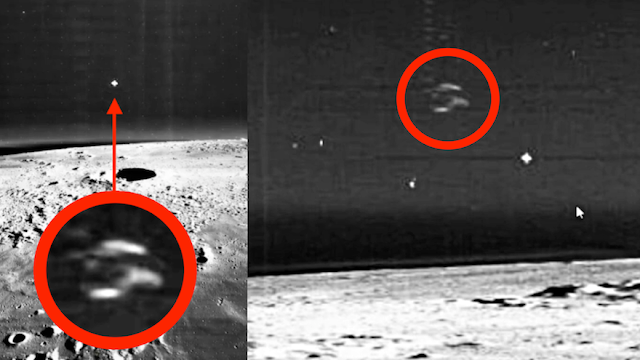
UFO Found On Moon In 1967 NASA Lunar Photo, Video, UFO Sighting News.


Ring UFO Over Ogden, Utah, USA On July 15, 2021, Video, UFO Sighting News.
UFO Sighting- Caught on Camera [Montello WI, June 13, 2021]

While trying to photo the milky-way I spotted a UFO above my house. I was able to quickly take four photos of this UFO. What is this thing?
Donut-shaped UFO flying over South Ogden, UT 15-Jul-2021

This daytime footage of a donut-shaped unidentified flying object was filmed over South Ogden, a city in Weber County, Utah. This happened on 15th July 2021.
Witness report:
Nearly flat, donut looking object traveled across the sky, looked almost like a balloon, but it was way faster and there was no wind; not even a breeze.
RELATED VIDEO, selected and posted by peter2011
Hubble Space Telescope Is Back in Action After NASA Fixes Odd Glitch – The Wall Street Journal
After a month of frantic tinkering, NASA said Friday that its aging Hubble Space Telescope was on the mend, recovering from a computer problem that crippled what many astronomers call the most productive scientific instrument ever built.
As the bus-size observatory circled Earth, space agency engineers worked by remote control to switch Hubble from its vintage electronics to backup hardware. In the final step, they powered up a payload computer that restored control of its six cameras and sensors, which peer through visible, infrared and ultraviolet wavelengths of light to the edge of space and the dawn of time.
“We are absolutely delighted that the observatory is up and running again,” said Kenneth Sembach, director of the Baltimore-based Space Telescope Science Institute, which handles the Hubble science operations. “All indications are that it’s doing well and we will get back to doing science again this weekend.”
In more than a million mind-expanding images of the universe snapped over the past 31 years, the solar-powered telescope has presented to astronomers and amateur stargazers alike a psychedelic tapestry of infant stars, dying supernovae, colliding galaxies, towering billows of stellar dust, dark matter and black holes feasting on spiral nebulae.
Hubble data has been used in more than 18,000 scientific papers that have documented the accelerating expansion of the universe, the evolution of galaxies and studies of planets beyond our solar system, NASA officials said.
“I think there’s a very credible case that the Hubble Space Telescope is the most scientifically productive instrument ever made,” said Paul Hertz, director of NASA’s astrophysics division. “The output of peer-reviewed published papers from Hubble certainly exceeds any of its competitors in any field of science.”
But then on June 13, Hubble was hobbled—and not for the first time. Technical problems that threatened to end the mission have plagued the telescope since the moment it reached its orbital perch some 340 miles above our planet’s surface on April 25, 1990.
Since its launch—with flawed optics causing its photos to be so blurry that the $4.7 billion observatory was initially deemed an embarrassing failure—five space shuttle missions repaired, upgraded and replaced systems on the telescope. All five of its main instruments were fixed, and a $50 million set of corrective lenses was installed to address its manufacturing flaws.
Last repaired by space shuttle astronauts in 2009, Hubble has lasted twice as long as originally expected, space agency officials said.
The latest trouble began when a voltage overload in an onboard payload computer built in the 1980s tripped a circuit breaker and shut down the telescope. It was the most serious technical failure that NASA project engineers had encountered in the 11 years since the last shuttle repair.
“We did a lot of debugging,” said James Jeletic, deputy project manager for the Hubble Space Telescope Project at NASA’s Goddard Space Flight Center in Greenbelt, Md. After three weeks of painstaking analysis, they decided to switch the telescope to its remaining backup systems.
“Every single thing worked as planned,” Mr. Jeletic said. “The computer came back up. All the backup hardware works fine. I don’t think we’re biting our fingernails anymore.”
NASA's Kepler Space Telescope spots four mysterious 'free-floating' planets that appear to be alone in deep space, unbound to any host star
NASA's Kepler Space Telescope has found a mysterious population of 'free-floating' or 'rogue' planets that aren't bound to any host star.
Based on a technique called gravitational microlensing, researchers reveal there are four new rogue planets in total, which likely have similar masses to that of Earth.
Gravitational microlensing relies on chance events where from a certain viewpoint, one star passes in front of another star.
The planets may have originally formed around a host star before being ejected by the gravitational tug of other, heavier planets in the system, the experts say.
The host star is likely still burning brightly in space, but just with fewer planets in its orbit.
Scroll down for video

The four newly discovered planets that are consistent with planets of similar masses to Earth
(stock image)
'We don't know exactly how far away they are,' study author Professor Iain McDonald at the University of Manchester told MailOnline.
'They are not among the nearest stars, but closer than the centre of our Galaxy. So it's probably most accurate to say they are several thousand light years away.
Professor McDonald said they're not sure exactly what these planets are like, but are 'probably rocky' with frozen oceans.
'If a planet like the Earth was flung out into deep space, far from the heat of a star, we'd expect the oceans to freeze over and the atmosphere to condense out onto the surface,' he said.
'Life could still continue, but only in places like hydrothermal vents, where there is another energy source.'

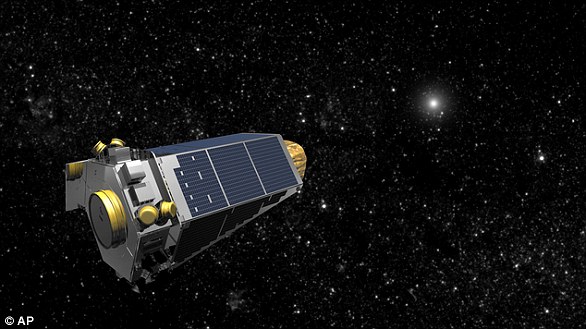
This is an artist impression of the Kepler Space Telescope that was decommissioned by NASA in 2018 after nearly a decade of service
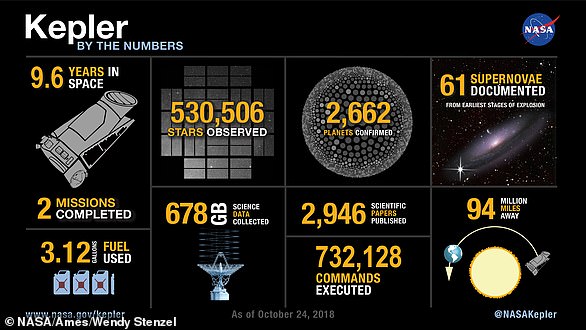
The now retired Kepler telescope spent nearly a decade in space looking for Earth-size planets orbiting other stars, but scientists are still analysing its data.
Kepler launched in 2009 and was decommissioned by NASA in 2018 when it ran out of fuel needed for further science operations.
It was launched specifically by NASA with the aim of identifying planets outside of our own Solar System, known as exoplanets.
For this project, researchers used data obtained in 2016 during the K2 mission phase of NASA’s Kepler Space Telescope – an extension of its original mission.
During its two-month K2 campaign, Kepler monitored a crowded field of millions of stars near the centre of our Galaxy every 30 minutes in order to find rare gravitational microlensing events.
Gravity from the closer star acts as a lens and magnifies the distant star over the course of the transit.
The study team found 27 short-duration candidate microlensing signals that varied over timescales of between an hour and 10 days.
Many of these had been previously seen in data obtained simultaneously from the ground.
However, the four shortest events are new discoveries that are consistent with planets of similar masses to Earth.
These new events do not show an accompanying longer signal that might be expected from a host star, suggesting that these new events may be free-floating planets.
'These signals are extremely difficult to find,' said Professor McDonald.
'Our observations pointed an elderly, ailing telescope with blurred vision at one the most densely crowded parts of the sky, where there are already thousands of bright stars that vary in brightness, and thousands of asteroids that skim across our field.

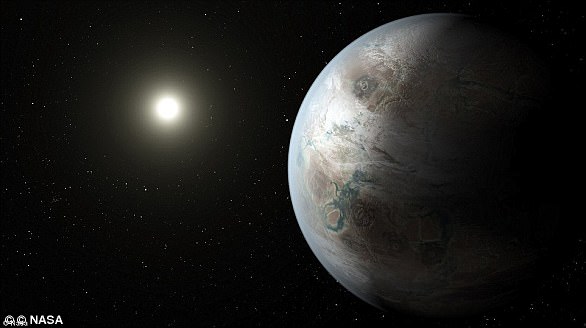
Artist's impression of a free-floating planet. Such planets may perhaps have originally formed around a host star before being ejected by the gravitational tug of other, heavier planets in the system
'From that cacophony, we try to extract tiny, characteristic brightenings caused by planets, and we only have one chance to see a signal before it’s gone.
'It’s about as easy as looking for the single blink of a firefly in the middle of a motorway, using only a handheld phone.'
Since its launch in 2009, Kepler spotted thousands of exoplanets outside our solar system, despite experiencing mechanical failures and being blasted by cosmic rays.
In 2013, Kepler's primary mission was concluded when a second reaction wheel broke, which meant that the space craft couldn't hold a steady gaze at its original field of view.
But Kepler was given a 'new lease on life' by NASA on its K2 mission, which required it to shift its field of view to new portions of the sky about every three months.
NASA initially assumed that K2 would only be able to conduct 10 campaigns with the remaining fuel, but it went on to complete an astonishing 16 campaigns.
Confirming the existence and nature of free-floating planets will be a major focus for NASA's upcoming Nancy Grace Roman Space Telescope and possibly the ESA's Euclid mission – both expected to detect microlensing events.
'Kepler has achieved what it was never designed to do, in providing further tentative evidence for the existence of a population of Earth-mass, free-floating planets,' said study author Eamonn Kerins at the University of Manchester.
'Now it passes the baton on to Roman that will be designed to find such signals, signals so elusive that Einstein himself thought that they were unlikely ever to be observed.'
The results have been published today in Monthly Notices of the Royal Astronomical Society.
Kepler Data Reveal Four Earth-Mass Free-Floating ExoplanetsUsing data from NASA’s Kepler/K2 mission, astronomers have detected four new microlensing events that are consistent with free-floating planets of similar masses to Earth.
An artist’s impression of a free-floating exoplanet.
Image credit: Sci-News.com.
Gravitational microlensing is an observational effect that was predicted in 1936 by Albert Einstein using his general theory of relativity.
When one star in the sky appears to pass nearly in front of another, the light rays of the background source star become bent due to the gravitational attraction of the foreground star.
This star is then a virtual magnifying glass, amplifying the brightness of the background source star, so astronomers refer to the foreground star as the lens star.
If the lens star harbors a planetary system, then those planets can also act as lenses, each one producing a short deviation in the brightness of the source.
Roughly one out of every million stars in our Milky Way Galaxy is visibly affected by microlensing at any given time, but only a few percent of these are expected to be caused by extrasolar planets.
“These signals are extremely difficult to find,” said Dr. Iain McDonald, an astronomer in the Jodrell Bank Centre for Astrophysics at the University of Manchester and Open University.
“Our observations pointed an elderly, ailing telescope with blurred vision at one the most densely crowded parts of the sky, where there are already thousands of bright stars that vary in brightness, and thousands of asteroids that skim across our field.”
“From that cacophony, we try to extract tiny, characteristic brightenings caused by planets, and we only have one chance to see a signal before it’s gone.”
“It’s about as easy as looking for the single blink of a firefly in the middle of a motorway, using only a handheld phone.”
Dr. McDonald and colleagues analyzed archival data obtained in 2016 during the K2 mission phase of NASA’s Kepler Space Telescope.
They found 27 short-duration candidate microlensing signals that varied over timescales of between an hour and 10 days.
Many of these had been previously seen in data obtained simultaneously from the ground.
However, the four shortest events are new discoveries that are consistent with planets of similar masses to Earth.
These new events do not show an accompanying longer signal that might be expected from a host star, suggesting that these new events may be free-floating planets.
“Kepler has achieved what it was never designed to do, in providing further tentative evidence for the existence of a population of Earth-mass, free-floating planets,” said Dr. Eamonn Kerins, an astronomer in the Jodrell Bank Centre for Astrophysics at the University of Manchester.
“Now it passes the baton on to other missions that will be designed to find such signals, signals so elusive that Einstein himself thought that they were unlikely ever to be observed.”
The results appear in the Monthly Notices of the Royal Astronomical Society.
_____
Hubble's meest recente prachtige opname: bolvormige sterrenhoop NGC 6380

Zelfs vanuit ons beperkte perspectief hier op aarde weten we dat de ruimte een plaats van uitgestrekte leegte is. Die kennis maakt deze blik op NGC 6380 des te surrealistischer.
Deze nieuwste Hubble-opname laat de bolvormige sterrenhoop die sinds zijn ontdekking op 29 juni 1934, door de Britse astronoom John Herschel, vele (en, zoals NASA opmerkt, tamelijk saaie) namen heeft gekregen zien. Maar het uiteindelijke zicht op NGC 6380 is echter allesbehalve saai. Kijk maar naar deze prachtige sterrenfoto....

Die heldere, blauwe blikvanger bovenin de foto maakt geen deel uit van NGC 6380. De bolvormige sterrenhoop, een bolvormige formatie van sterren die bijeengehouden wordt door de zwaartekracht, staat op 35.000 lichtjaar van de aarde. Onze blauwe vriend, een ster die HD 159073 wordt genoemd, staat veel dichterbij op slechts (lol) 4000 lichtjaar van de aarde.
Zoals de meeste dingen die in de diepe ruimte te zien zijn, is onze kennis van NGC 6380 beperkt door wat we van grote afstand kunnen waarnemen. Hij maakt deel uit van het sterrenbeeld Schorpioen - ja, dit samenraapsel van sterren is slechts een enkel lichtpuntje voor onze nietige, blote mensenogen. Maar zoals je hierboven kunt zien, is hij absoluut adembenemend als we inzoomen voor een beter zicht.
Beelden als deze zijn alleen mogelijk omdat de Hubble nog functioneert. De meer dan 30 jaar oude satelliet nadert het einde van zijn leven, doordat eind dit jaar de James Webb-ruimtetelescoop gelanceerd zal worden: de grootste en krachtigste ruimtetelescoop die ooit is gebouwd. De werking van de Hubble-telescoop werd in juni zelfs onderbroken toen de boordcomputer van de satelliet niet meer werkte, maar dat probleem lijkt gelukkig te zijn opgelost.
Wedge of Aiud: A piece of a 20,000-year-old ship?

The Aiud wedge is a piece of metal discovered in the year 73, about 10 meters deep. Strange mastodon bones were accidentally found . However, what caused the most controversy was a piece of metal.
The strange piece found in the city of Aiud, Romania, was donated to the Transylvanian History Museum and was hidden for years until it was rediscovered.
5 pounds and 20 × 12.5 × 7 centimeters in diameter were its characteristics. But what was that strange thing?1
The millimeter-thick oxide covered the entire block evenly, but this helped date its age to about 400 years .
But the geological layer in which it was found suggests that it must have been in the area about 20,000 years ago , in the Pleistocene .
Florin Gheorghita, a famous historian, managed to examine the analysis carried out on the Aiud wedge, ensuring that the metal alloy that made it up was extremely complex .
Gheorghita assured that the alloy is composed of 12 different elements; 89% aluminum, 6.2% copper, 2.84% silicon, 1.81% zinc, 0.41% lead, 0.33% lagoon, 0.2% zirconium, 0.11 % cadmium, 0.0024% nickel, 0.0023% cobalt, 0.0003% bismuth, 0.0002% silver and gallium in minute quantities.
Why was an object with these characteristics next to mastodon bones? It should be impossible, since aluminum in its pure state is not in nature and humanity managed to reach such a degree of purity only appeared in the nineteenth century .
An aeronautical engineer assured that the piece resembles that of an airplane landing gear.
Added to that are two perfect oval piercings, indicating that the Aiud wedge was undoubtedly made artificially .
Some experts suggest that it is a man-made tool , which would not make sense at the time.
It has even been compared to the fulcrum of space modules , such as the Viking , but it has not had results either.
This and other reasons have led us to think about the possibility that it was part of some extraterrestrial spacecraft . What function would such a modern piece of technology have in the remote past?
Gheorghita, in an article published in Ancient Skies, stated that he asked an aeronautical engineer about the piece about the artifact and the results of his analyzes.
The engineer replied that, according to its composition and the hole in the jock, as well as a pattern of abrasions and scratches on the metal, it was a piece of an airplane landing gear .
How and why was such an advanced piece of technology found alongside such ancient fossils? How did it get there? It is possible that we are facing the remains of a UFO accident in our remote past or something else.
New Experiments Link Lucid Dreaming to Alien and UFO Encounters

One of the things people who have alien and UFO encounters often hear is, “You must have been dreaming.” A team of Russian researchers decided to test if this could indeed be true in at least some cases and enlisted a group of proven lucid dreamers to conduct an experiment involving alien and UFO encounters (AUEs). The results were enlightening and thought-provoking, answering some questions while eliciting many more.
“Alien and UFO encounters (AUEs) have been a well-known part of human culture for centuries, but we are still unsure of their nature. Some studies suggest that in some such encounters, these phenomena could be related to dissociative REM sleep states, like lucid dreams (LDs), sleep paralysis (SP), and out-of-body experiences (OBEs). The present research focuses on the hypothesis that if some of AUEs are indeed the products of REM sleep, then they could be deliberately emulated by LD practitioners. Therefore, this experiment could help to explain the mystery of AUEs.”
Michael Raduga, Andrey Shashkov and Zhanna Zhunusova of the Phase Research Center in Moscow are experienced lucid dreaming researchers but this was their first attempt to link them to AUEs. They assembled a group of 152 proven lucid dreamers and instructed them to induce dreams about aliens and UFOs and report their results. Showing their amazing abilities, 114 managed to have alien dreams, with 70 (61%) dreaming of alien encounters. Breaking that down, 22 encountered humanlike aliens, 44 observed them talking, 22 saw them touching and 14 witnessed them doing both. In addition, 32 had UFO encounters, with 12 being inside one and 3 reporting flying.
The researchers next compared these lucid dream accounts to actual UFO and alien encounter reports to see how similar they were to ‘real’ experiences.
“Regarding the successful cases, 20% were close to reality in terms of the absence of paradoxical dreamlike events. AUEs can be emulated willfully and can be perceived as being very close to reality.”
How close? Lucid dreamers having alien encounters experienced fear and sleep paralysis – a common trait among people who report having alien encounters at night. Could this prove that nighttime abductions are actually dreams?
“The results of the present study show that bedtime AUEs can be deliberately emulated during REM sleep and can mimic reality. As such, ordinary people might spontaneously enter PSs, unintentionally have an AUE, and confuse it with reality. This might be the case every time an AUE starts during sleep or while in a state of relaxation.”
That seems to be the researchers’ conclusion. (More details and results of the study can read in the peer-reviewed International Journal of Dream Research.) Moreover, they propose that other unusual nighttime encounters — religious, paranormal, or mystical – could just be vivid dreams. They suggest as a follow-up training those with alien encounters to enter lucid dreams and attempt to recreate their experiences, thus allowing the researchers to compare ‘real’ and dream accounts from the same person.
This may be disappointing news to those believing their nighttime alien and UFO encounters were the real thing. On the other hand, it might be comforting to know they were just dreaming and not actually probed or chipped. What about daytime encounters? Can the experiments be done with lucid daydreamers? Can they prove they actually conducted this experiment and we didn’t just dream reading about it?
“Our findings aid the general understanding of the human brain, especially regarding the sleep process and its connection to consciousness. Therefore, our results help some irrational parts of our culture to become more reasonable and understandable.”
Anything that helps irrational parts of our culture become rational is most welcome. And THAT’S no dream.
A Young Earth Was Bombarded With City-Sized Asteroids

Many years ago when Earth was in its young stages, numerous asteroids hit our planet – many of which were the size of a city. It’s hard to imagine such large rocks bombarding the planet, as the asteroid that killed the dinosaurs and caused destruction to the Earth around 66 million years ago was about 6 miles across (almost 10 kilometers).
But now, based on new research, asteroids much larger than the one that killed the dinosaurs impacted Earth billions of years ago on a pretty steady basis. According to a recent statement, asteroids the size of a city – some even the size of a province – impacted Earth about every 15 million years. These impacts occurred between 3.5 and 2.5 billion years ago.
The asteroid that killed the dinosaurs was about 6 miles across.
Researchers were able to determine these events by analyzing spherules which are tiny bubbles of vaporized rock that were sent flying into space during each impact but ultimately fell back down to Earth after they became solidified. These spherules were found in layers of bedrock. If the layer of spherules was thicker, it meant that a larger asteroid struck the Earth.
When the experts compared the ancient layers of spherules to modern estimates of previous impacts, they noticed significant differences as explained in the statement by Simone Marchi who is a principal scientist with the Southwest Research Institute in Boulder, Colorado, “We found that current models of Earth’s early bombardment severely underestimate the number of known impacts, as recorded by spherule layers.” “The true impact flux could have been up to a factor of 10 times higher than previously thought in the period between 3.5 and 2.5 billion years ago.”
Additionally, the massive asteroid impacts could have potentially affected the planet’s ability to sustain life as well as the oxygen levels. “We find that oxygen levels would have drastically fluctuated in the period of intense impacts,” Marchi explained, adding, “Given the importance of oxygen to the Earth’s development, and indeed to the development of life, its possible connection with collisions is intriguing and deserves further investigation. This is the next stage of our work.”
As for what type of destruction these massive impacts would have had on Earth, it is hard to know for sure but it’s highly probable that some major damage would have happened. Rosalie Tostevin, who is from the University of Cape Town but was not involved in the study (she does specialize in ancient geology), reiterated this by stating, “These large impacts would certainly have caused some disruption.” “Unfortunately, few rocks from this far back in time survive, so direct evidence for impacts, and their ecological consequences, is patchy. The model put forward by Dr. Marchi helps us to get a better feel for the number and size of collisions on the early Earth.”
It’s a good thing that we don’t have any more of these city-sized asteroids impacting Earth as the destruction they would cause today would be catastrophic.
New Images of Mars From China’s Rover
On May 14th, 2021, the China National Space Agency (CNSA) achieved another major milestone when the Tianwen-1 lander successfully soft-landed on Mars, making China the second nation in the world to land a mission on Mars and establish communications from the surface. Shortly thereafter, China National Space Agency (CNSA) shared the first images taken by the Tianwen-1 lander.
By May 22nd, 2021, the Zhurong rover descended from its lander and drove on the Martian surface for the first time. Since then, the rover has spent 63 Earth days conducting science operations on the surface of Mars and has traveled over 450 meters (1475 feet). On Friday, July 9th, and again on July 15th, the CNSA released new images of the Red Planet that were taken by the rover as it made its way across the surface.
Since the rover deployed to the surface of Mars, it has been traveling southward to explore and inspect the terrain and has taken daily images of rocks, sand dunes, and other features using its Navigation and Topography Cameras (NaTeCam). Meanwhile, other instruments – like the Mars Rover Penetrating Radar (RoPeR), Mars Rover Magnetometer (RoMAG), Mars Climate Station (MCS) – have also been collecting data on Mars’ magnetic field, weather, and subsurface.
Whenever the rover came across notable landforms, it relied on its Mars Surface Compound Detector (MarSCoDe) and Multispectral Camera (MSCam) to carry out fixed-point scans to determine their composition. Among the new images were the two Martian rocks shown above (CNSA via Xinhuanet) that revealed the rocks’ texture features, the thick layers of dust covering them, and impressions left by the ruts of the rover.
Other images in the collection (see below) include a landscape shot that was taken by Zhurong on June 26th, the rover’s 42nd day on the Martian surface (Sol 42). On this day, the rover arrived in a sandy area and took images of a red dune located roughly 6 meters (~20 ft) away. As you can see (top gallery image), the dune has several rocks strewn about it, the one directly ahead of Zhurong measuring 34 cm (13.4 inches) wide.
The next image (bottom left) was taken on July 4th, Zhurong’s 50th day on the Martian surface (Sol 50), after the rover drove to the south side of the dune – which measures 40 m (~130 ft) long, 8 m (26.25 ft) wide and 0.6 m high (2 ft). The fifth and final landscape image (bottom right) was taken when the Zhurong rover was at a distance of 210 m (690 ft) from its landing site and 130 m (~425 ft) from the lander’s back cover and parachute.
These components were part of the Tianwen-1 mission’s Entry, Descent, and Landing (EDL) module. Whereas the back cover ensured that the rover and lander safely made it through deep-space and survived the turbulent ride through Mars’ atmosphere, the parachute was what allowed for their controlled descent through the atmosphere so they could make a soft landing.
These components are just visible in the upper right corner of the top image while a cluster of stones of various shapes is visible on the left. More recent images acquired by the rover were released on July 15th, 2021, which showed the rover inspecting the back cover and parachute more closely (see below). The first image (top left) was acquired three days prior and shows these two components on the rover’s left side as it continued on its southbound patrol.
As the CNSA indicated in a press statement that was released along with the images:
“The picture shows the full view of the parachute and the complete back after aerodynamic ablation. Cover structure, the attitude control engine diversion hole on the back cover is clearly identifiable, the rover is about 30 meters away from the back cover and about 350 meters away from the landing site during imaging.”
The second and third images (black and white) were taken by the front and rear obstacle avoidance cameras as the rover made its approach and departure from the back cover and chute. The fourth image shows the parachute after it was deployed during the lander’s descent over Utopia Planitia (where it landed) on May 15th. Yet another image was released by the CNSA the following day, which shows Tianwen-1’s landing site.
This image was taken by the orbiter element of the mission on June 2nd, days after the lander and rover element safely landed. The locations of the lander, the rover, the parachute, and back cover, and the heat shield are all indicated in white. The two white dots at the top right corner are the lander and rover, the parachute and back cover are almost directly beneath it (the elongated white mark being the chute) while the heat shield is at the bottom right.
The Tianwen-1 mission was quite the feather in the cap of the CNSA, and not just because it was China’s first mission to Mars. By successfully deploying this mission, China became the first nation to reach Mars with a mission that included an orbiter, lander, and rover element. Prior to this, every space agency that successfully sent a robotic mission to Mars began with orbiters, followed by surface missions – landers first, then landers with rovers.
On top of that, the Zhurong rover makes China the second nation in the world (after the US) to land and operate a rover on the Martian surface. This will be followed in the near future by the Rosalind Franklin rover (part of the ESA-Roscosmos ExoMars program) which will launch from Baikonur Cosmodrome sometime this September and is expected to arrive at Mars on June 10th, 2023.
These missions will help pave the way for human exploration, which China is now hoping to do (alongside NASA) during the 2030s. Much like all the crewed lunar missions planned for the near future, the human exploration of Mars is expected to be a multinational affair!
Further Reading: Xinhuanet, CNSA
The post New Images of Mars From China’s Rover appeared first on Universe Today.
Source:
LATEST UFO SIGHTINGS AND VIDEOS - MUFON CASES - 02** - 07- 2021MUFON CASE : 116938 Brooklyn, New York ( July 18, 2021 )
LATEST UFO SIGHTINGS AND VIDEOS -19 - 07 - 2021LATEST UFO SIGHTINGS AND VIDEOS -19 - 07 - 2021
UFO Sighted Over Hokkaido Japan ( July 18, 2021 )
This UFO or Unidentified Flying Object was sighted over the Japanese prefecture Hokkaido, Japan on July 18, 2021. Ron Watkins, known as CodeMonkeyZ, on the social medial platform Telegram, observed a 'Tic Tac' UFO in Hokkaido Japan on July 18, 2021.
RELATED VIDEO
UFO Sighted Over Squamish, British Columbia, Canada
UFO Sighted Over Squamish, British Columbia, Canada : Ufologist with UFO Detection Equipment capture a UFO
Leaked DHS Footage Of A-10 Warthog Being Chased By UAP / UFO
Leaked DHS footage of A10 Warthog being chased by UAP / UFO : Footage leaked via a Department of Homeland Security agent. Footage shows UAP / UFO flying past the Fairchild Republic A-10 Thunderbolt II Attack aircraft. from the nearby, Davis Monthan AFB. The Fairchild Republic A-10 Thunderbolt single-seat, twin turbofan engine, straight wing jet aircraft developed by Fairchild-Republic for the United States Air Force only has a top speed of 438.6 mph and is easily chased by the UAP /UFO
UFO Sighted In Las Vegas Lightning Storm ( July 12, 2021 )
Amazing UFO was sighted In a Las Vegas Lightning Storm on July 12, 2021 : This was captured last Sunday in Las Vegas by redditor V3_NoM
Amazing crop circle formation found in Hampshire, UK yesterday

Location: Woodcote Lane near Upham, Hampshire, UK
Date: 18th July 2021
David Adair – The Twelve Sites on the Moon Where NASA Told Us Not To Go To!

David Adair in Manchester, UK: Awakening Expo Anniversary Triple – Feature Release Special: The Secret Life of an Astronaut, The Twelve Sites on the Moon Where NASA Told Us Not To Go To, and the Future of Space Fairing. David Adair is an internationally recognized expert in space technology spinoff applications for industry and commercial use. At age 11 he built his first of hundreds of rockets which he designed, and test flew. At age 17 he won “The Most Outstanding in the Field of Engineering Services” award from the US Air Force. David describes the life of astronaut Neil Armstrong from a personal view as he was close friends with the Armstrong family, reveals some of the secrets behind the moon landing and those famous words as Neil stepped onto the lunar surface. David also discloses some of the incredible technology utilized by space fairing agencies, and what we can expect in the future.
The Hopi Legend Of The “Ant People” And Connections To The Anunnaki
The more you look at ancient texts and stories from around the world, you can’t help but see surprising patterns. Some are so glaring that it takes real effort to ignore them, but that’s what many people do. One example is from the Hopi Native America tribe and their beliefs in “Ant People.” The Hopi of the American Southwest are sometimes referred to as “the oldest of people” by other Native American tribes.
Once you learn about the Ant People, you can’t help but compare them to the ancient Sumerian texts of the Anunnaki. Why? Let’s take a simplified look, respecting the truth that only members of the Hope tribe could fully explain.
In ancient cultures, there is a common thread of worshiping extraterrestrial beings from the stars who will one day return. Animals symbolic of these beliefs appear frequently in ancient art.
The Hopi have a reverence for ants, similar to the way the Egyptians and Sumerians and other cultures had a special reverence for cows. The cows may have represented our Milky Way galaxy, and in the case of the ants, they described beings from the stars known as the Ant People.
The Hopi words for the Ant People or Ant Friends (Anu Sinom) create a direct link to the stories of the Anunnaki. It could be coincidental, but it is quite striking. The Babylonian sky god was named Anu, which is the Hopi word for ant.
The word, Naki translates to “friends.” Thus, Anu-Naki translates to “ant friends” in Hopi. In both languages, they are describing extraterrestrial beings, but the Hopi say these Ant People came from under the ground.
Another strikingly similar word is the Hopi word sohu, meaning “star,” and the Egyptian word sahu means “stars of Orion.” This constellation is seen repeatedly across the globe. Ancient Astronaut theorists observe Orion and other systems such as the Pleiades appearing over and over in the layout of the pyramids and ancient structures. Another coincidence?
In the Hopi legend, these Ant People were their saviors, taking them underground and teaching them how to survive two extreme cataclysms. Once again, we see stories of a great flood like that described in Sumerian texts and the Bible.
Surviving underground with the Ant People, the Hopi ancestors learned how to grow food with little water and build dwellings in the rocks. They learned about the stars and mathematics and would put those skills to use when they founded a new civilization.
When it was safe to return to the surface, the Ant People instructed the building of incredibly complex habitations such as what is seen today at Chaco Canyon. From above, they might appear like a giant ant mound. The structures included Kivas, a Hopi word for round semi-subterranean ceremonial rooms that were entered by ladders from above.
According to the National Park Service:
“During ceremonies today, the ritual emergence of participants from the kiva into the plaza above represents the original emergence by Puebloan groups from the underworld into the current world.”
Petroglyphs depicting the Ant People appear still appear today, and the Hopi continue to tell the story in dances and rituals.
Below are some intriguing images of Hopi ceremonies taking place inside the kivas.
Ancient Origins elaborates on the legend:
“One of the most intriguing Hopi legends involves the Ant People, who were crucial to the survival of the Hopi — not just once but twice. The so-called “First World” (or world-age) was apparently destroyed by fire — possibly some sort of volcanism, asteroid strike, or coronal mass ejection from the sun. The Second World was destroyed by ice — Ice Age glaciers or a pole shift.
“During these two global cataclysms, the virtuous members of the Hopi tribe were guided by an odd-shaped cloud during the day and a moving star at night that led them to the sky god named Sotuknang, who finally took them to the Ant People — in Hopi, Anu Sinom. The Ant People then escorted the Hopi into subterranean caves where they found refuge and sustenance.”
Stories that giants and other strange beings have lived deep inside the Earth are seen around the globe. In the Hopi legend, these beings were benevolent and helped the tribe even to their own detriment.
“In this legend, the Ant People are portrayed as generous and industrious, giving the Hopi food when supplies ran short and teaching them the merits of food storage. In fact, another legend says that the reason why the ants have such thin waists today is because they once deprived themselves of provisions in order to feed the Hopi.”
The thin waisted ants with their elongated heads and antennae resemble some of the ancient petroglyphs. Across the globe, an African species of Ant called the Pharaoh Ant remind some of a tiny version of Pharoah Akhenaten, famous for his strange alien appearance.
The History Channel’s Ancient Aliens series covers this subject in Series 4, episode 9 (See a clip below). In addition to depictions of the Ant People are wall paintings that show an unmistakable similarity to cuneiform symbols from ancient Sumeria. These symbols are associated with the “WingMakers,” according to the show.

The Chaco Canyon settlement had thousands of Anasazi inhabitants, who believed in protecting Mother Earth. However, the ancient Puebloans mysteriously disappeared, along with any signs of the Ant People. Today researchers believe that climate change drove them away as the growing population couldn’t sustain itself.
The Anasazi integrated with tribes like the Hopi, Zuni, and Rio Grande Pueblo. As the modern world faces extreme challenges from climate change today, the teachings of these tribes are more important than ever. Can we learn to respect the natural world and live in harmony with Mother Earth? Or are we headed for inevitable disasters, like those described in the Hopi legends?
Ancient Astronaut theorists often speculate if extraterrestrial beings could play a part in helping humans overcome impending future disasters. In the case of the Hopi legends, it appears they did just that. Could the Ant People return from deep in the Earth or from their home in the stars in our time of need?
For another Hopi origin story watch this beautiful video from PBS:

NASA uncovers hidden system of mysteriously draining lakes under Antarctica

Scientists have discovered two new lakes buried deep beneath the Antarctic Ice Sheet.
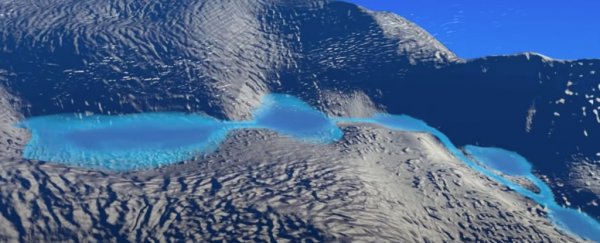
These hidden gems of frigid water are part of a vast network of ever-changing lakes hidden beneath 1.2 to 2.5 miles (2 to 4 kilometers) of ice on the southernmost continent. These lakes fill and drain over and over again in largely mysterious cycles that may influence how fast the ice sheet moves and how and where meltwater reaches the Southern Ocean. This flow, in turn, can change the currents in the Southern Ocean and potentially affect ocean circulation worldwide.
"It's not just the ice sheet we're talking about," study leader Matthew Siegfried, a geophysicist at the Colorado School of Mines, said in a statement. "We're really talking about a water system that is connected to the whole Earth system."
The lakes sit at the bottom of the ice sheet, where the ice meets the rocky Antarctic continent. Unlike in Greenland, where meltwater flows from the ice surface through crevasses and holes called moulins, Antarctica's lakes form from beneath the ice, probably as a result of pressure, friction and perhaps geothermal heat.
This water system was largely invisible until the advent of NASA's ICESat mission in 2003. The ICESat satellite used lasers to precisely measure the elevation of Antarctic ice. In 2007, Scripps Institution of Oceanography glaciologist Helen Amanda Fricker connected the elevation changes measured by ICESat to the dynamics of the lakes deep beneath the ice surface. As the lakes drain and fill, the ice above rises and falls, offering hints as to what's happening below.
Fricker's breakthrough opened up the possibility of tracking the lake system over time. ICESat, however, collected data for only six years. Its European Space Agency equivalent, CryoSat-2, collected similar data starting in 2010 but over a broader area and with less precision. In September 2018, NASA launched a new satellite, ICESat-2, which collects the highest-precision data yet.
"ICESat-2 is like putting on your glasses after using ICESat: The data are such high precision that we can really start to map out the lake boundaries on the surface," Siegfried said.
A dynamic system
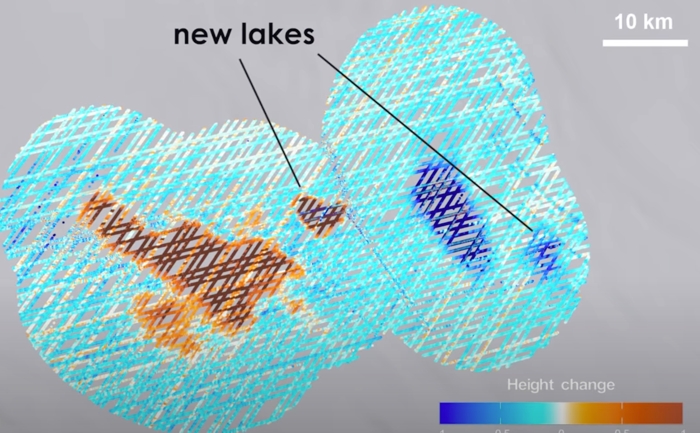
At the Mercer and Whillans boundary, the researchers found two new lakes, which they dubbed the Lower Conway Subglacial Lake and the Lower Mercer Subglacial Lake. They also found that what was thought to be one lake under the MacAyeal ice stream was actually two.
Over time, these lakes experienced major change. The lakes beneath the Mercer and Whillans ice stream boundary are currently undergoing their third period of drainage in 17 years. Meanwhile, all of the lakes beneath the MacAyeal ice stream have followed their own patterns of draining and filling. The lowermost lake went through four fill-drain events during the study period, each taking only about a year to complete. The second lake drained between 2014 and 2015 and is currently filling up again, while the third lake drained just slightly between 2016 and 2017. Meanwhile, the lakes beneath Academy Glacier drained between 2009 and 2018.
All of these changes are puzzle pieces in scientists' understanding of the speed and direction of Antarctica's ice sheet flow. Already, researchers are finding the links between the under-ice lakes and the ocean: In January, a study co-authored by Fricker found that the drainage of one lake on the Amery Ice Shelf in East Antarctica flushed as much as 198 billion gallons (750 billion liters) into the ocean in only three days, Live Science reported at the time.
The new study was published July 7 in the journal Geophysical Research Letters.
NASA Mission Uncovers Hidden Meltwater Lakes Under Antarctica's Ice

Antarctica may seem like a static environment: a still, white landscape frozen motionlessly into place.
But much more is going on under the ice than we realize – even if you have to travel all the way to space to tell for sure.
Over a decade ago, scientists made just such a discovery, when an analysis of data from NASA's ICESat satellite revealed that variations in ice elevation in West Antarctica reflected a vast mass of subglacial water movement underneath the ice sheet.
Prior to the discovery, it had been thought that hidden meltwater lakes – deeply concealed at the bottom of the ice sheet, where the ice meets the continental bedrock underneath – existed in isolation, cut off from one another.
But in 2007, researchers found that fluctuations in the height of Antarctica's surface ice signified the movement of water flowing between a hidden network of subglacial lakes, which alternately fill and drain before their water escapes to the Southern Ocean.

The new lakes discovered.
(Siegfried et al./NASA Goddard/YouTube)
Now, the ICESat mission's follow-up – ICESat-2, launched in 2018 – is giving scientists an even keener glimpse at this mysterious, deeply buried lake network, while revealing two lakes never before discovered.
"The discovery of these interconnected systems of lakes at the ice-bed interface that are moving water around, with all these impacts on glaciology, microbiology, and oceanography – that was a big discovery from the ICESat mission," says glaciologist Matthew Siegfried from the Colorado School of Mines.
"ICESat-2 is like putting on your glasses after using ICESat, the data are such high precision that we can really start to map out the lake boundaries on the surface."
In a new study, Siegfried and fellow researchers compiled altimetry data from ICESat-2 and the original ICESat mission, along with measurements taken from CryoSat-2, an ice-observing satellite operated by the European Space Agency (ESA).
By combining the datasets – encompassing the period from 2003 to 2020 – the researchers are able to monitor active subglacial lakes at timescales shorter than ICESat-2's repeat cycle (the 91-day gap before it can observe the same region again).
"Surface deformation due to active subglacial lakes filling and draining provides one of the few remotely accessible windows into the evolution of basal water systems; these systems are otherwise hidden beneath up to 4 km [2.5 miles] of ice and remain one of the major physical uncertainties on projections of future ice sheet dynamics," the researchers write in their paper.
"ICESat-2 laser altimetry can not only extend the record of subglacial lake activity but also provides better understanding of hydrological processes by capturing denser and more precise spatial detail."
In addition to giving us a more detailed look at the activity and outlines of known subglacial lakes in Antarctica – of which there are over 130 already documented – the analysis found two anomalies that appear to be hidden lakes, previously undetected.
These potentially active lakes – called Lower Conway Subglacial Lake (LSLC) and Lower Mercer Subglacial Lake (LSLM), lie near previously discovered lakes, and may have been missed by the original ICESat mission, falling within the narrow gaps between its observations.
In this region – underneath the Mercer and Whillans ice streams in West Antarctica – the lake system, which is dominated by two large active subglacial lakes (Conway Subglacial Lake and Mercer Subglacial Lake), appears to be in the midst of its third drainage event since ICESat observations began in 2003.
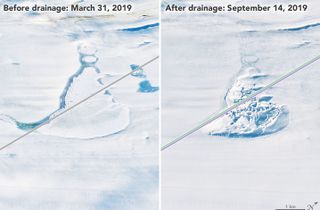
Just a few weeks ago, one of the same researchers involved here – glaciologist Helen Fricker from the Scripps Institution of Oceanography – co-authored a related study, detailing a dramatic lake drainage event in East Antarctica, where a surface lake on a floating ice shelf vanished in the space of days.
Far below the ice sheet in West Antarctica, the water draining from subglacial lakes is also thought to eventually flow into the ocean, although the concealed escape route is much harder to visualize.
"These are processes that are going on under Antarctica that we wouldn't have a clue about if we didn't have satellite data," Fricker says.
"We've been struggling with getting good predictions about the future of Antarctica, and instruments like ICESat-2 are helping us observe at the process scale."
The findings are reported in Geophysical Research Letters.