Ontdek de Fascinerende Wereld van UFO's en UAP's: Jouw Bron voor Onthullende Informatie!
Ben jij ook gefascineerd door het onbekende? Wil je meer weten over UFO's en UAP's, niet alleen in België, maar over de hele wereld? Dan ben je op de juiste plek!
België: Het Kloppend Hart van UFO-onderzoek
In België is BUFON (Belgisch UFO-Netwerk) dé autoriteit op het gebied van UFO-onderzoek. Voor betrouwbare en objectieve informatie over deze intrigerende fenomenen, bezoek je zeker onze Facebook-pagina en deze blog. Maar dat is nog niet alles! Ontdek ook het Belgisch UFO-meldpunt en Caelestia, twee organisaties die diepgaand onderzoek verrichten, al zijn ze soms kritisch of sceptisch.
Nederland: Een Schat aan Informatie
Voor onze Nederlandse buren is er de schitterende website www.ufowijzer.nl, beheerd door Paul Harmans. Deze site biedt een schat aan informatie en artikelen die je niet wilt missen!
Internationaal: MUFON - De Wereldwijde Autoriteit
Neem ook een kijkje bij MUFON (Mutual UFO Network Inc.), een gerenommeerde Amerikaanse UFO-vereniging met afdelingen in de VS en wereldwijd. MUFON is toegewijd aan de wetenschappelijke en analytische studie van het UFO-fenomeen, en hun maandelijkse tijdschrift, The MUFON UFO-Journal, is een must-read voor elke UFO-enthousiasteling. Bezoek hun website op www.mufon.com voor meer informatie.
Samenwerking en Toekomstvisie
Sinds 1 februari 2020 is Pieter niet alleen ex-president van BUFON, maar ook de voormalige nationale directeur van MUFON in Vlaanderen en Nederland. Dit creëert een sterke samenwerking met de Franse MUFON Reseau MUFON/EUROP, wat ons in staat stelt om nog meer waardevolle inzichten te delen.
Let op: Nepprofielen en Nieuwe Groeperingen
Pas op voor een nieuwe groepering die zich ook BUFON noemt, maar geen enkele connectie heeft met onze gevestigde organisatie. Hoewel zij de naam geregistreerd hebben, kunnen ze het rijke verleden en de expertise van onze groep niet evenaren. We wensen hen veel succes, maar we blijven de autoriteit in UFO-onderzoek!
Blijf Op De Hoogte!
Wil jij de laatste nieuwtjes over UFO's, ruimtevaart, archeologie, en meer? Volg ons dan en duik samen met ons in de fascinerende wereld van het onbekende! Sluit je aan bij de gemeenschap van nieuwsgierige geesten die net als jij verlangen naar antwoorden en avonturen in de sterren!
Heb je vragen of wil je meer weten? Aarzel dan niet om contact met ons op te nemen! Samen ontrafelen we het mysterie van de lucht en daarbuiten.
Woensdag 13 oktober 2021
Massive UFO near the sun shoots out into space
Massive UFO near the sun shoots out into space
Images captured by NASA's SDO-AIA 171 satellite show a massive spherical object near the sun until it shoot out into space.
According to NASA, the strange appearance is actually a type of solar activity called a prominence, a type of solar activity, which is normally attached to the sun before shooting out into space, like the infamous UFO/prominence image from 2012.
But the object captured on October 11, 2021 is not attached to the sun, we first see an elongated shadow moving through the plasma clouds before the actually spherical object becomes visible.
So, instead of a prominence could this have been a massive spacecraft?
UFO recorded by Pilot. Cockpit footage. With independent NARCAP report
UAP dropped out of the sky – recorded by Pilot | March 19, 2020
NARCAP Technical Report 20 An Independent Analysis of a March 19, 2020 Aviation Safety-Related Incident involving UAP, Unidentified Aerial Phenomena, Over Mexico, Monterrey, Nuevo Leon– https://www.narcap.org/blog/narcaptr20
Airline pilot (19 years exp. + 10 years of military flight exp.): “I have never in my life been witness to such phenomena however my first officer and I were in complete awe. I have multiple still photos and 4 videos that I would love to share with your network and with the world. forgive a slight delay in the submission as i had my doubts about reporting such occurrences but have no doubts as to what was witnessed. forgive some of the chatter and expletives but this was otherworldly. I have still photos as well.”
Sighting Basics Case 107281 Occurred 2020-03-19 23:00 Reported 2020-03-28 22:51 (Reported 8 Days Later) Time Zone America/Monterrey Source MUFON Summary Airline pilot with 19 years with additional 10 years military
City Monterrey Region Nuevo Leon Country Mexico Postal Code 70007
Distance 501 Feet – 1 Mile Altitude Over 500 Feet – No Cloudcover Duration 00:20:30 Features Patterned Surface, Other, Unknown Flight Path Path Then Hovering Shape Teardrop
The incident began when the First Officer, looking across to the left side of the cockpit, saw a yellowish white light descend into view from above. He first believed that it was a meteor and began to say so when it suddenly stopped near the same altitude as their aircraft. The UAP/Light then projected an illuminating beam of bright, white, light on their aircraft, and appeared to take a collision heading.
At this moment the Captain also saw the beam of light projected onto their aircraft from the UAP/Light. Both crewmen, in the belief that an aircraft with its landing lights on had turned onto a collision heading with their aircraft, took a defensive attitude and prepared for evasive control inputs.
As they prepared to avoid the apparently approaching UAP/Light, the beam of light illuminating their aircraft ceased, and the UAP/Light suddenly accelerated to the same speed and heading of the aircraft, maintained separation, and paced the aircraft. While estimating distances is difficult the Captain, a former tanker pilot experienced with night-time flight operations, suggested that the UAP/Light maintained a distance of approximately 1-2K ft from the aircraft. Near the minimum allowable separation of 1,000ft.
Unfortunately the video doesn’t capture the initial decent and movement of the object. I have no reason to doubt these pilot’s testimony or no explanation what this thing could be. VERY COOL!
Most people go to bed expecting to find the same person/pet/pillow or empty space next to them that was there when they fell asleep – anything else would be cause for alarm. A woman in British Columbia awoke last week to find something it’s pretty safe to say no one on Earth has ever found in bed with them before … and lived to tell the media about it. Meet Ruth Hamilton – the woman who woke up next to a space rock.
“I was shaking and scared when it happened, I thought someone had jumped in or it was a gun or something. It’s almost a relief when we realized it could only have fallen out of the sky.”
A relief to find out the rock on your pillow where your head should have been was a meteor and not debris from a construction site? Yep, that’s what Ruth Hamilton of Golden, B.C. told the Castlegar News on October 4th after she first called the police to come look at the rock on her bed and the hole in her roof. (Photos here.)
The hole left in the ceiling, and the space rock that created it.
(Ruth Hamilton photo)
After the police assured her it was not from a burglar nor from road construction in the nearby Kicking Horse Canyon just east of Golden, Hamilton checked with her neighbors and some remembered seeing a meteor streak across the sky the night before. (Photos here and here.)
Meteor over Lake Louise, Alberta, Canada a few nights ago
“I’m just totally amazed over the fact that it is a star that came out of the sky, It’s maybe billions of years old. The only other thing I can think of saying is life is precious and it could be gone at any moment even when you think you are safe and secure in your bed. I hope I never ever take it for granted again.”
Hamilton plans to keep the space rock as a souvenir, at least until her insurance company figures out if the roof repairs due to meteor strike are covered. And she’s obviously grateful her name wasn’t added to the very short list of people who succumbed to “death by meteorite.” In 2020, historical documents were confirmed to show the only death by meteorite occurred in on August 22, 1888 in Sulaymaniyah, Iraq, when one man was killed and another paralyzed by a space rock. In 1954, Ann Hodges was asleep on her couch in Oak Grove, Alabama, when she was hit by a piece of the Sylacauga or Hodges meteorite that crashed through the roof and seriously injured her hip – it is now in the Alabama Museum of Natural History (the space rock, not her hip).
Follow that rock!
Ruth Hamilton of Golden, BC, beat the death-by-meteorite odds — Tulane University environmental sciences professor Stephen A. Nelson calculated the odds of getting killed by a meteorite and determined them to be about 1 in 250,000.
It is already known that our moon was volcanically active billion of years ago, but new lunar samples that were brought to Earth from China’s Chang’e-5 mission have changed those estimates.
The moon is approximately 4.5 billion years old and during the first billion years, it was volcanically active. The activity was believed to have lasted for millions or even hundreds of millions of years. Based on the size of the moon, it was estimated that it began cooling down approximately 3 billion years ago, ultimately making the lunar surface rather quiet and uneventful. However, a lack of craters in certain areas of the lunar surface made scientists question whether there was something else going on that they didn’t know about. Lava flows would normally harden up into a smooth shape, meaning that volcanic activity may have lasted much longer than expected.
After conducting several different experiments, researchers came to the conclusion that the rocks of basalt that were collected from the moon (these are rocks that are created from volcanic activity) were indeed formed by lava flows that occurred 2 billion years ago.
But this raises more questions as chemical analysis didn’t provide the concentration of radioactive elements that should have been there if radioactive decay was the explanation for the volcanism. Perhaps there is another reason that kept the moon volcanically active for so long. One theory explores the possibility that Earth’s gravitational forces may have liquefied the interior of the moon, letting the magma flow for a much longer time as explained by Alexander Nemchin who is a planetary scientist at the Beijing SHRIMP Center and Curtin University in Bentley, Australia, “The moon was a lot closer 2 billion years ago.” When the moon started moving away from our planet, the forces would have become less powerful, therefore allowing the volcanic activity to decrease.
Another possibility is that constant bombardment of asteroids and comets may have kept the volcanic activity to continue; however, “at this point, any guess is a good guess,” said Jessica Barnes who is a planetary scientist at the University of Arizona in Tucson but wasn’t involved in the study.
For now, what we do know is that based on the lunar rocks that have been brought back to Earth and analyzed, there was volcanic activity on our moon as recently as just 2 billion years ago – much later than previously thought and by far the youngest moon rocks that have ever been collected. Interestingly, the rocks formed around the same time that multicellular life was first beginning to evolve on our planet.
The study was published in Sciencewhere it can be read in full.
From both the “What could possibly go wrong?” and the “Science fiction becomes reality” files comes word that NASA has officially announced the launch date for a mission to attempt to deflect an asteroid from its path as a test of technology that may one day be needed to save Earth from a meteor or comet on a path to causing mass destruction and possible mass extinction. Movies depicting this scenario (Deep Impact, Armageddon) ended with generally happy conclusions. Will real life follow that script? Get your favorite movie quotes and clichés ready!
“Media accreditation is open for the upcoming launch of NASA’s Double Asteroid Redirection Test (DART) mission, an evaluation of technologies for preventing a hazardous asteroid from striking Earth.
DART is targeted to launch at 10:20 p.m. PST, Nov. 23, 2021, (1:20 a.m. EST, Nov. 24), aboard a SpaceX Falcon 9 rocket from Vandenberg Space Force Base in California. Live coverage of the launch will air on NASA TV, the NASA app, and the agency’s website.
DART will be the first demonstration of the kinetic impactor technique, which involves sending one or more large, high-speed spacecraft into the path of an asteroid in space to change its motion. Its target is the binary near-Earth asteroid Didymos and its moonlet, which pose no threat to Earth.”
Official DART poster (all images courtesy of NASA)
DART has been talked about for decades, planned since 2018, and needed since science proved that space rock impacts caused many great extinctions. At the same time, astronomers began getting better at tracking Near Earth Objects, terrorizing Earthlings with predictions of “close but no cigar” meteors and having no answers for actual impacts and near hits they seem to miss on a regular basis. Seeing how popular the blast-an-asteroid movies were and having no other near-term options, NASA decided to try it out on a tiny hapless near-but-not-dangerous asteroid named Dimorphos (Didymos B) which is orbiting Didymos A in the 65803 Didymos binary asteroid system. Didymos A is about 780 m (2,560 ft) in diameter while Dimorphos is just 160 m (520 ft) in diameter As the NASA press release reports, “Didymos is not an Earth-crossing asteroid, and there is no possibility that the deflection experiment could create an impact hazard.” Famous last words? So … what is DART going to do?
“The DART spacecraft will achieve the kinetic impact deflection by deliberately crashing itself into the moonlet at a speed of approximately 6.6 km/s, with the aid of an onboard camera (named DRACO) and sophisticated autonomous navigation software. The collision will change the speed of the moonlet in its orbit around the main body by a fraction of one percent, but this will change the orbital period of the moonlet by several minutes – enough to be observed and measured using telescopes on Earth.”
Solar-powered DART will perform more of a nudge than a knockout – pushing Dimorphos slightly out of its orbit 1 km away from Didymos A but far enough that it can be observed and measured by telescopes. That nudge will be caused by DART itself as it self-destructs into Dimorphos in true movie fashion right after it takes one more look back at its home.
Two different views of the DART spacecraft. The DRACO (Didymos Reconnaissance & Asteroid Camera for OpNav) imaging instrument is based on the LORRI high-resolution imager from New Horizons. The left view also shows the Radial Line Slot Array (RLSA) antenna with the ROSAs (Roll-Out Solar Arrays) rolled up. The view on the right shows a clearer view of the NEXT-C ion engine. (credit: NASA)
The DART spacecraft launch window begins November 24, 2021. DART will launch aboard a SpaceX Falcon 9 rocket from Vandenberg Air Force Base, California. After separation from the launch vehicle and over a year of cruise it will intercept Didymos’ moonlet in late September 2022, when the Didymos system is within 11 million kilometers of Earth, enabling observations by ground-based telescopes and planetary radar to measure the change in momentum imparted to the moonlet. (Pause a moment to wipe a romantic tear.)
DART is targeted to launch at 10:20 p.m. PST, Nov. 23, 2021, (1:20 a.m. EST, Nov. 24), aboard a SpaceX Falcon 9 rocket from Vandenberg Space Force Base in California. NASA is obviously excited about this mission as it is promoting this launch more than usual.
Tom Cruise lost his race to shoot the first movie on the ISS. Maybe he still has time to cut a deal for “Armageddon II – This Time It’s Personal.”
THE CLIMATE-DRIVEN MASS EXTINCTION NO ONE HAD SEEN
Fossils from Duke collection uncover a previously unknown mass extinction event in Africa
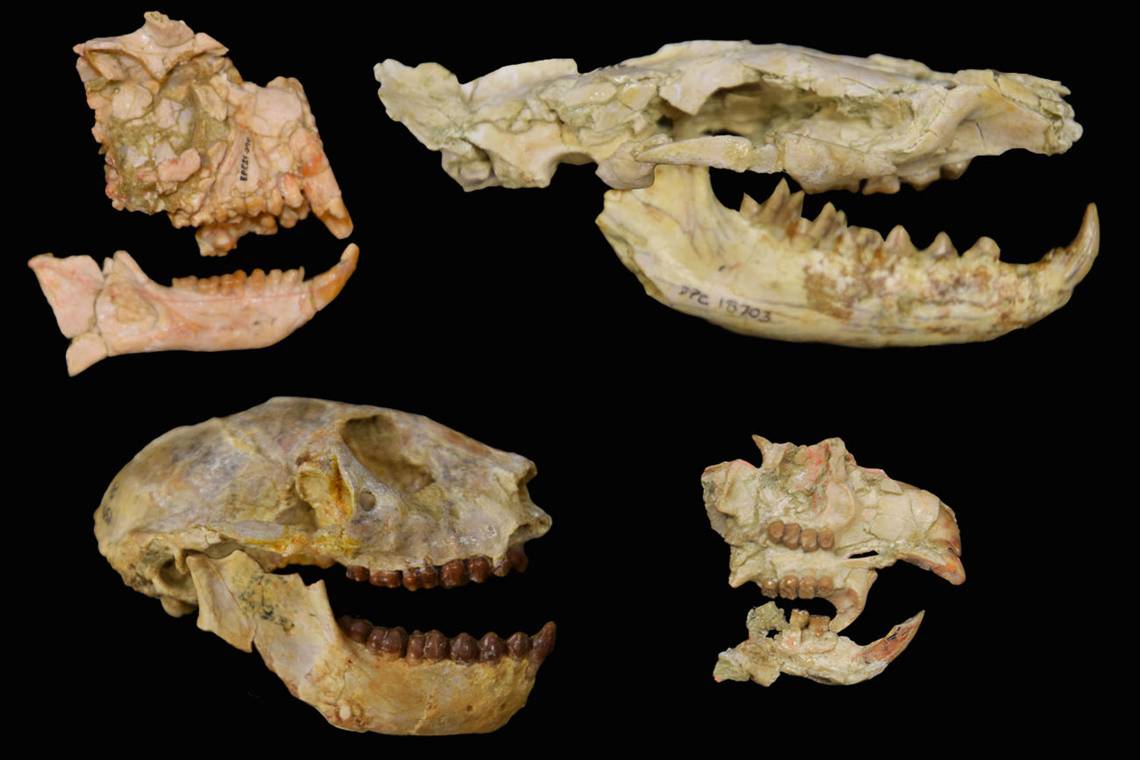
Fossils of the key groups used to unveil the Eocene-Oligocene extinction in Africa with primates on the left, the carnivorous hyaenodont, upper right, rodent, lower right. These fossils are from the Fayum Depression in Egypt.
DURHAM, N.C. – Sixty-three percent. That’s the proportion of mammal species that vanished from Africa and the Arabian Peninsula around 30 million years ago, after Earth’s climate shifted from swampy to icy. But we are only finding out about it now.
Compiling decades of work, a new study published this week in the journal Communications Biology reports on a previously undocumented extinction event that followed the transition between the geological periods called the Eocene and Oligocene.
That time period was marked by dramatic climate change. In a reverse image of what is happening today, the Earth grew cooler, ice sheets expanded, sea levels dropped, forests started changing to grasslands, and carbon dioxide became scarce. Nearly two-thirds of the species known in Europe and Asia at that time went extinct.
African mammals were thought to have possibly escaped unscathed. Africa’s mild climate and proximity to the Equator could have been a buffer from the worst of that period’s cooling trend.
Now, thanks in great part to a large collection of fossils housed at the Duke Lemur Center Division of Fossil Primates (DLCDFP), researchers have shown that, despite their relatively balmy environment, African mammals were just as affected as those from Europe and Asia. The collection was the life’s work of the late Elwyn Simons of Duke, who scoured Egyptian deserts for fossils for decades.
The team, comprising researchers from the United States, England, and Egypt, looked at fossils of five mammal groups: a group of extinct carnivores called hyaenodonts, two rodent groups, the anomalures (scaly-tail squirrels) and the hystricognaths (a group that includes porcupines and naked mole rats), and two primate groups, the strepsirrhines (lemurs and lorises), and our very own ancestors, the anthropoids (apes and monkeys).
By gathering data on hundreds of fossils from multiple sites in Africa, the team was able to build evolutionary trees for these groups, pinpointing when new lineages branched out and time-stamping each species’ first and last known appearances.
Their results show that all five mammal groups suffered huge losses around the Eocene-Oligocene boundary.
“It was a real reset button,” said Dorien de Vries, a postdoctoral researcher at the University of Salford and lead author of the paper.
After a few million years, these groups start popping up again in the fossil record, but with a new look. The fossil species that re-appear later in the Oligocene, after the big extinction event, are not the same as those that were found before.
“It's very clear that there was a huge extinction event, and then a recovery period,” said Steven Heritage, Researcher and Digital Preparator at Duke University’s DLCDFP and coauthor of the paper.
The evidence is in these animals’ teeth. Molar teeth can tell a lot about what a mammal eats, which in turns tells a lot about their environment.
The rodents and primates that reappeared after a few million years had different teeth. These were new species, who ate different things, and had different habitats.
“We see a huge loss in tooth diversity, and then a recovery period with new dental shapes and new adaptations,” said de Vries.
“Extinction is interesting in that way,” said Matt Borths, curator of Duke University’s DLCDFP and coauthor of the paper. “It kills things, but it also opens up new ecological opportunities for the lineages that survive into this new world.”
This decline in diversity followed by a recovery confirms that the Eocene-Oligocene boundary acted as an evolutionary bottleneck: most lineages went extinct, but a few survived. Over the next several millions of years, these surviving lines diversified.
“In our anthropoid ancestors, diversity bottoms out to almost nothing around 30 million years ago, leaving them with a single tooth type,” said Erik R. Seiffert, Professor and Chair of the Department of Integrative Anatomical Sciences at the Keck School of Medicine of the University of Southern California, a former graduate student of Simons, and senior coauthor of the paper. “That ancestral tooth shape determined what was possible in terms of later dietary diversification.”
“There's an interesting story about the role of that bottleneck in our own early evolutionary history,” said Seiffert. “We came pretty close to never existing, if our monkey-like ancestors had gone extinct 30 million years ago. Luckily they didn’t.”
A rapidly changing climate wasn’t the only challenge facing these few surviving types of mammals. As temperatures dropped, East Africa was pummeled by a series of major geological events, such as volcanic super eruptions and flood basalts – enormous eruptions that covered vast expanses with molten rock. It was also at that time that the Arabian Peninsula separated from East Africa, opening the Red Sea and the Gulf of Aden.
“We lost a lot of diversity at the Eocene-Oligocene boundary,” said Borths. “But the species that survived apparently had enough of a toolkit to persist through this fluctuating climate.”
“Climate changes through geological time have shaped the evolutionary tree of life,” said Hesham Sallam, founder of the Mansoura University Vertebrate Paleontology Center in Egypt and coauthor of the paper. “Collecting evidence from the past is the easiest way to learn about how climate change will affect ecological systems.”
Funding for this study came from The Leakey Foundation, the U.S. National Science Foundation (BSC-1824745 to DD. and DBI-1612062 to MRB), and the Natural Environment Research Council (NERC NE/T000341/1). Field work in the Fayum Depression, Egypt, and digital curation of Fayum fossils were supported by the U.S. National Science Foundation (BCS-0416164, BCS-0819186, and BCS-1231288) as well as Gordon and Ann Getty and The Leakey Foundation. Micro-CT scanning was partially supported by NSF grant DBI-1458192, DBI-2023087, and IMLS grant MA-245704-OMS-20.
CITATION:
“Widespread Loss of Mammalian Lineage and Dietary Diversity in the Early Oligocene of Afro-Arabia,” Dorien de Vries, Steven Heritage, Matthew R. Borths, Hesham M. Sallam & Erik R. Seiffert. Communications Biology, 10/07/2021. DOI: https://doi.org/10.1038/s42003-021-02707-9
Fig. 1: Lineage diversity shifts in Afro-Arabian primates, rodents, and hyaenodonts.
a Composite time-scaled tree of Afro-Arabian primates and rodents used for calculation of lineage diversity shifts from the Eocene to Recent. See Supplementary Fig. 1 for full tree. b Black line is the lineage through time (LTT) plot based on the composite tree in (a); light blue histogram shows number of tips in the composite tree in 1 Ma long bins; top, high-resolution astronomically dated benthic carbon (δ13C‰) and oxygen (δ18O‰) isotope curves from the early Eocene to Recent, from Westerhold et al.4. δ18O‰ curve provides a proxy for mean temperature difference from the present day. c LTT plot for the composite tree compared to 10,000 random trees with the same tip ages as the composite tree, but random topologies and branch lengths. d LTT plot for Afro-Arabian Hyaenodonta, a clade of carnivorous placentals that were likely the primary mammalian predators of the primates and rodents in the composite tree. Dan. = Danian, Se. = Selandian, Th. = Thanetian, Bart. = Bartonian, Rup. = Rupelian, Chat. = Chattian, Aq. or Aqui. = Aquitanian, Burd. = Burdigalian, L. or Lan. = Langhian, S. or Ser. = Serravallian, Tort. = Tortonian, M or Mes. = Messian, UD = undivided.
Fig. 2: Lineage diversity and dental topographic disparity in Afro-Arabian primates and rodents from the early Eocene to the middle Miocene.
The blue line is the LTT plot for the primate and rodent species for which M2 dental topographic metrics were calculated; the orange line shows temporal changes in the sum of the square roots of 2D hull areas for all four clades, with 2DHA calculated for each clade (Anomaluroidea, Anthropoidea, Hystricognathi, and Strepsirrhini) independently (sumSR2DHA); the green line shows temporal changes in the length of the minimum spanning tree (MST), calculated for each clade (Anomaluroidea, Anthropoidea, Hystricognathi, and Strepsirrhini) independently (sumMST). sumSR2DHA and sumMST show a tight correlation with lineage number, as shown by the r2 values in the insets (n = 80). Bart. = Bartonian, Aqui. = Aquitanian, Burd. = Burdigalian, Lan. = Langhian.
Fig. 3: Long-term trends in primate and rodent dental topography through the Paleogene and early middle Miocene.
Violin plots of all ancestral reconstructions for ariaDNE, OPCR, and RFI, collated at 0.5 Ma intervals.
Fig. 4: Movement of dental topographic morphospace centroids through time.
a Plot of Euclidean movement of the centroid of each clade’s dental topographic morphospace from their inferred arrival time in Afro-Arabia (first divergence) to 15 Ma, and overall path length, along the first two principal components derived from PCA of the three dental topographic metrics (ariaDNE, OPCR, and RFI). b Comparison of Euclidean movement of morphospace centroids within each order (Primates and Rodentia), showing relative shifts through time; red and orange circles indicate the position of the Eocene-Oligocene and Oligocene-Miocene boundaries, respectively.
Approximately 30 million years ago, there was amass extinction that nobody knew about until recently. As a matter of fact, a whopping 63% of mammals vanished from different parts of the Earth.
The extinction event occurred just after the changes of the geological periods of Eocene and Oligocene. This was also around the time when our planet experienced a drastic climate change from being swampy to icy. The Earth got colder, there were more ice sheets, sea levels dropped, forests turned into grasslands, and there was less carbon dioxide.
As for the mammals living in Africa, they were believed to have survived unharmed because of the continent’s mild temperatures and the proximity to where it was to the equator would have helped in preventing the cooler climates. Unfortunately, based on new research, the African mammals did not survive.
Climate change brought more ice.
A team of international researchers from the United States, England, and Egypt, analyzed a large amount of fossils that are located at the Duke Lemur Center Division of Fossil Primates (DLCDFP) and they found that even though Africa did have warmer weather, the mammals living there were just as tragically affected as those living in Europe and Asia.
The team studied fossils belonging to different groups of mammals – extinct carnivores called hyaenodonts; two rodent groups; anomalures (scaly-tail squirrels) and the hystricognaths (this group includes porcupines and naked mole rats); two primate groups, the strepsirrhines (lemurs and lorises), and the anthropoids (apes and monkeys). By creating a family tree for each of these groups, the team was able to determine that all of them suffered massive losses during the Eocene-Oligocene boundary. On a positive note, millions of years later, they did start appearing again but with different characteristics, specifically the changes in their teeth which indicated a change in their diet and habitat – like a “recovery period”.
Matt Borths, who is a curator of Duke University’s DLCDFP, noted, “Extinction is interesting in that way,” adding, “It kills things, but it also opens up new ecological opportunities for the lineages that survive into this new world.”
The dramatic climate change wasn’t the only factor that these animals had to deal with as East Africa suffered volcanic super eruptions and flood basalts when the temperatures dropped. “We lost a lot of diversity at the Eocene-Oligocene boundary,” Borths explained, “But the species that survived apparently had enough of a toolkit to persist through this fluctuating climate.”
Hesham Sallam, who is the founder of the Mansoura University Vertebrate Paleontology Center in Egypt, weighed in by stating, “Climate changes through geological time have shaped the evolutionary tree of life.” “Collecting evidence from the past is the easiest way to learn about how climate change will affect ecological systems.” A picture of some of the fossils the team analyzed during their research can be seen here.
Fossils of the key groups used to unveil the Eocene-Oligocene extinction in Africa with primates on the left, the carnivorous hyaenodont, upper right, rodent, lower right. These fossils are from the Fayum Depression in Egypt.
(Matt Borths)
The study was published in the journal Communications Biology where it can be read in full.
Think Ancient Egypt Is Remarkable Above Ground? Wait Until You See What They Discovered Under It via Matrix Wisdom
We are awestruck by what they see above the ground in Egypt, but what lies below the ground is even more remarkable. The construction has never been matched by any subsequent civilization. Even modern day experts have no idea how this was created.
Think Ancient Egypt Is Remarkable Above Ground? Wait Until You See What They Discovered Under It via Matrix Wisdom
What do you think? Staying cool this week I hope! Thanks for stopping by. Stay tuned for more BIN news
Massive Anomaly Discovered...There Is Something Bizarre Under The Alaskan Ice via Matrix Wisdom
There is something very strange going on in Alaska. Something is under the ice and it could be more ancient that humanity itself. Furthermore, there are not one but two anomalies in the region, and both are totally beyond comprehension.
Massive Anomaly Discovered…There Is Something Bizarre Under The Alaskan Ice via Matrix Wisdom
What do you think? Staying cool this week I hope! Thanks for stopping by. Stay tuned for more BIN news.
Scientists Are Predicting Polar Vortex To Bring Big Freeze And Coldest Winter :”People Should Be Prepared For a Real Flagstaff Winter”
Polar vortex enters Northern U.S.
The stratospheric polar vortex is a large-scale region of air that is contained by a strong west-to-east jet stream that circles the polar region. This jet stream is usually referred to as the polar night jet. The polar vortex extends from the tropopause (the dividing line between the stratosphere and troposphere) through the stratosphere and into the mesosphere (above 50 km). Low values of ozone and cold temperatures are associated with the air inside the vortex.
The stratospheric polar vortex shows quite a bit of day-to-day variability. This variability is caused by weather systems or large-scale waves that move upward from the troposphere into the stratosphere. In the left image , we see some undulations along the edge of the polar vortex, but the vortex is generally centered on the North Pole. Two weeks later we see the center of the polar vortex pushed away from the North Pole. On a constant latitude circle, PV values are high in the eastern hemisphere and low in the western hemisphere. This is referred to as a wave-1 pattern . The wave-1 pattern develops in the troposphere and moves upward (propagates) into the stratosphere.
These stratospheric waves are forced by the large-scale mountain systems and the land-sea contrasts between the continents and oceans. During the northern winter, these waves are continuously forming and moving upward into the stratosphere. The waves can “break”, much like the waves on a beach. These wave-breaking events erode the vortex and keep the polar region warmer and ozone amounts higher. Often, parts of the polar vortex are pulled away from the main vortex. The image on the right shows this, where a large piece of the polar vortex was pulled away from the main vortex (green colored material at the bottom of the image). A comparison between the middle and right images also shows a slight contraction of the polar vortex because of these waves.
Vortex breakup The polar vortex is a winter phenomena. It develops as the sun sets over the polar region and temperatures cool. During the spring, the sun rises and the absorption of solar radiation by ozone begins to heat the polar stratosphere. This heating eventually causes the vortex to disappear along with the polar night jet. However, this process is helped along by planetary-scale waves that propagate up from the troposphere. This wave event that drives the vortex breakup (or final warming) acts to also increase the temperature of the polar region and ozone levels. We mark the day of the vortex breakup when the winds around the vortex edge decrease below a particular value (about 15 m s -1on the 460 K potential temperature surface).
Health officials have issued a desperate plea to the public, urging them to wrap up warm and turn to pharmacies at the first sign of illness, amid “enormous pressure” on casualty departments. Forecasts suggest could be facing the coldest winter for five years, with average minimum temperatures. Research has also shown that people with conditions such as heart disease, lung problems including asthma, and dementia are much more likely to die in winter.
It also makes the blood more likely to clot, raising the risk of heart attack and stroke, and reduces the lung’s ability to fight off infection.
The senior doctor advised keeping homes warm, with regular hot drinks and meals, and urged people to see their pharmacist at the first sign of health problems.
US submarine hits underwater object in South China Sea, sailors injured
Oren Liebermann
The Seawolf-class fast-attack submarine USS Connecticut departs Puget Sound Naval Shipyard in 2016.
Credit: Petty Officer 1st Class Amanda R/Commander, Submarine Group Nine
A US nuclear powered submarine struck an object underwater in the South China Sea on Saturday, according to two defence officials.
A number of sailors on board the USS Connecticut were injured in the accident, the officials said.
None of the injuries were life-threatening, according to a statement from US Pacific Fleet. It’s unclear what the Seawolf-class submarine may have hit while it was submerged.
“The submarine remains in a safe and stable condition. USS Connecticut’s nuclear propulsion plant and spaces were not affected and remain fully operational,” the statement said.
“The incident will be investigated.”
The US Navy did not specify the incident took place in the South China Sea, only that it occurred in international waters in the Indo-Pacific region.
The accident happened as tensions between the US and China soared over the Chinese military’s incursions into Taiwan’s Air Defence Identification Zone (ADIZ).
The Seawolf-class fast-attack submarine USS Connecticut departs Puget Sound Naval Shipyard in 2016. Credit: Petty Officer 1st Class Amanda R/Commander, Submarine Group Nine
The Connecticut was operating in the waters around the South China Sea as the US and its allies have been carrying out a major multinational show of force in the region led by the United Kingdom’s Carrier Strike Group 21.
The ongoing operations saw exercises with ships from the US, UK, Japan, Australia, Canada, and the Netherlands, including three aircraft carriers, training in and around the South China Sea.
On Saturday, 39 Chinese military aircraft, including fighter jets and transport aircraft, entered Taiwan’s ADIZ, causing the Taiwanese air force to scramble jets and deploy air defence missiles to monitor the aircraft.
Military helicopters carrying tremendous Taiwan flags ahead of a National Day celebration amid escalating tensions between Taipei and Beijing.Credit: NurPhoto via Getty Images
Two days later, China sent 56 aircraft into Taiwan’s ADIZ within 24 hours, the highest number since the self-governed island began publicly releasing such numbers last year.
“We are very concerned by the PRC’s provocative military activity near Taiwan,” US Secretary of State Tony Blinken told reporters at a news conference in Paris Wednesday when asked about the Chinese activity.
“As we said, the activity is destabilising. It risks miscalculation and it has the potential to undermine regional peace and stability. So, we strongly urge Beijing to cease its military, diplomatic and economic pressure and coercion directed at Taiwan.”
Taiwan warns China could invade by 2025
On Wednesday, Taiwan’s defence minister, Chiu Kuo-cheng, said China could be ready to launch a “full-scale” invasion of the island by 2025, adding that “they currently have the ability” to attack, but they would have to “pay a price.”
The Biden administration has shifted the focus of US national security policy away from the wars of the past two decades and towards Beijing, which has asserted itself in the region and on the world stage.
On Thursday, the Central Intelligence Agency announced the creation of a new mission centre for China following a months-long review that found China as the greatest long-term threat to the United States.
One day earlier, national security adviser Jake Sullivan met a high-ranking Chinese official in Switzerland in what one senior administration official called a “candid, direct, and wide-ranging discussion”.
The meeting, which the official said had a “different tone” than an acrimonious meeting between Sullivan and his Chinese counterpart six months ago, set the stage for a virtual meeting between President Joe Biden and Chinese President Xi Jinping later this year in an effort to ensure stability.
Chinese President Xi Jinping meets with US Vice President Joe Biden in Davos, Switzerland, January 17, 2017, before Trump took office.Credit: Xinhua News Agency via Getty Images
But the agreement in-principle between the two leaders to meet did little to alleviate the current friction in the region, nor did it ease the friction around the South China Sea, where China has built a series of bases on reefs and artificial islands in the disputed waterway.
In response to a report in the Wall Street Journal on the presence of US troops in Taiwan, the Pentagon highlighted its support for Taiwan and its defence needs.
“Our support for and defence relationship with Taiwan remains aligned against the current threat posed by the People’s Republic of China,” said Pentagon spokesman John Supple on Thursday, accusing China of actions that are “destabilising and increase the risk of miscalculation.”
A Chinese PLA J-16 fighter jet flies in an undisclosed location.Credit: AP
As relations between the US and China soured, the State Department requested in June 2018 that US Marines be sent to Taiwan help safeguard the de facto US embassy there.
At the time, there were only 10 US troops in the Taiwan, according to Defense Department workforce records, and only one was from the Marine Corps, which is the branch of the military in charge of embassy security.
The number gradually increased to 19 troops two years later, before jumping to 32 troops earlier this year, the records show.
Similarly, the number of US troops in China increased from 14 in 2018 to 55 now, the majority of which are Marines.
White House national security adviser Jake Sullivan, left, and his delegation leave a hotel in Zurich, Switzerland, where a meeting between US and Chinese officials was taking place on Wednesday October 6, 2021.Credit: Michael Buholzer/AP
“The US defence relationship with Taiwan is guided by the Taiwan Relations Act and based on an assessment of Taiwan’s defence needs and the threat posed by the PRC, as has been the case for more than 40 years,” Supple said.
The comments are part of a series of escalating rhetorical attacks between the two superpowers engaged in what Pentagon officials call “Great Power Competition.”
Earlier this week, China criticised the US for what it called “irresponsible remarks,” after the US condemned the Chinese military flights in Taiwan’s ADIZ.
“In recent times, the United States has continued its negative actions in selling weapons to Taiwan and boosting its official military ties between the United States and Taiwan,” said the spokeswoman of China’s Foreign Ministry, Hua Chunying.
CORRECTION:This story has been updated with the correct name for Taiwan’s Air Defence Identification Zone and to clarify that the United Kingdom’s Carrier Strike Group 21 is leading a show of force in the region.
UFO Seen Near Space Station Makes 90 Degree Turn On Live Cam! Oct 5, 2021, Video, UFO Sighting News.
Date of sighting: October 5, 2021
Location of sighting: Space Station ISS
One of the most interesting things about space is that natural objects like meteorites, cannot turn in space...however intelligently controlled craft can. So...this is exactly what I look for when I search for UFOs near the space station. The object comes down...and almost looks like a tiny moon, but its way too small to be the moon! and then it begins to curve to the right...changing directions until it completes a full 90 degree turn! Thats impossible and yet, there it is from the live space station cam! Its a UFO! 100% undeniable proof that aliens exist!
These awesome photos were taken in La Ciotat, France this month. It was taken during sunset over the ocean. These disk shaped cloud formations are created by smaller metallic UFOs that hide at the center of the clouds in order to fly lower and closer to the ground without frightening the people below. The UFOs do not usually search for a cloud, but instead they most often create a cloud around the alien craft. The cloud stays pulled together without breaking due to the UFOs shield being extended outward...which contains the clouds and allows the UFO to have a continual hiding place. This UFO most likely came out of the ocean from an underwater alien base and formed a cloud around itself in order to fly over a few cities of France.
Aliens would like to think they are more intelligent than us and they feel they can outwit us at every turn. However that is not the truth. Their ego is much larger than their intelligence. Today, they were caught over La Ciotat, France.
On the night of October 1st Nguyen NT (living in Tinh Ky Commune, Quang Ngai City) posted a clip on his personal Facebook page with many pictures of a rather strange light streak appearing in the Quang Ngai sky in the afternoon of the day September 29th.
According to Ms. T., the light trail was accidentally recorded by her around 5:30 pm on September 29th. The band is bright red like a shooting star, but it doesn't move.
“A lot of people think that at that time the sun was setting, so there was an image like that. But the image I filmed appeared in the east so it couldn't be said that the sun had already set. The light strip appeared red at first, there was a bright red color. the tail was like a shooting star and then it melted very quickly "- recalls Mrs. T..
Le Thi My (who lives in Quang Ngai City) said he also saw a streak of red light in the sky 3 days ago. It was late afternoon the trail looked like a big shooting star the red light was very beautiful. "Some people think it's a sign of a big storm," My said.
According to Mr. Nham Xuan Sy, Director of Quang Ngai Hydrometeorological Station, with the initial images provided above it is still impossible to conclude anything. "If this image is true, then this is a very strange phenomenon, appearing in the sky for the first time in Quang Ngai," commented Mr. Sy.
Minnesota’s most notorious UFO sighting remains a mystery four decades later
UFOs are getting a ton of attention lately after a recent Pentagon report admits to “unexplained aerial phenomena” the government can’t explain. 1979 Warren UFO sighting!
10 INCREDIBLE ANCIENT TECHNOLOGIES THAT WERE WAY AHEAD OF THEIR TIME
We are yet to uncover so many things of the past. The ancient times were further ahead than we presume them to be. On example is the technology that existed then. They have been many discoveries that determine that the ancient Greeks, Romans, and other civilizations had devised numerous technologies to accomplish day-to-day work. From refrigerators for keeping ice cool in the hot desert to cups that could change color, we bring to you 10 incredible ancient technologies that will just blow your mind.
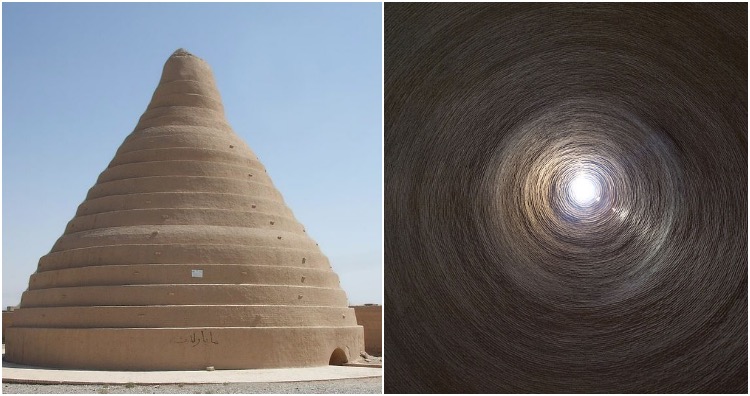
1. By 400 BC, Persian engineers had mastered the technique of storing ice during summers in the desert.
Yakhchal or icehouse (exterior), Meybod, Iran. Image Credit: Ggia via Wikipedia
During the winters, the Persian people used to bring ice from nearby mountains and store them in pits they created in the middle of the desert. The ice pits, known as “yakhchal,” were one of the most ancient refrigerators known to mankind. They were also used to keep food cool and healthy during the intense summers.
On first glance, the structure looks like a large dome made from mud brick. Some of the structures were as tall as 60 feet. Below the dome lies a large underground space with excess storage area. The underground space was as large as 5,00 cubic meters.
The underground space was connected to a “qanat,” or wind catch. The wind catch consisted of multiple windcatchers that had the ability to bring down the temperature to frigid levels during the summers.
The wall of the dome used to be as thick as two meters. Moreover, it was made by a special mortar that was comprised of sand, clay, egg whites, lime, goat hair, and ash in specific proportions. The walls were resistant to heat transfer, thus keeping the insides cool. Also, they were impenetrable to water which helped to keep the ice and food safe.
But what if somehow the ice melted a little bit? For such unforeseen circumstances, a trench was provided at the bottom so that the melted water could be caught and frozen again during the chilly desert nights. The entire structure was really well-thought despite being from an ancient era. (1, 2)
2. The “Archimedes screw” is a hand-operated machine that can move water up using gravity. If reversed, it can generate energy by water moving down.
The Archimedes screw was predominantly used for irrigation purposes in the ancient times. The machine was a screw inside a hollow pipe. The screw was initially operated by hand but later, wind energy was utilized.
The technology exists to this day and is operated with the help of a motor. As the shaft starts to turn, the bottom end of the device scoops up water. this water is then pushed to the top of the screw via the rotating helcoid until it comes out from the top end. (source)
3. There is an ancient masonry technology in Mexico that allows bricklayers to build vaults and roof-type domes using only their trowel, without formworks or ceiling mounts.
Tequisquiapan is a town located in the state of Querétaro Arteaga, one of the 32 federal entities of Mexico. The town is home to a generation of masons known as “bovederos.” These masons seem to have a superpower as they can build vaults and roofs of domes with just their trowel! For those who do not know what a trowel is, it is a small hand tool that is mostly used for digging or when applying concrete to bricks.
So, these masons from Mexico do not need the aid of any support and build domes with just their trowels! The video above shows this gravity-defying act in action. These masons do not require any formworks or ceiling mounts. It is said that the technology has been passed on from parents to children from generation to generation. This is one of the ancient technologies that still exists today. (source)
4. The ancient Egyptians invented the ramp to aid construction processes.
The Egyptians are well known for their massive architectural structures such as pyramids. They normally make their structures quite tall and uniquely shaped. Such massive structures call for the use of ramps during construction. Ancient Egyptians have been known to invent ramps to be used to carry materials during construction.
A ramp is just an inclined plane against a horizontal surface that enables people to overcome resistance. By applying a small force for a longer distance, the load can be carried to a height rather than applying intense force to lift or raise it vertically. The Egyptians were surely ahead in their time when it came to construction. (source)
5. The “Antikythera mechanism” is a 2,000-year-old computer developed by the Greeks. It was used to predict the position of the planets and stars in the sky depending on the calendar month.
One hundred sixteen years ago, divers found came across a shipwreck off the coast of a Greek island. They inspected the site and discovered an odd-looking bronze item. Little did they know that this small discovery would change our understanding of human history.
The structure had a series of gears made of brass and dials mounted on something that looked like a mantel clock. The structure had at least two dozen gears laid on top of one another with perfect calibration. Archaeologists came to the conclusion that this must be some kind of analog clock of the past or a calculating device. A debate went on for years until Princeton science historian Derek J. de Solla Price provided a detailed analysis of the device in 1959.
His study revealed that the device was used to predict the location of the planets and stars taking into account the calendar month. According to Price’s analysis, the main gear would move to represent the calendar year, in turn, would move the separate smaller gears that represent the motions of the planets, Sun, and Moon. In short, when the main gear is set to the current date, the device would point out the location of the celestial bodies in the sky!
In Price’s words, “The mechanism is like a great astronomical clock … or like a modern analog computer which uses mechanical parts to save tedious calculation.” The logic behind calling it an analog computer is that similar to a computer, the user can provide an input and get the desired output based on some calculations. (source)
6. A 1,600-year-old Roman chalice, the “Lycurgus Cup,” shows that Roman artisans were nanotechnology pioneers. They’d impregnated the glass with particles of silver and gold as small as 50 nanometers in diameter.
This ancient jade-green cup appears red when lit from behind. Scientists believe that the Romans may have been the first ones to come across the colorful potential of nanoparticles by accident, but they sure perfected it! This amazing property of the Lycurgus Cup puzzled scientists for decades when the cup was acquired by the British Museum in the 1950s. It was not until 1990 that the mystery was solved.
Researchers studied broken fragments of the cup under the microscope and discovered that the ancient Romans had created the glass with silver and gold particles that were ground to be as small as 50 nanometers in diameter. This was less than one-thousandth the size of a salt grain. This suggests that the Romans knew what they were doing, meaning they had knowledge of nanoparticles!
The way it worked was when the light hit the cup, the electrons belonging to the particles of the cup vibrate in ways that alter the color depending on the position of the observer. So. when different liquids would be poured into the cup, the electrons would behave differently, and the color would change. This is exactly how home pregnancy tests work. (1, 2)
7. Heron of Alexandria was the first to create a programmable robot to entertain audiences at the theatre. The device could move on its own and even change directions! He also invented the first vending machine, syringe, and windwheel among others.
Hero of Alexandria was surely the “Tony Stark” of his time. Many of his creations were the first to have existed. He has been known to create the first vending machine, syringe, force pump, fountain, etc. He is also said to have created a windwheel operating an organ making it the first instance in history where wind energy was used to run a machine.
But the most astonishing of all was the mechanical device that has been termed as the world’s first robot. The device was used to entertain the audience in the theatre. It had the ability to play by itself for almost ten minutes and was powered by a binary-like system of ropes, knots, and simple machines.
The entire structure was operated by a rotating cogwheel that was cylindrical in shape. In the video above, the device has been recreated by New Scientist, a media company. (source)
8. The Hal Saflieni Hypogeum, built by the people of Malta and Gozo, has incredible acoustic properties. The structure is said to amplify voices dramatically with certain frequencies resonating enough to be felt through the body.
The Hal Saflieni Hypogeum is a 6,000-year-old underground burial chamber located on the Mediterranean island of Malta. Archaeologists believe that this underground structure was built by the people of Malta and Gozo around 4000 BCE.
It was used for the purpose of ritualizing life and death. The structure consists of a large network of cavities and corridors. But the thing that has attracted experts to the site is the amazingly unique acoustic properties of the underground chamber.
Amidst all the chambers and corridors, there exists a special chamber that has been carved out of solid limestone. This is the chamber that produces unique sound properties. Known as the “Oracle Chamber,” any sound made in the chamber gets magnified a hundredfold.
Also, the sounds made in the chamber can be heard throughout the structure. According to William Arthur Griffiths, author of Malta and its Recently Discovered Prehistoric Temples, such acoustic properties were created so that when the oracle spoke from the chamber, the words would resonate throughout the structure with terrifying impressiveness.
At certain places within the Hypogeum, certain frequencies or pitches of sound vibrates into the bones and tissues as much as resonating in the ear. Richard Storm, the Sarasota arts and architecture critic, explains the sensation as, “Because you sense something coming from somewhere else you can’t identify, you are transfixed.”
Scientists are still working on whether the underground structure was intentionally made to produce such acoustic wonders or it was just an accident. But in case, it was intentional, and that means that the ancient engineers of Malta knew something that modern scientists have not grasped yet. (source)
9. The 2,000-year-old ancient Roman concrete is far better than the present day concrete. It is more durable and also environmentally friendly.
Experts today are fascinated by the longevity of the ancient Roman concrete structures. These cement structures are more than 2,000 years old, but they are still sturdy. The harbor structures, even after being washed by sea waves for so long, have not shown a single sign of erosion. Take into account our modern cement structures. They just give out after a few decades.
Finally, researchers led by geologist Marie Jackson from the University of Utah were able to study the chemistry involved in the ancient Roman concrete, and they have uncovered some astonishing properties. Not only is the Roman concrete is more durable than modern cement, it even gets stronger with time! The researchers studied the crystalline structure of the cement and were able to discover precisely how the cement solidifies over time.
Modern concrete is a typically a mixture of silica sand, limestone, clay, chalk and other ingredients that are melted together at insanely high temperatures. The final product is made inert so that no chemical reactions can take place that might lead to erosion. This is the reason why concrete does not last as long as natural rocks.
On the other hand, ancient Roman concrete was created with volcanic ash, lime, and seawater. The Romans took advantage of the chemical reactions they may have observed in tuff rocks, which are naturally cemented volcanic ash deposits. More volcanic rock was mixed in with the volcanic ash which would lead to more reactions making the concrete more durable.
The researchers also found out that a very rare mineral known as aluminous tobermorite and a related mineral called phillipsite was found in abundance in the concrete. Note that these minerals were not added but were formed within the cement as a result of the natural chemical reactions. “The Romans created a rock-like concrete that thrives in open chemical exchange with seawater,” says Jackson. (source)
10. Damascus steel used to make blades hold high reputation even today for their toughness and resistance to shattering. They are known to have had the ability to cut through a rifle barrel and to cut a hair falling across the blade.
The Damascus steel is a legendary material that has been widely used by warriors of the past, including the Crusaders.
The remarkable characteristics of the legendary steel became famous when the Crusaders traveled to the Middle East in the early 11th century. People were astonished by the unique properties of the blades.
It is said that the swords made from this metal had the ability to split a feather in midair! Moreover, these swords retained their sharp edges even after being in numerous battles. The swords were easily recognized by a characteristic watery or ”damask” pattern on their blades.
The armorers who made swords, shields, and armor from Damascus steel have been secretive of their method throughout the ages. But with the advent of firearms, the secret was lost.
Fast forward a few centuries, people have been trying to re-create the Damascus steel through reverse engineering. This means that during a time of self-driving cars, we are still unable to decode technologies used by our ancestors. (source)
Declassified documents reveal Project Horizon: The Lunar Outpost of the US Army
Declassified documents reveal Project Horizon 1959: Plans of the United States Army to build a manned lunar outpost.
“The establishment of a manned base of operations on the moon has tremendous military and scientific potential. Because invaluable scientific, military, and political prestige will come to the nation that first establishes a lunar base, it is imperative that the United States be first.“ (Source)
It isn’t a secret that Earth’s moon has been considered as a critical strategic celestial body. Looking back at history, we will find that numerous countries had planned ‘scientific’ outposts on its surface. However, there are certain documents that have only recently revealed militarization projects of the moon.
There is a requirement for a manned military outpost on the moon. The lunar outpost is required to develop and protect potential United States interests on the moon; to develop techniques in moon-based surveillance of the earth and space, in communications relay, and in operations on the surface of the moon; to serve as a base for exploration of the moon, for further exploration into space and for military operations on the moon if required; and to support scientific investigations on the moon. (Source)
On June 9, 1959, the United States Government decided that the construction of a lunar outpost is of great importance to the country. Project Horizon: The establishment of a Lunar Outpost was created in response to growing interest of other nations, like the Soviet Union in the militarization and exploration of the moon. However, its primary goal was to protect potential United States interests on the lunar surface.
During 1959, the Space Race was adopting a whole new level. Two years after the initial proposal of Project Horizon, the first Apollo mission would launch, on October 27, 1961, creating a new chapter in the history of mankind. However, countries around the globe –primarly the US and the Soviet Union—werent only planning traveling to the moon and placing astronauts into orbit around the planet, their plans were way ahead of time, and they had numerous projects already lined up that would have kickstarted the militarization of our solar system.
The rapid advances in propulsion, electronics and space medicine and other astronautical sciences in the 1950’s would have allowed the successful construction of a military outpost on the moon.
„To be second to the Soviet Union in establishing an outpost on the moon would be disastrous to our nation’s prestige and in turn to our democratic philosophy. Although it is contrary to United States policy, the Soviet Union in establishing the first permanent base may claim the moon or critical areas thereof for its own.“ (Source)
The outpost was planned to be of sufficient size in order to contain sufficient equipment that would later be used in the militarization and exploration of the moon. The military outpost was designed in order to allow the survival and moderate, constructive activity of ONE person, and 10-20 on a sustained basis.
During planning, researchers considered that the outpost needed to be designed for expansion facilities, supply and operation of personnel in order to maintain the maximum extension of sustained occupancy. The futuristic project of 1959 was planned to be self-sufficient for as long as possible without any additional support from Earth.
However, not only was Project Horizon the first step of lunar militarization, the base was designed so it could sever as a permanent manned installation on the moon, which eventually would allow the investigation of scientific, commercial and military potential on the lunar surface.
The lunar outpost was intended to serve as an observation post which would facilitate –in the near future—travel between Earth, the moon and eventual exploration of our solar system and outer space.
The establishment of a manned US outpost on the moon will:
Demonstrate the United States scientific leadership in outer space
Support scientific explorations and investigations.
Extend and improve space reconnaissance and surveillance capabilities and control of space.
Extend and improve communications and serve as a communications relay station.
Provide a basic and supporting research laboratory for space research and development activity.
Develop a stable, low-gravity outpost for use as a launch site for deep space exploration.
Provide an opportunity for scientific exploration and development of a space mapping and survey system.
Provide an emergency staging area, rescue capability or navigational aid for other space activity.
Project Horizon included a ‘sophisticated’ defense system that would be incorporated into the lunar outpost. The base would be defended against Soviet overland attack by man-fired weapons:
Unguided Davy Crockett rockets with low-yield nuclear warheads
Conventional Claymore mines modified to puncture pressure suits
Take in count that all of this was possible in 1959. Over half a century later, with the numerous technological advancements, just imagine what we are capable of.
Army imagery of Project Horizon, the Army’s proposed base on the moon.
“ … a lunar outpost … is of critical importance to the U.S. Army of the future.” It was March 1959, and Army Lt. Gen. Arthur G. Trudeau, the author of those words, was tasking the Army’s chief of ordnance to develop a proposal for a “manned lunar outpost” that would “protect potential United States interests on the moon.” The story behind this secret study (called “Project Horizon”) and the plan to have an Army base on the moon by 1966, is the story of a great idea whose time has never come.
When Trudeau wrote the ordnance chief, it was less than a year after the Soviets had shocked America and the West with the launch of the Sputnik satellite. With the United States now clearly behind in the so-called “Space Race” with the Soviets, it should come as no surprise that Trudeau and other senior Army leaders were thinking about a military presence in outer space in general – and on the moon in particular. In fact, according to a 118-page monograph produced by the Army in June 1959, “to be second to the Soviet Union in establishing an outpost on the moon would be disastrous to our nation’s prestige and in turn to our democratic philosophy.” Since the Soviet Union had already claimed that its citizens – and presumably the Red Army – would be on the moon in 1967, it was urgent for the United States to get there first.
The Army concluded that seventy-five Saturn II rocket launches could be achieved by the end of 1964 – with forty of these launches needed to put sufficient Project Horizon equipment into orbit for the lunar base’s construction.
The plan was to build a self-sustained moon base that would serve as an outpost for exploration of the moon, and further exploration of space. The base – which would house 10-20 personnel – would be the “first permanent manned installation on the moon” and, perhaps most importantly, would provide a platform for the Army, if required, to conduct “military operations on the moon.”
Cover sheet of the Project Horizon proposal. Note the illustration of the Saturn II that the Army planned to employ in building and supplying the moonbase.
The Army insisted that there were no known technical barriers to establishing a manned lunar base and believed that Project Horizon “should be a special project having authority and priority similar to the Manhattan Project in World War II.” After all, if America had built the atomic bomb, there was no reason that it could not put a handful of soldiers on the moon. Project Horizon contemplated using the multistage Saturn II rocket, then under actual development, and intermediate orbiting space stations (then only on drawing boards) to ferry construction materials to the moon. The Army concluded that seventy-five Saturn II rocket launches could be achieved by the end of 1964 – with forty of these launches needed to put sufficient Project Horizon equipment into orbit for the lunar base’s construction.
As for the base itself, the scientists and technicians who took part in Project Horizon suggested that natural “holes” or “caves” could be covered and sealed with pressure bags to create living space on the moon. This sort of construction also had the attraction of lessening the danger from meteorites and alleviating temperature extremes on the lunar surface. Drawings in the Army study also show a buried cylindrical structure that included living quarters – and an airlock to the surface. As for power, it would be provided by solar or nuclear energy. Oxygen and water could be extracted from the natural environment of the moon. Military personnel stationed on the moon would wear space suits and carry special weapons and equipment developed expressly for moon-use.
The proponents of Project Horizon argued that America’s ultimate goal on the moon should be to deploy moon-based weapons systems. Why? Because moon-based military power would be a strong deterrent to war since an enemy would have great difficulty in preventing U.S. retaliation.
The Army also proposed that a “unified space command” be created to control the lunar base and “that portion of outer space encompassing the earth and the moon.” There seems little doubt that the Army leaders who pushed Project Horizon saw an Army general as the perfect choice to lead such a unified command.
A page from the Project Horizon proposal, detailing plans for layout and living quarters.
The proponents of Project Horizon argued that America’s ultimate goal on the moon should be to deploy moon-based weapons systems. Why? Because moon-based military power would be a strong deterrent to war since an enemy would have great difficulty in preventing U.S. retaliation. This was because the enemy – read the Soviet Union – would have a hard time reaching the moon and, if American forces were already present, they could counter or neutralize any hostile force that might land. This, of course, was also the reason that American military forces must reach the moon first, and establish a military outpost, since the enemy could counter any U.S. attempt to land on the moon “if hostile forces were permitted to arrive first.”
A Manhattan Project-scale effort might have worked, but it would have required a huge increase in the U.S. government’s expenditures on defense and, as the alarm over Sputnik dissipated, there seems to have been diminishing political interest in funding a military base on the moon.
The Army officers working on Project Horizon concluded that the United States could establish “an operations lunar outpost by late 1966,” assuming that “initial manned landings” took place in the spring of 1965.
So what happened to Project Horizon, and the Army’s plan to have a manned lunar outpost?
First of all, the technological challenges were more difficult than the authors of Project Horizon had thought – and also considerably more expensive. A Manhattan Project-scale effort might have worked, but it would have required a huge increase in the U.S. government’s expenditures on defense and, as the alarm over Sputnik dissipated, there seems to have been diminishing political interest in funding a military base on the moon.
Second, the expansion of the war in Vietnam also siphoned off energy – and money – that might have gone to Project Horizon.
Finally, and most importantly, any future American military presence on the moon became an impossibility when the United States, Soviet Union and United Kingdom signed an outer space treaty in 1967.
Known formally as the “Treaty on Principles Governing the Activities of States in the Exploration and Use of Outer Space, including the Moon and Other Celestial Bodies,” this international agreement limited the use of the moon to peaceful purposes. In short, the militarization of the moon was no longer an option – and remains an impossibility since this international treaty is still in effect.
It took until 1969 before a man – astronaut Neil Armstrong – would take a giant leap for mankind on the surface of the moon, but there is still no base of any kind there. While Project Horizon is largely forgotten today, it remains a great idea whose time simply never came.
Although NASA was formed in 1958, Project Horizon – a plan to construct a base on the Moon– fell under the auspices of the military, specifically the U.S. Army. The plan was to create what would ultimately become a vast base on the surface of the Moon – a base that would be armed with nuclear weapons and which could be used to attack the Soviets if the United States was hit by a sneak attack and the infrastructure of the nation was significantly destroyed. It was in late March 1959 that the ambitious program was put into place. Overseeing many of the plans to create the secret base was Lieutenant General Arthur G. Trudeau. At the time, Trudeau was the Army’s Chief of Research and Development. Now-declassified files on Project Horizon demonstrate that Trudeau and his team estimated it would cost approximately $6 Billion to design, build and fully equip a base on the Moon. In a document titled “Project Horizon: A U.S. Army Study for the Establishment of a Lunar Military Post,” Trudeau penned the following words: “There is a requirement for a manned military outpost on the Moon. The lunar outpost is required to develop and protect potential United States interests on the Moon; to develop techniques in Moon-based surveillance of the Earth and space, in communications relay, and in operations on the surface of the Moon, for further exploration into space and for military operations on the Moon if required; and to support scientific investigations on the Moon.”
(NASA)
That’s our Moon
The program was indeed a grand one, a far-reaching operation designed to ensure that the control of outer space would fall into the hands of the United States. Plans were quickly initiated, in the wake of the publication of Trudeau’s report. One of those who was brought into the program was Wernher Von Braun – a Nazi scientist, who, at the end of the Second World War, was secretly brought to the United States under cover of a classified program called Operation Paperclip. Von Braun (who should have been 100 percent kicked out of the operation because of his Second World War activities) chose to assign an engineer named Heinz-Hermann Koelle to oversee Project Horizon. Koelle, too, fought for the Nazis during the Second World War. The initial plans were for the Moon base to be relatively small, which made a great deal of sense. After all, we’re talking about entirely new territory and technology. So, the plan was to slowly and bit by bit make the base bigger and bigger as time went on. But, initially, it would be something akin to a North Pole outpost, with a staff of around one to two dozen.
cosmonauts, invading the base and armed to the teeth with high-tech weaponry. On the scientific side of things, a great deal of research was focused on ensuring that the base would have a plentiful supply of water and oxygen – which, of course, none could live without. Plans were initiated to hUsing the base as a strategic military facility, as well as a place in which the mysteries of the Moon and the Solar-System could be carefully and secretly studied, ensured that America would have a significant lead over the Soviets – who were clearly a major threat at the time. In fact, on this issue of a Soviet threat, the Project Horizon team gave serious consideration to the possibility that Russians might very well try and destroy the base – possibly with Russianave vast shuttle craft sending endless supplies of water and food to the base – that is, until the base and its staff became completely self-sufficient.
As for how and where, exactly, the base would be constructed, Project Horizon’s scientists were of the opinion that the best option would be to build it in a natural crater or cavern. Such was the enthusiasm for the program, an estimation was made that the initial construction of the base could begin in 1965 – four years before Neil Armstrong set foot on the surface of the Moon. Project workers suggested that it might be wise to construct significant parts of the base underground, chiefly to protect it from not just the Soviets, but from natural space debris too, such a fragments of meteorites and / or comets – and also from potentially lethal radiation. Although Project Horizon was deemed a feasible, major program of the military, it was ultimately deemed to be too far ahead of itself. The military concluded that the plans for Horizon to begin in 1965 were overly ambitious in the extreme and the program was cancelled. Or, at least, we are told it was canceled. There are indications that this may not have been the case, and that the plans to control outer space went ahead in deep secrecy.
On this particular issue, it’s most intriguing to note that there is yet another story that suggests the United States has a secret space program – and, rather notably, it dates back to 1965; the very year in which the U.S. Army had said that it could begin constructing a base on the Moon. The story comes from a man named Karl Wolfe. At the time in question, Wolfe was in the Air Force, working on a program based at Langley Air Force Base, Virginia that was supporting NASA’s lunar-orbiter programs. It was while he was stationed at Langley learned of highly classified photographs held at the base that showed what were clearly buildings and facilities on the far side of the Moon – which, notably, and due to its specific orbit, never shows itself to the Earth. So, constructing a secret base on the side of the Moon that we never get to see would make perfect sense.
Of course, some people might suggest – and, indeed, have suggested – that the photos Karl Wolfe came to know of showed not a facility of the U.S. Army, but of visiting aliens. Not an impossible scenario, but, when we take into consideration the possibility that Project Horizon was not canceled, then it’s not at all improbable that some kind of installation does indeed exist on the Moon – whether on it or below its surface – and served a major role in the development of a secret space program. It may very well still serve that same program to this day. Except, we just don’t know about it.
Meer van UFO'S of UAP'S, ASTRONOMIE, RUIMTEVAART, ARCHEOLOGIE, OUDHEIDKUNDE, SF-SNUFJES EN ANDERE ESOTERISCHE WETENSCHAPPEN - DE ALLERLAATSTE NIEUWTJES


 Massive UFO near the sun shoots out into space