Location of discovery: Planet Mercury
Source Photo:

Alien Base On Mercury 20km Across! NASA Source, photos, UFO Sighting News.
UFO witnessed in northern lights

The northern lights take a drastic turn when UFOs seem to erupt in the sky. Is this proof of extraterrestrial life?
RELATED VIDEOS, selected and posted by peter2011
Singing Lemurs Create the Rhythm of Queen’s ‘We Will Rock You’

According to the “infinite monkey theory,” an infinite number of monkeys randomly hitting a keyboard an infinite number of times will at some point type the complete works of William Shakespeare. That would be an impressive, albeit accidental, accomplishment. But could it be topped? Could an infinite number of monkeys add music to the words and compose the complete works of The Beatles? How about The Monkees? Queen? It turns out the odds of this happening are better because of a species called the singing lemur which has just demonstrated that humans and birds are not the only animals with musical rhythm – singing lemurs matched the beat of Queen’s “We Will Rock You.” What next … lemurs leading the cheers at football games?
Buddy, you’re a monkey, lemur
Shouting in the trees, gonna take on the world someday
You got mud on your face, you big disgrace
Waving your tail all over the place
Lemurs, lemurs rock you
— (apologies to Queen)
Singing lemur by Alfred Grandidier (1875-1921)
While most songs have a 1:1 beat structure with the notes being of the same length, Queen’s “We Will Rock You” has a 1:2 ratio where some notes are twice as long as the others – specifically, the short-short-long pattern of stomps and claps. Mastering that rhythm was thought to be something only humans and a few birds (the nightingale thrush is one) could do until Chiara De Gregorio, a primatologist at Italy’s University of Turin went to the rainforests of Madagascar to study the critically endangered primate known as the indri (Indri indri) or singing lemur – one of the world’s largest lemurs. Their singing was well known – their loud songs can last up to three minutes and are a form of communication or warning signals – but it was thought to be random. De Gregorio and her team discovered otherwise.
“Since indris’ songs are composed of notes that are organized in phrases, they were very good candidates to understand if indris would share the same categorical rhythms that are typical of human music.”

De Gregorio explains in Inverse (and in a study published in Current Biology) how the researchers recorded indris singing in the wild, measured the intervals between the lemur’s musical notes, then “calculated the ratios between two subsequent notes by dividing each onset for its duration plus the duration of the following one.” They were shocked to find the lemurs using the 1:2 ration because “aspects of human musicality rare in other species.”
“Finding in indris [a] musical universal may indicate that human music is not truly novel, but its intrinsic musical properties are more deeply rooted in the primate lineage than previously thought.”
Does the band need a horn section?
Is this a “Planet of the Apes” moment that will lead to singing lemurs taking over the music charts? Hardly. In fact, there’s no chance a million of them working together could compose Queen’s “Bohemian Rhapsody” or “We Will Rock You” because the indri are so critically endangered – there are less than 10,000 in the wild on Madagascar. De Gregorio hopes her work can help save the indri from extinction. Maybe what she needs is a singing lemur cheer.
We will, we will save you, yeah, yeah, come on
We will, we will save you, alright, louder!
We will, we will save you, one more time
We will, we will save you
Space Force Wants to Build Superhighways to the Moon and Space Stations

On June 29, 1956, President Dwight D. Eisenhower signed the National Interstate and Defense Highways Act into law, authorizing the construction of 41,000 miles of the Interstate Highway System to provide access between U.S. military bases in the event of a war with the Soviet Union and its allies. Fortunately, the main benefit of the interstate system was to fuel the growth of the United States geographically and economically, but the military is now thinking about the need for another superhighway system to protect the U.S. against new enemies … in space. Who will build this space superhighway? The Space Force, of course!
“If you read their language, if you read their products — which I am a vigorous student of — if you look at what they do they telegraph everything that they’re going to do, they believe that the Moon is manifest destiny for them (and part of their) economic … and security equation.”
Space Uber driver?
Speaking last week at a National Defense Transportation Association seminar on space logistics, Space Force Brigadier General John Olson warned the audience that China is his perceived enemy in space based on their activities recently with a lunar rover on the Moon’s far side, a quickly constructed space station and two recent tests of hypersonic space gliders that could possibly be nuclear-tipped. Olson is an Air Force reservist, has NASA experience, served in the Obama White House at the Office of Science and Technology Policy, and is now Deputy Chief of Space Operations for Technology and Innovation of the Space Force and Mobilization Assistant to the Chief of Space Operations, so it’s no surprise that his solution to winning a space race with China is through Space Force mobilization. But … a space superhighway?
In the near term, Olson told the attendees this means encouraging industry to push forward the boundaries of space activities to make real the promise of future space utilization. Space Force is in the early stages of working with industry via Cooperative Research and Development Agreements (CRADAs, which involve no funding) on figuring out how to build the space infrastructure required — such as re-fueling depots along a “space superhighway,” he explained.
Breaking Defense was in attendance at the meeting and reports that Olson pitched the benefits of commercial space logistics – just like the interstate highway system – to help the US military “dominate” Space Command’s Area of Responsibility (AOR) which is defined as 100 km above the Earth to infinity, and support a support “resilient and persistent occupation” of space by the US “at a lower cost.” And like the interstate highway system and the current private space program, Olson sees “90-to-95 percent” of the investment in the space superhighway coming from industry.
This interspace highway system won’t be a concrete ribbon to the Moon – Olson sees it at first as a series of refueling depots. It will start with “Rocket Cargo” – using rockets to deliver military supplies point-to-point on Earth. That will lead to delivering supplies (and possibly weapons) to future space stations and eventually to the Moon and beyond. Does this mean the U.S. is abandoning the 1967 Outer Space Treaty (OST) which bans any nation state from claiming sovereignty over the Moon and other celestial bodies, and prohibits military maneuvers or weapons testing or establishing military bases on celestial bodies? Olson says no – or perhaps not yet – but implies that China’s actions seem to indicate it plans to – despite being a signatory with Russia on the OST.
Could a space superhighway start out with a military purpose and then evolve into a commercial and public highway like the interstate system? It’s possible, although the highway system was built when Americans were already driving – no one but billionaires are traveling to near space at the moment. IS the Space Force equipped to build such a highway? It’s sounds more like private corporations will do the building for a share of the toll fees, while the Space Force will be the traffic cops.
Does this sound like the militarization of space? What do you think? What would President Eisenhower think?
The M.I.B.: Looking at the The Two Different Groups – One Human and One NotThe topic of today’s article is on the fact that there are two groups of M.I.B., rather than just one. There might be more than two, but two is enough for today. I have to say that this issue – of there being two types of M.I.B. – is one of the most misunderstood within the UFO subject. Almost certainly, that explains why Gray Barker saw the M.I.B. as government agents, while Albert Bender saw them as something akin to high-tech, multi-dimensional demons. One of the groups originated with the U.S. government. The other, however, had – and still has – very different origins. Over the years, I have come to realize just how weird this two-pronged phenomenon is. Now, you will too. Some M.I.B. come from the worlds of government, the military, and the intelligence agencies of several countries. The FBI, at the order of J. Edgar Hoover, opened a file on Barker in the Fifties. The CIA’s “Robertson Panel” recommended keeping a secret watch on UFO groups – in the event they had “Red” leanings – in the 1950s. Clearly, some visits to UFO witnesses and researchers were from one or more of the various “ABC” agencies of the U.S. government. And those visitors were not beyond intimidating some of the early figures in Ufology. They did so by flashing ID cards and ordering those same figures to walk away from it all. Those who came calling and knocking loudly on front-doors in the post-Second World War era wore suits and fedoras – and often black. It just so happens, though, there was that other group of black-suited characters. They wore fedoras, too. These are what we might justifiably call the real M.I.B. They’re still around and they are most definitely not human.
It must be said this second group of M.I.B. were far removed from the world of government. They still are far removed from government. They are pale, skinny, cadaverous figures who look like they would be at home in an old, 1930s-era, black-and-white horror movie – and with Bela Lugosi at the helm. To this day, they still look like that: sickly and zombie-like. It gets weirder. Witnesses to the M.I.B. (and to their comrades, the Women in Black) tell of feeling sick and ill in their presence: as if they are being drained of energy. “Crashing” would be a good word to use. Yes, the vampire parallels are easy to make in M.I.B. world. Those unfortunate enough to encounter the Men in Black report poltergeist activity in their homes and in the wake of the confrontations. The real M.I.B. are far less like Tommy Lee Jones and Will Smith, and far more like the menacing characters-in-black in the 1998 movie, Dark City. You want to see what the M.I.B. really look like? Check out Dark City.
It’s unclear which group of M.I.B. came first – the government ones or the much stranger ones. Most of the data, however, suggests the supernatural group were first on the scene – in the late 1940s. By the early 1950s, however, government agencies knew enough of this weirder side of Ufology. And, as a direct result, government agents “hijacked” the real M.I.B. phenomenon for their own purposes. When they needed to cover their tracks, those in the intelligence world, and/or those in the military whose job it was to intimidate people who had seen UFOs, would put on the black suits and the black fedoras. They became the M.I.B. Essentially, they were playing a role that was inspired by a much stranger mystery. Documentation declassified via the terms of the U.S. Freedom of Information Act makes it clear that, in the 1950s and 1960s, the U.S. Air Force and the FBI were on the trail of the M.I.B., but they had no real idea of who or what they were. This didn’t stop the world of officialdom from pretending to be the M.I.B., however, when the time and the place was deemed appropriate.
So, in conclusion, yes, the M.I.B. are indeed all too real. In the early years of the Cold War, a genuine enigma of a supernatural – possibly extraterrestrial – nature was carefully, and brilliantly, mimicked by intelligence agents to ensure their real identities were never known. Those same government agents may actually not have had any real idea of what, or who, it was they were copying. Even up to today, they probably still don’t know. But, here’s the important thing in all of this: that lack of understanding of what the M.I.B. are has not stopped spies, agents and experts in the fields of surveillance and intimidation from passing themselves off as M.I.B. Meanwhile, in the background and in the shadows, the real, non-human Men in Black – with their plastic-looking faces and their bulging eyes – continue to lurk, waiting for their next target.
Linda Moulton Howe: More Strange Booms and 20 Nukes Turned Off by UFOs(1).jpg)
(1).jpg)
Linda Moulton Howe: More Strange Booms and 20 Nukes Turned Off by UFOs
TOPICS: From October 12th in Arizona to October 17th in Louisiana — citizens, law enforcement, and scientists are baffled by reports of strong house-shaking booms without any physical evidence. And the big military secret that UFOs have repeatedly turned off 10 Minuteman missiles at a time since the 1960s has military witnesses who think the public and Congress should know the truth.
What do you think? Let us know in the comments. Hope everyone has a great week.
White TicTac UFO Over Conyers, Georgia 10-25-2021, UFO Sighting News.
NASA chief Bill Nelson talks UFOs and Alien life
Russian Documentary About USOsTake a look at this Russian documentary about USOs or Unidentified Submerged Objects. It’s truly baffling. This documentary is from 2006. They are talking about “tic-tac” shaped fast objects 30 meters in length, even things that divide into two pieces, which reminds me of the UFO Aguadilla coast guard UAP video. Any thoughts?
RELATED VIDEOS, selected and posted by peter2011
We’re no strangers to ‘alien’ false alarms – one was caused by a microwave ovenShutterstock
We’re no strangers to ‘alien’ false alarms – one was caused by a microwave oven
The group of Russian astronomers spotted something unusual. They were observing the rather innocuous star HD 164595, located in the constellation of Hercules 94 light years (or about 900 trillion kilometres) from Earth. It’s a sun-like star of a similar age to the Sun and is known to have at least one large planet orbiting it. So it was with some surprise that the astronomers at the RATAN-600 radio telescope, located in Zelenchukskaya and led by Nikolay Bursov, received a short but loud radio burst from the direction of HD 164595.
News of the signal broke in mid August this year – even though it was originally picked up on May 15 2015. Given the possible origin of the radio signal, its frequency, and the signal strength there has been much speculation about what the source could be, including the possibility that it is a beacon signal from an advanced alien civilisation.
Such a short duration and bright radio burst is difficult to explain as a naturally occurring, if it is at the distances suggested by the direction it came from. The strength of the signal was 0.75 Janskys, which might not seem much given that a mobile phone at a distance of a kilometre has a signal strength of 110m Janskys. But at the distances involved (if it is coming from HD 164595) it is a very powerful signal indeed.
In response to the announcement, the Search for Extra-Terrestrial Intelligence (SETI) and Messaging to Extra-Terrestrial Intelligence (METI) institutes are turning the Allen Telescope Array and the Boquete Optical SETI Observatory towards the star. They hope that if this bank of radio telescopes built in part to look for alien life can recover the signal, they can learn more about its nature and origin.

So is the mysterious signal likely to be a message from space? If it is a beacon signal, sent in all directions, the transmitter would need a hundred million trillion watts of power. This power consumption is about a hundred million times the entire energy output of all the power stations on Earth.
The power requirement could be reduced quite a lot by pointing the beam at the Earth, rather than broadcasting in all directions. This would reduce the power needed to just about the entire Earth’s output. However, at a distance of 94 light years, the radio signal from HD 164595 would have to have been sent years before the source received any of the radio signals that leak out into space from the Earth. Which raises the question why any alien civilisations would have targeted our planet.
The frequency that the HD 164595 signal was detected is in the military wave band and not at a frequency we would expect a “Hello” signal to be. We would expect such a signal to be broadcast at a frequency with little noise that astronomers, alien or human, would be using such as the 21cm hydrogen frequency. The detected frequency of the transmission and its strength mean it is more likely a military signal that has bounced off some space debris and into the Russian observatory than an alien signal from deep space. A local source such as this would explain both the short duration and the intensity of the signal. It is also telling that in the previous thirty-eight HD 164595 observations, no trace of any radio signal has been seen.
False detections have been made before. The most recent signal was found to be caused by a kitchen microwave being opened while it was still running. In the 1960s, the first pulsar was mistaken for an extra-terrestrial beacon, and even named Little Green Men 1, before being recognised as a rapidly rotating core of a dead star.
However, not all SETI signals have been explained. The most famous, the WOW signal of 1977, was both brighter and longer than the 15th May signal. And despite follow up observations, the WOW signal was never observed again and remains largely unexplained. Likewise, KIC 8462852, a star in the constellation of Cygnus, that appears to be changing in brightness in a strange way that currently cannot reasonably be explained. It might even be a mega structure being built around the star by an advanced civilisation.
Perhaps the most important thing that comes out of the HD 164595 signal is that there is still a lot of things out there we don’t yet understand and we need to keep looking.
“Mark is a professional astronomer, author and science educator working in the School of Physics Astronomy and Mathematics at the University of Hertfordshire where he holds the Ogden Fellowship. He is actively involved in the University’s extensive public engagement and school education programme.”
Mysterious 'alien beacon' was false alarm

The 64-metre Parkes Murriyang telescope is one of the facilities involved in the search for extraterrestrial intelligence, or SETI.
Credit: CSIRO/A. Cherney
A radio signal detected by an Australian telescope in 2019, which seemed to be coming from the star closest to the Sun, was not from aliens, researchers report today in two papers in Nature Astronomy1,2.
“It is human-made radio interference from some technology, probably on the surface of the Earth,” says Sofia Sheikh, an astronomer at the University of California (UC), Berkeley, and a co-author of both papers.
But the disturbance, detected by Breakthrough Listen — an ambitious and privately funded US$100-million effort in the search for extraterrestrial intelligence (SETI) — looked intriguing enough at first that it sent astronomers on a nearly yearlong quest to understand its origins. It was the first time that data from Breakthrough Listen triggered a detailed search, and the experience puts scientists in a better position to study future candidate detections.
“It’s really valuable for us to have these dry runs,” says Jason Wright, an astronomer at Pennsylvania State University in University Park. “We need these candidate signals so we can learn how we will deal with them — how to prove they are extraterrestrial or human-made.”
Since 2016, Breakthrough Listen has used telescopes around the world to listen for possible broadcasts from alien civilizations. The programme has picked up millions of radio blips of unknown origin, nearly all of which could be swiftly classified as coming from radio interference on Earth, from sources such as mobile-phone towers or aircraft radar.
The 2019 signal was different. It was detected by the 64-metre Parkes Murriyang radio telescope in southeastern Australia and came from the direction of Proxima Centauri — the nearest star to the Sun, just 1.3 parsecs (4.2 light years) away. Proxima Centauri is of intense interest to SETI researchers, not just because it is nearby. The star has at least two planets, one of which orbits at the right distance for liquid water to be present on its surface — a prerequisite for life as it exists on Earth3. A sibling initiative to Breakthrough Listen, known as Breakthrough Starshot, aims to send a tiny spacecraft to this planet in the future to look for life there.
The mysterious signal was first spotted last year by Shane Smith, an undergraduate student at Hillsdale College in Michigan, who was working as a research intern with Breakthrough Listen. Smith was combing through data that Parkes collected over six days in April and May the previous year. The telescope had been making observations in the direction of Proxima Centauri for 26 hours. It was not hunting specifically for aliens at the time, but was instead monitoring flares on the star’s surface, which could hurt the chances for life to arise on nearby planets.
The data included more than 4 million signals from the vicinity of the star, but Smith noted one signal near 982 megahertz that seemed to originate from the star itself and lasted about 5 hours. "I was excited to find a signal that matched all the criteria I was looking for, but I immediately remained skeptical of it and thought there had to be some simple explanation," Smith says. "I did not ever think the signal would cause such excitement."
Smith shared the information with his supervisor Danny Price, who posted it on a Breakthrough Listen Slack channel, and the team started investigating in earnest. “My first thought was that it must be interference, which I guess is a healthy attitude, to be sceptical,” says Price, an astronomer at UC Berkeley and the Breakthrough Listen project scientist in Australia. “But after a while I started thinking, this is exactly the kind of signal we’re looking for.”
The signal, named BLC1 for “Breakthrough Listen candidate 1”, was the first to pass all of the programme’s initial screening tests to rule out obvious sources of interference. “It definitely had me wondering ‘what if?’ for a bit,” says Sheikh.
She, Price and a large group of colleagues began working through possible explanations, from uncatalogued satellites to transmissions from planetary spacecraft. In Australia, the radio-frequency band around 982 megahertz is primarily reserved for aircraft, but the scientists could not identify any aeroplanes that had been in the area and could account for the signal — and certainly not one lasting 5 hours.
In November 2020, and in January and April of this year, the researchers pointed the Parkes telescope at Proxima Centauri to see if they could pick up the signal again. They could not.
Eventually, the team spotted other signals in the original data that looked a lot like the 982-megahertz signal but were at different frequencies. These signals had been tossed out by the team’s automated analysis as being earthly interference. Further analysis showed that BLC1 and these ‘lookalike’ signals were all interference from an unknown source. The signals had modulated and muddied one another, much as a guitar amplifier modulates and distorts a guitar note, which is what made it so difficult to identify BLC1 as interference.
Because the signal didn’t re-appear in the 2020 and 2021 observations, it might have been coming from malfunctioning electronic equipment that got shut down or fixed, says Sheikh. The team suspects the equipment was relatively close to Parkes, perhaps within a few hundred kilometres. The frequency of the signal drifts in a way that is consistent with inexpensive crystal oscillators such as those commonly used in computers, phones and radios, says Dan Werthimer, a SETI astronomer at UC Berkeley who specializes in signal processing.
Working with another student, Sheikh is now using machine-learning algorithms to tease out what frequency the interfering equipment was transmitting at, which might help to track down its source. One lingering mystery is why the signal seemed to appear only when the telescope was pointed at Proxima Centauri. That might just be an unfortunate coincidence, if the cadence of the interference mimicked the cadence with which the telescope was looking at the star.
Radio interference has bedevilled other astronomical searches before, such as when flickering signals picked up at Parkes turned out to be the result of people microwaving their lunches4. The famous ‘Wow!’ signal, detected in 1977 by a radio telescope in Ohio, was a powerful blip so intriguing that the observing scientist scribbled “Wow!” in the margins of the computer printout — but its origin could never be traced.
Alien searches have become much more sophisticated since then, Sheikh notes. “Many groups assumed that if you had a detection that only showed up when you were pointed at the source, that was it, break out the champagne, you’re done,” she says. “As technology changes, the way we vet signals also has to change — and that hadn’t come together until BLC1.” One of the Nature Astronomy papers features a detailed checklist to help astronomers determine whether their signal is truly from aliens or not.
“The Universe gives us a haystack,” says Ravi Kopparapu, a planetary scientist at NASA’s Goddard Space Flight Center in Greenbelt, Maryland. “It is our need to find the needle in it, and make sure that it is actually a needle that we found.”

Ruimtevaartbedrijf Jeff Bezos bouwt commercieel ruimtestation: zo gaat het eruitzienHet ruimtevaartbedrijf van Amazon-oprichter Jeff Bezos gaat een commercieel ruimtestation bouwen. Blue Origin gaat daarvoor samenwerken met branchegenoot Sierra Space. Het station met de naam ‘Orbital Reef’ zou in de tweede helft van dit decennium in een baan om de aarde moeten draaien. Blue Origin deelde ook een reeks simulaties van hoe het er zal uitzien.
Volgens Blue Origin zal iedereen die ervoor betaalt, naar het ruimtestation kunnen afreizen. Het bedrijf vermeldt onderzoekers, maar ook commerciële klanten. “Doorgewinterde ruimtevaartagentschappen, hightechconsortia, landen zonder ruimtevaartprogramma, media en reisbedrijven, ondernemers en investeerders, ze hebben allemaal een plaats in Orbital Reef”, zo staat in een persbericht van Blue Origin.
Dat omschrijft het ruimtestation als een “businesspark voor gemengd gebruik”. Er is ook sprake van een ‘Single Person Spacecraft’, een ruimtetuigje waarmee toeristen uitstapjes zullen kunnen maken in de ruimte.
Blue Origin zet volop in op ruimtetoerisme om daarmee een deel van zijn lanceringen terug te verdienen. De afgelopen tijd ging Bezos zelf al de ruimte in. Ook nam Blue Origin acteur William Shatner, bekend als Captain James T. Kirk uit ‘Star Trek’, mee de ruimte in. Daarmee wil het bedrijf naamsbekendheid verkrijgen en meer rijke mensen trekken die de ruimte in willen.
De bouw van het ruimtestation wordt ook ondersteund door onder meer vliegtuig- en ruimtevaartbedrijf Boeing. Daarnaast is de Amerikaanse universiteit Arizona State University betrokken bij het project.
Richly Adorned Egyptian Tomb Could Rewrite the History of Mummification/https://tf-cmsv2-smithsonianmag-media.s3.amazonaws.com/accounts/headshot/Livia_lg.jpg)
A new analysis of a Fifth-Dynasty official’s mummy suggests sophisticated embalming techniques are 1,000 years older than previously believed
Studie: “Mummies wellicht duizend jaar ouder dan we denken”Wetenschappers hebben ontdekt dat mummificatie wellicht ouder is dan tot nu toe werd aangenomen. Dat blijkt na onderzoek van een goed bewaard gebleven lichaam van een edelman genaamd Khuwy.
Bron: The Guardian
De oude Egyptenaren gebruikten ongeveer 4.000 jaar geleden al mummificatietechnieken. Dat is maar liefst duizend jaar vroeger dan men tot nu toe dacht. Wetenschappers onderzochten het lichaam van Khuwy, een edelman die in 2019 werd ontdekt in een graf op de necropolis Saqqara. Ze vermoeden dat Khuwy uit het Oude Rijk dateert. Het zou een van de oudste Egyptische mummies zijn die ooit werd ontdekt.
“Als dit inderdaad een mummie uit het Oude Rijk is, moeten alle boeken over de geschiedenis van het Oude Rijk herzien worden”, zegt professor Salima Ikram, hoofd Egyptologie aan de American University in Cairo, aan The Observer.
Tijdens het mummificatieproces werd het lichaam in natron gedompeld zodat het uitdroogde. De huid werd bedekt met hars, en vervolgens werd het lichaam in met hars bewerkt linnen gewikkeld, waarna het in een sarcofaag werd geplaatst. De organen werden meestal in potten mee begraven met het lichaam.
Tot nu toe werd aangenomen dat mummificatie in het Oude Rijk zeer basaal - en niet altijd succesvol - was. In die vroege periode werden de hersenen nog niet verwijderd, en de overige organen slechts occasioneel. Er ging meer aandacht naar de uiterlijke verschijning van de overledene. Het gebruik van hars was in het Oude Rijk ook veel beperkter.
Opmerkelijk bij Khuwy zijn de verfijning van het mummificatieproces en de gebruikte materialen. Linnen en hars zijn overvloedig aanwezig en van een uitzonderlijk fijne kwaliteit. “Hij geeft een heel andere indruk van mummificatie in het Oude Rijk. Hij lijkt meer op mummies van duizend jaar later”, aldus Ikram.
In de religie van de oude Egyptenaren nam mummificeren een steeds belangrijkere plaats in, omdat zij geloofden dat het lichaam van de dode niet naar het eeuwige leven kon reizen zonder een stoffelijk lichaam dat niet verging.
Mogelijk eerste planeet buiten onze Melkweg ontdektVoor het eerst lijkt er een planeet te zijn ontdekt in een heel ander sterrenstelsel, dus buiten onze Melkweg. Helemaal zeker is het nog niet, en het is sowieso bijzonder moeilijk om bevestiging te krijgen, maar de metingen kunnen wetenschappers een nieuwe plek bieden om naar planeten te zoeken.
Ons zonnestelsel telt acht planeten: Mercurius, Venus, de Aarde, Mars, Jupiter, Saturnus, Uranus en Neptunus. Daarnaast hebben wetenschappers inmiddels bijna vijfduizend zogeheten exoplaneten gevonden. Die draaien allemaal rond andere sterren in onze Melkweg. De meesten staan binnen 3.000 lichtjaar afstand (1 lichtjaar is zo’n 9,47 biljoen kilometer) wat voor ruimtebegrippen 'om de hoek’ is.
Om zulke verre planeten te vinden, kijken wetenschappers niet naar de planeten zelf, want die zijn te klein en te ver weg om te zien. In plaats daarvan meten ze het licht en de röntgenstraling die van sterren komen. Als een planeet ‘door het beeld’ vliegt, wordt de straling even iets minder fel. De Amerikaanse ruimtetelescoop Chandra zag dat bij M51-ULS-1. Dat is een dubbelster in het sterrenstelsel Messier 51, dat ook wel het Draaikolkstelsel wordt genoemd. Het staat op ongeveer 28 miljoen lichtjaar van de aarde verwijderd.
M51-ULS-1 bestaat uit een ster die ongeveer twintig keer zo zwaar is als onze zon, waar een neutronenster of zwart gat omheen draait. De röntgenstraling van de ster werd urenlang geblokkeerd door de vermoedelijke planeet. Op basis daarvan berekenen de onderzoekers dat de planeet ongeveer even groot is als Saturnus, en twee keer zo ver van zijn ster staat als Saturnus van onze zon. Door zijn lange omloopbaan komt de kandidaat-planeet waarschijnlijk pas over zeventig jaar weer voor zijn ster langs. Pas dan is het mogelijk om te bevestigen of het inderdaad om een planeet gaat. Dat maakt de onderzoekers voorzichtig met hun conclusies.
De ontdekking verschijnt maandag in het belangrijke wetenschapsblad Nature Astronomy. De wetenschappers hebben naar in totaal 238 sterren in drie sterrenstelsels gekeken, en daarbij is maar één potentiële planeet aan het licht gekomen. Kans op leven op die planeet is er niet: hij wordt vrijwel zeker aan ondraaglijke straling blootgesteld.
Bekijk ook:
Bekijk ook:
Extrasolar planet, star cluster and nebula in outer space
© ThinkStock
Snake-like UFO Floats Across Lavonia, Georgia Oct 20, 2021, Video, UFO Sighting News.
Football Shaped UFO Over Metro Detroit Area, Oct 20, 2021, UFO Sighting News.Football Shaped UFO Over Metro Detroit Area, Oct 20, 2021, UFO Sighting News.
Huge UFO caught on tape over Sandy Springs, Georgia 2021

I just receive this UFO sighting video. It was filmed on 23rd September 2021 over Sandy Springs, GA.
What do you think this object is? Please leave your comments below!
UFOs in formation drop to the ground – Russia

This family recorded these different colored lights from a distance all in a straight line hovering, after about 3 minutes, they drop in a very weird way in groups, sorted by color. It looks very weird and i suspect that these are not flairs for that reason, as they are hovering all together for 3 minutes, but then suddenly drop. This happened over Russia on 1st June 2020.
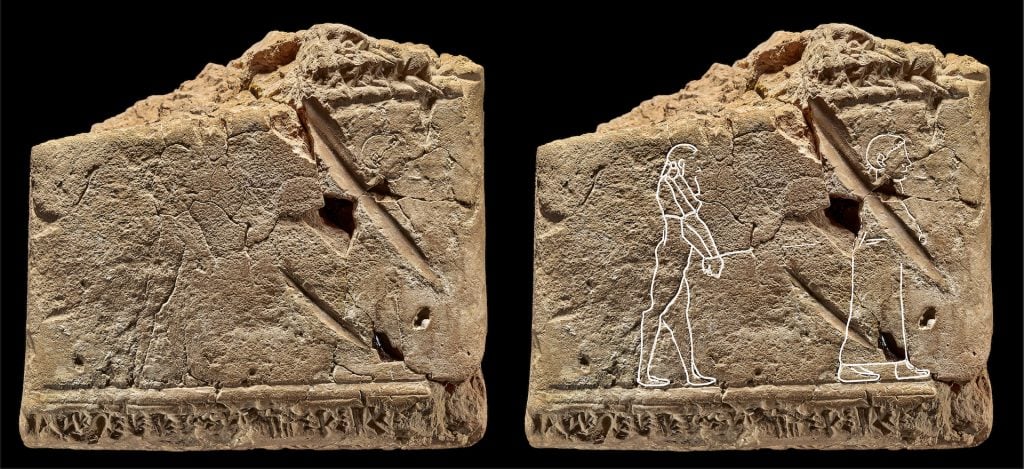
Boo Who? The World’s Oldest Ghost Drawing May Have Been Found on an Ancient Babylonian Tablet at the British Museum
The object is among many early examples curator Irving Finkel has documented that show humans' eternal fascination with the spiritual realm
Photo © British Museum, line drawing © James Fraser and Chris Cobb for The First GhostsA Babylonian tablet dating back to 1500 B.C.E. inscribed with instructions on how to perform an exorcism may depict one of the oldest images of a ghost in the world, according to a new book by British Museum curator Irving Finkel.
The First Ghosts: Most Ancient of Legacies takes a look at the history of our relationship with the spiritual realm, past the more recent image of clanking chains and sheets to early human cultures where, according to Finkel, ghosts were an accepted part of life. The assistant keeper of ancient Mesopotamian script, languages and cultures in the department of the Middle East at the British Museum was inspired to write the book after reading another history of ghosts that started in the 18th century.
“I suddenly thought, ‘Well, what about our stuff? What about Mesopotamia?'” Finkel recalled to artnet News. It then occurred to the curator that the archives and collections he had access to at the British Museum meant he could conduct research back to the earliest history of ghosts and our relationship with them.
“It twigged with me that actually, Mesopotamia is completely unknown as a resource to people who are interested in how old the story of ghosts is, and how far back we can trace it.” In Mesopotamia, they believed that if someone had died in a horrible way, they might come back and bother the people they knew when they were alive, Finkel said. Ancient people collected sightings of spirits “and documented how to get rid of each one, so we have a whole dossier.”
The fragment of the Babylonian clay tablet in question is inscribed with detailed instructions on how to rid yourself of a specific type of ghost, a bothersome older man. The drawing shows an older thin man tied to another figure, an attractive young woman who was intended to lead him back to the underworld, where they would both remain. The drawing on the tablet is extremely well done, leading Finkel to believe this was the work of a highly accomplished draftsman.
“You had this situation where people tended to be sympathetic towards ghosts unless they’re really foul,” he explained. “When they were, there were specialist magicians or exorcists who knew the right spells and rituals and what you could do to get rid of the ghost, drive it out and send it back to the underworld where it belonged,” Finkel explained.
The First Ghosts includes examples of other objects designed to drive away spirits such as bronze amulets, a ritual involving a human skull, and a chapter titled “The Delicate Art of Necromancy.” Having worked with the ancient world since he was 17, Finkel sees past practices and ideas about the spiritual world echoing through to today, whether it be a psychic offering to speak with dead relatives, or the popularity of supernatural films from Ghostbusters to Paranormal Activity.
“The basic belief system, as far as I can see, is unchanged. So, I’ve come to the conclusion that human beings as a whole species have always believed in ghosts from the very beginning,” Finkel said. “Is it all still going on? Yeah, the funny thing is, it really is.”
Follow Artnet News on Facebook:
RELATED VIDEO, selected and posted by peter2011