Date of sighting: January 10, 2022
Source: MUFON
Silver Object Over Haltom, Texas On Jan 10, 2022, UFO Sighting News.Date of sighting: January 10, 2022
Extraterrestrial Fleet arrives to watch humanity's liberation - Interview with James Gilliland
Bijzonder: verre planeet heeft de vorm van een rugbybalIn een ver stelsel blijkt een opvallende planeet te bestaan die niet rond is, zoals de aarde, maar die de vorm van een rugbybal heeft. De planeet heeft die ongebruikelijke vorm hoogstwaarschijnlijk door de kracht van de ster waar hij omheen draait. Dat melden de Europese ruimtevaartorganisatie ESA en de universiteit van Bern in Zwitserland.
De planeet heeft de wetenschappelijke naam ‘WASP-103b’. Hij is groter dan Jupiter, de grootste planeet in ons zonnestelsel, en heeft waarschijnlijk ongeveer dezelfde samenstelling.
WASP-103b draait om een ster die bijna twee keer zo groot is als onze zon en een slordige 200 graden warmer. De planeet staat zo dicht bij die ster, dat hij er in een minder dag omheen draait. De aarde doet iets meer dan 365 dagen en 6 uur over een baan rond de zon.
De planeet werd in 2014 al ontdekt met de ruimtetelescopen Hubble en Spitzer. Zijn vreemde vorm is nu vastgesteld met een andere ruimtetelescoop, de Europese Cheops, die eind 2019 werd gelanceerd. Die satelliet is gebouwd om te zoeken naar planeten die rond andere sterren draaien, zogeheten exoplaneten.
Thousands of Prehistoric Fossils Discovered in Australia’s “Dead Heart”

Thousands of rare and prehistoric fossils have been found in the now-dry “dead heart” of Australia. These fossils, which include spiders, small fish, and plants, date back between 16 and 11 million years ago during the Miocene Epoch when the region was full of rainforests.
The discoveries were made at a new fossil site called McGraths Flat in the Central Tablelands of New South Wales (close to the town of Gulgong). The field belonged to a farmer who reported that he found fossilized leaves and that’s how the discoveries began. This location is one of very few fossil sites in Australia that are referred to as a Lagerstätte which means that the fossils are of incredible quality.
(Not the fossils mentioned in this article.)
The rock layer that contains the fossils measures between 11,000 and 22,000 square feet (1,000 to 2,000 square meters). Paleontologists have excavated a little more than 500 square feet (50 square meters) so far, so there is a lot left to uncover. The reason why the fossils are so well preserved is because they are surrounded by goethite (iron-rich rock) on top of a sandstone layer. The fossils were in a now-dry pool and surrounded by iron and additional minerals that would have fallen into the pool from basalt cliffs (this is called a billabong).
Previous fossil findings in Australia from the Miocene Epoch were mostly teeth and bones belonging to larger animals, but the new discoveries were very significant as they were much smaller creatures like insects and tiny fish, as well as rainforest plants. In an email to Live Science, Matthew McCurry, who is the curator of paleontology at the Australian Museum, stated, “This site gives us unprecedented insight into what these ecosystems were like.” “We now know how diverse these ecosystems were, which species lived in them and how these species interacted.”
The fossils were analyzed with scanning electron microscopes (SEM) which allowed the experts to see them in incredible detail, such as the subcellular structures and single cells. What’s even more amazing is that the SEM revealed what the creatures ate prior to dying (these meals included larvae, fish, and a dragonfly wing that was partly digested). The SEM revealed other interesting features like pollen grains that were attached to the bodies of insects, and a freshwater mussel that was holding onto the fin of a fish.
(Not any of the fossils mentioned in this article.)
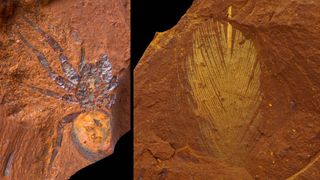
Additional fossils include fungal spores, pollen, flowering plants, a feather belonging to a sparrow-sized bird, and over a dozen fish specimens, as well as “a wide diversity of fossilized insects and arachnids”. There had only been four fossilized spiders found in Australia and thirteen have been discovered so far at this new fossil site. Pictures of the spider and feather fossils can be viewed here.

Exceptional fossils of a spider and a feather from the Australian site are between 16 million and 11 million years old.
(Image credit: Michael Frese)
Millions of years ago, this site was a lush rainforest ecosystem that washome to diverse plant and animal species.
(Image credit: Alex Boermsa)
Based on analysis of the fossilized leaves, the experts were able to calculate that the average temperature during that time period was approximately 63 degrees Fahrenheit (17 degrees Celsius). Their study was published in the journal Science Advances.
Asteroid Eros Hides Alien Base, NASA Source Photo, UFO Sighting News.Date of discovery: January 11, 2022
Location of discovery: Eros, asteroid
Source photo:
This is a structure on an astroid called Eros. Eros is famous for having been the first asteroid to have been orbited by a spacecraft. And looking at these photos, you can see why. You see, NASA always makes moves for a reason. They don't guess...they have data that they rely on and now we know why they went to visit Eros. They wanted to get some intel on the the structures there. I am wondering if they had found a signal coming from this asteroid, something unnatural that pushed them to do this mission. How did they know these structures were on it? I guess they will never say.
Scott C. Waring
Four Unknown Craft Over Phoenix, Arizona Dec 20, 2021, UFO Sighting News.
James Webb Telescope Will Make TERRIFYING Discoveries!

Decades after the idea, the James Webb Space Telescope has finally made it to space. Launched on this Christmas, the telescope started its deployment after it was sent to the space. Scientists are depending on the telescope to know the truth about our existence and also if there is any other life in this universe other than ours. The telescope fans are curious to know about its deployment and what’s next for this masterpiece, they are asking if the telescope is really going to find the answer to our creation? Welcome to Cosmos lab, your one station for all the news from space. Join us in today’s video to find out about the deployment of the James Webb Space Telescope, its goals, and what’s next for this massive beast.
The James Webb Space Telescope is the world’s most powerful and largest space telescope. It is an infrared space observatory that launched on Dec 25, 2021, from ESA’s launch site at Kourou in French Guiana, onboard an Arianespace Ariane 5 rocket. The telescope will let scientists to peek back 200 million years after the Big Bang to see how our cosmos looked. Images of some of the first galaxies ever formed will be captured by the telescope. It will also be able to peek inside dust clouds to see where new stars and planets are developing, as well as investigate the atmospheres of planets orbiting other stars. It will be able to observe objects in our solar system from Mars outward.
The $10 billion James Webb Space Telescope will explore the cosmos to learn more about the universe’s history, from the Big Bang to the birth of alien planets and beyond. It’s one of NASA’s Great Observatories, huge space instruments that include the likes of the Hubble Space Telescope to peer deep into the cosmos.
After being launched on Christmas Day, the James Webb Space Telescope will journey over a million miles or 1.5 million kilometers to its permanent home, a Lagrange point — a gravitationally stable place in space. At the second Lagrange point, the James Webb Space Telescope will orbit the sun (L2). L2 is a location in space near Earth that is opposite the sun; this orbit will keep the telescope in alignment with Earth as it orbits the sun. Several other space telescopes have used it, notably the Herschel Space Telescope and the Planck Space Observatory. If Webb gets to the right zone, it can use a minimum of fuel to stay in place thanks to a near-perfect alignment with the sun, Earth and moon.
The new observatory, the world’s largest space telescope, successfully unfolded its final primary mirror piece on January. 8, capping one of NASA’s most challenging space deployments ever. After the deployment, Engineering teams cheered back at the Space Telescope Science Institute in Baltimore, Maryland as the National Aeronautics and Space Administration announced on Twitter that the final wing was deployed.
‘Final wing is now deployed! Short celebration, but we’ve still got work to do. Engineers are working to latch the wing into place, a multi-hour process. When the final latch is secure, NASA Webb will be fully unfolded in space.’
Webb’s five-layered sunshield — a 70-foot-long, kite-shaped structure that acts as a parasol — was deployed to keep the telescope’s equipment cool so they could detect tiny infrared signals from the remote reaches of the Universe. The sun shield will be permanently installed between the telescope and the Sun, Earth, and Moon, with the Sun-facing side designed to resist temperatures of up to 230 degrees Fahrenheit (110 degrees Celsius).
The telescope was folded up because it was too large to fit into the nose cone of a rocket in its working condition. According to Nasa, unfurling has been a sophisticated and difficult process – the most difficult of its kind ever attempted. However, it has now been successfully deployed and according to NASA officials, we have still got work to do.
So, what is this work, and what is next for this gigantic space telescope? Webb is expected to arrive at its “insertion location” by Jan. 23. John Durning, Webb’s deputy project manager at NASA’s Goddard Space Flight Center, after the deployment in a press conference from Webb’s control center at the Space Telescope Science Institute in Baltimore, Maryland, said to the reporters that,
‘As Webb prepares for the engine fire, team members will spend the next 15 days aligning the 18 mirror segments to “essentially perform as one mirror.’ I should say also, that Webb will start turning on the instruments in the next week or so,” Durning added. “And then after we get into L2, as the instruments get cold enough, they [engineers] are going to be starting to turn on all the various instruments.’
L2 is an excellent area for Webb to carry out its mission.
Say Cheese! Memes Flood Internet After Report Claims NASA Hired 24 Theologians to Study Human Reaction to Aliens
Edited by Ritu Singh

Viral News: Needless to say, search for alien life has been a matter of fascination for humankind for centuries. There’s something really alluring and interesting about the unknown which teases our imagination. In a bid to find about the same, National Aeronautics and Space Administration (NASA) has reportedly hired priests and religious experts (theologians) to assess how humans will react if alien life is discovered on another planet. NASA also wants to assess how such discoveries could impact our ideas of gods and creation, New York Post reported.Also Read - From New Virus, Tsunami to Alien Attack: Here Are Blind Mystic Baba Vanga's Predictions For 2022
According to reports, the agency is hiring 24 theologians to take part in its program at the Center for Theological Inquiry (CTI) at Princeton University in New Jersey, which NASA gave a $1.1 million grant to in 2014. The programme aims to assess how the world’s major religions would react to the news that life exists in worlds beyond our own. It also aims to answer questions that have been puzzling us for a long time, such as, What is life? What does it mean to live? Where do we draw the line between humans and aliens? Is it possible that life exists elsewhere?
Meanwhile, the news has sparked a lot of curiosity, humour and memes (of course) on Twitter. Many were excited at the possibility of human contact with aliens, while others didn’t support the idea of hiring priests and bringing religion in the picture.
Here are some reactions:
RELATED VIDEOS, selected and posted by peter2011
The Moon’s Surface Has Enough Oxygen to Sustain 8 Billion People for 100,000 YearsAlongside advances in space exploration, we’ve recently seen much time and money invested into technologies that could allow effective space resource utilization. And at the forefront of these efforts has been a laser-sharp focus on finding the best way to produce oxygen on the moon.
In October, the Australian Space Agency and NASA signed a deal to send an Australian-made rover to the moon under the Artemis program, with a goal to collect lunar rocks that could ultimately provide breathable oxygen on the moon.
Although the moon does have an atmosphere, it’s very thin and composed mostly of hydrogen, neon, and argon. It’s not the sort of gaseous mixture that could sustain oxygen-dependent mammals such as humans.
That said, there is actually plenty of oxygen on the moon. It just isn’t in a gaseous form. Instead it’s trapped inside regolith—the layer of rock and fine dust that covers the moon’s surface. If we could extract oxygen from regolith, would it be enough to support human life on the moon?
Oxygen can be found in many of the minerals in the ground around us. And the moon is mostly made of the same rocks you’ll find on Earth (although with a slightly greater amount of material that came from meteors).
Minerals such as silica, aluminum, and iron and magnesium oxides dominate the moon’s landscape. All of these minerals contain oxygen, but not in a form our lungs can access.
On the moon these minerals exist in a few different forms including hard rock, dust, gravel, and stones covering the surface. This material is the result of impacts of meteorites crashing into the lunar surface over countless millennia.
Some people call the moon’s surface layer lunar “soil,” but as a soil scientist I’m hesitant to use this term. Soil as we know it is pretty magical stuff that only occurs on Earth. It has been created by a vast array of organisms working on the soil’s parent material—regolith, derived from hard rock—over millions of years.
The result is a matrix of minerals which were not present in the original rocks. Earth’s soil is imbued with remarkable physical, chemical, and biological characteristics. Meanwhile, the materials on the moon’s surface are basically regolith in its original, untouched form.
The moon’s regolith is made up of approximately 45 percent oxygen. But that oxygen is tightly bound into the minerals mentioned above. In order to break apart those strong bonds, we need to put in energy.
You might be familiar with this if you know about electrolysis. On Earth this process is commonly used in manufacturing, such as to produce aluminum. An electrical current is passed through a liquid form of aluminum oxide (commonly called alumina) via electrodes, to separate the aluminum from the oxygen.
In this case, the oxygen is produced as a byproduct. On the moon, the oxygen would be the main product, and the aluminum (or other metal) extracted would be a potentially useful byproduct.
It’s a pretty straightforward process, but there is a catch: it’s very energy hungry. To be sustainable, it would need to be supported by solar energy or other energy sources available on the Moon.
Extracting oxygen from regolith would also require substantial industrial equipment. We’d need to first convert solid metal oxide into liquid form, either by applying heat, or heat combined with solvents or electrolytes. We have the technology to do this on Earth, but moving this apparatus to the Moon—and generating enough energy to run it—will be a mighty challenge.
Earlier this year, Belgium-based startup Space Applications Services announced it was building three experimental reactors to improve the process of making oxygen via electrolysis. They expect to send the technology to the Moon by 2025 as part of the European Space Agency’s in-situ resource utilization (ISRU) mission.
That said, when we do manage to pull it off, how much oxygen might the Moon actually deliver? Well, quite a lot as it turns out.
If we ignore oxygen tied up in the Moon’s deeper hard rock material—and just consider regolith which is easily accessible on the surface—we can come up with some estimates.
Each cubic meter of lunar regolith contains 1.4 tons of minerals on average, including about 630 kilograms of oxygen. NASA says humans need to breathe about 800 grams of oxygen a day to survive. So 630 kilograms of oxygen would keep a person alive for about two years (or just over).
Now let’s assume the average depth of regolith on the Moon is about ten meters, and that we can extract all of the oxygen from this. That means the top ten meters of the Moon’s surface would provide enough oxygen to support all eight billion people on Earth for somewhere around 100,000 years.
This would also depend on how effectively we managed to extract and use the oxygen. Regardless, this figure is pretty amazing!
Having said that, we do have it pretty good here on Earth. And we should do everything we can to protect the blue planet—and its soil in particular—which continues to support all terrestrial life without us even trying.![]()
Landmark Webb observatory is now officially a telescope
NASA SAYS SPACE DEBRIS WILL DEFINITELY SLAM INTO THE JAMES WEBB SPACE TELESCOPE

NASA’s James Webb Space Telescope is “fully deployed,” according to the agency’s science administrator Thomas Zurbuchen — and that’s certainly a reason to celebrate after decades of hard work and tens of billions of dollars spent.
But the massive space observatory isn’t out of the woods just yet. As it spins around the Sun in a chaotic orbit, it will likely encounter plenty of space debris along the way — and an impact, its team says, is likely inevitable.
“Some small impacts from micrometeorites will happen,” NASA Goddard Space Flight Center scientist Michelle Thaller said during a livestream over the weekend. “You know, over the lifetime of the mission there will be some damage to the mirrors of the telescope.”
The telescope itself is indeed vulnerable, but the team says it’s likely it’ll be able to survive some damage.
“Let’s say a piece of debris hits it,” said Julie Van Campen, a NASA engineer, during the stream. “And then we had a problem like that broke a mirror.”
In terms of protection, there’s “not much,” she explained. “What you see is what you get.”
However, Van Campen said, if a micrometeor were to rip a tear into the telescope’s protective sunshield there would be at least four more layers to keep the shield together.
“It was part of our lifetime calculations,” she added.
Things could get pretty hairy for the JWST team back on the ground, though, as there is no way to actually service the observatory in person. That’s unlike NASA’s Hubble Space Telescope, which the agency’s Space Shuttle visited five times between 1993 and 2009 for repairs and upgrades.
But there’s one crucial difference: Hubble was operating in a much more cluttered orbit in low-Earth orbit. The JWST will be orbiting the Sun at L2 (Lagrange Point 2), a far more distant location that allows it to form a straight line with the Earth and Sun.
“It’s actually a very nice place to be,” Thaller explained during the stream, adding that it is a “cleaner place when it comes to space junk.”
Fortunately, engineers have thought ahead and also built in some additional redundancies. The telescope’s mirrors, for instance, are designed to take some damage without forcing its scientific endeavors to grind to halt.
NASA has set the ambitious goal of having the JWST last for at least ten years, a number that’s primarily limited by the amount of fuel the telescope needs to keep itself in orbit and running its instruments.
For now, the pressure is off. Engineers pulled off a huge feat with the telescope’s unfolding, a harrowing process that involves hundreds of steps.
But space debris and meteorites will always be a threat — even when extra precautions are being taken.
READ MORE:
More on the telescope:
Researchers Discover the “Most Eccentric” Exoplanet Ever

The “most eccentric” exoplanet ever found has been detected by a team of international researchers led by the University of Bern. This exoplanet, which has been named TOI-2257 b, is a “sub-Neptune” which means that it is smaller than the furthest planet in our Solar System.
Thanks to data collected by NASA’s Transiting Exoplanet Survey Satellite (TESS), a small red dwarf star was found and studied for four months. Experts were able to gather important additional data by using the SAINT-EX telescope in Mexico. TOI-2257 b was detected by the transit method which means that it was seen passing in front of its host star by causing a dip in the red dwarf’s brightness.
(Not TOI-2257 b)
The researchers found that the exoplanet has a short orbital period and may possibly have water as explained by the University of Bern, “With its 35-day orbital period, TOI-2257 b orbits the host star at a distance where liquid water is possible on the planet, and therefore conditions favorable for the emergence of life could exist.” But don’t get excited yet, as there probably isn’t any life since its radius is approximately 2.2 times bigger than Earth’s which “suggests that the planet is rather gaseous, with high atmospheric pressure not conducive to life.”
Nicole Schanche from Bern University noted, “In terms of potential habitability, this is bad news,” adding, “While the planet’s average temperature is comfortable, it varies from -80°C to about 100°C depending on where in its orbit the planet is, far from or close to the star.”
Another discovery they made was that the planet has a very odd orbit around its star. “We found that TOI-2257 b does not have a circular, concentric orbit,” Schanche said. It has even been described as being the “most eccentric planet” that has ever been found orbiting a cool star.
(Not TOI-2257 b)
As for why it has such an unusual orbit, one possibility is that there could be a massive planet located further away from the star which is affecting the orbit of TOI-2257 b. However, that is just a theory for now as further analysis needs to be conducted in order to know for sure.
Their study was published in Astronomy & Astrophysics where it can be read in full.

The SAINT-EX Telescope
© Institute of Astronomy, UNAM / E. Cadena
First Time a Giant Star’s Supernova Process Has Been Observed

For the first time ever, researchers from Northwestern University and the University of California, Berkeley (UC Berkeley) watched as a red supergiant star died out and went supernova. In fact, they were able to observe the star during the last 130 days of its life prior to exploding. The massive star, which was about ten times larger than our sun, was located in the NGC 5731 Galaxy which is approximately 120 million light-years away from us.
Based on previous observations, it was thought that red supergiant stars were pretty much dormant prior to going supernova; however, this latest observation has completely changed that theory. Throughout the last months before the star exploded, observations detected bright radiation from it. This means that the internal part of the star would have went through a lot of changes just before emitting gas and collapsing.
The star was first spotted during the summer of 2020 by the University of Hawaiʻi Institute for AstronomyPan-STARRS on Haleakalā, Maui. Then just a short time later, during the fall of that year, the star went supernova. Researchers were able to watch this supernova, which has been named 2020tlf (or SN 2020tlf), by using the W.M. Keck Observatory’s Low Resolution Imaging Spectrometer on Maunakea, Hawaiʻi.
Wynn Jacobson-Galán, who is the lead author of the study, discussed the significance of watching the star just before it exploded, “This is a breakthrough in our understanding of what massive stars do moments before they die,” adding, “Direct detection of pre-supernova activity in a red supergiant star has never been observed before in an ordinary type II supernova. For the first time, we watched a red supergiant star explode.”
Raffaella Margutti, who is an adjunct associate professor at CIERA and the senior author of the paper, described the moments before the explosion, “It’s like watching a ticking time bomb.” “We’ve never confirmed such violent activity in a dying red supergiant star where we see it produce such a luminous emission, then collapse and combust, until now.”
Jacobson-Galán finished off by stating how this observation will affect future research in regards to the moments prior to a star going supernova, “Detecting more events like SN 2020tlf will dramatically impact how we define the final months of stellar evolution, uniting observers and theorists in the quest to solve the mystery on how massive stars spend the final moments of their lives.” Their study was published in The Astrophysical Journal where it can be read in full.
A short video depicting the supernova can be viewed here.
Britten vinden grote en bijna complete ‘zeedraak’ van 180 miljoen jaar oud: “Eén van de beste fossielenvondsten in het Verenigd Koninkrijk ooit”Een grote prehistorische ‘zeedraak’ die is teruggevonden in de Engelse Midlands wordt omschreven als één van de beste fossielenvondsten in de geschiedenis van de Britse paleontologie. Het gaat over een ‘ichthyosaurus’, dat waren enorme zeereptielen die miljoenen jaren geleden in onze wateren leefden. Het g
evonden exemplaar is maar liefst 180 miljoen jaar oud.
Het fascinerende fossiel werd ontdekt in februari 2021, tijdens een routineuze drooglegging van een lagune-eiland bij het waterreservoir van Rutland, nabij de stad Leicester. Het skelet is zo’n 10 meter lang, de schedel weegt ongeveer een ton. Het gaat om het grootste en meest complete fossiel in zijn soort ooit bovengehaald in het Verenigd Koninkrijk, schrijft de Britse krant The Guardian maandag.
Ichtyosaurussen, die ook wel ‘zeedraken’ worden genoemd door hun erg grote en angstwekkende tanden en ogen, verschenen voor het eerst zo’n 250 miljoen jaar geleden en raakten zo’n 90 miljoen jaar geleden uitgestorven. Ze varieerden in grootte tussen 1 tot wel 25 meter. Als je kijkt naar de algemene lichaamsbouw van de zeewezens lijken ze het meest op enorme dolfijnen, met agressievere kenmerken.
De eerste ichtyosaurussen werden in de vroege 19de eeuw ontdekt door de beroemde Engelse fossielenjager en paleontoloog Mary Anning. Nu mag Joe Davis van het ‘Leicestershire and Rutland Wildlife Trust’ zich de ontdekker van dienst noemen.
De resten werden in augustus en september door een team van experten uit heel het Verenigd Koninkrijk uitgegraven. In de jaren 70 werden tijdens de constructie van het waterreservoir in het natuurreservaat van Rutland overigens al eens twee onvolledige en veel kleinere ichtyosaurussen gevonden. Maar de recentste onthulling is veel groter, en ook het eerste complete exemplaar.
Dean Lomax, een paleontoloog die al jaren de soort bestudeert en de kolos mee opgroef, legt bij The Guardian het belang van de vondst uit: “Hoewel er meerdere fossielen van deze zeereptielen zijn teruggevonden in het Verenigd Koninkrijk, is de ichtyosaurus van Rutland het grootste skelet dat hier ooit is blootgelegd. Het is werkelijk een ongeëvenaarde ontdekking en één van de grootste vondsten in de Britse paleontologische geschiedenis.”
Mark Evans van de Britse overheidsorganisatie ‘British Antarctic Survey’ bestudeert al meer dan 20 jaar specifiek de reptielenfossielen uit Rutland en Leicestershire. Hij zegt dat het al vanaf de eerste glimp van het gedeeltelijk blootgelegde fossiel duidelijk was dat het om de grootste ontdekking in de regio ooit ging. “Het was echter pas na onze verkennende opgraving dat we beseften dat het fossiel praktisch compleet was, van top tot teen.”
Nadat het fossiel zorgvuldig door het team was opgegraven, werd het kwetsbare skelet in een gipsen omhulsel met houten spalken gewikkeld, meldt watermaatschappij Anglian Water nog, de beheerder van het waterreservoir van Rutland. “Deze conserveringsmethode biedt extra bescherming voor de overblijfselen en maakte het mogelijk om ze in delen van de grond te tillen en veilig naar een onderzoeksfaciliteit te verplaatsen voor verdere analyse.” De maatschappij hoopt de vondst na onderzoek tentoon te kunnen stellen.
Voor de fans: de opgraving van de spectaculaire overblijfselen zal dinsdag om 20 uur te zien zijn op het BBC-programma ‘Two’s Digging For Britain’.
Lees ook:
Ross Coulthart UFOs Journalism Investigating the UAP Story!

Ross Coulthart is an investigative journalist, most recently for Australian news and current affairs program 60 Minutes on Channel Nine. He was previously chief investigations reporter for the Sunday Night news program. Coulthart has won five prestigious Walkley journalism awards, including the most coveted top award for Australian journalism.And has recently been heavily involved in investigating UFO’s.
REMEMBER THE “MOON CUBE”? CHINA JUST PUBLISHED A NEW PHOTO AND UHHHHH

It was just a month ago that the world was introduced to what appeared to be a bizarre cube on the Moon — and just like that, now it turns out the object was little more than an optical illusion.
As SpaceNews correspondent Andrew Jones tweeted, the latest Chinese images of the “Moon Cube” from closer up now show that the mysterious object appears to be… well, a perfectly normal Moon rock. Sorry, folks. Sometimes space is boring.
“Oh, this is amazing,” Jones wrote. “Close to tears.”
Moonsta Hut
The latest photos of the “mystery hut,” as it was originally known in Chinese media, show that this relatively small rock sitting on the edge of a lunar crater isn’t extraordinary in any way — and as the SpaceNews reporter wrote, the newly-dubbed “jade rabbit” is “so underwhelming it’s brilliant.”
“The Moon’s surface is 38 million square kilometres of rocks, so it would have been astronomically exceptional for it to be anything else,” Jones wrote in a subsequent tweet. “But while small, the jade rabbit/玉兔 rock will also be a monumental disappointment to some.”
Before this underwhelming discovery, conspiracy theories about the Moon Cube abounded, with netizens half-jokingly comparing it to the scourge of monoliths that plagued Earth in the first pandemic summer, and others still advising the Chinese Yutu 2 rover to “go back in the other direction” and avoid it as if contaminated.
There was always a great likelihood that the cube was going to be a plain ol’ rock. But this does, if nothing else, set a hilarious tone for what’s gearing up to be a huge year in space exploration.
More on the Moon Cube:
More on the Moon:
CHINA SAYS ITS LANDER HAS DETECTED WATER ON THE MOON

A global team of scientists led by researchers from the Chinese Academy of Sciences in Beijing says they’ve detected water under the surface of the Moon using data the China National Space Administration provided from the country’s Chang’e-5 lander — a stunning technical achievement on its own, as the first lunar sample return mission since the Soviet Union’s Luna 24 mission in 1976.
The team used a panoramic camera, lunar mineralogical spectrometer (LMS) and lunar penetrating radar to look for evidence of water, according to a study published in the journal Science Advances this week in collaboration with researchers from the National Space Science Center of CAS, the University of Hawai’i at Mānoa, the Shanghai Institute of Technical Physics of CAS and Nanjing University.
“It’s like a ‘field trip’ out on the Moon, the first opportunity to detect signs of water at close range and high resolution on the lunar surface,” said lead author and Chinese Academy of Sciences researcher Lin Honglei, according to a statement obtained by the South China Morning Post.
The team observed signals indicating the presence of water in reflectance spectral data acquired by the Chang’e-5 lander. The theory is that solar wind has gradually swept hydrogen atoms toward the Moon, according to SCMP‘s reporting, where it
We’ll be honest. Given the recent Moon cube moment that turned out to be — like we suspected — a humble rock, we’re a little skeptical of any big space claims by China. But scientists have long suspected that there’s likely ice and water on the Moon — and, if the research holds up, water would be a tantalizing resource for a long-term presence on the Moon by human astronauts.
More on Moon cube:
Did aliens genetically engineer humans 780,000 years ago?
The Alien Abduction of Christa Tilton: Hidden Underground Military Base And Strange People In Cells
Brightly Lit UFO Sighted Cruising Over Orangeburg, South Carolina. January 6, 2022Brightly Lit UFO Sighted Cruising Over Orangeburg, South Carolina. January 6, 2022
The witness stated the following: "Went out for a smoke and took pictures of the front yard, as i see frequent UFO activity and like to record proof. i have seen many UFOs that were far off but this was the first time anything has come so close. the craft came from the tree line pulsing multicolored lights. after a few seconds, two orbs came out of it and began to pulse/blink red. it was like they were trying to memos a large aircraft; however, i worked on c-17s in the air force and know that this no aircraft.
These crafts were moving slow towards the neighbors and disappeared in the trees. i went to the backyard and observed them descend down into the back woods behind the house (swamp land). you can see the red orbs change from vertical to horizontal close to the end of the video.
Source: MUFON/ UFO Stalker: Case Number 120202