Ontdek de Fascinerende Wereld van UFO's en UAP's: Jouw Bron voor Onthullende Informatie!
Ben jij ook gefascineerd door het onbekende? Wil je meer weten over UFO's en UAP's, niet alleen in België, maar over de hele wereld? Dan ben je op de juiste plek!
België: Het Kloppend Hart van UFO-onderzoek
In België is BUFON (Belgisch UFO-Netwerk) dé autoriteit op het gebied van UFO-onderzoek. Voor betrouwbare en objectieve informatie over deze intrigerende fenomenen, bezoek je zeker onze Facebook-pagina en deze blog. Maar dat is nog niet alles! Ontdek ook het Belgisch UFO-meldpunt en Caelestia, twee organisaties die diepgaand onderzoek verrichten, al zijn ze soms kritisch of sceptisch.
Nederland: Een Schat aan Informatie
Voor onze Nederlandse buren is er de schitterende website www.ufowijzer.nl, beheerd door Paul Harmans. Deze site biedt een schat aan informatie en artikelen die je niet wilt missen!
Internationaal: MUFON - De Wereldwijde Autoriteit
Neem ook een kijkje bij MUFON (Mutual UFO Network Inc.), een gerenommeerde Amerikaanse UFO-vereniging met afdelingen in de VS en wereldwijd. MUFON is toegewijd aan de wetenschappelijke en analytische studie van het UFO-fenomeen, en hun maandelijkse tijdschrift, The MUFON UFO-Journal, is een must-read voor elke UFO-enthousiasteling. Bezoek hun website op www.mufon.com voor meer informatie.
Samenwerking en Toekomstvisie
Sinds 1 februari 2020 is Pieter niet alleen ex-president van BUFON, maar ook de voormalige nationale directeur van MUFON in Vlaanderen en Nederland. Dit creëert een sterke samenwerking met de Franse MUFON Reseau MUFON/EUROP, wat ons in staat stelt om nog meer waardevolle inzichten te delen.
Let op: Nepprofielen en Nieuwe Groeperingen
Pas op voor een nieuwe groepering die zich ook BUFON noemt, maar geen enkele connectie heeft met onze gevestigde organisatie. Hoewel zij de naam geregistreerd hebben, kunnen ze het rijke verleden en de expertise van onze groep niet evenaren. We wensen hen veel succes, maar we blijven de autoriteit in UFO-onderzoek!
Blijf Op De Hoogte!
Wil jij de laatste nieuwtjes over UFO's, ruimtevaart, archeologie, en meer? Volg ons dan en duik samen met ons in de fascinerende wereld van het onbekende! Sluit je aan bij de gemeenschap van nieuwsgierige geesten die net als jij verlangen naar antwoorden en avonturen in de sterren!
Heb je vragen of wil je meer weten? Aarzel dan niet om contact met ons op te nemen! Samen ontrafelen we het mysterie van de lucht en daarbuiten.
Maandag 24 januari 2022
6KM Tall Tower Found On Mars Google Map, Video, UFO Sighting News.
6KM Tall Tower Found On Mars Google Map, Video, UFO Sighting News.
Date of discovery:Jan 2022 Location of discovery: Planet Mars Google Coordinates: 31° 3'48.78"S 74°15'18.46"E
There is a tower on the planet Mars. Its on all the versions of Google Mars map...there are seven...but one of them wont allow it visible...the most clear of them. The version choices are on the far left on the map.
When I measured this tower, it was over 6km tall! Thats amazing! No mountain could ever exist that was so tall and thin. This was created by intelligent beings, far more advanced than humans. This tower is so big, it could hold over tens of thousand of people in it. Its its been abandoned, its a perfect structure for humans to take over and adapt the alien technology so that humans can survive on Mars.
This isn't the only structure on Mars. There are thousands of structures many kilometers across. NASA has been hiding it to keep China and Russia from finding out and thus creating a race to Mars to take over some of these ancient cities. The country that does...will be a world power for centuries to come.
Catherine Austin Fitts: We're 'Headed for a Digital Concentration Camp'
Catherine Austin Fits: "We have what we have been building for the last 20 or 30 years, and it's getting much more obvious, but it's been covert most of the time. They basically want digital control systems through the financial system, through the health system and government systems to implement control.
It's important to understand what they are trying to do. They are trying to create complete transaction control. If they don't want you going five miles from your home, your electric car will not work more than five miles from your home. . . .
If they don't want you to buy pizza, your credit card will not allow you to buy pizza. They are talking about putting in extraordinary digital control systems and literally turning your car and your home into a digital concentration camp."
An investigator comes across something extraordinary while scanning images of Antarctica, see more in this clip from Proof Is Out There “Solar Spaceship & Invisibility Cloak.”
Deflecting an asteroid such as Bennu, which has a small chance of hitting Earth in about a century and a half, could require multiple small impacts from some sort of massive human-made deflection device, according to experts.
Scientists in California have been firing projectiles at meteorites to simulate the best methods of altering the course of an asteroid so that it wouldn't hit Earth.
According to the results so far, an asteroid like Bennu that is rich in carbon could need several small bumps to charge its course.
Bennu, which is about a third of a mile wide, has a slightly greater chance of hitting Earth than previously thought, NASA revealed earlier this month.
The space agency upgraded the risk of Bennu impacting Earth at some point over the next 300 years to one in 1,750.
Bennu also has a one-in-2,700 chance of hitting Earth on the afternoon of September 24, 2182, according to the NASA study.
This mosaic of Bennu was created from multiple images using observations by NASA's OSIRIS-REx spacecraft. Although there is a slight chance Bennu will smash into Earth over the next three centuries, NASA notes there is more than a 99.9 percent probability it will not
Scientists have been seriously considering how to stop an asteroid from ever hitting Earth since the 1960s, but previous approaches have generally involved theories on how to blow the cosmic object into thousands of pieces.
The problem with this is these pieces could potentially zoom towards Earth and present almost as dangerous and humanity-threatening issue as the original asteroid.
A more recent approach, called kinetic impact deflection (KID), involves firing something into space that more gently bumps the asteroid off course, away from Earth, while keeping it intact.
Recent KID efforts were outlined at the 84th annual meeting of the Meteoritical Society held in Chicago this month and led by Dr George Flynn, a physicist at State University of New York, Plattsburgh.
'You might have to use multiple impacts,' Dr Flynn said in conversation with The New York Times. 'It [Bennu] may barely miss, but barely missing is enough.'
Researchers have been working at NASA's Ames Vertical Gun Range, built in the 1960s during the Apollo era and based at Moffett Federal Airfield in California's Silicon Valley, for the recent KID experiments.
They fired small, spherical aluminum projectiles at meteorites suspended by pieces of nylon string.
The NASA Ames Vertical Gun Range (AVGR, pictured) is a facility that allows experts to investigate potential meteor or asteroid impacts on a planet or moon surface, as well as other research areas
AVGR, pictured, was designed to conduct scientific studies of lunar impact processes in support of the Apollo missions
The team used 32 meteorites – which are fragments of asteroids that have fallen to Earth from space – that were mostly purchased from private dealers.
The tests have allowed them to work out at what point momentum from a human-made object fired towards an asteroid turns it into thousands of fragments, rather than knocking it off course as desired.
'If you break it into pieces, some of those pieces may still be on a collision course with Earth,' Dr Flynn said.
DIFFERENT TYPES OF ASTEROIDS FROM THE SOLAR SYSTEM
Asteroid classification has proved controversial, with a number of letter-based systems developed.
According to NASA the three main types are labelled C, S and M.
C-type (chondrite) asteroidsare the most common in the solar system and likely consist of clay and silicate rocks.
They are darker than other asteroids and the most ancient objects in the solar system - dating back to its birth.
S-type (stony) asteroidsare made of silicate materials as well as nickel-iron and are the most common visitors to the Earth of the asteroid types.
M-type (nickel-iron) asteroidsvary depending on how far from the sun they formed.
Some are partly melted with iron sinking to the centre and forcing volcanic lava to the surface.
Carbonaceous chondrite (C-type) asteroids, such as Bennu, are the most common in the solar system.
They are darker than other asteroids due to the presence of carbon and are some of the most ancient objects in the solar system – dating back to its birth.
According to the findings from experiments at AVGR, the type of asteroid being targeted (and how much carbon it has in it) may dictate how much momentum would be directed at it from any human-made KID device.
From the experiments, the researchers found C-type meteorites could withstand only about one-sixth of the momentum that the other chondrites could withstand before shattering.
'[C-type] asteroids are much more difficult to deflect without disruption than ordinary chondrite asteroids,' the experts concluded.
'These results indicate multiple successive impacts may be required to deflect rather than disrupt asteroids, particularly carbonaceous asteroids.'
Therefore, around 160 years in the future – when Bennu is most likely to collide with Earth, according to NASA – a KID device would have to give it a series of gentle nudges to prevent it from breaking up and sending dangerous splinter fragments flying towards Earth.
NASA's recent study about Bennu, published in the journal Icarus earlier this month, did point out there is more than a 99.9 per cent probability Bennu will not smash into Earth over the next three centuries.
'Although the chances of it hitting Earth are very low, Bennu remains one of the two most hazardous known asteroids in our solar system, along with another asteroid called 1950 DA,' NASA said in a statement.
Asteroid Bennu, which is about a third of a mile wide, has a 1-in-2,700 chance of hitting Earth on the afternoon of September 24, 2182 (pictured). The statement was share by NASA on Wednesday and stems from data collected by the OSIRIS-Rex spacecraft that is brining samples of the asteroid back to Earth
Next year, NASA's Double Asteroid Redirection Test (DART) mission will test KID technologies on a real asteroid in the solar system, called Didymoon.
DART, a space probe, will smash into Didymoon, which orbits a larger asteroid called Didymos, at 13,500 miles per hour (21,700 km per hour) in October 2022. The mission is expected to launch this November.
DART will track and analyse data from Didymos and the smaller asteroid Didymoon, before slamming into it while it's sufficiently far away from Earth.
A NASA mission due to launch in November 2021 will experiment on our planetary defence system to protect the Earth from the threat of a collision with an asteroid. Pictured, an artist's depiction of NASA's DART mission to nudge an asteroid off course
The mission is called the Double Asteroid Redirection Test, or DART. The NASA graphic shows how the Double Asteroid Rendezvous Test (DART) will crash into a moonlet of the asteroid Didymos in 2022
Explained: The difference between an asteroid, meteorite and other space rocks
An asteroid is a large chunk of rock left over from collisions or the early solar system. Most are located between Mars and Jupiter in the Main Belt.
A comet is a rock covered in ice, methane and other compounds. Their orbits take them much further out of the solar system.
A meteor is what astronomers call a flash of light in the atmosphere when debris burns up.
This debris itself is known as a meteoroid. Most are so small they are vapourised in the atmosphere.
If any of this meteoroid makes it to Earth, it is called a meteorite.
Meteors, meteoroids and meteorites normally originate from asteroids and comets.
For example, if Earth passes through the tail of a comet, much of the debris burns up in the atmosphere, forming a meteor shower.
Interest in UFOs continues to grow, both among scientists and government officials.
An unidentified flying object captured on video by a U.S. Navy jet.
(Image credit: DOD/U.S. Navy)
In 2021, there was an upsurge in peculiar sightings reported, thanks to people with smartphones or other video gear that captured these strange glimmers in the sky.
Could these unidentified aerial phenomena (UAP) be satellites, technology deployed by foreign governments, falling space junk or maybe even floating specialty balloons or purposely faked unidentified flying objects (UFOs)?
Or could they be, well, aliens? What if Earth has been on the receiving end of extraterrestrials speeding in from Alpha Centauri who found themselves lacking brake fluid and crashed into New Mexico?
Many of these objects are ultimately identified. Others, however, remain mysterious.
Nonetheless, in 2022, UAP will get more attention from both the scientific community and the federal government, experts told Space.com.
In June 2021, the U.S. military and intelligence community issued a report on UAPs. It was followed by congressional urging to establish a formal office to carry out a "coordinated effort" on collection and analysis related to UAP.
"Our national security efforts rely on aerial supremacy, and these phenomena present a challenge to our dominance over the air. Staying ahead of UAP sightings is critical to keeping our strategic edge and keeping our nation safe," Sen. Kirsten Gillibrand said on Dec. 9, 2021, when announcing the inclusion of her UAP amendment in the $768.2 billion National Defense Authorization Act for fiscal year 2022, which was signed into law by President Joe Biden on Dec. 27.
Although the new office within the Pentagon, called the Airborne Object Identification and Management Synchronization Group, will not explicitly focus on the search for alien life, it will be tasked with providing a full spectrum of intelligence, as well as scientific and technical assessments, related to UAP.
One of the new UAP office's responsibilities will be to implement a plan to "test scientific theories related to UAP characteristics and performances," Gillibrand said in a statement.
So, what now?
For one thing, there's a concerted effort to build UAP-spotting hardware and to decide where it will be stationed. This year could be a turning point in the study of UAP/UFOs.
One potential major development in 2022 will be UFO detection, according to Mark Rodeghier, scientific director of the Center for UFO Studies in Chicago.
"The effort to detect, track and measure the UFO phenomenon in the field, in real time, has recently entered a new phase," Rodeghier told Space.com. "The technology has gotten better, software tools have improved and the current interest in UFOs has attracted new, qualified professionals.
"While one can't predict how soon we will gain new, fundamental knowledge about UAP/UFOs, I believe that these efforts are very likely to succeed and set UFO research onto a new foundation of reliable, physical data," Rodeghier added. "And as a consequence, we will have even more evidence — as if it was needed — that the UFO phenomenon is real and can be studied scientifically."
One upcoming initiative, called the Galileo Project, will search for extraterrestrial equipment near Earth. It has two branches. The first aims to identify the nature of interstellar objects that do not resemble comets or asteroids — like 'Oumuamua, the first known interstellar object to visit the solar system. The second branch targets UAP, similar to those of interest to the U.S. government.
"The Galileo Project's data will be open to the public, and its scientific analysis will be transparent," said Harvard astronomer Avi Loeb, who is spearheading the project. "The related scientific findings would expand humanity's knowledge, with no attention to borders between nations."
The Galileo research team includes more than 100 scientists who plan to assemble the project's first telescope system on the roof of the Harvard College Observatory in spring 2022.
"The system will record continuous video and audio of the entire sky in the visible, infrared and radio bands, as well as track objects of interest," Loeb said. "Artificial intelligence algorithms will distinguish birds from drones, airplanes or something else. Once the first system will operate successfully, the Galileo Project will make copies of it and distribute them in many geographical locations."
The truth is out there
An outlier in all the UAP and UFO chatter — that is nonetheless attracting some attention within the scientific community — is the possibility that UFOs are actually human time travelers.
"The human time travelers model to explain UFOs has been gaining traction over the last couple years," said Michael Masters, a professor of anthropology at Montana Technological University.
Masters is the author of the 2019 book "Identified Flying Objects," which examines the premise that UFOs and aliens may simply be our distant human descendants using the anthropological tool of time travel to visit and study us, as members of their own hominin evolutionary past.
"I think people are starting to realize that it makes a lot of sense in the context of how these ships operate, how they can achieve such incredible accelerations and decelerations if they are manipulating space-time in their own reference frame in and around these craft, and if we can take seriously the description of beings seen in association with them, how they are ubiquitously described in such human terms, regarding their behavior, technology and morphological form," Masters told Space.com.
Masters appreciates that the UFO/UAP topic is being taken seriously by a broader group of professionals in various fields.
"The more we continue to whittle away the stigma that has surrounded this subject for so long, the faster we may begin to understand the nuances of this mysterious phenomenon," he said. "Further reducing the stigma will hopefully also mean that more scientists and scholars will continue to enter the conversation without fear of retribution or shame being cast upon their existing research program, which can only help to advance our knowledge farther and faster."
Thanks to the official acknowledgement of the reality of these objects, Masters said, "the conversation can now move on from 'Are these real?' to 'What are they, and from where, or potentially when, are they coming?'"
Currently, there is a lack of coordination among organizations involved in UAP detection equipment, but that may change this year, said Robert Powell, an executive board member of the Scientific Coalition for UAP Studies (SCU) in Austin, Texas.
"I believe that will improve as we go into 2022," he said.
A number of SCU members are involved with the Galileo Project, and the organization has partnered with several groups, including UFODATA, the UFO Data Acquisition Project (UFODAP) and UAPx.
"UFODAP already has a working model that has been sold into the marketplace and is reasonably priced in the $2,000 to $5,000 range, depending on the accessories desired," Powell told Space.com. "This system has already been used by a group known as UAPx to collect data. Our goal is to coordinate these activities in a way such that we use a system with standardized equipment set to collect data."
But before that happens, Powell said, the groups need to plot out exactly what that equipment is trying to measure and verify that the system can achieve that goal.
"These are exciting times, as there are a growing number of groups focused on UAP detection and study," said Kevin Knuth, an associate professor of physics at the University at Albany and vice president of UAPx, which intends to incorporate a network of distributed sensors that interested parties can host locally to contribute to UAP spotting.
Still, there are some challenges involved with the interaction of various groups, he said.
"While some coordination among groups might be beneficial, especially in the context of efficiency, the fact that we currently know precious little about UAPs implies that the potential for discovery is higher if the groups begin by working independently, trying different equipment and procedures and watching in different places," Knuth told Space.com.
As lessons are learned and the results are made public, the various groups will begin to adopt equipment and procedures that have been demonstrated to be fruitful, he added.
"For this reason, it is probably not wise to coordinate the groups at this time," Knuth said. "Instead, as we learn more about how to best observe and study UAPs, communication across groups — facilitated by the sharing of data and publishing of results — will lead to improvements in general. This is the benefit of independent scientific studies."
Taking a broader view, Knuth said the scientific groups are planning on publishing peer-reviewed scientific papers. The upshot will be further advancement of the scientific studies of UAPs "while encouraging and compelling more scientists to get involved in studying what could very well be among the most important discoveries in human history," he said.
Leonard David is author of "Moon Rush: The New Space Race" (National Geographic, 2019). A longtime writer for Space.com, David has been reporting on the space industry for more than five decades.
Scientists have figured out how to catch up and study the first known interstellar asteroid 'Oumuamua. Project Lyra envisions the launch of a probe for February 2028, four years to perform gravity maneuvers near Earth, Venus, and Jupiter, and finally reaching 'Oumuamua around 2050-2054.
What do we know about Oumuamua?
Object 1I/Oumuamua was discovered on October 19, 2017, as a result of analysis of data obtained by the Pan-STARRS Panoramic and Rapid Response Telescope System, which is primarily designed to search for near-Earth asteroids. ‘Oumuamua was originally thought to be a comet but was later classified as an asteroid.
It was moving too fast for a simple asteroid, and with acceleration, but it did not leave a gaseous tail, which is considered a sign of icy comets from the outer part of the system. Its brightness also did not change, which is typical for asteroids, and not for comets.
Comet Borisov, the first interstellar comet, was discovered by amateur astronomer Gennady Borisov in August 2019 using a 65-cm telescope of his own design.
The extrasolar origin of ‘Oumuamua and Comet Borisov makes them extremely interesting objects to study, but they transit through the solar system and were already detected on the departure trajectory, it is quite difficult to catch up with them.
Scientists are especially intrigued by the possibility of an artificial origin of such objects, which may be hinted at by the extremely elongated shape of Oumuamua.
Since the object can no longer be properly studied through telescopes, there is only one way to understand its origin. The published document describes a mission called Project Lyra to send a probe from Earth that can catch up with ‘Oumuamua and find out its more about its structure.
The Interstellar Probe will become the farthest-reaching spacecraft to date. µCredit: John Hopkins APL
Catching up with Oumuamua: Project Lyra
The document contains a proposal to organize an updated mission, which should start in February 2028, and spend four years on acceleration using gravitational maneuvers – to use the so-called Oberth effect.
If the impulse of the device’s engine is given at maximum approach to a gravitating body, then part of the energy can be taken away from this body and thereby additionally disperse the apparatus.
Gravity maneuvers, or Oberth maneuvers, in this case, should be performed twice at the Earth and once at Venus and Jupiter, until at last the device acquires sufficient speed and reaches the vicinity of ‘Oumuamua in 2050-2054.
This is far from the first attempt to plot a course to ‘Oumuamua, but most previous attempts have focused on using the Oberth maneuver to fly around the Sun. This tactic involves the spacecraft falling into a gravity well and as it falls, it uses its thrusters to increase its acceleration.
The disadvantage of boosting with the help of the Sun is that to protect the probe from powerful solar radiation, one would have to use a complex and heavy shield, like the one currently carried by the American Parker Solar Probe, designed to study the outer solar corona.
While this maneuver looks great on paper, it has never been done before and therefore has a low level of technological readiness.
Another advantage of the maneuver with Jupiter is the final speed of the spacecraft’s arrival at ‘Oumuamua, which will be much lower than that of the spacecraft using the maneuver with the Sun – 18 km/s versus 30 km/s.
This will give the Lyra project more time to study the interstellar asteroid from a flyby trajectory. Based on a launch window of 2028, the researchers determined that the craft could catch up to Oumuamua by 2054.
Overview of the Project Lyra, which will be sent towards Oumuamua. Credit: arxiv.org
What if we find another similar object?
Another option could be, of course, to simply wait until another object similar to ‘Oumuamua is found and take the time to organize an expedition to it.
After all, every year, an estimated seven interstellar wanderers can fly through our solar system . It is even possible that some of the comets from the outer Oort cloud are actually of extrasolar origin.
However, according to the same article, it would be unwise to wait for such an event, because the second interstellar object ever discovered – comet 2I / Borisov 2019 – resembles small bodies already found in the solar system.
This makes ‘Oumuamua a more unique object, and it is unclear what the likelihood of a re-encounter with a similar celestial body in the future is. The possible scientific return from such a mission makes the ‘Oumuamua expedition an opportunity that should not be missed.
Alien Beings May Actually Live Among Us And We Can’t See Them
Because there is no proof of life elsewhere, science claims that mankind evolved organically on Earth to become the most sophisticated species in the universe. The reality, on the other hand, is the polar opposite.
Humans are not the most intellectual creature in the universe, and we do not evolve organically on this planet. This galaxy is home to numerous extraterrestrial civilizations, many of which are millions of years older than our own.
For a long time, the most evolved aliens have visited Earth; some are responsible for seeding human life on Earth and other compatible worlds.
-This implies that humans did not begin on the planet. So, theoretically, we’re aliens as well, despite the fact that we’ve been here for so long that we view things differently.
Aliens still inhabit this world, residing in underground or underwater bases or deep beneath mountains, and moving in disguised ships, underground tunnels, or teleportation portals.
Only a few alien species are highly negative or highly positive, despite the fact that there are at least fifty different extraterrestrial species on Earth.
Humanity is used as a natural resource by the negatives. Neutral aliens are mostly interested in living, observing, and learning.
Positive aliens want to assist people in escaping the energy farm and becoming superhumans.
Things are more convoluted than that because each alien faction can serve many objectives, but the idea is that the negatives are mostly interested in exploiting us, while the positives are primarily interested in assisting us.
Grays, Reptilians, Mantids, and Norsemen are the most common extraterrestrial species. The grays are small robotic beings with large heads, pale skin, and dark eyes.
Reptilians have slit pupils and scaly skin and are tall and intelligent. Mantids are human-sized versions of the praying mantis insect.
Norsemen are indistinguishable from humans, although they are more muscular, have only blond hair, and have very light eyes.
It is impossible to state that one alien species is entirely positive and another is absolutely negative, because there may be examples of both classifications within the same species, yet the orientation of some types is more distinct than that of others.
These aliens do not have the same physical characteristics as humans. They have the ability to dematerialize and pass through walls, travel back in time, use their minds to move items, communicate with us telepathically, and become invisible.
All of these abilities are part of the superhuman stage, and they are more sophisticated because they exist in a higher dimension that intersects with ours.
Higher-dimensional entities must focus on a tighter spectrum of vibrations in order to intercept our dimension, otherwise, they will stay invisible to us.
We’re like fish who are oblivious to the fact that people outside the aquarium are watching us, people who can make themselves known by tapping on the glass or sticking their fingers in the water.
Despite coming from a higher level, these entities technically exist between us and that dimension. What are your thoughts?
West Yorkshire, England, is what’s known as a metropolitan county and includes the larger cities of Leeds, Bradford and Wakefield, as well as enough smaller towns to have a population of over 2.3 million people … and a number of extraterrestrials. In a surprising report, the West Yorkshire police revealed their area of responsibility summoned them to at least nine instances where a county constituent reported an encounter with a UFO and/or extraterrestrials. Is West Yorkshire a UFO hotspot or should someone check the water supply?
An average day in West Yorkshire?
“Caller is reporting he thinks he has seen a UFO. He could (see) this ‘thing’ in the sky that kept appearing then disappearing. This occurred 22 times where ‘something flashed’ then it disappeared, then it flashed again. (He) says he watched this happen for approx 15 mins.”
Yorkshire Live recently provided a list of the West Yorkshire UFO and alien reports and many sound like this one from Morley, Leeds – unusual lights that could be planes, drones or those pesky Starlink satellites. However, some defy those explanations, like this one from Knottingley, Wakefield.
“Caller reporting white orbs in the sky; two shot off like shooting star; he’s seen some disappear; he has this on video; he’s seen 10 tonight; and they’re moving really weird; He can’t see them now. But he’s seen them last two nights. He’s just seen another now, and another one.”
Then there are the alien encounters, like this one from Skircoat, Halifax:
“Reporting he has seen an alien…he has seen something floating in the sky, talking to him.”
A woman in Weetwood, Leeds, reported being abducted, and a man in Skircoat, Halifax, said he had a close encounter.
“Reporting he has seen an alien…he has seen something floating in the sky, talking to him.”
While nine UFO/alien reports in one year in a county of 2.3 million residents might not qualify it as a paranormal hotspot (read about all of them here), West Yorkshire has a history of them that probably influences its police force to give the calls special attention. The most infamous involves former constable Alan Godfrey who claimed to have seen a UFO hovering over Burnley Road in Todmorden in 1980 and, under hypnosis, claimed to have been abducted and spent time in a spaceship. This was five months after finding the body of a missing man, Zigmund Adamski, who was reported to be strangely dressed, had his head shaved and sporting a bore a ring of burn marks, showed a slimy yellow-green substance seeping from a neck wound, and appeared to have been dropped into a railroad cola bin from a high altitude. To this day, Godfrey claims the two incidents ruined his life because of media coverage and investigations by the government.
Another typical day in West Yorkshire?
Then there was Russ Kellett, who in 2020 revealed a 1999 UFO abduction in Bingley, West Yorkshire, in which he remembers being in a spaceship with British pop star Robbie Williams. And in December 2021, a woman also from Todmorden broke her 40-year silence about witnessing a diamond-shaped UFO there in 1981 because it was approximately one year after Godfrey’s famous incident because she didn’t want her life ruined. Then there’s this — Todmorden has had unexplained cattle and sheep mutilations since the 1960s which many people blame on alien experiments, and there have been many alien big cat sightings which some have also attributed to ETs.
If you were a West Yorkshire constable, would you pay special attention to UFO and alien reports?
Or would you put in for a transfer to another county?
Like one those mysterious people who shows up uninvited at a party, proceeds to blow everyone away with their karaoke singing, and then disappears before anyone can get their name or learn where they came from, the interstellar object ‘Oumuamuablasted through our solar system in 2017, surprising astronomers with its origin, strange oblong shape, weird behavior and hasty exit. No one got a good look at it, prompting many to speculate it may have been a spacecraft that may or may not have been occupied. Fortunately, astronomers collected enough data on ‘Oumuamua that they believe a craft from Earth could track it and even catch up to it. Recently, one such group of scientists laid out a plan and a schedule to do just that.
“In this paper, we identify an alternative route to the interstellar object 1I/’Oumuamua, based on a launch in 2028, which does not require a SOM but has a similar performance as missions with a SOM. It instead employs a Jupiter Oberth Manoeuvre (JOM) with a total time of flight of around 26 years or so.”
In a newly published paper, a team from the UK-based Initiative for Interstellar Studies (I4IS) – a diverse group of volunteers “committed to the vision of seeing interstellar flight achieved in the very near future” – proposed a technique that would allow a conventional spacecraft to take an unconventional path that would allow it to quickly catch up with ’Oumuamua. Most long-mission crafts launched from Earth gain speed by using the Solar Oberth Manoeuvre (SOM) – heading towards the Sun, falling into its gravitational well, using its engines to accelerate the fall, and then using the additional speed to slingshot far out into space. Many spacecrafts then perform a similar maneuver around other planets, including Earth, to gain more speed. In what they call Project Lyra, the I4IS team bypasses the SOM and sends a craft to Jupiter for that Oberth boost.
“In January / February 2019, our team has worked on potential missions after 2024, leaving enough time for spacecraft development.”
The I4IS team realizes public and private space programs have the heavy rockets today but not the interstellar probe needed to catch ’Oumuamua, but expect one to be developed by 2024. They then propose a series of gravity-assist maneuvers – around Earth, Venus, Earth again and then Jupiter over four years – before shooting towards ’Oumuamua with an arrival time of either 2050 or 2054 depending on options. That’s a speed far faster than the Voyager and New Horizons probes. (You can view the study with its excellent charts and illustrations here.)
‘Oumuamua’s route through our Solar System.
Eliminating the trip around the Sun reduces weight on the interstellar probe by eliminating the need for a heat shield. Adam Hibberd, a researcher with the i4is and lead author of the new study, tells Universe Today the Jupiter Oberth Manoeuvre allows the probe to arrive at ‘Oumuamua at a slower speed than a SOM assist would, giving it more time to analyze ‘Oumuamua during approach and departure. The JOM would also reduce risks on the mission.
“Finally, our results rather strengthen the feasibility of a mission to 1I, as we demonstrated that such a mission may resemble existing interplanetary missions and not rely on significant new technology developments or unprecedented space Manoeuvres.”
In other words, a Project Lyra to catch ’Oumuamua can be done and would potentially solve the mystery of what it is. Now all they need to do is convince NASA, ESA, or another public or private space organization to take on the project.
As a certain shoe company likes to say: Just do it!
Are Curiosity and Perseverance, NASA’s two operational rovers on Mars, in a robotic rivalry to be the first to find a confirmed sign of life on the Red Planet? It would seem that way this week as Curiosity’s onboard lab analyzed some soil it had dug up and found it contained an unusual carbon signature that is considered to be one of the signs of life. Not to be outdone, NASA just announced that Perseverance has been finding a purple coating on rocks everywhere it roams and scientists think this could also be a sign of past life – or at least hold clues on what that life might have been. Purple rocks on Mars? Wouldn’t that have made an excellent Bowie/Prince collaboration?
“These particular purple patches we haven’t really seen with past rover missions.”
At a recent conference of the American Geophysical Union (AGU), Purdue University scientist Bradley Garczynski explained how he’s using the “scientific eyes of the rover” — a pair of cameras called Mastcam-Z – to study the purple images taken by Perseverance through various filters that can help determine their composition. National Geographic was at the conference and also reports on Ann Ollila, a geochemist at Los Alamos National Laboratory, who is also studying the purple coatings, splotches and blobs in Jezero crater, which was formed by a meteorite impact billions of years ago, once hosted an ancient lake, and is now the home of Perseverance and its little helicopter friend Ingenuity.
Jezero Crater as Seen by ESA’s Mars Express Orbiter
(NASA Public domain)
Ollila is taking a more weaponized approach – she’s using the rover’s SuperCam to blast the rocks with a laser to vaporize a hole and make a sound that is picked up by microphones and analyzed – the sound tells Ollila how hard the rock is and reveals other properties. The Supercam then compares the inside of the hole to the purple surface – it found the purple layer is softer and contains hydrogen and magnesium. Add that to the discovery by the Mastcam-Z that it also contains iron oxide and you’ve got … what?
“I don’t really have a good answer for you.”
That’s not what conference attendees and future Mars explorers wanted to hear from Ollila – they want to know if geological processes are similar among the solar system’s planets, what are the differences and how did they happen. And most importantly – what the heck is the purple stuff? If it’s a sign of ancient life, it’s in the wrong place – the spots in Jezero where Perseverance roams are not where there was water but where magma flowed. Also, the pings don’t match and neither do the compositions of the zapped holes and the purple coating around them. That doesn’t mean they aren’t potential signs of Martian life, says Nina Lanza, the team leader for Space and Planetary Exploration at Los Alamos National Laboratory studying the purple.
“Who knows what Martian microbes do?”
(Wouldn’t that have made a great opening line to a Bowie song?)
On Earth, a purple coating on a rock might mean microbes hid on it to escape from the sun’s ray, metabolizing metals in the rock or dissolved in water flowing over it. Ultimately, the purple rocks need to be brought back to Earth for intense analysis in a lab.
Perseverance
If the purple surface on these Martian rocks was really once purple Martian microbes in a Martian lake, that means it could have heated up, vaporized into clouds and formed something Prince could sink his musical teeth into.
Purple rain, Martian pain Purple rain, Martian pain I didn’t mean to step on you Thought you were just a stain
OK, maybe David Bowie.
Take a look at the ground, man Purple rock, I wonder why Oh man, wonder if we’ll ever know Is it purple Martian pee Is there life on Mars?
The violent birth of modern man: The incredible ancient stone carvings that reveal how a devastating comet impact 13,000 years ago killed thousands, altered the climate and triggered the rise of the first civilisations
Scientists were analysing symbols carved on pillars at Gobekli Tepe in Turkey
Using memorial carvings they pinpointed a comet impact to around 11,000BC
The comet triggered a mini ice age that lasted 1,000 years
This ice age forced humans to develop farming techniques to grow their crops
Ancient symbols carved into stone at an archaeological site in Turkeytell the story of a devastating comet impact that triggered a mini ice age more than 13,000 years ago, scientists believe.
Evidence from the carvings, made on a pillar known as the Vulture Stone, suggests that a swarm of comet fragments hit the Earth in around 11000 BC.
One image of a headless man is thought to symbolise human disaster and extensive loss of life.
The devastating event, which wiped out creatures such as woolly mammoths, also helped spark the rise of civilisation.
Scroll down for video
Ancient stone carvings confirm that a swarm of comets hit Earth 13,000 years ago sparking the rise of civilisations and wiping out the woolly mammoth. Pictured are the stone carvings used in the team's research, found on pillar 43 or 'the Vulture Stone' at Gobekli Tepe in Turkey
THE GOBLEKI TEPE CARVINGS
Gobleki Tepe is thought to be the world's oldest temple site.
Estimates suggest it dates back to around 9,000BC.
It is 6,000 years older than Stonehenge.
The carvings found by the team remained important to the people of Gobekli Tepe for millennia.
This suggests that the event and cold climate that followed the comet had a serious impact.
The team suggest the images were intended as a record of the cataclysmic event.
They claim that a carving showing a headless man may indicate human disaster and extensive loss of life.
Scientists have speculated for decades that a comet could have caused the sharp drop in temperature during a period known as the Younger Dryas.
The Younger Dryas is seen as a crucial period in humanity's history as it coincides with the beginnings of agriculture and the first Neolithic civilisations.
Scientists were analysing the mysterious symbols carved onto stone pillars at Gobekli Tepe in southern Turkey to find out if they could be linked to constellations.
Engineers from the University of Edinburgh studied animal carvings made on a pillar – known as the vulture stone – at the site.
By interpreting the animals as astronomical symbols, and using computer software to match their positions to patterns of stars, researchers dated the event to 10,950BC.
It probably resulted from the break-up of a giant comet in the inner solar system.
This is around the time the Younger Dryas period began according to ice core data from Greenland, which pinpoints the event to 10,890BC.
Before the comet strike, large fields of barley and wheat had allowed roaming hunters in the Middle East to set up permanent base camps.
Evidence from the carvings, made on a pillar known as the Vulture Stone, suggests that a swarm of comet fragments hit the Earth in around 11000 BC. The different symbols, said to tell the story, are labeled in the graphic above
But the ice-cold conditions created by the impact forced these hunters to band together and find new ways to grow crops.
They developed watering and selective breeding to help their crops last against the harsh climate, forming modern farming practices.
The carvings appear to have remained important to the people of Gobekli Tepe for millennia, the Edinburgh researchers said.
This suggests that the event and cold climate that followed likely had a serious impact.
The comet's impact killed thousands of people and triggered a mini ice age that lasted more than 1,000 years. Pictured is a replica of the Vulture Stone at Sanliurfa Museum in Turkey
By interpreting the animals as astronomical symbols, and using computer software to match their positions to patterns of stars, researchers dated the event to 10,950BC. This image shows the position of the sun and stars on the summer solstice of 10,950BC
The team suggest the images were intended as a record of the cataclysmic event.
A further carving showing a headless man may indicate human disaster and extensive loss of life, they said.
Furthermore, symbolism on the pillars indicates that the long-term changes in Earth's rotational axis was recorded at this time using an early form of writing.
The symbolism suggests that Gȍbekli Tepe was an observatory for meteors and comets.
The find supports a theory that Earth is likely to experience periods when comet strikes are more likely, owing to Earth's orbit intersecting orbiting rings of comet fragments in space.
Stone pillars at Gobleki Tepe, thought to be the world's oldest temple site. Scientists have speculated for decades that a comet could have caused the sharp drop in temperature during a period known as the Younger Dryas around 11,000BC
More stone pillars found at the Gobleki Tepe temple site. The Younger Dryas is seen as a crucial period in humanity's history as it coincides with the beginnings of agriculture and the first Neolithic civilisations
Dr Martin Sweatman, of the University of Edinburgh's School of Engineering, who led the research, said: 'I think this research, along with the recent finding of a widespread platinum anomaly across the North American continent, virtually seal the case in favour of (a Younger Dryas comet impact).
'Our work serves to reinforce that physical evidence. What is happening here is the process of paradigm change.
'It appears Göbekli Tepe was, among other things, an observatory for monitoring the night sky.
'One of its pillars seems to have served as a memorial to this devastating event – probably the worst day in history since the end of the ice age.'
Scientists were analysing the mysterious symbols carved onto stone pillars at Gobekli Tepe in southern Turkey to find out if they could be linked to constellations
The find supports a theory that Earth is likely to experience periods when comet strikes are more likely, owing to Earth's orbit intersecting orbiting rings of comet fragments in space
A huge asteroid may have hit the Earth 12,800 years ago causing global climate change and extinction, according to new evidence found in South Africa.
Scientists analysed ancient soil at a site called Wonderkrater and found high levels of platinum - which they say supports the The Younger Dryas Impact Hypothesis that a disintegrating meteor hit Earth and caused a mini ice age.
The resulting ice age is believed by many scientists to have wiped out dozens of mammals species including the Mammoth and giant wildebeest and decimated the human population.
Scientists believe 'platinum spikes' found in ancient soil samples across the world are evidence of the meteor fragments that crashed into Earth.
Meteorites are rich in platinum and the Wonderkrater site in the Limpopo Province, north of Pretoria in South Africa adds to almost 30 other platinum spikes found worldwide, mostly in the northern hemisphere.
This map shows the locations of platinum spikes which have been observed around the world, suggesting a meteorite may have smashed into Earth and scattered debris everywhere
WHAT IS THE YOUNGER DRYAS IMPACT HYPOTHESIS?
The Younger Dryas impact hypothesis proposes that fragments of a disintegrating comet struck the Earth around 12,800 years ago.
These fragments bombarded North and South America, Europe and western Asia.
This generated a thin layer of detritus covering around 19.3 million square miles (50 million square kilometres).
This layer contained concentrations of platinum, meltglass and nano-diamonds from the impactors.
Experts argue that this episode saw large-scale biomass burning, an impact-induced winter, longer-time climatic shifts and the extinction of late Pleistocene megafauna.
Until now, proof that meteoroids had impacted during that period and potentially led to a mini-ice age had only been documented across the northern hemisphere.
A total of 28 areas with high levels of platinum had been found.
The findings from the researchers at the University of the Witwatersrand in Johannesburg, South Africa partially support the theory that a meteorite crashed into earth with global consequences – along with another meteorite site discovered in Chile.
An episode of rapid cooling named the The Younger Dryas is a well documented period believed to have contributed to the extinction of many species of large animals around 12,800 years ago.
Theories previously pointed to this post-ice age cooling as a result of changes in oceanic circulation systems.
Another theory was presented by American scientists in 2007 – that the cooling was triggered by the dust fallout of an asteroid impact.
Dust circulating in the atmosphere after an impact could have reduced the amount of sunlight reaching the earth, affecting plant growth and temperatures on earth.
Now Francis Thackeray of the Evolutionary Studies Institute at the University of the Witwatersrand in South Africa believes a platinum spike found in South Africa proves the extinction of many large animals globally could have been caused by one or multiple meteoroid impacts.
Researchers have discovered their first evidence in the southern hemisphere that a mini ice age almost 13,000 years ago may have been caused by clouds of dust thrown up by an asteroid impact
(stock image)
Dr Thackeray who was working with researcher Philip Pieterse from the University of Johannesburg and Professor Louis Scott of the University of the Free State, said: 'Our finding at least partially supports the highly controversial Younger Dryas Impact Hypothesis (YDIH).
'We seriously need to explore the view that an asteroid impact somewhere on earth may have caused climate change on a global scale.
'And [it may have] contributed to some extent to the process of extinctions of large animals at the end of the Pleistocene, after the last ice age.'
Many mammals became extinct in North America, South America and Europe at the time of the Younger Dryas.
In South Africa a few extraordinary large animal species became extinct around that period including the giant African buffalo, a large zebra, and a very big wildebeest each weighing around 1,100lbs (500kg) more than its modern counterpart.
Human populations may also have been indirectly affected at the time in question.
Thackeray argues that a dramatic halt in the development of the use of stone tools by the Clovis people in North America and the Robberg stone artefacts used by populations in South Africa around that period could indicate that an asteroid may have caused global consequences.
Dr Thackery said: 'Without necessarily arguing for a single causal factor on a global scale, we cautiously hint at the possibility that these technological changes, in North America and on the African subcontinent at about the same time, might have been associated indirectly with an asteroid impact with major global consequences.'
WHEN WERE EARTH'S 'BIG FIVE' EXTINCTION EVENTS?
Traditionally, scientists have referred to the 'Big Five' mass extinctions, including perhaps the most famous mass extinction triggered by a meteorite impact that brought about the end of the dinosaurs 66 million years ago.
But the other major mass extinctions were caused by phenomena originating entirely on Earth, and while they are less well known, we may learn something from exploring them that could shed light on our current environmental crises.
The Late Ordovician: This ancient crisis around 445m years ago saw two major waves of extinction, both caused by climate change associated with the advance and retreat of ice sheets in the southern hemisphere. This makes it the only major extinction to be linked to global cooling.
The Late Devonian: This period is now regarded as a number of 'pulses' of extinction spread over 20m years, beginning 380m years ago. This extinction has been linked to major climate change, possibly caused by an eruption of the volcanic Viluy Traps area in modern-day Siberia. A major eruption might have caused rapid fluctations in sea levels and reduced oxygen levels in the oceans.
The Middle Permian: Scientists have recently discovered another event 262m years ago that rivals the 'Big Five' in size. This event coincided with the Emeishan eruption in what's now China, and is known to have caused simultaneous extinctions in the tropics and higher latitudes.
The Late Permian: The Late Permian mass extinction around 252m years ago dwarfs all the other events, with about 96% of species becoming extinct. The extinction was triggered by a vast eruption of the Siberian Traps, a gigantic and prolonged volcanic event that covered much of modern day Siberia, which led to a cascade of environmental effects.
The Late Triassic: The Late Triassic event, 201m years ago, shares a number of similarities with the Late Permian event. It was caused by another large-scale eruption, this time of the Central Atlantic Magmatic Province, which heralded the splitting of the supercontinent Pangaea and the initial opening of what would later become the Atlantic Ocean.
A meteor glowing as it enters the earth's atmosphere
(stock image)
He added: 'We cannot be certain, but a cosmic impact could have affected humans as a result of local changes in environment and the availability of food resources.'
At Wonderkrater, the team has also uncovered evidence from pollen to show that about 12,800 years ago there was temporary cooling.
This linked up with the 'Younger Dryas' drop in temperature that is well documented in the northern hemisphere, and now also in South Africa.
According to some scientists, this cooling in widespread areas could have been caused by the global dispersal of platinum-rich atmospheric dust after a meteorite hit.
Thackeray's team believes their discovery of a platinum spike at about 12,800 years ago at Wonderkrater is just part of the strengthening view that an asteroid or cometary impact might have occurred at that time.
This is the first evidence in Africa for a platinum spike leading to the mini-ice age of the Younger Dryas.
Younger Dryas spikes in platinum have also been found in Greenland, Eurasia, North America, Mexico and recently also at Pilauco in Chile.
Wonderkrater is the 30th site in the world discovered with evidence of platinum spikes.
Thackeray said: 'Our evidence is entirely consistent with the Younger Dryas Impact Hypothesis.'
The discovery in South Africa is expected to be analysed in context with those made in other parts of the world.
A large crater 31 kilometres in diameter was discovered in northern Greenland beneath the Hiawatha Glacier last year.
Thackery recognises that the source of the platinum at Wonderkrater could hypothetically be cosmic dust that was dispersed in the atmosphere after a meteorite impact in Greenland.
The South African research has been supported by the National Research Foundation and the DST/NRF Centre of Excellence for the Palaeosciences and was published in Palaeontologia Africana.
Asteroid Impact vs. Pole Shift as Cause of Catastrophic Destruction 12,900 Years Ago
I often write about a periodic cycle of pole shift catastrophes that alter the entire surface of the Earth and reduce civilizations to ruins every 12-13,000 years (probably every half-precession cycle of about 12,900 years.) But many researchers, including Graham Hancock, suggest that this (last) catastrophe roughly 12,800 years ago was caused by a comet impact – not a pole shift. Does evidence favor one theory over the other? From a Russian article I found recently:
Researchers from the University of the Witwatersrand (South Africa) have evidence that the Earth was hit by a comet or asteroid almost 13,000 years ago.
“A global catastrophe led to climate change known as the Dryas Cooldown (10730-9700 BC) and also caused the extinction of many animal species. In 2019, South African researchers analyzed rock samples recovered from peat deposits in the Limpopo province of South Africa. As a result, they found a high concentration of platinum, which is also found in celestial bodies.
According to the researchers, this is another evidence in favor of the hypothesis of a large space object colliding with the Earth – a comet or an asteroid, which probably fell in Northern Greenland, where a crater 31 kilometers in diameter and 12,800 years old was discovered under the Hiawatha glacier. Climate change has been caused by the dispersion of dust and soot in the planet’s atmosphere. Platinum has also been found in rocks of the same age in Greenland, Eurasia, North America, Mexico, and Chile.”
The image directly above does not show impact craters under the ice, like the recently discovered Hiawatha Crater in NW Greenland. It doesn’t show the ones in South Carolina or anywhere outside North America. What it does show, however, is that the last ice cap in Pleistocene times was centered near Hudson Bay, not our current North Pole.
Notice most of Alaska and all of Siberia (where so many remains of mammoths – which ate 500 pounds of vegetation a day – have been found) were not covered by an ice sheet but in fact were much warmer – before Asia moved north by 30 degrees of latitude (suddenly freezing the region) and the Americas moved 30 degrees south (thawing eastern Canada) during the last pole shift.
I feel the following adequately sums up the asteroid theory: we found impact craters, and the surface of the entire world shows a layer of dust rich in platinum (and other elements far less common on Earth) covered our world roughly 10,800 B.C. Therefore, the resulting climate changes and mass extinctions were caused by the comet (or fragments) impact.
While there are many impact craters from approximately the first century of the Younger Dryas climate change events, there is massive evidence supporting another cause – the idea that our entire galaxy has a positive and negative side separated not by a flat sheet but by a rippling, wave-like undulation between positive and negative charge. This ripple or wave reaches us roughly every 12,900 years and causes stellar micronovas and planetary pole shifts.
Many nearby stars between our sun and the galactic center have already erupted in recent years. It is only a matter of time before the strength of the incoming galactic wave overpowers and reverses the electromagnetic fields of our sun and our Earth.
Our sun’s magnetic field will eventually be overwhelmed and reversed by the galactic field changes, and our planetary magnetic field is overwhelmed with both the galactic wave (which takes centuries to make the full polarity reversal) and the solar micronova (which is over in hours and is the direct and immediate trigger of the pole shifts on Earth.) This is supported by many ancient myths, legends, and religions – such as Egyptian records of the sun rising in the west and setting in the east prior to the last catastrophe – or the Greek myth of Phaethon failing the handle Apollo’s sun-chariot and coming to close to Earth and scorching it before Zeus intervened by “tilting the table” to flood the burning lands and put out the fires and returning the reins to Apollo – or the description of an intensely brightened sun from Isaiah 30:26 “…the sunlight will be seven times brighter, like the light of seven full days…”
As our terrestrial magnetic field weakens to zero and reverses, our protection from cosmic radiation and dust temporarily disappears. The flow of the extended and greatly strengthened solar magnetic field flows right through the Earth, north to south, and carries extra cosmic dust pushed in from the galactic wave and a much greater amount of solar particles blasted out with the micronova. This also explains the high levels of platinum and other elements on the surface of the Earth at the time of pole shift events.
Earth is rarely hit by comets or asteroids, partially because the ones that intersect Earth’s orbit usually hit within the first thousand years of the establishment of such intersecting orbits, followed by long periods of stability and virtually no impacts for many thousands of years (our recent history) because Earth has cleared the path of its orbit by impacting the problems earlier…. Until the next galactic wave and micronova blasts disturb the orbits of everything in the solar system, followed by centuries of newly dislodged objects pushed into new trajectories. This causes at least a few centuries of much more frequent impacts on Earth.
So yes, there are impact craters and high levels of rare elements approximately 12,800 years ago. But I think the evidence suggests that was a result of the galactic ripple, solar micronova, and pole shift which occurred around 12,850-12,900 years ago. If the evidence truly favors a periodic (recurring) cycle of pole shift catastrophes, and not a one-time random impact event for the Pleistocene extinction that happened almost 13,000 years ago – why does our government – which funds the scientific establishment that won’t bite the hand that funds it – not admit or acknowledge the recurring pole shift cycle? (Or any other cyclic theory, such as our sun having a distant binary companion such as Sirius – or even that the sun is in one of the filaments/threads of a galactic rope of Birkeland currents of charged plasma, making it look like we are rotating with another nearby star or two as our filament channels and spirals us around the larger “rope” of entwined filaments?)
Because a one-time impact won’t happen again. Governments often love to incite fear and make the public take the action they want and have planned for. But in this case, they want the public to remain ignorant and take no action beyond continuing to work and pay taxes right up to the end, so that the elite get build, supply, and retreat into their bunkers without millions or billions of informed and angry unselected useless eaters like us banging down their doors or detonating nukes or burying their exits under tons of concrete. To avoid that, they must not teach about recurring cycles of destruction, especially if another event is due within our lifetimes. Instead we are offered distractions and lies.
The next pole shift is due in the 2nd quarter of the 21st century. There are plans to survive it. But you and I are not invited. I can find no acknowledgement of pole shift cycles by the American government. But I did recently find declassified KGB files offering Soviet acknowledgement – and they comment on known American preparations and even the Nazi archives they found on the subject. (The Nazis also expected the next pole shift in the early 21st century.)
If interested in any of these theories, check the links below for what I consider the best sources.
An ancient structure sits in this crater on Mars. The structure is buried by thousands of years of wind blown dirt and sand, but it's still there, standing out proudly...an achievement of an ancient culture of long ago. Had this been found on Earth in Egypt...archeologist would jump all over it thinking its some ancient tomb of an Egyptian king. However on Mars...a planet 34 million miles away makes it impossible to investigate it. The mystery will remain for decades to come.
The Megalithic Unfinished Obelisk St Aswan In Egypt, Video, UFO Sighting News.
Date of video: January 8, 2022
Location of Obelisk: St Aswan, Egypt
This video was taken by the famous Brian Foerster in Egypt. He is a tour guide and history expert who is looking at the unfinished Megalithic obelisk that is still laying in the ground. Although carving this huge megalith would be possible for humans if years of work were put into it...it would however be impossible to move such a massive stone structure hundreds of miles to Cairo which is 650km (404 miles) away. The structure is 137 feet (42 meters) long if completed and would weigh and estimated 1,200 tones. Thats like carrying a cargo ship loaded with containers on it...and carrying it not sailing it...across the mountains, desert, rocks and scorching earth to Cairo 650km away...we cannot even do that today! Its insane!
The only way such a megalithic structure could be moved is by using alien anti gravity technology. Even today, with all our modern equipment, technology and methods of transportation...we could never create and move this structure in one piece. This is 100% proof that aliens were here a long time ago, creating ancient Egypt.
Four Lights Over University place, Washington Jan 8, 2022, UFO Sighting News.
Date of sighting: Jan 8, 2022
Location of sighting: University place, Washington, USA
Source: MUFON
I really like the conversation happening during this video. Its 100% authentic and keeping it real is important in such cases. The eyewitness calls up her husband or boyfriend in order to tell him so he might see it and you can really hear their conversation about focusing on the UFO. Also a third eyewitness, a woman stood with her and then they attempted to get closer by taking the car. Which worked for a little bit. The videos are short and sweet, but they are hard core evidence that UFOs exist. Absolutely amazing, wish more folks were this excited about seeing a UFO, then maybe more people would be aware of the existence of aliens today.
Scott C. Waring - Taiwan
Eyewitness states:
Random bouncing lights with three stagnant lights that appeared and reappeared. In one of the videos there is a reflection of a light in my car but the other video I took outside of my car sitting on my carport. I’ve lived here most of my life and I have never seen those lights located where we saw them. Also, pardon our French.
In a testament to the kinds of strange calls that authorities receive on a fairly regular basis, a police department in England has shared details on a variety of very weird UFO and alien reports that their emergency operators fielded in 2021. Responding to an FOIA request, the West Yorkshire Police Force reportedly revealed that over the past year there were several incidents, ranging from fairly benign to outright bizarre, wherein bewildered residents said that they witnessed or encountered something from out of this world.
The first report, received in April, concerned a man who claimed to have seen a UFO "that kept appearing, then disappearing" for about 15 minutes. Another call came in to authorities in May when a resident said that they spotted "a number of solid lights that look like stars moving in the sky." The witness went on to describe the objects as being "spaced evenly out," which makes one suspect that the 'UFOs' could have been SpaceX Starlink Satellites which have sparkedsimilar reports in the past.
A more difficult to explain report from July saw a man call police with concerns about "white orbs in the sky" that were "moving really weird." These odd objects, the witness said, would occasionally take off "like a shooting star" or simply disappear. According to the caller, the eerie activity occurred over the course of two nights and, in total, he observed ten of these mysterious lights in the night sky. Although the man claimed to have captured video of the peculiar objects, it would appear that he did not turn it over to police.
Amazingly, the West Yorkshire Police Force say that 2021 saw a staggering six calls from residents who said that they had encountered visitors from another world! In one instance, a woman simply told the emergency operator that "an alien has attacked her," while another woman later in the year reported that she had been abducted by ETs. Meanwhile, a disappointingly brief report came in from a man who declared that "an alien has put drugs in his eyes."
Two separate callers in 2021 reported seeing an alien floating outside their window and, in one the cases, the being purportedly spoke to the witness. Sadly, the police logs do not include whatever message the 'space brother' shared with the witness. And perhaps the strangest of all the reports contained in the released files came from a man who talked to the operator about "life savers and aliens" and then went on to reveal that he "has a vision that the Queen sent him to another galaxy."
SCIENTISTS DISCOVER BLACK HOLE THAT’S CREATING STARS INSTEAD OF DEVOURING THEM
IS THIS THE LEAST DEADLY BLACK HOLE IN THE UNIVERSE?
GETTY
Let’s Be Friends
Not all black holes are the destructive monsters they’re often made out to be, according to new research done with the Hubble Space Telescope.
Scientists from Montana State University published an article in Nature this week that found a star formation in Henize 2-10, a dwarf starburst galaxy — and they say the black hole at the center of that galaxy actually created them.
“We conclude that this black-hole outflow triggered the star formation,” the authors wrote.
The findings provided insight into a decade-old mystery about whether smaller galaxies had black holes proportional in size to larger ones, according to NASA.
“Ten years ago, as a graduate student thinking I would spend my career on star formation, I looked at the data from Henize 2-10 and everything changed,” Amy Reines, a researcher at the University of Virginia and one of the study’s authors, told NASA. “From the beginning I knew something unusual and special was happening.”
And Beyond…
Reines told NASA that she expects even more research into dwarf galaxy black holes in the future. Using them as clues to better understand how supermassive black holes came into existence would solve a persistent problem for astronomers, and NASA reports that of the three leading theories about how black holes are created, none of them stand out as more likely than the others.
“It really has become the big question: where did they come from?” Reines said. “Dwarf galaxies may retain some memory of the black hole seeding scenario that has otherwise been lost to time and space.”
It’s poetic that an unusually creative black hole defying rules about how black holes are “supposed” to act may actually help scientists understand the most ancient of galactic mysteries.
Winston Churchill penned an 11-page essay about the prospect of alien life on other planets despite Europe being on the brink of war as he wrote, newly discovered documents revealed today.
In an article written in 1939 entitled 'Are We Alone in the Universe?' the wartime hero correctly predicted decades before time that large numbers of stars could have families of planets.
He also identified the importance of liquid water for alien life to survive in the typewritten essay, published a year before he became Prime Minister in 1940.
Before becoming Britain's greatest wartime Prime Minister, Winston Churchill found time to muse in an essay on whether aliens exist
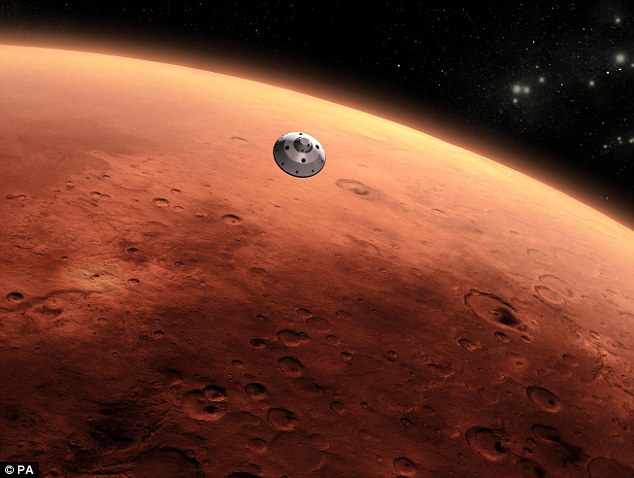
Churchill suggested in his newspaper article that the planet Mars, pictured, could harbour life
The article, which was hidden away in a museum in the US until rediscovered last year, revealed how Churchill believed there may well be life on Mars.
In it he muses about the possibility of life evolving elsewhere in the Solar System and beyond.
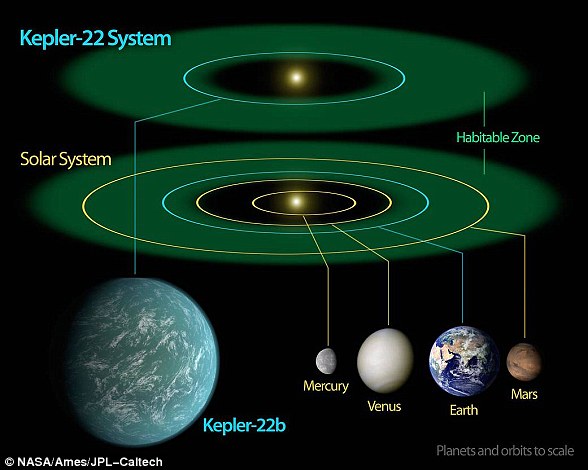
Pre-empting discoveries of extra-solar planets by more than five decades, he defines what scientists later called the 'habitable' or 'Goldilocks' zone - the narrow orbital region where a planet is not too hot or too cold but 'just right' to support life.
He also correctly concluded that many planets 'will be the right size to keep on their surface water and possibly an atmosphere of some sort' and some would be 'at the proper distance from their parent sun to maintain a suitable temperature'.
Churchill famously ordered that reports of UFO sightings should be kept secret in 1952 to avoid public panic.
The 'closet science fiction fan' suggested in the article - believed to have been intended for publication in the News of the World - that Mars and Venus could harbour life.
Churchill's 11-page essay was rediscovered last year by the museum's new director Timothy Riley, left, who passed it on to Israeli astrophysicist, author and former Hubble Space Telescope scientist Mario Livio, right
The article was written a year after the 1938 radio broadcast by Orson Welles dramatising The War Of The Worlds by HG Wells - later made into a film, pictured - which caused widespread panic among listeners in the US who thought they really were being invaded by Martians
The lengthy essay was never published but was passed to the US National Churchill Museum in Fulton, Missouri in the 1980s, where it was unearthed by a museum director and is published in the journal Nature today.
Writing as the Second World War broke out, Churchill wrote: 'I, for one, am not so immensely impressed by the success we are making of our civilisation here that I am prepared to think we are the only spot in this immense universe which contains living, thinking creatures, or that we are the highest type of mental and physical development which has ever appeared in the vast compass of space and time.'
The article was written a year after the 1938 radio broadcast by Orson Welles dramatising The War Of The Worlds by HG Wells, which caused widespread panic among listeners in the US who thought they really were being invaded by Martians
The document was rediscovered last year by the museum's new director Timothy Riley, who passed it on to Israeli astrophysicist, author and former Hubble Space Telescope scientist Mario Livio.
Describing the find in the journal Nature, Professor Livio said it came as a 'great surprise,' despite Churchill's well-known interest in science.
It is not the first time the Conservative leader and historian's love of science fiction has come to light.
Churchill was the first prime minister to hire a science adviser, and in the 1920s and 30s wrote a number of popular science essays for newspapers and magazines on topics such as evolution and cells
Churchill's famous phrase 'the gathering storm', used to describe the rise of Nazi Germany, crops up twice in The War of the Worlds to describe pending attacks on Britain by the Martians.
Historian Richard Toye, who has suggested that the Prime Minister borrowed the line, said of Churchill: 'He was not a scientist but science appealed to his imagination because he liked to play with ideas and was visionary in his understanding of scientific issues.
Churchill's lengthy essay was never published but was passed to the US National Churchill Museum, pictured, in Fulton, Missouri in the 1980s, where it was unearthed by a museum director and is published in the journal Nature today
'It is fair to say that Martians and life elsewhere in the universe are subjects he would have been happy to speculate about.'
Churchill's article builds on the 'Copernican principle' – the idea that, given the vastness of the universe, it is hard to believe that humans on Earth represent something unique.
He started by defining the most important characteristic of life, the ability to 'breed and multiply', going on to note that living creatures can only survive where liquid water exists.
Decades before today's search for water on Mars, Churchill correctly identified the 'Goldilocks zone' – the narrow region around a star that is neither too cold nor too hot, so that liquid water may exist on the surface of a rocky planet.
He wrote that life could survive only in temperatures 'between a few degrees of frost and the boiling point of water'.
Correctly predicting man reaching the Moon, he did however get it wrong with his assumption that planets are formed from the gas torn off a star when another star passes close to it. The model suggested by astrophysicist James Jeans in 1917 has since been ruled out, although the Tory leader did foresee the 1990s discovery of exoplanets around stars other than our sun.
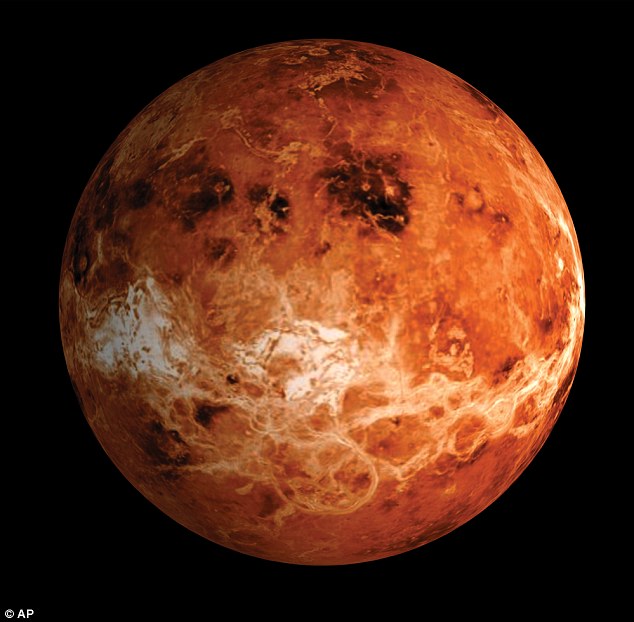
Venus was another planet that Churchill speculated might have the ability to sustain life
He wrote: 'I am not sufficiently conceited to think that my sun is the only one with a family of planets.'
The essay concludes that Mars and Venus are likely to be the only planets apart from Earth capable of sustaining life. And it finishes on a positive note, stating: 'With hundreds of thousands of nebulae, each containing thousands of millions of suns, the odds are enormous that there must be immense numbers which possess planets whose circumstances would not render life impossible.'
The article was written a year after the 1938 radio broadcast by Orson Welles dramatising The War Of The Worlds by HG Wells, which caused widespread panic among listeners in the US who thought they really were being invaded by Martians.
It was a year before Churchill would become Prime Minister, and is one of a number of popular science pieces on topics such as evolution and cells he penned in the 1930s to pay for the upkeep of his house in Kent, Chartwell.
His longstanding interest in science began when aged 22 he read Darwin's On the Origin of Species while stationed with the British Army in India and continued during the Second World War when he supported the development of radar.
Israeli astrophysicist Mario Livio, who was given the Churchill essay by the US museum, writing a comment piece on it in Nature, said: 'At a time when a number of today's politicians shun science, I find it moving to recall a leader who engaged with it so profoundly.'
WHAT IS A GOLDILOCKS ZONE?
The Goldilocks zone is the belt around a star where temperatures are ideal for liquid water to pool on a planet's surface - a key ingredient for life.
Earth inhabits the sun's Goldilocks zone, and astronomers are searching for other rocky planets in the Goldilocks zones of distant stars.
Bigger, hotter stars have their Goldilocks Zones further out, while smaller cooler stars such as M-type red dwarf stars have habitable zones much closer in.
Red dwarfs are the most common type of star in the Milky Way galaxy, and have very long life expectancies.
This means that Red dwarf Goldilocks zones are good places to search for alien because organisms have plenty of time to evolve into complex lifeforms.
To determine the location of a star's habitable zone, scientists have to first learn how much total radiation it emits.
Knowing precisely how far away a habitable zone needs to be from a star also depends on chemistry.
For example, molecules in a planet's atmosphere will absorb a certain amount of energy from starlight and radiate the rest back out.
How much of this energy is trapped can mean the difference between a turquoise sea and erupting volcanoes.
Looking for planets in the Goldilocks Zone is a way for scientists to hone in their search for Earth-like planets that could contain life.
Looking for planets in the Goldilocks Zone, such as Earth's nearby Kepler-22 system, is a way that allows scientists to hone in their search for Earth-like planets that could contain life
Since Churchill's letter in 1939, scientists have discovered several exoplanets outside of the Milky Way that occupy a distant star's Goldilocks zone.
The nearest, named Proxima b, orbits within the habitable zone of our sun's closest star, Proxima Centauri, and may have a mass just 1.3 times that of Earth.
Astronomers believe Proxima b may have a massive ocean and gassy atmosphere perfect for harbouring alien life.
Earlier this month, scientists unveiled plans for a soap-sized probe that measures only a few inches and weighs just 100 grams (0.2lbs) that could explore the mysterious planet.
A Scots man who believes he may have seen aUFO while bagging a munro has described it as "a special moment" for him.
Derek Craig, of Knightswood in Glasgow, had been bagging Ben Vorlich and Stùc a' Chròin at Loch Earn on Monday, January 3 when he noticed something in the sky.
The 41-year-old had been joined by two of his own friends, Scott McCandless, 43, and Christopher Lee, 43, as well as his son and his two friends.
As the older group made their way back down to join 26-year-old Callum Smith, and his pals, something suddenly caught their attention.
Asked whether it could possibly have been a shooting star, the 41-year-old replied: "No, this thing just moves in so many directions, a shooting star shoots but this thing was doing loop-de-loops.
"At one point, it shoots right up and it pulses twice and it zooms away, it was like something out of Star Wars.
"It also zig-zags in the sky, disappears and then it just appears again."
The trio saw a strange object shooting across the sky
Derek, who had started his own YouTube channel just weeks before, had been filming the expedition to share online later.
Although he was initially surprised at the sight in real life, he only realised just how much of a unique experience it really was at home.
The Glasgow native continued: "I've never experienced anything like this in my life.
"It's all I'm thinking about constantly, it's so strange what's happened to me."
Derek, who first took up the popular Scottish hobby of munro bagging with Callum in March 2021, has also changed his thoughts on whether there is other life out there.
He said: "I never thought before that there was, I was really skeptical but since I've seen this, I totally believe this was something else.
"That video has changed my beliefs.: He joked: "I don't think we're even human now, it's playing with my head that much."
Derek added: "I can't stop thinking about it, it's absolutely changed my life.
Meer van UFO'S of UAP'S, ASTRONOMIE, RUIMTEVAART, ARCHEOLOGIE, OUDHEIDKUNDE, SF-SNUFJES EN ANDERE ESOTERISCHE WETENSCHAPPEN - DE ALLERLAATSTE NIEUWTJES


 6KM Tall Tower Found On Mars Google Map, Video, UFO Sighting News.


 NASA raises odds of asteroid Bennu slamming into Earth from...
 Two huge red rocks with 'complex organic matter' have been...
 Fastest orbiting asteroid in the solar system is a 0.6-mile...
 More than 100 TRILLION objects lurking at the edge of


 It really is a small world: Stunning image reveals Earth as...
 A 'space hamburger' is spotted for the first time spinning...
 Indonesia's Flores 'hobbits¿ may be the earliest human...
 The spectacular Lyrid meteor shower peaks this weekend with...





 Take the bull by the...ears? Scientists breed hornless...
 Saturn overtakes Jupiter as the planet with the most moons...
 Instagram removes 'Following' feature that allowed people to...
 Powerful new suction cup inspired by the Northern clingfish...