UFO Hovering Over Islamabad, Pakistan, 13 min HD video, UFO Sighting News.
Huge Glowing Disk Over Argentina On January 6, 2022, Video, UFO Sighting News.
UFOs Shock Eyewitnesses At Lebanon, Tennessee On January 18, 2022, Video, UFO Sighting News.
The sun and its visitors continue to amaze us
10 Objects That Might Be of Extraterrestrial Origin!
Might. Remember the word “MIGHT.” There are things we know definitely come from Earth, like blancmange, and things we know definitely come from space, like David Bowie, but what if there are things ON Earth, that were secretly FROM outer-space? What if Piers Morgan was from Mars, or gin was from Jupiter? There are some things that seems so odd, so peculiar, so out-of-place that we have to wonder- is there a chance they were, originally, not of Earth? THESE areobjects that might be of extra-terrestrial origin!
Related videos, selected and posted by peter2011
THE JAMES WEBB SPACE TELESCOPE JUST DETECTED ITS FIRST SIGNAL

THE JAMES WEBB SPACE TELESCOPE JUST DETECTED ITS FIRST SIGNAL
WE'RE WATCHING THE FUTURE UNFOLD IN REAL TIME.

First Light
This week NASA released the thrilling news that as the James Webb Space Telescope begins its three-month alignment process, the Webb team saw the first photons of starlight that traveled through the entire telescope, detected by the Near Infrared Camera (NIRCam).
At first, the Webb’s photos will be unfocused, but scientists will fine tune the telescope over time. NASA says a team of engineers and scientists from Ball Aerospace, Space Telescope Science Institute, and NASA’s Goddard Space Flight Center have been rehearsing the alignment and are ready to work.
“The images taken by Webb during this period will not be ‘pretty’ images like the new views of the universe Webb will unveil later this summer,” NASA’s release reports. “They strictly serve the purpose of preparing the telescope for science.”
With Time
The Webb’s journey to photographing unknown parts of the universe won’t be so different from that of its predecessor, the Hubble Space Telescope. According to NASA, the Hubble was conceived in the late 1960s and launched in April of 1990. By May we had our first image, shown below. Even though it was about 50 percent sharper than a ground telescope’s image of the same stars, it still wasn’t very good.


By 1995 the Hubble had captured its now-iconic Eagle Nebula Gas Pillars, and the transition to beautiful deep space imagery was well under way. The images were sharper, arresting, and hauntingly beautiful.

Learning of the Webb’s first photon detection feels like 1990 all over again. Earth is about to embark on a new journey of discovery together, and we’ll all get to witness the Webb’s increasingly beautiful images over time. It’s pretty cool to think that a decade from now, we’ll be able to say we saw the initial, grainy images the Webb sent back as well as the amazing new features it’s sure to uncover.
More on the Webb:
Ozzy Sees Real UFO and Can’t Believe His Eyes!

Ozzy Sees Real UFO and Can’t Believe His Eyes!
Jack continues to convince his parents that unexplainable phenomena exists all around us with video evidence of shadow people, fairies and an ancient lake monster. Plus, he exposes a government secret — pyramid UFOs!
Levels of methane in the atmosphere are growing 'dangerously fast', warn scientists, with global warming itself behind the rapid increase

Levels of methane in the atmosphere are growing 'dangerously fast', warn scientists, with global warming itself behind the rapid increase
- Researchers have been tracking levels of methane found in the atmosphere
- They compared the type of methane in the air to that frozen in ice for centuries
- They found methane in ice since the industrial revolution is linked to fossil fuels
- However, methane since 2007 is linked to microbes, in wetlands and livestock
- They are now working out whether it is from wetlands, livestock or landfill
- If it comes from wetlands, it could mean we are in a new methane feedback loop
- This is where warming temperatures lead to more methane from wetlands, and then that extra methane further warms the planet, leading to more methane
Levels of methane found in the atmosphere are 'growing dangerously fast', scientists have warned, and it could be global warming causing the rapid increase.
A report, published in Nature, was compiled by an international team that examines data gathered by the US National Oceanic and Atmospheric Administration (NOAA) throughout 2021.
Methane is a dangerous, powerful greenhouse gas, with sources ranging from natural wetlands, to human activity, including livestock farming.
In the new study, the team found that methane in the atmosphere had raced past 1,900 parts per billion, which is triple levels found before the industrial revolution.
This 'grim new milestone' could be linked to global warming causing a rise in wetland areas, which then produce higher levels of methane, the team said.
Methane growth started to slow down around 2000, but there was a 'mysterious uptick' around 2007, which caused researchers at the time to worry global warming was creating a 'feedback mechanism'.

Levels of methane found in the atmosphere are 'growing dangerously fast', scientists have warned, and it could be global warming causing the rapid increase through more productive tropical wetlands.
Stock image

In the new study, the team found that methane in the atmosphere had raced past 1,900 parts per billion, which is triple levels found before the industrial revolution
As a greenhouse gas, methane is 28 times as potent as CO2, according to scientists, who said that if rising temperatures are causing more methane emissions, this will lead to ever greater, and faster, increases in global average temperatures.
'Methane levels are growing dangerously fast,' Euan Nisbet, an Earth scientist at Royal Holloway, University of London, in Egham, UK told Nature.
He said the emissions, which have been accelerating, are now a major threat the global efforts to limit global warming to 3.6F above pre-industrial levels.
Because of its potency, researchers have used aircraft and satellites to track levels of methane in the atmosphere, and built computer models to understand what is driving the increase.
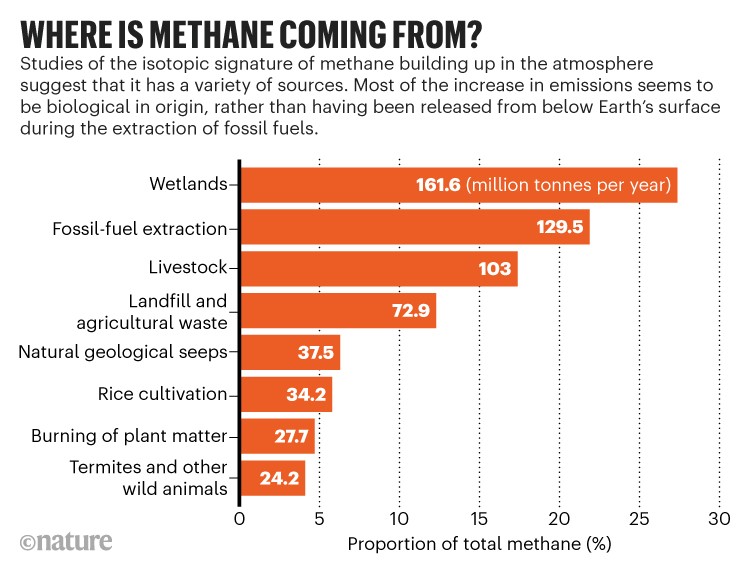
One explanation was direct human activities, including the expanding use of oil and gas, emissions from landfill, larger livestock herds, and wetlands.
Trends have proved to be 'enigmatic', said atmospheric chemist, Alex Turner, from the University of Washington, adding that there are no conclusive answers.

This 'grim new milestone' could be linked to global warming causing a rise in wetland areas, which then produce higher levels of methane, the team said.
Stock image
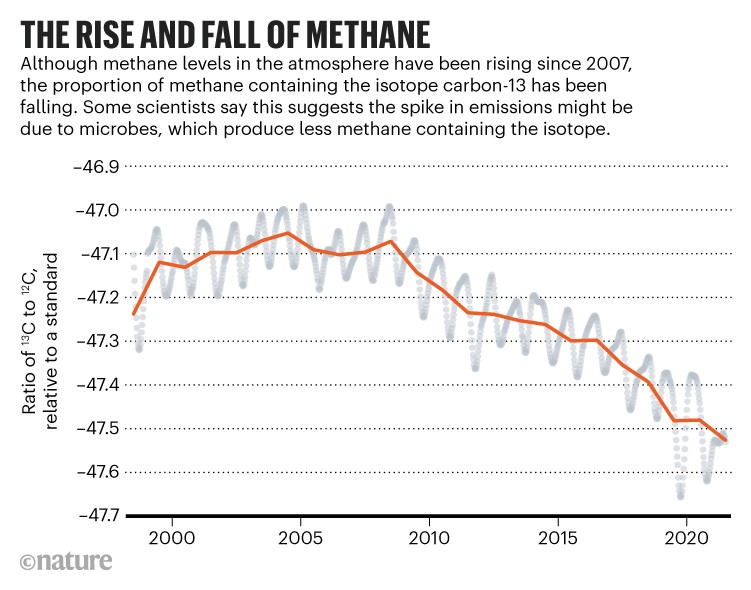
There are some clues, including through the isotpic signature of methane molecules - which normally contain carbon-12, but some have the heavier carbon-13.
Scientists found that methane produced by microbes, that have consumed carbon in the mud of a wetland, or gut of a cow, have less carbon-13 than methane produced by heat and pressure inside the planet - from fossil fuel extraction.
They compared this to the methane seen in the atmosphere, as well as methane trapped centuries ago in ice cores, or accumulated in snow.
For the two centuries after the start of the Industrial Revolution, the amount of methane containing carbon-13 has been increasing, but that reversed in 2007.
This was the year methane levels began to rise rapidly again, and scientists discovered the proportion of carbon-13 started to fall.
Researchers have put this down to an increase in microbial sources of methane over the past 15 years - which could be from livestock or more productive wetlands.
Xin Lan, from the NOAA Global Monitoring Laboratory in Colorado, told Nature that this was a 'powerful signature' suggesting human activities alone aren't to blame.
They used the carbon-13 in the atmospheric methane to estimate that microbes are responsible for 85 per cent of methane emission growth over the past 15 years.
The rest is down to fossil fuel extraction, through natural gas and oil recovery.
After comparing the types of methane, they then had to discover which environmental system the microbes came from - wetlands, livestock or landfill.
This is still an unanswered question, according to the Nature report, but if it is coming from tropical wetlands, which have become more productive due to increasing global temperatures, then we could be in a feedback mechanism.
The warmer it gets, the more productive the wetlands get, the more methane they produce, which leads to more warmer, more productive wetlands and more methane.
However, uncovering the source is a 'challenging problem', according to Lan, whose team are running new atmospheric models to try to trace the methane to its source.
'Is warming feeding the warming? It's an incredibly important question,' Nisbet told Nature, adding that 'as yet, no answer, but it very much looks that way.'
Even if a feedback mechanism is at play in increasing methane levels, humans aren't completely free of blame, said Lan, who estimates that human sources such as livestock, agricultural waste, landfill and fossil fuels account for 62 per cent of all methane emissions from 2007 to 2016.

Human activities emitting methane include leaks from natural gas systems and the raising of livestock. Methane is also emitted by natural sources such as natural wetlands.
Stock image

The upward trend in methane emissions continued in the past four years, which researchers put down to microbes, rather than fossil fuels. Found in livestock, wetlands and landfill
To limit the impact of any feedback mechanism, scientists say more needs to be done to reduce overall methane emission levels.
This could be done through reductions in livestock activities, fewer fossil fuel extractions and finding alternative uses for agricultural waste.
More than 100 countries signed the Global Methane Pledge at COP26 in Glasgow, with the target of cutting emissions by 30 per cent from 2020 levels by 2040.
Riley Duren, leader of the non-profit Carbon Mapper, which tracks sources of methane, said the focus should be on cutting emissions in the global south, particularly in low- and middle-income countries.
Scientists raise alarm over ‘dangerously fast’ growth in atmospheric methane

Scientists raise alarm over ‘dangerously fast’ growth in atmospheric methane
Harvard’s Galileo Project Might Prove ‘UFOs Are Alien Spacecraft’ In Two Years

Harvard’s Galileo Project Might Prove ‘UFOs Are Alien Spacecraft’ In Two Years
Our Solar system was created approximately 4.8 billion years ago. A part of the scientific community believes that an extraterrestrial civilization is responsible for bringing life on Earth 3.8 billion years ago. For example, Francis Crick, a co-discoverer of the structure of DNA and 1962 Nobel Prize winner seemingly believed in the “directed panspermia,” a hypothesis that life on Earth is the product of the designs of an advanced alien civilization.
After the various UFO/UAPs declassifications, mainstream experts turned the topic into a serious discussion. Harvard Professor Avi Loeb urges the scientific community to take UFO research seriously. Dr. Loeb is one of the few insiders who uplifted the study of modern phenomena.
In 2017, Dr. Avi Loeb shocked the scientific community by announcing that the asteroid Oumuamua is of an interstellar origin and probably an alien spaceship. In his book,l “Extraterrestrial: The First Sign of Intelligent Life Beyond Earth,” Dr. Loeb explains why he believes the object from 2017 was an intergalactic attempt to contact Earth.

He said that it may have even been a fully functional probe that was sent towards Earth by an alien civilization: “You need to be open-minded in order to find wonderful things.” He is known for his daring hypotheses. In 2018, he also said that we are definitely not alone in the universe.
In his January 2021 interview, Dr. Loeb claimed that there is a possibility of the existence of quadrillion alien spacecraft alone in our solar system. “There should be one in every volume roughly the size of the orbit of the Earth around the sun. This is a vast area in human terms, but in the immensity of space, it’s pretty small. So it means that there are plenty of them, a quadrillion of them, inside the Oort cloud. Inside the solar system. There are lots of them,” he added.
Last year, Dr. Loeb founded the Galileo Project, which aims to provide evidence for alien technology by building a global network of telescopes, cameras, and computers to allow it to investigate UFOs. In his new interview, Dr.Loeb said “we may be mere months away from seeing the first image detailed enough to provide incontrovertible evidence that UFOs are alien spacecraft.”
Read also:
- Are There Cr ashed UFOs & Dead Alien Bodies In So-Called ‘Hangar 18’ Of Ohio Military Base?
- Russian Scientists Stated In 1970 That Moon Is Artificial Space Object
- US Top Insiders Claim Imperceptible Beings Are All Around Us
- Does This FBI Document Suggest That Nikola Tesla Was An Alien From Venus?
The announcement of the Galileo Project came shortly after the Pentagon public its UFO footages in 2021. At the time, Dr. Loeb said: “what we see in our sky is not something that politicians or military personnel should interpret, because they were not trained as scientists, it’s for the science community to figure out.”
Dr. Loeb believed that the discovery of equipment from extraterrestrial civilizations will have a profound impact on humanity. His Galileo Project will search for such relics near Earth. He raised a few concerns in his blog which might be a big conflict if it turns out that we are not the smartest species out there.
He writes:
- “Does God exist? If we mean by that: ‘someone that can create life or new universes,’ and if their scientific understanding of biology and quantum-gravity is well ahead of ours, then they might possess the abilities that our religious texts assigned to a divine power. In fact, we are close to creating synthetic life in our laboratories only a century into our recent scientific development.
- What happens after death? The extraterrestrials might teach us how to extend our life expectancy by orders of magnitude with advanced technologies. If death can be postponed enough, then this question loses its urgency.
- How should humans treat each other? The realization that there is a far more advanced species out there, will make our genetic variations less significant and convince us to treat each other as equal members of the human species.
- What should be our long-term goals? A broader perspective of the realities far from Earth will reshape our goals in maintaining longevity by venturing into space. Our eggs should not be in only one basket.
- What happened before the Big Bang? What is Dark Matter and Dark Energy? What happens inside a black hole? and other scientific puzzles. If extraterrestrial science is far more advanced than ours, we might find answers to our unsolved questions. Just as opening a random page in a recipe book does not land on the best cake possible, humans may not be the smartest beings since the Big Bang.”
Dr. Loeb’s Galileo Project is comprised of a team of over 100 scientists. According to the Harvard professor, the project’s first telescope will start operating from the roof of the Harvard college observatory in summer 2022. It will keep infrared cameras, a radio sensor, an audio sensor, and a magnetometer rolling 24/7.
Dr. Loeb has grounded hopes in finding an extraterrestrial relic/equipment through his Galileo Project. He has advised the scientific community to find a way in order to decipher the intent of an intelligent extraterrestrial equipment. He suggested that we might need to rely on our AI systems in figuring out the intent of extraterrestrial AI systems.
Meet the solar system's youngest asteroids! Pair of space rocks orbiting the sun split off from their parent body just 300 YEARS ago, astronomers say

Meet the solar system's youngest asteroids! Pair of space rocks orbiting the sun split off from their parent body just 300 YEARS ago, astronomers say
- Researchers discovered two asteroids that shared a number of similarities
- They confirmed they both came from the same parent objects, likely a comet
- This happened about 300 years ago, making them the youngest asteroid pair
A pair of rocks orbiting the sun are the solar system's youngest asteroids, according to astronomers, who say they broke off from their parent body just 300 years ago.
In cosmic terms, that is very recent, a team from the Lowell Observatory in Flagstaff, Arizona explained, with most rocks dating back to the dawn of the solar system.
The asteroid pair, known as 2019 PR2 and 2019 QR6, were detected using the Pan-STARRS1 survey telescope in Hawaii, with confirmation by the Lowell Observatory.
The two likely broke off from the same, much larger object about 300 years ago, making them the youngest known 'asteroid pair' by a factor of ten, the team said.
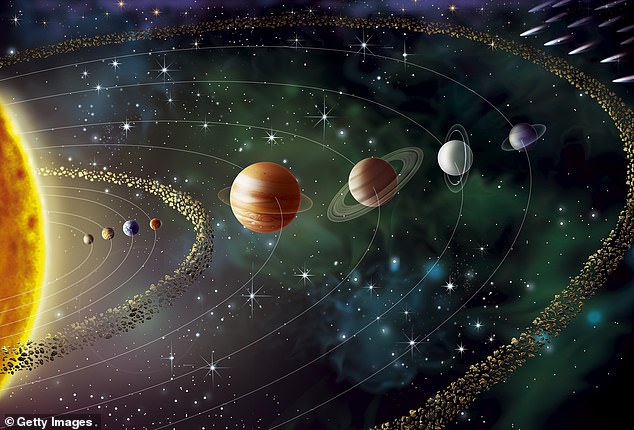
The largest of the pair, PR2, is just over half a mile wide, and the smallest about half that size, sitting between Mars and Jupiter in the Main Asteroid Belt.
Astronomers behind the discovery said it is most likely that the two objects, which are currently about half a million miles apart, were spun off by a large comet, and have been gradually drifting further from each other ever since.

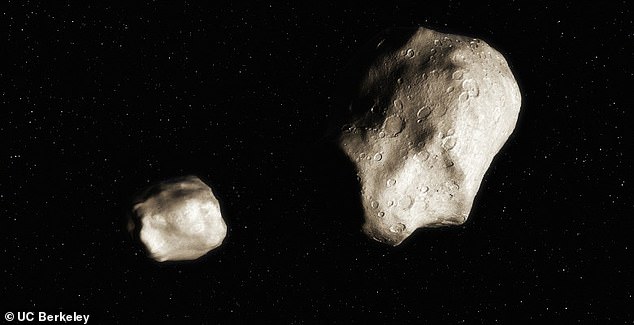
Artist impression of the asteroid pair shortly after they split from the parent object. They will gradually become further and further separated over thousands of years
What makes them unusual is that so far no observations have revealed any evidence of comet-like behaviour, but models all point to them coming from a comet.
Most asteroids are thought to have formed during the tremulous early years of the system, when planets were forming, breaking up, and colliding with one another.
The majority reside in the area between the orbits of Mars and Jupiter known as the main asteroid belt, but these two were found a little closer to home.
They are known as Near Earth Asteroids (NEAs) as their orbits bring them close to the Earth, even if they don't reside there the whole time.
These two pass by the Earth, but also go out beyond Jupiter, the team explained, adding that they pose no threat to our planet.
In 2019, scientists using the Pan-STARRS1 survey telescope in Hawaii and the Catalina Sky Survey in Arizona each discovered a new NEA.
They were identified as 2019 PR2 and 2019 QR6. The largest of the two measures about half a mile in diameter and the other half that size.
Astronomers discovered they had very similar orbits around the sun, and further study confirmed that they were both linked - an asteroid pair.

Petr Fatka of the Astronomical Institute of the Czech Academy of Sciences, confirmed they were two asteroids that separated from a single parent within the past several million years.
While they have the same parent, and were discovered in a similar region of the sky as viewed from Earth, they are currently separated by half a million miles of space.
Several telescopes were used for the follow-up observations, including the 4.3-meter Lowell Discovery Telescope (LDT) in northern Arizona.
These observations revealed very similar surface properties of both asteroids, further supporting the theory that they came from the same object.
'Thanks to the measurements performed with the LDT, it is clear that 2019 PR2 and 2019 QR6 come from the same parent object and their high orbital similarity is not coincidental,' explained Fatka.
Most asteroid pairs of this time form from a process known as rotational fission, which is where a spinning asteroid reaches a critical speed.
These rocks are effectively just piles of rubble held together by gravity, and so as they spin faster the debris flies off and forms one or more new asteroids.
When they spin off they maintain a very similar orbit to the parent body, which is how the team determined these two objects had a shared heritage.
Based on multiple modeling techniques and additional observations, which included previously unnoticed detections by the Catalina Sky Survey, they found that the pair only separated within the past 300 years.
'It's very exciting to find such a young asteroid pair that was formed only about 300 years ago, which was like this morning—not even yesterday—in astronomical timescales.' The previous record holders were at least ten times older,' said Fatka.
However, finding they only split 300 years ago from a larger parent, left the astronomers with a problem. It wasn't possible for standard models of rotational fission to explain the properties found on these rocks.
'Something else had to be going on to explain their current separation,' they wrote.
The team then developed new models that assume the original body was a comet, whose jets of gas could push their orbits into the configuration seen today. This provided a viable origin story for these objects.
Nicholas Moskovitz of Lowell Observatory said this then raised further problems, as the bodies don't display any signs of cometary activity.
'So it remains a mystery how these objects could have gone from a single parent body, to individually active objects, to the inactive pair we see today in just 300 years,' he added.

Petr Fatka of the Astronomical Institute of the Czech Academy of Sciences, confirmed they were two asteroids that separated from a single parent within the past several million years
It isn't currently possible to explain this problem with current data, the team explained, saying that more observations will be needed.
This will have to wait more than a decade though, as they are currently out of reach of available telescopes.
'To have a better idea about what process caused the disruption of the parent body, we have to wait until 2033 when both objects will be within the reach of our telescopes again,' said Fatka.
The team wrote in the paper: 'Targeted observations in 2033, for example with the James Webb Space Telescope, during the next perigee passage of these objects could directly probe for differences in thermal inertia.
'Indirect tests may come from NASAs upcoming DART and JANUS missions, both of which will be visiting binary asteroids.
'These missions may constrain any grain size differences between the primaries and satellites, which will provide important clues into the detailed physics of binary and asteroid pair formation and evolution.'
The findings have been published in the journal Monthly Notices of the Royal Astronomical Journal.
Read more:
Pair of Baby Asteroids Only 300 Years Old Discovered


Pair of Baby Asteroids Only 300 Years Old Discovered
While most scientists are looking for asteroids and meteorites billions of year old to help unlock clues to the birth of the universe, the solar system and Earth, a few are searching instead for an asteroid nursery filled with baby rocks. That side got a big boost this week with the record-setting discovery of two so young, they may need to be burped.
“It’s very exciting to find such a young asteroid pair that was formed only about 300 years ago, which was like this morning—not even yesterday—in astronomical timescales.”
In a Lowell Observatory press release announcing the discovery of the near-Earth asteroid pair 2019 PR2 and 2019 QR6, Petr Fatka of the Astronomical Institute of the Czech Academy of Sciences explains how they were discovered and why – besides their young age – these two baby space rocks are so unusual. Using the Pan-STARRS1 survey telescope in Hawaii and the Catalina Sky Survey in Arizona, the near earth objects (NEA) were discovered separately at about the same time in 2019 – with 2019 PR2 measuring about one-half mile in diameter and 2019 QR6 one-quarter mile wide. Found in the Main Asteroid Best between Jupiter and Mars, they are about one million km (620,000 miles) apart – almost Siamese twins in astronomy terms. In fact, backwards analysis of the pair show they indeed broke off of the same parent comet a mere instant ago.
Asteroid Belt
“Based on multiple modeling techniques and additional observations—including recovery of previously unnoticed detections made with the Catalina Sky Survey 14 years before the discovery—the team determined that the pair separated only 300 years ago, making it the youngest known pair of asteroid pairs.”
Youngest by at least a factor of ten, according to the study published in the journal Monthly Notices of the Royal Astronomical Society. Their surface composition confirms they broke off of the same parent in a process called rotational fission – spinning comets lose pieces that can no longer be held together by gravity. The parent comet pushes the pieces away with its jets, which explains how the two babies traveled so far in just 300 years. That can be confirmed the next time the two young rocks are in the range of the James Webb Space Telescope in 2033. The next view will hopefully explain another mystery of 2019 PR2 and 2019 QR6.
Are you our Mama?
“In the present day, the bodies don’t display any signs of cometary activity. So it remains a mystery how these objects could have gone from a single parent body, to individually active objects, to the inactive pair we see today in just 300 years.”
While their parent is a comet, 2019 PR2 and 2019 QR6 are a pair of inactive asteroid children. Does this mean they’re actually asteroid teenagers? Or did they come from a donor parent?
Are there DNA tests for asteroids?
Get Ready for Some Clear Photos of UFOs


Get Ready for Some Clear Photos of UFOs
There is one thing UFO believers and UFO skeptics have in common – besides a love for one of the two stars of “The X-Files” – and that is a mutual dislike/disgust/frustration/hatred of blurry photos. While this trait is shared with Bigfoot and other cryptid fans, it’s most pronounced amongst those hoping for confirmed visible evidence and identification of strange aerial phenomena. Well, folks … your prayers, burnt offerings, magic lamp wishes and animal sacrifices have been answered. Everyone’s favorite Harvard genius astrophysicist who believes in UFOs – Abraham ‘Avi’ Loeb’ – has made a personal commitment to provide clear UFO photos and videos very soon … possibly as early as this summer.
I thought YOU had the cellphone.
“I really want the next generation to be free to discuss it, and for it to become part of the mainstream. My hope is that by getting a high resolution image of something unusual, or finding evidence for it, which is quite possible in the coming year or two, we will change it.”
In an interview with The Guardian, Loeb compares himself to a fisherman on the beach who can’t see any fish because he’s not casting a net. Loeb has two UFO nets to cast – the first is data collected by the mini-satellite network of Planet Labs which will take photos from space of the entire surface of the Earth once per day. On the ground, Loeb and his Galileo Project are setting up a worldwide network of telescopes controlled by artificial intelligence to search the skies for UFOs – learning as they go along to eliminate birds, planes, bugs, clouds and other explainable anomalies.
Between the photos from above and below, Loeb thinks a clear picture of one or many UFOs will be taken. And that’s a good thing for both sides of the discussion.
“I really want the next generation to be free to discuss it, and for it to become part of the mainstream. My hope is that by getting a high resolution image of something unusual, or finding evidence for it, which is quite possible in the coming year or two, we will change it.”
Loeb and his combined Planet Labs/Galileo Project search is not without competition. Last week, Hakan Kayal, a Professor for Space Technology at Julius-Maximilians-Universität Würzburg (JMU) in Germany, revealed he has already set up a dual AI-controlled SkyCAM-5 camera system on a university building that has been watching for UFOs since December 2021. While Kayal may e ahead of Loeb on from-the-ground scans, he’s not incorporating satellite images. Perhaps they should join forces – it would provide a good example for the next generation and move the search for extraterrestrial intelligence even closer to the mainstream.
We needs some photos like this … only real.
Avi Loeb has always been open about his expansive beliefs in UFOs and extraterrestrials – he led the team who believed the ‘Oumuamua interstellar comet could be an ET spacecraft exploring our solar system. You can’t have big discoveries without some big ideas … even if some end up to be big mistakes.
Let’s hope Avi Loeb finds and photographs the UFOs … before someone (or something) shuts him down.
ALL RELATED VIDEOS, selected and posted by peter2011
Glowing Blue Orbs Over Volcano In March 2021, Video, UFO Sighting News.

Glowing Blue Orbs Over Volcano In March 2021, Video, UFO Sighting News.
Location of sighting: Fagradalsfjall volcano, Iceland
Alien Tech Found By Mars Rover! Life Altering Tech, UFO Sighting News.

Alien Tech Found By Mars Rover! Life Altering Tech, UFO Sighting News.
Location of discovery: Planet Mars
NASA Cuts Out Alien Life Form From Rover Photo! UFO Sighting News.
Date of discovery: February 2022
NASA photo:
Unknown bright object falling apart in the sky over Mexico

Unknown bright object falling apart in the sky over Mexico
The sky over Mexico’s Cabo San Lucas was illuminated by a slow moving bright light, the nature of which is unclear.
Strange UFO lights over the beach in Mar del Plata, Argentina – 6 January 2022

Strange UFO lights over the beach in Mar del Plata, Argentina – 6 January 2022

These strange lights were filmed in the night sky above Mar del Plata beach in Argentina on 6th January 2022.
What’s your opinion about this UFO sighting?
SCIENTISTS FAIL TO SPOT ALIENS AFTER SCANNING SKIES FOR SEVEN WHOLE HOURS

SCIENTISTS FAIL TO SPOT ALIENS AFTER SCANNING SKIES FOR SEVEN WHOLE HOURS
DON'T GIVE UP THAT EASILY!

Scanning… Scanning…
A team of astronomers have used the Murchison Widefield Array, a massive network of over 4,000 antennas spread out over the Western Australian desert, to look for aliens.
They collected seven agonizing hours worth of data — and to their dismay, they found nothing.
As detailed in their new paper, accepted for publication in the journal Publications of the Astronomical Society of Australia, the team used the array to collect data while peering into the Galactic Center, centered on Sagittarius A*, the suspected supermassive black hole at the core of the Milky Way.
They looked for technosignatures of extraterrestrials at a frequency of 155 megahertz, the first search of its kind. Usually, according to CNET, astronomers have focused on lower frequencies.
“This is our largest population of known exoplanets within our four surveys with the MWA,” lead author Chenoa Tremblay, and researcher at the SETI Institute, told the site.
Fear of an Exoplanet
Exoplanets are a particularly interesting place to look for signs of alien life. A previous search back in 2013 of the same corner of the galaxy contained only 38 known exoplanets. The new search upped the total to 144.
We’re only beginning to understand what is going on at the center of our galaxy, so there could be many more planets hiding in there — we don’t even know how many stars are lurking there since there’s a lot of cosmic dust obscuring our view.
With a bit of math, the astronomers’ latest survey could theoretically have covered a vast number of star systems. Their research is based on a previous survey that classified 3.3 million stars in the vicinity — but that only accounts for an area that is less than one percent of that covered by the MWA survey.
“If we extrapolate this, we are covering billions of stellar systems out to the center of our Galaxy,” Tremblay told CNET.
Of course, just because they didn’t find aliens in this one region of the sky who happened to be communicating on a specific frequency during a particular seven-hour stretch doesn’t mean much. So we hope they keep looking.
READ MORE:
More on aliens:


Earth has a SECOND 'Trojan asteroid': 1,800ft-wide space..
NASA's asteroid alert system ATLAS upgraded to constantly..
Elon Musk's SpaceX Starlink satellites disrupt almost a...