Ontdek de Fascinerende Wereld van UFO's en UAP's: Jouw Bron voor Onthullende Informatie!
Ben jij ook gefascineerd door het onbekende? Wil je meer weten over UFO's en UAP's, niet alleen in België, maar over de hele wereld? Dan ben je op de juiste plek!
België: Het Kloppend Hart van UFO-onderzoek
In België is BUFON (Belgisch UFO-Netwerk) dé autoriteit op het gebied van UFO-onderzoek. Voor betrouwbare en objectieve informatie over deze intrigerende fenomenen, bezoek je zeker onze Facebook-pagina en deze blog. Maar dat is nog niet alles! Ontdek ook het Belgisch UFO-meldpunt en Caelestia, twee organisaties die diepgaand onderzoek verrichten, al zijn ze soms kritisch of sceptisch.
Nederland: Een Schat aan Informatie
Voor onze Nederlandse buren is er de schitterende website www.ufowijzer.nl, beheerd door Paul Harmans. Deze site biedt een schat aan informatie en artikelen die je niet wilt missen!
Internationaal: MUFON - De Wereldwijde Autoriteit
Neem ook een kijkje bij MUFON (Mutual UFO Network Inc.), een gerenommeerde Amerikaanse UFO-vereniging met afdelingen in de VS en wereldwijd. MUFON is toegewijd aan de wetenschappelijke en analytische studie van het UFO-fenomeen, en hun maandelijkse tijdschrift, The MUFON UFO-Journal, is een must-read voor elke UFO-enthousiasteling. Bezoek hun website op www.mufon.com voor meer informatie.
Samenwerking en Toekomstvisie
Sinds 1 februari 2020 is Pieter niet alleen ex-president van BUFON, maar ook de voormalige nationale directeur van MUFON in Vlaanderen en Nederland. Dit creëert een sterke samenwerking met de Franse MUFON Reseau MUFON/EUROP, wat ons in staat stelt om nog meer waardevolle inzichten te delen.
Let op: Nepprofielen en Nieuwe Groeperingen
Pas op voor een nieuwe groepering die zich ook BUFON noemt, maar geen enkele connectie heeft met onze gevestigde organisatie. Hoewel zij de naam geregistreerd hebben, kunnen ze het rijke verleden en de expertise van onze groep niet evenaren. We wensen hen veel succes, maar we blijven de autoriteit in UFO-onderzoek!
Blijf Op De Hoogte!
Wil jij de laatste nieuwtjes over UFO's, ruimtevaart, archeologie, en meer? Volg ons dan en duik samen met ons in de fascinerende wereld van het onbekende! Sluit je aan bij de gemeenschap van nieuwsgierige geesten die net als jij verlangen naar antwoorden en avonturen in de sterren!
Heb je vragen of wil je meer weten? Aarzel dan niet om contact met ons op te nemen! Samen ontrafelen we het mysterie van de lucht en daarbuiten.
Woensdag 29 juni 2022
Giant Blue Matter On Google Sky Map May Be Intelligently Made Planet, UFO Sighting News.
Giant Blue Matter On Google Sky Map May Be Intelligently Made Planet, UFO Sighting News.
Date of discovery: June 29, 2022
Location of discovery: far right of Horesehead Nebula
Coordinates: -2.759860° -88.686101°
I was looking over Google Sky map, which is free and comes with the Google Earth map. You only need to click on the Satern icon on the top center of the Google map to move to Sky map or moon maps.
Here I found a strange object which I believe to be fake land. I believe that aliens can create planetary matter but in any design or shape that they see as being more useful to them. Here is a scattering of matter, blue and made to act like a planet. The object has lights in front of it due to planets an stars seen between us and it. It is not transparent.
We see life and existence as a lower life form would...simple with simplistic answers, however the depth of possibilities is endless and this object is space is no Nebula its something created by intelligent beings.
San Diego, California Skies light up with lights over ocean, June 27, 2022, 2 Videos, UFO Sighting News.
Date of sighting:June 27, 2022 Location of sighting: San Diego, California, USA
An unusual line of lights lit up the California city of San Diego a few days ago. The lights are similar to the ones seen by thousands of people over Phoenix, Arizona back in March 13, 1997 where long lines of lights were seen in the sky over the city. Well it looks like those aliens are back and they are near San Diego, but over the ocean area. This seems to indicate there may be an alien base somewhere in the ocean near San Diego, which would explain a lot of the earth quakes that they have been having over the years. The US military has denied that any exercises took place, so that rules out flare, but then again flares only last minutes, this sighting lasted almost an hour!
Scott C. Waring - Taiwan
Eyewitness states:
Its still happening, going on about an hour now. Multiple floating lights over the ocean. Very still, very bright. Orange reddish lights. Pattersn of 2, 3, 4, 5, and 6."
Alien civilizations from level 1 to level 7 - We are only at level 0.72
The Kardashev scale is a method of measuring a civilization's level of technological advancement based on the amount of energy it is able to use. The measure was proposed by Soviet astronomer Nikolai Kardashev in 1964.The scale is hypothetical, and regards energy consumption on a cosmic scale.
Kardashev's has given rise to numerous scenarios exploring the possibility of more evolved civilizations. These scenarios each question in their own way, defining a civilization: energy sources, technology and the transmission of interstellar messages.
The purpose of this classification is to guide the search for extraterrestrial civilizations, particularly within SETI, in which Kardashev participated, and this on the assumption that a fraction of the energy used by each type is intended to communicate with other civilizations.
To make this scale more understandable, they compare the speed of transmission across the galaxy of a volume of information equivalent to a medium-sized library.
For example:
A type 2 civilization can send this data by means of a transmission beam emitting for only 100 seconds. A similar amount of information can be sent across intergalactic distances of about ten million light years, with a transmission time of several weeks.
A type 3 civilization can transmit this same amount of data to the entire observable universe with a transmission time of 3 seconds.
Kardashev believes that it will take humanity 3,200 years to reach Type 2, and 5,800 years to reach Type 3, but physicist and futurist Michio Kaku suggested that, if humans increase their energy consumption at an average rate of 3 percent each year, they may attain Type 1 status in 100–200 years, Type 2 status in a few thousand years, and Type 3 status in 100,000 to a million years.
A Type I civilization is usually defined as one that can harness all the energy that reaches its home planet from its parent star.
A Type 2 civilization is capable of harnessing the energy radiated by its own star, or example, by means of the successful completion of a Dyson sphere or Matrioshka brain.
Note 1: A Dyson sphere is a hypothetical megastructure that completely encompasses a star and captures a large percentage of its solar power output.
Note 2: A Matrioshka brain is a hypothetical megastructure of immense computational capacity powered by a Dyson sphere. It is an example of a class-B stellar engine, employing the entire energy output of a star to drive computer systems.
A Type 3 civilization is in possession of energy at the scale of its own galaxy. Civilizations of this type as having access to power comparable to the luminosity of the entire Milky Way galaxy.
A Type 4civilization can control or use the entire universe while
a Type 5 civilization can control collections of universes as well as there is
a Type 6 multidimensional civilization
a Type 7 creator civilization what is discussed in the video below.
At the current time, humanity has not yet reached Type 1 civilization status, we are only at level 0.72
Mysterious rocket crash on moon baffles scientists or was it a UFO?
A mystery rocket has crashed into the moon creating two large craters. NASA astronomers are baffled, they don't know where the rocket came from and why the impact was spread over two distinct areas.
The astronomers discovered a rocket body heading toward a lunar collision late last year. The impact occurred on March 4, 2022 with NASA's Lunar Reconnaissance Orbiter later spotting the resulting crater. Surprisingly the crater is actually two craters, an eastern crater (18-meter diameter, about 19.5 yards) superimposed on a western crater (16-meter diameter, about 17.5 yards).
The double crater was unexpected and may indicate that the rocket body had large masses at each end. Typically a spent rocket has mass concentrated at the motor end; the rest of the rocket stage mainly consists of an empty fuel tank.
No other rocket body impacts on the Moon created double craters. The four Apollo SIV-B craters were somewhat irregular in outline (Apollos 13, 14, 15, 17) and were substantially larger (greater than 35 meters, about 38 yards) than each of the double craters. The maximum width (29 meters, about 31.7 yards) of the double crater of the mystery rocket body was near that of the S-IVBs.
That means it wasn’t an average rocket, NASA reported in a June 24 news release.
The origin of the rocket body remains uncertain and so far, none of Earth’s space exploring nations have taken credit or blame for the crash.
Since they cannot identify the object means it was an Unidentified Flying Object, but NASA will never admit that it was a UFO that crashed on the moon.
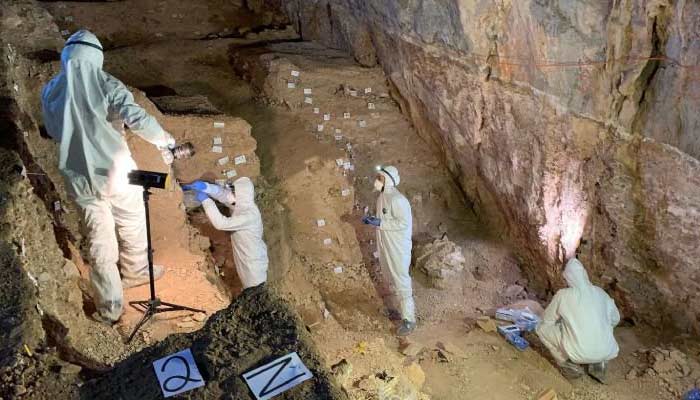
During archaeological excavations in Crimea , experts discovered a necropolis of the Byzantine Empire where the tomb of a giant was .
While the reconstruction work on the Mithridates Staircase in Kerch continues, archaeological excavation work has also started in the area.
This revealed up to 100 square meters of a necropolis, which had burials of people who once visited the temple of Juan Bautista .
To date there are 27 uncovered burials , some of children and twin burials. In addition to other elements, such as bronze pendants or bracelets.
They even managed to find felt clothing in one of the burials . This was very helpful as it allowed them to date the find .
Tomb of a giant in the necropolis
The find itself was not common and it became much more strange when they found a funerary box that exceeded 2.30 meters in length . When they uncovered it, they found what appeared to be the skeleton of a giant.
If the standard physique of the inhabitants of the area in the past is taken into account, finding a skeleton of a man that exceeded two meters in height is something that does not agree with the data.
The average height of the population of the date was 1.60 meters high , so there is no way to explain how the remains of this giant were buried in the area.
The remains were examined by the team’s anthropologist, who hopes to give an estimate of the age of the person buried there.
The remains must be analyzed to discover their origin
complicated excavation
The excavation work has been slow due to the complicated terrain, which is mixed . In ancient times, garbage was simply thrown on the ground.
Then, in the Middle Ages , the necropolis was created on top of all the ancient remains. For this reason it has become difficult for archaeologists to give an exact interpretation of the origin of everything found.
At the moment, the experts are in negotiations with the diocese of Kerch-Feodosia to be able to extract the remains found and examine them better.
Experts continue to investigate the origin of the mysterious skeleton and the reason for its abnormal size. In addition to finding an explanation for its origins.
The existence of giants is common in different ancient cultures, despite the fact that traditional archeology tries to keep these types of findings hidden. But discoveries like the one in Crimea show us that they existed.
ARCHEOLOGEN ZIEN 3400 JAAR OUDE STAD VAN MYSTERIEUZE BESCHAVING UIT HET WATER OPDOEMEN
Caroline Kraaijvanger
Door aanhoudende droogte viel de stad – die zich normaliter onder water schuilhoudt – eerder dit jaar heel even droog. Wat volgde, was een race tegen de klok. Mét resultaat.
Als klimaatverandering ergens tot uiting komt, dan is het – even afgezien van de polen – wel in Irak. Met name het zuiden van het land gaat regelmatig gebukt onder extreme droogte. Zo ook in januari en februari van dit jaar. Om de gewassen op de droge akkers in ieder geval nog een kans te geven, werd een beroep gedaan op het Mosoel-reservoir; het belangrijkste waterreservoir dat Irak sinds de jaren tachtig van de vorige eeuw rijk is (zie kader). Het waterpeil in dit reservoir zakte rap. En terwijl het water zakte, dook in het reservoir een grote en daarmee vermoedelijk belangrijke stad uit de Bronstijd op.
Mosoel-reservoir In 1981 werd in het noorden van Irak aangevangen met de bouw van de Mosoeldam (in die tijd aangeduid als de Saddamdam). Door de dam ontstond een stuwmeer dat men kort na de voltooiing van de dam – in 1985 – liet vollopen. Verschillende archeologische vindplaatsen verdwenen daarbij onder water, waaronder dus ook de stad die begin dit jaar tijdelijk uit het water verrees. Wat deze stad echter bijzonder maakt, is dat deze – ook voorafgaand aan de totstandkoming van het stuwmeer – nooit door archeologen onderzocht is.
Geen vrije tijd Koerdische archeologen haastten zich – met enkele Duitse collega’s – naar het Mosoel-reservoir. En dat was het startsein van een race tegen de klok (en het water). De archeologen hadden daarbij een duidelijk doel voor ogen: een zo’n groot mogelijk deel van deze stad – voor het water deze weer zou verzwelgen – verkennen. “De tijdsdruk had geen effect op de opgravingen en onze documentatiemethoden,” benadrukt onderzoeker Ivana Puljiz, verbonden aan de universiteit van Freiburg. “Maar het betekende wel dat we bijna geen vrije tijd hadden.”
Zes weken was de archeologen uiteindelijk gegund. En in die periode werd er continu keihard gewerkt. “De grootste uitdaging tijdens de opgravingen was het weer. Door de tijdsdruk bleven we doorgraven in kou, sneeuw, hagel, regen en zelfs stormen. Want we wisten niet wanneer het waterpeil weer zou stijgen en hoeveel tijd we zouden hebben.”
Machtig rijk Maar het harde werk heeft zijn vruchten afgeworpen. Want de archeologen zijn erin geslaagd om – in de korte tijd die hen daarvoor gegund was – een groot deel van de stad in kaart te brengen. Daarnaast zijn in de stad ook een aantal interessante vondsten gedaan die hopelijk meer inzicht kunnen geven in het nog altijd mysterieuze beschaving die tussen 1550 en 1350 voor Christus over grote delen van het noorden van Mesopotamië en Syrië heerste: de Mittani.
Over de Mittani “Het Mittani-rijk is één van de grootste staten die tijdens de late Bronstijd in het zuidwesten van Azië te vinden waren,” vertelt Puljiz. “Het bestond gelijktijdig met het Nieuwe Rijk in Egypte, de Kassieten die over Babylon heersten en het Hettitisch Koninkrijk (dat centraal Anatolië en noordwestelijke Syrië besloeg, red.). Het gebied waarin de Mittani heersten, was groot en reikte van de Mediterrane kust tot het noorden van Irak. Maar er is heel weinig bekend over de organisatie van het rijk, omdat de hoofdstad ervan tot op heden nog niet met zekerheid geïdentificeerd is en de archieven nog op ontdekking wachten.”
Waardevol Het maakt de opgravingen die nu op de tijdelijke oevers van het Mosoel-reservoir hebben plaatsgevonden heel waardevol. “De opgravingen wijzen erop dat dit een belangrijk centrum in het Mittani-rijk was,” vertelt onderzoeker Hasan Qasim. En de stad kan ons dan ook meer vertellen over deze nog altijd vrij mysterieuze beschaving.
Grote gebouwen Zo zijn de onderzoekers tijdens hun opgravingen op een paleis gestuit, maar ook op een soort fort met muren en wachttorens en een enorm, meerdere verdiepingen tellend pakhuis. “Wat het meest opwindend is, is dat we ons nu een voorstelling kunnen maken van hoe de stad eruitzag,” stelt Puljiz. “Hoe de stad functioneel en ruimtelijk georganiseerd was. Wat ons daarbij onder meer verbaasde was dat we op verschillende plaatsen in de stad op enorme gebouwen stuitten.”
In de stad zijn opmerkelijk goed bewaard gebleven muren ontdekt.
Afbeelding: Universities of Freiburg and Tübingen, KAO.
Metershoge muren Veel van die gebouwen zagen er naar omstandigheden nog redelijk goed uit. Zo werden er op verschillende plaatsen in de oude stad goedbewaard gebleven muren teruggevonden die soms wel enkele meters hoog waren. Dat de muren – gemaakt van in de zon gedroogde kleisteen – zelfs na meer dan 40 jaar onder water te hebben gestaan, nog heel zijn, is volgens de onderzoekers te herleiden naar een aardbeving die de stad rond 1350 voor Christus verwoestte. Tijdens deze beving stortten de bovenste delen van gebouwen in, waardoor de onderste delen erdoor begraven – en later ook beschermd – werden.
Tabletten Naast de muren stuitten de onderzoekers nog op een andere spectaculaire vondst; vijf keramische vazen die samen een meer dan 100 kleitabletten tellend archief herbergden. De kleitabletten dateren uit de periode kort nadat de aardbeving plaatsvond. En ook daarvoor geldt dat het bijna wonderbaarlijk te noemen is dat deze kleitabletten hun decennialange onderdompeling hebben doorstaan. De onderzoekers vermoeden dat de tabletten brieven zijn en hopen dat deze ons meer kunnen vertellen over de ondergang van de stad en misschien ook de opkomst van het Assyrische rijk in het gebied.
Hier zie je een met kleitabletten gevuld vat. Eén van de kleitabletten zit zelfs nog in zijn ‘envelop’.
Afbeelding: Universities of Freiburg and Tübingen, KAO.
Zakhiku Ten slotte denken de onderzoekers dankzij de opgravingen ook te weten hoe de Mittani deze indrukwekkende stad noemden. “Tijdens onze opgravingen hebben we een administratieve tekst gevonden die de oude stad Zakhiku noemt. We nemen aan dat dit verwijst naar de plek waar we opgravingen hebben gedaan.”
Dat de onderzoekers in amper zes weken tijd zoveel gezien en gedocumenteerd hebben, is indrukwekkend. En er viel nog veel meer te ontdekken, maar de tijd ontbrak; de archeologen waren in februari gedwongen de stad weer terug te geven aan het water. Maar niet voordat ze deze voor zover mogelijk met plastic hadden bedekt. “Het is belangrijk om ons gedeelde culturele erfgoed voor toekomstige generaties te behouden,” stelt Puljiz. “En archeologische vindplaatsen in reservoirs eroderen door het stijgende en dalende water. Uiteindelijk zal zo’n vindplaats compleet eroderen en gaan alle ruïnes verloren.” Dat probleem speelt ook in het geval van Zakhiku. “Hoewel de gebouwen uit de Mittani-periode dankzij hun omvang goedbewaard zijn gebleven, zijn de bovenliggende lagen – zonder ooit archeologisch onderzocht te zijn – al bijna vrijwel geheel geërodeerd. We hopen verdere erosie te voorkomen door de vindplaats in te pakken met plastic dat door stenen en keien op zijn plaats wordt gehouden.”
Na de opgravingen werden de ruïnes met plastic bedekt om ze tegen erosie te beschermen.
Afbeelding: Universities of Freiburg and Tübingen, KAO.
Inmiddels is de stad weer volledig door water bedekt. Wanneer deze weer uit het water verrijst, is onmogelijk te voorspellen. “Maar ik hoop dat we ons onderzoek op deze opwindende plek weer eens voort kunnen gaan zetten,” stelt Puljiz. “Er zijn nog zoveel dingen te ontdekken!” En niet alleen in deze stad. Want naast Zakhiku zijn er in de jaren tachtig met de totstandkoming van het Mosoel-reservoir nog veel meer gebieden aan het water ten prooi gevallen. “Voorafgaand daaraan heeft de Irakese overheid een soort reddingsprogramma op poten gezet waarbij talloze van deze gebieden eerst door Irakese en buitenlandse onderzoekers zijn onderzocht.” Hoewel men ook van het bestaan van Zakhiku op de hoogte was, werden de resten van deze stad echter nooit onder de loep genomen. En mogelijk zijn er nog wel meer plaatsen die archeologen toen – bewust of onbewust – niet nader hebben onderzocht. “Er kunnen zomaar tientallen andere belangrijke plaatsen zijn waar we nog helemaal nietsvan weten,” denkt Puljiz.
THE EARTH'S CORE IS COOLING WAY FASTER THAN WE THOUGHT, SCIENTISTS SAY
OUR PLANET IS TURNING INTO A ROCKY PLANET LIKE MERCURY OR MARS MUCH "FASTER THAN EXPECTED."
GETTY IMAGES
Cooling Earth
According to new research, the core of the Earth is cooling much faster and sooner than originally anticipated — a new mystery that could throw a wrench in our understanding of the planet's evolution.
To get a better sense of how far along the Earth is in the process, scientists are studying the thermal conductivity of the minerals present in the layer between the planet's core and mantle. The faster that hot center passes heat to the planet's outer layers, the faster the Earth is losing the heat present in its core.
Heating Rocks
In a lab simulation, a team of researchers from ETH Zurich in Switzerland and the Carnegie Institution for Science applied immense amounts of pressure and heat to a mineral called bridgmanite — which is found in the transitional zone between the core and mantle — to simulate the conditions deep below the surface. They then measured its thermal conductivity to get a better sense of the cooling processes at play.
The results were surprising.
"This measurement system let us show that the thermal conductivity of bridgmanite is about 1.5 times higher than assumed," said ETH professor Motohiko Murakami, lead author of a paper about the findings published in the journal Earth and Planetary Science Letters, in a statement.
In other words, the heat from the core is being passed on at a much faster rate than previously thought, leading to the greater cooling of the Earth.
A New Perspective
The study could rewrite what we already know about the dynamic processes leading to the slowing down of convection currents.
"Our results could give us a new perspective on the evolution of the Earth’s dynamics," Murakami explained. "They suggest that Earth, like the other rocky planets Mercury and Mars, is cooling and becoming inactive much faster than expected."
The researcher did, however, note we didn't know enough to pinpoint how long it will take for convection currents to stop altogether.
De Amerikaanse sonde Lunar Reconnaissance Orbiter (LRO), die sinds 2009 rond de Maan wentelt, heeft na de mysterieuze inslag van een rakettrap twee nieuwe impactkraters op het hemellichaam gevonden, zo heeft nieuwszender CNN maandag gemeld.
Op 4 maart sloeg een door mensenhanden gemaakt object, voor het eerst niet met opzet, op de Maan in. Nadien stelde de LRO vast dat er twee nieuwe impactkraters zijn. Een oostelijke is achttien meter breed en een westelijke zestien meter.
Volgens CNN zijn astronomen verrast dat er twee kraters zijn. Het suggereert dat de impact het werk is van een groot object.
Wat dat object precies is, is nog steeds onduidelijk. Eerst was sprake van een trap van een Amerikaanse Falcon-draagraket. Daarop sprak China de versie tegen dat het een trap van de Lange Mars-3C draagraket was die de Chinese Chang’e-5 Maanmissie lanceerde.
Mogelijk kan de dubbele inslag astronomen meer leren over de precieze herkomst, aldus nog CNN.
A rocket body struck the moon on March 4 near the Hertzsprung crater, creating a double crater roughly 28 meters wide.
Limburger looft 1 miljoen euro uit voor wie bezoek van aliens in ufo kan bewijzen
Eén miljoen euro voor wie het bestaan van ufo’s als buitenaardse ruimtetuigen kan bewijzen. Dat mooie bedrag looft Limburger Marc Broux uit, om zijn overtuiging dat ufo’s van aliens niet bestaan kracht bij te zetten. Zijn belofte loopt tot nog tot 21 april 2025.
24 juni 1947. Piloot Kenneth Arnold ziet negen onbekende vliegende objecten nabij de Mount Rainier in de Amerikaanse staat Washington. Zijn melding ervan geldt als de allereerste van zogenaamde ufo’s: unidentified flying objects of ongeïdentificeerde vliegende voorwerpen. De ufologie, het onderzoek naar ufowaarnemingen, bestaat sinds vrijdag dus exact 75 jaar. Maar of ook ufo’s zelf écht bestaan, dat is een andere zaak.
Marc Broux, een ufoloog uit Zolder, was lange tijd een believer, maar nu niet meer. De expert gelooft wel in waarnemingen van ongeïdentificeerde vliegende objecten, maar niet dat die vliegende schotels zouden bemand zijn door aliens, die onze aarde al dan niet geregeld een bezoekje brengen. “Al 75 jaar beweren honderdduizenden mensen ufo’s gezien te hebben”, aldus Broux. “Tienduizenden beweren in oogcontact te zijn geweest met de bestuurders ervan. En duizenden aardse mensen beweren ontvoerd en onderzocht te zijn geweest door buitenaardsen. Wel, als dat zo is, dan moet het toch een kleine moeite zijn om één fysisch, materialistisch, tastbaar of visueel bewijs te geven. Maar... dat gebeurt niet.”
Volgens Broux zijn ufo’s dan ook geen buitenaardse ruimtetuigen, maar eerder verkeerd geïnterpreteerde astronomische, natuurkundige of psychologische gebeurtenissen.
Wie wél bewijsmateriaal heeft, die kan zijn rekening aangedikt zien met maar liefst één miljoen euro. Broux lanceerde die belofte op 21 april van dit jaar en ze loopt nog tot 21 april 2025. “Maar er zijn spelregels”, voegt hij eraan toe. Wie aanspraak maakt op de mooie geldsom, moet kunnen bewijzen dat “bepaalde intelligente wezens die van buiten ons zonnestelsel komen, met hun ruimtetuigen onze aarde een bezoek brengen”. Foto’s en filmmateriaal zijn geen bewijs voor Broux. “Het beste bewijs is uiteraard het ruimteschip zelf”, vult hij aan. Het eventuele bewijsmateriaal zal ook wetenschappelijk onderzocht worden. Geïnteresseerden kunnen het deelnameformulier aanvragen met een brief naar Begonialaan 35 in Heusden-Zolder.
We Could Discover new Kinds of Particles Around Black Holes Through Gravitational Waves
On February 11th, 2016, researchers at the Laser Interferometer Gravitational-Wave Observatory (LIGO) announced the detection of gravitational waves (GW) for the first time. As predicted by Einstein’s General Theory of Relativity, these waves result from massive objects merging, which causes ripples through spacetime that can be detected. Since then, astrophysicists have theorized countless ways that GWs could be used to study physics beyond the standard models of gravity and particle physics and advance our understanding of the Universe.
To date, GWs have been proposed as a means of studying Dark Matter, the interiors of neutron stars and supernovae, mergers between supermassive black holes, and more. In a recent study, a team of physicists from the University of Amsterdam and Harvard University has proposed a way where GWs could be used to search for ultralight bosons around rotating black holes. This method could not only offer a new way to discern the properties of binary black holes but could lead to the discovery of new particles beyond the Standard Model.
It’s a well-known fact that normal matter will infall toward black holes over time, which will form an accretion disk around its outer edge (aka. Event Horizon). This disk will be accelerated to incredible speeds, causing the material within to become super-heated and release tremendous amounts of radiation while slowly being accreted onto the black hole’s face. However, for the past few decades, scientists have observed that black holes will shed some of their mass through a process called “superradiance.”
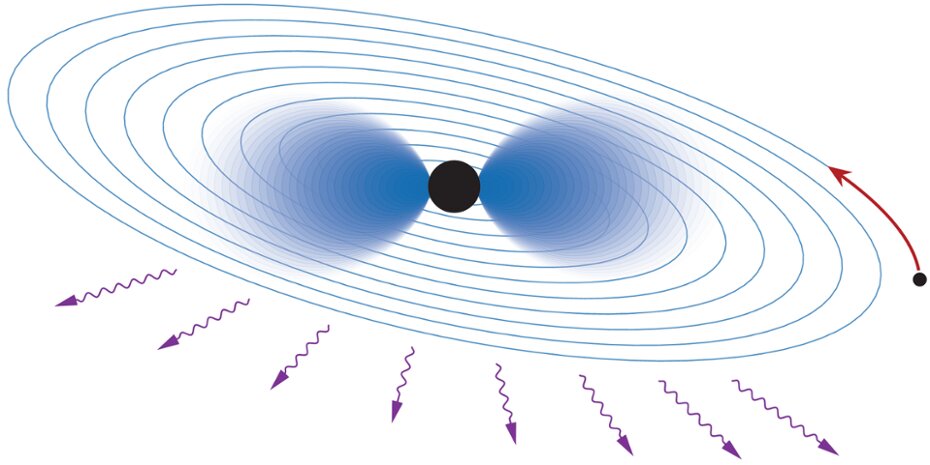
This phenomenon was studied by Stephen Hawking, who described how rotating black holes would throw off radiation that would appear “real” to a nearby observer, but “virtual” to a distant one. In the process of transferring this radiation from one reference frame to another, the acceleration of the particle itself would cause it to transform from virtual to real. This exotic form of energy, known as “Hawking Radiation,” will form clouds of low-mass particles around a black hole. This leads to a “gravitational atom,” so-named because they resemble ordinary atoms (clouds of particles surrounding a core)
While scientists know that this phenomenon occurs, they also understand that it could only be explained through the existence of a new ultralight particle that exists beyond the Standard Model. This was the focus of the new paper, where lead author Daniel Baumann (GRAPPA and the University of Taipei) and his colleagues examined how superradiance causes unstable clouds of ultralight bosons to form around black holes spontaneously. In addition, they suggest that the similarities between gravitational and regular atoms go deeper than their structure.
In short, they suggest that binary black holes could cause particles in their clouds to become ionized via the photoelectric effect. As described by Einstein, this occurs when electromagnetic energy (such as light) makes contact with a material, causing it to emit excited electrons (photoelectrons). When applied to a binary black hole, Baumann and his colleagues show how clouds of ultralight bosons could absorb the “orbital energy” of a black hole companion. This would cause some of the bosons to become ejected and accelerated, evident from the black hole’s associated GW signals.
Artist’s concept of a “gravitational atom,” where a nucleus (black hole) is surrounded by clouds of particles. Credit: UvA Institute of Physics
Lastly, they demonstrated how this process could dramatically alter the evolution of binary black holes by reducing the time it takes for the objects to merge. As they state:
“The orbital energy lost in this process can overwhelm the losses due to GW emission, so that ionization drives the inspiral rather than merely perturbing it. We show that the ionization power contains sharp features that lead to distinctive “kinks” in the evolution of the emitted GW frequency.”
These “kinks,” they argue, will be discernible to next-generation GW interferometers like the Laser Interferometer Space Antenna (LISA). This process could be used to discover an entirely new class of ultralight particles and provide direct information about the mass and state of “gravitational atom” clouds. In short, the ongoing studies of GWs using more sensitive interferometers could reveal exotic physics that advance our understanding of black holes and lead to new breakthroughs in particle physics.
This is one of many possibilities that have been ventured thanks to the revolution taking place with GW astronomy. In the coming years, astrophysicists hope to use them to probe the most extreme environments in the Universe, like black holes and neutron stars. They also hope that primordial gravitational waves will reveal things about the early Universe, help resolve the mystery of the matter/anti-matter imbalance, and lead to a quantum theory of gravity (aka. a Theory of Everything).
Canada admits UFO activity as a member of Parliament claims they are real
Following the moves taken by the US, Russia, and China earlier this week, Canada should become the latest state to either support or boost up the investigation into UFOs.
NASA announced the establishment of a small team to “advance the scientific knowledge of unexplained aerial phenomena ahead.” NASA confirmed the establishment of a small team to further scientific knowledge of mysterious aerial occurrences, making the United States the first to ‘act.’
In recently revealed letters dated June 6, officials from Canada acknowledged their plan to help UFO studies in the United States.
John Hannaford, the Deputy Minister for Natural Resources Canada, indicated his plan to participate in the US research in a letter to Larry Maguire M.P. and Kathleen Heppell-Masys, Directorate of Security and Safeguards for the Canadian Nuclear Safety Commission. This is what he wrote in the letter:
“I am writing in follow-up to my May 18, 2022, appearance before the House of Commons Standing Committee on Natural Resources, where you raised security-related questions regarding the Government of Canada’s position on drones and Unidentified Aerial Phenomena (UAPs) near North American nuclear facilities. Given the shared priority for nuclear safety and security of nuclear facilities, and the growing interest in UAPs in both Canada and the United States, the CNSC is committed to raising the issue with its United States counterpart and sharing any related information going forward.”
In a prior email, Maguire confirmed the existence of UAPs and stated that Canada needs to consider them with more seriousness.
This disclosure comes about a year after the US Office of the Director of National Intelligence issued a study claiming that the federal government couldn’t explain all of the 144 UAPs which were discovered by military aviators, instead they could do that only for one of them. They did mention birds or balloons, as well as classified American programs and superior Russian or Chinese technology.
Dust Devils and Strong Winds Produce the Constant Haze on Mars
Dust is an everyday feature on Mars and wreaks havoc on various pieces of equipment humans decide to send to it, such as Insight’s continual loss of power or the losses of Opportunity and Spirit. But we’ve never really understood what causes the dust to get up into the air in the first place. That equipment that is so affected by it usually isn’t set up to monitor it, or if it is, it has been sent to a place where there isn’t much dust, to begin with. Now, that has changed with new readings from Perseverance in Jerezo crater, and the answer shouldn’t be much of a surprise – dust devils seem to cause some of the dust in the atmosphere on Mars. But strong winds contribute a significant amount too.
A new paper in Science Advances by a team of over 45 scientists reports on data collected by Perseverance’s instrumentation that is designed to study the Martian environment. The Radiation and Dust Sensor (RDS) instrumentation is part of a broader package of instrumentation known as the Mars Environment Dynamics Analyzer (MEDA).
This instrument can detect changes in the environmental conditions that would occur around the rover about once a second. The most likely cause of those changes would be the presence of dust devils.
UT video discussing the perils of dust storms
But it is not enough to detect those changes alone, as they could be caused by sources other than dust devils. So the RDS combines forces with another MEDA instrument, the Thermal InfraRed Sensor (TIRS), which can provide data on the tracking radiative flux around the rover. Combining these two data sets allow scientists to comprehensively say whether or not a dust devil has overtaken the rover.
They do so often. About four times a day, the rover is subjected to “convective vortices,” the technical term for updrafts that are strong enough to sense. About one of those four carries enough dust to be thought of as what we would conventionally call a “dust devil.” And their existence seems to be the source of most of the dust that reaches the air. But they aren’t the only source.
There was some evidence for strong wind gusts that don’t actually form into a dust devil and might force a significant amount of dust into the air themselves. While these weren’t necessarily as strong as the dust devils, they covered a much larger area, with the largest being ten times larger than the largest dust devil. So even if they are much weaker, they were potentially able to lift smaller grains of dust high into the atmosphere.
Another dust devil seen by HiRISE. Credit – NASA / JPL / UArizona
The scientists think that a roughly equal amount of dust in the Martian atmosphere could be caused by both dust devils and these more concentrated wind gusts. But no matter what the dust is from, the existence of instruments on Mars that can finally collect data on the underlying cause of the dust is a breakthrough in understanding the Martian environment. It might also help us find a way to disrupt this potentially destructive process if it ever comes to that.
Deep-Sea Camera Captures What No One Was Supposed to See
Life on earth is entirely dependent on water, every single living organism requires water for survival. More than 60% of the human body is composed of water. We are dependent on water in different ways including for drinking, for taking showers, cooking food, and for swimming. Agriculture and industry both run on water. Well, 71% of the earth’s surface is covered with water and oceans constitute about 96.5% of this water. It means, we have tremendous opportunities to explore but exploring the abyss of the ocean is a difficult proposition and maybe quite scary. Scientists have been trying to reach the darkest corners of the unchartered oceans and they have come across some terrifying things.
Bright pulsating almost plasma looking UFO ramming in upon itself in Dearborn Missouri on June 7, 2022
Video Source MUFON Case Number 123037
UFO SIGHTING! TIC TAC SHAPED UFO WITNESSED IN ALABAMA & FR. THEN IN FRANCE IT MAKES EXTREME 25°TURN?
UFO sighting! Tic-Tac or pill shaped UFO recorded by family in Detroit Alabama then what appears to be the same UFO seen in Canoux en Provence France recorded by camper during their trip. Video source mufon case number 122858 and case number 122997 Source of videos of Saturn, Jupiter, Mars, Sun and the Moon, by Terry's Theories
Spirit Orb Seen On Baby Monitor Leaves When Mother Goes To Investigate & Returns After She Leaves.
This was captured on June 23, 2022 at their home in Preston, Lancashire in England. I believe this to be a spirit orb and not dust or a bug as with dust would not hover or stay in one spot for any length of time as for this being a bug, this was seen for several nights and always in the same area that had been clean so what could this be? One explanation could be with the passing of the grandmother could this be her watching over granddaughter
Two Fighter Jets Spotted Chasing A UFO Over Mount Desert Island In Maine. June 20, 2022
Guys I'm feeling a lot better and i have missed you crazy lot...
Now back to the footage. In this short clip we can see these two jets giving chase to this UFO just before the camera goes out of focus and the object and jets enter the clouds. I asked the witness if there was an air show and he replied "There was no air show. Heard the planes and looked up. My daughter saw them first. Low altitude over the water."
Thanks to Alex McCall for allowing me the use of his footage and to view the original:
COVER UP!? TIC TAC Found On Google Earth!? CRAZY UFO's Fall From SKY Village in Shock! 2022, UFO Sighting News.
Hey check out this great video of several discoverer on Google Earth map and UFO sightings reported by Thirdphaseofmoon of Youtube. Fantastic channel and great investigative thoughts and analysis.
Scott C. Waring - Taiwan
Third Phase Of Moon States: COVER UP!? TIC TAC Found On Google Earth!? CRAZY UFO's Fall From SKY Village in Shock! 2022
Black Circular UFO Passing The Moon Spotted By Amateur Astronomer In Colombia. May 8, 2022, UFO Sighting News.
Date of sighting: May 8, 2022
Location of sighting: Moon
Hey check out this amazing dark disk that passes over the moon, the object is absolutely amazing and even has a shadow on the moon below it. Thats 100% proof that is low over the moons surface.
This object was spotted durning one of Ruben Ariza livestreams from his home in Armenia in Quindío, Colombia on May 8, 2022. In the footage we can see this UFO fly into view leaving Ruben in absolute joy at this sighting. As the craft passes the moon it seems to be casting a shadow on the moon's surface. Thanks to Ruben Ariza for his diligent work and sharing his work with the world..
Can we expect a killshot that knocks out all modern day communication and power systems?
A G1-class geomagnetic storm was underway on June 26, 2022. The reason for the storm is a crack that has opened in Earth's magnetic field, allowing solar wind to enter the magnetosphere.
Immense cracks sometimes develop in Earth's magnetosphere and remain open for hours. Solar wind can pour through the gaps to fuel bright displays of Arctic lights.
Our magnetic shield takes the brunt of space storms, but some energy slips through its cracks, sometimes enough to cause problems with satellites, radio communication, and power systems.
Now, this time the A G1-class geomagnetic storm won't do any damage to satellites, radio communication, and power systems but it is just a matter of time a "killshot" will be triggered by a super solar flare. It has happened before and soon or later it will happen again.
Remember the solar storm of 1859—known as the Carrington Event - was a powerful geomagnetic solar storm during solar cycle 10 (1855–
1867). It created strong auroral displays that were reported globally and caused damage to electric equipment worldwide, which at that time consisted mostly of telegraph stations. The geomagnetic storm was most likely the result of a coronal mass ejection (CME) from the Sun colliding with Earth's magnetosphere and induced one of the largest geomagnetic storms on record on September 1–2, 1859.
A severe geomagnetic storm struck Earth on March 13, 1989 and caused a nine-hour outage of Hydro-Québec's electricity transmission system. The storm began on Earth with extremely intense auroras at the poles. The aurora could be seen as far south as Texas and Florida.
The Halloween solar storms were a series of solar flares and coronal mass ejections that occurred from mid-October to early November 2003, peaking around October 28–29. One of the solar storms was compared by some scientists in its intensity to the Carrington Event of 1859.
The solar superstorm a Carrington-class CME of July 2012 was an unusually large and strong coronal mass ejection (CME) event that occurred on July 23 that year. It missed the Earth with a margin of approximately nine days. The region that produced the outburst was thus not pointed directly towards the Earth at that time. The strength of the eruption was comparable to the 1859 Carrington event.
In 2013, Edward A. Dames, Major, U.S. Army (ret.) well known for his remote viewing capabilities, stated that he is very concerned about unprecedented events that will take place in the near future which will affect the whole world.
Edward A Dames - Quote from 2013: "I am far more concerned with a global pandemic breaking out, concomitant with a worldwide economic collapse, and leading to a devastating solar flare hitting the planet."
So far he has been right, We have experienced the global Covid 19 pandemic, a global economic collapse is unfolding right now, so will his 3rd prediction also come true and can we expect a "killshot" that knocks out all modern day communication and power systems?
And although Edward A. Dames 3rd prediction points to a devastating solar flare it is not unthinkable that, with the ongoing turmoil in the world in mind, the danger of a “killshot” will come of an electromagnetic pulse (EMP) generated by the detonation of a high-altitude nuclear weapon instead of devastating solar flare hitting the planet.
After their van shuts down in the middle of nowhere, this couple starts to see unexplainable bright lights from above, leaving them flabbergasted. They are convinced that they saw a UFO that night.
Engineers Investigating NASA’s Voyager 1 Telemetry Data
NASA’s Voyager 1 spacecraft, shown in this illustration, has been exploring our solar system since 1977, along with its twin, Voyager 2.
Credit: NASA/JPL-Caltech
While the spacecraft continues to return science data and otherwise operate as normal, the mission team is searching for the source of a system data issue.
The engineering team with NASA’s Voyager 1 spacecraft is trying to solve a mystery: The interstellar explorer is operating normally, receiving and executing commands from Earth, along with gathering and returning science data. But readouts from the probe’s attitude articulation and control system (AACS) don’t reflect what’s actually happening onboard.
The AACS controls the 45-year-old spacecraft’s orientation. Among other tasks, it keeps Voyager 1’s high-gain antenna pointed precisely at Earth, enabling it to send data home. All signs suggest the AACS is still working, but the telemetry data it’s returning is invalid. For instance, the data may appear to be randomly generated, or does not reflect any possible state the AACS could be in.
The issue hasn’t triggered any onboard fault protection systems, which are designed to put the spacecraft into “safe mode” – a state where only essential operations are carried out, giving engineers time to diagnose an issue. Voyager 1’s signal hasn’t weakened, either, which suggests the high-gain antenna remains in its prescribed orientation with Earth.
The team will continue to monitor the signal closely as they continue to determine whether the invalid data is coming directly from the AACS or another system involved in producing and sending telemetry data. Until the nature of the issue is better understood, the team cannot anticipate whether this might affect how long the spacecraft can collect and transmit science data.
Voyager 1 is currently 14.5 billion miles (23.3 billion kilometers) from Earth, and it takes light 20 hours and 33 minutes to travel that difference. That means it takes roughly two days to send a message to Voyager 1 and get a response – a delay the mission team is well accustomed to.
“A mystery like this is sort of par for the course at this stage of the Voyager mission,” said Suzanne Dodd, project manager for Voyager 1 and 2 at NASA’s Jet Propulsion Laboratory in Southern California. “The spacecraft are both almost 45 years old, which is far beyond what the mission planners anticipated. We’re also in interstellar space – a high-radiation environment that no spacecraft have flown in before. So there are some big challenges for the engineering team. But I think if there’s a way to solve this issue with the AACS, our team will find it.”
It’s possible the team may not find the source of the anomaly and will instead adapt to it, Dodd said. If they do find the source, they may be able to solve the issue through software changes or potentially by using one of the spacecraft’s redundant hardware systems.
It wouldn’t be the first time the Voyager team has relied on backup hardware: In 2017, Voyager 1’s primary thrusters showed signs of degradation, so engineers switched to another set of thrusters that had originally been used during the spacecraft’s planetary encounters. Those thrusters worked, despite having been unused for 37 years.
Voyager 1’s twin, Voyager 2 (currently 12.1 billion miles, or 19.5 billion kilometers, from Earth), continues to operate normally.
Launched in 1977, both Voyagers have operated far longer than mission planners expected, and are the only spacecraft to collect data in interstellar space. The information they provide from this region has helped drive a deeper understanding of the heliosphere, the diffuse barrier the Sun creates around the planets in our solar system.
Each spacecraft produces about 4 fewer watts of electrical power a year, limiting the number of systems the craft can run. The mission engineering team has switched off various subsystems and heaters in order to reserve power for science instruments and critical systems. No science instruments have been turned off yet as a result of the diminishing power, and the Voyager team is working to keep the two spacecraft operating and returning unique science beyond 2025.
While the engineers continue to work at solving the mystery that Voyager 1 has presented them, the mission’s scientists will continue to make the most of the data coming down from the spacecraft’s unique vantage point.
More About the Mission
The Voyager spacecraft were built by JPL, which continues to operate both. JPL is a division of Caltech in Pasadena. The Voyager missions are a part of the NASA Heliophysics System Observatory, sponsored by the Heliophysics Division of the Science Mission Directorate in Washington.
For more information about the Voyager spacecraft, visit:
Meer van UFO'S of UAP'S, ASTRONOMIE, RUIMTEVAART, ARCHEOLOGIE, OUDHEIDKUNDE, SF-SNUFJES EN ANDERE ESOTERISCHE WETENSCHAPPEN - DE ALLERLAATSTE NIEUWTJES


 Giant Blue Matter On Google Sky Map May Be Intelligently Made Planet, UFO Sighting News.