Ontdek de Fascinerende Wereld van UFO's en UAP's: Jouw Bron voor Onthullende Informatie!
Ben jij ook gefascineerd door het onbekende? Wil je meer weten over UFO's en UAP's, niet alleen in België, maar over de hele wereld? Dan ben je op de juiste plek!
België: Het Kloppend Hart van UFO-onderzoek
In België is BUFON (Belgisch UFO-Netwerk) dé autoriteit op het gebied van UFO-onderzoek. Voor betrouwbare en objectieve informatie over deze intrigerende fenomenen, bezoek je zeker onze Facebook-pagina en deze blog. Maar dat is nog niet alles! Ontdek ook het Belgisch UFO-meldpunt en Caelestia, twee organisaties die diepgaand onderzoek verrichten, al zijn ze soms kritisch of sceptisch.
Nederland: Een Schat aan Informatie
Voor onze Nederlandse buren is er de schitterende website www.ufowijzer.nl, beheerd door Paul Harmans. Deze site biedt een schat aan informatie en artikelen die je niet wilt missen!
Internationaal: MUFON - De Wereldwijde Autoriteit
Neem ook een kijkje bij MUFON (Mutual UFO Network Inc.), een gerenommeerde Amerikaanse UFO-vereniging met afdelingen in de VS en wereldwijd. MUFON is toegewijd aan de wetenschappelijke en analytische studie van het UFO-fenomeen, en hun maandelijkse tijdschrift, The MUFON UFO-Journal, is een must-read voor elke UFO-enthousiasteling. Bezoek hun website op www.mufon.com voor meer informatie.
Samenwerking en Toekomstvisie
Sinds 1 februari 2020 is Pieter niet alleen ex-president van BUFON, maar ook de voormalige nationale directeur van MUFON in Vlaanderen en Nederland. Dit creëert een sterke samenwerking met de Franse MUFON Reseau MUFON/EUROP, wat ons in staat stelt om nog meer waardevolle inzichten te delen.
Let op: Nepprofielen en Nieuwe Groeperingen
Pas op voor een nieuwe groepering die zich ook BUFON noemt, maar geen enkele connectie heeft met onze gevestigde organisatie. Hoewel zij de naam geregistreerd hebben, kunnen ze het rijke verleden en de expertise van onze groep niet evenaren. We wensen hen veel succes, maar we blijven de autoriteit in UFO-onderzoek!
Blijf Op De Hoogte!
Wil jij de laatste nieuwtjes over UFO's, ruimtevaart, archeologie, en meer? Volg ons dan en duik samen met ons in de fascinerende wereld van het onbekende! Sluit je aan bij de gemeenschap van nieuwsgierige geesten die net als jij verlangen naar antwoorden en avonturen in de sterren!
Heb je vragen of wil je meer weten? Aarzel dan niet om contact met ons op te nemen! Samen ontrafelen we het mysterie van de lucht en daarbuiten.
Woensdag 20 juli 2022
LATEST UFO SIGHTINGS AND VIDEOS
LATEST UFO SIGHTINGS AND VIDEOS
UFO over New York??
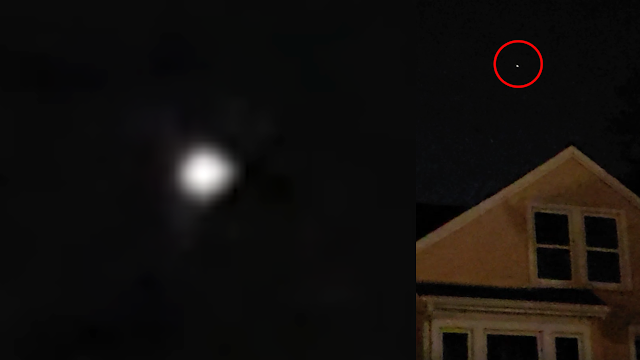
Strange metallic UFO witnessed over Haverstraw New York.
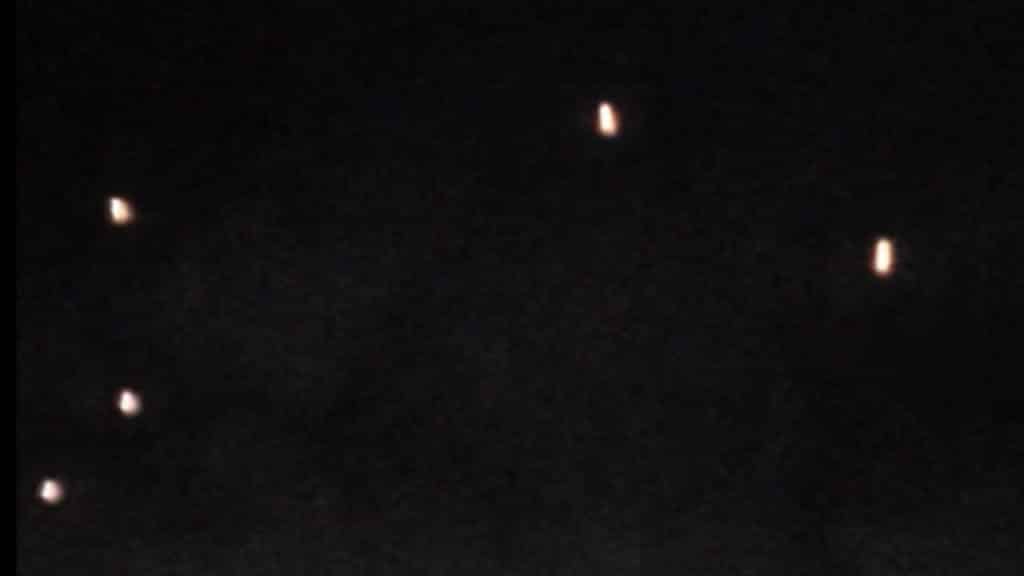
UFO activity over Winter garden, Florida 11-Jun-2022
This strange UFO lights were filmed in the sky above Winter Garden, a city 14 miles west of Downtown Orlando in the western part of Orange County, Florida.
Witness report:
I saw something weird hovering in a.straight path over some neighborhoods and I have never seen something like this before. I saw something very odd one night that I never seen before.and I recorded 2 videos of it.
The topic of underwater UFO bases is s a very large part of Ufology, We have seen numerous reports of how strange flying objects hid under water or appeared from the water. And if the aliens really have underwater bases on Earth, how long ago were they built?
Underwater UFO
It is likely that UFOs so often follow American warships for a reason – huge aircraft carriers themselves look formidable and impressive, and if they are also located near the alleged underwater UFO bases, then aliens have something to worry about.
Taking into account that UFO sightings by American sailors in most cases were made at those moments when aircraft carriers were on exercises near the coast of the United States, and according to numerous abductees, the UFO submarine bases where they were moved are not somewhere in the far part of the ocean, as well as not far from the coast, this theory has the right to exist.
Of course, there is information about the existence of probable UFO submarine bases in many places on our planet, but for some reason, there are especially many of them near the US coast. This may simply be a feature of the statistics because there are more American UFO researchers than ufologists from other countries, or maybe there is something else.
Underwater UFO Bases
If we assume that UFOs belong to beings that have been on Earth for many thousands, or even millions of years, then they were here long before the appearance of people and the ancestors of people, and, in this case, the development of mankind as a species took place before their eyes. And America is the last continent (not counting of course Antarctica), inhabited by people.
Thus, having moved their underwater bases to the shores of America in time, these creatures could observe people from a very convenient place for a long time, remaining as unnoticed as possible.
An interview with American ufologist Anna Whitty was recently published in the British tabloid Daily Star in connection with the release of a new documentary on the Roswell incident, “Roswell 75: The Last Evidence” (premiered July 7 on BLAZE). And Whitty stated that aliens are possibly an “advanced form of humans” that hail from Earth and have “always been here” living underwater.
Anna Whitty
According to Whitty, she studied the testimony of nurse Shirley Wright in great detail, who allegedly accompanied Albert Einstein to a military base, where they were both shown the bodies of dead aliens (and one survivor) from a ship that crashed in 1947 near Roswell in New Mexico. We previously published an article about this curious story.
Whitty says that Shirley was able to communicate with the surviving creature because they understood and could speak English. And at some point, this creature very interestedly asked Shirley abouthow far people “penetrated into the ocean”.
“If what Shirley said is true, then these ‘aliens’ are probably not visiting us from another planet, but from somewhere deep in the water,” says Whitty.
Whitty also believes that these creatures are actually not aliens at all, but appeared on Earth as a human race and at some point simply went underwater in order to hide or protect themselves from something.
Illustration of underwater alien beings
According to Whitty, they may have been fleeing the inevitable cataclysms that begin to haunt the developed civilization of people at a certain moment in the development of their society and “throwback” them into the “Stone Age”.
Whitty believes that having gone underwater in time and radically changed their lifestyle, these creatures were able to avoid such a fate, which is why they are now far ahead of us in technology, and maybe even in the capabilities of their body and mind.
“It is also possible that they are not at all what they seem to us, but they can make you think that you are seeing something that is not reality.”
As to why these creatures are now chasing people, Whitty thinks they want to change something in our behavior and help our development, perhaps so that we can avoid that very crisis that made them go underwater
According to an article published by International business times, it is believed by the alien and UFO conspiracy theorists that the U.S Government is conducting top-secret alien technology reverse-engineering research at multiple subterranean alien-government complexes.
dvanced Technology
According to conspiracy theorists, the testimony of whistleblowers suggests that the government is concealing the truth concerning contact with extraterrestrial species and exposure to advanced alien technology. It has been claimed by numerous whistleblowers have claimed that they have formerly served as government scientists and engineering contractors in subterranean alien-government research sites, such as the top-secret Area 51 military facility in the Nevada desert.
Believing the conspiracy theorists, it can be said that the crashed UFOs that have been found from the sites are housed in top-secret government facilities such as Area 51 and the Dulce subterranean facility.
Presence of Alien tech on Earth
Former Area 51 Engineer Bill Uhouse On Working With An Extraterrestrial Named J-ROD
Conspiracy theorists claim the accounts of many whistleblowers as evidence of continuous reverse engineering of extraterrestrial propulsion technology at Area 51. One such man is Bill Uhouse, who is around 70 years of age and has claimed thathe worked from 1966 through 1979 as an engineer at the top-secret Area 51 facility in collaboration with a Grey alien.
This is believed to be a real photograph of an alien named J-ROD kept at Area 51.
According to Uhouse, who died in 2009, he worked in Area 51 as a mechanical engineer with a Grey extraterrestrial known as “J-Rod.” It has been asserted by him that he collaborated with “J-Rod” to produce a flight simulator for the training of Air Force pilots who were supposed to fly superior USAF stealth reconnaissance planes created by reverse engineering studies of extraterrestrial UFOs.
According to Uhouse, he connected with “J-Rod” using a modified Grey extraterrestrial technology for human use. Thetechnology enabled human scientists and engineers to connect with Grey aliens through telepathy with the help of a complex translation program.
Bill Uhouse claims that “J-Rod” taught people at the facility how to operate an extraterrestrial spaceship. It is said that there are distinct species of the Grey aliens, and they consist of Tall Greys, Short Greys, and Greys of equal size to humans. However, it is unknown which of the three main Grey races “J-rod” belonged to.
Uhouse said that aliens and humans were doing reverse-engineering studies at a number of enormous subterranean complexes around the nation. The Area 51 research facility and the Dulce subterranean research facility are among the most well-known sites.
It is commonly thought that the Dulce alien-government subterranean complex, situated under the Archuleta Mesa near Dulce in Rio Arriba County, New Mexico, is significantly bigger and more substantial than Area 51.
Allegedly, the buildings were built with the purpose of accommodating Grey, reptilian, and tall white extraterrestrial alien-human hybrids under the tenure of Presidents Harry Truman and Dwight Eisenhower, it is thought that the building of the alien-government facilities started.
The agreement with the Greys and the Reptilians stipulated that the government would let the aliens construct subterranean research centers where alien scientists would undertake bio-genetic research to create superior alien-human hybrids.
In order to assist the supposed bio-genetic research program, the U.S. government authorized the aliens to abduct a restricted number of humans for use as test subjects. The aliens promised to provide the U.S. government with access to their superior technologies, particularly aircraft technology.
UFO conspiracy theorists claim that the majority of alien abductions involve Greys and Reptilians conducting bio-genetic experiments on people in a Nazi-style endeavor to create human-alien hybrids. The U.S. authorities are aware that the extraterrestrials are breaching the provisions of treaties made in the 1950s, but the government is unable to stop the violations.
The subterranean facilities include expansive labs and engineering workshops. In these labs, the captive extraterrestrials and kidnapped humans are treated as Guinea Pigs.
According to Uhouse, there may be hundreds or thousands of Grey aliens working on advanced technologies for the Pentagon as part of their attempts to uphold their agreement with the United States government.
What do you think about such claims? Tell us in the comments section below.
Two Spacecraft Could Work Together to Capture an Asteroid and Bring it Close to Earth for Mining
Humanity seems destined to expand into the Solar System. What exactly that looks like, and how difficult and tumultuous the endeavour might be, is wide open to speculation. But there are some undeniable facts attached to the prospect.
We need materials to build infrastructure, and getting it all into space from Earth is not realistic. (Be quiet, space elevator people.)
Asteroid mining is one of those things that’s been talked about for decades but hasn’t happened. That doesn’t mean it won’t happen; in fact, we’ll have to use resources that are already in space if we want to establish a real presence anywhere other than Earth.
Google Ngram viewer shows how often a word or phrase was used in published works. The first asteroid was discovered in 1801, and “asteroid mining” started appearing shortly after WW2. Almost everybody’s heard of it now. Image Credit: Google Ngram.
There are enormous resources available in asteroids, especially in the Main Asteroid Belt. But Near Earth Asteroids (NEAs) also hold vast quantities of water, metals, and volatiles. There are more than 26,000 NEAs, and they could play a key role in humanity’s space-faring future. The problem is, even though they’re termed Near Earth Asteroids, they’re not that accessible. So lots of the talk around asteroid mining involves moving asteroids into more advantageous and accessible orbits.
We’ve learned a lot about the asteroid population in recent decades, especially in the last two decades. In fact, in 2005, Congress asked NASA to catalogue dangerous objects and to find at least 90 percent of potentially hazardous NEOs sized 140 meters or larger by the end of 2020.
We’ve also come to understand asteroid composition better, and scientists have categorized asteroids into types based on composition. The three types are C-Type, M-Type, and S-Type, meaning carbonaceous, metallic, and silicaceous. They’re also grouped by their orbits, and by families, with each member of a family coming from the same parent body.
We’ve also sent spacecraft to study and sample asteroids, which is akin to prospecting here on Earth, though the sampling is aimed more at science than at resource exploitation. JAXA (Japan Aerospace Exploration Agency) and NASA have both launched successful asteroid sample return missions. JAXA has returned samples to Earth, and the sample from NASA’s OSIRIS-REx is on its way.
So we understand asteroids’ composition and their orbits, and we’ll continue to catalogue them and study them. We’ll probably continue to sample them, and NASA has taken its first tentative steps in changing an asteroid’s path by redirecting one with a kinetic impact. It seems certain that we’ll want to bring one closer to Earth and use its resources for our needs.
A new study suggests a unique way of shifting asteroids around and moving them into more advantageous orbits. The title is “A multiple-vehicle strategy for near-Earth asteroid capture,” and it’s published in the journal Acta Astronautica. The lead author is Livia Ionescu from the James Watt School of Engineering at the University of Glasgow.
The study shows how two separate spacecraft could work together to move an asteroid closer to Earth, where its resources can be extracted. One of the spacecraft acts as a pitcher, and one acts as a catcher. “These spacecraft act together as a ‘pitcher’ spacecraft and ‘catcher’ spacecraft, where the pitcher spacecraft hops from asteroid to asteroid and deflects them towards an orbit in the vicinity of Earth, while the catcher spacecraft is stationed at the Earth and captures the incoming asteroids,” the authors write.
In their paper, the authors compare their two-spacecraft proposal to other proposed methods using a single spacecraft. According to them, their method is superior.
One of the strengths of their proposal is the lack of round trips. The pitcher spacecraft needn’t return to Earth each time. A single pitcher spacecraft could nudge successive asteroids toward the catcher spacecraft. After nudging an asteroid, the pitcher could reposition itself for the next nudge.
This schematic from the study shows the trajectories of single-spacecraft redirection (a) and dual-spacecraft redirection (b.) Note that b doesn’t show the pitcher spacecraft’s initial journey from Earth to the target asteroid. Image Credit: Ionescu et al. 2022
The team’s analysis shows that their dual-spacecraft method is superior. “Results show that the two-spacecraft strategy is capable of returning more asteroid mass and often at a lower mission duration,” they write. Of course, it’s not quite that simple.
The team analyzed their proposal in three ways. They looked at asteroids following co-planar orbits and circular orbits, they analyzed a set of fictional near-Earth asteroids to create a large data set, and they analyzed some real asteroids as mission targets.
Then the team examined two scenarios to compare single-spacecraft missions with two-spacecraft missions. Each scenario is considered in terms of Delta V. Delta V measures how much acceleration is required to move an object, in this case spacecraft and asteroids. Delta V is the heart of the issue, but so is the amount of mass returned.
The team found that their method uses more Delta V than single-spacecraft methods. But their method returns more mass than single-spacecraft methods because the pitcher doesn’t return to Earth’s neighbourhood. In all cases, the target asteroid is placed in Earth’s heliocentric orbit.
“The analysis showed that the two-spacecraft strategy does not impact the required Delta V in a beneficial manner,” the paper states. “However, the aim of an asteroid capture mission is to retrieve useful mass to the vicinity of the Earth.”
This schematic from the paper shows the Delta Vs for a single-spacecraft (a) and two-spacecraft (b) capture of a single asteroid. There’s no Delta V advantage for the two-spacecraft method, but that method returns more mass. Image Credit: Ionescu et al. 2022
But the results presented so far are based on asteroids that have the same mass and that have fairly simple orbits. That, of course, isn’t realistic, so the team dug deeper.
The deeper analysis looked at artificially-generated NEAs with random but realistic elements to their orbits. “Therefore, in this section, the orbital elements of the asteroids will be randomly generated within specified ranges in order to generate statistical data on the relative performance of the one-spacecraft and two-spacecraft strategies,” the authors write.
In this deeper analysis, the mission architectures remain the same. In the single-spacecraft model, the spacecraft travels to an asteroid, brings it to a heliocentric orbit, then travels to the next asteroid. In the two-spacecraft model, the pitcher moves from asteroid to asteroid while the catcher remains in an Earth heliocentric orbit. In their analysis, each mission visits the same asteroids in the same order, but in real mission planning, that may not be the case.
The researchers found a clear correlation in the single spacecraft scenario. Higher ?V resulted in lower returned mass.
This figure from the study plots Delta V and returned mass for single spacecraft missions, double spacecraft missions, and for pitcher and catcher spacecraft in the double spacecraft missions. Image Credit: Ionescu et al. 2022
The team ran thousands of simulations. In their simulations, the semi-major axes of the asteroids play a key role. The team found that the further away the semi-major axis is from one astronomical unit (AU), the lower the returned mass is.
The paper is full of detail that can’t all be explained here. Overall, it shows that the two-spacecraft mission has some advantages. But that’s only when asteroids are brought to Earth’s heliocentric orbit.
But as we’ve written about here at Universe Today, it may not be necessary to bring asteroids close to Earth. Maybe Mars orbit is a better location.
The paper also doesn’t explore spacecraft design, although the authors acknowledge that if two spacecraft need to be developed, designed, and built, it increases mission complexity. And increased complexity means increased costs. But for the researchers, two things are clear: “The advantages of the two-spacecraft strategy are a higher quantity of retrieved mass and a shorter mission duration. Both imply a potential increase in revenue.”
Of course, any real benefits will depend on individual missions and the orbits and masses of individual asteroids. “Thus, the two-spacecraft has the potential to deliver a higher mass within a lower amount of time, but it still remains dependent on the targeted asteroids and launch date, such that a case-by-case analysis is necessary,” they write.
When the team looked at three specific asteroid missions with each mission architecture, the two-spacecraft advantage was clear. “Two mission cases have been presented with three target asteroids, where the two-spacecraft strategy is able to return approximately 1.5 times its initial mass, while the one-spacecraft strategy is only capable of bringing less than its initial mass.”
The authors don’t speculate much beyond their results. But they do point out that it might be possible for two or more pitcher spacecraft to service a single catcher. The two spacecraft mission is already more complicated than the single spacecraft mission because the pair of spacecraft have to be closely coordinated. Adding additional pitchers would only increase the complexity.
Asteroid mining is a ways off in the future, though, if it ever happens. For now, we’re building a more accurate and complete catalogue of asteroids, we’re bringing asteroid samples back to Earth for analysis, and we’re testing kinetic impactors to influence asteroid orbits.
Hey I first found this back in 2011 and had very few readers and Youtube subscribers, but decided to make it again in HD so that all you good folks can take a look. The object is in the far left of the panoramic photos and clearly shows a glowing energy cloud that shape-shifts from a rectangle to a three clover craft.
It's easy to dismiss a photo or even two of a UFO in the NASA index, but how easy do you think it is to dismiss 458 consecutive photos? Because thats how many this UFO appears in. Of those photos 40 are incredibly detailed.
The UFO positioned itself between the moon and the lunar module...just a bit ahead of it to make sure it was seen by the astronauts. I bet they saw this but kept their mouths shut due to NASA being a stickler about hiding these things.
100% proof...times 458...equals 45,800% proof that this is an alien spaceship.
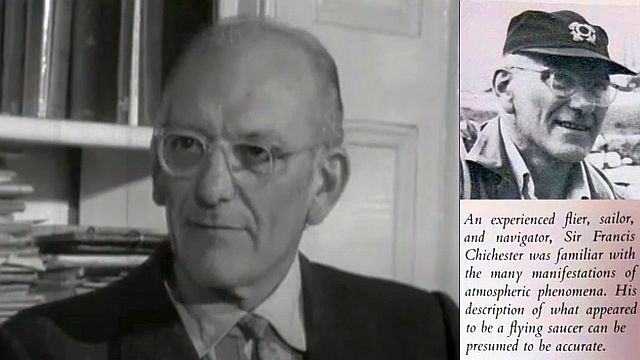
1965 Interview: Pioneer aviator on witnessing a 'Tic Tac' UFO during his 1931 flight from New Zealand to Australia
Sir Francis Chichester in an interview from 1965: "It was a perfect shape, it was... shaped sort of more like a pearl... with a tail. And I watched this thing and suddenly it disappeared. And I was... I thought well am I seeing things? I had a very grueling flight. I had been waiting for... I had engine trouble, and I had been waiting for hours expecting to go in to the sea you know."
However suddenly this thing reappeared coming towards me. Well I'm not going to let it go this time! I kept my look fixed on it and it [was] approaching fairly fast, and suddenly, gradually rather, it began to thin out and it vanished in front of me...
It came on, but instead of increasing in size, it diminished as it approached", he said. Did he see something from another world, or was it some peculiar kind of mirage on the horizon? Alas we will likely never know how far he was from land, and how high or close the thing was from the horizon."
From his book "The Lonely Sea and the Sky":
"Round the storm we flew into calm air under a weak lazy sun. I took out the sextant and got two shoots. It took me thirty minutes to work them out, for the engine kept back firing, and my attention wandered every time it did...
Suddenly, ahead and thirty degrees to the left, there were bright flashes in several places, like the dazzle of a heliograph. I saw a dull grey-white airship coming towards me. It seemed impossible, but I could have sworn that it was an airship, nosing towards me like an oblong pearl. Except for a cloud or two, there was nothing else in the sky.
I looked around, sometimes catching a flash or a glint, and turning again to look at the airship I found it had disappeared. I screwed up my eyes, unable to believe them, and twisted the seaplane this way and that, thinking that the airship must be hidden by a blind spot. Dazzling flashes continued in four or five different places, but I could not pick out any planes.
Then, out of some clouds to my right front, I saw another, or the same, airship advancing. I watched it intently, determined not to look away for a fraction of a second: I'd see what happened to this one, if I had to chase it. It drew steadily closer, until perhaps a mile away, when suddenly it vanished. Then it reappeared, close to where it had vanished: I watched with angry intentness. It drew closer, and I could see the dull gleam of light on its nose and back. It came on, but instead of increasing in size, it diminished as it approached. When quite near, it suddenly became its own ghost - one second I could see through it, and the next it had vanished. I decided that it could only be a diminutive cloud, perfectly shaped like an airship and then dissolving, but it was uncanny that it should exactly resume the same shape after it once vanished.
I turned towards the flashes, but those too had vanished. All this was many years before anyone spoke of flying saucers. Whatever it was I saw, it seems to have been very much like what people have since claimed to be flying saucers."
THE MAN WHO SAW ALIEN BASES ON THE MOON | The Amazing True Story of Ingo Swann
THE MAN WHO SAW ALIEN BASES ON THE MOON
Ingo Swann claimed to be a psychic who was employed by the CIA to remote-view the dark side of the moon. Specifically to look for an alien presence. It sounded like science fiction. But in 2006, when the CIA started releasing documents on the Stargate Project, Swann’s participation in the program was confirmed. When Swann was asked about the existence of extraterrestrials, he said not only were they already here, but they *are* building something on the far side of the moon. And, according to Swann, these aliens — aren’t friendly. Let’s find out why.
Cash-Landrum UFO Incident 1980: A Diamond Shaped UFO, Military Helicopters & Long Term Illnesses
In 1980, close to Huffman, Texas, Betty Cash, Vickie Landrum, and 7-year-old Colby Landrum came into contact with a UFO that they claimed was surrounded by a group of military-style helicopters. Following the incident, all three were subjected to various health conditions.
The Cash-Landrum UFO incident remains unresolved to this day
On the evening of December 29, 1980, near Huffman, Texas, three occupants of a 1980 Oldsmobile Cutlass witnessed an astounding sight. Betty Cash, Vickie Landrum, and Vickie's seven-year-old grandson, Colby, on their way home to Dayton were driving through the southern tip of the East Texas piney woods when they noticed a large light above the trees in the distance.
The light was briefly lost to view, but they saw it again, when after rounding a curve they found themselves on a straight stretch of two-lane road on Highway FM 1485. This time it was approaching them, floating above the road at less than treetop height and belching flames from its bottom. Cash and the Landrum's were only about 130 feet from the object.
Getting away from the UFO was impossible because the road they were on was that narrow and the ground surrounding the road was soggy and damp. Betty Cash was driving, and she knew if she attempted to turn around the car would get stuck. Betty stopped the car and both she and Vickie stepped outside, the frantic screaming of young Colby soon brought the women back towards the car.
The UFO, a dull metallic silver in colour and shaped like a huge, upright diamond, with the top and bottom cut off so that they were flat rather than pointed. The women claimed that small blue lights ringed the centre of the object, while periodically over the next several minutes, flames would shoot out of the bottom in an outwards manner, creating a cone effect.
All the while the witnesses felt their faces burning. The car was too hot to touch. At one point Vickie Landrum, leaning out the front window, steadied herself by putting her hands on the dashboard, only to find it molded to the shape of her fingers. (The imprints were still there when John Schuessler of the Mutual UFO Networth - MUFON - examined the car.) A few minutes later, when Cash tried to get back into the car, the doorhandle burned her fingers.
With a final blast of fire and heat, the UFO ascended slowly into the sky. But just as it was clearing the treetops, helicopters flew in from all directions. The helicopters and the UFO were then lost to view. The three resumed their journey. They passed along another long curve in the road and in five minutes arrived at the intersection of FM 1485 and FM 2100, where they saw the UFO and the helicopters again. Cash counted 23 helicopters, all clearly visible because the light from the diamond-shaped object was reflecting off them. Many of the aircraft were subsequently identified as large, double-rotor Boeing CH-47 Chinooks, a kind used by the Army and the Marines.
Boeing CH-47 Chinook as described in the UFO encounter
Cash drove on, the diamond UFO and the helicopters still in front of her, until she came to a road that would take them to Dayton. Even then she could see the object in the rearview mirror for the next few minutes. The whole incident lasted a total of 20 minutes.
Sickness That Followed
Cash dropped the Landrums off at their house and proceeded on to her own. Once home she sat in a chair and waited for the sick feeling to pass, but the headache and nausea would not go away, and large knots formed on her neck and scalp. Soon they became blisters. Meanwhile, her skin was reddening, and her eyes swelled. She threw up repeatedly and experienced severe diarrhea.
The Landrum's were suffering similar distress, though not quite so intensely. Their skin looked and felt badly sunburned, but their stomachs were upset.
The three witnesses to the Cash-Landrum UFO encounter
By morning, friends feared Cash was near death. She had lapsed into near unconsciousness. Cash had previous heart problems in the past but now was too groggy to identify her cardiologist; her friends were forced to call unknown physicians. Those they could reach during the holiday period would not take on an unfamiliar patient with a history of cardiac disorder and, moreover, with a crazy story about having been injured by a UFO.
Knowing nothing else to do, the friends brought Cash to Vickie Landrum's house. Landrum attempted to feed Cash, but she rejected food and water and grew ever weaker. Finally, Landrum persuaded a local pharmacist to look through his prescription records for the name of Cash's cardiologist. As soon as he had it, Landrum phoned and was instructed to take Cash to the Parkway Hospital emergency room.
Betty Cash was taken into the hospital on January 3, 1981. She could not walk and lost large patches of skin and clumps of hair. She was released after 12 days, though her condition was not much better, and she later returned to the hospital for another 15 days. The Landrum's improved slightly, though the sores on their skin and the damage to their eyes persisted. Vickie suffered periodic sickness for the next few years, and her eyesight never entirely recovered. Colby had problems with chronic illness, sores, and hair loss.
A radiologist who reviewed the victims' medical records for MUFON concluded, "We have strong evidence that these patients have suffered damage secondary to ionizing radiation. It is also possible that there was an infrared or ultraviolet component as well."
Investigation Into The UFO Encounter
Ufologists learned of the case when the witnesses reported it to a NASA representative in Houston. He suggested they talk with John Schuessler, an aerospace engineer and NASA supervisor with a longstanding interest in UFOs. Schuessler and some MUFON colleagues then interviewed other witnesses, some of whom had seen the UFO and the helicopters for as long as an hour and a half. They also sought the source of the helicopters. The Fund for UFO Research commissioned Allan Hendry, one of ufology's most trusted investigators, to find out where the aircraft had come from. No airport, civilian or military, would own up to a knowledge of the helicopters.
Cash and Landrum began a long, frustrating campaign to get answers from government agencies. Eventually, their senators, John Tower and Lloyd Bentsen, talked with representatives of the Department of Defense. They urged Cash and Landrum to take their complaints to the Judge Advocate Claims Officer at Bergstrom Air Force Base in Austin. In August 1981 they met with Air Force Lawyers at Bergstrom. They were told that if they could find a lawyer willing to represent them, they should file a claim with the US government for compensation for their injuries. The case worked its way through military and federal courts over the next few years, but the witnesses and their attorney could not prove that either the diamond-shaped object or the helicopters were official property. On August 21, 1986, the US District Court judge dismissed the case.
The only known official investigation of any significance was conducted by lieutenant Colonel George Sarran, whom the Department of the Army Inspector General (DAIG) directed to look into the case in 1982. Sarran concluded:
"Ms Landrum and Ms Cash were credible... The policeman and his wife (who had reported seeing 12 Chinook helicopters in the Huffman area on the night of the incident) were also credible witnesses. There was no perception that anyone was trying to exaggerate the truth. All interviewees were extremely cooperative and eager to be helpful in any manner. Through the course of inquiry, the DAIG investigator tried to concentrate on any reason or anyone or any organization which might have been flying helicopters that particular evening in that general area. There was no evidence presented that would indicate that Army, National Guard, or Army Reserve helicopters were involved. "
Meanwhile, according to Schuessler:
"Betty Cash has been hospitalized at least 25 times and had had two operations for cancer (after having shown no previous signs of it). She has had blood problems and trouble with her eyesight. Her hair has regrown, though in a different texture, but she is still very weak and has to spend a good deal of time in bed."
The Cash-Landrum UFO encounter is another fascinating example of aerial phenomena that has been accompanied by both government and military denial, despite witnesses watching their involvement with their own eyes.
An unidentified flying object, as seen by a U.S. Navy jet.
(Image credit: U.S. Navy)
In early June, NASA announced that it's commissioning an independent study on unidentified aerial phenomena (UAP), as UFOs have recently been rebranded.
"NASA believes that the tools of scientific discovery are powerful and apply here also," Zurbuchen said in a statement(opens in new tab). "We have access to a broad range of observations of Earth from space – and that is the lifeblood of scientific inquiry. We have the tools and team who can help us improve our understanding of the unknown. That's the very definition of what science is. That's what we do."
The UAP study team will be led by astrophysicist David Spergel, previously the chair of the astrophysics department at Princeton University.
"Given the paucity of observations, our first task is simply to gather the most robust set of data that we can," Spergel said in the NASA statement. "We will be identifying what data — from civilians, government, non-profits, companies — exists, what else we should try to collect and how to best analyze it."
Space.com reached out to a number of UAP and UFO (unidentified flying object) groups and leading experts in the field to get their thoughts on NASA's new endeavor.
NASA should be congratulated for its willingness to investigate UAP, said Robert Powell, executive board member of the Scientific Coalition for UAP Studies.
"During their press conference, it was clear that they would provide an exemplary approach to the subject by combining scientific rigor, transparency and a fundamental curiosity about this longstanding mystery," Powell said. "All scientists interested in the study of these phenomena should welcome NASA's entry into the arena as an indication that the time has come for the scientific community to openly examine this subject, and it is hoped that Congress will appropriate funding to open the study of this enigma to all of academia."
Powell said that the Scientific Coalition for UAP Studies would urge NASA to tap into the background knowledge that has already been obtained by other science organizations and become familiar with "the pitfalls and successes in the study of this subject." This will enable more rapid scrutiny of UAP development areas that need expanded scientific involvement, he said.
"In order to facilitate a rapid acquirement of known data, the new NASA UAP group should consider identifying an individual that can coordinate data and information sharing with established UAP organizations," Powell said. "This will help avoid duplication of efforts."
Win-win development
Also welcoming NASA's new study is Avi Loeb, head of Harvard's Galileo Project, a systematic scientific search for evidence of extraterrestrial technological artifacts.
The Galileo Project is currently assembling its first telescope system on the roof of the Harvard College Observatory, planning an expedition to retrieve fragments from the first known interstellar meteor, studying satellite data on UAP and designing a space mission to rendezvous with the next anomalous ('Oumuamua-like) interstellar object that zooms into our solar system.
Overall, this outcome is gratifying and represents a "win-win" development, Loeb said. "The Galileo Project is now likely to receive a boost to its funding from wealthy individuals and foundations with which I am in close contact," he wrote in the essay. "But most importantly, the Project's scientific mission narrative is now echoed within the government. It does not matter who tells the truth as long as it is being told."
Work is underway atop the Harvard College Observatory to keep an eye on the unknown, as part of the Galileo Project. (Image credit: Galileo Project/Avi Loeb)
Fishing expedition
Loeb said that it's wonderful that NASA will be engaged in trying to unravel the mysterious nature of UAP. He tags this quest as a "fishing expedition," one that will end up with a mixed bag of natural and human-made objects.
"But even if we have high-quality data on just a single object that demonstrates something else, such as an extraterrestrial technological origin, it would represent the most important discovery in human history," Loeb told The Jerusalem Post recently(opens in new tab).
Loeb said he would be delighted to provide any input that could help NASA's study, "because it shares the intellectual DNA of the Galileo Project," he wrote in the essay. "Government agencies and academia should be working together towards the collection of new evidence-based knowledge on UAP."
Open mindedness applies also to scientific research, Loeb said. "We should explore the unknown by seeking evidence agnostically and not assuming what we might find. Gladly, we now know that both the Galileo Project and NASA agree on following this principle."
A seemingly metallic object can be seen as a tiny blip in split-second footage taken from a U.S. Navy pilot's cockpit. (Image credit: Department of Defense)
UAP are best investigated openly, Rodeghier said, "both because this will allow a range of qualified researchers to be involved, but also because this will permit the results of the investigation to be shared with the public."
The military has advanced sensor capabilities, and that may be crucial for gathering critical data on the phenomenon, said Rodeghier. "But I have concern that findings will, as a matter of course, not be shared with the public. Those of us who have been advocating for years that more resources be devoted to studying UAP have always recommended that this be done openly and transparently."
Rodeghier said that, at this stage, NASA is conducting reconnaissance to learn what data are available and how best to study the phenomenon — which is exactly the right start — and he is not concerned about coordination with the military.
"Down the road, there could be potential for overlap and redundancy in the two efforts, but science is normally best done with multiple research groups working on the same problem, and UAPs are no different," Rodeghier told Space.com. "I do hope that NASA reaches out to the serious UFO community, because we can advise them on data and data-quality issues that we understand from long experience. Our involvement will make their study more robust and comprehensive."
"I think it's great that NASA, the U.S. Navy, and other organizations are starting to take the UFO question seriously. However, I find it strange that the U.S. Air Force, which has been openly investigating this phenomenon since the 1940s(opens in new tab), is completely quiet on the issue in modern times," said Michael Masters, a professor of biological anthropology at Montana Technological University.
In his new book, "The Extratempestrial Model" (Full Circle Press, 2022), Masters makes the case that UFOs and aliens are our future human descendants, coming back through time to visit and study their own evolutionary past.
Masters spotlights a number of case studies of close encounters. It seems that whenever a case involved military personnel specifically, he said, the Air Force Office of Special Investigations was all over it. "Why are they so quiet now? Why aren't these offices talking to each other and sharing information and data they've collected across multiple decades?"
Stigma has lifted
"I think NASA's involvement is extremely significant," said investigative journalist Leslie Kean, author of The New York Times bestseller "UFOs: Generals, Pilots and Government Officials Go on the Record" (Harmony Books, 2010).
"We have to remember that when Jimmy Carter was president, he asked NASA to conduct just the sort of assessment that the agency is undertaking now. NASA said no to the president of the United States. Now, NASA has initiated data gathering on its own. Clearly the stigma has lifted. We are living in a different world with respect to UAP," Kean said.
At this stage, NASA's task is simply to gather data, Kean said — to find out what data researchers have, what more they should collect and then determine how to analyze it.
"So we may not be given any major revelations in the near term," she added. "However, this is clearly the first step. And what's really important is that they are looking for data from civilians as well as from government. They will not be working with classified data and will make everything transparent to the public. This should stimulate additional scientific investigation, and it will greatly help lift the stigma even further within the scientific community."
NASA's UAP look-see should help groups like the Galileo Project, and hopefully data can be shared between those two organizations, said Kean. "I hope NASA accesses data from space. If we can document the existence of UAP in space, then we really have something."
Energy, experience and expertise
Kevin Knuth is an associate professor of physics at the University at Albany (State University of New York). He is an active UAP researcher.
"Given that pilots have been, and still are, reluctant to come forward regarding encounters with unidentified aerial phenomena, one must seriously ask whether NASA astronauts have seen significant unidentified phenomena in space," Knuth said. "I would hope that the NASA UAP investigation interviews NASA astronauts to determine what may have been witnessed in space. Perhaps there will also be interviews of former or current cosmonauts?"
Given that civilian organizations are becoming more active in space, there is the potential for a new safety issue involving UAPs, said Knuth. "Does NASA plan to require astronauts to report encounters with unknown objects in space like the U.S. Navy now does?"
Knuth points out that there are a number of former and current NASA scientists actively working to study UAPs via several research groups, including Loeb's Galileo Project. "I would hope that the NASA study team takes advantage of their energy, experience and expertise on the topic," Knuth said.
Not everyone is enthusiastic about the NASA UAP effort.
"NASA says that they are establishing an independent group of investigators to look into UAP reports, but it's difficult to see why this is expected to accomplish anything," said Robert Sheaffer, a leading skeptical investigator of UFOs.
For 75 years there have been plenty of people looking into UFO/UAP claims, some of them very educated, and still no solid findings have emerged, Sheaffer said. "So what does NASA bring to the table that wasn't there before? Do people really think that no astronomers or physicists have ever investigated UFO reports until now?"
Sheaffer pointed out that NASA's budget for its UAP appraisal is a modest $100,000, "which in the overheated world of government contracts won't even pay for a single full-time researcher for one year."
By contrast, from 2008 to 2011, the Pentagon's Advanced Aerospace Weapon System Applications Program gave $22 million to the Nevada-based company Bigelow Aerospace Advanced Space Studies to investigate UAPs and their allegedly "collocating" weirdnesses, Sheaffer said.
"It ended up with reports of poltergeists, paranormal wolf-like creatures and malevolent blue orbs attacking people, but they still learned nothing about the nature of UAPs," he said. "The Department of Defense refused to appropriate any money after that."
Sheaffer senses that the problem is not that there is too much data to analyze; rather, there are only anecdotal reports, blurry photos and other shaky information.
"Those who are familiar with the history of 75 years of UFO reports understand the perils of taking eyewitness reports at face value, a lesson that government investigators of high strangeness apparently have yet to learn," Sheaffer said.
Leonard David is author of the book "Moon Rush: The New Space Race," published by National Geographic in May 2019. A longtime writer for Space.com, David has been reporting on the space industry for more than five decades. Follow us on Twitter @Spacedotcom(opens in new tab)or onFacebook(opens in new tab).
Join our Space Forums to keep talking space on the latest missions, night sky and more! And if you have a news tip, correction or comment, let us know at: community@space.com.
Space Insider Columnist
Leonard David is an award-winning space journalist who has been reporting on space activities for more than 50 years. Currently writing as Space.com's Space Insider Columnist among his other projects, Leonard has authored numerous books on space exploration, Mars missions and more, with his latest being "Moon Rush: The New Space Race" published in 2019 by National Geographic. He also wrote "Mars: Our Future on the Red Planet" released in 2016 by National Geographic. Leonard has served as a correspondent for SpaceNews, Scientific American and Aerospace America for the AIAA. He was received many awards, including the first Ordway Award for Sustained Excellence in Spaceflight History in 2015 at the AAS Wernher von Braun Memorial Symposium. You can find out Leonard's latest project at his website and on Twitter.
According to UFO expert Jerome Clark, one of the most remarkable encounters with the third kind happened on September 16, 1994, at the Ariel School, Ruwa, Zimbabwe. 62 students, whose average age was 10, saw mysterious objects in the sky at 10:15 local time. They later described them as round structures with a metal surface and red lights. Their lights were flashing. The UFOs seemed to dissolve several times, and then reappear in another place.
One of the three UFOs began to descend at a leisurely pace and finally landed on the ground behind trees, 100 meters from the school. This incident frightened the children and they called the teachers. Just at the time of theUFO landing, all the teachers of the school were attending a meeting and did not immediately take the children’s cries seriously.
As the students later said, they ran to the landing site in front of the Ariel school and saw a bunch of light hovering or standing on the ground behind a small grove. This light turned out to be a giant round UFO with a metallic surface. Some children claimed to have seen humanoid figures standing near the flying object.
The site of the alleged Ariel UFO landing on September 16, 1994. Credit: Gunter Hofer via Dailymail
According to the children, the humanoids were short, wore black overalls, and had a pale complexion. Their eyes were oval and black (similar to the descriptions of Greys). The schoolchildren described the hair of aliens as long and black. The aliens reportedly did not speak.
However, several children claimed to have heard fragmentary phrases that dealt with the topic of environmental pollution on Earth. Most of the students at Ariel Elementary School got scared and ran back to the school to tell the teachers about their encounter. The teachers confirmed that there was a panic among the children.
Just a few minutes after the landing in the field of the Ariel school, the UFO took off again. The teachers also approached the object’s landing site but found no trace of the flying saucer there. The stories of the schoolchildren differed in some details regarding the UFO itself, the aliens, and the sequence of events.
Dedicated Investigation
Four days after the incident, local reporter Cynthia Hind analyzed it by first having the students writing down their impressions on paper and then asking them what exactly had happened there. In addition, Hind conducted interviews with the teachers and parents of schoolchildren.
The journalist believed that the children were telling the truth, although their stories sounded bizarre. Hind, who died in 2000, had publicly acknowledged her own experiences with otherwordly beings in the past, and had dedicated a decade and a half of her life to investigating UFO sightings on the African continent on behalf of the Mutual UFO Network, and then publishing her findings in the very collectible newsletter, UFO Afrinews.
“I had brought along a printout of Issue 11, which I opened on the bar counter before Sarah on Hind’s article “UFO flap in Zimbabwe: Case No 95”. It begins: “Wednesday, 14th September 1994, was an exciting night for Southern Africa. Roundabout 20:50 to 21:05 hours, a pyrotechnic display of some magnificence appeared in the almost clear night skies of this part of the continent.”
Some thought that the figures were Zvikwambo (spirits of humans, raised by magic) or tokoloshe (evil goblin creatures of Shona and Ndebele folklore). Hind believed these different interpretations, accompanied by similar drawings and descriptions, gave more credibility to the idea that the children had all seen a similar event.
She also believed that the kids would not have had access to the media about UFOs which could have tainted their testimony or planted similar images in their imaginations, telling the TV show Sightings “a lot of these children don’t go to the movies. They live in the country. Parents are farmers”. The argument that if they had not encountered these images before and then described something similar gives more credibility to their alien encounter being real.
Two months later, in November 1994, Dr. John E. Mack, a Pulitzer prize-winning author (awarded for his 1977 study of Lawrence of Arabia, A Prince of Our Disorder: The Life of TE Lawrence) and a professor of psychiatry at the Harvard Medical School performed his analysis, which lasted for 48 hours. And, based on the results of the interviews, he came to the conclusion that the students had really experienced the event and perceived it exactly as they described it.
“It looked like it was glinting in the trees. It looked like a disc. Like a round disc,” one child witness told the BBC a few days after the incident. “I saw something silver on the ground amongst the trees. And a person in black,” another child said.
Mack has recently been investigated by Harvard for giving credence to the idea of the witnesses who had “reported a ‘close encounter’ with an Extraterrestrial life form that this experience might well have been real.”
In 2008, the documentary “Ariel Phenomenon,” directed by Randall Nickerson, was released. He interviewed many former students who witnessed the visit of aliens near the Ariel school, and they all insisted that everything happened exactly as they described it.
Based on the descriptions of the students who witnessed the incident near the Ariel School, the humanoid alien figures are very similar to typical Greys. At the same time, one detail differs from the classic image of the grey: the creatures that were seen near the Ariel school in Zimbabwe had long black hair on their heads.
One student drew a picture of an alien that allegedly came out of the UFO in front of the group of school children
UFO sketch by Ariel school children
UFO sketch by Ariel school children
UFO sketch by Ariel school children
Nickerson believes he himself is a victim of UFO abduction, suggesting it on The Oprah Winfrey Show. This will lead some to believe that his work is biased to reinforce his own preconceptions of what UFOs might be.
New Photographs
Recently, Dailymail has published photographs of wedge-shaped impressions in the “rock-hard” soil and an oval indentation in the long grass allegedly left by the craft on the ground. Photographer Gunter Hofer was one of the first on the scene to document what happened, and shared his photos with DailyMail.com.
A marked photo illustrates the wedge-shaped impressions found in the dry soil within the grass after the alleged UFO sighting. Image Credit: Gunter Hofer via Dailymail
Hofer realized some of the children had also seen UFOs the day before on the other end of the campus, which led him to discover the physical evidence.
“We noticed some of the kids drew two objects. One object looked like a cigar, and they labeled that ‘Thursday. Then they drew what they saw on Friday the 16th which is more of a disc-like, oval-shaped object,” Hofer told to Dailymail.
Hofer said two boys had told him that on Thursday, September 15, 1994, they saw a craft with flashing lights flying above the power lines at the other end of the playground.
“It was moving, disappeared, instantly reappeared somewhere else, and then vanished,” he said.
He further added: “It was in that location he found the flattened grass and wedge markings. The earth there was rock-solid due to a long drought in Zimbabwe. So whatever made that mark really dug in hard.”
The Ariel school report takes its place among a number of other prominent mass sightings of strange UFOs involving schoolchildren. In 1966, approximately 200 students and staff reported seeing a cigar-shaped UFO, landing near their school in Melbourne, Australia. A similar witness report came from a school in Miami, Florida, in 1967. So did children in Britain report a UFO landing near their school in 1977, some also claiming to have seen strange beings outside the craft.
The greatest justification for what may have occurred on Mars comes from a 2015 research written by physicist John E. Brandenburg. A tremendous thermonuclear explosion decimated the planet’s atmosphere, which formerly resembled Earth’s. The Cydonian Hypothesis and Fermi’s Paradox were taken into account in the investigation.
In light of the imaging and geochemical findings, Brandenburg thought about the Cydonian Hypothesis. He used the Giza Pyramids, the Sphinx, and Olmec heads as analogs under the Principle of Mediocrity with attention to detail to adopt a model of Earthlike degraded archeology for comparison with Mars relics.
Enrico Fermi investigated the issue of an active universe that may support intelligent life. In addition, he was aware of how old the universe was in comparison to us. Other species had plenty of time to evolve, create radio and television transmissions, and spread across the cosmos to all inhabited worlds.
Since its inception, NASA has anticipated the possibility of discovering relics of earlier intelligent activity within the Solar System: “Though intelligent or semi-intelligent life may exist elsewhere in our solar system, it is very likely that if intelligent extraterrestrial life is discovered in the next twenty years, it will be by radio telescope from other solar systems. Artifacts left on the moon or other planets may potentially provide evidence of its presence.
The Cydonian Hypothesis, which postulates the existence of an old, native culture on Mars that dates to the roughly Bronze Age, was supported by evidence from the two Martian locations Cydonia Mensa and Galaxias Chaos, as demonstrated by physicist Brandenburg in his study. There is proof that a large mixed fusion-fission explosion occurred on Mars close to Cydonia Mensa, according to isotopic and gamma-ray data from the planet.
Large Thermonuclear Explosions On Mars in the Past: Evidence The noble gases, whose original relative abundances are thought to have been fixed by primordial nucleo-synthesis predating the formation of the solar system, remain nearly free of chemical reactions with the environment, and which provide clues to the processes that have shaped modern planetary atmospheres.
Two noble gas isotopes, 129Xe and 40Ar, dominate their other isotopes in relation to Earth and other inventory, which is a distinguishing characteristic of Mars’ atmosphere. Due to nuclear processes occurring in a planetary environment, both of these gases are known to be radiogenic. Due to its distinctive isotopic characteristics, Mars was identified as the parent body of the SNC meteorites.
It implies that significant radiological processes that produced a significant number of signature isotopes and blanketed the Martian surface in a thin layer of radioactive debris enriched in particular elements relative to its underlying rocks likely took place there. Two significant abnormal nuclear explosions that occurred on Mars in the past can be attributed to this pattern of phenomena.
Since it assumed that the same processes: life, evolution, and civilization, which produced the Pyramids and the Sphinx on Earth, had operated on Mars and for a comparable period of time, it was the most straightforward explanation that could be formulated, based on Viking data, for the apparent archeology on Mars.
Based on evidence that biology started early on Mars, as it did on Earth, and persisted for the majority of its geologic history. This evidence includes an ocean bed on the youngest part of Mars, a high degree of oxidation in the surface and sediments of Mars, and evidence that both planets evolved with a liquid water environment on their surfaces.
The Face in Cydonia and the neighboring D&M Pyramid were the two places where the Cydonian Hypothesis was founded, along with evidence of a prolonged Terrestrial climate on Mars.
The author now comes to the conclusion that the CH has been confirmed after higher resolution images of the face and D&M pyramid in Cydonia Mensa revealed apparent brickwork and new anatomical and artistic details not seen in Viking Images, as well as new images of the face “Galaxias A” in Galaxias Chaos (also known as the Utopia site), which confirmed its similar structure to the face in Cydonia Mensa and new details suggesting brickwork.
That is to say, some places on Mars have obvious eroded archeology from a long-dead indigenous culture, which is compatible with a long-lived, highly developed biosphere on Mars in the past, similar to the one on Earth. In passing, it’s also important to note that the nuclear catastrophe detailed in the paper would have spared certain bacterial species, and these might have been found in Gilbert Levin and Patricia Straat’s 1976 Viking Labelled Release Experiments.
The presence of a long-dead humanoid society on Mars is entirely compatible with both the planet’s apparent long-lived Earthlike past climate and the Principle of Mediocrity, which holds that any long-lived Earthlike environment will eventually give rise to intelligent life. This Martian civilisation likely vanished as a result of an unidentified global disaster that transformed Mars’ environment from being Earthlike to what it is now in a very short amount of geologic time. But was it a major nuclear assault that brought this civilisation to an end?
All things considered, the evidence points to Mars being the site of a nuclear war on a planetary scale. Thus, Mars could hold the key to solving Fermi’s paradox. To learn as much as possible about what happened there, Brandenburg suggested that a mission for human habitation of Mars be launched right now.
People often say that UFO disclosure is near, but if you take a look around its beyond near. There is more and more UFO disclosure every day. It just depends on where you look.
In fact, even the NY times recently published an article sharing three movies that were supplied by the Pentagon of US Navy UFO Sightings, movies in which UFO’s executed moves that man-made technology is really not capable of. This has defied our understanding of physics and aerodynamics.
In one of these three encounters, an object (UFO) fell from 60,000 feet high right down to sea level and then began to hover immediately, and all of this happening in less than a second. This same device (identical) would then transfer to other areas simultaneously and then materialise in other areas, what seemed to be remote time travel, an instant transfer of the ship. All this while allegedly predicting the Navy Pilot’s future position!
The New York Times also published a report entitled ‘off world cars’ being recovered. Many similar and related encounters have been published as the paperwork has become declassified over the the last twenty years. Only one event from the Navy has received significant mainstream publicity in that time.
Another factor that plays itself out time and time again is that failure of electrical instruments, especially the vital ones on military planes. How is that possible? One recurring event is the inability to fire their armament or air radar, causing these instruments to go crazy.
So What Exactly Happened?
For the past few years without us knowing the United States Department of Defense was working on a secret mission with their “Unidentified Aerial Phenomena Task Force” otherwise known as UAPTF. They have been keeping those who need to be abreast on the information informed. They have been briefing lawmakers, Intelligence community stakeholders (I wonder who they are?), as well as the highest levels of The US military informed on encounters that defy regular aerial expectations.
Christopher Mellon, the Former Deputy Assistant Secretary Of Defense For Intelligence tweeted out about a possible leak which brought it to our attention. It came with several photographs as well as video footage for the Navy troops.
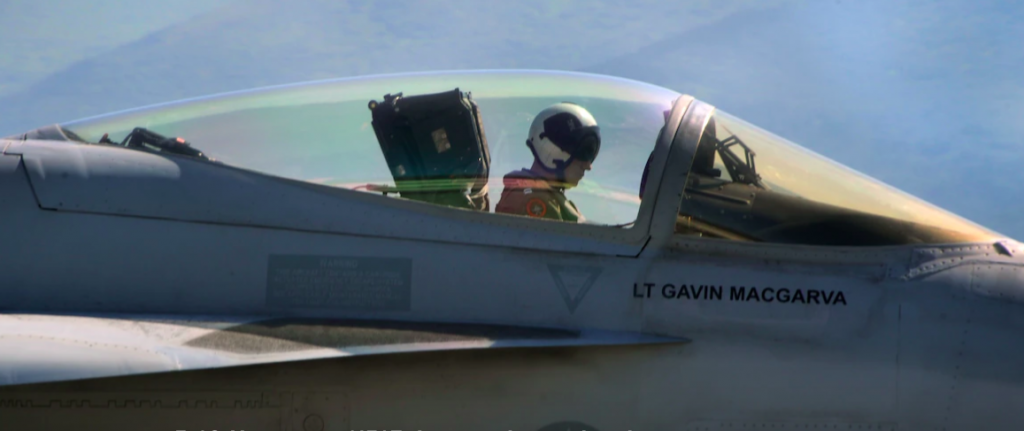
The Images Were Taken in an F18 By A Navy Pilot
The Debrief States..
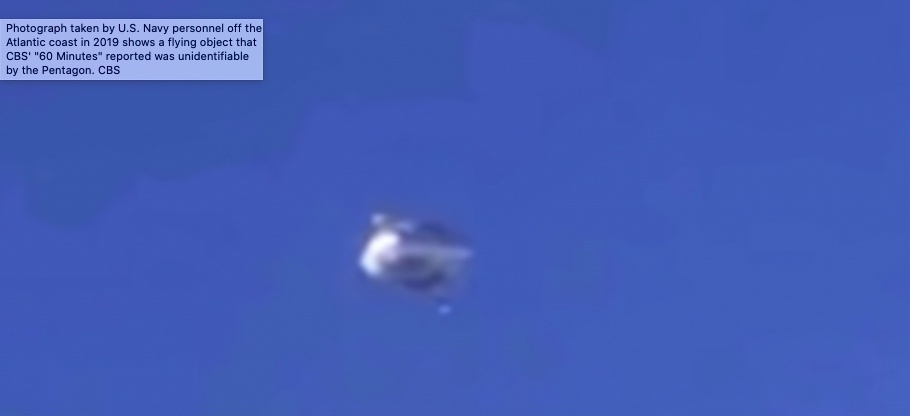
The Pentagon has acknowledged that US Navy Troops recorded multiple leaked photographs and a video exhibiting unidentified aerial phenomena, or UAP, involving instances presently under investigation by the Department of Defense’s Unidentified Aerial Phenomena Task Force. Susan Gough, a Pentagon spokesperson informed the debrief in an email.”
Susan Gough, the founder of the Black Vault, which is a well known Government website did end up verifying the tapes in her statement. There was also an interview with former CIA director James Woolsey.
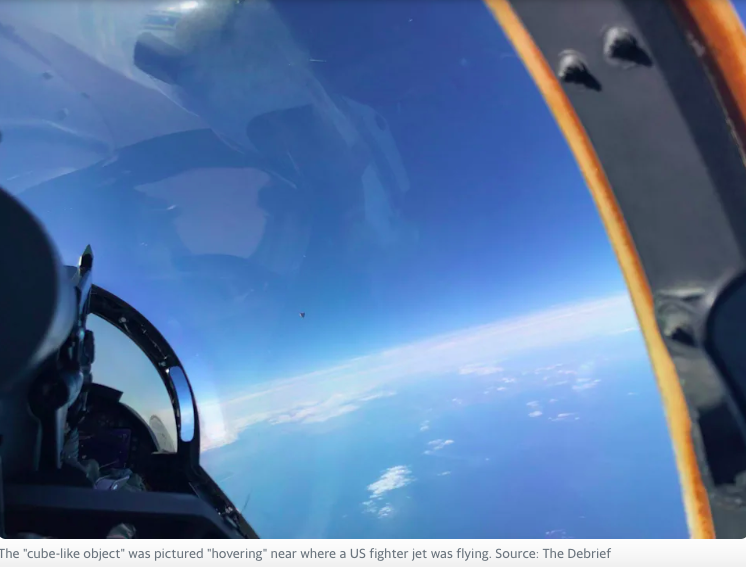
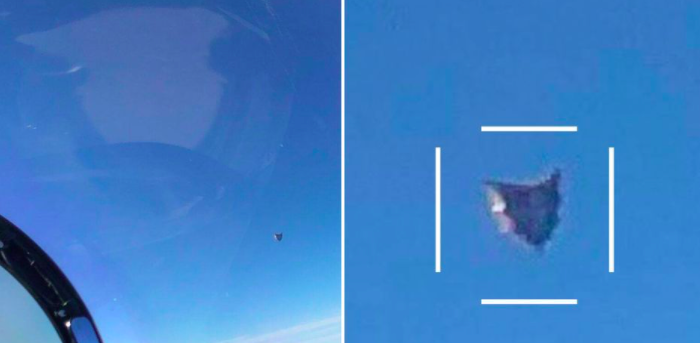
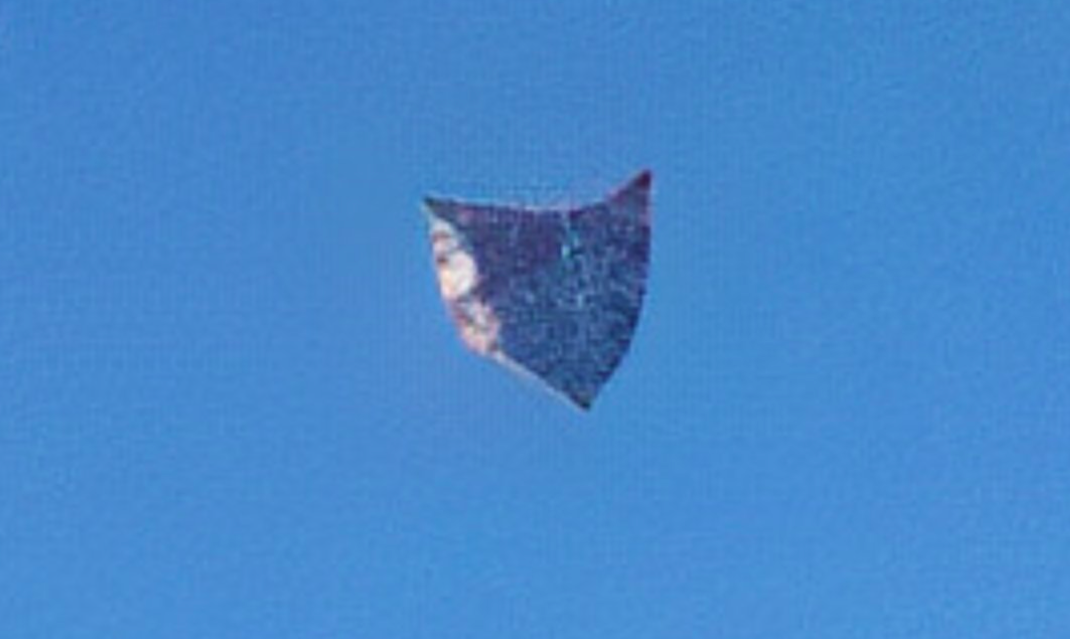
Pictures Obtained From the F18 Pilot in Sky Of The UFO
On April 6, 2021 these photos were leaked. KLAS investigative journalist George Knapp released the first photo, now known as “Acorn” as well as two other new photos indicating unidentified flying objects.
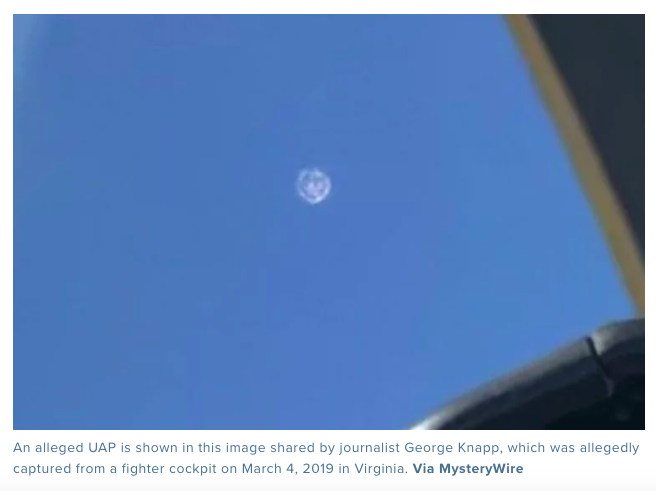
The other two photos were coined “the metallic blimp” and “spherical” were named by Knapp. These were said to be obtained within 30 minutes of each other on the same day.
The second image seems to be clear and transparent as well as spherical. Take a look for yourself:
“We are talking about objects that have been seen by Navy and Air Force pilots or have been picked up by satellite imagery that frankly engage in actions that are difficult to explain,” “movements that are hard to replicate, that we don’t have the technology for or traveling at speeds that exceed the sound barrier without a sonic boom.”
According to data from the National UFO Reporting Center, sightings of unidentified objects in the air reportedly rose in 2020 by about 1,000 nationwide, to more than 7,200 sightings
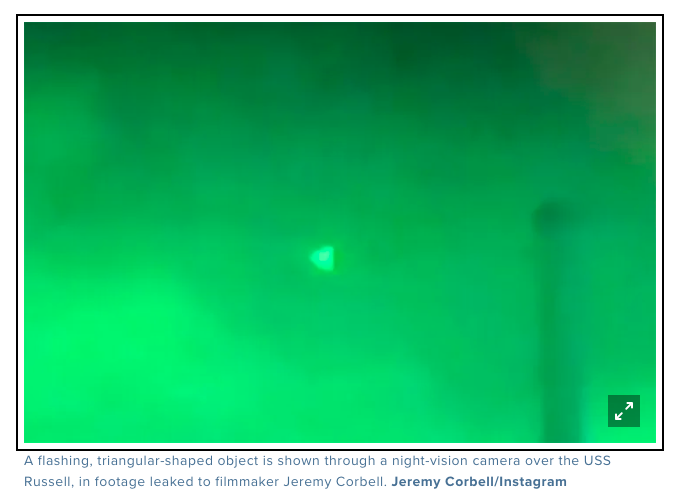
Perhaps the most startling video is the one recorded from the deck of the USS Russell, which appears to show several unidentified flying triangles “flashing” in the clouds off the coast of San Diego. The brief video was shot through a night-vision camera in July of 2019, Corbell says.
“I can confirm that the referenced photos and videos were taken by Navy personnel,” Pentagon spokesperson Susan Gough said in a statement to the Black Vault, a site with a long history of obtaining UFO-related documents through freedom of information laws.
“They confirmed they are all genuine, but won’t give their designation,” site operator John Greenewald said.
“The UAP (Task Force) has included these incidents in their ongoing examinations,” Gough said.
“As we have said before, to maintain operations security and to avoid disclosing information that may be useful to potential adversaries, DOD does not discuss publicly the details of either the observations or the examinations of reported incursions into our training ranges or designated airspace, including those incursions initially designated as UAP.”
“These are authentic photos and video from actual military encounters with UFOs — generated to educate high-level intelligence officers within our military on the nature and presentation of the UAP/UFO phenomenon,“ he wrote on his website.
Crop circles are a worldwide phenomenon that has captured the imagination of millions of people.
Typically found in cornfields and other crops, way out in the country, these circles often come with strange designs, including patterns that are incredibly difficult for our relatively insignificant human brains to decipher.
Recently, a physicist from Finland’s University of Helsinki provided a thought-provoking analysis on one of these strange patterns, and accompanying design that has people talking.
Crop circles are a surprising phenomenon, and they seem to pop up in the most unexpected ways and most unexpected places.
In 2002 in a field near Crabwood/Winchester, Hampshire, England, a famous crop circle appeared overnight (pictured below).
This crop circle has been documented, photographed and researched by scholars all over the world. The circles are intricately designed and “sown” into crop fields.
Upon further research, we are given clues as to how they have been formed — and perhaps whether or not a higher intelligence has been involved.
Richard Taylor, a physicist from the University of Oregon, examined them closely and found that the nodes of these stalks are “blasted out” on one signed as opposed to simply being flattened. This effect has been replicated by microwave heating which causes water inside the crop to vaporize and become dislodged. When this happens, the crops flop over completely to one side.
Crop circle artists are said to be using GPS devices, lasers, and microwaves to create these incredible patterns in the corn fields that are the delight of UFO enthusiasts, and the bane of local farmers.
Now, researchers have uncovered the chilling message accompanying these world famous circles, and what it could mean for the future of this phenomenon.
Take a look at the images:
Crop Circles Carry ‘Chilling Message in Binary Code’
According to Paul Vigay, a British computer consultant who developed and supported RISC OS software for PCs, the crop circle has a purpose behind its bizarre and intricate coding.
Vigay says that the message was encoded in ASCI binary code, an eight-bit code used in computer programming.
Meanwhile, a paper has been published on the circles titled ‘Crop Circles and Life at Parallel Space-Time Sheets.’
Here is what it had to say about the circles:
“Crabwood message consists of two parts. An alien picture and a picture representing spiral like bit sequence starting from the center of the picture and proceeding counterclockwise. It has been proposed that the message is coded using 9-bit code and that 8-bit portions obey ASCII code.
If this is in fact true, the message reads as follows:
‘Beware the bearers of FALSE gifts & their BROKEN PROMISES. Much PAIN but still time. EELI!UVE. There is GOOD out there. We OPpose DECEPTION. Conduit CLOSING\’
Pitkonen concludes that whoever made the circle is “extremely artistically, technologically and mathematically advanced to a point beyond belief.”
Final Thoughts on These Crop Circles
The question we should be asking ourselves now is, why are findings like these from world class researchers constantly dismissed, without even so much as a second thought?
Why does the mainstream media ignore them, and will things ever change? That is of course a rhetorical question, but in the meantime let’s do our best to share this information with anyone willing to listen — these researchers are doing brilliant work that simply cannot be ignored any longer.
The Crabwood crop circle was decoded many years ago. It refers to the Grey's as bearers of false gifts. Some say that this might be referring to the so-called Greada Treaty between the USG and the Grey ETs. That they would give the USG secret technology for a limited number of endorsed human abductions. The Greys broke their promise by abducting many.
The universe is so complex that even the greatest scientific minds on earth ultimately acknowledge that we do not understand the forces and true nature of the cosmos, let alone our place within it. Now for the first time, the un-seeable and unbelievable has been caught on video by multiple individuals who have not only captured mind bending video of Entities, UFOs and Angels, but have been profoundly affected by their experiences. Confronted by the unknown, they all share a deep and unwavering need to know and understand the phenomenon they are experiencing. These individuals did not seek recognition or compensation, they are driven by the questions: “Who are we? What is real?” The sky is alive and has been for millennia with non-human activity, much of which is not visible to the naked eye. See concrete evidence with real video from beyond human perception and discover a realm of fallen angels and otherworldly visitors in a universe that is beyond our comprehension. Dare to ask yourself, what is our place in the cosmos?
The U.S. military constantly monitors the airspace over and around the country for threats ranging from wayward Cessnas to truly unidentified craft, primarily using a network of radars, many of which are shared with the FAA, as well as alert fighter aircraft. This ecosystem is increasingly eyed for enhancements as the nature of the threat to the homeland morphs, especially in terms of the danger posed by cruise missile and drone attacks. At the same time, Congress is literally holding public hearings about unidentified aerial phenomena, or UAP, more classically referred to as UFOs. The topic exploded in the media thanks mainly to a media blitz by retired defense intelligence officials. In fact, Congress is now considering providing something akin to blanket immunity to public officials, military personnel, and even contractors, with any info on the UAP topic.
With this in mind, The War Zone thought the Center For Strategic and International Studies (CSIS) gathering yesterday of missile defense managers from top defense contractors that were brought together to discuss homeland cruise missile defense was a great opportunity to get perspective on the highly contentious UAP issue through their unique lens. We had a question about how existing and future airspace-monitoring and air defense systems aimed at countering cruise missiles could be harnessed to address the challenges presented by UAPs and the moderator, Global Business Editor at Defenseone.com, Marcus Weisgerber, was kind enough to present it to the panel.
Before we get to their responses, we need to provide a bit more background.
Executives from most of the top U.S. prime defense contractors sat on the CSIS panel. CSIS
There have been a concerning number of reportedly unauthorized and/or unidentified aircraft or objects over military facilities, near military aircraft and warships, and in designated test and training airspace in recent years. In particular, it is no secret that unidentified objects with small radar cross sections have been detected in military training ranges along both coasts with alarming regularity. The War Zone detailed a rash of encounters by Navy fighter pilots with unidentified craft off the U.S. East Coast over the last decade. There also was a bizarre string of events off Southern California in 2019. While it may be possible that these recent sightings include encounters with objects with extreme or unexplainable abilities, we have yet to see evidence of this. That doesn't mean evidence doesn't exist, though. What we do know for a fact is there have been many sightings that are explainable, but still extremely troubling.
An existing network of sensors monitors these same areas for potential nefarious actions, but upgrading this architecture to be able to better detect low-flying and small radar cross-section cruise missiles and drones is becoming a massive priority. This spurred the upgrade of F-15C/D and F-16C/D jets tasked with homeland defense with active electronically scanned array (AESA) radars, for instance, which can detect small, low-flying targets. The addition of infrared search-and-track (IRST) systems will help these fighters further to detect, identify, and engage these hard-to-spot targets. But these are just some first steps and a much more extensive sensor upgrade will be needed to better surveil the approaches to the continental U.S. and monitor for these threats. These same capabilities could be brought to bear for detecting and classifying UAPs. This includes having networking and sensor fusion capabilities so that even more complex targets – like those employing electronic warfare tactics – can still be detected, understood, and dealt with if need be.
Nick Bucci, vice president of defense systems and technologies at General Atomics, expounded on this idea.
“Maybe something that is designed to spoof one particular sensor can’t spoof another thing,” Bucci said. "So if I can ensure detection from, say, an [eleoctroptical/infrared] sensor or a [radio frequency] sensor, now I can start pulling that picture together better and getting better characteristics because I've looked at it different ways."
“Using passive sensors is another great way to get different information. Why don't we talk about acoustic sensors?" he continued. "There are a lot of really good acoustic sensors out there, which we happen to make – one that has been used for cruise missile defense and counter-UAS. Those are important sensors to now bring into this architecture. So that you can get that broader picture of the characteristics of a particular threat or object so you can tell whether it's a threat, to be sure you're going to do the right thing.”
Creating a multi-spectrum architecture where a sufficient number of sensors of various types are continuously monitoring the airspace is a costly proposition, said Doug Booth, director of radar and integrated air and missile defense at Lockheed Martin. Still, using ground radar installations in conjunction with airborne radars will help to paint a better picture of objects approaching, entering, or transiting the U.S. National Airspace, he said.
“I think there are multiple things that can be done there to help us solve the problem,” Booth said.
Jonathan Casey, director of small-to-medium ground-based air defense mission capability at Raytheon Missiles & Defense, said identifying objects as threats will always be difficult and that increased levels of scrutiny should be applied depending on whether the nation is at war or perceives an imminent national security threat – a point we discussed previously in great detail as it pertains to UAP. In times of war, the military could put less effort into parsing what an object is by assuming every unidentified object detected is a potential threat and treating it as such, he said.
“When there's a very, very high level of alert, do you reduce the level of confirmation you need in terms of combat ID?” Casey said. “I think that's a difficult decision. … Other than getting eyes on the target. It's never gonna be 100 percent. I mean, that's the 100 percent way to do it.”
Artificial intelligence and algorithmic analysis could sift through large quantities of airspace monitoring data to highlight abnormalities for human technicians to consider, Casey said. Social media companies take the same approach when trying to identify bot accounts among the millions of legitimate users and the level of scrutiny could be dialed up or down depending on the current threat alert state, he said.
David McFarland, senior director of missile defense programs at BAE Systems and a retired Navy captain, said the military services already employ different standards for combat identification in the missile defense arena, depending on threat levels. But those standards outlining flight characteristics and electronic emissions of various known enemy missiles can be circumvented, he said. Adversaries can use the crowded U.S. airspace to mask nefarious activity or even attacks, he said.
And crowded it is. We have cataloged and geolocated thousands of official FAA safety reports involving drones from pilots, many of which are unidentified, from across the country in recent years. You can check that out here and read more about our findings here and here.
"When I think about defense of the National Capital Region [NCR], boy, I can make a Tomahawk [cruise missile] kind of fly like a commercial airliner," McFarland said. "I could probably get into squawk mode and code that looks like a commercial airliner. Oh, by the way, there's this nice mountain range ... right outside of D.C. that can mask my approach and come in that way. Squawk and emote and code and looking all great. I can get away with it one time at least right? But that one time matters."
The NCR is the most highly surveilled and defended airspace in the United States. Nothing else exists like in the country in terms of a standing advanced integrated air defense system that includes many types of sensors and surface-to-air missiles. Still, concerns exist regarding its vulnerability to emerging capabilities and asymmetric attacks.
A U.S. Navy Tomahawk cruise missile flies by an isolated industrial complex during a flight test. U.S. DoD
His solution was to thwart missile defense threats before they are within striking range of the U.S. homeland. McFarland used the example of Cold War-era anti-submarine warfare (ASW), in which the Navy would use satellite imagery to count Soviet Oscar class submarines in their homeports. When one was “missing,” the Navy would then dispatch ASW aircraft to go find it, he said.
“Before it becomes an air defense problem, make it an ASW problem,” McFarland said. “We’ve got to start thinking big. We’ve got to start thinking about the battlespace differently. It's now the homeland, which means everything else, you know, we have to be out there with our forward-deployed forces with the mindset that we are defending the homeland.”
The now infamous videos seen below, taken using ATFLIR targeting pods on U.S. Navy F/A-18s, show examples of unidentified — at least publicly — objects Navy aircraft have encountered in the past. Exactly what these videos show or don't show remains a hotly contested topic.
But the Navy shoulders no official burden to police the U.S. National Airspace. That responsibility lies with the Air Force, which talks a lot about cruise missile defense, but says next to nothing about UAPs. The two issues are almost inextricably linked because an object flying toward or into U.S. airspace must be considered a threat until it can be positively identified as benign.
"We have to flow information openly," McFarland said. "It all comes back down to data."
The U.S. has sufficiently advanced intelligence, surveillance and reconnaissance capabilities to identify most aircraft and other objects that enter its airspace, but there are not enough sensors deployed and they must be upgraded on par with threats that could spoof or evade them, said Michael Noble, senior director of advanced missions at Anduril Industries.
“We have fantastic radar,” he said. ”We have fantastic EO [electro-optical], awesome [signals intelligence], etc. It will continue to improve and we need more sensors, absolutely. But I think a key thing to realize here is this is not something we solve. The enemy has a vote here, so the way we do combat ID is going to vary from one target to another and they're going to adjust. … This architecture is going to have to evolve.”
HBTSS satellites are designed to provide continuous tracking and targeting of enemy missiles launched from land, sea, or air, according to Northrop Grumman, the company developing the system. They are one part of the Overhead Persistent Infrared (OPIR) multi-layered constellation of satellites, “which can sense heat signatures to detect and track missiles from their earliest stages of launch through interception,” one company press release says.
HBTTS satellites will provide continuous tracking and handoff to enable targeting of enemy missiles launched from land, sea or air. Northrop Grumman
Bucci agreed with Noble's prescribed approach, but said the optimal multi-layered, multi-spectrum airspace defense architecture is far enough in the future that an intermediate plan to handle detection and missile-defense warnings is needed.
"Persistence is what we need,” Bucci said. “You don't have persistence until you get that fully-populated constellation of satellites that gives you 24/7/365 heads-up data. In the meantime, you have search capabilities. You put out medium altitude, high altitude, long-endurance UAVs with the right sensor suites on them to be able to search to where indications and warnings have given you some level of information that I now have a rogue submarine off the East Coast.”
While most people think “flying saucer” and “aliens” when they hear UFO, discussions of unknown airspace intrusions are now mainstream enough to be seriously considered in the halls of power in Washington. The government’s reframing of the issue as unidentified aerial phenomenon is one indication that the debate is moving from the realm of science fiction and conspiracy theory to real-world national security. And there are a multitude of good reasons for this that have nothing to do with hunting for the paranormal or visitors from space invaders. The biggest being that the next big weapons capability breakthrough may very well look and act unlike what came before it — alien in nature, if you will. An adversary could and likely would leverage silly cultural stigmas against reporting unidentified flying objects to their advantage, even making the mundane appear anything but.
Regardless, that a panel of high-ranking defense industry executives fielded a question about UAP with straight faces underlines both the reality that the issue is a serious one and that missile-defense technology is a potential solution to detecting, tracking, and identifying these phenomena.
Ultimately, as they said, solving the UAP issue will require a greater number of more-advanced sensors, signaling a secondary market for the technologies their companies already sell to or could develop for the government to defend the U.S. homeland against enemy missiles. They likely understand that if Congress believes UAP are a threat to national security, dollars will flow toward that problem set. And considering that the Pentagon is already standing up a much more deeply mandated and resourced office dedicated to this issue, and those who hold the purse strings are a driving force behind its establishment, they would be right.
Onderzoek naar leefbare planeten en de levensloop van sterren(stelsels): dit kunnen we de komende 20 jaar verwachten van de James Webb Space Telescope
Vier prachtige foto’s van sterrenstelsels, een analyse van de atmosfeer van een planeet ver weg van ons en donderdag als verrassing een testfoto van Jupiter. De James Webb Space Telescope (JWST) heeft al een goede eerste indruk nagelaten, maar deze week was eigenlijk slechts een voorproefje. Wat kunnen we nog verwachten van de ruimtetelescoop? Waarom kostte de ontwikkeling ervan tientallen miljarden euro’s en duurde dat meerdere decennia? En hoe lang zal de JWST nog operationeel blijven? We zochten het voor je uit.
De JWST heeft deze week getoond waar het goed in is: prachtige en vooral enorm gedetailleerde foto’s maken van plekken in het universum die miljarden lichtjaren van ons verwijderd zijn.
Dat kan dankzij de enorme, iconische spiegel bestaande uit de achttien zeshoekige segmenten, die allemaal apart af te stellen zijn. De totale breedte ervan is 6,5 meter, vergeleken met de spiegel van de Hubble-ruimtetelescoop die 2,4 meter breed is. Daardoor is de JWST tien tot honderd keer gevoeliger. Hieronder zie je een vergelijking tussen de Hubble en JWST.
De JWST is extreem koel
Die gevoeligheid maakt het mogelijk om meer licht op te vangen en vooral licht dat minder energie bevat. Dat maakt de JWST ideaal om sterren en andere objecten te observeren die enorm ver weg van ons liggen. Hoe verder die van ons verwijderd zijn, hoe zwakker het licht dat ze uitstralen of reflecteren.
Licht van die verre sterren ligt daarom op het infrarode deel van het elektromagnetische spectrum. Onzichtbaar voor het blote oog, maar detecteerbaar voor de JWST. Dat infrarode straling ook door warme objecten zoals de zon wordt uitgezonden, betekent dat de ruimtetelescoop afgekoeld moet worden tot min 370 Fahrenheit of min 223 graden Celsius.
Geen gemakkelijke klus
Dat de JWST operationeel is en foto’s kan doorsturen, is zowat een wetenschappelijk wonder. Het kostte vele jaren werk en er was een gigantisch budget voor nodig.
De spiegel van de telescoop is namelijk zodanig gigantisch dat die opgevouwen moest worden om op een raket te passen. Na de lancering op 25 december 2021 hadden ingenieurs weken lang werk om de spiegel te ontvouwen en juist af te stellen.
Dat was een kwestie van een foto nemen, de data ervan te verwerken om op basis daarvan de instellingen lichtjes aan te passen om de resultaten te verbeteren. Dat proces moest stap voor stap meerdere keren worden herhaald, getuigen NASA-werknemers bij ‘The Verge’.
Dat gebeurde bovendien vanop een afstand van zo’n anderhalf miljard kilometer van de aarde. De hitte van onze planeet zou het de JWST namelijk extra moeilijk maken. Bij de Hubble-telescoop was het nog mogelijk om astronauten reparaties te laten uitvoeren, de nieuwe ruimtetelescoop onderhouden is praktisch onmogelijk.
Menselijke fouten en pech
De ontwikkeling en het testen van de JWST startte in 1996, met een oorspronkelijke planning in 2007 en een budget van 500 miljoen dollar. Omgerekend is dat bijna 874 miljoen euro, rekening houdende met de inflatie.
In 2005 werd er echter besloten om de plannen te schrappen en opnieuw te beginnen. Ook gooide de coronapandemie op het einde nog wat roet in het eten. Het totale budget werd uiteindelijk eind vorig jaar berekend op 9,7 miljard dollar of ruim 9,6 miljoen euro. Dat is voor de volledige ontwikkeling en het toestel werkzaam te houden in de ruimte.
Bekijk ook: Wetenschapsexpert Martijn Peters legt uit hoe de James Webb Space Telescope werkt
Net geen twintig keer meer dan oorspronkelijk de bedoeling was. Een onafhankelijk onderzoek wees met de beschuldigende vinger naar defensie-, luchtvaart- en ruimtevaartbedrijf Northrop Grumman, dat de leiding had bij de ontwikkeling. Daar werden meerdere menselijke fouten gemaakt.
Ook moest er nieuwe technologie ontwikkeld worden om het concept werkbaar te maken. Experts zeggen volgens ‘The Verge’ dat de JWST zo uniek en complex is dat NASA nooit een realistische inschatting kon maken van de ontwikkeltijd en -kost.
Als alles goed gaat nog twintig jaar te gaan
De ingenieurs en wetenschappers zijn er gelukkig in geslaagd om de JWST op een erg efficiënte manier op z’n plek te krijgen. Daardoor wordt geschat dat de telescoop nog zo’n twintig jaar in gebruik kan blijven. Dat zei projectleider Bob Ochs tijdens een persconferentie, schrijft de website ‘Space.com’.
Al is daar een flinke portie geluk voor nodig, want kleine meteorieten kunnen ernstige schade toebrengen aan de spiegels. Wat dus onmogelijk gerepareerd kan worden. Begin juni was het al zover, maar ingenieurs kon de schade beperken door de spiegels opnieuw af te stellen, rekening houdend met de vervorming.
Vier centrale thema’s
De JWST heeft meerdere instrumenten aan boord, waaronder NIRSPEC. Dat is een spectograaf en kan dus straling meten die bijna infrarood is en afkomstig van objecten als sterren(stelsels). Die werd getest in de faciliteiten van het Centre Spatial de Liège.
Samen met de andere instrumenten zullen wetenschappers op basis van gegevens die de JWST verzamelt onderzoek doen naar vier thema’s.
Zo wordt er gekeken naar het universum vlak na de oerknal. De telescoop kan namelijk licht detecteren dat miljarden jaren de tijd nodig had om tot bij de aarde te geraken. De JWST kan dankzij z’n gevoeligheid 13,6 miljard jaar in het verleden kijken.
Daarnaast zal ook onderzoek worden gedaan naar hoe sterrenstelsels evolueren in de loop der tijd. De grote spiralen, zoals die van het Melkwegstelsel, zijn namelijk niet per se de standaard. Zo zijn er ook elliptische stelsels, die ontstaan zijn door het samensmelten van kleinere exemplaren. Sterrenstelsels die ver weg liggen zijn bovendien eerder klonterig. Hoe die dan veranderen naar een duidelijkere structuur is dus de vraag.
Ook wil men met de JWST kijken naar de geboorte van sterren. Dat kon al met de Hubble-telescoop, maar het feit dat het nieuwe apparaat veel beter infrarode straling kan opvangen, is beloftevol. Er zal opnieuw gekeken worden naar de Pilaren der Creatie in de Adelaarsnevel. Een foto ervan uit 1995, gemaakt door de Hubble-telescoop, is één van de bekendste beelden van het universum, maar er valt nog meer te ontdekken door de kracht van de JWST.
Tot slot: exoplaneten. Er zal met de JWST gekeken worden naar plaatsen buiten ons zonnestelsel waar de bouwstenen voor het leven te vinden zouden zijn. Wetenschappers kunnen namelijk de telescoop gebruiken om te kijken naar wat er in de atmosferen van die planeten zit. Verschillende chemische elementen breken het licht van sterren namelijk op een andere manier, wat kan worden gedetecteerd met een spectograaf zoals de NIRSPEC.
De JWST en wetenschappers hebben dus nog veel fascinerend onderzoek voor de boeg. En het brede publiek zal nog vaak kunnen genieten van prachtige foto’s van de sterren en daar voorbij.
A new Record for the Strongest Magnetic Field Seen in the Universe: 1.6 Billion Tesla
A team of astronomers using the Chinese Insight-HXMT x-ray telescope have made a direct measurement of the strongest magnetic field in the known universe. The magnetic field belongs to a magnetar currently in the process of cannibalizing an orbiting companion.
Magnetars are nasty, but thankfully rare. They are a special kind of neutron star that power up the strongest known magnetic fields.
Astronomers don’t know the exact origins of these ultra-powerful fields, but as usual they have their suspicions. While neutron stars are made of almost entirely neutrons, they do contain small populations of protons and electrons. When neutron stars are born in supernova explosions of a massive star, those charged particles can briefly create a strong magnetic field. In normal neutron stars, the magnetic field quickly melts away from all the complex physics happening in the explosion. But for some neutron stars, the magnetic field locks itself in before that happens. When the neutron star finally reveals itself, it retains this impressive magnetic strength, and a magnetar is born.
But most of the time astronomers have to make due with indirect measurements of magnetar magnetic field strengths. Thankfully, sometimes astronomers can get lucky.
Recently a team of astronomers used the new Chinese Insight-HXMT observatory to study J0243.6+6124, an ultraliminous pulsar in the Milky Way. This pulsar has an orbiting companion that wandered too close. The pulsar’s extreme gravity is currently in the process of tearing apart the companion, forcing its material into a thin accretion disk around the pulsar.
Occasionally the gas in the accretion disk flares, producing a flash of incredibly bright x-rays. In the spectrum of those x-rays the astronomers found an absorption line caused by electrons knocking away x-rays. Those electrons can only get that kind of energy if they’re powered by a magnetic field, and so through that observation the astronomers were able to directly measure the magnetic field strengths.
They estimated a field strength of 1.6 billion tesla, which is about a million billion times stronger than the Earth’s magnetic field.
Glowing Object When Calling ET To Them, Independence, Missouri, UFO Sighting News.
Date of sighting: July 13, 2022
Location of sighting: Independence, Missouri, USA
Watch this! Some people got together to try to use mental powers...telepathy to call over an alien entity to them. Long story short...it worked. This orb appeared soon during the calling and passed over them. I have tried it myself in the past and it worked the first time, but never again. Just mentally relax, focus your thoughts on your brothers and sisters in the sky and feel feelings of love and kindness toward them. They will often appear. No special powers, no religious titles needed, just you...and it will come.
Scott C. Waring - Taiwan
Eyewitness states:
On July 13, 2022, my brother and I were outside looking at the supermoon and skywatching when we decided to try the Quantum UFO Observation Technique using telepathy to send out a message. I said "If there are any non-human entities in the area please let yourself be known." Two minutes later my brother spotted a bright object the size of an aspirin held at arm's length headed straight towards us from the west. I got out my camera and just as it was over head at about 80 degrees the object veered to the NE, making a change in trajectory. I filmed it using my cell phone video. The object had a rounded shape on the bottom and it was a very bright blue/white light with a dark ring around it. The pictures do not show how bright this was. There was no sound. I looked up the ISS and it WAS visible in Independence at that exact same time, except it was at 48 degrees at its highest point and it did not change trajectory. I also looked up Flight Radar 24 and there was nothing at that time that was in the sky. Also in the video but not visible to the naked eye was a beam of light that appeared near us and a stationary linear object in the sky for which I can find no explanation.
Meer van UFO'S of UAP'S, ASTRONOMIE, RUIMTEVAART, ARCHEOLOGIE, OUDHEIDKUNDE, SF-SNUFJES EN ANDERE ESOTERISCHE WETENSCHAPPEN - DE ALLERLAATSTE NIEUWTJES


 LATEST UFO SIGHTINGS AND VIDEOS