Ontdek de Fascinerende Wereld van UFO's en UAP's: Jouw Bron voor Onthullende Informatie!
Ben jij ook gefascineerd door het onbekende? Wil je meer weten over UFO's en UAP's, niet alleen in België, maar over de hele wereld? Dan ben je op de juiste plek!
België: Het Kloppend Hart van UFO-onderzoek
In België is BUFON (Belgisch UFO-Netwerk) dé autoriteit op het gebied van UFO-onderzoek. Voor betrouwbare en objectieve informatie over deze intrigerende fenomenen, bezoek je zeker onze Facebook-pagina en deze blog. Maar dat is nog niet alles! Ontdek ook het Belgisch UFO-meldpunt en Caelestia, twee organisaties die diepgaand onderzoek verrichten, al zijn ze soms kritisch of sceptisch.
Nederland: Een Schat aan Informatie
Voor onze Nederlandse buren is er de schitterende website www.ufowijzer.nl, beheerd door Paul Harmans. Deze site biedt een schat aan informatie en artikelen die je niet wilt missen!
Internationaal: MUFON - De Wereldwijde Autoriteit
Neem ook een kijkje bij MUFON (Mutual UFO Network Inc.), een gerenommeerde Amerikaanse UFO-vereniging met afdelingen in de VS en wereldwijd. MUFON is toegewijd aan de wetenschappelijke en analytische studie van het UFO-fenomeen, en hun maandelijkse tijdschrift, The MUFON UFO-Journal, is een must-read voor elke UFO-enthousiasteling. Bezoek hun website op www.mufon.com voor meer informatie.
Samenwerking en Toekomstvisie
Sinds 1 februari 2020 is Pieter niet alleen ex-president van BUFON, maar ook de voormalige nationale directeur van MUFON in Vlaanderen en Nederland. Dit creëert een sterke samenwerking met de Franse MUFON Reseau MUFON/EUROP, wat ons in staat stelt om nog meer waardevolle inzichten te delen.
Let op: Nepprofielen en Nieuwe Groeperingen
Pas op voor een nieuwe groepering die zich ook BUFON noemt, maar geen enkele connectie heeft met onze gevestigde organisatie. Hoewel zij de naam geregistreerd hebben, kunnen ze het rijke verleden en de expertise van onze groep niet evenaren. We wensen hen veel succes, maar we blijven de autoriteit in UFO-onderzoek!
Blijf Op De Hoogte!
Wil jij de laatste nieuwtjes over UFO's, ruimtevaart, archeologie, en meer? Volg ons dan en duik samen met ons in de fascinerende wereld van het onbekende! Sluit je aan bij de gemeenschap van nieuwsgierige geesten die net als jij verlangen naar antwoorden en avonturen in de sterren!
Heb je vragen of wil je meer weten? Aarzel dan niet om contact met ons op te nemen! Samen ontrafelen we het mysterie van de lucht en daarbuiten.
Dinsdag 9 augustus 2022
The Voyager probes are not fully powering down ... yet
The Voyager probes are not fully powering down ... yet
NASA plans for the missions to continue into the 2030s.
Voyager 1 enters interstellar space in this artist's concept.
NASA/JPL-Caltech
The Voyager spacecraft have been flying through space for nearly 45 years, so seeing recent headlines that these interstellar pioneers are powering down understandably caused some waves.
But are the Voyager spacecraft really about to be shut down?
To clarify the situation, Astronomy reached out to the mission press officer Calla Cofield who was quick to correct the impression, saying, “nothing new is starting now.” She went on to explain that NASA is following a strategic plan to keep their oldest explorers going for as long as possible.
The Voyager mission estimates the spacecrafts entered interstellar space in 2012 (Voyager 1) and 2018 (Voyager 2).
NASA/JPL-Caltech
Keeping the lights on
The twin Voyager spacecraft left Earth nearly five decades ago; Voyager 2 left our planet Aug. 20, 1977, with Voyager 1 following shortly after on Sept. 5. Both spacecraft are powered by three radioisotope thermoelectric generators (RTGs) and have a host of instruments collecting and sending scientific data back to Earth. (In Voyager 1’s case it takes about 20 hours and 33 minutes for that data to reach us!)
Now, the RTGs aboard the Voyager spacecraft turn heat into electricity in order to power the probes. That heat comes from the decay of plutonium-238 radioisotopes. However, at this point in their lifetimes, the generators are producing about 40 percent less electricity than when they were first launched.
To keep them running for as long as possible, NASA began aggressively planning which systems to shut off in 2019. But the agency has been tackling the problem of diminishing power for decades now. “After 45 years in flight,” says Cofield, “the power budget is getting to the point where the team has to turn off whatever they can to keep the spacecraft running and doing science.”
NASA lists the instruments that have been powered down on the mission website.
Over the last three years, this has involved turning off the heaters to five of the probes' scientific instruments."Amazingly, all five have continued to operate well below the temperatures they were tested at!” says Cofield.
The Voyager Science Steering Group will make further decisions on maintaining the power budget for the Voyager mission this August. According to Cofield, the creativity and innovation of the engineering team means that, in theory, the plans could stretch the Voyager missions into the 2030s — half a century longer than the probes were originally expected to last. However, that would require the team to turn off even more scientific instruments at some point.
So, at least as it stands now, the Voyager spacecraft aren’t going anywhere (other than interstellar space) any time soon!
Astronomers Capture the Sharpest Image yet of a Monster Galaxy 12.4 Billion Light Years Away
A team of scientists obtained a magnificent photograph of a faraway galaxy, reminding us all how little we are in the grand scheme of things.
This monster galaxy’ is around 12 billion light-years away from Earth and produces new stars 1,000 times faster than our own Milky Way galaxy.
Scientists utilized the £1.1 billion ALMA Observatory in Chile to capture views of the galaxy with a resolution ten times better than any previous attempt, naming it ‘COSMOS-AzTEC-1.’
The measurements revealed previously unknown information on the structure of this starburst galaxy, which is thought to have originated in the first billion years following the big bang.
Monster galaxies, or starburst galaxies, form stars at a startling pace; 1000 times higher than the star formation in our Galaxy. But why are they so active? To tackle this problem, researchers need to know the environment around the stellar nurseries. Drawing detailed maps of molecular clouds is an important step to scout a cosmic monster.
Tadaki and the team targeted a chimerical galaxy COSMOS-AzTEC-1. This galaxy was first discovered with the James Clerk Maxwell Telescope in Hawai`i, and later the Large Millimeter Telescope (LMT) in Mexico found an enormous amount of carbon monoxide gas in the galaxy and revealed its hidden starburst. The LMT observations also measured the distance to the galaxy, and found that it is 12.4 billion light-years.
Monster galaxy COSMOS-AzTEC-1 observed with ALMA. ALMA revealed the distribution of molecular gas (left) and dust particles (right). In addition to the dense cloud in the center, the research team found two dense clouds several thousand light-years away from the center. These dense clouds are dynamically unstable and thought to be the sites of intense star formation.
(Credit: ALMA (ESO/NAOJ/NRAO), Tadaki et al.)
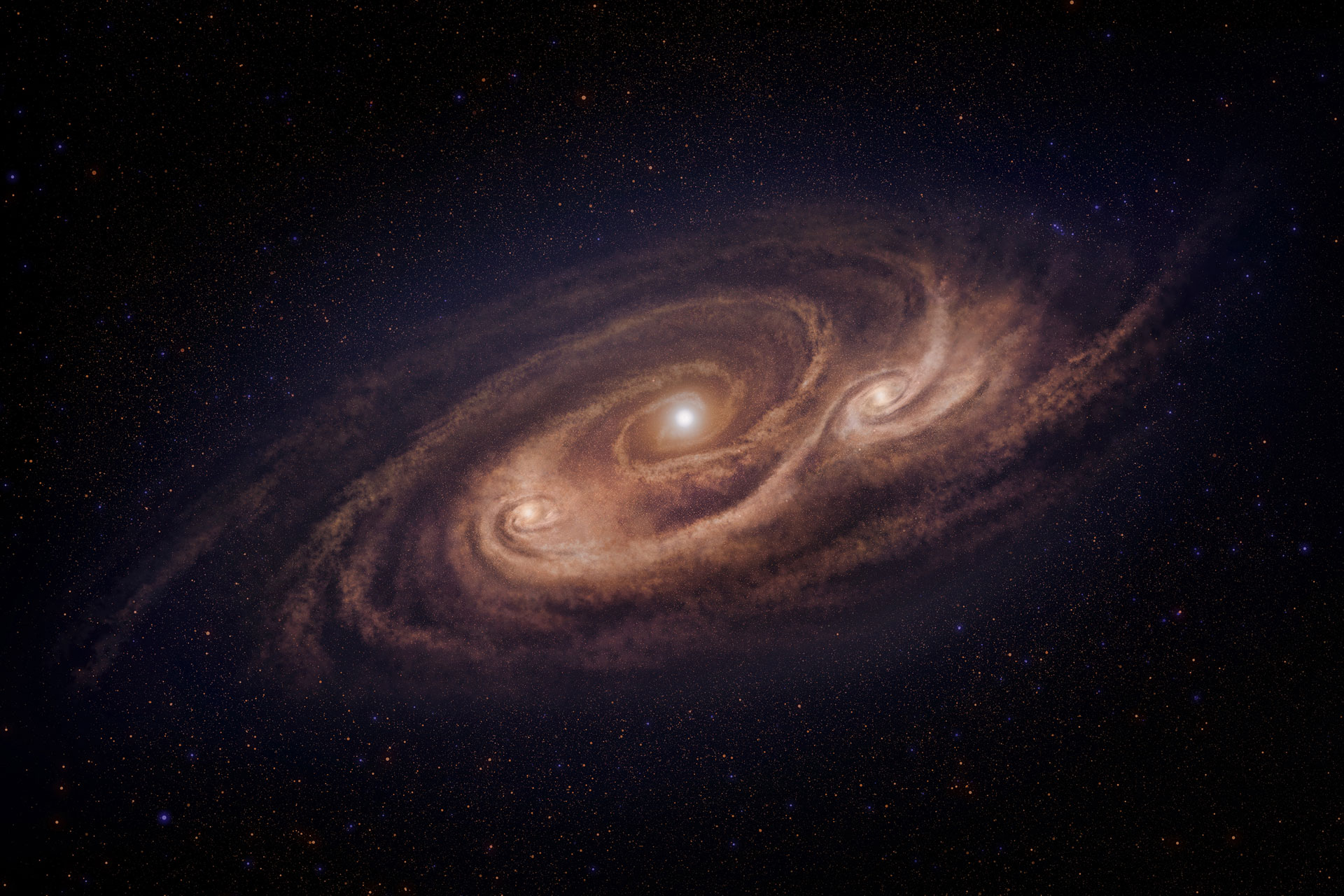
Artist’s impression of the monster galaxy COSMOS-AzTEC-1. This galaxy is located 12.4 billion light-years away and is forming stars 1000 times more rapidly than our Milky Way Galaxy. ALMA observations revealed dense gas concentrations in the disk, and intense star formation in those concentrations.
Credit: National Astronomical Observatory of Japan
Astronomers obtained the most detailed anatomy chart of a monster galaxy located 12.4 billion light-years away. Using the Atacama Large Millimeter/submillimeter Array (ALMA), the team revealed that the molecular clouds in the galaxy are highly unstable, which leads to runaway star formation. Monster galaxies are thought to be the ancestors of the huge elliptical galaxies in today’s Universe, therefore these findings pave the way to understand the formation and evolution of such galaxies.
“One of the best parts of ALMA observations is to see the far-away galaxies with unprecedented resolution,” says Ken-ichi Tadaki, a postdoctoral researcher at the Japan Society for the Promotion of Science and the National Astronomical Observatory of Japan, the lead author of the research paper published in the journal Nature.
Researchers have found that COSMOS-AzTEC-1 is rich with the ingredients of stars, but it was still difficult to figure out the nature of the cosmic gas in the galaxy. The team utilized the high resolution and high sensitivity of ALMA to observe this monster galaxy and obtain a detailed map of the distribution and the motion of the gas. Thanks to the most extended ALMA antenna configuration of 16 km, this is the highest resolution molecular gas map of a distant monster galaxy ever made.
“We found that there are two distinct large clouds several thousand light-years away from the center,” explains Tadaki. “In most distant starburst galaxies, stars are actively formed in the center. So it is surprising to find off-center clouds.”
The astronomers further investigated the nature of the gas in COSMOS-AzTEC-1 and found that the clouds throughout the galaxy are very unstable, which is unusual. In a normal situation, the inward gravity and outward pressure are balanced in the clouds. Once gravity overcomes pressure, the gas cloud collapses and forms stars at a rapid pace. Then, stars and supernova explosions at the end of the stellar life cycle blast out gases, which increase the outward pressure. As a result, the gravity and pressure reach a balanced state and star formation continues at a moderate pace. In this way star formation in galaxies is self-regulating. But, in COSMOS-AzTEC-1, the pressure is far weaker than the gravity and hard to balance. Therefore this galaxy shows runaway star formation and has morphed into an unstoppable monster galaxy.
The team estimated that the gas in COSMOS-AzTEC-1 will be completely consumed in 100 million years, which is 10 times faster than in other star forming galaxies.
But why is the gas in COSMOS-AzTEC-1 so unstable? Researchers do not have a definitive answer yet, but galaxy merger is a possible cause. Galaxy collision may have efficiently transported the gas into a small area and ignited intense star formation.
“At this moment, we have no evidence of merger in this galaxy. By observing other similar galaxies with ALMA, we want to unveil the relation between galaxy mergers and monster galaxies,” summarizes Tadaki.
China's ambitious plan to find the first Earth 2.0
Despite several high profile missions to find an Earth-like planet orbiting a Sun-like star, astronomers have failed to find one. Now the Chinese are launching their own space telescope to hunt for Earth 2.0.
Aleksandr Kukharskiy/Shutterstock
The Kepler Space Telescope made some of the most exciting discoveries in astronomy. Launched in 2009, the telescope observed 13 million stars until 2018, when it was de-activated.
During that time, Kepler discovered over 2600 planets orbiting other stars. Some were entirely unlike anything in our Solar System, forcing astronomers to invent two new classes of planet. One or two of Kepler’s discoveries even orbit in the habitable zone of their parent star, albeit around red dwarf stars that are rather different from our Sun. This was hugely exciting because this temperate region in which liquid water can exist has conditions thought crucial for the existence of life.
But for all that, Kepler ultimately failed. Its mission was to find another Earth, in other words an Earth-like planet orbiting a Sun-like star. But in nearly a decade of observations, Kepler found not a single Earth 2.0.
That was partly because Sun-like stars turned out to be noisier than expected and so required longer observation times. But also because in 2013, two of the observatory’s four reaction wheels broke down, making long-term observations impossible. As a result, astronomers have yet to find an alien Earth.
Scanning the Heavens
That could now change thanks to a Chinese mission called Earth 2.0 due to be launched in 2026. This mission will scan the heavens for Earth-like planets orbiting Sun-like stars with instruments designed to cope with the star-noise that Kepler unexpectedly discovered.
The team involves some 300 scientists and engineers from over 40 institutions, most in China. And this week, the collaboration published a detailed description of the mission on the arXiv.
One problem for any space observatory is to cover as a wide a field-of-view as possible while minimizing the cost and weight of the spacecraft. The Chinese team solved this problem by avoiding the cost and weight of a single giant telescope.
Instead, the spacecraft will carry six smaller 30cm telescopes that together will observe a similar area of sky as Kepler, which had a 1.4-meter mirror. These telescopes will look for the characteristic changes in star brightness as a planet passes in front of it.
The spacecraft will also carry a seventh telescope designed to look for microlensing events in which the gravitational field of a star focuses the light from a distant star behind it, temporarily brightening it. By studying the pattern of brightness, astronomers can tell if the star has an orbiting planet.
This seventh instrument will also be able to spot free floating planets, thereby helping to cast some light on these strange, lonely objects.
Data Firehose
The Chinese team’s plan is to launch Earth 2.0 to the L2 Lagrange point, one of several regions of space where the Earth and Moon’s gravitational fields are in balance, and away from Earth’s potential interference. L2 is a popular choice for observatories and home to several past and present, such as the Herschel Space Observatory and the James Webb Space Telescope. The Earth 2.0 spacecraft will orbit L2 over the course of 4 years, sending back some 169 Gb of data every day.
That raises the prospect of some mouth-watering discoveries. “Simulations show that the transit survey will be able to detect ∼ 29,000 new planets, including ∼ 4,900 Earth-sized planets,” the team say. That means the mission should detect between and 10 and 20 Earth 2.0s by 2030.
The discovery of the first Earth 2.0 is likely to be one of the defining moments in the history of astronomy. It is likely to create huge interest in the nature of these planets, the make-up of their atmospheres and the potential presence of water. Then there will be the search for biomarkers suggesting the presence of life, molecules like methane and oxygen, and the characteristic light absorption patterns of photosynthesis. Beyond that will be the search for technosignatures that might indicate the presence of a civilization, signals such as industrial pollutants like chlorofluorocarbons and even narrowband radio transmissions.
Of course, Earth 2.0 isn’t the only mission capable of spotting an alien Earth. Several others have the capability, such as ESA’s Plato mission which will also be launched in 2026. But these will have to be luckier than Earth 2.0 to be successful.
That sets the scene for an exciting international race to discover an “other Earth” and the beginning of a new era in the study of potentially habitable planets.
UFOs – Ultra-red Flattened Objects – revealed by Webb
Posted by Kelly Kizer Whitt
See one of the red UFOs – Ultra-red Flattened Objects – that appears in the Webb image (right), but not the Hubble image (left)? Webb is finding galaxies that Hubble missed. Image via Erica Nelson, et al./ arXiv.
UFOs in Webb’s range
The James Webb Space Telescope (JWST) is the successor to the Hubble Space Telescope (HST). It can see farther away in space, and so farther back in time. In operation only since this summer, it’s already discovering things Hubble couldn’t see, including some massive, deep-red, disk-shaped galaxies. Astronomers call them HST-dark galaxies. In a paper published on arXiv on August 2, 2022 (but not yet peer-reviewed), a team of scientists are also calling these galaxies Ultra-red Flattened Objects, or UFOs.
And – to Webb’s “eye” at least – they do have the classic, sci-fi look of a flying saucer!
Deep-red galaxies not visible to Hubble
These deep-red, disk-shaped galaxies have a redshift (or z) between 2 and 6. That value means we’re seeing them as they were in the universe 10.3 to 12.7 billion years ago. So they’re definitely not our next-door neighbors. But they are within the range of what Hubble could image, if it could see their red light.
Webb can see these “HST-dark” galaxies because it observes in infrared light, which is the part of the spectrum where these galaxies shine. The team that published the new study, led by Erica Nelson of the University of Colorado, Boulder, found 29 of these HST-dark galaxies. The galaxies have a significant amount of dust, which makes their light redder and hides them from Hubble’s vision. But Webb’s infrared sensors can see through that dust, making the UFOs pop into view.
Webb’s galactic discoveries
Compare the UFOs to the record-breaking distant galaxies that Webb has spied, which have redshifts of 11-20. That would be when the universe was between 400 million and 150 million years old. The UFOs, with a redshift of 2-6, existed when the universe was between 3 1/2 and 1 billion years old (out of its current 13.7 billion years of age). So these galaxies aren’t real close to us in time, but they are still closer than the record-breaking discoveries.
UFOs at cosmic noon
The astronomers refer to the time period that UFOs thrived as cosmic noon. The early ages of the universe when galaxies began to grow was the cosmic dawn. Then cosmic noon arrived, about 3 billion years after the Big Bang. Astronomers think most of the universe’s stars and black holes formed around the time of cosmic noon. And now astronomers say that these UFOs, or dusty star-forming galaxies undergoing extreme starbursts, dominate the total star formation rate budget of the universe during cosmic noon. So, as the paper said, since we have not yet been able to study what we could not see:
… we do not yet fully understand the growth of the most massive galaxies at cosmic noon.
From flattened to bulging
The scientists also said that these massive, dusty UFOs may be the progenitors of today’s large elliptical galaxies. They’re surprised by this finding, because astronomers believed that the bulging elliptical galaxies we see now would have already had that bulging shape at an early age. But as the paper said:
Perhaps the most noteworthy result stems from the flattened shapes of these HST-dark galaxies. These massive, star-forming galaxies are the likely progenitors of today’s massive galaxies, which tend to be bulge/spheroid-dominated … The expectation may have been that the stellar bodies of these objects would already host significant bulges. This, however, is not what we observe in this sample.
M87 is a large elliptical galaxy famous for the black hole at its center. The Hubble Space Telescope took this image in 2009. M87 lies about 55 million light-years away. It may have begun life as a UFO, or Ultra-red Flattened Object.
The discovery of these UFOs is helping astronomers get a better picture of the universe at a more recent age. As the paper noted:
The stellar masses, sizes, and morphologies of the sample suggest that some could be progenitors of lenticular or fast-rotating galaxies in the local Universe. The existence of this population suggests that our previous censuses of the universe may have missed massive, dusty edge-on disks, in addition to dust-obscured starbursts.
The paper concluded:
This sample highlights the fact that the JWST discovery extends studies of galaxy stellar structures to later cosmic epochs during which we thought we had a reasonable census of the universe already.
Bottom line: Astronomers analyzing new Webb images have found UFOs, or Ultra-red Flattened Objects. These UFOs are disk galaxies that only become visible in infrared light.
New faint, distant and cold brown dwarf discovered
by Tomasz Nowakowski , Phys.org
Image cutouts of GLASS-JWST-BD1. Credit: Nonino et al., 2022.
Using the James Webb Space Telescope (JWST), an international team of astronomers have detected a new faint, distant, and cold brown dwarf. The newly found object, designated GLASS-JWST-BD1, turns out to be about 31 times more massive than Jupiter. The discovery was detailed in a paper published July 29 on arXiv.org.
Brown dwarfs are intermediate objects between planets and stars. Astronomers generally agree that they are substellar objects occupying the mass range between 13 and 80 Jupiter masses. One subclass of brown dwarfs (with effective temperatures between 500 and 1,500 K) is known as T dwarfs, and represents the coolest and least luminous substellar objects so far detected.
Studies of T dwarfs could help astronomers better understand objects near the disputed planet/star boundary, for instance, giant exoplanets. However, although many brown dwarf have been detected to date, T dwarfs are not so common, as only about 400 such objects have been identified.
Now, a group of astronomers led by Mario Nonino of the Astronomical Observatory of Trieste in Italy, reports the finding of a new brown dwarf that is most likely of T dwarf subclass. The discovery was made as part of the Through the Looking GLASS (GLASS-JWST) project—a JWST Early Release Science (ERS) program targeting the massive galaxy cluster Abell 2744 with JWST's Near-Infrared Spectrograph (NIRSPEC) and Near-Infrared Imager and Slitless Spectrograph (NIRISS).
"We present the serendipitous discovery of a late T-type brown dwarf candidate in JWST NIRCam observations of the Early Release Science Abell 2744 parallel field. The discovery was enabled by the sensitivity of JWST at 4 µm wavelengths and the panchromatic 0.9–4.5 µm coverage of the spectral energy distribution," the researchers wrote in the paper.
According to the study, GLASS-JWST-BD1 has a mass of about 31.43 Jupiter masses and an effective temperature of some 600 K. The age of this brown dwarf was estimated to be 5 billion years.
Comparison with theoretical models suggest that GLASS-JWST-BD1 is a late-type T dwarf. Its distance was measured to be between 1,850 and 2,350 light years, in a direction perpendicular to the Galactic plane. The results indicate that this object is likely a member of the Galactic thick disk or halo population.
The astronomers noted that further observations of GLASS-JWST-BD1 are required in order to confirm its T-dwarf nature. In particular, kinematic or chemical abundance data are needed to get more insights into the properties of this object.
In concluding remarks, the authors of the paper underlined how their discovery demonstrates the capability of JWST to investigate distant low-mass Galactic stellar and substellar objects.
"The large estimated distance of GLASS-JWST-BD1 confirms the power of JWST to probe the very low-mass end of the stellar and substellar mass function in the Galactic thick disk and halo, enabling exploration of metallicity dependence on low-mass star formation and the evolution of brown dwarf atmospheres," the scientists wrote.
A chance alignment between Earth and a Mars-bound spacecraft has given us a rare glimpse into the movement of high-energy particles from the Sun.
A chance alignment between Earth and a Mars-bound spacecraft has given us a rare glimpse into the movement of high-energy particles from the Sun. The data from this event can help researchers understand the radiation environment near Mars — a key factor in planning crewed missions to our neighboring planet and beyond.
ENERGETIC PARTICLE PARADE
Illustration of energetic particles being ejected by the Sun. NASA’s Goddard Space Flight Center Conceptual Image Lab
The space between the planets in our solar system is filled with a wispy sea of charged particles that flow out from the Sun’s atmosphere. This particle population is augmented by cosmic rays — speedy protons and atomic nuclei accelerated in extreme environments across the universe — which ebb and flow against the 11-year solar activity cycle. This undulating particle background is punctuated by bursts of high-energy particles from the Sun, which can be unleashed suddenly in violent solar storms.
Spacecraft that venture out from the protection of Earth’s magnetic field must navigate this ocean of particles and weather solar storms. And if we someday wish to send astronauts to other planets, we’ll need to know how high-energy solar particles, which pose a risk to the health of astronauts and electronic systems alike, travel through the solar system.
WHEN SPACECRAFT ALIGN
Location of Tianwen-1 (TW-1) relative to Solar Orbiter (SolO), Parker Solar Probe (PSP), and STEREO-A (STA), Earth, and Mars. The black arrow marks the location of the active region that launched the solar storm. Adapted from Fu et al. 2022
In a new publication, a team led by Shuai Fu (Macau University of Science and Technology), Zheyi Ding (China University of Geosciences), and Yongjie Zhang (Chinese Academy of Sciences) studied the high-energy solar particles produced in an event in November 2020, when the Sun emitted a solar flare and a massive explosion of solar plasma called a coronal mass ejection.
This event coincided with a chance alignment of multiple spacecraft along the same solar magnetic field line. This alignment meant that several spacecraft near Earth and the Tianwen-1 spacecraft en route to Mars measured the same burst of energetic particles millions of miles apart, providing a rare opportunity to study how energetic particles from the Sun travel through space along magnetic field lines.
DIFFUSION AND EVOLUTION
Comparison of proton fluence (number of particles collected per unit area) measured by spacecraft at Earth (blue) and by Tianwen-1 at 1.39 au (red). The time increases from (a) to (h). The spectra at Earth and at Tianwen-1 “break” or bend at roughly the same energy, suggesting that there is little evolution as the particles travel outward. Click to enlarge. Fu et al. 2022
By comparing the timing of measurements from Tianwen-1 to those from three spacecraft near Earth, the team discerned that the magnetic field line that connected the spacecraft did not connect back to the origin of the particles. This means that the particles must have traveled, or diffused, across magnetic field lines to reach the spacecraft.
In addition, the team found that the shape of the particle energy distribution remained the same at moderate and high energies as the particles traveled between Earth and Tianwen-1’s location at 1.39 au. This suggests that the shape of the energy distribution is determined earlier, at the time the particles are accelerated to high energies, rather than as the particles travel through space.
The November 2020 event marked the first solar energetic particle event observed by Tianwen-1, but surely not the last. The spacecraft will continue to monitor high-energy particles from its station in Mars orbit as the solar cycle revs up, collecting valuable data for understanding the radiation environment around Mars and planning future missions.
CITATION
“First Report of a Solar Energetic Particle Event Observed by China’s Tianwen-1 Mission in Transit to Mars,” Shuai Fu et al 2022 ApJL934 L15. doi:10.3847/2041-8213/ac80f5
This post originally appeared on AAS Nova, which features research highlights from the journals of the American Astronomical Society.
Possible UFO appears during live broadcast in Germany
Was a UFO accidentally filmed during an ARD live broadcast recording of a wildfire in eastern Germany?
The video footage appears to show a high speed cylindrical object flying by in the background.
The object has no obvious signs of propulsion and no wings, also it can't be a bird either since we don't see flapping wings. Maybe an insect flying close to the camera? But can an insect fly that speed? What could it be?
UFO fireball in the western skies looking from Anza, California 6-Aug-2022
This bright UFO was seen and recorded in the sky above Anza, California on 6th August 2022.
Witness report:
I saw a fireball in the sky that changed colors from red to orange and changed in size. I was able to get a video of it on my iPhone 13. There was also a small white light that blinked intermittently on the left of it. The red object seemed to have control of the power like a jet engine going on and off. It hovered for a while and then it just disappeared.
Astronomers Discover A Disappearing Space Object That Turns On And Off Every 20 Minutes And Sends Highly-Polarized Radio Signals
According to a research paper published in Nature, astronomers detected a “really weird” object 4,000 lightyears distant from Earth. Every other minute, the object vanishes from view and produces a massive burst of radio waves three times an hour.
Tyrone O’Doherty, a Curtin University student, first noticed the enigmatic object while scanning the sky in rural Western Australia. “It’s exciting that the source I identified last year has turned out to be such a peculiar object,” stated O’Doherty in a press statement.
The object, which the scientists claim is unlike anything else they’ve observed, emits a tremendous beam of radiation that, every 20 minutes, shines brightly in the sky. It also spins and vanishes every minute.
Scientists refer to space objects that “turn” on and off in the night sky as “transients”.
“When studying transients, you’re watching the death of a massive star or the activity of the remnants it leaves behind,” said Dr. Gemma Anderson, an ICRAR-Curtin astrophysicist and co-author of the work.
Slower transients, such as supernovae, might arrive in a matter of days and last for several months. Fast transients, such as neutron stars, “flash” on and off many times per second. However, transients between those two speeds are uncommon, and the current discovery is “really weird” and “completely unexpected.” according to the researchers.
“It was kind of spooky for an astronomer because there’s nothing known in the sky that does that,” said astrophysicist Dr. Natasha Hurley-Walker, who headed the research team. “And it’s really close to us – about 4000 lightyears distant. It’s there in our galaxy’s backyard.”
Hurley-Walker characterized the enigmatic object as being smaller than the sun yet brilliant, radiating highly polarized radio waves three times an hour. These radio pulses imply that it has an “extremely strong” magnetic field, which may correspond to a previously anticipated astrophysical object that has never been verified to exist. Scientists refer to the hypothetical item as an “ultra-long period magnetar.”
“It’s a type of slowly spinning neutron star that has been predicted to exist theoretically,” Hurley-Walker explained. “However, no one anticipated to immediately discover one like this since they were not thought to be that brilliant. It converts magnetic energy to radio waves considerably more efficiently than anything else we’ve seen previously.”
-
Astronomers believe it is a rare sort of neutron star or a collapsing white dwarf, but they need to examine it again to establish if it is a fluke or a new type of space object.
Ancient Source of Oxygen for Life Discovered Hidden Deep in the Earth’s Crust
ByNEWCASTLE UNIVERSITY
Researchers have uncovered a source of oxygen that may have influenced the evolution of life before the advent of photosynthesis.
Scientists at Newcastle University have discovered a source of oxygen deep in the Earth’s crust that may have influenced the evolution of life before the advent of photosynthesis.
The pioneering research project uncovered a mechanism that can generate hydrogen peroxide from rocks during the movement of geological faults. The study was led by Newcastle University’s School of Natural and Environmental Sciences and published today (August 8) in the journal Nature Communications.
While hydrogen peroxide in high concentrations can be harmful to life, it can also provide a useful source of oxygen to microbes. This additional source of oxygen may have influenced the early evolution, and possibly even origin, of life in hot environments on the early Earth before the evolution of photosynthesis.
Researchers were able to simulate some of the key conditions of subsurface rock fracturing using vials in the lab. Rocks representative of oceanic and continental crust were crushed under nitrogen, added to oxygen-free water, then heated.
Credit: Jon Telling / Jordan Stone / Newcastle University
In tectonically active regions, the movement of the Earth’s crust not only generates earthquakes but also riddles the subsurface with cracks and fractures. These are lined with highly reactive rock surfaces containing many imperfections, or defects. Water can then filter down and react with these defects on the newly fractured rock.
Master’s student Jordan Stone simulated these conditions in the laboratory by crushing granite, basalt, and peridotite – rock types that would have been present in the early Earth’s crust. These were then added to water at varying temperatures under well-controlled oxygen-free conditions.
The research investigates a source of reactive oxygen associated with geological faulting; a potential oxygen source prior to cyanobacteria oxygenating the Earth’s atmosphere. This reactive oxygen may have had a role in the evolution of life from an oxygen-free to an oxygenated world and contributed to prebiotic chemistry in subsurface fractures prior to the origin of life.
Credit: Jon Telling / Jordan Stone / Newcastle University
The experiments revealed that substantial amounts of hydrogen peroxide – and as a result, potentially oxygen – were only generated at temperatures close to the boiling point of water. Importantly, the temperature of hydrogen peroxide formation overlaps the growth ranges of some of the most heat-loving microbes on Earth called hyperthermophiles, including evolutionary ancient oxygen-using microbes near the root of the Universal Tree of Life.
Lead author Jordan Stone, who conducted this research as part of his Master of Research in Environmental Geoscience, said: “While previous research has suggested that small amounts of hydrogen peroxide and other oxidants can be formed by stressing or crushing of rocks in the absence of oxygen, this is the first study to show the vital importance of hot temperatures in maximizing hydrogen peroxide generation.”
Lead author Jordan Stone, who conducted this research as part of his MRes in Environmental Geoscience at Newcastle University, UK, sets up one of the experiments.
Credit: Jon Telling / Jordan Stone / Newcastle University
Principal Investigator Dr. Jon Telling, Senior Lecturer, added: “This research shows that defects on crushed rock and minerals can behave very differently to how you would expect more ‘perfect’ mineral surfaces to react. All these mechanochemical reactions need to generate hydrogen peroxide, and therefore oxygen, is water, crushed rocks, and high temperatures, which were all present on the early Earth before the evolution of photosynthesis and which could have influenced the chemistry and microbiology in hot, seismically active regions where life may have first evolved.”
Reference:
“Tectonically-driven oxidant production in the hot biosphere” 8 August 2022, Nature Communications. DOI: 10.1038/s41467-022-32129-y
The work was supported through grants from the Natural Environmental Research Council (NERC) and the UK Space Agency. A major new follow-up project led by Dr. Jon Telling, funded by NERC, is underway to determine the significance of this mechanism for supporting life in the Earth’s subsurface.
NASA's 'Helical Engine' could reach 99% the speed of light
When it comes to space, there's a problem with our human drive to go all the places and see all the things. A big problem. It's, well, space. It's way too big. Even travelling at the maximum speed the Universe allows, it would take us years to reach our nearest neighbouring star.
But another human drive is finding solutions to big problems. And that's what NASA engineer David Burns has been doing in his spare time. He's produced an engine concept that, he says, could theoretically accelerate to 99 percent of the speed of light - all without using propellant.
He's posted it to the NASA Technical Reports Server under the heading "Helical Engine", and, on paper, it works by exploiting the way mass can change at relativistic speeds - those close to the speed of light in a vacuum. It has not yet been reviewed by an expert.
Understandably this paper has caused buzz approaching levels seen in the early days of the EM Drive. And yes, even some headlines claiming the engine could 'violate the laws of physics'.
But while this concept is fascinating, it's definitely not going to break physics anytime soon. As a thought experiment to explain his concept, Burns describes a box with a weight inside, threaded on a line, with a spring at each end bouncing the weight back and forth. In a vacuum - such as space - the effect of this would be to wiggle the entire box, with the weight seeming to stand still, like a gif stabilized around the weight.Overall, the box would stay wiggling in the same spot - but if the mass of the weight were to increase in only one direction, it would generate a greater push in that direction, and therefore thrust.
According to the principle of the conservation of momentum - in which the momentum of a system remains constant in the absence of any external forces - this should be not completely possible.
But! There's a special relativity loophole. Hooray for special relativity! According to special relativity, objects gain mass as they approach light speed. So, if you replace the weight with ions and the box with a loop, you can theoretically have the ions moving faster at one end of the loop, and slower at the other.
But Burns' drive isn't a single closed loop. It's helical, like a stretched out spring - hence "helical engine".
"The engine accelerates ions confined in a loop to moderate relativistic speeds, and then varies their velocity to make slight changes to their mass. The engine then moves ions back and forth along the direction of travel to produce thrust," he wrote in his abstract.
"The engine has no moving parts other than ions traveling in a vacuum line, trapped inside electric and magnetic fields."
It sounds really nifty, right? And it is - in theory. But it's not without significant practical problems.
According to New Scientist, the helical chamber would have to be pretty large. Around 200 metres (656 feet) long and 12 metres (40 feet) in diameter, to be precise.
And it would need to generate 165 megawatts of energy to produce 1 newton of thrust. That's the equivalent of a power station to produce the force required to accelerate a kilogram of mass per second squared. So a lot of input for a teeny tiny output. It is horribly inefficient.
But in the vacuum of space? It just might work. "The engine itself would be able to get to 99 per cent the speed of light if you had enoughAnd here's the other thing. Humans - not all of us, but still more than a few - desperately want to go to interstellar space. We may never get there. But if we never even try to think about it, that "may" becomes a "definitely." What's that saying - you miss 100 percent of the shots you don't take?time and power," Burns told New Scientist.
Burns notes the efficiency problem in his presentation, and also adds that his work hasn't been reviewed by experts, and there may be errors in his maths. We don't exactly have the blueprints for a fully functional space travel engine here.
What we do have is a piece of groundwork that could be used to develop such an engine. What we have is a dream of the stars.
The hush-hush vehicle is thought to be a space plane.
A Long March 2F rocket launches China's Shenzhou 14 crewed mission on June 4, 2022. A Long March 2F launched a mysterious reusable "test spacecraft" on Aug. 4.
(Image credit: CCTV+)
For the second time in two years, China has launched a classified reusable vehicle on a mystery mission to Earth orbit.
A Long March 2F rocket carrying a "test spacecraft" lifted off from Jiuquan Satellite Launch Center in the Gobi Desert on Thursday (Aug. 4; Aug. 5 Beijing time), China's state-run Xinhua news agency reported.
"The test spacecraft will be in orbit for a period of time before returning to the scheduled landing site in China, during which reusable and in-orbit service technology verification will be carried out as planned to provide technical support for the peaceful use of space," Xinhua wrote(opens in new tab) (in Chinese; translation by Google).
That's about all we know; Xinhua's update is just two paragraphs long and provides no further detail. But the mystery vehicle is thought to be a robotic space plane, perhaps one roughly the same size as the U.S. Space Force's X-37B, based on the Long March 2F's considerable payload capacity, SpaceNews reported(opens in new tab).
China also launched a reusable test spacecraft in September 2020, under a similar cloud of secrecy. That vehicle — which may or may not be the same one that lifted off on Thursday — stayed aloft for two days and released a small payload in orbit before coming down for a landing in China, SpaceNews noted.
For comparison, the X-37B space plane has been orbiting Earth for more than 800 days on its latest mystery mission, the sixth for the X-37B program. The Space Force is thought to have two of the 29-foot-long (8.8 meters), Boeing-built space planes in its fleet.
The Jiuquan launch was part of an extremely busy day in spaceflight. Thursday featured six rocket launches, starting with Rocket Lab's lofting of a spy satellite for the U.S. National Reconnaissance Office at 1 a.m. EDT (0500 GMT).
Mike Wall is the author of "Out There(opens in new tab)" (Grand Central Publishing, 2018;trated by Karl Tate), a book about the search for alien life. Follow him on Twitter @michaeldwall(opens in new tab). Follow us on Twitter @Spacedotcom(opens in new tab)or onFacebook(opens in new tab).
The quadrupedal robots are well suited for repetitive tasks.
Two Ghost Robotics Vision 60 Quadruped Unmanned Ground Vehicles (Q-UGVs) pose for a picture at Cape Canaveral Space Force Station, Fla., July 28, 2022. (Image credit: U.S. Space Force photo by Senior Airman Samuel Becker)
Man's new best friend is coming to the U.S. Space Force.-
The Space Force has conducted a demonstration using dog-like quadruped unmanned ground vehicles (Q-UGVs) for security patrols and other repetitive tasks. The demonstration used at least two Vision 60 Q-UGVs, or "robot dogs", built by Ghost Robotics and took place at Cape Canaveral Space Force Station on July 27 and 28.
According to a statement(opens in new tab) from the Department of Defense, Space Launch Delta 45 will use the robot dogs for "damage assessments and patrol to save significant man hours." The unit is responsible for all space launch operations from Kennedy Space Center and Cape Canaveral.
Images from the demonstration show personnel operating the robots with a hand controller inside a hangar. The Ghost Robotics Vision 60 Q-UGVs can be equipped with a wide variety of optical and acoustic sensors, enabling them to serve as automated "eyes and ears" around sensitive installations such as a Space Force base. The robots can be operated either autonomously or by a human controller and can even respond to voice commands.
U.S. Air Force 1st Lt. Andrew Cuccia, chief innovation officer, operates a Ghost Robotics, Vision 60 Quadruped Unmanned Ground Vehicle (Q-UGV) with a handheld controller at Cape Canaveral Space Force Station (Image credit: U.S. Space Force photo by Senior Airman Samuel Becker)
The dog-like robots can also serve as miniaturized communications nodes, carrying antennas to quickly extend networks beyond existing infrastructure or in locations where no such infrastructure exists.
A Ghost Robotics, Vision 60 Quadruped Unmanned Ground Vehicle (Q-UGV) is operated during a demo for 45th Security Forces Squadron at Cape Canaveral Space Force Station, Fla., July 28, 2022. (Image credit: U.S. Space Force photo by Senior Airman Samuel Becker)
The robots have been previously tested by the U.S. Air Force for perimeter defense tasks and as part of a large test of the service's Advanced Battle Management System (ABMS) data-sharing network. In that 2020 test, robot dogs at Nellis Air Force Base in Nevada "provided real-time strike targeting data to USAF operators" in Florida using Starlink satellite links, then-CEO of Ghost Robotics Jiren Parikh told The War Zone(opens in new tab).
The Ghost Robotics Q-UGVs are designed to withstand water and weather, and were recently demonstrated with a tail-like payload enabling them to travel underwater(opens in new tab).
Aside from their military applications, the robot dogs are also being eyed for uses in emergency management, public safety and industrial inspection.
Follow Brett on Twitter at @bretttingley(opens in new tab). Follow us on Twitter @Spacedotcom(opens in new tab)or onFacebook(opens in new tab).
If a distant solar system is millions of light years away and so we see it as it was millions of years ago, how can we see what it looks like now? Parul, aged 13, Sri Ganganagar, India
(Image credit: Tithi Luadthong/Shutterstock)
This article was originally published at The Conversation. The publication contributed the article to Space.com's Expert Voices: Op-Ed & Insights.
If a distant solar system is millions of light years away and so we see it as it was millions of years ago, how can we see what it looks like now? Parul, aged 13, Sri Ganganagar, India
What is the meaning of “now” and how does our “now” relate to the “now” somewhere else?
Nothing can travel faster than the speed of light: 300,000 kilometres per second. This means that it takes time for the light from a distant object in the universe to reach us.
Astronomers measure the vast distances across the universe in light years, the distance it takes light to travel in one year. If you use a telescope to look at a solar system at, say, ten light years distance – 95 trillion kilometres away – that means you see it as it was ten years ago on your watch.
Curious Kids is a series by The Conversation that gives children the chance to have their questions about the world answered by experts. If you have a question you’d like an expert to answer, send it to curiouskids@theconversation.comand make sure you include the asker’s first name, age and town or city. We won’t be able to answer every question, but we’ll do our very best.
If a friendly alien lived in that solar system ten light years away and we beamed a message to them, they would only receive the message in ten years’ time. Our “now”, when we send the message, will be in their future. But if we receive a message from them, our “now” will be in their past.
This seems to suggest that there is no way we could see what is happening right now in a distant solar system. But we can look to famous physicist Albert Einstein’stheories of relativity(opens in new tab) for an answer. These theories describe the relationship between objects and the space and time surrounding them.
Travelling in time
Einstein’s theories revealed something extraordinary. If you could leave the Earth and travel very fast through space, close to the speed of light itself, then time for you would pass at a slower rate than time for someone you had left behind on Earth.
An artist’s impression of a planet orbiting the star Epsilon Eridani, which is 10.5 light years away from us. (Image credit: NASA, ESA, and G. Bacon (STScI))
Imagine you went off travelling through space, going ten light years away and ten light years back, and left a twin sister behind on Earth. Time would pass differently for you both while you were away. For your sister, 20 years would pass. But for you, if you managed to reach within 1% of the speed of light, only three years would pass. When you got home, your sister would be 17 years older than you.
If you travelled within 0.1% of the speed of light, you’d come back just a month older than when you left. Your sister would be almost 20 years older than you.
This may seem like a trick, but we know it is true. When very fast moving particles called cosmic rays hit atoms in the Earth’s atmosphere, they create particles called muons(opens in new tab) that are unstable and fall apart. None of these muons should be able to reach the Earth’s surface. But we see them. Because their time runs slower than ours, they don’t fall apart before they reach us.
If you were able to travel at the speed of light, no time would pass for you. Your “now” would be the same as the “now” in the distant solar system or galaxy, because you would be there instantly. You would exist at your origin and at your destination at your same time, while others may have watched you travel over their time. Unfortunately, nothing with mass, such as a human being or a spaceship, can travel at exactly the speed of light.
Time is not a fixed thing. It only really has meaning for you and the way you see the world around you. When you come to think of it, time is perhaps the greatest mystery of life.
Follow all of the Expert Voices issues and debates — and become part of the discussion — on Facebook and Twitter. The views expressed are those of the author and do not necessarily reflect the views of the publisher.
Material from an accretion disk swirls around the young star FU Orionis in this artist’s concept.
NASA/JPL-Caltech
Accretion is one of the most fundamental processes in the cosmos. It is a universal phenomenon triggered by gravity, and the process by which bits of matter accumulate and coalesce with more bits of matter. It works inexorably on all scales to attract and affix smaller things to bigger things, from the tiniest dust grains to supermassive black holes.
Accretion creates everything there is: galaxies, stars, planets, and eventually, us. It is the reason the universe is filled with a whole bunch of somethings instead of a whole lot of nothing.
The fact that matter tends to glom together may seem intuitive. But to scientists, accretion remains a mysterious topic, filled with unanswered questions.
For instance: Why do some stellar nurseries form a few massive stars instead of lots of smaller ones? What causes so much accreting material to ultimately fall inward onto its central object, instead of just circling it forever? And how do space rocks ultimately stick together to form planets instead of just bouncing off each other? No one knows the definitive answers to any of these questions yet, but there are some theories gaining traction — and evidence.
The Taurus Molecular Cloud is a vast star-forming region threaded by a network of filaments. It was captured here by the European Space Agency’s Herschel Space Observatory, which operated from 2009 to 2013.
ESA/Herschel/NASA/JPL-Caltech, CC BY-SA 3.0 IGO; Acknowledgement: R. Hurt (JPL-Caltech)
All objects great and small
Accretion is the inevitable result of gravitational forces operating on all scales, and on all types of material — gas, dust, plasma, even dark matter. Gravity makes matter accrete. And when matter accretes, it forms objects. Thus, accretion and formation are very closely related in astronomy: The former can be considered an aspect of the latter.
The Soviet scientist Otto Schmidt devised the first accretion model of planetary formation in 1944, and his countryman Viktor Safronov fleshed out the mathematics of accretion in 1969. The underlying principles of gravitational attraction have since been applied to the formation of stars and even galaxies. The discovery of quasars and compact X-ray sources in the 1960s, using optical, radio, and X-ray observations, set the field in motion.
But the true renaissance began a decade ago, when the Atacama Large Millimeter/submillimeter Array (ALMA), an array of 66 radio telescopes in Chile, came online. With the ability to study distant, cool objects in detail came the data necessary to understand the process of accretion in a variety of circumstances. Seeing accretion in action promised to be a game-changer.
Today, ALMA and other advanced telescopes are observing numerous objects of different sizes and stages of evolution: galaxy groups, molecular clouds, stellar nurseries, protostars, planetary disks, black holes, and many more. We now know that whether on scales of kilometers or light-years, accretion operates on the same broad principles. The particular mechanisms remain mysterious, but the veil is beginning to lift.
The reason that the gas in a molecular cloud can accrete into a star may be due to magnetohydrodynamics (MHD), the physics of how magnetic fields interact with hot ionized gas.
Interstellar space and everything in it is permeated by a weak magnetic field. Normally, this background magnetic field has no effect on a cold, dense cloud of gas and dust.
But this changes when a collapsing cloud heats up and begins to generate plasma. Because plasma is electrically charged, it is linked to the magnetic field: As it moves, it drags the magnetic field lines with it. As the cloud collapses further and begins to form an accretion disk, the magnetic field becomes wound up by the disk’s rotation. The magnetic field also becomes stronger as the field lines bunch together.
All of these magnetic field lines then act as highways for plasma to escape the strong magnetic field: Following the field lines, the charged particles zip away from the accretion disk into space. This MHD wind carries angular momentum away from the disk — and this, astronomers suspect, helps the cloud collapse into a star.
The Giant GRB Ring is a suspected superstructure — a collection of nine gamma-ray bursts (immensely powerful stellar explosions) arranged in a loose ring that spans 5.6 billion light-years, as shown in this artist’s concept.
Pablo Carlos Budassi/Wikimedia Commons/CC BY-SA 4.0
Stellar nurseries at the crossroads
The largest structures in the universe are groups of galaxies that are gravitationally bound to each other. We are not yet able to see them, but peculiar arrangements of objects have been interpreted as evidence of such superstructures. They are given various names according to their observed shapes, such as arcs, rings, or walls.
The observable portions of superstructures consist mostly of molecular clouds of gas millions of light-years across. Over the eons, these diffuse regions are perturbed by a variety of effects: the chaotic motions of the galaxies within them, the winds thrown by quasar jets, the passing wakes of rotating black holes, and blasts from supernovae. Here and there, a confluence of gas and dust will become dense enough that gravity takes over and a domino effect begins, as more and more mass is drawn into a conglomeration, where a star-forming region is born.
The mechanics of these stellar nurseries, from which hundreds or thousands of stars are created, are not completely understood. Sometimes a region containing a few hundred solar masses of dense gas and dust will form 100 Sun-like stars. Other times a few massive stars will also appear. This difference is of particular interest to astronomers because massive stars can alter the evolution of a galaxy. What guides the seemingly random accretion process on these vast scales?
One theory posits that there are “filaments of flowing gas, which thread through these clusters,” says Todd Hunter, an astronomer at the National Radio Astronomy Observatory. Astronomers are starting to see evidence of these filaments. “They fragment and intersect at certain places, especially in the center of clusters,” says Hunter. “And where they meet is where protostars have access to a lot of gas on a short timescale” — which feeds the formation of massive stars.
The accretion disk that surrounds the elliptical galaxy M87 feeds its central supermassive black hole (SMBH) and relativistic jet in this artist’s concept.
ESO/M. Kornmesser
These objects are called infrared dark clouds, and they are very large, very cold objects that were difficult to detect and resolve until recently. The first observations were made with the Infrared Space Observatory in 1996. It was a serendipitous find, made during the first detailed survey of stellar populations in the galactic plane. Nowadays these regions are studied in detail with ALMA and the Submillimeter Array in Hawaii, which are more sensitive and have higher resolution at submillimeter wavelengths where cold molecular gas is easiest to detect.
These facilities have allowed astronomers to map the gas flows they believe provide the necessary supply for the growth of massive stars. One survey, published in The Astrophysical Journal in 2019, identified hundreds of protostellar and prestellar core candidates in a particular region and studied how they affect each other. The researchers suggest a kind of “competitive accretion” process takes place, alongside what they call “global hierarchical collapse” — where chaotic gravitational forces cause a series of collapses within collapses, with small-scale events happening later and faster than large-scale events. This process works over a couple of million years, eventually transforming a diffuse cloud of starless cores into a flattened disk of protostars.
A widening gyre
Where there is gravity and matter, there will also be accretion. Infalling matter forms a swirling accretion disk. This gravitational gyre forms because the infalling material — like everything else in the universe — had some motion and angular momentum before becoming caught up by an object’s gravity. The laws of physics state that angular momentum must be conserved — so, to fall into a star, black hole, or other object, material must lose its angular momentum first. It cannot be simply sucked toward the core along a straight line. Instead, it forms a flattened structure called an accretion disk.
At just 450 light-years away, the Taurus Molecular Cloud is an ideal place to search for accretion disks. Two examples are the young stars HL Tauri (bright blue, at upper center left) and V1213 Tauri (lower right). The latter is hidden by an accretion disk, though the star partly illuminates the disk above and below it. The visible disk and the jets comprise the object HH 30.
ESA/Hubble and NASA; Acknowledgement: Judy Schmidt
The closer the material is carried to the center, the faster it spins. (Physicists often use the metaphor of a figure skater to demonstrate this effect; when the skater pulls their arms in, they spin faster.) There’s just a small problem: For material to actually fall onto the core, it must slow down and eventually come to a stop. But how can this happen when the closer it gets, the faster it moves? Why doesn’t it just swirl around forever? What dissipates the angular momentum, allowing gravity to win the tug-of-war?
There are two prevailing theories. “The old idea is that disks are turbulent, and this turbulence generates a kind of viscosity,” or friction within a fluid, says Ilaria Pascucci, an astrophysicist and planetary scientist at the University of Arizona in Tucson. In this scenario, the disk is full of eddies, which means the gas particles don’t orbit smoothly. As inner material accelerates, it drags the material outside of it along for the ride, like a jar of molasses being stirred. “The viscosity redistributes angular momentum outward, enabling disk gas close in to accrete,” says Pascucci.
This turbulence-viscosity model of disk accretion was first suggested around 40 years ago. But astronomers have never really been able to make the numbers add up. The models required disks to be stickier and more viscous than turbulence could probably account for.
Then, in the last decade, an overlooked characteristic of accretion disks — magnetic fields — started to show promise. “What if the angular momentum is not redistributed in the disk, but extracted through winds?” Pascucci says.
The ghostly halo we see in the groundbreaking image of an SMBH from the Event Horizon Telescope is the hot, glowing plasma in the accretion disk surrounding it.
Event Horizon Telescope Collaboration
Star-forming regions have magnetic fields running through them. While they do not affect neutral gas, particles that have been heated and ionized have an electric charge and will tend to follow these magnetic field lines. As the large-scale clouds collapse under their own gravity, these magnetic field lines also become twisted and tangled. And if magnetic field lines are somehow bent outward, anchored to plasma that remains outside the collapsing cloud, plasma that is zipping along the magnetic field might be able to overcome gravity and accelerate away from the disk. Astronomers call these outflows magnetohydrodynamic (MHD) winds, and they could carry away angular momentum. This would enable the leftover disk material to fall onto the forming protostar.
Both observations and simulations seem to point toward the MHD wind hypothesis. The best evidence so far for an MHD wind is a 2021 study in The Astrophysical Journal of an active young star, where astronomers have measured how high the wind appears to sustain itself as it flows away from the disk. Measuring how powerful these winds are — and therefore how much angular momentum they carry away — will be the next major task in testing the theory.
Disk worlds
At the same time a star is forming, so are the planets that will orbit it. Both star formation and planet formation happen within disks via accretion. As gas and dust swirls around the star, delineations begin to appear in the disk. Astronomers saw this for the first time in 2014 in a young star called HL Tauri. This observation, made using ALMA, was a major advancement in our understanding of how planets form.
In a nascent planetary system, the congregation of matter depends on lots of different factors. Turbulence, magnetic fields, and the play of viscosity between gas and dust may cause a kind of traffic jam that eventually congeals to form protoplanets. Closer in, most of the gas gets consumed by the star, leaving rocky material and heavy metals, which form terrestrial planets.
In 2014, the ALMA radio telescope revealed distinctive gaps in HL Tauri’s accretion disk. They mark regions where planets are accreting and sweeping up material.
ALMA (ESO/NAOJ/NRAO)
But there is a long-standing question about how rocky bodies accrete, involving a concept called the bouncing barrier. Electrostatic forces cause small grains to stick together and larger planetesimals are attracted to each other by gravity. But how does a particle become a planet? Models show that objects in that middle range between tiny and massive just tend to bounce off each other. So how do amassing objects overcome this barrier to growth?
One theory is that the particles experience a drag force as they move through gas in the disk. “There’s a strong interaction between solid particles and the gas in the disk,” says James Stone, an astrophysicist at Princeton University. “This causes clumps to form, which over time can produce larger and larger objects.”
So far, this protoplanetary evolution mechanism, called streaming instability, seems to be a promising way to grow things from centimeter to kilometer sizes. The most intriguing part of the theory is that the gas is the crucial component: Without it, dust in the disk couldn’t coalesce to form planetesimals. But there is not yet direct evidence.
The hope is that within a decade or two, we will have seen lots of planets at different stages of formation. This will stand in as a kind of time-lapse and we can judge how well predictions of prevailing hypotheses, like streaming instability, match up to actual exoplanets. This ambitious venture received a kickstart in 2021 with the discovery of the youngest planet ever observed: 2M0437b. The discovery image, taken by the Subaru Telescope on Mauna Kea in Hawaii, shows a world still glowing hot from energy released during its formation, meaning it just recently (astronomically speaking) finished accreting. The study, led by Eric Gaidos of the University of Hawai’i, also fills in our picture of how quickly planetary systems form, because the star is only about 2.5 million years old.
Supercomputer simulations reveal the turbulent and hierarchical dynamics of collapsing infrared dark clouds (IRDCs), forming filaments within filaments. In the densest regions of this simulation, shown in red, molecular clouds are forming cores that will become massive stars.
Richard Klein, Lawrence Livermore National Laboratory; Pak Shing Li, University of California, Berkeley; Tim Sandstrom, NASA Ames Research Center
Gathering dust
Every star grows up on its own schedule. The protostar stage is like a star’s volatile teen years. When its accretion disk stabilizes and material stops falling into the core, it becomes a main sequence star. There may still be a debris disk and the planets around might still be figuring out where they orbit, but accretion has largely stopped. That doesn’t mean there won’t be any more accretion in the star’s future, though. Depending on its mass, when fusion ceases, it will then transition into either a white dwarf, a neutron star, or a black hole, all of which can form accretion disks of their own.
The supply for this new disk can come from a variety of sources. Compact objects, like white dwarfs and black holes, may siphon gas from a companion star. A white dwarf may also pull in material that it puffed off in the earlier red giant phase. And when black holes grow and merge to become the supermassive black holes (SMBHs) at the centers of galaxies, they draw material from the vast roaming stars, clouds, and nebulae within the galaxy itself.
As material from the disk falls into the central object — whether a star, planet, or singularity — it releases energy in the form of radiation. The disk itself also radiates as it swirls around the gravity well and heats up, with different factors like viscosity, friction, and speed making some parts hotter than others. The stronger the draw of the central object, the more powerful the radiation emitted, as gas can be transformed into plasma. The groundbreaking 2019 image of the supermassive black hole at the center of the galaxy M87 is not of the hole itself, but of the black hole’s shadow on the charged plasma swirling around it.
A black hole gains mass from everything it accretes over time. But while we understand how Sun-sized black holes form, we don’t know how SMBHs got as big as they are. For example, the SMBH at the center of the Whirlpool Galaxy (M51) in Canes Venatici has a mass equivalent to 1 million Suns. There is no way for a single small, stellar-mass black hole to accrete enough material to grow this large at the universe’s current age.
“It’s one of the biggest mysteries of black hole research,” says Joanna Piotrowska, a graduate student at Cambridge University. The laws of physics limit how quickly an object can accrete matter, called the Eddington limit. Above that limit, the radiation from the accretion disk is so intense, it blows material away — preventing more accretion from happening. “The mass of [SMBHs] exceeds what is expected from continuous accretion at the Eddington limit over the lifetime of our universe,” says Piotrowska.
One proposed solution is that SMBHs were big to start with. Perhaps in the early universe, even before the first stars, there were molecular clouds with just the right conditions to collapse straight away into singularities. The James Webb Space Telescope might be able to shed some light on this dark topic when it comes online this year. It was designed especially to see the first galaxies and stars, and those primordial formations could help us to understand the initial distribution of potential collapsible matter.
IRDCs appear as shadows splayed across the bright mid-infrared background of the Milky Way, as seen in this false-color image from NASA’s Spitzer Space Telescope. Though they are some of the darkest objects in the sky, these ultracold and dense clouds give birth to the brightest, most massive stars in the galaxy.
NASA/JPL-Caltech
And that’s not all ...
It’s tempting to picture accretion as a peaceful, gradual, and constructive process, like erosion in reverse. It can certainly take time to get going. But the methods by which an accretor gains mass can be quite quick and chaotic. Recently, observers have seen what they call accretion bursts around protostars — instances of extreme instability in a disk, where large amounts of material suddenly plunge into the star. Hunter recently observed this on NGC 6334 I, a protostar cluster in the Cat’s Paw Nebula (NGC 6334) in the constellation Scorpius, using the Stratospheric Observatory for Infrared Astronomy (or SOFIA). He theorizes that a high proportion of the total accretion of some stars — up to 50 percent — may actually happen in this way.
Furthermore, accretion is not always a constructive process — accretion in one place might actually preclude the process elsewhere. There is a rare kind of supernova, called Type 1ax, where the accretion disk around a white dwarf explodes. The accretion disks around quasars have powerful magnetic forces which shoot material out in supersonic jets. And there is evidence that winds from the jets of actively feeding SMBHs can actually quench, or turn off, star formation in their host galaxies.
These are exciting times for those who study accretion. Astronomers finally have the capability to compare their mathematical predictions to actual astrophysical objects at key stages of their lives. Whether their theories ultimately measure up to reality, or whether new ones will need to be invented to account for observations, only time — and a lot more data — will tell.
Aarde lijkt haast te hebben: kortste dag ooit sinds start van metingen geregistreerd
De aarde deed op 29 juni 1,59 milliseconde sneller over een volledige rotatie dan de gebruikelijke 24 uur. Dat is een recordtijd sinds de metingen in de jaren 60 van start gingen. Met andere woorden: 29 juni was de kortste dag ooit gemeten. Het vorige record dateerde nog maar van 19 juli 2020.
Het blijkt dus geen eenmalig feit te zijn, die snellere draaiing van de aarde rond haar eigen as. In 2020 werden zelfs de 28 kortste dagen geregistreerd sinds het bijhouden van de metingen. Ook in 2021 en 2022 ging het soms sneller dan normaal. Onlangs nog, op 26 juli 2022, lag de aarde 1,5 milliseconde voor op het dagschema.
Volgens Judah Levine, professor aan de universiteit van Colorado-Boulder en natuurkundige van het National Institute of Standards and Technology, zullen we waarschijnlijk nog meer van die kortere dagen krijgen omdat de aarde blijkbaar sneller om haar as blijft draaien. Paniek is zeker niet nodig, zegt de expert, want het gaat slechts om een fractie van een seconde op jaarbasis. Het bijzondere is wel dat wetenschappers geen echte verklaring hebben voor de huidige lichte versnelling van de aardrotatie.
De maan
In principe neemt de aardrotatie op lange termijn in snelheid af. Dat komt door de maan, die verantwoordelijk is voor de getijden op onze planeet en op die manier zorgt voor wrijving en ook vertraging. Zo duurde een paar honderd miljoen jaar geleden een dag slechts 22 uur en is de verwachting dat een dag de komende millennia langer zal duren dan de - ongeveer - 24 uur van vandaag. De versnelling van de laatste jaren gaat dus tegen die trend in.
Het is het International Earth Rotation and Reference Systems Service dat de snelheid van de aardrotatie meet. De snelheid komt niet helemaal overeen met de periode van precies 24 uur, die wij aan een zonnedag toekennen. Dat heeft in 1972 geleid tot de introductie van de schrikkelseconde. Het komt erop neer dat, wanneer de rotatie van de aarde niet synchroon loopt met de atoomklokken en de afwijking meer dan 1 seconde dreigt te worden, wetenschappers de klokken op 30 juni of 31 december om 23.59 uur een seconde stilzetten om ze bij te stellen. De laatste keer gebeurde dat op 31 december 2016.
Negatieve schrikkelseconde
Sindsdien was het niet meer nodig omdat men dus de laatste twee jaren een versnelling van de aardrotatie registreert in plaats van een vertraging. Er is nu zelfs sprake van een eventuele negatieve schrikkelseconde om de atoomklok bij te stellen. “Als die versnelling zich doorzet - en dat is een grote ‘als’ - dan hebben we over zo’n zeven à acht jaar misschien een negatieve schrikkelseconde nodig”, stelt Levine.
Mogelijk heeft een en ander te maken met de zogenaamde ‘Chandler-wiebel’, ontdekt in de 19de eeuw. Dat fenomeen verklaart waarom de niet perfect ronde aarde een beetje wiebelt en zo langzamer rond haar eigen as draait. Volgens Leonid Zotov zou die wiebel tussen 2017 en 2020 op mysterieuze wijze zijn verdwenen, waardoor de aardrotatie weer iets sneller zou verlopen.
Klimaatverandering
Nog een mogelijke verklaring is dat de klimaatverandering de rotatiesnelheid van de aarde zou beïnvloeden. Door het smelten van gletsjers verandert de vorm van de aarde lichtjes: wat platter aan de polen en boller aan de evenaar. Maar volgens professor Levine zouden die smeltende gletsjers net het tegenovergestelde effect moeten hebben. De rotatiesnelheid van de aarde zou dus moeten verlagen, niet verhogen.
Levine denkt dat de hogere snelheid waarmee de aarde rond haar as draait mede een gevolg is van de wisselwerking tussen de aarde en de atmosfeer. “Als de atmosfeer versnelt, vertraagt de aarde, en omgekeerd”, klinkt het. “Want de som van de twee is een constante.” Levine besluit dat “de rotatiesnelheid van de aarde een ingewikkelde zaak” is en dat ze onderhevig is aan een combinatie van de genoemde factoren. “Je kunt niet voorspellen wat er heel ver in de toekomst gaat gebeuren.”
Dwarf Galaxies Found Without Influence From Dark Matter
Ask astronomers about dark matter and one of the things they talk about is that this invisible, mysterious “stuff” permeates the universe. In particular, it exists in halos surrounding most galaxies. The mass of the halo exerts a strong gravitational influence on the galaxy itself, as well as on others in the neighborhood. That’s pretty much the standard view of dark matter and its influence on galaxies. However, there are problems with the idea of those halos. Apparently, some oddly shaped dwarf galaxies exist that look like they have no halos. How could this be? Do they represent an observationally induced challenge to the prevailing ideas about dark matter halos?
Finding Perturbed Dwarf Galaxies
In the so-called “Standard Model” of cosmology, shells or halos of dark matter protect galaxies from the gravitational influence of nearby galactic neighbors. However, when astronomers at the University of Bonn and Saint Andrews in Scotland looked in the nearby Fornax Cluster, which lies some 62 million light-years away from us, they saw something strange. It contains a number of dwarf galaxies with distorted, perturbed shapes. This is odd, especially if they should be surrounded by dark matter halos.
The Fornax Galaxy Cluster, which contains distorted dwarf galaxies in its collection. Image Credit: ESO
Let’s take a quick look at dwarf galaxies. They’re small and faint and usually found riding along in galaxy clusters or near much larger companions. The Milky Way Galaxy has a coterie of dwarf galaxies around it,. It is, in fact, cannibalizing ones such as the Sagittarius Dwarf Spheroidal. Interestingly, recent studies show that at least one of the dwarf galaxies near ours, an ancient one called Tucana II, has an astoundingly massive dark matter halo.
So, what’s happening in Fornax that’s different? There, dwarf galaxies could be “disturbed” by gravitational tides from nearby larger ones in the cluster. Tides happen when gravity from one body pulls differently on different parts of another body. These are similar to tides on Earth when the Moon pulls more strongly on the side of Earth that faces it.
The distorted shapes of the dwarf galaxies seen by the team indicate a problem with our understanding of dark matter. “Such perturbations in the Fornax dwarfs are not expected according to the Standard Model,” said Pavel Kroupa, Professor at the University of Bonn and Charles University in Prague. “This is because, according to that model, the dark matter halos of these dwarfs should partly shield them from tides raised by the cluster.”
Dwarf galaxy NGC1427A, part of the Fornax galaxy cluster.
(ESO)
Explaining Distorted Dwarf Galaxies
Kroupa and Ph.D. student Elena Ascencio analyzed observations of the perturbed dwarfs in Fornax. They wanted to understand the extent of gravitational distortions these galaxies show and what causes them. The expected levels of distortion depend on a couple of factors. One is the internal characteristics of the dwarf galaxy. In addition, their distance to the center of the cluster is important. That’s where gravitational influences are much stronger. As a rule, galaxies with large sizes but not many stars could be easily disturbed by strong gravitational tides. The same is true for galaxies closer to the core of the cluster.
The team members compared what they saw in the cluster with observations made by the VLT Survey Telescope at the European Southern Observatory. Asencio pointed out that what they found seems to point to problems with the Standard Model. “The comparison showed that, if one wants to explain the observations in the standard model,” she said, “the Fornax dwarfs should already be destroyed by gravity from the cluster center even when the tides it raises on a dwarf are sixty-four times weaker than the dwarf’s own self-gravity.”
Not only is this counter-intuitive, she said, it also contradicts previous studies. The team also found that the force needed to disturb a dwarf galaxy is about the same as its self-gravity.
What Does This Mean for the Standard Model?
The research team points out that it’s difficult to explain these perturbed, disturbed shapes of the dwarf galaxies in Fornax if they’re surrounded by dark matter. In other words, they shouldn’t be misshapen if they do have halos. Yet, there they are with disturbed-looking shapes. That means that there are no dark matter halos around those galaxies.
Obviously, if what the astronomers found is confirmed, then the Standard Model needs some tweaking. And, there is at least one alternative explanation for the strange galaxy shapes. It’s called the MOND model (short for Modified Newtonian Dynamics). It suggests that Newton’s law of universal gravitation should be modified to account for the observed properties of galaxies. It could be applied to explain why misshapen galaxies look the way they do.
According to Hongsheng Zhao, a member of the research team from the University of Saint Andrews, finding disturbed dwarfs without dark matter halos is a major challenge to the current view. It states that galaxies have halos. It appears not all of them do, he points out. “Our results have major implications for fundamental physics,” he said. “We expect to find more disturbed dwarfs in other clusters, a prediction which other teams should verify”.
Gods, Extraterrestrials and Religion: From Ancient Atlantis to Today
Ancient records and religious texts describe multiple "Gods" (aka extraterrestrials) creating humanity in a series of genetic experiments and warring among themselves over who would be dominant in influencing Earth's future.
The world's oldest known creation story, Sumer's Enuma Elish, and other ancient texts introduce the different creator Gods and how they formed grand assemblies to resolve their differences over the destiny of humanity.
This new video is the official trailer/short film for the "World Religions and Extraterrestrial Contact" webinar to be held on August 13. In addition to the above issues, the trailer discusses the rise and fall of Atlantis in relation to creator Gods/extraterrestrials alarmed over humanity's rapid technological development.
Finally, this short film covers the return of the creator Gods (Elohim/Anunnaki) to our solar system and what this means for us today.
Stationary blinking UFO over Boynton, Florida 31-May-2022
This blinking unidentified flying object was filmed above the sea near Boynton in Florida. This happened on 31st May 2022.
Witness report:
Here’s the 12 minutes video of various times during the 45 + minute sighting. However, please study this at 10 minutes and 35 seconds into the video above when a very large Ufo streaks across the screen from top right to bottom left quadrant!
So, let’s use logic. This craft flew at least 2 1/2 miles over the sea (which is a VERY conservative estimate because it really appears to have gone over the horizon which is 35 miles away). Theirs 3,600 seconds in one hour. IF this craft only went 2 1/2 miles in 1/10 th of a second – that would put the speed of the Ufo at 90,000 per hour!
However, if it’s gone out of sight over the horizon (35 miles) in 1/10 th of a second , using the same equation…(3,600 seconds in one hour) that would put the speed of the Ufo at an Astounding 1,260,000 mph!!
RECENT UFO-VIDEOS FLORIDA, selected and posted by peter2011
Meer van UFO'S of UAP'S, ASTRONOMIE, RUIMTEVAART, ARCHEOLOGIE, OUDHEIDKUNDE, SF-SNUFJES EN ANDERE ESOTERISCHE WETENSCHAPPEN - DE ALLERLAATSTE NIEUWTJES


 The Voyager probes are not fully powering down ... yet