Ontdek de Fascinerende Wereld van UFO's en UAP's: Jouw Bron voor Onthullende Informatie!
Ben jij ook gefascineerd door het onbekende? Wil je meer weten over UFO's en UAP's, niet alleen in België, maar over de hele wereld? Dan ben je op de juiste plek!
België: Het Kloppend Hart van UFO-onderzoek
In België is BUFON (Belgisch UFO-Netwerk) dé autoriteit op het gebied van UFO-onderzoek. Voor betrouwbare en objectieve informatie over deze intrigerende fenomenen, bezoek je zeker onze Facebook-pagina en deze blog. Maar dat is nog niet alles! Ontdek ook het Belgisch UFO-meldpunt en Caelestia, twee organisaties die diepgaand onderzoek verrichten, al zijn ze soms kritisch of sceptisch.
Nederland: Een Schat aan Informatie
Voor onze Nederlandse buren is er de schitterende website www.ufowijzer.nl, beheerd door Paul Harmans. Deze site biedt een schat aan informatie en artikelen die je niet wilt missen!
Internationaal: MUFON - De Wereldwijde Autoriteit
Neem ook een kijkje bij MUFON (Mutual UFO Network Inc.), een gerenommeerde Amerikaanse UFO-vereniging met afdelingen in de VS en wereldwijd. MUFON is toegewijd aan de wetenschappelijke en analytische studie van het UFO-fenomeen, en hun maandelijkse tijdschrift, The MUFON UFO-Journal, is een must-read voor elke UFO-enthousiasteling. Bezoek hun website op www.mufon.com voor meer informatie.
Samenwerking en Toekomstvisie
Sinds 1 februari 2020 is Pieter niet alleen ex-president van BUFON, maar ook de voormalige nationale directeur van MUFON in Vlaanderen en Nederland. Dit creëert een sterke samenwerking met de Franse MUFON Reseau MUFON/EUROP, wat ons in staat stelt om nog meer waardevolle inzichten te delen.
Let op: Nepprofielen en Nieuwe Groeperingen
Pas op voor een nieuwe groepering die zich ook BUFON noemt, maar geen enkele connectie heeft met onze gevestigde organisatie. Hoewel zij de naam geregistreerd hebben, kunnen ze het rijke verleden en de expertise van onze groep niet evenaren. We wensen hen veel succes, maar we blijven de autoriteit in UFO-onderzoek!
Blijf Op De Hoogte!
Wil jij de laatste nieuwtjes over UFO's, ruimtevaart, archeologie, en meer? Volg ons dan en duik samen met ons in de fascinerende wereld van het onbekende! Sluit je aan bij de gemeenschap van nieuwsgierige geesten die net als jij verlangen naar antwoorden en avonturen in de sterren!
Heb je vragen of wil je meer weten? Aarzel dan niet om contact met ons op te nemen! Samen ontrafelen we het mysterie van de lucht en daarbuiten.
Zondag 25 september 2022
Magnetic Pole Shift - When It's Time, It's Time
Magnetic Pole Shift - When It's Time, It's Time
If you look at the history of the earth, there are earth changes every 12,000 years that are also called ELE (Extinction Level Events). Events in which countless life forms on Earth disappear and we are also now in such a period according to Niburu.
Something is already going on at the moment. And that something has everything to do with the Earth's magnetic field and the magnetic poles. That could be one of the reasons, for example, that so many fish and other marine life are stranded, because their orientation point has changed position.
The North Magnetic Pole has been in a restricted area in northern Canada for centuries, but that has changed. And no small change either, because the magnetic north pole is now moving towards Siberia at unprecedented speed
In the Atlantic Ocean between South America and Africa, there is a vast region of Earth’s magnetic field, called the South Atlantic Anomaly (SAA), that is about three times weaker than the field strength at the poles and has decreased in strength by a further 6%, as well as moving closer to the west.
According to ec.europa.eu the geomagnetic field has been decaying for the last 3,000 years,’ said Dr Nicolas Thouveny from the European Centre for Research and Teaching of Environmental Geosciences (CEREGE) in Aix-en-Provence, France. Historically, there was a 5 percent decline per century, which is now 5 percent per decade. If it continues to fall down at this rate, in less than one millennium we will be in a critical (period).
If Earth’s magnetic field were to decay significantly, it could collapse altogether and flip polarity – changing magnetic north to south and vice versa. The consequences of this process could be dire for our planet, first starting with our communications satellites in the highest orbits which go down and the most worryingly, we may be headed right for this scenario.
Whether this will eventually culminate in a magnetic pole reversal is perhaps less important than the fact that every time in our history when the magnetic north pole moves, violent things happen.
It happened about 12,000 years ago when things happened that caused the climate to change rapidly and various life forms disappeared from the earth.
If you go further back in history, you will see that this pattern repeats itself.
A channel on Youtube that has been dealing with the above issues for years is called Suspicious Observers. As you can see in the video below, we are currently in a period that occurs once every 12,000 years.
Two UFOs chase an airplane in Argentina : "We are seeing an incredible show here !"
Two UFOs chase an Aerolíneas Argentinas plane going to Bariloche: "We are seeing an incredible show here !". Video shared on Reddit by RealRock in September 2022. You can hear the pilots corroborating with the control tower...
US Navy Battle with UFOs / UAPs, Summer 2019
Video shared on Instagram. This is a strange case that The Drive reported at the end of March 2021.In the summer of 2019, US Navy destroyers off the coast of California were harassed by two UFOs of unknown model and origin. Three years later, despite investigations involving the FBI as well as top US Navy officials, no one knows what the flying objects were, what they wanted or where they came from - and it looks like the Navy Not only the United States. It was the documentary maker (and UFO enthusiast) Dave Beatty who first reported the collision between the Navy and these mysterious unidentified flying objects in June 2020. Using the American Right to Information mechanism, the Freedom of Information Act, The Drive was then able to investigate the case ... This is a video shot by one of the warships, you can see that they fired well at it and you can see the result in the pictures. The objects are still flying...
EDIT : Apparently this video is a hoax, we discovered after posting that it was extracted from the game Arma 3 and manipulated in order to look real. Only fans of Arma 3 could know it. Sorry for the deception but we were fooled too by the pictures. After all, we're here to discuss about these videos, trying to explain them...
RELATED VIDEOS
THE LAKE BAIKAL HUMANOIDS : When Russian Navy Divers Encountered Aquatic Aliens
For centuries, Lake Baikal has been home to a plethora of unexplained phenomena. Locals use to claim that peculiar UFO encounters frequently occur within this remote region of Russia. Some theorize an extraterrestrial base is lurking somewhere in this rather inhospitable landscape. One of the most bizarre reports allegedly occurred in 1982 during a routine Soviet military training dive...
UFO with 3 lights in Southern California, Sept 2022
Video shared on Reddit by NaddyG showing UFO with 3 lights filmed in Southern California in September 2022.
Voyager 1 Receives a Mysterious Instruction in Interstellar Space from Something Unknown
Voyager 1 Receives a Mysterious Instruction in Interstellar Space from Something Unknown
Same UFO filmed over 4 different locations over United States(Pennsylvania, New York, Texas) YESTERDAY
Check out this UFO video of 5 sightings of the same UAP over different locations in USA. What do you think this object was? Filmed yesterday (on 24th September 2022).
Witnesses reports:
Wilkes-Barre, PA
Witnessed a slow flying orb like object which appeared to be followed, then passed by a helicopter. While walking my wife and I observed a orb like object flying slow in the sky which seemed to have an aurora around it and seemed to leave a trial. We also observed a helicopter following behind it which youll see in the video eventually passed under the object. Shortly after, the object seemed to vanish as if it passed threw a portal or something. We filmed the object for approximately 1 minute. There was absolutely no clouds in the sky. It was a cool clear 54 degrees at the time.
Staten Island, NY
Slow moving object high altitude blue comet like cloud tail. Looked like entering atmosphere. Was on my nightly walk, I always look up at the sky on a clear night. I walk to Gateway park in Staten Island NY. I have seen many shooting satellites and other identifiable aerial events. This area is secluded and dark for the suburbs. On my way there on 9-24-22 at approximately 7:45 pm (dusk) I saw an object at a high altitude roughly at a 40-45 degree angle slowly appearing to enter the atmosphere. It was a small blue glowing pill sized object omitting a large cloud comet like tail. I quickly accessed my phone to film the last 35-40 seconds. I observed it for roughly over 1 min total what looked like entry time. A week earlier I observed a glowing orange ball object around the same area. This video may be explainable, however many years star gazing I have never seen anything like it.
Forestport, NY
Ariel light moving in night sky. Northerly direction, uniform speed. Spot light that seemed to e moving and shingles it’s beam Iin various directions. There was virtually no engine or other sound.
Hanover, PA
Me, my son, and a parking lot of people seen a ufo. “I include the ufo video and a video of a plane we saw right after for reference” the plane blinks. Me and my son went to lowes for holloween supplies we pulled in right as it got dark outside. We see a family with kids shouting and recording something in the sky. That’s wen we saw it and I ran to my truck and grabbed my phone to record. I was in shock with excitement and didn’t wanna frighten my 5 year old son, but I was convinced this was a real ufo “I have thousands of hours of scientific lectures under my belt lol”. It was a hazy night so we hung out and waited for a plane so we could get a reference and they do not compare at all. And if you zoom in on the object and go frame by frame you can see it shoot off to the right at a incredible speed at the exact same time it looked like it simply dissapeard. It did not vanish but it actually flew off what looked to be faster than the speed of light. My only regret is not running out from under the parking lot lights that severely messed the video up, but I couldn’t due to having my son in a busy parking lot.
Rutherford, NJ
Bright light with triangular bright light behind. The object’s tip appears like a diamond. Flying north east. It had a bright tail behind that open up into a wide < shape like. There were airplanes going to land at Newark airport but they were flying lower and had distinguishable lights and sound. The object was very visible. Steady flight path. Clear sky and after 30 seconds disappeared. Other stars were visible in the sky. Very unusual. Others are posting seeing it.
A UFO hunter at Sheffield Hallam makes a startling discovery
The truth is out there…and David Clarke is going to find it
By Harry Shukman
The photograph had eluded Dr David Clarke for 26 years, and here, finally, it was in his hands. The buzz he felt was so powerful that even now, as he recounts the moment, words briefly fail him.
“It was,” explains Clarke, “almost like finding the Holy Grail of this subject.”
The Calvine incident, 4 August 1990.
The photo is perhaps the clearest image ever captured of a UFO, or unidentified flying object. It was taken in 1990 and shows a grey sky in the Scottish Highlands — foliage at the top, fencing at the bottom — and two objects in the air. One looks like a Harrier jet plane, the kind used by the RAF. The other is…something very different. It's the shape of a flat diamond, grey but with daubs of white and black. It looks much, much bigger than the jet.
Clarke is not an eccentric UFO nut who believes senior politicians have been abducted by aliens and injected with microchips. He is an academic at Sheffield Hallam, specialising in journalism and media law. And he never expected to see this photo. For years, as part of his research into contemporary legends, he had been sending information requests to the Ministry of Defence (MoD), tracking down former military intelligence officers, and spending countless hours hunched over government archives to uncover evidence of unidentified flying objects. This snap, taken in Calvine on the edge of the Cairngorms, had eluded him for a quarter-century. And now he had it.
He first read about Calvine in a UFO book in 1996 — a couple of sentences mentioning an incident in the Highlands — but it wasn’t until 2009 when Clarke was working at the National Archives curating declassified MoD files that he came across an odd drawing. It was a bad sketch by any measure — like a biro doodle from the back of a school textbook — but it showed a jet flying next to a UFO. This appeared to be a depiction of the Calvine incident. In the same archive was a defence briefing dated from Margaret Thatcher's government, advising how to dismiss unwanted press questions about Calvine.
Clarke’s interest was piqued, but his enquiries about the incident were rebuffed by government departments. The identities of the camera operator and the intelligence officers handling the incident were meant to be kept secret until 2076 due to privacy concerns. Without any more evidence Clarke had come to think, by 2021, that the Calvine incident may have been a hoax.
Craig Lindsay holding the Calvine incident print. Photo: David Clarke.
Until this summer, when he happened upon a “lucky break”. A professional investigator, Clarke protects his sources, but says he was put in touch with a retired RAF officer called Craig Lindsay who investigated Calvine. Clarke went to Lindsay’s home in Scotland. There, the former RAF man took a copy of Great Aircraft Of The World out of his desk, plucked an envelope hidden within its pages, and showed him this incredible photograph and told Clarke the story he had been waiting most of his adult life to hear.
Back in 1990, Lindsay had been tasked with interviewing two young chefs, who had been “utterly changed” by a weird experience in the Highlands. On the night of August 4th, these two men had finished a shift in the kitchens of a Pitlochry hotel and went for a hike in nearby Calvine. It was around 9pm — still light — when they saw something that made them dive into the bushes. Hovering silently in the sky above them was a craft roughly 100 feet long and shaped like a diamond. A jet plane zoomed by, circling the diamond craft, before shooting off on its way. The duo, who had a camera with them, took six photographs of this eerie scene. After ten minutes of hovering, the diamond ascended quickly into the sky.
Clarke credits Steven Spielberg for his interest in UFOs. It was the 1977 movie Close Encounters of the Third Kind, with Richard Dreyfuss doggedly investigating extraterrestrial life, that hooked him. He began his career as a journalist at the Sheffield Star before finding his way into UFOlogy, writing a dozen books on the subject, including How UFOs Conquered the World: The History of a Modern Myth and The UFO Files: The Inside Story of Real-Life Sightings. His books are well-reviewed, but not always popular with UFO enthusiasts, since they tend to chart his own journey from believer to sceptic (alongside documenting changing cultural attitudes to UFOs). He is now the co-founder of the Contemporary Legend research group at Sheffield Hallam.
“I haven’t been able to get away from it,” Clarke says, describing his career investigating UFO sightings. “I’ve thought that’s it, I’ve done everything I possibly can, and then something else comes along. [Calvine] is the perfect example. It’s just good to have found that photograph. To me, it’s a really important artefact.”
David Clarke with Craig Lindsay. Photo: David Clarke.
In his book The UFO Files, Clarke delves into public reactions over the last century to strange sightings in the sky. Interestingly, these sightings seem to surge during times of social uncertainty (such as the two world wars, the Cold War) and after the release of alien shows like The X-Files. The British public go through phases of obsession with UFOs.
But how did the public get hooked in the first place? UFOlogy got off to a flying start in 1947. According to a BBC article on the subject, commercial pilot Kenneth Arnold claimed in June of that year that he had seen nine “flying discs” in Washington state moving at 1,200mph — something which was reported to the Associated Press news service, and was broadcast further by Hearst International shortly afterwards. “The story spread around the globe considerably faster than 1,200 mph. Soon there were hundreds of other reported sightings.” Clarke quotes a Sheffield woman, during the flying saucer craze of 1947, writing in her diary about her husband’s new mania. Her exasperation is palpable:
“Husband much keyed up about the flying saucers over American skies. One of his pet subjects. Papers can’t report enough about them to satisfy him. Just like a small boy about it.”
1962 photos of UFOs over Sheffield. Photo: Alex Birch.
Sheffield has a rich history of UFO sightings, which will feature in a new Contemporary Legend archive at Sheffield Hallam. Two incidents stand out in particular. In 1962, a 14-year-old boy named Alex Birch took a picture that appeared to show a fleet of flying saucers over the city. It was published in the News of the World but dismissed by the Air Ministry as sunlight reflecting ice crystals in the smoky air. “This conclusion satisfied no one,” Clarke writes in The UFO Files.
Another occurred in 1968, when an off-duty constable called Martyn Johnson and his girlfriend spotted two multicoloured lights approaching them in High Hazels Park — “they were very, very soft and didn’t throw beams like a torch”, PC Johnson recalled — before splitting into four lights and zipping off along the railway towards Rotherham. Soon after this experience, Johnson was summoned to Sheffield Police Headquarters and quizzed by two men from “a government investigation department in London”, conspicuously dressed in trench coats and trilby hats. According to PC Johnson’s ever-so slightly hammy account (“if the people of the world knew how many genuine sightings there were like yours, there would be total panic,” he reports the men telling him), they swore him to secrecy.
Unlike Johnson, the two chefs in Scotland did not want to remain quiet. They decided to send their pictures into the Daily Record newspaper. Curiously, it never printed them. Clarke suggests that the paper’s editors alerted the government, which in turn pressured the Record not to print the photos due to national security concerns. Lindsay collected the photos from the newspaper, faxed a copy to the MoD’s offices in London, but kept the print. It stayed there, in the same envelope in Lindsay’s desk at home for more than three decades. Until Clarke showed up. “I have been waiting for someone to contact me about this for more than 30 years,” Lindsay told him.
According to another source of Clarke’s, the two chefs were out poaching in the Highlands and were posing with a deer they killed when they spotted the Calvine craft. This might explain why, after so long, neither of them has spoken about their experience. “I think they were up to no good,” Clarke explains, suggesting that the MoD struck a deal with the youngsters: the officials would not alert the police about their poaching in exchange for the chefs’ silence.
A News of the World clipping from the time.
Silence about what, though? To dispel the most tantalising theory — it’s almost certainly not aliens. Clarke says that 95%, or even 99% of UFO encounters can be explained without needing to get little green men involved. In his book, The UFO Files, he describes case after case in which conventional aircraft, weather balloons, satellites, or rare types of lightning (like the kind captured in this video) were mistaken for alien spaceships.
The remaining 1% of cases, it would seem, are simply yet to be understood. While it is thrilling to imagine that tiny percentage is proof of extraterrestrial technology, Clarke does not believe that aliens have ever come to Earth. He is, however, open to the idea that they may be out there…
So back to Calvine. Clarke puts forward a convincing argument for what happened there. The UFO sighting’s date is significant: still in the Cold War, just two days after the Gulf War broke out. A time of military paranoia and secrecy. Could the US military, which had airbases in rural areas of Scotland, have been testing one of its so-called “black projects”, a highly-classified type of aircraft?
It has never been confirmed, but in the late 1980s, the US was rumoured to be developing the Aurora plane, a speedy, silent aircraft that could spy on its enemies. If the Aurora was being tested in a remote part of the Scottish Highlands, what were the odds that two chefs out poaching venison late one night would have stumbled onto this top-secret machine?
The truth is out there, somewhere in the bowels of the MoD. And if anyone’s going to find it, it’ll be David Clarke.
GOOGLE SAYS IT'S CLOSING IN ON HUMAN-LEVEL ARTIFICIAL INTELLIGENCE
"THE GAME IS OVER!"
Too Smart
Artificial intelligence researchers are doubling down on the concept that we will see artificial general intelligence (AGI) — that's AI that can accomplish anything humans can, and probably many we can't — within our lifetimes.
Greene's original column made the relatively mainstream case that, in spite of impressive advances in machine learning over the past few decades, there's no way we're gonna see human-level artificial intelligence within our lifetimes.
"Solving these scaling challenges is what will deliver AGI," the DeepMind researcher tweeted, later adding that Sutskever "is right" to claim, quite controversially, that some neural networks may already by "slightly conscious."
DeepMind itself hasn't gone so far as to declare its new Gato multi-modal AI system capable of AGI, but given what one of its lead researchers is saying, it seems only a matter of time before Google declares that it's going to be the first to achieve it.
How many intelligent civilizations should there be in our galaxy right now? In 1961, the US astrophysicist Frank Drake, who passed away on Sept. 2 at the age of 92, came up with an equation to estimate this.
The spiral galaxy M74 imaged by NASA's James Webb Space Telescope. (Image credit: ESA/Webb, NASA & CSA, J. Lee and the PHANGS-JWST Team., CC BY-NC-ND)
How many intelligent civilizations should there be in our galaxy right now? In 1961, the US astrophysicist Frank Drake, who passed away on Sept. 2 at the age of 92, came up with an equation to estimate this(opens in new tab). The Drake equation, dating from a stage in his career when he was "too naive to be nervous" (as he later put it), has become famous and bears his name.
This places Drake in the company of towering physicists with equations named after them including James Clerk Maxwell and Erwin Schrödinger. Unlike those, Drake's equation does not encapsulate a law of nature. Instead it combines some poorly known probabilities into an informed estimate.
Whatever reasonable values you feed into the equation (see image below), it is hard to avoid the conclusion that we shouldn't be alone in the galaxy. Drake remained a proponent and a supporter of the search for extraterrestrial life throughout his days, but has his equation really taught us anything?
The expanded Drake equation. (Image credit: Author Provided)
Drake's equation may look complicated, but its principles are really rather simple. It states that, in a galaxy as old as ours, the number of civilizations that are detectable by virtue of them broadcasting their presence must equate to the rate at which they arise, multiplied by their average lifetime.
Putting a value on the rate at which civilizations occur might seem to be guesswork, but Drake realized that it can be broken down into more tractable components.
He stated that the total rate is equal to the rate at which suitable stars are formed, multiplied by the fraction of those stars that have planets. This is then multiplied by the number of planets that are capable of bearing life per system, times the fraction of those planets where life gets started, multiplied by the fraction of those where life becomes intelligent, times the fraction of those that broadcast their presence.
Tricky values
Frank Drake. (Image credit: wikipedia, CC BY-SA)
When Drake first formulated his equation, the only term that was known with any confidence was the rate of star formation — about 30 per year.
As for the next term, back in the 1960s, we had no evidence that any other stars have planets, and one in 10 may have seemed like an optimistic guess. However, observational discoveries of exoplanets (planets orbiting other stars) that began in the 1990s and have blossomed this century(opens in new tab) now make us confident that most stars have planets.
Common sense suggests that most systems of multiple planets would include one at the right distance from its star to be capable of supporting life. Earth is that planet in our solar system. In addition, Mars may have been suitable for abundant life in the past — and it could still be clinging on(opens in new tab).
Today we also realize that planets don't need to be warm enough for liquid water to exist at the surface to support life. It can occur in the internal ocean of an ice-covered body(opens in new tab), supported by heat generated either by radioactivity or tides rather than sunlight.
There are several likely candidates among the moons of Jupiter and Saturn, for example. In fact, when we add moons as being capable of hosting life, the average number of habitable bodies per planetary system could easily exceed one.
The values of the terms towards the right hand side of the equation, however, remain more open to challenge. Some would hold that, given a few million years to play with, life will get started anywhere that is suitable.
That would be mean that the fraction of suitable bodies where life actually gets going is pretty much equal to one. Others say that we have as yet no proof of life starting anywhere other than Earth, and that the origin of life(opens in new tab) could actually be an exceedingly rare event.
Will life, once started, eventually evolve intelligence? It probably has to get past the microbial stage and become multicellular first.
There is evidence that multicellular life started more than once(opens in new tab) on Earth, so becoming multicellular may not be a barrier. Others, however, point out that on Earth the "right kind" of multicellular life, which continued to evolve, appeared only once and could be rare on the galactic scale.
Intelligence may confer a competitive advantage over other species, meaning its evolution could be rather likely. But we don't know for sure.
And will intelligent life develop technology to the stage where it (accidentally or deliberately) broadcasts its existence across space? Perhaps for surface-dwellers such as ourselves, but it might be rare for inhabitants of internal oceans of frozen worlds with no atmosphere.
What about the average lifetime of a detectable civilization, L? Our TV transmissions began to make Earth detectable from afar in the 1950s, giving a minimum value for L of about 70 years in our own case.
In general though, L may be limited by the collapse of civilization (what are the odds of our own lasting a further 100 years?) or by the near total demise of radio broadcasting in favor of the internet, or by a deliberate choice to "go quiet" for fear of hostile galactic inhabitants.
Play with the numbers yourself — it's fun! You’ll find that if L is more than 1,000 years, N (the number of detectable civilizations) is likely to be greater than a hundred. In an interview recorded in 2010(opens in new tab), Drake said his best guess at N was about 10,000.
We are learning more about exoplanets every year, and are entering an era when measuring their atmospheric composition(opens in new tab) to reveal evidence of life is becoming increasingly feasible. Within the next decade or two, we can hope for a much more soundly based estimate of the fraction of Earth-like planets where life gets started.
This won’t tell us about life in the internal oceans, but we can hope for insights into that from missions to the icy moons of Jupiter(opens in new tab), Saturn(opens in new tab) and Uranus(opens in new tab). And we could, of course, detect actual signals from extraterrestrial intelligence.
Either way, Frank Drake's equation, which has stimulated so many lines of research, will continue to give us a thought-provoking sense of perspective. For that we should be grateful.
This article is republished from The Conversation(opens in new tab) under a Creative Commons license. Read the original article(opens in new tab).
Follow all of the Expert Voices issues and debates — and become part of the discussion — on Facebook and Twitter. The views expressed are those of the author and do not necessarily reflect the views of the publisher.
Cyclones circling Jupiter's poles still baffling space scientists
by Bob Yirka , Phys.org
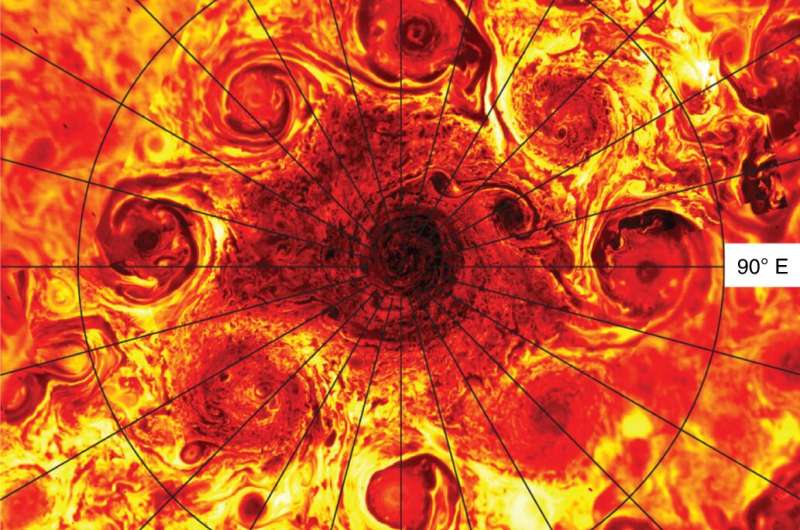
Infrared image of the northern hemisphere of Jupiter as seen by JIRAM. Credit: Nature Astronomy (2022). DOI: 10.1038/s41550-022-01774-0
A team of space scientists affiliated with multiple institutions in the U.S., working with a colleague from Italy and another from France has used modeling to partially explain the resilience of cyclones circling Jupiter's poles. In their paper published in the journal Nature Astronomy, the group describes how they analyzed images captured by the Juno space probe and used what they learned to create shallow water models that might at least partly explain how the cyclones last so long.
In 2016, NASA's Juno space probe entered an orbit around Jupiter. Unlike other such probes it has been circling the planet from pole to pole, rather than around its equator. As the probe began sending back pictures of the planet from this new perspective, researchers looking at them found a surprise. Not only was there a single cyclone sitting atop each of the poles, but both were surrounded by more cyclones. As time has passed, more pictures of the poles have arrived and the researchers studying them continue to be surprised by the stability of the cyclones—the original ones are still there today and have not even changed shape. Such behavior is of course unheard of here on Earth—cyclones take shape, travel around for awhile and then dissipate. Such behavior has left researchers scrambling to come up with a reasonable explanation for what they have observed.
Photos of the planet's north pole show that there are eight cyclones surrounding the central cyclone directly over the pole. All eight are in close proximity and all are nearly equidistant from the central cyclone—and are arranged in an octagonal pattern. At this time, it is not clear if the cyclones rotate around the center. There is a similar arrangement at the southern pole, only there are just five cyclones, shaped as a pentagon. In this new effort, the researchers have tried a new approach to explaining how it is that the cyclones hold in place for so long, and how they do it without changing their position or shape.
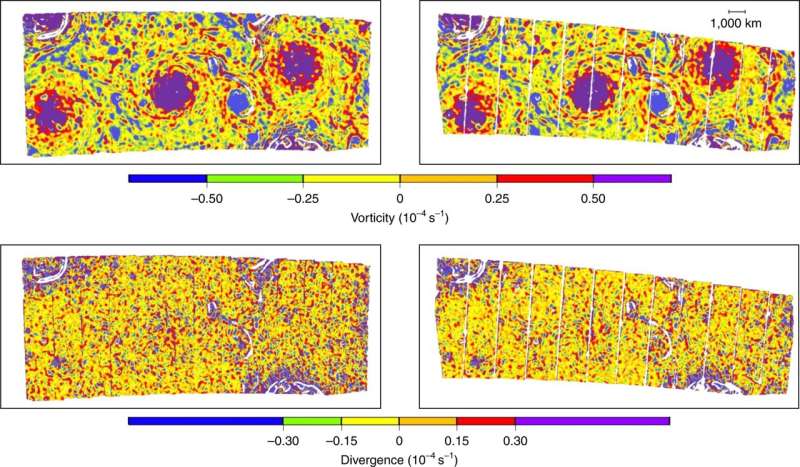
Vorticity and divergence derived from two independent determinations of the wind. Credit: Nature Astronomy (2022). DOI: 10.1038/s41550-022-01774-0
The work by the team involved analyzing pictures and other data from the Juno probe, looking specifically at wind speeds and direction. They then took what they learned and used it to create shallow water models and that led them to suggest that there is an "anticyclonic ring" of winds that move in the opposite direction of the cyclones, which is what keeps them in place. And while that may hold true, the team was unable to find signatures of convection, which would have helped to explain how heat was being used to fuel the cyclones. They acknowledge that much more work will need to be done to fully explain the behavior of Jupiter's cyclones.
The luminous band of the Milky Way, from Cassiopeia to Scorpius, stretches across the sky over Panamint Valley in Death Valley National Park.
To understand the nature of our galaxy, astronomers had to look to distant island universes.
Turn your eyes toward the night sky and you will see a bright, hazy band of light cutting across the sky.
For millennia, observers speculated about the Milky Way’s true nature. The Greeks said the streak of haze in the sky was milk spurting from the breast of the goddess, Hera, Egyptians thought it was cows’ milk, and some Aboriginal Australians thought it was a river flowing through the sky.
Today, we know that we are looking along the plane of our spiral galaxy, consisting of at least 100 billion stars. But understanding the shape of the Milky Way proved elusive up until the 20th century. The problem is we can’t get a bird’s eye view of our galaxy because our solar system is buried within the galaxy. But with the invention of the telescope, photography, spectroscopy, and radio astronomy, we have uncovered the shape and size of our home galaxy — and our place among the billions of stars that make up our island universe.
The telescope revolution
Before the telescope, there was no clear understanding of the extent of our galaxy. Nearly 25 centuries ago, the Greek philosopher Democritus proposed that the Milky Way was filled with stars that appeared to blend together because of their great distance. However, 100 years later, Aristotle suggested that the hazy river of light was an atmospheric phenomenon. Aristotle’s authority was accepted for nearly 2,000 years, until two small pieces of glass finally unseated him.
When Galileo turned his telescope to the sky in 1609, he made astounding discoveries. He published his observations in a little book, Sidereus Nuncius, in March 1610. The Moon was rugged and imperfect, he declared, and Jupiter had four companions. Galileo also scanned the Milky Way and reported, “This spyglass has allowed me to discover a multitude of fixed stars never before seen, of which there are more than ten times as many as are naturally visible.”
Observing targets like the Orion Nebula (M42) and the Beehive Cluster (M44) in the constellation Cancer, Galileo found myriad stars unobservable to the naked eye. He thought all the fuzzy objects in the sky would be resolved into stars; the astronomer could not know that each would play a role in giving us a picture of our galaxy.
This artist’s conception of the Milky Way is based on data from NASA’s Spitzer Space Telescope. Infrared images revealed that the Milky Way’s spiral structure is dominated by two of its four primary arms: the Perseus Arm and the Scutum-Centaurus Arm. The Norma and Sagittarius arms are located between them. The newly discovered Cattail structure, reported August 2021 by astronomers at Nanjing University in China, may also be a spiral arm or a very long filament of hydrogen gas.
Astronomy: Roen Kelly, after NASA/JPL-Caltech
Spiral nebulae
After achieving overnight fame in 1781 when he discovered Uranus, William Herschel was swiftly appointed as King George III’s court astronomer. The king gave him money to build telescopes, including his 40-foot-long (12 meters) telescope with a 48-inch mirror.
With it, Herschel produced perhaps the first systematic map of the Milky Way. He started by observing a dense area of the Milky Way and counting the number of stars in his field of view. As he moved away from the plane of the Milky Way, the number of stars dropped.
Herschel assumed that the number of stars in each area was a direct indication of the stellar population in that direction. Unaware of any relationship between faintness and distance, or that millions of faint stars were obscured from his view, he produced a diagram of the Milky Way that looks like a gigantic amoeba!
By the 1840s, Herschel’s equipment was dwarfed by the Leviathan of Parsonstown in Ireland. Built for William Parsons, Earl of Rosse, this monstrous telescope’s 72-inch mirror allowed Rosse to produce amazingly detailed drawings of what he saw. In particular, his observations of the Whirlpool Galaxy (M51), the Triangulum Galaxy (M33), and M99 (NGC 4254) showed distinct spiral structures. Without a proper way to measure distances, astronomers could only question whether these nebulae, like stars and clusters, were within the Milky Way. After all, if they were distant structures beyond the Milky Way, what did that mean for our place in the universe?
William Herschel constructed his map of the Milky Way with measurements he called “star-gages,” which he took by pointing his telescope at patches of sky and counting the number of stars he saw. The result is a cross section of the Milky Way from Earth’s vantage point.
Caroline Herschel
Cosmic yardsticks
The debate about the physical nature of the Milky Way continued into the early 20th century. Two new technologies helped charge the discussion: spectroscopy and photography. The ability to analyze starlight gave astronomers a powerful new way of understanding the chemistry of stars, while photography augmented the limited light-gathering ability of the human eye.
Armed with these tools, astronomers Henrietta Leavitt, Edward C. Pickering, and Ejnar Hertzsprung discovered and defined a relationship between the period of dimming and brightening of a class of stars called Cepheid variables. In 1908, Leavitt was studying variable stars in photographs of the Large and Small Magellanic Clouds sent to the Harvard College Observatory, where she worked, from Harvard’s observatory in Peru. She noticed a rhythmic and predictable variation in brightness of these stars in the Large and Small Magellanic Clouds, which might last from a single day to more than a month before repeating.
Furthermore, she discovered, the longer the period of variation, the brighter the star appeared to be. Since all the stars in the Small Magellanic Cloud are at roughly the same distance, she reasoned that the period of a Cepheid variable was related to its true, intrinsic brightness.
Pickering, the observatory director, suggested this period-luminosity relation could be useful to determine the distribution of star clusters and nebulae. And Hertzsprung was able to calibrate this technique by making independent distance measurements to Cepheids using the parallax method, seeing how much they shifted against background stars as Earth orbited the Sun.
Thus, by measuring the period of a Cepheid, astronomers could know its true brightness — and by comparing that to its apparent brightness, calculate how far away it was. Astronomers finally had a reliable cosmic yardstick.
Around the same time, the young astronomer Harlow Shapley began measuring the distribution of globular clusters — compact and dense spheres of stars. By 1918, he had found that the clusters centered around the constellation Sagittarius, forming a halo around the Milky Way. He also made improved parallax measurements of Cepheid variables, which in turn improved the calibration of Leavitt’s relation.
Using this data, Shapley not only located the center of our galaxy — in Sagittarius — but also showed that the Milky Way was 10 times the size of previous estimates. His observations also placed our solar system far from the center of the galaxy. Given the size of our galaxy, Shapley was convinced that spiral nebulae, like globular clusters, were all part of the Milky Way.
Cepheid variable stars remain important to understanding the shape of the Milky Way. Each dot in this image is a Cepheid whose distance was measured by a team using the Optical Gravitational Lensing Experiment telescope (OGLE), at center, at Las Campagnas Observatory in Chile.
K. Ulaczyk/J. Skowron/OGLE
The Great Debate
By the early 20th century, speculation about spiral nebulae and the nature of the Milky Way had reached a fever pitch. Photography clearly showed these nebulae had well-defined spiral structure composed of countless stars, but there were no good measurements of their distance to verify whether they were within the Milky Way or not.
In April 1920, Harlow Shapley faced off with Heber Curtis at the National Museum of Natural History in Washington, D.C., in a discussion called the Great Debate. Shapley maintained that spiral and all other nebulae were part of the Milky Way, just like globular clusters. But Curtis provided convincing evidence that they were independent star systems — “island universes,” as he called them, a term coined by the German philosopher Immanuel Kant.
Cepheid variables ultimately settled the debate. A few years later, while using the 100-inch Hooker telescope at Mount Wilson Observatory in California, Edwin Hubble found Cepheid variables in the Andromeda spiral nebula. Using Shapley’s calibration of Leavitt’s period-luminosity relation, Hubble showed this object was 900,000 light-years away, far beyond the outskirts of Milky Way. (This figure has since been refined to 2.5 million light-years.) In a single measurement, he proved that the Milky Way was not the entire universe, but part of a vast sea of island universes.
In 2019, the OGLE team released a three-dimensional map of the Milky Way, as traced by over 2,400 Cepheids. The map shows how the outer portion of the galaxy’s disk is warped. This warping had been previously detected, but this was the first time it had been mapped with direct distance measurements to stars.
Jan Skowron/OGLE/Astronomical Observatory, University of Warsaw
Radio astronomy rises
In the 19th century, astronomers were puzzled by large areas along the Milky Way almost devoid of stars. These so-called coal sacks appeared as dark holes against a starry background. At least one astronomer speculated they might be openings into heaven!
Because at that time the exploration of the Milky Way was still restricted to visible light, astronomers were unaware that the coal sacks were huge clouds of gas and dust blocking the light of distant stars. New technology would need to be developed before astronomers could explore and understand these cold, dark clouds running throughout the plane of the Milky Way.
The birth of radio astronomy provided this new tool and led to the discovery that the galaxy is filled not only with dust, but also with tremendous amounts of cold, neutral hydrogen gas. Most of the time, a hydrogen atom’s proton and electron spin in the same direction. But sometimes, electrons flip and spin in the other direction. For any given hydrogen atom, this only happens about once every 100 million years. When it does, energy is emitted with a wavelength of 21 centimeters. These waves pass right through the clouds of dust that hide visible light, which has a much shorter wavelength.
When astronomers first detected 21 cm radiation in 1951, they began using it to finally peer through these clouds to build a fuller picture of our Milky Way. By noting the distribution of neutral hydrogen, astronomers could map unseen portions of the galaxy, tracing its spiral arms, where hydrogen is concentrated.
The shape of our galaxy
Over the past 70 years, a picture has emerged of a massive galaxy with four primary spiral arms. The Sun is located 27,000 light-years from the galactic center along the Orion Spur, a smaller arm located between the Perseus and Sagittarius arms. In recent years, astronomers have discovered our galaxy’s central bulge has a bar structure. And its disk of gas and stars is slightly warped and twisted, perhaps by gravitational interaction with nearby dwarf galaxies.
There are deeper mysteries yet to be resolved. For instance, Newton’s law of gravity holds that stars and gas at a galaxy’s outer fringes should orbit slower than objects closer to its center — but instead, we observe that outer objects move faster. This is true in our galaxy, as well as others. The only explanation — without modifying the law of gravity — is the unseen existence of a great deal more mass, probably in the form of dark matter. But this dark matter has never been directly observed.
To stand out under a dome of shining stars and understand their true nature is an amazing feat of human ingenuity. To fathom the immensity of our galaxy and our place in it is a striking act of human imagination. Democritus envisioned vast numbers of stars beyond his power to see. And thanks to countless astronomers who came after him, we have found our true place in the galaxy we call home.
Foo Fighter Over National Park Forest Fire On Wake UP America Show! Video, UFO Sighting News.
Date of sighting:July 28, 2022 but reported today.
Location of sighting: Yosemite National Park, California, USA
Source: Email Report scwaring@yahoo.com
Hey I appreciate the UFO reports coming in today. Keep it up.
This UFO was caught on TV during the California forest fire and I can clearly see that its a foo fighter. A glowing white sphere often seen during WWI and WWII seen by pilots as the UFO flew along side them for sometimes hours. This UFO is seen shooting above and then through the fire chemical red stream being dropped by the plane. Why? Aliens clearly want to know the chemical make up of it in order to access how much damage it does to our environment and how dangerous it is and will be in the future. Data...its more important than money or gold to aliens.
Scott C. Waring - Taiwan
Eyewitness states:
On July 28th, 2022 I was watching WAKE UP AMERICA on Newsmax channel at 6:40 AM watching a plane dropping flame retardant on an Oak fire in California and noticed a ball UFO following the plane, tracking the retardant drop. It got very close to the rear of the plane. It entered the retardant then disappeared as the sun panned up from the bottom in the camera video as the camera man followed the plane's flight path. I don't believe it was a lens flare of the sun because in one frame it is half visible and half behind the retardant. It then disappeared into the retardant. I sent Newsmax a message about the video but got no response. So sent it into you Scott hoping you can take a look and tell me your thoughts.
UFO At High School Football Game, Wentzville, Missouri 9-23-2022, UFO Sighting News.
Date of sighting:9-23-2022 Location of sighting: Wetzville, Missouri, USA Source: Email report
Guys this just in, someone was at a high school football game when they noticed a strange light in the sky. The light appeared to be a glowing rainbow disk seen from its side. The eyewitness recorded it briefly just seconds before the object speed up and shot away. Great catch, 100% proof that UFOs visit highly populated events. Probably trying little by little to allow themselves to be seen in order to desensitize people making them less and less scared of the idea of alien life, until the final big reveal takes place.
Scott C. Waring - Taiwan
Eyewitness states:
UFO At High School Football Game, Wentzville, Missouri 9-23-2022, UFO Sighting News
Bob Lazar and the truth about a secret UFO base at Papoose Lake
Is our government working on crashed UFOs? Bob Lazar said he worked on reverse engineering alien spacecraft at a military facility in 1989 called SITE 4 (within the Area 51 designation). He described a unique and highly camouflaged building, built into the mountains and located at Papoose Lake... which is about 17 miles south of Groom Lake.
People have argued for 33 years if Lazar was telling the truth about a secret operational UFO facility at Papoose Lake.
The thing is... there was a civilian who snuck onto the Area 51 base - and took a look at Papoose Lake for himself. Did you know that?
In the spring 1997, an archeologist named Jerry Freeman snuck into the forbidden zone of Area 51 (and Papoose Lake). He is the only civilian known to have gained access to where Bob Lazar said was a hidden military installation. Lazar reported a unique and highly camouflaged building the military used to storehouse and reverse-engineer extraterrestrial flying saucers.
However, many people like to claim that Jerry Freeman never reported seeing anything unusual at Papoose Lake... that his excursion was uneventful, and that somehow his account throws shade on what Bob Lazar told us but that is nonsense.
Now, hear the REAL story from George Knapp… and also hear directly from Jerry.
This clip contains an audio interview Jerry did with radio host Art Bell. He gives a first-hand description of what he saw at Papoose Lake. Even the Los Angeles Times reported on Jerry’s forbidden excursion, and that he “discovered what seemed to be a lighted doorway that appeared and disappeared in the darkness of distant Papoose Lake”.
I think people have just forgotten their history, so it’s time to resurrect the truth... it’s time to listen up. You can now judge for yourself, and there’s more to come.
Is this just another confirmation that what Bob Lazar told us is true?
This really fast unidentified flying object was filmed over Groningen, a city in the northern Netherlands on 25th June 2022.
What do you think about it?
Witness report:
I hope somebody with a pro video edit can watch it and then say what it is.. because i don’t know yet what it is, in my video. maybe somebody from Mufon ? can anybody help me ? very strange, if it was space debri it would hit the ground i think and in the news, its going to fast for a drone, its 40 times 24 fps. my video is a slomo from samsung 20fe i was trying to make slomo videos from lightning but got this on video. 960fps in 1 sec video, it’s going way to fast for a drone, and to big for a bird or bug in the storm going true the clouds in almost straight line, in thunder weather. very fast. maybe it bends off a tiny bit. its just going too fast, and a bug is not going true a cloud in stormy weather. i have no idea what it is but looks the same as in U.K video very strange! my video is made on 25-06-2022. 14:08 and did not edit the video.
Ook dat nog: gasplaneet Jupiter gaat gebukt onder hittegolf
Op de planeet Jupiter is een extreem grote hittegolf ontdekt. Het getroffen gebied is ongeveer 10 keer zo groot als de aarde, heeft een internationale groep wetenschappers vrijdag naar buiten gebracht.
Jupiter, de grootste planeet in ons zonnestelsel, bestaat vrijwel helemaal uit dichte wolken van gas. De planeet weegt ongeveer 2,5 keer zo veel als de zeven andere planeten bij elkaar, en de aarde zou er ongeveer 1300 keer in passen. Vanaf Jupiter gezien is de zon niet meer dan een heldere ster in de verte, de planeet ontvangt ongeveer 4 procent van het licht dat de aarde krijgt.
Door de grote afstand en het weinige licht zou de temperatuur op Jupiter in theorie 70 graden onder nul moeten zijn, maar in de gaswolken stijgt het kwik makkelijk tot boven de 400 graden. De onderzoekers denken dat het komt door het permanente poollicht op Jupiter. Geladen deeltjes van de zon botsen tegen het sterke magnetische veld van Jupiter, en dat zorgt niet alleen voor het spectaculaire verschijnsel in de lucht, maar ook voor heel veel hitte.
300 graden warmer dan normaal
Net onder de noordpool van Jupiter zagen de onderzoekers een gebied waar de temperatuur is opgelopen tot boven de 700 graden, dus 300 graden warmer dan normaal. De wind blaast de hitte richting de evenaar van Jupiter. Dat zorgt voor een sliert hete lucht van 130.000 kilometer lang, ongeveer tien keer de doorsnee van de aarde.
De extreme temperatuur komt waarschijnlijk door een zonnevlam, denken de wetenschappers. Daardoor zouden extra veel deeltjes tegen het magnetische veld van Jupiter zijn gebotst, en daarbij zou de hitte zijn vrijgekomen.
Tests met kankerdodend virus lijken veelbelovend: “Ik kreeg al palliatieve zorg, maar nu ben ik genezen”
Er is een nieuwe vorm van kankertherapie gestart in Groot-Brittannië waarbij men gebruik maakt van een virus om schadelijke kankercellen te infecteren en te vernietigen. Volgens de Britse wetenschappers zijn de eerste proeven op mensen veelbelovend.
Bij één patiënt verdween de kanker, terwijl anderen hun tumoren zagen krimpen. Het geneesmiddel is een verzwakte vorm van het koortslipvirus dat is aangepast om tumoren te doden. Grotere en langere studies zijn eerst nog nodig, maar deskundigen zeggen dat de injectie uiteindelijk een reddingslijn kan bieden aan mensen met vergevorderde kanker.
Krzysztof Wojkowski, een 39-jarige bouwvakker uit het westen van Londen, is een van de patiënten die deelnam aan de lopende veiligheidsstudie van fase één. Bij hem werd in 2017 kanker van de speekselklieren, nabij de mond, vastgesteld. Ondanks een operatie en andere behandelingen bleef zijn kanker groeien.
“Ik kreeg te horen dat er voor mij geen opties meer waren en ik kreeg al palliatieve zorg. Het was verschrikkelijk, dus het was ongelooflijk dat ik de kans kreeg om aan de proef deel te nemen”, zegt Wojkowski. Een korte behandeling met het virus lijkt zijn kanker nu te hebben genezen. “Ik kreeg vijf weken lang om de twee weken injecties die mijn kanker volledig uitroeiden. Ik ben nu al twee jaar kankervrij.”
De injecties, die rechtstreeks in de tumor worden gegeven, vallen de kanker op twee manieren aan: door de kankercellen binnen te dringen en ze te laten barsten, en door het immuunsysteem te activeren. Ongeveer 40 patiënten hebben de behandeling in het kader van het onderzoek uitgeprobeerd. Sommigen kregen enkel de virusinjectie, RP2 genaamd. Anderen kregen ook een ander kankergeneesmiddel met de naam nivolumab.
“Indrukwekkend”
Hoofdonderzoeker professor Kevin Harrington vertelde de BBC dat de behandelingsresultaten “werkelijk indrukwekkend” waren voor een reeks gevorderde kankers, waaronder slokdarmkanker en een zeldzame vorm van oogkanker. “Het is zeldzaam om zulke goede responspercentages te zien in klinische proeven in een vroeg stadium, aangezien deze in de eerste plaats bedoeld zijn om de veiligheid van de behandeling te testen, en het gaat om patiënten met zeer gevorderde kankers waarvoor de huidige behandelingen niet meer werken”, zei hij. “Ik ben benieuwd of we voordelen blijven zien naarmate we meer patiënten behandelen.”
Het is niet de eerste keer dat wetenschappers een virus gebruiken om kanker te bestrijden. De Britse Nationale Gezondheidsdienst keurde enkele jaren geleden een soortgelijke therapie goed, maar dan met een verkoudheidsvirus. Deze therapie heet T-Vec en wordt nu gebruikt voor gevorderde huidkanker. Professor Harrington noemt RP2 een opgevoerde versie van T-Vec. “Het heeft andere modificaties aan het virus, zodat het meteen de kankercellen vernietigd van zodra ze in contact komen met elkaar.”
Doctor Marianne Baker, van Cancer Research UK, zei dat de bemoedigende bevindingen het verloop van de kankerbehandeling zouden kunnen veranderen. “Wetenschappers hebben 100 jaar geleden ontdekt dat virussen kunnen helpen bij de behandeling van kanker, maar het is een uitdaging geweest om ze veilig en effectief in te zetten. Deze nieuwe virale therapie is veelbelovend in een kleinschalige eerste proef. Nu hebben we meer studies nodig om na te gaan hoe goed het werkt”, besluit Baker.
Water gevonden op asteroïde verklaart mogelijk oorsprong van leven op aarde
De stofdeeltjes die een Japanse ruimtesonde heeft gevonden op een asteroïde op ongeveer 300 miljoen kilometer van de aarde, bevatten een verrassend bestanddeel: een waterdruppel. Die ontdekking biedt nieuwe steun voor de theorie dat het leven op aarde mogelijk uit de ruimte is gezaaid.
De bevindingen staan in het laatste onderzoek dat is gepubliceerd naar aanleiding van de analyse van 5,4 gram stenen en stof die de Hayabusa-2 sonde heeft verzameld bij de asteroïde Ryugu. “Deze waterdruppel heeft een grote betekenis,” vertelde de hoofdwetenschapper, Tomoki Nakamura van de Tohoku Universiteit. “Veel onderzoekers geloofden al dat er water is meegebracht uit de ruimte, maar wij hebben voor het eerst effectief water ontdekt in een asteroïde in de buurt van de aarde.”
Hayabusa-2 werd in 2014 gelanceerd op zijn missie naar Ryugu, en keerde twee jaar geleden terug in een baan om de aarde om een capsule met het monster af te zetten. De kostbare lading heeft al verschillende inzichten opgeleverd, waaronder organisch materiaal waaruit bleek dat sommige bouwstenen van het leven op aarde, aminozuren, mogelijk in de ruimte zijn gevormd.
De laatste ontdekking van het team was een druppel vloeistof in het Ryugu-monster. “De drupel is koolzuurhoudend water met zout en organisch materiaal”, aldus Nakamura. “Dat versterkt de theorie dat asteroïden zoals Ryugu, of grotere asteroïde, water met organische stoffen hebben geleverd op aarde”, zei hij. “We hebben dus bewijs ontdekt dat dit rechtstreeks verband kan hebben met bijvoorbeeld het ontstaan van de oceanen of organische materie op Aarde”
Nakamura’s team, dat bestaat uit ongeveer 150 onderzoekers, waaronder 30 uit de VS, Groot-Brittannië, Frankrijk, Italië en China, is het grootste team dat het monster van Ryugu analyseert. Het monster is verdeeld over verschillende wetenschappelijke teams om de kans op nieuwe ontdekkingen zo groot mogelijk te maken.
Kensei Kobayashi, een astrobiologie-expert aan de Yokohama National University die geen deel uitmaakt van de onderzoeksgroep, juichte de ontdekking toe. “Het feit dat er water is ontdekt in het monster zelf is verrassend”, gezien de kwetsbaarheid ervan en de kans dat het in de ruimte wordt vernietigd, zei hij. “Het suggereert dat asteroïdes water kunnen bevatten, in de vorm van vloeistof en niet alleen in de vorm van ijs. Hierdoor kan organisch materiaal dus verplaatst worden door de ruimte”.
Creating Crashed UFOs and Dead Aliens That Never Existed: Secret Psychological Warfare
Nick Redfern
Nineteen-sixty-nine was the year in which an undeniably elaborate UFO-themed Soviet ruse was put into place over in Russia. This strange affair was highly sophisticated and it revolved around a crashed UFO and the top secret study of an alleged dead alien creature. It was certainly shades of Roswell and the notorious 1995 "Alien Autopsy" film. The story itself is undeniably fascinating – which, I am sure, is what the Russians were surely counting on – as the “evidence” is an old piece of film-footage that reportedly chronicled the whole weird thing. While the crash of the UFO is said to have occurred in March 1969, the story – and the attendant film – did not surface until 1998, almost three decades later. That was the year in which a television production, The Secret KGB UFO Files, was broadcast in the United States and elsewhere, too. There's no doubt that a great deal of money was put into the over-sensationalized production and it was hosted by the late Roger Moore, the star of seven of the phenomenally successful James Bond movies. The documentary covered a wide body of UFO-based data (some of it blatantly hoaxed); however, there’s no doubt that it was specifically the film of the supposed crashed UFO and its deceased crew-member which caught the attention of most of those who bothered to watch it.
(Nick Redfern) Dead aliens or sophisticated dummies?
Certainly, a great deal of effort went into the production of the film: I have to stress to you that this was most definitely not the work of an amateur, half-hearted operation. The footage is grainy, it appears old, and was filmed by someone with a hand-held camera. It shows around fifteen-to-twenty men wearing Russian uniforms, thick coats and hats; they are all armed and are guarding a small, circular-shaped craft which appears to have slammed into the ground in a wooded, frosty area. The location was said to have been Sverdlovsk, Russia. The trees are largely bereft of leaves and everything points to the incident having occurred in very cold, bleak weather. Only around a half of the saucer-shaped vehicle protrudes out of the soil, in an angled fashion. The inference is that the military unit found the craft shortly after it hit the ground and, at the time of the filming, were in the process of guarding the site from any and all onlookers that might have come along. To this very day, we don’t know where the film came from, and how it reached the producers of The Secret KGB UFO Files. We’re told that the production company had to pay $10,000 U.S. dollars to secure it, after it was smuggled out of KGB archives. Supposedly. That part of the story is very foggy.
It's worth noting the following from the National UFO Center: “The footage at the crash site does seem to be authentic at least on several points. The truck in the film is a circa 1950 model ZIS151, which has not been used by the military for quite some time, and the truck would have been difficult to find to stage a hoax with. Other elements of the film do not exhibit any obvious signs of a hoax.” It should be noted there are two other, old military vehicles in the film, too. As for the remaining portion of the film, it very much mirrors the notorious “Alien Autopsy” film, which, in 1995, was foisted on the world by a man named Ray Santilli, and to wildly varying degrees of fanfare. Three men appear to be working on the autopsy of a small, humanoid creature, while a woman take notes. Numerous websites claim that the woman has been identified as a “KGB stenographer” named “O.A. Pshonikina.”
(Nick Redfern) Another controversial UFO crash case
This statement has been repeated time and again; yet, there is no evidence to prove the claim. Such is the reliability – or not - of the Internet. Was the footage created to have the U.S. Government and the intelligence community think that the Russians had recovered, and were extensively studying, alien creatures and their technology? These are mind-boggling, yet utterly plausible, questions to ponder on. There is another - and similar - affair to this. The next one, though, was put into place by a man who wrote fiction, but who may have known something of bogus crashed UFOs in the late 1940s and for pyschological warfare purposes by the U.S. government.
Nineteen-forty-eight was not just notable, in UFO terms, for the twisted tale of the supposed UFO crash in Aztec, New Mexico. It was also the year in which a very intriguing novel was published. Its title was The Flying Saucer and its author was Bernard Newman. In some respects, the story that Newman weaved in 1948 closely mirrored the claims of Alfred O’Donnell in 2011, as they related to the Roswell controversy of July 1947. In the 250-pages of The Flying Saucer, we are treated to a tale of cover-ups, conspiracies, and fabricated tales of Martians and UFOs. The story revolves around a group of scientists who decide that the people of Earth need to be united under one banner. A one world society. But, how could such a thing be achieved? By creating a faked, alien threat, that’s how.
In The Flying Saucer, those aforementioned scientists decide to fake a trio of UFO crashes, as a means to convince the world that aliens have reached the Earth, and that those same scientists have the priceless evidence in their hands. One of those three incidents occurs in the heart of New Mexico, no less. Another UFO crashes in the Soviet Union, and a third slams into the ground in the U.K. Of course, the crashes are actually nothing of the sort. Rather, they are ingeniously staged events designed to make the world believe that the Martian are among us. The scientists create the futuristic aircraft, making them appear to have unearthly origins. The team even stages a bogus alien autopsy, as a means to even further convince people that we are not alone in the universe. The plan is to unite the human race under a friendly, benevolent government. I’ll let you learn for yourselves how the story develops and reaches its climax. It’s not just the story that is intriguing – given that we now know such machinations were already afoot in the real world – but the author, Bernard Newman, himself, too.
(Nick Redfern) More UFOs that aren't what they seem to be?
Philip Taylor, a researcher who has dug deeply into the life and career of Bernard Newman, says: “In his unrevealing autobiography Speaking From Memory [Newman] describes how from 1919 onwards he was apparently employed in an undemanding Civil Service job in the Ministry of Works. Somehow he seemed able to take extremely long and, for those days, exceedingly adventurous holidays, including lengthy stays in Eastern Europe and Russia. His destinations invariably seemed to include areas of particular political interest: for example several extended holidays to Germany in the 1930’s.” Taylor also reveals that in 1938 Newman put together a paper for British Intelligence on the then-current state of German rocketry at the Peenemünde Army Research Center. It was overseen by the German Army Weapons Office. In other words, yet another curious thread is carefully weaved into the strange story. But, things don’t end there. There's more to come. Much of it.
In 1945, the New York Times ran an article on Newman who, by that time, was a well-respected, prestigious author on matters relative to the world of espionage. Indeed, his books that were published before the New York Times article appeared included The Secrets of German Espionage; Ride to Russia; Woman Spy; and Spy Catchers. As for that same article, it addresses, in part, claims that Newman worked as a “double-agent” during the First World War, infiltrating the German military and securing some of the Germans’ most prized secrets. This is not impossible, since Newman was fluent in German. He was, however, only eighteen at the time, which admittedly stretches credulity to a degree. On this matter, in February 1968, when Newman died, the U.K.’s Times newspaper suggested that this part of Newman’s life should be relegated to “the realm of fiction.” We may never know for sure all that Bernard Newman learned during his life as a prestigious writer on the world of spying, espionage and counterintelligence. But, we do know that in 1948, only one year after the events outside of Roswell, New Mexico occurred, Newman wrote a novel - The Flying Saucer – that contained just about all of the key ingredients that comprise the primary themes of the article you are now reading: faked UFO crashes, a bogus alien invasion, and the manipulation of the mindset of the populace. We have to wonder if Newman - who cultivated numerous colleagues and friends in the intelligence community. And, finally, there is this...
Kenneth Goff was an interesting character, and someone who had made controversial comments in the 1950s about communist-based plans to covertly introduce fluoride into the United States' water supply, to create what he termed a “spirit of lethargy” in the nation. And: guess what? Goff had a deep interest in Flying Saucers. Indeed, one of Goff’s regular lectures was titled: Traitors in the Pulpit, or What’s Behind the Flying Saucers – Are they from Russia, Another Planet, or God? But, it was not so much from the perspective of UFOs being alien or even Russian, however, that interested Goff. His concern was the very subject matter of the article you are now reading: how the UFO subject could be utilized as a tool of manipulation and control by more than just one government. In his 1959 publication, Red Shadows, Goff loudly offered the following to his readers – which, of course, secretly included the FBI: “During the past few years, the flying saucer scare has rapidly become one of the main issues, used by organizations working for a one-world government, to frighten people into the belief that we will need a super world government to cope with an invasion from another planet. Many means are being used to create a vast amount of imagination in the minds of the general public, concerning the possibilities of an invasion by strange creatures from Mars or Venus.”
There is one more story that ties in with the above cases. It comes from a well-known collector of crashed UFO tales. And. it's a thought-provoking one. That man was the late Leonard Stringfield. Over the decades, he was the recipient of a number of such controversial claims – although, sadly and perhaps inevitably, no films. And no surprise. One such intriguing tale told to Stringfield came from the unsurprisingly anonymous ‘Mr. T.E.’, who, said Stringfield in 1980, “holds a technical position in today’s life.” T.E. told Stringfield that in 1953, at the age of just twenty, and while stationed at Fort Monmouth, New Jersey, he was summoned to watch a startling piece of film-footage at the base theatre. Reported Stringfield: “Without any briefing, the 16mm movie projector was flicked on and the film began to roll on the screen…the film showed a desert scene dominated by a silver disc-shaped object embedded in the sand…”
Stringfield continued with this information: “Then…there was a change of scenes. Now in view were two tables, probably taken inside a tent, on which, to his surprise, were dead bodies. T.E. said the bodies appeared little by human standards and most notable were the heads, all looking alike, and all being large compared to their body sizes…They looked Mongoloid.” Interestingly, T.E. and his colleagues were told immediately after the screening to ‘think about the movie’; but were later advised that: “It was a hoax.” And, eerily paralleling the Santilli film, T.E. told Stringfield that: “The 5-minute long movie certainly was not a Walt Disney production. It was probably shot by an inexperienced cameraman because it was full of scratches, and had poor colouring and texture.” What all of this tells us is that when it comes to UFOs, we really don't know what is real and what isn't. Remember that.
Hear meteoroid striking Mars, Caught by NASA’s InSight Lander
NASA’s InSight lander detected seismic waves from a meteoroid and was able to capture the sound of the space rock striking the surface of Mars for the first time. The meteoroid – the term used for incoming space rocks before they hit the ground – entered Mars’ atmosphere on Sept. 5, 2021, exploding into at least three shards that each left craters behind. Mars’ atmosphere is just 1% as dense as Earth’s, allowing far more meteoroids to pass through and impact the Red Planet’s surface.
This event marks the first time seismic and acoustic waves from an impact were detected on the Red Planet. Why does this meteoroid impact sound like a “bloop” in the video? It has to do with a peculiar atmospheric effect that’s also observed in deserts on Earth.
After sunset, the atmosphere retains some heat accumulated during the day. Sound waves travel through this heated atmosphere at different speeds, depending on their frequency. As a result, lower-pitched sounds arrive before high-pitched sounds. An observer close to the impact would hear a “bang,” while someone many miles away would hear the bass sounds first, creating a “bloop.”
NASA’s Mars Reconnaissance Orbiter flew over the estimated impact site to confirm the location. The orbiter used its black-and-white Context Camera to reveal three darkened spots on the surface.
After locating these spots, the orbiter’s team used the High-Resolution Imaging Science Experiment camera, or HiRISE, to get a color close-up of the craters. Because HiRISE sees wavelengths the human eye can’t detect, scientists change the camera’s filters to enhance the color of the image. The areas that appear blue around the craters are where dust has been removed or disturbed by the blast of the impact. Martian dust is bright and red, so removing it makes the surface appear relatively dark and blue.
Orange UFO Orbs in San Clemente, California 19-Sep-2022
This UFO video was seen and recorded in the night sky above San Clemente, a city in Orange County, California on 19th September 2022.
Witness report:
My family observed 2-9 Orbs over a course of about 30 minutes on Sept 19th. The orbs did not move north/south/east/west or up/down. Over the course of 30 minutes the lights went away and came back a couple times – but always in the same spot. We do live by Camp Pendleton here in San Clemente. Our house is on a bluff overlooking the ocean approximately 1 mile away from the shore. Please pardon the colorful language at times. We feel lucky to have experienced this and hope to find out what they were.
UFOs Didn’t Start in 2004 – The Richard Dolan Show
The Tic Tac UFO encounter of 2004 is rightly considered to be a very important event. Unfortunately, too much of our public discourse relating to UFOs or UAP now only focuses on encounters from that point onward, and very little of the incredible rich story of 20th century UFOs is ever discussed in mainstream/establishment venues. Removing the history of UFOs is important for the military, as it enables them to continue to pretend that there’s no cover-up, no conspiracy. In fact, there is overwhelming evidence that the US military has been deeply engaged in the matter of UFOs for 80 years.
Canadian defence minister was briefed on UFOs ahead of U.S. intel report
Ahead of the release of a much-anticipated U.S. intelligence report on aerial phenomena, former Canadian defence minister Harjit Sajjan received a briefing on UFOs.
“I expect I am not alone in noting the recent increase in comment regarding Unidentified Flying Objects in the media internationally, particularly in the U.S.,” Sajjan’s then-chief of staff wrote in a May 19, 2021 email to senior defence officials. “I believe it is prudent to request a full briefing for Minister Sajjan from the Canadian perspective on this issue.”
A lieutenant-colonel co-ordinated the effort. An accompanying five-page slide presentation included an overview of cases and procedures, which currently link the Canadian Armed Forces (CAF) with air traffic controllers, federal aviation authorities and a civilian researcher in Manitoba. CTVNews.ca acquired the slides and related emails through an access to information request.
It took six weeks of emails before a Department of National Defence spokesperson confirmed the briefing occurred in mid-2021, although they would not provide an exact date. A subsequent access to information request revealed the briefing took place on May 27, 2021.
Sajjan, a former CAF lieutenant-colonel himself, was replaced as defence minister by Anita Anand in an Oct. 2021 cabinet shuffle and now serves as Minister of International Development.
“No, we have no records of subsequent briefs based on currently-available information,” the National Defence spokesperson said. “Minister Anand has not received a brief at this juncture.”
'VITAL INTELLIGENCE SIGHTINGS'
The briefing slides say approximately 1,000 UFO sightings are reported in Canada each year.
Emails and five-page slide deck below show how Sajjan received a briefing on “unidentified aerial phenomena” in May 2021. CTVNews.ca has redacted email addresses and phone numbers for privacy. Click here to see the document full screen.
The most recent case referenced was from May 9, 2021, when the pilot of a Delta Air Lines flight over Saskatchewan asked air traffic controllers “about traffic well above them and moving right to left.” According to a publicly-available report from Transport Canada, the “controller advised that there was no known traffic in the area. The pilot replied that they couldn't figure out what it was either.”
Transport Canada, the federal department that maintains the database, warns such “reports contain preliminary, unconfirmed data which can be subject to change.”
That data is mostly supplied by Nav Canada, a private company that owns and operates Canadian civil air navigation infrastructure such as airport control towers. When Nav Canada personnel receive UFO reports, the Canadian Armed Forces (CAF) are also usually alerted.
“NAV Canada is the responsible agency for managing UAP-related reporting,” the slides prepared for the then-defence minister read. “CAF does not typically investigate sightings of unexplained phenomena outside the context of investigating potential threats or distress.”
A Nav Canada spokesperson said the company doesn’t investigate UFO reports, adding that their role is to forward information to federal authorities. They point to a Nav Canada guide to Canadian aviation procedures, which puts “unidentified flying objects” at the front of a list of “vital intelligence sightings” requiring reports. Other examples include “surface warships identified as being non-Canadian or non-American.”
A spokesperson from Transport Canada told CTVNews.ca that UFO reports “have no potential for regulatory enforcement and often fall outside the department’s mandate.”
“Reports of unidentified objects can rarely be followed up on as they are as the title implies, unidentified,” the spokesperson said in an email.
The U.S. government has funded UFO research programs almost continuously since 2007. The public got a rare peek at those efforts on June 25, 2021, when the U.S. intelligence community released an unclassified report on recent military sightings, which included UAP that “appeared to remain stationary in winds aloft, move against the wind, maneuver abruptly, or move at considerable speed, without discernable means of propulsion.”
From drones to weather phenomena to top-secret technology, many potential explanations are floated for odd observations like these, and officials say they should not be interpreted as proof extraterrestrials are visiting earth. But finding answers requires investigation, and compared to government-funded programs in the U.S., little appears to be happening in Canada.
“As our closest ally and NORAD partner continues to investigate the national security implications of UAP, it would be prudent for Canada to take a similar approach,” the former Conservative cabinet member said in a statement to CTVNews.ca. “Rather than ridicule and silence, it would be wise to take this issue seriously, with the objective of identifying the origins and intent of these UAP.”
'CANADA'S PRE-EMINENT UFOLOGIST'
Declassified records held by Library and Archives Canada reveal military UFO procedures and sightings dating back to the early 1950s. By the 1960s, responsibility was transferred to the Royal Canadian Mounted Police and scientists at the National Research Council of Canada, which ended their involvement in 1995.
According to the briefing slides obtained by CTVNews.ca, it wasn’t long before a civilian researcher described as “Canada’s pre-eminent ufologist” started receiving UFO reports directly from the military and Transport Canada.
Chris Rutkowski is a Winnipeg-based science writer and University of Manitoba communications professional who has led efforts to document more than 23,000 sightings since 1989 through the annual Canadian UFO Survey. Rutkowski told CTVNews.ca he was asked to provide material for the minister’s briefing as a “civilian advisor,” and that he last received official UFO data in early 2021.
“I have been called both a sceptic and a believer, which probably demonstrates that my position is appropriate,” Rutkowski said in an email. “We are long past the era of UFOs being a subject of ridicule. Well-trained observers have reported sightings of UFOs and UAP and there seems to be a renewed interest by both scientists and the military establishment in taking a closer look at this persistent phenomenon.”
Rutkowski, whose 10th UFO book is scheduled to be released this spring, would like to see a panel or committee formed to gather and examine Canadian cases. Findlay also thinks it’s time for Canada to be more active and open about UFOs.
“We believe the government should adopt a streamlined, whole-of-government approach to standardize the collection of reports across numerous departments and contractors, such as NAV Canada,” Findlay told CTVNews.ca in a rare statement on the subject from a Canadian politician. “Efforts should be undertaken to investigate and make those findings public in a responsible manner.”
UFO procedures remain unchanged in Canada, the Department of National Defence spokesperson told CTVNews.ca. When asked if information on the subject has been provided to Prime Minister Justin Trudeau or his office, their response was, “not directly, no.”
CTV News was first made aware of Sajjan’s UFO briefing by an anonymous source, who shared documents acquired through Canadian freedom of information laws. CTV News verified those documents by filing a new access to information request with the Department of National Defence.
Edited by CTVNews.ca's Rachel Aiello and Brooklyn Neustaeter
RELATED IMAGES
A donut-shaped UFO was spotted in Rimouski, Que. on Oct. 23, 2017 and photographed by witnesses.
(Source: 2017 Canadian UFO Survey)
Correction
A Department of National Defence spokesperson previously told CTVNews.ca that the briefing occurred in "early June 2021." A subsequent access to information request revealed that the briefing actually took place earlier, on May 27, 2021. This story has been updated accordingly.
Meer van UFO'S of UAP'S, ASTRONOMIE, RUIMTEVAART, ARCHEOLOGIE, OUDHEIDKUNDE, SF-SNUFJES EN ANDERE ESOTERISCHE WETENSCHAPPEN - DE ALLERLAATSTE NIEUWTJES


 Magnetic Pole Shift - When It's Time, It's Time