Richard Dolan discusses the latest developments while also reviewing the notes themselves, his own personal connection to them, the arguments supporting their authenticity, and most importantly the implications.
Link to the Davis Wilson Notes:


 The Davis Wilson Notes: Secret reverse-engineering program pertaining to extraterrestrial technology
 Sgt. Russell Yokum recorded the sound of a UFO hovering over the Columbia River, St Helens, OR, 1981
Askins was watching. It was low and looked like it was standing out against the river. There were only a few faint lights in this area at that time.
Askins heard tOn March 17, 1981, Sergeant Russell Yokum of the police department of Saint Helens, Oregon, was on patrol along Highway 30 near the Columbia River. The small town is about 20 miles from Portland. It was very cold that morning.
At around 4:03 a.m., Yokum noticed a bright light moving upriver. It was heading toward Portland International Airport.
Airplanes frequently passed through this area as they made their way to the airport. Yokum immediately thought that the object was an aircraft after seeing it, so he radioed his department. He then drove to Saint Helens to look at it. The light from the courthouse on the other side of the Columbia River was very clear.
Other law enforcement officials, such as Tom McCartney and Ricky Cade of the Oregon State Police, met with Yokum at the courthouse. By this time, Yokum had already been in contact with Donald Askins, who was in Ridgefield, Washington state, near Saint Helens. Askins told Yokum that he had spotted the light and was seeing it now. The light had been stationary over the river, which turned the area into a full-daylight.
Initially, the officers in Saint Helens thought that the light was floating. Askins, however, insisted that it was stationary. It was later revealed that the object was a manmade light that was being used by Sauvie Island.
The fog that night had created the appearance of a bobbing object. After realizing their mistake, the officers decided to look south. They saw the light Askins was watching. It was low and looked like it was standing out against the river. Only faint lights could be seen from this area.
The fog that evening had created the appearance of a bobbing object. After realizing their mistake, the officers decided to look south. They saw the light he sound of the light, which was very loud. The officers then set up a portable tape recorder that was 18 inches from their radio. They also asked Askins to use his CB microphone to transmit the sound to them. He decided to do so by hanging his microphone from the window of his rented home.
The police then went to a nearby bluff, which provided them with an excellent view of the object. The footage recorded by the police, which was presented to the UFO studies center J. Allen Hynek, showed a fascinating and unsettling moment in the lives of people who were trying to understand the unknown.
French kids saw beings move very fast, kids saw UFO as well
July 1967 – A group of children had been walking in the pasture near the wood at around 3 p.m. When the youngest girl of the group exclaimed that she saw three Chinese men, the other kids ran away. According to the girl, they were small and spoke according to a type of music.
A teenager then went to the area, but she did not see anything. At around 4 p.m., she went back with a group of young people. They were sitting on a rock, which is about ten meters from a dirt road.
Suddenly, they saw a small black creature running across the flat part of the rock. Although it had a normal head, it shone and looked like it was covered in something. It moved at a speed of about 1.13 meters per second and passed 25 meters from the witnesses at 4 p.m., during the middle of summer.
The creature ran away into the hedge. The witnesses tried to catch it, but they were not able to catch it. The next day, they saw a circle of 4 meters with burnt grass, and the smell of burnt grass lingered in the area. The circle was more prominent in the center, and there were traces of small feet in the northeast.
The kid initially thought that the creature was burning bush. However, he later realized that it wasn’t. This is a remarkable example of how the brain tries to associate certain things with certain things.
NASA’s Mars rover makes ‘fantastic’ find in search for past life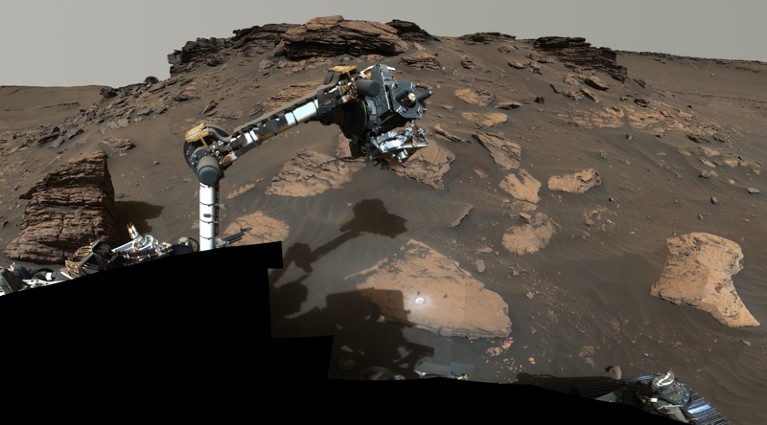
NASA’s Mars rover makes ‘fantastic’ find in search for past life
Perseverance used its robotic arm to collect rock cores from an outcrop called Skinner Ridge, which is part of an ancient river delta on Mars.
Credit: NASA/JPL-Caltech/ASU/MSSS
Since July, NASA’s Perseverance rover has drilled and collected four slim cores of sedimentary rock, formed in what was once a lake on Mars. They are the first of this type of rock to be gathered on another world — and scientists are excited because at least two of the cores probably contain organic compounds.
On Earth, organics, which are carbon-containing molecules, are often associated with living things, although they can be formed without the involvement of organisms.
RELATED
Adding to the buzz over the rock samples, Perseverance collected them from an ancient delta in Mars’s Jezero Crater, where a river once deposited layers of sediment — and possibly other matter. River deltas on Earth often teem with living organisms. If life ever existed in Jezero, these cores are probably NASA’s best chance of finding it.
Having the cores is “fantastic”, if scientists ever hope to answer that question, says Tanja Bosak, a geobiologist at the Massachusetts Institute of Technology in Cambridge.
In the coming years, NASA and the European Space Agency plan to send other spacecraft to Jezero to pick up the cores that Perseverance has collected and bring them back to Earth, where scientists will analyse them with advanced laboratory techniques. The samples, which are expected to arrive no earlier than 2033, will be the first ever returned from Mars.
“To undertake the challenge and the expense of a Mars sample-return mission, we need a great suite of rocks to bring back,” Laurie Leshin, director of the Jet Propulsion Laboratory in Pasadena, California, said at a press briefing on 15 September. “We are off to a great start.”
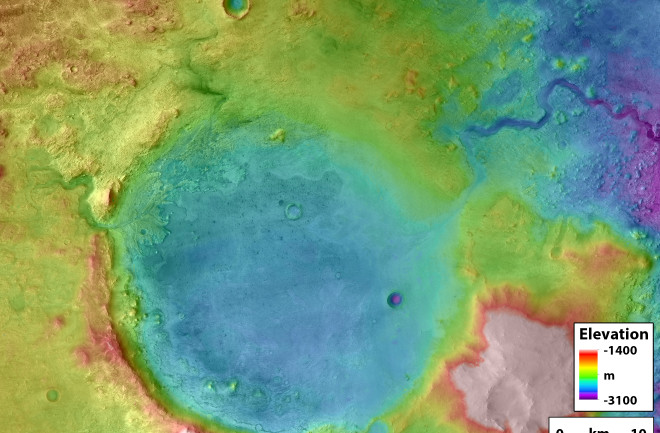
Perseverance landed in the 45-kilometre-wide Jezero Crater in February 2021. Its main goal is to look for signs of past life, and its prime destination is the 3.5-billion-year-old river delta, where sediments long ago turned into rock.
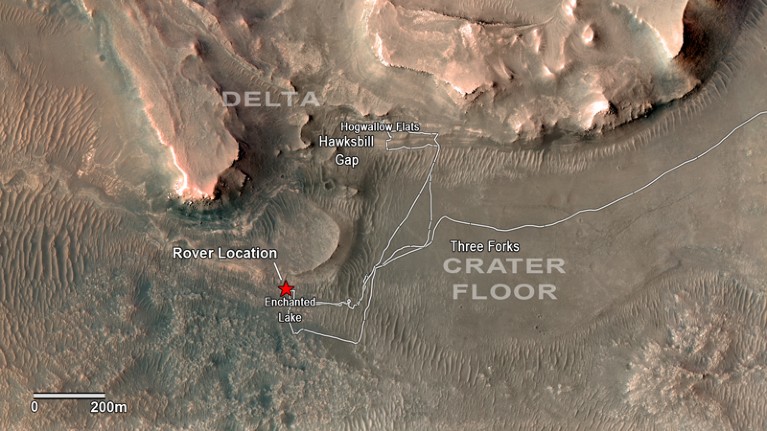
Perseverance travelled to the edge of Jezero Crater’s ancient river delta (from right) early this year. Once there, it collected rock cores from sites near Hogwallow Flats. Then it rolled back to an area called Enchanted Lake, where it currently sits.
Credit: NASA/JPL-Caltech/University of Arizona/USGS
Perseverance spent more than a year making its way to the delta to do its main studies. After landing farther away from the delta than scientists had hoped, it drove around Jezero’s floor, where it surprisingly found ‘igneous’ rocks formed directly from molten magma, or from volcanic activity. Scientists expected the crater floor, once the bottom of a lake, to contain sedimentary rock.
It wasn’t until April 2022, when Perseverance finally arrived at the delta, that scientists found what they had been looking for. In the past few months, the rover has collected two pairs of cores from different types of sedimentary rock that make up the edge of the delta.
RELATED
One pair comes from a rock outcrop known as Skinner Ridge, which is made of fine-grained sandstone similar to a type of rock seen in many places on Earth. Viewed up close in Perseverance’s sampling tubes, the Skinner Ridge cores appear light-coloured and studded with round grains of dark material. These darker grains were probably carried by the ancient river that once flowed into Jezero from regions that lie perhaps hundreds of kilometres away. So, studying the grains might tell scientists about the history of far-flung areas of Mars.
The other recently collected pair of cores comes from a spot called Wildcat Ridge, which lies just 20 metres from Skinner Ridge. These samples are lighter in colour, and are more homogeneous. They seem to be a mudstone — even more fine-grained than the Skinner Ridge cores. The finer the grains in a rock, the more likely it is to contain evidence of past life. On Earth, small grains tend to settle out in low-energy environments such as the bottom of a pond, where they can preserve decaying organisms or other signs of life that settle there.
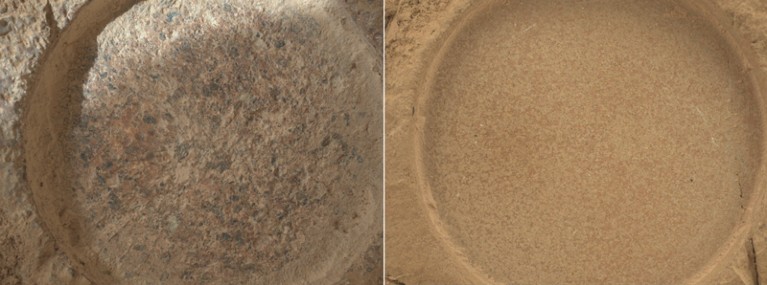
The rover examined sedimentary rock at Skinner Ridge (left) and Wildcat Ridge (right) by grinding circular patches. The Skinner Ridge rock contained dark grains, while the Wildcat Ridge patch was lighter in colour and had finer grains.
Credit: NASA/JPL-Caltech/MSSS
Wildcat Ridge is also where scientists spotted the organic molecules. Next to the sites from which Perseverance drilled its two cores, the rover ground a 5-centimetre-wide circle into the rock to expose its interior texture. The rover then stretched out its robotic arm and inspected the mineralogy of the rock.
It turned out to be richer in organics than any spot studied by Perseverance so far, said Sunanda Sharma, a planetary scientist at the Jet Propulsion Laboratory. And the organics seem to be most concentrated in spots that are also rich in sulfate minerals, which can harbour signs of life. This suggests that organics and sulfate minerals were concentrated as the lake that once filled Jezero was evaporating, Sharma said.
Perseverance has already moved on to another area, known as Enchanted Lake, that it had previously explored. There it will work to collect another pair of samples of fine-grained rock, as well as some of the material lying around on the Martian surface.
RELATED
Sometime before the end of the year, it will probably place six or more core samples on the ground, where they will serve as a first collection of rocks that could be picked up in the future. Perseverance will keep the rest of its tubes on board — some filled and some empty — and continue exploring Jezero. Ultimately, it will roll up on top of the delta and then continue out of the crater, onto the ancient terrain beyond.
Perseverance’s sidekick, the miniature helicopter Ingenuity, has lasted much longer than its designers ever thought it would. It recently made its 31st flight, having been designed for only five. Ingenuity has been flying along with the rover, helping it to scout paths forwards.
Moeten we bang zijn voor aliens?Driekwart van alle uitgestorven landdieren woonde op een eiland. De overgrote meerderheid viel ten prooi aan een ‘invasive alien species’. Via een spelletje geurcluedo met een kleine Kroatische hagedis ontdekte ik waarom eilanddieren zo gevoelig zijn voor aliens.
Foto: © Josip Stipisic
Daar zat ik dan. In een half afgewerkte hotelkamer op het Kroatische eiland Vis, de vensters afgeschermd met lakens, starend naar een karsthagedis (Latijnse naam: Podarcis melisellensis) die door het spiegelglas geen weet van mij had. Elke beweging noteerde ik. Elke keer ik zijn gevorkte tong zag piepen, turfde ik. Ik zat middenin een gedragsobservatie van een hagedis die ik een dag eerder ving op de rotsen van Mali Barjak, het naburige eiland met een diameter van nog geen 100 m. Die karsthagedis was er één van de meer dan tweehonderd die mijn collega’s en ik te pakken kregen op verschillende Kroatische locaties. In totaal deed ik zo’n vijfhonderdvijftig observaties op die hagedissen. “Waarom zou een mens zich daar in vredesnaam mee bezighouden?” hoor ik je denken. Wel, omdat die kleine eilandhagedis mij kon vertellen waarom zijn achterneef op het Kroatische vasteland wel kon vluchten van de bloeddorstige kleine Indische mangoeste en hij niet.
Een prooidier zonder reukzin heeft een aanzienlijke handicap
De kleine Indische mangoeste is een “invasive alien species” of – in het Nederlands – invasieve exoot. Exoten zijn organismen die afgereisd zijn naar een plaats waar ze oorspronkelijk niet thuis horen. In sommige gevallen brengt die exoot schade toe aan zijn nieuwe omgeving. Dan noemen we de exoot invasief. Onze kleine Indische mangoeste werd met opzet vanuit Azië geëxporteerd naar onder andere Hawaï, Fiji, Japan, Mauritius, en Kroatië. Dit om giftige slangen en rattenplagen te bestrijden. Waar niemand rekening mee had gehouden was dat de mangoeste een alleseter is. Hij lust dus ook wel eens een hagedis, en een vogeltje, ook wel een muisje of een kikker. Eenmaal aangekomen in een nieuwe regio verricht het dier vaak een bloedbad. En omdat de mangoeste nu ook op eigen houtje verder reist, is het niet meer dan logisch dat de kleine Indische mangoeste benoemd is tot één van de gevaarlijkste invasieve exoten op onze planeet.

De kleine Indische mangoeste werd met opzet geïntroduceerd op enkele eilanden en het vasteland van Kroatië.
Credit: J.N. Stuart.
Specifiek op eilanden zaaien invasieve exoten zoals de mangoeste dood en verderf. We zien dit veel minder op het vasteland. Moesten we weten waarin eilanddieren verschillen van hun continentale verwanten zouden we beter begrijpen waarom net zij zo kwetsbaar zijn. Die kennis zou ons toelaten eilanddieren beter te beschermen. Dus ging ik op zoek naar waar het fout loopt bij eilanddieren. Ik focuste op de eerste, meest belangrijke stap in het ontwijken van gevaar: gevaarherkenning. En dat, via één van de oudste zintuigen in het dierenrijk: de reukzin. Een roofdier ruiken geeft drie voordelen t.o.v. eentje zien, horen, en al zeker voelen:
Een prooidier zonder reukzin heeft dus een aanzienlijke handicap. Dit is de reden waarom heel diverse dieren hun reukzin gebruiken om roofdieren te ontwijken. Dit gaat van vogels over zoogdieren tot vissen, insecten, en … hagedissen. Maar specifiek hagedissen hebben enkele handige eigenschappen die het gemakkelijk maken om reukzin bij eilanddieren te onderzoeken. Zij kunnen namelijk ruiken via hun tong. Deze merkwaardigheid maakt het voor mij mogelijk om de aandacht die een hagedis voor een bepaalde geur heeft op een gestandaardiseerde manier te achterhalen. Ik tel simpelweg het aantal keren dat de hagedis zijn tong uitsteekt. Als ik daarbovenop ook nog tekenen van angst noteer, weet ik exact wat mijn hagedis van de mangoestegeur vindt. Het is het ideale biologische model voor mijn onderzoek.
Eilandhagedissen zien zich mogelijk genoodzaakt om te besparen op hersenweefsel ten koste van hun reukvermogen
Dus zat ik daar op een Kroatisch eiland, ettelijke uren geurcluedo te spelen met karsthagedissen. Het doel van het spel: vind de moordenaar enkel op basis van zijn geur. Naast mangoestegeur bood ik hagedissen ook gember, een geurloos doekje, en geuren van lokale roofdieren (slangen) waarmee ze wel vertrouwd waren aan. Wat bleek: Eilandhagedissen staken hun tong niet eens uit naar de doekjes en stenen gemarkeerd met mangoeste- en zelfs slangengeur, laat staan dat ze er schrik van hadden. De vastelandshagedissen hadden er nochtans alle moordenaars uit gehaald! Het lijkt er dus op dat eilandhagedissen hun vermogen om roofdieren te ruiken verloren zijn; en daarmee ook één van hun belangrijkste verdedigingsmechanismen.

Een karsthagedis in een observatie-arena achterhaalt welke geur er aan een steen hangt.
Maar waarom gebeurt dit specifiek op eilanden? Via hersenscans achterhaalde ik wat er schort aan het reukvermogen van de eilandhagedissen. En wat blijkt? De hersendelen die instaan voor het verwerken van geurmoleculen zijn veel kleiner in eilandhagedissen vergeleken met vastelandshagedissen. Het is momenteel moeilijk te zeggen hoe dat komt, maar er is wel een hypothese die dit zou kunnen verklaren. De hersenen verbruiken veel energie en eilanden staan bekend voor hun barre omstandigheden. Eilandhagedissen zien zich mogelijk genoodzaakt om te besparen op hersenweefsel ten koste van hun reukvermogen. Hierbij staan ze sterk achter op hagedissen van het vasteland die met hun superieure geurzin beter gewapend zijn tegen invasieve exoten.
Ook al vallen veel karsthagedissen ten prooi aan mangoestes, toch zien we vandaag nog geen grote gevolgen voor het voortbestaan van die soort op Kroatische eilanden. Ik heb dan ook goede hoop voor mijn geschubde vrienden die ik weer uitzette op hun vangstlocatie. Hun grote aantal is waarschijnlijk hetgeen in hun voordeel speelt. Minder courante dieren ondervinden echter ook die barre eilandomstandigheden. Het is dan ook hoogstwaarschijnlijk dat die eilandcondities ook hen beïnvloeden en beperken in hun vermogen om invasieve exoten te ontwijken. Voor die zeldzamere dieren kan de introductie van een invasieve soort dat extra duwtje richting uitroeiing zijn.
We kunnen dus besluiten dat in een geglobaliseerde wereld waar dagelijks miljoenen dieren worden verhuisd via het wegverkeer, de scheep- of luchtvaart, we specifiek moeten inzetten op het voorkomen van de introductie van invasieve exoten op eilanden. Zo kan mijn Mali barjakaanse hagedis met een gerust hartje verder zonnen op zijn rots te midden van de Adriatische zee.
Canadian defence minister was briefed on UFOs ahead of U.S. intel report
Daniel Otis / CTVNews.ca Writer
Ahead of the release of a much-anticipated U.S. intelligence report on aerial phenomena, former Canadian defence minister Harjit Sajjan received a briefing on UFOs.
Documents obtained by CTVNews.ca reveal the May 2021 briefing followed a flurry of mainstream media coverage about a then-upcoming report on U.S. military sightings of “unidentified aerial phenomena,” or UAP, the term American officials use for what are more commonly known as unidentified flying objects and UFOs.
“I expect I am not alone in noting the recent increase in comment regarding Unidentified Flying Objects in the media internationally, particularly in the U.S.,” Sajjan’s then-chief of staff wrote in a May 19, 2021 email to senior defence officials. “I believe it is prudent to request a full briefing for Minister Sajjan from the Canadian perspective on this issue.”
A lieutenant-colonel co-ordinated the effort. An accompanying five-page slide presentation included an overview of cases and procedures, which currently link the Canadian Armed Forces (CAF) with air traffic controllers, federal aviation authorities and a civilian researcher in Manitoba. CTVNews.ca acquired the slides and related emails through an access to information request.
It took six weeks of emails before a Department of National Defence spokesperson confirmed the briefing occurred in mid-2021, although they would not provide an exact date. A subsequent access to information request revealed the briefing took place on May 27, 2021.
Sajjan, a former CAF lieutenant-colonel himself, was replaced as defence minister by Anita Anand in an Oct. 2021 cabinet shuffle and now serves as Minister of International Development.
“No, we have no records of subsequent briefs based on currently-available information,” the National Defence spokesperson said. “Minister Anand has not received a brief at this juncture.”
The briefing slides say approximately 1,000 UFO sightings are reported in Canada each year.
The most recent case referenced was from May 9, 2021, when the pilot of a Delta Air Lines flight over Saskatchewan asked air traffic controllers “about traffic well above them and moving right to left.” According to a publicly-available report from Transport Canada, the “controller advised that there was no known traffic in the area. The pilot replied that they couldn't figure out what it was either.”
The government aviation incident database, where this report was published, is peppered with 25 years of strange sightings from soldiers, police officers, air traffic controllers as well as pilots on military, medical, cargo and passenger flights operated by WestJet, Air Canada Express, Porter Airlines and more.
Transport Canada, the federal department that maintains the database, warns such “reports contain preliminary, unconfirmed data which can be subject to change.”
That data is mostly supplied by Nav Canada, a private company that owns and operates Canadian civil air navigation infrastructure such as airport control towers. When Nav Canada personnel receive UFO reports, the Canadian Armed Forces (CAF) are also usually alerted.
“NAV Canada is the responsible agency for managing UAP-related reporting,” the slides prepared for the then-defence minister read. “CAF does not typically investigate sightings of unexplained phenomena outside the context of investigating potential threats or distress.”
A Nav Canada spokesperson said the company doesn’t investigate UFO reports, adding that their role is to forward information to federal authorities. They point to a Nav Canada guide to Canadian aviation procedures, which puts “unidentified flying objects” at the front of a list of “vital intelligence sightings” requiring reports. Other examples include “surface warships identified as being non-Canadian or non-American.”
A spokesperson from Transport Canada told CTVNews.ca that UFO reports “have no potential for regulatory enforcement and often fall outside the department’s mandate.”
“Reports of unidentified objects can rarely be followed up on as they are as the title implies, unidentified,” the spokesperson said in an email.
The U.S. government has funded UFO research programs almost continuously since 2007. The public got a rare peek at those efforts on June 25, 2021, when the U.S. intelligence community released an unclassified report on recent military sightings, which included UAP that “appeared to remain stationary in winds aloft, move against the wind, maneuver abruptly, or move at considerable speed, without discernable means of propulsion.”
From drones to weather phenomena to top-secret technology, many potential explanations are floated for odd observations like these, and officials say they should not be interpreted as proof extraterrestrials are visiting earth. But finding answers requires investigation, and compared to government-funded programs in the U.S., little appears to be happening in Canada.
Opposition defence critic Kerry-Lynne Findlay believes Ottawa should be paying more attention to American developments, which recently included a bipartisan U.S. senate initiative to establish a new UAP research office.
“As our closest ally and NORAD partner continues to investigate the national security implications of UAP, it would be prudent for Canada to take a similar approach,” the former Conservative cabinet member said in a statement to CTVNews.ca. “Rather than ridicule and silence, it would be wise to take this issue seriously, with the objective of identifying the origins and intent of these UAP.”
Declassified records held by Library and Archives Canada reveal military UFO procedures and sightings dating back to the early 1950s. By the 1960s, responsibility was transferred to the Royal Canadian Mounted Police and scientists at the National Research Council of Canada, which ended their involvement in 1995.
According to the briefing slides obtained by CTVNews.ca, it wasn’t long before a civilian researcher described as “Canada’s pre-eminent ufologist” started receiving UFO reports directly from the military and Transport Canada.
Chris Rutkowski is a Winnipeg-based science writer and University of Manitoba communications professional who has led efforts to document more than 23,000 sightings since 1989 through the annual Canadian UFO Survey. Rutkowski told CTVNews.ca he was asked to provide material for the minister’s briefing as a “civilian advisor,” and that he last received official UFO data in early 2021.
“I have been called both a sceptic and a believer, which probably demonstrates that my position is appropriate,” Rutkowski said in an email. “We are long past the era of UFOs being a subject of ridicule. Well-trained observers have reported sightings of UFOs and UAP and there seems to be a renewed interest by both scientists and the military establishment in taking a closer look at this persistent phenomenon.”
Rutkowski, whose 10th UFO book is scheduled to be released this spring, would like to see a panel or committee formed to gather and examine Canadian cases. Findlay also thinks it’s time for Canada to be more active and open about UFOs.
“We believe the government should adopt a streamlined, whole-of-government approach to standardize the collection of reports across numerous departments and contractors, such as NAV Canada,” Findlay told CTVNews.ca in a rare statement on the subject from a Canadian politician. “Efforts should be undertaken to investigate and make those findings public in a responsible manner.”
UFO procedures remain unchanged in Canada, the Department of National Defence spokesperson told CTVNews.ca. When asked if information on the subject has been provided to Prime Minister Justin Trudeau or his office, their response was, “not directly, no.”
CTV News was first made aware of Sajjan’s UFO briefing by an anonymous source, who shared documents acquired through Canadian freedom of information laws. CTV News verified those documents by filing a new access to information request with the Department of National Defence.

A Department of National Defence spokesperson previously told CTVNews.ca that the briefing occurred in "early June 2021." A subsequent access to information request revealed that the briefing actually took place earlier, on May 27, 2021. This story has been updated accordingly.
RELATED VIDEOS, selected and posted by peter2011
BEWIJS VOOR BUITENAARDS LEVEN KAN ZOMAAR AL EENS IN DE BUIK VAN DIT MARSWAGENTJE ZITTEN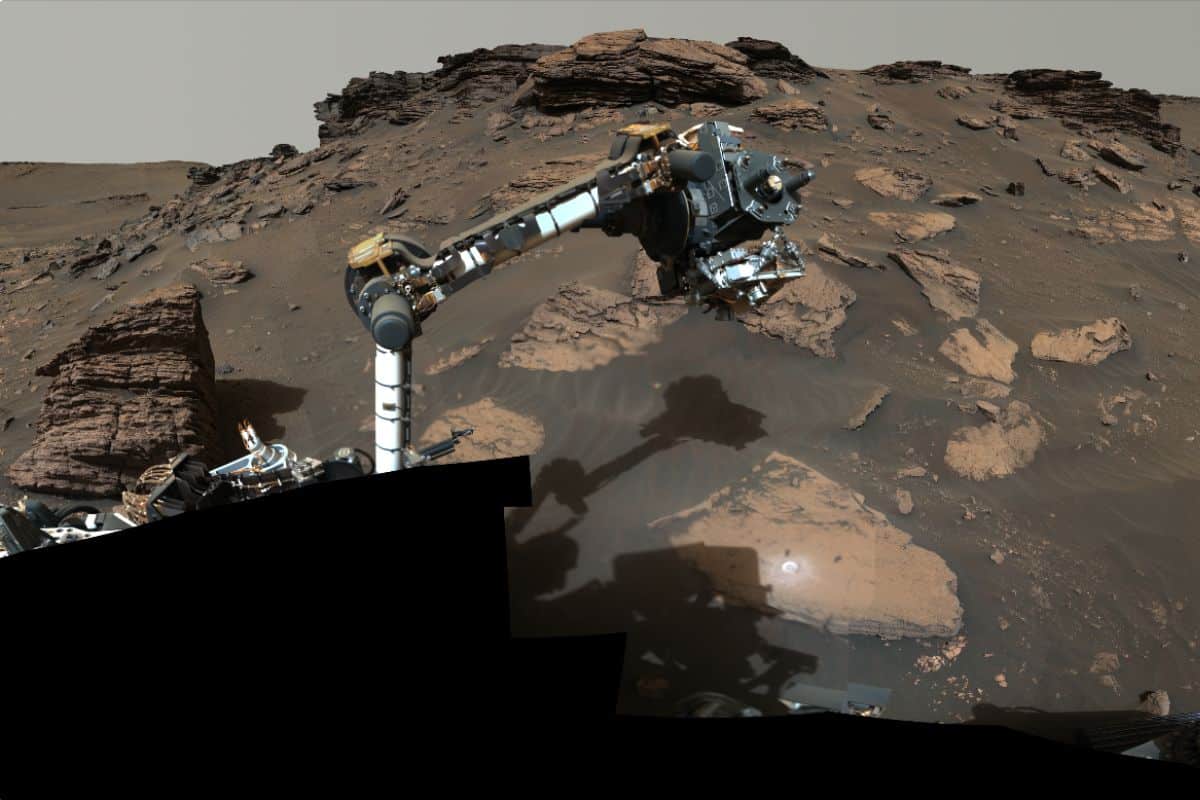 Wasp-inspired drones can 3D print a buildingHubble Unveils an Astronomical Explosion
A shroud of thick gas and dust surrounds a bright young star in this image from the NASA/ESA Hubble Space Telescope. Hubble’s Wide Field Camera 3 inspected a young stellar object, over 9,000 light-years away in the constellation Taurus, to help astronomers understand the earliest stages in the lives of massive stars. This object – which is known to astronomers as IRAS 05506+2414 – may be an example of an explosive event caused by the disruption of a massive young star system.
The swirling discs of material surrounding a young star are usually funneled into twin outflows of gas and dust from the star. In the case of IRAS 05506+2414, however, a fan-like spray of material traveling at velocities of up to 217 miles per second (350 km per second) is spreading outwards from the center of this image.
Astronomers turned to Hubble’s Wide Field Camera 3 to measure the distance to IRAS 05506+2414. While it is possible to measure the velocity of material speeding outward from the star, astronomers cannot tell how far from Earth the star actually is from a single observation. To determine the star’s distance, they measured how far the outflow travels between successive images. From there they could infer the distance to IRAS 05506+2414. Knowing its distance allows astronomers to determine how bright the star is and how much energy it is emitting, and therefore estimate its mass – all vital information in determining the origin of this bright young star’s unusual outflow.
This Wireless Camera Taps Into Sound Waves to Reveal Deep-Sea Secrets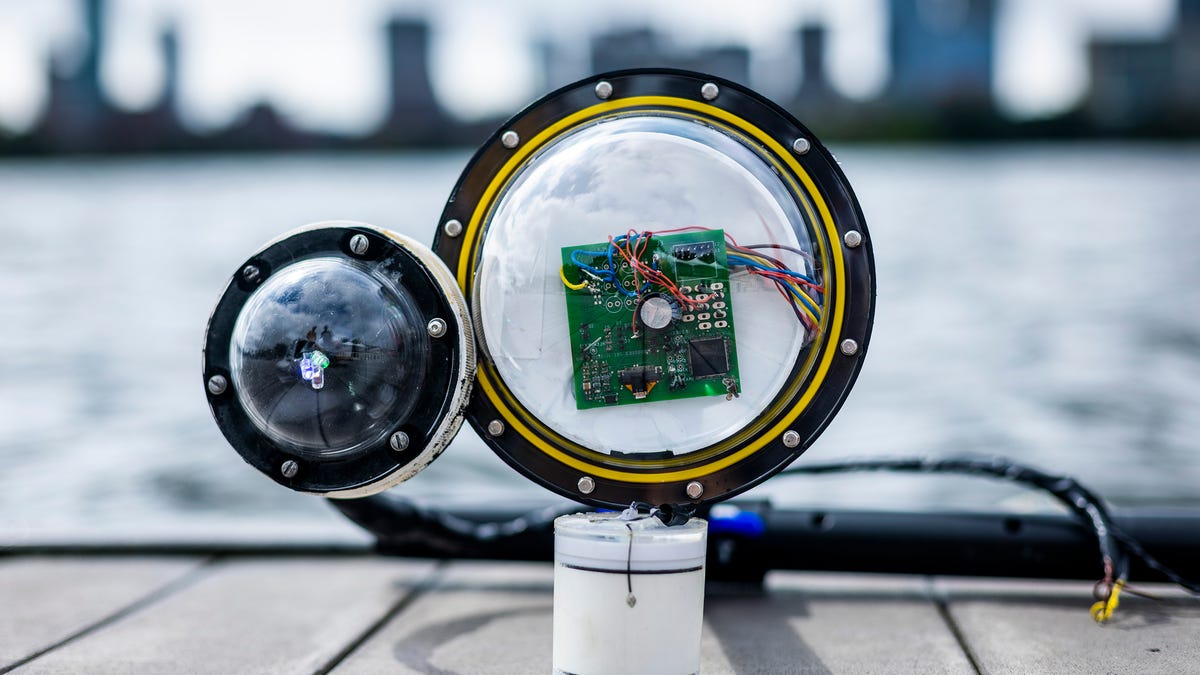
MIT scientists want to map the entire ocean so we can understand how climate change is forcing it to evolve.
MIT scientists presented their prototype of a fascinating underwater camera on Monday. Rather than rely on battery power, this device gets juice from sound waves traveling through the ocean for its deep-sea image escapades. It even works in the darkest of environments.
Then it has the ability to wirelessly transmit all that photo data goodness back through the water to be reconstructed on a computer.
This means that if the model can be scaled up, it could spring humanity a few steps forward on the journey to achieving a massive goal: mapping every corner of Earth's oceans.
Though our beautiful planet's surface consists of a whopping 70% water (reminder, this doesn't account for depth) the research team estimates we've only ever observed less than 5% of the sea. And one reason, they say, for such lack of knowledge is viable underwater cameras are really hard to build due to battery restrictions.
Simply, a workable imager within the sea can't travel too far out from a ship without running out of power. It's also expensive to make a super long-lasting battery, and not time efficient to have to restart an expedition every time the camera at hand must be retrieved and recharged. Thus, the newly proposed sound wave-energized camera holds potential to be a game changer for deep-sea explorers.
According to an outline of the invention, published in the journal Nature Communications, the device can run for weeks on end before someone has to pick it up, allowing it to venture far out into the sea in just one go. It's also about 100,000 times more energy-efficient than other undersea cameras, the team said.
"One of the most exciting applications of this camera, for me personally, is in the context of climate monitoring," Fadel Adib, associate professor in MIT's department of electrical engineering and computer science, said in a statement. "We are building climate models, but we are missing data from over 95 percent of the ocean. This technology could help us build more accurate climate models and better understand how climate change impacts the underwater world."
For instance, this camera could easily capture images of ocean pollution, monitor the health of fish raised in aquaculture farms, where commercial fish breeding occurs, and maybe even indicate how sea habitats are evolving. Right now, oceans are warming too rapidly due to human-induced climate change, and underwater animals are being ousted from their homes, forced to relocate, and sometimes, strained to adapt far quicker than their bodies can handle.
As proof of principle, the research crew tested their mechanism to create color images of plastic bottles floating in a New Hampshire pond. They also captured images of an African starfish in such high resolution that you can see the tiny tubercles along its arms. Overall, it appears to be a solid pathway toward solving the underwater battery conundrum.
But perhaps even more exciting than the long-term implications of the team's camera is the absolutely remarkable way it works.
Basically, the team explained, this sound wave-powered camera takes advantage of noise that's already present under the sea. Passing ships, marine life, tides and other such things create sound. But what is sound, exactly?
Sound isn't an intangible force of some sort. Rather, it's the product of waves traveling through a medium and vibrating that medium on a super (super) minute scale. The medium could be air, water -- anything with atoms, really. When air vibrations hit our eardrums, for example, our brain translates the signal into what we consider sound. That's also why stuff sounds warped to us when we're underwater. Nothing is truly "warped," per se. Soundwaves just vibrate water molecules differently.
OK, so the important bit about this mechanism, for the team's new camera, are those vibrations.
The small device is encased in a special material that produces an electric signal every time it's hit by sound waves vibrating through the water. Those vibrations, in essence, vibrate it as well. Then, the vibrations are converted from mechanical energy into electrical energy, and there you have it -- a steadily powered underwater camera.
Further, to keep hardware light -- so the camera doesn't eat away at its power – the team used off-the-shelf imaging sensors and cheap flash instruments that can only capture images in grayscale. From there, they used sort of an old-fashioned way of obtaining a full-color image.
"When we were kids in art class, we were taught that we could make all colors using three basic colors. The same rules follow for color images we see on our computers. We just need red, green and blue -- these three channels -- to construct color images," Waleed Akbar, MIT researcher and co-author of the study, said in a statement.
First, the camera captures the image with a specifically tailored red LED light filter, then again with a blue filter and again with a green one. Put together, you get the full pic. Finally, all the image data is encoded in computer language, aka ones and zeros, and here's the kicker.
It's sent to a receiver back as soundwaves.
The camera receiver basically transmits its own sound waves to the camera, then the camera can either reflect the waves back or absorb them fully. Altogether, this creates a sort of binary code to tell the receiver what the image data really is.
"This whole process, since it just requires a single switch to convert the device from a nonreflective state to a reflective state, consumes five orders of magnitude less power than typical underwater communications systems," MIT researcher Sayed Saad Afzal said in a statement.
As of now, however, the camera only possesses a maximum transmission range of 40 meters from the receiver. But the team said it wants to increase both that range and the device's memory capacity going forward.
Eventually, they said, it could potentially capture real-time photos and perhaps even stream underwater secrets right to a computer.
Mysterious Cases of Living Fossils, Suspended Animation, and Hibernation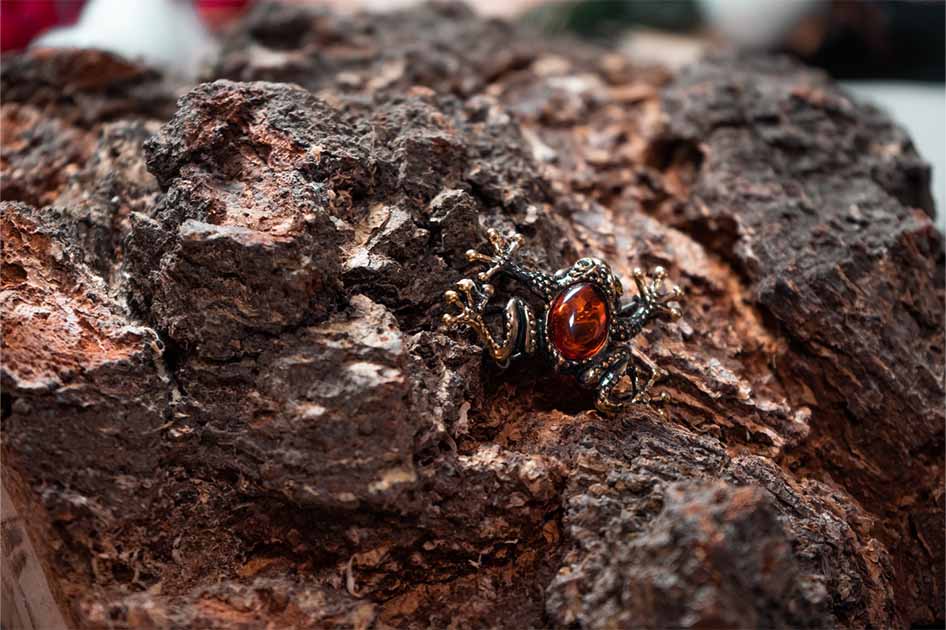
We all know that fossils, by their very nature, are dead. Of course, nothing can survive the conditions of pressure, depth and time required to petrify wood, see saplings mature into massive trees, transmogrify vegetation into coal or metamorphose mud into solid rock. Still, living creatures seemingly from remotest antiquity keep turning up encased in stone from far beneath Earth's surface, embedded inside solid tree trunks and in other situations defying both reason and the gospel of the Great God Science.
One such case occurred April 22, 1881, when miner Joe Molino was working deep in the Wide West Mine outside Ruby Hill, Nevada. When he wedged loose a protruding hunk of stone from the tunnel wall it landed on his foot. Enraged, he grabbed a sledgehammer and smashed it to bits. Molino was stunned to see his hammer blow had exposed a baseball-sized cavity in the rock. It was half full of motionless white worms.
As a crowd of quizzical miners gathered to view the unusual artifacts the worms began to move. Within an hour they were crawling around on the floor of the tunnel.
Mine operators sent the worms (whose species apparently was never determined) and their solid stone sarcophagus to the U.S. Bureau of Mines. Several weeks later the bureau sent the mine operators a letter declaring they must have been mistaken. Since it clearly is impossible for creatures to have survived under the circumstances described, as far as the bureau was concerned there was no way the incident could have happened.
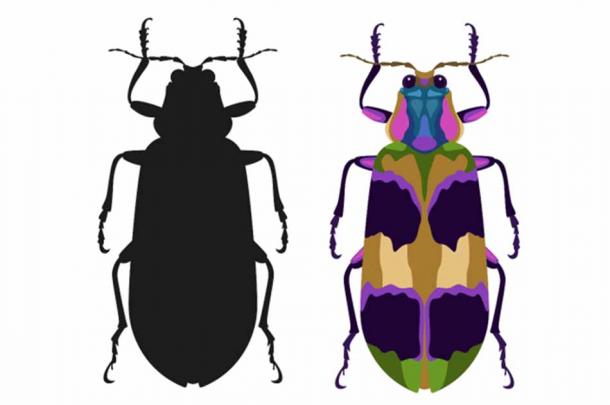
In 1892 an ore nugget found in an Arizona mine was found to contain a dead beetle from which emerged a live beetle: is that a living fossil or what?
( wectorcolor / Adobe Stock)
Yet more scientific mystery was brewing in the American West when, sometime in 1892, a large beetle was found encased in a chunk of iron ore in the Longfellow Mine outside Clifton, Arizona. The ore nugget and its dead inhabitant were turned over to El Paso geologist Z. T. White, who placed the insect in a specimen case. Several days later he was shocked to see the creature move. Watching through a magnifying glass White saw a small beetle emerge from the body of the larger, dead one. He placed the small beetle in a jar where it lived for several months. When it died, he presented it, the larger beetle and the lump of ore to the Smithsonian Institution , where they may remain to this day.
Since the vast majority of fossils are buried, it is predictable that mines are the main source of mysterious zoological artifacts. In 1873, miners at the Black Diamond Coal Mine outside San Francisco found a large frog encased in limestone.
This common (but venerable) bullfrog was apparently blind, and able to slowly move just one leg. After several hours on the surface, it died. The frog and its entombing stone were given to the San Francisco Academy of Sciences, where its survival of what would seem an impossible stretch of time continues to defy understanding.
Yet not all living fossils are found in stone or ore.
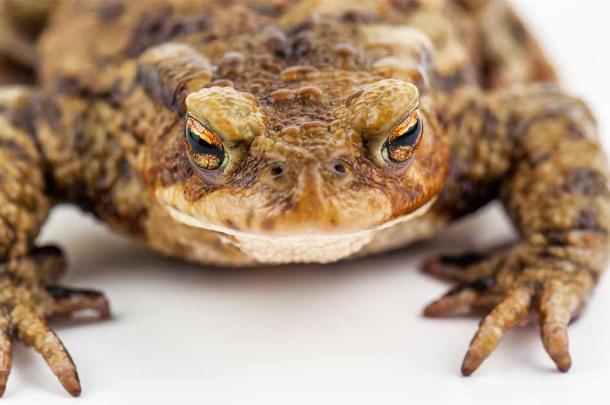
Once in 1893 in Ontario, Canada a live toad emerged from deep inside a tree trunk!
( Volodymyr Shevchuk / Adobe Stock)
In October 1893 workmen at the Brown and Hall Sawmill in Ontario, Canada were using a circular saw to cut a large tree trunk into planks when the blade sliced through a cavity containing (and almost cut in two) a live toad imprisoned squarely in the middle of the tree trunk. The tree was about 200 years old, and the spherical, perfectly smooth hole in which the amphibian was entombed was about 60 feet (18 meters) above the ground. The toad tumbled from its wooden prison and hopped away, seemingly none the worse for its long confinement.
Another report of a live toad in a hole comes from England. In 1829 huge granite blocks that had formed a submerged footing under the docks of Liverpool's George's Basin were being cut into small chunks to be made into steps. During one of the cuts, the stone saw revealed a little hole in the middle of a block, and a toad within it.
Workers gently enlarged the hole to free its occupant, and the amphibian made several futile attempts to get to its feet. Several hours later, after trying one last time to assume its normal crouching position, the toad sank to the pavement and died. Several scientists who later examined the small corpse confessed they were at a loss to explain how the animal could have been found alive under such airless, foodless and waterless conditions. One of these learned men took the dead animal home with him, and it was never seen again. It was not the first or last impossible fossil yielded by Britain.
In 1818 professional geologist Dr. E.D. Clark, who taught at Caius College in Cambridge, Scotland, was present at the digging of a pit on a friend's property when the workmen hit a layer of animated fossils. As one of the workers was breaking up a large chunk of chalk stone into smaller pieces so they could be removed from the hole he found three newts embedded in the rock. Clarke placed them in the bright sunlight and was stupefied when they began to move. Two of them died later in the day, and for years he exhibited them to his students during his lectures on prehistory. He placed the third newt in a nearby brook, and it "skipped and twisted about as though it had never been torpid," and escaped, he later said. Clarke was never able to identify the species to which the newts belonged.
Upon Clarke's retirement he donated the preserved newts to the university's biology department, where, for decades, other professors displayed them during lectures. During the chaos of the 1940 Nazi bombing blitz these pickled specimens turned up missing. Unless they were blown to atoms by a Luftwaffe bomb, they may remain somewhere within Cambridge University, forgotten and still unexplained.
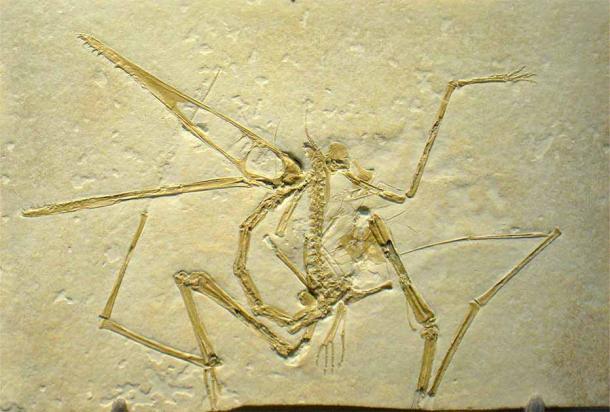
This is a fossil of a flying dinosaur, a Pterodactylus antiquus, and a close cousin of this species was apparently still alive in France in the 1850s according to newspaper reports at the time.
(Daderot / Public domain )
The most incredible find of a living fossil is that reported by the Illustrated London Times of February 9, 1856. The incident occurred in France during the construction of a railway tunnel between the towns of Nancy and St. Dizier. According to the article, workers were breaking up a huge boulder when a goose-sized monster staggered from a freshly exposed cavity and screeched hoarsely before falling dead. It had a long beak, sharp teeth, four legs joined by membranes, and feet with long hooked talons. Its flesh was oily and glossy black.
The mysterious carcass was taken to a paleontologist who instantly recognized the animal as a Pterodactylus anas, a denizen of the Jurassic Period , which ended 135 million years ago. There is no record of whether the body was preserved and still exists.
Certain animals' ability to live long stretches without sustenance is possible via hibernation to escape the lean, hostile conditions of winter. Because their metabolisms are conditioned to arouse them upon the advent of the warmth and renewed food supplies of springtime, they are seldom in suspended animation for more than four or five months. What might happen if spring never arrived? What if their hibernation dens were to be buried by glaciers and/or metamorphose into rock?
Southern Methodist University professor of biology Dr. John Ubelaker, Ph.D. points out that many organisms possess the ability to lower their metabolisms, and that this function is often triggered by environmental conditions. This permits survival through difficult times.
"This is a common phenomenon among many free-living nematodes that have the ability to form a resting stage--dauer larvae--in order to survive a stressful situation," he says. "In these nematodes the ability to control water and water loss is critical, and several metabolic-biochemical processes operate."
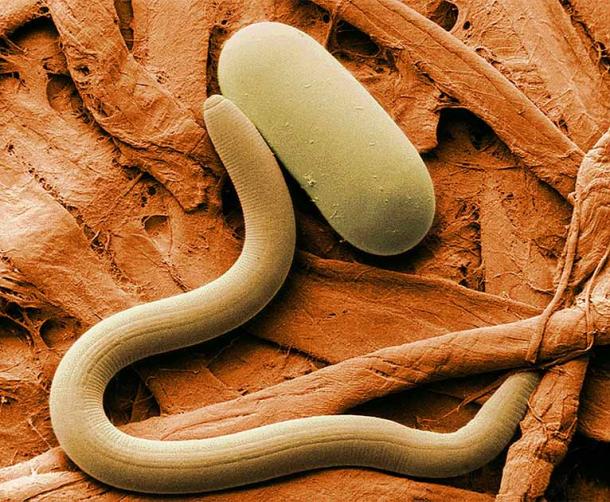
Nematodes that have come to life are perhaps the most incredible living fossils. A colorized electron micrograph of a soybean cyst nematode and egg.
(Agricultural Research Service / Public domain )
In his 1863 book History of the Supernatural noted British author and scientist William Hewitt recounted a midsummer incident he had personally witnessed several years earlier in which workmen in Nottinghamshire, England were digging a ditch and unearthed what he called "a regular stratum of frogs." The creatures were not only alive, but so animated they all hopped away.
He described the layer of mud that had held the frogs as "stiff as butter," and based on the time of year and his examination of the ground where they were buried, he estimated they had been there at least six months. As he asked his readers, "If these frogs could live six months in this nearly solid casing of viscous mud, why not six or any number of years?"
Ubelaker expands upon this premise:
"An interesting fact of life is that an organism's structure and composition can remain virtually the same even though it continuously takes in nutrients and produces wastes. Often defined as a dynamic equilibrium, life allows concentrations of the mixture of the materials in an organism to remain constant even though individual molecules are constantly shifting back and forth, increasing or decreasing in a short time scale," he says. "Remember that an organism at equilibrium is dead. A common classroom comparison is often made with a river and the steady state condition of organisms--the river maintains the same level and shape even though water is constantly flowing through it. Rivers rise and change course, drop to low levels depending on the available water, but at any one point it (and its concentration of materials) remains quite constant. In organisms the structure, proteins, nucleic acid, lipids stay relatively constant even though no one molecule remains in any pool for long."
The erratic and odd sides of the natural world remind us of how much we still have to learn about Mother Earth and the processes that govern her and her multitude of children. There are doubtless many more living relics of the primordial past awaiting exhumation. When they do come to light, they should be studied meticulously in order to ascertain how they survived such extremes of time, temperature and deprivation. The possibility of harmlessly subjecting human beings to suspended animation could solve problems of surviving extended space travel, awaiting the return of loved ones from the stars, outlasting terminal illnesses until cures are discovered, or simply staying alive long enough to meet one's great-great-great-grandchildren. Before we can even start on such grand aspirations, however, we must admit this potentially priceless process exists.
By Kelly Bell
China’s Mars rover finds hints of catastrophic floods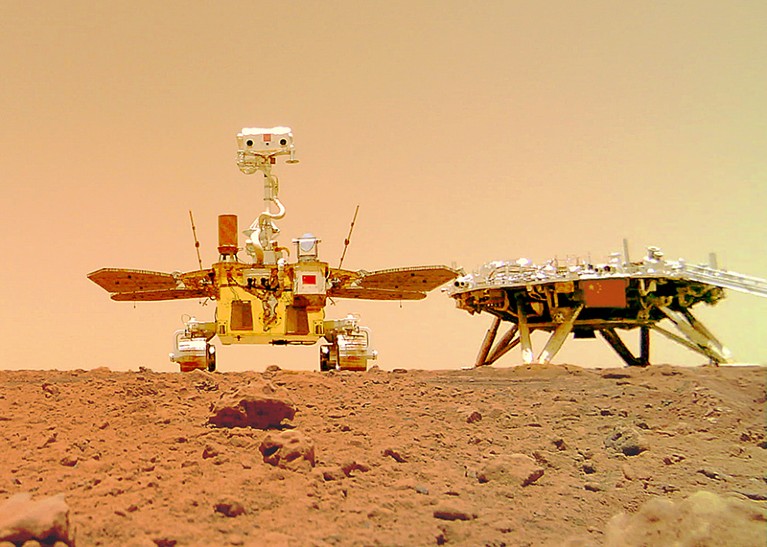
A radar on Zhurong can penetrate the surface to a depth of 100 metres.
Credit: Xinhua/Shutterstock
China’s Zhurong rover has peered deep under the surface of Mars, finding evidence of two major floods that probably shaped the region the robot has been exploring since it landed in May 2021.
An analysis published in Nature today1 is the first result from Zhurong’s radar imager, which can probe up to 100 metres below the surface. “It is a very interesting paper, and I was particularly impressed by how deep they can see with this radar,” says Svein-Erik Hamran, a planetary scientist at the University of Oslo, who analysed the only previous data from ground-penetrating radar used on the planet, collected by NASA’s Perseverance rover.
The history of Zhurong’s landing site — on Utopia Planitia, vast plains in Mars’s northern hemisphere — has puzzled scientists. Some have theorized that water or ice was once a feature of the landscape. Observations from space have identified sedimentary deposits that suggest the region was once an ancient ocean or submerged by huge floods, and geological features, such as pitted cones, resemble structures formed by water or ice. In May, researchers analysed infrared images of the landing site taken by China’s Mars orbiter, Tianwen-1, and found hydrated minerals that could have formed when groundwater rose through the rock or ice melted.
But the region could have also been covered in lava, concealing some of these hydrological processes in the subsurface. Eruptions from the volcano Elysium Mons to the east of the landing site, or other volcanic activity, could have covered the region in magma, as has been observed in other parts of the Utopia basin. By studying the radar data, researchers hope to understand what happened, and whether water or ice could still be lurking below the rocks. “We want to know what is going on beneath the surface,” says study co-author Liu Yang, a planetary scientist at the National Space Science Center in Beijing.
Zhurong is China’s first rover on the red planet, and it has been exploring the southern part of Utopia Planitia. The rover’s ground-penetrating radar transmits high-frequency radio waves that can penetrate the surface to a depth of between 3 and 10 metres, and low-frequency waves that can reach up to 100 metres underground but offer poorer resolution. The study authors analysed low-frequency data taken between 25 May and 6 September over more than 1,100 metres of terrain as Zhurong travelled south of its landing site. Radar signals reflect off materials under the surface, revealing the size of their grains and their ability to hold an electric charge. Stronger signals typically indicate larger objects.
The radar did not find any evidence of liquid water down to 80 metres, but it did detect two horizontal layers with interesting patterns. In a layer between 10 and 30 metres deep, the team reports, the reflection signals strengthened with increasing depth. The researchers say this is probably due to larger boulders resting at the base of the layer, and smaller rocks settling on top. An older, thicker layer between 30 and 80 metres down showed a similar pattern.
The older layer is probably the result of rapid flooding that carried sediments to the region more than three billion years ago, when there was a lot of water activity on Mars, says co-author Chen Ling, a seismologist at the Institute of Geology and Geophysics, Chinese Academy of Sciences, in Beijing.
The upper layer could have been created by another flood some 1.6 billion years ago, when there was lots of glacial activity. Chen says it is unlikely that the upper layer contains intact lava flows, because it has a smaller ability to hold an electric charge than would be expected for intact volcanic rocks. Furthermore, the researchers didn’t see any sudden changes in layering, which would be expected when lava flows meet sedimentary material.
But, Chen says, it is possible that a thin coat of lava once covered the upper layer and it has gradually been broken down into smaller pieces. Radar data alone cannot definitively reveal whether material is sedimentary or volcanic, says Xu Yi, a planetary scientist at Macau University of Science and Technology.
Radar data are good at indicating the layering and geometry of subsurface material, but not so good at pinpointing its composition, including whether the material is ice or rock, says Hamran. Often, researchers rely on other clues, such as rocks peering out from the surface, to build a picture of past events, he says. The authors say they can’t rule out the possibility that the region contains buried saline ice.
More radar results are expected from the mission, including data taken during Zhurong’s continued traverse of Mars, results from the high-frequency radar measurements already made, and Tianwen-1’s orbital radar observations, which penetrate deep into the planet. They could help to clarify details of the terrain. “This is only the first step,” say Ling.
Li, C. et al. Nature https://doi.org/10.1038/s41586-022-05147-5 (2022).
RELATED VIDEOS, selected and posted by peter2011
Is Rh-negative Alien Blood? Was It Evolved From Extraterrestrial Species?
Many ancient texts and Internet stories claim that humanity is the result of genetic mutation done to prehistoric humans by intelligent beings from outer space. Sitchin, who posed a great impact on the ancient astronaut theories, believed that an advanced race of intelligent beings arrived on Earth 450,000 years ago during the Age of Neanderthals, and through genetic engineering, they created modern-day human beings. Moreover, another theory that might support Sitchin’s claims is the mystery of Rh-negative blood which links humans to otherworldly origins.
“If mankind evolved from the same African ancestor then everyone’s blood would be compatible, but it is not. Where did the Rh- negatives come from? Why does the body of an Rh-negative mother carrying an Rh-positive child try to reject her own offspring? Humanity isn’t one race, but a hybrid species,” –Species with Amnesia: Our Forgotten by Robert Sepehr.

Species with Amnesia: Our Forgotten History
The population with the highest concentration of Rh-negative blood type is located between the border of Spain and France in the Pyrenees mountain range. The people that occupy this isolated region are known as the Basque, and they have long confounded anthropologists and historians. The language spoken by the portion of the territory is not related to any other in that part of the world. Up to 35% of Basque people have an Rh-negative blood type that is least likely to mutate or interact with other blood types.
There are 8 most common blood types (A+, A-, B+, B-, O+, O-, AB+, AB-); a classification derived from proteins found on the surface of cells which are basically designed to wage war against bacteria and viruses in the human body. Around 85% of humans in the world are Rh-positive and have no issues receiving blood from positive or negative donors.
Whether Rh-negative blood is just a mutation or not is something that has caused debate among researchers. If it was a mutation, then why are the people who possess Rh-negative blood known for having extra vertebrae? This, just as the blood type, is explained scientifically as being a mutation. However, according to modern DNA sequencing, it is demonstrated that humanity is not just one single race that descended from the same ancestor in Africa, but a hybridized species, with a far more enigmatic truth behind it all.
Read also:
The fact is if the mother is Rh-negative, her immune system treats Rh-positive fetal cells as if they were a foreign substance. The mother’s body makes antibodies against the fetal blood cells. These antibodies may cross back through the placenta into the developing baby. They destroy the baby’s circulating red blood cells. It suggests somewhere in our lineage that the Rh negatives and the Rh positives are perceived as being profoundly different.
Rh-negative is very rare. It was not spread across the world until colonization started in the 15th century. Rh-negative didn’t exist in the Americas, Southern Africa and Asia. It was only in Europe. According to scientists, modern humans arose in Africa at least 250,000 to 300,000 years ago. They are all Rh-positive. They do not have any Rh-negative, so from where did it evolve?
Robert Sepehr tells in his book “Species with Amnesia: Our Forbidden History” more about the enigmatic blood type Rh-negative. The author suggests that highly advanced civilizations had been on Earth before us, just to be destroyed by some great global catastrophe as mysteriously, history tells us.
Could the Rh-negative blood type offer evidence of a vastly different pre-human evolution than what we are led to believe in our history books? Might it offer indisputable proof of extraterrestrial intervention in the remote past? But if so, is the experimentation with intelligent hominid over, or is it still taking place?
Ancient Origins writes: “Indeed, it is amidst the Basque of France and Spain that we find an odd prevalence of one human blood type known as Rh-negative. The use of Rh here denotes “Rhesus,” as the origins of the blood type were labeled after a common factor shared between humans and the Rhesus monkey; today, the Rh blood group system is one of thirty of the existing current blood group systems recognized by science, of which close to eighty-five percent of humans have. 8 The most common manifestation of the Rhesus blood factor in humans is known as Rh-positive blood. By studying the common factors present between blood types of, for instance, humans and the Rhesus monkey, it becomes clear in terms of the genetic information present here that at some point in our ancient past, humans must have shared a common ancestor with this species of Old World monkeys.”
Sepehr argues that “highly advanced civilizations have been here before us, just to be destroyed by some great global catastrophe. But for each race that has died out, another has taken its place, with a selected few holding on to the memories and sacred knowledge of the past race. In our vanity, we think we have discovered some of the great truths of science and technology, but we are in fact only just beginning to rediscover the profound wisdom of past civilizations. In many ways, we are like an awakening Species with Amnesia, yearning to reclaim our forgotten past.”
Many believe that Rh-negative blood would be the legacy that the Anunnaki left on Earth among other things.
𝐍𝐀𝐒𝐀 𝐜𝐫𝐚𝐬𝐡𝐞𝐬 𝐃𝐀𝐑𝐓 𝐬𝐩𝐚𝐜𝐞𝐜𝐫𝐚𝐟𝐭 𝐢𝐧𝐭 Mummified Alien Soldier With Shield On Mars Hillside, Video, UFO Sighting News.

 Glowing Object Over Greenville, Wisconsin Sept 26, 2022 Video, UFO Sighting News.


Date of sighting: Sept 26, 2022
Octopus like UFO over NYC | Yesterday
This octopus like UFO with lights was filmed near Hudson river in New York City yesterday (on 26th September 2022).
The DART Mission, Will This Save All Life On Earth?The DART Mission, Will This Save All Life On Earth?
This could be history in the making and joining me tonight will be my space science guy Dan from smAshomAsh so come and be apart of this event with us. Hope to see you here, stay blessed and safe...
RELATED VIDEOS, selected and posted by peter2011
Eridu: The Sumerian Garden of Eden and the Oldest City in the World?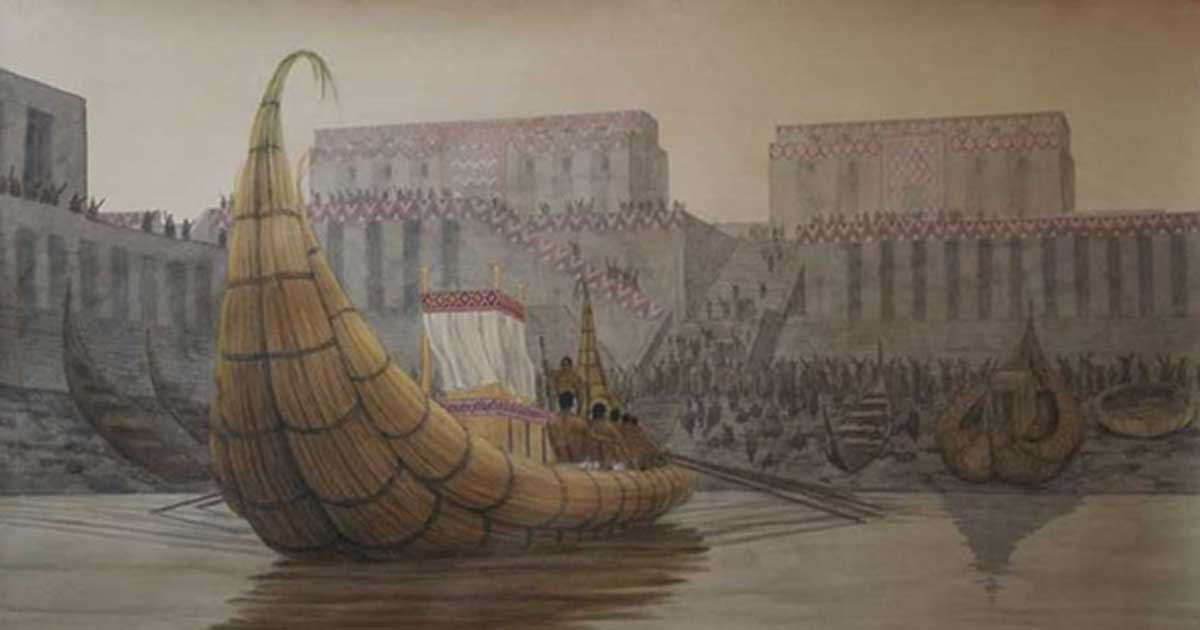
Today, Eridu is often considered to be one of the oldest permanent settlements in Mesopotamia, and perhaps even in the world. The ancient Sumerians also believed that Eridu was the first city in the world and they documented that belief in the Sumerian King List and the Eridu Genesis . At least 18 layers of settlement are found at the site, could the ancient Sumerian belief be possible?
Archaeological evidence shows that the earliest structures date to the 6th millennium BC. The city reached its zenith during the 4th millennium BC and continued to be inhabited until around the 7th century BC. By then, however, the city had lost its importance.
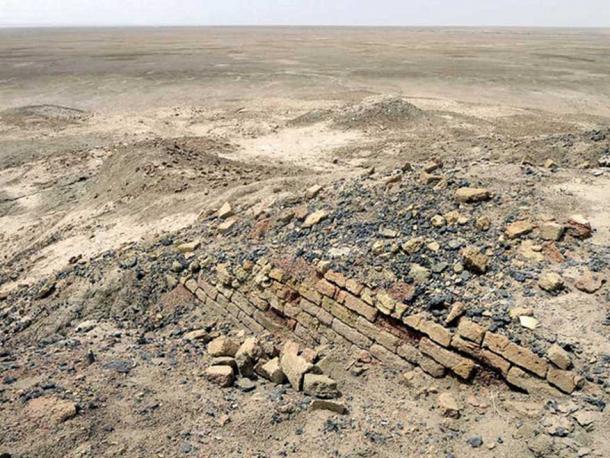
Some of the baked bricks used in the construction of the Sumerian ziggurat at Eridu, southwest of Nasiriyah, Iraq, are stamped with the name of King Ur-Nammu (2123-2106 BC).
(David Stanley/ CC BY 2.0 )
Eridu (known today as Tell Abu Shahrain) is located about 20 km (12.5 miles) to the southwest of the famous city of Ur. As its modern name indicates, the archaeological site is a tell, which is a huge mound formed over the millennia as a result of new settlements being built over the ruins of the previous ones. The tell rises to a height to 7 meters (23 feet), and is formed by 18 levels of occupation, according to the archaeological excavations. The bulk of this has been dated to the Ubaid and Uruk periods, which lasted from the 6th to 4th millennia BC.
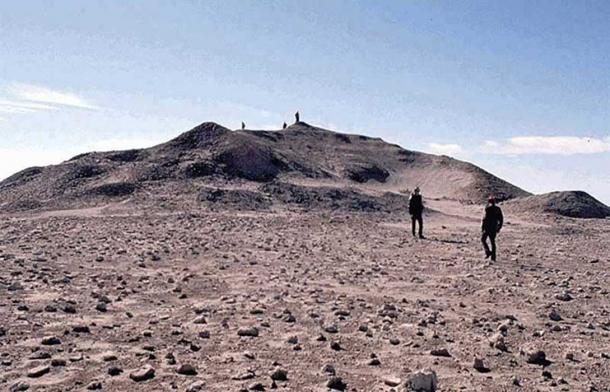
The ruins of Eridu in 2011.
(Ltybcc1/ CC BY SA 3.0 )
The ancient Sumerians themselves made mention of Eridu’s antiquity. In the Sumerian King List , for example, it is written that “After the kingship descended from heaven, the kingship was in Eridug.” In addition, in the creation myth known as the Eridu Genesis , it is said to have been one of the five cities that existed before the Deluge, the others being Bad-Tibira, Larak, Sippar, and Suruppak.
The patron god of Eridu was Enki (known also in Akkadian as Ea), the god of water. According to Sumerian mythology, the settlement was founded by Enki, and it was from this city that civilization was spread to other parts of the land. Although Enki was initially a local god, he rose in importance as the city grew in influence, resulting in him being incorporated into the pantheon of other cities as well. In Eridu, Enki’s temple is known as E-Abzu (Abzu may be translated as ‘Deep Ocean’, and refers to the underground spring from which all life is believed to have begun).
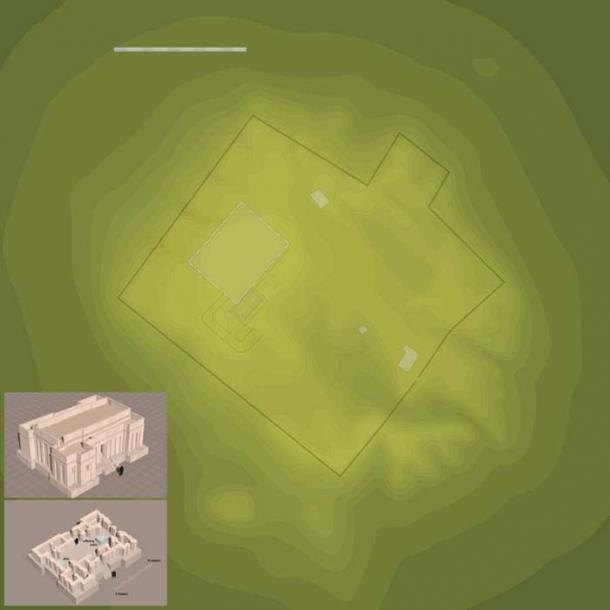
Rough map of the Eridu mound showing the main ziggurat, temple, and a few buildings.
(Cush/ CC BY SA 3.0 )
Archaeological excavations of the E-Abzu have revealed that the temple began as a small room containing what has been referred to by scholars as a ‘cult niche’ and an ‘offering table’. Over the millennia, however, the inhabitants built new temples over the ruins of the old ones, each bigger than the last. The E-Abzu eventually became a large ziggurat, an apt reflection of Enki’s status as a major deity. It has been proposed that the E-Abzu may have been the largest of the ancient Mesopotamian ziggurats.
Although the E-Abzu is the focal point of the site’s archaeology, there are either elements of interest. More recent excavations, for instance, have revealed that during the Ubaid period, the city was a pottery production center. This is evident in the pottery works, which had large scatterings of pottery fragments and kiln waste. Additionally, remains of fishing nets, weights, and even models of reed boats have been found at the site, suggesting that fishing was a major economic activity carried out by the inhabitants.

There are nine lines of cuneiform inscriptions on this fired clay brick; stamp of the king Amar-Sin (Amar-Suen, previously misread as Bur-Sin), king of Ur. 2100-2000 BC. From Eridu (modern-day Tell Abu Shahrain), southern Mesopotamia, Iraq. It is currently housed in the British Museum in London.
(Osama Shukir Muhammed Amin FRCP(Glasg)/ CC BY SA 4.0 )
Eridu was the dominant city in southern Mesopotamia during the Ubaid period, but it was eventually superseded by Uruk. Nevertheless, it continued to be revered as the first city, and it retained its religious significance thanks to the E-Abzu.
It has been suggested that ecological changes, i.e. the recession of the gulf coast and the increasingly unreliable water table, were responsible for the decline of Eridu around the end of the 3rd millennium BC. The city continued to be inhabited up until around the 7th century BC, although by then it had become a mere shadow of its former glory.
In 2016, Eridu was inscribed as a UNESCO World Heritage Site, as part of the ‘Ahwar of Southern Iraq: Refuge of Biodiversity and the Relict Landscape of the Mesopotamian Cities’.
By: Wu Mingren
RELATED VIDEOS, selected and posted by peter2011
US Navy Chilling Underwater UFO Encounters Might Prove Aliens Hiding Under Ocean
The OOD called for the Captain to come to the bridge at that time. At about the same time the object emerged from the clouds and fell down into the ocean. All five men witnessed this. The QMC (Quartermaster Clerk) took pictures as it rose up into the clouds and then back down into the ocean once again.
The five men watched for quite a while longer but nothing else happened. Soon the sub had moved out of visual range and the Captain told all witnesses that they were never to discuss what they had seen with anyone under any circumstances. He stated that the incident was classified information.
The Captain then went below and sent a radio msg. There was no doubt as to what we had seen. It was a metal craft with machinery on and around the outside of it. It appeared to have windows or lenses placed around its perimeter. It made no noise that we could hear. It did not disturb the sub’s electrical systems nor did it affect the gyro compass. It looked very much like a round flying “ship” as in sea going ship. It had the shape and form of a saucer with a bowl inverted in the saucer and it was huge. I will never forget it as long as I live.”
Another similar incident took place in 1991 off the west coast of South America. The witness stated that at that time, he was a Chief of Operations and Intelligence serving aboard the Knox-class escort destroyer USS Kirk FF1087 and that they were part of a drug interdiction force consisting of the USS Kirk and three other Navy ships. Their main task was to patrol using a network of radars to track and then intercept drug planes flying out of Colombia, Panama and Guatemala, as well as to seize any smuggling ships that they could find. (Source)

Baughman could not believe what he saw. He told his supervisor about the strange object he had seen underwater. But others were indifferent and ended the talk by saying “everyone sees weird shit in the ocean.”
He doubted about his sighting as he believed that it could be anything from an albino whale, shark, or some ship wreckage to an optical illusion. He said: “But it cast its own shadow and that’s how I was able to perceive it as a solid object.”

However, Baughman remained silent for all those years until the 2004 Nimitz event got public in 2017. This encouraged him to reveal his encounter with an underwater UFO. “It’s hard to come to grips with something like this, and I still feel somewhat insecure about it because it doesn’t make sense. But at the same time, more data points, even as basic as my story, could help solve the mystery of whether they’re foreign adversaries playing mind games, non-human entities, or the myriad of other possibilities,” he explained.
Being afraid of the response he could have received on his story, he had been keeping silence for many years. Likewise, there are other military personnel who do not reveal their incidents due to many reasons.
Some interesting UFO sightings have been reported by many in the US Navy, and footage has even been released showing UFOs entering water. Among the proposed evidence for this is a video filmed off the coast of San Diego in July 2019 by the crew of the USS Omaha. In a video posted by UFO researcher and investigative director Jeremy Corbell, a spherical object is seen flying over the ship and then descending into the water as one of the crew exclaims, “Wow, it splashed!”
The video caused a lot of buzz on the Internet, but it became even more interesting when Corbell said that a Navy submarine was sent to search for the object, however, it did not find anything. Interestingly, there was information that at about the same time, American submarines spotted other mysterious anomalous objects underwater in that area, which seemed to defy the laws of physics. The Navy has confirmed that the footage was genuine, but they cannot explain it.
More specifically, Luis Elizondo, a former director of the Pentagon’s Advanced Aerospace Threat Identification Program, said: