Who built these 100,000-year-old megalithic structures in the remote wilderness of Siberia?

Who built these 100,000-year-old megalithic structures in the remote wilderness of Siberia?
The Pentagon’s New UAP Report is Seriously Flawed - part 3
The Pentagon’s New UAP Report is Seriously Flawed - part 2
The Pentagon’s New UAP Report is Seriously Flawed - part 1Last month the U.S. government’s new UAP investigation office, the All-domain Anomaly Resolution Office (AARO), submitted a report to Congress entitled, “Report on the Historical Record of U.S. Government Involvement with Unidentified Anomalous Phenomena” (UAP, the new term for UFO). This new report is itself anomalous for several reasons.
Another irregularity worth noting is the fact that before its release, Department of Defense (DoD) Public Affairs sponsored a closed-door pre-brief on the report’s findings for a select group of press outlets on an invitation-only basis. Outlets like The Debrief, which closely follow the UAP issue, were excluded. Following the report’s release, most of the news agencies that had participated in the pre-brief went on to publish articles that uncritically parroted the report’s findings. Moreover, they seem to have done so without consulting any of the scholars or experts who have studied and written extensively on this topic as would normally be the case in another field.
What about consulting the famous scientist, author, venture capitalist, and UAP expert Dr. Jacques Vallee, who worked with Air Force astronomer Dr. J. Allen Hynek on Project Blue Book and lived much of the history this UAP report purports to cover? Neither AARO nor the press bothered to speak with him. How about Robert Powell, Director of the Scientific Coalition for UAP Studies and author of the outstanding new book UFOs: A Scientist Explains What We Know (and Don’t Know)? Or professor Alexander Wendt at the Ohio State University? I’m sure these and many other authors and scholars would have been happy to assist AARO or the press, had they been contacted.
That America’s leading press outlets missed the problems and issues identified below and failed to present an alternative perspective, is itself typical of the stigmatized history of UAP press coverage since WWII. Those interested in the role of the press on the UAP topic may want to read Terry Hansen’s provocative book, The Missing Times.
The disappointing lack of critical press coverage of this important report prompted me to begin compiling the insights of UAP scholars and experts who have studied the history of UAP and the US government. I hope the observations below will prove helpful to members of Congress and the public seeking to understand the history of the US government’s involvement with UAP. Perhaps, when AARO publishes Volume II of its report, some effort will be made by the mainstream press to consult UAP subject-matter experts before rushing their articles into print.
One of the other concerns I have about press coverage of this report is the tendency to conflate the UAP topic generally with allegations the government has recovered off-world technology. The UAP issue is distinct and critically important regardless of the truth about allegations of recovered extraterrestrial, nonhuman technology. Asking AARO to investigate that allegation was unfortunate since a subordinate DoD or IC office finding its superiors innocent was never going to satisfy the critics anyway.
Moreover, a disruptive secret of that colossal magnitude affecting every person on the planet would never be revealed in a report to Congress from a mid-level official or organization. Only the President, or an independent Congressional investigation, could reasonably be expected to reveal such a profound and transformative issue. If Congress wants to be confident it knows the truth, it needs to conduct its own independent investigation.
In the meantime, Congress and the public deserve a great deal more transparency and clarity regarding US government data on the UAP issue. Too many well-documented incidents are occurring at too many locations, a problem greatly exacerbated by the rise of sophisticated drone technologies. If you don’t think this is a serious issue, consider that just a few months ago fighter aircraft were transferred from Langley Air Force Base in Virginia to Naval Air Station (NAS) Oceana after weeks of intrusions by unidentified drone-like craft. The Air Force seemed powerless to capture or deter these intruders and has still not been able to identify them. Similar incidents have been afflicting Navy warships and other bases around the country.
If the Air Force can’t defend its own bases, how can it defend the rest of the country? Don’t we need to get on top of this sooner rather than later? As journalist Tyler Rogoway (incidentally a skeptic of ET theories) said in one of his many superb articles at The War Zone (emphasis added here and elsewhere below): “The gross inaction and the stigma surrounding Unexplained Aerial Phenomena as a whole has led to what appears to be the paralyzation of the systems designed to protect us and our most critical military technologies, pointing to a massive failure in U.S. military intelligence.”
In sum, the number of UAP reports and the number of intrusions into US military airspace are both increasing, so we need to embrace the full range of UAP and drone issues and pursue them vigorously, rather than trying to diminish or trivialize the topic the way AARO’s historical report seeks to do.
Hopefully, Volume II of AARO’s history of UAP will be far more accurate and informative, and will also garner more serious, informed, and independent press coverage.
The new UAP investigative agency of the U.S. Government is currently called the All-domain Anomaly Resolution Office (AARO). It reports jointly to the leaders of DoD and the Intelligence Community (IC). AARO recently sent the classified version of its first historical report, Vol. I, to Congress. Ostensibly, it covers the period from 1945 to October 31, 2023. The administrative cover date is February 2024. Volume II is due on about June 15, 2024.
“(ii) include a compilation and itemization of the key historical record of the involvement of the intelligence community with unidentified anomalous phenomena [UAP], including— …
“(III) any efforts to obfuscate, manipulate public opinion, hide, or otherwise provide incorrect unclassified or classified information about unidentified anomalous phenomena [UAP] or related activities.” [NDAA FY23 Sec. 6802(j)(1)(B); 50 U.S. Code § 3373(j)(1)(B)]
Contrary to Congressional direction, AARO completely omits entire agencies – NORAD, NSA, DIA (prior to 2009), CBP, etc. – agencies with known investigations or activities relating to UAP, and also omits any discussion of “any efforts to obfuscate, [or]… hide … unclassified or classified information about unidentified anomalous phenomena [UAP] or related activities.” AARO omits these agencies even when there are unclassified documents available on those agencies’ records and investigations of UAP (for example, see the approximate 100 pages of CBP Customs & Border Protection agency internal memos of Records on UAP, plus 10 videos, released in August, 2023, but unmentioned by AARO; Also see McMillan, Hanks, Plain, “Incursions at the Border,” The Debrief, May 27, 2022).
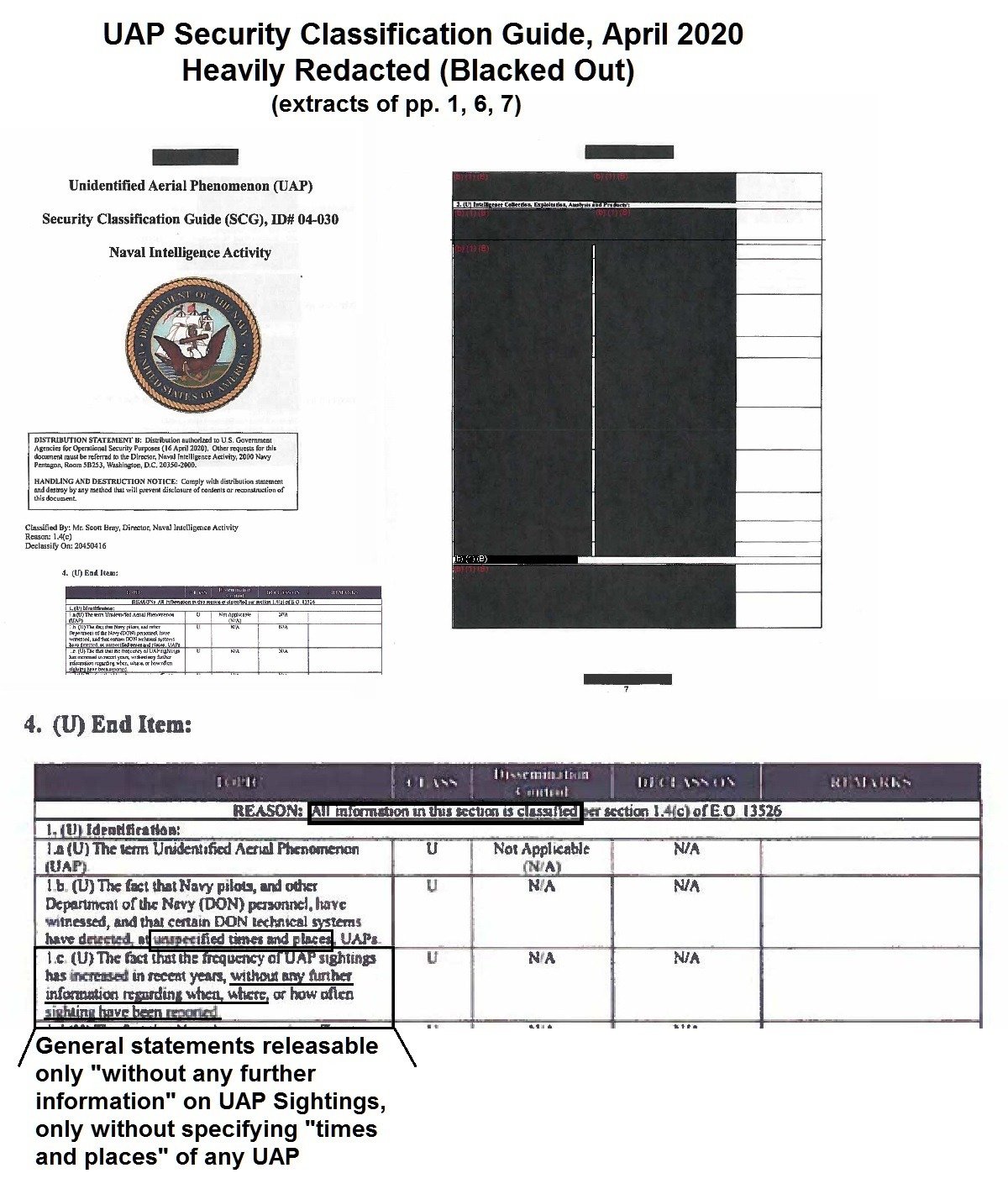
In the past, extreme and excessive secrecy has been displayed in efforts to “hide … unclassified or classified” UAP-related information, illustrated by the AARO predecessor’s UAP Security Classification Guide, first distributed internally on April 16, 2020 (see graphic below) which is itself heavily redacted, removing most indications of the type of UAP report content requiring classification. This is a binding secrecy regulation – don’t be fooled by the word “guide,” it is absolutely mandatory. The secrecy regulation specifically states that only a general statement of an increase in UAP sightings can be released to the public, and “without [releasing] any further information regarding when [or] where” a UAP “sighting [has] been reported” as that is classified. Additionally, the “times and places” of UAP detections are classified and are required to be “unspecified” and can’t be released; it is not “U” (Unclassified) (p. 6, subparagraphs. 4.1b-c).
How can this be, when DoD itself confirmed, prior to the creation of this (excessive) classification guide, that the three famous Navy UAP videos I provided the New York Times and Washington Post were unclassified, and their release would not damage national security? In fact, by bringing a major intelligence failure occurring in US airspace to the attention of policymakers, the public release of those videos clearly advanced national security. The bureaucratic fiasco of this classification guide occurred despite a broad consensus in government, including among our military and intelligence officials and members of Congress, that over-classification is a major problem that needs to be addressed. As Avril Haines, the Director of National Intelligence (DNI) said in a letter to Congress in 2022, “Over-classification of government secrets both undermines national security by blocking the intelligence community’s ability to share critical information and erodes the basic trust that our citizens have in their government.”
Air Force intelligence agency “efforts to … manipulate public opinion” on UAP since the 1950s are what caused the harsh stigma attached to the entire UFO subject in society. But this powerful anti-UAP stigma is not investigated or historically documented by AARO – or even mentioned – contrary to its legal obligation (more on this below). In addition to the AF-instigated Robertson Panel of 1953, and all that followed after it, there are even admissions by a retired USAF OSI officer of allegedly spying on civilian UFO researchers and spreading disinformation on behalf of the Air Force.
The unclassified version of the historical AARO Report (AAROR) was released on March 8, 2024. But prior to that, AARO quietly released the report 2 days in advance to several friendly media outlets to cultivate favorable media coverage. These outlets, including the New York Times and Washington Post, faithfully carried the government’s message forward, apparently without consulting any of the scholars and researchers who could have helped them understand the report’s numerous errors, omissions, and shortcomings to provide a more balanced assessment. More objective reporting would have uncovered numerous major problems and serious errors in the AARO Report.
What follows are only a select few of the many issues and questions raised by the AARO Historical Report.
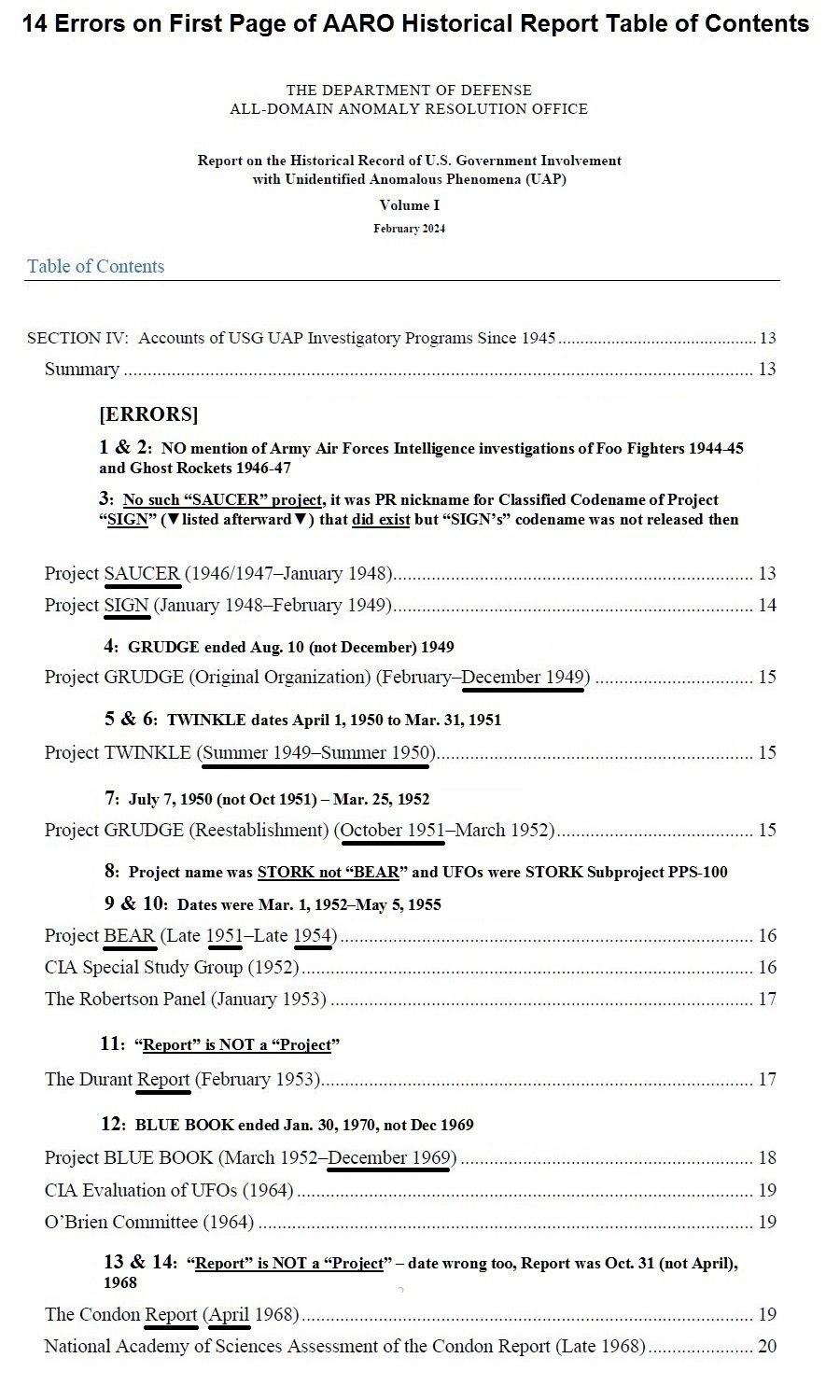
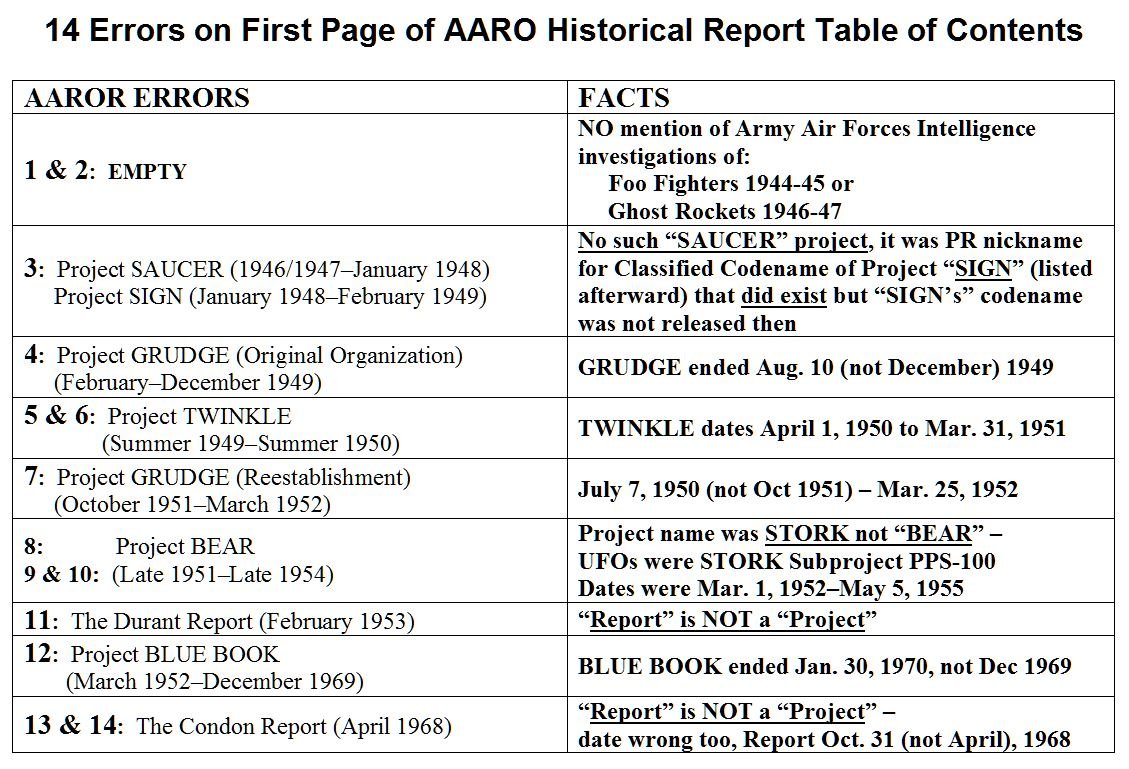
The AARO report (AAROR) is pervaded by hundreds of unfortunate errors and absurdities involving the history, science, and facts presented in its 63 pages, with dozens–or more–errors on some pages (see graphic below of 14 errors alone just on the first page of the Table of Contents).
The report is replete with so many mistakes and misunderstandings that, page for page, it appears to be the greatest single repository of UAP errors, arguably surpassing even the Air Force’s Project Blue Book. Call AARO the New Blue Book. Speaking of which, the report utterly fails to convey any of the fundamental flaws or national controversies that dogged Project Blue Book, including the admission by its own chief scientist that Blue Book was a deeply flawed Air Force public relations effort to dispel public and Congressional concerns, rather than an objective inquiry.
To begin with, AARO asserts the Kenneth Arnold sighting that launched the whole UAP era occurred on June 23, 1947 (AAROR, p. 14).
Simple Googling would have gotten the correct June 24 date and the correct shape (it wasn’t actually “circular,” and neither was the Flying Flapjack which they call the “Flying Pancake” to erroneously emphasize its circularity even more). Arnold insisted the press’s label “flying saucers” for his sighting was a misnomer. Significantly, it is the important watershed event that launched the entire modern age of UAP. It’s not a typo in a minor detail that can just be brushed off.
There are unbelievable statements and insinuations in the AARO report such as the peculiar claim that the Manhattan Project that built the first atomic bomb somehow caused “sightings” and “erroneous UAP reporting” (AAROR pp. 4, 39-40) and did so even after it terminated on December 31, 1946 (a date they omit because it would not explain the sightings that began the modern UAP era in June 1947). That is a bit like saying trailer parks cause tornadoes. Since the Manhattan Project did not launch special aerial vehicles of any kind that could be “misidentified” as UAP, did the Project’s buildings fly up in the air and cause “sightings” and “erroneous UAP reporting”? This incredible claim is not explained by AARO.
Indeed, the truth is precisely the opposite of what AARO suggests. Not only is there no evidence of outside civilians mistaking the Manhattan Project and successor operations for UAP, but we know that personnel working inside the US nuclear weapons program were sighting UAP, reporting them, and thereafter collecting hundreds of their own authentic UAP reports. The senior AFOSI (Air Force Office of Special Investigations) officer responsible for Los Alamos Scientific Laboratory compiled a detailed catalog of 209 recent “Unknown Aerial Phenomena” sightings and instrument tracking incidents in the Los Alamos area and surrounding regions (see sample p. 38 below). He sent the catalog with a classified memo to his superior, the agency director in Washington DC, General Joseph P. Carroll, on May 25, 1950, stating that security officials agreed:
“… the frequency of unexplained aerial phenomenon in the New Mexico area was such that an organized plan of reporting these observations should be undertaken…”
Other documents explain this “organized plan” included instrumented UFO / UAP tracking stations and networks that were set up by scientists and security officials in the Los Alamos Lab, Sandia Lab, Kirtland AFB, and Holloman AFB–White Sands areas, and put on base-wide alert, consisting of missile-tracking telescopic cameras, radars, nuclear radiation detectors, radio communication networks, aircraft for interception, etc. Yet, no AARO discussion of this.
“The observers of these phenomena include scientists, Special Agents of the Office of Special Investigations (IG), USAF, airline pilots, military pilots, Los Alamos Security Inspectors, military personnel, and many other persons of various occupations whose reliability is not questioned.”
Many of the UAPs reported by scientists and military personnel were described as either “green fireball phenomena” or flying “disks” (or “variation”). AARO has completely misrepresented the situation: The Manhattan Project and subsequent nuclear weapons activities were not causing spurious UAP sightings by civilians awed by “new technologies” they did not understand – the government scientists and military personnel themselves were actually seeing UAP and recording hundreds of UAP in authentic and well-documented reports.
These sightings officially reported by US Government personnel were consistent with what the external “unknowing” civilians (as AARO calls them) were reporting at the time – sometimes the government personnel and civilians sighted the same UAP at the same time, confirming each other.

Seemingly AARO is confusing secrecy-bred lurid rumors of aliens with a careful sighting of a UAP, up in the air, at an exact date, time, and location, having unexplainable motions and appearance, and backed up with scientifically valuable directional data involving speed, size, altitude, sensor data, radar tracking, etc. Yet AARO suggests that many of these documented sightings are just rumors or mistaken reports based on unwitting civilian observations of “new technologies” in classified US military activities.
AARO claims the first US satellite, Explorer 1 in 1958, and even the Apollo moon landings (pp. 41-42) caused UAP sighting misidentifications and were “formerly classified and sensitive … national security programs” (AAROR, pp. 39-40) – which they were not, and Apollo was just civilian NASA. AARO insinuates that the Apollo missions were “classified and sensitive”, and yet, apart from a limited number of contingency missions later revealed to have had classified components, the vast majority of NASA’s objectives with the missions were fully known to the public, with the moon landing broadcast to the entire planet on live television.
AARO states (pp. 10-11, 36):
“AARO assesses that some portion of [UAP] sightings since the 1940s have represented misidentification of never-before-seen experimental and operational space, rocket, and air systems… From the 1940s to the 1960s especially, the United States witnessed a boom in experimental technologies… Many of these technologies fit the description of a stereotypical Unidentified Flying Object (UFO). It is understandable how observers unfamiliar with these programs could mistake sightings of these new technologies as something extraordinary, even other-worldly.”
“AARO assesses that the incidents of UAP sightings reported to USG organizations … most likely are the result of a range of cultural, political, and technological factors. AARO bases this conclusion on the aggregate findings of all USG investigations to date [and] the misinterpretation of all reported named sensitive programs…”
What “new technology” let alone “many” was ever flown that “fit the description of a stereotypical … UFO” (e.g., a flying saucer)? Yet just before “naming” the Manhattan Project and Apollo as supposed “examples,” AARO reiterates the unsubstantiated point, claiming that many:
“… UAP sightings … were the result of misidentifications … of new technologies that [civilian] observers would have understandably reported as UFOs…. [O]bservers unknowingly … witnessed … and report[ed] as UFOs … classified and sensitive programs that involved … rocket launches … which AARO assess [sic] most likely were the cause of many UAP reports. AARO assesses that this common and understandable occurrence—the misidentification of new technologies for UAP— is present today [and] are reported as UAP.” (AAROR, p. 39)
Subsequently, AARO lists the Apollo program as one of 28 alleged examples (pp. 40, 42).
But no such UAP or “stereotypical UFO” sightings of a “misidentified” Apollo are known or cited by AARO and frankly, it is baffling to suggest anyone on Earth could see the Apollo moon landings with their eyes from 240,000 miles away or Apollo anywhere along the flight trajectory. AARO makes a point of stating that there were in the Apollo program “12 astronauts walking on the moon” without explaining how that is relevant or giving a single UAP sighting they seem to insinuate was caused by that. Are there any actual, serious UAP sightings misidentifying Apollo launches to the moon as UAP?
Scientific errors by AARO thus abound in its secret-project-inflated report, including those pointed out above regarding the miraculous feats of human vision sighting Apollo moon landings and Explorer 1 from outer space – besides insinuating apparent errors of logic and physics and injecting a non-issue of misleading irrelevancies (non-secret “secret” projects that did not and could not actually cause UAP sightings).
AARO may have “partnered” with the National Archives in retrieving old Air Force Project Blue Book files but AARO seems to think there are only 65,778 pages of Blue Book files (within some 7,000 larger digital files), instead of the actual total of some 130,000 pages.

Did AARO somehow miss half of Blue Book’s files–some 64,000 pages–in its supposedly “thorough”, “complete”, and “accurate” history (AAROR, p. 12)? Did someone lose 64,000 pages of Blue Book UFO files? Did AARO investigate where these apparently missing Blue Book files disappeared or how the accounting error arose if it is just that?
Even aside from missing half of Blue Book’s files, which therefore could not be reviewed for history, AARO’s review of Air Force Blue Book history is so cursory that AARO seems to merely rehash old Blue Book press releases (see AAROR, pp. 18-19).
AARO claims it established 6 Lines of Effort (“LOEs” they call them) to prepare a “complete” and “accurate” history of the UAP “record” of government investigations (just not of UAP sightings as Congress also wanted): (1) open source, (2) classified, (3) personal interviewing, (4) National Archives, (5) private companies, and (6) intelligence/nat sec agencies (AAROR, pp. 22-13).
But obviously, AARO’s Six Lines of Effort were unmindful of 64,000 missing pages of Blue Book UFO files that only they at AARO were missing – while the rest of the world has, and has had, access to the pages through the Fold3 website since 2007 or by going to the microfilms at the National Archives or buying copies (all available since 1976). Additionally, as will be explained further below, AARO seems completely unaware of the existence of numerous important US government UAP investigation programs, activities, sightings, and radar/sensor-tracking incidents.
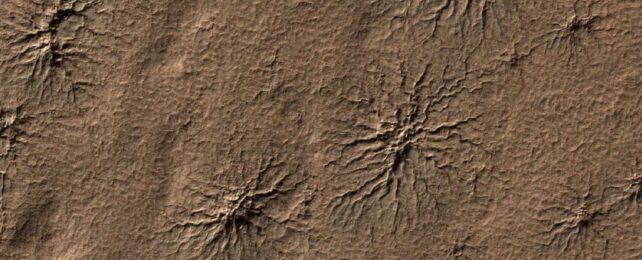
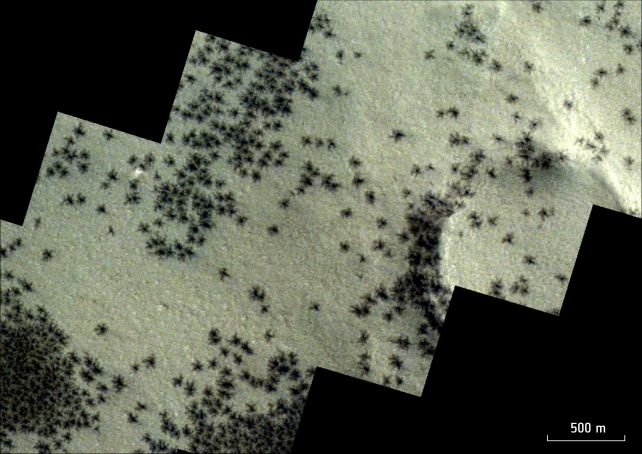
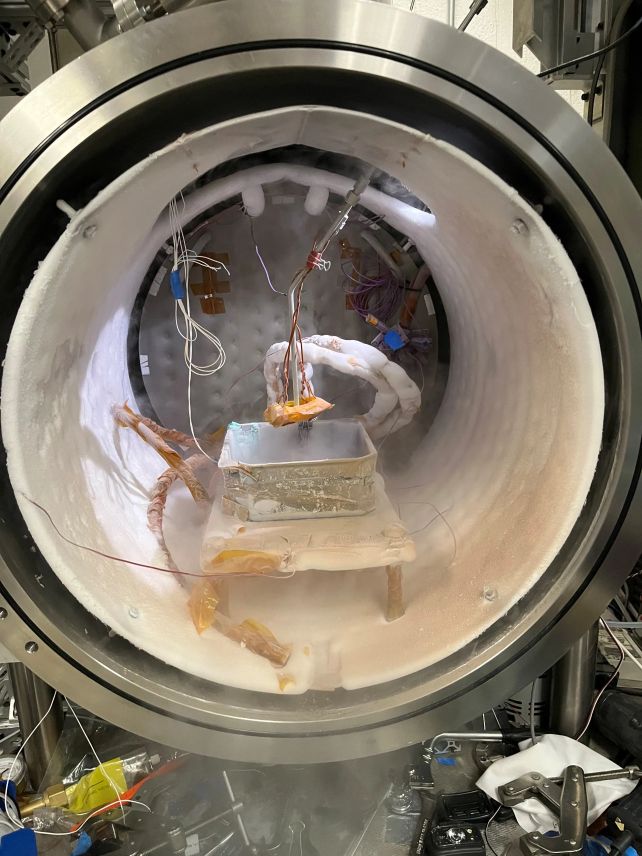
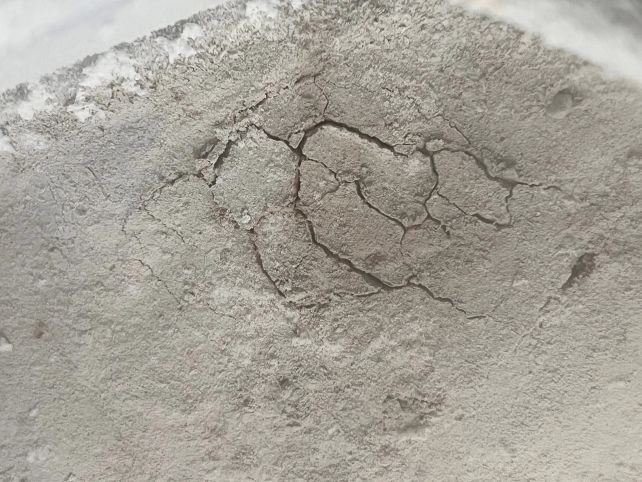
Martian ‘Spiders’ Re-Created in Lab for First Time
NASA’s Webb Reveals Distorted Galaxy Forming Cosmic Question Mark

It’s 7 billion years ago, and the universe’s heyday of star formation is beginning to slow. What might our Milky Way galaxy have looked like at that time? Astronomers using NASA’s James Webb Space Telescope have found clues in the form of a cosmic question mark, the result of a rare alignment across light-years of space.
“We know of only three or four occurrences of similar gravitational lens configurations in the observable universe, which makes this find exciting, as it demonstrates the power of Webb and suggests maybe now we will find more of these,” said astronomer Guillaume Desprez of Saint Mary’s University in Halifax, Nova Scotia, a member of the team presenting the Webb results.

While this region has been observed previously with NASA’s Hubble Space Telescope, the dusty red galaxy that forms the intriguing question-mark shape only came into view with Webb. This is a result of the wavelengths of light that Hubble detects getting trapped in cosmic dust, while longer wavelengths of infrared light are able to pass through and be detected by Webb’s instruments.
Astronomers used both telescopes to observe the galaxy cluster MACS-J0417.5-1154, which acts like a magnifying glass because the cluster is so massive it warps the fabric of space-time. This allows astronomers to see enhanced detail in much more distant galaxies behind the cluster. However, the same gravitational effects that magnify the galaxies also cause distortion, resulting in galaxies that appear smeared across the sky in arcs and even appear multiple times. These optical illusions in space are called gravitational lensing.
The red galaxy revealed by Webb, along with a spiral galaxy it is interacting with that was previously detected by Hubble, are being magnified and distorted in an unusual way, which requires a particular, rare alignment between the distant galaxies, the lens, and the observer — something astronomers call a hyperbolic umbilic gravitational lens. This accounts for the five images of the galaxy pair seen in Webb’s image, four of which trace the top of the question mark. The dot of the question mark is an unrelated galaxy that happens to be in the right place and space-time, from our perspective.

In addition to producing a case study of the Webb NIRISS (Near-Infrared Imager and Slitless Spectrograph) instrument’s ability to detect star formation locations within a galaxy billions of light-years away, the research team also couldn’t resist highlighting the question mark shape. “This is just cool looking. Amazing images like this are why I got into astronomy when I was young,” said astronomer Marcin Sawicki of Saint Mary’s University, one of the lead researchers on the team.
“Knowing when, where, and how star formation occurs within galaxies is crucial to understanding how galaxies have evolved over the history of the universe,” said astronomer Vicente Estrada-Carpenter of Saint Mary’s University, who used both Hubble’s ultraviolet and Webb’s infrared data to show where new stars are forming in the galaxies. The results show that star formation is widespread in both. The spectral data also confirmed that the newfound dusty galaxy is located at the same distance as the face-on spiral galaxy, and they are likely beginning to interact.
“Both galaxies in the Question Mark Pair show active star formation in several compact regions, likely a result of gas from the two galaxies colliding,” said Estrada-Carpenter. “However, neither galaxy’s shape appears too disrupted, so we are probably seeing the beginning of their interaction with each other.”
“These galaxies, seen billions of years ago when star formation was at its peak, are similar to the mass that the Milky Way galaxy would have been at that time. Webb is allowing us to study what the teenage years of our own galaxy would have been like,” said Sawicki.
The Webb images and spectra in this research came from the Canadian NIRISS Unbiased Cluster Survey (CANUCS). The research paper is published in the Monthly Notices of the Royal Astronomical Society.

VIDEOS
De James Webb-telescoop heeft een enorm vraagteken in de ruimte gevonden: wat betekent het?

NASA
Vergeleken met een paar decennia geleden weten we nu veel meer over het heelal en zijn samenstelling, geschiedenis en toekomst. Maar ondanks de antwoorden die zijn gevonden dankzij de voortdurende ontdekkingen van wetenschappers en de beelden van telescopen, blijven er nog veel vraagtekens bestaan. Letterlijk, soms. In feite is de ontdekking van een vraagteken in de ruimte, gefotografeerd door de James Webb Space Telescope, recent. Wat is het precies? En probeert het universum ons echt iets te vertellen? Laten we het samen ontdekken!
Als je naar de foto kijkt die door de JWST is gemaakt, lijkt het echt op een enorm vraagteken in de ruimte. Probeert het universum ook met ons te communiceren? Nou, ja en nee, want het vraagteken dat we zien is in werkelijkheid een geval van pareidolia, dat wil zeggen een illusie die ons ertoe brengt bekende objecten in willekeurige vormen te zien. En in feite bestaat het vreemde kosmische object uit drie sterrenstelsels die dit visuele effect bieden dankzij een zwaartekrachtlens.
Een zwaartekrachtlens, een effect dat al door Einstein werd voorspeld, is een verschijnsel dat optreedt wanneer het pad van licht van een object dat ver van ons vandaan is, wordt vervormd als gevolg van de vervorming van de ruimtetijd. Als licht een enorme massa passeert, buigt de ruimtetijd en dus ook het licht, waardoor gekromde sterrenstelsels, vreemde visuele effecten... en vraagtekens in de ruimte ontstaan.

NASA, ESA, CSA, STScI, V. Estrada-Carpenter (Saint Mary's University)
De foto die is gemaakt door de James Webb Space Telescope laat drie sterrenstelsels zien die in onze ogen een vraagteken in de ruimte vormen. Twee daarvan vormen de bovenkant van het bijzondere symbool: de eerste zit vol kosmisch stof en is rood van kleur, terwijl de tweede een wit spiraalvormig sterrenstelsel is. Tot slot is er de stip die wordt gevormd door een derde sterrenstelsel dat perfect is uitgelijnd met de telescoop. Jaren geleden had zelfs de Hubble dezelfde scène gefotografeerd, maar het detailniveau daarvan was veel lager dan dat van de JWST, waardoor het sommige details die we nu kunnen zien, niet kon vastleggen.
Bovendien zijn de eerste twee sterrenstelsels ongeveer 7 miljard lichtjaar van ons verwijderd, dus wat wij zien is wat er ongeveer 7 miljard jaar geleden is gebeurd. Het is heel goed mogelijk dat die twee sterrenstelsels vandaag zijn gefuseerd of al ver weg zijn, maar dat kunnen we niet weten. Nog niet, tenminste.
De ontdekking van een vraagteken in de ruimte is, afgezien van simpele humor of een subtiele metafoor, buitengewoon. Allereerst laat het opnieuw dat ongelooflijke instrument zien dat de JWST is, zelfs vergeleken met de Hubble-telescoop die ook de hemel blijft afspeuren. Ten tweede is het observeren van een zwaartekrachtlens altijd een kans voor astronomen en astrofysici, omdat het hen in staat stelt verder te kijken dan onoverkomelijke sterrenstelsels en te bestuderen wat daarachter ligt.
Kortom, deze ontdekking lijkt misschien eenvoudig en banaal: het was tenslotte gewoon een kwestie van het analyseren en inkleuren van enkele beelden verkregen op het infraroodspectrum, en het bekijken van de verschillende delen. Maar in werkelijkheid is de reikwijdte ervan veel breder: het toont opnieuw aan dat het vandaag de dag mogelijk is om het universum als nooit tevoren te zien en misschien enkele van de meest ondoorgrondelijke mysteries ervan te beantwoorden. Beginnend met de juiste vraagtekens.
Mysterious UFO Encounter: Deputy Sheriff Val Johnson’s Unforgettable Experience

On August 27, 1979, a seemingly routine night for Deputy Sheriff Val Johnson of Marshall County, Minnesota, turned into one of the most puzzling and widely discussed UFO encounters in history. What began as a standard patrol near the town of Stephen took a mysterious turn when Johnson experienced an inexplicable encounter with a bright beam of light. This incident has remained one of the most credible and well-documented UFO cases, leaving both investigators and skeptics baffled.
In the early hours of the morning, Johnson was patrolling a rural road in northern Minnesota when he noticed an unusual light shining down on the highway ahead of him. Initially, he thought it might be a plane or possibly smugglers dropping cargo, as drug trafficking was not uncommon in the area at the time. But as Johnson drove closer, the beam of light suddenly grew brighter and engulfed his vehicle, blinding him.
At that moment, Johnson lost consciousness. When he regained awareness, he found his patrol car had skidded off the road. His windshield was cracked, his car’s antenna was bent, and both the dashboard clock and his wristwatch were running 14 minutes behind. Johnson also sustained physical injuries, including eye damage resembling welder’s burns—a condition often associated with exposure to intense light.
Once Johnson called for help, local authorities quickly arrived at the scene. His injuries and the damage to his patrol car sparked an immediate investigation. The cracks on the windshield and the bent antenna were analyzed by forensic experts and engineers, but no conclusive explanation could be provided for the damage. Moreover, the fact that both his wristwatch and the car’s clock were exactly 14 minutes behind pointed to an electromagnetic anomaly, as UFOs are often linked to disruptions in electronic devices.
This time discrepancy became one of the most puzzling aspects of the case, leading some investigators to speculate that Johnson may have experienced a form of time distortion—a phenomenon sometimes reported in UFO encounters. The detailed physical evidence, combined with the deputy’s injuries, elevated this case to national attention and made it difficult to dismiss as a mere fabrication or hallucination.
Over the years, several theories have been proposed to explain what happened to Val Johnson that night. Some believe Johnson may have collided with a low-flying aircraft, despite there being no evidence of debris or other signs of such an impact. Others have suggested that he may have been struck by lightning, though no storms were reported in the area at the time.
UFO skeptics have tried to rationalize the incident as a misinterpretation of natural phenomena, but these explanations fall short due to the lack of weather anomalies and the unique nature of Johnson’s injuries and the clock discrepancies.
One of the key reasons why the Val Johnson UFO encounter has been taken so seriously is the credibility of the witness. As a deputy sheriff, Johnson was a respected figure in the community and known for his professionalism and reliability. His account of the incident remained consistent throughout the investigation, and he showed no signs of trying to gain publicity or financial benefit from the story.
Moreover, Johnson’s injuries were real and documented by medical professionals. His eyes showed symptoms consistent with exposure to a high-intensity light source, and he exhibited signs of physical trauma, including bruising and a concussion. These details make it harder to dismiss his account as a simple hallucination or misjudgment.
Despite the extensive investigation into the Val Johnson encounter, no definitive explanation has ever been found. The case remains one of the most perplexing UFO incidents, largely due to the physical evidence and the credible testimony of a law enforcement officer. While some theories have been floated, none adequately account for all the strange phenomena that occurred that night.
Today, the Val Johnson incident stands as one of the most credible and well-documented UFO encounters in history. It is a case that continues to intrigue researchers, UFO enthusiasts, and skeptics alike, as it raises profound questions about what Johnson encountered that night on the lonely rural roads of Minnesota.
The Val Johnson UFO encounter is a prime example of how some UFO sightings and experiences defy logical explanations. The combination of physical evidence, personal injuries, and a credible witness makes this case stand out in the long history of unexplained aerial phenomena. Even after decades of investigation, the encounter remains shrouded in mystery, reminding us of the complexities and unknowns that still exist in our world.
While no answers have been definitively provided, the incident continues to fuel discussions about the potential existence of extraterrestrial life and unexplained aerial encounters, making it a cornerstone in the annals of UFO research.
Ocean Explorers Discovered a Massive Underwater Mountain That's Taller Than Mt. Olympus

Courtesy of the Schmidt Ocean Institute
Summiting Greece’s towering Mount Olympus is an impressive feet for the 1-million-plus people who have accomplished the climb. But it would be even more impressive if they could do it underwater.
That’s impossible—for now. But oceanographers led by the Schmidt Ocean Institute exploring the depths of the Pacific Ocean just discovered a massive underwater mountain that at least presents the opportunity.
Regardless of climb-ability, the 3,109-meter seamount is a massive find. It’s one of many made during the oceanographers’ 28-day late-summer exploration in the research vessel Falkor (too), whimsically named for the famous luckdragon from The Neverending Story.
The team discovered the mountain along the Nazca Ridge, which is located about 900 miles west of the Chilean coast—a region that itself contains a chain of underwater mountains. But this particular peak was towering above the rest. The submerged mountain is about 200 meters taller from base to peak than Mount Olympus, and roughly four times the size of the tallest building in the world (Dubai’s Burj Khalifa), according to a press release from the institut
The Falkor (too) crew mapped the mountain and the surrounding area using a sonar system on the bottom of the vessel’s hull. “Sound waves go down and they bounce back off the surface, and we measure the time it takes to come back and get measured. From that we get a really good idea (of the seabed topography),” Jyotika Virmani, the institute’s executive director, told CNN.
The area plotted by the expedition is a drop in the ocean (pun intended), but every drop counts. Just under three-quarters of the Earth’s surface (about 71 percent) is ocean floor, but of that expanse, we’ve only mapped about 26 percent in high resolution—including this recent Nazca Ridge mission. The oceanographers also studied nine other features of the area, including a smaller, neighboring mountain’s sprawling coral garden that stretches the size of three tennis courts.
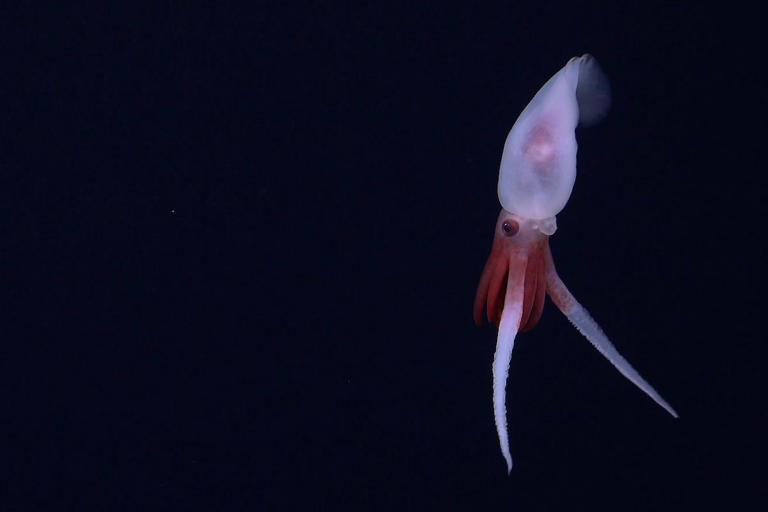
The rocky slopes on the Nazca Ridge mountains, and other mountains like them across the ocean, are perfect homes for ancient coral and sponge gardens in which some sea life can live largely undisturbed. In addition to mapping the mountains, the researchers used a robot to explore the region and made some pretty major wildlife discoveries. This includes the thePromachoteuthis squid, which is so rare that everything we previously knew about it came from the small handful of specimens that were collected as long ago as the late 1800s.
“The seamounts of the Southeastern Pacific host remarkable biological diversity,” Alex David Rogers, Science Director of Ocean Census, said in a press release from the Schmidt Ocean Institute.
The researchers also spotted a Caspar octopus—the first confirmed appearance of the cephalopod in the southern Pacific Ocean—and Bathyphysa siphonophores, which are more commonly and ridiculously known as “flying spaghetti monsters” (an apt description).
This was the institute’s third expedition of the year to that region of the ocean floor. During the previous two, researchers documented over 150 previously unknown species.
Scientists hope the results of these Nazca Ridge expeditions will help push forward policies to safeguard these areas of the natural world that—despite the fact that we don’t often see them—are no less worth protecting than what we can see.
“We’ve explored around 25 seamounts on the Nazca and Salas y Gómez Ridges,” Co-Chief Scientist and Schmidt Ocean Institute Marine Technician Tomer Ketter said in the press release. “Our findings highlight the remarkable diversity of these ecosystems, while simultaneously revealing the gaps in our understanding of how the seamount ecosystems are interconnected. We hope the data gathered from these expeditions will help inform future policies, safeguarding these pristine environments for future generations.”
VIDEOS
SpaceX Drains Air From Spacecraft While Astronauts Are InsideSpaceX's all-civilian Polaris Dawn mission has pulled off an incredible feat: the first-ever commercial spacewalk.
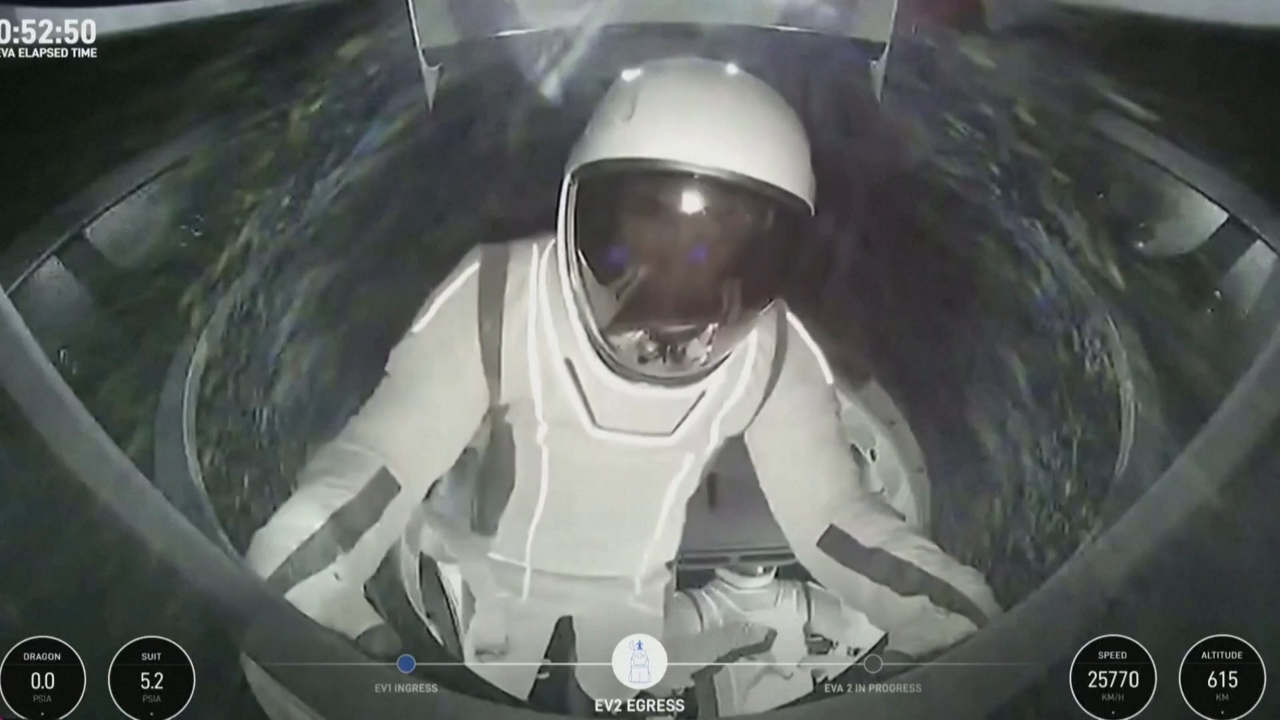
After fully depressurizing their entire spacecraft, billionaire and mission commander Jared Isaacman and crewmate Sarah Gillis carefully clambered outside their Crew Dragon capsule early Thursday morning to have a once-in-a-lifetime peek at the Earth below.
Footage shows Isaacman standing up and stretching his arms while holding onto the spacecraft's "Skywalker" platform, a pool ladder-like structure to ensure he and Gillis could keep in constant contact with the capsule.
The stunt was performed at an altitude of 458 miles, almost twice the height of the International Space Station's usual orbit.
"SpaceX, back at home we have a lot of work to do, but from here it looks like a perfect world," Isaacman told mission control while getting an unparalleled view of Australia.
Another video of the stunt shows a first-person perspective of Isaacman climbing out as SpaceX employees cheered him on at the company's headquarters. In total, Isaacman and Gillis spent roughly eight minutes outside the capsule.
Prior to venturing outside, the crew began slowly lowering the pressure inside the spacecraft to become accustomed to the thin air. Hours into their journey, the cabin pressure was lowered to 8.6 psi, which is just above the conditions at the base camp of Mount Everest. They also began to breathe pure oxygen through the connections of their spacesuits.
By the time Isaacman and Gillis ventured outside, the pressure inside their suits was a mere 5 psi, just below the summit of Mount Everest.
But even with SpaceX's newfangled extravehicular activities (EVA) suit, Isaacman and Gillis were still fully connected to their Dragon spacecraft via an umbilical, providing them with a steady supply of oxygen and thermal controls.
Isaacman and Gillis tested several mobility features of their new spacesuits, including hand and body movements, foot restraints, and the ability to hold tools during their short stints outside the spacecraft.
The mission isn't just historic as the first commercial spacewalk. Just hours into their mission, the Polaris Dawn crew reached an apogee of 869 miles — roughly three times the altitude of the space station — marking the farthest from Earth that any human has ventured since NASA's Apollo missions half a century ago.
The spacewalk is yet another major achievement for the Elon Musk-led SpaceX, setting the stage for similar missions to come.
And NASA is absolutely thrilled as well.
"Today’s success represents a giant leap forward for the commercial space industry and NASA's long-term goal to build a vibrant U.S. space economy," said NASA administrator Bill Nelson in a statement.
More on the mission:
The post SpaceX Drains Air From Spacecraft While Astronauts Are Inside appeared first on Futurism.
Japans ruimtevaartbedrijf ispace wil maanlanding herdefiniëren met Hakuto-R Missie 2Het Japanse ruimteverkenningsbedrijf ispace heeft plannen aangekondigd voor een tweede maanlandingsmissie, voorlopig gepland voor december. De “Hakuto-R Missie 2” zal bestaan uit het afleveren van een ruimtevaartuig via een SpaceX Falcon 9 raket vanuit Florida en een maanlanding proberen te maken na een ruimtevlucht van ongeveer vier tot vijf maanden.
Na de mislukte eerste poging in april 2023 als gevolg van een misrekening met de hoogte, is ispace erop gebrand om zichzelf te verlossen. Het bedrijf is gemotiveerd door het succes van Intuitive Machines, dat in februari ’s werelds eerste particuliere maanlanding realiseerde.
Ispace, opgericht in 2010, heeft ongeveer 300 mensen in dienst in Japan, de Verenigde Staten en Luxemburg. Net als andere landen onderzoekt Japan de maan op zoek naar water, brandstof en andere bronnen die het menselijk leven in de toekomst kunnen ondersteunen.
In de afgelopen jaren zijn verschillende landen, waaronder India, Japan en China, met succes op de maan geland. De Verenigde Staten plannen hun eerste maanlanding met astronauten sinds 1972 als onderdeel van het Artemis-programma, gepland voor 2026.
Scientist Reveals Two Terrifying Underwater UFO Encounters On Nuclear Submarine During Covert OperationsAn unidentified object that was traveling under the ocean at a speed greater than the speed of sound came dangerously close to a nuclear submarine. This claim was made by a researcher who was working on a classified operation aboard the USS Hampton when he made the statement. For many years, Bob McGwier worked in clandestine intelligence. He disclosed two incidents about underwater UFOs or USOs, that he saw while performing covert operations. This claim was made several months after a video had been made public by the United States military, in which it appeared to show an unidentified flying object moving from the sky into the water in the year 2019.
UFO researcher and former fighter pilot Chris Lehto heard the story from Bob McGwire, who said that the submarine passed at incredible speed while “going deep and fast” in the late 1990s. McGwire stated that this encounter was corroborated by a member of the crew who was surprised by the speed of the Unidentified Submerged Object, also known as the USO. (Source)
“We were underway and all of a sudden I hear the sound it was really strange… it was moving so fast. I just cannot believe it because this submarine is limited in the speed it can go by the incompressibility of the water in front of it and this thing blew by us like we were standing still. I’m not going to throw anybody else under the bus here but I guarantee you the following happened: a person with knowledge of onboard systems came out and said ‘oh my God’ this goddamn thing is going faster than the speed of sound underwater but that’s faster than the speed of sound in air.”
Robert G. McGwier is the founder and Technical Advisor at Hawkeye 360. He serves as Technical Director of Federated Wireless, Inc. Dr. McGwier is the Director of Research for the Ted and Karyn Hume Center for National Security and Technology, and Research Professor in the Bradley Department of Electrical and Computer Engineering at Virginia Tech. At Virginia Tech, he leads the overall execution of the Center’s research mission and leads the university’s program development efforts in national security applications of wireless and space systems. His area of expertise is in radio frequency communications and digital signal processing.

McGwire had another USO encounter that took place onboard the USS Blue Ridge (LCC-19) in 2008 while it was in a violent Typhoon. “I wanted to look outside and see what I could see and I was on the bridge so I was right up there underneath the American flag looking out the windows. When I noticed that even though we were in a typhoon and it was raining like mad there was no rain hitting the ship and I’m going what the heck and I looked out the window and looked up and I could see a glow above us in the sky. It was not very bright but I could see it and whatever it was blocking off the rain from the entire ship stem to stern.”
McGwire continued: “I believe I was on the port side and the reason I say that is because I took a peek outside and I could do that because I was Leeward in other words the winds were from behind me and the bulkhead of the ship were blocking the winds. So, I could look up easily so anyway it suddenly grew brighter and took off straight up and the rain returned.”
Similar to McGwire’s second encounter, in 1991, USS Kirk FF108 USO Encounter took place off the west coast of South America. The witness stated that at that time, he was a Chief of Operations and Intelligence serving aboard the Knox-class escort destroyer USS Kirk FF1087 and that they were part of a drug interdiction force consisting of the USS Kirk and three other Navy ships. Their main task was to patrol using a network of radars to track and then intercept drug planes flying out of Colombia, Panama and Guatemala, as well as to seize any smuggling ships that they could find. (Source)
USS Kirk (FF-1087).
Image credit: Wikimedia Commons
The witness said that his primary position was at the CIC Combat Information Center, which he and 22 other specialists maintained 24 hours a day, 7 days a week, rotating in two shifts of 11 people.
At 2 a.m. on December 16, he was on duty at CIC. The night was calm and nothing unusual happened. He said he used the break to go up to the bridge. At this time, the entire ship was in a status called “darkened ship,” when all external lights were turned off, as well as on the bridge, that is, everything around was dimly lit only by instrument panels. His friend was on deck duty that night, and they chatted when they had some free time. And suddenly, everything around was lit up in the red color:
“All of a sudden and out of nowhere, like a huge flash from a camera, emanating from the starboard bow sea level upward was a huge flash of red glowing light, which lit up our entire ship. It only lit up our ship, not the surrounding ocean, just our ship. It happened so fast, that the OOD, the navigator and I were speechless for about 5 seconds, at which time I looked at the OOD and asked him if he just saw that light. He stated yes in a sullen voice.
Read also:
I then asked the navigator and he replied yes. I then took the navigator’s sound powered headset, and asked the forward and aft look outs, if they had just seen the same red flash, to which the forward look out stated, “YES! WHAT THE HELL WAS THAT?”
After lookout said yes as well. I then immediately contacted CIC, and asked the CIC officer if we had any aircraft or surface ships in our vicinity, to which he replied clear as a whistle. I asked if we had any submarine activity in the area, to which he replied, no. At this point I looked at the OOD and asked him if we should wake up the captain or as we would call him, The Old Man. The OOD sat there stunned for a minute, as did I and everyone else.
What had just happened did not make any sense. The flash emanated from the sea, directly off of our starboard bow (like it was touching our bow), and ascended upwardly so rapidly, creating the effect of the bright red flash. The other weird aspect of this event was that only our ship was lit up within the red flash, not the surrounding sea, but our vessel only. The OOD elected not to wake the captain, and the entire incident was logged in our ship’s log as an unexplained phenomenon.
Up until this event, I did not believe in UFOss or USOss. I have no doubt that our ship, steaming along at 12 knots, came right up on a submerged unidentifiable aircraft. I don’t think the aircraft or USO had any idea we were sailing up to them. I think whatever it was, took off in a very unplanned and fast manner, and wanted to quickly identify us, thus the flash.”
In the end, after much deliberation, they decided not to wake the captain up, but simply to register it in the ship’s log as an “unexplained phenomenon.”
Many members of the United States Navy have reported fascinating sightings, and video showing UFOs entering water has even been made public. A video that was shot by the sailors of the USS Omaha in July 2019 off the coast of San Diego is one of the pieces of evidence that are being put up to support this claim. A spherical object is seen soaring over the ship and then plunging into the ocean in a video that was shared by UFO researcher and investigative director Jeremy Corbell. During this time, a member of the crew can be heard saying, “Wow, it splashed!”
The video generated considerable interest online, and when Corbell revealed that a Navy submarine had been dispatched to look for the object without success, things got even more intriguing. It is interesting to note that at around the same time, American submarines also spotted other mysterious anomalous objects that defied the laws of physics in the water nearby. The Navy has verified the authenticity of the video but claims to have no explanation for its existence.
More specifically, Luis Elizondo, a former director of the Pentagon’s Advanced Aerospace Threat Identification Program, said:
“Imagine a technology that can do 6-700 g-forces, which can fly at 13,000 miles per hour, which can evade radar and which can fly through air and water and eventually. in the space. And oh, by the way, has no obvious signs of propulsion, no wings, no control surfaces and yet can still defy the natural effects of Earth’s gravity. This is precisely what we are seeing.” (Source)
Nuclear fusion reactor in South Korea runs at 100 million degrees C for a record-breaking 48 secondsSouth Korea's "artificial sun" has set a new fusion record after superheating a plasma loop to 180 million degrees Fahrenheit (100 million degrees Celsius) for 48 seconds, scientists have announced.
The Korea Superconducting Tokamak Advanced Research (KSTAR) reactor broke the previous world record of 31 seconds, which was set by the same reactor in 2021.The breakthrough is a small but impressive step on the long road to a source of near-unlimited clean energy.
Scientists have been trying to harness the power of nuclear fusion — the process by which stars burn — for more than 70 years. By fusing hydrogen atoms to make helium under extremely high pressures and temperatures, so-called main-sequence stars convert matter into light and heat, generating enormous amounts of energy without producing greenhouse gases or long-lasting radioactive waste.
Related:
But replicating the conditions found inside the hearts of stars is no simple task. The most common design for fusion reactors — the tokamak — works by superheating plasma (one of the four states of matter, consisting of positive ions and negatively charged free electrons) and trapping it inside a donut-shaped reactor chamber with powerful magnetic fields.
Keeping the turbulent and superheated coils of plasma in place long enough for nuclear fusion to happen, however, has been a painstaking process. Soviet scientist Natan Yavlinsky designed the first tokamak in 1958, but no one has ever managed to create a reactor that is able to put out more energy than it takes in.
One of the main stumbling blocks has been how to handle a plasma that's hot enough to fuse. Fusion reactors require very high temperatures — many times hotter than the sun — because they have to operate at much lower pressures than where fusion naturally takes place inside the cores of stars. The core of the actual sun, for example, reaches temperatures of around 27 million F (15 million C) but has pressures roughly equal to 340 billion times the air pressure at sea level on Earth.

Cooking plasma to these temperatures is the relatively easy part, but finding a way to corral it so that it doesn't burn through the reactor without also ruining the fusion process is technically tricky. This is usually done either with lasers or magnetic fields.
To extend their plasma's burning time from the previous record-breaking run, the scientists tweaked aspects of their reactor's design, including replacing carbon with tungsten to improve the efficiency of the tokamak’s "divertors," which extract heat and ash from the reactor.
"Despite being the first experiment run in the environment of the new tungsten divertors, thorough hardware testing and campaign preparation enabled us to achieve results surpassing those of previous KSTAR records in a short period," Si-Woo Yoon, the director of the KSTAR Research Center, said in a statement.
KSTAR scientists are aiming to push the reactor to sustain temperatures of 180 million F for 300 seconds by 2026.
The record joins others made by competing fusion reactors around the world, including one by the U.S. government-funded National Ignition Facility (NIF), which sparked headlines after the reactor core briefly put out more energy than was put into it.
"
Bill Tompkins Was In Control Room When Neil Armstrong Met Moon ReptiliansJust two years before his death, William M. Tompkins had written “Selected by Extraterrestrials,” which induced sudden chaos in the UFO community with his incredible testimony about the US Navy’s secret development of space battle groups with the assistance of major aerospace companies beginning with Douglas Aircraft. He can be considered one of the most incredible whistleblowers to step forward and disclose the Secret Space Programs, E.T. Agendas, and hidden governments. He claimed to be part of an operation involving US Navy spies who stole UFO plans and antigravity technological secrets from the Nazis during World War II.
In July 2017, at a press conference, Tompkins made an unprecedented statement. He worked for the Douglas Aircraft Company alongside extraterrestrials (Nordic alien women). It had been 4-7 years before NASA appeared. He claimed about it in his book (mentioned above) that was published in 2015.
William Tompkins of Oceanside, CA displays one of the 307 ships in his fleet. A modeler since age 9, he started in earnest in his teens and built an entire fleet that illustrates naval history throughout America’s history.
Image Credit: Craftsmanshipmuseum.com/Tompkins
Additionally, he revealed that the Nazis had already had operational UFOs during the war, and because of the information that the US spies were able to obtain, the US later developed its fleet of UFOs – which then got siphoned off into the black military sphere under the control of Majestic 12, the ultra-secretive group that controlled and managed the UFO/alien issue in the 1940s.
During the time of World War, there were secret societies such as the Thule Society and the Vril Society. Famous British historian Nicholas Goodrick-Clark wrote a whole chapter about Maria Orsic in his book “Black Sun” published in 2001, where he connected her with Vril society.
The author mentioned that Orsic could communicate with alien civilizations and one of them was from the planet Aldebaran, which is located in the Taurus system.
According to Tompkins, the Nazis were in contact with Extraterrestrial Reptilians at the same time
According to Tompkins, Hitler allowed Orsic (and the Nordics with whom she was working) to continue to work on their UFO program because the Nazis were already in contact with the Reptilians, and because Hitler knew he could always take over Orsic’s project at any time.
Robert Wood, who was interviewed alongside William Tompkins by Search4TruthReality (source), claimed that the Nazis’ technology rapidly advanced due to their relationship with the Reptilians so that they got to the far side of the moon before the end of WW2.
William Tompkins and Dr. Robert Wood during an interview in 2016.
Dr. Wood worked in research and development management in Douglas Aircraft and McDonnell Douglas from 1956 to 1993. Later he became a Board member of MUFON. He was given $500,000 to disseminate UFO documents and $250,000 to make a UFO documentary. Later, Robert and his son Ryan scanned hundreds of MJ-12 documents and made them available on their website MajesticDocuments.com.
According to William Tompkins, he was recruited at a young age by the Navy due to his precocious ability to build highly accurate model ships. After working at North American Aviation and Northrop, he was hired by Douglas Aircraft Company in 1950.
In interviews such as with Project Camelot and in his book “Selected by Extraterrestrials,” Tompkins revealed much of his story. He explained that MJ-12 began in 1942 with the senior Douglas (the man who started the company).
Tompkins stated that right after the Battle of LA in 1942, to handle the implications of UFOs openly showing themselves in the skies, Douglas pulled some key men into a group (or think tank) that later became MJ-12.
Dr. Wood stated that MJ-12 is mostly associated with the Air Force, not other branches of the US military. He explained that the US Navy started back-engineering Nazi UFO crafts in 1942 before MJ-12 came into existence. It took the Navy around a decade to produce functional UFO craft, but they did so eventually.
Tompkins stated that when the first astronauts went to the moon, they were shocked to discover it had already been occupied by Draco Reptilians. He said that the Reptilians, over 9 feet tall, were standing next to their advanced craft.
Bill Tompkins: They were parked around the side of the crater. Okay. They were not parked on it. They were floating above it. So there were hundreds of these nine-foot reptilian guys standing with their legs. Yeah. They were all the way across underneath their vehicles, standing on the crater.
Interviewer: And what do they look like?
Bill Tompkins: They’re ugly-looking lizard, alligator-type people. They got the same skin as the lizards got. Okay. And terrible-looking faces. But then they have the ability to shift and look like a human. All of them do. Okay.
Interviewer. Do you think Von Braun was a reptilian?
Bill Tompkins: No. Your president. Yes.
Interviewer: Oh, which one?
Bill Tompkins: [George Bush senior] And Bill Clinton and this guy you just got rid. Yeah. They all were. Right. Okay. And they all have this ability to make themselves look like real good-looking people.
Interviewer: And you’re saying Trump isn’t one?
Bill Tompkins: No, he’s not. That’s a relief. And he knows more about this subject than people realize. But trying to get back to your earlier question, these groups of extraterrestrials who work together but are at war with other extraterrestrials, okay, have these vehicles that look like a planet, like our moon is a vehicle. It’s a command center for this arm. The easiest way to look at this is to put your arm out like this, and you be the center of the galaxy. (Source)
Read also:
According to both Tompkins and Dr. Wood, the Reptilians had already made a deal with the Nazis. Amazingly, Tompkins himself claimed he saw ancient structures on the far side of the moon and that he saw a floating building – 1.5 miles above the lunar surface.
According to Tompkins, many ET species are interacting with humanity currently, including Dracos/Reptilians and Nordics which have a great influence on the world.
In his Project Camelot interview, Tompkins prevented himself from disclosing more information about Reptilians as it was harmful to his credibility. Tompkins also described the US Military’s concerns about UFOs and alien beings and the Military’s rush to create advanced space-based weapons, which could be used to defend the planet Earth against an ET threat to our civilization.
He revealed US Navy has Battle Groups operating outside the Earth. He designed five spaceships and thirty support ships. Using the latest technology, he designed different spaceships for Northrop Aviation Company. Northrop started building the huge craft underground in Utah.
Tompkins claimed we are now building even better Battle Groups. The Apollo moon landings were also designed to build a base on the moon. We have had bases on the moon along with bases on Mars and Jupiter’s moons.
A month after the shocking conference, Tompkins passed away unexpectedly on August 21, 2017, in San Diego, California, at the age of 94.
NASA’s groundbreaking new solar sail finally spread its wings in spaceWhat is the Advanced Composite Solar Sail System?
If humans are ever going to become a spacefaring species then we need to figure out a few more efficient ways to traverse the cosmos. That’s why NASA’s latest futuristic solar sail tech should be raising eyebrows.
Photo Credit: Wiki Commons By NASA/Marshall Space Flight Center, Public Domain
Solar sails may seem more science fiction than reality, but just four months after a new NASA solar sail project hitched a ride into space, it spread out its sails and proved that the concept could be a viable option for space travel.
Photo Credit: Wiki Commons By Andrzej Mirecki, Own Work, CC BY-SA 3.0
It won’t be taking us to Mars anytime soon
Obviously, solar sails will not be able to take humans to other planets quite yet, but the technology could be used for a wide variety of missions in space. But how exactly does a sail work in the vacuum of space (a place with no wind)?
©Provided by Sports Unlimited News
Not like the sails back on Earth
Solar sails aren’t exactly like the sails on a boat here on Earth but the concept is quite similar according to Space.com. Just like how wind can guide a sailboat, solar energy (photons) can be harnessed to help guide vessels through space.
How does a solar sail work?
“It only takes a slight amount of sunlight to guide solar sails through space,” Space.com noted, adding that although “photons don't have mass, they can force momentum when they hit an object,” which is how solar sails can move objects in space.
Photo Credit: Wiki Commons By Scott Andrews, Public Domain
Launched into space in April 2024
On April 24th, the Advanced Composite Solar Sail System (ACS3) headed up to space with Rocket Lab's Electron vehicle, and on August 29th, the ACS3 spread its solar sails in space for the first time, and it was captured by cameras fixed to its sails.
Photo Credit: NASA
The solar sails are fully deployed
NASA published the first image from the ACS3’s sail deployment on September 5th, and it was a sight to see—even if its orientation was a bit confusing, something that NASA noted in its press release alongside the image.
Photo Credit: Wiki Commons By NASA Ames Research Center / NASA/Aero Animation/Ben Schweighart
The mission’s success is pretty awesome
“The success so far of this mission is pretty awesome because solar sail technology is an incredibly impressive concept both in practice and in theory,” reported Live Science’s Monisha Ravisetti. But now the real work has begun for NASA's ACS3 team.
Photo Credit: NASA/Aero Animation/Ben Schweighart
The ACS3 will be put to the test
NASA’s new solar sail system will be put to the test over the next few weeks according to Space.com’s Meredith Garofalo, who reported that the maneuverability of the system will be observed so that more can be learned about how to improve the system.
Photo Credit: Wiki Commons By NASA, Public Domain
Valuable information will be gathered
Raising and lowering the orbit of the Advanced Composite Solar Sail System spacecraft will provide valuable information that may help guide future concepts of operations and designs for solar sail-equipped science and exploration missions,” NASA noted.
The ACS3 spacecraft orbits the Earth at nearly double the altitude of the International Space Station according to NASA, which also pointed out its sails span roughly 860 square feet or about 80 square meters (half the size of a tennis court for reference).
Photo Credit: NASA/Bill Ingalls
Visible with the naked eye
“Now, with the sail fully extended, the Solar Sail System may be visible to some keen skywatchers on Earth who look up at the right time,” a NASA press release noted. So be sure to try and spot the spacecraft the next time you’re gazing up at the stars! It looks like a diamond according to NASA.
NASA’s groundbreaking new solar sail finally spread its wings in spaceWhat is the Advanced Composite Solar Sail System?
If humans are ever going to become a spacefaring species then we need to figure out a few more efficient ways to traverse the cosmos. That’s why NASA’s latest futuristic solar sail tech should be raising eyebrows.
Photo Credit: Wiki Commons By NASA/Marshall Space Flight Center, Public Domain
Solar sails may seem more science fiction than reality, but just four months after a new NASA solar sail project hitched a ride into space, it spread out its sails and proved that the concept could be a viable option for space travel.
Photo Credit: Wiki Commons By Andrzej Mirecki, Own Work, CC BY-SA 3.0
It won’t be taking us to Mars anytime soon
Obviously, solar sails will not be able to take humans to other planets quite yet, but the technology could be used for a wide variety of missions in space. But how exactly does a sail work in the vacuum of space (a place with no wind)?
©Provided by Sports Unlimited News
Not like the sails back on Earth
Solar sails aren’t exactly like the sails on a boat here on Earth but the concept is quite similar according to Space.com. Just like how wind can guide a sailboat, solar energy (photons) can be harnessed to help guide vessels through space.
How does a solar sail work?
“It only takes a slight amount of sunlight to guide solar sails through space,” Space.com noted, adding that although “photons don't have mass, they can force momentum when they hit an object,” which is how solar sails can move objects in space.
Photo Credit: Wiki Commons By Scott Andrews, Public Domain
Launched into space in April 2024
On April 24th, the Advanced Composite Solar Sail System (ACS3) headed up to space with Rocket Lab's Electron vehicle, and on August 29th, the ACS3 spread its solar sails in space for the first time, and it was captured by cameras fixed to its sails.
Photo Credit: NASA
The solar sails are fully deployed
NASA published the first image from the ACS3’s sail deployment on September 5th, and it was a sight to see—even if its orientation was a bit confusing, something that NASA noted in its press release alongside the image.
Photo Credit: Wiki Commons By NASA Ames Research Center / NASA/Aero Animation/Ben Schweighart
The mission’s success is pretty awesome
“The success so far of this mission is pretty awesome because solar sail technology is an incredibly impressive concept both in practice and in theory,” reported Live Science’s Monisha Ravisetti. But now the real work has begun for NASA's ACS3 team.
{
SpaceX-Polaris crew exits capsule for first private spacewalkBy Joey Roulette and Gerry Doyle
WASHINGTON (Reuters) - A crew of four aboard a SpaceX capsule embarked on the world's first private spacewalk on Thursday, as an astronaut eased out of the Crew Dragon spacecraft on a tether into the vacuum of space, hundreds of miles from Earth.
Billionaire Jared Isaacman, 41, exited first about 6:52 a.m. ET (1052 GMT). After he returned a few minutes later, SpaceX engineer Sarah Gillis, 30, was scheduled to take her turn in space, all their maneuvers streaming live on the company's website.
"Back at home we all have a lot of work to do, but from here, Earth sure looks like a perfect world," Isaacman said after emerging from the spacecraft, the planet glittering in half shadow below him.
Before the spacewalk began, the capsule was completely depressurized, with the whole crew relying on their slim, SpaceX-developed spacesuits for oxygen, provided via an umbilical connection to Crew Dragon.
The spacewalk was scheduled to last only about 30 minutes, but the procedures to prepare for it and to finish it safely last about two hours. It was meant to test the new spacesuit designs and procedures for the capsule, among other things.

A still image from the video of the SpaceX Polaris Dawn mission shows crew member Jared Isaacman outside the capsule during the first-ever private spacewalk on September 12, 2024.
© Polaris Program, AFP
Isaacman, Gillis, Scott Poteet, 50, a retired U.S. Air Force lieutenant colonel, and SpaceX engineer Anna Menon, 38, had been orbiting Earth aboard Crew Dragon since Tuesday's pre-dawn launch from Florida of the Polaris Dawn mission. Menon and Poteet remained inside the spacecraft during the spacewalk.
It is the Elon Musk-led company's latest and riskiest bid to push the boundaries of commercial spaceflight.
Isaacman, a pilot and the billionaire founder of electronic payments company Shift4, is bankrolling the Polaris mission, as he did his Inspiration4 flight with SpaceX in 2021.
He has declined to say how much he is paying, but the missions are likely to cost hundreds of millions of dollars, based on Crew Dragon's price of roughly $55 million a seat for other flights.
FARTHEST SINCE APOLLO
Throughout Wednesday, the craft circled Earth at least six times in an oval orbit as shallow as 190 km (118 miles) and stretching out as far as 1,400 km (870 miles), the farthest in space that humans have traveled since the last U.S. Apollo mission in 1972.
The gumdrop-shaped spacecraft then began to lower its orbit into a peak 700-km (435-mile) position and adjust cabin pressure to ready for the spacewalk, formally called Extravehicular Activity (EVA), the Polaris program said on social media on Wednesday.
"The crew also spent a few hours demonstrating the suit’s pressurized mobility, verifying positions and accessibility in microgravity along with preparing the cabin for the EVA," it said.
Only government astronauts with several years of training have done spacewalks in the past.
There have been roughly 270 on the International Space Station (ISS) since it was set up in 2000, and 16 by Chinese astronauts on Beijing's Tiangong space station.
The Polaris crew has spent 2-1/2 years training with SpaceX mission simulations and "experiential learning" in challenging, uncomfortable environments, said Poteet.
A record 19 astronauts are now in orbit, after Russia's Soyuz MS-26 mission ferried two cosmonauts and a U.S. astronaut to the International Space Station on Wednesday, taking its headcount to 12.
Three Chinese astronauts are aboard the Tiangong space station.
The first U.S. spacewalk in 1965, aboard a Gemini capsule, used a similar procedure to the one planned for Polaris Dawn: the capsule was depressurized, the hatch opened, and a spacesuited astronaut ventured outside on a tether.
Since 2001, Crew Dragon, the only U.S. vehicle capable of reliably putting humans in orbit and returning them to Earth, has flown more than a dozen astronaut missions, mainly for NASA.
The agency seeded development of the capsule under a program meant to establish commercial, privately-built U.S. vehicles capable of ferrying astronauts with the ISS.
Also developed under that program was Boeing's Starliner capsule, but it is farther behind.
Starliner launched its first astronauts to the ISS in June in a troubled test mission that ended this month with the capsule returning empty, leaving its crew on the space station for a Crew Dragon capsule to fetch next year.
"Spacewalk is now complete": Eerste ruimtewandeling ooit door niet-professionele astronauten succesvol afgerond

De eerste ruimtewandeling door 2 niet-professionele astronauten is succesvol afgerond. Zowel Jared Isaacman als Sarah Gillis verlieten het ruimteschip langs een luik en waren ongeveer 10 minuten in de ruimte. Ze deden dat in compleet nieuwe ruimtepakken, die nog nooit in de ruimte getest waren. Bij SpaceX kunnen ze nu gerust ademhalen, want dit was het gevaarlijkste en spannendste moment van de Polaris Dawn-missie, die dinsdag werd gelanceerd.
Voor de eerste keer ooit hebben 2 "gewone" mensen een ruimtewandeling kunnen maken. Ze deden dat door op zo'n 700 kilometer boven de aarde hun ruimteschip te verlaten, terwijl ze met 26.000 kilometer per uur door de ruimte vlogen. Het risicovolle onderdeel van de ruimtemissie verliep zoals gepland.
De Amerikaanse zakenman en miljardair Jared Isaacman was als gezagvoerder (en geldschieter) de eerste die het ruimteschip verliet. Daarna maakte ook de 30-jarige Amerikaanse ingenieur Sarah Gillis een ruimtewandeling.
Bekijk: "Het was een groot risico, maar het is belangrijk dat de pakken getest werden", ruimtevaartjournalist Wim De Maeseneer
Isaacman en Gillis gingen elk om de beurt ongeveer 10 minuten naar buiten. Met het openen en opnieuw sluiten van het luik en het regelen van de luchtdruk in de capsule nam alles in totaal zo'n 2 uur in beslag.
Gillis staat bij SpaceX aan het hoofd van het trainingsprogramma voor de astronauten. Zelf ging ze nog nooit de ruimte in, net als de 2 andere astronauten Scott Poteet en Anna Menon. Enkel Isaacman maakte in 2021 al eens een ruimtevlucht.
Anders dan bij de ruimtewandelingen door professionele astronauten, zweefden de astronauten niet echt door de ruimte. Ze bleven de hele tijd fysiek contact houden met het ruimteschip en gingen niet verder dan net buiten het luik. Ze bleven ook de hele tijd verbonden via een kabel die hen onder meer voorzag van zuurstof. Toch zijn ruimtewandelingen, ook onder die omstandigheden, uiterst gevaarlijk.
Wat deze ruimtewandeling extra risicovol maakte, is dat de gloednieuwe ruimtepakken die de astronauten droegen nog nooit getest waren in de ruimte. Het ruimteschip heeft ook geen luchtsluis, waardoor het hele ruimteschip werd blootgesteld aan het vacuüm van de ruimte. Ook de 2 astronauten die binnen bleven zitten en de wandeling begeleidden, liepen dus risico.
"Ik ga met een bang hartje kijken, ik ben er niet gerust op", vertelde ruimtevaartexpert Nancy Vermeulen op voorhand. "Het is de eerste keer dat niet-professionele, onervaren astronauten een ruimtewandeling doen. Er kan echt van alles misgaan."
"Het zijn eigenlijk 4 beginners", zei de Nederlandse astronaut André Kuipers in de podcast 'Space Cowboys'. "Ze gaan allemaal nieuwe dingen tegelijk doen. Dat is absoluut niet zonder gevaar. Normaal wordt een ruimtewandeling ook nooit zo vroeg in een ruimtevlucht gedaan, omdat je de eerste dagen ruimteziek kan worden."
Grensverleggende ruimtevlucht
De ruimtewandeling maakt deel uit van de Polaris Dawn-missie: een commerciële ruimtevlucht van SpaceX, het ruimtebedrijf van Elon Musk. De 4 zitjes aan boord zijn gekocht door de Amerikaanse zakenman en miljardair Jared Isaacman. Samen met 3 andere ruimtevaarders vliegt hij sinds dinsdag rond de aarde in een Dragon-capsule van SpaceX.
Polaris Dawn vloog op de 2e dag van de missie tot op 1.400 kilometer hoog. Het was al van de laatste maanvlucht in 1972 geleden dat een bemande ruimtemissie zo ver weg van de aarde reisde. Het was ook de eerste keer dat vrouwelijke astronauten zo ver in de ruimte zijn geweest.
De pakken zijn ontworpen door SpaceX, het ruimtebedrijf van de Amerikaanse zakenman Elon Musk. Zijn uiteindelijke doel is om de mensheid ooit op Mars te laten wonen. Om daar ooit te geraken, zijn er eerst nog vele ruimtereizen nodig, ter voorbereiding. En dus ook veel ruimtepakken.
De ruimtewandeling van Polaris Dawn dient vooral als eerste test voor de nieuwe pakken: zijn de pakken soepel genoeg en werkt alle apparatuur binnenin zoals het hoort? Daarnaast is het ook belangrijk om te bekijken of de pakken genoeg beschermen tegen de kosmische straling en extreme temperaturen.
"Het idee is om zoveel mogelijk over het pak te leren als we kunnen en dit terug te geven aan de ingenieurs zodat ze het pak in de toekomst verder kunnen ontwerpen", zei Isaacman eerder in een interview.
Wie zijn de astronauten aan boord van Polaris Dawn-missie?
De eerste ruimtewandeling ooit was door de Russische kosmonaut Aleksej Leonov op 18 maart 1965. En bijna ging het mis. Leonov raakte met moeite terug in zijn ruimteschip. Zijn pak was in het vacuüm van de ruimte helemaal opgeblazen waardoor hij bijna niet meer kon bewegen. Door wat lucht uit zijn pak te laten lopen, kon hij uiteindelijk terug naar binnen. Hij nam daardoor wel een groot risico.
Minder dan 3 maanden later volgde de Amerikaanse astronaut Edward White. Sindsdien maakten al zo'n 260 astronauten uit 12 landen een ruimtewandeling. De eerste ruimtewandeling door een vrouw gebeurde pas in 1984. In totaal hebben nog maar 16 vrouwen een ruimtewandeling gemaakt.
Megatsunami van 200 meter hoog blijkt oorzaak van dagenlange wereldwijde aardtrillingen, ontdekken Belgische onderzoekers

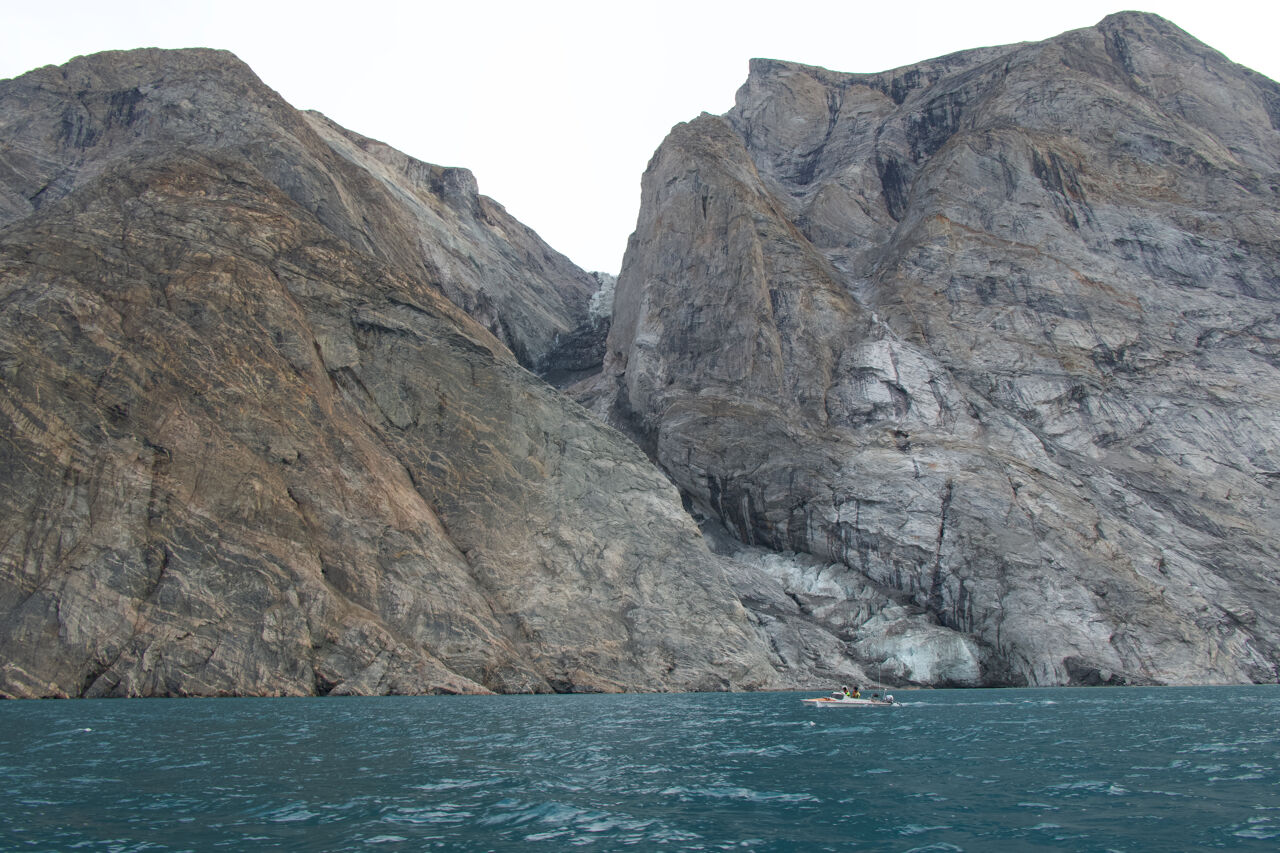
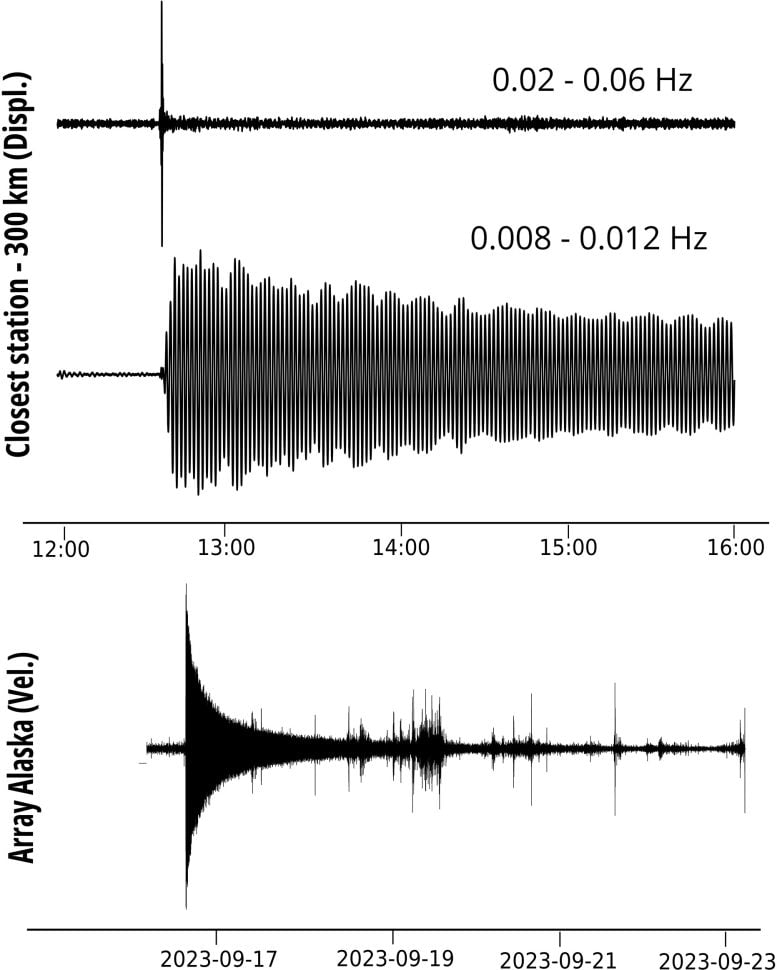
Belgische wetenschappers hebben de oorzaak ontdekt van mysterieuze trillingen in de aarde, die vorig jaar 9 dagen lang en wereldwijd meetbaar waren. De oorzaak bleek een megatsunami van 200 meter hoog, die heen en weer bleef klotsen in een fjord in Groenland. Een bergtop en gletsjer waren neergestort in het water.
Het is 16 september 2023 wanneer seismologen van over de hele wereld plots een mysterieus signaal zien op hun uiterst gevoelige meettoestellen. Het signaal lijkt tot hun verbazing helemaal niet op een aardbeving en houdt maar liefst 9 dagen aan.
De trillingen gaan de wereld rond en worden gedetecteerd in Engeland, de Verenigde Staten, Japan, West-Australië en van de Noord- tot de Zuidpool. En dus ook in België.
"We hebben een oproep gedaan aan seismologen over de hele wereld en kregen al snel de reactie dat ook zij allemaal hetzelfde signaal hadden gedetecteerd", zegt seismoloog Koen Van Noten van de Koninklijke Sterrenwacht van België. "We hebben dan kunnen achterhalen dat de trillingen waarschijnlijk uit Oost-Groenland afkomstig waren, maar we hadden geen flauw idee wat de oorzaak kon zijn."
Op hetzelfde moment krijgen onderzoekers van het Vlaams Instituut voor de Zee (VLIZ) bericht dat er een grote tsunami is waargenomen vlak bij een van hun meetstations waar ze onderzoek doen naar de klimaatverandering.
"Onze metingen en berekeningen bevestigden dat er inderdaad een grote tsunami moet zijn geweest", zegt onderzoeker Wieter Boone van het VLIZ. "We zijn dan meteen op satellietbeelden gaan zoeken wat en waar er iets gebeurd zou kunnen zijn."

On 16 September 2023, a massive landslide in Greenland triggered a megatsunami, creating a standing wave that oscillated in Dickson Fjord for over a week, observed worldwide through seismic stations. This unusual long-duration signal from the standing wave offers new insights into megatsunami dynamics, with implications for understanding climate change impacts on glacier retreat and landslide frequency.
(Artist’s concept).
Op die beelden, en op foto's die enkele dagen later door het Deense leger zijn gemaakt, was duidelijk te zien dat een van de hoge bergtoppen langs de Dicksonfjord volledig was ingestort. "Door die massa rotsen en de grote snelheid waarmee ze naar beneden zijn gekomen, is ook de gletsjer eronder afgebroken en in de fjord terechtgekomen", zegt Boone.
"In totaal moet zo'n 25 miljoen kubieke meter rotsen en ijs in de smalle kloof zijn gevallen. Dat komt overeen met de inhoud van 10.000 Olympische zwembaden of 27 van de grootste containerschepen."
"Dat heeft een tsunami veroorzaakt tot wel 200 meter hoog. En omdat de fjord een bocht van bijna 90 graden heeft, zat de golf gevangen en is het water heen en weer blijven klotsen, zoals in een bad, 9 dagen lang. De trillingen die dat heeft veroorzaakt zijn de wereld rondgegaan."
Volgens de onderzoekers gaan er door de klimaatopwarming nog meer grote landverschuivingen voorkomen. "Typisch in Noordoost-Groenland is dat er steile bergen en hoge gletsjer zijn, die aan elkaar zijn gevroren tot een geheel. Maar door de klimaatopwarming smelten ze van elkaar los en worden ze instabiel. Daardoor zien we nu al meer landverschuivingen in die regio", zegt Boone.
Gelukkig waren er die dag geen schepen in de buurt. Anders waren de gevolgen van de enorme tsunami niet te overzien geweest
"Onze instrumenten hebben de tsunami gelukkig overleefd. Maar 72 kilometer verder, op Ella Island, hadden ze minder geluk. Daar is wel een onderzoeksbasis vernield, door de deining van de tsunami die nog steeds 4 meter hoge golven veroorzaakte."
De Diksonfjord is ook populair bij toeristen die de Groenlandse fjorden per cruiseschip bezoeken. "Gelukkig waren er die dag geen schepen in de buurt. Anders waren de gevolgen van de enorme tsunami niet te overzien geweest", zeggen de onderzoekers. "Het zal belangrijk zijn om deze gebieden goed te monitoren."

Depending on the frequency range filtered out, the rockfall triggering the tsunami can be seen as a single peak (top), the standing wave sloshing back and forth as an undulating pattern in the recordings (middle, with several hours depicted) or the overall signal of the rockfall and the tsunami over the course of a week with strongly decreasing intensity of the oscillations (bottom).
Credit: Angela Carillo Ponce et al.
What Did We Learn From Manufacturing the ACS3 Solar Sail Mission?

We recently reported on the successful deployment of the solar sail of the Advanced Composite Solar Sail System (ACS3) technology demonstration mission. That huge achievement advances one of the most important technologies available to CubeSats – a different form of propulsion. But getting there wasn’t easy, and back in May, a team of engineers from NASA’s Langley Research Center who worked on ACS3 published a paper detailing the trials and tribulations they went through to prepare the mission for prime time. Let’s take a look at what they learned.
ACS3 was only a technology demonstration mission—it had no science payload to deal with. And that’s a good thing, too, because fitting the solar sail into the housing of a CubeSat was a challenge even without any scientific equipment.
The technology demonstrated was the deployable boom system that created an 81 square meter surface of solar sail to catch the photon particles used to propel the mission forward. That sounds much easier than it was, as is evident from the descriptions of the problems the team had to overcome.
Fraser describes how useful solar sails are.Eventually, the mission launched in a 12U CubeSat configuration, weighing about 16 kg (36 lbs) in total mass. However, the mission was initially prototyped to fit into a 6U configuration—about half the size and weight of the 12U. With the amount of deployable material and the necessary motors to drive their deployment, the engineers couldn’t fit other essential components, like reaction wheels, to steady the CubeSat’s orientation.
However, the 12U design “came with several technical challenges,” according to the paper. One was whether to use four independent spools of material, each tied to an independent boom or one central hub spool with all four booms coiled around a central axis. As was the case with almost all engineering projects, the team’s decision wasn’t based on what was technically best. They decided to use the four independent spools since that required the least modification from the original 6U design.
Another lesson described in the paper was the timing of the launch coordination. Both the “dispenser” (i.e., the system that sends the CubeSats out into space after a successful launch) and the launch contract weren’t submitted until ACS3 was already in testing. By then, modifications had been made to the design, which made it difficult to integrate into an existing dispenser, as the team had modified the edges of the satellite to fit the sails better. But doing so messed up one of the critical touchpoints for standard CubeSat dispensers.
Here’s Fraser’s overview of what a solar sail is.To make matters worse, without a known launch date and inclination, the team had to overengineer many of the CubeSat systems. They had to meet a much wider range of temperatures and shock/vibration environments. But when they finally got their launch date of April 23rd on an Electron rocket from New Zealand, the system had been engineered for an environment much harsher than what it was subjected to, causing increased cost and delays in the delivery.
To meet these challenges, the team took the approach of rapidly prototyping, including developing several different 3D-printed prototypes before finally making the full system out of metal. At one point, a management decision was made not to replace any insert fasteners that were never intended to be used on the final flight but ended up being included anyway because of the cost of replacing them.
Again, these kinds of management decisions are commonplace to anyone involved in an engineering project. However, it’s nice to see that, in this case, it didn’t affect the project’s overall success. Despite some indications that it might be either tumbling or wobbling, ACS3 undoubtedly achieved its primary objective of deploying its solar sail. So, after all the effort and compromises that the team at Langley and elsewhere at NASA put into it, now you just need to look up into the night sky, and you might see the fruits of their labor streaking across it.
Learn More:
Lead Image: