 32 things on Mars that look like they shouldn't be there - PART II
17. A "giant's fingerprint"

A long time ago, something slammed into the surface of Mars and left this enormous, ridged, thumbprint-like depression behind. A giant finger was not the culprit, of course. Located inside a much larger crater called Airy-0, this Martian hole is the result of an ancient meteor impact. The bright striations forming the "lines" of the fingerprint are a common sight across Mars. Known as transverse aeolian ridges, they are created when sand dunes get coated in a thin layer of dust. The dust likely contains reflective minerals, giving the depression its glowing appearance in this image.
18. A rock with an, er … crack

(Image credit: NASA/JPL-Caltech/ASU)
Try not to laugh at this rock snapped by NASA's Perseverance rover in 2021. The cracked boulder became the butt of more than a few jokes after its close-up was first released to the public. There's really not much to see, though — the Red Planet is full of cracked rocks, albeit not quite as plump as this one. Perseverance spotted this rock in dusty Jezero Crater, on its 102nd day on Mars.
19. An "angel" and a heart

When it's summertime on Mars, the angels come out to play. The Martian south pole is usually covered in an enormous ice cap, but when the ice melts in warmer weather, patterns in the ancient, red-hued sediment below come to light. This image, snapped by ESA's Mars Express spacecraft, shows an angel-like pattern next to a heart-shaped one. Both of these familiar-looking structures are the result of meteor impact craters that scraped away Mars' dusty topsoil to reveal the darker sediment below.
20. A weirdly green rock with "drill holes"

Did a bored Martian teenager get a hold of his parents' power tools again? That is one (unlikely) explanation for a strange, green rock seemingly pumped full of drill holes that was spotted by NASA's Perseverance rover early in its mission. The roughly 6-inch (15 cm) rock looks out of place in its environment, and scientists aren't totally sure how to explain it. Perhaps it is the remnant of a meteor that collided with the Red Planet, or maybe it is a piece of Martian bedrock that was flung far across the world during an impact event. Most of the holes are also a mystery — but, if you look just right of center, you may see a small train of tiny, uniform pockmarks left by Perseverance's laser, which it fired at the rock while trying to analyze its composition.
21. A small "foreign object"

A small, rectangular object spotted in Mars' Gale Crater in 2018 briefly gave NASA scientists a scare. Looking vaguely like a dusty sheet of metal, the object was potentially thought to be a chunk of the Curiosity rover that had inexplicably fallen off. Luckily, a quick analysis showed that the "foreign object," as NASA initially dubbed it, was just a flake of rock that had split off of a larger formation and wasn't foreign to Gale Crater at all.
22. A strange, white tower

Towering over the Martian horizon in an image captured by NASA's Perseverance rover in 2023, a tall, white column stands against the dark, rocky background. It is, in fact, a Martian dust devil. And it's an enormous one: The dusty vortex captured here is taller than an average tornado on Earth and five times taller than the Empire State Building, according to NASA. Formed when rising cells of warm air meet falling columns of cool air, dust devils are exceedingly common on Mars — perhaps numbering as many as 145 million per day, one 2018 study estimated.
23. A "scar" longer than the Grand Canyon

Gaping like a fresh wound in this image captured by ESA's Mars Express orbiter in 2024, the Martian feature known as Aganippe Fossa is a sight to behold. The deep, dark ravine stretches around 375 miles (600 km) long — longer than the Grand Canyon, which measures about 277 miles (446 km) long. Located near the base of an extinct volcano, the Martian canyon likely formed as the result of ancient volcanic activity — possibly when a large pool of magma beneath the volcano pushed violently upward, tearing the ground asunder, according to ESA.
24. "Rock candy," or ultra-rare crystals?

These strangely colored crystals on Mars were discovered by pure accident. In May 2024, NASA's Curiosity rover drove over a small rock in its path, unintentionally crushing it. Buried within the stone tomb was a cache of rare minerals, including some never seen before on the Red Planet. The yellowish crystals are made of pure elemental sulfur. Scientists had long expected that this material existed on Mars but had no proof until Curiosity's bout of destructive driving.
25. A "bullet" hole
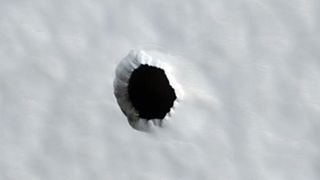
What looks like a hole blasted into the Martian landscape by a stray bullet may be something much more exciting — a possible refuge for future astronauts. The hole, which measures a few meters across, was imaged by NASA's Mars Reconnaissance Orbiter in 2022 on the flank of a massive volcano called Arsia Mons. The pit is located along a lava flow and appears to be a vertical shaft that could potentially connect to a deep system of caverns below the volcano. Although the hole's depth is unknown, it may be a tempting refuge for future astronauts who need a place to shield themselves from the intense radiation that beams down on the Red Planet.
26. An underground "dog"

Strange structures don't appear only on Mars' surface but underground as well. In September 2024, researchers combined data from several Mars-orbiting spacecraft to create a planet-wide map of gravitational anomalies — places where the pull of gravity is stronger than average, suggesting the presence of massive, dense structures located under the planet's surface. Most of these dense blobs are amorphous, but one caught the researchers' attention: a strange, dog-shaped structure, with a dark tail and ears, located near the Martian north pole. It's unclear how the dense, doggy structure formed, but it could be related to a past meteor impact or a pile-up of volcanic material.
27. Debris from outer space?

Nestled among the dusty, red rocks of Gale Crater, a jagged, gray object instantly caught the attention of scientists operating NASA's Curiosity rover. The shrapnel-like rock looks out of place because it almost certainly is — according to researchers, the pointy boulder is probably the remnant of a meteorite that crash-landed on Mars' surface ages ago. Dubbed Ames Knob and measuring about 4 inches wide by 5.5 inches long (10 by 14 cm), this meteorite isn't just space trash; according to NASA researchers, studying the rock could help reveal the past conditions on the planet when the meteorite fell, including whether it landed on land or in now-vanished water.
28. Debris … from Earth?

In 2022, NASA spotted what looked like the wreck of an "alien" spacecraft on Mars. In this case, the "aliens" were, in fact, Earthlings; the wreckage seen by NASA's Ingenuity Mars helicopter was a piece of the helicopter's own parachute and backshell, a saucer-like cover that helped slow the robotic craft's descent as it dropped onto the Red Planet along with the larger Perseverance rover. This piece of wrecked human technology, photographed by Ingenuity while it was flying 26 feet (8 m) above the Martian surface, looks particularly alien amid the desolate rocks and dust of the surrounding landscape.
29. An alien "egg"?

From certain angles, this pockmarked rock looks like an oozing, green egg belonging to some unknown alien monster. But a quick analysis from NASA's Curiosity rover revealed that the odd boulder — dubbed Egg Rock — is actually a fragment of a meteorite that landed on the Red Planet at some unknown time in the past. Studying Martian meteorites like this one can reveal valuable clues about the planet's past but is unlikely to lead back to any extraterrestrial monster nests.
30. Swirling patterns

Strange patterns carved into the surface of Mars' Nili Fossae region aren't alien sand art or the Martian version of Peru's Nazca Lines. They are, in fact, mineral deposits containing large quantities of olivine, a mineral typically only found deep below the surface of Mars. How did so much olivine-rich rock reach the planet's surface? That question presents a tempting mystery for scientists. It could be that a huge asteroid impact excavated the Martian interior, bringing olivine to the surface in swirling splatters — or perhaps the subsurface mineral saw daylight following a massive volcanic eruption. Its precise origin remains a mystery to this day.
31. An alien monolith?

When amateur stargazers were looking through images from NASA's Mars Reconnaissance Orbiter, they spotted something strange in the satellite's data: a bizarrely rectangular object reminiscent of the alien monolith from the opening scene of "2001: A Space Odyssey." The perplexing feature is indeed monolithic in shape and size, according to mission scientists. However, it is likely nothing more than a big, perfectly rectangular rock.
32. A crawling robot

Spotted from miles above by NASA's Mars Reconnaissance Orbiter, a crawling metallic robot glints on the Martian surface far below. This is a rare case where the mystery object is exactly what it looks like; that robot is NASA's Curiosity rover, making its way up Mount Sharp several years into its mission to explore the Red Planet. Concrete evidence that Mars ever held life is still lacking — but at least we can say Mars is the only known planet in the universe inhabited exclusively by robots.
RELATED VIDEOS