 New Jersey drones are BACK as interactive map shows activity ramping up... after Trump promised to release truth




As one of Earth's closest neighbors in space, Mars has long captivated humans with the prospect of alien life located just a short rocket trip away. No such life has been found. But now, as NASA and other space agencies have begun to explore the skies and surface of the Red Planet using robotic technology, images of strange features and formations continue to inflame skywatchers' hopes, fears and curiosities.
Here are some of our favorite objects on Mars that look like they don't belong on a dead and dusty planet. Many of these are a result of pareidolia — the tendency for humans to seek familiar patterns and shapes in inanimate objects. However, some of them may even lead scientists to the long-sought evidence of past Martian life.
1. An open "travel book"

Perhaps weary from hunting for evidence of ancient water, NASA's Curiosity rover took a short break in April 2023 to leaf through the pages of an old Martian hardback lying in the dust of Gediz Vallis. While the strange object may look like a book with a single page frozen mid-turn, it is in fact just a rock — and a small one at that. The charming little book-rock measures just 1 inch (2.5 centimeters) wide, according to NASA. Hey, at least it's travel-size!
Related:

In an image shared in January 2023 by the University of Arizona (UA), what appears to be the face of an enormous Martian teddy bear — complete with two beady eyes, a button nose and an upturned mouth — grins at the camera of NASA's Mars Reconnaissance Orbiter. According to UA, the cuddly-wuddly formation is likely just a broken-up hill in the center of an ancient crater. But as far as we're concerned, it's the cutest pile of rubble in the known universe.
3. Frozen "mineral flowers"
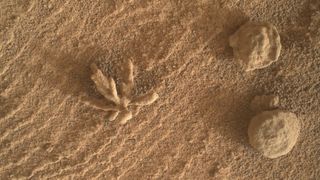
Branching outward like a tiny coral, this delicate mineral flower is about the closest thing to greenery one can find on the Red Planet today. Mineral deposits like these are common sights across Mars and result from ancient water mixing with ancient rock. Still, it's rare to see a deposit that's so perfectly flower-like, NASA researchers said. You'll notice two slightly less impressive, circular rocks of the same type to the right of the coral. Curiosity spotted this floral feature in February 2022.
4. A mysterious "doorway"

Is this perfectly hewn "doorway" into a Martian cliffside evidence of intelligent alien life on the Red Planet — or perhaps signs of a secret society of human astronauts camped out in clandestine Mars bunkers? Sadly (for conspiracy theorists), the truth is far simpler: It's just an eroded rock formation caught at the perfect angle. The image was captured by NASA's Curiosity rover in 2022.
5. Fossilized "animal tracks"

Did alien creatures once skitter across the surface of Mars, leaving fossilized tracks embedded in the rocks? One researcher made this controversial claim in 2018, pointing to images of stick-like structures, each about the size of a grain of rice, crisscrossing a Martian rock. NASA researchers quickly debunked the claims, noting that similar features are plentiful on Earth in areas where salts become concentrated in water, such as evaporating lakes. Their presence on Mars is yet more evidence of past rivers and lakes on the Red Planet, but they offer no proof that living creatures ever adorned its surface.
6. A bushel of "blueberries"

Blueberries are not a significant source of iron when consumed on Earth — but these geological "blueberries" discovered by NASA's Opportunity rover on Mars in 2004 are built differently. The iron-rich spheres, polished smooth by plentiful amounts of water billions of years ago, are some of the earliest evidence scientists have of Mars once being an incredibly wet world. Whether they also taste good on cheesecake is a question for future generations to grapple with.
7. Thousands of black "spiders on Mars"
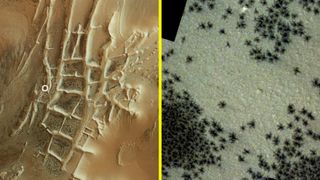
Every spring, thousands of squiggly black "spiders" emerge from their hibernation near the Martian south pole. No, they are not real spiders — they are not alive at all, of course. The seasonal phenomenon is a result of buried carbon dioxide ice sublimating, or turning to gas, as the weather warms. The newly released gas bursts through layers of surface ice, carrying with it dark dust that splatters across the ground in craggy patterns. To be visible from space, as these formations are, the "spiders" must be fairly big — each one measuring 150 to 3,300 feet (45 meters to 1 kilometer) across, according to the European Space Agency (ESA). Please, nobody tell Ziggy Stardust the bad news.
8. Ruins of an "Inca City"

Near the Martian south pole are curious structures that look like the ruins of a vast and ancient city. Dubbed the "Inca City" for its resemblance to actual ruins discovered in South America, the bizarre rock formation may be made of elevated sand dunes that turned to stone over time, according to ESA. However, its exact origins remain a mystery. The labyrinthine formation appears to curve, forming part of a giant circle 53 miles (86 km) in diameter, leading scientists to suspect it may be part of a much larger impact crater from a meteor strike ages ago.
9. An ancient smiley face

Did someone spray-paint a grinning face onto the Martian surface? Not quite, despite what it looks like in this infrared image snapped by ESA's ExoMars Trace Gas Orbiter. Visible only under certain conditions, the face seen here is actually the remnants of an ancient lake, outlined by chloride salt deposits and dotted with two meteor crater eyes. While no Martian graffiti artists are going to pop up from the lake to claim their work, the face-like structure could contain evidence of ancient life on the Red Planet. As Mars' once-plentiful lakes dried up, the remaining water sources likely became very salty, possibly offering a haven for microbial life.
10. An extremely out-of-place rock
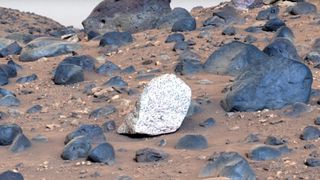
One of these things is not like the other. Standing out like a sore Martian thumb inside dusty Jezero Crater, this unusually white rock is the first of its kind ever seen on the Red Planet. Dubbed "Atoko Point" after a similarly light-colored feature of the Grand Canyon, the speckled rock is likely made of the minerals pyroxene and feldspar, according to an analysis by NASA's Perseverance rover. How did such a white rock find itself in such dark-hued company? It likely tumbled down from the crater rim or was transported to the crater floor from elsewhere on Mars back when rivers raged across the region.
11. A stony "Star Trek" symbol

Looks like someone from Starfleet left their communicator badge on the Red Planet — or so it would appear from the familiar shape of this rock spotted by the Curiosity rover. The rock's delta shape is just a coincidence, according to NASA. It is one of thousands located on Mount Sharp, which Curiosity has been exploring for years in its search to uncover clues about Mars' past and whether it ever held the conditions for life.
12. A "tile floor"

While scaling the slopes of Mount Sharp in 2021, NASA's Curiosity rover found remnants of what looks like a tile floor from a Martian bathroom. Dozens of interlocked polygons cracked through the dirt; most contain five or six sides and date to between 3.8 billion and 3.6 billion years ago. These jagged polygons are mud cracks, which have repeatedly dried out and moistened again over the course of untold years. They likely date to a time when the water level in the surrounding Gale Crater rose and fell repeatedly, causing the polygonal cracks in the ground to appear and disappear over time before a final dry spell left them as they are today.
13. Perfectly circular sand dunes

Mars is covered in dunes of all shapes and sizes, but few of them are as perfectly circular as the group spotted above by NASA's Mars Reconnaissance Orbiter in 2022. Snapped while flying over Mars' northern hemisphere, the image shows a bubbling patchwork of dark and strangely round dunes, slanting southward in the direction where the Martian wind likely blew them. Scientists are still not certain why these particular dunes are so circular or why they appear to be slowly migrating away from Mars' equator at a rate of roughly 3.3 feet (1 m) per Martian year (687 days on Earth).
14. A "shark fin" and a "crab claw"

While trawling through Jezero Crater, NASA's Perseverance rover caught sight of a few fishy-looking rocks. The two odd boulders — one jutting upward like a shark fin, and the other crimped like a crab claw — surprised researchers. However, there isn't much mystery to them. They are just rocks, sculpted by the wind over billions of years and left in the Martian dust for pattern-seeking human minds to find.
15. A "floating spoon"

In 2015, NASA's Curiosity rover spotted what appeared to be a wooden spoon, floating in midair with a shadow on the ground beneath it. It was, of course, an optical illusion; the spoon is simply a rock, shaped by the wind over eons, also known as a ventifact. The handle of the spoony rock juts out from a larger formation, allowing the spoon's rounded tip to hover over the ground below, casting a distinct shadow beneath it.
16. An eerie "face"

One of the earliest Martian rock formations to capture the public's interest was this infamous "face" spotted b{{ y NASA's Viking 1 satellite in 1976. While circling the planet looking for a landing site for its robotic companion, Viking 2, the satellite spotted a mound of rocks, partially obscured in shadow, distinctly resembling a human face. Follow-up observations with later spacecraft showed that the face was visible only from certain angles and under certain light conditions, proving that the Martian mound's humanlike appearance was just a trick of light and shadow.