By Malcolm Blackwood, Ufologist
In December 1984, an unmarked package arrived at the home of Jamie Shandera, a Los Angeles television producer with an interest in UFOs. Inside was an undeveloped roll of 35mm film. When processed, the images revealed what appeared to be classified government documents stamped "TOP SECRET/MAJIC" describing something extraordinary: a secret committee of 12 prominent scientists, military leaders, and government officials established by President Harry Truman in 1947 to investigate recovered alien spacecraft and bodies.
These papers, soon known as the "Majestic 12" or "MJ-12" documents, represent either the most significant government leak in history or one of the most sophisticated hoaxes ever perpetrated. For nearly four decades, they've sparked fierce debate among researchers, intelligence officials, and skeptics. The implications, if authentic, would transform our understanding of human history and government secrecy.
I've spent decades analyzing government documents and filing Freedom of Information Act requests related to unexplained aerial phenomena. The MJ-12 controversy demonstrates how difficult it is to determine the truth when confronted with materials that exist at the intersection of national security, classified information, and extraordinary claims.
Origin of the MJ-12 Documents
The MJ-12 saga began in December 1984, when a Los Angeles TV producer and ufologist named Jaime Shandera received an anonymous package at his home. Inside was an undeveloped roll of 35 mm film postmarked from Albuquerque, New Mexico. When developed, the film contained what appeared to be eight pages of a classified briefing paper dated November 18, 1952. This “Eisenhower Briefing Document” allegedly showed Vice Adm. Roscoe H. Hillenkoetter (former CIA director) informing President-elect Dwight D. Eisenhower about the recovery of two crashed UFOs and the remains of their alien occupants. Attached to the briefing was a one-page memorandum from President Harry S. Truman, dated September 24, 1947, which supposedly authorized the creation of a “Majestic 12” group to study the recovered spacecraft and beings.
In early 1985, acting on a tip, Shandera and his associate William L. Moore (a UFO researcher and co-author of The Roswell Incident) searched the U.S. National Archives for any reference to “MJ-12.” They discovered a July 14, 1954 memo from President Eisenhower’s assistant Robert Cutler to General Nathan Twining (Air Force Chief of Staff) that mentioned an “MJ-12 Special Studies Project” meeting. This “Cutler/Twining memo,” found tucked in an obscure file, appeared to corroborate the existence of Majestic 12 – though skeptics later noted that Gen. Cutler had actually been abroad on the date the memo was supposedly written, indicating it was likely planted as a hoax.
The MJ-12 story remained known only in UFO insider circles until 1987, when British author Timothy Good obtained a copy of the documents and signaled he would publicize them. In response, Moore and Shandera went public with their original film and the Cutler/Twining memo in May 1987. News of the alleged secret committee made headlines, igniting a media uproar. Major newspapers and TV programs (including The New York Times and ABC’s Nightline) covered the controversy. The sudden publicity prompted U.S. government agencies to respond, and it kicked off a fierce debate that continues in some form to this day.
Key Claims and Contents of the Documents
The MJ-12 documents make dramatic claims about UFO incidents and government secrecy. Chief among them is a report of the famous Roswell incident: according to the Eisenhower Briefing Document, on July 7, 1947, the U.S. Army conducted a covert operation to recover wreckage of a crashed alien spacecraft in New Mexico. During the recovery, the military allegedly found “four small human-like beings” (alien bodies) who had ejected from the craft and perished in the desert. The documents describe the recovered extraterrestrial craft and corpses being whisked away for scientific study, with all information tightly concealed.
To manage the situation, the documents assert, President Truman issued an executive order in September 1947 establishing Operation Majestic-12. This was described as a “Top Secret/Eyes Only” committee of top scientists, military leaders, and intelligence officials charged with investigating the Roswell crash, exploiting any alien technology, and handling future UFO events. The Truman memo (addressed to Defense Secretary James Forrestal) purportedly authorizes Forrestal and Dr. Vannevar Bush to proceed with the MJ-12 project and make all arrangements to maintain utmost secrecy. The later Eisenhower briefing (November 18, 1952) summarizes “Operation Majestic-12 – Preliminary Briefing for President-Elect Eisenhower.” It reviews early UFO sightings (such as the June 1947 Kenneth Arnold sighting) and asserts that recovered alien craft and bodies are being studied under the MJ-12 program. The briefing document even includes grisly details from Roswell, noting that four decomposed alien beings had been found two miles from the crash site and that autopsies were performed.
The MJ-12 papers also outline how the government planned to keep the extraterrestrial findings hidden from the public and coordinate with scientific and military intelligence channels. They indicate that the Majestic 12 committee was to report directly and only to the President of the United States【46†source】. In one passage, the document stresses the extreme sensitivity of the project, stating that the group’s activities are carried out under “exclusive control of MJ-12” and that only a special classified executive order (Truman’s order of 24 Sept 1947) established its authority【46†source】. The Eisenhower Briefing Document closes by anticipating a fuller operations briefing to follow once Eisenhower takes office【46†source】, implying that the incoming president would be read into the UFO secrets.
The Document Trail: How MJ-12 Emerged from the Shadows
The initial MJ-12 materials received by Shandera contained two key documents: a supposed memorandum from President Truman to Defense Secretary James Forrestal dated September 24, 1947, establishing "Operation Majestic-12," and a briefing paper allegedly prepared for President-Elect Eisenhower in November 1952. Shandera shared his discovery with colleagues William Moore (co-author of "The Roswell Incident") and nuclear physicist Stanton Friedman, who began investigating their authenticity.
The plot thickened in 1985 when Moore and Shandera claimed to have received anonymous tips leading them to the National Archives. There, they discovered what became known as the "Cutler-Twining memo"—a document from Robert Cutler (Special Assistant to President Eisenhower) to General Nathan Twining, referencing an "NSC/MJ-12 Special Studies Project" meeting. This find was particularly notable as it represented the only MJ-12 reference discovered in official archives.
"I remember the excitement when I first saw those documents," a former National Archives researcher told me. "The idea that we might have physical evidence of a government UFO committee was unprecedented. But immediately, red flags appeared alongside the tantalizing details."
Over the following years, additional documents surfaced. In 1994, UFO researcher Don Berliner received an anonymous mailing containing what became known as the "Special Operations Manual," subtitled "Extraterrestrial Entities and Technology, Recovery and Disposal," dated April 1954. Another researcher, Tim Cooper, subsequently received numerous alleged MJ-12 documents through a mysterious source using the pseudonym "Cantwheel," who claimed connections to the "Interplanetary Phenomenon Unit."
By the late 1990s, over 3,500 pages of purported MJ-12 documentation had emerged from various sources, creating what researcher Ryan Wood called "a Majestic document trove."
Inside the Documents: Claims of Crashed Saucers and Alien Bodies
The core MJ-12 documents describe the formation of a top-secret committee following the recovery of crashed alien craft near Roswell, New Mexico in July 1947. According to these papers, the operation was "responsible directly and only to the President of the United States" and handled the examination of both recovered technology and biological entities.
The Eisenhower Briefing Document states that "four small human-like beings" were found ejected from a "disc-shaped craft" near Roswell. All were dead, having suffered from exposure and predator attacks. The debris and bodies were allegedly transported to Wright-Patterson Air Force Base in Ohio for analysis. A second crash supposedly occurred in 1950 near the Mexico-Texas border near El Indio and Guerrero.
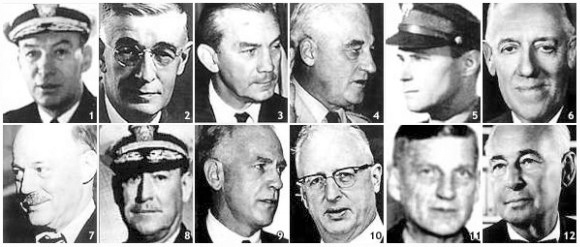
The documents identify twelve prominent men as the original MJ-12 members:
- Admiral Roscoe H. Hillenkoetter (First CIA Director)
- Dr. Vannevar Bush (Chairman of the National Defense Research Committee)
- Secretary James Forrestal (First Secretary of Defense)
- General Nathan F. Twining (Commander of Air Material Command)
- General Hoyt S. Vandenberg (Air Force Chief of Staff)
- Dr. Detlev Bronk (Medical physicist and physiologist)
- Dr. Jerome Hunsaker (Aeronautical engineer, NACA Chairman)
- Sidney W. Souers (First Director of Central Intelligence)
- Gordon Gray (Secretary of the Army, National Security Advisor)
- Dr. Donald Menzel (Astronomer and astrophysicist)
- General Robert M. Montague (Commander of Sandia Base)
- Dr. Lloyd V. Berkner (Physicist and engineer)
The Special Operations Manual provides extraordinary details about handling extraterrestrial biological entities (EBEs) and their technology, with specific classification protocols for different types of recovered materials. It contains instructions for securing crash sites, transporting specimens, and maintaining absolute secrecy.
The documents have expanded over time to include alleged autopsies of aliens, technical analyses of craft propulsion systems, and strategic assessments of the potential "extraterrestrial threat."
The Authentication Battle: Real Documents or Elaborate Fiction?
From the moment the MJ-12 documents emerged, they've been subject to intense scrutiny. The battle over their authenticity continues today with compelling arguments on both sides.
The skeptical case is straightforward: In 1988, after receiving the documents from the Air Force Office of Special Investigations, the FBI conducted a brief investigation and declared them "completely bogus." Archivists at the National Archives identified numerous problems with the Cutler-Twining memo, including improper security markings and the absence of registration numbers.
Researcher Philip J. Klass determined that Truman's signature on the MJ-12 document was an exact photocopy taken from a genuine Truman memo to Vannevar Bush dated October 1, 1947—including identical scratch marks. Records also show that Robert Cutler, the alleged author of the Cutler-Twining memo, was actually out of the country on July 14, 1954, the date the memo was supposedly written.
"The inconsistencies are glaring to anyone familiar with government documentation procedures," a former military archivist explained to me. "Classification markings, paper types, signature protocols—these aren't things easily faked without insider knowledge, and the MJ-12 papers contain numerous errors."
However, Stanton Friedman, a nuclear physicist and one of the most respected UFO researchers, became the foremost defender of the documents' authenticity. In his book "Top Secret/Majic," Friedman presented detailed arguments supporting their legitimacy.
Friedman noted that the documents contained details about classified projects and individuals that weren't publicly known in 1984-1985 but were later confirmed through declassified records. He pointed to specific details like meeting dates and security protocols that matched other verified documents from the era.
Perhaps most persuasively, Friedman argued that Truman used an autopen machine for signatures, potentially explaining the identical marks. He also found numerous examples of the disputed date format in genuine government papers, countering one of Klass's main objections.
"When you actually examine the specific claims of the skeptics," a document expert told me, "you find they often don't hold up to scrutiny. The authentication debate is far more nuanced than either side typically admits."
Donald Menzel: The Skeptic With a Secret Life
The most fascinating aspect of the MJ-12 story centers on Dr. Donald H. Menzel, a Harvard astronomer who publicly debunked UFO reports through books and media appearances. His inclusion on the MJ-12 list initially seemed like a glaring error by potential forgers, as Menzel appeared to be an unlikely candidate for a secret UFO study group.
However, Stanton Friedman's investigation into Menzel revealed a stunning contradiction. Through Freedom of Information Act requests and archival research, Friedman discovered that Menzel—the public UFO skeptic—had maintained the longest continuous association with the National Security Agency and its Navy predecessor of anyone in the country.
Menzel had taught cryptography before World War II, held a Top Secret Ultra clearance with the CIA, and performed classified work for numerous defense contractors. His Harvard archive, which required special permission to access, contained extensive correspondence with intelligence agencies and defense contractors—none of which was public knowledge when the MJ-12 documents first appeared.
I spoke with a former intelligence officer who knew of Menzel's classified work: "Having a public skeptic with high-level clearances on your secret committee makes perfect sense. Who better to help manage the public narrative? If the MJ-12 papers were faked, including Menzel represents a level of insider knowledge that's difficult to explain."
Friedman even uncovered correspondence between Menzel and Admiral Roscoe Hillenkoetter (another alleged MJ-12 member) from 1963, in which Menzel sent Hillenkoetter a copy of his anti-UFO book. Hillenkoetter's reply praised the book for putting to rest "all surmises about flying saucers being from outer space."
This was followed by another letter from Hillenkoetter to UFO researcher Major Donald Keyhoe, stating he had never discussed UFOs with Menzel and took no position on Menzel's statements—a curious contradiction that suggests compartmentalized communications.
The Menzel paradox transformed what initially seemed like a weakness in the MJ-12 story into one of its most intriguing elements.
The James Forrestal Mystery: Death of an MJ-12 Member
Another disturbing strand in the MJ-12 narrative involves James Forrestal, the first Secretary of Defense and an alleged member of the committee. According to the chronology established in the documents, Forrestal was an original member who later died under mysterious circumstances.
The official record states that Forrestal, suffering from depression and nervous exhaustion, was asked to resign by President Truman in March 1949. He was subsequently admitted to Bethesda Naval Hospital, where he fell to his death from the 16th floor on May 22, 1949. The death was officially ruled a suicide.
However, several troubling elements surround Forrestal's death. Broken glass was reportedly found in his hospital bed, suggesting a struggle. Some researchers claim the alleged suicide note wasn't in Forrestal's handwriting, and the military inquiry into his death was classified as "top secret."
"Forrestal's death has all the hallmarks of what intelligence professionals call 'wetwork,'" a former security specialist told me. "The question isn't whether the official story is complete—it's clearly not—but whether his death was connected to UFO secrecy or to his opposition to other policies."
Some MJ-12 proponents suggest Forrestal was eliminated because he favored more disclosure about UFOs and disagreed with policies of extreme secrecy. While mainstream historians typically attribute his death to mental health issues, the circumstances remain suspicious enough to feature prominently in the MJ-12 mythology.
Beyond Real or Fake: The Disinformation Hypothesis
Looking beyond the binary question of authenticity versus hoax lies a more complex possibility: that the MJ-12 documents represent deliberate government disinformation. This theory suggests intelligence agencies created the documents to serve specific purposes—neither wholly true nor completely false.
"Disinformation works best when it contains elements of truth," explained a former intelligence analyst I've worked with. "The most effective way to hide something isn't to deny it exists, but to surround the truth with so much nonsense that serious researchers can't separate fact from fiction."
Several strategic objectives could explain a government disinformation campaign around MJ-12:
- Deflecting attention from actual classified aerospace projects by creating elaborate but ultimately dismissible UFO documentation.
- Wasting Soviet intelligence resources during the Cold War by sending them chasing phantoms.
- Discrediting serious UFO researchers by encouraging them to embrace documents that could later be proven false.
- Creating "plausible deniability" around genuine classified programs by mixing authentic information with fabrications.
The disinformation theory gained credibility when researcher Bill Moore admitted to having worked with U.S. military intelligence to spread disinformation within UFO communities in exchange for inside information. The case of Paul Bennewitz—a civilian who photographed classified aircraft testing at Kirtland Air Force Base but was fed disinformation suggesting alien technology until he suffered a psychological breakdown—provides a documented example of such tactics.
"Notice how the FBI showed almost no interest in identifying who created these forged government documents," one researcher pointed out to me. "That's highly unusual unless the forgery was government-sanctioned."
The Cape Girardeau Incident: Pre-Roswell Recovery?
One of the more intriguing aspects of the expanded MJ-12 mythology involves references to UFO crash retrievals predating Roswell. The most notable is the alleged 1941 crash near Cape Girardeau, Missouri.
According to this story, Baptist minister Reverend William Huffman was called to give last rites to the occupants of a crashed "acorn-shaped" craft in April 1941. Huffman was allegedly driven approximately 15 minutes outside of town, where he encountered the wreckage and three dead "cloned aliens" (described as looking identical to each other). Military personnel then arrived, swore everyone to secrecy, and removed the evidence.
This account entered UFO literature primarily through Charlotte Mann, Huffman's granddaughter, who claimed her grandmother shared these details on her deathbed. Researcher Ryan Wood and remote viewer Joseph McMoneagle conducted on-site investigations in Cape Girardeau, using metal detectors to search for remaining debris, though without success.
If authentic, the Cape Girardeau incident would push the timeline of alleged government UFO recoveries back six years before Roswell and several years before the United States entered World War II, significantly altering our understanding of when the government first encountered extraterrestrial technology.
The Gravity Control Secret: The Ultimate Technology
According to some interpretations of the MJ-12 narrative, the ultimate secret protected isn't just the existence of extraterrestrial life but the reverse-engineering of alien technology—particularly gravity control.
"If you want to understand the real secret behind UFO technology, follow the physics, not the biology," a retired aerospace engineer told me. "The ability to manipulate gravity would transform everything from energy production to transportation to warfare. It's the ultimate strategic asset."
Researcher Ryan Wood, whose father Robert worked as a physicist at McDonnell Douglas (later Boeing), has suggested that by the late 1950s or early 1960s, scientists working for aerospace companies had "figured out the equations for gravity control." This technology would render conventional propulsion systems obsolete and potentially solve global energy problems.
Wood points to a quote from Ben Rich, former head of Lockheed's Skunk Works, who allegedly stated at a 1993 alumni event: "We have the technology to take ET home, and it won't take a lifetime to do it." Rich reportedly added, "We found a mistake in the equations and figured out how to do it."
Some researchers note that newspaper articles about gravity control research were common in the mid-1950s but suddenly disappeared around 1960, suggesting the research went classified. The gravity control theory also explains why certain UFO reports describe craft with electrostatic "wicks" or interaction with electrical systems—potential indicators of early human testing of such technology.
Cultural Impact and Recent Developments
Whether authentic or fabricated, the MJ-12 documents have had an undeniable impact on popular culture. The concept heavily influenced "The X-Files" TV series, where a similar group called the "Syndicate" operated in the shadows. The idea features prominently in video games like the "Deus Ex" series and has become a cornerstone of broader conspiracy theories, often linked with concepts like the New World Order and the Illuminati.
The landscape of UFO research has shifted dramatically in recent years. In 2017, the existence of the Pentagon's Advanced Aerospace Threat Identification Program (AATIP) was revealed, showing that the military had indeed been secretly studying UFOs. The official release of Navy fighter jet videos showing encounters with unexplained craft has lent credibility to the notion that the government takes the phenomenon seriously.
Congressional hearings featuring whistleblowers like David Grusch have included claims about recovered non-human craft and biological specimens. Grusch specifically mentioned a 1933 UFO crash in Magenta, Italy, allegedly recovered by Mussolini's forces and later acquired by the United States after WWII.
While most mainstream scientists and historians still regard the specific MJ-12 documents as forgeries, the core concept they represent—classified government programs studying non-human technology—appears increasingly plausible.
"The question we should be asking isn't whether these specific papers are authentic," noted researcher Richard Dolan, "but whether a group like MJ-12, regardless of its actual name, exists within the government to manage information about non-human intelligence."
Why the Mystery Endures
Despite decades of debate, the MJ-12 narrative continues to captivate researchers and the public. Several factors contribute to its persistence:
Documented government secrecy surrounding UFOs creates space for speculation. When the National Archives responds to FOIA requests with heavily redacted documents or claims processing times of "six years" for certain files, it fuels suspicion.
Some elements of the MJ-12 story have been independently verified, such as Donald Menzel's intelligence connections, even as the documents themselves remain suspect. As more official information about government UFO programs emerges, earlier dismissals of government involvement appear increasingly disingenuous.
The demonstrable reality of "need-to-know" compartmentalization in government projects means that official denials from one department don't necessarily reflect knowledge held elsewhere.
Whether the Majestic 12 documents represent leaked secrets, calculated disinformation, or an elaborate hoax, they've forever changed how we think about government secrecy and the possibility of extraterrestrial contact. They exist in that shadow realm where verified government deception meets extraordinary claims—a perfect formula for enduring mystery.
As the government slowly acknowledges its serious interest in unexplained aerial phenomena, the essential questions raised by the MJ-12 papers remain as relevant as ever: What do our governments know about non-human intelligence? When did they learn it? And who ultimately controls that information in a democratic society?
The answers remain tantalizingly out of reach, hidden behind classification barriers, institutional denial, and the fog of disinformation that surrounds the greatest question humanity has ever faced: Are we alone in the universe?
Investigations by Academics and Journalists
The explosive claims of the MJ-12 memos prompted extensive scrutiny from outside investigators – including scientists, historians, journalists, and veteran UFO researchers. As early as mid-1987, a panel of scientists and technical experts affiliated with the skeptic organization CSICOP (Committee for Scientific Investigation of Claims of the Paranormal) analyzed the documents line by line. Noted UFO skeptic Philip J. Klass and Professor Paul Kurtz were among those who published a report calling the MJ-12 papers “clumsy counterfeits” that were riddled with errors. Kurtz described the hoax as “one of the most deliberate acts of deception ever perpetrated against the news media and the public”. Their investigation (and others that followed) highlighted numerous anachronisms and discrepancies in the documents:
-
The Truman–Forrestal memo (Sept 24, 1947) bore an exact copy of President Truman’s signature taken from an unrelated letter. Experts discovered it was a photographic paste-up – identical down to tiny tell-tale scratch marks – of Truman’s signature on an October 1947 letter to Vannevar Bush. This indicated the signature on the MJ-12 memo was literally cut-and-pasted from a real document.
-
The supposed Top Secret classification markings were incorrect for the era. One MJ-12 page was labeled “Top Secret/Restricted Information” – a terminology not used in 1947 but rather introduced decades later in the 1970s Nixon administration. Such ahistorical errors gave the forgery away.
-
The format of the Truman memo was wrong: investigators noted it did not match Truman’s known memo style to his Cabinet officials. Moreover, the content of one MJ-12 document was plagiarized: a portion of text was identical to a real 1944 memo from General Marshall to President-elect Dewey about the WWII “Magic” code-breaking program – only with names and terms swapped (e.g. “Magic” to “Majic”). This strongly suggested that the hoaxer copied parts of genuine historical documents to create a faux “Majestic” memo.
-
The Eisenhower Briefing Document (1952) had blatant internal inconsistencies. For example, it referenced the (bogus) Truman memo and listed Donald Menzel as an MJ-12 member – even though Menzel’s overt stance as a UFO debunker wasn’t publicly revealed until decades later (raising the question of how a 1980s hoaxer might know Menzel had secret clearance). Skeptics also pointed out that the briefing used an unusual hybrid date format (“18 November, 1952,” with a comma) that happened to match the personal letter-writing style of William Moore – one of the document’s finders. This coincidence suggested Moore (or someone close to him) might have authored the “briefing” himself.
-
The Cutler/Twining memo (1954) found in the archives raised red flags: it was physically a folded piece of paper inserted among unrelated files, which is highly irregular for archived documents. Investigators noted it would have been easy for someone to surreptitiously plant this memo in the archives for later “discovery”. Indeed, the memo’s content (arranging a meeting about MJ-12) had little context and, as mentioned, it was proven that General Cutler was out of the country on the date of the memo – confirming it was a fabrication.
Over the years, journalists and independent UFO researchers dug into the mystery behind the MJ-12 hoax. Some pointed fingers at William Moore himself, given his central role in releasing the documents. Notably, Moore admitted in 1989 that he had cooperated with a “disinformation” scheme alongside a U.S. Air Force intelligence officer in the early 1980s – an admission that cast a shadow on his credibility. In fact, Moore had told fellow researcher Brad Sparks back in 1983 that he was considering creating fake “Top Secret” UFO documents to prompt former military insiders to talk. (Sparks strongly urged him not to do this.) This revelation, combined with the stylistic fingerprints in the papers, led many to suspect Moore either authored the MJ-12 forgeries or at least was knowingly involved in propagating them.
Another figure, Richard Doty, an Air Force Office of Special Investigations (AFOSI) agent, later claimed that he had fed counterfeit UFO documents to gullible ufologists as part of a psychological operation in the 1980s. Doty was known for his role in the Paul Bennewitz affair (where he planted UFO disinformation that ultimately sent a civilian UFO enthusiast into a spiral of paranoia). According to Doty, the MJ-12 papers could have been an outgrowth of AFOSI’s efforts to confuse U.S. adversaries or smoke out insider leaks by seeding false UFO stories. Some researchers (like journalist Howard Blum, author of Out There) entertained the theory that Majestic-12 was deliberate disinformation – essentially a modern myth created by intelligence agents to obscure real secret programs (or simply to see who in the UFO community would take the bait). However, even many UFO proponents eventually came to agree that whoever created MJ-12, it was not authentic government truth but rather a hoax or tactic.
Indeed, by the late 1990s, several well-known pro-UFO investigators publicly repudiated newly surfaced MJ-12 documents. In 1994, another batch of MJ-12 related material emerged: a purported “Special Operations Manual” (SOM 1-01) detailing how to recover crashed flying saucers. This manual, like the earlier papers, arrived as anonymous film canisters in the mail. UFO researcher Don Berliner received it and initially found it intriguing, but it was soon shown to contain errors (for example, referring to **“Area 51” in 1954, before that term existed). Berliner and others ultimately denounced the SOM 1-01 manual as a hoax in 1999. Around the same time, a UFO enthusiast named Tim Cooper circulated dozens of other alleged MJ-12 memos he claimed to have obtained from insider sources. While a few believers defended these (and even wealthy Silicon Valley entrepreneur Joe Firmage gave them initial credence), further analysis found them rife with historical mistakes. By 1999, even Firmage’s team conceded that “many, possibly all, of the so-called MJ-12 UFO documents were officially fabricated” as part of covert psychological warfare. In short, no credible researcher or journalist has ever uncovered verifiable documents or firsthand testimony to substantiate MJ-12 as real. Every piece of paper tied to MJ-12 has ultimately been discredited, often with the help of ufologists themselves.
Conspiracy Theorists’ Views vs. Mainstream Perspectives
From the beginning, MJ-12 split opinion between UFO conspiracy believers and skeptics/historians. On one side, UFO conspiracy theorists embraced Majestic 12 as the “smoking gun” proof that the government knew about alien visits. To them, the detail and apparent authority of the documents suggested there really had been a high-level cover-up since 1947. Notable UFO researchers like Stanton T. Friedman defended the authenticity of the MJ-12 files for many years. Friedman argued that certain obscure facts in the papers (e.g. Dr. Menzel’s secret cryptographic work for U.S. intelligence, or the mention of code-names) were things an ordinary hoaxer was unlikely to know. In his 1996 book Top Secret/Majic, Friedman concluded that while some MJ-12 documents might have been tampered with, the core story – that a secret committee investigated the Roswell crash – was likely true. Other theorists speculated that even if the leaked MJ-12 memos were bogus, they could be based on a real secret program. In their view, Majestic-12 might be a codename for an actual UFO crash retrieval taskforce, and the faked documents were either leaks mixed with disinformation or a deliberate attempt to discredit the genuine story if it ever got out.
Among conspiracy circles, there are a few schools of thought: some believe MJ-12 was (or is) absolutely real, and the government’s denials are a predictable cover-up. Others think the documents contain a mix of truth and lies – perhaps leaked by whistleblowers but doctored by intelligence agencies to sow confusion. A further faction concedes MJ-12 might be a total hoax, yet they maintain that similar secret committees must exist under other names. For example, when the U.S. government eventually launched programs like Project Blue Book (publicly) and more recently the Advanced Aerospace Threat Identification Program (AATIP, in the 2010s), some UFOlogists imagined these were “descendants” of the original Majestic 12 concept – essentially, MJ-12 by another name.
The mainstream historian and scientific community, on the other hand, views the MJ-12 affair as a classic case of modern folklore and conspiracy thinking. To scholars, MJ-12 is an elaborate hoax that gained traction because it appeared during a wave of 1980s UFO paranoia and Cold War distrust of government. There is broad agreement among historians that no archival evidence supports the existence of any “Majestic-12” committee apart from the forged papers. As the FBI and Air Force have pointed out, thousands of pages of authentic declassified documents on UFO investigations (from projects like Sign, Grudge, Blue Book, etc.) have become available – and none mention MJ-12 or any comparable top-secret panel. Reputable historians like Robert Goldberg (author of Enemies Within: The Culture of Conspiracy) have chronicled how MJ-12 became a myth embedded in UFO subculture: believers accepted it due to their conviction in a Roswell cover-up, even when clear evidence of forgery was presented. Most academics cite MJ-12 as an example of conspiracy lore that snowballed over time, rather than a credible historical event. As one journalist wryly noted, confirming MJ-12’s existence remains central to UFO theorists’ claims of government cover-up – but the government has consistently denied it, and the denial in this case is backed up by solid evidence of fakery.
In popular culture, the idea of Majestic 12 has nonetheless thrived. It has inspired fictionalized secret committees in TV shows like The X-Files (where a shadowy “Syndicate” resembles MJ-12) and other sci-fi media. Ironically, this pop-culture feedback loop further entrenches MJ-12 in the public imagination. But in serious historical discourse, MJ-12 is usually treated as a cautionary tale – a reminder of how easily documents can be faked and how eagerly people will believe extraordinary claims that align with their hopes or fears.
Recent Developments and Declassified Material
In the decades since the MJ-12 papers first appeared, no new evidence has emerged to validate the existence of a Majestic 12 committee. However, the legacy of the hoax has periodically resurfaced through additional forgeries and the release of official records related to the case:
-
Additional MJ-12 Forgeries: After the original documents in the 1980s, later waves of MJ-12-related papers kept surfacing through the 1990s. Aside from the aforementioned SOM 1-01 manual and Tim Cooper documents (all debunked by 1999), there have been scant few since then. One of the last notable “MJ-12” leaks was in the early 2000s, when some anonymous internet postings and dubious “deathbed confessions” referenced MJ-12, but these gained little traction without any verifiable documentation. The UFO research website MajesticDocuments.com continues to archive all these alleged papers, treating them with caution and inviting analysis. To date, every newly surfaced MJ-12 document examined has shown signs of fraud or fabrication consistent with the original hoax pattern (e.g. incorrect fonts, signatures lifted from unrelated letters, etc.). No document with a provable provenance (e.g. found in official archives with proper authentication) has ever been uncovered.
-
Declassified Government Files: On the other hand, a wealth of legitimate UFO-related files have been declassified by U.S. agencies in recent years – and they confirm the absence of any MJ-12. In 2011, the FBI released its case file on Majestic 12 to the public via the “FBI Vault.” The file shows how the FBI handled the matter from 1988 through the early 1990s: receiving copies of the MJ-12 memos, consulting with the Air Force, and ultimately concluding they were fake. The FBI Vault release even includes the large “BOGUS” stamp across the Eisenhower briefing and a note to “close the case”. Similarly, the Reagan Presidential Library has published correspondence from 1987 indicating that the National Security Council had no record of MJ-12 and believed it to be a hoax.
-
Roswell Reports: In 1994 and 1997, the U.S. Air Force authored comprehensive reports to satisfy public curiosity about Roswell. These reports (titled The Roswell Report: Fact vs Fiction in the New Mexico Desert and The Roswell Report: Case Closed) addressed the MJ-12 claim in appendices. The Air Force traced how the Majestic 12 story arose long after the actual Roswell events and reiterated that the alleged MJ-12 “Truman memo” and “Eisenhower briefing” were not authentic. Instead, the Air Force concluded the Roswell debris was likely from a Project Mogul balloon and that no secret committee was needed to handle it.
-
CIA and Other Agency Reviews: In 1995-1996, as part of an effort prompted by UFO researchers (and spurred by Congressman Steven Schiff’s inquiries into Roswell), the General Accounting Office (GAO) and agencies like the CIA re-examined their archives for any Roswell or MJ-12 materials. The GAO report on Roswell found no documents to support the crash of a spaceship – and it did not find any reference to MJ-12 either, aside from the FBI’s investigation of the hoax itself. The CIA’s historical review (published in Studies in Intelligence in 1997) treated MJ-12 as a curiosity of ufology, remarking that it persisted in pop culture despite being debunked.
-
Modern UFO Programs: In the 2020s, interest in UFOs (now often termed “UAPs” – unidentified aerial phenomena) has spiked again due to Navy pilot sightings and Pentagon investigations. However, in the official reports and Congressional hearings about these recent UFO/UAP encounters, Majestic 12 has never been mentioned. The focus has been on current military programs and improving data collection – there’s no indication of any continuity with an MJ-12 type group. If anything, officials have openly acknowledged that historically, the U.S. government did not have a single high-level UFO task force for decades (one reason the 2007–2012 AATIP program was initiated). This is the opposite of what the MJ-12 myth would suggest. Even so, some die-hard conspiracy theorists speculate that MJ-12 simply went deeper underground or morphed into a different code name over the years. As of today, however, no “smoking gun” document from recent declassifications lends credence to that idea.
In summary, the Majestic 12 saga remains a fascinating chapter in UFO folklore and government conspiracy literature. The originating documents are now widely acknowledged as hoaxes – cleverly crafted forgeries that capitalized on real historical people and events to seem plausible. Government agencies and independent experts methodically dismantled the credibility of those papers, and no secret committee was ever officially confirmed. MJ-12 lives on largely in the realm of conspiracy theory, yet it has undeniably influenced how UFO cover-ups are portrayed in books, movies, and television. As new generations confront unexplained sky phenomena, MJ-12 is a cautionary reminder: extraordinary claims demand extraordinary evidence, and in its absence, even an entire “shadow government” can be imagined into being.
{ https://hangar1publishing.com/ }


 Interstellar comet 3I/ATLAS encounters Mars: NASA and ESA conduct observations
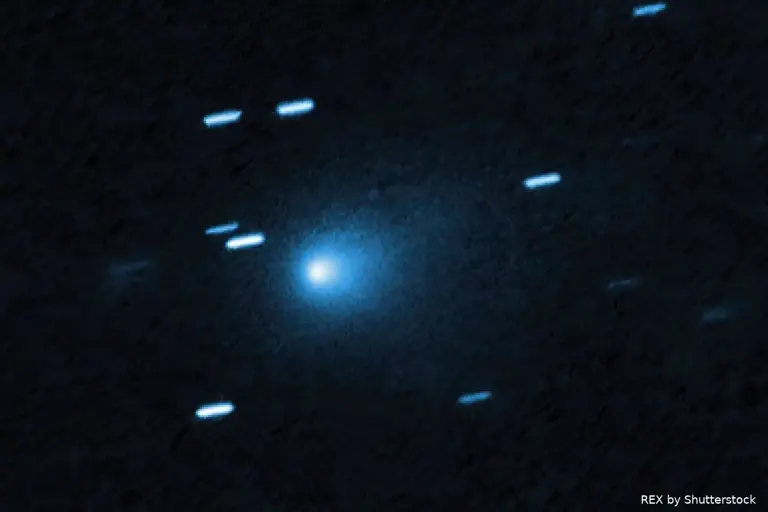
 Interstellar comet 3I/ATLAS in a photograph taken by the Gemini South Observatory.
Source: International Gemini Observatory/NOIRLab/NSF/AURA/Shadow the Scientist
Interstellar comet 3I/ATLAS in a photograph taken by the Gemini South Observatory.
Source: International Gemini Observatory/NOIRLab/NSF/AURA/Shadow the Scientist
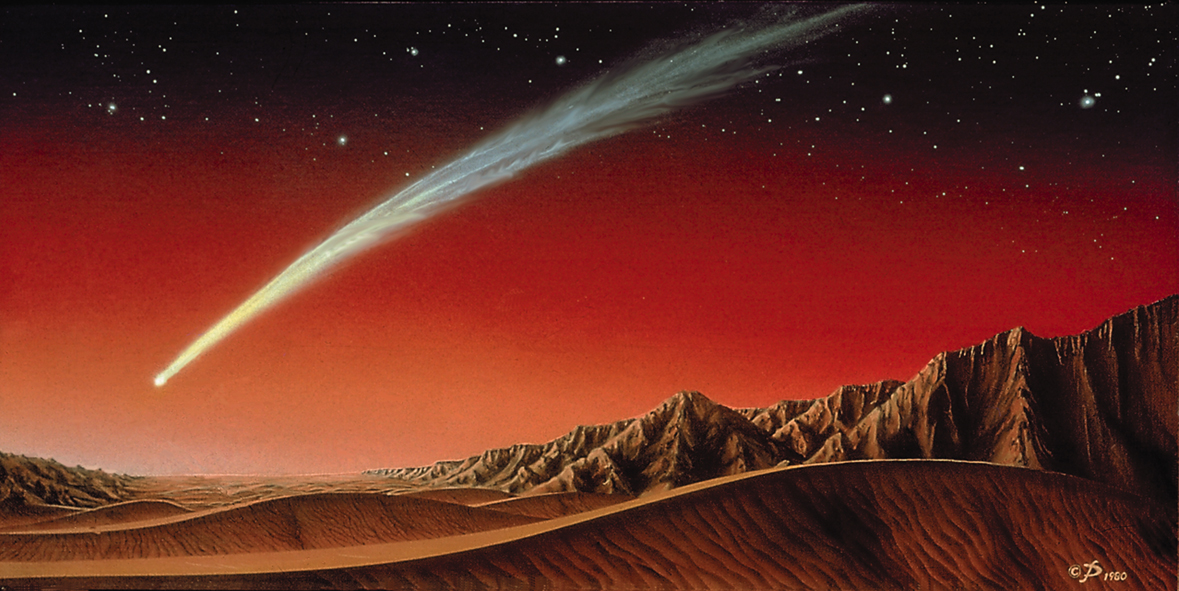 A comet in the Martian sky in an artist’s impression.
Source: Kim Poor
A comet in the Martian sky in an artist’s impression.
Source: Kim Poor
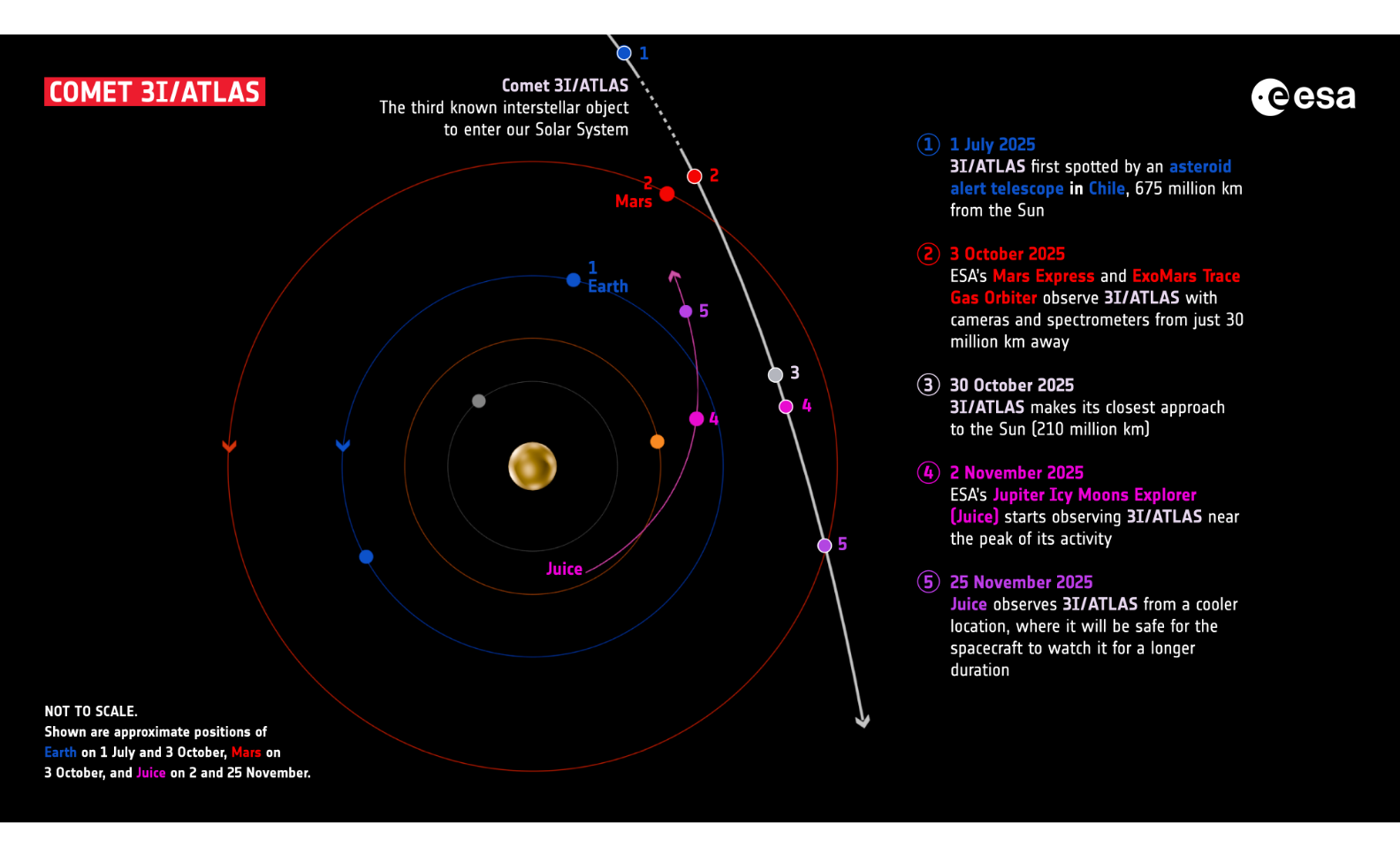 ESA observation plan for interstellar comet.
Source: ESA
ESA observation plan for interstellar comet.
Source: ESA