The annals of UFO lore and the field of UFOs in general are littered with cases of supposed crashes of these crafts. For whatever reason, despite their incredibly mind-boggling technology, these things just sometimes go down, and they always make for a spectacular case that leaves many mysteries in its wake. Many UFO crashes are world famous, such as obviously the one that allegedly happened at Roswell, New Mexico, but some others are not nearly as well known, yet are just as mysterious and perplexing.
One rather obscure supposed UFO crash, considering its location, is the time one apparently exploded and crashed right on the fringes of the neon-studded gambling capital of the world, Las Vegas. The whole odd affair actually began all the way across the country, over in Oneida, New York, where on April 18, 1962, military radar stations began picking up an anomalous object that seemed to be moving west rapidly. As it did so, there began a series of reports marking its progress, as panicked witnesses from across the country saw what looked like a glowing red ball or "flaming sword" that was at times bright enough to make night seem like day.
These reports came from several states along its trajectory, including Colorado, Kansas, Arizona, and, most remarkably of all, in Eureka, Utah, where there would be a report that it had actually landed and caused massive electrical disruptions before taking to the sky again. Throughout all of this, the object was reportedly largely completely silent, and there was such a deluge of calls to authorities that fighter jets were even scrambled and put on alert at Luke Air Force Base in Arizona. The object headed towards Nevada, where it continued to be seen by hundreds of people as it approached Reno, then was witnessed to make a turn to head in the direction of Las Vegas, and this is where things would get even stranger. There was reportedly heard an enormous rumbling and then a thunderous boom and blinding flash of light, after which the object vanished both visually and off radar somewhere over Nellis Air Force Base, right out in the badlands just past the lights of Las Vegas.

The sheriff’s office for Clark County, Nevada, was apparently so flooded by calls from terrified residents who had heard the boom that it was thought that there had been an explosion and that perhaps an aircraft had gone down. A sheriff’s search party was sent out to the area where the object was last seen, yet there could be found no sign of a downed aircraft, and there were furthermore no reports of a missing aircraft from any airports in the region. Considering this, it was assumed that what had been seen was a meteor that had exploded in midair, and the military was quick to use this explanation as well. There was only a single newspaper article related to the odd incident at the time, which appeared the next day in The Las Vegas Sun with the headline “Brilliant Red Explosion Flares In Las Vegas Sky,” and for the most part, everyone just sort of forgot about it. Even though thousands of people across the country had seen the mysterious object and several hundred had heard the massive explosion, it seemed the meteor explanation was good enough. Case closed. Or so it seemed.
It would not be until decades later that anyone would blow the dust off the case, when UFO researcher Kevin Randle began snooping around for more information in military reports and declassified reports from the Air Force’s Project Blue Book UFO investigation, and he also went about interviewing numerous witnesses to the events to shed more light on what happened on that evening, which would all be covered in his book A History of UFO Crashes. What Randle would manage to uncover would begin to paint a picture of something perhaps quite a bit stranger than a meteor, and which the military quite possibly knows more about than it is letting on.
Even a casual look at the old reports began pointing out oddities. One declassified military report that was completely free to read by anyone who cared came from Captain Herman Gordon Shields, who, on the evening of the incident, had been flying a C-119 aircraft near La Van, Utah. He would report that both he and his co-pilot had witnessed a very bright light that continued to get brighter even as they maneuvered their plane to get away from it. Whatever it was, it was apparently “as bright as daylight,” completely illuminating the landscape, and as they tried to further evade and avoid what they felt might be an incoming collision, they were able to get a clear look at the source of the light. According to pilot Shields, it was a long, cigar-shaped object with a yellow top surface and the bottom of which was an extremely bright light. Shields would say in his report of the object:
“And this object which I saw was illuminated. It had a long slender appearance comparable to a cigarette in size, that is, the diameter with respect to the length of the object. The fore part, or the lower part of the object was very bright, intense white such as a magnesium fire. The second half, the aft section, was a clearly distinguishable yellowish color. I would say the object was just about divided in half, the fore part being intensely white, the aft section having a more yellow color to it. There was no exhaust, no trail following after it. It was clearly defined. I saw it for a period of maybe one to two seconds.”

Both the pilot and co-pilot were certain that this was no meteor. Another very curious report uncovered by Randle was that of witnesses Bob Robinson and Floyd Evans, who saw it fly low as they were driving along a highway near Eureka, Utah. The witnesses said it was clearly some sort of flaming cylinder with a “series of windows” along its side, and that its approach caused their vehicle to stall. They also claimed that it slowed to a stop to hover momentarily over them before continuing on its way, after which their engine promptly started up again. Other witness reports seemed to point towards something under intelligent control as well, including reports of the object making turns, speeding up or slowing down, reversing its course, and even landing, all things that you might realize meteors do not do. Another interesting eyewitness report uncovered by Randle comes from the declassified Blue Book files from a witness whose name had been redacted, and which reads:
“As the object passed over Robinson [Utah), it slowed down in [the] air, and after, [a] gasping sound was heard, the object spurted ahead again. After this procedure was repeated three or four times, the object arched over and began descending to earth after which the object turned bluish color and then burned out or went dark. After the object began to slow down it began to wobble or "flshtail" in its path.”
Military reports also showed some other intriguing details surrounding the case. It would turn out that not only had there been significant military activity in the area of Nellis Air Force Base after the explosion, including the scrambling of jets, but an investigator, Douglas Crouch, from Hill Air Force Base, would interview many witnesses and officially state that he did not believe the object seen to be a meteor. Crouch would also confirm that there had been no military tests in the area at the time, nor any unusual atmospheric phenomena on the night in question, and additionally, no aircraft in the area that could have caused the disturbances. Far from the official government stance that this was a meteor, Crouch would clearly state that “no explanation has been developed for the brilliant illumination of the area, the object itself, or the explosion.”
Another detail that seems not to fully line up is that Air Force investigation reports state that an orange, glowing object in Eureka, Utah, was so low and bright that it actually knocked out photoelectric cells in the area. There was plenty of other evidence offered up by Randle that did not fit into the meteor theory either, such as that the directions of the various reports across states often described it going in a different direction, the speed was too slow to be that of a meteor, and on many occasions it was far too low to be a meteor, often wildly changing altitude in mid-course. Also, the official reports show that fighter jets had indeed been scrambled in response to the event, so would they do that for a simple meteor? Regardless, a follow-up investigation made by J. Allen Hynek and Lieutenant Colonel Robert Friend would come to the conclusion that the object had been a rare type of bright meteor called a “bolide,” and Friend would say of this:
“This investigation was completed in one full day and it was concluded that the object was a bolide. An attempt was made to locate the object but this effort failed due to the general nature of the data. Further study of this sighting indicates that the meteor probably struck in the area of the Wasatch National Forest; however, the Air Force has made no further at tempts to recover it.”
One day to come up with that, and that seemed to be the end of it as far as the Air Force was concerned, but there were also some ominous hints of a cover-up found speckled throughout these files that did not add up. Randle noticed that Nellis Air Force Base first labeled the object as "Unidentified," but it was later changed to "Insufficient Data for a Scientific Analysis" without further explanation. Perhaps even weirder is the assertion in the report that "no visual" was made of the object captured on radar, despite the fact that there were literally thousands of reports made to police of people seeing this thing. It was also found that the Air Force reports were intentionally and deceptively dated to make it seem as if the Utah accounts and Nevada accounts had happened on different days, possibly to make them seem like two separate events and throw off anyone snooping around. Randle says of this:
“The reports, as filed in Project Blue Book, were deceptively dated. The Utah case had the time logged in "Zulu," or Greenwich Mean Time, which means it was advanced at that time of the year by six hours. Add six hours to the 8:15 time, and you advance it to early morning the next day. A quick glance at the file shows the Utah case dated April 19, and the Las Vegas case logged in local time as April 18. On paper it looks as if they take place on separate days when, in reality, they happened within minutes of each other on the same day.”

There were also inconsistencies throughout, such as the files at differing points claiming that the object was a weather balloon or a U-2 spy plane, before coming back to meteors again, almost as if they couldn't decide which explanation to go with. It must also be remembered that at the time, U-2s and balloons were tracked very carefully, and there were none scheduled to be in the area at the time of the events. Much of this suggested to Randle that the military was being misleading at best, and downright lying at worst, in an effort to muddy the waters and promote a mundane, palatable explanation. Randle believes that this was no meteor or balloon, or conventional aircraft, and that somewhere out there in the desert outside of Las Vegas, an alien craft of some sort crashed and is being covered up. He says of this in his book:
“It is a case that demonstrates the air force's policy of explaining UFO sightings, even if they have to change dates to make the explanations work. It shows that the air force would lie to the public about the UFO situation. And it shows that air force investigators, when handed a solution, wouldn't ask the basic questions. They accepted the solution quickly. This also reveals that the air force was not interested in investigation or solving riddles. They were interested in clearing cases, slapping a label on them and letting it go at that. They ignored the information that didn't fit with the bolide theory. Something extremely extraordinary happened on the night of April 18, 1962. The air force offered a series of explanations ignoring the facts. But the witnesses who were there know the truth. They saw something from outer space, and it was not a meteor. It was a craft from another world.”
We are ultimately left to wonder just what happened out there on that night back in 1962. Was this just a meteor, or was something more mysterious going on? If so, what could it have been? Did a UFO actually crash right outside of Las Vegas, perhaps, as some conspiracies say, because it was actually engaged and shot down by the fighter jets that had been scrambled? Did the government willingly cover it all up? In the end, there is no evidence at all to fall back on either way, and that time a UFO supposedly exploded out into the Las Vegas desert will likely remain for some time to come.
Our next case takes us out to the cold, gray expanse of the Arctic Ocean, north of mainland Europe, where there is the remote Norwegian archipelago of Spitzbergen, now mostly known as Svalbard. It is a frigid, somewhat hostile domain once used as a base of operations for whalers and miners, with most of the land covered by glaciers and intersected by numerous fjords, and enveloped in a near-eternal night during the frigid winter months. It is a sparsely inhabited, largely untouched, and unspoiled realm of majestic natural beauty, and it is also the location of a series of very bizarre supposed UFO crashes.
The first of two supposed UFO crashes in the area of Spitzbergen supposedly began in 1946, when General James H. Doolittle was allegedly sent to the region by the Shell Oil Company for the purpose of investigating aerial phenomena in the area that were being called “ghost rockets.” Journalist Dorothy Kilgallen would then claim that a crashed UFO had been recovered in the area by the British and U.S. governments, claiming that sailors serving aboard the U.S.S. Alabama had told her that the mysterious craft had been recovered by Doolittle in Spitzbergen and whisked away to the U.S. for study. The story would basically end here, with her taking the truth to her grave when she died in 1965, but it would not be the last time something like this would be reported from the region.

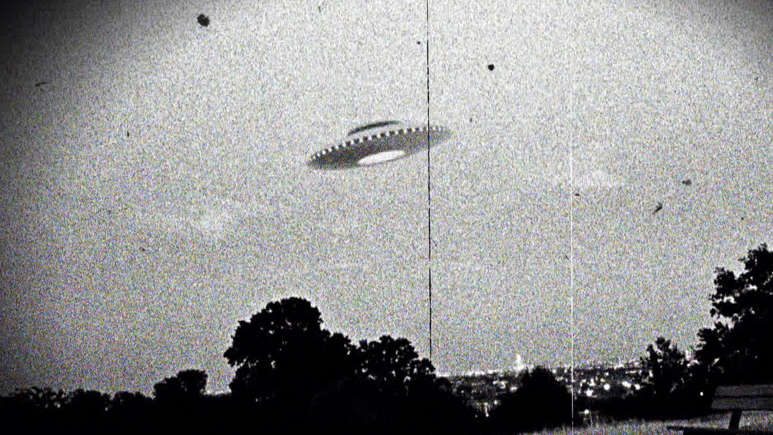
In June of 1952, a squadron of six Norwegian jet planes had just started summer maneuvers over Spitsbergen. As they sped over the Hinlopen Straits, their radios began crackling and emitting static before anomalously cutting out entirely to leave them with no way to communicate with each other. In the meantime, radar showed that an unidentified object was fast approaching, but the pilots themselves could see nothing visually. The fighters circled the area for some time, when Air Captain Olaf Larsen purportedly looked down to see a metallic disc lodged into the snow-frosted landscape down below, measuring 40 to 50 meters in diameter and shiny and bright enough to stand out in the snowy landscape. Further inspection would reveal that machinery and cables could be seen, as well as a series of jets around the side and what appeared to be a broken cockpit protruding from the icy ground. When they were finally able to get back to base and report what they had found, an expedition was sent to the apparent crash site, and a report in the German newspaper, Saarbrücker Zeitung, would say of what was found:
“A precise inspection of the remote-controlled flying disc that landed on the Nordaustlandet of Spitsbergen due to interference problems, led to the following indisputable information. The flying object, which has a diameter of 48.88 meters and slanting sides, is round and was unmanned. The circular steel object, is made out of an unknown metal compound, resembles a silver disc. After ignition, 46 automatic jets, located at equal distances on the outer ring, rotate the disc around a plexiglassed center ball, that contains measuring and control devices for remote control. The measuring instruments (gauges) have Russian symbols. The action radius of the disc seems to be more than 30.000 km, and the altitude over 160 km. The flying object, which resembles one of the legendary "flying saucers", has sufficient room for high explosive bombs, possibly nuclear bombs.
In the wreck of the apparatus an expert is said to have discovered a radio piloting transmitter with a nucleus of plutonium transmitting on all wavelengths with 934 hertz, a measure that has been unknown so far. The investigation has also shown that the flying saucer crashed because of a defect in its radio piloting system. The saucer carried no crew. The steel used in the construction is an unknown alloy. It consists of an exterior disc provided at its peripheral with 46 automatic jets. This disc pivots around the central sphere which contains the measurement and remote-control equipment. The Norwegian specialists assumed that the disc had started from the Soviet Union and had gone down over Spitsbergen due to a mistake in transmitting or receiving, being incapacitated because of the hard landing. The strange, remote-controlled, unmanned jet plane will be brought to Narvik on board a ship for further investigation.”
OK, so although weird, this was obviously just some sort of Russian experimental aircraft of some sort, right? Well, that is what it would seem to be at first, yet the story would continue to pick up new information and evolve. As the story got out into the open, it would pick up new details, such as that of a report that supposedly came forth from Colonel Gernod Darnhyl, of the Norwegian General Staff, who supposedly made the statement:
“The Spitsbergen crash was very rewarding. True enough, our science still faces many riddles. I am sure, however, that they can soon be solved by these remains from Spitsbergen. A misunderstanding developed, some time ago, when it was stated that the flying disc was probably of Soviet origin. It has - this we must state emphatically - not been built by any country on earth. The materials are completely unknown to all experts, either not to be found on Earth, or processed by physical or chemical processes unknown to us. We must tell the public what we know about the unknown flying objects. A misplaced secrecy may well one day lead to panic! We now have material at hand, on which we can start. That means laboratories can start the work right away and they might give us preliminary results shortly. Norwegian scientists think that the material from Spitsbergen can only give away its secrets by nuclear crushing; this because it does not change either at absolute zero, when air is liquified, or at the highest temperatures technically possible with our technology. Also, every chemical treatment has been tried. Scientific results will only be released subsequent to a UFO conference in London or Washington.”
So now it is not a Russian aircraft? Curiouser and curiouser. Before long, there were ever more fantastical stories surrounding the purported UFO crash, such as a report in Uruguayan newspaper El Nacional of Montevideo. In the report, it is claimed that the Norwegian scientist Hans Larsen Løberg had made clear that the craft had actually come down at the German island of Helgoland, in the North Sea, and was definitely not Russian, having no discernible engine, nor any rivets, fuses or bolts, and speculated to have operated on “magnetic forces.” Løberg also apparently stated that the craft had some sort of “beam weapon” on board, as well as the remains of actual alien bodies, or at least a crew of some sort. The report reads in part:
“The material used was as light as aluminum, but very much harder, and probably much heat-resistant. Of the things found in its interior, they noticed some water that was three times as heavy as normal water, and a few pills which were taken to be food. There was also an apparatus which probably was a radio. It was quite small and had no antenna. They also found some books, probably navigational instructions, in a completely unknown writing. The doors of the spaceship were open. Just inside of the doors were 7 bodies, burned beyond recognition. Scientists are of the opinion, according to Larsen Løberg, that the bodies were of men at the age of between 25 and 30 years, about 1,65 m tall. All had perfect sets of teeth. The reason for the crash of this saucer, he thought, had to be that it was affected by the American hydrogen-bomb explosions. The material of the spaceship, and its apparatus, resisted the enormous heat, but the crew burned to death.”
And just like that, the story has gone from a mysterious crash that could be anything or nothing at all to a downed alien spaceship with dead crew, alien or otherwise, on board. After this, the whole story becomes hazy, and there is not much to corroborate any of it, with many different versions offered up over the years that only further serve to muddy the waters as to what is going on. Indeed, there seems to be little to link any of this to an actual factual basis, and it lurks within the realm of strange cases that will probably be discussed over and over again, but which have no concrete evidence that can ever lead us in the direction of a real answer. The verdict of many in the UFO field is that this is an obvious hoax that has gotten out of control to take on a life of its own, with Norwegian ufologist Ole Jonny Brænne concluding:
“The conclusion therefore has to be that the Spitsbergen story (and the Helgoland story too, for that matter) is nothing but a classic H-O-A-X! The original authors, mainly J.M.M. and Sven Thygesen (if that was their real names), had a cursory knowledge of Norwegian military aircraft, but far from good enough. Even if this case does not hold any water, I will venture my way with a little prophecy: This story will, with great certainty, continue to be the subject of books as well as magazines during the 1990s. There will always be "researchers" who think this story deserves their enthusiastic attention, and cannot settle down with factual arguments which clearly show the story to lack any basis in reality.”
Was this a hoax, or was there something more to it? Opinions seem to be divided on this case, which only further fuels speculation and debate. Did something crash out there in that snowy wilderness, and was it covered up? Why has it evolved to add new details over time? It this the truth slowly coming out or the result of mere embellishment? Just what happened out there in the wilds of that remote place? The mystery remains, and we may never know for sure.

Moving on to our next case, on the evening of November 9, 1974, police in the quiet town of Carbondale, Lackawanna County, Pennsylvania, got a curious call from some scared teens. The group of friends, consisting of John Lloyd, 14, William Lloyd, 16, and Robert Gillette, 15, claimed that they had been outside playing in a park when they saw a fiery object “like a shooting star” come speeding over the nearby Salem Mountain to plummet to earth behind some trees, showering a trail of sparks behind it and emitting a “whistling noise” the whole way. When the curious boys excitedly ran over to see what had happened, they realized that the object had come down into a pond, or more accurately, a large coal breaker pit filled with water. When they approached the pond’s edge, they claimed to have seen something down in the depths, eerily glowing in the water about 20 feet from shore. They also claimed that there was a fizzing sound from the pond for a few minutes, as if “someone had thrown a cigarette in the water.” Police at first thought it was an obvious prank, but officers were sent to check it out anyway. This would be the beginning of one of the strangest UFO cases in Pennsylvania history.
When police arrived, they were surprised to see that there indeed was something out under the surface, emanating a spooky glow, with the teens even claiming that it seemed to have changed positions since they had first called it in. The police had no idea what it could be, and they quickly cordoned off the area just to be safe. It seems as if they still sort of thought of it as a joke, though, because one policeman even apparently fired off four shots into the pond at the mysterious object, to no effect. A closer look at the glow seemed to suggest that it was coming from a circular or spherical object, perhaps 5 feet in diameter, and that this glow seemed to be pulsating with a white-yellowish light. Police speculated that it was perhaps a downed plane, but the speed with which it had hit the water and the description from the boys seemed to discount this. Another idea was that it was a meteorite, some sort of space junk or even a downed Soviet missile. However, none of these explanations can explain one police report that a boat sent to investigate had seen the light seemingly rush towards them before returning to its original resting spot. What was going on here? No one had a clue. By the next morning, the glowing had stopped.
Before long, word had gotten out about a “UFO crash” at the pond, and police had their hands full trying to keep the flow of hundreds of congregating gawkers from approaching the water. In the meantime, Dr. J. Allen Hynek's Center for UFO Studies in Evanston, Illinois, was contacted by police about the strange incident, and he suggested that it was likely a meteor or a meteor fragment, as well as recommending that Geiger counter readings be taken at the site just in case. Hynek would also send a UFO field investigator to the site. Another investigator who would be called in was M.J. Graeber, ufologist and founder of UFORIC, a Philadelphia-based UFO Report and Information Center. By this time, the area was flooded with thousands of curiosity seekers and UFO enthusiasts, with many more clogging up the roads leading into the city, and all sorts of rumors were heavily making the rounds. Graeber would say of the scene and the flying rumors:
“It looked just like a scene from a science fiction movie and fears grew that emergency vehicles could not have got through if they were needed. To make matters worse, although we hadn't a ghost of an idea of what was actually in the water, rumors were spreading like a brush-fire and a few very vocal UFO enthusiasts who were milling about at the site were questioning the effectiveness of the police, fire companies and UFO researchers' retrieval efforts. There was a rumor that an alien space ship had landed - not crashed - in the silt pond and that the military had managed to recover whatever was in the water and spirit it away before anyone had an opportunity to see it. In one rumor scenario, the UFO was loaded upon a flatbed railcar that was brought to the site on a nearby (albeit, long abandoned) railroad spur - and in another account, two military helicopters were used to lift the object from the water and place it in an armored truck. Curiously, I too became linked to a rather ridiculous rumor which placed me at the scene as a government agent or high ranking Air Force officer disguised as a UFO field investigator. But the truth was that I was just a guy who had an interest in the UFO phenomenon and had been investigating sighting reports for about two years prior to the incident.”
Curiously, Graeber would report that there were only police at the scene and a single Air Force officer, with no armed military men present, despite what others would later claim. While the investigation was being carried out, the local Fire Department made efforts to pump and drain the pond to find out if anything was in there, but they faced many difficulties with debris and silt, making the process extremely slow going and basically useless. Another idea was to try and use a crane fitted with a magnet to lift whatever it was out, but this proved to be impractical, and there was still the fear that whatever it was could be leaking dangerous substances. They ended up calling in a diver by the name of Mark Stamey to come in and take a look, and in the meantime, some of the UFO investigators were being interviewed about their thoughts on the matter. Most of them were beginning to think this was perhaps a hoax, or at most a meteor. Graeber would say:
“The UFO researchers were being interviewed by the press and a TV station's helicopter circled the pond churning up the water. Although we still hadn't any solid information on what the object in the water might be, Dr. Hynek's representative and I were starting to suspect that the incident might be a prank that the teens had perpetrated on a nothing else to do Saturday night whim. We thought that perhaps their hoax simply got out of control and took on a life of its own - and that the boys may have been too scared to fess up to what they had done. Of course, it may have been that the boys had witnessed a meteor or a bolide (a large and occasionally exploding meteor) streaking across the night sky and mistakenly assumed that it was the same luminous object that they discovered moments later in the pond. This seemed to be a reasonable notion, as the boys' description of the aerial phenomenon they had observed was absolutely meteoric in character. However, my inspection of the alleged crash site revealed that there were no topographical indicators to suggest that something like a plane, a large piece of space junk or a meteor had impacted the pond or the area surrounding it. There wasn't any obvious displacement of earth; there was no displacement of water from the pond; there were no indicators of a fire, downed tree limbs or skid marks creating a gouge in the soil.”

It is quite possible that this is correct, as when Stamey finally suited up and dove in, he returned a short while later with a 12‐inch miner’s lantern. After this, the whole thing would fall apart. Robert Gillette Jr. would admit that he had thrown the lantern into the water to scare his sister, although the other two boys insisted that what they had seen was true, that an object really had come down from the sky. Nevertheless, the news soon hit that it was all a hoax, the disappointed crowds quickly dissipated, and the UFO researchers packed their bags and went home. However, there were still many who believed that a UFO, or at least something strange, had really come down, and there were many reports from people who insisted that they had seen a big flatbed truck on the road near the pond with something large on it and surrounded by the military, with the lantern planted there to make people go away and cover up the fact that they had retrieved an alien ship. This whole conspiracy would be fueled when, years later, Gillette would recant his confession to throwing the lantern into the pond and admit that something larger had been removed, although he shies away from aliens and thinks it was likely some Soviet tech. Gillette has said of this:
“My girlfriend broke up with me, so I was in a bad mood. I just told them what they wanted to hear, that it was a lantern. It wasn’t a lantern. Something was pulled out of the pond. I don’t think it was aliens. Some people do. I never called it a UFO. The official people did.”
The case has become quite the piece of lore in the area, and there are still plenty of people who think there is more to it than meets the eye. While it seems on the surface that it must surely be just a prank that got out of control, is that really what is going on here? Did these kids just pull off a hoax that managed to pretty much shut the whole town down? If so, why are there so many other reports of something strange going on? Did something come down into that pond or not, and if so, what was it? Was this a plane, meteor, satellite, or something altogether stranger? Was there someone who wanted to cover it all up by orchestrating it as a hoax? The case is so long ago now, and so written off as just a prank, even by many ufologists, that it hasn't really been investigated any further, and so it is left up to the imagination.
The small mining town of Dalnegorsk, Russia, is a rather bleak, stark, and frigid place. Indeed, the name Dalnegorsk literally means “far in the mountains,” and the unforgiving landscape here is fitting for such a name. It is a remote, rugged place of near perpetual cold, just a speck on the map and unknown to most of the outside world. Yet this forgotten place has one claim to fame, as it was once supposedly the site of a UFO that crashed to earth, which would then spawn stories of conspiracies and cover-ups, as well as usher in a whole series of UFO phenomena and strangeness.
In the cold, dark morning hours of January 29, 1986, hundreds of locals had their attention drawn skyward by an unusual sight. Streaking across the sky was seen a glowing reddish ball, travelling in a parallel, controlled manner at a speed of around 120 mph, described as being about the size of “half of the moon’s disc” and with a metallic surface like “hot stainless steel.” The object was obviously not a meteor, as it appeared to slow down to a speed of only around 50 mph as it approached Izvestkovaya Mountain, also called “Height 611.” It was thought at first that this was perhaps something from the military base nearby, but whatever it was did not make the slightest sound as it flew over at a height of around 700 feet. As the villagers looked on in astonishment, the object suddenly jerked and dipped sharply, before plummeting to earth behind the trees and hitting the mountain beyond in a ball of flame, producing a blindingly bright flash, yet there was oddly no expected boom of an explosion. For several hours, the glow of what looked from a distance like a forest fire could be seen emanating from where the mysterious object had gone down, yet no one dared approach.

It would not be until a few days later that anyone would arrive at the remote site to actually check it out, when a team from the Academy of Sciences came to investigate the odd reports. They discovered a circular spot in the forest that had obviously been charred, and to their amazement, there were numerous shards of metal, mesh fragments, beads, and an anomalous black film over everything. There were some odd magnetic readings at the site, an unidentifiable chemical odor lingering everywhere, and a certain charge to the air like static electricity, yet no abnormal radiation was detected. Some reports say that those who examined the area experienced various health issues, such as nose bleeds, headaches, nausea, and blood pressure fluctuations, and inexplicably, all photos taken of it would later come out completely blank. Samples of the materials were gathered, and things would get stranger still.
Scientists allegedly found that the beads were composed of lead, silicon, gold, nickel, and iron, but when melted down, their composition anomalously changed into such elements as titanium and molybdenum. The mesh-like material was also found to have many oddities. For one, its structure was bizarre to say the least, made of microscopic twisted fibers of carbonic and metal threads only 17 microns wide, beyond anyone's capabilities to make at the time. Some of the fragments featured an incredibly high density of gold, inconsistent with the surrounding area. The mesh also proved to be well-nigh indestructible, unable to be damaged by soaking in strong acids or solvents, and only able to be cut with the hardest diamond cutting tools. Scientists were apparently dumbfounded by all of this, but rather than explain it as aliens, it was thought to perhaps be from an American satellite or aircraft displaying some unknown advanced technology, although the United States would later deny having anything to do with it. In later years, some of these fragments made their way to the United States, and some would even be displayed. One such exhibit of some of these alleged fragments was shown at the National Atomic Testing Museum in Las Vegas, and the description at the exhibition reads:
“Three Soviet academic centers and 11 research institutes analyzed the objects from this UFO crash. The distance between atoms is different from ordinary iron. Radar cannot be reflected from the material. Elements in the material may disappear and new ones appear after heating. One piece disappeared completely in front of four witnesses. The core of the material is composed of a substance with anti-gravitational properties.”
In the days after the Dalnegorsk incident, the area, and in particular Height 611, would allegedly become ground zero for intense waves of UFO sightings, with dozens of subsequent instances of mysterious objects in the sky. On some occasions, the objects were reported as hovering over the mountain and illuminating the forest below with beams, as if looking for something, and such reports would carry on all the way into the following year and beyond, given by people from all walks of life, including traditionally reliable witnesses such as doctors, policemen, officials, and military personnel. In some instances, people even claimed to have found more of the mysterious fragments in the area, as well as patches of a strange oil-like substance.
Although it is all a rather spectacular tale, the Dalnegorsk incident managed to be sort of brushed under the carpet, hidden away by what was then the Soviet Union, and it was not until years later that outside ufologists would begin uncovering the tale and making its existence known through articles and TV shows, such as a notable segment on a 1995 episode of Sightings. Unfortunately, there does not seem to be much remaining in the way of corroborating evidence, and the vast majority of the supposed material from the crash has gone missing over the decades. While it is all very intriguing and seems promising on some levels, with plenty of eyewitnesses and potential physical evidence, we are forced to relegate it to the files of other cases that have been lost to history, with no way of proving them true or not, one way or the other. What happened at that cold, lonely mountain? We may never know.
This is pretty much what we are left with on all of these cases. These tantalizing supposed crashes of extraterrestrial spaceships have plenty of intriguing stories surrounding them, sometimes even alluring supposed evidence, but in the end, nothing to concretely confirm that they ever happened at all, or if they did, what they were. These stories have sort of faded away, any evidence that may have been gained lost or whisked away to remain unreachable, launching them firmly into the limbo of speculation and debate.


 Amazing Lesser Known UFO Crashes

































Researchers based their findings on clam shells recovered from around the North Atlantic region. In this colour map, redness indicates greater loss of current stability preceding rapid circulation changes
What is the North Atlantic Subpolar Gyre?
The North Atlantic Subpolar Gyre is a massive system of rotating ocean currents in the North Atlantic.
It transports heat from the tropics to the North Atlantic, helping to regulate temperatures in Europe and North America.
It also helps to power the Atlantic Meridional Overturning Circulation (AMOC) – a key part of the global ocean conveyor belt that moves heat and nutrients around the world.
'We don't have ocean observations going back into the distant past, but the bands in clam shells give us an unbroken annual record covering hundreds of years,' said Dr Nava.
The data revealed that the North Atlantic Subpolar Gyre has had two 'destabilisation episodes' over the past 150 years where it has lost stability – suggesting that a tipping point could be approaching.
The first destabilisation episode happened in the early 20th century before the 1920s, while the second stronger episode began around 1950 and continues to the present day.
This suggests that the North Atlantic Subpolar Gyre is moving toward a tipping point that could lead to a cascade of 'catastrophic, irreversible changes' to our climate, such as more extreme weather events, particularly in Europe, and changes in global precipitation patterns.
While it would be less catastrophic than the collapse of the AMOC, it would still bring substantial impacts including more frequent extreme weather in the North Atlantic region and deep freezes in Europe.
The UK and northern Europe could experience much harsher winters typical of parts of Canada, while the east coast of the US could see dramatic sea level rises due to changes in ocean circulation.
While the North Atlantic Subpolar Gyre looks likely to 'weaken abruptly', it 'would not completely collapse' as it is also driven by winds, Dr Nava said.
North Atlantic Subpolar Gyre is part of, and helps power, the Atlantic Meridional Overturning Circulation Earth's vast system of ocean currents that distributes heat and nutrients around the world. The new study finds evidence of 'stability loss' that suggests the region is 'moving towards a tipping point'
The Little Ice Age was a period of major mountain-glacier expansion that spanned from around the early 14th century through to the mid-19th century, when rivers froze over and crops were decimated
Read More
'Such a weakening would reduce the northward flow of heat carried by ocean currents, likely triggering a chain of climate changes including more frequent extreme weather events, stronger seasonal contrasts in Europe, and shifts in global rainfall patterns,' she told the Daily Mail.
However, a weakening North Atlantic Subpolar Gyre is what occurred during the early years of the Little Ice Age – suggesting similar climate effects could be seen again even if the wider AMOC doesn't collapse.
The study, published in the journal Science Advances, offers independent evidence that the North Atlantic has 'lost stability over recent decades and is vulnerable to crossing a tipping point'.
'Melting of polar ice due to climate change is certainly contributing to the weakening of ocean currents and pushing them closer to a tipping point, so rapidly reducing greenhouse gas emissions is the best way to prevent tipping points in the Atlantic Ocean,' the expert added.
How does global warming affect global currents?
Scientists think melting glaciers could cause the collapse of the Atlantic Meridional Overturning Circulation or AMOC, the system of ocean currents.
Described as 'the conveyor belt of the ocean', the AMOC transports warm water near the ocean's surface northwards – from the tropics up to the northern hemisphere.
When the warm water reaches the North Atlantic (Europe and the UK, and the US east coast), it releases the heat and then freezes. As this ice forms, salt is left behind in the ocean water.
Due to the large amount of salt in the water, it becomes denser, sinks, and is carried southwards – back towards the tropics – in the depths below.
Eventually, the water gets pulled back up towards the surface and warms up in a process called upwelling, completing the cycle.
Scientists think AMOC brings enough warmth to the northern hemisphere that without it, large parts of Europe could enter a deep freeze.
Prior studies have already shown that due to climate change, the AMOC is weakening (meaning the movement of heat is slowing down)
The engine of this conveyor belt is off the coast of Greenland, where, as more ice melts from climate change, more freshwater flows into the North Atlantic and slows everything down.