Naar de inhoud

UFO'S of UAP'S, ASTRONOMIE, RUIMTEVAART, ARCHEOLOGIE, OUDHEIDKUNDE, SF-SNUFJES EN ANDERE ESOTERISCHE WETENSCHAPPEN - DE ALLERLAATSTE NIEUWTJES

UFO's of UAP'S in België en de rest van de wereld
seniorennet.beseniorennet.be
Ontdek de Fascinerende Wereld van UFO's en UAP's: Jouw Bron voor Onthullende Informatie! Ben jij ook gefascineerd door het onbekende? Wil je meer weten over UFO's en UAP's, niet alleen in België, maar over de hele wereld? Dan ben je op de juiste plek! België: Het Kloppend Hart van UFO-onderzoek In België is BUFON (Belgisch UFO-Netwerk) dé autoriteit op het gebied van UFO-onderzoek. Voor betrouwbare en objectieve informatie over deze intrigerende fenomenen, bezoek je zeker onze Facebook-pagina en deze blog. Maar dat is nog niet alles! Ontdek ook het Belgisch UFO-meldpunt en Caelestia, twee organisaties die diepgaand onderzoek verrichten, al zijn ze soms kritisch of sceptisch. Nederland: Een Schat aan Informatie Voor onze Nederlandse buren is er de schitterende website www.ufowijzer.nl, beheerd door Paul Harmans. Deze site biedt een schat aan informatie en artikelen die je niet wilt missen! Internationaal: MUFON - De Wereldwijde Autoriteit Neem ook een kijkje bij MUFON (Mutual UFO Network Inc.), een gerenommeerde Amerikaanse UFO-vereniging met afdelingen in de VS en wereldwijd. MUFON is toegewijd aan de wetenschappelijke en analytische studie van het UFO-fenomeen, en hun maandelijkse tijdschrift, The MUFON UFO-Journal, is een must-read voor elke UFO-enthousiasteling. Bezoek hun website op www.mufon.com voor meer informatie. Samenwerking en Toekomstvisie Sinds 1 februari 2020 is Pieter niet alleen ex-president van BUFON, maar ook de voormalige nationale directeur van MUFON in Vlaanderen en Nederland. Dit creëert een sterke samenwerking met de Franse MUFON Reseau MUFON/EUROP, wat ons in staat stelt om nog meer waardevolle inzichten te delen. Let op: Nepprofielen en Nieuwe Groeperingen Pas op voor een nieuwe groepering die zich ook BUFON noemt, maar geen enkele connectie heeft met onze gevestigde organisatie. Hoewel zij de naam geregistreerd hebben, kunnen ze het rijke verleden en de expertise van onze groep niet evenaren. We wensen hen veel succes, maar we blijven de autoriteit in UFO-onderzoek! Blijf Op De Hoogte! Wil jij de laatste nieuwtjes over UFO's, ruimtevaart, archeologie, en meer? Volg ons dan en duik samen met ons in de fascinerende wereld van het onbekende! Sluit je aan bij de gemeenschap van nieuwsgierige geesten die net als jij verlangen naar antwoorden en avonturen in de sterren! Heb je vragen of wil je meer weten? Aarzel dan niet om contact met ons op te nemen! Samen ontrafelen we het mysterie van de lucht en daarbuiten.

Robots Are Learning Complex Tasks by Watching Humans and Other Robots

robots that learn by watching other robots

Image by Vilius Kukanauskas from Pixabay

Robots Are Learning Complex Tasks by Watching Humans and Other Robots

A team of scientists from the École Polytechnique Fédérale de Lausanne (EPFL) in Switzerland has revealed a new framework that embeds robots with an internal understanding of their own tools and abilities, as well as their functional limitations, called ‘kinetic intelligence.’

The researchers behind the novel framework said their approach gave the robots the unprecedented, if not somewhat dystopian-sounding, ability to learn new skills from other robots regardless of their functional similarity.

While still in the experimental stage, the team said that their learning from demonstrations (LfD) framework could dramatically improve efficiency in multi-robot environments such as large retail warehouses and automotive assembly plants by reducing training times of robotic systems designed to work together.

Learning Complex Tasks Remains Challenging for Robots of Different Designs

According to a statement announcing the sci-fi-sounding framework that lets robots learn complex tasks by watching other robots, some LfD systems already exist. However, these earlier versions cannot be transferred between different robotic systems, limiting them to a single robotic platform learning from an identical ‘trained’ model.

“Most LfD methods remain tied to the robot they were trained on,” the research team explained in a published study detailing their work.

As robotic systems become more prevalent in the workforce, their complexity and capabilities are also expected to continue to increase. The research team notes that this increasing “freedom of motion” will open the door to training methods that allow differently constructed robotic platforms to learn to accomplish tasks regularly performed by robots of a different, but similarly versatile, design. However, they also note that this increasing complexity will only increase the need for simpler training methods that don’t require hours of human intervention.

“Teaching robots new skills should be as natural as showing rather than programming,” the researchers explained. “Learning from demonstration (LfD) moves toward this goal by allowing users to guide a robot or sketch a desired motion, enabling learning without writing a line of code.”

Embedding Kinematic Intelligence on Differently Constructed Platforms

To remove human trainers from the equation, the EPFL team evaluated and classified different 3-jointed robots based on joint spacing and movement constraints. After testing various autonomous learning approaches, the team designed a framework that models potential workplaces, identifies ‘feasible’ motion trajectories based on how they had previously classified the robot, and then executes a safe movement within each robot’s specific design capabilities.

“(We) embedded kinematic intelligence into the control policy, ensuring constraint-awareness and predictable behavior regardless of design variations,” they explained.

The team notes that this framework “endows robots with kinematic intelligence: an internal understanding of their own joint limits, singularities, and connectivity.”

“Instead of correcting for these constraints after learning, we embedded them directly into the control policy from the outset,” they explained. “

Tests Validate Learning From Their Demonstration Framework After a Single Observation

To validate their new framework, the team tested it across several industrial robots with varying abilities and limitations. According to the study authors, this included “diverse simulated and real robots, both redundant and nonredundant, with varied link geometries and joint configurations.”

During each test, a human ‘trainer’ would perform a specified task to demonstrate the desired result. For example, the researchers would trace out the letters of a word or manipulate objects as if they were on a simulated assembly line.

After a single human demonstration, the robotic platforms with the embedded kinetic intelligence framework showed the uncanny ability to adapt their own tools to achieve the same result, regardless of design limitations. The researchers said this included demonstrating the ability to reproduce the traced characters, and to “push, pick-and-place, and throw objects successfully.”

“The Demonstrated Skill Executes Safely and Consistently Across Robots”

When discussing the successful tests, the researchers noted that robots imbued with kinetic intelligence could observe one or more demonstrations, extract a “globally stable dynamical system,” and produce behaviors that remain valid across robots with different physical tools and limitations. They also noted that one robot could watch another perform the skill and adapt its unique configuration to achieve the same result, without accidents or damage.

“The demonstrated skill executes safely and consistently across robots without retuning, thereby achieving cross-robot skill transfer,” they explained.

When discussing possible applications of their LfD framework that lets robots learn by watching other robots, they note that the entire design was grounded in the category of three-revolute (3R) robots, “which form the building blocks of many commercial robots.”

“This classification enables a joint space policy that preserves user intent and adapts to robot-specific constraints,” they conclude.

The study “Demonstrate once, execute on many: Kinematic intelligence for cross-robot skill transfer” was published in Science Robotics.

  • Christopher Plain is a Science Fiction and Fantasy novelist and Head Science Writer at The Debrief. Follow and connect with him on X, learn about his books at plainfiction.com, or email him directly at christopher@thedebrief.org.
RELATED VIDEOS

Humanoid Robots Learn by Watching Us #shorts


How Robots Learn Real-World Tasks

Why Every Tech Expert is Now Watching This New AI Robot

{ https://thedebrief.org/category/science/ }

Hoe vind je dit bericht?
Geschreven door peter om 18:11 Stuur door

New images of Mars surprise scientists with how different they are compared to the 1970s data

New images of Mars surprise scientists with how different they are compared to the 1970s data

We’re used to seeing Mars as a static world, almost frozen in time. In most classic photographs, we see a monotonous desert—a rust-brown surface covered by a thick layer of dust and scattered rocks, through which jagged cliffs are visible. This landscape seems to have remained unchanged for millions of years. However, new data obtained by European researchers debunks this myth. Recent images of the Red Planet have revealed an astonishing sight: a vast “blanket” of volcanic ash that is rapidly spreading across the surface.

Viking vs. Mars Express

Comparison with an image of a section of Mars captured by the Viking lander. The white frame marks the area of the panorama shown below Comparison with an image of a section of Mars captured by the Viking lander. The white frame marks the area of the panorama shown below

The comparison of modern photographs with archival images from 50 years ago caused quite a stir. When NASA’s Viking orbiters imaged the same region in 1976, they captured a classic scene: light, ochre-colored plains dotted with barely visible dark spots. However, in new detailed images sent by the European Space Agency’s (ESA) Mars Express spacecraft, the planet appears to be split in two.

A panoramic view of the Martian surface captured during the Viking and Mars Express missions. Photo: ESA

The dark cloud of ash now covers a much larger area than it did in the mid-1970s. This suggests that the geological “face” of Mars can change incredibly quickly by cosmic standards—literally in just a few decades. This trend underscores the fact that Mars is not a barren “dead rock,” but a planet where active atmospheric and, possibly, subsurface processes continue to shape its landscape.

Chemistry of Darkness

A close-up of a crater on Mars at the boundary between light and dark terrain. Photo: ESA

So what exactly is this dark layer? ESA scientists explain that the material is of volcanic origin. It is rich in so-called mafic minerals—compounds containing large amounts of magnesium and iron. It is these minerals that give the ash its characteristic dark color, which contrasts sharply with the surrounding light-colored terrain.

A bird’s-eye view of an impact crater on the ash-brown surface, which has changed since the Viking mission. Photo: ESA

Mars is known for its turbulent volcanic history. It is home to Olympus Mons, the tallest volcano in the Solar System, standing 20 km high. Billions of years ago, the planet was undergoing an era of super-eruptions that spewed an incredible amount of ash and gases into the atmosphere. Over time, the activity subsided, giving way to a period of calm lava flows, but the remnants of those ancient eruptions did not disappear. They remained buried beneath layers of dust, biding their time.

Two theories of the same transformation

The scientific community is currently considering two main scenarios as to why the dark ash has become so noticeable right now.

The first theory attributes this to the famous Martian winds. It is possible that global or local dust storms picked up ancient ash deposits from craters or faults and carried them to new areas, “painting” the rust-colored surface in dark hues.

The second theory posits the opposite process: the ash has always been where we see it now, but it was previously hidden beneath a thin layer of golden dust. Strong air currents may have simply blown away this top layer, exposing the dark volcanic “substrate.” In any case, these changes demonstrate the immense power of the Martian atmosphere.

Mysteries of Utopia Planitia

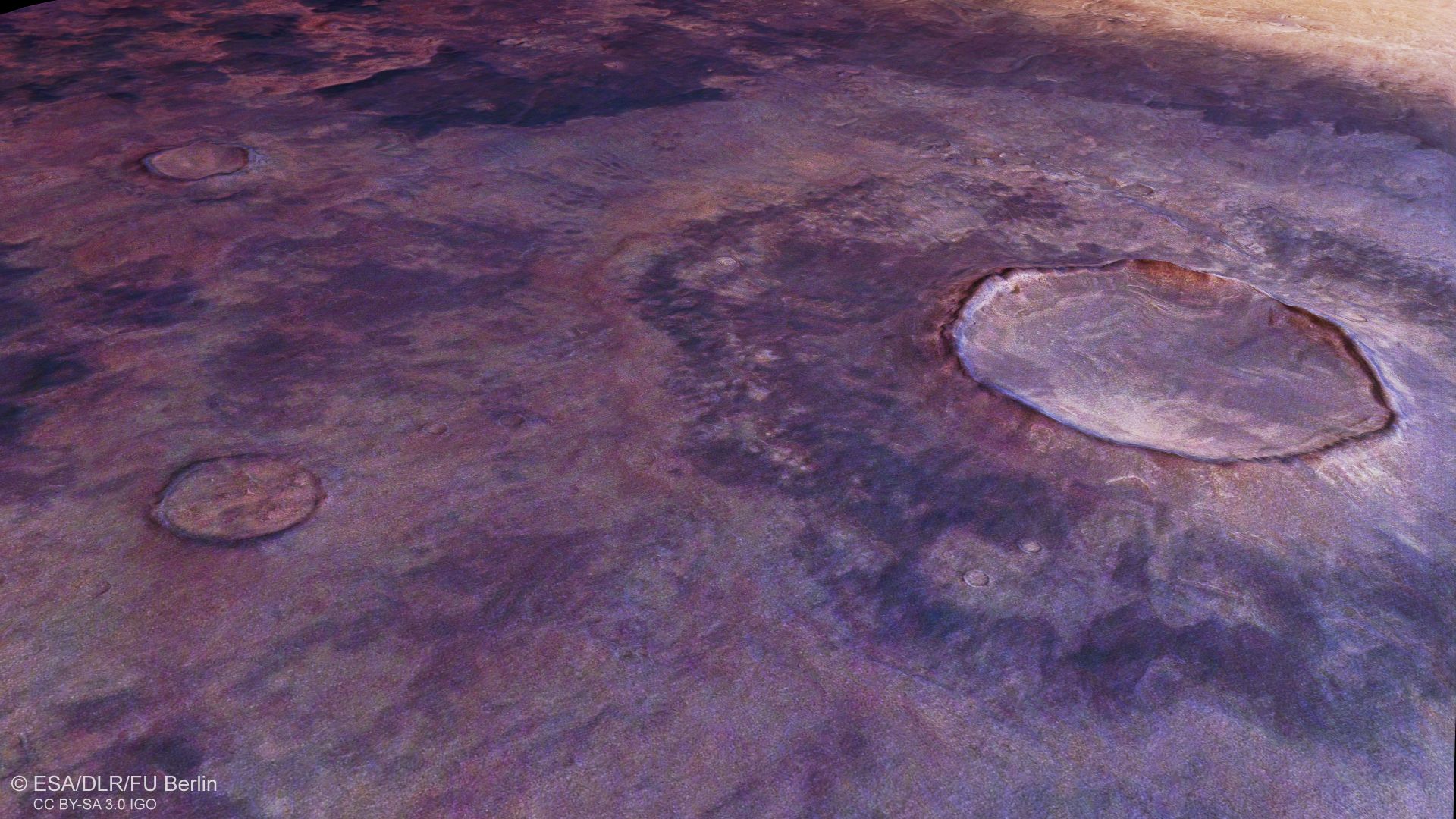
A wider view of the area of Mars shown in the main image, located in the Utopia Planitia basin. Source: ESA

The main focus of the study was the region surrounding Utopia Planitia—a massive impact plain that is one of the oldest basins on the planet. It is believed that in the distant past, this low-lying area may have been the floor of a vast ocean or a network of lakes. 

Mars Express images clearly show a large crater in this region, surrounded by a bright ring—the so-called “ejection veil.” This is material that was ejected from the planet’s interior during the meteorite impact. Although the surface of the basin appears dry and rocky, ESA data confirm that vast deposits of water ice still lie beneath the volcanic ash and sand.

Supporting this hypothesis are the “scalloped depressions” visible at the bottom of the images. These unusual, wavy depressions are a typical feature of a periglacial landscape. They form as a result of regular cycles of freezing and thawing (or sublimation) of ice beneath the surface. Thus, the dark ash not only changes the planet’s color but also helps scientists better understand how water is distributed in the Martian soil.

The mission continues

The spacecraft launched from Earth toward Mars on June 2, 2003. It reached its destination after a six-month flight and has been exploring the planet since early 2004. Photo: ESA

The Mars Express spacecraft has been in orbit around Mars since 2003. Over the course of more than twenty years of operation, it has created the most detailed map of the planet to date, with unprecedented resolution. Each of these photos is not just a beautiful landscape, but an important piece of the puzzle in the history of our neighbor’s geological and climatic evolution. As we watch ash and dust wage their eternal battle on the plains of Utopia Planitia, humanity has the chance to learn what Mars was once like and what it will become in the future, when the first human sets foot on its surface.

We previously discussed the changes experienced by the Martian Sphinx since it was first photographed.

  • According to ESA 

RELATED VIDEOS


🔴What Really Happened to Mars? Mars Then vs Now: Its Water, Atmosphere, and Life? #Mars #MarsMission

Mars Is Hiding Something BIG | The Discovery That Changes EVERYTHING

9 Recent Mars Discoveries That Should've Been Bigger News Than Artemis

{ https://universemagazine.com/en/articles-en/ }

Hoe vind je dit bericht?
Geschreven door peter om 22:43 Stuur door

The Sahara’s Mysterious “Richat Structure” Makes a Stunning Appearance in New NASA Satellite Images

Richat Structure

(Image Credit: NASA Earth Observatory/Lauren Dauphin)

The Sahara’s Mysterious “Richat Structure” Makes a Stunning Appearance in New NASA Satellite Images

One of Earth’s most impressive natural wonders—the Sahara Desert’s mysterious Richat Structure—just made a striking appearance in new satellite images released by NASA.

The curious feature, located in an isolated region of northern Mauritania on the Sahara’s mountainous Adrar Plateau, was first discovered almost a century ago but had not been photographed until it was spotted by astronauts during the Cold War.

The newest images of this geological marvel, captured on March 5 and 6, 2026, were recently featured as NASA Earth Observatory’s Image of the Day for April 16.

Richat Structure The most recent images of the Sahara’s Richat Structure, captured by the OLI (Operational Land Imager) on Landsat 9 and Landsat 8 on March 5 and March 6, 2026, respectively (Image Credit: NASA Earth Observatory/Lauren Dauphin)

According to a commentary by Adam Voiland accompanying the newest images, the Richat Structure is “a deeply eroded geologic dome formed by the uplift of rock above an underground intrusion of igneous material.”

“Over time, differing erosion rates among rock types in the exposed upper dome led to the development of circular ridges known as cuestas,” Voiland adds. “The orange and gray colors reflect differences in sedimentary and igneous rock types across the structure and the surrounding landscape.”

The Richat Structure is not the only unique feature in the Sahara Desert that features striking concentric geology similar to this. Another example, Jabal Arkanū’s concentric rock rings, found in southeastern Libya, also bear a unique circular appearance, though not quite as striking as its massive Mauritanian counterpart.

A Cold War Discovery

On June 3, 1965, at the height of both the Cold War and the great Space Race between the United States and the Soviet Union, the Gemini IV mission lifted off from Launch Complex 19  at Cape Kennedy Air Force Station in Florida, carried into orbit aboard the Gemini–Titan II, a modified Intercontinental Ballistic Missile.

Only the 10th manned American spaceflight at that time, astronauts James McDivitt and Ed White spent four days in orbit, during which White performed the first American spacewalk, spending nearly 20 minutes outside the spacecraft. The pair made a total of 66 trips around the Earth and conducted several scientific experiments in space.

“The objective of the mission was to test the performance of the astronauts and capsule and to evaluate work procedures, schedules, and flight planning for an extended length of time in space,” reads an official NASA historical summary of the mission. “Secondary objectives included demonstration of extravehicular activity in space, conduct stationkeeping and rendezvous maneuvers, evaluate spacecraft systems, demonstrate the capability to make significant in-plane and out-of-plane maneuvers and use of the maneuvering system as a backup reentry system, and conduct 11 experiments.”

Prior to entering space, McDivitt and White had been asked to photograph the Earth from space, and while doing so, to pay attention to what appeared to be “any large circular features which might be the roots of impact structures.” While passing over one of the planet’s hottest and most unforgiving regions—the Sahara desert—the astronauts spotted something which, to them, did look like it might have been evidence of a crater of some kind, albeit a strange one.

Peering at the astronauts like a massive eye emerging from the Saharan sand was a huge, circular object or structure with a large central area encircled by rings of stone and sand extending in every direction for miles. At nearly 30 miles across, what the Gemini IV astronauts had easily observed—and photographed for the first time from space—had been a feature known as the Richat Structure.

Richat Structure

Image taken during the Gemini IV mission of the Richat Structure as seen from space

(NASA/Public Domain).

Impact Crater, Ancient Volcano, or Something Else?

Although the Apollo era provided Earth with the first images of the mysterious feature, it had actually been discovered decades earlier, at least as early as the 1930s. By 1948, French scientist Jacques Richard-Molard was arguably the first to propose that the mysterious feature might have resulted from a sheet-like intrusion known as a laccolithic thrust.

However, upon its “rediscovery” by the Gemini IV crew in 1965, it was initially thought to have been an impact crater when it was observed from space. However, further studies showed it to have a flat central area and no shock-altered rock, which would have been a telltale indicator of an impact event. Other theories proposed included a volcanic eruption, which was later ruled out in favor of an uplifted region of rock sculpted over time by erosion, although its unusual circular appearance remains mysterious.

According to a Business Insider article from 2016, although questions remain about the structure’s formation, a pair of Canadian geologists speculate that the Eye of the Sahara’s origins began more than 100 million years ago, “as the supercontinent Pangaea was ripped apart by plate tectonics and what are now Africa and South America were being torn away from each other.”

According to the theory, the present dome of rock layers resulted from molten rock that was thrust upward, but never actually reached the surface. Thus, the Sahara’s strange Eye is essentially the geological equivalent of a pimple, surrounded by “ripples” in the form of fault lines. Limestone that was dissolved near the center of the formation by the accumulation of molten rock caused it to collapse, resulting in the breccia formation geologists observe there today.

Eye of the Sahara A past view of the Richat Structure, depicted in false color (NASA/Public Domain).

Archaeology of the Richat Structure

In addition to being a geological wonder, the Richat Structure has yielded a wealth of archaeological data over the years. Ongoing studies at the site continue to assess the duration and extent of human occupation of the Sahara Desert’s most peculiar geological feature. An abundance of Acheulean artifacts has been recovered there, indicating the presence of early archaic humans who lived and hunted in the vicinity of the peculiar formation.

However, most of the archaeological sites observed in the area are associated with quartz outcrops from which early humans may have gathered material for making stone tools. The majority of archaeological locations around the feature lie along its outer ring on the northwestern side, and surveys beginning around 1974 have found little archaeological evidence of human presence within the inner depressions of the structure.

The mysterious Eye of the Sahara has become a landmark for spacefaring shuttle crews since McDivitt and White first spied it from space in 1965. Today, although many unusual natural phenomena have been detected from Earth orbit, the Sahara’s famous Richat Structure remains one of the most impressive natural features visible from space.

  • Editor’s Note: This is an updated version of an article originally published by The Debrief on April 16, 2021.
  • Micah Hanks is the Editor-in-Chief and Co-Founder of The Debrief. A longtime reporter on science, defense, and technology with a focus on space and astronomy, he can be reached at micah@thedebrief.org. Follow him on X @MicahHanks, and at micahhanks.com.

RELATED VIDEOS


I Found Strange Ruins in the Eye of the Sahara. Is This Atlantis?

Sahara Mein Ek Aankh? | Eye of the Sahara Mystery

👉 Wait… why does this look like an eye?

Estructura de Richat: El Ojo del Sahara

10 Places on Earth That Science Still Can’t Explain

 { https://thedebrief.org/category/science/ }

Hoe vind je dit bericht?
Geschreven door peter om 22:11 Stuur door

The Legendary King Gilgamesh Was REAL According to Cuneiform Tablet

The Legendary King Gilgamesh Was REAL According to Cuneiform Tablet

Image portraying a likeness of Gilgamesh, with insert of a cuneiform tablet.

Gary Manners

More than a century after the National Museum of Denmark began acquiring a vast collection of inscribed clay tablets from the ancient Near East, researchers have finally completed a comprehensive analysis of the artifacts. The groundbreaking project, titled "Hidden Treasures: The National Museum's Collection of Cuneiform Tablets," has digitized and cataloged these ancient texts for the first time. Among the most spectacular findings is a royal list that includes the legendary king Gilgamesh, providing rare documentary evidence that the hero of the world's oldest epic poem may have been a real historical figure.

The collaborative effort between the National Museum of Denmark and the University of Copenhagen examined texts that are, in many cases, over 4,000 years old. These documents were written in the now-extinct Sumerian and Akkadian languages using cuneiform writing, a communication system that emerged around 5,200 years ago in ancient Mesopotamia. The project was led by Nicole Brisch of the University of Hamburg and Anne Haslund Hansen of the National Museum, with support from the Carlsberg Foundation, the Augustinus Foundation, and the Edubba Foundation.

Technology used to examine the cuneiform texts

Researchers from the National Museum of Denmark and the University of Copenhagen have analyzed, identified and digitized a large collection of cuneiform tablets.

(Troels Pank Arbøll/University of Copenhagen)

A Royal List That Names Gilgamesh

The specific tablet that has caused such excitement is a school text listing kings who ruled at the end of the third millennium BC. Other known copies of this same royal list also include Gilgamesh, the protagonist of the famous Epic of Gilgamesh. Assyriologist Troels Pank Arbøll, who led the research, was emphatic about its significance:

"This makes this royal list one of the few relics that suggest that Gilgamesh may have really existed. We had no idea that we possessed a copy of that list here in Denmark. It is quite spectacular."

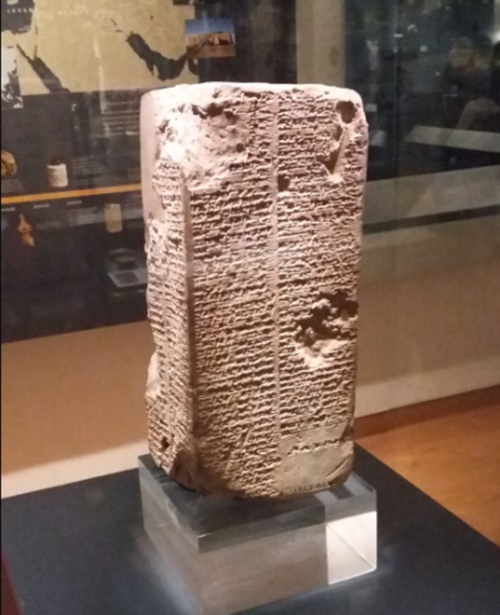
The Sumerian King List is already one of the most important documents in ancient history, but the discovery of a previously unknown copy in Denmark adds a new chapter to its remarkable story.

The Sumerian King List stele

The Sumerian King List, an ancient stone prism listing cities in Sumer, their rulers, and the length of their reigns.

(M.atkinsonross / CC BY-SA 4.0)

The collection had sat largely unstudied in the museum's storage rooms for around a century. Thorkild Jacobsen, the first person to earn an Assyriology degree from the University of Copenhagen, donated a significant portion of the holdings in 1939. The application of digital methods and philological work has now enabled researchers to classify a heterogeneous set of documents that include accounting records, letters, medical treatments, and a series of magical spells of enormous historical relevance. The project has made the entire collection publicly available through the Cuneiform Digital Library Initiative, opening it up to scholars worldwide.

Magical Spells and Royal Protection

Beyond the tantalizing evidence of Gilgamesh, the collection revealed a fascinating array of other texts. A significant group of tablets originated from the Syrian city of Hama, which was destroyed and plundered by Assyrian warriors in 720 BC. The Assyrians carried much of the spoils back to their capital, Assur, in present-day Iraq, but left behind some clay tablets in their hurried withdrawal. These texts, nearly 3,000 years old, contain medical treatments and magical spells, and were found among the remains of what archaeologists believe was a large temple library. Arbøll noted that "all the other texts had disappeared," emphasizing the exceptional nature of these surviving fragments, as virtually no other cuneiform tablets on these subjects have been found in the same region from that period.

One text from Hama particularly caught the researchers' attention: an anti-witchcraft ritual designed to ward off misfortunes and political instability that might threaten the Assyrian king. The ceremony took place over an entire night and involved burning small figurines made of wax and clay while an exorcist recited a fixed series of incantations. Researchers were surprised to find this text so far from the Assyrian capital and the rich literary centers of Babylonia, since Hama was located on the periphery of those regions. The presence of such a ritual in Hama underscores the widespread reach of Assyrian magical practices and the deep-seated fears of supernatural threats to royal authority.

Bureaucracy, Beer Receipts, and a Century of Collection

Another group of analyzed texts comes from Danish excavations carried out at Tell Shemshara in northern Iraq in 1957. These tablets consist of correspondence between a local chief and an Assyrian king from around 1800 BC, along with various administrative documents. Such records reflect the highly developed bureaucracy necessary to manage the advanced urban societies of ancient Mesopotamia. As Arbøll recalled, a large number of the cuneiform tablets preserved today testify to this sophisticated administrative culture, which was the very reason for the existence of cuneiform writing in the first place.

Among these administrative texts, researchers found one of the most relatable expressions of ancient daily life: a very ancient beer receipt, confirming that the control of goods and the recording of everyday transactions were already an integral part of life thousands of years ago. The juxtaposition of grand epics featuring Gilgamesh and magical rituals for kings with prosaic beer tabs highlights the diverse and complex nature of Mesopotamian society, captured forever in these enduring clay tablets. The full catalog of cuneiform texts from the National Museum of Denmark has now been published, making these remarkable documents accessible to the world for the first time.

  • Top image: Image portraying a likeness of Gilgamesh, with insert of a cuneiform tablet.
  • Source: AI generated.

By Gary Manners

References

RELATED VIDEOS

The World's First Epic Hero | Gilgamesh's True Story

The Epic of Gilgamesh: The Oldest Story on Earth

The Real History of Gilgamesh | The First Hero Humanity Remembered

{ https://www.ancient-origins.net/news-history-archaeology }

Hoe vind je dit bericht?
Geschreven door peter om 21:28 Stuur door

“What I Saw Was Not Our Technology”: A Navy Officer Breaks the Silence on Mysterious Underwater UFOs

“What I Saw Was Not Our Technology”: A Navy Officer Breaks the Silence on Mysterious Underwater UFOs

From the depths of the ocean, UFOs surface as a Navy officer warns of a threat too real to be ignored.

Written by Ashley Morgan

“what I Saw Was Not Our Technology” A Navy Officer Breaks The Silence On Mysterious Underwater Ufos

© Credit: Shutterstock

An extraordinary new investigation, originally published by Popular Mechanics is drawing fresh attention to a string of unexplained encounters between U.S. Navy personnel and unidentified submerged objects (USOs). These sightings—recorded over decades and across multiple oceans—are now being described by former officers as a legitimate threat and part of a global pattern that defies conventional physics.

Unexplained Encounters During Training Missions

In 2014, Lieutenant Ryan Graves, a U.S. Navy F/A-18 pilot stationed off the coast of Virginia Beach, began to detect anomalies during flight training missions. Initially dismissed as radar glitches, the signals reappeared repeatedly—only this time, they were backed by infrared and optical confirmation.

According to Graves, these unidentified objects could hover completely still or accelerate to supersonic speeds. They were seen across all altitudes, always above or near the ocean. Graves reported seeing a particularly strange object: a black or dark gray cube enclosed in a clear sphere, estimated to be 5 to 15 feet in diameter. It passed within 50 feet of one of the jets. That incident, he later explained, “was the turning point.”

When Graves later spoke with pilots stationed on the USS Nimitz and USS Princeton off the West Coast, he discovered that similar sightings had occurred for years.

Craft That Travel Between Air And Sea

The military has since adopted the term unidentified anomalous phenomena (UAPs) to describe objects like those witnessed by Graves. A growing number of them appear to be transmedium—able to travel from air to sea without slowing down, splashing, or generating turbulence. These transitions contradict what we know about aerodynamics and hydrodynamics.

Rear Admiral Tim Gallaudet, a retired oceanographer and Navy commander, was among the first to review footage of these transmedium encounters, captured in 2015 by jets from the USS Theodore Roosevelt. The craft shown in those videos moved at extraordinary speeds, rotated midair, and left no propulsion trail.

“What I saw was not our technology,” Gallaudet said. “No nation has craft that can move like that.” For him, these phenomena represent a national research priority. He now collaborates with Graves and former Pentagon officials to push for transparency and investigation.

Four Major Incidents Still Unexplained

Several high-profile military encounters continue to raise questions about unidentified submerged objects. In 2004, Navy pilots aboard the USS Nimitz witnessed a Tic Tac–shaped craft that dropped from 80,000 feet to sea level in under one second, with no wings or engines.

  • In 2013, infrared footage from Aguadilla, Puerto Rico captured a spherical object entering the ocean without a splash, resurfacing, then splitting into two before submerging—defying known flight and fluid dynamics.
  • A 1990s incident involved a CH-53 Sea Stallion helicopter crew near Puerto Rico. As they retrieved a drone, a massive dark object rose from below and pulled it back underwater, leaving the pilot stunned.
  • In 2019, the USS Omaha recorded a spherical object hovering over the Pacific before it dropped into the water without any visible splash. A sailor later confirmed similar sightings aboard the USS Jackson in 2023.

This New U.S. Law Could Expose Alien Technology

The volume and consistency of these reports have led to real political action. In 2023, Congress passed the UAP Disclosure Act, mandating federal agencies to catalog, analyze, and disclose data about recovered nonhuman craft and biologics. The legislation marks a shift in how the U.S. treats this topic, acknowledging the possibility of nonhuman intelligence and hinting at secret recovery programs.

Graves and Gallaudet recently briefed Washington officials on the national security implications of USOs. “We’re at a unique moment in history,” Graves said. “People have access to tools that can reveal things. The momentum is building.”

Reflecting on what lies beneath, Gallaudet posed a final theory: “Maybe they lived here for a long time, before we even evolved, and sought safety from the Earth’s atmospheric and geologic cataclysms by creating a habitat or place to live beneath the seafloor… That’s one hypothesis.”


Rear Admiral Tim Gallaudet on Undersea UFOs & USOs – The Navy’s Secret Knowledge..


Nuclear Submarine Captain Reveals UFO Radar Contact 2,000 Feet Below | Tim Gallaudet

{ https://dailygalaxy.com/category/news/ }

Hoe vind je dit bericht?
Geschreven door peter om 20:44 Stuur door

NASA’s Perseverance Detects That 3-Billion-Year-Old Mars Rocks Contain Something Never Seen Before at This Scale

NASA’s Perseverance Detects That 3-Billion-Year-Old Mars Rocks Contain Something Never Seen Before at This Scale

Deep inside rocks formed when water flowed on Mars, researchers have uncovered a surprising clue.


Nasa's Perseverance Detects That 3 Billion Year Old Mars Rocks Contain Something Never Seen Before At This Scale

© Credit: Shutterstock

NASA’s Perseverance rover has spotted unusually high levels of nickel in ancient Mars rocks, pointing to a surprisingly rich chemical environment billions of years ago.

The finding comes from Neretva Vallis and echoes mineral patterns that, on Earth, are sometimes linked to microbial activity. This does not prove that life existed on Mars, but it adds a new piece to a scientific investigation that has been ongoing for years.

Since landing in February 2021, Perseverance has been exploring Jezero crater, a 45-kilometer-wide basin believed to have once held a lake. As reported by Dr. Henry Manelski and his team at Purdue University, the crater shows clear signs of ancient water activity, including river channels and sediment deposits.

The rover eventually reached Neretva Vallis, an old river inlet where sediments dating back about 3 billion years have been preserved.

Record Nickel Levels Found In Martian Bedrock

To analyze the rocks, Perseverance used a mix of laser tools, infrared sensors, and X-ray instruments. Findings published in Nature Communications indicate that nickel showed up in 32 out of 126 rocks analyzed, with concentrations reaching up to 1.1% by weight.

“Generally, nickel is a trace element on the surfaces of Earth and Mars because the vast majority of it migrates into the planets’ cores during their formation. The substantial amount we have detected on the surface places unique constraints on how these rocks formed and were subsequently altered,” explained Henry Manelski.

Nickel Found In Magnesium Sulfate Veins In Jezero Crater Suggests An Authigenic Origin. Nickel found in magnesium-sulfate veins in Jezero crater suggests an authigenic origin. Credit: Manelski & al.

This is the highest nickel level ever measured in Martian bedrock. The element appears alongside iron sulfide minerals and sulfates such as jarosite and akaganeite, which form as these rocks break down over time. He also noted:

“Nickel-rich iron-sulfide is observed on Earth in ancient sedimentary rocks. Iron sulfide weathers easily in oxygen-rich environments, so its presence in ancient terrestrial rocks is one line of evidence used to demonstrate that Earth’s early atmosphere was once very oxygen-poor,” 

Looks Like Earth’s Mineral Formations

Scientists were particularly struck by how these Martian minerals resemble pyrite, a common iron sulfide on Earth. Similar formations on our planet are often associated with microbial processes, especially in low-oxygen environments involving sulfate and iron.

Mineral Veins In Jezero Crater Captured By Perseverance, With Close Ups Of Soap Creek And Seiber Point. Mineral veins in Jezero crater captured by Perseverance, with close-ups of Soap Creek and Seiber Point. Credit: Nature Communications

The same region has also revealed iron sulfides alongside organic carbon compounds. This combination can be linked to biological activity, though it may also result from purely chemical reactions.

“The presence of nickel-rich rocks indicates that, if living organisms had been present on early Mars, nickel may have been available in a form that they could have used.”

An Unresolved Origin

The source of the nickel remains uncertain. Researchers suggest it may come from the breakdown of volcanic rocks or from a nickel-rich meteorite.

“Further research is needed to determine the source of nickel in Neretva Vallis and to investigate possible connections between it and organic matter in this location,” the authors concluded.

Nickel Vs. Iron Levels In Rocks At Dragon Creek (a) With A Close Up Of The Analyzed Surface (b). Nickel vs. iron levels in rocks at Dragon Creek (a) with a close-up of the analyzed surface (b). Credit: Nature Communications

Has NASA Found 3 Billion Year Old Dead Martians Why A Green Crystal Could Be A Biosignature!

What Perseverance Rover Saw Inside Mars' Deepest Crater is Terrifying | Brian Greene

{https://dailygalaxy.com/category/space/ }

Hoe vind je dit bericht?
Geschreven door peter om 20:26 Stuur door

Trump reveals 'very interesting' findings in top secret government UFO files and says they'll be released 'very soon'

Donald Trump made a shocking revelation at a recent speaking event, abruptly announcing that he has instructed Pete Hegseth to release government UFO files. 

The president headlined a Turning Point USA event on Friday at a megachurch in Phoenix, Arizona, where he defended his record in office to a slew of young conservative voters. 

The event is the latest stop in the TPUSA tour across America, where top conservatives are attempting to bolster support for their party among young voters. 

During his remarks, Trump boasted about his Secretary of War, Pete Hegseth, revealing that the Pentagon would soon release documents relating to UFOs and 'unexplained aerial phenomena.' 

'I figured this was a good crowd because you people - you're really into that. I don't know. So I'm pleased to report today, I thought I'd save it for this crowd, because you're a little bit out there, that this process is well underway,' he joked. 

'We found many very interesting documents, I must say. And the first releases will begin very, very soon. So you can go out and see if that phenomena is correct. You'll figure it out. Let me know.' 

The Committee on Oversight and Government Reform's Task Force sent a letter to Hegseth in March, requesting video files related to Unidentified Aerial Phenomena (UAPs) by April 14. 

The letter followed hearings by the House task force in September, where whistleblowers testified that the All-domain Anomaly Resolution Office (AARO), a section of the Department of War, possessed video records of UAPs.

Donald Trump, pictured above speaking at a TPUSA event in Phoenix, revealed that he has directed Secretary of War Pete Hegseth to release UFO files

Donald Trump, pictured above speaking at a TPUSA event in Phoenix, revealed that he has directed Secretary of War Pete Hegseth to release UFO files 

It's unclear what files Trump was referring to in his remarks. Pictured above is a still from a previously released unclassified US government video appearing to show a UAP

It's unclear what files Trump was referring to in his remarks. Pictured above is a still from a previously released unclassified US government video appearing to show a UAP

Defense Secretary Pete Hegseth, pictured above on March 4 at the Pentagon, previously told reporters that his department was 'digging in' to UFO-related files

Defense Secretary Pete Hegseth, pictured above on March 4 at the Pentagon, previously told reporters that his department was 'digging in' to UFO-related files 

'The lack of disclosure regarding the very real threat posed by UAPs in and around US restricted airspace is concerning,' House representatives wrote. 

'The presence of UAPs in and around the sensitive airspaces of US military installations poses a threat to the security of the armed forces and their readiness.'

The letter requested over 45 video files dating back to 2019, including footage of 'cigar-shaped' and 'spherical' UAPs. 

Some clips reportedly captured UAP formations near Iran and Syria, incidents near US bases and airports, and even a 2023 shootdown over Lake Huron. 

Hoe vind je dit bericht?
Geschreven door peter om 17:25 Stuur door

UFOs operating around our planet

UFOs operating around our planet

The video opens with a compilation of various types of unidentified flying objects. Among the strange sightings are cylinder-shaped UFOs and a so-called “Fastwalker,” but the most striking moment features an orange sphere off the coast of Encinitas, California. 
ufos%20are%20here.jpg

The sphere suddenly appears above the ocean’s surface, casting an orange reflection across the water. It moves back and forth in a controlled manner before abruptly diving beneath the surface and vanishing. 
Moments later, it reemerges, only to submerge again. While underwater, its movement is still visible through a series of flashes, until it suddenly bursts back out of the ocean once more. 
This sequence repeats again, until the sphere finally ascends into the sky and disappears over the horizon. 
This brief compilation suggests that a wide variety of advanced technologies, whether man-made or of extraterrestrial origin, may be operating around our planet, often just beyond our understanding.
  

RELATED VIDEOS


BREAKING UFO Sightings WORLDWIDE! Mind Blowing UAP Footage

UFOs Aren’t What You Think | UFO Revelations: Rise of the UAP | Full Documentary

UFOs Confirmed: Latest UFO Footage BREAKING the Internet! Doomsday Event?

{ http://ufosightingshotspot.blogspot.com/ }

Hoe vind je dit bericht?
Geschreven door peter om 16:46 Stuur door

NASA astronaut finds God after returning to Earth: Reid Wiseman breaks down in tears after seeing a cross - as he claims 'it's very hard to fully grasp what we just went through'

He's travelled more than 250,000 miles (402,000km) to the moon and back – but astronaut Reid Wiseman said one of the most emotional experiences of his mission was seeing a cross on his return to Earth.

The Artemis II commander, who says he is 'not religious', was reflecting on his mammoth mission to space during a press conference yesterday.

One reporter asked the crew whether they had experienced any shift in consciousness following their 10–day journey to the dark side of the lunar surface.

Wiseman confirmed he had, referencing a moment that occurred after the team were picked up by the US Navy following their splashdown in the Pacific Ocean.

'I'm not really a religious person but there was no other avenue for me to explain anything or experience anything,' he said.

'So I asked for the chaplain on the Navy ship to just come visit us for a minute. When that man walked in – I'd never met him before in my life – but I saw the cross on his collar and I just broke down in tears.'

Wiseman said it's 'very hard to fully grasp what we just went through' and in the week since the astronauts came back, they have not had time to process their experience.

'It was other–worldly and it was amazing,' he said.

Reid Wiseman described the moment he 'broke down in tears' after seeing a cross on his return to Earth

Reid Wiseman described the moment he 'broke down in tears' after seeing a cross on his return to Earth

Some of the incredible moments the astronauts witnessed included seeing Earth ¿set¿ over the lunar surface

Some of the incredible moments the astronauts witnessed included seeing Earth 'set' over the lunar surface

Since the Orion spacecraft splashed down last week, the crew have been going through extensive medical and physical testing.

As well as Wiseman, the team consists of pilot Victor Glover and mission specialists Christina Koch and Jeremy Hansen.

They revealed they haven't really had time to properly reflect on their profound feat, which saw them break the record for the farthest humans have ever travelled from Earth.

'We've not had that decompression, we've not had that reflection time,' Wiseman said.

Some of the incredible moments they witnessed included seeing Earth 'set' behind the moon, a rare solar eclipse and observing our home planet suspended in the darkness of space.

'When the sun eclipsed behind the moon, I turned to Victor and said "I don't think humanity has evolved to the point of being able to comprehend what we are looking at right now",' Wiseman said.

Mission specialist Jeremy Hansen said he has been 'trying to find words' to describe the things he saw during the mission.

'But what kept grabbing my attention – when the lighting was right and we were looking out the window – is that I kept seeing this depth to the galaxy,' he said. 'That was mind–blowing for me. The sense I had of fragility and feeling infinitesimally small.'

This photo, titled 'The Artemis II Eclipse', was taken by the crew and shows the moment the moon eclipsed the sun

This photo, titled 'The Artemis II Eclipse', was taken by the crew and shows the moment the moon eclipsed the sun

The cognitive shift that astronauts experience when viewing Earth from space is called the ¿Overview Effect¿

The cognitive shift that astronauts experience when viewing Earth from space is called the 'Overview Effect'

Artemis II crew members: Mission Specialist Christina Koch (L), Mission Specialist Jeremy Hansen (top), Commander Reid Wiseman (R), and Pilot Victor Glover (bottom)

Artemis II crew members: Mission Specialist Christina Koch (L), Mission Specialist Jeremy Hansen (top), Commander Reid Wiseman (R), and Pilot Victor Glover (bottom) 

The 'Overview Effect' explained

This is a cognitive shift reported by astronauts when they see Earth from space.

It often involves a profound sense of awe and a realization of the planet's fragility and interconnectedness. 

Many astronauts describe feeling that national boundaries disappear, replaced by a sense of unity among all people. 

This experience can lead to a deeper commitment to environmental protection and global cooperation. 

Overall, the overview effect highlights how perspective can dramatically change human understanding and values.

The cognitive shift that astronauts experience when viewing Earth from space is called the 'Overview Effect'.

This is characterised by an overwhelming sense of awe, unity and a deeper connection to the planet.

Astronaut Edgar Mitchell became the sixth person to walk on the moon during the Apollo mission in 1971.

After returning to Earth he famously said: 'You develop an instant global consciousness, a people orientation, an intense dissatisfaction with the state of the world, and a compulsion to do something about it.

'From our there on the moon, international politics looks so petty.'

Despite the profoundness of their mission, astronaut Christina Koch revealed the team have been 'sleeping great' since they got back.

But she said: 'Every time I woke up during the first few days I thought I was floating. I truly thought I was floating and I had to convince myself I wasn't.'

She explained that she even let go of a shirt in the air, expecting it to float in front of her. 'It actually surprised me [when it dropped],' she said.

Wiseman also revealed a smoke detector went off on the second–to–last day of the mission, when the team were still 80,000 miles (129,000km) from home.

article image

'It was tense for a few minutes until we got things reconfigured,' he said.

When asked about the Orion capsule, where the crew spent the entirety of the mission, he said: 'There are always things we need to improve – there are ways we need to do better living in space and ways this machine needs to be improved.

'But in my own personal opinion, they could put the Artemis III Orion on the space launch system tomorrow and launch it, and the crew would be in great shape.'

The next Artemis mission will see astronauts test commercial lunar landers in Earth's orbit before the next big step – returning a crew to the surface of the moon by 2028.

Artemis II: Key facts

Launch date: April 1

Mission objective: To complete a lunar flyby, passing the 'dark side' of the moon and test systems for a future lunar landing.

Total distance to travel: 620,000 miles (one million km)

Mission duration: 10 days 

Estimated total cost: $44billion (£32.5billion)

* NASA Space Launch System rocket: $23.8billion (£17.6billion)

* Orion deep–space spacecraft: $20.4billion (£15billion)

Crew: 

+ BCommander Reid Wiseman

+ Pilot Victor Glover

+ Mission Specialist Christina Koch

+ Mission Specialist Jeremy Hansen

Mission Stages:

1. Launch from Kennedy Space Centre Launch Pad 39B

2. Manoeuvre in orbit to raise the perigee using the Cryogenic Propulsion Stage

3.Burn to raise apogee using the Cryogenic Propulsion Stage

4. Detach from Cryogenic Propulsion Stage and perform translunar injection

5. Fly to the moon over four days

6. Complete lunar flyby at a maximum altitude of 5,523 miles (8,889 km) above the moon's surface

7. Return to Earth over four days

8. Separate the crew module from the European Service Module and the crew module adapter

9. Splashdown in the Pacific Ocean  

RELATED VIDEOS

NASA's Reid Wiseman says being 250,000 miles away from earth feels 'majestic'

NASA Astronaut Reveals EVERYTHING | This Is What Really Happened on Artemis II

{ https://www.dailymail.co.uk/sciencetech/index.html }

Hoe vind je dit bericht?
Geschreven door peter om 16:16 Stuur door

White House directs FBI to investigate disappearance of missing scientists

The White House has vowed to leave 'no stone unturned' in its effort to uncover the truth behind the string of missing scientists. 

Press secretary Karoline Leavitt announced Friday on X that President Donald Trump has brought the FBI into the investigation.

'In light of the recent and legitimate questions about these troubling cases, and President Trump’s commitment to the truth, the White House is actively working with all relevant agencies and the FBI to holistically review all of the cases together and identify any potential commonalities that may exist,' Leavitt said.

Several scientists with ties to NASA, nuclear research, aerospace programs and classified projects have vanished or turned up dead in recent years. 

Many of the individuals, including researchers from NASA's Jet Propulsion Laboratory and Los Alamos National Laboratory, had access to sensitive information on space missions, nuclear technology or advanced defense systems, prompting speculation about possible connections. 

On Thursday, Trump revealed he had been briefed on the mysterious cases that have now reached 11.

The President addressed the alarming situation after landing at the White House on Thursday, where he was met by reporters and questioned by FOX News about whether the disappearances and deaths were random or potentially connected.

'Well, I hope it is random, but we are going to know in the next week and a half,' Trump said. 'I just left a meeting on that subject, so pretty serious stuff. Hopefully, coincidence... but some of them were very important people, and we are going to look at it.'

Retired Air Force General William Neil McCasland, 68, vanished from his New Mexico home without his phone, wearable devices or glasses on February 28

Retired Air Force General William Neil McCasland, 68, vanished from his New Mexico home without his phone, wearable devices or glasses on February 28

The President's statements followed a Wednesday briefing at the White House, where Leavitt was also asked about those linked to space or nuclear secrets who have mysteriously died or vanished without a trace.

'I haven't spoken to our relevant agencies about it. I will certainly do that and will get you an answer,' said Leavitt.

'If true, of course, that's definitely something I think this government and administration would deem worth looking into. So let me do that for you,' Leavitt continued.

This disturbing pattern emerged after retired Air Force General William Neil McCasland vanished on February 28.

He was last seen leaving his New Mexico home without his phone, wearable devices or glasses less than two months ago. He was only carrying a pistol and his wife told 911 dispatchers that it appeared he was trying 'not to be found.'

The strange circumstances surrounding the general's disappearance were almost identical to four other missing person cases taking place between May and August 2025 in the Southwest.

Concerningly, all four have been tied to McCasland through his work overseeing the Air Force Research Lab (AFRL), based at Wright-Patterson Air Force Base, which has been rumored to study extraterrestrial technology since the 1947 Roswell UFO crash.

While at Wright-Patterson, McCasland oversaw and reportedly approved the funding for scientist Monica Jacinto Reza's work on a space-age metal for rocket engines called Mondaloy.

Steven Garcia was last seen on August 28 last year. A source has revealed to the Daily Mail that he worked as a government contractor at a key nuclear weapons facility

Steven Garcia was last seen on August 28 last year. A source has revealed to the Daily Mail that he worked as a government contractor at a key nuclear weapons facility

Monica Jacinto Reza, 60, was last seen hiking in the rugged San Gabriel Wilderness area within the Angeles National Forest on the trail to Waterman Mountain summit on June 22 last year

Monica Jacinto Reza, 60, was last seen hiking in the rugged San Gabriel Wilderness area within the Angeles National Forest on the trail to Waterman Mountain summit on June 22 last year

Reza, 60, disappeared while hiking with friends in California on June 22 last year. She had just become the director of the Materials Processing Group at NASA's Jet Propulsion Laboratory.

The three other disappearances all involved workers at some of America's most important nuclear facilities, and all three were last seen walking out of their homes without their phones or keys, just like McCasland.

Steven Garcia, 48, vanished without a trace on August 28 last year. He was last seen leaving his Albuquerque, New Mexico, home on foot, carrying only a handgun. 

An anonymous source told the Daily Mail that Garcia was a government contractor working for the Kansas City National Security Campus (KCNSC), a major facility in Albuquerque that manufactures more than 80 percent of all the non-nuclear components that go into building the military's nuclear weapons.

Anthony Chavez and Melissa Casias both worked at the Los Alamos National Laboratory (LANL), one of the nation's most important nuclear research sites.

Chavez, 79, worked at the lab until his retirement in 2017, although his role there has not been made clear. Casias, 54, was an active administrative assistant at the facility and is believed to have had top security clearance.

Anthony Chavez was an employee at the Los Alamos National Laboratory until 2017. He disappeared without a trace in May last yearMelissa Casias worked at the Los Alamos National Laboratory, a nuclear research facility with ties to Kirtland Air Force Base, where General McCasland was previously stationed

Anthony Chavez (left) and Melissa Casias were both employees at the Los Alamos National Laboratory. Both disappeared within weeks of each other last year
Amy Eskridge was a scientist researching anti-gravity technology before her death in 2022 at age 34

Amy Eskridge was a scientist researching anti-gravity technology before her death in 2022 at age 34

article image

All three were last seen leaving their homes in New Mexico on foot, leaving behind their cars, keys, wallets and phones before disappearing without a trace. Police have not had any updates in the cases since last year.

In addition to the string of disappearances, five scientists in key areas of research have died over the last few years.

Amy Eskridge was just 34 years old when she allegedly died from a self-inflicted gunshot to the head in Huntsville, Alabama, on June 11, 2022. However, neither the police nor the medical examiners have publicly released any details of an investigation ever taking place.

Before her death, she was openly researching and trying to develop anti-gravity technology, a way to control or cancel out gravity, which could revolutionize space travel and energy production.

Nuclear physicist Nuno Loureiro and astrophysicist Carl Grillmair were both shot to death in their homes in recent months. 

Independent investigators have noted that Loureiro's revolutionary work in nuclear fusion may have made him a target of a greater conspiracy against US scientists, as his work may one day upend the energy industry. 

Last year, Claudio Neves Valente was identified by Boston authorities as a suspect in the shooting of Loureiro, as well as two Brown University students, Mukhammad Aziz Umurzokov and Ella Cook. 

After eluding police for days, Valente, 48, died by suicide in a storage unit in Salem, New Hampshire, on December 16.

Nuno Loureiro was leading efforts to create fusion energy, a form of clean energy that could upend the multi-trillion-dollar fossil fuel industryCarl Grillmair was killed by a gunshot wound while on his front porch. The scientist had been studying exoplanets and dark matter at the California Institute of Technology

Scientists Nuno Loureiro (left) and Carl Grillmair were both murdered in their own homes after making significant progress in the fields of nuclear fusion and astrophysics
Jason Thomas was found dead after being pulled from a Massachusetts lake on March 17. He had been missing since December 12

Jason Thomas was found dead after being pulled from a Massachusetts lake on March 17. He had been missing since December 12

Grillmair's work with NASA's NEOWISE and NEO Surveyor has also been linked to the Air Force, as the telescopes used the same systems the military relies on to track satellites and missiles.

Meanwhile, NASA scientists Michael David Hicks and Frank Maiwald, who also worked at the Jet Propulsion Lab, died from unknown circumstances at an early age.

Maiwald, 61, was the lead researcher on a breakthrough that could help future space missions detect clear signs of life on other worlds just 13 months before he died in 2024.

Hicks, whose death came just a year after leaving JPL at age 59, had been involved with the DART Project, NASA’s test to see if humans could deflect dangerous asteroids away from Earth.

NASA's JPL has not commented on the deaths of Maiwald or Hicks, and did not reply to the Daily Mail's inquiries into the nature of the scientists' work before their deaths.

In another mysterious incident, Jason Thomas, a pharmaceutical researcher testing cancer treatments at Novartis, was found dead in a Massachusetts lake on March 17, after disappearing without a trace in December. Local police have claimed there was no foul play suspected.

RELATED VIDEOS

FBI called on to investigate scientists' 'suspicious' deaths, disappearances

11th scientist death emerges in string of missing, dead officials with access to US secrets

10 US Scientists Go Missing: White House Vows To Find Truth | GRAVITAS Highlights

US Investigating the Mysterious Deaths & Disappearances, Trump Calls the Situation Very Serious

Hoe vind je dit bericht?
Geschreven door peter om 15:44 Stuur door

UFO cluster spotted over mysterious base tied to missing Air Force scientist

A massive cluster of unknown flying objects was spotted near Wright-Patterson Air Force Base, a military installation long rumored to be linked to UFO activity.

Witnesses near the Ohio base captured the craft on April 8, showing a silent triangle of glowing lights moving in perfect formation before splitting apart mid-flight.

The lights appeared to drift slowly downward, flickering, pulsing and changing brightness individually as they hovered in the night sky.

Reports described the sighting as having 'no sound, no standard navigation lights, movement unlike any known aircraft, drone swarm or satellite.'

The video was reportedly taken from Rainbow Lakes, a 60-acre outdoor recreational retreat in Fairborn, about four miles from the base.

Wright-Patterson Air Force Base (WPAFB) has drawn renewed attention in recent months, as its research laboratory was previously led by retired Major General William Neil McCasland, who disappeared earlier this year.

McCasland, 68, went missing from his New Mexico home on February 28, reportedly leaving with only hiking boots and a .38-caliber revolver.

He led the Air Force Research Laboratory from May 2011 until his retirement in 2013, a facility long associated in UFO lore with alleged materials recovered after the 1947 Roswell incident.

A massive cluster of unknown flying objects was spotted near Wright-Patterson Air Force Base, a military installation long rumored to be linked to UFO activity

A massive cluster of unknown flying objects was spotted near Wright-Patterson Air Force Base, a military installation long rumored to be linked to UFO activity

WPAFB leads development in aerospace technology, advanced materials, sensors, human performance and AI.

The Daily Mail has contacted WPAFB for comment on the video.

The clip has flooded social media, where users are debating whether the lights are extraterrestrials or parachutists with flares.

One user on X claimed the lights were 'non-human intelligent orbs,' while another user on Reddit shared: 'This is exactly what it looks like when parachuters have flares attached as they’re falling.'

'I agree that is what this looks like. A free-fall team, whether it be military or civilian, gets into their final descent stack after their chutes have already deployed,' a Redditor shared.

'My issue with this is that the cloud ceiling is super low. If this is a training jump, this low a ceiling would cause it to get pushed or canceled. 

'Obviously, it is hard to get an ideal grasp on everything since the video is short and in low light. That said, it looks like we lose visual on the flares intermittently as they pass through the clouds.'

Another Redditor joked, saying, 'They’re coming for more scientists,' likely referring to McCasland, who managed the Air Force's $2.2 billion science and technology program along with additional customer-funded research.

William Neil McCasland, 68, led a laboratory at Wright-Patterson Air Force Base that has long been associated with UFO lore

William Neil McCasland, 68, led a laboratory at Wright-Patterson Air Force Base that has long been associated with UFO lore

The lights appeared to drift slowly downward, flickering, pulsing and changing brightness individually as they hovered in the night sky

The lights appeared to drift slowly downward, flickering, pulsing and changing brightness individually as they hovered in the night sky

The retired general is said to have left his home on foot in February, but authorities have yet to locate any clues for his whereabouts. 

Because several of his personal items were left behind, investigators are trying to determine whether he left voluntarily or encountered trouble shortly after leaving his home. 

A 911 call, capturing a police dispatcher speaking with his wife, Susan Wilkerson, was released earlier this month, in which she can be heard saying that her husband 'had planned not to be found.'

'He's left his phone. He changed his clothes into... I don't know what. I think he's on foot. All of our cars and bicycles are in the garage,' Wilkerson said approximately three hours after McCasland disappeared.

'He turned it off and left it behind, which seems kind of deliberate because he's always got his phone. He has a smartwatch. I don't know if that's with him or not,' Wilkerson continued in audio obtained by the Law&Crime Network.

The clip has flooded social media, where users are debating whether the lights are extraterrestrials or parachuters with flares

The clip has flooded social media, where users are debating whether the lights are extraterrestrials or parachuters with flares

article image

McCasland did not take any of his wearable devices or prescription glasses, leaving without any way to trace him. 

His name became associated with UFO topics after the 2016 WikiLeaks release of emails from John Podesta, Hillary Clinton's campaign chairman.

In the emails, musician Tom DeLonge, founder of Blink-182 and the UFO-focused To The Stars Academy (TTSA), referenced McCasland multiple times, claiming he had advised him on disclosure matters and helped assemble an advisory team.

DeLonge also suggested on a podcast that he was being advised by McCasland and several named and unnamed insiders to carry out a slow disclosure of UAP information to the American public from US government or contractor sources.

He claimed that the US government and contractor groups already possess free energy technology, sometimes referred to as zero-point energy, that could make conventional energy sources obsolete, stating: 'One inch of air could power the US for hundreds of years.'

DeLonge suggested that TTSA was being restrained from releasing all the information government insiders had provided, but that the organization sought investment from private sources to develop this technology for energy and aerospace purposes.

He further stated that TTSA expected to create a working anti-gravity craft, and the company's SEC filing noted that its aerospace division is 'dedicated to finding revolutionary breakthroughs in propulsion, energy and communications.'

An email tied McCasland to Wright-Patterson, alleging he oversaw the lab where Roswell materials were supposedly sent and scheduling emails showed a planned meeting with DeLonge, Podesta, and someone signing as 'Neil McC,' consistent with McCasland.

These claims come from DeLonge and have not been confirmed by McCasland or official records.

There is no public evidence that he participated in UFO crash retrievals, reverse-engineering of non-human technology, or classified extraterrestrial programs.

His documented work focused on advanced aerospace research, which has fueled speculation about experimental propulsion and unidentified phenomena in defense circles.

RELATED VIDEOS

UFO orbs over U.S military base connected to missing alien research scientists 2026

Massive UFO Spotted Near Military Bases? BOMBSHELL FOOTAGE!

The Mystery Of The Missing UFO Scientists | Vantage on Firstpost | 4K

{ https://www.dailymail.co.uk/sciencetech/index.html }

Hoe vind je dit bericht?
Geschreven door peter om 15:05 Stuur door

Trump's UFO disclosure takes step forward as world waits with bated breath

Trump's UFO disclosure takes step forward as world waits with bated breath

President Donald Trump's UFO disclosure appears to be moving forward after a government-linked website believed to be tied to transparency suddenly showed signs of activity. 

The federal domain aliens.gov, which previously appeared inactive, is now returning an SSL error, a technical signal that the address may be connected to a live server but is not yet fully configured for public access.

An SSL error typically occurs when a server has been set up, but the digital certificate required to establish a secure connection has not been obtained. 

This usually means the domain is no longer dormant and may be undergoing development, even if no visible content has been published.

Cybersecurity experts note that such changes are common during routine website setup and do not necessarily indicate that a public platform is about to launch. 

Government agencies frequently register and configure domains months or even years before unveiling new websites, often using them first for internal testing, staging environments, or placeholder systems.

The step forward comes nearly one month after the domain, linked to the Executive Office of the President, was flagged by an automated tracker of federal websites.

The website appeared to align with Trump's February order to release files related to UFOs, also known as UAPs, and potential extraterrestrial activity.

President Donald Trump's UFO disclosure appears to be moving forward after a government-linked website believed to be tied to transparency suddenly showed signs of activity

President Donald Trump's UFO disclosure appears to be moving forward after a government-linked website believed to be tied to transparency suddenly showed signs of activity

While the website appears to be moving forward, cybersecurity experts note that such changes are common during routine website setup and do not necessarily indicate that a public platform is about to launch.

Government agencies frequently register and configure domains months or even years before unveiling new websites, often using them first for internal testing, staging environments, or placeholder systems.

However, the timing of the change has fueled speculation online, particularly as pressure mounts in Washington to release additional records related to unidentified aerial phenomena (UAP). 

Lawmakers and defense officials have in recent months renewed calls for greater transparency surrounding decades of classified material tied to unexplained aerial sightings.

Trump has gone quiet about his plans to release government files related to UFOs and extraterrestrial life. However, the war with Iran began shortly after he announced it in February. But other government officials have not forgotten.

Republican Rep. Anna Paulina Luna penned a letter to the US Secretary of Defense on April 1, ordering Pete Hegseth to deliver 46 specific clips no later than April 14, 2026.

Lawmakers said the videos could reveal patterns of activity near sensitive military sites and help determine whether the objects pose a potential national security threat.

The requested footage includes dozens of military-recorded encounters showing spherical, cigar-shaped and Tic Tac-like objects spotted over war zones, oceans and sensitive airspace around the world.

Domain information for aliens.gov, showing its status, nameservers, and registration dates.

The federal domain aliens.gov, which previously appeared inactive, is now returning an SSL error, a technical signal that the address may be connected to a live server but is not yet fully configured for public access

Some clips reportedly captured UAP formations near Iran and Syria, incidents near US bases and airports and even a 2023 shootdown over Lake Huron.

The threats extend beyond mysterious sightings, highlighting the danger unidentified objects pose when they appear near restricted airspace, military bases and active training zones.

Luna, however, said Tuesday afternoon on X that 'no one from the Pentagon had responded until we reached out, and it appears that someone did not pass the letter to the appropriate authorities.'

'How convenient,' the Florida representative added, noting that while she considers Hegseth a friend and supporter of President Donald Trump, 'the president has authorized the release, so whoever is trying to be cute at the Pentagon can take a hike.'

RELATED VIDEOS

NEW BURCHETT says its time for UFO disclosure and the stuff he has seen is WILD.

Rep. Tim Burchett on UFO disclosure: 'America is just ready'

Congressman Burchett: UFO Files Would Keep You Up at Night

{ https://www.dailymail.co.uk/sciencetech/index.html }

Hoe vind je dit bericht?
Geschreven door peter om 23:44 Stuur door

The longest-living people in the Bible

The longest-living people in the Bible

The longest-living people in the Bible

©Getty Images

The longest-living people in the Bible
How old is old? Say 70 years, 80 years, 90 years? Well, there are some figures in the Bible who lived to be nearly 1,000 years old! Most of the oldest people are from the Book of Genesis, in the Hebrew Bible and the Christian Old Testament. These biblical seniors include men and women, individuals whose lifespans average hundreds of years. So, just who are these pious pensioners, and how long did they live?

READ  through and start counting down the years.

Joshua

©Getty Images

Joshua
Joshua, Moses' assistant in the books of Exodus and Numbers, lived to 110 in the Bible.

Joseph

©Public Domain

Joseph
Joseph, the first son of Jacob and Rachel, was an important figure in the Hebrew Bible's Book of Genesis and in the Quran. He too was 110 when he died.

Moses

©Getty Images

Moses
According to both the Bible and the Quran, Moses was the leader of the Israelites: He is one of the most important prophets in Christianity and Islam, and died aged 120.

Rebekah

©Getty Images

Rebekah
Rebekah appears in the Hebrew Bible as the wife of Isaac and the mother of Jacob and Esau. She was at least 120 years old when she passed away.

Aaron

©Getty Images

Aaron
The prophet Aaron, elder brother of Moses, also appears in the Hebrew Bible, as well as in the New Testament and the Quran. He lived to 123.

Miriam

©Getty Images

Miriam
Aged at least 125 years old when she died, Miriam is described in the Hebrew Bible as the daughter of Amram and Jochebed, and the older sister of Moses and Aaron.

Sarah

©Public Domain

Sarah
Sarah, a biblical matriarch and prophetess identified in Judaism, Christianity, and Islam, was 127 years old when she died.

Jehoiada

©Getty Images

Jehoiada
Described in the Hebrew Bible as a prominent priest in the kingdom of Judah, Jehoiada passed away at 130 years old.

Laban

©Getty Images

Laban
Laban is a figure in the Book of Genesis of the Hebrew Bible. He was the brother of Rebekah, the woman who married Isaac and bore Jacob. Laban was said to be at least 130 years old when he died.

Levi

©Getty Images

Levi
According to the Book of Genesis, Levi was the third of the six sons of Jacob and Leah (Jacob's third son), and the founder of the Israelite Tribe of Levi. He lived until 137.

Ishmael

©Public Domain

Ishmael
Also according to the Book of Genesis account, Ishmael, the first son of Abraham, was 137 when he died. He's depicted here as a youngster hunting.

Esau

©Getty Images

Esau
Esau, seen here with Jacob, is the elder son of Isaac in the Hebrew Bible. He's mentioned in the Book of Genesis. Esau likely lived to 147.

Jacob

©Getty Images

Jacob
Jacob, later given the name Israel, is regarded as a patriarch of the Israelites. Jacob died at the age of 147.

Nahor, son of Serug

©Getty Images

Nahor, son of Serug
Nahor is the son of Serug, according to the Hebrew Bible. He is said to have lived to the age of 148 years old.

Abraham

©Public Domain

Abraham
The story of the life of Abraham, who lived to 175 years old, is told in the narrative of the Book of Genesis in the Hebrew Bible.

Isaac

©Getty Images

Isaac
According to the narratives in the Abrahamic religions, Isaac, one of the three patriarchs of the Israelites, died aged 180.

Terah, son of Nahor

©Getty Images

Terah, son of Nahor
The biblical figure in the Book of Genesis known as Terah lived an impressive 205 years. He is the son of Nahor.

Job

©Public Domain

Job
Job is the central figure of the Book of Job in the Bible. He is said to have lived at least to 210 years old.

Serug

©Getty Images

Serug
According to the Book of Genesis, Serug is the son of Reu and the father of Nahor. He's also the great-grandfather of Abraham. He died at 230 years old.

Enoch

©Getty Images

Enoch
A biblical figure and patriarch prior to Noah's flood, and the son of Jared and father of Methuselah, Enoch lived 365 years before he was taken by God, according to the Book of Genesis.

Eber

©Getty Images

Eber
Eber is an ancestor of the Ishmaelites and the Israelites according to the Table of Nations in the Book of Genesis and the Books of Chronicles. The Hebrew Bible records Eber dying at age 464.

Shem

©Getty Images

Shem
Shem was one of the sons of Noah in the Bible. Genesis 11:10 records that Shem was 600 years old when he died.

Lamech

©Public Domain

Lamech
According to the Masoretic Text in the Hebrew Bible, Lamech, the father of Noah, attained an age at death of 777.

Mahalalel

©Getty Images

Mahalalel
The grandfather of Enoch and subsequently the ancestor of Noah, Mahalalel reached the age of 895 before he died.

Enos

©Getty Images

Enos
Enos is mentioned in the Book of Genesis in the Hebrew Bible. He is one of just a few that lived beyond 900 years, his death occurring at age 905. Enos is one of the many figures depicted on Lyon Cathedral's astonishing stained glass windows.

Seth Bible

©Getty Images

Seth
Seth is the third son of Adam and Eve. According to the Hebrew Bible, he had two brothers: Cain and Abel. Seth outlived both his siblings, reaching 912 years old.

Adam

©Getty Images

Adam
Adam, meanwhile, is said to have lived to 930 years old.

Noah

©Getty Images

Noah
Noah's story appears in the Hebrew Bible and is referenced in various other books of the Bible, including the New Testament. Passing away at age 950, he is the third oldest person in the Bible.

Jared

©Getty Images

Jared
Jared is mentioned in the Book of Genesis as a sixth-generation descendant of Adam and Eve. He died aged 962, the second oldest figure in the Bible.

Methuselah

©Getty Images

Methuselah
At 969 years old, the biblical patriarch Methuselah has the longest lifespan of all those given in the Bible.

Sources:

  • (Bible Study Tools)
  • (Statista)
  • (Adventist Record)


SHOCKING: The Real Reason People Lived So Long in the Old Testament

Why Did They Live Up to 900 Years? The Bible Reveals the Forgotten Mystery!

{ https://www.starsinsider.com }

Hoe vind je dit bericht?
Geschreven door peter om 22:32 Stuur door

Steven Spielberg says 'Disclosure Day' is closer to truth than fiction

Steven Spielberg says 'Disclosure Day' is closer to truth than fiction

James Powel - USA TODAY


Steven Spielberg’s Disclosure Day Looks Bigger Than an Alien Invasion

LAS VEGAS – Director Steven Spielberg confirmed that aliens are the subject of his upcoming film "Disclosure Day" and debuted new footage during the Universal Studios presentation at CinemaCon in Las Vegas on April 15.

"I’ve been curious ever since I was a little kid about what’s happening in the night sky," he told the audience, saying that the possibility of extraterrestrial life sparks his creativity.

Spielberg's return to the summer blockbuster appears to follow Josh O'Connor's character, Daniel Kelner, fighting to reveal the existence of extra-terrestrial life along with Emily Blunt and Colman Domingo. Connor and Blunt appear to play characters that are possessed by aliens. Colin Firth appears to lead a shadowy government entity tasked with keeping the existence of aliens secret.

The "Jaws" filmmaker said the film was "way closer to truth than to fiction."

He pointed to a 2017 New York Times report on the existence of the Advanced Aerospace Threat Identification Program for the return to the subject he's explored in "E.T. the Extra-Terrestrial" and "Close Encounters of the Third Kind" saying that it made him curious again.

89634894007-afp-2270986767.jpg?width=2560

Filmmaker Steven Spielberg arrives on stage during Universal Pictures and Focus Features presentation at CinemaCon at The Colosseum at Caesars Palace in Las Vegas, Nev. … Show more   
VALERIE MACON, AFP via Getty Images

Christopher Nolan Talks The Odyssey - CinemaCon 2026

"I truly believe that this movie is going to answer questions and cause you to ask a lot of questions," Spielberg said.

The multi-Oscar award winner said that he has been highly protective of the film's third act due to younger audiences using marketing materials to anticipate plot points in upcoming films.

"All you need to get from the beginning to the end is a seatbelt," he said.

Domingo, who introduced and interviewed Spielberg, announced that film titan won the Motion Picture Association's' America 250 award.

"Steven Spielberg defines what Americans think when they think of movies," MPA Chairman Charles Rivkin said when he presented the award.

In his acceptance speech, the Oscar-winner recounted the story of him falling in love with film and showing movies for charity in his childhood home in Phoenix and making money by "charging 12-cents for popcorn."

89651604007-gty-2271693312.jpg?crop=4531,3394,x230,y0

"Nothing could compete with sitting in the first three rows of a movie palace (and) watching a Cecil B. DeMille epic with color by Technicolor," Spielberg said.

He called for studios to expand the exclusive theater window for films and rely less on already produced intellectual property. "If all we make is known branded IP we're going to run out of gas and we're going to run out of gas very quickly," he added.

RELATED VIDEOS

Steven Spielberg shows the ALIEN in fresh 'Disclosure Day' CinemaCon footage - Psicoactivo #964

Spielberg's Disclosure Day - Need To Know (December 2025)

{ https://eu.usatoday.com/entertainment/ }

Hoe vind je dit bericht?
Geschreven door peter om 21:28 Stuur door

Methane emerges from interstellar comet 3I/ATLAS as it exits the solar system

Methane emerges from interstellar comet 3I/ATLAS as it exits the solar system

These observations by NASA's SPHEREx show the infrared light emitted by the dust, water, organic molecules, and carbon dioxide contained within comet 3I/ATLAS's coma during the mission's December 2025 campaign. Credit: NASA/JPL-Caltech

Interstellar comet 3I/ATLAS is now on its way out of our solar system, never to return. The comet was only the third-ever detected object to originate from outside our solar system. Traveling at high speeds, it looped around the sun within 1.5 AU (one AU, or astronomical unit, is the distance between Earth and the sun) in October 2025; as of April, it is now past the orbit of Jupiter on its way out of the solar system.

3I/ATLAS is over a kilometer wide and is made up of dust and ices from the far-off planetary system where it originated. Using the advanced instrumentation of the James Webb Space Telescope (JWST), Caltech researchers examined the mid-infrared signatures (wavelengths of light 10 times longer than those humans see) that emitted from 3I/ATLAS as it approached the sun in an effort to understand the distant environment in which the comet formed. The paper is published in The Astrophysical Journal Letters.

"It's a very interesting object," says Caltech graduate student Matthew Belyakov, lead author on the new paper. "It has been traveling through the galaxy for at least a billion years. The high speed at which it flew past us gave just a narrow window to study it."

During our own solar system's formation, countless planetesimals—small clumps of rock and ice—coalesced together to build up Earth and other planets. 3I/ATLAS is an example of a planetesimal from another planetary system, and, as such, it contains different ratios and compositions of chemical compounds than the objects in our own. Instruments on JWST can detect and map many of these compounds coming off the comet and give an indication of where it formed in its own native system.

Interstellar comet shows methane in solar journey

Top: median-stacked images derived from the fully calibrated Channel 2 data cubes for the six successful JWST/MIRI observations of 3I. A logarithmic stretch has been applied to accentuate the extended dust coma. The sunward and target velocity directions are indicated. The panels are labeled with the corresponding date and spectral grating setting. The first three observations suffered from poor pointing, due to an uncertain ephemeris. There is low-level striping due to numerical artifacts from the IFU data-cube building process. Bottom: spectra of 3I extracted using a 1″ diameter circular aperture. Observations 2, 4, and 6 (blue) are combined into a single spectrum, by normalizing individual segments to align across their overlapping wavelengths. The spectra from Observations 13 and 15 (orange) are unaltered, illustrating the significant decrease in flux as the comet passed from a heliocentric distance of 2.20 to 2.54 au. The main H2O, CO2, CH4, and Ni fluorescence features are marked. The inset panel provides a zoomed-in view of the CO2 primary and hot bands. Credit: The Astrophysical Journal Letters (2026). DOI: 10.3847/2041-8213/ae5700

Two other interstellar objects previously visited our solar system: The first, designated 1I and known as "Oumuamua, did not exhibit comet-like activity when it was discovered in 2017; the second, 2I/Borisov, found in 2019, was relatively faint. In contrast, 3I/ATLAS is a very bright comet, making it a prime target to analyze with the sophisticated instrumentation on JWST.

The comet's surface has been irradiated by cosmic rays on its long journey, and so its most volatile surface ices—such as methane—were only weakly outgassing as it approached Earth. However, as 3I/ATLAS was leaving our solar system in December, Belyakov's JWST analysis showed that the comet began increasingly emitting methane as it was warmed by our sun. This change indicated that 3I/ATLAS had shed its ancient outer surface and began to melt its inner icy layers—which means that observations taken of 3I after its close approach reveal the underlying composition of this unique object, not just the chemistry of its topmost irradiated layers.

"JWST is going to look at 3I/ATLAS one more time this spring," Belyakov says. "It's already getting tough to observe; it's now out by Jupiter."

The team also observed the dust composition of 3I/ATLAS, to be reported in a forthcoming paper.

Publication details
  • Matthew Belyakov et al, The Volatile Inventory of 3I/ATLAS as Seen with JWST/MIRI, The Astrophysical Journal Letters (2026). DOI: 10.3847/2041-8213/ae5700

Journal information: 

RELATED VIDEOS

Something From Outside Our Solar System Just Flew Past The Sun — 3I Atlas Explained

A huge object from deep space has suddenly appeared – and is heading towards 3I/ATLAS.

China Finally SHOWS First Real Image of 3I/ATLAS — And NASA Can’t Explain What It Is!

The Lost Science of 3I Atlas | A Quiet Documentary !!
Hoe vind je dit bericht?
Geschreven door peter om 20:56 Stuur door

The dreams that indicate you're about to DIE: Terminally ill people reveal their most common visions – including being reunited with lost loved ones and seeing the light

The dreams that indicate you're about to DIE: Terminally ill people reveal their most common visions – including being reunited with lost loved ones and seeing the light

It's something many of us regularly think about – what happens when you're about to die? 

Now, scientists have revealed the dreams you'll probably have as you near your end. 

Experts from Azienda USL–IRCCS di Reggio Emilia surveyed more than 200 carers of terminally ill people about their end–of–life dreams and visions (ELDVs). 

And the results revealed several common themes. 

Many reported vivid dreams featuring lost loved ones, while others saw symbols of transition, including doors, stairways and light. 

According to the researchers, these themes may offer psychological relief and meaning to people facing end of life. 

'[ELDVs] carry an important relational potential,' the researchers explained in their study, published in the journal Death Studies.

'Talking about ELDVs allows patients to approach otherwise unspeakable topics through a symbolic mode of expression, bypassing the obstacles of rational language, which can instead trigger defensive reactions such as denial.'

It's something many of us regularly think about ¿ what happens when you're about to die? Now, scientists have revealed the dreams you'll probably have as you near your end (stock image)

It's something many of us regularly think about – what happens when you're about to die? Now, scientists have revealed the dreams you'll probably have as you near your end (stock image)

There have already been several studies on near–death experiences, and the visions people experience during them. 

However, until now, little has been known about the dreams people experience when they're about to die. 

'Despite their prevalence and relational significance, ELDVs still lack a clear cultural and clinical understanding,' the team, led by Elisa Rabitti, explained.

'Patients often hesitate to disclose them due to fear of ridicule, judgment, or being perceived as confused and may minimize their importance when they do share them.'

To get to the bottom of it, the team surveyed 239 palliative care doctors, nurses, and psychologists about the dreams their terminally ill patients had told them. 

The results revealed several common themes. 

Firstly, many participants experienced encounters with deceased loved ones. 

'One professional, for instance, recounted a patient who dreamed of her husband saying, "I'm waiting for you," interpreting this as a sign of inner peace and acceptance of death,' the researchers explained. 

Many reported vivid dreams featuring lost loved ones (stock image), while others reported symbols of transition, including doors, stairways and light

Many reported vivid dreams featuring lost loved ones (stock image), while others reported symbols of transition, including doors, stairways and light

Others saw symbols of transition, such as doors, stairways, or light. 

For example, one patient described herself 'climbing barefoot toward an open door filled with light'. 

Some of the dreams were described as unsettling or distressing.   

'One participant recalled a patient who dreamed that "a monster with my mother’s face was dragging me down," an image the professional perceived as reflecting unresolved emotional conflict or fear of letting go,' the team explained. 

In contrast, other dreams conveyed beauty or serenity – often through natural or symbolic imagery. 

article image

For example, one patients described seeing a 'white horse galloping along the shoreline.' 

The reason for these different visions remains unclear. 

However, several of the healthcare professionals put forward their suggestions. 

'Some participants suggested that comforting dreams, especially those involving deceased loved ones, might be understood as psychospiritual coping mechanisms,' the researchers explained. 

'While distressing visions might indicate unmet clinical or emotional needs.' 

WHAT DOES DYING FEEL LIKE?

Scientists reported in October 2017 that they had discovered a person's consciousness continues to work after the body has stopped showing signs of life.

That means they may be aware of their own death and there is evidence to suggest someone who has died may even hear their own death being announced by medics.

A team from New York University Langone School of Medicine investigated the topic through twin studies in Europe and the US of people who have suffered cardiac arrest and 'come back' to life, in the largest study of its kind.

Study author Dr Sam Parnia told Live Science: 'They'll describe watching doctors and nurses working and they'll describe having awareness of full conversations, of visual things that were going on, that would otherwise not be known to them.'

He said these recollections were then verified by medical and nursing staff who reported their patients, who were technically dead, could remember details of what they were saying.

Doctors define death based on when the heart no longer beats, which then immediately cuts off blood supply to the brain.

Once that happens, blood no longer circulates to the brain, which means brain function halts almost instantaneously.

You lose all your brain stem reflexes, including your gag reflex and your pupil reflex.

The brain's cerebral cortex, which is responsible for thinking and processing information from the five senses, also instantly flatlines.

This means that within two to 20 seconds, no brainwaves will be detected on an electric monitor.

This sparks a chain reaction of cellular processes that will result in the death of brain cells. 

However this can take hours after the heart has stopped, researchers said.

{ https://www.dailymail.co.uk/sciencetech/index.html }

Hoe vind je dit bericht?
Geschreven door peter om 20:40 Stuur door

UFO-linked scientist who warned 'my life is in danger' before she was found dead at 34 becomes ELEVENTH mysterious case

UFO-linked scientist who warned 'my life is in danger' before she was found dead at 34 becomes ELEVENTH mysterious case

A scientist experimenting with anti-gravity tech was found dead at 34 after warning that her life could be in danger, marking another mysterious case of deaths and disappearances in recent years. 

Amy Eskridge was just 34 years old when she allegedly died from a self-inflicted gunshot to the head in Huntsville, Alabama on June 11, 2022. However, neither the police nor the medical examiners have publicly released any details of an investigation ever taking place.

Before her death, she was openly researching and trying to develop anti-gravity technology, a way to control or cancel out gravity, which could revolutionize space travel and energy production.

Anti-gravity propulsion has also been widely discussed by UFO researchers, who have claimed this advanced technology is what allows alien spacecraft to achieve impossible speeds. 

Conspiracy theorists have also claimed the US military has been experimenting with this technology for years, but the government has denied that alien technology exists.

In 2020, Eskridge stated she was planning to present novel foundational work regarding antigravity but needed approval from NASA. 

Since her passing, shocking details, including an unearthed interview with Eskridge herself and independent findings submitted to Congress have claimed that the death was not a suicide and was instead part of an elaborate 'murder' conspiracy.

Eskridge's death marks the eleventh person with ties to America's space or nuclear secrets who has died or mysteriously vanished in recent years, putting US national security experts on edge. 

Amy Eskridge (Pictured) was a scientist researching anti-gravity technology before her death in 2022 at age 34

Amy Eskridge (Pictured) was a scientist researching anti-gravity technology before her death in 2022 at age 34

The Daily Mail has reached out to Eskridge's family as well as medical officials in Huntsville for comment on the circumstances surrounding her death.

The scientist also claimed that she specifically co-founded her research company, The Institute for Exotic Science, to create a 'public-facing persona to disclose anti-gravity technology.'

Eskridge said during the podcast: 'If you stick your neck out in public, at least someone notices if your head gets chopped off.

'If you stick your neck out in private... they will bury you, they will burn down your house while you're sleeping in your bed and it won't even make the news. That's why the institute exists,' she warned.

However, the Institute for Exotic Science has apparently closed since its co-founder's death, and its website is no longer accessible. 

Files of the company's records and mission statement have emerged online, including detailed studies of anti-gravity propulsion and pictures of alleged UFO-inspired aircraft.

Eskridge had founded the institute with her father, Richard Eskridge, a retired NASA engineer who specialized in plasma physics and fusion technology - another form of advanced propulsion. He reportedly served as the lab's Chief Technology Officer.

In 2018, Eskridge and her father delivered a presentation on behalf of their company, HoloChron Engineering, describing both historical and modern experiments related to gravity modification, including alleged black projects said to be developing triangular antigravity craft known as the 'TR3B.' 

Amy Eskridge was the co-founder of The Institute for Exotic Science, along with her father, former NASA scientist Richard Eskridge

Amy Eskridge was the co-founder of The Institute for Exotic Science, along with her father, former NASA scientist Richard Eskridge

According to documents shared online, the now-closed research company was working on anti-gravity technology they claimed had been used in UFO-inspired aircraft

According to documents shared online, the now-closed research company was working on anti-gravity technology they claimed had been used in UFO-inspired aircraft

Eskridge spoke in a 2020 podcast interview where she had detailed a plan for the public disclosure of UFOs and extraterrestrials, but feared the threats against her were growing more and more dire.

Eskridge said: 'I need to disclose soon, man. I need to publish soon because it's like escalating. It's getting more and more aggressive. This has been going on for like four or five years, and over the past 12 months, it's been escalating, like more aggressive, more invasive digging through my underwear drawer and sexual threats.' 

Before her death, Eskridge contacted retired British intelligence officer Franc Milburn for help investigating the incidents of harassment and intimidation she was allegedly the victim of, with Milburn ultimately concluding that her death was not from suicide.

article image

Both Eskridge and Milburn documented multiple occasions where she had been subjected to physical and psychological attacks, including an unknown suspect firing a 'directed energy weapon' at her, causing burns across her body using powerful microwaves.

Milburn's findings were submitted to Congress by independent investigators in 2023.

Journalist Michael Shellenberger testified before a public hearing on Unidentified Anomalous Phenomena that Eskridge was 'murdered by a “private aerospace company” in the US because she was involved in the UAP conversation.'

Milburn said on the fringe science radio show Coast to Coast AM: 'Somebody was after her work. It was either one of two main objectives. One, trying to get her to desist from doing the work, and two, with these attacks, with the harassment, and the directed energy weapon attacks, to actually stop her, to debilitate her so she was unable to do the work.'

Eskridge's story appears to continue a growing trend of dead scientists who were researching key areas of technology or space exploration around the time they were murdered or found dead.

Since Eskridge died in 2022, five other prominent researchers have died, including two who were murdered in their own homes. 

Nuno Loureiro, 47, was assassinated at his home in the Boston suburb of Brookline on December 15, 2025. Authorities said the gunman was Claudio Neves Valente, a former classmate from Portugal.

However, a former FBI official and independent investigators have noted that Loureiro's revolutionary work in nuclear fusion may have made him a target of a greater conspiracy against US scientists.

Similar to Eskridge's work with anti-gravity technology as a potential source for energy production and long-distance travel, Loureiro's research centered on plasma physics, the study of super-hot, ionized gases, and how to apply them to fusion energy, a promising clean power source.

A breakthrough in this field could disrupt the trillion-dollar fuel industry by reducing demand for oil, gas, and coal, especially for generating power and transportation. High-demand users like data centers could also switch to fusion for reliable, green energy.

Another scientist was gunned down in an unprovoked attack at his home in California. Astrophysicist Carl Grillmair, 67, was killed on February 16, 2026, after being shot on his front porch around 6am local time.

The scientist had worked on the NEOWISE and NEO Surveyor, NASA's infrared telescope projects that track asteroids but use the same physics as military systems for tracking satellites and missiles.

The Los Angeles County Sheriff's Department named Freddy Snyder, 29, as a person of interest in Grillmair's homicide case and later charged the man with murder, carjacking and burglary.

Nuno Loureiro was leading efforts to create fusion energy, a form of clean energy that could upend the multi-trillion-dollar fossil fuel industryCarl Grillmair was killed by a gunshot wound while on his front porch. The scientist had been studying exoplanets and dark matter at the California Institute of Technology

Scientists Nuno Loureiro (left) and Carl Grillmair (right) were both murdered in their own homes after making significant progress in the fields of nuclear fusion and astrophysics

Meanwhile, NASA scientists Michael David Hicks and Frank Maiwald, who both worked at the space agency's Jet Propulsion Lab in California, died from unknown circumstances at an early age. 

Maiwald, 61, was the lead researcher on a breakthrough that could help future space missions detect clear signs of life on other worlds just 13 months before he died in 2024.

Hicks, who passed away in 2023 just a year after leaving JPL at age 59, had been involved with the DART Project, NASA's test to see if humans could deflect dangerous asteroids away from Earth.

NASA'S JPL has not commented on the deaths of Maiwald or Hicks, and did not reply to the Daily Mail's inquiries into the nature of the scientists' work before their deaths.

In another mysterious incident, Jason Thomas, a pharmaceutical researcher testing cancer treatments at Novartis, was found dead in a Massachusetts lake on March 17, 2026, after disappearing without a trace three months earlier. Local police have claimed there was no foul play suspected.

As for the individuals who disappeared and still have not been found, four cases have been connected to missing Air Force General William Neil McCasland, who allegedly had knowledge of the government's nuclear and UFO-related secrets.

Tennessee Congressman Tim Burchett told WABC radio in New York that McCasland had been the key figure in America's secret research into UFO and extraterrestrial technology before his retirement.

Burchett claimed: 'He's the guy that had a lot of nuclear secrets. I've been told by several sources that he was the gatekeeper for the UFO stuff.'

William Neil McCasland, 68, was last seen around 11am on February 27 near Quail Run Court NE in Albuquerque, the Bernalillo County Sheriff's Office said

William Neil McCasland, 68, was last seen around 11am on February 27 near Quail Run Court NE in Albuquerque, the Bernalillo County Sheriff's Office said

The strange circumstances surrounding the general's disappearance on February 27 in New Mexico were almost identical to the four missing person cases taking place between May and August 2025 in the Southwest.

Nuclear research workers Steven Garcia, Anthony Chavez, and Melissa Casias and NASA scientist Monica Reza have all been tied to McCasland through his work overseeing the Air Force Research Lab (AFRL).

AFRL is also based at Wright-Patterson Air Force Base, which has been rumored to study extraterrestrial technology since the 1947 Roswell UFO crash.

While at Wright-Patterson, McCasland oversaw and reportedly approved the funding for Reza's work on a space-age metal for rocket engines called Mondaloy.

Reza, 60, disappeared while hiking with friends in California on June 22, 2025. She had just become the director of the Materials Processing Group at NASA's Jet Propulsion Laboratory.

The three other disappearances all involved workers at some of America's most important nuclear facilities, and all three were last seen walking out of their homes without their phones or keys, just like McCasland.

An anonymous source told the Daily Mail that McCasland also oversaw research at New Mexico's Kirtland Air Force Base during his career, which works closely with the country's nuclear labs on national security projects.

'That entire mission runs out of Kirtland Air Force Base. A big part of it, including the technology and the production of the technology that they use, is all built in Albuquerque. So McCasland would have absolutely known and been to these facilities,' the source revealed.

RELATED VIDEOS

UFO mystery: Stable of deceased, missing scientists grows | Jesse Weber Live

22 Missing ufo Scientists The 2026 Signal Found Under Antarctica 🔍

{ https://www.dailymail.co.uk/sciencetech/index.html }

Hoe vind je dit bericht?
Geschreven door peter om 20:24 Stuur door

EXCLUSIVE - Dead Los Alamos chief's secret UFO files revealed in stunning drop: '100% proof'

Scientist claims the universe has SEVEN dimensions

By WILIAM HUNTER, SENIOR SCIENCE & TECHNOLOGY REPORTER

It might sound like something from The Matrix, but scientists now say that our universe has seven dimensions.

In addition to the four dimensions we normally experience – height, length, depth, and time – physicists argue that there are three extra 'folded' layers of reality.

Far from being science fiction, researchers believe it could solve one of the most stubborn problems in the history of physics.

According to the researchers, this wild theory finally explains what happens to black holes when they die.

Scientists used to think that black holes were cosmic voids from which nothing could ever escape.

But in the 1970s, Stephen Hawking realised that black holes emit radiation, slowly evaporating away as time goes by. 

The problem is that this appears to violate one of quantum physics' most important rules, creating something called the information paradox.

A group of researchers now say they have found a solution to this 50–year–old conundrum – but it only works if the universe really has seven dimensions.

Scientists say that the universe actually has seven dimensions, the four we are used to experiencing - length, height, depth, and time - as well as three more 'hidden' layers of reality that tangle together in knots

Scientists say that the universe actually has seven dimensions, the four we are used to experiencing – length, height, depth, and time – as well as three more 'hidden' layers of reality that tangle together in knots 

The information paradox stems from a rule in quantum physics which states that information cannot be destroyed.

Co–author Richard Pinčák, a senior researcher at the Slovak Academy of Sciences, told the Daily Mail: 'Imagine you throw a book into a fire.

'The book is destroyed, but in principle you could reconstruct every word from the smoke, ash, and heat — the information is scrambled, not lost.'

However, according to Hawking, black holes should eventually evaporate away into nothingness, taking all the information they once contained with them.

This appears to be a fundamental clash between the 'classical' laws of physics ruling big objects like black holes, and the quantum laws that govern things on the smallest scales.

Dr Pinčák's unique solution to this paradox stems from a novel way of understanding the structure of spacetime itself.

According to Einstein's theories, spacetime is like a four–dimensional sheet that can twist, bend, and stretch in the presence of strong gravitational fields.

But according to some modern theories, spacetime actually has seven dimensions, including three that we can't normally see.

This theory helps to solve the puzzle of what happens when black holes evaporate and vanish. They appear to disappear, but this violates one of the rules of quantum physics

This theory helps to solve the puzzle of what happens when black holes evaporate and vanish. They appear to disappear, but this violates one of the rules of quantum physics

'We experience three dimensions of space and one of time – four dimensions in total,' says Dr Pinčák.

'Our model proposes that the universe actually has seven dimensions: the four we know, plus three tiny extra dimensions curled up so tightly that we cannot directly perceive them.'

This means that spacetime can not only fold, but twist – creating a new physical effect known as torsion.

It turns out that this so–called 'torsion field' is key to understanding what happens to black holes when they appear to vanish.

According to the researchers' theory, as a black hole evaporates away to the smallest scales possible, its seven dimensions essentially tangle into a knot.

When this knot becomes small enough, the folding of these hidden dimensions creates an outward force that prevents the black hole from collapsing entirely.

This leaves behind an astonishingly tiny remnant, some 10 billion times smaller than an electron.

However, this twisted knot of hidden dimensions still holds onto all the information that fell into the black hole like a tiny permanent memorial.

Instead of disappearing, black holes shrink so much that their hidden dimensions knot and twist into a shape that keeps them stable forever. This is called a 'torsion-stabilized black hole remnant'

Instead of disappearing, black holes shrink so much that their hidden dimensions knot and twist into a shape that keeps them stable forever. This is called a 'torsion–stabilized black hole remnant'

This means that the information is never lost because the black hole never really vanishes, resolving the apparent problem of the information paradox.

The exciting part of this theory is that it might also help solve a few of physics' thorniest issues.

The researchers say the three hidden dimensions and the torsion field is enough to produce the pattern of interactions behind the Higgs mechanism, otherwise known as the 'God particle', which gives other particles mass.

The researchers suggest that these black hole remnants could even make up dark matter, the invisible substance that makes up 27 per cent of the universe's mass.

article image

If they are right, scientists should be able to detect particles with extra dimensions known as 'Kaluza–Klein particles'.

However, these are about 14 orders of magnitude heavier than the most massive known elementary particle and seven orders of magnitude beyond the reach of the Large Hadron Collider.

Researchers may be able to find traces of these seven–dimensional structures in the Cosmic Microwave Radiation left over from the Big Bang or in ancient ripples in spacetime called primordial gravitational waves.

Yet the technology required for these experiments still remains far off, leaving this solution to the mystery of black holes as just another tantalising possibility.

BLACK HOLES HAVE A GRAVITATIONAL PULL SO STRONG NOT EVEN LIGHT CAN ESCAPE

Black holes are so dense and their gravitational pull is so strong that no form of radiation can escape them - not even light.

They act as intense sources of gravity which hoover up dust and gas around them. Their intense gravitational pull is thought to be what stars in galaxies orbit around.

How they are formed is still poorly understood. Astronomers believe they may form when a large cloud of gas up to 100,000 times bigger than the sun, collapses into a black hole.

Many of these black hole seeds then merge to form much larger supermassive black holes, which are found at the centre of every known massive galaxy.

Alternatively, a supermassive black hole seed could come from a giant star, about 100 times the sun's mass, that ultimately forms into a black hole after it runs out of fuel and collapses.

When these giant stars die, they also go 'supernova', a huge explosion that expels the matter from the outer layers of the star into deep space. 

RELATED VIDEOS

Genesis | The Seventh Dimension: Seven Laws of the Universe

The 7 Levels of The Universe | Space Documentary 2025

The Seven Dimensions of Genesis: A Scalar Light Architecture

{ https://www.dailymail.co.uk/sciencetech/index.html }

Hoe vind je dit bericht?
Geschreven door peter om 18:46 Stuur door

Spinning discs, glowing green underwater UFO: The U.S. Navy’s 1952 and 1992 cases

Spinning discs, glowing green underwater UFO: The U.S. Navy’s 1952 and 1992 cases

Richard Dolan delves into the U.S. Navy’s largely forgotten history with UFOs and USOs, uncovering a series of dramatic encounters spanning decades. From multiple incidents aboard the nuclear-armed USS Franklin D. Roosevelt during NATO’s Operation Mainbrace to the unsettling 1992 Pebble Beach Dome Attack, Dolan brings these overlooked cases back into focus. 
us%20navy%20ufo%20encounters%201952-1992.jpg

In this detailed historical analysis, he examines four well-documented UFO and USO sightings involving allied forces in the North Sea, including John W. Kilburn’s confirmed observation of a spinning disc. These events unfolded against the backdrop of Cold War nuclear tensions, raising questions about a possible non-human interest in U.S. naval operations and capabilities. 
The video also explores the disturbing April 2, 1992, case near Pebble Beach, where witnesses described a glowing green underwater dome projecting a beam of light and emitting a high-pitched ringing sound. The encounter reportedly caused panic and long-term trauma for a mother and daughter, who later filed a report with the National UFO Reporting Center. 
Drawing on decades of research, Dolan connects these “lost” incidents to a broader pattern involving government secrecy, credible military testimony, and the ongoing push for transparency and disclosure surrounding UFOs and UAPs.
  
RELATED VIDEOS

Ep. 8 | The Basement Office | Underwater UFOs add to US Navy mystery | New York Post

Response and Analysis of Recent UFO Disclosures from the US Military

Navy Rear Admiral speaks out about UAP sightings in new paper

{ http://ufosightingshotspot.blogspot.com/ }

Hoe vind je dit bericht?
Geschreven door peter om 17:11 Stuur door

Video Shows Amazon Delivery Drone Dropping Package Directly Onto Concrete, Smashing Its Delicate Contents

Video Shows Amazon Delivery Drone Dropping Package Directly Onto Concrete, Smashing Its Delicate Contents

"It does drop from 10 feet in the air."

A cardboard Amazon Prime package is shown falling through a bright blue sky with scattered white clouds. The package appears slightly blurred, indicating motion.

Illustration by Tag Hartman-Simkins / Futurism.

Source: Getty Images

Over the past few months, Amazon has been rapidly deploying its Prime delivery drones to cities across the US, from Arizona to Florida.

The drones promise to enable the delivery of small parcels to suburbanites in under two hours, for a modest fee of $4.99. But as more and more videos are starting to show, they might also be delivering a lot of broken glass.

In one clip, teacher-turned-influencer Tamara Hancock explores what happens if you order something fragile. In the comments under a previous video about Amazon drone delivery that shows the drones dropping cargo from a surprising height, the “number one question is, what if [I order] something fragile?” Hancock says in her latest.

To test it, she bought a container of blue raspberry syrup, to be delivered by drone. She notes that the bottle could be plastic or glass, but since “it does drop from 10 feet in the air,” it could go bust either way.

After Hancock waits an hour or so for the drone to descend, the moment arrives and the drone plops Hancock’s syrup directly onto the concrete, which isn’t a good sign.

“It’s definitely broken,” the influencer observes as she surveys the damage, a sticky mess of blue raspberry ooze. The bottle ended up being plastic, so if that can’t survive, it’s extremely unlikely a glass one will.

I tried ordering a breakable item by drone! (It didn’t go well) thumbnail

I tried ordering a breakable item by drone! (It didn’t go well)

Hancock’s clip isn’t the only one making the rounds. Take a delivery captured in Nashville just a few days ago, one of Amazon’s latest testing grounds for drone service. The clip, likely captured by the customer, shows a hulking white-and-blue drone descend down beneath the treeline, not unlike a dog trying to do its business.

Unlike a dog, the Prime drone keeps a healthy distance of 10 feet away from the ground at all times. When it drops it load — which plops out of a compartment on the thing’s underside — the package tumbles all the way down to the ground, rolling a little on impact.

This seems to be the norm for most Amazon drone deliveries (for an added bonus, the powerful drone propellers will even stir up your yard, kicking up any loose leaves or debris you forgot to rake up.)

As Hancock puts it in her video: “should you order it by drone? I guess it depends on how badly you need it.”

More on Amazon: 


Amazon Delivery Drone Drops Package in Backyard

{ https://futurism.com/ }

Hoe vind je dit bericht?
Geschreven door peter om 23:38 Stuur door

Meer van UFO'S of UAP'S, ASTRONOMIE, RUIMTEVAART, ARCHEOLOGIE, OUDHEIDKUNDE, SF-SNUFJES EN ANDERE ESOTERISCHE WETENSCHAPPEN - DE ALLERLAATSTE NIEUWTJES

↑ Terug naar de berichten