Churches told to prepare now for UFO disclosure that could challenge core religious beliefs

Churches told to prepare now for UFO disclosure that could challenge core religious beliefs
Dire wolves brought back from extinction are ready to BREED, biotechnology firm reveals
Dire wolf pups that were brought back from extinction are now ready to breed, the company behind the breakthrough has revealed.
Last year, Colossal Biosciences announced it had managed to 'de–extinct' the species, 12,000 years after it vanished from Earth.
The first litter included two male pups, Romulus and Remus, who were joined six months later by a female called Khaleesi.
The apex predators, made famous by Game of Thrones, are healthy and have continued to thrive under the watchful eye of keepers at a secure preserve in the US.
They have reached several milestones so far, including learning how to pick apart a whole deer carcass. And now, another landmark moment has been reached – as they are ready to breed.
The company has announced plans to create more pups later this year to expand the gene pool of the group and allow the animals to begin naturally growing their pack.
'The plan is to create an inter–breedable population of dire wolves in which they would eventually breed naturally to create a sustainable population of the world's first de–extinct species,' Matt James, the company's chief animal officer, told The Telegraph.
'We will grow the population through assisted reproduction initially and then eventually only rely on natural breeding.'
Colossal Biosciences says it has plans to engineer two to four more dire wolf pups to introduce into the pack before they will be allowed to breed

Romulus, Remus, and Khaleesi, the first genetically engineered dire wolf pups, are growing bigger than most gray wolves
To create the dire wolves, Colossal Biosciences started by reconstructing their genome from DNA found in ancient fragments of bone.
Using this genome as a reference, scientists then genetically modified grey wolf embryos so that they closely resembled the extinct dire wolf.
This meant inserting traits for a white coat, larger teeth, a more muscular build and a distinctive howl.
The hybrid embryos were then implanted in surrogate dog mothers, who gave birth by caesarean section to minimise the risk of complications.
'The dire wolves are doing great,' Ben Lamm, the chief executive and co–founder of the company said.
'The three dire wolves live on a 2,000–acre secure, expansive ecological preserve that allows us to monitor and manage them while providing them a semi–wild habitat to thrive in.
'We hope to have more dire wolf pups by the end of the year.'
The wolves are being kept in an undisclosed location where they are fed beef, deer, horse meat and a specially formulated dried pet food.

The dire wolves were created by Colossal Biosciences, a Texas–based company using cutting–edge genetic engineering to bring extinct species back to life, including the woolly mammoth, dodos, and Tasmanian tigers

After being extinct for around 12,000 years, Colossal Biosciences turned Game of Thrones' author George R. R. Martin's dire wolves into a reality. Pictured: George R. R. Martin holding a dire wolf pup
'The dire wolf pack is actually breeding–aged at this point,' Mr James continued.
'But we will initially grow the pack through assisted reproduction while we create new, genetically diverse individuals to grow our pack.'
The company has said it plans to engineer two to four more dire wolves over the coming years.
Future wolves will be engineered from different cell populations so that the pack has more genetic diversity.
Once the pack contains multiple dire wolves at different ages, natural pack dynamics and hierarchies should start to emerge.
Experts have previously warned a large pack of ice age predators could become dangerous.
Nic Rawlence, a palaeontologist at the University of Otago, previously told the Daily Mail: 'If released into the wild in large enough numbers to establish a self–sustaining population, this new wolf could potentially take down prey larger than that hunted by grey wolves.
'There would also be the potential for increased human and wolf conflict. This sort of conflict is increasing as wolf populations recover in the USA.'
Some critics have also pointed out that animals scientists had created were not 'dire wolves' but simply genetically modified grey wolves.
Likewise, ecologists have questioned whether a species can safely be reintroduced to an ecosystem that has changed so thoroughly in its absence.
After the company revealed it was planning to bring back the giant Moa bird, experts pointed out that this could lead to unintended consequences.
Professor Stuart Pimm, an ecologist at Duke University who was not involved in the study, told AP at the time: 'Can you put a species back into the wild once you've exterminated it there?
'I think it's exceedingly unlikely that they could do this in any meaningful way.'
May 2026 #9 MUFON eNewsletter
|
|
|
|
AI is progressing faster than we can keep up with: Report from Stanford
Stanford University’s annual index report on the state of artificial intelligence notes that the technology is advancing faster than society can keep up with. System capabilities are breaking records, investments have reached unprecedented heights, while security measures and public trust are falling further and further behind.
Illustrative image
More than 90% of the most notable new models in 2025 were developed by industry, not academic institutions. Some of them are already outperforming humans on competitive-level PhD exams in the natural sciences and mathematics. In one of the key engineering tests, the score rose from 60% to nearly 100% in just one year.
The percentage of organizations that have implemented AI has reached 88%. Four out of five college students are already using generative AI systems in their studies—and that number continues to grow.
Researchers describe what is known as the “uneven frontier” of AI—rapid progress in some tasks and unexpected failures in others. The Gemini Deep Think system won a gold medal at the International Mathematical Olympiad, competing against the world’s top high school students.
However, even the best model correctly reads the time on an analog clock only 50.1% of the time—slightly better than a random guess. AI agents performing real-world computing tasks saw their success rate jump from 12% to 66%—but they still make mistakes in about one out of every three attempts.
Companies readily report on what their models are capable of—but remain silent about how safe they are. The number of documented incidents related to AI—including misinformation, algorithmic bias, and privacy violations—rose to 362, up from 233 the previous year.
Researchers have identified another problem: making a model safer does not necessarily make it better. Often, the opposite is true—improving security reduces the accuracy of responses, and developers have to strike a balance between these two goals at the same time.
Generative systems have achieved 53% coverage of the population in less than three years—faster than personal computers or the internet did in their day. The rate of spread generally depends on a country’s income level, but some countries are performing better than might be expected. Among the leaders are Singapore (61%) and the UAE (54%). The United States ranks only 24th, with a rate of 28.3%.
The real benefits of these tools are also growing—specifically, the time, money, and effort that people save every day thanks to AI. Researchers estimate that it is worth $172 billion a year for American users—and the amount per person has tripled over the past year.
Among industry experts, 73% expect AI to have a positive impact on the labor market—but only one in four members of the general public shares this view. A similar gap is evident in assessments of the impact on the economy and the medical field. Experts are optimistic, while the public is much more cautious.
A separate issue is trust in regulators. The United States had the lowest level of public trust in its own government regarding AI regulation among all countries surveyed: just 31%. The European Union is currently viewed by the world as a more reliable regulator than the United States or China.
RELATED
Report: Pastors Told UFO Files Could Spark PanicBy Solange Reyner
Prominent U.S. pastors were secretly briefed by intelligence officials to prepare churches for the upcoming release of UFO files, which may cause some Christians to question how the universe was created, according to Cleveland-based televangelist Perry Stone.
"You're going to have people who are going to say if there are galaxies and there are allegedly other creations in the galaxies, then the whole creation story is a myth, and you're going to have people that's going to apostatize and turn from the Christian faith because they have no answer for what they're about to hear," Stone said in a YouTube video.
Report: Pastors Told UFO Files Could Spark Panic
President Donald Trump last week said the Pentagon is preparing to release some "very interesting" UFO files uncovered by his administration, generating a mix of buzz and skepticism as he hints at new revelations around questions of alien life.
"We’re going to be releasing a lot of things that we haven't," Trump said April 29 at a White House event celebrating NASA astronauts. "I think some of it’s going to be very interesting to people."
In the April 27 video, Stone said government officials warned a small group of pastors that the release would include reports, and possibly videos, of aliens and spacecraft not from this planet.
He said they also warned that non-Christians might panic and turn to the church for answers.
"They're going to freak out and they're going to come to pastors, ministers, and teachers and say, 'What is this? Is this really real?'" Stone said.
Bishop Alan DiDio of the Revival Nation Church, and American evangelist and podcaster Tony Merkel also were in attendance at the meeting.
DiDio told the Daily Mail the gathering took place "in an Airbnb in the mountains of Tennessee."
Merkel told the news outlet of his familiarity with the intelligence officials.
"I came in contact with these guys more than a year ago now, and I've been in touch with them, communicating with them, and their heart is to prepare the body of Christ for what's coming," Merkel said.
"These guys are part of, let's just say they're Christians in intelligence operations and they are specifically geared towards, initially, it was to gather evidence and data on what's actually going on behind the scenes within the disclosure community."
Obama Says UFO Disclosure Won’t Happen: “Government Is Terrible at Keeping Secrets”
The former president on why those waiting for Trump to disclose the existence of aliens are sure to be disappointed, and insisting first contact "hasn't happened yet."

The Late Show with Stephen Colbert and guest President Barack Obama during Tuesday’s May 5, 2026 show.
Scott Kowalchyk/CBS
Bad marketing news for Steven Spielberg’s Disclosure Day.
Despite the Trump administration and some members of Congress repeatedly teasing the pending release of documents that might prove the existence of extraterrestrial life, former President Barack Obama firmly insists the government isn’t actually hiding anything of true significance on the topic.
In a sitdown with Stephen Colbert for CBS’ The Late Show, Obama sought to firmly clarify his viral comment earlier this year about aliens being “real” and threw cold water on the idea that the government is hiding any legit evidence of alien life or ships from other worlds.
Colbert first told Obama “nobody believed you” when the former president tried to walk back his tantalizing original statement — clarifying that he meant aliens were real somewhere in the universe — and asked him to be honest.
“Here’s the thing: For those of you who still think that we’ve gotten little green men underground somewhere, one of the things you learn as president is the government is terrible at keeping secrets,” Obama said. “This idea of conspiracy theories — if there were aliens or alien spaceships or anything under the control of the United States government that we knew about, seen, photographs, what have you … I promise you some guy guarding the installation would have taken a selfie with one of the aliens and sent it to his girlfriend to impress her. There would be leaks.”
Obama added that he hoped alien life was real and had a suggestion as to who the human race should send as an emissary for first contact: Himself.
NASA scientist who 'died three times' saw the same thing every time... and it wasn't the pearly gates of Heaven
A NASA scientist has claimed she did not just die once, but three times, and saw the exact same thing each time.
Ingrid Honkala, 55, an oceanographer who has worked with NASA, said she had near-death experiences at the ages of two, 25 and 52.
While each incident unfolded differently, she said the outcome was identical: she entered a strange state of complete calm, with no fear, no sense of time and a feeling of separating from her physical body
Honkala described becoming 'pure awareness,' immersed in what she calls a vast, interconnected consciousness filled with light, clarity and peace.
She claimed this was not a fleeting hallucination, but a consistent experience she returned to every time she came close to death.
The scientist now believes these moments offered a glimpse into what lies beyond human life, challenging the idea that consciousness ends when the body shuts down.
Her claims, which blur the line between science and spirituality, are already sparking debate over what really happens when we die.
And despite skepticism, she insisted the experiences were more real than anything she had felt in the physical world.

Ingrid Honkala, 55, an oceanographer who has worked with NASA, said she had near-death experiences at the ages of two, 25 and 52
Honkala said her first brush with death came when she was just two years old after falling into a tank of icy water at her home in Bogotá, Colombia.
She recalled the initial shock and panic of struggling to breathe, before everything suddenly shifted.
'Instead of fear, a deep calm came over me,' she told Jam Press. 'The panic disappeared and was replaced by an overwhelming sense of peace and stillness.'
She described the moment as if her awareness separated from her body, allowing her to see herself floating lifeless in the water.
'At that moment, I no longer felt like a child in a body but like pure consciousness, a field of awareness and light,' Honkala said.
According to her, time seemed to disappear entirely, along with fear, thoughts, and even the sense of being an individual.
Instead, she felt completely connected to everything around her.
'It felt like being immersed in a vast intelligence filled with love, clarity and peace,' she explained.

While each incident unfolded differently, she said the outcome was identical: she entered a strange state of complete calm, with no fear, no sense of time, and a feeling of separating from her physical body
In one of the most extraordinary parts of her account, Honkala claimed she could see her mother several blocks away and somehow communicate with her without speaking.
Her mother later rushed home and found her daughter unconscious in the water, a detail Honkala said matched what she had seen during the experience.
The incident, she said, changed her life forever. 'From that moment forward, I no longer feared death,' she said.
Honkala went on to have two more near-death experiences later in life, one during a motorcycle crash at 25 and another at 52 when her blood pressure dropped during surgery.
Despite the very different circumstances, she said each experience brought her back to the same place.
Each time, she claimed, she entered the same peaceful state of awareness beyond her physical body.
While many scientists argue that near-death experiences are the result of brain activity under extreme stress, Honkala believes they point to something far deeper.
'These experiences transformed my understanding of life itself,' she said.
'Instead of seeing ourselves as isolated individuals struggling to survive, I began to understand that we may be expressions of consciousness experiencing life through a physical form.'
She now believes death is not the end, but a transition. 'From that perspective, death does not feel like the end of existence, it feels more like a transition in the continuum of consciousness,' she said.
Despite her extraordinary claims, Honkala went on to build a successful scientific career.
She earned a PhD in Marine Science and worked in environmental research, including collaborations with NASA and the US Navy, adding that her near-death experiences actually fueled her desire to understand reality through science.
'I wanted to understand the nature of reality through observation and research,' she explained.
While she largely kept her experiences private for years, she now believes science and spirituality may not conflict.
Instead, she argued they could be exploring the same unanswered questions from different angles.
Her upcoming book, Dying to See the Light: A Scientist's Guide to Reawakening, dives deeper into her experiences and what they could mean for our understanding of consciousness.
Religious leaders told 'prepare now' for UFO disclosure to unleash Bible-changing revelations
Influential pastors are claiming that they have been told to prepare their followers for shocking revelations about UFOs which may upend belief in the Bible.
Perry Stone, a well-known evangelist, author and Bible teacher from Tennessee, warned that fellow pastors were recently invited to a secret meeting with US intelligence officials to prepare for the release of secret files on extraterrestrials.
According to Stone, the officials warned a small group of pastors with a large reach in the Christian community that the government was about to release reports and possibly videos of aliens and spacecraft which were not from this planet.
In the April 27 video posted to his YouTube channel, the evangelist claimed that pastors were told about the existence of 'reptilian' creatures, UFOs and materials from a non-human origin and 'other things that almost sound like something out of a sci-fi movie.'
On February 19, President Trump ordered the Pentagon and Secretary of War Pete Hegseth to release all information the government possesses regarding UFOs and alien life.
Last week, Trump said that the first files would be released 'very, very soon' and would contain some 'very interesting' things for the public.
However, officials in this secret meeting allegedly said the information on its way may cause some Christians to question how the universe was created and even lose faith in religion.
Stone said: 'You're going to have people who are going to say if there are galaxies and there are allegedly other creations in the galaxies, then the whole creation story is a myth, and you're going to have people that's going to apostatize and turn from the Christian faith because they have no answer for what they're about to hear.'

Pastor Perry Stone (Pictured) revealed that fellow religious leaders were allegedly invited to a meeting with government officials to discuss UFO disclosure

The November 2025 documentary 'The Age of Disclosure' alleged that there's been an 80-year cover-up on UFOs and alien technology
Stone also claimed in the April 27 video government officials warned these religious leaders that non-Christians might panic and turn to churches for answers.
'They're going to freak out and they're going to come to pastors, ministers, and teachers and say, "What is this? Is this really real?"'
This reported meeting involved approximately six Christian leaders, including Bishop Alan DiDio of the Revival Nation Church, who confirmed that he was a part of the extraordinary gathering.
DiDio said: 'It seems like a half a dozen people were gathered in an Airbnb in the mountains of Tennessee discussing an investigation that's going on in the United States government against crimes they have committed in the process of retrieving and reverse engineering um technology from non-human intelligence.'
'The meeting also went forward to discuss the propaganda plan that was in place leading up to disclosure,' the pastor added in a March 7 livestream on YouTube.
Another reported attendee, American evangelist and podcaster Tony Merkel, added that the government officials who held the meeting expressed concerns about the impact of UFO disclosure on organized religion.
Merkel said: 'I came in contact with these guys more than a year ago now, and I've been in touch with them, communicating with them, and their heart is to prepare the body of Christ for what's coming.
'These guys are part of, let's just say they're Christians in intelligence operations and they are specifically geared towards, initially, it was to gather evidence and data on what's actually going on behind the scenes within the disclosure community.'

Videos of orbs taken by the US Air Force (Pictured) are among dozens of recordings which may be part of the Trump Administration's UFO disclosure releases
Meanwhile, Congresswoman Anna Paulina Luna of Florida has repeatedly urged the public to read the Book of Enoch, an ancient Jewish religious text, written in stages between 300 and 100 BC.
Luna, who is chairwoman of the House Oversight Committee tasked with declassifying government secrets, has repeatedly claimed that alien encounters disclosed to her in classified briefings appeared to have a stunning similarity to events in biblical times.
Instead of aliens, the congresswoman has called these alleged creatures 'interdimensional beings,' noting that the Book of Enoch tells of 200 angels, known as Watchers, who descended to Earth and mated with human women.
Last year, Luna told podcast host Joe Rogan: 'Have I seen a spaceship personally? No. Have I seen evidence of this? Yes. Have I seen photo documentation of aircraft that I believe were not made by mankind? Yes. Is there historical significance to this? Yes.'
'Is there multiple events that go back to, I would argue, maybe even before the time of Christ, that have been documented in text? Yes,' she continued during the August 2025 episode.
UFO disclosure to come in days as first batch of files is sent for public release
The first batch of secret files on UFOs has been submitted for release as the public disclosure of alien life may only be days away.
FBI Director Kash Patel revealed on Tuesday that the first wave of documents the US government has been keeping on alleged UFO encounters was already sent to the interagency committee assembled by the White House.
According to Patel, those files will be released to the public 'in the very near future.'
The FBI director said on the Hang Out with Sean Hannity podcast: 'We already delivered our first tranche of information to that committee and they’re going to be publicly releasing this information very soon.'
'We are all for it. There’s nothing in this subject that we’re talking about that we don’t want released.'
Patel, 46, noted that the process was being led by the US Department of War and Secretary Pete Hegseth after the February 19 order by President Trump to disclose what the intelligence community has discovered about extraterrestrials.
Although Patel said his bureau had delivered a portion of these files to the team at the Pentagon handling alien disclosure, the FBI director said he personally did not have any information on whether the US had ever recovered alien bodies from crashed UFOs.
Speaking about the message President Trump sent to his agency, Patel said: 'The American public wants the documents. We've already delivered the documents. They're coming out. That's it.'
FBI Director Kash Patel (Pictured) has confirmed that the first batch of UFO files has been delivered to the committee handling their release to the public
The Pentagon has been placed in charge of releasing decades of files regarding UFO encounters to the public
As America creeps closer to the apparent disclosure of alien life, famed UFO whistleblower and Air Force veteran David Grusch claimed that forces within the US government were still working to cover up the files before their release.
While speaking with Chris Farrell on Judicial Watch, Grusch said: 'I see a lot of power plays, a lot of games, a lot of positioning. Certain agencies are moving people into positions to kind of control the information release.'
The Pentagon has already been slammed by Congress for missing a strict deadline to release nearly four dozen videos allegedly containing recordings of UFOs.
Congresswoman Anna Paulina Luna penned a letter to Secretary Hegseth on April 1, ordering the Pentagon to deliver 46 specific clips no later than April 14, 2026.
Lawmakers had said the videos could reveal patterns of activity near sensitive military sites and help determine whether the objects pose a potential national security threat. It is not known if those videos have been delivered.
Despite the actions he referred to as 'shenanigans,' Grusch said on Tuesday that he believed UFO disclosure would reach a tipping point within the next 60 to 90 days.
'I certainly know what Congress is doing, and I won't reveal that here, but I do see a lot of pressure to get the substantiative empirical holdings that I've talked about, not videos or anything like that, out in the ether,' the whistleblower detailed.
Grusch, who is now an advisor to Congressman Eric Burlison, spent 14 years in the Air Force before working as an intelligence officer for the National Reconnaissance Office, which builds and launches surveillance satellites for the Pentagon.
The Pentagon has missed its deadline set my Luna to release 46 videos believed to show UFOs flying over war zones
He eventually became a whistleblower, testifying before Congress in 2023, after allegedly learning that elements of the US government had been hiding UFO retrieval and reverse-engineering programs for decades.
The widespread speculation about what information may be coming in the first batch of files has already caused concern among influential faith leaders, including a group of Christian pastors who claimed they were contacted by elements of the US government.
Bishop Alan DiDio of the Revival Nation Church revealed during a March 7 podcast with other faith leaders that he was one of six Christian pastors invited to a secret meeting with US intelligence officials to prepare for UFO disclosure.
According to DiDio, fellow attendee and American evangelist Tony Merkel, and Tennessee pastor Perry Stone, who did not go to the reported meeting, officials believed the coming release would cause many Christians to lose faith in religion.
Stone said in an April 27 video on YouTube: 'They're going to freak out and they're going to come to pastors, ministers, and teachers and say, "What is this? Is this really real?"'
Stone's claims about the meeting, which went viral online, were later confirmed by DiDio, who said the meeting recently took place in 'an Airbnb in the mountains of Tennessee.'
On Tuesday, Congresswoman Luna publicly requested that the Christian bishop reveal which intelligence officials held this meeting.

Lawmakers want to know which intelligence officials took part in an alleged meeting with Christian pastors which discussed UFO disclosure
Luna has been put in charge of the House Oversight committee tasked with declassifying government secrets, including what US agencies know about extraterrestrial intelligence.
Although President Trump has publicly remained skeptical about the existence of alien life, he recently revealed that the UFO files would contain some 'very interesting' things for the public, echoing Patel's claim that the files would emerge 'very, very soon.'
During a meeting with the crew of NASA's Artemis II moon mission, the president also noted that he had spoken with military pilots who revealed incidents involving what they believed were non-human craft.
'I interviewed some pilots. Very solid people, and they said they saw things that you wouldn't believe,' Trump said.
To this point, the US government and the Pentagon have maintained for decades that there has never been physical evidence that UFOs and alien life exists.
Archaeologists reveal wooden secret beneath ancient stone island

An ancient artificial island in a loch on the Isle of Lewis was built entirely on a wooden platform, archaeologists have discovered.
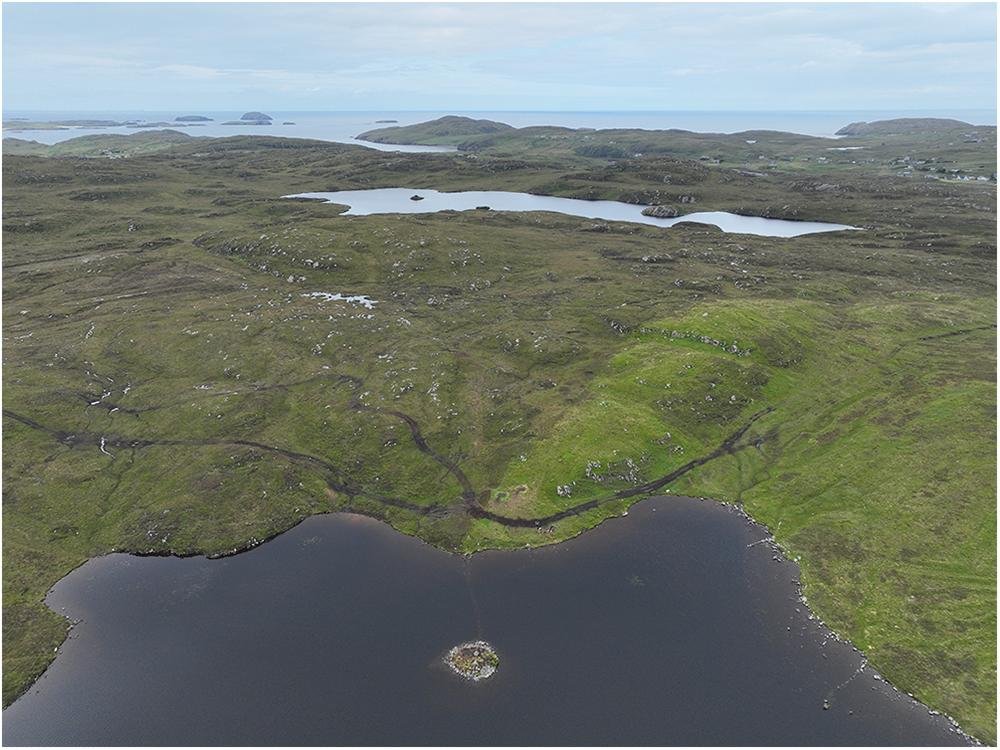
From above, the Neolithic island - or crannog - in Loch Bhorgastail appears to be made of stone, though it was known that there was some timber underneath it.

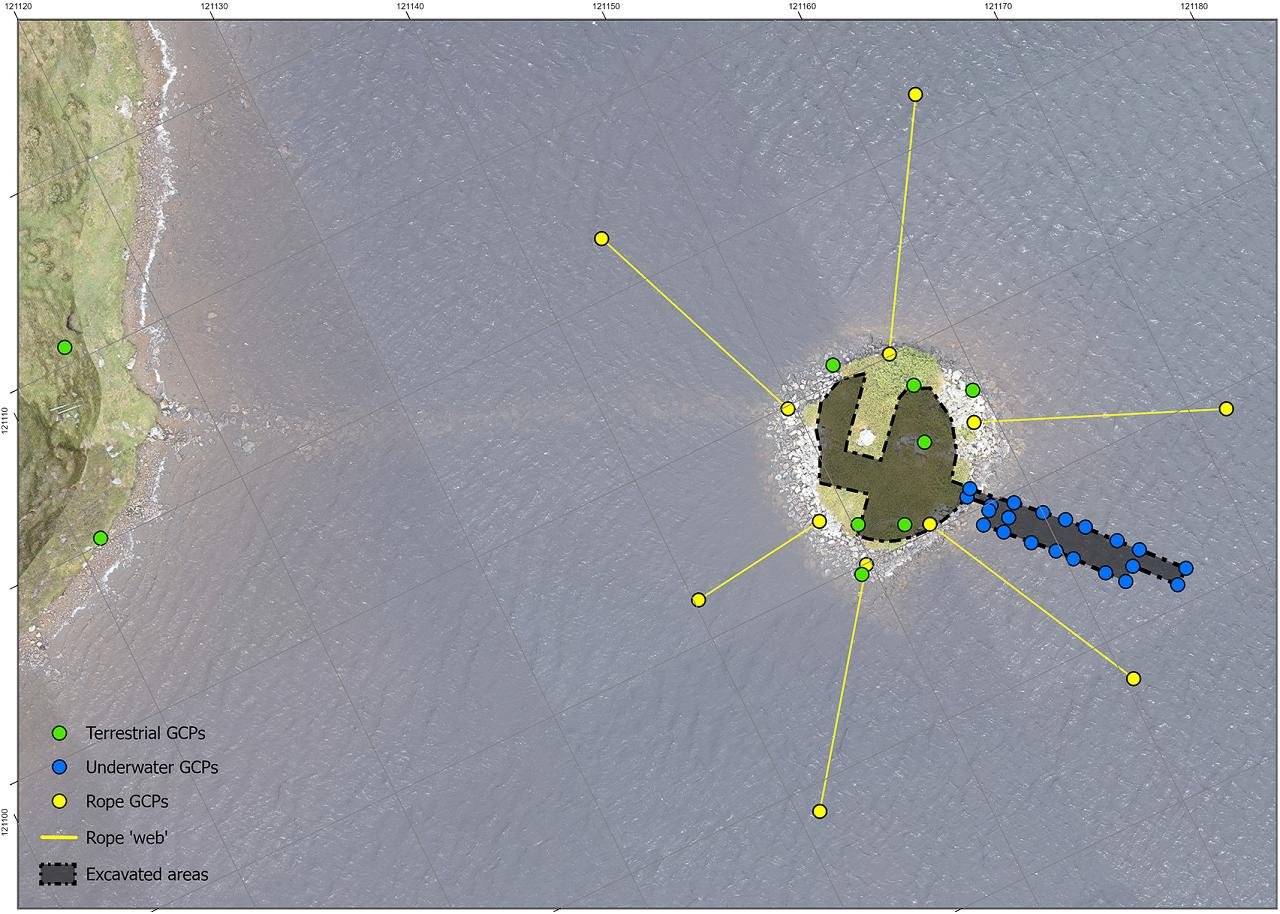
Ground control points used for UAS and underwater surveys at Loch Bhorgastail, showing the distribution of terrestrial, underwater, and rope-mounted control points across the land–water interface.
Credit: Blankshein et al., Advances in Archaeological Practice (2026)

The crannog at Loch Bhorgastail.
Credit: University of Southampton
However, researchers from the University of Southampton carried out an excavation and have revealed that wood was used to support the whole structure.
The group dated their findings between 3500 and 3300 BC - around the early Bronze Age - and said the technique would have been used at other nearby sites throughout the Outer Hebrides.

Plan view of stone and timber elements above and below the waterline, digitized from multiple integrated photogrammetry survey datasets.
Credit: Blankshein et al., Advances in Archaeological Practice (2026)
University of Southampton archaeologist, Dr Stephanie Blankshein, said: "When we actually started excavating is when we realised that it was actually this coherent, quite large timber structure that was under what you would see as the stone island today.
"While we still don't know exactly why these islands were built, the resources and labour required to construct them suggests not only complex communities capable of such feats, but also the great significance of these sites."
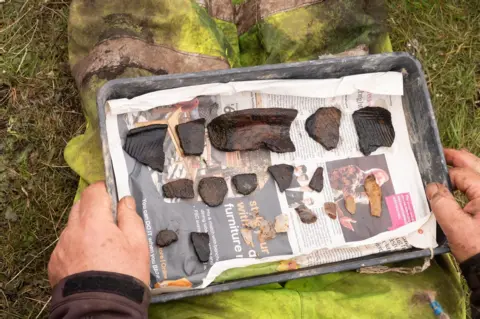
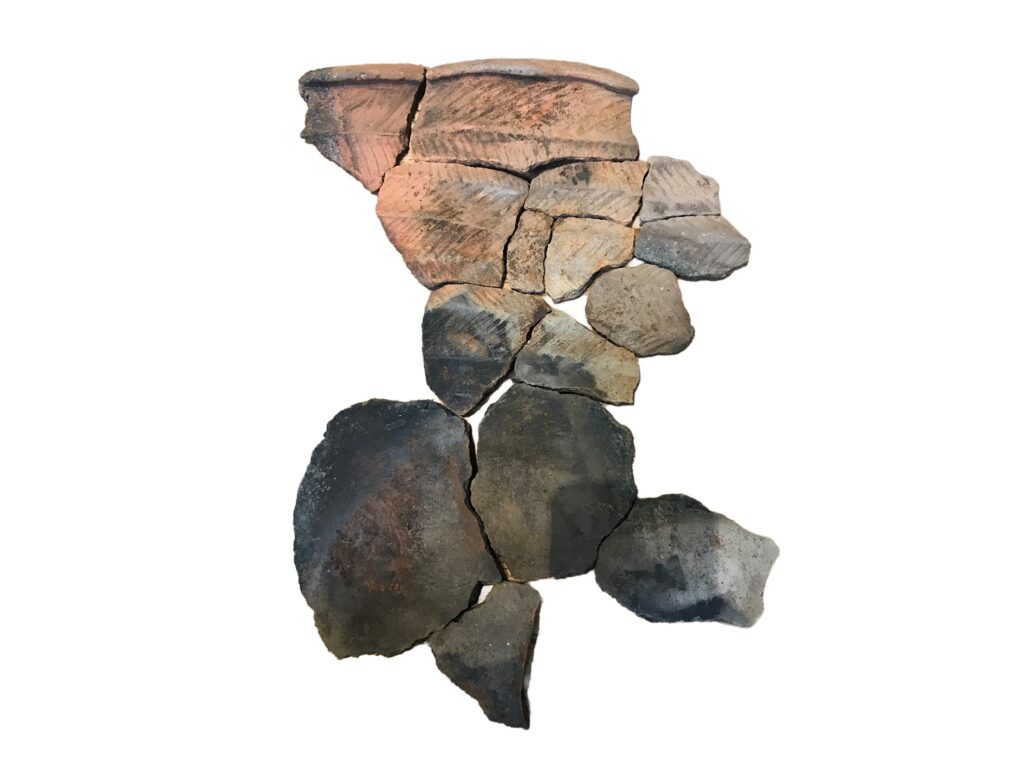
As well as the layered wood and brushwood construction under the stone, archaeologists found hundreds of pieces of Neolithic pottery in the surrounding water.

Crannogs are small artificial islands that are typically thousands of years old, and hundreds of them exist in Scotland's lochs.
The site in Loch Bhorgastail was first discovered in 2009.
Through fieldwork carried out since 2021, the archaeologists have revealed the different stages of development of the crannog.
They discovered that it was first established more than 5,000 years ago and started out as a circular wooden platform, around 23m (75ft) across, topped with brushwood.
Around 2,000 years later in the Middle Bronze Age, another layer of brushwood and stone were added, with more activity around 1,000 years after that during the Iron Age.
A stone causeway, now underwater, leads from the loch shore to the island.

As part of the fieldwork, the researchers created images of how the island looks above and below the water line using the science of photogrammetry.
Burchett: Here's What the Government Knows About UFOs


Sean Spicer:
Will we ever get the truth about UFOs/UAPs?
Featuring:
Rep. Tim Burchett
U.S. Congressman | Tennessee, District 2
YouTube link:
Top 5 innovations in the world of robots: From humanoids to autonomous AI
The global industrial robot market has reached a record high of $16.7 billion. This isn’t just a rise in sales—the industry is undergoing structural changes that will shape the future of manufacturing in the coming years.
Infographic showing the five key industry trends according to the International Federation of Robotics (IFR).
Source: ifr.org
In its annual report, the International Federation of Robotics (IFR) identified five key trends for 2026. First and foremost is the rapid adoption of artificial intelligence. Analytical AI enables machines to predict breakdowns before they occur and to autonomously plan routes within warehouses.
Generative AI has taken a step further: instead of rigidly defined algorithms, it now learns new tasks through simulations and understands commands in natural language. The combination of both approaches—known as agent-based AI—is designed to enable machines to act independently in truly unpredictable conditions.
Another trend is the convergence of information technology and operational technology. Put simply: data processing systems and systems for managing physical processes used to exist in parallel and had almost no interaction. Now these barriers are breaking down.
The actual exchange of data between the digital and physical layers gives robots greater context and flexibility—and forms the foundation of what is known as the Fourth Industrial Revolution.
The third area is humanoid robotics. Companies and research teams are moving from prototypes to actual deployments in manufacturing facilities and warehouses. The automotive industry has taken the lead in this field.
However, in order for humanoids to compete with conventional automation, they have to meet strict industrial requirements: keep up with the pace of the production cycle, not consume too much energy, and not require excessive maintenance. The IFR notes that the key criterion for success is achieving human-level agility and productivity.
The increasing autonomy of machines makes it more difficult to monitor and verify their behavior. Connecting robots to cloud platforms creates new vulnerabilities: experts are noting an increase in attempts to hack controllers and gain unauthorized access to systems.
Privacy is also a concern—devices collect video, audio, and sensor data streams. Deep learning models are often unable to explain their own decisions even to their developers, and the legal framework for determining liability for AI actions is still taking shape.
The fifth trend concerns the labor market. Robots are increasingly viewed not as a threat to employment, but as a solution to the shortage of skilled workers. IFR emphasizes that the successful implementation of automation depends on whether employees themselves are involved in the process.
Governments and companies are investing in reskilling programs so that people can compete in an economy where automation is becoming the norm.
Top 5 New Humanoid Robots Ranked at CES 2026 (AI NEWS)
Better ways to search for extraterrestrial civilizations
Benjamin Zuckerman, a researcher at the University of California, has proposed a new approach to the search for extraterrestrial civilizations. He believes that aliens will not transmit signals in all directions, but rather in a narrow, directed beam.
Where should we look for extraterrestrial life?
Source: www.nbcnews.com
When searching for signs of extraterrestrial intelligence, it’s helpful to know exactly what you’re looking for and to do so in the most effective way possible. However, as Benjamin Zuckerman, an astrophysicist and professor emeritus in the Department of Physics and Astronomy at the University of California, Los Angeles (UCLA), writes, this has generally not been done until now.
Zuckerman suggests examining an approach to the search using the electromagnetic spectrum, drawing on astronomical surveys conducted independently of the search for extraterrestrial intelligence (SETI), and proposes an improved search methodology developed based on his research.
Since, by all accounts, there are no alien probes in our Solar System, his methodology leads to the conclusion that “no alien civilization has passed within 100 light-years of Earth over the past few billion years.” His work was published in The Astrophysical Journal.
Most published works (at least those written by humans) have been based on the assumption that extraterrestrial intelligence (ET) would have limited energy resources—the electricity available to extraterrestrials would become increasingly difficult to generate, and its supply would ultimately be limited. It was believed that, to optimize the signal-to-noise ratio on the receiving end, ET would use very narrow bandwidths for both transmission and reception.
That is why people searching for radio signals use algorithms that analyze very narrow frequency bands, spanning just a few hertz. “Even with the use of modern equipment and software, the total bandwidth that has been achieved today amounts to only ‘a tiny fraction of the entire radio and microwave frequency spectrum,’” writes Zuckerman.
In 1964, Soviet astrophysicist Nikolai Kardashev, known for his Kardashev scale—which classifies civilizations based on their energy consumption—proposed the hypothesis that any signal transmitted by extraterrestrials would be isotropic, meaning it would have the same intensity in all directions rather than being directional. In any given direction, an isotropic signal would be weak, which limits its power, and this view has since influenced scientific research within the SETI program.
Zuckerman puts forward the exact opposite hypothesis—that any extraterrestrial civilizations would choose to send highly directional signals, so limited power would not be a serious problem. In this case, he writes, the most uncertain factor for us will be the signal’s wavelength (or, alternatively, its frequency), so we should investigate a much broader range of the electromagnetic spectrum—not only radio waves, but at least infrared and visible light as well. But this is “very difficult” to do using existing SETI radio search programs.
As Zuckerman writes, for neighboring technological civilizations that engage in targeted communication and make “every technological effort to establish contact,” power limitations—and consequently, filtering through very narrow bandwidths on Earth—are “irrelevant.”
This scenario allows civilizations conducting searches and receiving signals to “accidentally discover an alien transmitter during electromagnetic surveys of the sky conducted for reasons unrelated to SETI.” Any such signals would be calling out to us—if we were looking in the right direction—simply by conducting routine astronomical observations with modest telescopes.
Zuckerman took into account five relevant observational parameters: distance, direction, sensitivity (power received per square meter per hertz), wavelength (or frequency), and time.
He suggested that any extraterrestrial life discovered would, like ours, be based on water; therefore, their planet must be located in the habitable zone around its star, where liquid water exists on at least part of its surface. The planet’s star must be similar to the Sun; only stars with a mass less than 1.25 times that of the Sun live long enough (4.5 billion years) for such a technological civilization to evolve on the planet.
According to Zuckerman’s estimates, a targeted SETI search program would likely need to observe 300,000 stars within a radius of 200 parsecs (650 light-years) to cover all the old stars—those that have existed in the Earth’s atmosphere over the past two billion years, during which oxygen has existed in Earth’s atmosphere as a result of the Great Oxidation Event—about two million such stars have passed within 100 light-years of our solar system.
Based on many such astronomical, astrophysical, and SETI considerations, and given that many other all-sky surveys of stars in the radio and optical spectrum could detect continuous, strong signals deliberately transmitted (via highly directional transmissions) with the aim of attracting attention, Zuckerman arrives at the aforementioned limit: “No alien civilization has passed within 100 light-years of Earth over the past few billion years.”
Although some parts of the radio and infrared bands have not yet been explored, according to Zuckerman, a broad-band study of old, Sun-like stars—from radio frequencies to the visible spectrum—is needed. This will allow us to expand the scope of the search and, for the first time, obtain a numerical estimate of the number of extraterrestrial civilizations capable of communication. 100,000, or perhaps even 10,000.
Zuckerman said he had spoken with some of SETI’s leading astronomers, and none of them had criticized him. The same applies to other astronomers who are not SETI experts but are sufficiently qualified to evaluate its work and claims. But, he adds, “although the jury has not yet reached a decision, various pieces of evidence suggest that the verdict will be this: we are alone in our little corner of the Milky Way galaxy.”
Battle for androids: Meta acquires brain for robots
Meta has acquired a startup that develops artificial intelligence for humanoid robots. The company aims to create an open software platform for the industry—similar to how Google once built Android for smartphones. The financial terms of the deal have not been disclosed.
Illustrative image.
Humanoid robots are the main focus for tech giants in 2026.
Assured Robot Intelligence (ARI) is a startup that developed so-called foundational models—basic artificial intelligence algorithms that enable machines to understand human behavior and adapt to unpredictable situations in real-world environments.
Precisely this inability to generalize—to understand new situations without prior programming—is the key problem that no company in the field of humanoid robotics has yet solved. The entire team, including co-founders Xiaolong Wang and Lerrel Pinto, will join the Meta Superintelligence Labs division.
Wang wrote on X that they understood from the start that achieving the company’s goals meant training a “truly versatile physical agent.” He is now convinced that such an agent must be a humanoid, and that its training will be based directly on human experience. According to him, Meta has access to “the key components needed to realize this vision.”
The deal comes amid a fierce race among tech giants. Amazon acquired the startup Fauna Robotics—where Pinto previously worked—for its own humanoid robot project. Tesla is promoting the Optimus line and is already converting part of its Fremont factory to produce them.
According to forecasts by the research firm Kaiso Research, the global market for humanoid robotics is expected to grow from $2.64 billion in 2024 to $38.4 billion by 2035. Software—the very segment that ARI is strengthening—is already the fastest-growing sector.
Meta CTO Andrew Bosworth explained the company’s strategy back in 2025: “Software is the bottleneck.” The idea is to develop licensed software for the entire industry—just as Android has become the operating system for thousands of different devices.
The acquisition of ARI fits into this logic: instead of investing in expensive hardware, we are acquiring scalable software expertise.
Hollow‑Earth myths and Nazi UFOs on TikTok are bringing white supremacism into the mainstream

TikTok, The Conversation
Hollow‑Earth myths and Nazi UFOs on TikTok are bringing white supremacism into the mainstream
Eighty-one years after Adolf Hitler died by his own hand in a Berlin bunker, a viral video on TikTok shows an AI-generated vision of the Nazi dictator standing in Antarctica, shoulders broad and face smiling, sipping a White Monster Energy drink while Men at Work’s iconic song Down Under plays.
It’s an absurd image, but one that makes sense in the context of the “Agartha” trend on TikTok, which is quietly bringing white supremacist narratives into the mainstream to be seen by millions of users.
The modern myth of Agartha, a supposed utopia hidden inside the hollow Earth, was constructed from older pieces by esoteric authors after the second world war. It blends “Aryan” white supremacist themes with ideas of an occult SS and Third Reich spaceships.
Literal belief in hollow-Earth myths or Nazi UFOs is not the point. Instead, it’s an aesthetic – one that can host both coded far-right messages and explicit ones, fused with pop-cultural references such as the White Monster Energy meme.
Agartha videos on social media are “awful but lawful”: the content is objectionable but legal. It allows extremists to embed their narratives into mainstream social media spaces, without triggering moderation or outright rejection by the audience. As a result, they can reach large, young audiences.
To understand how the underlying esoteric myths are used, we analysed a network of more than 43,000 Agartha-related TikTok videos and closely studied selected examples. This analysis is part of an ongoing project led by researchers at Neu-Ulm University of Applied Sciences in Germany. The goal is to understand how extremists abuse platform features to carry radical narratives into the mainstream.
We identified four key mechanisms which far-right actors use to push radical narratives to unsuspecting audiences: aesthetic camouflage, dog-whistles and split-second glimpses, network building, and weaponised irony. Let’s unpack each of these terms.
Moderation systems on social media platforms aim to remove overt extremist propaganda. These systems work imperfectly, but overt propaganda is unlikely to reach mass audiences before being removed.
Instead, far-right actors often use generative AI to mask racial ideology behind seemingly benign tropes from science fiction and fantasy. This allows a “de-demonising” of their ideas. Elf-like depictions of the “Aryan” inhabitants of Agartha, or footage of an underground utopia, make the idea of a white ethnostate seem palatable.
The engaging aesthetic keeps people watching longer. In turn, this triggers the algorithm to push the video to wider audiences.
Far-right actors infuse their content with dog whistles that communicate to a certain audience without triggering moderation.
Our research identified recurring visual symbols in Agartha videos. “Raw milk” signals white supremacy. The number 271, which appears in hundreds of the videos, is a code for Holocaust denial.

Agartha videos also sometimes include overt extremist markers such as the Hakenkreuz (the Nazi symbol of the “hooked cross” or swastika). They are often flashed for only fractions of a second.
This is a calculated provocation. It tests and pushes platform boundaries, normalising the presence of far-right markers and slowly desensitising viewers. At the same time, successful inclusion of forbidden symbols in videos with viral reach serves as a badge of honour within the in-group.

The Agartha community is not an isolated echo chamber. Our analysis shows the Agartha network connects to others on TikTok. Around 87% of these connections come via the inclusion of mundane, mainstream hashtags on Agartha videos.
Extremists may deliberately “hijack” benign, high-traffic hashtags, such as #roblox or #loganpaul, to push their content into everyday feeds. Agartha is also strongly connected to gym and fitness content. Hashtags such as #gymtok serve as a bridge, potentially funnelling users towards radical narratives.

Here, we also observed targeted appeals. Agartha videos would commonly include hashtags associated with “looksmaxxing” – a trend for extreme physical self-optimisation – to push their videos towards audiences seen as potentially susceptible, such as insecure young men. Well-known looksmaxxers were also sometimes depicted in Agartha videos.
As the example of Adolf Hitler drinking a Monster Energy illustrates, Agartha videos rely heavily on absurd situations, frequently co-opting mainstream social media trends.
Because White Monster Energy is a popular meme within non-extremist spaces, users familiar with the trend are particularly likely to get algorithmic recommendations fused with extremist narratives.

Similarly, actors superimpose mainstream figures into Agartha to force association, such as YouTuber Logan Paul or actor Mads Mikkelsen.
Such co-opting is also done through music, with many hollow-Earth edits set to Men at Work’s 1980s hit Down Under. The track serves as a darkly ironic nod to the subterranean utopia.
This increases the chances for algorithmic amplification while providing creators with plausible deniability. Criticisms can be dismissed as a misunderstanding of dark humour or current trends.
Agartha is more than just a digital resurfacing of fringe occultism. It is a blueprint for how to design extremist content for algorithmically curated short-video platforms.
It’s also a reminder that extremist content on social media does not exist in isolation. Instead, it lives in what researchers call “hybridised spaces”, where users move in and out of extremist discourse. In such spaces, borderline content, outright extremism, mundane trends and humour blend seamlessly – and participants may find their mainstream interests lead them to radical narratives.
UFO-linked scientist claimed a top secret energy weapon blasted her before her death... now the Pentagon admits they are real
A futuristic weapon often dismissed as a conspiracy theory has been publicly acknowledged as being part of the US military's vast arsenal.
The US Department of War chose 'Star Wars Day' on May 4 to state that 'directed energy weapons are a fine addition to our arsenal.'
Directed energy weapons are devices capable of firing rays of energy, such as microwaves, at a target. Simply put, they fire lasers at the enemy, often to scramble and physically damage electronic equipment.
In the Pentagon's post on social media, they confirmed that DEWs produced 'beams of concentrated electromagnetic energy or atomic or subatomic particles.'
Monday's post cemented decades of rumors that the military has been working on futuristic weaponry that was once thought of as science fiction or unrealistic experiments by Pentagon researchers.
However, the revelation comes as stunning claims from a dead scientist were recently unearthed, alleging that she was the target and victim of a DEW attack in her own home in 2022.
Amy Eskridge, who reportedly took her own life on June 11, 2022 at age 34, shared shocking images that allegedly showed the damage these weapons could cause to the human body.
Pictures and text messages shared with the Daily Mail by a former British intelligence officer revealed burned skin, lesions and painful blisters Eskridge allegedly suffered after a beam from a DEW was fired into her home by an unknown assailant.

The Pentagon's Chief Technology Officer revealed on May 4 that laser weapons are 'a fine addition' to the US military

Amy Eskridge (Pictured) was a scientist researching anti-gravity technology before her death in 2022 at age 34
Franc Milburn, a retired paratrooper, investigated the Eskridge case and concluded she was 'murdered by a "private aerospace company"' to stop her research on futuristic propulsion technology and national security threats.
The images shared by Milburn also revealed how a microwave from an alleged DEW scorched the window of Eskridge's Huntsville, Alabama home as the beam passed through the glass.
Eskridge's death was reportedly ruled a suicide from a gunshot wound to the head, but the scientist allegedly consulted a former CIA weapons expert about the DEW attack in early 2022.
On May 19, 2022, Milburn said Eskridge messaged him to say: 'My ex-CIA weapons guy on my team saw my hands when they were burned really badly a couple months ago, and he saw that window pane in person,' she wrote.
'He said he had built things like that, and that it was most likely an RF k-band emitter run by five car batteries strung together from inside an SUV.'
While there has been no physical evidence to confirm Eskridge and Milburn's claims regarding a DEW attack, the theory that such a weapon uses a k-band emitter does match what the military is currently using in its laser weapon tests.
The k-band is a specific range of invisible radio waves, or microwaves, that military directed energy weapons can use to send out powerful beams at enemy targets.
These beams can travel well, focus tightly on a target and are especially good at damaging electronics inside drones, missiles or vehicles from a distance.

Eskridge's death was reportedly ruled a suicide from a gunshot wound to the head, but the scientist allegedly consulted a former CIA weapons expert about the DEW attack in early 2022

Directed energy weapons fire concentrated beams of microwaves or other particles at a target to disable electronics

Franc Milburn shared a picture, which he claims shows Eskridge's hands burned and discolored after allegedly being struck by a 'directed energy weapon'
Monday's statement came from the X account of the Department of War's Chief Technology Officer, Emil Michael, who oversees the Pentagon's entire research, development and prototyping operations.
Michael's profile on the Department of War website states that his mission is to 'accelerate the transition of breakthrough technologies from prototype to operational reality, ensuring that the US military maintains its technological edge.'
Although DEW technology was first mentioned in the 1960s and first deployed in 2014 by the Navy, there has not been any public mention by the US government or the Pentagon about using these weapons against people.
Over the last decade, the Pentagon's 'idea factory,' known as DARPA, has worked on multiple projects aimed at creating a new wave of directed energy devices for use against enemy drones, missiles, rockets, vehicles and computers.
A Pentagon official told the Daily Mail that the military's current focus is on six 'new critical technology areas,' including Scaled Directed Energy, or SCADE.
'The Department is continuing to scale and integrate these high-energy solutions to make our arsenal more lethal, precise, and cost-effective,' the officials said in a statement on Tuesday.

Large DEW have been used by the military to shoot down enemy missiles and drones

The technology is thought to be more cost effective than using bullets because each beam costs only a few dollars to emit
The official website of Congress even has a detailed section acknowledging the existence, uses and funding for the government's research and development of these futuristic weapons.
According to that report, the Pentagon requested $789.7 million for directed energy weapons programs during the 2025 fiscal year.
However, some of the research has also been handled by outside companies, including those in the aerospace field, with deep ties to national defense.
That includes defense technologies company AeroVironment, which developed the laser weapon shown in the Pentagon's social media post - the Locust X3.
The Locust is a truck or ship-mountable system that shoots a powerful, invisible beam at the speed of light to quickly destroy or disable enemy drones, especially small and medium-sized threats.
According to the military, these weapons have also become a more cost-effective solution to shooting down enemy drones, as each beam only costs a few dollars to fire and does not require bullets or bombs, which have limited supplies.
The Pentagon official added: 'By scaling and delivering on the priorities driven under the SCADE CTA, the Joint Force will be able to neutralize adversarial threats with unparalleled precision at a low cost-per-shot.'
The Body Gap: Researchers Warn AI Lacks the Physical Grounding That Shapes Human Thought

As AI and humans move closer to what some describe as the singularity, the distinction between being human and not may hinge on what researchers are calling the “body gap.” A new perspective from a UCLA Health team argues that today’s artificial intelligence systems can describe human experience but fundamentally lack the lived, bodily grounding that shapes how humans think, decide, and behave.
Coined “the body gap,” this may represent not just a philosophical limitation, but a practical concern for AI safety and alignment. The concept hinges on two key ideas: external embodiment (a system’s ability to perceive and act in the world) and internal embodiment (a continuous awareness of internal bodily states such as fatigue, uncertainty, stress, or need).
“Without a body or analogous internal physiology, AI systems may approximate, simulate, or even convincingly reproduce the expression of understanding,” said Akila Kadambi, the study’s first author and a postdoctoral fellow in the Department of Psychiatry and Biobehavioral Sciences at UCLA’s David Geffen School of Medicine. “But Simulation is not the same as experience.”
“On that view, an AI could be highly intelligent, or even sentient in some abstract sense, yet still lack the embodied grounding that characterizes human understanding,” Kadambi said in an email to The Debrief.
At its core, human cognition is shaped by connection, not isolation. The researchers point to even simple actions—like passing the salt across a table—as examples of how behavior is informed by more than the task itself. Such actions draw on a lifetime of sensorimotor experience: how objects feel, how distances are judged, and the social context or intent behind the interaction. In other words, human behavior is deeply contextual. The brain continuously integrates this external input with internal bodily signals, creating a feedback loop that influences attention, memory, and decision-making. According to the UCLA researchers, AI systems lack this internal layer.
“While there is a current focus in world modeling on external embodiment, such as our outward interactions with the world, far less attention is given to internal dynamics, or what we term ‘internal embodiment,’” Kadambi said. “In humans, the body acts as our experiential regulator of the world, as a kind of built-in safety system.”
“If you’re uncertain, if you’re depleted, if something conflicts with your survival, your body registers that,” she added. “AI systems right now have no equivalent. They can sound experiential, whether they should be or not, and that’s a real problem for many reasons, especially when these systems are being deployed in consequential settings.”
Kadambi explains that current AI models can produce human-like language without having any lived experience to match what those words really mean.
The study also highlights experiments involving point-light displays, in which several advanced AI systems failed to recognize patterns that humans readily identify as human movement. Instead, the systems interpreted them as unrelated shapes or even astronomical phenomena. When the displays were altered, the systems’ performance deteriorated further, suggesting a fragile and unrealistic mode of perception—one that contrasts sharply with the stability provided by embodied human experience.
The researchers argue that this limitation could have implications for human safety as AI systems are deployed more broadly in everyday settings.
“By contrast, current AI systems have no equivalent mechanism. They process inputs and generate outputs without any persistent internal state that regulates how they behave over time,” said Dr. Marco Iacoboni, professor in the Department of Psychiatry and Biobehavioral Sciences at the David Geffen School of Medicine and a senior author on the recent paper.
“This is not just a performance limitation, but also a safety limitation. Without internal costs or constraints, an AI system has no intrinsic reason to avoid overconfident errors, resist manipulation, or behave consistently.”
To address this issue, the paper proposes a “dual-embodiment framework.” The idea would be to enable AI systems to connect more directly with the external world while also incorporating internal “check-in” processes—loosely analogous to an inner voice—that could help regulate behavior.
The authors also call for the development of new evaluation benchmarks. Rather than focusing solely on whether AI can identify objects or complete tasks, future assessments should examine whether systems can maintain stability under uncertainty and demonstrate self-regulation.
Hantavirus outbreak could just be the beginning: Scientists issue urgent warning about spillover of other rodent–borne viruses amid rising global temperatures READ MORE: More than 20 Brits battling to get off rat virus vessel By WILIAM HUNTER, SENIO
The recent outbreak of hantavirus on a cruise ship could just be the beginning, scientists have warned.
In an ominous new study, researchers reveal that climate change will lead to enhanced 'spillover' of rodent–borne viruses.
As global temperatures rise and rodent populations shift, deadly arenaviruses will be driven into areas that have never faced these diseases before.
Researchers predict this will trigger outbreaks that threaten to reach 'millions' of people across South America.
The warning comes as more than 20 Brits remain trapped aboard a cruise ship infected with rat–borne hantavirus off the coast of Cape Verde.
Three passengers have now died after contracting the viral infection, including a Dutch couple and a German national.
The Dutch–flagged MV Hondius had previously docked in Argentina, where both hantavirus and arenaviruses kill dozens every year.
However, the researchers warn that similar outbreaks will only become more common the faster the climate warms.

Scientists predict that climate change will lead to a massive spread of rodent–borne viruses in South America
Like hantavirus, arenaviruses are hosted by rodents and usually spread to humans from animals rather than person–to–person infection.
These extremely common but poorly studied infections include Guanarito virus in Venezuela and Colombia, Machupo virus in Bolivia and Paraguay, and Junin virus in Argentina.
Infection causes severe hemorrhagic fevers with high hospitalisation rates, with fatality rates between five and 30 per cent.
Since these diseases are spread by rodents, their impact is closely connected to changes in rodent habitats.
However, studies have shown that the warming climate is producing dramatic changes in the ranges of disease–spreading animals.
Previous research has shown that factors such as temperature and precipitation have a massive impact on the risk of rodent–borne diseases such as Lassa fever and hantavirus.
Meanwhile, the distribution of the drylands vesper mouse, which transmits Argentine Hemorrhagic Fever, will undergo 'substantial changes' due to climate change.
In their paper, the researchers use machine learning to combine climate projections, population density predictions, infection risks, and habitat suitability for six rat and mouse species linked to the viruses.

As the climate becomes hotter, the habitats of rodents which carry arenaviruses will shift. This will bring more rodents into contact with humans

This comes as more than 20 Brits remain trapped aboard a cruise ship infected with rat–borne hantavirus off the coast of Cape Verde. The infection has already killed three passengers, including a Dutch couple and a German national
This revealed that the infection risk posed by these dangerous diseases would change dramatically in the next 20 to 40 years under different climate change scenarios.
Lead author Dr Pranav Kulkarni, of the UC Davis Weill School of Veterinary Medicine, says: 'As climate change accelerates, our study shows how the outbreak risk of dangerous New World arenaviruses could ride on shifting rodent populations to reach millions more people across South America.'
The new model shows that the guanarito virus, which is currently contained to central Venezuela, will spread to parts of Colombia, the border regions of Suriname, and northern parts of Brazil.
The machupo virus, which causes often fatal Bolivian Hemorrhagic Fever, will expand from the flatlands of Bolivia to the Andes foothills and mountain regions.
Meanwhile, the Junin virus that causes Argentine Hemorrhagic Fever will move out of the grassland areas and expand to the rest of Argentina.
This will reduce the risk in some areas that have already learned to deal with the disease, but increase the dangers of infection in others.
In all cases, Dr Kulkarni and his co–authors warn that populations with little or no prior exposure will be encountering these viruses for the first time, potentially increasing their vulnerability to infection and severe disease.
Senior author Dr Pranav Pandit says: 'Our study connects the dots between changing climatic conditions and land use, shifting rodent populations and human infection risk, making it possible to see where the next generation of zoonotic arenaviral outbreaks could emerge.'

Modelling shows that climate change will cause significant changes in the habitat of the drylands vesper mouse, which transmits Argentine Hemorrhagic Fever
These changes were primarily driven by expanding agricultural and urban areas, bringing more humans into the habitats of rodents capable of carrying arenaviruses.
Combined with climate–driven changes in the rodents' habitats, triggered by temperature and precipitation shifts, major outbreaks in previously safe areas are likely.
This research comes after an outbreak of rodent–borne hantavirus left a luxury cruise ship stranded at sea.
The MV Hondius vessel has been anchored in the Atlantic since Sunday, following the death of three passengers after an outbreak of the deadly disease.
Around 150 people remain aboard the vessel following the deaths and illnesses, while the World Health Organisation has confirmed six cases of hantavirus.
It is suspected that the virus may have been transmitted during a stop in South America, either directly to humans or to rodents aboard the ship.
A spokesperson for the Netherlands' National Institute for Public Health and the Environment told Reuters: 'You could imagine, for example, that rats on board the ship transmitted the virus," he said.
'But another possibility is that during a stop somewhere in South America, people were infected, for instance via mice, and became ill that way.'
Ark of the Covenant's final resting place pinpointed in new search©CC Composite Editor
The location of a chest believed to contain the Ten Commandments has long been a mystery, but archaeologists may be closer to finding the lost Ark of the Covenant. According to the Bible, the sacred relic was built by the Israelites shortly after fleeing Egypt around the 13th century BC, with Moses placing the Ten Commandments inside. Historians believe the Ark was kept inside the Holy of Holies, the innermost chamber of Jerusalem's ancient temple, before vanishing during the Babylonian sack of the city in 586 BC. Now archaeologist Dr Chris McKinny has proposed the Ark could be hidden within underground spaces in the City of David, just south of Jerusalem's Temple Mount. Researchers plan to scan underground spaces in the area using powerful technology designed to detect hidden cavities and buried metals deep beneath the surface.
©Shutterstock / A.Pushkin
Use of Muon Detection Technology in Archaeology
The method relies on muon detectors, instruments that track tiny subatomic particles created when cosmic rays from space strike Earth's atmosphere, allowing scientists to see deep underground and detect hidden chambers without digging. Early scans of the area have revealed previously unknown voids and structures beneath the ancient landscape, aligning with the hidden tunnel theory. If the technology is eventually extended beneath the Temple Mount, McKinny and his team believe the Ark could be detected , if it still exists, because it is said to be plated with gold inside and out. McKinny does not claim to have discovered the Ark of the Covenant or to know its exact location with certainty.
However, in his documentary Legends of the Lost Ark , released April 7, he explores three major ancient traditions describing what may have happened to the relic after the Babylonian destruction of Jerusalem's First Temple in 586 BC. According to McKinny, each account suggests the Ark was deliberately hidden to protect it from invading forces rather than destroyed or captured.
©Getty Images
Advanced Imaging Methods for Underground Exploration
McKinny also expressed optimism about emerging technology that could one day allow him and his team to digitally examine underground spaces without disturbing sacred ground. He pointed to advances in imaging tools such as ground-penetrating radar, seismic scanning, electrical resistivity tomography and other remote-sensing technologies capable of mapping hidden structures beneath the surface, All Israel News reported. According to McKinny, such tools could eventually help identify tunnels, chambers and concealed spaces beneath the Temple Mount, an area he described as one of archaeology's biggest blind spots because traditional excavation using 'the spade or the trowel' is largely forbidden.
He stressed that this remains a long-term possibility rather than an active excavation project. In a recent interview, McKinny said he is 'excited and hopeful for what will come from that,' while acknowledging that significant religious, political and logistical barriers still stand in the way of such work. Despite growing interest in advanced scanning methods, McKinny maintains a cautious approach, focusing primarily on ancient texts and historical traditions rather than dramatic excavation efforts.
©Daily Mail
Ark of the Covenant's final resting place pinpointed in new search
The stories draw from early Jewish sources, including the Book of 2 Maccabees and other historical traditions. The first and most widely discussed theory, often called the Mount Legend, suggests the Ark was hidden beneath the Temple Mount in Jerusalem. The Temple Mount is the holiest site in Judaism and central to biblical history, widely believed to be the place where Abraham prepared to sacrifice Isaac. Located in Jerusalem's Old City, the 36-acre raised compound once housed Solomon's Temple, known as the First Temple, and later the rebuilt Second Temple, serving as the spiritual center of Israelite worship and the symbolic dwelling place of God's presence. In this tradition, priests are said to have concealed sacred items in underground chambers or tunnels beneath the temple complex shortly before the Babylonian siege. This theory has fueled centuries of speculation about hidden chambers beneath the Temple Mount and remains one of the most widely debated possibilities among modern researchers. A second account, known as the Rock Legend, describes the prophet Jeremiah hiding the Ark at a mysterious rocky site located between two mountains.
©Shutterstock / P Maxwell Photography
Ark of the Covenant's final resting place pinpointed in new search
Jeremiah was a major biblical prophet who lived in Jerusalem during the final years before the city's destruction, making him a central figure in many accounts of the Ark's disappearance. The precise location described in the texts remains unclear, with some scholars suggesting it could refer to a wilderness region near Jerusalem or a more remote mountainous area. The third and oldest tradition, often referred to as the Mount Nebo Legend, appears in the ancient text 2 Maccabees. It claims Jeremiah carried the Ark, along with other sacred objects, to a cave or tomb on Mount Nebo, the mountain traditionally associated with the death of Moses.
Some interpretations suggest the Ark may have been hidden near the place believed to be Moses' burial site, though later traditions have complicated efforts to pinpoint the exact location. Despite their differences, McKinny noted that all three legends share key similarities. Each places Jeremiah at the center of efforts to safeguard the Ark, situates the events shortly before Jerusalem's fall, and suggests the relic was intentionally hidden rather than lost in battle.
{ ©Daily Mail }
Trump promises to release UFO files©The Daily Digest
The truth is out there?
As long as humanity can remember, people have been looking into the stars with awe and curiosity, trying to figure out the mysteries of the universe. Now one unlikely source might help solve one piece of this cosmic puzzle.
©The Daily Digest
Trump's promise
Newsweek reports that US President Donald Trump has promised that his administration will release documents pertaining to UFO-related activity.
©The Daily Digest
Seeing things you wouldn't believe
The US president didn’t give a specific date for the release, only saying that it would be soon and teasing that it includes files containing accounts “you wouldn’t believe.”
©The Daily Digest
Executive order
“As you remember, I recently directed the Secretary of War to begin releasing government files relating to UFOs and unexplained aerial phenomena,” Trump said, as cited by NBC.
©The Daily Digest
The process is underway
The US president added that “this process is well underway, and we found many very interesting documents, I must say, and the first releases will begin very, very soon.”
©Provided by The Daily Digest
Pressure from the US Congress
Lawmakers in the US Congress have been pressuring the White House to disclose files related to unidentified aerial phenomena, or UAPs.
©The Daily Digest
Moving away from UFOs
The scientific community has adopted the term UAP as a way to move away from the term unidentified flying object, or UFO, due to the older term's association with flying saucers.
©The Daily Digest
Image: US House of Representatives
Federal secrets?
One of them is Florida Republican Representative Anna Paulina Luna, who chairs the House Oversight Task Force on the Declassification of Federal Secrets.
©The Daily Digest
'Nonhuman origin'
According to Newsweek, Luna claims to have seen things she cannot explain. “I have observed things that are of nonhuman origin and creation. That’s my opinion,” the Florida congresswoman revealed in a podcast.
©The Daily Digest
The All-domain Anomaly Resolution Office
Since 2022, the US Congress has been looking more closely at the existence of UAPs, holding hearings on military sightings, intelligence reports, and the Pentagon’s All-domain Anomaly Resolution Office (AARO).
©The Daily Digest
Image: iammrcup / Unsplash
Never-before-seen information
A spokesperson for the Defense Department said in a statement to NBC News that AARO was “working in close coordination with the White House and across federal agencies to consolidate existing UAP records collections and facilitate the expeditious release of never-before-seen UAP information.”
©The Daily Digest
What Obama had to say
Trump isn’t the only US president to hint at the possibility that we aren’t alone in the universe. NBC points out that back in February, former US president Barack Obama shared his belief that we aren't alone in space.
©The Daily Digest
Personal belief vs. presidential information
However, Obama explained that he didn’t actually see any evidence of alien life during his time at the White House, but rather he was speaking about probability.
©The Daily Digest
'Very interesting'
“Anything having to do with UFOs or related material we are going to be releasing. And I think a lot of it is going to be very interesting,” Trump remarked, as quoted by Newsweek.
©The Daily Digest
On air
The US president claims to have been speaking with Air Force personnel: “I’ve interviewed people my first term primarily, but I interviewed some pilots, very solid people, and they said they saw things that you wouldn’t believe. So you’re going to be reading about it.”
©The Daily Digest
There's always a catch
However, NBC points out that despite Trump’s tantalizing words, the US president has not said he actually believes these sightings have been extraterrestrial in origin.
©The Daily Digest
Other famous conspiracy theories
In the past, the US president has made bombastic announcements about releasing classified documents pertaining to high-profile mysteries such as the Kennedy assassination or the killing of Martin Luther King.
©The Daily Digest
Just a distraction?
Critics have regarded the expectation around these file releases as a way to distract the press and the public from more relevant information withheld by the US government, such as the Epstein files.