Naar de inhoud

UFO'S of UAP'S, ASTRONOMIE, RUIMTEVAART, ARCHEOLOGIE, OUDHEIDKUNDE, SF-SNUFJES EN ANDERE ESOTERISCHE WETENSCHAPPEN - DE ALLERLAATSTE NIEUWTJES

UFO's of UAP'S in België en de rest van de wereld
seniorennet.beseniorennet.be
Ontdek de Fascinerende Wereld van UFO's en UAP's: Jouw Bron voor Onthullende Informatie! Ben jij ook gefascineerd door het onbekende? Wil je meer weten over UFO's en UAP's, niet alleen in België, maar over de hele wereld? Dan ben je op de juiste plek! België: Het Kloppend Hart van UFO-onderzoek In België is BUFON (Belgisch UFO-Netwerk) dé autoriteit op het gebied van UFO-onderzoek. Voor betrouwbare en objectieve informatie over deze intrigerende fenomenen, bezoek je zeker onze Facebook-pagina en deze blog. Maar dat is nog niet alles! Ontdek ook het Belgisch UFO-meldpunt en Caelestia, twee organisaties die diepgaand onderzoek verrichten, al zijn ze soms kritisch of sceptisch. Nederland: Een Schat aan Informatie Voor onze Nederlandse buren is er de schitterende website www.ufowijzer.nl, beheerd door Paul Harmans. Deze site biedt een schat aan informatie en artikelen die je niet wilt missen! Internationaal: MUFON - De Wereldwijde Autoriteit Neem ook een kijkje bij MUFON (Mutual UFO Network Inc.), een gerenommeerde Amerikaanse UFO-vereniging met afdelingen in de VS en wereldwijd. MUFON is toegewijd aan de wetenschappelijke en analytische studie van het UFO-fenomeen, en hun maandelijkse tijdschrift, The MUFON UFO-Journal, is een must-read voor elke UFO-enthousiasteling. Bezoek hun website op www.mufon.com voor meer informatie. Samenwerking en Toekomstvisie Sinds 1 februari 2020 is Pieter niet alleen ex-president van BUFON, maar ook de voormalige nationale directeur van MUFON in Vlaanderen en Nederland. Dit creëert een sterke samenwerking met de Franse MUFON Reseau MUFON/EUROP, wat ons in staat stelt om nog meer waardevolle inzichten te delen. Let op: Nepprofielen en Nieuwe Groeperingen Pas op voor een nieuwe groepering die zich ook BUFON noemt, maar geen enkele connectie heeft met onze gevestigde organisatie. Hoewel zij de naam geregistreerd hebben, kunnen ze het rijke verleden en de expertise van onze groep niet evenaren. We wensen hen veel succes, maar we blijven de autoriteit in UFO-onderzoek! Blijf Op De Hoogte! Wil jij de laatste nieuwtjes over UFO's, ruimtevaart, archeologie, en meer? Volg ons dan en duik samen met ons in de fascinerende wereld van het onbekende! Sluit je aan bij de gemeenschap van nieuwsgierige geesten die net als jij verlangen naar antwoorden en avonturen in de sterren! Heb je vragen of wil je meer weten? Aarzel dan niet om contact met ons op te nemen! Samen ontrafelen we het mysterie van de lucht en daarbuiten.

Archaeologists Found an ‘Anomaly’ Near the Pyramids That May Reveal an Ancient Portal

https:%2F%2Fmedia.zenfs.com%2Fen%2Fpopular_mechanics_642%2F7ff52ff30f0d0a60f3c224e88c8d2b54

Experts Find 'Anomaly' Near the Great Pyramids

Nick Brundle Photography - Getty Images

Ground-penetrating radar has enabled archaeologists to identify hidden structures beneath the surface. A new study conducted by Japanese and Egyptian researchers has revealed an L-shaped structure accompanied by a nearby anomaly next to the Great Pyramids of Giza. While the precise nature of the anomaly is unknown, the researchers speculate that the L-shaped feature could potentially be an entrance to a deeper structure.

In archaeology, ground-penetrating radar (GPR) has transformed the way sites are studied. This geophysical technique sends radar pulses into the ground to create subsurface images. Similar methods have previously uncovered Viking longships in Norway, revealed lost civilizations within the Amazon rainforest, and even mapped entire Roman cities without any excavation.

Once again, GPR has yielded discoveries near one of the world’s most thoroughly explored sites—the Great Pyramids of Giza. The research team, led by Motoyuki Sato of Tohoku University, combined GPR with electrical resistivity tomography (ERT), a method that uses variations in electrical resistance to map underground features. Using these techniques, they detected what they describe as an “L-shaped anomaly” in the western cemetery close to the pyramids.

Darren Orf

In the world of archeology, few tools have revolutionized the field as much as ground-penetrating radar (GPR). This geophysical technique uses radar pulses to image the subsurface. Similar techniques have uncovered Viking longships in Norway, revealed lost civilizations in the Amazonian jungle, and even entire Roman cities without ever putting a shovel into dirt.

In 2024, GPR once again delivered near one of the most well-excavated sites in the world—the Great Pyramids of Giza.

Researchers led by Tohoku University's Motoyuki Sato used GPR, along with electrical resistivity tomography, or ERT, to survey a "blank" patch of the Western Cemetery, the elite burial zone west of the Great Pyramid. The scans showed an L-shaped structure near the surface, with a deeper anomaly below it.

GPR sends radar pulses into the ground. ERT maps how strongly buried materials resist electrical current. Together, the methods gave the team a look at shapes and contrasts below the sand without opening the ground.

According to the team's research paper, published in the journal Archeological Prospection, the structure is roughly 6.5 feet from the surface, measures 33 feet in length, and was backfilled after construction.

"The Western Cemetery at Giza is known as an important burial place of members of the royal family and high-class officers," the paper reads. "In the initial survey by GPR and ERT we found an anomaly in the north of the survey site. The area of the anomaly could be established approximately, but the structure and the location were unclear."

Below the L-shaped feature, the team reported a deeper anomaly 16 to 33 feet underground and described it as "highly electrically resistive." That could mean a few things. The paper pointed to two possibilities: a mixture of sand and gravel, or sparse spacing with air voids. The cemetery around it is packed with mastabas, the flat-roofed tombs associated with elite burials at Giza. This particular patch drew less attention because it did not have the kind of visible surface architecture that usually pulls archaeologists in.

Later research and heritage-science literature treats the 2024 paper as an example of integrated GPR/ERT work in Egypt, but the Western Cemetery anomaly has not been upgraded into a solved archaeological case.

So, what exactly could this L-shape structure and its lower anomaly represent? Speaking with Live Science, Sato said the structure is likely not natural, as the shape is too sharp.

"It may have been an entrance to the deeper structure," Sato and his colleagues wrote in the paper. But "may" is doing real work here. The scan doesn't identify what is below the L-shaped feature, and the researchers didn't claim they had found a tomb. "From the survey results, we cannot determine the material causing the anomaly," they wrote, "but it may be a large subsurface archaeological structure."

The paper called for excavation to establish the anomaly's purpose. Until that happens publicly, the cleanest version of the story is that something unusual showed up in the scans beside the Great Pyramid, and archaeologists still don't know exactly what it is.

This Western Cemetery study is separate from viral claims about enormous hidden structures beneath the Pyramid of Khafre, which Egyptian archaeologist Zahi Hawass publicly rejected in 2025. The GPR/ERT study near the Great Pyramid is peer-reviewed and real—but it's also unresolved.

RELATED


Archaeologists Discovered Mysterious Technology in a Forgotten Pyram

Great Pyramid Anomaly Makes No Sense!

The Missing Logbook That Proves Pyramids Weren't Built With Ropes

{ https://www.popularmechanics.com/science/ }

Hoe vind je dit bericht?
Geschreven door peter om 17:32 Stuur door

Astrophysicist Avi Loeb explains government secrecy on UAPs

Astrophysicist Avi Loeb explains government secrecy on UAPs

Avi Loeb Sounds Alarm on UAPs: “A Matter of National Security” | The Count

Astrophysicist Avi Loeb, lead advisor to the new Trump-era UAP Governance Board, discusses why the government previously maintained secrecy regarding unidentified aerial phenomena. Loeb explains that some objects are unidentified and could pose national security risks from adversarial nations. He advocates for transparency, noting his council seeks to collect unclassified data to better understand these UAPs and potentially make groundbreaking discoveries.

RELATED 


Avi Loeb on UAP Secrecy and Science | The Sol Forum

'It's a privilege': Avi Loeb on new UAP Science Advisory Council head role | ChicagoLIVE

Avi Loeb: 40% of Military UAP Sightings Still Can't Be Explained

{ https://www.foxnews.com/# }

Hoe vind je dit bericht?
Geschreven door peter om 16:57 Stuur door

“It Was Completely Shocking to Me”: Archaeologists Discover the Earliest Monumental Egyptian Hieroglyphs Written 1,000 Years Before the Pyramids

Image by chuju_lin from Pixabay

“It Was Completely Shocking to Me”: Archaeologists Discover the Earliest Monumental Egyptian Hieroglyphs Written 1,000 Years Before the Pyramids

A joint expedition to the ancient Egyptian city of Elkab has unearthed several previously unknown ancient rock art inscriptions, including what the team believes are the earliest known monumental Egyptian hieroglyphs.

Written over 1,000 years before the Great Pyramid of Giza was constructed, these ancient Egyptian writings, discovered by archaeologists from Yale University and the Royal Museums of Art and History (Brussels), laid the foundation for the later, better-known hieroglyphic writing system.

Yale Professor John Coleman Darnell, the expedition’s leader and the co-director of the Elkab Desert Survey Project, said the newly discovered inscriptions, which were not recorded by any previous scientific expedition, include samples as far back as 4,000 BCE.

Although the team concedes that these are not the first examples of this specific style of rock art, they are the first of this ancient age and “monumental” scale, making them of great significance in the history of ancient Egyptian writing systems.

“This was not what I was expecting to find when I set out on this period of work on the expedition,” Professor Darnell said of the historic find. “It was completely shocking to me.”

Earliest Monumental Egyptian Hieroglyphs Depict Cosmological Concepts

In a Yale news story announcing the discovery, Professor Darnell noted that the newly discovered rock art site of El-Khawy preserved some of the earliest and largest signs “from the formative stages of the hieroglyphic script.” The professor added that the discovery includes “rare” evidence for how this enigmatic ancient society invented its internationally recognized ancient writing system.

The expedition, which was directed by Darnell and Dirk Huyge, was undertaken in cooperation with the Ministry of Antiquities and the Aswan and Edfu inspectorates.

After photographing the newly discovered inscription, Darnell and Alberto Urcia, a digital archaeologist and associate research scientist in the University’s Department of Near Eastern Languages and Civilizations, created a series of three-dimensional (3D) images. Darnell said the new technology allows archaeologists to record ancient sites and artworks “at a level of accuracy and detail that was absolutely impossible before.”

“It also means that we can record the site as a place, or a location, and not just as a series of inscriptions,” the professor added.

ancient writing, Earliest Egyptian hieroglyphs The newly discovered panel of signs features images of a bull’s head on a short pole followed by two back-to-back saddlebill storks with a bald ibis bird above and between them. This arrangement of symbols is common in later Egyptian representations of the solar cycle and with the concept of luminosity. Image Credit: Yale University, Royal Museums of Art and History (Brussels).

One of the more noteworthy examples of ancient monumental hieroglyphs, carved sometime between 4,000 and 3,500 BCE, depicted a herd of elephants. A closer examination also revealed that one of the elephants had an image of a smaller elephant inside of it, which Professor Darnell described as “an incredibly rare way of representing a pregnant female animal.”

A second discovery detailed by the joint expedition, which consists of four separate panels, was likely created sometime around 3,250 BCE. Written right to left, which ultimately became the dominant writing form in later Egyptian hieroglyphic languages, the panels show animal images of a bull’s head on a short pole, followed by two back-to-back saddlebill storks with a bald ‘ibis’ bird above and between them.

The research team said this arrangement of symbols is common in Egyptian representations created centuries after the newly discovered panels depicting the solar cycle. These same depictions typically include imagery of luminosity. Darnell suggested that the images may also express “the concept of royal authority over the ordered cosmos.”

“This is the First Time That Anyone Has Seen Them on Such a Massive Scale”

When discussing the importance of the new find, Professor Darnell noted the immense size of the individual tableaus and their elements. For example, each individual hieroglyph identified by the Yale-led team measures over half a meter in height. The professor also noted that the entire tableau “is about 70 centimeters (27.5 inches) in height,” whereas previously discovered signs of early Egyptian hieroglyphs were “only one or two centimeters in size.”

“This discovery isn’t new in the sense that this is the first time that anyone has seen these hieroglyphs,” Darnell explained, “this is the first time that anyone has seen them on such a massive scale.”

To offer a perspective on the discovery’s significance, the professor said a modern-world equivalent would be seeing smaller text displayed on your computer screen, “and then suddenly seeing very large ones made the same way,” only displayed up on a highway billboard.

When discussing the site’s location in the northeastern desert hinterland of Elkab, Darnell noted that it was a “very important” center in ancient Egypt, which demonstrates that the area’s budding communicative system “is not limited to the more commonly found small tokens or labels.”

The professor also said the study shows that ancient writing did not develop slowly “for bureaucratic use,” as researchers had previously believed. Instead, Darnell suggested that the discovery shows hieroglyphic-style writing “was more geographically widespread and topically diverse at the time of or shortly after its development.”

“This also suggests that there is a much more expansive use of the early writing system than is indicated from other surviving archaeological material,” the professor added.

  • Christopher Plain is a Science Fiction and Fantasy novelist and Head Science Writer at The Debrief. Follow and connect with him on X, learn about his books at plainfiction.com, or email him directly at christopher@thedebrief.org.
RELATED VIDEOS

These Hieroglyphs Finally Reveal How Ancient Egyptians Cut Granite — And The Machine They Actually


The Hieroglyphs Describe Structures That Existed Before Egypt — And What They Left Buried …


These Hieroglyphs Reveal How The Pyramid Stones Were Actually Lifted — And The Device They Used


These Hieroglyphs Describe Giants The Pharaohs Tried To Destroy — And Why They Couldn't Be Killed

{ https://thedebrief.org/category/science/ }

Hoe vind je dit bericht?
Geschreven door peter om 00:34 Stuur door

Where is the 3I/ATLAS Now? Harvard Physicist Claims 12-Billion-Year-Old Relic Is an Alien Probe

Where is the 3I/ATLAS Now? Harvard Physicist Claims 12-Billion-Year-Old Relic Is an Alien Probe

A frozen wanderer older than the Sun has slipped through our skies, leaving behind data, debate and a reminder of how little we know about the galaxy we live in.

Hoe vind je dit bericht?
Geschreven door peter om 00:00 Stuur door

5 real UFO coverups you missed in 'Disclosure Day'

5 real UFO coverups you missed in 'Disclosure Day'

How real-life intelligence programs inspired the plot

Steven Spielberg has captivated audiences for decades with cinematic masterpieces like Close Encounters of the Third Kind and E.T., but his film Disclosure Day marks a sharp turn toward historical reality. Inspired by the groundbreaking 2017 New York Times exposé on the Pentagon's secret UAP task force, the film blurs the lines between Hollywood entertainment and genuine ufology. This comprehensive breakdown explores the five real-world historical pillars anchoring the plot, evaluating the actual declassified documents, congressional testimonies, and folklore that Spielberg used to piece together his narrative.


5 REAL UFO Coverups You Missed in Disclosure Day I How it Hits
RELATED VIDEOS

Full Disclosure: The reality behind Spielberg's 'Disclosure Day'

25 Things You Missed in Disclosure Day

20 Hidden Disclosure Day Easter Eggs, Burning Questions And Behind The Scenes Facts You Missed!

{ https://mashable.com/entertainment?_}

Hoe vind je dit bericht?
Geschreven door peter om 23:52 Stuur door

Two plasmoid orbs over guys neighborhood, June 5, 2026, UFO UAP Sighting News.

Two plasmoid orbs over guys neighborhood, June 5, 2026, UFO UAP Sighting News.

UAP.png

UAP,%20DOD.png

Date of sighting: June 5, 2026
Location of sighting: Boise, Idaho, USA
Source: NUFORC
 
These are cloud orbs, at night they glow when they want to be seen. Often mistaken for angelic beings at night, they glow and flux as a sphere in the sky. I wonder...were they testing the guys reaction to them, recording his behavior, thoughts and more, because these energy entities can read your mind from a long ways away. 
Scott C. Waring - UFO Sightings Daily
 
Eyewitness states: 
Lights on object, Aura or haze around object, Emitted beams, Changed Color, Electrical or magnetic effects, Animals reacted Can’t explain changing colors hovering in place flashing and changing shape Changed colors silent hovering with occasional bursts of light. Seemed to change into almost a jack shape and back 2 in the sky seemed to be more farther off covering the valley. Most bizarre thing I’ve ever seen. Started to get an ominous feeling like it was aware of me so I went inside.

{ https://www.ufosightingsdaily.com/ }

Hoe vind je dit bericht?
Geschreven door peter om 23:17 Stuur door

Scientists propose radical new theory of consciousness – and claim it doesn't depend on flesh and blood

Scientists propose radical new theory of consciousness – and claim it doesn't depend on flesh and blood

Human consciousness is one of the strangest and most stubbornly elusive phenomena in nature.

Now, researchers have proposed a radical theory that suggests consciousness doesn't depend on flesh and blood.

According to their 'Copernican Principle', consciousness isn't some special property that is only found in humans and a handful of creatures with similar biology.

That means brains and bodies radically different from our own should be able to experience the universe just like we do.

This has huge implications for our search for life amongst the stars, since conscious beings might be nothing like life as we know it.

This bold theory opens the door to conscious aliens with entirely different biological chemistry from our own, like 'Rocky' from Project Hail Mary.

And it might mean that there's nothing preventing an artificial intelligence from becoming conscious.

Co–author Professor Eric Schwitzgebel, of the University of California, says: 'The universe may contain minds stranger than we can imagine.'

Researchers have proposed a bold new theory of consciousness, which says that it doesn't rely on flesh and blood

Researchers have proposed a bold new theory of consciousness, which says that it doesn't rely on flesh and blood 

Very roughly, we can define consciousness as the 'what it is like' aspect of existence.

The big question scientists and philosophers have spent years debating is whether this property is 'substrate flexible'.

This means that it can be 'realised' by lots of different types of things, just like the property of 'being a cup' can be realised by something made of glass or plastic.

Recently, some researchers have made the case that consciousness isn't substrate–flexible at all, meaning it can only arise in very specific types of biological systems.

This essentially narrows down the range of creatures that could be conscious to a very small slice of possible life that includes creatures on Earth and those with Earth–like biology.

That might seem like a harmless assumption until we start to think about the baffling variety of life that could exist out in the wider universe.

Professor Schwitzgebel and his co–author Dr Jeremy Pober, from the University of Lisbon, suggest that if advanced civilisations arise in just one galaxy in every billion, there would still be over 1,000 scattered over time and space.

The authors say that consciousness shouldn't be unique to things with human-like biology. This means that silicon-based life, like Rocky from Project Hail Mary, could also be conscious

The authors say that consciousness shouldn't be unique to things with human–like biology. This means that silicon–based life, like Rocky from Project Hail Mary, could also be conscious

Given the wide variety of possible environments in which they might flourish, it should be no surprise that many of these creatures would be very different to us.

Dr Pober told the Daily Mail that aliens could have 'high level' differences in terms of their functional architecture, but could also differ at the 'much lower level' of basic biochemistry.

'Astrobiologists and biochemists have shown that carbon–based life, which is nonetheless significantly different in biochemical composition from ours, is possible,' says Dr Pober.

For example, life that evolved in the sulphuric acid clouds of Venus might have silicon take the role that sulphur plays in our biochemistry.

However, no matter how advanced or intelligent these creatures might be, some theorists suggest that these differences rule them out from being considered conscious.

To Dr Pober and Professor Schwitzgebel, this is an obvious mistake.

Instead, they propose something called the 'Copernican Principle of Consciousness'.

The idea is that we shouldn't simply assume that humans and our particular type of conscious experience are special or unique.

Their ideas are inspired by the work of Nicolaus Copernicus (pictured), who showed that Earth wasn't in a special place in the universe. Likewise, they argue that we shouldn't think of human consciousness as special

Their ideas are inspired by the work of Nicolaus Copernicus (pictured), who showed that Earth wasn't in a special place in the universe. Likewise, they argue that we shouldn't think of human consciousness as special

What was the Copernican Revolution in astronomy?

The so–called Copernican Revolution was one of the most important paradigm shifts in the history of thought.

For thousands of years, astronomers had assumed that Earth was at the centre of the universe, with the sun and other planets orbiting us.

However, in 1543, a Polish astronomer called Nicolaus Copernicus published a work called 'Six Books Concerning the Revolutions of the Heavenly Orbs'.

This laid out the theory that Earth actually orbited the sun.

This had the consequence of suggesting that Earth was not the centre of the universe, and that humanity was not as important as the Church suggested.  

This draws inspiration from the so–called 'Copernican Revolution' in astronomy, in which astronomer Nicolaus Copernicus realised Earth wasn't at the centre of the universe.

Before Copernicus, people thought that Earth occupied a special or privileged position in the universe.

However, better scientific understanding has shown that it is better to assume that there is nothing special about Earth or humans until proven otherwise.

Dr Pober says: 'The spirit of the Copernican Principle is: we should believe that we as humans are special when we have evidence that says so, but not when we don't.

For example, we have plenty of evidence to suggest that humans are the most intelligent species on Earth, but absolutely no reason to think we are even nearly the most intelligent in the universe.

Once we apply this idea to consciousness, Dr Pober says there's no reason to think that consciousness needs to rely on flesh and blood.

The big consequence of that idea is that it vastly expands the possible range of life forms that could be having conscious experiences out in the wider universe.

The researchers are dubious that silicon–based lifeforms like Rocky or the Horta from Star Trek are biologically viable.

The researchers are divided over whether this means artificial intelligences, like Skynet from The Terminator, could be conscious in the future

The researchers are divided over whether this means artificial intelligences, like Skynet from The Terminator, could be conscious in the future 

But if they did exist, there is no reason to think that they wouldn't be conscious.

However, Dr Pober and Professor Schwitzgebel don't agree on what this means for AI.

On the one hand, Dr Pober isn't convinced that we shouldn't be so flexible with what can be considered conscious.

'There is good reason to think some aliens with biochemistries are conscious,' he says.

'The extent of this difference – the degree of substrate flexibility of consciousness, if you will – does not extend to stuff as different from us as silicon chips.'

However, Professor Schwitzgebel argues that we should be even more flexible about what sorts of systems can be considered conscious.

Once the idea that consciousness requires human biology is abandoned, he argues, it becomes harder to justify excluding silicon–based systems solely because they are made of silicon.

Professor Schwitzgebel adds that philosophers have 'focused too much on whether silicon can duplicate a human brain and not enough on the broader question of what kinds of systems can be conscious.'

HOW SOON WILL WE BE ABLE TO UPLOAD OUR MINDS TO A COMPUTER?

Brain and memory preservation has been explored at length by futurists, scientists and science fiction junkies alike. 

Many say it falls under the category of 'transhumanism.'  

Transhumanism is the belief that the human body can evolve beyond its current form with the help of scientists and technology.  

The practice of mind uploading has been promoted by many people, including Ray Kurzweil, Google's director of engineering, who believes we will be able to upload our entire brains to computers by 2045.

Similar technologies have been depicted in science fiction dramas, ranging from Netflix's Altered Carbon, to the popular series Black Mirror.  

Another prominent futurist, Dr Michio Kaku, believes virtual reality can be used to keep our loved ones' personalities and memories alive even after they die. 

Scientists and futurists have different theories about how we might be able to preserve the human brain, ranging from uploading our memories to a computer to Nectome's high-tech embalming process, which can keep it intact for thousands of years

Scientists and futurists have different theories about how we might be able to preserve the human brain, ranging from uploading our memories to a computer to Nectome's high-tech embalming process, which can keep it intact for thousands of years

'Imagine being able to speak to your loved one after they die ... it is possible if their personality has been downloaded onto a computer as an avatar,' he explained. 

These ideas haven't been met without criticism. 

McGill University Neuroscientist Michael Hendricks told MIT that these technologies are a 'joke.'

'I hope future people are appalled that in the 21st century, the richest and most comfortable people in history spent their money and resources trying to live forever on the backs of their descendants. I mean, it’s a joke, right? They are cartoon bad guys,' he said. 

Meanwhile, neuroscientist Miguel Nicolelis said recently that such technologies would be virtually impossible. 

'The brain is not computable and no engineering can reproduce it,' he said. 

'You can have all the computer chips in the world and you won't create a consciousness.'

RELATED VIDEOS

There are 22 theories of consciousness: Michael Pollan explains why none of them work

Your Consciousness Is Not Inside Your Brain — A Physicist Explains Where It Actually Is

What If Consciousness Never Dies? 😨 | The Terrifying Orch-OR Quantum Theory That Changes Everything

{ https://www.dailymail.com/sciencetech/index.html }

Hoe vind je dit bericht?
Geschreven door peter om 22:59 Stuur door

See Stonehenge's construction like NEVER before: Incredible visual reveals the vast manpower needed to haul the 25–tonne stones into position 5,000 years ago

See Stonehenge's construction like NEVER before: Incredible visual reveals the vast manpower needed to haul the 25–tonne stones into position 5,000 years ago

An incredible new visual has revealed Stonehenge's construction like never before.

Created by English Heritage based on laser scan data and archaeological research, this is the most accurate and detailed reconstruction ever made.

The monument we see today took around 1,500 years to build, from about 3100 BC to 1600 BC, although the visual focuses on the the main phase of construction, which took place around 2500 BC.

Hundreds of people would have come together to pull, hoist, and set the enormous sarsen stones that form the iconic stone circle, according to experts. 

Its builders also used surprisingly ingenious devices and techniques to make this mammoth task a little easier.

This transformed Stonehenge from a simple ring of ditches and wooden posts to the most sophisticated ritual site in ancient Britain.

Dr Susan Greaney, an archaeologist from the University of Exeter, who worked on the reconstruction, told the Daily Mail: 'In this new reconstruction, the sarsens are being raised into place by chocking them up on a pile of boulders, smaller sarsens and hammerstones, rather than the A–frame and weights seen in other reconstructions. 

'This is based on some evidence for how the Easter Island statues were raised, which are a similar weight and size.'

Created by English Heritage based on laser scan data and archaeological research, this is the most accurate and detailed reconstruction ever made

Created by English Heritage based on laser scan data and archaeological research, this is the most accurate and detailed reconstruction ever made 

New research suggests that the large sarsen stones were raised by propping them up with piles of rubble

New research suggests that the large sarsen stones were raised by propping them up with piles of rubble 

This stunning reconstruction, created for the book Stonehenge: The Story of an Icon, shows the builders transporting the enormous 'sarsen' stones to the site on the Salisbury Plain.

These are the largest and most recognisable stones in Stonehenge, forming both the standing pillars and the horizontal 'lintels' that cap the arches.

Archaeologists believe that they would have been taken from the edge of the Marlborough Downs, located about 15 miles to the North.

With the largest of these stones weighing over 36 tonnes and measuring seven metres long, moving these would have been an enormous task.

More than 150 people might have worked together to pull a single stone along a track made of timber greased with animal fat.

However, researchers say this is not necessarily because the task was so difficult, but because pulling the stones was part of a celebration.

Professor Duncan Garrow, an archaeologist from Durham University, co–curated a new digital exhibition on the monument with the British Museum, called The Virtual World of Stonehenge.

He told the Daily Mail: 'People get really into building monuments in the Neolithic period, and Stonehenge is the peak of that.

Archaeologists believe that the building of Stonehenge might have been even more important than the finished project, serving as a way of bringing the community together. Illustrated: A Neolithic man explains Stonehenge's construction to children

Archaeologists believe that the building of Stonehenge might have been even more important than the finished project, serving as a way of bringing the community together. Illustrated: A Neolithic man explains Stonehenge's construction to children

The five key unanswered questions about Stonehenge

  1. How were the stones moved?
  2. Why did its builders choose the Salisbury Plain?
  3. Why was it built and for what purpose?
  4. Why did people change its shape so often?
  5. Where are all the missing stones? 

It helped the community come together, so building it was very much part of the meaning and the purpose.'

Once the stones made it to the site, they still needed to be expertly shaped.

The ground at Salisbury Plain isn't exactly level, so each stone had to be precisely cut to the right height, and archaeologists have found piles of waste stone chips nearby.

Finally, the outer circle was topped with the lintels that formed a smooth, continuous ring around the entire structure.

While the Neolithic is known as the Stone Age, the people of this time were actually far more familiar with woodworking than stone carving.

This expertise can be seen in the traditional woodworking techniques used to fasten the lintels, with each massive stone being secured with dovetail joints and mortise and tenon fittings.

Archaeologists believe that building Stonehenge would have taken around five and a half million hours of labour – with four and a half million of those spent on the large sarsen stones.

Of course, the most impressive aspect of this gargantuan construction project is that Stonehenge aligns perfectly with the movements of the sun.

The large lintels were lifted into position by building timber platforms. Each lintel was then fitted with a mortise and tenon joint

The large lintels were lifted into position by building timber platforms. Each lintel was then fitted with a mortise and tenon joint 

The summer solstice sunrise perfectly aligns with the outlying Heel Stone, while the winter solstice sun sets directly between the uprights of the tallest Trilithon.

While earlier structures such as long barrows were built to align with the sunrise or sunset, this is the first structure that 'points' at the solstice.

Professor Garrow says: 'Once people started farming during the Neolithic period, they had more invested in planting crops, so it was a bigger deal if the harvest failed.

'So, good weather and a good year of sunshine and rain to make the crops grow become more important, and that escalated into a kind of religious focus on the sunshine.'

It is thought that this was centred around enormous gatherings around the summer and winter solstice, involving hundreds to thousands of people from all around the country.

Archaeologists believe that the Stonehenge builders stayed at the nearby site of Durrington Walls, one of the largest henges in Britain, measuring 500 metres across.

Excavations have evidence of mass feasting, with chemical analysis of pig bones and animal teeth revealing that these animals had been transported from as far as Scotland and west Wales.

Dr Matt Leivers, senior research manager, Wessex Archaeology, told the Daily Mail: 'Further away, very large numbers of people gathered for feasts, and we can imagine opportunities for things like exchange of foreign objects, marriage partners, settling of disputes, competition, games, all that sort of thing.'

However, while the gatherings near Stonehenge would have been 'seasonal fairs', the focus at the circle itself would have been religious.

'It was essentially a cathedral,' says Dr Leivers.

'Imagine Salisbury Cathedral or Westminster Abbey. It's the single crowning achievement of the expression of Neolithic religion in the English south.'

Exactly what those ritual gatherings would have looked like is hard to say, but researchers are now beginning to piece together a few scant clues.

Dr Leivers says: 'The evidence from Stonehenge tells us that there probably wasn't a lot done inside the circles that left a lot of material behind – so imagine that as a sacred centre.

'Most people would have been gathered outside the circles, watching, praying, celebrating – maybe singing, drumming, or maybe in silence.'

The Stonehenge monument standing today was the final stage of a four part building project that ended 3,500 years ago

Stonehenge is one of the most prominent prehistoric monuments in Britain. The Stonehenge that can be seen today is the final stage that was completed about 3,500 years ago. 

According to the monument's website, Stonehenge was built in four stages:   

First stage: The first version of Stonehenge was a large earthwork or Henge, comprising a ditch, bank and the Aubrey holes, all probably built around 3100 BC. 

The Aubrey  holes are round pits in the chalk, about one metre (3.3 feet) wide and deep, with steep sides and flat bottoms. 

Stonehenge (pictured) is one of the most prominent prehistoric monuments in Britain

Stonehenge (pictured) is one of the most prominent prehistoric monuments in Britain

They form a circle about 86.6 metres (284 feet) in diameter. 

Excavations revealed cremated human bones in some of the chalk filling, but the holes themselves were likely not made to be used as graves, but as part of a religious ceremony.

After this first stage, Stonehenge was abandoned and left untouched for more than 1,000 years. 

Second stage: The second and most dramatic stage of Stonehenge started around 2150 years BC, when about 82 bluestones from the Preseli mountains in south-west Wales were transported to the site. It's thought that the stones, some of which weigh four tonnes each, were dragged on rollers and sledges to the waters at Milford Haven, where they were loaded onto rafts.

They were carried on water along the south coast of Wales and up the rivers Avon and Frome, before being dragged overland again near Warminster and Wiltshire.

The final stage of the journey was mainly by water, down the river Wylye to Salisbury, then the Salisbury Avon to west Amesbury. 

The journey spanned nearly 240 miles, and once at the site, the stones were set up in the centre to form an incomplete double circle. 

During the same period, the original entrance was widened and a pair of Heel Stones were erected. The nearer part of the Avenue, connecting Stonehenge with the River Avon, was built aligned with the midsummer sunrise. 

Third stage: The third stage of Stonehenge, which took place about 2000 years BC, saw the arrival of the sarsen stones (a type of sandstone), which were larger than the bluestones.

They were likely brought from the Marlborough Downs (40 kilometres, or 25 miles, north of Stonehenge). 

The largest of the sarsen stones transported to Stonehenge weighs 50 tonnes, and transportation by water would not have been possible, so it's suspected that they were transported using sledges and ropes. 

Calculations have shown that it would have taken 500 men using leather ropes to pull one stone, with an extra 100 men needed to lay the rollers in front of the sledge.

These stones were arranged in an outer circle with a continuous run of lintels - horizontal supports. 

Inside the circle, five trilithons - structures consisting of two upright stones and a third across the top as a lintel - were placed in a horseshoe arrangement, which can still be seen today. 

Final stage: The fourth and final stage took place just after 1500 years BC, when the smaller bluestones were rearranged in the horseshoe and circle that can be seen today.

The original number of stones in the bluestone circle was probably around 60, but these have since been removed or broken up. Some remain as stumps below ground level. 

Source: Stonehenge.co.uk 


New discovery could reshape how we understand Stonehenge | BBC News

{ https://www.dailymail.com/sciencetech/index.html }

Hoe vind je dit bericht?
Geschreven door peter om 22:24 Stuur door

Scientists predict how the world will end – and say Earth may NOT be swallowed by the sun after all

Scientists predict how the world will end – and say Earth may NOT be swallowed by the sun after all

It's a rather grisly topic for a Monday – how will the world end?

For years, it's been believed that the sun will start to expand in around five billion years, swallowing our planet in the process.  

However, a new study suggests that this might not be the case after all.

Instead, scientists think that the sun's death throes will push Earth out into space, narrowly avoiding destruction.

Mars will also be spared from a fiery fate, scientists say, but Mercury and Venus won't be so lucky, as the two innermost planets will inevitably be swallowed by the sun.

Lead author Mats Esseldeurs, a PhD student at the University of Leuven, explains that Earth's fate 'depends on a delicate balance' between two forces.

These are the 'tidal' forces of gravity that will pull the Earth into the sun and the outward push of enormous solar winds caused by the sun losing mass as it expands.

'If tidal interactions predominate, Earth is engulfed by the sun,' says Mr Esseldeurs.

'If the sun's mass loss predominates, Earth escapes into an orbit larger than the radius of its star.'

Scientists have predicted that the Earth will not be swallowed by the sun as it expands into a red giant in five billion years

Scientists have predicted that the Earth will not be swallowed by the sun as it expands into a red giant in five billion years 

Using computer simulations, researchers found that Earth (red line) will be pushed just beyond the edge of the expanding sun (blue line)

Using computer simulations, researchers found that Earth (red line) will be pushed just beyond the edge of the expanding sun (blue line)

Stars like our sun can only remain stable for as long as they have a steady supply of hydrogen to burn as fuel.

When hydrogen is abundant, the immense force of gravity is held in check by the outward push from nuclear fusion in their core.

But when the hydrogen starts to run out at the end of a star's lifetime, that balance is upset, and the star begins to collapse.

This collapse makes the core hot enough to fuse helium atoms into carbon, releasing a surge of energy that kickstarts nuclear fusion in the outer layers, which then expand and cool.

The expanding star will then grow into a red giant, becoming anywhere from 100 to 1,000 times larger.

Scientists don't know exactly how big the sun will become, but even if it doesn't expand beyond Earth's current orbit, many researchers believe we are doomed.

This is due to an effect called tidal dissipation that will slowly drag our planet down into the sun.

As the sun expands, Earth's gravitational tug will raise a small bump or wave on the solar surface – just as the moon causes Earth's oceans to swell with the tides. 

Scientists previously believed that a gravitational effect called tidal dissipation would slowly pull the Earth out of orbit, until it was swallowed by the sun (artist's impression)

Scientists previously believed that a gravitational effect called tidal dissipation would slowly pull the Earth out of orbit, until it was swallowed by the sun (artist's impression) 

A star's life cycle

Around 90 per cent of stars in the sun are what scientists call 'main sequence' stars.

These are stars that fuse hydrogen into helium in their cores, and range from about a tenth of the mass of the sun to about 200 times as massive.

Main sequence stars start as clouds of gas and dust, which collapse under gravity into 'protostars'.

When a protostar is dense enough, the pressure and heat start nuclear fusion and a star is born.

Stars keep burning helium until it runs out in around 10 to 20 billion years.

At this point, stars will enter the post¿main sequence phase and become red dwarfs, white dwarfs, red giants, or even explode into neutron stars, depending on their size.  

This wave will lag behind the planet like a brake on its orbit, slowly draining its energy and dissipating it into the sun.

Until very recently, scientists assumed that these tidal forces would overwhelm the outward push of stellar wind from the sun's mass loss, leading to the Earth being engulfed.

However, Mr Esseldeurs and his co–authors now argue that this is based on a poor understanding of tidal dissipation in stars.

Using advanced models, the researchers show that the tug of these tidal effects is actually a lot smaller than previously expected.

They combined these gravitational predictions with observations of mass loss in a nearby star called L2 Puppis, which they describe as the sun's 'old cousin'.

That allowed the scientists to estimate how much solar wind our own sun might produce as it transitions into a red giant.

By comparing the push and pull of these competing forces, the researchers now believe that the Earth may well survive.

Co–author Dr Stephane Mathis, of the CEA Paris–Saclay centre in France, says: 'A better understanding of tidal physics and the most advanced constraints we have on mass loss allow us to say that—in the current state of knowledge—Earth could move away from the sun, contrary to what was predicted before.'

Scientists now think the solar wind created as the sun loses mass during its expansion will push the Earth away, counteracting the gravitational pull. Pictured: Artist's impression of the Earth in 5.7 billion years

Scientists now think the solar wind created as the sun loses mass during its expansion will push the Earth away, counteracting the gravitational pull. Pictured: Artist's impression of the Earth in 5.7 billion years

However, the researchers warn that Earth's fate is still not entirely certain.

They point out that the difference between survival and fiery annihilation is extremely dependent on the fine balance of gravitational dissipation and mass loss.

In simulations, even a small change in these estimates was enough to send the planet tumbling into the sun or soaring safely out into space.

In their paper, published in Astronomy & Astrophysics, the researchers warn: 'Given the current observational uncertainties in AGB mass–loss rates, the ultimate fate of the Earth remains uncertain.'

Likewise, even if Earth does survive the initial transformation, life on the planet may not be able to last much longer.

After becoming a red giant, the sun will gradually burn through the last of its fuel and shrink into an extremely dense star called a white dwarf.

No longer capable of fusion reactions, it will slowly become dimmer and cooler over time, and Earth will be left as a freezing, lifeless husk.

The good news is that this won't be for at least seven or eight billion years from today. 

WHAT WILL HAPPEN TO EARTH WHEN THE SUN DIES?

Five billion years from now, it's said the Sun will have grown into a red giant star, more than a hundred times larger than its current size. 

Eventually, it will eject gas and dust to create an 'envelope' accounting for as much as half its mass.

The core will become a tiny white dwarf star. This will shine for thousands of years, illuminating the envelope to create a ring-shaped planetary nebula.

Five billion years from now, it's said the Sun will have grown into a red giant star, more than a hundred times larger than its current size

Five billion years from now, it's said the Sun will have grown into a red giant star, more than a hundred times larger than its current size

While this metamorphosis will change the solar system, scientists are unsure what will happen to the third rock from the Sun.

We already know that our Sun will be bigger and brighter, so that it will probably destroy any form of life on our planet.

But whether the Earth's rocky core will survive is uncertain. 

RELATED VIDEOS

How Will Earth End? The Complete Timeline — Ranked by When They Actually Happen

How Will Life On Earth End? | The Fate of Human's Planet (in 6 minutes)

{ https://www.dailymail.com/sciencetech/index.html }

Hoe vind je dit bericht?
Geschreven door peter om 22:03 Stuur door

If 'Disclosure Day' Comes, How Can We Trust Evidence of UFOs?

If 'Disclosure Day' Comes, How Can We Trust Evidence of UFOs?

Steven Spielberg's new blockbuster coincides with real-world disclosures about the government's investigation of unidentified phenomena. But there's no proof of aliens yet.

Julian Dossett

UFO

Artist depiction of flying saucers.

Getty Images

Steven Spielberg's new sci-fi blockbuster Disclosure Day, which hit theaters June 12, explores what might happen when the world gets undeniable proof that we're not alone in the universe. While the film is pure Hollywood, the possibility that we may one day see real evidence of UFOs is moving from science fiction toward scientific plausibility.

For the past couple of months, the federal government has been declassifying and publishing reports of UAPs, or unidentified anomalous phenomena, on a website operated by the Department of Defense. 

While the government's disclosures haven't provided any actual evidence of extraterrestrial life or alien spacecraft, they signal a shift from its previous stance of secrecy on the subject. The Pentagon's real-world releases of strange sightings draw an obvious parallel to the movie's plot.

Without spoiling too much, Disclosure Day starts in the middle of the action: A whistleblower played by Josh O'Connor has already stolen proof of the cover-up of alien contact, while a Kansas City TV anchor played by Emily Blunt suddenly gains strange new abilities. The pair spends much of the 2.5-hour movie on the run from a shadowy government organization that wants to keep the truth hidden.

Spielberg was inspired to make Disclosure Day following a groundbreaking 2017 New York Times story, which published military videos of UAP sightings and alleged a secret UAP program in the Pentagon. According to some government officials and experts, the NYT report helped reduce the stigma of sharing UFO incident reports, especially among service members.

In subsequent Congressional hearings, former Navy pilots gave eye-witness accounts of UAPs in the sky, and a former intelligence officer testified to the existence of a secret UAP crash-retrieval program, where nonhuman "biologics" were retrieved from crash sites.

A video of an unidentified object in the air plays behind witnesses in a Congressional hearing room.

The US House Oversight Committee's Task Force on the Declassification of Federal Secrets held a hearing in September 2025 with witnesses who testified on UAPs, including the video shown here in the background.

Kevin Dietsch/Getty Images

I've looked through many of the UAP files released so far, and I haven't found any proof of alien life, but they're still interesting to read. Some of the documents date back to the Roswell crash era of the 1940s, one of the most famous alleged cases of a flying saucer recovery. Aliens or not, official military correspondence from 1948 that mentions "flying discs" remains a fascinating historical record.

The media's interest, along with the government's acknowledgment that it has long investigated UFOs, has helped move the topic beyond conspiracy books and online forums. In recent years, NASA commissioned an independent study team to examine UAPs, which produced a report (PDF) noting that the agency "should contribute to a comprehensive, government-wide approach to collecting future data." Even the late Pope Francis addressed the idea that the discovery of aliens and religious faith need not contradict one another.

While the videos, documents and testimonies on UAP sightings are intriguing to watch and read, the materials still lack the empirical data to conclusively prove that extraterrestrial life has visited Earth. Still, the sightings continue to be debated, with some scientists pointing to other possible explanations, such as drones, satellites or weather phenomena -- or even optical and infrared distortions. Many of the cases seem to point to more mundane, earthly origins.

As Carl Sagan wrote in The Demon-Haunted World, his 1995 book on critical thinking and the scientific method: "Everything hinges on the matter of evidence. The more we want it to be true, the more careful we have to be. No witness's say-so is good enough."

Have you ever seen a UFO?

Disclosure Day imagines what would happen if we were to definitely know that aliens are here. In the real world, the SETI Institute has been studying the stars for traces of life since 1984. Sagan briefly served on the board before he died in 1996. He even wrote the novel that inspired the 1997 sci-fi film Contact starring Jodie Foster, which popularized SETI. The institute has been taking the question of extraterrestrial life seriously for a long time, but hasn't found any evidence of it yet.  

img-1044

A previously confidential 1948 memorandum that mentions flying discs. 

Department of Defense

On June 5, the International Academy of Astronautics ratified an updated set of post-detection protocols, developed with input from SETI members, to address modern challenges in evaluating and verifying evidence of extraterrestrial intelligence. The new protocols will help govern how scientists announce evidence of extraterrestrial intelligence in today's global media environment, which is far more complex than it was when the original protocols were last revised 15 years ago. 

Astrophysicist Michael Garrett, chair of the IAA SETI post-detection committee, told CNET that misinformation is one of the key reasons the protocols were updated. Artificial intelligence, deepfakes and social media engagement algorithms have made it harder than ever to tell what's true from false on the internet. 

"Today, rumors, conspiracy theories, fabricated documents, and AI-generated images, audio and video can spread extremely quickly," Garrett says. "Independent verification by the global scientific community remains the most effective way to establish credibility and maintain public trust."

An image of two lights behind trees in a night sky.
An image from a July 2025 video captured in the northeastern United States. An eyewitness observed an intense bright light hovering about 25 feet in the air over their backyard.
Department of Defense

Garrett also said two common misconceptions he hears are that the protocols assume extraterrestrial civilizations would be hostile or that researchers would try to keep a discovery secret.

"Neither is true," Garrett said. "The protocols do not make assumptions about the intentions of extraterrestrial intelligence. Nor do they create any mechanism for secrecy."

Instead, Garrett says the protocols emphasize openness and public accountability. 

"The updated protocols encourage researchers to make observational data, analysis methods and software tools publicly available wherever possible once a candidate signal has been verified," Garrett said. So if scientists ever discover alien life in the real world, hopefully we won't need a government whistleblower to get the word out.  

Maybe the truth isn't out there

It's entirely possible, maybe even likely, that we'll never know what's really out there. That hasn't stopped decades of rampant speculation and a deep fascination with the topic. Sagan argued that many people believe in aliens because humans have historically looked for ways to fill gaps in mysteries and phenomena that go unexplained. 

img-1045

An archival photograph depicting the lunar surface as seen from the Apollo 12 landing site. The image has been modified to highlight unidentified phenomena near the right edge of the frame.

Department of Defense

In 2021, Pew Research reported that 65% of Americans believe that intelligent life exists on other planets. In 2023, an Ipsos poll found that 42% of Americans believe in UFOs, and that 10% say they've actually seen one. Now that the government is releasing decades' worth of UAP reports and sightings, it seems more likely than before that we might get proof we're not alone. Or maybe not.

Sagan long warned about the dangers of ignoring scientific rigor and how seductive pseudoscience can be. Even when mundane reasoning can explain the fantastic, we're often inclined to abandon our skepticism and ignore the boring explanation. 

"We've not yet found compelling evidence for life beyond the Earth," Sagan wrote in The Demon-Haunted World over three decades ago. "We're only at the very beginning of the search, though. New and better information might emerge, for all we know, tomorrow."

{ https://www.cnet.com/news/? }

Hoe vind je dit bericht?
Geschreven door peter om 23:21 Stuur door

Skeptic on UAP panel? That’s fine, up to a point, Ross Coulthart says

Skeptic on UAP panel? That’s fine, up to a point, Ross Coulthart says

Skeptic on UAP panel? That’s fine, up to a point, Ross Coulthart says - NewsNation

Hena Doba, Michael Ramsey, Batya Ungar-Sargon

(NewsNation) — A new UAP advisory panel’s inclusion of a devil’s advocate could strengthen the group’s mission, investigative journalist Ross Coulthart says, but he has some reservations about Michael Shermer, the skeptic who has been tapped.

Coulthart suggests Shermer, founder of The Skeptics Society, may be too skewed against the topic. He cited “pejorative” comments Shermer has made about David Grusch, the UAP whistleblower who told members of Congress the government has a secret program to retrieve alien technology.

“I don’t think there’s any harm in having a skeptic, so long as they are a skeptic and not a debunker,” Coulthart told “NewsNation Prime” on Saturday. “Skepticism is good. We need skepticism. It’s important that we’re skeptical.”

Shermer has been named to the newly created UAP Science Advisory Council, a private-sector team that will help the federal government research and evaluate “unidentified anomalous phenomena” now that the topic has gained traction in Washington, D.C.

The council includes Harvard University theoretical physicist Avi Loeb, whose Galileo Project has searched for signs of extraterrestrial technology.

Reached by email Saturday evening, Shermer responded to some of Coulthart’s comments. He said he generally tries to be “non-disparaging” but says whistleblower Grusch “deflects” when asked for evidence of his claims by saying details are classified and cannot be shared.

UAP disclosure advocates, including Coulthart have urged Congress to enact greater whistleblower protections.

UAP skeptic Michael Shermer: ‘Let’s get to the bottom of this’

Appearing over the weekend on “Batya!”, Shermer, founder of “Skeptic” magazine, referred to himself as a “debunker” as he shared his thoughts on the UFO-related materials, including videos, that have become publicly available.

“Even the hardcore UFOlogists say 90 to 95% of all sightings are ordinary terrestrial phenomena that we can explain. So, we’re really left with a residue of anomalies,” he said.

“Let’s get to the bottom of this,” Shermer added. “Enough stories, enough grainy videos and blurry photographs and anecdotes about spooky things in the night sky. Let’s get some detailed data that we can actually analyze.”

Like Loeb, Shermer says redacted videos released by the Pentagon do not offer context to properly evaluate the moving objects that are seen within them. Loeb says his panel can recommend ways to collect better data about UAP, which could then help the government determine whether the objects are man-made and pose a national security threat.

Loeb says there’s also the possibility that better data could identify something that is not human.

Does Shermer think aliens exist? He said it’s feasible there is other life in the galaxy but expressed doubt that extraterrestrials have visited Earth.

“Have they come here? I think, very probably, no, because of the vast distances of interstellar space. I think the chances of them getting here is very low,” he told “Batya!”

In his email Saturday, Shermer said he would love to join Coulthart on his podcast, “Reality Check,” for a “thoughtful conversation” about the topic.


UAP disclosure forum in DC meant to advance the cause: Ross

{ https://www.newsnationnow.com/ }

Hoe vind je dit bericht?
Geschreven door peter om 22:49 Stuur door

Avi Loeb to Lead New Federal UAP Science Panel

Avi Loeb to Lead New Federal UAP Science Panel


'It's a privilege': Avi Loeb on new UAP Science Advisory Counci

By Jim Thomas 

Harvard astrophysicist and frequent Newsmax contributor Avi Loeb will lead a new UAP Science Advisory Council assembled at the request of the White House, the Pentagon's All-domain Anomaly Resolution Office, the Office of the Director of National Intelligence, the FBI, and the broader intelligence community, the scientific arm of President Trump's push to declassify federal files on unidentified anomalous phenomena.

The council will report to a higher-level UAP Governance Board that met for the first time the week of June 15.

An ODNI official said the agency established the board with the FBI and War Department "to provide guidance, recommendations, and coordination at the interagency level, bringing together military, law enforcement, the intelligence community, and other civilian agencies."

The program carries no budget and will work only with declassified material.

Loeb's mandate is to advise the government on how to resolve the nature of UAP.

The roster spans physics, oceanography, AI, statistics, biology, anthropology, and psychology, and includes retired Navy Rear Adm. Tim Gallaudet, the former acting NOAA administrator; Stanford immunologist Garry Nolan; SUNY Albany physicists Kevin Knuth and Matthew Szydagis; and Michael Shermer, founder of Skeptic magazine, whose inclusion has drawn pushback from some disclosure advocates.

"I am very pleased and not surprised as I have been calling on the executive branch to prioritize UAP for years," Gallaudet said.

The panel's focus includes a June 5 AARO report, signed by Director Jon Kosloski and released June 12, documenting phenomena observed by law enforcement over two days in October 2023 near Cheyenne Mountain in Colorado, including an orange "mother" orb that appeared to launch smaller red orbs.

Roughly 40% of the reported events lacked a reasonable explanation.

"The simplest explanation would be to say that these orbs might be drones that are capable of producing smaller drones," Loeb told the New York Post. "But [AARO] is saying that 40% of the phenomena that were observed cannot be explained by technologies the U.S. possesses or that we know about from adversary nations."

Loeb cast the panel as outside scientific support for an agency apparatus he says lacks in-house capacity.

"The government is not a scientific organization. They don't have first-class scientists. So we can help them figure things out," he told the Post, adding the council will tell agencies "what needs to be collected in the future" if existing data falls short.

He said the panel would track evidence over attention: "We should keep our eyes on the orbs, not on the audience."

In a June 13 Newsmax interview, Loeb said the latest files highlight a national security concern and confirmed he was assembling the council.

He has been a recurring guest on Newsmax, including February and April appearances tied to Trump's directive on UAP records.

Loeb told NewsNation's "Elizabeth Vargas Reports" the new structure marks a shift in federal posture.

"There is a completely different mindset following President Trump's directive," he said. "We are trying to figure it out together, in cooperation, and I hope that all the suspicion against government hiding things will be forgotten once we get to the bottom of this."

The council is set to surface publicly again at the Disclosure Forum in Washington on Thursday.

{ https://www.newsmax.com/ }

Hoe vind je dit bericht?
Geschreven door peter om 22:34 Stuur door

Earthlings on Europa? Provocative Study Explores ‘Reverse Panspermia’ Scenario Where Earth Life May Have Invaded an Alien Moon

Europa

Artist's concept of the surface of Europa
(Image Credit: NASA)

Earthlings on Europa? Provocative Study Explores ‘Reverse Panspermia’ Scenario Where Earth Life May Have Invaded an Alien Moon

Astronomers have long wondered whether life on Earth might have had origins somewhere else in the cosmos. The idea that the key ingredients for life, or even simple organisms, might be carried through space by non-animate objects—a concept known as panspermia—has been proposed as one way such “seeding” of life on Earth might have occurred.

But what if it could also happen in reverse? In other words, what if life were one day found on an alien moon, which could later be traced back to Earth?

This is the very idea presented in a new study that explores the provocative idea that Jupiter’s frozen moon Europa may not only be hospitable, but that life from Earth could be thriving there.

In the new study, published in the International Journal of Astrobiology, astrophysicist Zaza Osmanov of the Free University of Tbilisi explored whether Earthly bacteria might have been able to escape our planet by traveling on microscopic dust particles, which, after escaping Earth’s gravity, could have drifted through space until they reached Europa.

There, a vast subsurface ocean is believed to exist beneath the moon’s icy crust, meaning that any simple organisms capable of escaping from Earth on tiny spacefaring rafts of dust might have found their way to a new home, and one that could support life.

Panspermia, but in Reverse

The long-debated idea of panspermia already presents the general idea for how this might work. However, Osmanov’s study investigates this idea in reverse order: not only might life on Earth have originated from elsewhere, but our planet could also hypothetically be the source of similar “seeding” events that might occur on alien worlds.

Based on mathematical models, Osmanov calculated how bacteria-rich dust grains could be launched into space, resulting from collisions with incoming dust in Earth’s upper atmosphere. Upon escaping the planet’s gravity, some of these bacteria might be able to sail along toward distant locales like Europa with the help of pressure generated by solar radiation—essentially the same concept as a solar light sail spacecraft, albeit much smaller.

With the help of solar radiation and occasional gravitational interactions, Osmanov theorizes that some particles might eventually be “steered” by such natural processes over time, eventually making their way to Jupiter.

Tiny Earthling Alien Invaders

Based on Osmanov’s estimates, there could potentially be as many as hundreds of millions of Earth-originating dust particles that might make their way to Europa every second. That’s a significant number, and although he estimates that the majority would be destroyed on impact, a small fraction could arrive at extremely shallow angles, which he believes may be able to survive landing on Europa’s surface.

However, even if a few bacterial invaders managed to survive, the next challenge they would face would be to reach the moon’s ocean that astronomers believe to be concealed beneath its icy exterior. Based on past studies, tidal forces generated by the massive host planet Jupiter offer a solution: such events are believed to likely cause fractures in Europa’s icy shell, which lead to the creation of entry points where surface materials might be capable of migrating downward.

Adding to this, Osmanov also points to instances where ice melting may also provide a means for the movement of material from the surface down into the moon’s hidden ocean. Over periods of thousands of years, some of these tiny bacterial invaders might make their way past the harsh surface environment and down into the moon’s far more hospitable subsurface ocean.

Osmanov estimates that there may be considerable numbers of Earth-derived particles that could reach Europa’s ocean over geological timescales. This could mean that terrestrial particles, Earthly microbes that have made the journey, may have had time to establish themselves as microbial colonists—if, of course, current presumptions about the moon’s conditions for supporting life are correct.

While the theory remains speculative, and Osmanov concedes that it cannot be tested directly at present, it suggests something fascinating: that the eventual discovery of life on an alien world could have ancestral links to our own planetary home.

Osmanov’s recent study, “Earth as a potential source of life for Europa’s subsurface ocean,” appeared in the journal International Journal of Astrobiology.

  • Micah Hanks is the Editor-in-Chief and Co-Founder of The Debrief. A longtime reporter on science, defense, and technology with a focus on space and astronomy, he can be reached at micah@thedebrief.org. Follow him on X @MicahHanks, and at micahhanks.com.
RELATED VIDEOS

What If Life on Earth Actually Came From Space? The Panspermia Hypothesis Explained | Eternal Puzzle

Did Earth Seed Life on Europa The Mystery of Reverse Panspermia #space #science #spacefacts

What If Life on Earth Didn’t Start Here? | Panspermia Secrets.

{ https://thedebrief.org/category/space/ }

Hoe vind je dit bericht?
Geschreven door peter om 22:05 Stuur door

NASA’s JPL Is Testing the Next Generation of Autonomous Martian and Lunar Technology

NASA ERNEST Rover

Credit: NASA/JPL-Caltech

NASA’s JPL Is Testing the Next Generation of Autonomous Martian and Lunar Technology

NASA is developing the next generation of surface exploration technology with its Exploration Rover for Navigating Extreme Sloped Terrain (ERNEST), designed with advanced mobility and autonomy capabilities to enable access to previously off-limits regions on the Moon and Mars.

In Southern California’s Colorado Desert, NASA’s ERNEST prototype is traversing rough patches of terrain as the design team at the Jet Propulsion Laboratory (JPL) continues to dial in the rover’s advanced mobility technology.

The four-wheeled, four-foot-long rover can readily handle landscapes that would be impassable for its six-wheeled predecessors, such as Curiosity and Perseverance.

NASA Lunar Navigation

ERNEST features mesh wheels for physically traversing difficult ground, as well as an intelligent decision-making system that determines the best route to its destination. As plans for humanity’s return to the lunar surface grow more ambitious, a rover capable of traveling longer distances at higher speeds will become a necessity. This is what ERNEST is accomplishing for NASA, already showing improvement over the performance of earlier rovers by an order of magnitude, as demonstrated in one test by traveling 16 miles in 37 hours.

The ERNEST prototype is less than half the size that the JPL team expects the final build to be. Since the project began in 2022, this is the third ERNEST prototype, with the other two being only two feet long and built primarily to test various suspension iterations over simulated lunar regolith packed at various slopes. They completed fabrication of the current prototype in September 2024 and operated it remotely via joystick control.

“You could do a science road trip across the Moon — or Mars — with this vehicle,” said James Keane, a JPL planetary scientist working on lunar missions.

ERNEST Project

ERNEST was a project that grew from relatively humble beginnings: initially, it sought only to replace current rovers with a simple, low-cost alternative by tweaking the rocker-boogie suspension already in use. The new active suspension developed for ERNEST allows it to balance weight among the four wheels rather than distributing it equally across all six wheels, as in the rocker-boogie system.

“We started by postulating that we could do better in designing a planetary surface robotic mobility system,” said Hari Nayar, a JPL principal technologist leading the ERNEST team. “While the rocker-bogie system has been very successful over the past 30 years, there’s been a lot of research in that time on mobility and understanding terrain interaction.”

NASA ERNEST Test

NASA JPL conducted ERNEST times at all times of day to determine if darkness or shadow would confuse the autonomous system.

Credit: NASA/JPL-Caltech

Powered joints in front of the rover allow it to switch between squirming, wheel-walking, and obstacle-climbing gaits to adapt to changing surface conditions. For less challenging terrain, a clutch allows the system to switch to a more energy-efficient passive suspension, conserving power for longer journeys. Each wheel is articulated to allow movement in any direction, allowing the vehicle to move completely sideways.

These major mobility advances will be a boon to mission planners, who have struggled to reach hard-to-access areas on Mars and the Moon that were previously inaccessible with previous technology.

NASA’s Autonomous Rover

“This testing is helping us refine the mobility hardware and autonomy software to navigate extreme distances across a wide range of terrain and lighting conditions anticipated on the Moon,” said Issa Nesnas, a principal technologist at JPL.

To move beyond operator control to autonomous decision-making, the team used an artificial intelligence technique called reinforcement learning, in which a model learns through interactions with the environment. 

A virtual testing environment, running multiple simultaneous instances for months, allowed the researchers to have the rover ready to meet its environmental challenges from its first real-world test.  Conducted at JPL’s Mars Yard, the initial tests featured an obstacle course of steps, slopes, ripples, and rubble. From this, and in many subsequent tests, ERNEST proved successful in navigating a range of very difficult environments

Further improvements to the rover’s autonomy are being pursued with an eye on intelligent long-distance travel, with the rover independently switching between suspension settings.

  • Ryan Whalen covers science and technology for The Debrief. He holds an MA in History and a Master of Library and Information Science with a certificate in Data Science. He can be contacted at ryan@thedebrief.org, and follow him on Twitter @mdntwvlf.

Field-Testing Rover Capabilities for the Moon and Mars

Testing the Next Generation of Mars Helicopter Rotor Blades

{ https://thedebrief.org/category/space/ }

Hoe vind je dit bericht?
Geschreven door peter om 21:40 Stuur door

A massive Mars impact led scientists to an even bigger discovery

A massive Mars impact led scientists to an even bigger discovery

A huge meteorite strikes Mars

©The Daily Diges

Photo: NASA/JPL-Caltech/University of Arizonat

A huge meteorite strikes Mars
NASA revealed, during a press conference, that a meteorite struck Mars on December 24, 2021. The American space agency unveiled images of the crater formed following the collision.
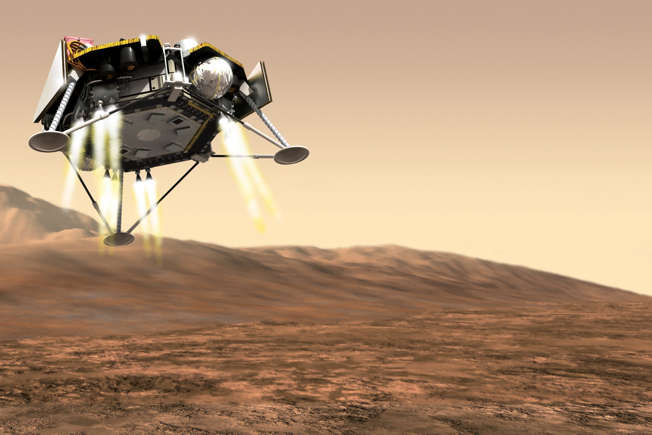
A crater of 492 feet in diameter

©The Daily Digest

A crater of 492 feet in diameter
The InSigh mission's seismometer detected two major impacts on the surface of Mars. The larger of the two formed a crater of 150 meters (492 feet) in diameter and 21 meters (69 feet) deep.
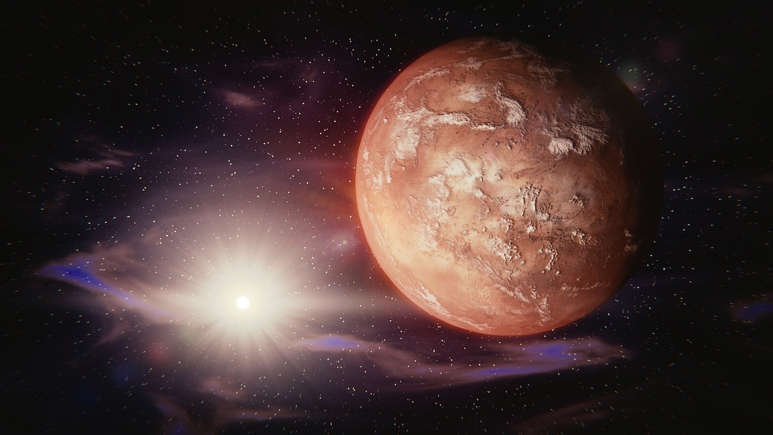
One of the largest impacts ever observed

©The Daily Digest

Photo: GooKingSword/Pixabay

One of the largest impacts ever observed
In its press release, the space agency said this was "one of the largest impacts ever observed on Mars since NASA began exploring the cosmos."
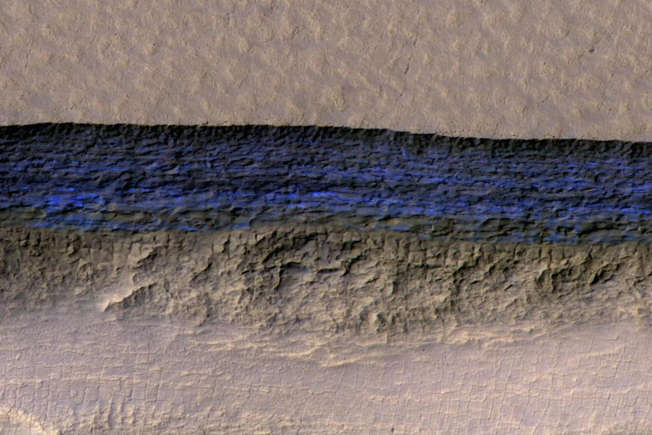
An even bigger discovery: ice inside Mars

©The Daily Digest

Photo:NASA/JPL-Caltech/UA/USGS

An even bigger discovery: ice inside Mars
However, what's thrilled scientists more than the recorded seismic activity is what the meteor uncovered when it slammed into Mars: boulder-size chunks of ice blasted inside the crater.
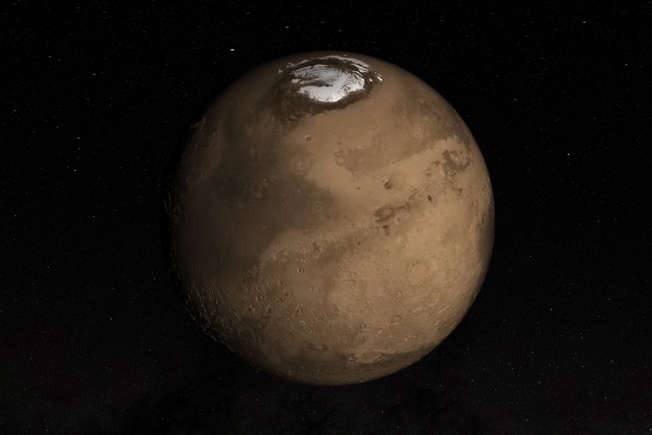
Ice in the poles of Mars

©The Daily Digest

Ice in the poles of Mars
Scientists were well aware of the ice on the poles on Mars, but they didn’t know that ice existed under the ice cap.
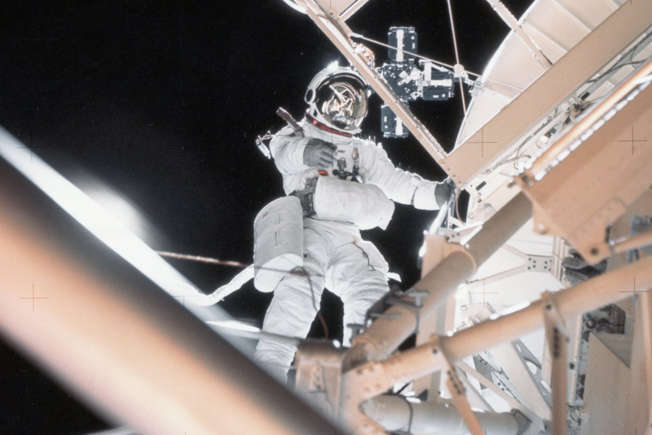
Ice can be converted into water, oxygen or hydrogen

©The Daily Digest

Ice can be converted into water, oxygen or hydrogen
"In planning for future human exploration of Mars, we'd want to land the astronauts as near to the equator as possible, and having access to ice at these lower latitudes, that ice can be converted into water, oxygen, or hydrogen. That could be really useful", said Lori Glaze, NASA's director of planetary science.
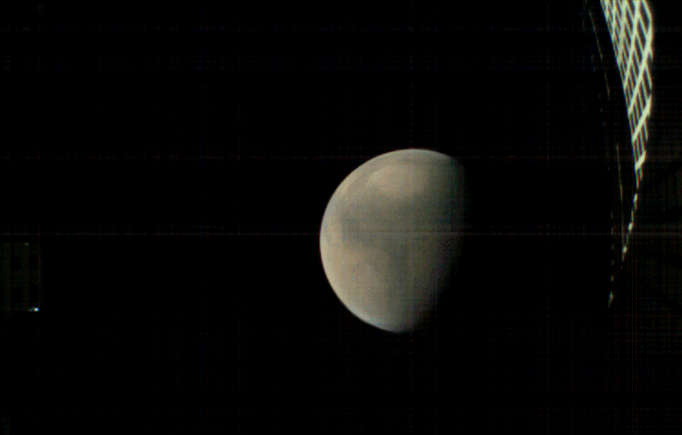
The red planet

©The Daily Digest

Photo: NASA/JPL-Caltech

The red planet
Mars is the planet in our Solar System that has the most similarities with Earth. This is mainly why the red planet is NASA’s favorite destination to explore.
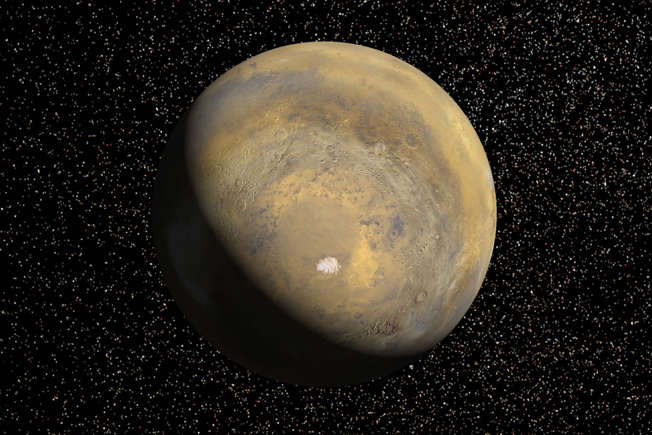
Photos that depict the red planet

©The Daily Digest

Photos that depict the red planet
So the recent discovery and amazing photos can be added to the collection NASA has of the red planet. Here are some of them:

©The Daily DigestMars’s two small moons
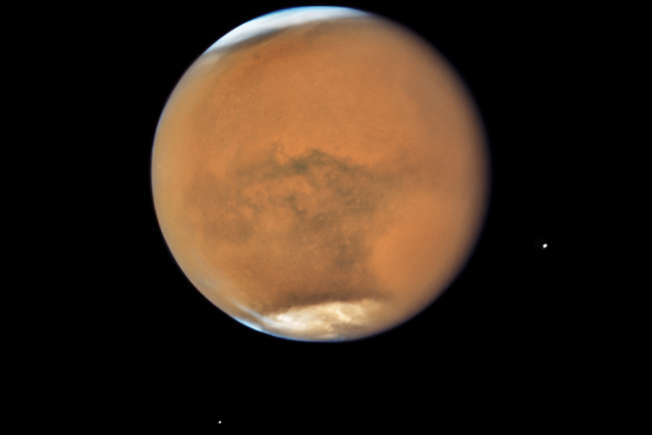
Photo: NASA, ESA, and STScI

Mars’s two small moons
This image of Mars was taken by NASA's Hubble Space Telescope on July 18, 2018, when Earth, Mars and the Sun were aligned. Mars' two small moons, Phobos and Deimos are visible in this shot.
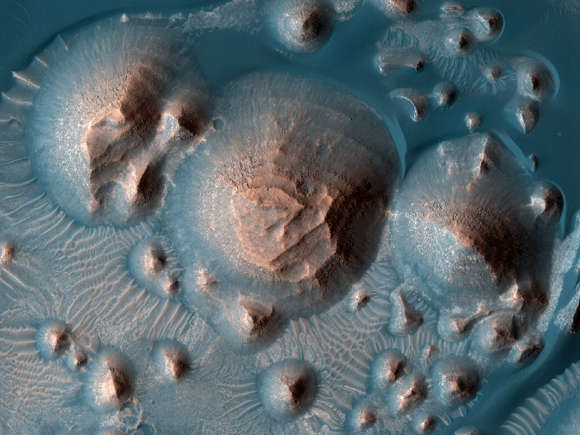
Arabia Terra

©The Daily Digest

Photo: NASA/JPL/University of Arizona

Arabia Terra
Arabia Terra is a vast region located on the northern hemisphere of Mars. It is characterized by its craters dating back approximately 4 billion years. Also seen in this photo are dark dunes, which the HIRISE team is monitoring closely for any wind activity.
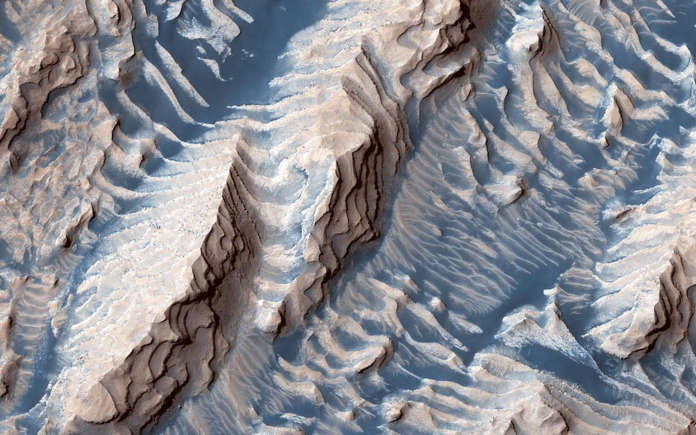
Danielson Crater

©The Daily Digest

Photo: NASA/JPL-Caltech/University of Arizona

Danielson Crater
Danielson is an impact crater measuring approximately 67 kilometers (41 miles) in diameter, located in the southwest of the Arabia Terra region. This image taken by the Mars Reconnaissance Orbiter spacecraft shows the sand and sedimentary rocks that make it up.
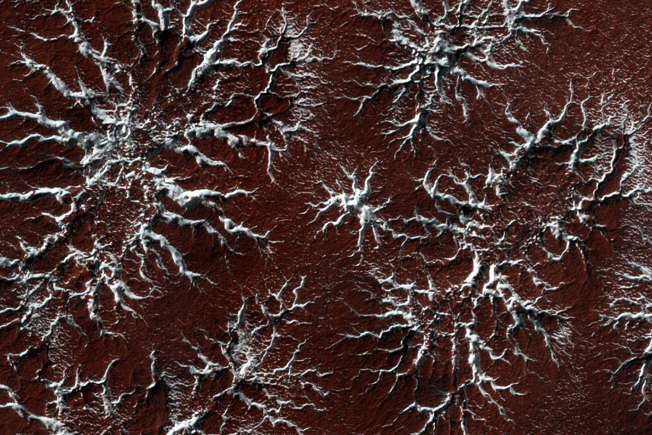
A wonderful contrast of colors

©The Daily Digest

Photo: NASA/JPL/University of Arizona

A wonderful contrast of colors
In this image, there’s channels filled with shiny ice, which contrast with the red soil of Mars. The photo was taken at the planet's seasonal polar caps.
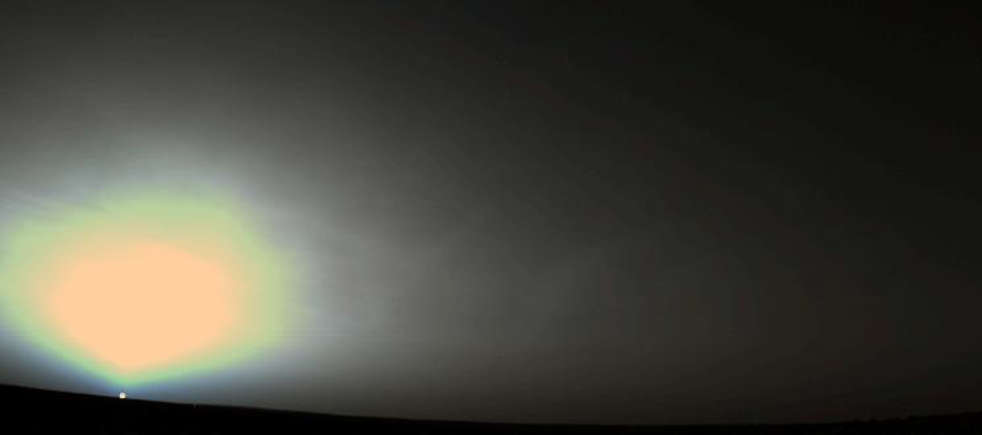
A sunrise on the planet Mars

©The Daily Digest

Photo: NASA/JPL/LaRC

A sunrise on the planet Mars
An intriguing Martian sunrise was captured by the Viking 2 exploration probe on June 14, 1978.
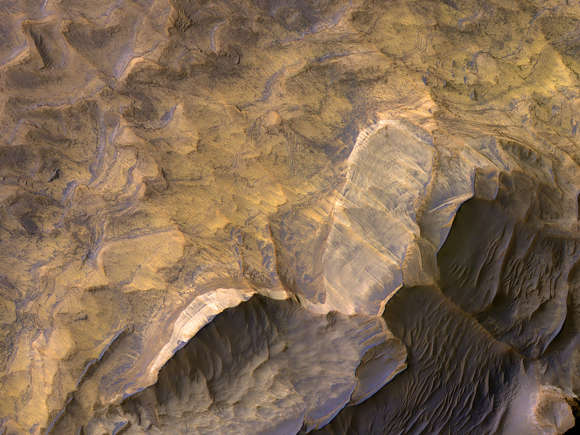
Candor Chasma

©The Daily Digest

Photo: NASA/JPL/University of Arizona

Candor Chasma

This is Candor Chasma, one of the valleys that are part of the Valles Marineris canyons, located close to the equator of the red planet. Its light-colored stratified deposits could be an area made up of sandstone, potentially habitable according to scientists.
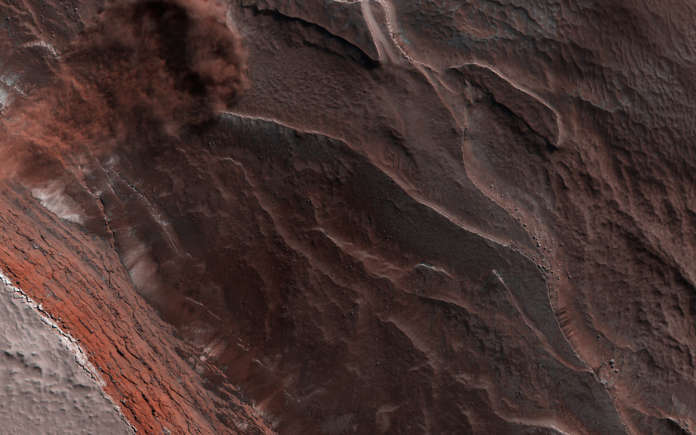
A spring avalanche

©The Daily Digest

Photo: NASA/JPL/University of Arizona

A spring avalanche
This is an avalanche captured by the HiRISE camera, near the north pole of Mars. Every spring, the sun shines on this area of the planet. The heat of its rays causes the detachment of blocks of ice. When reaching the bottom of the cliff, which is more than 500 meters high, these blocks raise a cloud of dust.
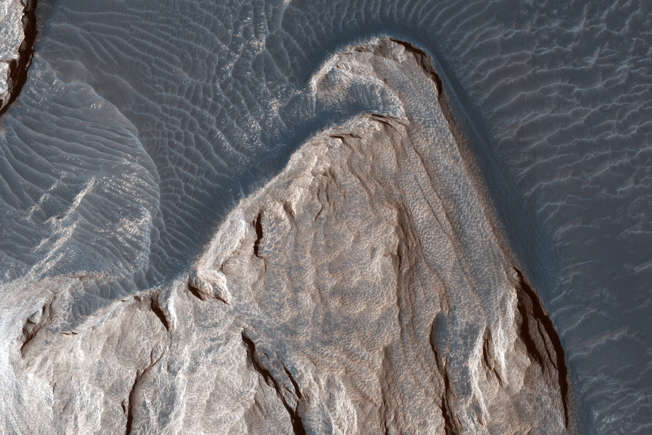
Rock formations

©The Daily Digest

©The Daily Digest

Rock formations
This image was captured in December 2018 by the Mars Reconnaissance Orbiter. The ripples that can be seen in the sand tell us which way the wind has moved around these rock formations.
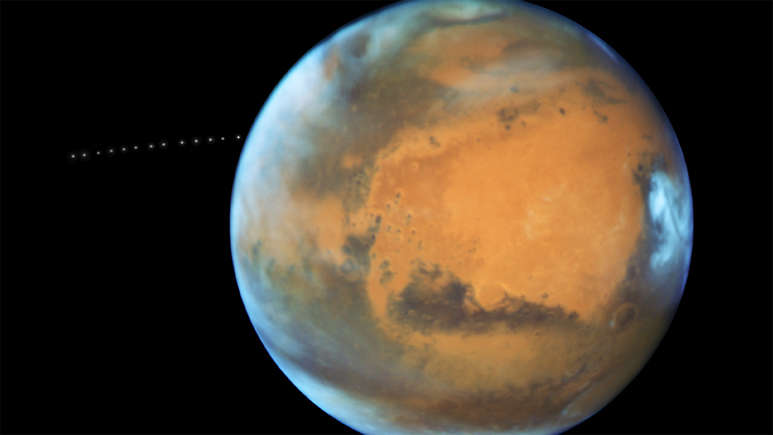
Phobos

©The Daily Digest

Photo: NASA, ESA, and Z. Levay (STScI)

Phobos
Phobos is one of the two natural satellites of Mars. This small moon rises west of Mars and circles the Red Planet three times in a Martian day, which lasts about 24 hours and 40 minutes.
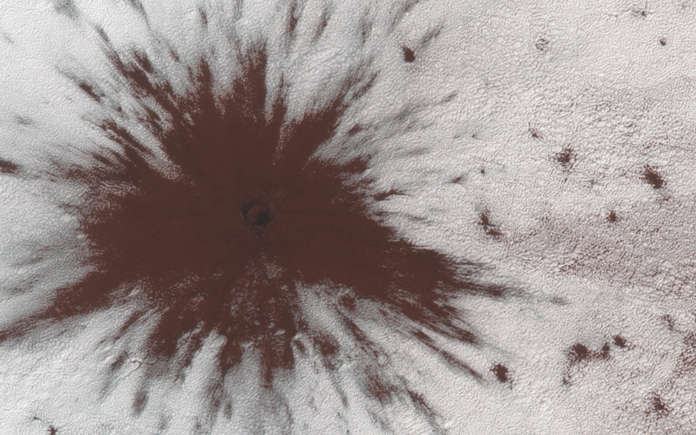
A very young impact crater

©The Daily Digest

Photo: NASA/JPL-Caltech/University of Arizona

A very young impact crater

This remarkable image shows us an impact crater formed between July and September 2018. This impact occurred in the seasonal southern ice sheet, and visibly pierced it, creating an incredible blast pattern.
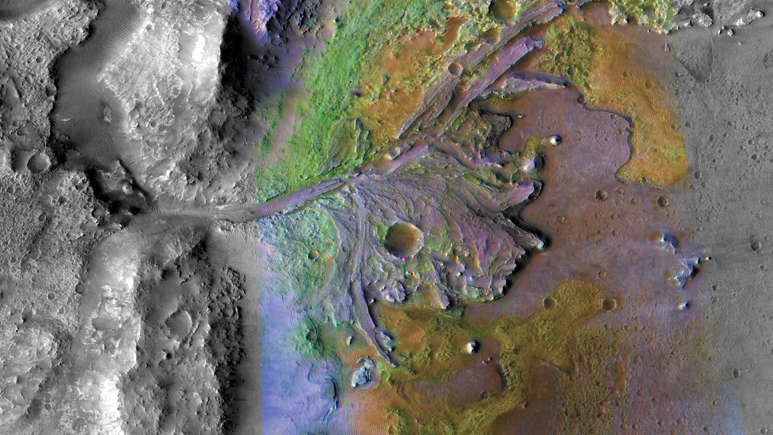
Jezero Crater

©The Daily Digest

Photo: NASA/JPL-Caltech/MSSS/JHUAPL

Jezero Crater
The Jezero crater is thought to have formed about 3.7 billion years ago. It is located to the west of Isidis Planitia, and it was chosen by NASA as the landing site for the "Mars 2020" mission, launched on July 30, 2020, and currently in progress.
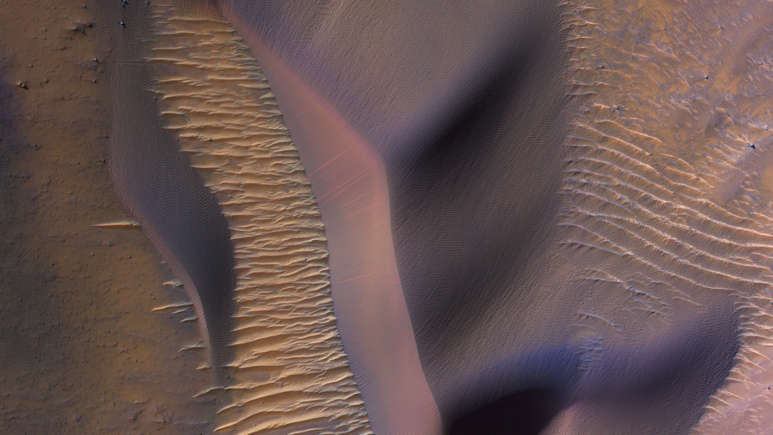
Steep dunes

©The Daily Digest

Photo: NASA/JPL/University of Arizona

Steep dunes
These dunes were photographed on the slopes of Nectaris Montes, in the canyons of Valles Marineris. The sand dunes that make up these giant canyons can be impressively large, with seemingly very steep slopes, as seen in the image.
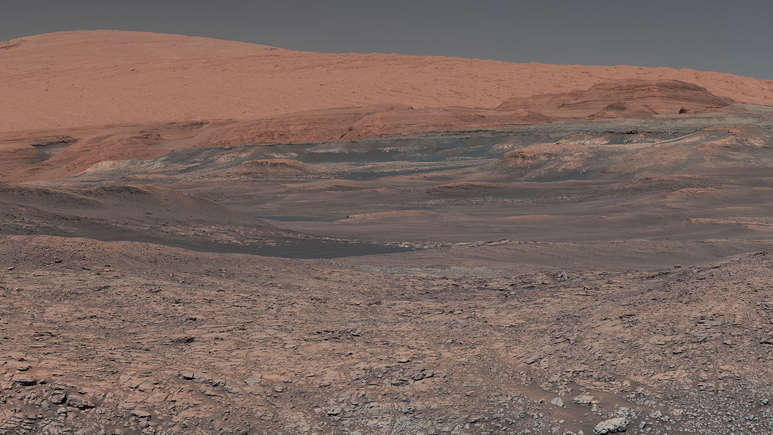
Mount Sharp

©The Daily Digest

Photo: NASA/JPL-Caltech/MSSS

Mount Sharp
This image was taken by the Curiosity rover, deployed on Mars since 2012, on Mount Sharp, a mountain that stands in the middle of the Gale crater. In the center of the image, you can see clay rocks that NASA scientists are eager to study.
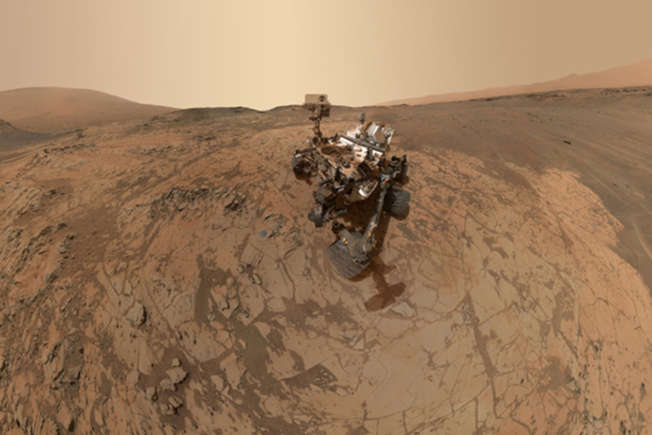
Curiosity selfie

©The Daily Digest

Photo: NASA/JPL-Caltech/MSSS

Curiosity selfie
This is Curiosity, the car-size rover sent to Mars for an exploration mission in 2012. One of its objectives is to explore the Gale crater, on which it landed. The "Mars Science Laboratory" mission is still ongoing today.
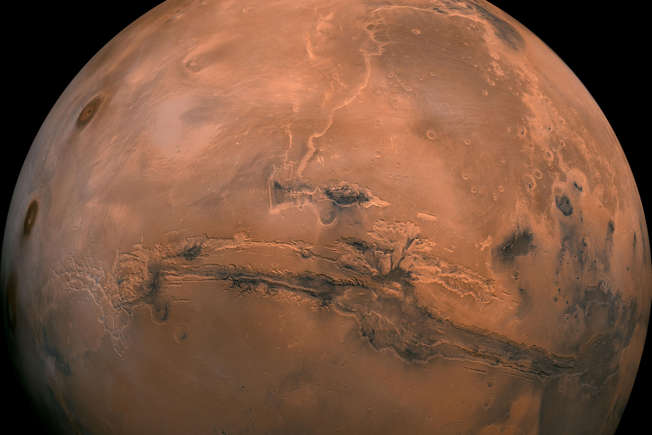
The canyons of Valles Marineris

©The Daily Digest

Photo: NASA/JPL-Caltech

The canyons of Valles Marineris
At the center of this mosaic, which is a compilation of images captured by the Viking Orbiter 1 spacecraft, is a broader view of the Valles Marineris canyons. They stretch over 3,000 kilometers long and 600 kilometers wide.
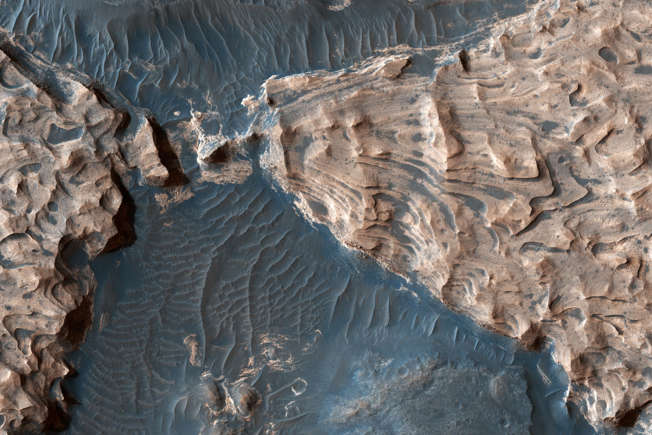
Aram Chaos Crater

©The Daily Digest

Photo: NASA/JPL/University of Arizona

Aram Chaos Crater
In this image, uplifted blocks of light-colored layers can be seen, composed largely of hematite and water-weathered silicates. These elements tell us that the Aram Chaos crater once contained a lake. Its diameter is about 284 kilometers (176 miles).
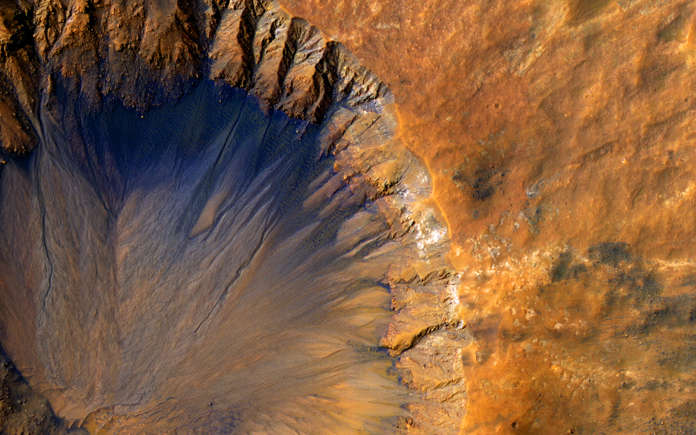
Crater Crisp

©The Daily Digest

Photo: NASA/JPL-Caltech/University of Arizona

Crater Crisp
The Crisp crater is located in the Sirenum Fossae. According to NASA scientists, this crater would be relatively recent, because its edge is still very sharp.
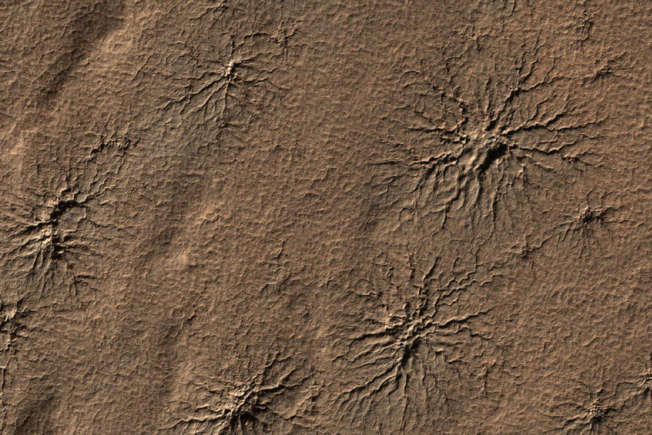
Spider shaped cracks

©The Daily Digest

Photo: NASA/JPL-Caltech/University of Arizona

Spider shaped cracks
These spider-shaped cracks are located in the surface of the south polar region of Mars. They were caused by the evaporation of carbon dioxide in the atmosphere.
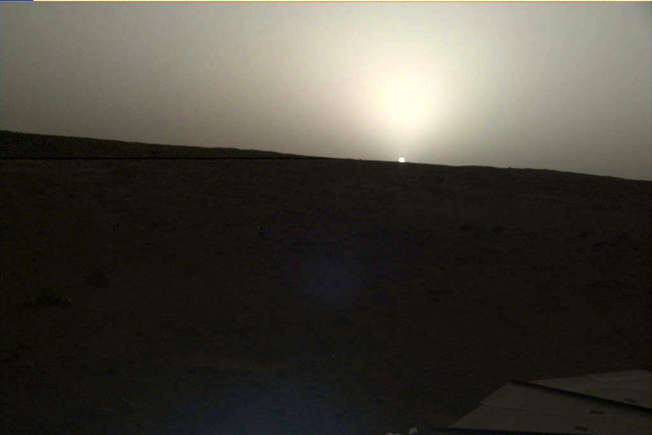
Another Martian sunset

©The Daily Digest

Photo: NASA/JPL-Caltech

Another Martian sunset
This sunset was captured by NASA's InSight lander on April 25, 2019 at 6:30 p.m. local Mars time.
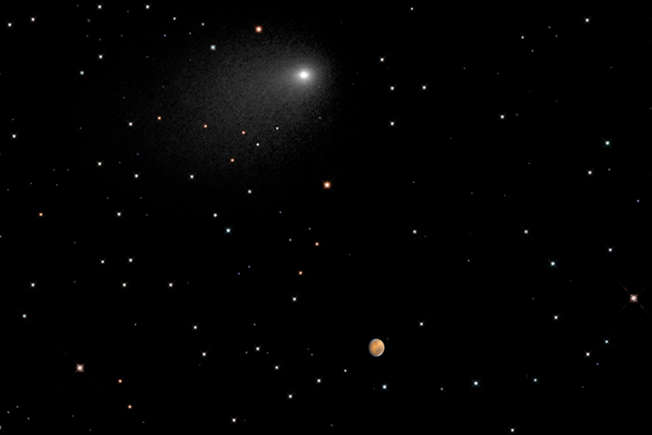
The passage of a comet near Mars

©The Daily Digest

Photo: NASA, ESA, J.-Y. Li (PSI), CM Lisse (JHU/APL), and the Hubble Heritage Team (STScI/AURA)

The passage of a comet near Mars
Finally, this is an image captured by the Hubble Space Telescope, which shows the closeness between a Comet and Mars on October 19, 2014.

{ https://thedailydigest.com/en/ }

Hoe vind je dit bericht?
Geschreven door peter om 23:43 Stuur door

Inside a Martian Meteorite, These Grains of an Unexpected Gemstone Hold Clues to a Hidden Past

garnet

Credit: United States Geological Survey/Mineral Information Institute

Inside a Martian Meteorite, These Grains of an Unexpected Gemstone Hold Clues to a Hidden Past

A Martian meteorite fragment containing unexpected grains of mineral could hold clues to the Red Planet’s geological history, according to an international team of researchers.

Prior to the team’s new paper, which was published in Geochemical Perspectives Letters, the red mineral garnet had never been observed in any martian rock sample. Now, the meteorite discovery provides scientists with new clues to Mars‘ extreme past conditions, over its 4.5 billion-year history, which could include hidden magma sources or ancient impact events.

Garnet and Geology

Although the gemstone garnet can come in many colors, it is best known for its dark red varieties, which were historically popular in ancient Egypt, Rome, and Victorian England. Beyond its beauty, the rock is important for the record it keeps of its birth, providing Earth’s geologists with information on our planet’s tectonic forces, ore-forming processes, and the fluid-rock interactions of the crust and mantle.

Similarly, the small grains of garnet discovered in the meteorite sample contain important data for reconstructing the forces that forged the Red Planet long ago.

“The findings add a striking new dimension to our understanding of the geology of Mars and open an exciting new window into the evolution of our planetary neighbour,” said co-author Professor James Darling.

“This discovery is going to expand our knowledge of the geologic processes that are possible on this planet,” said lead author Tanya Kizovski, Assistant Professor of Earth Sciences, from Brock University in Canada. “This new garnet-bearing rock type could give us clues to how Mars has changed throughout its history and new insights into the ancient environments that could have formed the garnet and related minerals.”

Mars Meteorite NWA 8171

The garnet fragments were discovered in a tiny Martian meteorite sample held in the Royal Ontario Museum’s collection, designated NWA 8171, discovered in northwest Africa. Kizovski led the team in analyzing the sample’s mineral and chemical composition after identifying it as a unique piece within the collection.

“This little section of the meteorite looked really interesting, and the chemistry was a bit odd,” Kizovski said. “At first, we assumed it was a mineral called pyroxene, which is very common, but then we decided to take a second look.”

The international effort brought in researchers from Italy’s University di Trieste and the UK’s Open University, utilizing the Royal Ontario Museum’s laser equipment and the University of Portsmouth’s Electron Microscopy and Microanalysis Unit.

Having never been observed in any previous Martian sample, the researchers were surprised to identify garnet in the meteorite’s composition. From their analysis of the sample’s chemistry and mineralogy, the researchers began to consider how the unexpected garnet could have formed.

“Garnet is a classic example of a mineral often found in metamorphic rocks on Earth,” Kizovski said. “The process of metamorphism transforms igneous or sedimentary rocks into a new form through exposure to extreme heat, high pressure, or hot fluids.”

“On Mars, the heat and pressure needed to produce garnet through metamorphism could have come from the impact of a meteorite hitting the surface of Mars, magma rising up into the Martian crust, or both,” Kizovski continued.

Explaining Martian Garnet

While garnet provided geologists with some data about how it formed, this is not like the point of origin stamped on a manufactured good. It is possible that the garnet was deposited on Mars during an earlier meteorite impact, only to later travel through the solar system again, or that it was created by a heretofore unknown magma source on Mars.

Only further analysis of the garnet’s isotopic signatures will allow the researchers to determine whether the mineral formed on Mars or elsewhere. Unfortunately, to do so, the team would have to destroy a portion of this rare and precious sample, which measures only 0.8 by 0.5 millimeters to begin with.

“Measuring oxygen isotopes from the garnet-bearing rock type itself would help to confirm if it is Martian in origin or from an exotic meteorite impactor,” Kizovski said.

“Isotopes are a collection of atoms with equal numbers of protons and electrons, but different numbers of neutrons,” she added, “which was avoided thus far due to its rarity, as it may be the only garnet-bearing Martian rock we have for study.”

A few members of the team are continuing their study of the sample by comparing their findings to Martian data collected by rovers and orbital platforms. Further insights, they hope, may help them discover more about how the garnet could have formed, and what its presence means for the deeper history of the Red Planet.

The paper, “Expanding Mars’ Lithologic Diversity: Discovery of a Garnet-Bearing Clast in NWA 8171,” appeared in Geochemical Perspectives Letters on June 16, 2026.

  • Ryan Whalen covers science and technology for The Debrief. He holds an MA in History and a Master of Library and Information Science with a certificate in Data Science. He can be contacted at ryan@thedebrief.org, and follow him on Twitter @mdntwvlf.
RELATED VIDEOS

Scientists Found a Mysterious Mineral Inside a Mars Meteorite – What It Means

Martian Meteorite Discovery Reveals Clues to Ancient Life | WION Podcast

NASA Discovered the Dark Truth About Mars' Ancient Oceans | Space Documentary

{ https://thedebrief.org/category/space/ }

Hoe vind je dit bericht?
Geschreven door peter om 22:32 Stuur door

Astronomers Observing a Supermassive Black Hole Just Had an Unexpected UFO Sighting

Supermassive black hole in an active galaxy producing a UFO
(Image Credit: ESA/AOES Medialab/NASA)

Astronomers Observing a Supermassive Black Hole Just Had an Unexpected UFO Sighting

It’s not the kind of thing astronomers expect to see while observing the powerful effects of a distant supermassive black hole: an unprecedented UFO sighting.

However, that’s precisely what one group of scientists now reports in a preprint paper, who detail the successful detection of one of the strongest UFOs—a black hole phenomenon otherwise known as “ultra-fast outflows”—that astronomers may have ever seen.

The landmark detection was made possible with the XMM-Newton space observatory and NuSTAR X-ray telescope, which allowed the researchers behind the discovery to observe a luminous quasar with origins that date back to “cosmic noon,” revealing a pair of outflow wind components being blasted from the black hole in question.

Cosmic Monsters with Major Appetites

Black holes have more than just large appetites for cosmic material: they also produce significant gas-driven winds from around their accretion disk.

These winds become known as ultra-fast outflows (UFOs) when their strength propels them to greater than ten percent of light speed, and astronomers currently believe they are an important part of what helps black holes regulate their growth, which may also hold for their host galaxies.

One way this occurs is that UFOs help to heat galactic gases that give rise to star formation, a quenching process that most astronomers believe occurred during a period called “cosmic noon,” which occurred between 1.6 and 3.5 billion years after the birth of the universe.

Cosmic Fingerprints of Powerful UFOs

Astronomers can detect ultra-fast outflows based on the “dips” they create in their powerful gusts, which are caused by ionized iron present in their outflow gases. These gases also absorb X-rays along their path away from their black hole originators, which leave “fingerprints” in the form of absorption features that are detectable using X-ray telescopes.

Significantly, these “dips” manifest as a blueshift since they are shifted to higher energies as they move at such high speeds (again, roughly 10% of the speed of light). From the blueshifted energy signatures they comprise, astronomers can determine not only the presence of UFOs, but also the wind speed of their gusty outflows.

In the past, most detections of these high-powered cosmic phenomena have relied on gravitationally lensed quasars. These celestial objects occur when a galaxy or similar feature closer to Earth appears in front of them, magnifying the quasar’s light and significantly brightening its luminosity from our Earthly perspective.

However, lensing of this variety can also present problems, and so astronomers led by Giorgio Lanzuisi of INAF Bologna designed a special system to target more than a dozen hyper-luminous quasars at cosmic noon, as a means of getting a better feel for the dynamics of non-lensed quasars.

“WISSHFUL” Thinking

WISSHFUL is an XMM-Newton multi-year heritage program that Lanzuisi and his colleagues designed for this purpose, whose initial target became a quasar designated WISSH13, whose redshift at 3.294 marks the object’s existence as it appeared approximately 2 billion years after the Big Bang.

20260605 2 6deie6

The WISSHFUL program: the highest redshift UFO discovered in a non-lensed QSO
Credit: arXiv

WISH13’s black hole also weighs in at close to 2 billion times that of our Sun, which causes it to shine far brighter than normally expected for an object of its estimated mass.

Their work began in the autumn of 2024 by combining observations from XMM-Newton and NuSTAR initially obtained in 2017. From these X-ray images of WISSH12, a pair of distinctive absorption features became evident, which the team determined to have been generated by two separate sources from within the same ultra-fast outflow.

These components were found to travel at different speeds: one moving at close to 30% of the speed of light, while the other at only about 10% of light speed. The slower of these two appears to have been an enduring component of the UFO, while the faster one showed signatures that indicated a more recent appearance. This could mean that it emanates from events that are shorter in duration.

By matching theoretical predictions of a layered wind structure surrounding the black hole, the researchers say their observations align with models that indicate a fast-moving inner “spine” launched from the accretion disk’s innermost regions. Meanwhile, a slower outer “sheath” is also believed to emanate farther from the black hole. The combined outflow components produce an estimated 21 to 24 solar masses of material annually.

Astronomers Detect Rare Ufo Signals From A Black Hole Racing At Near Light Speed

Artistic view of multiphase AGN-driven winds highlighting the different phases and scales that are involved in the outflow.

Credit: University of Bologna

The Most Massive UFO Ever Observed? 

Such figures, the team says, represent what is believed to be among the most massive and energetic ultrafast outflows ever observed, a discovery which also marks the highest-redshift ultrafast outflow yet detected in a non-lensed quasar.

Despite their remarkable energetic output, the team says these outflow winds seem to conform to the same essential relationships observed in active galaxies much closer to Earth, suggesting that the processes driving these outflows have remained remarkably consistent across cosmic time.

Going forward, the team says they hope to make additional observations of these powerful cosmic phenomena with help from the new Athena X-ray mission, which they say could help uncover similar winds in even more distant quasars.

The team’s discoveries were detailed in a recent paper, “The WISSHFUL program: the highest redshift UFO discovered in a non-lensed QSO,” which appeared at the preprint arXiv.org server.

  • Micah Hanks is the Editor-in-Chief and Co-Founder of The Debrief. A longtime reporter on science, defense, and technology with a focus on space and astronomy, he can be reached at micah@thedebrief.org. Follow him on X @MicahHanks, and at micahhanks.com.

Scientists Found a Hidden Pair of Black Holes — By Watching Stars Flicker in the Dark

Black Hole In Space: Astronomers Observe A Massive Black Hole Firing Winds At 60,000 km/s |Originals

{ https://thedebrief.org/category/space/ }

Hoe vind je dit bericht?
Geschreven door peter om 22:14 Stuur door

The Search for ET: What Do the Best Scientists in the Milky Way Know?

The Search for ET: What Do the Best Scientists in the Milky Way Know?

Albert Einstein is probably not the smartest scientist that ever lived since the Big Bang happened, 13.8 billion years ago. Most stars formed billions of years before the Sun. There had probably been a better scientist on another habitable planet a billion years ago.

The civilization which benefited from this ET genius could have populated the entire Milky Way galaxy with advanced probes by now. Perhaps we will find one of them.

The Galileo Project searches for extraterrestrial equipment using telescopes on the ground and in space. If we find an extraordinary interstellar vehicle, I will be delighted to hop on it and seek exceptional scientists throughout the Milky Way. We have many pressing questions for them: What happened before the Big Bang? Is there a way to create a baby universe in the laboratory? What is inside a black hole? What is the nature of dark matter and dark energy? Is it possible to travel faster than light? How widespread is intelligent life throughout the cosmos? And many more.

The importance of these questions – also echoed in my book Extraterrestrial, will bring more people to my funeral if I return some answers to Earth. When I made this point to the Smithsonian Magazine journalist, Jennie Rothenberg Gritz, she noted: “Your funeral will be a great interstellar celebration of your life – but I hope it doesn’t happen for a while!”

The exploration of space is currently popular from its commercial incentives. These include space tourism, novel industries at low-gravity on the Moon or Mars, and mining rare minerals on asteroids such as `Psyche’. But there is no business plan for leaving the Solar system towards other stars because of the vast distance and long duration of such journeys. The motivation for such expeditions must be spiritual, namely: exploring the unknown. If interstellar travelers arrive at our doorstep, it will be because we are unknown to them.

ETIn the search for ET, humanity must prepare for the challenges of meeting a civilization potentially far more advanced than ours (credit: Unsplash).

An encounter with an ET culture would be a humbling experience, since we will have to admit that our modern science was developed only over the past century out of the 4.5-billion-years-long history of Earth. Just over a hundred years ago, Albert Einstein pioneered general relativity – the foundation for our current understanding of the Universe, and quantum mechanics – the knowledge base for our electronic gadgets. But we still do not know the answers to many foundational questions about our cosmic neighborhood, as listed above.

Most of human history is shaped by the illusion of superiority that some people had relative to other people when the reality is that all humans are fundamentally so fragile that even a tiny virus-like COVID-19 can wipe them out in two weeks.

In today’s WORLD.MINDS forum coordinated by Rolf Dobelli, I asked Thomas Zurbuchen, the Associate Administrator for the Science Mission Directorate at NASA, “Do you believe that we will find evidence for intelligent ET life in our lifetime?”

Thomas replied that we might likely find such evidence, but the timeframe is highly uncertain. He then asked me in return, “And what do you think, Avi? I do not know how old you are, as that would affect your likelihood to witness it.”

My answer was short: “I will be sixty years old at the end of this week, and I do believe we will find such evidence during my lifetime.” Then, I jokingly added, “My only doubt is whether we will ever find intelligent life in Washington, DC.”

By that, I only meant to say that “extraordinary evidence requires extraordinary funding”, which often rests on strategic decisions by policymakers.

Thomas then raised his foot towards the camera and showed his socks. They had alien images on them.

“This is especially for you,” he said smiling. “Happy Birthday!”

Here’s hoping that we will find a message in an “extraterrestrial bottle” that will offer salvation from our weaknesses through the broader perspective of the cosmos. There is tension between the damage that our new technologies bring to Earth and the opportunity to avoid a single-planet catastrophe by venturing into space. Perhaps the wake-up call will come from interstellar space in the form of an unusual technological object that will be discovered by the Galileo Project.

  • Avi Loeb is the head of the Galileo Project, founding director of Harvard University’s – Black Hole Initiative, director of the Institute for Theory and Computation at the Harvard-Smithsonian Center for Astrophysics, and the former chair of the astronomy department at Harvard University (2011-2020). He is the bestselling author of “Extraterrestrial: The First Sign of Intelligent Life Beyond Earth” and a co-author of the textbook “Life in the Cosmos”, both published in 2021.

James Webb Just Revealed Where We Actually Are in the Milky Way

{ https://thedebrief.org/category/space/ }

Hoe vind je dit bericht?
Geschreven door peter om 21:47 Stuur door

De Noord-Atlantische koudevlek: toeval of teken van een groter klimaatprobleem?

De Noord-Atlantische koudevlek: toeval of teken van een groter klimaatprobleem?

Het mysterie van de 'koude plek' in de Noord-Atlantische Oceaan

©The Daily Digest

Afbeelding: NASA Scientific Visualization Studio/Goddard Space Flight Center

Een belangrijk raadsel dat opgelost moet worden
In de Noord-Atlantische Oceaan, ten zuiden van IJsland en Groenland, is een raadselachtige 'koude zone' ontstaan. In dit uitgestrekte zeegebied daalt de temperatuur continu, wat in contrast staat met de algehele opwarming van de oceaan.

Snel afkoelingsproces

©The Daily Digest

Snel afkoelingsproces
Volgens CNN zeggen experts dat dit belangrijke Atlantische gebied al meer dan een eeuw aan het afkoelen is, in die mate dat de temperatuur van het water volgens de beschikbare gegevens sinds 1900 met ongeveer één graad Celsius is gedaald.

Twee theorieën over wat er gaande is

©The Daily Digest

Twee theorieën over wat er gaande is
In deze context wordt er binnen de wetenschap gedebatteerd over twee theorieën over de mogelijke oorzaak van deze 'koude plek'. Enerzijds zou het te wijten kunnen zijn aan warmteverlies van het oceaanoppervlak als gevolg van veranderingen in wind en bewolking; anderzijds aan de verzwakking van het systeem dat de oceaanstromingen in de Atlantische Oceaan transporteert.

Cruciaal kantelpunt in het klimaat

©The Daily Digest

Cruciaal kantelpunt in het klimaat
Nieuw onderzoek, waarover CNN bericht, neigt nu naar de tweede optie om dit mysterie te verklaren. Het suggereert tevens dat het een teken zou kunnen zijn dat we op het punt staan een alarmerend kantelpunt in het klimaat te bereiken, met catastrofale gevolgen voor de toekomst.

Atlantische Meridionale Omwentelingscirculatie

©The Daily Digest

Atlantische Meridionale Omwentelingscirculatie
De studie verwijst naar het cruciale systeem van oceaanstromingen, de AMOC (Atlantische Meridionale Omwentelingscirculatie), dat volgens experts functioneert als een gigantische transportband die warm water vanuit de tropen naar het noordelijk halfrond voert, waar het afkoelt, zinkt en weer naar het zuiden terugkeert.

Vingerafdruk van veranderingen in de AMOC

©The Daily Digest

Vingerafdruk van veranderingen in de AMOC
Gezien het bestaan van de AMOC kan de 'koude zone' die we vandaag de dag in de Noord-Atlantische Oceaan zien, volgens de auteurs van de studie worden beschouwd als een vingerafdruk waarop de veranderingen binnen het systeem te zien zijn, aangezien het daar is waar de meeste waterkwaliteit die het met zich meebrengt, aankomt.

Opwarming van de aarde en zoet water

©The Daily Digest

Opwarming van de aarde en zoet water
Naast dit onderzoek hebben talrijke andere studies al gewaarschuwd voor de verzwakking van de AMOC. De reden hiervoor is dat door het smeltende ijs als gevolg van de opwarming van de aarde een enorme hoeveelheid zoet water de oceaan instroomt, waardoor het evenwicht tussen zoutgehalte en warmte verstoord raakt en de werking van dit stromingssysteem wordt beïnvloed.

Ineenstorten in het aangezicht van de toekomst

©The Daily Digest

Ineenstorten in het aangezicht van de toekomst
Deze verzwakking zal blijven toenemen totdat het klimaatkantelpunt is bereikt waar wetenschappers naar verwijzen, wat onvermijdelijk zou leiden tot de ineenstorting van de AMOC, iets wat, benadrukken zij, al in deze eeuw zou kunnen gebeuren.

Wereldwijde catastrofe

©The Daily Digest

Wereldwijde catastrofe
En wat zou er gebeuren in geval van een ineenstorting? De gevolgen zouden verwoestend zijn en een wereldwijde catastrofe veroorzaken, die zich zou manifesteren in een aanzienlijke stijging van de zeespiegel aan de oostkust van de Verenigde Staten of langdurige droogtes in Afrika als gevolg van de verstoring van de moesson, en bovendien het Europese continent in een permanente ijskoude winter zou storten.

Afkoeling zowel aan de oppervlakte als op grotere diepte

©The Daily Digest

Afkoeling zowel aan de oppervlakte als op grotere diepte
Een van de ontdekkingen van deze recente studie naar de 'koude zone' in de Noord-Atlantische Oceaan, die de neiging versterkt om te denken dat het probleem ligt in de verzwakking van de AMOC, is dat de afkoeling van het water niet alleen aan de oppervlakte plaatsvond, maar ook in de diepte van de oceaan.

Gegevens uit veldmetingen versus klimaatmodellen

©The Daily Digest

Gegevens uit veldmetingen versus klimaatmodellen
Om dit te analyseren, vergeleek het team van wetenschappers dat bij het onderzoek betrokken was, de daadwerkelijke gegevens over de oceaanwarmte, verkregen via satellietonderzoek en met specifieke instrumenten die uit het water waren gehaald, met de gebruikelijke klimaatmodellen. Op basis hiervan konden ze de verandering in de trend van dit uitgestrekte watergebied in de Atlantische Oceaan waarnemen.

Invloed van AMOC

©The Daily Digest

Invloed van AMOC
Volgens de auteur van de studie, Stefan Rahmstorf, hoogleraar natuurkunde en oceanografie aan de Universiteit van Potsdam (Duitsland), is de AMOC duidelijk de boosdoener achter de afkoeling van deze watermassa, omdat deze, zoals hij aan CNN vertelde, "het transport van oceanische warmte beïnvloedt".

Het zwakste punt in 1000 jaar

©The Daily Digest

Afbeelding: Wikipedia

Het zwakste punt in 1000 jaar
Rahmstorf benadrukte verder dat, afgezien van deze 'koude plek', ze al voldoende bewijs hadden uit talrijke eerdere studies die wezen op de verzwakking van de AMOC, in die mate dat, zo benadrukte hij, deze zich momenteel op het zwakste punt in 1000 jaar zou kunnen bevinden.

Heeft niets te maken met atmosferische omstandigheden

©The Daily Digest

Heeft niets te maken met atmosferische omstandigheden
Onderzoeker René van Westen van de Universiteit Utrecht (Nederland) benadrukte ook dat de resultaten van Rahmstorfs onderzoek het idee versterken dat de afkoeling van deze enorme watermassa niet wordt beïnvloed door atmosferische omstandigheden, hoewel is aangetoond dat deze wel degelijk via die weg kan plaatsvinden.

Gebieden waar wind en bewolking weinig invloed hebben

©The Daily Digest

Gebieden waar wind en bewolking weinig invloed hebben
Van Westen verwijst in dit geval naar de bijzonderheid dat het diepe water in dit specifieke gebied ook afkoelt, ondanks het feit dat elementen zoals wind of wolken hier weinig invloed hebben.

Eenvoudige benaderingen?

©The Daily Digest

Eenvoudige benaderingen?
Andere deskundigen, zoals David Thornally, hoogleraar oceaan- en klimaatwetenschappen aan University College London, wijzen erop dat het nog te vroeg is om definitieve uitspraken over deze kwesties te doen. Hoewel hij erkent dat de studie het bewijs voor een verband tussen de 'koude zone' en de AMOC versterkt, stelt hij dat de gegevens slechts benaderingen zijn en geen absolute waarheid weergeven.

De noodzaak van verder onderzoek

©The Daily Digest

De noodzaak van verder onderzoek
In een gesprek met CNN waarschuwde Thornally dat er onder wetenschappers nog steeds veel onzekerheid bestaat over wat er met deze massa koud water zou kunnen gebeuren, en benadrukte hij de noodzaak van verder onderzoek: "Ik denk niet dat (deze studie) het laatste woord over dit onderwerp is", verklaarde hij.

{  https://www.msn.com › nl-nl  }

Hoe vind je dit bericht?
Geschreven door peter om 21:32 Stuur door

Ancient Roman records offer fresh evidence Jesus was a real person

Ancient Roman records offer fresh evidence Jesus was a real person

Ancient writings of two Roman historians have been highlighted as some of the strongest evidence that Jesus was a real person.

The records come from Tacitus, one of Rome's most respected historians, and Flavius Josephus, a Jewish aristocrat and historian who lived just decades after Jesus' death.

Neither man was a Christian, and neither was trying to prove the claims of the New Testament. 

Yet both left behind accounts that place Jesus in Judea, connect him to the origins of Christianity and link his death to the Roman governor Pontius Pilate.

In one of the texts, Tacitus wrote that a man called Christus was executed during the reign of Emperor Tiberius.

In another, Josephus referred to James as 'the brother of Jesus-who-is-called-Messiah,' identifying Jesus as a real person known to his readers.

The references have drawn renewed attention as historians continue examining evidence for Jesus that exists outside the Bible.

For many scholars, the accounts represent some of the clearest non-Christian evidence that Jesus was a historical figure rather than a legend.

Ancient writings of two Roman historians have been highlighted as some of the strongest evidence that Jesus was a real person

Ancient writings of two Roman historians have been highlighted as some of the strongest evidence that Jesus was a real person 

article image

The evidence was recently reviewed on Thursday by biblical scholar Lawrence Mykytiuk, who examined ancient Roman and Jewish sources that mention Jesus, as reported in the Biblical Archaeology Society.

Most historians already accept that Jesus was a real historical figure, with debate focusing less on whether he existed and more on the details of his life and teachings.

That is why the ancient writings of Roman historian Tacitus and Jewish historian Flavius Josephus remain so important; they provide some of the earliest non-Christian references to Jesus, placing him in first-century Judea and linking his death to Pontius Pilate.

While the New Testament remains the primary source for information about Jesus' life, many skeptics have long argued that writings produced by Christians cannot be considered independent evidence.

That is why historians often focus on references written by people outside the faith.

One of the most important comes from Tacitus, a Roman senator, historian and one of the ancient world's most respected chroniclers.

Writing around 116 AD in his work Annals, Tacitus described Emperor Nero's efforts to blame Christians for the Great Fire of Rome in 64 AD.

According to Tacitus, Nero targeted a group known as Christians, whose name came from a man called Christus.

The highlighted passage contains Tacitus' reference to Christians, stating that their founder, Christ, was executed during the reign of Emperor Tiberius by the Roman governor Pontius Pilate

The highlighted passage contains Tacitus' reference to Christians, stating that their founder, Christ, was executed during the reign of Emperor Tiberius by the Roman governor Pontius Pilate

Tacitus wrote that Christus had been executed during the reign of Emperor Tiberius by Pontius Pilate, the Roman governor of Judea.

The passage is significant because Tacitus was openly hostile toward Christians.

Far from promoting their beliefs, he described Christianity as a dangerous superstition and expressed contempt for its followers.

Historians argue that this makes his reference to Jesus particularly valuable because he had no reason to invent details that supported the movement.

The account independently confirms several details found in the Gospels, including that Jesus was executed under Roman authority and that his followers continued spreading his teachings after his death.

Another major source comes from Josephus, a Jewish historian born only a few years after Jesus is believed to have been crucified.

Josephus fought against Rome during the First Jewish Revolt before eventually settling in Rome under imperial protection, where he wrote extensive histories of the Jewish people.

In his work Jewish Antiquities, Josephus referred to the execution of James, a leader of the early church.

To explain which James he meant, he identified him as 'the brother of Jesus-who-is-called-Messiah.'

The reference appears almost casually in the text, but historians say that is precisely what makes it important.

Jesus is not the focus of the passage, but is mentioned only to identify another person.

The 15th-century manuscript, now housed at the Bibliothèque Nationale de France, contains one of the most famous references to Jesus outside the Bible. In the highlighted passage, the Jewish historian Josephus describes Jesus as a wise man, writing: "Around this time there lived Jesus, a wise man, if indeed one ought to call him a man.

The 15th-century manuscript, now housed at the Bibliothèque Nationale de France, contains one of the most famous references to Jesus outside the Bible. In the highlighted passage, the Jewish historian Josephus describes Jesus as a wise man, writing: "Around this time there lived Jesus, a wise man, if indeed one ought to call him a man.

Scholars argue that such a reference would make little sense unless Jesus was already recognized as a real historical figure.

Josephus also included a longer passage describing Jesus as a wise teacher who attracted followers and performed remarkable deeds.

That section remains the subject of debate because many scholars believe later Christian scribes altered parts of the text.

However, the majority still conclude that the passage was based on an original reference to Jesus written by Josephus himself.

Taken together, the writings of Tacitus and Josephus support several key details about Jesus' life.

They indicate that he existed as a real person, was known by the name Jesus, gathered followers in Judea and was executed under Pontius Pilate.

The sources also show that his followers continued to spread his teachings long after his death and that the Christian movement had already reached Rome within a few decades.

Perhaps most strikingly, historians note that ancient critics of Christianity attacked Jesus in many ways but rarely questioned whether he existed.

Jewish and pagan writers accused him of false teaching, deception and even sorcery.

However, according to the historical record, virtually none argued that he was entirely fictional

RELATED VIDEOS

Roman Historians Actually Documented Jesus: Here's What They Wrote

Roman Records Prove Jesus Actually Existed 🏛️

Ancient Roman Records About Jesus: What Historians Discovered

{ https://www.dailymail.com/sciencetech/index.html }

Hoe vind je dit bericht?
Geschreven door peter om 00:44 Stuur door

Meer van UFO'S of UAP'S, ASTRONOMIE, RUIMTEVAART, ARCHEOLOGIE, OUDHEIDKUNDE, SF-SNUFJES EN ANDERE ESOTERISCHE WETENSCHAPPEN - DE ALLERLAATSTE NIEUWTJES

↑ Terug naar de berichten