- P-47: Present + 47,000 years.
- P-52: Present + 52,000 years.
Was a 2,000-Year-Old Manuscript Recording Jesus Rising From the Dead Just Identified?

Fact Check verdict: Unverified. A written account of Jesus rising from the dead was identified in a 2,000-year-old manuscript.
The Daily Mail ran a headline this week that reads "Written account of Jesus rising from the dead identified in 2,000-year-old manuscript, study suggests." The story behind it concerns the lines on Jesus written by the Jewish historian Flavius Josephus. So, has a 2,000-year-old manuscript really been found?
This Fact Check tests only the wording of that headline. It offers no verdict on matters of faith, and the Resurrection of Jesus is not under review here. What is checked is what the study is, what the text says and how the press described it.
The short answer is that no new manuscript has turned up. The study compares known versions of a passage that Josephus wrote in the first century. That passage does record that Jesus "appeared to them alive again the third day", and the headline is right that this is a written account by a historian who was not a Christian.
Now, a researcher has identified wording in an ancient text that he argues may preserve a first-century written account of Jesus rising from the dead
The passage is known as the Testimonium Flavianum, and it sits in Book 18 of Jewish Antiquities. The Daily Mail itself explains that Josephus wrote this history "around AD 93 to 94". In William Whiston's public domain translation of 1737, it begins "Now there was about this time Jesus, a wise man, if it be lawful to call him a man".
Whiston's text goes on to say that "when Pilate, at the suggestion of the principal men amongst us, had condemned him to the cross, those that loved him at the first did not forsake him". It then gives the line at the heart of the headline, "for he appeared to them alive again the third day". The passage closes, "And the tribe of Christians, so named from him, are not extinct at this day."
Here, then, is a Jewish historian writing at Rome in the first century about the crucifixion under Pontius Pilate, who names Jesus, his execution and the testimony of his followers that he appeared to them alive on the third day.
Josephus mentions Jesus a second time in his history, and in Book 20 he describes how the high priest Ananus brought before the Sanhedrin "the brother of Jesus, who was called Christ, whose name was James". This short notice of James is widely trusted, and the new study notes that this passage has drawn "almost none of the suspicion" given to Book 18, and it reports the judgment of the scholar Louis Feldman that few have doubted its authenticity.
The research behind the headline is a preprint by the independent researcher Jesús Fernández-Pedrera Correa, posted on the open repository Zenodo on August 15, 2026, under the title "The Testimonium Flavianum in Four Transmission Lines: Greek, Latin, Arabic, and Syriac". It deserves to be read on its own terms, and its argument is careful.
He sets the Greek text of Josephus beside three other ways the passage reached later readers. These are the Latin of Jerome, written about 392, the Arabic history of Agapius of Hierapolis from the tenth century and the Syriac Chronicle of Michael the Syrian from the twelfth century. All four carry the appearance on the third day. Jerome's Latin reads "Apparuit enim eis tertia die vivens", and the Daily Mail gives this in English as "he appeared to them the third day alive."
In the Arabic form, as the study summarizes Shlomo Pines's English rendering, Jesus "appeared to them three days after the crucifixion, alive". That matches the third day recorded in the Greek, the Latin and the Syriac, so every line of transmission the study follows keeps the account of Jesus appearing alive again.
His wider conclusion is a strong one for the passage. He writes that the idea of total interpolation "remains poorly supported" and that the core of the passage "stands as first-century non-Christian testimony to the existence of Jesus and to his execution under the Roman prefect." He also records that the scholarly debate about the passage is "by now largely settled in favor of the third option" among the three positions he lists, total authenticity, total interpolation or partial authenticity. Partial authenticity is the view that Josephus wrote a genuine core.
The problem lies in two words, "manuscript" and "identified". No copy of Jewish Antiquities in Josephus's own hand survives, which is the normal position for ancient books. The study states that the oldest Greek manuscript of the work, "Codex Ambrosianus 370 (F 128), is an eleventh-century book." That date is ordinary background for a text of this age. Like most classical histories, Jewish Antiquities reached the present through copies made by later scribes.
The Daily Mail's own article makes this clear further down the page, noting that "The study examines later copies and retellings of Josephus’s work, rather than a surviving manuscript from his lifetime." The passage itself was not newly identified either. Eusebius of Caesarea quoted it in his Ecclesiastical History around 324, the study notes, and readers have studied it ever since.
What is new in the study is therefore the argument. Fernández-Pedrera Correa reads the Latin, Arabic and Syriac witnesses together and argues that they help show the shape of what Josephus wrote.

Did a 2,000-year-old manuscript record Jesus rising from the dead? Historians are actively weighing in.
Rawpixel.com – stock.adobe.com
The headline gets the substance right and the object wrong. There is no newly found 2,000-year-old manuscript. There is a first-century history by a Jewish writer, preserved in later copies, which records Jesus, his crucifixion under Pilate and that he "appeared to them alive again the third day", together with a new study that argues for the genuine core of that passage.
For readers interested in Josephus as a witness, that is the story worth sharing. The same historian also wrote about John the Baptist, a few chapters later in the same Book 18.
Ancient Origins read the Daily Mail article of October 29, 2026, the Zenodo record and the full text of Fernández-Pedrera Correa's preprint, and William Whiston's translation of Jewish Antiquities in the Project Gutenberg edition. Scholars named by the study, including Louis Feldman, Alice Whealey, John Meier and Shlomo Pines, were not read directly and are reported only as the study describes them.
How we label claims: see How we check evidence. More Fact Checks: Göbekli Tepe, the Sphinx and Atlantis, the evidence hub.
By Aris Manus
RELATED
Scientist: "They are from the future and they are ultraterrestrial"
RELATED
Nostradamus' chilling prophecies fuel claims of financial ruin and deadly discovery in 2027
Nostradamus’ centuries-old writings have been linked to a chilling vision of 2027, with interpretations pointing to financial turmoil, devastating fires and upheaval overseas.
The French astrologer, who died in 1566, left behind cryptic passages that followers continue to search for clues about what lies ahead.
The latest readings suggest the coming year could bring threats to both the natural world and the systems people depend on.
One ominous passage describes fire sweeping across the horizon, leaving a disturbing scene in its wake.
Other writings have been presented as warnings of mounting debt and a potentially destructive financial reckoning.
References to an ancient power and a strategically placed city have also been linked to a turning point involving Iran.
And alongside a predicted political upset in France is a darker claim that a long-sought discovery could come at a deadly price.
However, Nostradamus never specifically named 2027 in these passages, and their connection to next year comes from modern interpretations.

While the writings do not include exact dates, believers say a number of his cryptic passages could relate to events happening this year, from escalating global conflicts to political turmoil
The claims appear in an analysis published by Sky HISTORY, which examined whether the astrologer’s mysterious verses could be applied to the year ahead.
Nostradamus wrote more than 900 four-line poems, known as quatrains, which were published in collections called Centuries.
His supporters have credited him with anticipating events including the Great Fire of London, the French Revolution and the assassination of President John F Kennedy.
Those connections remain interpretations of his often obscure language, rather than proof that he accurately foresaw the events.
For 2027, one theory centers on a detail in the way his writings were numbered.
Reports have suggested that the 27th verse of different Centuries could offer clues about the year ending in the same two digits.
The numbering itself does not establish a date, but it provides the starting point for several of the predictions now being discussed.
Among the most unsettling is a passage describing fire moving across a vast area.

Among the most unsettling is a passage describing fire sweeping across a vast area: ‘Celestial fire from the Western side, / And from the South, running up to the East' (stock)
The wording reads: ‘Celestial fire from the Western side, / And from the South, running up to the East.’
It continues with an image of ‘worms half dead without finding even a root.’
The outlet links that bleak scene to destructive wildfires, interpreting the reference to damaged life beneath the surface as a sign that the devastation could extend beyond what people see above ground.
The passage does not identify a modern country or give a date for such a disaster.
But its imagery has been presented as a warning of landscapes stripped of the conditions needed to sustain life.
A separate interpretation focuses on money, raising the prospect of a crisis driven by debt.
One passage, translated as ‘copies of gold and silver inflated,’ has been interpreted as a warning of financial turmoil, alongside references to mounting debt and the destruction of financial documents.
Together, those images have fueled speculation about an economic breakdown, although that reading depends on how the centuries-old language is translated and understood.
Unlike several other passages linked to 2027, the gold-and-silver verse comes from the 28th quatrain of Century VIII, rather than a verse numbered 27.
Another prediction shifts the focus from financial instability to a potential flashpoint near the Black Sea.
In Century V’s 27th quatrain, Nostradamus wrote: ‘Through fire and arms not far from the Black Sea, / He will come from Persia to occupy Trebizond.’
Persia is the historical name associated with Iran, while Trebizond is the older name for Trabzon, a city on Turkey’s northeastern Black Sea coast.
Those recognizable locations have prompted speculation that the passage could describe a future turning point involving the two countries.
The reference to ‘fire and arms’ adds a menacing undertone, but the verse does not identify the mysterious figure, explain his arrival or place the event in 2027.
Nostradamus’ native France also features in the unsettling interpretations.
The 27th quatrain of Century IX describes a figure who will strike the ‘Dauphin,’ the historical title given to the heir to the French throne.
Modern readings treat the royal reference as a symbol for a political successor, suggesting someone seemingly poised to take power could face an unexpected challenge.
The final prediction concerns a discovery that could turn triumph into tragedy.
A passage describes treasure concealed near an oak tree struck by lightning, followed by a grisly warning about the fate of whoever finds it.
‘Beneath the oak tree of Gienne, struck by lightning, the treasure is hidden not far from there,’ reads one translation.
The verse goes on to describe a fatal injury in which a person’s eye is pierced by a spring.
The oak reference has been linked to the legendary treasure hunt on Oak Island, where generations of searchers have pursued an elusive haul.
Under that interpretation, the passage hints that the moment of discovery could also bring death.
However, neither Oak Island nor 2027 appears in the wording, leaving both the supposed location and timing dependent on modern speculation.
RELATED
Mysterious UFOs fly in formation as astronomers report triangle of lights vanishing 'in the blink of an eye'
A group of astronomers reported watching two formations of mysterious lights race silently above their observatory before one vanished in an instant.
Eight members of the Salford Astronomical Society, a volunteer-run, not-for-profit astronomy club, were said to have witnessed the encounters over Salford, England, on October 7.
The first involved glowing orange orbs moving together across the sky.
Just 25 minutes later, a different arrangement appeared overhead, this time resembling a triangle.
The witnesses described both displays as unusually fast and unlike conventional aircraft.
Their account estimated speeds exceeding 500mph and placed the closest encounter at 500 feet.
Checks of flight tracking information and a military flying schedule did not explain it, according to the report.
The report, submitted to the National UFO Reporting Center on October 8 and published October 13, describes two encounters above the society’s observatory.

A group of astronomers reported watching two formations of mysterious lights race silently above their observatory before one vanished in an instant (stock)
The first began at 7:54pm, when six orange orbs reportedly passed overhead in a V formation.
They were traveling southwest, with the witnesses estimating that the lights were approximately 500 feet above them.
The account does not explain how that height was calculated or provide a size estimate for the orange lights.
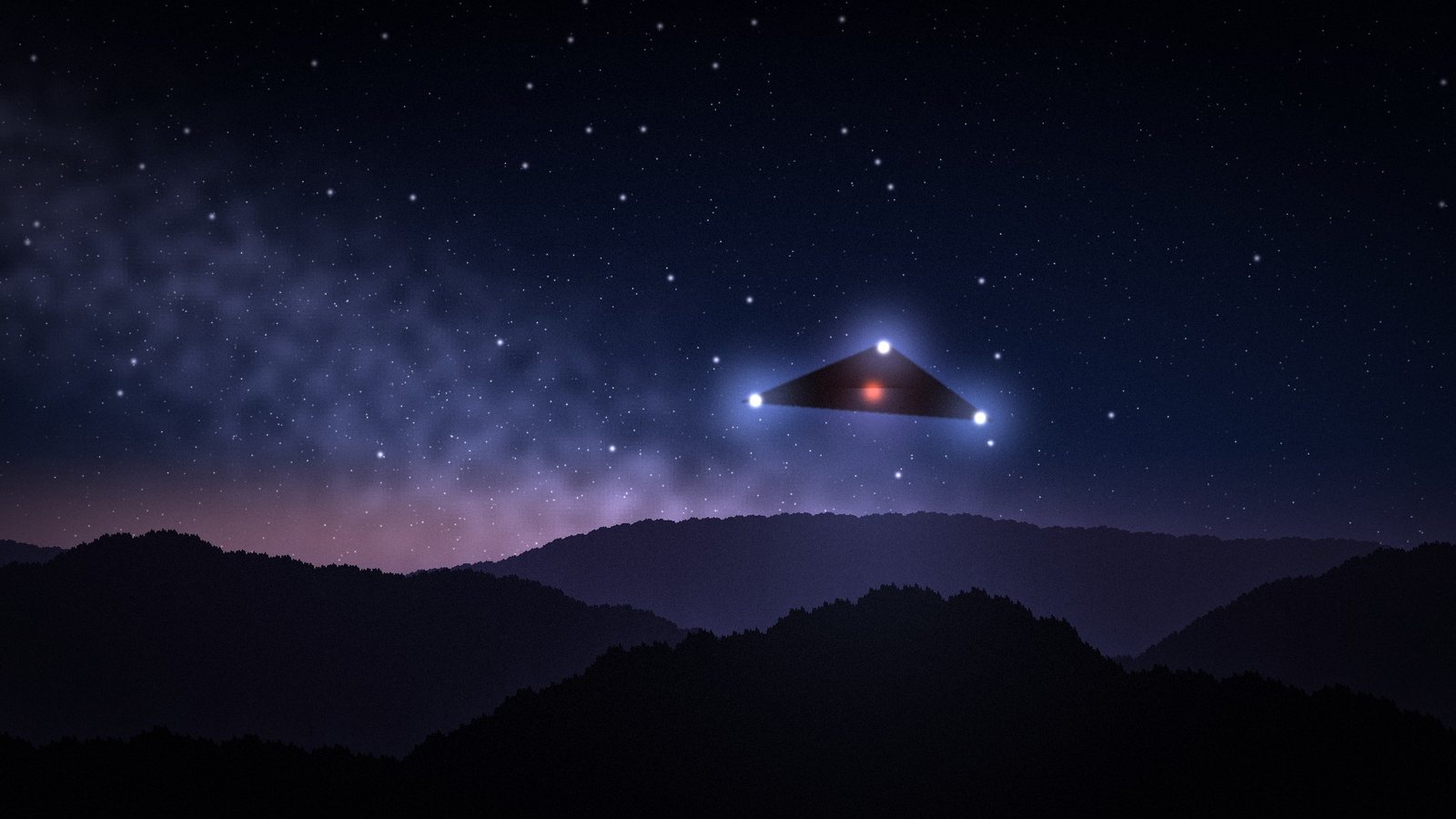
At 8:19pm, attention turned to three white lights arranged at equal distances from one another.
Their positioning outlined an equilateral triangle, with the report suggesting the lights appeared to mark the tips of a single shape.
The estimated size entered for the triangular arrangement was between 100 and 200 feet.
However, the description does not establish that a solid surface was visible between the lights, leaving the apparent connection between them uncertain.
Then, the three lights abruptly disappeared.
The witness described them vanishing ‘in the blink of an eye,’ as though someone had switched them off.
That wording describes a sudden loss of visibility, rather than demonstrating that an object physically disappeared.
The account lists a duration of 30 seconds, although it does not specify whether that applies to one encounter or the two combined.
Silence was another feature emphasized by the person who submitted the report.
Both formations were described as ‘very fast moving, absolutely silent,’ with the observer saying they did not resemble conventional aircraft.
The submission also lists pilot and aviation expertise among the observer details, but does not name the witnesses or explain their qualifications.
According to the account, the group checked flight tracking information after the sightings.
Aircraft departing Manchester Airport had been flying above the area, the witness said, but none appeared overhead at the times of the encounters.
The report does not identify the tracking service or include records showing what information was available.
The witnesses also dismissed drones, citing the lack of sound and saying no drone activity was planned locally.
They said a check of the Ministry of Defence’s low-flying schedule showed nothing planned in the area.
Those checks reflect the witnesses’ efforts to identify what they saw, but do not independently establish the source of the lights.
Area of ice in Mars’ polar craters was found to vary
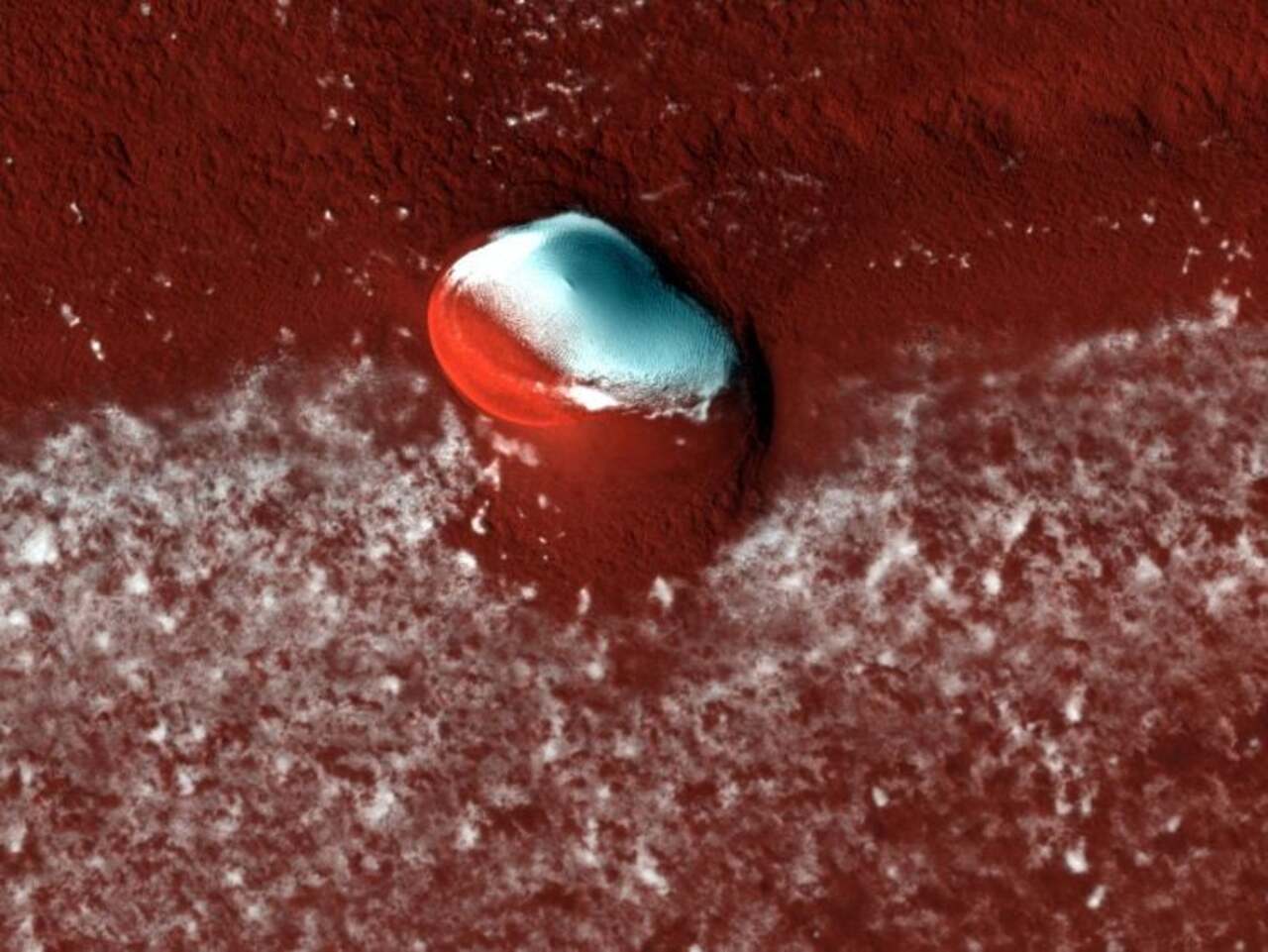
Bright ice deposits on the floors of small craters near Mars’s north pole expand and retreat from year to year. Planetary scientists identified the cause of these fluctuations by analyzing nearly twenty years of orbital images. The amount of ice in each crater depends largely on how much seasonal frost remains around it, rather than on changes affecting the entire polar cap.

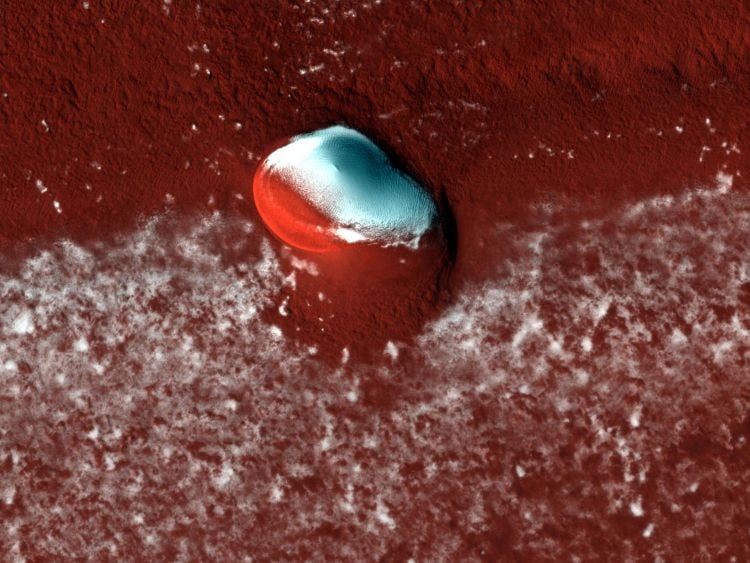
A crater near Mars’s north polar cap, imaged by the HiRISE camera aboard Mars Reconnaissance Orbiter.
Credit: NASA/JPL-Caltech/University of Arizona
Planetary scientists tracked 36 craters on the northern residual polar cap—the permanent layer of water ice exposed in summer when the seasonal covering of frozen carbon dioxide disappears. The largest craters measure up to 300 meters across, while one of the best studied is about 57 meters wide, roughly half the length of a football field. Between 2006 and 2025, the High Resolution Imaging Science Experiment (HiRISE) camera aboard Mars Reconnaissance Orbiter captured 228 images of these craters.
Ten Martian years passed during that period, each lasting 687 Earth days. Bright deposits changed in 32 craters, mostly alternating between expansion and retreat. Four others remained unchanged, and the authors do not explain why. The study was published in the peer-reviewed journal Journal of Geophysical Research: Planets.
Mars’s northern cap consists of layers of water ice mixed with dust, reaching a total thickness of several kilometers. Planetary scientists have long suspected that these layers preserve part of Mars’s climate history, much like ice cores on Earth. To read that record, researchers need to know whether the uppermost layer is currently accumulating or losing ice.
Previous observations offered conflicting answers. Some data indicated that the cap was losing ice, while other evidence suggested that its surface was very young and had been renewed until recently.
The ice on the floors of these craters is very young, probably no more than a few thousand years old. Only a small amount has accumulated over that time. Even frost that forms or disappears during a single summer can therefore noticeably change the extent of the ice on a crater’s floor.
When more frost covered the area around a crater, the deposit inside generally grew as well. When the surrounding frost diminished, the deposit retreated. In three-quarters of cases, changes inside and outside the craters followed the same direction.

A dune field of volcanic origin in Kaiser Crater. Frost deposits on the southern slopes create the metallic sheen.
Credit: ESA/DLR/FU Berlin (CC BY-SA 3.0 IGO)
The summer water cycle offers an explanation. In early summer, solar radiation turns ice directly into vapor. Toward the end of summer, the atmosphere cools, and the vapor settles back onto the surface. Frost covers both the plain surrounding a crater and its floor. If some of the previous year’s frost survives until the end of summer, a new layer of ice builds up on the crater floor. If not, the ice there becomes thinner.
As Universe Today notes, Mars’s axial tilt varies much more dramatically than Earth’s, so the planet’s climate undergoes wider fluctuations overall. The study’s authors suggest that the cap is currently close to equilibrium, gaining approximately as much ice as it loses.
For researchers trying to read the climate record preserved in the cap’s layers, this is an important caveat. An individual crater cannot reveal whether the entire cap is gaining or losing ice. Establishing that will require monitoring many craters simultaneously and accounting each time for how much frost remains around each one.
Three craters showed a different pattern. On at least one occasion, the surrounding frost and the ice inside changed in opposite directions, suggesting that conditions within the craters themselves have a greater influence on the ice. Exactly which conditions remains unclear. The authors suggest that carbon dioxide frost persists longer in shaded areas because they receive less sunlight. Water frost settles on top of it and may survive for part or all of the summer.
Following the global dust storm of 2018, the deposits shrank more frequently, but there are too few observations to establish that the storm was responsible. The same storm coated the Opportunity rover’s solar panels with dust, and contact with it was never restored. Climate models will be needed to test both hypotheses, which the authors identify as their next step.
Buried for 2,600 years beneath Nile mud, a massive ancient Egyptian complex was just found — from space
Satellite radar and underground electrical scans have revealed a 2,600-year-old structure at Buto, one of ancient Egypt's most sacred cities. The real surprise wasn't the walls — but what was underneath them.

Egyptian researchers have found a hidden 2,600-year-old structure the size of a football field after using satellites to peer below the ground. But what they found beneath the structure may be just as remarkable as the building itself.
The site they examined is known as Buto (modern-day Tell el-Fara'in), a sprawling mound of layered history in the northwestern Nile Delta. To the ancient Egyptians, it was the sacred home of Wadjet, the cobra goddess of Lower Egypt, and one of the most religiously important cities in the pharaonic landscape.
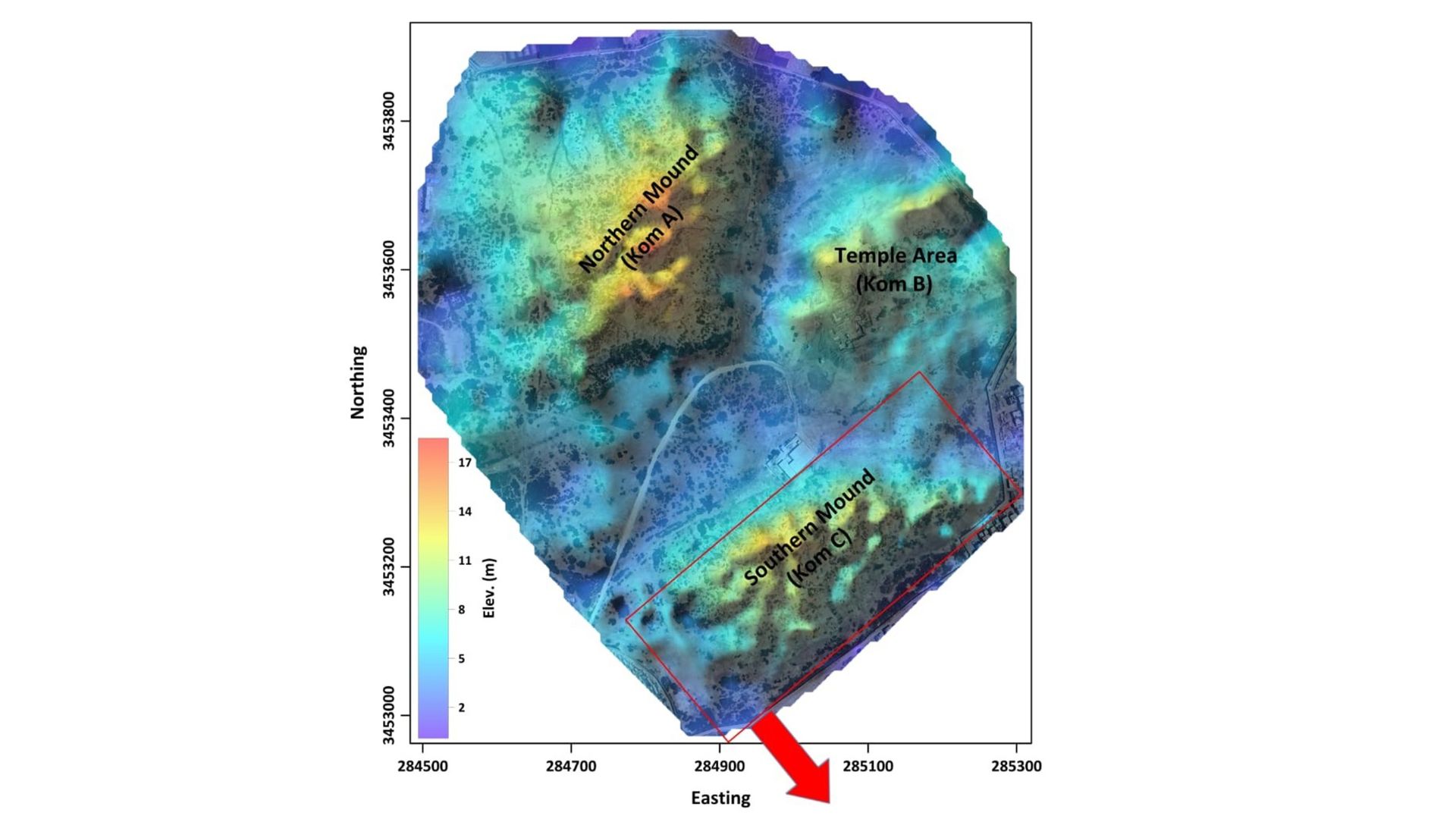
Archaeologists have excavated its upper layers for decades, finding remains from the rule of the Macedonian Ptolemaic dynasty (305 to 30 B.C.) and Roman era (30 B.C. to A.D. 395). But the deeper, older layers at the site — including a mound called Kom C, sitting below groundwater level in waterlogged delta clay — had stayed stubbornly out of reach. Kom C itself rises above the surface as a visible mound, but earlier excavations had reached only the Ptolemaic and Roman layers before hitting the water table.
Now, researchers have turned to noninvasive tools, including satellite imagery, to delve into the mysterious subterranean layers.
First, they turned to the European Space Agency's Sentinel-1 satellite, which can produce radar images by beaming down microwave pulses from orbit and then measuring how they reflect back; the returning signals can reveal subtle differences in surface moisture, elevation and reflectivity that can hint at buried structures beneath the ground. After looking at these radar images, the team spotted a large oval-shaped anomaly buried beneath Kom C that was 420 feet long and 203 feet wide (128 by 62 meters).
You may like
3,200-year-old inscription may point to a long-lost ancient Egyptian city from the time of Ramesses II
2 giant Ramesses II statues, one wearing a double crown, discovered by man in Egypt
Ancient Egyptian tomb holding the king's 'keeper of secrets' unearthed at Saqqara
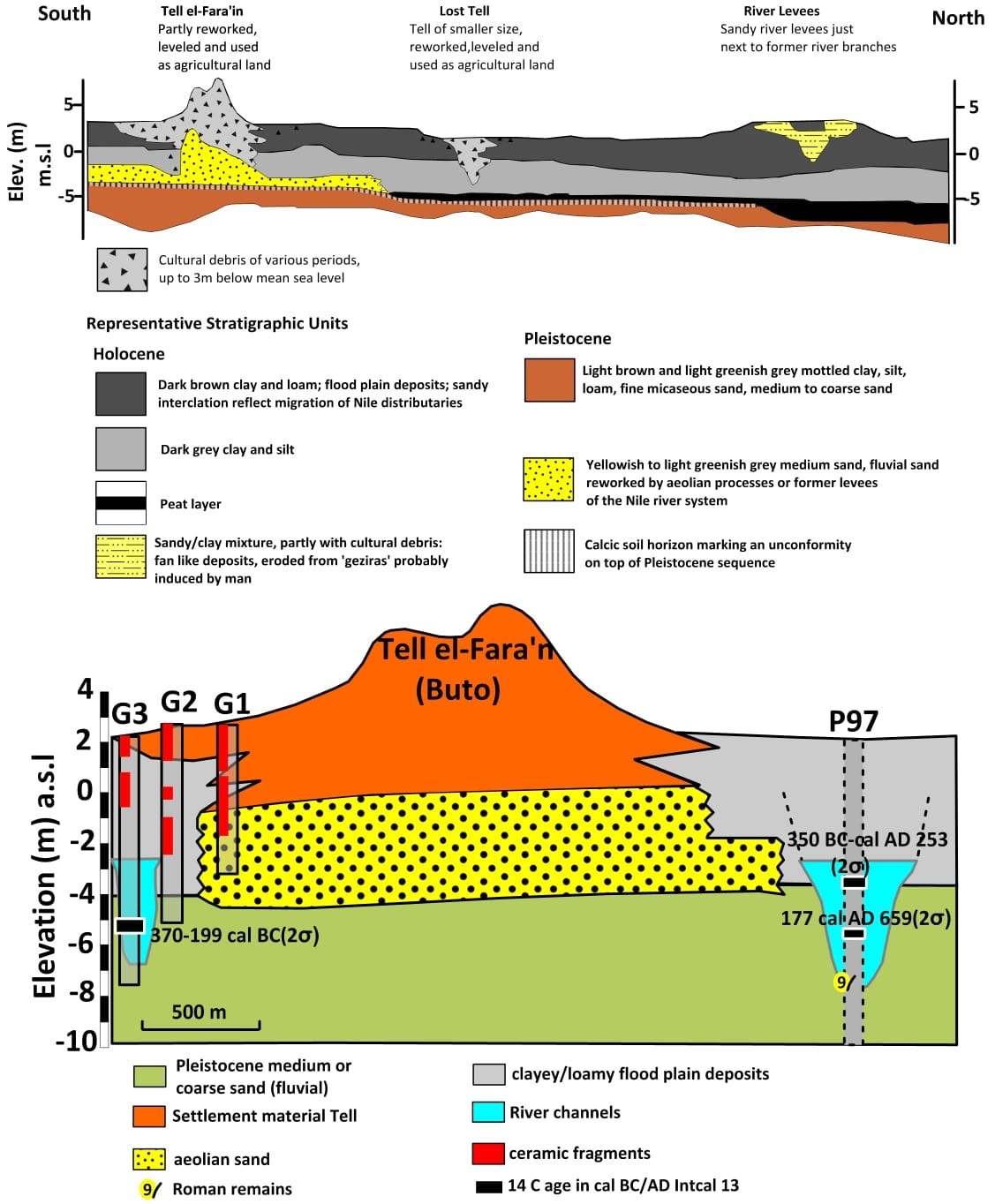
The geological profile of Tell el-Fara'in (ancient Buto) and the surrounding Nile Delta, showing the layered sequence of river sands and flood-plain clays from the last ice age and the settlement mound above.
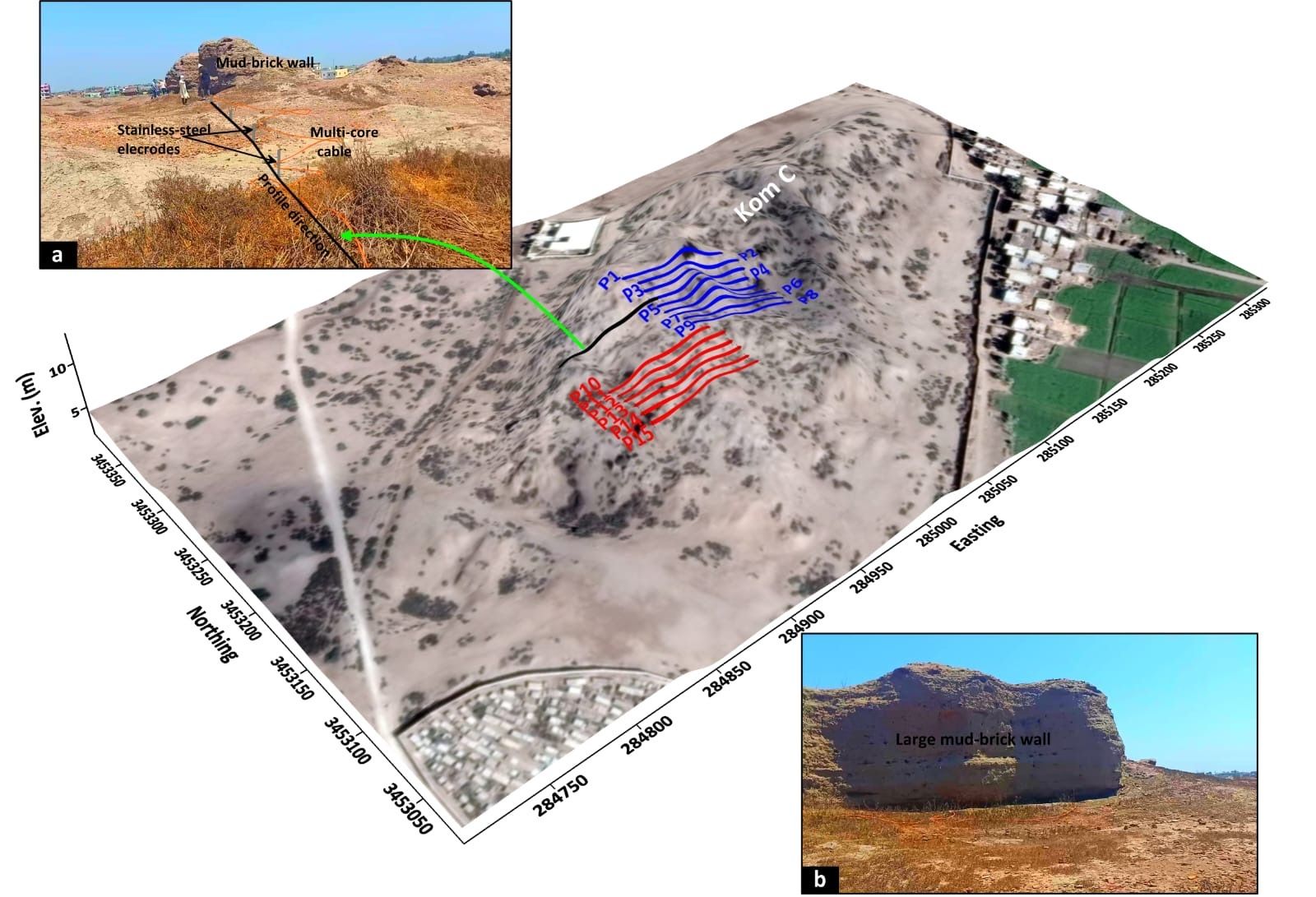
To learn more without disturbing the site, the team ran 15 parallel lines of electrical resistivity tomography (ERT) across an area of roughly 58,100 square feet (5,400 square meters). This technique reveals the underground landscape by passing electrical currents through the earth, measuring how they travel and creating a map that archaeologists can read.
The picture that came back was layered. Between the surface and 10 feet (3 m) down, the team found scattered Ptolemaic and Roman debris, including displaced mudbricks, pottery shards and broken limestone, which point to centuries of continued occupation and rebuilding on the site. Later residents dismantled older structures for reuse and left a scatter of displaced material behind.
Hussein Bassir, director of the Antiquities Museum at Bibliotheca AlexandrinaUsing pure sand as a stabilizing cushion was a brilliant, deliberate tactic — the ancient builders profoundly understood their environment.
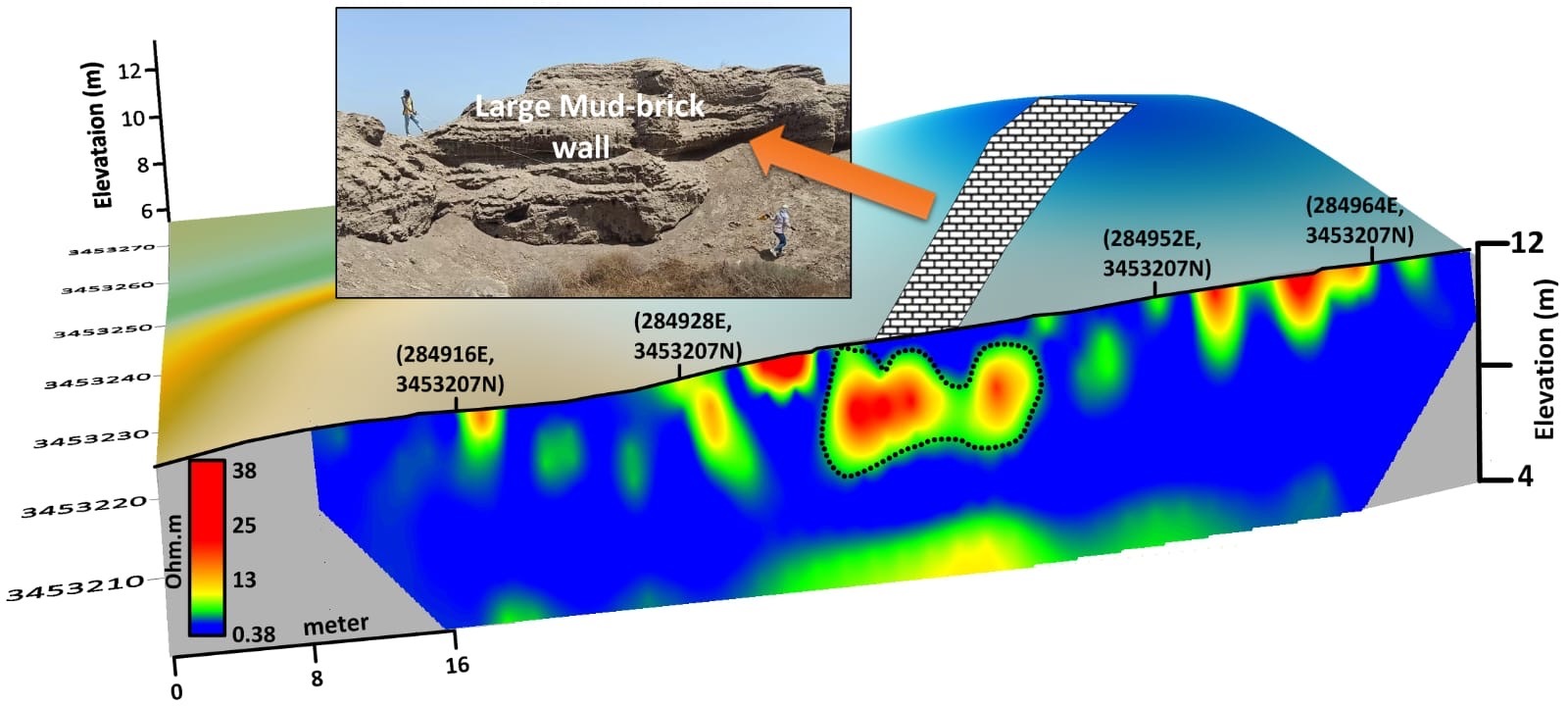
Deeper still, between 10 and 20 feet (3 and 6 m), the researchers found a large mudbrick structure from the 26th dynasty (688 to 525 B.C.), also known as the Saite period. They were able to date this discovery based on its layer, the unique shape of the mudbricks and other artifacts such as pottery, which the team dated by style and their archaeological layer, with carbon-14 dating applied to associated organic material. The large structure may be a tomb, a house for priests or a religious shrine, the team wrote in the study, published in March in the journal Acta Geophysica.
And below that, at 20 to 23 feet (6 to 7 m) underground, the researchers unexpectedly found a thick, clean layer of sand.
That sand is the discovery within the discovery, the team wrote in the study.
What to read next
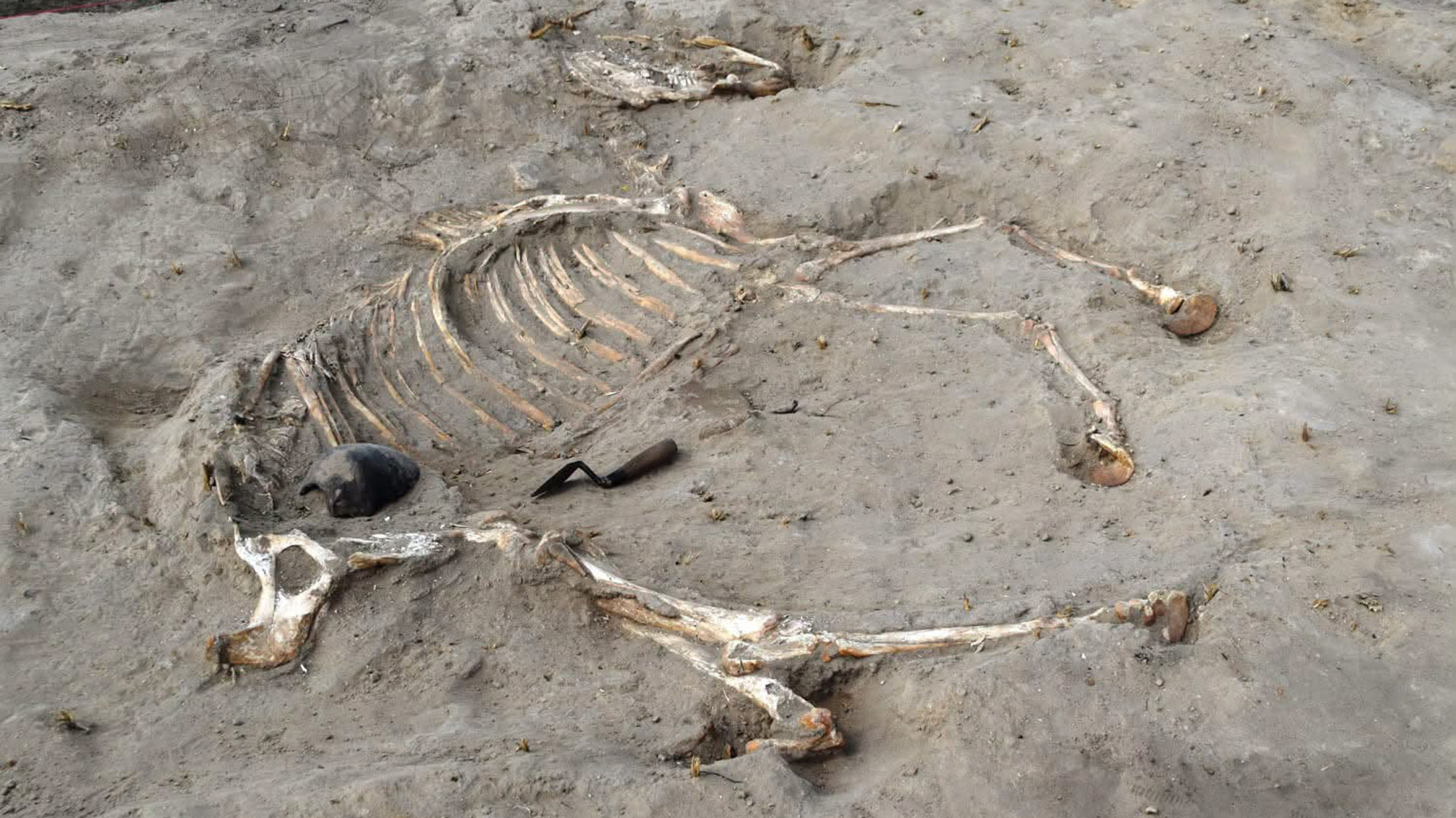
3,000-year-old burial of ancient Egyptian horse found — and a nearby stone carving depicts a captured prisoner
'Listen, father!': 1,700-year-old tomb discovered in Egypt contains a poem in ancient Greek and spells to protect the dead
Ritual solstice structure 1,000 years older than Stonehenge unearthed in Czech RepublicThe Nile Delta's clay is notoriously treacherous to build on. It absorbs moisture and swells, and then contracts and shifts as it dries — posing a slow-motion threat to anything heavy sitting on top of it. The Saite builders, it seems, knew this. Before laying the foundations to their structure, they packed a cushion of clean sand beneath it. This sand would have spread the building's weight, let groundwater drain through, and stopped the clay from creeping. It is the same logic behind modern load-distributing foundations — applied here more than two and a half millennia ago.

A 2D electrical resistivity scan aligned with a partially exposed mudbrick wall — the colored subsurface anomaly matches the location of the visible structure above ground.
"By combining satellite radar with deep ERT profiles, we didn't just map the walls of this massive Saite-era structure — we were also able to analyze the subsurface layers," study co-author author Abdelaziz Elfadaly, an associate research professor at Egypt's National Authority for Remote Sensing and Space Sciences, told Live Science. "The detection of a significant, clean sand foundation layer beneath the mudbrick walls explains how these heavy structures survived the high water table and shifting clayey soil of Buto."
The sand layer, in effect, acts as a barrier; it stops groundwater from wicking upward into the mudbrick, which would soften and dissolve it. The sand also lets water drain sideways instead of pooling against the foundation, according to Elfadaly.
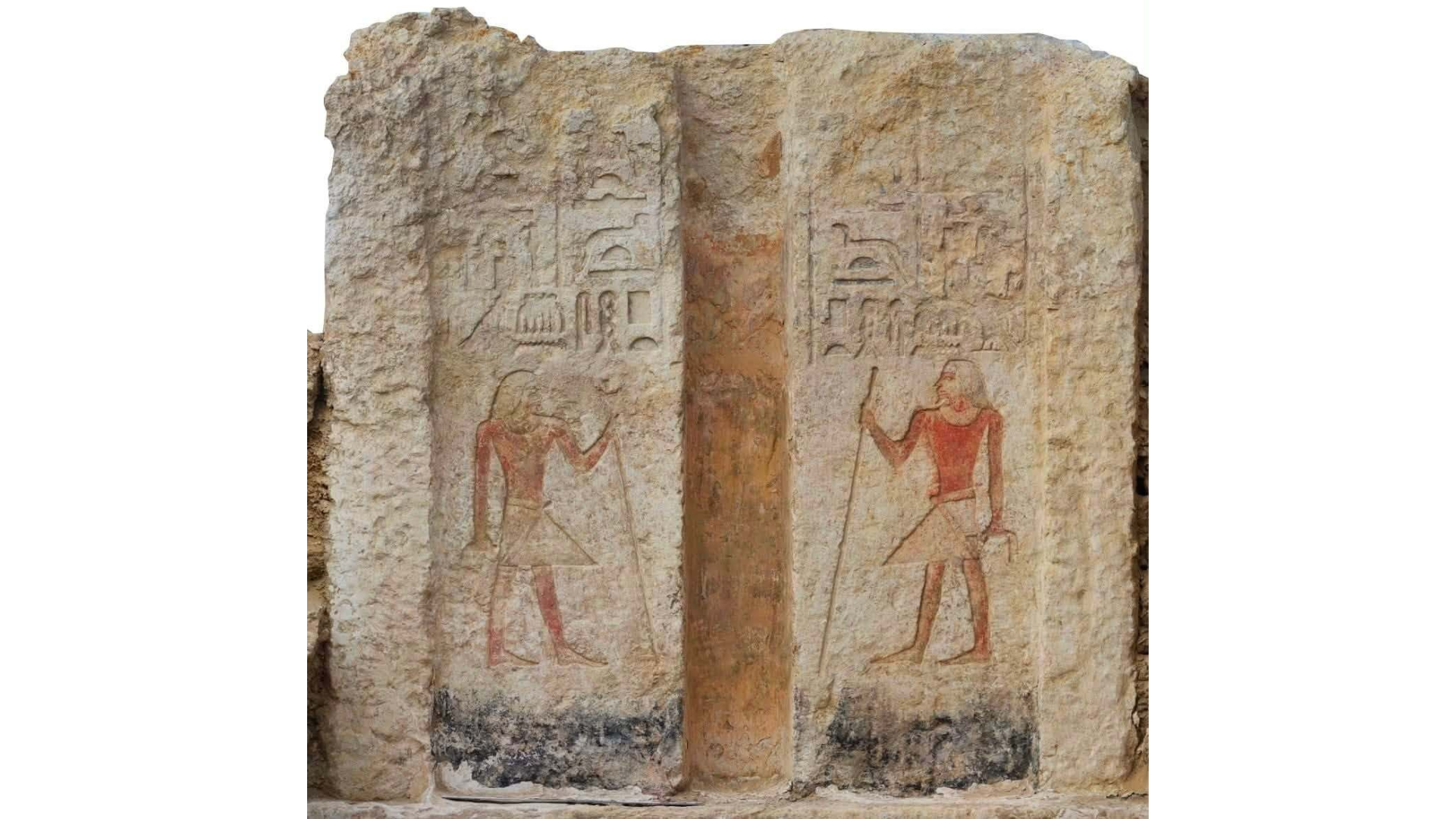
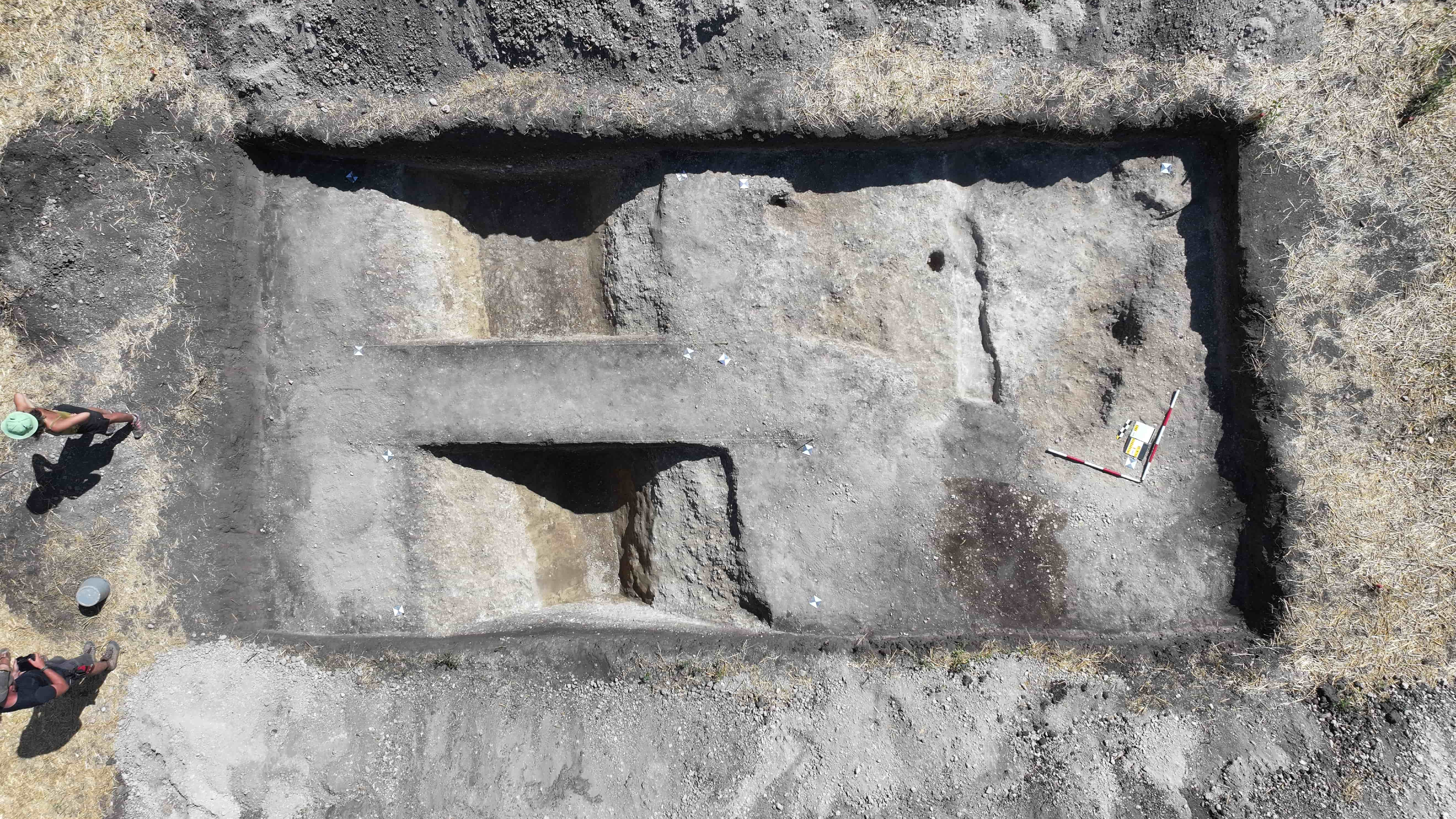
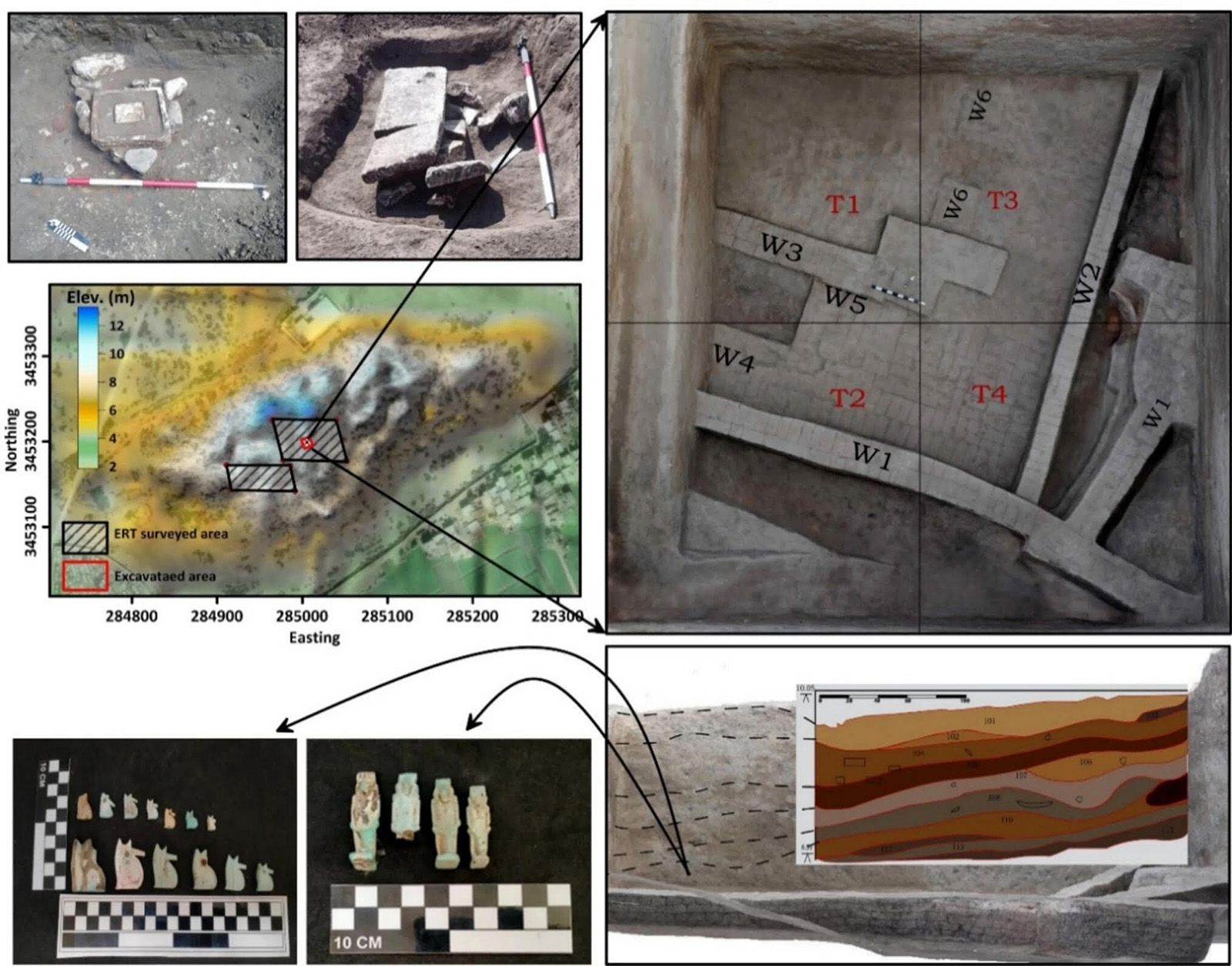
A 3-by-3 foot (10 by 10 m) excavation trench that was around 20 to 23 feet (6 to 7 m) deep confirmed the presence of thick mudbrick walls resting on that sand layer, and nearby, a spread of objects that hint at the site's sacred function. According to Elfadaly, these finds included ushabti and shawabti figurines — small servant statues typically placed in tombs to serve the deceased in the afterlife — and a limestone altar whose carved channels bore dried residues consistent with animal blood, pointing to offering rituals performed at the site. The study also noted a rarer find: a faience baboon figurine, the kind associated with Thoth, the god of wisdom.

Image credit: Abouarab et al.,Acta Geophysica (2026); CC BY 4.0
Layout of the ERT (electrical resistivity tomography) survey at Kom C. The blue lines mark one first set of profiles, and the red lines mark the second. Insets show the electrodes and cables deployed in the field, and a large mudbrick wall dating to the Late Roman period.

Image credit: Abouarab et al.,Acta Geophysica (2026); CC BY 4.0
A selection of artifacts recovered from the excavated square at Kom C, including small figurines and worked stone fragments from the Saite-era structure.
The Saite period was a moment of cultural revival. After generations of Assyrian and Libyan domination, Egyptian pharaohs retook the throne and poured resources into restoring Egypt's religious landscape, particularly in the Nile Delta, which had been their power base. Buto, with its deep ties to Lower Egyptian identity, was a natural focus. The Saite kings ruled from the nearby delta city of Sais, so restoring Buto reinforced their roots and their claim to the throne.
"A monumental building of this scale underscores the Saite pharaohs' intense commitment to glorifying the Delta region," Hussein Bassir, director of the Antiquities Museum at a cultural research center known as Bibliotheca Alexandrina who wasn't involved with the study, told Live Science in a WhatsApp message. "Using pure sand as a stabilizing cushion was a brilliant, deliberate tactic — the ancient builders profoundly understood their environment."
The team is planning a return visit, this time using wider-spaced electrical resistivity surveys to reach deeper layers, along with specialists who study ancient plants and also understand how geological features changed over time, which may help reconstruct what the landscape around Buto looked like when these walls were first laid.
{ https://www.livescience.com/archaeology/ancient-egyptians }
A former astronaut reveals the reasons for his belief in extraterrestrial life and warns of a war in space

Washington, DC – Former US astronaut Winston Scott has sparked widespread interest with his statements regarding his belief in the existence of intelligent life beyond Earth.
He based his argument on the vastness of the universe and the enormous number of planets. At the same time, he warned of the potential for military conflict in space as competition between major powers intensifies.
Scott, who participated in two NASA space missions during the 1990s, explained that the vastness of the universe and the existence of billions of planets make it difficult to believe that Earth is the only place where life has emerged.
He indicated that the possibility of other life forms warrants scientific investigation and study. Conversely, the former astronaut distinguished between the possibility of extraterrestrial life and claims of alien visits to our planet.
He also emphasized that believing in life elsewhere does not constitute proof that such beings have reached Earth. Furthermore, Scott warned of the spillover of political and military tensions between international powers into space.
This comes amidst growing competition to develop satellite and related systems capabilities. He believes this race could open the door to future confrontations beyond Earth’s atmosphere.
He pointed out that international cooperation on projects like the International Space Station
does not eliminate existing disagreements between major powers.
He also expressed his hope that space would continue to be used for research and exploration rather than becoming an arena for military conflicts.
He expressed interest in the competition between private space companies, particularly SpaceX and Blue Origin, to develop technologies for reaching and exploring the moon.
He believes that competition in this field can accelerate innovation and reduce the costs of space travel.
These statements come at a time of growing global interest in space exploration and the search for signs of extraterrestrial life. While NASA has not yet announced the discovery of conclusive scientific evidence proving the existence of life or life beyond our planet.
RELATED
{ https://www.voiceofemirates.com/en/category/science-and-tech/ }
Kurt Russell Witnessed One of the Most Famous UFO Sightings in History and Didn’t Even Realize ItThe ‘Escape From New York’ star hadn’t given what he’d seen a second thought until hearing it mentioned on a TV show years later
Space Outposts Beyond the Moon May Rely on Planetary AI

A conceptual AI visualization mapping lunar environmental data layers to identify target landing sites.
(Credit: The Ohio State University)
NASA plans to return astronauts to the lunar surface in 2028 for the first time since Apollo 17 in 1972. But the famed agency has no intention of stopping there, as they plan to establish a permanent human presence on the Moon through a slow and meticulous process involving power, resource extraction, and habitat technologies. However, with the soaring use of artificial intelligence (AI) in our everyday lives, how could this emerging technology be used to identify new landing sites for future outposts on the Moon and possibly Mars?
Now, a team of researchers from The Ohio State University might have contributed to how AI can be used for future space outposts. As discussed in a recent study presented at the 58th Annual Meeting of the Division for Planetary Sciences (DPS 58) of the American Astronomical Society, the researchers introduced how a novel AI model could be used to both identify safe landing sites and develop a human outpost strategy at those landing sites. The model is called LUMINA, which is an agentic AI framework designed to help mission planners evaluate safe landing sites on the lunar surface, specifically focusing on key resources like water ice, along with potential scientific value.
To identify prime landing sites, LUMINA doesn’t just rely on orbital images. It incorporates a myriad of lunar surface data, including topography and terrain hazards, scientific value, geology, surface properties, and even comparing the candidate landing sites to each other. As a result, LUMINA demonstrates a keen ability to identify landing sites across the lunar surface that could maximize mission success and effectiveness for both human habitation and science. But the researchers don’t want to limit LUMINA to the Moon, as they envision LUMINA contributing to other planetary bodies, specifically Mars.
“AI systems are going to become critical tools for space exploration that will help humans analyze the millions of images and datasets that future missions will require,” said Gokce Inal, who is a PhD candidate in Civil Environmental and Geodetic Engineering at The Ohio State University and lead author of the study. “This work is meant to serve as a bridge between those two worlds, AI and planetary science.”
LUMINA is built upon previous research by this same group called the Large Language-and-Vision Assistant for Lunar Exploration (LLaVA-LE), which demonstrated its ability to analyze and describe orbital images of the lunar surface. The LLaVA-LE model is currently available on arXiv, was recently presented at the CVPR2026 AI4Space Workshop in June 2026 and can be found on GitHub.
As noted, NASA has ambitious plans to establish a permanent human presence on the lunar surface with the long-term goal of sending humans to Mars. Developing the necessary technologies to accomplish both goals is part of NASA’s Moon to Mars Architecture, which is a constantly evolving strategic framework designed to develop and test vital technologies that will allow humans to work and live on the Moon that can then be used for human missions to the Red Planet. These technologies include power systems, transportation, habitation & life support, robotics & construction, in-situ resource utilization (ISRU), communications, and more. The question then becomes how can AI, and specifically the LUMINA model, be used to further develop these technologies?
“NASA’s Artemis program creates important opportunities for our research,” said Inal. “As new lunar data becomes available, their results can improve systems like ours and better support future mission planning.”
Of the technologies listed above, ISRU plays a crucial role in using local and available resources for crew use and survival. This includes water ice for drinking, bathing, fuel, and even oxygen from electrolysis, and using the lunar regolith to potentially grow plants and for construction. Also known as “living off the land”, ISRU aims to reduce, and potentially eliminate, the need for resupplies from Earth. Essentially, it wants to create a self-sustaining system exactly like life on Earth.
How will LUMINA help plan future space outposts on the Moon and Mars in the coming years and decades? Only time will tell, and this is why we science!
Martian Polar Crater Ice Shifts with Seasonal Frost

NASA MRO HiRISE image of a north polar crater.
(Credit: NASA/JPL-Caltech/Univ. of Arizona)
The planet Mars shares many landforms and weather patterns with the Earth, including changing seasons, volcanoes, canyons, dust storms and dust devils, and water ice. But one feature that Earth and Mars share among the eight planets in our solar system are polar ice caps. Both are one of each planet’s striking features, but the major difference is while Earth’s polar ice caps are both comprised of water, Mars’ north polar ice cap is only comprised of water while its southern polar ice cap is carbon dioxide. The reasons for this are determined by altitude, but Mars’ northern polar ice cap is one of the most studied regions primarily due to its water ice composition. But how does the north polar ice cap water ice change with the seasons compared to Earth, and what can this teach scientists about Mars’ climate history?
Now, an international team of researchers might have shed new light on this conundrum. As discussed in a recent study published in the Journal of Geophysical Research: Planets, the researchers challenged our understanding of ice deposits in Mars’ northern polar ice cap region. The primary motivation behind this study was to fill a longstanding knowledge gap regarding the seasonal changes in Martian polar ice deposits, specifically focusing on craters. The researchers note that better understanding seasonal changes in polar ice cap deposits could help gain insights into long-term climate changes on the Red Planet.
For the study, the researchers analyzed images of 36 craters within the northern polar ice cap region of Mars. The images were obtained from NASA’s Mars Reconnaissance Orbiter's High Resolution Imaging Science Experiment (HiRISE) camera between 2006 and 2025. This time period is also referred to as Mars Years (MY) 28–38 since one year on Mars is 668 Earth days. The goal of the study was to identify how polar ice deposits on crater floors changed with seasons, specifically whether the deposits increased or decreased in size based on winter or summer months, respectively.
In the end, the researchers found that 32 of the 36 craters exhibited changes in bright deposits, broadly indicating ice deposits are expanding and shrinking with the seasons. Of the remaining four craters, the researchers didn’t observe changes in brightness. The researchers note that seasonal frost deposits on the outside of each crater could be responsible for the changes in brightness.
“Not all craters exhibit changes in frost coverage from one Mars year to the next,” the study notes. “For a given Mars year, only a subset of craters show altered frost conditions relative to previous years, while others maintain similar or nearly identical frost extents. This spatial heterogeneity suggests that seasonal frost cycles and interannual mass balance are localized processes rather than cap-wide phenomena. Local topography, crater geometry, and microclimatic conditions likely modulate energy balance and vapor transport, leading to crater-specific responses to broader climatic forcing.”
Essentially, the researchers found the changes in crater ice deposits are triggered by local climate changes, as opposed to being triggered by larger climate changes. The reason why understanding Mars’ climate changes is important is to help pin down specific triggers, whether it’s seasonal or related to other factors. For example, Mars experiences much larger climate changes on grander scales compared to Earth due to the Red Planet’s planetary tilt having much larger swings than Earth. However, as this study demonstrates, local climates are still capable of delivering their own changes disconnected from the larger climate picture. This study identifies seasonal changes in polar ice deposits while providing motivation for future modeling work that could help expand our understanding of localized climates on Mars.
What new insights into Mars polar crater ice will researchers make in the coming years and decades? Only time will tell, and this is why we science!
As always, keep doing science & keep looking up!
Winged UFO Returns Near Sun, Nov 2, 2026 NASA Images, UAP Sighting News.
David Grusch’s Reptilian Crash-Site Claim: Ross Coulthart Examines the Allegations

Americans killed during an encounter with alleged reptilian beings. A nonhuman installation on the ocean floor. Classified footage of recovered bodies. Ross Coulthart’s latest Reality Check Q&A brings together several extraordinary claims he attributes to David Grusch’s interview with Joe Rogan — and raises an equally important question: what evidence can the public actually examine?
The most disturbing account concerns an alleged confrontation at a UFO crash site. In Coulthart’s retelling, Grusch acknowledged that this story came from colleagues rather than from an incident he witnessed himself. That distinction matters: this is a report of an allegation, not confirmation that such an encounter occurred.
According to Coulthart’s summary, Grusch described a Tic Tac-shaped craft embedded in the ground, with deceased beings commonly described as “Grays” and living entities said to be roughly seven feet tall and reptilian in appearance. The account alleges that an exchange of gunfire left American personnel injured or dead and that the beings were also killed.
The segment supplies no publicly examinable incident report, location, date, casualty list or named eyewitness testimony establishing this account. Without those details, readers cannot independently reconstruct what supposedly happened or test the description against records. The seriousness of the allegation makes that missing evidence especially consequential.
Coulthart also highlights a separate claim: that the Navy monitors a large installation associated with nonhuman intelligence on the seabed. As he recounts it, Grusch described something extending across an area comparable to several city blocks, with its age and purpose uncertain.
It is a striking addition to the discussion of unidentified submerged objects, or USOs. But the episode does not provide coordinates, sonar records or imagery that would allow an outside assessment of the alleged installation. Coulthart’s discussion should therefore be understood as commentary on Grusch’s claims, rather than independent documentation of an underwater base.
A different part of the discussion concerns material Grusch allegedly viewed himself. Coulthart says Grusch described classified recovery footage showing several nearly human-looking bodies, with unusual skin coloration and close-fitting clothing. He also recounts Grusch’s statements about biological assessments to which Grusch did not have full access.
Claiming to have watched a recording is different from repeating a colleague’s story. Even so, viewers of Reality Check are not shown the underlying recovery footage in this discussion. Its provenance, contents and interpretation cannot be independently assessed from Coulthart’s description alone. Nor does the episode establish the reported genetic comparisons as scientific findings available for scrutiny.
Beyond the encounter stories, Coulthart focuses on Grusch’s description of how an alleged legacy retrieval program might be organized. In that account, UAP-related activity is compartmentalized within programs whose outward purposes appear unrelated to UFOs. Personnel could work on one piece without understanding the larger operation
Coulthart also discusses assertions about nuclear secrecy and the role of private contractors. His concern is that disputed ownership, proprietary research and potential liability could complicate disclosure. These are proposed explanations for secrecy; the discussion itself does not establish that a particular company possesses nonhuman technology or that any specific legal barrier has been proven.
The crash-site allegation needs more than repeated retellings. A date and location, identifiable witnesses, authenticated records and an explanation of how the information reached Grusch would give investigators something concrete to examine. The undersea-base claim similarly calls for verifiable sensor data and independent analysis.
Coulthart’s episode illustrates both the appeal and the difficulty of the disclosure debate: dramatic accounts circulate while the material said to support them remains inaccessible. For now, the reptilian encounter, the underwater installation and the recovered bodies described here remain unverified allegations. The next meaningful development would be evidence that people outside the alleged programs can inspect.
The NewsNation episode below is the source for this article’s account of Coulthart’s remarks. It is his discussion of Grusch’s reported statements, rather than the full Grusch–Rogan interview.
Source: NewsNation, Reality Check with Ross Coulthart. Promotional thumbnail: NewsNation; it is not documentary evidence of the alleged encounter.
RELATED
Ex-Pentagon UFO Chief Dismisses FBI “Black Triangle” Sighting – and Says Solved Cases Were Released as Unresolved

It was one of the most talked-about cases in the latest batch of declassified UAP files: a group of FBI personnel watching a silent, jet-black triangle rise above a mountain ridge somewhere in the western United States, hang motionless in the air, and then vanish into a canyon in the blink of an eye. For many UFO enthusiasts, the credibility of the witnesses alone was enough to put the case near the top of the list. But the man who once ran the Pentagon’s own UFO investigation office is not convinced.
Dr. Sean Kirkpatrick, the founding director of the Pentagon’s All-domain Anomaly Resolution Office (AARO), says the newly released account simply does not contain the kind of evidence needed to determine what the agents actually saw – and he warns that the way the government is releasing these files may be doing more harm than good.
The sighting took place in June 2026 near an undisclosed national security site in the western U.S. and appears in two separate documents published as part of the Department of War’s rolling release of UAP records, ordered by President Trump earlier this year. One is a signed statement the agents gave to the FBI, the other is an AARO memo summarizing investigators’ debrief with the witnesses.
According to those records, the agents were scanning the western horizon when they noticed a large, dark, non-reflective object shaped like a delta-wing drone. Their description includes several details that immediately caught the attention of the UFO community:
Interestingly, the two documents do not fully agree. The FBI version describes an encounter lasting only a few seconds, while the AARO memo breaks it down into around ten seconds of ascent, twenty seconds of hovering and two to three seconds of high-speed departure. The speed itself was estimated by the witnesses, not measured by any instrument. The Department of War has also confirmed that the images attached to the FBI report are illustrations, not photographs of the object.
Speaking to the press this weekend, Kirkpatrick – who spent close to three decades in the Department of Defense and the intelligence community – argued that the professional background of the witnesses does not, by itself, turn a story into data. He described the tendency to accept such testimony at face value as a textbook example of “authority bias.”
Without photographs, radar tracks or sensor recordings, he explained, there is simply nothing for analysts to work with. In his view, many reports boil down to someone seeing something they could not identify, and people then filling that gap with extraordinary explanations that have repeatedly turned out to be wrong.
Kirkpatrick pointed out that triangular craft have a long history of being linked to classified aerospace programs. Before the F-117 Nighthawk stealth fighter was officially acknowledged, for example, its angular silhouette generated a wave of strange-sighting reports. Advanced, still-secret technology therefore remains a serious candidate for at least some modern “black triangle” cases.
During his tenure, AARO sorted every UAP report into three broad possibilities: advanced technology operated by a foreign adversary, ordinary objects or sensor artifacts that were misidentified, or something genuinely extraterrestrial. Each category has its own characteristic signatures, and investigators compare the real data from a sighting against those signatures.
According to Kirkpatrick, nothing his team reviewed ever matched the alien hypothesis. The vast majority of cases turned out to be mundane objects that military sensors were never designed to recognize, while a small number showed signs of possible foreign involvement and were passed on to national security officials.
He also stressed the difference between two words that are often used as if they meant the same thing. An unidentified object is one that can be observed and characterized with data, even if its exact nature is not yet known – like the objects shot down over North America in 2023 after the Chinese spy balloon incident, which were later determined to be balloons. An unresolved case, on the other hand, usually means there is not enough data to reach any conclusion at all.
The most striking part of Kirkpatrick’s comments concerns the release process itself. He claims that some of the cases now being published as unresolved had in fact already been resolved by AARO – and that he had even briefed Congress on several of them, including the likely explanations.
According to the former director, Pentagon leadership instructed AARO to strip the resolution language from those files before they were made public, in order to let the public decide for themselves. Kirkpatrick called that approach the worst possible choice, arguing that it only adds fuel to conspiracy theories. He did not say when the instruction was given or which officials were behind it.
The Department of War, for its part, says it is deliberately not offering any assessment of the released material – neither of the collection as a whole nor of individual files – so that Americans can reach their own conclusions. The Pentagon has not publicly confirmed Kirkpatrick’s allegation.
The black triangle report arrived as part of the seventh release under the presidential UAP disclosure order, which in this tranche alone included 28 PDF documents. Since the official WAR.GOV/UFO portal launched on May 8, 2026, it has reportedly been visited more than a billion times, and the files now span roughly eight decades of reports – from 1950s sightings around California’s Santa Catalina Island and a 1957 radar contact logged by a B-52 bomber, to recent accounts of orange orbs releasing smaller red orbs near a sensitive U.S. facility.
Kirkpatrick believes many of the historical cases must be viewed in the context of the technology of their time, such as early high-altitude balloon programs. He also notes that the sheer volume of reports works against the extraterrestrial explanation: even if alien visitation were real, it would hardly produce thousands of separate encounters. While he considers it statistically almost certain that intelligent life exists somewhere in the universe, he regards the idea that it is visiting Earth as equally improbable.
His overall verdict on the newest files is blunt: in his opinion, they contain nothing new.
For skeptics, Kirkpatrick’s comments confirm that eyewitness testimony – no matter how credible the people involved – cannot replace hard data. For those who believe the government is still hiding the truth, his claim that solved cases were deliberately repackaged as mysteries raises a very different question: if the Pentagon is editing what the public sees, what else might be missing from the files?
One thing is certain: the image of a silent black triangle rising over a dark ridgeline will remain one of the most discussed UFO stories of 2026 – at least until the next batch of files is released.
Decades-old theory on how life on Earth started is WRONG, scientists claim
Scientists have made a discovery that could overturn a decades-old theory on how life got started on Earth.
For living creatures to emerge out of lifeless chemicals, Earth needed a stock of organic molecules and the right conditions to put these together.
One of the most popular theories to explain where that stockpile came from is that icy comets delivered vast amounts of concentrated chemicals directly to Earth's surface.
However, researchers from the University of Cambridge now say this is highly unlikely.
The problem is that the vast majority of comets arrive too fast and hit the atmosphere at too steep an angle to survive the impact.
Small comets are blasted into pieces by the sudden shock, and the fragile organic molecules inside would almost certainly vaporise on impact.
That means the cometary delivery of life's building blocks is at best a 'one-off fluke' rather than the steady rain of raw materials previously envisioned.
Lead author Dr Richard Anslow from Cambridge's Institute of Astronomy says: 'It's kind of a romantic idea, but our results suggest it's highly unlikely.'

Scientists have poured cold water on the decades-old theory that the building blocks of life on Earth were delivered by icy comets from the outer Solar System.
Pictured: The comet C/2022 E3 (ZTF)
To understand how life emerged, scientists need to understand where the so-called 'feedstock' molecules came from and how they came together.
However, figuring out how the basic building blocks could have become concentrated in high enough levels has proved challenging.
Dr Anslow told the Daily Mail: 'Comets emerged as a promising delivery mechanism based on the observation of Solar System comets showing them to be rich in carbon- and nitrogen-bearing chemicals that we think are important for the origins of life.'
He adds that these giant space snowballs had become something of a 'get out of jail free card' for scientists keen to explain how Earth got the molecules needed to seed life.
In their paper, published in the journal Scientific Reports, the research focuses on hydrogen cyanide, a feedstock chemical made of hydrogen, carbon and nitrogen.
This chemical has been considered particularly promising since it is exceptionally abundant in icy comets from the outer Solar System and potentially tough enough to survive impact.
However, new computer modelling suggests that comets couldn't have delivered nearly enough hydrogen cyanide to get life's chemical chain reaction started.
In his previous research, Dr Anslow had theorised that comets might slow down by 'bouncing' through systems where planets orbit close together, delivering organic molecules as they went.

To see whether this could have happened in the Solar System, the researchers used the latest comet impact simulations and computer models of the evolution and origin of comets.
This allowed them to work out how comets would actually arrive and what would happen when they hit the atmosphere.
'We found that the typically high speeds that comets impact the Earth at lead to the destruction of the majority of these molecules, meaning that it is not straightforward for these to reach the surface intact,' says Dr Anslow.
Any comet smaller than 330ft (100m) wide would 'catastrophically fragment in explosive airbursts at high altitude', while even kilometre-sized comets would be broken apart.
After being dissolved in a planet's worth of water, the concentrations of hydrogen cyanide delivered in this way would be orders of magnitude lower than what is needed to start life's chemical reactions.
That suggests that comets are an unlikely source for the origin of life, meaning that the feedstock chemicals must have come from somewhere else.
Dr Anslow says: 'There are many promising alternative hypotheses including their delivery by carbon-rich asteroids, or alternatively these molecules could have been synthesised on the young Earth, not requiring any impacts at all.'
Previous studies suggest that the heat generated by rocky asteroids' passage through the atmosphere could provide the energy needed to forge these basic chemicals.

Mars, on the other hand, could have been seeded with chemicals from comets. Since its atmosphere is thinner and the planet is smaller, comets arrive slower and are more likely to survive the impact
On the other hand, some researchers propose that Earth's basic chemical stockpile could have been created in hydrothermal vents deep under the oceans or near the surface.
However, although scientists say they have ruled out comets as the source of life on Earth, the situation is very different elsewhere in the Solar System.
In fact, the researchers identify Mars as a promising place where comets could have given life a helping hand.
Since Mars is smaller than Earth and currently has a much thinner atmosphere, comets would be much more likely to make it to the planet's surface during the period of the Solar System's development when comets were far more frequent visitors.
'Because comets typically strike Mars at lower speeds than Earth, we found that — at face value — more of these molecules survive impact.
'However, a big caveat is that there are many uncertainties about early Martian environments, meaning that this isn't to say successful impacts occurred onto Mars!'
In the future, the researchers say that these findings could help telescopes like the James Webb Space Telescope or the proposed Habitable Worlds Observatory look for life.
By looking for planets where 'bouncing' comets could have safely reached the planet's surface, scientists can narrow down the number of places they need to search.
Extraterrestrial detection inspired by firefly communications could distinguish alien signals from pulsars

A swarm of fireflies inspires a detection model for extraterrestrials. Credit: Siraphol Siricharattakul via vecteezy.com https://www.vecteezy.com/photo/69717168-glowing-fireflies-illuminate-serene-forest-at-sunset-creating-magical-atmosphere
When we think of extraterrestrial intelligence that might be out there among the stars, we tend to think of creatures not too unlike us, though maybe with gray skin, probably bald and with big black eyes. We focus on the familiar, humanoids. But there are many intelligent species on Earth that are nonhumanoid: dolphins, crows, pigs and—with swarm if not individual intelligence—ants and bees. The film "Arrival" conceived of hexapod beings more capable than humans and with a more sophisticated communication system.
Searches for extraterrestrial signals also mostly look for the currently familiar, primarily radio signals, the kind that we have been emitting for a hundred years. Since 2016, the Breakthrough Listen initiative has also been looking for optical laser transmissions.
Our transition to cable TV and the internet leaves Earth less "radio loud," and any aliens might have gone through a similar short period of radio activity. This suggests "new paradigmatic frameworks could be necessary to recognize intelligent alien signals in astronomical data," write a group of American scientists in the journal Scientific Reports.
Making note of the Earth Species Project, where scientists are using machine learning to study animal communication, the researchers, from universities in the southwestern United States, developed a toy model—a simplified representation of a complex system designed to focus on the most essential features—of signal detectability inspired by fireflies.
In mating season, fireflies, also known as lightning bugs, glowworms, candle flies or fire beetles, produce sequences of flashes, usually during twilight, by the chemical process of bioluminescence produced from a specialized light-emitting organ located on their abdomens. Their purpose is mating, as flying males reveal themselves to females on the ground.
The flashing patterns can be altered in duration of luminescence, timing, color, the number and the rate of repetitions, the height of emission and the direction of flight. They vary by species as well as by geography.
The scientists, with lead author Cameron Brooks of Arizona State University, utilized a 2022 paper by Chantal Nguyen, and others, that investigated how firefly mating signals might co-evolve amidst the visual chaos of a swarm of fireflies, while maximizing the distinctiveness from other firefly species and limiting flashing to conserve energy. (Flashes require energy from the firefly and also pose a risk from predators.)
The researchers developed a toy model that evolved an alien signal that is "maximally distinct from a background of highly ordered, naturally occurring signals generated by pulsars, while also minimizing energy consumption."
Pulsars are highly magnetized, rapidly spinning neutron stars that produce bright, regular emissions in a highly periodic beam sweeping across space. There are an estimated 100,000 in the Milky Way galaxy, and, if the beam sweeps across the plane of Earth's orbit, they are detectable by us.
These properties are what might be expected of the broadcasts of an alien intelligence. (In fact, when pulsars were discovered in 1967, their behavior was so odd it was speculated they might be broadcasts by extraterrestrials.) Any intelligent aliens looking to broadcast their location with a pulsed radio beam would presumably make an effort to be distinct from nearby pulsars.
However, the researchers' model is not intended to search for literal firefly-like optical flashes, but instead for the more abstract structures of the signal pattern: the repetition period and pulse duration. Their toy model looked for patterns that minimized the weighted background signals of neighboring pulsars and minimized energy consumption (of the signalers, modeled as the fraction of time the signal stayed on). The model "evolved" to optimize the trade-off between signal properties and energy consumption.
To test their model, Brooks and colleagues generated candidate signals by considering 3,724 pulsars from the Australia Telescope National Facility database. They binned the pulse profiles of the pulsars into "on" and "off" states, where a user picks a mean flux density as a cutoff; a profile greater than the cutoff is "1," less than the cutoff "0."
They simulated hypothetical alien signals by generating repeating radio-pulse patterns that were optimized to stand out from background natural pulsar signals, with a constraint to limit energy use.
Their main test used 158 pulsars located within five kiloparsecs (16,000 light-years) of Earth to create a natural background, with cutoffs in energy and a frequency of 1,400 megahertz. This frequency is close to the famous hydrogen emission line of 1,420 MHz (a wavelength of 21 cm). Because light at this frequency, a microwave, penetrates dust clouds, it is a favorite of astronomers and one any aliens might well use if they're looking to broadcast their existence.
The model measured how closely each simulated signal matched the background pulsars while accounting for the different phase shifts of each incoming beam. (No two beams will overlap in the peaks and troughs of their wave cycles.) Optimization produced two signal structures: one when energy costs are ignored, and another shared by all the tested settings that include energy costs.
This study, a conceptual demonstration only, supports a strategy of detection-first: potentially artificial communication might stand out because of its relationship to surrounding signals, even when its content might be unintelligible to us. "This would complement, not replace, existing SETI methods," the group writes.
Written for you by our author David Appell, edited by Sadie Harley, and fact-checked and reviewed by Robert Egan—this article is the result of careful human work. We rely on readers like you to keep independent science journalism alive. If this reporting matters to you, please consider a donation (especially monthly). You'll get an ad-free account as a thank-you.
The Best Space Games from a Scientific Perspective
The Mexican studio Squad launched Kerbal Space Program in early access in 2011 and released version 1.0 in 2015. The game introduced thousands of people to the concept of delta-v (the change in velocity provided by rocket fuel). Players manage the space program of amusing little green characters known as Kerbals and construct rockets from individual modules. The game features very little plot, centering instead on the planet Kerbin, its moon, and several other worlds for players to explore.
The initial attempt to reach orbit challenges the intuition shaped by films. A rocket traveling straight upward will eventually fall back to the planet. To remain in space, it must attain substantial horizontal velocity and effectively fly past the planet. This is how every satellite in Earth orbit operates, and KSP teaches this lesson through experience.
Even more surprising is the approach to another spacecraft. To catch up with a station traveling ahead in the same orbit, firing the engine forward is ineffective: the spacecraft will enter a higher orbit and begin to fall even farther behind. Instead, it must slow down, descend to a lower orbit, and take advantage of the fact that lower orbits are shorter. This counterintuitive principle has been understood since the 1960s, when American astronauts in the Gemini program conducted their first in-orbit rendezvous exercises.
Interplanetary flights in the game adhere to the same principles as real-world missions. The Hohmann transfer orbit — an elliptical orbit that intersects the orbits of the departure and destination planets — is the most efficient option. Gravitational maneuvers provide velocity at no additional fuel cost, while the Oberth effect indicates that engines should be fired as close as possible to a massive body, where the spacecraft is traveling fastest. The player learns Tsiolkovsky’s equation without using formulas, simply by observing how each additional metric ton of cargo requires a disproportionately larger rocket.
There are several conventions here that are also worth understanding. Kerbal has a radius of only 600 km—ten times smaller than Earth’s—yet its surface gravity is equivalent to Earth’s. For this to be physically plausible, the planet would need to be denser than osmium. Conversely, a velocity of approximately 2.3 km/s is sufficient to reach orbit, rather than 7.8 km/s, preventing the game from becoming overly difficult. KSP calculates gravity using a simplified model: each spacecraft is affected by the gravitational pull of only one body at any given time. Consequently, the standard version does not include Lagrange points.
NASA was sufficiently impressed with the game that, in 2014, the agency partnered with Squad to release an expansion centered on an asteroid-deflection mission. Many members of the space industry openly acknowledge that KSP inspired them to pursue their career paths.
When Kerbal Space Program begins to feel too restrictive, you may wish to consider Orbiter. This free simulator was developed in 2000 by Martin Schweiger, a researcher at University College London. The simulation is true to scale: Earth is represented with its actual radius, the planets move according to ephemerides (tables of their precise positions), and calculations of Earth’s gravity account for the fact that our planet is flattened at the poles.
The graphics in Orbiter have long been surpassed by those of modern games, and the simulation does not include a storyline. Players are provided with a Space Shuttle and the International Space Station, as well as the ability to plan their own flight to Mars using the same principles employed by ballistics experts at space agencies. Over the past quarter-century, the community has created thousands of add-ons, ranging from the Apollo capsule to spacecraft that do not yet exist. In 2021, the author released the source code.

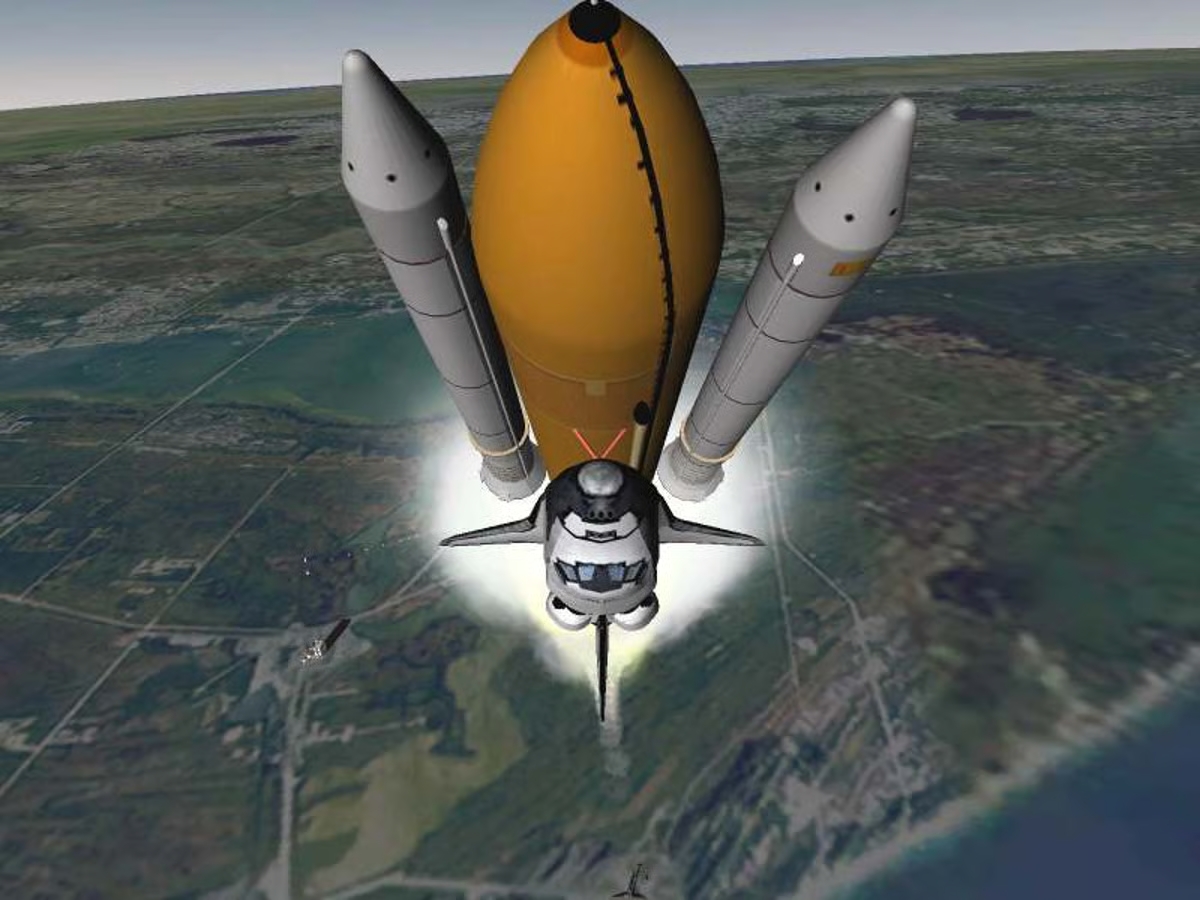
A screenshot from the game Orbiter.
Image source: tvtropes.org
Reentry: An Orbital Simulator, developed by Wilhelmsen Studios, offers a distinctive experience. Players occupy the cockpits of the American Mercury, Gemini, and Apollo spacecraft, which are meticulously recreated down to every switch. Before launch, players must complete an authentic pre-launch checklist. Returning to Earth requires orienting the capsule correctly, with its heat shield facing forward. Even a deviation of a few degrees can cause the spacecraft either to burn up or to bounce off the atmosphere and return to space.
This game effectively illustrates the significant limitations of astronauts’ computing resources in the 1960s. The Apollo onboard computer had approximately 4 KB of RAM, and in Reentry, users can interact with it through the same DSKY keyboard that pilots used to enter commands as “verb–noun” pairs.
Outer Wilds, a space-themed game developed by Mobius Digital, was released in 2019. The game is set within a small star system, where each planet serves as a distinct physics experiment. Twenty-two minutes after the game begins, the local star explodes in a supernova, resetting the world. The player’s primary objective is to uncover the cause of this phenomenon.
All celestial bodies in this system orbit one another, and the player’s spacecraft follows Newton’s laws of motion. It is possible to enter orbit around any planet; when landing on a rapidly moving satellite, the spacecraft must match its velocity, as it would during an actual docking maneuver.
The two planets known as the Hourglass Twins orbit one another so closely that sand flows between them in a dense column. Within 22 minutes, one planet is almost entirely buried by the other. Astronomers observe a comparable phenomenon in close binary star systems, where material from one star escapes beyond the boundaries of its Roche lobe — the region in which its gravity predominates — and flows onto its companion.
Brittle Hollow is gradually disintegrating, with its fragments falling into a black hole at the planet’s center. The comet’s ice begins to melt and evaporate as soon as it approaches the Sun. On the ocean planet Giant’s Deep, tornadoes propel islands into the air, while a core hidden beneath the water’s surface proves difficult to reach. Some of the game’s mechanics are rooted in quantum physics; explaining them would spoil its most compelling moments.
The scale is deliberately modest: the planets are only a few hundred meters in diameter, and the Sun is just a few minutes away by flight. Few games encourage you to think as naturally as an astrophysicist — formulating hypotheses based on observations and testing them experimentally.
“Universe Sandbox” from Giant Army is more accurately described as a simulator; it has neither victories nor defeats. Instead, users can manipulate the Solar System as they wish: double the Sun’s mass, send the Moon crashing into Earth, or add another star to the system. The program calculates the gravitational interactions among all bodies simultaneously — in other words, it solves the same N-body problem that mathematicians have grappled with since Newton’s time.
Experimental results often prove unexpected. If Jupiter were removed, the orbits of the asteroids would gradually change, and some would migrate into the inner Solar System. If the Moon were brought too close to Earth, it would cross the Roche limit (the distance at which tidal forces would tear the moon apart) and disintegrate into a ring of debris. This is likely how Saturn’s rings formed.
The simulator accounts for surface temperature, atmospheric conditions, and the quantities of water and ice. Users can move Earth into Mars’s orbit and observe the oceans freeze, or direct an asteroid comparable in size to the one that caused the extinction of the dinosaurs toward Earth. The developers regularly update the models using scientific data, and this “sandbox” is widely used by astronomy educators.
In Elite Dangerous, released in 2014 by the British company Frontier Developments, players have access to the entire Milky Way. The developers state that the game features 400 billion star systems, most of which have yet to be visited by a player. Pilots engage in combat, trade, and fulfill contracts; however, our primary interest lies in the structure of this galaxy.
The Stellar Forge procedural generator creates stars and planets using models employed by astrophysicists. It accounts for the distribution of matter across different regions of the Galaxy, the abundance of heavy elements, and the relative prevalence of various types of stars. In the vicinity of the Sun, the model incorporates more than 160,000 real stars from astronomical catalogs, including known exoplanets. Consequently, Sirius, Alpha Centauri, and TRAPPIST-1 appear in the game at the same locations they occupy in the sky.
In Elite, the journey to the center of the Galaxy — to the supermassive black hole Sagittarius A* — takes dozens of hours in real time, and players embark on joint expeditions, much like sailors of old. Along the way, they can observe planetary nebulae, neutron stars with jets, and Wolf-Rayet stars. The game also simulates gravitational lensing near black holes. Faster-than-light travel remains fictional; without it, reaching the nearest star would take millennia.
SpaceEngine goes even further by simulating the entire observable universe. Galaxies, stars, and exoplanets from real-world catalogs are supplemented by billions of procedurally generated objects. Within seconds, a player can travel from the surface of Mars to a galaxy cluster and back. The game offers few mechanics. For amateur astronomers, however, it serves as a useful interactive atlas, allowing them to view a familiar star from anywhere in the Galaxy.
Released in 2016, Children of a Dead Earth remains, perhaps, the most realistic space combat simulator to date. Its creator eschewed science-fiction-style technology. Every engine, armor plate, and cannon in the game is characterized by real-world parameters, including specific impulse, material strength, thermal conductivity, and laser beam diffraction.
Combat in this game bears little resemblance to cinematic battles. Ships approach one another in accordance with the laws of orbital mechanics over the course of hours or days, then engage each other from distances of hundreds of kilometers. Hiding in space is virtually impossible: a red-hot engine is detectable in the infrared spectrum from a considerable distance. A laser loses power as its beam diverges, and its effectiveness depends on the mirror’s diameter. A railgun accelerates a projectile to several kilometers per second; however, the process generates so much heat that massive heat sinks are required for sustained firing. Players quickly realize that excess heat is the primary adversary in space.
Terra Invicta by Pavonis Interactive (2022) combines global strategy with a similarly grounded perspective on space. Aliens have already arrived on Earth, and human factions are competing to determine the most effective response. Reaching Mars or the asteroid belt requires waiting for a launch window and calculating the delta-v budget. Propulsion systems advance gradually, from chemical rockets to nuclear and thermonuclear engines, with each new stage significantly reshaping the map of the Solar System. By the end of the campaign, players gain a thorough understanding of why specific impulse is more important than thrust for long-distance flights.
Hello Games’ No Man’s Sky (2016) and Bethesda’s Starfield (2023) frequently appear on lists of space games, despite their lack of scientific accuracy. In No Man’s Sky, the planets within a single system are only a few minutes’ flight apart and appear in the sky as enormous discs. Nearly every planet supports life, and a spacecraft in a vacuum decelerates and turns much like an airplane in the atmosphere.
Starfield’s star map more closely reflects reality: the Sun, Alpha Centauri, Barnard’s Star, and other nearby stars appear in their actual positions. However, the game does not include orbital mechanics. Ships remain stationary in space, and planetary landings are presented through cutscenes. Both games effectively convey a sense of scale and solitude; however, the games discussed in the previous sections are better suited to illustrating the physics of space.
In Mars Horizon, developed by the British studio Auroch Digital in 2020, players lead a national space agency from the launch of its first satellite to the landing of humans on Mars. The game was developed in consultation with the European Space Agency, a collaboration reflected in its finer details. Missions require carefully timed launch windows, rockets have limited payload capacities, and scientific credits for exploring Venus or Jupiter must be earned by deploying actual probes. The game conveys a straightforward and candid message: space exploration involves budgets, compromises, and failed launches far more often than heroic successes.
Plan B: Terraform challenges players to transform a lifeless planet into one capable of sustaining life. Players extract carbon dioxide to strengthen the greenhouse effect, melt ice, seed the surface with microorganisms, and subsequently introduce plants, which gradually increase the atmospheric oxygen levels. This sequence closely reflects terraforming scenarios for Mars that scientists have discussed for several decades. In the game, the process takes only a few hours; on Mars itself, it would take centuries.
The Planet Crafter, developed by the French studio Miju Games and released in its full version in 2024, portrays terraforming from the perspective of a single individual. The player arrives on a cold, airless planet similar to Mars and must make it habitable. Progress is measured by a terraforming index comprising temperature, atmospheric pressure, oxygen levels, and biomass. Heaters increase the temperature, drills release gases from beneath the planet’s surface, and, over time, lakes, moss, trees, and insects emerge.
The physics of the process is greatly simplified here. Mars’ atmosphere weighs approximately 25 trillion metric tons, and achieving Earth-like pressure would require expanding it by a factor of approximately 150. In the game, this is accomplished by several dozen machines over the course of dozens of hours. The sequence of stages is accurately represented: heat and pressure are required first, as water would not remain liquid on the surface without them; oxygen is then produced by plants, and only afterward do more complex forms of life emerge.
The number of space-themed games is increasing each year, and developers are increasingly consulting astronomers and engineers. Teenagers are now designing Hohmann transfer orbits in games, and some later pursue careers with space companies. Perhaps one of the people who first sent a Kerbal into orbit will someday calculate the trajectory for an actual mission to Mars.
An anomalous chemical signature detected in the interstellar comet 3I/ATLAS

Artist’s illustration of comet 3I/ATLAS. On the side facing the Sun, methanol is shown in blue, while icy dust particles remain present in the gas. On the comet’s dark side, hydrogen cyanide is shown in orange.
Credit: NSF/AUI/NSF NRAO/M. Weiss
Interstellar comets form in disks of gas and dust around other stars before leaving their home systems and wandering through the Galaxy. Unlike local comets, which follow closed orbits around the Sun, interstellar travelers pass us only once before disappearing forever. The age of 3I/ATLAS dates back to the dawn of the Universe, making it a unique “time capsule.”
An international team led by the Southwest Research Institute (SwRI) used James Webb’s NIRSpec spectrograph for three observing sessions between August 2025 and April 2026. As the Sun warmed the comet, it released gas that carried dust and icy grains into its coma.

The upper image shows interstellar comet 3I/ATLAS, photographed with the MIRI instrument on NASA’s James Webb Space Telescope, along with contours illustrating the distribution of different gases at the time of observation. Water vapor extends far beyond the nucleus because much of it is released from icy grains in the coma, while carbon dioxide and methane are most concentrated near the comet’s nucleus. The lower image shows the spectrum, with labels identifying features of the various gases that the telescope detected escaping from the comet.
Source: NASA, ESA, CSA, STScI
By splitting the comet’s light into a spectrum, scientists expected to see the standard signature of water ice: characteristic absorption bands at 1.5, 2.0, and 3 microns. But 3I/ATLAS surprised them: the bands at 1.5 and 2.0 microns were barely visible. Computer modeling showed that the comet consists of microscopic ice grains approximately 1 micron across or smaller, heavily mixed with dust. In such tiny particles, light penetrates only a short distance into the ice, suppressing the shorter-wavelength absorption bands.
The properties of the released dust changed as the comet traveled. As 3I/ATLAS moved away from the Sun in April 2026, James Webb detected the appearance of larger icy particles. This could have resulted either from uneven solar heating or from deeper layers being exposed as the surface vaporized.

The biggest surprise was the spectral similarity between 3I/ATLAS and trans-Neptunian objects—icy bodies orbiting in the distant outskirts of our Solar System, beyond Neptune’s orbit. These distant worlds are considered remnants of primordial mate
The findings suggest that the building blocks of planets, known as planetesimals, around other stars have physical properties very similar to those in our own system. Water ice in protoplanetary disks throughout the Universe initially forms as microscopic grains containing varying amounts of dust. These original characteristics remain preserved in icy bodies for billions of years.
Further observations with the James Webb Space Telescope will help astronomers determine whether 3I/ATLAS is a rare exception or a typical representative of comets in our Galaxy.
RELATED
Cattle Mutilations; Strange Deaths 1970s-1980s, Investigations, & Extraterrestrial Involvement?

During the 1970s, a bizarre phenomenon spread across ranching regions of the American West and Midwest: cattle and other livestock were being found dead with portions of their bodies apparently removed. Some carcasses appeared to have their eyes, tongues, ears, udders, reproductive organs, rectums, or sections of the hide missing. In some cases, ranchers reported little blood around the carcass, few obvious tracks, and wounds that appeared unusually clean.
The incidents became known as cattle mutilations, and they eventually became one of the most enduring mysteries associated with UFOs and alleged extraterrestrial activity. The subject remains controversial. There is good evidence that large numbers of cattle really were found dead and in unusual condition.
There is not, however, conclusive scientific evidence that extraterrestrials caused those deaths. Investigators have proposed everything from predators and insects to deliberate human activity—and, at the far end of the spectrum, extraterrestrial biological experimentation. Although reports of mysteriously injured or dead livestock existed before the 1970s, the phenomenon became a major national story during the mid-1970s. Colorado became one of the principal centers of the controversy.
In 1975, reports of nearly 200 cattle mutilations between April and October were made in Colorado. The story became sufficiently prominent that Colorado Senator Floyd Haskell asked the FBI to become involved. Reports subsequently appeared throughout New Mexico, Kansas, Nebraska, Wyoming, Montana, South Dakota, Oklahoma, Texas and other areas.
Ranchers often described remarkably similar discoveries: A cow found dead in an isolated pasture. One or both eyes missing. The tongue apparently removed. Portions of the lips or jaw missing. The reproductive organs or udder damaged or removed. The rectal area apparently removed. Patches of hide missing. Little obvious blood. Few or no human footprints around the animal. No obvious indication of a struggle. In some reports, the carcass appeared to have been disturbed very little despite the supposedly extensive injuries. To ranchers accustomed to seeing animals die from disease, injury, weather, predators, and old age, some of these scenes seemed profoundly unusual.
One reason the phenomenon became so mysterious was the appearance of certain wounds. Some ranchers believed the edges of the missing tissue looked too smooth to have been produced by coyotes, wolves or other predators. Others reported what appeared to be circular or extremely precise cuts. There were also claims that certain carcasses appeared to have been completely drained of blood. These observations became central to the extraterrestrial theory.
However, an important distinction must be made: what a carcass looks like several days after death does not necessarily reveal how the animal died. As the body dries, the hide contracts. Soft tissues decompose at different rates, and insects, birds and mammals preferentially consume exposed or easily accessible tissues. The resulting damage can sometimes look surprisingly clean or surgical.
A 1989 study published in the Canadian Veterinary Journal specifically examined alleged cattle mutilations and compared reported mutilation patterns with known scavenging behavior. The researchers concluded that the Alberta cases they studied were consistent with postmortem scavenging and emphasized that scavenging must be excluded before human involvement is proposed.
Why Were the Eyes, Tongues and Genitals So Often Missing? This is one of the most interesting aspects of the mystery. Those areas are composed partly of relatively soft tissue and are attractive to scavengers. Flies and their larvae, birds, coyotes and other animals can concentrate on the eyes, mouth, anus and reproductive areas after an animal dies.
There is another important phenomenon: dehydration and shrinkage. The hide surrounding an opening can contract as the carcass dries. The resulting separation between skin and underlying tissue can produce edges that look remarkably sharp. Thus, an animal that died naturally might initially have had no unusual wound whatsoever, yet several days later its corpse could appear to have been surgically altered. This explanation doesn’t necessarily account for every historical case, but it provides a scientifically documented explanation for at least some alleged mutilations.
The cattle-mutilation controversy eventually reached the federal government. The FBI’s own records confirm that during the mid-1970s reports of livestock mutilations were causing considerable concern. The Bureau notes that it was asked to investigate, although its jurisdiction was limited, particularly to cases involving Indian lands. The FBI’s released files contain correspondence, press reports and other material concerning the phenomenon from roughly 1974–1978.

The FBI’s involvement helped give the mystery an aura of official significance. To many people, the reasoning was simple: If the FBI was investigating cattle mutilations, perhaps there really was something extraordinary happening. But an FBI investigation does not establish an extraterrestrial explanation. The Bureau was responding to reports and allegations, not confirming their cause.
The controversy continued into the late 1970s. New Mexico became particularly important because cattle mutilations were being reported in remote areas, including areas involving Native American lands. In 1979, an investigation into reported mutilations on New Mexico Indian lands received FBI attention. The federal investigation ultimately did not find evidence establishing an exotic cause. Contemporary accounts of the FBI investigation report that the Bureau concluded the examined cases appeared consistent with ordinary predators rather than an unknown mutilating force.
At approximately the same time, however, some local investigators and ranchers remained convinced that something more unusual was occurring. This disagreement became a defining feature of the entire mystery. One of the most important investigations was conducted by Kenneth M. Rommel Jr., a former FBI agent who investigated New Mexico cattle-mutilation reports. Rommel’s work ultimately supported conventional explanations involving predators and scavengers acting upon animals that had generally died naturally. This conclusion was profoundly unsatisfying to people who had personally discovered the carcasses.
A rancher might look at a dead cow and say: “I’ve seen coyotes eat cattle before. This doesn’t look like that.” That testimony is important historically because it demonstrates why the mystery persisted even after official investigations offered conventional explanations.
The biggest belief in extraterrestrials responsible comes from a hoax story perpetrated by a certain Alexander Hamilton, a rancher and a former state legislator who fictitious story was published in a newspaper called “The Yates Center Farmer’s Advocate” in Kansas on April 23, 1897, during a time when much of America claimed to see strange airships. Mister Hamilton claimed he, his son, and a hired hand at night were awakened by his barking dogs to observe a massive 300 foot long cigar shaped airship “mystery airship” with a well lit glass carriage that had 6 people inside speaking a gibberish foreign language. Then, a red cable was dropped which lassoed a heifer. Hamilton and the other men tried to cut the cable with axes but to no avail. A loud turbine on the craft was activated and the ship carried the young cow away into the sky. Hamilton claimed the cow’s butchered remains were found the4next day in an adjacent field of a neighboring farmer.
Alex Hamilton had a reputation as a prankster with a gruesome sense of humor. He invented the fable to win T^he Yuma Township’s Liars Club contest for the best sensational; outlandish lie. That club disbanded shortly after the article’s publication. The newspaper’s original editor, Ed F. Hudson admitted in a letter the4 article was a deliberate hoax. (And such hoaxes sold lots and lots of newspapers, of course.)
The extraterrestrial interpretation developed; evolved from several observations and coincidences. During the 1970s, America was experiencing enormous public interest in UFOs. The subject had already been popularized by decades of UFO reports, military investigations and books about flying saucers. When mysterious cattle deaths began receiving national publicity, some investigators naturally asked: “Could UFOs be responsible?”
The theory proposed that extraterrestrial visitors might be using cattle for biological research. According to different versions of the hypothesis, aliens supposedly removed specific tissues to: Study bovine biology. Examine blood. Obtain genetic material. Test terrestrial diseases. Study reproductive organs. Analyze digestive systems. Monitor environmental contaminants.
Conduct biological experiments. Investigate Earth’s food animals.
Some theories proposed that cattle were being temporarily abducted, examined aboard UFOs and then returned to Earth. Others suggested that extraterrestrials were killing the animals directly on the ground. But, there has never been scientifically verified evidence demonstrating that such activities occurred.
One of the most dramatic claims concerned blood. Witnesses sometimes said that a mutilated cow had been completely drained of blood, seemingly without leaving a pool of blood on the ground. This became one of the strongest arguments for an extraordinary explanation. But forensic and veterinary considerations complicate this observation. After death, blood does not necessarily remain where a person expects to see it. It can settle internally through gravity, undergo clotting and decomposition, and be consumed or altered by insects and microorganisms. Furthermore, a carcass lying in the field for days can look dramatically different from a freshly killed animal. Consequently, the absence of a large pool of blood does not by itself demonstrate that an animal was somehow drained by an extraterrestrial device.
The Strange Reports of Helicopters. Another recurring element of the cattle-mutilation mythology involved unidentified helicopters. During the 1970s, ranchers sometimes reported seeing helicopters near areas where mutilated cattle were later discovered. This produced another theory: perhaps mysterious government or military helicopters were secretly collecting biological samples. The story became particularly attractive because the United States was in the midst of the Cold War, when secret military programs and classified experiments were very real.

Some researchers therefore proposed that cattle mutilations might have been associated with secret government biological or chemical experiments rather than extraterrestrials. Again, no conclusive evidence established that cattle mutilations were part of a secret nationwide military program. The Government-Experiment Theory. The government explanation became a kind of halfway point between conventional explanations and extraterrestrials.
Some theories proposed that cattle were being used to monitor: Radiation. Chemical contamination. Biological warfare agents. Environmental pollutants. New diseases. Agricultural experiments. The idea was attractive because cattle are excellent biological indicators of environmental conditions. But the theory encountered the same basic problem as the extraterrestrial explanation: there was no convincing chain of physical evidence connecting the carcasses to such programs.
Another possibility was that some mutilations were deliberate acts by people. Possible motives suggested over the years included: Pranks. Criminal acts. Satanic or occult activity. Sexual violence toward animals. Scientific experimentation. Hoaxes. Attempts to conceal ordinary livestock deaths. The difficulty with this explanation is that the reported incidents varied greatly. Some could conceivably have resulted from human activity, while others may simply have been natural deaths followed by scavenging. It is therefore probably a mistake to assume that every reported mutilation had one single cause.
Newspaper stories about mysterious cattle quickly became part of the larger UFO and paranormal culture. The controversy did not simply disappear when the major investigations ended. During the 1980s, books, magazines, television programs and UFO researchers continued discussing cattle mutilations. The subject became closely associated with the broader UFO phenomenon. Later stories about mysterious livestock deaths also helped preserve the legend.
By then, cattle mutilations had become a classic component of UFO folklore alongside: Alien abductions. Crop circles. UFO crashes. Secret government facilities. Missing-time experiences.
Strange lights in the sky. Alleged underground alien bases.
The Most Important Question: Did Extraterrestrials Really Do It? This is where the historical evidence and the legend separate. There is strong evidence that people really did discover dead cattle in unusual conditions. There is also strong evidence that at least some apparent mutilations can be explained through decomposition, insects, birds and terrestrial scavengers. The 1989 veterinary study is particularly important because it experimentally and observationally addressed how cattle carcasses can acquire mutilation-like characteristics. But there is no scientifically confirmed evidence that extraterrestrials caused cattle mutilations.
No alien spacecraft has been recovered in connection with a cattle case. No extraterrestrial instrument has been conclusively identified. No verified extraterrestrial biological material has been demonstrated. No controlled investigation has established an extraterrestrial mechanism for removing the tissues. And no reliable chain of physical evidence has connected a particular mutilated cow to a UFO. That does not mean every historical case has been perfectly explained. It means that “unexplained” and “extraterrestrial” are not the same thing.
Cattle mutilations remain fascinating because they occupy an unusual territory between established facts and unresolved questions. The established facts include the existence of numerous reports, the discovery of genuinely dead and damaged livestock, and extensive concern among ranchers and investigators. The FBI’s own archives document how widespread the controversy became during the 1970s. The unresolved part concerns individual cases in which investigators could not determine exactly what happened.
That uncertainty created an enormous space for speculation. For UFO believers, cattle mutilations became possible evidence of extraterrestrial biological experimentation. But even in alleged cases of human abduction from extraterrestrials who have been returned; the humans were not subject horrible mutilations and were returned whole, living, and generally in good health. For skeptics, they became an example of how ordinary biological processes can appear extraordinarily mysterious when viewed after the fact.
For many ranchers, however, the issue was much more personal: they had found their animals dead in their own fields, sometimes under circumstances that they found impossible to explain. But, very highly knowledgeable people of various studies, some of science, some controversial, did offer their explanations, even, at least, at times as their own personal theories which may or may not be correct.
The cattle-mutilation phenomenon of the 1970s and 1980s therefore has two histories. One is the physical history of dead livestock, decomposition, scavengers, investigations and disputed forensic observations, which the available evidence strongly supports. The other is the cultural history of UFOs, extraterrestrials, government secrecy and the belief that something intelligent and unknown might have been visiting rural America, which requires very strong evidence.
RELATED
Dems gearing up to seize UFO disclosure issue from GOP after midterms
Democrats are preparing to seize the UFO disclosure issue from the Republicans and the Trump administration, accusing them of dragging their feet on promises of transparency, according to one House leader.
The Dems are gearing up to form their own UFO caucus and select committee to supplant the Task Force on the Declassification of Federal Secrets led by Florida Republican Anna Paulina Luna — if they take control of the House after the midterms, insiders told The Post.
Rep. Andre Carson (D-Ind.), who chaired the first congressional hearing in 2022 on UFOs, has long pushed to bring the subject into the mainstream on Capitol Hill.

Rep. Andre Carson (D-Ind.) claimed the Trump administration is holding back critical information on the subject of UFO disclosure.
Mattie Neretin – CNP
“Unfortunately, the current administration has not been fully transparent on UAP and has slow walked several of the statutory requirements Congress established for UAP disclosure,” Carson said in a statement to The Post.
Carson said the report could shed light on decades of government investigations into UFO sightings — including whether classified programs were kept from Congress.
“I’m calling for the immediate release of this report, which is expected to provide additional findings of historical military and intelligence investigations of UAP, including how incidents were investigated, the role of classified programs, and whether relevant activities were appropriately disclosed to Congress,” the statement concluded.

A digital rendering prepared by the FBI in 2026 depicts a reported incident potentially involving an unidentified anomalous phenomenon near Colorado Springs.
U.S. Department of War
Carson’s office did not clarify what specific file they were referring to, which statutory deadline had been missed or where it is being held.
Republican insiders are worried that the Democrats could eclipse what could be a defining achievement of the Trump administration by taking ownership of the disclosure issue.
UFO whistleblower David Grusch has warned that the Trump administration needs to act fast if it wants to secure complete disclosure.
“It has to happen before Trump leaves because I just don’t trust another president to follow through on the president’s directive,” Grusch told podcaster Joe Rogan in a Sept. 30 appearance.
Rep. Luna did not respond to a request for comment.
'Black triangle' UFOs swarm British skies as they're seen gliding over housing estates
BY Nadeem Badshah and Richard Ault

UFOs have been seen over the UK
(Image: Getty Images/iStockphoto)
Manchester is the latest city to be hit by a UFO epidemic that’s gripping the UK, experts have said. Mystery “black triangles” are haunting our skies with nearly 2,000 sightings logged in the past five years by UFO Identified researchers.
They include 164 reports of the strange wedge-shaped objects, silently gliding over housing estates and farmland before zooming off at incredible speeds.
In the most recent report on July 22, witnesses spotted a “large black triangle” boasting a red light hovering over Stretford in Greater Manchester for more than 30 minutes.
Ash Ellis, founder of UFO Identified, said: “There are thousands of people across the UK who have seen something they could not readily explain, but the reports are often difficult to find once initial interest has passed.”

Manchester is the latest city impacted(Image:
Getty Images/iStockphoto)
Earlier this year, a “perfect triangle” was seen speeding across the sky above Chesterfield, Derbyshire.
Other spooky incidents include a “black V-shaped boomerang” spotted over the Fylde coast in Lancashire and a soundless black wedge above Exmouth, Devon.
Orbs, spheres and “star-like” sightings make up the bulk of British sightings, researchers said.
It comes after Pentagon chiefs in the US recently unveiled their latest release of declassified UFO files.
According to the report, a black triangular object hovered silently 300 feet in the air before whisking away into a canyon at high speed without leaving a trail.
Elsewhere, ex-US president Barack Obama has said the chances Earth has been visited by aliens is "low".
He said: "They're real but I haven't seen them.
"They're not being kept in Area 51. There's no underground facility unless there's this enormous conspiracy and they hid it from the president of the United States."