Ontdek de Fascinerende Wereld van UFO's en UAP's: Jouw Bron voor Onthullende Informatie!
Ben jij ook gefascineerd door het onbekende? Wil je meer weten over UFO's en UAP's, niet alleen in België, maar over de hele wereld? Dan ben je op de juiste plek!
België: Het Kloppend Hart van UFO-onderzoek
In België is BUFON (Belgisch UFO-Netwerk) dé autoriteit op het gebied van UFO-onderzoek. Voor betrouwbare en objectieve informatie over deze intrigerende fenomenen, bezoek je zeker onze Facebook-pagina en deze blog. Maar dat is nog niet alles! Ontdek ook het Belgisch UFO-meldpunt en Caelestia, twee organisaties die diepgaand onderzoek verrichten, al zijn ze soms kritisch of sceptisch.
Nederland: Een Schat aan Informatie
Voor onze Nederlandse buren is er de schitterende website www.ufowijzer.nl, beheerd door Paul Harmans. Deze site biedt een schat aan informatie en artikelen die je niet wilt missen!
Internationaal: MUFON - De Wereldwijde Autoriteit
Neem ook een kijkje bij MUFON (Mutual UFO Network Inc.), een gerenommeerde Amerikaanse UFO-vereniging met afdelingen in de VS en wereldwijd. MUFON is toegewijd aan de wetenschappelijke en analytische studie van het UFO-fenomeen, en hun maandelijkse tijdschrift, The MUFON UFO-Journal, is een must-read voor elke UFO-enthousiasteling. Bezoek hun website op www.mufon.com voor meer informatie.
Samenwerking en Toekomstvisie
Sinds 1 februari 2020 is Pieter niet alleen ex-president van BUFON, maar ook de voormalige nationale directeur van MUFON in Vlaanderen en Nederland. Dit creëert een sterke samenwerking met de Franse MUFON Reseau MUFON/EUROP, wat ons in staat stelt om nog meer waardevolle inzichten te delen.
Let op: Nepprofielen en Nieuwe Groeperingen
Pas op voor een nieuwe groepering die zich ook BUFON noemt, maar geen enkele connectie heeft met onze gevestigde organisatie. Hoewel zij de naam geregistreerd hebben, kunnen ze het rijke verleden en de expertise van onze groep niet evenaren. We wensen hen veel succes, maar we blijven de autoriteit in UFO-onderzoek!
Blijf Op De Hoogte!
Wil jij de laatste nieuwtjes over UFO's, ruimtevaart, archeologie, en meer? Volg ons dan en duik samen met ons in de fascinerende wereld van het onbekende! Sluit je aan bij de gemeenschap van nieuwsgierige geesten die net als jij verlangen naar antwoorden en avonturen in de sterren!
Heb je vragen of wil je meer weten? Aarzel dan niet om contact met ons op te nemen! Samen ontrafelen we het mysterie van de lucht en daarbuiten.
Berichten van 1 december 2017 tot 31 december 2017
An expert on the intersection of science and philosophy posits that our current transition to "postbiological" life could have already been undertaken by extraterrestrial species.
She warns that these alien lifeforms could by artificially intelligent, in which case they could pose a tremendous threat to life on Earth.
POSTBIOLOGICAL LIFE
Susan Schneider is a fellow at the Institute for Ethics and Emerging Technologies (IEET). She is also an associate professor of philosophy at the University of Connecticut, and her expertise includes the philosophy of cognitive science, particularly with regards to the plausibility of computational theories of mind and theoretical issues in artificial intelligence (AI).
In short, Schneider has a keen understanding of the intersection between science and philosophy. As such, she also has a unique perspective on AI, offering a fresh (but quite alarming) view on how artificial intelligence could forever alter humanity’s existence. In an article published by the IEET, she shares that perspective, talking about potential flaws in the way we view AI and suggesting a possible connection between AI and extraterrestrial life.
Credits: HBO
The bridge Schneider uses to make this connection is the idea of a “postbiological” life. In the article she explains that postbiological refers to either the eventual form of existence humanity will take or the AI-emergent lifeforms that would replace our existence altogether. In other words, it could be something like superintelligent humans enhanced through biological nanotechnology or it could be an artificially intelligent supercomputer.
Whatever form postbiological life takes, Schneider posits that the transition we’re currently experiencing is one that may have happened previously on other planets:
The technological developments we are witnessing today may have all happened before, elsewhere in the universe. The transition from biological to synthetic intelligence may be a general pattern, instantiated over and over, throughout the cosmos. The universe’s greatest intelligences may be postbiological, having grown out of civilizations that were once biological.
In light of that, Schneider asks the following: “Suppose that intelligent life out there is postbiological. What should we make of this?”
Credits: Warner Bros.
EXTRATERRESTRIAL, POSTBIOLOGICAL AI
There isn’t any guarantee that we can “control” AI on Earth when it becomes superintelligent, even with multi-million-dollar efforts devoted to AI safety. “Some of the finest minds in computer science are working on this problem,” Schneider writes. “They will hopefully create safe systems, but many worry that the control problem is insurmountable.”
If artificially intelligent postbiological life exists elsewhere in our universe, it’s a major cause of concern for a number of reasons. “[Postbiological extraterrestrial life] may have goals that conflict with those of biological life, have at its disposal vastly superior intellectual abilities, and be far more durable than biological life,” Schneider argues. These lifeforms also might not place the same value on biological intelligence that we do, and they may not even be conscious in the same manner that we are.
Schneider makes the comparison between how we feel killing a chimp versus eating an apple. Both are technically living organisms, but because we have consciousness, we place a higher value on other species that have it as well. If superintelligent, postbiological extraterrestrials don’t have consciousness, can we expect them to understand us? Even more importantly, would they value us at all? Food for thought for any proponents of active SETI.
Stanton Friedman weighs in on Pentagon's Secret UFO Search, with Kathleen Marden, 12-27-17
Stan Friedman with Kathleen Marden weigh in on the Pentagon's Secret UFO Search. Stan mentions he is pleased with Tom DeLonge's efforts and the team of high profile people on the To The Stars Academy board. Kathy mentions how important Luis Elizondo, Chris Mellon and Dr. Hal Puthoff among others are to the board as well. Stan: "It's a new ballgame for UFOlogy!" https://podcastufo.com/ In hour two, along with replying to caller's questions, they discuss the Betty & Barney Hill case including some never mentioned before family dynamics when they decided to go public.
Bio: Nuclear Physicist-Lecturer Stanton T. Friedman received his BSc. and MSc. Degrees in physics from the University of Chicago in 1955 and 1956. He was employed for 14 years as a nuclear physicist by such companies as GE, GM, Westinghouse, TRW Systems, Aerojet General Nucleonics, and McDonnell Douglas working in such highly advanced, classified, eventually cancelled programs as nuclear aircraft, fission and fusion rockets, and various compact nuclear powerplants for space and terrestrial applications.
He became interested in UFOs in 1958, and since 1967 has lectured about them at more than 600 colleges and 100 professional groups in 50 U.S. states, 10 Canadian provinces and 18 other countries in addition to various nuclear consulting efforts. He has published more than 90 UFO papers and has appeared on hundreds of radio and TV programs including on Larry King in 2007 and twice in 2008, and many documentaries. He is the original civilian investigator of the Roswell Incident and co-authored Crash at Corona: The Definitive Study of the Roswell Incident.
Bio: Kathleen Marden is a leading researcher of contact with nonhuman intelligence, an author, and lecturer. Her educational background in the social sciences has shaped her interest in scientific ufology. Extensive research and investigation into alien abduction has convinced her that some abductions are real.
She earned a B.A. degree in social work from the University of New Hampshire and participated in graduate studies in education while working as a teacher and education services coordinator. Her scholarship led to acceptance into the Alpha Kappa Delta sociology honor society. During her fifteen years as an educator, she innovated, designed and implemented model educational programs. She also held a supervisory position, coordinating, training and evaluating education staff.
Her interest in UFOs dates back to September 20, 1961, when her aunt, Betty Hill, phoned her childhood home to report that she and Barney had encountered a flying saucer in New Hampshire’s White Mountains. A primary witness to the evidence of the UFO encounter and the aftermath, Kathleen has intimate knowledge of the Hill’s biographical histories, investigation files, and scientific interest in their sensational experience. This led to a journey of exploration, leaving no stone unturned, to find answers through scholarly work, investigation and social research. She is recognized as the world’s leading expert on the Betty and Barney Hill abduction.
Here are 7 of the most-viewed news and feature stories of this past year.
1. Scientists reveal secrets of lost continent Zealandia.
In February, scientists were discussing whether a submerged realm called Zealandia should be recognized as a full-fledged Earth continent. In October, a team of researchers returned from an expedition to Zealandia and reported their results.
A rainbow seen from the research ship JOIDES Resolution, during the Zealandia expedition.
Image by Tim Fulton via International Ocean Discovery Program/ JRSO/ NSF.
2. Close shave from an undetected asteroid.
Whoosh! Astronomers discovered a small asteroid – now designated as asteroid 2017 OO1 – on July 23. That was 3 days after it passed 1/3 the moon’s distance from Earth. More.
Artist’s concept of an asteroid passing near Earth.
3. When’s the next U.S. total solar eclipse?
After 2017’s awesome total solar eclipse on August 21, the next total solar eclipse visible from North America will be April 8, 2024. More.
4. Biblical signs in the sky on September 23, 2017?
A mirror in the sky to “signs” from the Bible’s Book of Revelation? Possibly. But this same sky scene has been seen 4 other times in the past 1,000 years. An astronomer explains.
Green arrows show the “9” stars of Leo.Blue arrows show the planets Mercury, Venus, and Mars. Red arrow is Jupiter. Violet arrow is the moon (shown enlarged). The sun is at Virgo’s shoulder.
This asteroid-comet hybrid was closest to Earth December 16. Its presence near Earth may be why the Geminid meteors put on a good show in 2017. Info and images of the rock-comet here.
6. History of global temperature 1880-2016.
Take 14 seconds to watch the change in Earth’s surface temperature from 1880 through 2016. More.
7. And, lastly, the ever-popular … Betelgeuse will explode someday.
Someday, the star Betelgeuse will run out of fuel, collapse under its own weight, and then rebound in a spectacular supernova explosion. Someday … but probably not soon. More.
Betelgeuse imaged in ultraviolet light by the Hubble Space Telescope and subsequently enhanced by NASA. The bright white spot is likely one of this star’s poles.
Image via NASA/ESA.
Bottom line: EarthSky’s 7 most-viewed news and feature stories of 2017. Happy new year to our readers, and thank you for visiting EarthSky!
EarthSky sends out a year’s worth of thank yous to our friends from around the world who shared images with us throughout the year. Please keep sharing in 2018!
Here are the most popular photo galleries from 2017:
1. Moon sweeps past Venus and Mars.
As 2017 opened, the young moon swept past dazzling Venus in the west after sunset. Mars was there, too, and, for those with optical aid, Neptune! Go to gallery.
As seen from the Northern Hemisphere, the moon, Venus and Mars arced up and to the left of the sunset Sunday evening, January 1, 2017.
Photo by Gowrishankar Lakshminarayanan Parsippany, New Jersey. More photos here.
2. February 10-11 lunar eclipse.
A penumbral eclipse is subtle, but has a quiet beauty all its own. Go to gallery.
February 10, 2017 full moon rising over northeast Oklahoma, with a tinge of Earth’s penumbral shadow visible.
Wonderful photos of the moon and Jupiter on June 3, 2017, from around the world. Go to gallery.
Moon and Jupiter on June 3, 2017 from Deirdre Horan in Dublin, Ireland. More photos.
4. Summer full moon.
EarthSky friends are moon-lovers! Favorite photos of the July 2017 full moon from EarthSky friends around the world. Go to gallery.
John Ashley at Glacier National Park, Montana, wrote: “The July 2017 full moon rises over Mount Saint Nicholas on its way into a warm summer dusk. Video on my FB page at JohnAshleyFineArt. More photos. ”
5. Total solar eclipse.
We received many more wonderful photos of the August 21 eclipse than for any prior event. Go to gallery.
Sue Waddell contributed this eclipse composite from Eastview, Kentucky, where there was a 98.3% eclipse.More photos.
6. Orionid meteor shower.
October’s Orionid meteor shower didn’t disappoint. Go to gallery.
Composite image of meteors seen on the morning of October 21, 2017 from Simon Lee Waldram of Fuerteshoot in Spain. More photos.
7. A grand year for the Geminids.
December’s Geminid meteor shower was thought to have a better-than-average chance of producing a rich display, since the Geminids’ parent body – a strange rock-comet called 3200 Phaethon – is nearby. And so it was! Go to gallery.
“The Geminids are good,” reported veteran meteor observer Eliot Herman in Tucson, Arizona, who captured this fireball on the morning of December 14 around 4 a.m. More photos.
Bottom line: Favorite Earthsky photo galleries of 2017.
Science fiction has taught us to expect our first contact with alien life to be a momentous event, with radio signals from another civilization filling our airwaves and perhaps even the arrival of an alien spaceship or two. Reality is somewhat less exciting, and scientists have long expected our first discovery of extraterrestrial life to be on the microscopic scale. Now, the Russian space agency claims they may have stumbled upon just that, and it may have been hiding under our noses the entire time.
Russian cosmonauts have reportedly discovered tiny bacteria on a swab collected from outside the International Space Station, and they’re confident that the organisms didn’t originate on our planet. If the discovery can be confirmed, it would be the very first concrete evidence of extraterrestrial life. That’s a pretty big deal.
The swabs, which were collected years ago but seemingly overlooked, contained living bacteria which may have come from outer space. “Somehow these swabs reveal bacteria that were absent during the launch of the ISS module,” Russian cosmonaut Anton Shkaplerov explains. “That is, they have come from outer space and settled along the external surface. They are being studied so far and it seems that they pose no danger.”
Along with the purported alien bacteria, other bacteria thought to have originated on Earth was also found on the swabs. Surviving in the vacuum of space is no easy feat, and intense temperature fluctuations failed to kill the bacteria over the course of three years, which is mighty impressive. It’s unclear exactly how the researchers were able to differentiate between terrestrial bacteria and the alien bacteria that appeared within the same samples.
The bacteria was brought back to Earth on the swabs and is now being studied, though the Russian space agency says it shouldn’t be considered dangerous. The group apparently didn’t actually know the bacteria was present on the swab samples until it was returned to Earth for closer examination.
There will surely be plenty of scientific interest and certainly debate over where the bacteria originated, but if you’ve seen sci-fi movies you already know that the bacteria will become sentient and lead to the total destruction of the Earth within a few weeks anyway, so get your affairs in order.
MIT Astronomer's 'Zoo Theory' Explains Why Aliens Have Not Made Contact With Earth
It may be an old theory that was first proposed almost 45 years ago. But with SpaceX’s recent rocket launch sending many Los Angeles residents into a frenzy due to what they thought was a UFO sighting, and reports claiming that the U.S. government was secretly involved for years in the study of such phenomena, the so-called “Zoo Theory” is again making headlines for its unusual explanation as to why there has yet to be a confirmed UFO or alien sighting to this day.
The Zoo Theory was first proposed in 1973, when Massachusetts Institute of Technology radio astronomer John A. Ball wrote that aliens behave in a similar way to zookeepers, avoiding actual contact with humans to allow them to function normally and perform their everyday tasks. As Newsweek explained, the theory suggests that aliens are quietly watching us behind the scenes, but not interfering with the evolution of humanity because we are “too unevolved and uncivilized” to pose a significant threat or distraction to extraterrestrial beings.
In a 2016 article, Science Alert opined that the Zoo Theory is plausible, as there is a chance that life on other planets, if it does exist, evolved at a much faster pace than life evolved on Earth. That could lead to some interesting hypotheses about how these highly-evolved, possibly older civilizations could be much more technologically advanced than humanity currently is.
“An OC [other civilization] that is, say, a century younger than we are might not be able to communicate over interstellar distances; a century ago we couldn’t,” Ball wrote.
“And an OC a millennium older than we are would probably be using a technology for interstellar communications, such as modulated gamma rays, that we humans haven’t yet learned how to do.”
As further noted by Newsweek, the Zoo Theory is just one of many that explain why we have yet to confirm alien life on other planets, though other theories are leaning toward the possibility of non-intelligent life, as opposed to extraterrestrial beings that boast of advanced technology. Scientists have been exploring worlds such as Saturn’s moon Enceladus, in hopes of confirming whether the necessary ingredients of life are present. But while there could be a chance Enceladus, which is notable for its subsurface ocean, is habitable, experts believe that the moon might only be able to support microbial forms of life.
Despite the best efforts of scientists to confirm the existence of extraterrestrial life, recent efforts have not come anywhere close to proving that we aren’t the only form of intelligent life in the universe. Last month, a team of scientists conducted the first extensive search for radio signals from alien life, only to come up empty due to a lack of signals from distances of 50 parsecs (963 trillion miles) from Earth in all directions. According to Cosmos, the researchers concluded that the chances of signals from high-duty-cycle radio transmitters ever being detected within that 50-parsec distance are less than 0.1 percent.
Even with the Zoo Theory in place, as well as the continued lack of evidence to support the belief that other planets can support alien life, whether intelligent or non-intelligent, some researchers are still confident in the possibility of confirming extraterrestrial life in the foreseeable future. Earlier this year, Search for Extraterrestrial Intelligence (SETI) Institute senior astronomer Seth Shostak spoke to Futurism, quipping that he “bet everybody a cup of coffee” that scientists will be able to confirm intelligent alien life within the next 20 years.
Topgeheim materiaal uit UFO’s moet openbaar. Deze ufoloog voert de druk op de overheid op
Ufoloog Anthony Bragalia probeert te achterhalen wat voor soort metaal de Amerikaanse overheid uit UFO’s heeft gehaald.
Het materiaal zou opgeslagen liggen op het terrein van miljardair Robert Bigelow in Las Vegas.
Bragalia heeft een Wob-verzoek ingediend over het metaal en eist dat bepaalde documenten hierover openbaar worden gemaakt.
Hij is naar eigen zeggen bereid de Amerikaanse overheid voor de rechter te slepen als hij de informatie niet krijgt.
Grote sommen geld
De New York Times schreef eerder deze maand dat het Amerikaanse ministerie van Defensie in het geheim onderzoek deed naar UFO’s. Het ministerie bevestigde het bestaan van dit project.
De krant meldde ook dat tijdens het onderzoek een onbekende metaallegering uit een UFO zou zijn gehaald.
Bigelow kreeg grote sommen geld van het ministerie om de metaallegering te onderzoeken en te bewaren.
Historische gebeurtenis
Het feit dat het Amerikaanse leger toegeeft onbekend materiaal uit een UFO te hebben gehaald is volgens Bragalia een ‘historische gebeurtenis’.
“Er zijn nog maar weinig details over de herkomst van het materiaal,” zei hij. “Ik eis dat verschillende agentschappen alles naar buiten brengen wat zij weten over deze mogelijke buitenaardse legeringen.”
Verbluffende eigenschappen
Ralph Blumenthal, één van de auteurs van het artikel van de New York Times, verklaarde tegenover MSNBC: “Ze hebben materiaal verzameld van die onbekende vliegende objecten. Zo hopen wetenschappers te kunnen achterhalen hoe die UFO’s aan hun verbluffende eigenschappen komen.”
Blumenthal zei verder dat het Pentagon nog altijd niet weet uit welk materiaal ze bestaan. “Het is een soort legering die ze niet kennen,” stelde hij.
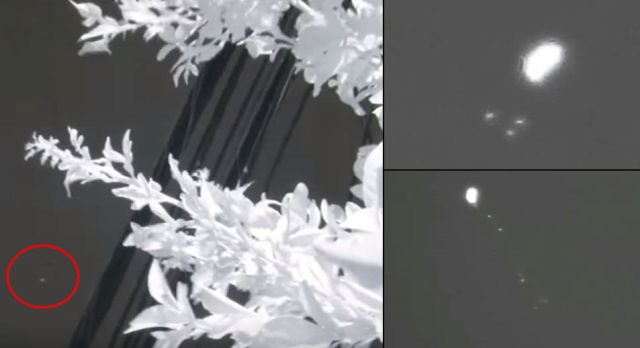
Strange Light in the sky off Newport Beach Coast California releases Bright Spheres
On October 21, 2017 the witness saw a huge bright light over his house in Long Beach, California.
At first he spotted two objects crossing paths with each other then focused on the larger one. As he zoomed in his camera the huge bright light started ejecting smaller spheres into the atmosphere.
The first ejection formed a triangular formation. As he kept filming the object the object started emitting many spheres in a steady stream.
There were at least 40 smaller spheres emitted from the main object. Interestingly the smaller spheres were only visible through his infrared camera. This was recorded with his full spectrum Canon SX60 with a monopod in his backyard in Long Beach CA.
On December 30, 2017, once again a strange light has been spotted off the coast of Newport Beach, California. This time the light in the form of a ‘hexagon’ appeared for approximately 30 minutes during the very early morning hours.
The first video shows the enhanced version of the November 21, 2017 sighting. Original video here. The second video shows the December 30, 2017 sighting including an analysis of both events.
Formerly Classified US Military Footage Apparently Shows Navy Pilots Tracking An Unidentified Flying Object
A previously classified footage has apparently revealed that the US fighter jets were sent to investigate a mysterious UFO as it hovered off the coast of San Diego.
The US Department of Defence (DoD) released a video that seems to show Navy pilots reacting with a surprise as they looked for the whitish oval object that glided over the Pacific Ocean.
A secret multimillion-dollar programme reportedly studied the footage. The programme was tasked with investigating UFO sighting reports.
The Pentagon confirmed reports that the Advanced Aviation Threat Identification Programme (AATIP) ran from 2007 to 2012 with annual funding of $22m (£15m) for DoD budgets.
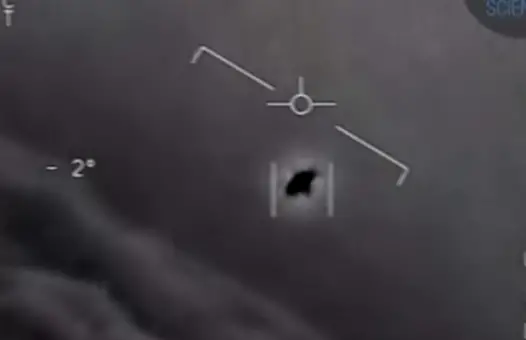
The released footage shows an encounter between a UFO, roughly the size of a commercial jet, and two Navy F/A-18 Super Hornets in 2004, from the aircraft carrier Nimitz.
Asked to investigate the object were Commander David Fravor and Lieutenant Commander Jim Slaight, who were on a routine training mission 100 miles out into the Pacific.
Naval cruiser USS Princeton detected the mysterious object appearing suddenly at 80,000 feet. The Naval cruiser had been tracking the UFO for two weeks.
In the video, a voice can be heard from one of the pilots saying “look at that thing, dude. It’s rotating.”
Commander Fravor told The New York Times the strange aerial thing was around 40ft long, had no plumes, wings or rotors. Fravor added that the object outpaced their F-18s and was big enough to churn the sea 50ft below it.
Fravor had no idea what he saw as the object accelerated like nothing he had ever seen.
The Navy superiors of the pilot did not investigate any further. Until today, the object has never been clearly identified.
The Pentagon said the AATIP was closed when defence officials shifted funding and attention to other priorities.
However, it was not clear whether officials continue to investigate UFO sighting reports. According to its backers, the programmed remains in existence without the public knowledge.
The initial funding of the programme came primarily at the request of former Senate Democratic leader Harry Reid, who is known for his space phenomena enthusiasm.
Pentagon spokesperson Laura Ochoa said that the AATIP ended in the 2012 timeframe. She explained that it was determined that there were other issues in higher priority that merited funding and it was in the DoD’s best interest to make a change.
Asked if the department continued to investigate such case, she said that the DoD takes all threats and potential threats to their people, assets, and mission seriously and takes action to credible information.
Believed to have been taken in 1992 in Eiger, Switzerland, the footage was found “on a server on the dark web” – a secretive area of the internet which is thought to contain hidden parts of society and which is not indexed by search engines.
It shows various pictures of a body with an over-sized head, with large eyes but small, spindly arms and torso – much like the stereotypical image of an alien.
One picture of the being shows it propped up by what appears like an electrical wire – suggesting it may have been electrocuted.
Another shows a group of scientists seemingly examining the body.
The clip – unsurprisingly – hasn’t been verified but viewers claimed it was “authentic”.
GETTY/YOUTUBE
MYSTERY: Alien hunters claimed to have proved ET's and spaceships exist in 2017
'Unexplainable' figure seen walking inside unusually shaped aircraft
Their followers claimed it showed an Alien Grey – a supposed extraterrestrial being named for its skin colour – walking inside its spacecraft.
“I just watched this four times and this Alien Grey, he moves a lot like a human,” one viewer said in a live phone-in.
“He looks like he’s wearing some sort of leggings or pants and his movements are very similar to a man’s – it looks like he’s working on the controls of the ship.”
But other users labelled the clip as fake, particularly given the grainy nature of how it was filmed.
HUGE shadow moves past International Space Station
The footage, which was posted by conspiracy theorist Streetcap1, showed the dark outlook from the station slowly turning lighter as the so-called object drifted past.
“Look at that – what on Earth can that be?” he asked his followers, who were quick to offer their responses.
“OMG, a mothership,” one suggested, but another suggested it was simply the sun’s light coming around.
Chilling moment US fighter jets encounter mysterious UFO
US fighter jets encounter ‘flying saucer’
Footage of the infamous UFO sighting of November 2004, involving the battleship USS Nimitz, surfaced last month.
It shows a mystery object hovering in the skies, before an F-18 fighter jet lines it up in its crosshairs.
But the US aircraft is unable to keep track of it when it speeds out of sight.
Unlike other videos in this list, the sighting was acknowledged by an official source in the form of former Deputy Assistant Secretary of Defence for Intelligence, Chris Mellon.
“Two F-18s approach, the four aviators see that the object has no wings or exhaust,” he recounted.
“It is white, oblong, some 40ft long and perhaps 12ft thick.”
Mellon went on to say the object suddenly “reoriented” itself toward the approaching F-18.
Extraordinary footage of military drone tracking down 'UFO'
This could be the most famous quote in ufology for the year 2017. “Look at that thing, dude” was uttered by a pilot on one of the two infamous videos released this month by parties identifying them as evidence of UFO encounters by U.S. military personnel. The “parties” are now in question, as the Department of Defense has backed off on saying it was involved in the release, and Luis Elizonso, the former head of the $22 million semi-secret UFO department called Advanced Aviation Threat Identification Program and a current member of Tom DeLonge’s To The Stars Academy, was found to have previously stated that he was going to use the videos for pilot training. Nonetheless, there’s no question that pilots dispatched on November 14th, 2004, by the USS Nimitz saw things they could not believe.
“There’s a whole fleet of them. Look on the S.A.”
The “S.A.” this pilot was referring to is the synthetic aperture radar, which was picking up the objects. And that’s where Raytheon comes in. Instrumentation inside the F/A-18 Super Hornet fighter jets is manufactured by this massive government contractor, including the most important part of this whole story – the Raytheon Advanced Targeting Forward Look Infrared sensor (ATFLIR) which was mounted under one of the fighters and captured the video which prompted the “Look at that thing, dude.”
Raytheon ATFLIR (AN/ASQ-228)
Is Raytheon, normally pretty secretive about weapons contracts and equipment, upset to be linked to this UFO story?
“We might be the system that caught the first evidence of E.T. out there. But I’m not surprised we were able to see it. ATFLIR is designed to operate on targets that are traveling in excess of Mach 1. It’s a very agile optical system with a sensitive detector that can distinguish between the cold sky and the hot moving target quite easily.”
They’re not upset … they’re excited! At least Aaron Maestas, director of engineering and chief engineer for Surveillance and Targeting Systems at Raytheon’s Space and Airborne Systems business, is. He is quoted on the company’s web site in an article entitled “The UFO Spotter: Navy Pilots Used Raytheon Tech to Track a Strange UFO,” which explains that ATFLIR (designated AN/ASQ-228 by the Navy) is a “single pod that combines mid-wave infrared targeting and navigation FLIRs, an electro-optical, or visual light, sensor, a laser rangefinder and target designator, and a laser spot-tracker. It can locate and designate targets day or night at ranges exceeding 40 nautical miles and altitudes surpassing 50,000 feet.”
Sounds impressive, but Dr. Steve Cummings, vice president of Technology Development and Execution at Raytheon Space and Airborne Systems wants to see more data. His UFO spotter would have …
“Wide-area search of some form or another. I would want at least two sensors, like radar and [electro-optical/infrared], to search the skies…One way to actually verify these and be absolutely certain that this is not an anomaly is to get the same target, behaving the same way on multiple sensors.”
USS Nimitz
So, despite the fact that 12 pilots and weapons system operators in six different planes, along with radar operators on the USS Princeton in the Nimitz fleet, saw the UFOs, Cummings wants the next generation of UFO hunters to have better equipment.
Los Angeles werd gisteravond opgeschrikt door een vreemd verschijnsel. Bestuurders zetten hun auto's stil op snelwegen om foto's en video's te maken en bewoners tot in San Diego bij de Mexicaanse grens belden TV-stations om melding te doen van "een mysterieus licht aan de hemel."
De brandweer van Los Angeles was er snel bij om het mysterie op te helderen: het ging om een raket. Ruimtevaartbedrijf SpaceX had een Falcon9 vanaf Vandenberg Air Force Base gelanceerd. Aan boord waren tien communicatiesatellieten die succesvol hun baan om de aarde bereikten.
Rond precies dezelfde tijd schiet ook Japan een raket de ruimte in met een tweetal satellieten aan boord. Alhoewel dit ongeveer gelijktijdig gebeurt met de SpaceX lancering is het in Japan inmiddels al zaterdag.
Dan, enkele dagen later lanceren de Russen een raket met aan boord naar verluid één satelliet. Er is verder weinig te vinden in de media over deze lancering.
Op vrijwel hetzelfde moment dat de Russen een raket lanceren, doen ook de Chinezen dat en ook deze raket zou een onbekend aantal satellieten de ruimte in brengen.
De vier grootste en machtigste landen ter wereld, Amerika, Rusland, China en Japan, lanceren allemaal in een tijdsbestek van enkele dagen een raket de ruimte in.
De reden weten we niet, maar wel dat dit absoluut geen toeval is en dat er iets groots gaande is in de ruimte, waardoor ze nu allemaal plotseling satellieten daar naartoe moeten brengen.
Het is niet dat we niet genoeg satellieten in de ruimte om de aarde hebben, dat er nu met spoed door deze vier landen een aantal nieuwe bij gelanceerd moeten worden. Er speelt iets anders, maar wat, dat is de grote vraag.
For the 1st time, astronomers have seen giant bubbles roiling up to the surface of a star beyond our solar system. Each great bubble is so huge it would extend from our sun to Venus.
The red giant Pi1 Gruis. Astronomers used ESO’s Very Large Telescope with the PIONIER instrument to see the convective cells on its surface. Each cell covers more than a quarter of the star’s diameter and about 75 million miles (120 million km) across.
With just a few exceptions, throughout the ages, whether using the eye alone or telescopes, astronomers have seen stars as pinpoints. Stars are really great balls of roiling gases, shining powerfully into space via thermonuclear reactions taking place in their interiors. But all stars besides our sun are so very distant that, even with telescopes, we’ve had very few direct glimpses of their surface features. Now, for the first time, astronomers have directly observed granulation patterns, caused by massive convection currents rising from the star’s interior, on the surface of a star outside our solar system. It’s no coincidence the star is a huge one, the aging red giant Pi1 Gruis, whose diameter is about 700 times that of our sun. The astronomers have seen the giant convective cells that make up the surface of this huge star. These new results are being published this week in the peer-reviewed journal Nature.
These astronomers used the European Southern Observatory’s (ESO’s) Very Large Telescope to make this observation, along with an instrument called PIONIER (Precision Integrated-Optics Near-infrared Imaging ExpeRiment). They said in their statement from ESO:
Located 530 light-years from Earth in the constellation of Grus (The Crane), Pi1 Gruis is a cool red giant. It has about the same mass as our sun, but is 700 times larger and several thousand times as bright. Our sun will swell to become a similar red giant star in about five billion years.
An international team of astronomers led by Claudia Paladini of ESO … found that the surface of this red giant has just a few convective cells, or granules, that are each about 75 million miles (120 million km) across — about a quarter of the star’s diameter. Just one of these granules would extend from the sun to beyond Venus. The surfaces — known as photospheres — of many giant stars are obscured by dust, which hinders observations. However, in the case of Pi1 Gruis, although dust is present far from the star, it does not have a significant effect on the new infrared observations.
When Pi1 Gruis ran out of hydrogen to burn long ago, this ancient star ceased the first stage of its nuclear fusion program. It shrank as it ran out of energy, causing it to heat up to over 100 million degrees. These extreme temperatures fueled the star’s next phase as it began to fuse helium into heavier atoms such as carbon and oxygen. This intensely hot core then expelled the star’s outer layers, causing it to balloon to hundreds of times larger than its original size. The star we see today is a variable red giant.
Until now, the surface of one of these stars has never before been imaged in detail.
A piece of our sun’s surface, showing a sunspot and solar granulation. In part because the sun is more compact than Pi1 Gruis, it has millions of convective cells, instead of just a few.
Image via the Hinode spacecraft.
In many ways, Pi1 Gruis is like our sun; both are stars, after all, and subject to many of the same processes. But, as with people, stars can be very different from each other. Pi1 Gruis has slightly more mass than our sun (about 1.5 solar masses), and a much larger volume, because it’s in a more advanced stage of its evolution. That may be why – in contrast to Pi1 Gruis’ few, very large convective cells – our sun’s photosphere contains about two million convective cells, with typical diameters of just 1,000 miles (1,500 km). The ESO statement explained:
The vast size differences in the convective cells of these two stars can be explained in part by their varying surface gravities. Pi1 Gruis is just 1.5 times the mass of the sun but much larger, resulting in a much lower surface gravity and just a few, extremely large, granules.
Doubtless if we could see Pi1 Gruis’ surface in even more detail, we’d be boggled at its beauty and complexity. That’s certainly the case with our own sun, whose surface has been revealed to us in recent decades by spacecraft, such as NASA’s Solar Dynamics Observatory, which captured the images to make the mesmerizing video below:
ESO also pointed out that the stage of life at which we see Pi1 Gruis is short-lived, on the timescale of stars:
While stars more massive than eight solar masses end their lives in dramatic supernovae explosions, less massive stars like this one gradually expel their outer layers, resulting in beautiful planetary nebulae. Previous studies of Pi1 Gruis found a shell of material 0.9 light-years away from the central star, thought to have been ejected around 20,000 years ago. This relatively short period in a star’s life lasts just a few tens of thousands of years – compared to the overall lifetime of several billion – and these observations reveal a new method for probing this fleeting red giant phase.
The video below, from ESO, zooms in on Pi1 Gruis.
Bottom line: For the 1st time, astronomers have seen giant bubbles roiling up to the surface of a star beyond our solar system. The star is an aging red giant, Pi1 Gruis, located about 530 light-years away.
Source: Large granulation cells on the surface of the giant star Pi1 Gruis
Evidence of life processes found in fossils in 3.5-billion-year-old rocks. Scientists say this work suggests life in our universe is widespread.
J. William Schopf and colleagues from UCLA and the University of Wisconsin analyzed the microfossils with a cutting-edge technique called secondary ion mass spectroscopy.
This month, scientists from UCLA and the University of Wisconsin–Madison announced the results of their analysis of rock samples found decades ago in Western Australia. They say the rocks contain fossils of 3.465-billion-year-old microorganisms, the oldest ones known. The study’s lead author – paleontologist J. William Schopf of UCLA – collected the fossils in 1982 and interpreted them then as early life. Critics had argued they were just odd minerals that only looked like biological specimens. The new study shows that two of the species appear to have performed a primitive form of photosynthesis, another apparently produced methane gas, and two others appear to have consumed methane and used it to build their cell walls. Thus, according to these scientists, the new findings show the microfossils are indeed biological.
Plus, they said, the fossils provide:
… strong evidence to support an increasingly widespread understanding that life in the universe is common.
Their work was published December 18, 2017 in the peer-reviewed journal Proceedings of the National Academy of Sciences.
These scientists say their work strengthens the case for life existing elsewhere in the universe because, they say, it shows a diverse group of organisms had already evolved extremely early in the Earth’s history. That early earthly life — combined with our knowledge of the vast number of stars in the universe and the growing understanding that planets orbit so many of them — suggests life is common in the universe. Schopf commented in a statement:
… it would be extremely unlikely that life formed quickly on Earth, but did not arise anywhere else.
The microfossils came from the Apex Chert, a rock formation in Western Australia. This area is among the oldest and best-preserved rock deposits in the world.
The scientists say their study is the most detailed ever conducted on microorganisms preserved in such ancient fossils. They said their study is:
… the first to establish what kind of biological microbial organisms they are, and how advanced or primitive they are.
The study describes 11 microbial specimens from five separate taxa. According to these scientists, some represent now-extinct bacteria and microbes from a domain of life called Archaea, while others are similar to microbial species still found today.
The scientists analyzed the microorganisms at the Wisconsin Secondary Ion Mass Spectrometer Lab (WiscSIMS) in Madison. It is one of just a few places in the world where this type of work can be done. Secondary ion mass spectroscopy revealed the ratio of carbon-12 to carbon-13 isotopes in the fossils.
The scientists then were able to use this information to determine how the microorganisms lived. The study’s co-author, geoscientist John Valley of the University of Wisconsin-Madison, said:
The differences in carbon isotope ratios correlate with their shapes. Their C-13-to-C-12 ratios are characteristic of biology and metabolic function.
When these fossils were formed, these scientists said, there was very little oxygen in Earth’s atmosphere. In fact, oxygen would have been poisonous to these microorganisms, and would have killed them, they said. Oxygen first appeared on Earth approximately half a billion years later, before its concentration in our atmosphere increased rapidly starting about 2 billion years ago. Thus, at the time these ancient microorganisms were alive, advanced photosynthesis didn’t exist yet.
The scientists also said the very existence of the rocks they analyzed is remarkable. That’s because the average lifetime of a rock exposed on Earth’s surface is about 200 million years. William Schopf commented that, when he began his career, there was no fossil evidence of life dating back farther than 500 million years ago. He added:
The rocks we studied are about as far back as rocks go.
An example of one of the microfossils discovered in a sample of rock recovered from the Apex Chert. A new study used sophisticated chemical analysis to confirm the microscopic structures found in the rock are biological.
By 3.465 billion years ago, life was already diverse on Earth; that’s clear — primitive photosynthesizers, methane producers, methane users. These are the first data that show the very diverse organisms at that time in Earth’s history, and our previous research has shown that there were sulfur users 3.4 billion years ago as well.
This tells us life had to have begun substantially earlier and it confirms that it was not difficult for primitive life to form and to evolve into more advanced microorganisms.
Schopf said scientists still don’t know how much earlier life might have begun. But, he said:
… if the conditions are right, it looks like life in the universe should be widespread.
Geoscientist John Valley, left, and research scientist Kouki Kitajima collaborate in the Wisconsin Secondary Ion Mass Spectrometer Lab (WiscSIMS).
Bottom line: Scientists analyzed fossil microorganism specimens from 3.465 billion years ago, providing strong evidence to support an increasingly widespread understanding that life in the universe is common.
Updated |On Christmas Day, astronomers at the Mount Lemmon Survey near Tucson, Arizona, discovered an asteroid fast approaching Earth. The newly named 2017 YZ4 skimmed past the planet at 10:50 a.m. ET (7:50 a.m. PT) today.
Fast and furious
The previously unknown rock hurtled through space at almost 21,500 miles per hour. It flew past the Earth closer than the moon. It is believed to measure between 22.6 and 49 feet in diameter according to observation news website The Watchers.
The asteroid’s trajectory is marked in green. The orbit of the moon is drawn in gray.
NASA
Lindley Johnson, Planetary Defense Officer at NASA’s Science Mission Directorate in Washington, D.C, tells Newsweek: “2017 YZ4 is the 52nd known asteroid to fly by Earth within one lunar distance this year and the first since two such asteroids flew past us on November 21. They varied from 1 to 80 meters [3 to 260 feet] in size.”
Unusually close flyby
The asteroid 2017 YZ4 hurtled through space at almost 21,500 miles per hour. The previously unknown rock flew past the Earth closer than the moon.
Even at its closest, 2017 YZ4 was incredibly unlikely to breach the Earth’s atmosphere. However, it came unusually close for a celestial boulder.
NASA considers it a Near-Earth Asteroid. This designation is reserved for any asteroid closer than six million miles to Earth.
Johnson tells Newsweek, “As of December 25, there are 17,506 known Near-Earth Objects (NEOs), in orbits around the Sun that could come close to our planet; 17,400 are asteroids and 106 are comets.
“This year, we’ve discovered 1,996 Near-Earth Asteroids so far. There were 1887 such objects discovered in 2016 and 1,566 in 2015.”
Over the 2018, the next closest asteroid to fly past Earth will be 2017 DR109. Don’t start building your underground shelter just yet, as the hunk of rock shouldn’t get closer than 880,000 miles from Earth. That is roughly three-and-a-half times the distance to the moon.
There are many more asteroids waiting to be discovered, Johnson explains. “Near-Earth Asteroids are never ‘new,’” he says. “They’ve been there for many millennia. We just haven’t discovered them all yet.”
The most powerful astronomical radar system on our planet recently provided the highest-resolution images to date of a near-Earth asteroid, 3200 Phaethon, during its Dec. close approach to Earth, ~1.1 million miles away: http://go.nasa.gov/2BkdwWD
This article has been updated to reflect 2017 YZ4’s journey past Earth and to include upcoming asteroid events in addition to comment from NASA’s Lindley Johnson.
Check out 100 facts about the Universe that will make your jaw drop
As most of you probably know, our Solar system is composed of the sun and everything else that orbits our star; planets, dwarf planets, moons, and space rocks.
Astronomers believe that the ‘edge’ of our solar system is located around 15 billion kilometers from our Sun.
The planets of our solar system have been of extreme interest for ancient civilizations throughout thousands of years and followed them across the sky and recorded their positions and even based every-day life in accordance to them and the stars.
There are countless things that few people know about the solar system, in this article we will introduce you furthermore to the solar system with a few facts, so let’s start.
According to astronomical research, our solar system formed 4.6 billion of years ago from the gravitational collapse of a giant molecular cloud.
Our Sun needs 240 million years to complete one single orbit around the center of our galaxy, the Milky Way.
According to astronomers, ever since our Sun was formed, it completed nineteen orbits around the galactic center.
Did you know that our star, the Sun, rotates counterclockwise?
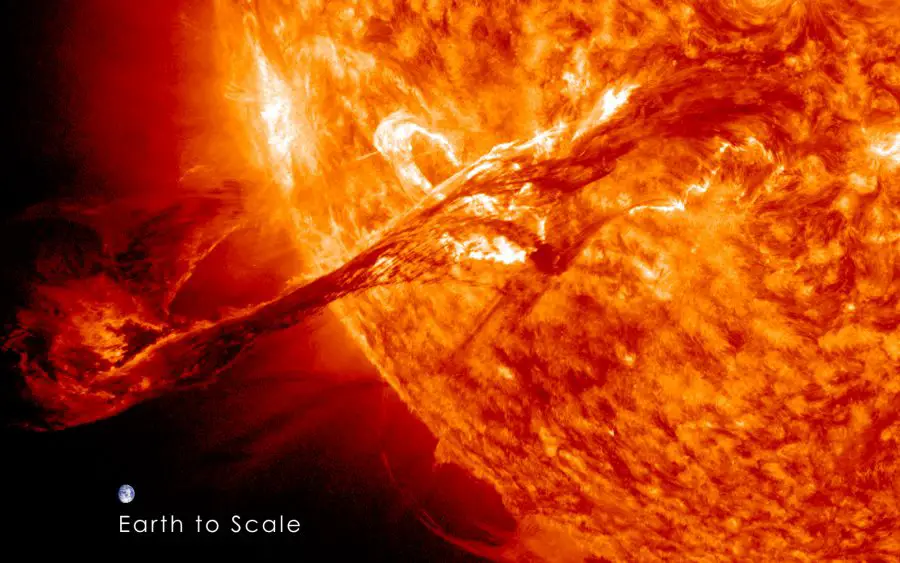
The Earth compared to the Sun.
The surface temperature of our Sun is about 5505 degrees Celsius.
Since its formation, our Sun has used up about half of the hydrogen in its core. This means it has still a lot of fuel to burn, so don’t worry.
The vast majority of the solar system’s mass is within the Sun over 99 percent, while the remaining mass is contained on Jupiter.
According to astronomical calculations, Jupiter’s magnetic field is approximately fourteen times stronger than that of Earth.
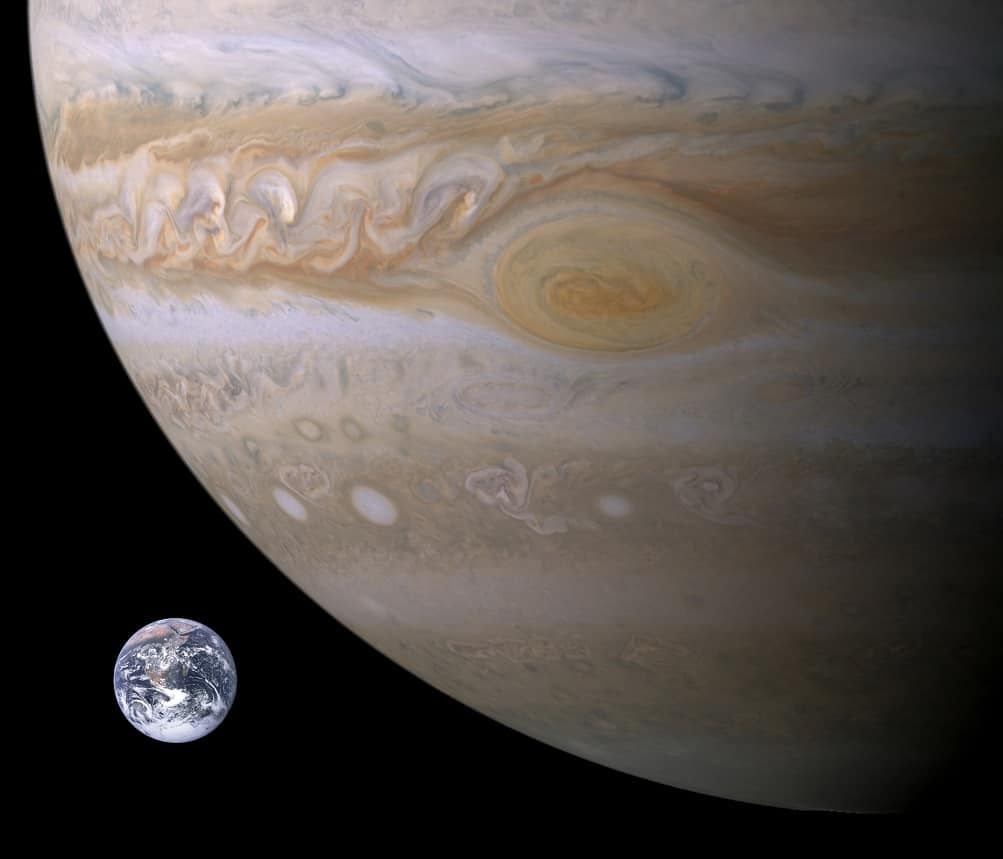
Remeber that massive Storm on Jupiter? Well, this gigantic storm is one of the biggest mysteries of astronomy. Experts have almost no information about it. Everything about is a mystery. What powers it, what caused it and why it’s…red?
Did you know that the great red spot on the surface of Jupiter is in fact an anti-cyclonic storm? It is believed to have started some 300-400 years ago.
The solid objects of the solar system; planets, moons, etc., comprise 0.0001% of the Solar System’s total mass.
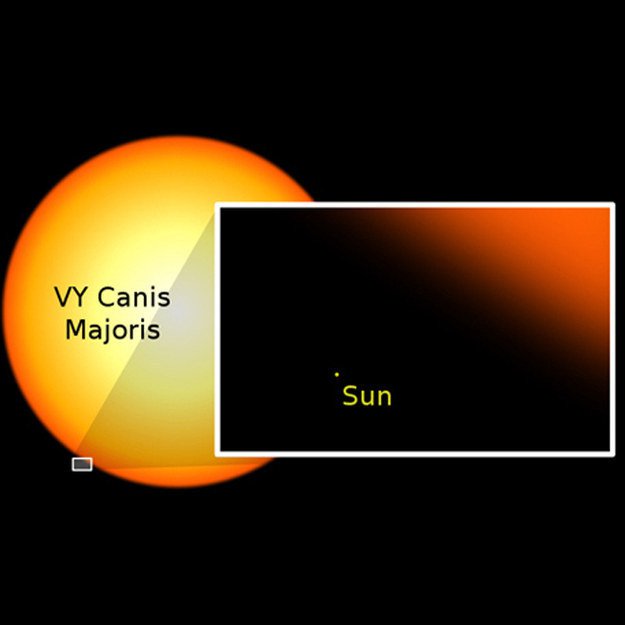
A comparison between our sun and Canis Majoris.
Even though our Sun is gigantic, it is small if we compare it to VY Canis Majoris; a red hypergiant located in the constellation Canis Major. This star is so big that If it would be placed in our Solar System, the surface of VY Canis Majoris would extend beyond the orbit of Jupiter. VY Canis Majoris is so big that astronomers estimate it to be 1,000,000,000 bigger than our Sun.
Did you know that Jupiter saved the Earth? Lexells Comet was traveling towards Earth following a trajectory that would make it impact our planet. However, thanks to the intense gravitational pull that Jupiter has, the comet was pulled towards the planet.
Our Sun is composed of roughly 98% hydrogen and helium.
We practically live WITHIN our Sun. This is because the Sun’s outer atmosphere extends far beyond it is visible surface; it is enormous. Earth orbits within this delicate atmosphere.
Practically a million of Earths’ could fit into the Sun.
This wide-field view of the sky around the bright star Alpha Centauri was created from photographic images forming part of the Digitized Sky Survey 2. The star appears so big just because of the scattering of light by the telescope’s optics as well as in the photographic emulsion. Alpha Centauri is the closest star system to the Solar System. Image released Oct. 17, 2012.
CREDIT: ESO/Digitized Sky Survey 2
As most of us have probably learned in school, the distance from the Sun to Earth is one Astronomical Unit or AU.
The Heliosphere which is the Sun’s outer atmosphere is considered to extend to around 100 Astronomical Units; One Astronomical Unit equals 149 597 871 kilometers.
Scientists suggest that the limit of the Heliosphere, referred to as Heliopause is located fifteen billion kilometers from our Sun.
Experts believe that the Sun’s atmosphere extends billions of kilometers downwind, as they believe Sun’s atmosphere has in fact a “teardrop” shape.
Compared to the rest of our solar system, the Sun’s mass is only one trillionth of a percent of the entire volume of our Solar system.
Astronomers believe that within our solar system alone are more than ten thousand objects that may be large enough to have been rounded by their own gravity.
If we were to look at the universe from an outside perspective, we would see that our solar system is located in the Orion arm, which in turn is located around 26,000 light years away from the center of our galaxy, the Milky Way.
As most of you already know, there are eight planets in our solar system, but hundreds of unidentified objects that lurk in the outermost region of our cosmic neighborhood.
The moon is considered the closest astronomical object to Earth. Why haven’t we visited it more often?
A comparison between Earth and Jupiter.
Out of the eight planets in our solar system, Mercury, Venus, Earth, and Mars are composed mostly out of rock and metal. Oh and there’s a planet missing between Mars and Jupiter.
Jupiter, Uranus, Neptune, and Saturn are mostly made out of hydrogen and helium. They are Gas Giants.
According to astronomers, Neptune has the fastest winds in the Solar System; The winds on the surface of Neptune can reach up to 2100 kilometers per hour, scientists have yet to determine the reason.
Uranus is the coldest planet in our solar system with temperatures that can drop to a freezing -224 degrees Celsius.
Jupiter is the fastest planet in our Solar System. It takes Jupiter little under ten hours to complete a full rotation around its axis.
Comets are usually referred to as “Dirty Snowballs” because of their composition, ice, and rock.
According to astronomical observations, there are 176 known natural satellites that orbit planets in our solar system out of which 168 moons orbit full-size planets. 8 moons orbit dwarf planets.
Jupiter is the planet that has the most amount of moons; a total of 63 confirmed satellites have been discovered, and some astronomers argue they may be even more moons hiding around the gas giant.
Jupiter, being the largest planet in our solar system is considered to have the largest ocean in the solar system; astronomers believe that it is about 40,000 km deep.
Astronomers have discovered several objects that orbit the sun that are located considerably further than Pluto. One such object is believed to be Planet X, a theoretical planet that should be there, but astronomers have still not found.
The Kuiper Belt is one of the two main reservoirs of cometary material and is believed to extend to over fifty astronomical units. Astronomers also considered it as one of the most distant regions in our solar system.
The Oort comet cloud is believed to extend to 50,000 Astronomical Units from the Sun.
Astronomers estimate that the Oort cloud contains TRILLIONS of icy bodies.
According to experts, at the outer edge of the Oort cloud, distant cosmic bodies are believed to have more gravitational influence from nearby stars than from the Sun.
Saturn could actually “float”, well at least partially, since the overall density of Saturn is 0.69 – seventy percent the density of water.
Saturn isn’t the only planet that has rings, Jupiter, Uranus, and Neptune also possess beautiful rings.
Jupiter’s dark rings are mostly made out of dust particles and are thus very hard to detect. Astronomers believe that within these rings are particles ejected by Jupiter’s volcanic moon Io.
Astronomers have found that the ring system of Uranus is similar to Jupiter’s, although the content of Uranus ring system is mostly composed of a material that resulted from collisions of relatively small “satellites”.
Saturn is cool. In fact, the planet has another gigantic ring, discovered in 2009; it can only be seen via infrared.
Did you now that the Solar System’s favorite planet Pluto was actually discovered by accident in 1930 after astronomers noted small and unexpected variation from the predicted orbit of Uranus and decided to look into this; thus Clyde Tombaugh discovered Pluto.
Pluto was considered the ninth planet of our solar system for seventy-six years, it was demoted to a dwarf planet and has been our favorite dwarf planet since 2006.
Pluto is extremely small. Mainstream scholars estimate that Pluto is just over 2,253 kilometers across, smaller than the United States of America.
Despite the fact that Mercury is the closest planet to orbit the Sun, it isn’t the hottest. Because of the fact that Mercury does not have an atmosphere, there is nothing that would keep the Sun’s heat on the planet.
According to astronomers, the hottest Planet in our solar system is Venus. The second closest planet to the Sun has a very thick atmosphere; astronomers estimate it to be a hundred times thicker than Earth’s atmosphere. Due to this, massive amounts of heat from the Sun is retained on the planet, and astronomers calculate that the average temperature on Venus is over 468 degrees Celsius. This makes the exploration of Venus really difficult.
Even though Mercury is the closest planet to the Sun, researchers believe that near Mercury’s poles Ice can be found
Did you know that Venus is the only planet in our Solar System that spins in the opposite direction of every other planet? Venus is a true rebel. Now I say why they say women are from Venus. Here’s a fun fact: A single day on Venus is, in fact, longer than its year; It takes Venus much more time to rotate on its own axis than to orbit our Sun.
Saturn’s moon Titan has a remarkably similar atmosphere to Earth’s atmosphere. Titan’s atmosphere is twenty percent more extensive than Earth’s atmosphere.
Scientists suggest that given the similarities to Earth, may have biologic activity; making it an ideal place to search for life outside Earth.
Ganymede, Jupiter’s natural satellite is considered the largest natural satellite in our Solar system and has a diameter of 5,268 km which is 8 percent larger than that of the planet Mercury.
The diameter of Ganymede is 2% larger than that of Saturn’s Titan which is the second largest moon.
Did you know that Ganymede, the largest and most massive moon of Jupiter, has the highest mass of all planetary satellites? It has 2.02 times the mass of the Earth’s moon.
Ganymede is the only moon in the Solar System known to possess a magnetosphere which is an area of space near an astronomical object in which charged particles are controlled by that object’s magnetic field.
Saturn’s moon Mimas is one of the most heavily cratered objects in our Solar System, it also eerily resembles the “Death Star” (the fictional space station known from the film Star Wars Episode IV: A New Hope) due to the gigantic impact crater on its surface, a 130 kilometers across.
Mimas is the smallest astronomical body that is known to be rounded in shape because of self-gravitation.
Asteroid 243 Ida has a satellite orbiting it called Dactyl. 243 Ida is also one of the most cratered objects in the solar system.
The largest dwarf planet that orbits our Sun is called Eris, orbiting the Sun at three times the distance of Pluto.
Eris was discovered recently (2005), and is the ninth most massive body known to directly orbit the Sun.
Eris is estimated to be 27 percent more massive than Pluto but there are uncertainties about its size; to properly calculate it, more research is needed.
Dysnomia is so far the only known natural moon of Eris, its diameter is estimated to be between 350 and 490 km.
Saturn’s moon Hyperion is the largest non-spherical moon in our Solar System.
In its composition, Hyperion is half as dense as water meaning that it would actually float if placed in water (hypothetically).
Astronomers believe that Hyperion is a fragment of a much larger object that was broken up in the distant past thus obtaining its irregular shape.
Hyperions surface contains a large amount of deep, sharp craters that together with its irregular shape, give the moon the appearance of a giant sponge.
Ceres is so far the only known dwarf planet located in the inner part of the solar system and is closer to the Sun than Neptune.
It is considered the largest asteroid in the inner part of our solar system.
Researchers estimate that Ceres contains an internal ocean of liquid water under its surface.
This dwarf planet contains more fresh water under its surface than all of the freshwater on Earth combined.
Sedna, a large planetoid is the first dwarf planet discovered in the Oort cloud.
In visible light, Sedna is one of the reddest objects in the solar system.
Sedna is one of the most distant objects known in the Solar System.
Sedna has the longest known orbital period in the Solar System, its orbit takes around 11,400 years to complete.
2012 VP113 is a planetoid that has the largest known perihelion – (closest approach to the Sun). Researchers suggest that 2012 VP113 is about half the size of Sedna.
There are four objects in our solar system that have perihelia larger than 47 Astronomical Units; Sedna, 2010 GB174, 2004 XR190 and 2004 VN112.
Olympus Mons, located on Mars is actually the largest Volcanic mountain to have been discovered in our Solar System.
Mars has water; Scientists have discovered the traces of water on Mars but not in liquid form.
Comet Hyakutake is believed to have had the longest ever discovered tail, over 570 million km in length.
Did you know that Uranus is the only known planet in our Solar System that actually rotates on its side? Guess what, if you were to scream in space, no one would actually hear you scream. This is because there is no air in space, which means that nothing could carry your voice, so, even if you would actually scream or talk, no one would actually be able to hear you.
Researchers have a hard time explaining the Moons of Mars; Deimos and Phobos, some even theorize that these moons were trapped in Mars’ orbit.
Phobos will probably one day impact into Mars. Because of its extremely low orbit, tidal forces are slowly lowering the orbit of Phobos. Astronomers have estimated that in about 50 million years, this moon will crash into the red planet.
Curiously, Mercury and Venus are two planets in our solar system that do not have moons orbiting them.
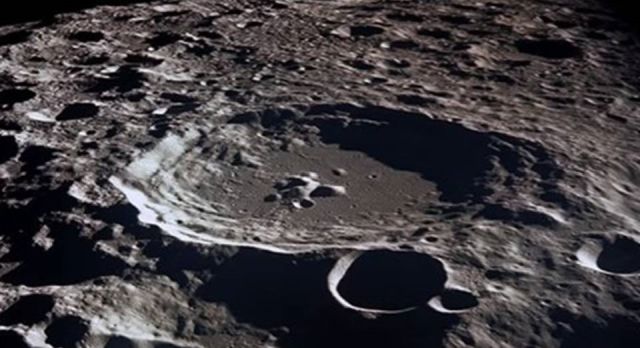
Did you know that Earth’s moon has water; and it is called Lunar water more accurately. Astronomers suggest that water in the form of ice can be present in craters on the Moon.
We’ve explored our solar system significantly in recent years. But despite this fact, Mercury is the least explored of the planets in our solar system.
Did you know that there are more than 500,000 minor planets that have been discovered and cataloged by the Minor Planet Center?
Venus apart from being the hottest planet is also the most dangerous planet since in its atmosphere is filled with sulfuric acid.
Despite the fact that there is a great possibility that hundreds of dwarf planets exist in the Kuiper belt, the International Astronomical Union has only accepted four: Pluto, Eris, Haumea, and Makemake.
Astronomers believe that more than 50 tons of space rock and dust fall on Earth each day.
One day on Mercury equals to 58 days on Earth.
The gravity on our planet is six times stronger than on the surface of the Moon; this means that you would weigh less on the Moon than on Earth.
The magnetosphere is one of the central reasons why life can exist on our planet. The magnetosphere helps divert harmful radiation from the Sun away from Earth.
Experts do not understand Saturn’s rings completely, Some astronomers believe they could be extremely old and may have existed since the beginning of the solar system. However, there are others who believe they could be relatively new… compared to the age of the planet.
Astronomers believe that there is a very high chance that there is life on Saturn’s moon, Enceladus.
Mars, the planet that is very similar to Earth has the largest dust storms in the Solar system, they can ever last for months and cover the entire planet.
I have no more facts to write about… just kidding, here is one more:
There are relatively few stars within ten light years of the Sun, as the closest is the triple star system Alpha Centauri located around 4.4 light years away.
Let me know if I missed something that is worth including into the article, and share your thoughts.
NASA is planning the first interstellar journey in history to search for Aliens
NASA has set their sights on Alpha Centauri, the star closest to our Solar System, and wants the mission to take place in 2069 and look for signs of alien life.
After reaching the moon (again) and actually getting to Mars, the American Space agency wants to turn mankind into an interstellar species.
Despite the fact that the ‘mission’ does not have a name yet and most of the technology necessary to take us there does not even exist, the projected launch date would coincide with the centenary of the arrival of mankind to the Moon.
NASA is yet to develop the necessary technology to travel to Alpha Centauri in a reasonable time.
Image Credit: Shutterstock
Initially, scientists say that a spaceship which would need to travel at a minimum of 10 percent of the speed of light would be required to get us there.
The Alpha Centauri constellation is located 4.4 light-years away, and even if one-tenth of the speed of light were achieved, we would be able to visit the star system after a 44-year journey, reaching our nearest neighbor in 2113.
This means we need to ramp up our tech game. In order for mankind to really become an interstellar species, colonize other planets and moons, first in our solar system, we need to develop a technology that’s affordable, reusable, and fast. Really fast.
According to the New Scientist, NASA is considering sending tiny laser-powered probes that, in theory, can travel at a quarter of the speed of light. Other techniques under consideration include the use of nuclear reactions, or through collisions between antimatter and matter.
However, there are other options experts will consider. But, time is ticking so NASA will need all the help it can get to make a trip to Alpha Centauri a reality.
Perhaps the best way to start their journey to our closest cosmic neighbor is by developing a technology that would get us to Mars in a matter of weeks, then days.
Getting to Mars, and creating a transportation system between the two planets could serve as a starting point for further technology in development, and it would make traveling to Mars something routine.
As reported by Newsweek, NASA’s revolutionary mission in 2069 will visit Proxima B, a planet that was discovered not long ago and may be a world very similar to Earth. Interestingly, the manager of the Innovation Foundry at NASA’s Jet Propulsion Laboratory Anthony Freeman called the entire project “very nebulous.”
Proxima Centauri B is an exoplanet orbiting within the habitable zone of the closest star to the Sun—the red dwarf star Proxima Centauri, which is in a triple star system. The planet—which has been hailed as Earth’s twin in the past—is located around 4.2 light-years from Earth, which makes it the closest known exoplanet to the Solar System.
In comparison, the only man-made spacecraft that has reached interstellar space is Voyager-1, which is currently traveling at LESS than 1 percent of 1 percent of the speed of life, reports Newsweek.
IF Voyager-1 had the ability to travel at 10 percent the speed of light, it would make it to Alpha Centauri in about 44 years.
If Humanity Discovered That Earth Would Be Destroyed In 400 years, What Would Be Humanity’s Response?
Oh, Snap…
A rogue planet ejected from its home solar system billions of years ago has wandered through interstellar space until it crossed our solar system’s gravity well. This slight trajectory deflection has put it on a direct path for impact with Earth. Scientists detected havoc in the Oort cloud out past Pluto. The Oort cloud is in chaos. Using our best minds and observatories we determined that the object is in the magnitude in size of Jupiter. Since it is travelling at a relativistic speed we have 400 years until Earth is no more.
Would the world band together and try to figure out a way to save humanity or would it be too far away and we would just let future generations figure out the solution?
The first astronomers to detect the upcoming event might not even recognize the danger. Anything that will take 400 years to hit us will be passing through a variety of gravitational fields and will be aiming at a location that might seemingly have nothing to do with Earth.
But at some point, someone would run the numbers and discover that yes indeed, we were facing the possibility of a celestial collision. At this point, they would only be thinking in terms of probabilities and not certainties. But after they shared their findings with other astronomers, gradually a general consensus would form, that the celestial body did not represent a mere possibility of colliding with Earth, but that it almost certainly would.
By this time, the astronomers had made no attempt to hide their work so far, the news would have already hit the Internet. But very few lay people would be able to follow the math, so there might be a series of confused news articles talking about something hitting something else someday.
But gradually the articles would gain coherence, the Wikipedia entry would become clearer and more persuasive. Counter-arguments and competing mathematics would be discredited, and a general sense of disturbance would begin to spread through the planet.
The governments of the world, while saying nothing publicly, would have long-since been in communication with the astronomers, and done their own verification of the science. In addition, they would have analyzed the possible effects of an impact, the probable number of deaths, the time it might take for human civilization and economies to recover. They would have considered the options of attempting somehow to divert the oncoming celestial body, the size of the required explosion, the mass and trajectory of debris, and other details. Finally, they would reach the inescapable conclusion that the impact could not be prevented and that the destruction would be too great for any kind of recovery. In 400 years the planet would be totally destroyed, with no hope that any life would survive.
During these considerations, NASA would for several months already have been calculating the possibility of resettling a portion of humanity onto another planetary body in the solar system. They would estimate the likelihood that the destruction of Earth would affect the orbits of other planets, or that debris from the impact might fly into any prospective resettlement area.
Official government spokespeople would have no comment yet. If asked, they would simply reply that they didn’t want to “get ahead of the science,” and that “so far, nothing is known for certain.” But they’d affirm that they’d have more to say when the scientific questions had been better understood.
At this point, only a very small minority of people would be expressing any sort of outrage at their government’s silence, or at the existence of the threat itself. Those people would be quite vocal, but the Internet buzz and radio talk-show hosts would always say something along the lines of, “even if it’s real, it’s 400 years in the future. Relax.” And that would echo the sentiments of many Americans, if not people throughout the world.
Eventually, the United States, China, Russia, and the European Union would make a joint announcement. The leaders of those nations, speaking together at the United Nations building in New York City, would announce a plan to create a series of large-scale, self-sufficient settlements on several planets and moons throughout the solar system. The impending threat against the Earth would not be mentioned. When asked if there was a connection between the colonial project and the threat of destruction, the reply would be that this project was a normal outgrowth of the space programs of all developed nations, and should be welcomed as a sign of ongoing human progress.
Gradually, budgeting for the various components of the colonial enterprise would be established. Research would proceed on a number of fronts, including the construction of space elevators along the equator, habitats capable of transporting large numbers of people across interplanetary distances, and larger habitats capable of maintaining those people indefinitely at specific locations throughout the solar system. There would also be a new focus on asteroid mining and bulk transportation of non-living cargo between planets. As reported in the news, each colony would need a permanent source of raw materials, ongoing protection of necessary atmospheric conditions, and a long-term effort to transform each colonial planet and moon into an Earth-like body with appropriate atmospheric and ecological conditions. Those terraforming efforts, however, would be acknowledged to require thousands of years, and would not be a major part of the requirements for the initial set of colonial outposts.
The first colonies would be established on Mars. Many lives would be lost in those initial efforts. But the governments of the world would praise those who sacrificed their lives and would redouble the effort to address the remaining technical problems. The colonial projects would go forward, government spokespeople would say, in spite of any obstacles.
After Mars, Jupiter would also be home to many colonies, in the form of orbiting stations. These stations would have a modular construction so that they could be continually expanded. Over the next hundred years, a ring of such constructions would gradually form around the planet, syphoning its material needs largely from Jupiter’s gaseous atmosphere. The water of Ganymede and the Earth itself would begin to be harvested for use by all colonial projects.
The first wave of colonists would be highly trained specialists, capable of building the colonial infrastructure and then setting up the requirements of actual habitation.
The next wave, however, would be taken from the impoverished countries of the world. In exchange for risking their lives, they would be given commercial opportunities in the new colonies. Like the early Martian colonies, many participants in this second wave would perish as well, until each colony was securely established and tested under proper load.
The third wave would consist of the populations of wealthy nations. Tens of millions of people would migrate to thriving economies ready to receive them. The occasional atmospheric accident would be hushed up as quietly as possible. But the governments of the world would provide whatever incentives were necessary in order to keep up migration rates.
Eventually, after half the world’s population had been resettled, the governments would acknowledge publicly for the first time that within another 200 years the planet would be destroyed by a celestial collision. They would put forward the colonies as a perfectly reasonable option and offer further economic incentives for people to migrate. They would also impose new laws restricting childbirth on Earth. Later, the restrictions would be tightened until all new Earth-based pregnancies were outlawed. An underclass of undocumented natives would spring up, living largely off the grid, and difficult to gather into the migratory waves.
By now the government officials would all have migrated to the colonies themselves, remotely overseeing a set of small, isolated, local governments on Earth. Among the off-world governments, there would be ongoing negotiations, attempting to unite them all into one; but these would be slow and unpromising, given religious, tribal, and political histories on Earth. But the United Nations would be quite strong and would play a large role in ongoing decision-making for the colonies as well as for the remaining local governments on Earth.
By the time of the destruction, only a few hundred million people would remain on Earth. The impact would be streamed live to viewers in every colony. Everyone, everywhere, would feel the loss as a tragic event; and would feel the uncertainty of their own future. How could these little colonies, these little bubbles of air, with no history, ever hope to have a future? And this uncertainty would become an inspiration to young people that would rally an inventiveness and resourcefulness throughout the colonies, and would lead them to make great leaps of technological advancement and to overcome the remaining obstacles to humanity’s continued survival.
The Fermi Paradox, first introduced by physicist Enrico Fermi, asks the question, “Where is everybody?” Or, more specifically, “Where are all the aliens?”
When we factor in the size of the universe, the number of Earth-like planets, and a range of other variables (as outlined in the Drake equation), there should be tens of thousands or more extraterrestrial civilizations in the galaxy. And with the galaxy being around 10 billion years old, scientists say that intelligent worlds have had plenty of time to contact one another. So if aliens should statistically exist, why haven’t we encountered any yet?
10. Earth Is Special
The Rare Earth Hypothesis suggests that the chain of events that created life on this planet was so complex that only a biological perfect storm could recreate it elsewhere. While there may be Earth-like planets, none of them have exactly what it takes for intelligent life to develop. In other words, we haven’t met any aliens, because none are out there, or they are so few and far between that contact is highly improbable.
The major factor that makes Earth so hospitable to life is its long period of relatively stable climatic conditions, which is due to the planet’s unique orbit and position. Without our precise distance from the Sun and Moon, the planet would likely be too hot or cold, have too little oxygen, and be too unstable to support any life beyond bacteria.
Paleontologist Peter Ward and astronomer Donald Brownlee were the first to introduce the Rare Earth Hypothesis. Even though nearly 15 years have passed since they publicized the theory, and Earth-like planets have since been detected, they are still confident that the odds of those worlds having life are extraordinarily low.
9. All Intelligent Life Hits A Stumbling Block
According to the Great Filter theory, alien life does exist, but intelligent life is incapable of technologically advancing enough for long-distance space communication or travel. Although our modern spaceships, satellites, and radios may make it seem like we’re getting closer, we’ll inevitably reach a barrier or catastrophe that will either wipe us out or cause technology to devolve.
We know cataclysmic natural disasters periodically strike Earth, so it’s possible that these types of events hit worlds everywhere, sending intelligent life back to the Stone Age before technology can adequately develop. Or, maybe we annihilate ourselves, such as through nuclear war. Whatever the filter is, it seems to mean nothing but bad news for humans. Not only will we never communicate with space beings—we’ll probably die trying.
However, there is one possible bright side. Some think that we are the first individuals to make it past the filter, so we’ll eventually be the first super-intelligent beings to roam space.
8. They’ve Moved Out Of The Universe
According to futurist John Smart’s Transcension Hypothesis, intelligent alien life once existed in our universe, yet it became so advanced that it moved on to greener pastures. More specifically, aliens became so evolved that they stopped looking at outer space and instead focused on inner space.
The concept can be compared to the miniaturization we’ve experienced in computers. What initially began as an enormous, room-filling technology progressively became smaller (even pocket-sized) while simultaneously growing in complexity and power. To Transcension supporters, intelligent life evolves in much the same way, constantly working toward a denser, more efficient use of space, time, energy, and matter (“STEM compression“). Eventually, we’ll be living and operating at the nano-scale until we become so small that we create and exist in a black hole outside this space-time continuum.
To Smart and others, black holes are the ultimate destination. They allow for ideal computing and learning, time travel, energy harvesting, and more. Civilizations that don’t achieve this destiny are failures.
Other cosmic beings may be working toward their own transcendence. Like humans, they might emit space broadcasts, but these types of signals are supposedly the work of immature civilizations and are unlikely to be successful. Also, based on Moore’s Law (that computing power doubles every two years), these beings would likely reach transcendence before exploring the cosmos.
7. Earth Isn’t As Great As We Think
Perhaps it’s hubris to think that aliens would even have an interest in us or our planet. Worlds far more interesting and life-supporting may exist, and intelligent beings would much rather spend their time focusing on super-habitable places rather than Earth. This theory is the complete opposite of the Rare Earth theory—Earth isn’t special at all.
An alien race capable of traveling or communicating across light years would no more care about chitchatting with us than a human would converse with a fly. Likewise, they’d undoubtedly have their own superior technologies and would not require any of our measly resources. If, however, they did need to harvest minerals or elements, they wouldn’t have to visit Earth. Those things are found floating all over space.
Furthermore, no matter how intelligent the beings, traveling across light years is no easy feat. What are the odds they’d invest all that energy coming here when there are 8.8 billion Earth-like planets in the Milky Way? For followers of this theory, to think Earth is everyone’s destination is to suffer from the same geocentrism that led to Galileo’s erroneous persecution.
6. We’re Living In A Virtual Reality
Arguably one of the most difficult to accept explanations to the Fermi Paradox is the Planetarium Hypothesis. Our world is a “form of virtual reality ‘planetarium,’ designed to give us the illusion the universe is empty.” We haven’t discovered any extraterrestrial life because those extraterrestrials haven’t designed that into the program.
The fundamentals of this theory date back to Descartes, who asked, “How can we know that the world around us is real—are we just a brain in a vat, which thinks it’s living in the real world?”
Instead of being brains in a vat, however, most modern supporters of this notion think we’re in a computer simulation designed by advanced aliens. These aliens are capable of harnessing enough energy to manipulate matter and energy on galactic scales. Why would the aliens want to watch us like ants in a farm? Maybe just for fun, or maybe they just made us to see if they could.
As unlikely as the Planetarium Hypothesis may sound, professional philosophers and physicists are serious about this idea. They say that we’re more likely to be artificial intelligences in a fabricated world than to have our own minds. Furthermore, we will likely discover the simulation, since we’ll inevitably notice a glitch in the system or devise an adequate test to prove the theory.
5. We Live In The Cosmic Boonies
Although intelligent alien life might exist, our planets may be too far apart to make communication practical or purposeful. Earth may be so far away from other inhabited planets that we’ve simply been overlooked. If that doesn’t feel lonely enough, some claim most other worlds exist relatively close together in clusters and are interacting with each other, while we’re off in cosmic no-man’s-land missing out on the party.
The roots of this idea come from a mathematical theory known as percolation, which describes how things clump in a random environment. Based on the percolation theory, the universe naturally formed with areas of large clustered growth and a few smaller areas of growth in outlier positions. Other intelligent beings are in the big cluster, and Earth is an isolated outlier.
Instead of trying to make contact with these faraway beings, some, like Stephen Hawking, suggest that we continue to lie low. Hawking says that if we pick up on an alien signal, “We should be wary of answering back, until we have evolved.” Otherwise, we may suffer a fate akin to the Native Americans after Columbus arrived.
Scientists like Frank Drake and the late Carl Sagan have argued the “absence of evidence is very different from evidence of alien absence.” Alien hunting has been held back by lack of government funding, which is necessary to afford extensive alien-tracking equipment and resources. Historically, the search for extraterrestrial intelligence (SETI) programs have had to rely on borrowed radio telescopes and other equipment, which they could only use for a limited time. These hindrances have made it virtually impossible to make any real progress.
Still, there is some good news—at least for those who think making alien contact is a good idea. The Allen Telescope Array, a radio telescope array specially designed to search for extraterrestrial intelligence, became operational in 2007. This mega-telescope (consisting of 42 individual 6-meter-wide (20 ft) telescopes) was largely funded by Microsoft co-founder Paul Allen. After numerous setbacks, it finally seems ready to begin doing some serious space exploration. If anything on Earth is capable of picking up alien signals, this is the device.
3. We Can’t Recognize Their Signals
Even if other planets are hospitable to life, would the beings there evolve similarly to living things on Earth? Maybe they are so different that neither of us would recognize a signal from the other. Comparable to how bats visualize sound waves while we only see light, it’s possible that humans and aliens operate with entirely different senses.
As cosmologist and astrophysicist Lord Rees pointed out, “They could be staring us in the face, and we just don’t recognize them. The problem is that we’re looking for something very much like us, assuming that they at least have something like the same mathematics and technology. I suspect there could be life and intelligence out there in forms we can’t conceive.”
Things get especially tricky when trying to connect with a highly advanced race because they might use communication methods (such as neutrinos or gravitational waves) beyond our technological understanding. Likewise, our primitive radio emissions might look like nothing more than white noise to them. If aliens and people are indeed extremely unalike, it’s unlikely that we’ll ever make contact and solve the Fermi paradox—especially so long as we’re anthropomorphizing aliens and expecting them to communicate as we do.
2. Super-Organisms Are Inherently Suicidal
The Medea Hypothesis, coined by paleontologist Peter Ward, is the notion that humans and other super-organisms carry within themselves the seeds of self-destruction. In this way, it very much ties in with the Great Filter theory, since it suggests that we end up dying before evolving enough to make alien contact.
The hypothesis is named after the murderous Medea from Greek mythology, who killed her own children. In this case, the planet is Medea, and all living things are her offspring. We don’t want to die, but Mother Earth made us destined to kill ourselves. Extinction is built into our biology to ensure that we are eliminated before we create too much of an imbalance on Earth. Once humans become an incurable plague on the planet, we will do something to guarantee our own demise.
Ward believes that almost all previous mass extinctions were brought on by living organisms. For instance, he blames the two Snowball Earth periods from millions of years ago on plants that proliferated so wildly that they absorbed excessive amounts of CO2. This brought about global cooling and consequently the plants’ demise. Similarly, if humans really are the root of today’s climate change, we may be well on the way to guaranteeing that our own species can’t survive on the planet.
In short, our internal suicidal clock will run out long before we get the chance to connect with aliens.
1. They Walk Among Us
It sounds like science fiction, yet people in prominent positions are confident that aliens live and work all around us. For example, former Canadian defense minister Paul Hellyer gave an interview in 2014 in which he claimed that 80 different species of alien life live on Earth. Some of them (including Nordic blondes) look nearly identical to humans. Another group, the “Short Greys,” appear more like stereotypical aliens and stay relatively hidden from the general population.
Hellyer is not alone in his claims. Physicist Paul Davies from Arizona State University and Dr. Robert Trundle from Northern Kentucky University have similar opinions about the existence of aliens on the planet. To Hellyer, Davies, Trundle, and those who share their beliefs, the Fermi paradox has already been answered—aliens do exist, and whether humans realize it or not, they interact with us on a daily basis.
Despite experiencing a great deal of criticism from their peers and the public, these men continue to be outspoken in their opinions.
Le 11 octobre, la star du Rock Tom DeLonge a animé une retransmission en direct du lancement officiel de son émission « To the Stars Academy of Arts and Science« . Au cours du lancement, il a présenté Luis Elizondo, un ancien agent des renseignements de carrière, qui a dirigé un programme d’enquête sur les menaces aériennes non identifiées au Pentagone, un programme qui a duré près de dix ans.
Les images filmées d’un incident d’OVNI du 14 novembre 2004 impliquant plusieurs jets F-18 de l’USS Nimitz ont été présentées et il a été annoncé que le Pentagone mettait à la disposition du public des dossiers officiels.
Les pilotes de la marine ont décrit l’OVNI comme défiant les lois de la physique et ne faisant pas partie d’un programme aérospatial conventionnel américain, comme l’a décrit Dave Fravor (Commander, US Navy ret.), l’un des pilotes qui ont été témoins de l’incident et qui a été mentionné dans un article de mars 2015:
À plusieurs reprises, à compter du 10 novembre [2004], l’agent de lutte contre les incendies et le chef principal du service de lutte contre les incendies, extrêmement expérimenté, avaient détecté de multiples retours descendant de loin au-dessus du volume de balayage du radar, soit quelque part à plus de 80 000 pieds. Les cibles, appelées Anomalous Aerial Vehicles (AAV), tomberaient de plus de 80 km pour planer à environ 50 pieds au-dessus de l’eau en quelques secondes.
Toujours au même endroit, un Lat/Long à environ 30NM au large de la côte de Baja, à environ 70nm au sud-ouest de Tijuana. À l’époque, le SPY-1 était le radar tactique le plus sophistiqué et le plus puissant de la planète. Grâce à lui, ils ont été en mesure de suivre ces avions pendant qu’ils descendaient, planaient en stationnaire et s’éloignaient ensuite à toute vitesse, vitesse de virage et accélération plus rapidement que n’importe quel avion ami ou menaçant connu. Impossible vitesse.
Un rapport sommaire officiel de l’incident de la Marine américaine avait déjà été publié en ligne. Néanmoins, la plupart des médias grand public ont simplement ignoré le lancement de DeLonge et la documentation abondante liée à l’incident des ovnis.
Tout cela a changé le 16 décembre 2017, lorsque le New York Times et Politico ont publié un article sur Elizondo et l’incident de 2004. Nous avons appris que le programme du Pentagone d’Elizondo a été officiellement financé de 2007 à 2012 grâce à une subvention de 22 millions de dollars créée par un groupe de membres du Congrès dirigé par l’ancien sénateur Harry Reid.
Les fonds ont été acheminés par l’intermédiaire de Robert Bigelow, l’ami milliardaire de Reid, qui dirige une société civile de l’aérospatiale, afin de construire des habitats humains extensibles pour les missions en orbite terrestre et dans l’espace lointain.
Il y a eu par la suite un tsunami de reportages dans les médias grand public sur le programme du Pentagone dirigé par Elizondo, le financement de 22 millions de dollars qu’il a reçu et l’incident de 2004. DeLonge et sa To The Stars Academy ont soudainement été des nouvelles majeures dans le monde entier.
Le ton de la couverture médiatique était respectueux et sérieux, comme l’illustre une entrevue de Tucker Carlson avec le pilote de la Marine lors de l’incident de 2004.
Les médias grand public disaient au public qu’il était temps de se débarrasser de l’association qui a longtemps empêché un examen sérieux du phénomène des ovnis.
Pourquoi deux mois de retard dans la couverture du témoignage d’Elizondo et de l’incident de 2004? Les histoires du New York Timeset de Politico ont-elles été conçues pour lancer un processus de divulgation officielle des informations officielles sur les ovnis, que DeLonge suggère depuis plus d’un an et demi avec le lancement de son projet multimédia « Sekret Machines » en avril 2016?
Il ne fait guère de doute que DeLonge a été aidé par un groupe d’initiés de haut niveau qui l’ont choisi comme véhicule pour révéler la vérité derrière le phénomène des OVNI. En mars 2016, DeLonge a donné un certain nombre d’entrevues au cours desquelles il a dit qu’on lui avait donné accès à dix initiés de haut niveau, y compris des généraux, qui avaient accepté de faire partie de son équipe consultative.
Au milieu de l’année 2016, Wikileaks a publié des courriels montrant un lien clair entre la campagne présidentielle de Hillary Clinton et DeLonge par l’intermédiaire de son président de campagne, John Podesta. Cela corroborait la prétention de DeLonge d’être soutenue par des initiés de haut niveau, et confirmait le lien de l’US Air Force avec DeLonge via le major-général à la retraite McCasland, ancien chef d’un laboratoire de recherche très secret à la BFA Wright Paterson. Un autre major général retraité de l’USAF, Michael Carey, avait écrit un endossement de 4ème de couverture de Sekret Machines.
En effet, des références ultérieures d’OVNI par Clinton et Podesta, au cours de la campagne, semblaient jeter les bases de futures révélations d’une présidence Clinton qui iraient dans le sens de l’initiative de DeLonge. Le succès de la campagne présidentielle Trump a été un revers majeur dans ce qui semblait être une initiative de divulgation hautement orchestrée et qui pouvait être attribuée à l’USAF.
Cela suggère que DeLonge fait partie d’une initiative de divulgation sanctionnée par l’USAF et que tous les cas d’ovnis officiellement libérés sont conçus pour appuyer ses efforts. Cela nous donne un indice quant à l’origine probable des ovnis observés et enregistrés lors de l’incident de Nimitz en 2004, qui a été soigneusement choisi pour le lancement de l’Académie To The Stars par DeLonge en octobre 2017, ainsi que pour les articles subséquents du NewYork Times et de Politico.
Dans sa fiction de 2016, fondée sur le livre d’information Sekret Machines, DeLonge faisait référence à un programme spatial secret exploité dans la zone 51, au Nevada, qui mettait en vedette des embarcations en forme de triangle et de soucoupe capables de défier les lois de la physique grâce à leurs technologies antigravité. Il est important de souligner que les faits allégués dans le livre ont été présentés à DeLonge par son équipe consultative de 10 hommes, qui, selon lui, lui ont fourni la révélation la plus documentée qui n’ a pas encore émergé sur les sujets des OVNI, de la vie extraterrestre et des programmes spatiaux secrets.
Le lien avec l’incident de 2004 impliquant l’USS Nimitz devient maintenant pertinent. En publiant des informations officielles du Pentagone sur l’incident de 2004, l’intention était-elle de révéler l’existence d’OVNIs extraterrestres pilotés ou d’un programme spatial secret dirigé par un État rival?
La réponse trouvée dans Sekret Machines de DeLonge est que l’USAF et la Russie possèdent leur propre flotte d’engins spatiaux antigravité capables de défier les lois de la physique. Le programme spatial secret de la Russie est décrit tout au long du livre comme une menace claire en termes de survols du territoire américain et d’installations nucléaires, d’enlèvements de citoyens américains et d’actions militaires hostiles contre les moyens spatiaux américains.
Il y a peu de mention dans le livre de DeLonge de la vie extraterrestre autre qu’une référence vague aux anciens dieux qui ont trompé l’humanité par leurs technologies avancées, qui sont aujourd’hui semées aux grandes nations comme des pommes modernes de la discorde.
Le premier livre de Sekret Machines de DeLonge est un effort pour dépeindre le phénomène d’OVNI comme impliquant principalement des véhicules aérospatiaux avancés d’abord développés par l’Allemagne nazie pendant la Seconde Guerre mondiale, puis rétro-ingénierie par les Etats-Unis et la Russie avec l’aide de scientifiques allemands précédemment impliqués dans les programmes nazis.
Il convient de souligner que le niveau élevé de soutien de l’initié à DeLonge suggère que ses livres et initiatives font partie d’un processus de divulgation officiellement approuvé, qui est soutenu par l’USAF en particulier, et le Pentagone en général.
Tout cela suggère que l’incident de 2004 mettant en cause l’USS Nimitiz correspondra à un récit qui émerge lentement dans la série de livres Sekret Machines de DeLonge et à l’Académie To The Stars. Cela indique clairement que l’incident a été dépeint comme un engin antigravité russe qui a adopté une posture menaçante pour le groupement tactique de la Marine.
Il y a des avantages politiques évidents à représenter la Russie possédant un programme spatial secret qui menace les navires de guerre américains dans les eaux internationales. Cela permettrait au Pentagone de bénéficier d’augmentations substantielles du financement de son propre programme spatial secret géré par l’USAF, qui est tout aussi avancé que le programme russe, selon DeLonge.
Le fait de présenter les OVNI comme des menaces à la sécurité nationale posées par les Russes, avec leur alliance de plus en plus grande avec la Chine, permettrait de garder hautement confidentiels les programmes créés pour faire face à cette menace. En effet, le nom du projet du Pentagone d’Elizondo, le « Advanced Aerospace Threat Identification Program », fait allusion à un tel processus déjà en cours.
Enfin, révéler un lien russe avec l’incident de Nimitz en 2004, qu’il soit artificiel ou non, alimenterait l’hystérie antirusse générée par la communauté américaine du renseignement à l’occasion de l’élection de Donald Trump. Alimentés par cette hystérie de l’ingérence inconnue de la Russie dans le plus sacro-saint des processus politiques américains, de nombreux citoyens américains seraient vraisemblablement d’accord avec un nouveau discours médiatique selon lequel la Russie, avec le soutien croissant de la Chine, est devenue une menace mondiale majeure par le biais d’un programme spatial secret.
J’espère que je me trompe, mais il y a des signes évidents que les initiatives de divulgation Sekret Machines et To The Stars Academy de DeLonge se transforment en un « lieu de rencontre limité ». Une partie de la vérité sur les programmes spatiaux secrets et les technologies de pointe sera publiée, ce qui est une évolution bienvenue. Cependant, des informations importantes sur d’autres aspects clés du phénomène des OVNI, tels que la visite extraterrestre, un programme spatial secret allemand qui a survécu à la Seconde Guerre mondiale et un programme spatial de la Marine appelé Solar Warden, qui opère dans l’espace lointain, continueront d’être supprimées.
Het incident van het UFO 2004 is intrigerend, en het zou wel eens een ander onderdeel in de wereld, maar het is waarschijnlijk dat dit specifieke incident is zo gekozen dat Rusland uiteindelijk zou geïdentificeerd als de boosdoener voor politieke redenen. Ik ben er zeker van dat de grote Amerikaanse defensie-aannemers kwijlen bij het vooruitzicht van de bouw vloten van ruimtevaartuigen gewapend antigravity om een Russische dreiging (en Chinese) kunstmatige nationale veiligheid van de Verenigde Staten door te voldoen een geheim ruimteprogramma.
UFO' sighting over Tasmania sparks intelligent alien life theories on Facebook
UFO' sighting over Tasmania sparks intelligent alien life theories on Facebook
The mystery of a fireball crossing the Tasmanian skyline has been solved, but not before Facebook users declared alien life had finally made it to Tasmania.
The federal government's air navigation services provider Airservices Australia confirmed the object captured on hundreds of mobile phones and cameras across southern Tasmania early on Tuesday morning was nothing more than an aircraft "as it passed over Australian airspace". But that assertion did not stop members of the public drawing their own conclusions and disparaging naysayers for their lack of faith.
Striking footage of the object filmed by Sorell resident Lee-Anne Peters caused a frenzy as Facebook users speculated on what it could be, with the International Space Station, meteorites, plane contrails, fairies and, of course, spacecraft from another galaxy among the mix of possibilities.
"It was very slow moving, not like the high jets I've seen before. I got out the binoculars and thought it must be a meteorite"Ms Peters said.
"I was sure it was something burning up from space … but now, I am sure it was just a plane with the sunrise highlighting its contrails"she said.
Despite Ms Peter's verdict, many Facebook users were quick to disagree — with some rejoicing in what the close encounter might mean.
"No longer will the population outcast you for believing in aliens," one Facebook user posted. Professor Dickey posited another theory that the object in the video could be "high cloud, backlit by the rising sun", which might explain the brightly-lit trail. Facebookers checking aircraft flight trackers narrowed it down to an Emirates Airbus A380 flight bound for Auckland which was scheduled to be in the airspace about the time the phenomenon occurred. Another person suggested the "fireball" was caused by the dawn sunlight reflecting the "wind drag over the wings" of a plane.
The case of the Knowles family
Believers like Mary Rodwell say the 1988 experience of Faye Knowles and her three sons (and their two dogs) is one of the most significant "close encounter" testimonies ever.
"UFO ATTACK KNOWLES FAMILY NULLARBOR 20/1/1988"
Also reportedly involving several witnesses, the story goes involves the witnessing an egg-like, bright structure. They then went on a high-speed car chase against the object, climaxing with the family's car being lifted from the road as weird black dust, high-pitched sound and a horrible smell overwhelmed the car. "I felt like my brain was being sucked out" said eldest son Patrick at the time. *dun dun DUN*
On a hunt for the most legitimate recent UFO sightings with video evidence, I found this. Remember when Robert Bigelow said on 60 minutes that the evidence aliens are on earth is right under our noses? Bigelow was involved in a $22M secret Pentagon-led UFO program and video recently released apparently shows a superfast high-altitude craft of an unusual shape.
Earlier this month, the New York Times released an elaborate report detailing a secret Pentagon-led program that focused on unidentified flying objects. Videos from the program released along with the report show official images of what seem to be UFOs. The clips were captured by Raytheon’s infrared sensors, the company said.
The Times report detailed a 2004 incident near the coast of San Diego in which three F/A-18 Super Hornet fighter jets encountered a UFO. The video, released by the group To the Stars Academy of Arts and Science, shows the American pilots astonished of what they were seeing.…
Here is video captured by a US navy F/A-18 Super Hornet off the coast of San Diego in 2004:
… The Pentagon UFO program, called the Advanced Aerospace Threat Identification Program, analyzed UAP imagery and data, including images from Raytheon’s ATFLIR.
“We might be the system that caught the first evidence of E.T. out there,” Aaron Maestas, the director of engineering and chief engineer for Surveillance and Targeting Systems at the company’s Space and Airborne Systems business, said in a statement this month. “But I’m not surprised we were able to see it. ATFLIR is designed to operate on targets that are traveling in excess of Mach 1. It’s a very agile optical system with a sensitive detector that can distinguish between the cold sky and the hot moving target quite easily.”
Raytheon describes the ATFLIR as a “single pod pod that combines mid-wave infrared targeting and navigation FLIRs, an electro-optical, or visual light, sensor, a laser rangefinder and target designator, and a laser spot-tracker.” ATFLIR can spot and designate targets during the day or at night. It can locate targets at ranges surpassing 40 nautical miles and altitudes past 50,000 feet.
From 2007 to 2012 the $22 million Advanced Aerospace Threat Identification Program investigated UFO reports and run under military intelligence official Luis Elizondo inside the Pentagon. … The secret program was primarily funded at the request of former Sen. Harry Reid, D-Nev., the report said. The Democrat, who retired last December, was reportedly a space fan. Most of the funds went to an aerospace research company run by billionaire entrepreneur Robert Bigelow, a friend of Reid’s. …
The Pentagon program gathered video and audio recordings of reported incidents involving UFOs. Some footage was collected from a Navy F/A-18 Super Hornet and “showed the aircraft surrounded by some kind of glowing aura traveling at high speed and rotating as it moves,” according to the Times. In the video, the pilots were confused about what they were looking at, while one pilot yelled: “There’s a whole fleet of them.”
Ancient Coins Depicting Aliens And UFOs Are The Proof Alien Lived Among Us
There has long been the belief that aliens have continued to be monitoring the Earth for quite some time now, and such proof has been shown through videos and an assortment of pictures taken by unsuspecting citizens.
The reasons for why aliens have decided to roam the Earth varies. Some reasons are because aliens may intend to create a war against humans and wipe out all of the society in order to open up their own personal world on the planet to create a much more civilized and intelligent society with technology and advances like no other.
Aliens Have Visited Earth Centuries Ago
The sightings of UFOs continue to take place throughout the world and seem to appear every year, which leads to the wondering whether aliens have touched down on Earth at one time or another.
One finding potentially answers this question and indicates that yes aliens have already been to Earth at least one time. In Egypt, eerie coins were located while excavating through some forested area.
Upon looking at the coins, they appeared to show an individual who seems to have an extremely large head with bulging black eyes. These characteristics are commonly associated with aliens.
Many conspiracy theorists have indicated that the coins are a proof that aliens once inhabited the Earth or at least may have visited previously.
The unanswered question is if these coins turn out to be a true alien currency, then why does it truly exist? Did the aliens participate in foreign trades or trades in general? It would be assumed that the coins are most likely some form of currency, so the coins must contain some sort of monetary value or be of use somehow.
The coins are also believed to have some writing on them which translates to "it's here in due time, "which hints at the belief that aliens may be setting up for another visit to the Earth, so the citizens of the world should be preparing thoroughly, because no one truly knows what the intentions of aliens are. Information is still coming out regarding this finding, but nothing is truly set in stone as of right now.
This map from the University of Puerto Rico’s Planetary Habitability Laboratory shows the known planetary systems within about 100 light-years from Earth, plotted on a logarithmic scale. The systems with potentially habitable exoplanets are highlighted with red circles. (PHL @ UPR Arecibo)
BERKELEY, Calif.— Twenty years after the movie “Contact” brought the search for extraterrestrial intelligence, or SETI, to the big screen, it’s dawning on astronomers that the real-world plotline might turn out to be totally different 20 years from now.
So far, SETI has been dominated by radio telescope surveys looking for anomalous patterns that may point to alien transmissions. But SETI’s practitioners are realizing that E.T. may make its presence known in other ways.
Over the next 20 years, or 200 years, SETI may come to stand for sensing extraterrestrial irregularities, ranging from unusual atmospheric chemistry to higher-than-expected thermal emissions. The telltale signs of life beyond our solar system may even be associated with phenomena we haven’t yet come across.
“Two hundred years from now, people are going to look at what we’re doing, and probably laugh and say, ‘Why weren’t they looking for tachyons, or subspace communications,’ or something like that,” Dan Wertheimer, chief scientist for SETI at the University of California at Berkeley, joked during a presentation held at the university in conjunction with the World Conference of Science Journalists in October.
Questions about the potential for life beyond our solar system are much sharper now than they were in 1997, when “Contact” came out, largely because space surveys have established that there could be billions of potentially habitable planetsout there.
The Berkeley presentation brought together leading SETI researchers — plus one of the leaders in the study of potentially habitable exoplanets, Guillem Anglada-Escudé of Queen Mary University of London.
The first planets beyond our solar system were detected in the mid-1990s, using a technique that looked for faint gravitational wobbles in the motion of stars. It was a big deal back in 2010 when the list of known exoplanets reached 500. Today, the tally of candidate exoplanets is past the 5,000 mark.
Anglada-Escudé said the planet search is increasingly focusing in on potentially habitable worlds — such as Proxima Centauri b, the nearest exoplanet, which he and his Pale Red Dot team detected just last year.
“The detection has taken so long not because we didn’t have the technology, but because we didn’t know where to search,” he said.
Now that astronomers know how to check red dwarf stars for potentially habitable, close-in planets, “this is going to be happening more often,” Anglada-Escudé said.
Which raises an issue: So far, astronomers have judged the livability of alien planets on the basis of their orbital positions, assumed densities and how much light they get from their parent stars. But to determine whether they’re truly habitable, and whether they have a chance of harboring life, much more information is needed.
Fortunately, more information is on the way — from giant observatories such as NASA’s James Webb Space Telescope, which is now due for launch in 2019; and from smaller, more focused missions such as the Transiting Exoplanet Survey Satellite, to be launched next year.
Such telescopes could tease out the spectral signatures of alien atmospheres, looking for chemical imbalances that could hint at biological activity. It’s more complex than just finding, say, oxygen or water vapor.
“There might be CO2, there might be even molecules we don’t expect to be there at all,” Anglada-Escudé said. “We might see emission features. … When you have the ability to detect methane, oxygen, you can find things that you don’t expect at all.”
Seth Shostak, senior astronomer at California’s SETI Institute, said more powerful telescopes could look for the waste heat given off by highly advanced civilizations, or the radioactive waste left behind by the civilizations that didn’t last.
“There have been schemes proposed for looking for dead alien civilizations,” he said.
In addition to better telescopes, alien-hunting scientists are using artificial intelligence to aid their search.
“We’re just starting to learn how to look for, in machine learning, what’s called anomaly detection,” Wertheimer said. “In anomaly detection, you classify things — ‘this is a curved signal, this is a sinusoidal signal, this is a pulsed signal’ — and if it’s not one of those things, it’ll say, ‘Hey, I found something that’s not following all these categories, this is an anomaly.’ It will alert you, and you’ll take a look at it and see if it’s interesting. We are not doing that now, we’re learning how to do that.”
SETI astronomer Jill Tarter, who served as one of the models for the main character in “Contact,” said the search should really go 24/7 in order to make sure no extraterrestrial anomaly is left behind.
“There’s a big hole in our searches … and that is that we’re not at all very sensitive to transients,” she said. If our telescopes happen to be looking someplace else when E.T. sends out a quick message, the opportunity for contact would be lost.
Tarter said the search for E.T. needs more stable funding in order to better the odds. And in the years ahead, it’ll be even more challenging to keep up with the torrents of data that will come from radio dishes and other types of telescopes.
The evidence of life beyond our solar system may well be found by “carefully combing the astronomical data that are collected every day for things that are anomalous, things that are a little different,” Shostak said.
Well, that didn’t take long. The Sun Online tried to obtain additional information from the Defense Intelligence Agency which ran the so-called UFO investigation agency and was told there’s been some “confusion” about the program, the Department of Defense did not release the two videos and it won’t honor requests for the release of any others … if they even exist. Let the backtracking begin.
The fingers in this case are pointing long and hard at Luis Elizondo, who allegedly ran the $22 million Advanced Aviation Threat Identification Program (AATIP) from 2007 to 2012 when it was allegedly dissolved due to running out of money. However, he implied that some form of AATIP existed beyond that time and he was involved with it until he resigned in October to join Tom DeLonge’s To The Stars Academy.
It was apparently in his capacity as a TTSA founder, not as the former AATIP director, that Elizondo released the videos, thus giving the Pentagon an opening to back away from responsibility. The Defense Intelligence Agency to Sun Online:
“There is some confusion about this program and claims about its purpose in press reporting… the Defense Intelligence Agency has not released any information, files or videos.”
A spokesperson for its parent, the Defense Department, disputed only the part about it the AATIP’s purpose:
“The AATIP’s mandate, when it existed, was to assess far-term foreign advanced aerospace threats to the United States.”
That also puts into question Elizondo’s claim that the program somehow continued to live on without funding and that its purpose was to look for extraterrestrial UFOs, noth just “foreign” aerospace threats. Star Online points out that Elizondo changed his story about the videos substantially once they became public, citing a Washington Post report that Elizondo said in an internal government memo that he merely wanted the videos to “help educate pilots and improve aviation safety.” That doesn’t sound like UFO disclosure and AATIP exposure.
Of course, any questioning of the videos or insinuation of backtracking brings out the cries of “government cover-up” and that is always a possibility. The only way that will change now is if Luis Elizondo releases more videos or other forms of evidence. And this time, the video better be a blockbuster. No more trickle-down UFOnomics … the public wants a big flood of evidence or it’s going to go back to watching The Orville.
What Ancient Human Civilizations Said About The Moon – The Moon Is Not What You Think It Is!
Ancient Human Civilizations across multiple continents around the world speak of the time BEFORE the Moon arrived - and with it so did our ocean tides, seasons and conditions prime for an abundance of life.
However, there is an abundance of evidence that significant information regarding our Moon and the Apollo landings have been withheld from the masses as well as the Moon Express mining operation raises questions of this as well.
The New York Times investigation into the Advanced Aerospace Threat Identification Program at the Pentagon reported that the first pilot who saw this object described it as a forty foot long Tic Tac, an Unidentified Flying Object with no visible means of propulsion“, “just hanging close to the water.” Said the pilot, “As I get closer, as my nose is starting to pull back up, it accelerates, and it’s gone. Faster than I’d ever seen anything in my life.” He added, “It was not from this world.”
I’ve been waiting for this day since the night in the summer of ‘77 when I chased one.
That summer, after graduating from my Catholic all guys high school, a classmate and good friend, asked me to join him in Ohio as summer camp counselor. I love camp. I’d been a counselor-in-training for the Boy Scouts. I applied and was accepted. We arrived at The Divine Word Seminary, Summer Camp for boys, in Perrysburg, Ohio, aside the Maumee River, to find a wicked large campus with a fancy set up including classrooms, dormitories, and a big gym, plus horses, a horse barn and paddock, riding trails, hiking trails, a canoe pond, an archery range, a ball field, a woodshop, a great view, a large swimming pool, a rifle range, and a cafeteria.
Inside the cafeteria, for our first camp counselors meeting, amiable young men from South Africa, England, and everywhere the USA filled rows and rows of tables. Jobs were handed out that day—head of this; assistant of that; or counselor. I was the Boy Scout with a Riflery merit badge. The Camp Director asked me to head of the Rifle Range. I ran a safe, educational, and controlled firing line, and so I earned the Director’s trust. He let me drive the camp sedan. The first night we went roller skating at the rink. The second night we said that were going roller skating at the rink, but instead we drove to a store and bought beer.
We turned up off of the camp road, about a mile before camp, to a secluded spot that one of the guys knew about. We drove up a dark and wooded hillside stopping at the scenic overlook that dead-ended in an empty parking lot above the Maumee River.
As I popped a cassette tape into the player and clicked play, as the first beers in the back seat snapped open, as the pot pipe was being packed, the parking lot illuminated like daylight. Pop!
“Oh my God, it’s the cops!” One guy gasped.
Adrenaline and fear raced through our bodies. As the driver, feeling responsible, I said, “We are busted boys. Let’s be good Catholics school boys and give ourselves up. Everybody get out of the car. Hands up.”
We piled out as a guy gasped, “How I am going to explain an arrest to my parents?” We all worried the same thought as we turned to face the cops. Behind us, we saw nobody and nothing. The daylight came from above. We looked up at an entire ceiling solid with light right overhead. Wide-eyed and slightly blinded, I lowered my head to see if it had an edge. It did twenty-five or more yards away. We stood beneath the middle, the center, of it. Whatever it was, it was immense.
Awestruck, nobody spoke, and nobody moved, until a minute passed, after the adrenaline rush of fear of cops and parents subsided. Suddenly the aircraft—because what else can you call—began to drift silently, and slowly, down the hillside gliding just above tree-top. It looked like a saucer to me and it had visible means of propulsion.
A guy shouted, “Everybody in the car! Let’s go after it!”
We dove in. I turned the car around. We took off after it. A guy shouted, “Toss the beers, the pot, and the pipe out the windows.”
We turned toward camp racing after this unidentified aircraft. It was just ahead of us, and picking up speed as it paralleled the road skimming above treetop, flying over corn fields, and soy fields and woodlands a bright white light against a starlit sky.
And then we were speeding through camp. The speedometer read eighty-six. The aircraft accelerated. I floored it on the straightaway.
Miles from camp it made a turn right angle turn onto Route Sixty Four.
It never decelerated. It did ninety through the right angle turn. Imagine the G-forces.
“HOLY SH*T! DID YOU SEE THAT!”, A guy shouted. As we zoomed passed the T-bone turn.
“Go after it! “Go after it!” They chorused.
I hit the brakes, and shot the car to the left, flying off the road, and down an embankment, landing in a cornfield, tearing through rows of corn by dozens with the steering wheel hard over, spraying an arc of corn parts and dirt, arcing for Route Sixty-Four. Straightening, I floored it. We bounded up the embankment and bounced down hard to the pavement. Heads and bodies went out windows searching the sky ahead and above, and everyone shouting at each other. A quarter mile toward the bridge over the Maumee River it waited, hovering, just over treetop. We roared on and in a split second, it shot up like a streak of light, at a humanly impossible speed and was gone.
I stopped the car. We got out saying nothing still staring up at the night sky, as we processed what just happened. After minutes passed by, a guy said, “Guys, there’re corn stalks are sticking out from under the car. No sense in getting caught.”
We slow drive back to camp summarizing. It was an utter silent aircraft that could hover, could make impossible right angle turns and moved an unthinkable speed. It had no visible propulsion.
What did we think and feel? We thought that whoever they were,
that they knew, that we knew, that they had our attention; we were watching each other and we felt like they were playing with us, and maybe showing off for laughs as we might do.
We decided that it was smarter to keep this event among ourselves that summer. Who would have believed us? And there was the matter of the cornfield. I checked under the sedan at first light, before the camp awoke—good thing that I did. There were two partial corn stalks underneath.
I’ve told a few trusted people over the years but mostly kept my mouth for obvious reasons. I can’t prove it. I can’t expect you to believe me unless you’ve seen one, and I think that are plenty of good people who have seen one, who don’t talk about it and want to talk about it. Now’s a good time. Why? Because, as the Daily Mail Reported, “The former head of a Pentagon program to understand the mysteries of UFOs has said that such objects visiting Earth had been ‘proved beyond reasonable doubt’.” Let that legal term sink in.
Let’s keep this conversation, meaning your replies, focused on your personal sighting of unidentified aircrafts by describing them and what they did. It’s a safe place to begin. Just the facts. I’d love to read your comments below. Oh, and think of the theological implications, my clergy friends. If this video means something to you, please share it.
Peace out. Jah Love. God is One Love for us all. Until next time.
The mystery of a top-secret UFO program has deepened after government officials claimed there was confusion about its purpose — while experts accused them of backtracking.
The Pentagon last week confirmed the existence of a $22 million program called the Advanced Aviation Threat Identification Program (AATIP) which investigated sightings of UFOs between 2007 to 2012, The Sun reported.
The revelation excited UFO fans around the world as it was the first time the US government had admitted investigating UFOs since 1969.
The organisation’s work was outed by Luis Elizondo when he told The New York Times he ran the shadowy Department of Defence program from 2007 to 2012 and continued to look into the issue until he resigned in October this year.
Two bombshell videos of unexplained UFO sightings by US military personnel — investigated by the AATIP — were also published.
However, when contacted by Sun Online, the spy organisation Defence Intelligence Agency claimed there had been some misunderstandings.
A spokesman said: “There is some confusion about this program and claims about its purpose in press reporting ... the Defence Intelligence Agency has not released any information, files or videos.”
But Department of Defence officials disputed this, saying they did not know what “confusion” the Defence Intelligence Agency was referring to, and stating they had been “clear” about the program’s aims.
A Department of Defense spokesman said: “The AATIP’s mandate, when it existed, was to assess far-term foreign advanced aerospace threats to the United States.”
It is claimed the program ended in 2012, however Mr Elizondo said that he had continued to work with officials from the Navy and the CIA on the program until he resigned from office in October.
UFO experts have claimed that this disagreement could be the government trying to back-pedal because it isn’t “ready or willing” to disclose the information.
Ufologist Alejandro Rojas from Open Minds TV, which is dedicated to extraterrestrial life, said: “It does seem to me like they might be backtracking.
“They haven’t clarified exactly what the confusion is, but I’m not surprised that they are scrambling over this now.
“According to The Washington Post, Luis Elizondo essentially got the videos under somewhat false pretences.
“He claimed he wanted to use the videos for training pilots. He didn’t say he wanted to use the videos to demonstrate that UFOs are real, which is what’s happening.
“I think that’s why the clips are so short and — especially with the second one. There is so little information attached to it.
“I think perhaps they thought just in case somebody gets a hold of this and tries to turn it into a big UFO thing, we just won’t give them much information.
“It puts them in a spot because perhaps they’re not ready or even willing to come out and talk about this.
“And they didn’t intend these videos to be used for this purpose.
“It wouldn’t be the first time the government has tried to spin things in a different direction on this topic.
“But we’ve got Elizondo who led the program going on the record to talk about it — so it’s clear that they were investigating UFOs.”
Sun Online has now lodged a Freedom of Information request with the Defense Intelligence Agency for any other UFO files or videos related to AATIP.
Mystery over top-secret UFO programme deepens as US government is accused of backtracking on staggering footage released
The Defense Intelligence Agency, which ran the real-life X-Files programme, says it has not released any information, files or videos - but UFO experts claim they're distancing themselves because they aren't "ready or willing" to disclose the information
EXCLUSIVE
By Emma Parry, Digital US Correspondent
THE mystery of a top-secret UFO programme has deepened after government officials claimed there was confusion about its purpose - while experts accused them of backtracking.
The Pentagon last week confirmed the existence of a $22million programme - called the Advanced Aviation Threat Identification Program (AATIP) - which investigated sightings of UFOs between 2007 to 2012.
GETTY - CONTRIBUTOR
The programme was unable to explain more than 700 sightings
The revelation excited UFO fans around the world as it was the first time the US government had admitted investigating UFOs since 1969.
The organisation's work was outed by Luis Elizondo when he told the New York Times he ran the shadowy Department of Defense programme from 2007 to 2012 and says he continued to look into the issue until he resigned in October this year.
However, when contacted by Sun Online, the Defense Intelligence Agency - the Department of Defense's spy arm, which first started the programme - claimed there had been some misunderstandings.
They said there was "confusion" over the AATIP's purpose, and denied releasing any videos or files related to it.
New footage shows ‘UFO’ recorded by US fighter jet pilots
A spokesman for the US Defense Intelligence Agency said: "There is some confusion about this program and claims about its purpose in press reporting... the Defense Intelligence Agency has not released any information, files or videos."
But Department of Defense officials disputed this response, claiming they did not know what "confusion" the Defense Intelligence Agency was referring to - and stated they had been "clear" about the programme's aims.
A spokesman for the Department of Defense added: "The AATIP’s mandate, when it existed, was to assess far-term foreign advanced aerospace threats to the United States."
The US Defense Intelligence Agency said: 'There is some confusion about this program'
The Department of Defense said they did not know what 'confusion' the Defense Intelligence Agency was
The Department of Defense claim the programme ended in 2012 - however, Elizondo, chief of the Pentagon's secret UFO research initiative, said that he had continued to work with officials from the Navy and the CIA on the programme until he resigned from office in October.
UFO experts have claimed that this disagreement could be the government trying to back-pedal away from the issue of UFOs - because they aren't "ready or willing" to disclose the information.
YOUTUBE
Luis Elizondo ran the shadowy Department of Defense programme from 2007 to 2012 - but claims he continued to work on the project until this year
Ufologist Alejandro Rojas, from Open Minds TV, which is dedicated to the study of UFOs, said: "It does seem to me like they might be backtracking.
"They haven't clarified exactly what the confusion is, but I'm not surprised that they are scrambling over this now.
"According to The Washington Post, Luis Elizondo essentially got the videos under somewhat false pretences.
JOHN CHAPPLE FOR SUN ONLINE
Alejandro Rojas says he is not surprised government officials are 'scrambling' after the secret UFO programme was unveiled
"He claimed he wanted to use the videos for training pilots - he didn't say he wanted to use the videos to demonstrate that UFOs are real, which is what's happening.
"I think that's why the clips are so short and - especially with the second one - there is so little information attached to it.
"I think perhaps they thought just in case somebody gets a hold of this and tries to turn it into a big UFO thing, we just won't give them much information.
"It puts them in a spot because perhaps they're not ready or even willing to come out and talk about this.
HOW TALL CAN WE BUILD AND CAN WE CREATE A TOWER THAT GOES INTO SPACE?
Did you know that you can see the sun set twice during a single day in Dubai? You watch it dip below the horizon from the base of Burj Khalifa, before taking the elevator to the observation deck to see it set again.
At 828 metres tall, the Burj Khalifa is so high that in 2011 the Dubai Islamic Affairs Department passed a ruling to state that people living above the 80th floor must delay breaking their fast during Ramadan by two to three minutes to factor in the timing of the sunset.
It’s as mind-boggling a concept as the original plans for the Burj Khalifa were when it was first announced. The idea of a building more than twice as tall as New York’s iconic Empire State Building (a building so lofty that, should you jump off the top, you would reach terminal velocity before hitting the ground) seemed unfathomable at the time. And not only was it proved possible, but surpassable.
“The proposed Sky Mile Tower in Tokyo is a staggering 1,700m tall — twice the height of Burj Khalifa”
This month, Emaar Properties will start work on another Dubai-based building that will be taller than its own Burj Khalifa. According to the developers, the slim, needlepoint-like tower will be a notch taller than the existing record holder, and will be completed before Expo 2020.
Taller still is the 1,001m Jeddah Tower project (formerly Kingdom Tower), currently being built in Saudi Arabia, that will claim the World’s Tallest Building title when it opens in 2020. Further afield, there are proposals to construct an even bigger skyscraper in Tokyo Bay, known as the Sky Mile Tower, that would be a staggering 1,700m tall, twice the height of Burj Khalifa. So the obvious question arises: just how high can we build?
The truth is, other than the restrictions imposed by financing and land usage, there are no physical limitations to just how high we can go. Twice the Burj Khalifa? We’ll figure it out. Three times? We’ll cross that bridge when we come to it. It’s the very essence of an engineering problem — if it doesn’t exist yet, you can bet that someone, somewhere, is looking at new methods and designs to turn it into a reality.
To test this theory, in 1995 the Japanese company Taisei Corporation designed the X-Seed 4000, a speculative Eiffel Tower-esque structure with a base covering 6sqkm, and able to house 500,000 people. The hypothetical structure would reach a height of 4,000m — nearly a half-Everest. But surely, there has to be an upper limit. We couldn’t build a structure that goes into space, could we? Well, potentially, yes.
Although this may all sound like science fiction, serious research has gone into exploring the possibilities, one of which was a book published in 2003 called Space Elevators.
The work explored the idea of a 100,000km-tall tower that would clear Earth’s atmosphere and be anchored at the top by a satellite.
Further research by the International Academy of Astronautics (IAA) claimed that the colossal structure would be a cost-effective way to send materials and resources directly into Earth’s lower orbit — essentially operating as a vertical railway line.
Naturally, there are several issues with this idea. The most pressing of these is the weight of a structure of this size, as no material exists that would be able to support it against gravitational pull… yet. But with development of a new diamond-like nanothread material (supposedly 13 times stronger than steel) progressing in the US, a major Japanese construction company has not given up hope, and has even gone as far as announcing plans to build a space elevator by 2050.
Choruses of scientists claim that while it currently isn’t possible, it is by no means unthinkable. The creation of stronger material that can be used to tether the structure would make it possible, but would require significant funding and collective common interest, much like other great human engineering feats that have happened throughout history.
If built, the elevators would significantly reduce the cost and risk elements currently faced by using rocket ships and, as the IAA report states, “would open up our Solar System to humankind”. Just imagine what the sunsets would be like from up there.
It's one of the big philosophical questions we all love to ponder—is there life beyond Earth? We still don't have any firm evidence there is, but that doesn't mean 2017 wasn't an exciting year for alien enthusiasts. Here are some of the biggest stories of the year:
Jaw-dropping new exoplanet discoveries:
All told, scientists announced the discovery of more than a hundred new exoplanets this year. The new worlds present an incredible spectrum of what planets beyond our solar system can look like. And even better, many of them have been intriguingly like Earth: rocky and placed within what astronomers nickname the habitable zone, close enough but not so close to its star that liquid water can exist on its surface. This year's new haul of planets included little rocky LHS 1140b, Ross 128 b and its unusually calm star, and even a giant exoplanet tucked at the heart of our own galaxy. And NASA rounded out its year by announcing it had discovered an eighth planet in another solar system, making it the only one to match our own for the total tally.
A depiction of the Kepler-90i solar system, the first known foreign solar system with eight planets.
NASA/WENDY STENZEL
Anonymous claims of NASA evidence for alien life:
In June, the global hacking collective Anonymous released a video claiming that NASA had evidence that alien life exists and is hiding it from the American public. The agency administrator heavily cited in that video quickly ruled out any announcement, and the succeeding six months have been quiet.
The Weird! signal:
The search for extraterrestrial intelligence got a brief boost in July when astronomers in Puerto Rico announced they had spotted a strange signal coming from a star known as Ross 128. Further examination suggested that the signal came from one of the fleet of human-made satellites orbiting Earth, but for a few days, scientists scrambled to solve the puzzle the signal presented.
An artist’s depiction of what Oumuamua might look like. The myerious asteroid could be a galactic bus carrying life between solar systems .
ESO/M. KORNMESSER
Scientists spot their first interstellar asteroid, Oumuamua:
In October, astronomers spotted an object flying through the solar system on such a strange path that it was immediately clear it had come from a different neighborhood. As scientists continued to peer at the object, it only became stranger. Their readings revealed it was oddly shaped and coated in organic material. Astronomers jumped on the chance to check Oumuamua for radio signals that would indicate it was communicating with aliens, but the search has so far found only quiet.
Five-year Pentagon program investigating UFOs revealed:
A New York Times story published in December detailed the existence of the $22 million Defense Intelligence Agency project called the Advanced Aerospace Threat Identification Program. The program looked into UFO sightings reported by military personnel, and since it has become public knowledge, its former head has expressed his certainty that aliens exist and UFOs are real.
But 2017 wasn't all good news for alien enthusiasts. The year saw a particularly important delay in the hunt for alien life when NASA again postponed the launch of its long-overdue James Webb Space Telescope. The telescope is designed to, among other tasks, study the atmospheres of exoplanets, including alien planets where ET just might exist.
UFO author Anthony Bragalia is trying to uncover the truth about recent claims metal from UFOs was recovered during a top secret US Government UFO inquiry and stored at the premises of an aerospace billionaire in Las Vegas.
So far, no images have surfaced of the alleged material, nor have any details of where it was found, or any reports of tests carried out on it.
He says he is “willing and able to sue the US Government” if the information is not supplied.
Reports of the metal emerged this month after the New York Times revealed the US Department of Defense had run a top secret Advanced Aerospace Threat Identification Programme (AATIP) Programme from 2007 to 2012 at a cost of £16.5million.
Getty*YouTube
It has been claimed that unknown metal alloys from a UFO are being stored.
In order to find and flesh out details on the debris, I am compelling several agencies to reveal all that they know about these possible alien alloys.
Anthony Bragalia
Mr Bragalia said: “I have FOIA requests with five US Department of Defense agencies for the release of test results on UFO alloys that have been reported by The New York Times to be in the possession of the United States government.”
The story broke earlier this month in the New York Times, when former intelligence official Luis Elizondo revealed Bigelow Aerospace was hired by the US Government to house in “modified buildings” strange metal-like materials recovered by military personnel as UFO residue, flotsam, shot-off pieces, or crash items.
The firm run by billionaire Robert Bigelow was paid huge amounts of money by the US Department of Defense to research the phenomenon and look after the “metal alloys”, according to news reports.
Mr Bragalia said: “This admission to the retrieval of UFO debris by the US military is historic.
“Details are scant on the precise nature of the material.
“In order to find and flesh out details on the debris, I am compelling several agencies to reveal all that they know about these possible alien alloys.”
Mr Bragalia is not alone in raising questions about the claims of metal being found.
Jeff Wise wrote on Nymag.com about the claim: "The straightforward presentation of these assertions implies that the authors believe them to be true.
"But they beg for elaboration. Were the produced documents credible?
"In what way were the buildings modified, and why was it necessary to modify them in order to store this material?"
Jacob Winding said on Pastemagazine.com: "If this is true, it is the biggest news of our lifetime: the government is holding potential extraterrestrial material that has a supposed ability to alter our physical state.
"It was crazy to me how everyone just seemed to accept this and blow past it, but such is 2017."
When pressed, New York Times reporter Ralph Blumenthal told MSNBC: “They have, as we reported, some material from these objects that is being studied so that scientists can find what accounts for their amazing properties…its some kind of compound that they don’t recognise.”
In May Mr Bigelow stunned the world by declaring during an interview with primetime CBS current affairs show 60 Minutes, that believes that intelligent aliens are secretly living on Earth, and the government knows about it.
The UFO inquiry was run by military intelligence official, Luis Elizondo, on the fifth floor of the Pentagon’s C Ring.
Mr Elizondo, who resigned in October to form UFO research group To The Stars Academy with former Blink 182 singer Tom DeLonge's, said that the effort secretly continues and that he has a successor, whom he declined to name.
Nick Pope*Getty
Nick Pope says the authorities will be loathe to release any information.
Nick Pope, a former investigator of the UFO phenomenon for the British MoD, said: "There are tests that can tell whether or not material has been in space, such as those that involve examining isotopic ratios or looking at ionization.
"These sorts of tests are done on meteorites, to differentiate them from terrestrial rocks.
"If any materials were exposed to cosmic rays it doesn't prove they're alien, as they might have come off a satellite or a rocket, but it certainly narrows things down.
"These tests are so obvious to chemists and materials specialists that there's no way they won't already have been done.
"Bigelow Aerospace must know the results of these tests and presumably their findings were briefed back to AATIP."
He believes it will be a slog getting any information released.
He added: "Journalists and UFO researchers are in for an unpleasant surprise when they find out how just many of their AATIP-related Freedom of Information Act requests will be turned down because the information is exempt, as it's held by Bigelow Aerospace and not by any federal agency.
"That's one of the reasons why government moves particularly sensitive projects into the private sector in the first place."
No official reports on the alleged materials have been released, but it is claimed that research was also carried out on people who came into contact with the material to see if there were any effects on them.
The secret UFO project was originally funded at the request of former Senator Harry Reid, who retired from congress this year.
The Nevada Democrat, who was the Senate majority leader at the time, allowed the money to go to his friend Mr Bigelow’s company.
Express.co.uk approached Mr Bigelow through Bigelow Aerospace to try to find out what happened to the material, if he still has it, and whether it can be photographed, or if any reports or studies on it can be released.
Express.co.uk also contacted Mr Reid, and Mr Elizondo through To The Stars Academy, asking if they know what became of the materials.
Experts claim there is ‘new evidence’ that Noah’s Ark really is on Mount Ararat
If we are to believe the latest claims from a group of explorers, we could soon find the real Noah’s Ark. According to what is written in the Bible, the Ark came to rest on ‘mountains of Ararat’ in Turkey after 150 days.
The ark was said to have been found many times in the past, but no one has managed to bring definite evidence in order to back up their claims.
One of the most famous groups who said to have allegedly fount the Ark were a group of evangelical Christian explorers who said in 2010 that they discovered traces of the Ark on the mountain.
However, this was quickly dismissed as scientists called them out for not providing any evidence whatsoever to back up their claims.
This hasn’t stopped many other explorers to continue searching for the Ark.
Image Credit: Shutterstock
Now an Ark Hunter from California claims he has found fresh evidence that Mount Ararat is the resting place of the Ark, and where the ark originally came aground.
Unsurprisingly, these claims are also widely dismissed by experts.
Everyone wants to find the Ark.
And if anyone does come up with it, it would be one of the most important archeological discoveries ever.
Many ark hunters know that, and its wy more than 100 explorers recently met in a three-day international symposium on Mount Ararat and Noah’s Ark in Ağrı in Turkey, in order to se whether they could come up with new clues that may help them find the Ark.
Speaking about the Ark, Professor Raul Esperante from the Geosciences Research Institute said: “My plan is to visit the sites around the mountain in order to find clues about catastrophic events in the past.”
Sponsored by the Seventh-day Adventist Church, the Geosciences Research Institute’s mission is to ‘’discover and share an understanding of nature and its relationship with the Biblical revelation of the Creator God,’ according to their website.
Noah’s Ark appears in chapters six to nine of the Book of Genesis.
Image Credit: Shutterstock.
The ark was said to have been found in 2010 when a team of Chinese and Turkish explorers embarked on an expedition that explored the region where the alleged Ark’s remains were located.
A few weeks into the search, they said to have discovered wooden remains from ‘an ark-like structure’ at an elevation of around 4,000 meters.
Mount Ararat is the highest peak in Turkey at 5,100 meters.
According to the team of Chinese and Turkish Ark explorers, carbon dating was carried out on the pieces of wood that allegedly belonged to the Ark which showed that they date back 4,800 years.
Now, Professor Esperante believes that the Ark really is located on Mount Ararat and in order to find it, more ‘rigorous, serious scientific work’ in the area is required, writes the Express, urging for international investment into a full investigation.
“The result of my discoveries will be published in books, publications, and journals, but at this point it is too early to know what we are going to find’, said Professor Esperante. Once the scientific community knows about the existence of Noah’s Ark in Mount Ararat, we can make it available to the general public.”
View of the Ishak Palace and the Mount Ararat.
Image Credit: Shutterstock.
In the Bible, the legend of Noah’s Ark appears in chapters six to nine of the Book of Genesis.
The chapters details how God, driven by the immorality and corruption of man, vows to send a vast cleansing flood.
Considering Noah to be the only honest man worth saving, God instructs him to create a vast ship, the ark – capable of saving himself, his family and two of each of the world’s animals.
When Noah completes his massive ship, God instructs ‘two of every sort’ of animals to the Ark Noah had built, before flood waters rise until all mountains on Earth are covered.
60-Million-Year-Old Meteor Strike Uncovered on Remote Isle of Skye
By Samantha Mathewson, Live Science Contributor
A thin slice of ejecta deposited on the Isle of Skye, Scotland, 60 million years ago.
Credit: Simon Drake
A remote island in Scotland bears traces of out-of-this-world minerals from a 60-million-year-old meteorite impact.
A team of geologists from Birkbeck, University of London was examining volcanic rocks on the remote Isle of Skye in Scotland when they uncovered rare minerals that have never before been found on Earth, according to a study that was published Dec. 12 in the journal GeoScienceWorld.
In the study, the team focused on a 3.3-foot-thick (1-meter) layer at the base of a 60-million-year-old lava flow deposit. Using an electron microprobe, which shoots electrons at samples and analyzes the X-rays the samples emit in response, the researchers found that rocks from the area contained rare minerals from space. [Crash! 10 Biggest Impact Craters on Earth]
The mysterious mineral, vanadium-rich and niobium-rich osbornite, was previously only found in dust samples from space on the comet 81P/Wild 2, collected by NASA's Stardust Comet Sample Return Mission.
"When we discovered what it was we were very surprised, and it was a bit of a shock because we were not expecting that," study co-author Andy Beard, a lecturer in the Department of Earth and Planetary Sciences at Birkbeck, University of London, said in the statement.
The osbornite was discovered unmelted, suggesting that it was likely an original piece of the meteorite. Other minerals associated with impacts were also found at the site, the researchers said.
In fact, the same strange mineralogy was also found at a second site located 4.3 miles (7 kilometers) away. This site was a 6.6-foot (2 m) thick layer of material ejected from a crater, according to the statement.
This discovery raises questions about the region — also known as the British Paleogene Igneous Province (BPIP) — and where the ancient meteorite hit. It's also possible that the meteorite impact triggered the outpouring of volcanic lava believed to have started at the same time, the researchers said.
The area in which the researchers discovered the unusual minerals is very steep, rough and boggy, which may have deterred previous researchers from sampling the site.
"We were sinking in up to our thighs. I distinctly recall saying to Andy Beard, 'this had better be worth it,'" lead author Simon Drake, an associate lecturer in geology at the same institution, said in the statement. "It was worth it."
The New York Times’ bombshell report this week on the Pentagon’s classified UFO program rekindled a longstanding American belief in the possibility of alien visits.
Mystique about interstellar encounters attracts a far broader contingent than just UFO enthusiasts. In the decade after World War II, the US experienced such a surge in reported UFO sightings that the government created Project Blue Book to examine the phenomenon. From 1952 to 1969, Air Force personnel reviewed 12,618 incidents and concluded that 701 remained “unidentified,” though not definitively extraterrestrial or dangerous.
But by the turn of the century, 80 percent of the country thought the government was concealing evidence of extraterrestrial existence, according to a 1997 CNN/Time pollconducted on the 50th anniversary of a reported UFO sighting in Roswell, New Mexico.
One avid believer in alien visits is former Senate Majority Leader Harry Reid (D-NV), who initiated and secured the funds for the recently revealed Pentagon project. Established in 2007, the Advanced Aviation Threat Identification Program (AATIP), is a $22 million initiative to investigate the origins of observed UFOs. The bulk of the money went to Bigelow Aerospace, a Nevada-based research company headed by Reid’s longtime friend and fellow believer, Robert Bigelow. One of the more shocking disclosures from the Times story is that the company converted several Las Vegas buildings into warehouses to store debris from “unidentified aerial phenomena.”
Though the Department of Defense eventually terminated funding in 2012 to invest in more pressing issues, officials continued to collect and investigate footage of reported sightings. A heavily scrutinized clip shows a Navy pilot tailing an aircraft enclosed in a glowing aura, apparently traveling and rotating at an astonishing speed.
Videos of this sort led Luis Elizondo, head of the Pentagon’s UFO Unit, to say that “there is very compelling evidence that we may not be alone.”
Scientists are less convinced. Astrophysicist Jonathan McDowell said the object in one bit of footage may just be a reflection; astronomer Seth Shostak suggested that the decision to recruit Bigelow, someone with predetermined views about the phenomenon, alone undermines the program’s objectivity; astrophysicist Neil deGrasse Tyson and MIT professor Sara Seager pointed to a faulty interpretation of UFOs: unexplained objects need not be extraterrestrial in nature.
“The universe brims with mysteries,” Tyson said. “Just because you don’t know what it is you’re looking at doesn’t mean it’s intelligent aliens visiting from another planet.”
The first two videos include the aforementioned encounter between a Navy F/A-18 Super Hornet and an unknown object, plus a new interview with the Navy pilot. The third shows Tyson’s perspective on UFO origins.
Le Pentagone a révélé qu’ils ont récupéré des alliages métalliques d’un OVNI qu’ils ne reconnaissent pas. Les matériaux sont censés avoir des propriétés qui sont incroyables et sont actuellement censés être stockés dans des bâtiments à Las Vegas qui ont été modifiés,peu après le stockage des matériaux.
DOD admis à 22 millions de dollars Secret Programme d’enquête sur les ovnis
Le ministère de la Défense a admis qu’il y avait un programme qui avait été gardé secret qui a coûté 22 millions de dollars et ce programme a fonctionné entre 2007 et 2012, et son seul but était de se pencher sur les rapports d’OVNIS et d’enquêter avec discrétion.
Un auteur du New York Times qui a révélé que les matériaux ont des propriétés étonnantes a déclaré que les scientifiques essayaient de découvrir ce qui se cache derrière leurs propriétés.Ralf Blumenthal a poursuivi en disant que le ministère de la Défense n’avait aucune idée de ce que sont les matériaux car c’était un composé qui leur était inconnu.
En 1945 ,il y eu le Crash d’un OVNI à San Antonio, au Nouveau-Mexique :l’enquête compris l’analyse microscopique de matériaux réels pris à partir des débris de l’OVNI.
Le Pentagone a été invité à commenter mais ils (les responsables) ont refusé decommenter. Le New York Times a également déclaré que des chercheurs avaient étudié des personnes qui prétendaient avoir des effets physiques après avoir eu des rencontres rapprochées avec les phénomènes OVNI. Une vidéo qui avait été précédemment classée a été révélée par le ministère de la Défense, et elle a montré les réactions des pilotes de la Navy qui ont été envoyés pour regarder un OVNI car il planait juste au large de la côte de San Diego.
Le film, qui vient juste d’être publié, a montré une rencontre en 2014 entre ce qui était censé être un objet de la taille d’un avion typique et les Super Hornets F / A-18 de la Navy, qui ont décollé du porte-avions Nimitz . Le capitaine de frégate Jim Slaight et le commandant David Fraver participaient à une mission d’entraînement routinière à environ 100 milles au-dessus de l’océan Pacifique et on leur a demandé d’aller voir l’objet. Fraver a dit que l’objet semblait avoir environ 40 pieds de long et qu’ils ne pouvaient pas y voir de rotors, de panaches ou d’ailes. Il a également souligné que l’objet était capable de distancer les F-18 dans lesquels ils se trouvaient et aussi assez grand pour faire le barattage de l’océan, qui était d’environ 50 pieds en dessous.
Blumenthal a dit que même aujourd’hui personne n’a une idée de ce que l’objet a été vu cette nuit-là. Beaucoup de recherches ont été faites pour essayer d’identifier les moyens de propulsion des objets ainsi que leur aérodynamique phénoménale, qui ne représenteraient rien de ce qui a été vu sur Terre dans aucun pays. Les experts ont dit qu’il y a généralement une bonne explication des observations d’OVNIS et qu’elles peuvent être expliquées, et il faut faire attention de ne pas sauter à la conclusion qu’elles sont extraterrestres juste parce qu’il n’y a pas eu d’explication mondaine.
AATIP peut ne pas être complètement fermé vers le bas
Alors que le Pentagone a déclaré que le Programme d’identification avancée des menaces aériennes avait été fermé il y a cinq ans en raison des fonctionnaires du ministère de la Défense déplaçant des fonds vers d’autres priorités, ses partisans disent qu’il est resté en vie sous une certaine forme.
Laura Ochoa, porte-parole du Pentagone, a révélé que l’AATIP a pris fin en 2012 après que d’autres priorités aient été annoncées. Ochoa a été demandé si le Département de la Défense avait continué à se pencher sur les observations d’OVNI suite à la dissolution, elle a dit que le DOD avait pris des menaces potentielles très au sérieux et ils ont pris des mesures si toute information crédible venait à être révélée.
Que savons-nous…
Que savons-nous? Nous savons que le gouvernement ment tout le temps à tout. Nous savons que le pentagone achète des médias et influence autrement les médias. Nous savons que sur le NYT,on ne peut pas faire confiance. Nous savons qu’ils nous ont menti dans la guerre en Irak, au Viet Nam, à la guerre de 1812 et à chaque action en Amérique du Sud et aussi à beaucoup d’autres opérations de faux-drapeaux. Des tas d’actions illicites de la CIA, du FBI, de la DEA, etc.,nous sont connus. Ce même gouvernement a tué JFK, Bobby, King et d’autres. Alors pourquoi devrions-nous faire confiance à cela? Pourquoi ne serait-ce pas une sorte de manipulation? Peut-être pour nous distraire du fait qu’un coup d’État est en train de se produire? Le rasoir d’Occam: Il est beaucoup plus probable que le gouvernement tire nos chaînes et ce qu’ils nous disent n’est pas vrai. Le cinéma et une bonne histoire ne sont pas des preuves. Juste un autre faux drapeau (false flag) très popularisé.
Les Alliages et les technologies extraterrestres récupérées de la zone d’accident d’OVNI et leur utilisation par l’armée
Bien que l’opinion publique américaine ait insisté pour déclassifier les documents d’incident de Roswell, les autorités américaines n’ont pas suivi ces étapes et ont même contourné la loi sur l’obligation de déclassifier les documents après un certain nombre d’années.
Cependant, des informations sur ce qui s’est passé à Roswell sont venues de divers scientifiques qui ont indépendamment enquêté sur l’incident.
L’affaire Roswell s’est déroulée de la même manière en 1986 à Dalnegorsk, URSS.
Le 29 janvier, les habitants de Dalnegorsk ont remarqué une sphère lumineuse qui s’est écrasée sur une colline voisine. L’objet était à une vitesse de 15 km / h et volant chaotique, montant, descendant, volant en zigzag. Après l’effondrement, l’épave a brûlé pendant une heure.
Parce que l’accès à la zone de l’accident était difficile, l’armée est arrivée à l’épave le lendemain.En plus de l’épave, des sphères contenant de l’or, du fer, du magnésium et de l’aluminium ont été récupérées sur les lieux de l’accident.
Métaux extraterrestres et alliages | Quand leur accident a façonné notre histoire
La zone a été évitée par les animaux et les insectes pendant trois ans, le niveau de radioactivité étant élevé.
Périodiquement, il attire l’attention des personnes intéressées, à travers des témoignages ou des documents, sur l’incident de la forêt de Rendlesham dans le Suffolk, à environ 150 kilomètres au nord-est de Londres, considéré comme le plus important événement ovni du Royaume-Uni.
Ici, en 1980, deux bases militaires inaugurales, Bentwaters et Woodbridge, ont été louées à la Force aérienne de l’OTAN et ont accueilli un nombre indéterminé d’ogives nucléaires.
À l’aube du 27 décembre 1980, vers 3 h, une patrouille de sécurité près de la porte est de la RAF Woodbridge a signalé que des lumières étranges avaient atterri dans la forêt voisine de Rendlesham. Croyant qu’un avion s’était écrasé ou avait atterri, une troupe de trois soldats a marché à pied pour enquêter sur ce qui s’était passé.
Au début, ils ont vu des lumières étranges se déplacer à travers les arbres, ainsi qu’une forte lumière provenant d’un objet non identifié.
Puis, comme indiqué, ils y ont vu une forme triangulaire étrange, brillante, apparemment métallique, d’environ deux à trois mètres de large à la base et d’environ deux pieds de haut.
Il y avait une lumière pulsante rouge sur le dessus et un laiton bleu bleu dessous. Lorsque la patrouille s’est approchée de l’objet, elle a manoeuvré à travers les arbres et a disparu.
L’objet a également été trouvé pendant une courte période, environ une heure, près de la porte arrière. Il a réapparu la nuit suivante.
Qui sont-ils…d’ou viennent-ils? Il y aurait plus de 42 races extraterrestres qui nous visitent depuis des temps fort reculés!
Scientists have spotted a bizarre phenomenon reeling through the southern seas: linked swirls of water that resemble giant whirlpools spinning in opposite directions.
Rotating masses of water called eddies are common in the ocean. The newly revealed pairs, however, churn through the water up to ten times faster than their single counterparts, and are connected underwater by a U-shaped vortex. What’s more, they might be able to slurp up tiny marine animals and ferry them great distances. Researchers are now trying to figure out how these maelstroms came to be and why they behave so weirdly.
Eddies, which can measure more than 60 miles across, are typically created by turbulence in larger ocean currents. “When they reach a certain strength they spontaneously start meandering and breaking up into eddies,” says Chris Hughes, an oceanographer at University of Liverpool in England and one of the scientists behind the new discovery. Eddies play an important role in the ocean by mixing water from different areas, he says. They can stir up nutrients normally found in deeper waters and transport water across gyres, patterns of circular ocean currents that can be thousands of miles wide. This is essential for transporting heat from the equator up to the waters around the poles. “That really wouldn’t be possible without the eddies,” Hughes says.
An eddy near South Africa photographed on December 26, 2011 by NASA's Terra satellite, its spiral shape highlighted by light blue plankton blooms. Eddies stir up nutrients from deeper waters, creating ideal conditions for plankton to prosper.
Mathematicians have proposed that eddies might be able to meet up and travel in pairs since the 1970s. And researchers have been able to create tiny versions of this phenomenon; you can even observe these vortices, which are shaped like the bottom half of a smoke ring, in a swimming pool. But until now, double eddies have never been seen in the wild. Hughes spotted one while examining satellite footage of the ocean’s surface from around the world.
“I happened to notice one little feature down in the Tasman Sea [between Australia and New Zealand] that was behaving very strangely compared to everywhere else,” Hughes says. “Almost all these eddies drift slowly westwards, but this little feature was going quickly eastwards. It turned out to be this half smoke ring.”
These smoke rings seem to be quite rare. Hughes and his colleague Peter Miller, of the Plymouth Marine Laboratory, pored over 25 years’ worth of satellite imagery and identified just eight in the waters around Australia and one off the coast of South Africa. Eddies normally travel around one mile per day in these areas; the smoke rings covered five to 10 miles per day, and lasted for about six months before splitting up.
Hughes thinks a smoke ring’s unusual speed and direction might be related to the balance between its two eddies. In each smoke ring, one eddy has a hole in the center like the one you might normally see in a whirlpool. The other has a bump of water in the middle and spins the opposite way. The dip or bump in a normal eddy creates a disturbance that pushes through the surrounding waters, constraining its speed. “If you have a pair of them together, that can cancel out,” Hughes says. “There’s no mass moving westwards like there is in a standard eddy.”
Smoke rings may be spawned when two eddies spinning in opposite directions smack into each other. Or in other cases, a single eddy may form near the coastline, where friction will slow some of the churned-up water until it begins to spin in the opposite direction. This seems to be what happens in the vicinity of the East Australian Current, although why smoke rings haven’t appeared in the many other places that have strong currents near the shore isn’t clear, Hughes says.
Aside from its cameo in Finding Nemo, the East Australian Current is famous for having different conditions than the surrounding water, including warmer temperatures. Eddies that form in that current are distinctive as well.
“If they pair up they’ll shoot across the whole of the Tasman Sea and also carry the same kinds of properties with them,” Hughes says. “You would get particular blobs of water where the biology and the conditions are totally different from the surrounding area.”
He believes the smoke rings might even capture tiny marine creatures and transport them far across the sea, while also attracting larger animals. “It’s quite possible there are shoals of particular types of fish following these eddies for their special conditions,” says Hughes, who published the findings December 4 in Geophysical Research Letters. “Fish would actually actively follow the eddies by choice because of what’s in them.”
Ces nouvelles images dateraient du 24 novembre 2017. D’après son auteur, on y verrait un appareil d’origine extraterrestre dans lequel on pourrait voir ses occupants.
Cette nouvelle vidéo a été filmée à Phoenix en Arizona. Si tout le monde se rappelle des lumières de Phoenix, cette nouvelle séquence pourrait être tout aussi surprenante. Le témoin, qui veut rester anonyme, raconte qu’il aurait vu un étrange objet dans le ciel. Si au départ, il avait pensé à une étoile, il s’est rendu compte que l’objet était artificiel.
L’objet aurait ensuite changé de couleur, passant du bleu au blanc avant de disparaître dans le ciel. Mais ce n’est pas le plus étonnant. Notre témoin raconte que sur la vidéo, on peut voir une des entités extraterrestres en train de se déplacer. Sur les images qui ont été publiées, on peut en effet deviner ce qui pourrait être une forme, mais difficile de dire de quoi il s’agit vraiment. Le zoom est vraiment trop important et l’objet trop éloigné pour vraiment dire qu’il s’agit d’entité ou simplement d’erreur lié au capteur de la caméra. La vidéo est assez surprenante, si au début ,on peut penser à un objet quelconque dans le ciel, la fin est vraiment étonnante, en effet le violent changement de couleur puis la disparition de l’objet est vraiment étonnant. Si on peut émettre des doutes sur la présence de créature dans l’appareil, l’ovni en lui-même est des plus étranges. Difficile de vraiment savoir de quoi il s’agit. Si on peut penser à une lanterne japonaise ou un drone, la fin de la vidéo ne correspond pas à ce type d’objets. Mais de quoi s’agit-il ? À moins d’une supercherie, il pourrait s’agir d’un phénomène naturel inconnu ou bien d’un engin venu d’un autre monde qui serait reparti dans l’espace… À votre avis ?
You’ve probably read about this unprecedented visitor from interstellar space. Astronomer Guy Ottewell thought you’d like to see its trajectory through our solar system.
Editor’s Note: One of the most exciting discoveries of 2017 was that of Oumuamua – the first known interstellar asteroid – which must have traveled through space for millions of years before its chance encounter with our star system. This chart and explanation of Oumuamua’s path through our solar system originally appeared at Guy Ottewell’s blog. Used here with permission.
This diagram shows the paths of the four inner planets in October, November, and December of 2017. The path of Oumuamua is shown from August onward. Its path is drawn in magenta before its October 19, 2017 discovery, and then in yellow. Stalks connect it to the ecliptic plane, that is the Earth-sun plane, at the beginning of each month.
Oumuamua arrived from the north, at an angle of about 33° (its inclination of 123°, or 90°+33°, means that the direction is retrograde, or opposite to the general motion of the planets). As with all travelers on huge orbits, like long-period comets, only the innermost, shortest, speediest part of the orbit is on the other side of the plane.
It descended through the plane on August 24, inside the orbit of Mercury; was at perihelion (closest point to the sun) on August 30. If you look closely you can see a sunward tick at that point. It ascended back through the plane on October 13, well outside Earth’s orbit.
It was nearest to Earth (0.276 a.u.) on October 8. A green line connects it to Earth at the nearest moment, which was some days before the discovery.
The view is from 15° north of the ecliptic plane, from a longitude of 350°, and from a distance of 6 astronomical units(sun-Earth distances). The planets are exaggerated 500 times in size, the Sun 5 times. The dashed line shows the vernal equinox direction (the zero point for sky mapping).
Artist’s concept of the 1st interstellar asteroid, which has been named Oumuamua. Data analysis reveals that is is a dark red highly-elongated metallic or rocky object, about 1,000 feet (400 meters) long, unlike anything normally found in our solar system. Image via ESO/ M. Kornmesser.
Bottom line: That’s enough for now. It was easier than I expected to find orbital elements, and make them work for this graphical representation of Oumuamua’s trajectory through our solar system, but I’ve spent more than half the day (the day before Christmas).
Two Harvard scientists have succeeded in creating an entirely new substance long believed to be the “holy grail” of physics — metallic hydrogen, a material of unparalleled power that could one day propel humans into deep space. The research was published in January in the journal Science.
Scientists created the metallic hydrogen by pressurizing a hydrogen sample to more pounds per square inch than exists at the center of the Earth. This broke the molecule down from its solid state and allowed the particles to dissociate into atomic hydrogen.
The best rocket fuel we currently have is liquid hydrogen and liquid oxygen, burned for propellant. The efficacy of such substances is characterized by “specific impulse,” the measure of impulse fuel can give a rocket to propel it forward.
“People at NASA or the Air Force have told me that if they could get an increase from 450 seconds [of specific impulse] to 500 seconds, that would have a huge impact on rocketry,” Isaac Silvera, the Thomas D. Cabot Professor of the Natural Sciences at Harvard University, told Inverse by phone. “If you can trigger metallic hydrogen to recover to the molecular phase, [the energy release] calculated for that is 1700 seconds.”
Metallic hydrogen could potentially enable rockets to get into orbit in a single stage, even allowing humans to explore the outer planets. Metallic hydrogen is predicted to be “metastable” — meaning if you make it at a very high pressure then release it, it’ll stay at that pressure. A diamond, for example, is a metastable form of graphite. If you take graphite, pressurize it, then heat it, it becomes a diamond; if you take the pressure off, it’s still a diamond. But if you heat it again, it will revert back to graphite.
Scientists first theorized atomic metallic hydrogen a century ago. Silvera, who created the substance along with post-doctoral fellow Ranga Dias, has been chasing it since 1982 and working as a professor of physics at the University of Amsterdam.
Metallic hydrogen has also been predicted to be a high- or possibly room-temperature superconductor. There are no other known room-temperature superconductors in existence, meaning the applications are immense — particularly for the electric grid, which suffers for energy lost through heat dissipation. It could also facilitate magnetic levitation for futuristic high-speed trains; substantially improve performance of electric cars; and revolutionize the way energy is produced and stored.
But that’s all still likely a couple of decades off. The next step in terms of practical application is to determine if metallic hydrogen is indeed metastable. Right now Silvera has a very small quantity. If the substance does turn out to be metastable, it might be used to create room-temperature crystal and — by spraying atomic hydrogen onto the surface —use it like a seed to grow more, the way synthetic diamonds are made.
If you liked this article, check out this video: "Metallic Hydrogen - The Holy Grail Of Science"
4 OVNI sphériques observés à Bonnieux au sud de la France
Au mois de décembre 2017, un homme et sa femme rentraient chez eux à bord de leur véhicule lorsqu'ils ont observé quatre OVNI de forme sphérique dans le ciel qui se dirigeaient en direction du nord.
Les témoins se trouvaient alors à Bonnieux, une commune du département du Vaucluse, dans le sud de la France. Ils ont déposé leur témoignage sur le site Internet du MUFON.
Témoignage :
« Le 25 Décembre 2017, lors de notre retour à notre domicile vers 01 Heures du matin entre Goult et Bonnieux (Vaucluse-84), 4 boules lumineuses de couleurs orangés sont apparues de la crête du Luberon (600 mètres d'altitude), toutes séparées d'environ 2 à 3 km.
Elles se sont élevées dans le ciel à une hauteur approximative de 1 000 à 1 500 mètres sans aucun scintillement ni clignotement et sans présence de fumé ou de trainé.
Cette observation durera une bonne minute avec un déplacement à faible vitesse, ce temps nous a permis de nous questionné sur l'origine de ce phénomène, l'éclairage ambiant ne nous permettant pas la prise de photo ou vidéo avec nos smartphone.
Avec la présence de verglas sur la route je me décide à m'arrêter par sécurité avec les warning sur le bord de la route pour observer ce phénomène, j'estime son déplacement à seulement une centaine de kilomètre heure (vitesse d'un avion de tourisme 150/200 km/h).
Quelques seconde après mon arrêt une des boules lumineuse a brusquement accéléré pour rattraper la premières jusqu'à la dépasser (2/3 km en seulement 2 à 3 secondes) et une fois ce dépassement effectuer elle a brusquement changé de direction pour ce diriger sur mon véhicule tandis que les trois autres ont continuées leurs chemins.
Au vue de ce phénomène étrange et de la présence de ma femme et de mon fils en bas âge dans la voiture j'ai pris la décision d'éteindre mes warnings et repartir doucement par prudence.
Je n'ai pas quitté des yeux malgré mon départ en voiture ces boules et elles ont toutes disparue en une fraction de seconde juste après notre départ.
Je travaille en aéronautique et je peux certifier qu'il ne s'agit en aucun cas d'un aéronef quel qu'il soit, de par son évolution, sa vitesse et sa lumière.
Je suis également passionné de météorologie, je tiens une association qui travaille en partenariat avec le service départemental d'incendie et de secours du Vaucluse et je peux certifier qu'il ne s'agit pas non plus de ballon sonde.
C'est pourquoi je juge important de faire ce récit, ne croyant pas spécialement en l'existence d'OVNI, je ne peux de par mon métier et mon observation définir ce que j'ai vue, ma femme et moi restons choqués de cette vision qui aura duré au final une à deux minutes. »
GROOT MOEDERSCHIP LANCEERT KLEINE UFO'S BOVEN CALIFORNIË, USA
Wij mensen vertrouwen volledig op onze eigen zintuigen en als gevolg daarvan bestaan dingen die wij daarmee niet kunnen waarnemen niet, want anders hadden we die wel gezien.
Iemand in Californië besloot echter om de lucht te filmen met een infrarood camera omdat hij dacht daarmee meer te kunnen waarnemen en wanneer je die beelden ziet, valt je mond open.
Het is inmiddels een bekend gegeven dat UFO's zich vaak vermommen, ook wel cloaking genoemd. Ze zijn dan niet zichtbaar omdat ze zich bijvoorbeeld verbergen in een kunstmatige wolk. Deze zijn vaak toch te herkennen omdat ze dikwijls voorkomen als enige wolk in een verder blauwe lucht.
Vorig jaar deed iets dergelijks zich bijvoorbeeld voor boven België waar wij toen het volgende over schreven:
Nu doet zich een vergelijkbaar verschijnsel voor ergens boven België. De exacte locatie is onduidelijk, maar wat te zien is, is zonder meer indrukwekkend.
We zien weer, zoals meestal in dit soort situaties, een wolk die eigenlijk niet thuis hoort in de lucht zoals de er op dat moment uit ziet.
Aan de randen van de wolk, verschijnen ronde UFO’s, die als het ware de basis verlaten en op verkenning gaan.
Naast het cloaken hebben ze nog andere manieren om zich te vermommen omdat ze erin slagen onzichtbaar te worden in de normale frequenties die wij als mens kunnen waarnemen.
Het fenomeen licht wordt meestal uitgelegd als een golf. Deze golf heeft een frequentie, net als radio golven. Je kunt de frequentie ook in lengte (meters) uitdrukken. Lambda (golflengte) = c (snelheid licht) / f (frequentie).
Onze ogen zijn alleen gevoelig voor golflengtes tussen de 750 en 400 nm (nanometer). Licht met een andere golflengte kunnen wij met ons oog niet waarnemen, maar dat wil niet zeggen dat het niet bestaat. Is de golflengte groter dan 750 nm, dan spreekt men van "infrarood". Infra omdat de golf-frequentie LAGER is (langere golflengte) dan wat we kunnen zien. Vaak kunnen CCD of CMOS camera chips deze kleur wel "zien", gewoon omdat de chip ook voor die frequenties gevoelig is.
Aan de andere kant van het spectrum zit ultraviolet. Het zit aan de violet kant, en is qua frequentie hoger (kortere golflengte).
En zo komen we bij één van de meest spectaculaire UFO waarnemingen ooit en eentje die is gefilmd met een infrarood camera. Dan zie je opeens dingen die met het blote oog niet of gedeeltelijk zichtbaar zijn, maar die er wel degelijk zijn en feilloos worden vastgelegd door een infrarood camera.
Via onze occulte specialist Bert ontvingen wij een video opname van Secure Team waarin beelden zijn te zien die gemaakt zijn door een goede kennis van Tyler, de eigenaar van dat Youtube kanaal. Het is een filmmaker die in Long Beach in Californië woont en die boven zijn huis enkele UFO's filmde met een infrarood camera.
En dan plotseling verschijnen er drie kleine UFO's uit de grote en die formeren zich in een driehoeksformatie.
De man blijft filmen en even later verschijnt er een hele serie kleine UFO's vanuit het moederschip.
Hierna volgen de bewegende beelden en die zijn echt spectaculair. Wie niet de hele video wil bekijken, kan skippen naar ongeveer minuut 8 in de video vanaf waar een analyse volgt van de gefilmde waarneming.
Bovenstaande opnames zijn natuurlijk prachtig en tonen aan dat er heel veel gebeurt in de lucht boven ons, zonder dat wij dat met het "blote oog" kunnen zien.
En is het dan toeval dat er op Eerste Kerstdag een vergelijkbare opname wordt gemaakt boven Sao Paulo in Brazilië? Ook daar enkele grotere moederschepen van waaruit minimaal één kleinere UFO tevoorschijn komt.
Helaas is het commentaar is het Spaans en kunnen wij het niet precies verstaan, maar de beelden zijn duidelijk.
Misschien tijd voor UFO enthousiastelingen om te proberen de hand te leggen op een infrarood camera en wie weet zie je ook dingen die voor het gewone oog niet zichtbaar zijn.
Zo te zien wemelt het in onze lucht van de activiteit en zien wij daarvan maar een fractie.
WETENSCHAP & PLANEETDe astronauten die in het Internationaal Ruimtestation ISS vertoeven, hebben een prachtig zicht op de aarde en namen ook dit jaar adembenemende foto’s van al dat moois. NASA selecteerde de 17 knapste ruimtebeelden van 2017. Welke foto is jouw favoriet?
AFPNegentien satellieten, waaronder een Russische weersatelliet, gingen verloren.
WETENSCHAP & PLANEETDat de lancering van een belangrijke Russische weersatelliet vorige maand volledig mislukte, valt te verklaren door een flater van formaat. De raket, die 2,6 miljard Russische roebel (zo’n 48 miljoen euro) had gekost, blijkt verkeerd te zijn geprogrammeerd.
Om 06.41 uur Belgische tijd vertrok eind november zoals gepland een Sojoez-2.1B draagraket met niet minder dan negentien satellieten, waarvan een weersatelliet van het type Meteor de belangrijkste nuttige lading was. De andere 18 satellieten waren van onderzoeksinstellingen en commerciële bedrijven uit Rusland, Noorwegen, Zweden, de VS, Japan, Canada en Duitsland.
Het Russische ruimtevaartagentschap Roscosmos meldde al snel dat het contact met de satelliet kort na de lancering werd verbroken. De raket werd afgeschoten vanaf Vostochny, in het oosten van Rusland. Achteraf blijkt de satelliet te zijn geprogrammeerd om - zoals gepland - gelanceerd te worden vanaf Baikonur, een raketlanceerbasis die 4500 kilometer verderop ligt in het hart van Kazachstan.
“De raket was echt geprogrammeerd alsof hij zou vertrekken vanaf Baikonur”, gromde de Russische vice-premier Dmitry Rogozin vandaag op de Russische staatstelevisie. “Ze hebben de verkeerde coördinaten gebruikt.”
Het Kremlin analyseert nu mogelijke structurele veranderingen bij ruimtevaartbureau Roscosmos, want het is niet het enige incident. Gisteren nog ging het contact verloren met de eerste Angolese satelliet. Vervaardigd door de raketbouwer Energija was die van op Baikonur met een Oekraïense Zenith-draagraket gelanceerd. Specialisten proberen het contact te herstellen en de Angosat normaal te laten werken.
It’s been barely a week since the government releasedtwo UFO videos … that’s more than enough time to start connecting this “disclosure” to other events/dots that are strange, government-or-military-related and potentially linked to space travel, UFOs and government cover-ups. Just such a confluence of incidents occurred over the past week when the US, Russia, China and Japan all launched rockets during a brief four-day period. All were reportedly carrying satellites and some had unusual circumstances surrounding them. Let’s start connecting.
Credit for noticing the four launches in four days goes to the folks at UFO Sightings Hotspot, who think the satellite payloads means that ““Something” Is Being Monitored In Space!” That’s obvious, but what? And why four different programs?
A previous SpaceX launch
The US. launch was the iconic and infamous SpaceX launch of a completely recycled two-stage Falcon 9 booster from Vandenberg Air Force Base in California on December 22 11:27 p.m. EST (8:27 p.m. local California time). This was the launch that launched 10 more Iridium Next satellites and thousands of UFO sighing calls as the rocket blazed a condom-shaped trail across the evening sky. The Iridium satellite constellation consists of over 60 active satellites covering the entire planet to provide worldwide voice and data communication. While this historic launch caused quite a stir, it doesn’t appear to be unusual.
On the same day, Japan had its own unusual launch from the Tanegashima Space Center. One H-2A rocket released satellites in two different orbits by first putting a Shikisai climate monitoring satellite into a polar orbit around 500 miles (800 km), then reigniting twice and dropping a demonstration satellite in a lower orbit between 280 and 400 miles (450-643 km). Spaceflight Now reported that the Japanese launch occurred just 72 seconds before the SpaceX liftoff – the shortest interval between two successful launches in history. Coincidence or intentional?
Just four days later, China launched remote sensing satellites on a Long March-2C carrier rocket from the Xichang Satellite Launch Center. Chinese media reports the satellites will conduct electromagnetic environmental probes and other experiments. However, Spaceflight Insider points out that China has been very secretive about other launches in what is called the Yaogan-30 project and most experts believe it’s a secret military project.
A previous Baikonur Cosmodrome launch
That brings us to the Russian launches. The Russian space agency Roscomos launched a rocket from the Baikonur Cosmodrome carrying Angola’s first-ever telecommunications satellite late on December 26th, but announced it had lost contact with it shortly after it entered orbit.
However, the other Russian launch on December 26th was successful. Russian media reported that “the Strategic Missile Forces from the State Central Inter-Specific Test Site Kapustin Yar in the Astrakhan Region conducted a test launch of the intercontinental ballistic missile” to test “the prospective combat equipment of intercontinental ballistic missiles” and help in “developing effective means of overcoming missile defense.” Uh-oh. This is the missile launch that prompted UFO reports in Russia and Austria. Was this nighttime launch meant to call attention to it, compete with the SpaceX launch or generate UFO calls to cover up its real purpose?
Four nations, five (or possibly six, depending on how you count Japan’s) rocket/missile launches in four days, two causing UFO calls, two (or perhaps all) very secretive.
It’s the hometown of Russia’s president Vladimir Putin, so anything unusual happening there gets high attention. So what kind of attention do you think a blue snowfall got? How about blue mixed with some deep purple snow?
The strange-colored snow fell on Russia’s second-largest city on December 26th. The St. Petersburg Internet news source www.fontanka.ru reported that approximately 1 cm (0.39 inches) fell on that date, covering the ground, roofs, cars, windowsills and plants.
“Eyewitnesses specify that it is not distributed evenly – by waves, as if the “paint” was blown off somewhere and blown by a wind rose. The thickness of the cover is about 1 cm. All the respondents of Fontanka stated that they see this phenomenon for the first time in their life.”
“First time” in St. Petersburg, perhaps, but if any of them were in Chelyabinsk in February 2015 they would have seen a similar scene – blue snow covering a large area of the city that just two years before survived the great 2013 meteor explosion. The “Chelyabinsk blue” snow was said to have smelled like iron and tasted sweet (who goes around tasting mysterious blue snow that’s not in a cone?) but caused throat irritations (duh). After the usual denials, finger-pointing and conflicting possibilities, a local company that makes Easter egg dye confessed that it had a “minor” spill that was somehow major enough to taint the snowfall, but of course it was “not harmful to humans.” This blue snow came just two weeks after a mysterious orange snow fell on the Russian city of Saratov, which was blamed on orange sand lifted into the atmosphere by a sandstorm in the Sahara desert. How did the Sahara get orange sand? That’s a mystery for them to figure out.
Meanwhile, back in St. Petersburg, residents demanded answers as they shoveled the blue and purple swirls from their sidewalks and driveways and marveled cautiously as their dogs added yellow streams and turned the snow green.
“To find out what substance caused the staining of the snow, the laboratory of the FGBU “TsLATI in the North-West Federal District” took samples. It is expected that the intermediate results of the study of snow will be known in the near future. The Office promises to immediately inform the public about them.”
Non-experts noted two things: the chemicals most likely to cause a blue stain are cobalt or methylene blue, also known as methylthioninium chloride, a substance used to treat methemoglobinemia, a blood condition that usually caused – ironically — by exposure to a drug or chemical. It’s ironic in this case because the locals also noticed that the blue snow coincided with the demolition of the nearby Chemist-Pharmaceutical Plant No. 1.
All together now: “Ah-ha!”
“According to our assumptions, it was brought by the wind from the building of the chemical and pharmaceutical research institute, which they began to demolish on Aptekarsky Avenue.”
A local resident told www.fontanka.ru that the plant once churned out Citrimon, Vitamin C tablets, iodine and oterh medications until it was closed in 2007. The factory buildings were supposed to have been turned into retail shops, but for some ‘mysterious’ reason no one seemed interested in doing the renovations and they were left vacant for 10 years until finally being demolished this past week.
If it’s not in a cone, leave it alone.
As usual, the developers responsible for the demolition say they weren’t aware of any chemicals and promised to bring in “nature management, environmental protection and environmental safety” experts.
What’s the Russian word for “Isn’t it a little late for that?”
The Chupacabra takes its name from the Spanish for “Goat-Sucker.” As I have come to realize over the years, many people assume that it’s just goats that the beast is said to feed on. But, that’s not the case, at all. Pigs, chickens and cats have all fallen victim to the mysterious creature. And then there are the peacock attacks. Back in the summer of 2004, I headed off to Puerto Rico with monster-hunter Jon Downes, along with a crew from the SyFy Channel. We were there for more than a week, seeking out tales of, and witnesses to, the beast.
One of our stops was a ranch high in the hills of Puerto Rico. The drive was an infinitely slow one: practically the last five miles were undertaken on a dirt-filled, track-like road that had a huge drop on its right side. Jon repeatedly advised me to drive as carefully as I conceivably could. I did my best: we survived. We were due to meet a rancher whose bad luck it had been to encounter a Chupacabra. He lived in a large stone house, one that was protected by a tall, cemented white wall. A rolling and flowing landscape, huge peaks, and thick woods were all the order of the day. It turned out that as well as having a huge herd of cattle and numerous goats and pigs, the rancher, Dominic, kept peacocks. And, back in 1998, something very strange happened to some of his brightly plumed birds: four of them were killed, during the early hours of a July morning, by a stealthy and deadly predator.
All four birds displayed evidence of vicious bites to the neck. There was, however, something else too, something that neither of us had seen or heard of before: the skulls of the unfortunate birds had been penetrated by something small and triangular in shape. Angered at the deaths of his prized peacocks, Dominic elected to keep a very careful watch on his remaining birds. This involved staying up all night and ensuring that there were no repeat attacks. Thankfully, there weren’t. But, as Dominic told us, a deadly Chupacabra did make a return visit; in fact, it made a handful of visits. We asked Dominic how he could be so sure, if there was no evidence of further attacks and killings. The answer was one that we were very pleased to hear: he had seen the monster for himself.
This was a major development. Here was a highly credible source, someone who – while protecting his remaining birds throughout the course of the night – came face to face with the killer culprit. Dominic was asked to describe what he saw. The peacocks, said Dominic, were housed in a large, fenced enclosure, a fence that on the night of the killings had been violently ripped open on its north-facing side. Since the birds were more like pets than farm animals, and were treated as such by Dominic, he decided to take a chair and a flashlight, and spend a few nights in the enclosure, in the event that there was a repeat attack. It was a most wise decision.
On the very first night after the attacks, and well after midnight, the creature returned, via the same gaping hole in the fence. When Dominic heard the unmistakable sound of something forcing itself through the opening, he suddenly turned his flashlight on, and in the precise direction of the damaged fence. He was shocked to see a large creature, around four-feet in length and tan in color. Initially, said Dominic, the animal walked on all-fours, but, when hit by the bright beam, it reared up onto its hind legs. As it did so, the beast let out a menacing growl and a large row of spikes suddenly sprung erect down the length of its neck and back.
Frozen with fear in his chair, Dominic didn’t even make a move to pick up the rifle that sat next to him. The peacocks were screaming at the top of their lungs. Dominic was struck dumb. And, amid all of the chaos and terror, the Chupacabra stood its ground, swaying menacingly, from side to side. Thankfully, however, the creature seemed not to want to tackle a fully grown man and it suddenly dropped to all-fours and charged out of the hole in the fence. While the creature never again bothered Dominic’s peacocks, he had no less than four or five more sightings of the animal. They all occurred around dusk, and over the next two or three weeks, near to his huge expanse of plantains. On each occasion, the creature beat a hasty retreat into the depths of the field. Finally, it was gone for good.
Meer van UFO'S of UAP'S, ASTRONOMIE, RUIMTEVAART, ARCHEOLOGIE, OUDHEIDKUNDE, SF-SNUFJES EN ANDERE ESOTERISCHE WETENSCHAPPEN - DE ALLERLAATSTE NIEUWTJES


 Happy Newyear 2018


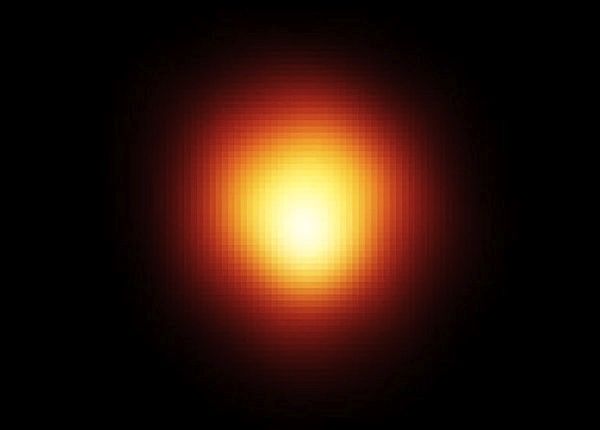


 @MikeWehner