Ontdek de Fascinerende Wereld van UFO's en UAP's: Jouw Bron voor Onthullende Informatie!
Ben jij ook gefascineerd door het onbekende? Wil je meer weten over UFO's en UAP's, niet alleen in België, maar over de hele wereld? Dan ben je op de juiste plek!
België: Het Kloppend Hart van UFO-onderzoek
In België is BUFON (Belgisch UFO-Netwerk) dé autoriteit op het gebied van UFO-onderzoek. Voor betrouwbare en objectieve informatie over deze intrigerende fenomenen, bezoek je zeker onze Facebook-pagina en deze blog. Maar dat is nog niet alles! Ontdek ook het Belgisch UFO-meldpunt en Caelestia, twee organisaties die diepgaand onderzoek verrichten, al zijn ze soms kritisch of sceptisch.
Nederland: Een Schat aan Informatie
Voor onze Nederlandse buren is er de schitterende website www.ufowijzer.nl, beheerd door Paul Harmans. Deze site biedt een schat aan informatie en artikelen die je niet wilt missen!
Internationaal: MUFON - De Wereldwijde Autoriteit
Neem ook een kijkje bij MUFON (Mutual UFO Network Inc.), een gerenommeerde Amerikaanse UFO-vereniging met afdelingen in de VS en wereldwijd. MUFON is toegewijd aan de wetenschappelijke en analytische studie van het UFO-fenomeen, en hun maandelijkse tijdschrift, The MUFON UFO-Journal, is een must-read voor elke UFO-enthousiasteling. Bezoek hun website op www.mufon.com voor meer informatie.
Samenwerking en Toekomstvisie
Sinds 1 februari 2020 is Pieter niet alleen ex-president van BUFON, maar ook de voormalige nationale directeur van MUFON in Vlaanderen en Nederland. Dit creëert een sterke samenwerking met de Franse MUFON Reseau MUFON/EUROP, wat ons in staat stelt om nog meer waardevolle inzichten te delen.
Let op: Nepprofielen en Nieuwe Groeperingen
Pas op voor een nieuwe groepering die zich ook BUFON noemt, maar geen enkele connectie heeft met onze gevestigde organisatie. Hoewel zij de naam geregistreerd hebben, kunnen ze het rijke verleden en de expertise van onze groep niet evenaren. We wensen hen veel succes, maar we blijven de autoriteit in UFO-onderzoek!
Blijf Op De Hoogte!
Wil jij de laatste nieuwtjes over UFO's, ruimtevaart, archeologie, en meer? Volg ons dan en duik samen met ons in de fascinerende wereld van het onbekende! Sluit je aan bij de gemeenschap van nieuwsgierige geesten die net als jij verlangen naar antwoorden en avonturen in de sterren!
Heb je vragen of wil je meer weten? Aarzel dan niet om contact met ons op te nemen! Samen ontrafelen we het mysterie van de lucht en daarbuiten.
Berichten van 1 augustus 2018 tot 31 augustus 2018
Another resident of San Diego, Nicky Fox, wrote on Twitter: “Extraterrestrial lights randomly appearing in the air of Pacific Beach, San Diego.”
One user, Fluttergirl9, posted on Reddit: “I’m in the San Fernando Valley right now and I couldn't believe how many UFOs were in the sky tonight.”
However, Government officials moved to calm the nerves of San Diego residents and came out with an official response to the sightings.
UFO sighting: Strange lights over San Diego prompt extraterrestrial speculation
(Image: GETTY • YOUTUBE)
They state that the strange lights were actually flares released as part of a military test drill 30 miles (50km) off the coast.
But this official explanation still did not conspiracy theorists chins from wagging.
Spirit Walkers commented on a YouTube video of the event: “The most hilarious thing about all these videos is the DESPERATION of all the gov shills trying to explain away each anomaly. ‘Go back to sleep, it's flares…Drones!’.”
While Twitter user Joe Martin contacted prominent conspiracy theorist and former Blink 182 band member Tom DeLonge, who is now a self-proclaimed truth seeker for UFO activity, to ask: “Howdy @tomdelonge , what do you make of this? It was in our (San Diego) night sky tonight. The official word is that it was a military flare exercise. I don't agree.”
New play In Your Skies is partly inspired by the infamous UFO incident in Rendlesham Forest in Suffolk.
Picture: Getty
Lights in the sky, alien space craft, military cover-ups in the woods, they are the stuff of science fiction and conspiracy theories.
Now a Norfolk theatre company is hoping to combine the two in a new play and is seeking people with real-life stories of strange goings-on to help them.
Diss-based The Keeper’s Daughter is currently developing In Your Skies, a play that will explore the life of ufologists and the wider UFO phenomenon.
As part of the research in October, the theatre company are holding two public events at Flying Saucer Cafe in Ipswich and Biddy’s Tea Room in Norwich and they hope UFO investigators and anybody who has seen unexplained lights in the sky will share their experiences.
Mark Finbow, The Keepers Daughter artistic director, who is seeking stories for new play In Your Skies.
Picture: Tom McCall
The play is partly inspired by the infamous 1980 incident in Rendlesham Forest in Suffolk that has become the UK’s most famous alleged UFO sighting.
American officers stationed at the former RAF Woodbridge site reported seeing strange lights and an alien craft on two occasions. The mystery has inspired for books, documentaries, a feature film and even a UFO trail in the Forestry Commission woods.
Mark Finbow, The Keeper’s Daughter artistic director and co-founder, said: “It’s fascinating and over the years there have been so many versions of the story. Whatever the truth is that people are seeking they are never going to find it. I think something happened but I don’t believe it was aliens and most of the people I’ve spoken to so far don’t believe that either.”
In Your Skies is being developed in conjunction with Eastern Angles, DissCorn Hall, and The Garagre in Norwich.
Picture: Keepers Daughter
To research the play, he has already met investigator Brenda Butler, who published a book on the Rendlesham incident in 1984 called Sky Crash. Now he hopes to get other stories too.
The resident theatre company at Diss Corn Hall, The Keeper’s Daughter specialise in science fiction stories. Recent productions includes sci-fi rom com Tomorrow is Your Hope and Wandering Spectre, a children’s ghost story inspired local memories from the people of Diss.
Mr Finbow said: “I prefer the human stories so really this play will be about people who search for UFOs, why they search for them, why this has become a compulsion, possibly obsession, for some of them. They want to believe and you are much more likely to see something if you want to see it.”
Press cutting relating to the Rendlesham UFO incident from 1980.
Picture: Archant Library
The first results of In Your Skies, which is being developed in conjunction with Suffolk theatre company Eastern Angles, will be unveiled in Ipswich and at The Garage in Norwich in February, before it tours the region later in 2019.
Some people thought this meteor in Australia was a UFO
A meteor seared over Australia on Tuesday night, lighting up the sky over Perth.
According to the ABC, the local Department of Fire and Emergency Services received calls from "more than one concerned caller" who thought the meteor could be a UFO.
As Lisa Barnes points out, if the meteor managed to make it to land, you probably shouldn't grab souvenirs. Remnants belong to the state and any discoveries should be reported to Gravity Discovery Centre.
Lisa Barnes✔@Barnsy_Lisa
Lots of reports coming in about a meteor in the sky over Perth last night. Senior astronomer at Gravity Discovery Centre Richard Tonello tells @6PRbreakfast even if a piece hit the ground, it technically belongs to the State Govt & should be reported to the museum #perthnews
Finding actual pieces of meteor is questionable — according to Professor Phil Bland, director of the Desert Fireball Network which studies the fallen space rocks, only about 2 to 3 percent of visible meteors make it to the ground.
But Bland is hopeful. He told ABC that considering how bright it appears on camera, the object must have been large. Larger meteors have a greater chance of making it through Earth's atmosphere intact.
"So that is really exciting," he said.
ABC reports that the Desert Fireball Network should be able to pinpoint where the meteor landed by the end of the day.
Videos : UFO camouflage? Rare clouds that look like UFOs Or is it really a UFO camouflage?
Different UFO enthusiasts are convinced that aliens are hiding behind the big cloud and that the clouds should be just their cover, with which they can discreetly observe people. However, experts are more skeptical about this theory.
Such a view of the sky, it do not often comes along. This is an interesting, quite rare, lenticular clouds or almond shaped. Even has its name – altocumulus lenticularis. It occurs when air rises rapidly through the topographic barrier
Simply put: if the airflow is obstructed, such as high mountains, begins to rise and is condensed. This provides the cloud, often consisting of two or more layers. When to add extra shine and illuminate them nicely, they may resemble massive fixed object, such as a UFO. Beauty!
Germans . Beyond time and space. NAZI UFO 1935-1945. part3. Secret Nazi Experiments.
At the end of World War II, when the defeat of Nazi Germany was almost certain, the US Army began to discover secret underground laboratories and factories throughout the territories. Missile systems, new cannons, jet planes, an atomic bomb, this is just a fraction of what has come to the surface. German advanced technologies and research were miles away from the rest of the world.
But what happened to the best scientists of the Third Reich and state-of-the-art research? Workers in secret factories used prisoners from concentration camps. Almost everything that has been found in these strictly classified places has come to an end in the US. This in essence reflected the world’s power from non-human research. But what did the Germans also prepare, and what were their plans, which never saw the light of the world?
German UFOs
During World War II, flying plates were developed. This fact is really incredible, although research has probably never achieved the desired results. There are theories that should have been used to transfer a planned atomic bomb.
Atomic bomb
Official testimonies say that the Germans were far from developing a real atomic weapon. So they told the Nuremberg court. On the other hand, what is the fact? In 1945, Kurt Diebner’s scientific team had to test the atomic bomb at a German shooter in the Jonastal Valley, where we can now look for increased radioactivity. There are also several witnesses gathered by German historian Rainer Karlsch in the book Hitler’s Bomb. Other sources say that Hitler considered nuclear physics to be a Jewish science, and he did not want to share anything with nuclear research.
Solar weapon The project led by renowned rocket scientist Hermann Oberth had planned to create 22 miles above the ground a huge mirror that would be 100 meters wide and the Nazis would be able to burn any city on the sunny rays or arrange a nice weather on the Rimsko Seme. The metal sodium colossus was supposed to be (fortunately) finished up to 50 or 100 years after designing it.
Project High Jumptajny vyskum
In 1946, one year after the war, 27 US military ships, 4,000 soldiers and 400 scientists flocked to the shores of Antarctica. After two weeks, however, they have suffered huge losses, and so far this megalomania action is only talking about harmless research. Even after almost 70 years we still wonder what is hiding in Nové Švábsko? It was during the Second World War, when the Germans declared part of Antarctica as their territory and was named after New Swabia, and there were many mysterious German submarines that did not go back on its shores. Allegedly, there have been research institutes in newly-discovered warm lakes. But what really happened there?
Too many unanswered questions, many concealments and few answers. It is definitely a phase of history that needs to be deeper. But it could be a dangerous game.
New Videos Of What Could Be The New Space Force In Action. But Why Now? Something Is Going On Over Florida! Special Thanks To The People Who Shared There Video With Thirdphaseofmoon!
With Mars Dust Storm Clearing, Opportunity Rover Could Finally Wake Up
By Mike Wall, Space.com Senior Writer
This June 2017 photo by NASA's Opportunity Mars rover shows the area just above "Perseverance Valley,” which lies on the rim of the 14-mile-wide (22 kilometers) Endeavour Crater. Opportunity has been silent since June 10, 2018, as a dust storm has raged around it.
Credit: NASA/JPL-Caltech/Cornell/Arizona State Univ.
If NASA's Opportunity Mars rover is still alive, we should hear from it relatively soon.
The solar-powered Opportunity hasn't made a peep since June 10, when a worsening dust storm plunged the rover's environs — a spot on the rim of the 14-mile-wide (22 kilometers) Endeavour Crater called Perseverance Valley — into deep darkness.
"The sun is breaking through the haze over Perseverance Valley, and soon there will be enough sunlight present that Opportunity should be able to recharge its batteries," John Callas, Opportunity project manager at NASA's Jet Propulsion Laboratory in Pasadena, California, said in a statement.
Mission controllers are already trying to hail Opportunity three times a week, beaming beep-eliciting commands via the big radio dishes of NASA's Deep Space Network (DSN) during times when the rover might be awake. But as soon as a measurement of atmospheric opacity known as "tau" dips under 1.5, the DSN communication campaign will step up significantly, Callas said. (At the dust storm's height, tau got all the way up to 10.8. More recently, it's been down in the 2-to-2.5 range.)
The clock will start ticking for Opportunity upon the initiation of this campaign.
"If we do not hear back after 45 days, the team will be forced to conclude that the sun-blocking dust and the Martian cold have conspired to cause some type of fault from which the rover will more than likely not recover," Callas said.
"At that point, our active phase of reaching out to Opportunity will be at an end," he added. "However, in the unlikely chance that there is a large amount of dust sitting on the solar arrays that is blocking the sun's energy, we will continue passive listening efforts for several months."
Opportunity has been exploring the Martian surface for more than 14 years. The golf-cart-size rover and its twin, Spirit, touched down in different locales on the Red Planet three weeks apart in January 2004.
Both rovers embarked on 90-Earth-day missions to hunt for signs of past water activity on Mars. And both found lots of such evidence, and then kept rolling along. Spirit last communicated with Earth in March 2010, but Opportunity remained healthy and productive until the dust storm forced it into a sort of hibernation.
The biggest threat to the rover in its current state is cold weather, mission team members have said. Opportunity cannot operate its onboard heaters, so if temperatures drop too much, some of the robot's critical internal components could break. But there's a silver lining to the dust clouds: Dust traps heat, making the potentially dangerous Martian nights a little warmer than they otherwise would be.
"In a situation like this, you hope for the best but plan for all eventualities," Callas said. "We are pulling for our tenacious rover to pull her feet from the fire one more time. And if she does, we will be there to hear her."
I thought I’d check out what ufo videos are out there caught on a flir camera, well actually I mean thermal imaging camera Flir is a brand name. Nearly all flir ufo captures are by military and police forces.
but there are some or atleast one guy I found on YouTube, capturing ufos on a thermal imaging camera. At first I thought there was 2 guys, 1 called UFO MAN and 1 called UFO HUNTER but I’m pretty certain it’s the same guy.
I really want one of these things but at $2500 or £4000 in the U.K for a small camcorder sized one, to $125, 000 for a second hand military grade looking job on eBay, I think I’ll give it a miss.
Ive quite frankly had enough of this shitty little island being ripped of by everyone ...including its own people
$2500 is £2000, so who ever is buying them into Britain is being ripped off .....or the fecker is ripping us off, I suppose it don’t matter cause I can’t afford one.
anyway, I got 3 videos, one is military footage caugh by the puertorican authorities and the other 2 are by the guy called ufo hunter. But this first one is completely mind blowing, not only is it a good capture but it’s what happens towards the end! The ufo goes into the sea and comes out split into 2 separate ufos and although that’s pretty awesome, that isn’t the bit that gets me ...it’s the fact that when it enters the sea, it does not appear to effect it in anyway ....no slowing down, nothing! It doesn’t even seem to make a splash??
To me it just confirms that ufos are not really there “ physically” there is something else going on? But it’s anyones guess what
heres the first video and it’s the military one:
the next 2 are from that ufo guy and are no less impressive. And let me say before anyone calls birds. Birds fly in unison and tend to only over take the other, when taking turns to lead the pack and it is not done at such speed as they are already flying nearly as fast as they can!
ive never seen ufos like this before, they are flying in formation and look to me like an intelligent organic living thing, like someone mentioned the ufos could be in the first video. I’ve always thought orbs could be somekind of living thing ....sky jelly fish or summin? 😆
Let’s face it there could be anything out there beyond human comprehension
Stars is not what you think they are - they sing together like an orchestra!
This is such a great video depicting stars in real time filmed by amateur photographers not NASA and the difference is astonishing- Stars are not what we think they are.
"Beyond the Sky" reveals the truth behind UFOs and Alien Abductions
Fulvio Sestito is having a real moment in Hollywood with his second movie ‘The Curse’ entering pre-production just as his directorial debut ‘Beyond the Sky’ is set to light up the theatre screens.
This autumn, critics have suggested, the world will be stunned by what has been hyped as the terrifying UFO movie to hit the big screen in years.
Beyond the Skies shines a new light on alien abductions
The movie centres on a UFO sceptic named Chris Norton. Norton has spent his life surrounded by stories of UFO abductions and alien encounters, and he believes with all his heart that they are nothing more than nonsense and delusion. He sets himself the mission to debunk claims of alien abductions once and for all and heads into enemy territory to just that.
At a UFO convention, Norton seeks out alleged abductees to confirm his suspicions that they are either lying or just crazy. At first, it seems like Norton’s suspicions are about to be approved until he meets Emily who claims that she has been abducted every year for the past seven years on her birthday. Chris is intrigued by Emily and thinks that there might be more to her story than meets the eye, and so he agrees to accompany her on her birthday which is only a few days away.
What happens next will change Norton’s mind about the UFO phenomenon and open up a seriously terrifying new reality that he could have never imagined existed.
Critics who have seen the film have praised its high-stakes thrills and superb writing team along with the all-star cast of cult movie darlings including Ryan Carnes, Jordan Hinson, Peter Stormare, Dee Wallace, Martin Sensmeier and Don Stark.
The trailer for what is guaranteed to be one of the must-see movies of this year can be viewed below.
WETENSCHAPNa drie maanden is de enorme stofstorm op de planeet Mars eindelijk gaan liggen. Door de storm kon de onbemande verkenner Opportunity, die op zonne-energie werkt, de afgelopen maanden geen onderzoek doen omdat de accu leeg was. Nu de zon opnieuw begint te schijnen op mars, kan de Mars-rover zijn batterijen weer opladen. Als hij het nog doet tenminste.
Volgens de Amerikaanse ruimtevaartorganisatie NASA “breekt de zon door de wolken boven Perseverance Valley”, de plek waar de verkenner geparkeerd staat. Als de lucht op Mars helder genoeg is, probeert NASA een signaal naar de Opportunity te sturen om een idee te krijgen hoe de verkenner eraan toe is. Als ze na 45 dagen nog niets hebben gehoord, gaan ze ervan uit dat de verkenner onherstelbaar beschadigd is door de stofstorm.
De stofstorm werd op 30 mei voor het eerst waargenomen. Op 10 juni liet de Opportunity voor het laatst van zich horen. In 2007 overleefde de Mars-rover een nog veel grotere storm. De kou die daarmee gepaard ging, betekende volgens de NASA vermoedelijk wel het einde van tweelingbroer Spirit, die toen ook op Mars rondreed.
De Opportunity werd in juli 2003 gelanceerd en landde in januari 2004 op Mars. De verkenner rijdt al ruim veertien jaar rond op Mars, terwijl de missie oorspronkelijk negentig dagen zou duren. Hij heeft inmiddels iets meer dan 45 kilometer afgelegd en vond een paar weken na zijn landing al sporen van water. Nader onderzoek wees uit dat de Opportunity op de kustlijn van een opgedroogde zoute zee stond. Later vond de verkenner nog meer bewijs dat er miljarden jaren geleden water stroomde op Mars.
Coördinaten van Grote Piramide komen overeen met lichtsnelheid. Is dit bewijs voor buitenaardse invloed?
Als je de afmetingen van de Grote Piramide afzet tegen de exacte coördinaten van de evenaar, kom je tot de ontdekking dat het bouwwerk een soort schaalmodel is van het noordelijk halfrond. Dat wordt gesteld in het nieuwe seizoen van het tv-programma Ancient Aliens.
Aan de hand van satelliettechnologie is recentelijk nog iets opmerkelijks ontdekt.
Als je de locatie van de Grote Piramide weergeeft als een coördinaat, komt dat coördinaat exact overeen met de snelheid waarmee het licht reist.
Niet zomaar
Ook andere bouwwerken op aarde, zoals de Meso-Amerikaanse piramides en Ziggoerats in Mesopotamië, blijken niet zomaar ergens te zijn gebouwd.
“Deze gebouwen zijn neergezet onder goddelijke leiding,” zegt Jonathan Young, curator van de Joseph Campbell Archives.
“Dit is een merkteken van de goden,” vervolgt hij. “Ze hebben bepaalde dingen in die gebouwen gestopt om ons te laten weten dat ze niet geheel van menselijke oorsprong zijn.”
Uitgelijnd
“Ze staan voor iets groters,” aldus Young.
Het zou om die reden geen toeval zijn dat bepaalde sterrenbeelden zijn uitgelijnd boven oude bouwwerken.
Zo komen de drie piramides op het Gizeh-plateau overeen met de drie sterren in de riem van Orion. Datzelfde geldt voor drie piramides die in Teotihuacan staan.
Lying just off the southern coast of Italy is a small archipelago of islands that comprises the island nation of Malta. The country has a unique and colorful history, first settled in 5,900 BC and then passed through a succession of rulers over the millennia, including the Phoenicians, Carthaginians, Romans, Byzantines, Arabs, Normans, Sicilians, Spanish, French, and British, due to it Naval importance, and finally becoming a British colony in 1814, before gaining independence in 1964. With such a long history spanning back for millennia, Malta is known for its splendid ruins, historical monuments, and ancient sites, but one of these places stands out; a mysterious underground complex that holds with in it many enigmas and oddities that remain unsolved to this day.
The place known as the Hypogeum of Ħal-Saflieni, or also just simply the Hypogeum, was found quite by accident, when in 1902 some workers were digging cisterns at a housing development in the town of Paola when they broke through into what seemed to be an immense chamber of some kind. This chamber seemed to be part of some larger structure that had sat down there in the darkness away from human eyes for a very long time, but for some reason the workers decided to cover up their discovery, meaning that the true extent of this bizarre place would not be uncovered until later.
When word got out that there was a mysterious subterranean complex of unknown origin lying down there right under the town, archeologists were quick to swarm to it, and it would soon prove to be one of the most important and interesting archeological discoveries of the century. Dated to as old as 4,000 BC, it was and still is thought to be the oldest underground complex in the world, and here was a Neolithic structure that held temples, shrines, altars, vast warrens of tunnels that meandered off into the dark, burial chambers, all painstakingly cut directly into the surrounding rock and littered with countless objects such as statues, figurines, pottery, stone and clay beads, shell buttons, amulets, axe-heads, and many, many others. Yet, perhaps the most notable and macabre discovery down there in this ancient place long buried and forgotten down in the bowels of the earth were the remains of an estimated 7,000 individuals, along with numerous burial tools, leading to the theory that this massive complex was meant as a necropolis, or basically a city of the dead, a giant tomb.
The Hypogeum of Ħal-Saflieni
It was already all a mystery as to who had built this place, how it had remained hidden for so long, and why it was packed with thousands of dead people, but these were by far not the only mysteries awaiting discovery in this dark, forgotten place. By far one of the most well-known mysteries of the Hypogeum is the discovery of numerous very anomalous skulls scattered amongst the many remains found there, and uncovered at what appears to be a sacred well adorned with statues of a goddess.
The skulls in question were immediately striking in that they were abnormally elongated and larger than normal human skulls, and further analysis showed that some displayed some kind of mysterious genetic abnormality, while others held evidence that their skulls had been intentionally bound to make them that way, similar to a practice among priests in ancient Egypt, Mesopotamia, and South America. A few of the skulls are very odd indeed, showing an inconsistent pattern of, and in one case a complete lack of, the cranial “knitting,” a line across the skull denoting the fusing of cranial plates, also called the fossa median, which are the plates of the skull that are separate in infancy and later join together into adulthood. This baffled the researchers who looked at them, as there is no known genetic abnormality or mutation in humans. Most of the strange skulls also demonstrated evidence of having undergone some mysterious surgical procedure, with three small holes drilled into the head for unknown reasons.
These bizarre skulls prompted wide speculation at the time, and still do. Why did these individuals have these mysterious elongated skulls and what was its significance? One of the earlier ideas was that these remains represented a whole new race of humans or a new mutation, while others suggested it had some religious implication or was some sort of sign of status. There was also the idea that these could have been settlers from Egypt, where the elongation of skulls was a documented practice, or were descendants from an unknown Maltese tribe or lost civilization. Other more far-out theories have been that these are the remains of ancient aliens or interdimensional travelers, while others say that they were attempts to enhance psychic abilities, or even that they were the remnants of the displaced population of the lost continent of Atlantis.
One of the mysterious Malta skulls
It is hard to say for sure because the skulls themselves have been so little-studied, and remain cloaked in shadow. After their discovery, 11 of the bizarre skulls were put on display at the Archeological Museum of the Valletta, after which they were suddenly removed without explanation, with access strictly limited, making it nearly impossible for anyone to adequately study them. Indeed, some of the only evidence that we have that they ever even existed at all are some photos and records by Maltese researchers Dr. Anton Mifsud and Dr. Charles Savona Ventura. Adding to the mystery is the fact that apparently several of the skulls have gone missing over the years, with only 6 of the original 11 remaining. What happened to the others? No one knows, and it has added a layer of dark government conspiracies and cover-ups upon the whole thing. As a result of all of this, the weird skulls of Malta have remained hotly debated and their exact origins unknown.
While we don’t know exactly where they came from or why they were there, these skulls are not even the most outlandish mystery of the Hypogeum. In the 1930s, a worker from the British Embassy by the name of Lois Jessop came forward with a truly bizarre account from down in the depths of the Hypogeum. She claimed that she had been exploring the ancient subterranean tunnels on a guided tour by candlelight when she came to burial chamber with a steep drop that plunged down into the murk. When she used her candle to look down through the darkness she claims that she saw something very strange down there in the abyss, and she looked down there as someone held onto her sash to keep her from falling, and would explain of what happened next:
I held my candle higher and peered down into the abyss, thinking that with this dangerous drop it was better not to go on further without a guide. Then I saw about twenty persons of giant stature emerge from an opening deep below me. They were walking in single file along another narrow ledge down below. Their height I judged to be about twenty to twenty-five feet, since their heads came up about half way on the wall on the opposite side of the cave. They were covered in long white hair, combed downward and shaggy looking. They walked very slowly, taking long strides. Then they all stopped, turned and raised their heads in my direction. All simultaneously raised their arms and with their hands beckoned to me. The movement was something like snatching or feeling for something, as the palms of their hands were turned down.
Things get even spookier a few weeks later, when Jessop claimed that there had been a group of 30 students and some teachers who had gone down into the very same chamber, only to mysteriously vanish after the cave collapsed behind them. Screams and cries for help could purportedly be heard echoing out from somewhere within for days, even as search parties looked and failed to find them, before finally giving way to silence. Their bodies were never found. After this, the government then supposedly went in and boarded up the tunnels, closing them to the public. Jessop’s tale was published in the publication The Journal of Borderland Research, but her veracity has been controversial since she would go on in later years to express an intense interest in UFOs and even become head of a UFO research organization. Was her account true, and if so what did she see down there? Who knows?
Other oddities of the Hypogeum have been uncovered in recent years as well. For instance, it has been found that the cave consistently produces sound frequencies that fall within the range of 110 to 111 hertz, which is known to have physical and mental effects and is too consistent to have been an accident. It is thought that this place was specifically chosen and designed for this effect, and that it served some as yet unknown purpose for these people or beings. With its air of mystery, unclear origins, unidentified remains, mystical features, and its otherworldly skulls, the Hypogeum of Malta, which managed to remain hidden from civilization for thousands of years, just may hold many of its enigmas for thousands more.
A rod was seen shooting past a security cam just as a Tesla shoots past and became airborne. It appears the the rod, an alien probe was following along side the Tesla to observe its technology and abilities. I mean, how often do you see Tesla cars flying past? Its a rare thing, but probably going to become more common since they are lighter and faster than their gas counterparts.
Now youtube videos can be slowed down. Hit the settings button in the video bar, hit speed, then hit .24. That will make it 1/4 the speed. This way you can see the UFO and the Tesla both.
Scott C. Waring
Video states:
A four-door Tesla crossed the steep Little Avenue railway tracks at a high rate of speed Tuesday evening and became airborne before losing control and crashing into the parking lot of Assikinack Public School.
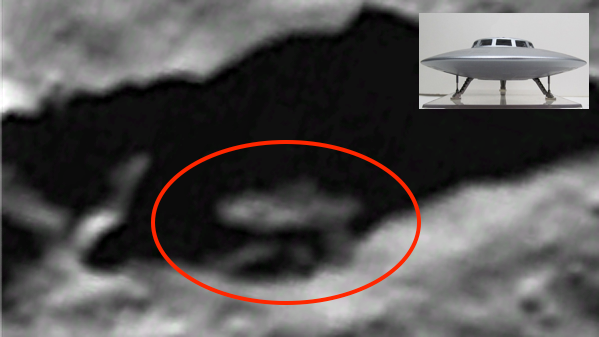
Three Mile Long UFO Found On Google Moon, Aug 31, 2018, UFO Sighting News.
Date of discovery: Aug 31, 2018 Location of discovery: Earths moon Method: Google Moon Coordinates: Unknown, northern region I was looking at Google Moon map at a UFO that was parked near a crater edge so it was partly hidden in the shadows, when all of a sudden Google Moon crashed. It happened just a second before I was about to copy the Google coordinates. I did not expect that to happen. Its almost like Google was trying to keep me from devolving the location of this UFO. I will however still make a post about it, and one day, someone else will find the coordinates of it again. I did get some great screenshots of it before it crashed. The UFO is 3 miles long and 1 mile wide. Its standing on legs in the shadows. Why did Google Moon crash when my mouse curser was on the coordinates to copy? Could be a program glitch or it could be Google is helping to hide the existence of aliens. Since Google is the largest search engine in the world in control of the worlds total Internet knowledge...it only make sense to use it to the governments advantage. Scott C. Waring
Fireball Lights Up Sky Over Western Australia (Videos)
By Elizabeth Howell, Space.com Contributor
Dash cam footage shared on Twitter shows the bright blue light
A fireball lit up the sky over the Australian city of Perth late Tuesday (Aug. 28), reportedly generating a powerful shockwave that rattled houses in the area — and some observers caught the dramatic event on video.
Perth's fire and emergency department started receiving calls about the meteor today at 7:40 p.m. local time (7:40 a.m. EDT and 1140 GMT), according to the Australian Broadcasting Corporation (ABC). Several people captured fireball videos with CCTV cameras and dash cams and sent the footage to the Perth Observatory.
"We heard the boom; we saw the light. We just thought it was lightning to start with, but the boom that came after it was definitely not thunder," Robyn Garratt, a resident of York — which lies about 60 miles (100 kilometers) from Perth, the capital of the state of Western Australia — said in an interview with ABC Radio. [The Dazzling Perseid Meteor Shower of 2018 in Photos]
"In York, people felt a lot more than that," Garratt added. "They all went running outside, thinking the sky was falling, basically."
Meteors are incoming space rocks that hit Earth's atmosphere, sometimes producing a powerful light show and/or shockwaves detected by people on the ground. Any pieces of that space rock that make it to the ground are called meteorites. (A fireball is any meteor that blazes more brightly than Venus in the sky.)
Scientists from Curtin University in Perth are among the people trying to determine if any meteorites were generated from the fireball. With so many videos available, university researchers are working to triangulate observations to narrow down the search, Phil Bland, director of the Curtin University-run Desert Fireball Network, told ABC.
On CNN, Bland also gave advice about what any such meteorite would look like, for those who are searching for one. (He urged anybody who found a meteorite to give him a call.)
"It will look strange. Iit will have a black crust on it, and it'll be kind of slightly rounded in a way that most terrestrial rocks aren't," Bland said. "It will look distinct; it'll look odd. Also, they're usually a little bit heavier than average rocks."
Earth gets hit by space rocks every day, in sizes ranging from tiny pebbles to much larger objects. While most of these impacts are harmless, occasionally a meteor generates more damage.
A prominent, recent example of a more damaging eventtook place over Chelyabinsk, Russia, in 2013, when a meteor broke up in the atmosphere and its shockwave shattered thousands of windows in the city below, injuring about 1,500 people. This particular space rock was probably about 65 feet (20 meters) wide when it crashed into the atmosphere, but much smaller fragments were retrieved on the ground.
NASA has a Planetary Defense Coordination Office that keeps an eye out for the largest space rocks that threaten Earth, through a network of telescopes that watch the skies for asteroids. Astronomers worldwide have found more than 8,000 near-Earth objects that are at least 460 feet (140 m) in diameter — big enough to destroy a U.S. state in the event of an impact.
The network isn't designed to pick up smaller space rocks. But NASA researchers say they have not yet found an imminent threat to Earth among the big ones.
It’s no secret that humans (well, at least presidents) are aching to go back to the Moon. And now, we have more concrete plans on how we might do that. Earlier this week, the Human Exploration and Operations Committee for NASA’s Advisory Council presented the most detailed plan to date of how, exactly, it will go about it.
NASA’s plan involves something called the Deep Space Gateway, aka the Lunar Orbital Platform Gateway. First announced in March 2017, the Gateway would be a small habitat that would orbit the Moon and would act as a “spaceport for human and robotic exploration to the Moon and beyond.”
In other words, it would act as a basecamp to explore the surface of the Moon, conduct experiments into the viability of prolonged space travel, and prepare for much (much) farther destinations. According to the presentation this week, NASA plans to have the completed Gateway in lunar orbit as soon as 2024 — that is, if everything goes according to plan.
“Right now, our near-term focus is the Moon and returning humans there,” Kathryn Hambleton, a NASA spokesperson, tells Futurism. NASA’s teams are planning to use the space beyond Earth’s orbit near the Moon “to build up our technology capabilities, test our systems, and test our operations while we are still a few days from Earth before we are ready to take on the multi-month journey to Mars.” To do all that, though, it needs the Gateway in place.
During its meeting, which was open to the public, the Advisory Council noted that the Gateway will be made up a couple of main components:
The Power and Propulsion Element (PPE): The component that powers the Gateway and allows it to move to different orbits.
The Airlock: A point of exit that could be used for astronaut spacewalks or permit other types of rockets to dock to the Gateway.
The Habitat: Pressurized sections of the Gateway that will house up to four crew members for up to 90 day missions.
But before astronauts can populate the Gateway, NASA has a lot of work to do. And it’s gotta do it all in the next six years.
Step 1: Build a giant rocket called the Space Launch System (SLS). Here’s how it would go. The SLS will launch major components of the Gateway into lunar orbit between now and 2024. In 2024, NASA’s Orion Spacecraft that’s currently in development would nudge those pieces into place, making the Gateway ready for human inhabitants.
To send a crew of astronauts all the way to the Gateway, SLS is going to need a rocket capable of sending 37 metric tons (81,000 lbs) of cargo into orbit around the Moon. Right now, we don’t have a rocket that can tow that much — SpaceX’s Falcon Heavy’s max payload to the Moon is estimated to be around 18 to 22 metric tons. Engineers are going to have to figure out how to double that capacity to make the SLS happen.
Complete the SLS and the Orion Spacecraft, and find funding for all components of the Gateway, and launch it into lunar orbit, and send the first couple of astronauts there by 2024? Pretty darn ambitious. Especially since so far the SLS’ development hasn’t exactly been smooth sailing.
The private space industry might help NASA get there. The space agency is hoping that a private space company will take on the substantial task of developing the lander that Gateway astronauts will use to travel from their habitat to the surface of the Moon, but no official partnership has been announced yet.
The Gateway’s doors (or airlock) will be open to rockets launched by both government space agencies and private companies. Since companies like SpaceX are making giant technological leaps — they’re launching rockets that are more powerful and cheaper — they could take a big a big load off of NASA’s back. “There will definitely be opportunities for a variety of rockets to deliver supplies and logistics to the Gateway,” says Hambleton.
Even with private space companies on board, NASA will inevitably face some major roadblocks to getting the Gateway up and running. There’s still the inherent risks that astronauts face during deep space travel – intense levels of radiation, isolation, a lack of gravity, and harsh environments.
Luckily, NASA’s research is well underway, particularly from studies conducted on the International Space Station. “We are working towards greater reliability of systems and more of a closed-loop kind of system in terms of recycling air and water, so we’re less reliant on Earth for those consumables,” Hambleton tells Futurism. No matter the outcome of these experiments, however, NASA still plans to make the Gateway happen in the stated timeframe.
Yes, NASA has a lot of work to do before the Deep Space Gateway is peacefully orbiting the Moon. Six years go by pretty fast, but making things happen in that timeframe is no impossible. With the right public-private partnerships and international collaborations, NASA has a much better shot at getting astronauts back onto the surface of the Moon, and maybe to Mars before we even know it.
WATCH HOW A LIGHTNING STRIKE TEMPORARILY DISABLES THIS UFO’S CLOAKING SHIELD
It seems electrical disturbances have an impact on a UFO’s cloaking device, as evidenced by the following video.
An unidentified flying object’s cloaking shield is one of its best assets since it allows the craft’s occupants to remain undetected while performing their obscure activities on Earth.
Visible light can be considered an oscillating electric and magnetic field and because the cloaking shield works on a visible level, it must operate on some kind of electromagnetic principle we’ve yet to discover. You know what else is electromagnetic? The immense power surge caused by a lightning strike. So it makes sense that when a camouflaged UFO is hit by the thousand or so Giga Watts discharged by a lightning bolt, some interference may occur.
In the following video we are treated to the rare sight of such a phenomenon.
During a recent thunderstorm in the U.S., a large, circular UFO became visible after coming in contact with the immense voltage of an electrical discharge between clouds. It is unclear whether the craft was accidentally hit or it was there exactly for that reason. Perhaps these advanced vehicles are able to harvest energy from a variety of sources, including, but not limited to volcanoes, lightning and solar wind.
After lightning touches its surface, the UFO becomes visible for approximately 30 seconds during which it remains lit and illuminates the sky and clouds surrounding its massive body. Once the UFO disappears, the surrounding area returns to its normal luminosity.
Although videos like this are rare, they are not unheard of. In a previous article, we showed you a fleet of UFOs recharging their batteries during a thunderstorm. Another video that quickly went viral featured a creepy UFO exiting a lightning storm at a high velocity.
It’s obvious that aliens always need two things: human specimens and a whole lot of power.
This Group of NASA Veterans Wants to Build Their Own Space Station
Axiom also hopes to revive orbital tourism, with tickets priced at $55 million.
At first Axiom’s modules would be attached to the International Space Station. Eventually, the company wants to have a separate station in orbit. (Axiom Space)
As a NASA astronaut for 20 years, Michael Lopez-Alegria conducted 10 spacewalks and set a U.S. record for total spacewalking time (67 hours and 40 minutes) that still stands. Now he heads business development for Houston-based Axiom Space, which aims to send private “spaceflight participants” up to the space station (for $55 million a seat), then to attach its own commercial module to the International Space Station, followed eventually by a free-flying commercial station of its own. Lopez-Alegria talked to Senior Editor Tony Reichhardt in June.
Air & Space: The Russians were taking paying customers up to the space station every couple of years in the early 2000s, but we haven’t seen any of those spaceflight participant flights in almost a decade. What happened?
Lopez-Alegria: Pretty simple. At the time, the station had three crew members, and we were rotating one of the three on shuttle flights and the other two on a [three-seat] Russian Soyuz, leaving a third seat open. Once the shuttle stopped flying, all three crew members started rotating on the Soyuz, so there were no more seats available. The demand was still there, but there was no supply.
What was the idea behind Axiom Space?
Our co-founder, Mike Suffredini, was NASA’s program manager for the International Space Station for ten years until he retired in 2015. He went to work with the other co-founder, Kam Ghaffarian, who at the time owned a company called SGT, which is a large contractor with NASA. They wanted to investigate the viability of a commercial space station, and after studying it for about a year Mike thought it was doable. And here we are.
Bigelow Aerospace already has an experimental module attached to the station, and is planning a commercial module of their own. How is your plan different?
We’re largely appealing to the same markets, which, in the beginning anyway, will be foreign professional astronauts as well as spaceflight participants. There are a couple other lines of revenue—research, space manufacturing, advertising, and something called exploration systems testing. When NASA starts going to points farther than Low Earth Orbit, like cislunar space or Mars, they want to have tested the support equipment and other critical components in space before they deploy them to places that are a lot harder to get to. It’s a lot easier to go fix something in Earth orbit than it is to fix something orbiting the moon. So that’s a sixth line of business, working for the companies and governments developing hardware for exploration.
We’re different from Bigelow in that they use expandable technology, which is sort of like a balloon that they inflate. We are going with a more proven system, basically an aluminum cylinder. Our module is going to be manufactured by the same guys, Thales Alenia, who have built something like 40 percent of the habitable volume on the space station. We don’t want to try anything that’s super hard. I mean, we don’t have much time to get this done. The ISS is going to be de-orbited somewhere between 2024 and 2028, maybe a little later. But this is still a pretty ambitious endeavor. It will take time, and we want to make sure we can get this stuff up there and activated. Trying that with new technology doesn’t seem like the path to success for us.
What does NASA have to do to make it happen?
They have to grant access for somebody to use one of the space station’s berthing ports. There’s only one port located in a place where you could attach something big enough to call a space station, or the beginning of a space station. So we think NASA needs to get on with whatever competitive process they want in order to decide which company is worthy of putting their confidence in.
If you’re an investor, and I come to you to invest a whole bunch of money, you’re going to say “What are the risks?” And if I say, “One of the risks is that we may not win this docking port,” you’re going to think twice. So until that docking port is granted, it’s going to be very difficult to raise a lot of money, and until you raise the money you can’t start constructing a module. So the first domino has to be the granting of the docking port. Then construction comes, and we can launch and dock and activate and start making revenue, and prove our worth to NASA so they can say okay, now we can retire the ISS, because we are confident we’ll have a place to go [in low Earth orbit]. Because we really don’t want a gap in our capability to work in Low Earth Orbit.
Has NASA given any indication of when they might start this competition for the docking port?
Oddly, two years ago, in the summer of 2016, they issued a request for information where they asked industry, “If we wanted to give away [the docking port] what criteria should we use?” A bunch of companies, 19 of us, responded, and NASA indicated that the responses were going to form the basis of a solicitation. But then the election happened, and I don’t pretend to know why it’s taken so long, but they still haven’t done it yet. Recently they issued what’s called a NASA research announcement, asking a lot of the same questions they did in 2016. So we’re encouraging them to use the data they already have to develop a [solicitation].
What agreements do you already have in place with NASA? Even before you attach your own module to the station, you want to send up paying customers, right?
Yes, that’s right. We’re getting a lot of interest from investors in spite of the lack of a docking port, because [flying private customers to the ISS] is already a sustainable business in and of itself. We would like to get NASA and other ISS partners comfortable with our operation. Flying to the ISS and demonstrating that we know what we’re doing is going to be good for them and for us, although we already have a ton of NASA experience within our company. So that’s a real reason to do these precursor flights. We have one planned in 2020, and another one or two planned in 2021. Then we’d like to get our modules up there in 2022.
We have a Space Act Agreement with NASA , and the first phase is complete, a kind of feasibility study to outline what services and utilities we would need from the station. We need to get some power and cooling capacity, et cetera, and we’d need to know how our module affects the mass and center of gravity of the station. So they’ve done all that preliminary work.
Have you already got customers lined up for the 2020 and 2021 flights?
No, we’re talking to [potential customers]. We only recently [in June] announced our campaign to market spaceflight participant flights. We’re agnostic as to which launch vehicle we’d use. It could be Soyuz, which has three seats, it could be the SpaceX Dragon, which has four, or it could be Boeing’s Starliner, which has five. Let’s take the Dragon case in the middle. On short duration flights, which are about ten days, we’d like to have at least one professional astronaut and up to three spaceflight participants. We could have more professionals—it doesn’t really matter to us, the price is effectively the same except for the training. We are fairly far along in negotiations with some countries to provide professional astronauts, but we have just started looking for spaceflight participants.
Are you thinking of astronauts from countries that don’t have their own space programs?
Two different categories: One would be countries that are fairly technologically advanced but don’t have human spaceflight programs. We can help with everything from astronaut selection to training. We have quite a bit of experience within our company. SGT [Ghaffarian’s former company] is a contractor to NASA, and today does all the training for NASA astronauts as well as all the flight control functions in Mission Control for the ISS. So you have a huge knowledge base accessible to our company. We would be able to select and then train and then fly astronauts for these countries. The second category are countries that already have astronauts, but don’t get to fly often enough. And a lot of those are in Europe.
One of the barriers to signing up spaceflight participants in the past was the amount of time required to train in Russia. Will your training be shorter?
Yes, and they won’t have to learn to speak Russian, either. I flew with two of those spaceflight participants, and both of them were in Russia for several months. We’re talking about being able to do our training in about 15 weeks, and it would all be in the U.S., with potentially a one-week trip to Russia to understand the Russian part of the space station.
Most of the space tourists a decade ago actively participated in the onboard experiments, and really tried to pitch in. Do you see that happening on your flights as well?
They can do whatever they want, is the bottom line. But I’ll tell you a story. When I was an astronaut and found out I was going to be flying with tourists, I wasn’t terribly excited about it. I figured this is a place for steely-eyed test pilots, and didn’t think very highly of the concept. I ended up flying about ten days with Anousheh Ansari, and she completely inverted that perspective. I saw how she and the guy I flew home with, Charles Simonyi, were both extremely professional, very courteous, and extremely willing to help. More importantly, she wrote a blog that reached millions of people on the ground and really kind of democratized the experience. It kind of opened my eyes to this notion that space is such a unique and magnificent experience that it ought to be shared with as many people as possible.
With all the experience at Axiom, do you see ways to build or operate a space station that might be better than the way NASA does it?
I hate to say it, but things that the government buys are always going to be more expensive just because they have a lot of bureaucracy and a lot of requirements. That’s the advantage of having a team that’s so experienced, that has sat through all the safety reviews. We can tell which [requirements] are valid, that we really need to consider, and which ones are kind of fluff. I think anybody who’s honest would tell you that you a lot of stuff happens that is just a function of the size of the organization.
Secondly, the ISS was built with pretty old technology, basically 386 processors and 1553 [military standard] data, which is kind of overkill for what we need, and drives costs out the roof. With the speed of processors today, you can do so much more with so much less in terms of weight, volume, and complexity. For instance, some of the gear on the ISS was so big that it had to go outside on the truss structure. And if it breaks it’s a real pain to go fix it. You have to have a spacewalk, or use very complex robotics, whereas now, because of miniaturization, we can put something like that inside, behind a cupboard door. So those are the things that will help us save money.
In his 20 years at NASA, Lopez-Alegria conducted 10 spacewalks and set a U.S. record for total spacewalking time (67 hours and 40 minutes) that still stands.(NASA)
If everything goes according to your plan, how do you see Earth orbit in 10 or 15 years? Will there be several space stations?
I think probably just one company will benefit from the ISS, which is in a particular orbit. Other companies might want to go to different orbits. But once that one company proves the market, then I think you’ll see more investment, other companies trying to build independent space stations. For the first one, it would be advantageous to start attached to the ISS. Once the market gets proven, and I’m confident it will be, I do think you’ll see a proliferation of stations.
Would you like to go up again yourself?
I’ve had kind of a tongue-in-cheek conversation with Mike [Suffredini]. He said “You can be the first guy to go as soon as you write me a check for $55 million.” [Laughs] I don’t think it’s gonna happen any time soon.
It’s the stuff of thriller movie plots and space travel nightmares. A meteorite crashed into the International Space Station and pressure started dropping on the Russian side as oxygen began leaking out of the hole. A good screenwriter could spin this opening scene into 90 minutes of heart-thumping action, but NASA decided to let the crew continue to sleep and deal with it in the morning. Does NASA Need better technicians or better screenwriters?
“As flight controllers monitored their data, the decision was made to allow the Expedition 56 crew to sleep since they were in no danger. When the crew was awakened at its normal hour Thursday morning, flight controllers at Mission Control in Houston and at the Russian Mission Control Center outside Moscow began working procedures to try to determine the location of the leak.”
The current ISS crew consists of station Commander Drew Feustel, Flight Engineers Ricky Arnold and Serena Auñón-Chancellor of NASA, Alexander Gerst of the European Space Agency and Oleg Artemyev and Sergey Prokopyev of the Russian space agency Roscosmos. Upon awakening (to the music of “Fixing a Hole” by the Beatles?), NASA sent them all over to the Russian side to look for the leak. Really!
Soyuz spacecraft
And? They found it! The hole was no more than two millimeters (.078 inches) in diameter and located not on the ISS itself but in the Soyuz spacecraft currently docked to it. That spaceship has been attached there since June, so it’s considered part of the station. The hole appeared to have been caused by a micrometeorite impact and was apparently found by ESA astronaut Gerst who reportedly … get ready for this … put his finger over the hole! The little Dutch boy with his finger in the dikewould be so proud.
It gets better. The space news website NASASpaceFlight.com was monitoring communications between ground support and the crew gave these updates on the initial repairs:
“Russian ground controllers say they are now into a deep dive evaluation of the hole. Sergey Prokopyev is still trying to hunt down a repair kit. They have taped the hole as a band aid. Plan is to clean up the area and add more permanent patches.”
Tape! Patches! And then …
“Now told to use a toothpick on the hole (likely to aid photography and scale). Then will apply sealant and cover it with a patch. General ISS pressure is holding stable now.”
Toothpicks! Glue!
This is no space thriller movie … this is a sitcom for aliens watching Earthlings in their feeble attempts at space travel.
We’re glad the crew is safe and the hole is repaired. This shows how risky space travel is and how dangerous even a tiny meteorite or piece of debris can be. A permanent fix will most likely have to be made from the outside on a spacewalk.
NASA has probably already put in orders to ship up some Bondo, sandpaper and paint.
DE GOUDEN BIBLIOTHEEK VAN ONZE VOOROUDERS ( VIDEO )
Wanneer de aarde dreigt te vergaan door allerlei mogelijke rampen, dan doet de mensheid vaak toch pogingen om een boodschap voor toekomstige generaties of volken achter te laten.
Ook onze verre voorouders hebben dat gedaan in de vorm van een ondergrondse bibliotheek in Zuid Amerika.
Ongeveer vijf jaar geleden kwam er een claim van een aantal mensen die beweerden een enorme ondergrondse bibliotheek in Ecuador te hebben ontdekt, of beter gezegd, herontdekt.
Een team onderzoekers heeft bekendgemaakt dat zij de legendarische metalen bibliotheek en diverse andere schatten hebben gevonden in het Tayos grottensysteem in Ecuador.
Zij maakten ook bekend dat ze per ongeluk enkele verborgen tunnels hebben ontdekt die lang geleden door iemand of.... iets gemaakt zijn.
Het team was in staat om één van deze tunnels bijna een kilometer lang te volgen en kwam uiteindelijk uit in een grote kamer die de gouden bibliotheek en diverse andere waardevolle objecten bevatte. Hier volgt een lijst van wat de onderzoekers zeggen te hebben gevonden:
1) Een bibliotheek met duizenden metalen boeken. Het team was nog niet in staat om te vertellen welk metaal gebruikt was voor de boeken, maar het leek op zilver. 2) Iedere pagina bevatte symbolen en vreemde tekens. Individuele platen met tekens erop die eruit zagen alsof ze van goud waren. 3) Honderden verschillende beelden van insecten, dieren en mensen, verspreid door de grote kamer. 4) Veel metalen staven, zowel van (wat eruit zag als) goud en zilver. 5) Ook werd er kinderspeelgoed gevonden en juwelen van goud of zilver. 6) Een grote sarcofaag met daarin een menselijk skelet, versierd met juwelen en goud. 7) Het team vond tenminste nog drie deuren die naar meer kamers zouden kunnen leiden, maar die waren afgesloten.
Tot nu toe zijn de claims van dit team alleen nog gedaan via een radioprogramma en zijn er (nog) geen verdere mededelingen gedaan. Ze meldden verder dat ze voorbeelden hadden van tenminste één van de metalen boeken, een gouden plaat en verschillende kleine beeldjes die aangeboden zullen worden voor professioneel onderzoek. Hopelijk zullen er binnenkort meer berichten volgen.
Daarna is er nooit meer iets vernomen voor zover ons bekend.
Desalniettemin zijn de grotten en de verhalen over die bibliotheek wel echt.µ
Mensen die zich al eerder met deze bibliotheek hebben beziggehouden zijn onder andere Erich von Däniken en de Schotse onderzoeker Stanley Hall. Deze laatste kwam in de jaren zeventig van de vorige eeuw in contact met een Italiaanse priester, Crespi genaamd. Crespi had zich jarenlang onbaatzuchtig ingezet voor de belangen van de plaatselijke indianen en had als beloning ondermeer een soort gouden plaat gekregen, met daarop allerlei vreemde tekens. Ook had hij diverse andere voorwerpen in zijn bezit die erop wezen dat deze bibliotheek inderdaad bestond en gezien de vormen van de aangetroffen beelden, er inderdaad een verband mogelijk is met buitenaardse beschavingen. Stanley Hall heeft diverse expedities georganiseerd in de vorige eeuw, waaronder één waarbij ook de voormalige astronaut Neill Armstrong van de partij was. Alhoewel ze wel in het grottensysteem zijn geweest, zijn ze er niet in geslaagd om de bibliotheek te traceren. Hall is inmiddels overleden, maar zijn werk wordt voortgezet door zijn dochter. Deze kwam er ook achter dat de gouden plaat samen met vele andere waardevolle voorwerpen van de priester, na zijn dood in 1982 ineens waren verdwenen.
Toch is het verhaal over de tunnelcomplexen zeer interessant. Want dit soort tunnelstelsels bestaan namelijk echt. Erich von Däniken vertelde in 1973 in zijn boek ‘Het Goud der Goden’, dat hij ter plaatse foto’s had gemaakt van een enorm tunnelcomplex in Ecuador. Hij vertelde dat de Hongaarse Argentijn Juan Moricz, dit gangenstelsel vond en er via een notariële akte in 1969 eigenaar van werd. Dit klopt als een bus. Dit is middels akte en handtekeningen gedocumenteerd. Moricz ontmoette in 1972 Erich von Däniken en nam hem mee naar de plaats waar hij een rondleiding kreeg. Dit werd wonderlijk genoeg naderhand door Moricz zelf, tegenover de Duitse pers ontkend toen zij hier naar vroegen (hier zodadelijk meer over – want Erich von Däniken moet daar weldegelijk geweest zijn!). Erich von Däniken schreef in zijn boek vol lof over het enorm grote gangenstelsel.
von Däniken schreef hierover:
“Voor mij is het het ongelofelijkste, onwaarschijnlijkste verhaal van de eeuw. Het zou een science-fiction-story kunnen zijn, als ik het niet zelf gezien en gefotografeerd had. Ik heb het met eigen ogen gezien. Het is droom noch fantasie, het is realiteit. Onder het Zuidamerikaanse continent ligt een reusachtig door wie en wanneer dan ook aangelegd tunnelsysteem. Het ligt heel diep onder de aarde en is meerdere duizenden kilometers lang. In Peru en Ecuador werden honderden kilometers betreden en uitgemeten. En dat is nog maar het begin van iets waar de wereld niets van afweet.”
Op de volgende afbeelding zie je Von Däniken samen met Juan Moricz.
Wie meer wil lezen over dit bijzonder interessante verhaal raden wij om hier of hier verder te lezen.
Wie nu precies wel of niet dat grottenstelsel heeft ontdekt is wellicht minder belangrijk dat het feit dat ze er wel degelijk zijn.
Wat opvalt in vooral de eerste video met Stanley Hall en Father Crespi is dat er via dat gevonden beeld weer wordt gerefereerd aan de Soemeriërs en Babylonië.
Waarom werd dit enorme grottenstelsel gemaakt en waarom werd een dergelijke uitgebreide bibliotheek opgeslagen? Hoogstwaarschijnlijk omdat er rampen plaatsvonden of zouden plaatsvinden op aarde, waardoor complete beschavingen zouden worden weggevaagd.
Bij de mainstream wetenschap hoef je niet aan te kloppen voor antwoorden op dit soort vragen, want daar doet men alle mogelijke moeite om mensen in voorgeprogrammeerde gedachtepatronen vast te houden en daar horen dit soort werkelijkheden niet in thuis.
Misschien iets voor Evert Jan Poorterman om hier eens wat dieper in te duiken? Of iemand anders natuurlijk.
Large cone shaped metal looking UFO in the sky over Lake Erie
On July 11, 2018 a resident of Huron, Ohio captured a strange large cone shaped metal looking object with two triangular bright lights came out of it over Lake Erie before it all disappeared.
The witness states: I live on a golf course on Lake Erie approximately one quarter mile from the water.
I was out on my patio early evening and looking up the sky and noticed that there were no clouds in the sky, just overcast.
I saw this strange looking grayish vapor like cloud that almost looked like a short jet stream.
There were no planes in the air at that time and the altitude was somewhat low. It appeared to me that it was out over the lake.
I used my phone and took a picture of the cloud and then I took two more within 5 or 6 seconds after that, then the cloud and all objects were gone.
When I looked at the pictures which I have attached this is what I saw. I am the type of person who has to see it to believe it and I can assure you that this was not photoshopped or faked in any way I'm a very skeptical person anyhow this one has me. Your thoughts?
The photographer has submitted the images to Mufon case 94503.
Large cone shaped metal looking UFO in the sky over Lake Erie
Amazing UFOs caught on tape over Las Vegas, Nevada
This really shocking footage was filmed over Las Vegas on 24th July back in 2015 and it was just published online.
Witness report:
I shot this video from my backyard in the Summerlin area of Las Vegas, Nevada on the night of July 24, 2015. The location where these were filmed was above and beyond the Las Vegas Mountain Range which is at least 22 miles from my home where I was filming and is restricted airspace. I know they were a minimum of 22 miles away because you can see them go behind the mountain which is 22 miles away at 21:16:56 on the time stamp in the lower right-hand corner of the video. I know some of you don’t like it when I speed the video up but in this case, there was a lot of footage I wanted to show so I sped it up by five times. There are many times that these amazing objects perform stunts that are unheard of with our current technology and it’s much easier to see when the video is running at a faster pace. I also know that some of you don’t like the music but many others do so I add background music because the night vision camera does not record audio.
Turn your sound down or mute the video if you don’t like the music and it will be a win-win situation for all viewers. I recently decided to put MUFON to the test and turned a video in that is just as amazing as this one and they are the very same objects. It has been two weeks and I still haven’t heard a peep. I am very curious to find out whether or not they will even contact me. Finally, I have some great news… I have been wanting to buy a Nikon Coolpix P900 which gas an 83X optical zoom and 16.1 million megapixels for a long time now and I finally got it about a week ago. It will be great for taking close up photos of where I film and hopefully some of the objects I film. Right now I am just learning how to use it so I can take the best photos possible. I will put a slideshow video out soon showing you how sweet everything works.
Author (UFOs Over Vegas – Steven Barone @ youtube)
Dyson spheres are hypothetical megastructures built by extraterrestrials for the purpose of harvesting all of a star’s energy. Here’s how the European Space Agency’s Gaia mission might help find one.
Artists’ concept of a Dyson sphere. Notice the little moon or planet on the left side, being ravaged for raw materials. This image – called Shield World Construction – is by Adam Burn. More about it here.
When contemplating extraterrestrial intelligence, one of the most tantalizing ideas is that a super-advanced alien civilization could build an enormous structure around its home star, to collect a significant portion of the star’s energy. This hypothetical megastructure is popularly known as a Dyson sphere. It’s a sci-fi-sounding concept, but some scientists have also seriously considered it. This week, a story emerged about how the European Space Agency’s Gaia mission – whose primary purpose is to create a 3D map of our Milky Way galaxy – might be instrumental in the search for Dyson spheres.
In the past, searches for Dyson spheres have focused on looking for signs of excess infrared or heat radiation in the vicinity of a star. That would be a telltale signature, but those attempts have come up empty, so far. The new peer-reviewed study – which was published in the Astrophysical Journal on July 18, 2018, and later described in Astrobites – proposes looking for Dyson spheres with little or no infrared excess. In other words, it describes a technique not attempted before.
Erik Zackrisson at Uppsala University in Sweden led the new study. It focuses on a type of Dyson sphere that would’ve been missed by prior searches focused on infrared radiation.
Suppose you were looking toward a Dyson sphere. What would you see? The visible light of the star would be reduced significantly since the Dyson sphere itself – by its nature – would mostly surround the star for purposes of energy collection. The star would continue shining; it would be shining on the inner portion of the Dyson sphere. Presumably, the star’s radiation would heat the sphere. According to earlier thoughts by scientists on the subject, a Dyson sphere should have a temperature between 50 and 1,000 Kelvin (-370 to 1300 degrees Fahrenheit; -220 to 730 degrees Celsius). At that temperature, radiation from the sphere would peak in infrared wavelengths.
That was the earlier idea, until Zackrisson’s study.
An all-sky view of the Milky Way and neighboring galaxies from the Gaia mission. This view includes measurements of nearly 1.7 billion stars.
Image via Gaia Data Processing and Analysis Consortium (DPAC)/A. Moitinho/A. F. Silva/M. Barros/C. Barata – University of Lisbon, Portugal/H. Savietto – Fork Research, Portugal.
His study suggests the possibility that the sphere might be composed of a different kind of material than what had been previously supposed. Suppose this material had the ability to dim the star’s light equally at all wavelengths? That would make it a so-called gray absorber and would significantly affect methods used to search for Dyson spheres. If you measured the star’s distance spectrophotometrically – by comparing the star’s observed flux and spectrum to standard stellar emission models – then the measurements would suggest that the star is farther away than it actually is.
But then if you measured the star’s distance using the parallax method, you’d get a different number. The parallax method compares the apparent movement of a nearby star against the stellar background, as Earth moves from one side of its orbit to another across a period of, say, six months. The size of a Dyson sphere could be determined by comparing the difference in distances between these two methods. The greater the difference, the greater the amount of the star’s surface that is being obscured by the sphere.
Now, thanks to new data from the Gaia mission, astronomers can do these kinds of comparisons, which could – in theory – detect a Dyson sphere. From the new study:
A star enshrouded in a Dyson sphere with a high covering fraction may manifest itself as an optically subluminous object with a spectrophotometric distance estimate significantly in excess of its parallax distance. Using this criterion, the Gaia mission will in coming years allow for Dyson sphere searches that are complementary to searches based on waste-heat signatures at infrared wavelengths. A limited search of this type is also possible at the current time, by combining Gaia parallax distances with spectrophotometric distances from ground-based surveys. Here, we discuss the merits and shortcomings of this technique and carry out a limited search for Dyson sphere candidates in the sample of stars common to Gaia Data Release 1 and Radial Velocity Experiment (RAVE) Data Release 5. We find that a small fraction of stars indeed display distance discrepancies of the type expected for nearly complete Dyson spheres.
In other words, using this new method, astronomers have found candidate Dyson sphere stars.
Graph showing distribution of covering fractions for all stars in the Gaia-RAVE database overlap (left) and just those stars with less than 10 percent error in their Gaia parallax distance and less than 20 percent error in their RAVE spectrophotometric distance (right). If the parallax distance is smaller than the spectrophotometric distance, that is interpreted this as a negative covering fraction, and could be an indication of a Dyson sphere surrounding that star.
Image via Zackrisson et al. 2018.
The Gaia mission is currently charting a three-dimensional map of our galaxy, providing unprecedented positional and radial velocity measurements with the highest accuracy ever. The goal is to produce a stereoscopic and kinematic census of about one billion stars in the Milky Way galaxy and throughout the Local Group of galaxies.
As it happens, these data are very useful when searching for Dyson spheres.
Using the parallax distances from the first data release of Gaia, Zackrisson and his colleagues compared that data to previously measured spectrophotometric distances from the Radial Velocity Experiment (RAVE), which takes spectra of stars in the Milky Way. This resulted in an estimate of what percentage of each star could be blocked by Dyson sphere material.
Illustration of how Gaia is measuring the distances to most stars in the Milky Way with unprecedented accuracy.
Image via S. Brunier/ESO; Graphic source: ESA.
Of course, figuring out if any of these could actually be Dyson sphere candidates required further analysis. Zackrisson and his team decided to focus on main-sequence stars (like the sun), spectral types F, G and K, and narrowed those down to those which displayed a potential blocking fraction greater than 0.7. Larger giant stars were removed from the data set since their spectrophotometric distances tend to be overestimated compared to main-sequence stars.
This alone left only six possible candidates. Those in turn were then narrowed down to only two, after eliminating four candidates due to problems with the data itself. One of those, the star TYC 6111-1162-1, was then considered to be the best remaining candidate.
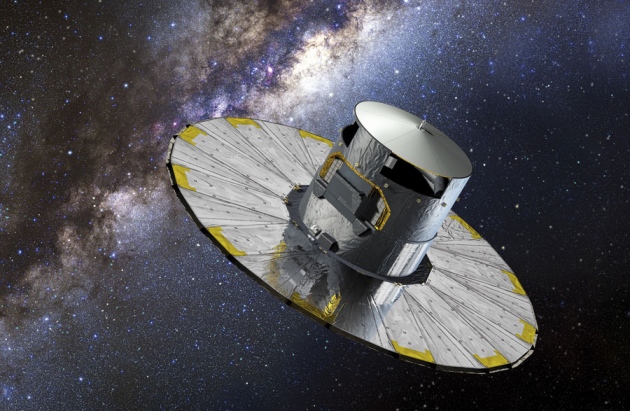
Artist’s concept of Gaia in space.
Image via D. DUCROS/ESA.
So … has the first Dyson Sphere been found? The simple answer is we don’t know yet. The star, a garden-variety late-F dwarf, seems to exhibit the sought-after characteristics, but more data is needed. No other glitch-related weirdness was found in the data, but the star was also found to be a binary system consisting of two stars (the other being a small white dwarf) which might explain the results – but none of that is certain yet. Additional study of the star will be required, including using future Gaia data releases, to determine what is really happening here. From the new study:
To shed light on the properties of objects in this outlier population, we present follow-up high-resolution spectroscopy for one of these stars, the late F-type dwarf TYC 6111-1162-1. The spectrophotometric distance of this object is about twice that derived from its Gaia parallax, and there is no detectable infrared excess. While our analysis largely confirms the stellar parameters and the spectrophotometric distance inferred by RAVE, a plausible explanation for the discrepant distance estimates of this object is that the astrometric solution has been compromised by an unseen binary companion, possibly a rather massive white dwarf. This scenario can be further tested through upcoming Gaia data releases.
A handy illustrated guide to Dyson spheres – massive structures which could be built to surround a star and harness its energy by an advanced alien civilization.
Image via Karl Tate/Space.com.
Bottom line: Discovering an actual Dyson sphere, or something similar, would be incredible. This new study proposes a new method of searching which shows some promise. It’s even possible that a Dyson Sphere-type object has already been found in the preliminary data, but that will require more follow-up to either confirm or disprove. Regardless, this new search method will prove valuable in future searches as well.
What Would It Take to Land on Mercury? It's Time to Find Out, Scientists Say
By Meghan Bartels, Space.com Senior Writer
A 2010 mission study examined the possibility of landing on Mercury, but the challenges were too substantial at the time.
Credit: Illustration: Space.com; NASA/Johns Hopkins University Applied Physics Laboratory/Carnegie Institution of Washington; JHU/APL/NASA
Mercury has been devoid of spacecraft companions since NASA's Messenger mission ended in 2015, and while the next mission bound for the innermost planet launches later this year, it won't arrive until 2025.
Scientists are passing the time digging through Messenger's data and planning what the new mission will bring, of course. But, they've also begun to think about what's next for the littlest planet in the solar system — and to revive dreams of finally putting a robot on its surface.
"That's going to really be unprecedented, with two spacecraft observing Mercury at once," Nancy Chabot, a planetary scientist at the Johns Hopkins University Applied Physics Laboratory, told Space.com. Chabot was referring to the BepiColombo mission, which consists of a pair of orbiters that will be launched in October. "We all know that we're going to get a lot of amazing data and make a lot of discoveries about the planet, but we also know that mission has been in development for decades." [10 Strange Facts About Mercury (A Photo Tour)]
Chabot is one of the lead authors of a newly published white paper calling for a detailed study to examine the feasibility of putting a lander on Mercury. Although such a study was conducted in 2010, no mission ever came of it because the planet is such a challenging target — but new technology may make a Mercury lander more feasible. And a lander would fit with the typical rhythm of planetary exploration: fly by, orbit, land, rove.
But NASA decides its missions in accordance with reports called decadal surveys, which are produced every 10 years by the National Academies of Sciences. Committees will soon begin working on the next one for planetary endeavors, which will cover 2013 to 2022. And when they do, Mercury scientists want them to consider their favorite planet.
"We need to get working on this now for us to see a Mercury lander in the 2030s," Paul Byrne, a planetary geologist at North Carolina State University and one of the lead authors of the white paper, told Space.com. "Our job will be complete if we can convince people to do one of these studies."
Why send a lander?
There are plenty of questions haunting Mercury scientists, especially in the wake of the Messenger orbiter, which gathered data from 2011 to 2015. And that situation will only improve once BepiColombo reaches the planet in 2025 and begins sending back more orbital data.
Mercury itself is a weird, wonderful world. "Mercury is sort of a planet of extremes — you've got the hot and cold temperatures, you've got the fact that it spins on its axis three times for every two times it goes around the sun," Steven Hauck, a planetary scientist at Case Western Reserve University, one of the lead authors on the white paper and a key figure in the mission study completed in 2010, told Space.com. "There are places on the planet where you can see double sunsets and double sunrises." And then there's the bit where the planet is almost entirely made up of core, with thin shells of mantle and crust surrounding a giant metallic ball.
All that weirdness means that while individual scientists have their own preferences for what a mission could look like, they say that right now, the details are much less important than looking at the feasibility of any mission at all. That's why the white paper doesn't specify any particular landing site or instrument suite — or even what the lander's primary goal would be. [Mercury Photos from NASA's Messenger Probe - Part 2 (April 2011 through 2012)]
"With any of those [mission goals], there's still amazing, compelling science that you could do on the surface of Mercury," Chabot said. "I think I'd be willing to go with a lot of different options, just because there are so many different science questions that a lander could answer."
What makes Mercury so difficult
But missions aren't solely about scientific merit: NASA and its fellow space agencies need to be pragmatic about their resources as well, and that puts Mercury at a disadvantage. "For decades, people have argued that Mercury is just as — if not more — scientifically compelling than Mars, but Mars is much easier to get to," Byrne said. Mars is also easier for a spacecraft to land on and survive, whereas every step of a Mercury lander would be challenging.
First, getting there: "You essentially need three rockets to get to Mercury," Hauck said: one to get off Earth, one to get from Earth to Mercury and one to carefully land on the planet (because it lacks an atmosphere that can slow down a spacecraft). Oh, and the entire process takes six or seven years because of the complex trajectory a spaceship would need to follow in order to reach the tiny, innermost planet.
And it doesn't get easier after landing, given a host of threats on the surface — most notably the incredible temperature extremes on the planet. "It's exceptionally hot on the day side and the exact opposite on the night side," Hauck said.
But since the last mission study was conducted in 2010, a host of new technologies have become available, or close enough for researchers to reasonably consider using them for a mission in the 2030s. That includes high-power rockets like SpaceX's Falcon Heavy, which could help send a mission on its way. And technology developed to enable the Parker Solar Probe to fly just 4 million miles (6 million kilometers) above what we consider to be the surface of the sun may be adaptable enough to allow a lander to survive out of the shade on Mercury, Byrne said.
The team's hope is that a new, detailed mission study could determine whether these factors combined, plus administrative changes — such as, no longer needing to include the cost of the launch itself in a mission plan — might make a Mercury lander affordable under NASA's New Frontiers program, which has created the Juno, New Horizons and OSIRIS-REx missions. That program caps mission costs at $850 million. [Most Enduring Mysteries of Mercury]
The group behind the white paper knows that a detailed-consideration study may not return a favorable result. "A Mercury lander is challenging, we all know this, we're not being naive," Chabot said. But the group's scientists worry that without a study, NASA will simply assume a lander isn't feasible — and in the process, shortchange the scientific merit of the smallest planet.
"We don't know why Mercury is the way it is, only that it's kind of important we understand that," Byrne said. And landing on the tiny planet may be the key to solving some of its many mysteries — if only someone can figure out how to do it.
Archaeologists Find Massive Underground World Belonging To A Long Lost Civilization In Peru
Researchers in Peru have discovered a complex underground world belonging to the ancient Chavín culture that has been identified as burial chambers that date back thousands of years.
The culture developed in the northern Andean highlands of Peru from 1,300 and 550 BC. The Chavín extended its influence to other civilizations along the coast. The Ancient Chavin civilization developed advanced knowledge not only in metallurgy, but in soldering, and temperature control. The ancient Chavin used early techniques to develop refined gold work.
Seen in this image are the new underground galleries that have been found containing the first human burials of the Chavin period. Image Credit: Juan Ponce / El Comercio).
Not, researchers have discovered galleries, ceramics and even a place where this civilization carried out burials, located beneath the surface. They say it’s the most important archaeological discovery made in the last 50 years.
Since June of 2018, a team of archaeologists has unearthed three new galleries in an area adjacent to the circular plaza of Chavín. In the place, they have found remarkable pieces of ceramics, utensils and intact human burials.
According to American anthropologist and archaeologist John Rick, in charge of the Archaeological and Conservation Research Program of Chavín, the three discovered galleries come from the late period of this civilization that developed between 1,300 and 550 BC.
The Ministry of Culture estimates that to date only 15% of the area has been explored. Image Credit: Juan Ponce / El Comercio
“What these galleries show is that Chavín has a much larger underground world than we think,” said Rick.
Inside one of these underground galleries, archeologists discovered artifacts that belonged to the later Huaraz culture.
These successive occupations, found at different levels in the archaeological complex demonstrate the cultural and religious importance that Chavin had in the central highlands for centuries.
The project’s specialists used small robots with built-in micro-cameras to carry out the explorations. These machines – designed on site by engineers from Stanford University – entered very small areas and discovered cavities in the Chavin labyrinths, where pottery was preserved.
Chavin de Huantar was designated a UNESCO World Heritage Site in 1985. So far 35 interconnected underground passageways have been found at the site, Peru’s culture ministry said.
Is the President afraid of aliens? I’m not sure, but there is a legit reason some lawmakers want to create a sixth branch of the military the President is calling the Space Force.
Here's a recipe for freaking out Twitter: Borrow a video of a realistic humanoid robot strolling up a driveway. Post it on Twitter. Wait for world famous mentalist Derren Brown to retweet it. Gather nearly 5 million video views. Enjoy the comment fallout as people question whether it's real.
Brown's retweet of a short robot video on Saturday helped spread the footage across Twitter, whose users described it as "scary," "creepy," "terrifying" and "my worst nightmare." It helped that Brown wrote, "WE ARE ALL GOING TO DIE" in his tweet caption.
Blomkamp didn't have anything to do with the driveway video, though he chimed in on Brown's Twitter thread, writing, "Props to the artist who implemented Adam into live action footage."
The artist behind the video appears to be 3D artist Maxim Sullivan, who originally posted the video to Twitter on Aug. 12 with the message, "Glitchy test of Adam from the @oatsstudios Unity film, going for a walk."
Sullivan answered some questions in his own Twitter thread, saying the creation is indeed CGI. While Sullivan's original tweeted video has almost 13,000 views, the version tweeted out of context by another Twitter user (and retweeted by Brown) has almost 5 million.
While Adam isn't real, there are plenty of actual robots out there that can give you the willies. Boston Dynamics' running robot Atlas is a top candidate that should slot nicely into your robo-fear nightmares.
There are fears that tend to come up when people talk about futuristic artificial intelligence — say, one that could teach itself to learn and become more advanced than anything we humans might be able to comprehend. In the wrong hands, perhaps even on its own, such an advanced algorithm might dominate the world’s governments and militaries, impart Orwellian levels of surveillance, manipulation, and social control over societies, and perhaps even control entire battlefields of autonomous lethal weapons such as military drones.
But some artificial intelligence experts don’t think those fears are well-founded. In fact, highly-advanced artificial intelligence could be better at managing the world than humans have been. These fears themselves are the real danger, because they may hold us back from making that potential a reality.
“Maybe not achieving AI is the danger for humanity.”
As a species, Mikolov explained, humans are pretty terrible at making choices that are good for us in the long term. People have carved away rainforests and other ecosystems to harvest raw materials, unaware of (or uninterested in) how they were contributing to the slow, maybe-irreversible degradation of the planet overall.
But a sophisticated artificial intelligence system might be able to protect humanity from its own shortsightedness.
“We as humans are very bad at making predictions of what will happen in some distant timeline, maybe 20 to 30 years from now,” Mikolov added. “Maybe making AI that is much smarter than our own, in some sort of symbiotic relationship, can help us avoid some future disasters.”
Granted, Mikolov may be in the minority in thinking a superior AI entity would be benevolent. Throughout the conference, many other speakers expressed these common fears, mostly about AI used for dangerous purposes or misused by malicious human actors. And we shouldn’t laugh off or downplay those concerns.
We don’t know for sure whether it will ever be possible to create artificial general intelligence, often considered the holy grail of sophisticated AI that’s capable of doing pretty much any cognitive task humans can, maybe even doing it better.
The future of advanced artificial intelligence is promising, but it comes with a lot of ethical questions. We probably don’t know all the questions we’ll have to answer yet.
But most of the panelists at the HLAI conference agreed that we still need to decide on the rules before we need them. The time to create international agreements, ethics boards, and regulatory bodies across governments, private companies, and academia? It’s now. Putting these institutions and protocols in place would reduce the odds that a hostile government, unwitting researcher, or even a cackling mad scientistwould unleash a malicious AIsystem or otherwise weaponize advanced algorithms. And if something nasty did get out there, then these systems would ensure we’d have ways to handle it.
With these rules and safeguards in place, we will be much more likely to usher in a future in advanced AI systems live harmoniously with us, or perhaps even save us from ourselves.
Pour les adeptes du paranormal, les crop circles qui apparaissent dans les champs de blé seraient l'œuvre d'aliens. Pour les sceptiques, ils seraient d'origine humaine. Pour trancher le débat, des youtubeurs ont réalisé une petite expérience instructive.
Ce crop circle est apparu dans un champ de blé de Sarraltroff en Moselle. Il est l'oeuvre de youtubeurs et non d'extraterrestres.
ARNAUD THIRY
Cette fois, ils ont frappé à Sarraltroff (Moselle). Ils ? Les extra-terrestres bien sûr ! C'était le 9 juin et comme à leur habitude, ils ont laissé une trace de leur passage dans un champ de blé : un immense crop circle ou cercle de culture en français ou encore agroglyphe. Le dessin géant est formé d'épis couchés par “une technologie alienne”. Il est composé de plusieurs cercles disposés de manière énigmatique voire ésotérique et dont la "géométrie parfaite” ne peut s'apprécier que vue du ciel. Selon les exégètes de la chose, cette géométrie est d'ailleurs trop parfaite pour être l'oeuvre de simples êtres humains. La preuve, donc, qu'il s'agit bien d'une production extra-terrestre... Le champ est alors devenu un véritable lieu de pèlerinage New Age, chargé “d'énergie”, “de vibrations” et autres fluides cosmiques obscures.
Malheureusement - pour les exégètes - ce crop circle a bel et bien été réalisé par des humains ordinaires… ou presque. Effectivement, le 24 août, de joyeux youtubeurs ont révélé qu'ils étaient les auteurs de l'agroglyphe de Sarraltroff. Ces mordus de science, sont surtout adeptes de la zététique, l'étude rationnelle de phénomènes prétendument extraordinaires (paranormal, pseudo-sciences, pseudo-médecines etc…). Ils étaient aidés par deux ufologues sceptiques, rompus à l'analyse des phénomènes supposés extra-terrestres. Armés de simples mètres rubans pour les mesures et de quelques bières, les membres du commando ont agi en pleine nuit à la lueur de leurs torches frontales. Une planche sous le pied tenue à chaque extrémité par une ficelle, ils ont écrasé minutieusement les blés dans le champ d'un agriculteur complice (voir les explications de la méthode dans la vidéo). L'opération a duré à peine une heure. Et à la différence d'insaisissables extra-terrestres, les youtubeurs ont tout filmé. Les séquences sont diffusées et largement commentées sur Astronogeek, la chaîne Youtube d'Arnaud Thiry, l'initiateur du projet (trois épisodes sont prévus).
“L'objectif n'était pas de se moquer de ceux qui croient aux extra-terrestres, nous assure Arnaud Thiry. Nous voulions tester la méthode qui permet aux experts d'affirmer si un crop circle est une oeuvre extra-terrestre ou humaine.” Une véritable expérience en aveugle. En d'autres termes, est-ce que ces experts, ne connaissant pas l'origine du crop circle, sont capables déterminer, comme ils le prétendent, s'il a été produit par des humains. La réponse est clairement non. “Tous ceux qui sont venus sur place ont affirmé qu'il s'agissait bien d'une réalisation extra-terrestre", confirme Arnaud Thiry.
« Ce crop est tellement élaboré. C’est vivant, comme dans les cathédrales ou devant un menhir. Un humain n’aurait pas pu le faire. »
Umberto Molinaro, le plus populaire d'entre-eux, est lui aussi tombé dans le panneau. Ce conférencier français, auteur de quatre livres sur le sujet, s'est rendu sur place. Entouré de nombre de ses fidèles qui le suivent notamment sur Facebook ou lors d'une émission diffusée sur la chaîne Youtube CTVM TV, il a pu observer le nouveau “message” laissé par ceux qu'il appelle tantôt “les Etres de Lumière” tantôt “les Galactiques”. Ainsi, interrogé par une journaliste du Républicain Lorrain, il ressort l'argument de la complexité du motif : " Ce crop est tellement élaboré. Chaque cercle est lié aux autres par des rapports particuliers. C'est vivant, comme dans les cathédrales ou devant un menhir. Un humain n'aurait pas pu le faire. " L'occasion d'improviser avec ses amis une séance collective de captation d'énergies et de vibrations assurément cosmo-telluriques.
Alors forcément, quand deux mois plus tard il apprend que les cercles de culture ont été réalisés non pas par des Galactiques, mais par des humains, il change de version. Il affirme notamment qu'il n'a jamais dit qu'il s'agissait d'un “vrai crop circle” (d'origine extra-terrestre). Contacté par téléphone il nous confirme : “Je n'ai jamais authentifié ce crop circle. Pour le faire il faut prélever de la terre et analyser sa résistivité.” (sic). Il poursuit : “J'ai tout de suite vu que c'était un faux.” Pourtant, sur Facebook et sur Youtube, l'expert français n'a pas cessé de gloser sur l'authenticité de l'oeuvre, assénant, photos à l'appui, tous les indices qui permettent de distinguer la main de l'Etre de Lumière du pied de l'être humain.
Outre la complexité du motif, les partisans de l'hypothèse extraterrestre évoquent par exemple la présence de blés coudés. Il s'agit en fait de tiges qui se redressent partiellement vers le ciel. Le phénomène serait l'oeuvre “d'une résonance vibratoire” caractéristique de la technologie alien. Pourtant, comme l'ont montré les youtubeurs, la technologie terrestre consistant à aplatir le blé avec une simple planche de bois, produit les mêmes effets. Le blé coudé s'explique par l'héliotropisme, littéralement une attirance pour le soleil, qui pousse une plante vivante, dépendante de la photosynthèse, à s'orienter naturellement vers la lumière.
Mieux encore, Umberto Molinaro commente la présence de mouches mortes collées sur les épis de blé. Là encore, il s'agit pour lui des effets secondaires de la méthode extra-terrestre. Et pour l'affirmer avec plus de force, il fait appel à une autorité dans le domaine : Valentin, un jeune homme décédé depuis plusieurs années et en contact direct avec les Galactiques... L'explication de Valentin relayée par Umberto Molinaro est alors limpide : “Les insectes sont immobilisés sous les effets vibratoires. Ca les scotche sur place. Ils n'ont plus la force de réagir.”
Au téléphone, le malaise est perceptible. Umberto Molinaro nous confie qu'il a été piégé. Il accuse les youtubeurs d'avoir étudié sa technique pour l'induire en erreur. Mais comme le montre la vidéo, la bande de sceptiques n'a fait qu'écraser le blé en suivant la méthode de la planche de bois abondamment décrite sur Internet. Mieux, le rapport VECA, rédigé par Gilles Munsch du Groupe d'études et d'informations sur les phénomènes aérospatiaux non identifiés (GEIPAN) au Centre national d'études spatiales (CNES), révèle tous les éléments qui permettent de montrer qu'un crop circle a été réalisé par l'homme. Un rapport consultable par tous car en accès libre sur Internet. Gilles Munsch est d'ailleurs venu lui-même, à titre personnel, sur le champ de Moselle : “En quelques minutes il a conclu que c'était l'oeuvre d'humains. Il m'a même décrit comment ils avaient procédé, dans quel ordre ils avaient dessiné les cercles. J'ai du rapidement lui avouer que c'était nous”, raconte Arnaud Thiry.
Coincé par la simplicité de la démonstration, Umberto Molinaro s'emporte et lâche un argument inattendu : “Quand j'emmène des gens sur un crop circle, on est à un autre niveau. On n'est pas là à chercher le vrai et le faux parce qu'on s'en fiche. Ce qu'on retrouve dans un vrai ou un faux crop circle n'est pas lié au crop circle lui-même. On est lié déjà à quelque chose de plus grand que nous.”
Cette histoire de vrai ou faux extraterrestres pourrait faire sourire, faisant passer les adeptes des crop circlespour de doux rêveurs. Mais une vidéo filmée en caméra cachée par Arnaud Thiry sur le site de Moselle, montre un toute autre visage de l'univers parallèle dans lequel ils évoluent : celui de “vibrations” ou encore “d'énergies” bienfaitrices laissées par les Galactiques et qui seraient dotées d'un pouvoir guérisseur.
Unstable Monster Galaxy Hosts Runaway Star Formation
By Sarah Lewin, Space.com Associate Editor
An artist's impression of the ancient, huge galaxy COSMOS-AzTEC-1, which researchers have found has three dense, star-forming regions. The galaxy can be seen forming stars at an extremely fast rate.
Credit: National Astonomical Observatory of Japan
Some 12.4 billion light-years from Earth, a monster galaxy can be seen forming stars 1,000 times faster than the Milky Way does. It's less of a mess than researchers expected — but its frenetic pace can't last.
Researchers using the Atacama Large Millimeter/submillimeter Array (ALMA) observatory in Chile have gotten the closest look ever at the galaxy, called COSMOS-AzTEC-1. So-called extreme starburst galaxies may be the predecessors of modern galaxies like the Milky Way, and so understanding them lends insight into how today's galaxies formed and evolved.
"A real surprise is that this galaxy seen almost 13 billion years ago has a massive, ordered gas disk that is in regular rotation instead of what we had expected, which would have been some kind of a disordered train wreck that most theoretical studies had predicted," Min Yun, an astronomer at University of Massachusetts, Amherst, and co-author on the new work, said in a statement.
The ancient galaxy's structure held other surprises, as well. With ALMA, they saw that instead of just one dense cloud of material in the center, there were two extra blobs of star-generating gas.
"We found that there are two distinct large clouds several thousand light-years away from the center," Ken-ichi Tadaki, the study's lead author and a researcher at the Japan Society for the Promotion of Science and Japan's National Astronomical Observatory, said in the statement. "In most distant starburst galaxies, stars are actively formed in the center. So it is surprising to find off-center clouds."
And its off-the-charts star formation comes from an inherent instability, the researchers said. In most galaxies, clouds of gas collapse and form stars, which eventually explode into supernovas, pushing gas outward again and slowing the pace of star birth. But in this galaxy, gravity is winning: More and more gas is collapsing into stars, without being pushed outward strongly enough to slow down.
Researchers have been wondering for a long time how early galaxies could form stars so quickly, the researchers said.
"How these galaxies have been able to amass such a large quantity of gas in the first place and then essentially turn the entire gas reserve into stars in the blink of an eye, cosmologically speaking, was a completely unknown question about which we could only speculate," Yun said. "We have the first answers now."
The Atacama Large Millimeter/submillimeter Array (ALMA) observatory in Chile provided these new views of the monster galaxy COSMOS-AzTEC-1 — on the left, you can see the distribution of molecular gas, and on the right, you can see the distribution of dust. Those high-density zones are the key areas for the galaxy's rapid star formation.
Credit: Tadaki et al./ALMA (ESO/NAOJ/NRAO)
If the early universe were populated with galaxies with structures like this one, they could have accumulated huge amounts of gas before suddenly blasting out stars in a runaway effect — although the researchers still don't know how the galaxy was able to build up gas in so stable a fashion before the reaction began.
And the ancient galaxy's life is likely fleeting: The researchers said it will be completely consumed in 100 million years, 10 times faster than other star-forming galaxies.
The researchers speculate that colliding galaxies could have merged to create the behemoth but would need more research — and to look at more ancient galaxies in this much detail — to evaluate how likely that origin is, and to learn more about our mammoth galactic predecessors.
The new work was detailed today (Aug. 29) in the journal Nature.
Email Sarah Lewin at slewin@space.com or follow her @SarahExplains.
For reasons unknown, the travel fare aggregate Orbitz has decided to create a series of extraterrestrial tourism posters they have made available free online. They are really cool and commemorate potential incidents from around the world of alien visitations.
The website reads:
We are not alone.
Reports of UFO sightings, and encounters of the first, second, and third kind date back to Ancient Egypt, and continue throughout the course of history.
Ruimtestation ISS kampte vandaag met een klein gaatje in de wand. Daardoor is de druk aan boord donderdag een beetje weggevallen. Het gaatje van 2 millimeter is gedicht met afplaktape. De situatie aan boord is onder controle.
Wellicht tengevolge van de inslag van een micrometeoriet is er in de nacht van gisteren op vandaag een noodsituatie in het Internationaal Ruimtestation ISS geweest, zo heeft het hoofd van het Russische ruimtevaartbureau Roscosmos bekendgemaakt. Dmitri Rogozin beklemtoont dat het probleem is opgelost en dat de bemanning niet in gevaar verkeert.
In de loop van de nacht ontstond er zo drukverlies en een zuurstoflek in het ISS te wijten aan een gaatje van twee milimeter. De Amerikaanse bemanningsleden en de Duitser Alexander Gerst voegden zich bij hun Russische collega’s in het Russische segment van het complex. Daarop werd segment per segment afgesloten om te onderzoeken waar en wat er gebeurd is. “Uiteindelijk lokaliseerden wij het probleem, aldus Rogozin.
Micro-meteoriet
Het gaatje zat in een Russisch gedeelte van het ruimtestation, de zogeheten Rassvet-module. Dat is de plek waar capsules die vanaf de aarde komen, worden aangekoppeld. Nu zit er het vaartuig waarmee een Duitser, een Amerikaanse en een Rus in juni bij het ISS aankwamen. Het is nog niet bekend of het lek gevolgen heeft voor hun geplande terugkeer eind dit jaar.
Wellicht is er een micro-meteoriet ingeslagen, waardoor een gaatje ontstond. Het is ondertussen gerepareerd. Een ruimtewandeling voor verdere reparaties is niet nodig, aldus Rogozin.
Popular UFO researcher Graham McHardy who ran the YouTube channel 'Streetcap1' has died. The death news was revealed by Scott C Waring, another alien researcher. Waring revealed that Streetcap1 died of a sudden heart attack in June 2018, and he added that the UFO researcher was in a decent health at that moment.
"I am saddened to say that the great UFO researcher Streetcap1 (Graham McHardy) passed away in June. I just found out today. I contacted his family and they said he died of a sudden heart attack, and that no one was expecting it. He was in decent health at that moment," wrote Scott C Waring on his website UFO Sightings Daily.
In his UFO research career, Streetcap1 had pointed out several anomalies in lunar photos taken by various NASA missions. Some of the anomalies pointed out by Streetcap1 were so convincing, and it made many of his viewers believe that space agencies like NASA are covering up something sinister.
The last time he uploaded a video on his YouTube channel was on June 7, 2018. As Streetcap1 did not upload any videos since then, many of his followers asked him whether anything has gone wrong.
Tyler Glockner, another popular UFO researcher also uploaded a video about Streetcap1 on his YouTube channel 'Secureteam10'. After Glockner published the video about Streetcap1's death, viewers also expressed their suspicions regarding the untimely demise.
"Tyler you must continue your mission in honor of StreetCap you must carry this legacy and represent all of us in the seeking of Truth! We are not alone!," commented LP Ripper 24 TV, a YouTube user.
"I had a feeling..He talked about it in the last few videos..It didn't seem right then..It doesn't seem right now..He was one of my favorite, if not my favorite researcher..He will be sorely missed..RIP STREETCAP1..If you haven't seen his work..please do," commented Ancient Knowledge, another YouTuber.
Populaire UFO-onderzoeker plotseling overleden. Is hij uit de weg geruimd?
De populaire UFO-onderzoeker Graham McHardy, eigenaar van het YouTube-kanaal Streetcap1, is overleden. Dat schrijft de International Business Times.
Scott C. Waring, een andere UFO-onderzoeker, liet weten dat Graham in juni dit jaar plotseling een hartaanval kreeg. Hij voegde toe dat de man op dat moment in goede gezondheid verkeerde.
“Met droefheid deel ik mee dat de grote UFO-onderzoeker Streetcap1 (Graham McHardy) in juni is overleden,” schreef hij op zijn website UFO Sightings Daily.
Prima in orde
“Zijn familie heeft laten weten dat hij is gestorven aan een hartaanval, en dat niemand dat had verwacht,” voegde hij toe. “Zijn gezondheid was op dat moment prima in orde.”
Streetcap1 ontdekte onder meer onregelmatigheden op maanfoto’s die tijdens diverse NASA-missies waren gemaakt.
Veel van zijn volgers zijn ervan overtuigd dat ruimteagentschappen zoals de NASA informatie voor ons achterhouden.
Twijfels
Op 7 juni jongstleden plaatste Graham zijn laatste filmpje op YouTube. Sindsdien vroegen velen zich af of hem misschien iets was overkomen.
Sommigen hebben zo hun twijfels over zijn vroegtijdige overlijden.
Een gevoel
“Ik had een gevoel. Hij sprak erover in zijn laatste video’s,” reageerde YouTube-gebruiker Ancient Knowledge. “Het klopt niet.”
“Het is misschien wel mijn meest favoriete onderzoeker,” klonk het verder. “Hij zal erg worden gemist. Rust in vrede Streetcap1. Bekijk vooral zijn materiaal.”
Psychic spies: Inside the government's secret ESP program
While scientists question whether extrasensory perception exists, for decades the Defense Department took an offensive interest in studying psychic phenomena.
Many people claim (and many others question) the existence of ESP -- Extra Sensory Perception. Erin Moriarty of "48 Hours" has gone searching for answers (Originally broadcast March 18, 2018):
In the 1970s, a handsome ex-Israeli army paratrooper popularized extrasensory perception, or ESP. Uri Geller claimed he could bend spoons with his mind, see inside sealed containers, and even read other people's minds.
It was great television. But off-stage, Geller had also caught the eye of the intelligence community.
"This is where it got very interesting, because scientists would consider, 'Wait a minute, maybe we can read the minds of other government officials; maybe we can see inside a nuclear facility in Russia,'" said national security reporter Annie Jacobsen.
LITTLE BROWN
It sounds incredible, but it's true. Relying on now-declassified documents, Jacobsen has written about the U.S. government's decades-long to attempts to use Uri Geller, and others like him, for psychic espionage.
"It's sort of like a highly-classified black program inside of a black program," Jacobsen said. "One, because you don't want the Russians or the Chinese to know what we are doing; and two, because a lot of scientists didn't want their colleagues to know what they were doing, because of the embarrassment factor."
And there had long been reports, said Jacobsen, that the Kremlin was also experimenting with ways to weaponize people with ESP.
"There's a declassified report that talks about the Pentagon's real fear -- citing Uri Geller by name -- that if he was able to bend metal with his mind, he might be able to use his mind to interfere with the delicate electronic systems on a nuclear-tipped ICBM," Jacobsen said.
But Uri Geller's skills turned out to be unreliable, as on his now-infamous appearance on "The Tonight Show" in 1973.
Johnny Carson: "Uri was telling me, you don't feel, what, strong tonight? Is that…" Geller: "I don't feel strong. I can't…" Carson: "Well, I'm not trying to pressure you. I'm really not."
Still, that didn't stop the government experiments. In the 1980s, the Defense Intelligence Agency began "Project Star Gate," which was, according to Dean Radin, a scientist who worked on the program, top secret. "It's actually beyond top secret."
The program employed about a dozen psychics and mediums. Its aim: espionage.
PENGUIN
Moriarty asked, "To see whether someone in the United States could spy on other countries from here, just using their minds?"
"Right."
"Did it work?"
"It did work, yeah," Radin replied.
Angela Ford was with Project Star Gate for nine years. She calls herself a medium; the Defense Department preferred "remote viewer." "I was good at finding people," she said. "I was good at locating things."
Moriarty asked, "In a sense, were you hired as a psychic spy?"
"I guess, yes!" she laughed.
Her assignment? To look for missing hostages and fugitives without ever leaving a building at Fort Meade in Maryland.
She recalled one assignment, in 1989, when she says she was able to psychically track down a former customs agent who had allegedly gone rogue.
"I was called into session," Ford said. "My boss asked me, 'Where is Charles Jordan?' I said, 'The man is in Lowell, Wyoming.' And I spelled it: L-O-W-E-L-L."
Ford was off by one letter -- it was Lovell, Wyoming.
"Well, when my boss went to Customs and said, 'We're still getting the Wyoming feeling,' Customs said, 'As we are speaking, we are apprehending Charles Jordan, 100 miles west of Lovell, Wyoming.'"
"So you were right?"
Ford said, "We were right."
There is no obvious explanation for how Ford obtained the intel that turned out to be accurate. But could it have been ESP?
Not according to physicists like Cal Tech's Sean Carroll. When asked if there is such a thing as extrasensory perception, Carroll replied, " No. I think we know enough about the brain to say, no, it really doesn't work that way. We'd be able to test that, be able to put a little receiver next to your head and pick up those signals if they were actually coming."
Angel's Ford's response: "They can't detect it yet."
Moriarty asked her, "But you believe ESP exists?"
"Yes, it does. Yeah, of course."
In 1995, Project Star Gate was shut down. But government interest in the paranormal has not been completely abandoned. Writer Annie Jacobsen says the military is working to see if certain soldiers have "enhanced perception," or "precognition" -- sensing what will happen before it does.
Dean Radin, now at the Institute of Noetic Sciences (which studies ESP), put Moriarty through a test: "This experiment is going to see if your body responds before you see an emotional picture as compared to before a calm picture."
If the pupils of Moriarty's eyes dilate before the disturbing pictures appear on the screen, that's precognition.
CBS NEWS
Does she have any special powers? Yes! She reacts five seconds before seeing an emotional picture.
"Whoa -- I sure didn't see that coming … which is why I have my doubts," Moriarty said.
But those who have seen people like Uri Geller and Angela Ford in action say you can't dismiss the idea that some people may have ESP.
Radin said, "What we're talking about is something like a talent, similar to musical talent or sports talent. So, there will be some people who are at the Olympic level; most of us aren't there."
Journalist Annie Jacobsen said, "There's instances of unusual situations, but there is no proof. It does not pass scientific muster."
Overheid zette jarenlang in het geheim helderziende spionnen in, en met succes. Een uniek inkijkje
In de jaren zeventig trok de Israëlische ex-soldaat Uri Geller de aandacht van de inlichtingengemeenschap door te beweren dat hij lepels kon buigen met zijn gedachten en gedachten van anderen kon lezen.
‘Als we de gedachten van andere overheidsfunctionarissen kunnen lezen, kunnen we misschien een kijkje nemen in een nucleaire installatie in Rusland’, zo dachten de inlichtingendiensten.
De Amerikaanse onderzoeksjournaliste Annie Jacobsen heeft zich verdiept in het decennialange onderzoek van de Amerikaanse overheid naar mensen zoals Uri Geller.
Bang
“Het is een soort topgeheime black operation binnen een black operation,” zei Jacobsen tegen CBS News. “Ze wilden niet dat de Russen of Chinezen erachter zouden komen.”
“Ze wilden ook niet dat hun collega’s erachter zouden komen, uit schaamte,” klonk het.
De journaliste merkte op dat het Kremlin ook al geruime tijd experimenteerde met buitenzintuiglijke waarneming.
“In een vrijgegeven document staat letterlijk dat het Pentagon bang is dat Uri Geller mogelijk met zijn gedachten de elektronische systemen van een kernraket kon verstoren,” zei Jacobsen.
Beyond top secret
In de jaren tachtig startte de Amerikaanse militaire inlichtingendienst DIA het Stargate Project.
Volgens Dean Radin, een wetenschapper die eraan meewerkte, was het project ‘beyond top secret’.
De Amerikaanse overheid huurde helderzienden en mediums in om te spioneren. En dat werkte, aldus Radin.
Angela Ford werkte negen jaar voor het Stargate Project. Hoewel ze zichzelf ‘medium’ noemt, gebruikte het ministerie van Defensie liever de term ‘remote viewer’.
Nog steeds
“Ik was goed in het vinden van mensen,” zei ze. “Ik was goed in het vinden van dingen.”
Ford lokaliseerde gijzelaars en voortvluchtigen vanuit een gebouw in Fort Meade in Maryland.
Hoewel het programma in 1995 werd beëindigd, doet het Amerikaanse leger hier nog steeds onderzoek naar.
Zo wordt onder meer gekeken of soldaten aanvoelen wat er gaat gebeuren, ook wel precognitie genoemd.
In my recent article,”U.K. Government UFO Research: The Real Picture,” I shared the story of how the U.K.’s police – specifically Special Branch – secretly opened, in the 1950s, a surveillance file on George King, the founder of the Aetherius Society. But who, exactly, was George King? Well, that’s the subject of today’s article. George King was born in Wellington, Shropshire, England in 1919 to parents George and Mary, and went on to become one of the most well-known of all the Contactees of the 1950s and 1960s. Even from a very young age, King was surrounded by distinct high-strangeness. His mother and grandmother both claimed to be psychics; and, in his book You Too Can Heal, King related how, at the age of eleven, and while his mother was seriously ill and confined to bed, he headed deep into the heart of nearby woods, where he prayed intently for her speedy recovery. As he did so, King said, an “angelic being” manifested before him in the ancient woodland, instructing him to return home, as his mother was now fully cured. After excitedly racing home and learning that she was indeed restored to full health, a realization came to King that his life was not at all like that of the other kids in the neighborhood.
At the outbreak of the Second World War, King – a “conscientious objector” who refused to fight for his country against Hitler’s hordes – took a position in London with the National Fire Service, ultimately becoming a section-leader. By the time the hostilities were at a close – in 1945 – King was in his mid-twenties, and had begun to develop a deep interest in yoga, alternative therapies, and new-age-style belief systems. This radical change in the mindset of King came to the fore on a Saturday morning in May 1954, when, while doing nothing stranger than washing the dishes in his Maida Vale, London apartment, he heard a loud, disembodied voice cry out: “Prepare yourself! You are to become the voice of Interplanetary Parliament!”
Allegedly, in the days, weeks and months that followed, said King, he became the recipient of countless channeled messages: from a “great Yogi adept” who materialized in his apartment and warned him of “the unfeeling march of science into the realms of the atom.” Further messages came from a highly spiritual, Venusian being named Aetherius, who bestowed a wealth of words of wisdom upon a shocked, yet profoundly elevated, King. Indeed, so elevated and changed by the cosmic experiences was King that he quickly quit his job as a taxi-driver, and established the Aetherius Society, believing that space-aliens held “the key to the salvation both of the planet as a whole and of every individual on Earth.”
On July 23, 1958, King, somewhat outrageously, claimed a close encounter with none other than Jesus Christ atop Holdstone Down – a 330 meter-high hill above the village of Combe Martin, in the English county of Devonshire. So the story went, thirteen days earlier, King received a channeled message from Aetherius, who advised him to travel to Combe Martin where he would receive instructions from an “adept from Mars.” Seeing nothing strange in this at all, King dutifully did as he was told. Sure enough, upon taking his position on Holdstone Down he could see a “blue sphere” hovering over the waters of the Bristol Channel; after which Jesus – dressed in a flowing and glowing robe, and sporting a wand – manifested in the skies above.
The researchers Dr. David Clarke and Andy Roberts say: “Waves of energy passed between the entity and King who was plunged into a religious rapture before ‘Jesus’ stepped into a beam of light and vanished. King realized that Holdstone Down was now charged, a spiritual power battery whose energies were inexhaustible.” It seems King’s own energies were inexhaustible, too: one year later, he founded an American branch of the Aetherius Society – in Los Angeles, where King ultimately moved to live permanently, and where he continued to spread the words of wisdom bestowed upon him by the various other-worldly entities with whom he claimed to have communed.
Clarke and Roberts add: “The Aetherius Society were never a huge organization, indeed their numbers rarely totaled more than one thousand members worldwide…The Aetherius Societywas not for everyone but, for those seekers who wanted or needed a spiritual dimension to their saucer beliefs, they provided a philosophy, structure and network of sincere like-minded souls.”
George King suffered a heart-attack in 1986, underwent a multiple heart bypass in 1992, and died in Santa Barbara on July 12, 1997. The Aetherius Societycontinues to thrive.
Two Arm UFO Seen Over Cedarhurst, New York On Aug 29, 2018, Video, UFO Sighting News.
Date of sighting: Aug 29, 2018
Location of sighting: Cedarhurst, New York, USA
Source: MUFON #94490
Here is a unique sighting from New York. A craft that has several long thick arms floated over the city. The eyewitness caught only several seconds of footage before it moved past them, but it was enough to get some good screenshots. I added light to one photo (above only) and left the originals below. We can see in the screenshots that the object has an unrecognizable shape and design. Its like nothing I have ever seen before. I do love when a UFO is reported with a shape that I have never seen before...it really challenges the imagination. If seeing is believing, then this is it.
Scott C. Waring
Eyewitness states:
It was very odd looking, moving very smoothly. At first I thought it was a helicopter carrying something, I had to stop and get a closer look. It was almost floating.
Black Disk Caught By Tourist Over Argentina Mountains, Aug 2018, UFO Sighting News.
Date of sighting: Aug 25, 2018 Location of sighting: El Hornocal Jujuy, Argentina Source: MUFON #94500 This UFO was caught by accident when a woman was having her picture taken and later noticed the black disk in the background. The UFO is moving horizontal to the mountains and looks like its moving very fast since it does have a slight blur to it. The blur could also be due to the crafts alien propulsion system causing a distortion around the craft. The disk may have come from an underground base nearby. Often aliens chose to make bases 4-6 miles under volcanos and steep mountains where humans are less likely to travel. Scott C. Waring Eyewitness states:
I identified a strange object in a picture I took on my vacations, it is not a picture defect.
Will Mars Rover Opportunity Survive Monster Dust Storm? It's Still Too Soon to Tell
By Mike Wall, Space.com Senior Writer
NASA's Opportunity Mars rover took this self-portrait in March 2014, shortly after wind had cleaned accumulated dust off its solar panels. Opportunity has been silent since June 10, 2018, forced into a sort of hibernation by a powerful dust storm.
Credit: NASA/JPL-Caltech/Cornell Univ./Arizona State Univ.
NASA's Opportunity rover has been quiet for 80 days now on the Martian surface, but that doesn't mean the plucky robot is dead.
Indeed, mission team members say it's still too soon to draw any conclusions about the fate of Opportunity, which has been sidelined by a monster Martian dust storm since June 10.
"We simply don't know what's going to happen," mission scientific principal investigator Steve Squyres, a professor of physical sciences at Cornell University in New York, told Space.com. "There's only one way to find out, and that's to listen." [Mars Dust Storm 2018: How It Grew & What It Means for Opportunity]
Opportunity goes silent
The golf-cart-size Opportunity touched down on Mars in late January 2004, three weeks after its twin, Spirit, landed in a different part of the Red Planet.
The two solar-powered rovers embarked on three-month missions to hunt for signs of past water activity. Both found lots of such evidence in relatively short order and then continued exploring, rolling through the red dirt for years after their warranties expired.
Spirit finally gave up the ghost in 2010 after getting bogged down in a Martian sand trap, but Opportunity has remained remarkably healthy and resilient over the years. No vehicle, robotic or crewed, has ever traveled farther on the surface of another world than Opportunity, whose odometer currently reads 28.06 miles (45.16 kilometers).
In late May of this year, however, NASA's Mars Reconnaissance Orbiter spotted a dust storm swirling near Opportunity's locale, the rim of the 14-mile-wide (22 km) Endeavour Crater. The storm intensified over the ensuing days, throwing so much dust into the Martian atmosphere that Opportunity couldn't harvest enough sunlight to recharge its batteries.
The rover fell silent on June 10, apparently putting itself in a sort of hibernation mode. And the storm kept growing; by June 20, it had become a global maelstrom, encircling the entire planet.
The danger to Opportunity is very real. The rover cannot operate its onboard heaters in its current state, so Opportunity could freeze to death if the ambient temperature drops low enough.
"If things get too cold, they can break," Squyres said, citing soldering joints and other key pieces of internal hardware as examples.
How cold is too cold? Nobody knows. During pre-launch tests, both Spirit and Opportunity survived extended exposure to temperatures as low as minus 67 degrees Fahrenheit (minus 55 degrees Celsius). But Opportunity has endured about 5,000 taxing day-night thermal cycles on the Red Planet over the past 14.5 years, so it's unclear how resilient its internal components are today.
"At what temperature do they break now? We don't know," Squyres said.
Somewhat paradoxically, the dust storm mitigates this problem a bit. All of that airborne dust prevents a lot of sunlight from reaching the surface during the day, but it also traps infrared radiation (heat) at night. The result is cooler days but warmer-than-usual nights — and supercold nights are the biggest concern for Opportunity. (In case you were wondering: NASA's other active Mars rover, Curiosity, is nuclear-powered and is therefore largely unbothered by the dust storm.)
The dust is clearing
The storm began abating last month, and the skies are continuing to clear, Squyres said. However, it'll probably take an extended period of relatively sunny weather — not just a single good day — to rouse Opportunity, if the rover is indeed still alive.
Squyres said he's not sure if that good-weather threshold has yet been cleared.
"But with the storm well into its decay phase, we have now reached the point where it really makes sense to start listening closely," he said.
The team is doing just that, scouring all the communications from NASA Mars-exploring robots for any peep from Opportunity. Mission team members are also pinging the rover regularly during scheduled "wake-up times," then listening for a response, NASA officials have said.
If Opportunity does pull through, the rover almost certainly won't get back to business as usual right away. The six-wheeled robot has been through quite an ordeal, Squyres stressed; it'll therefore probably take a few weeks to bring Opportunity out of whatever "fault mode" it has fallen into and assess its health and capabilities.
But again: It's premature to speculate about such things right now, with Opportunity's fate so up in the air.
"It's either going to be a miraculous recovery, or an honorable death," Squyres said.
Incredible NASA Photos Show Jupiter's Marbled Atmosphere
By Meghan Bartels, Space.com Senior Writer
Four images of Jupiter taken over a 15-minute period in July 2018 show off the complicated dynamics of the atmosphere in the planet's northern hemisphere.
A stunning series of photographs captured by NASA's Juno spacecraft highlights the complicated dynamics of Jupiter's atmosphere.
The images, taken July 16 between 12:54 a.m. and 1:11 a.m. EDT (0454 and 0511 GMT) by the JunoCam camera on board NASA's Juno spacecraft, show the atmospheric features in Jupiter's northern hemisphere, NASA officials said in a statement when releasing the image yesterday (Aug. 27).
Those features include an anticyclone storm marked by a white oval, most easily seen in the second image; a storm nicknamed the Little Red Spot, visible at the bottom of the second and third images; and an orange stripe called the North North Temperate Belt, visible in the last two images.
The images were captured during Juno's 14th close skim over Jupiter's surface, when the spacecraft came as close as 3,900 miles (6,000 kilometers) above the planet's clouds. JunoCam is controlled by the public, and members of the public process the raw photographs from the camera and turn them into stunning images like these.
The $1.1 billion Juno mission launched in August 2011 and has been studying the gas giant planet since July 2016. The spacecraft is due to remain at work for almost three more years, which means scientists can keep watching these atmospheric features as they change over time.
The Anunnaki Creation Story: Humanity's Biggest Secret
I found this presentation really very palatable and quite easy to understand and ingest.
The information in here is maligned and played down by some/many, but although Sitchin's work has been questioned by certain types, a good argument for its validity is made in this video by saying (paraphrasing):
“Look, A, B, and C are all verifiably attributed to this civilization with zero doubt or controversy…yet somehow D isn’t? Come on. Let’s look at D and see what it says and what’s really going on here.”
Adding to the mystery has been claims that all the monuments of Giza in the African nation were perfectly aligned with certain constellations.
Many have argued for decades that ancestors in Egypt were physically unable to build the incredible Pyramids of Giza.
They suggest that advanced lifeforms from space passed on their knowledge or created the monuments before civilisations emerged.
One conspiracy website outerworlds.com dedicates a whole section to the argument that "aliens built the pyramids”, reports Express.co.uk.
DAILY MYSTERIES
IMPOSSIBLE: Theorists claim it would have been impossible for humans to build the Pyramids
DAILY MYSTERIES
MYSTERY: Some believe intelligent lifeforms were responsible for the Pyramids of Giza
The theory then says because two diagonal lines extend from the pyramids on either side of the Nile River delta, the early Egyptians could not have known this when building them.
It says: "How could the Egyptians possibly have built their pyramid facing the exact magnetic North Pole without even having a compass?
"Those aliens, abundant in their knowledge and drowning in technology, came along and using their compasses, they landed on earth and found the actual magnetic north and south poles.
“Then they built the pyramids."
“Those aliens, abundant in their knowledge and drowning in technology, built the pyramids.”
Outerworlds.com
But theorists claim the Pyramids were just one of a number of incredible structures built thousands of years ago when it would not have been possible with technology of the age.
The potential alien buildings include Stonehenge in Wiltshire which boasts stones weighing as much as 50 tonnes, and a 1,000-year-old interlocking stone fortress outside the Inca capital of Cusco in Peru.
In the same South American country, the 800 long and straight Nasca Lines which feature 300 geometric shapes and 70 figures of animals are another creation of wonder linked to ancients ETs.
And some claim aliens were also responsible for the 900 human stone figures on Easter Island in the South Pacific Ocean, which date back more than 1,000 years.
In Perth, in het westen van Australië, is gisterenavond een vuurbal waargenomen in de lucht. Inwoners van de stad konden het natuurfenomeen vastleggen op video. De vuurbal was zichtbaar rond 19.40 uur ’s avonds. Een vuurbal ontstaat wanneer een brokstuk(je) uit de ruimte in de atmosfeer belandt en verbrandt.
Being called “The Bermuda Triangle of ____” is never a good thing … just ask the people who have disappeared the Bridgewater Triangle (Massachusetts), the Bennington Triangle Glastenbury), the Dragon’s Triangle (Japan), the Michigan Triangle (you can figure this one out yourself) and the Matlock Triangle (Derbyshire Dales). These other triangles are on land or in the ocean, but none are on ice. That unique distinction belongs to Piteraq Alley, the Bermuda Triangle of Greenland, and this mysterious area is in the news because researchers announced they have found a lost World War II P-38 from the infamous Lost Squadron under over 300 feet (91 meters) of ice in the Piteraq Alley.
Credit for the discovery goes to businessman Jim Salazar and Ken McBride from the non-profit Arctic Hotpoint Solutions and Fallen American MIA Repatriation Foundation (FAMIARF), who have spent a number of years searching for planes and crew remains lost in the area, especially the Lost Squadron – a group of two B-17 bombers and six P-38 fighters flying from the U.S. to Britain in July 1942 as part of Operation Bolero, delivering planes, pilots, equipment and supplies for the war. The path they followed was known at the time as the Snowball Route – a string of secret bases from Maine to Newfoundland to Greenland to Iceland to Scotland. Greenland was a crucial stop – it was the only reliable source of cryolite, a mineral used to produce aluminum for the planes.
“It’s Greenland’s ‘Bermuda Triangle’ … the weather there shifts in a matter of minutes. As a pilot, you can clearly understand why there were so many difficulties in that area.”
By “difficulties,” Salazar means that the Lost Squadron planes weren’t the only ones lost in Piteraq Alley. While the indigenous Intuits didn’t know about airplanes or Bermuda, they did know about the dangers of the Alley – Piteraq means “that which attacks you” and is their word for Greenland’s severe snowstorms that can appear in just minutes. Despite searches, a piteraq likely covered the downed planes quickly and nothing was found until 1992, when the first P-38 from the group was discovered, recovered and restored. Salazar himself has been leading searches since 2011, but it wasn’t until July 2018 that one of his drones using ground-penetrating radar found evidence of something unusual in the ice. They then used a thermal probe to melt through the ice to a depth of 300 feet, where they found red i5606 Hydraulic fluid from the P-38. As Live Science reports, further investigations identified it as P-38 “Echo,” piloted by Army Air Corps Lt. Col. Robert Wilson. (Pictures of the drone and the expedition can be seen here.)
That’s as much as Salazar’s team can do for now … it’s Greenland and winter is already blowing through. Next summer, he plans to dig and melt through the ice to recover the P-38 and any remains, then return it to the U.S. for possible restoration. He will also be looking for two other victims of the Greenland Triangle – a C-53 cargo plane (a converted DC-3 civilian aircraft) which crashed in late 1942 and a U.S. Coast Guard Duck aircraft which crashed in a futile attempt to rescue the survivors.
Are there any other victims of the Greenland Triangle? It appears planes have avoided the area due to the severity and unexpectedness of piteraqs. Also, piteraqs are a low-altitude weather phenomenon. These high-density katabatic winds start on Greenland’s icecaps and are pulled by gravity down the slopes like ground-hugging hurricanes. The Danish Meteorological Institute has measured speeds from 50 to 80 m/s (180-288 km/h; 111-178 mph). On February 6, 1970, the community of Tasiilaq was hit by the worst documented piteraq ever in Greenland, with winds estimated at 90 m/s or over 200 miles per hour. Since then, the Danish Meteorological Institute has been issuing piteraq warnings.
Piteraq Alley has definitely earned its title as Greenland’s Bermuda Triangle. While not as mysterious, it’s unquestionably as deadly and worth avoiding in the air or on the ground.
Russia’s undeniable and outrageous meddling in things that are none of their business has a significant bearing on the UFO issue of yesteryear. With that in mind, I thought it would be timely to bring to your attention a few intriguing and eye-opening issues. Firstly, the pro-Russia stance of a certain famous UFO Contactee. That man was George Adamski. He was arguably the most famous and controversial of all the Contactees: he claimed multiple encounters with human-like aliens from other worlds, including Venus, no less (yeah, right…). The facts concerning the Russian issue are contained in Adamski’s FBI file, which is in the public domain, thanks to the terms of the U.S. Freedom of Information Act. An FBI document of May 28, 1952 reveals that the FBI had a credible source who, back in 1950, had shared with them certain data on Adamski. The file states:
“On September 5, 1950, [source] advised the San Diego Office that he first met Adamski about three months ago at the café which is named the Palomar Gardens Café, owned and operated by Adamski, at the road junction, five miles East of Rincon, California, at a point where the highway branches off leading to Mount Palomar Observatory. [Source] advised that Adamski has four or five women working in the café and according to [source] business does not warrant the employment of four or five persons. [Source] stated that on August 20, 1950, the occasion of his last visit to Adamski’s café, he [source] and a [deleted] of San Diego, became involved in a lengthy conversation with Adamski during which Adamski told them at great length of his findings of flying saucers and so forth. He told them of a space ship which he said he saw between the earth and the moon, which he estimated to be approximately three miles in length, which was flying so fast that he had to take about eighty photographs before he could get three of them to turn out.”
The story continues: “At this time, Adamski showed [source] and [deleted] a number of photographs which he has taken of what he purports to be flying saucers. [Source] commented that one of these photographs was published in the ‘San Diego Union’ under the caption of ‘What is it?’ Adamski stated he had first submitted this particular photograph to the Navy but when it appeared they were not interested, he, Adamski, released it for publication in the ‘San Diego Union.’
“According to [source] Adamski stated that the Federal Communications Commission, under the direction of the ‘Military Government’ of the United States, has established communication with the people from other worlds, and has learned that they are so much more advanced than the inhabitants of this earth that they have deciphered the languages used here. Adamski stated that in this interplanetary communication, the Federal Communications Commission asked the inhabitants of the other planet concerning the type of government they had there and the reply indicated that it was very different from the democracy of the United States. Adamski stated that his answer was kept secret by the United States Government, but he added, ‘If you ask me they probably have a Communist form of government and our American government wouldn’t release that kind of thing, naturally. That is a thing of the future – more advanced.’”
This is, of course, all highly controversial. And, it’s very easy to understand why the FBI should have taken such a deep interest in Adamski’s opinions on extraterrestrials and communism. Let’s not forget that at the time – the very early 1950s – Joseph Stalin still ruled ruthlessly over the Soviet Union. I suspect that if Adamski had actually visited Russia in that period, he would have headed back to the United States in rapid-time. And without a look back. The FBI file continues: “Adamski, during this conversation, made the prediction that Russia will dominate the world and we will then have an era of peace for 1,000 years. He stated that Russia already has the atom bomb and the hydrogen bomb and that the great earthquake, which was reported behind the Iron Curtain recently, was actually a hydrogen bomb explosion being tried out by the Russians. Adamski states this ‘earthquake’ broke seismograph machines and he added that no normal earthquake can do that.”
There was even more, too: “Adamski stated that within the next twelve months, San Diego will be bombed. Adamski stated that it does not make any difference if the United States has more atom bombs than Russia inasmuch as Russia needs only ten atom bombs to cripple the United States by placing these simultaneously on such spots as Chicago and other vital centers of this country. Adamski further stated the United States today is in the same state of deterioration as was the Roman Empire prior to its collapse and it will fall just as the Roman Empire did. He stated the Government in this country is a corrupt form of government and capitalists are enslaving the labor.”
The FBI also recorded the following: “[Source] advised that when Adamski left the group for a brief period, one of the women working in the café came over and entered into the conversation. She stated that some of our servicemen who stopped there to have drinks during World War II and subsequent thereto, told ‘Professor’ Adamski of the atrocities which they were forced to commit, murdering women and children on orders of their superior officers. [Deleted] exhibited a great deal of animosity against the United States, stating the United States committed more atrocities during World War II than did the Japanese but since the Japanese were the ones who lost the war, they were the ones who were tried as war criminals.”
The source had more to say, as the FBI papers demonstrate: “This woman added that a friend of hers who recently returned from Russia stated he was very pleased with everything he found there. He stated to her that the people in Russia received seven tickets per month for the opera and cinema. These tickets are free, being issued by the government. The woman added ‘The people there (in Russia) don’t have to be worrying about where their next meal is coming from. Everything is fine in Russia and in the United States we have to fight for everything we get.'”
There was this, too, from the FBI: “[Source] advised that Adamski returned to continue his conversation stating that the United States will soon be in the same condition that Europe was in during the last war. He added that ‘It is a good idea to be quiet now. Right now if you talk in favor of Communism you will be spotted as a Communist and if you talk against Communism you will be spotted by the Communist, so it’s best to just shut up.’ Adamski stated to [source] that ‘The United States hasn’t a chance to win the war. Russia will take over the United States.'” This was all deeply inflammatory. It’s no surprise, at all, that the FBI made Adamski a person of interest.
Now, let’s focus on the matter of potential Russian meddling and the UFO Contactee movement – way back in the 1950s, no less. Truman Bethurum was someone who, in the early-to-mid 1950s, claimed flirty, close encounters with a beautiful alien space-babe named Aura Rhanes. Most people, very understandably, dismissed Bethurum’s tales as fantasies run wild. After all, at the time, his second marriage was on the rocks. It’s intriguing, however, to note the following words from Bethurum:
“Two or three fellows who had sons in Korea and who read a lot in the newspapers about the Communist underground in this country, were convinced in their own minds that I was, if making contact with anyone at all, making it with enemy agents[italics mine]. They even went so far as to tell me belligerently that they intended to get guns and follow me nights, and if they caught up me having intercourse with any people from planes, airships of any kind, they’d blast me and those people too.” Was Aura Rhanes a figment of Bethurum’s imagination? Could she have been an alien? Or, might she have been one of those “enemy agents” to which Bethurum referred? Just maybe, a Russian enemy agent seeking to manipulate the UFO scene?
Now, let’s take a look at the words of the late Jim Moseley, who, for years, ran the Saucer Smear newsletter. Moseley said of his time spent in 1950s-era Ufology: “…I had fallen under the influence of Charles Samwick, a retired army intelligence officer. Both a saucer fiend and very concerned about Communist subversion. Samwick was active in New York City-area saucering circles. Quite sincere and most convincing, he told me…‘the Communist Party has planted an agent in every civilian saucer club in the United States [italics mine].’”
Interestingly, in the June-July, 1955 issue of his other newsletter, Saucer News, Moseley stated: “…Let us give some very serious consideration to the many alleged space men being called to the public’s attention – all of whom invariably tell us of the dangers of war and the exploitation of atomic energy. No one desires peace any more sincerely than we do, but let us remember too that it is part of the Communist ‘peace line’ to frighten the American people into ceasing our atomic experiments. It is quite possible that some of these ‘space men’ are unwittingly playing into the hands of the Communists.” Or, maybe, the “space men” were communists: Russiancommunists. Moseley also offered this: “Could it be that Orthon[one of George Adamski’s alleged, extremely-human-looking alien visitors] was a Communist agent [italics mine], maybe from the Red Planet – or at least the Kremlin – rather than Venus?”
Orfeo Angelucci was another of the early UFO Contactees. Although he never gained the level of popularity that George Adamski achieved, he certainly left his mark on Ufology. His books included The Secret of the Saucers and Son of the Sun. Angelucci made an intriguing statement in the early years of his time as a Contactee. He revealed that on one occasion, and while on a “tour of the East,” he met with what he described as a “subversive element.” That same subversive element attempted to “convert me to Communism” and – more significantly – to “slant my talks along the Party Line [italics mine].”
Whoever these meddling communists were, Angelucci made his position very clear: “Communism is the negation of all that is honest and good in the world and in humanity. They would enslave the human mind. Their obstructiveness is willful and planned. We must eventually meet this murderous element at Armageddon; when it will be victory for one side or the other. Good will triumph, or evil! Every entity in the world and the adjoining planes is now aligned definitely upon one side or the other. No matter what the outcome of the conflict, the positive element of good will ultimately attain a greater life and progression; whereas the negative will meet death, destruction and a new beginning in a more hostile environment. As you have made your choice, so be it!’”
Was there a concerted, meddling effort on the part of the Soviets, back in the early 1950s, to use the UFO Contactee issue as a means to promote communism and the Russian way of life? Was George Adamski’s clear admiration for communism provoked by him having been influenced by the very same people that approached Orfeo Angelucci? Maybe Truman Bethurum too? And, maybe even to create hysteria and fear in the United States? Don’t bet against it. Take, for example, the matter of the CIA’s Robertson Panel, which, in part, addressed the matter of UFOs and how the phenomenon could potentially be manipulated for sinister purposes. In the very same time-frame that the Contactee movement was at its height, the panel’s members feared that Russian interference might have an adverse effect on U.S. national security. On this matter, I will leave you with the words of the Robertson Panel and their thoughts on the matter of UFOs, the then-Soviet threat, and possible Russian manipulation:
“…although evidence of any direct threat from these [UFO] sightings was wholly lacking, related dangers might well exist resulting from:
A. Misidentification of actual enemy artifacts by defense personnel.
B. Overloading of emergency reporting channels with ‘false’ information [italics mine].
C. Subjectivity of public to mass hysteria and greater vulnerability to possible enemy psychological warfare [italics mine].”
Meer van UFO'S of UAP'S, ASTRONOMIE, RUIMTEVAART, ARCHEOLOGIE, OUDHEIDKUNDE, SF-SNUFJES EN ANDERE ESOTERISCHE WETENSCHAPPEN - DE ALLERLAATSTE NIEUWTJES




 UFO sighting: Strange lights over San Diego prompts extraterrestrial speculation