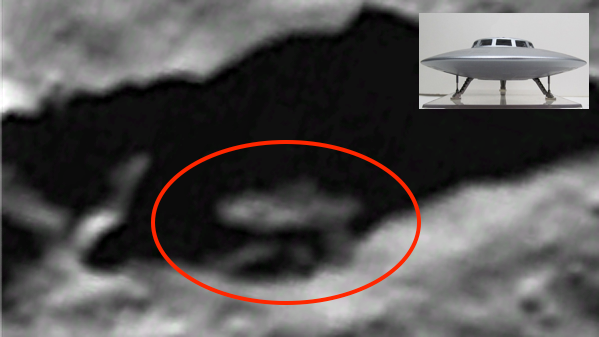
Antarctica mystery base discovered on Google Earth

Antarctica mystery base discovered on Google Earth
Flying Tesla Followed By UFO Caught On Security Cam, Canada, Video, UFO Sighting News.
Three Mile Long UFO Found On Google Moon, Aug 31, 2018, UFO Sighting News.
Fireball Lights Up Sky Over Western Australia (Videos)
NASA Wants Its Deep Space Gateway Habitat To Orbit The Moon By 2024
It’s no secret that humans (well, at least presidents) are aching to go back to the Moon. And now, we have more concrete plans on how we might do that. Earlier this week, the Human Exploration and Operations Committee for NASA’s Advisory Council presented the most detailed plan to date of how, exactly, it will go about it.
NASA’s plan involves something called the Deep Space Gateway, aka the Lunar Orbital Platform Gateway. First announced in March 2017, the Gateway would be a small habitat that would orbit the Moon and would act as a “spaceport for human and robotic exploration to the Moon and beyond.”
In other words, it would act as a basecamp to explore the surface of the Moon, conduct experiments into the viability of prolonged space travel, and prepare for much (much) farther destinations. According to the presentation this week, NASA plans to have the completed Gateway in lunar orbit as soon as 2024 — that is, if everything goes according to plan.
“Right now, our near-term focus is the Moon and returning humans there,” Kathryn Hambleton, a NASA spokesperson, tells Futurism. NASA’s teams are planning to use the space beyond Earth’s orbit near the Moon “to build up our technology capabilities, test our systems, and test our operations while we are still a few days from Earth before we are ready to take on the multi-month journey to Mars.” To do all that, though, it needs the Gateway in place.
But before astronauts can populate the Gateway, NASA has a lot of work to do. And it’s gotta do it all in the next six years.
Step 1: Build a giant rocket called the Space Launch System (SLS). Here’s how it would go. The SLS will launch major components of the Gateway into lunar orbit between now and 2024. In 2024, NASA’s Orion Spacecraft that’s currently in development would nudge those pieces into place, making the Gateway ready for human inhabitants.
To send a crew of astronauts all the way to the Gateway, SLS is going to need a rocket capable of sending 37 metric tons (81,000 lbs) of cargo into orbit around the Moon. Right now, we don’t have a rocket that can tow that much — SpaceX’s Falcon Heavy’s max payload to the Moon is estimated to be around 18 to 22 metric tons. Engineers are going to have to figure out how to double that capacity to make the SLS happen.
Complete the SLS and the Orion Spacecraft, and find funding for all components of the Gateway, and launch it into lunar orbit, and send the first couple of astronauts there by 2024? Pretty darn ambitious. Especially since so far the SLS’ development hasn’t exactly been smooth sailing.
The private space industry might help NASA get there. The space agency is hoping that a private space company will take on the substantial task of developing the lander that Gateway astronauts will use to travel from their habitat to the surface of the Moon, but no official partnership has been announced yet.
The Gateway’s doors (or airlock) will be open to rockets launched by both government space agencies and private companies. Since companies like SpaceX are making giant technological leaps — they’re launching rockets that are more powerful and cheaper — they could take a big a big load off of NASA’s back. “There will definitely be opportunities for a variety of rockets to deliver supplies and logistics to the Gateway,” says Hambleton.
Even with private space companies on board, NASA will inevitably face some major roadblocks to getting the Gateway up and running. There’s still the inherent risks that astronauts face during deep space travel – intense levels of radiation, isolation, a lack of gravity, and harsh environments.
Luckily, NASA’s research is well underway, particularly from studies conducted on the International Space Station. “We are working towards greater reliability of systems and more of a closed-loop kind of system in terms of recycling air and water, so we’re less reliant on Earth for those consumables,” Hambleton tells Futurism. No matter the outcome of these experiments, however, NASA still plans to make the Gateway happen in the stated timeframe.
Yes, NASA has a lot of work to do before the Deep Space Gateway is peacefully orbiting the Moon. Six years go by pretty fast, but making things happen in that timeframe is no impossible. With the right public-private partnerships and international collaborations, NASA has a much better shot at getting astronauts back onto the surface of the Moon, and maybe to Mars before we even know it.
NASA’s planning to send people back to the Moon’s surface in about a decade
More on NASA’s Gateway: Russia Confirms Participation in NASA’s Deep Space Gateway Project
WATCH HOW A LIGHTNING STRIKE TEMPORARILY DISABLES THIS UFO’S CLOAKING SHIELD

An unidentified flying object’s cloaking shield is one of its best assets since it allows the craft’s occupants to remain undetected while performing their obscure activities on Earth.
Visible light can be considered an oscillating electric and magnetic field and because the cloaking shield works on a visible level, it must operate on some kind of electromagnetic principle we’ve yet to discover. You know what else is electromagnetic? The immense power surge caused by a lightning strike. So it makes sense that when a camouflaged UFO is hit by the thousand or so Giga Watts discharged by a lightning bolt, some interference may occur.
In the following video we are treated to the rare sight of such a phenomenon.
During a recent thunderstorm in the U.S., a large, circular UFO became visible after coming in contact with the immense voltage of an electrical discharge between clouds. It is unclear whether the craft was accidentally hit or it was there exactly for that reason. Perhaps these advanced vehicles are able to harvest energy from a variety of sources, including, but not limited to volcanoes, lightning and solar wind.
After lightning touches its surface, the UFO becomes visible for approximately 30 seconds during which it remains lit and illuminates the sky and clouds surrounding its massive body. Once the UFO disappears, the surrounding area returns to its normal luminosity.
Although videos like this are rare, they are not unheard of. In a previous article, we showed you a fleet of UFOs recharging their batteries during a thunderstorm. Another video that quickly went viral featured a creepy UFO exiting a lightning storm at a high velocity.
It’s obvious that aliens always need two things: human specimens and a whole lot of power.
This Group of NASA Veterans Wants to Build Their Own Space Station/https://public-media.smithsonianmag.com/filer/ca/53/ca53c515-5a0f-4aa1-987f-24343799985a/image_-_axiom_station_nadir_view.png)
![]()
As a NASA astronaut for 20 years, Michael Lopez-Alegria conducted 10 spacewalks and set a U.S. record for total spacewalking time (67 hours and 40 minutes) that still stands. Now he heads business development for Houston-based Axiom Space, which aims to send private “spaceflight participants” up to the space station (for $55 million a seat), then to attach its own commercial module to the International Space Station, followed eventually by a free-flying commercial station of its own. Lopez-Alegria talked to Senior Editor Tony Reichhardt in June.
Air & Space: The Russians were taking paying customers up to the space station every couple of years in the early 2000s, but we haven’t seen any of those spaceflight participant flights in almost a decade. What happened?
Lopez-Alegria: Pretty simple. At the time, the station had three crew members, and we were rotating one of the three on shuttle flights and the other two on a [three-seat] Russian Soyuz, leaving a third seat open. Once the shuttle stopped flying, all three crew members started rotating on the Soyuz, so there were no more seats available. The demand was still there, but there was no supply.
What was the idea behind Axiom Space?
Our co-founder, Mike Suffredini, was NASA’s program manager for the International Space Station for ten years until he retired in 2015. He went to work with the other co-founder, Kam Ghaffarian, who at the time owned a company called SGT, which is a large contractor with NASA. They wanted to investigate the viability of a commercial space station, and after studying it for about a year Mike thought it was doable. And here we are.
Bigelow Aerospace already has an experimental module attached to the station, and is planning a commercial module of their own. How is your plan different?
We’re largely appealing to the same markets, which, in the beginning anyway, will be foreign professional astronauts as well as spaceflight participants. There are a couple other lines of revenue—research, space manufacturing, advertising, and something called exploration systems testing. When NASA starts going to points farther than Low Earth Orbit, like cislunar space or Mars, they want to have tested the support equipment and other critical components in space before they deploy them to places that are a lot harder to get to. It’s a lot easier to go fix something in Earth orbit than it is to fix something orbiting the moon. So that’s a sixth line of business, working for the companies and governments developing hardware for exploration.
We’re different from Bigelow in that they use expandable technology, which is sort of like a balloon that they inflate. We are going with a more proven system, basically an aluminum cylinder. Our module is going to be manufactured by the same guys, Thales Alenia, who have built something like 40 percent of the habitable volume on the space station. We don’t want to try anything that’s super hard. I mean, we don’t have much time to get this done. The ISS is going to be de-orbited somewhere between 2024 and 2028, maybe a little later. But this is still a pretty ambitious endeavor. It will take time, and we want to make sure we can get this stuff up there and activated. Trying that with new technology doesn’t seem like the path to success for us.
What does NASA have to do to make it happen?
They have to grant access for somebody to use one of the space station’s berthing ports. There’s only one port located in a place where you could attach something big enough to call a space station, or the beginning of a space station. So we think NASA needs to get on with whatever competitive process they want in order to decide which company is worthy of putting their confidence in.
If you’re an investor, and I come to you to invest a whole bunch of money, you’re going to say “What are the risks?” And if I say, “One of the risks is that we may not win this docking port,” you’re going to think twice. So until that docking port is granted, it’s going to be very difficult to raise a lot of money, and until you raise the money you can’t start constructing a module. So the first domino has to be the granting of the docking port. Then construction comes, and we can launch and dock and activate and start making revenue, and prove our worth to NASA so they can say okay, now we can retire the ISS, because we are confident we’ll have a place to go [in low Earth orbit]. Because we really don’t want a gap in our capability to work in Low Earth Orbit.
Has NASA given any indication of when they might start this competition for the docking port?
Oddly, two years ago, in the summer of 2016, they issued a request for information where they asked industry, “If we wanted to give away [the docking port] what criteria should we use?” A bunch of companies, 19 of us, responded, and NASA indicated that the responses were going to form the basis of a solicitation. But then the election happened, and I don’t pretend to know why it’s taken so long, but they still haven’t done it yet. Recently they issued what’s called a NASA research announcement, asking a lot of the same questions they did in 2016. So we’re encouraging them to use the data they already have to develop a [solicitation].
What agreements do you already have in place with NASA? Even before you attach your own module to the station, you want to send up paying customers, right?
Yes, that’s right. We’re getting a lot of interest from investors in spite of the lack of a docking port, because [flying private customers to the ISS] is already a sustainable business in and of itself. We would like to get NASA and other ISS partners comfortable with our operation. Flying to the ISS and demonstrating that we know what we’re doing is going to be good for them and for us, although we already have a ton of NASA experience within our company. So that’s a real reason to do these precursor flights. We have one planned in 2020, and another one or two planned in 2021. Then we’d like to get our modules up there in 2022.
We have a Space Act Agreement with NASA , and the first phase is complete, a kind of feasibility study to outline what services and utilities we would need from the station. We need to get some power and cooling capacity, et cetera, and we’d need to know how our module affects the mass and center of gravity of the station. So they’ve done all that preliminary work.
Have you already got customers lined up for the 2020 and 2021 flights?
No, we’re talking to [potential customers]. We only recently [in June] announced our campaign to market spaceflight participant flights. We’re agnostic as to which launch vehicle we’d use. It could be Soyuz, which has three seats, it could be the SpaceX Dragon, which has four, or it could be Boeing’s Starliner, which has five. Let’s take the Dragon case in the middle. On short duration flights, which are about ten days, we’d like to have at least one professional astronaut and up to three spaceflight participants. We could have more professionals—it doesn’t really matter to us, the price is effectively the same except for the training. We are fairly far along in negotiations with some countries to provide professional astronauts, but we have just started looking for spaceflight participants.
Are you thinking of astronauts from countries that don’t have their own space programs?
Two different categories: One would be countries that are fairly technologically advanced but don’t have human spaceflight programs. We can help with everything from astronaut selection to training. We have quite a bit of experience within our company. SGT [Ghaffarian’s former company] is a contractor to NASA, and today does all the training for NASA astronauts as well as all the flight control functions in Mission Control for the ISS. So you have a huge knowledge base accessible to our company. We would be able to select and then train and then fly astronauts for these countries. The second category are countries that already have astronauts, but don’t get to fly often enough. And a lot of those are in Europe.
One of the barriers to signing up spaceflight participants in the past was the amount of time required to train in Russia. Will your training be shorter?
Yes, and they won’t have to learn to speak Russian, either. I flew with two of those spaceflight participants, and both of them were in Russia for several months. We’re talking about being able to do our training in about 15 weeks, and it would all be in the U.S., with potentially a one-week trip to Russia to understand the Russian part of the space station.
Most of the space tourists a decade ago actively participated in the onboard experiments, and really tried to pitch in. Do you see that happening on your flights as well?
They can do whatever they want, is the bottom line. But I’ll tell you a story. When I was an astronaut and found out I was going to be flying with tourists, I wasn’t terribly excited about it. I figured this is a place for steely-eyed test pilots, and didn’t think very highly of the concept. I ended up flying about ten days with Anousheh Ansari, and she completely inverted that perspective. I saw how she and the guy I flew home with, Charles Simonyi, were both extremely professional, very courteous, and extremely willing to help. More importantly, she wrote a blog that reached millions of people on the ground and really kind of democratized the experience. It kind of opened my eyes to this notion that space is such a unique and magnificent experience that it ought to be shared with as many people as possible.
With all the experience at Axiom, do you see ways to build or operate a space station that might be better than the way NASA does it?
I hate to say it, but things that the government buys are always going to be more expensive just because they have a lot of bureaucracy and a lot of requirements. That’s the advantage of having a team that’s so experienced, that has sat through all the safety reviews. We can tell which [requirements] are valid, that we really need to consider, and which ones are kind of fluff. I think anybody who’s honest would tell you that you a lot of stuff happens that is just a function of the size of the organization.
Secondly, the ISS was built with pretty old technology, basically 386 processors and 1553 [military standard] data, which is kind of overkill for what we need, and drives costs out the roof. With the speed of processors today, you can do so much more with so much less in terms of weight, volume, and complexity. For instance, some of the gear on the ISS was so big that it had to go outside on the truss structure. And if it breaks it’s a real pain to go fix it. You have to have a spacewalk, or use very complex robotics, whereas now, because of miniaturization, we can put something like that inside, behind a cupboard door. So those are the things that will help us save money.

If everything goes according to your plan, how do you see Earth orbit in 10 or 15 years? Will there be several space stations?
I think probably just one company will benefit from the ISS, which is in a particular orbit. Other companies might want to go to different orbits. But once that one company proves the market, then I think you’ll see more investment, other companies trying to build independent space stations. For the first one, it would be advantageous to start attached to the ISS. Once the market gets proven, and I’m confident it will be, I do think you’ll see a proliferation of stations.
Would you like to go up again yourself?
I’ve had kind of a tongue-in-cheek conversation with Mike [Suffredini]. He said “You can be the first guy to go as soon as you write me a check for $55 million.” [Laughs] I don’t think it’s gonna happen any time soon.
Meteorite Hits International Space Station and Creates Leak

Houston, we have a different problem.
It’s the stuff of thriller movie plots and space travel nightmares. A meteorite crashed into the International Space Station and pressure started dropping on the Russian side as oxygen began leaking out of the hole. A good screenwriter could spin this opening scene into 90 minutes of heart-thumping action, but NASA decided to let the crew continue to sleep and deal with it in the morning. Does NASA Need better technicians or better screenwriters?
“As flight controllers monitored their data, the decision was made to allow the Expedition 56 crew to sleep since they were in no danger. When the crew was awakened at its normal hour Thursday morning, flight controllers at Mission Control in Houston and at the Russian Mission Control Center outside Moscow began working procedures to try to determine the location of the leak.”
The current ISS crew consists of station Commander Drew Feustel, Flight Engineers Ricky Arnold and Serena Auñón-Chancellor of NASA, Alexander Gerst of the European Space Agency and Oleg Artemyev and Sergey Prokopyev of the Russian space agency Roscosmos. Upon awakening (to the music of “Fixing a Hole” by the Beatles?), NASA sent them all over to the Russian side to look for the leak. Really!
Soyuz spacecraft
It gets better. The space news website NASASpaceFlight.com was monitoring communications between ground support and the crew gave these updates on the initial repairs:
“Russian ground controllers say they are now into a deep dive evaluation of the hole. Sergey Prokopyev is still trying to hunt down a repair kit. They have taped the hole as a band aid. Plan is to clean up the area and add more permanent patches.”
Tape! Patches! And then …
“Now told to use a toothpick on the hole (likely to aid photography and scale). Then will apply sealant and cover it with a patch. General ISS pressure is holding stable now.”
Toothpicks! Glue!
This is no space thriller movie … this is a sitcom for aliens watching Earthlings in their feeble attempts at space travel.
We’re glad the crew is safe and the hole is repaired. This shows how risky space travel is and how dangerous even a tiny meteorite or piece of debris can be. A permanent fix will most likely have to be made from the outside on a spacewalk.
NASA has probably already put in orders to ship up some Bondo, sandpaper and paint.
DE GOUDEN BIBLIOTHEEK VAN ONZE VOOROUDERS ( VIDEO )

Wanneer de aarde dreigt te vergaan door allerlei mogelijke rampen, dan doet de mensheid vaak toch pogingen om een boodschap voor toekomstige generaties of volken achter te laten.
Ook onze verre voorouders hebben dat gedaan in de vorm van een ondergrondse bibliotheek in Zuid Amerika.
Een team onderzoekers heeft bekendgemaakt dat zij de legendarische metalen bibliotheek en diverse andere schatten hebben gevonden in het Tayos grottensysteem in Ecuador.
Zij maakten ook bekend dat ze per ongeluk enkele verborgen tunnels hebben ontdekt die lang geleden door iemand of.... iets gemaakt zijn.
Het team was in staat om één van deze tunnels bijna een kilometer lang te volgen en kwam uiteindelijk uit in een grote kamer die de gouden bibliotheek en diverse andere waardevolle objecten bevatte.
Hier volgt een lijst van wat de onderzoekers zeggen te hebben gevonden:
1) Een bibliotheek met duizenden metalen boeken. Het team was nog niet in staat om te vertellen welk metaal gebruikt was voor de boeken, maar het leek op zilver.
2) Iedere pagina bevatte symbolen en vreemde tekens. Individuele platen met tekens erop die eruit zagen alsof ze van goud waren.
3) Honderden verschillende beelden van insecten, dieren en mensen, verspreid door de grote kamer.
4) Veel metalen staven, zowel van (wat eruit zag als) goud en zilver.
5) Ook werd er kinderspeelgoed gevonden en juwelen van goud of zilver.
6) Een grote sarcofaag met daarin een menselijk skelet, versierd met juwelen en goud.
7) Het team vond tenminste nog drie deuren die naar meer kamers zouden kunnen leiden, maar die waren afgesloten.
Tot nu toe zijn de claims van dit team alleen nog gedaan via een radioprogramma en zijn er (nog) geen verdere mededelingen gedaan. Ze meldden verder dat ze voorbeelden hadden van tenminste één van de metalen boeken, een gouden plaat en verschillende kleine beeldjes die aangeboden zullen worden voor professioneel onderzoek. Hopelijk zullen er binnenkort meer berichten volgen.
Daarna is er nooit meer iets vernomen voor zover ons bekend.
Desalniettemin zijn de grotten en de verhalen over die bibliotheek wel echt.µ
Mensen die zich al eerder met deze bibliotheek hebben beziggehouden zijn onder andere Erich von Däniken en de Schotse onderzoeker Stanley Hall. Deze laatste kwam in de jaren zeventig van de vorige eeuw in contact met een Italiaanse priester, Crespi genaamd. Crespi had zich jarenlang onbaatzuchtig ingezet voor de belangen van de plaatselijke indianen en had als beloning ondermeer een soort gouden plaat gekregen, met daarop allerlei vreemde tekens. Ook had hij diverse andere voorwerpen in zijn bezit die erop wezen dat deze bibliotheek inderdaad bestond en gezien de vormen van de aangetroffen beelden, er inderdaad een verband mogelijk is met buitenaardse beschavingen.
Stanley Hall heeft diverse expedities georganiseerd in de vorige eeuw, waaronder één waarbij ook de voormalige astronaut Neill Armstrong van de partij was. Alhoewel ze wel in het grottensysteem zijn geweest, zijn ze er niet in geslaagd om de bibliotheek te traceren. Hall is inmiddels overleden, maar zijn werk wordt voortgezet door zijn dochter. Deze kwam er ook achter dat de gouden plaat samen met vele andere waardevolle voorwerpen van de priester, na zijn dood in 1982 ineens waren verdwenen.
Echter, een heel belangrijk iemand die niet in bovenstaande voorkomt is Juan Moricz.
Toch is het verhaal over de tunnelcomplexen zeer interessant. Want dit soort tunnelstelsels bestaan namelijk echt. Erich von Däniken vertelde in 1973 in zijn boek ‘Het Goud der Goden’, dat hij ter plaatse foto’s had gemaakt van een enorm tunnelcomplex in Ecuador. Hij vertelde dat de Hongaarse Argentijn Juan Moricz, dit gangenstelsel vond en er via een notariële akte in 1969 eigenaar van werd. Dit klopt als een bus. Dit is middels akte en handtekeningen gedocumenteerd. Moricz ontmoette in 1972 Erich von Däniken en nam hem mee naar de plaats waar hij een rondleiding kreeg. Dit werd wonderlijk genoeg naderhand door Moricz zelf, tegenover de Duitse pers ontkend toen zij hier naar vroegen (hier zodadelijk meer over – want Erich von Däniken moet daar weldegelijk geweest zijn!). Erich von Däniken schreef in zijn boek vol lof over het enorm grote gangenstelsel.
von Däniken schreef hierover:
“Voor mij is het het ongelofelijkste, onwaarschijnlijkste verhaal van de eeuw. Het zou een science-fiction-story kunnen zijn, als ik het niet zelf gezien en gefotografeerd had. Ik heb het met eigen ogen gezien. Het is droom noch fantasie, het is realiteit. Onder het Zuidamerikaanse continent ligt een reusachtig door wie en wanneer dan ook aangelegd tunnelsysteem. Het ligt heel diep onder de aarde en is meerdere duizenden kilometers lang. In Peru en Ecuador werden honderden kilometers betreden en uitgemeten. En dat is nog maar het begin van iets waar de wereld niets van afweet.”
Op de volgende afbeelding zie je Von Däniken samen met Juan Moricz.

Wie meer wil lezen over dit bijzonder interessante verhaal raden wij om hier of hier verder te lezen.
Wie nu precies wel of niet dat grottenstelsel heeft ontdekt is wellicht minder belangrijk dat het feit dat ze er wel degelijk zijn.
Wat opvalt in vooral de eerste video met Stanley Hall en Father Crespi is dat er via dat gevonden beeld weer wordt gerefereerd aan de Soemeriërs en Babylonië.
Waarom werd dit enorme grottenstelsel gemaakt en waarom werd een dergelijke uitgebreide bibliotheek opgeslagen? Hoogstwaarschijnlijk omdat er rampen plaatsvonden of zouden plaatsvinden op aarde, waardoor complete beschavingen zouden worden weggevaagd.
Bij de mainstream wetenschap hoef je niet aan te kloppen voor antwoorden op dit soort vragen, want daar doet men alle mogelijke moeite om mensen in voorgeprogrammeerde gedachtepatronen vast te houden en daar horen dit soort werkelijkheden niet in thuis.
Misschien iets voor Evert Jan Poorterman om hier eens wat dieper in te duiken? Of iemand anders natuurlijk.
Large cone shaped metal looking UFO in the sky over Lake Erie
Cigar Shaped UFOs Surround Pluto In NASA Photo?

Original photo:
Amazing UFOs caught on tape over Las Vegas, Nevada

This really shocking footage was filmed over Las Vegas on 24th July back in 2015 and it was just published online.
Witness report:
I shot this video from my backyard in the Summerlin area of Las Vegas, Nevada on the night of July 24, 2015. The location where these were filmed was above and beyond the Las Vegas Mountain Range which is at least 22 miles from my home where I was filming and is restricted airspace. I know they were a minimum of 22 miles away because you can see them go behind the mountain which is 22 miles away at 21:16:56 on the time stamp in the lower right-hand corner of the video. I know some of you don’t like it when I speed the video up but in this case, there was a lot of footage I wanted to show so I sped it up by five times. There are many times that these amazing objects perform stunts that are unheard of with our current technology and it’s much easier to see when the video is running at a faster pace. I also know that some of you don’t like the music but many others do so I add background music because the night vision camera does not record audio.
Turn your sound down or mute the video if you don’t like the music and it will be a win-win situation for all viewers. I recently decided to put MUFON to the test and turned a video in that is just as amazing as this one and they are the very same objects. It has been two weeks and I still haven’t heard a peep. I am very curious to find out whether or not they will even contact me. Finally, I have some great news… I have been wanting to buy a Nikon Coolpix P900 which gas an 83X optical zoom and 16.1 million megapixels for a long time now and I finally got it about a week ago. It will be great for taking close up photos of where I film and hopefully some of the objects I film. Right now I am just learning how to use it so I can take the best photos possible. I will put a slideshow video out soon showing you how sweet everything works.
Author (UFOs Over Vegas – Steven Barone @ youtube)
How Gaia could help find Dyson spheres
Dyson spheres are hypothetical megastructures built by extraterrestrials for the purpose of harvesting all of a star’s energy. Here’s how the European Space Agency’s Gaia mission might help find one.

Artists’ concept of a Dyson sphere. Notice the little moon or planet on the left side, being ravaged for raw materials. This image – called Shield World Construction – is by Adam Burn. More about it here.
When contemplating extraterrestrial intelligence, one of the most tantalizing ideas is that a super-advanced alien civilization could build an enormous structure around its home star, to collect a significant portion of the star’s energy. This hypothetical megastructure is popularly known as a Dyson sphere. It’s a sci-fi-sounding concept, but some scientists have also seriously considered it. This week, a story emerged about how the European Space Agency’s Gaia mission – whose primary purpose is to create a 3D map of our Milky Way galaxy – might be instrumental in the search for Dyson spheres.
In the past, searches for Dyson spheres have focused on looking for signs of excess infrared or heat radiation in the vicinity of a star. That would be a telltale signature, but those attempts have come up empty, so far. The new peer-reviewed study – which was published in the Astrophysical Journal on July 18, 2018, and later described in Astrobites – proposes looking for Dyson spheres with little or no infrared excess. In other words, it describes a technique not attempted before.
Erik Zackrisson at Uppsala University in Sweden led the new study. It focuses on a type of Dyson sphere that would’ve been missed by prior searches focused on infrared radiation.
Suppose you were looking toward a Dyson sphere. What would you see? The visible light of the star would be reduced significantly since the Dyson sphere itself – by its nature – would mostly surround the star for purposes of energy collection. The star would continue shining; it would be shining on the inner portion of the Dyson sphere. Presumably, the star’s radiation would heat the sphere. According to earlier thoughts by scientists on the subject, a Dyson sphere should have a temperature between 50 and 1,000 Kelvin (-370 to 1300 degrees Fahrenheit; -220 to 730 degrees Celsius). At that temperature, radiation from the sphere would peak in infrared wavelengths.
That was the earlier idea, until Zackrisson’s study.

An all-sky view of the Milky Way and neighboring galaxies from the Gaia mission. This view includes measurements of nearly 1.7 billion stars.
Image via Gaia Data Processing and Analysis Consortium (DPAC)/A. Moitinho/A. F. Silva/M. Barros/C. Barata – University of Lisbon, Portugal/H. Savietto – Fork Research, Portugal.
His study suggests the possibility that the sphere might be composed of a different kind of material than what had been previously supposed. Suppose this material had the ability to dim the star’s light equally at all wavelengths? That would make it a so-called gray absorber and would significantly affect methods used to search for Dyson spheres. If you measured the star’s distance spectrophotometrically – by comparing the star’s observed flux and spectrum to standard stellar emission models – then the measurements would suggest that the star is farther away than it actually is.
But then if you measured the star’s distance using the parallax method, you’d get a different number. The parallax method compares the apparent movement of a nearby star against the stellar background, as Earth moves from one side of its orbit to another across a period of, say, six months. The size of a Dyson sphere could be determined by comparing the difference in distances between these two methods. The greater the difference, the greater the amount of the star’s surface that is being obscured by the sphere.
Now, thanks to new data from the Gaia mission, astronomers can do these kinds of comparisons, which could – in theory – detect a Dyson sphere. From the new study:
A star enshrouded in a Dyson sphere with a high covering fraction may manifest itself as an optically subluminous object with a spectrophotometric distance estimate significantly in excess of its parallax distance. Using this criterion, the Gaia mission will in coming years allow for Dyson sphere searches that are complementary to searches based on waste-heat signatures at infrared wavelengths. A limited search of this type is also possible at the current time, by combining Gaia parallax distances with spectrophotometric distances from ground-based surveys. Here, we discuss the merits and shortcomings of this technique and carry out a limited search for Dyson sphere candidates in the sample of stars common to Gaia Data Release 1 and Radial Velocity Experiment (RAVE) Data Release 5. We find that a small fraction of stars indeed display distance discrepancies of the type expected for nearly complete Dyson spheres.
In other words, using this new method, astronomers have found candidate Dyson sphere stars.

Graph showing distribution of covering fractions for all stars in the Gaia-RAVE database overlap (left) and just those stars with less than 10 percent error in their Gaia parallax distance and less than 20 percent error in their RAVE spectrophotometric distance (right). If the parallax distance is smaller than the spectrophotometric distance, that is interpreted this as a negative covering fraction, and could be an indication of a Dyson sphere surrounding that star.
Image via Zackrisson et al. 2018.
The Gaia mission is currently charting a three-dimensional map of our galaxy, providing unprecedented positional and radial velocity measurements with the highest accuracy ever. The goal is to produce a stereoscopic and kinematic census of about one billion stars in the Milky Way galaxy and throughout the Local Group of galaxies.
As it happens, these data are very useful when searching for Dyson spheres.
Using the parallax distances from the first data release of Gaia, Zackrisson and his colleagues compared that data to previously measured spectrophotometric distances from the Radial Velocity Experiment (RAVE), which takes spectra of stars in the Milky Way. This resulted in an estimate of what percentage of each star could be blocked by Dyson sphere material.

Illustration of how Gaia is measuring the distances to most stars in the Milky Way with unprecedented accuracy.
Image via S. Brunier/ESO; Graphic source: ESA.
Of course, figuring out if any of these could actually be Dyson sphere candidates required further analysis. Zackrisson and his team decided to focus on main-sequence stars (like the sun), spectral types F, G and K, and narrowed those down to those which displayed a potential blocking fraction greater than 0.7. Larger giant stars were removed from the data set since their spectrophotometric distances tend to be overestimated compared to main-sequence stars.
This alone left only six possible candidates. Those in turn were then narrowed down to only two, after eliminating four candidates due to problems with the data itself. One of those, the star TYC 6111-1162-1, was then considered to be the best remaining candidate.

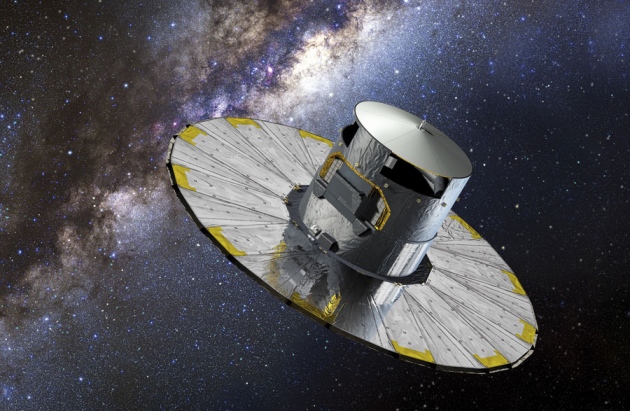
Artist’s concept of Gaia in space.
Image via D. DUCROS/ESA.
So … has the first Dyson Sphere been found? The simple answer is we don’t know yet. The star, a garden-variety late-F dwarf, seems to exhibit the sought-after characteristics, but more data is needed. No other glitch-related weirdness was found in the data, but the star was also found to be a binary system consisting of two stars (the other being a small white dwarf) which might explain the results – but none of that is certain yet. Additional study of the star will be required, including using future Gaia data releases, to determine what is really happening here. From the new study:
To shed light on the properties of objects in this outlier population, we present follow-up high-resolution spectroscopy for one of these stars, the late F-type dwarf TYC 6111-1162-1. The spectrophotometric distance of this object is about twice that derived from its Gaia parallax, and there is no detectable infrared excess. While our analysis largely confirms the stellar parameters and the spectrophotometric distance inferred by RAVE, a plausible explanation for the discrepant distance estimates of this object is that the astrometric solution has been compromised by an unseen binary companion, possibly a rather massive white dwarf. This scenario can be further tested through upcoming Gaia data releases.
Read more: What is a Dyson sphere?

A handy illustrated guide to Dyson spheres – massive structures which could be built to surround a star and harness its energy by an advanced alien civilization.
Image via Karl Tate/Space.com.
Bottom line: Discovering an actual Dyson sphere, or something similar, would be incredible. This new study proposes a new method of searching which shows some promise. It’s even possible that a Dyson Sphere-type object has already been found in the preliminary data, but that will require more follow-up to either confirm or disprove. Regardless, this new search method will prove valuable in future searches as well.
Source: SETI with Gaia: The Observational Signatures of Nearly Complete Dyson Spheres
What Would It Take to Land on Mercury? It's Time to Find Out, Scientists Say
Archaeologists Find Massive Underground World Belonging To A Long Lost Civilization In Peru
Researchers in Peru have discovered a complex underground world belonging to the ancient Chavín culture that has been identified as burial chambers that date back thousands of years.
The culture developed in the northern Andean highlands of Peru from 1,300 and 550 BC. The Chavín extended its influence to other civilizations along the coast. The Ancient Chavin civilization developed advanced knowledge not only in metallurgy, but in soldering, and temperature control. The ancient Chavin used early techniques to develop refined gold work.

Not, researchers have discovered galleries, ceramics and even a place where this civilization carried out burials, located beneath the surface. They say it’s the most important archaeological discovery made in the last 50 years.
Since June of 2018, a team of archaeologists has unearthed three new galleries in an area adjacent to the circular plaza of Chavín. In the place, they have found remarkable pieces of ceramics, utensils and intact human burials.
According to American anthropologist and archaeologist John Rick, in charge of the Archaeological and Conservation Research Program of Chavín, the three discovered galleries come from the late period of this civilization that developed between 1,300 and 550 BC.

“What these galleries show is that Chavín has a much larger underground world than we think,” said Rick.
Inside one of these underground galleries, archeologists discovered artifacts that belonged to the later Huaraz culture.
These successive occupations, found at different levels in the archaeological complex demonstrate the cultural and religious importance that Chavin had in the central highlands for centuries.
The project’s specialists used small robots with built-in micro-cameras to carry out the explorations. These machines – designed on site by engineers from Stanford University – entered very small areas and discovered cavities in the Chavin labyrinths, where pottery was preserved.
Chavin de Huantar was designated a UNESCO World Heritage Site in 1985. So far 35 interconnected underground passageways have been found at the site, Peru’s culture ministry said.
VIDEO: What’s the deal with the Space Force?Is the President afraid of aliens? I’m not sure, but there is a legit reason some lawmakers want to create a sixth branch of the military the President is calling the Space Force.
Check out this video from my new YouTube channel: The Alejandro Advantage
Robot video terrifies Twitter, but the apocalypse isn't hereYou won't have to outrun this robot.
Advanced Artificial Intelligence Could Run The World Better Than Humans Ever Could

There are fears that tend to come up when people talk about futuristic artificial intelligence — say, one that could teach itself to learn and become more advanced than anything we humans might be able to comprehend. In the wrong hands, perhaps even on its own, such an advanced algorithm might dominate the world’s governments and militaries, impart Orwellian levels of surveillance, manipulation, and social control over societies, and perhaps even control entire battlefields of autonomous lethal weapons such as military drones.
But some artificial intelligence experts don’t think those fears are well-founded. In fact, highly-advanced artificial intelligence could be better at managing the world than humans have been. These fears themselves are the real danger, because they may hold us back from making that potential a reality.
“Maybe not achieving AI is the danger for humanity,” Tomas Mikolov, a research scientist for Facebook AI, said at The Joint Multi-Conference on Human-Level Artificial Intelligence, organized by GoodAI, in Prague on Saturday.
“Maybe not achieving AI is the danger for humanity.”
As a species, Mikolov explained, humans are pretty terrible at making choices that are good for us in the long term. People have carved away rainforests and other ecosystems to harvest raw materials, unaware of (or uninterested in) how they were contributing to the slow, maybe-irreversible degradation of the planet overall.
But a sophisticated artificial intelligence system might be able to protect humanity from its own shortsightedness.
“We as humans are very bad at making predictions of what will happen in some distant timeline, maybe 20 to 30 years from now,” Mikolov added. “Maybe making AI that is much smarter than our own, in some sort of symbiotic relationship, can help us avoid some future disasters.”
Granted, Mikolov may be in the minority in thinking a superior AI entity would be benevolent. Throughout the conference, many other speakers expressed these common fears, mostly about AI used for dangerous purposes or misused by malicious human actors. And we shouldn’t laugh off or downplay those concerns.
We don’t know for sure whether it will ever be possible to create artificial general intelligence, often considered the holy grail of sophisticated AI that’s capable of doing pretty much any cognitive task humans can, maybe even doing it better.
The future of advanced artificial intelligence is promising, but it comes with a lot of ethical questions. We probably don’t know all the questions we’ll have to answer yet.
But most of the panelists at the HLAI conference agreed that we still need to decide on the rules before we need them. The time to create international agreements, ethics boards, and regulatory bodies across governments, private companies, and academia? It’s now. Putting these institutions and protocols in place would reduce the odds that a hostile government, unwitting researcher, or even a cackling mad scientist would unleash a malicious AI system or otherwise weaponize advanced algorithms. And if something nasty did get out there, then these systems would ensure we’d have ways to handle it.
With these rules and safeguards in place, we will be much more likely to usher in a future in advanced AI systems live harmoniously with us, or perhaps even save us from ourselves.
How Humanoid Robots Will Be Better Than Humans
More on the future of artificial intelligence:
Crop circle : Comment des youtubeurs ont berné des “experts” en extraterrestres
Pour les adeptes du paranormal, les crop circles qui apparaissent dans les champs de blé seraient l'œuvre d'aliens. Pour les sceptiques, ils seraient d'origine humaine. Pour trancher le débat, des youtubeurs ont réalisé une petite expérience instructive.

Ce crop circle est apparu dans un champ de blé de Sarraltroff en Moselle. Il est l'oeuvre de youtubeurs et non d'extraterrestres.
ARNAUD THIRY
Cette fois, ils ont frappé à Sarraltroff (Moselle). Ils ? Les extra-terrestres bien sûr ! C'était le 9 juin et comme à leur habitude, ils ont laissé une trace de leur passage dans un champ de blé : un immense crop circle ou cercle de culture en français ou encore agroglyphe. Le dessin géant est formé d'épis couchés par “une technologie alienne”. Il est composé de plusieurs cercles disposés de manière énigmatique voire ésotérique et dont la "géométrie parfaite” ne peut s'apprécier que vue du ciel. Selon les exégètes de la chose, cette géométrie est d'ailleurs trop parfaite pour être l'oeuvre de simples êtres humains. La preuve, donc, qu'il s'agit bien d'une production extra-terrestre... Le champ est alors devenu un véritable lieu de pèlerinage New Age, chargé “d'énergie”, “de vibrations” et autres fluides cosmiques obscures.
Malheureusement - pour les exégètes - ce crop circle a bel et bien été réalisé par des humains ordinaires… ou presque. Effectivement, le 24 août, de joyeux youtubeurs ont révélé qu'ils étaient les auteurs de l'agroglyphe de Sarraltroff. Ces mordus de science, sont surtout adeptes de la zététique, l'étude rationnelle de phénomènes prétendument extraordinaires (paranormal, pseudo-sciences, pseudo-médecines etc…). Ils étaient aidés par deux ufologues sceptiques, rompus à l'analyse des phénomènes supposés extra-terrestres. Armés de simples mètres rubans pour les mesures et de quelques bières, les membres du commando ont agi en pleine nuit à la lueur de leurs torches frontales. Une planche sous le pied tenue à chaque extrémité par une ficelle, ils ont écrasé minutieusement les blés dans le champ d'un agriculteur complice (voir les explications de la méthode dans la vidéo). L'opération a duré à peine une heure. Et à la différence d'insaisissables extra-terrestres, les youtubeurs ont tout filmé. Les séquences sont diffusées et largement commentées sur Astronogeek, la chaîne Youtube d'Arnaud Thiry, l'initiateur du projet (trois épisodes sont prévus).
Ses collègues diffusent eux aussi les images et les analysent chacun à leur manière sur leurs chaînes respectives : Hygiène Mentale, la Tronche en Biais, le Defakator et un Monde Riant.
“L'objectif n'était pas de se moquer de ceux qui croient aux extra-terrestres, nous assure Arnaud Thiry. Nous voulions tester la méthode qui permet aux experts d'affirmer si un crop circle est une oeuvre extra-terrestre ou humaine.” Une véritable expérience en aveugle. En d'autres termes, est-ce que ces experts, ne connaissant pas l'origine du crop circle, sont capables déterminer, comme ils le prétendent, s'il a été produit par des humains. La réponse est clairement non. “Tous ceux qui sont venus sur place ont affirmé qu'il s'agissait bien d'une réalisation extra-terrestre", confirme Arnaud Thiry.
Umberto Molinaro, le plus populaire d'entre-eux, est lui aussi tombé dans le panneau. Ce conférencier français, auteur de quatre livres sur le sujet, s'est rendu sur place. Entouré de nombre de ses fidèles qui le suivent notamment sur Facebook ou lors d'une émission diffusée sur la chaîne Youtube CTVM TV, il a pu observer le nouveau “message” laissé par ceux qu'il appelle tantôt “les Etres de Lumière” tantôt “les Galactiques”. Ainsi, interrogé par une journaliste du Républicain Lorrain, il ressort l'argument de la complexité du motif : " Ce crop est tellement élaboré. Chaque cercle est lié aux autres par des rapports particuliers. C'est vivant, comme dans les cathédrales ou devant un menhir. Un humain n'aurait pas pu le faire. " L'occasion d'improviser avec ses amis une séance collective de captation d'énergies et de vibrations assurément cosmo-telluriques.
Alors forcément, quand deux mois plus tard il apprend que les cercles de culture ont été réalisés non pas par des Galactiques, mais par des humains, il change de version. Il affirme notamment qu'il n'a jamais dit qu'il s'agissait d'un “vrai crop circle” (d'origine extra-terrestre). Contacté par téléphone il nous confirme : “Je n'ai jamais authentifié ce crop circle. Pour le faire il faut prélever de la terre et analyser sa résistivité.” (sic). Il poursuit : “J'ai tout de suite vu que c'était un faux.” Pourtant, sur Facebook et sur Youtube, l'expert français n'a pas cessé de gloser sur l'authenticité de l'oeuvre, assénant, photos à l'appui, tous les indices qui permettent de distinguer la main de l'Etre de Lumière du pied de l'être humain.
Outre la complexité du motif, les partisans de l'hypothèse extraterrestre évoquent par exemple la présence de blés coudés. Il s'agit en fait de tiges qui se redressent partiellement vers le ciel. Le phénomène serait l'oeuvre “d'une résonance vibratoire” caractéristique de la technologie alien. Pourtant, comme l'ont montré les youtubeurs, la technologie terrestre consistant à aplatir le blé avec une simple planche de bois, produit les mêmes effets. Le blé coudé s'explique par l'héliotropisme, littéralement une attirance pour le soleil, qui pousse une plante vivante, dépendante de la photosynthèse, à s'orienter naturellement vers la lumière.
Mieux encore, Umberto Molinaro commente la présence de mouches mortes collées sur les épis de blé. Là encore, il s'agit pour lui des effets secondaires de la méthode extra-terrestre. Et pour l'affirmer avec plus de force, il fait appel à une autorité dans le domaine : Valentin, un jeune homme décédé depuis plusieurs années et en contact direct avec les Galactiques... L'explication de Valentin relayée par Umberto Molinaro est alors limpide : “Les insectes sont immobilisés sous les effets vibratoires. Ca les scotche sur place. Ils n'ont plus la force de réagir.”
Au téléphone, le malaise est perceptible. Umberto Molinaro nous confie qu'il a été piégé. Il accuse les youtubeurs d'avoir étudié sa technique pour l'induire en erreur. Mais comme le montre la vidéo, la bande de sceptiques n'a fait qu'écraser le blé en suivant la méthode de la planche de bois abondamment décrite sur Internet. Mieux, le rapport VECA, rédigé par Gilles Munsch du Groupe d'études et d'informations sur les phénomènes aérospatiaux non identifiés (GEIPAN) au Centre national d'études spatiales (CNES), révèle tous les éléments qui permettent de montrer qu'un crop circle a été réalisé par l'homme. Un rapport consultable par tous car en accès libre sur Internet. Gilles Munsch est d'ailleurs venu lui-même, à titre personnel, sur le champ de Moselle : “En quelques minutes il a conclu que c'était l'oeuvre d'humains. Il m'a même décrit comment ils avaient procédé, dans quel ordre ils avaient dessiné les cercles. J'ai du rapidement lui avouer que c'était nous”, raconte Arnaud Thiry.

Coincé par la simplicité de la démonstration, Umberto Molinaro s'emporte et lâche un argument inattendu : “Quand j'emmène des gens sur un crop circle, on est à un autre niveau. On n'est pas là à chercher le vrai et le faux parce qu'on s'en fiche. Ce qu'on retrouve dans un vrai ou un faux crop circle n'est pas lié au crop circle lui-même. On est lié déjà à quelque chose de plus grand que nous.”
Cette histoire de vrai ou faux extraterrestres pourrait faire sourire, faisant passer les adeptes des crop circlespour de doux rêveurs. Mais une vidéo filmée en caméra cachée par Arnaud Thiry sur le site de Moselle, montre un toute autre visage de l'univers parallèle dans lequel ils évoluent : celui de “vibrations” ou encore “d'énergies” bienfaitrices laissées par les Galactiques et qui seraient dotées d'un pouvoir guérisseur.
L'une de ces adeptes de la théorie extra-terrestre explique ainsi qu'en venant sur le crop circle "vous pouvez vous reconnecter avec votre ADN". Elle évoque même le cas d'une femme qui aurait guéri de son cancer ! Une autre conseille d'abandonner les “médicaments chimiques” et la médecine conventionnelle. Et d'affirmer : “Le cancer pour moi, c'est une maladie de l'âme.” Umberto Molinaro lui-même n'hésite pas dans ses vidéos à affirmer ses positions anti-vaccinales (voir à partir de 53'00) ! Lors d'une émission diffusée par la chaîne Youtube CTVM TV il discute abondamment avec l'animatrice Sylvie Richard, des effets thérapeutiques “des taux vibratoires” enregistrés sur les crop circles (voir à partir de 6'50). Une véritable dérive thérapeutique sur fond de communication avec les morts et les extraterrestres, bien éloignée de l'image de doux rêveurs inoffensifs.
Unstable Monster Galaxy Hosts Runaway Star Formation