Ontdek de Fascinerende Wereld van UFO's en UAP's: Jouw Bron voor Onthullende Informatie!
Ben jij ook gefascineerd door het onbekende? Wil je meer weten over UFO's en UAP's, niet alleen in België, maar over de hele wereld? Dan ben je op de juiste plek!
België: Het Kloppend Hart van UFO-onderzoek
In België is BUFON (Belgisch UFO-Netwerk) dé autoriteit op het gebied van UFO-onderzoek. Voor betrouwbare en objectieve informatie over deze intrigerende fenomenen, bezoek je zeker onze Facebook-pagina en deze blog. Maar dat is nog niet alles! Ontdek ook het Belgisch UFO-meldpunt en Caelestia, twee organisaties die diepgaand onderzoek verrichten, al zijn ze soms kritisch of sceptisch.
Nederland: Een Schat aan Informatie
Voor onze Nederlandse buren is er de schitterende website www.ufowijzer.nl, beheerd door Paul Harmans. Deze site biedt een schat aan informatie en artikelen die je niet wilt missen!
Internationaal: MUFON - De Wereldwijde Autoriteit
Neem ook een kijkje bij MUFON (Mutual UFO Network Inc.), een gerenommeerde Amerikaanse UFO-vereniging met afdelingen in de VS en wereldwijd. MUFON is toegewijd aan de wetenschappelijke en analytische studie van het UFO-fenomeen, en hun maandelijkse tijdschrift, The MUFON UFO-Journal, is een must-read voor elke UFO-enthousiasteling. Bezoek hun website op www.mufon.com voor meer informatie.
Samenwerking en Toekomstvisie
Sinds 1 februari 2020 is Pieter niet alleen ex-president van BUFON, maar ook de voormalige nationale directeur van MUFON in Vlaanderen en Nederland. Dit creëert een sterke samenwerking met de Franse MUFON Reseau MUFON/EUROP, wat ons in staat stelt om nog meer waardevolle inzichten te delen.
Let op: Nepprofielen en Nieuwe Groeperingen
Pas op voor een nieuwe groepering die zich ook BUFON noemt, maar geen enkele connectie heeft met onze gevestigde organisatie. Hoewel zij de naam geregistreerd hebben, kunnen ze het rijke verleden en de expertise van onze groep niet evenaren. We wensen hen veel succes, maar we blijven de autoriteit in UFO-onderzoek!
Blijf Op De Hoogte!
Wil jij de laatste nieuwtjes over UFO's, ruimtevaart, archeologie, en meer? Volg ons dan en duik samen met ons in de fascinerende wereld van het onbekende! Sluit je aan bij de gemeenschap van nieuwsgierige geesten die net als jij verlangen naar antwoorden en avonturen in de sterren!
Heb je vragen of wil je meer weten? Aarzel dan niet om contact met ons op te nemen! Samen ontrafelen we het mysterie van de lucht en daarbuiten.
Attention cat people. There's a burgeoning theory around the internet that begs reckoning. It's not the theory that parasites in cat poop are turning you into crazy cat ladies, though that's certainly cause for alarm. It's much worse than that.
Domestic house cats, it seems, may be alien sentinels—sent to spy on us and report their findings back to the mother ship. Or, as some theorists have put it, they're like alien camcorders tracking our every move.
Well, maybe. We humans love our conspiracy theories, and there's a decent chance this is just another among them. As a poll published just yesterday reveals, 51 percent of Americans believe the JFK assassination was a conspiracy; 15 percent believe "the government or the media adds mind-controlling technology to TV broadcast signals"; and 4 percent believe reptilian shapeshifters control the government.
It's impossible to know just how pervasive cats-as-alien spies theory is without an adequate polling apparatus (if you have one, please get in touch). One guesses it's fairly low. Then again, 4 percent is much higher than one might have expected for the lizard people theory, and, according to the same poll, some 29 percent of Americans believe aliens exist and 14 percent believe in Bigfoot, so who knows?
As with most conspiracy theories, the cats-as-alien-spies theory is surprisingly well-developed—and based on a few kernels of truth and genuine ambiguity. How much? Motherboard decided to take a look at some of the supporting premises, one-by-one. A user who goes by the moniker "RedSpider" summarizes the prevailing wisdom in a handy list on the British tech message board, Digital Kaos. I've appropriated his/her list here (lightly edited for style and clarity), with the original points bolded.
Examine the evidence and decide for yourself:
1. There is no documentation before ancient Egypt that mentions the existence of cats. And in ancient Egypt, they were worshipped as gifts from the gods.
As with several of these premises, these propositions are mostly true, but also somewhat disputable. To find out more about the fossil record, I emailed Ryan Haupt, a paleontologist at the University of Wyoming who, as he described it for a previous interview, "studies the lives of modern mammals to better understand what their extinct relatives were doing in the past." He said Egypt was "the best guess" for the origin of the domestic cat species, but noted that "cat skeletons have been found at older sites."
Exporting domestic cats was illegal in ancient Egypt, according to Wild Cats of the World, a book by Mel and Fiona Sunquist, which may explain why they don't appear definitively in the records of other civilizations until thousands of years later than early cat records in Egypt. What older feline skeletons have been found elsewhere don't provide clear "evidence as to whether they were domesticated or not," Haupt said, adding, however, that they "probably" weren't.
"Looking at just skeletons it's basically impossible to say when cats stopped being wild and started being domesticated." Haupt said.
As for cat worship, the picture is a bit more complicated than the conspiracy theorist asserts. Cats were, indeed, revered by the ancient Egyptians, the Sunquists write. Cats were beloved as pets; they were mourned like family members when they died; they were embalmed and buried with varying degrees of pomp according to its owner's wealth; cat cemeteries were plotted along the banks of the Nile; the penalty for killing a cat was death. But cats weren't simply viewed as gifts from the gods. Some of the Egyptian gods were cats, like Bastet, the goddess of joy and love. One ancient Egyptian papyrus depicts Ra, the sun god, as a knife-wielding cat with spots.
2. Science is baffled by a cat's purr, and cannot determine how the sound is produced. (Feedback, much?)
I'm not entirely sure what "Feedback much?" means, unless it means that a cat's purr is some kind of transmission feedback, similar to a cell phone's when held near a speaker. But the broader assertion is, again, partly true.
For this, I started with a bit of internet research. That science doesn't know why cats purr is often taken for granted around the internet, but that only tells part of the story. It's true that cats possess no special organ for purring. But science does know a thing or two. As noted in a WebMD article:
A rhythmic, repetitive neural oscillator [in the brain] sends messages to the laryngeal muscles, causing them to twitch at the rate of 25 to 150 vibrations per second (Hz). This causes a sudden separation of the vocal cords, during both inhalation and exhalation - the unique feline vibrato. "Opera singing for cats," is what animal behaviorist Karen L. Overall, VMD, PhD calls it. But the purr is usually so low-pitched that we tend to feel it as much as hear it.
I contacted Dr. Ken Simpson, of Monon Animal Hospital, my vet back in my hometown of Indianapolis to ask what the latest veterinary science said. (Full disclosure, he's also my uncle.) He said the "physiology remains a slight enigma," but noted that vets have learned a few fascinating things about purring over the years.
"To me, purring is a method of communication that may be derived when the laryngeal folds are dilated with blood due to excitement from stimulation," he wrote to me. "As air flows through the folds, a vibration occurs which creates the sound heard. I have also heard that diaphragm movement against over-inflated lung tissue contributes sounds to the purr. In my experience, cats with asthma and hyperinflated lungs have a slightly louder purr."
There's evidence the behavior is learned, he noted. He described a deaf cat, for example, who never purred. Another cat patient of his had meningitis as a kitten and was learning-impaired as a result; that cat never purred either. Case studies like that lend themselves to the notion that cat purring does indeed, originate in the brain, and Simpson said he saw "no reason to doubt" the "neural oscillation" theory.
Still there's a certain point where the knowledge plateaus: What, exactly, is the neural oscillator? Why, exactly, does neural oscillation exist? And why, in behavioral terms, do cats purr? Those questions remain a bit of a mystery. Alien bio-technology? Transmission signals? It's doubtful, considering some wild cats, like cheetahs, purr as well.
3. If you hold a cat's ears back and describe what you see, it is a perfect match to the classic "grey alien," with its almond-shaped eyes, small mouth, and small nose.
Obviously true. See below. Next premise.
LEFT TO RIGHT, IMAGES VIA FLICKR AND WIKIMEDIA COMMONS
4. A cat can see exponentially better than you. Making it appear that it must be more advanced evolutionarily speaking. How?
The extrapolated version of this, as I've gathered from other cat-as-alien-spy internet detritus, says that cats stare at us with those big eyes because they are, in fact, alien cameras, recording and beaming our actions back to the grey aliens that put them here. I can't find any evidence of anything but standard neuronal circuitry in a cat's brain, but one never knows. We humans have recently managed to build a computer out of living cells, so who knows what alien technology may be hidden in the feline brain?
Leaving that aside, the idea of a cat's eyes being "exponentially better" and that translating into evidence of irrationally advanced evolution is, of course, absurd.
Cats eyes have more "rods" in them than "cones"—the former are responsible for providing black-and-white images, which makes them crucial for night vision; the latter add color and help us discern details. Cats, thus, have better night vision, but they only "see better" depending on your definition. I like seeing in color, so if you suddenly gave me cat's eyes, I wouldn't describe my vision as "better" at all.
A cat's eyes do have a second advantage with regard to night vision. As this New York Times article explains:
Cats also have elliptical pupils that open and close faster and can become larger than our round ones. In addition, cats and some other nocturnal animals have a mirrorlike membrane, the tapetum, on the back of their eyes, which reflects the light passing through the rods back through them in the opposite direction. This "double exposure" allows cats to see well in near darkness.
But suppose we were to grant that cats had "better" vision because they can see better in some ways. That would mean, yes, that its eyes (but not the whole cat) were "more advanced evolutionarily speaking." But dogs smell better than we do. So do bees and mice, for that matter. Cheetahs run faster, birds fly better and elephants kick more ass generally. Are they aliens, too? Doubtful. If any species presents a real anomaly, it's us, with our enormous brains, which are three times bigger than nature typically grants its animals proportionally. I would like to go on the record here to state that if anything is related to aliens, it's probably us.
5. Ever watch a cat wake from a deep sleep and run out of the room in an instant? Transmissions from the mothership coming in, and they must be alone.
We've all seen this happen and I can't find an answer. Evidence of alien collaboration? Put it in the "maybe" column.
6. All things that come out of cats are totally unnatural. (Not of this earth.)
This, too, is absurd. Hairballs are disgusting but totally natural considering cats are hair and all they do is lie around and lick themselves all day. As for their urine and excrement, I don't see how it's any different than any other mammal's, other than its smelling particularly foul.
7. Cats survive situations that any earthbound animal would surely perish in. How can a cat fall out of a four-story building backwards, and land on its feet? (Anti-gravity properties.)
This is partly true. Cats are great hunters, and would probably outlive us humans in the wild if we and our cats were suddenly stranded on an uncharted desert isle or in a post-apocalyptic situation. But so would a lot of wild animals. The landing-on-feet scenario notwithstanding (more on that below), it's hard to conceive of a natural situation in which cats will always survive better than "any earthbound animal."
But that landing-on-its-feet thing is no joke. It's nuts. Folks at the Smarter Every Day YouTube channel offer some great slow-motion footage of a few cat-drops using a high-speed camera. As the host explains, the flipping cat problem was a mystery since time immemorial. Today physicists know a lot more about it, and the physics observed in flipping cats has helped teach scientists how to operate space telescopes.
As series host Destin Sandlin, a mechanical engineer and rocket tester, notes, on the surface a cat appears to violate the physical law of conservation of angular momentum. "I've studied freefalling bodies—my own, in fact—in several different environments, and once I get my angular rotation started in one direction, I can't stop it," he says.
But when the cat's freefall is slowed down, it's clear the cat does not violate the law. It's just extremely, extremely agile. In physics terms it's complicated, but it has everything to do with the way the cat arches its back, extends and retracts its legs, and, in doing so, rotates its body along two separate rotational axes.
So while the theory of anti-gravity properties is certainly appealing, it doesn't, shall we say, carry weight.
8. If you die, your cats will eat you. Not really a link between cats and Aliens, but still pretty creepy.
By all accounts this is true. In 2010, for example, about a dozen cats were found eating the corpse of a northwestern Pennsylvania man who was found dead there with his mother.
But as Chris Gayomali notes for The Week, cats aren't the only pets that eat their owners after they die. Some pets kill their owners then eat them. Gayomali's article includes examples of pet pigs, pythons, a pet hippo, lizards and others, including a pair of Nebraskan pugs who survived on their owner's body for two weeks after he killed himself.
Now may be a good time for a bit more journalistic disclosure by saying that I am, in fact, a dog person. I would happily believe that cats are the only pets that eat their owners if so compelled. But it simply isn't true. Brian Palmer notes in this Slate article that history is rife with examples of dogs eating dead humans, even the corpses of their owners. (Apparently, Palmer notes, there is even a theory among some scholars that Jesus' body was eaten by dogs and that "his acolytes fabricated the story of a reverential entombment as a sort of coping mechanism.")
Our conspiracy theory friends are correct that this is creepy, indeed. But it's hardly evidence that cats are alien drones.
The ancient water tunnel is thought to have been built by Emperor Montezuma I in the 15th century. Inscriptions, carvings and paintings inside, as well as the tunnel itself, are thought to be linked to the Empire’s god of water and fertility, Tlaloc.
Announcing the discovery, the Mexican Institute of Anthropology and History (INAH) revealed they had found the densely decorated tunnel in the city of Ecatepec de Morelos within the central state of Mexico.
Several carvings out of rock were found inside, as well as chunks of statue thought to have unbounded archaeological value.
According to local media, researchers found 11 carved images on the wall of the tunnel, which measured 27.5ft long, as well as the remains of a wooden gate.
The images inside the tunnel have been linked to Tlaloc, one of several gods the polytheistic Aztecs worshipped.
The tunnel was found underneath Mexico City
(Image: GETTY)
The tunnel is the latest find in a series of excavations since 2004
(Image: CEN/INAH)
Tlaloc was associated as a beneficent giver of life and sustenance.
Despite this benevolent aspect, Aztecs learned to fear Tlaloc as it became apparent that the deity could send hail, thunder and lightening, and for its ability to manipulate water.
Raul Garcia Chavez, project coordinator of the excavation, told local media that his team had been working on the site for more than 10 years - since 2004.
It was then that they launched a conservation project around la Calzada de San Cristobal, the site where infrastructure was built in he 17th century by indigenous peoples, as reported by the monk of the time, Juan de Torquemada.
The water tunnel is the latest find of the project, with previous findings having preceded the current tunnel with different passages - including an area that was once the prospective site for a new bus route.
Ancient archaeological finds keep popping up over the globe, with finds in Egypt usually covered more than anywhere else.
Researchers were recently baffled on finding a coffin among an enormous burial site which was inscribed with “nonsense hieroglyphics”.
The find, just south of Cairo, proved something of an enigma for Dr Kamil Kuraszkiewicz, a top European archaeologist, who failed to translate the drawings.
Ancient rock carvings can be found throughout Mexico; a reminder of its tribal past
(Image: GETTY)
Many artefacts are stored in Mexico's national museum
(Image: GETTY)
This led Dr Kuraszkiewicz to conclude that the hieroglyphs were in fact a poor copy, likely done by an illiterate “scribe” attempting to lift what they had seen on other coffins.
Burial sites are usually made up of noblemen and people of whose status was untouchable.
Thus, inscriptions are more often than not near perfect, with flawless design and patterns, and easily decipherable code.
Mr Kuraszkiewicz labelled the inscriptions as “clumsy” and likely written by an illiterate worker.
Egypt has a rich pre-history
(Image: Express Newspapers)
In total, 36 mummies were found at Saqqare, Egypt’s famous “city of the dead”.
The giant cemetery is home to thousands of ancient corpses and is the site of the Djoser pyramid.
At 4,700 years old, the pyramid is regarded as the first pyramid ever built.
The coffins found in the new site, thought to be between 2,000 and 2,600 years old, were in extremely bad condition.
The bodies inside were only given a simple wrapping and embalming, suggesting the dead were of working or middle class families, rather than the elite.
However, this discovery was not entirely in vain, as it for the first time proved people of lower social standing to have mimicked their rich and famous counterparts.
The hieroglyphs were poor imitations of the real thing
3D Ribcage Indicates Neanderthals Looked Nothing Like We Thought
An international team of scientists has completed the first 3D virtual reconstruction of the ribcage of the most complete Neanderthal skeleton unearthed to date, potentially shedding new light on how this ancient human moved and breathed.
The team, which included researchers from universities in Spain, Israel, and the United States, including the University of Washington, focused on the thorax - the area of the body containing the rib cage and upper spine, which forms a cavity to house the heart and lungs. Using CT scans of fossils from an approximately 60,000-year-old male skeleton known as Kebara 2, researchers were able to create a 3D model of the chest - one that is different from the longstanding image of the barrel-chested, hunched-over "caveman." The conclusions point to what may have been an upright individual with greater lung capacity and a straighter spine than today's modern human.
The study is published Oct. 30 in Nature Communications .
"The shape of the thorax is key to understanding how Neanderthals moved in their environment because it informs us about their breathing and balance," said Asier Gomez-Olivencia, an Ikerbasque Fellow at the University of the Basque Country and the study's lead author.
And how Neanderthals moved would have had a direct impact on their ability to survive on the resources available to them, said Patricia Kramer, professor in the UW Department of Anthropology and corresponding author on the paper.
"Neanderthals are closely related to us with complex cultural adaptations much like those of modern humans, but their physical form is different from us in important ways," she said. "Understanding their adaptations allows us to understand our own evolutionary path better."
Our Upright Ancestor?
Neanderthals are a type of human that emerged about 400,000 years ago, living mostly from what is today Western Europe to Central Asia. They were hunter-gatherers who, in some areas, lived in caves and who weathered several glacial periods before going extinct about 40,000 years ago. Studies in recent years have suggested that Neanderthals and early Homo sapiens interbred , because evidence of Neanderthal DNA has turned up in many populations .
Over the past 150 years, Neanderthal remains have been found at many sites in Europe, Asia and the Middle East. This team worked with a skeleton labeled Kebara 2, also known as "Moshe," which was found in Kebara Cave in Northern Israel's Carmel mountain range in 1983. Though the cranium is missing, the remains of the young adult male are considered one of the most complete Neanderthal skeletons ever found. Two different forms of dating of the surrounding soil, thermoluminescence and electron spin resonance, put the age at somewhere between 59,000 and 64,000 years.
the same research team created a virtual reconstruction of the Kebara 2 spine, the first step in updating theories of Neanderthal biomechanics. The team's paper, published in the book "Human Paleontology and Prehistory," reaffirmed the likelihood of upright posture but pointed to a straighter spine than that of modern humans.
This image from the virtual reconstruction shows how the ribs attach to the spine in an inward direction, forcing an even more upright posture than in modern humans.
Source: Gomez-Olivencia, et al.
For this model of the thorax, researchers used both direct observations of the Kebara 2 skeleton, currently housed at Tel Aviv University, and medical CT scans of vertebrae, ribs and pelvic bones, along with 3D software designed for scientific use. "This was meticulous work," said Alon Barash, a lecturer at Bar Ilan University in Israel. "We had to CT scan each vertebra and all of the ribs fragments individually and then reassemble them in 3D."
They then used a technique called morphometric analysis to compare the images of Neanderthal bones with medical scans of bones from present-day adult men.
"In the reconstruction process, it was necessary to virtually 'cut' and realign some of the parts that showed deformation, and mirror-image some of those that were not so well-preserved in order to get a complete thorax," said Gomez-Olivencia.
The reconstruction of the thorax, coupled with the team's earlier finding, shows ribs that connect to the spine in an inward direction, forcing the chest cavity outward and allowing the spine to tilt slightly back, with little of the lumbar curve that is part of the modern human skeletal structure. "The differences between a Neanderthal and modern human thorax are striking," said Markus Bastir, senior research scientist at the Laboratory of Virtual Anthropology at the National Museum of Natural History in Spain.
"The Neanderthal spine is located more inside the thorax, which provides more stability," said Gomez-Olivencia. "Also, the thorax is wider in its lower part." This shape of the rib cage suggests a larger diaphragm and thus, greater lung capacity.
"The wide lower thorax of Neanderthals and the horizontal orientation of the ribs suggest that Neanderthals relied more on their diaphragm for breathing," said senior author Ella Been of Ono Academic College. "Modern humans, on the other hand, rely both on the diaphragm and on the expansion of the rib cage for breathing. Here we see how new technologies in the study of fossil remains is providing new information to understand extinct species."
What that means for how Kebara 2 lived is ripe for further research, Kramer said. How did Neanderthals breathe, and for what physical demands might they have needed powerful lungs? What does that tell us about how they moved, and the environment in which they lived? Did any of these physical traits make them more or less adaptive to climate change?
Reconstructing the thorax was an exercise in starting from scratch, deliberately trying to avoid being influenced by past theories of how Neanderthals looked or lived, Kramer said.
"Thinking through all the permutations of the different fragments, it was like a jigsaw without all the pieces. What do the pieces tell us?" she said. "People have told you it should be a certain way, but you want to make sure you're not over-reconstructing, or reconstructing it the way you think it should be. You're trying to maintain a neutral approach."
Other authors of the study were Daniel Garcia-Martinez of the National Museum of Natural History and Mikel Arlegi, of the University of the Basque Country.
Top image: Neanderthal man with spear in hand. Source : ginettigino / via Fotolia
The article, originally titled ‘ Neanderthal ribcage reconstructed, offering new clues to ancient human anatomy ’ was first published on Science Daily .
Source:
University of Washington. "Neanderthal ribcage reconstructed, offering new clues to ancient human anatomy." ScienceDaily. ScienceDaily, 30 October 2018.
Archaeologists Say They’ve Solved Mystery of How Pyramids were Built After Unearthing 4,500-Year-Old Ramp
Has the riddle of how the ancient Egyptians built the pyramids finally been solved? A multi-national team of experts say yes, after they unearthed an ancient ramp, which they say was used to haul giant blocks into place.
Despite centuries of research into the pyramids of Giza, there has still been no definitive explanation as to how the ancient Egyptians cut, transported, and assembled millions of limestone and granite blocks, each weighing an average of 2.3 metric tons. “For the construction of the pyramids, there is no single theory that is 100% proven or checked; They are all theories and hypotheses,” said Hany Helal, Vice President of the Heritage Innovation Preservation institute. But many have speculated that ramps played a very important role in the construction of pyramids such as the three world-famous pyramids at Giza.
This 4,500-year-old ramp was discovered at Hatnub, an ancient quarry in the Eastern Desert of Egypt. Two staircases with numerous postholes are located next to the ramp. An alabaster block would have been placed on a sled, which was tied by ropes to the wooden poles.
A combined team of archaeologists from the French Institute for Oriental Archaeology based in Cairo and the University of Liverpool from the UK were excavating at the Hatnub alabaster quarry, which is near Luxor. It was here, according to Science Alert , that they found a ‘4,500-year-old ramp’ that was apparently used to move blocks of alabaster cut from the steep slopes of the quarry. This type of stone was used in the construction of tombs and for paving the floors of pyramids and temples.
The archaeologists believe that they have discovered the Egyptian system for moving the large building blocks based on their investigations in the quarry. This system involved the construction of a large ramp, which was lined by flights of stairs on each side where large wooden posts were fixed. The co-director of the excavation told Live Science that the archaeologists believe that a ‘sled carried a stone block’ and was tied to the wooden posts on the stairs. By pulling on the ropes, workmen could maneuver the stone down the ramp. The system, using wooden poles, ropes, and gravity, allowed huge blocks to be taken out of the quarry.
Fox News reports that ‘this kind of system has never been discovered anywhere else" . The Anglo-French team, with the support of the Egyptian Ministry of Antiquities, investigated the tool marks and linked them to some inscriptions found in the quarry. The archaeologists believe that the ramp dates back to the reign of the Pharaoh Khufu (died 2566 BC) who constructed the Great Pyramid at Giza .
Looking up at the Great Pyramid of Giza from the base of the southeast corner.
Can Researchers Finally Agree How the Pyramids Were Built?
The team believes that they have finally shown how the Egyptians moved massive stones. This is because they presume that the method for moving alabaster was similar to that used to move other stone blocks. The main stone used in the construction of the pyramids was limestone, and according to Live Science , the ‘ramp system could contain some vital clues’ as to how the Egyptians moved stone and how they were able to place huge blocks on the side of the pyramid.
This was not the only important find at the alabaster quarry. During their excavation, the experts found a large number of inscriptions marking the visits of Pharaohs to the quarry, indicating its importance in royal building projects. The team has also uncovered four stone slabs (stele) with some inscriptions that are illegible. They also found some of the huts that once sheltered the quarry workers. There are conservation efforts being undertaken to protect the inscriptions and the structures.
During their excavation, the experts found a large number of inscriptions marking the visits of Pharaohs to the quarry, indicating its importance in royal building projects.
The Secretary-General of the Egyptian Ministry of Antiquities says the discovery is one of the first to show how the Pharaohs’ workmen moved heavy blocks. It also confirms the importance of ramps in the construction of the pyramids. Most significant of all, it provides evidence on the advanced engineering skills and knowledge of ancient Egypt some 4,500 years ago, when most of the world was still in the Stone Age.
Top image: How were the pyramids built? The discovery of a quarry ramp may finally provide a consensus on this debate.
Mythical 'lost city of Gods' discovered in dense Cambodian jungle
A lost city that experts have spent years searching for has been uncovered in a jungle in Cambodia
By Rachel O'DonoghueAssistant News Editor
A city that experts have spent years searching for has been uncovered in a jungle in Cambodia.
The ancient city of Mahendraparvata, which means Mountain of Indra (King of Gods), was thriving well over a thousand years ago and is thought to have been the first capital city of the Khmer Empire.
But efforts to locate the remains of the mysterious city have been unsuccessful, with scientists even disagreeing on where they should be looking for it.
Until now.
Scientists used new technology to find the city in the jungle(Image: Getty Images/iStockphoto)
The team used state-of-the-art Lidar laser scanning techniques to pinpoint the location of the city, which dates back to the 9th Century and is located to the north-east of the city of Angkor.
Discussing the amazing find, archaeologist Jean-Baptiste Chevance, of the Archaeology and Development Foundation in the UK, wrote in a paper: "The mountainous region of Phnom Kulen has, to date, received strikingly little attention.
"It is almost entirely missing from archaeological maps, except as a scatter of points denoting the remains of some brick temples."
He added: "The Ancient Khmer modified the landscape, shaping features on a very large scale – ponds, reservoirs, canals, roads, temples, rice fields, etc.
"However, the dense forest often covering the areas of interest is a main constraint to investigating them."
The team said it was not inhabited for very long despite how vast it was(Image: Getty Images/500px)
The laser technology the team used meant they were able to look past hundreds of years of dirt and vegetation that now covers the remains of the city.
They could then see a huge urban network that spanned 50km-squared across the jungle.
"Numerous other elements of the anthropogenic landscape connect to this broader network, suggesting the elaboration of an overall urban plan," the team explained.
"Dams, reservoir walls and the enclosure walls of temples, neighbourhoods and even the royal palace abut or coincide with the embanked linear features."
But despite its size, the city was not inhabited for very long, with people migrating to terrains that were easier to live in.
Damian Evans, of the French School of the Far East, told the New Scientist: "The city may not have lasted for centuries, or perhaps even decades.
"But the cultural and religious significance of the place has lasted right up until the present day."
The interstellar comet 2I/Borisov which is currently visiting our solar system is harbouring water that came from another star system, a study has found.
The findings suggest that water-rich comets are not unique to the Solar System and that other star systems likely formed through similar processes.
By extension, the universe is likely to contain other water-harbouring, Earth-like worlds which have the potential to support extraterrestrial life.
On October 10, experts announced that they had found that 2I/Borisov had come from a twin star system dubbed 'Kruger 60' that lies 13 light years away.
Borisov — named after the Crimean astronomer who discovered it — will pass within around 177,000 miles (285,000 kilometres) of the Earth in early December this year.
It is trailing behind it a 100,000 mile-long tail of dust, which is released as the comet melts in the Sun's glare.
After this, it will head back out towards interstellar space, passing Jupiter around the middle of 2020.
2I/Borisov is the second-known visitor from outside our solar system — joining the cigar-shaped asteroid 1I/'Oumuamua, which was detected on October 19, 2017.
Scroll down for video
The interstellar comet 2I/Borisov, pictured, which is currently visiting our solar system is harbouring water that came from another star system, a study has found
WHAT IS 2I/BORISOV?
2I/Borisov is a comet that came from outside the solar system.
It is believed to have a core that is around 0.9–4.1 miles (1.4–6.6 kilometres) in diameter.
The comet was spotted by amateur astronomer Gennady Borisov from Crimea's MARGOT observatory on August 30, 2019.
It will make its closest pass to the Sun on December 8, 2019 — but will not get close to any of the planets in the solar system.
2I/Borisov will leave the solar system in the direction of the constellation of Telescopium.
According to Polish researchers, it likely originated from the binary red dwarf star system Kruger 60.
The comet is only the second interstellar visit to have been spotted.
The first was the cigar-shaped asteroid 1I/'Oumuamua, which was detected on October 19, 2017.
Astronomer Adam McKay of NASA's Goddard Space Flight Center in Maryland and colleagues used the Astrophysical Research Consortium Telescope in New Mexico to analyse 2I/Borisov using so-called spectroscopic observations.
When light from our sun hits the comet, some is absorbed and some is reflected — depending on the elements and compounds in the cosmic body.
By studying the spectra of the light received from 2I/Borisov's gas trail, scientists can thus determine the composition of the materials that make up the comet.
McKay and colleagues found an absorption line in the spectra taken from the comet that is consistent with water — with the strength of such suggesting that water is coming off of 2I/Borisov at a rate of around 113 septillion litres of water per second.
'Comets have a primitive volatile composition that is thought to reflect the conditions present in their formation region in the protosolar disc,' the researchers wrote in their paper.
'This makes studies of cometary volatiles powerful for understanding the physical and chemical processes occurring during planet formation.'
'Comet 2I/Borisov provides an opportunity to sample the volatile composition of a comet that is unambiguously from outside our own Solar System, providing constraints on the physics and chemistry of other protostellar discs,' they added.
Comets seen in our solar system are typically also water-rich — with experts believing that much of the Earth's water was deposited on our planet by comets.
Modelling the size of the active water-releasing area on the comet, the researchers predict an area of around 0.65 square miles (1.7 square kilometres) — a proportion of 2I/Borisov's whole that is on par with the make-up of comets in the solar system.
The latest findings suggest that water-rich comets are not unique to the Solar System and that other star systems likely formed through similar processes
Other spectroscopic analyses have also found that Borisov is releasing diatomic carbon and cyanide — substances that are also common in comets orbiting the Sun.
Put together, the findings suggest that comets from elsewhere in the universe are likely very similar to those we have seen in our own cosmic neighbourhood — suggesting that the conditions that formed our Solar System are not unique.
Furthermore, this raises the likelihood of their being other, water-harbouring, Earth-like planets — which could potentially also have supported the development of life.
A pre-print of the article, which has not yet been peer-reviewed, can be read on the arXiv repository.
2I/Borisov is the second-known visitor from outside our solar system — joining the cigar-shaped asteroid 1I/'Oumuamua, which was detected on October 19, 2017
On October 10, experts announced that they had found that 2I/Borisov had come from a twin star system dubbed 'Kruger 60', pictured in an artist's impression, that lies 13 light years away
WHAT IS 'OUMUAMUA AND WHAT DO WE KNOW ABOUT IT?
A cigar-shaped asteroid named 'Oumuamua sailed past Earth at 97,200mph (156,428km/h) in October.
It was first spotted by a telescope in Hawaii on 19 October, and was observed 34 separate times in the following week.
It is named after the Hawaiian term for 'scout' or 'messenger' and passed the Earth at about 85 times the distance to the moon.
It was the first interstellar object seen in the solar system, and it baffled astronomers.
Initially, it was thought the object could be a comet.
However, it displays none of the classic behaviour expected of comets, such as a dusty, water-ice particle tail.
The asteroid is up to one-quarter mile (400 meters) long and highly-elongated - perhaps 10 times as long as it is wide.
That aspect ratio is greater than that of any asteroid or asteroid observed in our solar system to date.
But the asteroid's slightly red hue — specifically pale pink — and varying brightness are remarkably similar to objects in our own solar system.
Around the size of the Gherkin skyscraper in London, some astronomers were convinced it was piloted by aliens due to the vast distance the object traveled without being destroyed – and the closeness of its journey past the Earth.
Alien hunters at SETI – the Search for Extra-terrestrial Intelligence based at Berkeley University, California said there was a possibility the rock was ‘an alien artefact’.
But scientists from Queen’s University Belfast took a good look at the object and said it appears to be an asteroid, or ‘planetesimal’ as originally thought.
Researchers believe the cigar-shaped asteroid had a 'violent past', after looking at the light bouncing off its surface.
They aren't exactly sure when the violent collision took place, but they believe the lonely asteroid's tumbling will continue for at least a billion years.
Een gigantisch stedelijk netwerk in niemandsland: mythische ‘verloren stad van Goden’ ontdekt in Cambodjaanse jungle
Een stad waar experts al jaren naar zochten, is nu ontdekt in de jungle van Cambodja. Dat schrijft de Daily Star.
De oude stad Mahendraparvata, wat Koning van Goden betekent, was zo’n duizend jaar geleden nog bewoond en kan naar verluidt worden gezien als de eerste hoofdstad van het Khmer-rijk.
Tot voor kort speurden wetenschappers tevergeefs naar de resten van de mysterieuze stad.
Opvallend weinig aandacht
Wetenschappers gebruikten geavanceerde scantechnieken om de exacte locatie te achterhalen van de stad, die dateert van de negende eeuw en gelegen is ten noordoosten van Angkor.
“De bergachtige regio Phnom Kulen heeft tot dusver opvallend weinig aandacht gekregen,” merkte archeoloog Jean-Baptiste Chevance van de Britse Archaeology and Development Foundation op.
“[De regio] is op vrijwel geen enkele archeologische kaart terug te vinden,” vervolgde hij.
Dichte bebossing
De oude Khmer bouwden op grote schaal tempels, maar de interessante plekken zijn door de dichte bebossing lastig te vinden, aldus Chevance.
Dankzij lasertechnologie kon het team dwars door de vegetatie heen kijken en de resten van de stad opsporen.
Gigantisch stedelijk netwerk
Ze zagen een gigantisch stedelijk netwerk in de jungle dat zich uitstrekt over ruim 50 vierkante kilometer.
De onderzoekers wisten dammen, muren, tempels en zelfs een koninklijk paleis te onderscheiden.
Poor ‘Oumuamua. The first known interstellar visitor was the belle of the cosmic ball for a few years – admired for its cigar shape, envied for its long travels, alluring with its mysterious looks that led even the most skeptical to wonder if it might possibly be a spaceship. Today, it’s “Ouma who?” The new star of the stellar show is Borisov – the second known interstellar comet, whose name is easier to remember, large size is hard to ignore and early arrival makes it the center of astronomers’ attention. While Borisov has already garnered “it’s a spaceship” speculation, conventional scientists are hailing it for a better and much more revolutionary reason – Borisov has shown evidence it’s carrying alien water from another solar system! Break out the bubbly or your last can of alien beer from storming Area 51 and let’s toast!
This is a time-lapse sequence compressing Hubble Space Telescope observations of comet 2I/Borisov, spanning a seven-hour period.
Credits: NASA, ESA and J. DePasquale (STScI)
“Using a simple sublimation model, we find an H2O active area of 1.7 km2, which for current constraints on the nucleus size could imply active fractions from as low as 1% to > 100% (implying a hyperactive nucleus), though these active fractions are highly model dependent. More measurements are needed as Borisov approaches perihelion to fully understand its composition and activity.”
Blah, blah, blah … H2O! The discoverers of water on Borisov have already generated a paper on the subject. Adam McKay and a team of scientists at NASA’s Goddard Space Flight Center used an instrument at the Apache Point Observatory in New Mexico to study light reflected by Borisov. Studying the vapor spewing off the comet, the instrument detected hydrogen and oxygen – the results of sunlight breaking down water (H2O). The measurements show Borisov is producing up to 19 kilograms of water per second. That’s 42 pounds per second. Even pro wrestlers don’t sweat that much. Alan Fitzsimmons at Queen’s University Belfast, told New Scientist he’s hopeful.
“This would be the first package of water from another planetary system.”
This illustration shows the path of Comet 2I/Borisov through our solar system.
NASA / ESA / J. Olmsted & F. Summers (STScI)
Or maybe not. The oxygen detected could also be coming from a breakdown of carbon monoxide or carbon dioxide, although so far it looks like the result of water vapor. McKay and most members of the scientific community would rather it be water. That would mean other solar systems have the potential for life forms similar to Earth’s. Or perhaps it lends credence to panspermia and the theory that life travelled through space rather than sprouted on individual planets.
“Are we special as a planetary system or are a lot of planetary systems like ours? That has implications for the origin of life, and how common life is throughout the universe.”
Sorry, ‘Oumuamua. We’re infatuated with Borisov now.
ET Bases Found On Earths Moon, NASA Source, UFO Sighting News.
Date of discovery: Oct 30, 2019 Location of discovery: Earths moon
I found these amazing structures in a NASA photo today. The structure in the screenshot above seems to have been made in six parts and put together in this location. I also show a few other interesting craters that have some black structures within them. I feel its odd that so many structures are at the center of craters...so perhaps a lot of the craters are created by aliens for putting the structures into. Take a look at the video I made and tell my your thoughts. Scott C. Waring
Fastwalkers flying at an incredible speed through the sky over Alaska and Argentina
At two separate locations, drones have captured Fastwalkers flying at an incredible speed through the sky respectively over Alaska on October 19, 2019 and Argentina on October 12, 2019.
The Alaska fastwalker flies just above the top of the trees. The video shows the original footage in slow motion as well as in different colors.
The fastwalker captured in Ayacucho, Province of Buenos Aires, Argentina passes at full speed in front of the drone, a Dji Phantom. The video recorded at a resolution of 4K at 30 frames per second shows the fastwalker in the original speed as well as in slow motion and enlarged.
Decades-old questions about the potential existence of fantastical anti-gravity propulsion technologies have resurfaced following the Navy’s own disclosure of encounters with unidentified aerial phenomena and our own original reporting on a series of bizarre patents assigned to the U.S. Navy that seem to defy our current understanding of physics and aerospace propulsion. While the discussion continues over whether any such technologies are feasible, the truth is that the theoretical concepts behind them are anything but new. In fact, the U.S. military and the federal government have been formally researching these radical concepts since the 1950s, and according to our own research, those efforts have continued on to this very day.
In our dive into what seems like something of a bottomless rabbit hole of government studies into this exotic scientific realm, we have collected a body of research, news reports, and firsthand accounts. These establish the fact that the types of "anti-gravity", propellantless propulsion, and mass reduction technologies described in the Navy’s recent "UFO" patents are at least based on more than 60 years of peer-reviewed research conducted and published by the likes of the American Institute of Physics, NASA, the American Institute of Aeronautics and Astronautics, and the Air Force Research Laboratory.
While we can't say that any of this research led to actually being able to harness "anti-gravity" or extremely advanced next-generation propulsion technologies to any useful extent, the most advanced laboratories under control of both the armed forces and the academic world have certainly been trying their best to get there for the better part of a century. Also, keep in mind that all of this information comes from unclassified sources, and there is definitely more of it than just what is represented here. We can only wonder how much work has been done in the classified realm on what was once openly considered the next massive revolution in aerospace technology.
The Martin Company's Early Foray Into Anti-Gravity
In terms of the Air Force’s early anti-gravity research, one intriguing first-hand account comes from Dr. Louis Witten, who was a professor of physics at the University of Cincinnati from 1968 to 1991. Throughout his career, Witten conducted research into gravitation, quantum gravity, and general relativity. The last one of these is the theory first put forward by Albert Einstein that proposes that gravity is essentially a warp or curve in the geometry of space-time caused by mass.
During a roundtable discussion titled “Recollections of the Relativistic Astrophysics Revolution” held at the 27th Texas Symposium on Relativistic Astrophysics in 2013, Witten recounted his own work on what he somewhat puzzlingly refers to as "the discovery of anti-gravity."
In his portion of the roundtable, Witten recalls being recruited by George S. Trimble, then serving as Vice President for Aviation and Advanced Propulsion Systems at the Glenn L. Martin Company, which evolved first into Martin-Marietta and eventually merged with Lockheed in 1995 to form Lockheed Martin. The project for which Witten was recruited would come to be known as the Research Institute for Advanced Studies (RIAS) and was officially founded in 1955 by George Bunker, president of Martin, with the goal of advancing aerospace science and development.
"The vice president [Trimble] had the wonderful idea which was to develop anti-gravity," Witten says, noting he immediately balked at the proposal. "When he tried the idea in public, you can imagine the greeting he received from scientists. So he said to himself 'those poor bastards, I'll show them.'" Despite his skepticism, Witten ended up accepting Trimble's offer to join the powerful Martin executive's pet project.
Throughout his short speech given at the roundtable, Witten says that even though he faced ridicule within the scientific community for his research, there was no shortage of people who would tell him they knew how to achieve anti-gravity:
“Some of them were very simple ideas. The simple ideas are always hard to combat. Suppose somebody comes to you and says 'I have a rock of bismuth that demonstrates anti-gravity.' What do you do?
There was a Vice President of the Martin Company who brought that up, he said 'I read about a guy in Indiana who says a rock of bismuth…' I said 'It’s nonsense.' He said ‘How do you know it’s nonsense? How do you know there’s no isotope of bismuth that shows anti-gravity?' What do you say to that?”
Witten's speech begins around the 1:49:10 mark:
Witten’s ends his speech by pointing out that despite the constant barrage of nonsense claims to investigate, "the power of a Vice President of a big company is so great that the reason there was a laboratory at Wright Field [today known Areas A and C of Wright Patterson Air Force Base] was to find out what we were doing and to help us do it and I got a contract from Wright Field to do it - to do gravity. Which I did, very happily."
It’s unknown what, if anything, ever came of Witten’s research or the program's other related research. While we haven’t found a record of him at Wright Patterson to confirm his account, Witten did in fact publish several theoretical articles concerning general relativity throughout that period including “Invariants of General Relativity and the Classification of Spaces”, “Geometry of Gravitation and Electromagnetism”, and “Conformal Invariance in Physics”, all of which list Witten as an employee of the Research Institute for Advanced Studies established by Martin.
The anti-gravity work Witten claims to have conducted at RIAS on behalf of Martin is corroborated by a series of three articles written by aviation journalist Ansel Talbert and published in the New York Herald Tribune on November 20, 21, and 22, 1956. Talbert served as the aviation correspondent for the Herald Tribune from 1953 until the paper shut down in 1966, after which he wrote for various aviation magazines and trade publications.
NEW YORK HERALD TRIBUNE
The front page of the November 20, 1955 issue of the New York Herald Tribune.
The articles outline several research institutes that were focused on unlocking the secrets of gravity in the 1950s, including several major universities and private laboratories. A key part of much of the research conducted at these facilities involved relatively down-to-earth topics like electromagnetism, rotating masses at high speeds, and various methods of attempting to reduce an aircraft’s mass.
Ansel Talbert was offered a firsthand glimpse into the research conducted at many of the laboratories set up in the 1950s to research gravity and attempts to combat it. His series of articles exploring the subject mention the anti-gravity interests and research of some of the biggest names in aviation: William P. Lear, Lawrence D. Bell, Dr. Igor I. Sikorsky, Martin's Vice President Trimble, and even frozen foods magnate Clarence Birdseye. "Mr. Birdseye gave the world its first packaged quick-frozen foods and laid the foundation for today's frozen food industry," Talbert wrote, "more recently he has become interested in gravitational studies."
NEW YORK HERALD TRIBUNE
Lawrence Bell of Bell Aircraft with Lt. Col Frank J. Everest, Maj. Charles Yeager, and Maj. Arthur Murray. According to Talbert's articles, Bell believed that is was possible "to cancel out gravity instead of fighting it."
Talbert’s series offers a fascinating glimpse into the many anti-gravity research efforts which were underway in the mid-1950s, but like all accounts of anti-gravity or breakthrough propulsion research, none of the subjects Talbert interviewed offered any suggestion that conclusive working anti-gravity technologies ever came from these endeavors.
Still, Talbert points out that some of the brightest minds in aerospace engineering and physics were devoted to studying gravity at the time, studies which led to important breakthroughs in general relativity:
The current efforts to understand gravity and universal gravitation both at the sub-atomic level and at the level of the universe have the positive backing today of many of America's outstanding physicists.
These include Dr. Edward Teller of the University of California, who received prime credit for developing the hydrogen bomb; Dr. J. Robert Oppenheimer, director of the Institute for Advanced Study at Princeton; Dr. Freeman J. Dyson, theoretical physicist at the Institute, and Dr. John A. Wheeler, professor of physics at Princeton University who made important contributions to America's first nuclear fission project.
It must be stressed that scientists in this group approach the problem only from the standpoint of pure research. They refuse to predict exactly in what directions the search will lead or whether it will be successful beyond broadening human knowledge generally.
One of the biggest takeaways from Talbert’s series is the optimism shared by many of those involved with the project, as well as the stigma surrounding such an endeavor, even back then:
Grover Loening, who was the first graduate in aeronautics in an American university and the first engineer hired by the Wright Brothers, holds similar views. Over a period of forty years, Mr. Loening has had a distinguished career as an aircraft designer and builder and recently was decorated by the United States Air Force for his work as a special scientific consultant. "I firmly believe that before long man will acquire the ability to build an electromagnetic contra-gravity mechanism that works," he says. "Much the same line of reasoning that enabled scientists to split up atomic structures also will enable them to learn the nature of gravitational attraction and ways to counter it."
Right now there is considerable difference of opinion among those working to discover the secret of gravity and universal gravitation as to exactly how long the project will take. George S. Trimble, a brilliant young scientist who is head of the new advanced design division of Martin Aircraft in Baltimore and a member of the sub-committee on high-speed aerodynamics of the National Advisory Committee for Aeronautics, believes that it could be done relatively quickly if sufficient resources and momentum were put behind the program.
"I think we could do the job in about the time that it actually required to build the first atom bomb if enough trained scientific brainpower simultaneously began thinking about and working towards a solution," he said. "Actually, the biggest deterrent to scientific progress is a refusal of some people, including scientists, to believe that things which seem amazing can really happen... I know that if Washington decides that it is vital to our national survival to go where we want and do what we want without having to worry about gravity, we'd find the answer rapidly."
Transcribed full text versions of Talbert’s articles "Conquest of Gravity Aim of Top Scientists in U.S.," "Space-Ship Marvel Seen If Gravity is Outwitted," and "New Air Dream - Planes Flying Outside Gravity" can be found online here, while digital versions of the articles as they appeared in the New York Herald Tribune can be found through the Herald Tribune archives available through the ProQuest database or the New York Public Library system.
NEW YORK HERALD TRIBUNE
An op-ed sent to the New York Herald Tribune in response to Talbert’s series.
The Aerospace Research Laboratories At Wright Patterson Air Force Base
George Trimble, Clarence Birdseye, and Lawrence Bell weren’t the only ones interested in researching anti-gravity. Talbert's series reported that nearly every major aerospace company at the time was involved in some way with researching "the gravity problem": Convair, Lear, Sikorsky, Sperry-Rand Corp., General Dynamics, and Avro Canada. Just as Dr. Louis Witten mentioned off-hand in the closing seconds of his speech at the 27th Texas Symposium on Relativistic Astrophysics, the United States Air Force also established its own gravity research project at Wright Patterson Air Force Base.
The project was initially known as the General Physics Laboratory of the Aeronautical Research Laboratories (ARL), but its name was changed to Aerospace Research Laboratories at some point. To head the project, the Air Force hired physicist Joshua N. Goldberg who had recently received his PhD from Syracuse University. According to Goldberg’s Curriculum Vitae, he served as a research physicist at Wright Patterson’s Aerospace Research Laboratories from 1956 to 1962, as well as teaching graduate-level classical mechanics at the Ohio State University Extension at Wright Patterson.
Viewpoints differ on the nature of the research conducted at Wright-Patterson under this program. Some have posited that it had to do with actually trying to develop anti-gravity propulsion, while others say its goals were far more mundane.
Nevertheless, the research supported by the Air Force led to what some science historians have called the “Golden Age of Relativity,” a title disputed by others, such as German physicist Hubert Goenner, who argues that “to a great extent what was named the ‘Golden age of relativity’ in the United States, may have been nothing but a feature of a general trend in physics after the ‘Sputnik’-shock.” It’s often claimed that the institute at Wright Patterson and other associated Air Force-funded laboratories were set up merely to investigate reports of Russian anti-gravity research to see if America's adversaries had achieved what the United States had not been able to.
The anti-gravity research conducted at Wright Patterson concluded in the early 1970s with the passage of the Mansfield Amendments. The first of these, passed in 1970, limited “military funding of research that lacked a direct or apparent relationship to a specific military function.”
According to an Office of Technology Assessment report delivered to the U.S. House of Representatives in 1991, these Mansfield Amendments for some years somewhat slowed the rate of U.S. military research into the types of lofty, abstract topics studied at Wright Patterson throughout the 1950s and 1960s. Following those Amendments, the Department of Defense’s research strategy shifted more towards the proposal-grant model seen at university and private laboratories today.
That is not to say that the U.S. military’s research into gravitation ended with the Mansfield Amendments or was limited solely to Goldberg’s group at Wright Patterson. There is a wealth of research in the public realm that shows the Air Force’s research into these concepts continued long after the scientists at that base moved on to long careers in academia.
In 1972, an ad hoc group with Franklin Mead, then Senior Aerospace Engineer with the Air Force Aerospace Research Laboratories, serving as editor had published a technical report titled “Advanced Propulsion Concepts - Project Outgrowth” for the Air Force Rocket Propulsion Laboratory at Edwards Air Force Base. The document discusses various advanced propulsion concepts ranging from traditional rocket propulsion to “anti-gravity propulsion,” to which an entire chapter is dedicated.
Two main approaches are outlined in Project Outgrowth: those using gravitational absorption, and those based on unified field theory which unites electromagnetism and gravitation. While the document notes that these approaches would “require some major breakthroughs in materials,” it points out that “no new or radical change in fundamental physics” would be required to make these breakthroughs a reality. In other words, Mead and the rest of the study group believed that these types of breakthrough propulsion concepts may be possible once materials sciences caught up with concepts developed in theoretical physics.
USAF
Throughout the expansive Project Outgrowth document, Mead and the other scientists also explored field propulsion, defined as those concepts which use “electric and/or magnetic fields to accelerate an ionized working fluid, or react directly with the environment by electric or magnetic effects.” While a range of theoretical field propulsion approaches were analyzed, they concluded that “it would be impossible within the time constraints of this study to evaluate the field propulsion area completely,” noting however that “more radical concepts may be found in the open literature by those interested in pursuing them.”
Still, the document contains quite a few curiosities. One chapter, titled “Electrostatic Effects,” describes the use of electric generators to charge giant metallic spheres buried in the ground six miles apart in symmetrical arrangements. Another sphere would be placed on top of the ground in the center of this arrangement of spheres, which would then be shot up to 620 miles into space when the other spheres are charged with an intense electrical current, according to the document. It is also claimed that vehicles flying in space with charged skins could be used to cause the spheres to change directions instantly without any loss of velocity or use of propellant.
USAF
As fascinating as this experiment sounds, there is nothing in the document to suggest the Air Force actually sent metal spheres flying into the sky, and the document points out that “analysis of this concept completely ignores the effect of the immense electric fields of the surrounding environment,” noting that ambient ions accumulating around the spheres would nullify the repulsion effect. "Handling and producing charged objects of the magnitude assumed for the analysis may be well beyond the reach of technology for decades to come“ and "all of the ideas discussed lack theoretical and technical merit,” the study group concluded.
USAF
The same document outlines theoretical approaches at using superconductors to achieve electromagnetic spacecraft propulsion, noting that the applications of high energy electromagnetic fields range far beyond propulsion:
The greatest advantage of this concept is that the system is initially charged on earth with a tremendous amount of massless energy which is stored in a low-loss propulsion system. [...] Similar to other low-thrust vehicles, this system is capable of accelerating to very high velocities when operating over great distances for substantial periods of time. [...] This system could be used to decelerate vehicles approaching the Earth at high speed. Militarily, this concept could, with its high magnetic field, destroy, deflect, or severely damage incoming high-speed projectiles.
USAF
The Project Outgrowth document concludes by arguing that while many of these concepts are still out of the grasp of the USAF, advances in materials and engineering could make what in 1972 seemed like fantasy a reality in the decades to come:
Obviously, advancements in certain areas of technology could make a number of concepts suddenly very attractive. Improvements in high energy lasers by several orders of magnitude of energy output or new concepts involving long-distance energy transfer would make both laser propulsion and infinite Isp ramjet very attractive. The development of higher current density superconductors, metallic hydrogen, or even room temperature superconductors would make many of the magnetic concepts more attractive. [...]
Radical departures from time-honored, well-proved approaches are either discarded or lack visualization. Possibly, not until man truly becomes a creature of space will the restrictions imposed on his imagination be removed and radically new propulsion concepts devised. We are just beginning to understand the true nature of space and to attempt to utilize this environment for our propulsion needs.
The same concepts explored in the Project Outgrowth document were later examined by subsequent Air Force-funded studies. In 1988, the New York-based Veritay Technology, Inc. submitted the document “21st Century Propulsion Concept” to the Air Force Astronautics Laboratory (AFAL) at Edwards Air Force Base. The document looks at the Biefield-Brown effect, a controversial theory that claims that electrical fields can produce propulsive forces sometimes referred to as ionic wind. The AFAL was able to generate minuscule measures of propulsion with the concept, but concluded that “ion propulsion effects are negligible.”
A similar report from 1989 titled “Electric Propulsion Study” also complied for the Astronautics Laboratory at Edwards outlines a variety of theories and experiments that explore the interactions between gravitational, electrical, and electromagnetic fields. Concepts like ionic wind, the Mach effect, and various applications of high energy electromagnetic fields are discussed.
One brief chapter explores the concept of inertial mass variation using a rotating cylinder filled with mercury. The Air Force concluded that the experiment showed little promise and that “no AFAL action is suggested at this time” but that “should an experiment by external agencies be done with positive results, then this area should be reconsidered.”
Ultimately, the document concludes that while much of the research it cites is still in its infancy, inertial mass reduction techniques may offer the most promising results with further study:
It is recommended that policies and plans take into consideration long time studies in the area of gravity and inertia. These areas deserve more emphasis. This is likely to be more important than any single experimental program. Since chemical propulsion is reaching its theoretical limits and nuclear propulsion has political difficulties, it is more likely that gravitational and electromagnetic studies will lead to future breakthroughs than any nuclear force studies (with the possible exception of more recent low temperature fusion work).
The Air Force continues to look into ways of defying gravity without the use of propellants and some technical reports maintain that this will soon be possible. According to the 2006 study “Advanced Technology and Breakthrough Physics for 2025 and 2050 Military Aerospace Vehicles” which was published by the American Institute of Physics, some scientists claim that next-generation propulsion may be achieved sometime within the next three decades.
The study was compiled at the request of the U.S. Air Force Research Laboratory (AFRL) and examines the technological breakthroughs that researchers believed could be developed and implemented by 2025 and 2050.
AMERICAN INSTITUTE OF PHYSICS
The conceptual "2050 vehicle" featuring hypothetical inertial mass reduction technology which is theorized to extract energy from the quantum vacuum.
While most of the report centers around compact fusion reactors and the developments of new high temperature composite materials, the section on the “2050 Vehicle” predicts that the jet propulsion and power systems of this hypothetical aircraft will come in the form of propellant-less field propulsion based on the principle of inducing mass fluctuations using high-frequency electromagnetic fields:
One example of propellant-less field propulsion [...] proposes the use of high voltage and high frequency electromagnetic (em) field pulsations to induce mass fluctuations within the electronic and ionic structure of dielectric materials - to cause a favorable “gravinertial” field coupling with nearby and distant matter that results in unidirectional force.
Of course, as we now know, the USAF isn’t the sole branch of the military openly looking into next-generation hypothetical vehicles based on concepts of electromagnetic fields and inertial mass variation. Based on the recent announcement declaring a partnership with TTSA, we know even the U.S. Army is also exploring similar concepts for next-generation ground vehicles that exploit the same principles the USAF has explored for decades: mass manipulation, electromagnetic metamaterial waveguides, and quantum physics.
Civilian Research Into Gravitation, Electromagnetism, And Propulsion
The military isn’t the only sector that has for decades conducted research that has explored the boundaries of aerospace propulsion and general relativity. In 1996, NASA funded an endeavor known as the Breakthrough Propulsion Physics (BPP) Program which invited some of the brightest minds in physics and aerospace engineering to propose radical new ideas to propel spaceflight into a new paradigm.
In a paper outlining the BPP program presented at the Second Symposium on Realistic Near-Term Advanced Scientific Space Missions in 1998, its director, Marc Miller, offered an overview of NASA’s aims for the project, noting that “it is known from observed phenomena and from the established physics of General Relativity that gravity, electromagnetism, and spacetime are inter-related phenomena” and that “these ideas have led to questioning if gravitational or inertial forces can be created or modified using electromagnetism.”
Many of the ideas Miller and the NASA BPP program describes were developed or are better understood thanks to the research funded by Wright Patterson, including Hermann Bondi’s concept of negative mass (Bondi’s group at Kings College, London received funding from the U.S. Air Force) and Joshua Goldberg’s theory of gravitational radiation.
In an attempt to achieve breakthrough propulsion based on these concepts, NASA’s project identified three major barriers that stood in the way of their main goal of achieving interstellar travel:
(1) MASS: Discover new propulsion methods that eliminate or dramatically reduce the need for propellant. This implies discovering fundamentally new ways to create motion, presumably by manipulating inertia, gravity, or by any other interactions between matter, fields, and spacetime.
(2) SPEED: Discover how to attain the ultimate achievable transit speeds to dramatically reduce travel times. This implies discovering a means to move a vehicle at or near the actual maximum speed limit for motion through space or through the motion of spacetime itself (if possible, this means circumventing the light speed limit).
(3)ENERGY: Discover fundamentally new modes of on board energy generation to power these propulsion devices. This third goal is included since the first two breakthroughs could require breakthroughs in energy generation, and since the physics underlying the propulsion goals is closely linked to energy physics.
In 1997, NASA’s Lewis Research Center, now known as the John H. Glenn Research Center at Lewis Field, held a conference on these breakthrough propulsion concepts, the proceedings of which are worth a read and contain titles such as “Inertial Mass as a Reaction of the Vacuum to Accelerated Motion”, “Force Field Propulsion”, and “The Zero-Point Field and the NASA Challenge to Create the Space Drive”.
From what little we know or think we know about Salvatore Cezar Pais, the elusive inventor of the Navy’s intriguing if not puzzling anti-gravity ‘UFO’ patents that we’ve explored in our previous reporting, he was working on his PhD dissertation at Case Western Reserve University while serving as a NASA Graduate Student Research Fellow at NASA’s John H. Glenn Research Center at Lewis Field at the time of the conference.
There’s no concrete evidence that Pais attended the workshop, but according to the document’s foreword, 12 students were in attendance. The table of contents for the conference proceedings lists a total of 449 pages, the last of which is a list of workshop participants. However, the versions available online stop at page 389. We are currently pursuing a Freedom of Information Act request to obtain the missing pages.
Confirming Pais' presence at the conference would be significant because many of the exact same revolutionary concepts that NASA was exploring in terms of unlocking new forms of propulsion and space travel are the same types of concepts found throughout the patents for his "hybrid aerospace-underwater craft" and "high energy electromagnetic field generator." Many of the participants at NASA's workshop are also cited throughout Pais' patents and publications. Placing Pais at the conference would add to the body of evidence which suggests the technologies in the Navy's patents may have been in the works for the past 20 years, at least as far as the inventor is concerned. In reality though, as we've laid out here, many of the concepts in Pais' patents are similar to those which were researched at Wright-Patterson and other facilities in the 1950s and are still being explored today.
Aside from NASA, academic and independent laboratories have been researching the same principles and approaches the Air Force and other military laboratories have been looking into for decades. One of the most commonly researched areas is in hypothetically reducing an aircraft’s mass using electromagnetism, preferably to zero, and several Lockheed Martin researchers have been involved with quite a few theoretical studies into altering inertial mass (see Haisch, Rueda, and Puthoff, 1998; Rueda and Haisch, 1998; Haisch and Rueda, 1999; and Woodward, Mahood, and March 2001).
A large body of peer-reviewed research into mass reduction involves using advanced superconducting materials such as yttrium barium copper oxide, or YBCO (see Podkletnov and Nieminen, 1992; Li et al, 1997; and Podkletnov and Modanese, 2001). Some of these studies, many of them more than 20 years old, reported observing mass reductions of up to two percent. Of course, just because scientists report a peer-reviewed result doesn’t mean their data can’t be challenged or have been impacted by spurious factors.
Other attempts to overcome and harness gravity focus on the use of electromagnetic fields. In the 2007 publication “The Connection between Inertial Forces and the Vector Potential”, researchers found a connection between electric and magnetic fields, writing that there is a “possibility to manipulate inertial mass" and potentially "some mechanisms for possible applications to electromagnetic propulsion and the development of advanced space propulsion physics.”
In 2010, an Air Force-funded study at the University of Florida leveraged these principles to design and test a "Wingless Electromagnetic Air Vehicle (WEAV)" which is claimed to employ "no moving parts and assures near-instantaneous response time." The study writes that this vehicle is designed to support the Air Force Research Laboratory's strategy to “deliver precision effects: ubiquitous, swarming sensors and shooters” by 2015-2030.
The study was able to produce a disc that "was able to hover a few millimeters above the surface for a sustained duration (about three minutes)" and noted that "prototypes of varying radius were also successfully 'flown', demonstrating that WEAV is scalable."
AIR FORCE OFFICE OF SCIENTIFIC RESEARCH
Many other approaches have focused on the unique properties of novel materials. The 2007 publication “Direct Experimental Evidence of Electromagnetic Inertia Manipulation Thrusting" reports “new experimental results suggesting that ‘propellantless’ propulsion without conventional external assistance has been achieved by means of electromagnetic inertia manipulation” using piezoelectric materials, compounds that change shape when subjected to an electrical charge.
In fact, several researchers have reported significant results in mass manipulation using a specific piezoelectric compound, lead zirconate titanate (PZT), which is found throughout several of the Navy’s recent patents. One physicist in particular, Dr. James Woodward of California State Fullerton, has found repeated success in altering the mass of small test samples of PZT.
While the levels of mass reduction Woodward has observed are tiny, so are the samples and energy levels he has used. Still, in one study published with aerospace engineer Paul T. March, then at Lockheed Martin, the authors note that “very large mass fluctuation effects should be producible with only relatively modest power levels,” but are beyond the scope and scale of their study.
Even so, Woodward’s results have been so promising that at least two Air Force studies, the 1989 technical report “Electric Propulsion Study” and the 2017 paper “Movement and Maneuver in Deep Space: A Framework to Leverage Advanced Propulsion”, call attention to his research in particular and note that his approach seems most promising.
However, the 2017 Air Force paper notes that “obvious institutional and funding barriers stand in the way” and that “materials science and engineering work would be required to produce new piezoelectric materials and compensate for natural resonance, mechanical fatigue, and thermal effects.”
Perhaps for that reason and for likely many more, various branches of the Armed Forces have for years been actively researching metamaterials that can propagate high energy electromagnetic fields. Navy budget documents show that between 2011 and 2016, the Navy’s In-House Laboratory Independent Research program conducted research into the “dispersion and control of electromagnetic (EM) waves in the microwave (RF) region, using fabricated metamaterial structures”.
DEPARTMENT OF DEFENSE
Starting in 2017, the Navy combined several program elements under one title, changing the way individual projects are reported in their budget and thus making it more difficult to know whether this metamaterial research continues today.
Scratching The Surface While Not Knowing What Lies Beneath It
The research cited here is only a brief look at a handful of the numerous studies the Air Force, other branches of the military, and various academic laboratories have conducted into "anti-gravity" and various propellantless propulsion methods, and only those that are available to the public. Anyone familiar with military research and development knows that there is a vast trove of projects, associated data, and technologies the public has yet to be shown and may never be shown.
There have been hints of those secret technologies for years offered by insiders of some of America's most high-level aerospace research and development outfits. For instance, Ben Rich, the second director of Lockheed Martin’s Skunk Works, told Popular Science in 1994 the following:
“We have some new things. We are not stagnating. What we are doing is updating ourselves, without advertising. There are some new programs, and there are certain things, some of them 20 or 30 years old, that are still breakthroughs and appropriate to keep quiet about [because] other people don’t have them yet.”
With this in mind, it is possible that there are certain technologies in existence that once were, but may no longer be the things of science fiction.
Regardless, when it comes to harnessing exotic methods of overcoming gravity, the U.S. military’s interest in doing so has continued since the 1950s, and civilian laboratories have been hot on their heels.
We're still pursuing answers to the enigma surrounding the recent Navy patents, but to say they have come out of the blue and have no scientific basis whatsoever seems to be not entirely accurate based on the decades of research we've presented here. The same principles and many of the same names cited in Salvatore Pais' patents filed for the US Navy between 2015 and 2018 appear throughout numerous NASA studies, the peer-reviewed publications of the scientific community, and the long history of U.S. government-funded research into general relativity and breakthrough propulsion science.
We have to stress once again that this doesn't mean that actually realizing these concepts and putting them to use is possible at this time, or even ever in the future, for that matter. But it does show that there has been an incredibly long and detailed history of interest by the U.S. military and the scientific community in this exotic field that has resulted in significant amounts of research that spans nearly seven decades. All this occurred in spite of the fact that scientists realized as far back as the 1950s that the topic was largely taboo and often scoffed at by the larger scientific community.
Once again, what exists behind the curtain of the classified realm is the big wildcard here. With so much research present in the unclassified environment, one can only guess as to just how far the military and their industry partners have actually gone in an effort to obtain the 'Holy Grail' of aerospace engineering. For some, that speculative answer may be not very far at all. For others, it may be quite the contrary. The fact is we just don't know. But at least we do know that the topic, in general, isn't quite as alien as it may seem.
Whatever is out there, it’s probably not much like us at all.
It astonishes me how much we seem to know about aliens. They build technology-driven civilisations and pilot spaceships across the galaxy. They create energy-harvesting structures around their stars. They beam interstellar greetings to us. We cannot be sure that, when our own broadcasts reach them in some future era, they will breathlessly await the arrival of the next episode of Glee–but it seems a fair bet.
How do we know all this? Not by science’s usual method of finding out stuff, which is by observing. We know it because it stands to reason. Because we’ve seen it at the movies. Because it’s what we would do. Which is to say: when we start speculating about what advanced extraterrestrials are like, we are really just talking about ourselves.
The impulse to cast life on other worlds in our own image goes back all the way to the 17th century.
The impulse to cast life on other worlds in our own image goes back all the way to the proto-science fiction of the 17th century, such as the novel The Comical History of the States and Empires of the Worlds of the Moon and Sun (1657) by the French writer Cyrano de Bergerac. Cyrano pictured a lunar landscape inhabited by gigantic man-animals who somehow managed to create a very European courtly society where they debated Aristotle and Christian theology. So it has been, mostly, ever since. The galactic empires of Isaac Asimov’s Foundation novels (1942-1993) and the Star Wars and Star Trek franchises are peopled by creatures modeled on robustly late-20th-century humans in psychology and motive, no matter how much fur or how many forehead ridges they possess.
Such self-reflexive assumptions about alien civilizations leapt from the movie screen to the science journals last September when the astronomer Tabetha Boyajian of Yale University and her coworkers, using the Kepler space telescope, reported that the light coming from a star called KIC 8462852 exhibits intense, rapid brightness fluctuations that can’t easily be explained by any known natural process. Boyajian suggested that a circling horde of comets might be blocking the star’s light, but Jason Wright, an astronomer at Pennsylvania State University, and his colleagues added a provocative, albeit unlikely, alternative: the flickering of KIC 8462852 could be the passing shadow of a gigantic structure built by alien engineers.
The concept of such a star-circling structure was proposed in the 1960s by the British-born physicist Freeman Dyson. He argued that any civilization with sufficient technical capability would construct a vast solar array in space to feed its enormous energy demand. Wright’s comment about a possible real-life “Dyson sphere” around KIC 8462852 was made with all due caution, but you can’t speculate quietly about the detection of aliens. Soon, the idea was shouted from headlines worldwide. Further raising the volume, other researchers began listening for messages coming from KIC 8462852. Those searches focused on radio waves and laser pulses, just like the signals we use, highlighting the abiding narcissism of the effort.
For as long as scientists have looked for alien life, they have conceived them in our own image. The quest arguably began with a 1959 Naturepaper by the physicists Giuseppe Cocconi and Philip Morrison, who argued that “near some star rather like the Sun there are civilizations with scientific interests and with technical possibilities much greater than those now available to us.” The two scientists further posited that such aliens would have “established a channel of communication that would one day become known to us.” Such alien signals would most likely take the form of shortwave radio, which is ubiquitous through the Universe, and would contain an obviously artificial message such as “a sequence of small prime numbers of pulses, or simple arithmetical sums.”
If all complex life in the universe originated through a Darwinian evolution, isn’t it reasonable to imagine that it will be curious and expansionist?
Nothing in this suggestion was unreasonable, but it’s self-evidently the result of two smart scientists asking: “What would we do?” Cocconi and Morrison’s proposal to look for familiar types of signals, coming from familiar types of technology, has heavily conditioned the search for extraterrestrial intelligence (SETI) ever since. Today, the Harvard astronomer Avi Loeb thinks it might be good to look for spectroscopic signatures of chlorofluorocarbons (CFCs) in the atmospheres of alien planets, apparently in the conviction that aliens have fridges like ours (or perhaps they’re just crazy about hairspray). Other scientists have proposed finding aliens by looking for their light-polluting cities; their starship Enterprise-style antimatter drives; or the radiation flashes from extraterrestrial nuclear war. It all sounds dreadfully… human.
The obvious defense is that, if you’re going to bother with SETI at all, you have to start somewhere. That we have the urge to search for life elsewhere probably owes something to our natural instincts to explore our environment and to propagate our kind. If–and this does seem rather likely–all complex life in the universe originated through a competitive Darwinian evolutionary process, isn’t it reasonable to imagine that it will have evolved to be curious and expansionist? Then again, not all human societies seem intent on spreading beyond the village, and whether Darwinian selection will continue to be the predominant shaping force on humanity over the next millennium (never mind a million years) is anyone’s guess.
The problem with basing SETI on projections of our own impulses and inventions is that it constrains our thinking along a very narrow path. Those curbs were going up even before Morrison and Cocconi laid the foundations of SETI. In 1950 the Italian physicist Enrico Fermi was musing with some colleagues about the existence of intelligent aliens who explore the cosmos. If other beings are capable of travel between the stars, surely they’d have spotted us and come to take a look by now, he reasoned, so ‘Where is everybody?’ Fermi’s ‘paradox’ is still cited as an argument for why intelligent life must be rare in the Universe. Among the possible resolutions offered by the SETI Institute, whose name advertises its goals, is: “Aliens have done cost-benefit analyses that show interstellar travel to be too costly or too dangerous.” Maybe “the Galaxy is urbanized [but] we’re in a dullsville suburb.” Or perhaps Earth is being preserved in isolation as “an exhibit for alien tourists or sociologists.”
It’s funny–I almost feel I know these aliens.
Do these failures of imagination mean that we should shut up about what alien civilizations might or might not do? Not at all. I reckon that speculating in this fashion is one of the perks our species has earned for having made a modicum of sense out of this perplexing cosmos. But how can we move beyond solipsism and tired Hollywood tropes?
One tip is not to be too distracted by science fiction. Some of it is fabulous, but let’s not forget that it’s storytelling, which means that it needs characters and plots with which we can identify. And so those classics, from Frank Herbert’s Dune (1965) and Arthur C Clarke’s Childhood’s End (1953) to the elaborate futures of Kim Stanley Robinson and Iain M Banks, have overlords and dictators, heroes and heroines, spaceship fleets and empires. The Dyson sphere was itself prefigured in, and explicitly inspired by, Olaf Stapledon’s novel Star Maker (1937). When we apply human-centric narratives to SETI, we need to remind ourselves that we’re merely looking into a distorted mirror. Such a warning could prod us to be more daring and imaginative in thinking about alien life, as well as to ponder whether there might be a more rigorous way to explore the range of possibilities.
Maybe super-advanced beings will relinquish the physical world, dwelling in the nooks and crannies of extra dimensions
Dig a little, and it’s possible to find more creative ideas about how intelligent aliens might exist yet not be detectable to us. Maybe super-advanced beings will relinquish the physical world, dwelling in the nooks and crannies of extra dimensions. Maybe they will disintegrate into a disembodied swarm intelligence, like the Black Cloud in the 1957 sci-fi novel of that name by English astronomer Fred Hoyle – a rare example of a scientist being truly inventive in fiction. Maybe the life of a hyper-intelligent alien will look to us incomprehensibly boring or complicated.
Or perhaps they will revert to a simpler lifestyle, like the small-brained, seal-like descendants of humans that lounge on rocks in Kurt Vonnegut’s novel Galápagos (1985). They still find farts amusing, though, so even they aren’t so very different from us.
The hand might look like an X-ray from the doctor's office, but it is actually a cloud of material ejected from a star that exploded. NASA's NuSTAR spacecraft has imaged the structure in high-energy X-rays for the first time, shown in blue. Lower-energy X-ray light previously detected by NASA's Chandra X-ray Observatory is shown in green and red.
Witches, ghosts and ghouls don't just haunt the Earth on Halloween night — such spooky figures exist throughout the universe, too. Here are some of the most spine-chilling space photos to scare your pants off this Halloween. HERE: This glowing, green zombie-like hand reaches through the depths of space to grab a bright-red cloud of light. Is this a giant space zombie grabbing some dinner? Not quite — NASA calls this nebula the "Hand of God." It is actually a pulsar wind nebula, produced by the dense remnant of a star that exploded in a supernova.
2. Screaming Skull
A. Fabian (IoA Cambridge) et al., NASA
Yikes! This ghastly face in space appears to be screaming while suffering through a miserable, fiery death. But no real skulls were harmed in the making of this photo. It's actually an X-ray image of cluster of galaxies known as the Perseus Cluster.
3. Space Ghosts
Adam Block, NOAO, AURA, NSF
Ghastly figures appear to be fighting to escape from this cloud of interstellar gas and dust called SH2-136. The illuminated dark nebula is about 1,200 light-years away, towards the constellation Cepheus.
4. Halloween Skull in Space
NAIC-Arecibo/NSF
How did this skull wind up in space? A radar image of asteroid 2015 TB145, which NASA says is likely a dead comet, was captured using the Arecibo Observatory in Puerto Rico on Oct. 30, 2015. The skull-shaped asteroid flew by Earth last Halloween (Oct. 31).
5. Zombie Pac-Man Nebula
Gemini South GMOS/Travis Rector/U. of Alaska Anchorage
An ominous-looking nebula named NGC 246 lurks in the constellation Cetus about 1,600 light-years away from Earth. It is nicknamed the "Skull Nebula," but some astronomers call it the "Pac-Man Nebula." It appears to be taking a bite out of space.
6. Witch Head Nebula
NASA/JPL-Caltech
A witch appears to be cackling out into space in this eerie image from NASA's Wide-Field Infrared Survey Explorer, or WISE. The infrared portrait shows the Witch Head nebula, named after its resemblance to the profile of a wicked witch.
7. Eye of Sauron is Watching You
NASA, ESA, P. Kalas, J. Graham, E. Chiang, E. Kite (University of California, Berkeley), M. Clampin (NASA Goddard Space Flight Center), M. Fitzgerald (Lawrence Livermore National Laboratory), and K. Stapelfeldt and J. Krist (NASA Jet Propulsion Laboratory
This evil eye-shaped nebula, formally named Fomalhaut, strikes an eerie resemblance to the fearful Eye of Sauron from the Lord of the Rings series. In the books, Tolkien described the eye as being "rimmed with fire... watchful and intent, and the black slit of its pupil opened up on a pit, a window into nothing."
8. The Face on Mars
NASA
Though we have yet to find any aliens on Mars, NASA did discover this creepy human face on the Red Planet. The original "Face on Mars" image was taken by NASA's Viking 1 orbiter, in grey scale, on July, 25 1976. NASA assures that the face is simply a peculiar pile of rocks — but that doesn't make it any less spooky!
9. Ghost Head Nebula
Mohammad Heydari-Malayeri (Observatoire de Paris) et al., ESA, NASA
The Ghost Head Nebula's two flaming-hot eyes peer at us all the way from the Magellanic cloud, located about 170,000 light-years away from Earth. Its glowing eyes are star-forming regions with hot blobs of hydrogen and oxygen.
10. Black Widow Nebula
NASA/JPL-Caltech/Univ. of Wisc.
This giant, red space spider is the biggest black widow we've ever seen! But don't worry — it won't bite. It's actually just a nebula, or a cloud of interstellar gas and dust.
11. Zombie Star Explodes Back to Life
NASA/CXC/Chinese Academy of Sciences/F. Lu et al
This zombie star named Tycho was once a white dwarf, or the remnants of an exploding supernova. The dead star gobbled up too much mass from another nearby star and exploded again in what's called a Type Ia supernova.
12. Extreme Pumpkin Stars
NASA's Goddard Space Flight Center
NASA has discovered 18 strange stars that spin so fast that their spherical shape is squashed into the shape of a pumpkin. These rapidly-spinning stars blast X-rays into space at rates of up to thousands of times as much as our sun.
Het is zover: legerveteranen en wetenschappers gaan UFO’s opsporen voor de kust van Californië. Dit is het doel
Een aantal legerveteranen, wetenschappers en ondernemers gaan zich inzetten in het opsporen van onbekende vliegende objecten oftewel UFO’s.
Ze hebben zich aangesloten bij een ngo die UAP eXpeditions gaat heten.
De organisatie wordt geleid door Kevin Day, een gepensioneerde marineofficier en radarbeheerder die gestationeerd was op één van de schepen die betrokken waren bij een inmiddels beroemde UFO-waarneming waarbij onder meer een object in de vorm van een Tic Tac werd gesignaleerd.
Vandaag de dag
Day volgde de objecten op de radar aan boord van de USS Princeton en denkt dat ze zelfs vandaag de dag nog in het gebied rondvliegen.
De groep gaat onder meer getrainde waarnemers en wetenschappers inzetten en daarnaast wordt gebruikgemaakt van de nieuwste experimentele technologieën.
Denk daarbij aan geavanceerde camera’s die worden gebruikt om de objecten te volgen en vast te leggen.
Zoveel mogelijk
Het doel is om er zoveel mogelijk over te weten te komen.
Ook dr. Kevin Knuth, voorheen werkzaam voor het Ames Research Center van de NASA, heeft zich aangesloten bij de organisatie.
Twee fases
Hij liet weten dat het project zal bestaan uit twee fases. Eerst wordt er met behulp van satellieten gespeurd naar onbekende objecten in de regio.
Vervolgens worden de objecten vanaf een groot schip voor de kust van Californië gevolgd en bestudeerd, aldus Knuth.
If you’ve discovered four galaxy clusters being merged together into one giant galaxy that may be the largest of all time, who would you call to verify that claim? Is there a Guinness Book of Universe Records? There should be, because discoveries like this one may become more common as space agencies plan more Great Observatories like the Chandra X-ray Observatory, Hubble Space Telescope, Compton Gamma Ray Observatory and the Spitzer Space Telescope. Chandra gets to claim this record with the news that NASA astronomers used it to find Abell 1758, a space village contains two pairs of galaxy clusters made up of hundreds of small galaxies that are on a collision-course towards a record-setting cosmic collision.
“The Chandra data revealed for the first time a shock wave — similar to the sonic boom from a supersonic aircraft — in hot gas visible with Chandra in the northern pair’s collision. From this shock wave, researchers estimate two clusters are moving about 2 million to 3 million miles per hour (3 million to 5 million kilometers per hour), relative to each other.”
In a recent press release, NASA scientists reveal that the quadruple galaxy cluster system Abell 1758, first discovered in 2004 and located about three billion light-years from Earth, is not just four clusters moving around each other — they’re speeding towards each other like desperate soaked sink spiders circling a cosmic drain. While the newly-detected shock wave of hot gas helped determine their speed, Chandra’s view of how so-called heavy elements – those heavier than helium – are re-distributed during the collision process shows how close the galaxies in each pair are to becoming one, and how close those are to one massive merger.
Labeled image of Abell 1758 system.
Credit: Chandra X-ray Center
NASA released an excellent highlighted image of the northern and southern pairs of the colliding galaxies and a video recreation of the impending crash.
And the expected date for the explosion guaranteed to light up the universe … or at least the phones at the Guinness Universe Records office is? For that, one needs to dig into “Forming One of the Most Massive Objects in the Universe: The Quadruple Merger in Abell 1758,” the paper describing the discovery published recently in The Astrophysical Journal and written by Gerrit Schellenberger, Larry David, Ewan O’Sullivan, Jan Vrtilek (all from Center for Astrophysics | Harvard & Smithsonian) and Christopher Haines (Universidad de Atacama, Chile). Needless to say, it won’t be anytime soon.
The James Webb Space Telescope, scheduled to be launched in 2021, will join the Great Observatories until the Hubble is retired. In the meantime, astronomers will continue to use the Chandra X-ray Observatory to search for the telltale shock waves of hot gas that indicate crashing galaxy clusters.
Crashing Galaxy Clusters would make a great name for a band, and Shock Waves of Hot Gas sounds like their first heavy metal hit. Opening act? The Desperate Soaking Sink Spiders, of course.
Do you think the US Space Command and the proposed US Space Force have secret ‘black’ budgets that are designated for advanced technologies which could already be flying and are being spotted by civilians as UFOs? There’s a good chance that you do. Do you think those mysterious triangular crafts and snake-like UFOs might be some of them? Probably. Are you worried about these secret flying weapons and their potential to take us into (or even start) a space war? At this point, you most likely believe that too. Are you doing anything about it? While you’re still pondering your answer, Bruce Gagnon already is. He’s the co-founder of theGlobal Network Against Weapons & Nuclear Power in Space, a group promoting an annual Keep Space for Peace Week International Week of Protest to Stop the Militarization of Space. While a shorter name would help, it hasn’t stopped Gagnon from spreading the fears that the space wars may have already begun.
“I’m sure they’re testing technologies for space warfare that we can’t even imagine, that I know for sure.”
In an exclusive interview with Daily Star Online shortly after the latest Keep Space for Peace Week (events were held across the U.S. October 5-12), Gagnon described seeing a photo of one such technology – the Northrop Grumman B-21 Raider, a very long-range, stealth strategic bomber capable of delivering conventional and thermonuclear weapons. Northrup allegedly made the rumored TR-3A Black Manta triangular or flying wing spy plane using funds from a so-called black budget. Photos of the B-21 are not yet known to exist, so whatever Gagnon saw was unauthorized by the Pentagon. Gagnon is a unique combination of war and peace – he served in the Air Force in Vietnam and that’s where he became a peace and anti-nuclear activist.
Artist rendering of the rumored B-21 Stealth Bomber
“But most importantly, the question of the kind of seed we carry from earth into the heavens must be considered by the people of our planet. Are we to allow the U.S., and other nations, to carry the bad seed of warfare, greed, exploitation and environmental contamination into space?”
The noble cause of Gagnon’s Global Network Against Weapons & Nuclear Power in Space is to keep space clean of nuclear power and contamination, keep it free of weapons and stop its exploitation by governments and businesses. One week of protests every year is obviously not enough, so Gagnon is stirring up interests and fears by connecting the recent spate of unexplained UFO sightings – Tic Tacs, snakes, triangles, etc. – with the secretive Space Command and proposed Space Force.
“They’re now training people, young people, they have space camps around the United States. They bring them in and get them excited they then move them into the Air Force Academy and are given a heavy indoctrination on warfare and space.”
Gagnon also looks at space and military camps for youths as scary and not-so-secretive indoctrination programs recruiting future space warriors under the guise of much-needed science and space education and career guidance.
Far-fetched? Do you trust a peace warrior’s warnings about your own government or that government’s warnings about space warriors being the only way to stop other government from dominating space? Do you trust billionaire rocket builders? Do you trust those who still haven’t figured out nuclear power on Earth to manage it safely in space? Do we really own space? Does anyone? Or does everyone? If it’s everyone, how do we get our voices heard over the fight songs of the space warriors?
Do we really know what is taking off or landing at our bases?
Bruce Gagnon reminds us of another time when similar questions were asked.
“The Columbus mythology is often invoked to describe our “manifest destiny” as it relates to space exploration and colonization. The noble explorer theme is used to cover the more practical notion of profits to be made in regards to space. The Columbus mythology does indeed fit. Only it reminds us that the single mindedness that pursues profits and power in the “New World” will also carry grave implications for centuries to come.”
Grave implications. Again.
It’s easy to poke fun at the Space Force because of the times and manner in which it was announced. But while we’re asked to pay for it, our demands for information and explanations of the Tic Tacs, triangles and secret aircraft go unheeded … and are sometimes poked fun at as well.
Should Space Force parades go the way of Columbus Day parades before they have a chance to get started?
Going back to just about as long as encounters with strange alien entities have been around there have been many types of beings that are most commonly described by witnesses who have seen them and people who claim to have been abducted. There are the “Greys” perhaps most well-known in popular culture and which are probably the first image that springs to mind for most in the mainstream, but there are also commonly reported encounters with reptilian beings, and even odder still are those describing something insectoid in nature. Here we will look at a selection of such encounters in recent years, but these are really just the tip of the iceberg, and it seems to be a phenomenon that is firmly entrenched in the world of the paranormal and UFOlogy. These reports are the strange of the strange, so get on your tin foil hats, because we are going for a ride into the furthest reaches of the utterly bizarre.
What have often been called “Mantis Men” or “Mantis aliens” typically are said to look very much as their name would suggest. They are usually described as standing 6-7 feet tall, with long, thin torsos, skinny, multi-jointed limbs, triangular, insect-like heads with large, slanted eyes and small or non-existent mouths, and the whole of the creatures covered with what appears to be some sort of segmented exoskeleton. One good description is given by UFO BC, and reads:
These Beings have long, narrow faces, with long, narrow, large eyes, sharply slanted upward and outward in an almost narrow-V position, giving an almost insect-like appearance. This comparison is heightened by the Praying-Mantis types’ extremely thin, long torsos, long, extremely thin arms which are usually crooked into a sharp bend at the mid-joint, with the hand and fingers sloping almost vertically downward from the wrist, and legs also bent at an almost right-angle at the mid-joint, creating a crouched pose. The overall effect is the characteristic ‘Praying Mantis’ look. It should be noted that experiencers feel that this type is no insect, but rather an intelligent, gentle spirited… and jerky moving, human-like life form. There are both males and females.
It may sound completely absurd, like something out of a bad science fiction movie, but there are actually numerous reports of encounters with such entities, running throughout a range of ages and walks of life. Such encounters can come in conjunction with UFO sightings and abductions, but just as often are reported by witnesses who see these creatures just roaming about, and the reports are so varied and weird that it is hard to know what to make of them at times. While most commonly associated with the UFO phenomenon and lumped together as aliens, Mantis Man sightings often happen out in the wilderness with no mention of UFOs, as if a particularly freakish Bigfoot report, and a few of these occurred as recently as the early 2000s in the state of New Jersey. The first in this series of encounters allegedly happened in 2002 at Stephens State Park, north of Hackettstown, New Jersey, where two men had been fishing at dusk along the Musconetcong River when they saw something very odd indeed. A friend of one of the witnesses would tell Lon Strickler, of Phantoms and Monsters of the surreal events that would transpire:
Apparently about a year ago my friend and his brother were down at Stephen’s State Park fishing right around dusk. During this time, while his brother was roughly 50 yards downstream fishing, he said he felt this strange vibration in his right ear and from that he turned and looked to the right. When he turned and looked to the right he said he saw this 6 to 7 foot praying-mantis-looking-man… just standing there and unable to believe that he could see him. He said the creature was black and gray and to be quite honest, the way my buddy was telling me this story, I was having a tough time. I know he saw this thing… because I could see it in his face.
Strickler would end up digging up another sighting of what seems to be a very similar creature in the same vicinity, which was seen by another fisherman as well. The witness claims that he had been out fishing in at the river with his boss in 2004, and they had both been waist high in the water when he says he just suddenly noticed a very outlandish entity making its way up the opposite bank. He explains:
I just “Caught it”. Movement out of the corner of my eye to my left and there it was—Humanoid. Tall. 6 foot at least –no reference points– but I sense 6’6″ – 7′. Moving away from me back up the bank. (I am chest-high in the river) The first thing I see was the ‘grasshopper’ thigh, but bending forward like a human. Then the whole form. He is looking at me over his shoulder, moving up the bank, astonished, amazed. What, that I am in the water in a strong current, that I can see him? But yes we lock eyes and this creature is astonished– I get the sense that he can’t believe I am in the water, that he can’t believe I have seen him, that I am not perturbed at all– something of all three, I still don’t know– just astonishment and he is actually trying to get away from me and the water! Triangular Head. Huge, slanted black eyes. Just like a Praying Mantis. It’s whole body was gangly, nobby, ((Nobby!) but you could still sense it was powerful, and no– I would not say it was a “Big Bug”– it was definitely humanoid despite the mantis/insect qualities.
Again, I stress the strong impression that The Mantis Man was cloaked and I “caught it” just right; it abruptly found itself against a “new”/blank background and was adjusting quickly. No, I do not believe it “slipped” into another dimension/plane. I detected movement and first saw that strong left thigh, (and strong right calf) then the whole thing and immediately those eyes/face. The whole encounter was only a couple of seconds. I can not tell you with any strong certainty what its feet or hands looked like –I wasn’t looking there– but I can tell you that its arms were “normal”, and not the literal Mantis forelegs I have recently seen in drawings of these “Aliens”.
The detail that it seemed so surprised to be seen is interesting, although it is hard to know what to make of that. Yet another sighting featured on Phantoms and Monsters happened in the same area, this time in July of 2014 by a witness who claims he had been driving along the Musconetcong River and just sort of taking in the scenery when he noticed something very tall standing out in the water. At first he took it to be a fisherman, but it seemed too strange looking and somehow not human, so he slowed down to get a closer look. This is when he would realize that it was definitely no fisherman, and he says of his encounter:
I saw something strange a few weeks ago on the Musconetcong River near my home here in Hackettstown, New Jersey. I was driving home from the drug store on Newburgh Rd. As I drove near the bridge over the river, I noticed to my left something (I thought a fisherman) standing in the river just off the south bank. I slowed the car and looked closer. It wasn’t a person and it was transparent-like with a weird shape. It moved slowly towards the bank and into the trees. I drove further so I could see it coming out of the trees. That’s the last I saw of it. It was tall, 8 ft. or so and had long thin arms hanging off of it. The color was a pale brown, but I could see through it! The head was small compared to the body. It was sunny that day so I thought it may be glare from the water, but after I thought back I realized I wasn’t seeing a mirage or glare.
This one almost seems to have been trying to cloak itself somehow, perhaps why the enitiy in the previous encounter was so baffled that it was seen. Another seemingly similar creature, although much smaller than these previous accounts, was also reported, this time in 2011 along the Thames River, in Connecticut. The woman claims she had been driving home from work at around midnight when she saw something she cannot explain. She says:
I saw a small 1 1/2 to 2-foot-tall Praying Mantis humanoid running on the side of Pequot Avenue in New London, CT. The avenue runs alongside the Thames River and I was driving southbound on Pequot when I saw it on the side of the road directly on my left. It was a mahogany brown color and it looked exactly like the CGI version on the show. I stopped my car and watched it and it was looking right at me the whole while as it ran towards a storm drain. It never took its eyes off me then it jumped down the storm drain.
Interestingly, another of these creatures was spotted in 2015 in the vicinity of Big Basin Redwoods State Park, California, which was related to the show Coast to Coast AM and involved the witness seeing an 8-foot-tall “Mantis Man” that apparently had the ability to turn invisible or vanish at will. While these reports are certainly very bizarre, there are other Mantis Man reports that are even more outlandish, and with these we truly take a trip into a realm deeply lodged in high strangeness. One very odd report that has made the rounds was given on UFO BC, by a witness calling himself “Jim G,” who lives in London, England. He claims that one evening in August of 2001 he woke to find two of these entities looming over his bed, apparently watching him as he slept, and they looked very much like some sort of insectoid humanoids. One entity was cloaked in a robe, but had what seemed to be a shiny black exoskeleton like that of a beetle, while the other was more of the classic description of a Mantis Alien, standing 7 feet tall and all segmented limbs and mantis head, with no noticeable clothing. Jim explains the mantis creature and the weird events that would play out thusly:
All I recall was that it was tall. At least 7 foot, it had to bend its neck because of the height of the ceiling. Its head was pointed with large eyes. Its for-arms were extremely long and moved in a jerky fashion. The cloaked figure was closer, crouching by my bed, so I couldn’t tell how tall it was, but I could clearly see that it was wearing some kind of overlapping ridged amour? Including a metallic looking breastplate that had a series of circles on it. Its head was dome-like with emotionless facial features. Its eyes were large and surrounded again by detailed ridges. It acted in a way that reminded me of a robot or insect.
I remember thinking to myself, nobody’s going to believe this! A bloody giant sized mantis and medieval-style dressed alien, what the hell is this? Before this incident, although I hadn’t see one, I was familiar with the gray (alien) types but I had never heard of the praying-mantis types. At this point, the mantis bent its upper body, over my bed and directly above me. In its hand it was holding a long metal object that looked like a needle. A green light shot directly from the needle and into my right eye. Maybe it’s a laser, I am not sure, but I do know it felt very painful. I could see all the veins from my eye, the same effect you get when an Optician checks your eyes. I screamed but no noise came out. I then felt something stick into my skull! I’m not sure what because by that time I had my eyes closed. I pretended to sleep and went into deep panic! My mind was racing at a million miles per hour. I heard a great whooshing sound and when I next reopened my eyes thankfully they had gone.
Another one of the weirder of these reports is an account chronicled by UFO researcher Linda Moulton Howe in her book Glimpses of Other Realities, Vol. II: High Strangeness. She tells the tale of a witness named Linda Porter, who claimed to have had an incredibly odd encounter with a telepathic mantis-like humanoid in a hallway in 1961 and that it had whisked her off to another dimension via what she called an “interdimensional tunnel.” The next thing she knew, Porter was with a “Praying mantis being in a light-filled room,” and she said:
I remember the being slowly coming around the corner and facing me. He stood very still and simply waited as if he knew how frightening he appeared to me. Eventually he began to talk to me (telepathically). He seemed to possess a great deal of dignity and gave the impression of being quite old. He walked me to this room (filled with dense light). The memory ends with me about to enter the room and the thought ‘Translated Into the Light’ has to do with what happened.
Adding to the utter strangeness of this case, Porter, who had been born with a heart defect, claimed that she had had her soul transferred by the creature into a cloned body of herself that was healthy, and that the creature had explained to her in depth about other dimensions and travel between them. Very weird stuff, indeed. In another peculiar account from UFO BC, there is a witness who says that her and her friend had been captured by tall, insectoid humanoids and then been subjected to some sort of violent, gruesome medical procedure. She would say:
I stood there helpless for the longest time, not knowing what to do but feeling a real sense of panic. Something had to be done quickly. All of a sudden there were two Beings that appeared next to my friend. They seemed to push me right aside and silently went right to work on her, like skilled surgeons. They stood to her left, standing together and working furiously on my friend. I had no idea who they were, what they were doing, but the first thing I thought of was ‘are they aliens’??? I stood there and watched…I thought they looked like Praying Mantises. Alien Praying Mantises…
Then I focused on my friend and saw her head was split wide open, like these aliens sliced it perfectly open. I saw freshly sliced raw flesh and these Aliens/Praying Mantis were busily removing pieces of bone, rock or whatever from her brain. This did not look anything like what I would imagine the inside of a brain to look but it was just such a clean cut. These two Alien/Praying Mantis worked quickly, without speaking one word. I seemed to black out and don’t remember any more of it.
What was going on here? What were they doing? What happened to the friend? Was this all a hallucination or is there anything more to it? Who knows? From the same site is a bizarre report from a witness who claims the Mantis Men were rather more benevolent towards him, and even gifted him with advanced technology. He explains:
My Praying Mantis figure was very kind to me. He urged me to stay calm and telepathically reassured me everything would be alright. My right eye was removed by a device that came down from the white ceiling. I started to really panic but the Mantis kept me from really freaking out. Then it was replaced. The Mantis also told me telepathically that I was a special person who would really make a difference here on earth. I am now 44 years old and have made no real significant differences to the human race. I think he may have just wanted to reassure a child at the time. I have retained 1 thing from my encounter. I still have the power to see major global disasters before they happen. I only report them to either my fiancé or my close family members because I know anyone else would just call me crazy. But now they believe me for the most part. Because when I see something clearly and tell them, it always happens.
Here we have looked at merely a selection from the files of truly otherworldly encounters with insectiod humanoids, and it is all really quite a lot to take in. What could possibly lie at the root of such reports? Are these things aliens or undiscovered creatures of some sort? With regards to Mantis Men the theory that these are interdimensional travelers is often brought up, so could that possibly be what is going on here, these beings coming across the veil between realities rather than across the sea of stars? Are these just hallucinations, delusions, or lies? As it is we are left pretty baffled by such reports, and it has come to the point where these accounts are largely even shunned by those within cryptozoology, UFOlogy, and the paranormal world in general. Yet, still these sightings and reports come in, and it sure does make one wonder just what is going on here.
Moon Size UFO Exits Sun On NASA Camera! UFO Sighting News.
Date of sighting: Oct 22, 2019 Location of sighting: Earths Sun Source:Helioviewer.org A massive triangular UFO moved past our sun last week. The object was caught on serval SOHO helioviewer cameras and has a definite shape to it that appears to be intelligently designed. On the blue filter camera (AIA 225) its easy to see the outline of the craft. If we use the comparison chart of the earth, we see the size of this UFO is equal to our moon. That this alien ship seems to have exited our sun and passed by our planet...all without NASA ever saying a single world to the public about it. Also the object is shooting out of the sun at an odd angle. If an object was spit out by the sun, it would usually shoot straight out due to gravitational pull of the sun and its rotation. However this UFO shoots out the outer edge of the sun and exits at an impossible angle. This is absolute proof that alien species are using our sun for their own purposes. That our sun...is not ours after all, but theirs. This sighting strengthens my hollow sun theory. That the center of our sun holds a compact mini solar system within it...created and placed there by the alien species who currently live on those mini planets. This UFO...comes from one of those planets within our sun. Scott C. Waring-Taiwan
UFOs Found In NASA Apollo 17 Images, Video, UFO Sighting News.
Date of discovery: Oct 2019
Location of discovery: Earths orbit
Mission: Apollo 17
These dark triangle UFOs were reported this week by Youtuber Terrys Theories. He found some interesting triangle craft in some old Apollo 17 archives. The triangle UFO appears to be very close to the Apollo module. I would estimate that the UFO is 800 meters away at the most. In the screenshot below you can see the triangle UFO moving away, cutting a trail through the clouds as it moves. As I have said before, aliens have faster than light craft, which are capable of time travel. They like to travel to significant moments in human history that define who we are...and witness that for themselves first hand.
UFO Shows Up Behind John Wayne In "Rio Grande" Movie, Video, UFO Sighting News.
Date of discovery: 2010 Location of sighting: Rio Grand classic movie These UFOs were seen in the original Rio Grand. They show up in a scene behind John Wayne. The argument here is....did they make a fake backdrop for this movie or were they outside in the Arizona/Nevada area filming it? Alien do have a habit of traveling to moments in time that allow them to see actual historic figures. Yes I said travel...meaning time travel. For instance, President Reagan said he witnessed two UFOs from his private plane while he was Governor of California. But, yet even the eyewitness testimony of a US president doesn't seem to change the US publics opinion of UFOs. I'm honestly not sure what it would take other than a full scale invasion. Scott Waring
Again a weird object falls from the sky during thunderstorm and this time above Concordia, Argentina
It happened two weeks ago when a weird object fell from the sky during a thunderstorm over San Antonio and now it has happened again over Concordia, Argentina on October 27, 2019.
Jésica Bonasola who captured the object said: When returning from the big jump lake because a storm was approaching, I turned on my camera in order to be able to capture a lightning bolt in slow motion, when I reproduce it I see something descending at its side. What do you think?
Just a coincidence that within two weeks strange objects fall out of the sky during a storm or is there more to it?
A Private Company Will Try To Locate and Track UFOs Off The California Coast
The government appears not interested in producing more details about potential UFOs in our military airspace beyond three Navy videos. Some UFO enthusiasts suggest that the private sector should get more directly involved. Well, this may be happening very soon.
Kevin Day, a former sailor on the USS Princeton during the Nimitz UFO encounters, has embarked a company that plans to locate and track UFOs if they are still visiting off the California Coast. The question now is that if this venture can attract investors.
Kevin Day believes it does, and that’s the reason he founded UAP eXpeditions. The organization plans to install advanced equipment off the coast of California for tracking UAPs like those infamous Tic Tacs tracked by the USS Nimitz.
Day should know about this as he was stationed on the USS Princeton as an air intercept controller during the encounter. He believes those UFOs are still out there.
Day has teamed up with Dr. Kevin Knuth, an ex-NASA scientist, to find those tic tacs. While Day knows what these mysterious objects look like, Knuth knows how to capture their images in the best details as possible and share them with the public.
The plan involves using powerful binoculars, drones, cameras in the visual to infrared wavelengths, and satellite data. Mr. Day is partnering with quantum physicist Deep Prasad and several other big names. Prasad said that these investigations could lead to incredible technological advances if we can reverse engineer what these UFOs are capable of doing.
While the Navy ‘Tic Tac’ UFOs and the Storm Area 51 fiasco get all of the mainstream media attention, what has been memorialized by government officials as the “only historically documented UFO sighting in the United States” continues to be the Rodney Dangerfield of UFO sightings, getting no respect from the media nor local community government officials and business leaders who want the monument dedicated to the 1969 event moved out of sight and the park established around it repurposed to something less … popular with everybody but them?
That explains why Thom Reed, who as a 9-year-old was “taken aboard a tarnished circular looking vessel where an image of a willow tree was displayed” and returned hours later with his family. Reed fought to have the event memorialized, fought again when local officials claimed it was on public property and is now fighting again – this time in court. Before you ask, he has the support documents, the letter from the governor and the polygraph test (verified by the police) to prove it. Why did the aliens accept Thom Reed but not his own people?
Thom Reed has retained a prominent law firm and has begun the process of suing the town of Sheffield, Massachusetts, and others for blatant malice and slander regarding their involvement in the selection of the site for the monument, which they later said was on public property and that it was all Thom Reed’s doing. He’s also filing a class action lawsuit with the many local television personalities and businesses who sponsor the UFO Monument Park and has other suits and complaints under consideration. Needless to say, Thom Reed is upset – not just about the monument and the park but about his good name as well.
Local radio station WSBS verified that it broadcast news of a UFO sighting on September 1, 1969, which was witnessed by many people besides Thom Reed who called in to report it. It was the subject of numerous documentaries (the History Channel filmed an episode of “Ancient Aliens” at the park) and the dedication of the monument in 2015 received coverage outside of the local news. Thom Reed is now working on his own documentary and book that will no doubt include more details of his fight for the monument and park memorializing his abduction and experiences because it’s still the “only historically documented UFO sighting in the United States.”
“The incident was factually upheld, founded, and deemed historically significant and true by means of Massachusetts historians. The records highlighting the historic event are now officially part of the Great Barrington, Ma. Historical Society’s Collection and your recent induction into Massachusetts history.”
Thom Reed has stated that he saw UFOs twice on his family’s property prior to 1969. Has he somehow been selected to fight for the rights of UFO witnesses and contactees to have their stories told accurately? Do UFO accounts have to be military-related or potential moneymakers before they’re accepted? As this quote from the Berkshire Eagle implies, there’s plenty of people who believe in lake monsters and how many of them have letters from the governor?
You can believe in Thom Reed’s UFO encounter or not, but even those who don’t should believe in his right to protect his name and reputation. This is still America.
Mysterious vanishings and what I like to call “almost vanishings,” wherein a person has disappeared only to reappear again with a strange story suggesting they could have very well have been gone forever, are surely enigmatic enough as it is. Yet, in some cases there are details that suggest there are odd and very dark forces possibly at work behind the scenes. Such are those of these cases that involve some sort of entities, the nature of which we cannot understand, which according to these reports might have stepped out of the fringe to claim these people.
One very strange recent case of mysterious entities and a what seems to be a near vanishing comes from the Monsters Among Us podcast, Season 8, Episode 5, and which revolves around the case of a witness known only as Mark, who worked on his parents’ dairy farm in the state of California. In August of 2019, Mark was working late, when at around 3:15 AM the silence was broken by what sounded like muffled voices wafting through the air from behind a nearby hay barn. The startled man could not figure out why anyone would be out there at that hour, and a patrol of the farm turned up no intruders or trespassers, indeed no sign of where the anomalous sounds had come from. He tried to forget about it and chalk it up to tiredness, but the voices would start up again on several occasions, with the source never identifiable.
He decided to sit in a feed loader within the barn and wait until the voices started again, after which his plan was to flick on the lights and catch whoever it was, but he must have fallen asleep, because the next thing he knew he was waking up in an unfamiliar room with a door in front of him. He sat up and peered at this door, which had not been there before, and as he did it apparently flew open to disgorge a knife wielding man, who ran at him without a sound or expression on his face. Somehow Mark was able to side step the attack and send the would be attacker sprawling to the floor, after which the stranger would lie still as if dead, and the night would become even more surreal yet.
As Mark prodded the fallen assailant with his foot, two other doors apparently appeared out of thin air, and from each of these stepped another strange entity. One was an extremely tall, lanky man with the head of a crow, and the other was a man in a business suit who had a contorted face that was “smiling and twisted.” This man with the contorted face allegedly grabbed Mark by the wrists, and as it did its shirt fell open to reveal a buzzing circular saw-blade embedded within its chest that it seemed to be pulling him towards. The panicked Mark knocked the entity to the ground, where it lie still and apparently dead just as the knife wielding man had done. That crow-faced entity then stepped forward to loom over Mark and stare at him before backing away back to the door it had come through, stepping through it and then vanishing, whereupon the horrified and baffled witness jolted awake in that feed loader, with no sign of any of the entities and the doors gone.
He would have blamed it all on a very bad and trippy dream, but looking at his wrists he could see red hand marks left behind from where he had been grabbed, which burned as if hot, and a peek at his watch showed that just 5 minutes had passed since he had sat within that loader. What happened to this witness? Did Mark encounter extra-dimensional entities who sought to abduct him for inscrutable purposes, or was this simply all a hallucination? Who knows, but it is a very outlandish a and surreal report, and we are left to wonder what these entities were, if anything.
An attempted abduction by possible aliens or inter-dimensional interlopers fits in well with our next case, which was related by David Palides, this time in a Coast 2 Coast AM interview with George Knapp. In this weird account, a 3-year-old boy known only as John Doe went missing on Oct 1 2010 at around 6:30 PM along a popular fly fishing river near Mt. Shasta, in California. Shortly after his reported disappearance, authorities conducted a search of the area and found the boy 5 hours later sitting in a stand of trees and seemingly dazed and confused. He would later come forth with quite the odd story to tell.
According to the boy, he had been taken into a cave deep within the mountain by a woman who he had thought was his grandmother. Once they had reached their destination, the boy claimed that he had found himself in a cold, dark room full of human-looking robots that sat or stood around in various positions, apparently motionless, as well as some form of guns or weapons scattered about accruing dust, not to mention giant spiders skittering about in the gloom. It was then that the boy allegedly realized that there was a strange light emanating from his grandmother’s head and that she too was some sort of robot. The “grandmother” apparently ordered him to defecate upon a sheet of paper and got agitated when he refused. The grandmother also told him that he was from outer space and had been planted in his mother’s womb. The boy was then taken back outside and told to wait in a thicket until he was found.
When the whole incredibly bizarre tale came to light, the grandmother confessed that a year before the incident she had been camping in the area and had been inexplicably pulled from her tent and deposited a short distance away. When she had woken up, she claimed to have felt a pain in the base of her neck, and had discovered two puncture marks surrounded by red skin. The grandmother had no idea if this had anything to do with the boy’s far-out tale, but it does seem rather odd. Paulides has claimed that this is one of the more bizarre disappearances he has come across, and the whole tale seems rather absurd if not for the fact that everyone involved has continued to maintain that it is true.
A perhaps even more terrifying encounter allegedly occurred in April of 1992, and while it did not result in a vanishing it certainly seems like it was headed in that direction. On the evening of April 12, the anonymous witness was driving through the desolate desert wasteland of US 180 near Deming, New Mexico, at approximately 11:20 PM when he noticed a white light shining in the dark off to the left side of the road. Thinking this to be odd he continued on his way, only to suddenly notice that a grayish-white, luminous cloud of smoke had stretched across the road ahead almost like a wall.
The witness then drove right on into this eerie fog, and claimed to have driven through it for around an hour but soon found that it was so thick he could barely see the road right in front of his truck. It was all extremely odd considering that such dense fogs are exceedingly rare in such desert locales. Perplexed, the witness exited the vehicle to take a look around, but as he did he claims that he abruptly lost control of his limbs and sprawled to the ground, dizzy and numb and unable to move. As he lie there on the parched earth surrounded by this clinging vapor, two shadowy figures approached out of the murk to grab him by each arm and begin hauling him through the smoke towards a shiny metallic object situated nearby.
According to the witness, these beings brought him through a rectangular opening in the side of the craft and placed him in a chair-like device. It was now that he could see that the two figures were not human, but rather slender, bony entities around 5 feet in height, with oval faces and large black eyes. The chair was put into a reclining position and the witness claims that something was inserted into his nose, some type of tube or device, which caused a distinct buzzing and stinging sensation that caused him to shout out. The two beings were apparently startled, reportedly then throwing him back outside, after which he levitated to his vehicle and the thick fog melted away to leave him there shaking and sobbing in the desert night. What would have happened to him if he had not managed to escape?
A possible such abduction in which the person never did come back to tell the tale is the very weird case of the vanishing of Granger Taylor, who disappeared in 1980 from his parent’s home in the rural town of Duncan, on Vancouver Island in Canada. A high school dropout, Taylor had nevertheless been a remarkably talented mechanic all of his life, he had always had the urge to build and tinker with things, including rebuilding a junked bulldozer, renovating and restoring an abandoned old locomotive he had found out in the forest as well as a vintage World War II P-40 Kitty Hawk airplane, which he fixed up good as new. His skill with building things was undeniable.
Granger Taylor
Granger was not without his own eccentricities, as such geniuses are won’t to be, and at one point he painstakingly constructed an actual life sized UFO in his yard over the course of a year, tirelessly cobbled together from some old satellite dishes and other assorted spare parts and junk. It was around this time when Granger had expressed intense interest in the subject of UFOs and aliens, and he began to make increasingly bizarre claims to his friends that he was in regular telepathic contact with actual extraterrestrials. By all accounts he had become hopelessly and deeply obsessed with UFOs, constantly reading about them and theorizing about how they worked, and it was practically the only thing he would ever talk about. He would spend hours locked away within his UFO replica, which was equipped with a stove and a bed, feverishly reading about UFOs and doing who knows what else out there. Things got weirder still when Granger began to tell his friends that not only had aliens been contacting him, but that they had actually invited him on a journey aboard one of their craft.
On November 29, 1980, the night he vanished without a trace, Granger had dinner at a diner he regularly frequented, despite the fact that a severe storm was ominously brewing outside. On that night, gale force winds were beginning to come roaring through the area, eventually knocking out large swaths of electricity and causing mass panic. Granger returned home through the storm and left an incredibly weird letter behind for his parents in the barn, which had served for his workstation where he tinkered with and built all manner of curious things. The deeply weird letter read:
Dear Mother and Father, I have gone away to walk aboard an alien spaceship, as recurring dreams assured a 42-month interstellar voyage to explore the vast universe, then return. I am leaving behind all my possessions to you as I will no longer require the use of any. Please use the instructions in my will as a guide to help.
On the back of the letter was inexplicably scrawled a map of Waterloo Mountain, around 20 miles away, the significance of which has never been ascertained. After writing this letter, Granger got into his 1972 Datsun pick-up truck and drove out into the roiling storm outside, his final destination unknown. True to his word, he had indeed left behind everything he owned, including a sizable chunk of cash to the tune of $10,000, although his secretly penned last will held few clues at all. He has never been seen again. The Royal Canadian Mounted Police (RCMP) immediately organized a massive search for the missing man, but no sign of neither him nor his vehicle could ever be located. The only possible clue ever found was a few bits of human bone that were found 4 miles away from the Taylor property at a dynamite blast site, with the main theory being that Granger had had some dynamite in his truck that had accidentally gone off, but it has never been conclusively determined whether these remains really belonged to Granger or not.
In the years since, the bizarre vanishing has of course produced many theories as to what happened to him. One is that he had simply had enough of his life and either went off to start a new one or ended it, or that he accidentally exploded himself with dynamite, as the evidence seems to suggest. Another is that he was the victim of foul play of some sort, but there is no evidence to support this. There is also the idea that he had some sort of psychotic break from reality and fled off into the unknown, which is supported by claims from friends and family that Granger had been heavily smoking a lot of pot and frequently dropping acid in the months leading up to his inexplicable vanishing. Then of course in light of his final letter there is the notion that he actually did make contact with his beloved aliens, and that they had spirited him away to destinations unknown. Whether Granger was the victim of suicide, a demented, troubled mind, or he was truly whisked away to the stars by otherworldly beings, his odd case has never been solved, and it remains one of the strangest, surreal disappearances there is.
One such case that is rather completely off the wall concerns a man who was whisked away to be held prisoner by a strange race of people for years before being spat back into our reality once again. The tale concerns a pilot only known as Eddy, who was out on a mission and approached Howland Island, eerily in the vicinity where Amelia Earhart notoriously vanished, where he claims to have seen a vast expanse of green fog, which upon entering caused his aircraft to malfunction and his communications with the outside world to cease. As he emerged from the fog, Eddy reported that he had come into visual sight of an island that was not supposed to be there, and which did not show up on any charts.
Eddy was able to land the jet, and was supposedly approached by a young woman of seemingly Polynesian descent, who apologized and stated that the island had a habit of pulling in planes such as his. Eddy would purportedly end up living on the mysterious uncharted island for around 6 months, where he claimed the inhabitants lived a simple lifestyle, all while intensive search efforts were being made to find him. None of the island residents seemed to have the slightest awareness of nor concern for the outside world which Eddy had left behind, and they seemed to be perfectly content with their reclusive existence.
Yearning for home, Eddy became despondent, after which he was told he could finally return to from whence he came. As he put distance between himself and the strange island which had been his home for months, he allegedly suddenly regained radio communications and was found by a passing fishing vessel. It was at that point that the entire island reportedly became veiled by a green mist and blinked out of existence in a flash of brilliant white light. Did this pilot manage to punch through some barrier between dimensions and make contact with a parallel universe of some sort? Would he have remained forever vanished like so many other aircraft if he hadn’t been allowed to leave? Was this aliens, a lost civilization, or what? Could it be that numerous other pilots who have seemed to have flown off the edge of the earth have wound up in realms like these, perhaps some sort of pocket dimensions? It is unclear just what the answers to these questions are.
One of the most bizarre mysterious disappearances and reappearances involving strange entities is one that I have covered before but which seems worth mentioning here again all the same. The case was told by David Paulides in an interview for Paranormal Central, and comes from the year 1868, when 3-year-old girl suddenly went missing in Northern Michigan as she was at a lumber camp run by her father. According to the father, she had been there one second and then simply gone the next, as if she had simply blinked from existence. A search was launched, during which the panicked father enlisted the help of two hunters to try and find his young daughter lost out alone in the woods. The girl’s name was called over and over again into the thick forest as night and shadows slowly crept up on them, yet no answer came back. It was as she had vanished into thin air. With the onset of darkness, the search was called off until the next morning, with no trace of where the young girl had gone off to.
The next day the search continued and the hunters were hard at work scouring the woods for any sign of the missing girl. As they trudged through rugged, dense wilderness, they allegedly heard the shouts of a young girl from nearby, which sounded muffled and muted somehow, like sounds coming from farther away than they were, as if through some veil or blanket. The hunters claimed that they followed the source of the shouts to a river, and that as they fought through brush to approach they could hear a large splash after which they saw an enormous black shape that they took to be perhaps a bear entering the water and swimming towards the opposite shore. As they stared in shock at the retreating beast, they noticed the girl standing upon a nearby log, minus some articles of clothing.
When the girl was recovered, she seemed to be rather shaken up, and claimed that the creature they had seen was named Mr. Wolf and that he had been holding her prisoner there. She claimed that this Mr. Wolf had eaten her hat, taken her shoes, and had refused to let her leave under any circumstances, although he had also provided her with berries to eat. It is unclear whether this was a bear, a wolf, or something else, and the story certainly seems rather bizarre. What was this “Mr. Wolf” and what did it want? Just what is going on here?
There has been some doubt as to the veracity of this particular story, with skepticism cast on Paulides’ reporting of the events. According to paranormal investigator Theo Paijmans, Paulides may have exaggerated some elements of the story and even confused the case with the fairy tale Little Red Riding Hood, as there is very little corroborating evidence in the news of the time to suggest that there was ever this mysterious “Mr. Wolf.” Paijmans told me:
In regards to Paulides’ retelling of the 1868 missing girl case, his version is not supported by any of the original sources. The story was widely reported in various US newspapers. Not in the timeframes Paulides claims, but in 1868, 1882 and again in 1903. Each time the retellings of the story consistently remain the same. None of the many articles that appeared in the American newspapers from 1868 to 1903 mention a “Mr. Wolf”. A bear is mentioned though – but that’s it, plain and simple. Paulides may have been confused by the old German-Dutch European fairy tale of Little Red Riding Hood (the girl Little Red Riding Hood visits her grandmother in the forest and meets with a wolf in disguise who wants to eat her) in this account.
It is hard to say what is going on here, but it is a wild story all the same. We are left to ask, are there things out there that seek to whisk us away to other realms for nefarious purposes? Do certain entities stalk about in the periphery waiting for their chance to strike, with only those who have managed to escape bringing back glimpses into the possibilities of what has happened to those who have stepped off the face of the earth? Whatever the case may be, these are very odd and disturbing accounts that serve to stoke the fires of the imagination and make us wonder just what forces lie out there beyond our understanding.
Scientists claim to know the location of where thefirst modern humans walked the Earth 200,000 years ago. Although it was originally believed that the first modern humans arose in the eastern part of Africa, new evidence has pinpointed the location to the southern part of the continent.
A team of researchers used geology, physics and genetics to determine that the Makgadikgadi wetlands located to the south of the Zambezi River in northern Botswana was the original hometown of our Homo sapien ancestors.
Vanessa Hayes, who is from the Garvan Institute of Medical Research in Australia, said, “It has been clear for some time that anatomically modern humans appeared in Africa roughly 200,000 years ago.” She went on to say, “What has been long debated is the exact location of this emergence and subsequent dispersal of our earliest ancestors,” adding, “This is the first time the exact location has been identified.” The findings have been published in the journal Nature and can be read in full here.
Kalahari Desert in Botswana
Despite the Makgadikgadi wetlands area being home to mostly salt pans and a large desert today, back 200,000 years ago it had a huge lake that was approximately twice the size of Lake Victoria (Africa’s largest lake) which measures 26,828 square miles. The wetland also had a lush green landscape which would have allowed our ancestors to “thrive” according to Hayes. She went into further detail by explaining, “It was an extremely large area, it would have been very wet, it would have been very lush. It would have actually provided a suitable habitat for modern humans and wildlife to have lived.”
Homo sapiens remained there for approximately 70,000 years until most of them spread out to other locations due to climate change. That was when our ancestors moved to different areas in Africa before eventually migrating to other parts of the world.
Between 130,000 and 110,000 years ago, the first group of migrants traveled north, followed by a second group that went south west. A third group remained at the wetlands. They migrated because of two climate shifts called “green corridors”.
Axel Timmerman, who co-authored the study, said that 130,000 years ago was the same time period as the end of the Penultimate Glacial Period that caused a “major change in Earth’s orbit.” He explained, “In particular, the Southern Hemisphere summer is moving closer to the Sun,” adding, “It receives more sunlight and it’s also having more moisture. There is clearly a shift in climate and vegetation that allowed greater rainfall around 130,000 years ago.”
The additional amounts of rainfall created the first “green corridor” and that’s why some of our ancestors moved to the north east. Several thousand years later, around 110,000 years ago, after another “green corridor”, more of them decided to migrate to the south west. And eventually they ended up in different locations all around the world.
Jose Angel Castro was on his way to the shopping center with a friend when they noticed a UFO about 500 meters above the stores. The day was overcast at 10 am. Jose says that he saw domes on the top and bottom center of the craft that were easier to see with his eyes that the camera didn't pick up on. The white ceramic color disk soon changed to a metallic color. This is a fantastic sighting of a white disk over Panama. The official video is only on Facebook so they are not making any profit from it like Youtube users are. This video looks 100% legit. I cannot see any flaws or glitches in it. Fantastic raw footage. Scott C. Waring
The woman trying to sell me healing crystals couldn't be clearer. "You have to go to Capilla Del Monte," she says. "It's the spiritual capital of the country."
I've heard a lot about this small central Argentinian town. Its claim to fame is its apparent UFO appearances, which are so frequent that local press have given it the rather unimaginative nickname of "the town where everyone has seen a UFO". According to locals, the reason for all the extra-terrestrial activity is an underground UFO base buried deep beneath the mountains surrounding the town, which residents call "ERKS". Unsurprisingly, all this extraterrestrial business attracts tens of thousands of tourists to Capilla Del Monte every year.
From the Chilean desert to Nazca in Peru, local anecdotes of UFO appearances are hardly a rarity in South America. Last month, in the Brazilian state of Bahia, a hiking guide confided in me that while he feared neither jaguars nor poisonous snakes, he was terrified by the "beings coming and going from the base of the hills at Chapada Diamantina National Park" – a nature reserve in eastern Brazil. According to him, the creatures have "mixed" their DNA with that of the local population, thus explaining their "trippy" behaviour.
Although many mistake hot-air balloons and a variety of natural phenomena for flying saucers, plenty of credible witnesses have claimed to have spotted UFOs recently, like American fighter pilots, for example, who report having seen strange objects during their missions. A few months ago, Navy officials confirmed that these sightings were in fact unexplainable.
Capilla Del Monte is emblematic of the excitement surrounding UFO stories. The morning I get to the town, a local news site is reporting on a complaint filed by a panicked resident whose husband had disappeared for a few days. After returning, her husband claimed to have been abducted by aliens and subjected to "horrible things".
AN ALIEN MONUMENT IN CAPILLA DEL MONTE.
PHOTO BY MARC BONOMELLI
The town became famous on the 9th of January, 1986, when three locals – including a child – claimed to have seen a huge round ship with windows land next to a local mountain, charring a 12-metre-long and 64-metre-wide mark in the grass. Since then, more and more people say they have seen strange things in the area, like luminous spheres flying in formations, saucers, humanoid beings and light spectres.
The town quickly figured out how to turn a profit from the attention, capitalising on UFO tourism with a yearly Alien Festival, extraterrestrial shops and bookstores, as well as tourist agencies offering UFO tours. An observation centre was also established here 21 years ago, and locals claim that NASA has a base close by, but I wasn't able to verify that.
MOUNT URITORCO, WHERE THE GALACTIC BASE IS SAID TO BE HIDDEN UNDERGROUND.
MARIELA ATIA/AFP
"In Capilla Del Monte," explains Claudio, a mountain guide, "you have the skeptics and you have the mystics. The skeptics have to see before they believe, and the mystics have to believe before they see." Claudio seems to fall somewhere between the two camps.
He tells me the mystics believe that ERKS, this mysterious subterranean city – or rather, a sort of galactic base – is located hundreds or even thousands of metres under the mountains of Uritorco, Los Terrones and El Pajarillo. There, apparently, reside aliens from another dimension – or even from the future, according to some – on a mission to teach humankind what they know. The mountains above it are said to act as "energy portals", opening the veil between the two worlds and letting through positive vibrations, supposedly attracting mediums, shamans and healers to the area.
According to Claudio, these sites have been sacred since time immemorial, particularly to the Comechingones Indians, an indigenous group who lived here before the arrival of the conquistadores. "Legend has it that the surviving Comechingones escaped into the mountains and sacrificed themselves, because they disappeared without a trace. But many believe they went to the alien city using secret tunnels," Claudio tells me.
A MEETING OF THE "COMMUNITY OF LIGHT" IN CORDOBA.
PHOTO: FRATERNITADE.
In a shop filled with mystical objects, I zero in on a book by a guy named Ariel Pro, titled The Five Cosmic Exercises of the ERKS. The author describes himself as a "mystical cosmic guide" who received a long esoteric education – energetic, religious and spiritual – in Spain. He was then summoned by the Guides of ERKS, he says, who he describes as "wise beings from ancient earthly civilisations, who possess ancestral knowledge". Their mission? "To herald and prepare an alliance between the universe and humankind."
Ariel doesn't reply to my interview request. Instead, I end up having lunch with Raul, who was also once "summoned" by the beings. Raul is a professional mountain guide – a family man with a peaceful vibe, who doesn't want me to take a picture of him next to the statue of an alien sitting on a bench.
"It’s because of those kinds of images that people don't take us seriously," he explains. Raul believes ERKS is one of the most important epicentres for awakening one's conscience. He even sees the area as a potential Noah's Ark that will serve as a refuge after the cataclysms that will mark the end times.
Ana Maria, a psychology graduate I meet, enlightens me more about the aliens. "The dimension they inhabit is more subtle than the physical world," she explains. "But thanks to their technology, they can change their frequency and make themselves invisible, which explains how their ships appear and disappear in the blink of an eye."
While it's possible to see ERKS' inhabitants with the naked eye, explain the locals, they reveal themselves to us mostly through our intuitive senses. This makes it very difficult to distinguish between imagination and reality – but this distinction doesn't seem to matter much to those who believe.
Remarkable fossils capture mammals’ recovery after the dino-killing asteroid
Survivors grew from the size of a rat to that of a wolf within 700,000 years of the impact
Scientists have found 40 mammal skulls (a selection shown) so far at Corral Bluffs, a fossil site in Colorado that’s helping reveal how mammals thrived after an asteroid strike 66 million years ago.
Understanding how life rebounded after an asteroid strike 66 million years ago, which wiped out up to 75 percent of Earth’s species and ended the dinosaurs’ reign, has been hard. Fossils from the immediate aftermath are exceedingly rare (SN: 4/2/19). Now, though, a fossil-rich deposit in Colorado’s Denver Basin is offering paleontologists a window into how mammals, plants and reptiles recovered and flourished following the impact.
The find has allowed the scientists to piece together a detailed timeline of how mammals quickly diversified and grew in size once nonavian dinosaurs were out of the way. Within 700,000 years after the impact, for instance, some mammals had grown to be 100 times as heavy as the original survivors, researchers report online October 24 in Science.
“This is one of those discoveries all paleontologists dream of,” says Steve Brusatte, a paleontologist at the University of Edinburgh who was not involved in the research. “With a snap of a finger, mammals took over from the dinosaurs. More than 150 million years of dinosaur dominance was ended, just like that, and our ancestors took over.”
Corral Bluffs, near Colorado Springs, has a remarkably rich fossil site covering 27 square kilometers.HHMI TANGLED BANK STUDIOS
The Corral Bluffs site in the Denver Basin is the only known locality in the world to have numerous fossils of animals and plants representing a whole series of time slices in the 1 million years following the Cretaceous–Paleogene, or K–Pg, extinction.
Over the last three years, a team led by researchers at the Denver Museum of Nature and Science has uncovered more than 7,000 fossils there. These include 233 kinds of plants and 16 species of mammals — among which are the earliest known mammals to reach relatively large sizes as they evolved and filled ecological roles previously occupied by dinosaurs (SN: 1/25/17).
Despite a century of searching, the site had previously yielded few fossils — until paleontologist Tyler Lyson realized in 2016 that bones were preserved inside nodules of rock called concretions, rather than visible among the surface rocks.
That eureka moment allowed his team to “crack the code” of discovery there, Lyson says. “That was the real game-changing moment when I broke open the first concretion and saw a mammal skull staring back at me.”
By comparing plant and animal fossils with data on precise dates, the researchers have puzzled together the story of what happened at Corral Bluffs 65 million to 66 million years ago. Following the global devastation wrought by the asteroid impact, ferns and palms dominated, but were slowly replaced by forests with a much greater diversity of trees.
Mammals took a little while to recover, but then swiftly diversified into a variety of forms and body sizes. The biggest initial survivors of the impact weighed just 500 grams, about the size of a rat. But in layers of rock dated to just 100,000 years later, raccoon-sized mammals weighing up to six kilograms appear, Lyson says, not too far off from the maximum size mammals had reached before the mass extinction.
By 300,000 years after the asteroid impact, mammals such as omnivorous, raccoon-sized Loxolophus (illustrated) foraged for food in palm-dominated forests.µHHMI TANGLED BANK STUDIOS
A lack of large predators in the post-impact world — as well as an explosion in plant diversity, offering a wider variety of better food sources — may be what allowed some mammals to reach 25 to 30 kilograms, such as beaver-sized Carsioptychus, by 300,000 years after the impact.
By 700,000 years in the same rocks that the earliest known members of the legume, or bean, family of plants are found, mammals of nearly 50 kilograms appear, such as wolf-sized Eoconodon.
Aside from the sheer number of fossils and different time slices revealed at Corral Bluffs, it was the number of mammal skulls — at least 40 so far, Lyson says — that astounded Brusatte. Skulls are usually very rare and mammals from around this time are typically “known just from teeth, and maybe a few bones here and there,” he says.
Brusatte is working on a site in New Mexico that is one of very few others with similarly aged vertebrate fossils. Though those fossils are less complete, they also point to a rapid recovery and diversification of mammals after the impact. “Different areas are giving the same signal; that tells us that it’s probably true,” he says.
While many mammals before the impact were from long-extinct subgroups, placental mammals, the young of which develop in a womb, came to dominate afterward, making up 95 percent of the roughly 6,500 mammal species alive today. “This is the best record to my knowledge on Earth that shows the recovery of terrestrial biotas after the K–Pg extinction,” says Jin Meng, a paleontologist and expert on dinosaur-era mammals at the American Museum of Natural History in New York City. “The study shows at least part of the earliest record, part of the trunk, of the placental mammal tree of life.”
Rules guarding other planets from contamination may be too strict
As more missions target the moon, Mars and other places, scientists want to update guidelines
Given what we know now about solar system bodies like the moon and Mars, future space missions may not need to abide by the same, strict planetary protection guidelines currently used, scientists say.
Some policies for protecting the moon, Mars and other places in the solar system from contamination by visiting missions may be too strict.
That’s the conclusion of a 12-expert panel commissioned by NASA to review voluntary international guidelines for keeping space missions from polluting other worlds with earthly life, and vice versa. These guidelines are recommendations from the international scientific organization COSPAR, which for decades has set and revised policies for spacefaring nations (SN: 1/10/18).
With NASA sending a sample-collection mission to Mars next year (SN: 11/19/18), and other government agencies and private companies also preparing for trips to the moon (SN: 11/11/18), planetary protection guidelines “are in urgent need of updating,” said Thomas Zurbuchen, associate administrator for NASA’s Science Mission Directorate, in a teleconference coinciding with the review’s October 18 release. “We want to respect the integrity of the places we go and protect our home planet” from any contaminants that might be brought back, he says. But the report found that current rules could make future missions unnecessarily complex or expensive.
For instance, current guidelines treat the whole moon as a potentially interesting site to investigate the origins of life. That means every landing mission is supposed to submit documentation to COSPAR detailing where it went and what it did. But apart from a few regions, such the lunar south pole which may have water ice reservoirs (SN: 7/22/19), the moon holds little interest for investigating the chemical evolution of life, said panel chair and planetary scientist Alan Stern of the Southwest Research Institute in Boulder, Colo., during the teleconference. So many places may not need protection.
At least one astrobiologist cautioned, however, against relaxing current guidelines too much. Spacecraft landing in areas deemed sterile could still contaminate areas that are potentially interesting for astrobiology, says John Rummel of the SETI Institute in Mountain View, Calif. If a lunar probe crashes on the moon’s surface, “you end up with material that’s taken into the lunar atmosphere and deposited in the cold traps at the south and north anyway,” he says. “You don’t even have to land at the south pole to affect [it].”
It might be time to rethink the rules on how clean spacecraft need to be to visit Mars (pictured), as well as how dangerous Red Planet rocks brought back home would really be, according to a new NASA report.CORNELL UNIV., JPL-NASA
In its report, the review panel also recommended reassessing contamination risks across Mars. Missions to the Red Planet have been designed to meet rigorous sterilization standards that often involve exposing spacecraft components to heat, chemicals or harsh radiation. But experiments have suggested that Earth microbes probably would struggle to survive and spread on many parts of Mars. So such deep cleaning may not be needed, according to the report.
The report suggests that specific areas of Mars should be identified as high-priority zones for seeking past or present life. Other areas could be designated as human exploration zones, where microbes brought by astronauts wouldn’t pose such a problem. “While some places on Mars have high interest for understanding the potential for past life on Mars, or even prebiotic development of life … not all places on Mars have that potential,” Stern said.
Rummel, of the SETI Institute, takes a more conservative view. “There are undoubtedly places on Mars where Earth microbes aren’t going to grow,” he says. The rub is understanding Mars in enough detail to know where those spots are with total confidence. “We don’t know enough about Mars, in my opinion, [to categorize] most of it.”
Beyond reevaluating the risks of contaminating the Martian surface, the NASA report also considers rules for bringing samples back to Earth. Current guidelines stipulate that Red Planet rocks should be sterilized or to undergo biohazard testing before they can be handed out for analysis. Such precautions “lack a fully rational basis,” considering how much Martian material has landed already on Earth, the report says. “Earth and Mars have been exchanging meteorites for billions of years with absolutely no planetary protection,” Stern pointed out.
NASA now will consider the report in updating its own standards of practice for planetary protection, but the process for incorporating these suggestions into COSPAR’s guidelines “is not well-defined,” the report says.
Physicists have pondered how the cold, uniform matter of the inflationary early universe became the ultrahot, complex mixture of matter, space and time that led to the universe we know. New work simulates a bridge between cosmic inflation and … everything else.
According to Big Bang theory, our universe began as a singularity – a point of seemingly infinite density containing all the mass and spacetime of the universe – then inflated over the next 13.8 billion years to the cosmos that we know today.
Because light travels at a finite speed, looking out into space lets us look back in time. But – as yet – astronomers have not been able to peer back far enough to witness the birth of the universe. For that reason, what we understand about the universe’s birth comes from theoretical physicists and astrophysicists, who rely on mathematical formulas and computer models. Late last week (October 24, 2019), physicists at MIT announced that they’ve worked with others around the globe to simulate a critical “reheating” period that kickstarted the Big Bang in the universe’s first fractions of a second. This new work helps explain what has been a mystery in cosmology: how cold, uniform matter in the brief period of inflation – a period lasting less than a trillionth of a second in the early universe – transformed to become the ultrahot, complex soup that led to the universe as we know it.
In an fascinating piece for the MIT News Office, Jennifer Chu explained:
As the Big Bang theory goes, somewhere around 13.8 billion years ago the universe exploded into being, as an infinitely small, compact fireball of matter that cooled as it expanded, triggering reactions that cooked up the first stars and galaxies, and all the forms of matter that we see (and are) today.
Just before the Big Bang launched the universe onto its ever-expanding course, physicists believe, there was another, more explosive phase of the early universe at play: cosmic inflation, which lasted less than a trillionth of a second. During this period, matter — a cold, homogeneous goop — inflated exponentially quickly before processes of the Big Bang took over to more slowly expand and diversify the infant universe.
Recent observations have independently supported theories for both the Big Bang and cosmic inflation. But the two processes are so radically different from each other that scientists have struggled to conceive of how one followed the other.
Now physicists at MIT, Kenyon College, and elsewhere have simulated in detail an intermediary phase of the early universe that may have bridged cosmic inflation with the Big Bang. This phase, known as ‘reheating,’ occurred at the end of cosmic inflation and involved processes that wrestled inflation’s cold, uniform matter into the ultrahot, complex soup that was in place at the start of the Big Bang.
Physicist and science historian David Kaiser of MIT is a co-author on the new paper, which was published October 25, 2019, in the peer-reviewed journal Physical Review Letters. He commented in Chu’s article:
The postinflation reheating period sets up the conditions for the Big Bang, and in some sense puts the ‘bang’ in the Big Bang.
It’s this bridge period where all hell breaks loose and matter behaves in anything but a simple way.
Alan Guth first proposed and developed cosmic inflation as a theory in 1979. The theory was needed to resolve outstanding mysteries in cosmology. For example, there was the horizon problem. As shown in this image, these photons could not have communicated with each other unless inflation took place in the very early universe.
According to Chu, Kaiser and his colleagues used the tools of physics, mathematics and computers to simulate in detail how multiple forms of matter would have interacted at the end of the very brief period of inflation:
Their simulations show that the extreme energy that drove inflation could have been redistributed just as quickly, within an even smaller fraction of a second, and in a way that produced conditions that would have been required for the start of the Big Bang.
The team found this extreme transformation would have been even faster and more efficient if quantum effects modified the way that matter responded to gravity at very high energies. Quantum mechanics is the branch of physics that deals with the very small, that is, with the motion and interaction of subatomic particles, which are the basic consituents of all matter. Einstein’s theory of general relativity, meanwhile, predicts matter and gravity should interact; modern Big Bang Theory is highly dependent on it. It was this blending of Einstein’s theory with quantum mechanics that led to the new work’s conclusion: that a critical “reheating” period at the end of the period of inflation helped transform cold, uniform matter into an ultrahot, complex medium that led to star-filled galaxies, and everything else, we know today.
Kaiser commented:
This enables us to tell an unbroken story, from inflation to the postinflation period, to the Big Bang and beyond. We can trace a continuous set of processes, all with known physics, to say this is one plausible way in which the universe came to look the way we see it today.
Bottom line: Physicists have pondered how the cold, uniform matter of the inflationary early universe became the ultrahot, complex mixture of matter, space and time that led to the universe we know. New work simulates a bridge between cosmic inflation and … everything else.
English Woman Jessie Roestenberg Describes Her Close Encounter On Oct. 21st 1954
Old UFO cases – Jessie Roestenberg experienced a flying saucer close encounter in Staffordshire – West Midlands, England in October 1954.
On October 21st,1954 in West Midlands, England, Jessie Rosenberg, then aged 29 and her two children, witnessed a object flying overhead then hovering over her house. She described the event as "Two Blondes" in a "Mexican-Hat" like craft. They also saw two humanoid figures with blond hair staring down at them. This video was banned from airing on TV in the UK starting in the late 60's No sorce for this video it was an English Documentry from the late 60's but this is a good collection of info about the sighting and Jessie Rosenberg
Staffordshire, UK Flying Saucer Close Encounter
Video from Arthur C. Clarke`s Mysterious World – Discovery Channel, Norwegian Text
UFO England documentary movie – Out Of This World; Staffordshire 1954
English Woman Describes Her Close Encounter On Oct. 21st 1954
UFO Encounter by English Woman in Staffordshire, England - FindingUFO
Photo composite image above rendered by Robert D. Morningstar showing the shape and relative size of the UFO as it passed by in flight. The Date was June 1st, 2019. The Time was 4:10 p.m and the weather was clear with 7-10 mile visibility.
I am the Editor/Co-Publisher of UFO Digest and I’m writing to share with you a very special event that happened in New York City on June 1st, 2019. On that afternoon, my friend and I had a close UFO encounter of the 1st kind while waiting for our Tai Chi class to start on the South Plaza of the Soldiers & Sailors Monument in the borough of Manhattan, New York City.
I was sitting by the flagpole on the South Plaza if The Monument with my friend when my attention was drawn to the sky by the roaring sound of a low flying jet on its way to La Guardia when I suddenly saw a large round object rising from behind a large tree ….
climbing slowly at first to rise above a nearby building. When it had risen about 100-10 feet above the building, the UFO began to fly horizontally and crossed beneath the airliner’s flight path.
I picked up the UFO object visually with my peripheral vision as I was watching the airliner on it way to LaGuardia Airport. I saw the UFO rise slowly, and almost vertically after appearing from behind a large tree, and making me think: “Dang! That’s the biggest balloon I’ve ever seen in New York City!”
The object rose up above the the 15 story building rising another 100 feet r so above it, passing by us travelling north at about 250 to 300 feet AGL, and I estimate the size to have been about 50-60 feet in diameter and sporting a typical Flying Saucer shape. or, as they use to say in the 1950s, it looked like a “flying pancake.”
As the UFO cleared the building, it rolled slowly and much to my amazement, it changed shape from spherical to a lenticular or “pancake” shaped disk.
Photo composite (facsimile) UFO image above rendered by Robert D. Morningstar
During its slow roll (as it flipped over) for horizontal flight. For a moment, there was a strange glimmer, an aura of shimmering light surrounding it during its transformation. The UFO flew by at a relatively slow speed for UFOs, giving me time to take in details of the craft and relative position to local landmarks. I estimated its speed to be about 120 mph, or the speed of small plane like a Cessna 172 Skyhawk or Piper Warrior. As it flew toward the west and after making a wide turn around The Soldiers & Sailors Monument, it flew off heading west, oscillating right and left as it flew on a straight course over Manhattan, against the wind and crossing the Hudson River at about 500 feet above the water to disappear into low clouds over Ne Jersey and heading toward Teterboro Airport, New Jersey.
By comparison with the airliner’s speed (approximately 250 mph in the LaGuardia ATC control zone), I estimate that the UFO’s speed was travelling about half that speed, 120-125 mph. i.e., at the speed of a small plane,
I’ve often heard that UFOs, when flying at slow speeds, tend to wobble or oscillate like falling leaves at times. This UFO presented such characteristics exactly. This UFO had a regular period of oscillation, alternating one side up and the other side down, vice versa throughout its straight line flight. This characteristic provided a perfect view (during its transitioning from one side to the other) to see the roundness of the body of entire disk turning into a planar convex lens form then back to round disk.
The wavering motion also permitted me to see both top and lower surfaces of the craft several times.
It was a beautiful sight to see as well as puzzling (for a pilot) trying to understand propulsion and control elements of a “Flying Pancake.”
The UFO’s Point of View
Editor’s Note:
Click the link below to see the Flying Saucer’s point of view as it flow by my position sitting by the flagpole on the South Plaza of The monument, This window opens precisely over the point where I first saw the craft rising above the trees seen on West 89th Street.
This UFO event marked the 7th time that we (one or more Tai Chi students & I) have had UFO flybys and seen close UFO approaches at this site known officially as the Soldier & Sailors Monument, a Civil War monument, which is …
“Dedicated to the Soldiers & Sailors Who FoughtTo Preserve The Union.”
Since 2007, 6 people in our study group, including me, have seen a total of 7 UFOs pass by The Monument as we were practicing Tai Chi Ch’uan.
In April 2007, one large UFO made a slow approach toward our group as we watched it, at first hovering over 97th & West End Avenue.
The silver topped and copper bottomed UFO appeared to come down West End very slowly just above the buildings on West End Avenue, advancing slowly till it stopped dead still and hovered (as if observing us) just 50 feet above the building adjacent to the North Porch of the Monument at 90th Street. It stayed there about 1-2 minutes, then it slowly disappeared behind the building heading East. The entire episode lasted about 5 minutes.
Another spectacular UFO event event occurred when a solo Tai Chi student and I were practicing Tai Chi in late August 2011. I use the word “spectacular” because the display that we saw was a spectacle of UFO activities, a large star-like UFO suddenly appeared in the West. the sudden appearance and the sight of it that made me experience cognitive dissonance for a moment as I paused, first, to consider whether or not it really was “a bright star” (but then I asked myself: “A Star? Visible at 11 a.m. in the morning?). However, it was not that easy to explain or to dismiss what our eyes were seeing.
At first my rational mind was baffled and tried to explain it away logically as a star or “The Planet Venus”… But again, my mind objected saying: “What? At 11 o’clock in the morning and in the West?” That theory was soon forsaken when Claudia, my Tai Chi partner, and I observed intense UFO activities taking place around “the star” hovering over New Jersey about 7 to 10 miles away.
Multifarious spots of light (scout ships) began darting hither and thither in all directions. Some UFOs zoomed off to the North others to the South, and some went off to the far West of New Jersey disappearing in the distance and then zooming back to the “star ship.”
Their activities were so quick and so intense that I had to coin a new name for this type of UFO and dubbed it “A Hive UFO” because the activities around the main craft reminded me of a beehive or a hornets nest, hence, (Bee) Hive UFO. The date was August 24th, 2011 and Hurricane Irene struck New York & New Jersey the very next day.
I’m reminding readers of all this because I have been part of the US Navy UFO Disclosure Initiative for many decades, starting in 1969 when I was studying psychology at Fordham University. This US Navy Initiative has been part of a secret war between the US Naval Intelligence against the Deep State and the people who assassinated JFK, who had been a member of the Office of Naval Intelligence since WW II.
In 2008, as co-editor with Dirk vander Ploeg of UFO Digest, I was invited by a representative of the Pentagon and the US Navy to become part of a UFO Disclosure Initiative team effort that the “US Navy brass” spurred by trying to achieve a limited UFO Disclosure through the auspices of the United Nations. The original USN UFO Disclosure Team was comprised of Clay and Shawn Pickering, Richard Theilman, and me. Clay, Shawn and I handled news and publication while Theilman acted as liaison with the US Navy, the Pentagon, and an ad hoc UFO Disclosure committee formed secretly inside the United Nations with the goal of effecting UFO Disclosure through the United Nations General Assembly.
That initiative was thwarted by the Deep State’s stooges within the UFO community who took it upon themselves to be”gate keepers” of UFO secrecy and acted as counter-disclosure operatives within the UFO community. However, although our attempt was stalled before completion, the mass media’s silence and cover-up had been broken. Most importantly, major news companies most notably, CNN’s Larry King LIVE (and later Fox News) began to cover the UFO topic seriously with less and less skepticism and derision shown toward witnesses and investigators over the next few years. Today, after the exposure of the ATTIP, and with the public testimony of several US Navy aviators who gave chase to the Tic Tac USOs, it is a “Given” that UFOs are Real.
The important inroads that we made then (2008-2010) continued to branch out throughout TV, movies and mass media, and finally succeeded in a breakthrough on December 16, 2017 with the US Navy/Pentagon revelation of UFO Reality through the Advanced Aerospace Threat Identification Program (AATIP) stating UFOs exist, UFOs are REAL, and as Cdr. David Fravor plainly stated, the unidentified craft that he chased, quote, “…were not of this world.”
There will soon be another big national event related to UFOs and it is important to be ready for a major paradigm shift. mentally, emotionally and psychologically.
NYC UFO UPDATE
October 13th, 2019
A video of a UFO that appears to be identical to the one seen by this UFO investigator on June 1st, 20a9 (as described above) was recorded on adrier’s dash cam as he crossed the Verrazano Narrows Bridge on March 13th, 2013.
My friend and colleague, Carol Rosin, who worked directly under Werner Von Braun in NASA during the 1970s & 80s, was forewarned by Dr. Von Braun that The Deep State was planning to stage an “alien invasion” as a false flag event to create a national crisis in order to declare and implement Martial Law across the country and later by extension to the world. Carol Rosin warns us not to be fooled or frightened into believing in a government staged “alien Invasion” or to permit the militarization of outer space with nuclear weapons or new Tesla technologies now being developed and implemented.
Many people will have difficulty dealing with such a prospect; those who are psychology prepared will be more adaptable to a new and perhaps shocking global UFO paradigm.
CBS captures UFOs over New York City October 13th, 2012
Manhattan Reported More UFO Sightings Than Any Other Borough
Most notably, regarding the UFO flyover of June 1st, 2019, this event marked the 7th time since 2007 that we, my Tai Chi classmates and I, have had UFOs make low and slow approaches and flybys during our Tai Chi classes, and all of them on or near the Soldiers & Sailors Monument.
Four (4) of these UFO events occurred at the beginning of morning Tai Chi classes circa 11 a.m. in 2007. On Labor Day weekend 2007, specifically, Saturday September 1st, a a couple of minutes after 11 a.m., my student “Z” and observed 2 spherical (White Pearl) UFOs, identical to those captured in the CBS News video linked below, approached the Monument at slow speed from the North at an estimated speed of 25 mph, which was determined by comparing its speed to local NYC traffic on the Henry Hudson Parkway, over which it flew and which averages 50 mph. On eUFO flew within 100 feet of us and then climbed out to meet up with another identical UFO that remained stationary over the Hudson River at an altitude of approximately 800 to 1o00. The 2 UFOs met up, separated and remaining in the same positions (about 20 feet apart) for about 15 seconds. Then they climbed higher at a 45 degree angle to the horizon at slow speed and continuing toward a low hanging cloud (at about 4000 fee AGL) which they reached in about 5-6 seconds. The UFos flew into the cloud disappearing as they merged with the cloud, becoming “white on white.”
On September 19th, 2009, while doing some astronly and viewing the Moon through a telescope, 2 of us had a night sighting of a UFO that appeared to be chased by a very low-flying NYPD helicopter. This incident involved telepathic contact with the UFO (if not its “operator”) and will be detailed in a separate report.
A numerologically significant UFO flyby occurred around 11 a.m. on January 1st, 2011 -> (1/1/11)!
A spectacular UFO event occurred on Friday August 26th 2011 at 11 a.m. when a “Hive UFO” was seen operating over New Jersey in the region of Teterboro Airport. I dubbed it a “Hive UFO” because of the aerial activity of small and brilliant spherical UFOs that I determined to be UFO scouting ships (or drones) being deployed from the “HIVE SHIP” that was to be seen surrounding, darting to and from, a brilliant object which appeared suddenly.
When I first saw the object, I was surprised by its brilliance, luminosity and position in the sky well above he horizon so early in the morning and directly opposite the Sun.
As the Sun was behind us, my mind sought for a “natural explanation,” and so I first considered the possibility that the brilliant light could be the Planet Venus, but that theory was soon dismissed when we saw what appeared to be frantic aerial activity in our atmosphere around the object.
As the large “Mothership UFO” on the other side of the Hudson River somewhere over Passaic or Garfield, NJ remained perfectly still, holding a steady altitude and position at a distance I estimated to be 7-10 miles, a large number of smaller, but equalling luminous, points of light (which Iahad I had seen before in 2007) and which I call “scout ships” were shooting off in many directions over New Jersey from the South to the North and far out to the West (but, oddly, not to the East, in our direction).
At times the scout craft moved so fast aht it looked like sparking forme the Hive UFO. I recall thinking that the UFO scout ships and the motions reminded me of a cross between fireflies and bees or hornets angling about around their hive, hence the name I gave it, namely, The Hive UFO.
Finally, I must mention that the day was partly cloudy and the idea of “cloud seeding activities” occurred to me as a possible explanation for the frantic actions of the Hive UFO. On the following day, August 27th, 2011, Hurricane Irene struck the New York New Jersey area with a vengeance.
On June 24th, the event of June fist was reported to the Operations Branch at Teterboro, which was followed by an initial report to the Office of Naval Intelligence via their website
An ongoing investigation continues, stay tuned for Part 2.
If we are to seriously entertain the idea some UFOs are actual spacecraft travelling from unknown and far away locations in the physical universe to earth, then we need to examine the physical universe we live in. The physical universe is wondrous, complex and finely tuned. It is so vast; the size of the universe is not known. We do know the universe is unimaginably huge. At the time of this writing, scientists estimate that in this universe there are at least 100 billion galaxies, and on the average, there are about 100 billion stars in each galaxy.
So, we can do the math. If we assume each star has just three planets, the sheer number of planets cannot be fully grasped by the human mind. For those who suggest some UFOs travel to earth from some far away planet, they claim there so many planets in the physical universe it is highly likely some of those planets harbor intelligent life that is suitable for space travel and has the capability to quickly travel vast distances.
First, we do not know how many planets there are, but there are many other important factors. Second, the more astronomers and other related scientists study our universe they acknowledge that it appears that Earth in perhaps is a unique planet after all. For now, there is no evidence that life outside of earth exists. There is no actual proof other planets can harbor or produce life of any kind. We are not talking about microscopic organisms, but rather sentient life so advanced the beings could and would produce technology that can take them outside their solar system and know where to go once they left their solar system.
For sake of discussion, if a UFO departed a planet many light years away (light travels 186,000 miles per second) from earth, the distances would simply be too vast. The nearest star to our sun is a small, red dwarf, low-mass star called Proxima Centauri, which is more than four light years away. That means if a space ship travelled 186,000 miles per second, it would need more than four years to reach our solar system. For a UFO travelling the speed of light, it would need approximately 100,000 years to travel from one end of our galaxy to the other end, and then it would need 2.5 million years to travel to the next nearest galaxy. The numbers simply do not add up for space ships travelling from one solar system to another.
Those who believe UFOs are physical craft from other planets believe the UFOs travel much faster than the speed of light. There is no evidence this is even possible. Physical objects travelling faster than the speed of light would completely discredit Einstein’s theory of relativity. Some argue there is natural phenomena such as a wormhole that bends space and time. This is fanciful conjecture with no evidence for support.
Regardless of how vast the physical universe is, God is given credit for creating it (John 1:3). Isaiah 40:26 says, “lift up your eyes on high, and behold who hath created these things, that bringeth out their host by number: he calleth them all by names by the greatness of his might, for he is strong in power; not one faileth.” Nehemiah 9:6 says God made the starry host. In Deuteronomy 10:14 we read where God created the highest heavens. In Genesis 2:1 we read where God created the heavens, and it is the physical universe that declares the Glory of God (Psalms 19:1). So, regardless of the size of the universe and what exists in it, God is the creator and sustainer of this wondrous physical realm. While focusing on the creation, we are not to lose focus on its Creator.
UFO enthusiasts in general reject the Biblical account of creation and accept atheistic evolution. In other words, life regardless of its complexity is ultimately nothing more than a product of time, energy and random events. For them there is no personal God. Some will accept the notion God may have populated many planets with people.
Examining the UFO phenomenon
Credible witnesses, for the most part, report thousands of UFOs, Unidentified Flying Objects, in the U.S. each year. For most adults, they are either convinced the UFO phenomenon means physical beings from other planets have traveled to earth in physical space ships for reasons not understood, or they consider the phenomenon to be a result of misidentification, hallucinations, mass hysteria, attention seekers, perpetrator or victim of a hoax, etc.
TV shows such as “Star Trek,” “Star Gate,” “The X-Files” and others, as well as many science fiction cartoons, are based on the idea there are other planets where intelligent life lives and some of these beings travel from their planets to earth. Our society has embraced the Hollywood idea of what UFOs are or could be. The UFO phenomenon is imbedded in our culture, and men and women of all ages in all 50 states report sightings. Christians as well as non-Christians have professed to have seen UFOs. People from all ethnic, cultural, and social backgrounds have reported observing UFOs. According to a survey conducted by National Geographic in 2012, 36% of U.S. adult Americans believe UFOs are real. This percentage has gradually increased over the past few years.
Even so, the Bible and available evidence demonstrates the atheistic view is simply not adequate to address this complex issue satisfactorily. It is most unfortunate that many people, especially in western civilization in general, do not grasp the seriousness and significance of this phenomenon. The modern UFO phenomenon is a Christian issue; therefore, the Christian perspective should be compatible with God’s revelation contained in the Bible. If there is anything about the UFO phenomenon contrary to or not compatible with the Bible, then all Christians should be concerned.
It is important for Christians to possess a basic understanding of what this phenomenon is and is not. For many Christians, the claim that the UFO phenomenon is a Christian issue may be considered extraordinary, and is at least controversial for many Christians and non-Christians alike. When one carefully examines the UFO phenomenon and uses the Bible, it is clear why Christians need to take this phenomenon very seriously. An important factor to consider is that about 96% of all UFO sightings reported can be explained without the need to entertain the idea that non-human beings from other planets are somehow involved.
For every 1,000 UFO sightings reported, about 960 are really Identified Flying Objects (IFOs). Most of these 96% involves:
Misidentification of man-made phenomenon that is unfamiliar to the observer
Misidentification of man-made phenomenon that is familiar to the observer but is seen in unusual circumstances
Misidentified natural phenomena that the observer is familiar with but is seen in unusual circumstances
Misidentified natural phenomena that the observer is unfamiliar with and is seen in usual or unusual circumstances
Hallucinations
Hoaxes (victim or perpetrator)
Observer’s medical or physical condition caused misidentifying phenomenon observed poor vision, extreme physical or mental stress, etc.
These seven categories explain a high percentage of the UFO reported sightings. Since the above addresses about 96% of all UFO reported sightings, what about the other 4%? It is this 4% that compels us to conclude UFO phenomenon as real; that it does involve intelligent beings that did not originate on earth, and they have a keen interest in the affairs of humanity. It is this 4% that involves, UFO occupants, alien contact and abductions. It is this 4% that we, as Christians, must take seriously. According to the entertainment industry and mainstream media, if UFOs are real, then this means there are advanced, intelligent beings from other planets using complex technology so they can travel to our planet. The Bible simply does not support such a view.
The three basic views regarding the UFO phenomenon
The UFO phenomenon is simply much ado about nothing. In other words, whatever the UFO phenomenon is, it does not and cannot have a serious or significant impact on humanity. Those who hold this view reject the idea earth is being visited by aliens from outer space and reject the idea the UFO phenomenon is somehow connected with demonic entities.
The UFO phenomenon involves advanced intelligent beings that did not originate on earth, and some travel vast distances to earth via advanced technology for reasons not fully understood.
The UFO phenomenon involves non-human beings that are not advanced beings from other planets, and these beings normally reside in the non-physical or spiritual realm. Their reasons for this deception is to interfere with the plans of God.
To accept view #1, one must reject available evidence and reject the view that demons can masquerade and pretend to be aliens from other planets. There are many UFO reports submitted by credible witnesses that simply should not be rejected merely because of the high strangeness level. Many competent UFO investigators have concluded that some people’s UFO experiences are real; therefore, the UFO phenomenon is significant.
To accept view #2, one must reject the idea demons can masquerade as aliens from other planets. One must also discard the fact that no alien has ever been found nor has presented itself on earth for examination. He also has to acknowledge that no extra-terrestrial built space craft has ever been located.
To accept view #3, one must acknowledge the Bible is God’s revelation to humanity. One must also acknowledge that fallen angels or demons have the power and desire to lie and deceive humanity with a variety of devices and snares.
What if God created other advanced beings, which do live on other planets. This question is often asked, so how does a Christian provide a response that is rational and consistent with the Bible? We know from the Scriptures God created the physical realm. The physical realm exists because of God. Could God have created other beings on other planets? From a human perspective, God is able to create and populate other planets with physical beings similar or different from humans. The Bible does not confirm or directly indicate that God did so. In fact, the Bible is silent on this issue.
The focus of the physical universe seems to be on humanity. When Lucifer rebelled against God, he was cast out of heaven, and Lucifer went to earth. Why did Lucifer go to earth? Why not some other planet? Jesus never spoke about this topic, and there is nothing in the Scriptures in reference to future events that evenly slightly hint that one day humans will interact with people from other planets. The Bible in no way suggests or in any way validates the claim God populated other planets with created beings similar to humans.
For the mere sake of argument, let us assume there are physical, intelligent beings living on other planets. There are still too many valid reasons why they would never travel to earth.
These reasons are:
They are not technologically advanced enough. Humans are technologically advanced but still cannot send humans to our nearest planet Mars. There are no humans living on the earth’s moon, which is only 240,000 miles away.
They have no desire to come to earth. Even if they were advanced and possessed space travelling technology, they may have no desire to leave their solar system. One theory is truly advanced beings have lost the urge to be explorers. They have outgrown this desire to explore other planets and instead focus their attention on other, more meaningful pursuits.
They are fearful of leaving their solar system. If they do exist, they could be afraid if they made themselves known to other beings from another planet. They may avoid risking an attack or possible exposure to a harmful disease. These beings may have valid reasons for not wanting to be known.
They do not know other intelligent beings exist. There are some galaxies where the stars are so numerous; they would have no way in knowing if another galaxy existed. They would not be able to see past the starlight produced in their own galaxy. They would be limited to visiting solar systems in their own galaxy.
They do not know the location of earth. Just because they may believe there are other inhabited planets they could visit, how would they know about earth? If they were hundreds or thousands of light years away, how could they know about our planet? They would have no way of knowing earth even existed.
There could be other reasons, but even if one concedes to the possibility there may be advanced life on other planets, there is no compelling reason to think they can leave their planet. Even if they could, would they be willing to commit valuable resources to seek out an unknown planet with known and unknown risks involved? For now, there is no proof aliens from other planets have ever made contact with us or has visited our solar system.
While Christians reject the false and dangerous notions that the physical universe began to exist without a cause; that non-life produced life, that non-intelligence produced intelligence and that non- consciousness produced consciousness, we still have no evidence to suggest there are people living on other planets. The physical universe declares the glory of God, and it may not be a theological stretch to suggest the wondrous and majestic universe in some way could remind us of how the spiritual realm may even be more wondrous and majestic.
The UFO Phenomenon is Real
Thousands of credible witnesses do observe UFOs and beings they claim to be from other planets. They have seen what appears to be actual physical objects that are in the air or on the ground that are not made by human hands. There are, on occasion, people who report an encounter and even an interaction with non-human beings associated with UFOs. Some of these interactions, they say, are unwelcomed and even terrifying. These witnesses include people of varying ages, religions, ethnic backgrounds, etc. The people who report these encounters with alleged UFO aliens are often highly respected people whose integrity is not in doubt. There is compelling evidence there are intelligent non-human beings actively interacting with humans. So why do they interact with humans and what do they want?
The Evidence Does Not Support the Extraterrestrial Theory
For most people who accept the idea, the UFO phenomenon is real, though the actual evidence does not support this view. In addition to what has been previously mentioned, there are other considerations.
Nine reasons to reject the Extraterrestrial Theory, aka the ET Theory
Close encounters of UFO/occupants or aliens are far too frequent. There are at least several hundreds of these cases reported each year. The massive number of these close encounters over a period of a few decades in the U.S. alone is staggering.
There is no evidence that humanoid life exists anywhere except on earth.
Humans are not biologically adapted for long space flights.
The UFO aliens offer conflicting and contradictory statements to those who they encounter.
There are too many different types and kinds of aliens reported.
There is no spaceship located to examine.
No alien has ever presented itself to a human for examination.
No alien technology has been located or given to humans for examination.
No video evidence (videos made by the many satellites orbiting earth) of UFOs entering our solar system.
Most of the proponents of the Extraterrestrial Theory are either atheists or agnostics. Whatever their position is on the origin of life; for them there is no personal God. For atheists, the universe exists without an objective purpose and without objective value.
While there is no evidence to demonstrate there is complex life on other planets, this does not mean God cannot create life elsewhere, nor does it mean God has not created life on other planets. The reality is there is no evidence to suggest God did. There is certainly no Bible verses to reference that would suggest God did. For more information about this particular topic, a review of the so-called “fermi-drake” paradox is recommended. The fermi-drake paradox is an equation formulated to attempt to estimate the probability of locating intelligent life in the universe.
The ultimate conclusion is that if there was other highly advanced intelligent life in our galaxy, humans would already have the evidence proving intelligent life did exist on other planets. Since we do not already have this evidence, this proves there is no intelligent, communicating life elsewhere.
The Evidence Points to a Spiritual Explanation
Part of the issue when examining the UFO phenomenon is to determine properly what is and what is not evidence. What is and what is not considered evidence depends in part on the perspective of the UFO investigator/analyst. An investigator who is committed to the Extraterrestrial Theory may often reject anything that would weaken or disprove his core beliefs. An atheist UFO investigator, as most are, will not have the same perspective as that of a Christian. An atheist will either reject outright or misinterpret any evidence that supports the view that the UFO phenomenon involves fallen angels. If the UFO phenomenon is not connected to aliens from other planets, that leaves only one viable and tenable option – the UFO phenomenon requires a spiritual explanation. The spiritual view makes the most sense for a number of reasons. The view that the UFO phenomenon is dealing with fallen angels is consistent with the evidence, is rational thought, is logically coherent and is compatible with Biblical teaching on the abilities and powers possessed by fallen angels. Even non-Christians who have spent several years investigating the UFO phenomenon have rejected the Extraterrestrial Theory. Dr. Allen Hynek is perhaps one of the best-known UFO investigators; years ago, he was employed by the U.S. government as an UFO investigator. His classic book, The UFO Experience, is considered required reading by anyone seriously interested in the UFO phenomenon. Hynek rejected the Extraterrestrial Theory. Later in life he concluded, I have come to support less and less the idea that UFOs are ‘nuts’ and bolts’ space crafts from other worlds. There are just too many things going against this theory. To me, it seems ridiculous that super intelligences would travel great distances to do relatively stupid things like stop cars, collect soil samples, and frighten people. I think we must begin to reexamine the evidence. We must begin to look closer to home.
Jacques Vallee, who is well known in the UFO research world, has a PhD in computer science and has studied the UFO for several years. He has written several books on the subject including Messengers of Deception. Vallee, who is not a Christian, believes the UFO phenomenon is being produced by interdimensional beings who are attempting to drastically alter our society. Vallee’s conclusion is “I would be disappointed if UFOs turn out to be nothing more than spaceships.” Many non-Christian UFO investigators do reject the Extraterrestrial Theory outright and are convinced that there is are intelligent beings responsible for the UFO phenomenon; that these non-physical beings have a keen interest in the affairs of humanity, and that these beings can manipulate matter and energy to suit their needs. Accepting the fact that the UFO phenomenon is real and rejecting the Extraterrestrial Theory is not limited to only Christians.
For the few Christians who do cling to the Extraterrestrial Theory as being valid and an explanation of the UFO phenomenon, they may wish to consider following:
Their existence does not disprove that God is real.
Their existence does not in any way invalidate the Bible as being God’s Word.
They are created beings with the ability to be mistaken and even be deceptive. Not everything they communicate may be factual.
Mankind still has a sin problem and only Jesus Christ can offer salvation.
As Christians, we realize there are two realms. One is physical and the other is non-physical or the spiritual realm. We also know the spiritual realm was in existence prior to the creation of the physical realm. In the spiritual realm, there are many non-physical beings. There are both holy and unholy angels. All angels were created holy but some rebelled against God and were cast out of heaven. Can the unholy or fallen angels (a.k.a. devils) be responsible for the UFO phenomenon? These fallen angels or devils are willing to deceive and lie. They possess the means to manipulate energy and matter, and to produce visions and appear as human beings. These demons can also pose as other beings. Because they lie and deceive, many will give heed to seducing spirits (Timothy 4:1). It is interesting to note that Satan is the prince and power of the air, and UFOs are seen in earth’s atmosphere, where Satan can use his power. Satan and his demons can produce lying wonders. This includes appearing as a human being or as a non-human being.
We know that Satan and demons:
Lie – this includes making claims they are beings from another planet.
Manipulate matter and energy (Exodus 7:10, 11, 21, 22; 8:7).
Affect a person’s mind (John 13:2 and Matthew17:15-18).
Spread false doctrines – claim to be space brothers and are here to help.
Manipulates time (Luke 4:5)
Manipulates energy (Job 1:15-19)
As we closely examine the UFO phenomenon, we become motivated to examine the Bible for answers. The Biblical based explanation is consistent with the evidence. Demons can temporarily manipulate time, energy and matter to produce what appears to be physical objects. This is how UFOs can suddenly appear and disappear. This is how they can appear to defy the laws of gravity and move at tremendous speeds. These lying wonders are not bound by the natural laws in place for the physical realm. Aliens do not usually deny the reality of Jesus Christ; however, they will not acknowledge that Jesus Christ is the Son of God. Demons masquerading as UFO aliens sometimes claim Jesus Himself is an alien.
Linda Howe, a well know UFO and paranormal investigator, has written extensively on the subject. She has spoken publicly on how aliens have reportedly claimed Jesus Christ was an alien who came to earth. Howe claims she interviewed a man in Brazil, named Urandir Oliveira, who alleges he is a lifetime UFO abductee, which means he has been abducted on multiple occasions. According to Howe, Oliveira was shown some kind of hologram that revealed to him that Jesus Christ “was a lead scientist who along with His team went back in time about 2000 years ago with the idea they could change ‘the hearts, minds and souls of humanity.’” UFO aliens are not hesitant to talk about Jesus; however, they deny that He is God in the flesh (1 Timothy 3:16). Howe is in a very revealing video where she tells a remarkable story at a UFO conference; she repeats a claim given to her that Jesus Christ came from outer space to earth 2,000 years ago. The claim is Jesus Christ was a great teacher who came to earth to teach humanity great spiritual truths.
When someone talks about Jesus Christ, it is indeed a Christian issue. The fact is Jesus Christ is mentioned often when dealing with the UFO/alien/contactee issues. It is simply not possible to conclude the UFO phenomenon is not a Christian issue. What is not found is UFO/alien/contactees talking about Confucius, Krishna, Mohammed or Mecca, Gautama Buddha or other religious leaders of the past. What these aliens (devils) tell their UFO contactees about Jesus Christ is in direct contradiction to what the Bible reveals about Jesus. The UFO phenomenon is a Christian issue because the aliens tell lies about Jesus Christ and deny the Bible is God’s Word.
UFO contactee/abductions do occur. Satan and his angels are masquerading as travelers from other planets. Some people only have one such experience while others may have several over a period of a few years. Their experiences are real. This is merely one of Satan’s devices. John Keel, who never claimed to be a Christian, was a pioneer in investigating the UFO phenomenon in the 1960s and wrote many books about the topic stated, “The UFO manifestations seem to me, by and large, merely minor variations of the age old demonological phenomenon.” From His book, Operation Trojan Horse, Keel realized that the UFO phenomenon is real, and the perpetrators are intelligent beings who have historically been referred to as demons.
Even Dr. Jacques Valley who studied the UFO phenomenon for decades concluded “We are dealing with a yet unrecognized level of consciousness, independent of man but closely linked to earth…. I do not believe anymore that UFOs are simply the spacecraft of some race of extraterrestrial visitors. This notion is too simplistic to explain their appearance, the frequency of their manifestations through recorded history, and the structure of the information exchanged with them during contact.” The E.T. theory is “too simplistic” and in my view lacks rational coherency.
I have reached the view the UFO phenomenon is real but is based on deception from non-physical beings known as fallen angels or devils. They are active on earth and have an agenda that is harmful to humanity.
Hygiea may soon be getting a classification promotion from asteroid to dwarf planet. High-resolution pictures were studied by astronomers who discovered that Hygiea actually has a spherical shape which is an extremely important qualification for being labelled a dwarf planet.
Prior to finding out that it has a spherical shape, Hygiea already met three of the four requirements in order to be classified as a dwarf planet – it orbits the sun; it isn’t a moon that orbits another planet; and it hasn’t pushed other objects out of its orbit. And now astronomers have confirmed that it has a round shape, meaning that it had enough mass for its gravity to mold it into that shape. Robert Massey, who is from the U.K.’s Royal Astronomical Society, told Newsweek, “It’s an unusual situation, as Hygiea appears to be smaller than the minor planets Vesta and Pallas, but is more spherical.”
Hygiea is the fourth biggest rock in the Asteroid Belt between the orbits of Mars and Jupiter. According to the team of astronomers that was led by Pierre Vernazza from the Laboratoire d’Astrophysique de Marseille in France, Hygiea has a diameter of a little more than 267 miles, making it less than one-fifth of the width of Pluto (approximately 1,491 miles in diameter).
The team was surprised to have found only two impact craters on its surface. “This result came as a real surprise as we were expecting the presence of a large impact basin, as is the case on Vesta,” Vernazza said. The asteroid’s parent body was thought to have been between 46 and 93 miles wide before a huge impact broke it apart into thousands of pieces, ultimately causing the creation of Hygiea.
If Hygiea moves up from asteroid to dwarf planet status, it would officially be our Solar System’s smallest dwarf planet, stealing the title from Ceres that has a diameter of nearly 590 miles.
Asteroid Belt
But for now, Hygiea is still officially classified as an asteroid, as the International Astronomical Union (the same group that demoted Pluto to a dwarf planet) has to review all of the evidence and take a vote on whether or not it will be promoted to dwarf planet status. (Pictures of Hygiea can be seen here.)
Hygiea, a contender for the smallest planet in the solar system, is featured in this new image from the European Southern Observatory's Very Large Telescope in Chile.
(Image credit: ESO/P. Vernazza et al./MISTRAL algorithm (ONERA/CNRS))
A new study published Oct. 28, 2019 in the journal Nature Astronomy found that Hygiea is spherical, potentially making it the smallest dwarf planet in the solar system. Vesta and Ceres are also dwarf planets.
(Image credit: ESO/P. Vernazza et al./L. Jorda et al./MISTRAL algorithm (ONERA/CNRS))
In a statement from the European Southern Observatory (ESO) that manages the SPHERE instrument that captured the high-resolution photos, Vernazza stated, “Thanks to these images, Hygiea may be reclassified as a dwarf planet, so far the smallest in the solar system,” adding, “Thanks to the VLT and the new generation adaptive-optics instrument SPHERE, we are now imaging main belt asteroids with unprecedented resolution, closing the gap between Earth-based and interplanetary mission observations.” Their study was published in Nature Astronomy and can be read in full here.
If there’s money to be made in UFOs and Unidentified Aerial Phenomena, Silicon Valley would be the logical place to make it, since that’s where the all of the big money is being made these days. However, if there’s no money to be made, would Silicon Valley billionaires still be involved – perhaps as a noble cause? That may be the case with UAP eXpeditions, a new Silicon Valley nonprofit created to “field a top-notch group of uber-experienced professionals providing the public service of field testing new UAP related technologies.” Public service from Silicon Valley billionaires?
“Do fleets of UAP ‘migrate’ from Catalina Island to Guadalupe Island with a certain frequency?”
Kevin Day thinks they do, and that’s why he founded UAP eXpeditions. He tells MJ Banias of Motherboard (and a Mysterious Universe contributor) that the organization plans to put high-tech equipment off the coast of California for tracking UAPs like those famous Tac Tacs tracked by the USS NImitiz. Day should know about these because he was stationed on the USS Princeton during the encounter as an air intercept controller. He believes those “tic tacs” are still out there and he’s teamed up with Dr. Kevin Knuth, a former NASA scientist, to find them. While Day knows what they look like, Knuth knows how to capture their images and intimate details and share them with the public.
“[We] will obtain current satellite imagery of the area (more or less in the area of Catalina Island and southward for ~100 miles) and determine whether these anamolous objects can be observed. We will monitor these satellite images both manually and using machine learning and build up a database of detections, classifications, and any observed patterns of activity.
We will be using tracking security cameras in the visual to infrared wavelengths with telephoto lenses, human eyes on the water with high power binoculars and spotting scopes, as well as digital SLR cameras with high power telephoto lenses ranging from 400mm – 600+mm. We plan to have high-quality drones in the air with imaging capabilities. We are looking into IR imaging as well, as well as detectors for x-ray, gamma-ray and custom-built neutron detectors (which are designed to look for dark matter).”
What if it’s armed and dangerous?
What did I tell you? Now all they need is money. Day is already working with video game entrepreneur and angel investor Rizwan Virk and Deep Prasad, CEO of ReactiveQ, a quantum computing materials design pioneer. That’s not enough, so Day is pitching to more angel investors and crowd-funding as a backup. Virk admits that Day has a tough sell because the number of Silicon Valley UFO fans is small. He needs more people who think like Deep Prasad. Here’s what Prasad told Motherboard:
“As technologists we seek to master science and engineering in such a way that all of humanity benefits from it. In front of our eyes are technologies underlying these UFOs that are far beyond our understanding and capabilities of recreating … if we pay close attention and reverse these technologies to bring to the masses, we will see a world with interstellar travel at our fingertips.”
Reverse these technologies? Knuth’s plan seems to be limited to watching and tracking UAPs. Prasad appears to want to shoot down or capture them with the intent of reverse-engineering their technology. (This is a good place to note that no one has limited “their” to aliens or enemy planes or our own.) That sounds less like a noble cause and more like a movie plot or Space Force mission. Of course, this is Silicon Valley. The real question is: which one will make the most money? Without an actual UAP to study and play with, Day will have to pitch his Nimitz experience, smoke, mirrors and whatever Knuth can pick up with his observation devices. Virk offers one market that may be interested.
“Some reports of the technology have said that it gets into areas that we are just starting to explore in Silicon Valley – mind/computer interfaces.”
It was a malfunctioning mind/computer interface – do you still want a piece?
It’s hard to believe that Silicon Valley is “just starting to explore” mind/computer interfaces and equally hard to believe that this is the first thing the people putting up billions would be interested in. Then again, there have been many stranger ideas that raised billions – and a few of them made billions more.
Yes, UAP eXpeditions is a nonprofit. That doesn’t mean it’s not interested in making a profit. And it’s in Silicon Valley, which is ALWAYS interested in making a profit. Let’s hope Day and Knuth can keep their eye on the noble cause and provide what would be the first real public service in UAP studies.
Reptile-like Alien Being spotted in Curiosity Mars Rover image
NASA Curiosity Mars image SOL 184 shows a small reptile-like alien being in the Yellowknife Bay area, Gale crater on Mars.
Since gigapan images are often clearer then the original NASA images, MPJ created a gigapan image of SOL 184 - MSL Curiosity - Yellowknife Bay area in Gale crater, on which the alien being was subsequently discovered.
There is already evidence that Mars is inhabited by animal species that are like those that exist on Earth in this age, that once existed on Earth in prehistoric times, or that are hybrids that possess the characteristics of two or more Earth species at once.
The discovery of this reptile-like alien being proves once again that there is much diversity of life forms and eventual intelligent life forms represented on the surface of the planet Mars?
Before you check the gigapan image and zoom in on the reptile, watch the short video of Mysteries showing the exact location of the being.
Cube-shaped UFO passing the sun at an enormous speed
On October 22, 2019 NASA's solar satellite captured images of a cube-like UFO passing the sun at an enormous speed. The images were captured by the Solar Dynamics Observatory (SDO), and taken by the helioviewer website.
Swiss researcher Nassim Haramein is convinced that aliens are using our Sun as a gateway for interstellar travel.
He believes the alien spacecraft somehow manipulate the extreme forces and phenomena present in or around the sun into opening portals or wormholes that connect the Solar System to various other places in our universe, maybe going even further than that.
Due to the speed of the object, the video is played in slow motion.
Ten years ago, scientists speculated that warm dust in the exoplanet system BD +20 307 – located 300 light years away – had resulted from a planet-to-planet collision. Now astronomers see 10% more warm dust in this system, further supporting the idea of a collision between worlds.
View larger. | Artist’s concept of a catastrophic collision between 2 rocky exoplanets in the planetary system BD +20 307. This system has been known for some years as a place where two worlds collided. In 2019, astronomers observed a change in the dust left behind by the collision.
When astronomers speak of the process that formed our Earth, moon and the other worlds orbiting our sun, they often speak of collisions. The planets began as dust grains orbiting the newly born sun. The grains came together, making bigger grains, ultimately forming clumps that in turn collided with each other to form larger bodies known as planetesimals. More collisions … and more. And even after the planets we know today had ultimately formed, the collisions in our solar system did not stop. They peaked about 4 billion years ago during an interval called the Late Heavy Bombardment by astronomers. The heavily cratered surfaces on our moon, Mars and Mercury still retain scars from this period. Now – looking into our Milky Way galaxy – astronomers have obtained a dramatic glimpse of the aftermath of a collision between two planets in a distant solar system, 300 light-years away. What is it they are glimpsing? Not a collision itself, but the dust that was left behind from a collision that appears to have occurred in about the past 1,000 Earth-years.
The star system is known as BD +20 307. It consists of at least two stars that are at least a billion years old. That’s a fairly mature system; by contrast, our sun is 4.5 billion years old. Our sun and solar system retain some dust, too, mostly in the asteroid belt between Mars and Jupiter, or in the distant, cold Kuiper Belt beyond Neptune. But, by some estimates, the BD +20 307 system has a million times more dust than our solar system. Plus this dust debris isn’t cold, as would be expected in a solar system the age of BD +20 307. Instead, NASA said:
… the debris is warm, reinforcing that it was made relatively recently by the impact of two planet-sized bodies.
NASA’s Spitzer Space Telescope joined ground observatories in providing hints of this collision a decade ago, when the warm debris was first found. More recently, NASA’s Stratospheric Observatory for Infrared Astronomy (SOFIA) showed that – as viewed in the infrared – the brightness of the debris has increased by more than 10%.
It’s exciting when things in astronomy happen on timescales humans themselves experience. According to NASA, the increase in brightness is a sign there’s now even more warm dust in the BD +20 307 system than there was 10 years ago. NASA explained:
While there are several mechanisms that could cause the dust to glow more brightly – it could be absorbing more heat from the stars or moving closer to the stars – these are unlikely to happen in just 10 years, which is lightning fast for cosmic changes. A planetary collision, however, would easily inject a large amount of dust very quickly.
This provides more evidence that two exoplanets crashed into each other.
The astronomers who made the new observations with SOFIA published their results in the peer-reviewedAstrophysical Journal earlier this year. They said their results:
… further support that an extreme collision between rocky exoplanets may have occurred relatively recently. Collisions like these can change planetary systems. It is believed that a collision between a Mars-sized body and the Earth 4.5 billion years ago created debris that eventually formed Earth’s moon.
Maggie Thompson is an astrophysics PhD student at UC Santa Cruz and lead author on the paper about warmer dust in the BD +20 307 system.
The warm dust around BD +20 307 gives us a glimpse into what catastrophic impacts between rocky exoplanets might be like. We want to know how this system subsequently evolves after the extreme impact.
Alycia Weinberger is an observational astronomer interested in planet formation, exoplanets and brown dwarfs. She’s lead investigator on the project to study the BD +20 307 system.
Alycia Weinberger is a staff scientist at the Carnegie Institution for Science’s Department of Terrestrial Magnetism in Washington and lead investigator on the project to study the BD +20 307 system. She said:
This is a rare opportunity to study catastrophic collisions occurring late in a planetary system’s history. The SOFIA observations show changes in the dusty disk on a timescale of only a few years.
The team is analyzing data from follow-up observations to see if there are further changes in the system.
This artist’s concept of a collision in the BD +20 307 system comes from 2005. In that year, observations from the Gemini/Keck observatories in Hawaii revealed dust and caused astronomers to begin speculating about a collision between worlds. They said at that time collisions responsible for the dust could range in size from asteroids (approximated here) to planets the size of the Earth or Mars.
Image via Gemini Observatory/Jon Lomberg/Space.com.
Bottom line: Astronomers using SOFIA see 10% more warm dust in the double star system known as BD +20 307 than they did 10 years ago. This fast increase in the amount of warm dust in the system supports the idea that astronomers are witnessing the aftermath of a collision between worlds.
Jörg Carstensen/dpaKlokkenluider Edward Snowden staat journalisten te woord via een videoverbinding in Berlijn.
De Amerikanen hebben geen bewijs dat er buitenaards leven is. Ook was de eerste maanlanding in 1969 geen doorgestoken kaart en is klimaatverandering wel degelijk een probleem. Dat zegt voormalig CIA-medewerker en klokkenluider Edward Snowden in een nieuwe podcast, meldt CNN.
Snowden had toegang tot geheime documenten van de VS toen hij werkzaam was voor de inlichtingendiensten. Hij ging op zoek naar antwoorden. “Voor zover ik weet hebben aliens nooit contact opgenomen met de aarde”, zei hij. “En mocht je benieuwd zijn: ja, de mens is daadwerkelijk op de maan geland, klimaatverandering is echt en chemtrails bestaan niet.” De zaken die Snowden opsomt worden door complotdenkers vaak in twijfel getrokken. Chemtrails zijn volgens complotdenkers de witte strepen die in de lucht te zien zijn achter een vliegtuig. Ze zouden er onder andere zijn om moedwillig chemische stoffen te verspreiden in plaats van waterdamp.
“Over aliens kon ik echt niets vinden. En als ze ergens verborgen zijn, dan worden ze goed verborgen. Want zelfs iemand van binnenuit kan ze niet vinden”, zei Snowden. Snowden lekte in 2013 geheime documenten over spionageactiviteiten door de NSA. Sinds zijn onthullingen verblijft hij in Rusland. De Verenigde Staten willen Snowden vervolgen vanwege het lekken van geheime informatie. Hij toonde aan hoever de Amerikaanse inlichtingendiensten gaan in het bespioneren van burgers. Tot op de dag van vandaag kan hij niet vrij reizen, dit om arrestatie door de VS te voorkomen.
Bestseller
Snowden schreef een boek genaamd ‘Permanent Record’. Zijn memoires zijn een bestseller. De VS spande een zaak aan om te voorkomen dat hij van de opbrengsten van de uitgave kan profiteren. Omdat hij de inlichtingendiensten niet vooraf inzage gaf en om toestemming vroeg, wil Washington alles confisqueren.
AFPSnowden schreef een boek genaamd ‘Permanent Record’.
Are we alone in the universe? It comes down to whether intelligence is a probable outcome of natural selection, or an improbable fluke. By definition, probable events occur frequently, improbable events occur rarely — or once. Our evolutionary history shows that many key adaptations — not just intelligence, but complex animals, complex cells, photosynthesis, and life itself — were unique, one-off events, and therefore highly improbable. Our evolution may have been like winning the lottery … only far less likely.
The universe is astonishingly vast. The Milky Way has more than 100 billion stars, and there are over a trillion galaxies in the visible universe, the tiny fraction of the universe we can see. Even if habitable worlds are rare, their sheer number — there are as many planets as stars, maybe more — suggests lots of life is out there. So where is everyone? This is the Fermi paradox. The universe is large, and old, with time and room for intelligence to evolve, but there's no evidence of it.
Could intelligence simply be unlikely to evolve? Unfortunately, we can't study extraterrestrial life to answer this question. But we can study some 4.5 billion years of Earth's history, looking at where evolution repeats itself, or doesn't.
Evolution sometimes repeats, with different species independently converging on similar outcomes. If evolution frequently repeats itself, then our evolution might be probable, even inevitable.
And striking examples of convergent evolution do exist. Australia's extinct, marsupial thylacine had a kangaroo-like pouch but otherwise looked like a wolf, despite evolving from a different mammal lineage. There are also marsupial moles, marsupial anteaters and marsupial flying squirrels. Remarkably, Australia's entire evolutionary history, with mammals diversifying after the dinosaur extinction, parallels other continents.
Other striking cases of convergence include dolphins and extinct ichthyosaurs, which evolved similar shapes to glide through the water, and birds, bats and pterosaurs, which convergently evolved flight.
We also see convergence in individual organs. Eyes evolved not just in vertebrates, but in arthropods, octopi, worms and jellyfish. Vertebrates, arthropods, octopi and worms independently invented jaws. Legs evolved convergently in the arthropods, octopi and four kinds of fish (tetrapods, frogfish, skates, mudskippers).
Here's the catch. All this convergence happened within one lineage, the Eumetazoa. Eumetazoans are complex animals with symmetry, mouths, guts, muscles, a nervous system. Different eumetazoans evolved similar solutions to similar problems, but the complex body plan that made it all possible is unique. Complex animals evolved once in life's history, suggesting they're improbable.
Surprisingly, many critical events in our evolutionary history are unique and, probably, improbable. One is the bony skeleton of vertebrates, which let large animals move onto land. The complex, eukaryotic cells that all animals and plants are built from, containing nuclei and mitochondria, evolved only once. Sex evolved just once. Photosynthesis, which increased the energy available to life and produced oxygen, is a one-off. For that matter, so is human-level intelligence. There are marsupial wolves and moles, but no marsupial humans.
There are places where evolution repeats, and places where it doesn't. If we only look for convergence, it creates confirmation bias. Convergence seems to be the rule, and our evolution looks probable. But when you look for non-convergence, it's everywhere, and critical, complex adaptations seem to be the least repeatable, and therefore improbable.
What's more, these events depended on one another. Humans couldn't evolve until fish evolved bones that let them crawl onto land. Bones couldn't evolve until complex animals appeared. Complex animals needed complex cells, and complex cells needed oxygen, made by photosynthesis. None of this happens without the evolution of life, a singular event among singular events. All organisms come from a single ancestor; as far as we can tell, life only happened once.
Curiously, all this takes a surprisingly long time. Photosynthesis evolved 1.5 billion years after the Earth's formation, complex cells after 2.7 billion years, complex animals after 4 billion years, and human intelligence 4.5 billion years after the Earth formed. That these innovations are so useful but took so long to evolve implies that they're exceedingly improbable.
An unlikely series of events
These one-off innovations, critical flukes, may create a chain of evolutionary bottlenecks or filters. If so, our evolution wasn't like winning the lottery. It was like winning the lottery again, and again, and again. On other worlds, these critical adaptations might have evolved too late for intelligence to emerge before their suns went nova, or not at all.
Imagine that intelligence depends on a chain of seven unlikely innovations — the origin of life, photosynthesis, complex cells, sex, complex animals, skeletons and intelligence itself — each with a 10% chance of evolving. The odds of evolving intelligence become one in 10 million.
But complex adaptations might be even less likely. Photosynthesis required a series of adaptations in proteins, pigments and membranes. Eumetazoan animals required multiple anatomical innovations (nerves, muscles, mouths and so on). So maybe each of these seven key innovations evolve just 1% of the time. If so, intelligence will evolve on just 1 in 100 trillion habitable worlds. If habitable worlds are rare, then we might be the only intelligent life in the galaxy, or even the visible universe.
And yet, we're here. That must count for something, right? If evolution gets lucky one in 100 trillion times, what are the odds we happen to be on a planet where it happened? Actually, the odds of being on that improbable world are 100%, because we couldn't have this conversation on a world where photosynthesis, complex cells, or animals didn't evolve. That's the anthropic principle: Earth's history must have allowed intelligent life to evolve, or we wouldn't be here to ponder it.
Intelligence seems to depend on a chain of improbable events. But given the vast number of planets, then like an infinite number of monkeys pounding on an infinite number of typewriters to write Hamlet, it's bound to evolve somewhere. The improbable result was us.
Scientists with NASA’s InSight Mars lander mission recently got the spacecraft’s burrowing heat probe moving again after “pinning” it with the lander’s soil scoop.
The burrowing heat probe aboard NASA's InSight Mars lander was designed to go 10 to 16 feet (3 to 5 meters) underground, using a self-hammering tool dubbed "the mole." But the mole got stuck just a foot (0.3 m) or so down shortly after its February 2019 deployment and could not be budged for months.
"We scratched our heads for quite a while trying to figure out what we could do," InSight project manager Tom Hoffman, of NASA's Jet Propulsion Laboratory in Pasadena, California, said Friday (Oct. 18) during a presentation at the 22nd Annual International Mars Society Convention in Los Angeles.
The InSight team homed in on two possible explanations for the mole's lack of progress: Either there was a big rock blocking its way, or the little digger had lost friction with the Red Planet's soil. Without a good grip on the dirt, the mole can't move much.
Last week, we got some good news: The InSight team had gotten the mole to move a few centimeters using a "pinning" technique, pressing the lander's soil scoop against the mole to create friction. That result showed that hypothesis number two was probably on the money and offered hope that the mole could eventually get down to its prescribed depth.
But even if that doesn't end up happening, the mole will still have taught the team some interesting things about Mars. For example, unlike typical holes dug here on Earth, the one excavated by InSight's mole has no lip of dirt around its rim, Hoffman said.
"Where did the soil go?" he said. "Basically, it got pounded back into the ground, so it seems like it’s very cohesive, even though it’s very dusty."
And this is a weird combination of characteristics, strongly suggesting that Mars dirt is alien in more ways than one.
"The soil properties are very different than anything we’ve ever seen on Earth, which is already a very interesting result," Hoffman said.
InSight is probing the Martian interior like never before, helping scientists to create a detailed 3D map of the planet from crust to core. This work will reveal a great deal about how rocky planets form and evolve, mission team members have said.
The lander totes two main science instruments: the burrowing heat probe, which is officially called the Heat Flow and Physical Properties Package (HP3), and a suite of supersensitive seismometers known as SEIS (Seismic Experiment for Interior Structure).
SEIS has already detected 150 seismic events, 23 of which are definitely marsquakes, Hoffman said. But just three of the 23 were larger than a magnitude 3 quake here on Earth, he added.
"So, very many marsquakes, but kind of less substantial than you might expect," Hoffman said.
Most earthquakes are caused by the movement of tectonic plates, which make up our planet's crust. But Mars does not appear to have such plates. The Red Planet's quakes — and those on Earth's moon as well — likely result from continuous cooling and contraction of rock, which cause stress that eventually breaks the crust, according to NASA officials.
Mike Wall's book about the search for alien life, "Out There" (Grand Central Publishing, 2018; illustrated byKarl Tate), is out now. Follow him on Twitter @michaeldwall. Follow us on Twitter@Spacedotcom orFacebook.
Space aliens are breeding with humans, university instructor says. Scientists say otherwise.
Outlandish claim has a secret breeding program creating alien-human hybrids who can survive climate change.
xavierarnau / Getty Images
By Seth Shostak
Maybe you've never seen any space aliens, but recent polls indicate that up to 6 percent of Americans claim to have been abducted by them. The experience doesn't sound pleasant. The extraterrestrials are often said to take their captives to their saucers, lay them out on a table and extract sperm from the men and impregnate the women.
If you're familiar with UFO lore, you know there are a couple of common explanations for these breeding experiments. One is that the aliens are in a reproductive bind on their home world: They can no longer successfully procreate and so have come to Earth to use humans as incubators to spawn alien offspring. The other is that the aliens are producing hybrid beings that will somehow help them take over our planet.
Scientists, of course, are dubious of such claims. After all, there's never been any good evidence that the abductions are taking place. No one ever seems to bring along a cellphone to take photos or to pocket an artifact from the saucers.
But an instructor at the University of Oxford in England believes the abductions are real. Young-hae Chi, who teaches Korean at the university, also claims to know what the aliens have in mind. In lectures given at the university, he says they're creating alien-human hybrids as a hedge against climate change. To support his unorthodox theory, Chi notes that for several decades the number of reported alien abductions has risen. He bases this statement on the work of David Jacobs, a retired Temple University historian who has published several books on ufology and who runs the International Center for Abduction Research.
Jacobs has interviewed more than a thousand people who claim to have been abducted, using hypnotic regression that apparently allows them to recall their unearthly encounters with aliens. (Mind you, this too is controversial, and Jacobs himself admits that people should be skeptical of these recollections.)
Chi takes the claims at face value, and links the growing number of abductees cataloged by Jacobs to the increase in atmospheric greenhouse gases. He doesn't imply a cause and effect: The abduction experiment is not responsible for global warming. Rather, it's a reaction to it. The extraterrestrials are producing hybrids that can better withstand the rigors of a toastier planet. By producing a new model of Homo sapiens, this project would eliminate the need for difficult climate accords or elaborate geoengineering projects. It would also help the aliens themselves — who are said to be living among us — by preserving the part of their DNA that's carried by the temperature-tolerant hybrids.
Of course, human-alien hybrids, no matter how well adapted to a warmer world, don't address the crux of the climate change problem. Even unimproved humans can handle hotter temperatures; after all, they already live in a plethora of steamy environments including the Congo, Amazonia and downtown Tucson. Rising sea levels could be dealt with too, by building dikes along the seaboards and writing off Miami Beach.
But it's the other inhabitants of the planet that are problematic — crops and critters that will either migrate toward the poles or disappear altogether. These, after all, are essential to both our environment and our food supply. Does the Oxford instructor presume that these other earthly residents are also being re-engineered by the aliens?
In addition, Chi's argument rests on the fact that two things have simultaneously increased in the past several decades: the number of reported abductions and the concentration of atmospheric carbon dioxide. Of course, many other things have risen during this time, too — including the price of bacon and the number of TV channels. It's a big jump from a coincidence in timing to an alien project to produce a climate-resistant species.
Eventually, this weird theory will be vindicated or vanquished by observation. Chi says the reason we don't see the aliens is that they are largely unrecognizable. "The first generation hybrids still have physical features distinctive to aliens'" he told NBC News MACH in an email. "But from the second generation ... they have almost indistinguishable bodily features from those of humans, although they may still carry at least one fourth of alien genes."
The inability to discern anything odd about the appearance of the hybrids is both convenient and unconvincing. They live among us, but we don't notice. And meanwhile, the concentration of atmospheric carbon dioxide continues to climb. It seems unlikely that humanity will ultimately find this situation less threatening thanks to an alien re-build.
But still, you might want to check your 23andMe results. Maybe you're already a hybrid.
Here's What Would Happen if a Solar Storm Wiped Out Technology as We Know It
PETER DOCKRILL
It's a strange and lucky irony that the worst solar storm in recorded history happened at a time when human civilisation wasn't yet uniquely vulnerable to the Sun's inescapable geomagnetic fury.
As a barrage of charged particles collided with Earth's magnetic field, intense auroras lit up skies around the world – but with strong electrical currents sweeping across the globe, the repercussions went far beyond colourful visuals.
Telegraph systems covering Europe and North America went down, as sparks flew from equipment, giving electric shocks to their human operators and even starting fires. Amid the electrified tumult, machines that had been disconnected from their power supplies eerily continued to relay their truncated messages.
It was, in other words, technological chaos. Yet from the comparatively futuristic perspective of 2018, as far as tech apocalypses go, it all sounds rather quaint and contained.
If a similar-scale solar storm were to strike Earth's pervasive technological systems right now – over a century and a half later – what would happen?
Nobody knows for sure how bad things would be, but given how scarily reliant we are on today's deep-rooted technological and electronic superstructures – compared to the primitive and relatively rare contraptions of 1859 – it would certainly be no picnic.
Perhaps our most relevant clue lies in some strange events that befell the world in the month of March, 1989.
Back then, a severe but not-Carrington-class solar storm struck Earth, courtesy of another coronal mass ejection from the Sun. Again, intense auroras resulted, leading some to think they could be seeing hazy after-effects of World War III.
The most extreme results were felt in Quebec, Canada, where the power grid went offline, meaning some 6 million people were immediately deprived of electricity. For many, the outage lasted only hours, but for others it took days for the power to come back on.
It's this kind of medieval scenario that has scientists at the White House worried a doomsday-scale geomagnetic storm on the level of the Carrington Event could effectively send the world back to the Dark Ages.
The thinking goes that "the big one", when it hits (about once every 500 years, if not sooner) would be powerful enough to knock out electrical and communications systems across Earth for days, months, or even years – nixing power grids, satellites, GPS, the internet, telephones, transportation systems, banking, you name it.
And forget taking out Quebec – we could be talking about all of Canada going offline, maybe the whole world – and with only hours of warning before technological darkness falls.
It sounds like something out of a disaster movie, but it's not the stuff of fiction. Conservative estimates suggest we could be looking at up to US$2 trillion of damage in the first year of such a calamity, with a recovery effort that could take a decade for the world to pull off.
On the more extreme side, others say US$20 trillion is a more reasonable figure – an inevitable damage bill that should perhaps make us reassess the risk factors of space-borne destruction.
"In terms of risk from the sky, most of the attention in the past was dedicated to asteroids," astrophysicist Abraham Loeb from Harvard University explained to Universe Today last year.
"But a century ago, there was not much technological infrastructure around, and technology is growing exponentially. Therefore, the damage is highly asymmetric between the past and future."
In a best-case scenario, a severe geomagnetic storm might only result in limited communications disruptions. But as history has shown, even such small-scale interference with the wrong kind of technological systems can have devastating consequences – like taking the world to the brink of nuclear war.
Just where a more powerful solar storm might take us next – or when – is the million-dollar question. Under majestic auroras, we might be forced to undergo a brutal, incalculable reset.
"An event of [Carrington] scale could be catastrophic if it happened tomorrow," director of research for MIT's Energy Initiative, Francis O'Sullivan, told CNET last week.
"It's not just the lights going off now. It's bank accounts disappearing… If you think what would happen if the stock exchange was taken offline for a week or month or if communications were down for a week or a month, you very quickly get to a point where this might be one of the most important threats the nation faces, bar none."
Giant tubes of plasma are encircling Earth high in the atmosphere, an astronomer has found.
The remarkable discovery shows these tubes follow Earth's magnetic field lines and extend for huge distances from the surface.
And using a novel imaging technique, the astronomer was able to create movies tracking the motion of these structures, and even map them in 3D.
Scroll down for video
The discovery was made by a student at the University of Sydney. She found that plasma was being trapped in Earth's magnetic field lines in tubular shapes (illustrated). This is thought to be occurring about 370 miles (600km) above the ground, and by using a new technique the astronomer was able to map the tubes in 3D
The discovery was made by Cleo Loi, a student at the ARC Centre of Excellence for All-sky Astrophysics (CAASTRO) and the School of Physics at the University of Sydney.
She managed to do something no other astronomer had before - find evidence for the hypothesised plasma tubes high above Earth's surface, specifically 370 miles (600km) up.
POWERFUL RADIO TELESCOPE ARRAY CAN SCAN ENTIRE SKY
A new array of radio antennas in California, called the Owens Valley Long Wavelength Array, is aiming to watch the universe's radio waves pulsing across the sky.
By scanning the entire sky at once, the array aims to pick up signals from flaring stars, flashing planets and potentially even alien life.
'Our new telescope lets us see the entire sky all at once, and we can image everything instantaneously,' said Gregg Hallinan, an assistant professor of astronomy at the California Institute of Technology in Pasadena.
One of the key goals of the project is to monitor extrasolar space weather - the interaction between nearby stars and their orbiting planets.
Earth's immediate vicinity is occupied by its magnetic field, called its magnetosphere, but it is also filled with plasma that is created when the atmosphere is 'ionised' - electrically charged - by sunlight.
The innermost layer of Earth's magnetosphere is the ionosphere, and above that is the plasmasphere.
They are embedded with a variety of strangely shaped plasma structures including, as has now been confirmed, the tubes.
Ms Loi told MailOnline that each tube was roughly six to 30 miles (10 to 50km) in width and stretched for at least several hundred kilometres, and possibly several thousand.
As to what these tubes do, Ms Loi said they may have a ‘possibly significantly role to play in moderating the energies of the radiation belts’ that surround Earth.
Understanding them could also help with regards to radio astronomy and satellite communications, which can be distorted by the tubes.
Using the MWA, Ms Loi found that she could map large patches of the sky and even exploit the MWA's rapid snapshot capabilities to create a movie - effectively capturing the real-time motions of the plasma. Shown here is a still from the video that shows the motion of the plasma across the sky
Ms Loi used a radio telescope in the Western Australian desert to make the discovery, called the Murchison Widefield Array (MWA).
This uses 128 antenna 'tiles' spread over the ground across an area 1.15 square miles (3 square km), and by splitting them into two groups she created a pair of 'eyes' to observe Earth's atmosphere.
The method enabled her to not only detect the existence of plasma tubes above Earth, but also 'probe the 3D nature of these structures and watch them move around,' she said.
She added: 'We measured their position to be about 600 kilometres [370 miles] above the ground, in the upper ionosphere, and they appear to be continuing upwards into the plasmasphere.
'This is around where the neutral atmosphere ends, and we are transitioning to the plasma of outer space.'
Ms Loi used a radio telescope in the Western Australian desert called the Murchison Widefield Array (MWA) to make the discovery.This uses 128 antenna 'tiles' (some shown) spread over the ground across an area 1.15 miles squared (3km squared), and by splitting them into two groups, she created a pair of 'eyes'
Using the MWA, Ms Loi found she could map large patches of the sky and even exploit the MWA's rapid snapshot capabilities to create a movie - effectively capturing the real-time motions of the plasma.
'We saw a striking pattern in the sky where stripes of high-density plasma neatly alternated with stripes of low-density plasma,' she said.
'This pattern drifted slowly and aligned beautifully with the Earth's magnetic field lines, like aurorae.
'We realised we may be onto something big and things got even better when we invented a new way of using the MWA.'
Ms Loi has been awarded the 2015 Bok Prize of the Astronomical Society of Australia for her work.
MYSTERIOUS OBJECT FELL FROM THE SKY DURING LIGHTNING
During a storm in San Antonio on October 16, 2019, a dark mysterious object fell from the sky during a lightning strike.
The dark object appears next to the lightning strike before it falls to the ground in an unknown area. It is unknown what the object might have been but what makes it weird is that it’s faster than the lightning.
The photographer said that she was recording to lightning on super slow mode when he caught the object.
“I was recording to lightning on super slow mode and caught something strange. What makes it weird is that it’s faster than the lightning”, wrote author of the video Julia Jannell.
“My dad loves the lighting, so I was just going to send him the video of how crazy it was on my side of town”, she added.
Gianluca Masi of the Virtual Telescope Project in Rome said he just managed to capture an image of a small asteroid – labeled 2019 UB8 – coming very close on October 29, at about half the moon’s distance. Details here.
View larger. | The Virtual Telescope Project in Rome will show you asteroid 2019 UB8 as it sweeps closest to Earth – between us and the moon’s orbit – on the night of October 28, 2019, beginning at 8:30 p.m. EDT (00:30 UTC; translate UTC to your time).
The near-Earth asteroid 2019 UB8 will have a safe, very close encounter with our planet, coming at about 120,000 miles (190.000 km) from us – half of the average distance of the moon – tonight (October 28-29, 2019), according to clocks in Europe, Africa and the Americas. This 14- to 31-foot large asteroid (4.3 to 9.5 meters) will reach its minimum distance (120,000 miles or 190.000 km) from us on October 29, 2019, at 06:30 UTC; that is 2:30 a.m. EDT on the morning of October 29;translate UTC to your time.
We at the Virtual Telescope Project in Rome will show it to you live around its flyby time, beginning at 8:30 p.m. EDT on October 28 (00:30 UTC on October 29; translate UTC to your time).
Of course, there are no risks at all for our planet.
We also managed to capture its image last night. The image below comes from the average of three 500-second exposures, remotely taken with “Elena” (PlaneWave 17?+Paramount ME+SBIG STL-6303E) robotic unit available at Virtual Telescope. The telescope tracked the apparent motion of the asteroid. This is why stars show as small trails, while the asteroid looks like a faint, sharp dot of light in the center of the image, marked by an arrow.
The asteroid is marked by an arrow at the center of this image, taken October 27, 2019, via the Virtual Telescope Project.
The image above is quite exceptional, considering how faint (being small, see below) and fast-moving this rock is.
At the imaging time, asteroid 2019 UB8 was at about 1.3 million km (808,000 miles) from the Earth and it was on its way, approaching us.
Bottom line: A small asteroid – 2019 UB8 – will come very close to Earth on October 29, 2019. It’ll sweep safely past at about half the moon’s distance. Details here.
The X-37B, a test vehicle operated by the U.S. Air Force, has returned from orbit and landed successfully at NASA’s Kennedy Space Center in Florida, more than two years after it originally launched on its latest mission aboard a SpaceX rocket.
The X-37B Orbital Test Vehicle, as it’s formally known, was on its fifth mission, which involved — well, we don’t really know. The whole point of X-37B is that its mission is mostly clandestine, so we likely won’t ever know the full particulars of what it has been up to in its orbital jaunts. But we do know that it’s demonstrating technologies for USAF use, and specifically to help them develop a “reliable, reusable, unmanned space test platform.”
We know from the Air Fore that that means running a battery of tests across systems including avionics, guidance, thermal shielding, propulsion, spacecraft re-entry systems and more. We also know that it’s around 30-feet long, like a kind of shrunk-down Space Shuttle, and we know that it’s built by Air Force contractor Boeing. And because this is the Air Force we’re talking about, we also know that the goals of any experiments run in the spaceplane are likely going to ramp up to defense and military use, which is a logical thing for the U.S. to pursue, given how quickly space is becoming a relative boom town, and how much money other states are spending on in-space defense and militarization.
The X-37B will spend some time on the ground after its record-breaking 780-day flight, and then will launch again sometime in 2020 from Cape Canaveral Air Force Station.
SCIENTISTS DETECT THE SMALLEST DWARF PLANET IN OUR SOLAR SYSTEM
ESO
KRISTIN HOUSER
Moving On Up
The asteroid Hygiea just got a promotion.
Using European Southern Observatory’s SPHERE instrument at the Very Large Telescope (VLT), astronomers were able to get their most detailed look yet at Hygiea, an object in the asteroid belt.
And based on what they saw, they think the asteroid deserves reclassification as a dwarf planet — making it the smallest one yet identified in the entire solar system.
Four For Four
To be classified as a dwarf planet, an object must meet four requirements: it must be spherical, it must orbit the Sun, it can’t be a moon — and it must not have cleared the neighborhood around itself, which would make it a proper planet.
Astronomers already knew that Hygiea met the latter three requirements, and the new VLT data allowed them to confirm the first.
“Thanks to the unique capability of the SPHERE instrument on the VLT, which is one of the most powerful imaging systems in the world, we could resolve Hygiea’s shape, which turns out to be nearly spherical,” lead researcher Pierre Vernazza said in a news release. “Thanks to these images, Hygiea may be reclassified as a dwarf planet, so far the smallest in the Solar System.”
Meer van UFO'S of UAP'S, ASTRONOMIE, RUIMTEVAART, ARCHEOLOGIE, OUDHEIDKUNDE, SF-SNUFJES EN ANDERE ESOTERISCHE WETENSCHAPPEN - DE ALLERLAATSTE NIEUWTJES


 Attention cat people. There's a burgeoning theory around the internet that begs reckoning. It's not the theory that parasites in cat poop are turning you into crazy cat ladies, though that's certainly cause for alarm. It's much worse than that. Domestic





 Giant space rock thought to be the fourth largest asteroid...
 The stargazers' trail: New 'astro-tourism' trail created in...
 The biggest pumpkin of all! NASA shares creepy Halloween...






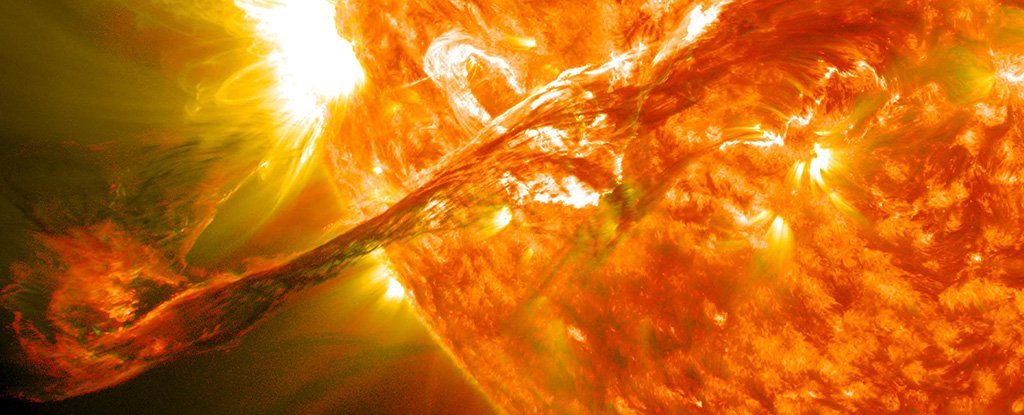

 The mysterious blue lagoons of MARS: Images appear to show...
 That's enough sun, wristband will warn us: Band will help us...
 Is the X-37B on a secret spy mission for the US Air Force?...
 Nasa prepares to test radical 'flying saucer': Giant...


