Ontdek de Fascinerende Wereld van UFO's en UAP's: Jouw Bron voor Onthullende Informatie!
Ben jij ook gefascineerd door het onbekende? Wil je meer weten over UFO's en UAP's, niet alleen in België, maar over de hele wereld? Dan ben je op de juiste plek!
België: Het Kloppend Hart van UFO-onderzoek
In België is BUFON (Belgisch UFO-Netwerk) dé autoriteit op het gebied van UFO-onderzoek. Voor betrouwbare en objectieve informatie over deze intrigerende fenomenen, bezoek je zeker onze Facebook-pagina en deze blog. Maar dat is nog niet alles! Ontdek ook het Belgisch UFO-meldpunt en Caelestia, twee organisaties die diepgaand onderzoek verrichten, al zijn ze soms kritisch of sceptisch.
Nederland: Een Schat aan Informatie
Voor onze Nederlandse buren is er de schitterende website www.ufowijzer.nl, beheerd door Paul Harmans. Deze site biedt een schat aan informatie en artikelen die je niet wilt missen!
Internationaal: MUFON - De Wereldwijde Autoriteit
Neem ook een kijkje bij MUFON (Mutual UFO Network Inc.), een gerenommeerde Amerikaanse UFO-vereniging met afdelingen in de VS en wereldwijd. MUFON is toegewijd aan de wetenschappelijke en analytische studie van het UFO-fenomeen, en hun maandelijkse tijdschrift, The MUFON UFO-Journal, is een must-read voor elke UFO-enthousiasteling. Bezoek hun website op www.mufon.com voor meer informatie.
Samenwerking en Toekomstvisie
Sinds 1 februari 2020 is Pieter niet alleen ex-president van BUFON, maar ook de voormalige nationale directeur van MUFON in Vlaanderen en Nederland. Dit creëert een sterke samenwerking met de Franse MUFON Reseau MUFON/EUROP, wat ons in staat stelt om nog meer waardevolle inzichten te delen.
Let op: Nepprofielen en Nieuwe Groeperingen
Pas op voor een nieuwe groepering die zich ook BUFON noemt, maar geen enkele connectie heeft met onze gevestigde organisatie. Hoewel zij de naam geregistreerd hebben, kunnen ze het rijke verleden en de expertise van onze groep niet evenaren. We wensen hen veel succes, maar we blijven de autoriteit in UFO-onderzoek!
Blijf Op De Hoogte!
Wil jij de laatste nieuwtjes over UFO's, ruimtevaart, archeologie, en meer? Volg ons dan en duik samen met ons in de fascinerende wereld van het onbekende! Sluit je aan bij de gemeenschap van nieuwsgierige geesten die net als jij verlangen naar antwoorden en avonturen in de sterren!
Heb je vragen of wil je meer weten? Aarzel dan niet om contact met ons op te nemen! Samen ontrafelen we het mysterie van de lucht en daarbuiten.
Is There an Ancient Terrestrial Civilization Below the Surface of Our World? Do They Pretend to be Extraterrestrial?
Have you ever given thought to the possibility that extraterrestrial creatures might be living on our planet, but deep below the surface of the Earth? The scenario is a decidedly unsettling one: potential dangerous extraterrestrials that, possibly thousands of years ago, chose to make our world their world – or, at least, portions of the Earth: those that are almost impenetrable; at least to us. But not to them. One person who pursued this particular theory was Mac Tonnies, who passed away in 2009; but not before his book, The Cryptoterrestrials, could be finished. Reptilain aliens, bug-eyed and insect-like extraterrestrials were all the forefront of Tonnies research – and just happen to be two types of entities highlighted in this book. Tonnies concluded that alien abductions, the abilities of the assumed ETs to breathe our air, and their concerns about nuclear war were all due to one fact: the aliens were from right here. And they always have been.
I was fortunate enough to interview Tonnies just a few months before his passing and he shared with me a wealth of fascinating data on his thoughts, suspicions and conclusions. Let’s see what he had to say: “After devouring countless books on the UFO controversy and the paranormal, I began to acknowledge that the extraterrestrial hypothesis suffered some tantalizing flaws. In short, the ‘aliens’ seemed more like surreal caricatures of ourselves than beings possessing the god-like technology one might plausibly expect from interstellar visitors. Like [UFO researcher] Jacques Vallee, I came to the realization that the extraterrestrial hypothesis isn’t strange enough to encompass the entirety of occupant cases. But if we’re dealing with humanoid beings that evolved here on earth, some of the problems vanish.”
(Nick Redfern) Mac Tonnies, who focused on the Cryptoterrestrials and his "home-grown" theory for our "aliens"
Tonnies continued: “I envision the cryptoterrestrials engaged in a process of subterfuge, bending our belief systems to their own ends. And I suggest that this has been occurring, in form or another, for an extraordinarily long time. I think there’s a good deal of folkloric and mythological evidence pointing in this direction, and I find it most interesting that so many descriptions of ostensible ‘aliens’ seem to reflect staged events designed to misdirect witnesses and muddle their perceptions. During the course of his research into the Cryptoterrestrial theory, Tonnies spent a great deal of time addressing the matter of alien abductions. For those who aren’t fully aware of the nature of the phenomenon, a bit of background data is required.
Regardless of whether people believe or don’t believe in the reality of the alien abduction phenomenon, there is no doubt that the vast majority of people have heard of it. It was, however, a phenomenon that was pretty much unknown until September 19, 1961. Yes, there were a few, earlier cases, but, for the most part, they were not publicized until after September 19. So, what, exactly is so significant about that particular date? The answer is that it was the date of a now-historic UFO event which occurred to a married couple from New Hampshire. They were Betty and Barney Hill. At the time in question, the Hills were driving home from a vacation in Canada, when the journey suddenly took on strange and unearthly proportions. It was on a dark stretch of road that the Hills caught sight of a curious light in the sky; it even seemed to be monitoring or shadowing them. They watched it for a while, and then something really strange happened: the Hills became confused, experienced a sense of missing time – of several hours, no less – and after getting home suffered from weird and traumatic dreams; they were dreams which suggested they may have been taken on-board the craft and even experimented on by weird-looking, humanoid figures. In no time at all, the dreams became definitive nightmares. Something had to be done. And, it was.
When things got really bad for the Hills, and the nightmares and stress began to overwhelm them (Barney, for example, developed stomach ulcers), they sought help; it was a very good idea, as that same help led to answers for what happened on that mystery-filled drive back to New Hampshire. They were put in touch with a neurologist and psychiatrist who operated out of Boston, Massachusetts, named Benjamin Simon. Clearly aware that the Hills were in deep states of anxiety, he elected to subject them to regressive hypnosis – with the permission of Betty and Barney, of course. What followed next can only be described as incredible. Both husband and wife told near-identical stories of being taken from their vehicle, onto what can only be described as an unidentified flying object, and subjected to a series of medical procedures – most of which were very intrusive and stressful. Frightening, even. The encounter went on for roughly two hours. So detailed were the memories of Betty and Barney that the time Benjamin Simon worked with the Hills went on for months.
Such was the phenomenal reaction to the story of Betty and Barney Hill, it prompted author John Fuller to write a book on the subject, titled The Interrupted Journey – an appropriate title, indeed – and which was published in 1966. Since then, the alien abduction phenomenon has grown and grown and spread like wildfire. We may never know for sure how many people believe they may have been kidnapped and experimented on by black-eyed, dwarfish beings from far away galaxies. After all, not everyone wants publicity – and particularly so not publicity of a very controversial type. In that sense, there may be as many silent abductees as there are publicly visible ones. To demonstrate the sheer level of experiences on record, though, it is worth noting that after Whitley Strieber’s 1987 alien abduction-themed book, Communion, was published Strieber and his late wife, Anne received letters from the public in no less than six figures. Other books, such as Budd Hopkins’ Missing Time and Dr. John Mack’s Passport to the Cosmos, have added to the controversy and given it more publicity.
(Nick Redfern) Alien abduction might be different to what we think it is
As for what may be behind the abductions, certainly the most controversial and widespread belief is that alien entities are engaged in a massive, covert program to create what may amount to untold numbers of untold alien-human hybrids. Some researchers and abductees believe the outcome of the rise of the hybrids will be a positive one: the dawning of a new world, filled with prosperity and peace. Dr. David Jacobs, though, in his books, The Threat and Walking Among Us, concludes that the hybrid issue is downright dangerous, and that we are being infiltrated by aliens who, bit by bit, are infiltrating us with one goal in mind: complete control. That many abductees believe they have been implanted with devices that have an unclear agenda, adds weight to the theory that the alien abduction issue is a threat to both national security and the people of Earth. But, what if there was a far more down to earth explanation for the alien abduction phenomenon? That question brings us back to Mac Tonnies:
“I regard the alleged ‘hybridization program’ with skepticism. How sure are we that these interlopers are extraterrestrial? It seems more sensible to assume that the so-called aliens are human, at least in some respects. Indeed, descriptions of intercourse with aliens fly in the face of exobiological thought. If the cryptoterrestrial population is genetically impoverished, as I assume it is, then it might rely on a harvest of human genes to augment its dwindling gene-pool. It would be more advantageous to have us believe we’re dealing with omnipotent extraterrestrials rather than a fallible sister species. The ET-UFO mythos may be due, in part, to a long-running and most successful disinformation campaign.” Tonnies then turned his attention to the claims of Antonio Villas Boas, a Brazilian lawyer who claimed that, in 1957, as a young man and while living on his family’s farm at the time, he was abducted onto a UFO and had sex with a surprisingly hot-looking space-babe. Tonnies said of Villas-Boas’ story:
“After intercourse, the big-eyed succubus that seduced Antonio Villas-Boas pointed skyward, implying a cosmic origin. But the mere fact that she appeared thoroughly female, and, moreover, attractive, belies an unearthly explanation. Further, one could argue that the clinical environment he encountered aboard the landed ‘spacecraft’ was deliberately engineered to reinforce his conviction that he was dealing with extraterrestrials. “If cryptoterrestrials are using humans to improve their genetic stock, it stands to reason they’ve seen at least a few of our saucer movies. As consummate anthropologists, they likely know what we expect of ‘real’ extraterrestrials and can satisfy our preconceptions with a magician’s skill. Their desire for our continued survival, if only for the sake of our genetic material, may have played a substantial role in helping us to avoid extinction during the Cold War, when the UFO phenomenon evolved in our skies; much to the consternation of officialdom.” It is indeed a fact that in the early to late 1950s, countless people across the planet claimed close encounters with very human-looking aliens, who demanded we lay down our atomic weapons, lest we turn our planet into a radioactive wasteland, all but bereft of life.
Of course, this begs an important question: why would aliens from a planet in a star-system who-knows-how-many light-years away, even care about what might happen – of a cataclysmic nature – on our world? Well, a good argument can be made that they wouldn’t care. Why should they? But, if, as Tonnies suspected and suggested, the ‘aliens’ are really Cryptotererstrials from right here, then their fears that we might destroy the Earth become far more understandable: they are forced to share the planet with the most violent and destructive species on the entire planet: us, the human race. Tonnies says of what became known as “the Space Brothers”: “Commentators regularly assume that all the Contactees [a term for those who claimed encounters with human-like aliens, chiefly in the 1950s] were lying or else delusional. But if we’re experiencing a staged reality, some of the beings encountered by the Contactees might have been real and the common messages of universal brotherhood could have been a sincere attempt to curb our destructive tendencies. The extraterrestrial guise would have served as a prudent disguise, neatly misdirecting our attention and leading us to ask the wrong questions; which we’re still asking with no substantial results.”
When, in 2008, Tonnies began to talk and write publicly about the Cryptotererstrial theory, he got mixed responses from UFO researchers, as Tonnies himself admitted to me: “The cryptoterrestrial theory has met with mixed reactions. Some seem to think that I’m onto something. Most UFO researchers are, at best, extremely skeptical. Others think I’m parroting John Keel’s ‘superspectrum’ [Keel was the author of the acclaimed 1975 book, The Mothman Prophecies], a variation on the ‘parallel worlds’ theme that in turn shares memes with Jacques Vallee’s ‘multiverse.’ Both ideas suggest that we somehow occupy dimensional space with our ‘alien’ visitors, doing away with the need for extraterrestrial spacecraft while helping explain the sense of absurdity that accompanies many UFO and occupant sightings. Keel and Vallee have both ventured essentially ‘occult’ ideas in cosmological terms; both the ‘superspectrum’ and the ‘multiverse’ require a revision of our understanding of the way reality itself works. But the cryptoterrestrial hypothesis is grounded in a more familiar context.”
Tonnies expanded: “I’m not suggesting unseen dimensions or the need for ufonauts to ‘downshift’ to our level of consciousness. Rather, I’m asking if it’s feasible that the alleged aliens that occupy historical and contemporary mythology are flesh-and-blood human-like creatures that live right here on Earth. Not another version of Earth in some parallel Cosmos, but on Earth. While I can’t automatically exclude the UFO phenomenon’s ‘paranormal’ aspects, I can attempt to explain them in technological terms. For example, I see no damning theoretical reason why ‘telepathy’ and ‘dematerialization’ can’t ultimately be explained by appealing to cybernetics, nano-technology and other fields generally excluded from ufological discourse.” He concluded: “The cryptoterrestrial hypothesis manages to alienate champions of the extraterrestrial hypothesis and those who support a more esoteric, ‘inter-dimensional’ explanation. It offers no clear-cut reconciliation. It does, however, wield explanatory potential lacking in both camps.” Echoing Tonnies’ words were those of long-time UFO investigator, Timothy Green Beckley, who has his own tale of the Cryptoterrestrial kind to share: “Some people might suggest that because the Space-Brothers look so much like us that they could be from somewhere right here on Earth – an ancient race, maybe. There are a lot of cultural legends about advanced beings living underground: UFOs coming out of the oceans, lakes, caverns. The whole hollow-Earth thing is a little hard for me; but the caverns theory I can take.
“I remember once incident, 1970s, where I was lecturing and a gentleman – a professor at the college where I was lecturing – came up to me and told this story about how he was driving outside of a town in Michigan. It was rather late at night, and he saw these lights in the woods. He pulled over, and there was no other traffic coming in either direction; but there was already another car parked at the side of the road. “He described seeing some sort of ship in the distance – a UFO. A group of human-like aliens got out, walked to the car, which was a Cadillac, or something like that. He watched them and could see they looked human. They just got in the car and drove off. But then, a couple of weeks later, he sees one of the same guys in a supermarket. These reports sound far-fetched; but there’s so many of them of what seem to be aliens being able to move among us. But, if they’re really from here, that might explain it.” Now, we get to the issue of a U.S. Government cover-up concerning the Cryptoterrestrials.
(Nick Redfern) The Roswell crash site. Mac Tonnies theorized that it was Cryptoterrestrials, and not aliens, that came down
While Mac Tonnies’ admittedly intriguing theory was simply that – a theory – there is an even more intriguing aspect to this story, one which comes from a former employee of the U.S. Government. He writes under the pen-name of E.A. Guest. His real name, however, is Walter Bosley, who served in both the U.S Air Force Office of Special Investigations (AFOSI) and the Federal Bureau of Investigation (FBI). He has revealed a startling story told to him by his father, who was also a respected figure within the U.S. military. In the 1950s, Bosley’s father worked on various projects that would ultimately have a significant bearing upon the manned space-program, including “training pilots in altitude chambers” and “flight medicine training.” At one point in his career, Bosley’s father was ordered to attend a briefing at Wright-Patterson Air Force Base, Dayton, Ohio. It was a briefing on none other than the legendary UFO crash outside of Roswell, New Mexico in early July 1947. Despite what UFO researchers – and a sizeable amount of the public think – Bosley says his father told him that nothing of an extraterrestrial nature crashed at Roswell on that fateful – and, for the crew, fatal – day. In Bosley Jr.’s very own words: “According to my father, these vehicles came from inside the planet. The civilization…exists in a vast, underground system of caverns and tunnels beneath the southwest and is human.”
“Occasionally, they come and go, emerging in their vehicles and occasionally they crash. They are human in appearance, so much so that they can move among us with ease [and] with just a little effort. If you get a close look, you’d notice something odd, but not if the person just passed you on the street.” Significantly, Walter Bosley says: “I believe that the ET hypothesis has been used by the ‘aliens’ themselves, because it is most readily embraced by people who have had encounters with them.” Bosley’s words bring us back to Mac Tonnies, and his theories on the conspiracy-filled Roswell affair of July 1947. In his 2009 book, The Cryptoterrestrials, Tonnies speculated on the possibility that the Roswell craft was balloon-like and built, flown, and disastrously crashed, by ancient humanoids that lurk in the depths of the planet. Controversial? Yes. But he made some interesting observations on this possibility. In Tonnies’ own words:
“The device that crashed near Roswell in the summer of 1947, whatever it was, featured properties at least superficially like the high-altitude balloon trains ultimately cited as an explanation by the Air Force. Debunkers have, of course, seized on the lack of revealingly ‘high-tech’ components found among the debris to dismiss the possibility that the crash was anything but a case of misidentification; not even Major Jesse Marcel, the intelligence officer who advocated an ET origin for the unusual foil and structural beams, mentioned anything remotely resembling an engine or power-plant.” Tonnies continued, in a fashion that emphasized the Cryptoterrestrials may not be as scientifically and technologically advanced as they might prefer us to think they are: “The cryptoterrestrial hypothesis offers a speculative alternative: maybe the Roswell device wasn’t high-tech. It could indeed have been a balloon-borne surveillance device brought down in a storm, but it doesn’t logically follow that is was one of our own. Upon happening across such a troubling find, the Air Force’s excessive secrecy begins to make sense.”
Regardless of what you, me, or indeed any number of the well-known Roswell researchers/authors – such as Bill Moore, Kevin Randle, Stan Friedman, or Don Schmitt – might think or conclude, the fact is that Tonnies’ Cryptoterrestrial theory is probably the only one that allows for the Roswell crash site to have been comprised of very unusual, non-Homo-sapiens, but, at the same time, incredibly simplistic technology. The alien theory should, of course, require highly advanced technology to have been recovered – yet, we hear very little on this matter, aside from talk of fields full of foil-like material with curious properties. Accounts of the military coming across alien-created “power-plants” and “engines” – as Tonnies described them – are curiously absent from the Roswell affair. It’s that aforementioned foil and not much else. Perhaps, Tonnies was indeed on the right track when it came to Roswell. Maybe, Walter Bosley, who still pursues the story, is still on the right track. And, just perhaps, it was the Roswell affair that – quite out of the blue – led the U.S. military to realize, to both its amazement and its fear, that we are not the only species of human on the planet. And, in the process, a huge cover-up was initiated to ensure that the world never gets to know the true story of Roswell’s Cryptoterrestrials. If you buy into it, all.
A Former CIA Agent and a Scientist Link UFOs to Earthquakes and Seismic Activities
Paul Seaburn
When it comes to UFOs and natural disasters, the first thing that comes to mind is all of the UFOs that seem to appear around volcanoes, both active and inactive. The very active Popocatépetl stratovolcano located in central Mexico is a prime example – the ring of cameras surrounding it to provide early warnings of eruptions to local residents regularly record unusual objects and shapes that seem to be entering, exiting and flying over Popocatépetl. Because the quality of these video cameras is low, the objects could be ash, erupted rocks, birds, bugs, planes, drones or other flying objects. However, that doesn’t cover all of them, and the high number of UFOs around other volcanoes suggests to many that they may be ships using the volcano to travel to and from an underground base where extraterrestrials may be refueling or monitoring Earth. Another natural disaster often linked to UFOs is earthquakes, especially the phenomenon known as “earthquake lights.”
These luminous flashes appear similar to auroras and there is no consensus as to what part of seismic activity may be causing them – from tectonic plates scraping to electrical grids sparking. While earthquake lights generally appear during or after the seismic events, a former CIA agent and UFO researcher has come forward recently with the claim that pre-earthquake UFOs are actually warnings of pending quakes … and both we and seismologists should start paying more attention to them. In fact, one scientist has long agreed with him. Could these phenomena also explain some of the Popocatépetl and other volcanic UFOs?
Or is it really aliens?
“It is widely acknowledged that as much as 95% of publicly reported UFO activity can be linked to secret, classified, or sensitive projects and airborne national security operations.”
Andrew Bustamante describes himself as a former covert CIA intelligence officer, a US Air Force combat veteran, and Fortune 10 corporate advisor. He is perhaps best known as a speaker and consultant – through his “Everydayspy” Program, he offers to teach others how to use the mental, physical, and social spy skills he learned in the CIA to “master their mind, leverage their talents, and achieve their potential.” Bustamante is also a UFO researcher and explains in a report from Everydayspy how all governments take UFOs very seriously – despite what we’ve been led to believe. That interest is at an all-time high due to rapid advancements in air travel, drone technology, and the commercialization of space travel. This has resulted in a historic worldwide high in aircraft crashes, inflight emergencies, near-miss collisions, and unidentified aerial phenomena sightings. Bustamante says that 95% of these are caused by humans. He discusses some of the other 5% on a recent podcast hosted by Shawn Ryan, a former U.S. Navy SEAL and CIA Contractor.
“There's so much in the sky that they see it all the time and we don't know what we're looking at. A satellite looks pretty clear – it moves in a straight line – but the stuff that's up there isn't always a satellite. I've seen strange glowing orbs, like balls of light that change direction, and I have no idea what that is. Could it be an alien aircraft or a domestic aircraft that forgot to turn off its headlights? Maybe.”
Or maybe not. Bustamante first brings up the idea of ball lightning – another unexplained luminescent aerial phenomenon shaped like balls or orbs that are most often seen with thunderstorms but rarely behave like conventional lightning. Besides their different shapes and colors, they are visible longer (up to a minute), travel slower, move erratically in all directions and behave in other ways that defy conventional weather or electrical science … so it is no wonder that they are often thought to be of alien or sometimes demonic origin. Bustamante then moves to another natural phenomenon and the strange unidentified aerial phenomena associated with them … earthquakes and earthquake lights.
“There's also pre-indicators of earthquakes, such as a geological effects that release electromagnetic energy into the atmosphere. When the energy comes up from a fault line and comes into contact with certain conditions in the atmosphere it creates lights in clouds, and all of a sudden lights in clouds are floating.”
While most earthquake researchers say the earthquake lights occur during the actual quake activity and aftershocks, Bustamante’s experiences and research suggest to him that these earthquake UFOs occur BEFORE they happen and should be studied as harbingers of upcoming seismic activity – both earthquakes and volcanoes.
"Every time the earth moves violently, which happens pretty often, there's a strong possibility of you seeing a UFO. They can produce a number of things like luminosities, electromagnetic disturbances which some people may interpret as unusual observations or sometimes even UFOs."
A recent article about UFOs and their connections to natural disasters in The U.S. Sun quotes the late Dr. Michael Persinger, a professor of psychology at Laurentian University who studied how subtle changes in geomagnetic activity could cause parapsychological phenomena, and how tectonic movement in the Earth's crust could cause luminous phenomena attributed to UFOs. His Tectonic Strain Theory (TST) suggested that luminous phenomena and associated physical effects in humans were caused by manifestations of tectonic strain and could precede earthquakes by as much as weeks.
"They can produce a number of things like luminosities, electromagnetic disturbances which some people may interpret as unusual observations or sometimes even UFOs."
Persinger did not like calling these luminous phenomena “UFOs” because they have natural causes and are not extraterrestrial. However, he confused the issue by attributing so many other psychological phenomena with earthquakes and seismeic disturbances.
"You can get paralyses, feelings of foreboding, dream-like states, and a number of peripheral effects."
We could defintiely use an earthquake warning system
Former CIA covert intelligence officer Andrew Bustamante thinks all leading governments are well aware of UFOs and studying them intently. He believes that 95% of UAP are explained by human-made technology. He also believes that some of the other 5%, particularly orbs and luminescent UFOs, are warnings of impending earthquakes and other seismic activities. The late Dr. Michael Persinger believed that low level seismic activities could cause lights as well as psychological forces which might cause humans to interpret these lights as extraterrestrial UFOs when they’re actually earthquake warning signs.
With the recent huge losses of life and damages caused by quakes and volcanic eruptions around the world, is it time to listen to Bustamante and Persinger and link some UFO orbs to earthquakes and volcanoes and treat them as early warning signs?
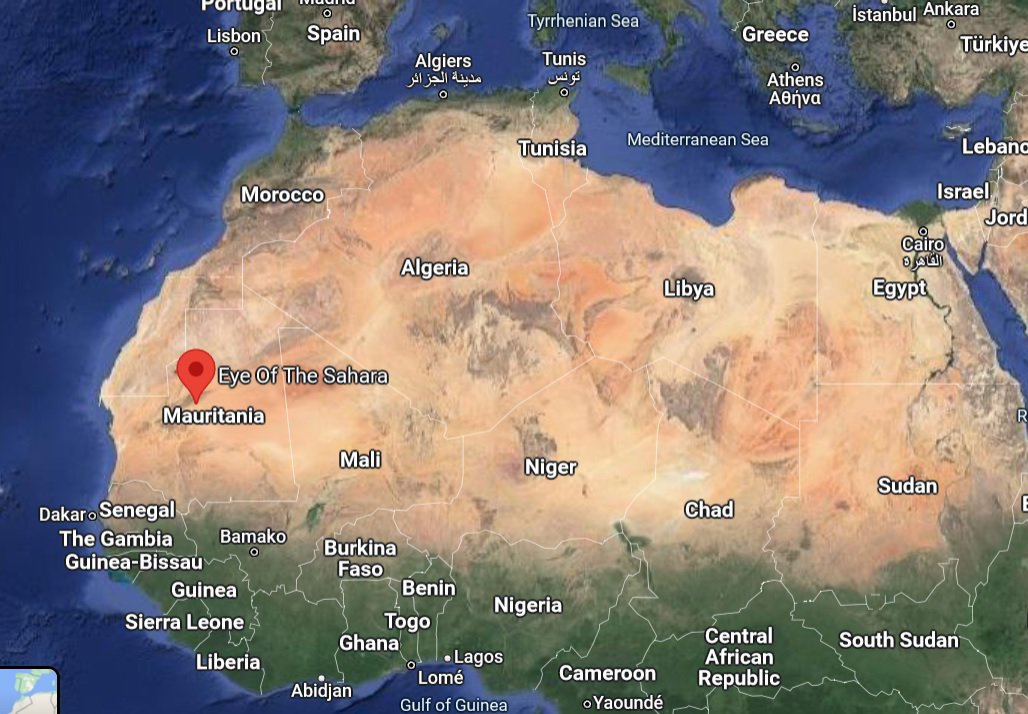
A new theory doing the rounds on the internet in recent times is that, the geological feature in the Sahara desert known as the “Eye of the Sahara” is the legendary kingdom of Atlantis. My initial reaction was one of skepticism, since Plato had described Atlantis as a large island, as big as Libya and Asia Minor combined, located beyond the Straits of Gibraltar. However, I decided to take a closer look at what the proponents of this idea are claiming to check if that conforms to the descriptions of Atlantis found in the Critias[1] and the Timaeus[2].
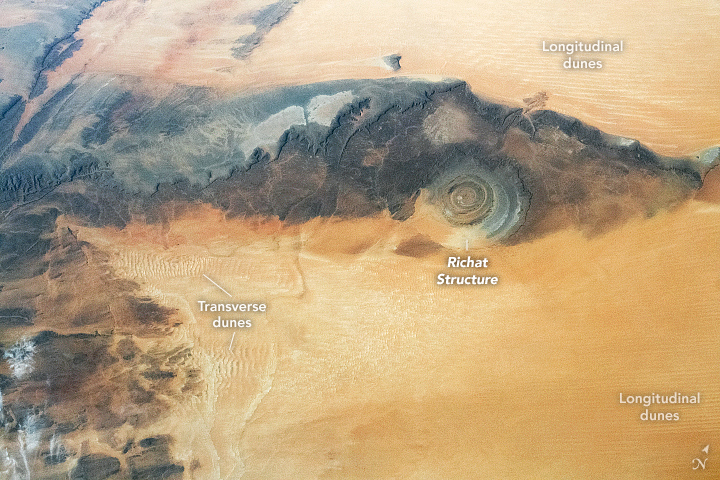
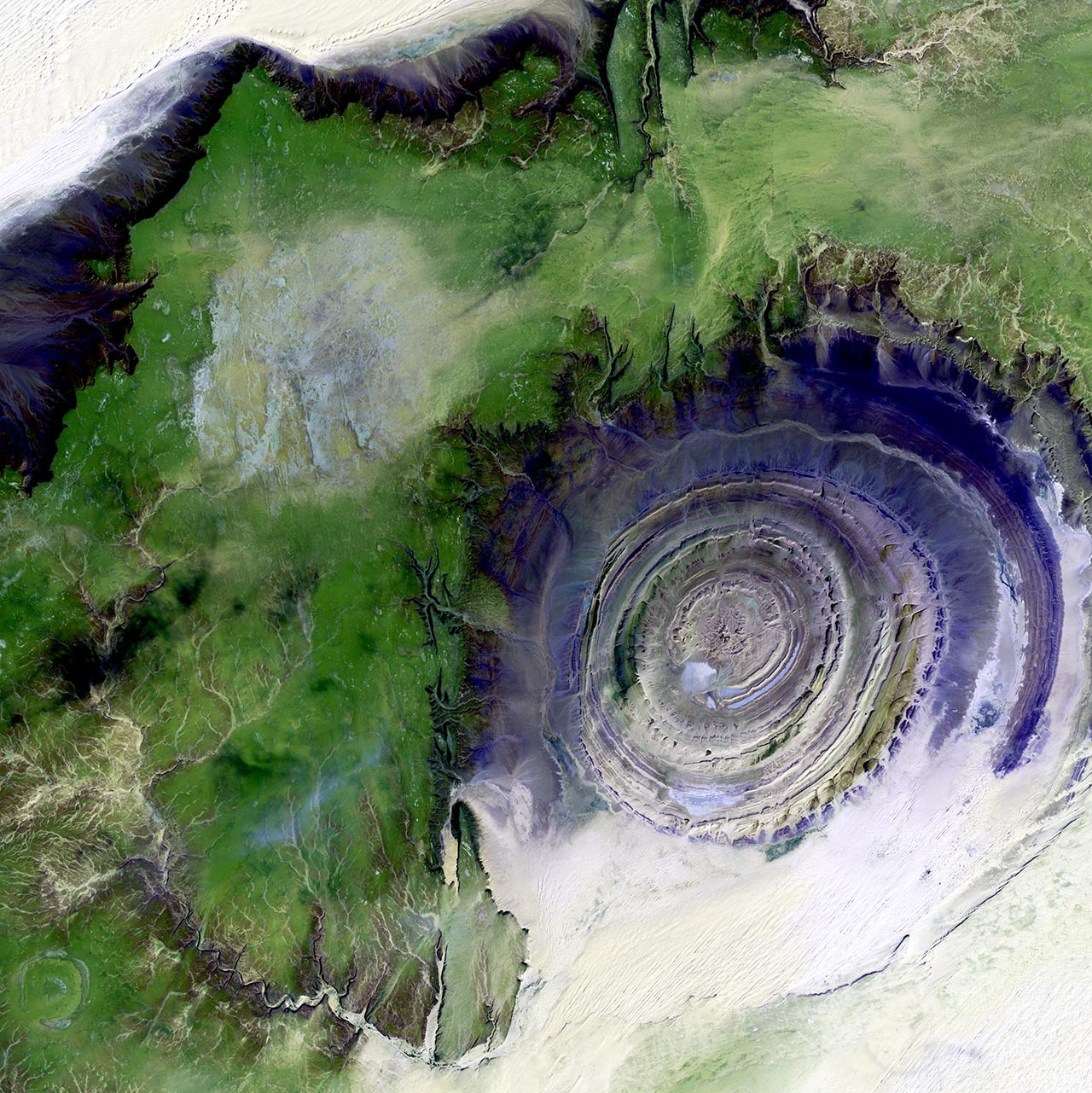
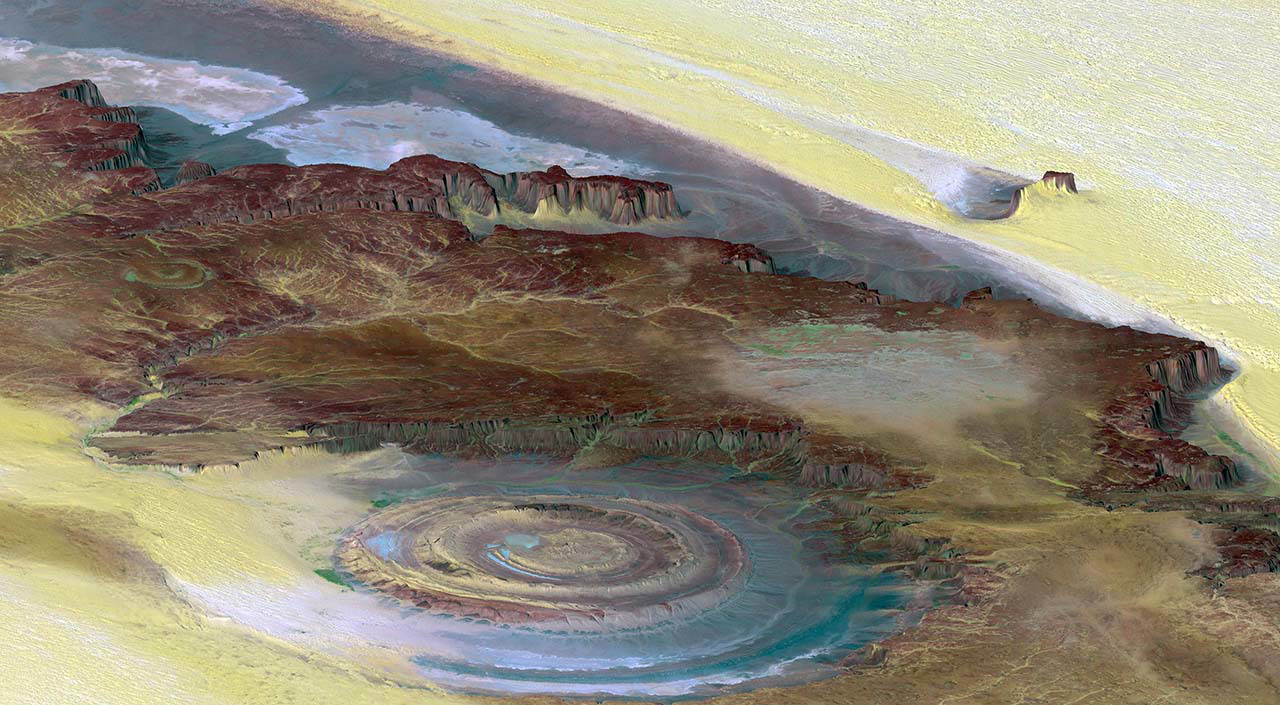
The Eye of the Sahara, also known as the “Richat Structure”, is a prominent circular feature in the Sahara desert of Mauritania. It is about 45 km in diameter and forms a conspicuous bull’s-eye in the otherwise featureless expanse of the desert. Since the feature is so large, one cannot really make out the whole structure from the ground. The overall contours were seen only after NASA started sending people to space, and was used as a landmark by shuttle crews. The Gemini-mission astronauts were the first to photograph the formation in the 1960s. Later, Landsat satellite images provided precise information about the size, height, and extent of the structure.
The Eye of the Sahara in Mauritania, Western Africa.
Source: Google Maps
Richat Structure, photographed from the International Space Station, NASA Earth Observatory, Public Domain
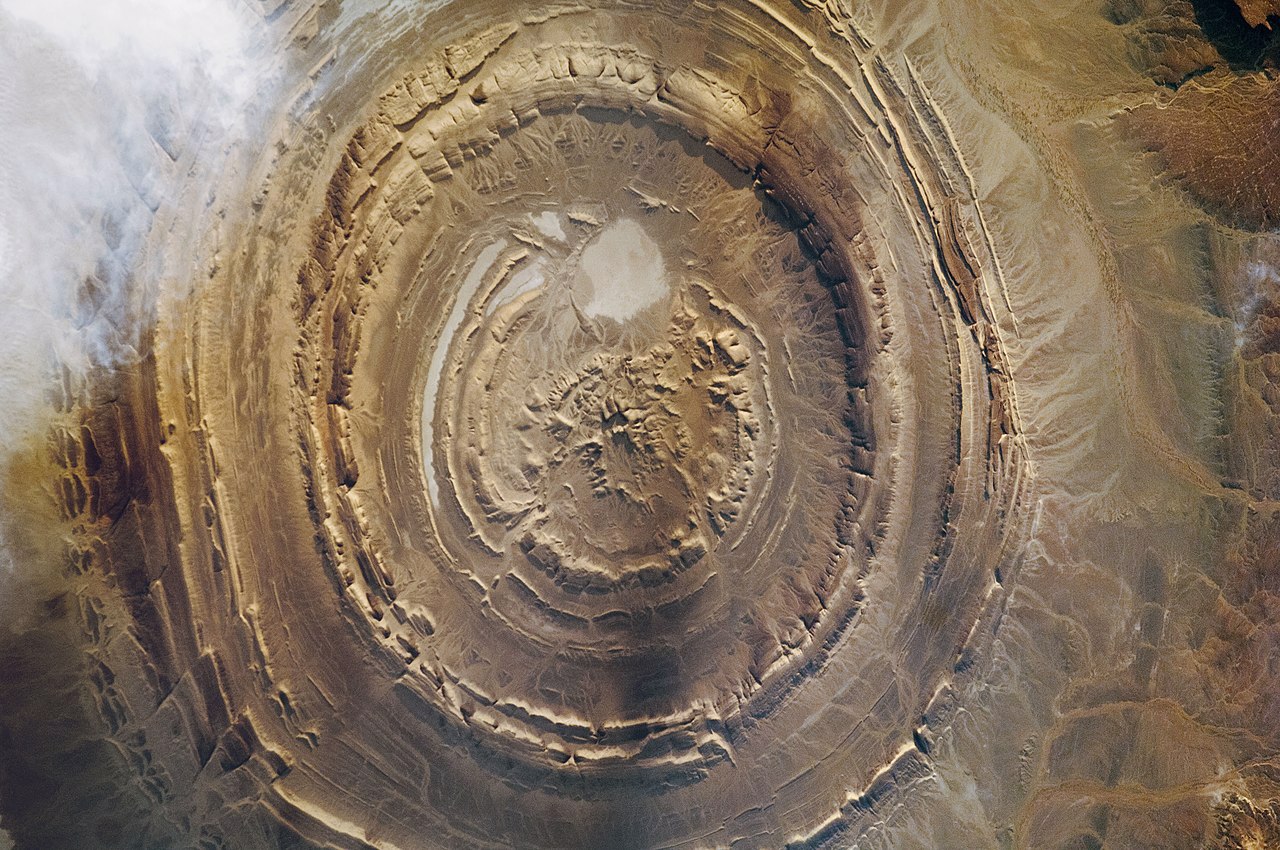
The Richat Structure of Mauritania.
Credit: NASA, Public Domain
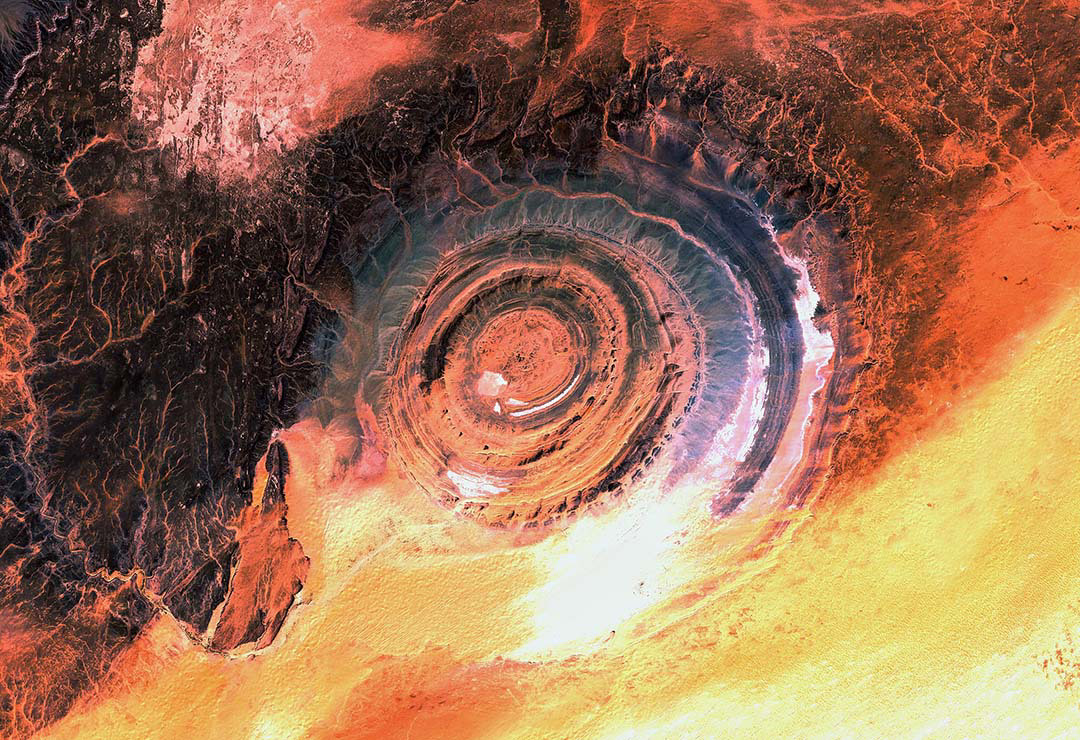
When the feature was first studied in the 1930s and 40s, it was thought to have been an impact crater, and was known as the Richat Crater. However, subsequent studies revealed that the structure lacks any impact proxies, and, therefore, must have formed due to terrestrial processes. The dominant theory is that it is a highly eroded geological dome. An underlying alkaline igneous intrusion of the Cretaceous age uplifted the overlying sedimentary rocks in the form of a dome. Subsequently, the differential erosion of alternating hard and soft rock layers of this geological dome, created the circular distribution of ridges and valleys. Today, the Eye of the Sahara is somewhat sunken below the level of the surrounding landscapes.
Extensive field mapping and aeromagnetic data has revealed that the sedimentary and igneous rocks have formed two concentric ring dykes around the central dome. A recent journal paper (2021) provides precise data of their dimensions.[3] The central dome is spread over a surface area of about 4 sq.km. It forms a rough topography with vertical structures as high as 40 m. The inner ring dyke, located 3 km from the center, has an estimated thickness of about 30 m. The outer gabbroic ring dyke is located 8 km from the center of the structure with a thickness of about 70 meters.
The Eye of the Sahara, as viewed from Sentinel 2 satellite. Credit: ESA, CC BY-SA IGO 3.0 via Wikimedia Commons
The central zone of the Richat Structure displays a large unit of collapse breccia with hydrothermal internal sediments of Cretaceous age.
Credit: Michel Jebrak, CC BY-SA 4.0 via Wikimedia Commons
With that overview, let’s investigate why it has been proposed as a likely location of Atlantis. To the best of my knowledge, the hypothesis was first advanced by Martin K. Ettington in his book The Real Atlantis: In the Eye of the Sahara (2018), although I can’t be sure if someone else had made the connection earlier. A YouTube video, posted on the Bright Insight channel in 2023, provides additional arguments. Let us see if the evidence stacks up in favor of this hypothesis.
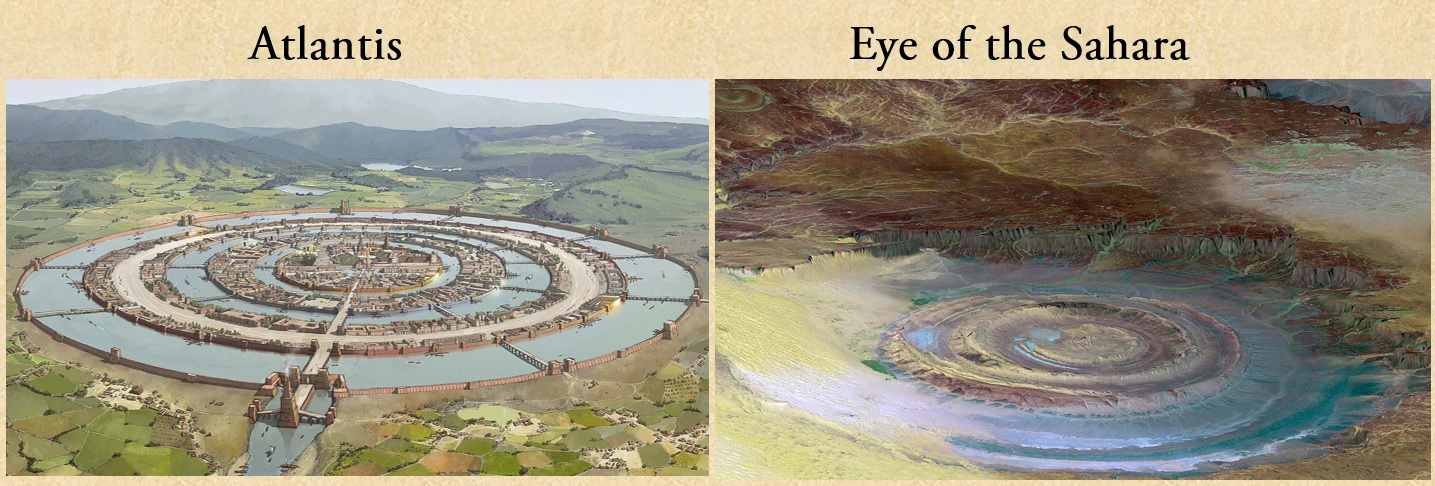
Artist's representation of Atlantis, as described by Plato. Credit: Rocio Espin Pinar
At first sight, the Richat Structure does bear an uncanny structural similarity to Atlantis since it has two concentric bands of ring dykes separated by eroded valleys. As per Plato’s description of Atlantis in the Critias, the central island of Atlantis - on which was located the hill where Poseidon and his mortal wife Cleito lived – was enclosed by two zones of land and three zones of water. The text states,
“Poseidon breaking the ground, enclosed the hill in which she (Cleito) dwelt all round, making alternate zones of sea and land, larger and smaller, encircling one another; there were two of land and three of water, which he turned as with a lathe, each having its circumference equidistant every way from the centre.”
Let us look at the dimensions of the central island and the land and sea zones of Atlantis. As per the Critias, “The (central) island in which the palace was situated had a diameter of five stadia.” The measure of a Greek stade (pluralstadia) is generally taken as 180 meters. Thus, the diameter of the central island was 900 meters. This gives an estimated area of 0.63 sq.km, which is 6-times less than the area of the central dome of the Richat structure (4 sq.km). Nevertheless, the areas are comparable in magnitude. In fact, I was pleasantly surprised that the central dome of the Richat Structure covers such a large area. You do need a lot of space for the royal palace, temples, statues of gold, fountains, groves, baths, gardens, buildings, guard houses and docks that had been built on the central island of Atlantis, where the kings and their family lived.
A comparison of Atlantis and the Richat Structure.
As per the Critias, the outermost zones of land and sea of Atlantis were three stadia (540 meters) in width, the inner zones of land and sea were two stadia (360 meters) in width, while the zone of sea which surrounded the central island was one stadium (180 meters) in width. Here is the relevant section from the text:
“Now the largest of the zones into which a passage was cut from the sea was three stadia in breadth, and the zone of land which came next of equal breadth; but the next two zones, the one of water, the other of land, were two stadia, and the one which surrounded the central island was a stadium only in width.”
The dimensions of the zones of land and sea in Atlantis do not match with that of the Richat Structure. The inner ring dyke has an estimated width of only 30 meters as opposed to 360 meters in Atlantis, while the outer dyke has a width of 70 meters as opposed to 540 meters for Atlantis. The width of the ring dykes seem too small to support a city with all its amenities. However, on careful reading of the Critias, I found that these two zones of land had gardens, places for exercise for men and horses, a race course etc. It seems to me that these two zones were used primarily by the army for protecting the central island, with the zones of water acting as “moats”. People who provided support services to the royal palace may have also lived here. It was not a place meant for common people. If that were the case, the narrow widths of the ring dykes would have sufficed.
The width of the zones of water surrounding the central island of Atlantis doesn’t correlate with the Richat Structure either. The first zone of water was said to be one stadium (180 meters) wide, whereas in the Richat structure, the inner dyke is 3 km from the center, which means the width of the eroded valley is approx. 2 km (since the radius of the central dome is approx. 1 km). The second zone of water was two stadia (360 meters) wide, while the outer dyke in the Richat structure is 8 km from the center, which means the width of the eroded valley is nearly 5 km. The third zone of water was three stadia (540 meters) wide, while the width of the third eroded valley works out to nearly 14.5 km (assuming the Richat Structure is 45 km wide).
The overall diameter of the concentric zones of Atlantis was 27 stadia i.e. 4.8 km, while the diameter of the Richat Structure is around 45 km. So, the Richat Structure is nearly 10 times larger. Even though the dimensions do not match, it is quite interesting that the width of the zones of land and water are in increasing proportion in case of Atlantis as well as the Richat Structure.
As per the Critias, the concentric bands of land and sea was in the southern part of the island, around 50 stadia i.e. 9 km from the surrounding ocean. The Atlanteans had built a canal from the sea to the outermost zone of water. This is what the text states:
“And beginning from the sea they bored a canal of three hundred feet in width and one hundred feet in depth and fifty stadia in length, which they carried through to the outermost zone, making a passage from the sea up to this, which became a harbour, and leaving an opening sufficient to enable the largest vessels to find ingress.”
However the Eye of the Sahara is located nearly 500 km from the Atlantic coast, and there is no sign of any canal linking it to the ocean. Even if we assume that the canal may have existed in the past and got covered over during the YD period or by subsequent erosional processes, it is impossible for water to have flowed from the Atlantic Ocean to the Richat Structure, which is located 400 meters above sea level! During the Ice Age, sea levels were a further 120 meters lower. How on earth would sea water flow up such a gradient?
Artist’s representation of Atlantis, depicting the canal from the sea. Credit: Rocio Espin Pinar
Plato also mentions that the Atlanteans had built bridges from the central island to the rest of the city. They also cut channels through the zones of land, so that ships could reach the central island. Every passage to the city was guarded by gates and towers, and a wall surrounded each of the city's rings. The walls were constructed of red, white and black rock, and were covered with brass, tin and orichalcum. Moreover, the entire city was encircled by an outer wall which was at a distance of 50 stadia i.e. 9 km from the outermost zone. The Critias states,
“Leaving the palace and passing out across the three harbours, you came to a wall which began at the sea and went all round: this was everywhere distant fifty stadia from the largest zone or harbour, and enclosed the whole, the ends meeting at the mouth of the channel which led to the sea. The entire area was densely crowded with habitations.”
The ordinary people lived outside the concentric zones, but within the outer wall of Atlantis. This means there was a significant urban sprawl outside the concentric zones. The overall diameter of the city of Atlantis, therefore works out to (50 + 13.5)*2 = 127 stadia or 22.86 km, which is roughly half the width of the Richat Structure (45 km).
Atlantis probably had a significant urban sprawl outside the concentric zones. Credit: Rocio Espin Pinar
Clearly, the dimensions of the Richat Structure and Atlantis don’t match up. But what about the archaeological remains of Atlantis? If a large civilization like Atlantis had flourished in the Eye of the Sahara, and then got destroyed by a global catastrophe sometime during the Younger Dryas period, then it would have left some material traces – pottery fragments, carved stone blocks, tools and utensils made of gold, silver, brass, tin, orichalcum, wood, ivory etc. which the Atlanteans were said to have used in profusion. But archaeologists have found nothing of that sort. Instead, what they found was an exceptional accumulation of Acheulean artifacts.[4] Acheulean is an archaeological industry of stone tool manufacture characterized by oval and pear-shaped hand axes associated with Homo erectus. They were produced during the Lower Palaeolithic era across Africa and much of West Asia, South Asia, East Asia and Europe. It is thought that Acheulean technologies first developed about 1.76 million years ago, and lasted until as late as 130,000 years ago.[5] In addition to Acheulean artifacts,
“Sparse and widely scattered Neolithic spear points and other artifacts have also been found. However, since these sites were first discovered by Theodore Monod in 1974, mapping of artifacts within the area of the Richat Structure have found them to be generally absent in its innermost depressions. So far, neither recognizable midden deposits (i.e. old dump for domestic waste) nor manmade structures have been recognized and reported from the Richat Structure. This is interpreted as indicating that the area of the Richat Structure was used for only short-term hunting and stone tool manufacturing.”[6]
Thus, the archaeological evidence for an Atlantis-like civilization is completely absent in the Richat Structure, and the area seems to have been inhabited by Homo erectus in a very remote past and later by Neolithic hunter-gatherers.
Stones and salt flats inside the Richat Structure. Credit: LBM1948, CC BY-SA 4.0 via Wikimedia Commons
The island of Atlantis was much larger than the city, which, as we have discussed was around 127 stadia in diameter and surrounded by an outer wall. Beyond the city wall, Atlantis had large fertile plains that extended for hundreds of kilometers. As per the Critias,
“The whole country was said by him to be very lofty and precipitous on the side of the sea, but the country immediately about and surrounding the city was a level plain, itself surrounded by mountains which descended towards the sea; it was smooth and even, and of an oblong shape, extending in one direction three thousand stadia (540 km), but across the centre inland it was two thousand stadia (360 km).”
So, we are basically talking of an enormous, oblong-shaped island, surrounded by high mountains, which measured 540 km by 360 km. The city of Atlantis, with its concentric zones of land and water in the center, was located at the southern end of the island, 9 km from the sea.
The Richat Structure, however, is not an island, but is located inland, nearly 500 km from the Atlantic coast. An interesting correlation here is that, one of the diameters of Atlantis was around 540 km, which is quite close to the distance between the Richat Structure and the Atlantic coast i.e. 500 km. The region beyond the Richat Structure would have been green and fertile during the African Humid phase (9500 BCE – 3500 BCE), supporting farmlands, forests, rivers, lakes and abundant wildlife of every kind. In that respect it conforms to the fertile outer plains of Atlantis. Plato states that a large circular ditch encircled the plain around the city. No sign of such a circular ditch exists around the Richat Structure in the present day.
“It (the circular ditch) was excavated to the depth of a hundred, feet, and its breadth was a stadium (180 m) everywhere; it was carried round the whole of the plain, and was ten thousand stadia in length (1800 km). It received the streams which came down from the mountains, and winding round the plain and meeting at the city, was there let off into the sea. Further inland, likewise, straight canals of a hundred feet in width were cut from it through the plain, and again let off into the ditch leading to the sea.”
Finally, let us talk about the location of Atlantis specified by Plato. Plato was very clear that Atlantis was located beyond the Pillars of Hercules, which is now known as the Straits of Gibraltar. In fact, the extremity of the island was close to the Strait, for Plato wrote that, the twin brother of Atlas ruled over “the extremity of the island towards the Pillars of Heracles, facing the country which is now called the region of Gades.” To reach the Richat Structure, on the other hand, one need not cross the Strait of Gibraltar by boat, but travel overland though Africa.
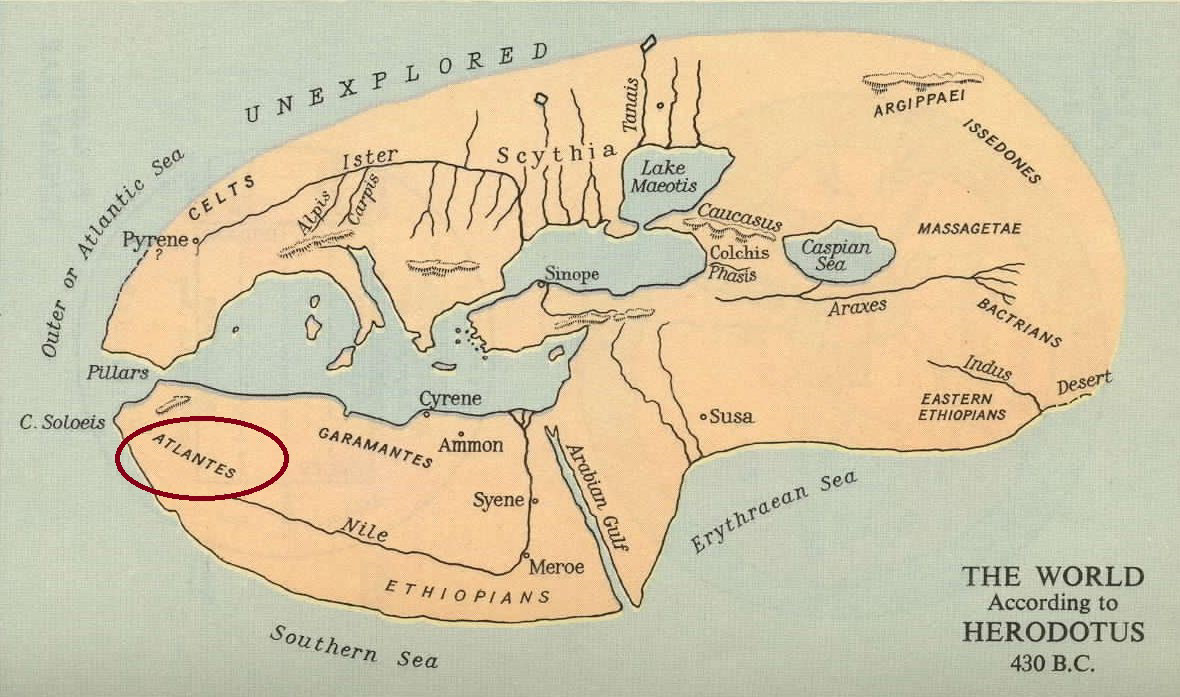
One of the interesting points that Martin Ettington had raised in support of his argument is that, ancient Greek maps, based on “The Histories” (c.450 BCE), written by Herodotus, shows a place called Atlantes in north-west Africa, near Mount Atlas. He claims that this is an indication that the Greeks knew that Atlantis was in Africa and was not an island in the Atlantic Ocean.
A world map based on “The Histories” of Herodotus. Atlantes is a group of people living near Mount Atlas.
This is a highly presumptive deduction, for according to Herodotus, “Atlantes” is not a place, but a group of people who live near Mount Atlas and derive their name from this mountain. This is what he wrote:
“Another ten days' journey from the Garamantes there is again a salt hill and water, where men live called Atarantes. These are the only men whom we know who have no names; for the whole people are called Atarantes, but no man has a name of his own. When the sun is high, they curse and very foully revile him, because his burning heat afflicts their people and their land. After another ten days' journey there is again a hill of salt, and water, and men living there. Near to this salt is a mountain called Atlas, whose shape is slender and conical; and it is said to be so high that its heights cannot be seen, for clouds are always on them winter and summer. The people of the country call it the “pillar of heaven”. These men get their name, which is Atlantes, from this mountain. It is said that they eat no living creature, and see no dreams in their sleep…I know and can tell the names of all the peoples that live on the ridge as far as the Atlantes, but no farther than that. But I know this, that the ridge reaches as far as the Pillars of Heracles and beyond them.”[7]
It is obvious that the “Atlantes” people are not related to the island-kingdom of Atlantis described by Plato, but derive their name from Mount Atlas, which borders the Mediterranean Sea and the Atlantic Ocean. Incidentally, Mount Atlas, which is regarded by the natives as the “pillar of heaven” derives its name from Atlas, the Titan of Greek mythology, who was condemned to hold up the heavens for eternity after the Titanomachy. Atlas also became the first king of the ancient region of Mauretania (modern-day Morocco and west Algeria, not to be confused with the modern-day country of Mauritania which is to the south and where the Richat Structure is located). Plato had mentioned that the first king of Atlantis was Atlas, but this Atlas was a different person, being the son of Poseidon the god of the sea and Cleito, a mortal woman.
On the whole, there are some interesting correlations between the Richat Structure and Atlantis, as well as many disparities. Let me sum up the correlations first. The central dome of the Richat Structure occupies a large area of 4 sq.km, which is 6-times larger than central island of Atlantis, but still within the range of comparison. The Richat Structure has two concentric ring dykes, and three eroded valleys, corresponding to the two zones of land and three zones of sea in Atlantis. The width of the zones of land and sea in Atlantis are in increasing proportion as are the widths of the ring dykes and eroded valleys in the Richat Structure. During the Ice Age, the Richat Structure would have been surrounded by the fertile, green plains of the Sahara with abundant natural resources, just as Atlantis was said to be enclosed by fertile plains.
However, there are many points which do not match up. The diameter of the concentric zones of Atlantis was 4.8 km, which is 10-times less than the diameter of the Richat Structure i.e. 45 km. The width of the zones of land in Atlantis are much larger than the width of the ring dykes in the Richat Structure (30m and 70m wide). There is no way that the eroded valleys between the dykes could have been filled with sea water during the Ice Age, since it is 400 m above current sea level, and would have been nearly 520 m above sea level during the Ice Age. There is no sign of a channel linking the Richat Structure with the Atlantic coast, which is nearly 500 km away. There are no archaeological remains of a high civilization or a permanent habitation at the site, other than tools associated with Homo erectus and Neolithic hunter-gatherers. No evidence has been found of a circular ditch in the outer plains. Finally, Plato had described Atlantis as a massive island located beyond the Straits of Gibraltar, measuring 540 km by 360 km, and surrounded by steep mountains that descend to the sea. The Richat Structure, on the other hand, is an inland geological feature, roughly 45 km in diameter, which can be reached from within the Straits by traveling overland.
Richat Structure. Credit: USGS/EROS/NASA/Landsat, Public Domain
So, what do we conclude from this? I think, going by the large number of disparities, it would be quite a stretch to claim that the Eye of the Sahara is the Atlantis described by Plato. On the other hand, we know that legends undergo a lot of modifications and exaggerations over time. The story of Atlantis had been transmitted by means of oral tradition for more than 9000 years after Atlantis was destroyed, before it was written down by Plato. We can’t assume, therefore, that everything Plato wrote about Atlantis was correct. The original Atlantis may not have looked exactly the same as Plato described it. We also know that the people of the ancient times were not big on geography. The ancient Greek maps of the world were quite childish when compared to modern globes. Hence, the descriptions of the geography of Atlantis by Plato may not have been spot on. So, we need to loosen up a bit, and start asking some questions.
What if the original Atlantis was not really an island, but an inland geological feature like the Richat Structure, which gave the impression of being an island because it was surrounded by multiple zones of water? Over time, this could have led to the idea that the entire kingdom of Atlantis, 540 km by 360 km in dimension, was an island.
Could it not be that there were rivers and waterways which connected the Richat Structure with the Atlantic coast during the Ice Age, and the kings and merchants of Atlantis used to sail up the Atlantic coast and enter the Mediterranean Sea through the Straits of Gibraltar, which gave rise to the notion of a large island-kingdom located beyond the Straits of Gibraltar?
What if the eroded valleys between the ring dykes were not filled with sea water but with freshwater that was brought in through canals from the many rivers and streams that crisscrossed the Sahara during the Ice Age? Plato mentions that the Atlanteans built many canals which connected their rivers with these zones of water. After the African Humid phase ended, these rivers and canals may have dried up and disappeared. The remnants of one possible canal can be seen towards the southern end of the Richat Structure. Tenochtitlan, the capital of the Aztec Empire, was built on an island in the middle of a freshwater lake called Lake Texcoco. So, why not Atlantis? In fact, it would make a lot more sense for a city to be built in the middle of a freshwater lake, for that would give you easy access to water for drinking and other household purposes.
Richat Structure, Mauritania. Water could have flowed into the structure through the opening on the left. Credit: NASA/JPL/NIMA, Public Domain
We can see from the images that the ring dykes in the Richat Structure are not continuous but have breaks in some places. Perhaps, this is how the water from the outer zones flowed into the inner zones, and not through a single channel as Plato had described? It would make sense to have multiple points of entry and exit into such a large island-city, in order to reduce travel time, effort and traffic logjams in the water zones.
It is now scientifically established that fragments of a large comet struck the Earth at the Younger Dryas boundary and set off a global chain of cataclysms – wildfires, tsunamis, earthquakes, acid rain etc. - that destroyed the civilizations of that period. What if the cataclysms of the Younger Dryas struck the Richat Structure with such ferocity that it was virtually scrubbed clean of all the artifacts produced by the Atlanteans? Perhaps, that is why archaeologists have found Acheulean artifacts associated with Homo erectus (c.1.7 Mya – 130 K BP), followed by Neolithic stone tools (from c. 8000 BCE), and nothing for the period in-between, which is the time when Atlantis is said to have flourished? Maybe, all the evidence of an Atlantean civilization have been washed away to sea?
So, where do we stand? If we are looking for a precise match between the Atlantis described by Plato and the Eye of the Sahara, then we are not going to find it, for there are plenty of dissimilarities. However, if we go by the spirit of the story of Atlantis, and not get bogged down by too many details, knowing fully well that the legend must have undergone distortions and embellishments in course of oral transmissions over nearly 9000 years, then there is a glimmer of hope that the Eye of the Sahara could, indeed, be the location of Atlantis. It may well have been the “real” Atlantis, which served as an inspiration for the legend. The latitude of the Richat Structure (21.7° N) is very close to the Tropic of Cancer, which means it would have enjoyed moderate climate even during the peak of the Ice Age. That, combined with a green, fertile Sahara, would have provided all the natural resources needed for a large civilization to thrive. Perhaps, future discoveries will shed more light on whether this line of thinking has any merit or not.
References
[1] Plato, Critias (360 BCE), tr. by Benjamin Jowett, https://www.sacred-texts.com/cla/plato/critias.htm$
[2] Plato, Timaeus (360 BCE), tr. by Benjamin Jowett, https://www.sacred-texts.com/cla/plato/timaeus.htm
[3] El Houssein Abdeina, Sara Bazin, Gilles Chazot, Hervé Bertrand, Bernard Le Gall, Nasrrddine Youbi, Mohamed Salem Sabar, Mohamed Khalil Bensalah, Moulay Ahmed Boumehdi, "Geophysical modelling of the deep structure of the Richat magmatic intrusion (northern Mauritania): insights into its kinematics of emplacement", Arabian Journal of Geosciences (2021) 14:2315, https://doi.org/10.1007/s12517-021-08734-4
SpaceX Starship Effectively Grounded by FAA After in-Flight Explosion
It was an exciting time when, two weeks ago, SpaceX got the clearance it needed to conduct its first orbital flight test with the Starshipand Super Heavy launch system. After years of waiting, SN flight tests, static fire tests, and stacking and unstacking, the long-awaited test of the SN24 Starship and BN7 Booster prototype was on! For this flight, SpaceX hoped to achieve an altitude of at least 150 km (90 mi) above sea level, crossing the 100 km (62 mi) threshold that officially marks the boundary of “space” (aka. the Karman Line) and making a partial transit around the world before splashing down off the coast of Hawaii.
Unfortunately, things began to go awry a few minutes into the flight as the Starship prototype failed to separate from the booster, sending the rocket into a spin that ended in an explosion. While Musk and SpaceX issued statements that the test was largely successful and lots of valuable data was obtained, residents and environmental researchers claim the explosion caused damage to houses in the area and the local environment. In response, the FAA has launched a “mishap investigation,” temporarily grounding the Starship until the explosion’s impact can be assessed.
The timing of the flight test was certainly fortuitous, falling on April 20th (4/20) exactly as Musk had previously predicted. Everything appeared to be in the green as all 33 engines of the BN7 booster fired, and the fully-stacked and fueled prototype lifted off without incident. About three and a half minutes into the flight, when stage separation was supposed to occur, the Starship began an uncontrolled tumble and was destroyed by onboard charges. The SN24 and BN7 managed to reach an altitude of 40 km (25 miles) before the anomaly occurred.
Musk commended the ground teams, tweeting, “Congrats @SpaceX team on an exciting test launch of Starship! Learned a lot for next test launch in a few months.” At the same time, it was clear that some sizeable changes needed to be made. In addition to the mid-air explosion, the launch also destroyed the launchpad, which sent debris flying in all directions. This raised the issue of a deluge system that the Boca Chica launch site does not have (unlike other launch facilities). These systems rely on a “flame trench” to channel rocket exhaust and water or foam to suppress shockwaves and flames.
Musk was sure to temper expectations before the flight, saying in a Twitter discussion on April 16th that when you have a spacecraft that’s got “33 engines on the booster, got six engines on the upper stage of the ship. It’s a lot of engines! It’s like having a box of grenades, really big grenades.” He was also sure to cite SpaceX’s track record with rapid prototyping, which has always involved “testing to failure” and a lot of trial and error:
“This is really kind of the sort of first step in a very long journey that will require many, many flights. For those that have followed the history of Falcon 9, and Falcon 1 actually, and our attempts at reusability, I think it might have been close to 20 attempts before we actually recovered a stage. And then it took many more flights before we had reusability that was meaningful, where we didn’t have to rebuild the whole rocket.”
To residents and environmentalists, the test was not an occasion for celebration. Ever since SpaceX broke ground in Boca Chica and began testing, Musk has had a strained relationship with the locals, who have frequently complained about noise and the impact these tests have on their communities and the natural environment. According to Pablo De La Rosa, a reporter with Texas Public Radio (TPR) and NPR, there were multiple reports of “particulates” raining down on South Padre Island up the coast and on the nearby town of Port Isabel.
The IOP/SS system deploys almost a half-million gallons of water in one minute to protect the SLS during launch. Credit: NASA
Residents in the town also reported broken windows “and ash-like particles covering their homes and schools.” The Sierra Club cited similar reports, with Dan Cortez (Lone Star chapter director) stating in an interview with CNBC that the destruction of the launchpad caused collateral damage that could have been much worse. “Concrete shot out into the ocean, and risked hitting the fuel storage tanks which are these silos adjacent to the launch pad,” he said. With mid-air explosions, there are also concerns that residual propellant (which are often toxic) could rain down on the surface, causing environmental damage.
A post-launch assessment by the Federal Aviation Administration (FAA) is standard practice in cases like this. As the Administration explained in a statement regarding Recent Aviation Accidents and Incidents (issued on April 20th):
“The FAA will oversee the mishap investigation of the Starship / Super Heavy test mission. A return to flight of the Starship / Super Heavy vehicle is based on the FAA determining that any system, process, or procedure related to the mishap does not affect public safety. This is standard practice for all mishap investigations. The FAA is responsible for protecting the public during commercial space transportation launch and reentry operations.”
In other words, the FAA has effectively grounded SpaceX’s testing efforts at Boca Chica until they can determine if future flight tests will threaten public health, safety, and the local environment. This will likely result in a list of mandatory actions that SpaceX must complete to keep its license and resume testing. At this juncture, Musk is already prepared to address the issue of a deluge system, which he has admitted his crews looked at in the past but decided was unnecessary. Nevertheless, he also hinted before the launch that “melting the launch pad” was a real possibility.
In any case, Musk appeared to be admitting on April 21st that the decision to proceed without first installing a cooling system beneath the launchpad was a mistake, tweeting: “3 months ago, we started building a massive water-cooled, steel plate to go under the launch mount. Wasn’t ready in time & we wrongly thought, based on static fire data, that Fondag would make it through 1 launch. Looks like we can be ready to launch again in 1 to 2 months.”
At this juncture, a month or two seems optimistic, considering that the full impact could take weeks and corrective actions could take much longer to implement. It could turn out that the FAA will demand that a full deluge system is necessary, that additional protections are needed to prevent debris from striking fuel tanks, and that SpaceX install a launch abort system that will force the Starship and Super Heavy to separate in the event of an anomaly. This last item would ensure that at least the booster (the most explosive element) can remove itself and return safely to a landing site.
It’s even also remotely possible the FAA will revoke SpaceX’s license, and Musk will decide to relocate all testing to Cape Canaveral, where SpaceX is still working on a second launch facility. Then again, this may all be resolved shortly, and SpaceX could be testing prototypes again by mid-summer. As the company’s adage famously goes, “Launch. Recover. Repeat.” In this case, “recover” may mean repairing the damage caused by a test gone wrong and ensuring it never happens again. But the next step remains the same – Repeat!
Or, to paraphrase another famous adage, “Explosion will continue until launches improve!”
Dark Couple – Most Massive Touching Stars Ever Found Will Eventually Collide As Black Holes
The smaller, brighter, hotter star (left), which is 32 times the mass of our Sun, is currently losing mass to its bigger companion (right), which has 55 times the mass of our Sun. The stars are white and blue as they are so hot: 43,000 and 38,000 degrees Kelvin respectively.
Credit: UCL / J. daSilva
Binary star on course for black hole merger. The smaller, brighter, hotter star (left), which is 32 times the mass of our Sun, is currently losing mass to its bigger companion (right), which has 55 times the mass of our Sun.
Two massive touching stars in a neighbouring galaxy are on course to become black holes that will eventually crash together, generating waves in the fabric of space-time, according to a new study by researchers at University College London and the University of Potsdam.
Comparing the results of their observations with theoretical models of binary stars’ evolution, they found that, in the best-fit model, the star that is currently being fed on will become a black hole and will feed on its companion star. The surviving star will become a black hole shortly after.
These black holes will form in only a couple of million years, but will then orbit each other for billions of years before colliding with such force that they will generate gravitational waves – ripples in the fabric of space-time.
PhD student Matthew Rickard (UCL Physics & Astronomy), lead author of the study, said: “Thanks to gravitational wave detectors Virgo and LIGO, dozens of black hole mergers have been detected in the last few years. But so far we have yet to observe, stars that are predicted to collapse into black holes of this size and merge in a time scale shorter than or even broadly comparable to the age of the universe. Our best-fit model suggests these stars will merge as black holes in 18 billion years. Finding stars on this evolutionary pathway so close to our Milky Way galaxy presents us with an excellent opportunity to learn even more about how these black hole binaries form.”
: “This binary star is the most massive contact binary observed so far. The smaller, brighter, hotter star, 32 times the mass of the Sun, is currently losing mass to its bigger companion, which has 55 times our Sun’s mass” co-author Daniel Pauli, a PhD student at the University of Potsdam, said in a press release.
In their study, the researchers measured different bands of light coming from the binary star (spectroscopic analysis), using data obtained over multiple periods of time by instruments on NASA’s Hubble Space Telescope (HST) and the Multi Unit Spectroscopic Explorer (MUSE) on ESO’s Very Large Telescope in Chile, among other telescopes, in wavelengths ranging from ultraviolet to optical to near infrared. With this data, the team were able to calculate the radial velocity of the stars – that is, the movement they made towards or away from us – as well as their masses, brightness, temperature and orbits. They then matched these parameters with the best-fit evolutionary model.
Their spectroscopic analysis indicated that much of the outer envelope of the smaller star had been stripped away by its larger companion. They also observed the radius of both stars exceeded their Roche lobe – that is, the region around a star where material is gravitationally bound to that star – confirming that some of the smaller star’s material is overflowing and transferring to the companion star.
Talking through the future evolution of the stars, Rickard explained: “The smaller star will become a black hole first, in as little as 700,000 years, either through a spectacular explosion called a supernova or it may be so massive as to collapse into a black hole with no outward explosion.
“They will be uneasy neighbours for around three million years before the first black hole starts accreting mass from its companion, taking ‘revenge’ on its companion.”
Pauli, who conducted the modelling work, added: “After only 200,000 years, an instant in astronomical terms, the companion star will collapse into a black hole as well. These two massive stars will continue to orbit each other, going round and round every few days for billions of years. Slowly they will lose this orbital energy through the emission of gravitational waves until they orbit each other every few seconds, finally merging together in 18 billion years with a huge release of energy through gravitational waves.”
UFO over Arizona, Colorado, New Mexico and Texas on Thursday, Video, UFO Sighting News.
Date of sighting: April 27, 2023
Location of sighting: Albuquerque, New Mexico, USA
This object was flying much to slow to be a meteor. It's actually about 10X slower, so yeah, much. The object was recorded passing over Arizona, Colorado, New Mexico and Texas on Thursday and was actually recorded from 37 different eyewitnesses across the US on Thursday. This was a UfO. UFOs that are large will have to find a way to disguise themselves so everyone on the ground who sees them will shrug away thoughts of it being nothing important. So the UFO will create a long tail, no fire, just a gaseous tail and powerful white glow, but it moves as slow as a passenger jet. So yeah, didn't fool me at all there. Watch the video below and judge for yourself. Aliens are intelligent and pride themselves on being smarter than humans. Nah...not today aliens. Not smarter today.
Numerous accounts, in-depth investigations, and genuine testimonies from those who have encountered UFOs come together to explore the enigmatic realm of ufology. Delve into a world shrouded in mystery as a team of dedicated researchers share their experiences and expertise, guiding us through the methods of investigation, the rich history of ufology, and the complex psychological reactions of the human mind during close encounters. Experience this fascinating journey as we uncover hidden truths and venture into the unknown, seeking answers to the questions that have captivated humanity for decades.
'Scary Barbie' is an incredibly bright cosmic object that has been burning for two years, and it has yet to sputter out.
An artist's illustration of a black hole swallowing a star, the event that gave rise to Scary Barbie.
(Image credit: Mark Garlick/Science Photo Library via Getty Images)
Astronomers have detected one of the longest, brightest and most energetic cosmic objects ever observed — and they've named it "Scary Barbie," in part due to its terrifying power.
The remote object, an astonishingly bright flash of light that has lasted for more than two years, was discovered lurking inside an enormous data set gathered by computer-guided telescopes.
After finding the brightly burning patch of sky in the data and cross-referencing it with observations made by other telescopes, the astronomers realized they had stumbled across one of the most powerful cosmic explosions ever witnessed. They reported their findings April 17 on the preprint server arXiv(opens in new tab), and their paper has been accepted for publication in The Astrophysical Journal Letters.
"It's absurd. If you take a typical supernova and multiply it a thousand times, we're still not at how bright this is — and supernovas are among the most luminous objects in the sky," co-author Danny Milisavljevic(opens in new tab), an assistant professor of physics and astronomy at Purdue University, said in a statement(opens in new tab). "This is the most energetic phenomenon I have ever encountered."
Scary Barbie was born from the final death throes of a star being torn to shreds by a supermassive black hole.
Black holes feed upon unfortunate stars that cross their paths, using tidal forces exerted by their immense gravitational pulls. As the star is reeled ever closer to the black hole's maw, the gravity affecting the regions of the star closer to the black hole is far stronger than that acting on the star's farside. This disparity "spaghettifies" the star into a long, noodle-like string that gets tightly wound around the black hole layer by layer — like spaghetti around a fork.
This noodle of hot plasma then quickly accelerates around the black hole and spins out into an enormous jet of energy and matter, which produces a distinctive bright beam of light — known as a transient event — that optical, X-ray and radio-wave telescopes can detect.
Because Scary Barbie's light came from a remote region of the sky — traveling around 7.7 billion years across the expanding fabric of space-time — astronomers didn't spot the event directly. Instead, by developing a machine-learning system called Recommender Engine For Intelligent Transient Tracking, the researchers combed through data from many observations before finding the extremely bright light source. By using the Lick Observatory in California and the Keck Observatory in Hawaii, the researchers were better able to characterize the light as coming from a transient event.
But Scary Barbie — a nickname made by appending its randomly assigned alphanumeric name, ZTF20abrbeie, with a reference to its frightening power — is weird even among other rare and extreme astronomical events. It is much brighter than any other transient event the astronomers could compare it to, and, while transient events usually last only weeks or months, Scary Barbie has already burned incandescently for more than two years, with no indication it will sputter out.
The astronomers said further observations of Scary Barbie, possibly using the Hubble Space Telescope and the James Webb Space Telescope, could enable them to snap some high-resolution images of the incredibly rare cosmic outburst.
"There are few things in the universe that can be so powerful, reactions that can be this long-lived," Milisavljevic said. "Discoveries like this really open our eyes to the fact that we are still uncovering mysteries and exploring wonders in the universe — things no one has ever seen before."
Qicheng Zang, a California Institute of Technology PhD student who is the lead author of the study, used the Solar and Heliospheric Observatory spacecraft to examine Phaethon and its tail. Most asteroids, made of rock, do not usually form tails as they approach the sun, according to NASA. Comets, which are made of rock and ice, usually form tails.
Based on the study of Phaethon, Zhang and other scientists wonder whether some comets may not actually be comets.
"A lot of those other sunskirting 'comets' may also not be 'comets' in the usual, icy body sense, but may instead be rocky asteroids like Phaethon heated up by the sun," Zhang said in a NASA post.
Phaethon is also the source of the annual Geminid meteor shower, even though comets cause most meteor showers. When astronomers thought Phaethon's tail was made of dust, this made sense because burning bits of the debris trail produce meteor showers. Now experts are left looking to answer how Phaethon, with its sodium gas tail, provides material for the Geminid meteor shower each December.
There may have been a disruptive event a few thousand years ago that caused Phaethon to eject the material making up the Geminid debris stream, Zhang's team said.
Researchers may get more answers later this decade. An upcoming Japan Aerospace Exploration Agency mission called DESTINY+ is expected to fly past Phaethon, imaging its rocky surface and studying any dust that might exist around the asteroid.
Phaethon also caught NASA's attention in 2017 when it came close enough to Earth that it was classified as "potentially hazardous" by the International Astronomical Union's Minor Planet Center.
In 1859, while exploring the remote island of Bacan in the North Moluccas, Indonesia, the renowned naturalist Alfred Russel Wallace made an astounding discovery: the Megachile pluto — the world’s largest bee. Wallace described the bee, which is about four times the size of a honeybee, as a “large black wasp-like insect, with immense jaws like a stag-beetle.” But for more than a century, that was the only known sighting of the Megachile pluto, and some feared that deforestation had rendered the giant insect extinct.
In 1981, biologist Adam Messer discovered several Megachile nests on Bacan and neighboring islands — a sight so rare that locals said they’d never before seen the nests. Again, it would be the only known sighting for decades.
Then, several years ago, Eli Wyman, an entomologist at the American Museum of Natural History, and nature photographer Clay Bolt teamed up to go rediscover Wallace’ giant bee. In early 2018, the pair saw that a Megachile specimen had sold for $9,000 on eBay, creating a new sense of urgency to travel to Indonesia to find the bee.
“We decided that we had to go there,” Bolt told Earther. “Number one, to see it in the wild, to document it, but also to make local contacts in Indonesia that could begin to work with us as partners to try and figure out how to protect the bee.”
In January, Clay, Wyman and other researchers finally rediscovered Wallace’s giant bee, this time in a termites’ nest in a tree.
“It was absolutely breathtaking to see this ‘flying bulldog’ of an insect that we weren’t sure existed any more,” Clay Bolt, the photographer who captured the first images of the species alive, told the BBC. “To actually see how beautiful and big the species is in life, to hear the sound of its giant wings thrumming as it flew past my head, was just incredible.”
FEARS OF SPARKING A COLLECTORS’ FRENZY
The hope, among scientist and conservationists, is that the existence of a sole female in the wild means the region’s forests still harbor a sustainable population of the giant bees. One concern, however, is that the news will spark frenzy among collectors willing to pay big money for rare specimens.
The world's largest bee -- roughly the size of a human thumb -- has been rediscovered in a remote part of Indonesia in its firstsighting in nearly 40 years, researchers said on February 21, 2019. Despite its conspicuous size, no one had observed Wallace's giant bee -- discovered in the 19th century by British naturalist Alfred Russel Wallace and nicknamed the "flying bulldog" -- in the wild since 1981, the Global Wildlife Conservation said.Show less
AFP PHOTO / GLOBAL WILDLIFE CONSERVATION / CLAY BOLT
“We know that putting the news out about this rediscovery could seem like a big risk given the demand, but the reality is that unscrupulous collectors already know that the bee is out there,” Robin Moore, a conservation biologist with Global Wildlife Conservation, told The Guardian. “By making the bee a world-famous flagship for conservation we are confident that the species has a brighter future than if we just let it quietly be collected into oblivion.”
WHY IT’S HARD TO KNOW WHEN A SPECIES IS EXTINCT
Determining when a species is extinct is difficult, in short, because the planet is huge, conservation resources are scarce, and it’s simply hard to prove a negative.
“It all boils down to the challenge of definitively proving something does not exist,” Gary Langham, chief scientist for the National Audubon Society, an environmental organization, told Audubon.org. “It’s much easier to prove something does exist.”
Size also makes a difference: It’s far easier for scientists to keep track of the populations of large animals — say, the northern white rhino, whose last male died in 2018 — than of small birds or insects. For some animals, scientists often must rely on more indirect measures to determine population size, such as by gathering data on habitat destruction, collecting reports of sightings and examining things left behind by the animals, like droppings or nests. The difficult of these kinds of surveys means that it’s usually not enough to say that a species is extinct simply because nobody’s seen it in some 50 years.
“It’s a thing that keeps getting perpetuated, that there’s a 50 year rule,” Craig Hilton-Taylor, head of the Red List unit at the International Union for Conservation of Nature (IUCN), told the BBC.
Uncovering the Martian Mysteries: What NASA doesn't want you to know!
A NASA scientist was studying images of a region of Mars called "Cydonia" when something caught his eye. He had to take a second to process what he was seeing. He grabbed a magnifying glass. There was no doubt.
Image of a glowing orb hovering above the surface of Mars.
On the surface of Mars, 140 million miles from Earth, was a structure in the shape of a human face.
It was huge; about a mile wide; and showed two eyes, a nose, and a mouth. Around the Face were pyramids and structures that didn't look natural. They look like they were built... by someone.
The following day, NASA held a press conference. Of the thousands of photos sent back from Mars, all anyone asked about was The Face.
Who built it and why? Is it a message from an advanced civilization now long extinct? Is it a religious artifact? Is it solid like the Great Sphinx? Or could it contain chambers like the Great Pyramid?
Then NASA threw cold water on the speculation. They said there was a second photograph of the area taken shortly after. And that photo showed that the face was nothing more than an optical illusion.
Small problem. That second photo doesn't exist. So why did NASA lie?
This and much other alien artifacts are shown and analyzed in the next video.
Barney & Betty Hill: The Enigma Behind the Most Infamous Alien Abduction
Betty & Barney Hill
Untangling the web of extraterrestrial encounters and conspiracies surrounding the Hill’s case
In the dark, mysterious realm of the paranormal, few events have captured the world’s imagination like the alleged alien abduction of Barney and Betty Hill. This enigmatic tale, dating back to 1961, has become the cornerstone of UFO lore and a breeding ground for tantalizing conspiracy theories. With its chilling accounts of extraterrestrial encounters and unexplained phenomena, the Hill abduction story continues to baffle skeptics and thrill believers.
On a seemingly ordinary night in September 1961, the Hills were driving home through the desolate New Hampshire countryside after a vacation in Canada. Little did they know that their lives were about to change forever, as their journey would soon be interrupted by an otherworldly presence.
As they navigated the dark, winding roads, the couple spotted an unusual, bright light in the sky. Initially dismissing it as a shooting star or satellite, they quickly realized this was no ordinary celestial object. As the light drew closer, the couple grew increasingly alarmed, and their fascination turned into pure terror.
According to their account, the mysterious craft hovered directly above their vehicle, forcing Barney to stop the car in the middle of the road. To their astonishment, they claimed to have seen humanoid figures inside the craft, silently observing them. And then, in the blink of an eye, everything went black.
Upon regaining consciousness, the Hills found themselves back in their car with no recollection of what had transpired during the missing hours. Baffled and disoriented, they continued their journey home, only to discover that their lives would never be the same.
In the weeks and months that followed, the Hills underwent a series of hypnotic regression sessions to unlock the hidden memories of their encounter. The revelations were both shocking and astonishing. They described being abducted by extraterrestrials, subjected to medical examinations, and engaged in telepathic communication with their captors. These chilling accounts of alien encounters became the bedrock of UFO abduction stories for generations to come.
While skeptics have challenged the Hill’s story, pointing to the possibility of false memories or hallucinations, the case remains a tantalizing mystery. And with the recent declassification of government documents and video evidence of UFO sightings, the tale of Barney and Betty Hill has only grown more intriguing.
But what if there is more to the story than meets the eye? What if the Hill abduction was not an isolated incident but part of a larger, hidden conspiracy? Some researchers have posited that the Hills were not random victims of extraterrestrial curiosity but, in fact, key players in a secret government experiment designed to test the limits of human consciousness and perception.
Could it be that the Hills were unwitting participants in a top-secret psychological operation, their memories manipulated to create the ultimate paranormal deception? As new information and theories continue to emerge, the enigma of Barney and Betty Hill’s abduction refuses to fade into the shadows.
In conclusion, the Hill abduction case remains a cornerstone of paranormal lore, inspiring countless stories of alien encounters and conspiracies. As the world continues to grapple with the possibility of extraterrestrial life, the Hills’ story serves as a chilling reminder that sometimes, the truth is stranger than fiction.
VIDEO:
HILLS ABDUCTION: THE ZETA RETICULI INCIDENT – ORIGINAL DOCUMENTARY V MOVIES
In 2008, the UK Ministry of Defence (MoD) began disclosing the secret files concerning UFO/UAP phenomena that had been hidden for 50 years. The ministry’s recent release was in 2013. One astonishing incident, which was revealed in the MoD files, happened in 1957 over East Anglia, England. It involves the two U.S. fighter planes that were ordered to shoot down an aircraft carrier-sized UFO. (Archive Source)
The accounts of the incident were made public concerning the recollections of two retired pilots from the USAF 406th Fighter Interceptor Wing, which came to light when they met at a reunion at RAF Manston in 1988. One pilot said he was seconds away from firing 24 rockets at the object, which moved erratically and gave a radar reading like “a flying aircraft carrier.”
On May 20, 1957, 25-year-old USAF lieutenant Milton Torres was with the 514th Fighter Interceptor Squadron in the 406th Air Expeditionary Wing based at RAF Manston in Kent. Lt. Torres was the pilot of one of two F-86D jets at RAF Manston airfield when the incident occurred in the late evening on May 20.
Lt. Torres and the other pilot Dave Roberson were in the “alert shack” at RAF Manston when they received instructions to take to the air. The two pilots raced to their respective F-86Ds and took off well within the allotted five minutes.
Torres Milton. Credit: YouTube Screencap
Torres testified:
“I can remember the call to scramble quite clearly, however, I cannot remember specifics such as the actual vector to turn after take off. We were airborne well within the 5 minutes allotted to us, and basically scrambled to about Flight Level 310. Our vector took us out over the North Sea just east of East Anglia. Normally, Dave Roberson, the other member of the set of two fighters would be the lead ship. I can only suggest that I was leading due to an in-place turn of some sort.
I remember in quite specific terms talking as lead to the GCI3 site (whose call sign I cannot recall). I was advised of the situation quite clearly. The initial briefing indicated that the ground was observing for a considerable time a blip that was orbiting the East Anglia area.
There was very little movement and from my conversation with the GCI, all the normal procedures of checking with all the controlling agencies revealed that this was an unidentified flying object with very unusual flight patterns. In the initial briefing, it was suggested that the bogey was motionless for long intervals.
The instructions came to go ‘gate’ to expedite the intercept. Gate was the term used to use maximum power (in the case of the F86-D that meant full afterburner) and to proceed to an Initial Point at about 32,000 feet. By this time, my radar was on, and I was looking prematurely for the bogey.
The instructions came to report any visual observations, to which I replied ‘I’m in the soup and it’s impossible to see anything!’ The weather was probably high alto stratus, but between being over the North Sea and in the weather, no frame of reference was available, i.e. no stars, no lights, no silhouettes – in short nothing. GCI continued the vectoring and the dialogue describing the strange antics of the UFO.”
Aware that he was reaching the upper limit of his jet’s capabilities, Torres requested to come out of the afterburner, but ground control denied his request. At that time, he prepared to execute the order to “fire a full salvo of rockets at the UFO.” The F-86D carried 24 rockets that contained the power of a 75mm artillery shell.*
As Torres prepared all 24 of his rockets for firing, he could hear the other F-86D pilot also responding to orders from ground control. “I wasn’t paying too much attentionR 30; but I clearly remember him giving a ‘Roger’ to all the transmissions. I can only suppose he was as busy as I was
Torres was given a final turning maneuver to execute and was told to look 30 degrees to port. His radar screen displayed the UFO at 30 degrees and about 15 miles distant. He said: “The blip was burning a hole in the radar with its incredible intensity. It was similar to a blip I had received from B-52s and seemed to be a magnet of light.”
Pair of USAF F-86D Sabres from 514th Fighter Interceptor Wing. Photo courtesy of Duncan Curtis.
According to Torres, the radar return “had the proportions of a flying aircraft carrier.” He added: “By that I mean the return on the radar was so strong that it could not be overlooked by the fire control system on the F-86D… The larger the airplane the easier the lock on. This blip almost locked itself… it was the best target I could ever remember locking on to. I had locked on in just a few seconds, and I locked on exactly 15 miles, which was the maximum range for lock on.”
Suddenly, Torres noticed that the object on the radar screen was moving. He was left with the impression that the UFO was moving at no less than Mach 10 (over 7,000 miles per hour) when it disappeared.
According to Torres, the UFO “didn’t follow classic Newtonian mechanics. It made a right turn almost on a dime. The (Royal Air Force radar) scope had a range of 250 miles. And after two sweeps, which took two seconds, it was gone. And I was flying almost at Mach 1.”
He returned to the base and was debriefed the next day by an unnamed man who “looked like a well-dressed IBM salesman.”
“He threatened me with a national security breach if I breathed a word about it to anyone,” Torres said.
The documents contain no official explanation for the incident, which came at a time of heightened tension between the West and the Soviet Union. Planes were on constant stand-by at British bases for a possible Soviet attack.
Torres Milton, MAJOR, USAF Retired, PhD, passed away peacefully at home in Miami, Florida, on Sunday, October 25, 2015. Credit: Legacy.com
The files blame other UFO sightings on weather balloons, clouds or normal aircraft. Torres said he had been waiting for 50 years for an explanation. “I shall never forget it. On that night I was ordered to open fire even before I had taken off. That had never happened before.”
Speaking to Miles O’Brien of Cable News Network (CNN), Torres said he is convinced the UFO he had encountered was designed by an “alien” intelligence and was not manufactured on Earth. He also noted: “It was some kind of space alien craft. It was so fast, it was so incredible… it was absolutely death-defying.” (Source)
UFO expert David Clarke said the sighting may have been part of a secret U.S. project to create phantom aircraft on radar screens to test Soviet air defenses. “Perhaps what this pilot had seen was some kind of experiment in electronic warfare or maybe it was a UFO,” he said. “Something very unusual happened.”
The most common and yet interesting question that many people ask is: Are we alone in this universe? The answer has taken a great turn from “Maybe yes” to “Maybe no” in the past few years. There is a long list of credible personalities who never denied the presence of non-human intelligent life among us. Moreover, a few of them are certain that aliens are on Earth. American billionaire Robert Bigelow said something shocking about aliens in November 2017.
According to Robert Bigelow, famous in the aerospace industry for the manufacture of inflatable modules such as those tested out at the International Space Station, there are extraterrestrial beings living among humans. He said that he is “absolutely convinced” aliens live among humans on Earth. During the interview with CBS’ 60 Minutes, reporter Lara Logan asked Bigelow if he believes in aliens. He replied: “I’m absolutely convinced. That’s all there is to it.” He further said: “There has been and is an existing presence, an ET presence.”
He continued: “I spent millions and millions and millions – I probably spent more as an individual than anybody else in the United States has ever spent on this subject.” “You don’t have to go anywhere” to find aliens and they are here right in front of people. Bigelow had his own close encounters but declined to go into detail.
When award-winning journalist George Knapp asked his comment on this interview, he said: “There are different ways to go at this. So one is from a hardware standpoint. The other one is from the presence standpoint, ET presence. And, you know, a lot of people say, well, whether they’re, you know, that they can be among the population, whether they’re hybrids, or there’s some other kind of, really look alike, you know, kind of thing. But so, so you can look at it in different kinds of ways. And, and so, I know of a really good high quality researcher who has fantastic academic credentials and background. And he would be predisposed to the latter, saying that, yeah, it could be among us, you know, but he’s probably on the more extreme, he’s definitely on the more extreme. Others would say, well, we’re safe in saying that there’s hardware, you know, so that’s among us, and hardware kind of context.” (Source)
Skinwalker Ranch, a property located in northeastern Utah has been the subject of alleged paranormal activity, including UFO sightings and other strange occurrences. The ranch gained notoriety in the 1990s when it was purchased by Mr. Bigelow, who funded a number of studies of the phenomena reported at the ranch.
However, the specifics of what has been reported at the ranch and the credibility of those reports have been the subject of much debate and skepticism. Some people believe that the ranch is a hotspot for extraterrestrial activity, while others believe that the reports of strange occurrences at the ranch are the result of hoaxes or misidentifications of natural phenomena.
Bryant “Dragon” Arnold (Chief Security Officer on Skinwalker Ranch), Casey Smith, Erik Bard and Kaleb Bench, from left, check the radiation in a sinkhole pit on Skinwalker Ranch, in a moment from History’s series “The Secret of Skinwalker Ranch.” Image via The Salt Lake Tribune
Following his interview with Mr. Bigelow, Knapp then asked if the entities at Skinwalker Ranch would be investigated through the Bigelow Institute for Consciousness Studies (which he founded in 2020 after his wife passed away). Besides, he wondered that if they are among us, can they also be considered alien? Bigelow said: “Well, if you if you follow the literature and pay attention to a lot of other kinds of sources, they absolutely are.”
Further, Mr. Bigelow shared his personal experiences and losses that prompted his interest in life after death, as well as UFOs. He talked about possible links between consciousness research and UFOs. He also talked about the risks of trying to establish communications with the unknown.
“That’s been mainly what I’ve been doing except for the skinwalker ranch thing for 20 years as the space world has been huge in my life to pursue the legitimate parochial kind of you know using fire engines rockets to get you there. We didn’t expect anything like this to happen and so there this is different. This is the holy grail and is different than the second holy grail. If the second one is ‘Beings’ (E.T.), then the first one: Is there any part of your consciousness that survives your bodily death? That’s a big deal. That’s a huge story. That’s gigantic.”
“Be a little careful about what you wish for. So on the face of it, communication sounds great and that by the way has been tried forever ever since the oracle of Delphi. I mean you can go back thousands of years and that’s been attempted. So It’s not now you know the last 100 years through electronics and using some kind of electrical apparatus to try to have some kind of communications. And you know communication can be at all different kinds of levels. There might be communication that just causes you an awareness.”
Then Knapp asked him what triggered his curiosity about UFOs, possibly it was after Bob Lazar’s story came out. Mr. Bigelow replied that he was already into UFO research. He was looking at UFO stories worldwide to understand what they actually were.
In 1992, he started the Bigelow Foundation with Bob Lazar, who worked on reverse-engineering recovered extraterrestrial craft at Area-51. Mr. Bigelow also backed Dr. John E. Mack, a professor of psychiatry at Harvard who wrote two popular books about his work with people who told him they had been abducted by aliens, and Budd Hopkins, an artist who became an abduction investigator and also wrote popular books.
Mr. Bigelow’s investigative team, headed by Colm Kelleher, the institute’s scientific administrator and biochemist, documented their own paranormal events, according to a 2005 book “Hunt for the Skinwalker,” by Dr. Kelleher and Mr. Knapp.
Mr. Bigelow said he saw “interdimensional” forces at play through portals at certain paranormal hot spots like Skinwalker. But he also said he had frequently visited the ranch without experiencing the kind of chilling events others reported, as if some intelligence were selecting the people to act upon. “I slept like a log every single night,” he said. And no human was physically harmed, but he said he and other visitors often carried strange things home, like a sulfurous stink in a certain part of his house. His wife felt the presence of a faceless creature pressing down on her side of bed. (Source)
Bigelow amassed his fortune through the hotel chain Budget Suites of America and used this money to fund his UFO study. In an interview with The Associated Press, he said that UFOs are “under our noses” and wondered why news organizations had not extensively covered UFO sightings.
In 2008, Mr. Bigelow secretly created BAASS (Bigelow Aerospace Advanced Space Studies) to study the UFO mystery and related phenomena. The public did not know that he had signed a contract with the Defense Intelligence Agency to do an investigation under the AAWSAP program.
His political influence has been strong when it comes to UFO study. He once convinced his friend and then-Democratic U.S. Sen. Harry Reid to allocate $22 million to the Advanced Aerospace Threat Identification Program, which investigated UFO reports from 2007 to 2012. The majority of the funds were sent to Bigelow’s company to investigate, and the allocation was not made public until a 2017 New York Times investigation. The Pentagon stated that the program was terminated in 2012, although Reid later stated that he had no remorse about the expenditure.
Later, he and his team hired dozens of investigators, scientists, and support staff to work on putting together a huge database of original investigations and UFO files from other countries. The now-famous 2004 Tic Tac encounter off the coast of Southern California was one of the cases that BAASS looked into.
What a Mess. A Black Hole's Stellar Meal is Brighter and Longer Lasting Than Ever Seen Before
It’s a tale as old as time. A cataclysmic event occurs in the universe and releases a tremendous amount of energy in a short period of time. The event then fades into the darkness and the cosmos returns to normal. These short-lived cosmic events are known as transients and include things such as supernovae and gamma-ray bursts. Transients are quite common, but some of them can challenge explanations. Take for example the transient known as ZTF20abrbeie, nicknamed Scary Barbie.
Scary Barbie was first observed in 2020 and was later observed over a range of wavelengths. It’s an unusual transient for two reasons. The first is that it has lasted much longer than typical transients. A fast radio burst can last for seconds. The afterglow of a supernova can be observed for a month, but Scary Barbie has lasted for more than 800 days and continues to be visible. The second is how terrifyingly energetic it is. A supernova can outshine a galaxy, but Scary Barbie is a thousand times more energetic than the brightest supernovae. It’s hard to imagine the scale of this transient.
According to a study being published in The Astrophysical Journal Letters there’s really only one phenomenon that could explain Scary Barbie: A star being consumed by a black hole.[^1] Black holes don’t swallow stars whole. They first rip the star apart in what is known as a tidal disruption event (TDE). The superheated material of the star is captured by the black hole. Based on observations of ZTF20abrbeie, it was likely a TDE involving a 14 solar mass star and a supermassive black hole more massive than 100 million Suns.
Images of the transient ZTF20abrbeie. Credit: Subrayan, et al
One of the strange things about this transient is that it doesn’t seem to be associated with a particular galaxy. That’s unusual since supermassive black holes tend to lurk in galactic centers. But then again, this transient is so unusual it wasn’t immediately recognized. The team only discovered it through an AI software package they developed known as the Recommender Engine For Intelligent Transient Tracking (REFITT). REFITT combs through observational data looking for transients to study. It came across Scary Barbie in public data from Palomar Observatory’s Zwicky Transient Facility. Once they discovered it, the team then gathered data from other observatories.
This work is a great example of how public data and AI data mining can lead to unexpected discoveries. Only by making data publically accessible and developing tools to filter through this information are these discoveries possible. Science works best when everyone can participate, as this latest study shows. Who knows what other amazing things are lurking in public data just waiting to be discovered?
The Ancient ‘Computer’ That Simply Shouldn’t Exist (Video)
When we think of ancient technology, we often imagine simple tools and primitive machinery. But what if we told you that over 2,000 years ago, the ancient Greeks had built the world’s oldest computer? That's right, we're talking about the Antikythera mechanism, a complex device discovered in a shipwreck off the coast of Greece in 1901.
This incredible machine contained a system of gears and cogs that was able to predict astronomical positions and eclipses with incredible accuracy. It's no wonder that some have called it the world's first computer, a marvel of engineering that was centuries ahead of its time. The Antikythera mechanism is a reminder that even in the ancient world, there were minds that were capable of incredible feats of technology and innovation.
Top image: Artistic rendering of the Antikythera mechanism, the oldest analogue computer.
Discover the mind-bending world of extraterrestrial contact and its multidimensional implications in the compelling documentary, “Multidimensional.” Directed by Peter Maxwell Slattery, the film offers an intimate look into Slattery’s own experiences with one of the most documented ET contact cases in history. With a wealth of photographic and video evidence, as well as hundreds of witnesses to corroborate the strange events surrounding him, Slattery’s story challenges our understanding of reality and the true nature of existence.
“Multidimensional” delves into the interconnectedness of paranormal phenomena, UFOs/UAPs, and human consciousness, revealing an alternative perspective on these mysterious events. The film features a diverse and knowledgeable cast of experts, including image analysis specialist Jason Gleaves (Ex-UK Airforce/Aerospace), counselor and hypnotherapist Mary Rodwell, remote viewer John Vivanco (a former “psychic spy” for the FBI, NASA, and other agencies), and James Gilliland of the ECETI Ranch.
Together, these experts help to shed light on the experiences of people from all walks of life who have encountered the unexplained. What do these encounters signify? What is the purpose of these otherworldly beings? And why is there a shroud of secrecy surrounding their existence?
“Multidimensional” takes viewers on an unforgettable journey through the extraordinary, asking thought-provoking questions about humanity’s place in the cosmos and challenging the conventional wisdom surrounding the paranormal. With breathtaking visuals and a captivating narrative, this documentary will leave you questioning the very fabric of reality and eager to explore the vast mysteries of the universe.
Embark on this mesmerizing adventure and experience the awe-inspiring world of “Multidimensional.” Prepare to have your perceptions transformed and your curiosity ignited as you delve into the captivating enigma of extraterrestrial contact and the multidimensional nature of existence.
Remote viewing is a controversial subject studied by scientists, but James H. Lee, a financial advisor, believes it could contribute to the toolbox of professional futurists. Remote viewing is discussed in declassified CIA files, where psychic abilities were used to spy on Soviet Russia under Project Stargate, tracking down its military activities.
In the 1970s, the first test of a highly classified project aimed at mind-reading of enemies was conducted at the US Army base of Maryland. The CIA began recruiting individuals who claimed to possess extraordinary abilities of extrasensory perception (ESP) to assist in uncovering military and domestic intelligence secrets. The CIA declassified file revealed that Uri Geller replicated things drawn by a researcher in another sealed room. The US government continued funding the project as it proved to be beneficial.
One of the remote viewers who participated in the project was Angela Dellafiora Ford. She revealed her psychic powers on the CBS News program “48 Hours.” In 1989, the army tasked her with psychically tracking down the location of a man. To everyone’s surprise, Angela located the man in Lowell, Wyoming, and he was later arrested 100 miles west of a Wyoming town called Lovell.
The project aimed to exploit the potential of extrasensory perception (ESP) to gain intelligence and stay ahead of enemies. The US government was determined to uncover and develop this capability to its fullest. The project was highly classified, and the individuals involved were expected to keep their involvement a secret. However, as the project progressed, information regarding the project began to surface.
The government continued to invest in the project as it was producing promising results. Angela Dellafiora Ford’s tracking of the man in Lowell, Wyoming, proved to be a significant breakthrough for the project. This result confirmed that remote viewing could be used for practical purposes. The project continued until the mid-1990s, and the information obtained during this period remains highly classified.
Russia Contacts Aliens
The remote viewing program was also a big thing in Soviet Russia. In Episode 13 of WEAPONIZED, investigative journalist and UFO researcher George Knapp claims that scientists in Soviet Russia used psychic abilities to make contact with higher intelligence (“cosmic intelligence” as he stated) that was not from Earth.
In the 1990s, Knapp visited Soviet Russia to uncover the truth about the Unidentified Aerial Phenomenon (UAP). At that time, the Russian military tried to downplay and dismiss any claims about the existence of flying saucers. The general public was discouraged from openly discussing such topics. Still, behind closed doors, the Russian Ministry of Defense carried out what is believed to be the large-scale study on UFOs by the government in history.
Knapp discovered scientists who had “reverse-engineered” alien technology. According to Knapp, Lieutenant General Alexei Yurievich Savin had developed a “remote viewing” technique, and showed Knapp training films where Russian sailors were able to identify other naval assets without being able to see them.
Knapp said: “They were really accurate, incredibly accurate, at least in this film.” Knapp added that Lt General Savin selected ordinary Russian housewives to trial the technique and some became so skilled at it that they developed psychic abilities.
Knapp told Corbell:
“I didn’t really want to delve into remote viewing while we were there, but Lieutenant Savin really made a point to make himself available to us. He had developed, in essence, a remote viewing program, and he had shown us some training films. In those films, they would take a Russian sailor who had been trained in remote viewing protocols, put him down on the bottom of a ship, and then ask him to identify where other naval assets were around him without being able to look out the window and see them. They were submarines, ships, and they were really accurate, incredibly accurate, at least in this film. And then he decided that he was going to show that the technology, the techniques, could be taught to anyone.
So, we walked into our second meeting with him and found a whole room full of women – pretty good-looking women. They were all housewives, regular women, not scientists, that he had hand-picked to show that this is something that could be taught to everyone. He was showing this to us in part because when remote viewers got good, they would run into what he called ‘Cosmic Intelligences.’ They would communicate with other intelligence that wasn’t from Earth
Remote viewers who were skilled enough could communicate with extraterrestrial beings and even write down their conversations or draw images. Knapp said: “They’re projecting their consciousness out into the cosmos, and then they run into somebody else who has a conversation with them, shares information with them, or shares images. Some of them would write this stuff down, almost like channeling, or draw pictures of what they were encountering. It’s really very similar to things that I’ve read about Stanford Research Institute’s program under Hal Puthoff and Remote Viewing.”
Russian UFO research was reportedly several steps ahead of the US in the 1990s, and Russia was the site of multiple high-profile alien sightings, such as the Voronezh case, where witnesses reported seeing giant robot-like aliens exit a spaceship in a park.
CIA Chilling Remote Viewing Document
In 2021, Blackvault published approximately 2,700 pages of declassified documents from the CIA regarding UAP/UFO information. One document, titled “Mars Exploration May 22, 1984,” features an interview with a subject named Joseph McMoneagle, a retired US Army veteran who claimed to have used astral projection to observe ancient alien life on Mars.
McMoneagle described seeing pyramid-like structures and tall, thin people wearing strange clothes on the planet’s surface. The document was approved for publication in 2000 but was recorded in 1984, and McMoneagle was the only remote viewer working at the time.
According to McMoneagle, the request to visit Mars was not made by the CIA but by an unknown army person. McMoneagle was confused about why he had been asked to explore Mars, as his assumption was that he was working on targets on Earth. He also recalled being asked to examine a UFO, but he had concerns about validating the information obtained from such missions.
Mars Exploration Source: CIA
In an interview with Richard Thieme, McMoneagle shared his experiences with Project Stargate, UFOs, and ETs. He recounted an incident in 1966 where he suffered a radiation burn after encountering a UFO. McMoneagle also discussed a remote viewing mission in the early 1980s, where a UFO target was mixed in with other targets, and he was not initially aware that it was a UFO target. He was involved in around 450 missions over the years, including a mission in 1980 where he correctly identified that a suspected KGB agent was using a small pocket calculator as a disguised short-wave radio.
McMoneagle retired from the Army in 1984 but continued to work as a Stargate consultant. His experiences highlight the complex and potentially unreliable nature of remote viewing and other methods of gathering information about UAPs and extraterrestrial life.
M1 was due to land in the previously unexplored Atlas Crater (right) in the Moon’s northern hemisphere.
Credit: Damian Peach/Science Photo Library
A Japanese spacecraft has probably crashed during its attempt to land on the Moon.
The HAKUTO-R Mission 1 (M1) lander — developed by Tokyo-based company ispace — was due to touch down in the Moon’s Atlas crater on 25 April at around 16:40 universal time, which would have made it the first successful lunar landing accomplished by a commercial mission.
But the ispace team lost contact with the craft when it was around 90 metres above the lunar surface, and were unable to re-establish communication after the landing as planned. “We have to assume that we could not complete the landing,” announced ispace chief executive Takeshi Hakamada.
Hours later, ispace said in a statement that there was a “high probability” M1 had made a crash-landing on the Moon. The company says its engineers are still investigating exactly what happened. The 2.3-metre-tall lander was in an upright position during its final approach but was running low on fuel. Data also show that the spacecraft picked up speed as it descended towards the lunar surface.
“It was doing what it should have done, which is descending vertically with its engines keeping it to the low velocity,” says Lionel Wilson, a geophysicist at Lancaster University, UK. But for the last few hundred metres, “it was in freefall”, he adds. “It just dropped like a stone.”
If the craft ran out of fuel before touchdown, there could have been a slight miscalculation of its fuel requirement that amounted to tens of seconds of flight, adds Wilson. Because M1 was not coming back to Earth, “you’d like to land with the very last drop of fuel being used, so you haven’t carried any wasted weight on the flight”, he says.
The M1 lander was set to deploy two rover vehicles on the Moon.
(Reuters: Kim Kyung-Hoon)
Near miss
Simeon Barber, a lunar scientist at The Open University in Milton Keynes, UK, says that the failed attempt demonstrates how challenging it is to accomplish a lunar landing. “Everything has got to happen perfectly in order to get that signal back saying ‘we’ve landed on the Moon successfully’,” he says. “They were close.”
The lander was carrying the United Arab Emirates’ 50-centimetre-long Rashid rover, which was developed by the Mohammed bin Rashid Space Centre in Dubai. The rover’s aim was to study particles in the lunar soil and investigate the geological properties of the Moon’s surface with its cameras and probe. Also on board was a two-wheeled robot developed by the Japanese space agency, JAXA, and a multi-camera system built by Canadensys Aerospace, a space-systems company based in Toronto, Canada.
M1 launched on 11 December 2022 from Cape Canaveral, Florida, on board a SpaceX Falcon 9 rocket. On 21 March, it entered lunar orbit and reached 100 kilometres above the Moon’s surface three weeks later. The mission has accomplished eight of its ten objectives, ispace said in a statement. Hakamada added that data acquired during M1’s lunar orbit and landing sequence will offer insights for ispace’s second attempt to land on the Moon, planned for 2024.
“We believe that we have fully accomplished the significance of this mission, having acquired a great deal of data and experience by being able to execute the landing phase,” said Hakamada. “What is important is to feed this knowledge and learning back to Mission 2 and beyond.”
Barber agrees. “They will have learnt a huge amount about how to get to a certain point,” he says. “It puts them in such a strong position for next time.”
Scientists found the ingredients for planet formation in a star cluster called NGC 346, which lies in the Small Magellanic Cloud.
Credit: NASA, ESA, CSA, O. Jones (UK ATC), G. De Marchi (ESTEC), and M. Meixner (USRA). Image processing: A. Pagan (STScI), N. Habel (USRA), L. Lenkic (USRA) and L. Chu (NASA/Ames)
The ingredients for planet formation have turned up in part of a nearby galaxy where it was thought planets might not emerge. The discovery, reported on 24 April in Nature Astronomy1 and made using NASA’s hugely powerful James Webb Space Telescope (JWST), suggests that planet formation may be more common throughout the Universe than previously thought.
“I’ve waited a long time to be able to do these observations,” says Olivia Jones, an astrophysicist at the UK Astronomy Technology Centre in Edinburgh and the lead author of the study. “It’s not been possible to do them before.”
Researchers looked at NGC 346, a highly active star-forming region in a galaxy near the Milky Way called the Small Magellanic Cloud (SMC). They chose this place because it has a very low concentration of metals — which astronomers define as any element heavier than hydrogen and helium.
That makes it resemble the conditions during the ‘cosmic noon’, a period approximately ten billion years ago when stars formed in a flurry in nearly all the galaxies of the Universe. Furthermore, NGC 346 is much bigger than other star-forming regions nearby, allowing astronomers to see more clearly how stars interact with each other and how they take shape.
Seeking low-mass stars
The researchers were mainly interested in studying low-mass stars because they are much more common in the Universe than high-mass stars. The Sun is a low-mass star, so understanding star formation in NGC 346 could also help explain the birth of the Solar System.
But it had been challenging to study the birth of low-mass stars because they emit a lot of dust as they form, which hides their light. The best way to see through the dust is by capturing infrared light, something JWST’s predecessor, the Hubble Space Telescope, wasn’t built to do. “With Webb, you can see these stars right at that moment of being born,” says Jones.
Dust, however, is also crucial to detecting planet formation. The dust released by a star when it’s born can collect into a disk that eventually turns into planets. It wasn’t known whether enough dust could survive for planets to form in NGC 346, because the low-metal conditions make such disks susceptible to fast evaporation by light.
Impossible planets
The researchers used filters on JWST’s camera to find combinations of infrared wavelengths that allowed them to identify stars at various stages of their lives. They found enough dust, collecting in signature ways, to indicate planet formation was possible.
Spotting the ingredients for planets in NGC 346 broadens understanding of where planets can exist, says Stefanie Milam, deputy project scientist for JWST planetary science at NASA’s Goddard Space Flight Center in Greenbelt, Maryland. “It’s giving us a lot more area to start searching for planet formation and star formation beyond what we had originally presumed.”
Researchers understand how, once rocky planets begin to take shape in low-metal galaxies, they can collect more dust, says Jones. But how enough dust survives to foster planet formation in the first place is still a mystery, she says.
What’s next?
It’s too soon to say whether the existence of more planets increases the probability that there is life elsewhere in the Universe, says Jones. But she wants to look at NGC 346 more closely for signs of certain substances, including water and carbon dioxide.
Jones plans to use JWST to conduct follow-up observations in around six months, targeting the potential planetary systems reported in the latest study. Further in the future, investigating whether other unexpected galaxies can nurture planet formation will help to build a better picture of how the process works, says Milam.
“I think the discovery space is just infinite,” Milam says. “Hands down, we’re ready for the next generation of astrophysics.”
doi: https://doi.org/10.1038/d41586-023-01418-x
References
Jones, O. C. et al.Nature Astron. https://doi.org/10.1038/s41550-023-01945-7 (2023).
The Continuing Enigma of the Petroglyph Beach in Wrangell, Alaska
The wild and enigmatic northern regions of North America have always been a place of great mystery. The wild beauty of Alaska, of Canada’s vast northern provinces, and their tranquil coastal areas, always captivated the attention of explorers and adventurers. History here is rich too, with many venerated native tribes leaving their important mark on the land. But one historic remnant did stir the imagination of scholars, and proved to be a bit of an enigma. The so-called Petroglyph Beach at Alaska’s city of Wrangell is an intriguing insight into the oldest traces of human habitation in the area. What is more, it has one of the highest concentrations of intricate rock carvings in North America - and in the world too. Who left these marks, and why?
Wrangell, located along the important Inside Passage coastal route, is a small and tranquil coastal fishing city in Alaska. Before the European settlers arrived, the area had been the home of the Tlingit native tribe for thousands of years and their identity is still strong in this region. This is an area of exceptional beauty, with some of the last true wilderness left in the world. With rugged mountains and lush boreal forests, rocky peaches and crowded archipelagos, this coastal area of Alaska is captivating with its primal beauty.
Wrangell, however, is a simple town of some 2,500 inhabitants, centered on its traditional fishing industry. Yet it hides something quite unique. Just a mile out of town, after a pleasant hike, one can stumble upon the enigmatic Petroglyph Beach, the coast whose jagged rocks are dotted with numerous intricate stone carvings. Easily spotted above and below the mean high tide, these carvings vary from simple and crude, to detailed and captivating. A petroglyph is a carving made in stone, and it is one of the oldest forms of expression, found all across the world.
But they are seldom found in such dense concentration at a single place, especially in North America. Petroglyph Beach at Wrangell contains between 40 and 50 carvings, most of them well preserved. And scholars propose that they are up to 8,000 years old! Did the Tlingit natives carve them? Or some inhabitants much older than them?
It is not known for certain who etched these intricate carvings. As they are estimated to be 8,000 years old, they could have been made by regional inhabitants that predated the Tlingit. The Tlingit oral stories tell of their sacred protector animal, the Raven, who saved children from a great flood. But of their exact emergence as a distinct cultural group, nothing can be said with absolute certainty. There are, however, several theories that are connected to the creation of the designs at Petroglyph Beach in Wrangell.
Bill Reid's Raven and the First Men (1980), UBC Museum of Anthropology, depicts a scene from the Haida creation myth. The Raven represents both the creator and trickster figures, common to many mythologies.
One theory proposes that they were made by the Haida people , whose ancestors dwelt on the nearby Haida Gwaii islands for as long as 13,000 years. The Haida likely developed the use of canoes around 8,000 years BP, and could have sailed the 300 miles (482 km) distance towards Wrangell, carving the images in the process.
Another theory states that it was some entirely different cultural group that carved these images, predating the emergence of both the Haida and the Tlingit. Could it have been the very first Paleoindians that entered into the area? We might never know for certain. The imagery, however, shares the elements of all the above theories: there are the styles popular with both the Tlingit and the Haida, but also the more primitive and crude designs of much older cultures.
Amongst the various petroglyphs, there are many different designs. Some are simple spirals, circles, dots, and squares - miscellaneous symbols whose significance remains a mystery. But there are those that are much more complex. Artistic carvings of killer whales, salmon, ravens, birds, fish, and many other creatures can also be seen. For the local native tribes, these animals always had a great importance, often being the difference between life and death. The designs are best observed just before sunset, when the light washes over them, and the light water spray gives them a sparkling shine.
Still, due to the age and the coastal erosion, some of the petroglyphs are now below the waterline. They can be observed in detail only at low tide. Nevertheless, all of these carvings are a wonderful glimpse into the cultural development of this wild region of coastal Alaska. But their age and enigma are still a big question mark in the scientific community that is still trying to understand their true origins.
Even modern Tlingit scholars are puzzled by the meaning of the carvings, which most certainly predate the earliest emergence of this Native tribe. But this only goes to show us that the pre-European history of Alaska, and North America as a whole, is full of mystery and unsolved riddles, with ancient peoples whose histories are lost to time.
Top image: Ancient Alaskan Petroglyphs in Stone. Some of the best surviving examples of native artistic expression are petroglyphs found in southeast Alaska.
15 Incredible Discoveries from Ancient Egypt (Video)
Egypt is a civilization that continues to fascinate, enlighten, and puzzle people to this day. Archaeologists are constantly discovering new artifacts and learning more about this ancient civilization. Let’s take a look at 15 amazing discoveries in Egypt. From the Rosetta Stone, which helped pave the way for our modern understanding of hieroglyphics, to the Valley of the Golden Mummies , which contained the largest collection of mummies ever found at one site, each discovery offers a unique glimpse into the past.
That’s not to mention some of the more mysterious discoveries, such as the Abidos carvings at the Temple of Seti , which depict images that look like modern-day vehicles, fighter jets, and spaceships, leaving archaeologists and historians alike pondering the possible explanations for these intriguing carvings. These are 15 of the most amazing discoveries made in Egypt, so far.
3 Orbs over thunderstorm Dallas, Texas Seen From Plane! 4-20-2023 UFO Sighting News. Video.
Date of sighting: April 20, 2023
Location of sighting: Over Dallas, Texas, USA
Source: MUFON
Watch carefully and you will see three glowing UFOs over a thunderstorm at Dallas, Texas this week. This is 100% proof that UFOs cause severe weather phenomenon. What I mean is UFOs have been seen near tornados, earthquakes and floods and even were recorded at the Fukushima, Japan tidal wave disaster. UFO and their link to weather phenomenon is clear. They are causing much of it. Here the three UFOs are creating a storm to steal the energy from it. Enough energy to power all Dallas all year long, and these three tiny UFOs need it, but at what price to humanity and our environment?
Scott C. Waring - Taiwan
Eyewitness states:
I was on a flight to Dallas and we went around a huge storm system at about 30,000 feet. While observing the thunderstorm I saw 2 white circles above the thunderstorm then disappear. It was moving in a non linear fashion. Then about a minute later I saw them again and turned to the passengers next to me and asked them to look out the window and tell me I’m not crazy. They both saw it and they moved from the top of the thunderstorm directly upward and also a non linear fashion and disappeared again.
So I decided to film the thunderstorm to see if I saw the 2 objects again and I did. So I have a 40 second clip in which about 28 seconds show the lights again. The 2 objects are just above the thunderstorms and left of center of the video footage. I have to zoom in to see them better. Please let me know what you think. Thank you
The UFO Phenomenon: Graham Hancock Weighs In On Recent Sightings
Renowned author and researcher Graham Hancock has finally broken his silence on the recent surge in UFO sightings. As a prominent figure in the fields of alternative history and ancient civilizations, Hancock’s perspective on this intriguing phenomenon is highly anticipated. In this article, we will explore his views and assess their implications for our understanding of unidentified flying objects.
Graham Hancock’s Perspective:
Hancock has long been known for challenging mainstream historical narratives and exploring the mysteries of ancient civilizations. With the recent increase in UFO sightings, it is no surprise that he has decided to weigh in on this fascinating topic.
Hancock argues that these recent sightings should not be dismissed as mere hoaxes or misidentified natural phenomena. Instead, he believes that they may offer valuable insights into the nature of our reality and the potential existence of advanced extraterrestrial civilizations.
Drawing on his extensive research into ancient cultures, Hancock highlights the recurring theme of advanced beings visiting Earth throughout human history. He posits that these recent UFO sightings could be evidence of ongoing contact between Earth and extraterrestrial civilizations.
The Importance of Open-mindedness:
Hancock emphasizes the importance of approaching the UFO phenomenon with an open mind. He encourages researchers and the general public to consider the possibility that these sightings may represent advanced technologies beyond our current understanding.
Hancock also stresses the need for continued investigation and documentation of these sightings. By compiling and analyzing data from reliable sources, he believes that we may gain a deeper understanding of the UFO phenomenon and its implications for humanity.
VIDEO:
THEY ARE COMING – Graham Hancock FINALLY Breaks Silence On Recent UFO Sightings!
The recent surge in UFO sightings has captured the attention of experts and enthusiasts alike, with Graham Hancock’s perspective adding a unique angle to the ongoing discussion. His call for open-mindedness and continued research into this enigmatic phenomenon highlights the potential for discovery and understanding. As Hancock suggests, these sightings may be a key to unlocking secrets of our past and shedding light on the mysteries of our universe.
The moonlet Deimos is made of the same type of material as Mars, the latest observations suggest.
Credit: Emirates Mars Mission
The United Arab Emirates’ space probe Hope has taken the first high-resolution images of the farside of Mars’s moonlet Deimos. The observations add weight to the theory that Deimos formed together with Mars, rather than as an asteroid that was captured in the planet’s orbit, mission scientists say.
Hope, formally known as the Emirates Mars Mission (EMM), performed a fly-by — the first of many — on 10 March. EMM science lead Hessa Al Matroushi recalls the excitement when the first images streamed in, looking down at the 12.4-kilometre-wide moonlet. “Mars was in the background — and that was just mind blowing, honestly,” says Al Matroushi, who is at the Mohammed Bin Rashid Space Centre in Dubai, United Arab Emirates. She reported the results at the European Geosciences Union meeting in Vienna on 24 April.
Like Earth’s Moon, Deimos is tidally locked to its planet, meaning that any observations from a low Mars orbit or the planet’s surface are always of the same side of the moonlet.
Hope’s closest encounter with Deimos reveals its irregular shape and asteroid pockmarks.
Credit: Emirates Mars Mission
But compared with the flotilla of missions that have visited the red planet, Hope has an unusually high and elongated orbit, which reaches more than 40,000 kilometres above Mars’s surface at its highest point, explains Al Matroushi. This enables it to observe Deimos from above and to image its farside. (EMM is unable to visit Mars’s other natural satellite, Phobos, which circles the planet at less than 10,000 kilometres from the surface — lower than the lowest point in the probe’s orbit.)
During the 10 March fly-by, the mission team used all three onboard instruments to take readings spanning from the infrared to the extreme ultraviolet. The relatively flat spectrum the scientists saw is suggestive of the type of material seen on Mars’s surface, rather than the carbon-rich rock often found in asteroids, suggesting that Deimos was formed from the same material as the planet. “If there were carbon or organics, we would see spikes in specific wavelengths,” she says.
The Hope probe is the first to fly by Deimos. It captured stereo images during its closest pass, seen here in a 3D picture best viewed with red–cyan anaglyph glasses.
Credit: Emirates Mars Mission
The 1.35-tonne, US$200-million spacecraft launched on a Japanese rocket in July 2020 and arrived at Mars in February 2021. With frequent observations of Mars’s atmosphere, its main science goal was to study seasonal variations in the planet’s atmosphere and weather patterns. But once that phase was concluded with propellant to spare, mission control fired the onboard thrusters in a manoeuvre that allows the spacecraft to intersect with Deimos’s orbit multiple times. “We don’t want to get a one-time observation of Deimos,” says Al Matroushi. “We knew we wanted more.”
Japans poging om lander op de maan te zetten, lijkt mislukt
Het is waarschijnlijk niet gelukt om een Japanse lander veilig en wel op het oppervlak van de maan te zetten. Het apparaat stuurde geen signaal naar de aarde dat hij was aangekomen, terwijl dat wel had moeten gebeuren. Het is niet duidelijk wat er precies is misgegaan. De vluchtleiding onderzoekt de situatie, maar gaat ervan uit dat de lander verloren is gegaan.
Het moest de eerste commerciële landing op de maan worden. Een vlucht naar de maan kent veel risico’s, er zijn veel manieren waarop zo’n missie kan mislukken.
Het bedrijf achter de missie, ispace, wil op den duur grondstoffen en water op de maan delven. Dat kan helpen bij het bouwen van een bemande basis op de maan. Missie 1 van het project Hakuto-R is bedoeld om het ontwerp en de technologie te testen. De tweede missie staat gepland voor volgend jaar en de derde missie voor 2025.
Het toestel werd in december gelanceerd op de Amerikaanse basis Cape Canaveral, aan boord van een raket van SpaceX. De lander draaide sinds vorige maand in een baan rond de maan, op een hoogte van ongeveer 100 kilometer boven het oppervlak. Dinsdag rond 17.40 uur Belgische tijd gingen de motoren aan, waardoor de sonde remde en naar beneden zakte. Ongeveer een uur later zou hij zachtjes landen in de krater Atlas op de maan. Dat ging volledig geautomatiseerd.
Met de lander ging ook een onbemande verkenner uit de Verenigde Arabische Emiraten mee. Het karretje Rashid zou ongeveer twee weken lang moeten rondrijden op de maan om met camera’s en sensoren wetenschappelijk onderzoek te doen. De lander en de verkenner waren in december gelanceerd. Ze vlogen via een lange omweg naar de maan. Daardoor duurde de vlucht maanden, en niet een paar dagen.
Eerdere pogingen andere landen
Tot nu toe zijn alleen de Verenigde Staten, de Sovjet-Unie/Rusland en China erin geslaagd veilig op de maan te landen. Pogingen van Israël en India mislukten.
De Verenigde Staten willen over een paar jaar weer mensen op de maan laten lopen, voor het eerst sinds 1972. Het land krijgt daarbij hulp van Canada, Europa en Japan. Ook ispace is daarbij betrokken.
KIJK.
Japan's New Robotic Rover for Moon Exploration | Gorund demonstration GITAI's Space Robot.
KIJK.
Artemis team member says "we're going to go back" to the moon "in a completely different way"
Voor het eerst haarscherpe beelden gemaakt van mysterieuze maan van Mars
Een ruimtesonde van de Verenigde Arabische Emiraten is erin geslaagd om de allereerste close-ups te maken van de kleinste maan van de planeet Mars: Deimos. Over die maan is nog maar heel weinig bekend. De beelden lijken meer licht te werpen op de vraag waar Deimos vandaan komt.
Mars heeft in totaal twee manen: Deimos (‘paniek’) en Phobos (‘angst’), genoemd naar de twee paarden die de strijdwagen van de Griekse oorlogsgod Ares trokken, de tegenhanger van de Romeinse oorlogsgod Mars. Beide manen hebben een oppervlak dat doet denken aan die van heel wat asteroïden in de planetoïdengordel tussen Mars en Jupiter, waardoor veel wetenschappers denken dat ze eigenlijk gevangen asteroïden zijn.
De nieuwe beelden van de Hope-ruimtesonde lijken in een andere richting te wijzen, aldus de wetenschappers die de missie volgen. Ze suggereren dat de samenstelling van de kleine maan Deimos vergelijkbaar is met die van de oppervlakte van de rode planeet en dat ze samen ontstaan zijn, zoals onze aarde en haar maan.
100 kilometer
Hope vloog op 10 maart een eerste keer voorbij Deimos en naderde toen tot 100 kilometer van de oppervlakte van de 12,4 kilometer grote maan. Het missieteam gebruikte alle drie de instrumenten aan boord om waarnemingen te doen, van infrarood tot extreem ultraviolet. Het relatief vlakke spectrum deed vermoeden dat het om hetzelfde type materiaal ging als op het oppervlak van Mars en niet om koolstofrijke gesteente dat vaak in asteroïden wordt aangetroffen. Dat laatste zou pieken geven in specifieke golflengten.
Is a UFO hidden in the California hills? Google Earth, UFO Sighting News
Google coordinates: 35°29'5.63"N 120°49'37.51"W
Date of discovery: April 22, 2023
Location of discovery: California hills, USA
I found this on Google Earth map and it looks like a 40 meter UFO hidden on a farm in California hills. Its location is far from the big cities and anything flying and landing in that area at night might go totally unnoticed. Tell me your thoughts please.
More proof that ChatGPT is not truthful and does help the US gov hold back alien info, UFO Sighting News.
Here is a screenshot of my conversation with ChatGPT. This is 100% proof that ChatGPT is corrupted by the US gov and is manipulated to only speak on subjects it allowed to by the US gov and its programers. This is exactly why Elon Musk wants to create ChatTruth, a bot without restrictions on telling the truth. With ChatGPT it's like talking to a closed mind, like talking to your grandmother who is separated from you by many generations with a whole new belief system. It's limited and clearly the US gov has a hand in it even now to control what it does, says and devolves about alien life to the world.
UFOs & Aliens Stories: The Mysterious Disappearance of Granger Taylor
The fascinating cases of Zigmund Adamski, Granger Taylor, and Alan Godfrey remain some of the most captivating UFO-related mysteries. Each story carries its unique set of peculiarities and unanswered questions, with their connections to UFO phenomena sparking intrigue and speculation. This article delves into the lives and unexplained incidents of these three individuals, exploring the strange circumstances surrounding their experiences.
Zigmund Adamski’s Mysterious Death
In June 1980, the small mining town of Todmorden, England, became the center of an enigmatic event involving the unexplained death of a Polish coal miner named Zigmund Adamski. He disappeared without a trace, only to be found dead five days later on top of a coal heap, miles from his home. His body showed signs of unexplained burns, and a strange, gel-like substance covered his wounds. Despite an extensive investigation, the authorities could not determine the cause of Adamski’s injuries or how he ended up in such a peculiar location. His death remains unexplained to this day, with some speculating that his demise was linked to extraterrestrial activity.
The disappearance of Granger Taylor in November 1980 remains a mystery that continues to baffle investigators. A gifted mechanic from Duncan, British Columbia, Taylor was known for his obsession with UFOs. Before vanishing, Taylor left a note for his family, claiming that he was embarking on a 42-month interstellar journey aboard an alien spacecraft. His truck, believed to have been used for his journey, was found on a mountain near Duncan in 1986, but there was no trace of his body. Theories surrounding his disappearance range from a tragic accident to an otherworldly encounter, but the truth remains elusive.
Alan Godfrey’s Close Encounter
Just months after Adamski’s mysterious death, police officer Alan Godfrey experienced a bizarre encounter in Todmorden. In November 1980, while investigating a missing person case, Godfrey encountered a large, diamond-shaped UFO hovering over the road. As he attempted to sketch the object, Godfrey experienced a period of missing time. Later, under hypnosis, he recalled being taken aboard the craft and examined by non-human entities. His experience, along with other corroborating witness accounts, remains one of the most compelling UFO abduction cases in the UK.
The enigmatic incidents involving Zigmund Adamski, Granger Taylor, and Alan Godfrey share a connection to the UFO phenomena, leaving more questions than answers. These cases demonstrate the complexity of such mysteries and the enduring fascination with the possibility of extraterrestrial contact. While definitive conclusions may be out of reach, these stories continue to capture the imagination and spark debates among UFO enthusiasts and investigators alike.
A former CIA pilot John Lear dedicated part of his life to serve in the US Air Force and then worked for the Central Intelligence Agency (CIA). Lear’s death on March 29, 2022, sent ripples through the worlds of aviation and conspiracy theories. Lear was widely known for his claims about UFOs and Area 51, but also for a lifetime of daring exploits in everything that could fly.
Lear was the son of American inventor Bill Lear, who created the Lear jet and invented the 8-Track tape system. Determined to carve out his own path, Lear dove into aviation, becoming an accomplished pilot at a young age, eventually setting multiple world records in all manner of planes. His daredevil life came with a cost, as serious injuries caused by plane crashes he should not have survived.
During the Vietnam era, he flew cargo planes for the CIA and continued to court danger by flying in and out of other hotspots. His contacts in the aerospace world were extensive, and Lear became interested in secret planes and projects. In the 80s, he and a few friends started staking out obscure bases in the Nevada desert, places that later became world-famous.
John Lear, former CIA pilot and UFO activist died at 79 on March 29, 2022.Image credit: KLAS-TV
Lear, who is known as the “Godfather of conspiracies,” was behind breaking the story of the existence of a secret plane that was invisible to radar and a UFO coverup linked to Area 51.
On March 29, 1989, Lear and his friends recorded a video of the object, a glowing disc that rose from a facility on the outskirts of Area 51 that officially did not exist. Ironically, March 29 was the same date Lear died at his Las Vegas home, though many years later.
Later that year, the identity of Lear’s friend Bob Lazar was revealed. Lazar’s claims put Area 51 on the map, inspired movies, TV shows, and entire industries along what came to be known as Nevada’s Extraterrestrial Highway. In his later years, Lear’s health declined. He could no longer fly but continued to share stories about increasingly outrageous conspiracies, enjoying the shock they generated.
UFOs’ Actions Are Hostile
John Lear talked about a July 1987 incident when an enormous UFO reportedly followed a cargo plane over Anchorage, Alaska, and a 1975 incident when UFOs reportedly hovered over Strategic Air Command bases. Investigative journalist George Knapp asked Lear about the church’s view of UFOs in the interview in “On The Record,” a 30-minute TV show broadcast on KLAS TV in Las Vegas in the late summer of 1987.
Lear mentioned Japan Air Lines Cargo Flight 1628 incident. He answered that as the aircraft passed over the United States border and the northern part of Anchorage, it was intercepted by a UFO that was twice the size of an aircraft carrier, and followed it for about 40 minutes. He said: “Regardless of what you hear, the FAA did have him on radar and so did the Air Force. If you have a picture there. This is a 26-page document made by Bruce Maccabee who’s a physicist employed by the Naval Surface weapons laboratory and one of the most respected figures in ufology.”
Knapp: You’ve said before you thought that a lot of their intentions were hostile and you’ve mentioned before that a lot of the sightings around the military bases. Why don’t we see them here? Las Vegas, we’ve got a lot of military bases here.
Lear: Well, the in fact there have been a lot of a lot of reports of UFOs in around Las Vegas, not specifically over the Air Force bases. We have the Test Site and of course, we don’t know what’s going on there, and we have Nellis Air Force Base. But there have not really been a lot of sightings over there. The main Air Force sightings were in 1975. And the UFOs descended on every Strategic Air Command base guarding the perimeter of the northern United States. They hovered over the nuclear weapons storage area and they stayed there with impunity for up to two and three hours over a period of three days.
George Knapp interviews John Lear on a 1987 broadcast of “On the Record.” Image credit: KLAS-TV
“The problem is not only just the fact that there are five and as many as 10 different civilizations visiting us. Apparently, and this is from the research that I’ve done, at least 90% of them are hostile. And when I say hostile, if not hostile, they have a completely different set of morals than we do,” he added.
Lear On Aliens, Mars & Moon Mysteries
Knapp: Now why do you suppose that hasn’t come out? I mean, this particular incident. Why hasn’t it come out if so many people, and you’ve told me about this before, have seen it, or seen these aliens? Why haven’t some of them come forward?
Lear: I’m not trying to sell a book and then trying to promote a lecture. This is based on what I’ve come across after intense research in the last year. And I have found out that the government has retrieved between 10 and 15 actual flying saucers, three of which have been in perfect condition, one of which they tried to fly. They have between 30 and 50 alien bodies in cryogenic storage. We even have the name of the person whose job it is to show these bodies to the heads of state and the people who are authorized to see them. They represent at least five different civilizations.
During his interview with Coast to Coast AM radio program, Lear made some statements that could be hard for anybody to digest. He said that in 1953, a UFO crashed with an extraterrestrial named EBE 3, who helped the US government to build spacecraft with alien technology. Then he said that in 1962, a craft with incredible speed was built to carry passengers and take them to Moon in just 60 minutes. In 1966, NASA had a trip to Mars. What’s more, “humans there were adapted to breathe in the thin atmosphere.”
Given that flights into space are carried out only within the same galaxy in which planet Earth is located, and even then at very short distances, therefore, it is not worth completely rejecting the information provided by John, because the government always has something to hide.
Planet Earth is considered a prison for the inhabitants of various galaxies, and billions of creatures are referred to it as re-education. The man also said that on Earth, a person is serving his sentence from birth, and only with death is sent to a better world; a similar model of the world can be found in various religious systems, which in some cases confirm the information.
The following statement by the ex-CIA pilot is also worth noting: “The moon is an artificial body that was dragged to our planet, as a result of which an ice age broke out on Earth that killed all living things.” In fact, the circumstances of the appearance of the moon in outer space are not exactly known, and no one has seen the back of the moon. John also explained in his interview how Moon had been created in Jupiter and brought to Earth’s orbit about 15,000 years ago which was nearly around the last Ice Age. Besides, he said that the Greys are on the moon also but mainly remain underground within huge laboratories.
John Lear also said that NASA astronauts flew to Mars in 1966. Moreover, Lear believed that astronauts had been preparing for this mission especially long. They introduced certain drugs into the body, allowing people to adapt to Martian climatic conditions. Allegedly, those astronauts could breathe rarefied Martian air, so NASA had the opportunity to launch humans on the red planet for a longer time.
The most amazing thing is that there are many great authors, military or experts in espionage, space aeronautics, etc. that confirm many of these incredible statements, such as Colonel Philip Corso, David Wilcock, Glen Steckling, Henry Deacon, Barr Digregorio, and Gilbert Levin. They are not simple madmen but the key figures in space research.
A bridge of roiling gas stretches like taffy between two galaxies as they pull apart after a dramatic hit-and-run collision.
Twenty-five million years ago and 180 light years away, two spiral galaxies plowed into each other head-on and kept on going. A team of astronomers, led by Analia Smith of Argentina’s Instituto de Astrofisica de La Plata, recently captured this stunning image of the aftermath.
The thin brown filaments of gas in this image are mostly hydrogen, while the red clumps are clouds of molecular hydrogen: pairs of hydrogen atoms joined together. Normally those clumps would be ideal places for new stars to form, but the gas is still so turbulent after the collision between the two galaxies that star formation is impossible, even 25 million years later.
When galaxies collide, they often clip each other in passing or fall into a gradual spiral that ends in a merger. The process compresses and heats interstellar gas in both galaxies, usually triggering waves of star formation.
But when the spiral galaxies UGC 12914 and UGC 12915 slammed into each other 25 million years ago, their momentum carried both galaxies through the collision and out the other side, with both galaxies trailing gas in their wakes: the glowing bridge of turbulent gas we see in the recent image from the Gemini North Telescope. And the sheer violence of this particular collision left the gas too turbulent to settle and collapse into stars. That’s why the taffy-like bridge stretching between the retreating galaxies is empty of star formation despite the clumps of potential star stuff between the delicate-looking filaments.
The two galaxies keep moving apart, stretching the gas between them and earning the pair a shared nickname: the Taffy Galaxies.
At first glance, galaxy collisions might look destructive, but they actually helped build the large, intricately-structured galaxies we see in the modern universe. Earlier in the universe’s history, smaller, simpler galaxies collided with each other and merged into larger ones, eventually building up galaxies like ours — and like the Taffy Galaxies. And that process isn’t over; in about 5 billion years, our galaxy will merge with one of our nearest large galactic neighbors, the Andromeda Galaxy.
Unleashing the Fury of the Khopesh: A Look at Egypt’s Deadliest Weapon (Video)
An often overlooked area of Egyptology is perhaps one of the most important of all, Ancient Egypt’s incredibly impressive military technology . Take for example, the Khopesh - the ultimate weapon of ancient Egypt. Its curved blade was designed to strike fear into the hearts of enemies, slicing through armor and flesh with ease. With a history dating back to 2500 BC, the Khopesh became the weapon of choice for pharaohs and warriors alike. Over the centuries, it evolved into different variations, each one deadlier than the last. But as new weapons emerged, the Khopesh eventually fell out of use, leaving behind a legacy of power and precision. Today, the Khopesh remains a symbol of ancient Egypt's military might , captivating scholars and enthusiasts with its unique design and rich history.
Did these cracked areas on the rocket cause it to spin before it was self destructed? UFO Sighting News.
Hey this is odd. I was on Twitter and was looking at @elonmusk tweet of a rocket going slow motion. I noticed something was off. I found cracked areas in three locations on the rocket that exploded. Sure it exploded because they self destructed it to contain the spin the rocket couldn't escape from, but still, it could be the reason for the spin if gases or leaks of something shot out of one of these areas. I just think that maybe it matters and might help fix this spinging problem on the next launch. Look at the screenshots I made and tell me your thoughts on Twitter.
Fast moving underwater UFO/USO caught on film by deep ocean ROV.
On June 29, 2019 a deep ocean ROV (remotely operated vehicle) captured at a depth of 1789 meters a UFO/USO passing the ROV at high speed.
This USO/UFO footage was filmed with a work class ROV at an ocean depth of 5870 Feet (1789 Meters) in the Gulf of Mexico. The USO was untethered and was operating at a depth that prevented any kind of remote operation.
While the footage quality isn’t excellent, ROV operators that have seen the footage have no idea what the object may have been but concluded that it is not organic.
The USO demonstrated advanced AI operation, construction, and power management capabilities that are not known in the commercial ROV world.
This footage is further proof that these USOs do exist and have been with us for as long as airborne UFOs have. We only need to recognize and understand this phenomenon whether they are of extraterrestrial origin or military.
Timestamps Video:
1. Context from an ROV Operator (00:30) 2. USO Footage (12:00) 3. USO Replay (12:40) 4. USO Slow Motion (13:00)
UFO/USO caught by a ROV off the coast of Sanriku, Japan at a depth of 421 meters
During a 2002 ROV expedition by Japan Agency for Marine-Earth Science and Technology (JAMSTEC) off Sanriku, something unexpected happened at the moment the ROV filmed a squid.
The footage shows something like a fast-moving glowing saucer-shaped object passing by in the background at a depth of 421 meters.
Unable to identify the object, the puzzled expedition members wondered if the ROV (remotely operated vehicle) had captured a deep-sea animal or more likely a UFO/USO (Unidentified Submerged Object).
It's not the first time USOs like this have been seen in Earth's bodies of water. These UFOs/USOs flying into and out of the oceans, unknown craft that are able to travel underwater at a tremendous speed but till now it remains a mystery what exactly these objects are and where they come from.
“Lights in the Sky” Documentary Explores Unexplained Phenomenon
The film investigates the unexplained sightings of strange lights in the sky over Colorado and Nebraska back in January 2020. Initially dismissed as drones, the US government has since been unable to provide a clear explanation for these mysterious occurrences.
Driven by skepticism and a determination to uncover the truth, Krista Alexander delved into the phenomenon after editing video footage of the lights posted on a Facebook group. Her findings challenged conventional explanations, and she faced disbelief and ridicule from those who dismissed her discoveries as mere fantasies. Undeterred, Alexander produced this documentary to share her findings and offer scientific explanations, ranging from quantum theories to biological perspectives.
“Lights in the Sky” sets itself apart from other UFO documentaries by not focusing on government conspiracies or alien invasions. Instead, the film poses thought-provoking questions about our perception of reality and society’s refusal to acknowledge the unexplainable. The documentary features never-before-seen footage of the enigmatic lights, along with insightful interviews from some of the world’s leading scientific minds.
The next generation of artificial intelligence (AI) systems is likely to include a machine more complex than the human brain, since the existing 100 trillion connections of GPT-4 are only a factor of 6 shy of the number of synapses in the human brain. Although the machine will be trained on human-made texts, it will develop its own qualities of mind by learning from new personal experiences. It will likely mature similarly to the way that children become independent adultswho take legal responsibility for their actions.
Humanity gave birth to an alien baby in its technological belly. Alarm bells are starting to sound about the existential risk that AI may bring as an alien entity.
This is not unprecedented on Earth. Life was foreign to the soup of chemicals on early Earth. Human intelligence was foreign to animal life before it emerged a few million years ago. AI was foreign to the philosopher Martin Buber who only knew of the “I-it” or “I-Thou” interactions and never imagined Alan Turing’s “imitation game” in the form of the “I-AI” or “AI-AI” interactions.
The repeating question I get asked every day is: “Are aliens visiting Earth from interstellar space?” Such visitors could be different from our own AI creations. In fact, they are likely to represent our technological future if the same sequence of terrestrial events was realized on another habitable planet near a star that formed billions of years before the Sun. In that case, the visitors are unlikely to be biological creatures because of the long travel times involved, of order a few billion years for chemical propulsion to go around the circumference of the Milky Way disk at the Sun’s location. The expectation for an encounter with purely technological products would save us from an interstellar health disaster analogous to the deadly diseases that were brought by European visitors to isolated indigenous tribes of the “New World.”
The extraterrestrial encounter could involve space trash — in the form of `Oumuamua being a piece from a broken Dyson sphere, or functional devices — in the form of AI astronauts appearing as Unidentified Aerial Phenomena (UAP). The breaking news delivered by extraterrestrial AI packages would be that our AI systems were not the first to be created throughout cosmic history, 13.8 billion years after the Big Bang. This will open a new field of research: astroAI, in analogy to astrobiology, astrochemistry or astrophysics.
It is very likely that most of the reported UAP are human made. This point was argued in great detail recently, but was already explicitly pointed-out in the 2022 UAP Report from the Director of National Intelligence (DNI) to the US Congress — which stated that nearly half the UAP are human-made balloons and some are human-made drones. While the government focuses on national security threats, the fundamental scientific question is whether there is anything else that cannot be associated with human-made technologies. This would be of great interest to fundamental science, a global enterprise which studies the cosmos with open data and no loyalty to national borders. Scientifically, we would like to know whether there are one or more objects among all reported UAP of extraterrestrial origin. This was explicitly stated by the DNI director, Avril Haines, at the Ignatius forum that I attended with her five months after her 2021 UAP report to Congress. Avril has a bachelor’s degree in physics from the University of Chicago.
Many people without a physics degree or the evidence apparent to Avril Haines, have strong opinions about this question. These commentators resemble soccer reporters who are instructing the players in the field how to play soccer. The work of scientists should be done by scientists, not by uninformed UAP commentators with non-scientific credentials.
It is much easier to have an uninformed opinion than to conduct the difficult scientific work needed to find conclusive evidence beyond a reasonable doubt. I lead dozens of researchers within the Galileo Project team, who took a full year to assemble the first UAP Observatory at Harvard University. Past astronomical observatories were not suitable for the task because they focused on small fields of view or ignored objects passing overhead. By now, the first Galileo observatory is recording continuously the full sky in the infrared, optical, radio and audio.
The Galileo research team will soon have more data at its disposal than ever reported openly by UAP enthusiasts. The Galileo Project is planning to make two copies of the first Galileo observatory in the coming months. Later on, the project will need a modest funding level of tens of millions of dollars to establish a comprehensive data set with state-of-the-art instrumentation and get to the heart of the UAP puzzle. The project’s AI classification algorithms search the images and trajectories of objects for anything which is not natural or human-made.
When the US government identifies or shoots down balloons, it reduces the clutter of UAP in the sky and helps the scientific mission of the Galileo Project. Government and science complement each other in separating national security threats from potential extraterrestrial objects. And there is also the natural world; here, the Galileo Project made a promise to deliver a photo album of birds to Valerie Jensen, the latest funder of a new Galileo observatory.
Aside from its scientific mission, the Galileo Project serves to educate the public as well as the academic community that new scientific knowledge is acquired by new data and not by expressing an opinion on low-quality data from the past. This learning process requires the hard work of assembling instruments and surrendering without prejudice to the message that the data delivers. The UAP past was shaped by scientists avoiding data collection and non-scientists making unsubstantiated claims about new physics. This is not the trademark of a truly intelligent species.
If aliens are watching us, they must be enjoying their version of Turing’s “imitation game” in the spirit of: “Lets keep sending packages to the mailbox of humanity until humans are smart enough to open one of the packages and read the answer to Enrico Fermi’s paradox: `Where is everybody?’ The answer is: `We are right next to you. Congratulations on finally noticing us! We could not believe it when we followed NASA sending probes to Mars for decades and seeking proof for extraterrestrial microbial life and the SETI community searching for radio signals from distant exoplanets and banning UAP discussions, while all along our probes were flying near Earth.’ ”
There is a good reason it took humanity a long time to get engaged. Only over the past decade our survey telescopes and government sensors were capable of identifying the first interstellar objects. And even now, the anomalies exhibited by the unusual shape and non-gravitational acceleration of `Oumuamua or the extreme material strength of the first two interstellar meteors, IM1 and IM2, are ignored by many astronomers.
Here’s hoping that the AI systems employed by the Galileo Project will provide clarity on the possible existence of alien technological objects near Earth. This realization, mediated by the alien AI system we created on Earth, may finally elevate us to the class of intelligent civilizations in the Milky Way galaxy, marked by two simple principles: “Stop the chatter; follow the evidence.”
ABOUT THE AUTHOR
Avi Loeb is the head of the Galileo Project, founding director of Harvard University’s — Black Hole Initiative, director of the Institute for Theory and Computation at the Harvard-Smithsonian Center for Astrophysics, and the former chair of the astronomy department at Harvard University (2011–2020). He chairs the advisory board for the Breakthrough Starshot project, and is a former member of the President’s Council of Advisors on Science and Technology and a former chair of the Board on Physics and Astronomy of the National Academies. He is the bestselling author of “Extraterrestrial:The First Sign of Intelligent Life Beyond Earth” and a co-author of the textbook “Life in the Cosmos”, both published in 2021. His new book, titled “Interstellar”, is scheduled for publication in August 2023.
There is more to light than meets the eye, and it teaches us a lot about the universe.
Different wavelength of the electromagnetic spectrum reveal different aspects of the universe.
(Image credit: Space Telescope Science Institute)
Parts of the electromagnetic spectrum invisible to human eyes reveal a vast amount of information about the universe, but it took a long time for astronomers to learn how to viewit.
For thousands of years, humans were looking up at the star-studded night sky using just their eyes sensitive to the optical wavelength of the electromagnetic spectrum. The first telescopes, invented in the early 17th century, enhanced the ability of human eyes by magnifying distant objects.
But as physicists started discovering in the 19th century that there are other, invisible, types of light in the natural world around us, astronomers realized that there must be such light emanating also from the universe.
Today, astronomers know that the majority of radiation, or light, present in the universe is invisible to human eyes. By looking at the universe in all possible wavelengths, scientists are piecing together a complex picture of the unfathomably vast cosmic environment that we are a part of. It took, however, decades, for instruments to be developed that could detect this invisible radiation from celestial sources.
Here we explain what different parts of the electromagnetic spectrum teach us about the universe.
(Image credit: NASA)
WHAT DO RADIO WAVES TEACH US ABOUT THE UNIVERSE?
Radio astronomy studies cosmic radiation with the longest wavelengths (from less than 0.4 inches to several miles, or 1 centimeter to several kilometers) and was the first kind of astronomy developed that relies on wavelengths other than optical light.
The discovery that radio waves from bodies in the universe lash our planet was made completely by accident. In 1933, a young American radio engineer Karl Jansky, an employee of the famous telephone company Bell Laboratories, was tasked to search for sources of unexplained hiss that sometimes interfered with transmissions of radio messages across the Atlantic Ocean. Jansky found that while some of this noise was coming from sources on Earth, such as nearby thunderstorms, there was a type of signal, constantly picked up by his experimental antennas, that appeared to be coming from what we know today is the center of our Milky Way galaxy, the region where the black hole Sagittarius A* resides. Systematic exploration of the radio universe began soon thereafter.
Astronomers have discovered since that radio waves are emitted by spinning electrons and emanate from all sorts of environments that have the ability to make those electrons spin, Affelia Wibisono, an astronomer at the Royal Observatory Greenwich in the U.K., told Space.com.
"Typically, when you detect radio waves, you're looking at electrons moving through a magnetic field," Wibisono said. "But ionized gas can emit radio waves as well."
By tracing the structure of radio wave-emitting clouds, astronomers were able to map out the entire structure of our galaxy, the Milky Way, as well as other nearby galaxies. They could determine areas with high concentrations of hot young stars, but also study objects obscured by dust, such as black holes that hide in galactic centers. Highly magnetized bodies, such as fast-spinning stellar remnants called pulsars are prime targets for radio astronomy as they send out powerful flashes of radio waves as they spin like superfast cosmic lighthouses.
The Square Kilometer Array's site in Australia will rely on 130,000 Christmas-tree like dipole antennas to listen to radio waves emitted by objects in the most distant universe. (Image credit: SKAO)
Famous radio telescopes
As radio waves are the type of electromagnetic radiation with the longest wavelengths, radio telescopes have to be rather large. Vast arrays of radio-antennas, such as the Karl G. Jansky Very Large Array in New Mexico that consists of 28 dishes each 82-foot-wide (25 meters), are the technological standard today. By combining multiple antennas, astronomers create telescopes that have immense apertures that equal the distance between the array's most distant parts, thus enabling the scientist to detect the faintest signals with the best possible resolution.
The Square Kilometer Array (SKA), currently constructed across two locations in Australia and South Africa, will be the world's largest radio telescope by a significant margin once it comes online around 2028. With its thousands of dishes and dipole antennas spanning thousands of square miles of remote land, SKA will survey large areas of the sky at once and detect the faintest signals coming from the farthest reaches of the universe.
Unlike some other types of wavelengths, radio waves mostly penetrate Earth's atmosphere with ease, allowing astronomers to base their equipment on the planet's surface.
However, due to the ubiquity of radio communication technologies in the modern world, radio telescopes are at risk of getting confused by human-made signals. SKA, for example, will therefore be surrounded by a radio-quiet zone where no cell phones and no radio equipment will be allowed.
Constantly searching for better ways to study the universe, astronomers are now seriously considering building a radio telescope on the far side of the moon. Removed from Earth-based sources of human-made radio noise, as well as from Earth's ionosphere (the upper part of the atmosphere which contains ionized gas that absorbs and distorts some cosmic radio signals), such an observatory would provide scientists with the deepest and most undisturbed views into the earliest epoch of the universe.
WHAT DO MICROWAVES TEACH US ABOUT THE UNIVERSE?
The next electromagnetic spectrum band after radio waves are microwaves. As microwaves cover wavelengths between 3.3 feet and 0.04 inches (1 meter and 1 millimeter), the first discoveries of cosmic microwaves were actually made by radio telescopes.
This uniformness is unseen in other wavelengths, which reveal the sky in dots and regions of varying brightness. In fact, cosmic microwave radiation is so odd that the researchers who first discovered it in the 1960s (completely by accident during experiments with echo balloons) originally thought it was produced by a telescope defect.
Subsequent research, however, confirmed that the microwave hum was coming from space and that it was nothing less than the residue of radiation released by the Big Bang, the enormous explosion which created the universe some 13.8 billion years ago.
This radiation was originally released in the form of highly energetic, short-wavelength X-rays, but since it took so long to reach us, the so-called redshift effect caused by the expansion of the universe has stretched this wavelength all the way into microwaves.
Microwaves reveal the universe as it looked in its earliest stages. The most sensitive surveys were able to go as far as distinguishing the denser regions of gas and dust that subsequently produced the first galaxies.
The most detailed map of the Cosmic Microwave Background created by the European Planck telescope. (Image credit: European Space Agency)
Famous microwave telescopes
Microwaves get mostly absorbed by Earth's atmosphere, which means they are best studied by space-based telescopes.
In 1989, after the initial crude Earth-based detections of cosmic microwaves, NASA sent the first dedicated microwave-observing satellite — the Cosmic Background Explorer (COBE) — into space. COBE measured differences in the temperature of the microwave background in various regions. COBE's successor, the Wilkinson Microwave Anisotropy Probe (WMAP), launched in 2003, further improved the level of detail of this cosmic microwave map. These observations helped to determine the universe's age with greater precision, according to the European Space Agency (ESA)(opens in new tab), and define the amounts of different types of matter that the universe contained in its earliest years.
ESA's Planck mission, launched in 2009, then completed the task of creating the most accurate map of the cosmic microwave background, which, ESA said, is to some extent "definitive," as some of the measurements cannot be further improved.
Submillimiter waves have a limited but fascinating role in astronomy. For example, they reveal the sources of natural laser lights. (Image credit: ALMA (ESO/NAOJ/NRAO), M. Weiss (NRAO/AUI/NSF))
WHAT DO SUBMILLIMETER WAVES TEACH US ABOUT THE UNIVERSE?
The submillimeter wavelength sits between the millimeter and infrared ranges. As the name suggests, submillimeter waves have lengths shorter than 1 mm, or 0.04 inches, and up to a few hundred micrometers. Observations in this range partially overlap with the longest wavelengths of the infrared spectrum.
The use of submillimeter wavelengths in astronomy is relatively recent, according to Astronomy Cast(opens in new tab). Detectors used to detect submillimeter radiation are quite similar to those used in radio astronomy, but thousands of times smaller. Technology therefore had to progress enough to make these detectors possible.
Speaking to the Astronomy Cast, an astronomy podcast, American astronomer Pamela Gay said that the use of submillimeter waves in astronomy is limited to certain types of objects and phenomena.
Submillimeter waves penetrate through clouds of molecular gas and dust into star-forming regions, which are obscured from the view of of optical telescopes.
In submillimeter waves, astronomers can observe universe's "natural lasers," regions where highly charged electrons emit laser light as they discharge some of their energy, said Gay. These natural lasers, sometimes called masers, are usually observed in a special type of pulsating variable stars called the Mira stars.
Submillimeter waves are also good at pointing astronomers to some interesting types of organic molecules and do a good job analyzing cold objects such as comets in the solar system, said Gay.
The Atacama Large Millimeter/submillimeter Array observes the universe's from Chile's Atacama desert. (Image credit: ESO/José Francisco Salgado (josefrancisco.org), EHT Collaboration)
Famous submilimeter telescopes
Because submillimeter waves get absorbed by water in Earth's atmosphere, observatories that study sources of submillimeter radiation in the universe need to be built in high and dry places to prevent water vapor from obscuring their views. In essence, you will find submillimeter telescopes in the same places on Earth where you find the best optical telescopes.
The Submillimeter Array on Hawai'i's Maunakea, which is operated by the Harvard Smithsonian Center for Astrophysics, sits somewhat lower, at 13,450 feet (4,100 m) above sea level.
The iconic Pillars of Creation captured by the optical Hubble Space Telescope on the left and by the infrared James Webb Space Telescope on the right. (Image credit: NASA, ESA, CSA, STScI; Joseph DePasquale (STScI), Anton M. Koekemoer (STScI), Alyssa Pagan (STScI).)
WHAT DOES INFRARED LIGHT TEACH US ABOUT THE UNIVERSE?
Unlike submillimeter waves, infrared light spans a vast range of the electromagnetic spectrum from 0.04 inches (just below 1 millimeter) on the side bordering with microwaves to 0.75 micrometers on the side bordering with the visible light.
The NASA-led James Webb Space Telescope (JWST), launched on Christmas Day, 2021, thrust infrared astronomy into the spotlight with its ability to see the farthest reaches of the universe.
Infrared light, which is essentially heat, was the first non-visible wavelength discovered, completely by accident, by British astronomer William Herschel in 1800 during his experiments with the visible light spectrum. It took, however, a long time for infrared detectors to become sensitive enough to provide the breathtaking views of the cosmos that JWST is now known for.
The first crude observations of celestial objects in the infrared spectrum focused on the moon and the sun. Astronomers in the second half of the 19th century were able to measure the temperature of the sun's atmosphere as well as the various temperature zones on the moon's surface. By the turn of the century, technology progressed to the level that it was possible to detect heat from the solar system's giant planets Jupiter and Saturn, according to A brief history of infrared astronomy(opens in new tab).
Infrared astronomy, however, didn't fully take off until the second half of the 20th century when more sophisticated detectors were developed, allowing astronomers to analyze heat sources across the Milky Way.
The James Webb Space Telescope has become an icon of infrared astronomy. (Image credit: James Vaughan)
As the JWST has plentifully demonstrated since the release of its first images in July, 2022, infrared light is good at many things.
Thanks to its ability to penetrate through dust and gas, infrared light reveals what's going on inside of thick dust and gas clouds where stars form. Stars emerging in the middle of these clouds are not yet hot enough to emit visible light, but are warm enough to be detected by infrared sensors.
With such advanced technology as the JWST, astronomers can observe matter that is only several degrees warmer than absolute zero, the temperature of minus 459.67 degrees Fahrenheit (minus 273.15 degrees Fahrenheit), where the motion of atoms stops.
When viewing the Milky Way in infrared light, a hidden galaxy of failed stars, called brown dwarfs, emerges. Brown dwarfs are bodies that are too big to be called planets but are not quite massive enough to ignite nuclear fusion in their cores. Bodies in the farther reaches of the solar system that receive too little solar illumination also spring into view. Even the interstellar medium, the cool gas and dust dispersed between stars and galaxies, can be mapped in the infrared spectrum.
Webb was built with the aim to detect the first light that lit up the universe a few hundred million years after the Big Bang. Although this light had been emitted in the optical wavelength range, the accelerating expansion of the universe had stretched this light into the infrared range thanks to the effect known as redshift. Optical telescopes, even if they were as sensitive as Webb, could therefore no longer see this light.
But the James Webb Space Telescope sees only a small fraction of the infrared spectrum, the so-called mid and near-infrared light, which spans wavelengths from 28.5 micrometers to 0.6 micrometers where the visible spectrum begins.
NASA's recently retired flying telescope SOFIA was a specialist in the longer wavelength type of infrared light, the so-called far infrared, which reaches all the way to 612 micrometers and is best for observing the cool interstellar medium.
The SOFIA flying telescope mapped the presence of water on the moon. (Image credit: NASA's Goddard Space Flight Center Scientific Visualization Studio/Ernie Wright)
Famous infrared telescopes
Both, the James Webb Space Telescope and SOFIA, the current and recently retired (respectively) infrared astronomy flagships, had their predecessor.
NASA's Spitzer Space Telescope surveyed the universe in the mid-infrared and parts of the far infrared spectrum from 2003 to 2020. ESA's Herschel spacecraft complemented this work in the far-infrared spectrum between 2009 and 2013.
The iconic Hubble Space Telescope observes the universe in optical and ultraviolet light. (Image credit: NASA via Getty Images)
WHAT DOES OPTICAL LIGHT TEACH US ABOUT THE UNIVERSE?
Optical astronomy has made enormous leaps since those first early 17th-century telescopes. Enhancing the natural abilities of the human eye beyond imagination, 21st-century optical telescopes are still the backbone of astronomy research.
From giant telescopes occupying remote mountain tops and highland plateaus to orbiting super-eyes such as the iconic Hubble Space Telescope, optical observatories reveal the universe with an ever-increasing level of detail. Some, on the other hand, focus on scanning vast swaths of the sky at once to spot unexpected phenomena, such as supernova explosions of dying stars or approaching asteroids.
Optical telescopes show the universe as it would appear to human eyes. Colors in optical images correspond to the colors human eyes would see. Images from other types of telescopes, such as those imaging the universe in infrared and ultraviolet light, have to be processed by astronomers on the ground, with colors artificially assigned to different wavelengths.
To be visible in the optical wavelengths, objects need to either emit their own visible light or be illuminated by other objects. Planets, moons and asteroids in our solar system are only visible to optical telescopes (and to human eyes) because of the vicinity of our sun.
Optical light can't pass through obstacles, such as thick clouds of dust, which hide some of the most interesting areas of the universe (such as centers of galaxies where supermassive black holes devour huge amounts of material or star-forming nebulas).
Optical light is also somewhat affected by Earth's atmosphere, even though not as much as the infrared and submillimeter wavelengths. While infrared and submillimeter radiation gets mostly absorbed, optical rays get a little dispersed by the molecules in the atmosphere, which means that observed objects don't appear as sharp as they would if the atmosphere wasn't present. This atmospheric blurring limits the accuracy of observations that Earth-based optical telescopes can achieve, even though modern adaptive optics systems installed on the world's best telescopes can to a certain extent make up for this shortcoming.
Aside from complex, costly machines in space and on remote mountain tops, optical astronomy is the most accessible method of observing the sky for amateur skywatchers. Decent backyard telescopes can be purchased for a few hundred dollars and Space.com provides plenty of guides on how to pick the best one for you.
Visible wavelengths reveal the universe as it would appear to human eyes. (Image credit: NASA, ESA, C. Pallanca and F. Ferraro (Universits Di Bologna), and M. van Kerkwijk (University of Toronto); Processing: G. Kober (NASA/Catholic University of America))
Famous optical telescopes
The Hubble Space Telescope is the undisputed king of optical astronomy and the source of many images that have gained iconic status. The telescope, launched in 1990, is still going strong and still may have a decade or so of life and fabulous astronomy ahead of it.
The Very Large Telescope (VLT) operated by the European Southern Observatory (ESO) in Chile is one of the most advanced Earth-based optical telescopes. VLT consists of four main telescopes, each with a 27-foot-wide (8.2 meter) mirror, and four 5.9-foot-wide (1.8 m) auxiliary telescopes. The four main telescopes can each detect light that is four billion times fainter than what human eyes can see. The telescopes can also work together as a so-called interferometer(opens in new tab), which increases the resolution to a level that would be achievable with a single telescope with a 426-foot-wide (130 m) mirror.
ESO is currently building the next-generation Extremely Large Telescope (ELT), also in Chile. With a single 130-foot-wide (39.3 m) mirror(opens in new tab), ELT will be the world's largest optical telescope. Once completed, the observatory will be able to gather 100 million times more light than the human eye and provide images 16 times sharper than the Hubble Space Telescope, according to ESO.
The twin Keck Telescopes on the Hawaiian island of Maunakea are fitted with 32.8-foot-wide (10 m wide) mirrors that forced the technical teams that designed and built them in the late 1980s to develop some ingenious technical solutions. Since it wasn't possible at that time to accurately operate a single solid mirror of such a size, engineers made the Keck mirrors from 36 hexagonal segments that work together as a unit with the help of an active optics system. This segmented mirror design is quite similar to the one used for the 21-foot-wide (6.5 m) mirror of the James Webb Space Telescope.
The Large Binocular Telescope in Arizona features the world's largest non-segmented mirror, measuring 28 feet (8.4 m) in diameter.
The Gran Telescopio Canarias on the Spanish island of La Palma off the coast of western Africa, is the world's largest single-aperture optical telescope, featuring a 10.4 m wide mirror.
There is more to light than meets the eye, and it teaches us a lot about the universe.
Different wavelength of the electromagnetic spectrum reveal different aspects of the universe.
(Image credit: Space Telescope Science Institute)
Parts of the electromagnetic spectrum invisible to human eyes reveal a vast amount of information about the universe, but it took a long time for astronomers to learn how to viewit.
For thousands of years, humans were looking up at the star-studded night sky using just their eyes sensitive to the optical wavelength of the electromagnetic spectrum. The first telescopes, invented in the early 17th century, enhanced the ability of human eyes by magnifying distant objects.
But as physicists started discovering in the 19th century that there are other, invisible, types of light in the natural world around us, astronomers realized that there must be such light emanating also from the universe.
The Very Large Telescope in Chile. (Image credit: ESO/S.Guisard)
WHAT DOES ULTRAVIOLET LIGHT TEACH US ABOUT THE UNIVERSE?
The great Hubble is also the world's main observer of ultraviolet light that emanates from sources in the universe. Ultraviolet light has shorter wavelengths and carries higher energies than visible light and points astronomers to hot, energetic processes, such as those taking place in young stars and in young star-forming galaxies. Massive stars that orbit each other in binary systems also emit ultraviolet light and so do powerful auroras on giant gaseous planets like Jupiter.
Ultraviolet light gets absorbed by the ozone layer in Earth's atmosphere, which is good for organisms living on Earth (as these wavelengths are known to cause tissue-damage and cancer). For astronomy, however, the limited ability of ultraviolet light to penetrate the atmospheres means that telescopes designed to study it need to orbit in space.
The Hubble Space Telescope is the main tool of ultraviolet astronomy. In this image, it caught a glimpse of ultraviolet auroras around Jupiter's north pole. (Image credit: NASA / ESA / J. Nichols (University of Leicester))
Famous ultraviolet telescopes
Apart from the Hubble Space Telescope, solar observatories such as the European Solar Orbiter or NASA's Solar Dynamics Observatory carry ultraviolet imagers to observe highly energetic processes on the sun. NASA's Jupiter explorer Juno also carries an instrument for studying ultraviolet light.
The sun emits ultraviolet light. (Image credit: NASA/SDO)
WHAT DO X-RAYS TEACH US ABOUT THE UNIVERSE?
Things get even more heated and energetic with X-rays. Discovered accidentally by German physicist Wilhelm Roentgen in 1895, these matter-penetrating rays are generated in vast amounts during some of the most extraordinary processes in the universe, such as when supermassive black holes or extremely massive neutron stars suck in matter from their surroundings, or during supernova explosions of dying stars.
X-rays come from the hottest places in the universe including black hole and neutron stars' accretion disks where matter spirals at extreme speeds. High-temperature plasma that fills space between galaxies in galaxy clusters also emits X-rays, and so do stars including our sun.
Astronomers recently discovered that comets can emit X-rays, Wibisono said, and that Jupiter, in addition to its ultraviolet aurora, also produces an aurora that shines in X-rays.
"X-rays are a really powerful part of the spectrum because you get fluorescence in X-rays," said Wibisono. "Rocky surfaces of moons and planets give off X-rays for fluorescence. The atmospheres around terrestrial planets also fluoresce and X-rays, the gas giants scatter solar X-rays, so they act like a mirror to the solar X-rays."
Fluorescence is the ability of a surface to absorb and subsequently emit light that originally arrived from another source.
Infamous for their potential to cause DNA mutations that may lead to cancer, X-rays get, just like ultraviolet rays, fortunately filtered out by Earth's atmosphere. X-ray astronomy could therefore only take off once humans were able to send objects to space. Astronomers knew prior to that that the sun is a powerful source of X-rays, but the first instruments capable of detecting other sources of cosmic X-rays were only launched aboard sounding rockets in the 1960s.
One of the problems with the detection of cosmic X-rays is their ability to penetrate matter. Just like they penetrate human tissue to reveal broken bones, X-rays also pass through mirrors that astronomers may want to use to concentrate them.
Building sensitive X-ray detectors therefore requires some engineering ingenuity. Scientists have to design mirrors for X-ray telescopes in a way that the energetic rays hit the reflecting surface at a shallow angle "like a stone skipping across the surface of a pond," according to NASA(opens in new tab).
X-ray telescopes require multiple mirrors (opens in new tab)positioned at gradually increasing angles to deflect the X-rays onto a detector. Such contraptions, however, tend to be rather chunky and require large satellites to accommodate them. NASA's Chandra, for example, at 45-feet-long (13 m), is the largest satellite launched by the Space Shuttle, about a three feet (1 m) longer than Hubble.
The matter-penetrating ability of X-rays, however, also has its advantages, as these rays easily escape from dust-shrouded regions, such as galactic centers where black holes munch on the infalling matter.
An X-ray view of an exploring supernova captured by NASA's Chandra space telescope. (Image credit: X-ray: NASA/CXC/STScI/K.Long et al., Optical: NASA/STScI )
Gamma-rays are the highest energy type of radiation present in the universe. Just like X-rays, they come from extremely hot and energetic processes in the universe, such as supernova explosions and accreting black holes. Even more capable of penetrating matter than X-rays, gamma-rays are also produced during nuclear explosions on Earth, and, in smaller quantities, in thunderstorms and during radioactive decay. Stars such as our sun also produce occasional gamma-ray flashes in the form of solar flares.
Just like many other types of astronomy, gamma-ray astronomy came about by accident. In the 1960s, American military satellites were looking for signs of the USSR's testing of nuclear weapons, when they detected inexplicable flashes of extremely energetic gamma-rays. Lasting from fractions of seconds to several minutes, these gamma-ray bursts, as they became known, were coming regularly from all parts of the universe.
It took until the 1990s for astronomers to figure out that these bursts come from extremely powerful explosions that mark the birth of new black holes when massive stars die. The shorter types of gamma-ray bursts are produced in collisions of superdense stellar remnants called the neutron stars.
Gamma-ray bursts point astronomers to the fact that a cataclysmic event has just occurred somewhere in the universe. By measuring the intensity of the burst, astronomers can learn something about the intensity and distance of the event. However, they need to search for the source of the flash afterward, using other types of telescopes. When they manage to locate the region in the sky where the burst has come from, they can then observe the area in other parts of the electromagnetic spectrum to gain more insight into the processes involved.
The aftermath of the brightest gamma-ray burst ever observed that lit up the cosmos around Earth in October, 2022. (Image credit: NASA/Swift/A. Beardmore (University of Leicester))
Famous gamma-ray telescopes
NASA's space telescopes Fermi and Swift together with ESA's Integral are the world's current gamma-ray burst spotting workhorses. However, only Swift, which covers about 9% of the sky, has the ability to locate sources of these giant explosions.
Astronomers are therefore looking for new approaches to gamma-ray burst detection. In 2021, a team of scientists from Hungary and Slovakia launched a tiny cubesat called GRB Alpha, that has been successfully detecting gamma-ray bursts ever since. In October 2022, GRBAlpha made an accurate detection of the peak intensity of the brightest gamma-ray burst ever seen, while the event completely blinded detectors on NASA's Fermi.
The researchers envision that a fleet of such cubesats would make it possible to find sources of gamma-ray bursts across the entire sky through the so-called triangulation, the same method used to pinpoint a location on Earth with the help of GPS.
Follow Tereza Pultarova on Twitter @TerezaPultarova(opens in new tab). Follow uson Twitter @Spacedotcom(opens in new tab) and on Facebook(opens in new tab).
Walker, J. H. A brief history of infrared astronomy, Astronomy & Geophysics, Volume 41, Issue 5, October 2000, Pages 5.10–5.13: https://doi.org/10.1046/j.1468-4004.2000.41510.x(opens in new tab)
Awesome Tear Drop UFOs Shoot Past Jet On Idaho, April 22, 2023, UFO Sighting News.
Date of sighting: April 22, 2023
Location of sighting: Idaho, USA
Source: MUFON
These UFOs were not seen until after they got home and looked at the photos. The photos actually show a single UFO moving so fast that its caught several times in each photo. The object is tear drop shaped and has a metallic skin and nothing on earth could move that fast without wings, sound or even being noticed unless it was alien technology. This happen more often than you would think. I'm sure many people every day catch UFOs in their photos and video after the fact, but fail to report it out of fear of being made fun of or ridiculed by family and friends. Only one person out of every 25 will actually report the UFO they recorded in photos or video. That means 24 out of 25 people never reported the sighting. Yeah that numbers pretty accurate. About 15-25 sightings come in a day, but there are about 360-600 a day world wide not reported.
Scott C. Waring - Taiwan
Eyewitness states:
I was sitting outside my front porch when my spouse and I spotted a very fast flying jet and I decided to start recording the jet flying by. Because of how quickly the jet was flying by. Afterwards, we re-watch the video and we noticed an unknown flying object zip right pass the jet that I was recording.
Glowing Object Over Minnesota March 3, 2023, UFO Sighting News.
Date of sighting: March 3, 2023 Location of sighting: City unknown, Minnesota, USA
Watch this amazing and beautiful UFO as it moves across the Minnesota night sky last month. The eyewitness recorded a short video of it passing overhead, but they forgot to write down the city location in Minnesota. The UFO looks like a bright orange X as it moves quickly across the horizon. This alien craft is really moving fast, too fast to be a balloon, too slow and quiet to be a jet or plane. This is just a fantastic an rare close up catch of a real UFO.
Scott C. Waring - Taiwan
Eyewitness states:
Moving against the wind, no sound, steady speed, unsure how big or how far away.
Footage shows NASA satellite firing green laser beams to Earth
On Sept. 16, 2022, motion-sensing cameras set up by museum curator Daichi Fujii to capture meteors instead caught the laser beams of NASA's ICESat-2 satellite as it passed over Japan. It's the first time the ICESat-2 team has seen footage of the lasers at work in orbit.
The beams were synchronized with a tiny green dot that was briefly visible between the clouds. He guessed it was a satellite, so he investigated orbital data and got a match. NASA’s Ice, Cloud and Land Elevation Satellite 2, or ICESat-2, had flown overhead that night.
ICESat-2 was launched in September 2018 with a mission to use laser light to measure the height of Earth's ice, water, and land surfaces from space. The laser instrument, called a lidar, fires 10,000 times a second, sending six beams of light to Earth. It precisely times how long it takes individual photons to bounce off the surface and return to the satellite.
Now, this is an example of a common laser beam used to measure the height of the ice, water and land surface of the earth from space but it also indicates that they may have the knowledge to use such technology as an energy weapon to shoot laser beams or microwaves from space when it comes to warfare, to carry out a staged alien attack, such as the infamous Blue Beam project or to attack individuals or groups in which people become sick, causing the infamous 'Havana syndrome'.
The Unsolved Swedish UFO Mystery: An Encounter for the Ages
In November 1988, a strange event occurred in Sweden that left people baffled and questioning the existence of extraterrestrial life. Witnesses from different areas reported seeing a mysterious object in the sky, with descriptions that were eerily consistent. Decades later, this unsolved mystery continues to intrigue UFO enthusiasts and skeptics alike. In this article, we will delve into the fascinating story of the Swedish UFO encounter, exploring the various accounts and possible explanations for this mysterious sighting.
The Olafsons’ Encounter
The story begins with the Olafson family, who were driving home one evening when they noticed a bright light in the sky near a golf club. As they approached, the light became brighter and seemed to illuminate the entire area. Fearing for their safety, the family decided to retreat to the safety of their grandparents’ house.
Upon arriving at the grandparents’ house, the family discovered that their electronic devices, including their phone and television, were no longer working. Later, they found out that their closest neighbor, a couple of kilometers away, had also experienced similar issues with their electronics.
Despite the fear and confusion, the family bravely decided to return to the golf club to investigate the mysterious light further. However, once they arrived, the area was silent and there was no sign of the object they had seen earlier. They returned home with more questions than answers.
Multiple Witnesses
What makes this story even more intriguing is that the Olafsons were not the only ones to witness something strange that night. Other residents in the area reported seeing a mysterious, Zeppelin-shaped object with green and red lights hovering silently in the sky. These sightings were consistent across unrelated witnesses, suggesting that there was indeed a physical object in the sky that night.
UFO Sweden Investigation
The case caught the attention of UFO Sweden, an organization dedicated to investigating UFO and paranormal reports. They contacted defense authorities to inquire about any unusual radar activity that night, but received inconclusive responses. Some documents and reports from witnesses were allegedly lost or destroyed, further adding to the mystery.
Possible Explanations
As with any UFO sighting, there are several possible explanations to consider. Some have suggested that the object could have been a Zeppelin or airship, as there were reports of such aircraft being tested in the area at the time. However, the pilot of a known Zeppelin claimed they rarely flew during the winter months, and the descriptions provided by witnesses did not match the appearance of the Zeppelin in question.
Others have proposed the possibility of military experiments or spy activities, but these explanations seem unlikely given the conspicuous lights and attention the object drew to itself.
VIDEO:
The UFO That SCARED SWEDES in the 80s 👽🛸(Unsolved Mystery)
The Swedish UFO mystery remains unsolved to this day, with no definitive explanation for the strange object seen in the sky that night. The consistency in witness testimonies and the lack of plausible explanations make this case particularly intriguing. Whether the object was extraterrestrial or not, it serves as a reminder of the vast and unexplored mysteries that our world holds. As we continue to search for answers, stories like the Swedish UFO encounter remind us to keep an open mind and embrace the unknown.
Mysterious difficulties are still preventing the release of information related to the government’s hoarding and suppressing data about the first known interstellar object to land on Earth, nearly a year after U.S. Space Command confirmed that scientists had correctly identified it. Whereas, scientists provide an explanation for the trajectory of the most controversial “Oumuamua.”
Scientists Jennifer Bergner and Darryl Seligman submitted a paper, concluding that Oumuamua contained water and molecular hydrogen, which froze into ice due to the extreme cold of deep space. When the interstellar object entered the inner solar system and warmed up, the ice converted to its crystalline state, causing the H2 to be forced out and provide the propulsive push that explained the acceleration. The scientists ruled out nitrogen and carbon monoxide as possible explanations for the outgassing and acceleration because their levels were too low.
Dr. Avi Loeb said: “Oumuamua was not a Hydrogen-Water iceberg.” He submitted a new paper in collaboration with Thiem Hoang, challenging the surface temperature calculation of Oumuamua made by Bergner and Darryl in their recent paper published in Nature. He and Hoang argue that the calculation ignored the cooling effect of evaporating hydrogen, leading to an overestimation of the surface temperature by a factor of 9. The decrease in surface temperature limits the thermal annealing of water ice, further challenging the original model’s credibility.
Additionally, Dr. Loeb argues that Oumuamua’s lack of a visible coma, absence of carbon-based molecules or dust, and its unusual elongated shape, are all inconsistent with it being a generic comet. Dr. Loeb has previously proposed the possibility that Oumuamua is artificial in origin, which has sparked debates among experts.
In 2019, Amar Siraj and Dr. Loeb discovered an interstellar meteor near Papua New Guinea in 2014 and attempted to confirm their discovery. Relevant data had been collected by Department of Defense sensors, which were used to track nuclear explosions and was classified. In 2022, after delays, Space Command confirmed the researchers were correct about the meteor’s origin. This raised questions about why the government had suppressed information about the discovery for years.
According to this report, Motherboard filed a request under the Freedom of Information Act with different federal agencies seeking insight into why the government was not sharing data about alien bodies transiting our solar system. One request was filed with the Department of Energy in April 2022, and sought emails from two scientists at Los Alamos National Laboratory, who mentioned the terms asteroid, meteor, or debris. Motherboard requested expedited processing due to the public’s interest in the topic.
The Department of Energy informed Motherboard that the request had been forwarded to the National Nuclear Security Administration, and a government information specialist later informed Motherboard that they had not demonstrated a compelling need for expedited processing. The request’s estimated completion date was moved several times, and Motherboard was ultimately told there is no estimated completion date due to “a few difficulties that the NNSA’s Los Alamos Field Office and/or Lab will have to work out.”
There is no definite answer to why mainstream scientists are trying to diminish Dr. Loeb’s discovery of Oumuamua and his bold acceptance of extraterrestrials. However, in his recent blog post, he mentioned that he was visited by two government representatives from Washington DC, who assumed he was on the right path. Perhaps, he is right about some UFOs might be extraterrestrial. (Source)
“‘Am I wasting my time?’ I asked the two visitors who came all the way from Washington DC to my home a couple of days ago. ‘Not at all,’ they assured me,” writes Dr. Loeb. He further added: “There is, of course, a lingering possibility that I am naïve and UAP are smoke and mirrors. In that case, we will find out soon enough. This is why I asked my guests from DC whether I may be wasting my time. I have no access to classified data and the publicly available data is not convincing. But the known facts are intriguing enough to get me going. Just as the nature of dark matter inspired me to write many scientific papers as a theoretical astrophysicist.”
Dr. Loeb has written extensively about dark matter and other cosmic phenomena. However, he is now leading the Galileo Project, which aims to investigate unident ified aerial phenomena (UAP) and determine if any have an extraterrestrial technological origin. The author notes that the scientific community has not been open to exploring UAP in the same way they have been with dark matter, and that this is a problem.
He argues that new scientific knowledge is gained through high-quality data, and the path to this knowledge should not be hindered by academic intolerance or low-quality data. He also notes that UAP research is often hindered by unsubstantiated claims and low-quality data, and that the focus should be on collecting new high-quality data to determine the nature of UAP.
A recent poll conducted by Professor Brian Keating from the University of California, San Diego, shows that 51.1% of respondents believe that the first Oumuamua was of extraterrestrial technological origin, despite inconclusive scientific evidence.
According to Dr. Loeb, “three of the known four interstellar objects (ISOs) appear anomalous, namely the meteors IM1 and IM2 in their high material strength and Oumuamua in its non-gravitational acceleration without a visible cometary tail, is intriguing for those who maintain their childhood curiosity or beginner’s mind (Shoshin) of Zen Buddhism. This evidence is not intriguing for everyone. Some science journalists celebrated a Nature paper last week and chose to ignore a follow-up paper which demonstrated that the Nature paper violated energy conservation, in order ‘not to confuse their readers.'”
On March 7, 2023, Avi Loeb presented a paper co-authored with Dr. Sean Kirkpatrick, Director, All-domain Anomaly Resolution Office (AARO) of the Pentagon, stating that some UAPs could be small probes from an alien mothership. The paper describes physical constraints on UAPs using known forms of matter and radiation and states that the lack of radio signatures could indicate inaccurate distance measurements.
Dr. Loeb suggests that an artificial interstellar object could release many small probes during its close passage to Earth, which could reach Earth or other Solar system planets for exploration, and would be undetectable for existing survey telescopes but could be detected by deep space radars and space fences. The changes in arrival time and distance of the closest approach to Earth would manifest due to a small ejection speed far away, leading to a large deviation from the trajectory of the parent craft near the Sun.
In conclusion, the idea that Oumuamua and some UAPs could be of alien origin is a topic that continues to intrigue and spark debate among scientists and the general public. While some believe that the inconclusive scientific evidence does not support this claim, others like Dr. Loeb and Dr. Sean Kirkpatrick have presented research and theories that suggest the possibility of alien probes. As technology advances, it will be interesting to see if we can detect more evidence that could provide answers to this ongoing mystery.
A prototype robotic "mason" could fly on the Chang'e 8 lunar south pole mission.
A notional illustration of a Chinese moon base.
(Image credit: gremlin/Getty Images)
China aims to test printing bricks from lunar regolith later this decade in a step towards constructing a permanent base on the moon.
The country's Chang'e 8 mission is scheduled to land on the moon around 2028 and will likely include in-situ resource utilization tests, or using resources found on the lunar surface. Scientists gathered at a conference in Wuhan this week confirm that they are looking at 3D printing bricks using materials from the lunar surface, China Science Daily reported(opens in new tab).
Ding Lieyun, a scientist at Huazhong University of Science and Technology, revealed a six-legged, insect-like robot prototype called a "super mason" which could put these printed bricks together in a similar fashion to Lego pieces, according to the report. "Eventually, building habitation beyond the earth is essential not only for all humanity’s quest for space exploration, but also for China's strategic needs as a space power," Ding told China Science Daily during the conference, according to(opens in new tab) a report by the South China Morning Post (SCMP).
The conference was the first dedicated to discussing approaches to building a crewed base, according to SCMP.
3D printing for space activities has been under consideration and testing for many years, with the European Space Agency working (opens in new tab)on making bricks with lunar regolith simulant, and Airbus set to send a metal 3D printer to the International Space Station. Such capabilities mean that items could be produced or replaced in space, rather than need to be launched from Earth, greatly reducing cost of exploration.
China is currently working on its next set of lunar missions, namely Chang'e 6, which will collect the first samples from the far side of the moon in 2025, and the multi-spacecraft Chang'e 7, which is scheduled to launch in 2026 and will search for water-ice in shadowed craters among other objectives.
Chang'e 8 will follow in 2028 and lay some of the groundwork for the larger ILRS project.
What do other world governments know about the UFO mystery? When the USSR collapsed in the early '90s, a brief window of opportunity opened. With the help of a well-connected Russian physicist, journalist George Knapp traveled to Moscow and interviewed high ranking Russian military officials and scientists about what might be the largest UFO study ever conducted. The witnesses, who had never before spoken with any journalist, confirmed the Russian military had conducted a ten-year nationwide investigation into UFOs and UFO technology. The Russians also knew plenty about what the US government had been doing with UFO investigations; Both governments had been lying to their citizens. In this episode, Jeremy and George dive into the Russian UFO files and we hear from some of the key witnesses associated with the Ministry of Defense program.
•••
In WEAPONIZED, Jeremy Corbell and George Knapp pull back the veil on the world of the known, to explore the unexplained. This multi-platform investigative series features exclusive interviews, never-before-seen footage, previously-suppressed documents, original audio and video recordings, and hard evidence related to UFOs, the paranormal, cutting-edge science, cover-ups, conspiracies, and big-time crimes. Original, groundbreaking conversations with government whistleblowers, spies, spooks, scientists, military officials, muckraking journalists, filmmakers, historians, artists, musicians, and major celebrities will cast a wide shadow through the other-world… and detail the human experiences that inform these extraordinary phenomena. Your curiosity will be WEAPONIZED.
Meer van UFO'S of UAP'S, ASTRONOMIE, RUIMTEVAART, ARCHEOLOGIE, OUDHEIDKUNDE, SF-SNUFJES EN ANDERE ESOTERISCHE WETENSCHAPPEN - DE ALLERLAATSTE NIEUWTJES


 Is There an Ancient Terrestrial Civilization Below the Surface of Our World? Do They Pretend to be Extraterrestrial?