Ontdek de Fascinerende Wereld van UFO's en UAP's: Jouw Bron voor Onthullende Informatie!
Ben jij ook gefascineerd door het onbekende? Wil je meer weten over UFO's en UAP's, niet alleen in België, maar over de hele wereld? Dan ben je op de juiste plek!
België: Het Kloppend Hart van UFO-onderzoek
In België is BUFON (Belgisch UFO-Netwerk) dé autoriteit op het gebied van UFO-onderzoek. Voor betrouwbare en objectieve informatie over deze intrigerende fenomenen, bezoek je zeker onze Facebook-pagina en deze blog. Maar dat is nog niet alles! Ontdek ook het Belgisch UFO-meldpunt en Caelestia, twee organisaties die diepgaand onderzoek verrichten, al zijn ze soms kritisch of sceptisch.
Nederland: Een Schat aan Informatie
Voor onze Nederlandse buren is er de schitterende website www.ufowijzer.nl, beheerd door Paul Harmans. Deze site biedt een schat aan informatie en artikelen die je niet wilt missen!
Internationaal: MUFON - De Wereldwijde Autoriteit
Neem ook een kijkje bij MUFON (Mutual UFO Network Inc.), een gerenommeerde Amerikaanse UFO-vereniging met afdelingen in de VS en wereldwijd. MUFON is toegewijd aan de wetenschappelijke en analytische studie van het UFO-fenomeen, en hun maandelijkse tijdschrift, The MUFON UFO-Journal, is een must-read voor elke UFO-enthousiasteling. Bezoek hun website op www.mufon.com voor meer informatie.
Samenwerking en Toekomstvisie
Sinds 1 februari 2020 is Pieter niet alleen ex-president van BUFON, maar ook de voormalige nationale directeur van MUFON in Vlaanderen en Nederland. Dit creëert een sterke samenwerking met de Franse MUFON Reseau MUFON/EUROP, wat ons in staat stelt om nog meer waardevolle inzichten te delen.
Let op: Nepprofielen en Nieuwe Groeperingen
Pas op voor een nieuwe groepering die zich ook BUFON noemt, maar geen enkele connectie heeft met onze gevestigde organisatie. Hoewel zij de naam geregistreerd hebben, kunnen ze het rijke verleden en de expertise van onze groep niet evenaren. We wensen hen veel succes, maar we blijven de autoriteit in UFO-onderzoek!
Blijf Op De Hoogte!
Wil jij de laatste nieuwtjes over UFO's, ruimtevaart, archeologie, en meer? Volg ons dan en duik samen met ons in de fascinerende wereld van het onbekende! Sluit je aan bij de gemeenschap van nieuwsgierige geesten die net als jij verlangen naar antwoorden en avonturen in de sterren!
Heb je vragen of wil je meer weten? Aarzel dan niet om contact met ons op te nemen! Samen ontrafelen we het mysterie van de lucht en daarbuiten.
Maandag 24 april 2023
How does astronomy use the electromagnetic spectrum? - PART I
How does astronomy use the electromagnetic spectrum? - PART I
There is more to light than meets the eye, and it teaches us a lot about the universe.
Different wavelength of the electromagnetic spectrum reveal different aspects of the universe.
(Image credit: Space Telescope Science Institute)
Parts of the electromagnetic spectrum invisible to human eyes reveal a vast amount of information about the universe, but it took a long time for astronomers to learn how to viewit.
For thousands of years, humans were looking up at the star-studded night sky using just their eyes sensitive to the optical wavelength of the electromagnetic spectrum. The first telescopes, invented in the early 17th century, enhanced the ability of human eyes by magnifying distant objects.
But as physicists started discovering in the 19th century that there are other, invisible, types of light in the natural world around us, astronomers realized that there must be such light emanating also from the universe.
Today, astronomers know that the majority of radiation, or light, present in the universe is invisible to human eyes. By looking at the universe in all possible wavelengths, scientists are piecing together a complex picture of the unfathomably vast cosmic environment that we are a part of. It took, however, decades, for instruments to be developed that could detect this invisible radiation from celestial sources.
Here we explain what different parts of the electromagnetic spectrum teach us about the universe.
(Image credit: NASA)
WHAT DO RADIO WAVES TEACH US ABOUT THE UNIVERSE?
Radio astronomy studies cosmic radiation with the longest wavelengths (from less than 0.4 inches to several miles, or 1 centimeter to several kilometers) and was the first kind of astronomy developed that relies on wavelengths other than optical light.
The discovery that radio waves from bodies in the universe lash our planet was made completely by accident. In 1933, a young American radio engineer Karl Jansky, an employee of the famous telephone company Bell Laboratories, was tasked to search for sources of unexplained hiss that sometimes interfered with transmissions of radio messages across the Atlantic Ocean. Jansky found that while some of this noise was coming from sources on Earth, such as nearby thunderstorms, there was a type of signal, constantly picked up by his experimental antennas, that appeared to be coming from what we know today is the center of our Milky Way galaxy, the region where the black hole Sagittarius A* resides. Systematic exploration of the radio universe began soon thereafter.
Astronomers have discovered since that radio waves are emitted by spinning electrons and emanate from all sorts of environments that have the ability to make those electrons spin, Affelia Wibisono, an astronomer at the Royal Observatory Greenwich in the U.K., told Space.com.
"Typically, when you detect radio waves, you're looking at electrons moving through a magnetic field," Wibisono said. "But ionized gas can emit radio waves as well."
By tracing the structure of radio wave-emitting clouds, astronomers were able to map out the entire structure of our galaxy, the Milky Way, as well as other nearby galaxies. They could determine areas with high concentrations of hot young stars, but also study objects obscured by dust, such as black holes that hide in galactic centers. Highly magnetized bodies, such as fast-spinning stellar remnants called pulsars are prime targets for radio astronomy as they send out powerful flashes of radio waves as they spin like superfast cosmic lighthouses.
The Square Kilometer Array's site in Australia will rely on 130,000 Christmas-tree like dipole antennas to listen to radio waves emitted by objects in the most distant universe. (Image credit: SKAO)
Famous radio telescopes
As radio waves are the type of electromagnetic radiation with the longest wavelengths, radio telescopes have to be rather large. Vast arrays of radio-antennas, such as the Karl G. Jansky Very Large Array in New Mexico that consists of 28 dishes each 82-foot-wide (25 meters), are the technological standard today. By combining multiple antennas, astronomers create telescopes that have immense apertures that equal the distance between the array's most distant parts, thus enabling the scientist to detect the faintest signals with the best possible resolution.
The Square Kilometer Array (SKA), currently constructed across two locations in Australia and South Africa, will be the world's largest radio telescope by a significant margin once it comes online around 2028. With its thousands of dishes and dipole antennas spanning thousands of square miles of remote land, SKA will survey large areas of the sky at once and detect the faintest signals coming from the farthest reaches of the universe.
Unlike some other types of wavelengths, radio waves mostly penetrate Earth's atmosphere with ease, allowing astronomers to base their equipment on the planet's surface.
However, due to the ubiquity of radio communication technologies in the modern world, radio telescopes are at risk of getting confused by human-made signals. SKA, for example, will therefore be surrounded by a radio-quiet zone where no cell phones and no radio equipment will be allowed.
Constantly searching for better ways to study the universe, astronomers are now seriously considering building a radio telescope on the far side of the moon. Removed from Earth-based sources of human-made radio noise, as well as from Earth's ionosphere (the upper part of the atmosphere which contains ionized gas that absorbs and distorts some cosmic radio signals), such an observatory would provide scientists with the deepest and most undisturbed views into the earliest epoch of the universe.
WHAT DO MICROWAVES TEACH US ABOUT THE UNIVERSE?
The next electromagnetic spectrum band after radio waves are microwaves. As microwaves cover wavelengths between 3.3 feet and 0.04 inches (1 meter and 1 millimeter), the first discoveries of cosmic microwaves were actually made by radio telescopes.
This uniformness is unseen in other wavelengths, which reveal the sky in dots and regions of varying brightness. In fact, cosmic microwave radiation is so odd that the researchers who first discovered it in the 1960s (completely by accident during experiments with echo balloons) originally thought it was produced by a telescope defect.
Subsequent research, however, confirmed that the microwave hum was coming from space and that it was nothing less than the residue of radiation released by the Big Bang, the enormous explosion which created the universe some 13.8 billion years ago.
This radiation was originally released in the form of highly energetic, short-wavelength X-rays, but since it took so long to reach us, the so-called redshift effect caused by the expansion of the universe has stretched this wavelength all the way into microwaves.
Microwaves reveal the universe as it looked in its earliest stages. The most sensitive surveys were able to go as far as distinguishing the denser regions of gas and dust that subsequently produced the first galaxies.
The most detailed map of the Cosmic Microwave Background created by the European Planck telescope. (Image credit: European Space Agency)
Famous microwave telescopes
Microwaves get mostly absorbed by Earth's atmosphere, which means they are best studied by space-based telescopes.
In 1989, after the initial crude Earth-based detections of cosmic microwaves, NASA sent the first dedicated microwave-observing satellite — the Cosmic Background Explorer (COBE) — into space. COBE measured differences in the temperature of the microwave background in various regions. COBE's successor, the Wilkinson Microwave Anisotropy Probe (WMAP), launched in 2003, further improved the level of detail of this cosmic microwave map. These observations helped to determine the universe's age with greater precision, according to the European Space Agency (ESA)(opens in new tab), and define the amounts of different types of matter that the universe contained in its earliest years.
ESA's Planck mission, launched in 2009, then completed the task of creating the most accurate map of the cosmic microwave background, which, ESA said, is to some extent "definitive," as some of the measurements cannot be further improved.
Submillimiter waves have a limited but fascinating role in astronomy. For example, they reveal the sources of natural laser lights. (Image credit: ALMA (ESO/NAOJ/NRAO), M. Weiss (NRAO/AUI/NSF))
WHAT DO SUBMILLIMETER WAVES TEACH US ABOUT THE UNIVERSE?
The submillimeter wavelength sits between the millimeter and infrared ranges. As the name suggests, submillimeter waves have lengths shorter than 1 mm, or 0.04 inches, and up to a few hundred micrometers. Observations in this range partially overlap with the longest wavelengths of the infrared spectrum.
The use of submillimeter wavelengths in astronomy is relatively recent, according to Astronomy Cast(opens in new tab). Detectors used to detect submillimeter radiation are quite similar to those used in radio astronomy, but thousands of times smaller. Technology therefore had to progress enough to make these detectors possible.
Speaking to the Astronomy Cast, an astronomy podcast, American astronomer Pamela Gay said that the use of submillimeter waves in astronomy is limited to certain types of objects and phenomena.
Submillimeter waves penetrate through clouds of molecular gas and dust into star-forming regions, which are obscured from the view of of optical telescopes.
In submillimeter waves, astronomers can observe universe's "natural lasers," regions where highly charged electrons emit laser light as they discharge some of their energy, said Gay. These natural lasers, sometimes called masers, are usually observed in a special type of pulsating variable stars called the Mira stars.
Submillimeter waves are also good at pointing astronomers to some interesting types of organic molecules and do a good job analyzing cold objects such as comets in the solar system, said Gay.
The Atacama Large Millimeter/submillimeter Array observes the universe's from Chile's Atacama desert. (Image credit: ESO/José Francisco Salgado (josefrancisco.org), EHT Collaboration)
Famous submilimeter telescopes
Because submillimeter waves get absorbed by water in Earth's atmosphere, observatories that study sources of submillimeter radiation in the universe need to be built in high and dry places to prevent water vapor from obscuring their views. In essence, you will find submillimeter telescopes in the same places on Earth where you find the best optical telescopes.
The Submillimeter Array on Hawai'i's Maunakea, which is operated by the Harvard Smithsonian Center for Astrophysics, sits somewhat lower, at 13,450 feet (4,100 m) above sea level.
The iconic Pillars of Creation captured by the optical Hubble Space Telescope on the left and by the infrared James Webb Space Telescope on the right. (Image credit: NASA, ESA, CSA, STScI; Joseph DePasquale (STScI), Anton M. Koekemoer (STScI), Alyssa Pagan (STScI).)
WHAT DOES INFRARED LIGHT TEACH US ABOUT THE UNIVERSE?
Unlike submillimeter waves, infrared light spans a vast range of the electromagnetic spectrum from 0.04 inches (just below 1 millimeter) on the side bordering with microwaves to 0.75 micrometers on the side bordering with the visible light.
The NASA-led James Webb Space Telescope (JWST), launched on Christmas Day, 2021, thrust infrared astronomy into the spotlight with its ability to see the farthest reaches of the universe.
Infrared light, which is essentially heat, was the first non-visible wavelength discovered, completely by accident, by British astronomer William Herschel in 1800 during his experiments with the visible light spectrum. It took, however, a long time for infrared detectors to become sensitive enough to provide the breathtaking views of the cosmos that JWST is now known for.
The first crude observations of celestial objects in the infrared spectrum focused on the moon and the sun. Astronomers in the second half of the 19th century were able to measure the temperature of the sun's atmosphere as well as the various temperature zones on the moon's surface. By the turn of the century, technology progressed to the level that it was possible to detect heat from the solar system's giant planets Jupiter and Saturn, according to A brief history of infrared astronomy(opens in new tab).
Infrared astronomy, however, didn't fully take off until the second half of the 20th century when more sophisticated detectors were developed, allowing astronomers to analyze heat sources across the Milky Way.
The James Webb Space Telescope has become an icon of infrared astronomy. (Image credit: James Vaughan)
As the JWST has plentifully demonstrated since the release of its first images in July, 2022, infrared light is good at many things.
Thanks to its ability to penetrate through dust and gas, infrared light reveals what's going on inside of thick dust and gas clouds where stars form. Stars emerging in the middle of these clouds are not yet hot enough to emit visible light, but are warm enough to be detected by infrared sensors.
With such advanced technology as the JWST, astronomers can observe matter that is only several degrees warmer than absolute zero, the temperature of minus 459.67 degrees Fahrenheit (minus 273.15 degrees Fahrenheit), where the motion of atoms stops.
When viewing the Milky Way in infrared light, a hidden galaxy of failed stars, called brown dwarfs, emerges. Brown dwarfs are bodies that are too big to be called planets but are not quite massive enough to ignite nuclear fusion in their cores. Bodies in the farther reaches of the solar system that receive too little solar illumination also spring into view. Even the interstellar medium, the cool gas and dust dispersed between stars and galaxies, can be mapped in the infrared spectrum.
Webb was built with the aim to detect the first light that lit up the universe a few hundred million years after the Big Bang. Although this light had been emitted in the optical wavelength range, the accelerating expansion of the universe had stretched this light into the infrared range thanks to the effect known as redshift. Optical telescopes, even if they were as sensitive as Webb, could therefore no longer see this light.
But the James Webb Space Telescope sees only a small fraction of the infrared spectrum, the so-called mid and near-infrared light, which spans wavelengths from 28.5 micrometers to 0.6 micrometers where the visible spectrum begins.
NASA's recently retired flying telescope SOFIA was a specialist in the longer wavelength type of infrared light, the so-called far infrared, which reaches all the way to 612 micrometers and is best for observing the cool interstellar medium.
The SOFIA flying telescope mapped the presence of water on the moon. (Image credit: NASA's Goddard Space Flight Center Scientific Visualization Studio/Ernie Wright)
Famous infrared telescopes
Both, the James Webb Space Telescope and SOFIA, the current and recently retired (respectively) infrared astronomy flagships, had their predecessor.
NASA's Spitzer Space Telescope surveyed the universe in the mid-infrared and parts of the far infrared spectrum from 2003 to 2020. ESA's Herschel spacecraft complemented this work in the far-infrared spectrum between 2009 and 2013.
The iconic Hubble Space Telescope observes the universe in optical and ultraviolet light. (Image credit: NASA via Getty Images)
WHAT DOES OPTICAL LIGHT TEACH US ABOUT THE UNIVERSE?
Optical astronomy has made enormous leaps since those first early 17th-century telescopes. Enhancing the natural abilities of the human eye beyond imagination, 21st-century optical telescopes are still the backbone of astronomy research.
From giant telescopes occupying remote mountain tops and highland plateaus to orbiting super-eyes such as the iconic Hubble Space Telescope, optical observatories reveal the universe with an ever-increasing level of detail. Some, on the other hand, focus on scanning vast swaths of the sky at once to spot unexpected phenomena, such as supernova explosions of dying stars or approaching asteroids.
Optical telescopes show the universe as it would appear to human eyes. Colors in optical images correspond to the colors human eyes would see. Images from other types of telescopes, such as those imaging the universe in infrared and ultraviolet light, have to be processed by astronomers on the ground, with colors artificially assigned to different wavelengths.
To be visible in the optical wavelengths, objects need to either emit their own visible light or be illuminated by other objects. Planets, moons and asteroids in our solar system are only visible to optical telescopes (and to human eyes) because of the vicinity of our sun.
Optical light can't pass through obstacles, such as thick clouds of dust, which hide some of the most interesting areas of the universe (such as centers of galaxies where supermassive black holes devour huge amounts of material or star-forming nebulas).
Optical light is also somewhat affected by Earth's atmosphere, even though not as much as the infrared and submillimeter wavelengths. While infrared and submillimeter radiation gets mostly absorbed, optical rays get a little dispersed by the molecules in the atmosphere, which means that observed objects don't appear as sharp as they would if the atmosphere wasn't present. This atmospheric blurring limits the accuracy of observations that Earth-based optical telescopes can achieve, even though modern adaptive optics systems installed on the world's best telescopes can to a certain extent make up for this shortcoming.
Aside from complex, costly machines in space and on remote mountain tops, optical astronomy is the most accessible method of observing the sky for amateur skywatchers. Decent backyard telescopes can be purchased for a few hundred dollars and Space.com provides plenty of guides on how to pick the best one for you.
Visible wavelengths reveal the universe as it would appear to human eyes. (Image credit: NASA, ESA, C. Pallanca and F. Ferraro (Universits Di Bologna), and M. van Kerkwijk (University of Toronto); Processing: G. Kober (NASA/Catholic University of America))
Famous optical telescopes
The Hubble Space Telescope is the undisputed king of optical astronomy and the source of many images that have gained iconic status. The telescope, launched in 1990, is still going strong and still may have a decade or so of life and fabulous astronomy ahead of it.
The Very Large Telescope (VLT) operated by the European Southern Observatory (ESO) in Chile is one of the most advanced Earth-based optical telescopes. VLT consists of four main telescopes, each with a 27-foot-wide (8.2 meter) mirror, and four 5.9-foot-wide (1.8 m) auxiliary telescopes. The four main telescopes can each detect light that is four billion times fainter than what human eyes can see. The telescopes can also work together as a so-called interferometer(opens in new tab), which increases the resolution to a level that would be achievable with a single telescope with a 426-foot-wide (130 m) mirror.
ESO is currently building the next-generation Extremely Large Telescope (ELT), also in Chile. With a single 130-foot-wide (39.3 m) mirror(opens in new tab), ELT will be the world's largest optical telescope. Once completed, the observatory will be able to gather 100 million times more light than the human eye and provide images 16 times sharper than the Hubble Space Telescope, according to ESO.
The twin Keck Telescopes on the Hawaiian island of Maunakea are fitted with 32.8-foot-wide (10 m wide) mirrors that forced the technical teams that designed and built them in the late 1980s to develop some ingenious technical solutions. Since it wasn't possible at that time to accurately operate a single solid mirror of such a size, engineers made the Keck mirrors from 36 hexagonal segments that work together as a unit with the help of an active optics system. This segmented mirror design is quite similar to the one used for the 21-foot-wide (6.5 m) mirror of the James Webb Space Telescope.
The Large Binocular Telescope in Arizona features the world's largest non-segmented mirror, measuring 28 feet (8.4 m) in diameter.
The Gran Telescopio Canarias on the Spanish island of La Palma off the coast of western Africa, is the world's largest single-aperture optical telescope, featuring a 10.4 m wide mirror.
There is more to light than meets the eye, and it teaches us a lot about the universe.
Different wavelength of the electromagnetic spectrum reveal different aspects of the universe.
(Image credit: Space Telescope Science Institute)
Parts of the electromagnetic spectrum invisible to human eyes reveal a vast amount of information about the universe, but it took a long time for astronomers to learn how to viewit.
For thousands of years, humans were looking up at the star-studded night sky using just their eyes sensitive to the optical wavelength of the electromagnetic spectrum. The first telescopes, invented in the early 17th century, enhanced the ability of human eyes by magnifying distant objects.
But as physicists started discovering in the 19th century that there are other, invisible, types of light in the natural world around us, astronomers realized that there must be such light emanating also from the universe.
The Very Large Telescope in Chile. (Image credit: ESO/S.Guisard)
WHAT DOES ULTRAVIOLET LIGHT TEACH US ABOUT THE UNIVERSE?
The great Hubble is also the world's main observer of ultraviolet light that emanates from sources in the universe. Ultraviolet light has shorter wavelengths and carries higher energies than visible light and points astronomers to hot, energetic processes, such as those taking place in young stars and in young star-forming galaxies. Massive stars that orbit each other in binary systems also emit ultraviolet light and so do powerful auroras on giant gaseous planets like Jupiter.
Ultraviolet light gets absorbed by the ozone layer in Earth's atmosphere, which is good for organisms living on Earth (as these wavelengths are known to cause tissue-damage and cancer). For astronomy, however, the limited ability of ultraviolet light to penetrate the atmospheres means that telescopes designed to study it need to orbit in space.
The Hubble Space Telescope is the main tool of ultraviolet astronomy. In this image, it caught a glimpse of ultraviolet auroras around Jupiter's north pole. (Image credit: NASA / ESA / J. Nichols (University of Leicester))
Famous ultraviolet telescopes
Apart from the Hubble Space Telescope, solar observatories such as the European Solar Orbiter or NASA's Solar Dynamics Observatory carry ultraviolet imagers to observe highly energetic processes on the sun. NASA's Jupiter explorer Juno also carries an instrument for studying ultraviolet light.
The sun emits ultraviolet light. (Image credit: NASA/SDO)
WHAT DO X-RAYS TEACH US ABOUT THE UNIVERSE?
Things get even more heated and energetic with X-rays. Discovered accidentally by German physicist Wilhelm Roentgen in 1895, these matter-penetrating rays are generated in vast amounts during some of the most extraordinary processes in the universe, such as when supermassive black holes or extremely massive neutron stars suck in matter from their surroundings, or during supernova explosions of dying stars.
X-rays come from the hottest places in the universe including black hole and neutron stars' accretion disks where matter spirals at extreme speeds. High-temperature plasma that fills space between galaxies in galaxy clusters also emits X-rays, and so do stars including our sun.
Astronomers recently discovered that comets can emit X-rays, Wibisono said, and that Jupiter, in addition to its ultraviolet aurora, also produces an aurora that shines in X-rays.
"X-rays are a really powerful part of the spectrum because you get fluorescence in X-rays," said Wibisono. "Rocky surfaces of moons and planets give off X-rays for fluorescence. The atmospheres around terrestrial planets also fluoresce and X-rays, the gas giants scatter solar X-rays, so they act like a mirror to the solar X-rays."
Fluorescence is the ability of a surface to absorb and subsequently emit light that originally arrived from another source.
Infamous for their potential to cause DNA mutations that may lead to cancer, X-rays get, just like ultraviolet rays, fortunately filtered out by Earth's atmosphere. X-ray astronomy could therefore only take off once humans were able to send objects to space. Astronomers knew prior to that that the sun is a powerful source of X-rays, but the first instruments capable of detecting other sources of cosmic X-rays were only launched aboard sounding rockets in the 1960s.
One of the problems with the detection of cosmic X-rays is their ability to penetrate matter. Just like they penetrate human tissue to reveal broken bones, X-rays also pass through mirrors that astronomers may want to use to concentrate them.
Building sensitive X-ray detectors therefore requires some engineering ingenuity. Scientists have to design mirrors for X-ray telescopes in a way that the energetic rays hit the reflecting surface at a shallow angle "like a stone skipping across the surface of a pond," according to NASA(opens in new tab).
X-ray telescopes require multiple mirrors (opens in new tab)positioned at gradually increasing angles to deflect the X-rays onto a detector. Such contraptions, however, tend to be rather chunky and require large satellites to accommodate them. NASA's Chandra, for example, at 45-feet-long (13 m), is the largest satellite launched by the Space Shuttle, about a three feet (1 m) longer than Hubble.
The matter-penetrating ability of X-rays, however, also has its advantages, as these rays easily escape from dust-shrouded regions, such as galactic centers where black holes munch on the infalling matter.
An X-ray view of an exploring supernova captured by NASA's Chandra space telescope. (Image credit: X-ray: NASA/CXC/STScI/K.Long et al., Optical: NASA/STScI )
Gamma-rays are the highest energy type of radiation present in the universe. Just like X-rays, they come from extremely hot and energetic processes in the universe, such as supernova explosions and accreting black holes. Even more capable of penetrating matter than X-rays, gamma-rays are also produced during nuclear explosions on Earth, and, in smaller quantities, in thunderstorms and during radioactive decay. Stars such as our sun also produce occasional gamma-ray flashes in the form of solar flares.
Just like many other types of astronomy, gamma-ray astronomy came about by accident. In the 1960s, American military satellites were looking for signs of the USSR's testing of nuclear weapons, when they detected inexplicable flashes of extremely energetic gamma-rays. Lasting from fractions of seconds to several minutes, these gamma-ray bursts, as they became known, were coming regularly from all parts of the universe.
It took until the 1990s for astronomers to figure out that these bursts come from extremely powerful explosions that mark the birth of new black holes when massive stars die. The shorter types of gamma-ray bursts are produced in collisions of superdense stellar remnants called the neutron stars.
Gamma-ray bursts point astronomers to the fact that a cataclysmic event has just occurred somewhere in the universe. By measuring the intensity of the burst, astronomers can learn something about the intensity and distance of the event. However, they need to search for the source of the flash afterward, using other types of telescopes. When they manage to locate the region in the sky where the burst has come from, they can then observe the area in other parts of the electromagnetic spectrum to gain more insight into the processes involved.
The aftermath of the brightest gamma-ray burst ever observed that lit up the cosmos around Earth in October, 2022. (Image credit: NASA/Swift/A. Beardmore (University of Leicester))
Famous gamma-ray telescopes
NASA's space telescopes Fermi and Swift together with ESA's Integral are the world's current gamma-ray burst spotting workhorses. However, only Swift, which covers about 9% of the sky, has the ability to locate sources of these giant explosions.
Astronomers are therefore looking for new approaches to gamma-ray burst detection. In 2021, a team of scientists from Hungary and Slovakia launched a tiny cubesat called GRB Alpha, that has been successfully detecting gamma-ray bursts ever since. In October 2022, GRBAlpha made an accurate detection of the peak intensity of the brightest gamma-ray burst ever seen, while the event completely blinded detectors on NASA's Fermi.
The researchers envision that a fleet of such cubesats would make it possible to find sources of gamma-ray bursts across the entire sky through the so-called triangulation, the same method used to pinpoint a location on Earth with the help of GPS.
Follow Tereza Pultarova on Twitter @TerezaPultarova(opens in new tab). Follow uson Twitter @Spacedotcom(opens in new tab) and on Facebook(opens in new tab).
Walker, J. H. A brief history of infrared astronomy, Astronomy & Geophysics, Volume 41, Issue 5, October 2000, Pages 5.10–5.13: https://doi.org/10.1046/j.1468-4004.2000.41510.x(opens in new tab)
Awesome Tear Drop UFOs Shoot Past Jet On Idaho, April 22, 2023, UFO Sighting News.
Date of sighting: April 22, 2023
Location of sighting: Idaho, USA
Source: MUFON
These UFOs were not seen until after they got home and looked at the photos. The photos actually show a single UFO moving so fast that its caught several times in each photo. The object is tear drop shaped and has a metallic skin and nothing on earth could move that fast without wings, sound or even being noticed unless it was alien technology. This happen more often than you would think. I'm sure many people every day catch UFOs in their photos and video after the fact, but fail to report it out of fear of being made fun of or ridiculed by family and friends. Only one person out of every 25 will actually report the UFO they recorded in photos or video. That means 24 out of 25 people never reported the sighting. Yeah that numbers pretty accurate. About 15-25 sightings come in a day, but there are about 360-600 a day world wide not reported.
Scott C. Waring - Taiwan
Eyewitness states:
I was sitting outside my front porch when my spouse and I spotted a very fast flying jet and I decided to start recording the jet flying by. Because of how quickly the jet was flying by. Afterwards, we re-watch the video and we noticed an unknown flying object zip right pass the jet that I was recording.
Glowing Object Over Minnesota March 3, 2023, UFO Sighting News.
Date of sighting: March 3, 2023 Location of sighting: City unknown, Minnesota, USA
Watch this amazing and beautiful UFO as it moves across the Minnesota night sky last month. The eyewitness recorded a short video of it passing overhead, but they forgot to write down the city location in Minnesota. The UFO looks like a bright orange X as it moves quickly across the horizon. This alien craft is really moving fast, too fast to be a balloon, too slow and quiet to be a jet or plane. This is just a fantastic an rare close up catch of a real UFO.
Scott C. Waring - Taiwan
Eyewitness states:
Moving against the wind, no sound, steady speed, unsure how big or how far away.
Footage shows NASA satellite firing green laser beams to Earth
On Sept. 16, 2022, motion-sensing cameras set up by museum curator Daichi Fujii to capture meteors instead caught the laser beams of NASA's ICESat-2 satellite as it passed over Japan. It's the first time the ICESat-2 team has seen footage of the lasers at work in orbit.
The beams were synchronized with a tiny green dot that was briefly visible between the clouds. He guessed it was a satellite, so he investigated orbital data and got a match. NASA’s Ice, Cloud and Land Elevation Satellite 2, or ICESat-2, had flown overhead that night.
ICESat-2 was launched in September 2018 with a mission to use laser light to measure the height of Earth's ice, water, and land surfaces from space. The laser instrument, called a lidar, fires 10,000 times a second, sending six beams of light to Earth. It precisely times how long it takes individual photons to bounce off the surface and return to the satellite.
Now, this is an example of a common laser beam used to measure the height of the ice, water and land surface of the earth from space but it also indicates that they may have the knowledge to use such technology as an energy weapon to shoot laser beams or microwaves from space when it comes to warfare, to carry out a staged alien attack, such as the infamous Blue Beam project or to attack individuals or groups in which people become sick, causing the infamous 'Havana syndrome'.
The Unsolved Swedish UFO Mystery: An Encounter for the Ages
In November 1988, a strange event occurred in Sweden that left people baffled and questioning the existence of extraterrestrial life. Witnesses from different areas reported seeing a mysterious object in the sky, with descriptions that were eerily consistent. Decades later, this unsolved mystery continues to intrigue UFO enthusiasts and skeptics alike. In this article, we will delve into the fascinating story of the Swedish UFO encounter, exploring the various accounts and possible explanations for this mysterious sighting.
The Olafsons’ Encounter
The story begins with the Olafson family, who were driving home one evening when they noticed a bright light in the sky near a golf club. As they approached, the light became brighter and seemed to illuminate the entire area. Fearing for their safety, the family decided to retreat to the safety of their grandparents’ house.
Upon arriving at the grandparents’ house, the family discovered that their electronic devices, including their phone and television, were no longer working. Later, they found out that their closest neighbor, a couple of kilometers away, had also experienced similar issues with their electronics.
Despite the fear and confusion, the family bravely decided to return to the golf club to investigate the mysterious light further. However, once they arrived, the area was silent and there was no sign of the object they had seen earlier. They returned home with more questions than answers.
Multiple Witnesses
What makes this story even more intriguing is that the Olafsons were not the only ones to witness something strange that night. Other residents in the area reported seeing a mysterious, Zeppelin-shaped object with green and red lights hovering silently in the sky. These sightings were consistent across unrelated witnesses, suggesting that there was indeed a physical object in the sky that night.
UFO Sweden Investigation
The case caught the attention of UFO Sweden, an organization dedicated to investigating UFO and paranormal reports. They contacted defense authorities to inquire about any unusual radar activity that night, but received inconclusive responses. Some documents and reports from witnesses were allegedly lost or destroyed, further adding to the mystery.
Possible Explanations
As with any UFO sighting, there are several possible explanations to consider. Some have suggested that the object could have been a Zeppelin or airship, as there were reports of such aircraft being tested in the area at the time. However, the pilot of a known Zeppelin claimed they rarely flew during the winter months, and the descriptions provided by witnesses did not match the appearance of the Zeppelin in question.
Others have proposed the possibility of military experiments or spy activities, but these explanations seem unlikely given the conspicuous lights and attention the object drew to itself.
VIDEO:
The UFO That SCARED SWEDES in the 80s 👽🛸(Unsolved Mystery)
The Swedish UFO mystery remains unsolved to this day, with no definitive explanation for the strange object seen in the sky that night. The consistency in witness testimonies and the lack of plausible explanations make this case particularly intriguing. Whether the object was extraterrestrial or not, it serves as a reminder of the vast and unexplored mysteries that our world holds. As we continue to search for answers, stories like the Swedish UFO encounter remind us to keep an open mind and embrace the unknown.
Mysterious difficulties are still preventing the release of information related to the government’s hoarding and suppressing data about the first known interstellar object to land on Earth, nearly a year after U.S. Space Command confirmed that scientists had correctly identified it. Whereas, scientists provide an explanation for the trajectory of the most controversial “Oumuamua.”
Scientists Jennifer Bergner and Darryl Seligman submitted a paper, concluding that Oumuamua contained water and molecular hydrogen, which froze into ice due to the extreme cold of deep space. When the interstellar object entered the inner solar system and warmed up, the ice converted to its crystalline state, causing the H2 to be forced out and provide the propulsive push that explained the acceleration. The scientists ruled out nitrogen and carbon monoxide as possible explanations for the outgassing and acceleration because their levels were too low.
Dr. Avi Loeb said: “Oumuamua was not a Hydrogen-Water iceberg.” He submitted a new paper in collaboration with Thiem Hoang, challenging the surface temperature calculation of Oumuamua made by Bergner and Darryl in their recent paper published in Nature. He and Hoang argue that the calculation ignored the cooling effect of evaporating hydrogen, leading to an overestimation of the surface temperature by a factor of 9. The decrease in surface temperature limits the thermal annealing of water ice, further challenging the original model’s credibility.
Additionally, Dr. Loeb argues that Oumuamua’s lack of a visible coma, absence of carbon-based molecules or dust, and its unusual elongated shape, are all inconsistent with it being a generic comet. Dr. Loeb has previously proposed the possibility that Oumuamua is artificial in origin, which has sparked debates among experts.
In 2019, Amar Siraj and Dr. Loeb discovered an interstellar meteor near Papua New Guinea in 2014 and attempted to confirm their discovery. Relevant data had been collected by Department of Defense sensors, which were used to track nuclear explosions and was classified. In 2022, after delays, Space Command confirmed the researchers were correct about the meteor’s origin. This raised questions about why the government had suppressed information about the discovery for years.
According to this report, Motherboard filed a request under the Freedom of Information Act with different federal agencies seeking insight into why the government was not sharing data about alien bodies transiting our solar system. One request was filed with the Department of Energy in April 2022, and sought emails from two scientists at Los Alamos National Laboratory, who mentioned the terms asteroid, meteor, or debris. Motherboard requested expedited processing due to the public’s interest in the topic.
The Department of Energy informed Motherboard that the request had been forwarded to the National Nuclear Security Administration, and a government information specialist later informed Motherboard that they had not demonstrated a compelling need for expedited processing. The request’s estimated completion date was moved several times, and Motherboard was ultimately told there is no estimated completion date due to “a few difficulties that the NNSA’s Los Alamos Field Office and/or Lab will have to work out.”
There is no definite answer to why mainstream scientists are trying to diminish Dr. Loeb’s discovery of Oumuamua and his bold acceptance of extraterrestrials. However, in his recent blog post, he mentioned that he was visited by two government representatives from Washington DC, who assumed he was on the right path. Perhaps, he is right about some UFOs might be extraterrestrial. (Source)
“‘Am I wasting my time?’ I asked the two visitors who came all the way from Washington DC to my home a couple of days ago. ‘Not at all,’ they assured me,” writes Dr. Loeb. He further added: “There is, of course, a lingering possibility that I am naïve and UAP are smoke and mirrors. In that case, we will find out soon enough. This is why I asked my guests from DC whether I may be wasting my time. I have no access to classified data and the publicly available data is not convincing. But the known facts are intriguing enough to get me going. Just as the nature of dark matter inspired me to write many scientific papers as a theoretical astrophysicist.”
Dr. Loeb has written extensively about dark matter and other cosmic phenomena. However, he is now leading the Galileo Project, which aims to investigate unident ified aerial phenomena (UAP) and determine if any have an extraterrestrial technological origin. The author notes that the scientific community has not been open to exploring UAP in the same way they have been with dark matter, and that this is a problem.
He argues that new scientific knowledge is gained through high-quality data, and the path to this knowledge should not be hindered by academic intolerance or low-quality data. He also notes that UAP research is often hindered by unsubstantiated claims and low-quality data, and that the focus should be on collecting new high-quality data to determine the nature of UAP.
A recent poll conducted by Professor Brian Keating from the University of California, San Diego, shows that 51.1% of respondents believe that the first Oumuamua was of extraterrestrial technological origin, despite inconclusive scientific evidence.
According to Dr. Loeb, “three of the known four interstellar objects (ISOs) appear anomalous, namely the meteors IM1 and IM2 in their high material strength and Oumuamua in its non-gravitational acceleration without a visible cometary tail, is intriguing for those who maintain their childhood curiosity or beginner’s mind (Shoshin) of Zen Buddhism. This evidence is not intriguing for everyone. Some science journalists celebrated a Nature paper last week and chose to ignore a follow-up paper which demonstrated that the Nature paper violated energy conservation, in order ‘not to confuse their readers.'”
On March 7, 2023, Avi Loeb presented a paper co-authored with Dr. Sean Kirkpatrick, Director, All-domain Anomaly Resolution Office (AARO) of the Pentagon, stating that some UAPs could be small probes from an alien mothership. The paper describes physical constraints on UAPs using known forms of matter and radiation and states that the lack of radio signatures could indicate inaccurate distance measurements.
Dr. Loeb suggests that an artificial interstellar object could release many small probes during its close passage to Earth, which could reach Earth or other Solar system planets for exploration, and would be undetectable for existing survey telescopes but could be detected by deep space radars and space fences. The changes in arrival time and distance of the closest approach to Earth would manifest due to a small ejection speed far away, leading to a large deviation from the trajectory of the parent craft near the Sun.
In conclusion, the idea that Oumuamua and some UAPs could be of alien origin is a topic that continues to intrigue and spark debate among scientists and the general public. While some believe that the inconclusive scientific evidence does not support this claim, others like Dr. Loeb and Dr. Sean Kirkpatrick have presented research and theories that suggest the possibility of alien probes. As technology advances, it will be interesting to see if we can detect more evidence that could provide answers to this ongoing mystery.
A prototype robotic "mason" could fly on the Chang'e 8 lunar south pole mission.
A notional illustration of a Chinese moon base.
(Image credit: gremlin/Getty Images)
China aims to test printing bricks from lunar regolith later this decade in a step towards constructing a permanent base on the moon.
The country's Chang'e 8 mission is scheduled to land on the moon around 2028 and will likely include in-situ resource utilization tests, or using resources found on the lunar surface. Scientists gathered at a conference in Wuhan this week confirm that they are looking at 3D printing bricks using materials from the lunar surface, China Science Daily reported(opens in new tab).
Ding Lieyun, a scientist at Huazhong University of Science and Technology, revealed a six-legged, insect-like robot prototype called a "super mason" which could put these printed bricks together in a similar fashion to Lego pieces, according to the report. "Eventually, building habitation beyond the earth is essential not only for all humanity’s quest for space exploration, but also for China's strategic needs as a space power," Ding told China Science Daily during the conference, according to(opens in new tab) a report by the South China Morning Post (SCMP).
The conference was the first dedicated to discussing approaches to building a crewed base, according to SCMP.
3D printing for space activities has been under consideration and testing for many years, with the European Space Agency working (opens in new tab)on making bricks with lunar regolith simulant, and Airbus set to send a metal 3D printer to the International Space Station. Such capabilities mean that items could be produced or replaced in space, rather than need to be launched from Earth, greatly reducing cost of exploration.
China is currently working on its next set of lunar missions, namely Chang'e 6, which will collect the first samples from the far side of the moon in 2025, and the multi-spacecraft Chang'e 7, which is scheduled to launch in 2026 and will search for water-ice in shadowed craters among other objectives.
Chang'e 8 will follow in 2028 and lay some of the groundwork for the larger ILRS project.
What do other world governments know about the UFO mystery? When the USSR collapsed in the early '90s, a brief window of opportunity opened. With the help of a well-connected Russian physicist, journalist George Knapp traveled to Moscow and interviewed high ranking Russian military officials and scientists about what might be the largest UFO study ever conducted. The witnesses, who had never before spoken with any journalist, confirmed the Russian military had conducted a ten-year nationwide investigation into UFOs and UFO technology. The Russians also knew plenty about what the US government had been doing with UFO investigations; Both governments had been lying to their citizens. In this episode, Jeremy and George dive into the Russian UFO files and we hear from some of the key witnesses associated with the Ministry of Defense program.
•••
In WEAPONIZED, Jeremy Corbell and George Knapp pull back the veil on the world of the known, to explore the unexplained. This multi-platform investigative series features exclusive interviews, never-before-seen footage, previously-suppressed documents, original audio and video recordings, and hard evidence related to UFOs, the paranormal, cutting-edge science, cover-ups, conspiracies, and big-time crimes. Original, groundbreaking conversations with government whistleblowers, spies, spooks, scientists, military officials, muckraking journalists, filmmakers, historians, artists, musicians, and major celebrities will cast a wide shadow through the other-world… and detail the human experiences that inform these extraordinary phenomena. Your curiosity will be WEAPONIZED.
ANGRY Starship Orbital Test Analysis - The rocket was a success, but serious problems remain!
Starship's first flight was perhaps the most impressive thing I've ever watched. However, once the dust and elation subsided, it became painfully obvious that Starship's launch facilities have serious problems that could have produced a devastating accident.
Important Mars Updates: 50th Flight, Strange Dunes, Electric Chemistry and More!
11:10 Crewed mission redesigned and may include Venus
Congress holds 2nd hearing on UFOs, UAPs in last 50 years
When you hear the term, do you think of ET or a more down-to-earth explanation? Are UFOs of the exotic origin or of Earth? That’s what lawmakers want to know.
The UFO/UAP video footage THE WORLD is talking about! A must see!
The UFO/UAP video footage THE WORLD is talking about! A must see!
The Antioquia UAP/UFO: A Closer Look
A closer look at the Antioquia, Colombia UAP video, revealing some harder-to-spot details. For those looking for the pilot's statements regarding the video: YouTube won't yet let me post links in the description (since the channel is so new), but search for this phrase on Google: "Jorge A. Arteaga, quien presuntamente grabó el video". You should find an article on a website called telemedellin. You'll need to translate it into English (or whichever language you prefer).
The Secret Truth & Strange Happenings Over At Dulce Base - New Mexico
Dulce Base in New Mexico is a top secret underground facility that's home to scores of alien visitors. They cooperate with U.S. military personnel in mutually beneficial experiments conducted on human beings. Allegedly, in exchange, alien technology is provided to the U.S. government and today you’ll hear the accounts of researchers, scientists and witnesses, as well as non-believers, relating to one of the most extraordinary alien conspiracy theories to date.
Ancient Aliens: Egyptian Mysteries Hide Proof of UFOs
These Ancient Egyptian mysteries will have you scratching your head... See more in this compilation from Ancient Aliens.
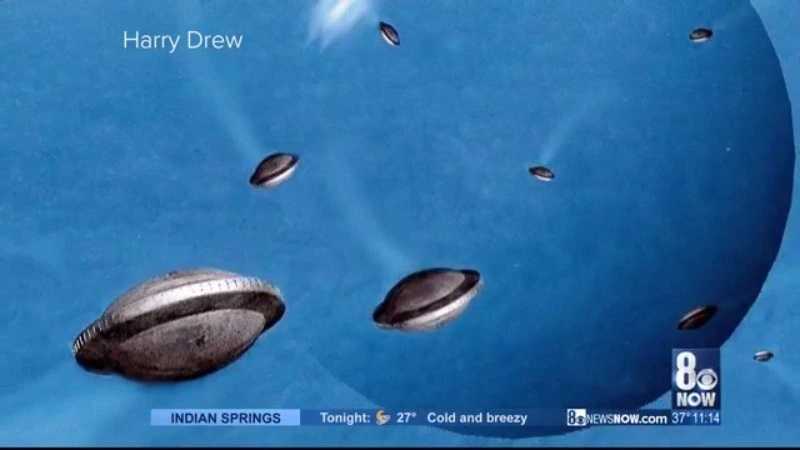
In 1953, the Atomic Energy Commission conducted a series of powerful explosions at the Nevada Test Site, known as “Upshot Knothole.” During the same period, witnesses reported seeing eight unidentified flying objects engaged in a dogfight near Arizona. Historian and former museum curator Harry Drew spent ten years investigating the incident and discovered that three of the craft had crashed on the outskirts of Kingman, Arizona in May 1953.
Drew did not expect to find evidence of the Kingman UFO and was surprised to learn about the third crashed craft. Mystery Wire reports he researched old records and interviewed original witnesses to uncover a complicated story that was more intricate than the Roswell UFO crash story.
In 1973, a retired Nevada Test Site technician named Arthur Stansel revealed that he and his team were taken to a remote desert location in Arizona to recover a secret experimental craft that had crashed. The team found a perfectly intact 40-foot diameter disc-shaped craft with four alien beings associated with it, and it was shipped to Groom Lake, Nevada, where Area 51 was later built around it.
An artist’s rendition of the 1953 Kingman UFO Crash. Credit: Harry Drew via Mystery Wire
In his book, “7 Days in May: The Kingman UFO Story,” Drew describes what happened to the three crashed crafts. One was destroyed when it crashed into a mountain near Kingman, another was found intact miles away from the crash site, and the third one crashed next to a small reservoir after clipping a rocky butte. The military took the last unknown craft back to a Nevada base. He found military-issued food containers dating back to 1953 around the exact crash site, proving that military teams camped there.
UFO enthusiasts have speculated that the Kingman UFO incident might be linked to the nuclear tests conducted in Nevada. However, Drew’s research suggests that the cause was a trio of powerful experimental radar sites set up around Kingman.
Drew claimed that he was able to document the crashes and the secret transport of the crafts to Nevada. He also asserted that one of the crafts was entirely intact when discovered. Despite the hotly contested nature of the story, Drew has evidence to support his findings.
According to MUFON researcher Richard Hall, in April 1964, the first report of a crash near Kingman was relayed to him by a future Vietnam commander. However, it was not until June 1973 that the case of the Kingman UFO retrieval was brought to the public’s attention by renowned UFO researcher Raymond Fowler.
The incident involved an engineer, Arthur G. Stancil (also known as “Fritz Werner”), who took preliminary measurements to assess the momentum of the crashed craft, which could prove useful in any reverse engineering attempts. Stancil, an Ohio University mechanical engineering graduate, who worked at Wright-Patterson Air Force Base in Dayton, Ohio, first made the story public.
Dr. Eric Wang, who was suspected of leading a reverse engineering team on alien craft, headed the Installations Division within the Office of Special Studies where Stancil worked. Stancil provided an affidavit in April 1976 vouching for the honesty of his testimony, which was released by Ray Fowler in the UFO Magazine. In his statement, Stancil revealed that he was loaned out to the Atomic Energy Commission and designated as a project engineer on some atomic bomb tests referred to as “Operation Upshot Knothole.”
The craft was reported to have a brushed aluminum exterior finish, measuring approximately 30 feet in diameter, and contained two swivel seats, instruments, and display panels. The hatch was five feet high and three feet wide. Additional reports from the book “Majic Eyes Only,” written by Ryan S. Wood, indicate that the craft was embedded 20” into the desert sand on impact
Re-Engineered UFO And Four Aliens
There are varying reports about the number of extraterrestrial biological entities (EBEs) recovered at the crash site. Some sources claim that four small EBEs were recovered, while others state that only one was found. Despite these discrepancies, there is evidence to suggest that a military blockade was set up along Highway 40, possibly in 1953, to secure the area leading to and from the potential crash site.
It is unclear whether the military recovered objects of extraterrestrial origin and transported them to a clandestine hangar, but there are reports of crashed discs being housed at a top-secret facility known as Area S-4, located 12 miles south of Area 51.
According to Wendelle Stevens, a retired US Air Force pilot-turned-UFO researcher, the disc that crashed near Kingman was transported to Area 51 via a U.S. Army tank transporter. The recovery crew attempted to tilt the craft on end to facilitate transportation across the country but abandoned this procedure when it became clear that it was impossible. Telephone poles had to be removed when the main road intersected with unimproved surfaces or dirt roads due to the oversized load of the disc on the trailer.
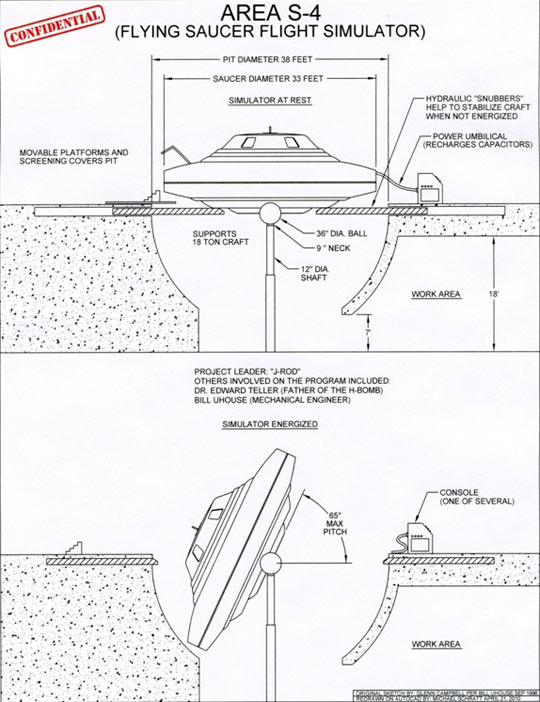
Bill Uhouse, a retired mechanical engineer, claimed to have been part of a top-secret program to design and build flight simulators used to teach American test pilots how to control flying saucers. He stated that the origin of the program came from the UFO crash at Kingman.
Mr. Uhouse claimed to have served in the Marine Corps and Air Force for a total of 14 years as a fighter pilot and flight tester of experimental aircraft. Later in his career, he worked as an engineer for defense contractors, focusing on antigravity propulsion systems and flight simulators for exotic aircraft, as well as actual flying discs.
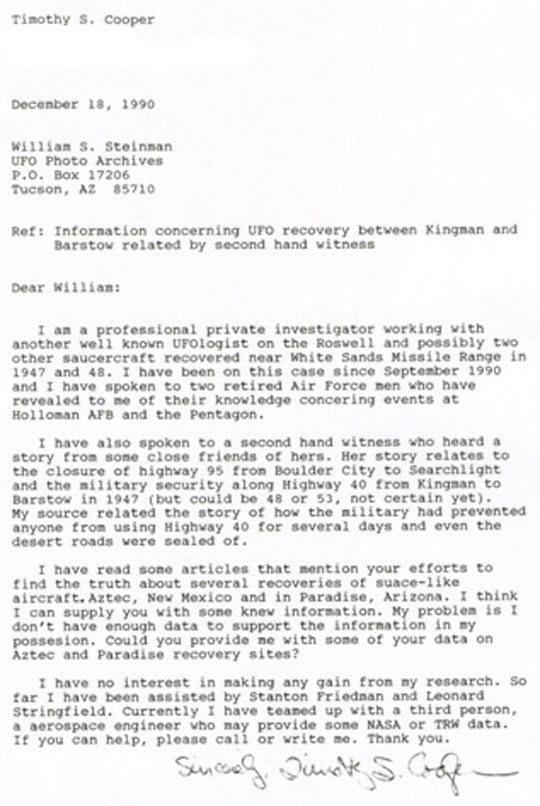
A letter written by investigator Timothy Cooper to UFO researcher Wendelle Stevens dated December 18 1990, may provide additional confirmation to rumored Kingman UFO crash
According to his testimony, the first disc they tested was a re-engineered ET craft. Mr. Uhouse was invited to work on a flying disc simulator by an unknown man. He was reassigned to link aviation and worked on building the F-102 simulator and B-47 simulator. He claimed that extraterrestrials presented a craft to the US government which was taken to Area 51, and the four ETs were taken to Los Alamos. His specialty was the flight deck and instruments, and he met with an ET called J-rod who helped engineers with the craft’s engineering.
“There was only one of them (alien) that would talk to scientists in the lab with them and the rest wouldn’t talk to anybody or even have a conversation with them. First, they thought it was mental telepathy but it is kind of a joke to me because they actually speak maybe not like we do but uh they actually speak,” Mr. Uhouse said on Sirius Disclosure.
In his 2013 interview, Mr. Uhouse discussed his work on a craft that was different from Bob Lazar’s alleged reactor. He explained that the simulator he worked on had six capacitors charged with a million volts each, which created a gravitational field that allowed the craft to lift off and turn left to right.
The craft had no windows, and visibility was through cameras, and there were no seat belts as the craft had its own gravitational field. Uhouse mentioned that it took a significant amount of training to operate the craft, and its design did not allow for the installation of external weapons like traditional aircraft. He also claimed that Area-51’s secrecy was due to a peace pact signed between the US and the United Nations during the time of President Eisenhower.
In 1977, UFO researcher Len Stringfield shared another account supporting the Kingman UFO crash. According to this new story, a man who served in the National Guard at Wright Patterson claimed to have witnessed the delivery of three bodies packed in dry ice, measuring four feet tall with large heads and brownish skin. The bodies were reportedly recovered from a crash site in Arizona in 1953. Since then, several other witnesses have come forward, but further details are currently unavailable. (Source)
Interestingly, UFO expert Charles Wilhelm heard a strikingly similar story in 1966 from a man who claimed that his father had shared the account on his deathbed. In 1995, an individual who went by the name of Jarod-2 contacted The Groom Lake Desert Rat, an Internet publication, and revealed that he had worked on a secret project for the USAF. The project aimed to construct a flying saucer simulator and had gathered materials from the Roswell and Kingman crash sites.
Several AI tools aim to summarize scientific findings to help researchers.
Credit: Dimitri Otis/Getty
As large language models (LLMs) gallop ever onwards — including GPT-4, OpenAI’s latest incarnation of the technology behind ChatGPT— scientists are beginning to make use of their power. The explosion of tools powered by artificial intelligence (AI) includes several search engines that aim to make it easier for researchers to grasp seminal scientific papers or summarize a field’s major findings. Their developers claim the apps will democratize and streamline access to research.
But some tools need more refinement before researchers can use them to help their studies, say scientists who have experimented with them. Clémentine Fourrier is a Paris-based researcher who evaluates LLMs at Hugging Face, a company in New York City that develops open-source AI platforms. She used an AI search engine called Elicit, which uses an LLM to craft its answers, to help find papers for her PhD thesis. Elicit searches papers in the Semantic Scholar database ad identifies the top studies by comparing the papers’ titles and abstracts with the search question.
Variable success
Fourrier says that, in her experience, Elicit didn’t always pick the most relevant papers. The tool is good for suggesting papers “that you probably wouldn’t have looked at”, she says. But its paper summaries are “useless”, and “it’s also going to suggest a lot of things that are not directly relevant”, she adds. “It’s very likely that you’re going to make a lot of mistakes if you only use this.”
Jungwon Byun, chief operating officer at Ought, the company in San Francisco, California, that built Elicit, says: “We currently have hundreds of thousands of users with diverse specializations so Elicit will inevitably be weaker at some queries.” The platform works differently from other search engines, says Byun, because it focuses less on keyword match, citation count and recency. But users can filter for those things.
Other researchers have had more positive experiences with the tool. “Elicit.org is by far my favourite for search,” says Aaron Tay, a librarian at Singapore Management University. “It is close to displacing Google Scholar as my first go-to search for academic search,” he says. “In terms of relevancy, I had the opposite experience [to Fourrier] with Elicit. I normally get roughly the same relevancy as Google Scholar — but once in a while, it interprets my search query better.”
These discrepancies might be field-dependent, Tay suggests. Fourrier adds that, in her research area, time is critical. “A year in machine learning is a century in any other field,” she says. “Anything prior to five years is completely irrelevant,” and Elicit doesn’t pick up on this, she adds.
Full-text search
Another tool, scite, whose developers are based in New York City, uses an LLM to organize and add context to paper citations — including where, when and how a paper is cited by another paper. Whereas ChatGPT is notorious for ‘hallucinations’ — inventing references that don’t exist — scite and its ‘Assistant’ tool remove that headache, says scite chief executive Josh Nicholson. “The big differentiator here is that we’re taking that output from ChatGPT, searching that against our database, and then matching that semantically against real references.” Nicholson says that scite has partnered with more than 30 scholarly publishers including major firms such as Wiley and the American Chemical Society and has signed a number of indexing agreements — giving the tool access to the full text of millions of scholarly articles.
Nicholson says that scite is also collaborating with Consensus — a tool that “uses AI to extract and distill findings” directly from research — launched in 2022 by programmers Eric Olson and Christian Salem, both in Boston, Massachusetts. Consensus was built for someone who’s not an expert in what they’re searching for, says Salem. “But we actually have a lot of researchers and scientists using the product,” he adds.
Like Elicit, Consensus uses Semantic Scholar data. “We have a database of 100-million-plus claims that we’ve extracted from papers. And then when you do a search, you’re actually searching over those claims,” says Olson. Consensus staff manually flag contentious or disproven claims — for example, that vaccines cause autism, says Olson. “We want to get to a state where all of that is automated,” says Salem, “reproducing what an expert in this field would do to detect some shoddy research.”
Room for improvement
Meghan Azad, a child-health paediatrician at the University of Manitoba in Winnipeg, Canada, asked Consensus whether vaccines cause autism, and was unconvinced by the results, which said that 70% of research says vaccines do not cause autism. “One of the citations was about ‘do parents believe vaccines cause autism?’, and it was using that to calculate its consensus. That’s not a research study giving evidence, yes or no, it’s just asking what people believe.”
Mushtaq Bilal, a postdoc at the University of Southern Denmark in Odense, tests AI tools and tweets about how to get the most out of them. He likes Elicit, and has looked at Consensus. “What they’re trying to do is very useful. If you have a yes/no question, it will give you a consensus, based on academic research,” he says. “It gives me a list of the articles that it ran through to arrive at this particular consensus,” Bilal explains.
Azad sees a role for AI search engines in academic research in future, for example replacing the months of work and resources required to pull together a systematic review. But for now, “I’m not sure how much I can trust them. So I’m just playing around,” she says.
Students at Carnegie Mellon University are sending America's first robotic lunar rover to the moon this May, beating NASA to the punch by about a year.
An artist's illustration of the Orion spacecraft orbiting the moon.
(Image credit: NASA/Liam Yanulis)
After 65 years of lunar exploration, the United States is finally going to put its first autonomous rover on the moon. But this mission won't be helmed by NASA engineers — instead, it is the brainchild of a dedicated group of college students.
The Iris rover was developed by students, faculty and alumni at Carnegie Mellon University in Pennsylvania over the span of three years. It is being carried to the moon as part of NASA's Commercial Lunar Payload Services (CLPS) program, the agency's foray into partnering with the commercial space industry.
Initially, it was scheduled to launch in late 2021 or early 2022, but setbacks in NASA's moon agenda delayed the launch to this spring.
The mission represents America's first robotic moon rover (NASA's VIPER rover is scheduled to launch next year), as well as the first rover to be developed by university students. (NASA famously launched astronaut-driven "moon buggies" on the final three Apollo missions.)
The 4.4-pound (2-kilogram) Iris has a chassis as big as a shoebox, and its carbon-fiber wheels are shaped like bottle caps. Its 60-hour-long mission will be a primarily visual one: Snapping images of the moon's surface for geographic study. It will also test new localization techniques as it transmits data about its position back to Earth.
In addition to Iris, the Carnegie Mellon team plans to send along an art installation called the MoonArk, a tiny time capsule filled with poems, music, pictures and small objects. The project is meant to convey a narrative "that is moving to people now, but also 1,000 years down the road," Dylan Vitone(opens in new tab), an associate professor at Carnegie Mellon and the MoonArk director, said in a statement(opens in new tab). A second, identical ark is currently on display at the Smithsonian National Air and Space Museum.
MoonArk and its pint-sized rover companion will hitch a ride to space aboard United Launch Alliance's Vulcan Centaur rocket, and be shuttled down to the lunar surface by Pittsburgh-based space company Astrobotic's Peregrine lander. The launch is scheduled for no earlier than May 4 — which, fittingly, the internet has christened international Star Wars Day — from Cape Canaveral Space Force Station in Florida.
"Hundreds of students have poured thousands of hours into Iris," Raewyn Duvall, a research associate at Carnegie Mellon University and commander of the mission said in a statement(opens in new tab). "We've worked for years toward this mission, and to have a launch date on the calendar is an exciting step."
Follow us on Twitter @Spacedotcom(opens in new tab) or Facebook(opens in new tab).
Leaked photo from Pentagon UFO task force shows 'silver cube' hovering over the Atlantic at 35,000ft - as classified reports reveal concerns 'aliens' could be operating beneath the world's seas
New report reveals activities of DoD's Unidentified Aerial Phenomena Task Force
Two 'position reports' circulated in intelligence community in 2018 and this year
Both included photos taken from the cockpits of U.S. military fighter jets
One leaked photo shows an unidentified 'cube-shaped' object hovering
Another is described as showing a triangular craft with lights on its corners
Pilots say the triangular object emerged from the open ocean and shot into air
It adds to speculation that unidentified craft are operating underwater
Officially, Pentagon refuses to comment on Unidentified Aerial Phenomena
The existence of two classified Pentagon reports on UFOs has been revealed, the contents of which include a leaked photo depicting a mysterious object hovering over the Atlantic.
The DoD's Unidentified Aerial Phenomena Task Force issued the two classified intelligence 'position reports' in 2018 and the summer of this year, and they circulated widely in the U.S. intelligence community, according to a detailed account from The Debrief based on interviews with multiple intelligence sources.
The position reports' startling contents included a leaked photo that has never before been made public, accounts of 'Unidentified Aerial Phenomena' (UAP) emerging from the ocean and soaring through the sky, and an admission that extraterrestrial origins for the objects cannot be ruled out.
'These revelations are extraordinary, and give the public a genuine peek behind the curtain when it comes to how the US government is handling the ufo issue,' Nick Pope, who investigated UFOs for the UK Ministry of Defence, told DailyMail.com.
'What this new information does is confirm that the US government is taking the UFO phenomenon more seriously than ever before,' he added. 'I anticipate further revelations shortly.'
The Pentagon did not immediately respond to an inquiry from DailyMail.com requesting confirmation of the existence of the two position reports, as well as the authenticity of a leaked cockpit photo included in one of the reports.
This leaked photo, published by The Debrief on Thursday, was included in the 2018 position report, two DoD and one intelligence source told the outlet
The photo was previously described as depicting an 'unidentified silver 'cube-shaped' object' hovering over the ocean at an altitude of roughly 30,000 to 35,000
The leaked photo, published by The Debrief on Thursday, was included in the 2018 position report, two DoD and one intelligence source told the outlet.
The leaked photo was was captured in 2018 off the East Coast of the United States by a military pilot using his cell phone camera, the sources said.
The photo was previously described as depicting an 'unidentified silver 'cube-shaped' object' hovering over the ocean at an altitude of roughly 30,000 to 35,000.
It appears that the image was captured by the backseat weapons systems operator of what appears to be an F/A-18 fighter jet.
Experts were baffled by the photo, but noted that the object somewhat resembles a GPS dropsonde, an atmospheric profiling device designed to be dropped from aircraft, typically over a hurricane.
The object is shaped similar to the parachute on a dropsonde (above) -- but the atmospheric devices plunge quickly toward earth, and no GPS transponder is seen dangling below the object
However, the object in the photo does not have the GPS transponder dangling from it as a dropsonde does -- and dropsondes plunge toward the Earth at 10 to 12 meters per second, rather than hover in the air.
It is possible that the object is some other kind of weather balloon -- but the Pentagon task force found it baffling enough to include in their report.
The 2018 report is said to have provided a general overview of the UAP topic and included details of previous military encounters, as well as a frank admission that the origin of many UAP could not be determined.
As well as offering a list of other, more prosaic explanations, the report expressly stated there was a legitimate possibility that UAP represented 'alien' or 'non-human' technology.
Even more shocking were the revelations contained in a second, revised report issued by the Unidentified Aerial Phenomena Task Force earlier this year.
The report delved deeply into the possibility that UAP are able to freely move both through the air and underwater, zipping through the ocean undetected and emerging into the air at incredible speeds.
The report contained an 'extremely clear' photograph of an unidentifiable triangular aircraft that emerged from the ocean in front of a F/A-18 Hornet fighter pilot, sources told The Debrief.
An artist's recreation (above) shows the image in the 2020 report as described by sources: a large equilateral triangle with rounded edges and large, spherical white 'lights' in each corner
Researcher Dave Beaty created this image to depict the object as described by sources who had seen the report from the Unidentified Aerial Phenomena Task Force
That photo has not been leaked publicly, but artist and researcher Dave Beaty's recreation shows it as described by sources: a large equilateral triangle with rounded or 'blunted' edges and large, perfectly spherical white 'lights' in each corner.
The encounter occurred off the East Coast in 2019, according to officials who had seen the latest report.
Two officials said said the photo was taken after the triangular craft emerged from the ocean and shot straight upwards.
Officials say the latest report focused specifically on the possibility of 'transmedium' craft that are able to operate both underwater and in the air.
It is not the first time that military sightings have suggested the existence of transmedium UAP.
In 2017, former Navy Commander David Fravor spoke out about the infamous USS Nimitz 'Tic Tac' encounter that occurred over the Pacific in 2004.
Fravor says he was flying in an F/A-18F Super Hornet when he made visual contact with the object, which seemed to be just below the water, before it emerged and sped out of sight when he tried to approach it.
The object was smooth, white and oblong, and had no visible wings or engines, Fravor said. He told the New York Times the experience left him 'pretty weirded out.'
Navy Commander David Fravor and Lieutenant Commander Jim Slaight had been flying about 100 miles off the coast of San Diego (pictured) in each of their F/A-18F Super Hornets (pictured) when they encountered an unidentified flying object described as a 'Tic Tac'
In August of this year, the Pentagon officially acknowledged the existence of the Unidentified Aerial Phenomena Task Force, which authored the two newly revealed reports.
'The Department of Defense and the military departments take any incursions by unauthorized aircraft into our training ranges or designated airspace very seriously and examine each report,' the Pentagon said in a statement at the time.
However, an internal email obtained by The Debrief shows that almost one year before the DoD's announcement, the highest levels of the U.S. military were already being briefed on UAP.
The email, obtained through a FOIA request, shows an October 16th, 2019 exchange between former Vice Chief of Naval Operations, Admiral Robert Burke, and current Vice Chief of Staff for the Air Force, General Stephen 'Steve' Wilson.
Admiral Burke tells General Wilson: 'Recommend you take the brief I just received from our Director of Naval Intelligence VADM Matt Kohler, on Unidentified Aerial Phenomena (UAP). SECNAV [Secretary of the Navy] will get the same brief tomorrow at 1000.'
In a 2019 email, former Vice Chief of Naval Operations, Admiral Robert Burke (left) advised current Vice Chief of Staff for the Air Force, General Stephen 'Steve' Wilson (right) to take a briefing he had just received regarding Unidentified Aerial Phenomena (UAP)
The 'SECNAV' would have been then-Secretary of the Navy, Richard V. Spencer, who was fired about a month later over disputes about the court-martial of Navy SEAL Eddie Gallagher.
Last year, the Senate Select Committee on Intelligence received its own classified briefing on UAP -- and the committee has asked the Pentagon to release an unclassified report on such encounters. The request is not binding, however.
'People knew the Senate Intelligence committee had demanded a report from the Director of National Intelligence, and that an Unidentified Aerial Phenomenon task Force has been set up,' Nick Pope, the British UFO expert, explained to DailyMail.com.
'What we now have is an insight into what's going on behind the scenes, and what this task force has been doing,' he added.
'I was genuinely surprised to see some of this information in an open source publication and I think some people within the defense and intelligence community are sailing very close to the wind here in discussing matters that are highly classified,' said Pope. 'I wouldn't be surprised if there's a leak inquiry going on at the Pentagon over this.'
While the intelligence community is required to grant Congress access to classified information, only the executive branch has the authority to declassify national security information in order to make it public.
'President Trump has hinted he knows some great secret about UFOs, that he might declassify,' said Pope. 'This might turn out to be the ultimate monkey wrench for the new administration!'
De betreffende ster blijkt een immense exoplaneet te herbergen. Het is één van de weinige exoplaneten die tot op heden direct is waargenomen. Maar daar kan nu weleens verandering in gaan komen.
Ondertussen hebben astronomen al meer dan 5000 exoplaneten opgespoord. De meeste daarvan zijn echter niet direct in beeld gebracht. Onderzoekers vertrouwen meestal op indirecte methoden, waarbij ze de aanwezigheid van een exoplaneet afleiden door naar de moederster te turen, in de hoop er getuige van te zijn dat de helderheid van de ster kortstondig afneemt. Hier kan ruimtetelescoop Gaia weleens verandering in gaan brengen. Want dankzij deze satelliet zijn onderzoekers op een ‘wiebelende’ ster gestuit, waarna onderzoekers voor hun ogen een werkelijk gigantische exoplaneet zagen verschijnen.
(In)direct Zoals gezegd zijn er twee manieren waarop astronomen op exoplaneten jagen: direct en indirect. Historisch gezien zijn de meeste exoplaneten gevonden met behulp van indirecte methoden. Direct houdt in dat een telescoop de planeet daadwerkelijk ziet. Momenteel zijn er van de duizenden exoplaneten die ons bekend zijn, slechts twintig direct in beeld gebracht. Dat dit er zo weinig zijn, is niet zo vreemd. Exoplaneten zijn namelijk buitengewoon moeilijk te zien met bestaande telescopen. Om ze goed in beeld te krijgen, moet de exoplaneet ver van zijn moederster verwijderd zijn en bovendien veel massiever zijn dan Jupiter, de grootste planeet in ons zonnestelsel. En het universum maakt helaas niet veel van dergelijke planeten.
Wiebelende sterren Maar misschien dat Gaia de directe waarneming van exoplaneten nu een tikkie makkelijker maakt. Met behulp van deze telescoop speurden astronomen de nachtelijke hemel af, op zoek naar sterren die letterlijk aan de hemel wiebelen. Op het moment dat een planeet namelijk om een ster draait, dan wiebelt de ster heen en weer, waardoor de relatieve snelheid ten opzichte van de aarde toeneemt of afneemt. Een wiebelende ster kan dus de aanwezigheid van een planeet verraden
Astrometrie is een methode waarbij de beweging van een ster bepaalt wordt door nauwkeurig zijn positie aan de hemel te meten. Deze techniek kan worden gebruikt om planeten rond die ster te vinden. Want wanneer astronomen kleine veranderingen in zijn positie meten, weten ze dat de ster mogelijk een planeet herbergt. Afbeelding: ESA, CC BY-SA 3.0 IGO
Na de verzamelde gegevens grondig te hebben bestudeerd, ontdekten de onderzoekers inderdaad een aantal veelbelovende wiebelende sterren, die zomaar eens een gigantische planeet konden herbergen. Vervolgens wendden ze zich tot de Subaru-telescoop, gelegen op het eiland Hawaï. En niet veel later kregen ze een immense exoplaneet die rond de ster HIP 99770 draait, in het vizier.
Ontdekking van HIP 99770 b. Afbeelding: T. Currie (Subaru/UTSA)
HIP 99770 b De nieuw ontdekte exoplaneet is HIP 99770 b genoemd en heeft ongeveer zestien keer de massa van Jupiter, zo schrijven de onderzoekers in het vakblad Science. De exoplaneet draait om een ster die bijna twee keer zo zwaar is als onze zon. Hoewel de omloopbaan van de planeet meer dan drie keer zo groot is als de baan van Jupiter rond de zon, ontvangt hij bijna dezelfde hoeveelheid licht als Jupiter omdat zijn moederster veel helderder is dan de onze.
De nieuw ontdekte exoplaneet. Afbeelding: ESA, CC BY-SA 3.0 IGO
Karakteriseren Met de ontdekking laten de onderzoekers zien dat het met behulp van Gaia mogelijk is om op een veel gemakkelijkere wijze exoplaneten direct in beeld te brengen. En dat is een belangrijke stap voorwaarts. Daarnaast heeft de vondst van HIP 99770 b ook nog bredere implicaties. “Het laat niet alleen zien hoe we meer exoplaneten kunnen opsporen, het laat ook zien hoe we ze beter kunnen karakteriseren,” zegt onderzoeker Thayne Currie. Dat komt omdat directe en indirecte detectiemethoden verschillende informatie over een planeet opleveren. Met behulp van directe methoden kunnen astronomen goed de temperatuur en de samenstelling van een planeet bepalen. Ondertussen leveren indirecte methoden nauwkeurige metingen van de massa en de omloopbaan op, zeker als deze vervolgens nog worden gecombineerd met metingen van de positie van de planeet door middel van directe waarnemingen.
Vervolgstudies Kortom, de combinatie van de Gaia-gegevens met waarnemingen van de Subaru-telescoop geeft astronomen het beste van twee werelden. En dit is nog maar het begin. Nu astronomen weten dat de planeet bestaat en bovendien zichtbaar is, kunnen andere telescopen de taak op zich nemen om het licht verder te analyseren. “De ontdekking van deze planeet zal leiden tot tientallen vervolgstudies,” denkt Currie.
Bovendien liggen er waarschijnlijk nog veel meer ontdekkingen in het verschiet. HIP 99770 was een van de eerste sterren die werd bestudeerd. Momenteel analyseren Currie en zijn team gegevens van ongeveer 50 andere sterren. En wat ze tot nu toe hebben gezien, doet hen vermoeden dat er meer ontdekkingen van nog onbekende exoplaneten in de pijplijn zitten.
Het ruimtevaartbedrijf spreekt zelf van een ‘snelle ongeplande ontmanteling’, kort na lancering. Daarmee kwam de testvlucht weliswaar vroegtijdig ten einde, maar is deze niet per definitie mislukt.
Vanmiddag was het dan eindelijk zover: SpaceX’ Starship koos het luchtruim. De lancering was spectaculair en leek even volgens het boekje te verlopen.
Maar iets meer dan drie minuten na de lancering en eenmaal op iets meer dan 30 kilometer hoogte gaat het mis. De eerste rakettrap (de Super Heavy Booster) hoort zich op dat moment los te maken van Starship, maar dat gebeurt niet. En kort daarop explodeert het geheel.
En daarmee is er vroegtijdig een einde gekomen aan de allereerste suborbitale testvlucht van de Super Heavy Rocket en Starship, waarbij Starship zich eigenlijk naar een hoogte van zo’n 235 kilometer had moeten begeven om na ongeveer anderhalf uur met een plons in de Stille Oceaan te landen.
Over Starship
SpaceX-baas Elon Musk heeft er nooit een geheim van gemaakt dolgraag mensen op Mars te willen zetten. Maar dat vereist wel een krachtig transportsysteem. En dat heeft SpaceX de afgelopen jaren ontwikkeld. Het resultaat is Starship: een volledig herbruikbaar transportsysteem dat bestaat uit de Super Heavy Rocket (een raketbooster) en Starship (een tweede rakettrap en compartiment voor vracht of bemanning). De afgelopen jaren zijn beide onderdelen afzonderlijk van elkaar al uitgebreid getest. Zo maakte Starship al verschillende testvluchten (die overigens niet altijd heelhuids afliepen) en onderging de Super Heavy Rocket ook al verschillende static fire-tests. Hierbij werd de raket stevig aan het lanceerplatform vastgeketend en vervolgens kortdurend aangezwengeld. Het waren stuk voor stuk interessante testen, maar lang niet zo interessant als de testvlucht die voor vandaag op de planning stond. Vandaag hadden de Super Heavy Rocket en Starship namelijk voor het eerst samen een suborbitale testvlucht moeten maken.
Ook mislukte testvlucht is waardevol Waarom de testvlucht eindigde in een explosie is nog onduidelijk; een analyse van de data die tijdens de korte testvlucht is verzameld, moet daar meer inzicht in geven. Ondertussen wordt er ook naar een nieuwe testvlucht toegewerkt, zo meldt SpaceX.
Het lijkt te suggereren dat het bedrijf niet in zak en as zit na deze explosie of – zoals ze het zelf noemen – deze ‘ongeplande ontmanteling’. Dat klopt ook wel. Want ook het mislukken van de testvlucht is in zekere zin waardevol. “Met een test zoals deze zit het succes ‘m in wat we leren,” zo schrijft SpaceX op Twitter. “En de test van vandaag helpt ons om Starship betrouwbaarder te maken.”
Tegenslagen zijn SpaceX helaas niet vreemd. Zo moest de lancering van Starship maandag nog worden afgelast vanwege technische problemen. En ook de ontwikkeling van Starship en de Super Heavy Rocket ging niet altijd over rozen. Zo gingen eerdere prototypes van Starship tijdens testvluchten – zonder de Super Heavy Rocket eronder – herhaaldelijk in vlammen op. Dat het nu weer brokstukken regende, is voor degenen met een voorliefde voor de (bemande) ruimtevaart natuurlijk wel een beetje een domper. We moeten namelijk niet vergeten dat deze testvlucht de opmaat is naar meer. Veel meer zelfs. Zo wil SpaceX Starship bijvoorbeeld gebruiken om op korte termijn enkele ruimtetoeristen een rondje om de maan te laten vliegen. En een variant van Starship – het Starship Human Landing System – speelt een cruciale rol in de plannen van NASA om binnen enkele jaren astronauten op de maan te zetten. Het uiteindelijke doel van Starship is echter om mensen nog dieper het zonnestelsel in te laten reizen, bijvoorbeeld naar Mars. Dat scenario lijkt na vandaag echter toch weer ver weg. Tegelijkertijd moeten we SpaceX niet onderschatten; het bedrijf heeft de veerkracht, de middelen en ambitie om van Starship een succes te maken en dat is tijdens de ontwikkeling van eerdere ruimtevaartuigen (uiteindelijk toch) een succesformule gebleken.
Bronmateriaal
SpaceX Afbeelding bovenaan dit artikel: Official SpaceX Photos (via Flickr.com, (CC BY-NC 2.0))
After the Pentagon‘s great UFO declassification and congressional hearings, NASA decided to hunt down the aliens. The agency possesses advanced technology on Planet Earth, exploring the possibility of transforming satellites into alien seekers to probe unexplained sightings without launching new equipment. The Galileo Project is designing a space mission to rendezvous with the next anomalous (Oumuamua-like) interstellar object that zooms into our solar system.
Is that the first time NASA became interested in alien civilizations? NASA whistleblowers, who claimed to have closely worked in some of the top missions, do not think so. Former NASA employee, Donna Hare reportedly saw a photo of a distinct UFO. Her colleague explained that it was his job to airbrush such evidence of UFOs out of photographs before they were released to the public.
On May 9, 2001, over twenty military, intelligence, government, corporate and scientific witnesses came forward at the National Press Club in Washington, DC to establish the reality of UFOs or extraterrestrial vehicles, extraterrestrial life forms, and the resulting advanced energy and propulsion technologies. As part of the Disclosure Project, Donna Hare, a photographic scientist testified to have worked for NASA contactor Philco Ford in the early 1970s. She had a high-security clearance to walk in NASA’s photo lab and other departments.
During the Disclosure Project press conference, Hare revealed that NASA covered up and eliminated space anomalies such as UFOs from the satellite photos. Hare has got several awards in the space programs. She dedicated most of her time as a technical illustrator to space programs. She created lunar maps and landing slides and had been working for 15 years as a sub-contractor for NASA.
Donna Hare Image credit: YouTube screencap
Hare claimed to have had access to a place known as “Building Eight,” from where she made contacts with high-ranking officials. Once, she walked into a restricted area which was NASA’s photo lab. She noticed the lab had photographs of the Moon taken from satellites. She was with a friend who pointed at one of the photographs and surprisingly, she saw a round white dot.
Below is the transcript of Hare’s part in the Disclosure Program (Full Video link here):
“Good morning everyone! My name is Donna Hare, and I worked at Philco Ford aerospace from 1967 to 1981. During that time, I was a design illustrator draftsman. I did the launch slides, landing slides, and also projected plotting boards lunar maps for NASA. We were a contractor but most of the time, I worked in Building 8. I had the opportunity to do extra work during downtime which was between missions, and I walked into a photo lab which was the NASA lab across the hallway. I had a secret clearance which is not that high but I was able to go into restricted areas.
At the time, I was talking to one of the techs in there and he drew my attention to a NASA photograph. It had a “Dot” on it, and I asked what it was. Well, he drew my attention to it and I said is that a dot on the emulsion? He was smiling and he had his hands crossed… This was an aerial photograph of the Earth, I’m assuming the Earth because it had pine trees on it and the shadows of the craft or whatever it was were at the same angle as the trees and by its very nature, a UFO. And I wanted to clarify that to the gentleman that was talking to me… So, I did not know what this was but I realized at this point that it’s very secret.
I asked him what he was gonna do with this piece of information. He said they always airbrush these out before they sell them to the public, so they’re pissed pesky little creatures appearing on this photograph they wanted to get rid of. After that, I decided I would ask questions to other people that worked there (away from the site and not on site).
A guard told me that he was asked to burn some photographs and not to look at them, and there was another guard guarding him who was in green fatigues watching him burn the photographs and he said he was too tempted he looked at one.
I knew someone in quarantine with the Apollo astronauts he told me that the Apollo astronauts saw crap on the moon when we landed. He said that the astronauts are told to keep this quiet.”
Hare was told by one of the sources that during one of the moon landings, three UFOs had landed. Subsequently, there was a codeword “Santa Claus” for these crafts. She said she would be willing to testify before Congress. (Source)
In 2000, Gary McKinnon, a British Hacker who got so fed up with the government hiding information related to UFOs and free energy that he decided to hack the most secured servers of NASA and the Pentagon. McKinnon said that he had seen real photographs of UFOs in computer files at the Johnson Space Center Building. He even took a screenshot of one of the cigar-shaped UFOs in-between space and the earth’s atmosphere. Unfortunately, it was removed from his computer after being seized.
Below is the recreation of the famous ‘NOT MAN MADE’ craft that was seen by McKinnon when he hacked & accessed NASA computers. (Source)
Gary claims he discovered a satellite picture of a cigar-shaped alien craft with domes on the sides, like this artist’s impression
This image taken by the Perseverance rover of the Ingenuity helicopter is a composite of a single Left- and Right-Mastcam-Z camera photo, both taken at a local mean solar time of 2:25 pm Wednesday, 8 March 2023. Credit: NASA/JPL-Caltech/ASU.
NASA Was Hoping for 5 Helicopter Flights on Mars. Ingenuity Just Completed its 50th!
The Ingenuity chopper on Mars is the little helicopter that just keeps on going. It’s doing that, even as it takes on flights over some pretty tough ground on the Red Planet. On April 13, Ingenuity made its 50th flight of the mission, 45 more than it was originally scheduled to do.
During the April 13th trip, the little chopper flew 322.2 meters in 145.7 seconds. It also went up 18 meters—a new altitude record. At the end of the flight, Ingenuity settled down near Belva Crater. It’s all an amazing achievement and the mission is ready to do more.
“Just as the Wright brothers continued their experiments well after that momentous day at Kitty Hawk in 1903, the Ingenuity team continues to pursue and learn from the flight operations of the first aircraft on another world,” said Lori Glaze, director of the Planetary Science Division at NASA Headquarters in Washington.
Where to Next?
The next flight for the chopper is a “repositioning” trip to put it in the right place for the next set of explorations. Mission controllers are eyeing a region called “Fall River Pass”, which is part of the Jezero Crater region. That’s where Perseverance—Ingenuity’s “parent” ship landed in February 2021.
It’s all part of the continuing exploration of Jezero Crater. Planetary scientists think that billions of years ago, this crater was filled with water. As such, it may be a key place to look for signs of past life, probably microbial in nature. While Perseverance isn’t equipped with life-detection instruments, it is perfectly designed to study the chemistry and geology of Mars’s surface. It’s been doing so since landing and has traveled more than 17.5 kilometers.
This illustration shows Jezero Crater — the landing site of the Mars 2020 Perseverance rover — as it may have looked billions of years ago on Mars, when it was a lake. An inlet and outlet are also visible on either side of the lake. This region is now dry, but Perseverance and Ingenuity are exploring its geology and for possibilities of ancient life signs. Courtesy NASA.
Its 51st flight (the repositioning) should be happening any time now. That trip should cover just over 180 meters in a period of 130 seconds. It, like Perseverance, is headed west and will be taking images along the way.
Ingenuity Surpasses its Role as a Tech Demo
The first helicopter on Mars really was supposed to be a demo and only fly a few times. But, it has soldiered on. This, despite facing some pretty adverse conditions. Dust storms coat its blades and solar panel. In the winter, it hibernated, and it continues to “brown out” during the night. Now that winter has passed, the Ingenuity can recharge more quickly. It will soon be flying over some pretty amazing terrains more frequently. It stays in touch with Perseverance via a Helicopter Base Station onboard its mother ship and uses auto navigation as it flies.
Ingenuity contains “off-the-shelf” components like smartphone processors and cameras. Its surprisingly hardy, much to the delight of its controllers. “When we first flew, we thought we would be incredibly lucky to eke out five flights,” said Teddy Tzanetos, Ingenuity team lead at JPL. “We have exceeded our expected cumulative flight time since our technology demonstration wrapped by 1,250% and expected distance flown by 2,214%.”
Ingenuity Helicopter Inspires Future Flights on Mars (Mars Report - April 2023)
NASA’s Ingenuity Mars Helicopter made history when it achieved the first powered, controlled flight on another planet – and it’s inspiring future aerial exploration of the Red Planet, too. In this Mars Report, Ingenuity Team Lead Teddy Tzanetos at NASA’s Jet Propulsion Laboratory provides an update on the helicopter’s achievements and future plans.
This video shows testing for Sample Recovery Helicopters, which could serve as a backup retrieval system for Mars Sample Return, a campaign that intends to retrieve samples taken by NASA’s Perseverance Mars rover for study here on Earth. These next-generation helicopters would be able to pick up and carry sample tubes in flight and also drive on the Martian surface.
Another future helicopter concept is the Mars Science Helicopter, a proposed six-rotor “hexacopter” that would be about the size of the Perseverance rover. It would bring important payloads to areas of Mars that are not currently accessible.
Teddy Tzanetos at NASA’s Jet Propulsion Laboratory provides an update on the agency’s Ingenuity Mars Helicopter and discusses how it’s inspiring future aerial exploration of the Red Planet. Credits: NASA/JPL-Caltech
Despite all the success, the chopper is showing signs of wear and tear. Its future flights and landings will challenge its capabilities, according to Tzanetos. “We have come so far, and we want to go farther,” said Tzanetos. “But we have known since the very beginning our time at Mars was limited, and every operational day is a blessing. Whether Ingenuity’s mission ends tomorrow, next week, or months from now is something no one can predict at present. What I can predict is that when it does, we’ll have one heck of a party.”
The Moon is the Best Place to Transport Rocket Fuel
When astronauts return to the Moon in the next few years, the plan is to have them stay for good while establishing a permanent outpost on Earth’s nearest celestial neighbor. Like all space missions, a lunar outpost will require fuel for long-term sustainability, but would it be better to mine fuel on the Moon or get fuel resupply from the Earth? This is what a team of researchers led by Bocconi University in Italy hope to address as they addressed the best option in terms of deriving fuel from either the Earth or the Moon.
Mattia Pianorsi, who is a Junior Researcher of the Space Economy Laboratory at the SDA Boccini School of Management and a PhD Candidate at the University of St. Gallen, recently told Universe Today the main objective of the study was to ascertain the economic and technical feasibility of mining fuel from the Moon’s water ice deposits or from the Earth. Both options would use an orbiting depot (OD) which Pianorsi says would be used “as a distribution channel for satellites as well as rockets in space.” The OD, which is separate from NASA’s proposed Lunar Gateway and is also not mentioned in the study, would possess a maximum fuel capacity of 25 tons and be located at the Earth-Moon Lagrange Point L1 which is approximately three-quarters the distance between the Earth and the Moon.
Artist rendition of an orbiting depot located at the Earth-Moon Lagrange Point L1. (Credit: Sommariva et al. (2023))
For the study, the researchers conducted a Monte Carlo analysis to evaluate the risks associated with both options. For their scenario, the researchers used hypothetical variables such as a lunar mining company, a transporter/distributor company, and end-users. The hypothetical lunar mining company charges fuel at $500 per kilogram while for the Earth refueling option a transporter purchases the fuel from the Earth at a negligible cost. Both options considered fixed costs, including Design, Development, Testing, and Evaluation (DDT&E), Manufacturing, and Transportation, while the recurring costs included Refueling and Operations.
The researchers determined the Earth refueling option would involve approximately 1.5 launches of a Falcon Heavy (FH) Expendable plus propellant tank with a spacecraft refueling payload of 17.5 tons. While the OD has a capacity of 25 tons, the FH would need to bring a combined total of 26.69 tons as the remaining 1.69 tons of fuel would be used to “transfer the refilling tank with its subsystems”, according to the study. As stated, the fuel costs are negligible, but the launch costs are estimated to be $150 million per launch, putting a total refueling price tag at $227.9 million, which includes launch plus fuel costs. The estimated launch costs also totaled $6511.4 per kilogram with a total operation cost of $42.38 million per year.
For the Moon refueling option, the researchers used a hypothetical Moon shuttle built by the Cislunar Space Development Company (CSDC) with a payload of 25 tons that launches from the Moon, docks and refuels the OD to its maximum capacity of 25 tons , then returns to the lunar surface, with the assumption that zero fuel is lost during the entire process. As stated, the hypothetical lunar mining company put the fuel costs at $500 per kilogram, and the study put the total refueling price tag at $37.51 million dollars, which includes launch plus fuel costs, giving a total operation cost of $35 million per year.
Rendering of the Moon shuttle from the Cislunar Space Development Company. (Credit: Sommariva et al. (2023))
Based on these results, the researchers concluded that refueling the OD is more affordable from the Moon than from the Earth.
“So, if you want to put this project into real substance, it should be able to understand and to analyze data from a project financing point of view,” Pianorsi recently told Universe Today. “So, it’s the same logic under which you finance the infrastructure here on Earth, you have to understand how to incentivize your investors to jump in on the basis of the mitigation of the risk that you that you put in place, for instance, through contracts. So, this is a very important thing to do if you want to develop infrastructure, involving not only the public money, and maybe the money of the corporates, but even the money of financial investors. And I don’t speak about venture capital or private equity, I speak about institutional investors.” Pianorsi tells Universe Today that he believes these factors should be the next steps in terms of research.
As for the upcoming Artemis missions, Pianorsi emphasized to Universe Today the importance of “creating an economic cycle between the Earth and the Moon” but also emphasized the importance of not just having space agencies and space companies conducting lunar and Mars activities, but non-space companies, as well.
“The companies need to understand that economic sustainability is the new prerogative of the new space economy,” Pianorsi tells Universe Today. “It’s not anymore cost-plus contracts of NASA. Right now, the times are changing and even space agencies, especially in times of budget constraints, need to rely on private companies to make innovation and to improve efficiency. And this implies not only from a cost perspective, but even from a market perspective.”
Could a future orbiting depot assist in crewed missions to the Moon, and will it turn out to be cheaper to refuel from the Moon than from the Earth? Only time will tell, and this is why we science!
Since its last flyby, of the Kuiper Belt object Arrokoth, the New Horizons mission has been exploring objects in the Kuiper Belt as well as performing heliospheric and astrophysical observations. Courtesy: Credit: NASA/Johns Hopkins University Applied Physics Laboratory/Southwest Research Institute//Roman Tkachenko
The New Horizons mission currently flying through the Kuiper Belt could be facing an unexpected change of plans. NASA’s Science Mission Directorate is soliciting input on turning the spacecraft into a
heliospheric science probe. The agency wants to do it much sooner than mission planners intended. If that happens, it will stop further planned planetary exploration of objects in that distant regime of the Solar System.
The changes NASA proposes come as a surprise since the spacecraft continues to perform Kuiper Belt object observations. And, it has received a very good recent senior science review. That report stated, “This is likely the only spacecraft humans will send through the outer Solar System for at least 20 – 30 years. The investigations proposed are strengthened by the unique position of this asset.”
More Kuiper Belt Studies
To date, the mission continues to accomplish its planned science goals in planetary exploration. “We’re doing a variety of Kuiper Belt science—including tracing the dust distribution from colliding KBOs out much farther than ever before,” said Principal Investigator Alan Stern. “We’re studying new, more distant KBOs from angles and closer ranges that you can’t get from Earth to determine their surface properties, their satellite counts, and shapes, things that cannot be done well except by a spacecraft in the Kuiper Belt. And of course, we’re on the prowl for a new flyby target if one can be found.”
Stern points out that the mission has, through 2022, observed and characterized 36 Kuiper Belt objects. In addition, it has studied several dwarf planets from its unique vantage point in the Belt. Data from those observations help calculate the shapes, orbits, and surface textures of these very distant bodies.
What the science teams have found so far will help place some important constraints on KBO formation mechanisms. Future observations should also help the teams understand the processes driving the surface evolution and compositional differences between various KBOs.
Building on New Horizons Observations of Pluto and Arrokoth
Science also continues to flow from the mission’s earlier discoveries, as reported at the March Lunar and Planetary Science conference. For example, the team may have figured out how the primitive Kuiper Belt object Arrokoth formed by gentle accretion. They’ve also been tracking the phenomenon of polar wander on Pluto. It turns out that the surface feature Sputnik Planitia may play a role.
A false-color image made from data supplied by New Horizons shows a ridge-trough system on Pluto that could have been Pluto’s original equator before the poles began to wander. Credit: James Tuttle Keane (JPL / Caltech) / NASA / JHUAPL / SwRI
The spacecraft is well placed to “look back” and capture views of Uranus and Neptune. Those observations will be done in tandem with the Hubble Space Telescope. In addition, New Horizons will continue its planned studies of the heliosphere. Finally, it will continue to map the cosmic background in optical and ultraviolet light. In other words, there’s plenty for the spacecraft to do in astrophysics, cosmology, and solar system sciences.
Searching for the Next Target
Since the Arrokoth encounter, the team’s been hunting for another flyby target. According to Stern, it’s been an intense search. “We’re twice as far out from Earth as when we found Arrokoth, which makes the targets we search for sixteen times farther. So, the search is much harder,” he said. “This is the only chance we’ve got to do Kuiper Belt science for decades and we need time to find the next target.”
The Hyper Suprime-Cam at the Subaru Telescope in Hawai’i is part of the search for New Horizons flyby targets. It is outfitted with a special filter to aid in the search. Credit: NAOJ/Subaru Telescope.
That hunt uses enhanced equipment on ground-based telescopes and also takes advantage of machine-learning AI software. The Subaru Telescope in Hawai’i has a new high-throughput filter on its giant Hyper Suprime-Cam digital camera. The New Horizons team specifically purchased that filter to use in the KBO search. The Dark Energy Camera instrument at the Cerro Tololo Inter-American Observatory in Chile is another tool in the hunt. Those facilities should be able to find what amounts to a needle in the Kuiper Belt haystack. If the team finds an object along the New Horizons trajectory, they’ll spool up planning for its observations.
The Dark Energy Camera at CTIO is one part of the search for another flyby target for New Horizons. Credit: Andreas Papadopoulos.
Proposed Changes from NASA
So, given the current successes, why is NASA looking to discontinue planetary science using New Horizons? The first hints about this proposed change came when the agency sent word that the current extended mission will end on October 1, 2024. Originally, the team asked for funding to continue Kuiper Belt science through 2025. However, in May 2022, NASA informed the team of the cutback to only two years of further exploration. The team is working to get the third year back. This is important since the mission will be traversing the Kuiper Belt until at least 2027-2028. That gives plenty of time to do more planetary science.
Other hints of possible changes came in another NASA Science Mission Directorate (SMD) suggestion. This one is to move the mission from the Planetary Science section to the agency’s Heliophysics division. SMD also issued a request for Information (RFI) on March 15, 2023. It states, “SMD is exploring whether interested science teams have a set of science objectives to propose to NASA for use of the mission beyond FY24. The purpose of this RFI is to gauge the level of interest of the wider science community in pursuing the next phase of science leadership for the mission, and to estimate appropriate annual costs.”
The SMD request for input from the larger science community seems focused on what to do with the mission (and its team) now that the Pluto and Arrokoth flybys are over. It doesn’t acknowledge that New Horizons hasn’t finished its survey of the Kuiper Belt. Plus, it’s still actively doing planetary science there.
Presenting the Changes
At an SMD question-and-answer session on April 6th, Planetary Science Division director Lori Glaze acknowledged the mission extension proposal for operations past Fiscal Year 2024. She also noted that it received a good senior review as a multi-disciplinary approach for planetary science, astrophysics, and heliophysics.
Glaze stated, “[The review] says that the probability of additional science return for planetary science with New Horizons spacecraft is quickly diminishing and that there’s very little additional planetary science that we can gain from the spacecraft.” Glaze also pointed out that the astrophysics and heliophysics divisions evaluated the same review. “They did identify significant heliophysics science that could be done from this unique location in the solar system,” she said.
The actual review she refers to says something slightly different. It states that proposed KBO studies are unlikely to dramatically improve the state of knowledge. This is a statement some planetary scientists have characterized as a naive assumption. But, it does not say specifically that there’s very little planetary science to be gained. It also goes on to point out that an extended mission would support all the planetary science, plus astrophysical and heliophysics objectives outlined in the 2003 Decadal Survey.
Truncating Valuable Planetary Science?
Despite the favorable reviews and mission accomplishments, the proposed plan to abruptly stop doing planetary science with New Horizons and turn it into a heliospheric mission will be devastating. According to Stern, if a further extension is not granted, it amounts to a truncation of New Horizons Kuiper Belt planetary science years too early.
“New Horizons is a national treasure,” he said. ” “We’ll never get another Kuiper Belt extension if it goes to Heliophysics Division. Right now, we need to exploit this mission for every bit of planetary and particularly Kuiper Belt science we can get while we’re still in the Kuiper Belt.”
Historically, the exploration of this regime of the solar system came from a prime recommendation of the 2003 Planetary Decadal Survey. It recommended a Pluto-Kuiper Belt explorer mission as a way to study solar system history, volatiles, and organics in the solar system. The survey report specifically stated that “KBP’s value increases as it observes more KBOs and investigates the diversity of properties.”
It further points out that “The SSE Survey anticipates that the information returned from this mission might lead to a new paradigm for the origin and evolution of these objects and their significance in the evolution of objects in other parts of the solar system.”
That survey led to the creation of the New Horizons mission to Pluto and the Kuiper Belt. Its prime aims were to do as much planetary science in the Belt as possible. It also included robust heliophysics and astrophysical components from the beginning. So far, it has accomplished all those types of observations and more.
What’s Lost If New Horizons KBO Mission Gets Shortened?
According to Mark Sykes, a planetary scientist and CEO and Director of the Planetary Science Institute, the potential loss of planetary science from New Horizons is a big deal. “It has a collection of instruments and a team that’s operating now that knows best how they operate, their sensitivities, and so on,” he said. “New Horizons is the one opportunity we have to study these objects in their primordial state in the region where they have resided frozen for the age of the solar system.”
The New Horizons instrument payload that is currently doing planetary science, heliospheric measurements, and astrophysical observations. Credit: NASA/Johns Hopkins University Applied Physics Laboratory/Southwest Research Institute
“Four years ago New Horizons flew by the first such object ever seen, Arrokoth,” he said. “The most important thing NASA can do now is to make every effort to find a second target for New Horizons to fly by. It is the only way we could get any clue about the physical diversity of these objects, which would greatly impact our understanding of the formation and evolution of the solar system.”
Sykes points out that the search for a flyby target is high risk. “There might not be a target close enough to New Horizons’ flight path. But, the very high payback and the marginal cost of the effort is tiny compared to the billion dollars already invested by taxpayers in this mission, he said. “While they hunt, there are a lot of unique planetary, astrophysical, and heliophysical observations that can be made. To not make these observations, to not make an effort in planetary, as well as astrophysics, and heliophysics with everything this spacecraft can do, to me, is a crime.”
Sykes also pointed out that the spacecraft’s position in the Kuiper Belt provides the most unique look at dust distribution there. That’s because it’s taking in situ measurements. “The dust tells you something about the collisional environment there, and provides a really important constraint in terms of what’s going on,” he said.
What’s Next?
For now, New Horizons has not yet been moved out of the planetary science portfolio. NASA is still soliciting input from the broader science community over the proposed move. The RFI ends on April 17th.
The New Horizons team is working to get the planetary component extended. They also want to keep experienced mission scientists in place. Although the RFI doesn’t state it directly, the wording seems to suggest that the Science Mission Directorate is looking to replace the current science team with new groups of scientists who will propose heliophysics science for the spacecraft moving forward. These researchers would not be as familiar with the mission instruments.
Something like this has never been done to any spacecraft team before, said Stern. He fears that if new people are brought in to run the mission, the current team will be sent packing, unfunded and unaffiliated with the spacecraft they worked to build, launch, and operate. And, the loss to science is incalculable.
“If they shut it down as a planetary mission, it will be the end of Kuiper Belt exploration for several decades,” he said. “Cutting us off prematurely is exactly counter to what the Decadal Survey recommended.”
Planetary Mission Challenges
This challenge to New Horizons and its science team plays out against a backdrop of big budget issues at NASA. Just as one example, the agency is grappling with delays to the flagship Mars Science Return mission. There is talk about descoping it to save money. The Veritas mission just got delayed by three years. That’s largely due to technical issues, as well as funding requirements for other missions.
Budgetary constraints shouldn’t be part of the New Horizons situation, according to Stern. “Our budget request for another mission extension is around $10 million,” he said. That’s an amount the team requested to restore the fiscal year 2025 funding that NASA took away. He compared that to NASA’s overall science budget of just under $8 billion. “It’s a drop in the bucket for the amazing science return we still hope to get.”
Meer van UFO'S of UAP'S, ASTRONOMIE, RUIMTEVAART, ARCHEOLOGIE, OUDHEIDKUNDE, SF-SNUFJES EN ANDERE ESOTERISCHE WETENSCHAPPEN - DE ALLERLAATSTE NIEUWTJES


 How does astronomy use the electromagnetic spectrum? - PART I