Ontdek de Fascinerende Wereld van UFO's en UAP's: Jouw Bron voor Onthullende Informatie!
Ben jij ook gefascineerd door het onbekende? Wil je meer weten over UFO's en UAP's, niet alleen in België, maar over de hele wereld? Dan ben je op de juiste plek!
België: Het Kloppend Hart van UFO-onderzoek
In België is BUFON (Belgisch UFO-Netwerk) dé autoriteit op het gebied van UFO-onderzoek. Voor betrouwbare en objectieve informatie over deze intrigerende fenomenen, bezoek je zeker onze Facebook-pagina en deze blog. Maar dat is nog niet alles! Ontdek ook het Belgisch UFO-meldpunt en Caelestia, twee organisaties die diepgaand onderzoek verrichten, al zijn ze soms kritisch of sceptisch.
Nederland: Een Schat aan Informatie
Voor onze Nederlandse buren is er de schitterende website www.ufowijzer.nl, beheerd door Paul Harmans. Deze site biedt een schat aan informatie en artikelen die je niet wilt missen!
Internationaal: MUFON - De Wereldwijde Autoriteit
Neem ook een kijkje bij MUFON (Mutual UFO Network Inc.), een gerenommeerde Amerikaanse UFO-vereniging met afdelingen in de VS en wereldwijd. MUFON is toegewijd aan de wetenschappelijke en analytische studie van het UFO-fenomeen, en hun maandelijkse tijdschrift, The MUFON UFO-Journal, is een must-read voor elke UFO-enthousiasteling. Bezoek hun website op www.mufon.com voor meer informatie.
Samenwerking en Toekomstvisie
Sinds 1 februari 2020 is Pieter niet alleen ex-president van BUFON, maar ook de voormalige nationale directeur van MUFON in Vlaanderen en Nederland. Dit creëert een sterke samenwerking met de Franse MUFON Reseau MUFON/EUROP, wat ons in staat stelt om nog meer waardevolle inzichten te delen.
Let op: Nepprofielen en Nieuwe Groeperingen
Pas op voor een nieuwe groepering die zich ook BUFON noemt, maar geen enkele connectie heeft met onze gevestigde organisatie. Hoewel zij de naam geregistreerd hebben, kunnen ze het rijke verleden en de expertise van onze groep niet evenaren. We wensen hen veel succes, maar we blijven de autoriteit in UFO-onderzoek!
Blijf Op De Hoogte!
Wil jij de laatste nieuwtjes over UFO's, ruimtevaart, archeologie, en meer? Volg ons dan en duik samen met ons in de fascinerende wereld van het onbekende! Sluit je aan bij de gemeenschap van nieuwsgierige geesten die net als jij verlangen naar antwoorden en avonturen in de sterren!
Heb je vragen of wil je meer weten? Aarzel dan niet om contact met ons op te nemen! Samen ontrafelen we het mysterie van de lucht en daarbuiten.
The Intriguing Tales Behind UFO Sightings: Real Accounts from Abductees
UFO sightings have fascinated humans for decades. From mysterious lights in the night sky to tales of alien abductions, these unexplained phenomena continue to capture our imagination. In an age of technology and extensive space exploration, the stories behind UFO sightings have become more compelling than ever.
Drawing Insights from the Abductees:
The documentary “Abductees” by Paul Vester delves deep into the experiences of those who claim to have been abducted by extraterrestrial beings. These aren’t just mere tales but are accounts formed from interviews, hypnotic regression tapes, and the original drawings of abductees like Linda Cortile and Rusty Hudson.
Visual Representations of the Encounters:
A striking element of these tales is the artwork that originates from the very individuals who experienced these encounters. Often, therapists and investigators ask abductees to sketch what they witnessed, and these drawings serve as the primary means to visualize their experiences. These aren’t just rudimentary sketches but vivid portrayals of their memories. The emphasis on the eyes of the extraterrestrial beings is a recurring theme. Many describe them as akin to 1950s Italian wraparound sunglasses. These depictions aren’t just for investigators; they offer a therapeutic outlet for the abductees.
Beyond the Visual – The Emotional Depth:
The emotional depth of these accounts is haunting. One abductee recounted the sheer force of telepathic communication, likening it to a radio turned too loud. Another speaks of the terrifying ordeal, describing the feeling of pressure around the kidneys and the strange sensation that followed.
The Power of Memory:
These memories, often suppressed or distorted, sometimes need hypnotic regression to surface. Some abductees remember certain aspects of the experience clearly, while others recall their encounters in fragmented sequences. The struggle between distinguishing reality from dreams becomes a significant aspect of their tales.
VIDEO:
Five tales of alien abduction: “Abductees” (Paul Vester, 1995)
In a world increasingly driven by logic and science, stories of UFO sightings and alleged abductions offer a tantalizing glimpse into the unknown. As we continue our quest for understanding, it is essential to listen, analyze, and respect these narratives. After all, in the vast expanse of the universe, can we truly claim to be alone?
Two young chefs decided to go out for a walk after a tiresome shift at the Pitlochry Hotel on the outskirts of Cairngorms National Park in Scotland. It was 9:00pm. The air was fresh, and the light was dwindling steadily. The two mates drove some miles to Calvine, close to the edge of the Cairngorms, where they began a walk across the hills.
Suddenly, up in the skies, they saw a strange-looking, diamond-shaped object over 100 feet long. It hovered above them as if searching for something.
The puzzled men went straight to the bushes to hide, but they kept watching. The mysterious flying object stayed there. Then, two British fighters passed through the area as if nothing had happened.
Strangely enough, one returned as if the pilot had seen that strange flying object. The frightened chefs desperately took some pictures of the flying object with a camera.
The UFO violently flew vertically and disappeared above the sky. It was never seen again, but the two cooks had evidence of what they had witnessed. And it would take a long time to unravel the mystery of what it was.
RELATED
NEW: Gov't UFO report finds 'concerning high speeds' & 'unusual maneuverability' in recovered crafts
Ancient Aliens: UFO Witnesses THREATENED By Men in Black (Season 2)
A pilot flies alongside flying saucers, but is threatened by mysterious men to keep quiet about his experience. See more in this scene from Season 2, Episode 4, "Extraterrestrial Close Encounters."
Did Bob Lazar Work On Restricted Alien Spacecrafts
Did Bob Lazar work on restricted alien spacecrafts? Or was he just a sensational fake who made up stories about secret government projects? In this video, we'll investigate the mystery surrounding Bob Lazar and see what evidence exists to support or refute his claims.
The Crab Nebula – otherwise known as the first object on Charles Messier’s list of non-cometary objects or M1 for short – has never really failed to visually underwhelm me! I have spent countless hours hunting down this example of a supernova remnant and found myself wondering why I have bothered. Yet here I am, after decades of looking at it, and I still find it one of the most intriguing objects in the sky.
Never has this interest been piqued more than right now after another mirror-smashing beauty of an image from the James Webb Space Telescope, and it’s already found its way to my mobile phone wallpaper!
The NASA/ESA/CSA James Webb telescope was launched back in December 2021, and from its position 1.5 million km away, it orbits the Sun, giving us a brand new window out into the Universe. Using its Near-Infrared Camera (NIRCAM) and the Mid-Infrared Instrument (MIRI) JWST has been exploring the Crab Nebula, the remains of a star whose explosion was recorded back in 1054. The object, which is 6,500 light years away, can be seen in small amateur telescopes and is without doubt one of the most studied supernova remnants of all.
Despite being the target of many, many observations, there are still plenty of unanswered questions about the nature of the star that exploded, the mechanics of the explosion itself, and the composition of the ejecta. Using JWSTs infrared capabilities, the image of the Crab reveals red/orange filaments of dust around the central region. The filaments weave an intricate pattern over the whole nebula, but it’s the core that has received more attention.
Compare and contrast the Hubble version on the left with the new, Webb version on the right. Credit: NASA, ESA, CSA, STScI, T. Temim (Princeton University)
It has been known that there is a pulsar at the core of the nebula, and it’s this pulsar that is the true remains of the progenitor star. When it went ‘supernova,’ the core collapsed to form the ultra-dense rotating object that, if you happen to be in the right place in space (hey, that rhymes), then you will see a pulse of radiation as it rotates. The infrared images from JWST reveal synchrotron emissions, which are a direct result of the rapidly rotating pulsar. As the pulsar rotates, the magnetic field accelerates particles in the nebula to astonishingly high speeds such that they emit synchrotron radiation. As a fabulously lucky quirk of nature, the radiation is particularly obvious in infrared, making it ideal for JWST.
Not only has JWST detected synchrotron radiation, but it has also mapped out locations of dust particles and even… locations where dust particles are forming. It’s fabulous to think that an object that was discovered almost a thousand years ago is still surprising us. That’s one of the things I love about astronomy: you think you have seen it all, but there is always more to learn. Over the coming years, teams of astronomers using both HST and JWST will continue to probe the depths of the Crab Nebula, and maybe one day, all of its secrets will finally be revealed.
EXCLUSIVE: FBI agents visit scientists building flying saucer at Falcon Space lab in New Jersey - and reveal they are part of 'X-Files like' government UFO investigation
Mark Sokol, 35, told DailyMail.com FBI agents showed up at his New Jersey lab last Friday and revealed they had been 'tasked with investigating' UFOs
The scientist, the founder of Falcon Space Lab in Hawthorne, said the feds told them they had received a tip about 'enriched uranium' being used at the site
CCTV shared with DailyMail.com shows the two FBI agents flashing their badges and interviewing the inventor as well as pacing outside with a Geiger counter
FBI agents visited a New Jersey lab where scientists are trying to build a flying saucer – after they received a report of dangerous uranium being used on site.
Mark Sokol, founder of the Falcon Space laboratory in Hawthorne, New Jersey, told DailyMail.com he was shocked when two federal agents showed up at his shop last Friday.
Sokol said the more senior of the two agents told him they had been tasked by Bureau bosses with looking into Unidentified Anomalous Phenomena (UAP), the government term for UFOs – making him a kind of real-life Fox Mulder from the classic show The X-Files.
They didn't find any dangerous uranium, Sokol said, but were intrigued by the experiments going on at Falcon Space.
Sokol, 35, and his colleagues are attempting to use nuclear physics to make objects weightless, the first step towards building a functioning flying saucer.
CCTV shared with DailyMail.com shows two FBI agents grilling scientist Mark Sokol during a surprise visit to his lab in Hawthorne, New Jersey on October 20
Scientists and inventors are trying to build their own gravity-defying flying saucer in the Falcon Space laboratory in New Jersey
Sokol explained he and his colleagues have been working on experiments to make objects weightless – the first step towards building a functioning flying saucer – using this foil-lined Faraday cage that managed to reduce an object's weight by 17.8%
They are inspired by verified reports of strange unidentified objects flying in extraordinary ways in our skies, seas and space, which are now being openlyinvestigated by the government.
Sokol told DailyMail.com his goal is to figure out the technology behind these objects, which some believe to be extraterrestrial craft.
CCTV shared with DailyMail.com shows the two FBI agents flashing their badges and interviewing the inventor as well as pacing outside with a Geiger counter – a device used to detect radiation – which showed no harmful radiation at the lab, he said.
'They showed up on Friday right around noon,' Sokol said. 'They flashed their badges, said ''FBI'', and asked if we had any enriched uranium.
'I laughed and told them no. One said that we're not in trouble and he wanted to come back at some point and pick my brain about UAPs because he's been tasked by the FBI, in investigating UAPs or UFOs.'
But if the senior agent is a real-life version of David Duchovny's Mulder, his partner didn't quite measure up to Gillian Anderson's Dana Scully.
Sokol said the more junior of the pair was fresh-faced and ‘probably in his early 20s’.
'They said they got a tipoff that I have enriched uranium. The only uranium we have here is a little piece that I got off Amazon to check our Geiger counter to make sure it's working.'
A spokeswoman for the FBI field office in Newark, New Jersey, told DailyMail.com: 'We receive information from the public each day through various reporting mechanisms.
Left to right: Jatin Parmar, Tom Butler, Mark Sokol, Wayne Ojala all working on an experiment at their lab in Hawthorne
Members of the Falcon Space laboratory plot their experiments to replicate UFO technology such as anti-gravity
Falcon Space was founded by Mark Sokol, who turned his battery manufacturing laboratory into a hub for scientists and inventors trying to crack the problem of anti-gravity
'In general, when we get information about a situation involving illegal and dangerous radiological or hazardous materials, our agents investigate it.'
The spokeswoman did not comment on whether their FBI office had a designated agent for UFO-related cases.
Sokol described his lab as a bootstrapped community of scientists, engineers, and inventors hoping to crack anti-gravity, warp drives, and other futuristic technologies.
They are funded by donations and a few private investors passionate about the topic.
'We're researching UFO propulsion, trying to figure out propellant-less propulsion concepts that have been theorized to work throughout the years,' he said.
'There's lots of papers and patents that have been put out. But we're a lab where we actually put those theories to the test.'
Some of their experiments test the theory that objects' mass comes from the jumbled directions in which the subatomic particles of their atoms spin.
If you can get those tiny parts to spin in the same direction, it will make them weightless, so the theory goes.
'We've seen up to 17.8% weight loss in one experiment,' Sokol said.
He believes once they can get above 90%, they'll be able to make a floating saucer.
Lab cofounder Jeremy Rys runs their YouTube channel Alien Scientist, where they post videos of their experiments and scientific discussions at their regular online 'Alternative Propulsion Engineering Conference'.
Lab cofounder Jeremy Rys said he was skeptical of the FBI visitors, noting that the senior agent had a background in financial crime investigations unrelated to X-Files-type probes
The agents appeared to be real-life versions of FBI special agents Fox Mulder, played by David Duchovny and Dana Scully, played by Gillian Anderson, from the hit sci-fi series The X-Files
Rys was skeptical of the FBI visitors, noting that the senior agent had a background in financial crime investigations unrelated to X-Files-type probes.
'They said they were interested in UAP and the kind of stuff he was doing at the lab. It could be a shoe in the door,' he said.
'Maybe they're trying to trick Mark into opening up more because they know it's his passion.
'If you lie to federal investigators in any way, even just telling them the time on a broken clock, they can later put charges against you.'
Though the government has not officially confirmed it is using FBI agents to conduct UFO-related investigations on the ground X-Files-style, there are several hints that this is the case.
In a presentation by Sean Kirkpatrick, director of the Pentagon's All-domain Anomaly Resolution Office (AARO) in January, the DOJ was listed as one of the agency's 'key partners'
A 2021 law which created the latest incarnation of the Pentagon's UFO investigation office 'AARO' also ordered it to 'rapidly respond to, and conduct field investigations of, incidents involving unidentified aerial phenomena under the direction of the head of the Office'.
At a conference on January 11 this year, AARO director Dr. Sean Kirkpatrick presented a slide deck which listed the Department of Justice, ultimately responsible for the FBI, as one of its 'key partners and stakeholders'.
Kirkpatrick, a decorated physicist and intelligence official, also included one intriguing bullet point on his slides suggesting that AARO aimed to 'recover' downed UAP.
The slide said his office is involved in 'UAP detection, tracking, mitigation, and recovery'.
The US government has itself tried to build craft resembling classic flying saucers, though official records show it achieved little success.
In the 1950s the US Air Force hired a Canadian contractor to help it try to build a supersonic flying saucer.
DailyMail.com obtained a slides from Kirkpatrick's January 11 presentation which showed the steps AARO was taking to ensure UAP 'are effectively and efficiently detected, tracked, analyzed, and managed'
Kirkpatrick's presentation warned of 'threats to the immediate safety of US citizens and Government facilities'
Documents from the venture, codenamed Project 1794, were declassified in 2012, and include schematics that look like they come right out of a science fiction movie.
According to papers published by the National Archives, the saucer was designed to fly 'between Mach 3 and Mach 4, a ceiling of over 100,000 ft. and a maximum range with allowances of about 1,000 nautical miles'.
Despite indications of initial success at a relatively low cost, the project fizzled out after engineers apparently failed to get the craft flying higher than a few feet.
From 2015 to 2017 the US Navy filed for a series of patents for futuristic inventions including a triangular-shaped 'hybrid aerospace underwater craft' and a 'craft using an inertial mass reduction device' – or anti-gravity.
The supposed inventor, Dr. Salvatore Pais, boasted in the patent of possible 'extreme speeds' by his vehicle and the potential to 'engineer the fabric of our reality at the most fundamental level'.
But other physicists criticized the filings for their lack of specific technical details and allegedly nonsensical pseudoscience terms – fueling theories that the patents could just be propaganda to confuse America's adversaries.
The Navy told US engineering news site The Drive that they spent three years and $508,000 on the project, but ended it in September 2019 after failing to prove Dr. Pais' proposed science.
'No further research has been conducted, and the project has not transitioned to any other government or civilian organization,' a spokesperson for the Naval Air Warfare Center Aircraft Division told the site in 2021.
An artist's impression of an undiscovered alien world.
(Image credit: Dottedhippo via Getty Images)
We've all wondered whether we're alone in the universe, and with potentially habitable planets, strange space signals and UFO hearings hitting the headlines, it's starting to feel like we're on the cusp of a major extraterrestrial discovery. But what's the best scientific evidence we've found for the existence of alien life?
The sobering reality is that there isn't any yet. There's no scientific evidence for aliens in the declassified UFO videos, in mutilated cows whose injuries are blamed on extraterrestrial activities or in purported alien bodies. Nor is there any such evidence in the formal academic research. Live Science checked in with experts to make sure.
"There's just no evidence right now," Professor Sara Seager, an astrophysicist and planetary scientist at the Massachusetts Institute of Technology and author of "The Smallest Lights in the Universe: A Memoir" (Crown, 2020), told Live Science.
Nikku Madhusudhan, a professor of astrophysics and exoplanetary science at the University of Cambridge, gave a similar response, saying, "I don't think we have clear evidence just yet of any kind for alien life."
There is, however, good reason to hold out hope that the evidence will eventually come, even if it isn't personally delivered by a little green man.
Madhusudhan told Live Science that "there are hints here and there" and "there is evidence for habitable conditions." In other words, there are signs that certain planets and moons could harbor life, but we haven't found evidence of life in these places yet.
There may be hundreds of millions of habitable planets in our galaxy alone. Scientists consider planets capable of hosting life if they sit in the so-called habitable zone, the distance from a star where it's possible for a rocky planet to have liquid water on the surface, an essential ingredient for life on Earth. Planets and moons outside of the habitable zone aren't necessarily inhospitable to life either. For example, Jupiter's moon Europa isn't in the sun's habitable zone, but has a saltwater ocean beneath its icy crust that may be able to host life.
Researchers are looking inside and outside of our solar system for signs of life. Madhusudhan led a study, published in October 2023 in The Astrophysical Journal Letters, that detected hints of an ocean on a planet called K2-18 b, located more than 100 light-years away. Their data also suggested "potential signs" of dimethyl sulfide, a chemical that, as far as we know, is produced only by life on Earth.
"That is very tentative," he said. "We don't know if it is present or not, but we do see it in the data at some level."
That potential sign of alien life will be subject to further studies and may be refuted. Regardless, Madhusudhan said he wouldn't be surprised if we found evidence for extraterrestrial microbial life within the next decade. "I'd be very surprised if there is no life out there of any kind," he added.
Seager believes we'd confirm the existence of alien life only with sample-return missions — collecting samples from another planet or moon and bringing them back to Earth for study, in-situ measurements or "incredibly futuristic" technology, like a solar gravitational lens telescope, a theoretical instrument that would use the sun's gravity to magnify light from distant planets.
"With all the tools we have now, or that we could build with enough money, it's sample return, because I don't see anything else being definitive," Seager said.
Seager was part of a 2020 study published in the journal Nature Astronomy that reported the "apparent presence" of phosphine gas — a potential signature of life — on Venus. The research has been debated in the scientific community since.
Researchers will argue about whether potential life signatures detected on other planets are real, and then whether those signatures are accurate, and then whether those signatures are actually caused by life, which they currently won't be able to prove without collecting samples, according to Seager.
However, she's confident that scientists will find more signs of water and oceans that could indicate habitability, as well as gases that might be due to life. "I think that's enough to keep this generation's long search moving forward," she said.
Keep in mind that space is incredibly vast. It would take humans more than a million years to visit K2-18 b with traditional rocket propulsion. Even sending our fastest probe to the nearest known exoplanet, Proxima Centauri b, would take thousands of years. The planets and moons within our solar system are right on our doorstep by comparison, with probe travel times ranging from some years to mere months.
UFO Sightings: The Mysterious Patterns in New England’s Skies
The endless tapestry of the night sky has always captivated humanity. From ancient seafarers navigating by the constellations to contemporary astronauts jetting toward the moon and beyond, we’ve forever been enchanted by the vastness above. But every so often, amid that vastness, something unusual appears that cannot be easily explained. These are the phenomena we commonly label as UFO sightings.
For enthusiasts and skeptics alike, UFO sightings are not just mere claims; they present a riddle that science and society are racing to decipher. And nowhere is this truer than in New England, a region that has become a hotspot for mysterious aerial activities.
The New England Enigma
The heart of New England holds tales of magnetic anomalies, intriguing patterns, and a history of sightings that date back decades. A recent investigation by Melissa, combined with Ben Hansen’s exploration in Fairfield, Connecticut, sheds light on some of the most eerie UFO encounters America has ever seen.
Historical accounts from the late 1950s reveal an incident involving Lieutenant Colonel Frank Woolley, who reported seeing a white object floating in the Hartford sky for a staggering 45 minutes. But this was just the beginning. As years rolled on, sightings grew in frequency, with reports of strange lights and unknown flying objects coming from various parts of New England.
A Magnetic Attraction?
With each account, researchers have tried to discern patterns or explanations. Recent discoveries suggest that our very solar system may contain magnetic bubbles that could act as beacons for extraterrestrial beings. Could these magnetic thoroughfares be directing UFOs straight to Earth?
Brian Bowden, a UFO and paranormal researcher with over 40 years of experience, believes that the area’s magnetic anomalies might offer a clue. NASA’s recent finding of magnetic bubbles in our solar system, which some theorists suggest might act as a pathway for extraterrestrial visitors, only adds to the intrigue.
The Evolution of UFOs
It’s not just the number of sightings that’s fascinating but the evolution of these unidentified flying objects. While the typical “flying saucer” dominated reports in earlier decades, the recent trend points to orange objects that change color or large, shape-shifting crafts. This transformation leads to a thought-provoking question: Are the visitors upgrading their vehicles just as we upgrade ours?
VIDEO:
Shocking Alien Encounter at America| UFO Witness|Discovery Channel
While the enigma of UFO sightings remains, one thing is clear: People are more aware of their surroundings, looking up more often, and reporting anomalies with greater frequency. As science continues its pursuit of the unknown, it’s essential to keep an open mind and continue searching for the truth hidden in the skies.
EXCLUSIVE: New analysis of 200ft 'saucer-shaped object' spotted over the Andes Mountains in 2010 finds it is 'a genuine UFO': 'We're getting closer to the truth,' scientists say
Scientists re-analyzed an image showing a saucer-shaped object over Chile
It shows an orange 'blob' hanging in reddish clouds during the day in 2010
A giant UFO pictured over Chile in 2010 has been described as genuinely unidentified by alien hunters.
The image appeared to show a glowing orange object hidden behind the clouds and was taken by a family picnicking in the Andes Mountains in 2010.
The National Aviation Reporting Center on Anomalous Phenomena (NARCAP) investigated the sighting the same year, but scientists are reopening the case as part of a new documentary that attempts to prove or debunk strange phenomena.
An expert in physics from the University at Albany said: 'This object is truly unidentified, so it is a genuine UFO.'
A photo snapped by a family picnicking at the Andes Mountains in 2010 that appears to capture a 'massive saucer-shaped object' has been re-analyzed by scientists to determine if it was a UFO or simple camera effects
The only evidence of the sighting is a July 2010 report that describes the exterior boasting a red and white woven pattern with a large region of straight individual lines along the bottom - and the 'disc' could be up to 200 feet long
The image was taken during the day on a Sunday, which shows the sun shining through white clouds and a band of reddish clouds to the left, encasing a glowing 'solid' orange object with 'interesting surface details,' according to the NARCAP report.
The image's story dates back to February 14, 2010, when a couple and their one-year-old daughter spent the day at the El Yeso Reservoir.
The mother snapped 16 photos of the stunning valley and sky above, and upon returning home, she noticed the reddish clouds with the object.
The Chilean government shared the photo with NARCAP, an advisory of aviation professionals investigating UPAs and aviation safety.
Ted Roe, head of the organization, conducted a lengthy analysis of the image, publishing a 23-page report on July 2, 2010.
Roe was featured on 'The Proof is Out There' where he said: 'This study resolves that this is in fact an external anomaly.
The image's story dates back to February 14, 2010, when a couple and their one-year-old daughter spent the day at the El Yeso Reservoir. The mother snapped 16 photos of the stunning valley. Pictured is one of the images taken that day
The report states that a portion of the UAP appears to be obstructed by the cirrus or cirrocumulus clouds, making it difficult to assess the true size of the UAP. However, NARCAP believes the object could span more than 200 feet long
'It does not appear to be inserted in the photograph, so we're left with an unidentified aerial phenomenon.'
The case, however, went cold after the report was quietly released in July.
The sighting was featured on The History Channel's 'The Proof is Out There,' where experts determined that no camera effects are associated with the 'blob' and concluded the object is 'a genuine UFO' -saying 'we are getting closer to the truth.'
'The Proof is Out There' is a non-fiction series that brings in experts to investigate videos and images of bizarre sightings captured by the public.
Tony Harris, the show's host, told DailyMail.com: 'I think in a lot of these cases can be explained, but the beauty of the show is that by doing the work, we are weeding out the nonsense.
'We are getting closer. Through the process of taking a look at things like the Andes UAP, having the experts take a look at it and coming to the conclusion that they cannot identify it [is a] ding ding ding [moment].
'I think that is a step closer. If we can't identify it with the crew we have on board, professors from acclaimed universities and theoretical physicists, I think that means we are getting closer to something.'
Experts investigated the image under red, green and blue factors to see how the light may have been distributed
The red and green wavelengths contributed more detail and outline definition to the UAP
The upper edge of the object could be seen in each of the three hues 'as if some source of light is illuminating it'
The report states that a portion of the UAP appears to be obstructed by the cirrus or cirrocumulus clouds, making it difficult to assess the true size of the UAP.
However, NARCAP believes the object could span more than 200 feet long.
Roe also investigated the image under red, green and blue factors to see how the light may have been distributed.
The red and green wavelengths contributed more detail and outline definition to the UAP than the blue, but the upper edge of the object could be seen in each of the three hues 'as if some source of light is illuminating it,' reads the report.
The deadline is November 3 at 11:59 pm ET, and submissions will be analyzed by a 'Space and Extraterrestrial Expert.'
An investigation into pixel distortion was also conducted, which enlarged the image to the point where individual pixels were apparent to see if they may have been created or pasted into the sky.
Roe concluded in the report that 'no such distortions in luminosity or spatial displacement were discovered suggesting that the UAP was present when the photograph was taken.'
Now, 13 years later, the mysterious case in the Andes has been re-opened for another look.
'The Proof is Out There' episode features astronomer and video effects designer Mark de Antonio explaining that the strange formation could be the result of the prism effect.
The effect occurs when the sun hits ice crystals in the atmosphere, creating a stunning rainbow.
'And that is what we are seeing [in the image], in my view,' de Antonio said.
'When you divide the image in half, you have the sun [on one side] and the object [on the other.
The distance from that center frame to the object is the same. The likelihood is very small that an object is going to be the exact same distance from the sun unless there is a lens flare.'
Lens flares are when bright lights hit the camera lens, creating artifacts - but not all experts agree with de Antonio.
Meteorologist Juan Hernandez with the National Weather Service said: 'Although I am not a photography expert, it does not seem like we are looking at a camera artifact effect.
He points to the orange spot in the clouds, noting no explanation for why it is there.
Most artifacts appear as lines, but the UAP is a disc shape.
'The likely explanation towards a reddish hue in any cloud would be a setting sun, but it is the middle of the day,' said Hernandez.
Another expert, physicist Matthew Szydagis with the University of Albany, also sides with Hernandez.
'I agree with the conclusion of the NARCAP report, which suggested that this object is truly unidentified, so it is a genuine UFO.'
Harris told DailyMail.com that the verdict does not mean it is aliens.
'It means just what it says 'undefined,'' he said.
'We felt comfortable going on the air and saying exactly what it is.
'The Proof is Out There' is currently in its fourth season.
'The thing about our show, we stay on these clips and try to identify them even if it is outside of the show,' said Harris, suggesting that the truth of the Andes Mountain UAP could officially be concluded.
A documentarian has blasted military whistleblowers, claiming sensationalism is converting the public to believe that UFOs have visited Earth more than science.
Brian Dunning hit out at the three high-ranking officials who testified about their first-hand knowledge about UFOs in a first-of-its-kind hearing in DC during a podcast interview with Fox News Digital.
Dunning, who hosts a nonprofit podcast titled 'Skeptoid' said it was very easy to find UFO believers who are veterans.
He tells the interviewer: 'You've got people in Congress who are not scientifically minded, who are not well-versed in subjects like astrobiology and astrophysics.
'And when they are told that, "hey, here's some military pilots who have some UFO reports," they tend to take it very seriously, as I think most people would.
'Once you start from that foundation, it's very easy to take the next step and say, "we'd better interview these people and take it pretty seriously".
'That doesn't mean that it has any factual or scientific foundation.'
Brian Dunning hit out at the three high-ranking officials who testified about their first-hand knowledge about UFOs in a first-of-its-kind hearing in DC during a podcast interview with Fox News Digital
He also went on to claim that all of the New York Times's coverage of aliens and Congressional hearings 'have been driven by the same core group of UFO believers since they had their first big PR success getting their article published in The New York Times in 2017.
'It's really quite astonishing how easy it's been for the UFO people to sort of steer the public's belief in this subject.'
According to Dunning, the publication's coverage has led to a 50 percent increase in the public's belief in aliens.
Later in the interview, he criticizes Harvard University professor Dr Avi Loeb for making the existence of aliens 'interesting' to the public and not revealing that 'he is alone in his belief'.
He claims that while there is an 'overwhelming consensus in the astronomy community' of 'probably life being elsewhere in the universe', it is not a common belief that extraterrestrial life has made it to Earth.
'You have guys like Avi Loeb showing up in the newspapers and on TV all over the place. Harvard physicist. And it sounds very impressive. What they don't mention is he is completely alone in his belief system.
'Virtually nobody else in the entire astrophysics field agrees with the things he's been saying. They never present that perspective on TV because it's not fascinating. It's not sensational'
He also went on to claim that all of the New York Times's coverage of aliens and Congressional hearings 'have been driven by the same core group of UFO believers since they had their first big PR success getting their article published in The New York Times in 2017
Denning goes on to then question if there has ever been any empirical evidence of aliens visiting Earth or UFO sightings during the interview
But his claim about Dr Loeb is refuted by the Professor himself.
He told the channel that hundreds of scientists are working on the Galileo Project and that he is not alone in his belief.
'The Galileo Project that I lead includes about a hundred scientists, so I am hardly alone in studying whether any of the objects near Earth might be of extraterrestrial technological origin.
'Allowing for the possibility that an anomalous interstellar object is technological in origin is not a wild speculation given that we launched Voyager 1 & 2, Pioneer 10 & 11 and New Horizons to interstellar space over the past five decades, which are a fraction of one in a hundred million of the age of the sun.
'There are hundreds of billions of stars like the sun in the Milky Way galaxy alone, and most of them formed billions of years before the sun.
'It takes less than a billion years for a Voyager-like probe to cross the entire Milky Way disk from side to side. It is, therefore arrogant and unwise to suggest that we are alone,' Dr Loeb said.
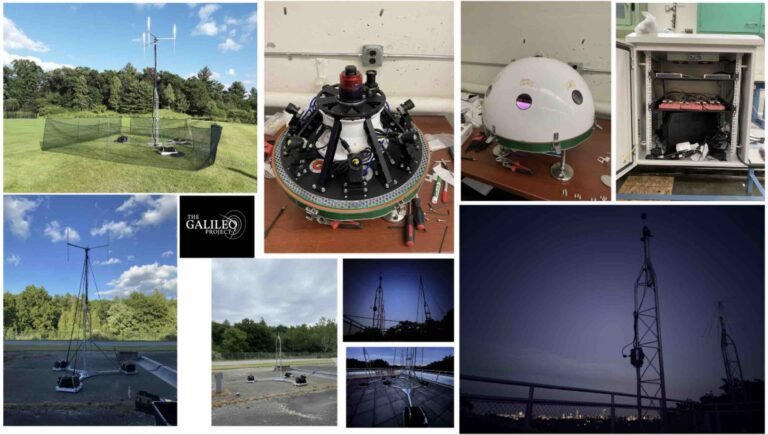
The Galileo Project aims to bring the search for extraterrestrial technological signatures of Extraterrestrial Technological Civilizations (ETCs) from accidental or anecdotal observations and legends to the mainstream of transparent, validated and systematic scientific research.
Denning goes on to then question if there has ever been any empirical evidence of aliens visiting Earth or UFO sightings.
'Has Earth been visited by aliens?,' he asked. 'All of the mathematics that we know, all of the physics that we know, all of the evidence that we have suggests that, no, that's probably not ever going to be possible and certainly hasn't happened before.
'So when we're talking about things like alien visitation, a skeptical perspective would be things are probably as the laws of physics tell us they are, unless we find evidence that aliens have visited the Earth. So far, we haven't. And so we stick with the default assumption, which is that no, things are as the laws of physics tell us they probably are, and we haven't been visited.'
In July 2023, Lieutenant Ryan Graves, a former F-18 pilot with over a decade of service in the U.S. Navy, testified that his squadron regularly detected unidentified craft while stationed off Virginia's coast in 2014
Pentagon whistleblower David Grusch, who served 14 years in the Air Force claimed in June 2023 that the US had run a top-secret UFO retrieval program for decades
In July 2023, Lieutenant Ryan Graves, a former F-18 pilot with over a decade of service in the U.S. Navy, testified that his squadron regularly detected unidentified craft while stationed off Virginia's coast in 2014.
Pentagon whistleblower David Grusch, who served 14 years in the Air Force claimed in June 2023 that the US had run a top-secret UFO retrieval program for decades and said that some of the 'non-human intelligences' discovered are malevolent and have even killed humans.
He claimed that the US has had UFOs since 'the 1930s' and has been secretly back-engineering them and carrying out a public disinformation campaign to prevent the details from leaking publicly. Grusch also suggested that the US government has murdered people as part of the conspiracy to keep UFOs a secret.
Brian Denning is a writer and producer who focuses on science and skepticism. he has published multiple books on scientific skepticism and two educational films titled: 'Here Be Dragons' in 2008 and 'Principles of Curiosity' in 2017
UAP Makes Three Changes In Direction Near Sun, UFO Sighting News.
Date of sighting: Oct 27, 08:30:07
Location of sighting: Earths Sun
Sun camera: LASCO C3
I sent a message to NASA on X platform (formerly Twitter) today asking them if they can explain this unusual object. I wrote...Hey @NASA @NASAJPL @NASAKennedy Whats up with this UAP changing directions three times in the span of a few seconds on Sun imager LASCO C3? Can you give us a zoom in image of this craft? UFO Sighting News. In space, an object that doesn't have any propulsion system or external forces acting upon it will generally continue to move in a straight line at a constant velocity, following Newton's first law of motion (the law of inertia). This means that without any propulsion or external influences, it will not change its direction on its own.
If they answer I will let you know. But this UAP makes three course corrections in a few seconds time. That means it's intelligently controlled. Therefore, it's an alien ship.
UAP Buzzes Plane Over Bartow, Florida Oct 25, 2023, UFO Sighting News. Video.
Date of sighting: Oct 25, 2023 Location of sighting: Bartow, Florida, USA
A plane was traveling across Florida from west to east and a giant glowing UFO shot past them. The object was about 15X larger and didn't fall but instead traveled ahead of the plane and out of sight. The ocean off the Florida coast is home for a huge alien base. This video is 100% proof of that. And please, compare the size for yourself of the UFO and the plane. That looks like a 727 that is below the UFO, so this UFO...is huge!
Chile’s Sky Shocker: UFO Phenomenon Breaks Cover Amidst the Clouds!
UFO sightings have long captured the imagination of many across the globe. From mysterious saucer-like shapes hovering over vast expanses of land to inexplicable light formations darting across the night sky, these unidentified flying objects have frequently become a topic of intrigue and debate. Our exploration dives deep into a particular incident in Chile, using it as a springboard to discuss the broader phenomenon of UFO sightings.
The Chilean Encounter
On a serene day, 45 miles southeast of Santiago, Chile, a family, blissfully unaware of the unusual encounter ahead, set out for a Sunday picnic near the ELO reservoir. With the picturesque valley and the vast sky serving as a perfect backdrop, the mother snapped a series of photos. But, a routine family outing soon turned into an event of paranormal proportions.
Upon returning home and browsing through the shots, an anomaly stood out – a gigantic, saucer-shaped object, lurking amidst the reddish clouds. This wasn’t just another digital glitch; the image had inadvertently captured what many believe to be evidence of UFO sightings.
A Deep Dive Analysis
The Chilean government, ever inquisitive about such events, entrusted the photos to Ted Row of the National Aviation Reporting Center on Anomalous Phenomena (NARCAP). His detailed examination of the image revealed an unexplained anomaly: a disc-shaped entity amid the clouds. When contrasting the light levels within the photograph, NARCAP deduced that the photographed object was external and solid – not a mere insertion or aberration.
Chile: A Hotbed for UFO Sightings?
Chile has often been cited as a hotspot for UFO sightings. Tales of mysterious lagoon behind the mountains near ELO reservoir serving as a UFO landing strip have often made the rounds. Regions like Sométonga and the Chilean Patagonia have reported numerous UFO shaped clouds and unidentified aerial occurrences. Could Chile’s topographical and atmospheric conditions make it a preferred destination for extraterrestrial visits?
Scientific Perspectives
While the community remains divided, experts from various fields have pitched in with their theories. Mark De Antonio, an astronomer and video effects designer, hypothesizes that the unique colors captured in the Chilean image might be the result of cirrus clouds’ prismatic effects at high altitudes. On the other hand, meteorologist Juan Hernandez believes that the reddish hue, being the prime enigma, couldn’t have been the result of a setting sun.
Video:
The Proof Is Out There: Chilean UFO Spotted in the Clouds (Season 4)
While UFO enthusiasts may be quick to label such incidents as concrete evidence of extraterrestrial life, skeptics and scientists continue their quest for logical explanations. Whether these UFO sightings are real, misinterpretations of natural phenomena, or results of man-made activities, the allure and enigma surrounding them remain undiminished.
In every war there are often lesser known experiences floating about beyond the typical tales of fighting and heroism. Here in the background of all of the conflict and death often lurk outlandish accounts of something strange going on, something perhaps even more frightening than the enemy. Strange things in the sky have long been said to loiter around places of war, going all the way back to ancient times, but this is far from just in the realm of superstition and the ignorant of the past misunderstanding common celestial phenomena, and here we will look at some of the stranger cases of these things congregating to war all the way up into modern times.
Starting from World War I we have the spectacular time the Red Baron supposedly shot down a flying saucer. The so- called Red Baron was the German ace pilot Manfred Freiherr von Richthofen, who was both renowned and feared for his unrivaled flying skills, often considered to be “the ace of aces” and racking up at least 80 air combat victories over his wartime carreer. In the book UFOs of the First World War, by Nigel Watson, there is a curious account that seems to show that human pilots were not the only ones the Red Baron hunted down and engaged. The story goes that as he was flying over the Belgian trenches in the spring of 1917 with fellow pilot Peter Waitzrick, the Baron spotted an unidentified object that was described as “an upside down silver saucer with orange lights” hovering in clear blue skies. After a moment of awe, fear and wonder, the Red Baron opened fire upon it, and Waitzrick, who reportedly saw the whole incident, described what happened next as follows:
We were terrified because we’d never seen anything like it before. The Baron immediately opened fire and the thing went down like a rock, shearing off tree limbs as it crashed into the woods.
But wait, it gets even weirder still. As they passed over the wreckage, two humanoid figures were supposedly seen to climb out of the otherworldly wrecked craft and scurry off into the trees, after which they were not seen again. Waitzrick would keep the whole bizarre story to himself until 80 years later, in 1999, when he would tell the world about it. There are certainly some suspicious aspects of the whole tale, not the least of which is that Waitzrick chose to come out with his amazing experience after 8 decades of silence to The Weekly World News, which many readers will recognize as perhaps not the most trustworthy of news publications. Also, the planes they were piloting were claimed to be Fokker triplanes, which is odd since these planes would not be used in the war until some months after the alleged event, in August of 1917. Perhaps Waitzrick just didn’t know anyone who would take his story seriously and didn’t know any better so it just happened to be that the Weekly World News picked it up, and perhaps with the planes his memory after nearly a century was not what it once was, but one thing he seems to be quite sure of is that the infamous Red Baron shot down a UFO, saying:
There’s no doubt in my mind that the Baron shot down some kind of spacecraft from another planet and those little guys who ran off into the woods were space aliens of some kind.
Other UFOs encountered during World War I are the so-called “Flaming Onions” which were typically described as glowing green balls that would zip around, do flips, other aerial maneauvers, and very often chase aircraft, easily outpacing and outmaneuvering them but not actually ever attacking them in any way. This strange phenomenon was purportedly seen throughout the war by both sides of the engagement, and it always terrified those who experienced it. One theory as to what the Flaming Onions were is that they might have been flares fired by the Germans, but flares typically do not actively chase aircraft and seasoned pilots can usually recognize flares as such. They remain a curious unexplained mystery of the war.
Besides spaceships and weird lights, another baffling aerial phenomenon reported during World War I began with a very strange sighting made by a Lieutenant Frederick Ardsley as he was on a morning patrol in northern France on January 9, 1918. As he flew along, another biplane of the same make and model as his own positioned itself next to him, and when he looked to see who was in the cockpit he was surprised to see a beautiful woman with long flowing blonde hair blow him a kiss and do a Can Can dance in her cockpit before swiftly flying away. Ardsley attempted to chase the mysterious pilot, but she was reportedly a far superior pilot and was able to easily lose him. Unbelievably, the mystery woman would show up at other times during the war and engage German pilots, usually easily beating them and shooting them down, and sighted by both pilots and civilians alike. Some reports even say that her plane was impervious to bullets or that she would vanish into thin air. She came to be known as “Lady Sopwith” or “The Valkyrie,” and became legendary. No one knows who she was or whether this is all just another wartime myth.
If alien forces are somehow attracted to war, then considering that World War II is one of the greatest and most massive wars of all time it is perhaps no surprise at all that they should be drawn there as well. On the evening of November 27, 1944, a Lt. Fred Ringwald of the U.S. Air Force was riding as an observer on a night operation over the Rhine Valley, just north of Strasbourg on the French-German border when he saw something in the sky that was not supposed to be there. There over a hill in the distance were eight to 10 of lights in a row, glowing fiery orange, and when he pointed them out the pilot and the rest of the crew saw them too. They checked with Allied ground radar, but they registered nothing. As they decided whether to engage, the lights then simply vanished. It was completely baffling to them, as these lights had not been any known aircraft they were familiar with and defied any rational explanation, and they decided to keep it to themselves.
Ringwald and his crew were part of a U.S. Air Force unit called the 415th Special Operations Squadron. Formed in 1943, it was tasked with carrying out missions in the Mediterranean Theatre of Operations, and then later in northwestern Europe during World War II. As the name suggests, they were mostly involved in nighttime operations and missions, which made them especially likely to notice strange lights in the skies around them. Although Ringwald’s crew stayed quiet about what they had seen on that mission, they would soon learn that other flights from their unit were starting to see something similar in the sky, in particular over the German-occupied Rhine Valley. Pilots were coming forward with stories of strange lights, usually red, orange, or green following them, or even flying parallel to their planes to pace them. They were reported as typically cigar-shaped, with no wings or visible propulsion system, and very maneuverable and fast, as well as often flying in formation of up to 10 of them and never showing up on radar. These mysterious lights had a habit of seeming to toy with the pilots, before suddenly tearing away at breathtaking speed or simply vanishing into thin air, and no one had any idea of what they were. One baffled airman would give a good representative account when he said:
I was flying and there was an object next to me. I couldn’t get rid of it, I slowed up, it was there. I sped up, it was there. I would dive, it would be there. I turned to starboard and two balls of fire turned with me. I turned to the port side and they turned with me. We were going 260 miles an hour and the balls were keeping up with me. I called. Nothing on radar.
These objects defied all explanation, and there were whispers that they were not of this planet. Sightings began pouring in from all over the European Theater of war, and it was looking more like the War of the Worlds than World War II. Before long these mysterious glowing craft were being called "Foo Fighters," which is a silly name that came from the comic strip Smokey Stover, in which the main character had the catchphrase “Where there’s foo there’s fire.” Considering the reliability and experience of these witnesses, on top of the sheer number and consistency of reports, the military launched an investigation into the phenomenon. At first they suspected that the Foo Fighters were some sort of top secret German weapons, but the rabbit hole got deeper when they learned that enemy pilots were seeing the same thing and they also realized that the objects never actually seemed to attack or act in a threatening manner. After a full investigation there was no official conclusion reached. Theories include that these Foo Fighters were enemy tech, some sort of atmospheric phenomenon, or just combat fatigue and the pilots seeing things, but their true nature remains unknown.
Interestingly, over in the Pacific Theater of Operations of the war pilots there were also reporting bizarre things in the sky. In this case, rather than glowing objects zipping about doing aerial maneuvers, pilots typically reported “balls of fire” hanging in the sky, often just hovering there before shooting off or vanishing. Once again, theories were thrown around that these were just some kind of Japanese weapon, but as with the Foo Fighters of Europe they never seemed to attack and the enemy fighters were seeing them as well. Although the terms UFO and flying saucer had not yet been coined, both the Foo Fighters and the Pacific balls of fire would have certainly fit the bill. Aliens or something else? The answer remains lost to the mists of time.
Moving on to the Korean War, fought between North Korea and South Korea from 1950 to 1953, we have a case that has largely remained confined to the shadows of history, and which supposedly involved a whole regiment of men who seem to have come under attack by forces from beyond this world. A very bizarre account from the Korean War emerged in January of 1987, when John Timmerman, of the J. Allen Hynek Center for UFO Studies (CUFOS), sat down for an interview with a former U.S. Army private first class (PFC) by the name of Mr. Francis P. Wall, who had a most unusual tale to tell. Wall had been deployed with the Army infantry, 25th Division, 27th Regiment, 2nd Battalion, 'Easy' Company, and in May of 1951 they were operating outside of Chorwon, in an area known by the military as the Iron Triangle, on a mission to reach a small village in the mountains. The village in question was in an area marked to be bombarded with artillery fire, wiped off the face of the earth, and Wall and his men were there to make sure that any innocent civilians were properly warned of the impending rain of fire. Indeed, the air was already reverberating with the thumps and booms of shells hitting, the dark of night occasionally lit up with flashes in the distance. Wall and company had made their way to a steep slope overlooking the village and the fiery flowers of artillery airbursts painting the scene with fire, and that was when they saw something they could not explain up there in the air in the middle of this war ravaged scene. Wall would say of this:
We suddenly noticed on our right-hand side what appeared to be a jack-o-lantern come wafting down across the mountain. And at first no one thought anything about it. So we noticed that this thing continued on down to the village to where, indeed, the artillery air bursts were exploding. It had an orange glow in the beginning. We further noticed that this object was [so] quick that it could get into the center of an airburst of artillery and yet remain unharmed. But then this object approached us. And it turned a blue-green brilliant light. It's hard to distinguish the size of it; there's no way to compare it. The light was pulsating. This object approached us.
The men were understandably very unsettled by this point, as the object was obviously not one of theirs, nor any known aircraft any of them had ever seen before, and they radioed the situation in to their superiors, requesting permission to open fire on it. Why they would think that their rifles would do any good when they had just witnessed it casually make its way through artillery explosions is anyone’s guess, but the permission was granted and Wall claims that he would then open fire on it with his M-1 rifle loaded with armor piercing bullets. He claims that he hit the object several times, hearing the pings of the bullets against what sounded like metal, and the bullets seemed to have an effect on it where the artillery had not, apparently damaging it and causing it to exhibit some strange behavior. Wall would say:
Now why would that bullet damage this craft if the artillery rounds didn't? I don't know, unless they had dropped their protective field around them, or whatever. But the object went wild, and the light was going on and off. It went off completely once, briefly. And it was moving erratically from side to side as though it might crash to the ground. Then, a sound -- we had heard no sound previous to this -- the sound of, like, diesel locomotives revving up. That's the way this thing sounded.
This was where things would get pretty harrowing, as according to Wall the craft unleashed some sort of a retaliatory attack on them. The craft allegedly emitted a kind of ray or beam that came in pulses, and which they could see aiming at them “like a searchlight.” When the ray swept over them the men found themselves overcome with a tingling, burning sensation, and while it didn’t seem to be causing any visible damage they could feel it penetrating through their skin and the pain was enough to make them scramble for cover, scurrying in a panic into their bunkers, where the attack seemed to continue. Wall describes the terrifying and otherworldly scene thusly:
So the company commander, Lt. Evans, hauled us into our bunkers. We didn't know what was going to happen. We were scared. These are underground dugouts where you have peep holes to look out to fire at the enemy. So, I'm in my bunker with another man. We're peeping out at this thing. It hovered over us for a while, lit up the whole area with its light, and then I saw it shoot off at a 45-degree angle, that quick, just there and gone. That quick. And it was as though that was the end of it.
Unfortunately for Wall and the others, this seemed to be far from the end of it, as over the next few days they would begin to develop an array of debilitating physical symptoms, including disorientation, memory loss, headaches, stomachaches, nausea, and extreme weakness that was potent enough that some of them had trouble even walking. Doctors who examined them could find no reason or cause for these symptoms, the only evidence that anything was wrong being an unusually high white blood cell count that could not be explained. Despite nothing really officially being wrong with them, the men were nevertheless all physically ill and suffering from something, and it was widely assumed by them that this was the doing of the beam that UFO had fired at them. According to Wall, many of them continued to suffer from ill health for years after the encounter, with him saying that even to that day he had frequent bouts of disorientation, memory loss, weakness, and difficulty putting on weight.
In later years it has been speculated that the men were probably suffering from radiation sickness, but there have been plenty of other ideas by those who have heard of this rather obscure case. One idea is that the Soviets or even the Chinese had been carrying out covert military experiments in the remote region testing anti-gravity technology and sonic weaponry, and indeed this has been used as an explanation for many of the dozens of other UFO sightings made during the Korean War. Of course there is also the notion that this encounter was exactly what it looks like, being an attack by an actual UFO, perhaps having been present in the region observing the combat for inscrutable reasons, and it has even been suggested that the craft did not mean to launch a fatal attack, but to merely disorient and immobilize them, hence the fact that that they did not suffer any severe injury or death.
Then again, maybe this is all hallucinations and the result of trauma, tiredness, and stress in the war-torn environment. It could even just be a tall tale conjured up by Wall himself, as he is the only official witness, and although he claims that 25 other men witnessed this event none of these others seem to have ever been tracked down and independently interviewed. Just about the only thing known for sure is tht he was indeed a soldier in the Korean War in the area specified on the date specified, but after that no one knows. Although he swore an oath that his story is true, in the end we are really left to take the word of one witness. So was this just war time hallucinations, Soviet or Chinese experiments, or an actual attack by an otherworldly UFO? It is quite likely we will never have a concrete answer, and that this will just remain another curious account lost in the fog and history of warfare.
By all accounts it seems that troops in the Vietnam War were also absolutely plagued by UFO activity, and some of the most spectacular reports of alien encounters that seem to have occurred during the Vietnam War have to do with actual military engagements with UFOs. One such incident allegedly occurred on June 15, 1968, along the demilitarized zone (DMZ) between North and South Vietnam, where a patrol boat known as PCF-12, commanded by a Lieutenant Pete Snyder, was on a routine night patrol near Cua Viet. At 12:30AM, PCF-12 reportedly received a frantic distress call from another patrol boat in the vicinity, PCF-19, claiming that they were being attacked by unidentified lights they were calling “enemy helicopters,” which seemed odd because the North Vietnamese enemy were not known to utilize combat helicopters at the time.
Snyder ordered the PCF-12 to head for PCF-19’s position to offer assistance, and they as they closed in reported spotting in the sky two circular bright lights immersed in a “strange glow” hovering over PCF-19’s position. As they approached, one of the strange lights reportedly emitted a bright flash of light, after which PCF-19 exploded in a cascade of water and flying debris. Directly after the destruction of PCF-19, the two enigmatic lights were described as rapidly accelerating away towards the sea as PCF-12 scouted the area for any possible survivors of the carnage they had just witnessed. Two wounded men were found and recalled that the two UFOs had been trailing them for miles along the river. The survivors then claimed that they had decided to fire upon the threatening, mysterious objects, and that was when one of them had issued a piercing blast of light to obliterate the boat. At first it was thought by officials that the PCF-12 had been the victim of an enemy missile fired from shore, but a later AP dispatch from Saigon would quote a military spokesman as having attributed the loss of PCF-19 to an “unidentified object,” and not enemy coastal batteries or missiles.
The PCF-12 continued its patrol up the river and were soon approached by the same two unidentified lights, which took up positions hovering on the port and starboard sides around 300 yards away and 100 feet above the water. PCF-12 called in to headquarters to try and get an idea of what they were dealing with, but were met with the response that there were no aircraft in the area at the time. Realizing that these craft were not friendly, Snyder ordered his men to open fire on the lights, which apparently did little to faze or even slow them down, and PCF-12 began to retreat at full speed as the two mysterious aircraft tailed and stalked them, flickering in the night the whole time. Second engine man Jim Steffes would later claim that he got a good look at the craft and described them as having “a rounded front like an observation helo,” and what looked like “two crewman sitting side by side.”
Strangely, although no weapons could be seen mounted on the unidentified aircraft, PCF-12 nevertheless found itself being fired upon. Steffes remembered seeing tracer rounds piercing up into the night from the nearby base Point Dume, with their targets being what he said were other far-off blinking circular lights whizzing about in the sky above. Eventually, a group of Phantom F4 fighter jets arrived to converge upon and chase off the strange lights that were plaguing PCF-12 out to sea, leaving the crew to wonder what in the hell had just happened.
At roughly the same time, another very strange incident was unfolding out in the South China Sea with an Allied ship of the Royal Australian Navy, the HMAS Hobart, which was patrolling near Tiger Island, about 20kms off Cap Lay and reported sighting up to 30 unidentified slow-moving lights hovering in the night sky near their ship, which were at first thought to be Russian-built M-14 ‘Hound’ helicopters, but upon closer inspection it could be seen that they were not. US 7th Air Force Phantom fighter-bombers were sent to engage, supported by generous anti-aircraft fire from the ground. The lights flew out to sea as they were pursued by the fighters, which fired upon them mercilessly along with several other military ships in the area, which unfortunately contributed to the friendly fire incident in which a U.S. swift boat was sunk by missiles, killing 5 of the 7 crew.
The HMAS Hobart was prepped for battle when the radar room detected an incoming unidentified aircraft coming in fast with no identification number to mark it as friend or foe. Word soon came in that the craft was “friendly,” but it was then that a missile struck the ship to kill one and injure two others, followed by a barrage of two more missiles. Whatever the craft was swiftly fled the scene before it could be shot down. In the meantime, F4 jets scrambled about firing upon the lights, joined by a hail of anti-aircraft fire from the ground, with attempts to communicate with whoever was onboard the mystery craft going unanswered. Eventually, the lights floated off and the fighter pilots were ordered back to base. The following morning, a complete search of the area turned up not a single shred of wreckage of an enemy helicopter, or any other enemy aircraft for that matter, despite the intense fighting that had occurred. The complete and utter lack of any wreckage of any aircraft was baffling considering that these enemies had come under such resistance and been met with so much concerted, relentless fire. The Royal Australian Navy News would later confirm:
No physical evidence of helicopters destroyed has been discovered in the area of activity nor has extensive reconnaissance produced any evidence of enemy helicopter operations in or near the DMZ.
There was little confidence among the men engaged in the incident that the aggressors had been “enemy helicopters” as was at first claimed. After all, if that were the case they should have been decimated by the potent retaliatory force displayed upon their arrival and attacks. There was also no trace whatsoever of helicopters at the time in the area before or during the incident and no wreckage afterwards. A skipper aboard the Hobart during the baffling engagement would later claim that it was certainly not enemy helicopters, expressing his doubt of such a theory by saying:
Neither before nor after the incident … was there any report by any of the ships of a helicopter being there [around Tiger Island]. Now having said that, the captain of one of the American ships told me later at Subic Bay that he thought there were helicopters there, but the fact is he didn’t report, and if he believed there was a helicopter … it was his duty to report it at the time, but there was no report.
Whatever the lights were that caused so much chaos continued to be sighted sporadically for months afterwards along the DMZ, furtively skirting around the area, wandering back and forth over the line, and baffling those who saw them. They were often sighted by radar roaming up and down the coast, and apparently no one could quite figure out what they were. They appeared on radar to be low, slow moving objects just like helicopters, but often there would be no visible confirmation or they would not look at all like helicopters. They were also prone to just disappearing into thin air, and jets scrambled to intercept the objects would arrive to find nothing there. Troops on the ground would sometimes witness the lights appear and disappear out of nowhere, and in one such case American artillerymen reported seeing a group of mysterious lights along the Ben Hai River, but when they had opened fire on them the objects had suddenly vanished as if they had never been there at all. At no point did anyone report seeing an actual helicopter, and the strange objects were always described as moving lights, often hovering erratically or moving in sudden bursts of speed inconsistent with a helicopter.
The origin of the strange lights remains unknown to this day. There were theories at the time that somehow a misreading of radar signals had occurred, which had then made other friendly vessels appear to be slow moving flying blips, or that the North Vietnamese had more helicopter power than had been previously assumed. In the end the official explanation was that it was all due to atmospheric disturbances or possible enemy helicopter activity, coupled with panicked friendly fire, and there have also been theories that it was all due to bird flocks or even insect swarms, but does any of this really match up to what occurred? Would trained Navy and fighter jet personnel go to engage such mundane phenomena? What hit the Hobart? Indeed what attacked the PCF 12 and 19 at precisely the same time? If there were enemy helicopters involved where was all the wreckage, why were they never successfully shot down, and wouldn’t these trained men know helicopters when they saw them? It is also strange that an enemy helicopter would so brazenly venture over the heavily defended DMZ, and it would be strange that they should fly around with their lights on all of the time for hours on end. In the case of the Hobart it seems obvious that this was some sort of concerted attack, but by who or what remains open to debate and speculation.
It is interesting that these reports make mention of “enemy helicopters,” as this was a term used so often to describe any unidentified lights in the sky in Vietnam that it became sort of a code word for “UFO,” regardless of any relation the object had to an actual helicopter, becoming sort of a catch-all phrase for anything weird in the sky. The fact that the Viet Cong were not known to use helicopters made it a perfect way to explain discreetly when men were seeing something in the sky that shouldn’t be there. On October 16, 1973, the USAF Chief of Staff, General George S. Brown, gave a press conference in Illinois where he addressed this terminology to some extent when asked about UFOs in Vietnam, saying:
I don’t know whether this story has ever been told or not. They weren’t called UFOs. They were called enemy helicopters. And they were only seen at night and they were only seen in certain places. They were seen up around the DMZ [demilitarized zone] in the early summer of ’68. And this resulted in quite a little battle. And in the course of this, an Australian destroyer took a hit and we never found any enemy, we only found ourselves when this had all been sorted out. And this caused some shooting there, and there was no enemy at all involved but we always reacted. Always after dark.
Another comment on the matter was made by a patrol boat captain by the name of Bill Cooper, who served in Vietnam from 1967 to 1969. During a UFO conference in Los Angeles in 1989, Cooper would say of his own experiences:
After about five months I was sent up north to the DMZ, to a place called Qua Vieaf [perhaps Qua Viet] on the Tacan [sic] river …. It was while there that I discovered that there was a tremendous amount of UFO and alien activity in Vietnam. It was always reported in official messages as ‘enemy helicopters’. Now any of you who know anything about the Vietnam war know that the North Vietnamese did not have any helicopters especially after our first couple of air raids into North Vietnam [during 1965]. Even if they had, they would not have been so foolish as to bring them over the DMZ, because that would have ensured their demise.
Another American ship was not directly attacked, but nevertheless allegedly had a very intimidating and threatening encounter with an Unidentified Underwater Submersible, or USO. In 1974 the ammunitions ship the USS Kilauea was operating in the Indian Ocean along with a destroyer and a carrier, and the witness claims that one evening at around 9PM he had been on deck with two friends looking up at the brilliant array of stars in the night sky. Their attention was drawn to the eerie beauty of the shifting light trails formed by phosphorus algae in the wake of the ship in formation in front of them, yet as they watched this light display of nature something else began glowing in the depths, becoming brighter and brighter until it became a blinding orange/yellow ball just under the surface. The mysterious blazing orb then spectacularly burst forth from the water to arch right over the top of the destroyer, just missing smashing into it, before crashing back into the ocean on the other side and sinking back into the dark depths. The witness would say of the puzzling, frightening incident:
We all just stared at each other with our mouths open. We could not believe what we saw, but I asked friends of mine who were on watch on the bridge if they saw it and they all did. There was nothing ever reported that I know of though and we just quit talking about it. I bet the destroyer got a good look at it. It went right over the bridge of that ship and it was big. Maybe 150 to 200 feet in diameter. That was my big encounter.
It is all a very intriguing peek into some of the more mysterious aspects of these wars. Such tales lurk beyond the known history of these conflicts, hiding in the cracks and shadows and invisible, lost to the mists of time save for the few who are willing to share their bizarre tales. What went on out there in the skies above all of the fighting? What were these troopers and pilots dealing with? Were these cases some sort of experimental aircraft, the stresses of combat playing tricks on the imagination, or something altogether more bizarre? The true answers have been buried by history and lost to the mysterious shadows of history.
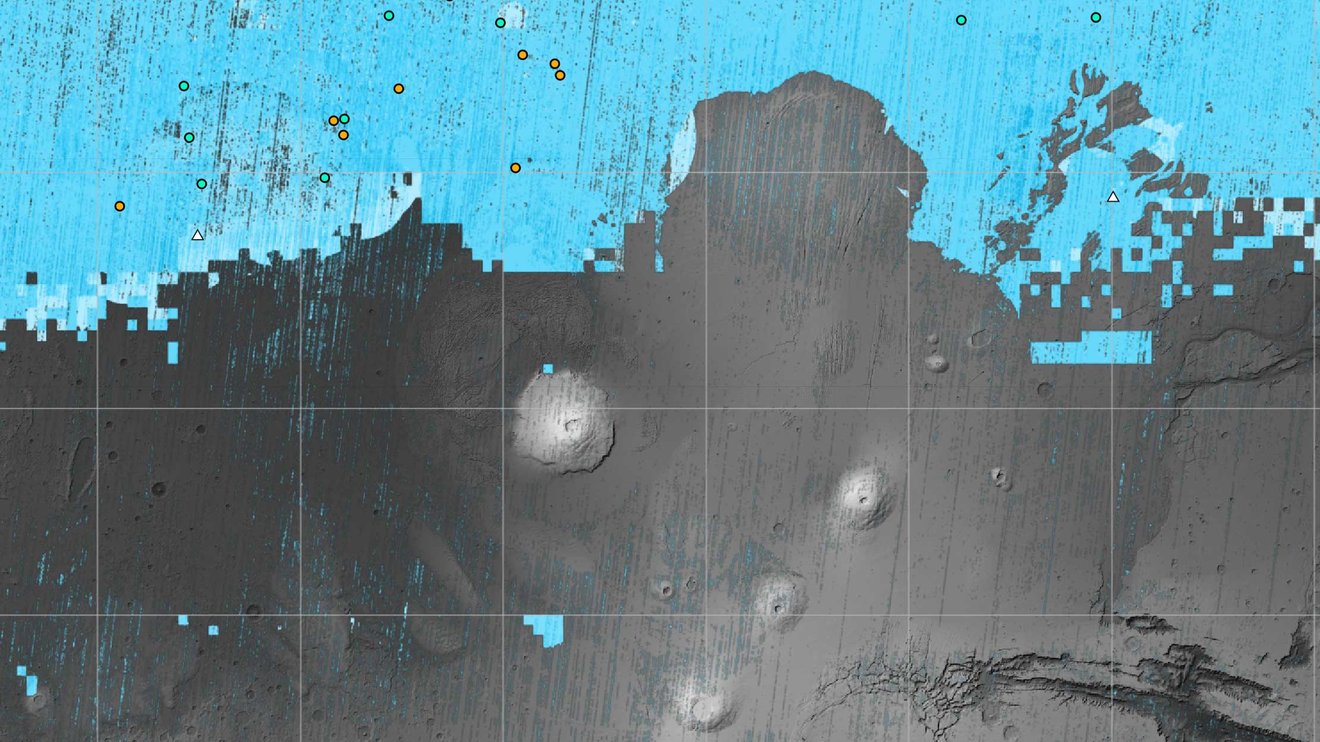
The blue areas on this map of Mars are regions where NASA missions have detected subsurface water ice (from the equator to 60 degrees north latitude). Scientists can use the map – part of the Subsurface Water Ice Mapping project – to decide where the ... Credit: NASA/JPL-Caltech/Planetary Science Institute.
Water will be one of the most important resources for human explorers on Mars. They’ll need it for drinking, propellant, breathing, and more. It makes sense to land near a spot where there’s water ice close to the surface.
NASA has released a new map of Mars’s northern hemisphere showing all the places where subsurface water ice has been detected, some of which are surprisingly close to the equator, as well as surprisingly close to the surface. This map could decide the first human landing site.
Earlier and later HiRISE images of a fresh meteorite crater 12 meters, or 40 feet, across located within Arcadia Planitia on Mars show how water ice excavated at the crater faded with time. The images, each 35 meters, or 115 feet across, were taken in November 2008 and January 2009. Credit: NASA/JPL-Caltech/University of Arizona
Early on during the Mars Reconnaissance Orbiter (MRO) mission, which arrived at Mars in 2006, scientists started finding evidence of subsurface water ice being exposed from recent impacts, showing up as bright white in the high-resolution images from the new spacecraft. While scientists were fairly certain there was ice below the surface at high latitudes of Mars, they were surprised to find that the ice was also present closer to the equator.
But whenever you’re looking for exposed subsurface ice on the Red Planet, you have to look fast. It doesn’t take long for ice — or water – to sublimate away because of the thin atmosphere on Mars.
The ice-exposing impact crater at the center of this image is an example of what scientists look for when mapping places where future astronauts should land on Mars. It’s one of several such impacts incorporated into the latest version of a series of NASA-funded maps of subsurface water ice on the Red Planet.
Credit: NASA/JPL-Caltech/University of Arizona
Scientists have now combined data from several NASA missions, including MRO, 2001 Mars Odyssey, and the now-inactive Mars Global Surveyor. The project is called SWIM, Subsurface Water Ice Mapping. The project has just released its fourth set of maps, and NASA and JPL say these are the most detailed water ice maps since the project began in 2017.
Using a mix of data sets, scientists have identified the likeliest places to find Martian ice that could be accessed from the surface by future missions.
“These ice-revealing impacts provide a valuable form of ground truth in that they show us locations where the presence of ground ice is unequivocal,” said Gareth Morgan, SWIM’s co-lead at the Planetary Science Institute, in a JPL press release. “We can then use these locations to test that our mapping methods are sound.”
These Mars global maps show the likely distribution of water ice buried within the upper 3 feet (1 meter) of the planet’s surface and represent the latest data from the SWIM project. Buried ice will be a vital resource for astronauts on Mars, serving … Credit: NASA/JPL-Caltech/PSI
The new maps reveal what scientists believe are masses of subsurface frozen water along Mars’ mid-latitudes. The northern mid-latitudes are especially attractive because a thicker atmosphere exists there than most other regions on the planet. A thicker atmosphere would aid in slowing down an incoming spacecraft. NASA says the ideal astronaut landing sites would be a sweet spot at the southernmost edge of this region – far enough north for ice to be present but close enough to the equator to ensure the warmest possible temperatures for astronauts in an icy region.
“If you send humans to Mars, you want to get them as close to the equator as you can,” said Sydney Do, JPL’s SWIM project manager. “The less energy you have to expend on keeping astronauts and their supporting equipment warm, the more you have for other things they’ll need.”
The HiRISE camera on NASA’s Mars Reconnaissance Orbiter took this image of a new, 8-meter (26-foot)-diameter meteorite impact crater in the topographically flat, dark plains within Vastitas Borealis, Mars, on November 1, 2008. The crater was made sometime after Jan. 26, 2008. Bright water ice was excavated by, and now surrounds, the crater. This entire image is 50 meters (164 feet) across. Credit: NASA/JPL-Caltech/University of Arizona
Back in 2009, data from several instruments on MRO detected and confirmed highly pure, bright ice exposed in new craters, ranging from 1.5 feet to 8 feet deep, at five different Martian sites. Scientists said they were able to figure out, given how long it took that ice to fade from view, that the ice was about 99 percent pure ice.
Over the years, MRO’s wonderful, high-resolution camera, HiRISE (High-Resolution Imaging Science Experiment) has continued to study fresh impact craters, where meteoroids may have excavated chunks of ice. For the latest maps for the SWIM project, HiRISE data was incorporated to provide the most detailed perspective of the ice’s boundary line as close to the equator as possible. Another instrument on MRO, the Context Camera, which provides a big-picture, background view of the terrain, provides data that further refines the northern hemisphere maps.
Detailed image of large-scale crater floor polygons, caused by desiccation process, with smaller polygons caused by thermal contraction inside. The central polygon is 160 metres in diameter, smaller ones range 10 to 15 metres in width and the cracks are 5-10 metres across. Credit: NASA/JPL
In addition to ice-exposing impacts, scientists also look for “polygon terrain,” where the seasonal expansion and contraction of subsurface ice causes the ground to form polygonal cracks. Seeing these polygons extending around fresh, ice-filled impact craters is yet another indication there’s more ice hidden beneath the surface at these locations.
“The amount of water ice found in locations across the Martian mid-latitudes isn’t uniform; some regions seem to have more than others, and no one really knows why,” said Nathaniel Putzig, SWIM’s other co-lead at the Planetary Science Institute. “The newest SWIM map could lead to new hypotheses for why these variations happen.”
In this artist’s concept, NASA astronauts drill into the Martian subsurface. The agency has created new maps that show where ice is most likely to be easily accessible to future astronauts.
Credit: NASA
He added that it could also help scientists tweak models of how the ancient Martian climate evolved over time, leaving larger amounts of ice deposited in some regions and lesser amounts in others.
SWIM’s scientists hope the project will serve as a foundation for a proposed future mission, called Mars Ice Mapper. This would be an orbiter with a powerful subsurface radar that could search for near-surface ice beyond where HiRISE has confirmed its presence.
This artist’s rendering shows the star HR 8799 and one of its four planets, HR 8799c. It illustrates the system at an early stage of evolution. It also shows the star's dusty disk and rocky inner planets. Credit: Dunlap Institute for Astronomy & Astrophysics
When the JWST activated its penetrating infrared eyes in July 2022, it faced a massive wish-list of targets compiled by an eager international astronomy community. Distant, early galaxies, nascent planets forming in dusty disks, and the end of the Universe’s dark ages and its first light were on the list. But exoplanets were also on the list, and there were thousands of them beckoning to be studied.
But one distant solar system stood out: HR 8799, a system about 133 light-years away.
Why this system over others? 15 years ago astronomers discovered three exoplanets orbiting the star. Not long after they announced a fourth, all detected with direct imaging. They’re all massive planets on wide orbits, which are rare. The HR 8799 system is also young, another important point.
The fact that they were discovered 15 years ago is also important; it means we have observations of these planets that span a lengthy time. This type of data is critical to understanding other solar systems because the duration of the data paints a more complete picture.
However, it also poses more questions and whets our appetite for more answers.
That’s why the JWST observed the system recently. Its MIRI instrument and its coronagraph can perform the kind of high-contrast imaging needed to understand the system better.
HR 8799 is 1.5 times more massive than the Sun and is almost five times more luminous. It’s also surrounded by a debris disk and is only about 30 million years old. Young solar systems are important because they can reveal the intricate details behind planet formation, one of the things the JWST was built to focus on.
The four planets are HR 8799 b, c, d, and e. They’re all massive planets, between 5.7 and 9.1 Jupiter masses, barely below the point where deuterium fusion takes place, making them brown dwarfs. They range from 16 to 71 astronomical units away from the star, and have orbits from about 45 to about 460 years. All four of them have radii of about 1.2 Jupiter radii.
A portrait of the HR8799 planetary system as imaged by the Hale Telescope. A fourth planet was eventually discovered. Credit: NASA/JPL-Caltech/Palomar Observatory.
Massive giant planets that follow large orbits greater than 5 AU are rare. So every instance of these types of planets is important. MIRI’s high contrast imaging can open up a new window on these types of systems and allowing scientists to characterize them more fully. Mid-infrared observations of the system have been difficult up until now. Not only that, but the JWST’s angular resolution makes the observations even more powerful.
What did the JWST find?
“Overall, the MIRI images of the HR 8799 system yield a very different vision than in the near IR, with the clear detection of the four planets, together with a localized but extended central emission,” the authors write.
The JWST was able to refine what we already know about some aspects of this system. The main objective of this work was to characterize the planetary atmospheres better.
While there has been some uncertainty around the nature of the planets, and if they are brown dwarfs, the JWST observations put that idea to rest. “Their colors indicate that these four giant planets differ from field brown dwarfs,” the authors write.
An artist’s depiction of the relative sizes of the Sun, a low-mass star, a brown dwarf, Jupiter, and the Earth. While there was some initial uncertainty over the nature of the planets around HR 8799, the JWST images confirmed them as planets rather than brown dwarfs. Image Credit: Jupiter: NASA,ESA,and A. Simon (NASA,GSFC); Sun and Low-Mass Star: NASA,SDO; Brown Dwarf: NASA,ESA,and JPL-Caltech; Earth: NASA; Infographic: NASA and E. Wheatley (STScI)
Their temperatures range from 900 K to 1300 K, with HR 8799 b being fainter and cooler. The JWST measurement’s shows that planet b’s temperature is lower than previous observations showed, an indication of the telescope’s greater power. MIRI also identified two atmospheric chemicals unequivocally: H2O and CO. The authors say there’s a debatable detection of methane, and that’s additional evidence that they’re planets not brown dwarfs. Brown dwarfs always show the signature for methane at these temperatures.
The JWST’s MIRI instrument was built with different filters. They were partly designed to investigate the presence of ammonia, which is a solid biosignature on terrestrial planets. Unfortunately, these four planets are a little too hot for ammonia to stand out. “As a result, the current data cannot conclude on the detectability of the ammonia feature in the HR 8799 planets,” the paper states. If it had detected ammonia, it would be headline news.
This is one of the JWST’s MIRI images of HR 8799 and its four planets. It won’t grace the cover of a magazine; it’s a scientific image. Image Credit: Boccaletti et al. 2023.
The HR 8799 system is also noteworthy for its debris disk. It’s unusual in that it has two belts. Researchers have wondered if the inner edge of the outer belt was caused by a fifth planet with a mass between Jupiter’s and Saturn’s. Others thought it might be a dust clump.
But the JWST shows that it’s a background object, and seems to have ended the debate. “With a new data point, 4.44 years apart from the former detection, we can now safely conclude that this is a background object,” the authors write.
The powerful filters on the JWST’s MIRI instrument ended the debate about a potential fifth planet at HR 8799. This MIRI image helped determine that the object is in fact a background object. Image Credit: Boccaletti et al. 2023.
This was the JWST’s first look at a young exoplanetary system with its MIRI instrument, including its filters and its coronagraph. “The MIRI instrument onboard JWST is now offering high-contrast imaging capacity at mid-IR wavelengths, thereby opening a completely new field of investigation to characterize young exoplanetary systems,” the authors explain.
As such, the main thrust of the work was to test the observations and different algorithms to determine how to best use it in future work, and how to interpret the results. For example, measuring a planet’s flux successfully means accounting for how the coronagraph attenuates the images, depending on a planet’s position.
These observations contribute to using the instrument more effectively. Ironically, MIRI’s coronagraph can be so sensitive that understanding its images of young stellar systems can be challenging. The use of the instrument is only in its infancy, and the coronagraphs extreme sensitivity “can make the detection and the interpretation of young system observations very challenging, not mentioning the confusion related to background galaxies,” the authors write.
The authors point out that there’s still room for improvement, and these results will only lead to improved future results.
Former US intelligence officer David Grusch testified before Congress during the July 2023 UAP hearing, stating that we have numerous spacecraft of non-human origin. If this is the case, one might wonder if any contact has been established between humans and these extraterrestrial species. There have been persistent rumors suggesting that the US government may have signed treaties with these extraterrestrials and has been engaged in collaborative efforts with them over an extended period.
According to a rather extraordinary claim made by former US government consultant Timothy Good, it is alleged that the 34th President of the United States, Dwight D. Eisenhower, had three clandestine meetings with extraterrestrials. Good claimed Eisenhower met aliens at a remote air base in New Mexico in 1954. In more recent times, former Israeli Space Head Haim Eshed stated that aliens and the U.S. government had reached some type of deal to stay quiet about their experiments on Earth and secret facilities on Mars. Eshed went on to claim the existence of a “Galactic Federation” and implied that then-President Trump was on the brink of making significant revelations in this regard.
Video Evidence
During a podcast with former Fox News anchor Clayton Morris on his show Redacted, Joshua Reid, a former United States Navy serviceman with a background in missile weapons defense systems, brought a wealth of knowledge and experience to the table. He opened the conversation by referencing his personal experiences in the Navy, specifically during the years 2004 to 2006. Reid’s background made him intimately familiar with topics related to secret space projects, a subject that has piqued his interest for over two and a half decades.
It is worth noting that Joshua Reid’s extensive research in the field of UAPs and classified information has led him to the inner workings of certain government activities. His extensive four-year investigation revealed a disconcerting pattern. It appeared that military technology, particularly in special access programs, was unintentionally making its way to foreign adversaries, including China. This exchange of classified information seemed to involve universities and professors who were receiving grants to reverse engineer technologies from these programs.
The remarkable twist in this story was that Hillary Clinton’s emails were potentially facilitating the sale of this classified information to China and other foreign entities. China would fund universities, enticing professors to divulge information on special access programs. This enabled them to advance their technology rapidly, potentially reaching parity with the United States.
Former Inspector General I. Charles McCullough III, well-versed in these special access programs, played a crucial role in this unfolding drama. He represented David Grusch and became a central figure in the whistleblower saga. According to Reid, multiple whistleblowers were involved, with two possessing firsthand information and tangible evidence. The fear of repercussions led these individuals to testify in front of congressmen, notably, Indiana Congressman André Carson. However, it was not until these whistleblowers presented video evidence of intelligence community members communicating with extraterrestrials that congressmen took their claims seriously.
The impact of these videos was profound. Congressmen were visibly shaken, with one trembling and another drinking water profusely. This sudden shift in demeanor signified that the evidence was both extraordinary and unsettling. The whistleblowers were introduced to Inspector General McCullough, who had an extensive background in the very special access programs at the center of the controversy.
“I’ve heard that we can confirm this later, but from what I’m hearing, André Carson is this Congressman that they testified in front of, along with a few others. The Congressman didn’t take these guys seriously, but what ended up happening is they pulled out the evidence, a DVD, and they showed these congressmen video evidence of intelligence community members communicating with extraterrestrials. After these videos were shown to congressmen, they were noticeably shaken in fear. One of them was holding a piece of paper and could not stop shaking. Another was drinking water profusely, and this is when they began to take this very, very seriously and introduce these gentlemen to the former Inspector General of the Intelligence Community, McCullough. Hence, he enters the picture as someone who understands these SAP programs, has been read into these programs from back in the day, and is now representing these gentlemen.”
Morris was eager to learn more about the DVDs and the physical evidence related to the astounding claims made by the whistleblowers. He posed the question of where this evidence was currently held and whether the public would ever have the opportunity to view it.
Joshua Reid responded by revealing that the evidence, in the form of DVDs and other materials, was regarded as an “insurance policy.” This meant that the evidence was securely in the hands of two prominent UFO researchers. Furthermore, Reid confirmed that these researchers had not only seen the evidence but also verified its authenticity, which was a significant factor contributing to the growing interest in this matter.
Morris was eager to learn more about the DVDs and the physical evidence related to the astounding claims made by the whistleblowers. He asked Reid where this evidence was currently held and whether the public would ever have the opportunity to view it.
Joshua Reid responded by revealing that the evidence, in the form of DVDs and other materials, was regarded as an “insurance policy.” This meant that the evidence was securely in the hands of two prominent UFO researchers. Furthermore, Reid confirmed that these researchers had not only seen the evidence but also verified its authenticity, which was a significant factor contributing to the growing interest in this matter.
One of the prominent UFO researchers who has been sharing insider knowledge on UAPs is investigative journalist Ross Coulthart. It is quite uncertain if Coulthart possesses this DVD evidence but he did reveal that there exists a huge UFO in the possession of the United States that cannot be moved, and he knows the location of the craft. Ross mentioned the existence of non-human intelligence engaging with Earth for a long time and the recovery of certain objects, but he could not disclose specific details due to concerns about revealing advanced technologies.
In a recent episode of “The UFO Podcast,” host Andy engaged in a thought-provoking conversation with Ross. The discussion centered around the secrecy surrounding UFO sightings and government knowledge. Ross, who has deep insights into the matter, shared his perspective on why certain details remain undisclosed.
Andy began by addressing a critical question that has been on the minds of many UFO enthusiasts: the location of the mysterious craft. He asked Ross whether he could reveal where the craft was being held.
Ross responded: “Let me tell you, I can’t tell you the country it’s in; it’s not America. But what I can tell you is that the place where it is kept is used for another purpose that is a laudatory purpose that’s as much in your interests in your country in the UK as it is in mine in Australia and as it is in America. The simple reasons are that there are other uses for the place where this object is stored, and we could end up with a storm Area 51-type scenario if you came out and announced it.”
Ross went on to explain the potential consequences of revealing such information, including international incidents and threats to the safety of personnel at the facilities. He also emphasized the importance of protecting sources, drawing on his experience as a journalist dealing with sensitive intelligence.
Interestingly, Steve Sprague, a UFO researcher who studied the UAP phenomenon for 30 years, claimed that an aerospace executive would come forward and share the information during the July 2023 Congressional Hearing on UAPs. This unidentified insider is described as a C-level executive within the United States-based company, which, according to Sprague, is a top firm reverse-engineering alien technology.
According to the insider, aliens not only exist but have been present on Earth for at least five millennia, if not longer. Startlingly, the individual revealed the existence of at least two civilizations currently residing on our planet: humans and a group known as the “Ganzi,” originating from a distant part of our galaxy, roughly forty light years away. The Ganzi are characterized as technologically advanced beings who possess knowledge far surpassing humanity’s capabilities.
The insider also touched upon significant presidential briefings that have taken place, shedding light on the United States government’s awareness of these developments. On various occasions, President Biden was reportedly briefed on advanced technologies recovered from the Ganzi. The briefings included demonstrations of lasers capable of remarkable feats, such as extracting elements directly from ore and analyzing biological and geological data.
Videos of these briefings purportedly exist, with one showing Biden interacting with three Ganzi beings through a small device placed in his ear. Notably, one of the individuals accompanying the beings was John Podesta, who later assumed the role of Senior Advisor for Clean Energy Innovation. The insider also linked breakthroughs in fusion energy and laser technology to the company’s efforts in reverse-engineering Ganzi technology.
Sprague wrote,
“Date 4 – May 19, 2022, Biden is now in Alaska and stopped off to refuel at Joint Base Elmendorf-Richardson. This video is the most incredible of all. Biden meets with three of the Ganzi. Biden puts a small device in his ear and a conversation occurs without sound. The video lasts for nine minutes and then four people enter the area. One of the people is John Podesta. The other three are unknown. The beings leave and the video ends. In September of 2022, Biden names Podesta as the Senior Advisor for Clean Energy Innovation. December 14, 2022, America has a breakthrough in fusion. To achieve this scientific feat – a laser is used. This laser has ‘unique’ properties.” (Source)
Sprague’s claims cannot be verified; however, it is certain that there exists an alien craft, and the United States has successfully accessed its interior. Dr. James Lacatski, a retired DIA intelligence officer who established the UFO program that operated from 2008 to 2010, has confirmed this. He stated that the craft possesses a streamlined configuration suitable for aerodynamic flight but lacks conventional features such as an engine, wings, intakes, exhaust, or fuel tanks.
NASA knows there is a spinning and glowing artificial object hiding in the Kuiper Belt
On May 12, 1994 astronomers Michael Irwin and Anna Jitk were working at the observatory in the Canary Islands observing the Kuiper Belt when they spotted something and it glowed and dimmed in a regular rhythm every 5 and a half hours and according to science this object shouldn't even exist.
On April 7, 2016, the NASA team running NASA’s New Horizons mission were waiting nervously. The spacecraft was about to enter the outermost reaches of our solar system.
They'd aimed toward Pluto. Which lives in a region of the solar system called the Kuiper Belt. Just before arriving at the dwarf planet, the team noticed an object, discovered by the astronomers in 1994, nearby. And it was acting very strange. This object, whatever it was, was spinning faster than everything else around it. Too fast. Artificially fast. And the object reflected light in an odd way.
New Horizons changed course to do a fly-by. They wanted a better look at this bizarre behavior. But as the spacecraft approached the object, all communications went down.
The New Horizons spacecraft suddenly put itself into safe mode. Nothing was broken but NASA wasn't able to see or hear anything.
Something or someone was controlling it and blocking the signal and if there is someone controlling the object, they don't want to be seen and of all the places in the solar system the Kuiper belt is the best place to hide.
Whoever it was did not want NASA to know they were here and that they’ve been watching us for a very long. time.
Even though NASA did lose contact with New Horizon at one point in time it is not a surprise that there's no official record of New Horizons breaking down.
When high-ranking officials whisper secrets, hidden for decades, and Congress sheds light on age-old mysteries, there’s a seismic shift. At the heart of this change, there’s George Knapp, an investigative journalist who’s had an up-close encounter with the truth.
In the 1980s, Area 51 was mostly unknown, a mere spot in the Nevada desert. That changed with two names: Bob Lazar and John Lear. They brought to the public’s attention tales of reverse engineering alien craft, stoking the fires of UFO enthusiasts and conspiracy theorists. While many dismissed Lazar’s accounts as fabrications, George Knapp, a seasoned journalist, couldn’t simply look away.
Throughout his career, Knapp navigated the intricate web of UFO lore, whistleblower accounts, and government silence. His encounters with David Grusch, an intelligence officer, became especially significant. Grusch unveiled his whistleblower complaint that disclosed a multi-decade UFO crash retrieval and reverse engineering program. In the presence of high-ranking bosses, Grusch attended a UFO conference, shedding light on these covert operations.
The Mysterious Mantell UFO Incident by Crashed Pilot Captain Thomas F. Mantell (1948) - FindingUFO
The Pilot Who Chased a UFO... and died - Thomas Mantell
Such testimonies weren’t isolated events. There were congressional hearings where pointed questions were asked about extraterrestrial technology and biologics. Eyebrows raised at the mention of non-human entities associated with UFO crash sites. Even more startling were revelations of unidentified aerial phenomena showing interest in nuclear technology.
This isn’t merely a tale of unverified accounts. Behind the stories lies a deeper truth: a government possibly sitting on groundbreaking information. Are they safeguarding national security, or is there more to the story? As Knapp’s reporting suggests, there might be people behind the scenes who possess knowledge far beyond what’s publicly known.
In recent years, the conversation has changed. UFOs, once a fringe topic, are now discussed openly in mainstream media. The public’s interest has surged, eager for answers to questions that might reshape humanity’s understanding of itself and the cosmos.
Video:
The UFO Reporter Part 2: The Files of George Knapp | NewsNation Prime
Yet, as Knapp reminds us, the journey to truth is layered. “It would be interesting if we could have a much larger investigation by someone else,” he mused. And while the path ahead remains uncertain, one thing is clear: this enigma warrants our attention.
With researchers like Knapp and Jeremy Corbell at the forefront, sharing testimonies of whistleblowers and unearthing more pieces of the puzzle, the future promises revelations that could be both astonishing and transformative.
Planet formation is a little like making a cake. If you haven't yet added an emulsifier, you will find that the liquids and fats separate in the bowl. Something like this happened when big celestial bodies in our Solar System were forming billions of years ago. Scientists now think Mars was once covered in a global magma ocean, and eventually, gravity began to separate the different stuff within this gooey ultra-hot blob into layers.
Data from NASA’s Mars InSight mission suggests that its center is more decadent than expected. Rather than one single, sizable liquid iron core, there’s evidence that it's much smaller but topped with a coating of molten rock.
LISTENING TO A CRASH
On Wednesday, the journal Nature published two papers based on data from Insight, which listened keenly to Mars’ interior rumblings beginning in 2018 until dust blanketed the stationary lander’s solar panels, cutting off its energy supply and forcing the mission to end in 2022.
The Red Planet is only the third celestial body, after Earth and the Moon, to have its interior significantly examined via seismological waves, the same science that tracks earthquakes on Earth. On Mars, tremors are called marsquakes. These perturbations come from internal activity or when a meteorite smacks into the planet’s surface, and they give scientists an idea about what is sitting in the middle of the planet, deep below any probe could survive. Waves travel differently depending on what they move through, and thanks to one particular meteorite strike, scientists have reimagined what lies deep beneath Mars’ surface.
The two new studies focused on a strike from a meteor that smacked into Mars almost on the opposite side to where Insight was located. The September 2021 event created waves that sliced through the planet and skimmed across the top of Mars's center. This reading, paired with other marsquake data, reveals that the iron core of Mars is smaller than previously estimated, owing to the coating of a molten rock layer.
Two new studies published on October 25, 2023 suggest that Mars’ liquid iron core (center) is surrounded by a 93-mile-thick (150 km) molten rock layer.
A critical aspect of the new work is the P wave that propagated through Mars. In seismology, there are two main types of waves. Imagine a slinky on a table, and you're holding one end. Push it, and the coil will compress and travel, known as a P wave. The meteorite impact was almost on the other side of Mars to where the InSight probe was stationed, so the lander picked up this P wave after it hit the molten rock layer on top of the iron liquid core.
Other marsquakes that happened much closer to Insight produced S waves. If instead of pushing a slinky, you move the end side to side, you create a vertical wiggle known as an S wave. Altogether, P wave and S wave data show that Mars's iron liquid iron core is actually much smaller than previously predicted, as it’s surrounded by a 93-mile-thick liquid layer made of silicate.
A UNIQUE POSSIBILITY
Molten rock touching molten iron “appears to be unique,” Amir Khan, a geophysicist at Eidgenössische Technische Hochschule Zurich and lead author of one of the two studies, says in a Nature article describing the research. “You have this peculiarity of liquid–liquid layering, which is something that doesn’t exist on the Earth.”
The second study suggests there was an ancient, global magma ocean on Mars, a time in the planet’s ancient past when heavy iron gravitationally separated from the lighter silicates and formed the liquid iron core that has fascinated scientists since InSight’s surveys began.
Scientists think Mars’ core is entirely covered by the molten rock, but the estimate is based on the serendipitous blows that meteorites dealt to Mars while InSight was online. There’s no future seismological survey planned for Mars to add further checks, but at the very least, what scientists have learned with the lander will inform missions to other worlds in our Solar System.
NASA heeft een prachtige opname gepresenteerd in de ‘Astronomische Afbeelding van de Dag‘ van Komeet Encke, de tweede periodieke asteroïde ooit ontdekt in de geschiedenis, na de Komeet Halley, naast de emissienevel die officieel bekendstaat als IC 410.
Encke (2P/Encke) staat bekend om zijn korte omlooptijd onder de kometen die door ons zonnestelsel reizen, en heeft slechts 3,3 jaar nodig om een volledige omloop om de zon te voltooien en zichtbaar te worden.
Bovendien is deze komeet nauw verbonden met ten minste twee jaarlijkse meteorietenregens op aarde, de Noordelijke en Zuidelijke Tauriden, die beide eind oktober en begin november plaatsvinden.
Op de afbeelding is de schoonheid van Komeet Encke te zien, met zijn groene kleur, in de buurt van een jonge sterrenhoop en wolken in de emissienevel IC 410.
NASA benadrukt een indrukwekkende opname van een komeet naast een nevel
Mars’ liquid iron alloy core is surrounded by a layer of fully molten silicate (magma) about 150 km thick, according to a pair of papers published in the journal Nature.
An artist’s depiction of a liquid silicate layer wrapped around the Martian core.
Image credit: IPGP-CNES.
In 2021, an analysis of seismic data gathered by the Seismic Experiment for Interior Structure (SEIS) instrument onboard NASA’s InSight lander suggested the presence of a large but low-density core, composed of liquid iron and lighter elements such as sulfur, carbon, oxygen and hydrogen.
However, these results suggest that the core has a higher proportion of lighter elements than is feasible according to estimates of the abundances of these elements early in Mars’ formation history.
In the two new studies, the authors analyzed the latest batch of seismic data from InSight in combination with first principles simulations and geophysical models to produce their estimates for the size and composition of the Martian core.
They found that the liquid iron core of Mars is surrounded by an approximately 150 km-thick layer of near-molten silicate rock, the top of which was previously misinterpreted as the surface of the core.
This decrease in core radius implies a higher density than estimated in the earlier InSight study.
“The blanket not only insulates the heat coming from the core and prevents the core from cooling, but also concentrates radioactive elements whose decay generates heat,” said University of Maryland’s Professor Vedran Lekic.
“And when that happens, the core is likely to be unable to produce the convective motions that would create a magnetic field — which can explain why Mars currently doesn’t have an active magnetic field around it.”
Without a functional protective magnetic field around itself, a terrestrial planet such as Mars would be extremely vulnerable to harsh solar winds and lose all the water on its surface, making it incapable of sustaining life.
“This difference between Earth and Mars could be attributed to differences in internal structure and the different planetary evolution paths the two planets took,” Professor Lekic said.
“The thermal blanketing of Mars’ metallic core by the liquid layer at the base of the mantle implies that external sources are necessary to generate the magnetic field recorded in the Martian crust during the first 500 to 800 million years of its evolution,” said Dr. Henri Samuel of the French National Center for Scientific Research.
“These sources could be energetic impacts or core motion generated by gravitational interactions with ancient satellites which have since then disappeared.”
The findings support theories that Mars was at one time a molten ocean of magma that later crystallized to produce a layer of silicate melt enriched in iron and radioactive elements at the base of the Martian mantle.
The heat emanating from the radioactive elements would then have dramatically altered the thermal evolution and cooling history of the Red Planet.
“These layers, if widespread, can have pretty big consequences for the rest of the planet,” Professor Lekic said.
“Their existence can help tell us whether magnetic fields can be generated and maintained, how planets cool over time, and also how the dynamics of their interiors change over time.”
“The discovery of this stratification in the Martian mantle opens new research horizons, since the seismic data recorded by the SEIS instrument of the InSight mission will now be reconsidered in the light of this new paradigm,” said ISAE-SUPAERO’s Dr. Mélanie Drilleau.
A. Khan et al. 2023. Evidence for a liquid silicate layer atop the Martian core. Nature 622, 718-723; doi: 10.1038/s41586-023-06586-4
H. Samuel et al. 2023. Geophysical evidence for an enriched molten silicate layer above Mars’s core. Nature 622, 712-717; doi: 10.1038/s41586-023-06601-8
Idaho’s Unsolved Mystery: UFO Chase Ends in Military Showdown! #TruthIsOutThere
The picturesque landscapes of northern Idaho, with its expansive lakes and undulating mountains, aren’t just renowned for their beauty. For some, they harbor secrets that span both the modern age and ancient times. Among the captivating mysteries is the story of Carolyn, a resident of the region, whose tale of a mysterious sighting and an unexpected military confrontation has left many astounded.
On a seemingly ordinary day in the vicinity of Lake Pend Oreille, Carolyn’s afternoon took an unexpected turn. As she glanced towards the mountains, a strange object streaked across the sky. To the casual observer, it could have been dismissed as a meteor, but for Carolyn, it was clear this was no ordinary celestial body. The object was engulfed in flames, leaving a trail of smoke in its wake, moving faster than any aircraft she had ever seen. Intrigued and driven by an indomitable spirit of curiosity, she decided to follow it.
But what started as a pursuit of the unknown quickly took a dark turn. Rounding a bend, Carolyn was met not with answers, but with the chilling sight of military jeeps and armed personnel. The guns weren’t pointed to the skies from whence the object came, but squarely at her. The urgency and surprise in the encounter were palpable. Where had they come from? Why were they so suddenly on the scene? And most importantly, what were they hiding?
Carolyn’s account suggests that whatever she saw wasn’t just known to her, but was also of significant interest to the military. Rumors later swirled through the town of a military flatbed truck, making its way discreetly with an enigmatic cargo hidden beneath a tarp. Was it a fragment of the object she saw, or was it something else entirely?
The story is reminiscent of many UFO accounts where witnesses find themselves inadvertently crossing paths with official entities, seemingly eager to keep such incidents under wraps. What sets Carolyn’s story apart is the backdrop of Lake Pend Oreille’s rich history. The land, which is steeped in Native American culture, particularly the Kalispell tribe, has tales of the ‘star people’—beings from another realm or perhaps, another galaxy.
VIDEO:
UFO Witness Was Threatened By The US Military After Pursuing Mysterious Sighting | UFO Witness
While Carolyn’s confrontation with the military was unnerving, it’s also a testament to the lengths to which some entities might go to keep certain truths hidden. Whether the object was extraterrestrial or just a top-secret military asset is still up for debate, but for Carolyn and those who’ve heard her tale, the skies over Idaho will never look the same again.
In a world where the extraordinary is often drowned out by the noise of daily life, stories like Carolyn’s serve as a powerful reminder. Sometimes, all it takes is a glance towards the horizon to challenge what we know and push us into the realm of the unknown.
Bizarre aerial phenomenon baffles Ohio residents with sonic boom
On October 23, 2023, an unusual event unfolded in the skies above Northwestern and Eastwestern Ohio, leaving residents perplexed.
Initially, attention was drawn to a mysterious white object descending through the daytime sky above Eastwestern Ohio which was obviously not a conventional aircraft, helicopter, drone, or meteor, the orb-like nature of this white object fueled speculation.
Soon after, a second swiftly moving object emerged above Northwestern Ohio, changing direction which means the object is under intelligent control. Adding to the intrigue, a sudden and thunderous sonic boom echoed through the air, further intensifying the mystery.
The first white object remains unexplained. Regarding the second unidentified entity, MrMBB333 proposed a hypothesis involving a potential crash into the Earth. However, alternative theories circulated, with some speculating that the resounding sonic boom might have been the result of a fighter jet breaking the sound barrier. Nonetheless, this theory lacks conclusive evidence.
Whatever these two objects were, their presence in the sky constituted a highly uncommon occurrence, capturing the attention of onlookers on that October day.
When it comes to mystery and eeriness, there is no place quite like Solomon Islands. This remote island chain in the Pacific Ocean is located to the east of Papua New Guinea and consists of six major islands and hundreds of smaller islands. Guadalcanal is the largest island where the capital city Honiara is located. Much of what we know about the strange and chilling phenomena that routinely occur here was documented by an Australian aircraft engineer named Marius Boirayon, in his book titled, Solomon Island Mysteries. [1]
Marius had taken early retirement and married into the local community in the Solomon Islands. During the time he was living in Guadalcanal he came to know from the locals that the dense tropical forests of the islands are infested with hundreds of humanoid giants, some of whom are well over 15-feet tall! Sightings of these Sasquatch-like creatures are very common here, and no-one makes a big deal out of it. Terrifying stories of abduction and cannibalism practiced by the giants are remembered and passed on by the villagers. The giants have an unsavory reputation of occasionally abducting women and breeding with them, giving birth to human-giant hybrids, some of some still survive. I had written about Marius’s experiences with the Solomon Island giants in a previous article.
The Solomon Islands and Melanesia. Credit: Cruickshanks, CC BY-SA 3.0 via Wikimedia Commons
As if the incredible tales of menacing humanoid giants are not enough to test the limits of our belief, Marius writes of another strange phenomenon that occurs routinely on the islands. Almost every other night, a bright, menacing, UFO - which the villagers call a “Dragon-Snake” – flies over the island, and often terrorizes the locals. During the time Marius was living in a remote seaside village in north-west Guadalcanal, he learnt that, “this creature came out of the mountains at night and flew around. Everyone in the whole area had feared this so-called Dragon-Snake for generations, as it had piercing red eyes that killed people and had been responsible for people going missing.” One night, while spear-fishing by torchlight with his friend Joseph, Marius got his first view of the Dragon-Snake.
“As I looked down the beach, I couldn’t believe what I was seeing. About a kilometer away, there was a very bright luminous white object flying slowly over the water...After focusing in on the star-like, brilliantly lit object (with binoculars), I noticed that it was about 60-foot round and appeared to make no noise. We watched it for a couple of minutes until it submerged itself in the sea. Joseph told me to just wait for about ten minutes and I’d see it come back out again - which it did! When it rose out of the water, it was glowing twice as brightly as when it first went in. We continued to watch it with my binoculars as it returned back to the coast in the same direction as it came and disappeared out of sight over the top of the coconut trees.”
The UFO appeared almost every other night, and Marius recounted having seen it more than sixty times over a seven-month period. Once it flew noiselessly over Marius’s house, the brilliance of its white light illuminating the whole area. Not only could it fly at phenomenal speeds, it could also vanish instantly, almost as if it had cloaked itself! The locals said that the Dragon-Snake had been seen well over a century, but it exhibited a distinctly unfriendly and menacing attitude towards the islanders, because of which it was greatly feared. Marius was greatly mystified by these tales, as well by his own sightings. He wondered how many of the UFOs were actually there on the islands. Why did it go under the sea from time to time? What could be the reason for the killing and abduction of the natives?
A couple of disturbing incidents convinced Marius that the stories of abduction and injuries inflicted by the UFOs were not just tall tales meant for the entertainment of foreigners. One day Marius learnt from his friend Joseph that a fisherman had sustained grievous burn injury to his entire body from a UFO. Marius and Joseph visited the fisherman in the hospital, where he was lying on his bed in great pain, covered in bandages from head to toe. The fisherman recounted his story to Joseph in the Guadalcanal language.
“He told Joseph that he had been out fishing in his fiber-glass boat at about 3:00 am, when he saw the Dragon-Snake flying along. Foolishly, he started flashing his torch at it. That was when it flew over to him in an instant and hovered overhead. Panicking, he started his engine and took off to get away from it, but it followed him as he zigzagged his way back to shore. It was during this short pursuit to the beach, that the so- called Dragon-Snake fired some form of light at him, only partially hitting him…The fisherman said that when he drove his boat up onto the beach and ran into the bush, the Dragon-Snake followed him to where he was hiding behind a tree and hovered above him.”
It seems like the act of flashing the torch offended the UFO to the extent that it decided to injure the fisherman with a light beam. Of course, this is not the first time that the UFOs of Solomon Islands have tormented and terrorized the villagers, without much of a reason. It reveals an insensitive and sinister side of the UFOs that is often not observed or reported in other parts of the world.
The only other cases that I am aware of where UFOs were said to have inflicted severe burn injuries on humans, or even killed them, are those which were recorded during the UFO wave in Brazil in 1977-78. The MUFON archive in the Black Vault Encyclopedia Project contains a detailed report by UFO investigator Bob Pratt who had made more than ten field visits to Brazil between 1978 to 1993 with the express objective of collecting and translating documented information about the UFO incidents, and to interact with eyewitnesses. The report states,
“Operação Prato was a Brazilian Air Force investigation of a prolonged UFO wave that went on in Brazil in 1977-78. In the Prato investigation between October 1977 and January 1978, intelligence agents from the Air Force base in Belém in northern Brazil interviewed hundreds of witnesses in Colares and about thirty other villages north of Belém…
The men were sent to the Colares area only after several mayors complained that their villages had come under attack by UFOs and appealed to the Air Force for help. Many of the people had been burned by rays of light from UFOs that swarmed over the area. During the operation the agents themselves saw UFOs numerous times and took hundreds of photographs as well as several hours of motion picture films. Some of the films reportedly showed UFOs diving into or coming out of the waters of nearby Marajó Bay. The investigation lasted only four months but continued unofficially throughout much of 1978 because of the personal interest of the leaders of the investigators.
In 1997, long after he had retired as a lieutenant colonel, Hollanda decided he was no longer obligated to remain silent about Operação Prato and publicly discussed Operação Prato. He gave several interviews, including one with fellow researcher Cynthia Luce and me (Bob Pratt). He told us “many people” had been burned by UFOs during the UFO wave, both on the Colares Island side of Marajó Bay and on Marajó Island.... A doctor once told Belém researcher Daniel Rebisso Giese that a colonel had shown him many photos of people who had been burned….Wellaide Carvalho, the doctor in Colares at the time, told Daniel and me in 1993 that she had treated about forty people who had been burned and that two of them died. She said members of the Air Force team knew people had been burned.”[2]
Bob Pratt later wrote a book titled UFO Danger Zone (1996), where he described the harrowing encounters of the people of Colares with the UFOs during the 1977-78 wave, and the physical and psychological aftereffects of these experiences.
“Frequently, an encounter of the unhealthy kind peculiar to Brazil begins when a UFO appears without warning just above the head of someone at night, revealing itself in a burst of sudden daylight and then chasing the terrified man, woman or child as he or she flees in terror. At times, UFOs have tried to pull a victim up into their craft with some unseen force, and sometimes they've taken people away. They've also used grappling hooks to snag unfortunate souls, and dropped hot liquid on the arms and shoulders of others to make them let go of trees and bushes.
Some hapless victims have been paralyzed during encounters. Others have hidden, horror-stricken, as UFOs tried for hours to flush them out of their hiding places. Not even homes have been safe, as beams of lights from UFOs have pierced tile roofs like lasers and burned men and women inside.
Even when a person isn't injured, he or she is nearly always traumatized. They are confronted by a strange airborne machine with seemingly magical powers and humanoid creatures who try to take them away. Even the simple sighting of a fiery ball of light in the sky can be terrifying because almost everyone knows of someone who had been chased, hurt or killed by these things.”
Apparently, the UFOs that swooped down on the island of Colares in Brazil in 1977-78, and later extended to nearby locations, exhibited the same kind of terrorizing propensity as those of Solomon Islands. Could these be a specific bunch of rogue aliens who get a kick out of terrorizing hapless victims? Perhaps, they just can’t stop themselves from showing off their technological superiority and having a laugh at our expense? While abductions and genetic experiments have been reported in many UFO cases, there haven’t been too many instances of people being deliberately burnt or killed. This is kind of scary and one can only imagine the terror that the people of Colares went through and the deep scars it would have left in the collective memory.
Coming back to Marius’s adventures on Solomon Islands, sometime after the fisherman incident Marius heard on the radio news that two Catholic nuns had gone missing while walking along the road, a few kilometers east of the village where he lived. This greatly intrigued him. This region of Guadalcanal was renowned for the Dragon-Snake’s reputation for stealing people. Were the UFOs at it again? Or were the normally reclusive giants feeling the urge to breed with the villagers? These are the kinds of surreal issues that the Solomon Islanders grapple with. When an abduction happens, they try to narrow it down between giants or UFOs. They don’t think in terms of criminals or psychopathic nutcases on the loose, like the rest of us.
During one of his conversations with a local chief, Marius came to know that the Dragon-Snake comes out of a lake at the base of a waterfall, located high up on an unnamed mountain, around 8 km inland from the coast. For the sake of convenience, Marius named this mountain, “Mount Dragon”. After a bit of planning, he and Joseph set out on a difficult and dangerous trek through the dense, mountainous, rainforests, which were teeming with wild boars, snakes and leeches. After three days of arduous climbing on steep, slippery slopes, they caught sight of the waterfall lake below them. It was about half the size of a football field with reeds growing around its edge and a waterfall feeding it from above. They found a good viewing spot, and concealed themselves with leaves and twigs to avoid being spotted by the UFO and getting incinerated. Their efforts paid off, as Marius writes:
“It was nearly 9:45 pm when we first saw the light of the UFO glow in the water of the lake before it surfaced and, after moving to the edge of the lake, flew slowly northwards down the mountain range at a 45-degree angle, continuing along the length of the valley and, after a minute or so, disappearing out of sight. I remember that moment as being all the confirmation I needed of what the chiefs had told me – and the beginnings of a mind-altering realization. We had been waiting for it to return for about two hours when we saw the light of another UFO surfacing out of the lake. “What! Two of them! How many of them were there?” This one did not head north but instead went south along the valley and, shortly after, disappeared out of sight. It was approximately 2:30 am when, I presume, the one that went north emerged from the darkness and flew back up the valley, slowly climbing to the lake’s entrance and submerging itself in the lake, with the glow from the vehicle diminishing as it went deeper. I had been expecting the UFO that went south to return that night, but it didn’t.”
This is probably the only instance I know of where a UFO has been surreptitiously observed emerging from its subterranean entrance and re-entering the same entrance later at night. If this account is true – and I have no reason to believe otherwise – then it is a strong indication that the UFO phenomenon is largely driven by the inhabitants of a highly advanced underworld civilization, who prefer to keep themselves hidden from us. Marius also found out from a book kept in the Solomon Island Cultural Museum that the Solomon Islanders who had interactions with the “alien” beings flying these UFOs described them in a very similar fashion as other eyewitnesses from around the world.
“Upon arriving at the Solomon Island Cultural Museum, and after a few directions to this book, there it was! Fifteen pages of hand-drawn, detailed sketches of aliens, just like the ones we are all used to seeing on the television. An islander had compiled this short collection for the museum from different eyewitness accounts of these strange-looking creatures.”
Over time, working on tips and information received from the islanders, Marius identified five entrances on the islands of Guadalcanal and Malaita that the UFOs use to enter and exit their subterranean world. He believes that all these entrances lead to a vast, highly-advanced, subterranean civilization that we have no clue about. “Although there’s no shortage of extraterrestrial traffic around Planet Earth from other parts of the Galaxy”, he writes, “the majority of the UFO sightings that we Homo sapiens surface-dwellers see, are actually from extraterrestrial subterranean species that live beneath our planet. It’s a big world down there…”
He believes that these subterranean dwellers “were here several hundred thousand years before Homo sapiens arrived and they originally evolved here on Earth anyway. A long time ago, they and many other technologically advanced species, learnt that it is safer to live below the surface of the planet.”
Now, that is an astute observation, for it is indeed safer under the earth’s surface, where one can be sheltered from extreme temperature fluctuations, volcanic eruptions and high-energy radiation from space that causes harmful genetic mutations. However, one needs to be physiologically adapted to living in an environment with low oxygen and sunlight. Recent scientific discoveries indicate that subterranean life may be the most common form of life on the other planets of the Solar System. Surface living may be an exception, rather than the norm. In 2019, scientists found geological evidence of a “planet-wide groundwater system” on Mars. Pluto has an underground ocean below its thick frozen shell, as does Europa, the fourth largest of Jupiter’s 67 confirmed moons. These subsurface oceans may act as incubators of life. If alien life forms from the subterranean oceans or caverns of a different star system came to the earth thousands or millions of years ago, either on spaceships or by hitching a ride on interstellar comets, they would be inclined to fashion a home for themselves underground, within the vast aquifers or enormous cave systems.
Marius’s reckons that the giants of the Solomon Islands – who are sighted almost every other day somewhere on the island chain – also live under the surface of the earth, and move from place to place through extensive subterranean tunnels.
“The giants have vast cave systems running within most of the mountains of this 200-plus kilometer tropical jungle island. Some of the Guadalcanal giants live organized lifestyles with social structures, and I have come across many Guadalcanal people that believe they can go from east to west through their cave systems without seeing the light of day, and many believe that their population numbers in the thousands. The Guadalcanal islanders also believe that there is a huge city of them living inside or underneath the big mountains of the island.”
What I found most appealing about Marius’s accounts of the Solomon Island UFOs and giants is the conviction with which he claimed that both the giants and the UFOs inhabit a secret, subterranean civilization. This conviction stems not only from his own experiences and researches into this topic over a period of many years, but also the many interactions he had with many locals and eyewitnesses, who had nothing to gain by relating their incredible experiences and the stories they had heard from their ancestors.
In many parts of the world, the UFO phenomenon seems to go hand-in-hand with Sasquatch sightings. In other words, wherever Sasquatch sightings are frequent, or the legends of the giants and the dwarfs are deeply embedded in the local folklore, UFOs are also spotted from time to time. This could be because there are certain “hot spots” on the surface of the earth with multiple points of entry and exit to the subterranean civilization. The subterrestrials prefer to use these portals for their nocturnal adventures, and as such, we find a concentration of paranormal phenomenon in a specific region. Undoubtedly, Marius’s personal experiences in the Solomon Island takes us a step closer to unraveling this ongoing mystery, where answers are hard to come by.
References
[1] Marius Boirayon, "Solomon Island Mysteries: Accounts of Giants and UFOs in The Solomon Islands", 2009. [2] Operação Prato , MUFON archive in the Black Vault Encyclopedia Project, https://documents.theblackvault.com/documents/MUFON/Pratt/prato.pdf
The inner structure of Mars, revealed: NASA discovers a molten layer wrapped around the planet's core - in breakthrough that could provide key clues to its formation
The discovery suggests Mars' core is denser and smaller than previous estimates
It may help to explain how Mars evolved and became the barren planet it is today
Like Earth, much of Mars' rocky insides remain somewhat of a mystery because the planet's interior is inaccessible to humans.
But a major new breakthrough could yet provide new insights into how Mars formed, evolved and became the barren world it is today.
That's because two new studies have helped to uncover a previously unknown molten layer wrapped around the planet's core.
The scientists involved compared it to a 'heating blanket' and say the discovery suggests the Martian core is likely to be smaller and denser than previously thought.
Their findings have been described as 'the most accurate and precise estimates so far of Mars' core and mantle structure'.
The inside of Mars: Data from NASA's Insight lander has helped to discover a molten layer wrapped around the Red Planet's core
Cutting open the Red Planet: Scientists compared it to a 'heating blanket' and say the revelation suggests the Martian core is likely to be smaller and denser than previously thought
Mars is the fourth planet from the sun, with a 'near-dead' dusty, cold, desert world with a very thin atmosphere.
Mars is also a dynamic planet with seasons, polar ice caps, canyons, extinct volcanoes, and evidence that it was even more active in the past.
It is one of the most explored planets in the solar system and the only planet humans have sent rovers to explore.
One day on Mars takes a little over 24 hours and a year is 687 Earth days.
Facts and Figures
Orbital period: 687 days
Surface area: 55.91 million mi²
Distance from Sun: 145 million miles
Gravity: 3.721 m/s²
Radius: 2,106 miles
Moons: Phobos, Deimos
Vedran Lekic, a professor of geology at the University of Maryland and co-author of one of the new studies, said: 'The blanket not only insulates the heat coming from the core and prevents the core from cooling, but also concentrates radioactive elements whose decay generates heat.
'And when that happens, the core is likely to be unable to produce the convective motions that would create a magnetic field — which can explain why Mars currently doesn't have an active magnetic field around it.'
Experts believe Mars once had a similar magnetic field to Earth which shut down billions of years ago and left behind only patches of magnetism thanks to magnetised minerals in the Martian crust.
Without a protective shield surrounding it, the Red Planet would then have been extremely vulnerable to harsh solar winds, causing it to lose all water on its surface and making it incapable of sustaining life.
Lekic believes the difference in internal make-up between Earth and Mars is likely to explain why the two planets took very different evolutionary paths, leading to life forming on Earth around 3.7 billion years ago.
'The thermal blanketing of Mars' metallic core by the liquid layer at the base of the mantle implies that external sources are necessary to generate the magnetic field recorded in the Martian crust during the first 500 to 800 million years of its evolution,' said the paper's lead author Henri Samuel, of the French National Center for Scientific Research.
'These sources could be energetic impacts or core motion generated by gravitational interactions with ancient satellites which have since then disappeared.'
The researchers added that the results would help to further scientists' understanding of how terrestrial planets such as Mars and the Earth form, as well as revealing more about what they are made of.
The Red Planet's internal structure was originally mapped by NASA's InSight mission — a probe which landed on Mars in November 2018 and concluded its mission last year.
Conclusion: The new studies support theories that Mars was once a molten ocean of magma which later crystallised to produce a layer of silicate melt enriched in iron and radioactive elements at the base of the planet's mantle
However, scientists are still pouring over data from the mission.
This is what helped to uncover the existence of a thin layer of molten silicates – rock-forming minerals which make up the crust and mantle of both the Earth and Mars – surrounding the Red Planet's liquid iron core.
With the new discovery of this layer, the researchers concluded that Mars' core is likely to be both denser and smaller than previous estimates indicated.
This assumption is also backed up by geophysical data and analysis of Martian meteorites.
A separate new study led by researchers at ETH Zürich in Switzerland also suggests that the liquid iron core is in fact surrounded by a 93-mile (150km)-thick layer of near-molten silicate rock, the top of which was wrongly thought to be the surface of the core.
How Mars evolved: The heat coming from these radioactive elements would have dramatically altered the thermal evolution and cooling history of the Martian world, experts say
Analysis of measurements from InSight suggested in 2021 that Mars had a low-density core made up of liquid iron and lighter elements such as sulfur, carbon, oxygen and hydrogen.
However, this doesn't fit with estimates of how abundant such lighter elements were at the time the Red Planet was formed.
The new studies support theories that Mars was once a molten ocean of magma which later crystallised to produce a layer of silicate melt enriched in iron and radioactive elements at the base of the planet's mantle.
The heat coming from these radioactive elements would then have dramatically altered the thermal evolution and cooling history of the Martian world, experts say.
'These layers, if widespread, can have pretty big consequences for the rest of the planet,' Lekic said.
'Their existence can help tell us whether magnetic fields can be generated and maintained, how planets cool over time, and also how the dynamics of their interiors change over time.'
The two new studies have been published in the journal Nature here and here.
Tools: The InSight lander (pictured) had three key instruments
Three key instruments allowed the InSight lander to 'take the pulse' of the Red Planet:
Seismometer: The InSight lander carried a seismometer, SEIS, which listened to the pulse of Mars.
This recorded the waves travelling through the interior structure of a planet.
Studying seismic waves tells us what might be creating the waves.
On Mars, scientists suspect that the culprits may be marsquakes, or meteorites striking the surface.
Heat probe: InSight's heat flow probe, HP3, burrowed deeper than any other scoops, drills or probes on Mars before it.
It was tasked with investigating how much heat is still flowing out of Mars.
Radio antennas:Like Earth, Mars wobbles a little as it rotates around its axis.
To study this, two radio antennas, part of the RISE instrument, tracked the location of the lander very precisely.
This helped scientists test the planet's reflexes and gave them information about how the deep interior structure affects the planet's motion around the sun.
Why doesn’t Mars have a magnetic field? If it did, the planet would be protected from cosmic radiation and charged particles emitted by our Sun. With a magnetic field, perhaps the Red Planet wouldn’t be the dry, barren world it is today.
It has long been believed that Mars once had a global magnetic field like Earth does, but somehow the iron-core dynamo that generated it must have shut down billions of years ago.
But new seismic data from NASA’s InSight lander might change our understanding of Mar’s interior, as well as alter the view of how Mars evolved and changed over time. InSight’s data revealed the presence of a molten silicate layer overlying Mars’ metallic core. Scientists say this insulating layer is like a blanket that might prevent the core from producing a global magnetic field.
“The blanket not only insulates the heat coming from the core and prevents the core from cooling, but also concentrates radioactive elements whose decay generates heat,” said Vedran Lekic, a professor at the University of Maryland and co-author of a new paper published in Nature. “And when that happens, the core is likely to be unable to produce the convective motions that would create a magnetic field—which can explain why Mars currently doesn’t have an active magnetic field around it.”
Earth’s magnetic field comes from its core, where molten, electrically conducting iron flows beneath the crust. This magnetic field is global, meaning it surrounds the entire planet. Even though Mars is a rocky, terrestrial planet like Earth, Mars does not generate a magnetic field on its own, outside of relatively small patches of magnetized crust.
Without the protection a magnetic field provided, Mars’ atmosphere was stripped, and eventually, any water on the surface – even oceans – would have evaporated as water vapor in the atmosphere was lost to space, making it incapable of sustaining life.
InSight’s seismometer, SEIS, the Seismic Experiment for Interior Structure. Credit: NASA/JPL
NASA’s InSight mission deployed the first seismometer on the surface of Mars. It recorded “Marsquakes,” and it has also helped determine the layering and thickness of the planet’s crust, the structure of the mantle, and the size of Mars’ core and its composition. Data from InSight is helping planetary scientists to work out the internal structure of Mars. Lekic and his colleagues say that InSIght has now revealed, surprisingly, the molten silicate layer overlying the planet’s metallic core.
Silicates are rock-forming minerals that make up the crust and mantle of both Mars and Earth. The molten layer on Mars lies between the mantle and core. Earlier research with data from InSight revealed that the Martian core is molten but is larger than previously thought. With the discovery of this molten layer, the researchers say this explains “other geophysical data and analysis of Martian meteorites,” according to a press release from the University of Maryland.
They also theorize that Mars was at one time a molten ocean of magma that later crystallized to produce a layer of silicate melt enriched in iron and radioactive elements at the base of the Martian mantle. The heat emanating from the radioactive elements would then have dramatically altered the thermal evolution and cooling history of the red planet.
Mars’ interior as revealed by the NASA/DLR InSight lander. Image Credit: Cottar, Koelemeijer, Winterbourne, NASA
“These layers, if widespread, can have pretty big consequences for the rest of the planet,” Lekic said. “Their existence can help tell us whether magnetic fields can be generated and maintained, how planets cool over time, and also how the dynamics of their interiors change over time.”
The InSight lander mission officially ended in December 2022 after more than four years of collecting data on Mars. InSight was part of the overall effort to understand Mars and if it was habitable in the past. By probing the planet’s interior, it has revealed some of the planet’s geological history. Another finding by InSight’s magnetometer showed that the planet’s magnetic field may have been much stronger on the surface than orbital measurements showed, which strengthens the case for its potential ancient habitability.
As this new research indicates, analysis of the spacecraft’s observations continues.
“This new discovery of a molten layer is just one example of how we continue to learn new things from the completed InSight mission,” Lekic said. “We hope that the information we’ve gathered on planetary evolution using seismic data is paving the way for future missions to celestial bodies like the Moon and other planets like Venus.”
Io has 266 Active Volcanic Hotspots Linked by a Global Magma Ocean
Jupiter’s Io stands apart from the Solar System’s other moons, with its numerous volcanoes and its surface dominated by lava flows. Io’s surface volcanism was confirmed in 1979 when the Voyager spacecraft imaged it, but its volcanic nature isn’t duplicated anywhere else in our system. Tidal heating is behind the moon’s eruptive nature, driven by Jupiter’s powerful gravity, and by resonance with other moons. But is there a magma ocean inside Io?
A final answer to that question has been elusive, but new research supports the idea of a magma ocean.
NASA’s Juno mission has shifted its focus from Jupiter to the gas giant’s moons, beginning with the volcanic Io. It’s flybys are getting increasingly closer to the unique moon, and the decreasing distance is giving the spacecraft a better and better look. It’s identified 266 active volcanoes, and together, they’re evidence of a vast global ocean of magma according to new research.
A new study titled “Io’s polar volcanic thermal emission indicative of magma ocean and shallow tidal heating models” presented these results. The lead author is Ashley Gerard Davies from NASA’s Jet Propulsion Laboratory. “The extreme level of volcanic activity on Io, the most volcanically active object in the Solar System, is the result of tidally-induced internal heating,” the authors write. That’s not a new conclusion, but there’s more to the research.
Juno’s Jovial Infrared Auroral Mapper (JIRAM) instrument acquired the data behind this research. JIRAM is an image spectrometer, and was designed to probe Jupiter’s upper atmosphere in infrared, including the giant planet’s auroral regions. But now the focus has shifted to Io, and JIRAM is observing the moon’s widespread volcanic activity.
“Io is the most volcanic celestial body that we know of in our solar system,” said Scott Bolton, Juno principal investigator from the Southwest Research Institute in San Antonio. “By observing it over time on multiple passes, we can watch how the volcanoes vary – how often they erupt, how bright and hot they are, whether they are linked to a group or solo, and if the shape of the lava flow changes,” Bolton said in May 2023 when Juno came within about 35,500 km (22,000 miles) of Io.
Since then, Juno has closed the distance even more, and its latest pass brought it to within 12,000 km (7500 miles.) But it’s not just the proximity that is driving more discoveries. Juno follows a polar orbit, while previous observations of Io have been mostly confined to an equatorial plane. Why does that matter?
Scientists have been studying Io intently, trying to discover what drives its volcanic nature. They’ve developed detailed models of the moon, but haven’t been able to test them as rigorously as they can now. “Models predict enhanced heat flow at Io’s poles if tidal heating is deep in the mantle, and at lower latitudes if heating is predominantly in the asthenosphere, or a magma ocean is present,” the authors explain.
But now scientists have Juno’s data to work with, and its polar orbit is giving researchers a more complete look at the moon.
This figure from the research shows four images of Io from JIRAM. Two are from perijove 10 and show the south polar region at a resolution of 112 km/pixel (a & c.) The other two (c & d) are from perijove 43 and show the north polar region at a resolution of 21 km/pixel. Image b and d are JIRAM data overlain on Galileo/Voyager images. This new data from Io’s poles is critical to understanding the moon’s nature. Image Credit: Davies et al. 2023.
“The distribution of Io’s volcanic activity likely reflects the position and magnitude of internal tidal heating,” the authors write. Now that JIRAM has provided polar data, researchers have complete, global near-infrared coverage that reveals the distribution and the magnitude of thermal emission from Io’s actively erupting volcanoes. With that data, the researchers can probe the moon’s interior and models developed to explain it.
“This result is consistent with models of a global magma ocean or tidal heating in the shallow asthenosphere.”
From “Io’s polar volcanic thermal emission indicative of magma ocean and shallow tidal heating models” by Davies et al. 2023
The research uncovered differences in energy output between the poles and the more equatorial regions, and between the poles themselves. “On average, Io’s polar volcanoes individually generate less energy than volcanoes at lower latitudes; and the south polar volcanoes generate less energy per volcano than the north polar volcanoes,” the researchers explain.
This figure from the research shows the hot spot detections. They range in colour and size from blue up to yellow. Each increasing size and corresponding colour indicates greater spectral radiance. Image Credit: Davies et al. 2023.
Why are these findings significant? It’s because of previously developed models.
“We show that the distribution of volcanic heat flow from 266 active hot spots is consistent with the presence of a global magma ocean, and/or shallow asthenospheric heating,” the authors write.
This isn’t the first study to suggest that Io has a magma ocean. Previous research from 2009 based on Galileo’s magnetometer data showed that the moon must have a magma ocean about 50 km (30 mi) below the surface. But Galileo only did one flyby of the moon, leaving room for some doubt to creep in. More recent analysis of the same data strengthened the same conclusion, showing that the magma ocean is 50 km thick.
But there was always a little doubt cast on those conclusions because they lacked global infrared data. Now that scientists have that data, the case for a magma ocean is solidifying
Asteroid Didymos (bottom left) and its moonlet, Dimorphos, about 2.5 minutes before the impact of NASA’s DART spacecraft. Credit: NASA/Johns Hopkins APL.
After DART Smashed Into Dimorphos, What Happened to the Larger Asteroid Didymos?
NASA’s DART mission (Double Asteroid Redirection Test) slammed into asteroid Dimorphos in September 2022, changing its orbital period. Ground and space-based telescopes turned to watch the event unfold, not only to study what happened to the asteroid, but also to help inform planetary defense efforts that might one day be needed to mitigate potential collisions with our planet.
Astronomers have continued to observe and study Dimorphos, well past the impact event. However, Dimorphos is the smaller asteroid in this binary system, and is just a small moon orbiting the larger asteroid Didymos.
The James Webb Space Telescope (JWST) is the only telescope capable of visually distinguishing between the two closely orbiting asteroids. Now, astronomers have made follow-on observations on the system with JWST to see what happened to Didymos after the dust cleared.
In a new preprint paper, a team of scientists, led by Andrew Rivkin, the Investigation Lead for DART, explain how they used two instruments on JWST to measure spectra of Didymos about two months after the DART impact. One of their biggest takeaways is that Didymos and Dimorphos appear to be of the same composition, which is that of an ordinary chondrite. That’s the class of stony meteorites which account for over 80% of total meteorite falls on Earth. This means DART’s test was an extremely good proxy for the type of asteroids that might pose a threat one day.
“One of the benefits of using the Didymos system was definitely that we thought it was representative of most of what’s out there in its properties,” Rivkin told Universe Today via email. “People working on planetary defense often note that the ‘asteroid picks us rather than the other way around,’ but showing that what we did at Dimorphos is broadly applicable is very important.”
For the new observations, the scientists used NIRSpec – the near infrared spectrometer — and MIRI, the mid-infrared instrument, on November 28, 2022.
At the time of the observations, the centers of Didymos and Dimorphos were never separated by more than 0.1” from each other, from JWST’s vantage point. But the team did take advantage of Dimorphos being occulted by Didymos during the MIRI observations.
Median averaged slice through the MIRI MRS IFU showing Didymos. Note that Dimorphos was being occulted by Didymos during the entire period of MIRI observations.Credit: Rivkin et al, 2023.
“Didymos is roughly five times larger in diameter than Dimorphos and therefore it has roughly 25 times the cross-sectional area as Dimorphos,” the researchers wrote. “This size difference between the components means that roughly 96% of flux from the system typically comes from Didymos.”
The researchers said several lines of evidence suggest that the asteroid and its moon have similar compositions and the team concludes they “can reasonably estimate the composition of Dimorphos specifically from measurements of the Didymos-dominated flux.”
This image from the DART spacecraft of the light from asteroid Didymos and its orbiting moonlet Dimorphos. Credit: NASA/JPL-Caltech/DART Navigation Team
Given how hard it is to distinguish between Didymos and Dimorphos in long-range observations, I asked Rivkin if they were able to see any noticeable changes in the observations of Didymos after the impact to Dimorphos, given all the dust and debris from the impact. The results seem to indicate Didymos escaped mostly unscathed from DART’s impact of the asteroid’s moon.
“We have a lot of new results from observations of the Didymos system that are getting published (including this pre-print paper led by Theodore Kareta) talking about the tail development and evolution. It shows that after 25 days or so there was no extra brightness from debris within the Didymos system, and so by November 2022, observations of the system (including the JWST ones!) are pretty much all Didymos again.”
Rivkin added that they’ve made some puzzling observations using polarized light that suggest perhaps the average particle size or the average reflectivity might have slightly changed on Didymos, but they are waiting for spring 2024 to get more observations.
Rivulets of melted rock line the fusion crust of melted rock on this small Chelyabinsk meteorite. Credit: Bob King
An interesting (and fun!) comparison that Rivkin and his team made is how similar in composition Didymos is to the Chelyabinsk meteor, the famous meteor that created a huge airburst event over Russia in February 2013. The Chelyabinsk meteor is thought to be the biggest natural space object to enter Earth’s atmosphere since the 1908 Tunguska event. So, it too serves as a very representative near-Earth asteroid.
“Yes, that comparison seemed particularly apt!” Rivkin said. “What Didymos and Dimorphos are composed of are very common among near-Earth asteroids, so even a randomly chosen meteorite would have a good chance of matching!”
Other asteroids that have been studied even more closely — such as Eros and Itokawa — also have similar compositions, Rivkin said, even though they likely don’t come from the same original object. But all the asteroids mentioned here are from the same class, S-type asteroids – siliceous or stony.
Eros was the first asteroid to be orbited by a spacecraft (NEAR in 2000), and the first asteroid to have a spacecraft land on it. It was also the first near-Earth asteroid (NEA) to be discovered, in 1898. Itokawa was visited by the JAXA Hayabusa mission, and was the first asteroid from which samples were captured and brought to Earth for analysis.
Detailed view of the rubble-pile asteroid 25143 Itokawa visited by the Japanese spacecraft Hayabusa in 2005. Credit: JAXA
Even though remote observations of distant objects like Didymos and Dimorphos are incredibly difficult – especially for precisely determining asteroid composition – Rivkin said he’s heartened by the success they’ve had.
“We’ve spent over 50 years trying to sort out some very detailed questions and how to approach them,” he said. “Studies like the JWST observations and all of the other great work done to observe Didymos over the years and the fact they agree on the big-picture story gives us a chance to step back and realize how far we’ve come in being able to remotely tell what something is made of.”
But the observations of Dimorphos and Didymos will continue, and astronomers are looking forward to learning even more soon. ESA’s Hera mission is scheduled to arrive at the Didymos system in late 2026, and the researchers said they’ll be able to follow up or extend several of the results they found with JWST.
Hera specifically will be able to image Didymos’ surface at higher spatial resolution than was possible from DART (as well as from LICIACube — the Light Italian CubeSat for Imaging of Asteroids, a cubesat that was part of the DART mission, which sent back images of the impact.) Hera will be able to perform a test of the regolith particle size inferences derived from mid-infrared spectroscopy and a do check on the measured thermal inertia.
“We look forward to Hera and future JWST measurements of additional S-complex asteroids to help us continue efforts to understand the population of potential asteroid impactors, for the science return and to help inform planetary defense efforts to mitigate potential collisions,” the researchers said.
Civilizations are Probably Spreading Quickly Through the Universe
TheSearch for Extraterrestrial Intelligence(SETI) has always been plagued by uncertainty. With only one habitable planet (Earth) and one technologically advanced civilization (humanity) as examples, scientists are still confined to theorizing where other intelligent life forms could be (and what they might be up to). Sixty years later, the answer to Fermi’s famous question (“Where is Everybody?”) remains unanswered. On the plus side, this presents us with many opportunities to hypothesize possible locations, activities, and technosignatures that future observations can test.
One possibility is that the growth of civilizations is limited by the laws of physics and the carrying capacity of the planetary environments – aka. The Percolation Theory Hypothesis. In a recent study, a team from the University of the Philippines Los Banos looked beyond traditional Percolation Theory to consider how civilizations might grow in three different types of Universes (static, dark energy-dominated, and matter-dominated). Their results indicate that, depending on the framework, intelligent life has a finite amount of time to populate the Universe and is likely to do so exponentially.
The study was conducted by Allan L. Alinea and Cedrix Jake C. Jadrin, an Assistant Professor of Physics and a Teaching Associate with the Institute of Mathematical Sciences and Physics at the University of the Philippines Los Banos. The preprint of their paper, “Percolation of ‘Civilization’ in a Homogeneous Isotropic Universe,” recently appeared online. For their study, the team considered how traditional Percolation Theory could be interpreted in terms of a Logistic Growth Function (LGF), where a population’s per capita growth rate gets smaller as population size approaches a maximum imposed by the limits of local resources (aka. carrying capacity).
The Big Bang Theory: A history of the Universe starting from a singularity and expanding ever since. Credit: grandunificationtheory.com
Percolation Theory
In brief, Percolation Theory describes how networks behave when nodes or links are removed, wherein they will break down into smaller connected clusters. The first known instance of this theory being applied to the Fermi Paradox was perhaps made by Carl Sagan and William I. Newman in 1981. In a paper titled “Galactic Civilizations: Population Dynamics and Interstellar Diffusion,” they argued that the reason humanity has not encountered extraterrestrial civilizations (ETCs) is because interstellar exploration and settlement are not linear phenomena.
In contrast to the Hart-Tipler Conjecture, which argues that advanced ETCs would have colonized our galaxy long ago (hence, they do not exist), Sagan and Newman postulated that interstellar exploration is a matter of diffusion. Geoffrey A. Landis argued these same sentiments in his 1993 paper, “The Fermi Paradox: An Approach Based on Percolation Theory,” where he argued that the laws of physics impose limits on interstellar growth. According to Landis, there is no “uniformity of motive” to be expected from extraterrestrial civilizations:
“Since it is possible, given a large enough number of extraterrestrial civilizations, one or more would have certainly undertaken to do so, possibly for motives unknowable to us. Colonization will take an extremely longtime, and will be very expensive.It is quite reasonable to suppose that not all civilizations will be interested in making such a large expenditure for a pay off far in the future. Human society consists of a mixture of cultures which explore and colonize, some times over extremely large distances, and cultures which have no interest in doing so.”
Similarly, Prof. Adam Frank and colleagues from NASA’s Nexus for Exoplanetary Systems Science (NExSS) wrote a paper in 2019 titled “The Fermi Paradox and the Aurora Effect: Exo-civilization Settlement, Expansion, and Steady States.” Inspired by the 2015 novel Aurora by Kim Stanley Robinson, they argued that the interstellar settlement would occur in clusters since not all potentially habitable planets would be hospitable to an alien species. In short, the laws of physics, biology, and evolution impose limits on how far and fast a species can settle our galaxy.
Solve for T & H
To constrain those limits, the team considered the three main cosmological models of the Universe, including static, matter-dominated, and dark energy-dominated. A static Universe, as originally described by Einstein and his Cosmological Constant, is infinite in terms of space and time and is neither expanding nor contracting. A matter-dominated Universe describes the state of the Universe prior to 9.8 billion years after the Big Bang, a time when the energy density of matter exceeded both the energy density of radiation and the vacuum energy density.
A dark energy-dominated Universe describes the latest phase of cosmic evolution, which began roughly 9.8 billion years ago and is characterized by an accelerated rate of expansion. The team also considered all three scenarios in terms of a Logistic Growth Function to determine the number of planets settled with time. From this, the team obtained the two parameters of their study: T, the time needed to settle a spherical section of an ideal Universe that is both homogeneous and isotropic, and H, the Hubble parameter that describes the rate of cosmic expansion – a.k.a. the Hubble Law or Hubble-Lemaitre Law.
For a static Universe, they found that settlement follows the LGF, similar to how population growth, the spread of infectious diseases, and chemical reactions do. As they noted in their study, these dynamical systems follow a general pattern beginning with a relatively slow start due to limited sources (in this case, habitable planets). But, as they continue to expand and acquire new sources, this multiplies the number available, and the propagation speeds up. This continues until the number of sources begins to dwindle and/or the elements of the system are exhausted.
To their surprise, the team noted similar behaviors when looking at a matter-dominated and dark-energy Universe. As Dr. Alinea told Universe Today via email.
“Remarkably, when the space itself is expanding as in the dark-energy and matter-dominated Universes, the process of settlement, for the most part, still follows the Logistic Growth Function. We did not expect this result because a system with expanding space appeared to us as vastly different from a static system. Most of the studies we know on percolation are based on a static lattice (e.g., spread of forest fire, propagation of disease, information diffusion) where the logistic growth behavior is usually observed. Our study ‘extends’ this behavior to cases where the lattice is expanding like our very own Universe.”
Steps to the Hubble Constant.
Credit: NASA, ESA, and A. Feild (STScI)
Nevertheless, they did find there was a delay in an expanding Universe in terms of the rate of settlement compared to a static one. For a dark energy-dominated universe, they found that the total settlement time (T) was marked with divergence for a large enough expansion rate (H). In accordance with Hubble’s Law, when H is large enough, some planets would expand beyond the horizon and become “unreachable.” In essence, distant planets can be receding faster than the speed of light, making it improbable that an expanding civilization would ever reach them.
They also found that in cases where the Hubble Sphere (H) was smaller, the relation between T and H was linear – in other words, T was roughly equal to H (T ~ H). For a matter-dominated Universe, their findings indicated that where Hwas similarly small, the same relation applied, but where H became larger, the relation changed significantly to T~ H2. In comparison to that of a dark energy-dominated Universe, T did not increase exponentially or reach infinity unless H was infinite. Said Alinear:
“This is interesting because a matter-dominated Universe is also characterized by a horizon. It means that for planets far enough from a reference planet in this Universe, they are receding at a velocity faster than light, making it appear that they are unreachable. However, for a matter-dominated universe, in accordance with Friedmann Equation, the comoving Hubble Sphere is shrinking instead of expanding. Put simply and informally, those planets far away from a reference planet in this Universe (that are initially ‘moving’ faster than the speed of light) are ‘slowing down,’ making them reachable, at least in principle.”
So… Where Are They?
From their results, the team determined that advanced civilizations will generally follow a growth trend that is slow to start but will take off over time, eventually slowing and stopping as the number of “reachable” planets is exhausted. As Dr. Alineal described, “This model is marked by a three-phase pattern: slow settlement rate –> fast settlement rate –> slow settlement rate.” The question remains: what does this mean for Fermi’s time-honored question? How does this three-phase pattern help us refine the search for advanced civilizations expanding across the galaxy?
To that, the team concludes that our galaxy may currently be in Phase I, characterized by a slow settlement rate. This could be because only a few intelligent, advanced civilizations are engaged in interstellar settlement right now. “This slow phase can be exacerbated by large distances between”living” planets. But once some number of traveling civilizations is reached, we may enter Phase II, characterized by a fast settlement rate. Given enough time upon entering this phase, we may finally say hello to aliens out there.”
The center of the Milky Way as seen from Chile. The core contains very old stars that date back to early in cosmic history. Credit: ESO/P.Horalek CC by 4.0.
Moreover, their results address the possibility of humanity becoming an interstellar species someday, perhaps as a means of ensuring the continued survival and development of our species. This represents a challenge in an ever-expanding, ever-accelerating Universe dominated by Dark Energy. But as Dr. Alineal summarized, there are options:
“Given enough technology to travel near the speed of light, it is still challenging to reach any planet in the Universe, particularly the far away planets. Having said this, there is a spherical section of this Universe, centered in our location, whose planets are reachable, at least in principle, for possible settlement. Beyond this are planets that “move” away from us at a speed higher than that of light and may not be reachable. Unfortunately, this sphere is shrinking, so a section of the universe that we can inhabit, although large on the human scale, becomes smaller and smaller with time.”
“If there is a mechanism to drive the universe to a state such that its expansion rate is the same or similar to that of a matter-dominated universe, then we would be lucky enough to have a Universe that can, in principle, be colonized up to any distance from us; that is, the colonization and human influence in the Universe is not bounded by any sphere unlike that of the dark-energy dominated Universe.”
In summary, the answer to Fermi’s question may be that advanced civilizations are in an early, slow phase of expansion that has (so far) prevented us from making contact. But as there spherical volume of Hubble Space (H) that we could occupy expands, we are more likely to get close enough to someone else’s that we will finally know that we’re not alone in the Universe. Similarly, while Dark Energy may limit how far we can reach (within our galaxy, not much farther), a sufficient volume of space would enable our continued development and could prevent a single cataclysmic fate from claiming all of our species.
And who knows? Perhaps cosmic expansion will not carry on as it has for the past 4 billion years, and the Universe will slow down and achieve a sort of homeostasis – the kind Einstein preferred to believe in. In that case, our Hubble Spheres may continue to expand indefinitely, and there will be no shortage of intermingling between cosmic civilizations. It does make for some exciting prospects, doesn’t it?
This overview of the Milky Way's Galactic Center (GC) shows the region of the proposed JWST survey. Image Credit: NASA/JPL-Caltech/S. Stolovy (Spitzer Science Center/Caltech)
Astronomers Want JWST to Study the Milky Way Core for Hundreds of Hours
To understand the Universe, we need to understand the extreme processes that shape it and drive its evolution. Things like supermassive black holes (SMBHs,) supernovae, massive reservoirs of dense gas, and crowds of stars both on and off the main sequence. Fortunately there’s a place where these objects dwell in close proximity to one another: the Milky Way’s Galactic Center (GC.)
Astronomers know this, and they’ve studied the GC intensely. There are many unanswered questions in astronomy and astrophysics, and some of the answers are hidden in the densely-packed GC. But while its densely-packed nature make it an area practically begging to be studied, it also makes it difficult to study. Only the most powerful telescopes have the angular resolution to make sense of the Milky Way’s central region and its crowded constituents.
Fortunately, the James Webb Space Telescope has the angular resolution to make sense of the region. A new white paper lays out the case for a multi-epoch, large-area, multi-wavelength survey of the Milky Way’s inner 100 parsecs.
The paper is “The JWST Galactic Center Survey: A White Paper.” Over a hundred participants from more than 80 institutions around the world are listed authors, with Rainer Schodel from the Instituto de Astrofisica de Andalucia (CSIC), Granada, Spain listed as first author.
“JWST has the unique capability to provide us with the necessary, game-changing data,” the authors write. “As a community, we have identified the key unknowns that are limiting the potential of the Galactic Center as a laboratory for extreme astrophysics and understanding how galactic nuclei shape the galaxy population.”
These images from the white paper show how the JWST’s high angular resolution can help scientists figure out what’s going on in the GC. The left image was captured with the the ESO’s Vista Telescope in 2010. The middle image was captured in 2019 with the ESO’s VLT, and the image on the right is from the JWST. Image Credits: L: Minniti et al. 2010; M: Nogueras-Lara et al. 2019; R: JWS Proposal 1939, PI J. Lu.
What are the unknowns in this turbulent region? Sgr. A*, the SMBH at the heart of it all, draws matter inexorably towards itself, shredding stars that get too close and creating an enormous swirling mass of gas and dust. Vast gas clouds are caught up in it all, and out of these clouds, stars in their multitudes are born and then extinguished, many as ultra-powerful supernovae. The Milky Way’s nuclear star cluster is there, too, and is many times more massive than Sgr. A*, an anomaly in galaxies. And then there’s the nuclear bulge, where old, comparatively metal-rich stars congregate.
This image shows the Milky Way’s nuclear bulge and its nuclear star cluster (NSC.) The Milky Way is one of the few instances where evidence shows an NSC in a galaxy that also has an SMBH. Image Credit: Schoedel et al. 2008.
This survey, if it takes place, will help astrophysicists untangle some of nature’s most perplexing, stubborn questions. In their white paper, the multi-national team of astronomers lays out five key questions that the JWST can help address in an observing campaign focused on the GC:
What is the formation history of the Galactic Center and its relation to the overall formation history of the Milky Way?
How much stellar mass formed in the past ~30 Myr and what does this imply for the overall energetics of the GC?
What is the origin of, and environmental variation in, the stellar initial mass function?
Why is the star formation rate one to two orders of magnitude lower than predicted by standard star-formation-dense-gas relations?
What is the 3D structure of the interstellar medium (ISM) orbiting and fueling accretion and star formation at the Galactic Center?
This is an ambitious list of questions that helps define the current state of astronomy and astrophysics. Perhaps the only things not mentioned are dark matter and dark energy, and those two phenomena are outside of the JWST’s primary focus.
Success depends on being able to resolve more detail than previous studies of the region. “By being able to resolve physical processes down to size scales separating individual stars, the survey will provide a foundation for addressing key open questions in other fields,” the authors write. The GC is an extreme environment, and is often the case in science, understanding the extremes helps us understand nature’s boundaries.
“What drives the mass flows and energy cycles in extragalactic nuclei and high-z environments?” the authors ask. “What shapes star formation and the evolution of nuclear star clusters, nuclear stellar discs and their interaction with central black holes?” These are all compelling questions.
The proposed survey is designed to address them. As a multi-epoch survey, it would examine the GC in three separate epochs separated by 1, 5, and 10 years. It would observe the nuclear stellar disk and associated giant molecular clouds (GMCs) in the central molecular zone (CMZ,) a region containing about 60 million solar masses of star-forming gas. To see inside the region accurately, the survey would utilize the JWST’s NIRCam and its system of filters.
This image shows the Milky Way’s GC region and some of the objects of interest, including the nuclear star cluster and associated giant molecular clouds in the central molecular zone. Image Credit: Schodel et al. 2023.
One telescope can’t reveal everything, and the JWST won’t be alone in this survey. Success will rely on synergy with other telescopes. ALMA and the Hubble Space Telescope will be part of this observational coalition, as will future telescopes like the Roman Space Telescope, the ESO’s Extremely Large Telescope, and Japan’s JASMINE infrared astrometry mission.
“Together these surveys herald a revolution in the interpretation of current/future data, bring together research in different sub-fields, and answer key open science questions with enormous legacy potential,” Schodel and his colleagues write.
One of the questions the survey hopes to address is particularly fundamental in astrophysics: the Initial Mass Function (IMF.) The IMF describes how mass is distributed during star formation in a giant cloud of gas. The IMF is like an agglomeration of smaller sub-functions in star formation, and it also links individual star formation to larger issues of galaxy formation and evolution. “Thus, understanding the properties of the IMF and how it behaves in different environments has far-reaching implications for star formation theory and beyond,” the paper states.
The Milky Way’s galactic center is the only GC we can observe, and it’s been a tricky target. But the JWST has the power to probe this tumultuous astrophysical maelstrom more deeply than ever before. Along with the SMBH, the NSC, and gas clouds, there are other mysteries. The GC contains hundreds of mysterious magnetized radio filaments that are so far unexplained. Then there are the questions around stellar feedback and how it interacts with the Interstellar Medium (ISM) and how black hole feedback plays into it all.
If this survey takes place, it’ll provide answers that shift the horizon of our knowledge, and also highlight new questions. This survey will far surpass other GC surveys and observations. The authors claim that they can discern the proper motion for more than 10 million stars in the GC. “Such revolutionary data would enable exploring the GC kinematically down to almost solar mass main sequence stars,” the authors write, and that would be an enormous contribution.
As always, there will be surprises, and those surprises will almost certainly spread to scientific topics beyond the study of the GC. “The project proposed in this White Paper has implications for the entire GC community – and beyond,” the authors write.
Alien Encounters and Theories: Unraveling the Mysteries with Joe Rogan
The Joe Rogan Experience Podcast, a popular platform renowned for its diverse range of discussions, has occasionally delved into the enigmatic world of UFOs and extraterrestrial theories. Throughout its history, a myriad of guests have shared their personal experiences, academic opinions, and mysterious tales about otherworldly entities. Here’s a breakdown of some of the most captivating segments on this topic:
Post Malone’s Alien Story: At the start, rapper and songwriter Post Malone narrates an uncanny encounter, adding his voice to the growing number of celebrities who’ve allegedly had close encounters of the third kind.
Bob Lazar: Wilson Document & Ancient Alien Technology: Bob Lazar, often termed the whistleblower of Area 51, discusses the controversial Wilson Document. He touches upon the possibility of ancient alien technologies being concealed from the public and their potential implications on human history.
Brazil’s Roswell: Dubbed as “Brazil’s Roswell,” this segment delves into an incident that echoes the infamous Roswell event in the USA. It adds to the intrigue surrounding UFO sightings and crashes in different parts of the world.
Will We See Aliens in Our Lifetime A philosophical and speculative discussion revolves around the potential of humanity making definitive contact with extraterrestrial beings within our lifetime. It’s a topic that stokes wonder and fear in equal measure.
Zimbabwe UFO: The mysterious case of a UFO sighting in Zimbabwe, witnessed by multiple individuals, especially children at a school, is dissected. This event remains one of the most well-documented and yet unexplained sightings in UFO history.
Physicist’s Opinion on Aliens: A refreshing perspective is added with a physicist weighing in on the possibility of extraterrestrial life. Grounded in science, this segment examines the odds and the scientific consensus around the phenomenon.
Travis Walton: Alien Abduction: Perhaps one of the most chilling accounts comes from Travis Walton, who claims to have been abducted by aliens. His detailed and harrowing story serves as a fitting climax to the sequence of otherworldly discussions.
From heated debates on the authenticity of these events to trying to fathom the unfathomable, Joe Rogan’s podcast episodes on alien theories present a captivating mix of skepticism and wonder. Whether you’re a believer or a skeptic, one thing is certain: these discussions will leave you pondering about our place in the vast cosmos.
UAP On Security Cam, Saint Louis, Missouri 6-15-2023, Video, UFO Sighting News.
Date of sighting: 6-15-2023 Location of sighting: Saint Louis, Missouri, USA
Source: MUFON
Wow, look at this security cam video and you will see a huge glowing sphere passing over the house and away, but then it comes back and shoots off into the distance. UFOs often come out when at late night and early morning when there are less eyewitnesses around. This is 100% proof of that very fact.
Scott C. Waring
Eyewitness states:
I was watching TV late at night with my husband, in our basement apartment. I kept hearing something like a lawn mower on mute, but he did not. It was driving me nuts, so I rushed outside to see it the next time I heard it. I looked up, and saw a rectangular object over my head. It was the brightest thing I had ever seen. It had three unwavering lights. The bottom two lights were white and rectangular; the top light was a red square. It was flying low, and it did not make a sound when I was under it. I watched as it flew away, then went inside and told my husband. He came outside with me, but it was gone.Later, I reviewed our cameras, and saw it. My camera recorded it, but it recorded something completely different. The camera picked up a very bright white orb damn near hovering over my house. It was flying incredibly low (that particular camera was placed about hip height). It shows the orb close to our basement entrance 5 minutes before I come outside. It then records me staring up at the object (orb to the camera, rectangle to me).
A series of UFO incidents occurred between 2007 and 2009 in the town of Kumburgaz, situated near Istanbul, Turkey. The events stunned the media and UFO enthusiasts after the images and videos of the sightings went viral on the Internet. The video evidence of UFOs shared by a nightwatchman named Yalcin Yalman could be another strong evidence of non-human technology.
Back in 2008, Yalcin Yalman worked as a night watchman at the Yenikent facility from where he shot all these amazing videos of UFOs, hovering over the Marmara Sea near Kumburgaz. He even showed his second-hand camera to the media in a press conference held at the Dedeman Hotel in Istanbul.
Yalman said he started recording the strange crafts as a hobby to pass his time in the night. Due to the shaky videos, some skeptics claimed that the mysterious objects over the skies of Turkey could have been a US stealth drone or other aircraft. However, numerous experts confirmed that the videos were authentic. Besides, many people witnessed the same unknown crafts in the sky. The sightings gained attention from locals, national media, and even CNN. Several videos were recorded between June 8 and 12, 2009, showing mysterious objects and lights.
Originally, the video was analyzed and made public by the Sirius UFO Space Sciences Research Center led by researcher Haktan Akdoğan. Haktan said the UFOs were often seen by civilians and military pilots during an International UFO Congress in 2009. (Source)
In 2009, after the conference, there were witnesses of 8-10 people including UFOlogist Dr. Roger Leir, who also witnessed and verified the Kumburgaz UFO sighting. Dr. Leir was present during the filming of one video on May 17, 2009, and confirmed that as the UAP turned, it was similar to the “Roswell” shaped craft (more boomerang-shaped) rather than a traditional disc. Dr. Leir discussed this incident that happened with him after the conference on Coast to Coast with George Knapp.
Yalcin Yalman (Left) sitting next to Akdoğan (Right), showing his camera during a press conference in Istanbul in 2009
Dr. Leir told Knapp that he, Yalman and others went to Kumburgaz to film UFOs. The group stayed up from midnight to 4 o’clock in the morning to capture any possible sightings. The conditions were ideal, with clear skies and no obstructions. During the filming, they observed a bright object below the full moon, which initially appeared as a potential star or planet. As they focused on this object, they discovered a semi-circular craft with a multitude of lights, possibly shaped like a boomerang or a cylindrical saucer.
Dr. Leir said,“You’d think, ‘Well, gee, a bright sky, bright moon, you’re not going to see anything.’ But in this case, the moon was a big help. It essentially lit up the exterior portion of the craft, which initially, when we saw it, looked a bit like a boomerang because we weren’t seeing it straight on, so we couldn’t tell the exact shape of the craft. But then we went to full film on it, and we could see that it was either a boomerang, or we were looking at a certain portion of a cylindrical craft or a saucer.
Till this day, I don’t know, and I don’t know what the analysts said about the shape. But it was either one of the two: either a boomerang shape with a round front or a complete saucer. It did turn a couple of times, so we were able to see the side, and it looked like it could have been saucer-shaped. But then we got the biggest shock of our lives because we could see light that was emanating from the internal portion of the craft in three areas. One was directly in front, and one was on either side.
This was a full-on front view, and folks can look at the Coast website and they can not only see the video but please go to the Chilean analysis because there are some still photos there which show what we saw when we looked in the central portion. That was a big shock to look and see, not a Rorschach-type thing, but actual entities that were, whatever they were doing, looking out the front of the craft, just the same as we were looking at them.”
Video Observation
From 2007 to 2009, Yalman recorded approximately 30 videos. The footage was taken with a MiniDV Canon DM-GR1-A based on the NTSC system with a diaphragm set at a maximum of 1.8. It is a 3CCD 20x optic 100x with a teleconverter mounted on a 58 mm adapter. The tele-objective is a Sony VCL HGD 1758 model lens, x 1.7. [2007 to 2009 Original Raw Footage]
The videos were examined by two influential state-sponsored organizations in Turkey, “The Scientific and Technology Research Board of Turkey” and “The TUG National Observatory.” Their objective was to identify any evidence of forgery, but the results supported the authenticity of the videos. The original film cassettes were also studied by individuals from Japan, Chile, Brazil, and Russia, and despite several attempts, no one has been able to conclusively demonstrate evidence of a hoax, fraud, or manipulation, leaving the case unidentified.
Yalman’s camera was equipped with a zoom option which allowed him to even capture the pilots, sitting in one of the crafts. The image is shaky due to the hand movements while zooming. However, with the editing software, the video was stabilized, and the result shocked everyone. Two humanoid figures could be seen in the image with large black eyes and oversized heads.
“We see the heads of not only one UFO but also of two beings in the images. This is the first in the world.” He further added that those images would have a great impact on UFOlogy. He had been researching UFOs for 22 years and had never seen something like this. He stated: “These are the most remarkable images taken in Turkish history.”
[In translation] Akdoğan stated that “these beings are generally seen in areas rich with resources, volcanic areas, and historical places. They started to come more frequently after nuclear tests. Maybe the released radiation also harms the cosmic neighbors, we disrupt the balance in the universe. Maybe they observe this dangerous process.” (Source)
The images were recorded in digital NTSC format by the above-mentioned camera.
The date on the video indicates that the recordings were made during 2007, 2008, and 2009.
The footage images of the object that visibly have a certain configuration are not computer animations, special video effects or studio-re-created images or models. The footage is genuine.
The first observation made from the footage is that some of the images were recorded in the nighttime sky at a certain altitude from the horizon. The footage also covers images of the moon in some parts which proves that the video was shot in the nighttime and open air. But, the fact that digital date displays show AM in certain frames and PM in others, raises suspicion about the validity of the time in which the recordings were made.
Since in some parts, there is no other object that can be featured as a reference in the close-up frames and no observable differences were found on background examination, the actual location, distance, dimensions and nature of the objects could not have been determined.
Through the examination of shootings of multiple dates, it is a strong possibility that 2-3 different objects were captured. However, it is difficult to determine whether the objects are moving or not. Their movement is slow even if they do so.
The reflections of light on the objects are sometimes caused by the moon which was in a convenient location at that time, and sometimes produced by some other sources of light.
The light reflection from the left side of the object which is seen on the August 10th shootings is not produced by the moon. At that time, the moon was in a phase that was pretty close to the “new moon” phase and located approximately at a 10-degree proximity/angle to the horizon. Moreover, the image processing analysis conducted on some parts of the footage revealed that the center of the object has the same density as its background, namely is of a transparent nature.
Not Debunked
Adam Goldstack of UAP Media UK mentions that many debunkers try to explain the craft as cruise ships but according to former F-16 fighter pilot and researcher Chris Letho, it does not add up. Letho analyzed the videos and case and calculated the object’s size, horizon distance, plus visual angles from the Marmara Sea. He concluded the logistics of a cruise ship did not match the reported UAP. (Source)
Additionally, the triangulation of the UAP in most video cases was calculated to be too high to be a cruise ship or boat, by other researchers. Alternatively, in the fixed/stabilized camera videos (as shown below), we can see that the objects are motionless against a black background in the vast majority of videos. The motionless aspect of the UAP could also discount the “small-boat theory,” given that even on calm waters/oceans floating objects will still move and rock around slightly. Additionally, despite the mass mainstream media coverage in Turkey at the time, no person has ever come forward to state that the objects/boats belonged to them or that they were sailing off the coast in the middle of the night.
Goldstack writes, “From an analytical perspective, the Turkey Kumburgaz UFO case is unique with regards to the clear and multiple video footage obtained. Through this case, we also have sequential data that display behavioral patterns, times, and dates. We see all of the twenty-five video encounters/incidents at night-time/early morning (with one in the late evening), which is in keeping with the wider range of Ufology data that suggests UAP often appears at night-time.
We also see another significant pattern displaying the encounters around water – in this case, the Marmara Sea. The Sea of Marmara itself is a small sea with an area of 11,350 km2 (4,380 sq mi) and with dimensions of 280 km × 80 km (174 mi × 50 mi). The sea has a greatest depth of 1,370 m (4,490 ft). How significant the Sea of Marmara is to potential UAP has still not been explained. No connection to nuclear facilities or weapons has been linked in this case.”
NASA krijgt "wetenschappelijke schat" met buitenaardse bodemstalen niet open
Artikel van Wim De Maeseneer
"Een wetenschappelijke schat", zo noemde NASA de verzamelde bodemstalen van de planetoïde Bennu twee weken geleden. Op 11 oktober werden de eerste resultaten en foto's bekendgemaakt van het ruimtegruis dat 3 jaar onderweg is geweest.
NASA verklaarde toen dat de capsule nog niet werd geopend, omdat er zoveel zwart stof en steentjes aan de buitenkant van de capsule waren blijven hangen dat de wetenschappers zich daar eerst uitgebreid zouden over ontfermen.Nu blijkt dat NASA de capsule eigenlijk niet open krijgt. "Het team heeft 70,3 gram stenen en stof kunnen verzamelen, veel meer dan de 60 gram die we voor ogen hadden", zo staat te lezen op deblogvan NASA over de OSIRIS-REx-missie.
"Het goede nieuws is dat er nog veel meer stalen verzameld zijn. Maar na verschillende pogingen om de capsule te openen, ontdekte het team dat twee van de 35 sluitingen niet kunnen worden geopend met het voorziene gereedschap."
NASA zoekt nu andere manieren om de bodemstalen uit de capsule te halen, zonder ze te beschadigen en besmetten.
NASA krijgt "wetenschappelijke schat" met buitenaardse bodemstalen niet open
Voor alle duidelijkheid: de capsule met de bodemstalen was tijdens de terugkeer naar de aarde beschermd door nog een tweede omhulsel. Het ruimtegruis dat zich buiten de afgesloten capsule bevond, is dus niet per definitie onbruikbaar.
Zo veel ruimtegruis dat deksel eerst niet dicht kon
In oktober 2020 kon het onbemande OSIRIS-REx-ruimtetuig bodemstalen oppikken van de planetoïde Bennu, die op dat moment zo'n 330 miljoen kilometer van de aarde stond.-
Tegen de verwachting in konden veel meer steentjes en stof worden meegenomen. Zo veel dat het deksel eerst niet meer kon sluiten, waardoor een deel van de stalen verloren zijn gegaan. NASA verwacht dat er in totaal toch nog 250 gram ruimtegruis kon worden meegenomen.Bennu is een grote ruimterots die rond de zon draait en waarschijnlijk 4,5 miljard jaar geleden is ontstaan, in het prille begin van het zonnestelsel. Wetenschappers verwachten dat Bennu de bouwstenen bevat waaruit het zonnestelsel, en ook het leven op aarde, is opgebouwd. De eerste analyses van de bodemstalen tonen inderdaad aan dat er water- en koolstof zijn op Bennu.
Hints of a government coverup, compelling eyewitness accounts from airforce officials, a spacecraft purportedly hovering through trees and landing; the Rendlesham Forest UFO incident has it all when it comes toinstances of the unexplained.
Here's a look at some of the standout witness statements, and what experts have said about the 1980 incident which has been dubbed "Britain's Roswell".
Do you believe the Rendlesham Forest UFO Incident is a real case of extraterrestrials landing on Earth? Have a read and let us know what you think.
al sightings occurred in the early hours of December 26, 1980
It is now almost 40 years since the UFO incident at Rendlesham forest. Understandably, the facts are murky as contradictory accounts have emerged in the years since the incident took place.
Sections of the U.S. Air Force were stationed at the airbase when the incident occurred, including eyewitnesses that, to this day, claim they saw an extraterrestrial craft in the forest in the month of December 1980.
3. It is one of the few officially documented UFO sightings where witnesses claim to have seen a craft land
Nick Pope, who was a Ministry of Defence employee from 1985 to 2006, and who wrote a book titled 'Encounter in Rendlesham Forest: The Inside Story of the World's Best Documented UFO Incident', described the incident with the following words:
“This was not some vague ‘lights in the sky’ sighting – the UFO actually landed.”
4. U.S. Air Force officer John Burroughs described agitated animals and red and blue lights near a farmhouse
One of the men asked to investigate the strange blue, red, orange, and white lights coming from the forest was, John Burroughs. In a witness statement, published in 1981, he said:
"The woods lit up and you could hear the farm animals making a lot of noises... You could see the lights down by a farmer’s house [on the forest's edge]... We climbed over the fence and started walking toward the red and blue lights and they just disappeared."
5. Officer Jim Penniston's witness account describes a craft made from "smooth, opaque, black glass"
USAF officer Jim Penniston, who was with Burroughs during the incident, described seeing a craft covered in hieroglyphic-like characters. He said the following:
“I estimated it to be about three meters tall and about three meters wide at the base. No landing gear was apparent, but it seemed like she was on fixed legs. I moved a little closer... I walked around the craft, and finally, I walked right up to the craft. I noticed the fabric of the shell was more like a smooth, opaque, black glass.”
6. Indentations on the ground and high radiation levels were recorded the next day
The morning after the incident witnessed by Burroughs and Penniston, indentations on the forest floor were spotted, as well as damage to the trees in the area where the lights had been seen.
Radiation levels recorded at the site of the indentations were also reported to be unusually high.
7. Colonel Halt recorded a running commentary during the second UFO sighting at Rendlesham Forest
On December 27 1980, two nights after the first reported incident, United States Air Force Lieutenant Colonel Charles Halt was ready. Known as a pragmatic character, Halt set out to disprove the wild theories doing the rounds at the RAF bases. When more lights were spotted, he took his tape recorder and joined a military patrol group.
The resulting audiotape has since been declassified by the United Kingdom's Ministry of Defence. It is now public domain, and can be listened to here:
During the recording, in which he mentions objects and lights in the sky, as well as a red orb floating near the ground, Colonel Halt says:
“It looks like an eye winking at you... Here he comes from the South, he's coming towards us now... Now we're observing what appears to be a beam coming down to the ground. This is unreal."
The recording is considered today to be one of the most valuable pieces of evidence from the Rendlesham Forest incident.
8. Burroughs and Penniston, the first two witnesses, suffered Post-Traumatic Stress Disorder
In the Encounter in Rendlesham Forest book, Penniston wrote: “I left the forest a different man… I was in awe of the technology and yes, a knowing that it was not an aircraft which could have been manufactured in 1980 or even now.”
Both Penniston and Burroughs have since suffered from Post-Traumatic Stress Disorder, The Telegraphreported in 2015. In recent years, Penniston has claimed that the craft telepathically transmitted binary code into his brain.
9. Numerous eyewitness statements emerged following the incident
Burroughs, Penniston, and Col. Halt have been the most vocal in saying they believe what they saw was extraterrestrial in origin, but they are not the only eyewitnesses.
Sgt. Adrian Bustinza, a security police commander who investigated the incident at the time, said: “When I arrived [at the scene], it was going in and out through the trees and at one stage it was hovering.”
10. Some eyewitnesses claim not to have seen any UFO
Another witness, Ed Cabansag, described seeing, "a glowing near the beacon light, but as we got closer we found it to be a lit-up farmhouse. We got to a vantage point where we could determine that what we were chasing was only a beacon light off in the distance."
The Ministry of Defence has claimed that the lights came from the nearby Orfordness lighthouse — more on this in section 16. It also stated that the event posed no threat to national security, and was, therefore, never investigated as a security matter.
11. In 1983, a U.K. newspaper ran a front-page story which stated, "UFO LANDS IN SUFFOLK, And that's OFFICIAL"
In the following years, as accounts about the Rendlesham Forest incident were released, the press started to respond to the growing public interest around the events
In 1983, the News of the World ran a front-page story which proclaimed: "UFO LANDS IN SUFFOLK, And that's OFFICIAL."
12. Statements from radar operators have recently corroborated Colonel Halt's claims
As recently as 2015, the then-75-year-old Col. Halt announced that he had obtained written statements from radar operators at RAF Bentwaters and nearby Wattisham airfield that an unknown object was, in fact, tracked at the time of the incident.
As per the BBC, Halt claimed they had not wanted to come forward until after they had retired from their military roles.
"I have confirmation that (Bentwaters radar operators)... saw the object go across their 60 mile (96km) scope in two or three seconds, thousands of miles an hour, he came back across their scope again, stopped near the water tower, they watched it and observed it go into the forest where we were," said Col. Halt.
13. Today, there is a 'UFO Trail' set out for forest trekkers
In 2005, due to the public interest in the UFO incident, the Forestry Commission used Lottery proceeds to create a trail in Rendlesham Forest. They called it the "UFO Trail".
In 2014, the Forestry Service commissioned an artist to create a sculpture, that was placed at the end of the trail, based on drawings made by eyewitnesses of the UFO.
14. In 2015, a dog walker posted a fresh video of UFO footage from Rendlesham Forest
There have been more incidents of unexplained lights and UFOs in the United Kingdom and Rendlesham Forest since 1980.
Only five years ago, a dog walker posted the above video of bright moving unidentified lights in the sky above Rendlesham Forest, filmed alongside an RAF helicopter.
15. There is a story about incredibly futuristic technology secretly installed at RAF Bentwaters
Daniel Simpson, director of The Rendlesham UFO Incident, a fictionalized account of the story filmed on location in Rendlesham Forest, told The Telegraph the following story:
"I recently heard a very interesting story of a guy that went up to the Bentwaters airbase and, because it’s privately owned, some of those buildings are rented out to people. A company up there wanted to have their internet sorted out and this guy dug down and – he was a telecom guy – he came back and he was sheet white. He couldn’t believe it.
"He said he’d just come across these cables, two-foot down, and they were cables delivering such a powerful internet connection – but they were cables from 1980... They were from 1980 and yet they were so in advance of what we’ve even got now. I’m told that all the time what we get [technologically] is much behind what they [the military] actually know."
16. Recent claims suggest the Rendlesham Forest incident was a 'revenge' hoax by the SAS
In December 2018, Dr. David Clarke, a British UFO researcher, reported a claim that the incident was set up by the SAS as a revenge plot on the USAF. According to the story, in August 1980, the SAS parachuted into RAF Woodbridge to test security at the site.
The USAF detected and captured the SAS troops, who were subsequently interrogated, beaten up, and reportedly even called "unidentified aliens." As a form of revenge, the SAS devised their own prank version of an alien event.
"....as December approached, lights and colored flares were rigged in the woods. Black helium balloons were also coupled to remote-controlled kites to carry suspended materials into the sky, activated by radio-controls," The Telegraphexplains in an article about the purported hoax.
17. One original proponent now believes it was an Unidentified Aerial Phenomena (UAP) that was seen at the site
Jenny Randles was one of the first journalists to report on the incident. She also co-authored the first book on the case in 1984, Sky Crash: A Cosmic Conspiracy.
In 2010, Randles suggested that a UAP, an Unidentified Aerial Phenomena of unknown origin, might be responsible for what eyewitnesses experienced.
"Whilst some puzzles remain, we can probably say that no unearthly craft were seen in Rendlesham Forest," she explained. "We can also argue with confidence that the main focus of the events was a series of misperceptions of everyday things encountered in less than everyday circumstances."
18. Some UFO skeptics believe the sightings were caused by a meteor and atmospheric distortions
As science writer and UFO skeptic Ian Ridpath explains, on the night of the incident, the British Astronomical Association Meteor Section reported that "an exceptionally brilliant meteor, termed a fireball by astronomers, was seen over southern England. It is shown that this fireball is most likely what they saw and that nothing landed in Rendlesham Forest."
Some skeptics have also suggested the lights seen in the sky may have been bright stars distorted by atmospheric and optical effects, a common source of UFO reports.
19. Others have suggested the sightings may have been caused by the nearby Orfordness lighthouse
According to the witness statements from 26 December, the flashing light seen from the forest lay in the same direction as the nearby Orfordness Lighthouse. Timings on Halt's audiotape also suggest that the light he saw flashed every five seconds — the same flash rate as the lighthouse.
As Daniel Simpson countered to The Telegraph, “the lighthouse theory is rubbish. Lighthouses don’t fly down into forests, split up into five different lights and zap off into space at Mach-3. They don’t move through the trees and get mistaken by up to 20 witnesses from the United States Air Force.”
20. There have been suggestions of a government cover-up
Colonel Halt, who recorded the audiotape commentary during the second incident, has gone on record saying that he believes what he saw was of extraterrestrial origin and that the incident was covered up by the U.K. and U.S. governments.
The Ministry of Defence, meanwhile, is adamant that the Rendlesham Forest incident was of no threat to national security, and therefore, hadn't merited a full investigation.
21. Details continue to emerge as "Britain's Roswell" earns iconic status
Academic David Clarke argues that Rendlesham Forest, which now has an iconic status amongst UFO enthusiasts, is passing into legend. And it's not about to be put to rest — new witnesses have emerged as recently as 2016 and 2019, one of which describes a glowing "reddish ball", and a new documentary called Capel Green is in the works.
With a lack of any satisfying conclusive evidence on either side, skeptics and proponents will continue to debate the matter, and compare it to the Roswell UFO incident in 1947. What do you believe?
The Rendlesham Forest "UFO" Affair: It's Weirder Than You Can Ever Think
Nick Redfern
In the final days of December 1980 multiple,strange encounters and wild incidents occurred in Rendlesham Forest, Suffolk, England. And across a period of three nights, no less. Based upon their personal encounters, many of those who were present believed that something almost unbelievable came down in the near-pitch-black woods on the night of December 26. Lives were altered forever – and for the most part not for the better, I need to stress. Many of those who were present on those fantastic nights found their minds dazzled, tossed and turned – and incredibly quickly, too. Those incidents involved American military personnel who, at the time it all happened, were stationed in the United Kingdom. Their primary role was to provide significant support in the event that the Soviets decided to flex their muscles just a little bit too much – or, worse still, planned on hitting the proverbial red button and ending civilization in hours. Maybe, even in minutes.
Reportedly, those U.S. personnel who were in the area and helped to protect the U.K., came face to face with something much stranger than the likes of a crashed Soviet satellite, a secret Stealth-type plane that malfunctioned and went off-course, or something similar to today’s drones – all of which have been suggested as potential candidates for the whatever-it-was that landed four decades ago. Some, though, are absolutely certain that unearthly entities were encountered: aliens from another world. Confusion was all around. With that in mind, here's the original document that started everything:
(Nick Redfern) The Rendlesham Forest Affair of 1980: Still an Enigma
"1. Early in the morning of 27 Dec 80 (approximately 0300L) two USAF security police patrolmen saw unusual lights outside the back gate at RAF Woodbridge. Thinking an aircraft might have crashed or been forced down, they called for permission to go outside the gate to investigate. The on-duty flight chief responded and allowed three patrolmen to proceed on foot. The individuals reported seeing a strange glowing object in the forest. The object was described as being metallic in appearance and triangular in shape, approximately two to three meters across the base and approximately two meters high. It illuminated the entire forest with a white light. The object itself had a pulsing red light on top and a bank(s) of blue lights underneath. The object was hovering or on legs. As the patrolmen approached the object, it maneuvered through the trees and disappeared. At this time the animals on a nearby farm went into a frenzy. The object was briefly sighted approximately an hour later near the back gate.
"2. The next day, three depressions 1.5 inches deep and 7 inches in diameter were found where the object had been sighted on the ground. The following night (29 Dec 80) the area was checked for radiation. Beta/gamma readings of 0.1 milliroentgens were recorded with peak readings in the three depressions and near the center of the triangle formed by the depressions. A nearby tree had moderate (0.05–0.07) readings on the side of the tree toward the depressions.
"3. Later in the night a red sun-like light was seen through the trees. It moved about and pulsed. At one point it appeared to throw off glowing particles and then broke into five separate white objects and then disappeared. Immediately thereafter, three star-like objects were noticed in the sky, two objects to the north and one to the south, all of which were about 10 degrees off the horizon. The objects moved rapidly in sharp, angular movements and displayed red, green and blue lights. The objects to the north appeared to be elliptical through an 8-12 power lens. They then turned to full circles. The objects to the north remained in the sky for an hour or more. The object to the south was visible for two or three hours and beamed down a stream of light from time to time. Numerous individuals, including the undersigned, witnessed the activities in paragraphs 2 and 3.
"Charles I. Halt, Lt Col, USAF, Deputy Base Commander"
It’s fair to say that when it comes to UFOs, Rendlesham Forest is right up there with the Roswell “UFO crash” of July 1947. It’s no wonder at all that the case has become known as “Britain’s Roswell.” Not because anything actually crashed in the forest – it was described as being much more like a touch-down – but because of the widespread visibility and notoriety that surrounds the case. The December 1980 encounters have been the subjects of countless prime-time television documentaries on both sides of the pond, and of more than a few books, too. Mostly, the authors behind those same books take the view that extraterrestrials really did come down in picturesque Suffolk – and not on just one occasion. More than a few of the military personnel involved have come forward to tell their stories of what happened. Some of them are sure they had encounters with extraterrestrials. For them, no other answer can be considered. What if, however, there are other explanations for what happened decades ago? And what if that explanation, if revealed, would prove to be even more controversial than the notion that extraterrestrials really manifested within our very midst? The ramifications for the field of Ufology could be – and likely will be - immense. The fact is that Rendlesham is downright weird. As you'll see.
There may be another aspect of the Rendlesham Forest legend that prompted the people behind the experiments to choose that particular area of woods for their tests. Rendlesham Forest has a long history of ghostly encounters. Witchcraft and occult-based rites and rituals have been performed late at night in those dark woods. So-called “Alien Big Cats,” or “black panthers,” as they are mostly named, have been seen roaming through the woods on more than a few times. One of the earliest, credible cases on record is that of Jimmy Freeman, whose close encounter with a big cat occurred while driving past Rendlesham Forest late one night in the mid-1970s. While the precise date has been lost to the inevitable fog of time, the details are as fresh in the mind of Freeman today as they were on the night the incident occurred.
(Nick Redfern) Porton Down: a Secret Facility That Played a Key Role in the Forest Incidents
Given the fact that the encounter had occurred around 11:15 to 11:30 on what was a dark, cloudy and slightly misty night, Freeman was driving slowly and had his lights on full-beam as he negotiated the dark and winding roads. As a result, when something large and shadowy charged across the road in front of him, Freeman could not fail to see the creature for what it was. Long, sleek and black in color, Freeman is in no doubt that for a split second or two he had a brief sighting of a huge cat. Today, he says firmly: “If I live to be a hundred, I will tell the same: Rendlesham Forest has big cats.” On a cold winter’s afternoon in 1983, the then-soon-to-be-married Paul and Jane Jennings were blissfully strolling through those woods when they were terrified by the sudden manifestation in front of them of what Jane would describe succinctly as “a big black dog.” She elaborated that the pair had been walking along a pathway when, on rounding a bend, they came face to face with the phantom beast – something that prompted Jane to intriguingly add: “It was almost like it was waiting for us.” Far more shocking, however, was what happened next. Suddenly, the beast began to flicker on and off for four or five times, then finally vanished, literally, before the Jennings’ eyes amid an overwhelming smell that reminded the pair of burning metal. Not surprisingly, the terrified couple fled for the safety of their car and fled the area. The U.K.’s “phantom black dogs,” as they are popularly known, prompted none other than Sir Arthur Conan Doyle – the creator of Sherlock Holmes – to write his classic novel, The Hound of the Baskerevilles.
Rendlesham Forest, as well as the Suffolk locales of West Wratting and Balsham, is reportedly home to an even more diabolical beast than the phantom black dog. It is a creature that has come to be known locally as the Shug-Monkey. Described as being a bizarre combination of giant dog and large ape, the creature is said to strike deep terror into the hearts of those souls unfortunate enough to cross its path. And you thought that UFOs were the strangest things to be found in Rendlesham Forest, right? Wrong. It’s a magnet for strange phenomena – and it has been for a long, long time. It is, however, Rendlesham Forest’s UFO connection that has made those woods world-famous. In many respects, it doesn’t really matter if you are a believer or a disbeliever in supernatural phenomena, such as large and mysterious cats, ghostly hounds and a weird ape-like beast. The important thing to note is this: Rendlesham Forest has a reputation of being distinctly creepy for reasons that go far beyond UFOs and aliens, as you have just seen. If you wanted to run a secret project in an area of English woodland, then what better place could there be than Rendlesham Forest? The answer is simple: there is no better location. Here’s why: Those who do believe in the paranormal will likely say that tales of mysterious creatures seen in the woods only serve to reinforce the idea that aliens landed at Rendlesham – which is almost certainly what the people that concocted the experiments were counting on.
After all, the renowned expert on all-things supernatural, John Keel – noted most of all for his 1975 book, The Mothman Prophecies - came to believe that Bigfoot, UFOs, aliens, the Djinn, the Loch Ness Monster and more mysterious entities were all inter-connected. Using an area of woods – for nefarious reasons - that already had a reputation for being drenched in unearthly phenomena, would amount to perfect planning. When the “UFOs” put in their appearances at Christmas 1980, it was just another addition to the already-bulging collection of tales of the unknown that came from within Rendlesham Forest. And, because of the eerie reputation that the woods had (and still have), no-one was thinking about secret experiments of government agencies. It was in January 2001 that the then-retired - and now late - British Admiral of the Fleet, Lord Hill-Norton, decided to get into the Rendlesham Forest controversy. Having had an interest in UFOs for decades, he used his considerable clout to try and figure out what occurred in 1980. It was hardly an easy task for Hill-Norton to achieve. Of specific interest to Hill-Norton were the claims of a connection to the activities of the Porton Down staff. He wanted to know “whether personnel from Porton Down visited Rendlesham Forest or the area surrounding RAF Watton in December 1980 or January 1981; and whether they are aware of any tests carried out in either of those two areas aimed at assessing any nuclear, biological or chemical hazard.”
Hill-Norton got a response from the government he had dutifully worked for. It was not, however, the reply that he hoped for. The reply came from Baroness Symons of Vernham Dean. She spoke on behalf of the MoD, who provided nothing but a concise comment that didn’t really advance the investigation into the case at all. The baroness said: “The staff at the Defense Evaluation and Research Agency (DERA) Chemic and Biological Defense (CBD) laboratories at Porton Down have made a thorough search of their archives and have found no record of any such visits.” It has to be said that government agencies – and their fawning lackeys – can be extremely careful about what they say and how they say it. It should be noted that Baroness Symons never said that there was no Rendlesham-Porton link. What she said was that no evidence of such a connection had been found. That’s a very different thing, altogether. Playing things carefully and tactfully provides government personnel with a perfect “get out clause,” in the event that additional information might later surface that shows the earlier claims to have been erroneous.
One of those who had a fascination for the Rendlesham Forest mystery was the Admiral of the Fleet Peter John Hill-Norton, Baron Hill-Norton. From 1971 to 1973 he held the position of Chief of the Defense Staff. Having heard of the curious rumors revolving around HM Prison Highpoint North, Hill-Norton was determined to get to the heart of the matter. Unfortunately, Hill-Norton’s attempts to pry open the can of worms failed miserably. It was on October 23, 1997 that Hill-Norton brought up the issue in the U.K. government’s House of Lords. The response he got was this: “Lord Hill-Norton asked Her Majesty’s Government whether staff at Highpoint Prison in Suffolk received instructions to prepare for a possible evacuation of the prison at some time between 25 and 30 December 1980, and, if so why these instructions were issued.” Lord Williams of Mostyn provided a response that only served to muddy the waters even more: “I regret to advise the noble Lord that I am unable to answer his question, as records for Highpoint Prison relating to the period concerned are no longer available. The governor’s journal is the record in which a written note is made of significant events concerning the establishment on a daily basis. It has not proved possible to locate that journal.”
As I’ve stressed, government personnel are very careful when it comes to making statements on sensitive topics. Lord Williams did not deny the story that a major evacuation was almost initiated in late 1980. Instead, he simply said that the logbook for that particular period could not be found. And that was the end of it. Hill-Norton was deeply frustrated by the take-it-or-leave-it response that was dished out to him. You might wonder why someone like Hill-Norton – who was the Chief of the Defense Staff for two years – would not be told the full, true story. The answer is actually quite simple: Hill-Norton retired in 1977, three years before the Rendlesham Forest incident even occurred. And it was two decades after his retirement that he demanded answers concerning HM Prison Highpoint North. Hill-Norton – despite his influential and powerful standing in the government and the military in the 1970s – was long out of the loop by the time George Wild had got the ball rolling in the 1980s. By then, Hill-Norton no longer possessed what is known in government as a “need to know.” Or, in Hill-Norton’s position, a lack of a need to know.
(Nick Redfern) Who Knows the Truth?
Now, to more bizarre activity at Rendlesham Forest: our story moves on from HM Prison Highpoint North to another strand of this curious part of Rendlesham. It’s a story that Georgina Bruni found herself involved in. Bruni confided in me that she had a source of information on the prison connections and who held a significant position in the U.K.’s Special Branch – which, in 2005, was merged into the Metropolitan Police Anti-Terrorist Branch (SO13). Counter Terrorism Command now performs the roles that Special Branch previously performed. According to what Georgina was told, one of the other prisons primed for evacuation was HM Prison Blundeston, which is located thirty-nine miles from Woodbridge. Opened in the early 1960s, it once housed around five hundred prisoners. In 2013, an announcement was made by the Home Office that the jail was to be closed no later than 2014. Bruni’s Special Branch whistleblower informed her that the other jail was HM Prison Hollesley Bay. The U.K. government’s HM Prison & Probation Service says of the facility: “Hollesley Bay opened on this site as a Borstal in 1938. From that year and until 2006, the prison managed an 1800 acre farm on which the care of both crops and livestock, delivered employment for the prisoners. Today the establishment is an outward looking modern institution which holds sentenced adult males from 18 years and upwards without limit. The farm has gone, and a focus on resettlement and reducing re-offending is at the heart of our agenda. The establishment has developed a strong reputation in successfully preparing life sentenced prisoners for their final release.” It should be noted that HM Prison Hollesley is barely eight miles from the village of Woodbridge.
The year 2000 was when Georgina Bruni’s important discoveries about Porton Down and Rendlesham Forest appeared publicly - in her book You Can’t tell the People. I know from speaking to Georgina on many occasions, though, that she had been working on her book for several years prior to its publication. Did someone in government (who knew that Georgina’s revelations would ultimately surface, even if it was still a couple of years down the line) decide that certain action had to be done to try and diffuse what Georgina had unearthed about the Rendlesham Forest-Porton Down connection? Was a plan initiated to encourage the idea, via the media and the world of on-screen entertainment, that there were real ties between Porton Down and aliens? That would have been much more preferable than having an enterprising journalist discover that the real story of UFOs and Porton Down was actually driven by classified tests designed to determine just how much fucking the human mind could take. Or, in some cases, couldn’t. The people behind the operations may have come up with something very much like a scenario I have conjured up: “If we can’t hide the truth of Porton Down’s secret experiments in Rendlesham Forest, and we can’t stop the publication of Georgina Bruni’s book, then let’s swamp and distort the truth with incredible tales, whistleblowers, TV shows, and novels.”
On top of all that, there's Jim Penniston: The year 2000 was when Georgina Bruni’s important discoveries about Porton Down and Rendlesham Forest appeared publicly - in her book You Can’t tell the People. I know from speaking to Georgina on many occasions, though, that she had been working on her book for several years prior to its publication. Did someone in government (who knew that Georgina’s revelations would ultimately surface, even if it was still a couple of years down the line) decide that certain action had to be done to try and diffuse what Georgina had unearthed about the Rendlesham Forest-Porton Down connection? Was a plan initiated to encourage the idea, via the media and the world of on-screen entertainment, that there were real ties between Porton Down and aliens? That would have been much more preferable than having an enterprising journalist discover that the real story of UFOs and Porton Down was actually driven by classified tests designed to determine just how much fucking the human mind could take. Or, in some cases, couldn’t. The people behind the operations may have come up with something very much like a scenario I have conjured up: “If we can’t hide the truth of Porton Down’s secret experiments in Rendlesham Forest, and we can’t stop the publication of Georgina Bruni’s book, then let’s swamp and distort the truth with incredible tales, whistleblowers, TV shows, and novels.”
Now, in the final part of this articlle, it's time to jump back and show people who found the truth of the Rendlesham affair. On the issue of how Ufology learned of the story, there’s no doubt at all that it was the team of Brenda Butler, Dot Street and Jenny Randles that got the ball rolling. They were the authors of the very first book on the mystery, Sky Crash, which was published in 1984. There is also no doubt that without their combined investigations, our knowledge of the incidents would be nowhere compared to where we are today. Possibly, even, without those three persistent investigators the truth behind those incidents would have remained hidden and locked away. Forever? I would not bet against it. That gives you some idea of the depth and determination of Dot, Jenny and Brenda to get the answers.
A bit of background for you on how the story began to surface: Brenda lived not at all far from the forest and had more than a few contacts in the region. Notably, that included friends who were employees of the U.S. military. It wasn’t one hundred percent inevitable that Brenda would hear tales of something strange having taken place just outside the confines of RAF Woodbridge. It was, however, highly likely that such a thing would eventually occur. And as the history books have shown, such a thing did occur. Dot and Brenda were friends and decided to take a deep and careful look at the story. Jenny Randles joined their team soon after, in early 1981. The three were soon hot on the trail of the story – and barely a month after Lieutenant Colonel Halt had put his memo together for the U.K.’s Ministry of Defense. And, the three never looked back. It was a story that suggested, just maybe, a spacecraft from a faraway world had come down in the woods. In the world of Ufology, this was a development that could not have been envisaged just a short period earlier. One of the key sources for the story who the three women relied on - and whose unforgettable words galvanized the trio to look ever deeper into the story - was the pseudonymous “Steve Roberts.” Such was the sensitivity surrounding the man and his story, he was careful to mask his real name. A lot of water has gone under the bridge since the very early part of 1981, however. Today, we know so much more. That includes the real name of that prime, early source.
Gary Heseltine is a former Royal Air Force Police officer who went on to have a twenty-four-year-long career with the British Transport Police, serving the majority of the time as a detective. Heseltine, who has spent a large amount of time studying what happened in Rendlesham Forest, says: “Surprisingly to this day, many people don’t realize that the mysterious ‘Steve Roberts witness’ has been identified for many years as J. D. Ingles. Ingles was on the base at the time of the incident, a Sergeant in the Reports and Analysis section of the 81st Security Police Squadron.” It was, to a large degree, the words of their source that caught the attention of Street, Butler and Randles. They did a very good, solid job of pursuing the story. It was soon published. Sky Crash makes for fascinating reading. Shadowy characters, Ministry of Defense chicanery, sinister goings-on in the woods, tales of extraterrestrial visitation, and military figures hiding their real names for fear of what might happen to them, were just the start of things. In the weeks and months that followed, the Ministry of Defense proved to be highly close-mouthed when it came to discussing the December incidents with members of the public and the media. No surprise. They were even more cautious about chatting with an energized team of UFO sleuths who weren’t going to give up. That’s Jenny, Dot and Brenda, of course.
In some ways, the MoD was unable to do very much about it, as wild rumors of the startling events were already seeping out. Eventually matters would develop into a chaotic torrent. To demonstrate how incredibly careful and determined the MoD was to try and keep matters under wraps, it was not until April 13, 1983 that an official admission was made to Jenny Randles that a handful of “lights” had been seen in the vicinity of Rendlesham Forest and that remained “unexplained.” That’s right: two years passed before the rumors of something very strange and non-human having been seen in Rendlesham Forest began to unravel in the world of intelligence and the military. Those who were hiding the truth were now in the dangerous position of losing control of the situation. Almost two months later to the day, a copy of Lieutenant Colonel Halt’s memo was declassified in accordance with the laws of the U.S. Freedom of Information Act. It was provided to a now-deceased American UFO investigator, Robert Todd. In a June 14, 1983 letter to Todd, Colonel Peter Bent – who, at the time, was the Commander of the 513th Combat Support Group (CSG) – made an amazement statement. He said: “It might interest you to know that the U.S. Air Force had no longer retained a copy of the 13 January 1981 letter written by Lt. Col. Charles I. Halt. The Air Force file copy had been properly disposed of in accordance with Air Force regulations. Fortunately, through diligent inquiry and the gracious consent of Her Majesty’s government, the British Ministry of Defense and the Royal Air Force, the U.S. Air Force was provided with a copy for you.”
It wasn’t long at all before Brenda, Dot and Jenny found themselves in a runaround. Curiously, during the course of an interview with MoD spokeswoman Pam Titchmarsh on August 18, 1983, Randles was told that – contrary to the statement made by Colonel Bent – the Ministry of Defense had not supplied the Americans with a copy of Halt’s memorandum. Notably, Titchmarsh was very wary about discussing the case with Randles, who had made a trip down to London with Street and Butler. “I wouldn’t know,” was Titchmarsh’s uneasy and succinct reply when Randles asked her if the MoD’s “operational staff” had built up their own files on the case. Nevertheless, since a copy of the Halt memo had been released to Robert Todd by U.S. authorities, Titchmarsh was – at the very least - obliged to admit that her department in the MoD (Defense Secretariat 8) did have a copy of Halt’s report on file. Despite that, the Ministry of Defense denied that the events of December 1980 were of any kind of defense significance. It was a stubborn, mule-like stance from which the Ministry of Defense has never, ever wavered. The MoD just loves that mule. Always has, always will.
The UFO Reporter Part 1: The Files of George Knapp | NewsNation Prime
For the first time, NewsNation is bringing you unprecedented access to the files of legendary television reporter George Knapp. “I have secret stashes of files and things all over the station,” Knapp said in an exclusive interview with NewsNation's Brian Entin. “Mountains of evidence compiled from the government’s own files.”
The UFO Reporter Part 2: The Files of George Knapp | NewsNation Prime
In an exclusive interview, Legendary Las Vegas journalist George Knapp sits down with NewsNation's Brian Entin to discuss his career covering UFOs and UAPs, giving unprecedented access to his archives that date back decades.
Pentagon Confirms Military UFO Aircraft That Defies Physics
12 Secret Aircraft That Don’t Exists. In the enigmatic realm of conspiracy theories, lies a vast and intriguing world filled with astonishing and mysterious machines. These machines, which the government vehemently denies, possess extraordinary capabilities that surpass those of ordinary devices. Among these remarkable contraptions are aircraft that can only be described as stealthy and as swift as rockets. They appear to have emerged straight out of a captivating science fiction movie or perhaps even UFO sightings. Astonishingly, the Pentagon has officially acknowledged the existence of UFO-like aircraft that defy the laws of physics, specifically at the infamous Area fifty-one. The shroud of mystery and secrecy surrounding these phenomena continues to captivate our minds, leaving us pondering over the extraordinary world of covert planes and peculiar sightings gracing our skies. As we embark on this exploration, hold on tight as we delve into the realm of twelve secret aircraft that don't exist..
RELATED
This MASSIVE Structure Was Just Detected Moving Close To Our Moon
In the vast expanse of the cosmos, where mysteries unfold and secrets lurk in the shadows, something extraordinary is happening. High above our Moon, a silent guardian of the night sky has become the stage for an enigma that defies explanation. A colossal structure beyond our comprehension, has been detected, moving with purpose towards our lunar neighbor. What secrets does this massive structure hold? Could it be the key to unlocking the mysteries of our universe, or does it herald an event of cosmic proportions that will forever alter the course of human history? Join us as we venture into the darkness to unveil the truth behind this massive structure moving close to our moon.
RELATED
Clearest UFO Sightings
Michio Kaku: "Oumuamua Just Returned & Something Weird Is Happening!"
When ‘Oumuamua came close to Earth in 2017, many people believed the pancake looking celestial body was an alien spaceship sent to spy on us. This theory, however, was shot down fast and branded a conspiracy by many scientists. But now, this same space object is coming back to Earth, and it has everyone talking and wondering if this is really an alien intergalactic spaceship. And this includes highly rated scientists like Dr. Michio Kaku.
Compilation Of UFO Footage That Was Shown On The Channel
This is a look back at some of the UFO videos that i'm so proud to have shown on the channel and i felt we should take another look at. Thanks to you guys for your endless support of me and the channel and i sure hope you all will enjoy this video. Much love to you all, Stay Blessed and safe.
The Fermi Paradox: Fallen Empires
The cosmos seem silent and empty of any great interstellar empires, but perhaps they once existed, and if so, what titanic ruins might they have left behind?
BREAKING: Former Gov Insider CONFIRMS US Unraveling Alien Tech Secrets! #UFOTechReveal
In today’s world, the term “UFO” isn’t just confined to science fiction movies or late-night radio shows. With a staggering increase in UFO sightings reported around the globe, the topic has propelled itself from the fringe to the forefront of international attention.
The evolution of technology, especially with the ubiquity of smartphones, has allowed people from various walks of life to capture and share mysterious objects in the sky with ease. But is this sudden surge in reports merely a result of our hyper-connected age? Or is there something more to these UFO sightings?
Several prominent figures, from former military personnel to respected journalists, have engaged in passionate discussions on this topic. This very discourse has been amplified recently when a certain podcast delved deep into potential government knowledge about unidentified aerial phenomena. Their guest lineup, featuring experts like Luis Elizondo, Jeremy Corbell, and James Fox, added credibility to the claims of potential otherworldly encounters.
Video:
Ex-Government employee reveals the US is indeed reverse engineering UFO technology?! | The Big Thing
Interestingly, the overwhelming public interest isn’t solely based on grainy videos or obscure testimonies. The conversation took a curious turn when David Grusch, a renowned entity in this domain, became the focal point of discussion, hinting at potentially game-changing revelations in the next six months to a year.
Speculation aside, this upsurge in UFO sightings isn’t just about trying to prove the existence of extraterrestrial life. It’s about humanity’s innate desire to understand the unknown and broaden its horizon. Whether these sightings will lead to conclusive evidence or remain a tantalizing mystery is still up in the air (pun intended!). But one thing’s for certain, as our world becomes increasingly interconnected, the quest for truth about these enigmatic events will only intensify.
Aurora records in royal chronicles from Korea show that during the 'Maunder Minimum' between 1645 and 1715, the sun's solar cycles became several years shorter than they are today.
An annotated section of the historical Korean texts that mentions auroras occurring during the Maunder Minimum. (Image credit: Yan et al. 2023)
The sun's solar cycles were once around three years shorter than they are today, a new analysis of centuries-old Korean chronicles reveals. This previously unknown anomaly occurred during a mysterious solar epoch known as the "Maunder Minimum," more than 300 years ago.
The sun is constantly in a state of flux. Our home star cycles through periods of increased activity, known as solar maximum, when solar storms become more frequent and powerful, as well as spells of reduced activity, known as solar minimum, when solar storms almost completely disappear.
It currently takes about 11 years for the sun to complete a solar cycle, from minimum to maximum and back again. Scientists can track the sun's progress through a solar cycle by counting the number of sunspots on the star's surface, which appear more frequently in the lead-up to and during solar maximum.
But just as the sun fluctuates within individual cycles, historical sunspot records show that over longer periods, spanning decades or centuries, the overall output of solar cycles can also rise and fall.
The Maunder Minimum, sometimes referred to as the Grand Solar Minimum, was a period of greatly reduced solar activity between 1645 and 1715 when sunspots "effectively disappeared," Scott McIntosh, a solar physicist at the National Center for Atmospheric Research in Colorado who was not involved in the recent research, told Live Science in an email._
A comparison of the sun during solar maximum (left) and solar minimum (right). (Image credit: NASA/Solar Dynamics Observatory)
During this time, the sun's output was so low that average global temperatures also dropped, in what scientists have dubbed a "mini ice age," according to NASA — though it was also likely linked to high levels of volcanic eruptions at the time.
Sunspot records paint a general picture of the Maunder Minimum, which is named after the English astronomer Edward Walter Maunder. But there is still much about the period that scientists don't know.
In the new study, published Oct. 3 in the journal AGU Advances, researchers analyzed historic auroral records from Korea and found that solar cycles during the Maunder Minimum were only eight years long on average — three years shorter than modern cycles.
This graph shows how solar activity (measured by estimated solar irradiance) dropped off during the Maunder Minimum. (Image credit: NASA/University of Colorado'/LASP Interactive Solar Irradiance Datacenter)
The aurora records were part of three separate books, or chronicles, written on behalf of Korean kings that contained detailed daily reports of royal business, state affairs, weather and astronomical phenomena that occurred within the Korean peninsula between 918 and 1910, according to the 2021 study that first described them.
The astronomical sections of the chronicles frequently speak of "red vapors" or "vapors like firelight." The researchers believe these descriptions refer to the West Pacific Anomaly (WPA) — an area above Korea that produces regular red auroras despite being far from the magnetic poles. Like other auroras, the WPA occurs when solar radiation collides with Earth's magnetic shield. But unlike other auroras at the time, these lightshows persisted despite a decrease in solar activity because the Earth's magnetic field is thinner in this region, which makes them a great proxy for solar cycle progression, the researchers wrote.
A diagram of Earth showing the location of the West Pacific Anomaly (WPA). (Image credit: Yan et al. 2023)
The dates when these auroras occurred show that solar radiation from the sun followed an eight-year cycle.
Scientists don't know what causes long-term solar cycle trends like the Maunder Minimum, McIntosh said. There are "many things" that could influence solar activity over such long periods, he added. It is also unclear why the solar cycles shortened during that time. But the new findings could provide "pivotal clues" in understanding this mysterious epoch in greater detail, researchers wrote in the paper.
Over the last few solar cycles, solar activity has decreased slightly, and there have been some slight fluctuations in cycle length. This led some experts to predict that we were entering a new epoch of reduced solar activity.
Lunar Astronauts Will Need Easy Walking Trails Around the Moon's South Pole
Before this decade is out, NASA plans to return astronauts to the Moon for the first time since the Apollo Era and build the necessary infrastructure to keep sending them back. And they will hardly be alone. Alongside NASA’s Artemis Program, the European Space Agency also plans to send astronauts to the Moon and establish a permanent habitat there (the Moon Village), while China and Russia are working towards creating the International Lunar Research Station (ILRS). Numerous commercial space companies will also be there to provide crew transportation, cargo, and logistical services.
All of this will happen in the Moon’s southern polar region, a topographically complex region characterized by craters, permanently shadowed regions (PSRs), and undulating slopes. This terrain could prove difficult for crews conducting extravehicular activities (EVAs) away from landing sites and habitats. In a recent study, an international team of researchers used data from NASA’s Lunar Reconnaissance Orbiter (LRO) to create a detailed atlas of the region that accounts for all the traverses and descents. This atlas could prove very useful for mission planners as they select landing sites for future exploration.
Shown here is a rendering of 13 candidate landing regions for Artemis III. Each region is approximately 15 x 15 km (9.3 x 9.3 mi). A landing site is a location within those regions with an approximate 100-m (328-ft) radius. Credits: NASA
“EVAs will be required to conduct planned scientific expeditions, assemble structures, perform nominal maintenance, and intervene and solve problems outside of the vehicle that cannot be solved either robotically or remotely. The ultimate success of future Exploration missions is dependent on the ability to perform EVA tasks efficiently and safely in these challenging environments. With lunar missions planned for up to 30 times more EVA hours than during the Apollo era, exploration missions to the moon and Mars will present many new challenges with regard to crew health, safety, and performance.”
While mission planners anticipate EVAs much longer than any performed by the Apollo astronauts, NASA’s understanding of human health and performance parameters in lunar gravity is limited to lessons learned from the Apollo Era. Subsequent observations and studies involving microgravity EVAs aboard the Space Shuttle and the International Space Station (ISS) have provided invaluable lessons. However, this data has mainly been used to design new spacesuits, like the recently unveiled Exploration Extravehicular Mobility Unit (xEMU).
Nevertheless, the report also indicates that there has been limited quantification of the physiological and biomechanical variables associated with suited activities in unit and partial gravity. For the astronauts conducting EVAs as part of Artemis III (and subsequent missions), the risks and hazards largely depend on the distance being explored and whether a rover is involved. As study co-author David A. Kring, a researcher with the CLSE-LPI, told Universe Today via email:
“The initial Artemis missions will be limited to walking. The principal challenge in that type of mission will be terrain slope. Any traverse needs to be on slopes less than 20 degrees. Astronauts will also be asked to stay within 2 kilometers [1.24 mi] of the lander and, ideally, keep the lander in sight. After rovers are deployed, astronauts can travel farther from a lander. It may also be possible to reuse rovers in multiple missions. In that case, Houston will telerobotically drive rovers from one astronaut landing site to another. Topography and slope will affect the paths taken. Some of the lunar mountains are larger than Mt. Everest on Earth.”
Data visualization shows the mountainous area west of the Nobile Crater and the smaller craters that litter its rim at the lunar south pole. Credit: NASA
Exploring the Lunar South Pole
What is needed to ensure that crews don’t exhaust themselves or fall prey to the many geographical hazards that characterize the terrain, Kring and his colleagues consulted data from the LRO’s Lunar Orbiter Laser Altimeter (LOLA), which obtained 5-meter per pixel (16.4 ft/pixel) measurements the Moon’s southern polar region in 2015 – from which, they identified 521 PSRs. They then created an automated pipeline called MoonPath, which combines a Monte Carlo approach with Dijkstra’s minimum cost path algorithm to calculate traverse paths that minimize metabolic workload.
Like the other candidate landing regions, they are of significant scientific interest due to the potential presence of volatile compounds like water ice, which could be used to produce everything from drinking water and oxygen gas to rocket propellants. As Pena-Asensio explained, the resulting algorithm operates under a set of constraints, including round-trip traverses, minimizing steep slopes, avoiding large boulders, and restricting the overall distance to a 2 km (1.24 mi) radius:
“The optimal strategy for minimizing metabolic workload is to find the shortest and flattest route. Our tool evaluates the properties that an astronaut would encounter along the traverse, such as topographical variations, the incidence of sunlight on their bodies, direct line-of-sight to the lunar lander, temperature, and bearing capacity. Additionally, we estimate the walking speed and time based on Apollo mission records.”
Atlas for Artemis
The result of their work was an atlas that included all 521 traverses and descents to PSRs in the southern polar region. Based on their analysis, the team found that 94?% of all these PSRs are accessible from the rim on slopes below 15°. They further determined that 20 and 19 PSRs are accessible from potential landing sites 001 and 001(6) (respectively), four of which are accessible on slopes entirely below 10°, and that traverses around site 004 are more workload-demanding. This type of information is critical for optimizing astronaut EVAs and identifying accessible targets for science operations.
As they indicate in their paper, the pipeline and traverse atlas can be used to support mission planning for the collection of ice and volatile samples and address major scientific priorities. It can also be used to calculate the minimum workload astronaut paths to any other geologic and exploration targets within the AEZ or elsewhere on the Moon. As Kring summarized:
“The planning tool that the team developed will sharpen our ability to plan geologic traverses that astronauts can successfully complete on schedule. The tool be used to sharpen individual notional traverses. The tool can also be used in an automated mode that allows the team to investigate a constellation of traverse options and, thus, identify the best one from a metabolic perspective. The team developed the tool to assist Artemis astronauts, but it can also be used to explore robotic missions to the lunar surface.”
The Moon is 40 Million Years Older Than We Thought
An object the size of Mars crashed into the Earth over 4 billion years ago, creating a cloud of debris that formed the Moon. When the Apollo astronauts landed on the lunar surface, they found and brought back Moon rocks that helped pinpoint when this event happened. Now, a new study of crystals in the lunar samples pushed that event back even further –about 40 million years earlier than previous estimates — setting the Moon’s formation to about 4.46 billion years old – not long after the Earth formed.
Researchers at Northwestern University and the Field Museum in Chicago, along with the University of Glasgow in Scotland used an atom-probe tomography facility to study Moon rocks and dust collected during the Apollo 17 mission in 1972. This facility allowed them to perform an improved form of radiometric dating. Radiometric dating calculates an age in years for geologic materials by measuring the presence of a short-life radioactive element, such as carbon-14, or a long-life radioactive element plus its decay.
A lunar zircon grain under a microscope.Credit: Photo courtesy of Jennika Greer.
The facility, which includes a sensitive high-resolution ion microprobe, allowed the researchers to look at every atom in the zircon crystals and count how many of the atoms have undergone radioactive decay. When an atom undergoes decay, it sheds protons and neutrons to transform into different elements. Uranium, for example, decays into lead, and zircon contains the radioactive element uranium. Uranium has been called “the clock within zircon” because it converts to the element lead at a specific rate over a long span of time.
“This study is a testament to immense technological progress we have made since 1972 when the last [crewed] Moon mission returned to Earth,” said Northwestern’s Dieter Isheim, who co-authored the paper, published in the journal Geochemical Perspectives Letters. “These samples were brought to Earth half-a-century ago, but only today do we have the necessary tools to perform microanalysis at the requisite level, including atom-probe tomography.”
When the Mars-size object hit the Earth and formed the Moon, the energy of the impact melted the rock that eventually became the Moon’s surface.
“When the surface was molten like that, zircon crystals couldn’t form and survive,” explained Philipp Heck from the Field Museum, another co-author. “So, any crystals on the Moon’s surface must have formed after this lunar magma ocean cooled. Otherwise, they would have been melted and their chemical signatures would be erased.”
Apollo 17 was the sixth and final Apollo mission to land people on the Moon and was the only Apollo mission to have a trained geologist among its crew. Lunar module pilot and geologist Harrison Schmitt joined Commander Gene Cernan and Command Module Pilot Ron Evans. The astronauts landed on the southeastern rim of the Serenitatis Basin, known as Taurus-Littrow. Schmitt and Cernan collected about 243 pounds (110.4 kg) of soil and rock samples that were brought back to Earth for further study. Previous studies concluded that the samples from Apollo 17 came from the oldest known impact craters on the Moon.
The microscopic sharpened tip of a lunar crystal. Credit: Courtesy of Jennika Greer
For the new experiment on these samples, a small portion of the lunar sample was sharpened into a very sharp tip, using a focused ion beam microscope. Then, UV lasers evaporate atoms from the surface of that tip. The atoms travel through a mass spectrometer, and how fast they move provides evidence of how heavy they are, which in turn tells the scientists what the atoms are made of.
“These crystals are the oldest known solids that formed after the giant impact,” Heck said. “And because we know how old these crystals are, they serve as an anchor for the lunar chronology.”
Heck said that radiometric dating works somewhat like an hourglass.
“In an hourglass, sand flows from one glass bulb to another, with the passage of time indicated by the accumulation of sand in the lower bulb,” he said. “Radiometric dating works similarly by counting the number of parent atoms and the number of daughter atoms they have transformed to. The passage of time can then be calculated because the transformation rate is known.”
Lead author Jennika Greer working with the atom probe. Credit: Courtesy of Dieter Isheim, Northwestern.
A previous study by co-author Bidong Zhang suggested this older age of the lunar surface. Zhang worked with lead author Jennika Greer to use the atom probe tomography facility at Northwestern to get a nanoscale look at the lunar samples, which confirmed the age of this oldest known lunar crystal
Greer was a doctoral candidate at the Field Museum and the University of Chicago and is now a research associate at the University of Glasgow.
“It’s amazing being able to have proof that the rock you’re holding is the oldest bit of the Moon we’ve found so far,” said Greer. “It’s an anchor point for so many questions about the Earth. When you know how old something is, you can better understand what has happened to it in its history.”
The researchers said it’s important to know when the Moon formed since it is such an important part of our planetary system.
“It stabilizes the Earth’s rotational axis, it’s the reason there are 24 hours in a day, it’s the reason we have tides,” said Heck. “Without the Moon, life on Earth would look different. It’s a part of our natural system that we want to better understand, and our study provides a tiny puzzle piece in that whole picture.”
The Tunguska event was a mega explosion, which occurred near the Podkamennaya Tunguska River in what is now Krasnoyarsk Krai, Russia, on June 30, 1908. It is classified as an impact event even though it exploded in the sky rather than hit the surface with as a result that about 2,000 square km of forest was flattened.
No one disputes it occurred, but how it occurred is a heated controversy.
Despite the best efforts of mainstream science, we still haven't gotten anything but ad hoc explanations that leave some inescapable facts shouting for attention.
The event began around 7:15 in the morning of June 30th, 1908. A blue-white fireball that some say was brighter than the Sun raced across the sky and then exploded (with the power) of a 10 to 15 megaton hydrogen bomb.
The shockwave alone was enough to knock people off their feet and break windows hundreds of kilometers away. The explosion though devastated 2,000 square kilometers, felling almost 60 million trees, and yet somehow left a ring of burned trees standing near the epicenter. Even stranger, several more unburned trees remained in the middle of those.
Seismic stations across Europe and Asia felt the explosion, and even as far as Britain fluctuations of atmospheric pressure were detected. That pulse of air pressure circled the Earth twice. Astronomers observed a red-glowing haze in the upper atmosphere for several nights after, even if they didn't understand what had caused it.
And then comes another oddity. Reports of an unusually bright nighttime sky begin coming out the night before the Tunguska event and several more unusually bright nights follow. For weeks, reports say the night sky was so bright you could read under it. Both the Smithsonian Astrophysical and Mount Wilson Observatories reported a decrease in atmospheric transparency that would persist for several months.
Most astronomers today figure the destruction was caused by either a small comet or asteroid bursting a few miles off the surface, with estimates putting the object around 100 meters in diameter. According to the calculations of Christopher Chyba of NASA's Goddard Space Flight Center in Greenbelt, Maryland, only a stony meteorite would explode at 10 kilometers up where the Tunguska blast is thought to have occurred.
However, a comet of that size would disintegrate much higher in the atmosphere, causing less damage on the ground. Yet, over a hundred years later scientists still argue over several unexplained facts and to this day no trace of the impacting object has ever been found.
Andrei Ol’khovatov, an independent Russian physicist who was intrigued by the Tunguska then agrees that the impact theory leaves too many unanswered questions.
He points out witnesses reporting strange weather and increased seismic activity in the area for days before the event. This absence of any coherent explanation has invited plenty of speculation from the mainstream. Everything from a miniature black hole passing through the earth to anti-matter bombs going off in the night. UFOs, extraterrestrial weaponry, even a theory about Tesla's death ray have been introduced to explain the unexplained.
But guess what they left out - 'the electrical force'. The one single force that allows for a unified solution that doesn't need to leave out any fields of evidence.
Proponents of the Electric Universe ask us to judge this perspective based on predictive success and their theories’ ability to explain all relevant data, without leaving a substantial collection of evidence on the cutting room floor, like the mainstream. So, let's pencil electricity into the equation and see what happens - the extraordinary power of a high-energy explosion above ground. The most likely origin of the object responsible for the Tunguska event was the short-period comet Encke acknowledged source of the Beta Taurid meteor shower which was at its peak on June 30th, 1908.
In the Electric model, the energy released by a comet fragment when they encounter Earth isn't limited to the mass and kinetic energy of a fragment. Instead, it packs the entire punch of the charge differential between itself and the earth.
What did they leave out? Electricity. Researchers who ignore the electrical force end up theorizing an object with grossly exaggerated mass and size, and these inaccuracies have made the search for fragments of the original bolide difficult. They're looking in the wrong places. Repeated testimony of strange sounds before the event
In terms of the speed of sound in the earth's atmosphere, the reports of weird sounds in advance, might seem absurd. But not when you consider electrophonic sounds that are heard either before or during sightings of brilliant meteor fireballs up to a hundred kilometers distant. Electrophonic sounds are a direct conversion by transduction of very low frequency electromagnetic energy into sound, through a medium that can be as simple as a gold tooth or a pair of glasses.
Reports of such unusual sounds connected with meteors, auroras, earthquakes, and even nuclear bomb tests, substantiate this effect. The easiest way to understand it, is as a natural resonance of extensive plasma discharge in earth's atmosphere, or underground in the case of earthquakes. In the case of the incoming comet, the body is electrified in respect to the earth.
Plasma Sheath
In our electric solar system, planets and comets all have a plasma sheath that isolates them electrically from the solar plasma. But when these plasma sheaths touch, the two bodies see each other electrically for the first time.
Now consider that these comets have plasma sheaths that are millions of kilometers in diameter. Even at the incredible speeds they're traveling, their plasma sheaths reach us days in advance, causing electrical interaction with the earth long before any physical encounter.
Strange Weather
Reports of strange weather before the event.” In our electric solar system it's the flow of electric current between the planets and the solar plasma that primarily drive earth’s weather patterns. Seen in these terms, electrical disturbances resulting in unusual weather would be expected, even days before a comet's arrival.
Reports of strange seismic activity before the event
New evidence is linking earthquakes to occurrences of underground lightning. The intrusion of even a minor electrical charged body approaching the earth, could certainly trigger earthquakes in the same way electrical sunspot activity does.
Geomagnetic storms
Geomagnetic effects before the event. Professor Weber of Kiel University observed unusual regular periodic deviations of the compass needle. An effect repeated each evening from the 27th through the 30th of June 1908. The recordings look like geomagnetic storms often caused by solar electrical activity. But in this instance, it was the approaching comet causing the disturbance. The duration of these storms indicate that comets are copious sources of electrons, meaning they carry substantial negative charge compared to the inner solar system and have a vastly greater influence than mere gravitational or inertial considerations would suggest.
Global atmospheric pressure pulse
The earth's atmosphere forms the dielectric of a capacitor with the two plates being pressure pulses earth and the ionosphere. The comet’s electrical disturbances cause pressure pulses through the atmosphere, both before and when the comet arrives. Consider the giant ionospheric disturbance that accompanied the 9.3 magnitude Sumatra earthquake on December 26, 2004, where the ionosphere moved up and down by almost 40 kilometers. Such changes have been recorded in the atmosphere five to ten days before an earthquake.
Missing crater
When a comet passes close to earth, the plasma discharge that takes place between them can cause the comet to fragment or burst from internal electrical stresses. Now these fragments can melt or vaporize in the intense plasma discharge leaving nothing left to create a crater on the ground.
Interestingly, the Tunguska epicenter is over the top of a Triassic volcano. Volcanoes are the focus of electrical discharge activity and may retain electrical conductivity that differs from the surrounding crust, adding another credible argument that the blast was electrical.
Absence of meteoric fragments
If it was just the fire and air friction breaking the bolide apart, we'd expect to find its stony remains, but as noted above all this gets vaporized in the discharge. Also, ground zero has nothing to do with any impact or crater, but is instead the spot where a focused plasma discharge between earth and comet occurs, meaning most Standard Model researchers don't even know where to look.
Instantaneous eruption of fire across hundreds of square kilometers
A discharge at these levels would have been like nothing the locals had ever seen. Both regular radiation fires and electrically ignited ones would have erupted all over a wide area, all at the same time, setting it all ablaze.
Frightful lightning and thunder in the midst of the firestorm. Saint Elmo's fire and ball lightning are generated at the earth's surface and the locals would have seen lightning snaking across a clear blue sky.
Lightning
Blasts of heat, along with a shock wave many kilometers from the explosion. Wherever the discharge touches down, there's intense heat and a blast, but these touchdown points are often far from the bolide’s track or the epicenter of the explosion. ”Presence of microscopic glassy spheres over a large area.” When those comet fragments vaporize, the explosion sprays glassy spherules outward from the discharge.
Electrical fusing
It's a common effect of lightning and yes easily demonstrated in the lab. After a hundred years, the experts are still debating if this was a comet or an asteroid that exploded over Tunguska. The comet camp points out cometary material found in a wide area, but the asteroid camp claim a fragile comet would get destroyed too high in the atmosphere. What neither side understands is that a comet is just an asteroid large enough to hold its own charge, while moving along a highly elliptical orbit through the Sun's electric field. There are no icy dirt balls. Both form the same way, and an asteroid that's big enough can become a comet simply by being knocked out of its regular circular orbit.
The above theory proposed by the Electric Universe model of cosmology could be the answer to the question of what really caused the Tunguska event. It's electric!
The Electric Universe Theory generally states that electricity is the engine behind a long list of natural and astrophysical spectacles. It supports the idea that invisible electricity powers surround our planet, our solar system, the galaxy and... everything and that cosmic occurrences are electrical in nature.
Crystals packed inside Apollo's lunar rocks suggest that the Moon could be a much older age than we thought.
Half a century after the last Apollo mission departed the Moon in December 1972, scientists have taken a fresh look at its precious parcels. A team sharpened the lunar rocks the astronauts had ferried to Earth, and then, by using a precise dating technique that measures the decay of unstable molecules called isotopes, researchers concluded that the Moon is at least 4.46 billion years old. Their new estimate, published in a new study in the journal Geochemical Perspectives Letters, suggests the Moon is older than previously estimated by 40 million years.
“It’s amazing being able to have proof that the rock you’re holding is the oldest bit of the Moon we’ve found so far,” Jennika Greer, lead author of the new study and former doctoral candidate at the Field Museum of Natural History in Chicago, said in an announcement.
Apollo 17 astronaut Harrison Schmitt in 1972.
COURTESY OF NASA
HOW DID THE MOON FORM?
The crystals that researchers examined are traces of a violent encounter between ancient Earth and a Mars-sized object. Fittingly, it's called the Giant Impact hypothesis.
This crash is time zero on the clock for the Moon’s existence as we know it. The event would have caused a molten ocean across the Moon’s entire surface.
As Philipp Heck, curator for meteoritics and polar studies at the Field Museum and the study’s senior author, explained in the announcement, “When the surface was molten like that, zircon crystals couldn’t form and survive.” Once the magma ocean cooled down, the zircon crystals would begin to form. They are, therefore, a good way to estimate the minimum possible age for the Moon.
HOW DID THEY FIGURE OUT THE MOON’S AGE?
Greer says the team used a focused ion beam microscope like “a very fancy pencil sharpener” to prepare the lunar sample for observation. The team produced five of these “nanotips.” Ultraviolet lasers then evaporated atoms from the tip; this allowed the team to learn what they were made of.
The next step was to look at the proportion of different isotopes. The team could then discern how many atoms had transformed during the passage of time as they underwent radioactive decay. This technique, which Heck described as an “hourglass,” provides a reliable way to learn the ancient age of a sample.
This new study is proof that astronomers need only peer into the nearby universe to make exceptional discoveries.
The need for self-defense has always been present in history, especially in the ancient world. Sometimes, however, the common folk were not provided with adequate weapons or sufficient training, which greatly reduced their effectiveness in battle. In many cultures, people chose to instruct themselves, and thereby developed unique martial arts that could be very deadly forms of self defense. Many of these martial arts survived through the centuries, being refined and perfected. Here are ten deadly martial arts of the ancient world!
1. Tahtib
Tahtib, also known as Arnis sa Kawayan or simply “stick fighting,” is a traditional martial art that originated in ancient Egypt. Rooted in history and culture, tahtib involves combat techniques using a long bamboo stick as the primary weapon . Practitioners of tahtib engage in choreographed movements that simulate combat scenarios, incorporating strikes, blocks, thrusts and sweeps. The art emphasizes fluid and rhythmic footwork, balance and coordination, making use of the stick as both an offensive and defensive tool.
Tahtib has cultural significance beyond self-defense, often being performed in celebratory events, festivals, and social gatherings. It serves as a means of entertainment, storytelling, and preserving historical heritage. While tahtib's prominence waned over time, efforts have been made to revive and preserve this ancient art. Modern practitioners study tahtib to connect with Egypt's martial history, promote cultural appreciation, and foster a sense of community.
Tahtib showcases the ingenuity of ancient Egyptian combat traditions and contributes to a broader understanding of the diversity and depth of martial arts across different cultures.
Kung Fu is a diverse and multifaceted martial arts discipline that originated in China and has gained global recognition. Rooted in ancient traditions, Kung Fu encompasses a vast array of styles, techniques, and philosophies that have evolved over centuries.
Kung Fu techniques include a wide spectrum of strikes, kicks, punches, blocks, joint locks, throws, and more. It emphasizes fluidity of movement, balance, flexibility, and the integration of mind and body, and it can be quite deadly when used in true combat. Many styles are named after animals, imitating their characteristics and movements. Beyond combat, Kung Fu embodies a philosophy of self-discipline, personal development and respect for others. It encompasses principles like harmony, balance and the pursuit of inner peace. Traditional Kung Fu schools often integrate meditation , philosophy and healing practices into their teachings.
The practice of Kung Fu has influenced various aspects of Chinese culture, including literature, theater and film. It gained global popularity in part due to its portrayal in movies and television. Different styles of Kung Fu, such as Shaolin , Wing Chun, Tai Chi and Wushu, showcase its versatility and adaptability to different goals, whether they be self-defense, physical fitness, artistic expression or spiritual growth.
3. Bataireacht
Bataireacht, also known as Irish stick fighting or cudgel play, is a traditional martial art that originated in Ireland. Rooted in the country's history and culture, bataireacht involves the skilled use of a wooden stick or cudgel for combat.
Practitioners of bataireacht develop proficiency in various techniques, including strikes, blocks, parries and footwork. The art emphasizes fluid movements, precision and timing, making use of the stick as an extension of the body. Bataireacht techniques can be applied in both one-on-one combat and in larger-scale confrontations.
Historically, bataireacht played a role in Ireland's fight for independence, as well as in everyday self-defense among common people. The art was often practiced covertly due to its association with resistance against British rule. While bataireacht's prominence waned over time, efforts have been made to preserve and revive its techniques and cultural significance.
Fight with Cudgels by Francisco de Goya, circa 1820, resembles a bataireacht brawl.
Pankration was an ancient Greek martial art that emerged in the early Olympics and has left an indelible mark on combat sports history. Combining elements of boxing and wrestling, pankration was a no-holds-barred fighting discipline that allowed for a wide range of techniques, including strikes, joint locks, chokes, and throws.
In pankration, combatants aimed to incapacitate or submit their opponents through a combination of brute force and strategic finesse. Matches could become intense and often ended only when one fighter either surrendered, was rendered unconscious, or was unable to continue. Despite its aggressive nature, there were rules in place to prevent maiming or death.
Pankration was held in high esteem in ancient Greek society, celebrated for its physical prowess and mental fortitude. Its champions were regarded as true all-around athletes, showcasing a blend of strength, agility, and tactical acumen.
Pankration's legacy can be seen in the modern evolution of mixed martial arts (MMA), as it bears similarities to the diverse combat techniques and versatility displayed in contemporary cage fighting. While pankration itself is no longer widely practiced, its influence endures through its impact on combat sports.
5. Kalaripayattu
Kalaripayattu is an ancient Indian martial art with roots in the state of Kerala. Considered one of the world's oldest fighting systems, it encompasses a holistic approach to physical, mental, and spiritual development. Kalaripayattu is known for its distinctive blend of striking techniques, weaponry and physical conditioning.
This martial art is divided into various stages of training, beginning with the practice of Meipayattu (body conditioning) to develop flexibility and strength. Kolthari involves training with wooden weapons like staffs, Ankathari introduces metal weapons like knives and swords, and Verumkai focuses on unarmed combat.
Kalaripayattu's unique techniques include intricate footwork, graceful movements and powerful strikes aimed at vital points on the body. It emphasizes a deep understanding of the body's energy flow and pressure points for both offense and defense.
Beyond combat, Kalaripayattu incorporates healing techniques, known as Marma Chikitsa, to treat injuries and restore balance. It's also an essential part of Kerala's cultural heritage and has influenced other martial arts like Silambam and certain aspects of traditional dance forms.
Two Kalaripayattu swordsmen in mock sword against sword martial arts combat in Kerala.
Karate is a traditional Japanese martial art that originated on the island of Okinawa and later gained worldwide recognition. Characterized by its emphasis on striking techniques using various parts of the body, karate focuses on delivering powerful punches, kicks, knee strikes and elbow strikes. It embodies principles of discipline, respect, and personal development.
Karate practitioners, known as karateka, train in forms (kata), which are choreographed sequences of movements that simulate combat scenarios. These forms help practitioners develop techniques, balance, coordination and mental focus. Karate also includes sparring (kumite), where practitioners engage in controlled, supervised combat to apply techniques in a dynamic setting.
Different styles of karate exist, each with its own philosophy and techniques. Shotokan, Shito-ryu, Goju-ryu, and Wado-ryu are some of the most well-known styles. Karate has been influenced by Okinawan and Chinese martial arts, and it has evolved over time to include both traditional and sport-focused elements.
Karate's popularity as a martial art, self-defense system and competitive sport has led to its inclusion in international events like the Olympic Games. Beyond physical skills, karate fosters mental resilience, self-confidence and a sense of community.
7. Ninjutsu
Ninjutsu is a historic and secretive Japanese martial art that encompasses a wide range of skills and techniques associated with espionage, sabotage and unconventional warfare. Originating during feudal Japan, ninjutsu was developed and practiced by the ninja, covert agents skilled in espionage and guerrilla tactics.
Ninjutsu encompasses various disciplines, including espionage, disguise, stealth, camouflage, escape, evasion and unconventional combat techniques. Practitioners, known as shinobi or ninja, were trained to operate in a clandestine and covert manner, using their specialized skills to gather information, conduct assassinations and disrupt enemy activities.
The art of ninjutsu places a strong emphasis on adaptability, deception and survival. Techniques include unarmed combat, weapon handling, explosives, poisons and the use of everyday tools as weapons. Additionally, the art includes meditation and mental training to enhance focus, awareness and control.
Ninjutsu's mystique has been popularized in modern media, though historical records are often limited due to its secretive nature. While the traditional role of the ninja has evolved, the legacy of ninjutsu endures as a symbol of ingenuity, resourcefulness, and the art of adapting to challenging circumstances.
8. Silambam
Silambam is an ancient martial art hailing from the southern regions of India, particularly Tamil Nadu and Kerala. Rooted in tradition and culture, Silambam revolves around the skillful use of a bamboo staff, also known as silambu or lathi, as a versatile weapon for both offense and defense.
Practitioners of Silambam engage in a dynamic and rhythmic dance-like combat, focusing on fluid movements, footwork and precise strikes. The art incorporates a wide range of techniques, including strikes, blocks, sweeps, thrusts and spins, making it a comprehensive, deadly, and adaptable form of self-defense.
One of Silambam's distinctive features is its emphasis on weapon-to-weapon combat, as well as unarmed techniques that complement the staff work. The art's historical roots trace back to ancient battles and warrior traditions, where the silambu was utilized to defend against various opponents and weaponry.
Over time, Silambam has evolved into a cultural expression and a symbol of regional heritage. It has gained recognition as a sport and a means of promoting physical fitness, coordination and discipline. The practice of Silambam continues to be celebrated through performances, competitions and demonstrations, showcasing its significance in preserving the rich martial heritage of South India.
9. Eskrima / Kali / Arnis
Arnis is the national martial art of the Philippines. Also known as Eskrima or Kali, this is a versatile and comprehensive martial art that can be very lethal. This ancient system places a strong emphasis on weapon-based combat, with a primary focus on sticks, blades and improvised weapons. Eskrima practitioners develop a deep understanding of both armed and unarmed techniques, making it effective for self-defense in various scenarios.
Practitioners learn to strike, block, disarm and manipulate opponents' weapons with precision and speed. The art's footwork and body positioning contribute to its effectiveness, enabling practitioners to maintain a balanced and controlled approach to combat.
While weapons training is a cornerstone of Eskrima, it also incorporates empty-hand techniques, grappling, and throws, providing a well-rounded self-defense system. The art's adaptability has led to its integration into modern law enforcement and military training, as well as its continued practice in various cultural and sporting contexts.
Eskrima remains an integral part of the nation's cultural identity, celebrated for its practicality, efficiency and holistic approach to combat and self-preservation.
Eskrima practitioner wearing a traditional headdress and striking with a stick as part of this unique martial art.
Varma Kalai is an ancient martial art and healing system that originated in the region of Tamil Nadu in South India. Rooted in the Siddha tradition, Varma Kalai focuses on the manipulation of vital points ( varma) on the body to both incapacitate opponents and promote healing, depending on the need. This martial art encompasses a wide range of techniques, including strikes, pressure point manipulation, joint locks and weapon-based combat.
Varma Kalai practitioners are trained to target specific points on the body, believed to be interconnected with the body's energy pathways, nerves, and vital organs. Strikes and pressure applied to these points can disrupt an opponent's physiological functions, causing pain, paralysis or even death. However, the art also emphasizes the ethical use of its techniques and places great importance on understanding the body's energy flow and balance.
In addition to combat applications, Varma Kalai includes a comprehensive system of healing and medicine, utilizing the knowledge of vital points to treat injuries, ailments and imbalances in the body. While the ancient art of Varma Kalai has diminished in prominence over time, efforts to preserve and revive its teachings continue, allowing its unique blend of martial prowess and therapeutic knowledge to persist as a cultural and historical treasure.
These ten martial arts, whether showcasing the graceful but lethal moves in Kalaripayattu or the brute force encounters of pankration in ancient Greek arenas, offer a deep dive into the ingenious methods developed for self-defense and warfare. They stand not just as methods of physical combat, but also as spiritual disciplines, philosophies, and influential cultural symbols woven deeply into the tapestries of their respective societies.
De maan is nog 40 miljoen jaar ouder dan gedacht, wijst nieuw onderzoek uit
Artikel van Radio 1, Maxine Rappé
Minstens 4,46 miljard jaar. Dat is de leeftijd van de maan, blijkt uit nieuw Brits en Amerikaans onderzoek. “Dat is bijna zo oud als de aarde”, zegt sterrenkundige Katrien Kolenberg in “Nieuwe feiten” op Radio 1. Voordien dacht men dat het hemellichaam 4,42 miljard jaar was.
De geboorte van de maan
Wetenschappers vermoeden dat de maan in het vroege zonnestelsel ontstond na een botsing. Een object zo groot als Mars stootte tegen de aarde, waardoor een deel van onze planeet werd weggeslingerd. Die gesteentes smolten later samen tot de maan.
“Eens dat gestold was, hebben er zich op het maanoppervlak kristallen gevormd”, zegt Kolenberg. Die werden 51 jaar geleden meegenomen door astronauten van de Apollo 17-missie, de laatste missie waarbij voet op de maan werd gezet.
Een zirkonenkristal.
Beeld Jennika Greer
Oude stenen, nieuwe inzichten
Het zijn die 51 jaar oude kristallen die nu voor meer duidelijkheid zorgen. “Ze zijn recent onderzocht door Britse en Amerikaanse onderzoekers met een nieuwe techniek: atoom sonde tomografie.” Die techniek, gebaseerd op de datering van radioactief verval, laat toe om de leeftijd van gesteente in detail vast te stellen. Met een laser worden atomen uit kristallen verdampt.
Het huidige maanoppervlak bestaat uit gesteente dat is gesmolten door de energie die vrijkwam toen de maan werd losgeslagen van de aarde. De meegebrachte kristallen kunnen zich pas hebben gevormd nadat het gesteente was afgekoeld, zegt Philipp Heck, een van de auteurs van het onderzoek.
“Nu hebben we de technieken om meer details te ontrafelen”, zegt Kolenberg. Dat verschil van "amper" 40 miljoen jaar in de datering van de maan lijkt misschien onbenullig. Toch is het een stap vooruit voor de wetenschap. “Het leert ons iets bij over de geschiedenis van ons zonnestelsel, en hoe vroeg het er al was.”
Toen het object op de aarde knalde en de maan vormde, smolt door de energie van de impact het gesteente dat uiteindelijk het maanoppervlak zou vormen. “Toen het oppervlak zo gesmolten was, konden zirkonenkristallen niet ontstaan of overleven. Dus alle kristallen op het maanoppervlak moeten zijn ontstaan nadat deze magma-oceaan op de maan was afgekoeld”, legt Heck uit. “Anders zouden ze zijn gesmolten en was hun chemische signatuur vernietigd.”
Volgens Heck is het belangrijk om te weten wanneer de maan is ontstaan om het leven op aarde beter te begrijpen. De maan stabiliseert onder meer de rotatie-as van onze planeet. Bovendien zorgt de aantrekkingskracht van de maan voor eb en vloed. “Het is een onderdeel van ons natuurlijke systeem dat we beter willen begrijpen. Onze studie is een klein puzzelstukje in dat hele plaatje”, zegt Heck.
Guys, check this amazing fossil I found recently on Mars. The fossil is about 1 meter across and looks much more worn than similar size clam fossils on earth that are 500 million years old. This is 100% proof that an ancient ocean once existed on Mars. Imagine what we the public could accomplish if given control of the rover for one year. We would make more discoveries than NASA did in its whole 55 year existence.
Aliens Among Us? The Startling Truth Behind UFO Sightings and Implants!
From mysterious objects implanted beneath the skin to unexplained sightings in the sky, the world of UFO investigations is as thrilling as it is perplexing. Are these phenomena the product of extraterrestrial contact, elaborate hoaxes, or something else entirely?
The Curious Case of Barbara Eberhardt
One of the most riveting accounts comes from Barbara Eberhardt, who believes she has alien implants in her body. A square-shaped anomaly beneath her skull and another in her shoulder have left experts scratching their heads. When tested with conventional methods, these implants defy logical explanation. Even metal detectors, which one might expect to pick up foreign objects, fail to identify the composition of these curious items. Some experts, like renowned UFO investigator Daryl Sims, speculate that they may be composed of unknown earthly metals or even operate on nuclear power. With implants potentially emitting radiation, the implications for the individuals involved could be dire.
A Global Phenomenon
Though often centered on US experiences, alien encounters and implant tales span the globe. Stories of abductions, unidentifiable flying objects, and mysterious implants come from far and wide, from Brazil to Italy. This international scope prompts the question: Why are these occurrences so widespread? And are they the result of a singular entity or a federation of extraterrestrial species with coordinated agendas?
Piecing Together the Puzzle
Researchers like Ben and Melissa tirelessly work to connect the dots. From the shapeshifting UFOs reported near military facilities to the submerged objects and mantis aliens blamed for abductions in Southern California, patterns slowly emerge. Native American tribes, for instance, have long spoken of ‘star people,’ visitors from the cosmos that interacted with their ancestors. In Idaho, these legends persist, while just southeast, reports of grey aliens conducting chilling experiments abound.
Imminent Invasion or Longstanding Conspiracy?
The debate rages on. Are we on the brink of an extraterrestrial invasion, or are we already ensnared in a vast conspiracy involving mind control and hybridization programs? The answers remain elusive, but one thing is certain: our understanding of the universe and our place in it is constantly being challenged.
Video:
Ben and Melissa Recap Their UFO Investigation & Investigate Alien Implants | UFO Witness
The Enmyoin Temple in the Fukushima prefecture of Japan is now known colloquially by a different name, said its Chief Monk, Tomonori Izumi: “The Miracle Temple.”
“I don’t know if it was some god or some powerful being in a UFO, but I believe that some invisible power really did come to save us,” said Izumi.
On March 11 2011, the Fukushima Daiichi nuclear plant was the site of one of the worst nuclear disasters ever after an earthquake and subsequent tsunami caused its electrical grid to fail. The simultaneous disasters laid waste to much of the surrounding area, but “miraculously, the temple was untouched.”
“The UFO's came after the explosion. There were so many of them. I was shocked,” said the monk in the fourth episode of the VICE Studio’s Netflix docuseries series Encounters: “Lights Over Fukushima.”
“Radioactive energy was leaking everywhere. I believe the UFOs came to readjust the flood of radioactive energy in order to save us. That's my theory, anyway,” said Izumi.
Just like after the Fukushima disaster, UFO’s have been documented repeatedly around places where humans have spawned nuclear activity. There are “very clear connections” between UFO sightings and nuclear sights “going back decades,” said author Dr. Jensine Andresen.
“My personal view on the basis of over 30 years of very extensive research is that there is an advanced extraterrestrial presence operating basically here on Earth and in the oceans,” she said.
Andresen cited declassified U.S. government reports from agencies like the FBI and CIA about UFO sightings near nuclear sites, saying she had looked at 39 different accounts between the 1940s and 1990s.
“It goes back to the 1930s when the science and research was being done to understand fission. But then it really heats up in the 1940s, in particular, right after the detonation of the two atomic bombs in Japan in 1945. Then it is decisive, it’s conclusive. You see one after another event occurring in proximity specifically to sites associated with nuclear weapons,” said Andresen.
There are numerous cases, she said, listing sightings near Kirtland Air Force Base, Sandia National Laboratories, and other places “where nuclear weapons were stored.”
Another well-known case took place at Malmstrom Air Force Base in Montana in March of 1967. Robert Salas, who worked as a missile launch officer controlling ten nuclear tipped missiles at the time, alleged one day after he received reports from other officers of strange UFO sightings, his missiles were shut down and became “unlaunchable.” He later learned that ten weapons at another nearby site were also shut down “under similar circumstances, very similar circumstances where UFOs were sighted over the launch facilities.” More recently, Salas said that he had briefed the Pentagon's All-domain Anomaly Resolution Office (AARO), a unit tasked with resolving credible UFO sightings, on the event.
Andresen said one of the clearest examples of these sorts of activities around nuclear facilities was the 1986 Chernobyl nuclear disaster in Ukraine.
“There was a lot of UFO activity reported there also. At the height of the fire in Chernobyl, the reading was 3000 milliroentgens, which is a unit of ionizing radiation. And right at the height of the fire, many people observed a UFO come, stayed for 3 minutes, shown a light right at Unit 4 and departed,” she said. “They took another reading and it had apparently dropped to 800. Just in a few minutes. That seems like a very conscious attempt to remediate the danger caused by the malfunction there.”
Like the Chief Monk of the Miracle Temple, Andresen also believes that these extraterrestrial beings are trying to help us avoid our own self destruction via nuclear catastrophes.
“I think this is an intelligence that recognizes the depth of human creativity and wants to preserve it. I think this intelligence cares about us. I think this intelligence does not want us to go extinct. That's what I think is really being communicated,” she said. “’We're right here with you. Just open your hearts. Open your minds. We'd like to help you. And, you know, let's get to know one another.’ I think that's really what the message is.”
Over the past few weeks, team members of the Galileo Project engaged in a truly heroic effort to assemble the first telescope system at Harvard University.
The Galileo Project is a scientific search program for extraterrestrial equipment near Earth. The Project was publicly announced one month after the ODNI report to the US Congress about Unidentified Aerial Phenomena (UAP) in June 2021. The Project’s name was inspired by Galileo Galilei’s legacy of finding answers to fundamental questions, in this case the nature of UAP, by looking through new telescopes.
The search is agnostic regarding its potential outcome. It represents a fishing expedition that could result in a mixed bag, containing primarily (after the elimination of instrumental artifacts):
Natural objects, like: bugs, birds, rocks or atmospheric phenomena.
Human-made objects, like: weather balloons, drones, airplanes, rockets or satellites.
Assembling high-quality data on the first category would be of interest to zoologists or atmospheric scientists. The second category could be of interest to national security agencies in government. But anything else would be of great scientific interest to the Galileo Project. This third category includes objects that appear to be of artificial origin, for example – showing screws or bolts in high-resolution images of their surface, but moving or interacting in ways that cannot be reproduced by current human-made devices.
The Galileo Project is a new research initiative. Its novel cameras will monitor the entire sky in the optical, infrared and radio bands, as well as in audio, magnetic field and energetic particle signals. The data will be analyzed by artificial intelligence (AI) algorithms that will aim to catalog objects within the above-mentioned categories.
As Arthur Conan Doyle’s fictional detective Sherlock Holmes noted: “When you have eliminated all which is impossible, then whatever remains, however improbable, must be the truth.”
The Galileo Project is a new research initiative. Existing astronomical observatories target objects at great distances and have a limited field of view of the sky, whereas the Galileo Project aims to monitor the entire sky continuously and study fast-moving objects in the vicinity of the Earth. It is an astronomy project since it analyzes data obtained by telescopes and searches for interstellar objects that originate outside the Solar system. Its novel observing strategy employs state-of-the-art cameras and computers.
Government agencies aim to protect the safety of military personnel and national security interests. From their perspective, UAP reports by military staff members, such as those discussed during congressional hearings, are of primary importance for the first task, and data from military patrol sites are linked to the second objective. Government agencies must know what the vast majority of UAP are, and for that purpose they must attend to data of compromised quality including blurry videos.
However, the goal of scientists is complementary to that. They do not need to explain most of the reports. Even if only one object is of extraterrestrial technological origin among the clutter of natural or human-made objects, it would represent the most consequential discovery in human history. To figure this out, scientists must have access to the highest quality data, such as a high-resolution image of an object showing a label “Made on Exo-Planet X”, or a maneuver at a fraction of the speed of light or a set of buttons on a futuristic gadget.
Moreover, scientists are concerned with all possible geographical locations even if they do not host military or national assets. Extraterrestrial equipment might not adhere to national borders in much the same way that a biker navigating down the sidewalk does not care which of the pavement cracks is occupied by a specific colony of ants.
The innovative new telescope system of the Galileo Project represents a brand-new observatory design with unprecedented capabilities. As its “Lego pieces” were put together seamlessly over the past few weeks, my heart filled with respect and appreciation for the professional quality of the Galileo team members. In the years to come, we will harvest new knowledge from copies of the first observatory template they constructed.
These telescopes are the new eyes and the computer system attached to them is the new brain of the Galileo Project. Watching the sky through new observatories is our best way to find out whether we have neighbors. What we do with the answer depends on the details it entails.
Avi Loeb is the head of the Galileo Project, founding director of Harvard University’s – Black Hole Initiative, director of the Institute for Theory and Computation at the Harvard-Smithsonian Center for Astrophysics, and the former chair of the astronomy department at Harvard University (2011-2020). He chairs the advisory board for the Breakthrough Starshot project, and is a former member of the President’s Council of Advisors onScience and Technology and a former chair of the Board on Physics and Astronomy of the National Academies. He is the bestselling author of “Extraterrestrial:The First Sign of Intelligent Life Beyond Earth” and a co-author of the textbook “Life in the Cosmos”, both published in 2021.
First on CNN: US is receiving dozens of UFO reports a month, senior Pentagon official tells CNN
The US government is receiving dozens of reports of unidentified anomalous phenomena, more commonly known as UFOs, each month, according to the director of the office established to investigate the incidents, with the potential for “hundreds, if not thousands” more reports expected in the near future.
The office has received approximately 800 reports of unidentified objects to investigate as of this past April, up from 650 reports in August 2022, Sean Kirkpatrick, who heads the All-domain Anomaly Resolution Office at the Pentagon told CNN. Nearly all of the new reports refer to objects observed in the air; only one comes from a maritime sighting.
The vast majority are benign objects, such as balloons or drones, but some may be the result of America’s adversaries trying to spy on the US, said Kirkpatrick.
“There are some indicators that are concerning that may be attributed to foreign activity, and we are investigating those very hard,” said Kirkpatrick, speaking exclusively to CNN ahead of the release of the annual report on unidentified aerial phenomena.
The report, released on Wednesday, said the object sightings may represent an issue for flight safety. Most sightings and observations come from near restricted military airspace, the report found, likely a result from the additional sensors and radars around the facilities.
A portion of the increase in reports comes from the Federal Aviation Administration, which monitors airspace around US airports starting to provide information to the Pentagon.
Pentagon launches 'one-stop shop' website for UFO information and reporting
About half of the reports contain enough data that they can be ruled out as “mundane things,” such as errant balloons or floating trash, Kirkpatrick said, but 2-4% are truly anomalous and require further investigation.
The report said only “a very small percentage” of observations have “interesting” signatures, such as high-speed travel or “unknown morphologies.”
Kirkpatrick’s office has transferred “a lot” of cases to law enforcement for further investigation and, if necessary, counterintelligence. But some sightings could potentially be foreign adversaries spying on the United States, like the Chinese spy balloon shot down off the coast of South Carolina in February.
The annual report on UAPs, put together by the Defense Department and the Office of the Director of National Intelligence, said, “Although none of these UAP reports have been positively attributed to foreign activities, these cases continue to be investigated.”
Asked if the Pentagon could definitively identify a sighting of an unidentified object as belonging to a foreign adversary, Kirkpatrick said that his office is “looking at some very interesting indicators of things, and that’s about all I can tell you.” But the office, which has more than 40 employees and is expected to grow, can’t say that for sure yet.
“There are ways to hide in our noise that always concern me,” Kirkpatrick said, referring to the extraneous readings picked up by US radars and other sensors. “I am worried from a national security perspective.”
But Kirkpatrick could offer few details about why certain reports raised suspicions about foreign involvement.
“It could just be a foreign entity. It could be a hobbyist. It could be anybody,” he said. “And those are the things that we have to look into.”
Huge public interest in UFOs
Ever since the Biden administration established a formal office to investigate reports of UAPs, the subject has garnered massive public attention, fueled by its inextricable link to UFO sightings. A July hearing in Congress on the matter drove the interest even higher, as David Grusch, a former Air Force intelligence officer, alleged that the government has covered up its research into the sightings, a claim Kirkpatrick flatly denied.
But Grusch went much further, even as he acknowledged that he had no first-hand knowledge and was only told things by others, asserting that the US government had unidentified alien objects in its possession and the “non-human” pilots of the craft.
Kirkpatrick dismissed the sensational claims, saying he has “no evidence that suggests anything extraterrestrial in nature.”
“If anybody thinks that they know where those things are, they should be coming to talk to us,” said Kirkpatrick. “That’s why we have set up this entire architecture for people to securely come in and talk to us.”
New submissions from public
The Pentagon is preparing for a flood of new reports as it readies two new portals for submissions: one for historical sightings from current or former government employees and contractors and a second for public submissions of new reports.
The portal for historical sightings is set to open sometime in the next month or so, Kirkpatrick told CNN. Its purpose is to validate or refute past reports of unidentified objects, checking them against other reports and cataloging them for possible further analysis.
It is the opening of the public portal, still several months away, that Kirkpatrick says could flood the system with “hundreds, if not thousands” of new reports to sort through. Even so, Kirkpatrick has a plan for his office, which involves a system that will automatically match known objects to public reports, allowing the government to dismiss sightings of identified bodies. But the reports of unknown objects could prove to be valuable, Kirkpatrick says.
“If it’s a foreign adversary and I got 100,000 people with cell phones who can collect it, well now it makes it really hard for the foreign adversary to do anything,” Kirkpatrick says.
Asked if the US government should have created an effort to handle unidentified objects earlier, Kirkpatrick demurred. He said the new office came “probably at the right time for the right reasons.” But in an acknowledgment of the interest and the mystery of the subject matter, he added, “I think the government as a whole – that includes Congress – should have probably addressed some of this years ago in a more directed fashion.”
This story has been updated with additional developments.
Meer van UFO'S of UAP'S, ASTRONOMIE, RUIMTEVAART, ARCHEOLOGIE, OUDHEIDKUNDE, SF-SNUFJES EN ANDERE ESOTERISCHE WETENSCHAPPEN - DE ALLERLAATSTE NIEUWTJES


 The Intriguing Tales Behind UFO Sightings: Real Accounts from Abductees