Ontdek de Fascinerende Wereld van UFO's en UAP's: Jouw Bron voor Onthullende Informatie!
Ben jij ook gefascineerd door het onbekende? Wil je meer weten over UFO's en UAP's, niet alleen in België, maar over de hele wereld? Dan ben je op de juiste plek!
België: Het Kloppend Hart van UFO-onderzoek
In België is BUFON (Belgisch UFO-Netwerk) dé autoriteit op het gebied van UFO-onderzoek. Voor betrouwbare en objectieve informatie over deze intrigerende fenomenen, bezoek je zeker onze Facebook-pagina en deze blog. Maar dat is nog niet alles! Ontdek ook het Belgisch UFO-meldpunt en Caelestia, twee organisaties die diepgaand onderzoek verrichten, al zijn ze soms kritisch of sceptisch.
Nederland: Een Schat aan Informatie
Voor onze Nederlandse buren is er de schitterende website www.ufowijzer.nl, beheerd door Paul Harmans. Deze site biedt een schat aan informatie en artikelen die je niet wilt missen!
Internationaal: MUFON - De Wereldwijde Autoriteit
Neem ook een kijkje bij MUFON (Mutual UFO Network Inc.), een gerenommeerde Amerikaanse UFO-vereniging met afdelingen in de VS en wereldwijd. MUFON is toegewijd aan de wetenschappelijke en analytische studie van het UFO-fenomeen, en hun maandelijkse tijdschrift, The MUFON UFO-Journal, is een must-read voor elke UFO-enthousiasteling. Bezoek hun website op www.mufon.com voor meer informatie.
Samenwerking en Toekomstvisie
Sinds 1 februari 2020 is Pieter niet alleen ex-president van BUFON, maar ook de voormalige nationale directeur van MUFON in Vlaanderen en Nederland. Dit creëert een sterke samenwerking met de Franse MUFON Reseau MUFON/EUROP, wat ons in staat stelt om nog meer waardevolle inzichten te delen.
Let op: Nepprofielen en Nieuwe Groeperingen
Pas op voor een nieuwe groepering die zich ook BUFON noemt, maar geen enkele connectie heeft met onze gevestigde organisatie. Hoewel zij de naam geregistreerd hebben, kunnen ze het rijke verleden en de expertise van onze groep niet evenaren. We wensen hen veel succes, maar we blijven de autoriteit in UFO-onderzoek!
Blijf Op De Hoogte!
Wil jij de laatste nieuwtjes over UFO's, ruimtevaart, archeologie, en meer? Volg ons dan en duik samen met ons in de fascinerende wereld van het onbekende! Sluit je aan bij de gemeenschap van nieuwsgierige geesten die net als jij verlangen naar antwoorden en avonturen in de sterren!
Heb je vragen of wil je meer weten? Aarzel dan niet om contact met ons op te nemen! Samen ontrafelen we het mysterie van de lucht en daarbuiten.
Tourist Accidentally Captures UFO Near Empire State Building, New York, April 2016, UFO Sighting News.
Date of sighting: April 2, 2016 Location of sighting: New York, New York, USA Source: MUFON #75586 This UFO was captured in NYC this week, and for this UFO to have been so close to the Empire State Building it had to have been cloaked. Aliens have a high interest in how we try to persevere our old culture, and this building is a prime example of what they would like to see. Scott C. Waring www.ufosightingsdaily.com Eyewitness states: Hi my names "D" from the UK im visiting NYC with my girlfriend and have just been looking back through my previous days photos and seen this. Don't know what it is, but looks freaky! Hopefully you guys can sharpen the pic up and tell me what it is. In one of the pics ive tryed to zoom in and put some filters on it to see if it shows anything different... but ive sent the original also.
Spinning UFO Caught With Infrared Camera Over Australia On April 4, 2016, UFO Sighting News
Date of sighting: April 4, 2016 Location of sighting: Mudgee, Australia This is ColourUFO of Youtube. He works daily on catching UFOs flying over Australia and has been on Australian News with his extraordinary catches. I want one of these cameras so bad. His Canon HD converted IR camera is amazing! Scott C. Waring www.ufosightingsdaily.com Eyewitness states: This spinning Object shape was Triangle shape.I am was very lucky. The time was 4./34. Pm.Never saw the UFO this clearly and this large through the camera.How this object spinning Tumbling.The camera was used: CANON.X.A.2. Full H D camera with I R. 850. infra red optical filter fitted.
Iranian Air Force apparently tried to shoot down aerial objects that have unique features, not normally found in any known aircraft. The news was featured not in a conspiracy website but in a Combat Aircraft Monthly article published in October 2013. Combat Aircraft Monthly is a magazine of military aviation that has some well-respected writers.
The news also came out in an article on Iranian F-14 Tomcat fighters. It was written by Babak Taghvaee, who is a respected writer on the Iranian Air force. In the article, Taghvaee narrates how Iran tried to intercept UFOs overflying its nuclear facilities.
According to Taghvaee’s write up, Iran describes the UFOs as luminous objects and Iranians believe that the mysterious objects were emitting light to enable photography even at night. Iranians recount that the UFOs have astonishing flight characteristics such as the ability to fly beyond the atmosphere with maximum speed of Mach 10 and minimum of zero. They can hover above the target and use advanced ECM to jam enemy’s radars and eventually disrupt navigation systems.
In November 2004, it was reported that Iranian F-14 Tomcat attempted to lock its radar on to a luminous object over the Arak nuclear facility but the radar beam was disrupted. According to the pilot’s description, the object was spherical with green afterburner that created a considerable amount of turbulence behind it. The UFO flew at tremendous speed and disappeared like a meteor, according to the article.
In January 2012, an F-14 tried again to intercept an intruder moving above the Bushehr nuclear power plant. The tale took a deadly turn as seconds after take-off, the F-14 exploded and killed both crewmen. The tragedy’s cause is still unknown.
How fast is Mach 10? It is ten times the speed of sound or 7,612 miles per hour. So, what known aircraft can fly such tremendous speed? The closest known aircraft that can fly close to that speed was the NASA’s experimental hypersonic aircraft called as X-43, which flew at Mach 9.68 in 2004 but the project was terminated. The program was resurrected as the Air Force X-51 but the aircraft only flew at Mach 5 in less than four minutes before it plunged into the Pacific last May.
This UFO incident gathers civilians, pilots, generals and the Air Force radar itself who witnessed an unidentified flying object in the skies of Tehran (capital of Iran) on the night of September 19, 1976.
This 3D Printing Pen Can “Draw” Human Cartilage Directly Into Patients
MedTribune
IN BRIEF
A team of Australian surgeons and researchers have developed a 3D printing pen that allows surgeons to draw and sculpt customized cartilage implants made from actual human stem cells during live surgery.
THE WAR AGAINST ARTHRITIS
Arthritis is an extremely common condition that affects over 350 million people worldwide. It causes joint cartilage to break down, which can produce an unbearable amount of pain. Because cartilage has no blood supply or nerves, it can’t regrow on its own. Sometimes, the only curable option for someone to take is invasive surgery that involves bone drilling or implanting pre-made implants into the affected area.
Their findings were published in the journal Biofabrication.
3D PRINTING WITH STEM CELL ‘INK’
The team created a mobile 3D printing pen, dubbed the ‘BioPen,’ which is a revolutionary device that allows users to 3D print cartilage directly into the patient’s body. The BioPen works similarly to a 3Doodler, instead using a mixture of the patient’s own stem cells and a protective hydrogel bioink.
When the stem cells are ‘printed’ into the affected area, the hydrogel bioink acts to protect them while they regrow. It hardens into a 3D scaffold, later dissolving back into the body after time. Lab tests conducted revealed that more than 97% of stem cells were still alive and thriving after just one week.
MEDICINAL BREAKTHROUGH
With the BioPen, we would be able to print on-the-spot rather than estimate the dimensions of the pre-made implant. We would also see a decrease in the hundreds of thousands of arthritis-induced knee and hip replacement surgeries every year.
This example, of scientists and clinicians working together, demonstrates an extremely innovative outcome. “The BioPen project highlight both the challenges and exciting opportunities in multidisciplinary research. When we get it right, we can make extraordinary progress at a rapid rate,” noted Professor Gordon Wallace, ACES Director.
Since the BioPen encourages the body to mend itself, we could see some advancements in various 3D Bioprinting procedures in the near future. It could even be modified to print a range of substances such as tissue, including skin and muscle tissue.
With the ability to 3D Bioprint this extensively, how far can we go with medicine?
Emitting a continuous 30 MW laser for about 10 hours, once a year, would be enough to hide us from aliens, at least in visible light.
OFFERING A CHOICE
Stephen Hawking has often cautioned humanity against broadcasting our presence to alien life. He noted that any civilization with which humanity could communicate is likely to be much older and much more technologically advanced than ours.
In short, they could easily kill us and strip-mine our planet for parts, if they chose to do so.
Photo Credit: ESO / G. Hüdepohl
Hawking isn’t the only scientist to share this concern. However, now, astronomers at Columbia University in New York could have the answer to staying hidden from potential other-worldly threats. Professor David Kipping and graduate student Alex Teachey suggest humanity could use lasers to conceal the Earth from the searches of advanced extraterrestrial civilizations.
To help clarify, astronomers try to find other Earth-like planets by looking for the dip in light when a planet moves directly in front of the star it orbits. If a far-off extraterrestrial is using the same method, our visibility could be masked by controlled laser emission, with the beam directed at the star where the aliens might live. When the Earth moves in front of the Sun, the laser would be switched on to compensate for the dip in light.
“There is an ongoing debate as to whether we should advertise ourselves or hide from advanced civilizations. Our work offers humanity a choice,” says Kipping.
KEEPING UP APPEARANCES
According to the authors, in order to mask our presence, emitting a continuous 30 MW laser for about 10 hours, once a year, would be enough to eliminate the dip, at least in visible light. A chromatic cloak, effective at all wavelengths, is more challenging.
“Alternatively, we could cloak only the atmospheric signatures associated with biological activity. This should make the Earth appear as if life never took hold on our world,” said Teachey.
But what if aliens already know about laser cloaking and are doing it themselves? That might sound a little bit conspiracy-theory heavy, but the scientists have considered this possibility. They propose that the Search for Extraterrestrial Intelligence could be broadened to search for artificial transits in order to help us find alien life.
Which leaves us asking: Would we really want to seek out a civilization that doesn’t want visitors?
Astronomers Find the Purest Oxygen Atmosphere Ever Discovered—On a White Dwarf
Image of Sirius A and Sirius B taken by the Hubble Space Telescope. Sirius B, which is a white dwarf, can be seen as a faint pinprick of light to the lower left of the much brighter Sirius A.
Image: NASA, ESA
IN BRIEF
Astronomers have discovered a never-before-seen type of white dwarf star, one that has a pure oxygen atmosphere. In a paper published in Science, the researchers detail the discovery of what is the only star of its kind known.
A PECULIAR WHITE DWARF
White dwarfs are like the doddering seniors of the stellar world: They’re in the last stage of their development, they come just after the most active and expansive phase of a star’s life, and they’re white with age.
These curious objects are the leftovers of a star after it has exhausted its nuclear fuel. Super-dense and super-hot, these white dwarfs have only the lightest elements on their surface, typically hydrogen and helium.
But then again, not all of them.
Astronomers have discovered a white dwarf that has a pure oxygen atmosphere. In a paperpublished in Science, the researchers detail the discovery of what is the only star of its kind ever to be found.
The team of Brazilian astronomers were combing the data of the Apache Point Observatory for a project called the Sloan Digital Sky Survey when they found the star, over 1200 light years distant, which seemingly had an atmosphere of 99.9 % oxygen.
They nicknamed the star “Dox” (Dee-Awks).
STRIPPING A STAR
The question on everybody’s mind is: what happened to it? White dwarfs typically have hydrogen and helium in their atmospheres, and heavier elements like oxygen, neon, and magnesium are found in a pool of these light elements.
Also, stars that have these heavy elements are typically large. For a white dwarf to have any oxygen, it must have been at least twice as big as Dox.
Quite simply, Dox defies most of our knowledge in stellar evolution and white dwarf formation. But this is not to say that there are no theories.
The most popular theory is that the star is a product of a binary evolution; there was another star in the same system, somewhat like the setups in the nearby Sirius and Procyon systems. The other star stripped Dox of its surface, exposing the heavy materials underneath. This explains why such a seemingly small white dwarf harbors such heavy elements: it used to be bigger.
“This star, a possible oxygen-neon white dwarf, will provide a rare observational test of the evolutionary paths toward white dwarfs,” says Dr. Kepler de Souza Oliveira, team leader of the astronomers.
With such a pure oxygen atmosphere, we could probably breath it—while simultaneously being fried by the white dwarf’s intense radiation and crushed to single-atom thickness by its colossal gravity.
For an embarrassingly inept (but informative) discussion of the new discovery, please see the video below.
Live 2016 UFO Congress, Round Robin, Friedman, Hansen, Speigel and more! VIDEO
Published on Feb 17, 2016
Live recorded round-robin at the 2016 International UFO Congress in Phoenix, Arizona February 17th with Stanton Friedman, Kathleen Marden, Chase Kloetzke, Julie & Sam Maranto, Ben Hansen, Keith Arem, Lee Speigel and Travis Walton.
UFOTV Presents - UNDERWATER UFOs AND UNDERSEA USO BASES – MUFON UFO SYMPOSIUM – Preston Dennett
Published on Apr 3, 2016
UFOTV® Accept no Imitations! (Please vote thumbs-up for UFOTV®!). After publishing and article in Fate Magazine and a LIVE appearance on a History Channel Special, both with a focus on Unidentified Submerged Objects (USOs), Author and UFO Researcher Preston Dennett received a flood of emails and letters from new witnesses detailing many dramatic USO cases that had never been revealed before. Along the way, he discovered that the Southern California Coast is one of the worlds most active areas for Undersea USO reports. Reports that date back to the late 1940s, and continue to this day. After years of research, Preston Dennett has come to the startling conclusion that there is an Undersea UFO Base in the Santa Catalina Channel, located along the U.S. Pacific Coast. In this presentation he will present the results of his investigations into the USO situation around the world. Includes evidence of Government surveillance of USOs and ensuing coverup, photographs of UFOs and USOs, and a visual presentation of eyewitness accounts. Preston Dennett is a MUFON Certified UFO Field Investigator and the Author of over 16 books and 100 published essays on UFOs, USOs, and Alien Encounters.
UFOTV® and THE MUTUAL UFO NETWORK (MUFON) have joined forces to bring the MUFON INTERNATIONAL UFO SYMPOSIUM to UFOTV® here on YOUTUBE. Subscribers are automatically notified first as we add new programs each week.
MUFON has been carefully collecting daily UFO Sighting Reports for over 48 Years. If you see a UFO, please fill-out a UFO Sightings Report at www.MUFON.com. Only through the help of viewers like you, can we track UFO activity here on Earth.
Proceeds from YouTube help to support the on-going research of The Mutual UFO Network (MUFON) a 501c Non-Profit Organization. Your donations are tax deductible.
THE MUFON UFO SYMPOSIUM from UFOTV® coming soon to Special Edition DVD, AmazonPRIME, and UFOTV® on Roku!
Climate change and strong winds caused mile-high mounds on the surface of Mars, a new study says. Pictured here are craters on Mars (top row) in various phases of erosion and the results of an experiment using a miniature crater and a wind tunnel (bottom row).
( photo : Mackenzie Day /University of Texas )
Researchers have found that mile-high mounds in Mars were created by strong winds and climate change.
Because of climate change, water on Mars dried up and allowed massive winds to carve out large mounds over a billion years, according to University of Texas researchers. The process highlighted the role of wind in creating the landscape of the red planet.
"On Mars there are no plate-tectonics, and there's no liquid water, so you don't have anything to overprint that signature and over billions of years you get these mounds, which speaks to how much geomorphic change you can really instigate with just wind,"said graduate student Mackenzie Day of the University of Texas at Austin Jackson School of Geosciences.
She said that the process is something that cannot occur on Earth because of other processes that overpower wind.
"Wind could never do this on Earth because water acts so much faster, and tectonics act so much faster," Day explained.
The research was conducted in association with researchers David Mohrig and Gary Kocurek, also of the Jackson School of Geosciences, and William Anderson of the Department of Mechanical Engineering, University of Texas at Dallas. The study was published in the American Geophysical Union journal Geophysical Research Letters on March 31.
The mounds, first observed in the 1970s during NASA's Viking program, were found to be at the bottom of Mars' craters. An additional investigation by the Curiosity rover of Mount Sharp inside the Gale Crater showed the mounds were more than 3 miles high.
Layered sedimentary rocks make up the thickest part of the mounds, with the bottom parts showing sediments brought by water that was previously present in the crater. The top part is made up of sediments carried by wind.
The researchers are clueless about the how the mile-high mounds were able to form inside the craters considering that these were once filled with sediments. However, they are positive that they will be able to figure out the wind dynamics that made it possible.
To find out if wind could indeed form a mound, the research team created a model crater that measured 30 centimeters (11.8 inches) in width and 4 centimeters (1.5 inches) high and filled it with damp sand. They then placed the miniature crater in a wind tunnel and observed the movement of the sand.
The elevation and distribution of the sand were carefully monitored until all of it was blown away. The erosion present in the miniature crater's sediment was found to be similar with those seen in the Martian craters. The erosion also created a moat shaped like a crescent that widened and deepened around the crater's edge.
To get a better understanding of the wind dynamics, the study authors built a computer model that replicated the flow of wind at different phases of erosion.
The mound's composition - bottom created during a wet period, and top created and mound shaped during a dry period - significantly helps in establishing the effects of climate change on Mars, Kocurek said.
"Overall, we are seeing the complete remaking of the sedimentary cycle on Mars to the one that characterizes the planet today," Kocurek said.
By studying the location of more than 30 mounds and identifying them to be only present on terrain during the Noachian period, a geological era about 3.7 billion years ago, the researchers concluded that it was during this period that Mars shifted from a wet planet to a dry one.
To compare, they examined five examples of mounds in craters formed during Mars' Amazonian period. The deposits were not similar with the sedimentary deposits, which means the erosion came from a recent activity.
The study showed that global climate change and strong winds, not some alien like the alleged giant mouse, caused the mounds on the Martian surface.
'The aliens are coming...and they'll take the FAT ones first!' Gym is accused of being offensive for advert claiming an ET invasion is the best reason for getting in shape
The 20-foot high advert in Sawley, Derbyshire, promotes the Fit4Less gym
It shows aliens beaming up a person into their spaceship if they are obese
Leisure bosses said billboard was meant to be 'light-hearted' and 'funny'
A gym billboard poster warning fat people that aliens will 'take them first' is 'offensive', according to an anti-bullying charity.
The 20-foot high advert in Sawley, Derbyshire, promotes the Fit4Less gym along Tamworth Road and shows aliens beaming up a person into their spaceship alongside the words 'they'll take the fat ones first'.
Leisure bosses said the billboard was intended to be 'light-hearted and humorous', but it has caused outrage with a local charity.
The offending alien poster which is next to a Co-op store in Tamworth Road, Sawley, in Derbyshire
Natalie Harvey, founder of an anti-bullying charity, vents her anger at the billboard advert she came across
Mike Kingscott and Mrs Harvey got into a furious row on Twitter about the billboard which he supports
Natalie Harvey, founder of Combat Bullying, based in Nottinghamshire, took to Twitter to vent her anger when she saw the advert for the first time.
The charity was set up in 2012 after Mrs Harvey, who is a parliamentary adviser on bullying, had enough of internet trolls on social media. Her cause helps dozens of children affected by bullying in supportive sessions.
She told Fit4Less, the Co-operative and Erewash Borough Council, the advert was 'beyond tasteful advertising'.
The poster is plastered on the side of a Co-op store. The firm reacted to Mrs Harvey, 39, on Twitter admitting it was a 'sensitive topic' and would ask for it to be swiftly removed.
Mrs Harvey has tweeted Prison Break star Wentworth Miller about the poster, who has talked about how he turned to food when depressed following an internet meme which made fun of his weight gain.
Mrs Harvey, a mother of two, said: 'Just this week alone I've had three cases of bullying due to weight issues and I feel campaigns like this aid bullying.
'I couldn't believe it when I saw it. It's 2016, this sort of fat-shaming humour is offensive.
'I first spotted it on Tuesday and I thought 'I can't just keep driving past', we have a responsibility to say something.
'Children are so fragile, it just doesn't sit well with me.
'If those children or the perpetrators saw this poster it would cause further harm for the children who are being bullied.
'The poster should be removed and replaced with something more tasteful to attract the gym goers.'
Critics of the billboard have called it in 'poor taste' and 'offensive'.
Lorry driver Gary Turner, 44, who lives in Sawley, added: 'I've always been a big chap and I am quite comfortable with my size.
'But when I saw that giant poster it did make me feel a bit self-conscious.
Natalie Harvey, who works as a parliamentary adviser on bullying, in front of the billboard which states the aliens are coming and they will take the fat ones first
Mrs Harvey in conversation with The Co-operative about the offending billboard poster
Mr Kingscott, who backs the advert, claimed Mrs Havery was 'bullying' the gym into removing the billboard
The Fit4Less gym based in Long Eaton, Nottingham, which is behind the alien billboard poster
'It is just embarrassing that a big company like that has to resort to the kind of childish bullying humour you would get in a playground.'
But Fit4Less has defended the billboard. Jan Spaticchia, the chief executive of the gym's parent company Energie Group, said: 'The aliens campaign is actually very successful.
'We aim to get people talking and promote the notion of a healthy lifestyle.
'We don't take ourselves too seriously. I'm a 45-year-old man who is 17.5 stone and proud of it but I'm healthy with it.
'There is such a thing as being overweight and healthy, not everyone has to be skinny.
'We certainly didn't mean to cause offence and we care about the relationships that we build with the communities that we serve.
'We also believe however that if we are going to reach more people as a sector then we need to stop taking ourselves so seriously and realise that if we want to attract normal people, then we need to be willing to poke fun at ourselves and our messaging is designed to do exactly that.'
Mr Spaticchia also refused to take the poster down but the Advertising Standards Authority (ASA) said anyone with any concerns should complain to them
An ASA spokesman said: 'Without launching an investigation and going through our processes, the ASA can't comment on whether this ad is ethical or breaks the rules.
'The ASA isn't a censor, so it's not for us to ban ads on the grounds of offence if we haven't received any complaints.'
The UK Advertising Codes state that no ad should contain anything which is likely to cause serious or widespread offence.
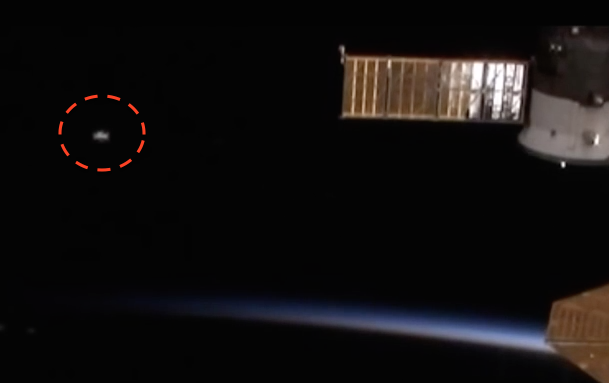
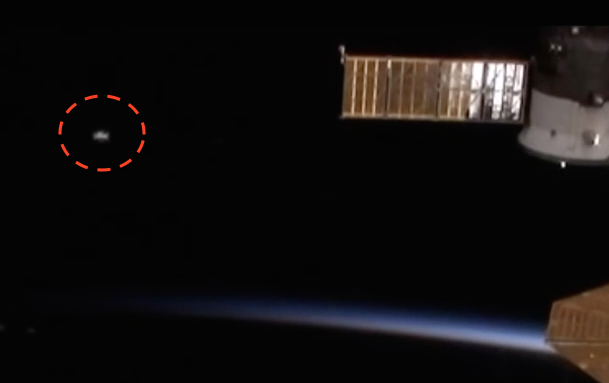
UFO Seen On Live Cam At The NASA Space Station, April 2016, Video, UFO Sighting News.
Date of sighting: April 1, 2016 Location of sighting:Earths orbit at ISS This UFO was caught by Streetcap1 of Youtube and I have to say this UFO is more classic than most seen at the station. This one seems to have a humped lower and upper section. This UFO did appear on April 1, 2016, So is NASA playing a joke on the nation? I don't think they have that in them. That's the last thing they even want to suggest...that they are faking anything...at least, I hope they are thinking that. Scott C. Waring www.ufosightingsdaily.com
A man in West Carrollton, Ohio reported witnessing two spinning gem-shaped UFOs and recording them on video moving in formation. The witness was outdoor smoking when he saw the two lights above the tree line around 6:30 p.m. on the 7th of November 2015.
The witness stated that the two unknown aircraft travelled a straight and level flight path from northwest to southeast. The two spinning gems flew without a sound and the witness who claimed to have a military background could not identify the objects.
Though the UFOs were not travelling at an unusual speed and not making abnormal maneuvers, they suspiciously vanishing so quickly after passing the witness’ position as he faced south. The witness claimed that he had been an aircraft mechanic for more than three decades, including nearly five years in the USAF at Edwards AFB. He was confident that the UFOs were not the same to any other usual things he had seen before around Edwards. The witness lives around a 15-minute drive from Wright Patterson AFB.
The witness used his mobile phone video to record his UFO sighting. He zoomed in and out a little to maintain focus, the witness said. Towards the end of the video, tree branches become visible, and the lead craft disappears while the second one travels a little further before it also disappears. One thing that the witness noticed was the spinning in unison. The witness said that he did not have the means to enhance the video and would love to see if anybody could do it.
is a research fellow at the Frankfurt Institute for Advanced Studies, with a special interest in the phenomenology of quantum gravity. Her freelance work has been published in Forbes, Scientific American, and New Scientist, among others.
After you die, your body’s atoms will disperse and find new venues, making their way into oceans, trees and other bodies. But according to the laws of quantum mechanics, all of the information about your body’s build and function will prevail. The relations between the atoms, the uncountable particulars that made you you, will remain forever preserved, albeit in unrecognisably scrambled form – lost in practice, but immortal in principle.
There is only one apparent exception to this reassuring concept: according to our current physical understanding, information cannot survive an encounter with a black hole. Forty years ago, Stephen Hawking demonstrated that black holes destroy information for good. Whatever falls into a black hole disappears from the rest of the Universe. It eventually reemerges in a wind of particles – ‘Hawking radiation’ – that leaks away from the event horizon, the black hole’s outer physical boundary. In this way, black holes slowly evaporate, but the process erases all knowledge about the black hole’s formation. The radiation merely carries data for the total mass, charge and angular momentum of the matter that collapsed; every other detail about anything that fell into the black hole is irretrievably lost.
Hawking’s discovery of black-hole evaporation has presented theoretical physicists with a huge conundrum: general relativity says that black holes must destroy information; quantum mechanics says it cannot happen because information must live on eternally. Both general relativity and quantum mechanics are extremely well-tested theories, and yet they refuse to combine. The clash reveals something much more fundamental than a seemingly exotic quirk about black holes: the information paradox makes it aptly clear that physicists still do not understand the fundamental laws of nature.
But Gia Dvali, professor of physics at the Ludwig-Maximilians University of Munich, believes he’s found the solution. ‘Black holes are quantum computers,’ he says. ‘We have an explicit information-processing sequence.’ If he is correct, the paradox is no more, and information truly is immortal. Even more startling, perhaps, is that his concept has practical implications. In the future, we might be able to tap black-hole physics to construct quantum computers of our own.
The main reason why recovering information from black holes seems impossible is that they are almost featureless spheroids with essentially no physical attributes on their horizons; they have ‘no hair’, as the late US physicist John Wheeler put it. You cannot store information in something that has no features that could be used to encode it, the standard argument goes. And therein lies the error, Dvali says: ‘All these no-hair theorems are wrong.’ He and his collaborators argue that gravitons – the so-far undiscovered quanta that carry gravity and make up space-time – stretch throughout the black hole and give rise to ‘quantum hair’ which allows storing as well as releasing information.
The new research builds on a counter-intuitive feature of quantum theory: quantum effects are not necessarily microscopically small. True, those effects are fragile, and are destroyed quickly in warm and busy environments, such as those typically found on Earth. This is why we don’t normally witness them. This is also the main challenge in building quantum computers, which process information using the quantum states of particles instead of the on-off logic of traditional transistors. But in a cold and isolated place, quantum behaviour can persist over large distances – large enough to span the tens to billions of kilometres of a black-hole horizon.
You don’t even need to go to outer space to witness long-range quantum effects. The enormous distances and masses necessary to create black-hole quantum hair might be far beyond our experimental capabilities, but by cooling atoms down to less than one ten-thousandth of a Kelvin (that is, one ten-thousandth of a degree above absolute zero), researchers have condensed up to a billion atoms, spread out over several millimetres, into a single quantum state. That’s huge for collective quantum behaviour.
Hawking’s information puzzle would find a natural solution if black holes are, in essence, puddles of condensed gravity
Such an atomic collective – known as a Bose-Einstein condensate, named after the Indian physicist Satyendra Bose and Albert Einstein – is currently one of the most promising tools for creating a workable quantum computer. Quantum effects within a Bose-Einstein condensate, like the ability to be in two places at the same time, can stretch through the whole condensate, giving rise to many interlocked states. Enormous information-processing power could become available if researchers succeed in stabilising the condensate and controlling these states. And, not coincidentally, Bose-Einstein condensates might also solve the decades-old puzzle of black-hole information loss.
Hawking’s information puzzle would find a natural solution, Dvali notes, if black holes consist of gravitons that have undergone Bose-Einstein condensation – puddles of condensed gravity, in essence. The idea might sound crazy, but for Dvali it’s a perfectly reasonable conclusion, drawn from what physicists have learned about black-hole information in the years since Hawking first posed his riddle. Theorists know how to calculate how much information the black hole must be able to store: the amount is quantified in the black hole’s entropy and proportional to the horizon surface area. They have also found that black holes can redistribute or ‘scramble’ information very quickly. And finally, they know the pace at which information must escape from the black hole in order to avoid conflicts with quantum mechanics.
Starting in 2012, Dvali explored these various attributes and discovered, to his surprise, that certain types of Bose-Einstein condensates share their essential properties with black holes. To act like a black hole, the condensate must linger at a transition point – its so-called quantum critical point – where extended fluctuations span through the fluid just before the quantum behaviour collapses. Such a quantum-critical condensate, Dvali calculated, has the same entropy, scrambling capacity and release time as a black hole: it has just the right quantum hair. ‘Somebody can say this is a coincidence, but I consider it extremely strong evidence – mathematical evidence that is – that black holes genuinely are Bose-Einstein condensates,’ he says.
Linking black holes with a form of matter that can be created in the lab means that some aspects of Dvali’s idea can be explored experimentally. Immanuel Bloch, professor of physics at the Max-Planck-Institute in Munich, has first-hand experience with Bose-Einstein condensates. He condenses atoms in ‘crystals of light’ – optical lattices created by intersecting multiple laser beams – and then takes snapshots of the condensate using a technique called fluorescence imaging. The resulting pictures beautifully reveal the atoms’ correlated quantum behaviour.
Bloch finds Dvali’s idea, which originated in a field entirely different from his, intriguing. ‘I am pretty excited about Gia’s proposal. I think that’s something really new,’ Bloch says. ‘People have seen collapse dynamics with interacting condensates, but nobody has so far investigated the quantum critical point and what happens there.
‘In the BEC [Bose-Einstein condensate] you have macroscopic quantum waves, and this means in the quantum numbers you have a lot of fluctuations. This is why the BEC normally looks like a Swiss cheese,’ he continues. But by applying a magnetic field, Bloch can change the strength by which the atoms interact, thereby coaxing them into an orderly lattice. ‘Now you make the atoms strongly interacting, then you go to the [very orderly] “Mott state”. This is a great state for quantum computing because you have this regular array. And you can address the atoms with lasers and rotate them around and change the spin [to encode and process information].’
‘Dvali’s idea is competing with a lot of other stuff out on the market. I have more skepticism than faith’
According to Dvali, black-hole physics reveals a better way to store information in a Bose-Einstein condensate by using different quantum states. Black holes are the simplest, most compact, most efficient information storage devices that physicists know of. Using the black holes’ coding protocol therefore should be the best possible method to store information in condensate-based quantum computers.
Creating a black-hole-mimic condensate in the lab seems doable to Bloch: ‘[In a black hole,] the interaction strength adjusts itself. We can simulate something like that by tuning the interaction strength to where the condensate is just about to collapse. The fluctuations become bigger and bigger and bigger as you get closer to the quantum critical point. And that could simulate such a system. One could study all the quantum fluctuations and non-equilibrium situations – all that is now possible by observing these condensates in situ, with high spatial resolution.’
Just because realising Dvali’s idea is possible does not necessarily mean it is practical, however. ‘It’s competing with a lot of other stuff out on the market. Right now, I have more skepticism than faith,’ Bloch says. He also points out that efficient information storage is nice, but for quantum computers ‘information capacity is presently not the problem’. The biggest challenge he sees is finding a way to individually manipulate the quantum states that Dvali has identified – data processing, rather than data storage. There are other practical hurdles as well. ‘There are so many things we don’t know, like noise, is it resistant to noise? We don’t know,’ Bloch notes. ‘For me, the much more interesting aspect is the connection to gravitational physics.’ And here the implications go well beyond information storage.
Dvali’s is not the only recent research suggesting a connection between gravity and condensed-matter physics, a trend that has opened whole new realms to experimental investigation. In the tradition of Einstein, physicists generally think of curved space-time as the arena for matter and its interactions. But now several independent lines of research suggest that space-time might not be as insubstantial as we thought. Gravity, it seems, can emerge from non-gravitational physics.
In the past decades, numerous links between gravity and certain types of fluids have demonstrated that systems with collective quantum behaviour can mimic curved space-time, giving rise to much the same equations as one obtains in Einstein’s theory of general relativity. There is not yet any approach from which general relativity can be derived in full generality by positing that space-time is a condensate. For now, nobody knows whether it is possible at all. Still, the newfound relations allow physicists to study those gravitational systems that can be mimicked with atomic condensates.
Simulating gravity with condensates allows physicists to explore regions – such as black-hole horizons – that are not otherwise accessible to experiment. And so, although Hawking radiation has never been observed in real black holes, its analogue has beenmeasured for black holes simulated through Bose-Einstein condensates. Of course, these condensates are not really black holes – they trap sound waves, not light – but they obey some of the same mathematical laws. The condensates do thus, in a sense, perform otherwise complicated, even intractable, physics calculations.
‘We like to speak of “quantum simulations” and try to use these systems to look for interesting phenomena that are hard to calculate on classical computers,’ says Bloch. ‘We are also trying to use this kind of system to test other systems like the black holes, or we looked at the [analogue of the] Higgs particle in two dimensions.’ In a 2012 Naturepaper, Bloch and his collaborators reported that their quantum simulation revealed that Higgs-like particles can also exist in two dimensions. The same technique could in principle be used to study Bose-Einstein condensates behaving like black holes.
‘The black hole [no hair] theorems are, sorry, crap’
But using black-hole physics to develop new protocols for quantum computers is one thing. Finding out whether astrophysical black holes really are condensates of gravitons is another thing entirely. ‘I am not interested in the idea if one can’t test it,’ says Stefan Hofmann, a theoretical cosmologist and colleague of Dvali’s in Munich.
Hofmann therefore has dedicated significant time to exploring the observational consequences of the idea that black holes are graviton condensates. ‘The black hole [no hair] theorems are, sorry, crap,’ he agrees with Dvali. Hofmann thinks that the quantum hair nearby the black-hole horizon would subtly alter the predictions of general relativity (especially the emission of gravitational waves during formation or collision of black holes), in ways that should be detectable. ‘The dream would be a binary [black hole] merger,’ Hofmann said in a 2015 seminar. His dream has just become true: theLIGO collaboration recently announced the first measurement of gravitational waves emitted from a merging pair of black holes.
Hofmann and his collaborators have yet to make quantitative predictions, but due to the macroscopic quantum effects, Dvali’s proposed solution to the information-loss problem might soon become experimentally testable. However, the idea that black holes are quantum-critical condensates of gravitons, truly equivalent to a Bose-Einstein condensate, leaves many questions open. To begin with, Dvali’s calculations cannot explain what actually happens to matter falling into a black hole. And Hofmann admits that it isn’t clear how the object is a ‘black hole’ in the conventional sense, since it can no longer be described within the familiar framework of general relativity.
Carlo Rovelli from the University of Marseille thinks that, even in incomplete form, Davli’s idea of black holes as condensates might be scientifically useful. ‘They are using a brutal approximation which might fail to capture aspects, but it might work to some extent, especially in the long wavelength regime. For the low-frequency quantum fluctuations of [space-time] it may not be absurd,’ Rovelli says. He cautions, however, that the condensate model ‘cannot be a complete description of what happens in the black hole’.
What is clear, though, is that this research has revealed a previously unrecognised, and quite fruitful, relation. ‘We have a very interesting bridge between quantum information and black-hole physics that was not discussed before,’ Dvali says. If he is right, the implications are conceptually staggering. Information really does live on eternally. In that sense, we are all immortal. And the supermassive black hole at the centre of our galaxy? It’s actually a cosmic quantum computer.
Snowden Reveals Documents: 'More Intelligent Homo Sapiens Exist Underground'
Edward Snowden, the leaker of NSA surveillance documents, was granted asylum in Venezuela on Friday. With safe harbors in sight, Snowden was willing to share shocking and world-shattering exclusive secret government documents with The Internet Chronicle.
Snowden’s testimony was as follows:
“The highest levels of government don’t know what to do about UFOs, and the official story that they are all merely weather balloons or natural phenomena has been clearly dismissed. If anything, these documents speak about UFOs as if they are surely guided by an intelligence beyond our own. As it turns out, the most credible and inexplicable sightings are of vehicles that have been spotted leaving the sea floor at hydrothermal vents and directly entering solar orbit.
“Because ballistic missile tracking systems and deep-sea sonar are kept as state secrets, scientists don’t have access to data about these objects. However, most of the contractors at DARPA are sure that there is a species more intelligent than homo sapiens living in the mantle of the Earth. It makes sense, if you think about it, because that is the only place where conditions have been more or less stable for billions of years. Extremophiles may live at different temperatures than us, but they have been able to thrive and develop intelligence at a seemingly accelerated rate. That’s not true, because they’ve simply evolved at the same rate, but without many of the vicissitudes which set back surface life . . .
“The president receives daily briefings about their activities. Analysts believe their technology to be so far advanced that we stand little chance of survival in any potential war. The general sentiment is that we are but ants from their perspective, so there is little chance they would empathize or attempt to communicate with us, and the current contingency plan is to detonate nuclear weapons in deep caverns to ‘sting’ the foe we have no hope of destroying in hopes it would discourage further attacks.”
Critics may allege that what the 30-year-old former NSA and CIA contractor can state with authority about our ultraterrestrial neighbors is already well-known. But the Ground-Penetrating Radar, or GPR, scans, which The Internet Chronicle has shared and confirmed with sources within intelligence community, will only serve to underscore popular bitterness over strategically timed earthquakes and tsunamis.
Just as PRISM shined a new light on goings-on in NSA’s ECHELON computer systems, revealed in the 1990s, the vast complexes of underground cities – laser-etched from pure diamond – apparent in the GPR scans will transform public debate about the balance between liberty and security. - Chronicle
Les OSNIS et la base secrète AUTEC : Une zone 51 en eaux profondes ?
Published on Apr 2, 2016
La vérité est ailleurs
AUTEC : Les activités mystérieuses de cette base sous-marine secrète ont soulevé beaucoup de questions dans le clan des chercheurs enquêtant sur les disparitions du triangle des Bermudes.
Cette installation serait l’équivalent sous-marin de la base 51 de l’armée américaine (une base secrète où le gouvernement aurait fait des études sur les extra-terrestres, et où certains témoins affirment avoir vu des OVNI). Au sein même de l’AUTEC, des anomalies électromagnétiques auraient pu être reproduites, ce qui n’est pas sans danger pour les navires et aéronefs environnants.
Plus troublant encore : de mystérieux engins ont été aperçus à plusieurs reprises dans les environs de l’AUTEC. Les témoins décrivent des engins effectuant des mouvements inhabituels : virages très serrés, accélérations incroyablement rapides, … Un témoin raconte avoir été à 3 km d’un objet inanimé qui flottait sur l’eau. Il croyait voire une baleine. Il s’est ensuite approché à 800 mètres. L’objet brillait étrangement, et ressemblait plutôt à engin futuriste. Soudain, l’engin décolla et s’éloigna au dessus de l’eau à une vitesse incroyablement élevée, puis disparut sous l’eau...
A large interstellar cloud may have caused the extinction of dinosaursClaudioVentrella/iStock
A thick interstellar cloud may have caused the dinosaurs to become extinct. Researchers say the Earth could have crossed paths with an interstellar cloud – a large clump of cosmic dust and gas – 66 million years ago, starving the planet of light and making it very cold. They theorise that this ultimately led the dinosaurs to extinction.
A study, due to be published in Gondwana Research, identified thick deposits of iridium in the Pacific Ocean; a hard silvery-metal which the scientists believe may have been deposited from an interstellar cloud. They say this cloud would have caused a 'Nebula Winter', as the cloud would have blocked out a majority of the sunlight, which may have cooled the planet enough to kill most life.
The Earth is known to be covered in a blanket of iridium, roughly 30cm thick. This is believed to be caused by asteroid impacts. However, a team of scientists from the Japan Spaceguard Association found a section of the Earth's surface with a 5-metre thick layer of iridium. They say a layer this thick cannot be explained by an asteroid.
Where did the iridium come from?
The researchers suggest an alternative theory. They say this large abundance of iridium must have come from a specialised extra-terrestrial source, possibly an interstellar cloud.
Dinosaurs may have become extinct from a giant interstellar cloudReuters
They suggest the interstellar cloud was more than 330 light-years across, and a thousand times more dense than space itself. It may have taken up to one million years for Earth to pass through the cloud, collecting a large amount of iridium from it at the same time.
The cloud would have blocked out sunlight, and caused the Earth to become very dark, reducing the amount of plant life. The planet would also become very cold from the icy cosmic dust. This may have been cold enough to wipe out the dinosaurs.
The scientists do not dispute the theory that a large asteroid struck the planet 66 million years ago;which is the more common understanding for the extinction of dinosaurs. They suggest it happened as well as the Earth passing through the molecular cloud. However, it was the cloud that was the primary factor in the dinosaurs extinction, they say.
The scientists say finding more space-originating radioactive elements will further strengthen their theory. In large amounts, these elements must have been left by a similar extra-terrestrial source. That could well be from the same interstellar cloud.
Scientists have discovered that temporarily turning off a part of the brain can reduce prejudice and the fervour of religious beliefs in peopleiStock
For the first time, scientists have discovered that they can change the way people think about religion and politics by directing magnetic energy to their brains to temporarily shut off specific regions of the brain.
Scientists from the University of York and the University of California, Los Angeles (UCLA) conducted an experiment using transcranial magnetic stimulation (TMS), a non-invasive, safe method of stimulating small areas of the brain that is used by doctors to treat severe depression, as well as to evaluate damage caused by injuries, strokes, multiple sclerosis, amyotrophic lateral sclerosis, movement disorders and motor neuron disease.
The study analysed the brains of 38 UCLA undergraduates from a multitude of races who were divided into two groups. One group had enough magnetic energy directed at their brains to temporarily shut down the posterior medial frontal cortex, a part of the brain located near the surface and roughly a few inches up from the forehead that is associated with detecting problems and triggering responses that address them.
The other group, meanwhile, received a much lower dose of magnetic energy that did not affect their brains in any way. After experiencing the magnetic energy, all the participants were asked to think about the concept of death, and then answer questions about their religious beliefs and feelings about immigrants.
The researchers discovered that the group which had the targeted brain region shut down reported 32.8% less belief in God, angels, or heaven, and were 28.5% more positive in their feelings toward an immigrant who criticised their country.
Using magnetics to decrease prejudice and religious fervour
The researchers decided to focus on the posterior medial frontal cortex because it plays a key role in cognitive dissonance, where an individual holds two or more contradictory beliefs or ideals at the same time and becomes psychologically uncomfortable, thus seeking to reduce this feeling and avoid situations that increase it.
"People often turn to ideology when they are confronted by problems. We wanted to find out whether a brain region that is linked with solving concrete problems, like deciding how to move one's body to overcome an obstacle, is also involved in solving abstract problems addressed by ideology," said Dr Keise Izuma, a lecturer at the University of York's Department of Psychology.
"We decided to remind people of death because previous research has shown that people turn to religion for comfort in the face of death. As expected, we found that when we experimentally turned down the posterior medial frontal cortex, people were less inclined to reach for comforting religious ideas despite having been reminded of death."
The participants had been prescreened to make sure that they had strong convictions about religion, and to ensure that the participants would respond adversely to a Latino immigrant's criticisms of the US, participants who were "extremely liberal" or "Hispanic/Latino" were not chosen to take part. The resulting group was considered to be "politically moderate", so that the scientists could see if their minds could be changed.
The mind processes criticisms as ideological threats
To judge the participants' feelings about nationalism, the researchers gave them two essays to read that had been written by recent immigrants to the US. One of the essays was extremely positive about the US, while the other essay was extremely negative. Interestingly, the participants with a brain region temporarily turned off were more positive towards the immigrant that criticised their country, than the participants whose brains were unaffected.
"We think that hearing criticisms of your group's values, perhaps especially from a person you perceive as an outsider, is processed as an ideological sort of threat," said Dr Izuma.
"One way to respond to such threats is to 'double down' on your group values, increasing your investment in them, and reacting more negatively to the critic. When we disrupted the brain region that usually helps detect and respond to threats, we saw a less negative, less ideologically motivated reaction to the critical author and his opinions."
The researchers says that their findings are consistent with the idea that brain mechanisms, which evolved for relatively basic threat-response functions, are also used to produce ideological reactions. However, more research is needed to establish exactly why religious beliefs and ethnocentric attitudes were reduced.
Stanton argues that although many high profile scientist have a lot to say about UFOs and ETs, they have not looked and the evidence, and their statements are often not scientific.
Quantum Theory Proves Consciousness Moves To Another Universe At Death
A book titled “Biocentrism: How Life and Consciousness Are the Keys to Understanding the Nature of the Universe“ contains a notion that life does not end when the body dies, and it can last forever.
The author of this publication, scientist Dr. Robert Lanza who was voted the 3rd most important scientist alive by the NY Times, has no doubts that this is possible.
Lanza is an expert in regenerative medicine and scientific director of Advanced Cell Technology Company.
Before he has been known for his extensive research which dealt with stem cells, he was also famous for several successful experiments on cloning endangered animal species.
But not so long ago, the scientist became involved with physics, quantum mechanics and astrophysics. This explosive mixture has given birth to the new theory of biocentrism, which the professor has been preaching ever since.
Biocentrism teaches that life and consciousness are fundamental to the universe. It is consciousness that creates the material universe, not the other way around.
Lanza points to the structure of the universe itself, and that the laws, forces, and constants of the universe appear to be fine-tuned for life, implying intelligence existed prior to matter.
He also claims that space and time are not objects or things, but rather tools of our animal understanding.
Lanza says that we carry space and time around with us “like turtles with shells.” meaning that when the shell comes off (space and time), we still exist.
The theory implies that death of consciousness simply does not exist. It only exists as a thought because people identify themselves with their body.
They believe that the body is going to perish, sooner or later, thinking their consciousness will disappear too.
If the body generates consciousness, then consciousness dies when the body dies. But if the body receives consciousness in the same way that a cable box receives satellite signals, then of course consciousness does not end at the death of the physical vehicle.
In fact, consciousness exists outside of constraints of time and space. It is able to be anywhere: in the human body and outside of it.
In other words, it is non-local in the same sense that quantum objects are non-local. Lanza also believes that multiple universes can exist simultaneously. In one universe, the body can be dead.
And in another it continues to exist, absorbing consciousness which migrated into this universe.
This means that a dead person while traveling through the same tunnel ends up not in hell or in heaven, but in a similar world he or she once inhabited, but this time alive. And so on, infinitely. It’s almost like a cosmic Russian doll afterlife effect.
This hope-instilling, but extremely controversial theory by Lanza has many unwitting supporters, not just mere mortals who want to live forever, but also some well-known scientists.
These are the physicists and astrophysicists who tend to agree with existence of parallel worlds and who suggest the possibility of multiple universes.
Multiverse (multi-universe) is a so-called scientific concept, which they defend. They believe that no physical laws exist which would prohibit the existence of parallel worlds.
The first one was a science fiction writer H.G. Wells who proclaimed in 1895 in his story “The Door in the Wall”.
And after 62 years, this idea was developed by Dr. Hugh Everett in his graduate thesis at the Princeton University. It basically posits that at any given moment the universe divides into countless similar instances.
And the next moment, these “newborn” universes split in a similar fashion. In some of these worlds you may be present: reading this article in one universe, or watching TV in another.
The triggering factor for these multiplyingworlds is our actions, explained Everett. If we make some choices, instantly one universe splits into two with different versions of outcomes.
In the 1980s, Andrei Linde, scientist from the Lebedev’s Institute of physics, developed the theory of multiple universes. He is now a professor at Stanford University.
Linde explained: Space consists of many inflating spheres, which give rise to similar spheres, and those, in turn, produce spheres in even greater numbers, and so on to infinity. In the universe, they are spaced apart. They are not aware of each other’s existence. But they represent parts of the same physical universe.
The fact that our universe is not alone is supported by data received from the Planck space telescope. Using the data, scientists have created the most accurate map of the microwave background, the so-called cosmic relic background radiation, which has remained since the inception of our universe.
They also found that the universe has a lot of dark recesses represented by some holes and extensive gaps.
Theoretical physicist Laura Mersini-Houghton from the North Carolina University with her colleagues argue: the anomalies of the microwave background exist due to the fact that our universe is influenced by other universes existing nearby. And holes and gaps are a direct result of attacks on us by neighboring universes.
So, there is abundance of places or other universes where our soul could migrate after death, according to the theory of neo-biocentrism. But does the soul exist?
Is there any scientific theory of consciousness that could accommodate such a claim? According to Dr. Stuart Hameroff, a near-death experience happens when the quantum information that inhabits the nervous system leaves the body and dissipates into the universe.
Contrary to materialistic accounts of consciousness, Dr. Hameroff offers an alternative explanation of consciousness that can perhaps appeal to both the rational scientific mind and personal intuitions. Consciousness resides, according to Stuart and British physicist Sir Roger Penrose, in the microtubules of the brain cells, which are the primary sites of quantum processing.
Upon death, this information is released from your body, meaning that your consciousness goes with it.
They have argued that our experience of consciousness is the result of quantum gravity effects in these microtubules, a theory which they dubbed orchestrated objective reduction (Orch-OR).
Consciousness, or at least proto-consciousness is theorized by them to be a fundamental property of the universe, present even at the first moment of the universe during the Big Bang.
“In one such scheme proto-conscious experience is a basic property of physical reality accessible to a quantum process associated with brain activity.”
Our souls are in fact constructed from the very fabric of the universe – and may have existed since the beginning of time. Our brains are just receivers and amplifiers for the proto-consciousness that is intrinsic to the fabric of space-time.
So is there really a part of your consciousness that is non-material and will live on after the death of your physical body?
Dr Hameroff told the Science Channel’s Through the Wormhole documentary: “Let’s say the heart stops beating, the blood stops flowing, the microtubules lose their quantum state. The quantum information within the microtubules is not destroyed, it can’t be destroyed, it just distributes and dissipates to the universe at large”.
Robert Lanza would add here that not only does it exist in the universe, it exists perhaps in another universe. If the patient is resuscitated, revived, this quantum information can go back into the microtubules and the patient says “I had a near death experience”‘
He adds: “If they’re not revived, and the patient dies, it’s possible that this quantum information can exist outside the body, perhaps indefinitely, as a soul.”
This account of quantum consciousness explains things like near-death experiences, astral projection, out of body experiences, and even reincarnation without needing to appeal to religious ideology.
The energy of your consciousness potentially gets recycled back into a different body at some point, and in the mean time it exists outside of the physical body on some other level of reality, and possibly in another universe.
The Mystery deepens: Scientist believes Planet X caused massive extinction on Earth
According to an astrophysicist, not only does Planet X, aka the Ninth Planet exists lurking in the outer edges of our solar system, the elusive planet is, in fact, responsible for several mass extinctions on Earth.
Like never before, evidence is being revealed supporting the idea that Planet X, the Ninth Planet, or commonly referred by some as mythical planet ‘Nibiru’, does in fact exist, and lurks the outer edges of our solar system.
Now, an astrophysicist suggests that this ‘elusive’ planet does not only exist but is responsible for causing MASS EXTINCTIONS on our planet.
According to researchers, as Planet X orbits our sun, its titled orbit slowly changes, passing through the Kuiper Belt ever 27 million years, causing numerous comets to be knocked into the inner solar system.
Earlier this year, researchers discovered evidence supporting the existence of a mysterious, giant planet lurking the outer edges of our solar system, and ever since, scientists are desperately looking for signs that could help them confirm its existence.
However, the mystery around this elusive planet has just deepened after a US astrophysicist said that the enigmatic planet could, in fact, be responsible for numerous mass extinction on planet Earth.
This week, astronomer Mike Brown of Caltech revealed he had found more evidence supporting the existence of the mysterious planet. Brown believes that the unusual and weird movement of objects in the outer parts of the solar system is best explained by the anomalous orbit of a huge planet researchers ar referring to as planet Nine or Planet X. In the past couple of months, strong arguments have been made by researchers around the globe which believe a huge planet, unlike anything we have seen in our solar system is somewhere out there.
The giant ‘elusive’ planet is believed to sit on the edge of our solar system and is ten times more massive compared to Earth. Its exact composition remains a mystery, but scientists expect it to be similar to Neptune or Jupiter.
Now, in addition to comments from Brown, the researcher behind the initial announcement of the so-called ninth planet, Dr. Daniel Whitmire, a retired professor of astrophysics working at the University of Arkansas Department of Mathematical Sciences has concluded that this giant planet could have caused several mass extinctions on Earth.
According to Dr. Whitmire, the giant planet located on the outer edge of our solar system triggers comet showers that bombard the planets of the inner solar system. However, the theory proposed by Dr. Whitmire isn’t new, as a matter of a fact, the theory was initially proposed by Dr. Whitmire and his college John Matese in 1985 while working at the University of Louisiana.
In the research published in the journal Nature, Dr. Whitmire and colleague John Matese suggested the presence of a mysterious planet in the outskirts of our solar system, dubbed planet X.
According to the theory proposed by Dr. Whitmire, as Planet X orbits the sun, its tilted orbit slowly rotates and as the elusive planet makes its way through the Kuiper belt of comets every 27 million years, its enigmatic orbit causes comets to be knocked into the inner solar system triggering possible mass extinctions on Earth.
Dr. Whitmire firmly believes that its very likely that in the distant past, Planet X could have significantly influenced the evolution of life on our planet.
The hidden origins on mankind: Giant Skeletons that will change History
“The eyes of that species of extinct Giant, whose bones fill the Mounds of America, have gazed on Niagara as ours do now.” –Former President Abraham Lincoln, Niagara Falls, 1848.
In the last couple of decades, much of the population on Earth has firmly come to believe that history has been told only partially. We have come to realize that there are numerous pieces missing from the puzzle and that mankind’s origin and the past are far more enigmatic than many scholars are willing to accept.
Throughout the decades, countless findings have been made, pointing towards a much different history than we are being told by mainstream scholars.
Religion, ancient texts, and monuments are only partially understood by scholars, who are ever-more selective when sharing their knowledge.
One of the most interesting researchers who has come to challenge mainstream scholars and their extremely linear views on history and our origins is without a doubt Michael Tellinger.
Tellinger is an author, scientist, and explorer, who has made a number of groundbreaking discoveries regarding ancient civilizations that mysteriously vanished under doubtful circumstances. Most of his research has been focused on the African continent where he has come across intriguing pieces of evidence which directly contradict mainstream history.
“One of the most popular books in the world, the Bible, tells us that when the Gods were on Earth, they were giants. . . . This, when you bring up in conversation, normally brings up, you know, laughter and people giggling and thinking you’re joking, and yet, the Bible is full of references to giants in our history.” –Michael Tellinger (source)
While many believe that stories found in the bible cannot be considered as firm evidence supporting the idea that giants existed on earth in the distant past, it is interesting to note that there are other sources which point towards the existence of giants. In nearly all ancient cultures, there is evidence suggesting beings of humongous size, existed on our planet in the distant past.
Physical evidence supporting such theories can also be found around the globe. One of such examples is a part of an upper leg bone of a being that is believed to have been at least 3.5 meters in height. The bone is located at the medical school at WITS University in Johannesburg since the 1960’s. The bone was discovered in northern Namibia by miners and is considered as one of the most important and rare specimens of giant beings existing on our planet in the distant past.
However, more similar discoveries were made around the globe. A 38-centimiter-long figure found in Egypt is another impressive discovery that contradicts conventional historical views. The images displayed were taken in 1988 and were published by one of Europe’s leading newspaper, BILD.de.
Researchers from Egypt believe it had to belong to a creäture that was over 5 meters height. Only a few people got to take images of this incredible artifact in 1988.
In an interview with BILD.de, Spörri stated: “It was an oblong package, smelled musty,” Spörri said when he told his story to the public in 2012. “I was totally flabbergasted when I saw the dark brown giant finger. I was allowed to take it in hand and also to take pictures. A bill was put next to it to get a size comparison. The bent finger was split open and covered with dried mold.”
According to Gregor Spörri, the grave robber who found the finger also had a certificate of Authenticity and an X-ray image, both of which are from the 1960’s.
Interestingly, in 1883, the Smithsonian Institute dispatched a team of researchers to the South Charleston Mount. There, according to reports, they discovered numerous giant skeletons ranging from 7 to 9 feet tall. The giants were said to have been buried with heavy copper bracelets and other items which appeared to have a religious and/or cultural meaning.
Apparently the report also mentioned that some of the giants had skulls which looked ‘compressed or flat-head type’, resembling similar skeletal remains discovered in south America and Egypt. (source)
Interestingly, another crucial piece of evidence was a discovery made in Wisconsin. The finding was omitted by researchers who remained silent and decided not to speak about the lost race of giants found in burial mounds near Lake Delavan in Wisconsin. The mysterious discovery, which was first reported in the 4 May 1912 issue of the New York Times states that at least 18 anomalous skeletons had been found in Wisconsin exhibiting extremely weird features unlike any known species to date. The excavation side was overseen by the Beloit College and included over 200 mounds. (source)
These anomalous skeletons were unlike anything is seen before, totally differing from any known human species with alleged heights that ranged from 8 to 10 feet.
“…presumably those of men, are much larger than the heads of any race which inhabit America to-day.”
Vine Deloria, a Native American author, and professor of law said:
“Modern day archeology and anthropology have nearly sealed the door on our imaginations, broadly interpreting the North American past as devoid of anything unusual in the way of great cultures characterized by a people of unusual demeanor.
“The great interloper of ancient burial grounds, the nineteenth century Smithsonian Institution, created a one-way portal, through which uncounted bones have been spirited.”
“This door and the contents of its vault are virtually sealed off to anyone, but government officials. Among these bones may lay answers not even sought by these officials concerning the deep past.”
“In addition to the human skeletons found in NY State, there is also the famous case of ‘The Cardiff Giant,’ a white alabaster-like statue of an 11-foot man which showed an exposed penis and hieroglyphic inscriptions. This statue caused a worldwide sensation and was exhibited in New York City to thousands of paying customers before it was declared a fake by the NY newspapers, despite the fact that scholars from Harvard and elsewhere insisted that the statue was genuine.” – Richard Dewhurst
The fact that huge megalithic structures have been discovered around the globe could prove to be another indication that giants inhabited Earth in the past. In ancient Egypt for example, we have numerous hieroglyphs which depict beings that are up to five times larger than ordinary humans.
In the valley of Khafre in Egypt, we find one of the most incredible ancient temples built using humongous limestone blocks, some as large as 30 feet long, while weighing over 200 tons.
This fact makes you wonder just how was it possible, for ancient mankind to erect such monuments, with the accuracy and precision they did, thousands of years ago.
Graham Hancock explains it pretty well in his book Fingerprints of the Gods: The Evidence of Earth’s Lost Civilization:“ At present there are only two land-based cranes in the world that could lift weights of this magnitude. At the very frontiers of construction technology, these are both vast, industrialized machines, with booms reaching more than 220 feet into the air, which require on-board counterweights of 160 tons to prevent them from tipping over. The preparation-time for a single lift is around six weeks and calls for the skills of specialized teams of up to 20 men.13 In other words, modern builders with all the advantages of high-tech engineering at their disposal can barely hoist weights of 200 tons. „
All of the above discoveries and facts are proof that history, as we have been told, is completely wrong, misinterpreted and incomplete, a fact that mainstream scholars around the world have ignored in an attempt to promote a specific ideology in today’s society.
Wat als aliens ons vinden en géén goede bedoelingen blijken te hebben? De Amerikaanse astronomen David Kipping en Alex Teachy stellen dat dit risico niet genomen moet worden en we onze planeet gewoon moeten 'verstoppen' voor potentieel gevaarlijke buitenaardse wezens. Dat kan volgens professor Kipping van de Columbia University in New York en zijn assistent redelijk eenvoudig met laserstralen, schrijft BBC.
Telkens de aarde voor de zon schuift, wordt het licht gedimd en zo kan dus de aanwezigheid van onze planeet worden verraden. Om dat fenomeen te verbergen, zouden we laserstralen kunnen uitzenden in de ruimte. Volgens Kipping zou dat onze aarde compleet onzichtbaar maken voor potentiële geavanceerde astronomen van andere planeten.
De NASA-ruimtetelescoop Kepler heeft al zo'n duizend nieuwe planeten ontdekt door te speuren naar kleine dipjes in lichtsterkte die zich voordoen als een planeet voor haar dichtstbijzijnde ster passeert. Buitenaardse astronomen zouden natuurlijk dezelfde techniek kunnen toepassen om onze planeet te ontdekken.
Een laserstraal van 30 megawatt één keer per jaar gedurende tien uur is voldoende om de terugval in lichtintensiteit veroorzaakt door de doortocht van de Aarde te maskeren, berekende Kipping. "Er is een debat aan de gang of we ons nu moeten proberen kenbaar maken voor aliens of ons net moeten verstoppen", zegt de professor. "Ons werk biedt de mensheid de keuze, tenminste wat die doortocht betreft. We moeten daarover nadenken."
Teachey voegt eraan toe: "We kunnen ook enkel de atmosferische tekenen van biologische activiteit, zoals zuurstof, verhullen. Dat kan met een laserpiek van maar 160 kilowatt per doortocht. Voor mogelijk andere beschavingen zou het dan lijken alsof er op de aarde nooit leven mogelijk was."
British Astronaut Announces From The ISS About The Discovery Of A UFO
British man in space could be the first astronaut from his country to have encountered one of the major findings in the history of humanity. Major Tim Peake announced from the International Space Station (ISS) that he had a glimpse of what seemed to be an extraterrestrial craft while recording a time-lapse video of the Earth – a regular activity made famous by NASA astronaut, Scott Kelly.
The video is grainy and appeared to show a UFO flying randomly across the screen near the ISSS. Peake also posted similar footage in February on Twitter to demonstrate how lightning can strike Earth.
In the press conference from the ISS, Peake said that it was far better than he had imagined as it was difficult to describe what he called a phenomenal machine.
Peake fans have been reacting on Twitter using the hashtag #PeakeUFO. The great apparent discovery followed the first broadcast of Peake when he revealed how he missed the green colour in space.
Humanity will now wait and see if the footage could help the effort of taking a big leap towards aliens and their potential leaders.
Another press briefing is scheduled in midday GMT, which will reveal more details on the possibility of extraterrestrial life aboard the UFO.
Many people still doubt the existence of a flying saucers, but I tell you, just wait until they appear in large quantity. Around the entire planet will demonstrate their ability to fly, their appearance and disappearance. In a way that confuses people into the large extent, that no one really understand what is happening. It has been written that the sky will “sign”. This “sign” already seen a lot of people, but by the end of this age will see it every man of the earth and will be surprised”
Traveling west out of Asheville, North Carolina and crossing the border into Jackson County, one can trace the Caney Fork River along toward the little Tuckasegee community, following NC Highway 107 heading out of the nearby campus town of Cullowhee.
There, off a gravel road running between two pastures, is one of the most underrated–and often overlooked–wonders anywhere in the Eastern United States.
Known today as “Judaculla Rock”, the strange stone mound protrudes from the earth just as it did centuries ago, much earlier even than the Cherokee Indians had begun to inhabit the region. According to most estimates by geologists, the stone’s markings date back as much as 3000 years, though on Raliegh-based group a number of years ago supposed that some of the petroglyphs covering the boulder could be twice as old as previous estimates, if not more.
Of all the curious symbols that appear along the stone’s surface, one particular image stands out among the rest, resembling vaguely a hand-like imprint. According to legend, this portion of the stone marks the place where an ancient Cherokee god of the hunt, known as “Tsul’Kalu’,” had leaped from a nearby mountain, and landing within the valley below, had steadied himself against what is now Judaculla Rock. This is, in fact, merely one of several legends regarding Tsul’Kalu’ that still exist, many of which have some fairly remarkable tie-ins with mysterious discoveries of “giants” alleged to have existed in the ancient Americas.
Researchers Might Have Found the Sunken City of Atlantis, But Nobody is Talking About It Anymore
In 2001, a team of explorers who were participating in a survey mission off the western coast of Cuba detected a curious set of stones on their sonar equipment. The bizarre structures were covered under 650 meters of water and they strongly resembled an ancient metropolis. The media soon take over, announcing a possible discovery of the lost city of the Caribbean or even Atlantis.
The government, national museum and national geographic were immediately drawn into picture by this big announcement and they promised to fully investigate the intriguing site revealed by the sonar images. However, this never happened (officially) and after 15 more years the story remains silent. Why the media remained silent about this unusual sunken discovery we can only guess, but the possibility of the officials discovering something that would challenge the foundation of our written history is likely to have happened.
When marine engineer Pauline Zalitzki and her husband Paul Weinzweig first captured the anomaly on their sonar equipment, the first though crossing their minds was of a HUGE discovery. The couple was working on a survey mission together with the Cuban government. They were initially scanning a 2 square kilometers area on the bottom of the sea in order to find wrecks from the Spanish colonial era that could hold treasure, but luck had it that they came across a series of symmetrical stone structures resembling a sunken city.
After investigating the sonar images, Zalitzki noticed that some of the stone blocks possessed a pyramidal shape, while others had a circular design. Intrigued by the discovery, the two returned to the site with Manuel Iturralde, senior researcher of Cuba’s Natural History Museum and furtherly sent a Remotely Operated Vehicle to scan the depths of the sea in detail. Their assumptions of a sunken city were not in vein, as the new images revealed what appeared to be the ruins of sunken city.
“These are extremely peculiar structures, and they have captured our imagination,” said Iturraide, who inspected numerous underwater formations. “But if I had to explain this geologically, I would have a hard time.”
Experts estimated that it would take around 50,000 years for such structures to submerge to the depth at which they were found. “50,000 years ago there wasn’t the architectural capacity in any of the cultures we know of to build complex buildings,” Iturralde said. Another specialist in underwater archaeology from the University of Florida added the following: “It would be cool if they were right, but it would be real advanced for anything we would see in the New World for that time frame. The structures are out of time and out of place.”
Could they have discovered the sunken city of Atlantis, a timeworn metropolis of some unknown civilization, or was this only a natural phenomenon as some archaeologists seemed to believe?
According to the original discoverers, the sunken formation could be “the remnants of a local culture,” once situated on a 100-mile “land bridge” that connected Mexico’s Yucatan Peninsula with Cuba. Those claims were supported by the Mayan and native Yucatecos beliefs that speak of an isle of their ancestors that was taken by the sea. However, because the supposed metropolis was located at a considerable depth under the water, researchers who followed the Pleistocene timeline noticed that sea levels dropped by a maximum of 100 meters, making it hard to believe that such a discovery had artificial origins.
“At no point during the Ice Age would it have been above sea level unless, of course, the land on which they stand has sunk. This is the claim for Atlantis – according to Plato’s account, it was destroyed ‘by violent earthquakes and floods.’ However, if we take Plato at his word – as we must if we assume Atlantis to have been a historical place – the violence of its sinking makes it improbable that an entire city could have survived plunging more than 600 m into an abyss,” Fitzpatrick-Matthews wrote.
If these assumptions were correct, and the sunken formation was indeed the result of a natural phenomenon, scientists would still venture from across the world to investigate and document the bizarre site. Suspicious enough, there has been no progress being done towards revealing to the general public what lies beneath the Caribbean Sea. All the promises from the government, national museums, National Geographic, and other parties who offered to investigate came to a dead end.
Could this prove (once again) that suppression of information is real, and that whenever there’s a massive discovery involved the scientific world tends to cover it up for some unknown reason? Is it possible that the ruins of Atlantis or other unknown and advanced civilization had been uncovered but the elites refuse to make this public? Whatever the case, it’s likely that we are being lied to, and there could be numerous finds that challenge the foundation of history itself – all of them suppressed.
A Costa Rican witness at Cartago claimed to have seen and photographed a saucer-shaped UFO near the Irazú Volcano National Park. He submitted a report of his experience to Mutual UFO Network (MUFON). It is filed under Case 74756 of the network’s witness reporting database.
According to the report, the witness was with his girlfriend outside in the park area under good weather condition with sunlight and no clouds when the encounter happened at 11:06 in the morning of February 24, 2016.
The reporting witness notes that the volcano is about 3,400 meters (11,260 feet) above sea level. Their location was close to the biosphere, and so they were above the clouds. The witness points out that they are like on an airplane, watching the sky so clear at 11 in the morning. He adds that part of the sky is light black.
The witness snapped some photos of the landscape and the volcano itself. He saw the clouds like a white sea, but there were some clouds close to the mountains in different forms, so he began to snap photos in that area.
While he was checking the pictures after going home, he noticed a black circle over the mountains. It appears to be a circular saucer with two little antennas – one on the top and another on its tail. He says that the object isn’t in the other pictures, which he took in a burst and only seconds apart of the picture that captured the UFO.
Robert Schroeder believes that we may be on the threshold of understanding the technology of UFOs. While it was once thought that the idea of extra dimensions was strictly the domain of science fiction, that has all changed in the last several years. Physicists now appear to be closing in on a final “THEORY OF EVERYTHING” which suggests that we may live is a Universe comprised of eleven dimensions. These cutting edge theories are now being tested at the large “Hadron Collider Particle Accelerator” in Geneva, Switzerland. One theory being tested by Harvard Scientists is “WARPED GEOMETRY” that Scientists believe may hold the key to “FAST INTERSTELLAR TRAVEL THROUGH OTHER DIMENSIONS.” SPECTROGRAPHIC DATA from actual UFO sightings can confirm whether these craft are using technology that we are now on the precipice of unraveling ourselves. Get the facts about these amazing observations and discoveries that will have a dramatic affect our future in this fascinating LIVE presentation.
Testing the Multiverse: Beyond the Limits of Science? (Op-Ed)
By Robert Lawrence Kuhn
If there’s a multiverse out there can we see it?
Credit: Flickr/Maciek Bielec, CC BY-NC-SA
Robert Lawrence Kuhn is the creator, writer and host of "Closer to Truth," a public television series and online resource that features the world's leading thinkers exploring humanity's deepest questions (produced and directed by Peter Getzels). This essay is the second in a series of three on the multiverse. The first is available at: "Confronting the Multiverse: What 'Infinite Universes' Would Mean." Kuhn contributed this essay to Space.com's Expert Voices: Op-Ed.
My night musings often drift to deep truths of existence: thoughts on cosmos, consciousness, meaning (if any). I can't help it. That's why I'm entranced by the idea of a multiverse, the theory that there are many universes, multiple universes, innumerable universes, perhaps an infinite number of universes. But the same set of facts, theories and inferences that imply a multiverse also severely limit, and perhaps proscribe completely, humans' capacity to conduct high-grade scientific studies, experimental or observational, to detect a possible multiverse.
So is the search for a multiverse "science?"
It depends on what the word "science" means
I studied science (my doctorate is in brain research) because science discerns how the world works. If there is any way to find agreement among disparate cultures and creeds, there's no way better way than through science.
Some scientists say that the scientific method is the only way of knowing. If science cannot know something, these scientists say, then that something is either not knowable or not worth knowing.
But are there truths, real truths, beyond science? What are the limits of science? How far can it go? Are there philosophical boundaries beyond which science cannot travel?
"I don't see them," said Frank Wilczek, who won the Nobel Prize in Physics for deciphering the inner structure of protons and neutrons (they're almost all empty space). "The application of science can give insight into any question that makes sense. It may not give an answer. It may advise that the question is ill-posed, or it may provide only partial insight — but I don't think anything should be ruled out as inaccessible to science."
A multiverse, as we shall see, is a test case.
The essence of science — what science is actually doing — may seem obvious to scientists, but not to philosophers of science.
Bas van Fraassen is just such a philosopher of science, at San Francisco State University, and a professor of philosophy emeritus at Princeton University in New Jersey, and he is a strict empiricist, meaning that he believes knowledge qua knowledge must come directly from observation and data. "When I think about science," he told me, "I think of it as a large human enterprise that has certain criteria of success, and, as an empiricist, I say that all such success relates to what's observable. When science is successful, it gives the best possible descriptions and explanations of what we find in the observable realm." (All quotes are from "Closer to Truth.") [5 Reasons We May Live in a Multiverse ]
Van Fraassen said he is not a "scientific realist," meaning that he does not accept that the scientific criterion of success is "truth in every respect" or "truth, period." He said he rejects the prevailing notion that science can penetrate deeper than "just what's observable" and "postulate all things needed in order to explain observable things."
He has argued that we must decouple what we observe from whatever underlying reality may be generating those observations. In other words, there are (at least) two levels of reality: One consists of the rules and regularities of the physical world, which science can access and measure. But the other level, the ultimate source of those rules and regulations, science can never even access, much less come to know.
"To say you accept a scientific theory," van Fraassen said, "[only] means that you believe that it is empirically adequate with respect to the observable phenomena, what we find via inspection and measurement. I do not see the scientist as Columbus discovering America, but rather as constructing models and theories in order to represent observable phenomena."
Strict empiricism offers a more modest mission for science. So does its philosophical cousin, anti-scientific realism, which rejects, for various reasons, the common-sense idea that what we perceive is what really exists (for example, doubting that reality is mind-independent). Both strict empiricism and anti-scientific realism see an unbridgeable gap between deep reality and human cognition, because, like in a relay race, the "baton of information" is passed from one medium to another: from the actual source in deep reality, to electromagnetic radiation, to man-made instruments of observation, to biological sense organs, to neural processing in brains.
At each stage of that "information relay," argues the strict empiricist (and the anti-scientific realist), information is lost. There are several gaps, which combine to constitute an overall, unbridgeable gap.
As a strict empiricist, van Fraassen affirms only that which human beings can know for sure. He allows only observations and models into his realm of certitude, but not the underlying realities that generate them. "The scientific realist must have theories referring to real things," he stressed, "but to an empiricist, that is not a scientific explanation — it's a metaphysical explanation — and not the thing to do."
Princeton physics professor J. Richard Gott described the boundaries of science in terms of what science can and cannot know. "We've learned a great deal about the universe — age, structure, initial conditions, how it started, how it's developing. But a theologian might say, 'Well, have you really answered the question of why is there a universe, as opposed to no universe at all?' It's easy to imagine no universe at all. Science is not prepared to answer this question, at least not at the present time," he said.
Is there anything in the middle, so to speak, between what science can and cannot know?
The multiverse, stretching the limits of understanding
In answering that question, Gott pointed to a multiverse. "Scientists now speak of a multiverse ," he said, "many different universes beyond our observational capability. But we talk seriously about them."
A multiverse, awesome if real, is indeed a test case for exploring the limits and boundaries of science.
South African cosmologist George Ellis sharply asserted that view in the journal Nature. Ellis, who is well known for challenging the multiverse, argued that "attempts to exempt speculative theories of the universe from experimental verification undermine science.
"Because we cannot see them," Ellis told me, "we can't prove anything about them," emphasizing skeptical commentary similar to what he shared in my essay on the multiverse.
"This is a very powerful argument," Linde noted in response. "You cannot prove anything about things that you cannot see. Fortunately, this argument is wrong. Here's what's often missed in the discussion of the multiverse: If we have many experimental or observational facts that can be explained only in the context of one particular theory (e.g., multiverse), these facts constitute experimental or observational evidence in favor of this theory." [Note: "…in favor of this theory" is precise language; it does not mean "…evidence that proves this theory."]
"Thus, anybody disliking the theory of the multiverse," Linde continued, "should be asked to present an explanation of these observational or experimental facts in any other context, not involving a multiverse. Many people tried. Nobody succeeded. That's why we take it so seriously."
To make sure I understood what he meant by "experimental or observational facts that can be explained only in the context of one particular theory," or in other words, "that which cannot be explained otherwise," Linde invoked the anthropic principle. This oddly profound principle constrains theories of physics and cosmology by human existence, because humans must obviously exist if they are to observe the facts that they try to explain. This seemingly trivial, tautological or even nonsensical claim is, depending on one's views, either a surprisingly powerful predictive and explanatory tool or an embarrassing abandonment of the scientific method and an excuse for failure.
Two Nobel Laureates in physics have offered me their diametrically opposing views on the anthropic principle.
Steven Weinberg at the University of Texas at Austin, one of the pioneers of this new way of thinking about science, said that assuming "different versions of the multiverse idea, the anthropic principle is just common sense." The reason, he said, was that "if there is a vast number of universes — in which the various constants [of physics], including the energy in empty space [known as the cosmological constant], vary from universe to universe — it is natural that we will be only in the kind of universe that could support life." In other words, if the cosmological constant, which is a kind of repulsive gravity, would be greater than a certain maximum amount, then its anti-gravity force would resist and overpower gravity, preventing gravity from forming agglomerated bodies (galaxies, stars, planets).
On the other hand, when asked his view of the anthropic principle, physicist David Gross at the University of California at Santa Barbara said, "I hate it."
"Anthropic considerations acquire real physical meaning only if one has many potential options," Linde explained to me, "but only if some of them are compatible with the existence of observers.
"The multiverse provides these options", he asserted. "The most famous problem addressed by anthropic considerations is the size of the cosmological constant." In other words, in studying the energy density of empty space, the vacuum, why is the cosmological constant so astonishingly small but still not zero?
Linde said there are multiple problems in physics and cosmology, and only a multiverse can solve them, thus validating the multiverse as "science," even if justified in this new kind of way.
"I couldn't make any sense of this 'anthropic principle'," Linde explained, "until I proposed a model of an inflationary universe consisting of many different parts with different properties [different laws of physics]. The same picture appears in a much more convincing way in [cosmic] eternal chaotic inflation and finally became even more convincing after the discovery of 10^500 vacua in string theory." (See Linde’s "A brief history of the multiverse.")
This theoretical finding was that there are (very roughly) 10^500 different, theoretically feasible configurations or ways that string theory can generate different, theoretically feasible laws of physics (based on all the possible stable, geometrical or topological configurations of an infinitesimally small, higher-dimensional "manifold" that string theory proposes as the foundation of space and time and particles and forces). Each one of this vast number of specific configurations or ways characterizes its own kind of universe — and perhaps doing so in reality innumerable times to define innumerable universes — all of which taken together compose the multiverse.
Moreover, Linde claimed, this also means that the same facts that can serve as experimental evidence in favor of a multiverse can simultaneously serve as experimental evidence in favor of string theory. Thus, he concluded, both string theory and the multiverse become properly classifiable as "science."
Linde admitted that this is an unusual way to think about science, and he cited Weinberg: "Now we may be at a new turning point," Weinberg said famously, "a radical change in what we accept as a legitimate foundation for a physical theory."
"New theory is born in pain," Linde reflected, "but so far, the parents are quite happy, or at least cautiously optimistic," and he again quoted Weinberg.
"I found a report of a discussion at a conference at Stanford," Weinberg said, "at which [U.K. Astronomer Royal] Martin Rees said that he was sufficiently confident about the multiverse to bet his dog's life on it, while Linde said he would bet his own life. As for me, I have just enough confidence about the multiverse to bet the lives of both Linde and Rees' dog."
The failures of multiverse theory
With Linde's permission, I circulated his remarks to others quoted in my "Confronting the Multiverse" essay, and I received everyone's permission to post the remarks that follow.
In response, Ellis stated that Linde's argument requires three parts: experimental or observational facts to be explained, a viable theory that can explain these facts and no other theory that can work as well. And Ellis claimed that for the multiverse, "there are problems with each part."
"First, the anthropic puzzle" — i.e., how human observation seems to select or "determine" those laws of physics that are consistent with human existence — "is not a problem in physics," Ellis said. "It's a philosophical issue. By that I mean that there is no requirement of a new theory because of some experiment that contradicts the standard model of particle physics plus the standard model of cosmology. Rather, the aim is to explain values of fundamental constants involved in those theories. But that is always in terms of new theories involving other constants, which then in turn need to be explained in terms of further theories with further constants, and so on. It is quite unclear how many constants there are to be explained, when to stop the chain of explanation, or indeed what constitutes a valid 'explanation' — for this is a philosophical (or perhaps psychological?) aim."
Second, Ellis challenged each of what he labeled "the three pillars" of Linde's argument for multiple universes: (a) cosmic eternal chaotic inflation plus (b) the string-theory mechanism that generates vast numbers of different kinds of universes to give (c) an anthropic explanation of the value of the cosmological constant. Ellis claimed that competing theories and observational evidence disfavor Linde's theory. In any case, Ellis said, "using the multiverse to anthropically explain all the constants of physics does not work, because so many constants will have wrong values." In other words, according to Ellis, anthropic reasoning (i.e., where human existence must constrain physical conditions) in the context of a putative multiverse cannot predict the actual values of physical constants.
In summary, Ellis said arguments for the multiverse fail "because their requirements are not fulfilled." Pointedly, Ellis asserted that Linde’s multiverse-generating theories of cosmic inflation are ruled out or disfavored by recent observational data.
In response, Linde denied that “eternal chaotic inflation” is ruled out or disfavored by recent observational data, stressing differences among eternal chaotic inflation, chaotic inflation in general and its simplest version (all of which Linde discovered, or invented, depending on one's views). Only inflation's simplest version, he said, is ruled out by recent observations.
"The main idea is that in a broad class of theories, inflation can start even if initial conditions in the universe were chaotic, which explains the name 'chaotic inflation,'" he said. "High-temperature phase transitions, which were the basis of the first versions of inflationary theory, are no longer required. Almost all inflationary models studied now belong to this general class."
Linde stressed that just because he rejects Ellis' arguments against the multiverse does not mean that he thinks the theory of the multiverse is complete.
After reviewing the contrasting positions, Rees wondered whether it is "inconsistent" that Ellis gave "'scientific' arguments against Linde's specific model (which indeed are proper topics for debate) while asserting that none of this is real science."
Personally, in my epistemology of a multiverse, as it were, I am influenced by Weinberg's simple statement: "I quite agree with Linde" — which is consistent with Weinberg's own position permitting anthropic arguments to address scientific problems.
Challenging current belief
Although in questioning the multiverse, Ellis is in the minority — certainly among contemporary cosmologists — I admire his challenge to current belief. After all, that is what MIT physicist Alan Guth (the originator of cosmic inflation theory), Linde and others did in postulating cosmic inflation theory and multiple universes in the first place. Ellis has made people think hard about the assumptions underlying the purported reality of multiple universes, which, if real, would radically expand the scope of existence.
"First, if a multiverse is one of many predictions of a theory, and if its other predictions can be directly tested," he said, "then (assuming it survives those tests) we increase our confidence that there is a multiverse. Secondly, we can use statistical analysis related to anthropic selection, as Linde points out, to make testable predictions. So, for example, the multiverse explanation of the weakness of [repulsive] dark energy predicts that as we learn more about the formation of galaxies, the measured value of dark energy should come closer and closer to the maximum permitted that is consistent with galaxy formation. If some other explanation is correct, then there is no such constraint."
In other words, Davies made a provocative point about the fit between the actual, measured value of (repulsive) dark energy and the theoretical maximum value that such (repulsive) dark energy could take, but still allow for human existence by not overpowering, and thus not nullifying, the gravitational attraction needed to form galaxies, stars and planets. The tighter this fit, Davies said, the greater the consistency with a multiverse.
But, dare I say it, the same would also be true for consistency with a Design/Designer, would it not? ("The Multiverse and God" will be the topic of my third and final essay on the multiverse.)
Yet Davies challenged the multiverse by combining the implications of a multiverse with the so-called "Simulation Argument." This draws on two premises or assumptions, that (i) alien civilizations exist throughout the universe and (ii) continue to increase their computational capabilities. Given those two premises, then randomly chosen observers, like human beings, would most likely find themselves living in a simulated or "fake" universe (unless there are cosmic or technological "showstoppers" preventing whole-world simulations).
Davies argued that in a multiverse, "'fake universes' would be even more likely to vastly outnumber real universes [than in our one universe without a multiverse], so that if we live in multiverse, we would be overwhelmingly more likely to be living in a simulated reality. But that would imply that the laws of physics in our universe are also overwhelmingly more likely to be simulations and therefore cannot be used to conclude that there is a multiverse! So there is an inconsistency at the heart of the multiverse concept."
Let's unpack the argument and lay it out. To Davies, "If you take seriously the possibility of a multiverse of all possible universes, including all possible variations, then there would have to be at least some of those universes where sentient civilizations would advance to the point where they would have sufficient computing power to simulate entire fake worlds (like in the 'Matrix' movies). Simulated universes are much cheaper to make than the real thing. So once you've got civilizations throughout the multiverse that can simulate universes," Davies stressed, then this is what they will do, and do increasingly.
As a result, "the number of fake universes in a multiverse will proliferate greatly and very soon outnumber real ones." [Is Our Universe a Fake?]
Fake universes, Davies said, "undermine all the arguments for a multiverse," because arguments for a multiverse are based on the physics of this universe. "But if ours is a simulated universe, then our laws are simulated, too, which means that the whole of physics is a fake." And if the whole of physics is a fake, Davies said, then the whole argument for a multiverse collapses. The reason is that while the multiverse argument proceeds from the physics humans have discovered in this universe, people cannot use this argument because it then leads, surprisingly, to the conclusion that this is a fake universe, with fake physics.
That, Davies claimed, is an internal contradiction of the multiverse theory. "You're hoist by your own petard if you want to claim that there is a true multiverse with all possibilities, because it leads you to accept the fact that it's just full of fakes," he stressed, which then undermines the reality of physics, which in turn undermines standard arguments for the multiverse.
The best way to avoid this circular contradiction, in my opinion, is by asserting that simulating whole worlds, especially the simulation of consciousness, is impossible — even impossible in principle, even with an infinite number of universes, a claim that causes its own set of problems. [The Singularity, Virtual Immortality and the Trouble with Consciousness]
Another way might be to suppose that any simulated laws of physics in simulated universes would likely be based on "real" laws of physics in the simulators' "real" universe. (But for this counterargument to work, there would need be no exceptions, none whatsoever — which in such a vast universe, I think, is a bar too high.)
At first, the Simulation Argument (the possibility that this universe is a fake) seems to have nothing to do with arguments for the multiverse, yet each, curiously, threatens the other. Just as Davies showed how simulations would undermine the multiverse, a multiverse of infinite numbers of universes would play havoc with the Simulation Argument of this universe. (The reason is that infinities mess up measurements and statistics, because when all things occur an infinite number of times, the relative occurrences of all things acquire a kind of strange equality.)
In support of a multiverse, philosopher John Leslie posed a novel argument. "If there is any 'Creative Factor' responsible for there being a universe at all, something rather than nothing, anything not a blank," he argued, "then one could well expect that this cosmos-creating Creative Factor would operate more than once." That Creative Factor would be a principle, force, God — it doesn't matter what, he said. "Why on Earth would it have operated once only? Wouldn't it make more sense to suppose that it had operated countless times? If so, then there would be grounds for believing in a multiverse that didn't depend on accepting that the laws of physics we observe are genuine instead of 'fakes.'"
Human beings seem hardwired to want to know things, all things; people want to push knowledge to its ultimate limits, plumb the depths of ultimate reality. Science or metaphysics? Science and metaphysics? Which is the multiverse?
Follow all of the Expert Voices issues and debates — and become part of the discussion — on Facebook, Twitter and Google+. The views expressed are those of the author and do not necessarily reflect the views of the publisher. This version of the article was originally published on Space.com.
Cataclysm Hunters: The Search for Monster Black-Hole Collisions
By Sarah Lewin, Staff Writer
Supermassive black holes at the heart of merging galaxies will circle closer and closer until they come together, releasing a titanic wave of energy. The process may help explain how black holes get so huge to begin with.
Credit: NASA
Julie Comerford has built a career searching for galaxies that contain not one, but two supermassive black holes — light-devouring monsters that have masses millions or billions of times that of the sun. So far, the count is up to 12.
"The mergers of two supermassive black holes is second only to the Big Bang as the most energetic phenomena in the universe," Comerford, an astrophysicist at the University of Colorado, Boulder, told Space.com. Yet that titanic, violent dance — essential to galaxy growth and evolution — has not been spotted very often.
Each galaxy has a supermassive black hole at its core. When two galaxies merge, the two central black holes circle faster and faster, coming closer and closer until they merge into one as well. Once light crosses the threshold of a black hole, it can never escape, but galactic sleuths like Comerford have spent years looking for other kinds of evidence revealing those monster black holes headed for a cataclysmic collision. [The Strangest Black Holes in the Universe]
Relatively small "stellar mass" black holes form when a huge star dies in a supernova explosion and its core collapses. A black hole can grow as more mass falls into it, but nobody can fully explain how the supermassive ones lurking at the cores of galaxies are able to get so enormous — the one at the center of the Milky Way has a mass 4 million times that of the sun, and it's comparatively small. The process of two galaxies merging could explain this extraordinary growth.
"One theory is that maybe a lot of the black hole mass growth actually occurs during galaxy mergers, because that's when all this gas is being slammed together and funneled towards a black hole — so there's a lot of fuel available for the black hole to eat and build up its mass," Comerford said.
Solving the growth mystery promises to reveal insight into how galaxies, and the black holes at their hearts, grow and change over time. Plus, it should help hone scientists' newly proven powers of detecting gravitational waves.
Searching for light
The ultralarge black holes at the centers of galaxies don't let any light slip out, but pairs of structures so massive leave their mark on the environment around them in other ways. For one thing, they're always at the hearts of merging galaxies.
"The Milky Way just has one central big sphere of stars, so it would not be a good candidate for one of these potential double black holes," Comerford said. "We're looking for things that look different from the usual galaxies that you see images of, like a normal spiral galaxy or elliptical galaxy — that's not what we want. [We want] the ones that look like they're two merging spheres of stars."
That merging process also puts a lot of extra material in the path of each of the black holes, which can gain whirling "accretion disks" of dust around them that glow brightly andemit jets of energy. Supermassive black holes with that kind of ultrabright beacon are called quasars, and they're far from invisible — in fact, they often outshine the galaxies that surround them.
This artist's concept illustrates a quasar, or feeding black hole, similar to APM 08279+5255, where astronomers discovered huge amounts of water vapor. Gas and dust likely form a torus around the central black hole, with clouds of charged gas above and below.
Credit: NASA/ESA
Comerford first started searching for these double-black-hole galaxies when she was in graduate school. Her group first recognized the black holes by the unusual spectrum of light their host galaxies emit, as measured in big survey studies like the Sloan Digital Sky Survey.
Galaxies with a quasar at their center — a supermassive black hole taking in large quantities of material — emit a narrow band of radiation that's very bright. But the galaxies Comerford was looking for were more complex: Instead of a nice, tall peak indicating the intense glow emitted by the quasar, she saw two peaks — one slightly redder and one slightly bluer.
The two peaks showed that there were two significant light sources in the system: one moving toward Earth and one moving away. By following up with an X-ray or radio telescope, or with NASA's Hubble Space Telescope looking in visible light, she could verify that those two light sources were embedded in a merging set of galaxies. [Black Holes' Jets Herald Galaxies' Mergers (Video)]
Comerford's systematic search could find supermassive black holes that are around 3,000 light-years away from each other — that's about 1/8 the distance from Earth's solar system to the center of the galaxy — and that are orbiting one another at about 500,000 mph (800,000 kph). Looking straight at such systems, it might be impossible to distinguish the two quasars from each other because they'd be too close together, so the wavelengths of light emitted provided a crucial first clue.
More recently, because of the increasing amount of Hubble galaxy imagery available, Comerford has started relying on visual images to pinpoint the supermassive black hole pairs. First, she finds quasar activity in telescope data, and then she checks with a Hubble image of the galaxy to see if it looks like it might be two merging galaxies, with two tight cores of stars that might each surround a supermassive black hole. Finally, she follows up with higher-resolution infrared or radio telescopes to try and distinguish whether there are two separate quasars there.
Diagrams of 30 merging galaxies. The edges show signal strength from carbon monoxide, while colors show where the gas is moving. Red represents gas moving away from Earth, and blue moving towards.
Credit: ALMA (ESO/NAOJ/NRAO)/SMA/CARMA/IRAM/J. Ueda et al.
"There may be one [supermassive black hole pair] in every something like a thousand to a million galaxies," Sarah Spolaor, a researcher at the National Radio Astronomy Observatory in New Mexico, told Space.com. "The chance of just finding one by chance is pretty low, but if you have a sky catalog of thousands upon thousands of galaxies, then you're much more likely to see that kind of weird-looking one that you think, 'What is that?' — and it's maybe a binary black hole."
The growing mystery
Researchers know that supermassive black holes are intimately tied to the galaxies surrounding them. There's one at every galaxy's heart, and the galaxy's size is reflected in the size of the black hole. Even early galaxies, born close to the beginning of the universe, show that correlation. Finding black hole mergers can help solve the mystery of how those black holes got so big, so early in the universe's history. Plus, even the existence of quasars at all, which can only form once black holes get massive enough, raises questions.
"Why are we doing this stamp collecting?" Comerford said. "There's scientific questions that we want to answer, and that is one of the big ones: how do black holes get enough gas in the first place to become a quasar?"
Researchers know that black holes at the center of merging galaxies ultimately form into one larger supermassive black hole, but it's unclear whether that's the whole picture.
"Galaxy mergers are definitely an effective way to get supermassive black holes to grow," said Scott Barrows, an astronomer also at the University of Colorado, Boulder. "But how important is this process relative to other processes that could just be happening in a galaxy that's not interacting?" Barrows said. "There's not a good consensus on how this works as of yet," he told Space.com.
Barrows' own research searches for supermassive black hole systems where only one black hole has bloomed into a quasar — an indicator, he said, that the black holes are uneven; one is growing faster than the other and taking in more material kicked up in the merger. That uneven matchup could help scientists understand exactly what role the events play in growing black holes and the galaxies surrounding them. [Gallery: 65 All-Time Great Galaxy Hits]
Besides solving that mystery, a better understanding of the epic systems should reveal more about the overall universe's evolution, researchers say.
"Supermassive black holes are thought to play a huge role in how the universe evolves," Spolaor said. "They are the most massive compact single objects in the universe."
Black holes are so bizarre, they sound unreal. Yet astronomers havefound good evidence they exist. Test your knowledge of these wacky wonders.
When two black holes finally merge, they set off an intense clap of energy that should be released as gravitational waves — ripples in space-time that are caused by superenergetic events.
Gravitational waves were measured for the first time in February, and were traced back to the merging of two small black holes, each of which contained about 30 times the mass of the sun. Supermassive black hole mergers should give off a much more powerful signal.
"Once you have a population of these close double black holes, you can make predictions about how long they'll take to merge, or what the gravitational wave signatures they produce will be like," Comerford said. "That's the other angle. [On] the one side, we're learning about how black holes grow and build up their mass, and then the other angle is these are the black hole pairs that we know of that are the closest to merging and creating gravitational waves." [Stirred, Not Shaken - How Colliding Black Holes Make Waves (Video)]
This artist’s illustration shows gravitational waves created by two merging black holes.
Credit: Swinburne Astronomy Productions
Spolaor uses supersensitive radio telescopes to hunt for double black hole systems as part of her research into pulsar timing, a process that measures tiny changes to certain celestial bodies to detect gravitational waves moving through space. Knowing where double black hole systems are, and physical properties about the circling giants, can help her narrow down what types of gravitational wave signals to search for from the systems.
Scientists have already found one invisible interaction with gravitational waves, and one day, gravitational wave measurements will point out many of the universe's wildest interactions. But for now, it's up to researchers to interpret what light makes it over from those powerful, chaotic systems.
"When something like Hubble is observing one of my galaxies, I like to look up where the orbit of Hubble is," Comerford said. "I like to find out when it's passing overhead, where I am. So I go outside, and I look at Hubble while it's looking at one of my galaxies — that's how I commune with it. But then, I have to be patient and wait until at least the next day to see what the data actually looks like."
UFOs and Nukes Film to be Released: Robert Hastings’ Documentary Available at Vimeo On Demand
The reality of UFO incursions at American nuclear weapons facilities has been convincingly established. Hundreds of U.S. military veterans now openly discuss these ominous incidents and thousands of declassified government documents affirm their assertions.
Over the past four decades, I have interviewed more than 150 of those veterans regarding their involvement in one case or another. On September 27, 2010, CNN live-streamed my UFOs and Nukes press conference in Washington D.C. during which former U.S. Air Force missileers described occasions when several ICBMs mysteriously malfunctioned moments after a disc-shaped craft was observed hovering near their underground launch silos.
Robert Hastings The UFO Chronicles 4-2-16
My documentary film, UFOs and Nukes: The Secret Link Revealed, will be available at Vimeo On Demand beginning on April 10, 2016. Unlike many of the UFO “documentaries” found on network television nowadays, which contain far more speculation than fact, this film rigorously examines the officially-still-hidden history of UFO activity at nuclear weapons laboratories, test areas, storage depots and missile sites—using authenticated files and the testimony of vetted military eyewitnesses.
The evidence presented makes clear that humans’ deadliest weapons have been—ever since their development and use during World War II—under intense scrutiny by still-unidentified observers. Significantly, documents smuggled out of Russia in the 1990s confirm that Soviet nukes were also the focus of UFO interest during the Cold War era. More recently, U.S. Air Force personnel have alleged a UFO involvement in one large-scale missile-disruption incident in October 2010. In short, the situation is still unfolding.
The purpose of this film is public education. Someone possessing tremendously advanced technology has monitored and even tampered with American and Russian nuclear weapons for decades. My view is that UFOs are piloted by beings from another world. Regardless, these stunning, nearly unbelievable developments must not be kept secret by a handful of government and military officials. We all have a right to know the facts.
TRIANGULAR UFO spotted over Myanmar temples ! March 2016
March 2016 - Myanmar, Burma. People filmed mysterious triangular UFO with glowing lights hovering over temple during several minutes.
Watch the VIDEO HERE !
Black triangles are a class of unidentified flying objects, or UFOs, with certain common features which have reportedly been observed during the 20th and 21st centuries. Media reports of black triangles originally came from the United States and United Kingdom.
Reports generally describe this class of UFOs as large, silent, black triangular objects hovering or slowly cruising at low altitudes over cities and highways. Sightings usually take place at night. These objects are often described as having pulsing colored lights that appear at each corner of the triangle.
Black triangle UFOs have been reported to be visible to radar, as was the case with the famous Belgian UFO wave. During these incidents, two Belgian F-16s attempted to intercept the objects (getting a successful missile lock at two occasions) only to be outmaneuvered; a key conclusion of the Project Condign report was that no attempt should be made on the part of civilian or RAF Air Defence aircraft to outmaneuver these objects except to place them astern to mitigate the risk of collision.
The reports state : "Occasionally and perhaps exceptionally, it seems that a field with, as yet, undetermined characteristics, can exist between certain charged buoyant objects in loose formation, such that, depending on the viewing aspect, the intervening space between them forms an area (viewed as a shape, often triangular) from which the reflection of light does not occur. This is a key finding in the attribution of what have frequently been reported as black 'craft,' often triangular and even up to hundreds of feet in length." These plasma formations also have the effect through "magnetic, electric or electromagnetic (or even unknown field), appears to emanate from some of the buoyant charged masses. Local fields of this type have been medically proven to cause responses in the temporal lobes of the human brain.
Recently un-redacted sections of the report state that Russian, Former Soviet Republics, and Chinese authorities have made a co-ordinated effort to understand the UAP topic and that Russian investigators have measured (or at least detected) 'fields' which are reported to have caused human effects when they are located close to the phenomena. According to the Ministry of Defence researchers, Russian scientists have connected their UAP work with plasmas and the wider potential use of plasmas and may have done "considerably more work (than is evident from open sources)" on military applications, for example using UAP-type radiated fields to affect humans, and the possibility of producing and launching plasmas as decoys.
Disc-shaped UFO over Romsdalen Valley - NORWAY ! March 2016
March 2016 - Norway, Romsdalen Valley. Hiker filmed mysterious disc-shaped UFO with glowing lights hovering over mountain in Romsdalen Valley.
Watch the VIDEO HERE !
The Hessdalen Mystery :
The Hessdalen lights are unexplained nocturnal lights observed in a 7.5-mile-long (12 km) Hessdalen valley in rural central Norway. The Hessdalen lights are of unknown origin. They appear at night, and seem to float through and above the valley. They are usually bright white, yellow, or red and can appear above and below the horizon. The duration of the phenomenon may be from a few seconds to longer than an hour. Sometimes the lights move with enormous speed, and at other times, seem to slowly sway back and forth. On yet other occasions, they hover mid‑air. Some hypothesise that the light is ionised iron dust.
Unusual lights have been reported in the region since at least the 1930s. Especially high activity occurred between December 1981 and mid-1984, at which point the lights were being observed 15–20 times per week, which attracted many overnight tourists. As of 2010, the lights were observed 10–20 times per year.
Since 1983, there has been ongoing scientific research often nicknamed "Project Hessdalen", initiated by UFO-Norge and UFO-Sweden. The project was active as field investigations during 1983–1985. A group of students, engineers, and journalists collaborated as "The Triangle Project" in 1997–1998 and recorded the lights in a pyramid shape that bounced up and down. In 1998, the Hessdalen Automatic Measurement Station (Hessdalen AMS) was built in the valley and registers and records the appearance of lights.
Later, the EMBLA programme was initiated. It brings together established scientists and students into researching these lights. Leading research institutions are Østfold University College (Norway) and the Italian National Research Council.
Despite the ongoing research, there is no convincing explanation for the phenomenon. However, there are numerous working hypotheses.
1) One possible explanation attributes the phenomenon to an incompletely understood combustion involving hydrogen, oxygen, and sodium, and occurs in Hessdalen because of the large deposits of scandium there.
2) One recent hypothesis suggests that the lights are formed by a cluster of macroscopic Coulomb crystals in a plasma produced by the ionization of air and dust by alpha particles during radon decay in the dusty atmosphere. Several physical properties including oscillation, geometric structure, and light spectrum, observed in the Hessdalen lights (HL) can be explained through a dust plasma model. Radon decay produces alpha particles (responsible by helium emissions in HL spectrum) and radioactive elements such as polonium. In 2004, Teodorani showed an occurrence where a higher level of radioactivity on rocks was detected near the area where a large light ball was reported. Computer simulations show that dust immersed in ionized gas can organize itself into double helixes like some of occurrences of the Hessdalen lights; dusty plasmas may also form in this structure.
3) Another hypothesis explains HL as a product of piezoelectricity generated under specific rock strains (Takaki and Ikeya, 1998) because many crystal rocks include quartz grains which produce an intense charge density. In a 2011 paper, based on the dusty plasma theory of HL, it is suggested that piezoelectricity of quartz cannot explain a peculiar property assumed by the HL phenomenon – the presence of geometrical structures in its center. Paiva and Taft have shown a mechanism of light ball cluster formation in Hessdalen lights by the nonlinear interaction of ion-acoustic and dusty-acoustic waves with low frequency geoelectromagnetic waves in dusty plasmas. The theoretical model shows that the velocity of ejected light balls by HL cluster is about 10,000 m s−1 in a good agreement with the observed velocity of some ejected light balls, which is estimated as 20,000 m s−1. Why is the ejected ball always green-colored? Ejection of small green light ball from HL is due to radiation pressure produced by the interaction between very low frequency electromagnetic waves (VLF) and atmospheric ions (present in the central white-colored ball) through ion-acoustic waves (IAW). Paiva and Taft presented a model for resolving the apparently contradictory spectrum observed in HL phenomenon. Thus, its nearly flat spectrum on the top with steep sides is due to the effect of optical thickness on the bremsstrahlung spectrum. At low frequencies self-absorption modifies the spectrum to follow the Rayleigh–Jeans part of the blackbody curve. This spectrum is typical of dense ionized gas. Additionally, the spectrum produced in the thermal bremsstrahlung process is flat up to a cutoff frequency, ν, and falls off exponentially at higher frequencies. This sequence of events forms the typical spectrum of HL phenomenon when the atmosphere is clear, with no fog. According to the model, spatial color distribution of luminous balls commonly observed in HL phenomenon are produced by electrons accelerated by electric fields during rapid fracture of piezoelectric rocks under the ground.
There have been some sightings positively identified as misperceptions of astronomical bodies, aircraft, car headlights, and mirages.
Two researchers have proposed beaming controlled laser emissions in order to create an invisibility cloak around Earth, in order to help disguise the faint dimming of light produced by our planet every time it passes in front of the sun, hiding from prying ‘Alien’ eyes.
Is it possible that an ‘invisibility cloak of lasers’ could hide Earth, preventing an Alien invasion? According to experts, a new system could help protect our planet from hostile Aliens that might try and destroy it.
Two astronomers have proposed that beaming controlled laser emissions could literally create an invisibility cloak around Earth, in order to help disguise the faint dimming of light produced by our planet every time it passes in front of the sun.
According to experts, Intelligent Alien civilizations might be looking for Earth the same way we search for Alien Worlds: by looking for dips in our Suns light. This is why, they propose beaming a laser into the sky, in order to cloak this change in light. This ‘new’ system could effectively hide our planet from extraterrestrial telescopes, pointed at our planet. The method used in order to search for Alien worlds is based on light anomalies created by planets as they pass in front of their host star. Using this technique, NASA Kepler space telescope has discovered over 1000 new planets among them several which are believed to be extremely similar to Earth, located in the so-called habitable zone of their host star where temperatures are ideal for liquid water to exist.
However, it’s very likely that advanced alien civilizations m inhabiting other parts of the cosmos might have adopted similar techniques in order to hide their worlds from possible predators.
Professor David Kipping and his student Alex Teachey from Columbia University in New York believe that ‘alien astronomers’ might be using similar techniques as we do, in order to spot habitable zones around distant stars. Some of these aliens might not be as benevolent as we would want them to be, this is why it would be a great idea to hide our planet from prying ‘alien’ eyes.
The two researchers believe we can effectively hide our planet by masking the dip it creates while passing in front of our star. This can be achieved by sending a continuous 30MW laser blast for 10 hours each year.
‘There is an ongoing debate as to whether we should advertise ourselves or hide from advanced civilizations potentially living on planets elsewhere in the galaxy.
‘Our work offers humanity a choice, at least for transit events, and we should think about what we want to do,’ explained Professor Kipping.
In the past, numerous scientists have warned about sending radio signals into outer space since it could attract hostile aliens that would be technologically superior than we are. Professor Stephen Hawking warned about Aliens last year in an interview with El Pais: “ If aliens visit us, the outcome could be much like when Columbus landed in America, which didn’t turn out well for the Native Americans. Such advanced aliens would perhaps become nomads, looking to conquer and colonize whatever planets they can reach. To my mathematical brain, the numbers alone make thinking about aliens perfectly rational. The real challenge is to work out what aliens might actually be like.” Hawking speculated.
But Hawking wasn’t the only one to suggest looking for aliens might not be such a great idea.
According to a statement from Dr. Kaku, who is an advisor on the Discovery channel’s Curiosity series, the human race wouldn’t stand a chance if Aliens came to Earth and attacked us. Aliens which could be over a million years ahead of our technology could wipe out mankind in seconds if they were to invade our tiny little planet.
“Hollywood assumes the aliens are maybe 100 years advanced than us and only if we had a secret weapon would defeat the aliens.
“Wrong.
“They could be a thousand, a million years more advanced than us. Realize the universe is 13.7 billion years old – they could have weapons we couldn’t even conceive of,” said Dr. Kaku.
This is why Professor David Kipping and Alex Teachey have proposed sending a continuous 30MW laser blast for 10 hours each year in order to hide our planet.
In their study, the duo wrote: „We suggest that advanced civilizations could cloak their presence, or deliberately broadcast it, through controlled laser emission. Such emission could distort the apparent shape of their transit light curves with relatively little energy, due to the collimated beam and relatively infrequent nature of transits. We estimate that humanity could cloak the Earth from Kepler-like broadband surveys using an optical monochromatic laser array emitting a peak power of about 30 MW for roughly 10 hours per year.
A chromatic cloak, effective at all wavelengths, is more challenging requiring a large array of tunable lasers with a total power of approximately 250 MW. Alternatively, a civilization could cloak only the atmospheric signatures associated with biological activity on their world, such as oxygen, which is achievable with a peak laser power of just around 160 kW per transit. Finally, we suggest that the time of transit for optical SETI is analogous to the water-hole in radio SETI, providing a clear window in which observers may expect to communicate. Accordingly, we propose that a civilization may deliberately broadcast their technological capabilities by distorting their transit to an artificial shape, which serves as both a SETI beacon and a medium for data transmission. Such signatures could be readily searched in the archival data of transit surveys.“
‘To another civilization, this should make the Earth appear as if life never took hold on our world,’ said Mr. Teachey.
The proposal created by Professor David Kipping and Alex Teachey are published in the journal Monthly Notices of the Royal Astronomical Society.
Japan's space agency says that has received signals from the Hitomi satellite, which might have separated into multiple pieces due to being hit by space debrisJAXA
The Japan Aerospace Exploration Agency (JAXA) says it is still receiving signals from the its black hole-hunting satellite Hitomi, even though it is likely that the $273m (£191m) observatory has broken into multiple pieces.
Hitomi, which is a state-of-the-art x-ray observatory, was developed in conjunction with Nasa, the European Space Agency (ESA) and the Canadian Space Agency (CSA), with the intention of having it observe and analyse some of the greats secrets of the universe, such as black holes and exploding stars.
Hitomi, also known as ASTRO-H, was launched into space on 17 February, but JAXA lost contact with the satellite 4.40pm GMT (00.40am JST, 09.40am CST) on 26 March. Then on 27 March, the US Joint Space Operations Center (JSpOC), which tracks and monitors all space debris near Earth tweeted that five pieces of debris were seen floating in the vicinity of Hitomi around the same time that it lost communication with Earth.
Then on 28 March, JSpOC confirmed that its analysis of the incident showed that the Hitomi satellite definitely did break into multiple pieces, which means that the satellite was possibly hit by some sort of space debris that caused it break into pieces.
Now that's pretty bad news, and JAXA has since confirmed JSpOC's report, but the Japanese space agency hasn't given up on finding Hitomi, and in fact posted an update on 29 March at 2pm GMT (10pm JST, 7am CST), stating that it received signals from the satellite on two separate occasions.
"The Japan Aerospace Exploration Agency (JAXA) has been trying to communicate with the X-ray Astronomy Satellite "Hitomi" (ASTRO-H), using ground stations both in Japan and overseas. By utilising two opportunities of communicating with Hitomi, JAXA received signals from the satellite: the first time was at about 10pm on 28 (March) at the Uchinoura Ground Station, and the second one was at around 0.30am on 29 (March) at the Santiago Tracking Station in Chile," JASA wrote in its update.
"JAXA has not been able to figure out the state of its health, as the time frames for receiving the signals were very short."
So in fact, Hitomi might not have suffered extensive damage after all, a belief echoed by Dr Jonathan McDowell, an astrophysicist at the Harvard-Smithsonian Center for Astrophysics who is also the author of Jonathan's Space Report, a bi-monthly newsletter that documents satellite launches.
"'Debris' doesn't mean Hitomi's in little pieces. It means little pieces have come off it. Satellite might be basically intact, we don't know," McDowell wrote in a post that was retweeted by JSpOC.
JAXA also confirmed that telescopes at the Bisei Space Guard Center (BSGC) owned by the Japan Space Forum detected two objects around the satellite's original orbit, and that a radar located at the Kamisaibara Space Guard Center (KSGC) identified one of the objects. The space agency says it is continuing to investigate the connection between JSpOC's information and the communication anomaly.
For now, we still very little about what's happened to the Hitomi satellite, but it would be great if $273m hadn't gone completely down the drain.
…ou illusion d'optique comme sur cette photo mettant volontairement en situation étonnante l'œuvre d'un architecte ?
Phénomènes d'optique comme sur ce document amateur… - (Photos archives NR)
Lumières étranges, objets brillants se déplaçant à des vitesses inhabituelles, triangles lumineux… l’Indre-et-Loire n’échappe pas aux apparitions parfois étonnantes. Ovnis or not ovnis ?
Loches, le 19 juin 1980, il est 23 h 45. « Un enfant voit sa chambre s'éclairer et aperçoit par la fenêtre un engin de forme triangulaire. Des lumières fixes ou clignotantes éclairent l'objet qui se déplace sans bruit. La base de l'engin est éclairée de jaune et sur les côtés des lumières jaunes et rouges disposées alternativement clignotent. Un gyrophare rouge s'éclaire fortement lorsque les lumières des côtés arrivent au sommet. Effrayé l'enfant appelle sa mère et ils verront ensemble l'engin disparaître dans le paysage. Lors de l'observation le ciel était nuageux. Aucune autre information n'a été recueillie sur ce phénomène pour lequel nous manquons d'informations. »
En juillet de cette même année, la mère de cet enfant se rend à la brigade de gendarmerie de Loches et y fait une déposition. Souhaitant rester discrète sur ce phénomène des plus étranges, elle demande au brigadier qui la reçoit de ne pas ébruiter l'affaire. Le procès-verbal suivra pourtant alors le chemin des procédures habituelles : ministère de la Défense, commandement des bases aériennes, services de renseignements… Pour se retrouver aujourd'hui dans les archives du Geipan, le très sérieux Groupe d'études et d'informations sur les phénomènes aérospatiaux non identifiés. Une structure scientifique rattachée au Centre national d'études spatiales (Cnes) sur lequel l'État français porte une attention toute particulière.
Ou quand l'étoile Capella joue aux ovnis
Sur le site du Geipan il est ainsi possible d'accéder à toutes les archives mentionnant des apparitions étranges survenues dans le ciel de Touraine. A la plupart d'entre elles, les scientifiques du Geipan apportent une explication qui décevra les adeptes d'ovnis.
Comme en ce mois de mars 2015 où plusieurs témoins, dans le secteur de Joué-lès-Tours, observent un objet lumineux se déplaçant dans le ciel. A cela, les scientifiques concluront « que le cas concerne l'observation certaine de l'étoile Capella doublée d'une illusion de déplacement et d'un effet physiologique de micro-nystagmus. L'étoile disparaît probablement masquée par un banc de nuages ».
Il existe ainsi plusieurs cas tourangeaux recensés ces dernières décennies par le Geipan. Entre phénomènes étranges et sans réponses - comme celui de Loches - et apparitions « normales » (satellites, étoiles, illusion d'optique, ballon-sonde…), le ciel de Touraine livre ainsi (presque) tous ses mystères. Pour faire référence à la célèbre série X-Files, la vérité n'est donc pas forcément ailleurs…
repères
En France, 16 % des phénomènes analysés par le Geipan sont parfaitement identifiés. Et 34 % sont probablement identifiés.
En fait, sur la totalité des phénomènes observés sur le territoire national « seuls » 280 d'entre eux sont non-identifiés.
Pyramids in China Hidden by the Chinese Government We have all heard about the great Pyramid, the one in Giza, that is the tallest Pyramid on Earth, Right? You may be surprised to discover that the great Pyramid found in Giza is NOT the tallest one on Earth, in fact it is not even close. Wait till you hear this!
**Watch video**
Subscribe on YT for more -
https://www.youtube.com/user/TheKeplertelescope In China, there are large Pyramids that are not only lined with the stars and showing advanced Mathematics in lay-out, design and construction, they are also among the largest in the World, in fact the true great Pyramid, the largest that we know of, is twice the size of the Great Pyramid at Giza and it is hidden in plain, but why are the Chinese trying to hide the biggest and most significant archaeological find of the Ancient World? Despite speculation about the existence of the great pyramids in China, archaeologists have refused to consider even the rumours about such structures. But recent aerial pictures proves that China’s pyramids are indeed real, rivalling those of Egypt and Central America for their age, size and significance. The Chinese pyramids drew popular attention just after World War II. Many early stories were focused on the existence of the Great White Pyramid. This is the tomb of Emperor Wu of Han located in Shaanxi Province.** shang-k-sii, (I think)** U.S. Army Air Corps pilot James Gaussman is said to have seen a white jewel-topped pyramid during a flight between India and China during World War II. James Gaussman told of his eyewitness encounter with a Chinese pyramid in the March 28, 1947 edition of The New York Times. A photo of a pyramid in China appeared in The New York Sunday News on March 30, 1947, raising a few eye brows across the globe. Pseudo-historians have increased western awareness of these pyramids. Hartwig Hausdorf speculated it was built by aliens, and Philip Coppens repeated this theory The existence of these pyramids in China remained completely unknown in the Western world until the 1910s. They were documented in large numbers around Xian, first in 1912 by the Western traders Fred Meyer Schroder and Oscar Maman, and also in 1913 by the expedition of Victor Segalen. It is located about 40 miles southwest of Xian **Zyan**, the largest of sixteen pyramids located in the area designated as a no-go area, a forbidden zone by Communist authorities. These restrictions make it extremely difficult and dangerous for Westerners to visit the pyramid and take photographs of it. Despite the restrictions and with the help of the people of China, photos are emerging. It is unknown when exactly the Great Pyramid of China was built. According to some Chinese archaeologists the pyramid was built around 3000 years before the birth of Christ. Ancient records preserved in an old monastery near the Mongolian border describe the Xian pyramid. The structure was said to measure 1,000 feet in height which made it the highest pyramid in the world, the Great Pyramid of Egypt is 450 feet in height, so the Great China pyramid is more than double the height. Imagine that for a second, 2 Giza pyramids on top of each other and then some, does that not blow your mind? According to the monastic documents the pyramid was already extremely old when the records were made so we are talking about some of the oldest structures on Earth here. In the valleys surrounding the Xian pyramid there are dozens of other pyramids, some almost as tall as the Great Xian Pyramid, these smaller ones are also larger than any of the other Pyramids found scattered across the globe. When Hartwig Hausdorf and his friend Peter Krassa reached the township of Xianyang, about 40 miles west of Xian they saw at least 15 pyramids in the area. The two researchers were surprised to see small trees planted on the sides of these pyramids. “I had been told that, over the past four or five years, the Chinese had been planting fast growing conifers, a kind of Cypress tree on the slopes of these pyramids. I wondered briefly what they were trying to hide by making these Ancient Wonders blend so completely into their surroundings. The construction of these smaller Chinese pyramids is similar to that of the pyramids of Teo-tiahu-can**teo-tia-hu-can_, near Mexico City, the tops of most of these Chinese structures are flattened off, similar to the rectangular structures of the Mayans,” Hausdorf said. The estimated age of these pyramids is 6000 years and it is believed they have been arranged to align with certain constellations in the night sky, just as certain key pyramids in Egypt were constructed in imitation of the constellation Orion. The Chinese pyramids near Xian are proof of the immense knowledge of geometry and mathematics by these builders five millennia ago, who were they? And where did they go? In 1994, archaeologists discovered several pyramids near the Wei River, north of Xian. It is thought that there may be as many 100 pyramids in China, including the Great White Pyramid which is the highest of them all. All of them are unheard of in the Western world so spread the word guys. Who were the mysterious Chinese pyramid builders? Were they members of an ancient Atlantean civilization, or were they perhaps giants of the past, or maybe even Alien visitors or inhabitants from the stars? Maybe they positioned the pyramids under their home stars. Local villagers claim their distant ancestors spoke of sky ships that navigated the heavens and used the pyramids. Whatever the purpose was for these Pyramids, they were built with such precision that our current technology cannot replicate it. Pretty amazing right. What do you guys think of the Giant Pyramids in China? Why are the Chinese trying to keep them secret? Comments below.
Ook het leven van de zon duurt niet eeuwig en als de zon sterft ziet het er slecht uit voor onze planeet. Maar misschien…kunnen we de aarde met haar hele hebben en houwen wel verhuizen naar een veiliger plekje!
Een hele tijd geleden kon je op Scientias.nl lezen wat er gebeuren zou als onze zon sterft. Erg rooskleurig zag het er niet uit. Kort samengevat: de zon wordt groter en helderder (een rode reus) en slokt Mercurius en Venus op. En ook voor de aarde ziet het er niet goed uit: de kans is aanwezig dat onze planeet ook door de uitdijende zon wordt verorberd. Of de aarde wordt – in het gunstigste geval – enkel geroosterd en van zijn water ontdaan. Beide scenario’s resulteren in hetzelfde: de aarde raakt zijn leven kwijt.
Redding Het is nog niet direct iets om vannacht over wakker te liggen. De zon heeft naar schatting nog meer dan zes miljard levensjaren te gaan en zal pas over zo’n 3,5 miljard jaar een bedreiging voor het leven op aarde gaan vormen. Desalniettemin houdt deze naderende ellende wetenschappers in haar greep. Want hoe kunnen we het leven op aarde – ervan uitgaande dat dat er tegen die tijd überhaupt nog is – redden?
De zon laat haar stralen over de aarde glijden. Afbeelding: NASA.
Huis en haard verlaten Er is een vrij simpele oplossing: maken dat we wegkomen. We zouden in een ruimteschip kunnen stappen en naar een exoplaneet (een planeet buiten ons zonnestelsel) kunnen vliegen die in veel opzichten op onze aarde lijkt. Voorwaarde is wel dat zo’n exoplaneet bestaat (tot op heden hebben we het tweelingzusje van de aarde nog niet kunnen vinden) en we deze bereiken kunnen (de dichtstbijzijnde exoplaneet is zo’n 40 biljoen kilometer van ons verwijderd).
Huis en haard meenemen Het zal even slikken zijn: onze planeet – of wat er tegen die tijd dan nog van over is – achterlaten. Gelukkig is er nog een andere manier om het vege lijf te redden. En het grote voordeel van deze methode is dat we niet alleen ons eigen vege lijf, maar ook dat van de aarde veilig kunnen stellen. Wetenschappers kwamen enkele jaren geleden met het idee om de gehele aarde te verhuizen. Het is een interessant voorstel dat in theorie zou kunnen werken. De zon wordt groter en helderder en vroeg of laat komt deze te dicht bij onze planeet in de buurt. Tenzij we de afstand tussen de zon en de aarde voorafgaand aan dat moment geleidelijk aan vergroten. Klinkt eenvoudig, maar dat is het niet. Want hoe gaan we de aarde in beweging krijgen?
Een artistieke impressie van een Kuipergordelobject. Afbeelding: NASA.
Kuipergordelobject In 2008 deden drie wetenschappers dat in hun paper ‘Astronomical engineering: a strategy for modifying planetary orbits‘ uit de doeken. Ze stelden voor om gebruik te maken van een Kuipergordelobject. Dit zijn objecten die zich voorbij de baan van Neptunus bevinden en – net als de planeten – om de zon cirkelen. Om zo’n Kuipergordelobject te kunnen gebruiken, moeten we het eerst dichterbij halen. Dat kan door het object – dat een omvang van zo’n 100 kilometer moet hebben – af te remmen (bijvoorbeeld door met behulp van een raket tegengas te geven). Het Kuipergordelobject zal dan richting het hart van het zonnestelsel beginnen te vallen. Het is de bedoeling dat het object daarbij op zo’n 16.000 kilometer afstand langs onze planeet scheert. Tijdens die scheervlucht moet het object de aarde een zwiepje geven, waardoor onze planeet zich van de zon verwijdert.
MAG DE MAAN MEE?
Ze zijn al heel lang samen: de aarde en de maan. Wat gebeurt er met onze natuurlijke satelliet wanneer we de aarde gaan verhuizen? Mag de maan mee? Uit de berekeningen van de onderzoekers blijkt dat de aarde de maan tijdens dit hele proces kwijt zou raken. Nu is het verlies van de maan mogelijk niet wenselijk en zullen er dus wellicht maatregelen moeten worden getroffen om onze natuurlijke satelliet toch mee te laten verhuizen.
Geduld! Eén scheervlucht van een Kuipergordelobject zal ons niet van de ondergang kunnen redden. Daarvoor zijn meerdere scheervluchten (bij voorkeur van hetzelfde Kuipergordelobject) nodig. Met elke scheervlucht schuift de aarde namelijk ongeveer 48 kilometer op. Om de aarde ver genoeg van de zon vandaan te krijgen, moet er voor de rest van het leven van de zon elke 6000 jaar zo’n scheervlucht plaatsvinden. In dat scenario zou de aarde over 6,3 miljard jaar – wanneer de zon 2,2 keer helderder is dan nu het geval is – anderhalf keer verder van de zon verwijderd zijn dan nu het geval is en ongeveer evenveel zonlicht ontvangen als deze nu doet. Het zou betekenen dat de oceanen niet gaan koken, de planeet niet geroosterd wordt en het leven op aarde blijft bestaan.
De risico’s Het klinkt als een prachtig plan. Maar er zijn wel risico’s aan verbonden. Het komt namelijk allemaal heel erg nauw. Om zoveel mogelijk energie op de aarde af te geven, moet het Kuipergordelobject heel dicht bij de aarde in de buurt komen. Een kleine fout in de calculaties kan zomaar resulteren in een inslag. Wanneer een object met een omvang van zo’n 100 kilometer op aarde inslaat, zou al het leven op aarde (met uitzondering van de bacteriën) verdwijnen. Ook het effect dat het Kuipergordelobject op de aarde heeft, moet goed berekend worden: we willen natuurlijk niet dichter naar de zon toe bewegen. En welke gevolgen heeft het verhuizen van de aarde voor de andere planeten in ons zonnestelsel? “De gevolgen van het opnieuw inrichten van het zonnestelsel moeten geëvalueerd worden,” zo schrijven de onderzoekers. Ze verwijzen daarbij naar een studie uit het eind van de twintigste eeuw die aantoont dat het verwijderen van de aarde uit ons zonnestelsel ervoor zou zorgen dat Venus en Mercurius uit balans raken. Hoewel de onderzoekers niet voornemens zijn de aarde te verwijderen, zou het verhuizen ervan ook gevolgen kunnen hebben voor de stabiliteit van andere planeten.
Zo zijn de planeten nu geordend. Maar wat gebeurt er als we met één van die planeten gaan rommelen? Afbeelding: WP (via Wikimedia Commons).
Er zijn dus zeker risico’s aan verbonden. En dat brengt ons bij de vraag: wegen die risico’s op tegen het redden van onze planeet? Voor je daar een antwoord op kan geven, is het goed om te weten dat ook het verhuizen van de aarde in feite niets meer is dan uitstel van executie. Want de zon blijft niet voor eeuwig een rode dwerg. Uiteindelijk zal alleen de kern van de zon overblijven. We noemen dat een witte dwerg. Die kern – waarin geen fusie meer plaatsvindt – koelt steeds verder af. En zo komen we voor een nieuw probleem te staan: dit keer geen hitte, maar kou. En dan zal er dus opnieuw een oplossing gezocht moeten worden om ons vege lijf te redden.
Gelanceerd met een H-IIA draagraket in februari, zijn er zware problemen met een Japanse satelliet voor ambitieus astronomisch onderzoek, zo heeft het Japanse ruimtevaartbureau Jaxa bekendgemaakt.
Vorige week verloor de röntgensatelliet Hitomi (de nieuwe naam voor de Astro-H) de communicatielink met de grond.
De kunstmaan was er niet in geslaagd zichzelf te stabiliseren, raakte op 26 maart in een rolbeweging en liep daarna "enige schade" op, aldus een functionaris van het Jaxa. Het denkt niet dat de satelliet met ruimteschroot is gebotst. Meerdere objecten, tot een meter groot, in de buurt van het tuig zouden afgebroken delen van de kunstmaan zijn.
Wel heeft de satelliet nog vier onvolledige pakketten data doorgestuurd wat erop wijst dat sommige systemen nog steeds functioneren.
Mogelijk zal het Jaxa maanden nodig hebben om te weten hoe het precies zit en om eventueel wegen te vinden om de Hitomi weer aan de praat te krijgen.
Als mogelijke oorzaak denkt het Jaxa aan een breuk in de heliumtank, een brandstoflek in de stabilisatiemotor of een batterijpanne.
Medeontwikkeld door de Amerikaanse NASA beschikt de Hitomi over vier röntgentelescopen en twee detectoren van gammmastraling.
Wetenschappers hoopten bijvoorbeeld meer te weten te komen over zwarte gaten.
VREEMD WEZEN ONTDEKT IN THAMES BIJ LONDEN, GB ( VIDEO )
Iedere dag maken toeristen gebruik van een mooie kabelbaan die bij Greenwich in Londen de ene oever met de andere verbindt.
Je hebt van daaruit een prachtig uitzicht over de rivier en soms zie je ook dingen die er eigenlijk niet thuis horen.
In Londen heb je tegenwoordig een kabelbaan die de ene oever van de Theems met de andere verbindt.
Wanneer je echt van het uitzicht wilt genieten, is het natuurlijk een mooie manier om van de ene kant naar de andere van de stad te reizen.
Nu zijn er enkele mensen geweest die tijdens die overtocht over de rivier iets vreemds onder en half boven water hebben gezien.
Het zag eruit zoals op de volgende foto’s:
Er zijn door een aantal mensen ook video-opnames gemaakt zoals hieronder te zien.
Wat het ook is, het is maar heel kort zichtbaar.
Afgezien van een vreemd wezen zou het natuurlijk ook een soort onderzeeër of iets dergelijks kunnen zijn. Als dat het geval is dan zal ongetwijfeld Vladimir Poetin weer worden aangewezen als schuldige (grapje).
Natuurlijk bestaat ook de mogelijkheid dat het monster van Loch Ness besloten heeft om een lang weekend in Londen door te brengen.
Fleet Of UFOs Lift Off Out Of Ocean Near Island Off Of Spain, March 2016, Photos, UFO Sighting News
Date of sighting: March 27, 2016 18:42:28 Location of sighting: Callao Salvaje Island, Spain Source: MUFON #75515 Look closely and not only do you see a long UFO over the water at Callao island, but you also see five round UFOs behind it. There is also something very big and cloaked on the left side of the screen. It looks like buildings, but is probably a cloaked vessel. Scott C. Waring www.ufosightingsdaily.com Eyewitness states: One mothership with cigar apareance plus 5 objects near mothership, faraway up to skyline caught from our security camera with movement detector. You can see clearin the photo, but in video only appear as a flash during one second in the second number two of the film.
Silver UFO Over Neighborhood In Virginia On March 26, 2016, Photos, UFO Sighting News
Date of sighting: March 26, 2016 Location of sighting: Alexandria, Virginia, USA Source: MUFON #75524 This UFO was reported today on MUFON and the eyewitness states they spotted the object while on the train. Excellent capture, even though he only had a few seconds to get the photos. If you live in Alexandria and have seen this UFO, please let us know in comments below. Scott C. Waring www.ufosightingsdaily.com Eyewitness states: On Saturday March 26, 2016- I was exiting the Huntington Metro garage on the Huntington Ave side (lower Huntington Metro) when coming down the ramp across from Fenwick Dr. when I glanced up and saw a strange silver/grey object hovering off in the distance seemingly over the area of the highway/Eisenhower ave/ Duke st. I could not tell its exact size but it was large and stationary ( it did not lower or raised as I watched it). I noticed that the sky was partly cloudy but the top of the object was reflecting sunlight or radiated its own light. As I was watching the item, a couple came up to me and said that they had first spotted the object form the metro train as they came into Eisenhower station. The wife stated that her husband did not see any type of tether and ask me did I see one. I said I did not as we watched it hover, then spin on its axis and I saw the attachment just under its "nose". It was slightly curve and reddish in color. I took out my cell phone and snap off a couple of pictures. I then quickly cross Huntington ave and made my way towards Huntington Park, which took me know more than 5 minutes. I lost sight of the object so I crossed the length of the park still not spotting it. I made my way to the banks of Camron Run/ Huntington Creek, looked and saw nothing. I stood there for about 10 minutes before I left and went on my way. The pictures are nice and clear but the object to far away for the phone to get a better picture. Blow-up you can see the attachment better.
UFO-and-alien-themed movies have been making sizable dents at the worldwide box-office for decades. As I define it, the UFO subgenre boasts some of the most successful movies of all time. But for every Independence Day, there are dozens of lesser-known UFO movies. Some have slipped under our radar for being, shall we say, less ‘polished’ than the typical Hollywood fare; some have been simply too ‘weird’ and failed to connect with audiences of their time; while others have escaped our attention for being produced outside of the Hollywood system altogether.
Here, then, are five UFO movies you’ve (probably) never seen…
The Flying Saucer (1950)
The Flying Saucer was the world’s very first UFO movie, and its director, Mikel Conrad, had claimed publicly while in production that he had managed to secure footage of a real flying saucer that would wow audiences the world over. In September 1949, Conrad told the Ohio Journal Herald, “I have scenes of the saucer landing, taking off, flying and doing tricks.” Shortly thereafter the director became the subject of a two-month Air Force investigation.
As documented by Nick Redfern, files released under the Freedom of Information Act reveal that an agent of the Air Force Office of Special Investigations was dispatched not only to interrogate Conrad about his claims, but also to attend the first private screening of his completed film. Unsurprisingly, Conrad’s story was soon revealed as an elaborate marketing scam designed to promote what was, in reality, a tedious and uneventful movie. The Conrad case is significant for its demonstration of the high degree of seriousness with which the USAF regarded the issue of media depictions of the burgeoning UFO phenomenon.
Disappointingly, the eponymous flying saucer eventually proves to be a soviet secret weapon. Aliens don’t even get a mention. At the time of the movie’s release in 1950, the Extraterrestrial Hypothesis (ETH) was already firmly in favor among UFO believers, and Conrad’s unimaginative story failed to connect with audiences. Its shoddy production values and dreadful performances didn’t help. Like many a real flying saucer, Conrad’s movie was seen by only a few people, and for a short time.
The Body Stealers (1969)
When a unit of British military paratroopers vanishes inexplicably during a jump from an army plane, two investigators, Patrick Allen (Bob Megan) and Neil Connery (Jim Radford), are tasked with solving the mystery and soon uncover a dastardly alien plot to steal human bodies by snatching them out of the air.
Released in 1969, this James-Bond-inspired, low budget Brit flick was arguably the first motion picture ever to focus directly on the idea of alien abduction. This was a time when abduction lore was still embryonic, with only a small handful of accounts having surfaced in UFO literature, most notably the Hill abduction case of 1961 (not widely publicised until 1966), and the Herbert Schirmer case of 1967. While earlier movies, such as Invaders from Mars (1953) and This Island Earth (1955), had contained plot details closely paralleling those of modern UFO abduction accounts, The Body Stealerswas the first to devote its entire narrative to the mystery of alien-human kidnappings. Sadly, it’s incredibly dull, dramatically and UFOlogically, although it still entertains today in an Austin Powers sort ofway.
The Stranger Within (1974)
This peculiar production was broadcast in 1974 as an ABC Movie of the Week. The Stranger Within starred Barbra Eden as a suburban housewife with a vasectomized husband who finds herself inexplicably pregnant. As the narrative unfolds the wife’s behavior grows increasingly bizarre. Her husband and her doctor eventually reach the radical conclusion that she has been abducted and impregnated by aliens, and that her memory of these events has been erased. The film plays out as a serious psychological drama, free of the cheap sensationalism it could so easily have embraced.
The author Mike Clelland has provideed insightful analysis of the movie, noting: “What is terribly bizarre is that this movie seems to have predicted so much of what has now become well documented within the UFO abduction research field – accounts of women who are mysteriously pregnant, seemingly after an abduction by aliens.”
Clelland further observes a list of plot points in this obscure little movie which anticipate with eerie precision what are now considered to be key characteristics of the abduction phenomenon:
~ A pregnancy without any sexual source.
~ A female abductee with gynecological problems
~ The urge to research and study scientific topics.
~ Hypnosis as a tool for recovering memories of the abduction experience.
~ An abductee channeling an alien being.
~ Telepathic communication.
~ A sense of longing for an alien world.
~ Experiencing a dramatic healing.
~ Marks on the body that can’t be explained, only to heal rapidly without scarring.
~ Lower than normal body temperature.
~ An abductee with Rh blood factor.
~ Sensitivity to sound.
~ Craving salt.
The Stranger Within was scripted by famed writer Richard Matheson, based closely on his own 1953 short story, Trespass. “How did Matheson write something that so closely predicted what would unfold decades later?” Clelland asks. “One thought is that he might have been an abductee, and he was simply using his own experiences, either remembered or buried, when he wrote the story.” Clelland dismisses this idea, though, “because he [Matheson] had a massive output of work, and little else [of his] seems to match these ideas.”
Clelland instead suggests that a far stranger force could be at work in this case. He writes:
I am convinced that there is a very real power in the creative process, and when abandoning (or disciplining) oneself to this kind of artistic inspiration, something mysterious can unfold. The artist can somehow tap into deeper truths. The work-a-day routine of sitting in front of a typewriter (or canvas, or drawing board) can be seen as a ritual act, very much like the forgotten alchemist who sits before his candle. Matheson must have been on fire during those early years writing for pulp magazines, and something weirdly predictive seems to have been manifested in his tight little story.
The power of the creative process to anticipate and manifest realities has been explored extensively by Jeffrey J. Kripal, J. Newton Rayzor Chair in Philosophy and Religious Thought at Rice University in Texas. In his book, Mutants and Mystics, Kripal asserts that “There is something fundamentally mystical about writing… words, stories, and symbols can become real.” Kripal means this literally, not figuratively. It is through the creative process, he says, that “The imagination can become empowered to make contact with what appears to be a real spiritual world or, at the very least, an entirely different order of mind.”
The Arrival of Wang (2011)
Gaia (Francesca Cuttica), a Chinese-to-Italian interpreter in Rome is summoned for an urgent and highly sensitive assignment. So sensitive that she’s kept in the dark, both figuratively and literally, by her government employer, represented by belligerent Secret Service agent, Inspector Curti (Ennio Fantastichini).
Unable to resist a substantial cash offer for her services, Gaia reluctantly accepts her clandestine assignment, which requires that she be blindfolded for her own security. Ushered into a darkened room in an underground government bunker, Gaia is asked to sit (still blindfolded) at a table opposite the subject of her translation – a mysterious “Mr. Wang.”
Inspector Curti then prompts Gaia to elicit from Mr. Wang the reason for his unexpected arrival in Rome. As Curti’s interrogation methods become increasingly hostile, Gaia demands that her blindfold be removed and the lights turned up, only to find that the quietly-spoken ‘Chinese man’ in front of her is, in fact, an alien. And a slimly, tentacled one at that. He’s shackled to a cold metal seat in a stark room under the watchful eye of an armed guard.
Gaia is horrified – first by Mr. Wang’s distinctly alien visage, then, more so, at the shameful manner in which this unique and timid visitor is being treated by her government. Mr. Wang is adamant that he comes in peace on a mission of “cultural exchange,” and it’s not long before the liberal Gaia begins admonishing Curti for his total disregard for human rights, pleading for the parched captive to have a sip of water and to be freed from his shackles. But Curti won’t budge, insisting that Mr. Wang, despite his gentle and courteous manner, is a grave threat to national security.
Things go from bad to worse for the poor Mr. Wang as he endures not only psychological but also physical torture in a prolonged effort to divulge his true agenda on Earth. At one point, Gaia even sneaks off to phone Amnesty International to inform them of the crimes unfolding beneath the Roman streets, and we want desperately for her call to be answered.
It may have been written as an allegory of Earthly foreign politics, but The Arrival of Wang raises interesting UFOlogical questions: Would aliens have human rights? Should they? What would it take for non-human extraterrestrials (or any extraterrestrials, for that matter) to gain our trust? Are all potential alien races deceptive and invasive, as Hollywood so often assumes?
Intelligently scripted and powerfully acted, The Arrival of Wang has a brilliant premise, and one that directors the Manetti brothers (Antonio and Marco) deliver on until a most unwelcome last-minute twist, which, rather than daring to subvert our inherent fear of ‘the Other’, cynically plays to it, imparting to the viewer a message that’s just plain abhorrent. Shame. A Hollywood remake is rumored to be in the works.
Crawlspace (2013)
“In 1966, the Australian and US Governments established Pine Gap, a top secret research facility in the remote Australian outback. 15 hours ago all contact with the facility was lost.” Thus reads the opening blurb for Crawlspace, a low-budget Australian sci-fi horror set at the infamous Pine Gap base, which, in real-life, is a joint US-Australian defence space research installation operated by the US National Security Agency in conjunction with the CIA. It is, by all accounts, one of the most secretive government facilities on Earth. It is also alleged by some to be a testing ground for captured alien technologies.
Crawlspace fully embraces the Pine Gap folklore, pitting an elite black-ops assassination unit against the terrors that lurk 200 feet beneath the surface of what is referred to in the movie as “Australia’s own Area 51.” The black-ops unit has been sent in to kill a number of highly psychic and extremely dangerous human “test subjects” who have escaped from their cells and wrought havoc on the facility.
That’s right, Pine Gap in this movie is concerned less with satellite tracking and communications-monitoring than it is with horrific biomechanical research involving inter-species grafting procedures that stitch-together human and alien brains to create the ultimate psychic warrior in a decades-long East-vs.-West remote viewing war. “What we do here isn’t exactly sanctioned by the government,” says a Doctor Mengele-like scientist. No kidding.
Crawlspace begins with bags of potential, but, within minutes, dumps these bags in one of its many cramped ventilation shafts, where they remain just beyond the reach of all involved in this clumsy and clichéd production.
With its wise-cracking, heavy-heat-packing elite military unit, and its extensive use of night-vision POV shots, Crawlspace wants desperately to be James Cameron’s Aliens. But while Cameron’s movie is an adrenalin shot to the heart, Crawlspace is more like a dose of Valium. Still, for the committed UFO buff, there’s much here to wrap your brain around. It’s worth a watch.
There’s an ever-growing chance of an actual alien invasion taking place in the near future, that’s why scientists are now working on a defense mechanism based on lasers that would cloak our planet’s activity from any unwanted visitors.
A considerable portion of energy emanating from the human race is directed towards the discovery of alien life. Past the enthusiasm of such an accomplishment, there is always the possibility of these intelligent aliens not being so peaceful. Even more, in the case of an alien contact, they could see planet Earth as an extremely valuable place from where to harness resources. After all, we humans are exploiting it, so why shouldn’t they want to do the same?
Fortunately for us, a destructive alien scenario has been pictured by astronomers who also found a solution – cloaking our planet using lasers in case things go the other way around. So how will they do that you might ask? While on the lookout for planets outside of our solar system, astronomers are mainly tracking stars which dim periodically. That perturbation in light indicates that a celestial body is passing in front of it, thus revealing relevant traits about it such as the orbiting time, size, and even how close the planet is to the star.
Although this survey allows only for a few planets to be studied at a given time, it’s an effective way to determine where else could life reside in the universe. Now, if intelligent aliens would use a similar technique when scouting for hospitable planets, they’ll be in for a treat since humans have already developed a way to block all signals.
A project initiated by a team from Columbia University aims at blasting a laser whenever the Earth passes in front of the Sun, thus covering the dip in brightness receive by the Sun and ultimately cloaking us from a hostile alien species. At first, astronomers believed that altering the signal broadcasted by our planet would solve the issue, but they’ve soon reconsidered and found this cloaking scenario more viable. After all, it would only take a 30 megawatts laser blasting into space for 10 hours each year to completely block our planet’s signal whenever it passes in front of the sun. That’s almost the same energy amount collected by the International Space Station’s solar panels in a year, and it is well worth it considering that it could prevent Earth’s total annihilation.
Another possibility would be to use a system of turning lasers that would make us “invisible” on all wavelengths, but that would require approximately 250 megawatts of power. This system may seem like the best choice, but according to scientists, it could also make us more vulnerable to ETs scouting for signs of life because a total cloaking device would only offer limited protection, meaning that indirect signs of our planet can still be intercepted. In theory, this would rise suspicions since our planet will be perceived as a space anomaly.
Another safer way proposed by researchers is the cloaking of atmospheric signals associated with biological activity, such as oxygen and water vapors. This process would only take up to 160 kilowatts of energy and would make Earth look like a dead rock in space, a thing seemingly unwanted by the alien scouts.
“The atmospheric cloaking produces totally self-consistent observations,” said co-author of the study Alex Teachey.“They see a planet, but they think it’s just another dead world floating out in space.”
Whichever system they’ll choose to put in place, it won’t change the fact that ETs may be using technology that exceeds our imagination, thus penetrating through any defense system we build. However, aliens aren’t necessarily bad, and they are not necessarily looking for us, but why not give it a try and cloak the planet since we already have all the necessary means.
“We could build this next week if we really wanted to. It’s totally feasible with current technology,” added Alex Teachey.
There’s another thing though; if we’re trying to hide our planet from hostile alien species, why not assume they’re doing the same? If so, it’s likely they already have a system in place, unlike us who only aspire at one.
The aim of science, as is generally accepted today, is to organize knowledge gleaned from what we observe in nature. We take what we observe, and we structure it by using testable explanations, which thereby help us make future predictions about new things we may eventually learn about our universe. Hence, with regard to our study of nature and the cosmos, a good question that comes to mind from time to time is this one: What criteria would define a subject that science does not seek to address?
When we ask what things science doesn’taim to study in our broader quest for knowledge, should that necessarily mean that these kinds of things, esoteric though they may seem, cannot be “known” or studied at all? This has long been among the questions that philosophers have asked; after all, in the modern sense of the study of things around us, such issues surrounding concepts that fall “beyond” the scope of the physical sciences generally are left out altogether, if not left to the philosophers among us.
One might argue that, when it comes to the study of the unexplained, one way of seeking to understand certain “paranormal” subjects would be to subject them to some degree of logical philosophical thought, particularly in areas where science has either dismissed them (i.e. these aforementioned subjects that science does not address), or where there is not enough physical data that a proper scientific assessment can be rendered.
This brings us to epistemology, which, defined roughly, involves the “theory of knowledge”, or study of how we know what we know (more broadly, it is an assessment of what knowledge is, how it is acquired, and the study of limitations on how knowledge pertinent to a particular subject can be acquired). Recently, Michael, a reader and listener of my weekly podcast, wrote to me with a question about epistemology, and how our philosophical theories of knowledge might relate to the study of the unexplained.
Michael writes, and takes us “down the rabbit hole”, thusly:
What I would like to get your opinion on is a matter of epistemology, and how one who is exposed to such a myriad of ideas and thoughts, often times conflicting ones, can come to know the truth. I reject rigid relativism and subjectivism in favor that there is objective truth. It’s quite possible for there to be objective truth and due to our human limitations we simply cannot know or ever be certain (the skeptics position), but one cannot assume that because something is yet to be verified or unverifiable empirically it is untrue. I find the latter to be an irrational position, but therein lies the problem. What method or means can we rely on outside of sensory experience to give us truth?
Without the dogmatism that science holds today, the ancients may have trusted some other means of truth finding that we have either dismissed or lost. You might think this other method would need some verification process like science has with experimentation, but isn’t that just a scientific bias creeping through? True things, especially events, can certainly be unique instances and unrepeatable. What then is to be said of truth dependent on verification and verified by what means? Divorcing empiricism and verification from truth can obviously lead to a number of errors, so it’s unwise to dismiss these methods entirely and in all cases.
What I am proposing is that outside the realm of things which lend themselves to be subject to science, there is truth to be realized and possibly a way to arrive at it. I know you’ve addressed this kind of issue a number of times, but I think it is worth reiterating and revisiting from time to time because it really underpins nearly all conspiracy and paranormal related topics.
Michael’s discussion of epistemology here is esoteric indeed by today’s standards (and especially as it relates to the “popular” study of the unexplained). Deep though it is, his observations, I feel, may bear fruit for those patients enough to pose similar contemplation; they also mirror, in many ways, my own notions and perceptions about certain alleged “paranormal” phenomenon.
This is particularly the case with UFOs, and I feel that this subject, while representative of something that is also a very tangible mystery, has similarly been deemed “outside the area of questions that science seeks to answer”, as physicists like Stephen Hawking might phrase it.
For me, such matters that science will not (or cannot, at present) address likely should enter the realm of philosophy. The problem, however, is that in many cases, the modern scientist views philosophy as being “dead”, and having not kept up with the progress of science, especially since the time Einstein arrived on the scene with his revolutionary theory of general relativity. Therefore, if philosophy is dead in the minds of some scientists, then those things relegated to philosophy are thus unimportant (or “dead”, as it were) as well.
Hey, even Einstein enjoyed reading the philosophy of Kant.
This ongoing debate over which things are “dead” or otherwise unimportant in relation to the schism between science and philosophy is an interesting logical conundrum unto itself, in my view. However, as far as Michael’s line of thought expressed in his question above, in which things resting “outside of science” may still be knowable in some manner, I do believe that part of understanding this problem involves understanding the nature of individual specialization.
To return to Hawking again, the great physicist has often said that serious advances in the sciences are now relegated to specialists in the field, unlike the old days when many “untrained” individuals who proceeded logically could render new discoveries. Here, I would argue instead that the latter is actually still the case as well, although the specialization Hawking refers to allows new kinds of discoveries, as a result of the deep thought, scientific training, and complex systems that are employed. Such things might have been “knowable” much earlier, had the tools and practices that allow for their study today already been in place at an earlier time. This does not mean, however, that all things are “unknowable” without the use of such tools, training, and practice that the modern specialist employs. Indeed, I think the right non-specialist, looking at the right subject, may indeed stumble onto discoveries in the everyday that are scientifically meaningful.
As an interesting parallel, Hawking’s own specialization illustrates, at times, some of his own logical shortcomings, such as in cases where he begins to apply his thoughts and perspectives to other fields of interest beyond his “specialty” in the area of physics. Hawking, for instance, while not an A.I. researcher himself, seems pretty convinced that the creation of artificial intelligence would be a bad thing for humanity.
Elsewhere, his remarks about philosophy itself have generally been quite dismissive (as have his statements pertaining to UFOs, which we’ll return to in a moment). One could argue that Hawking does not possess the required “specialization” to be able to recognize the shortcomings of his own thought processes, as evidenced not only by his “philosophy is dead” remarks, but also by his observations about philosopher Ludwig Wittgenstein’s assessment of language being “the only subject left for philosophy”, as related by Hawking in the final pages of A Brief History of Time. (Personally, I am amazed that there aren’t far more philosophers who have come along and challenged Hawking’s views on Wittgenstein, or A.I., or UFOs, or philosophy in general… but I digress).
I feel that discerning those things which science deems “unknowable” must require a bit more than specialization, and in fact, at times may also require multi-disciplinary efforts. For example, putting on our physicist or astronomy cap, we may look out into space for answers about things like UFOs, but would doing so really help us find any more answers than we have already managed to glean thus far? Furthermore, are there other areas of study that might help us solve the problem too, from “the ground up”, so to speak?
An interesting observation to be made has to do with the attitudes among those studying UFOs — the scientists, and believers alike — which will typically reveal one simple reality: that both “approaches” to study are actually quite dogmatic, and representative of belief-based biases that are built around, or perhaps grow from within, what are obviously social movements.
To put it another way, belief in an “alien” reality underlying UFOs is as much a social movement as modern skepticism and its “I think, therefore it is not!” approach. This is because those of similar mind on a subject will likely gather together, and when allowed to run to their illogical extremes, run the unfortunate risk of producing a very dogmatic, faith-based approach to the study of a given subject. At its worst, this bears promise for a lack of objectivity, and an approach that is generally unscientific, despite any attempts to the contrary.
Philip Klass, widely considered an “arch debunker” of UFOs, and at times even unscientifically so
Thus, a range of new phenomena begin to emerge. Within the skeptic camp, the result has often been a move toward more “debunking” by individuals whose minds are already made up about the subjects they study at the outset of their “investigations”. This, rather famously, led sociologist and skeptic Marcello Truzzi to leave the Committee for Scientific Investigation of Claims of the Paranormal (CSICOP, now known as CSI) shortly after it was formed in 1976, due to the uncompromising stances of his fellow members. On the other side of the fence, from within the ranks of the “believer” camp, we find more and more reformed UFO advocates and “born again skeptics”, as I like to call them, who (like myself) have had to accept a vast change in our attitudes and perception about so-called UFO research, after spending many years of (frustrating) examination of data that, often times, is spurious at best.
That’s not to say that either side — belief (or advocacy, as some may prefer), or skepticism — is the way to absolute truth. I actually prefer a more agnostic, middle-of-the-road stance, in an effort not to be dismissive of good evidence that may be put forth by either position. However, straying too far in one direction or the other often leads to bias, just as well.
Thus, while making a good case for what a UFO is (or is not) remains difficult, we could certainly employ science of sociology to make a strong case that belief systems can, and have influenced (perhaps negatively) the serious attempts at applying science to certain subjects. In this case, the subject would be UFOs, and although this observation is fundamental, it is my belief that it is important, on a much broader scale, and not just in terms of sociological studies, but in applying a bit of philosophical logic to the breakdown between people’s thoughts and attitudes. In other words, in the epistemological sense that Michael had suggested earlier, we’re asking “how we know what we think we know.”
This is the great role of philosophy: while some will continue to proclaim that it is a “dead” practice, its proponents and practitioners view it as an important system of “checks and balances”, that if not providing new discoveries itself, might at least help guide future scientific inquiry in positive ways.
Indeed, perhaps our predicament with things “outside” science has more to do with understanding why those things are deemed unknowable through science; and asking “why” is the fundamental job of the philosopher.
Admitting you’re active in the field of UFO research, in all likelihood, will not serve you well as a pickup line when visiting a bar. After all, anytime a subject like alien abduction lands on the table during a conversation with someone you’re just getting to know, you’re bound to get a few strange looks… and if you’re lucky, you might even get a few strange stories, also.
To put it simply, I got lucky last night. But before I have to drag your mind back out of the gutter, I should make it clear what I mean: I was lucky enough to be able to share a conversation with someone who, rather than getting squeamish when the conversation drifted to the subject of alien abduction, responded by calmly saying that, “oh yeah, well that happened to a family member of mine.” The details that followed were incredibly interesting… and perhaps even a bit unsettling.
The conversation took place during a break between sets at a pub I visit once a week near the North Carolina/Georgia border, where my acoustic group is the house band on Wednesday evenings. My friend Amy had stopped in to watch us play, and since she was waiting for a few of her friends to arrive, I started chatting with her at the bar after she came over and told me “she had seen a wolf” on her way into town earlier that evening.
“A wolf,” I said, admitting a bit of skepticism. “Are you sure that wasn’t a coyote?”
She argued that coyotes she had seen were always more scrawny and physically smaller, and soon, a couple of the locals had chimed in with information about wildlife programs where Timber Wolves had been reintroduced in certain areas throughout the region. From this point, the conversation went on to sightings of weird or unusual animals, and before long, a full-on discussion of the unexplained had been initiated. When I admitted my primary area of interest dealt with UFOs, Amy told me something I had hardly expected.
“Well, I believe there’s evidence for that sort of thing. My dad’s mother actually said she was abducted by a UFO back in the 1970s.”
“Oh really?” I replied with genuine interest, though I’ve grown accustomed to people telling these kinds of stories by now.
“Yeah, but they say she’s a little crazy. And the weird thing about it was that she said that when they took her on board, they did all these tests on her… but they weren’t aliens or anything,” Amy told me, grasping for words a bit. “She said they were people on board that thing.”
“Wait, you said people? You meanhumans?”
“That’s right,” Amy said. “She lives in Florida now, but if she’s ever in town, I’ll try and bring her by to speak to you.”
“I may just want to speak to her before then, if it could be arranged!” I told her. While there are a plethora of interesting reports of alleged alien abduction, the more seldom reports where people have claimed that there is a human connection to the entire UFO mystery have always intrigued me. Such reports are often connected with stories of underground bases, secret military projects, and a number of other conspiracy theories; but also of interest are studies that have emerged over the years which seem to suggest altered states of consciousness might be capable of inducing strong hallucinatory experiences where an individual might misinterpret things about their environment (such as with the research of Dr. Rick Strassman, outlined in his bookDMT: The Spirit Molecule). Could it be even a remote possibility that some accounts of “alien abduction” involve something far more terrestrial going on, as perceived by abductees who filter their experience through the distortions some kind of altered state might present? Furthermore, what could be the reason for such an altered state (which could lend itself to the reasons for “dreamlike” experiences reported by many abductees)? Is there a chance they could be the result of some variety of hallucinagens that victims of abduction scenarios might be introduced to in some way?
While this is all mere speculation (and stemming from a conversation this author had with a friend at the pub), it does remind me of the countless other experiences reported by abductees that seem to bear these sorts of characteristics. What could be the real story behind the abduction phenomenon, and might certain aspects of the mystery remain far closer to home than most of us are willing to accept or realize otherwise?
New Mysteries Emerge from Undeneath Dwarf Planet Ceres’ Surface
New images sent back from dwarf planet Ceres reveal a detailed perspective of the bright white spots considered by many to be an extraterrestrial city.
To recap on this topic, Ceres is a dwarf planet located between Mars and Jupiter that was subject to heated debate last year, when scientists around the world tried to determine what formed the mysterious white dots seen on the planetary surface. With the recent photos beamed back by NASA’s Dawn spacecraft, researchers are closer than ever to solving this puzzle.
The pictures revealed only recently at the 47th annual Lunar Planetary Science Conference in Texas, were captured from a distance of 385 kilometers (240 miles) above the Occator Crater, a 4 kilometers-deep hole on the planet’s surface stretching across 92 kilometers of rocky terrain.
The novelty of those pictures is given by the relatively low altitude from where the probe is hovering above the dwarf planet. Planetary scientist Ralf Jaumann explained the following:
“Before Dawn began its intensive observations of Ceres last year, Occator Crater looked to be one large bright spot. Now, with the latest close views, we can see complex features that provide new mysteries to investigate. The intricate geometry of the crater interior suggests geologic activity in the recent past, but we will need to complete detailed geologic mapping of the crater in order to test hypotheses for its formation.”
The team of researchers has also made public a colour map of Ceres’ surface which contains the various materials from which the dwarf planet is made of and a close analysis of craters around it. This data is vital for determining what lies below the Ceres’ crust.
Another surprise from Ceres comes from the Oxo Crater where traces of water were spotted through the infrared mapping spectrometer (VIR). It appears that the bright spots are not the only controversial subject, as numerous mysteries are still being found by the orbiting probe.
A new research paper will soon be released with some of the mysterious discoveries on the dwarf planet. The new data will encompass further details into the mystery regions of the planet such as the Occator Crater, but will also focus on new discoveries such as the liquid water recently observed.
Although astronomers debunked the white bright dots as being salt deposits, it has been highlighted that they constantly change in shape and size, and no one seems to know the reason for the moment.
“We’re excited to unveil these beautiful new images, especially Occator, which illustrates the complexity of the processes shaping Ceres’ surface,” said Carol Raymond, deputy principal investigator for the mission. “Now that we can see Ceres’ enigmatic bright spots, surface minerals, and morphology in high resolution, we’re busy working to figure out what processes shaped this unique dwarf planet.”
The latest high-resolution map of Occator Crater clearly indicates there’s no alien city found on the surface of the planet, but since there’s a clear indicator of geologic activity underneath the dwarf planet, along with liquid water and other anomalies, the possibility of an underground ecosystem arises.
Furthermore, there are some sky watchers and UFO analysts who firmly believe there are signs of intelligent life on Ceres. Although NASA has unveiled a close-up of the bright spots from Occator Crater, the bizarre mountain “Ahuna Mons” hasn’t been brought into discussion yet. Could this prove that the renowned space agency has found something suspicious there and refuses to reveal it to the public until a proper investigation (or alteration) has been done?
Whatever the case, dwarf planet Ceres will remain as enigmatic as last year and will provide debatable content for both the scientific community and UFO enthusiasts. Until NASA reveals more pictures, we can only speculate on what could reside underneath Ceres’ crust, but I have a feeling that we’re not being told everything.
An Ancient Egyptian necklace of Extraterrestrial origin
The study obtained incredible results not only because of the origin of the mysterious minerals but because the ancient necklace was manufactured in 3200 B.C.
In 1911, during the excavation of the graves of Naqada, north of Egypt, archaeologists came across what appeared to be a necklace made of iron inlaid with gold and precious stones, but they couldn’t be more wrong.
More than a century later, a study conducted by Egyptologist Thilo Rehren of the University of Hamad bin Khalifa showed that the precious ancient treasure, currently in possession of the Petrie Museum in London, is actually made of meteoric iron. X-ray analysis determined that the necklace was made from thin sheets of iron from a meteorite, molded with a hammer and rolled in the form of beads.
Researchers discovered that the nickel content of this original metal was extremely high, indicating that it originated from a meteorite, and not from Earth minerals as first believed. During the study, scientists identified a distinctive crystalline structure called a Widmanstätten pattern. Scientists say that this structure can only be found in iron meteorites that cooled extremely slow inside their asteroids during the formation of our solar system.
Professor Thilo Rehren, lead author of the Journal of Archaeological Science study said: „The beads were created by ‘multiple cycles of hammering’ and not by the traditional carving or drilling stone techniques that were used on other beads found in the same tomb.“
The study obtained incredible results not only because of the origin of the mysterious minerals but because the ancient necklace was manufactured in 3200 B.C., almost two thousand years before the iron casting technique was developed, proving one more time that the Ancient Egyptian civilization was extremely advanced having developed techniques that were reinvented by ‘modern’ society thousands of years later.
Scientists from the University College London’s Petrie Museum conducted several tests of beads and necklaces, pictured in the image. They used gamma ray scans to demonstrate that the beads, which were originally believed to be made from simple iron, were in fact created using fragments of meteorites thousands of years ago
In an interview with Culture24, Professor Rehren said: ‘The really exciting outcome of this research is that we were for the first time able to demonstrate conclusively that there are typical trace elements such as cobalt and germanium present in these beads, at levels that only occur in meteoritic iron.’
The study allowed researchers to understand for the first time ever, the internal structure of the beads revealing how they were created, showing an extremely advanced knowledge and skill of metal work.
A gift from the ‘Gods’
‘The sky was very important to the ancient Egyptians,’ said Joyce Tyldesley, an Egyptologist at the University of Manchester, UK, and a co-author of the paper on the discovery.
‘Something that falls from the sky is going to be considered as a gift from the gods.’
Dr. Tyldesley added: ‘Today, we see iron first and foremost as a practical, rather dull metal. To the ancient Egyptians, however, it was a rare and beautiful material which, as it fell from the sky, surely had some magical/religious properties.
Meer van UFO'S of UAP'S, ASTRONOMIE, RUIMTEVAART, ARCHEOLOGIE, OUDHEIDKUNDE, SF-SNUFJES EN ANDERE ESOTERISCHE WETENSCHAPPEN - DE ALLERLAATSTE NIEUWTJES


 Tourist Accidentally Captures UFO Near Empire State Building, New York, April 2016, UFO Sighting News.


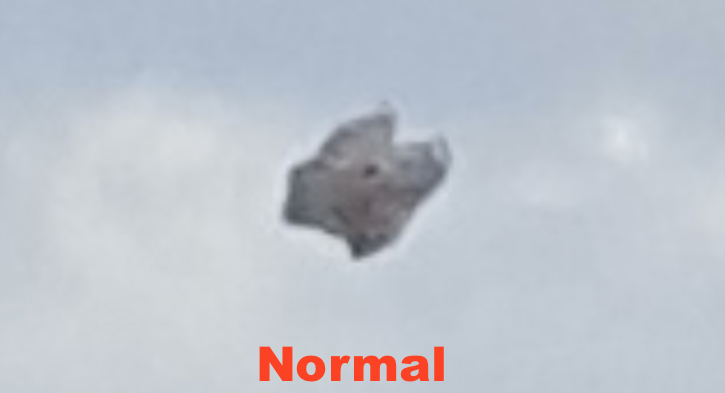

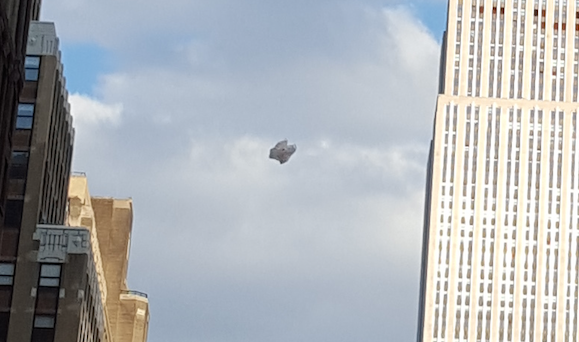



 Obese woman who was too fat to fit in a plane seat reveals...

 Could enjoying a nap KILL you? Sleeping for more than 40...