Ontdek de Fascinerende Wereld van UFO's en UAP's: Jouw Bron voor Onthullende Informatie!
Ben jij ook gefascineerd door het onbekende? Wil je meer weten over UFO's en UAP's, niet alleen in België, maar over de hele wereld? Dan ben je op de juiste plek!
België: Het Kloppend Hart van UFO-onderzoek
In België is BUFON (Belgisch UFO-Netwerk) dé autoriteit op het gebied van UFO-onderzoek. Voor betrouwbare en objectieve informatie over deze intrigerende fenomenen, bezoek je zeker onze Facebook-pagina en deze blog. Maar dat is nog niet alles! Ontdek ook het Belgisch UFO-meldpunt en Caelestia, twee organisaties die diepgaand onderzoek verrichten, al zijn ze soms kritisch of sceptisch.
Nederland: Een Schat aan Informatie
Voor onze Nederlandse buren is er de schitterende website www.ufowijzer.nl, beheerd door Paul Harmans. Deze site biedt een schat aan informatie en artikelen die je niet wilt missen!
Internationaal: MUFON - De Wereldwijde Autoriteit
Neem ook een kijkje bij MUFON (Mutual UFO Network Inc.), een gerenommeerde Amerikaanse UFO-vereniging met afdelingen in de VS en wereldwijd. MUFON is toegewijd aan de wetenschappelijke en analytische studie van het UFO-fenomeen, en hun maandelijkse tijdschrift, The MUFON UFO-Journal, is een must-read voor elke UFO-enthousiasteling. Bezoek hun website op www.mufon.com voor meer informatie.
Samenwerking en Toekomstvisie
Sinds 1 februari 2020 is Pieter niet alleen ex-president van BUFON, maar ook de voormalige nationale directeur van MUFON in Vlaanderen en Nederland. Dit creëert een sterke samenwerking met de Franse MUFON Reseau MUFON/EUROP, wat ons in staat stelt om nog meer waardevolle inzichten te delen.
Let op: Nepprofielen en Nieuwe Groeperingen
Pas op voor een nieuwe groepering die zich ook BUFON noemt, maar geen enkele connectie heeft met onze gevestigde organisatie. Hoewel zij de naam geregistreerd hebben, kunnen ze het rijke verleden en de expertise van onze groep niet evenaren. We wensen hen veel succes, maar we blijven de autoriteit in UFO-onderzoek!
Blijf Op De Hoogte!
Wil jij de laatste nieuwtjes over UFO's, ruimtevaart, archeologie, en meer? Volg ons dan en duik samen met ons in de fascinerende wereld van het onbekende! Sluit je aan bij de gemeenschap van nieuwsgierige geesten die net als jij verlangen naar antwoorden en avonturen in de sterren!
Heb je vragen of wil je meer weten? Aarzel dan niet om contact met ons op te nemen! Samen ontrafelen we het mysterie van de lucht en daarbuiten.
Berichten van 1 september 2016 tot 30 september 2016
A District of Columbia witness reported watching two orb UFOs “exchanging plasma” while a craft appeared and hovered for more than two hours, according to testimony in Case 79086 from the Mutual UFO Network (MUFON) witness reporting database.
The witness was house sitting and stepped out onto the front porch at 7:40 p.m. on August 30, 2016, when the incident began.
“I was just relaxing and enjoying the nice evening,” the witness stated.“I was looking out over the horizon (to the west) overtop a couple of buildings. Straight ahead of me, just over the buildings, I noticed what, at first, I thought to be a star but then realized it was a bit too bright and I thought it must be Venus.”
See witness Exhibit 1.
Witness Exhibit 1. Credit: MUFON)
“At this point, ‘Venus’ blinked off and on twice. I immediately knew that something was not right. I will now, for clarity, refer to ‘Venus’ as the ‘primary orb’. Almost immediately after the blinking off and on, a secondary orb came out of, or came out from behind, the primary orb. So now I’m staring at two orbs. I’m shocked and my mind is not processing this because I just don’t know what this is.”
The witness described the orbs.
“The orbs appeared to be visually closer than they actually were as if I was looking through an invisible pair of binoculars. The two orbs began to gyrate and move as if vying for some particular position in relation to one another like two boxers bobbing and weaving in the ring. I had a very distinct feeling from that that they were trying to get something accomplished. Once they ‘found’ their positions both orbs proceeded to emit to one another some kind of plasma energy. I’m using the term ‘plasma’ because it’s the only word I can think of that best can describe what I was seeing. This plasma met between them and joined the two orbs together. This lasted a couple of seconds and then each orb took back the plasma it emitted and they were no longer connected.”
See witness Exhibit 2.
Witness Exhibit 2. (Credit: MUFON)
“At that point, the primary orb stretches out plasma to the secondary orb. They connect once again and then the plasma from that retracts back to the primary orb.”
See witness Exhibit 3.
Witness Exhibit 3.
(Credit: MUFON)
“As if things could not get any stranger, the secondary orb now sprays plasma at a slightly upward angle toward the primary orb. Imagine a garden hose tilted at an upward angle and seeing the individual water streams come down. These were plasma streams coming down on to the primary orb.”
See witness Exhibit 4.
Witness Exhibit 4.
(Credit: MUFON)
“When these streams hit around the primary orb they formed a perfect circle of dots of red light with the primary orb centered in the middle.”
See witness Exhibit 5.
Witness Exhibit 5.
(Credit: MUFON)
“After about three seconds, the circle of red dots disappeared, but the primary orb was still there. Now I’m absolutely perplexed and I don’t know what I’m seeing. I rubbed my hands on my eyes for about two seconds and when I pulled them away there was a craft (UFO) where the orbs had been. From where I was, it looked like it could be disc-shaped or cigar-shaped. The color of the craft itself seemed to match the background sky. There were lights around the edges that blinked randomly (white and a variety of other colors I could not determine at that point).”
See witness Exhibit 6.
Witness Exhibit 6.
(Credit: MUFON)
“As soon as I realized it was a craft, it began to ascend slowly as if going up in an elevator. It then stopped and hovered there with lights blinking. It did not move at all as if it was sitting on a shelf.”
See witness Exhibit 7.
Witness Exhibit 7.
(Credit: MUFON)
“I’m staring at it and then see a bright flash of light to my left. I look up to the left and there is a cloud and as I look at it a bright flash of circular light shines down through it. This flash happens twice more. Each flash about a second long with three seconds in between each one. I’m looking at the craft, then the cloud and wondering if these are connected. The flashes did not look like lightning to me and the weather that evening did not call for rain or storms. Because I was caring for someone, I needed to go back in the house. I went back inside at about 7:45p.m. I was able to find some old and barely useful binoculars. I went back out several times to look through the binoculars. I could see very random patterns and colors. Because of the poor quality of the binoculars it was hard to get any more detail than the random patterns of lights. Sometime between 8:30p.m. and 9:30p.m., I saw an airplane coming from the north. It did not alter its path. It flew a little to the east (closer to me) and a little lower than the UFO. It may have been a passenger jet preparing to land at National Airport. Whoever was piloting that plane had to have seen the UFO hovering there.”
See witness Exhibit 8.
Witness Exhibit 8.
(Credit: MUFON)
“At 10p.m., before I went to bed, I checked to see if the craft was still there. It was. It had moved maybe a few hundred feet to the north.”
See witness Exhibit 8a.
Witness Exhibit 8a.
(Credit: MUFON)
“Some clouds were starting to come in but I could still see the lights flashing. My observation point for this sighting was about .5 to .75 mile east of the craft. I estimate it was hovering over the area of the Washington International School. This craft had been in view for 2 hours and 15 minutes and in very close proximity to the Washington National Cathedral and the U.S. Naval Observatory.”
The witness believes there have to be additional witnesses.
“I find it hard to believe that I could be the only person to have witnessed this. As a last note, the next morning I went out onto the patio just in time to see a formation of three helicopters (there might have been more but maybe I just missed them) flying to the left of where I had been observing the craft the night before. They were flying quite low and right towards the area where the craft had been hovering. They were identical to one another and I did not see N numbers on any of them. Where they flew by is not a helicopter flight path.”
District of Columbia MUFON is investigating. Please remember that most UFO sightings can be explained as something natural or man-made. The above quotes were edited for clarity. Please report UFO activity to MUFON.com.
De Europese astronomiesatelliet Gaia heeft al meer dan een miljard sterren met grote precisie in kaart gebracht, een prestatie zonder voorgaande in de sterrenkunde. Dit heeft het Europese Ruimtevaartbureau ESA vandaag, 1.000 dagen na de lancering, bekendgemaakt.
Tijdens zijn streven om de meest gedetailleerde driedimensionale kaart van onze Melkweg te maken, heeft de Gaia al de exacte positie en helderheid van 1.142 miljoen sterren bepaald. Dat is ongeveer één procent van de sterren in ons sterrenstelsel.
Daarbovenop realiseerde de satelliet een driedimensionale film omtrent de afstanden en de bewegingen van meer dan twee miljoen van de helderste sterren in onze omgeving. De Gaia deed ook metingen van meer dan drieduizend variabele sterren (sterren wiens helderheid schommelt) en bracht duizenden objecten buiten de Melkweg in kaart.
De 740 miljoen euro kostende satelliet bevindt zich op een positie van ongeveer 1,5 miljoen kilometer van de Aarde. Zijn camera kan mutatis mutandis een muntstuk van een cent op de Maan zien. Wetenschappers hopen meer te leren over de geschiedenis van de Melkweg en rekenen met de ontdekking van duizenden nieuwe planeten.
Belgische inbreng België draagt twintig miljoen euro bij aan de missie. Zo wijden er zowat 45 mensen (minstens een deel van) hun tijd aan de missie. Zestig procent werkt bij universiteiten, of de Koninklijke Sterrenwacht in Ukkel. Er waren ook zowat twintig private bijdragen aan de satelliet, onder andere van het Luikse bedrijf Amos, Thales Alenia Space Belgium en Spacebel.
Als een voorhamer die een watermeloen raakt: dat moet volgens nieuw chemisch bewijs zowat de impact geweest zijn waardoor onze maan werd gevormd, nadat de nog jonge aarde in botsing kwam met een ander ruimteobject ter grote van Mars. Jarenlang dachten wetenschappers dat die impact 4,5 miljard jaar geleden een stuk minder indrukwekkend was geweest.
Dat de maan ooit voor een stuk deel uitmaakte van de aarde is een alom aanvaarde theorie, maar de manier waarop ze van onze planeet werd afgesplitst, bleef voer voor discussie. Het gebeurde ongeveer 20 tot 100 miljoen jaar nadat ons zonnestelsel werd gevormd. Theia, een object met de grootte van Mars, botste met de zich nog ontwikkelende aarde. De impact op onze planeet zou meegevallen hebben, maar het grootste deel van Theia versmolt met de oppervlakte en de kern van de aarde. Uit het stof en het puin dat in een baan rond de aarde werd geworpen, werd de maan gevormd.
50 jaar lang werd aangenomen dat de aarde en Theia elkaar eerder hadden geschampt dan voluit hadden geraakt. Het zou onder meer verklaren waarom de maan zo groot is en een verschillende rotatiegraad heeft van onze planeet. Er was maar één probleem met die hypothese: de maan had dan voor 60 tot 80 procent uit materiaal van Theia moeten bestaan.
Apollomissie Maar nieuwe en betere chemische analyses op stalen die werden meegebracht door de Apollomissies in de jaren 70 toonden aan dat de rotsen op de maan en de aarde bijna identiek in samenstelling waren. En de kans dat Theia en de aarde ooit uit hetzelfde materiaal bestonden, was erg onwaarschijnlijk.
Meer nog: er werd maar één isotoop gevonden in de maanrotsen dat niet was terug te leiden naar de aarde, namelijk zwaar kalium. En dat kon alleen voorkomen als de rotsen aan een extreem hoge temperatuur waren blootgesteld. Wat onderzoekers tot de conclusie bracht dat de impact van de botsing tussen de aarde en Theia veel groter geweest moest zijn dan oorspronkelijk gedacht.
Gewelddadig Volgens de auteur van de nieuwe studie - Kun Wang, een geochemicus aan de universiteit van Washington in St. Louis - was de botsing extreem gewelddadig en werden de aarde en Theia bijna volledig verpulverd. De twee hemellichamen zouden daarna samengesmolten zijn in een dichte atmosfeer, die dan condenseerde in onze planeet en haar maan.
Niet iedereen is evenwel overtuigd van die these. Het grootste punt van kritiek is de representativiteit van de (amper) zeven maanstalen waarop de analyse werd uitgevoerd.
(VIDEO) GERMAN SPY REVEALS SECRET US HOLLOW-EARTH-PACT
A truly astonishing Federal Security Service rumour circulating in the Kremlin today on the Foreign Intelligence Service arrested yesterday by Germany’s National Intelligence Service for spying states that this German national has given to Russian officials “Hot evidence” that the United States has entered into a “secret pact” with “forces” inhabiting our Earth’s interior regions for the purpose of ruling the world.
According to the media sources, the Germany National Intelligence Service arrested a man named as Manfred K. age 60. Because he wanted to give the information to the Foreign Intelligence Service.
Manfred K. was a civilian worker at the United States NATO Ramstein Airbase that is the command and control for the Western missile defence forces in Europe, where he had access to this top secret information including maps from the Nazi regime 1930/1945.
Watch the video below to learn more about this bizarre story.
Ancient Structure In Japan Similar To Structure On Mars, Sept 2016, Video, UFO Sighting News
Date of discovery: unknown Location of discovery: Mars Google Earth: 36° 7'45.64"N 139°28'52.95"E Google Mars: 6° 3'57.07"N 92° 4'13.22"E These structures were discovered about two years ago, but recently I was wondering if this is proof that aliens came from Mars after the destruction of their planet. The Japanese do a lot of things different than other cultures...in a way that creates unity among its people more than other countries. It may be possible they are direct descendants of the ancients from Mars. Scott C. Waring News states: A massive structure appears isolated on a flat empty plane. The sides of the structure appear to have straight edges that run down to a large circular 'dot' formation at its base. NASA says the straight edges may be the result of fractures, related to fractures or a hill that was lifted up by the faulting and its current shape was the result of the surrounding terrain having been eroded down over billions of years. The same formation as on Mars, has also been found in Kofun in Japan. The Kofun era lasted from AD250 -538.
Fleet of UFO seen over Salt Lake City during sunset on Aug 11, 2016, Photos, UFO Sighting News
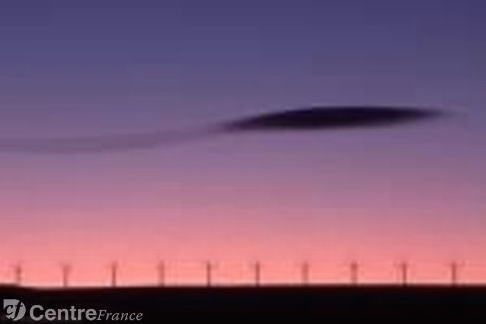
Date of sighting: August 11, 2016 Location of sighting: Salt Lake City, Utah, USA Source: MUFON #78355 These photos reveal a dark disk over Salt Lake City last month. The disk was seen alone, then with several others, and then alone again. Thats how cloaking devices work. It was seen right after sunset, when the cloaks of the ships are most vulnerable, that is when they saw many. Later, there was just one. Aliens do this for several reasons. One, they want a scout up ahead, that is being watched by humans, so the others wont be seen if their cloak is not working. Two, they want to see, feel the reactions of those who see it, so they know what precautions they must take next to insure they don't frighten humans. Scott C. Waring
Eyewitness states: My family and I ( myself 37 years of age, sister 24, brother 27 and my two boys 10 and 8) were driving up interstate 15 in utah just south of salt lake city. I was the first to notice a black object in the sky which seeemed to be about 3 miles away, about 1500 feet off the ground. I made a joke to my boys to look there was a ufo. My sister said its just a cloud to which I responded " I know I'm just trying to trick the boys". I did think it was wierd that there was a single black cloud low in the sky and not all that far away. We watched it for a few minutes still talking about it going back and forth weather it was a cloud because as we got closer so it seemed it seemed more defined edges and solid. I decided to take pictures half thinking I was just taking pictures of a single solid black cloud. The pictures did not turn out well because it was with a cell phone a little past sun set and zoomed to the max. After taking several pics and looking threw what I took I looked up and there were now 3 black classic ufo shape objects. Then two and then one again. I did not see them seperate or come back together if that is infact how there became three and then one. It then seemed to pick up speed continuing north towards ogden. Within seconds it was gone. My brother and I both thought the object was about 500 yards across and about half that tall. We all at first were not excited about what we were watching but slowly realized it was no cloud and then when there were three horizontally and evenly spaced apart about 600yards we became real excited and kids a little scared. I don't know what it was but I know it was unusual. There was never a light on the objects. Just black.
Controversial Black Military Projects – Philadelphia Experiment, The Montauk Project, UFO Technology and the CERN Hardon Collider
Insightful author and publisher Alexandra Bruce sits down once again with dark journalist Daniel Liszt for a breaking interview on dimensional doorways, UFOs, MILAB, timeline manipulation. CERN Hadron Collider is believed to be responsible for opening dimensional doorways.
Alexandra shares her discoveries during a comprehensive investigation of the Philadelphia Experiment and the Exotic Invisibility Technology, which the Navy supposedly developed to confuse enemies.
Her probe eventually led to the bizarre revelations of a Black Budget research laboratory called The Montauk Project, located at Montauk Air Force Station on Long Island, New York. The research lab is believed to be the place of the extension or continuation of the so-called Philadelphia Experiment on October 28, 1943.
The original classic book “The Montauk Project,” by Alexandra, has made awareness to the public of the tales of Energy Manipulation, Time Travel, Astral Travel, Psychic Consciousness, Remote Viewing and Alternate Dimensions.
She claimed to have found witnesses who were part of a UFO Crash Retrieval team. These witnesses, according to Alexandra, were being used on black project experiments, particularly merging Human DNA with Alien technology.
She also claimed of interviewing a teenager whom his consciousness had been put in a younger vehicle after living many years as a soldier in Vietnam.
Some say that it was just a military psychological mission or operation. However, many believe that those experiments really took place.
The connection among The Montauk Project, the Philadelphia Experiment, CERN Hardon Collider and UFO Technology could suggest that an exchange system with an alternate dimension is being developed through the technological continuum.
The investigation could be a breakthrough into a dark black military project, which involves human testing and experiments.
Ancient Aliens – Beyond Roswell History Channel, Season 11 Episode 13 19th August 2016
The U.S. military has long denied that the infamous 1947 Roswell crash was anything other than a weather balloon, but FBI files released in 2011 include a memo to J. Edgar Hoover regarding the recovery of not one, but three “flying saucers.” Could the U.S. government really have extraterrestrial crafts in their possession? Ancient Astronaut theorists say yes, and claim that Roswell is just the tip of the iceberg. Over a dozen other UFO crashes were reported all across the world around the same time as Roswell, and it is rumored that the wreckage from these incidents was retrieved and hidden away at secret military bases like Area 51 in Nevada, Kapustin Yar in Russia, Pine Gap in Australia, Rudloe Manor in England, and even in the remote hills of China. But if true, what happened to these alien spaceships?
Blue Origin's Huge New Rocket Heats Up Billionaire Space Rivalry
By Mike Wall, Space.com Senior Writer
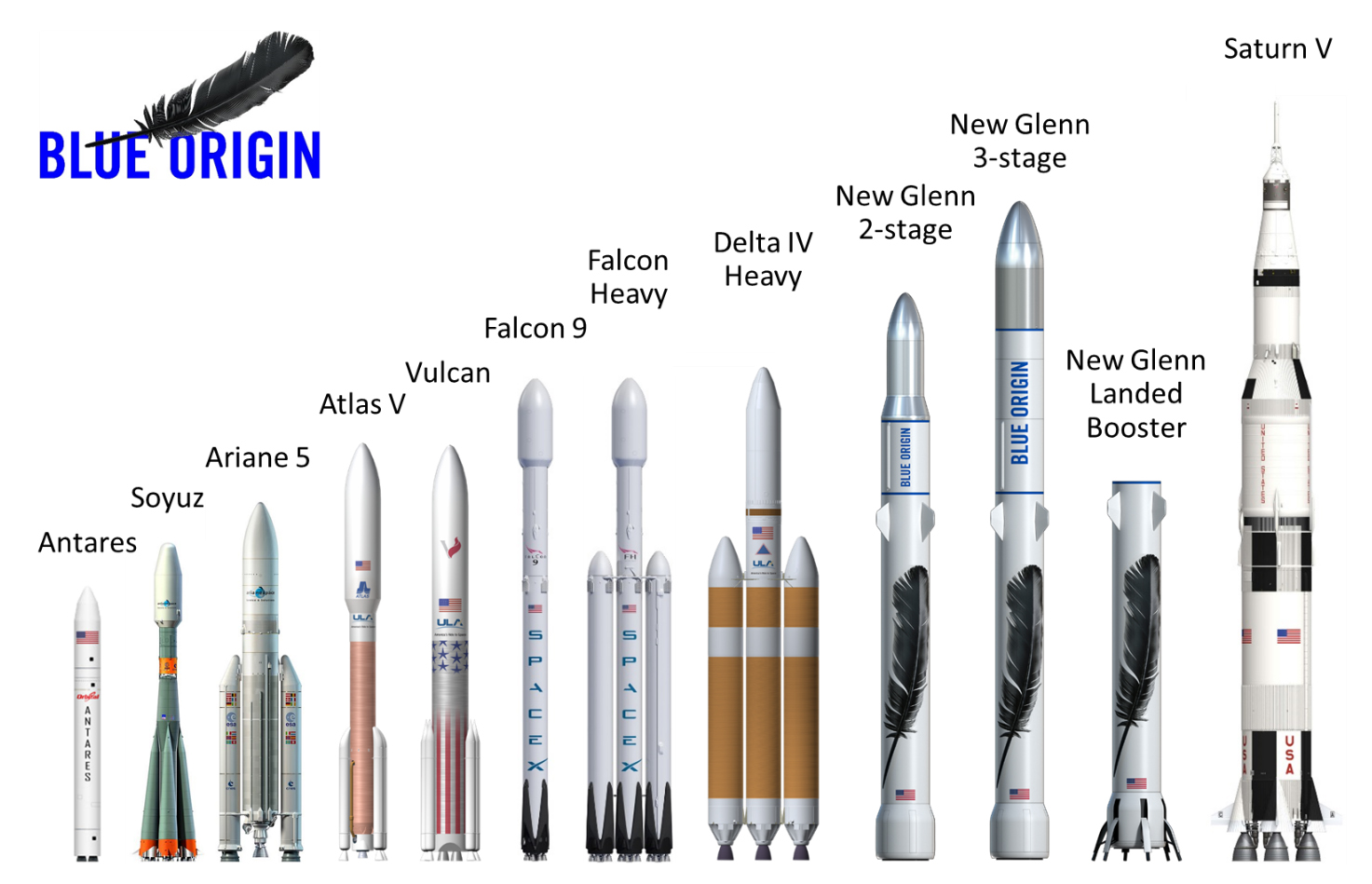
Blue Origin's newly announced New Glenn heavy-lift rockets will feature reusable first stages. The two- and three-stage versions will stand 270 feet (82 meters) and 313 feet (95 m) tall, respectively.
Credit: Blue Origin
The competition between billionaire space entrepreneurs Elon Musk and Jeff Bezos has reached new heights.
On Monday (Sept. 12), Bezos announced that his company Blue Origin is developing a family of heavy-lift rockets known as New Glenn, after John Glenn, the first American to orbit the Earth. With a maximum height of 313 feet (95 meters), New Glenn will be taller than the 230-foot (70 m) Falcon Heavy, which Musk's SpaceX is building.
The Falcon Heavy will be more powerful, however, generating 5.1 million pounds of thrust, compared to New Glenn's 3.85 million pounds. [Blue Origin's Private Spaceships in Photos]
The first stages of the Falcon Heavy (including the two strap-on boosters, which will be derived from Falcon 9 first stages) and New Glenn will be reusable, in keeping with the priorities of SpaceX and Blue Origin; both companies aim to slash the cost of spaceflight by landing and reflying their rockets multiple times.
The two companies' parallel efforts to develop this technology spawned aminisquabble between Musk and Bezos in November 2015, after Blue Origin's New Shepard rocket landed during a suborbital test flight, becoming the first booster ever to do so.
Musk congratulated Bezos via Twitter at the time, but also stressed that bringing a rocket back during an orbital launch — as SpaceX had been trying to do with its Falcon 9 — was a much more difficult task. (New Shepard is a suborbital rocket designed to take paying customers and science experiments on brief jaunts to space, while the Falcon 9 launches payloads to orbit.)
An artist's illustration of a SpaceX Falcon Heavy rocket at Launch Complex 39A at NASA's Kennedy Space Center in Florida.
Credit: SpaceX
Bezos then pushed back, saying that SpaceX was trying to recover just the Falcon 9's first stage, which never makes it to orbit.
"The second point that I would make is that the SpaceX first stage does an in-space deceleration burn to make their re-entry environment more benign," Bezos said during a news conference in November. "So if anything, the Blue Origin booster that we just flew and demonstrated may be the one that flies through the harsher re-entry environment. And then finally, the hardest part of vertical landing and reusability is probably the final landing segment, which is the same for both boosters."
SpaceX succeeded in landing a Falcon 9 first stage in December 2015, during the launch of 11 satellites for the company Orbcomm. Since then, SpaceX has landed five more Falcon 9 first stages, some of them on terra firma near the launch pad and some on robotic "drone ships" stationed offshore.
And Blue Origin has successfully launched and landed the same New Shepard first stage four times to date, most recently in June of this year.
In his Monday announcement, Bezos said that the company's goal is to have New Glenn — which will have a two-stage variant and a three-stage version — up and running by 2020. Meanwhile, SpaceX representatives had said that the maiden flight of the Falcon Heavy should take place later this year, but that timeline may be in doubt as the company continues to investigate theexplosion of a Falcon 9 during a routine prelaunch test on Sept. 1.
Bezos and Musk aren't the only billionaires reshaping the spaceflight landscape. For example, Virgin Galactic was founded by British entrepreneur Richard Branson in 2004, and in 2011 Microsoft co-founder Paul Allen formed Stratolaunch Systems, which will launch satellites (and, eventually, crew-carrying vehicles) beneath the biggest airplane that has ever flown.
De afgelopen maanden zijn er diverse kraters ontstaan in Siberië. Wetenschappers hebben mogelijk een verklaring gevonden hoe deze kraters zijn gevormd. De vinger wijst in de richting van klimaatverandering als hoofdverdachte.
Op 19 juli voerden onderzoekers, onder leiding van Andrei Plekhanov van het Scientific Centre for Artic Studies, een onderzoek uit bij de Yamal-krater die eerder die maand is ontstaan. Zij troffen opvallend veel methaan aan. Nabij de bodem van de krater bestond de lucht voor 9,6% uit methaan. En dat terwijl de lucht gemiddeld voor 0,000179% uit methaan bestaat.
Gesmolten permafrost Plekhanov en zijn team denken dat er sprake is van een connectie tussen het ontstaan van de krater en de opvallend hete zomers in de omgeving van de krater in 2012 en 2013. De gemiddelde temperatuur was vijf graden Celsius hoger dan normaal. De wetenschappers suggereren dat de bevroren permafrost is ontdooid en in elkaar is gestort. Hierbij kwamen grote hoeveelheden methaan vrij. Andere wetenschappers denken dat er sprake is van een langduriger effect. Zij wijzen er op dat de permafrost op een diepte van twintig meter de afgelopen twintig jaar met twee graden Celsius is opgewarmd.
Verder onderzoek De wetenschappers gaan graag terug naar de krater om meer onderzoek te doen. Ze willen graag de hoeveelheid methaan in de wanden van de krater meten. Maar, het is zeer gevaarlijk werk. De krater is minstens zeventig meter diep. Daarnaast brokkelen de randen dagelijks verder af door opwarming.
Zorgen Hoewel de krater in onbewoond gebied is gevonden, maken de onderzoekers zich zorgen. Wat als er meer kraters ontstaan in bewoonde gebieden of in gasvelden? Gaan dit soort gaten mensenlevens opeisen?
De grootste maan van Pluto heeft een vuurrode noordpool. Dit wordt veroorzaakt door bevroren methaan, zeggen Amerikaanse wetenschappers.
De baan van Pluto rondom de zon is niet rond, maar ovaalvormig. Aangezien de omlooptijd van deze dwergplaneet 248 jaar is, kennen Pluto en Charon winters die niet enkele maanden, maar vaak meer dan honderd jaar duren.
Tijdens zo’n lange winter vangt Charon methaan dat ontsnapt uit de atmosfeer van Pluto. Dit methaan vriest vast aan het oppervlak van de dwergplaneet. Naarmate de temperatuur stijgt, verkleurt het methaan en krijgt het gebied een rode gloed.
De bovenstaande theorie is niet nieuw, maar tot nu toe bleef het bij speculaties. Will Grundy en zijn collega’s van het Lowell observatorium hebben de gegevens van de New Horizons-ruimtesonde gebruikt om modellen van het oppervlak van Pluto en Charon te bouwen. De modellen bevestigen alle speculaties, waardoor het zeer aannemelijk is dat het rode gebied ook daadwerkelijk op deze manier is ontstaan.
Op weg naar het volgende doel De scheervlucht langs Pluto is alweer een jaar ten einde en dat betekent dat de ogen zijn gericht op het volgende doel: 2014 MU69. New Horizons komt in januari 2019 aan bij dit Kuipergordelobject. Een lange reis nog te gaan!
Nieuwe stof gebruikt zon en wind om apparaten van stroom te voorzien
Tim Kraaijvanger
Wetenschappers van het Georgia Institute of Technology hebben een stof ontwikkeld die zonne-energie en windenergie opvangt. Misschien kan dit textiel in de toekomst gebruikt worden om GPS-systemen of smartphones op te laden.
De onderzoekers gebruikten een weefmachine om zonnecellen van polymeervezels met vezelachtige tribo-elektrische nanogenerators te weven. Deze tribo-elektrische nanogenerators gebruiken een combinatie van het tribo-elektrische effect (materialen wisselen bij contact elektrische lading uit) en elektrostatische inductie om een mechanische beweging (roteren, schuiven of vibreren) om te zetten in stroom.
De nieuwe stof is 320 micrometer dik en bestaat voor een groot deel uit wol. De onderzoekers beweren dat de stof geïntegreerd kan worden in tenten, gordijnen en kleding. “Het materiaal ademt, is flexibel, weegt bijna niets en kan overal voor gebruikt worden”m concludeert professor Zhong Lin Wang. Zijn paper staat deze week in het wetenschappelijke vakblad Nature Energy.
Straks heeft jouw horloge geen batterijtje meer nodig. Misschien kan de stof wel gebruikt worden als horlogebandje?
Daarnaast is het materiaal niet prijzig om te maken. “De polymeervezels zijn niet duur en goed verkrijgbaar”, zegt Wang. “Daarnaast zijn ze milieuvriendelijk. De elektroden zijn ook niet kostbaar om te produceren, waardoor massa-productie een mogelijkheid is.”
Aardige opbrengst De onderzoekers hingen een lapje stof ter grootte van een A4’tje uit een autoraam. Toen de auto bewoog werd energie opgevangen, ook al was het die dag bewolkt. Een stukje stof van vier bij vijf centimeter laadde een condensator binnen een minuut op tot twee volt, met dank aan wind en zonlicht.
Vervolgonderzoek De grote vraag is nu: hoe lang gaat het materiaal mee? Wetenschappers richten zich de komende tijd op deze vraag. Het zou natuurlijk jammer zijn als jouw nieuwe trui van dit materiaal binnen een paar weken uit elkaar valt.
Earth Vulnerable to Major Asteroid Strike, White House Science Chief Says
By Mike Wall, Space.com Senior Writer
Artist's concept of an asteroid striking Earth.
Credit: NASA/Don Davis
The world is still vulnerable to a potentially catastrophic asteroid strike, according to President Barack Obama's chief science adviser.
NASA has made substantial progress in finding the asteroids that pose the biggest threat to Earth, but there's still a lot of work to do, said John Holdren, director of the White House's Office of Science and Technology Policy.
"We are not fully prepared, but we are on a trajectory to get much more so," Holdren said today (Sept. 14) at NASA's Goddard Space Flight Center, during a discussion of the agency's planned Asteroid Redirect Mission (ARM). [Images: Potentially Dangerous Asteroids]
Holdren cited the February 2013 meteor explosion over the Russian city of Chelyabinsk and the 1908 Tunguska airburst as reasons to take the asteroid threat seriously.
The Chelyabinsk strike, which injured about 1,200 people, was caused by an object that is thought to be about 65 feet (20 meters) wide. The Tunguska event was much more powerful; a space rock perhaps 130 feet wide (40 m) exploded over a mostly unpopulated region of Siberia, flattening 800 square miles (2,070 square kilometers) of forest. Both strikes caught the world completely by surprise.
"We know that this does happen," Holdren said.
Strikes such as the Chelyabinsk impact are thought to happen once every hundred years, he added, while Tunguska is regarded as a once-in-1,000-years event.
But, Holdren said, "if we are going to be as capable a civilization as our technology allows, we need to be prepared for even those rare events, because they could do a lot of damage to the Earth."
"This is a hazard that, 65 million years ago, the dinosaurs succumbed to," he added. "We have to be smarter than the dinosaurs."
ARM can help educate us, Holdren said. In late 2021, NASA aims to launch a robotic probe toward a near-Earth asteroid; the current target is a 1,300-foot-wide (400 m) rock called 2008 EV5, but that’s not set in stone, agency officials said.
After it arrives at the asteroid, the spacecraft will pluck a boulder off its surface and then fly along with the space rock for a while, investigating the potential of a deflection strategy known as the "enhanced gravity tractor." (The standard gravity-tractor method calls for nudging a potentially hazardous asteroid off course over the course of years or decades, using the subtle gravitational tug of a tag-along robotic probe; this effect will be "enhanced" by the addition of the boulder's mass.)
The probe will then head back toward Earth, eventually placing the boulder in orbit around the moon. Astronauts aboard NASA's Orion space capsule will visit the purloined rock in the mid-2020s, agency officials have said.
The $1.25 billion ARM mission should help researchers learn more about asteroids and the resources they possess; demonstrate many of the technologies needed to get astronauts to Mars (which NASA aims to do before the end of the 2030s); help the agency practice human operations in deep space; and hone some of the skills that will be needed to deflect a potentially dangerous asteroid one day, Holdren said.
"The asteroid-retrieval mission makes sense in about five different ways," he said.
While smaller asteroids can do great damage on a local scale, experts think that space rocks must be at least 0.6 miles (1 km) wide or so to threaten human civilization. NASA scientists estimate that they have found at least 90 percent of these mountain-size, near-Earth asteroids, and none of them pose a threat for the foreseeable future.
Gravity tractors aren't the only possible defense against incoming asteroids. For example, dangerous space rocks could also be knocked off course by "kinetic impactors" (a series of spacecraft that slam into them). Some researchers have also proposed destroying asteroids with nuclear bombs; this is usually regarded as a last-resort strategy, to be used with space rocks that are discovered too late to deflect via gravity tractors and/or kinetic impactors.
Unlimited Energy: Physicists Assert We Already Have a Viable Model of a Fusion Device
IN BRIEF
One of the biggest challenges in the fusion energy development is finding the best shape for the device to contain the plasma, but physicists in the United States believe they may have found a new kind of nuclear fusion device that could be the most commercially viable design yet.
HOLY GRAIL
Physicists around the world are on a mad dash to build a nuclear fusion machine that can replicate the Sun’s atom-fusing process and provide everyone with a low-cost, sustainable energy resource—effectively ending our dependence on fossil fuels.
Replicating how the sun and stars create energy through fusion is essentially like putting “a star in a jar,” although there is no “jar” in existence that is not only capable of containing superhot plasma, but also low-cost enough that it can be built around the world—although it’s not for lack of trying.
In fact, physicists are working on a new kind of nuclear fusion device that could be the most commercially viable design yet.
In a new paper published in Nuclear Fusion, physicists working at the U.S. Department of Energy’s Princeton Plasma Physics Laboratory (PPPL) assert that a model for such fusion device “already exists in experimental form – the compact spherical tokamaks at PPPL and Culham, England.”
Test cell of the National Spherical Torus Experiment-Upgrade with tokamak in the center. (Photo by Elle Starkman/PPPL Office of Communications)
SPHERICAL TOKAMAKS
Current designs for this so-called “jar” essentially call for doughnut shaped objects that come complete with powerful magnetic fields which suspend the plasma inside it, called tokamaks. It’s incredibly expensive to make and also hard to maintain, which is why physicists continue to develop new designs that will, hopefully, keep the cost down.
So far, there are two advanced spherical tokamaks in various stages of development. The first is the Mega Ampere Spherical Tokamak (MAST), which UK expects to be completed soon; the other is the National Spherical Torus Experiment Upgrade (NSTX-U) at PPPL, which went online last year.
“We are opening up new options for future plants,” said Jonathan Menard, lead author and program director for the NSTX-U.
But the devices, described in the 43-page paper, still have a long way to go. They must first be able to control the turbulence created after the plasma particles are subjected to electromagnetic fields, and also control how the superhot plasma particles interact with the device’s walls to avoid possible disruptions, which can happen if the plasma becomes too impure.
PPPL Director Stewart Prager said these two reactors, “will push the physics frontier, expand our knowledge of high temperature plasmas, and, if successful, lay the scientific foundation for fusion development paths based on more compact designs.”
World First: New Nanofish Will Change the Way We Deliver Medicine
Credit: Small (2016). DOI: 10.1002/smll.201601846
Randy Patton, Ohio State University
IN BRIEF
Researchers have created the world's first nanofish using gold, nickel, and silver. Each Segment is just 800 nm long. The fish could be key to better ways of delivering medicine and manipulating cells.
SWIMMING ROBOTS
Drug delivery technology is currently experiencing a sort of Renaissance. From delivery using ultrasonic vibrations to ingestible electronics, we are currently developing many ways to effectively deliver medicine in a safer, more targeted way.
But who would have thought that included injecting swimming nanomachines into our body?
Researchers at U.C. San Diego have created the world’s first nanofish, small robots that swim like fishes, created with drug and medicine delivery in mind.
While creating nanomachines is no new feat, current models are more akin to submarines, spinning with a corkscrew-like propeller. While this has enabled them forward movement, it is not the most efficient way of propelling these tiny machines.
TARGETING DELIVERIES
Instead, the new study, to be published in Nano Small Micro, proposes a fish-like movement. Essentially, the robot will sway its tail back and forth using electromagnetism. The small nanomachines are made up of 800 nanometer-long gold and nickel segments connected by silver.
An external magnet controls their movement, making the nickel sway back and forth. By altering the strength and orientation of the magnets used, the speed and direction of the machines can be controlled. This allows the researchers to tell the fish when and where to go, opening the possibility of pushing drugs to their intended target. The ultimate goal is targeted delivery, or even the possibility of manipulating single cells.
Currently, the researchers are working on several improvements, according to New Scientist. These include tackling the challenge of how to get the machines out of the body. One solution would be making the robots biodegradable. But that doesn’t solve all the issues. The fish would also be extremely expensive because of the precious metals used in the design. Thus, it may be a while before we have schools of fish solving all of our interior medical issues.
Imagine charging your phone or portable device with your shirt or your jacket. A group of researchers may have made it possible with a technology that has been in the works for two years now. And all it takes is a bit of movement and sunshine.
CUT FROM… WELL, A CLOTH
A lot can be said of mobile batteries, but “long-lasting” isn’t a phrase that comes to mind. Thus, the birth of power banks and power-saving options in mobile OS devices. Well, things may be about to change.
A group of US and Chinese researchers from the Georgia Institute of Technology in Atlanta have worked for the past two years to develop an electricity-producing fabric. The super-thin material generates electricity through movement and sunlight.
This smart fabric is made using “solar cells fabricated from lightweight polymer fibers into micro cables are then woven via a shuttle-flying process with fibre-based triboelectric nanogenerators,” according to the article published in Nature Energy.
A CUT ABOVE THE REST
The applications of such a technology are limited only by what you can weave. “A single layer of such fabric is 320 μm thick and can be integrated into various cloths, curtains, tents and so on,” the study claims. And it can be charged as you move wearing the cloth, or as the wind blows it around.
Lead researcher Professor Zhong Lin Wang explains: “If you’re walking [and] your jacket is flicking back and forwards, you can harvest this kind of motion energy to charge your cell phone.” The researches demonstrated this using a 4 cm by 5 cm piece of the cloth and it was enough to power “a 2 mF commercial capacitor up to 2 V in 1 min under ambient sunlight in the presence of mechanical excitation.”
Credits: Professor Zhong Lin Wang
With the rise of wearable tech, this fabric already has market potential — from mobile to medical technology, and infrastructure monitoring to GPS. The researchers have received a number of inquiries from people in these industries.
In two years, the fabric may be available on the market.
First-Ever Discovery: Complex Organic Molecules Found on Rosetta’s Comet
This false-color four-image mosaic comprises images taken from a distance of 28.7 km from the center of Comet 67P/Churyumov-Gerasimenko on 3 February 2015. The mosaic measures 4.2 x 4.6 km. Image
credit: ESA / Rosetta / NAVCAM / CC BY-SA IGO 3.0.
IN BRIEF
The ESA's Rosetta comet orbiter has found complex, solid organic molecules in dust particles that came of the comet 67P/Churyumov-Gerasimenko, lending credence to the theory that organic compounds, or even life itself came from the stars.
ONE LAST FIND
Over the past few months, the ESA’s Rosetta orbiter has been feeding us valuable data on comets: where they come from, what they’re made of, how they work, and so on. But its time is nearly at an end, with a kamikaze dive towards the surface of comet 67P/Churyumov-Gerasimenko scheduled for later this month.
But just before it dies, it has one more surprise up its sleeve.
The scientists behind Rosetta report that the probe has found complex, solid organic matter in the dust particles of the comet, the kind we’ve never expected to find. Previous missions could not collect these solid organic molecules, since these missions were merely flybys. Ultimately, they crafts moved too fast, disrupting the particles too much for a proper characterization.
MORE SOLID EVIDENCE
But Rosetta has the ability to lower its speed so that such information can be gathered. By slowing down, it was able to collect 27,000 dust particles, enough for its COSIMA mass spectrometer to get a proper reading.
What it found was nearly 200 particles of note, which are being studied to determine their organic structure. In a paper published in Nature, the scientists present seven representative particles, particularly two named Kenneth and Juliette.
Nature
“Our analysis reveals carbon in a far more complex form than expected,” remarked Hervé Cottin, one of the authors of the paper, in a statement. “It is so complex, we can’t give it a proper formula or a name!”
Comparison of the spectra determined for Kenneth and Juliette with the composition of organic matter in a chondritic meteorite found on Earth. Red lines indicate cometary dust grains while black lines indicate the meteorite.
Image: ESA/Rosetta/MPS for COSIMA Team
These results are more extraordinary given that previous results from the Philae Lander and Rosetta itself saw only light, gaseous organic molecules, very different from the ones detected by this study.
“These particles have remained pristine and untouched for billions of years…” says senior author Martin Hilchenbach, in the same statement. “The results add to the growing picture that Comet 67P/C-G contains some of the most primitive material from our Solar System’s early history.”
VIDEO: Apollo-astronauten zagen mysterieuze lichten op de maan
Vlak voor de landing van Apollo 17 zag astronaut Jack Smith iets vreemds op of boven het maanoppervlak. “Ik zag net een flits op het maanoppervlak,” zei hij. “Het was een felle flits bij die krater.”
Het object werd ook gezien door astronaut Eugene Cernan. De waarneming door het tweetal stelt experts al tientallen jaren voor een raadsel.
Te fel en te blauw
In het programma The Unexplained Files wordt een foto getoond waarop mogelijk het object is te zien dat Smith tijdens zijn ruimtereis zag. Er werd namelijk een mysterieus blauwgekleurd object vastgelegd boven het maanoppervlak, zo laat astronoom Marc D’Antonio zien.
“In de bovenhoek bevindt zich een heel vreemd driehoekig object,” zegt hij, toevoegende dat hij niet weet wat het is. De drie blauwe lichten zijn te fel en te blauw om een planeet of sterrenbeeld te kunnen zijn.
Geen officiële verklaring
Astronaut Alfred Warden heeft een mogelijke verklaring voor het object. Tijdens een eerdere missie had hij een mini-satelliet in een baan om de maan gebracht. Hij zegt dat de twee astronauten wellicht die satelliet hebben gezien.
Het is onmogelijk om met zekerheid te zeggen wat Cernan heeft gezien. Sommigen speculeren dat Smith meteoren zag die insloegen op de maan. NASA heeft geen officiële verklaring voor deze UFO-waarneming.
Breakthrough Starshot : en route vers Proxima du Centaure ?
Financé par l’entrepreneur russe Yuri Milner et avec la bénédiction de Stephen Hawking, le projetBreakthrough Starshot a pour objectif d’envoyer une sonde vers le système stellaire le plus proche, où l'on vient de découvrir une planète, en une génération seulement.
Lee Billings. Traduction de William Rowe-Pirra
Alpha Centauri, le système stellaire le plus proche du Soleil, est la cible du projet Breakthrough Starshot, qui vise à y envoyer des nanosondes propulsées par laser.
Pour Yuri Milner, l’entrepreneur russe et philanthrope milliardaire qui finance les prix scientifiques les plus richement dotés et la recherche de vie extraterrestre, le ciel n’est pas la limite – et le Système solaire non plus. Soutenu par le physicien Stephen Hawking et d’autres appuis de poids, Yuri Milner a annoncé début 2016 son investissement le plus ambitieux à ce jour : 100 millions de dollars pour un programme de recherche visant à envoyer des sondes robotiques vers le système stellaire le plus proche en seulement une génération.
« L’histoire de l’humanité est faite de bonds en avant », avait déclaré le milliardaire russe peu après l’annonce de son investissement. « Il y a 55 ans, Yuri Gagarine est devenu le premier humain à aller dans l’espace. Aujourd’hui, nous nous préparons pour le prochain grand saut – vers les étoiles.»
« Breakthrough Starshot », le programme financé par Yuri Milner, a pour objectif de faire rentrer tous les composants d’une sonde robotique – les cameras, les détecteurs, les propulseurs de manœuvre et l’équipement de communication – dans une « nanosonde » de l’ordre de quelques grammes. Celle-ci serait suffisamment petite pour être accélérée à des vitesses très élevées, à l’aide de technologies également en développement : un réseau de lasers terrestres de taille kilométrique, capable d’émettre des impulsions de 100 gigawatts pendant plusieurs minutes à travers l’atmosphère ; impulsions qui frapperaient des « voiles solaires » de quelques atomes d'épaisseur et plusieurs mètres de large et les propulseraient vers les étoiles. Chaque photon de l'impulsion laser délivrerait une petite quantité de mouvement à la voile et à son chargement, mais dans le vide et l'apesenteur de l'espace, le torrent de photons libéré par un laser de l’ordre du gigawatt amènerait la nanosonde à des vitesses relativistes. « Sans de nouvelles méthodes de propulsion, nous ne pouvons tout simplement pas aller très loin, » a expliqué Stephen Hawking lors de l’annonce. « La lumière est la technologie la plus accessible. »
Lancées par milliers depuis un vaisseau mère mis en orbite autour de la Terre, chaque nanosonde déploierait sa voile et profiterait d’une impulsion laser pour accélérer à 20 % de la vitesse de la lumière – soit quelques 60 000 kilomètres par secondes. En utilisant un système d'optique adaptative sophistiqué (des miroirs qui se déforment en temps réel) pour conserver la cohérence et la précision de chaque impulsion malgré les turbulences de l’atmosphère, chaque impulsion posséderait une énergie équivalente à celle d'une fusée au décollage. Le réseau de lasers pourrait ainsi propulser une nanosonde par jour.
Ce réseau devrait être construit à haute altitude, dans un environnement aride, et dans l’hémisphère Sud – peut-être au sommet d’une montagne du Chili, d’Afrique du Sud ou même d’Antarctique –, quelque part où l'on voit directement la cible du projet Breakthrough Starshot : l'étoile double Alpha Centauri qui, à 4,37 années lumières, forme avec Proxima du Centaure le système stellaire le plus proche du nôtre. La Nasa a déjà envoyé cinq sondes sur des trajectoires qui les conduisent au-delà des limites du Système solaire, mais même la plus rapide d’entre elles mettrait plus de 30 000 ans à atteindre Alpha du Centaure. Les nanosondes du projet Breakthrough Starshot accompliraient ce même voyage interstellaire en seulement 20 ans. Dépourvue de système de freinage, elles récolteraient brièvement des informations sur les éventuelles planètes du système Alpha Centauri, qu’elle nous enverrait avant de s'enfoncer plus profondément dans l'obscurité de l'espace interstellaire, hors de portée de toute communication.
Pour Yuri Milner, « si cette mission se concrétise, elle nous en apprendra autant sur nous mêmes que sur Alpha Centauri ». Breakthrough Starshot est le concept le plus récent des initiatives Breakthrough, un ensemble de projets multidisciplinaires qui mobilisent des fonds privés pour tenter de répondre à des questions sur la vie dans l’univers. En 2015, toujours avec Stephen Hawking, Yuri Milner avait annoncé Breakthrough Listen, un projet à 100 millions de dollars s’étalant sur 10 ans, qui consiste à écouter plus d’un million d’étoiles et une centaine de galaxies pour tenter de déceler les signaux d’une potentielle civilisation extraterrestre. Il avait aussi annoncé le projet à 1 million de dollars Breakthrough Message, dont l’objectif est de composer des communiqués à diffuser vers l’espace à destination de toute éventuelle civilisation extraterrestre attentive. Comme Breakthrough Starshot, qui représente la plus grosse somme d’argent jamais dédiée exclusivement aux recherches sur le voyage interstellaire, ces autres initiatives constituent un tournant dans le financement de ces champs de recherche qui, en raison de leur nature particulièrement spéculative, ont longuement végété dans les tréfonds des financements scientifiques publics.
Grands projets, petites sondes
Les plans sérieux pour ce projet ont débuté il y a environ un an, quand Yuri Milner a consulté des experts qui ont réfléchi concrètement aux options envisageables pour rendre le voyage interstellaire possible. L’un d’entre eux, Avi Loeb, astrophysicien à l’université de Harvard et nouveau président du conseil consultatif de Breakthrough Starshot, a déjà proposé des idées étonnantes pour rechercher la vie extraterrestre.
Avi Loeb et ses collègues consultants ont souligné que nous sommes déjà capables chaque jour d’accélérer des particules subatomiques à une vitesse proche de celle de la lumière et que plus une sonde est petite, plus elle pourra voyager vite. « Si vous retirez la coque et l’interface d’un iPhone, ses composants électronique, y compris la caméra et les dispositifs de communications, ne pèsent que quelques grammes, » explique Avi Loeb. « C’est presque tout ce dont vous avez besoin pour une nanosonde et nous sommes sur le point de l’avoir grâce à la miniaturisation de l’électronique. »
Après avoir considéré, puis rejeté, des options aussi exotiques que des fusées propulsées par l’annihilation d’antimatière ou par la fusion nucléaire, les consultants se sont intéressés aux voiles solaires propulsées par laser, un concept apparu pour la première fois dans les années 1960. Ils se sont concentrés sur les travaux récents de Philip Lubin, un physicien de l’université de Californie à Santa Barbara, qui venait juste de mettre au point la « feuille de route » pour développer de minuscules sondes interstellaires propulsées par laser, dans le cadre d’une étude modestement financée par la Nasa. Après quelques modifications, ces plans ont fourni un modèle pourBreakthrough Starshot et Philip Lubin est désormais l’un des membres clés du projet.
« Le problème du voyage interstellaire peut-être abordé de deux manières, explique Lubin. Les fusées à antimatière ou à fusion nucléaire font partie d’une approche "réelle". Les lois physiques connues indiquent que ce sont des solutions réalistes, même si nous ne savons pas encore bien comment les mettre en pratique. La propulsion par distorsion de l'espace-temps ou par les trous de ver font partie d’une approche plus "imaginaire" – ce que j’appellerais des solutions fictives, parce que personne n'a la moindre idée de comment les réaliser. » Le concept de propulsion laser est, selon lui, une approche tout à fait réelle parce qu’il est à la fois « réaliste et réalisable ».
La feuille de route de Philib Lubin énonce les nombreux obstacles qu’une mission interstellaire à propulsion laser devra surmonter, tel que la synchronisation d'une multitude de petits lasers en un réseau de taille kilométrique et la fabrication d’une voile légère et fine comme une toile d’araignée, mais capable de résister à des impulsions laser de l’ordre de plusieurs gigawatts. Un autre problème sera de convaincre les responsables politiques d’autoriser la construction d’un tel système laser qui pourrait, en principe, être utilisé comme une arme. Les sondes devront transmettre leurs observations à la Terre en utilisant des lasers embarqués d'une énergie de quelques watts seulement – un problème potentiellement soluble en utilisant le réseau laser terrestre comme récepteur. Mais l’obstacle le plus important est simplement une question de prix : à un coût estimé d’environ 10 dollars par watt, la construction du réseau de laser à 100 gigawatt de Breaktrough Starshot coûterait 1000 milliards de dollars.
Mais si élevé cela que puisse paraître, il faut se souvenir que les prix du marché d’il y a 10 ans auraient rendu le projet 100 fois plus cher. Poussé par la forte demande des systèmes de télécommunications et par les projets de défense, le coût des technologies nécessaires à un réseau de lasers géant est divisé par 2 tous les 18 mois, selon Philip Lubin. Cette baisse exponentielle des coûts suggère que d’ici 10 ans, le prix des lasers pourrait passer de 10 dollars par watt à seulement 10 centimes. « Le projetBreakthrough Starshot consiste au fond à améliorer et à développer à une échelle bien plus grande des technologies critiques, en examinant ce qui permet ou empêche ce changement d'échelle », explique le physicien. « Si les prix ne bougent pas dans les 30 prochaines années, nous aurons de gros problèmes pour mener à bien ce projet. »
Selon Avi Loeb, il existe un autre obstacle, plus subtil, de l’ordre du phénomène social : le « facteur dérision », c’est-à-dire la tendance des gens à se moquer de concepts avant-gardistes. « Toute révolution scientifique ou technologique passe par une première phase durant laquelle elle est moquée, » développe Avi Loeb. « Parfois, la moquerie est issue de critiques valides, mais parfois elle n’existe que parce que le projet est différent et peut paraître étrange… Ce qui est sûr, c’est que la majeure partie de la communauté scientifique qui travaille sur des sujets dont on n'est pas censé se moquer – des sujets dont le facteur dérision est de zéro – font eux même une grande erreur en se moquant. » « Nous sommes sérieux, poursuit Avi Loeb. Nous découvrirons si, oui ou non, ce projet est réalisable et s’il ne l’est pas, nous l’admettrons et passerons à autre chose. »
Le rêve Centauri
Suivant la feuille de route modifiée de Philib Lubin, une grande partie des 100 millions de dollars de Yuri Milner serviront à financer le développement de solutions à une vingtaine d’obstacles techniques majeurs identifiés. Ces solutions pourraient ensuite donner naissance à un prototype, qui pourrait peut-être être construit pour quelques centaines de millions de dollars de plus. Du moment que les prix des technologies électroniques et photoniques continuent de baisser et que leurs performances continue d’augmenter, l’assemblage d’un système pleinement fonctionnel nécessiterait un financement de la même échelle que celui du Grand collisionneur de hadrons ou du télescope spatial James Web, c'est-à-dire plusieurs milliards de dollars – que Yuri Milner ne pourrait pas fournir seul. Les gouvernements ou bien des collectifs de philanthropes milliardaires pourraient alors participer. Avec Yuri Milner et Stephen Hawking, le troisième membre du conseil de direction de Breakthrough Starshot est d'ailleurs Mark Zuckerberg, le fondateur et président de Facebook.
« Cela doit être vu comme un effort collectif, parce que c’est seulement de cette façon que nous y arriverons », déclare Yuri Milner. « Il serait très excitant que nous y parvenions au cours de notre vie, comme nous l’espérons, mais si ce n’est pas le cas, nous transmettrons ce projet à la génération suivante – pas simplement comme une idée, mais comme une feuille de route et une technologie développées. Nous ne sommes pas à des centaines d’années d’accomplir cela, seulement à quelques décennies. Ces 100 millions de dollars ont pour objectif de servir pendant les prochaines années, pour permettre de se concentrer sur chaque obstacle que nous avons mis en lumière et de voir jusqu’où nous pouvons repousser la limite. »
En dehors du manque de matériel et de financement, l’une des craintes majeures des auteurs du projet était qu’aucune planète n’avait encore été observée dans le système Alpha Centauri à l’époque. Heureusement, une exoplanète vient d'être découverte en orbite autour de Proxima du Centaure,l’étoile la plus proche parmi les trois astres du système triple Alpha Centauri. Et quand bien même, selon Pete Worden, ancien directeur du centre de recherche Ames de la Nasa et directeur du projet Breakthrough Starshot, les nanosondes propulsées par laser pourraient aussi servir à plus long terme à explorer d'autres systèmes stellaires.
En plus de faire du voyage interstellaire une réalité, Breakthrough Starshot pourrait aussi avoir des applications plus directes pour nous, explique Peter Worden. Le réseau laser pourrait servir à détecter et à caractériser des astéroïdes potentiellement dangereux pour la Terre, et son réseau de miroirs déformables pourrait servir de télescope géant pour capter la lumière stellaire plutôt que de focaliser des lasers. Les lasers pourraient aussi propulser des sondes en direction des planètes de notre propre système solaire et envoyer des messions vers Mars en quelques heures ou vers Pluton en quelques jours pour quelques centaines de milliers de dollars par tir.
« Une fois que nous aurons lancé ces sondes et que nous aurons obtenu des images d'une planète orbitant autour d’une autre étoile, cela nous forcera à définire l'humanité comme un tout et ouvrira la voie à notre avenir commun, » pense Pete Worden. « C’est un projet qui, s'il fonctionne, nous amènera à repenser notre existence en tant qu’espèce mais aussi en tant qu’habitants d’une planète. »
Le lancement de Breakthrough Starshot permet déjà aux fondateurs desBreakthrough Initiatives de revoir leurs autres projets, tel que Breakthrough Listen. Si nous cherchons des planètes potentiellement habitables dans d’autres systèmes stellaires et utilisons des lasers pour y envoyer des flottilles de sondes miniaturisées les explorer, nous n’avons pas de raison de penser que nous sommes les seuls à le faire. Les sondes en elles-mêmes seraient invisibles : un vaisseau interstellaire de quelques grammes pénétrant la haute atmosphère terrestre à une vitesse de 20 % celle de la lumière dégagerait une énergie d’à peine une kilotonne, impossible à distinguer de celle des quelques météorites de l'ordre d’un mètre qui pénètrent notre atmosphère chaque année. L’un des lasers propulsant une telle sonde pourrait être détecté s’il achevait sa course dans l’un de nos télescopes les plus performants. La plus grande partie des efforts du projet Breakthrough Listen consiste à rechercher des signaux radios de communications extraterrestres, mais le projet s’intéresse aussi à tout potentiel signal lumineux en provenance de l’espace interstellaire.
Lors de la conférence annonçant le projet, Stephen Hawking a expliqué qu’il soutenait ce projet moins pour l'avancée scientifique que pour une question de survie. « La Terre est un endroit merveilleux, mais elle pourrait bien ne pas durer éternellement, » explique-t-il. « Tôt ou tard, nous devrons nous tourner vers les étoiles. Breakthrough Starshot est un premier pas prometteur sur cette route. »
Avi Loeb est du même avis : « Un jour, il faudra qu’on trouve une alternative à la vie sur Terre, et comme pour n’importe quel grand voyage, celui-ci doit commencer par un premier petit pas – on ne peut pas juste abandonner. Rappelez-vous ce que disait Oscar Wilde : " Nous sommes tous dans le caniveau, mais certains d’entre nous regardent les étoiles. ". Quand je regarde les étoiles, la nuit, elles ont l’air de petites lumières dans un grand vaisseau qui voyagerait à travers l’espace. Et à chaque fois je me pose la même question : y a-t-il d’autres passagers à bord de ce vaisseau, près de ces petites lumière ? Si ce projet se concrétise, nous pourrons leur rendre visite et découvrir la vérité.
UFO Sightings Have Doubled – The ET’s Creating Their Own Disclosure?
In the month of June 2015 UFO sightings were dramatically on the up by a 100%. Some are saying that this is the summer of “Alien Disclosure”
Dare we mention their name but MUFON had double the amount of sightings in June compared to may, up from 600 to a staggering 1,179 sightings! With this better summer weather and clear sky’s around many parts of the world, all this going hand in hand with many leading events throughout the world, could this be the time for the Aliens to start forcing their very own disclosure!?
But guess what people, MUFON have declared that this means nothing and the only reason for the dramatic increase in sightings is due to the fact that they have shared their footage recently with the History Channel for a TV series called ‘ Hangar 1: The UFO Files’
Roger Marsh, MUFON’s Director of Communications, recently confirmed to another UFO Research site called ‘Openminds‘ that:
“We feel [it] was directly related to the final two episodes of Season 2 of ‘Hangar 1: The UFO Files,'” he told the alternative news site Open Minds.
“A very high percentage of the June UFO report surge were historical cases,” Marsh added.
“People were watching our show and decided they finally discovered a place where they could report their encounter.
“Some of these are very, very interesting and compelling cases currently under investigation.” Roger Marsh said
Like as we stated above one thing that we agree with MUFON is that Roger also stated that due to people being outside a lot more in this good weather and probably appreciating the night sky more, then this will add to the amount of UFO sightings being seen! BUT this does not explain the increase of sightings compared to last years amount of UFO sightings (please see table below).
A graph table showing the dramatic increase in sightings!
It is clear as we have highlighted many times before on our website and on our FB/Twitter page that we are clearly being ‘Drip Fed’ with Disclosure on a weekly basis pretty much, so could this all possibly go hand in hand with the dramatic increase in UFO sightings and could this also mean that the Aliens are possibly growing impatient and want Disclosure Now?
Are the ET’s forcing their very own ‘Disclosure’ ?
It of course is impossible to confirm at this moment in time, but its important to remember some of the exciting stories we have read in the papers recently and the things that leading space agencies and Scientists have confirmed. We have had the European Space agency mentioning about potentially discovering life on a comet one of their space landers have not so long ago landed on. We have also had it confirmed that even in our very own Galaxy, the Milky Way, we could be surrounded by‘Billions of Habitable planets’ (as a child I was taught that we were alone in the Universe). ‘Alien seeds and space Bugs being found above the Earths atmosphere’ by leading scientists etc etc the list goes on with the amount of Alien headlines we have had recently! On top of all this headline news about Aliens we are also now seeing more and more UFO sightings appearing in the media too, ESECIALLY in June 2015!
U.I.P SUMMARY
All of this VERY much goes hand in hand together! We are very much not alone in the Universe and being visited pretty much daily and the world leaders and the media are working together to ‘educate’ the masses…..Whether Official Disclosure happens this year or next….Disclosure is coming people, whether the people of this world like it or not, and THIS is why we are now seeing more sightings as it is all one big build up to what is to come!!
Yes there will always be hoaxes and fakes but sightings are on the up and ‘Extra-terrestrial’ interest is on the up…The world is shifting in to a new level of consciousness, its a new ‘Awakening’ for Planet Earth! But there will always be those that will be against the acceptance of life beyond planet earth, hence the ‘Drip feeding’ of Disclosure by the world leaders! (But the Aliens may be running out of patience!?).
Please see below some of the ‘few’ recent headline sightings from around the world.
MWV – U.I.P
Huge Cigar UFO and Orbs above California – Just one of the MANY UFO images appearing in the media nowadays!
This intriguing shot from Stonehenge:
There appears to have been something in the air in June. According to an international group of alien hunters, the number of UFO sightings doubled last month. High-profile sightings last month included one of a ‘flying saucer’ UFO which visited Stonehenge!
Suspected mass sightings seen in space too recently:
They're Here! Mass UFO Sightings & The Covert Campaign Against Ufology! 6/19/16
Roswell UFO breakthrough? Investigators claim development after BIZARRE desert discovery
Alien hunter websites have been sent into overdrive after the mysterious discovery was made on Google Maps. The claimed ‘crash site’ is around 70 miles from Roswell in New Mexico, where UFO legend has it that a flying saucer crashed in July 1947, and the US military covered it up.
There are several long-standing conspiracy theories about Hitler and the Nazis experimenting with the occult and making contact with aliens in secret bases, including in the Antarctic, which have fuelled speculation about the new discovery.
Pseudo-science and archaeology website Ancient Origins has picked up on the images.
Its website said: “People have claimed that the enigmatic symbol found near Roswell is the result of Nazi occultism and even alien worship, due to its proximity to Roswell, where one of the most famous UFO sightings in history occurred.”
YouTube•UFOvni
Is this a swastika or sign of Buddha?
But Ancient Origins concluded the patterns were more likely made by the US Air Force as target practice for bombers.It would not be the first time this has happened.
In 2007, the US Navy was forced into an embarrassing apology after satellite imagery exposed how the Coronado Naval Amphibious Base in San Diego had been designed in the swastika shape.
But others believe the Roswell symbols have been there much longer.
Ancient Origins added: “However, this theory isn’t widely accepted by everyone, as there are many people who believe that the enigmatic symbols spread across the land of New Mexico, date back hundreds of years.”
YouTube•UFOvni
Some of the markings appear like ancient runes
Adding to the mystery is the fact the patterns are also close to the top-secret Area 51 US military base in the Nevada desert – where alien conspiracy theorists claim the “Roswell crashed UFO” was hidden away in 1947.Scott C Waring, editor of UFOsightingsdfaily.com, is not one to sit on the fence when it comes to proof of aliens.
In a blog posting he took the leap from speculation to say it was a sign pointing out a hidden underground alien base.
While others wondered why a hidden base would have such an unusual “X marks the spot” highlighting it, he said it was to warn oil drillers to steer clear and avoid the cavernous dwelling.
He blogged: “This is not a symbol of Hitler’s Nazis, but is the ancient buddha symbol that means pure goodness.
“Also in the writing in the rectangle above is alien symbols, very similar to those found at the Roswell UFO crash on small metal beams and parts.
Travis Walton (born February 10, 1953) is an American logger who was allegedly abducted by a UFO on November 5, 1975, while working with a logging crew in the Apache-Sitgreaves National Forest in Arizona. Walton could not be found, but reappeared after a five-day search.
The Walton case received mainstream publicity and remains one of the best-known instances of alleged alien abduction. UFO historian Jerome Clark writes that “Few abduction reports have generated as much controversy” as the Walton case. It is furthermore one of the very few alleged alien abduction cases with some corroborative eyewitnesses, and one of few alleged abduction cases where the time allegedly spent in the custody of aliens plays a rather minor role in the overall account.
UFO researchers Jenny Randles and Peter Houghe write that “Neither before or since has an abduction story begun in the manner related by Walton and his coworkers. Furthermore, the Walton case is singular in that the victim vanished for days on end with police squads out searching … it is an atypical ‘Close Encounter: Fourth Kind’ (CE4) … which bucks the trend so much that it worried some investigators; others defend it staunchly.
Background
The case began on Wednesday, November 5, 1975. Then 22 years old, Walton was employed by Mike Rogers, who had for nine years contracted with the United States Forest Service for various duties. Rogers and Walton were best friends; Walton dated Rogers’ sister Dana, whom he later married. Others on the crew were Ken Peterson, John Goulette, Steve Pierce, Allen Dallis and Dwayne Smith. They all lived in the town of Snowflake, Arizona.
Rogers was hired to thin out scrub brush and undergrowth from a large area (more than 1,200 acres) near Turkey Springs, Arizona. The job was the most lucrative contract Rogers had received from the Forest Service, but the job was behind schedule. As a result, they worked overtime to fulfill the contract, typically from 6 a.m. until sunset.
The Search
About 7:30 p.m., Peterson called police from Heber, Arizona, near Snowflake. Deputy Sheriff Chuck Ellison answered the telephone; Peterson initially reported only that one of a logging crew was missing. Ellison then met the crew at a shopping center. They related the tale to him — all the men distraught, two of them in tears — and though he was somewhat skeptical of the fantastic account, Ellison would later reflect “that if they were acting, they were awfully good at it.”
Ellison notified his superior — Sheriff Marlin Gillespie — who told Ellison to keep the crew in Heber until he could arrive with Officer Ken Coplan to interview the men. In less than an hour, Gillespie and Coplan arrived, and they heard the tale from the crew. Rogers insisted on returning to the scene immediately to search for Walton, with tracking dogs, if possible. No dogs were available, but the police and some of the crew returned to the scene. Crew members Smith, Pierce and Goulette were too upset to be of much help in a search, so they elected to return to Snowflake and relate the bad news to friends and family.
At the scene, the law enforcement officers became suspicious of the story related by the crew, mainly because there was nothing in the way of physical evidence to back up the account. Though more police and volunteers arrived to search the area, they found not a trace of Walton. Winter nights could be bitterly cold in the mountains, and Walton had worn only jeans, a denim jacket and a shirt; police were worried that Walton could fall victim to hypothermia if he were lost.
Rogers and Sheriff Coplan went to tell the news to Walton’s mother, Mary Walton Kellett, who lived on a small ranch at Bear Creek, some 10 miles (16 km) from Snowflake. Rogers told her what had happened, and she asked him to repeat the account. She then asked calmly if anyone other than the police and the eyewitnesses had heard the story. Coplan thought her reserved response was odd; this factor contributed to the growing suspicion among police that something other than a UFO was responsible for Walton’s absence. On the other hand, Clark noted that Kellett was known as being generally guarded, and had furthermore raised six children largely by herself under often trying circumstances, which “had long since taught her to not to fly to pieces in the face of crises and tragedies. Yet in the days ahead, as events overwhelmed her, she would show emotion before friends, acquaintances and strangers alike — a fact that would go unmentioned in debunking treatments of the Walton episode.”
About 3 a.m., Kellett telephoned Duane Walton, her second-oldest child. He left his home in Glendale, Arizona, and drove to Snowflake.
By morning on November 6, officials and volunteers had scoured the area around the scene where Walton went missing. No trace of him was discovered, and police suspicions were growing that the UFO tale was concocted to cover up an accident or homicide. Saturday morning, Rogers and Duane Walton arrived at Sheriff Gillespie’s office “explosively angry” because they had returned to the scene and found no police there. By that afternoon, police were searching for Walton with helicopters, horse-mounted officers, and jeeps.
Publicity
By Saturday, word of Walton’s disappearance had spread internationally. News reporters, ufologists and the curious began travelling to Snowflake. Among the visitors was Fred Sylvanus, a Phoenix UFO investigator, who interviewed Rogers and Duane Walton on Saturday, November 8. While repeatedly expressing worry for Walton’s well-being (and criticizing what they saw as a halfhearted search effort by police), both men would make statements that would return to haunt them, when seized upon by critics.
On the recordings made by Sylvanus, Rogers noted that because of Walton’s disappearance and the subsequent search, he would be unable to complete his contract with the Forest Service, and he hoped the search for his missing friend would mitigate the situation. Duane Walton reported he and Walton were quite interested in UFOs, and that some twelve years earlier, Duane had witnessed a UFO similar to the one witnessed by the logging crew. Duane reported that he and Walton had both decided that if they had a chance, they would get as close as possible to any UFO they might see. Duane also suggested that Walton would not be injured by the aliens, because “they don’t harm people”. Without intending to do so, Rogers and Duane Walton had laid “the foundations for an alternative interpretation of the case” with their statements. Walton would later report that he never had a “keen” interest in UFOs, even after his supposed abduction, but the tape recorded statement of his brother Duane, while Walton was still missing, runs contrary to Walton’s statements.
Shortly after the Sylvanus interview, Snowflake town marshal Sanford Flake announced that the entire affair was a prank engineered by Duane and Travis. They had fooled the logging crew by lighting a balloon and “releasing it at the appropriate time”. Flake’s wife disagreed, suggesting that her husband’s story was “just as farfetched as Duane Walton’s”.
In the meantime, Police officers were making repeated visits to Kellett’s home; Duane once returned there to find her in tears as she was being questioned in her living room. Duane told the police to leave unless they had something new to relate, or to ask. Duane suggested that she speak with police only on the front porch, which would allow her to end the interview anytime she chose by simply going inside. She did exactly that after Marshal Flake arrived to relate a message, which Clark notes, contributed to the feeling among skeptics that Kellett was “hiding something. Or someone”.
Duane also spoke with William H. Spaulding of Ground Saucer Watch. Spaulding suggested that if Walton ever returned, GSW could provide a doctor to examine him in confidence.
Polygraph
On Monday, November 10, all of Rogers’ remaining crew took polygraph examinations administered by Cy Gilson, an Arizona Department of Public Safety employee. His questions asked if any of the men caused harm to Walton (or knew who had caused Walton harm), if they knew where Walton’s body was buried, and if they told the truth about seeing a UFO. The men all denied harming Walton (or knowing who had harmed him), denied knowing where his body was, and insisted they had indeed seen a UFO.
Excepting Dallis (who had not completed his exam, thus rendering it invalid), Gilson concluded that all the men were truthful, and the exam results were conclusive. Clark quotes from Gilson’s official report: “These polygraph examinations prove that these five men did see some object they believed to be a UFO, and that Travis Walton was not injured or murdered by any of these men on that Wednesday”. If the UFO was fake, Gilson thought, “five of these men had no prior knowledge of it”.
Following the polygraph tests, Sheriff Gillespie announced that he accepted the UFO story, saying “There’s no doubt they’re telling the truth.”
In 2009, Walton was a participant on game show The Moment of Truth. When asked if he was abducted by a UFO in 1975, he responded, “Yes”, an answer which the polygraph examiner determined to be deceptive prior to taping. Walton, in response to this outcome, said that polygraphs are 97% accurate, even in the best of cases.
Walton in the news
By Tuesday afternoon, word of Walton’s return had leaked out to the public. Duane took a telephone call from Spaulding, and told Spaulding not to bother the family again. Clark writes that after this telephone call, “Spaulding became a sworn enemy in the case.”[3]:663
Among the other telephone calls after news of Walton’s return was one from Coral Lorenzen of Aerial Phenomena Research Organization (APRO), a civilian UFO research group. She promised Duane that she could arrange an examination for Walton by two medical doctors — general practitioner Joseph Saults and pediatrician Howard Kandell — at Duane’s home. Duane agreed, and the exam began at about 3:30 p.m. Tuesday.[3]:636
Clark writes that “between Lorenzen’s call and the physicians’ examination, another party would enter, and hugely complicate, the story”. Lorenzen was telephoned by an employee of the National Enquirer, an American tabloid newspaper known for its sensationalistic tone. The Enquirer employee promised to finance APRO’s investigation, in exchange for APRO’s “cooperation and access to the Waltons”. Since the Enquirer’s financial resources were far greater than APRO’s, Lorenzen agreed to the arrangement.
The medical examination revealed that Walton was essentially in good health, but they did note two unusual features:
A small red spot at the crease of Walton’s right elbow that was consistent with a hypodermic injection, but the doctors also noted that the spot was not near a vein. Analysis of Walton’s urine revealed a lack of ketones. This was unusual, given that if Walton had indeed been gone for five days with little or no food as he insisted (and as his weight loss suggested), his body should have begun breaking down fats in order to survive, and this should have led to very high levels of ketone in his urine. Critics would argue this inconsistency is evidence against Walton’s story. Walton would later speculate that he had gotten the mark on his elbow in the course of his logging work; critics would speculate that the mark showed where Walton (or someone else) had injected drugs into his system. Clark dismisses this possibility of drugging as most unlikely, given that the medical doctors found no sign of it, but he also notes that perhaps “more difficult to explain is the absence of bruises, which one might expect in the wake of Walton’s alleged beam-driven collision with the ground.
Walton in the UFO
In his survey of UFO abduction literature, Terry Matheson writes that “Walton’s experience stands out by virtue of its not being particularly bizarre as far as abduction accounts go.”
Walton reported that after approaching the UFO near the work site, the last thing he remembered was being struck by the beam of light. When he woke, Walton said he was on a reclined bed. A bright light shone above him, and the air was heavy and wet. He was in pain, and had some trouble breathing, but his first thought was that he was in a normal hospital.[citation needed]
As his faculties returned, Walton says he realized he was surrounded by three figures, each wearing a sort of orange jumpsuit. The figures were not human. Walton described the beings as typical of the so-called Greys which feature in some abduction accounts: “shorter than five feet, and they had bald heads, no hair. Their heads were domed, very large. They looked like fetuses […] They had large eyes — enormous eyes — almost all brown, without much white in them. The creepiest thing about them were those eyes … they just stared through me.” Their ears, noses and mouths “seemed real small, maybe just because their eyes were so huge.”
Walton related that he feared for his safety and got to his feet, and shouted at the creatures to stay away. He grabbed a glasslike cylinder from a nearby shelf and tried to break its tip to create a makeshift knife, but found the object unbreakable, so instead waved it at the creatures as a weapon. The trio of creatures left him in the room.[citation needed]
Matheson finds this portion of the narrative troublingly inconsistent, noting that “despite his ‘weakened’ condition, ‘aching body’ and ‘splitting pain in his skull’, maladies [sic] for which no cause is suggested, he has no trouble jumping up from his operating table, seizing a conveniently placed glasslike rod, and, assuming a karate ‘fighting stance’, frightened them with this display of macho aggression, enough at least to cause them to run away.”
Walton then left the “exam room” via a hallway, which led to a spherical room with only a high-backed chair placed in the centre of the room. Though he was afraid there might be someone seated in the chair, Walton says he walked towards it. As he did, lights began to appear in the room. The chair was empty, so Walton says he sat in it. When he did, the room was filled with lights, similar to stars projected on a round planetarium ceiling.[citation needed]
The chair was equipped on the left arm with a single short thick lever with an oddly shaped moulded handle atop some dark brown material. On the right arm, there was an illuminated, lime-green screen about five inches square with black lines intersected at all angles.
Aftermath
In 1978, Walton published The Walton Experience, in which he outlined his own narrative of the event and its aftermath. The same year, Bill Barry published The Ultimate Encounter, in which he argues that the various debunkers, especially Klass, did not make persuasive cases and that Walton and others alleging similar experiences related events more or less as they believed they had happened.
Matheson argues that Walton’s book makes a few fundamental errors that severely harm his case. While Walton “proclaims self-righteously” that he intends only to relate events and not “interpret” them, Matheson writes, “the reader will see almost immediately that large sections of the book are nothing more than highly speculative, purely imaginative recreations on his part”.For example, after he is knocked unconscious by the blue beam, Walton offers precise, novelistic dialogue describing the conversations of his fellow crew workers after they drove away in a panic. Yet Walton never mentions whether he is paraphrasing their words based on what they related to him, if he interviewed the others to determine who said what, or if he simply assumed what they said. Matheson argues that this represents a “lack of concern for literal accuracy that the reader cannot help but suspect is characteristic of the entire work”.
After the initial furor subsided, Walton remained in Snowflake and eventually became the foreman at a lumber mill; he married Dana Rogers and they had several children. Beyond the film based on his encounter, Walton has occasionally appeared at UFO conventions or on television specials.
Fire in the sky
In 1993, Walton’s book was adapted into a film, Fire in the Sky, directed by Robert Lieberman and starring D. B. Sweeney as Travis Walton, Robert Patrick as Mike Rogers and Scott MacDonald as Walton’s brother Dan Walton. Clark writes that the film found “Moderate success, mixed reviews, and ufologists’ complaints about its inaccuracies and exaggerations.”Especially inaccurate was the portion of the film detailing his time on the UFO; it bears almost no resemblance to the original narrative. Screenwriter Tracy Tormé even sent letters to many ufologists, claiming that the changes were requested by studio officials, and apologizing for making such substantial alterations to Walton’s narrative. (Randles and Hough, 188)
Walton and Mike Rogers made a few promotional appearances to support the film; they debated Klass on Larry King Live. At one point, Klass lost his temper and called Rogers a “goddamned liar.”In his book, Clark does not offer any background context to explain Klass’s remark on Larry King Live.
In the renewed publicity generated by the motion picture, Walton, Mike Rogers and Allen Dallis agreed to take polygraph examinations at the behest of “a skeptical ufologist, Jerry Black”.[3]:650 Again, the tests were conducted by Cy Gilson, and the men all asserted that the events as they related them were true. Gilson concluded that all three men were truthful in regard to their responses about the events of November 5, 1975.[citation needed]
At the time of the film’s release, Walton re-issued The Walton Experience under the same title as the film; expanding it to include text rebutting Klass’s commentary.
A Washington witness at Auburn reported watching a teardrop-shaped UFO with fins, according to testimony in Case 78929 from the Mutual UFO Network (MUFON) witness reporting database.
The witness was driving to a family members home when the object was first noticed at 2:18 p.m. on September 4, 2016.
Witness illustration.
(Credit: MUFON)
“I thought it was one of those stealth-type planes, but I noticed the wings/fins on the side of it didn’t normally match the ones that I had previously seen before,” the witness stated.“They looked like they had bat-like points on the ends of them. Think of the bat symbol almost on a triangle/teardrop shape.”
The witness then noticed a second anomaly.
“Behind the black object was a weird, small shape that looked like it was glimmering/glittering. It was super sparkly, but I wasn’t able to identify it at all.”
The witness described a second object behind the first one that may have been pulled by the first object over Auburn.
(Credit: Google)
The witness described the weather conditions and the object itself.
“The sky was a clear blue and the object was completely black/dark and the object it was either pulling or following was shiny and reminded me of sparkly mesh netting. At first when I noticed it I thought it was one of the stealthy/army planes since I’ve seen those around here and there, but the wings on the side of it didn’t match any of the kind I had seen before, plus the weird sparkly spider-web behind it made it seem really out of place.”
The witness was not sure of the relationship between the two objects.
“It was completely black and flying in a straight line while ‘pulling’ (it didn’t look attached to the actual flying object, it looked like it was being pulled though) this incredibly shiny, glittery mesh that reminded me of a spider web when it gets water droplets on it and sparkles. It wasn’t driving in any weird path or anything like that. It was moving completely straight as was the object behind it.”
The witness said the object just disappeared. Pictured: Auburn, WA.
(Credit: Google)
The object then quickly disappeared.
“I don’t like saying ‘it just disappeared’ because it sounds cliché, but that is exactly what it did. It was there one moment and then gone the next. The object being pulled behind it was gone as well. While at a red light I looked everywhere. Everywhere. Behind me, to the sides of me, in the air, near the road, and it was completely gone. When I reached my destination I looked everywhere then too, but I was not able to see it again, which kind of freaked me out.”
Auburn is a city in King County, WA, population 70,180.
The witness provided one sketch with the MUFON report which was filed on September 4, 2016. Washington Chief Investigator Maryanne Snyder is investigating. Please remember that most UFO sightings can be explained as something natural or man-made. The above quotes were edited for clarity. Please report UFO activity to MUFON.com.
Op 8 september hangt er na een warme dag een grote onweersbui boven het Franse eiland Corsica.
Een man staat te filmen en naast de indrukwekkende bliksemflitsen legt hij nog iets anders vast.
Tijdens zijn laatste avond op Corsica aan het einde van zijn vakantie ziet een man dat er zich een onweersbui aan het ontwikkelen is en besluit te gaan filmen om zo te proberen een aantal van de indrukwekkende lichtflitsen vast te leggen.
Het is ongeveer negen uur in de avond wanneer hij begint met filmen, waar later meer op de beelden blijkt te staan dan alleen wat bliksemflitsen.
Het resultaat zijn niet alleen prachtige opnames van onweerswolken, maar ook zijn er diverse UFO’s waar te nemen.
Bij één daarvan zie je dat deze wordt getroffen door de bliksem en waarschijnlijk is dat ook de bedoeling. Het is natuurlijk zo langzamerhand een bekend feit dat er veel UFO’s rondom onweersbuien worden waargenomen.
Afgezien van dat dat in sommige gevallen te maken heeft met zogenaamde dimensieportalen, schijnen UFO’s de energie bij onweersbuien te gebruiken als een soort vorm van brandstof.
Waarschijnlijk vergelijkbaar met de grote UFO’s die soms worden waargenomen bij de zon om daar energie te tanken.
Hoe dan ook, het zijn prachtige opnames van UFO’s en onweersbuien.
This UFO was seen during sunset in France last Sunday. It is making its own cloud, but moving faster than a cloud, so its making a slight trail behind it. This is a medium size disk, about 500 meters across and are seen all around the world, but usually coming from the ocean area. Scott C. Waring
French News states: Charles and Danielle Barbanes have had a paranormal experience at home Sunday night. In the air, strange lights crisscrossed the sky. It was a Sunday night that resembled many others for this retired couple from Aixe-sur-Vienne. But for about forty seconds, their life changed in the paranormal ... "I was outside, when suddenly I saw a light south round the size of a half moon. I believed in a probe, then she started to move inexplicably "recounts Charles Barbanes. Random trajectories The latter immediately called his wife, then inside. It also still has trouble believing what she saw. "A kind of ball which emanated a yellow light came. She made a kind of parable, before falling to the other side of the bank of Vienna, "says Danielle. A total of five balls of this type are passed near their home in less than a minute. "It made no noise, there was no aircraft noise or drone. There are even two who remained motionless in the sky before climbing vertically. " For now, these unidentified flying objects in the sky Aachen found no rational explanation and the retired couple is the only known to have been observed. The police did its part not been informed of such a supernatural phenomenon Sunday night. As to the control tower at Limoges airport, she found no abnormal activity in the sector. Mystery…
This is an awesome find in Argentina. This meteorite was found this week and fell about 4,000 years ago. Made of iron and nickel, its extremely heavy, which makes it near impossible to burn up in the atmosphere as it falls. Meteors like this pass Earth every day, some of them are 20-100X its size, but most pass the distance of our moon, while others pass between Earth and our satellites in orbit. Makes you wonder if the NEO (Near Earth Object) gov organisation will tell us or not if a big one is about to come. Scott C. Waring
News states: Some meteorites are so big they need a name. Meet the Gancedo meteorite, a gigantic space rock extracted from the ground over the weekend using heavy machinery. It was found near the village of Gancedo in Argentina in an area known as Campo del Cielo ("Field of Heaven"). Ancient miracle meteorite saved from Australian outback 'Sword of Heaven' katana blade forged from meteorite Campo del Cielo is rife with iron meteorites estimated to have fallen around 4,000 years ago. What makes Gancedo unusual is its massive size, with a weight estimated at around 68,000 pounds (31,000 kilograms). News organization Compacto Nea posted a video of the meteorite extraction on YouTube Monday. It was a complicated affair requiring excavation equipment, chains, cables and plenty of heavy lifting to remove it from its impact crater. Parts of the iron meteorite have a rusty orange hue. The largest meteorite ever uncovered sits in southern Africa. The Hoba meteorite is estimated to weigh more than 132,000 pounds (60,000 kilograms). It's so big, it hasn't been moved and is now a tourist site. Argentinian news source Norte says the Gancedo meteorite is the second largest ever discovered.
Famous Author Says Aliens Have Something To Do With Cattle Mutilation
Jeering public and skeptical authorities buried UFO sightings, disclosed Ben Mezrich, an acclaimed author of books that were the base for Oscar winner movies “The Social Network,” and “21.”
Flashing lights and mysterious movies are creating waves and catching attention virtually everywhere as UFOs are becoming the eye candy. However, believers appear to be lesser in number when compared to disbelievers. Every time an apparent alien being observed in the skies, there is always a debate of whether they are indeed UFOs or just birds and ordinary aircraft.
Ben Mezrich latest book “The 37th Parallel” could likely make waves in the UFO community. According to Mezrich, cattle mutilation is one of many pieces of evidence about aliens.
He wrote that there had been more than ten thousand horses and cows have been found without life and mutilated over the past seventy years. These mutilated animals usually left lying on their sides with organs being removed through what Mezrich describes as precise, circular wounds.
Most mutilated animals have missing lungs, tongues, eyes, and hearts. And, according to Mezrich, this isn’t even the worst part. Nearly all carcasses have been recovered completely drained of blood, Mezrich wrote.
Michio Kaku: ‘This Has To Be An Alien Super Structure!’
Well respected Top Theoretical Physicist Michio Kaku believes that the recent announcement about a potential Alien Super structure being found next to a star “1,500 light years away” could actually be “the biggest story in the past five-hundred years!”
He also believes that has to be proof of an advanced Alien civilization.
We recently posted an article about this very same subject (please click here) and it now appears that many leading figures are getting behind this exciting theory, that there is a potential ‘Alien superstructure’ around star KIC 8462852″ which was first discovered in 2009.
Michio Kaku who has written many intriguing books and appeared on many TV shows with his exciting views on things, appears VERY excited about this latest discovery!
KIC 8462852 (pictured), located 1480 light-years away, and has produced a series of bizarre light fluctuations researchers have not been able to conclusively explain.
“This could be the biggest story in the past five-hundred years,” Michio Kaku explained.
Kaku said went on to say that “this star is breaking all the rules” and that “we would have to rewrite astronomy text books” to think anything different.
“Basically if a planet eclipses a Mother Star, goes in front of the Mother Star, starlight drops maybe one percent at maximum–however starlight has been dropping at twenty-two percent,” Kaku explained.
“There is a colossal, humongous, object of some sort blocking the starlight from this star. We’ve ruled out all of the usual suspects; rouge planets, comets, asteroids” and the only thing left is an ‘alien superstructure’ of some type.
“We’re talking about what’s called a Type Two Civilization that could build a gigantic [Dyson Sphere] sphere possibly bigger than Jupiter to absorb starlight, to produce energy and is right out of science fiction.”
U.I.P SUMMARY – Kaku went on to state the below which makes some extremely valid points and puts our very own existence in the Universe very much into perspective:
We here on Earth are “what’s called a Type Zero Civilization” because “we get our energy from oil and coal.”
“Type one would be like Buck Rodgers” and imagine we are talking Type II. Next we are going to focus our radio-telescope to see if we can eavesdrop” on them, Kaku said.
We want to “see if there is any regular radio emissions from that planet.”
KIC 8462852, located 1480 light-years away, and has produced a series of bizarre light fluctuations researchers have not been able to conclusively explain.
@MailOnline
I recently read an interesting article about the different civilizations out there, which really does make you think about how far behind we probably are from other ‘older’ more advanced species out there in deep space (and possibly other dimensions).
Please have a read of the below about the Kardashev Scale:
The Kardashev Scale
The scale was initially made in 1964 by the Russian astrophysicist, Nikolai Kardashev (who was searching for signs of extraterrestrial life within cosmic signals). It has 3 base classes, each with an energy usage level: Type I (10¹⁶W), Type II (10²⁶W), and Type III (10³⁶W).
Other astrophysicists have prolonged the scale to Type IV (10⁴⁶W) and Type V (the energy accessible to this kind of civilization would equal that of all energy accessible in not just our cosmos, but in all universes and in all time-lines).
These additions reflect both energy access as well as the amount of knowledge the civilizations have access to.
Initially, it is significant to note that the human race is not even on this scale yet. Since we still sustain our energy requirements from dead plants and animals, here on Earth, we are a poor Type 0 civilization (and we have a LONG way to go before being promoted to a type I civilization).
Kaku inclines to believe that, all things taken into concern, we will reach Type I in 100 – 200 years time. But what does each of these classes really stand for in literal terms?
A Type I title is a given to species who have been capable of harnessing all the energy that is obtainable from a nearby star, collecting and storing it to meet the energy demands of a growing population.
This means that we would need to increase our current energy production over 100,000 times to reach this status. Though, being capable of harnessing all Earth’s energy would also mean that we could have control over all natural forces.
Human beings could control volcanoes, the weather, and even earthquakes! (At least, that is the impression.)
These types of achievements are hard to believe, but compared to the advances that may still be to come, these are just basic and basic levels of control (it’s completely nothing comparative to the abilities of societies with higher rankings).
The next step up – a Type II civilization – can harness the power of their whole star (not just converting starlight into energy, but controlling the star). Numerous methods for this have been suggested. The most popular of which is the hypothetical ‘Dyson Sphere.’
This device, if you want to call it that, would include every single inch of the star, collecting most (if not all) of its energy output and transporting it to a planet for later use.
Instead, if fusion power (the mechanism that powers stars) had been mastered by the race, a reactor on a truly enormous scale could be used to fulfill their requirements. Nearby gas giants can be utilized for their hydrogen, gradually drained of life by an orbiting reactor.
What would this much energy mean for a species? Well, nothing known to science could wipe out a Type II civilization.
Take, for instance, if humans lived long enough to attain this status, and a moon sized object arrived our solar system on a crash course with our little blue planet – we’d have the capability of vaporizing it out of existence.
Or if we had time, we could move our planet out-of-the-way, totally dodging it. But let’s say we didn’t want to move Earth… are there any other options? Well yes, since we’d have the ability to move Jupiter, or another planet of our choice, into the way – pretty cool, right?
So we’ve gone from having control over a planet, to a star, which has resulted in us harboring enough “disposable” energy to fundamentally make our civilization immune to extinction.
But now, onto Type III, where a species then becomes galactic traverses with knowledge of everything having to do with energy, resulting in them becoming a master race.
In terms of humans, hundreds of thousands of years of evolution – both biological and mechanical – may result in the populations of this type III civilization being extremely different from the human race as we know it.
These may be cyborgs (or cybernetic organism, beings both biological and robotic), with the offspring of regular humans being a sub-species among the now-highly advanced society. These completely biological humans would possibly be observed as being disabled, poorer, or unevolved by their cybernetic colleagues.
At this stage, we would have developed colonies of robots that are proficient of ‘self replication’; their population may upsurge into the millions as they spread out across the galaxy, inhabiting star after star.
And these being might build Dyson Spheres to encapsulate each one, making a huge network that would carry energy back to the home planet. But extending over the galaxy in such a manner would face numerous difficulties; namely, the species would be constrained by the laws of physics. Chiefly, light-speed travel.
That is, except they develop a working warp drive, or use that spotless energy cache to master wormhole teleportation (two things that remain theoretical for the time being), they can only get so far.
Artistic interpretation of Advanced Alien structures in deep space
Kardashev believed a Type IV civilization was ‘too’ advanced and did not go beyond Type III on his scale. He thought that, confidently, this would be the extent of any species’ capability. Many think so, but a few believe there is a further level that could be achieved.
(I mean, surely there is a limit?) Type IV civilizations would almost be capable of harnessing the energy content of the whole universe and with that, they could traverse the accelerating expansion of space (additionally, advance races of these species may live inside supermassive black holes).
To previous methods of producing energy, these kinds of feats are considered impossible. A Type IV civilization would require to tap into energy sources unknown to us using strange, or currently unknown, laws of physics.
Type V. Yes, Type V might just be the next possible advancement to such a civilization. Here beings would be like gods, having the knowledge to manipulate the universe as they please. Now, as I said, humans are a very, very long way from ever reaching anything like this.
But it’s not to say that it cannot be achieved as long as we take care of Earth and each other. To do so, the first step is to preserve our tiny home, extinguish war, and continue to support scientific advances and discoveries.
All of the above shows how potentially far we are behind the rest of the Universe! Like us guys always state here at U.I.P “In an infinite Universe, comes INFINITE possibilities!”
These are exciting times – but how much are they ‘truly’ going to tell us about!?
Source info on the Kardashev Scale – Article Originally Published on FQ2Q Author: Joe Garland Source idea: Independent online – via U.I.P.
Russia “UFO’s are real and we know how to Summon them!”
Russians have claimed that they can predict when UFOs will appear and that they can even willingly summon them. They claim that UFO activity is increased when large scale weapons testing is taking place and have been measuring UFO activity by doing so. According to Vasily Yeremenko, a Major General of FIB in reserve, academician of the Academy of Security, Defense and Law Enforcement:
“We can say that we learned to summon UFOs in Vladimirovka. To do this, we dramatically increased the number of military flights and movement of the equipment. If the intensity on our side increased, UFOs appeared with the probability of 100 percent.”
The Russians have come to three main conclusions:
Modern science is not yet able to identify such phenomena.
The UFOs could be US or Japan surveillance drones.
The UFOs could be extraterrestrial activity.
According to Svobodnaya Pressa, a news website, the Russian Navy have now declassified records of encounters with unidentified objects that technologically surpass anything ever built by humanity.
A special Navy group headed by Deputy Navy Commander Admiral Nikolay Smirnov collected information on reports of unidentified objects, delivered by submarines and military ships.
According to Vladimir Azhazha, a UFO researcher and former Navy officer:
“Fifty percent of UFO encounters are connected with oceans. Fifteen more – with lakes. So UFOs tend to stick to the water.”
According to one report, a nuclear submarine on a combat mission detected six unknown objects pursuing them. After failing to lose the objects, the captain ordered the submarine to surface – the objects followed, departed from the water and flew away at high speed.
In 1982 a group of military divers training at Baikal saw a group of humanoid beings dressed in silvery suits. Despite the divers trying to catch them, three of them died whilst the other four were injured.
According to Captain 1st rank Igor Barklayof Navy Intelligence:
“Ocean UFO’s often show up wherever our or NATO’s fleets concentrate. Near Bahamas, Bermudas, Puerto Rico. They are most often seen in the deepest part of the Atlantic Ocean, in the southern part of the Bermuda Triangle, and also in the Caribbean Sea.”
Robot Life on Mars! Meet the Machines Exploring the Red Planet Today
By Hanneke Weitering, Staff Writer-Producer
Credit: The Viking Project/NASA
Mars: Home of the Robots
Mars may be a barren desert with no alien life (that we know of), but the Red Planet certainly isn't lifeless. Thanks to Earth's ambitious space programs, several robotic scientists explore the Martian surface as well as its skies. Read on to find out about all the spacecraft that are actively exploring Earth's neighboring planet.
NASA's Mars Atmosphere and Volatile EvolutioN (MAVEN) orbiter has been circling the Red Planet since 2014. The spacecraft is studying Mars' atmosphere to help scientists figure out how the planet transitioned from a world that holds water to a barren, desert wasteland. So far, MAVEN has revealed that particles emanating from the sun, or solar wind, stripped Mars of its atmosphere. Additionally, data from MAVEN suggests that about half of Mars' atmosphere may have been lost to interstellar clouds of gas and dust. When Mars still had all of its atmosphere, the planet was warm enough to retain liquid water. Today, the planet is much colder and drier. [Photos: NASA's MAVEN Mission to Mars]
Credit: NASA/JPL-Caltech
Odyssey
NASA's Odyssey spacecraft has spent more than 15 years orbiting Mars, and the craft continues to hold the record for the longest Mars mission duration in history. The spacecraft arrived at Mars orbit in 2001, where it has been searching for evidence water and ice on the Red Planet. The orbiter's full name is 2001 Mars Odyssey, after a famous novel written by Arthur C. Clarke in 1968 titled "2001: A Space Odyssey." With high-power cameras on board, Odyssey keeps a close watch on the Martian weather conditions, like dust storms that could potentially damage rovers on the ground. [Mars Odyssey: Pictures from Longest Mars Mission]
Credit: NASA/JPL-Caltech
Mars Reconnaissance Orbiter
NASA's Mars Reconnaissance Orbiter (MRO) arrived at Mars in 2006 with a mission to search for evidence that water previously existed on the planet. The orbiter bears the most powerful camera and spectrometer of any spacecraft at Mars. MRO's six science instruments study the atmosphere and the Martian surface while searching for possible underground deposits of water and ice. These instruments allow MRO to monitor the daily weather on Mars. MRO's camera also scopes out the Martian surface for potential landing sites for future Mars missions. [Latest Photos from NASA's Mars Reconnaissance Orbiter]
Credit: NASA/JPL/Cornell.
Opportunity (& Spirit)
NASA's twin rovers, Spirit and Opportunity, launched back to back in the summer of 2003 and landed on Mars by parachute in January 2004. These two robotic geologists both found evidence of ancient Martian environments that contained water and were potentially habitable. Unfortunately, Spirit got stuck in a sand dune and ran out of power in March 2010. But Opportunity is still roving, and it now holds the record for the longest-running Mars rover ever — both in terms of time and distance covered. The rover is beginning to show its age with memory problems, but it's still exploring the Red Planet nonetheless. [Latest Mars Rover Photos from Opportunity & Spirit]
Credit: ESA, C. Carreau
Mars Express
The European Space Agency (ESA) sent its Mars Express orbiter out to the Red Planet in 2003. It was the first time the ESA sent a spacecraft to explore another planet. Mars Express brought along a lander, named Beagle 2, but the little spacecraft didn't survive its plunge down to the surface. Mars Express carried on without its partner, however. The spacecraft made its first discovery before even getting settled into Mars orbit, spotting water ice on the planet's south pole. Just a few weeks later, Mars Express foundmethane on Mars — a sign of active geological processes deep inside the planet, and possibly methane-burping microbes living underground. [Photos: Red Planet Views from Europe's Mars Express]
Credit: ISRO
Mars Orbiter Mission
India's first interplanetary spacecraft joined the party on Mars in 2014. The Mars Orbiter Mission (MOM), also known as Mangalyaan (meaning "Mars craft" in Sanskrit), arrived at Mars orbit just two days after NASA's MAVEN orbiter. Officials with the Indian Space Research Organization (ISRO) have said that the mission was primarily a technology demonstration, but MOM is still doing plenty of science as it whizzes around the Red Planet. The craft's small,15-kilogram (33 lbs.) payload contains five scientific instruments, including a color camera, for studying Mars' atmosphere. The spacecraft's mission was originally planned to end after six months, but the little orbiter is still going strong. MOM could even last long enough to meet its little sister, Mangalyaan 2, which is scheduled to launch in 2020. [India's First Mars Mission in Pictures]
Credit: NASA/JPL-Caltech/University of Arizona/Texas A&M University
A spacecraft graveyard
Mars is littered with dead spacecraft. Some of their missions ended as planned, while others ran out of power, got stuck on Mars' terrain or were demolished in not-so-smooth landings. About a dozen spacecraft have died on Mars. Pictured here is NASA's Phoenix lander, which died when it ran out of power during a winter dust storm in 2008. Find out more about the lifeless spacecraft on Mars in this gallery: Mars: The Spacecraft Graveyard.
Elusive Planet? See Mercury at Its Best This Month
By Joe Rao, SPACE.com Skywatching Columnist
On Sept. 28, Mercury will rise at 5:30 a.m. local time, well before the sun, and shine brightly against the predawn sky. The planet will be at its maximum angle away from the sun on this date. The waning crescent moon will sit about 10 degrees above the planet; the duo is shown here at 6 a.m.
Credit: Starry Night Software
Mercury has a reputation for being hard to spot. Indeed, the planet is known in some circles as the "elusive planet."
I've used this nickname before in our Space.com forum, and it perfectly captures the general feeling about this rocky, little world. In his book "The Solar System and Back" (Doubleday, 1970), the famed scientist and author Isaac Asimov (1920-1992) argued that Mercury "is hardly ever visible when it is truly dark."
Mercury "will be seen only near the horizon in dawn or twilight, amid haze and sun glare," Asimov added. "I suspect, in fact, that many people today (when the horizon is dirtier and the sky much hazier with the glare of artificial light than it was in centuries past) have never seen Mercury." [10 Strange Facts About Mercury (A Photo Tour)]
From this description, I get the distinct impression that Asimov may never have laid eyes on Mercury. And yet, beginning on Sept. 19, people living north of the equator will have a great opportunity to view the planet in the early morning sky. On that day, the solar system's smallest planet will begin a three-week stretch during which it will be readily visible to anyone who has a clear and unobstructed view of the eastern horizon and is out looking about 45 minutes before sunrise.
On Monday (Sept. 12), Mercury moved through inferior conjunction — when the planet passes between Earth and the sun — and entered the morning sky. Mercury will quickly move out of the glare of the sun in subsequent days and will brighten rapidly.
Dual identity
In the pre-Christian era, Mercury actually had two names, as skywatchers then did not realize the planet could alternately appear on one side of the sun and then the other. Mercury was called Mercury when in the evening sky but was known as Apollo when it appeared in the morning. It is said that the famous Greek mathematician Pythagoras pointed out in the fifth century B.C. that Apollo and Mercury were one and the same.
In old Roman legends, Mercury was the swift-footed messenger of the gods. The planet is well-named, for it is the closest world to the sun and therefore the fastest-orbiting: Mercury travels at an average speed of 108,000 mph (174,000 km/h) and completes one orbit every 88 Earth days.
Interestingly, the time it takes Mercury to rotate once on its axis is 59 days, so all parts of the planet's surface experience periods of intense heat and extreme cold. Although Mercury's mean distance from the sun is just 36 million miles (57.9 million kilometers), the planet experiences by far the greatest range of temperatures: from 800 degrees Fahrenheit (427 degrees Celsius) on Mercury's dayside, all the way down to minus 280 degrees F (minus 173 degrees C) on the planet's nightside.
Photograph of Mercury via the American spaceonde MESSENGER - Foto: NASA
"Surprisingly easy"
kaanse ruimte
Mercury is called an "inferior planet" because its orbit is nearer to the sun than the Earth's. Therefore, Mercury always appears from an Earth-bound vantage point to be in the same general direction as the sun (as Asimov indicated).
After Monday (Sept. 12), Mercury rises before the sun for the rest of this month and will be surprisingly easy to see from Sept. 19 through Oct. 11. All you have to do is look low above the eastern horizon during morning twilight, about 45 minutes before sunrise. Mercury will appear as a bright, yellowish-orange "star."
Mercury will be at its greatest elongation (or greatest angular distance) west of the sun on the morning of Sept. 28. Greatest elongation will occur only 110 minutes after Mercury reaches perihelion (its closest point to the sun in space), so the planet's angular separation on this date is the minimum possible at a greatest elongation: just 17.85 degrees from the sun. (Your fist held at arm's length measures about 10 degrees across.)
Yet for observers in midnorthern latitudes, this elongation in the dawn sky is nearly vertical, placing Mercury due east and rising 90 minutes ahead of, and directly above, the sun. Mercury will rise as dawn breaks on Sept. 28 and shine at magnitude -0.4, making this the planet's best morning apparition of 2016. (Negative magnitudes represent brighter objects on the astronomers' scale; for comparison, Saturn's maximum brightness is magnitude 0, while that of Sirius, the Dog Star, is about -1.)
Mercury, like Venus and the moon, appears to go through phases. When Mercury makes its first appearance on Sept. 19, the planet will appear as a slender crescent, just 11 percent illuminated. At its greatest elongation, nine days later, Mercury will appear half-illuminated, and the amount of its surface illuminated by the sun will continue to increase thereafter. By Oct. 11, Mercury will be 91 percent illuminated. So although it will begin to turn back toward the sun's vicinity after Sept. 28, Mercury will continue to brighten steadily, which should keep it in easy view for another couple of weeks. [Visible Planets, September 2016: When, Where & How to See Them]
This view shows Mercury's north polar region, colored by the maximum biannual surface temperature, which ranges from hotter temperatures in red to lower temperatures in purple. Image released March 16, 2015.
A visit from the moon and Jupiter
On Sept. 29, skywatchers will get a bonus: The slender sliver of a waningcrescent moon, just 2 percent illuminated by the sun, will slide just over a degree to the lower left of Mercury. Once again, look low to the east about 45 minutes before sunrise for Mercury shining like an amber jewel to the upper right of the lunar sliver. Binoculars will enhance the view.
Mercury starts October still readily visible, approaching magnitude -1, surpassing the brilliance of every star in the sky with the exception of Sirius (the brightest of all stars). But the planet will also be getting noticeably lower in the dawn twilight. At the same time that Mercury is going down, Jupiter is coming up.
When October opens, Jupiter can be seen low in the east, midway through the morning twilight. But each morning thereafter, the king of planets rises earlier and climbs higher in the east. Finally, on the morning of Oct. 11, the biggest and smallest planets will rise side by side, separated by only 0.75 degrees, with Jupiter on the right and Mercury on the left. Look for them 5 degrees above the horizon about a half hour before sunrise.
That will be Mercury’s grand finale; thereafter, it will disappear into the glare of the sun.
This view of Mercury shows two craters. The one on the left has a sharp rim for about one-quarter of its circumference (at the right side).The other three quarters consist of a broad terrace, created by slumping and inward movement of material, the cause of which is unknown. Image released March 9, 2015.
Editor's note: If you have an amazing skywatching photo you'd like to share with Space.com and our news partners for a possible story or image gallery, please contact managing editor Tariq Malik at spacephotos@space.com.
Joe Rao serves as an instructor and guest lecturer at New York's Hayden Planetarium. He writes about astronomy for Natural History magazine, the Farmer's Almanac and other publications, and he is also an on-camera meteorologist for News 12 Westchester, N.Y. Follow us @Spacedotcom,Facebook or Google+. Originally published on Space.com.
Ancient Aliens – Russia’s Secret Files History Channel, Season 11 Episode 12 12th August 2016
Russia is a vast country, spanning over 6 million square miles of some of the most rugged terrain on Earth, much of which is uninhabited and largely unexplored. It is also the home of ‘cosmism’ — a belief that human civilization originated in the cosmos and is destined to return to space. But many believe the rise of communism led to a wall of secrecy surrounding ancient and modern extraterrestrial contact in Russia. Ancient astronaut theorists suggest that otherworldly visitations predate the establishment of the Russian nation, and point to the ancient settlement at Arkaim as evidence–a centuries-old megalithic site that, like Stonehenge, is oriented along astronomical lines. In addition, tiny metal coils and springs recovered 30 feet beneath the Ural Mountains may indicate the presence of advanced technology on Earth thousands of years ago.
There’s No Up: New Study Reveals That The Cosmos is Completely Directionless
Andrew Pontzen and Fabio Governato/Flickr
IN BRIEF
Researchers have determined that it's almost certain that our Universe is not expanding in one preferred direction. This closes the debate on whether the Universe is really homogeneous and reinforces our standard model of cosmology as never before.
DIRECTIONLESS UNIVERSE
Every day, we are learning more about our great and wonderful Universe (like that it’s actually a lot smaller than we thought, for example). But underneath all of that is one rather solid fact: that the Universe is expanding, and it’s expanding everywhere, and it’s expanding ever faster. The key to all of this is that the distribution and expansion are equal all over—that things are roughly homogeneous.
However, one idea seeks to shatter that homogeneity. It’s known as the anisotropic hypothesis, where the Universe is expanding along a preferred axis or direction. That idea, if proven, would shatter all the models we have built of the expansion of the known universe and put our standard model of cosmology into question.
What principle would cause the cosmos to have a specific direction? Ultimately, we don’t know. However, if true, this idea could provide solutions to Einstein’s field equations (specifically, it lends weight to the Bianchi models).
But before we get to the viability of the idea, let’s back up a bit.
The anisotropic hypothesis was born when it was realized that galaxies and star clusters are scattered randomly. If the Universe was so homogeneous and isotropic, then why is matter not evenly distributed, why is star system formation random?
This theory was strengthened back in the 2000s, when NASA’s Wilkinson Microwave Anisotropy Probe (WMAP) spacecraft found strange ‘bumps’ in the universe’s background radiation. In fact, astronomers have found a place where these ‘cosmic bumps’ line up so much that they called it the “axis of evil.”
All of these contrarian finds spurred researchers from the University College London in the UK to look at the cosmic microwave background (CMB) in order to see whether the anisotropic hypothesis actually holds up.
Now, it seems that the anisotropic/isotropic debate may be coming to a close.
The cosmos has no special direction that might be used to define a universal "up," according to a new study.
PUT TO THE TEST
The team probed the CMB for evidence that the Universe expands at different speeds along different axes, or whether gravitational waves distorted the Universe, stretching it in one direction and compressing it in another. Cosmologists breathed a collective sigh of relief when the study of the Universe’s background radiation showed (seemingly once and for all) that the cosmos is expanding everywhere uniformly, just as our models predicted.
An isotropic (A) and anisotropic (B) Universe. Science
The study used a supercomputer to search for these patterns in the utter randomness of the CMB. They determined that there is one-in-121,000 chance that the Universe is heading in a preferred direction. This is the most conclusive study of its kind to date, and it seemingly puts a lid on the question once and for all, proving that it’s just one aimless ride for all of us.
There’s no direction. There’s No preferred place…which may be less than stellar for the Bianchi models, but it’s good for our standard model of cosmology.
NASA Scientist Claims Space Mining is Possible With Today’s Tech
Concept image of a harvester for Deep Space Industries.
Foster + Partners
IN BRIEF
A new report explains how the world is ready for space mining. A fraction of NASA's budget investing over the next few decades would have the ability to transform Earth's industry.
A SELF-SUSTAINING INDUSTRY
Former NASA researcher and current University of Central Florida professor Dr. Phil Metzgerpresented a proposal stating that mining and manufacturing outside of our planet is currently possible with the technology we have today, and it would be advantageous to Earth, as well (as opposed to a money drain).
Surprisingly enough, the biggest challenge to humanity taking this next step isn’t money or the lack of technology. According to Dr. Metzger, “The main challenge for this concept, is neither technology nor cost but simply convincing people it is realistic.” He estimates making this goal a reality would take up about 3-12% of NASA’s budget each year for the next few decades.
Image credit: Dassault Systèmes
Space mining of the moon and nearby asteroids would allow for greater access to hydrogen, carbon, silicon, metals, and other materials that may be overmined on this planet. Metzger’s vision does not involve launching entire mining and manufacturing infrastructures to these distant bodies. Fortune reports, “He projects that only 12 tons (<11 tonnes) of initial assets on the Moon could build themselves out into 150 tons (136 tonnes) of equipment (close to the amount that has been deemed necessary for a lunar colony) using local resources.” This method is referred to as a Self-sufficient Replicating Space Industry (SRSI).
MORE THAN MINING
The Earthly benefit of a SRSI is far more inclusive than just industrial gains. Space mining and manufacturing will also ease some of the burden current mining practices put on the planet. Taking resources from space will help to keep from depleting the limited resources left.
Some space mining critics claim an economic focus of such a plan would take important funding and attention away from scientific pursuits. However, Metzger also explains that there are more celestial bodies near Earth than we would ever have funding to reach. Bringing along industrial interests could multiply the monetary resources dedicated to space study. This way, mining in space can benefit humans both economically and scientifically.
Boston Dynamics has just released a video of its Atlas robot balancing on a piece of wood. Just like a regular human, you can watch it shift, shake, and move to stay on the beam.
One of the primary challenges with bigger robots is making them move without falling over. Big, human-sized robots either can’t walk at all, or they walk like a one-legged man having a seizure. Balance, stability, grace—these are the things we have yet to see in a humanoid robot.
Now, we may finally have a contender. Boston Dynamics has been working on the Atlas robot, and it looks like it can balance on a piece of wood as well as any person can.
In the video, we can see Atlas balancing on a thin piece of wood for thirty seconds. But its not just the balancing part that’s awesome—its seeing a robot move, shift its weight, and react like an actual person.
Notably, its original specs were meant to make it humanoid. It has a height of approximately 1.8 meters (6 feet) and a weight of 150 kg (330 pounds). It’s also fairly robust—it’s made of aircraft-grade titanium and aluminum with blue LED lights mounted inside its chest.
Remarkably, its reaction when it finally loses to gravity even mimics how a person would when taking a tumble, twisting its torso in the opposite direction.
A black hole weighing around 140 million Suns, will be sucked up by the most massive black hole known in the universe—the OJ 287—weighing around 18 billion Suns. The violent impact caused by this collision will unleash a power that will rival 20,000 supernovae explosions in the same spot.
10,000 years into the future, mankind will witness what may be the most spectacular devastation in our entire existence. Proven to be inevitable, two massive black holes are set to have the ultimate collision of all time.
One of these black holes weighs around 140 million suns. Massive, right? Think again. Its competitor, the OJ 287, is determined to be the most massive black hole in the known universe—weighing around 18 billion Suns. That’s about 130 times bigger than it’s contender! Quite the bully don’t you think?
The smaller one currently orbits the OJ 287, on its way to being sucked up. As mentioned earlier, the smaller black hole has no chance of escape. Energy leaches away from the binary orbit, bringing the pair closer together and making each cycle around the behemoth a little shorter than the last.
When black holes merge, the bigger one either banishes the smaller one out of its galaxy or eats it up like a midnight snack. In this case, the Laser Interferometer Gravitational-Wave Observatory (LIGO) in the U.S. has offered us a mini preview of the event.
In the end, the violent impact caused by this collision will unleash a flood of ultraviolet radiation, releasing as much energy as 20,000 supernovae explosions in the same spot.
This Eerie New Drone Comes With Spider-Like Grasping Arms
Prodrone
IN BRIEF
A Japanese company first revealed their newest drone model. The upgrade will give the flying machine a set of arms built to lift up to 10 kg.
The proliferation of drone technology has certainly been beneficial to users, albeit whileannoying some others. One manufacturer is about to start producing the next evolution of the technology.
At the InterDrone show in Las Vegas, Japanese drone manufacturer, Prodrone claims that the PD6B-AW-ARM is “the world’s first dual robot arm large-format drone.” Prodrone has taken its previous PD6B-AW model and upgraded it with 5-axis grasping arms. It can carry up to 10 kg (22 lb). The PD6B-AW-ARM also has a stabilizing feature that balances the aircraft while the arms carries and moves stuff around.
Image credit: Podrone
The drone will have an maximum flight time of up to a half-hour per charge. The drone can also clock in with forward speeds of 60 km/h (37 mph) and fly up to an altitude of 5,000 m (16,404 ft) This likely doesn’t account for the extra force of lugging its cargo. Grabbing and lifting isn’t all the arms can do. As New Atlas reports, “Along with the obvious grasping and carrying of cargo, the company’s suggested uses…also include attaching or joining items, cutting cables, flicking switches, delivering lifesaving buoys, or retrieving hazardous materials.”
The company has yet to announce a release date for the upgraded drones. Pricing is also forthcoming.
NASA’s Curiosity Captures Astonishingly Detailed Photos Of Mars
NASA
IN BRIEF
NASA just released detailed colored images of Mars like never before. The agency plans on releasing more photos as Curiosity explores more of our Earth's neighbor.
NASA spent a fortune on the Curiosity rover — and it’s a good thing they didn’t hold back on the on-board camera. The agency just released incredibly detailed photos of Mars that make us feel like we’re there.
NASA/JPL-Caltech/MSSS
“Curiosity’s science team has been thrilled to go on this road trip through a bit of the American desert Southwest on Mars,” shared Ashwin Vasavada, a Curiosity project scientist.
The images captured by the rover were snapped just last September 8. They show sharp and colorful photos of the Murray Buttes region, inside the Red Planet’s giant Gale crater.
According to Vasavada, the Curiosity scientists learned that ancient sand dunes in Mars were “formed and were buried, chemically changed by groundwater, exhumed and eroded to form the landscape that we see today.”
The photos released are just teasers. NASA plans to show us more as Curiosity explores extensive mountains and rockier terrains. If they keep this up, it might not be long before we have a full view of our sister planet.
Nieuwe metingen hebben het bestaan bevestigd van drie door onder meer astronomen van de Luikse universiteit ontdekte exoplaneten bij dwergster TRAPPIST-1. Dit meldt astronomie.nl op gezag van het vakblad Astrophysical Journal Letters.
In mei meldde een team onder leiding van wetenschappers van de ULg drie levensvatbare exoplaneten te hebben gevonden.
De astronomen ontdekten het planetair systeem met de TRAPPIST-robottelesoop in het Chileense La Silla. De drie planeten draaien rond een ster die veel kleiner, kouder en roder is dan onze Zon. Het hemellichaam, 2MASS J2062928-0502285 alias TRAPPIST-1, is nauwelijks iets groter dan "onze" Jupiter. Dergelijke ultra-koude dwergsterren komen in onze Melkweg zeer frequent voor, meer dan sterren die op onze Zon gelijken. Voorheen waren er rond dergelijke dwergsterren geen planeten gevonden.
De planeten zouden qua afmetingen en samenstelling veel overeenkomsten vertonen met de Aarde.
Ter bevestiging hebben Amerikaanse astronomen met een speciale camera op de Gemini South Telescope, eveneens in Chili, gezocht naar de aanwezigheid van een mogelijke begeleider van TRAPPIST-1. Als die op kleine afstand gezelschap zou hebben van een tweede dwergster - dat zou een rode of een bruine dwerg kunnen zijn -, zouden de eerdere metingen misschien te verklaren zijn door diens aanwezigheid en gedrag.
Maar het nieuwe onderzoek geeft aan dat TRAPPIST-1 geen dubbelster is. Nu het bestaan van een begeleidende dwergster is uitgesloten, is de laatste mogelijke twijfel rond de ontdekking van de drie "Belgische" exoplaneten weggenomen, luidt het.
Bij de stad Aurangabad in de Indiase staat Maharashtra bevinden zich de grotten van Ellora. Grot 16, beter bekend als de tempel van Kailasa, is gewijd aan hindoegod Shiva.
De tempel is twee keer zo hoog als het Parthenon in Athene. Archeologen vermoeden dat het bouwwerk van boven naar beneden uit de rotsen is gebeiteld. Sommige historici hebben gezegd dat er tijdens de bouw in totaal 400.000 ton rots is verwijderd. De tempel zou in slechts 18 jaar zijn gebouwd.
“Zelfs met de technologieën die vandaag de dag beschikbaar zijn, is zoiets niet mogelijk,” zegt oprichter van Phenomenal Places Praveen Mohan.
Moeilijk te geloven
Ingenieur A.V. Srinivasan vindt het moeilijk te geloven dat de tempel in slechts 18 jaar is gebouwd. “Zelfs nu is dat moeilijk voor te stellen. Op basis van de hoeveelheid rots die is weggehaald zou je verwachten dat het hele proces ongeveer een eeuw in beslag heeft genomen,” zegt hij.
Een ander opmerkelijk feit is dat de honderdduizenden tonnen rots die verwijderd zouden zijn nergens zijn teruggevonden, aldus professor Deepak Shimkhada van de Claremont School of Theology. “Waar is al dat materiaal gebleven?” vraagt hij zich af.
Machine
Mohan wijst erop dat in de Veda’s wordt gesproken over een machine waarmee rots letterlijk kon worden veranderd in lucht. Onder de grotten van Ellora bevinden zich tunnels die volgens de lokale autoriteiten leiden naar een enorme ondergrondse stad.
Sommige theoretici menen dat deze oude stad ooit een buitenaardse basis was en dat de Indiase god Shiva een buitenaards wezen is.
Venus is the hottest planet in the solar system and is known for the absolute hellish conditions that exist on it.
With its acid thunderclouds, its atmosphere which is a mixture of poisonous sulfuric acid and carbon dioxide, atmospheric pressure that would crush your bones, and above all, the absence of water, it is one of the most uninviting places in the entire solar system.
However, some scientists insist this was not always the case, and they have mounting evidence that Venus was once habitable.
Scientists at NASA’s Goddard Institute for Space Studies (GISS) in New York created models of what Venus may once have looked like, considering the speed at which it may have rotated and how much sunlight it received. Their research suggests that planet Venus may have had a shallow liquid-water ocean and habitable surface temperatures anywhere between 2.9 billion and 715 million years ago.
As per Michael Way, a researcher at GISS, “Many of the same tools we use to model climate change on Earth can be adapted to study climates on other planets, both past and present. These results show ancient Venus may have been a very different place than it is today.”
Scientists consider that Venus might once have been habitable, having a similar atmosphere to Earth’s and flowing water on its surface. Although Venus has an ozone layer, owing to the runaway greenhouse effect and the lack of a magnetic field, the temperature of the planet increased rapidly, and water disappeared. Its atmosphere got thicker and trapped heat, and eventually led to the hellish Venus of today.
Nidhi Goyal
Nidhi is a gold medalist Post Graduate in Atmospheric and Oceanic Sciences. You can also find Nidhi on Google+.
Fire Tornadoes (Image Courtesy UMD http://www.umdrightnow.umd.edu/sites/umdrightnow.umd.edu/files/cover_figure_1_2.jpg)
Nearly Soot Free Combustion
Nearly everyone has seen the out-of-control “fire tornadoes” or “fire whirls” thought to have been made worse and more intense by global climate change. Scientists have been thinking for years about how these “fire whirls” might be used for constructive purposes.
Now a group of scientists has developed a high-efficiency, low-emissions combustion process it calls “blue whirls.” A paper published in the Proceedings of the National Academy of Sciences of the United States of America (PNAS) details the findings.
When the team studied “fire whirls” over oil-contaminated water, they stumbled upon what could become a highly efficient, nearly soot free method of cleaning up oil spills. Another type of flame, known as a yellow flame, produces significantly higher emissions and is more turbulent.
For more pictures & videos of blue whirls, visit UMD.
The following video of the blue whirl is provided by UMD’s A. James Clark School of Engineering.
David Russell Schilling
David enjoys research and writing about cutting edge technologies that hold the promise of improving conditions for all life on planet earth.
Here, an image from the Grolier Codex, a Mayan text that researchers now say is authentic.
Credit: Justin Kerr
The authenticity of the Grolier Codex has been disputed for the last four decades. A group of researchers who revisited the rare Maya text now argue that there's no way it could be a forgery.
If the 800-year-old Grolier Codex is indeed authentic, it would be the oldest known paper manuscript from the Americas, and one of just four Maya codices that are known today.
The calendar spans 104 years, meaning the codex could have been used by at least three generations of calendar priests or "day-keepers," the authors of the new study wrote. For the Maya, Venus was an omen for unfortunate events, and the different cycles of the planet were linked to particular gods—most of whom are depicted in the Grolier Codex as dangerous, holding weapons like spears, darts and knives used for beheading.
Shady provenance
When it surfaced in the 1970s, the codex was eyed as a possible forgery. Those suspicions arose in part because of the manuscript's shady collecting history; it was not discovered by archaeologists, but looters, who sold it to a Mexican private collector JosuéSáenz in the late 1960s.
Sáenz presented what many scholars thought was an outlandish story about how he had acquired the manuscript. He said he was taken in a light plane to a remote airstrip in an undisclosed location in the Mexican state of Chiapas. There, the looters allegedly showed him the codex —along with other Maya artifacts, including a wooden mask and a child's sandal—and told him that the objects had been found in a cave.
According to the research consortium Trafficking Culture, Sáenz allowed archaeologist Michael Coe to display the text at theGrolier Club in New York (hence the name of the codex) where it gained international attention. It then apparently sat for years in the basement of the Mexican National Museum of Anthropology.
"It became a kind of dogma that this was a fake," study researcher Stephen Houston, an archaeologist at Brown University, said in a statement. "We decided to return and look at it very carefully, to checkcriticisms one at a time."
Evidence of authenticity
Coe, Houston and two other researchers have just published their 50-page reassessment of Grolier Codex in the journal Maya Archaeology.
Among the supporting evidence they present are radiocarbon dates that show the manuscript dates back to the 13th century. This would suggest the text was created toward the end of the early post-Classic period (A.D. 900–1250), when both Chichen Itza in Yucatan and Tula in Central Mexico were falling into decline, and the authors say that the Grolier Codex contains imagery similar to what's been found at those two archaeological sites.
Skeptics had previously argued that a hoaxer could have created a forgery using genuinely ancient Maya paper. But the researchers also argue that the codex bears features that Mayanists in the 1960s didn't fully understand, and so a forger wouldn't have been able to create such features. The manuscript, for instance, contains images of deities that hadn't yet been discovered, the authors write, and some of the paintings are rendered in a pigment known as "Maya blue," which hadn't been accurately synthesized in a lab until the 1980s.
"A reasoned weighing of evidence leaves only one possible conclusion: four intact Maya codices survive from the pre-Columbian period, and one of them is the Grolier," the authors wrote.
The three other Maya codices —which are much longer and in better condition than the Grolier Codex —are the Dresden Codex, the Madrid Codex and the Paris Codex, each named after the city where the text is housed. It's not that the Maya didn't produce many written records. But many texts were written on organic material like strips of paper made from the inner bark of fig or mulberrytrees, and they likely disintegrated under the wet conditions of Central America. Still, others were deliberately destroyed by European Christians who saw the manuscripts as heretical works.
Some book burnings were even described in colonial accounts that would make any historian's heart sink. For example, one 16th-century Spanish Franciscan friar named Diego de Landa wrote about finding a large number of Maya books that contained "nothing in which there was not superstition and lies of the devil," so, he and his fellow missionaries burned them all, which the Maya, unsurprisingly, "regretted to an amazing degree."
This artist’s concept of NASA's Lunar Atmosphere and Dust Environment Explorer (LADEE) spacecraft in orbit above the moon. LADEE scientists announced the discovery of a ring of tiny dust particles around the moon in 2015; now, scientists have discovered even smaller dust particles around Earth's largest satellite.
Credit: NASA Ames / Dana Berry
The moon is shrouded by an unstable cloud of "nanodust" kicked up by cosmic impacts, and lit up by sunlight, a new study finds.
Similar clouds of teeny dust particles may envelop other airless bodies, researchers say.
Airless space objects such as the moon are surrounded by tenuous layersknown as exospheres, which are made of particles gravitationally bound to those bodies. Unlike the particles of thicker atmospheres, like that of Earth, which regularly collide with each other, those in exospheres rarely collide.[The Moon: 10 Surprising Facts]
The particles in exospheres may originate in part from the way airless bodies are worn down by their environment — for example, by meteoroid impacts or storms of high-energy particles from the sun. As such, analyzing exospheres can shed light on these "space- weathering" events.
Last year, researchers reported that the probe had detected a permanent asymmetric exosphere made of dust particles as small as 300 nanometers, or billionths of a meter in diameter, about the same width as a wavelength of orange light. The particles in this exosphere are not permanently aloft — rather, forces acting on the moon's surface sporadically kick up a certain amount of dust, said study co-author Amanda Cook, a lunar scientist at NASA Ames Research Center in Silicon Valley, California.
Now, scientists analyzing LADEE data have found evidence in the exosphere of much smaller nanodust that is nonetheless dense enough to detect via the sunlight it scatters. And this smaller-grain dust appears to come and go with meteoroid streams.
"We weren't actually looking for a fluctuating exosphere," Cook told Space.com. "It's just something that came out of the data."
The researchers examined two sets of data from the shadowed side of the moon, which yielded the best conditions for low-light observations. One set of data was taken near the peak of Quadrantid meteoroid stream impacts to the moon in January 2014, whereas the other set was captured three months later during a time of relatively weak meteoroid activity.
During the meteoroid stream, the spacecraft saw scattered sunlight, which is consistent with dust grains less than 60 nanometers wide. Less such light was detected during the quieter period.
This artist's concept shows the lunar dust exosphere surrounding the moon, discovered by the LADEE spacecraft. That discovery was announced in 2015. The craft's trajectory around the moon is also shown.
Credit: University of Colorado Boulder/Daniel Morgan/Jamey Szalay
A changing nanodust cloud
The nanodust cloud may envelop the moon and vary over space and time, depending on meteoroid impact rates, the researchers suggest.
"This result is exciting because if the detected signal is indeed originating from nanodust, then there seems to be much more of it than we expected to see, by several orders of magnitude," study lead author Diane Wooden, a lunar scientist at NASA Ames Research Center, told Space.com.
Increasingly, observations of other airless bodies in the solar system, such as the asteroids and Mercury, "indicate that very small particles are present in their exospheres as well," Wooden said.
Future study of these small dust grains could reveal details about the meteor showers, solar flares or the solar wind that propelled them, Wooden said, as well as details about magnetic anomalies on planetary surfaces.
The Guiana Space Center is a facility used by the European Space Agency and the French government to launch satellites into space. The center is located near Kourou in French Guiana.
The French government began launching satellites there in 1964, and offered to share it with the European Space Agency when the latter was created in 1975. ESA contributes two-thirds of the spaceport's annual budget every year. The spaceport has also been used for launches for the United States, Japan, Canada, India and Brazil, among other countries.
Location and summary
Like many launch sites worldwide, Kourou is located near the equator. Its latitude is 5 degrees 3 minutes north, ESA says, which makes it a good location to launch missions that will operate at or near the equator. That's because the Earth's rotation acts as an extra source of propulsion for the rocket as it brings the satellite into space, saving fuel and money. It also allows for satellites to be heavier since less fuel is required.
French Guiana is also only lightly populated, with about 90 percent of the country covered by forests rather than human habitations. It's in a zone that is not prone to earthquakes or hurricanes, and its launch angle of 102 degrees allow for several kinds of missions to launch to the east or the north.
In 1962, the French space agency (CNES) started to look for a launch site close to the equator. Fourteen sites were considered among several selection criteria. Some of those criteria included political stability, the existence of a port and an airport, and enough geographical area to ensure launch security, CNES said on a webpage written in French.
On April 14, 1964, Prime Minister Georges Pompidou officially chose Guiana due to numerous attributes, such as its location near the equator, its small population, its excellent access to the Atlantic Ocean, its stable climate and the fact that there was already some infrastructure in place that could be expanded for a future space site.
The spaceport's first mission was in April 1968, when the liquid-propellant French Veronique sounding rocket lifted off, according to launch provider Arianespace. Other missions followed, with the Diamant B launch vehicle (starting in 1970) and the European Europa launcher (1971). After the Europa program ended, European launch programs continued with the Ariane series (which is ongoing today).
Ariane initially operated from the ELA-1 Launch Complex (the same complex that Europa used) between 1979 and 1989, during which time 25 Ariane vehicles were launched. (The facility is now being repurposed for Arianespace's forthcoming Vega set of lighter rockets.) ELA-2 saw 116 launches of the Ariane 2, 3 and 4 launch vehicles between June 1998 and February 2003.
ELA-3 began operations in 2008 for heavy-lift Ariane 5 launches. The program is still ongoing and is well-known for launching all five Automated Transfer Vehicle cargo ship to the International Space Station between 2008 and 2014. Arianespace's medium-launch Soyuz rocket also began operations at Guiana in 2011.
The Soyuz launch site at Europe's spaceport near Kourou, in French Guiana.
Credit: ESA/S. Corvaja
Recent notable launches
Excluding launches of various new rocket types by Arianespace, here are some of the notable missions that took place in the past few years (or will very shortly) after a launch at the Guiana Space Center.
March 2, 2004: An Ariane rocket launched the Rosetta mission that made its way to Comet 67P/Churyumov–Gerasimenko, arriving in August 2014. After three months mapping the surface, Rosetta deployed the lander Philae that touched down on Nov. 12, 2014. Philae was supposed to hook into the comet's surface, but the harpoons failed to deploy after a decade of being in space. The solar-powered lander bounced several times and landed in a shady area, using its dwindling battery power to do just over 60 hours of work on the surface. Rosetta remains in orbit. The mission's milestones not only include the first comet landing, but finding organic molecules and a different kind of water on the comet than on Earth.
March 9, 2008: The first Automated Transfer Vehicle (named Jules Verne) left for the International Space Station. This series of five cargo vehicles was not only used to bring cargo to the orbiting complex, but also was studied to improve future space mission design. For example, sensors were used in the last mission, Georges Lemaître, which deorbited in 2015. Scientists were interested in seeing how the spacecraft broke up as it re-entered the atmosphere, and planned to use the information for future landing vehicles.
May 14, 2009: The Herschel and Planck space telescopes were brought into space together on an Ariane 5 rocket. Both observatories operated until 2013. Herschel, an infrared telescope, discovered molecular oxygen in space and also did studies of deuterium in the comet Hartley 2. The findings suggested some comets share the same kind of water as Earth. Planck mapped the cosmic microwave background, which is the leftover glow of the energy of the Big Bang.
October 2018: The James Webb Space Telescope is expected to launch from the center. The telescope is a next-generation successor to the Hubble Space Telescope, and will be most powerful in infrared wavelengths. JWST's mission is to uncover the origins of the universe, including when the first galaxies formed. The telescope is also able to examine exoplanets and perhaps probe the atmospheres of some of the closer and larger ones, which would be a huge boon to that field of science since atmospheric studies are mainly theoretical right now.
Artist's impression of the Colossus telescope, the successor to PLANETS telescope undergoing fundraising right now.
Credit: PLANETS Foundation
If there's anything we've learned from scouring thousands of planetary candidates over the past decade, it's that finding life beyond Earth is an intensive search.
We've got observatories in space and observatories on the ground. We've got plenty of evidence of rocky planets in the habitable regions of their respective stars. What we're missing, though, is information about these planets' atmospheres. Is there oxygen or other life-friendly elements?
A group of astronomers now hope to fill this gap in our knowledge. They are raising money for a nearly $4 million project called the Polarized Light from Atmospheres of Nearby ExtraTerrestrial Systems (PLANETS) telescope. If funding, site approvals and construction all line up, they hope to have the 1.85-meter telescope ready by mid-2018.
The ultimate goal is to create a $600-million Colossus telescope with 60 independent off-axis 8 meter telescopes, all in a single structure, but that's down the road. First things first: the PLANETS telescope has less than a million dollars of funding to go before construction can begin.
The PLANETS Foundation has a team of astrophysicists and imaging experts on board, as well as several institutions and they are hoping to convince the astronomy community that they can make a valuable contribution to looking at potentially habitable planets. Jeff Kuhn, the leader of the consortium, talked about the recent discovery of a planet around Proxima Centauri as one example worthy of study.
Artist's impression of the planet around Proxima Centauri.
Credit: ESO/M. Kornmesser
"One of the interesting questions that we're all faced with is this planet around Proxima is very close to the star, and there's a lot of interest in understanding whether planetary atmospheres can exist in those conditions," said Kuhn, who is also a professor at the University of Hawaii's institute of astronomy, in an interview with Discovery News.
For a ground-based telescope, light is both an enemy and a friend. It can see light from distant stars and planets, but the atmosphere tends to scatter the light and make those objects more difficult to see. Telescopes themselves can also scatter light, even while collecting it.
The PLANETS telescope has an optical design that is supposed to minimize scattered light by eliminating a secondary mirror that often contributes to this problem. The mirrors are also intended to be lightweight and flex according to the light it receives from the star.
The off-axis telescope has several scientific targets, including atmospheres of planets in the solar system, atmospheres of exoplanets, protoplanets being born, and biosignatures (chemical signatures of life) on potentially habitable exoplanets.
Site approvals are currently being sought for an existing building on Hawaii's Haleakala, a location also known for hosting observatories such as Pan-STARRS and the Zodiacal Light Observatory. For more information on the project, visit the PLANETS Foundation website.
Are we living in a hologram? Energy fields are decoded by our brains into a 3D picture, to give the illusion of a physical world.
Despite its apparent materiality, the universe is a kind of 3-D projection and is ultimately no more real than a hologram. And some recent scientific discoveries support the conclusion that the universe is one big holographic projection.
The building blocks of reality are behaving in ways which are inexplicable and can only make sense if we think of the universe in terms of a holographic field, not an empty container filled with objects. A recent study published in Nature suggests that the universe may be one big projection, according to their simulations.
As the paper states: In 1997, theoretical physicist Juan Maldacena proposed [1] that an audacious model of the Universe in which gravity arises from infinitesimally thin, vibrating strings could be reinterpreted in terms of well-established physics.
The mathematically intricate world of strings, which exist in nine dimensions of space plus one of time, would be merely a hologram: the real action would play out in a simpler, flatter cosmos where there is no gravity.
It provided physicists with a mathematical Rosetta stone, a ‘duality’, that allowed them to translate back and forth between the two languages, and solve problems in one model that seemed intractable in the other and vice versa (see ‘Collaborative physics: String theory finds a bench mate‘).
But although the validity of Maldacena’s ideas has pretty much been taken for granted ever since, a rigorous proof has been elusive.
In two papers posted on the arXiv repository, Yoshifumi Hyakutake of Ibaraki University in Japan and his colleagues now provide, if not an actual proof, at least compelling evidence that Maldacena’s conjecture is true.
In one paper [2], Hyakutake computes the internal energy of a black hole, the position of its event horizon (the boundary between the black hole and the rest of the Universe), its entropy and other properties based on the predictions of string theory as well as the effects of so-called virtual particles that continuously pop into and out of existence.
In the other3, he and his collaborators calculate the internal energy of the corresponding lower-dimensional cosmos with no gravity. The two computer calculations match.
“It seems to be a correct computation,” says Maldacena, who is now at the Institute for Advanced Study in Princeton, New Jersey and who did not contribute to the team’s work.
In other words, our world is a projection of infinitesimally small vibrating strings which gives rise to the appearance of a physical world. Our world is a shadow of the real world where the activity is actually taking place.
As an article in Discover Magazine states reports, physicist Brian Greene believes that properties at the black hole’s surface — its event horizon — suggest the unsettling theory that our world is a mere representation of another universe, a shadow of the realm where real events take place.
Even weirder than a holographic universe is the idea that we live in massive computer simulation. We’ve seen the Matrix, right?
Nick Bostrom, a philosophy professor at the University of Oxford, argues that we are almost certainly living within a computer simulation. Right now we have been able to produce very tiny simulations of the universe.
To that end, they’ve created an ultra-small version of the universe that’s down to the femto-scale. Interestingly, the researchers consider their simulation to be a forerunner to more powerful versions in which molecules, cells, and even humans themselves might someday be generated.
Here is an interview with physicist and NASA consultant Tom Campbell talking about why he believes the virtual model of reality best explains our universe:
Video – Impossible vanishing stars could be signs of advanced alien life
It’s a cosmic game of hide-and-seek. A team of astronomers say that the next search for advanced extraterrestrial civilisations should look for stars – or even galaxies – that have vanished without a trace, as anything so unexplainable could only be due to life far more intelligent than us.
Beatriz Villarroel at Uppsala University in Sweden says this crazy idea has been gnawing at her since her first year of graduate studies. Now she and two undergraduates have finally taken the plunge. They scoured multiple surveys of the night’s sky by eye in order to see if any of nearly 300,000 light sources disappeared from one survey to the next.
So far the results are mixed. The team found one interesting artefact that looks like it might have vanished, but they can’t be sure. “It was a depressing case in the sense that we neither could reject it and neither could we say that it was a real candidate,” says Villarroel. Although the team checked for so-called false positives, throwing out hundreds of similar disappearing objects, this one withstood all tests – but only just.
Even if the disappearance is real, there could still be an astrophysical explanation. Quasars – the bright centres of galaxies powered by supermassive black holes – can shut down in less than a decade and drop drastically in brightness. Stars, too, can be highly variable.
Video – Impossible vanishing stars could be signs of advanced alien life
That’s why Villarroel and her colleagues plan to search for this missing object (and any others found in the future), on the largest telescopes. If it is still not visible, then they will be able to rule out most astrophysical phenomena and say with more likelihood that it has vanished. Only then will they begin speculating about extraterrestrial causes
“I think it’s a very reasonable thing to do,” says Jay Olson at Boise State University, Idaho. “It’s a deliberate search for something very unusual, which could be hiding in existing data across time. At this stage of the game, it’s a very limited search, but it illustrates well what can be accomplished.”
Unlike Tabby’s Star, a baffling star that dips in brightness and made headlines last year when astronomers suggested that “alien megastructures” could be the culprit, these objects would have no physical culprit behind their sudden disappearance – it’s just not possible for something to suddenly vanish from the universe without a trace. Instead, Villarroel and her colleagues invoke Arthur C. Clarke’s third law: “Any sufficiently advanced technology is indistinguishable from magic.”
So while other teams search for possible signatures of astro-engineering like the one suspected around Tabby’s star, Villarroel and her colleagues are searching for things that seem impossible. If they confirm a star that has vanished without an accompanying supernova explosion or a galaxy that has disappeared from view, there’s simply no physical explanation – save for aliens.
Video – A UFO destroys Israeli weaponised satellite on the launch pad
…this time the “smoking gun” is a foo fighter and energy weapon…it seems not everyone “out there” believes Greater Israel is a galaxy-wide proposition…
[Editor’s note:The event depicted in the photographs below is not our conspiracy theory. The UFO destruction theory of the “facebook” satellite, now that’s a conspiracy theory if I ever heard one, comes from NASA.
From their notes:
A. UFO
B. Airborne Laser weapons test on third stage booster?
C. Small nuclear explosion caused by lithium ion batteries shorting out. Or other nuclear source in the third stage guidance unit.
D. Not a kerosene or hydrogen fuel fire as initial cause. The satellite and its geosynchronous booster were intact until it is seen collapsing and producing a secondary explosion. Everything else is a kerosene fuel fire.
Either we have 3 UFO’s in the photos or they are aircraft landing lights???(referring to last set at the bottom)
This is what they believe and, being who we are, they couldn’t simply let it go without pullingthe tail as it were. We agreed, as we are inclined to do, to aid them in this task. g]
Launchpad explosions of rockets is a fairly common thing, after all, a rocket is really a bomb waiting to go off and even with very careful handling, they do sometimes blow up due to technical issues.
This explosion however is something altogether different. This was no mere explosion of a rocket while being fueled, this was a deliberate act of destruction.
Note that the explosion occurs near the top of the rocket, where there aren’t any fuel tanks, the explosion is also far hotter than would be caused by rocket fuel – note the bright white blob on the video bright enough to cause a lens flare (the four diagonal streaks). The rocket fuel burning comes several frames later and is quite different looking – the colours are reds and oranges with black and grey smoke, this is a secondary explosion where the rocket fuel was ignited by the primary explosion further up the rocket.
Now for the really shocking bit – the craft responsible for this destruction was caught in the video – a small spherical object that flies from right to left on the screen and appears to have fired some kind of laser or beam weapon at the rocket.
So now the big question is this: Just what had the Israelis built into that satellite that someone decided had to be destroyed before it could be placed in orbit? Our working theory is that it was some kind of weapon, quite possibly a laser as we received intelligence some time ago that a space based laser had been used to cause several mysterious explosions in Iran.
This is a story we will be delving further into and will report on further as we uncover more.
Meer van UFO'S of UAP'S, ASTRONOMIE, RUIMTEVAART, ARCHEOLOGIE, OUDHEIDKUNDE, SF-SNUFJES EN ANDERE ESOTERISCHE WETENSCHAPPEN - DE ALLERLAATSTE NIEUWTJES


 UFOs hover over Washington DC more than two hours