Naar de inhoud

UFO'S of UAP'S, ASTRONOMIE, RUIMTEVAART, ARCHEOLOGIE, OUDHEIDKUNDE, SF-SNUFJES EN ANDERE ESOTERISCHE WETENSCHAPPEN - DE ALLERLAATSTE NIEUWTJES

UFO's of UAP'S in België en de rest van de wereld
akke.beakke.be
Ontdek de Fascinerende Wereld van UFO's en UAP's: Jouw Bron voor Onthullende Informatie! Ben jij ook gefascineerd door het onbekende? Wil je meer weten over UFO's en UAP's, niet alleen in België, maar over de hele wereld? Dan ben je op de juiste plek! België: Het Kloppend Hart van UFO-onderzoek In België is BUFON (Belgisch UFO-Netwerk) dé autoriteit op het gebied van UFO-onderzoek. Voor betrouwbare en objectieve informatie over deze intrigerende fenomenen, bezoek je zeker onze Facebook-pagina en deze blog. Maar dat is nog niet alles! Ontdek ook het Belgisch UFO-meldpunt en Caelestia, twee organisaties die diepgaand onderzoek verrichten, al zijn ze soms kritisch of sceptisch. Nederland: Een Schat aan Informatie Voor onze Nederlandse buren is er de schitterende website www.ufowijzer.nl, beheerd door Paul Harmans. Deze site biedt een schat aan informatie en artikelen die je niet wilt missen! Internationaal: MUFON - De Wereldwijde Autoriteit Neem ook een kijkje bij MUFON (Mutual UFO Network Inc.), een gerenommeerde Amerikaanse UFO-vereniging met afdelingen in de VS en wereldwijd. MUFON is toegewijd aan de wetenschappelijke en analytische studie van het UFO-fenomeen, en hun maandelijkse tijdschrift, The MUFON UFO-Journal, is een must-read voor elke UFO-enthousiasteling. Bezoek hun website op www.mufon.com voor meer informatie. Samenwerking en Toekomstvisie Sinds 1 februari 2020 is Pieter niet alleen ex-president van BUFON, maar ook de voormalige nationale directeur van MUFON in Vlaanderen en Nederland. Dit creëert een sterke samenwerking met de Franse MUFON Reseau MUFON/EUROP, wat ons in staat stelt om nog meer waardevolle inzichten te delen. Let op: Nepprofielen en Nieuwe Groeperingen Pas op voor een nieuwe groepering die zich ook BUFON noemt, maar geen enkele connectie heeft met onze gevestigde organisatie. Hoewel zij de naam geregistreerd hebben, kunnen ze het rijke verleden en de expertise van onze groep niet evenaren. We wensen hen veel succes, maar we blijven de autoriteit in UFO-onderzoek! Blijf Op De Hoogte! Wil jij de laatste nieuwtjes over UFO's, ruimtevaart, archeologie, en meer? Volg ons dan en duik samen met ons in de fascinerende wereld van het onbekende! Sluit je aan bij de gemeenschap van nieuwsgierige geesten die net als jij verlangen naar antwoorden en avonturen in de sterren! Heb je vragen of wil je meer weten? Aarzel dan niet om contact met ons op te nemen! Samen ontrafelen we het mysterie van de lucht en daarbuiten.

Berichten van 1 september 2016 tot 30 september 2016

World War 3 in SPACE: Superpowers engineering battle-ready laser-armed cosmic tech

World War 3 in SPACE: Superpowers engineering battle-ready laser-armed cosmic tech

World War 3 in SPACE: Superpowers engineering battle-ready laser-armed cosmic tech

Superpowers across the world have tasked military boffins to develop weaponry which can be deployed to space in the break out of a global conflict.Earth’sorbit will become a battlefield featuring laser armed spacecraft, kamikaze satellites, orbital strike platforms, cyber warfare stations, and war-ready robotics.Experts predict this new dimension of war will also change the battlefields of earth, as electronic warfare destroys communications satellites and leaves planet-bound armies stumbling blind in a devastating conflict. Probes fight while earth burns ORBITAL STRIKE: Unmanned probes will battle in space and rain fire on Earth

American modern warfare specialist Peter Singer told Daily Star Online: “He who controls the heavens likely controls what plays out on planet earth.”

He added: “If the major states were to go to war on planet earth in the 21st century, their battles would likely reach into space.“The major powers depend on space systems greatly, which offers a lure for trying to take it away from the other side.
“Russia, China, and the US have tested various types of anti-satellites weapons, but no one has permanently deployed them there, as far we know.”

The space weapons expert also added space warfare could plunge earthbound conflict into darkness as communications and GPS systems are knocked out.

Orbital Strike Platforms BLAST: Orbital platforms could fire energy weapons down onto Earth

America used to be the world’s top space power, but Bob Work, deputy US secretary of defense, said:“We see several nations developing capabilities that threaten to erode our long-assured technological overmatch and our ability to project power.”Work also warned Russia and China could be developing bionic drug-fuelled super soldiers for the battlefield.

The Pentagon has begun training Air Force crews in a program called “Space Mission Force” to develop “space warfighters for tomorrow”.

General John Hyten, commander of Air Force Space Command, said: “Securing our right to use space is simply an extension of an age old principle to guarantee use of global commons.”

One of their bits of tech in development is the X-37B, an unmanned space plane to replace the shuttle.

Secure World Foundation, an organisation promoting peace in space, said “could be used to rendezvous and inspect satellites, either friendly or adversarial, and potentially grab and de-orbit satellites

091021-x37b-orbit-02.jpg?interpolation=lanczos-none&fit=inside|*:1400

x37b-space-plane-landing-runway-2-oct17-2014.JPG?interpolation=lanczos-none&fit=inside|*:1400

SECRET: The X-37B has flown a number of mystery missions – what is it doing up there? The United States pointed the finger at China was becoming the world’s leading space power as the nation is “pursuing a broad array of counterspace capabilities” in an annual report to Congress.The report penned by top US diplomats warned China’s “space program is expanding and accelerating rapidly as many other nations’ programs proceed with dwindling resources and limited goals”.Beijing – with which the United States has strained tensions because of a dispute in the South China Sea – is said to have “systems consisting of a satellite armed with a weapon such as an explosive charge, fragmentation device, kinetic energy weapon, laser, radio frequency weapon, jammer or robotic arm”.

611359.jpg

China is set to launch 20 space missions this year and are investing in anti-satellite weapons as their analysts say the US relies on them for up to 80% of their intelligence – rendering the US blind the advent of war.Beijing is developing a Space Force within the People’s Liberation Army which will include nuclear weapons, electronic warfare and strike vessels.

A hypersonic strike vehicle named the DF-ZF is currently undergoing tests in the People’s Republic which could carry a nuclear payload and also carry out non-nuclear precision strikes.

Rick Fisher, a Chinese military affairs expert, said the force’s objective is “to achieve control of low earth orbit in order to defeat the United States on Earth”.

DF-ZF HYPERSONIC: The DF-ZF is said to be able to travel at 7,000mph

Russia meanwhile is also dedicated to creating anti-satellite weaponry and satellite based electronic jammers.

Vladimir Putin is determined to follow China in create a futuristic weapons which would “guarantee for Russia the fulfilment of space defence tasks for the period until 2020”.

Laser weapon capabilities are already in the hands of Russia – some which are already set to be deployed on their most advanced sea-going warships.

Admiral Cecil D. Haney, commander of U.S. Strategic Command, said: “Russia, has demonstrated the ability to perform complex manoeuvres in space.”

Putin’s boffins are currently developing a hypersonic strike bomber capable of launching nuclear weapons from space.

The Russian leader also announced an ambitious plan to “conquer the moon” earlier this year.

Chubby dictator Kim Jong-un also has his eye on the moon as he tasked North Korea’s infant space programme to turn his hermit kingdom into a galactic empire.

However, Earth orbit becoming a battleground with manned star-fighters and hefty capital ships like something out of Star Wars is someway off, Mr Singer adds.

He said: “The human is likely the weak link given all the ways you’d have to design a ship solely around keeping them alive” so most space combat will likely be with unmanned robotic vehicles.

Futuristic war tech is also being developed for Earthbound battlefields with drone armies and an bionic exoskeletons set to make war in the near future.

Stephen Hawking has warned this pursuit of new warfare technology could lead to our own destruction.

Source www.dailystar.co.uk

{ http://alien-ufo-sightings.com/ }

Hoe vind je dit bericht?
Geschreven door peter om 01:01 Stuur door

PEOPLE WITH RH NEGATIVE BLOOD MAY BE DESCENDENTS OF EXTRATERRESTRIALS OR ATLANTEANS

PEOPLE WITH RH NEGATIVE BLOOD MAY BE DESCENDENTS OF EXTRATERRESTRIALS OR ATLANTEANS

PEOPLE WITH RH NEGATIVE BLOOD MAY BE DESCENDENTS OF EXTRATERRESTRIALS OR ATLANTEANS

Do you know your blood-type? Every human on this planet has either blood type O, A, B, or AB, and within these types, you either have RH positive or RH negative blood. The Rhesus (Rh) factor refers to a specific antigen in the blood. If your blood lacks the Rh antigen, you are Rh-negative.

If your blood has the antigen, you are Rh positive. About 85% of the population has the antigen. 15% does not, and are considered ‘Rh- Negatives’

541151_10151107122583381_690615173_n.jpg?oh=6b5405b4fad43a64c5c4158cf43cc58f&oe=58813B48

 Negative blood types are one of the most fascinating subjects I’ve ever researched. In the study of genetics, we find that we can only inherit what our ancestors had; except in the case of mutation. We can have any of numerous combinations of traits inherited from all our ancestors.

Nothing more and nothing less. Therefore, if man and ape had evolved from a common ancestor, their blood would have evolved the same way. Blood factors are transmitted with much more exactitude than any other characteristic. All other earthly primates also have this Rh factor.

So, if all mankind evolved from the same ancestor, their blood should be compatible. Do you get what I’m saying? If we had all evolved from the same ancestor, we would all have the same blood.

We don’t! RH Positive blood can be traced back to the Rhesus monkey and all other primates, but RH negative blood CANNOT. In fact, it cannot be traced anywhere else in nature.

Another strange thing.. When the mother is Rh negative and the father is Rh positive, the baby can inherit the Rh factor from the father. Thus making their offspring Rh positive as well. If that happens, an RH negative Mother may abort the baby. Why?

shutterstock_290559608

For the same reasons you can’t mate a Mule with a Mule to create another Mule. Just like you can’t breed a pair of Ligers to produce another Liger. All animals and other living creatures known to man can breed with any other of their species. Size and color makes no difference. But, you cannot breed two mixed species together.

If you do, you get something called Haemolytic disease. This is the same allergic reaction that occurs when an Rh negative mother is carrying a Rh positive child. Her blood builds up antibodies to destroy an ALIEN substance (the same way it would a virus), thereby destroying the infant. Why would a mother’s body reject her own offspring? Nowhere else in nature does this occur naturally. This fact alone points to the distinct possibility of a cross-breeding between two similar, but genetically different species.

The thing is, hardly anyone has tried to explain where the Rh negative people came from. Most people familiar with blood factors, assume these people must be a mutation if not descendants from a different ancestor. If Rh negatives are a mutation, what caused the mutation?

Why does it continue with the exact same characteristics? Why does it so violently reject the Rh factor, if it was in their own ancestry? Who was this ancestor? Difficulties in determining ethnology are largely overcome by the use of blood group data, for they are a single gene characteristic and not affected by the environment.

The Basque people of Spain and France have the highest percentage of Rh negative blood. About 30% have Rh negative blood and about 60% carry one RH negative gene. The average among most people is only 15%-Rh negative, while some groups have very little.

shutterstock_314941463

The Oriental Jews of Israel, also have a high percentage of Rh negatives in their population, although most other Oriental people have only about 1% Rh negative.

The Samaritans and the Black Cochin Jew also have a high percentage of Rh negative blood, although again the Rh negative blood is rare among most African peoples. And as of yet, the origin of the Basques is unknown.

Their language is unlike any other European language. Some believe that Basque was the original language of the book of Genesis. Some believe it was the original language of the world and possibly, of one of the ancient ET races. Even Edgar Cayce commented on this, and explained how they came from Atlantis. You can read an interesting article about that HERE.

RH Negatives also tend to have strange characteristics about themselves that are uncommon to most other people in society, such as:

  • A feeling of not belonging
  • Truth seekers
  • Sense of a “Mission” in life
  • Empathy & Compassion for Mankind
  • An extra rib or vertebra
  • Higher than average IQ
  • ESP Ability
  • Love of Space & Science
  • More sensitive vision & other senses.
  • Increased of psychic/intuitive abilities
  • Lower body temperature
  • Higher blood pressure (some say lower)
  • Predominantly blue, green, or Hazel eyes
  • Red or reddish tint to hair color
  • Increased sensitivity to heat & sunlight
  • Unexplained Scar
  • shutterstock_436393942
  • Empathetic Illnesses
  • Ability to disrupt electrical devices
  • Experience strange unexplained phenomenon
  • Psychic Dreams
  • Prone to Alien Abductions
  • Cannot be cloned

Here are some other commonly found Personality Characteristics. (According to the Japanese who discuss blood type personalities a lot more often in their culture than we do, a person’s RH factor makes no difference when it comes to personality characteristics.. So, even RH Positive blooded people, especially with those who have the recessive gene, may also exhibit the same personality characteristics of RH Negative people with the same blood type.)

Type O– You want to be a leader, and when you see something you want, you keep striving until you achieve your goal. You are a trend-setter, loyal, passionate, and self-confident. Your weaknesses include vanity and jealously and a tendency to be too competitive.

Type A– You like harmony, peace and organization. You work well with others, and are sensitive, patient and affectionate. Among your weaknesses are stubbornness and an inability to relax.

Type B– You’re a rugged individualist, who’s straight forward and like to do things your own way. Creative and flexible, you adapt easily to any situation. But your insistence on being independent can sometimes go too far and become a weakness.

Type AB– Cool and controlled, you’re generally well liked and always put people at ease. You’re a natural entertainer who’s tactful and fair. But you’re standoffish, blunt, and have difficulty making decisions.


soul2

I have always had a strange life. I have been able to see ghosts and UFO’s since I was a kid. I’m also a bit clairvoyant, I can astral project, and I share many of the other characteristics mentioned above. When I first read about RH Negative humans, I sensed I was RH negative too.

When I started researching the personality characteristics of RH negative people, I was even more sure of it.

My personal thoughts- I wanted to share my beliefs on this subject since it’s one of my favorites to discuss. Many people believe RH negatives are the survivors of Atlantis and Lumeria. (It would also explain the Basques and RH negative Egyptian mummies) and that is certainly possible.

The personality characteristics of people with O, B and AB blood sounded nothing like me whereas the RH A negative characteristics sounded just like me. I intuitively knew I was RH A Negative, but I had to be sure. So, I donated blood. 3 weeks later, I found out that I am INDEED, A Negative. I had 94% chance of being wrong, and yet I knew what I was. How strange is that?

In closing, I’d like to leave you a little more info if you’d like to know more. Next week I’m also going to cover ‘Eating Right for your Bloodtype’, where we will discuss how each blood-type tend to thrive on a particular diet.

This video shows the history of man from a Sumerian point of view. It also shows the connection of man’s history with the RH blood type anomaly.

Additional Info:

I know some of you are going to laugh off some of this, like the part about being prone to alien abductions.. But there is evidence to back it up! Have a look!
Blood Groups of Abductees and Contactees

Make sure you check out this link! It’s got lots of great info on it.
http://www.energeticbalancing.us/rh-negative-blood/

Remember, even if you have RH Positive Blood, you may have a Recessive Negative RH Gene.
http://rhnegativeregistry.com/rh-negative-factor-recessive-trait.html

Here is the RH Negative Registry Site. Its AWESOME. You need to join to have full access, but it well worth it.
http://rhnegativeregistry.com/rh-negative-home-page-

One of the best videos on the subject. Make sure you check out the one that comes before it too.. Mechanics of Ascension – DNA Mysteries.

Source thespiritscience.net

{ http://alien-ufo-sightings.com/ }

Hoe vind je dit bericht? 1 stem
Geschreven door peter om 00:46 Stuur door

What Is A Starseed? Could You Be From The Stars?

What Is A Starseed? Could You Be From The Stars?

What Is A Starseed? Could You Be From The Stars?

What is a Starseed? Starseeds are beings who have come from a far distant star system and galaxies. They are highly evolved souls who have incarnated into a human body, carrying a whole variety of knowledge and they have specialized abilities.

Every starseed is encoded with a dna activation or wakeup call which unlocks at a predetermined time. The activation unlocks the potential of these starseed beings; this may happen through spiritual awakening.

Going through life most starseed’s feel like outcasts on planet Earth, they have the sense of emptiness within them and feel homesick, longing to go back to their true home. Then again there are many who have made Earth their home and are helping and guiding people with their spiritual knowledge.

What are the Starseeds Types?

There are many different types of starseeds here on Earth… Listed below are some of the most common starseed types.

Andromedan Starseeds

The Andromedan starseeds are from our neighboring galaxy andromeda. Andromedan beings are freedom seekers; they will always change jobs, homes and relationships to find their freedom. They are seekers and never comfortable being in one place for too long and often have feelings of being trapped.

They love to travel and they thrive on many types of realities. They have a passion for cars and enjoy driving fast, or even flying in airplanes. Their passion stimulates their subconscious memories of their home.

arcturians aliens 1

Apollonian starseeds

Apollonian starseeds thrive on learning, they love the idea of improving their abilities in any way they can. They have varied interest in taking classes to develop their skills. Simply Apollonian’s don’t allow themselves to be limited to anything. They hate being labeled or limited in their roles.

Apollonian starseeds know they have work to do on Earth; they have taken on a healing approach mainly because of their deep connection to earth and her needs. They have early recognition of energy fields, auras and spirits; they are very much drawn to spiritual learning as way to find answers and information

Arcturians Aliens

Arturians aliens are deep thinkers; they are the ones with strong personalities and deep inner strength. On the surface they appear hard, but they are very capable and powerful. They have a feeling that they have a important purpose in their life.

Arcturians don’t seem to have many close friends, or intimate relationships but instead they have casual friends. However if they were to accept you as their close friend, know that you have been carefully considered.

pleiades-star-people

Lyran starseed

Lyran starseeds are all about their mission here on Earth. They are interested in space travel and astronomy or science fiction. Often Lyran starseeds are master at healing and are the ones who founded Lemurian civilization.

Lyran beings often see other people’s potential. People are attracted to them and acknowledge their authority. They appear confident, chilled and sometimes they can be serious. They don’t like keeping their family and friends close, they seem to be very independent.

Pleiadians and Sirians

Pleiadians and sirians have been here on Earth for a long time. The pleiadians are very ancient, they have traveled many places in the universe, pleiadians are a humanoid type of race. Pleiadians are very sensitive, loving and compassionate. They always carry pleasant and gentle energy. They want everyone to be happy and be at peace.

Sirians have deep connection with Earth and the energies of nature. Many Sirians have had numerous lives as American indians and they maintain close ties and memories of these lives. Sirians are very intuitive and visual; they have the ability to see things which others do not.

starseed physical symptoms

The Many Starseed Physical Symptoms

Now that we have gone through the list of many known starseeds, you may resonate with some of the descriptions. Maybe you have already known where you are from. You have felt lonely and sometimes felt home sick, yes the Earth’s energies can feel foreign to many of the starseeds here and as a result they face many physical symptoms. Here some of the common starseed physical symptoms.

1. You feel like you are in a pressure cooker or in overwhelming energy; you feel stressed. This is a symptom that you are adjusting to a higher vibrational state and you will at some point adjust. Your old behaviors, patterns and beliefs are coming to the surface so there is a lot going on inside of you.

2. A feeling of disorientation, you feel like you don’t know where you are, a loss of sense of place. After the activation you move into higher vibrational frequency or higher dimension.

3. There may be some unusual aches and pains throughout your body. Your body is purifying and releasing blocked energy.

4. You are waking up at night between 2 and 4 am. Much is going on in your dream state. You can’t seem to be there for a long time and need a break.

what is a starseed 3

5. There are some periods of deep sleeping. You are just resting from all the acclimating and you are integrating, and building up for the next phase.

6. You are sensitive to your surroundings. Crowds, noise, foods, tv other human voices are barely tolerable. You also tend to overwhelm very easily and become over stimulated. You are just tuning up.

7. You don’t feel like doing anything at all. Your body is in a rest period and knows what it needs.

8. You can’t tolerate low vibrational energy, either in conversations, attitudes, social set ups, healing modalities etc. They practically make you feel sick inside. You are in a higher vibrational and your energies are no longer in alignment.

Conclusion

We now know what a starseed is and the different types of starseeds that are incarnating here on Earth; each one having their own unique purpose and characteristics. We know the physical symptoms that starseeds go through here on Earth. If you resonate with any of the starseeds let us know, we love hearing from you.

Source www.spiritualunite.com

{ http://alien-ufo-sightings.com/ }

Hoe vind je dit bericht?
Geschreven door peter om 00:34 Stuur door

Advanced alien civilisations PROVED by maths: ‘Humans not the first and not the last’

Advanced alien civilisations PROVED by maths: ‘Humans not the first and not the last’

Advanced alien civilisations PROVED by maths: 'Humans not the first and not the last'

Scientists say it’s ridiculously unlikely that we are universe’s first intelligent culture.

A calculation gives odds of less than one in 10 billion trillion that aliens haven’t developed technology like ours.

Which means that – either now or in the past – numerous advanced civilisations must have existed on worlds besides our own.

Professor Adam Frank from the University of Rochester, who co-authored the new paper, said our experience on earth was far from unique.

“One in 10 billion trillion is incredibly small,” he said. “To me, this implies that other intelligent, technology producing species very likely have evolved before us.

“Before our result you’d be considered a pessimist if you imagined the probability of evolving a civilisation on a habitable planet were one in a trillion.

“Now even that guess implies that what’s happened here on Earth with humanity has in fact happened about a 10billion other times over cosmic history.”

Alien city and spaceship on another planet RIVAL WORLD: Even a modest estimate would give 10billion civilisations existed

The odds were arrived at by adjusting the Drake equation from the 1960s, which calculates the likelihood that alien civilisations exist.

It’s a sum that examines the number of habitable planets in the universe and then the likelihood of civilisation arising on them.

But the new equation removes one of the big unknowns from its predecessor, how long advanced cultures will likely exist.

It also dispatches with the question of how probable it is for civilisation to arise on habitable planets.

Instead it tries to calculate how unlikely it is that we would be the only technological species ever.So the question becomes how many alien societies have ever arisen on other worlds, instead of how many exist now.And thanks to new data from NASA’s Kepler mission, among others, we can almost certainly say we are not the only ever advanced culture.Professor Frank and his co-author, Professor Woodruff Sullivan, even worked out the odds of there having been another civilisation in our galaxy.

Woodruff Sullivan, left, and Adam Frank, right BREAKTHROUGH: Woodruff Sullivan, left, and Adam Frank, right, co-authored the new study

If the odds are better than one in 60billion, then there likely is or was a developed alien society in the Milky Way.But we might never be able to contact them, because even if there have been a thousand in our galaxy, all might have collapsed already.Professor Sullivan said: “If they live only as long as we have been around — roughly ten thousand years — then all of them are likely already extinct.“Others won’t evolve until we are long gone. For us to have much chance of success in finding another active technological civilization, they must last much longer than we so far have.” 

Source www.dailystar.co.uk

{ http://alien-ufo-sightings.com/ }

Hoe vind je dit bericht?
Geschreven door peter om 00:26 Stuur door

Could a 'Star Trek'-Like Genesis Device Transform Alien Worlds?

Could a 'Star Trek'-Like Genesis Device Transform Alien Worlds?


452b-conception.jpg
This artist's concept depicts one possible appearance of the planet Kepler-452b, a near-Earth-size world found in the habitable zone of a star similar to the sun. A new paper proposes a plan to help life get started on planets that are hospitable to life.
Credit: NASA Ames/JPL-Caltech/T. Pyle

A theoretical project could help to turn marginally habitable planets into rich environments capable of hosting microbes, a new paper argues. The project is reminiscent of a fictional machine called "the Genesis Device," which appeared in two 1980s "Star Trek" films, but the author told Space.com that the resemblance is mostly coincidental.

In the film "The Wrath of Khan" (1982), the Genesis Device was accidentally deployed and created a whole new planet in a time span of just days or weeks. The real-world device would be used to plant terrestrial lifeforms on an existing planet that has some of the ingredients of habitability, but not all of them.

An idea for a sort-of real-world version of that fictional device, called the Genesis project, is described in a new paper by Claudius Gros, a professor who studies complex system theory and simulated robotics at Goethe University Frankfurt in Germany. [10 Exoplanets That Could Host Alien Life]

In the new paper, Gros argues that it would be possible to terraform planets(effectively make them more like Earth), using robotic probes that would carry terrestrial organisms and deposit them on the surface of the alien planet. However, the technology for such probes is not even in the design phase, making it uncertain when such a project could come to light.

"The Genesis project is about giving life [the chance] to evolve all by itself on other planets," said Gros in an e-mail to Space.com. "This process is robotic only in the sense that the initial seeds will be transported by robotic interstellar probes."

Gradual evolution

Upon deployment, a probe would send down "nano-size re-entry capsules" that would carry an array of terrestrial organisms. Ahead of deploying it, scientists would decide which terrestrial organisms might be best suited to the chosen planet's particular environment. Over time, the scientists would watch how the planet reacts to the arrival of the new organisms. 

If scientists find a planet that is generally hospitable to life and seed it with the right kind of organisms, Gros says there could very likely be "global-scale ecological disasters" in the first while, such as "uncontrolled blossoming of unicellular algae." But, he said, the planet would be expected to stabilize in a few thousand years. Whether or not the newly deposited life-forms survive, or even thrive, will depend on several factors, such as how much carbon dioxide is in the planet's atmosphere, the average temperature of the planet, and how much sunlight reaches the surface (or if the life-forms must rely on another energy source, likehydrothermal activity).

Of course, once a real-world planet is "seeded" with life, things won't play out the way they do in the movie "The Search for Spock" (1984): evolution will proceed at a normal pace. And unlike the film, the planet wouldn't age rapidly, either.

Scientists have strong evidence that life appeared on Earth about 1.2 billion years after the planet's formation, but there are also hints that organisms may have appeared only half a billion years after the planet's birth. Multicellular animals and planets only appeared with the Cambrian explosion, close to 550 million years ago. While something like the Genesis project could jump-start this process on another planet, Gros said, it would depend on the specifics of the planet; for example, it would still take at least 10 million to 100 million years for the terrestrialorganisms to produce oxygen and have it accumulate in the planet's atmosphere, making way for more advanced life-forms. "Enough time to watch more than a few 'Star Trek' movies," he joked.

Gros added that he thinks the technology needed to send these terraforming probes to other planets should be available in 50 to 100 years. But he said his outlook will be influenced by the success of a project called Breakthrough Starshot, which aims to send postage-stamp-size probes to the star system nearest to Earth, using a massive laser to kick-start the probe on its journey. The Starshot project was just announced in April; its leadership includes famed physicist Stephen Hawking and billionaire investor Yuri Milner.

"The Genesis project is quite unique in the sense that there will be no tangible benefit for humanity," he added. "There is, however, no doubt that the project will be realizable both scientifically as well as economically in the not too far future. Personally I find the thought of life flowering elsewhere in the universe very appealing."

As described in the paper, two of the reasons that Gros feels the device could be feasible at some point are the success of exoplanet searches in finding small, rocky planets that could have some characteristics that make them potentially hospitable to life, and early-stage studies on robotic interstellar travel (including the Breakthrough Starshot proposal). However, it is unclear exactly when a device like the one described by Gros could be ready, as much of the work in these fields is in the early stages.

Should Genesis be deployed, Gros acknowledges an ethical dilemma with the situation. If some form of life already exists on the planet (something the scientists who launched Genesis didn't notice), it's possible the newly introduced life-forms would wipe out the native life-forms. 

Gros writes that there are two general points of view for planetary protection, which contrast the scientific benefit for humanity with the idea that independently evolved life has "value per se." Gros advocates balancing these options in each individual situation to figure out what the best solution is.

Gros' research has been accepted in the journal Astrophysics and Space Science, and is available now on the pre-publishing site Arxiv.

Follow Elizabeth Howell @howellspace, or Space.com @Spacedotcom. We're also on Facebook and Google+. Original article on Space.com.

{ http://www.space.com/ }

Hoe vind je dit bericht?
Geschreven door peter om 22:29 Stuur door

Why NASA Picked Space Rock Bennu for Its Asteroid-Sampling Mission

Why NASA Picked Space Rock Bennu for Its Asteroid-Sampling Mission

CAPE CANAVERAL, Fla. — What's so special about Bennu?

NASA had literally thousands of potential targets for its asteroid-samplingOSIRIS-REx mission, which is scheduled to launch Thursday (Sept. 8) from Cape Canaveral Air Force Station here. But the agency decided on a space rock named Bennu, because the asteroid checks off three important boxes.

"Bennu's size, primitive and carbon-rich composition and orbit make it one of the most fascinating and accessible asteroids, and that is why it was ultimately chosen as the target asteroid for the OSIRIS-REx mission," Christina Richey, OSIRIS-REx deputy program scientist at NASA Headquarters in Washington, D.C., said during a news conference Tuesday (Sept. 6). [Osiris-Rex: NASA's Asteroid Sample-Return Mission in Pictures]

The main goal of the $800 million OSIRIS-REx mission (whose name is short for Origins, Spectral Interpretation, Resource Identification, Security, Regolith Explorer) involves learning more about the role asteroids may have played in seeding Earth (and perhaps other worlds) with the building blocks of life.

NASA’s Deep Space Network antenna in Goldstone, California, captured these radar images of asteroid Bennu in 1999, when the space rock was still known as 1999 RQ36.
Credit: NASA/JPL-Caltech

If all goes according to plan, OSIRIS-REx will arrive at Bennu in August 2018, grab at least 2 ounces (60 grams) of asteroid material two years later and return this sample to Earth in September 2023.

Snagging samples from an asteroid in deep space is a tricky operation under any circumstances, but it's especially difficult when the space rock is less than 660 feet (200 meters) or so wide, Richey said. That's because small asteroids rotate fast — sometimes fast enough to fling material off the surface, leaving little stuff for a visiting probe to grab.

"Furthermore, it's difficult [for a spacecraft] to match the rotation speed of a rapidly rotating object," Richey said.

But Bennu is nearly 1,640 feet (500 m) in diameter, and it rotates just once every 4.3 hours — slowly enough that OSIRIS-REx should be able acquire samples via a "safe, smooth, slow high-five" of the surface, she added.

The nearly spherical asteroid is also quite accessible, thanks to a relatively Earth-like orbit. Bennu completes one lap around the sun every 1.2 years and comes into Earth's neighborhood every six years, Richey said. In addition, the asteroid's orbit is inclined by just 6 degrees compared to that of Earth.

"So it really is optimal for accessibility, for the spacecraft to go to and then return from" in a relatively short amount of time, Richey said.

Then there's the composition.

Bennu "has a very dark, black surface that we think indicates high concentrations of carbon, and hopefully in the form of organic material," OSIRIS-REx principal investigator Dante Lauretta, of the University of Arizona, told Space.com last month.

"We're really interested in bringing back a pristine sample of the early solar system," he added. "Did these kinds of bodies [like Bennu] deliver organic material and water, in the form of hydrated minerals like clay, to the surface of our planet that created the habitability and the environments that may have led to the origin of life?"

osiris-rex-asteroid-1999RQ36-infographic-110526c-02.jpg?1306503190
NASA is sending a probe to the asteroid Bennu to collect samples from the space rock and return them to Earth. See how NASA's OSIRIS-REx mission to collect samples of the asteroid 1999 RQ36 will happen in this Space.com infographic.
Credit: Karl Tate/SPACE.com

But Bennu wasn't the only asteroid that met all of these necessary criteria. In fact, the OSIRIS-REx team eventually identified five suitable finalists, Lauretta said.

"We selected asteroid Bennu as the final target of OSIRIS-REx because it was so well characterized, with the radar data and telescopic data, that we felt that really reduced risk to the mission profile," he said during Tuesday's news conference.

Indeed, Bennu, which was discovered in 1999, is the best-understood near-Earth asteroid that has never been visited by a spacecraft, Richey said.

Bennu offers some bonus perks as well. It's classified as a potentially hazardous asteroid, and there's aslight chance it could slam into Earth in the late 22nd century, scientists have said. OSIRIS-REx's observations will allow researchers to fine-tune their understanding of Bennu's orbit, and thus the threat it poses to Earth, Lauretta said. The mission should also shed light on the forces that can nudge an asteroid this way and that along its trajectory, Lauretta said.

One such force comes from the solar energy that asteroids radiate away as heat, in a phenomenon known as the Yarkovsky effect.

"When that happens, it acts like a thruster and changes the trajectory of the asteroid," Lauretta told Space.com in August. "If you want to be able to predict where an object like Bennu is going to be in the future, you have to account for this phenomenon, and we're going to provide the best-ever scientific investigation of this fascinating concept."

Follow Mike Wall on Twitter @michaeldwall and Google+. Follow us@Spacedotcom, Facebook or Google+. Originally published on Space.com.

{ http://www.space.com/ }

Hoe vind je dit bericht?
Geschreven door peter om 22:21 Stuur door

Research Reveals That Hundreds of Black Holes May be Hiding in our Galaxy

Research Reveals That Hundreds of Black Holes May be Hiding in our Galaxy

New research reveals hundreds of undiscovered black holes
 
NASA
IN BRIEF

New research, using advance computer simulations, on a galactic globular cluster reveals a slight change in our understanding of how black holes are formed. It may be possible for one globular cluster to host several hundred black holes — an occurrence previously thought to be impossible.

https://youtu.be/-fmWeYcAksQ

GLOBULAR CLUSTERS AREN’T BORING

Globular clusters are collections of stars that orbit around a galactic center. Most are ancient and generally considered uneventful, remnants of a star system’s early, first few billion, years. A team of researchers from the University of Surrey, however, thinks there may be more to these clusters than we can actually see.

Using advance computer modeling, researchers Miklos Peuten and Mark Gieles chose to study a globular cluster called NGC 6101 — mainly because this ancient cluster showed a less concentrated distribution of stars, unlike younger clusters.

What they discovered when mapping NGC 6101 over its lifetime of 13 billion years might change our understanding of how black holes are formed.

RIDDLED WITH HOLES

It turns out, NGC 6101’s less concentrated distribution of stars may be due to the large population of black holes within the cluster itself.
Black holes are not observable via telescope, because no light escape from of them. “In order to find them, we look for their gravitational effect on their surroundings. Using observations and simulations, we are able to spot the distinctive clues to their whereabouts and therefore effectively ‘see’ the un-seeable”, explains Peuten.
Credits: University of Surrey
Image source: University of Surrey
Originally, a black hole was thought to be expelled from its parent cluster during its supernova explosion. NGC 6101 shows that it may not entirely be the case. It seems that it’s possible for black holes to stay within their parent cluster. This is the first time such a population of black holes existing within a globular cluster was detected. 

In 2013 astrophysicists discovered that some individual black holes can stay within globular clusters, a phenomena possible because a companion star donates material to the black hole. 
This study was published in the Monthly Notices of the Royal Astronomical Society.
Hoe vind je dit bericht?
Geschreven door peter om 21:56 Stuur door

To Bennu and Back: NASA Just Launched the First-Ever Asteroid Return Mission

To Bennu and Back: NASA Just Launched the First-Ever Asteroid Return Mission

 
OSIRIS-REx will travel to near-Earth asteroid Bennu on a sample return mission. Credits: NASA
OSIRIS-REx will travel to near-Earth asteroid Bennu on a sample return mission.
Credits: NASA
IN BRIEF

The OSIRIS-REx spacecraft has launched aboard an Atlas V 411 rocket. It's headed towards the asteroid Bennu, which could hold some pretty incredible secrets about our origins. It's so incredible that the principle investigator of the mission already has plans for a second trip.

We just had our first ever landing on a comet in 2014 (and we finally found Philae this week!). Now, we’re going to an asteroid and coming back. Can you believe it?

Tonight, the Origins, Spectral Interpretation, Resource Identification, Security-Regolith Explorer (OSIRIS-REx) spacecraft launched aboard an Atlas V 411 rocket. But it has quite the journey ahead of it—it’s not slated to reach its target until 2018.

Just what is that target? A Near-Earth asteroid called Bennu.

NASA NASA

OSIRIS-REX

The OSIRIS-REx mission hopes to answer some of the biggest questions about our existence: Where did humans come from? How did the Earth form?

It might seem strange that we’re heading to an asteroid for the answer, but scientists expect that Bennu may hold clues to the origin of the Solar System and the source of the water and organic molecules that may have made their way to Earth.

As previously mentioned, this won’t be a quick trip. The OSIRIS-REx spacecraft has an approximately two-year cruise to reach Bennu. Upon arrival, OSIRIS-REx will spend another two years conducting surface mapping and sample site reconnaissance operations before performing the sampling maneuver in 2020. OSIRIS-REx will then deliver the pristine sample of Bennu back to Earth in 2023.

The craft comes equipped with many instruments vital to exploring Bennu, such as the OSIRIS-REx Camera Suite (OCAMS), which a system consisting of three cameras. Additionally, the spacecraft has two systems that will enable the sample collection and return, including the Touch-And-Go Sample Acquisition Mechanism (TAGSAM), which is an articulated robotic arm with a sampler head to collect a sample of Bennu’s surface. Fun Fact: the design for the TAGSAM began as a red solo cup and some compressed gas in one of the scientist’s driveways. 

osirisrex_arrival.jpg

This is an artist's concept of NASA's OSIRIS-REx asteroid-sample-return spacecraft arriving at the asteroid Bennu.

Credits: NASA's Goddard Space Flight Center Conceptual Image Lab

parentbody_impact.jpg

This is an artist's concept of the impact that created the asteroid Bennu. Scientists think Bennu formed when some of the rubble from a collision like this coalesced under its own gravity.

Credits: NASA's Goddard Space Flight Center Conceptual Image Lab

WHY BENNU?

There’s a few reasons scientists chose Bennu over the more than 500,000 other known asteroids in our Solar System. First, did we mention that Bennu is one of the most potentially hazardous asteroids out there? According to NASA, there’s a relatively high probability that good old Bennu will collide with Earth (but not until late in the 22nd century, so a problem for future generations).

Still, scientists are being proactive. OSIRIS-REx will help determine Bennu’s physical and chemical properties, which will be critical to know in the event of an impact mitigation mission.

Bennu is also in close proximity to Earth. The closest asteroids to Earth are called Near-Earth Objects (NEOs). As the name suggests, NEOs are objects that orbit within 1.3 AU of the Sun. (1 AU = the distance between Earth and the Sun, or ~93 million miles) For a sample return mission like OSIRIS-REx, the most accessible asteroids for a spacecraft to reach are located between 1.6 AU and 0.8 AU. The ideal asteroid has an Earth-like orbit with low eccentricity and inclination—just like Bennu.

Another reason scientists chose Bennu was because asteroids like it contain natural resources such as water, organics, and precious metals. In the future, we could mine these. In fact, asteroids may one day fuel the exploration of the solar system by robotic and manned spacecraft.

“What could you do with that material to go farther in space? That’s where I see the real possibility,” says Dante Lauretta, Principal Investigator for OSIRIS-REx. Lauretta has big hopes for the craft, as well as Bennu. “I fully expect Bennu will be visited again after OSIRIS-REx,” says Lauretta.

We can’t wait.

Hoe vind je dit bericht?
Geschreven door peter om 21:43 Stuur door

Signalen van nieuw boson gevonden in data die Higgsboson opleverden - HLN.be

Signalen van nieuw boson gevonden in data die Higgsboson opleverden - HLN.be

Bron: Belga

media_xll_9045861.jpg

Archiefbeeld uit de Large Hadron Collider (LHC) van het CERN. 

© afp.

WETENSCHAP In de data die in 2012 het bestaan van het Higgsboson hebben bevestigd, zijn signalen van een nieuw elementair deeltje gevonden, zo hebben meerdere gespecialiseerde websites bericht. Het ding kreeg de voorlopige naam Madala.

Het signaal kwam voor het eerst naar boven tijdens experimenten in de gigantische deeltjesversnelker LHC bij het Centrum voor Nucleair Onderzoek (CERN) in Genève. Zij bevestigden het bestaan van het door de Schot Peter Higgs, en de Belgen François Englert en Robert Brout, een halve eeuw daarvoor voorspelde Higgsboson dat het sluitstuk vormt van het standaardmodel omtrent het wezen van de materie. Het geeft alle andere deeltjes hun massa.

In 2015 en 2016 zagen wetenschappers van de Universiteit van Witwatersrand (Zuid-Afrika) opnieuw het signaal van dat mogelijk nieuw deeltje. Eenmaal er bevestiging komt van zijn bestaan, kan dit veel bijdragen tot de kennis over de plaats van de mysterieuze donkere materie in het heelal.

Niettegenstaande het Higgsboson het standaardmodel deed kloppen, kan het nieuwe deeltje het bestaan of gedrag van die donkere materie immers niet verklaren. Het zwaardere Madala lijkt volgens de wetenschappers immers met donkere materie in interactie te zijn, in tegenstelling tot het Higgsboson dat enkel in interactie is met de gekende materie die slechts vier procent uitmaakt van de massa en de energie in de kosmos.

Het Higgsboson heeft een massa van ongeveer 126 GeV (gigaelektronvolt), het hypothetische Madala zou zich rond 270 GeV situeren.

Overigens leverden de experimenten in 2015 en 2016 aanwijzingen op voor een nog zwaarder boson.

{ http://www.hln.be/ }

Hoe vind je dit bericht?
Geschreven door peter om 19:03 Stuur door

VS lanceert ruimtesonde naar asteroïde Bennu - HLN.be

VS lanceert ruimtesonde naar asteroïde Bennu - HLN.be

Bron: Belga

media_xll_9043207.jpg

De lancering van de OSIRIS-REX op Cape Canaveral. 

© ap.

VIDEO De NASA heeft gisterenavond de sonde OSIRIS-REx naar asteroïde Bennu gelanceerd. De sonde moet stalen van de asteroïde meenemen om terug te brengen naar de Aarde. De terugkeer van de sonde wordt in 2023 verwacht.


View image on Twitter
View image on TwitterView image on TwitterView image on Twitter

Looking back at my time on Earth... 🌍 I'm going to miss you guys, but I'm off on an adventure!#ToBennuAndBack

De OSIRIS-REx van zes meter lang en 2.100 kilogram werd om 19.05 uur (vrijdag 01.05 uur Belgische tijd) bij een heldere hemel gelanceerd vanaf Cape Canaveral. "Ons ruimtevaartuig OSIRIS-REx is onderweg, en alles verloopt volgens schema", zo zei de NASA op Twitter.

Het is de eerste keer dat NASA stalen gaat afnemen op een asteroïde. Daarvoor zal de OSIRIS-REx eerst nog foto's nemen en andere onderzoeken doen met behulp van vijf wetenschappelijke instrumenten en camera's.

Gevaarlijkste bekende asteroïde 
Bennu, met een diameter van ongeveer 490 meter, werd in 1999 ontdekt en wordt als de gevaarlijkste bekende asteroïde beschouwd. Wetenschappers achten het immers mogelijk dat Bennu in de 22ste eeuw de aarde zal raken. Al is die kans slechts 1 op de 2.700, de impact ervan zou ongeveer 80.000 keer krachtiger zijn dan de atoombom op Hiroshima, aan het einde van de Tweede Wereldoorlog.

De OSIRIS-REx moet Bennu bereiken in augustus 2018 en zou in 2020 met een robotarm een staal tussen 60 gram en twee kilogram moeten kunnen nemen, om in 2023 terug te keren naar de aarde. In totaal zal het ruimtetuig meer dan 650 miljoen kilometer afleggen.

De missie zal wetenschappers helpen de impact die asteroïden hebben op de aarde beter te begrijpen. Daarnaast zullen ze ook meer te weten komen over de geschiedenis van Bennu van de laatste 4,5 miljard jaar en over de evolutie van het zonnestelsel.

Lees ook

{ http://www.hln.be/ }

Hoe vind je dit bericht?
Geschreven door peter om 18:44 Stuur door

Mysterieuze 'valse' Mayacodex blijkt na 50 jaar toch echt te zijn - HLN.be

Mysterieuze 'valse' Mayacodex blijkt na 50 jaar toch echt te zijn - HLN.be

 Bron: IBT

media_xll_9041877.jpg

© kos.

Een historisch manuscript van de Maya's dat dateert uit de dertiende eeuw, werd als sinds de ontdekking ervan in de jaren 1960 beschouwd als een vervalsing. Nu blijkt dat het om met oudste bestaande manuscript uit Amerika gaat.

Sinds de ontdekking van de Grolier-codex in de jaren zestig, bestaat er veel controverse rond het document. Plunderaars vonden het manuscript in een grot in Chiapas in Mexico, samen met zes andere voorwerpen, waaronder een offermes. 

Hoewel wetenschappers de authenticiteit van de andere voorwerpen konden bevestigen, bestond er in het academische milieu twijfel over de echtheid van het manuscript. Onderzoekers suggereerden dat de plunderaars mogelijk genoeg afwisten van het Mayaschrift en de gebruikte materialen om het boek zelf te fabriceren. Verzamelaar Josué Sáenz opperde bovendien dat het document verschilde van andere exemplaren uit de Mayacultuur. 

"Het werd een soort van dogma dat het vals was," vertelt onderzoeker Stephen Houston van Brown University in Rhode Island die aan de studie meewerkte. "We besloten om terug te keren en het grondig te onderzoeken, om alle kritieken een voor een te checken. Nu brengen we een definitieve kopie van het boek uit. Het lijdt geen twijfel dat de Grolier-codex authentiek is." 

Dankzij koolstofdatering kon vastgesteld worden dat de Grolier ouder is dan de andere gekende Maya-codices, waardoor het exemplaar het oudste bestaande manuscript is. 

"Een beredeneerde afweging van het bewijs laat maar ruimte voor één mogelijke conclusie: uit de Precolumbiaanse periode blijven vier intacte Maya-codices over en een daarvan is de Grolier. [De studie] is een bevestiging dat het manuscript, in tegenstelling tot sommige beweringen, echt is," zo luidt de verklaring van de onderzoekers. Het team is ervan overtuigd dat de plunderaars vijftig jaar geleden niet in staat waren om een dergelijke overtuigende vervalsing te maken.

Lees ook

{ http://www.hln.be/ }

Hoe vind je dit bericht?
Geschreven door peter om 18:36 Stuur door

Astronauts and 'Star Trek': How a TV Show Inspired Real Space Travelers

Astronauts and 'Star Trek': How a TV Show Inspired Real Space Travelers

Astronauts and 'Star Trek': How a TV Show Inspired Real Space Travelers
NASA astronaut Terry Virts took this image from the International Space Station in 2015 to honor Leonard Nimoy, who had recently died. The gesture is one of many astronaut connections to "Star Trek."
Credit: Terry Virts via ISS Instagram

Terry Virts was halfway through an International Space Station mission when the lifelong Trekkie received some sad news: Leonard Nimoy, who played the beloved Vulcan character Spock, had died at age 83.

During a busy day on Feb. 28, 2015, Virts, an Expedition 42-43 spaceflyer, received an email with the news from a friend in NASA's astronaut office. Virts wanted to commemorate Nimoy's passing; with time on the space station often scheduled in 5-minute increments, however, he had only moments to reflect. 

Then inspiration struck while Virts was in the cupola, the International Space Station's seven-windowed room that provides constant views of Earth. ['Star Trek' and NASA: A Mind-Meld of Science Fiction and Fact in Pictures]

"The idea came to me: I'll do the Vulcan 'live long and prosper' sign with Earth in the background," Virts told Space.com in an interview. "So I ran and tweeted it in literally a few minutes. That was the only time I had."

The Twitter post generated more than 38,000 retweets and was widely covered by worldwide media. Coincidentally, the picture was taken over Nimoy's birthplace of Boston. While this is one of the most famous examples of "Star Trek" influence reaching into orbit, astronauts and "Star Trek" have intersected in many ways over the past 50 years.

When "Star Trek" first aired, on Sept. 8, 1966, the American human space program was only four years old. NASA was practicing rendezvous, docking and spacewalks in the agency's Gemini program. The Apollo moon landingswere still three years away, and the space shuttle was only just being designed.

It was an exciting time for future American astronauts, including Virts, Tom Jones and Mike Massimino. All three would become shuttle and space station astronauts, and they told Space.com that the 1960s space program highly inspired them as children. "Star Trek" was a lesser influence, they said.

"I really liked the original series, but I don't think it was an inspiration," said Massimino, 54, who participated in two Hubble Space Telescope repair missions. He said he remembers sitting in kindergarten knowing he would watch the series with his older brother that night. He caught the show again in reruns, but he said his real inspiration came from Neil Armstrong — the first moonwalking astronaut — and "those guys" from the Apollo program.

Tom Jones, 61, said he remembers watching the original series when he was about 11. At the time, he was already following the "space race" between the United States and the Soviet Union to the moon in newspapers and on television, he said. 

"When they brought out a new series like 'Star Trek,' it was an additional push toward space as a career possibility," Jones said, but he added that he caught the space bug from several sources. Still, he said he would run home from his Boy Scout meetings three blocks away to catch the opening moments of the show on Friday nights.

Actress Nichelle Nichols (Uhura in Star Trek) toured Johnson Space Center in Houston on March 4, 1977, while Apollo 12 lunar module pilot and Skylab II commander Alan Bean showed her what it felt like inside the Lower Body Negative Pressure Device and showed her how the Shuttle Procedures Simulator operated.
Credit: NASA

Virts, 48, said he recently found a picture of himself from his elementary school years, wearing a yellow "Star Trek" shirt. He used to watch reruns of the show at his father's house and think of how cool it would be to have a communicator — just like the smartphone version he uses today, like for the Space.com interview, he joked.

"Star Trek" continued as a constant through his early career, Virts said, adding that he remembers discussing Captain James T. Kirk's leadership style in classes at the U.S. Air Force Academy. The first "Star Trek" movie, in 1979, also resonated with Virts, he said, because it mentioned a real-life space mission called Voyager.

While Virts was a fan of "Star Trek" and "Star Wars," he said he considered the series about "dreaming what was possible in a cool way that was more sparking the imagination." That's why he said the science-fiction series were only a partial influence, because he could see NASA doing real things as they proceeded through the Apollo, Skylab and early shuttle programs.

Virts got a surprise invitation to be on the very last "Star Trek: Enterprise" episode in 2005 after being a mission backup for Mike Fincke, an Expedition 9 astronaut. Fincke, for his part, spoke with Scott Bakula (who played Captain Jonathan Archer on "Enterprise") during his time in space. 

Scott Bakula, who played Captain Jonathan Archer on Star Trek: Enterprise, stands with astronauts Terry Virts and Mike Fincke on set. The two astronauts made guest appearances on the series finale episode “These Are The Voyages …” March 2005.
Credit: NASA

After Fincke's flight, he and Virts were at NASA contractor meetings in Los Angeles when they were invited on the set of "Enterprise" and eventually given a short cameo. Their appearance put the astronauts in a select group of "Star Trek"-appearing spaceflyers; the first was Mae Jemison, who appeared on "Star Trek: The Next Generation" in 1993.  

Virts' "Star Trek" connection persisted for years afterward. In 2009, Virts recorded a special feature for a "Star Trek" DVD set. And recently, Virts sat at a table with the original series' George Takei (who played Hikaru Sulu) during a charity event led by Apollo 11 astronaut Buzz Aldrin.

"I showed him the Spock Vulcan symbol [tweeted from space], and he told me some cool stories about Leonard Nimoy," Virts recalled. "It was surreal. [I thought], 'When I was little, I watched you in reruns, and now I'm having dinner with you.' Having been to space myself, I am having dinner with Mr. Sulu. It was really amazing."

These days, Virts is working on a space photography book that should be published next fall. No word yet on if the Vulcan salute will be part of the collection. [Star Trek's George Takei Talks with Space.com (Video)]

Massimino is now the senior advisor for space programs for the Intrepid Sea, Air & Space Museum, an attraction housed on an aircraft carrier in New York City. The museum is hosting the traveling "Trek"-themed exhibit "Star Trek: The Starfleet Academy Experience" on the adjacent pier. 

"Star Trek" has some potential to inspire kids, but it's not necessarily a way to educate them, Massimino said. He added that he is working to educate people in other ways — through his new book coming out Oct. 4, by teaching at Columbia University and also spending time at the Intrepid.

Jones — who has written several books for the public in the past few years — pointed out that even though "Star Trek" and real spaceflight are not exactly the same, some things from the series have already come true. One highlight of his shuttle career was working directly with the Russians — mirroring the cooperation shown in the show — on the International Space Station. (On his last flight, on STS-98 in 2001, his crew delivered the U.S. Destiny Laboratory Module to the orbiting complex.)

"We were in the pioneering stages of space exploration, even in the shuttle era," Jones said. "We didn't expect to live life according to the 'Star Trek' model, but it was fun to see what parallels were there."

Follow Elizabeth Howell @howellspace, or Space.com @Spacedotcom. We're also on Facebook and Google+. Original article on Space.com.

{ http://www.space.com/ }

Hoe vind je dit bericht?
Geschreven door peter om 23:59 Stuur door

How NASA Is Making 'Star Trek' Tech a Reality

How NASA Is Making 'Star Trek' Tech a Reality

How NASA Is Making 'Star Trek' Tech a Reality
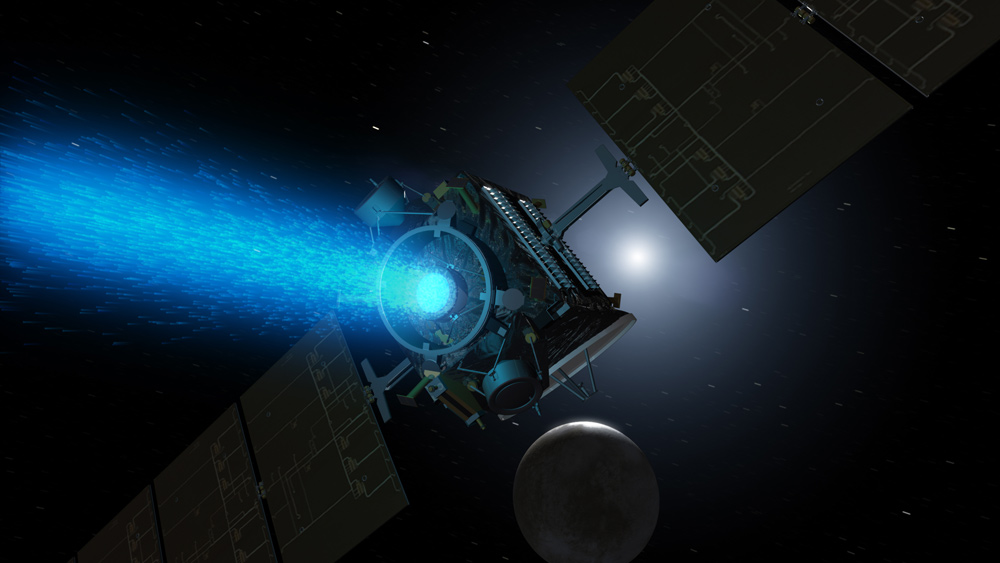
The Dawn spacecraft used futuristic ion engines to fly between the asteroid Vesta and the dwarf planet Ceres. Ion drives are one of many "Star Trek" technologies NASA is pursuing.
Credit: NASA

"Star Trek" technologies are starting to become a reality in our everyday lives; just ask anyone who owns a cellphone or tries a virtual reality headset. But how real are these "Star Trek" technologies in space today, 50 years after the iconic science fiction series' TV debut? While the tech for warp drives and transporters remains elusive, NASA is using some technology in space that would be at home on the starship Enterprise.

One key way NASA is emulating "Star Trek" is by finding ways for humans to spend years in space without requiring constant resupply missions from Earth, said Jason Crusan, NASA's director for advanced exploration systems. This means using the International Space Station as a test bed for technology that can extend an astronaut's stay in space and thus could be used one day on the long journey to Mars.

Space station astronauts already drink water mostly recovered from urine, but NASA wants to push its recovery rate (now in the 80 percent range) even further, Crusan said. [13 Things "Star Trek" Gets Right (and Wrong) About Space Tech]

"Humans have a lot of salt in our waste," Crusan told Space.com. So, in late June, NASA awarded Paragon Space Development Corp. a $5.1 million contract to create a Brine Processor Assembly for flight in 2018. This assembly is expected to remove brine and recover up to 94 percent of the water from urine, NASA officials said in a statement.

Ongoing technology developments also allow astronauts to manufacture their own tools using 3D printing and to use atmospheric monitors to check the air in the cabin environment for contaminants. Those monitors shrink huge gas chromatography mass spectrometry units, which identify different substances in test samples, to about the size of a toaster.

All of these are important considerations in sending a future crew to Mars in an Orion spacecraft, along with one to three other habitat modules attached to provide extra room, Crusan said. This "Orion plus" spacecraft would likely have solar electric propulsion capability — engines that ionize noble gases to give a small amount of thrust and run for long periods of time, Crusan said. 


star-trek-technology-130517a-02.jpg?1368807207
Where did all that superscience tech come from?
Credit: Karl Tate, SPACE.com Infographics Artist

One form of solar electric propulsion is an ion drive, which was used for the Dawn spacecraft now orbiting the dwarf planet Ceres. Ion drives were mentioned specifically in some "Star Trek" episodes, said David Allen Batchelor, a member of the radiation effects and analysis group at NASA's Goddard Space Flight Center in Greenbelt, Maryland. [Warp Drive & Transporters: How 'Star Trek' Technology Works (Infographic)]

Batchelor recently republished a list of "Star Trek" technologies used in real life; this list has been available in different versions on NASA's website since 1993, and he is asked to update it every once in a while, he told Space.com.

Indeed, there have been several recent additions to that list. Lasers have been used to send test communications to the moon. NASA is simulating its new space transportation system using supercomputers. "Super-telescopes," such as Kepler and the Hubble Space Telescope, are discovering and exploring strange new worlds from a distance. And there are even androids (of a sort) on Mars.

"Although they're not shaped like Mr. Data, the Curiosity rover and rovers like that are actually robotic," Batchelor said. "They are autonomous, and they do things according to a plan, without [immediate] human intervention." 

The Mir space station, which operated from 1986 to 2001, experienced a serious fire late in its operational phase, so NASA and its Russian partners on the International Space Station are well aware of the danger that fire poses to human lives in space. But fire behaves much differently in microgravity, and of course, no one wants to conduct tests near astronauts. Understanding how to mitigate fire is one of the biggest ways to keep astronauts safe for long periods of time.

"Fire is really bad in space, obviously, and we also don't understand it," Crusan said. NASA's solution is to set a fire inside the Cygnus spacecraft after it undocks from the station, in a mission called the Spacecraft Fire Experiment (Saffire) series. The first experiment in the series ran in June on a single 16-by-37-inch (41 by 94 centimeters) fiberglass and cotton cloth, known as a SIBAL cloth. (SIBAL is short for "Solid Inflammability Boundary at Low Speed.")

Saffire-II will look at nine smaller segments, and Saffire-III will have a large sample again. By the fourth, fifth and sixth increments, NASA plans to bring a combustion product monitor along to monitor the experiment — it's an advanced version of a smoke detector, Crusan said. It uses lasers to look at the chemical compounds emitted even before humans are aware there is smoke.

NASA employees continue to see "Star Trek" as inspiration for more "Star Trek" space exploration technologies, Batchelor added. "There are certainly plenty of NASA employees that are 'Star Trek' fans," he said, adding, "People do try to make it happen."

During a "Trek Talk" panel discussion at "Star Trek": Mission New York on Sept. 4, 2016, Michelle Thaller, deputy director of science communications at NASA's Goddard Space Flight Center, discussed how the advanced technologies of "Star Trek" are being explored in modern physics labs today. 

"You can't invent something if you haven't imagined it," Thaller said, in reference to warp drives and transporters used in "Star Trek." 

The idea behind being able to change the nature of space-time to travel faster than the speed of light — the fundamental concept behind a warp drive — "may turn out to be the real foundation of the next phase of modern physics," Thaller said. 

For example, scientists have had success with experiments involving quantum teleportation, which is the process of "teleporting" very small atoms or molecules from one location to another. These particles never travel; rather, they stop existing in one place and start existing in another, Thaller explained. (It's the quantum information about the object that goes from one place to another.)

"Quantum teleportation, we believe, probably works because every particle in the universe is connected to every other particle by a wormhole — by some sort of tie through space-time that we are only just becoming aware of now," Thaller said. "It is still theoretical at this point, but we believe that our experiments really require that to be true."

Now, scientists are exploring the separation between space and time, Thaller said. "There may be a very deep, underlying, physical connection that we can use to make a warp drive or teleporter. That [idea] is real; it is what is actually going on in modern physics right now." 

Additional reporting by Samantha Mathewson, Space.com staff writer, from New York City. Follow Elizabeth Howell @howellspace, or Space.com@Spacedotcom. We're also on Facebook and Google+. Original article onSpace.com.

{ http://www.space.com/ }

Hoe vind je dit bericht?
Geschreven door peter om 23:51 Stuur door

Ovnis : «10 % des phénomènes demeurent inexpliqués»

Ovnis : «10 % des phénomènes demeurent inexpliqués»

Jean-Paul Aguttes a été responsable des avant-projets de satellites au CNES./Photo Frédéric Maligne, Cnes

Hier soir, Jean-Paul Aguttes, responsable du Geipan, l'organisme du Cnes qui étudie les phénomènes aérospationaux non identifiés, était l'invité d'un repas de passionnés d'Ovnis àToulouse. L'occasion de faire le point sur les activités du Geipan.

Quel est l'objectif du Geipan ?

Le Geipan est chargé d'apporter une réponse aux personnes qui sont témoins de phénomènes insolites visuels ou sonores dans le ciel qu'ils ne comprennent pas. Nous essayons de trouver une explication.

Comment traitez-vous ces témoignages ?

Le témoin peut d'abord se documenter sur notre site sur les méprises les plus courantes, et souvent trouver lui-même une explication à ce qu'il a vu, ce qui fait un premier tri. S'il ne trouve pas de solution, il remplit un questionnaire qui nous est soumis. Si la première étude du témoignage ne nous permet pas d'identifier le phénomène, nous menons une enquête sur le terrain. Nous rencontrons le témoin et faisons des mesures et des reconstitutions sur le site. Quand on n'arrive toujours pas à identifier le phénomène, un collège d'experts se réunit. Il comprend des spécialistes de nombreuses disciplines : sciences humaines, astronomie, météorologie, plasma, rayonnements, aéronautique.

Quelle part de phénomènes rapportés reste inexpliquée ?

Environ 10 % des phénomènes sont classés comme non identifiés sur les 250 dossiers qui nous sont soumis en moyenne chaque année.

Quelles sont les méprises les plus fréquentes ?

Ce qui relève de l'aéronautique - les avions, les ballons et les lanternes thaï - représente 40 à 50 % des dossiers. Les lanternes thaï sont tellement fréquentes que nous avons mis en ligne toute une documentation pour permettre aux témoins de les identifier et de réduire le nombre de dossiers. En seconde position, il y a les phénomènes astronomiques : étoiles, planètes, etc. Puis les satellites, et les phénomènes atmosphériques comme les nuages.

Les signalisations augmentent-elles ?

Après une croissance ces deux dernières années du fait des lanternes thaï, ça tend à se stabiliser.

Les drones font-ils augmenter ces signalisations ?

Ce n'est pas encore vraiment le cas, mais les drones nous préoccupent. Ils se développent rapidement et sont difficilement identifiables parce qu'ils peuvent prendre des aspects très variés que l'on peut confondre avec les phénomènes inexpliqués : des phénomènes très fugitifs, qui bougent beaucoup dans le ciel. Donc on se renseigne sur eux, leurs formes, ce qu'ils peuvent faire ou ne pas faire. Mais on pense que les signalisations devraient augmenter en raison du développement des drones.

Certains des phénomènes inexpliqués peuvent-ils avoir une origine extraterrestre ?

Si on étudie ces phénomènes, c'est qu'on considère que ça fait aussi partie des hypothèses, mais avec une vraisemblance très faible, et parmi beaucoup d'autres. Mais on doit rester ouvert sur ces domaines-là. Au Geipan, on explique ce qu'on peut expliquer dans les limites de la connaissance actuelle. Quand on ne trouve pas d'explication, parmi les explications possibles, il y a des explications conventionnelles qu'on finit par trouver avec de nouvelles connaissances, et pourquoi pas l'hypothèse extraterrestre, mais c'est vraiment par défaut.


Les phénomènes du département

En 2015, 14 phénomènes aérospatiaux insolites constatés en ex-région Midi-Pyrénées ont été signalés au Geipan. La moitié d'entre eux ont été observés en Haute-Garonne. Sur ces sept cas, un a été parfaitement identifié, cinq probablement identifiés et un autre a été classé non identifiable faute d'informations. Le dernier cas non identifié en Haute-Garonne remonte à août 2011. Un étudiant ingénieur avait alors déclaré avoir vu à Toulouse, depuis son balcon, le déplacement silencieux d'un engin volant triangulaire. Le Geipan estime que le témoin est crédible, mais que faute d'autres témoins et de trace enregistrée, le cas est de type non identifié, mais de «consistance faible».

{ http://www.ladepeche.fr/ }

Hoe vind je dit bericht?
Geschreven door peter om 23:26 Stuur door

Alien Documentary 2015 - UFOs File Declassified Air Force UFO 2015

Alien Documentary 2015 - UFOs File Declassified Air Force UFO 2015

Published on Sep 24, 2015

Alien Documentary 2015 - UFOs File Declassified Air Force UFO 2015

Like And Subscribe For More Updates UFO Sightings 2015
Subscribe for more videos → https://www.youtube.com/channel/UCoei...
Thank For Waching :
✓ GOOGLE+:https://plus.google.com/+ufotvnew2015
✓ TWITTER: https://twitter.com/ufotvnew2015
✓ FACEBOOK: https://www.facebook.com/ufotvnew2015

https://youtu.be/PwwzenNozIw

〓〓〓〓〓〓〓〓〓〓〓〓〓〓〓〓〓〓〓〓〓〓〓〓


Hoe vind je dit bericht?
Geschreven door peter om 18:44 Stuur door

UFOs: I KNOW WHAT I SAW - 2016 Best UFO HD Movie UFOTV®

UFOs: I KNOW WHAT I SAW - 2016 Best UFO HD Movie UFOTV®

Published on Dec 3, 2014

UFOTV® Accept no Imitations! (Please vote thumbs up!) What people say about I KNOW WHAT I SAW - "Compelling" - Steven Spielberg, "The Real Close Encounters - Larry King, CNN. "The most compelling film on the subject to date." - Edgar Mitchell, Apollo 14 Astronaut. Government and Military Officials reveal the truth about UFOs. The most credible UFO witnesses from around the world tell stories that challenge reality in I KNOW WHAT I SAW, a documentary guaranteed to change the way we see the universe. Director James Fox brings together the testimony of Air Force generals, astronauts, military and commercial pilots, government and FAA officials from seven countries; their accounts reveal the reasons those involved at the highest levels have chosen government secrecy over public disclosure in I KNOW WHAT I SAW here on UFOTV®.

https://youtu.be/tGMGOdKOPKk

{ 

Hoe vind je dit bericht?
Geschreven door peter om 18:39 Stuur door

THE SECRET INTERSTELLAR STAR-FLEET - HIDDEN FROM HUMANITY

THE SECRET INTERSTELLAR STAR-FLEET - HIDDEN FROM HUMANITY

Footage captured by Jose Escamilla has sparked hot debate in circles of space enthusiasts, as it appears to depict images of a secret interstellar Starfleet. For some theorists, this footage could confirm the rumours that Earth has established an enormous military presence in space. This theory has been growing in popularity in recent years and has attracted some high-profile proponents such as Robert O. Dean and Garry McKinnon.
 
NEW FOOTAGE APPEARS TO SHOW AN INTERSTELLAR STAR FLEET FROM EARTH 
 
Rumours have been circulating about the United States military developing interstellar technology for years now with grave suspicions that they were assisted with sinister pacts with an alien species. The theory goes that while the United States has had the technology to design and construct an interstellar fleet of star ships for years, they have had to conceal the technology from the general public as part of their agreement with the alien species how furnished them with the knowledge. More recently, it has been suspected that the United States’ closest military ally, the United Kingdom, has joined the United States in creating secret and advanced space technology. This video has confirmed for many that believe this theory that the UK and the USA are currently patrolling the edges of our solar system. 
 
The reason for these patrols is unknown at this point. Some believe that Earth is displaying their military prowess on the edges of the solar system to deter some alien threat. Others say that it may even be possible that Earth has been involved in some inter-galactic war over the past couple of decades without the knowledge or consent of the general public. 
 
Sceptics have been quick to pour cold water on this speculation. Many have said that the images simply depict normal man-made satellites, and that humanity is years from developing the kind of space technology referred to in these theories. However, the objects depicted in the video footage are far larger than the satellites and space shuttles that NASA has ever released for public viewing, which seems to contradict the sceptics somewhat. 
 

http://www.disclose.tv/

{http://7tales.net/ } 

Hoe vind je dit bericht? 3 stemmen
Geschreven door peter om 18:34 Stuur door

UFO - SPACESHIP with ALIENS in Forest filmed by Hikers - Poland !!! May 2016

UFO - SPACESHIP with ALIENS in Forest filmed by Hikers - Poland !!! May 2016

May 2016 - Poland, Bialowieza Forest. Very rare footage from hikers who filmed UFO/spaceship with aliens in Forest.
 
Watch the VIDEO HERE !
 
 
Emilcin Abduction was a supposed alien abduction of farmer, Jan Wolski in May 1978. There was little media attention at the time. A monument was subsequently erected in Emilcin, Poland, at the site where the abduction is said to have taken place.
 
an Wolski (29 May 1907 – 8 January 1990) was out driving a horse-drawn cart early on 10 May 1978 when he says he was jumped by two "short, green-faced humanoid entities" about 5 feet (1.5 m) tall. The two beings jumped onto Wolski's cart and, according to Wolski, sat next to him and started to speak in a strange language. Originally he had mistaken them for foreigners because of their "slanted eyes and prominent cheekbones." Wolski drove his cart, with the two beings aboard, to a clearing where he says a large object was hovering. 
 
 
According to Wolski, a purely white unidentified flying object, about 14.75 feet (4.5 m) – 16.5 feet (5.0 m) in height and "as long as a bus," hovered in the air at an altitude of about 16 feet (4.9 m). There were no notable external features of the craft (i.e. lights, joints, etc.). Wolski mentioned that there were four objects on the craft made of a black material that appeared to be drill-like in appearance, which generated a humming sound. An elevator-like platform attached to the hovering craft descended to the ground.
 
Wolski then claims that he was taken aboard the ship with two additional entities he met near the flying object. He was then gestured to "dress down" (take off his clothes). There were about eight or ten benches situated around the craft, each the size for one person to sit in. There were some rooks in front of the door which was moving its legs and wings but seemed to be immobilizied. Wolski claims that he was then examined with a tool that resembled two dishes or "saucers." After this, he was ordered to redress, and it was then that he noticed there were no lights or windows on the craft, only the daylight coming through the craft's door. Entities ate and offered him something like icicles but he refused. The craft's interior was described as black with a greyish tint, similar to that of the creatures' outfits. 


Afterwards, Wolski returned home to his family and notified them of what had just happened, urging them to come see the floating craft. He notified his sons who called to other neighbours, and together they went to investigate the site. The grass where the craft had been had signs of usage in it, being "trodden down covered with dew and paths coming in all directions." Wolski returned home, leaving the rest of the neighbours and family at the site. Wolski's sons claim that there were footprints left behind by the beings, though they did not detail whether the footprints were larger or smaller than their own.
 
A six-year-old boy claims to have witnessed a bus-like craft hover over a barn, then climb high into the sky and vanish.
 
Wolski explained these memories in an interview with Henryk Pomorski and Krystyna Adamczyk in July 1978, two months following the incident. The audio tape of the interview was kept in a private archive for a long time before being released to the public.
 
In 2005, a memorial was constructed in Emilcin at 51°8′2.63″N 22°2′16.16″E to commemorate the alien abduction of Jan Wolski. The text in Polish, read: "On 10 May 1978 in Emilcin a UFO object landed. The truth will astonish us in the future".
 

{ http://7tales.net/ }

Hoe vind je dit bericht? 3 stemmen
Geschreven door peter om 18:08 Stuur door

Russian Pilot reported close encounter with Two UFOs !!!

Russian Pilot reported close encounter with Two UFOs !!!

July 2016 - Russia, Kursk area - 60,000ft. Russian military pilot reported a close encounter with two UFOs, they were filmed by on-board camera.
 
Watch the VIDEO HERE !
 
 
UFOs over RUSSIA
 
The Russians approached the subject of UFOs with the utmost seriousness and attention to detail. Boris Sokolov, a retired Russian colonel ran an in-depth study in 1980. "For 10 years," Sokolov said, "the entire Soviet Union became one gigantic UFO listening post."
 
There were 40 cases where pilots encountered UFOs, explained Sokolov. Initially, they were commanded to chase, then shoot the UFO. But when the pilots engaged, the UFO would speed up. On two occasions, pilots gave chase, lost control and crashed, with the crew killed on impact. After these unfortunate incidents, the pilots received another order: When they saw a UFO they should change course - and get out.
 
On October 5, 1983 Sokolov received an order from his commander to leave immediately for the Ukraine. A report from the base commander to the Chief of the General Staff claimed that the day before, from 4 until 8 in the evening, a UFO had been observed near the base. During that time, the missile launch codes had mysteriously been enabled. How this happened has never adequately been explained.
 
Dr Rimili Avramenko, a Russian scientist revealed that during the Vietnam War, a massive UFO flew over Hanoi. Although every major weapon in that city had its sights set on the craft, it didn't budge.
 
UFO sightings by Soviet cosmonauts are not uncommon. Unlike American astronauts' reluctance to talk about the subject, Soviet references to UFOs were reported from the very beginning, with Yuri Gagarin himself. In documents, Gagarin is quoted as saying UFOs are real, they fly at incredible speeds and that he would tell more about what he had seen in orbit - provided he be given permission to do so.
 
According to Cosmonaut Mus Manarov on the 1991 Mir Mission: “It happened during a visit mission, when all our attention was focused on the slowly approaching space capsule… It is possible that it was a kind of UFO.”
 
Yuri Andropov, the former Soviet leader and long-time head of the KGB, had an acute personal interest in UFOs and ordered a 13-year programme that required every soldier in the military to monitor sightings over Russian territory.
 
Through Andropov's personal interest, in 1978, two committees were established to investigate UFOs, one military and one civilian. Andropov ordered four million Soviet soldiers to file detailed reports of incidents.
 
According to some sources, the programme led to hundreds of thousands of sightings being recorded in the 13 years before it was abandoned with the break-up of the Soviet Union in 1990.
 
However, most cases had a 'rational explanation and were mainly linked to technical issues like missile launches'.
 
 
Hoe vind je dit bericht?
Geschreven door peter om 18:04 Stuur door

Waarom landen UFO’s niet in de voortuin van het Witte Huis?

Waarom landen UFO's niet in de voortuin van het Witte Huis?

Waarom landen UFO’s niet in de voortuin van het Witte Huis?

Amerikaanse miljardairs weigeren het UFO-fenomeen serieus te nemen, maar doneren wel aan het SETI-instituut. Er was echter één uitzondering, schrijft directeur van de Indian Society for Extraterrestrial Studies (INSETS) Sabir Hussain voor de krant The New Indian Express.

Filantroop en miljardair Laurence Rockefeller (1910-2004), de vierde zoon van John D. Rockefeller, richtte in 1993 het UFO Disclosure Initiative op. Hij drong er bij president Clinton op aan om alle informatie die de CIA en de luchtmacht sinds de jaren veertig hadden verzameld over UFO’s, vrij te geven.

Waarom landen UFO's niet in de voortuin van het Witte Huis?

Bill Clinton en Laurence Rockefeller in 1995

Een jaar later gaf Clinton opdracht miljoenen geheime stukken te openbaren. In Frankrijk resulteerden de inspanningen van Rockefeller in 1999 in het beroemde Cometa-rapport. De miljardair financierde ook het onderzoek van de bekende Harvard-professor dr. John Mack, die een bestseller schreef over buitenaardse ontvoeringen, en het Disclosure Project van dr. Steven Greer.

Systematisch mishandeld

Hussain schrijft dat UFO’s sinds de jaren veertig duizenden individuen hebben benaderd en uitgebreide informatie hebben gegeven over de planetenstelsels waaruit zij afkomstig waren. ‘Contactees’ kregen vooral te horen dat de mensheid de aarde systematisch mishandelt, met ecologische crises tot gevolg.

Iedere keer als mensen over hun ervaringen spreken worden ze voor gek versleten of uitgelachen door de mainstream media, de wetenschappelijke gemeenschap, inlichtingendiensten en de luchtmacht, aldus Hussain.

Gelogen

En waarom landen ze niet in de voortuin van het Witte Huis? Hij merkt op dat er in 1952 UFO’s zijn verschenen boven het Witte Huis en het Capitool, maar dat de Amerikaanse luchtmacht hierover heeft gelogen door te zeggen dat de waarnemingen waren veroorzaakt door ‘temperatuurinversie’.

De luchtmacht gaf piloten opdracht de objecten uit de lucht te schieten. Frank Feschino schreef er een boek over, getiteld Shoot Them Down – The Flying Saucer Air Wars of 1952.

Belangrijker nog is dat de Amerikaanse president helemaal niet spreekt namens het menselijk ras. Hij spreekt namens de olie-industrie, de wapenindustrie en de multinationals, aldus Hussain. Iedere keer dat ze verschijnen, sturen we onze gevechtstoestellen op ze af.

‘De fout ligt in onszelf’

De UFO’s hebben vervolgens twee mogelijkheden: de straaljagers neerschieten (zoals ze in 1976 boven Teheran hebben gedaan), of het gebied verlaten, wat ze meestal doen.

Shakespeare schreef in Julius Caesar: “De fout, beste Brutus, ligt niet in onze sterren, maar in onszelf.”

“Op dezelfde manier ligt de fout niet in UFO’s, maar in onszelf,” besluit Hussain. “Door onze naïeve, luie, ongeïnteresseerde en schaapachtige houding stellen we een kleine groep mensen in staat om de grootste gebeurtenis in de menselijke geschiedenis verborgen te houden voor de rest van de wereld.”

[New Indian Express]

Hoe vind je dit bericht?
Geschreven door peter om 17:53 Stuur door

ALIEN SENSATION: More than 100 'saw UFOs in bizarre triangle formation after meditating'

ALIEN SENSATION: More than 100 'saw UFOs in bizarre triangle formation after meditating'

MORE than 100 people were reportedly witness to a bizarre formation of UFOs in the desert skies during a huge alien chaser conference.

More than 100 people are said to have seen a UFO fleet make a triangle formation.

GETTY

More than 100 people are said to have seen a UFO fleet make a triangle formation.

Yesterday Express.co.uk exclusively revealed how a female pilot claimed she and her boyfriend were left with a "life-changing" experience after seeing "four UFOs" in the desert during the Contact in the Desert conference in the Joshua Tree National Park, California, which is one of the world's biggest ET conferences.

The woman, who is also a lawyer and has yet to be named, said the possible alien spacecraft appeared on Saturday evening during a special skywatch event in a report to the Mutual UFO Network (MUFON) which investigates UFO cases across the globe.

Now a second report about the incident has been filed with MUFON, claiming there were MORE UFOS, and that more than 100 people witnessed the strange triangle formation.

Kristie Cowans has filed a report to MUFON, claiming there was an attempt by the skywatchers known as CE-5 contact, to summon the presence of UFOs through meditation, before the phenomenon.

She said it took place at 10pm local time on Saturday and she had stargazing binoculars and a green laser.

She pointed out there was a small airport to the south and a Marine Base north-east of them, but all the "UFO" activity came from the west going due east.  

She wrote: "As we began I was able to spot many stars, planets, planes and satellites as part of the process of really looking at what was above us-then the unexpected happened.

"There was a parade of seven orbs/UFOs flying faster than satellites and as high as planes & helicopters from west over the mountains and disappearing to the east. 

"The colours of the orbs were bright, but a diffused soft green, diffused soft red, and diffused soft lilac blue, with the blue one being larger than the others."

Contact in the Desert is attended by 1000s of UFO buffs.

CONTACTINTHEDESERT

Contact in the Desert is attended by 1000s of UFO buffs.

RELATED ARTICLES

She claimed the UFOs "flashed back" when the group used lasers to call out to the mystery crafts, which remained for up to 10 minutes.

She said: "This was the only time the orbs/UFOs flashed is when we flashed them first, otherwise they just glowed a solid color.

"The second, third and fourth ones formed a triangle configuration as they passed us.

"The crowd of around 100 people went wild with cheers, clapping, and jumping up and down.

"At this time I did feel a "heart" connection, thanking them and sending love to them. 

"I was “gushing” with love and gratitude to them as this was such a great show they gave us.

"This was the most exciting thing ever! Not only are they here, it appears they are friendly."

She said the crafts were big enough to be seen with the naked eye and about 800 feet high.

"Quite large actually and through the binoculars looked like an orb of soft diffused light with no corona around them," she said.

Ms Cowans said she had ruled out the objects being drones.

She said: "They were quiet and they glowed with one single light, unlike recreational and military drones that glow with 2 or more. 

The

GETTY

The "contact" took place at night in the Joshua Tree National Park (pictured).

RELATED ARTICLES

There was a parade of seven orbs/UFOs flying faster than satellites and as high as planes & helicopters from west over the mountains and disappearing to the east.

UFO witness Kristie Cowans

"The type of glow was unlike anything I have ever seen in my research on military drones as my skeptical mind considered this possibility. 

"They did not look like drones - I saw no structures connected to the glowing lights, the glowing light floated independent of any structure."

The unnamed pilot previously independently reported seeing five of the coloured UFOs.

She described how the first UFO zipped overhead, followed by a third, fourth and fifth, the three of which then formed a triangle formation.

The woman and her boyfriend said they have been left profoundly affected by what they saw and estimated around 30 people in total would have witnessed the event.

Contact in the Desert is a four-day annual event held in the remote desert with several UFO and alien expert speakers and the opportunity for skywatching.

Their sighting and a short video showing the triangle formation is now being investigated by MUFON.

In her report to MUFON, the woman said: "We are both highly educated, professional people with an interest in UFOs. 

"He is a Management Consultant and I am an attorney. I am also a private pilot."

She said the pair queued for about an hour for the "Night Vision Experience" which involved scouring space with military grade night vision goggles from around 10pm local time.

She said: "There was a yell from another participant.

"We swung our goggles to look in the northerly direction. I focused on a white, glowing object which looked like a ball of light with fuzzy edges coming over the horizon rather fast, traveling west to east and then slowly disappearing. 

The formation was said to be similar to this one previously snapped by UFO chasers.

YouTube

The formation was said to be similar to this one previously snapped by UFO chasers. 146831.jpg The Truth Is Out There: 150 years of UFOs

RELATED ARTICLES

"Process of elimination set in: Not a plane, helicopter because no blinking lights. 

“Fuzzy edges, ball shaped. 

“Not a satellite because too low on the horizon and moving too fast. These objects were large enough and bright enough to be seen with the naked eye."

She said as they watched, a second object, blue in colour, "came out of the west and traveled rapidly to the east”.

It was ball shaped, glowing, with fuzzy edges, and slowed down, she said.

She added: "The third object then came from the west, this time green in colour. Same shape, characteristics as above. This one slowed down also. 

"The fourth, object, I'm uncertain about the colour as people were now very excited and many thoughts were racing through my mind. 

"Now, the second, third and fourth object had slowed to a triangle formation. With the apex of the triangle facing up. They did not stop but kept moving to the east."

"Ever since that evening, my boyfriend and I have been processing this event. 

"Since then, we have not stopped thinking about what we saw. We are both logical, sane people. 

"Neither one of us has ever experienced anything like it in our lives. 

"We cannot stop thinking about what we saw at Joshua Tree."

Sceptics suggest that at events where many people attend, particularly when they want to see something, mass hysteria can kick in, an the memory becomes distorted or embellished.

Others have said that drones could be the cause of the sighting, and with it being a UFO conference taking place, it could have been pranksters flying them overhead at the time of the skywatch.

Related articles

{ http://www.express.co.uk/news }

Hoe vind je dit bericht?
Geschreven door peter om 01:14 Stuur door

EXCLUSIVE UFO SENSATION: Could amazing footage be first video PROOF of mysterious TR-3B

EXCLUSIVE UFO SENSATION: Could amazing footage be first video PROOF of mysterious TR-3B

UFO investigators are analysing shocking footage that could be the world's first ever genuine video recording of a mysterious TR-3B spacecraft.

The Mutual UFO Network (MUFON) has been sent a video clip by a stunned unnamed witness who claims to have recorded the fabled craft flying over a major highway.

TR-3B is alleged by conspiracy theorists to be a secret "black project" spy craft of the US Government that can be flown into space.

The allegations are that these crafts are created at top-secret military bases like Area 51 in Nevada, by reverse engineering alien technology.

Others claim they are actual UFOs flown by aliens visiting Earth.

In the video, which lasts nearly two minutes, an apparent black triangle shape is seen slowly moving silently in the sky. It appears to have large pulsating red and green lights, like many previous alleged TR-3B sightings.

Later there appear to be three lights visible.

A CGI image of the fabled TR-3B stealth craft.

YouTube*SECURETEAM

A CGI image of the fabled TR-3B stealth craft.

RELATED ARTICLES

Is this 'UFO' on the MOON proof of a secret spy plane the US won't...

Area 51 secret project insider reveals TRUTH of 'UFO cover up'

Two men are heard talking in amazement about what they see, initially whispering, but becoming increasingly louder and excited.

One man says: "What is that? It is not even moving. Dude, holy c**p, that's weird. 

"What the heck dude? What the f*** is this?

"Dude, look at this thing, it is not even f***ing moving. Dude, it's f***ing triangular. Holy s*** dude, that is some wicked s***.

"Dude, you got your camera? Holy s*** there's no noise. That is not a helicopter."

An alleged TR-3B said to have been snapped in Belgium in 1990.

YouTube

An alleged TR-3B said to have been snapped in Belgium in 1990.

RELATED ARTICLES

Is this proof the US is carrying out SECRET weather tests that...

David Icke claims the moon is HOLLOW and built by ALIENS

Dude, look at this thing, it is not even f***ing moving. Dude, it's f***ing triangular. Holy s*** dude, that is some wicked s***.

TR-3B witness

In a brief report to MUFON, which is the world's largest UFO investigation organisation based in the US, the witness said: "Triangular UFO hovered over route 45 in Mantua, New Jersey, and turned on its side over the road, and then flew sideways towards Philadelphia."

He described the craft as flying extremely slowly, at just around 10 miles per hour.

He said: "I have never encountered any aircraft like this in my life. 

"It made no noise and it seemed to have multicoloured lights rotating inside one light. 

"Did anyone else witness this at approximately 9:40 pm on June 10th 2016?"

Conspiracy theorists have long claimed the TR-3B Black Mantra is an alleged stealth reconnaissance nuclear-powered triangular shaped craft.

Previous conspiracists have claimed the Black Mantra was developed by the US under a cloud of secrecy in the 1970s, but its existence has never been proved. 

146831.jpg The Truth Is Out There: 150 years of UFOs

RELATED ARTICLES

Mystery 'triangle UFO' seen on BOTH sides of US 24 hours apart

WATCH: Shock as UFOs form amazing triangle formation in desert skies

Over the years, there have been dozens of reported sightings of mysterious-shaped aircraft in Antelope Valley in the Californian desert - an area known to attract Black Mantra hunters as it is near several military research and testing zones.

But, until now, no clear video footage had been captured.

Conspiracists believe the TR-3B Black Mantra is not the first of its kind and is, in fact, a successor to an earlier TR-3A craft.

There are longstanding rumours about the existence of reconnaissance airplanes of the US Air Force under so-called "black projects". 

According to conspiracy theorists, the TR-3A Black Manta is a subsonic stealth spy plane designed by Northrop Gruman and was allegedly used in the Gulf War to guide F-117A Nighthawk bombers.

However, there is no proof or direct evidence of the existence of any of the alleged spy planes.

Last June YouTube UFO channel Secureteam 10 released a video claiming to have found a Black Mantra craft sitting in a crater on the moon in images obtained from a camera mounted on the Lunar Reconnaissance Orbiter (LRO) spacecraft.

Earlier that month, Secureteam also posted a video claiming they had found similar craft in NASA images of Dwarf planet Ceres.

But the were widely panned as being an odd-shaped rocks.

MUFON confirmed it is investigating the new footage.

Related articles

 Bizarre 'floating humanoid UFO' sparks claims of alien experiments

 Spike in crop circles 'heralds coming of death world Nibiru

 UFOS GET CRAZY: 'Ten-mile mothership' and 'angel by the sun'

Hoe vind je dit bericht?
Geschreven door peter om 00:58 Stuur door

Our Universe Is Not A Hologram. Alien or Otherwise. Here Is Why!


Our Universe Is Not A Hologram. Alien or Otherwise. Here Is Why!

Sometimes science gives us mind-blowing results that fundamentally force us to revise our perception of the universe we inhabit. From discovering that Earth is a sphere to the theory of special relativity, science has readjusted our grasp of reality time and again. This is not one of those times.

images (3)

Over the years I have seen many claims that the Universe is a hologram.  Vast bands of pseudoscience enthusiasts think they have worked it all out. They believe that the entire universe is a holographic projection. That it is our thought energy that provides the (laser beam) energy to manifest the holographic image we call reality. We, each and every one of us, is a holographic plate (film). And just like a holographic plate, each of us contains all the information in the universe. Because of this, we are literally connected to everything, and, everything is connected to everything else.

In this vast sea of gibberish, they believe their theory of holography accounts for why prayers, meditations, healing, miracles, and instant communication over unlimited distances actually has the power to influence our reality.

This daffy idea even has some supporters in the halls of academia. Nick Bostrom, professor of Philosophy at Oxford University and the Director of the Future of Humanity Institute has offered the theory that we may not actually be what we think we are. We may, in fact, be a holographic program generated by banks of supercomputers created by an alien species.

download

Since it is coming from an Oxford professor some people may be fooled into thinking it is a smart hypothesis. Mr. Bostrom is a Philosophy professor. One of the superstars of philosophy is Friedrich Nietzsche. He is known to have said some strikingly dumb things such as  ‘What doesn’t kill us makes us stronger.‘ Just think about that for a second. Billions of things don’t kill us that don’t make us stronger.

In pop culture, one influence above all others has fed this idea into our collective consciousness. The Matrix movie trilogy. I blame the Wachowski brothers for ruining more minds than syphilis.

MatrixSystemAnomalybyEnCrypt

But what is the real story?

That “our Universe is a hologram” is perhaps one of the greatest physics-related misconceptions of recent decades. Let me write a clarification in bold so that it will be absolutely clear:

No, our Universe is NOT a hologram! There is ZERO evidence to support this assertion.

It’s just a metaphor used to describe some property we think the universe might have. It has absolutely nothing to do with actual holograms.

Okay, now that we’ve got this covered, let me explain what the holographic principle actually means.

Get ready for some science… I’m going to science the s**t out of this…

images (4)

The entropy of a black hole is given by the area of its horizon, divided by 4. Now, imagine that you have some volume of space with some matter in it, not necessary a black hole. Is there a similar limit to the total entropy in that volume?

Well, let’s think about it. Intuitively, you can put more and more matter inside that volume of space, thus increasing the entropy within it. But at some point, there will be so much matter inside that it will inevitably collapse into a black hole. In other words, we cannot increase the entropy of a volume of space indefinitely; we can only increase it until it is equal to the surface area of the volume, divided by 4.

Now, entropy is a measure of information; the more information you have, the more entropy you’ll get. So it appears that there is a principle, the holographic principle, which roughly says that the total amount of information inside a volume of space cannot be larger than the amount of information that can be encoded on the boundary of that volume.

The word “principle” here means that it is a principle that you must follow when you try to formulate a theory of quantum gravity. This means that any potential theory of quantum gravity must either be shown to follow this principle or have a very good reason to violate it, otherwise, it is not compatible with the intuitive picture I gave above.

Note that the holographic principle is just a principle with which to formulate certain scientific theories, and not a scientific theory by itself, so it does not have any predictions that can be tested experimentally. So the mere existence of the principle doesn’t mean that “our universe is a hologram” or that our universe actually obeys the holographic principle.

To be perfectly clear: whether our universe obeys the holographic principle or not is a statement that must be tested empirically, but it cannot be tested until we have an actual theory of quantum gravity, which we do not have.

So if someone tells you that “the universe is a hologram”, you can be sure they don’t know what they’re talking about.

The misleading and incorrect articles that frequently appear in the media citing “evidence” that “the universe is a hologram” are usually talking about something called the AdS/CFT conjecture. Let me first make another very important clarification in bold:

download (1)

The AdS/CFT conjecture suggests a purely mathematical relation between two completely unrealistic theories, one on the “AdS” side and one on the “CFT” side, and it says absolutely nothing whatsoever about the real universe that we live in.

The AdS/CFT conjecture gives a mathematical model in which the holographic principle seems to work. As I said above, this mathematical model is not a realistic one, and it has nothing to do with our own universe.

Why do we study it if it’s not realistic? There is a concept called a “toy theory”. A toy theory is a theory that we know is not realistic in any way, but we study it mainly for three reasons:

  1. It is a very simple model, so we can perform calculations on it that we can’t do in more realistic models; and/or
  2. We have no realistic model, so we make do with what we have.
  3. Give us a reason to stand in front of our whiteboards and look deep in thought.

Okay, now, what does the AdS/CFT conjecture actually say? Without going too much into the technical details, it basically talks about some object described by string theory called a D3-brane (but the name doesn’t matter).

You can look at this brane from two different “perspectives”. From one perspective it looks like a theory of (quantum) gravity in 5 dimensions (“AdS”), and from the other perspective, it looks like a theory without gravity in 4 dimensions (“CFT”).

But the brane is still a brane, and it should act the same way no matter from which perspective you look at it. In other words, we can perform calculations either in the 5-dimensional theory or in the 4-dimensional theory and we’ll get the same results.

This duality of two different descriptions is extremely useful for doing calculations. This is because if something is too hard to calculate from the gravity perspective you can calculate it from the non-gravity one, or vice versa.

In addition, and more relevantly to the present context, this duality provides a concrete, if unrealistic, model in which the holographic actually works. This is because the 5-dimensional theory “encodes the same information” as the 4-dimensional theory.

I say AdS/CFT is a conjecture because it has not actually been proven. There are many pieces of evidence that the conjecture might be true. These basically come from calculating the same thing from both perspectives and checking that the results agree. But there is still no proof that the results always agree.

So whenever you read an article saying that “physicists found evidence that our universe is a hologram”, what it actually means is that physicists did some more calculations and found that they agree with the AdS/CFT conjecture. But it doesn’t say anything about our universe, only about a very unrealistic model.

Why is the model unrealistic? For many reasons:

  • The model is built using string theory. Despite the impression you might get from popular media, string theory is really a “toy theory”; it doesn’t actually describe our own universe. It describes an imaginary universe which turns out to be similar to our own universe in some ways, but very different from it in other ways.
  • The perspective of a theory of gravity is called AdS because it describes a universe which has a special geometry called “Anti de Sitter”. However, our universe does not have this geometry. In fact, it is (asymptotically) described by the exact opposite of Anti de Sitter, which is called “de Sitter”. So the AdS perspective definitely does not describe anything even remotely close to our universe.
  • The perspective of a theory without gravity is called CFT because it describes a universe which has a special symmetry called “conformal symmetry”. So the theory is called aConformal Field Theory. However, our universe does include gravity and does not have conformal symmetry. So the CFT perspective also definitely does not describe anything even remotely close to our universe.

In conclusion, AdS/CFT is a conjecture offering a model of an imaginary, unrealistic universe which is certainly not our universe, in which the holographic principle is mathematically realized. It’s a very important conjecture and has many applications, but it says absolutely nothing about our own universe, which is neither AdS nor CFT.

images (1)However, unlike the specific unrealistic model of AdS/CFT, the holographic principle as a general principleis something that we think should apply to the real universe that we live in.

As I mentioned above, the validity of the holographic principle in our universe is something that must ultimately be determined empirically once we have a working theory of quantum gravity. Don’t hold your breath on that one.

I have full confidence that we will discover the grand unification theory that has been so elusive for over a century. Which the theory of quantum gravity is a huge part of. I am also confident that when all is said and done that the holographic principle will not be a part of it. The true nature of reality obeys laws. Science does not claim to know all the laws and limits imposed on us by the Universe, but we do have a slight inclination. This inclination all points to the falsity of the holographic principle as being any part of the building blocks of reality.

But.. what do I know? I am just an explorer of this thing we call reality. I always at all times reserve the right to be wrong.

Science is the music of the Universe…We all should learn how to play.

Please SHARE This Article If You Enjoyed It.

If You Enjoyed This Article Please Join Me On Facebook At:

 https://www.facebook.com/groups/TheAngryUFOlogist

Friend me on Facebook @ www.facebook.com/trevor.a.w

{ http://www.theangryufologist.us/ }

Hoe vind je dit bericht?
Geschreven door peter om 23:19 Stuur door

Breakthrough ‘Madala Boson’ Could Unlock the Mysteries of Dark Matter

Breakthrough ‘Madala Boson’ Could Unlock the Mysteries of Dark Matter

Wits University scientists predict the existence of a new boson 
CERN
Wits University scientists predict the existence of a new boson
Scientists are seen working on the inside of the ATLAS cryostat.
Credit: Claudia Marcelloni/CERN
IN BRIEF

The Higgs' boson helped us understand known matter, but scientists at the High Energy Physics Group (HEP) of the University of the Witwatersrand in Johannesburg believe they have the necessary data to discover a new boson, called the Madala boson. Its discovery may help us explore more about what dark matter is and how it interacts with the universe.

Universe Dark Energy-1 Expanding Universe

This diagram reveals changes in the rate of expansion since the universe's birth 15 billion years ago. The more shallow the curve, the faster the rate of expansion. The curve changes noticeably about 7.5 billion years ago, when objects in the universe began flying apart as a faster rate. Astronomers theorize that the faster expansion rate is due to a mysterious, dark force that is pulling galaxies apart.

NASA/STSci/Ann Feild

DISCOVERING THE MADALA BOSON

Discovery of the Higgs boson in 2012 at the European Organization for Nuclear Research (CERN) has contributed heaps to our understanding of modern physics. But theHiggs boson only explains mass that we can see, touch and smell. Known matter only makes up 4% of the Universe’s mass and energy. Scientists predict the discovery of a new boson which interacts with dark matter, which makes up 27% of our universe.

Using the same data that led to Higgs’ discovery, the bright minds at the High Energy Physics Group (HEP) of the University of the Witwatersrand in Johannesburg have come up with the Madala hypothesis, which they believe will help them discover the new Madala boson.

The Madala boson team isn’t lacking in scientific minds, as they have around 35 students and researchers to brainstorm and help understand data from the experiments. They also have the support from Wits University, such as theorists Prof. Alan Cornell and Dr. Mukesh Kumar and Prof. Elias Sideras-Haddad’s assistance in detector instrumentation.

Image credit: Taylor L; McCauley T/CERN Image credit: Taylor L; McCauley T/CERN

DARK MATTER MATTERS

Man’s understanding of physics keeps on evolving. Professor Bruce Mellado, team leader of the HEP group at Wits says we are now at a point similar to when Einstein formulated relativity and to when quantum mechanics came to light. We found classic physics lacking as it failed to make sense of plenty of phenomena. When the Higgs’ boson was discovered, the Standard Model of Physics was completed, but we have still only scratched the surface. Modern physics still can’t explain other phenomena including dark matter.

The discovery of the new Madala boson puts man in a good position to learn more about our universe. Perhaps there are even more particles to be discovered aside from this new boson. The future of modern physics has never been brighter.

Hoe vind je dit bericht?
Geschreven door peter om 23:06 Stuur door

UFOs and giant structures filmed in NIGER by US helicopter !!! Sept 2016

UFOs and giant structures filmed in NIGER by US helicopter !!! Sept 2016

September 2016 - Niger, desert - US forces of USAFRICOM reported mysterious giant structures and UFOs in the desert.
 
 Watch the VIDEO HERE !


Only 8,000 years ago, rocks were sculpted in the Tassili plateau of Sahara, depicting what appeared to be human beings but with strange round heads (helmets ? Or "sun" heads on human bodies ?).
 
Archeologists usually refer to the paintings at Tassili n-Ajjer in southern Algeria as prehistoric "masked figures". Though there is evidence that the people of the Sahara influenced the cultures of both the Nile Valley and West Africa, there is no stylistic similarity between the "masks" in Tassili and those from West Africa. Scholars are not certain of the meaning of these paintings because they still haven't deciphered the hieroglyphic language engraved on the rocks next to them. Dating these figures is difficult even with radiocarbon techniques, yet they are roughly divided into several periods ranging from the beginning of human occupation at Tassili, around 5500 B.C. when the Sahara was much wetter, continuing sporadically until the fifth century B.C.
 
The faceless (aniconic) figures are found in both the early and middle periods. The smaller figures engraved in shelters are believed to be contemporary with the oldest paintings in Tassili. Either before or shortly after these cave paintings were made, an enormous "masked" figure was painted on the side of a cliff. This large figure is nearly eighteen feet high, outlined in dark purple and shaded with broad planes of color. It has a helmet-type device that encircles the head and rests directly on the shoulders.
 
This large figure was dubbed "the Great God Mars" by critic and art historian André Lhote in his 1950 Treatise on Figure Painting.
 
 
FROM TASSILI......SAHARA DÉSERT......NORTH AFRICA.........SOURCE UFO SIGHTING SHOTSPOT.BLOGSPOT.FR.............This cave painting is from Tassili, Sahara Desert in North Africa. It dates back to 6000 B.C. The figures do not look human. Notice the flying disk in the sky.


Hoe vind je dit bericht?
Geschreven door peter om 22:21 Stuur door

De ‘onmogelijke’ raketmotor gaat de ruimte in: tijd om de EmDrive te testen

De 'onmogelijke' raketmotor gaat de ruimte in: tijd om de EmDrive te testen

De ‘onmogelijke’ raketmotor gaat de ruimte in: tijd om de EmDrive te testen

Binnenkort wordt voor het eerst een werkende EmDrive gelanceerd. Dan zal blijken of het mogelijk is om een raketmotor aan te drijven zonder enige vorm van brandstof.

De controversiële EmDrive is gebouwd door de Amerikaanse uitvinder en ingenieur Guido Fetta. Hoewel uit diverse experimenten is gebleken dat een dergelijke motor werkt, lijkt het apparaat in strijd te zijn met een fundamentele natuurwet.

Nanosatelliet

De derde wet van Newton zegt namelijk dat krachten altijd in paren optreden. Veel natuurkundigen zeggen dat de EmDrive in strijd is met die wet. De motor lijkt aangedreven te worden zonder brandstof. En dat niet alleen: met zo’n motor kunnen we in slechts 70 dagen naar Mars reizen.

Fetta is de bedenker van de Cannae Drive, een raketmotor die gebaseerd is op het oorspronkelijke ontwerp van de EmDrive. Hij heeft nu aangekondigd dat hij de motor gaat gebruiken om een 6U CubeSat, een nanosatelliet, te lanceren.

Opschieten

Popular Mechanics meldt dat ongeveer een kwart van de satelliet ter grootte van een schoenendoos zal bestaan uit de Cannae Drive, die tenminste zes maanden om de aarde zal draaien. “Hoe langer hij in een baan om de aarde blijft, hoe meer de satelliet zal laten zien dat hij wordt aangedreven zonder brandstof.”

Er is nog geen lanceerdatum bekend, maar verwacht wordt dat de satelliet binnen nu en zes maanden in de ruimte wordt gebracht. Fetta mag wel opschieten, aangezien Chinese ingenieurs en de uitvinder van de oorspronkelijke EmDrive Roger Shawyer ook werken aan lanceerbare EmDrives.

[ScienceAlert]

Hoe vind je dit bericht?
Geschreven door peter om 22:13 Stuur door

RUSSISCH DORP OPGESCHRIKT DOOR ENORME UFO ( VIDEO )

RUSSISCH DORP OPGESCHRIKT DOOR ENORME UFO ( VIDEO )

wol3.jpg

Het is een bekend gegeven dat UFO’s zich graag verbergen in/als wolken, want dat is voor hen de manier om onzichtbaar te blijven voor de bevolking. 

Keer op keer zijn er nieuwe verhalen en beelden van enorme UFO’s die zich voordoen als een wolk, zoals dat ook onlangs gebeurde in Rusland. 


Dat UFO’s zich dikwijls vermommen in de vorm van een wolk, werd al in 1957 vastgelegd door een Amerikaanse soldaat uit Virginia. 

Hij zag in eerste instantie een ringvormige ufo, die later stukje bij beetje veranderde in een wolk.


xxx

Ook vandaag de dag komen ze in alle soorten en vormen voor, zoals onlangs boven een dorp in Rusland.


xxx


xxx

Op 27 augustus 2016 schrokken de inwoners van een klein Russische dorpje dan ook behoorlijk, toen ze bovenstaande “wolk” zagen. 

Ook hier zien we weer een veel voorkomend kenmerk. Een wolk die eigenlijk niet thuis hoort in het bestaande wolkenlandschap. 


UFO’s gebruiken ook dikwijls vulkanen als ingangen naar ondergrondse basis, zoals duidelijk wordt uit de vele beelden uit Mexico, waarbij UFO’s bij de bekende vulkanen af en aan vliegen en soms in de kraters verdwijnen. 

Een dergelijke vulkaan is er ook in Japan en dat is Mount Fuji. Volgens Scott Waring is onderstaande opname ook een voorbeeld van hoe buitenaardsen hun UFO’s verbergen en waarschijnlijk in dit geval dit soort wolken gebruiken om het vertrek en de aankomst van UFO’s bij de basis onder de vulkaan wat minder opvallend te maken.


xxx

Wolken die er op het eerste gezicht vrij normaal uitzien, maar bij nader inzicht totaal niet in het landschap passen. Wolken die naast vermomming van ruimteschepen, waarschijnlijk ook kunnen fungeren als een soort dimensieportaal, waarbij UFO’s van het ene op het andere moment enorme afstanden kunnen afleggen. 

Een mooi voorbeeld van een vermomde ufowolk zagen we vorig jaar in Mexico, zoals wij toen schreven: 

Dit is één van de meest spectaculaire ontdekkingen van de laatste tijd en de wereldpers zwijgt in alle toonaarden. 

Het afgelopen jaar is er wat ons betreft veel meer duidelijk geworden over hoe buitenaardsen zich bewegen door ons universum. 

Hoe zij in staat zijn om in korte tijd enorme afstanden te overbruggen. Dit heeft alles te maken met dimensies. Wanneer je je van de ene naar de andere dimensie kunt begeven dan zijn de mogelijkheden om door het universum te reizen natuurlijk eindeloos. 

Dat is precies wat er lijkt te gebeuren met de UFO’s die wij in grote getale waarnemen. 

Het meest spectaculaire bewijs daarvan is de opname uit Mexico waarbij een sigaarvormige UFO met grote snelheid in een wolk verdwijnt en er niet meer uitkomt aan de andere kant. Een wolk wat geen wolk is, maar een soort combinatie van dimensieportaal en moederschip van waaruit de UFO’s die wij op aarde zien, aankomen en vertrekken. 

In Nederland zijn we gelukkig genoeg geweest om dit ook mee te mogen maken in Friesland eind vorig jaar en ook ontvingen wij meldingen uit andere landen.

Nu zijn er nieuwe opnames beschikbaar gekomen uit Mexico die het bovenstaande verder ondersteunen. 

Er wordt door iemand daar een vreemdsoortige wolk gefilmd die een beetje de vorm heeft van een UFO moederschip. Van daaruit, wat eigenlijk een dimensieportaal is, komen de UFO’s tevoorschijn zoals je kunt zien op de volgende afbeelding. 

ms 41

Aan de linkerkant schiet een witte ronde UFO naar buiten. Op de afbeelding hierna is zichtbaar dat het aan beide kanten van het dimensieportaal gebeurt. 

ms 42

Hiermee zouden politici door mensen bestookt moeten worden. Voor onze ogen zien we UFO’s verschijnen en weer verdwijnen in wat een vreemdsoortige wolk lijkt. Het komt steeds vaker voor en zeker ook in ons land. 

Je zou verwachten dat mensen antwoorden zouden willen hebben. Klaarblijkelijk kunnen er zich echter de meest vreemdsoortige taferelen afspelen in het luchtruim en interesseert het het gros van de bevolking niet.


{ http://niburu.co/ }

Hoe vind je dit bericht?
Geschreven door peter om 22:04 Stuur door

WIE GELOOFT DAT ER 322 RENDIEREN ZIJN GETROFFEN DOOR DE BLIKSEM ( VIDEO )

WIE GELOOFT DAT ER 322 RENDIEREN ZIJN GETROFFEN DOOR DE BLIKSEM ( VIDEO )

322.jpg

Iets meer dan een week geleden verschijnen er berichten in de pers over meer dan 300 dode rendieren die gevonden zijn op een hoogvlakte in Noorwegen. 

De verklaring voor wat er gebeurd is, komt snel, 322 dieren zouden gezamenlijk zijn omgekomen door een blikseminslag, maar niets is minder waar. 


Op zondag 28 augustus verscheen het volgende bericht in de media: 

In Noorwegen zijn zeker 320 wilde rendieren gedood door de bliksem. Een jachtopziener vond de dieren, die dicht bij elkaar lagen. 

Een groot deel van van de Hardangervidda-hoogvlakte, het gebied waar de dieren werden gevonden, maakt deel uit van een nationaal park. Er leven zo'n 10.000 wilde rendieren. Het is ook een populair wandelgebied. 

Bij een paar rendieren zijn de hersenen verwijderd om onderzoek te doen naar CWD, een soort gekkekoeienziekte. Die ziekte komt voornamelijk voor in Amerika, maar is ook bij een paar rendieren in Noorwegen gevonden. 

In Noorwegen zelf waren ze wat preciezer met het aantal dode dieren, want daar kwamen ze uit op 322. 


Hier hebben we weer zo’n verhaal, waarbij iemand zegt dat die dieren zijn gedood door bliksem en wat dan vervolgens door de hele wereld klakkeloos wordt nageblaat. 

Er is helemaal niets dat er op wijst dat deze 322 zijn getroffen door de bliksem. Meer dan 300 dieren getroffen door bliksem en niet één vertoont zelfs maar een schroeiplekje. 

Ter vergelijking een foto van een man die door de bliksem is getroffen. Niets van dat alles te zien bij de rendieren.


xxx

Dan volgt er nog een vreemd verhaal over de ontbrekende koppen bij een aantal dieren. Volgens staatsomroep NOS zouden bij enkele dieren de hersenen zijn weggehaald om onderzoek te doen naar gekke koeienziekte. 

In Noorse publicaties wordt weer een ander verhaal verteld, namelijk dat de koppen van alle volwassen dieren verwijderd zouden zijn voor onderzoek. 

Een kenmerk van situaties waarbij men de werkelijkheid verborgen wil houden, is dat de verhalen vaak veranderen. Ze worden aangepast aan de situatie of aan de zich ontwikkelende gebeurtenissen. 

Zoals net na de gebeurtenis wordt overal gesproken over een aantal van 322 dieren, toevalligerwijze het getal van de beruchte Skull & Bones society. Nadat dit enkele mensen begint op te vallen, wordt in alle verdere verhalen opeens het aantal dode dieren op 323 gezet. 

Aangezien er geen uiterlijke kenmerken zijn van dieren die door de bliksem getroffen zijn, is er wel iets anders dat hun dood zou kunnen verklaren: 

Microwave radiation could have caused it. Microwaves cook from the inside out. So maybe a new Russian microwave particle beam weapon was tested.... 

Dan komen we terecht op het gebied van wapens die dit zouden kunnen veroorzaken. Om aan te tonen dat die wapens wel degelijk bestaan, hieronder een bekende video van de Russische politicus Zjirinovski die daar het één en ander over vertelt. 


Dit soort wapens doet ook gelijk denken aan de HAARP installatie in Alaska. 

Echter, wanneer je denkt dat HAARP in Alaska groot is, bedenk dan dat ze op dit moment met een Europese HAARP installatie bezig zijn in hetzelfde land als waar de dode rendieren zijn aangetroffen, Noorwegen. 

Deze installatie staat bekend onder de naam EISCAT 3. 


Zouden de experimenten die daar worden uitgevoerd, iets te maken kunnen hebben met de mysterieuze dood van meer dan 300 rendieren?

Enkele jaren geleden zagen we volgende bizarre beelden uit Noorwegen. 


Precies boven het gebied waar zich de installaties van EISCAT 3 bevinden, verscheen de bizarre spiraalvorm in de nacht van 9 december 2009. De verklaring die door de hele wereld zoet werd geslikt was dat het een mislukte lancering was van een Russische raket. 

Een aantal dode rendieren die op vreemde wijze om het leven zijn gekomen, maar absoluut niet door een blikseminslag. Het aantal van 322 wijst naar een donkere occulte club en ook het getal 323 dat later wordt gebruikt, verwijst volgens sommigen naar een soort occulte feestdag. 

Verder zijn er bijna complete boekwerken geschreven over de occulte relatie tussen de Skull & Bones club en rendieren, waardoor wat er is gebeurd op die Noorse hoogvlakte weinig meer te maken heeft met een onfortuinlijke natuurlijke gebeurtenis. 

Voor de liefhebbers, de volgende video gaat wat dieper in op eventuele numerologische verbanden en andere occulte aanwijzingen. 

{ http://niburu.co/ }

Hoe vind je dit bericht?
Geschreven door peter om 21:58 Stuur door

Four-Minute Clip Shows Strange Flying Objects In The Sky Above Wycombe

Four-Minute Clip Shows Strange Flying Objects In The Sky Above Wycombe

Wycombe-ufos

UFO followers have been in a frenzy in social media after a video showing four strange objects floating above High Wycombe surfaced online.

Some Wycombe residents are speculating extraterrestrial beings visited the town. The footage appears to have been shot from West Wycombe Hill, looking towards Downley.

Laura Manser recorded the four-minute clip at around 8:30 pm on Monday night. It shows two bright balls of light hovering in the sky above the town. Moments later, two more become visible just below the first two.

The UFOs then create different patterns while moving around the sky.

After her strange encounter, Ms. Manser then shared it along with the video on Facebook, creating speculations from Wycombe residents as to what the objects could be. Some suggest that they could be war planes, a laser show, Chinese lanterns or alien UFOs.

She said the strange lights remained visible in the sky for about thirty minutes.

At first, she and her friends were joking around that the lights were extraterrestrial UFOs, but as time went on, they were somewhat convinced those were indeed flying objects from other planets.

What do you think the objects in the video could be? Leave your thoughts below.

{ http://www.latest-ufo-sightings.net/ }

Hoe vind je dit bericht?
Geschreven door peter om 21:46 Stuur door

Giant Triangular UFO Hovers For About Half An Hour

Giant Triangular UFO Hovers For About Half An Hour

triangle-ufo

Atherton Tablelands, Northern Australia – A young family claimed to have spotted a massive triangular UFO that is allegedly 100 times bigger than a plane. The unidentified flying object emerged on the Tablelands on September 3, 2016, Saturday.

Kyle Mathiot was with his two young boys and partner Deborah Price playing with sparklers in the front yard of their home in Herberton on the weekend about 7:30 pm when they noticed something unusual in the distance.

Mr. Mathiot recalled that he saw one light up in the sky and for him, it was way too large to be a star.

He decided to get his partner’s phone to take pictures of the light. Moments later, he noticed another two lights, making a triangle shape with the first light.

This time, Mr. Mathiot started to realize that it was a triangle UFO with three bright lights. He then snapped multiple photos of the UFO as it hovered in the same spot for around thirty minutes before it disappeared.

He said that it was zipping weird and fast like no drone or plane can ever do. The lights were reportedly about two centimeters apart in the sky. Mr. Mathiot thinks it had to be an enormous aerial object.

A spokesman for Australian Defense Force stated there was no proof of military aircraft at the time of sighting in the Herberton area.

UFO researcher Alec Brimacombe confirmed that Mr. Mathiot’s pictures appeared to show a triangular object. He said that if the witness was telling the truth about the object being spotted with the naked eye, then it could not be just a photographic anomaly.

{ http://www.latest-ufo-sightings.net/ }

Hoe vind je dit bericht?
Geschreven door peter om 21:44 Stuur door

Rosetta maakt foto van omgevallen komeetlander Philae

{ http://www.scientias.nl/ }

Hoe vind je dit bericht?
Geschreven door peter om 01:12 Stuur door

'Leven op aarde ontstond dankzij botsing met Mercurius-achtige planeet'

Hoe vind je dit bericht?
Geschreven door peter om 01:05 Stuur door

NASA's OSIRIS-REx Asteroid-Sampling Mission Ready to Launch Thursday

NASA's OSIRIS-REx Asteroid-Sampling Mission Ready to Launch Thursday

NASA's OSIRIS-REx Asteroid Sample Return Mission

CAPE CANAVERAL, Fla. — NASA's first-ever asteroid-sampling spacecraft is poised for an on-time liftoff Thursday evening (Sept. 8), and mission team members said they can't wait.

There are no issues with the OSIRIS-REx probe's  United Launch Alliance (ULA) Atlas V rocket or the range at Cape Canaveral Air Force Station, just down the road from here, NASA officials said today (Sept. 6).

"The Atlas V rocket and range equipment are ready, and the combined government and contractor launch team is prepared to launch this fantastic asteroid sample-retrieval mission, OSIRIS-REx," Tim Dunn, NASA launch manager at Kennedy Space Center, said during a news conference today. [Osiris-Rex: NASA's Asteroid Sample-Return Mission in Pictures]

osiris-rex-asteroid-1999RQ36-infographic-110526c-02.jpg?1306503190
NASA is sending a probe to the asteroid Bennu to collect samples from the space rock and return them to Earth. See how NASA's OSIRIS-REx mission to collect samples of the asteroid 1999 RQ36 will happen in this Space.com infographic.
Credit: Karl Tate/SPACE.com

Mother Nature should cooperate as well; Air Force weather forecasters are predicting an 80 percent chance of good conditions. Furthermore, there is no foreseen fallout from the dramatic explosion of SpaceX's Falcon 9 rocket at a neighboring Cape Canaveral pad. That accident occurred Sept. 1 during a routine test ahead of the planned Sept. 3 launch of a communications satellite.

"Our Atlas V vehicle, as well as OSIRIS-REx, are safely buttoned up and secure inside the VIF," said Scott Messer, program manager for NASA missions at ULA, referring to the Vertical Integration Facility, where rockets are stacked ahead of launch. "We haven't identified any damage or any concerns as a result of the incident last week."

The $800 million OSIRIS-REx (Origins, Spectral Interpretation, Resource Identification, Security, Regolith Explorer) mission is scheduled to lift off Thursday at 7:05 p.m. EDT (2305 GMT). There is some margin for error in case of a delay; the launch window is 115 minutes long.

If all goes according to plan, OSIRIS-REx will rendezvous with a 1,640-foot-wide (500 meters) asteroid named Bennu in August 2018, grab a sample of space rock material two years later and return that material to Earth in September 2023.

Bennu is thought to harbor carbon-containing organic molecules, the building blocks of life as we know it. So the mission should shed light on the role space rocks like Bennu may have played in helping life get a foothold on Earth, NASA officials have said.

osiris-rex-mated-rocket.jpg?1472850943?interpolation=lanczos-none&downsize=*:1400
The OSIRIS-REx spacecraft, enclosed in a payload fairing, is positioned atop a United Launch Alliance Atlas V rocket at Space Launch Complex 41 at Cape Canaveral Air Force Station on Aug. 29, 2016.
Credit: NASA/Dimitri Gerondidakis

That's the primary goal. But OSIRIS-REx's observations should also help scientists better understand the threat the potentially dangerous Bennu poses to Earth. The mission should also clarify the forces acting on asteroids in deep space, leading to improved orbit predictions for space rocks in general, mission team members have said.

Principal investigator Dante Lauretta, who's based at the University of Arizona's Lunar and Planetary Laboratory, has been working on OSIRIS-REx since 2004, when the mission was just a concept. He said he can hardly believe the spacecraft is finally about to get off the ground.

"It's something I've dreamed about since I was a little kid," Lauretta said. "To be able to climb around on the Vertical Integration Facility and see a rocket getting stacked that's got my spacecraft on top of it that we're about to send off to an asteroid — sometimes I have to just pinch myself to convince myself that I'm not dreaming all of this."

Follow Mike Wall on Twitter @michaeldwall and Google+. Follow us@Spacedotcom, Facebook or Google+. Originally published on Space.com.

EDITOR'S RECOMMENDATIONS
Hoe vind je dit bericht?
Geschreven door peter om 00:57 Stuur door

Ice Volcanoes and More: Dwarf Planet Ceres Continues to Surprise

Ice Volcanoes and More: Dwarf Planet Ceres Continues to Surprise

Lecture: Unveiling Dwarf Planet Ceres

Flight Over Dwarf Planet Ceres

The dwarf planet Ceres is a complex and active world unlike any other place in the solar system, new research suggests.

Observations by NASA's Ceres-orbiting Dawn spacecraft indicate that "ice volcanos" have erupted on the dwarf planet in the recent past and that Ceres' crust is an odd ice-rock mixture that has never been observed before, scientists reported in a series of six new studies published online today (Sept. 1) in the journal Science.

"When we got to Ceres, we were expecting to be surprised, and we have been in many ways," Dawn principal investigator Chris Russell, a professor of geophysics and space physics at the University of California, Los Angeles (UCLA), told Space.com. [Watch: An Ice Volcano on Ceres]

"Ceres has been active during its history inside; the interior has been changing, evolving, much like the Earth's interior changes with time," added Russell, lead author of one of the new Science papers and co-author on the other five. "It's in the transition between the smaller asteroids and the Earth, in that it changes, and has changed, over the years from the time that the material initially came together."

NASA's Dawn probe captured this high-resolution image of the Ceres mountain Ahuna Mons. Image width is 19 miles (30 kilometers).
Credit: NASA/JPL-Caltech/UCLA/MPS/DLR/IDA

Dawn launched in September 2007 on a $467 million mission to study the two largest objects in the main asteroid belt between Mars and Jupiter — the 330-mile-wide (530 kilometers) protoplanet Vesta and Ceres, which is about 590 miles (950 km) across.

Dawn orbited Vesta from July 2011 through September 2012, when the probe departed for Ceres. The spacecraft arrived at the dwarf planet in March 2015, in the process becoming the first probe ever to orbit two different bodies beyond the Earth-moon system.

Scientists already knew a bit about Vesta, based on analyses of rocks that were blasted off the object long ago and have fallen to Earth as meteorites. Dawn's work confirmed suspicions that Vesta is basically "frozen in time," Russell said.

"It formed early and cooled off rapidly, and has just been a very solid body that was battered by impacts," he said.

Ceres was more mysterious, because no meteorite "family" is associated with the dwarf planet. But Dawn has discovered that Ceres is an altogether different beast than its asteroid belt neighbor, as the six new Science papersshow.

false-color-ahuna-mons-ceres.jpg?1472751485?interpolation=lanczos-none&downsize=*:1400
Perspective view of the Ceres mountain Ahuna Mons in false color derived from Dawn’s framing-camera data. The bluish color of the mountain’s flanks probably represents a compositional change. Ahuna Mons is 2.5 miles tall and 10.5 miles wide (4 by 17 kilometers).
Credit: NASA/JPL-Caltech/UCLA/MPS/DLR/IDA

For example, the surface of Ceres is much more diverse and complex than that of Vesta, possessing extensive linear structures, lobed features caused by flowing material and a 2.5-mile-high (4 km) mountain (in addition to numerous craters).

This massif, known as Ahuna Mons, resembles the dome-shaped mountains created by volcanism here on Earth, researchers reported in one of the new studies. And Dawn team members said they think Ahuna Mons was indeed created by a volcano, but one that spewed out cold, molten ice rather than hot, liquid rock.

The researchers — led by Ottaviano Ruesch, of NASA's Goddard Space Flight Center in Greenbelt, Maryland — said they aren't sure exactly what Ceres' "cryomagma" is made of, but they suggested it could be a mix of chlorine salts and water ice.

Furthermore, Ahuna Mons appears to be quite young, the researchers said. Analyses of crater counts suggest that the mountain formed in the last 200 million years or so, study team members said. (Like the rest of the solar system, Ceres itself formed about 4.56 billion years ago.)

In another one of the new studies, a team led by Debra Buczkowski,,of the Johns Hopkins University Applied Physics Laboratory in Laurel, Maryland, identified other dome-shaped features that also appear to be products of cryovolcanism (though not all of it as recent as the activity responsible for Ahuna Mons). Buczkowski and her colleagues also concluded that some of Ceres' linear features likely represent subsurface faults.

Ceres doesn't experience tidal heating; its insides are never churned and heated by another object's powerful gravitational pull, because Ceres never gets close enough to a giant planet. So the energy driving geological activity such as cryovolcanism must come from the dwarf planet's internal heat, Russell said — primarily the heat left over from the object's long-ago formation, with some contribution from radioactive decay processes.

"Ceres is cooling down, but it hasn't cooled down yet," he said.

Ceres is probably similar in this respect to Pluto, another dwarf planet that hasremained geologically active into the recent past. (The powerful ice geysers that blast from the south polar region of the Saturn moon Enceladus, on the other hand, are driven by tidal heating.)

Astronomers know, based on Ceres' measured density, that the dwarf planet harbors a large amount of water. Over the years, there's been some speculation that a subsurface ocean such as the one on Enceladus may exist on Ceres.

If Ceres ever had such an ocean, it's probably gone now, Russell said. But the dwarf planet may still be able to support life as we know it, he added.

"We now know that there is water, and there is enough heat in the interior that that water can be in liquid form," Russell said. "There's certainly water, or brine, that can flow through the system and reach the surface." [Dwarf Planet Ceres' Intriguing Features Seen in New Detail (Video)]

Perspective view of the Ceres mountain Ahuna Mons in false color derived from Dawn’s framing-camera data. The bluish color of the mountain’s flanks probably represents a compositional change. Ahuna Mons is 2.5 miles tall and 10.5 miles wide (4 by 17 kilometers).
Credit: Ruesch et al Science (2016)

Before Dawn got to Ceres, most astronomers thought the dwarf planet's crust consists primarily of water ice. But another one of the new Science studies, which is based on a detailed analysis of Ceres' many craters, suggested that's not the case.

Water ice is fairly soft, at least compared to rock. So if Ceres had a primarily icy shell, the dwarf planet's craters would tend to "relax," or flatten out, on relatively short timescales: 10 million to 100 million years or so, the researchers said. But study leader Harald Hiesinger, of the University of Munster in Germany, and his colleagues didn't find the expected relaxation.

Instead, Ceres' crater morphology suggests that the dwarf planet's crust is a strange mix of perhaps 60 percent rock and 40 percent ice, Russell said.

"This is something that we haven't seen before," he said.

"It's a new material to us — something that, if you hit it really hard, it will melt and flow, but you don't have to warm it up to the temperature of lava," Russell added. "We have many, many different areas where the material has flowed across the surface after having been hit by perhaps a meteorite or something of that nature." [Take a Trippy Trip Over Dwarf Planet Ceres (Video)]

dawn-vesta-ceres-asteroids-infographic-110708d-02-big.jpg?1425646559
NASA's Dawn spacecraft is the first ever to visit two targets in the asteroid belt, Vesta and Ceres. See how NASA's Dawn spacecraft will visit the asteroids Vesta and Ceres in this Space.com infographic.
Credit: Karl Tate/Space.com

Another of the new studies, this one led by Russell, suggested that Ceres may possess a thin atmosphere; such an "exosphere" could explain Dawn's observations of the solar wind interacting with the dwarf planet, the researchers wrote.

One of the other Science papers reported the probable detection of water ice, likely unearthed by an impact or landslide, at the bottom of a crater named Oxo. Another paper concluded that Ceres' surface was likely substantially altered by water at some point in the past, based on the widespread distribution of clay minerals (which only form in water).

These two studies were led by Jean-Philippe Combe (of the Bear Fight Institute in Winthrop, Washington) and Eleonora Ammannito (of UCLA), respectively.

(The new papers don't touch much on Ceres' famous bright spots, which appear to be composed largely of carbonates, Dawn team members recently reported.)

Dawn should help astronomers refine their understanding of Ceres even more in the future; NASA recently extended the spacecraft's mission by an additional two years.

For the past eight months or so, Dawn has been studying Ceres from an altitude of just 240 miles (385 km). But on Friday (Sept. 2), the probe will begin spiraling out to a higher orbit, one that lies 910 miles (1,460 km) above the dwarf planet's surface.

The move will allow Dawn to save fuel, NASA officials said. In addition, Dawn should be able to make better targeted observations from the more distant orbit, Russell told Space.com.

During the remainder of the mission, the Dawn team will look hard for changes in Ceres' surface over time, to get a better handle on the dwarf planet's geological activity and processes, Russell said.

The team is particularly interested in better understanding how often material makes it from Ceres' subsurface onto the surface, he added.

"We know that there is liquid inside Ceres," Russell  . "Does it come out on a regular basis, or does it just leak out as vapor? Or are there outgassing events?"

A possible outgassing event occurred several years ago on Ceres: In January 2014, researchers reported that Europe's Herschel Space Observatory had detected a transient cloud of water vapor around the dwarf planet. Dawn is not equipped to detect water vapor directly, but the probe may be able to spot a plume by indirect means, Russell said.

The Herschel detection "suggested that there were times when there was more atmosphere than others," he said. "We would love to be able to check that out."

Follow Mike Wall on Twitter @michaeldwall and Google+. Follow us@Spacedotcom, Facebook or Google+. Originally published on Space.com.

Hoe vind je dit bericht?
Geschreven door peter om 00:47 Stuur door

NASA to Launch Asteroid-Sampling Mission Next Week

NASA to Launch Asteroid-Sampling Mission Next Week

osiris-rex-payload-fairing.jpg?interpolation=lanczos-none&downsize=*:1400
NASA's asteroid-sampling OSIRIS-REx spacecraft being prepared for encapsulation in its payload fairing inside the Payload Hazardous Servicing Facility at NASA's Kennedy Space Center in Florida.
Credit: NASA/Glenn Benson

The launch of NASA's first asteroid-sampling mission is less than a week away and won't be affected by a nearby SpaceX rocket explosion that occurred yesterday (Sept. 1), space agency officials say.

On Thursday, Sept. 8, NASA's OSIRIS-REx spacecraft is scheduled to launch from Florida's Cape Canaveral Air Force Station, kicking off a two-year journey to a near-Earth asteroid named Bennu. Lift off of the probe's Atlas V rocket is set for 7:05 p.m. EDT (2305 GMT) and remains on track despite the explosion of a SpaceX Falcon 9 rocket at a nearby launchpad yesterday. 

"@OSIRIS-Rex remains on Sep. 8," NASA officials wrote on Twitter after the rocket explosion yesterday. "Initial assessments show @ulalaunch rocket & spacecraft healthy and secure, 1.1 miles from @SpaceX's pad," SpaceX is investigating the cause of the explosion yesterday. Meanwhile, launch provider United Launch Alliance is preparing its own Atlas V booster for the OSIRIS-Rex launch. [Osiris-Rex: NASA's Asteroid Sample-Return Mission in Pictures]

If all goes according to plan, OSIRIS-REx will rendezvous with the 1,650-foot-wide (500 meters) Bennu in July 2018, grab a hefty chunk of asteroid material two years later and return that sample to Earth in September 2023.

The main goal of the $800 million mission — whose name is short for Origins, Spectral Interpretation, Resource Identification, Security-Regolith Explorer — involves better understanding of the role carbon-rich asteroids such as Bennu may have played in delivering the building blocks of life to Earth, OSIRIS-REx team members have said.

"Bennu has what we believe to be some of the most primitive, organic-rich material that exists in our solar system," Daniel Scheeres, leader of the mission's radio-science team, said in a statement.

"We think it was initially distilled out of gas during the dawn of the solar system, which is the main reason it was chosen for the mission," added Scheeres, an aerospace engineering professor at the University of Colorado Boulder.

NASA Set To Launch Asteroid-Sampling Mission

This Week @ NASA, August 19, 2016

OSIRIS-REx's observations will also help scientists refine their understanding of the threat Bennu poses to Earth. (There's a slight chance the space rock could hit the planet in the late 22nd century.)

"By visiting Bennu, we can very precisely determine its orbit, determine the physical forces affecting it and do a much better job of predicting where it will be in the next couple of hundred years," Scheeres said. "By then we should know if we need to start building a giant space tugboat."

The mission will also investigate the resources Bennu possesses, providing information that may prove useful to future asteroid miners, NASA officials have said.

OSIRIS-REx is NASA's first asteroid-sampling mission, but it's not the first one in history. Japan's Hayabusa mission sent home tiny pieces of the asteroid Itokawa in 2010, and Hayabusa 2 launched in December 2014 to snag samples from a different space rock.

NASA has mounted other types of sample-return missions in the past. The Apollo astronauts brought hundreds of pounds of rocks home from the moon, for example, and the robotic Genesis and Stardust spacecraft grabbed particles from the solar wind and a comet, respectively.

Follow Mike Wall on Twitter @michaeldwall and Google+. Follow us@Spacedotcom, Facebook or Google+. Originally published on Space.com.

Hoe vind je dit bericht?
Geschreven door peter om 00:26 Stuur door

Jump-Starting Life in Outer Space: The Quest For Life Beyond Earth

Jump-Starting Life in Outer Space: The Quest For Life Beyond Earth

 futuristic-city-wallpaper-5.jpg
Futuristic City Wallpaper 39
IN BRIEF

The possibility of life in outer space has always been a popular topic in science and science fiction alike. Now, a professor at Goethe University Frankfurt suggests that we may need to play a more active role in the creation of this life.

FINDING LIFE

It is no secret that one of the projects that has kept space agencies the most busy is the search for the existence of life beyond Earth. This has largely been done through the search for exoplanets (planets that exist outside of our solar system) that fit the basic requirements for life as we know it.

Success on this front is not lacking. We have found a universe full of worlds both great and small. However, one scientist from the Institute of Theoretical Physics at the Goethe University Frankfurt thinks that simply being “Earth-like” may not be enough.

Dr. Claudius Gros’ theory appears in a paper published at the scientific journal Astrophysics and Space Science.

In short, Gros asserts that many seemingly habitable exoplanets may not be capable of sustaining life in the long run.”It is therefore certain that we will discover a large number of exoplanets that are inhabitable intermittently but not permanently. Life would, indeed, be possible on these planets, but it would not have the time to grow and develop independently,” the physicist argues.

PIA19639-1024x768.jpg NASA

“MAKING” LIFE

So, what to do? How to get complex alien life?

In his research, Gros proposes that we provide what is necessary to jump-start life on these habitable planets, and then work as we can to sustain this life. Gros aptly calls this effort The Genesis Project (Star Trek, anyone?).

The necessary conditions to make life happen can be recreated (via terraforming), but the Genesis Project proposes to take this further by creating these conditions on discovered exoplanets that are already suitable for life as we know it. This means taking a shortcut of…well, billions of years.

Technologically, Gros argues that it can be done with current technologies, using small, unmanned interstellar ships that will build automated gene laboratories to engineer single-celled organisms on the target exoplanet. This ecosphere would, ideally, develop into more complex life, similar to the Earth’s experience. The only difference is, this time, we would have a hand on it.

Contributing to life in space would be an achievement unparalleled in space exploration.

{ http://futurism.com/ }

Hoe vind je dit bericht?
Geschreven door peter om 23:49 Stuur door

Jump-Starting Life in Outer Space: The Quest For Life Beyond Earth

Jump-Starting Life in Outer Space: The Quest For Life Beyond Earth

 futuristic-city-wallpaper-5.jpg
Futuristic City Wallpaper 39
IN BRIEF

The possibility of life in outer space has always been a popular topic in science and science fiction alike. Now, a professor at Goethe University Frankfurt suggests that we may need to play a more active role in the creation of this life.

FINDING LIFE

It is no secret that one of the projects that has kept space agencies the most busy is the search for the existence of life beyond Earth. This has largely been done through the search for exoplanets (planets that exist outside of our solar system) that fit the basic requirements for life as we know it.

Success on this front is not lacking. We have found a universe full of worlds both great and small. However, one scientist from the Institute of Theoretical Physics at the Goethe University Frankfurt thinks that simply being “Earth-like” may not be enough.

Dr. Claudius Gros’ theory appears in a paper published at the scientific journal Astrophysics and Space Science.

In short, Gros asserts that many seemingly habitable exoplanets may not be capable of sustaining life in the long run.”It is therefore certain that we will discover a large number of exoplanets that are inhabitable intermittently but not permanently. Life would, indeed, be possible on these planets, but it would not have the time to grow and develop independently,” the physicist argues.

PIA19639-1024x768.jpg NASA

“MAKING” LIFE

So, what to do? How to get complex alien life?

In his research, Gros proposes that we provide what is necessary to jump-start life on these habitable planets, and then work as we can to sustain this life. Gros aptly calls this effort The Genesis Project (Star Trek, anyone?).

The necessary conditions to make life happen can be recreated (via terraforming), but the Genesis Project proposes to take this further by creating these conditions on discovered exoplanets that are already suitable for life as we know it. This means taking a shortcut of…well, billions of years.

Technologically, Gros argues that it can be done with current technologies, using small, unmanned interstellar ships that will build automated gene laboratories to engineer single-celled organisms on the target exoplanet. This ecosphere would, ideally, develop into more complex life, similar to the Earth’s experience. The only difference is, this time, we would have a hand on it.

Contributing to life in space would be an achievement unparalleled in space exploration.

{ http://futurism.com/ }

Hoe vind je dit bericht?
Geschreven door peter om 23:49 Stuur door

Philae Found! Lost Lander Finally Spotted on Comet’s Surface

Philae Found! Lost Lander Finally Spotted on Comet’s Surface

Scientists describe the pictures as definitive: There's no doubt the object is Philae.
Futurism / ET
IN BRIEF

Rosetta Mission team announces that Philae, the little space robot thought to be lost since 2014, has been finally found. Tucked away in the crack of the comet and eternally in shadow, researchers can rest knowing the lander is not lost forever.

In May 2015, the European Space Agency lost all contact with its Rosetta mission’s lander, Philae.

Now, less than a month before the mission of comet-orbiter Rosetta was set to end, its high resolution camera manages to capture an image that shows Philae’s final resting place wasn’t going to remain a celestial mystery.

Philae was meant to land on a comet called 67P/Churyumov-Gerasimenko. The challenging task was (nearly) pulled off in November 2014. Unfortunately, upon landing, the lander bounced twice and landed in a shadow. Unable to get enough sunlight to charge its solar panels, Philae went through its power supply within 57 hours and fell silent—resulting in the Rosetta teamlosing contact with the lander altogether.

Still, as the comet approached the sun six months later, Philae managed to gather enough power to signal home with a few inconsequential blips. Nothing was from heard from it since.

Screen-Shot-2016-09-06-at-12.33.08-PM.png Image Credit: European Space Agency

On September 2, 2016, Rosetta took images of the comet from a distance of 2.7 kilometers (1.67 miles) from its surface. Upon closer inspection of the photographs, the three-legged probe was finally spotted. In the image, Philae was seen wedged into a crack on the surface of the comet.

While spotting the lander isn’t going to put it back in commission, the find can help researchers decipher the images it was able to transmit before shutting down. Also, let’s not forget the sense of closure researchers can feel now knowing Philae’s final resting place.

Hoe vind je dit bericht?
Geschreven door peter om 23:43 Stuur door

Nog een megastructuur? Astronomen ontdekken tweede ‘Dysonbol’-ster

Nog een megastructuur? Astronomen ontdekken tweede 'Dysonbol'-ster

Nog een megastructuur? Astronomen ontdekken tweede ‘Dysonbol’-ster

Opnieuw zijn er vreemde ‘dipjes’ waargenomen in het licht van een ster. De ster, EPIC 204278916 geheten, wordt sinds 2014 nauwgezet gevolgd door het Max Planck-instituut voor buitenaardse natuurkunde in Duitsland.

Net als KIC 8462852, ook wel Tabby’s ster genoemd, neemt de ster zo af en toe sterk in helderheid af. Astronomen onder leiding van Simone Scaringi hebben ontdekt dat de ster zeer onregelmatige helderheidsvariaties vertoont. Over een periode van 79 dagen werd de ster 25 achtereenvolgende dagen tot wel 65 procent zwakker.

Grote hoeveelheid materie

Wat zorgt ervoor dat er zoveel licht wordt tegengehouden? Een enorme planeet, een stofwolk, een kometenwolk of misschien een buitenaardse megastructuur of Dysonbol? In ieder geval cirkelt er een grote hoeveelheid materie in compacte formatie om de ster.

De astronomen zeggen dat EPIC 204278916 niet ouder kan zijn dan 11 miljoen jaar. De ster is bovendien slechts half zo zwaar als onze zon. Er zou zich rond de ster dus nog een zogeheten protoplanetaire schijf, voorlopers van planetaire systemen, kunnen bevinden. Jonge sterren zijn vaak omgeven door een rommelige schijf van stof en puin.

Mysterieuze gedrag

Kepler staat nog niet zo lang gericht op EPIC 204278916, en dus er zijn meer waarnemingen nodig om duidelijkheid te krijgen en het mysterieuze gedrag van de ster te kunnen verklaren. Het onderzoek is gepubliceerd op de website arXiv.

De andere merkwaardige ster die op onvoorspelbare momenten forse helderheidsveranderingen vertoont, KIC 8462852, werd in oktober vorig jaar ontdekt. Er wordt serieus gekeken naar de mogelijkheid dat de verduisterende objecten van kunstmatige aard zijn.

[News.com.au, ScienceAlert]

Hoe vind je dit bericht?
Geschreven door peter om 23:29 Stuur door

Reference: SETI & the Search for Extraterrestrial Life

Reference:

SETI & the Search for Extraterrestrial Life

The Universe - Search for Extraterrestrial Life

The billions of stars in the night sky can give rise to the question, are we alone in the universe? The Search for Extraterrestrial Intelligence (SETI) seeks to answer that question by hunting for signs of advanced civilizations in the cosmos.

The term SETI can be applied in two ways. The first characterizes the quest itself, the search for other advanced lifeforms undertaken by people around the world. The SETI Institute, the second application, leads the charge in the pursuit of broadcasts from life beyond Earth.

The largest player in the hunt for advanced life beyond the solar system, the SETI Institute is made up of scientists, engineers, technicians, teachers, and other support staff. In 1988, NASA began funding a strategy to sweep all directions of the sky in the hunt for life. Observations began in 1992, on the 500th anniversary of Christopher Columbus' arrival in the New World. However, within a year, Congress terminated funding.

The SETI Institute then sought private funding to continue the hunt for advanced life in the universe. Donations from the enthusiastic public have helped continue the hunt for signals from other worlds. According to its website, the Institute has over 100 active projects, spanning astronomy and planetary sciences, chemical evolution, the origin of life and climate change.

Project Phoenix continued the targeted search initially instituted by NASA. The program carefully examined regions around a thousand nearby sun-like stars with the world's largest antennae.

In a joint project with the University of California, Berkeley, the Institute built 42 individual telescopes that function as a single massive instrument. TheAllen Telescope Array, named for benefactor Paul Allen (co-founder of Microsoft), began observations in 2007. According to the SETI Institute, the array should allow scientists to examine as many as 1 million nearby stars in the next two decades.

Extraterrestrial life can be roughly grouped into two categories. The first is the broad classification of life itself, a process that includes microbial and other simple forms. Without civilization and technology, life cannot produce the advanced signals that travel across the galaxy. However, many scientists continue to investigate atmospheres and other characteristics of worlds both in and out of the solar system as part of the search for life beyond our planet.

The search for extraterrestrial intelligence looks beyond this broad category in an effort to find advanced civilizations. Most SETI searches focus on the hunt for radio or optical signals that can signify highly evolved alien life.

Because life on Earth arose within 100 million years after the planet was habitable, many scientists think that life should evolve on planets with the right characteristics. With billions of stars in the galaxy, each thought to host at least one planet, there are numerous opportunities for life to evolve. The wealth of planets revealed by NASA's Kepler space telescope have produced a slew of potentially habitable worlds for SETI scientists to target.

According to SETI Institute astronomer Seth Shostak, there are three ways to find life on other worlds. The first is to go and look, a process only feasible within the solar system. The second is by studying light from the planet to investigate its atmosphere, currently under way with instruments like NASA's Hubble Space Telescope. The third is to search for signals that could indicate intelligence.

"That's what SETI does," Shostak said in a broadcast.

Most SETI searches focus on radio signals, and most of these hunt for narrow-band signals, radio emissions that cover only a small portion of the radio spectrum. Natural objects blanket the spectrum with signals, so finding a signal that only dominated a small region would be suggestive of an artificial source.

Scientists also focus on optical searches for advanced civilizations. These hunts involve looking for very brief flashes of light that last only nanoseconds.

Messages from other worlds could be deliberately beamed or they could be accidental. Earth has been broadcasting signals since World War II, when radio communications became more common. SETI searches also look for intentional messages transmitted into space. More recently, the SETI hunt has begun to look for communications between two worlds along Earth's line of sight; messages beamed toward a planet or moon in the system couldcontinue on toward Earth.

Whether or not humans would be capable of understanding the message is another story. If a civilization is deliberately beaming a message into space, they may seek to distill it to its simplest form. However, if the message is accidentally broadcast or is a message for another world, it is possible that scientists will never be able to decode it.

According to the SETI Institute, the signal will reveal a few things about the civilization producing it. Scientists will be able to pinpoint its origination, and changes can help determine how the planet is rotating and moving.

"But even though this information is limited, the detection of an alien intelligence will be an enormously big story," the SETI Institute said on its website.

"We'll be aware that we're neither alone nor the smartest thing in the universe."

Having found the signal, the institute envisions that enthusiasm on Earth will spur humans to build larger dishes more capable of receiving weak signals.

It is unlikely that Earth and an advanced civilization far from the sun will engage in much communication. That's because it can take years for a signal to travel from one planet to the other. The closest star, Alpha Centauri, is only 4.3 light-years away. If an advanced civilization exists on a (yet-unseen) planet around the star, it would take over eight years for a signal to travel from Earth to that world and back.

In addition to accidental broadcasts, Earth has sent a handful of messages into space. In 1974, a simple message was transmitted from Arecibo Observatory in Puerto Rico. Both NASA and Russia have since sent a handful of brief, deliberate signals into space since then, according to the SETI Institute.

When an interesting signal is detected, scientists must first verify it came from beyond Earth. By confirming observations with another radio telescope, they can make sure they have not picked up a human-created signal. Even if the original detector determines that the source didn’t come from Earth, additional instruments provide “duplication,” an important part of the scientific process.

"Once an artificial signal is confirmed as being of extraterrestrial intelligent origin, the discovery will be announced as quickly and as widely as possible," said the SETI Institute.

"There will be no secrecy, and indeed getting the word out quickly is important as there would be an urgent need to have astronomers world-wide monitor any detected signal 24 hour a day."

While the SETI Institute is easily the most well-known seeker of signs of advanced civilizations, they are not the only ones. The University of California, Berkeley has several SETI programs under way, including one using the Arecibo Observatory. Italy's University of Bologna also has a radio SETI search in progress. Both Berkeley and Harvard University in Boston have optical SETI searches in progress.

In a 2014 presentation to Congress, Shostak predicted that life would be found on worlds other than Earth in the near future.

"It's unproven whether there is any life beyond Earth," Shostak said. "I think that situation is going to change within everyone's lifetime in this room."

Even if no sign of an advanced civilization is found, the SETI Institute remains optimistic.

According to their website, "We are just scratching the surface of what a modern search can do. Failure to find a signal wouldn’t prove that we’re the only thinking beings in the Galaxy. After all, absence of evidence is not evidence of absence."

"The SETI Institute intends to press the search. Needless to say, the march of technology and new scientific discoveries will influence future SETI strategies. But giving up is not in the cards. Christopher Columbus did not turn around simply because he failed to find any new lands during his first few days at sea."

Follow Nola Taylor Redd on Twitter @NolaTReddor Google+. Follow us at@Spacedotcom, Facebookor Google+. Originally published on Space.com.

Editor's note: This article was corrected to reflect the accurate distance to Alpha Centauri.

{ http://www.space.com/ }

Hoe vind je dit bericht?
Geschreven door peter om 19:02 Stuur door

Egyptian Mummy's Face Recreated with 3D Printing

Egyptian Mummy's Face Recreated with 3D Printing

Egyptian Mummy's Face Recreated with 3D Printing
Researchers created a 3D-printed replica of the skull from an Egyptian mummy.
Credit: Varsha Pilbrow and Gavan Mitchell, University of Melbourne

An Egyptian mummy's head and face have been reconstructed with forensic science and 3D printing, offering scientists a tantalizing glimpse of the individual's life and death.

The mummified head was discovered by accident in the collections of the University of Melbourne in Australia. A museum curator happened upon the remains during an audit and, concerned about the state of the specimen, sent it for a computed tomography(CT) scan.

"Turns out, [the skull] is actually quite intact; it has got bandages and looks well on the inside," said Varsha Pilbrow, a biological anthropologist in the University of Melbourne's Department of Anatomy and Neuroscience. "Of course, that then allowed us to think what to do next." [In Photos: Egypt's Oldest Mummy Wrappings]

With the help of an imaging specialist, Pilbrow and her team used the scans to create a 3D-printed replica of the mummy's skull. Then, the scientists studied the specimen's facial-bone features, such as the size and angle of the jaw and characteristics of the eye sockets, to determine that the head belonged to a female. The researchers are calling the specimen Meritamun. They say she was probably not more than 25 years old at the time of her death and was important enough to be mummified. 

"It is quite fascinating that we did all of this without destroying the specimen in any way, and that is important from a museum curatorial point of view," Pilbrow said.

The true origins of the mummified head are still unknown, though. Scientists think it belonged in the collections of Frederic Wood Jones, a professor who conducted archeological work in Egypt before joining as the head of anatomy at the University of Melbourne in 1930. From the distinctive style of the linen bandaging and embalming of the specimen, the researchers think Meritamun was mummified in Egypt and that she may have lived at least 2,000 years ago. They will now use radiocarbon dating to date the specimen more precisely, the scientists said.

Meanwhile, the CT scans and 3D-printed replica of the skull are revealing other details about Meritamun, including her dental abnormalities and diseases she might have had. 

"We noticed that the top of her skull is very thin. It is extremely porous," Pilbrow told Live Science. "It suggests that she would have suffered from severe anemia."

A deficiency of hemoglobin and oxygen would have led to the swelling of bone marrow — as it tried to produce more red blood cells — and thinning of the skull bone, Pilbrow said.

"Anemia and dental pathologies were quite prevalent among Egyptian populations," Pilbrow said.This provides just one possible clue about how Meritamun died, but Pilbrow and her co-workers are continuing to dig into other factors that may have cost the young woman her life.

The research has yet to be published in a peer-reviewed journal.

Original article on Live Science.

{ http://www.livescience.com/ }

Hoe vind je dit bericht?
Geschreven door peter om 18:44 Stuur door

Fascinating Topics May Lead to False Memories

Fascinating Topics May Lead to False Memories


mind-memory-160829.jpg
Credit: Nixx Photography/Shutterstock.com

The more interested you are in a topic, such as politics or sports, the more likely you may be to form "false memories" about events related to that topic, according to a new study.

In the study, people were asked whether they remembered certain events, including some that really happened and some that didn't. The researchers found that only 10 percent of people in the study said they remembered an event that did not really happen — or in other words, they had a false memory — in relation to topics that they were not interested in. In contrast, 25 percent of people in the study had false memories about events in relation to topics they were interested in.

"Most people are pretty confident in their own memory for events, but this research shows that false memory is a lot more frequent than many people realize," said study co-author Ciara Greene, a psychologist at the University College Dublin in Ireland. [5 Strange Facts About Memory]

"In terms of daily life, the take-home message here may be to understand that someone who remembers an event differently from you isn't necessarily lying — someone's memory may be faulty, and it might be yours," Greene said.

In the study, the researchers asked 489 people to rank seven topics from the most to the least interesting. Those topics were football, politics, business, technology, film, science and pop music, according to the study, which the researchers will present on Thursday (Sept. 1) in Barcelona, Spain, at a meeting of the British Psychological Society.

The researchers asked each person to read four news stories about events that were related to the topic they ranked as the most interesting, and four stories about events related to the topic they rated as the least interesting. In each case, three of these events really did occur, but the fourth one was made up. For example, in the "science" category, the fictional story was about recent rediscovery of a supposedly extinct bird species in Senegal. However, in truth, the species is very common in that country and is in no danger of extinction.

The researchers then asked the people to indicate if they remembered each of the four news events by choosing one of the following options: "I remember this," "I remember this differently" or "I do not remember this."

It turned out that people tended to remember the stories from the topics they said they were more interested in, compared with topics they were not interested in. However, the participants also tended to store more false memories related to the topics they were interested in, compared with topics they were not interested in, the researchers found.

This finding "is counterintuitive, interesting and definitely worthy of further scientific examination," said Elizabeth F. Loftus, a psychologist and false-memory expert at the University of California, Irvine, who was not involved in the study.

Moreover, the researchers found a similar effect if a person knew a lot about a certain topic, rather than just being interested in it. In that case, he she or was also more likely to form false memories about the subject, compared with topics that he or she did not know much about. [Top 10 Mysteries of the Mind]

It is not clear why having a strong interest or deep knowledge of a topic is linked to a greater risk of forming false memories about the subject. However, the more people know about a topic, the more memories related to this topic they have stored in their brains, the researchers said. Therefore, when a person encounters new information on this topic, that information may trigger traces of similar memories that are already stored in the brain, Greene said.

"This can result in a sense of familiarity or recognition of the new material, leading to the conviction that the information has been encountered before and is in fact an existing memory," Greene told Live Science. In other words, this new material or information may "feel" familiar and therefore the person may assume it must be true, he said.

Learning more about how false memories work may help protect against the harmful effects of them, such as when eyewitness accounts of crimes are faulty, the researchers said.

Originally published on Live Science.

{ http://www.livescience.com/ } 

Hoe vind je dit bericht?
Geschreven door peter om 18:38 Stuur door

VIDEO: Oud-agent zegt hard bewijs te hebben voor buitenaardse ontvoeringen

VIDEO: Oud-agent zegt hard bewijs te hebben voor buitenaardse ontvoeringen

VIDEO: Oud-agent zegt hard bewijs te hebben voor buitenaardse ontvoeringen

Vele duizenden mensen van over de hele wereld claimen te zijn ontvoerd door aliens. Onder hen is zelfs een wereldleider: in 2007 kondigde de toenmalige president van de Russische autonome republiek Kalmukkië Kirsan Iljoemzjinov op tv aan dat hij aan boord van een buitenaards schip was geweest.

Al duizenden jaren gaan er verhalen rond over mensen die worden meegenomen door buitenaardse wezens. Vaak keren de ontvoerden terug naar de aarde met nieuwe kennis of instructies voor de mensheid.

Olieachtige substantie

Voormalig politieagent Derrel Sims uit Texas verzamelt al 30 jaar bewijsmateriaal dat is achtergelaten op plekken waar mensen ontvoerd zouden zijn. In sommige gevallen wordt straling gemeten in gebieden waar een UFO is geland of komen mensen terug met littekens of implantaten, claimt hij.

Sims laat een foto zien van een vrouw uit Chili die na aanraking door een alien brandwonden zou hebben opgelopen. Hij vermoedt dat een olieachtige substantie afkomstig uit het lichaam van de alien hier verantwoordelijk voor is geweest.

Echt bewijs

De oud-agent toont verder vermeende buitenaardse implantaten die zijn geanalyseerd door verschillende laboratoria. Uit het labonderzoek bleek dat het materiaal waar de implantaten uit bestaan, afkomstig is uit meteorieten.

“Deze objecten zijn ingebracht bij mensen,” legde Sims uit. “Er is iemand die dit doet. Dit is gerelateerd aan entiteiten. We hebben hier te maken met echt, feitelijk bewijs.”

[History]

Hoe vind je dit bericht?
Geschreven door peter om 17:46 Stuur door

Fascinating Video reveals The Truth About The Nephilim

Fascinating Video reveals The Truth About The Nephilim

Ancient texts detail how the Nephilim lived on Earth and created chaos and destruction. At one point in history, they began having prophetic dreams of Armageddon, as fear swept through their hearts. According to the texts, the first of the Nephilim to have such prophetic dreams was Mahway, the Titan son of the angel Barakel.
 
According to his dream, a huge tablet was submerged under water, as the tablet surfaces only three names are left. This is believed to symbolize the Great Flood and eventual distribution of all but Noah’s sons.
 
What are your thoughts about the Nephilim and the so-called fallen Angels? Do you believe they are just mythological creatures created by mankind’s imagination? Or is it possible as many ancient texts indicate, that the Nephilim and fallen Angels were real, and roamed the Earth in the distant past?
 
Starting from the beginning, we must understand that even today in the 21st century, the word ‘Nephilim‘ is not entirely understood. Throughout the years, scholars have proposed a number of etymologies, among them: ‘The Fallen, ‘Apostates’, and even ‘those that cause others to fall.’ But regardless of their name and the meaning, the enigmatic Nephilim have long been considered the giant beings that inhabited our planet in the distant past.
 
In recent years, many authors would argue that based on numerous ancient texts we may conclude that the Nephilim could have been an ancient Alien species that inhabited Earth in the distant past.
 
This theory, while heavily opposed by skeptics has become accepted by many people in recent years.
 
Many argue that based on several texts and interpretations of these mysterious beings, the Nephilim were, in fact, mysterious beings that dominated over the planet before the Great Flood.
 
In many ancient texts, they are referred to as giants and some ancient texts suggest these mystery beings are in fact the descendants of the Fallen Angels.
 
In the Hebrew Bible, the word ‘Nephilim’ occurs on two occasions, both times in the Torah, the first one being in Genesis 6:1-4, just before the story of Noah’s ark, and the second is Numbers  13:32–33 when spies sent to Canaan reported seeing ‘fearsome giants’.
 
2 Samuel 21:20 even offers a detailed description as to how the enigmatic beings looked like: „…And there was again war at Gath where there was a man of great stature who had six fingers on each hand and six toes on each foot; twenty-four in number and he also was descended from the giants.“
 
But perhaps the most important ‘archaeological’ evidence supporting the existence of these beings is the2,000-year-old Book of Giants which is said to describe how these beings were destroyed.
 
The enigmatic and somewhat controversial book of giants was discovered over 50 years ago. It was found at the Qumran Caves among thousands of antique scrolls that offered extremely important insight into our past.
 
But in addition to the numerous texts and articles we can watch and read about the Nephilim, this documentary offers a fascinating insight into one of the most debated subjects in the last couple of decades.
 
Nephilim were offspring of the “sons of God” and the “daughters of men” before the Deluge according to Genesis 6:4; the name is also used in reference to giants who inhabited Canaan at the time of the Israelite conquest of Canaan according to Numbers 13:33. A similar biblical Hebrew word with different vowel-sounds is used in Ezekiel 32:27 to refer to dead Philistine warriors.


http://www.ewao.com/

{ http://7tales.net/ }

Hoe vind je dit bericht?
Geschreven door peter om 17:21 Stuur door

Surveillance camera in Peru films ‘ Alien entity ’ at Pachacamac

Surveillance camera in Peru films ‘ Alien entity ’ at Pachacamac

A surveillance camera at a service station near Pachacamac Peru has filmed what many are calling an alien entity from another dimension. So far, the video recording has appeared on numerous television programs, and no one seems to be able to explain what the enigmatic ‘alien creature’ actually is.
 
 Surveillance cameras from a service station on the Panamerican Highway South district of Pachacamac, Peru, show an alleged alien creature about half a meter in height as it appears in the early hours of Monday, August 22.
 
In the video recording posted on YouTube, you can see four workers from the service station talking when the mysterious  ‘alien being’ appears.
 
The workers fail to understand what the mysterious creature is as they follow the entity across the highway while filming the encounter on their mobile phones.
 
One of the workers, identified as Juan Mauricio Morales approached the ‘alien entity’ as it floated away. A bus apparently  intercepts the alien entity but nothing happens, as the creature continues disappearing.
 
The mysterious encounter with the alien entity has already been discussed on numerous television shows in Peru as people fail to understand what the mysterious creature may have been.
 
Was it an actual alien entity? Or is it possible e that workers of the service station confused it with something else?
 
Interestingly it isn’t the first time that such an entity has been caught on camera.
 
 
Could this mysterious encounter be evidence of the alleged other dimensional beings mentioned by one of FBI’s documents which indicate we are being visited by beings not from Earth, and not from this dimension?
 
It is noteworthy to mention that Pachacamac is precisely where one of the most fascinating archaeological sites in Peru is located. The site located some 40 kilometers southeast of Lima Peru in the Valley of the Lurin River has numerous buildings and temples which were built sometime between 800 and 1,450 AD.
 
Archaeologists have discovered numerous pyramids on the site (at least  17), and many of them are irreversibly damaged by the weather phenomenon of El Niño.


Hoe vind je dit bericht?
Geschreven door peter om 17:08 Stuur door

NASA Promises To ‘Find Alien Civilizations By 2025’ – The Drip Feeding Of Disclosure?

NASA Promises To ‘Find Alien Civilizations By 2025’ – The Drip Feeding Of Disclosure?

a1

“We are on the cusp of discovering alien civilizations”, NASA’s top scientists have said. They have very recently predicted that we are just one generation away from finding something in our Milky Way neighbourhood, which is bustling with environments conducive to life…….let the Drip Feeding of Disclosure begin!

The NASA Scientists made their comments at a panel discussion Tuesday, the scientists predict that the first discoveries will definitely come within a decade. Chief scientist Ellen Stofan believes we’ll have “definitive evidence within 20 to 30 years,” as “in most cases we have the technology, and we’re on a path to implementing it. And so I think we’re definitely on the road.” Ellen Stofan has been asked about UFO’s and Aliens before but always kept quiet when asked….

“I think we’re one generation away in our solar system, where it’s on an icy moon or on Mars, and one generation [away] on a planet around a nearby star,” former astronaut John Grunsfeld said at the session.

“Sometime in the near future, people will be able to point to a star and say, ‘that star has a planet like Earth’,” said Sara Seager, professor of planetary science and physics at MIT.

“Just imagine the moment, when we find potential signatures of life,” concurred Matt Mountain, a top space telescope boffin. “Imagine the moment when the world wakes up and the human race realizes that its long loneliness in time and space may be over – the possibility we’re no longer alone in the universe.”

“I think in the next 20 years we will find out we are not alone in the universe,” added NASA astronomer Kevin Hand.

NASA has made some huge strides in both spotting distant worlds and analysing their chemical composition. Stofan said: “We know where to look.” Indeed, the Kepler mission has found no shortage of rocks that could support life, while icy moons in our own galaxy have long been suspected to hold incredible secrets deep beneath their own icey crust – among them Jupiter’s enigmatic moons – especially Europa, where a gargantuan body of water rages beneath the thin surface and water vapour’s are literally sprayed 200 km upward, giving clues to life-supporting minerals beneath. This while Ganymede is thought to have more water than all of Earth’s oceans combined!

Simulated View from Europa's Surface (Artist's Concept) (Image credit: NASA/JPL-Caltech)

Simulated View from Europa’s Surface (Artist’s Concept)

(Image credit: NASA/JPL-Caltech)

The same can also be said of Saturn’s satellite Enceladus. Scientists found evidence to suggest that, like our more distant galactic neighbours, Mars also harboured entire oceans, the cracks and scars on its surface appearing to be made by raging water currents full of salt. All of these scenarios makes the Milky Way quite “a soggy place,” according to the director of NASA’s Astrophysics Division, Paul Hertz.

“We can see water in the interstellar clouds from which planetary systems and stellar systems form,” he says. “We can see water in the disks of debris that are going to become planetary systems around other stars, and we can even see comets being dissipated in other solar systems as [their] star evaporates them.”

The now well known Mars rover Curiosity, which is actually stationed on the Red Planet, continues to dazzle scientists daily with intriguing new finds. Just two weeks ago, it discovered organic molecules containing carbon and “fixed” nitrogen – elements which are central to ALL known life. The mars Rover has also got many people talking about NASA hiding images from Mars which prove that there was once life on the Red Planet!

The Mars Rover 'Curiosity' Searching for life on Mars!

The Mars Rover ‘Curiosity’ Searching for life on Mars!

The Kepler mission’s amazing success has also been a godsend – its lens measuring the very tiniest changes in the light intensity of a star, as a planet passes by it. With its robotic eye, it showed us that life and rocky worlds should be far more common in our galaxy than the likes of gassy Saturn and Jupiter!

Numerous advances in both technology and our ability to implement it means that we are also accelerating the pace more than ever. One US company has recently just been given a grant for its plasma rocket to reach Mars in JUST 39 days, while NASA itself is already hard at work on developing a new Mars lander that resembles a Flying saucer and promises to make it possible to “safely land heavier spacecraft” on alien planets!

NASA's Flying Saucer style Craft

NASA’s Flying Saucer style Craft

It has become very clear that Humanity is now facing two major separate challenges in space: the first one is finding signs of intelligent life, the other is identifying potentially habitable environments. While one may rush to tie the two together, the latter is a considerably easier proposition to make.Stofan is all but certain the manned mission to Mars will emerge with spectacular discoveries, which kind of confirms the conspiracy theories that are going around about their being signs of ancient civilizations on Mars, something which NASA has been accused of trying to cover up: “I’m a field geologist; I go out and break open rocks and look for fossils,” she said. “Those are hard to find. So I have a bias that it’s eventually going to take humans on the surface of Mars — field geologists, astrobiologists, chemists — actually out there looking for that good evidence of life that we can bring back to Earth for all the scientists to argue about.”

Dr. Ellen Stofan

Dr. Ellen Stofan

Europa will see us much sooner than that. As soon as 2022, our $2.1 billion will get to work on probing the mysteries of its oceans. And then there are the water vapours, spotted in the region next to the southern pole….Could there be life lurking under those deep under the Ice Oceans?!

Water, methane and carbon monoxide have been detected in the atmosphere of exoplanet HR 8799 b

Water, methane and carbon monoxide have been detected in the atmosphere of exoplanet HR 8799 b

These exciting discoveries are accompanied by huge strides in lens technologies NASA says will be central to finding alien life within at least two decades. Already there are several contenders for the next King of telescopes, their tech specs threatening to leave the famed Hubble far behind; among them the James Webb Space Telescope (JWST), which cost the space agency a fat $8.8 billion. The technology on-board the impressive Telescope is strong enough to peer at distant ‘super-Earths’ and analyse the possible chemical composition of those worlds, the gasses they spew out being strong indicators of life. For direct signs, however, we still need to take good old photos of the rocks, according to Hertz. That is why NASA is hard at work on the next generation of telescopes – one that will feature a coronagraph. The device is invaluable for blocking out the glare of the host stars of the exoplanets, giving us a clear view of the celestial bodies. It’s set to launch sometime in the mid-2020s….just imagine being able to stare out at and see other potential civilized worlds buzzing with life, but if we can see them one things for sure, somebody out there has already seen us!

The OFFICIAL Drip Feeding Of Disclosure ~ U.I.P Summary

Well here it is people the news that we all wanted to hear, NASA admitting firstly that there IS Alien life out there and secondly confirming that we will find ‘where’ the Aliens are!

This piece of important news gets the alarm bells ringing with people shouting out loud “Disclosure Disclosure!” and yes this is a great piece of Drip Feeding Disclosure, building us up to the inevitable that Aliens exists not too far from us (in the greater scheme of things!). It’s clear to many of us that we are being visited by Alien Beings, and if we know and have seen like a lot of us have NASA know this very well too! NASA and the Governments of this world know A LOT more than they are letting on…..do you think it’s a coincidence that Aliens are making the News nowadays? NO! Is it a coincidence that Scientists are firing up the Large Hadron Collider again? NO! These two key areas are VERY important in discovering the Truth!

It is clear that NASA and the Scientists of this world KNOW that we are not alone…and are seeking ways to travel beyond the stars just like our ET friends……but at what risk to mankind!?

These are exciting times and as we always state here at U.I.P Science Fiction is now becoming Science FACT! So lets keep digging for the truth.

The LHC - Discovering how to travel the stars!?

The LHC – Discovering how to travel the stars!?

U.I.P

{ http://www.ufointernationalproject.com/ }

Hoe vind je dit bericht?
Geschreven door peter om 17:02 Stuur door

Huge UFO flying over Gold Coast, Queensland, Australia 30-Aug-2016

Huge UFO flying over Gold Coast, Queensland, Australia 30-Aug-2016

Gold Coast, Queensland UFO

Here’s one new interesting footage of a bright unidentified flying object or orb in the sky above Royal Palm Beach Resort in Queensland, Australia. This happened on 30 August 2016.

{ http://www.latest-ufo-sightings.net/ }

Hoe vind je dit bericht?
Geschreven door peter om 16:46 Stuur door

Video Apparently Shows Evidence Alien Responsible For Space X Rocket Explosion

Video Apparently Shows Evidence Alien Responsible For Space X Rocket Explosion

spacex-ufo

Last week, Elon Musk’s Falcon 9 Space X rocket exploded moments before a test launch. The incident left massive financial and technological loss for the company. It was blamed to a faulty rocket engine that made a spark and eventually explosion of the entire system, including the launchpad.

The company has issued an official statement concerning the incident. They are reportedly investigating the exact cause of the explosion with the help of the Federal Aviation Administration, the US Air Force, and NASA. The next generation space rocket was supposedly designed to be incorporated into a NASA crew flight in 2017.

Meanwhile, alien enthusiasts believe they know the reason for the explosion saying that a UFO shot a laser beam that resulted in the destruction of the Space X rocket. These self-proclaimed UFO researchers point out the video evidence showing an unidentified flying object over the rocket moments before the explosion. Furthermore, they also refer an anomaly on the launchpad following an explosion.

They dismissed the idea that the black flying object in the video was just a bird or a bug, arguing that it must have been a UFO moving at hypersonic speed. They explained that if between the left and right tower there’s at least a quarter mile, the so-called bug is traveling 3,600 mph at a minimum because it beamed from one end to the other in just 0.25 second.

UFO enthusiasts further suggesting that the UFO is behind the tower and not in front of the camera lens, dismissing once more the possibility of a bug. They stressed that the left tower hides the UFO behind it.

{ http://www.latest-ufo-sightings.net/ }

Hoe vind je dit bericht?
Geschreven door peter om 16:43 Stuur door

Meer van UFO'S of UAP'S, ASTRONOMIE, RUIMTEVAART, ARCHEOLOGIE, OUDHEIDKUNDE, SF-SNUFJES EN ANDERE ESOTERISCHE WETENSCHAPPEN - DE ALLERLAATSTE NIEUWTJES

↑ Terug naar de berichten