Naar de inhoud

UFO'S of UAP'S, ASTRONOMIE, RUIMTEVAART, ARCHEOLOGIE, OUDHEIDKUNDE, SF-SNUFJES EN ANDERE ESOTERISCHE WETENSCHAPPEN - DE ALLERLAATSTE NIEUWTJES

UFO's of UAP'S in België en de rest van de wereld
akke.beakke.be
Ontdek de Fascinerende Wereld van UFO's en UAP's: Jouw Bron voor Onthullende Informatie! Ben jij ook gefascineerd door het onbekende? Wil je meer weten over UFO's en UAP's, niet alleen in België, maar over de hele wereld? Dan ben je op de juiste plek! België: Het Kloppend Hart van UFO-onderzoek In België is BUFON (Belgisch UFO-Netwerk) dé autoriteit op het gebied van UFO-onderzoek. Voor betrouwbare en objectieve informatie over deze intrigerende fenomenen, bezoek je zeker onze Facebook-pagina en deze blog. Maar dat is nog niet alles! Ontdek ook het Belgisch UFO-meldpunt en Caelestia, twee organisaties die diepgaand onderzoek verrichten, al zijn ze soms kritisch of sceptisch. Nederland: Een Schat aan Informatie Voor onze Nederlandse buren is er de schitterende website www.ufowijzer.nl, beheerd door Paul Harmans. Deze site biedt een schat aan informatie en artikelen die je niet wilt missen! Internationaal: MUFON - De Wereldwijde Autoriteit Neem ook een kijkje bij MUFON (Mutual UFO Network Inc.), een gerenommeerde Amerikaanse UFO-vereniging met afdelingen in de VS en wereldwijd. MUFON is toegewijd aan de wetenschappelijke en analytische studie van het UFO-fenomeen, en hun maandelijkse tijdschrift, The MUFON UFO-Journal, is een must-read voor elke UFO-enthousiasteling. Bezoek hun website op www.mufon.com voor meer informatie. Samenwerking en Toekomstvisie Sinds 1 februari 2020 is Pieter niet alleen ex-president van BUFON, maar ook de voormalige nationale directeur van MUFON in Vlaanderen en Nederland. Dit creëert een sterke samenwerking met de Franse MUFON Reseau MUFON/EUROP, wat ons in staat stelt om nog meer waardevolle inzichten te delen. Let op: Nepprofielen en Nieuwe Groeperingen Pas op voor een nieuwe groepering die zich ook BUFON noemt, maar geen enkele connectie heeft met onze gevestigde organisatie. Hoewel zij de naam geregistreerd hebben, kunnen ze het rijke verleden en de expertise van onze groep niet evenaren. We wensen hen veel succes, maar we blijven de autoriteit in UFO-onderzoek! Blijf Op De Hoogte! Wil jij de laatste nieuwtjes over UFO's, ruimtevaart, archeologie, en meer? Volg ons dan en duik samen met ons in de fascinerende wereld van het onbekende! Sluit je aan bij de gemeenschap van nieuwsgierige geesten die net als jij verlangen naar antwoorden en avonturen in de sterren! Heb je vragen of wil je meer weten? Aarzel dan niet om contact met ons op te nemen! Samen ontrafelen we het mysterie van de lucht en daarbuiten.

Berichten van 1 februari 2017 tot 28 februari 2017

It's not aliens. It's never aliens. Stop saying it's aliens.

It's not aliens. It's never aliens. Stop saying it's aliens.

WHAT'S THIS?

Is it aliens? Nope.
Is it aliens? Nope.
IMAGE: SHUTTERSTOCK / URSATII

On Wednesday, NASA will make an announcement about a "discovery beyond our solar system." 

Pretty cool and mysterious sounding, right?

According to the space agency, the announcement is specifically related to "planets that orbit stars other than our sun,  known as exoplanets."

Cool, cool. Exoplanets are a big deal in space science these days so it makes sense that NASA would plug the finding in a press event of some kind. 

You know what doesn't make sense? Rampant speculation that somehow this press conference, scheduled for 1 p.m. ET on a Wednesday — the same time the science journal Nature lifts its embargo every week — is an announcement that NASA has found alien life in the universe. 

That hasn't stopped numerous news organizations and people on social media from speculating that the space agency will, in fact, publicly announce that aliens are real and we've found them. This is my favorite headline so far: "Has Nasa found ALIENS? Space agency to announce ‘discovery beyond our solar system"

If you want to watch the NASA announcement — which is seriously not about aliens but is about something cool — the agency will stream it live in the window below starting at 1 p.m. ET Wednesday. 

This isn't the first time NASA has gotten the internet's hopes up by plugging a mysterious sounding announcement before a science journal's embargo lifts, either. 

This kind of thing seems to happen every time the agency hints at announcing any science result at all.

It's actually a great strategy if you want people to watch your mid-day press conferences. But that said, it's also clear that this whole thing just gives news outlets free rein to speculate in an attempt to drive plenty of traffic. 

But here's a good rule of thumb for all you consumers of news out there: It's not aliens. 

Besides, we all know that if it ever is aliens, that news will be dumped overboard on a Friday evening before a long weekend.

TOPICS: ALIEN LIFE, SPACE, SCIENCE, SPACE EXPLORATION, WORLD{ http://mashable.com/ }
Hoe vind je dit bericht?
Geschreven door peter om 17:48 Stuur door

50.000 jaar oude bizarre organismen ontdekt in gigantische ondergrondse kristallen

50.000 jaar oude bizarre organismen ontdekt in gigantische ondergrondse kristallen

50.000 jaar oude bizarre organismen ontdekt in gigantische ondergrondse kristallen

Wetenschappers hebben in een Mexicaanse mijn vreemde levensvormen gevonden die in ondergrondse kristallen gevangen zitten, schrijft nieuwssite MNN.

Vermoed wordt dat de microben al minstens 50.000 jaar in de kristallen leven.

Het is NASA-wetenschappers gelukt om enkele van de organismen te verwijderen uit de kristallen en weer tot leven te wekken.

Superleven

Je waant je in de mijn van Naica, die zich 300 meter onder de grond bevindt, op een andere planeet. Er schijnt geen licht naar binnen en de temperatuur loopt er op tot 65 graden Celsius.

De onderzoekers weten nog maar heel weinig over de organismen die in de gigantische kristallen zijn gevonden.

“Het is superleven,” zei Penelope Boston van het NASA Astrobiology Institute (NAI). De 40 soorten microben die ontdekt zijn, zijn totaal verschillend van alle andere levensvormen.

Bizar

De organismen, die leven van onder meer ijzer en zwavel, zijn zo bizar dat hun meest naaste verwanten zich op de genetische stamboom zo ver bevinden als mensen van paddenstoelen.

Onder het ijs van Antarctica werden enkele jaren terug levende organismen van een half miljoen jaar oud gevonden.

De ontdekking bewijst volgens de wetenschappers dat leven op aarde onder extremere omstandigheden kan gedijen dan altijd werd gedacht.

[De Morgen]
Hoe vind je dit bericht?
Geschreven door peter om 17:19 Stuur door

UFO-jagers ontdekken iets mysterieus in video van Duitse straaljagers die vliegtuig begeleiden

UFO-jagers ontdekken iets mysterieus in video van Duitse straaljagers die vliegtuig begeleiden

UFO-jagers ontdekken iets mysterieus in video van Duitse straaljagers die vliegtuig begeleiden

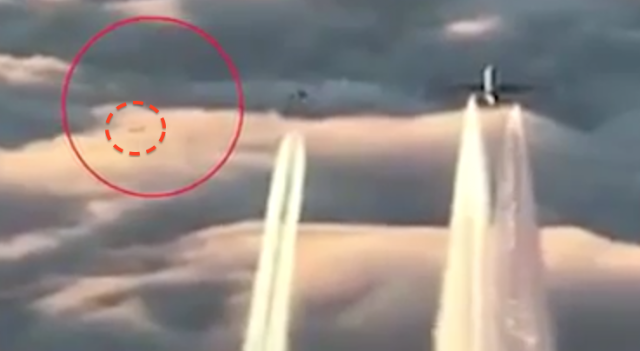
Zondag werden beelden van enkele vliegtuigen boven de Duitse stad Keulen op sociale media geplaatst, waarna oplettende kijkers een geheimzinnige zwarte stip opmerken die zich met grote snelheid voortbewoog.

Al snel werd gespeculeerd dat het om een ongeïdentificeerd vliegend object (UFO) ging. Er wordt inmiddels druk gediscussieerd over de beelden.

De video werd gemaakt toen enkele Duitse straaljagers een vliegtuig dat op weg was naar Londen begeleidden, nadat het toestel geen contact meer kon maken met de Duitse luchtverkeersleiding.

Niet overtuigd

Veel mensen ontdekten dat er iets vreemds aan de hand was met het filmpje. “Geweldige video! Er vliegt trouwens een UFO door de wolken,” schreef iemand.

“Ik heb deze video al enkele keren voorbij zien komen,” schreef een ander. “Er is iets heel vreemds aan de hand.”

Luchtvaartdeskundigen menen dat het gaat om de schaduw van een vliegtuig dat hoger vliegt en niet op de beelden is te zien. Anderen zijn niet overtuigd door deze bewering.

Niet zo snel

Sommigen stellen dat een vliegtuig niet zo snel kan vliegen, terwijl sceptici van mening zijn dat er niets bijzonders op de beelden is te zien.

De beelden zijn gemaakt vanuit een toestel van British Airways dat zich in de buurt van het incident bevond.

[Nieuwsblad]
Hoe vind je dit bericht?
Geschreven door peter om 17:15 Stuur door

VIDEO: “Roswell-UFO was niet alleen en maakte deel uit van een vloot”

roswell-crash1

VIDEO: “Roswell-UFO was niet alleen en maakte deel uit van een vloot”

De UFO-crash bij Roswell in New Mexico in juli 1947 is één van de meest gedenkwaardige gebeurtenissen in de geschiedenis.

Voor het eerst gaan ‘drie van de meest getalenteerde remote viewers op aarde’ een antwoord proberen te vinden op de vraag wat er precies is gebeurd.

Deze remote viewers, die al eerder hebben deelgenomen aan wetenschappelijke experimenten, gaan onder meer proberen een kijkje te nemen in en buiten het object dat in de woestijn is neergekomen.

Verborgen

Ze reizen terug in de tijd om de herkomst van het vaartuig te bepalen en meer te vertellen over de wezens die het bestuurden en bouwden.

Over de inspanningen van de remote viewers is een documentaire gemaakt. Centraal in de film staat het Farsight Institute, dat zich bezighoudt met grootschalige projecten op het gebied van remote viewing oftewel verzien.

“We richten ons op doelen die onthullen wat lange tijd voor zoveel mensen verborgen is gebleven,” aldus het instituut.

Vloot

De remote viewers kregen van tevoren geen informatie over dit specifieke project. Pas achteraf kregen ze te horen dat het experiment betrekking had op de Roswell-crash in juli 1947.

“Dat ding was niet alleen,” zei Dick Allgire, één van de remote viewers. “Het maakte deel uit van een vloot, een squadron, een cluster.”

Bekijk hieronder een trailer van de documentaire:

[Farsight Institute]
Hoe vind je dit bericht?
Geschreven door peter om 17:11 Stuur door

Unexpected Birth Has This Lady Thinking That She May Be An Alien Hybrid, Video, UFO Sighting News.

Unexpected Birth Has This Lady Thinking That She May Be An Alien Hybrid, Video, UFO Sighting News.

hybrid%252C%2BElon%2BMusk%252C%2BAI%252C%2Bartificial%2BIntelligence%252C%2Btank%252C%2Barcheology%252C%2BGod%252C%2Bmysterious%252C%2Bunidentified%2Bflying%2Bobject%252C%2Bspace%252C%2BUFO%252C%2BUFOs%252C%2Bsighting%252C%2Bsightings%252C%2Balien%252C%2Baliens%252C%2BFox%252C%2BNews%252C%2Bastronomy%252C%2Btreasure%252C.png

Aliens are all around us. On every moon and planet in our solar system, in Earths orbit and skies, and even on our planet. This woman dives into the subject and explains how her life has been impacted by the visits of aliens. 
Scott C. Waring

Video states:

French talking. 6'3" with blonde-hair and green eyes. Lisa has dependably felt like she is "distinctive." More remarkable than her striking nearness is the way that Lisa trusts she might be what numerous in UFO hovers allude to as a human-cross breed. Half breeds are frequently characterized as the offspring of abductees who have been subjected to contact with outsiders where ladies have been impregnated. The outcome is the introduction of an outsider human cross breed with outsider attributes in these crossover kids that lay lethargic. It is the human qualities that are more dynamic.
However something else is seen and these human half and halves feel like they don't completely have a place on Earth. All things considered, the eyes of these human half and halves are regularly profoundly convincing. When they take a gander at you, it feels as though they achieve profound into your spirit. Deep down, they every now and again report longs for flying and out-of-body encounters that regularly carry them into space where contact with their ET starting points are seen. Cross breeds additionally report that they are exceptionally instinctive. They sense, feel and apparently discuss clairvoyantly, with their patrimonial clairvoyant aptitudes tuning into read the contemplations of people without saying a word to them. These qualities and the sky is the limit from there, characterize Lisa's encounters.
Having a secretive birth and numerous UFO-related encounters for the duration of her life, Lisa shares only a couple of her high abnormality perceptions translated into English through UFO Researcher, Luigi Vendittelli from Montreal, Canada. "I have an explanation behind being here and it is somewhat not quite the same as other individuals however I feel there are many individuals like this. There is something to be finished. We have to change things and it's an overwhelming weight to have." Lisa says as she herself tries to get a handle on the riddle of what she feels inside.

{ http://www.ufosightingsdaily.com/ }

Hoe vind je dit bericht?
Geschreven door peter om 17:00 Stuur door

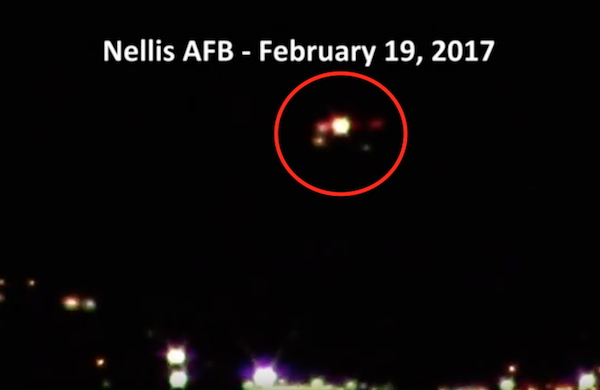
Alien Ship Hovering Over Nellis Air Force Base On Feb 19, 2017, Video, UFO Sighting News.

Alien Ship Hovering Over Nellis Air Force Base On Feb 19, 2017, Video, UFO Sighting News.

UFO%252C%2BUS%2BAFB%252C%2BAir%2BForce%252C%2Bsighting%252C%2Briver%252C%2B.png
Date of sighting: February 19, 2017
Location of sighting: Nellis AFB, Las Vegas, Nevada, USA
 
Here is a great sighting that took place just a few days ago in Las Vegas, Nevada. It was over Nellis AFB which has over 1,000 square miles of land...which people never question why they need so much land. Its because the Tall Whites moved in. The USAF let the Tall Whites build their own underground base behind the old firing range. An alien race thats lives up to 800 years and is highly arrogant and aggressive. Excellent video by Steven Barone of Youtube. 
Scott C. Waring
 
Eyewitness states:
I shot this video from my backyard in the Summerlin area of Las Vegas, Nevada on the night of February 19, 2017. If you haven't heard of the USA space fleet I highly suggest you look up "Solar Warden" or "Gary McKinnon." He was the Scottish hacker that penetrated the computers at NASA and the Johnson Space Center. He wasn't trying to do any harm but wanted to know more about UFOs and what the USA knew about them. What he found far exceeded anything he was expecting. He found evidence od a secret space fleet that had been in existence since the 1980's. It is said that the USA has at least eight tubular motherships and nearly fifty smaller ones. What really blew him away was a list of non-terrestrial officers and ship to ship transfers. If you believe this then you have to ask where this secret space fleet is based. Where better than Area 51 and Nellis Air Force Base. This is just a theory of mine and I cannot prove it but based on everything I have seen and filmed over a nearly three-year period it is the only thing that makes sense.

{ http://www.ufosightingsdaily.com/ }

Hoe vind je dit bericht?
Geschreven door peter om 16:57 Stuur door

United States: Circle-shaped UFO appears after thunderstrike

United States: Circle-shaped UFO appears after thunderstrike

circle-shaped-ufo

Here’s one video analysis of a ring that appeared after a thunder strike. This happened somewhere in US recently.

During a recent thunderstorm in the US a UFO appeared. It’s not clear whether the UFO got hit by the lightning strike or whether it was using the lightning for it’s energy. After the lightning strike the UFO becomes visible for a 30 seconds and illuminates the sky and the surrounding area. Then a second lightning strike is heard and the UFO dissappears. When the UFO disappears the area turns dark again.
I made a short video analysis of the footage to explain what happened.
Did the UFO open up a portal in order to travel to another dimension?

{ http://www.latest-ufo-sightings.net/ } 

Hoe vind je dit bericht?
Geschreven door peter om 16:44 Stuur door

Kuwait: The Same Two UFOs Appear In Five Videos Taken By Different People In Different Positions

Kuwait: The Same Two UFOs Appear In Five Videos Taken By Different People In Different Positions

kuwait-ufo


Five different UFO sighting videos made the rounds online after they showed the same UFO over the same city captured in various positions. What makes the videos interesting is the fact that they were taken by three different people in Kuwait. The videos show one round white orb and another UFO in lower altitude, which some enthusiasts believe it was 90% cloaked. It is not happening every day that multiple people record the same UFOs.

One eyewitness says that he wants to share something he has seen with his very own eyes, which he has never seen before. He says that it looks like a UFO, which, according to him, gives out circular smoke before the UFO itself vanished. The witness admits he used the Viva Video app but insists that this is not edited at all. He says that he only used the app to get a slow motion of the video for the viewers to see the smoke. He assures the viewers that the video is not done with any camera tricks.

Some UFO observers found the evidence that comes with this sighting overwhelming. They suspect thousands of people witnessed the same thing and expect more UFO videos showing this particular sighting to come over the next few weeks. They speculate that aliens like to visit Kuwait because this is an ancient nation with ancient traditions still in place.

Hoe vind je dit bericht?
Geschreven door peter om 16:39 Stuur door

NASA SENDING SPACESHIP TO ROOT OUT SPACE ALIENS

NASA SENDING SPACESHIP TO ROOT OUT SPACE ALIENS

'Goal to search for evidence of life' on Jupiter moon Europa

Europa

Europa

NASA thinks aliens might be hiding on the frozen moon of Jupiter, called Europa, and as such, is sending out a search spaceship to root them out, the aeronautics agency reported.

Just this week, NASA announced three goals for its upcoming exploration mission on Europa. What were they?

“The primary goal is to search for evidence of life on Europa,” NASA wrote, News.com.au reported.

In layman’s terms, that’s tantamount to saying, ‘let’s go look for aliens.’

NASA’s other two goals with its Europa mission, meanwhile, are less eye-widening in nature.

“The other goals are to assess the habitability of Europa by directly analyzing material from the surface, and to characterize the surface and subsurface to support future robotic exploration of Europa and its ocean,” News.com.au reported.

The announced missions come on the heels of NASA’s mulled spacecraft exploration of the ocean – once again, to root out possible alien life forms.

Get the hottest, most important news stories on the Internet – delivered FREE to your inbox as soon as they break! Take just 30 seconds and sign up for WND’s Email News Alerts!

But before starting that operation, NASA said it wants first to go to Europa. Tantamount to its mission is to find proof positive an ocean actually lurks beneath the surface layers of that moon.

“Scientists agree that the evidence is quite strong that Europa, which is slightly smaller than Earth’s moon, has a global saltwater ocean beneath its icy crust,” NASA said. “This ocean has at least twice as much water as Earth’s oceans.”

And that means the possibility for alien life is significant.

“While recent discoveries have shown that many bodies in the solar system either have subsurface oceans now, or may have in the past, Europa is one of only two places where the ocean is understood to be in contact with a rocky sea floor.”

So what?

As NASA noted: “This rare circumstance makes Europa one of the highest priority targets in the search for present-day life beyond Earth.”

The other moon in the solar system that likely has a rocky sea floor is Saturn’s Enceladus.

NBC News on Tuesday noted NASA’s ongoing pursuit of alien life forms with a short video chronicling the various electronic messages the agency has placed onto Voyager’s Golden Records. The Golden Records were created in 1977 as a means of NASA illustrating and “explaining Earth” via “a series of vinyls” to any alien life forms who happened upon them, the news outlet reported.

VIDEOSpaceX launch scrubbed


“The records include sounds of wind, rain, laughter, heartbeats and animal noises,” NBC News reported. “It also offers a music collection, from Beethoven to Chuck Berry. The images feature equations, diagrams and snapshots of nature and human life. It also contains greetings from 55 languages to say hello to the universe.”

Watch video of Golden Records programmed by NASA in 1977 to explain the story of Earth:

{ http://www.wnd.com }

Hoe vind je dit bericht?
Geschreven door peter om 01:36 Stuur door

UFOs in the Middle East? Mass sightings send social media into frenzy

UFOs in the Middle East? Mass sightings send social media into frenzy

SEVERAL videos of an alleged mass sighting of UFOs over Kuwait and Iran have sparked a social media frenzy.


Footage was filmed in the Middle East on Sunday of two mysterious objects in the sky, before being uploaded to social media.

It sparked intense online debate about whether they could be alien in origin. 

Scott C Waring, editor of ufosightingsdaily.com, blogged: "Three different people in Kuwait just uploaded five different UFO videos of the same UFO, but from different positions within the city. 

"All the videos do show two UFOs. One round white orb and another lower UFO that is 90 percent cloaked. We are very lucky to have so many people record the UFOs.

"The evidence that comes with this sighting is overwhelming. Its more than most sightings ever get. 

Kuwait-UFO

YouTube

A series of UFO sightings over Iran and Kuwait led to specuklation over aliens.

RELATED ARTICLES

"It must have been seen by thousands of people and I expect more UFO videos will come in over the next few weeks from today."

Mr Waring is convinced it was an alien space craft.

He added: "Kuwait is an ancient country with ancient traditions still in place. 

"There is probably more reason for aliens to want to visit there for its history than to visit America for its new innovations."

But, other UFO specialists had more convincing explanations.

RELATED ARTICLES

All the videos do show two UFOs. One round white orb and another lower UFO that is 90 percent cloaked. We are very lucky to have so many people record the UFOs.

Scott C Waring

Scott Brando runs hoax-busting website ufoofinterest.org.

He forensically examines footage before reaching conclusions over what it could be.

He initially speculated that it may be a rocket launch, after learning of reports of Iranian rocket missile tests carried out on Monday.

However, he concluded that it was actually the launch on Sunday from the Kennedy Space Centre in Cape Canaveral, Florida, by Space X of its Falcon 9 rocket, which he said would have passed over the Middle East at the time of the sightings.

Related articles

Hoe vind je dit bericht?
Geschreven door peter om 01:21 Stuur door

The Most Amazing Space Stories This Week!

The Most Amazing Space Stories This Week!

The Most Amazing Space Stories This Week!
The dwarf planet Ceres, as seen by NASA's Dawn spacecraft.
Credit: NASA/JPL-Caltech/UCLA/MPS/DLR/IDA

NASA unveiled the winners of its space poop challence, life's building blocks were found on the dwarf planet Ceres and an Indian rocket launched a record-breaking 104 satellites to orbit. Here are the most interesting things that happened in the universe this week.

Space poop challenge

Turns out space poop is a problem that puzzles thousands of people. After NASA asked for solutions to let astronauts urinate and defecate inside a spacesuit for more than one day, more than 5,000 entries (representing 20,000 people) answered the call. [Full Story: How to Poop in Space: NASA Unveils Winners of Space Poop Challenge] 

Ceres has organic molecules

NASA's Dawn spacecraft has spotted organic molecules — the carbon-containing building blocks of life as we know it — on Ceres for the first time, a new study reports. [Full Story: Life's Building Blocks Found on Dwarf Planet Ceres] 

104 satellites!

The Indian Space Research Organization shattered a spaceflight record on Feb. 14 by launching 104 satellites to orbit on a single rocket. [Full Story: India Launches Record-Breaking 104 Satellites on Single Rocket] 

NASA whittles possible Mars 2020 rover landing sites to three

NASA has selected three potential landing sites for the upcoming Mars 2020 rover: an ancient lake, a past volcanic hotbed and a potential early hot-spring site. [Full Story: Landing Sites for 2020 Mars Rover: NASA Weighs 3 Options] 

North Korea may launch an ICBM this year

North Korea appears to be making serious progress on an intercontinental ballistic missile, which could conceivably allow the nuclear-armed nation to make good on its oft-repeated threat to turn major American cities into "seas of fire," experts say. [Full Story: North Korea's Missile Threats to US May Not Be Empty for Long] 

More delays for commercial crew?

NASA intends to put a backup plan in place in the event that SpaceX and Boeing are not ready to fly humans to space in 2019, according to a new report. [Full Story: Private Astronaut Taxis by SpaceX, Boeing May Not Be Ready by 2019: Report] 

Giant exoplanet rings host star's bell

A gigantic exoplanet and its host star have a very special relationship, a new study suggests. The gas-giant planet, known as HAT-P-2b, induces heartbeat-like pulsations in the star every time the two bodies get close. [Full Story: Cosmic Love: Star's Heart Beats for Giant Alien Planet] 

How to make an alien language

The production designer for the Oscar-nominated science fiction movie "Arrival" talks about creating the striking visual elements of the film. [Full Story: Talking in Circles: Creating the Alien Language of 'Arrival'] 

Super space prank

NASA astronaut Peggy Whitson just pulled off a prank that's literally out of this world. [Full Story: A NASA Astronaut Just Pulled Off an Awesome Prank in Space] 

Winston Churchill's thoughts on alien life

Winston Churchill was known for his leadership during World War II, but a newfound essay on alien life reveals another side of him, one that was deeply curious about the universe. [Full Story: Winston Churchill on Aliens: 1939 Essay Discovered] 

Help astronomers find Planet 9

Think you can find Planet 9? A new citizen-science project lets participants search for hidden objects beyond the orbit of Neptune, where a possible ninth planet may lie. [Full Story: Think You Can Find Planet 9? Check Out This Citizen-Science Project] 

Off-Earth art

On Friday (Feb. 10), a 3D printer aboard the International Space Station created a sculpture that represents human laughter — the first such piece of art ever to be produced off Earth, project representatives said. [Full Story: 3D-Printed 'Laugh' Is 1st Major Artwork to Be Made in Space] 

Should we send messages to aliens?

Although there's some fear surrounding the act of sending messages to hypothetical extraterrestrial intelligences, it could be one of the most important things humanity could do — scientifically speaking. [Full Story: This Is Why Sending Messages to Aliens Might Be a Good Idea] 

Follow us @Spacedotcom, Facebook or Google+. Originally published on Space.com.‪

{ http://www.space.com/ }

Hoe vind je dit bericht?
Geschreven door peter om 01:11 Stuur door

The Most Interesting Science News Articles of the Week

The Most Interesting Science News Articles of the Week

Each week we uncover the most interesting and informative articles from around the world, here are 10 of the coolest stories in science this week.

<i>Hirondellea gigas</i> are the goats of the sea — they'll eat any organic material that floats down from above, including pollutants.
Hirondellea gigas are the goats of the sea — they'll eat any organic material that floats down from above, including pollutants.
Credit: Alan Jamieson/Newcastle University

A recent study of creatures living in some of the deepest places in the ocean revealed disturbingly high levels of pollutants.

Scientists captured and tested crustaceans from the Mariana Trench, comparing them with crabs from the Liaohe River, one of the most polluted in China. Tests found incredibly high amounts of pollution in the deep-sea animals. [Read more about pollution in the Mariana Trench.]

Fatal overdoses from cocaine use in the U.S. are on the rise. A recent study revealed an increase in the number of deaths due to a combination of cocaine and opioids. [Read more about the drug connection.]

A new material that is as thin as aluminum foil can be used to cool houses or power plants without using any electricity or water. The material manipulates the properties of light to reflect the sun's rays while allowing objects beneath it to passively radiate heat to cool off.
Credit: Glenn Asakawa

A simple-to-produce material could one day cool buildings without power. The futuristic supermaterial cools using radiative cooling, just like Earth. [Read more about the futuristic wrap.]

Desert ants walk on treadmills to help scientists understand homing behavior.
Credit: Matthias Wittlinger

Studying how animals move can be tricky. Scientists have devised a unique way to study them — by having them run and walk on treadmills. [Read more about exercising ants.]

Scientists have announced they will conduct another set of radar scans of King Tut's tomb (shown here) to look for any hidden chamber.
Credit: Everett - Art/Shutterstock.com

Archaeologists studying the tomb of Tutankhamun say it may hide a secret chamber with Queen Nefertiti's tomb. So far, scans of the tomb have not revealed any such secrets. [Read more about the secrets of King Tut's Tomb.]

The Lego bot can move each limb independently of the other thanks to its magnetically controlled screws placed in a unique layered magnetic field.
Credit: J. Rahmer and B. Gleich/Philips Research

In the future, troops of microscopic robots may help fight cancer. Scientists have created magnetically controlled swarms of magnetic devices to perform specialized tasks. [Read more about the robot army.]

In South Australia, a battle to the death ensued and was captured on video. A red-bellied snake took on a brown snake and one of them paid the price. [Read more about the dueling snakes.]

An artist's interpretation of an ancient mother <i>Dinocephalosaurus</i> swimming with an embryo developing within her.
An artist's interpretation of an ancient mother Dinocephalosaurus swimming with an embryo developing within her.
Credit: Dinghua Yang

Researchers discovered that the ancient marine reptile known as Dinocephalosaurus gave birth to live young rather than laying eggs. [Read more about the ancient "Nessie".]

The magnetic field surrounding Earth is constantly fluctuating in strength.
Credit: NASA's Scientific Visualization Studio

Pottery jugs from over 2,500 years ago have secrets of Earth's geomagnetic field. The act of heating to create the jugs locked data about the field into the pieces and experts have unlocked some of those secrets. [Read more about the secrets of the geomagnetic field.]

Fossils of 444-million-year-old sponges from the Anji Biota in China that thrived after the mass extinction.
Credit: J.P. Botting

While sponges may be simple creatures, after a mass extinction some 445 million years ago, they all but ruled the world. The Ordovician mass extinction killed off around 85 percent of all species on Earth at the time. [Read more about the sponges.]

Follow Live Science @livescience, Facebook & Google+.

{ http://www.livescience.com/ }

Hoe vind je dit bericht?
Geschreven door peter om 01:01 Stuur door

Athena: ESA's Big X-ray Telescope

Athena: ESA's Big X-ray Telescope

Athena: ESA's Big X-ray Telescope
Artist's conception of the proposed Advanced Telescope for High-Energy Astrophysics (Athena+).
Credit: Athena+ Team

Athena, or Advanced Telescope for High-ENergy Astrophysics, is a European Space Agency (ESA) large-class mission expected to launch in 2028. 

The spacecraft is an X-ray observatory expected to answer questions about the hot and energetic universe. The two main questions include "How does ordinary matter assemble into the large-scale structures that we see today" (such as galaxy groups and clusters) and "How do black holes grow and influence the environment around them." A black hole's environment is best seen in X-rays, and hot gases, which are visible in X-rays, can give clues about galactic structure formation and evolution.

Science objectives of Athena include investigating:

  • how galaxy groups and clusters form and evolve;
  • how hot "baryons," or subatomic particles, evolve;
  • missing baryons in the intergalactic medium, or plasma between galaxies;
  • how black holes and supermassive black holes grow over time;
  • how black holes influence "active" galaxies (those galaxies that produce an extraordinary amount of energy);
  • the effects of active galactic nuclei on galactic clusters and star formation.

The launch vehicle hasn't been determined yet, but it's possible that Athena will launch on an Ariane 5. After launch, the spacecraft will then be placed in a stable gravitational area in space known as a Lagrange point. In this case, Athena will use L2, which is on the "dark" side of the Earth (meaning that it is exactly opposite of the sun.) L2 has also been used for missions such as WMAP (the Wilkinson Microwave Anisotropy Probe) and Planck, and will be the location of the future NASA James Webb Space Telescope after launch in 2018.

Athena will perform about 300 pointed observations of celestial objects each year, ESA stated. Each observation will last an average of 105 seconds. While there will be a planned observation campaign, there will be flexibility to move Athena to a target if a transient event in the sky is noticed, such as a gamma-ray burst. Planning allows this to happen twice per month, ESA said.

Athena is expected to last five years, although consumables (such as fuel) have been rated for 10 years in the case of a mission extension. 

Athena is named after an Ancient Greek goddess who favored Odysseus, the hero of the Odyssey. The telescope project was born out of the reformulation of several older missions. At first, ESA and NASA were each pursuing different telescope projects, called XEUS and Constellation-X respectively. This changed in 2008 after officials from NASA, ESA and the Japan Aerospace Exploration Agency (JAXA) agreed on an International X-Ray Observatory (IXO) to merge the Constellation-X and XEUS projects.

The United States periodically conducts studies among space scientists to determine the priorities for the coming decade, which is called the decadal survey. ESA has its own priority list that draws from the recommendations of the Cosmic Vision Programme 2015-2025. The 2010 U.S. decadal survey ranked IXO fourth among large-scale missions. In 2011, ESA issued a statement saying the agency would go alone for large-scale missions. It cited the lack of support in the decadal survey for three joint European missions, and added that it had concerns that NASA funding would not let the missions launch in a timely fashion.

ESA subsequently moved forward with a modified version of IXO under Cosmic Vision, known as Athena. Athena was among the candidates proposed for the first large-class mission launch competition in 2012, but officials ultimately chose JUICE (the JUpiter ICy moons Explorer). Athena was instead chosen in 2014 for the second large-class mission opportunity, for a launch in 2028.

"The mission has now entered the study phase; once the mission design and costing have been completed, it will eventually be proposed for 'adoption' around 2019, before the start of the construction phase," ESA wrote in a summary page about the mission.

While Athena's design is still being determined, the telescope will likely have an X-ray telescope with a focal length (distance between the center of its lens, and the focus of the telescope) of about 12 meters, or 39 feet. It will also include two instruments: an X-ray Integral Field Unit for high-spectral resolution imaging, and a Wide Field Imager that will get more moderate resolution spectroscopy over a wide field of view.

"The telescope will use silicon pore optics (SPO), which will provide a unique combination of a large collecting area and good angular resolution across a large field of view while meeting a stringent mass budget," ESA stated on another page. Arrays of these pores will be placed into modules using commercially available silicon wafers, the agency added. These wafers will be cut, arranged and stacked in a radial pattern to focus the light.

Supporting the X-ray optics will be a mirror assembly module that will include a sun protector, a straylight baffle and a thermal baffle so that the telescope can perform its sensitive observations with a minimum of interference. 

With dozens of X-ray telescopes launched into space, it is difficult to summarize all of the missions quickly. The first of these launched in the 1970s, and observations from X-ray telescopes continue today. Some of the larger and more recent missions are summarized below.

The Chandra X-ray Observatory was launched on the STS-93 shuttle mission in July 1999, and is still operating. Chandra is considered one of NASA's "Great Observatories," referring to a program in the 1980s and 1990s that birthed the large-class observatories of the Hubble Space Telescope, Compton Gamma-Ray Observatory and Spitzer Space Telescope. Chandra has made numerous discoveries, including imaging a halo of hot gas around the Milky Way, showing that nearly all stars on the main sequence of evolution emit X-rays, and observing X-ray emission from Sagittarius A* (the supermassive black hole at the Milky Way's center).

XMM-Newton (X-ray Multi-Mirror Mission) is an ESA mission launched in December 1999 aboard an Ariane 5 rocket. XMM-Newton is a part of ESA's Horizon 2000 program, a previous long-term plan the agency followed for choosing missions. Its mission has been extended several times, and the observatory remains in good health. Its discoveries include measuring the spin rate of a supermassive black hole (along with another observatory called NuSTAR) and making observations of massive galaxy clusters, which help confirmed the presence of dark energy.

The Swift Gamma-Ray Burst Mission has instruments on board that can observe these transient phenomena using gamma-ray, X-ray, ultraviolet and optical wavelengths. It flew into orbit in 2004 aboard a Delta II rocket, and remains in operation. It has seen black holes, supernovas (star explosions), active galactic nuclei, comets and many other things. Among its discoveries was finding a new kind of gamma-ray burst that is not associated with a supernova, which was a surprise to astronomers.

ESA's INTErnational Gamma-Ray Astrophysics Laboratory (INTEGRAL), which launched in 2002 and is still operational, has a similar mission to Swift. In conjunction with NASA and the Russian Space Agency, INTEGRAL examines gamma-ray bursts. Besides gamma-ray bursts, it has performed observations of X-ray binaries as well as X-ray sources outside of the galaxy. This includes the cosmic X-ray background, the remnant of radiation left over from when the Milky Way was born.

Additional resources

{ http://www.space.com/ }

Hoe vind je dit bericht?
Geschreven door peter om 00:47 Stuur door

Abduction on North Canol Road, Northern Canada

Abduction on North Canol Road, Northern Canada
Depiction> <div align=Kevin's Account

written, Feb 2001

posted March 21, 2004)

In August or September 1987 (later determined to be Wednesday September 2, 1987), I left Ross River (where I lived) and headed up the North Canol Road by myself on my motor bike for moose (hunting).

I was planning on spending 3 days in the area between Sheldon Lake and Macpass. A guy I worked with and a friend of his were to leave a day later and I was to meet them for some fishing. We were all to stay at a trailer at Dewhurst Creek.

I left Ross River early in the morning and the temperature started to drop. Then it started to rain very hard and very cold. When I got to Gravel Creek, I stopped at Art John's Cabin and put on extra clothes while standing under the edge of his roof. I knew the rain would not stop, so I got back on my bike and headed off. I arrived at the trailer ½ hour before dark, very cold and very tired. I lit up a fire, cooked supper and went straight to bed looking forward to the morning hunt. Over night the rain had stopped.

At daybreak (September 3, 1987) I put my gear and my gun on my bike and headed towards Macpass. A couple of miles down the road, I was putting along at about 10 mph looking into the trees and watching the hillsides. I decided to stop for a restroom break.

I stopped where I could see some mountainsides and some valleys. I parked on the right side of the road. The sun was shining; the air was perfectly still and a bit cool. I was standing just in front of my bike watching the mountains to the south, when I noticed to the left out of the corner of my eye, what I first thought was an airplane. It was 400 to 500 yards away and about the size of a DC-3 plane or a full-size school bus. It was travelling north to south, at about 40 yards above ground and moving maybe 30 km/h. Right away I thought "boy is he low". I blinked my eyes because I couldn't make out any tail fin or wings.

It had what looked like portholes all along the side of it. It was cigar shaped with a grey strip down the middle and a dark green on top and bottom.

I thought to myself, "something's wrong with this picture", then I realised there was no sound! If it was an airplane, the roar would have filled the valley.

As I watched, it seemed to partially dematerialize and then return to solid form, it did this as it was moving, a couple of times. Then it dawned on me, oh, oh, I don't think I should be seeing this; it's a UFO and probably doesn't want to be seen!

I crouched down on the road, hiding behind the roadside grass.

I then watched it go behind a cone-shaped hill and not come out. I stood up looking for it and feeling very excited and happy about what I saw and thinking they didn't even know they were being watched.

I was standing beside my bike when I heard a loud metallic clunk behind me around the corner.

Right away I thought, somebody must be here and I've got to tell them what I saw. The noise I heard sounded like a heavy trunk lid on a car slamming shut.

I quickly walked along the edge of the road to the corner to see who was there.

I came face to face (about 20 yards) with 2 grey creatures in blue jump suits, about 5 ft. tall with big insect looking heads, pointy faces, big eyes, thin arms, body and legs. I immediately thought "they're not little green men*, they're grasshopper people".

northcanolroadabduction2.jpg
At that same instant, the one on the left raised his left hand to his waist, which held some type of flashlight device and I saw a bright flash of light come from it.

I instantly felt paralyzed and was convinced time had stopped, everything was black, no sound. I tried to yell "No!" but all that came out was a distorted grunt.

Next thing I knew I was standing on the side of the road scared, shaking and confused.

Within seconds I remembered all of this that had just taken place and I thought, "I'm getting out of here before they get me again." I turned around to get my bike and for some reason it was not there, then I noticed it was on the other side of the road. I said to myself, "what the hell is this? I didn't put it there". Still panicking I rushed over and got on it and realized the keys were gone.

I always left the keys in it, that way I could not lose them while sneaking around in the bush. I immediately started looking down the road and suddenly saw them in my hand. I started my bike and raced back to the trailer.

I was feeling scared and amazed at the same time and then noticed that all the shadows of the trees were pointing in a different direction than that of the morning sun. About 15 minutes later I was at the trailer. Half an hour later it was dark. I thought "no way, I only left here an hour ago, what's going on?"

I was really confused then, I said to myself, "I'm not telling anybody about this, I'll just forget the whole thing".

I put on a pot of coffee and could then hear a soft humming sound above the trailer. I could also feel a soft vibration in everything (trailer, air, etc.). After about 10 minutes it had all stopped. I had a very strong feeling that they were outside. I did not look out the windows.

Later that night I still couldn't sleep and while having my coffee I began to have flashbacks of the past events. I remember being in a dream-like state watching scenery flash by underneath as if I was flying. I watched mountains and rivers and forests go by at a very high rate of speed.

I then became aware of other sounds and seemed to wake up. I opened my eyes and could see nothing but black, very deep and inky black. As I was looking at this, the blackness pulled back, revealing a face, I had been looking into the eyes of a grey type creature. I could hear in my mind a voice saying "there is nothing to worry about". I could hear him talking in my mind.

There were 3 or 4 of these types walking around, but only one talked to me. The two I saw earlier on the road, I never saw again. (Note: the aliens that he saw at this point were of the typical "grey type" while the ones at the edge of the road were more insectoid.)

I then sat up and had an idea of what might be going on and I asked, "Are you going to do experiments on me?" and the one said, "They've already been done." I felt really good then because, except for a strange sensation in my hands everything felt normal. I kept rubbing my hands together but did not look at them, as there was a totally strange environment to look at instead. I experienced no discomfort.

The being nearest me asked if I would like to see my home planet and I said sure. I then walked over to the window, where there was a machine that looked like a big copy machine. He asked me not to touch it, I replied "Don't worry, I'm not touching anything in here".

He then said, that bright white star is your home. I didn't know anything about astronomy at the time, but I always thought earth was blue, so right away I thought he's lying. He also explained to me about space and stars etc. but I can't remember any of it now.

I was also asked if I would like to go on a trip. I replied "Not yet", I felt very honoured to be asked and I did want to go, but felt that the time was not right.

Then I was told I would have to forget all of this. I was disappointed at hearing this. The first part of the experience was very scary, but once I was with them, I found them to be friendly, helpful and their looks didn't bother me. They actually seemed like old friends.

They gave me a clear glass, ¾ full with a yellow liquid and said to drink it up, it would make me forget everything. I told them, I did not want to forget an experience like this. It should be remembered! I was told it was for my own good that I forget. So I took 3 little sips and put the glass down.

Next thing I know, I'm on the road by my bike, scared to death and wanting to get out of there.

The next day I met up with the other two guys and never said anything to them.

Martin Jasek, M.Sc., P.Eng.

http://www.ufobc.ca/yukon/n-canol-abd/in

{ http://www.ufocasebook.com/ }

Hoe vind je dit bericht?
Geschreven door peter om 00:38 Stuur door

Alleged Alien Abductee Details Childhood Encounters at the International UFO Congress: We’d Tell Our Parents, ‘The Bald Men Are Coming’

Alleged Alien Abductee Details Childhood Encounters at the International UFO Congress: We’d Tell Our Parents, ‘The Bald Men Are Coming’

Audrey Starborn Hewins

Congress met in Fountain Hills, Arizona, last week, taking over the posh We-Ko-Pa Resort with their usual displays of space alien paraphernalia, panels about extraterrestrial abductions and occasional close encounters with tourists who dared to mix it up with cowboy boots, flying saucer earrings and “I Don’t Believe in Humans” T-shirts.

At the International UFO Congress — the world’s largest convention dedicated to unidentified flying objects — it doesn’t matter what political party you’re from, or, for that matter, what species.

Anyone is welcome at the week-long event, even skeptics, providing that they leave their snarky comments and tin foil hats at home.

“While the Roswell UFO Festival may be better known to the general public, the UFO Congress occupies a very special place in the hearts of UFO researchers and enthusiasts,” says Noe Torres, author of The Real Cowboys and Aliens: UFO Encounters of the Old West, who was one of this year’s convention speakers.

“There are no alien parades, alien dog costume contests or other gimmicks,” Torres, of Edinburg, Texas, tells PEOPLE. “It’s about exploring the history of UFO research and examining some of the most outstanding cases of the past and present.

This month marks the 26th year that hundreds of UFO enthusiasts worldwide descended upon the pretty desert town of Fountain Hills, with a population of 23,235, to celebrate starry skies and strange lights, spaceships, crop circles and alien life forms of all kinds at the conference sponsored by the paranormal research organization, Open Minds.

Although there were plenty of booths selling E.T.-themed merchandise (alien lawn statues, little green men necklaces, Fifty Shades of Greys books), most of the 2,000-plus conference goers came for the latest research on UFO sightings and crashes, speeches about government cover-ups and conspiracies, a popular UFO film festival and “experiencer” sessions featuring people who claim to have been abducted by aliens.
News reporters were not allowed to attend sessions featuring “abductees,” but people who claim to have been visited or whisked away by small creatures with large dark eyes were not in short supply.

Audrey Starborn Hewins, 43, came to the conference to offer support therapy to alien “experiencers” after claiming several close encounters of her own since age 5.

Hewins, of Oxford, Maine, says that she and her identical twin, Debbie, were visited frequently by grey aliens as girls growing up in Athens, Ohio.

“We’d tell our parents, ‘We don’t want to go to bed — the bald men are coming,'” she tells PEOPLE. “They started doing all kinds of experiments on us when we were 12.”

In later years, Hewins says she was saved from drowning in the ocean by an alien being.

“It was then that I decided to dedicate my life to helping others who have also had encounters,” she says. “I won’t want them to feel alone. It’s hard for people to come forward because they’re afraid that everyone will think they’re crazy. Only another experiencer can fully understand.”

Although Hewins has spent a lifetime dealing with skeptics, she found a believer in Robert Davis, a neuroscientist from North Port, Florida, who delivered a keynote address about a research project he worked on involving more than 2,300 people who claim they’ve had alien encounters.

“Despite initial feelings of confusion and anxiety, many UFO ‘contact experiencers’ manage to reach a place of integration and healing,” Davis tells PEOPLE, “but for some, it can be a difficult, long-term struggle. They often find that speaking of their experience can be traumatic to their psychological well-being and have devastating consequences. For many, it’s frightening to accept that this experience is valid.”

Abductees’ needs are not properly addressed by the psychological community, says Davis, even though their experiences are “shared by many thousands, if not millions, worldwide.”

“It’s unreasonable to think that they all would be lying or reporting dreams and fantasies,” he tells PEOPLE. “These events are consistently reported and should be taken seriously by everyone, in spite of their uniqueness.”

Ken Johnston knows the feeling of not being taken seriously, but that’s never stopped him from speaking out about what he calls a government conspiracy to cover up evidence of an alien base on the moon.

Ken Johnston

The retired aerospace engineer and astronaut trainer says one of his duties was to take care of photos from five lunar missions and provide them to scientists from around the world who were studying moon samples.

After the Apollo 15 mission in 1971, Johnston was told to destroy everything in his files, he tells PEOPLE. But he instead kept a set of the photos for himself and released them to the public in 2015, before donating his collection to the Roswell International UFO Research Center and Museum. One of the photos, he says, shows what looks like a base on the moon, with visible lights and structures.

“The United States, Canada and the U.K. have attempted to debunk any person who tries to provide information that might prove ETs exist and that they may have just messed with our DNA to make us who we are,” says Johnston, who now lives in Belen, New Mexico, and gave a presentation at the International UFO Congress about his findings.

“But now that the whole world has access to my personal archive, more anomalies are being discovered by people from all over the world, including Mexico, Europe and Africa,” he says. “Researchers worldwide now use my archives to help discover evidence of extraterrestrial life, past and present, on the moon.”

Closer to home in Arizona, thousands of people will soon be marking the 20th anniversary of the state’s most famous UFO sighting — the “Phoenix Lights” incident of March 13, 1997, when police phone lines were clogged with calls from residents reporting a triangular formation of lights in the night sky.

Dozens of those witnesses were at the International UFO Congress, including several who took to the stage to share what they saw that night.

Phoenix physician Lynne Kitei, 69, counts herself among more than 10,000 people who reported seeing bright orange lights in the shape of a boomerang, floating silently over the city 20 years ago.

“It was such a wondrous sight,” she tells PEOPLE, “that it sent me on a journey to try and find a logical source of meaning behind what I’d seen. Twenty years later, though, I’ve yet to find it.”

Kitei wrote a book about her experience, The Phoenix Lights, and is now a familiar face every year at the International UFO Congress.

“What I saw that night is the most documented mass UFO sighting in modern history,” she says. “You can choose to believe or you can choose not to believe. Ever since that night, I’ve been a believer. We are not alone.”

Hoe vind je dit bericht?
Geschreven door peter om 00:30 Stuur door

Nasa's 'holy grail': Entire new solar system that could support alien life discovered

Nasa's 'holy grail': Entire new solar system that could support alien life discovered

It is ‘amazing’ how similar the entire solar system is to Earth

Andrew Griffin 

Scientists have found a new solar system filled with planets that look like Earth and could support life, Nasa has announced.

At least three of the seven planets represent the “holy grail for planet-hunting astronomers”, because they sit within the “temperate zone” and are the right temperature to allow alien life to flourish, the researchers have said. And they are capable of having oceans, again suggesting that life could flourish on them.

No other star system has ever been found to contain so many Earth-sized and rocky planets, of the kind thought to be necessary to contain aliens.

The researchers might soon be able to find evidence of life on the planets, they have said. British astronomer Dr Chris Copperwheat, from Liverpool John Moores University, who was part of the international team, said: “The discovery of multiple rocky planets with surface temperatures which allow for liquid water make this amazing system an exciting future target in the search for life."

Any evidence of life is likely to be “strong, very strong or conclusive”, the scientists said. It will be done by looking for what molecules are in the atmosphere – if they were to find things like oxygen, and in the right amounts, then it would probably indicate that there was biological activity.

Co-researcher Dr Amaury Triaud, of the Institute of Astronomy in Cambridge, said: “We hope we will know if there's life there within the next decade.”

Even if life isn’t ever found near TRAPPIST-1, it might eventually develop there. The star is relatively young – even when our own Sun has run out of fuel and our solar system is destroyed, the newly-discovered one will still be in its early infancy.

TRAPPIST-1 “burns hydrogen so slowly that it will live for another 10 trillion years – more than 700 times longer than the Universe has existed so far, which is arguably enough time for life to evolve”, wrote Ignas AG Snellen from the Leiden Observatory, in an accompanying article about the discovery.

All of the planets were found using a method called “transit photometry”. That works by watching out for when a planet passes, or transits, in front of its host star – blocking out a small amount of light, allowing us to see the planet and learn about its size.

Scientists first found the star TRAPPIST-1 in 2010, after monitoring the smallest stars close to the Sun. Since then, they have been watching out for those transits – and after seeing 34 of them clearly, they proposed that they can be attributed to the seven new planets.

They then worked to understand the size and composition of each of the worlds. That work is still continuing, but the researchers believe that the planets have large oceans, are temperate and other conditions that could make way for alien life.

The Seven Wonders of Trappist-1

Dr Michael Gillon, from the STAR Institute at the University of Liege in Belgium, said: “This is an amazing planetary system – not only because we have found so many planets, but because they are all surprisingly similar in size to the Earth.”

If a person were on one of the planets, everything would look a lot darker than usual, the scientists said. The amount of light heading to your eye would be about 200 times less than you get from the sun, and would be comparable to what you can see at sunset.

Despite that relative darkness, everything would still feel warm, the researchers said. That’s because roughly the same amount of energy would be coming from the star as warms our Earth – but it does so infrared.

Because the star is so dim in relative terms, all of the planets are warmed enough to sit in the temperate zone. That’s despite the fact that they are all so close to it – each of them sitting nearer to the star than Mercury, the planet in our solar system that orbits closest to the Sun.

“The spectacle would be beautiful,” said Amaury Triaud, one of the scientists involved in the research. “Every now and then you’d see another planet, about as big as another moon in the sky.”

The sun would also look about 10 times bigger than our own does from Earth, Dr Triaud said, despite the fact that it is in fact only 8 per cent as big. And it would be a sort of salmon pink, said Dr Triaud, who noted that the scientists initially thought it would be a deep reddish crimson but most of that red light would be infrared and so invisible.

pia21425.jpg
This chart shows, on the top row, artist conceptions of the seven planets of TRAPPIST-1 with their orbital periods, distances from their star, radii and masses as compared to those of Earth. The bottom row shows data about Mercury, Venus, Earth and Mars (NASA/JPL-Caltech)

It’s unlikely that any possible life that is on the planet would actually see this way, the scientists noted, since they would probably have evolved entirely different eyes – or perhaps none at all.

The researchers hope that they can do more work to watch the planets and learn more about their character. They want to look in particular at the seventh, outermost planet because at the moment they are not sure how it interacts with the inner ones.

Nasa's Hubble Space Telescope is already being used to search for atmospheres around the planets. Future telescopes, including the the European Extremely Large Telescope and James Webb Space Telescope, may be powerful enough to detect markers of life such as oxygen in the atmospheres of exoplanets.

The first exoplanet was found in 1992. Since then, astronomers have detected more than 3,500 of the worlds, distributed across 2,675 star systems.

About a fifth of the sun-like stars are thought to have Earth-sized planets close enough to them to support life.

Further details on the 7 newly discovered planets

In all, there might be 40 billion potentially habitable words sitting just in our galaxy, the Milky Way, astronomers estimate.

Scientists have long thought that Earth-sized planets were abundant, but the new research shows just how many of them there might be. Many of those planets might never be seen, because they don’t pass in front of their host star and so aren’t visible.

That might mean that the new system is actually not all that out of the ordinary. Scientists expect that for each planet we find, there are as many as 100 we can’t see – and so the scientists might not actually have been lucky, but rather seen something that wasn’t that unusual.

{ http://www.independent.co.uk/ }

Hoe vind je dit bericht?
Geschreven door peter om 00:00 Stuur door

UFO Recorded In This Weeks The Walking Dead TV Show, S07E10, Feb 2017, UFO Sighting News.

UFO Recorded In This Weeks The Walking Dead TV Show, S07E10, Feb 2017, UFO Sighting News.


Walking%2BDead%252C%2BTV%2Bshow%252C%2BElon%2BMusk%252C%2BAI%252C%2Bartificial%2BIntelligence%252C%2Btank%252C%2Barcheology%252C%2BGod%252C%2BNellis%2BAFB%252C%2BMoon%252C%2Bunidentified%2Bflying%2Bobject%252C%2Bspace%252C%2BUFO%252C%2BUFOs%252C%2Bsighting%252C%2Bsightings%252C%2Balien%252C%2Baliens%252C%2BFox%252C%2BNews%252C%2Bastronomy%252C%2Btreasure%252C%2B3.png
the%2Bwalking%2Bdead.gif
Date of sighting: February 21, 2017
Location of sighting: Walking Dead S07E10

Here is the last place you would expect to find a UFO...on The Walking Dead set from this weeks episode. The UFO is at 28:27 minutes into the show. It was found byLampicka PSN of Youtube and shows a dark object that moves from the right to the left of the screen. The UFO is a dark disk and showed up on purpose. UFOs have have mind control, especially good for making you temporarily forget what you saw, and even make you remember things. Its even possible this UFO showed up to get caught on the scene on purpose so that it could use its mind control methods on the most popular TV show in America...which may reach a lot of viewers out there. 


It was Elon Musk that stated last week, "if there are super intelligent aliens out there, they probably already observing us. That would seem quite likely and we are just not smart enough to realise it."


In other words, aliens are everywhere, but we have to put the effort into uncovering the evidence before us. Scott C. Waring

science%252C%2BWalking%2BDead%252C%2BTV%2Bshow%252C%2BElon%2BMusk%252C%2BAI%252C%2Bartificial%2BIntelligence%252C%2Btank%252C%2Barcheology%252C%2BGod%252C%2BNellis%2BAFB%252C%2BMoon%252C%2Bunidentified%2Bflying%2Bobject%252C%2Bspace%252C%2BUFO%252C%2BUFOs%252C%2Bsighting%252C%2Bsightings%252C%2Balien%252C%2Baliens%252C%2BFox%252C%2BNews%252C%2Bastronomy%252C%2Btreasure%252C%2B2.png


Walking%2BDead%252C%2BTV%2Bshow%252C%2BElon%2BMusk%252C%2BAI%252C%2Bartificial%2Bseries%252C%2Bcontrol%252C%2Barcheology%252C%2BGod%252C%2BNellis%2BAFB%252C%2BMoon%252C%2Bunidentified%2Bflying%2Bobject%252C%2Bspace%252C%2BUFO%252C%2BUFOs%252C%2Bsighting%252C%2Bsightings%252C%2Balien%252C%2Baliens%252C%2BFox%252C%2BNews%252C%2Bastronomy%252C%2Btreasure%252C%2B1.png


{  http://www.ufosightingsdaily.com/ }

Hoe vind je dit bericht?
Geschreven door peter om 23:57 Stuur door

Mysterious UFO 'the size of Jupiter crashes into sun' captured in bizarre images from Solar Observatory spacecraft

Mysterious UFO 'the size of Jupiter crashes into sun' captured in bizarre images from Solar Observatory spacecraft

Conspiracy theorists believe the images - of huge transparent group of rings - could prove that giant extra-terrestrial spaceships exist in our solar system

BY KARA O'NEILL

Conspiracy theorists believe a UFO the size of Jupiter has crashed into the sun.

Bizarre images captured by the Solar and Heliospheric Observatory (SOHO) spacecraft, which is jointly run by Nasa and the European Space Agency, appear to show and object hovering close to the surface.

Russian website Pravadu.ru describes the UFO as being made up of a transparent group of rings.

But while many believe the ship collided 'by accident', other alien hunters believe the object is actually an extra-terrestrial spaceship using the sun to refuel.

Solar Observatory inadvertently capture imagery of UFO crashing into the sun
The bizarre object allegedly crashed into the sun  (Photo: Paranormal Crucible/Youtube)

The object is said to be approximately the size of Jupiter, according to the video uploaded by Paranormal Crucible .

When the huge object crashed into the sun, a bright flash of light was generated, although scientists have not offered any explanation for this phenomenon.

At the end of the last year, Nasa images circulated online which conspiracy theorists believed showed alien spacecrafts gathering close to the surface of the sun, and are sucking solar power away.

READ MORE

The pictures seem to show a white spot which is joined towards the sun's surface with a 'connected line'.

One YouTuber StreetCap1 asked the question last week: "Is this a massive UFO feeding off sun energy?" as he uploaded the video footage.

Solar Observatory inadvertently capture imagery of UFO crashing into the sun
The object is said to be the size of Jupiter  (Photo: Paranormal Crucible/Youtube)

UFO blogger Scott C Waring, who runs the website UFO Sightings Daily added his thoughts on the images too.

He said: "This is definitely a UFO shot out of the sun.

READ MORE

"It may have been using the sun's energy to fuel itself or to recharge in some way, but it's leaving at high speeds."

He also pointed out that the UFO is a somewhat glowing white, but the sun's plasma is yellow.

He added: "This will imply that the craft is made from a different material that is resistant from the sun's surface."

{ http://www.mirror.co.uk/ }

Hoe vind je dit bericht?
Geschreven door peter om 19:09 Stuur door

Couple 'ran home and locked doors' after spotting a UFO in the skies above a popular Cornish beach

Couple 'ran home and locked doors' after spotting a UFO in the skies above a popular Cornish beach

By HannahCL

Could UFO spotted over Portreath Beach be proof of aliens in Cornwall?

Could UFO spotted over Portreath Beach be proof of aliens in Cornwall?

It is the second reported UFO sighting in just a few weeks, as two women claim to have been left 'shocked' and 'in awe' of a huge UFO they saw in Penzance.

Speaking to UK UFOs about the sighting in Portreath, a woman who gave only her last name, Miss Couzens, said that she was walking along the beach with her partner when events started to take an eerie turn.

Miss Couzens said that she and her partner were watching the ocean, but soon noticed that they could not hear it.

Read more: Police praised for witty reply to query about fitting Back to the Future car modification

She said that she was walking along the beach with her partner, as it was peaceful.

She continued: "We sat down on the bench by the cafe; as soon we looked at the ocean, we noticed everything went silent - it was an eerie feeling, we felt like we were in a different time zone."

The couple reportedly looked up and realised that hovering over their heads was a huge UFO.

Miss Couzens said: "We looked up and saw this black-shaped boomerang object (that) looked so big that we were sat frozen just staring at this thing. We both were so mesmerised by this. All of a sudden we heard a humming sound and we looked at each other and then all of sudden it disappeared."

Read more: Cornwall outlines ambitious bid to lead the UK in space research and flights by 2020

According to UK UFOs the sighting took place at Portreath Beach on Monday, February 20.

The sighting adds to a theory that Cornwall could be a UFO triangle of paranormal activity.

After seeing the strange UFO the startled couple left the beach, heading home to lock their doors and contemplate what it was that they saw in the skies above Portreath.

"Me and my partner ran from the beach, ran home and locked our doors," added Miss Couzens.

"Whatever it was it was so big it covered the stars."

According to David Gillham, founder of Cornwall UFO Research group, no sightings were reported to them, however he is currently trying to get more information on a sighting in Penzance that left two women 'haunted' and 'in awe' of a strange phenomenon spotted in the skies.

David said: "We haven't had anything reported to us as yet in the Portreath area.

"The last sighting we had in Cornwall was in Penzance, but it was a few weeks ago now."

Read more: Police want to know who put this row of logs across a road near Newquay

David is now appealing to members of the public who may be able to give him more information on the reported sighting over Penzance that left two women fearing there 'would be a plane crash'.

Two women driving in their car claimed to have seen unusual red, green and white lights forming a 'squashed triangle' in the skies on Wednesday, January 18.

The women said that other unusual paranormal events had occurred earlier in the evening.

One of the two women, who wished to remain anonymous, said: "Previously that evening the radio in my car was on a local station. It kept 'forgetting' the station and then skipped to another station. It did this a few times from about 5pm. On our way up the hill, my friend shouted that something was going to crash."

Read more: UFO spotter claims these pictures show him punching a grey alien in the face during alien abduction

The woman turned to look out of the window and claimed that she and her friend saw a large flying object that they could not identify.

The woman added: "Seeing her look of surprise at something to the right of us, I instinctively turned to look. I immediately brought the car to an abrupt stop in the middle of road and together in a moment of silence, we braced ourselves for what we thought would be a plane crash very near to us.

"There was no sound, but our rational minds had told us we had seen an airliner about to plough into the ground.

"What we had seen were three lights. All different colours, red, green and white and forming a 'squashed triangle' shape. There was no substance or 'walls' to the shape, but the balls of light were moving at the same high speed, in the same direction which is what gave us the impression it was an object.

"This looked to be just above three buildings on our right, but slightly further away. It was easily the length of the three bungalows.

The photograph above was taken at the scene by the women, who drew in the lights to show the size and shape of the object they saw.

The two women then got out of their car to see if they could still see the lights.

"We waited until it had gone which was very quick and drove to the top of the hill where we got out of the car. We watched an odd light for between five and 10 minutes.

"This light was much smaller and singular and we thought this may have been a helicopter. However its movements were irregular and rapid and still, there was no noise.

"We have speculated and attempted to rationalise what we saw that evening, but the intense and immediate fear of something so large crashing stays with me. It has been suggested that the three lights may have been a helicopter. It was too big and too quiet. It was silent and fast.

"While I am open to exploring the theory of unexplained phenomena, I am a rational person and I find it difficult that I am not able to identify what we saw that evening with any kind of certainty.

"While it has haunted me immensely, I am still in awe at what I saw and grateful to have experienced this while with my friend. After I had dropped my friend home that evening, I left with silence and shock.

"My radio in the car no longer skipped or searched and it hasn't since."

Read next: See all the latest news here

{ http://www.cornwalllive.com/news }

Hoe vind je dit bericht?
Geschreven door peter om 18:55 Stuur door

NASA Has Ideas for How to Keep Astronauts Breathing in Deep Space

NASA Has Ideas for How to Keep Astronauts Breathing in Deep Space

If mankind ever wants to explore deep space, we’re going to need to make sure we can breathe. Right now, NASA’s technology recycles about half of the carbon dioxide that astronauts exhale and turn it into oxygen, but that’s just not good enough for a long-duration mission. That’s why the agency is investing in new technology that will help space explorers breathe easy — and they’re got two pretty promising ideas.

The International Space Station recovers about 50 percent of the oxygen its inhabitants breathe, but NASA’s Next Generation Life Support Spacecraft Oxygen Recovery project element is gunning to devise a new system that recovers at least 75 percent of the oxygen. A system that effective would drastically reduce the amount of oxygen resupply that future missions would require. That’s especially important for long-duration deep space missions, since resupplying oxygen is a logistical nightmare that far away, to say the least.

NASA plans on investing up to $2 million in the next two years towards this goal. The two proposals it’s selected to pursue are “Phase II Methane Pyrolysis System for High-Yield Soot-Free Recovery of Oxygen from Carbon Dioxide,” which was cooked up by Honeywell Aerospace in Phoenix, and “Continuous Bosch Reactor,” from the UMPQUA Research Co. in Myrtle Creek, Oregon. NASA didn’t go into much further detail in its news release.

“The development of advanced life support technologies will allow NASA to establish improved capabilities for future deep space, long-duration, human exploration missions,” said Steve Jurczyk, associate administrator of NASA’s Space Technology Mission Directorate.

All good, but seems like it’s going to be a while before this technology is perfected and implemented. In other words, astronauts: don’t hold your breath.

Save that oxygen, Matt!

Photos via NASA

WHAT'S NEXT

{ https://www.inverse.com/ }

Hoe vind je dit bericht?
Geschreven door peter om 18:43 Stuur door

NASA Scientists Have a New Way to Define Planets

NASA Scientists Have a New Way to Define Planets

nh-apluto-wide-9-17-15-final_0-750x300.png
NASA
IN BRIEF
  • NASA researchers led by by Alan Stern, the principle investigator for NASA's New Horizons Pluto mission, have proposed a geophysical definition of a planet.
  • The new definition would include all known dwarf planets as well as our very own Moon, but would leave out other cosmic objects such as stars and black holes.

pluto-planet-stern_1024.jpg

Pluto's redemption? Credit: NASA/JHUAPL/SwRI

NASA MANIFESTO

Most people are just getting used to not counting Pluto among the solar system’s nine — oops, eight — main planets. Now though, we may have to change our understanding of what planets are (again), as NASA scientists suggest a new definition.

Screen Shot 2017-02-21 at 10.41.19 AM CLICK TO VIEW FULL INFOGRAPHIC

Back in 2006, the International Astronomical Union (IAU) redefined what constitutes a planet in our solar system as follows: “a celestial body that (a) is in orbit around the Sun, (b) has sufficient mass for its self-gravity to overcome rigid body forces so that it assumes a hydrostatic equilibrium (nearly round) shape, and (c) has cleared the neighborhood around its orbit.” It was the last bit in this definition that effectively kicked Pluto out of the planet roster.

Now, NASA researchers led by by Alan Stern, the principle investigator for NASA’s New Horizons Pluto mission, have proposed a geophysical definition. Instead of being dependent on whether a cosmic body orbits the Sun or not, the scientists looked to their intrinsic physical properties. According to the manifesto, “a planet is a sub-stellar mass body that has never undergone nuclear fusion and that has sufficient self-gravitation to assume a spheroidal shape adequately described by a triaxial ellipsoid regardless of its orbital parameters.”

solarsystem.jpg

The changing landscape of the Solar System

A MATTER OF OPINION?

Stern was particularly adamant about the 2006 decision, as it was proposed by California Institute of Technology (Caltech) astronomer Mike Brown. “Why would you listen to an astronomer about a planet?” Stern told Business Insider’s Kelly Dickerson back in 2015. “You really should listen to planetary scientists that know something about this subject,” added Stern, who is a planetary scientist himself. “When we look at an object like Pluto, we don’t know what else to call it.”

Defining what a planet is isn’t as arbitrary is it seems. Stern and his team had to come up with a definition that would reinstate Pluto back into full-planetary status, while at the same time leaving out a host of other cosmic objects — like stars and other stellar bodies, including white dwarfs, neutron stars, and black holes. The new definition, however, would include not just all known dwarf planets but also our very own moon.

None of this is final, of course. But if there’s one thing we can conclude from this battle of definitions, it’s this: there’s still so much we don’t know about the cosmos. Recent discoveries about Pluto have made it more obvious than ever that it could be defined as a planet, but more research is needed to finally conclude what a planet is.

Hoe vind je dit bericht?
Geschreven door peter om 18:37 Stuur door

Landmark Discovery Reveals Complex Organic Compounds on Ceres

Wave to the aliphatic compounds.

Landmark Discovery Reveals Complex Organic Compounds on Ceres

For the first time, scientists have identified rich, complex organic molecules on the dwarf planet Ceres — the kind of carbon-based compounds that are the building blocks for primitive life. The discovery could catapult Ceres to near the top of the list of places targeted in the search for extraterrestrial life.

The molecules are called aliphatic organic compounds, and by all indications they formed on Ceres itself, rather than arriving via an external source like an impacted comet. Fans of the panspermia hypothesis — the theory that life throughout the universe has been “seeded” by traveling asteroids and comets — might look to this new data for support, but they won’t find it here. Ceres features enough water and possible heat-retention of its own to explain the evolution of the newfound molecules. It’s also pretty isolated compared to many other asteroids in our solar system (it’s classified as a small planet, but it’s more like an asteroid in terms of how it’s situated - the largest object in the belt that stretches between Mars and Jupiter). A paper describing the findings was published Thursday in the journal Science.

“We prefer the hypothesis of formation in Ceres itself,” says first author Maria Cristina De Sanctis. “It would be difficult to deliver material between Ceres and other bodies, not just organic material but [as a] general problem.”

Ceres

De Sanctis and her colleagues made the observations using the Visible and InfraRed Mapping Spectrometer — a feature of NASA’s Dawn spacecraft, which studies Ceres alongside the asteroid Vesta and the surrounding objects in the belt. Ceres was the first dwarf planet ever visited by a spacecraft, when Dawn entered its orbit in 2015.

What they saw was that on Ceres’s surface near the crater Ernutet (in the tradition of naming celestial objects after ancient gods and goddesses, this was the Egyptian goddess of fertility), there were signs of the right groups of methyl and methylene to support the presence of aliphatic compounds. If you’re picturing brackish primordial ooze, you’re not far off — the minerals are described as “tar-like.” Another reason the science indicates these compounds were formed on Ceres and not elsewhere is that these particular molecules likely wouldn’t have survived the extreme heat of an impact event. Nor does their pattern of distribution across Ceres’s surface fit with an impact theory.

“Overall, I think it’s possible to transfer organic material from one body to another, or to bring by comet,” says Michael Kueppers, the author of a related paper on Ceres’s complex molecules. “But Ceres is the largest object around [that area], and also I associate panspermia more with the movement of microbes through the solar system and universe … this is about organic material.”

De Sanctis agrees, noting that while it’s possible to get a mix of impacted material and target material, that’s not the main hypothesis in this case. Her research didn’t reveal any evidence for small asteroid, pieces of debris, or other spatial material of any kind around Ceres.

“For other asteroids, for Vesta, we have a very large family [number of surrounding objects] that could also reach the Earth, but not for Ceres,” De Sanctis says.

Ceres

Both scientists believe that Ceres will now gain much greater traction as an object on which to theoretically find microbial life. It could even compete with Mars as the most prominent candidate. It’s already a more attractive target than the two other big names that tend to come up in this discussion — Europa and Enceladus — because a) it’s closer to Earth and therefore easier to potentially investigate and b) the radiation in its environment is more benign. Plus, in addition to having the right chemistry to make an appealing biological study, it’s the proper distance from the sun for sustaining ice — not too close or too far, but just right.

When we’re differentiating between organic molecules that might indicate life and the ones that are just molecules, the factor most important to bear in mind is temperature, explains NASA planetary protection officer Catharine Conley. Ceres is extremely cold, so it would take something else - discovery of a liquid core, say - to get us really hoping for alien life.

It’s important to contextualize the discovery not just in relation to Mars and various distant moons, but in relation to everything out there we haven’t had the chance to study yet. Organic compounds are all over the place — pretty much everywhere you have oxygen and carbon and hydrogen, which are the among the most common molecules in the universe. We will find organic compounds in many more places just as soon as we have the means to look there, and only a fraction of those, if any, will actually translate to biological life. The carbon chemistry required to create life the way we think of it on Earth is really, really complex, and the conditions needed to approximate it are narrow.

But being able to understand what reactions are taking place on Ceres helps us understand exactly what those boundary conditions are. And as we go forward with these studies, it’ll be more vital than ever that we do so in controlled, sanitized settings — we’ll never be able to make any headway on the panspermia hypothesis if there’s a chance that non-indigenous life we find was introduced by our own scientific meddlings.

“We know there’s life on Mars,” says Conley. “It’s Earth life, and we put it there.”

We don’t actually know whether life, in the universe as a whole, is easy or hard to form, because we only have our own example — n=1, in science-speak — Earth. At least, for the time being.

In the meantime, at least we still have this:

Abstract

The delivery of extraterrestrial complex organic molecules to Earth may have been important for the origin and early evolution of life (1) and signatures of organic matter on solar system bodies have been sought for decades. Organic compounds, including amino acids, occur in some chondritic meteorites, possibly formed during aqueous alteration on their parent bodies (2,3,4) and/or as the result of interstellar photochemistry (5). However, organics have not been unambiguously identified on the surfaces of asteroids (meteorite parent bodies) or on outer solar system objects, with few exceptions (6-12). Here we report the clear detection on dwarf planet Ceres of an absorption at 3.4 μm that is characteristic of the presence of organic matter. The existence on Ceres of a mixture of ammonia-bearing hydrated minerals, water ice, salts (13-16), and organic material indicates a complex chemical environment that could allow the formation of prebiotic molecules.

Photos via NASA / JPL, NASA

WHAT'S NEXT

{https://www.inverse.com/ }

Hoe vind je dit bericht?
Geschreven door peter om 18:08 Stuur door

Enormous UFO skidding off the surface of the Sun

Enormous UFO skidding off the surface of the Sun

Incredible unknown object caught skidding off the surface of the Sun. This object is immense, around the size of Jupiter.

ring%2Bshaped%2BUFO%2BArchon%2BSun%2B%25281%2529.jpg

Does this older footage, (see video below) from NASA confirm the possible existence of giant extraterrestrials who pilot gigantic spaceships in our solar system? .
Another interesting anomaly caught near the Sun, which appears to show a large ring shaped UFO, firing a powerful beam of light into the suns corona.

ring%2Bshaped%2BUFO%2BArchon%2BSun%2B%25283%2529.jpg

Two questions remain and need to be answered. Was the object attacking the sun, or was it refueling, drawing plasma from the corona to power its massive engines. See video here.

The following object, similar to the other “Archon-like” anomalies appears to phase in or materialize next to the Suns corona, and then we see a very violent reaction taking place within the Sun itself.

ring%2Bshaped%2BUFO%2BArchon%2BSun%2B%25282%2529.jpg

I believe this craft is actually drawing electrical power. Because of the Sun's positive charge, it acts as the anode in a plasma discharge, so it makes sense that these enormous extraterrestrial ships require immense power sources for fuel, what's more abundant and powerful than stars? See video here.

Video below: Truly compelling footage of the Jupiter sized UFO or whatever this bizarre anomaly may actually be.
  

{  http://ufosightingshotspot.blogspot.be/ }

Hoe vind je dit bericht?
Geschreven door peter om 17:58 Stuur door

Giant Flying Buttocks, The Airlander 10, Will Soon Take To The Skies Again!

Giant Flying Buttocks, The Airlander 10, Will Soon Take To The Skies Again!

By: Marshall Smith

Hybrid Air Vehicles

Hybrid Air Vehicles

Everyone’s favorite aircraft will rise again according to its maker, Hybrid Air Vehicles.

The Airlander 10, which is world’s largest aircraft and doubles as the world’s biggest buttocks, will take to the skies again after “all major structural repairs are complete,” says the company.

Its last launch took place last August and ended in a soft crash, with everyone on board escaping without injuries.

HVA notes the cause of the crash is “fully understood” in its press release, which is great news seeing as how we’d all love to see the funny looking aircraft flying again sooner rather than later.

Ultimately, the Airlander 10 has experienced a sad existence thus far as it was originally built for the military, yet never quite reached its full potential.

Here’s to a better 2017, Airlander 10!

{ http://www.industrytap.com/ }

Hoe vind je dit bericht?
Geschreven door peter om 17:55 Stuur door

The Nazca Lines: Ancient Vimana Runways

The Nazca Lines: Ancient Vimana Runways

Nazca Airport

What if, in the distant past, the Nazca lines were used as runways for the Ancient Vimana?

Ever since the Nazca lines and their intricate figures were discovered, people have wondered what their real purpose was. Were these giant figures meant to be seen from above? Do hey mimic constellations in the sky? What were the ancient’s trying to say to future generations? Were the Nazca lines mere ancient art? If so… why would ancient mankind create art that cannot be fully appreciated from the ground? It seems that whatever way you look at the Nazca lines, trying to explain to them while maintaining a close mind like most researchers is something  impossible. What if the answer to the enigmatic Nazca lines is right in front of us, yet we do not want to accept it?

Not long ago, Professor Masato Sakai, a specialist in Andean archaeology who has been investigating  the Nazca lines for over ten years; estimates that about one thousand of the straight lines found at Nazca have expressed, reaffirmed and facilitated communication and links between the villages and people. According to the theory proposed by Professor Sakai, the Nazca lines were produced over a period of about 2,000 years from 400 BC.

While his theory is certainly interesting, it fails to explain the general purpose of the figurines, geometric shapes and giant ‘runways’ on mountains that seem as if their top was literally removed to create a nearly flat surface that strangely mimics modern-day runways.

View-From-Above

The question is why are we not interpreting the giant lines as what they seem to be… giant runways? Well, first of all, that would go against everything we have been told by history in the last hundreds of years. The ancient man who inhabited regions of the Americas, Asia and Africa was primitive and not advanced, so the idea that the Nazca lines could have been used as some sort of giant runway sounds ridiculous to those who abide to mainstream historians and archaeologists.

Regrettably, it has been proven that mainstream scholars are very close minded when it comes to sites like the Nazca lines, Puma Punku, Tiahuanaco, Teotihuacan, etc…

Just because mainstream scholars state that it is impossible that ancient mankind possessed advanced technology thousands of years ago, doesn’t necessary mean it’s true.

An important question we need to ask is if the Nazca lines were actually ancient art or a way for ancient man to communicate, then why are there magnetic anomalies present at the Nazca lines? According to reports, scientists from the University of Dresden researched the Nazca lines. They measured the magnetic field and they found changes in the magnetic field under some of the lines at Nazca. Electrical conductivity was also measured at Nazca where tests were performed directly at the Nazca lines and next to them and the results showed that electric conductivity was 8000 higher on the lines than next to them. According to the researchers approx. eight feet beneath some of the lines there are magnetic field anomalies. There is something at Nazca that makes it unique, different from any other place on Earth but we simply do not know what it is.

Nazca Airport

Nazca: The Ancient Vimana runway

Ancient texts, specifically from India speak of the ancient Vimana, which are, according to many interpretations the vehicles of the gods who visited Earth in the distant past. These incredible flying machines, believed to be a myth by mainstream scholars, are said to have been able to travel for short periods of time to different places on the planet, the same Vimanas are also said to have the ability to travel from planet to planet.

Aachaarya Naaraayana says, “That which can speed on earth, on water, through air, by its own power, like a bird, is a “Vimana.”

Shankha says, “Experts in the science of aeronautics say, “That which can fly through air from one place to another is aVimana”

And Vishwambhara says, “Experts say that which can fly through air from one country to another country, from one island to another island, and from one world to another world, is a “Vimana“.”

The Vaimānika Śāstra an early 20th-century Sanskrit text on aerospace technology makes a claim that he vimānas mentioned in ancient Sanskrit epics were advanced aerodynamic flying vehicles, similar to a rocket capable of interplanetary flight as backed up by the ancient alien theory. The texts were revealed in 1952 by G. R. Josye and contain 3000 shlokas in 8 chapters which Shastry claimed was psychically delivered to him by the ancient Hindu sage Bharadvaja. The propulsion of the Vimanas according to Kanjilal (1985) is by a “Mercury Vortex Engines”, a concept similar to electric propulsion.

Nazca Airport 2

The authors argue that the sage Maharishi Bharadwaj would have described more than 7000 years ago “aircraft traveling between countries, continents and planets.” At the same time, the Vice Chancellor of the University of Mumbai, Rajan Welukar, said that “there is no reason to believe in what they say about the Vedas, but it is something that is worth studying.”

So, what if the giant ‘runways’ that are clearly seen in Peru at the Nazca are in fact ‘navigational markers’ for ancient vehicles such as the Vimana? What if the ‘gods’ used these paths in the distant past to visit the people in Peru? And what if, ancient people created figurines such as the Nazca Astronaut in honor of those “gods” who came from above?

Interestingly, according to some local legends, the mysterious Incan creator god Viracocha, commissioned the Nazca Lines and glyphs in the past. These lines are said to be created by the Viracocha himself. He was the great teacher God of the Andes.

Viracocha was one of the most important deities in the Inca pantheon and seen as the creator of all things or the substance from which all things are created, and intimately associated with the sea. According to the myth recorded by Juan de Betanzos, Viracocha rose from Lake Titicaca (or sometimes the cave of Pacaritambo) during the time of darkness to bring forth light.

Some of the parts of Nazca have amazing designs, highly accurate triangles that are a mystery. Some of the triangles look like they were made by something that literally pressed the ground down at least 30 inches with incredible force. Could the ancient Nazca have done this? With their feet? How would you press down a six-mile “perfect” triangle into the desert? These are some of the theories from mainstream scholars which try to explain the enigmatic lines at Nazca.

{ http://www.ewao.com/ }

Hoe vind je dit bericht?
Geschreven door peter om 17:49 Stuur door

Singapore 'fire rainbow' cloud phenomenon lights up sky

Singapore 'fire rainbow' cloud phenomenon lights up sky.

Picture of fire rainbow in Singapore on 20 February 2017 Image copyrightFAZIDAH MOKHTAR

A rare cloud phenomenon over Singapore has delighted people in the city-state.

The multi-coloured glow appeared in the sky on Monday in the late afternoon, lasting for about 15 minutes, and was seen across the island.

Media reports said it was likely a fire rainbow, which occurs when sunlight refracts through ice-crystal clouds.

Others have also said it could have been cloud iridescence, which happens when water droplets or crystals scatter light.

Picture of fire rainbow in Singapore on 20 February 2017 Image copyrightNAYLA YG TERCAKITI

Fazidah Mokhtar, who works in a childcare centre, told the BBC that she spotted it around 17:10 on Monday (09:10 GMT).


You might also be interested in:

Eating worms: Lombok festival inspired by a 'beautiful princess'

Hutt River: The Australian farm with a 'royal' family

Facebook bereavement leave: How long is long enough?


"It started as a small orange circle and then grew bigger and bigger till all the colours came out... It lasted for about 15 minutes and it slowly went off.

She said "all the children in the school, some parents, and other staff were very excited and commenting that it was very, very rare to see such a beautiful and unique rainbow".

Picture of fire rainbow in Singapore on 20 February 2017 Image copyrightZHOU GUANG PING Picture of fire rainbow in Singapore on 20 February 2017 Image copyrightZHOU GUANG PING Picture of fire rainbow in Singapore on 20 February 2017 Image copyrightBENJAMIN KONG

The phenomenon prompted jokes online, with many comparing it to a Paddle Pop, a rainbow-coloured frozen dessert popular in Australia and Asia.

"The rainbow bridge is broken," joked one Facebook user, while another person asked: "Is this a case of Monday Rainbows?!"

Picture of fire rainbow in Singapore on 20 February 2017 Image copyright@HAMSLUMINIQ

{ http://www.bbc.com/ }

Hoe vind je dit bericht?
Geschreven door peter om 17:35 Stuur door

The Manhattan Abduction (Linda Cortile Napolitano)

manhattanmain.jpg

The Manhattan Abduction (Linda Cortile Napolitano)

An extremely compelling and controversial case of alien abduction is that of Linda Napolitano, (originally aliased as Cortile) which was researched by the well-known and respected Budd Hopkins. Napolitano claimed that she was abducted by the so-called "greys," who floated her from a closed bedroom window into a hovering UFO. The craft was waiting for her above a Manhattan apartment building at about 3:00 A.M. November 30, 1989.

Linda's experience, though intriguing, was hampered at first by memory loss. She could recall only bits and pieces of the abduction. She could remember vividly the actual kidnapping and the room where she was examined, but the transportation process itself was totally lost to her. Further details of the case would be forthcoming via the passage of time, other witness statements, and through regressive hypnosis.

HopkinsBudd.jpg
Hopkins, as to be expected, has been ridiculed by many of his peers, but has been steadfast in searching out the consistent, underlying themes that run through alien abduction cases. Napolitano's case is remarkable and unique in itself, although following the general abduction pattern on some points. More than a year after Cortile's experience, Hopkins received mail correspondence from two witnesses, (known as Richard and Dan) who claimed to have actually seen the abduction.

Doubtful at first about these witnesses, their claims would ultimately be a building block of the case itself. Agreeing perfectly with Linda's account of the abduction, the two men were bodyguards of a senior United Nations statesman who was visiting Manhattan. This diplomat would eventually be identified as Javier Perez de Cuellar, who, according to his two bodyguards, was visibly shaken while viewing the surreal scene. These three men encountered an unbelievable sight...the plight of a woman being floated through the air, and not only that...but three entities were also being floated, accompanying her on a short trip to a massive hovering flying craft.

Linda's own words:

"I'm standing up on nothing. And they take me out all the way up, way above the building. Ooh, I hope I don't fall. The UFO opens up almost like a clam and then I'm inside,"

said 41 year old (at the time) Linda.

"I see benches similar to regular benches. And they're bringing me down a hallway. Doors open like sliding doors. Inside are all these lights and buttons and a big long table."

"I don't want to get up on that table. They get me on the table anyway. They start saying things to me and I'm yelling. I can still yell. One of them says something that sounds like {Nobbyegg}. I think they were trying to tell me to be quiet because he put his hand over my mouth."

lindanapolitano.jpg

The high-level of security clearance and professionalism required for the two bodyguards' positions would be no help in dealing with what they had seen. What they witnessed that night would become a curse to them, having a deep impact on their lives for years to come.

They would become irrational and psychotic, and one of them would become to think of Linda as having some unusual, extraordinary power or influence on others. He began to stalk her. Did he somehow blame Linda for his emotional behavior and fear? Or would his involvement be a threat to his livelihood?

The actions of the two bodyguards, whom would later be revealed as CIA agents, presented a strange, enigma to Hopkins. On April 29, 1991 they kidnapped Linda, bundled her into their car in broad daylight and quizzed her for three hours. Dan became increasingly upset with Linda as she repeated stated that she had no idea why it (the abduction) had happened. Linda would be kidnapped a second time by the men who tried to pry information from her, thinking she had a part in the alien abduction herself, which brought them into the case involuntarily.

One of the agents, Richard, stated:

"There was an oval-shaped object hovering over the top of the apartment building two or three blocks up from where we sat."

"We didn't know where it came from. It happened too fast. Its lights turned from a bright reddish orange to a whitish blue coming out of the bottom. Green lights rotated round the edge of the saucer. A little girl or woman wearing a white gown sailed out of the window in a fetal position - and then stood in mid-air in this beam of light. I could see three of the ugliest creatures I ever saw. I don't know what they were. They weren't human."

"Their heads were out of proportion, very large heads with no hair. Those buggers were escorting her into the craft. My partner screamed, 'We have got to get them.' We tried to get out of the car but couldn't. After the woman was escorted in, the oval turned reddish orange again and whisked off."

Hopkins told them that Linda Cortile was the woman they had seen.

Hopkins' investigation would gain additional momentum when more witnesses to the event would come forward with their stories.

As was the usual, Hopkins kept the details of his case private until they reached a certain level of credibility. The additional eyewitnesses stated that they too, had seen the abduction that night from the Brooklyn Bridge. The witnesses (one of which was one Janet Kimbell?, or Kimble) thought they were watching the filming of a scene from an upcoming Sci-fi film. She was a retired telephone operator. Soon, Hopkins could not keep the lid on the Napolitano abduction any longer.

perez.jpg

The case would take a dramatic turn when Hopkins finally discovered the identity of the United Nations representative, or the "third man," as Javier Perez de Cuellar, the former Secretary General of the United Nations. Naturally, Hopkins' dream would be to get Cuellar to go public with his acknowledgment of the facts of the abduction, which would bring the case and the entire alien abduction question to a sensational level of acceptance within the public's eye, and the scientific community.

Although Cuellar corresponded with Hopkins and verified the abduction, he explained to Hopkins that he could not go public for obvious reasons. Cuellar went even as far as to meet privately with Hopkins to discuss details of his observations that night, but demanded that he remain anonymous.

The Linda Napolitano affair is without question one of the best documented alien abduction cases in UFO history. Most of these cases are related to authorities and investigators by a single person. It is extremely unusual to have multiple witnesses, especially those totally unknown to the experiencer, to validate the facts of an alien abduction. Hopkins did an exceptional job of holding together the case, despite some unusual twists and turns.

Skeptics, as you would expect, dismiss the case without offering any evidence to support their theories, except the commonly used statement, "it can't happen, so therefore it didn't."

In a recent French magazine, La Gazette Forteenne, Issue # 2, 2003, Linda gives an interview that does add some new facts about her case. She mentions a new witness, a New York Post truck driver, who saw the abduction from the Brooklyn Bridge. No name is given

There had also been rumors of the abduction causing a small traffic jam on the intersection between South Street and Catherine Slip. Now, there is a witness who saw the stopped traffic at approximately the same time as the abduction. Linda says:

"At the New York Post complex, a well-known journalist leaves a nearby bar. Too drunk to drive, he asks one of the drivers if he can drop him home. The driver answers that the lorries cannot move because there are several limos blocking the street. He even suspected that the big boss could be paying a visit to the newspaper."

Supposedly, the lead limo was the one carrying Dan, Richard, and Cuellar. Hopefully, more information will be forthcoming in the near future.

(B J Booth)

Also see: The Daze After Manhattan Stood Still

napolitanomap.jpg

sources:

Wall Street Journal, (Jefferson, 1992)

MUFON Symposium, 1992

OMNI, (Baskin, 1992)

Paris Match (De Brosses, 1992)

New York Times (Sontag, 1992)

Inside Edition (television show)

Mufon UFO Journal (Stacy, 1992, p. 9

(Mon Cas: 30 Novembre 1989 - La Gazette Forteenne #2, 2003)

{  http://www.ufocasebook.com/ }

Hoe vind je dit bericht?
Geschreven door peter om 17:17 Stuur door

Hunt For Alien Life: As NASA Teases ‘Discovery Beyond Our Solar System,’ Here Are The 5 Most Promising Exoplanets We’ve Found So Far

Hunt For Alien Life: As NASA Teases ‘Discovery Beyond Our Solar System,’ Here Are The 5 Most Promising Exoplanets We’ve Found So Far

On Monday, NASA announced it would hold a press conference on a “discovery beyond our solar system.” During the conference, to be held at 1 p.m. EST Wednesday, the space agency is expected to present new findings on exoplanets — planets that orbit a star (or stars) other than our sun.

Although details of what researchers at NASA are planning to reveal are still not known, and a study outlining the findings is under an embargo until 1 p.m., speculation is rife that the revelation may be the biggest exoplanet news since last year’s discovery of a potentially habitable planet around Proxima Centauri.

As we wait with bated breath for NASA to reveal whatever it has up its sleeves, here’s a handy list of some of the most potentially habitable and/or Earth-like exoplanets we have discovered so far:

1. Proxima b

When a team of astronomers using the European Southern Observatory (ESO) announced the discovery of this planet back in August 2016, the excitement it triggered among exoplanet hunters was immediate and fierce. And with good reason.

Proxima b is not only located in the so-called Goldilocks zone — a region in a planet’s orbit where the temperature is just right for liquid water to exist — but it also orbits a star just over four light-years from Earth. In the cosmic scale of things, Proxima Centauri — the red dwarf star Proxima b orbits — is quite literally in Earth’s galactic backyard.

New-Earth-Like-Planet-Proxima-B-2016

A view of the surface of the planet Proxima b orbiting the red dwarf star Proxima Centauri, the closest star to our solar system, is seen in an undated artist's impression released by the European Southern Observatory, Aug. 24, 2016.

 Photo: Reuters

“Although Proxima b orbits much closer to its star than Mercury does to the Sun in the Solar System, the star itself is far fainter than the Sun,” the ESO said in a statement last August. “As a result Proxima b lies well within the habitable zone around the star and has an estimated surface temperature that would allow the presence of liquid water.”

Although a recent study cast doubts over the habitability of the planet, arguing that stellar eruptions and storms associated with its parent star would’ve made it ill-suited for life — it is still the best bet for the discovery of life as we know it beyond our solar system.

2. Kepler-452b

NASA describes Kepler-452b as “Earth’s Bigger, Older Cousin.” This exoplanet was discovered by the Kepler Space Telescope — the space agency's planet-hunting workhorse that has so far made over 3,400 confirmed discoveries — in July 2015.

Kepler-452b is 60 percent larger in diameter than Earth (making it a “super-Earth”) and orbits a star that is 6 billion years old — about 1.5 billion years older than our sun — has the same temperature, and is 20 percent brighter.

452b_artistconcept_comparisonwithearth

This artist's concept compares Earth (left) to Kepler-452b, which is about 60 percent larger in diameter.

 Photo: NASA/JPL-Caltech/T. Pyle

“It’s awe-inspiring to consider that this planet has spent 6 billion years in the habitable zone of its star; longer than Earth. That’s substantial opportunity for life to arise, should all the necessary ingredients and conditions for life exist on this planet,” Jon Jenkins, Kepler data analysis lead at NASA’s Ames Research Center in Moffett Field, California, who led the team that discovered the exoplanet, said in a statement.

3. Gliese 667 Cc

The discovery of this planet was announced in 2012 by researchers associated with the ESO’s High Accuracy Radial Velocity Planet Searcher (HARPS) collaboration. Gliese 667 Cc, estimated to be about four times heavier than Earth, is the second planet in the Gliese 667 triple star system, located roughly 23.6 light-years away.

Gliese 667 Cc

This artist’s impression shows a sunset seen from the super-Earth Gliese 667 Cc. The brightest star in the sky is the red dwarf Gliese 667 C, which is part of a triple star system.Photo: ESO/L. Calçada

Although scientists originally said that it “almost certainly” has the right conditions for the existence of liquid water — a prerequisite to the origin and evolution of life — a 2014 study, which took into account the effect of stellar activity of its parent red dwarf, cast doubts over whether Gliese 667 Cc is really habitable.

In addition, the fact that the planet is most probably tidally locked to the star — always showing the same hemisphere to its parent star (much like the moon is tidally locked to Earth) — may also have made its surface inhospitable to life.

4. Kepler-186f

Kepler-186f — the first validated Earth-size planet to orbit a distant star in the habitable zone — was discovered in 2014. The planet, which is less than 10 percent larger than Earth, orbits its star — a red dwarf — once every 130 days and receives one-third the energy that Earth does from its sun, placing it near the outer edge of the habitable zone.

“If you could stand on the surface of Kepler-186f, the brightness of its star at high noon would appear as bright as our sun is about an hour before sunset on Earth,” NASA explained in a statement.

kepler186f

The artist's concept depicts Kepler-186f, the first validated Earth-size planet to orbit a distant star in the habitable zone. 

Photo: NASA Ames/JPL-Caltech/T. Pyle

Scientists believe that Kepler-186f, located about 500 light-years from Earth, could either be a rocky terrestrial planet or an ocean planet (à la the Miller planet from “Interstellar”).

5. Kepler 438b

When the discovery of this planet was announced in January 2015, it was touted as the most Earth-like planet discovered to date (its Earth Similarity Index, a measure of how similar a planet is to Earth, is 0.88). Kepler 438b, which is about 12 percent larger than Earth, completes one orbit around its parent star — an orange dwarf located about 470 light-years away — every 35 days.

Given its small size, scientists believe that the planet is probably rocky. However, when it comes to answering the question about the existence of water and life on its surface, the answer is complicated by the fact that its parent star may be emitting high-energy coronal mass ejections.

kepler_438b

An artist's impression of Kepler 438b — an exoplanet orbiting an orange dwarf located about 470 light-years away. Here the planet’s atmosphere is shown being stripped away.

 Photo: Mark A Garlick / University of Warwick

“If the planet ... has a magnetic field like the Earth, it may be shielded from some of the effects,” David Armstrong from the University of Warwick, who conducted a study on the planet’s habitability, said in a statement. “However, if it does not, or the flares are strong enough, it could have lost its atmosphere, be irradiated by extra dangerous radiation and be a much harsher place for life to exist.”

{  http://www.ibtimes.com/ }

Hoe vind je dit bericht?
Geschreven door peter om 13:24 Stuur door

This Week, NASA is Announcing a New “Discovery Beyond our Solar System”

This Week, NASA is Announcing a New “Discovery Beyond our Solar System”

 File:PIA19833-RockyExoplanet-HD219134b-ArtistConcept-20150730.jpg

File:PIA19833-RockyExoplanet-HD219134b-ArtistConcept-20150730.jpg

IN BRIEF
  • NASA will hold a press conference at 1 p.m. EST Wednesday, February 22nd to present new findings on exoplanets, and the public will be able to ask questions via twitter.
  • Many are curious what this press conference will entail. Has evidence been uncovered of life beyond our planet?

AN EXO-CONFERENCE

NASA has served as a symbol of wonder and scientific enthusiasm. From landing on the moon to the exploration of our solar system, it has been the organization’s ultimate goal to make the unknown, known. As of this moment, one of the most pressing unknowns is the existence of extraterrestrial life.  Avoiding discussion without a fact base, NASA has already launched several evidence-based research projects on the matter. From establishing a martian colony to diving into the seas of Europa—NASA is at work trying to find answers.

NASA will be holding a press conference at 1 p.m. EST Wednesday, February 22nd to present new findings on exoplanets, which are planets that orbit stars other than our sun.

CLICK TO VIEW FULL INFOGRAPHIC CLICK TO VIEW FULL INFOGRAPHIC

Participants of the briefing include Thomas Zurbuchen, associate administrator of the Science Mission Directorate at NASA Headquarters, Michael Gillon, astronomer at the University of Liege in Belgium, Sean Carey, manager of NASA’s Spitzer Science Center at Caltech/IPAC, Nikole Lewis, astronomer at the Space Telescope Science Institute, and Sara Seager, professor of planetary science and physics at Massachusetts Institute of Technology.

During the conference, NASA will be taking questions from the public and the media on twitter through the hashtag #askNASA. At 3 p.m. EST, following the briefing, NASA will host a Reddit AMA(Ask Me Anything) session with the scientists available to answer questions in English and Spanish.

The event can be streamed live on NASA TV at the time of the conference.

WHERE ARE WE NOW?

The first exoplanet around a main-sequence star to be discovered was in October of 1995,  and ever since, we have discovered 4,696 candidates, 3,449 confirmed exoplanets, and of these exoplanets, 348 have been terrestrial. Thanks to advanced technology, we continue to unravel more and more mysteries of the universe, and exoplanets are no exception.

Below you can find a commercially sponsored trailer for exoplanets created by NASA:

Hoe vind je dit bericht?
Geschreven door peter om 13:07 Stuur door

NASA doet straks mysterieuze aankondiging: nieuwe 'aarde-achtige' planeet ontdekt? - HLN.be

NASA doet straks mysterieuze aankondiging: nieuwe 'aarde-achtige' planeet ontdekt? - HLN.be

Bron: NASA; The Independent

media_xll_9540674.jpg

© NASA.

De Amerikaanse ruimteorganisatie NASA zal straks tijdens een persconferentie een nieuwe ontdekking aankondigen. Dat schrijft The Independent. Het zou om een nieuwe planeet gaan.

Er is voorlopig maar heel weinig geweten over wat NASA zal onthullen, maar volgens verschillende bronnen zou het gaan om de ontdekking van een planeet die niet rond onze zon draait, een zogenaamde exoplaneet. 

Exoplaneten zijn de grootste hoop voor buitenaards leven. De afgelopen jaren zijn er al verschillende planeten ontdekt die veel gelijkenissen vertonen met de aarde en waarop leven misschien mogelijk is. Mogelijk komt NASA straks op de proppen met een nieuwe 'aarde-achtige' planeet.

Lees ook

Live stream

Om 13.00u (19.00u Belgische tijd) start de persconferentie in New York. Verschillende gerenommeerde wetenschappers zijn uitgenodigd en de volledige bijeenkomst wordt ook live gestreamd op de website van NASA.

Wie zelf nog met vragen zit, kan die via #AskNASA aan de onderzoekers stellen.

{ http://www.hln.be/ }

Hoe vind je dit bericht?
Geschreven door peter om 12:21 Stuur door

Bewijzen deze twee foto’s met dezelfde achtergrond dat de maanlandingen nep waren?

Bewijzen deze twee foto's met dezelfde achtergrond dat de maanlandingen nep waren?

Bewijzen deze twee foto’s met dezelfde achtergrond dat de maanlandingen nep waren?

Deze twee maanfoto’s worden door complottheoretici aangedragen als bewijs dat de Apollo-maanlandingen zijn gefilmd in een studio, schrijft de Daily Express.

De foto’s, in 1971 gemaakt tijdens de vierde maanlanding, tonen dezelfde achtergrond, hoewel ze op verschillende plaatsen zijn gemaakt.

Op de ene foto zijn de maanmodule en bandensporen te zien, op de andere is een rotsachtig oppervlak zichtbaar.

Bewerkt

Complottheoretici claimen dat de foto’s in een filmstudio zijn gemaakt. Ze hebben beide foto’s over elkaar gelegd en stellen dat de achtergronden precies met elkaar overeenkomen.

Producent David S. Percy, die lid is van de Royal Photographic Society, meent dat de foto’s bewerkt zijn en dat voor beide foto’s dezelfde achtergrond is gebruikt.

Hij acht het niet mogelijk dat vanuit verschillende locaties precies dezelfde horizon te zien is.

Niet echt

“Ons onderzoek toont aan dat de beelden van de Apollo-maanlandingen niet echt zijn,” zei hij. “Wij zeggen dat de Apollo-foto’s nep zijn. Veel van de beelden zitten vol onregelmatigheden.”

De NASA ontkent dat de maanlandingen in scène zijn gezet.

Je ziet het verschil niet doordat de bergen ver weg liggen, hoewel dat op de foto’s niet zo lijkt, aldus de NASA.

Geen waas

De maan heeft vrijwel geen atmosfeer, waardoor er geen waas ontstaat zoals op aarde, die ervoor zorgt dat objecten op grote afstand minder scherp ogen, klinkt het nog.

Volgens de website Badastronomy.com zijn de foto’s echt en is het onwaarschijnlijk dat de maanlandingen een hoax zijn.

Samenzwering

De complottheoretici beweren dat de maanlandingen pure volksverlakkerij zijn, een samenzwering van de Amerikaanse regering, de NASA, de media en de filmindustrie.

Het doel van het complot was de macht en het aanzien van de VS te vergroten, zo menen ze.

[Express]
Hoe vind je dit bericht?
Geschreven door peter om 12:12 Stuur door

SPECTACULAIRE UFO-SHOW BOVEN KOEWEIT ( VIDEO )

SPECTACULAIRE UFO-SHOW BOVEN KOEWEIT ( VIDEO )

kw.jpg

Het komt niet zo vaak voor dat er duizenden mensen getuige zijn van een UFO en daarom is de waarneming enkele dagen geleden boven Koeweit zeer waardevol. 

Er zijn door diverse mensen vanuit verschillende locaties beelden geplaatst op Youtube, waardoor er geen enkele twijfel bestaat over de echtheid. 


In alle beelden zie je hetzelfde. Een kleinere ronde UFO boven in beeld en onder zie je er een die voor een gedeelte "gecloaked" is, dat wil zeggen, verborgen of vermomd.


xxx

Op de volgende afbeelding zie je de onderste UFO duidelijk als een soort wolkje.

xxx

Op de twee afbeeldingen hierna zie je duidelijk een ronde ufo uit het wolkje tevoorschijn komen.

xxx


xxx

Later verdwijnt die onderste UFO ook weer. Het lijkt alsof hij als het ware oplost in de lucht en je hoort de verbaasde kreten van de getuigen in de achtergrond in de volgende video. 


Een getuige die het fenomeen waarnam en filmde zegt het volgende: 

“Hey lui, ik wil graag iets met jullie delen dat ik met mijn eigen ogen heb gezien. Iets dat lijkt op een ufo dat ik nog nooit eerder in mijn leven heb gezien. 

Er was iets heel geks aan de hand, want er komt op een gegeven moment een soort rook wat rond lijkt te draaien en dan ineens is de ufo weg. De beelden zijn niet bewerkt, maar ik heb een Viva Video app gebruikt om het in slow motion te kunnen laten zien. Dat is alles. Maar, ik kan je verzekeren dat deze video niet is gemaakt door gebruik te maken van trucjes". 


De waarnemingen in Koeweit zijn heel bijzonder, want niet alleen laten zij zonder enige twijfel een aantal UFO’s zien, ze tonen ook aan dat deze zich verbergen in een soort wolken zoals wij dat al talloze malen op deze site hebben geschreven en laten zien. 

Navolgend nog een opname door iemand anders gemaakt en wat ons betreft horen de UFO’s boven Koeweit bij de beste waarnemingen in het nog vrij nieuwe jaar 2017. 

 
Koeweit kwam eerder in het nieuws met een spectaculaire UFO waarneming en dat was in 1978 toen talloze mensen een grote cilindervormige versie waarnamen nabij een olieveld en waarbij ook tijdelijk de stroom uiviel.


xxx

Er werd destijds een onderzoekscommissie samengesteld, maar die kwam na maanden onderzoek tot de conclusie dat ze geen flauw idee hadden wat dat geweest kon zijn. Ook de Amerikanen hadden grote belangstelling voor de waarneming in Koeweit zoals je kunt zien uit later vrijgegeven berichten van hun overheid. Niemand durft met enige zekerheid te zeggen dat het geen buitenaards schip is geweest.

xxx

{ http://niburu.co/ }

Hoe vind je dit bericht?
Geschreven door peter om 12:06 Stuur door

UFO Near Boeing 777 Causes It To Cloak On Radar, Feb 2017, Video, UFO Sighting News.

UFO Near Boeing 777 Causes It To Cloak On Radar, Feb 2017, Video, UFO Sighting News.

sky%252C%2Bpilot%252C%2Bescort%252C%2BIntelligence%252C%2Btank%252C%2Barcheology%252C%2BGod%252C%2BNellis%2BAFB%252C%2BMoon%252C%2Bunidentified%2Bflying%2Bobject%252C%2Bspace%252C%2BUFO%252C%2BUFOs%252C%2Bsighting%252C%2Bsightings%252C%2Balien%252C%2Baliens%252C%2BFox%252C%2BNews%252C%2Bastronomy%252C%2Btreasure%252C%2Bpirate%252C%2Bcraft%252C%2Bstation%252C%2Bnew%2BSTS%2B134%252C23.png
Elon%2BMusk%252C%2BAI%252C%2Bjet%252C%2BIndia%252C%2BGermany%252C%2Btank%252C%2Barcheology%252C%2BGod%252C%2BNellis%2BAFB%252C%2BMoon%252C%2Bunidentified%2Bflying%2Bobject%252C%2Bspace%252C%2BUFO%252C%2BUFOs%252C%2Bsighting%252C%2Bsightings%252C%2Balien%252C%2Baliens%252C%2BFox%252C%2BNews%252C%2Bastronomy%252C%2Btreasure%252C%2Bpirate%252C%2Bcraft%252C%2Bstation%252C%2Bnew%2BSTS%2B134%252C23.png

Date of sighting: February 2017
Location of sighting: Germany

UFOs often are not just cloaked, but have a invisible bubble area around them that hides them from radar. This bubble sometimes hundreds even a thousand meters across, so when this passenger jet flew into this UFOs cloak, it too became invisible to radar. That is why the Germany Air Force saw the jet disappear on radar and sent a jet escort to go check on it. You can hear the pilots say the words aliens as he is filming. Lucky for us, there was another passenger jet behind them to record it all. 

Scott C. Waring

Video states: 

An Indian plane carrying more than 300 people flew to London and on the way lost contact with the ground. The German military sent a fighter jet escort. The process was was recorded by the pilots on the jet behind them. According to the "Central News Agency" reported that a Jet Airways aircraft from Mumbai to London on the way, in the German airspace and flight control personnel lost contact, causing serious security concerns, the German Air Force sent a fighter to escort this passenger jet carrying more than 300 in a Boeing 777 aircraft.

{ http://www.ufosightingsdaily.com/ }

Hoe vind je dit bericht?
Geschreven door peter om 11:51 Stuur door

International UFO Congress Met In Phoenix, Arizona This Week, Feb 2017, Video, UFO Sighting News.

International UFO Congress Met In Phoenix, Arizona This Week, Feb 2017, Video, UFO Sighting News.

International%252C%2BCongress%252C%2Barcheology%252C%2BGod%252C%2BNellis%2BAFB%252C%2BMoon%252C%2Bunidentified%2Bflying%2Bobject%252C%2Bspace%252C%2BUFO%252C%2BUFOs%252C%2Bsighting%252C%2Bsightings%252C%2Balien%252C%2Baliens%252C%2BFox%252C%2BNews%252C%2Bastronomy%252C%2Btreasure%252C%2Bpirate%252C%2Bcraft%252C%2Bstation%252C%2Bnew%2BSTS%2B134%252C23.png

This is awesome. The International UFO Congress met in Phoenix, Arizona this week. I have never gone, but only because I live in Taiwan. At the conference, you get to hear some of the most famous eyewitnesses speak out about what they saw and experienced during their encounter. When you see the faces of the individuals and their body language on stage, you truly feel their confidence in the sighting and know that this is important for you to not just hear, but to keep inside you so you can mull it over later to help you better understand. 

Everyone everywhere eventually sees a UFO in their lifetime, some more so, because they look up more often than others. If you haven't, its because you have not spent a few hours this week looking at the sky. Try it sometime. You might be surprised, but record it so others can share your experience too. Just believe and it will happen. Belief translates into your effort to search the sky. If you believe you can...then you will try harder. Which increases the chance of success.


Belief=effort (hours, days, weeks, months searching)

Scott C. Waring

{ http://www.ufosightingsdaily.com/ }

Hoe vind je dit bericht?
Geschreven door peter om 11:48 Stuur door

Round UFO Watches Astronaut On Space Walk At Space Station, Video, UFO Sighting News.

Round UFO Watches Astronaut On Space Walk At Space Station, Video, UFO Sighting News.

space%2Bstation%252C%2Bwork%252C%2Btank%252C%2Barcheology%252C%2BGod%252C%2BNellis%2BAFB%252C%2BMoon%252C%2Bunidentified%2Bflying%2Bobject%252C%2Bspace%252C%2BUFO%252C%2BUFOs%252C%2Bsighting%252C%2Bsightings%252C%2Balien%252C%2Baliens%252C%2BFox%252C%2BNews%252C%2Bastronomy%252C%2Btreasure%252C%2Bpirate%252C%2Bcraft%252C%2Bstation%252C%2Bnew%2BSTS%2B134%252C23.png
Date of sighting: February 20, 2017
Location of sighting: Space Station

This is a UFO caught by Streetcap1 of Youtube. Its from his saved archives that he never released before. We see an astronaut working outside the space station and a round UFO moves slowly around the station to observe the astronaut. Awesome catch and it is 100% proof that aliens exist.

Scott C. Waring

Streetcap1 states: 

This is not new footage it is something I had on file, but I think it proves that spacecraft have flown very close to the ISS on several occasions. This particular one has overtaken the space station at incredible speed. SC1.


{ http://www.ufosightingsdaily.com/ }

Hoe vind je dit bericht?
Geschreven door peter om 11:45 Stuur door

NASA Astronauts Train Deep Undersea For Deep Space Missions

cn7b4dnwgaar5ph.jpg

NASA Astronauts Train Deep Undersea For Deep Space Missions

What do the bottom of a blue ocean and the surface of a Red Planet have in common? Both are extreme environments.

A group of astronauts, engineers and scientists will venture to the bottom of the Atlantic Ocean again this summer to prepare for future deep space missions and the journey to Mars. Isolating crew members at the bottom of the ocean simulates life and work for astronauts in microgravity environments like the International Space Station, or in spacecraft that will travel to asteroids and planets in the future.

During the 16-day NASA Extreme Environment Mission Operations (NEEMO) 21 expedition beginning July 21, an international crew will explore tools and techniques being tested for future space exploration by living in simulated spacecraft conditions and conducting simulated spacewalks outside of their undersea habitat, Aquarius.

Inside Aquarius, the international crew will conduct a variety of research and operations studies, such as testing a mini DNA sequencer that NASA astronaut Kate Rubins also will be testing aboard the International Space Station, and a telemedicine device that will be used for future space applications. During their simulated spacewalks, the crew will collect samples for marine biology and geology studies, test software for managing operations, and participate in a coral restoration project. Throughout many of these tasks, the mission will also test communications delays similar to those that would be encountered on a mission to Mars.

“NEEMO 21 astronauts and crew will pioneer complex tasks on the seafloor utilizing the most advanced underwater navigation and science tools which are methodically choreographed to mimic a Mars exploration traverse,” NEEMO Project Lead Bill Todd said. “Equipment can fail, communication can be challenging and tasks can take longer than expected. Other tasks go just as planned. All cases are equally beneficial. It’s how we learn and how we are able to assemble all of this together so that someday we’re prepared for the unexpected when we are living on and traversing the Martian surface.”

NASA Astronaut Reid Wiseman will command the first eight days of the NEEMO 21 mission. Wiseman flew in space as part of Expedition 40/41 in 2014, spending 166 days living and working aboard the International Space Station. Wiseman was a naval aviator and test pilot prior to joining NASA in 2009.

NASA Astronaut Megan McArthur will command the second half of NEEMO 21, and will live in the habitat for the entire 16-day mission. McArthur flew on the STS-125 shuttle mission in 2009, and has served as a Mission Control spacecraft communicator for both space shuttle and space station missions. Prior to joining NASA, McArthur obtained a doctorate in oceanography at Scripps Institution of Oceanography.

Joining McArthur for the entire 16 days is ESA (European Space Agency) Astronaut Matthias Maurer. For the first eight days, Marc O’Griofa, chief medical and technology officer for Noninvasive Medical Technologies Inc., also will join Wiseman, McArthur and Mauerer. For the second half of the mission, McArthur and Mauerer will be joined by Florida Institute for Human and Machine Cognition Research Scientist Dawn Kernagis and Naval Postgraduate School Researcher Noel Du Toit.

The NEEMO crew and two professional habitat technicians will live 60 feet below the surface of the Atlantic Ocean in Florida International University’s Aquarius Reef Base undersea research habitat 6.2 miles off the coast of Key Largo, Florida. NEEMO 21 is supported by the Human Health and Performance Directorate at NASA’s Johnson Space Center with funding from ESA and partnerships with the Naval Postgraduate School, Embry Riddle Aeronautical University, Vega Telehealth, TeloRegen, and Johns Hopkins.

For more information about NEEMO, the crews and links to follow the mission on Facebook and Twitter, visit: www.nasa.gov/neemo.

{ https://www.nasa.gov/ }

Hoe vind je dit bericht?
Geschreven door peter om 23:19 Stuur door

Nasa to host major press conference on 'discovery beyond our solar system'

Nasa to host major press conference on 'discovery beyond our solar system'

Exoplanets are the best hope for finding life away from Earth

Andrew Griffin 

newexoplanet.jpg An artist's impression shows what HD 219134b could look like  NASA/JPL-Caltech

Nasa is to host a major press conference on a "discovery beyond our solar system".

The event will see the revelation of major information about exoplanets, or planets that orbit stars other than our sun, according to a release. It made no further mention of the details of what would be revealed.

Exoplanets are the major hope for life elsewhere in the universe, since many have been found that resemble our own Earth and could have the building blocks of life. More of them are being discovered all the time.

The event will take place on 22 February at 1pm New York time, it said. It will be streamed live on Nasa's television station and on its website.

7 facts about: THE SPEED OF LIGHT

Determination of the speed of light: 5 facts you may not know ... 

Attending the press conference will be astronomers and planetary scientists from across the world.

Nasa said that the public will be able to ask questions using the hashtag #AskNasa during the conference. The agency will also hold a Reddit AMA, or ask me anything, session straight after the briefing.

More about: 

{ http://www.independent.co.uk/ }

Hoe vind je dit bericht?
Geschreven door peter om 23:11 Stuur door

UFO Party - Kallangur AUSTRALIA Feb 16 2017 (Full speed then Slower Speed)

UFO Party - Kallangur AUSTRALIA Feb 16 2017 (Full speed then Slower Speed)

Published on Feb 20, 2017

This footage, from the Australian Weathercam Network is from Thursday Feb 16 2017.

After 6pm each night, numerous bright lights appear, usually from the lower right, then they take a sharp turn and zoom off screen to the left. On this date, quite a number appeared - many seem to appear out of nowhere. Thanks for watching.

Image: Australian WeatherCam Network
Music: Cylinder 5 by Chris Zabriskie

{ https://www.youtube.com/ }

Hoe vind je dit bericht? 1 stem
Geschreven door peter om 22:55 Stuur door

NASA have announced a major press conference due to 'discoveries beyond our solar system'

NASA have announced a major press conference due to 'discoveries beyond our solar system'
Hoe vind je dit bericht?
Geschreven door peter om 22:38 Stuur door

The Mexican caves that could hold clues to alien life

The Mexican caves that could hold clues to alien life

  • Sarah Knapton

Lifeforms that have been living inside crystals for up to 60,000 years have been revived by NASA, raising hopes that alien organisms could be found in extreme environments on other planets.

Penelope Boston, the director of NASA's Astrobiology Institute, and her team have spent years exploring Mexico's Naica mine in Chihuahua looking for extremophiles - organisms that thrive in hostile conditions.

Mario Corsalini stands near a gypsum rosette crystal in the Naica cave system, where scientists have discovered life ...

Mario Corsalini stands near a gypsum rosette crystal in the Naica cave system, where scientists have discovered life trapped in crystals that could be 50,000 years old.  Photo: AP

The mine, which contain caves as large as cathedrals, is filled with giant gypsum crystals that look so extraordinary that when Dr Boston first saw a picture, she assumed it was a Photoshop hoax.

But more astounding was that, inside the crystals, tiny bugs were discovered in a state of "geolatency" - where living organisms remain viable in geological materials for long periods of time.

Dr Penelope Boston with gypsum crystals from Naica Cave in Mexico. Dr Penelope Boston with gypsum crystals from Naica Cave in Mexico.  Photo: NASA Astrobiology Institute

"Much to my surprise we got things to grow," Dr Boston said.

"It was laborious. We lost some of them - that's just the game. They've got needs we can't fulfil. That part of it was really like zookeeping.

About 100 different bugs, which were mostly bacteria, were found inside crystals, where they had been trapped for between 10,000 and 60,000 years. Ninety per cent had never been seen before.

The cave system sits above a large pocket of volcanic magma and is geothermally heated to temperatures of up to 60 degrees Celsius, which has led to astrobiologists dubbing it "hell".

A geologist in the Cave of Crystals  in Naica Mine, Chihuahua, Mexico. A geologist in the Cave of Crystals in Naica Mine, Chihuahua, Mexico.  Photo: Science Photo Library

Most life could not survive there but scientists have discovered that some organisms have evolved to feed on the sulphides, iron, manganese or copper oxide in the cave.

"They're really showing us what our kind of life can do in terms of manipulating materials," Dr Boston said.

"These guys are living in an environment where there's not organic food as we understand it. They're an example at very high temperatures of organisms making their living essentially by munching down inorganic minerals and compounds. This is maybe the deep history of our life here."

Other caves were detected with "weird life forms" but accessing them was too dangerous.

Scientists said the discoveries raised the possibility that dangerous bugs could hitch a ride back to Earth when spacecrafts return from other planets.

NASA has plans to bring back rock and ice samples from Europa, an icy moon of Jupiter, which is one of the best targets in the solar system for life because it has a salty ocean beneath its crust.

Dr John Rummel, from the Seti Institute in California, said it was "pretty easy" for bugs to survive space journeys as long as they are shielded from the sun's ultraviolet radiation.

"If we bring samples back from either Europa or Mars, we will contain them until hazard testing demonstrates that there is no danger and no life, or continue the containment indefinitely while we study the material," he said.

Telegraph, London

{ http://www.smh.com.au/ }

Hoe vind je dit bericht?
Geschreven door peter om 22:33 Stuur door

Blame space particles next time your phone freezes

Blame space particles next time your phone freezes

By Margi Murphy, The Sun

Alien subatomic particles from outer space are wreaking havoc on Earth’s electronic devices – including your smartphones.

Many have felt the frustration of a frozen screen and cursed Apple, Microsoft or Google.

But it appears that these rays are to blame for some of the glitches.

Scientists found that millions cosmic particles are striking our bodies every second could have a devastating affect on critical infrastructure, too.

“This is a really big problem, but it is mostly invisible to the public,” said Bharat Bhuva, professor of electrical engineering at Vanderbilt University during a conference for the American Association for the Advancement of Science in Boston on Friday.

Modal Trigger An image of an aurora caused by cosmic rays is captured by an astronaut of the International Space Station in January, 2016.Getty Images

Bhuva and his colleagues have found that millions of energetic neutrons, muons, pions and alpha particles that are soaring through space could carry enough energy to affect the memory in our gadgets.

In some cases they can interfere with data stored in memory, which causes your phone to freeze.

“The semiconductor manufacturers [phone chip make] are very concerned about this problem because it is getting more serious as the size of the transistors in computer chips shrink and the power and capacity of our digital systems increase,” Bhuva said.

“In addition, microelectronic circuits are everywhere and our society is becoming increasingly dependent on them.”

Alien ray attacks have been found to attack plane and voting systems too.

In 2003, in the town of Schaerbeek, Belgium, suffered a “bit flip” causing an electronic voting machine to add 4,096 extra votes to one candidate.

The error was spotted after the glitch gave the candidate more votes than were possible and it was traced to a single bit flip in the machine’s register.

In 2008, the avionics system of a Qantus passenger jet flying from Singapore to Perth appeared to suffer from a single-event upset that caused the autopilot to disengage.

Modal Trigger A solar flare captured by NASA’s Goddard Space Flight Center in 2014. Scientists think these types of rays might be causing glitches in airline computers.AP

As a result, the aircraft dove 690 feet in only 23 seconds, injuring about a third of the passengers seriously enough to cause the aircraft to divert to the nearest airstrip.

Bhuva added that there has been a number of unexplained glitches in airline computers – some of which experts feel must have been caused by solar rays – which have resulted in cancellation of hundreds of flights.

Geomagnetic storms are behind the awe-inspiring natural phenomenon the Northern Lights.

But they can prove devastating to human civilization as we know it, experts have warned.

There is no evidence to suggest that they are playing havoc with our health.

But they could alter navigation systems, posing a serious safety risk.

{ http://nypost.com/ }

Hoe vind je dit bericht?
Geschreven door peter om 22:25 Stuur door

The strange link between the human mind and quantum physics

How does our consciousness work? (Credit: Victor Habbick Visions/Science Photo Library)
The strange link between the human mind and quantum physics

Nobody understands what consciousness is or how it works. Nobody understands quantum mechanics either. Could that be more than coincidence?

"I cannot define the real problem, therefore I suspect there's no real problem, but I'm not sure there's no real problem."

The American physicist Richard Feynman said this about the notorious puzzles and paradoxes of quantum mechanics, the theory physicists use to describe the tiniest objects in the Universe. But he might as well have been talking about the equally knotty problem of consciousness.

Some scientists think we already understand what consciousness is, or that it is a mere illusion. But many others feel we have not grasped where consciousness comes from at all.

The perennial puzzle of consciousness has even led some researchers to invoke quantum physics to explain it. That notion has always been met with skepticism, which is not surprising: it does not sound wise to explain one mystery with another. But such ideas are not obviously absurd, and neither are they arbitrary.

For one thing, the mind seemed, to the great discomfort of physicists, to force its way into early quantum theory. What's more, quantum computers are predicted to be capable of accomplishing things ordinary computers cannot, which reminds us of how our brains can achieve things that are still beyond artificial intelligence. "Quantum consciousness" is widely derided as mystical woo, but it just will not go away.

What is going on in our brains? (Credit: Mehau Kulyk/Science Photo Library)

What is going on in our brains? (Credit: Mehau Kulyk/Science Photo Library)

Quantum mechanics is the best theory we have for describing the world at the nuts-and-bolts level of atoms and subatomic particles. Perhaps the most renowned of its mysteries is the fact that the outcome of a quantum experiment can change depending on whether or not we choose to measure some property of the particles involved.

When this "observer effect" was first noticed by the early pioneers of quantum theory, they were deeply troubled. It seemed to undermine the basic assumption behind all science: that there is an objective world out there, irrespective of us. If the way the world behaves depends on how – or if – we look at it, what can "reality" really mean?

The most famous intrusion of the mind into quantum mechanics comes in the "double-slit experiment"

Some of those researchers felt forced to conclude that objectivity was an illusion, and that consciousness has to be allowed an active role in quantum theory. To others, that did not make sense. Surely, Albert Einstein once complained, the Moon does not exist only when we look at it!

Today some physicists suspect that, whether or not consciousness influences quantum mechanics, it might in fact arise because of it. They think that quantum theory might be needed to fully understand how the brain works.

Might it be that, just as quantum objects can apparently be in two places at once, so a quantum brain can hold onto two mutually-exclusive ideas at the same time?

These ideas are speculative, and it may turn out that quantum physics has no fundamental role either for or in the workings of the mind. But if nothing else, these possibilities show just how strangely quantum theory forces us to think.

The famous double-slit experiment (Credit: Victor de Schwanberg/Science Photo Library)

The famous double-slit experiment (Credit: Victor de Schwanberg/Science Photo Library)

The most famous intrusion of the mind into quantum mechanics comes in the "double-slit experiment". Imagine shining a beam of light at a screen that contains two closely-spaced parallel slits. Some of the light passes through the slits, whereupon it strikes another screen.

Light can be thought of as a kind of wave, and when waves emerge from two slits like this they can interfere with each other. If their peaks coincide, they reinforce each other, whereas if a peak and a trough coincide, they cancel out. This wave interference is called diffraction, and it produces a series of alternating bright and dark stripes on the back screen, where the light waves are either reinforced or cancelled out.

The implication seems to be that each particle passes simultaneously through both slits

This experiment was understood to be a characteristic of wave behaviour over 200 years ago, well before quantum theory existed.

The double slit experiment can also be performed with quantum particles like electrons; tiny charged particles that are components of atoms. In a counter-intuitive twist, these particles can behave like waves. That means they can undergo diffraction when a stream of them passes through the two slits, producing an interference pattern.

Now suppose that the quantum particles are sent through the slits one by one, and their arrival at the screen is likewise seen one by one. Now there is apparently nothing for each particle to interfere with along its route – yet nevertheless the pattern of particle impacts that builds up over time reveals interference bands.

The implication seems to be that each particle passes simultaneously through both slits and interferes with itself. This combination of "both paths at once" is known as a superposition state.

But here is the really odd thing.

The double-slit experiment (Credit: GIPhotoStock/Science Photo Library)

The double-slit experiment (Credit: GIPhotoStock/Science Photo Library)

If we place a detector inside or just behind one slit, we can find out whether any given particle goes through it or not. In that case, however, the interference vanishes. Simply by observing a particle's path – even if that observation should not disturb the particle's motion – we change the outcome.

The physicist Pascual Jordan, who worked with quantum guru Niels Bohr in Copenhagen in the 1920s, put it like this: "observations not only disturb what has to be measured, they produce it… We compel [a quantum particle] to assume a definite position." In other words, Jordan said, "we ourselves produce the results of measurements."

If that is so, objective reality seems to go out of the window.

And it gets even stranger.

Particles can be in two states (Credit: Victor de Schwanberg/Science Photo Library)

Particles can be in two states (Credit: Victor de Schwanberg/Science Photo Library)

If nature seems to be changing its behaviour depending on whether we "look" or not, we could try to trick it into showing its hand. To do so, we could measure which path a particle took through the double slits, but only after it has passed through them. By then, it ought to have "decided" whether to take one path or both.

The sheer act of noticing, rather than any physical disturbance caused by measuring, can cause the collapse

An experiment for doing this was proposed in the 1970s by the American physicist John Wheeler, and this "delayed choice" experiment was performed in the following decade. It uses clever techniques to make measurements on the paths of quantum particles (generally, particles of light, called photons) after they should have chosen whether to take one path or a superposition of two.

It turns out that, just as Bohr confidently predicted, it makes no difference whether we delay the measurement or not. As long as we measure the photon's path before its arrival at a detector is finally registered, we lose all interference.

It is as if nature "knows" not just if we are looking, but if we are planning to look.

(Credit: Emilio Segre Visual Archives/American Institute Physics/Science Photo Library)

Eugene Wigner (Credit: Emilio Segre Visual Archives/American Institute of Physics/Science Photo Library)

Whenever, in these experiments, we discover the path of a quantum particle, its cloud of possible routes "collapses" into a single well-defined state. What's more, the delayed-choice experiment implies that the sheer act of noticing, rather than any physical disturbance caused by measuring, can cause the collapse. But does this mean that true collapse has only happened when the result of a measurement impinges on our consciousness?

It is hard to avoid the implication that consciousness and quantum mechanics are somehow linked

That possibility was admitted in the 1930s by the Hungarian physicist Eugene Wigner. "It follows that the quantum description of objects is influenced by impressions entering my consciousness," he wrote. "Solipsism may be logically consistent with present quantum mechanics."

Wheeler even entertained the thought that the presence of living beings, which are capable of "noticing", has transformed what was previously a multitude of possible quantum pasts into one concrete history. In this sense, Wheeler said, we become participants in the evolution of the Universe since its very beginning. In his words, we live in a "participatory universe."

To this day, physicists do not agree on the best way to interpret these quantum experiments, and to some extent what you make of them is (at the moment) up to you. But one way or another, it is hard to avoid the implication that consciousness and quantum mechanics are somehow linked.

Beginning in the 1980s, the British physicist Roger Penrose suggested that the link might work in the other direction. Whether or not consciousness can affect quantum mechanics, he said, perhaps quantum mechanics is involved in consciousness.

Physicist and mathematician Roger Penrose (Credit: Max Alexander/Science Photo Library)

Physicist and mathematician Roger Penrose (Credit: Max Alexander/Science Photo Library)

What if, Penrose asked, there are molecular structures in our brains that are able to alter their state in response to a single quantum event. Could not these structures then adopt a superposition state, just like the particles in the double slit experiment? And might those quantum superpositions then show up in the ways neurons are triggered to communicate via electrical signals?

Maybe, says Penrose, our ability to sustain seemingly incompatible mental states is no quirk of perception, but a real quantum effect.

Perhaps quantum mechanics is involved in consciousness

After all, the human brain seems able to handle cognitive processes that still far exceed the capabilities of digital computers. Perhaps we can even carry out computational tasks that are impossible on ordinary computers, which use classical digital logic.

Penrose first proposed that quantum effects feature in human cognition in his 1989 book The Emperor's New Mind. The idea is called Orch-OR, which is short for "orchestrated objective reduction". The phrase "objective reduction" means that, as Penrose believes, the collapse of quantum interference and superposition is a real, physical process, like the bursting of a bubble.

Orch-OR draws on Penrose's suggestion that gravity is responsible for the fact that everyday objects, such as chairs and planets, do not display quantum effects. Penrose believes that quantum superpositions become impossible for objects much larger than atoms, because their gravitational effects would then force two incompatible versions of space-time to coexist.

Penrose developed this idea further with American physician Stuart Hameroff. In his 1994 book Shadows of the Mind, he suggested that the structures involved in this quantum cognition might be protein strands called microtubules. These are found in most of our cells, including the neurons in our brains. Penrose and Hameroff argue that vibrations of microtubules can adopt a quantum superposition.

But there is no evidence that such a thing is remotely feasible.

Microtubules inside a cell (Credit: Dennis Kunkel Microscopy/Science Photo Library)

Microtubules inside a cell (Credit: Dennis Kunkel Microscopy/Science Photo Library)

It has been suggested that the idea of quantum superpositions in microtubules is supported by experiments described in 2013, but in fact those studies made no mention of quantum effects.

Besides, most researchers think that the Orch-OR idea was ruled out by a study published in 2000. Physicist Max Tegmark calculated that quantum superpositions of the molecules involved in neural signaling could not survive for even a fraction of the time needed for such a signal to get anywhere.

Other researchers have found evidence for quantum effects in living beings

Quantum effects such as superposition are easily destroyed, because of a process called decoherence. This is caused by the interactions of a quantum object with its surrounding environment, through which the "quantumness" leaks away.

Decoherence is expected to be extremely rapid in warm and wet environments like living cells.

Nerve signals are electrical pulses, caused by the passage of electrically-charged atoms across the walls of nerve cells. If one of these atoms was in a superposition and then collided with a neuron, Tegmark showed that the superposition should decay in less than one billion billionth of a second. It takes at least ten thousand trillion times as long for a neuron to discharge a signal.

As a result, ideas about quantum effects in the brain are viewed with great skepticism.

However, Penrose is unmoved by those arguments and stands by the Orch-OR hypothesis. And despite Tegmark's prediction of ultra-fast decoherence in cells, other researchers have found evidence for quantum effects in living beings. Some argue that quantum mechanics is harnessed by migratory birds that use magnetic navigation, and by green plants when they use sunlight to make sugars in photosynthesis.

Besides, the idea that the brain might employ quantum tricks shows no sign of going away. For there is now another, quite different argument for it.

Could phosphorus sustain a quantum state? (Credit: Phil Degginger/Science Photo Library)

Could phosphorus sustain a quantum state? (Credit: Phil Degginger/Science Photo Library)

In a study published in 2015, physicist Matthew Fisher of the University of California at Santa Barbara argued that the brain might contain molecules capable of sustaining more robust quantum superpositions. Specifically, he thinks that the nuclei of phosphorus atoms may have this ability.

Phosphorus atoms are everywhere in living cells. They often take the form of phosphate ions, in which one phosphorus atom joins up with four oxygen atoms.

Such ions are the basic unit of energy within cells. Much of the cell's energy is stored in molecules called ATP, which contain a string of three phosphate groups joined to an organic molecule. When one of the phosphates is cut free, energy is released for the cell to use.

Cells have molecular machinery for assembling phosphate ions into groups and cleaving them off again. Fisher suggested a scheme in which two phosphate ions might be placed in a special kind of superposition called an "entangled state".

Phosphorus spins could resist decoherence for a day or so, even in living cells

The phosphorus nuclei have a quantum property called spin, which makes them rather like little magnets with poles pointing in particular directions. In an entangled state, the spin of one phosphorus nucleus depends on that of the other.

Put another way, entangled states are really superposition states involving more than one quantum particle.

Fisher says that the quantum-mechanical behaviour of these nuclear spins could plausibly resist decoherence on human timescales. He agrees with Tegmark that quantum vibrations, like those postulated by Penrose and Hameroff, will be strongly affected by their surroundings "and will decohere almost immediately". But nuclear spins do not interact very strongly with their surroundings.

All the same, quantum behaviour in the phosphorus nuclear spins would have to be "protected" from decoherence.

Quantum particles can have different spins (Credit: Richard Kail/Science Photo Library)

Quantum particles can have different spins (Credit: Richard Kail/Science Photo Library)

This might happen, Fisher says, if the phosphorus atoms are incorporated into larger objects called "Posner molecules". These are clusters of six phosphate ions, combined with nine calcium ions. There is some evidence that they can exist in living cells, though this is currently far from conclusive.

I decided... to explore how on earth the lithium ion could have such a dramatic effect in treating mental conditions

In Posner molecules, Fisher argues, phosphorus spins could resist decoherence for a day or so, even in living cells. That means they could influence how the brain works.

The idea is that Posner molecules can be swallowed up by neurons. Once inside, the Posner molecules could trigger the firing of a signal to another neuron, by falling apart and releasing their calcium ions.  

Because of entanglement in Posner molecules, two such signals might thus in turn become entangled: a kind of quantum superposition of a "thought", you might say. "If quantum processing with nuclear spins is in fact present in the brain, it would be an extremely common occurrence, happening pretty much all the time," Fisher says.

He first got this idea when he started thinking about mental illness.

A capsule of lithium carbonate (Credit: Custom Medical Stock Photo/Science Photo Library)

A capsule of lithium carbonate (Credit: Custom Medical Stock Photo/Science Photo Library)

"My entry into the biochemistry of the brain started when I decided three or four years ago to explore how on earth the lithium ion could have such a dramatic effect in treating mental conditions," Fisher says.

At this point, Fisher's proposal is no more than an intriguing idea

Lithium drugs are widely used for treating bipolar disorder. They work, but nobody really knows how.

"I wasn't looking for a quantum explanation," Fisher says. But then he came across a paper reporting that lithium drugs had different effects on the behaviour of rats, depending on what form – or "isotope" – of lithium was used.

On the face of it, that was extremely puzzling. In chemical terms, different isotopes behave almost identically, so if the lithium worked like a conventional drug the isotopes should all have had the same effect.

Nerve cells are linked at synapses (Credit: Sebastian Kaulitzki/Science Photo Library)

Nerve cells are linked at synapses (Credit: Sebastian Kaulitzki/Science Photo Library)

But Fisher realised that the nuclei of the atoms of different lithium isotopes can have different spins. This quantum property might affect the way lithium drugs act. For example, if lithium substitutes for calcium in Posner molecules, the lithium spins might "feel" and influence those of phosphorus atoms, and so interfere with their entanglement.

We do not even know what consciousness is

If this is true, it would help to explain why lithium can treat bipolar disorder.

At this point, Fisher's proposal is no more than an intriguing idea. But there are several ways in which its plausibility can be tested, starting with the idea that phosphorus spins in Posner molecules can keep their quantum coherence for long periods. That is what Fisher aims to do next.

All the same, he is wary of being associated with the earlier ideas about "quantum consciousness", which he sees as highly speculative at best.

Consciousness is a profound mystery (Credit: Sciepro/Science Photo Library)

Consciousness is a profound mystery (Credit: Sciepro/Science Photo Library)

Physicists are not terribly comfortable with finding themselves inside their theories. Most hope that consciousness and the brain can be kept out of quantum theory, and perhaps vice versa. After all, we do not even know what consciousness is, let alone have a theory to describe it.

We all know what red is like, but we have no way to communicate the sensation

It does not help that there is now a New Age cottage industry devoted to notions of "quantum consciousness", claiming that quantum mechanics offers plausible rationales for such things as telepathy and telekinesis.

As a result, physicists are often embarrassed to even mention the words "quantum" and "consciousness" in the same sentence.

But setting that aside, the idea has a long history. Ever since the "observer effect" and the mind first insinuated themselves into quantum theory in the early days, it has been devilishly hard to kick them out. A few researchers think we might never manage to do so.

In 2016, Adrian Kent of the University of Cambridge in the UK, one of the most respected "quantum philosophers", speculated that consciousness might alter the behaviour of quantum systems in subtle but detectable ways.  

We do not understand how thoughts work (Credit: Andrzej Wojcicki/Science Photo Library)

We do not understand how thoughts work (Credit: Andrzej Wojcicki/Science Photo Library)

Kent is very cautious about this idea. "There is no compelling reason of principle to believe that quantum theory is the right theory in which to try to formulate a theory of consciousness, or that the problems of quantum theory must have anything to do with the problem of consciousness," he admits.

Every line of thought on the relationship of consciousness to physics runs into deep trouble

But he says that it is hard to see how a description of consciousness based purely on pre-quantum physics can account for all the features it seems to have.

One particularly puzzling question is how our conscious minds can experience unique sensations, such as the colour red or the smell of frying bacon. With the exception of people with visual impairments, we all know what red is like, but we have no way to communicate the sensation and there is nothing in physics that tells us what it should be like.

Sensations like this are called "qualia". We perceive them as unified properties of the outside world, but in fact they are products of our consciousness – and that is hard to explain. Indeed, in 1995 philosopher David Chalmers dubbed it "the hard problem" of consciousness.

How does our consciousness work? (Credit: Victor Habbick Visions/Science Photo Library)

How does our consciousness work? (Credit: Victor Habbick Visions/Science Photo Library)

"Every line of thought on the relationship of consciousness to physics runs into deep trouble," says Kent.

This has prompted him to suggest that "we could make some progress on understanding the problem of the evolution of consciousness if we supposed that consciousnesses alters (albeit perhaps very slightly and subtly) quantum probabilities."

"Quantum consciousness" is widely derided as mystical woo, but it just will not go away

In other words, the mind could genuinely affect the outcomes of measurements.

It does not, in this view, exactly determine "what is real". But it might affect the chance that each of the possible actualities permitted by quantum mechanics is the one we do in fact observe, in a way that quantum theory itself cannot predict. Kent says that we might look for such effects experimentally.

He even bravely estimates the chances of finding them. "I would give credence of perhaps 15% that something specifically to do with consciousness causes deviations from quantum theory, with perhaps 3% credence that this will be experimentally detectable within the next 50 years," he says.

If that happens, it would transform our ideas about both physics and the mind. That seems a chance worth exploring.

Join over six million BBC Earth fans by liking us on Facebook, or follow us on Twitter and Instagram.

If you liked this story, sign up for the weekly bbc.com features newsletter called "If You Only Read 6 Things This Week". A handpicked selection of stories from BBC Future, Earth, Culture, Capital, Travel and Autos, delivered to your inbox every Friday.


{ http://www.bbc.com/ }

Hoe vind je dit bericht?
Geschreven door peter om 20:42 Stuur door

De vreemde link tussen de menselijke geest en kwantummechanica

De vreemde link tussen de menselijke geest en de kwantummechanica

De vreemde link tussen de menselijke geest en kwantummechanica

Sommige wetenschappers denken te begrijpen wat bewustzijn is, of dat het slechts een illusie is. Vele anderen hebben geen idee waar bewustzijn precies vandaan komt.

Er zijn onderzoekers die bewustzijn proberen uit te leggen aan de hand van de kwantummechanica.

De uitkomst van een kwantumexperiment is afhankelijk van een bewuste waarnemer die al dan niet eigenschappen van de betrokken deeltjes meet.

Illusie

Dit effect lijkt de basisaanname achter alle wetenschap te ondermijnen: dat er een objectieve wereld is waar we geen invloed op hebben.

Sommige wetenschappers concludeerden op basis hiervan dat objectiviteit een illusie is en dat bewustzijn een actieve rol moet spelen binnen de kwantumtheorie.

Vandaag de dag vermoeden sommige natuurkundigen dat we de kwantumtheorie nodig hebben om echt goed te kunnen begrijpen hoe het brein werkt.

Tweespletenexperiment

Het tweespletenexperiment laat misschien wel beter dan welk ander experiment dan ook zien wat er zo vreemd is aan de kwantummechanica.

De natuurkundige Pascual Jordan zei hierover: “Waarnemingen verstoren niet alleen datgene wat gemeten moet worden, ze produceren het.”

“We dwingen een kwantumdeeltje om een definitieve positie in te nemen. Met andere woorden: wij produceren de resultaten van de metingen.”

Weet

Als dat zo is, bestaat er inderdaad geen objectieve realiteit.

Maar het wordt nog gekker.

Uit een experiment dat in de jaren zeventig is bedacht door de Amerikaanse natuurkundige John Wheeler blijkt dat het net is alsof de natuur niet alleen ‘weet’ of we kijken, maar ook of we van plan zijn te gaan kijken.

Navigeren

Je kunt er niet omheen dat bewustzijn en kwantummechanica op de één of andere manier aan elkaar gelinkt zijn.

Er zijn onderzoekers die bewijs hebben gevonden voor kwantumeffecten in levende wezens.

Sommigen stellen dat vogels en planten bij respectievelijk het navigeren en de fotosynthese gebruikmaken van de kwantummechanica.

Telepathie

Er wordt ook beweerd dat de kwantummechanica vermogens als telepathie en telekinese kan verklaren.

In 2016 speculeerde Adrian Kent van de Universiteit van Cambridge dat bewustzijn mogelijk het gedrag van kwantumsystemen verandert.

Hij suggereerde dat de geest de uitkomst van metingen echt kan beïnvloeden. Over de achterliggende mechanismen is echter nog maar weinig bekend.

[BBC]
Hoe vind je dit bericht?
Geschreven door peter om 20:26 Stuur door

Churchill ordered UFO cover-up, National Archives show

Churchill ordered UFO cover-up, National Archives show

Drawing of UFO sighting Image captionSpotters often drew what they saw and sent pictures to the MoD

The government took the threat of UFOs so seriously in the 1950s that UK intelligence chiefs met to discuss the issue, newly-released files show.

Ministers even went on to commission weekly reports on UFO sightings from a committee of intelligence experts.

The papers also include a wartime account claiming prime minister Winston Churchill ordered a UFO sighting be kept secret to prevent "mass panic".

The files show reports of UFOs peaked in 1996 - when The X Files was popular.

The Joint Intelligence Committee is better known for providing briefings to the government on matters relating to security, defence and foreign affairs.

But the latest batch of UFO files released from the Ministry of Defence to the National Archives shows that, in 1957, the committee received reports detailing an average of one UFO sighting a week.

The files also include an account of a wartime meeting attended by Winston Churchill in which, it is claimed, the prime minister was so concerned about a reported encounter between a UFO and RAF bombers, that he ordered it be kept secret for at least 50 years to prevent "mass panic".

X Files

Nick Pope, who used to investigate UFO sightings for the MoD, said: "The interesting thing is that most of the UFO files from that period have been destroyed.

"But what happened is that a scientist whose grandfather was one of his [Churchill's] bodyguards, said look, Churchill and Eisenhower got together to cover up this phenomenal UFO sighting, that was witnessed by an RAF crew on their way back from a bombing raid.

"The reason apparently was because Churchill believed it would cause mass panic and it would shatter people's religious views."

Reports of sightings of UFOs peaked in 1996 in the UK - when science fiction drama The X Files was popular.

According to the files, there were more than 600 reports in 1996, compared with an average of 240 in the previous five years.

UFOs have become the third-most popular subject for people to write to the ministry of defence saying please could you release this fileDr David Clarke, National Archives UFO consultant

Send your comments

The figures for 1996 show 609 reported sightings of unidentified flying objects, 343 letters from the public to the MoD's UFO desk and 22 enquiries and questions from MPs.

But by 2009, the MoD's UFO inquiry desk -Sec(AS)2 - had been closed down.

The 18 files released on Thursday are the latest to come out as part of a three-year project between the MoD and the National Archives.

Dr David Clarke, a UFO consultant to the National Archives, explained why the papers are being made public now.

Dr Clarke told the BBC: "Since the Freedom of Information Act arrived in 2005, this subject - UFOs - have become the third-most popular subject for people to write to the Ministry of Defence saying 'please could you release this file, or papers that you hold on this particular case'.

"What they've decided to do is to be totally open and to say, 'look we're not holding any secrets back about this subject we've got all these files and we're going to make them available to the public'."

One includes details on "aerial phenomena" prepared for a meeting of the Cabinet Office's Joint Intelligence Committee in April 1957.

According to a note included in the Red Book, the weekly intelligence survey, four incidents involving UFOs tracked by RAF radars were "unexplained".

'Spaceman'

The documents also include reports of a famous incident dubbed the "Welsh Roswell" in 1974, where members of the public reported seeing lights in the sky and feeling a tremor in the ground.

Other cases included in the files are:

  • A near-miss with an "unidentified object" reported by the captain and first officer of a 737 plane approaching Manchester Airport in 1995.
  • A mountain rescue team called to investigate a "crashed UFO" in the Berwyn Mountains in Wales in 1974.
  • Attempted break-ins at RAF Rudloe Manor in Wiltshire - sometimes referred to as Britain's "Area 51" - the US's secretive desert military base.
  • The Western Isles incident, when a loud explosion was reported in the sky over the Atlantic in the Outer Hebrides.
  • The 14-minutes of "missing" film relating to the Blue Streak missile test launch in 1964, believed by some to show a "spaceman".
  • A gambler from Leeds who held a 100-1 bet on alien life being discovered before the end of the 20th Century, and who approached the government for evidence to support his claim after the bookmakers refused to pay out. The MoD said it was open-minded about extra-terrestrial life but had no evidence of its existence.

The files come from more than 5,000 pages of UFO reports and letters and drawings from members of the public, as well as questions raised by MPs in Parliament.

They are available to download for free for a month from The National Archives website

{ http://www.bbc.com/ }

Hoe vind je dit bericht?
Geschreven door peter om 16:13 Stuur door

Excited Reports of 'Habitable Planets' Need to Come Back Down to Earth

Excited Reports of 'Habitable Planets' Need to Come Back Down to Earth

Excited Reports of 'Habitable Planets' Need to Come Back Down to Earth

This article was originally published at The Conversation. The publication contributed the article to Space.com's Expert Voices: Op-Ed & Insights.

In 1950, physicist Enrico Fermi famously asked, "Where are they?" as a kind of lament about the lack of observational evidence for alien intelligence in our universe. Today, the question is still asked in the context of the always-hoped-for discovery of other worlds like our own, with the thought that maybe, just maybe, we will finally find those aliens.

Against this backdrop, advances that have occurred in the past 20 years in the field of exoplanet discovery have excited the imaginations of scientists and enthusiasts alike.

When, the question goes, will we finally discover a planet that can sustain life? When will we discover Earth 2.0?

The impatience associated with this question has led many in the media and even some in the scientific community to make premature declarations that an "Earth analogue" has been discovered. But when exoplanets are discovered, claims that they are similar to Earth are based on, at best, optimistic modelling and, at worst, sensationalism.

Many such claims have been made on the basis of invented ranking systems that use the observed properties of exoplanets to extrapolate how Earth-like a planet might be. Unfortunately, these systems must make extremely simple – and almost certainly incorrect – assumptions about the characteristics of the planets they are trying to describe.

Before any exoplanets had been discovered at all, certain astrophysicists proposed that each star had an associated zone around it that came to be known as the "habitable zone." This zone is at a distance from every star where a hypothetical Earth twin would have an average surface temperature between the freezing and boiling point of water. Too close and you exceed 100°C; too far and you drop below 0°C.

But if a planet has an atmospheric composition different from Earth’s, its true surface temperature is likely to be completely different.

Gaseous planets do not even have a well-defined surface to consider. And, for rocky planets, a thinner atmosphere can make them much colder (especially at night) while a thicker atmosphere can make them much hotter.

One of the most dramatic examples of this problem is Venus. Owing to its thick atmosphere and a runaway greenhouse effect, the planet has a temperature of a whopping 450°C — far higher than than the 25°C you would calculate given an Earth-like atmosphere. Although Venus lies within our Sun’s nominal habitable zone, it is surely not accurate to call it habitable.

The two most fruitful methods for discovering exoplanets (the "transit method" and the "radial velocity method") both give a straightforward way to determine the distance between a star and an exoplanet. That, together with our knowledge of how much heat is given off by the star, lets us calculate whether the planet is in the star's habitable zone. But, as we have seen, that is not the same thing as discovering a habitable planet.

Nevertheless, discoveries of planets in the habitable zones of other stars have been identified in the media and even in press releases of scientific institutions as discoveries of second Earths. Since we do not know the surface temperatures of any exoplanet, whether they are actual Earth analogues can only be guessed at using other lines of evidence.

Our best understanding to date is that surface temperatures are strongly dependent on atmospheric composition and planet density. The density of a planet is dependent on both its mass and volume, but the two detection methods only allow for one or the other of the two complementary characteristics to be directly measured.

The transit method detects the shadow a planet casts on the star it is orbiting, allowing the planet's area (and, because planets are spheres, its volume) to be measured. What is not directly discoverable from this method, however, is the planet's mass.

Alternatively, the radial velocity method detects a planet via a wobble in the star's motion that can be used to infer a minimum possible planetary mass tugging on the star with its gravity. In many cases, the tug is being done at an angle so we see a reduced effect, which makes us infer a mass that is smaller than the actual mass of planet. Aside from this potential confusion, there is no way via the radial velocity method alone to determine a planet's volume.

Astrophysicists who model planet formation and composition have proposed a variety of models that offer possible relationships between the volumes and masses of planets depending on planet compositions.

The smallest planets in our own solar system are rocky and the largest planets are gaseous, but we see a number of exoplanets whose sizes lie between the smallest gaseous planet (Neptune) and the largest rocky planet (Earth). We have models that can accommodate "super-Earths" that are rocky or "mini-Neptunes" that are gaseous and all manner of hybrids in between.

These varied models can accommodate a range of atmospheres, and the exoplanets will have very different surface temperatures depending on all of this. It is therefore of some importance that we learn more about exoplanet atmospheres directly using better telescopes and more sensitive techniques.

Some astronomers have proposed a scheme to decide which exoplanets are most likely to have their atmospheres directly detected – the obvious next step in working towards determining a planet's surface temperature and ultimately whether it is habitable.

A regrettable tendency right now is to jump the gun. Planets have been discovered in the habitable zones of other stars with radial-velocity-measured minimum masses that are similar to Earth's and transit-measured surface areas that are not much larger than Earth's.

Crucially, none of these "analogues" has yet been measured in both ways. But almost every time such planets are discovered, breathless reports of theirpossible import are generated.

While discoveries of exoplanets are exciting, it is definitely premature to try to decide how Earth-like any planet is or is not on the basis of the scant data we are now able to gather. The best we can hope to do at this time is collate a list of possible targets for future observation.

Someday, we may discover definitive proof that another Earth is out there. But that day has not yet arrived – despite the excited headlines.

Joshua Tan, Astronomer at the Instituto de Astrofísica, Universidad Católica de Chile

This article was originally published on The Conversation. Read the original article. Follow all of the Expert Voices issues and debates — and become part of the discussion — on Facebook, Twitter and Google +. The views expressed are those of the author and do not necessarily reflect the views of the publisher. This version of the article was originally published on Space.com.

{ http://www.space.com/ }

Hoe vind je dit bericht?
Geschreven door peter om 15:55 Stuur door

Life on Mars? Alien mystery on Red Planet could be solved by 'gushing salty brine'

Life on Mars? Alien mystery on Red Planet could be solved by 'gushing salty brine'

ALIEN life on Mars could finally be discovered as scientists probe the Red Planet's "gushing salty brine".

LIFE ON MARS: Alien life could be discovered in the salty brine on the Red Planet

Boffins have identified the strange phenomena on the slopes of Mars as potentially key to discovering life.

Scientists believe markings – which appear to ebb and flow with the seasons – found on the Red Planet’s hillsides are proof a brine-like water is welling up from beneath the Martian surface.

The extremely salty water flows are believed to potentially be key to both discovering life on Mars and establishing human colonies on the surface.

RELATED ARTICLES

“The presence and habitability of brines on Mars is vital to assess the planet’s potential for life”

Lulea University of Technology

A research paper published in the the journal Astrobiology by Swedish institution the Lulea University of Technology's division of space technology says probing these brines is "vital" for finding life.

The water flows could be teaming with microbes which have adapted to exist in the salty and icy cold water.

Discovering habitable liquid water on Mars is understood to be key in establishing whether life exists, or has existed, on Mars.

RSLs on Mars

NASA

BRINE: Streaks on the Martian slopes called RSLs are thought to be briny water

"Understanding the presence and habitability of brines on Mars is vital to assess the planet’s potential for harbouring life and for providing usable resources for future human exploration," writes Javier Martin-Torres and Maria-Paz Zorzano from the research team.

The paper goes on: "The discovery of a large deposit produced by brines on Mars could hold the key to further human exploration or even colonisation of the Red Planet."

Mars is covered in gullies and dry riverbeds, suggesting water was once common on the fourth planet from the Sun.

{  http://www.dailystar.co.uk/news }

Hoe vind je dit bericht?
Geschreven door peter om 15:35 Stuur door

Alien bugs hitching a ride to Earth on spacecraft could ATTACK humans and must never be allowed to escape

Alien bugs hitching a ride to Earth on spacecraft could ATTACK humans and must never be allowed to escape

  • Extraterrestrial organisms could be picked up from planets and invade Earth
  • Human immune system might not be strong enough to fight space pathogens
  • Experts are also concerned about Earth microbes contaminating other planets 

Alien bugs could hitch a lift on spaceships to Earth and attack humans, researchers warn.

These extraterrestrial viruses may be a 'danger' to our immune systems, potentially killing large numbers of people.

Scientists say rock and ice samples brought back from Mars or Jupiter’s moon Europa should be isolated forever to mitigate the threat. 

Scroll down for video 

Alien bugs could hitch a lift on spaceships to Earth and attack humans, researchers warn. These extraterrestrial viruses may be a 'danger' to our immune systems, potentially killing large numbers of people

Alien bugs could hitch a lift on spaceships to Earth and attack humans, researchers warn. These extraterrestrial viruses may be a 'danger' to our immune systems, potentially killing large numbers of people

Dr John Rummel, a senior scientist at the Seti Institute in Mountain View, California spoke about his fears of space contamination at the American Association for the Advancement of Science (AAAS) annual meeting in Boston. 

Dr Rummel said it was 'pretty easy' for alien pathogens to survive space journeys because they are shielded from the sun's ultraviolet radiation. 

He said it was therefore hugely important to isolate material that comes from other planets.

'If we bring samples back from either Europa or Mars, we will contain them until hazard testing demonstrates that there is no danger and no life, or continue the containment indefinitely while we study the material', he said.    

Scientists believe Europa has a salty ocean beneath its crust which may harbour simple life. 

Extraterrestrial viruses could be a 'danger' to our immune systems and top scientists have said samples from other planets might have to be contained forever for public safety (stock image)

Extraterrestrial viruses could be a 'danger' to our immune systems and top scientists have said samples from other planets might have to be contained forever for public safety (stock image)

A patch of land in an ancient valley on Mars may once have been home to salty groundwater – and it could now be a prime target in the search for past life. 

'Introduced to the intense radiation around Europa, exposed microbes should die off in hours to days to weeks, but organisms protected inside the spacecraft would still be alive as long as the silicon chips are functioning.'

'Microbial life, as a whole, is pretty immune to cold, dry conditions,' he said. 

'It is assumed that such life would be hardy – to survive the trip to Earth; not easy – and precautions taken would provide a very high degree of containment.' 

A 'COSMIC ZOO' OF ALIEN LIFE

In a recent paper published to the journal Life, researchers from Washington State University and the Massachusetts Institute of Technology describe how the evolution of life on Earth could predict what we find on other planets.

The researchers argue that the universe may be a ‘cosmic zoo’ of plant and animal life with functions similar to those seen on our planet – though with the possibility of different anatomy and chemistry.

In the study, they examined the key innovations that drove the development of life on Earth.

This includes the transition from single cell life to multicellular life, the rise of photosynthesis, the evolution of macroscopic beings, and the rise of intelligent life.

The team determined that these innovations were ‘invented’ several times, originating independently at different points of history.

They say this suggests that once life originates, it will likely follow a natural evolutionary path toward complexity, given enough time and the proper environment.

If life has arisen on an alien world and a sufficient energy flux exists, the researchers say animal-like life could develop.

Scientists say rock and ice samples brought back from Mars or Jupiter’s moon Europa (pictured) should be isolated forever to mitigate the threat of alien life invading Earth

Scientists say rock and ice samples brought back from Mars or Jupiter’s moon Europa (pictured) should be isolated forever to mitigate the threat of alien life invading Earth

The scientist also raised concerns about space equipment from Earth contaminated these foreign worlds.

Dr Rummel said it was essential that there were systems in place to prevent contamination of pristine planets with microbes from earth. 

If organisms from Earth contaminated Europa it would make it much harder to find out the origins of the planet.

'Earth organisms in the Europan ocean could hide the origin of Europan life from science, forever,' said Dr Rummel. 

Mars has such harsh conditions that it was less likely to be affected by bugs carried on spacecrafts. 

How Alien Life Will Be Discovered

Could life exist here? Artist impression of alien world surface

{  http://www.dailymail.co.uk/ }

Hoe vind je dit bericht?
Geschreven door peter om 15:24 Stuur door

NASA makes incredible discovery of 'alien microbes' inside Mars-like cave in Mexico

NASA makes incredible discovery of 'alien microbes' inside Mars-like cave in Mexico

NASA scientists have discovered "alien microbes" thriving in Mars-like conditions buried deep in a Mexican cave.

Shut off from light or oxygen, some had been there for 60,000 years, and give an insight into how alien life could have thrived in the tough conditions on Mars.

When science boffs attempted to classify the bugs they found 90% could not be matched with any other existing micro-organisms.

Five cave chambers, ranging from the size of an average room to a cathedral-like cavern, were explored at the Naica mine in Chihuahua.

The discovery comes as a top scientist claimed humans should make contact with aliens now.

Mike Spilde looking at crystals in the Naica mine in Chihuahua

GETTY/PA

DISCOVERY: Mike Spilde looking at crystals in the Naica mine in Chihuahua

This is maybe the deep history of our life here”

Dr Penelope Boston

Dr Penelope Boston, director of NASA’S Astrobiology Institute, who led the first expedition in 2008, said: "The deepest part we accessed was a place called Hell, very evocatively. That chamber is at the 800 metre level.

"It was a transformative experience ... it really felt strange. It was a very hard environment to work in, but tear-inducingly beautiful. It's like being inside a geode."

To protect them from the heat and allow them to breathe, the scientists wore all-covering "space suits".

They found the microbes in small water-filled pockets within the sparkling white crystals, some of which were five metres long and a metre wide.

The bugs included around 100 different strains made up both of bacteria and other microbes known as archaea.

Mario Corsalini by giant gypsum rosette crystals in the Naica mine

PA

INCREDIBLE: Mario Corsalini by giant gypsum rosette crystals in the Naica mine

And they may offer a hint of what to expect if alien microbes are found on Mars or Jupiter's moon Europa, which has a global ice-covered ocean.

Experiments conducted to see if the weird bugs could be cultured were partly successful.

"Much to my surprise we got the things to grow," said Dr Boston, who was speaking at the American Association for the Advancement of Science (AAAS) annual meeting in Boston, Massachusetts.

"It was laborious. We lost some of them — that's just the game. They've got needs we can't fulfil. That part of it was really like zoo keeping."

Mike Spilde inside the cave

PA

ALIEN: The microbes discovered inside the cave give a hint of alien life

She said the bugs were as different to known micro-organisms as humans and fungi.

Dr Boston added: "They're really showing us what our kind of life can do in terms of manipulating materials.

"These guys are living in an environment where there's not organic food as we understand it.

"They're an example, at very high temperatures, of organisms making their living essentially by munching down inorganic minerals and compounds. This is maybe the deep history of our life here."

RELATED ARTICLES

{ http://www.dailystar.co.uk/ }

Hoe vind je dit bericht?
Geschreven door peter om 15:06 Stuur door

Elon Musk Posts Dramatic Video of Falcon 9's Controlled Descent

Elon Musk Posts Dramatic Video of Falcon 9's Controlled Descent

Clouds filled the sky over Cape Canaveral on Sunday morning, but the weather failed to obscure views of the SpaceX Falcon 9 rocket’s first stage descending onto LZ-1. Sunday’s launch, designated CRS-10, was SpaceX’s 10th resupply mission for the International Space Station. This successful landing marked the third time SpaceX has landed a rocket at LZ-1, but the first time the company did so during daylight hours. And despite the weather, viewers around the world were treated to a fiery launch and graceful landing via the company’s webcast.

Sunday’s launch propelled a Dragon capsule into low-Earth orbit, where it will rendezvous with the ISS on February 22 to deliver routine equipment — food, exercise equipment, and the like — as well as scientific instruments. These include the Stratospheric Aerosol Gas Experiment III, SAGE III for short, which monitors Earth’s ozone layer, and the Raven module, which will be attached to the ISS and will eventually enable autonomous satellite repairs.

Almost as important as successfully delivering the payload to the space station, a top goal for SpaceX is safely returning the rocket’s first stage to Earth. In the long-term, the company hopes that by reusing the rockets instead of jettisoning them into the ocean, as has been the custom since the dawn of spaceflight, rocket launches can become cheaper and therefore more frequent.

In the video that SpaceX CEO and founder Elon Musk posted on Instagram, viewers can see the Falcon 9’s descent straighten out from its angled reentry path to a vertical posture. Having shed much of its speed on its way down through Earth’s atmosphere, the Falcon 9’s grid fins help maintain course. Its thrusters shoot a tongue of flame towards the ground, and the rocket’s legs smoothly unfold to embrace the landing pad. As it touches down, the Falcon 9 first stage is surrounded by a bowl of smoke shaped like an upside-down mushroom. For all the exacting engineering such a reentry requires, and all the tension surely felt by the crew on the ground, it’s a surprisingly peaceful sight.

Here’s the video Musk posted on Instagram:

SpaceX also shared this video, which was shot by a camera mounted on an aerial drone:

In this video, taken from a camera mounted on the side of the rocket, you can see the landing burn slowing the Falcon 9’s descent and the grid fins adjusting the rocket’s attitude as it comes down to Earth.

WHAT'S NEXT

{ https://www.inverse.com/ }

Hoe vind je dit bericht?
Geschreven door peter om 14:52 Stuur door

Meer van UFO'S of UAP'S, ASTRONOMIE, RUIMTEVAART, ARCHEOLOGIE, OUDHEIDKUNDE, SF-SNUFJES EN ANDERE ESOTERISCHE WETENSCHAPPEN - DE ALLERLAATSTE NIEUWTJES

↑ Terug naar de berichten