Naar de inhoud

UFO'S of UAP'S, ASTRONOMIE, RUIMTEVAART, ARCHEOLOGIE, OUDHEIDKUNDE, SF-SNUFJES EN ANDERE ESOTERISCHE WETENSCHAPPEN - DE ALLERLAATSTE NIEUWTJES

UFO's of UAP'S in België en de rest van de wereld
akke.beakke.be
Ontdek de Fascinerende Wereld van UFO's en UAP's: Jouw Bron voor Onthullende Informatie! Ben jij ook gefascineerd door het onbekende? Wil je meer weten over UFO's en UAP's, niet alleen in België, maar over de hele wereld? Dan ben je op de juiste plek! België: Het Kloppend Hart van UFO-onderzoek In België is BUFON (Belgisch UFO-Netwerk) dé autoriteit op het gebied van UFO-onderzoek. Voor betrouwbare en objectieve informatie over deze intrigerende fenomenen, bezoek je zeker onze Facebook-pagina en deze blog. Maar dat is nog niet alles! Ontdek ook het Belgisch UFO-meldpunt en Caelestia, twee organisaties die diepgaand onderzoek verrichten, al zijn ze soms kritisch of sceptisch. Nederland: Een Schat aan Informatie Voor onze Nederlandse buren is er de schitterende website www.ufowijzer.nl, beheerd door Paul Harmans. Deze site biedt een schat aan informatie en artikelen die je niet wilt missen! Internationaal: MUFON - De Wereldwijde Autoriteit Neem ook een kijkje bij MUFON (Mutual UFO Network Inc.), een gerenommeerde Amerikaanse UFO-vereniging met afdelingen in de VS en wereldwijd. MUFON is toegewijd aan de wetenschappelijke en analytische studie van het UFO-fenomeen, en hun maandelijkse tijdschrift, The MUFON UFO-Journal, is een must-read voor elke UFO-enthousiasteling. Bezoek hun website op www.mufon.com voor meer informatie. Samenwerking en Toekomstvisie Sinds 1 februari 2020 is Pieter niet alleen ex-president van BUFON, maar ook de voormalige nationale directeur van MUFON in Vlaanderen en Nederland. Dit creëert een sterke samenwerking met de Franse MUFON Reseau MUFON/EUROP, wat ons in staat stelt om nog meer waardevolle inzichten te delen. Let op: Nepprofielen en Nieuwe Groeperingen Pas op voor een nieuwe groepering die zich ook BUFON noemt, maar geen enkele connectie heeft met onze gevestigde organisatie. Hoewel zij de naam geregistreerd hebben, kunnen ze het rijke verleden en de expertise van onze groep niet evenaren. We wensen hen veel succes, maar we blijven de autoriteit in UFO-onderzoek! Blijf Op De Hoogte! Wil jij de laatste nieuwtjes over UFO's, ruimtevaart, archeologie, en meer? Volg ons dan en duik samen met ons in de fascinerende wereld van het onbekende! Sluit je aan bij de gemeenschap van nieuwsgierige geesten die net als jij verlangen naar antwoorden en avonturen in de sterren! Heb je vragen of wil je meer weten? Aarzel dan niet om contact met ons op te nemen! Samen ontrafelen we het mysterie van de lucht en daarbuiten.

Berichten van 1 maart 2017 tot 31 maart 2017

Scientists Have New Information About the Massive Bands of Radiation Surrounding Earth

Scientists Have New Information About the Massive Bands of Radiation Surrounding Earth

 van-allen_1024.jpg

NASA
IN BRIEF
  • Recent findings have shown that the particles that astronomers thought made the inner Van Allen Belt so dangerous usually aren't even present.
  • Now that astronomers know that this belt is safe to study, they can do research that was thought impossible before.

A RADIATION BELT

Massive bands of radiation, known as the Van Allen Belts, surround Earth. Discovered in 1958, these belts of charged particles are routinely monitored by the Van Allen Probes. However, because of the previously perceived danger of these belts, scientists have been wary of sending spacecraft to conduct further studies of them. But new observations from the probes have shown that what we’ve thought about these belts might not be true.

Recent findings have shown that the particles that astronomers thought made the inner belt so dangerous — namely, the ultra-fast (relativistic), highest-energy Electrons — aren’t usually even present.

That’s right — the area that was thought to contain destructive electrons circling 640 to 9,600 km (400 to 6,000 miles) above the surface of Earth is typically (more often than not) entirely devoid of these electrons. It is now known that especially intense solar storms sometimes push high-energy electrons into the inner belt. While these instances are the exception to the rule, the belt takes a while to return to “normal,” so it was thought that the electrons were a usual fixture.

Image Credit: NASA Image Credit: NASA

So, how did they figure this out? What technology could have been used with the probe to determine this new information? Well, it turns out that they used a specialized instrument called the Magnetic Electron and Ion Spectrometer (MagEIS). This device allowed scientists to more easily determine the energy and charge of different particles. This allowed them to distinguish between relativistic electrons and high-energy Protons. Seth Claudepierre, a Van Allen Probes scientist, said in a NASA press release that subtracting these protons from the measurements was key to these findings.

“We’ve known for a long time that there are these really energetic protons in there, which can contaminate the measurements, but we’ve never had a good way to remove them from the measurements until now,” Claudepierre.

inner electron belt

Purple depicts the relativistic electrons.

Credit: NASA's Goddard Space Flight Center/Mary Pat Hrybyk-Keith

A NEW FRONTIER

They have also found that not only is the inner belt a lot “weaker,” as some might put it, than previously thought, it is also much less stable. It is expected for the outer belt to fluctuate in size in response to solar activity, but now astronomers can see that the inner belt acts similarly.

The inner belt is no longer known as an unchanging band of high-energy, relativistic electrons. It has now been revealed to be an ever-changing belt that is (usually) made up of low-energy electrons and high-energy protons.

Because of the previous notions surrounding these belts, there has been relatively little study of them. This new information opens up an entirely new door for discovery. As we continue to explore our solar system, new information about these belts and the ways in which solar winds, Earth’s magnetic field, and radiation interact could be invaluable. Especially as scientists consider the possibilities of terraforming Mars, a planet lacking an atmosphere, research of the Van Allen Belts could catapult progress forward.

This animated gif shows how particles move through Earth’s radiation belts, the large donuts around Earth. The sphere in the middle shows a cloud of colder material called the plasmasphere. New research shows that the plasmasphere helps keep fast electrons from the radiation belts away from Earth.

Credits: NASA/Goddard/Scientific Visualization Studio

{https://futurism.com/ }

Hoe vind je dit bericht?
Geschreven door peter om 22:25 Stuur door

A Teenager Just “Delighted” NASA By Pointing Out a Significant Error in Their Data

A Teenager Just “Delighted” NASA By Pointing Out a Significant Error in Their Data

 
iss050e012261_0-1-750x300.jpg
NASA

A British school student recently contacted NASA to point out that there was an error in data recorded on the International Space Station (ISS), earning him thanks from the US space agency.

Miles Soloman, a 17-year-old student from Tapton School in Sheffield, was working on the TimPix project, which lets school students in the UK access data recorded by radiation detectors during British astronaut Tim Peake’s six-month stay on the ISS.

Amongst other projects, Peake participated in a research program that aims to understand the impact of space radiation on humans. Radiation on the ISS is monitored with USB-shaped Timepix detectors, which are plugged into computers and regularly send data back to Earth.

Soloman and his fellow students were given these Timepix measurements in a giant pile of Excel spreadsheets, allowing them to practice data analysis on real-world scientific information.

When they sorted the data by energy levels, Soloman noticed something odd.

“I went straight to the bottom of the list, and went to the lowest bits of energy there were,” he told BBC Radio 4’s World at One current affairs program.

“I noticed that where we should have no energy, where there was no radiation, it was actually showing -1. The first thing I thought was ‘Well you can’t have negative energy,’ and then we realised that this was an error.”

Soloman and his physics teacher James O’Neill jumped into action and emailed NASA straight away.

CORRECTING NASA

As Soloman explained to BBC Radio, researchers at NASA responded that they were aware of the error, but thought it had only been happening once or twice a year. They were wrong.

“What we actually found was that they were happening multiple times a day,” says Soloman.

“They thought they had corrected for this,” said physicist Lawrence Pinsky from the University of Houston, who is involved with the TimPix project, and is a collaborator of the radiation monitoring project on ISS.

“The problem is that some of the algorithms which converted the raw data were slightly off, and therefore when they did the conversion, they wound up with a negative number.”

Prompted by BBC’s World at One host Martha Kearney on whether such a revelation by a schoolboy was embarrassing, Pinsky answered that he didn’t think so.

“It was appreciated more so than being embarrassing,” he said. “The idea that students get involved at a real level means that there’s an opportunity for them to find things like this.”

The TimPix project is one of many initiatives organized by IRIS (the Institute for Research in Schools), a UK-based charitable trust that gives students and teachers opportunities to do actual scientific research at school.

IRIS has partnered with organizations such as CERN, NASA, Wellcome Trust, and the UK Royal Horticultural Society to bring real science projects into the classroom and get kids excited about pursuing careers in science.

“We’re also tapping into the potential of young minds and what they can do,” said Soloman’s teacher O’Neill. “As far as I’m concerned, the greatest research group we can form is our students around the country.”

Apart from analysing radiation exposure on ISS, students have also been doing genetic research into cardiovascular disease, analysing the atmosphere of Mars, and taking part in the MoEDAL experiment at the Large Hadron Collider, looking for signs of a magnetic monopole.

There’s even a project in the works that will let kids build a replica of the Large Hadron Collider in Minecraft, working in collaboration with the particle physics team from the University of Oxford.

At least for Miles Soloman, IRIS has definitely given him inspiration to pursue more science, although he hastens to explain that he wasn’t trying to outsmart NASA researchers when he pointed out the data error.

“I’m not trying to prove NASA wrong, I’m not trying to say I’m better, because obviously I’m not – they’re NASA,” he said. “I want to work with them and learn from them.”

 Read more articles from Science Alert
Hoe vind je dit bericht?
Geschreven door peter om 22:13 Stuur door

VIDEO: Enorme cirkelvormige schaduw passeert ruimtestation ISS

VIDEO: Enorme cirkelvormige schaduw passeert ruimtestation ISS

VIDEO: Enorme cirkelvormige schaduw passeert ruimtestation ISS

Er zijn beelden opgedoken van een enorme cirkelvormige schaduw die het internationale ruimtestation ISS passeert. Complottheoretici stellen dat het een buitenaards moederschip betreft.

Op de beelden is te zien hoe vanuit het ISS wordt neergekeken op een zwart vlak. Dat vlak wordt plotseling lichter terwijl er een soort cirkelvormig object voorbij lijkt te komen.

Onder de video schrijft YouTube-gebruiker Streetcap1 dat hij niet zegt dat het een moederschip of buitenaards ruimteschip is, maar dat het er wel vreemd uitziet, meldt de Daily Star.

Vreemde dingen

Hij plaatste het filmpje op zaterdag op YouTube. “Je ziet een grote schaduw in beeld verschijnen,” zei hij. “Wat kan dit in hemelsnaam zijn?”

Volgens sommigen zijn de beelden bewijs voor buitenaards leven. “Het is een moederschip,” reageerde iemand.

Een ander schreef dat er vreemde dingen gebeuren in de ruimte en dat er nog meer staat te gebeuren.

Aan het oog onttrokken

Anderen suggereerden dat de schaduw kan zijn veroorzaakt door het camerafilter of het zonlicht.

Eén iemand merkte echter op: “De achtergrond wordt compleet aan het oog onttrokken door dat grote object. Dat kan toch geen schaduw of eclips zijn?”

Eerder deze maand werd al een ‘sigaarvormige UFO’ bij het ISS gespot, waarna de NASA het beeld donkerder zou hebben gemaakt.

[Daily Star]
Hoe vind je dit bericht?
Geschreven door peter om 22:06 Stuur door

UFO IN NOS JOURNAAL

UFO IN NOS JOURNAAL 

ron3.jpg

Met alle verkiezingstoestanden is de NOS verslaggever Ron Fresen in Den Haag een belangrijk man. 

Alle journaallezers vragen constant: “Hoe zit dat nu Ron?”, maar wat Ron niet vertelt, is dat hij waarschijnlijk buitenaardse assistentie krijgt. 


In vroegere tijden werd het nieuws gebracht en mochten mensen zelf bepalen wat ze daarvan vonden. 

Tegenwoordig werkt dat niet meer zo en moet alles wat er in de wereld gebeurt, worden “geduid” om te voorkomen dat het publiek teveel of überhaupt zelf conclusies gaat trekken. Gelukkig hoeven burgers zich daar tegenwoordig niet meer het hoofd over te breken, want dat duiden wordt gelukkig voor hen gedaan. 

Alles wat er in politiek Den Haag gebeurt en in het NOS journaal terechtkomt, wordt dan ook geduid door Ron Fresen. Kijk maar eens een journaal en verbaas je hoe het kan dat de nieuwslezers zelf helemaal niets kunnen bedenken, maar dat ze altijd aan Ron Fresen in Den Haag moeten vragen wat iets nu eigenlijk betekent. 

Jesse Klaver van Groen Links laat een scheet. Vroeger zou dit worden gebracht als een feit, tegenwoordig is het: “Wat betekent die scheet van Klaver nu eigenlijk Ron, is het een scheet met een dubbele bodem? Zit er een luchtje aan? Hoe moeten we dat zien? ”. 

Een lezer keek naar wat hij noemt het gebral van Ron en hij schrijft daarover het volgende (dank!):

live uitzendingen blijven verbazen ,niet alleen bij het iss station maar nu eens live bij de nos .dat was vandaag 21-3 bij het 18.00 uur journaal tijdens gesprek live met ron uut den haag en de studio bij 2.39 zie je bij zijn hoofd iets snel naderen daarna zie je in het midden een grote bal en bij logo NOS ontploft of verdwijnt het dat was voor mij veel mooier dan het gebral van Rob hierbij de foto,s Bekijk de uitzending en verbaas u . Op de volgende foto’s zie je inderdaad een ronde ufo verschijnen, net linksboven het hoofd van Ron. Op de foto’s daarna zie je hoe het naar links beweegt door het beeld.

xxx


xxx


xxx


xxx

Het is duidelijk dat er iets door het beeld vliegt achter het hoofd van Ron. Of dit betekent dat Ron bij het duiden van politiek Den Haag buitenaardse hulp krijgt, is nog niet helemaal duidelijk. 

Misschien maakt Ron dat wel bekend in zijn eerstvolgende uitzending?

Wie de uitzending zelf wil bekijken, kan dat hier doen.

{ http://niburu.co/ }

Hoe vind je dit bericht? 1 stem
Geschreven door peter om 22:02 Stuur door

SCIENTISTS STILL HAVE NO EXPLANATION FOR MYSTERIOUS LIVING STONES

SCIENTISTS STILL HAVE NO EXPLANATION FOR MYSTERIOUS LIVING STONES

No, this isn't the basis for a science fiction movie or television series, but something that actually exists out there in the world. Found in Romania, these large stones have baffled individuals for many years now since their first discovery. The oddest thing about these stones is that not only do these move but they also seem to have the ability to grow. 
 
These stones referred to as Trovants are found right outside the small village of Costesti. The stones have been reported to have grown in measurement to 2 meters to 10 meters. As for the origins of these stones, this is another mystery no one can explain. One thing that has been determined is every time it rains in that area the stones seem to come to life. As if the water seems were providing the life force making it possible for the stone to grow and move. 
 
Over the years many scientists have studied the Trovants to try to determine why these stone seem to be alive, but no solid theory has been reported. Despite the mystery and the myth surround them the Tovants have become revered in the area, and not feared. In the year 2004 a commission to preserves the stones was created and “Trovants Museum Natural Reserve" was founded. So, the Trovants have become somewhat of an attraction in the area. 
 
But guess what turns out Romania isn't the only place where this unusual phenomenon can be found. It turns out there are more living stones in other parts of the world. There have been reports of finding such stones in the countries of Russia, and Czech Republic just to name a few of the places where Trovants have also been found. 
 
For those of us who would like to see Trovants for ourselves, there are videos online where these unusual stones can be seen. For anyone who doubts that these stones could really be alive, these videos could very well change your mind. 


{ http://7tales.net/ }

Hoe vind je dit bericht?
Geschreven door peter om 17:32 Stuur door

VIDEO ALLEGEDLY SHOWS BLACK KNIGHT SATELLITE DESTROYED BY THE ILLUMINATI

VIDEO ALLEGEDLY SHOWS BLACK KNIGHT SATELLITE DESTROYED BY THE ILLUMINATI

Conspiracy theorists are claiming the infamous alien satellite was recently shot down by the equally-infamous Illuminati. But things aren’t always what they seem.
 
The video evidence uploaded to YouTube makes a bold claim: the age-old Illuminati, also known as the Enlightened Ones have managed to bring down the Black Knight Satellite, an alien device that is said to have been orbiting the Earth for over 13,000 years. Until very recently, that is.
 
According to claims made by  YouTube channel UFO Today, the alien satellite was blasted out of the sky by a “secret Illuminati war plane.”
 
In the article accompanying the video, the uploaders maintain that “two days ago a secret server of Wikileaks was used to upload a huge amount of data coming from an unknown source. Apparently, all the document and files were marked with metatags that contained references to the legendary Black Knight satellite.”
 
The following day, the strange video allegedly showing the destruction of the Black Knight Satellite was uploaded to YouTube.
 
 
The video description says that on March 16, a secret military mission funded and ordered by the Illuminati themselves had a war plane hit the alien satellite with an anti-matter warhead. The video explains that prior to the offensive, the group had secretly gathered data about the Black Knight Satellite and managed to uncover several weak spots. Therefore, the strike was a precise hit aimed at the BNS’ Achilles Heel.
 
Immediately after the video was uploaded, UFO analysts chipped in with their own theories.
 
Controversial UFO channel Secureteam10 claims that immediately following the missile impact, several escape pods can be seen leaving the satellite and the scene. This would imply the satellite had extraterrestrial occupants and was not just an autonomous alien probe.
 
Some speculate the offensive carried against the Black Knight was the result of the Illuminati intercepting a signal originating from the satellite. The signal is said to have been a call to action to the original builders of the satellite because the time to conquer our planet had finally come.
 
Naturally, this is all unfounded speculation based purely on a video showing an object burning up as it entered the atmosphere.
 
After a very brief time spent digging around, I identified the original uploader of the video as YouTube channel Sexy Girls and random stuff. Not kidding.
 
So what this does to the credibility of these allegations is more damaging than the explosion seen in the video.
 
And as it turns out, the controversial video is actually an edited portion of an older video. In 2010, NASA filmed the fiery re-entry of the Japan Aerospace Exploration Agency (JAXA) Hayabusa spacecraft. No Illuminati war plane, no anti-matter warhead, no Black Knight.


By all accounts, the alien satellite is still up there, slowly orbiting and gathering data about life on Earth. Shooting down the Black Knight Satellite won’t be that easy, you know.
 

{ http://7tales.net/ }

Hoe vind je dit bericht?
Geschreven door peter om 17:29 Stuur door

PROJECT BLUE BOOK: THE AIR FORCE'S UFO PROGRAM

PROJECT BLUE BOOK: THE AIR FORCE'S UFO PROGRAM

12,618 reported UFO sightings have been investigated by Project Blue Book.
 It has been reported that over the 18 years that Nathan Robert "Rosie" Rosengarten has been investigating UFOs, he has never found any extraterrestrials. 
 
Rosengarten was a retired Air Force colonel who died last week at the age of 101. The declassified program named Project Blue Book is just now being learned about by many who did not know it existed before. The program has analyzed and investigated thousands of reported UFO sightings from the years of 1952 to 1970. 
 
The following are the top 5 topics to be aware of regarding Project Blue Book. 
 
Many sightings were probed: There were 12,618 sightings reported around the world by Project Blue Book. This took place at Wright-Patterson Air Force Base with Project Sign and Project Grudge acting as forerunners to the project. 
 
Typical Dayton report from March of 1967: Red and white revolving lights were reported by a 34-year-old. The lights were reportedly traveling at very high speeds, then hovering, then disappearing past the horizon. This happened with the lights producing no smoke or noise. 
 
The witness assured that it was not an aircraft, helicopter, or star. A weather balloon and swamp gas were also ruled out as possible culprits. 
 
"It makes no difference if you want to believe me or if anyone believes me for that matter" the man stated. "It was something alien-like and I know what I saw." 
 
No explanations for hundreds of sightings: Although the sighting reports reached into the thousands, over 700 never gained an explanation. This information was stated in a letter released by officials at Wright-Patterson Air Force Base. U-2 and SR-71 spy planes were to blame for over half of the reported sightings, which was concluded by a CIA report from 1992. 
 
Alien discoveries? 0: Project Blue Book concluded that none of the UFO sightings investigated by them were ever a threat to national security. It was also stated that the objects under investigation did not behave or operate outside of the realm of modern technology at the time. No signs pointed to the objects being associated with aliens or extraterrestrial beings. 
 
Cyberspace now the home for Blue Book: In 1969, Project Blue Book hung up its hat for the last time and retired. Wright-Patterson also claims it no longer investigates or documents UFO reports. Even though these types of records have been declassified for quite some time, they call a microfiche at the National Archives home now. The accessibility of the documents was made more readily available in 2015 when UFO researcher from California (John Greenwald, Jr.) posted upwards of 130,000 pages on a website named Black Vault: http://www.theblackvault.com/casefiles/project-blue-book-unknown-case-files-complete-list/ 
 
PROJECT BLUE BOOK ARTIFACTS 


This UFO was identified by the U.S. Air Force Project Blue Book program as a Mack Truck brake drum.


This UFO was identified by the U.S. Air Force Project Blue Book program as part of a Sputnik satellite hoax.
 
 
This UFO was identified by the U.S. Air Force Project Blue Book program as part of a hoax.


{ http://7tales.net/ }

Hoe vind je dit bericht?
Geschreven door peter om 17:25 Stuur door

NAVAL OFFICER: REPTILIANS AND NORDICS ARE HIJACKING MANKIND

NAVAL OFFICER: REPTILIANS AND NORDICS ARE HIJACKING MANKIND

A retired U.S. Navy NCO declares that he saw silver UFOs and an entrance to an UNDERGROUND BASE in the SOUTH POLE operated by humans and aliens in Antarctica A US Navy flight engineer has seen SILVER UFOs moving in the skies of Antarctica and a large (literally a large hole) of access to an UNDERGROUND BASE existing in Antarctica and occupied in collaboration by ETs and humans. 
 
Antarctica has long been considered one of the most mysterious places on earth. It is therefore not surprising that numerous "conspiracy theories, claims, and reports" have been proposed over the years, attempting to explain some of the many puzzling occurrences on the most isolated continent on Earth. For years, people have stated that Antarctica is one of the most protected places on Earth for a good reason. 
 
What do you think? Is there anything strange about Antarctica? Is Antarctica only an isolated, frozen continent? Or is there something more puzzling about this place, as many conspiracy theorists claim? 
 

{ http://7tales.net/ }

Hoe vind je dit bericht?
Geschreven door peter om 17:18 Stuur door

US NAVY COMMANDER REVEALS GENUINE UFO PICTURES

US NAVY COMMANDER REVEALS GENUINE UFO PICTURES

Photographs of UFOs circled through the media last week as U.S. Navy Commander turned whistleblower decided that now was the time to release classified information, mostly photographs which would serve as confirmation of UFO existence. 
 
Photos of a UFO launch and several others were produced last week by Navy Commander Graham Bethune. The photos date back to 1989 and are shocking as they make the rounds through the media. Bethune is currently retired and felt that the truth was more important than his U.S. Military standing and reputation. 
 
AMAZING UFO PHOTOGRAPHS LEAKED BY U.S. MILITARY WHISTLEBLOWER
 
 
Bethune claims that the photos came from a close friend of his. This friend, who requests and maintains anonymity, sent the photos to Bethune, claiming that he rendezvoused with another form of intelligence and took these photos then. At that moment, the photos were taken on September 27, 1989. 
 
The location of the photos was somewhere around Nashville, Tennessee. Reportedly, the photos are of a theatrical reenactment, including real alien spacecraft. Strong circular columns of light come down from the craft as it appears to be either taking off or landing. 
 
 
The story behind the is that the photographer was driving just outside of Nashville, through an unknown rural area of town, looking to take pictures of the night sky on July 14, 1989. Behind a line of trees, the photographer saw a light, which appeared to be active and moving. So, at about 9: 00 PM he stopped his car and took two models of a camera from his trunk. One was a Canon AE-1, and another was a Canon T-90.
 
 As a professional photographer, he moved toward the mountain and line of trees to see a better view. From there, he took the recently released stunning photographs. He projects that he was six miles away but still got amazing shots. In the end, he used the rest of his film to take these photos. The National UFO Center believes these photos to be genuine, as the film shows a central discharge for taking off. The individual credited with the photos still stays anonymous, and the photos are still investigated and studied to this day. 


Hoe vind je dit bericht?
Geschreven door peter om 17:15 Stuur door

‘Mass Effect: Andromeda’ guide and SpaceX Easter Eggs: Alien technology, side missions and other points to remember

‘Mass Effect: Andromeda’ guide and SpaceX Easter Eggs: Alien technology, side missions and other points to remember

MassEffect.com
Game photo of "Mass Effect: Andromeda" fromMassEffect.com.  
MassEffect.com

If latest reports are to be believed, “Mass Effect: Andromeda” is full of SpaceX Easter Eggs. While a group of daring pioneers to travel outside the galaxy, the game never forgets those who are pioneering such journeys in the real world. It lovingly references ESA and SpaceX among others.

Humans will discover alien technology on Mars in the year 2148, as per the game. This technology will rapidly enhance the technology of the humans in turn. Mankind will soon reach to the edge of solar system and to a galaxy beyond. As per a codex in the game, all this is possible because of the pioneering space exploration company SpaceX. Players will find a “SpaceX Model” in Ryder’s cabin on the Tempest. The model looks very similar to Falcon Heavy. This SpaceX rocket will become the most-powerful in the world.

ESA also gets it own shout-out in the game. ESA, along with the theoretical Lowell City, are a big player in “Mass Effect: Andromeda.” Players will be surprised to see some of the space missions in the game have already been carried out in the real world. The game includes past missions such as ExoMars and also planned missions like JUpiter ICy moons Explorer or “Juice” and Mercury explorer BepiColombo, reports Gizmodo AU. “Mass Effect’s” timeline shows that humans will establish first colonies in Mars by the year 2103.

However, in real life, NASA aims to achieve this goal as early as 2030. Meanwhile, there are certain things every player should keep in mind while playing the BioWare game. A player’s action on each planet has long-lasting effects. Turning on vaults and monoliths expands the area one can explore over time. This opens up new side missions and locations. Players can visit certain planets multiple time and some they can’t visit at all. Unless Suvi tells about an anomaly, players can simply orbit and scan them.

According to Polygon, “Mass Effect: Andromeda” players can argue with crewmates without affecting the finality of the mission. A lot of conversations and missions in the game end with a binary choice. Selling ones salvage is important when hunting for the perfect weapon and armour. Players will tend to collect tons of stuffs from containers and fallen enemies. Selling them will give extra cash. Players can also go back to a particular part of the game and redo their skills.

“Mass Effect: Andromeda” players generally tend to focus only on one skill tree. It is okay to do so early on in the game. But as the game progresses, other skills should not be ignored. Players should not get too much involved in side missions. Instead, they should have an evening just for these missions to earn XP and AVP points.

Hoe vind je dit bericht?
Geschreven door peter om 17:08 Stuur door

Alien in 'Life' Raises Some Philosophical Questions for Humanity, Director Says

Alien in 'Life' Raises Some Philosophical Questions for Humanity, Director Says

The new science-fiction-horror movie "Life" centers on a bloodthirsty alien life-form, but the film's director, Daniel Espinosa, told Space.com that viewers shouldn't be too quick to cast the alien as a villain. 

The film begins when a dormant, single-celled life-form is discovered on Mars and is brought to the International Space Station to be studied. A group of astronauts manages to revive the creature — nicknamed "Calvin" — only to see it grow rapidly in size, intelligence and strength. Soon, Calvin escapes its captors and realizes it can gain sustenance from their bodies. 

Is Calvin's behavior vindictive, or is it a natural response to being a test subject? Does the creature behave any differently from the way humans have behaved and treated one another throughout our shared history? Espinosa thinks Calvin's behavior should prompt humans to do some self-reflection. [Best Space Movies in the Universe]

"For me, Calvin is not malicious," Espinosa told Space.com. "He is only reacting." 

What would happen if humanity were to encounter an alien species? That's a question that science-fiction movies have explored for about as long as science-fiction movies have been around. These flicks often explore how humanity might cope with an aggressive alien species, or how humans might end up being the aggressors. Espinosa said Calvin's behavior in "Life" is perhaps no different from that of any other animal in a similar situation. Perhaps the problem is not with Calvin, but with how his captors treat him. 

Astronauts contend with an alien life-form on the International Space Station in the science-fiction movie
Astronauts contend with an alien life-form on the International Space Station in the science-fiction movie "Life."
Credit: Sony Pictures/CTMG Inc.

"I think we have to think about … how we as a human species have reacted when we encounter the unknown," Espinosa said. "I mean, if you look into the history of the human species and how we have encountered new territories and new peoples, we have not been open-minded and gentle."

"I truly believe that space could make us better. It could unite us," Espinosa continued. "But we have to get to a place where we are willing to [do] a bit of self-reflection [about] mankind's history."

Actor Ariyon Bakare plays scientist Hugh Derry, who awakens Calvin and watches him grow. Despite Calvin's horrible behavior, Derry can't help but love this creature. [The Scariest Space Movies in the Universe]

"I thought it would be like when you go in for that first [pregnancy] scan and you see your baby: It was like I was a father to this great discovery," Bakare told Space.com. "And yet, like a child in the teenage years, [the life-form] can become exceptionally unruly. But you still love them. Then, it became a dilemma between my rational mind and my irrational mind — yes, I know we've got to destroy this thing, but this is also the greatest discovery ever! And we've got to contain it; we've got to look after it; we've got to teach it."

Bakare brought up an interesting question: If a life-form is hostile toward humanity but only because the life-form is acting on its instincts, can the two species ever respect each other? Or would that scenario erode any possible trust?

Astrophysicists and people who are looking for signs of intelligent civilizations in the universe have also discussed whether an alien species with the technology to visit our planet would be more likely to be peaceful or hostile. Astronomer and science communicator Carl Sagan said he thought such a civilization would be totally peaceful. Astrophysicist Stephen Hawking has said he thinks it's more likely they'll be conquerors — similar to the Europeans who colonized the Americas and nearly wiped out the native populations in the process. If humans discover a kind of life that we can initially dominate, will we treat it with respect or dominance? 

"Life" is first and foremost a horror movie (and viewers should be aware that the flick earns its "R" rating from some gory and disturbing scenes), but there's some philosophy to be found in it as well. It's contributing a few words to a discussion that's been going on in science-fiction movies for decades.  

"Life" debuts in theaters nationwide on Friday, March 24.

Follow Calla Cofield @callacofield.

Follow us @Spacedotcom, Facebook and Google+.

Original article on Space.com.

{ http://www.space.com/ }

Hoe vind je dit bericht?
Geschreven door peter om 16:59 Stuur door

Tiny Folding Robots Could Explore Alien Worlds (Video)

Tiny Folding Robots Could Explore Alien Worlds (Video)

Future NASA robots exploring Mars and other alien worlds may be even more productive, thanks to a pocketful of tagalong minirovers.

NASA engineers are developing the Pop-Up Flat Folding Explorer Robot (PUFFER), a lightweight, origami-inspired bot capable of flattening itself out, squeezing into tight spots and clambering up steep slopes. (You can see the PUFFER in action in this video.)

PUFFERs could eventually scout out promising locations and explore places that are off-limits to the bots' parent rovers, project team members said. [Amazing Mars Photos by NASA's Curiosity Rover (Latest Images)]

NASA’s Pop-Up Flat Folding Explorer Robot (PUFFER) was inspired by an origami design. This little robot could be used as a scout for larger rovers, going places that would be risky or hard to reach.
Credit: NASA/JPL-Caltech

"They can do parallel science with a rover, so you can increase the amount you're doing in a day," Jaakko Karras, PUFFER's project manager at NASA's Jet Propulsion Laboratory (JPL) in Pasadena, California, said in a statement. "We can see these being used in hard-to-reach locations — squeezing under ledges, for example."

Karras came up with the basic idea behind PUFFER's body while experimenting with origami designs, NASA officials said. He and his colleagues swapped out paper in favor of printed circuit boards like those in ordinary smartphones.

"The circuit board includes both the electronics and the body, which allows it to be a lot more compact," PUFFER team member Christine Fuller, a mechanical engineer at JPL, said in the same statement. "There are no mounting fasteners or other parts to deal with. Everything is integrated to begin with."

PUFFER originally had four wheels, but the design evolved into a two-wheel variant whose wheels could be folded over the body, allowing the little rover to crawl as well as roll. PUFFER also features a tail for stability, a high-resolution "microimager" camera and solar panels on its belly. (PUFFER can flip over when its batteries need a recharge.)

A prototype of NASA’s PUFFER robot crawls under a ledge during field testing. The robot’s small size and foldable body allows it to wedge itself into small spaces.
Credit: NASA/JPL-Caltech

The project team has already built a PUFFER prototype and put it to the test. Over the past 18 months, NASA officials said, PUFFER has performed field tests in Big Bear, California; a ski resort in Grand Junction, Colorado; and on Antarctica's Mount Erebus, the southernmost active volcano on Earth.

PUFFER isn't ready to fly just yet, the officials said. The team's planned next steps include incorporating scientific instruments, such as gear that can identify carbon-containing organic molecules, and giving the robot more autonomy. (PUFFER can currently be controlled remotely via Bluetooth.)

The robot will also probably get bigger before it's ready to blast off. Future planetary-exploration versions may be about the size of a bread box, NASA officials said.

"Small robotic explorers like PUFFER could change the way we do science on Mars," Karras said. "Like [the small Mars rover] Sojourner before it, we think it's an exciting advance in robotic design."

Follow Mike Wall on Twitter @michaeldwall and Google+. Follow us @Spacedotcom, Facebook or Google+. Originally published on Space.com.

{ http://www.space.com/ }

Hoe vind je dit bericht?
Geschreven door peter om 16:46 Stuur door

7,000 Underground Gas Bubbles in Siberia Are About to Burst

Yamal crater siberia pingo permafrost methane

7,000 Underground Gas Bubbles in Siberia Are About to Burst

Though the phenomena is a mystery, scientists are fairly certain of the culprit: climate change.

Jacqueline Ronson

In Siberia, Russian scientists have mapped out 7,000 dirt-covered mounds, which have mysteriously taken shape in the otherwise flat tundra landscape. Some of them are slowly filling up with pressurized carbon dioxide and methane, and some of them are on the verge of exploding.

The finding was reported last week by TASS, a Russian news service, and comes after several giant craters suddenly surfaced on the Yamal Peninsula in the Kara Sea in 2014. Size estimates vary, although one of the craters is believed to be at least 300 feet across and maybe twice as deep.

The origin story behind the craters is shrouded in mystery, and the theories being floated are questionable at best. Initial reports stated that villagers heard an explosion from 60 miles away, and at least one person saw the sky light up (these accounts are unverified). Early speculation pointed to meteorites, secret military testing, and of course aliens.

The most credible hypothesis is less sinister. Carolyn Ruppel of the U.S. Geological Survey posited to National Geographic that a geological formation called a pingo collapsed suddenly, releasing a mass of natural gas that had been trapped under pressure below. It didn’t explode or burn up in flames; the gas bubbled to the surface as if it was in a pot of very thick simmering stew.

This version of events is supported by satellite imagery that shows pingos at the sites where the craters are now found. A pingo is a round hill that forms over a mound of icy soil, occurring in places where shallow permafrost lakes have drained away. The soil directly under a permafrost lake is not frozen, kept warm instead by the liquid water above. But when the lake drains, this pocket of soil freezes, and since ice takes up more space than water it bulges into a mound.

When the permafrost that makes up a pingo melts, it can collapse away into a crater, although before these examples in Siberia they were not known to form in such a dramatic way. But climate change could make this phenomenon a lot more common.

Permafrost is soil that is frozen year-round, and typically, it’s been that way for thousands of years. The frozen ground traps methane, preventing it from being released into the atmosphere. As the Arctic warms in response to climate change, though, permafrost is melting. It creates a feedback loop, since the melting permafrost releases greenhouse gases which contribute to more global warming.

Normally, the gases unlocked from the permafrost simply seep out of the ground and into the atmosphere. But in this part of Siberia, this isn’t always happening seamlessly, and deposits are accumulating underground.

Take these air pockets found recently in the same region underneath a field. These, too, are the result of methane released from permafrost below, and it seems that a thick mat of roots and grasses is slowing the gases so that they accumulate under the soil faster than they seep out. This is creating cushiony pockets that look very fun to jump on.

If the ice that makes the structure of a pingo melts and drains away, this could become a perfect reservoir for trapped gases beneath the soil to gather. As pressure builds up below and soil destabilizes from above, conditions ripen for the whole system to collapse in a very large belch.

What exactly happened when these craters formed is still a bit of a mystery, and scientists continue to investigate. And yet, the Russian government would rather be prepared the next time a giant chunk of earth suddenly falls away, releasing a large volume of flammable and potentially explosive gas.

That’s why they’re mapping the pingos across the landscape, although it’s yet unclear which are still frozen solid and which may be accumulating a store of pressurized methane. Once it’s known which mounds are dangerous, it will be possible to drill into them and release the gas before it blows. Which is too bad, really — in the name of science it would be a lot more interesting to wait and witness the cratering event first hand.

Photos via Siberian Times / YouTube

Jacqueline Ronson is a science writer based on Vancouver Island, Canada. Before that she lived way up in Whitehorse, where she reported for the Yukon News. These days she likes to talk to smart people about the future of the planet, ride her bicycle, play her banjo, and frolic.

WHAT'S NEXT

{ https://www.inverse.com/ }

Hoe vind je dit bericht?
Geschreven door peter om 16:37 Stuur door

Franse astronaut maakt adembenemende foto's vanuit ruimtestation - HLN.be

Franse astronaut maakt adembenemende foto's vanuit ruimtestation - HLN.be

Bron: Twitter

media_xll_9602338.jpg

© Twitter.

VIDEO De Franse astronaut Thomas Pesquet (39) vertrok 120 dagen geleden op ruimtemissie naar het internationaal ruimtestation ISS en daar neemt hij al enkele maanden magisch mooie foto's van onze aarde. Hij deelt de beelden op Twitter en laat iedereen meegenieten.

Pesquet vertrok in november vorig jaar naar het ISS en kwam daar op 20 november aan, samen met een Amerikaanse en een Russische collega. Ze blijven er zes maanden en zullen honderden wetenschappelijke experimenten uitvoeren. Pesquet is de jongste astronaut ooit van de Europese ruimtevaartorganisatie ESA en de tiende Fransman in de ruimte.

Lees ook

{ http://www.hln.be/hln/nl/961/Wetenschap/ }

Hoe vind je dit bericht?
Geschreven door peter om 16:27 Stuur door

Incredible New Map Reveals Secrets of Earth's Magnetic Field

magnetic-fieldgif.gif?rect=0,28,480,160&auto=format&gifq=35

Incredible New Map Reveals Secrets of Earth's Magnetic Field

Earth’s magnetic field affects the planet’s climate, tectonic shifts, gravity, and even its rotation. However, its most important function is deflecting harsh solar radiation and particles that could upend our very existence here. Up until now, technology wasn’t advanced enough to allow scientists to fully map the magnetic field, but, thanks to the European Space Agency’s Swarm mission, they finally have a more complete understanding.

The Swarm satellites are three spacecraft launched into Earth’s orbit — two in low elevation, one in high — in 2013 to survey the magnetic field, better understand the planet’s evolution, and measure the electric field in the atmosphere. After three years of collecting data, scientists were able to create the highest resolution map of the magnetic field to date.

“We had a very high volume of data and good coverage of Earth’s lower elevation,” Dhananjay Ravat, a geophysicist at the University of Kentucky who helped ESA complete the map, tells Inverse. “We took a different approach and also used data from the lower altitude CHAMP satellite, which helped us to achieve 250 km wavelength in resolution, which was not possible before.”

With the map, scientists can essentially peer 1,800 miles into Earth’s molten iron outer core, which generates the magnetic field and sends currents to magnetized rocks in the upper lithosphere — the rocky surface we dwell on.

The findings show that the magnetic field isn’t evenly distributed across the planet. In some places, there are higher deposits of iron and nickel, both highly magnetized elements. For example, in the Central African Republic, the field is sharper and stronger than anywhere else on the planet, possibly because of a meteorite that hit Earth 540 million years ago.

“The meteorite could have been made of iron and nickel and those fragments could have impacted the planet making it highly magnetized in that area,” explains Ravat.

The map shows how the magnetic field seems to spike in the Central Africa Republic, scientists believe this may be because of a meteorite that struck the planet 540 million years ago.
The map shows how the magnetic field seems to spike in the Central Africa Republic, scientists believe this may be because of a meteorite that struck the planet 540 million years ago. 

Another interesting aspect of the map is that it shows the stripes on the sea floor. Those stripes are believed to be caused by shifts in the magnetic field. About every 700,000 years, the poles reverse, meaning the pointer on your compass would face south when it used to face north. This theory is evident in the stripes, which, as Ravat explains, are caused by rock formations that grow in the direction of the magnetic field and shift when the field shifts.

“These stripes are symmetric with the mid-oceanic ridge and can really only be seen from high altitudes or some satellites,” Ravat says. “They tell us about how the Earth’s magnetic field behaved in the past, that is why this map is so important, it’s a continuous record of 200 million years.”

This animation shows how the stripes are continuously formed on the sea floor.
This animation shows how the stripes are continuously formed on the sea floor. 

The next step for the scientists is to collect data during the solar minimum, a time when the 11-year solar cycle is at its least active. Ravat says during this time there will be less radiation from the sun, and the satellites will be able to generate even higher quality maps.

Photos via ESA

WHAT'S NEXT

{ https://www.inverse.com/ }

Hoe vind je dit bericht?
Geschreven door peter om 14:34 Stuur door

Hubble Finds a Star Missing Since the Middle Ages

Orion Nebula

Hubble Finds a Star Missing Since the Middle Ages

Medieval Europe wasn’t the only place in the universe marred by war during the Middle Ages. In the 1400s, there was a celestial battle raging in the night sky. A group of stars were fighting for their gravitational territory in the Orion Arm of the Milky Way, which ended in at least three of them being hurtled off into the galaxy without so much as a clue as to where they went. Though two drifting stars had been found in the 90s, it wasn’t until 2015 that astronomers identified the third star and could finally confirm the location of the original event, thanks to the Hubble Space Telescope.

In results published in The Astrophysical Journal Letters on Monday, the research team details learning how the rogue star, which they are calling “Source-X,” had moved significantly compared to Hubble images taken in 1998, judging that it must be moving at 130,000 mph. With that information they were able to trace Source-X back to the Kleinmann-Low Nebula, near the center of the Orion Nebula complex, about 1,300 light-years away — the same location where they had also traced back two other runaway stars.

star orion nebula
The motion of the newly discovered runaway star in the Orion Nebula.

Those stars, which go by the names Source I and Becklin-Neugebauer (BN), were both found in the ‘90s. BN traveled at about 60,000 mph, while Source I was moseying along at 22,000 mph. But, without Source-X, astronomers really couldn’t pinpoint where they had come from.

hubble orion nebula
A Hubble close-up view of the stars is shown at top right. The birthplace of the multi-star system is marked "initial position." Two of the stars — labeled BN, for Becklin-Neugebauer, and "I," for source I — were discovered decades ago. Source I is embedded in thick dust and cannot be seen. The third star, "x," for source x, was recently discovered to have moved noticeably between 1998 and 2015, as shown in the inset image at bottom right. Source x is traveling at an unusually high speed of 130,000 miles per hour, which is 30 times faster than the velocity of most stars in the nebula. 

Now, after wrangling all three, scientists can point to the exact time and location of the event, giving them very rare evidence of a star cluster tearing apart.

“The new Hubble observations provide very strong evidence that the three stars were ejected from a multiple-star system,” lead researcher Kevin Luhman, a professor at Penn State University, said in a press release. “Astronomers had previously found a few other examples of fast-moving stars that trace back to multiple-star systems, and therefore were likely ejected. But these three stars are the youngest examples of such ejected stars.”

Luhman says the stars are probably only a few thousand years old and still show remnants of their pre-natal disks, which are rings of dust that spin rapidly around a star while it is forming.

This remarkable discovery is helping scientists understand how young star clusters eventually duke it out for their place in the galaxy, which they believe happens when two stars get too close and form so much pressure that they push out all of the stars in the cluster in a cosmic explosion.

Astronomers are eager to hunt for more runaways drifting through the Milky Way once the James Webb Telescope launches in October 2018 to further understand how these events unfold.

Photos via NASA, ESA, and K. Luhman, NASA, ESA, K. Luhman, M. Robberto, NASA, ESA, M. Robberto

WHAT'S NEXT

{ https://www.inverse.com/ }

Hoe vind je dit bericht?
Geschreven door peter om 14:24 Stuur door

VIDEO. Admirez cet incroyable survol de Mars

VIDEO. Admirez cet incroyable survol de Mars

Un photographe finlandais a assemblé des images prises par la sonde MRO en un spectaculaire film qui donne l'impression de survoler la planète Rouge en rase-mottes.

Survol de Mars

Image extraite du film du photographe Jan Fröjdman, qui a assemblé les images de la planète Mars capturées par la sonde MRO

©JAN FRÖJDMAN /NASA

Jan Fröjdman est un photographe amateur finlandais. C'est aussi un passionné d'espace, et un utilisateur habile des logiciels de montage et d'effets spéciaux. Fasciné par les images de la planète Mars, prises par la caméra HiRise montée sur la sonde Mars Reconnaissance Orbiter (MRO), le photographe a décidé de les sublimer. Il s'est attelé à la tâche de collecter de multiples clichés de plusieurs zones pour les assembler. Résultat : un film de 4 minutes 30 qui donne l'illusion de survoler la surface de la planète Rouge de si près que le relief des dunes et des collines nous apparaît très nettement.

Recréer cette impression de relief à partir d’images capturées par une caméra mono-objectif (et donc pas prévue pour tourner en 3D) a nécessité un travail de fourmi. Le photographe explique avoir dû prendre pour chaque cliché des milliers de points de repère au sol (plus de 33.000, chiffre-t-il) afin que la succession des images se déroule de manière fluide. Et comme chaque image a été capturée avec un angle différent, cet effet de relief est alors naturellement recréé au fil des images qui se succèdent. "Cela m’a pris trois mois à temps plein pour réaliser ce film" estime le photographe. Ce dernier précise toutefois que son travail est plus artistique que scientifique. Les couleurs notamment, qui ont demandé un gros travail d’étalonnage, ne sont pas conformes à la réalité. Ce qui n’enlève absolument rien à la fascinante beauté de ce film.

Hoe vind je dit bericht?
Geschreven door peter om 14:11 Stuur door

Alien mothership? HUGE circular shadow floats past ISS in remarkable NASA footage

Alien mothership? HUGE circular shadow floats past ISS in remarkable NASA footage

AN alien mothership was filmed floating past NASA’s International Space Station, conspiracy theorists have claimed.

The bizarre footage shows part of the space station looking out onto a black nothingness.

For no apparent reason, the dark outlook begins to get lighter as some sort of circular object floats past.

It continues to get lighter and lighter as the shadow is lifted.

The mysterious shape floating in front of the ISS

YOUTUBE/STREETCAP1

BIZARRE: A huge circular shape floated past NASA's International Space Station

Man woken by disturbing ALIEN noises from frozen lake

In his caption to the video, he pointed out he wasn’t for certain saying it was a “huge mothership or any sort of alien spacecraft” but that it “certainly looks unusual”.

Alien enthusiast Streetcap1 posted the footage to his YouTube channel on Saturday (March 19).

As he watched the mysterious shape move past, he said: “You see a big shadow coming across the picture.

“Look at that – what on Earth can that be?”

Are aliens at WAR on the moon?

But some of his loyal fan base did reach the conclusion it was proof of extraterrestrial life.

“OMG, a mothership,” one user wrote.

Another added: “Some f***** up s*** is going on out in space and it’s slowly becoming known. Be aware I’m pretty sure more events are still to come.”

The ISS

YOUTUBE/STREETCAP1

TRANSFORM: The footage originally just showed darkness in front of the ISS

Other followers suggested it could have been the filter in the camera moving out of screen, or simply the sun’s light coming around.

But one viewer pointed out: “The background is completely obscured by whatever that large object is.

"How can it be a shadow or an eclipse?”

It comes after another strange video surfaced claiming to show alien crash sites on the moon.

And there are some that believe alien bases still exist on the moon.

RELATED ARTICLES

{ http://www.dailystar.co.uk/ }

Hoe vind je dit bericht?
Geschreven door peter om 13:25 Stuur door

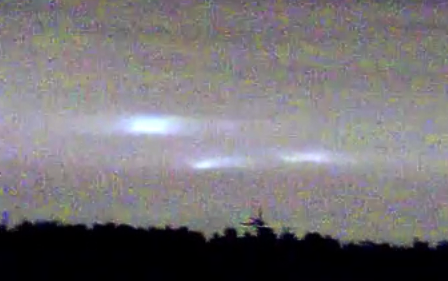
Glowing UFOs Over Durham, England On March 22, 2017, Video, UFO Sighting News.

Glowing UFOs Over Durham, England On March 22, 2017, Video, UFO Sighting News.

UFO%252C%2BUFOs%252C%2Bsighting%252C%2Bsightings%252C%2BEngland%252C%2BUK%252C%2Blights%252C%2Bsky.png

Date of sighting: March 22, 2017 (???)
Location of sighting: Durham, England

This is a fantastic video of UFOs over Durham yesterday. There person used an old night vision camera that had its date settings wrong, so the exact date is still unknown. I have seen lights like this here in Taiwan once. It was very similar in most ways, but there were more of them, and they were traveling from one horizon to the other, but when they saw us they looped over my family at midnight as we walked home. These are energy beings. They acted alive and highly aware of the people who were watch from the ground. 

Scott C. Waring

Eyewitness states:

Saw some strange lights in the sky to north from Durham England, they where around every night for a month last year. Recorded with infared hunting scope hence the poor quality of recording. They really were stunning. Il be honest the moment the camera shuffled at 55 sec mark, it got real close, and did spook me. Thought i would share so they can be identified.

{ http://www.ufosightingsdaily.com/ }

Hoe vind je dit bericht?
Geschreven door peter om 12:38 Stuur door

UFO In Blue Sky Takes Color Of White Clouds, March 2017, Video, UFO Sighting News.

UFO In Blue Sky Takes Color Of White Clouds, March 2017, Video, UFO Sighting News.

cloud%252C%2Borb%252C%2Borbs%252C%2BUFO%252C%2BUFOs%252C%2Bsighting%252C%2Bsightings%252C%2BEngland%252C%2BUK%252C%2Blights%252C%2Bsky.png

strange%252C%2Bodd%252C%2Bcool%252C%2BUFO%252C%2BUFOs%252C%2Bsighting%252C%2Bsightings%252C%2BEngland%252C%2BUK%252C%2Blights%252C%2Bsky.png

Date of sighting: March 22, 2017
Location of sighting: Unknown

This is a great capture of a cloud color UFO that moves away from the camera. The person didn't state their location, but we can see that the UFO has a shape that is very similar to those of the glowing diamond UFOs seen over England three weeks ago. 

Scott C. Waring

{  http://www.ufosightingsdaily.com/ }

Hoe vind je dit bericht?
Geschreven door peter om 12:34 Stuur door

A Genius Boy Says Humans Live Eternally – Martians Still Live In Underground Cities

A Genius Boy Says Humans Live Eternally – Martians Still Live In Underground Cities

indigo children

A boy who lives in the town of Zhirinovsk of Volgograd region in Russia made his parents worried about his fascinating talents. Named Boris Kipriyanovich or Boriska, the boy was born on January 11, 1996, and since the age of 4, he has been visiting Medvedetskaya Gryada, a well-known anomalous zone near the town. It appears that Boris needs to visit the mountain regularly to get his energy needs.

Boriska’s parents, who are known to be nice, educated, and hospitable people, don’t know how others will perceive Boriska when he grows up. The parents say they would be happy to talk to an expert regarding how to raise their wunderkind.

His doctor mother noticed that as a baby boy, he could hold his head in only 15 days after his birth. Four months later, he could utter the word “baba” and soon after, he could speak simple words. He had no difficulties reading newspaper headlines at one year and a half. And at two years old, he began drawing and learned painting six months later. He started his kindergarten at the age of two. Tutors noticed right then the genius boy’s language skills, different memory, and remarkable quick-wittedness.

The parents witnessed that Boriska not only got knowledge from the outer world, but also through strange channels. They saw the boy reading unknown details from somewhere.

The mother said that no one has ever thought his son, but he told them specific facts about Mars, planetary systems, and alien civilizations.

When the boy turned two years old, space started to become the permanent item of his stories. According to Boriska, he used to live on Mars and added that the planet is still inhabited until now, but in underground cities after the planet lost its atmosphere due to a mammoth catastrophe.

The boy also claimed that he used to fly from Mars to Earth to do research. He further claimed that he used to pilot a spaceship during the Lemurian civilization. He said that the Lemuria died because they stop to develop themselves spiritually and eventually broke their planet’s unity.

The boy told his parents after reading Ernest Muldashev book titled “Whom We Are Originated From” that Lemurians were nine meters tall and lived 70,000 years ago. He also recollected pyramids and shrines when reading Muldashev’s second book “In Search of the City of Gods.” The boy said that ancient knowledge is not under the Great Pyramid of Cheops, but under another pyramid, which has not yet been discovered. He stated that human life would change when the Spinx is opened, which has opening mechanism behind the ear, but he could not remember exactly.

Boriska, who is one of the so-called Indigo children, said that he has no fear of death as they live eternally.

He also revealed that Martians mostly breathe carbon dioxide. Though he came from Mars, he breathes oxygen when in a human body, but he stressed that it causes aging.

When asked by specialists about the reason human-made spacecraft often crash as they approach the Red Planet, he replied that Martians destroy stations containing harmful radiation through transmitting special signals.

Indigo children start to appear on Earth as a token of the coming major transformation of the planet.

{ http://www.latest-ufo-sightings.net/ }

Hoe vind je dit bericht?
Geschreven door peter om 12:29 Stuur door

Sleeping Their Way to Mars

Sleeping Their Way to Mars

For astronauts on long space voyages, the safest way to travel may be in induced hibernation.

SpaceWorks SpaceWorks, a NASA contractor, has proposed Mars transports and studies of “induced torpor” for their passengers.  (SpaceWorks)
Some day, astronauts packed into rocketing tin cans bound for other planets may be protected from radiation and space sickness by having their metabolisms depressed to a fraction of their typical rate. They’ll hibernate like bears as they hurtle through space for months at a time. Perhaps they’ll sleep in white coffin-like pods, as the cryo-preserved astronauts in futuristic fantasies like 2001: A Space Odyssey, Alien, and Avatar did.

More likely, though, astronauts and space colonists will learn a few tricks from dehydrated snails, which survive for a year or more ingesting nothing; giant pandas subsisting on low-calorie bamboo; leeches that survive a liquid nitrogen bath; children who have been submerged in frozen ponds yet can still be resuscitated; or skiers buried in an avalanche and brought back to life ever so slowly, reborn from a super-cooled, dreamless state.

Scientists call this phenomenon “torpor-induced hibernation.” Once considered outlandish, torpor induction—the old term was “suspended animation”—is under serious study for long-duration spaceflight.

This interest is due in part to advances in low-temperature surgery, but also to an increased understanding of cases like one documented in 1995 in the journal Prehospital and Disaster Medicine. A four-year-old boy fell through the ice of a frozen lake in Hanover, Germany. A rescue team pulled him out but could not resuscitate him in the field. His pupils were fixed and dilated, and he remained in cardiac arrest a full 88 minutes. Upon admission to the hospital, his core body temperature was 67.6 degrees Fahrenheit, a sign of severe hypothermia.

Twenty minutes later, as doctors worked to warm the boy’s chest cavity, the ventricles of his heart started contracting. Ten minutes after that, his heart resumed normal sinus rhythm. The boy made a full recovery and was discharged two weeks later. His doctors believed the icy lake had rapidly cooled his body to a state of protective metabolic torpor, preserving all vital organs and tissues while reducing the need for blood oxygen—in effect, saving the boy’s life. Cases like this are “exactly why we think that very deep hypothermia can allow our patients to survive,” writes Samuel Tisherman, director of the Center for Critical Care and Trauma Education at the University of Maryland Medical Center, in an email. “The key is cooling the brain either before blood flow stops or as soon as possible after blood flow stops. The colder [it gets], the longer the brain can tolerate not having blood flow.”

Therapeutic hypothermia has become a part of surgical practice. Experimental procedures with cooling started as early as the 1960s, mostly in cardiac and neonatal cases. Babies were placed in cooling blankets or packed in ice and even snow banks to slow circulation and reduce oxygen requirements before heart surgery.

Today, physicians use moderate hypothermia (roughly 89 degrees) as a staple of care for some newborns in medical distress, such as those born premature or suffering from fetal oxygen deprivation (hypoxia). The babies are treated with cooling caps for 72 hours, which lower their metabolism just enough to reduce tissue oxygen requirements and allow the brain and other vital organs to recover.

By the same token, surgeons apply cooling and metabolic suppression to patients who’ve suffered various physical traumas: heart attack, stroke, gunshot wounds, profuse bleeding, or head injuries resulting in brain swelling. In emergency situations, anesthetists can insert a cannula—a slim tube—into the nose that feeds cooling nitrogen gas directly to the base of the brain. In one experimental therapy, surgeons insert a cardiopulmonary bypass cannula through the chest and into the aorta, or through the groin and into the femoral artery. Through these tubes, they infuse cold saline to reduce core body temperature and replace lost blood. Once the trauma surgeon has control of bleeding, a heart-lung machine restarts blood flow and the patient is given a blood transfusion.

“If you get cold fast enough before the heart stops, the vital organs, particularly the brain, can tolerate cold without blood flow for a time,” Tisherman explains. He is performing a clinical trial of this cold saline replacement technique in critically injured trauma victims in Baltimore, and he expects the study will last at least until the fall of 2018 and possibly later. The ensuing hypothermia rapidly decreases or stops blood flow for an hour or so, cutting oxygen requirements and giving surgeons time to repair critical wounds and then, ideally, warm the patient back to life.

The Torpor Enigma

Today, some in the aerospace community are looking to medically induced hypothermia and the resulting metabolic stasis as a way to save space and mass, along with freight, fuel, food, and frustration on the months-long flights to Mars or more distant planets. The studies are just beginning. One challenge is medical: What’s the best method for putting healthy astronauts into torpor? Even though therapeutic hypothermia is well understood in operating rooms, keeping people in deep space chilled and sedated for weeks, months, or years on end is an entirely unknown area of inquiry. Some scientists studying hibernation in animals suggest that other means of suppressing metabolism would be better: Specialized diet, low-frequency radiation, even the use of proteins that trigger hibernation in animals like bears and Arctic ground squirrels, which can regulate their metabolic rates safely and, in most cases, reversibly.

Astronaut Scott Kelly Astronaut Scott Kelly inside the Soyuz simulator at Gagarin Cosmonaut Training Center in Moscow in March 2015. Kelly spent a year aboard the International Space Station being observed for the long-term effects of spaceflight on the human body, in anticipation of long spaceflights.  (NASA/Bill Ingalls)

Another obvious hurdle is funding. How much will NASA prioritize research into metabolic stasis, both animal and human, when exploratory budgets are being reduced? Pete Worden, former director at NASA’s Ames Research Center in California and now the executive director of Breakthrough Starshot, says that with NASA’s emphasis on synthetic biology and the ability of organisms to survive and function in exotic environments like Mars, “it’s probably inevitable that the hibernation area is going to get funded.”

That optimism is hardly universal. “People are frustrated,” says Yuri Griko, a Moscow-trained NASA radiobiologist and lead senior scientist in Ames’ space biosciences division. “When Sputnik was put up in space in 1957, our generation was so excited, so inspired, and we believed that we’d be on Mars in the millennium. But…we’re still not on Mars. It’s personal for people like me because we expected to be much more progressed than we are right now.”

Griko acknowledges that metabolic suppression research is in limbo itself. He began at NASA in 2005 after spending five years at the biotech outfit Clearant, Inc., using ionizing radiation to inactivate pathogens in therapeutic blood products, transplant organs, and commercial biopharmaceuticals. NASA then invited Griko to research ways to protect astronauts from space radiation. It turns out that metabolic suppression is one of the most effective mechanisms nature provides.

When animals go into hibernation their bodies survive radiation without significant damage to their cells. Griko believes metabolic suppression mitigates radiation-induced damage by reducing biochemical processes and excessive oxidative stress. Hypoxia—lower oxygen consumption—is one possible explanation for the radio-protective effect: In hypoxia, production of oxygen free radicals and hydroxyl radicals is reduced. Because ionizing radiation releases free radicals causing cell damage, suppressing metabolism and oxygen consumption appears to do the reverse: it reduces normal cell death and prolongs healthy cell life.This protective effect is even more pronounced at lower temperatures.

Griko speculates that hibernation may also protect animals from the muscle atrophy and bone loss people typically experience in microgravity. Humans who eat a balanced diet while confined to bed rest for 90 days lose a little more than half of their muscle strength, Griko says. But bears that consume nothing and are confined to their dens for the same length of time or slightly longer lose only 25 percent of muscle strength and exhibit no signs of bone loss. He notes that animals capable of hibernation—tortoises and pocket mice—haven’t been flown in space in decades.

NASA did not fund his request for flight experiments involving hibernating animals. His current research is limited to surveys of existing hibernation studies, along with his own laboratory work on stasis in mice, leeches, and snails. Griko proposed a 2015 international conference on torpor that would have brought together the world’s hibernation experts to discuss deep-space applications. NASA declined to fund it, though Griko still hopes to raise the money.

“There are significant barriers to torpor research if we’re serious about going farther in space,” says Leroy Chiao, a former NASA astronaut and International Space Station commander who spent 193 days in orbit between October 2004 and April 2005. Animal research is a particularly sticky problem, one that has landed NASA in the crosshairs of animal-rights groups before. “Even research on simple primates starts getting people up in arms,” he says.

The Two-Planet Solution

Jason Derleth, a program executive with NASA Innovative Advanced Concepts in Washington, D.C., sees reason to hope. Under Derleth’s watch, NIAC has awarded two innovation grants since 2013, supporting one company’s detailed plans for torpor-enabled Mars transfer habitats. The project leader, SpaceWorks Enterprises, Inc., of Dunwoody, Georgia, about 20 miles north of Atlanta, is an aerospace design contractor for NASA and the Department of Defense and has done work in the development of tiny CubeSat satellite constellations. But it’s torpor that’s captured the imagination of SpaceWorks president and chief operating officer John Bradford.

“I’ve asked myself for 15 years how to engineer materials, structures, and propulsion systems to enable a mission to Mars and its moons,” he says. Bradford is a Ph.D. aerospace engineer who has led several NASA, Defense Advanced Research Projects Agency, and Air Force Research Laboratory projects designing military spaceplanes.  He was also a consultant on the 2016 science fiction film Passengers, wherein Jennifer Lawrence and Chris Pratt played interplanetary settlers who wake from hibernation early. “We’re not in the vein of an Apollo mission anymore—no more ‘flags and footprints,’ ” he says. “We need to become a two-planet species.”

Arctic ground squirrel Though the Arctic ground squirrel hibernates for two-thirds of the year, it experiences only minor bone and muscle loss. University of Alaska neuroscientist Kelly Drew is studying the animal, hoping to extend her findings to humans. (© 2005 Lesa Hollen and Leone Thierman)

Bradford’s engineering and medical team used the first of those NIAC grants, issued in 2013, to design a compact zero-gravity, rigid-structure habitat based on the International Space Station crew module designs. The habitat featured closed-loop oxygen and water production systems, direct access to the Mars ascent and descent vehicles, and support for a crew of six, all of whom would be kept in torpor for the entire six- to nine-month Mars journey.

The proposed medical treatment relies on using techniques similar to the ones surgeons perfected to induce hypothermia. For example, cooling nitrogen gas could be fed to astronauts via nasal cannula, lowering brain and body temperatures to between 89 and 96 degrees—close enough to normal to maintain torpor without overcooling the heart or increasing the risk of other complications. Cooling tends to decrease the body’s ability to clot, Tisherman says. He has also noted that patients who are cooled to mild levels of hypothermia—93 degrees—for 48 hours or more have more infections than uncooled people.

In the SpaceWorks habitat, robotic arms in the module would be programmed to carry out routine chores, manipulate astronaut limbs, and check body sensors, urine evacuation lines, and chemical feeds. Robots would administer electrical stimuli to astronauts’ muscles to maintain tone, along with sedation to prevent a natural shivering response. The astronauts would also receive total parenteral nutrition, in which all nutrients—electrolytes, dextrose, lipids, vitamins, etc.—are administered via liquid through a catheter inserted in the chest or the thigh. SpaceWorks outfitted TPN supplies in the experimental module to last 180 days; should the habitat be required for a prolonged Martian stay, the module would have another 500 days’ worth of nutrition.

In all, the SpaceWorks Mars Transfer Habitat reduced total habitat mass, including consumables, to 19.9 tons (low-Earth-orbit weight). By comparison, NASA’s TransHab habitat, with consumables specified in the agency’s Mars Design Reference Architecture 5.0, weighs 41.9 tons. That’s a 52 percent decrease in mass. Compared with the NASA model, SpaceWorks was able to shrink total habitat consumables by 70 percent.

NIAC officials were intrigued. “SpaceWorks made an interesting proposal,” Derleth says. “People have been studying torpor for medical applications. But no one as far as we could find is actually doing an engineering study of what cryo-sleep or torpor would actually do to the architecture of a mission.”

In 2013 NIAC awarded SpaceWorks a Phase 1 grant of $100,000 to develop a rough torpor-enabled architecture for exploration-class missions—those with four to eight crew members heading to Mars or its moons. But the agency balked at the idea of putting all crew members in torpor for the entire journey. What about medical or spacecraft complications? How long could astronauts stay under without psychological or physical damage? What if some complication required their premature awakening? What about the slow waking and warming times to get the astronauts out of hibernation?

These questions sent the SpaceWorks team back to work. They designed a crew habitat for torpor that would keep at least a few astronauts awake on a rotating basis for piloting and interventions (as in the 1968 movie 2001, in which two crew members of the Jupiter-bound spacecraft Discovery remain awake while the others sleep).

Then Bradford’s team moved further. Designing three interconnected habitat modules for a 100-passenger “settlement class” Mars mission—colonists, in other words—the team produced a spacecraft and habitat that departed completely from anything in NASA’s plans. The SpaceWorks settlement-class craft includes two compact, rotating habitat modules, each accommodating 48 passengers in torpor. Rotation at varying speeds would produce artificial gravity to mitigate astronauts’ bone loss.

But in the bolder “sentry mode” proposal, a separate habitat module would accommodate four care-taking astronauts on duty throughout the mission. One or more could be rotated with others in torpor to keep crews fresh.

“You get 80 percent of the benefits by cycling through the hibernating crew and waking some up, rather than turning out the lights on everybody for six months,” Bradford says. Spacecraft accommodating settlers in torpor would be lighter, which would enable much greater velocities, shorter voyages, and, possibly, more efficient radiation shielding because of the radio-protective effect of metabolic stasis. Further, Bradford says, hibernating astronauts wouldn’t experience motion sickness, a common problem on the International Space Station.

SpaceWorks has designed concepts for a “settlement-class Mars Transfer Habitat” that include two chambers, each carrying 48 colonists in torpor. Their pods would revolve around a central axis to generate artificial gravity, minimizing bone and muscle deterioration.  (Artwork by Mark Elwood and Nathan Kreuzman, Copyright 2016, SpaceWorks Enterprises, Inc.)

Sleep Like a Bear

But what would torpor in space feel like? Not like being frozen dead in cryogenics, then being revived, according to Doug Talk, an obstetrician and SpaceWorks consultant who has used therapeutic hypothermia to treat oxygen-deprived babies. “[Cryogenics] has had zero success with that,” Talk says. “The human body isn’t meant to be frozen; it’s mostly water, and when water expands [as it does when it freezes], it produces cellular damage.”

More likely, astronaut torpor will be like coma, a state hovering between dreamless sleep and semi-conscious awareness. “Coma patients display cycles of brain activity that alternate between seeming wakefulness and non-REM sleep,” Talk explains. Even though coma patients are unable to move, their brains remain active and even responsive to outside stimuli, including verbal commands.

Bears experience hibernation in similar ways; their core temperature drops only a few degrees (similar to the mild-hypothermia temperature range in humans), while their metabolism drops 75 percent. Bears in northern climates can remain in torpor for seven to eight months without eating or drinking, and pregnant female bears will give birth to their young and nurse them even while in hibernation.

“Someone in torpor will act like the bear does,” Talk theorizes. “They’ll cycle through non-REM sleep and being awake. And like bears when they finally wake up, they’ll be sleep deprived.”

In May 2016, NIAC approved a second phase of the SpaceWorks project, this time releasing $250,000 to extend first-phase engineering, operational, and medical research plans. “Phase 1 projects have proven that what they’re talking about is real,” Derleth says. “We’re very happy to see Dr. Bradford’s progress.”

In addition to habitat engineering refinements, the SpaceWorks team initially proposed a two- to three-week hibernation test with a small number of healthy pigs. Pigs, like humans, are natural non-hibernators; therefore their physiological responses to torpor induction will offer better clues to what humans may expect than studies of mice or snails, obviously. Derleth says agency regulations prevented NASA from funding the pig study.

So SpaceWorks submitted an alternate proposal: to research existing metabolic suppression experiments comprehensively in order to establish a near-term road map for technology development, including more-methodical animal research leading to human trials. This summer, NIAC will conduct a mid-term review of SpaceWorks’ progress and determine whether to award them an additional $250,000.

“We continue to believe that live-subject research will be necessary to advance this torpor technology toward longer durations,” SpaceWorks founder and CEO John Olds wrote in a follow-up email. “That step may require private sponsors.”

Regardless of who pays for it, testing with animals can be difficult to do because it continues to raise ethical questions.

“I think NASA is right: Slow is the way to go,” says Arthur Caplan, director of the division of medical ethics at New York University Langone Medical Center. While there’s enthusiasm for suspended animation for long durations in space, NASA doesn’t need any more troubles from animal rights activists, in his opinion.

“Pigs are somewhat physiologically similar to humans, so pigs are a reasonable animal model for testing,” says Caplan. “Though it’s fair to say to critics: The number of pigs involved in this kind of study wouldn’t amount to one’s week’s breakfast for the average American.”

The Human Factor

Sci-fi movies and novels have romanticized torpor, Caplan says, suggesting humans could move in and out of that coma-like state without difficulty. That might not be the case.

The humans in which torpor will first be tested will be unusual people—most likely test pilots, Caplan predicts. “These people take risks every day; they understand the physiological risks because they test jets and know many colleagues who have died. I’ve had astronauts tell me they’ll enroll in any experiment just to get into space. Our job is to rein them in.”

Science fiction Science fiction has long portrayed hibernation as a means of enduring travel across astronomical distances. In the 1986 movie Aliens, a squad of Marines sleep through the entire three-week flight to planet LV-426. (TWENTIETH CENTURY FOX FILM CORP.)

Human trials would be an unprecedented step. No one has ever tried to use hypothermia to suppress the metabolism of a person who wasn’t severely sick or injured, much less super-healthy astronauts.

“We’ve had lots of healthy people who have volunteered for long-term torpor experiments,” Talk says. “There’s a pent-up demand for people who want to punch out of life for six months. I’m sure the FDA wouldn’t approve of that.”

Meanwhile, Talk has invited two experts on therapeutic hypothermia—Alejandro Rabinstein, the medical director of the neuroscience intensive care unit at the Mayo Clinic, and Kelly Drew, a University of Alaska Fairbanks neuroscientist investigating animal hibernation—to join SpaceWorks’ research team. Drew and other scientists at the University of Alaska’s Institute of Arctic Biology are studying the hibernation patterns of endothermic animals like hedgehogs, Arctic ground squirrels, and bears. Their hope is to find the key to a healthy hibernation state—and the signaling cascade in the brain that induces it—that could be adapted to human astronauts without side effects.

The Arctic ground squirrel, for example, cools itself to 32 degrees Fahrenheit in winter. No scientist understands exactly what triggers its hibernation, although a particular brain and muscle receptor—the A1 adenosine receptor—appears to make the squirrel grow cold and sleepy, only to emerge with minimal bone and muscle loss eight months later.

“Adenosine is a neuromodulator that plays a role in sleep and in reducing brain excitability,” Drew says. “It’s ubiquitous in animal brains.” She has induced hibernation in Arctic ground squirrels by using a drug to stimulate their A1 adenosine receptors. Drew can also wake squirrels up from hibernation by using another drug to block the same receptor.

But the signaling cascade and genetic makeup of humans are far more complex and difficult to decipher.  Adding to the complexity of the task is the fact that not all hibernators hibernate the same way.

The only primate known to do it, Madagascar’s fat-tailed dwarf lemur, spends seven months a year in torpor, mostly in hot weather; it survives by consuming fat stored in its tail. Low metabolic rates in animals do not require low body temperatures.

Meanwhile, Rabinstein, who plans to help SpaceWorks evaluate mild hypothermia to induce torpor, says the techniques that work in an ICU might not be so reliable in space.

 “The fact that little children have ‘drowned’ and survived in ice ponds and lakes is remarkable and has given us hope,” he says. “But can we transform this [understanding of deep hypothermia] into a more mild degree of hypothermia and allow people to tolerate it for a longer period of time and get away with it, without psychological or physiological stress? We have to see, but we think there is a chance.”

Preview thumbnail for video 'Subscribe to Air & Space Magazine Now

Subscribe to Air & Space Magazine Now

This story is a selection from the April/May issue of Air & Space magazine

TAGS

{ http://www.airspacemag.com/}

Hoe vind je dit bericht?
Geschreven door peter om 01:35 Stuur door

10 weird little aliens you can find right here on Earth

10 weird little aliens you can find right here on Earth

The strangest creatures already live among us

Sure, we'd all love to traipse over to Europa and go hunting for alien lifeforms. But in the meantime, we can enjoy the weirdos that already live right here on Earth. Here are 10 of our favorite Earth-dwelling aliens—organisms so strange they seem otherworldly.

immortal jellyfish

Wikimedia Commons

The ocean is full of immortal beings

Well, biologically immortal at least. Turritopsis dohrnii starts out as a little larvae but eventually settles down and forms a colony of identical polyps. Eventually, the polyps break up and form a horde of independent, sexually mature jellyfish that like to snack on other medusae. When those jellyfish get old or sick, they're able to revert back into child-like polyps and breed entirely new colonies. This growth and regression can theoretically continue forever, making the species essentially immortal. Tell me that isn’t extraterrestrial.

You're already doing their work, dummy

Wikimedia Commons

You're already doing their work, dummy

“Once upon a midnight dreary, while I pondered, weak and weary," the genus Corvus totally took advantage of me. Ok, so that’s not exactly how Edgar Allan Poe’s "The Raven" actually goes, but it could be, because crows, ravens, rooks, and jackdaws are totally playing you. Considered some of the smartest animals of Earth— on par with many non-human primates—these black birds make tools like wire hooks and even set nuts in front of our tires so they can later retrieve the meat when our cars crack them. Admire all you want, but they never promised they came in peace.

You wish you were

Wikimedia Commons

You wish you were "blind" like this bat

Even the coolest vampire myths have got nothing on real bats. Let’s just list out the basic facts: they’re the only mammal capable of flight; a brown bat can eat 1,000 mosquitoes in a single hour, and they don’t even need to be thanked for it; they can live in communities up to a million in number; the largest bats have wingspans of 6 feet, which is taller than the average American man; and, with lifespans up to 30 years, they live way longer than most mammals their size. And that doesn’t even cover their coolest feature—echolocation. By sending out sonar into the darkness they can effectively “see” through the night, because solid objects in their path send back echoes. Small echoes might be a bug, ready to eat, while larger echoes might indicate a tree these guys need to avoid. I’m just saying, that would be a great tool on another planet, maybe one that never sees sunlight

Avoid eye contact and back away slowly

Wikimedia Commons

Avoid eye contact and back away slowly

These deep sea creepers get a bad rap—and I’m not here to absolve them. Anglerfish live in near total darkness, they have big heads and truly incredible underbites, and the females glow thanks to bioluminescent bacteria on the end of a tiny probe growing out of their foreheads. But the anglerfish’s strangest feature is its parasitic mating strategy. The male sinks his teeth into the female and in return, she slowly absorbs him. His eyes disappear into her abdominal wall, and then the rest of him follows, until all that is left are his testes, which the female wears like a statement necklace. Oh, and she wears as many as six of these testicular trophies at a time. Stay safe, my friends.

You... BEE!

Wikimedia Commons

What's the buzz

Bee’s knees are actually cooler than we originally thought, as new research suggests they really can bend it like Beckham. Scientists trained bees to play soccer, and the bees who showed the most prowess were those that watched other bees play before trying it themselves, implying a capacity for social learning. And that’s not all, folks. They recognize human faces. They also somehow know how to determine the shortest flight path between flowers. And each bee is specially suited to its role in the hive community, while still sporting an individual identity. Of all the animals on this list, bees would likely make the most benevolent overlords. But there's still the matter of those stingers...

a tardigrade

Wikimedia Commons

The strangest thing

These deceptively cute “water bears” are actually super strong. Enamored of their resilience, scientists have been pushing them to their limit for centuries—and though they are not limitless, they’re still pretty impressive. Tardigrades can survive a few minutes at over 300 degrees Fahrenheit and a few days at negative 300 degrees. They can survive the vacuum of open space for a week and a half as well as the pressure cooker of the Mariana Trench. Once, a tardigrade even bounced back to life after 30 years spent frozen. It promptly gave birth and lived to see many generations of its family prosper.

Platypus

Wikimedia Commons

Platypus phone home

What even is a platypus? It’s like a collage made by a child asked to design an alien using Earthly animal body parts. Take a beaver’s tail, duck’s bill and feet, and an otter’s fur, mix it all together and you get a platypus. Oh, and give the males a poisonous spur in their little webbed foot. And then make the females lay eggs, but also nurse her young after they hatch. They’re definitely a great candidate for the most alien-y animals on Earth, but based solely on their scattered physiology, it seems doubtful they'll get organized enough to stage a coup. See also: the pangolin.

army ants

Wikimedia Commons

Do not take me to your leader

Army ants get stuff done. The colony is divided between blind—but terribly efficient—workers; big-jawed workers that move goods and protect the nest; a breeding class of males; and the queen around which they all revolve. These clear “careers” allow the unit to build a nest out of only their bodies, work together to kill and consume hundreds of thousands of individual prey (other ants, wasps, larvae) each day, and protect millions of the queen’s eggs. Imagine what humans could do with this kind of hive mind—for better or worse (but probably worse).

mantis shrimp

Wikimedia Commons

I ain't afraid of no shrimp

When humans look at a mantis shrimp, they see the tiny creature's beautiful rainbow shell. What a mantis shrimp sees when it looks in the mirror is hard to determine, because where we have only three receiving cones in our eyes, the mantis shrimp has sixteen. They're seeing colors we can't even imagine. But for all their beauty, they're total monsters, and boy, are they good at being bad. The shrimp can move so fast the water around their prey actually boils—so hot, when the bubbles collapse, they emit a blast of light—making it easy to pick apart the prey and feast. Hopefully, they won't turn on us before we've learned to use their own skills against them, as researchers are currently working to translate their understanding of the mantis shrimp into the development of military technology.

The original desalination plant

Wikimedia Commons

The original desalination plant

Penguins are cute, sure, but they're not typically lauded as innovators. But these flightless birds have a special supraorbital gland on their foreheads that gives them a power humans have been lusting over for decades: they can remove sodium chloride from the seawater they ingest. Penguins, it turns out, need freshwater, but they're not likely to get it, as they tend to live in salty waters. So they've developed a super-kidney that takes the salt out of a penguin's bloodstream and secretes it back into the ocean through its bill. It doesn't turn saltwater into freshwater directly, as some urban legends have suggested, but it's an impressive tool nonetheless.

Hoe vind je dit bericht?
Geschreven door peter om 01:09 Stuur door

Three new chances for life out there

Three new chances for life out there

A new discovery could change how we see ourselves in the universe

Seven new exoplanets were discovered several weeks ago by a Belgian team of astronomers in the Atacama desert in Chile. These discoveries were made with the help of NASA telescopes but were not first discovered by NASA.

The Transiting Planets and Planetesimals Small Telescope (TRAPPIST) was used to discover the incredibly cool dwarf star named Trappist-1. This star is right in our backyard, being only 40 light years away.

Illustration of the surface of a planet inside the TRAPPIST-1 system

An illustration shows the possible scene on the surface of the planet called TRAPPIST-1f.

ILLUSTRATION BY NASA/JPL-CALTECH

According to Jerome Fang, an astronomy instructor at Orange Coast College, the discovery was made when the planets orbiting Trappist-1 passed in front of it.

“So these are seven planets found around the star, Trappist-1. They were detected by watching the star they go around. They can actually see the planets go in front of the star, and that makes the star slightly dimmer,” Fang said.

All the planets orbiting this star are similar to Earth in size and mass, experts say. Only three of them are the right distance from Trappist-1 which makes them likely to have water, spelling the potential for life in the Trappist-1 system.

“These planets are all similar to the Earth in terms of how big they are, how much mass they have. And three of them are, yes, they’re the right distance from the star that they could have liquid water on the surface, which makes them maybe habitable,” Fang said.

The reason this discovery is so important is because this is the largest number of temperate, Earth-sized planets that have been discovered to date. The Trappist-1 system, while it has many differences, is very similar to our solar system.

“I guess the unusual thing with that is that there are seven Earth-like planets. Most of them will tend to be a little larger, and not that they haven’t found a few that are sort of similar to the Earth in size, mass, maybe. But seven in one system is pretty unusual I’d say,” Nicholas Contopoulos, an astronomy instructor at OCC said.

One big difference is that all seven planets orbit very close to their star, all closer than Mercury orbits the sun. The reason three of them are still theorized to have water and be hospitable for life is because the planets all orbit an incredibly cool dwarf star.

Illustration of the TRAPPIST-1 star and its seven planets

The TRAPPIST-1 planets are snuggled close enough to their dim, red star to potentially have liquid water on their surfaces.

ILLUSTRATION BY NASA/JPL-CALTECH

Today, astronomers aren’t sure if these planets have water. They aren’t sure if the radiation from Trappist-1 has stripped the planets of their atmospheres, or if this star is still relatively young and hasn’t stripped much of the planets’ atmospheres.

“We don’t actually know definitively what’s on the surface because we can’t tell. We hope that the composition of these planets is similar to the Earth’s. We think they’re rocky. That’s about all we can say. Beyond that we can’t say if there’s an atmosphere, I don’t think we know that. We can’t say that they have moons because moons are impossible to find. Just bare-boned, we kind of know they’re like the Earth,” Fang said.

Despite all these advances and discoveries in the field of astronomy, financial support toward the sciences is being cut from the federal budget.

“They’re certainly withdrawing funds from science related content, like EPA is going to be defunded. Basically the military is going up $54 billion so they’re going to find the money somewhere. So I think they’re just taking it from things that they don’t feel are necessary,” Contopoulos said.

Some instructors believe that NASA is too important to continue to cut from the federal budget.

“Studying astronomy with NASA and all that is giving us a sense of perspective, like how do we fit into this crazy thing we call the universe. It puts into perspective maybe the issues we deal with. I talk to students and they tell me, ‘hey, our problems don’t seem so big when we study things that are out there.’ A lot of the greatest successes in NASA is because we put in the money. So if we’re taking away money that just makes the chances of doing something great and amazing even less likely,” Fang said.

Recently private industry is filling in the gaps where NASA isn’t able to from a lack of funding. SpaceX announced recently that it will send two private citizens on a trip around the moon before the end of next year. Its CEO, Elon Musk, has even discussed plans to colonize Mars in the future.

“I guess what’s different this time is you’re looking at private industry doing a lot, not that it didn’t do that before, but it’s not just NASA anymore. It’s sort of more private industry, where before NASA was sort of the head,” Contopoulos said.

Although the astrophysics as an industry isn’t as popular as it used to be, some students claim that the industry is expected to pick up in the near future.

“If anything, the space engineering industry is growing and it’s about to experience a really big boom probably within the next 10 years,” Garrett Prechel, a 30-year-old physics major said.

OCC’s Astronomy Club is filled with students of all majors ranging from physics and astronomy to even art and childhood education. The students, however, have the same positive sentiment toward astrophysics.

“It is concerning to have a government that doesn’t support it but at the same time you can’t rely on them for everything. Things will change eventually. The work has a lot more meaning than some people telling you that it’s not worth funding,” Junell Brown, an 18-year-old astrophysics major said

One faculty adviser to the club stresses the importance of advancing in the realm of science and  continuing to learn about the world in a scientific manner.

“Anytime a country or a civilization diminishes the curious component, you endanger the strength of that civilization because that’s kind of what drives this curiosity. You’re trying to find your place in the cosmos. By understanding that and the fundamentals, we can better understand our purpose. We don’t have all the answers, and we definitely need science to push a civilization forward. If you diminish that you’re kind of cutting yourself at the legs, and just going, ‘well, things will just work out.’ Well they don’t, and I think that’s a dangerous path,” Contopoulos said.

{ http://www.coastreportonline.com/ }

Hoe vind je dit bericht?
Geschreven door peter om 00:49 Stuur door

7 Alien 'Earths' May Be Swapping Life via Meteorites

7 Alien 'Earths' May Be Swapping Life via Meteorites

Tiny life-forms can move easily between these recently described planets, according to a study of the travel times between worlds.

Illustration of the surface of a planet inside the TRAPPIST-1 system

An illustration shows the possible scene on the surface of the planet called TRAPPIST-1f.

ILLUSTRATION BY NASA/JPL-CALTECH

The discovery of alien life would be revolutionary. But what if we uncovered it on two—or even seven—planets all orbiting the same star?

That’s the tantalizing possibility offered by the cosmic grouping called TRAPPIST-1, where seven Earth-size worlds circle a star roughly 39 light-years away. According to a new study, those planets are packed so tightly around their stellar host that the seeds of life could be hopping between them with ease.

The study, conducted by Manasvi Lingam and Abraham Loeb of the Harvard-Smithsonian Center for Astrophysics, is based on a theory known as panspermia, which in turn is based on the fact that planetary debris can be swapped between the worlds in our solar system. This is especially true for neighboring rocky planets—for instance, asteroid strikes have sent fragments of Mars crash-landing onto Earth.

Panspermia takes this a step further and suggests that life could catch a ride on that debris, hitchhiking from one planet to the next. It might sound wild, but recent research shows that some extreme forms of life can survive conditions akin to an interplanetary journey. Some scientists even argue that the seeds of life on Earth could have come from Mars.

In the TRAPPIST-1 system, all seven planets are nestled within a region that’s more than 20 times smaller than the distance between Mars and Earth. Such close proximity raises the tantalizing possibility that panspermia could take place in this system with ease.

Illustration of the TRAPPIST-1 star and its seven planets

The TRAPPIST-1 planets are snuggled close enough to their dim, red star to potentially have liquid water on their surfaces.

ILLUSTRATION BY NASA/JPL-CALTECH

PLAYING HOPSCOTCH

Now, Lingam and Loeb have calculated that exact probability. Comparing the TRAPPIST-1 planets to Earth and Mars, they found that the travel time between one planet and the next is shorter by a factor of a hundred. This boosts the chance that life can survive such a harrowing journey. They also found that the likelihood of one planet’s debris landing on another is larger by a factor of 20 or so.

Altogether, the possibility that life can play hopscotch from one planet to the next is a few thousand times higher among the TRAPPIST-1 worlds than the possibility that it did the same from Mars to Earth.

“In a single planetary system, like TRAPPIST-1, the interchange of bacterial life is almost inevitable,” says the University of Buckingham’s Chandra Wickramasinghe.

Even better for the imagined aliens, all of the TRAPPIST-1 planets can potentially host life, given the right conditions.

Three of the worlds orbit in the star’s habitable zone, the region where they receive the perfect amount of heat for liquid water to flow on their surfaces. The rest of the worlds are temperate, meaning they might be equally warm if they have the right internal temperatures and atmospheric blankets.

“We might find forms of life that survive under conditions that we haven't anticipated,” says Loeb. “That's why it's exciting. We shouldn't have any prejudice, but should look at all seven planets in TRAPPIST-1.”

BLOWIN’ IN THE WIND

Of course, right now there’s no direct evidence that panspermia happens in our solar system or beyond. And some astronomers are doubtful that hitchhikers could survive such a traumatic journey.

First, the building blocks of life would have to endure extreme heat and pressure from the impact that spewed them into space. Out in the open void, they would be subjected to harsh ultraviolet radiation from their host star for potentially millions of years. Finally, they would once again face blazing temperatures as they fell from the sky and crash-landed in yet another violent impact.

“The poor organism would be fried twice and would be radiated by ultraviolet photons,” says Brice-Olivier Demory of the University of Bern, a co-author on the study that announced the TRAPPIST-1 discovery last month.

Amaury Triaud, a University of Cambridge astronomer who also co-discovered the TRAPPIST-1 planets, is on the fence: “I'm a skeptic about this,” he says. “But I also have to remind myself that life has managed to survive in extreme conditions.”

Bacteria have persevered inside nuclear reactors and on the outer rim of the International Space Station. Tardigrades—tiny water-dwelling invertebrates that look like chubby bears—have endured the vacuum of space for up to 10 days. And organisms frozen in Antarctic ice for centuries have been revived in labs. (Also see “Weird Life Found Trapped in Giant Underground Crystals.”)

Illustration of the TRAPPIST-1 planetary system
VIEW IMAGE

An illustration shows what the TRAPPIST-1 planets might look like from Earth if we had a powerful enough telescope.

ILLUSTRATION BY NASA/JPL-CALTECH/R. HURT (IPAC)

Wickramasinghe also points out that not every cell flung between worlds needs to survive: “It's like throwing seeds in the wind,” he says. “Most are destined to be destroyed. But a very few could take fruit—and that's all that's needed.”

Already, the discovery team is planning to turn the Hubble Space Telescope toward the seven siblings, along with the next-generation James Webb Space Telescope, due to launch in 2018. If the TRAPPIST-1 planets have atmospheres, these powerful instruments will be able to discern some of the molecules in the air and potentially find the fingerprints of life.

Should astronomers find signs of life on one planet, that will motivate them to scour its neighbors for similar signatures—even if the search comes up empty-handed at first. And if they find a match, it will suggest that the planets are indeed swapping life.

“That’s a golden opportunity to study panspermia,” Loeb says.

And if they find the right evidence, that would imply life doesn’t necessarily have to start over again on each new planet. Instead, it might spread like wildfire throughout a planetary system—and maybe even the cosmos.

Follow Shannon Hall on Twitter.

{ http://nationalgeographic.com/ }

Hoe vind je dit bericht?
Geschreven door peter om 00:39 Stuur door

Reynolds, Gyllenhaal take on aliens in Life

Reynolds, Gyllenhaal take on aliens in Life

A-listers Ryan Reynolds (far left) and Jake Gyllenhaal lead the cast of sci-fi blockbuster Life. PHOTO: AGENCE FRANCE-PRESSE

LOS ANGELES •Eight decades after Flash Gordon hinted that aliens might not have humans' best interests at heart, mankind still risks destruction in the movies to make contact with extraterrestrial life.

From Frederick Stephani's 1936 big-screen serial through the US$1.2-billion Alien franchise to last year's Independence Day: Resurgence, the heroes of more than 500 space invasion films have been lining up to die in new and inventive ways.

This year's first sci-fi blockbuster is Life, a claustrophobic game of cat-and-mouse between the crew of the International Space Station and a rapidly evolving life form that caused extinction on Mars and now threatens all life on earth.

Set in the near future, Daniel Espinosa's breakneck-speed thriller hits theatres on Friday with an international cast led by A-listers Jake Gyllenhaal and Ryan Reynolds.

"The script, pacing-wise, was blistering and terrifying. I mean, when I was reading it, you get to a couple of moments in the script, I was legitimately anxious, which is a very good sign," Gyllenhaal said.

The film reunites Reynolds with his Deadpool writers Rhett Reese and Paul Wernick, although this white-knuckle suspense horror is short on the snarky humour that marked the 2016 superhero movie.

"There's nothing scarier than something that's just trying to survive and knows a little more than you do," Reynolds said at the world premiere at the South by Southwest festival in Austin, Texas, last Saturday.

"I think people love that and people love a claustrophobic thriller too. Hitchcock started doing it and now it's been around forever."

Comparisons with Ridley Scott's 1979 sci-fi horror Alien - in which a deadly extraterrestrial stalks the crew of a spaceship - are inevitable, especially when Alien: Covenant, the sixth instalment in the iconic series, is fast approaching.

"I can see why people will compare it with Alien, but science fiction came from an old idea of noir cinema. I wanted my movie to play into that old American tradition," Espinosa said.

"Another big difference is the time, the era, when Alien was made. It was a post-atomic age when everyone was very much looking into the future. Young people today live in such a chaotic world that they don't think so much about what might happen in the next 10 years, let alone 100 years."

The point of Life, said Espinosa, was to make a thriller that would be entirely plausible today - a rover discovering a single-cell organism on Mars and bringing it back to the International Space Station, only for it to grow powerful and turn hostile.

In keeping with the "science reality" approach, the production team consulted British geneticist Adam Rutherford, who has published influential books on the use of genetic modification to make new life forms.

Espinosa worked with Rutherford to create an entirely original being made up of cells that can each perform any bodily function, and is structurally superior to humans.

The Life crew created a shape- shifter creature that adapts to its environment and can mimic whatever it comes into contact with, growing ever bigger, stronger and more threatening.

"We don't think that a life form would survive on the surface of Mars. The atmosphere is too thin and it would be sterilised by ultraviolet radiation," Rutherford said.

But he managed to come up with an idea for a creature that had survived for millennia by protecting itself from the Red Planet's harsh conditions. "The idea was that the alien has been in hibernation, protected from the radiation beneath the surface of the planet," he said.

Early reviews have been mixed, with the Hollywood Reporter predicting that the "underwhelming" movie may "suffocate in the anticipatory atmosphere surrounding Alien: Covenant".

Other critics have been kinder, however, pointing to its lean directing and refreshingly multicultural cast boosted by actors: Japanese Hiroyuki Sanada, Briton Ariyon Bakare and Belarusian Olga Dihovichnaya.

"Life is a thrill when it's smart, but it's even more exciting when the characters are dumb - which is ultimately a paradox the film wears proudly, to the possible extinction of the human race," concluded Variety magazine.

AGENCE FRANCE-PRESSE

{ http://www.straitstimes.com/singapore }

Hoe vind je dit bericht?
Geschreven door peter om 00:30 Stuur door

Watch Amazon CEO Jeff Bezos Control a Giant Mech Robot

Watch Amazon CEO Jeff Bezos Control a Giant Mech Robot

Watch Amazon CEO Jeff Bezos Control a Giant Mech Robot
Amazon CEO Jeff Bezos piloted a giant "mech" robot at the 2017 Machine Learning, Home Automation, Robotics and Space Exploration (MARS) conference.
Credit: Jeff Bezos/Twitter

Amazon CEO Jeff Bezos got to live out every 6-year-old's fantasy when he got behind the controls of a giant "mech" robot.

The Verge reports that Bezos tried out the 13-foot-tall (4 meters) robot yesterday (March 19) at his company's private Machine Learning, Home Automation, Robotics and Space Exploration (MARS) conference. Video of the bot, developed by Hankook Mirae Technology in South Korea, first surfaced in December in promotional clips. Live Science was skeptical of the robot's existence and functionality at the time. 

But the new video reveals that the robot does, indeed, exist. However, it's far from clear how much the mech (a term for piloted, humanoid robots) can really do. Bezos flails the arms around using controls in the robot's torso cockpit, but the robot does not take any steps and is tethered to the ceiling, presumably for safety reasons. [The 6 Strangest Robots Ever Created]

The robot does not pick anything up in the video, either, which is notable because its developers say that one of their goals is to create piloted robots for real-world jobs, like cleaning up the Fukushima nuclear power plant that was damaged in 2011 when a massive earthquake and tsunami struck Japan. So far, none of the footage of the mech has shown it manipulating objects. The massive bot also runs on external power, which means that, so far, it's unable to work untethered.

Such limitations could be overcome. Roboticists have already developed robots that can navigate uneven terrain, including Boston Dynamics' intimidating "Big Dog" and the bipedal "Atlas" humanoid robot. Atlas can open doors, lift boxes and even right itself when pushed, and operates with an internal power source. Those bots are much smaller than the giant mech Hankook Mirae is trying to develop, however, and don't present the same safety challenges as a piloted robot. According to Hankook Mirae's website, the mech robot, nicknamed Method 2, weighs a minimum of 1.6 tons.  

A designer affiliated with Hankook Mirae, Vitaly Bulgarov, told Live Science in December that the giant mech has been under development for several years and is a prototype made to show off particular technologies, like the human-machine interface that controls the arms.

In that case, the mech may never be used for more than demonstration purposes, while the individual technologies used to make it might be redirected to more practical designs.

Whatever the ultimate function of the robot, it certainly taps into human fantasies of what robots should be. Mechs like the Method 2 design appear in the 2009 film "Avatar" as well as in "Starship Troopers" (1997) and in "Pacific Rim" (2013). The character of Ripley (played by actress Sigourney Weaver) also uses one in the classic sci-fi film "Aliens" (1986), which Bezos referenced during his ride in Method 2.

"Why do I feel so much like Sigourney Weaver?" Bezos quipped.

Original article on Live Science.

{ http://www.livescience.com/ }

Hoe vind je dit bericht?
Geschreven door peter om 00:22 Stuur door

Mars Volcano Died at Same Time As Dinosaurs

Mars Volcano Died at Same Time As Dinosaurs

Mars Volcano Died at Same Time As Dinosaurs
This digital-image mosaic of Mars' Tharsis plateau shows the extinct volcano Arsia Mons. It was assembled from images that the Viking 1 Orbiter took during its 1976 to 1980 working life at Mars.
Credit: NASA/JPL/USGS

Around the same time that the dinosaurs became extinct on Earth, a volcano on Mars went dormant, NASA researchers have learned.

Arsia Mons is the southernmost volcano in a group of three massive Martian volcanoes known collectively as Tharsis Montes. Until now, the volcano's history has remained a mystery. But thanks to a new computer model, scientists were finally able to figure out when Arsia Mons stopped spewing out lava.

According to the model, volcanic activity at Arsia Mons came to a halt about 50 million years ago. Around that same time, Earth experienced the Cretaceous-Paleogene extinction event, which wiped out three-quarters of its animal and plant species, including the dinosaurs. [Photos: Mars Volcano Views Revealed by Spacecraft]

A view of Mars' three large Tharsis Montes volcanoes, which lie in a straight line. Olympus Mons, the largest known volcano in the solar system, is at upper left.
Credit: NASA

Jacob Richardson, a postdoctoral researcher at NASA's Goddard Space Flight Center in Maryland and co-author of the new study, presented the findings today (March 20) at the 48th annual Lunar and Planetary Science Conference, The Woodlands, Texas.

"We estimate that the peak activity for the volcanic field at the summit of Arsia Mons probably occurred approximately 150 million years ago — the late Jurassic period on Earth — and then died out around the same time as Earth’s dinosaurs," Richardson said in a statement. "It’s possible, though, that the last volcanic vent or two might have been active in the past 50 million years, which is very recent in geological terms."

Richardson and his team identified 29 volcanic vents on Arsia Mons. These vents are located inside the caldera — the crater-shaped depression on top of the volcano. Calderas form when volcanoes collapse under their own weight as lava accumulates on top. The caldera on Arsia Mons, which is big enough to hold at least all the water in Lake Huron, measures 69 miles (110 kilometers) across. 

To figure out when the volcano was last active, Richardson and his team used high-resolution images from Context Camera on NASA's Mars Reconnaissance Orbiter to map lava flows around the 29 vents. Tallying craters around the volcano helped them to determine how long the lava flows had been there. Combining this data, the researchers determined that the most recent volcanic activity occurred 10 to 90 million years ago. The oldest lava flows are about 200 million years old.

"Think of it like a slow, leaky faucet of magma," Richardson said. "Arsia Mons was creating about one volcanic vent every 1 to 3 million years at the peak, compared to one every 10,000 years or so in similar regions on Earth."

The results of the study were published in January in Earth and Planetary Science Letters.

Email Hanneke Weitering at hweitering@space.com or follow her @hannekescience. Follow us @Spacedotcom, Facebook and Google+. Original article on Space.com.

{ http://www.livescience.com/ }

Hoe vind je dit bericht?
Geschreven door peter om 00:10 Stuur door

VIDEO: Mystery blue fireball lights up Swedish night sky

VIDEO: Mystery blue fireball lights up Swedish night sky

VIDEO: Mystery blue fireball lights up Swedish night sky
A meteor camera captured the bright light. Photo: Swedish Allsky Meteor Network/Uppsala University
A bright, blue light which flashed across the night sky in eastern Sweden on Monday followed by a loud bang was most likely a huge bolide.

People in several towns in Sweden, including Uppsala, Stockholm and Örebro, reported seeing the strange fireball at around 9.30pm on Monday. One reader told The Local she saw it as far north as Piteå.

But an expert from the Department of Physics and Astronomy at Uppsala University has explained that it was a so-called bolide, a very bright meteor that explodes in the atmosphere.

"This is something that happens a few times a year," Eric Stempels, who also manages the Swedish Allsky Meteor Network project, a network of meteor cameras across Sweden, told The Local.

"Because it can happen during the day, when it is cloudy or far from populated areas, these events usually don't get much attention," he said, adding that this one fell in the north-eastern Uppland region.

Experts believe that this particular bolide may have been unusually large and Stempels estimated to Aftonbladet that it is possible it was between the size of "a fist and a football".

Bolides usually burn up at an altitude of 30-50 kilometres, but regional newspaper UNT reports that Monday's fireball may have made it as far as 25 kilometres from the Earth's surface.

One of the Swedish Allsky Meteor Network's cameras in Uppsala managed to capture the bright light. Watch the short video below.

{ https://www.thelocal.se/ }

Hoe vind je dit bericht?
Geschreven door peter om 23:56 Stuur door

Mysterieuze blauwe vuurbal verlicht hemel boven Zweden

Mysterieus blauw licht verlicht hemel boven Zweden

Mysterieuze blauwe vuurbal verlicht hemel boven Zweden

Op maandagavond is in het oosten van Zweden een fel blauw licht gezien aan de hemel dat werd gevolgd door een harde knal.

Inwoners van verschillende steden in Zweden – waaronder Uppsala, Stockholm en Örebro – maakten rond 21.30 uur melding van de vreemde vuurbal.

Volgens een expert van de Universiteit van Uppsala zou het een bolide zijn geweest, een felle meteoor die in de dampkring explodeert.

Voetbal

“Dit gebeurt enkele keren per jaar,” vertelde Eric Stempels aan The Local. “Omdat het ook overdag kan gebeuren, als het bewolkt is of in afgelegen gebieden, is er doorgaans weinig aandacht voor dit soort gebeurtenissen.”

Experts denken dat dit specifieke object ongewoon groot was. Stempels schat volgens de krant Aftonbladet dat het ongeveer net zo groot was als een voetbal.

25 kilometer

Bolides verbranden doorgaans op een hoogte van 30 tot 50 kilometer, maar de lokale krant UNT schrijft dat deze vuurbal het oppervlak mogelijk tot op 25 kilometer is genaderd.

Het felle licht werd opgepikt door een camera van het Swedish Allsky Meteor Network:

[The Local]
Hoe vind je dit bericht?
Geschreven door peter om 23:52 Stuur door

Triangle UFO dips low over Pennsylvania witness

image-1-ftr

Triangle UFO dips low over Pennsylvania witness

A Pennsylvania witness at Dauphin reported watching a low flying, triangle-shaped object with a metallic-like appearance that “simply disappeared,” according to testimony in Case 82087 from the Mutual UFO Network (MUFON) witness reporting database.

Illustration of the triangle object. (Credit: MUFON)

Illustration of the triangle object.

(Credit: MUFON)

The witness was driving near home at 8:30 p.m. on February 14, 2017, when the incident occurred.

“My attention was drawn to a triangular object in the sky quickly flying toward me,” the witness stated.“It was low and had a couple of alternating, brightly flashing, white lights with a red light. There were several other smaller, flashing white lights that outlined the rectangular shape.”

The object moved directly over the vehicle. Pictured: Dauphin, PA. (Credit: Google)

The object moved directly over the vehicle. Pictured: Dauphin, PA.

(Credit: Google)

The object then shifted direction toward the witness.

“I was drawn to watch it, so I stopped in the middle of the road. It descended and flew directly over my car. When I looked up through my sunroof, I could see it had a metallic-like appearance (but it wasn’t smooth) and an irregular light pattern. It quickly started a slight ascension, made a quick 90-degree direction change and simply disappeared. The entire event was only a couple of minutes in duration. It happened so quickly, it was difficult to take pictures.”

Dauphin, PA, is about 8 miles north of Harrisburg. (Credit: Google)

Dauphin, PA, is about 8 miles north of Harrisburg.

(Credit: Google)

Dauphin is a borough in Dauphin County, Pennsylvania, population 791. Pennsylvania MUFON State Section Director Julia Weiss closed this case as an Unknown. Please remember that most UFO sightings can be explained as something natural or man-made. The above quotes were edited for clarity. Please report UFO activity to MUFON.com.

{  http://www.openminds.tv/ }

Hoe vind je dit bericht?
Geschreven door peter om 23:46 Stuur door

UFO 'moving lights' seen in Derby over Chaddesden

UFO 'moving lights' seen in Derby over Chaddesden

By George_Allen

Reader Josephine McMullan sent in these pictures of "moving lights in the sky" over Chaddesden in Derby.

Reader Josephine McMullan sent in these pictures of "moving lights in the sky" over Chaddesden in Derby.


Bizarre "moving lights in the sky" over Chaddesden have left one reader and her neighbours grasping at straws as to what could be behind the UFO sighting.

Josephine McMullan sent in this picture and said she had seen the lights on Monday and Tuesday night this week - but she couldn't come up with an explanation.

Readers have also been searching the Derby Telegraph website using the keyword 'UFO' but until now the reason was unclear.


Unfortunately - or fortunately if you're terrified of the unknown - there may be a rather simple explanation for this particular close encounter.

{ http://www.derbytelegraph.co.uk/ }

Hoe vind je dit bericht?
Geschreven door peter om 21:43 Stuur door

Bright orb hovering above Parksville, Canada 19-Feb-2017

Bright orb hovering above Parksville, Canada 19-Feb-2017

canada-ufo

Check out this interesting footage of a huge bright orb that was hovering in the sky above Parksville in British Columbia, Canada. This was filmed on 19th February 2017.

Witness report: 

Had diner at resort went to beachfront parking lot after diner and my wife observed a strange white/blue object below cloud cover it was over cast and raining. i video tape object for 52 sec then got in car went home. I did a 10 zoom of object then panned camera to left HWY 4 and right to the ocean so the experts can determine exact location along with gale each coordinates. the was Feb 19 at 7:02 pm. Object appeared to be moving but mostly hovering. I don’t believe in UFO but none the less this is what I saw and recored. Video and Google map location provided.

Author (source: MUFON)

{ http://www.latest-ufo-sightings.net/ }

Hoe vind je dit bericht?
Geschreven door peter om 21:33 Stuur door

Canadian witness says object entered home

image-1-ftr

Canadian witness says object entered home

A Canadian witness at Bathurst recalled events from 1991 when a “round, white ball, fist sized,” entered her living room at a window and made a clacking sound, according to testimony in Case 82075 from the Mutual UFO Network (MUFON).

Bathurst, New Brunswick, Canada. (Credit: Wikimedia Commons)

Bathurst, New Brunswick, Canada.

(Credit: Wikimedia Commons)

The witness stated that the events happened very quickly on November 30, 1991.

“We were sitting in my livingroom in Bathurst one evening with my three teens and pre-teen daughter watching TV,” the witness stated. “Something – it seemed mechanical – a small, round, white ball, fist sized, with black eyes, or a lens, moved the old plastic vertical blinds we had in those days. Made a clacking noise that both he and I heard. First on the left of the window, then directly in front of where William and I were sitting on the couch, moving the hard, plastic slats twice at the front picture window, slipping into the room; and seemed to maybe take a picture of us.”

(Credit: Wikimedia Commons)

(Credit: Wikimedia Commons)

The witness watched the object.

“We heard a clicking noiseand it seemed to have eyes or a lens that opened and closed. Both William and I saw it come through the closed window and closed window shade slats; and move the blind – but the kids did not see it or hear it. He and I immediately turned to each other with huge eyes and said, ‘Did you see that,’ but the kids laughed at us, as all four of them were just watching TV on the floor.”

The two jumped up and asked the kids again, but they laughed.

“He and I went to see if the window was open and neither of the two side windows, maybe sliders on the bottom, don’t remember, were open. There was nothing outside and the blinds had hardly moved when this object seemed to come through them to take a look at us.”

(Credit: Google)

(Credit: Google)

The two went out the front door next to the window and still did not see anything to give them a clue as to what had happened.

We recently covered two cases where witnesses said the object was inside the house – Case 82001 and 82021. Canada MUFON Field Investigator Paul Bedard closed this case as an Unknown. Please remember that most UFO sightings can be explained as something natural or man-made. The above quotes were edited for clarity. Please report UFO activity to MUFON.com.

{ http://www.openminds.tv/ }

Hoe vind je dit bericht?
Geschreven door peter om 01:16 Stuur door

Ancient Aliens Debunked? What do you think??

Ancient Aliens Debunked? What do you think??

Ancient Aliens Debunked? What do you think?? 1

Few pseudo scientific ideas have captured the imagination like ancient astronaut “theory”. The idea has become almost it’s own religion as it often uses religious myth as a source of so-called evidence. Assisting its popularity is a host of documentaries including a series called Ancient Aliens specifically dedicated to the ancient alien hypothesis (hereby referred to as AAH).

In this thread I hope to dissect the first episode of the History Channel show Ancient Aliens in an effort to more or less debunk the claims presented. My hope is that this attempt will further discussion and get those who believe in AAH to take a closer look at what they believe and why and what they are prepared to call evidence. I hope that everyone will take the time to watch the video either before or during reading. I am going to describe much of what is talked about in the video in an attempt to make viewing it non-essential however.

This is gonna be a long one folks.

After the intro they begin by introducing Erik Von Daniken, author of Chariot of the Gods. He talks about the inception of AAH and how he scoured religious texts from all over the world. Daniken than says that no matter where you go the story is always the same. God’s descended from the heavens. The problem is that not all mythologies involve the gods descending from the Heavens. Daniken is taking the myths out of context. And often times gods that do descend do so because they are lightning, sun or moon gods that would naturally be associated with the sky.

It is no doubt that many gods do indeed dwell in the heavens. It is also true that many gods aren’t associated with heaven at all. There are underworld gods, sea gods, wind gods, Earth gods, etc. To suggest that the story is always the same Daniken must ignore VAST quantities of mythology and choose only bits and pieces to accept as accurate. He must then rob those of their mythical context and impose aliens upon them to see if they “fit”.

Daniken admits that he starts with the presupposition of aliens AND THEN looks for proof. This generally isn’t the way science works. Usually you want to collect evidence before coming to a conclusion, not come to a conclusion and then procure the necessary evidence. This section is also filled with lot’s of appeals to the popularity of Daniken’s book. This is a logical fallacy. It’s popularity has no correlation to whether or not it’s true.

At 8:29 George Noory is right when he says that people want answers to these ancient mysteries. It’s perfectly understandable for people to want answers. But using aliens to explain away mysteries is just an argument from ignorance, it doesn’t get us any closer to the truth.

Planting ideas, the insinuation that the Nazca lines “look like airstrips”. Considering that many of them are pictographs I fail to see how its possible for them to be airstrips. But of course he’s likely referring to the rectangular ones. Why exactly would the aliens land their high-tech interstellar craft on some lines in the dirt? More insinuations soon follow about how it’s an airport despite showing images of the so-called “Airstrips” crisscrossing in ways that would undoubtedly cause collisions or confusion of any aircraft attempting to land. They are sure to label the more down-to-Earth explanations as “disputed” while doing no such thing for the airstrip idea.

Ancient Aliens Debunked? What do you think??

Dave Childress keeps stressing “WHAT IS THE REASON.” But he apparently refuses to leave the mystery. Yes the Nazca lines are a mystery but that doesn’t mean we insert aliens into that gap in our knowledge.

Cargo Cults are the next topic. The issue with this is that physical evidence was left behind by those visiting tribes in airplanes. Crates of goods, airstrips, and other material evidence was left behind that could have been created by the tribes there. So where are the alien artifacts? Where are the tricorders and warp drives left behind by ETs? Why are the only so-called “alien” artifacts ones that can be explained as within the capability of the ancients? Stone monuments, pyramids, the Baghdad battery, all point to being man made, not alien made. WHERE IS THE EVIDENCE?

The Bible

We open with Daniken professing that he still has his faith in God, atmospheric music is added. We open with the Ezekiel account. The issues with this are many but I will focus primarily on the description of the creatures in Ezekiel. They are said to have the face of a man, a lion, an ox and an eagle. These seem very specific, even symbolic, not at all the description of horrific alien beings and certainly NOTHING like any aliens reported by modern abductees. They also had hooves, wings and human hands, these are also specifically described as if to be symbolic, not literal. If it is a literal account than this thing is some genetic monstrosity, not an alien.
Their faces looked like this: Each of the four had the face of a human being, and on the right side each had the face of a lion, and on the left the face of an ox; each also had the face of an eagle.  Such were their faces. 

Source www.biblegateway.com

The next book we go to is Enoch. Daniken is allowed to assert without challenge that the ANGELS described by Enoch were aliens. He calls Enoch an “eye witness” as if that lends the story credibility as an actual event. People see wild things all the time, eye witness reports do not count as evidence. Of course in this case we’re not just dealing with an eye-witness, we’re dealing with a religious text filled with all sorts of fanciful material such as angels interbreeding with humans to create a race of giants. This is mythology being read as fact and then aliens being added to it for no reason.

Our next two speakers are both skeptics, one a Biblical archeologist, one a Professor of Spirituality studies. They point out several good flaws in AAH interpretation of Ezekiel. They are offered only about a minute of time to voice their opinions before we return to the believers. Giorgio Tsoukalos then asserts that religious stories might be “true after all”. What he actually means is the opposite. He’s not proposing that these myths are to be taken in their original context or even LITERALLY, he suggesting they be reinterpreted out of context to uphold AAH. He reinforces this only with the assertion that because writing was rare people would write down things that actually happened to them.

Vimana

Ancient Aliens Debunked? What do you think??

They open this section with an image that should instantly cast doubt on the claim that Vimana’s are UFOs. Notice anything from the photo above? How about the horses and elephants and chariots? Does this look like a depiction of a UFO war in the sky? Or does it look like a fanciful mythological tale being retold in artwork? A man then makes some claims about how being made of metal, appearing in two places at one and having a motion similar to a butterfly is CONSISTENT with modern UFO reports. Flight pattern of a butterfly? Well two out of three ain’t bad.

David Childress returns at around 29:00 comparing the descriptions of flying machines in Indian mythology to Buck Rogers and Flash Gordon. Funny, I thought he was in favor of AAH not against it. Come to think of it why can’t these descriptions simply be a case of science fiction from ancient times? They follow this up with Giorgio making a few appeals to popularity by pointing out repeatedly that these stories are widely accepted in India. Of course he quotes no pole or statistic and shows no evidence of any kind to reinforce this assertion.

Artifacts and Cave Paintings

Ready for some more desperate attempts to reinterpret things and steal them out of any historical or archeological context? Check out this photo that is apparently flashed up on screen as some kind of physical evidence of aliens.

Ancient Aliens Debunked? What do you think??

Notice anything about the headdress in the center? Looks like it’s made to appear animal to me. Why are they showing this? Do they think that seriously resembles a space helmet? This image betrays the issue with the vast majority of supposed “astronaut” figurines and paintings. Headdresses were common in tribal times, helmets aren’t a new technology.

Ancient Aliens Debunked? What do you think??

While the photo above is up George Noory plants the idea of astronauts in the audience’s head never leaving room for it to be anything else. A helmet, a headdress, a halo, the depiction of someone’s head being on fire. The list of plausible possibilities would stretch for miles before aliens would be an option without some other evidence aside from a drawing. What will people who come across superman comic books in 10,000 years say about us, will they claim we could only draw superman because he was real and we must’ve seen him?

Ancient Aliens Debunked? What do you think??

The quite obviously tribal headdress above is labeled as “eerily similar to a modern astronaut”. In what world are these people living in? This thing looks nothing like an astronaut. If it is anything out of the ordinary it looks more like a diving helmet (and even that is WAY pushing it).

Ancient Aliens Debunked? What do you think??

This has become an iconic artifact amongst AAH proponents. If this is a plane as they suggest where are the engines? Where’s the cockpit? Why are there clearly two EYES? And why exactly does ancient foreknowledge of the plane logically lead one to ALIENS? We humans invented the plane, not aliens, why would we credit them with this artifact? A civilization capable of crossing interstellar space wouldn’t likely have need for such things and according to AAH proponents themselves ancient mythical accounts describe flying saucers NOT airplanes.

There is an assertion that the upright tail-fin is not intrinsic to nature. That is, of course, only true if you discount ALL FISH, guess those aren’t part of nature . Even if it were not found on any animals it most certainly could have been created with creative license, the sculptors own creative decision. The idea that this is evidence of aliens is insulting to people’s intelligence.

Mayans

Our one stop is Pacal’s Tomb and I’m honestly still curios as to why this one is so popular amongst ancient astronaut believers. Nothing about this carving looks remotely like an alien craft without stretching the imagination. Of course like most of these things we must first rob it of it’s widely understood historical/cultural context and RE-interpret it (for no reason). When looking at the image in detail the symbolic and widely accepted meaning makes more sense.

“The widely accepted interpretation of the sarcophagus lid is that Pakal is descending into Xibalba, the Maya underworld. Around the edges of the lid are glyphs representing the Sun, the Moon, Venus, and various constellations, locating this event in the nighttime sky. Below him is the Maya water god, who guards the underworld [4]. Beneath Pakal are the “unfolded” jaws of a dragon or serpent, which Pakal is escaping from, ascending towards the world tree. This is a common iconographic representation of the entrance to the underworld”

Source wikipedia.org

Piri Reis Map

This is another one that truly baffles me. What does this have to do with aliens? If aliens were helping out Piri in creating the map or in creating the source maps he used why weren’t they flawlessly accurate? Why did they not depict the ENTIRE world? The map clearly shows the tip of South America wrapped around at the bottom often asserted to be Antarctica’s coast. If this were true, for sake of argument, why exactly would this logically lead to aliens? Quite simply there is no link that can be built logically other than by STARTING with the conclusion of aliens and just lumping the map in as possible evidence because its mysterious.
 
Pyramids and Monuments
 
So it begins. This is going to be aggravating for me as person after person will no doubt belittle the ancients by claiming they were too stupid to devise ingenious ways to put stones on top of other stones. Even within the first few minutes of this section the narrator himself asks how the Egyptians could have possibly done this on their own. Mysteries, ignorance, does not mean you can insert whatever idea you want.
 
Jason Martell, so called “Alien Investigator” (there’s an official title for you) provides a backhanded compliment claiming that the ancients were strong enough to build these monuments but not smart enough and that some kind of “intervention” was necessary. This sort of thing is very frustrating for me – these baseless assertions made without any sort of evidence at all are far too common in the arguments made for AAH. Martell even go so far as to say “they couldn’t have just come up with it on their own” … WHY NOT?
 
What exactly do the aliens gain from the building of a pyramid? Why spread knowledge about how to build them? Why not spread, oh I don’t know, the cure for cancer?
 
The assertions begin that pyramids are “all over the world” and that means something weird. This is a common and downright stupid claim. It’s like asking why so many cultures built rectangular homes. What we’re dealing with is a fairly simple shape to build in, a pyramid. And contrary to assertions often made by AAH proponents cultures did not all begin building pyramids at around the same time. In fact some pyramids were built after 1 AD while others such as those at Giza are over 2,000 years older. They talk about Teotihuacan for instance and the pyramid of the sun even comparing it to Giza. The Pyramid of the sun was built around 100 AD. The great pyramid was built well over 2,000 years before that. So aliens paused for 2,000 years before passing on the knowledge to the builders at Teotihuacán?
 
Most of this monument section can be glanced over. It’s mostly comparing ancient sites and making the claim that the stones are too big or well placed for humans to do it. Giorgio even goes so far as to say that the site Puma-Punku is the best evidence of AAH available. If that’s the case we can toss out AAH right now. Is Puma-Punku a mystery? YEP. Does that mean we get to call it aliens and walk away? ABSOLUTELY NOT. To do so is just another in a long list of arguments from ignorance. The fallacious logic never seems to cease. A mystery is not evidence of aliens, end of story.
 
We’re about an hour in and we finally get another skeptic, this time an anthropologist named Todd Disotell who correctly points out some of the flaws that I’ve gone over in the AAH claims.

Mechanisms, Math and Electricity

Next up is the Antikythera Mechanism. Again I find it strange that this is picked out to SUPPORT AAH when it does no such thing. The device is indeed hi-tech for it’s time but then it’s nowhere near something that would be invented by aliens capable of crossing interstellar space. This is clearly a work of man. The Mechanism was found in Greece, Greece was a well-known scientific center in it’s day. Stories of Archimedes and other inventors inventing some pretty crazy stuff exist in that area.
 
We transition from Antikythera to a well-known Egyptian carving of an plant of some sort misconstrued as a giant light bulb by way of some imaginative Pareidolia. You can even see the quite plant-like stem and leaves just before the “bulb”. Giorgio claims that this carving is in an area that no one was allowed into, a secret room, yet he then claims that lightbulbs were a tool used to light the tombs as they carved. Even if, for sake of argument, we accept these as lightbulbs how in the hell does one get from lightbulbs to ALIENS? What sort of jump of logic is that?
Ancient Aliens Debunked? What do you think??
 

The Baghdad Battery is up next. This, as per usual, has zero to do with aliens. It’s an interesting discovery if indeed it is intended as a battery but it’s clearly an ancient homegrown design, not something imparted from beyond the stars. Honestly how any of this manages to convince anyone of aliens astounds me. Is there a reason the ancients couldn’t have developed this on their own?

Eventually a skeptic comes up and says what all critical thinkers are probably screaming at their TVs “we shouldn’t think of the ancient people as dummies!” The narrator soon asks the audience why the ancients were so obsessed with the sky? Well put yourself in their shoes for half a second, strip away all knowledge you have of astronomy. If you were entirely ignorant of what you were looking up at you would marvel at it too. Hell people still marvel at the beauty of the sky today, amateur astronomy is a fairly popular hobby and we know what we’re looking at better than the ancients did.

Conclusion 

The show wraps up with Giorgio pretending that skeptics have the burden of proof, that we have to prove him wrong in order for him to set aside AAH. The ones making the claim hold the burden of proof. The skeptics do not need to show evidence that you are wrong. AAH doesn’t need to be debunked, it certainly helps but it’s not necessary. To quote Sagan, extraordinary claims require extraordinary evidence.
 
The lapses in logic and the fallacious reasoning used by AAH proponents should really say it all. The fact that the vast majority of their so-called evidence is actually explainable better with human ingenuity and mythology also speaks volumes on the subject. In the end ancient aliens are another argument from ignorance like a God used to fill gaps and mysteries in our past. There simply is no reason to believe in ancient aliens. Although we cannot rule out the possibility of alien visitation without conclusive evidence of it there simply is no reason to believe. I say it is better to leave ancient mysteries a mystery until a real answer can be found.

{ http://alien-ufo-sightings.com/ }

Hoe vind je dit bericht?
Geschreven door peter om 01:01 Stuur door

8 Cave Paintings depicting Aliens

8 Cave Paintings depicting Aliens

Kimberley-Australia-ancient-aliens.jpg?fit=758%2C351

All over the world there are unexplained cave paintings that archeologists struggle to explain. Here are 8 cave paintings depicting aliens / UFOs. It is believed that prehistoric caveman used to draw whatever he used to see, hence the existences of the images of UFOs and aliens in the various cave drawings certainly prove that aliens and UFOs are not the yield of creative minds only.

Sego Canyon, Utah, USA

Sego Canyon alien pictographs ?

Large eyes and missing limbs of the creatures would certainly remind you of visitors from the outer space. These paintings are found to be 7,500 years old.

Val Camonica, Italy

8 Cave Paintings depicting Aliens

Dating back to 10,000 B.C., there are several strange depictions in this Italian caves. It appears to depict two beings in protective suits holding strange implements. Notice the halo looking objects over their heads, which is very similar to other early cave drawings and paintings.

Niaux caves, France

What looks exactly an outline diagram of a spaceship as seen in sci-fi movies is actually a cave drawing that is found in the Niaux caves of France. This Paleolithic cave painting was drawn some time between 13,000 B.C. and 10,000 B.C.

Prehistoric Cave Art of Niaux France

Tassili, Sahara desert, Algeria

8 Cave Paintings depicting Aliens

This figure also does not look human. Notice the same halo-looking object around the head that we see in some of the other paintings from other parts of the world. This cave painting is from Tassili, Sahara Desert in North Africa. It dates back to 6000 B.C. The figures do not look human. Notice the flying disk in the sky.

Itolo, Tanzania

8 Cave Paintings depicting Aliens

Several disc shaped objects are seen in the cave drawings of Itolo, in Tanzania that dates back to 27,000 B.C.

Cave of Pech Merle, France

8 Cave Paintings depicting Aliens

The drawings in the cave of Pech Merle near Le Cabrerets in France depict a field of different wild animals, amidst which there is a strange looking humanoid structure that has limbs and a tail as well. There is no reason to believe that this figure was imaginative as all the other animals seen in the drawing can be recognized. Three flying objects are also seen in this drawing that was drawn about 17000 to 19000 years ago.

Kimberly, Australia

These cave paintings date back to approximately 3,000 B.C and are from Kimberley, Australia. These are more ancient paintings of what the local Aborigines call the Wandjina.

Notice how these also possess the same dominate characteristics: the eyes and the halo-type object around the heads. Most of these also possess the bulbous head which the famous “greys” are said to possess.

Chhattisgarh, India

10,000-year-old rock paintings depicting aliens and UFOs found in Chhattisgarh 1

10,000-year-old rock paintings depicting aliens and UFOs found in Chhattisgarh

We already write about this one here. These paintings which are about 10,000 years old depict humanoid figures that do not have nose or lips and are characterized by large bulging eyes only.

Source ancientufo.org

{ http://alien-ufo-sightings.com/ }

Hoe vind je dit bericht?
Geschreven door peter om 00:49 Stuur door

Alien: Covenant unleashes intense new international trailer

Alien: Covenant unleashes intense new international trailer

Alien-Covenant-Teaser-Trailer-029.jpg?fit=758%2C316

Fox has unleashed an intense new international trailer for Ridley Scott’s Alien: Covenant.

The new two-minute trailer doesn’t show an awful lot of new footage, but does give us a bit more Xenomorph attack action as one stalks the unfortunate crew of the titular colony ship Covenant.

Basically, they’re probably all screwed.

The new trailer uses the same tagline of “the path to paradise begins in hell” that was in the trailer unveiled earlier this month.

That clip gave us a bit more of an idea how the crew of the Covenant find themselves in danger as they come across what they think is an unexplored nirvana, only to discover it’s actually a Xenomorph-filled nightmare.

Whoops.

Alien: Covenant unleashes intense new international trailer

At least we now know where the Xenomorphs came from as a preview this week answered a long-standing question about the origin of the aliens.

It seems that it was all android David’s (Michael Fassbender) fault. After his meddling in Prometheus, it looks like in the intervening years, he has perfected the creatures seen at the end of that movie into the familiar facehuggers we know.

Back in January, we were lucky enough to get a glimpse of the carnage in store with three scenes from Alien: Covenant and it looks like it’ll be very violent, very scary and very Alien.

Alien: Covenant bursts into UK cinemas on May 12 and US cinemas on May 19.

Source www.digitalspy.com

{http://alien-ufo-sightings.com/ }

Hoe vind je dit bericht?
Geschreven door peter om 00:14 Stuur door

Film Arrival – reviewed by a UFO expert

Film Arrival – reviewed by a UFO expert

Nick Pope by Nick Pope

A scene from the sci-fi thriller Arrival

A scene from the sci-fi thriller Arrival

What does Arrival have to say about our readiness to deal with aliens? Nick Pope, who was responsible for investigating UFO sightings during his time with the Ministry of Defence in the 1990s, watched the new sci-fi blockbuster

Extraterrestrials arrive on Earth in giant spaceships, and the world holds its breath as we wait to see if they’ll be friendly, or whether this is the beginning of an alien invasion. So far, so Hollywood.

But what if we can’t figure out what they want – how would we communicate with them? This intriguing question forms the central premise of Arrival, and to help figure things out the military call in a linguist, Dr. Louise Banks, superbly played by Amy Adams. Her backstory involves the death of her daughter, but while this is a plotline that has the potential to take us into clichéd territory, it’s deftly handled and turns out to be relevant.

“I’ve often been asked if there’s a government contingency plan for dealing with extraterrestrial visitation. There isn’t.”

This is a movie that resonates with me personally. I worked for the Ministry of Defence for 21 years and for much of the early Nineties I was posted to a section where my duties included researching and investigating the UFO phenomenon.

I’ve often been asked if there’s a government contingency plan for dealing with extraterrestrial visitation. There isn’t, but director Denis Villeneuve’s film may have you thinking it might not be such a bad idea to draw one up.

Communication and the potential for miscommunication are central themes, as illustrated by a clever discussion about the potential confusion between a tool and a weapon. There’s enough technical material about the theory and structure of language to make us appreciate the problem, but not so much that the movie gets bogged down in over-technicality.

This is definitely a movie with a message. In parallel with the struggle to establish meaningful communication with the extraterrestrials, it’s clear that with alien craft hovering over a variety of different terrestrial powers and superpowers, perhaps the biggest danger comes from our failure to properly communicate with each other: astrophysicists with linguists, military with scientists, East with West. Amy

Arrival

Adams as Dr Louise Banks in Arrival

Cleverly, the military are neither eulogised nor demonised in this film, and this entire aspect of the movie is focused on the character of the senior officer in charge of the US response, Colonel Weber.

Weber’s character is played with considerable sensitivity by Forest Whitaker – the steel is clearly there, but there’s a counter-intuitive quietness about him, that helps us steer clear of sci-fi clichés and get to the deeper and more thoughtful core.

• Arrival review: a refreshingly intelligent slice of sci-fi

In a similar vein, the spaceships and the aliens are well-designed, but never threaten to take over the movie.

Arrival is sci-fi at its best: visually stunning for sure, but with such a good story at its heart that it never needs to rely on special effects to bail it out.

It seems that hardly a week goes by now without some new exoplanet being discovered, coupled with speculation that it’s only a matter of time before we discover alien life.

Arrival made me look back fondly at my old MoD job, and did make me wonder whether it wouldn’t be prudent to draw up a plan for what to do if any of this ever happened for real.

Arrival is in cinemas now

{ https://inews.co.uk/ }

Hoe vind je dit bericht?
Geschreven door peter om 23:57 Stuur door

How Urine Could Help Astronauts Grow Food in Space

How Urine Could Help Astronauts Grow Food in Space

How Urine Could Help Astronauts Grow Food in Space
The German Space Agency is researching how to grow food using recycled urine and sweat for future missions to Mars or the Moon.
Credit: DLR

If you want to be one of the first human beings to visit Mars, you better have a strong stomach. Scientists in Germany are testing ways in which urine and sweat could help astronauts grow food on the Red Planet.

Most food for missions to the International Space Station are brought as cargo from Earth. However, longer-duration space missions, such as those to Mars, will need a self-sustaining food supply, scientists have said. Jens Hauslage, a plant physiologist at the German Aerospace Center (DLR), is researching how to grow food in space, including a test system that involves a tank of urine and a tomato plant, the BBCreported.

"The Earth is a closed biological system with plants producing oxygen and food; then you have the animals and the microbes to produce all the degradation processes in the soil," Hauslage told the BBC. "Without these systems, no sustainable long-term life-support system will be viable." [Sending Humans to Mars: 8 Steps to Red Planet Colonization]

Using both synthetic and human urine, Hauslage is conducting lab experiments to re-create this cycle in a way that could be useful for space fliers, the BBC reported. For example, the scientists filled columns of urine with pumice stones, the hole-covered stones that form when lava mixes with water. Within the pumice stones' holes are colonies of bacteria that feed on the urine, converting the ammonia in the urine into nitrites and nitrate salts (a fertilizer).

Most water on the International Space Station — including that from urine, sweat and wastewater from washing — is recycled aboard the orbiting lab. Hauslage's research at the DLR is investigating other applications for this water, which is already efficiently captured and recycled, for growing food in space.

The lab research will launch into space later this year on DLR's Eu:CROPIS (short for Euglena and Combined Regenerative Organic-food Production in Space) mission, a satellite containing two miniature greenhouses, Space.comreported. The satellite will simulate lunar gravity for the first six months, to test the potential of growing vegetables on the moon, and then will simulate Martian gravity.

While the satellite orbits, 16 cameras will document the onboard tomato seeds that will germinate and grow automatically under. Just as in the lab experiments, the satellite growing environment will use bacteria to feed on synthetic urine, producing fertilizer for the tomatoes as they grow, the BBC reported.

"Ultimately, we are simulating and testing greenhouses that could be assembled inside a lunar or Martian habitat to provide the crew with a local source of fresh food," Hauslage said in a statement about the mission last year.

Original article on Live Science.

{ http://www.livescience.com/ }

Hoe vind je dit bericht?
Geschreven door peter om 23:13 Stuur door

Could We Really Be Living in the Matrix? Here’s What Science Has to Say

Could We Really Be Living in the Matrix? Here’s What Science Has to Say

 matrix-750x300.png
IN BRIEF
  • A Matrix prequel is in the works, but the science on which the dystopian future rests has some scratching their heads.
  • A video breaks down the feasibility of utilizing an enslaved humanity to power their robotic overlords.

In the 1999 movie “The Matrix,” the dystopian future is ruled by robots that have harnessed the energy generated by human bodies. Today, rumors that a prequel is in the works are swirling, and the ideas for how a society like this might come to be has us asking, “could humanity really be a sufficient power source for malevolent machines?”

According to the estimates of the Matrix character, Morpheus, the net output per human in energy is 315 W of power, and if the entire world’s population is under control, that would mean 2 TW of power, equivalent to five times the output of all nuclear reactors on the planet! But in reality, the potential for total human output is actually around 0.6 TW, and if we account for efficiency it is actually about 0.18 TW.

Assuming that matrix is at least power-dependent as the internet, and internet ranges around 30 GW of power, the calculations may possibly bring light to a matrix. But it wouldn’t make sense, as the energy outputted by humans is contingent on energy inputted (food). So while we doubt the synthetic robots would be feeding a source of energy that they depend on, obfuscating the whole human battery concept — some are still concocting theories to make the Matrix work.

Regardless of its scientific plausibility, we are looking forward to seeing the digital dystopia light up our screens once again.

Hoe vind je dit bericht?
Geschreven door peter om 23:03 Stuur door

Should we call out to space aliens?

Should we call out to space aliens?

To speed the search for extraterrestrials, some scientists recommend sending signals to space
man on a road

DENNISVDW/ISTOCKPHOTO

Scientists have been listening to space for decades, hoping to pick up alien signals. Now some have proposed we try broadcasting a welcome call. Not everyone, though, thinks that is a good idea.

This is the first in a three-part series on the search for extraterrestrial life.

Ever been to a party and wondered why no one was talking to you? That’s kind of how SETI scientists feel — but on a cosmic level.

For more than half a century, astronomers have been listening to space. They use powerful radio telescopes, hoping to pick up signals from civilizations in distant space. They call this project the Search for Extra-Terrestrial Intelligence, or SETI. The trouble is, they’ve never heard a single ping, beep or “howdy.” The number of aliens who want to talk to us seems to be exactly zilch.

So how can we get the conversation started? Scientists disagree.

Some want to follow your mom’s advice: Introduce yourself nicely. They think Earthlings should start beaming signals out into the universe. Maybe it would improve our chances of hearing back from aliens if we let them know we’re friendly and want to chat.

This so-called “active SETI” would deliberately beam signals out in hopes of reaching space beings. Seth Shostak is an astronomer at the SETI Institute in Mountain View, Calif. He supports the idea. He also concedes that it is “extraordinarily controversial.”

Indeed, some scientists question the wisdom of advertising our presence. After all, maybe the aliens aren’t exactly what you’d call warm and cuddly. Do we really want to shout out to whomever will listen: “Here we are! Come invade our planet!”? At the very least, these scientists argue, people should discuss the idea and decide as a species whether we should try to actively put ourselves onto the radar screen of more technologically advanced beings.

“There are some people who think it’s dangerous, because you don’t know who’s out there,” Shostak says. “Maybe the aliens are just into yoga and poetry. But it could be that one percent of them are aggressive Klingons.”

Shostak doesn’t share these fears. But some people worry that if the aliens are not peaceable travelers, their response to even a friendly “hello” could be downright hostile. Some worry that instead of a friendly chat, those aliens might, as he puts it, “launch an attack and obliterate the Earth.”

David Brin doesn’t appreciate the Klingon jokes. He’s a scientist and science fiction writer. He also is one of those people who argues that Earthlings should proceed with caution. It’s not a matter of being afraid of some alien invasion, he says. “I know how unlikely those scenarios may be.” Instead, he thinks of active SETI almost like a potential environmental hazard.

Broadcasting powerful signals would change the nature of our planet. It would make Earth more observable from space. Other projects must go through an environmental review, he says, and this should too. “What’s so hard about that to understand?”

As an astrobiologist, David Grinspoon studies the possibilities of life throughout the universe. He works for the Planetary Science Institute in Washington, D.C. Whatever Earthlings do, Grinspoon thinks it’s important for them to decide as a group.

“The more I think about it,” he explains, “the more it seems almost anti-human to say, ‘I’m just going to be the ambassador for the whole human race and start broadcasting to aliens on my own.’”

Alien life is likely, many scientists suspect

Inviting contact with space aliens might sound like the plot of one of Brin’s sci-fi novels. Yet plenty of researchers are taking this idea quite seriously. Even though we haven’t found extraterrestrials yet, many scientists believe that it’s quite likely that life exists on other worlds.

Milky Way
The discovery that there are actually billions of other planets in the universe led many scientists to believe that extraterrestrial life probably exists.
den-belitsky/iStockphoto

For one thing, science recently has shown that planets are much more common than astronomers had once thought. There are probably billions of them in the universe.

Biology also has turned up plenty of life on Earth that can survive and thrive in extreme environments — conditions that once were thought uninhabitable. These include places that are very hot, very cold, very dry or even bathed in acid.

“Everything we’ve learned about other planets and the diversity of life on Earth points us in the direction of believing there is abundant life elsewhere in the universe,” argues Grinspoon.

What’s more, even if life truly needed many of the same conditions found on our world, planets have been turning up that may host Earth-like temperatures, atmospheres — and perhaps even water. Such worlds exist in what’s known as “Goldilocks” zones. These are not too hot or too cold — but just right to sustain liquid water somewhere.

Scientists Say: Goldilocks zone

Whatever such alien life might be like — even if most of those organisms are just algae or worms — some would likely be intelligent, Grinspoon suspects. “It’s not just a fantasy that someone might pick up a signal if we broadcast it,” he says. “It’s my belief that there probably are creatures out there. And some of them probably have much more advanced technology than we do.”

Striking up a conversation

So how would people try to contact other worlds? Scientists have a few ideas. Like a message in a bottle, people could put something into a capsule and shoot it into space. Or scientists could flash lights at the aliens, training the beams of super-powerful lasers at nearby star systems. Think of it like Boy Scouts waving their flashlights at girls who might be camping on the other side of a lake. Researchers would send radio broadcasts out across the vast expanses of space.

Explainer: What is a laser?

Douglas Vakoch is president of METI International in San Francisco, Calif. (METI stands for Messaging Extraterrestrial Intelligence.) In addition to other ideas for sending out signals, he recommends beaming radio messages at other stars with huge radio telescopes, like the Arecibo (Air-eh-SEE-boh) observatory in Puerto Rico.

Right now, Arecibo uses radar to probe our solar system. The telescope sends out a pulse of radio waves. How long it takes those signals to bounce off things, such as asteroids, tells us how far away those things are. Under Vakoch’s plan, the telescope would send out those same radar pulses. But he’d aim them at nearby star systems. If all went well, intelligent aliens would notice those radio tweets and answer our “beep” with a “boop.”

Arecibo telescope
Some researchers want to use large radio telescopes like the Arecibo observatory in Puerto Rico to beam radio messages to the stars.
IsaacRuiz/iStockphoto

“Maybe some civilizations out there are doing what we’re doing,” Vakoch says. “They’re listening, but they’re not transmitting.” If they are, “we just wouldn’t discover them,” he notes. Active SETI, he explains, “is an attempt to let any civilization out there know not only that we’re here, but also that we’re interested in making contact.”

So why do we even want to talk to aliens? The search for extraterrestrial intelligence — or ETI — is part of humanity’s larger quest to explore the universe, and understand the nature of life, Vakoch says. “Perhaps more importantly, it holds a mirror up to ourselves.”

Throughout human history, any time civilizations have met, they have exchanged ideas, knowledge and technology. Meeting a more advanced culture could give our species a new perspective about life on Earth, says Vakoch. It might also show us new tools to solve Earthly problems, he adds.

Brin sees it a bit differently: “It’s worth bearing in mind that every time human civilizations that didn’t know about each other came into contact, there was pain.” Think about what happened to Native Americans or Africans when European explorers arrived on the scene, he says. Europeans coming to the “New World” brought along never-before-seen diseases. And their advanced technology, such as guns and metal, led to the destruction of the Native Americans’ way of life.

That’s one reason Brin thinks scientists and government leaders should not act too quickly. He advises that they think and talk it over before deciding what to do next. If we do contact aliens, studying our own history might give us ideas about ways to keep our interactions peaceful.

“Why did some contact situations [in history] go better than others?” Brin asks. “It turns out, there were some commonalities in the ones that were less painful. This should be something we study, not something we avoid.”

E.T. may already know about us

It’s probably too late to hide from advanced space civilizations, many scientists observe. Supporters of active SETI point out that FM radio and television signals both emit a high enough frequency that they could be picked up in space. Then there are all of those signals flying around between satellites, and those powerful radar pings from telescopes like Arecibo.

While people debate the issue, maybe the aliens are already watching our TV shows and listening to our music, says Philip Lubin. He’s a physicist at the University of California, Santa Barbara. “When someone says we shouldn’t transmit,” he notes, “you kind of have to say, ‘Okay, what planet do you live on?’ Because we’ve been transmitting for 100 years.”

Active SETI would take those transmissions to the next level. It would beam out more powerful signals, focusing them on the closest star systems. “The real question,” Lubin asks, “is should we transmit with the intention of being understood?”

laser stars
Another way to send messages into space could be to flash bright lights, like lasers, at nearby star systems.
MarcelC/iStockphoto

Any civilization so advanced that it could visit Earth would already have the technology to pick up our signals, Vakoch agrees. So it would likely already know we’re here. In that case, he cautions: Maybe it’s in the best interest of the people of Earth to offer a peaceable greeting before those aliens pay us a visit. “There’s the idea that doing something is more dangerous than doing nothing,” Vakoch says. “But maybe it’s more dangerous not to say anything.”

He doesn’t want to wait to start active SETI. He does, however, agree that society should talk openly about the search for extraterrestrial life — and decide what to do if aliens respond. Most scientists have agreed to the “Protocols for an ETI Signal Detection.” This is a plan for what to do if aliens make contact with us. (Step one: Tell other scientists so they can confirm the discovery.) But Vakoch would like to see those policies debated and agreed to by the United Nations.

He concedes, though, “So far, we haven’t convinced [U.N. officials] that this should be at the top of their list.”

Grinspoon does think we should debate the issue before we broadcast messages into space. But it’s not because he’s afraid of ET. Discussing the welfare and future of our planet “is the kind of thing we humans need to get better at,” he says. In fact, the biggest threat to human civilization isn’t alien invasion, he argues. It’s things like climate change, war and pollution.

The only solution to those problems is to learn how to think and act not as different races and countries, but as one species, he says. “It’s actually more important to try to have a conversation with our fellow human beings than it is to have a conversation with aliens,” he says. “That is our survival challenge.”

Power Words

(for more about Power Words, click here)

aggressive     (n. aggressiveness) Quick to fight or argue, or forceful in making efforts to succeed or win.

algae     Single-celled organisms, once considered plants (they aren’t). As aquatic organisms, they grow in water. Like green plants, they depend on sunlight to make their food.

alien     A non-native organism. (in astronomy) Life on or from a distant world.

asteroid     A rocky object in orbit around the sun. Most orbit in a region that falls between the orbits of Mars and Jupiter. Astronomers refer to this region as the asteroid belt.

atmosphere     The envelope of gases surrounding Earth or another planet.

biology     The study of living things. The scientists who study them are known as biologists.

broadcast     To cast — or send out — something over a relatively large distance. A farmer may broadcast seeds by flinging them by hand over a large area. A loudspeaker may send sounds out over a great distance. An electronic transmitter may emit electromagnetic signals over the air to a distant radio, television or other receiving device. And a newscaster can broadcast details of events to listeners across a large area, even the world.

climate     The weather conditions prevailing in one area, in general, or over a long period.

climate change     Long-term, significant change in the climate of Earth. It can happen naturally or in response to human activities, including the burning of fossil fuels and clearing of forests.

cosmic     An adjective that refers to the cosmos — the universe and everything within it.

culture     The sum total of typical behaviors and social practices of a related group of people (such as a tribe or nation). Their culture includes their beliefs, values, and the symbols that they accept and/or use. Culture is passed on from generation to generation through learning. Once thought to be exclusive to humans, scientists have recognized signs of culture in several other animal species, such as dolphins and primates.

diversity     (in biology) A range of different life forms.

environment     The sum of all of the things that exist around some organism or some device and the condition those things create for that organism or device. Environment may refer to the weather and ecosystem in which some animal lives, or, perhaps, the temperature, humidity and placement of components in some electronics system or product.

E.T.      (n.) An abbreviation made famous by the 1982 Universal Pictures movie, E.T. the Extra-Terrestrial. The main character was a charming space alien called E.T. His most famous line from the movie was “E.T. phone home.” E.T. has since come to be used as a colloquial term for any intelligent and potentially friendly space alien.

extraterrestrial     Anything of or from regions beyond Earth.

frequency     The number of times a specified periodic phenomenon occurs within a specified time interval. (In physics) The number of wavelengths that occurs over a particular interval of time.

intelligence     The ability to collect and apply knowledge and skills.

laser     A device that generates an intense beam of coherent light of a single color. Lasers are used in drilling and cutting, alignment and guidance, in data storage and in surgery.

Native Americans     Tribal peoples that settled North America. In the United States, they are also known as Indians. In Canada they tend to be referred to as First Nations.

observatory     (in astronomy) The building or structure (such as a satellite) that houses one or more telescopes.

organism     Any living thing, from elephants and plants to bacteria and other types of single-celled life.

physicist     A scientist who studies the nature and properties of matter and energy.

planet     A celestial object that orbits a star, is big enough for gravity to have squashed it into a roundish ball and has cleared other objects out of the way in its orbital neighborhood. To accomplish the third feat, the object must be big enough to have pulled neighboring objects into the planet itself or to have slung them around the planet and off into outer space. Astronomers of the International Astronomical Union (IAU) created this three-part scientific definition of a planet in August 2006 to determine Pluto’s status. Based on that definition, IAU ruled that Pluto did not qualify. The solar system now includes eight planets: Mercury, Venus, Earth, Mars, Jupiter, Saturn, Uranus and Neptune.

planetary science     The science of planets other than Earth.

protocol     An accepted or agreed-upon procedure for doing something.

radar     A system for calculating the position, distance or other important characteristic of a distant object. It works by sending out periodic radio waves that bounce off of the object and then measuring how long it takes that bounced signal to return. Radar can detect moving objects, like airplanes. It also can be used to map the shape of land — even land covered by ice.

radio     To send and receive radio waves; or the device that receives these transmissions.

radio waves     Waves in a part of the electromagnetic spectrum; they are a type that people now use for long-distance communication. Longer than the waves of visible light, radio waves are used to transmit radio and television signals; they are also used in radar.

satellite     A moon orbiting a planet or a vehicle or other manufactured object that orbits some celestial body in space.

scenario     An imagined situation of how events or conditions might play out.

science fiction     A field of literary or filmed stories that take place against a backdrop of fantasy, usually based on speculations about how science and engineering will direct developments in the distant future. The plots in many of these stories focus on space travel, exaggerated changes attributed to evolution or life in (or on) alien worlds.

SETI     An abbreviation for search for extraterrestrial intelligence, meaning life on other worlds.

society     An integrated group of people or animals that generally cooperate and support one another for the greater good of them all.

solar system     The eight major planets and their moons in orbit around our sun, together with smaller bodies in the form of dwarf planets, asteroids, meteoroids and comets.

species     A group of similar organisms capable of producing offspring that can survive and reproduce.

star     The basic building block from which galaxies are made. Stars develop when gravity compacts clouds of gas. When they become dense enough to sustain nuclear-fusion reactions, stars will emit light and sometimes other forms of electromagnetic radiation. The sun is our closest star.

technology     The application of scientific knowledge for practical purposes, especially in industry — or the devices, processes and systems that result from those efforts.

telescope     Usually a light-collecting instrument that makes distant objects appear nearer through the use of lenses or a combination of curved mirrors and lenses. Some, however, collect radio emissions (energy from a different portion of the electromagnetic spectrum) through a network of antennas.

terrestrial     Having to do with planet Earth, especially its land. Terra is Latin for Earth.

tool     An object that a person or other animal makes or obtains and then uses to carry out some purpose such as reaching food, defending itself or grooming.

transmit     (n. transmission) To send or pass along.

tweet     Message consisting of 140 or fewer characters that is available to people with an online Twitter account.

universe     The entire cosmos: All things that exist throughout space and time. It has been expanding since its formation during an event known as the Big Bang, some 13.8 billion years ago (give or take a few hundred million years).

Readability Score:

8.0
Hoe vind je dit bericht?
Geschreven door peter om 22:52 Stuur door

Why a NASA spacecraft could bounce, crunch or sink on icy Europa

Why a NASA spacecraft could bounce, crunch or sink on icy Europa

Landing on Jupiter's moon in search of alien life won't be easy.

Alexandra Witze

NASA/JPL-Caltech/SETI Institute

Europa's icy surface covers an ocean.

Sometime in the early 2030s, NASA hopes to attempt a landing on Jupiter’s moon Europa. A four-legged spacecraft would descend towards the icy surface, ready to hunt for signs of alien life in a buried ocean.

But Europa could be a treacherous place to land. Its surface may be unexpectedly hard — or so porous that the probe might sink into it. And giant crevasses threaten to swallow any visitor. With an extremely thin atmosphere, low gravity, and bone-chilling temperatures of just 100 kelvin (–176 °C), Europa poses formidable challenges to spacecraft engineers.

“We really just don’t know enough,” says Cynthia Phillips, a planetary scientist at the Jet Propulsion Laboratory (JPL) in Pasadena, California. She and others are discussing ideas for a Europa lander this week at the Lunar and Planetary Science Conference in The Woodlands, Texas.

Prompted by the US Congress's enthusiasm for visiting icy worlds, NASA is working on a pair of spacecraft concepts for exploring Europa, to launch in the 2020s. The first, an ongoing project named Clipper, would fly to the Jupiter system and loop past Europa multiple times, photographing it and creating a new high-resolution map of the world. The second spacecraft — not yet formally approved, and left out of President Donald Trump's recent budget proposal for NASA — would follow perhaps several years later and land on the moon.

Safe landing

One challenge is finding a suitable landing site. Europa’s surface is riven by crevasses, possibly with geyser-like plumes of water occasionally spurting up through the cracks. One of the top candidates for a landing site is an area called Thera Macula, where iceberg-like blocks jostle against one another in what is evocatively known as “chaos terrain”.

Arriving there could be like trying to touch down on a glacier in Greenland spawning ice chunks, says Catherine Walker, a planetary scientist at JPL. “I don’t know if you really want to land on that,” she says.

NASA/JPL/University of Arizona

The Thera Macula region is one site where NASA could one day send a Europa lander.

But scientists want to get as close as possible to areas where water could be squirting up from beneath Europa’s icy shell — possibly carrying extraterrestrial microbes. Chaos terrains like Thera Macula may lie above shallow liquid water1, making them the best chance of finding direct connections between the buried ocean and the surface. “If we’re right about those areas, maybe things weren’t alive recently but the record of organisms could be more intact,” says Britney Schmidt, a planetary scientist at the Georgia Institute of Technology in Atlanta.

If there are at least 100 cells of extraterrestrial organisms in every millilitre of Europan ice, the lander’s instruments could detect them, according to a NASA report released last month. That’s comparable to the number of microbes in the ice overlying Antarctica’s buried Lake Vostok.

“For the first time in the history of humanity, we have the tools and capability to go and do this great experiment of seeing whether or not biology works beyond Earth,” says Kevin Hand, an astrobiologist at JPL. He co-chaired the new report, which is being discussed this week at the Texas meeting.

But so little is known about the surface properties of Europa that planning a lander is like planning the first Moon landings, Phillips says.

Cold effect

Temperatures are so cold that ice grains on Europa behave very differently from on Earth. Phillips and her colleagues, led by Jamie Molaro at JPL, have been studying how Europan ice grains might 'sinter' or merge together, becoming more dense. Theoretical modelling and lab experiments, intended to grow tiny chunks of Europa-like ice, show how the ice grains begin to stick together over time. That process will affect how the lander's footpads interact with the surface, Phillips says.

The lander has to survive intact enough to burrow 10 centimetres into the ice, collecting five samples in 20 days and then analyzing them for signs of life. Current mission designs call for a four-legged lander with a flat belly, able to land on rough ice with unknown properties. It would be the first touchdown in the outer Solar System since 2005, when the European Space Agency’s Huygens probe parachuted onto Saturn’s moon Titan.

“When Huygens was built, we had no idea if Titan had a liquid or a solid surface,” Phillips notes. “That was a crazy engineering challenge.”

Europa engineers are facing much the same thing today.

{ http://www.nature.com/ }

Hoe vind je dit bericht?
Geschreven door peter om 22:33 Stuur door

Triangle UFO sensation deepens: Two MORE bizarre craft caught on camera

Triangle UFO sensation deepens: Two MORE bizarre craft caught on camera

A TRIANGLE UFO sensation which is sweeping the US has intensified after two more mystery craft were apparently caught on video camera.

Triangle-ufo

MUFON

Two more bizarre triangle UFOs have been reported to MUFON.

The Finding UFO YouTube channel has released two separate videos showing triangle shaped objects filmed by stunned onlookers.

It comes after Express.co.uk exclusively revealed in December there had been a rise in reports of the mysterious UFOs to the US-based Mutual UFO Network (MUFON), which keeps a global database of alleged UFO and alien sightings. 

MUFON receives hundreds of similar reports each year, with numbers seemingly on the rise.

The reports are often eerily similar, leading to speculation the bizarre UFOs could be REAL.

Many reports tell of a triangle shape, defined by a series of lights, which are said to be in some cases as big as a football field, moving slowly and silently across the sky.

Some believe they are alien craft, while others think they are top secret test craft created by the US Government at mysterious air bases like Area 51 in the Nevada desert.

In the first new video released by Finding UFO, said to have been filmed over National City, near San Diego in California, three orange blinking lights appear to hover in a static position in the night sky.

The case was reported to the US-based Mutual UFO Network (MUFON), which keeps a global database of alleged UFO and alien sightings. 

Finding UFO said: "This UFO video of a triangular-shaped formation was taken over National City in California on 23rd January 2017."

The unnamed witness said in a report to MUFON: "These three fire-like lights were just hovering inside a big rain cloud. 

"You see halfway through that the one on the left starts to fade away or go into the horizon. 

RELATED ARTICLES

"My batteries were low on my cell phone but after this video a fourth light appeared to the right of the street lamp and the one that had disappeared re-appeared."

The second video released by Finding UFO, was filmed nearby in San Diego.

It was described as a silent triangular UFO in a separate report to MUFON.

The witness, who has not been named, said in their report: "It slowly moved in our direction west to east from above La Jolla Shores.

"As I filmed it it began to hover over us. Its lights were solid and did not blink, except from one light that was red that would blink unlike other aeronautical blinking lights I have seen.

"There were two rectangular light illuminations on the side of the triangle that were located at the tip of a corner appearing to be a sort of cockpit. 

Triangular UFO with glowing lights spotted over San Diego

RELATED ARTICLES

There were two rectangular light illuminations on the side of the triangle that were located at the tip of a corner appearing to be a sort of cockpit.

Report to MUFON

"It did not leave any trails, or make any sounds when it travelled by. 

"I knew that this was a UFO and was certain because it resembled nothing I have seen before. 

"It eventually flew over our apartment building out of sight. This craft did not make any sounds as it passed by."

The most infamous mass triangle UFO sighting was the Phoenix Lights incident of March 13, 1997, over Arizona, which had its twentieth anniversary this week.

Five lights were seen in a formation by thousands of people over three hours from 7.30pm to 10.30pm.

The sightings took place across a 300-mile area from Phoenix to Tucson.

It was blamed by officials as military flares at the time.

Another mysterious case was the Belgian UFO wave from November 1989. 

Thirty different groups of witnesses, and three groups of police officers, reported seeing on November 29 a large object flying at low altitude. 

RELATED ARTICLES

The craft was described as "flat, of triangular shape, with lights underneath", and being silent as it slowly moved across Belgium towards the Netherlands and Germany.

Scott Brando runs website ufoofinterest.org which exposes hoax UFO sightings.

He is sceptical any unexplainable sightings have been made.

The expert says the Phoenix Lights Incident was explained as aircraft and military flares.

He told Express.co.uk: “The Phoenix lights were explained with two different events. The first was the flight of five planes in V-shape formation.

Related articles

"This is what the witness saw in that day.

"The second event was the launch of military flares over Estrella mountains."

He said of the Belgian UFO Wave: "The Belgian UFO wave began as a normal sighting (some lights in the sky) and then spread virally, but it took more time because at that time the media coverage had no internet like now."

Referring to triangle UFOs generally, he added: “About other similar sightings I'd like to see some reports by MUFON, however many formation of sky lanterns or the launch of skydivers Golden Knights were often mistaken for UFOs.”

Hoe vind je dit bericht?
Geschreven door peter om 22:25 Stuur door

NASA's Cassini gets up close and personal with Saturn's 'UFO-shaped' Pan moon

NASA's Cassini gets up close and personal with Saturn's 'UFO-shaped' Pan moon

Pan is Saturn's second-innermost moon, present in the Encke Gap region of Saturn's A-ring. It possesses an average diameter of 17 miles (28 kilometers).

Nupur Jha

Pan is Saturn's second-innermost moon, present in the Encke Gap region of Saturn's A-ring. It has an average diameter of 17 miles (28 kilometers).

In both images of this unique-looking moon, the side facing away from Saturn -- the trailing side -- can be seen.

Saturn, Pan, moon, Cassini, spacecraft, space,
These stereo views, or anaglyphs, highlight the unusual, quirky shape of Saturn's moon Pan. They appear three-dimensional when viewed through red-blue glasses with the red lens on the left.
NASA/JPL/Space Science Institute

These photographs were taken by Cassini's narrow-angle camera; the image on the left was taken from a distance of around 16,000 miles (25,000 kilometers) and  the image on the right was taken from approximately 21,000 miles (34,000 kilometers) away.

The astronomers who imaged the photographs believe that Pan was formed within the rings of the gas giant and comprises matter from the ring, responsible for the shape of its central mass.

The UFO-shaped moon is thin around its equator; the edges are believed to have formed after the central bulge, and after it cleared the gap in Saturn's rings.

"On a larger, more massive body, this ridge would not be so tall [relative to the body], because gravity would cause it to flatten out," a NASA statement revealed.

"But Pan's gravity is so feeble that the ring material simply settles onto Pan and builds up. Other dynamic forces keep the ridge from growing indefinitely," the NASA officials added.

ALSO READ

{ http://www.ibtimes.co.in/ }

Hoe vind je dit bericht?
Geschreven door peter om 21:38 Stuur door

EN WEER EEN SIGAARVORMIGE UFO BIJ ONWEERSWOLK

EN WEER EEN SIGAARVORMIGE UFO BIJ ONWEERSWOLK

muf.jpg

Het aantal waarnemingen van cilinder- of sigaarvormige UFO’s begint de laatste jaren aanzienlijk toe te nemen. 

Ook nu zijn er weer prachtige opnames gemaakt door een man die zit te wachten tot de barbecue klaar is en besluit om de dreigende onweersbui te filmen. 


Deze waarneming is aangemeld bij MUFON en het heeft alle kenmerken van een authentieke gebeurtenis. 

Het voorval speelde zich af op 16 augustus 2016, zo ongeveer aan de grens tussen Canada en Amerika aan de noordoostkust bij de Baai van Fundy. 


De Fundybaai of de Baai van Fundy is een baai tussen de Canadese provincies New Brunswick en Nova Scotia, ook grenzend aan een stukje van de Amerikaanse staat Maine, aan de Atlantische kust van Noord-Amerika. De Fundybaai staat bekend als de plaats met het grootste getijdenverschil ter wereld, met 16 meter verschil tussen hoog- en laagwater. 


De getuige die het voorval vastlegde was op bezoek bij een vriend voor een barbecue en vertelt het volgende verhaal: 

Ik was naar een behoorlijk intensieve onweersbui aan het kijken die de monding van de Funsybaai binnen rolde. 

We zaten te wachten tot onze barbecue klaar zou zijn en ondertussen begon ik met het filmen van de onweersbui in de hoop dat ik misschien wat mooie bliksemflitsen kon vastleggen. 

De bui was nog zo’n 20 minuten van ons verwijderd, maar de bliksemflitsen gingen iedere keer recht naar het water en ik ben toen nog een paar minuten doorgegaan met filmen. 

Daarna legde ik mijn camera aan de kant en ging eten en dacht er niet verder over na, totdat ik enkele dagen later nog eens de video bekeek. 

Ik bekeek de filmopname en zag eerst niets. Ik ging naar het einde en pauzeerde op het moment van één van de bliksemflitsen. Ik nam een screenshot voor Facebook en scrolde achterstevoren heel langzaam door de opnames heen en ging van bliksemflits tot bliksemflits en nam daar screenshots van. 

Toen ik zo bij de eerste seconden van de video kwam waar zich een dubbele bliksemflits voordeed, was het bingo, ik zag een schijf-achtig object ter grootte van een oplegger uit de baai door de lucht en de bliksemflitsen vliegen in een hoek en met een onvoorstelbare snelheid met een grote “bang” en het echo geluid van een windtunnel in de wolken verdwijnen. 

Met het geduld en vastberadenheid van een hersenchirurg ben ik erin geslaagd om binnen die seconde sreenshots te maken. Ik heb beelden die je niet zult geloven en foto’s. 

De afgelopen maanden ben ik bezig geweest om hulp te krijgen, maar dat is mij nergens gelukt. Ik smeek jullie dan ook om mij serieus te nemen en belangstelling te tonen, want dit is echt. 

Hier volgen een aantal screenshots die de man maakte en enkele uitvergrotingen.


xxx


xxx


xxx


xxx


xxx

En weer is er ook sprake van bliksem en onweer zoals zo dikwijls. Hier schijnt echter wel sprake te zijn geweest van een echte onweersbui als je het verslag van de getuige leest.

En weer ook de bekende sigaarvorm, een schip dat ook schijnt voor te komen bij de Duitsers op Antarctica, zoals wij schreven in een eerder artikel: 

De Duiters hadden een project in de jaren '43-'45 van de vorige eeuw onder de naam Andromedagerät. De Andromeda was een groot sigaarvormig ruimteschip, met binnenin ruimtes waar zich kleinere vliegende schotels bevonden. 

naz 2

Of dit ruimteschip ooit daadwerkelijk heeft gevlogen is niet zeker, alhoewel er wel enkele foto's zijn waarop dit schip vliegend is afgebeeld, zoals de volgende.


naz 4

We zijn inmiddels ongeveer 65 jaar verder sinds het Andromeda ruimteschip is ontworpen. Als de Nazi's ten tijde van de mislukte expeditie van admiraal Byrd al de beschikking hadden over vliegende schotels die geluidloos uit de zee opstegen, en ook toen al beschikten over in ieder geval het ontwerp van de Andromeda dan is het niet onlogisch om aan te nemen dat nu, zoveel jaren later, zij in staat zouden zijn om kunstmatige wolken te creëren met daarin verborgen een moderne versie van de Andromeda. 

Volgens Scott Waring zijn het buitenaardse schepen en gebruiken ze de onweerswolken en bliksemschichten om daar energie te tanken. Hij zegt zelfs dat de UFO de bliksemflitsen veroorzaakt, zodat het op die manier energie kan tanken.

{ http://niburu.co/ }

Hoe vind je dit bericht?
Geschreven door peter om 21:26 Stuur door

UFO'S VLIEGEN VOORBIJ TIJDENS INTERVIEW MET ISS ASTRONAUTE ( VIDEO )

UFO'S VLIEGEN VOORBIJ TIJDENS INTERVIEW MET ISS ASTRONAUTE ( VIDEO )

iss1.jpg

In de loop der jaren zijn er al heel wat bizarre dingen de revue gepasseerd rondom het International Space Station, ISS. 

Het komt echter niet vaak voor dat er beelden zijn van een interview met een astronaut in het ISS, terwijl erachter,zichtbaar door het raam, UFO’s vrolijk ronddartelen. 


Legendarisch zijn ondertussen de verhalen over wanneer NASA weer eens merkt dat er een UFO in beeld komt, de verbinding plotseling wordt verbroken wegens technische problemen en kijkers naar een blauw scherm zitten te staren. 

Soms worden er ook in het ISS zelf opnamen gemaakt en dan meestal van de astronauten die daar op dat moment aanwezig zijn. 

Zo zijn er ook opnames gemaakt in de tijd dat Samantha Christoforetti zich in het ISS bevond. 


Samantha Cristoforetti (Milaan, 26 april 1977) is een Italiaans ruimtevaarder van de ESA. Cristoforetti haar eerste ruimtevlucht was Sojoez TMA-15M en vond plaats op 23 november 2014. Hiermee werd ze de eerste Italiaanse vrouw in de ruimte. 

In totaal heeft Cristoforetti één ruimtevlucht op haar naam staan, deze bracht haar naar het Internationaal ruimtestation ISS. Deze missie duurde onverwacht een maand langer dan gepland; hierdoor werd Christoforetti de vrouw die het langst in de ruimte verbleef tijdens een enkele vlucht. Met 199 dagen overtrof ze het oude record van Sunita Williams. 

Tijdens één van de opnames die is gemaakt van Christoforetti in het ISS laat ze zien hoe het werkt wanneer je naar buiten wilt kijken en hoe je dan een soort luik voor het raam kunt weghalen. 

Op de volgende afbeelding is ze bezig met de uitleg en zie je achter haar het raam.


xxx

Terwijl Samantha druk bezig is met het vertellen van haar verhaal, vliegen er in de achtergrond enkele UFO’s langs die te zien zijn door het raam achter haar. 

Op de volgende afbeelding zie je er één, rechts, vlak naast de zonnepanelen.


xxx

Er zijn in totaal twee UFO’s zichtbaar, de eerste vrij kort, maar de tweede langer en die zie je niet alleen met enorme snelheid vliegen, maar ook verschillende keren van koers veranderen. 

Dit is uiteraard een duidelijk teken dat we hier te maken hebben met een intelligent bestuurd object. 

Voor de bewegende beelden en een uitgebreide analyse volgt hier een video van Secure Team die deze bijzondere opname kreeg toegestuurd van een abonnee op zijn kanaal. 


Het is niet de eerste keer dat Samantha in verband wordt gebracht met een UFO. Eind 2014 schreven wij een artikel over hoe deze astronaut een verschrikte kreet slaakte, waarvan later ook een UFO bleek de oorzaak te zijn. 

Een klein deel uit dat eerdere artikel uit december 2014: 

Iets meer dan een week geleden brachten wij het verhaal van de Italiaanse astronaute Cristine Christoforetti die enorm schrok tijdens de aankoppeling bij het ISS ruimtestation. 

Zo zei ze later: "De enorme zonnepanelen werden als het ware bedolven onder een krachtig oranje licht, helder, warm en bijna buitenaard".


Ze vertelde niet concreet dat ze een UFO had gezien, maar zoals wij schreven: 

Er was “iets” dat haar verwelkomde en zorgde voor deze felle oranje gloed. “Iets” dat niets te maken had met het ruimtestation.  Bijna dagelijks, maar zeker wekelijks, worden er UFO's waargenomen bij en rondom het ISS ruimtestation. Wat Samantha gezien heeft is vrijwel zeker de reflectie van één van deze UFO's die waarschijnlijk nieuwsgierig was of haar wilde verwelkomen aan boord van het ruimtestation.  


Misschien heeft Samantha die UFO niet daadwerkelijk gezien, maar de vluchtleiding wel degelijk. 

De ESA (European Space Agency) heeft een video gepubliceerd waarin de aankoppeling van de Soyuz raket aan het ruimtestation is te volgen. 

Daarin zie je enkele minuten voordat Samantha haar verschrikte kreten slaakt, inderdaad een UFO in beeld komen. 

Op de volgende afbeelding is deze te zien in het vierkant rechtsboven, als een vage ronde stip, niet ver van de centrale lijn die het beeld verticaal in tweeën deelt. 

st 1

In de ESA video hieronder kun je die UFO door het beeld zien bewegen, van boven naar beneden rond de 1 minuut 20. Enkele minuten later, rond de 4 minuut 36, hoor je de verbaasde uitroep van Samantha.

De kans dat deze twee gebeurtenissen niet gerelateerd zijn, is natuurlijk minimaal. Er arriveert een UFO bij het ISS en kort daarna schrikt Samantha zich een hoedje.

{ http://niburu.co/ }

Hoe vind je dit bericht?
Geschreven door peter om 21:17 Stuur door

That Ain't No Little Green Man

That Ain't No Little Green Man

Are These Strange Creatures From Above or Below?

That Ain't No Little Green Man

Decades of entertainment and pop culture have invaded our eyes and ears with tales of little green men coming from destinations unknown and plaguing our skies and our homes. These little green critters often changed throughout the decades as stories spread and culture shifted. So when we hear the stories of close encounters with what we often consider aliens, it's no wonder that some of these more radical reports get brushed to the side. They just seem to be too damn strange. They don't fit the prototypical alien mythology we've been conditioned to believe (or not believe) is true. They bend the rules and they challenge the norm. So what are these outsiders amongst outsiders? Let's take a look at a few cases of possible monsters from above... or possibly below.

The Flatwoods Monster

It was September 12th, 1952. In the town of Flatwoods, West Virginia, three young boys were wrapping up an evening of football when they noticed something unusual in the night sky. As they watched above, a rather bright object seemed to be making a rapid descent towards a nearby farm. Scared and excited, the boys immediately rushed to the first home they could find. This was the home of one Kathleen May. May, fearing an aircraft crash of some sort, called the local police. But they didn't want to wait, fearing that someone may be hurt and need immediate attention. Soon, May, the children, and her dog, all headed out to the proposed site where the object had either landed or crashed.

As the group made their way towards the top of a nearby hill, the dog excitedly ran ahead, sensing something of interest. Moments later, the dog returned, looking completely scared and whimpering. It wouldn't be long before the group saw just exactly what the dog had encountered. About one hundred yards or so in the distance, a glowing object burned bright, a hissing sound emanating in all directions. A thick mist covered the area. As the group timidly moved forward, they noticed that the light was actually two circles, giving off the effect of headlights of some sort. As one of the boys cast his flashlight forward, it soon became clear that the object wasn't an object at all. It was alive.

As they all stood in terror, they looked on at a creature that was about ten feet tall and four feet wide. It appeared to be wearing some sort of metallic suit, green in color, pipes, and valves wrapping around it. A cowl, shaped like an ace of spades, covered its blood-red head. The eyes of the creature seemed to be portholes of some sort, a mixture of green and orange light piercing through them. Varying accounts also describe the creature as having small, stick-like arms, while others claim it had no appendages. Either way, as the group began to become more vocal, the creature seemed to take notice. It hissed furiously and began to ominously float towards them.

srq9kwsucpagyiprf7mw

Petrified, the group ran back over the hill and fled the area. It was at this point that the local sheriff finally showed up. May began to explain what they'd seen, and soon a local news reporter, A. Lee Stewart of the Braxton Democrat, was on site, interviewing the witnesses. Meanwhile, the sheriff and several officers searched the area for the creature but could find nothing. Many other reports of flying objects had been reported in the area prior to this event, and even of the same creature. Civilian Saucer Investigation (CSI) had compiled many reports which included that of a mother and her daughter who claimed to have encountered the same metallic, hissing creature. The encounter had emotionally and mentally affected the daughter so severely that she remained in a hospital for weeks trying to recover from the entire ordeal. Another interesting report came from the mother of the farmer who the original event had stricken. She claimed that at around the same time of the incident, the radio in her home cut out completely and some sort of explosion seemed to occur, shaking the entire foundation of the home.

vnzc4iwybehlipqpcbyq

While reports continued to trickle in prior to and after this main event, it was clear that something from above had come down in Braxton County in the small town of Flatwoods, West Virginia. But just like many tales of this kind, the town embraces it with open arms and open pockets. It has become a destination for many monster hunters and folklore enthusiasts, small tourist attractions littered with images of the monster welcoming visitors from all over the world. So was this smelly, metallic, hissing creature something from outer space? Or was it all just a desperate ploy to bring attention to the town? Either way, the Flatwoods Monster remains a staple of both UFO and monster lore, blending the two in enigmatic intrigue.

The Hopkinsville Goblins

It was August 21st, 1955 when the Sutton family were settling down for a night with friends in their farmhouse, located on Old Madisonville Road, about eight miles north of Hopkinsville, Kentucky. Indoor plumbing was a luxury they just couldn't afford, and as the summer night progressed, it was usually warm. One of the friends, Billy Ray Taylor, went outside to fetch some water for the group. But as he made his way to the well, he noticed something unusual above him.

There, in the night sky, a multi-colored object hovered and seemed to be spitting flames in every direction. Suddenly, the object began to make a rapid descent into a gully about three-hundred yards away. Struck by the event, Taylor rushed inside to tell everyone what he'd seen. As he excitedly described the object, the Suttons, and even Taylor's wife, believed him to be making the entire story up. They brushed it off and went on with their night.

It was around 8 pm when the Sutton family dog began to bark at something at the window. Curious, the oldest son of the family, Elmer, noticed something glowing outside. As he peered out the window, he reeled back in surprise. There, behind the glass, was what appeared to be a small figure. It was about three feet tall with a large head and bat-like ears. It had large eyes, no nose, and a mouth that stretched from one side of its face to another. It was very thin, with long arms that included talon-like claws. A silver-colored suit covered its body. As the Suttons and friends began to react inside, the creature noticed that it had been spotted. It then began to float towards the house, a few feet off the ground. At this point, Elmer and Taylor grabbed a pair of rifles and headed outside.

Upon seeing the creature floating in mid-air, they panicked and both began to open fire. But the creature was unfazed. It turned and disappeared into the darkness. They returned inside to calm the rest of the group, explaining they'd at least scared the creature away. To assure them of this, they went outside again. But just as Taylor walked out, a claw grabbed him by the hair from the roof above. Elmer once again opened fire on the creature, hitting it directly. It fell from the roof and onto the ground below. Suddenly, a bright light illuminated from the nearby woods. Another creature soon appeared. And another. It was clear that the Sutton farm was being invaded my these goblin-like creatures.

zpvs21atb5xd16aw9cdq

A one-sided firefight ensued for the next few hours, as Taylor and Elmer continued firing at the creatures every time they tried to approach. And each time, they would retreat into the darkness of the woods. Around 11 pm, terrified and exhausted, the activity seemed to wind down, and soon, the creatures were nowhere to be found. The Taylors and Suttons hopped into their vehicles and immediately headed for the Hopkinsville police station.

After explaining in great detail what had just occurred, several officers accompanied the group back at the farm. After a long investigation lasting well into the early morning, they could find nothing and left the scene. Apparently, around 2:30 am, the Taylor and Sutton family were terrorized yet again by the creatures as they played their mind games yet again, appearing and disappearing into the dark. Gunfire ensued yet again until the sun rose and the families finally fell asleep, hoping this was all just a very vivid nightmare. But it wasn't.

The following morning, a report of the event was published in the Kentucky New Era newspaper, the police having seemingly released information to the media. As news spread, reporters from all over the country descended on the small farm. UFO enthusiasts camped out on the family's lawn, hoping for a return by these possibly extraterrestrial goblins. Completely disturbed by the media circus and the exposure, the Sutton family eventually sold the farm and moved into the nearby town of Kelly, hoping to blend in and forget about that terrifying night.

Elmer Sutton (Middle) describing the craft and creatures

Elmer Sutton (Middle) describing the craft and creatures

But the towns of Kelly and Hopkinsville never forgot. The story made it into many publications on UFOs and encounters with alien beings. And the town of Kelly even holds the annual Little Green Men Festival, highlighting the events that took place on the Sutton farm. And while the current owner of the land dissuades any from visiting, that doesn't stop a community who sees peaks in tourism every August when the event originally occurred.

The Dover Demon

It was in April of 1977 when the small town of Dover, Massachusetts suffered a string of strange sightings involving a small creature roaming the streets. First reported by a group of teenage boys, Bill Bartlett, 17, noticed a small figure huddled next to a stone wall as they passed by it in their vehicle. The figure soon came into sight from the car’s headlights, turning and staring straight at Bartlett. Its eyes were, according to Bartlett, “glowing brightly like orange marbles. It was about four feet tall and stood upright. It had a pale, gray tone to its hairless body. It had no nose or mouth. Its head was very large like a watermelon,” he would go on to describe. While the other friends in the car didn’t see anything, they all admitted that Bartlett was extremely distraught after telling them what he had seen. Bartlett would return home that night, visibly shaken, according to his father, and sketched the creature.

rodfmp1mhqot4l8tgdqy

It was a few hours later that the second sighting of this creature took place. John Baxter, 15, was walking home from his girlfriend’s house. Thinking it was a friend of his, he approached, stunned when he finally saw the silhouette of something rather odd. This small creature stared at him, standing upright, with bright orange/red eyes. It had very long toes and fingers which clung tight to rocks on the ground.

The following night would include what most considered the final sighting of the Dover Demon. Abby Brabham was being driven home by a friend when she noticed a small creature on the side of the road. She would describe it quite similarly to that of Bartlett and Baxter, however, she stated that it was crawling on all fours. Her description of the eyes differed as well, proclaiming a bright green color.

iuqhxsare4z1tkcviar0

Despite the variances in witness testimony, it seems that something truly strange was wandering the streets of Dover over the span of two nights. Could the fact that as the sightings grew, the creature was becoming more and more desperate to not be seen? Or perhaps, it was somehow ill or injured, starting on two legs, and slowly digressing in strength, having to eventually crawl. Though completely speculative, it seemed that this creature did not want to be seen. But in the eyes and memory of the three witnesses above, the small gray creature dubbed the Dover Demon has all but faded into cryptozoological obscurity, its bright orange (or green) eyes haunting the back roads of Dover up until today.

Conclusions

It is quite apparent that the stories above don't fit the typical close encounter narratives we are used to when dealing with UFO cases. In fact, these stories may have absolutely nothing to do with aliens. But the appearance of objects in the sky preceding some of the events does beg the question; if not alien, then what? And while these cases may go down in cryptid lore for decades to come, one thing is for certain. The Flatwoods Monster, The Hopkinsville Goblins, and the Dover Demon will continue to haunt the pages of many books, many films, and many tourist traps. But more importantly, they will continue to haunt our minds as we peer into the darkness time and time again, hoping we will never come face-to-face with any or all of these creatures from parts unknown.

***************************************

Ryan Sprague is the author of 'Somewhere in the Skies: A Human Approach to an Alien Phenomenon' (Available on Amazon). Speaking on the UFO topic, he has been featured on ABC News, Fox News, and The Science Channel. He is also a regular on the Travel Channel's 'Mysteries at the Museum'. Ryan is the co-host for both the Into the Fray & UFOmodPOD podcasts. Learn more at: www.somewhereintheskies.com 

{ https://omni.media/ }

Hoe vind je dit bericht?
Geschreven door peter om 20:00 Stuur door

They’re real and contain hidden messages, scientist says

They’re real and contain hidden messages, scientist says

92bea1bd9631554443fe6c612f86735f

Crop circles have been appearing around the world for centuries.

authorBlockSingle

IT all started with a UFO sighting.

Dr Horace Drew, 61, was just 10 years old when he allegedly saw an unidentified, silver, windowless craft hovering in the sky near his suburban home, in Jacksonville, Florida. The encounter lasted only moments but led to a lifelong fascination with the extraterrestrial.

“I saw a UFO, so I knew they were real from an early age,” Dr Drew told news.com.au.

The scientist, who holds a PhD in Chemistry from Caltech, the California Institute of Technology, and worked for CSIRO as a molecular biologist, has been researching crop circles and aliens for 20 years. Dr Drew relocated to Australia in the 1980s but most of his work has taken him overseas, predominantly to Europe.

“They’re quite rare in Australia,” he said.

He, along with many conspiracy theorists, believe crop circles are the work of aliens or human time travellers. Sceptics say most are probably man-made.

A crop circle is typically defined by standing wheat stems that have been flattened in the shape of a circle or more complex pattern. They tend to appear mainly in developed Western or secularised countries — including Japan.

The cause of many of the circles is unknown despite various natural and unorthodox explanations having been put forward. Some crop circles have been proven to be hoaxes.

But according to Dr Drew, a number are legitimate and contain puzzles that can be decoded and linked to time travel and alien life.

He told news.com.au he had visited about “two dozen crop circles” around the globe in his career. Typically, they were between 50-500m in length, he said.

“For the past 20 years I have been studying UFOs or crop circles. Just as other mainstream scientists study conventional subjects,” Dr Drew told guests at the March UFO & Paranormal Research Society of Australia (UFO-PRSA) seminar in Sydney on Wednesday night.

“This has led to at least one major breakthrough the discovery of a more advanced binary code than our computers currently use.”

Dr Drew claimed that aliens or human time travellers have been leaving the crop circles on Earth as messages to “us or themselves”.

Sightseers visit an incorporated oversized crop circle in a cornfield, not far from the small community of Mammendorf near Munich, southern Germany, on August 3, 2016. The crop circle had a diameter of 180 metres. Picture: AFP / Christof Stache

Sightseers visit an incorporated oversized crop circle in a cornfield, not far from the small community of Mammendorf near Munich, southern Germany, on August 3, 2016. The crop circle had a diameter of 180 metres.

Picture: AFP / Christof StacheSource:AFP

WHY ARE THERE CROP CIRCLES?

Dr Drew said he was one of a handful of scientists around the world who had worked to successfully decode some of the messages in crop circles.

According to him, some crop circles provide general descriptions of the future.

“Other crop (circles) show schematic images of the future for astronomical or human events,” he said.

He said some of the decoded messages read: ‘Much pain but still time. Believe. There is good out there’; ‘Beware the bearers of false gifts and their broken promises’; ‘We oppose deception. Conduit closing’.

Dr Drew has developed at least two theories as to the purpose of the circles by reading their “advanced (version of) binary codes”.

“One theory is that they are trying to introduce themselves to us peacefully, like we do using bubbles with dolphins,” he said.

“When (humans) want to talk with dolphins we put little bubble circles under the ocean with a generator. We watch the dolphins come up and play and investigate, and we study them.

“This is called the ‘dolphin communication project’.”

He said the dynamic between the way humans interact with dolphins and whales was likely comparable to how extraterrestrials communicate with us.

“Barack or Trump have never said to a dolphin: ‘take me to your leader I want to sign a treaty with you’,” he said.

“And (the extraterrestrials are) not interested in making a treaty with us.

“They are ahead of us like we are ahead of the dolphins and the whales.”

His second theory was that the messages “are not even for us”.

Dr Drew said human time travellers from the distant future could be creating the circles as directional markers, to help them navigate “in their distant past, which is our present”.

“There are definitely humans living there in about 5000 years with time travel capability,” he said.

“They’re coming back and flying all over Earth.

“They seem to just say ‘this is a certain day’ and mark it.

“So the trouble is we don’t know space time physics enough to understand what’s happening. It’s beyond our knowledge.

“Maybe they don’t want us to know about it. It might be just for them.”

It’s a theory shared by many in his field of work.

A crop circle once appeared in field of wheat at Clay Hill, Warminster, Wiltshire. The site, made famous by UFO sightings in the 60s and 70s, had crop circle experts baffled over the 200 foot design.

A crop circle once appeared in field of wheat at Clay Hill, Warminster, Wiltshire. The site, made famous by UFO sightings in the 60s and 70s, had crop circle experts baffled over the 200 foot design.

Source:Supplied

HOW ARE THEY MADE?

Dr Drew said the circles appeared to be created by an “unknown energy that heats the crops up”.

“It’s like microwave energy but is something beyond earth’s science,” he said.

“It can pattern the wheat.

“No one sees or hears anything and that's why its so hard to prove. If there’s a craft, it’s silent, noiseless.”

But there’s nothing to fear, according to him.

“Don’t be afraid,” he said.

REAL OR A HOAX?

Telling the difference between a real crop circle and a hoax is like differentiating between an original painting and a fake, according to Dr Drew.

“There are some things to look for,” he said.

Crops that are bent “halfway up” their stems, rather than on the ground ,is one telltale sign “cereologists”, or someone that advocates paranormal explanations of crop circles, look for to determine that it’s not a hoax.

“You can’t absolutely prove a crop circle wasn’t a hoax but you can give a high probability and judgment,” he said.

“If there’s a hoax the word of it gets around very fast, people are aware, people are not that easily fooled.”

Scientist Dr Horace Drew said he took this photos in a “newly found crop” circle at Etchilhampton near Decizes, England in July, 2012. “About 25 per cent of fallen wheat stems inside the picture were bent by unknown energies,” he told a conference on Wednesday.

Scientist Dr Horace Drew said he took this photos in a “newly found crop” circle at Etchilhampton near Decizes, England in July, 2012. “About 25 per cent of fallen wheat stems inside the picture were bent by unknown energies,” he told a conference on Wednesday.

Source:Supplied

In 1991, English pranksters Doug Bower and Dave Chorley took credit for most of the crop circles across southern England made since 1978. They were inspired by the Tully “saucer nest” case in Australia, where a farmer found a flattened circle of swamp reeds after observing a UFO.

Using basic tools including a plank of wood, rope, and a baseball cap fitted with a loop of wire to help them walk in a straight line, they said they made complex crop circles in England — which others then copied all over the world into the 1980s.

They made a circle for journalists, which was later declared authentic by a cereologist. They then revealed their hoax to the world, spurring on even more copycats.

Scientist Dr Horace Drew has been researching crop circles and aliens for 20 years.

Scientist Dr Horace Drew has been researching crop circles and aliens for 20 years.

Source:Supplied

Dr Drew said there was a lot of scientific evidence to show that some crop circles were made by human time travellers or extraterrestrial beings. “Laboratory results on plant or soil samples taken from a crop circle in Brazil in October of 2016 show that it was formed by unknown sterilising images,” he said.

The earliest mention of a crop circle dates back to the 1500s. A woodcut from the time showed a “mowing devil” making the pattern.

An aerial view shows people strolling through a crop circle on a field near Mammendorf, southern Germany, on July 26, 2016. The pattern had a diameter of 180 meters. Picture: AFP / Sven Hoppe.

An aerial view shows people strolling through a crop circle on a field near Mammendorf, southern Germany, on July 26, 2016. The pattern had a diameter of 180 meters.

Picture: AFP / Sven Hoppe.Source:AFP

GOVERNMENT SECRETS?

Earlier this month, US TV host Jimmy Kimmel asked former US President George Bush if he went through “secret files, the UFO documents” when he was in office.

But instead of laughing off the question, the former commander in chief replied: “Maybe.”

Mr Kimmel then asked him if there were “any great secrets you know that you can’t share with people?”

“Yeah, there are,” Mr Bush said. “But I’m not telling you.”

Many conspiracy theorists and some scientists, including Dr Drew, argued that Mr Bush’s comments indicated the US government knows much more about extraterrestrial life than it has publicly revealed.

“The politicians are scared they'll lose votes if they talk about it,” Dr Drew said.

He said international media had also played a part in causing the public to doubt the legitimacy of crop circles and aliens.

But according to him, its important for humans to keep seeking answers.

“The ET visitors have technologies which would benefit us greatly, for example, how to make safe, clean energy without burning oil, coal or gas,” Dr Drew said.

“Ultra-fast propulsion systems, based on gravity and inertia, could carry us safely to distant planets or stars.

“We may also need to upgrade our planetary defences soon, to protect against ET’s who may not be friendly.”

There’s still a lot more to be understood but Dr Drew’s hope is that he one day gets a closer look at what was inside the UFO he believes he saw as a child.

“I’d like to meet (the extraterrestrials or human time travellers) in person,” he said.

“But I don’t think they're going to do that.

“Whichever scientific team is doing this I don’t think we’re supposed to have full knowledge of it because it will interrupt their program, whatever they're doing.”

megan.palin@news.com.au

Crop circles

{ http://www.news.com.au/ }

Hoe vind je dit bericht?
Geschreven door peter om 19:48 Stuur door

The Guy From Blink-182 Has One Helluva Story About Aliens

The Guy From Blink-182 Has One Helluva Story About Aliens

The best rock-and-roll alien story since Ziggy Stardust.

One little-discussed aspect of the hacked emails from the 2016 presidential campaign was the interest that John Podesta, Hillary Clinton's campaign manager, had in extraterrestrial life. As a self-described "curious skeptic," Podesta has openly called for greater government transparency on UFO-related matters. In his forward to UFOs: Generals, Pilots, and Government Officials Go on the Record, a 2011 book by journalist Leslie Kean, he wrote, "The American people—and people around the world—want to know, and they can handle the truth."

After hackers working at the behest of the Russian government accessed Podesta's Gmail account and shared his emails with WikiLeaks, according to the US government, WikiLeaks, in turn, released more than 50,000 of them over the course of several weeks. Among the revelations were details about campaign strategy, Podesta's tips on preparing the perfect risotto, and a cache of his correspondence with entrepreneur, author, and rock star Tom DeLonge. DeLonge is best known as a founding member of the multiplatinum pop-punk band Blink-182 (with whom he had a falling out in 2015). He's busy with his other band, Angels and Airwaves, but it was the work of his Encinitas, California-based company, To the Stars, that he discussed in his correspondence.

DeLonge describes To the Stars as an "independent multi-media entertainment company" that explores "the profound, yet unresolved mysteries involving science and the universe," an interest he shares with Podesta. In one October 2015 emailfrom DeLonge, with the subject line, "Important things," the rock star offered to set up a meeting with "important" figures within the military industrial complex. He suggested Podesta might find them "very interesting" because they were in "principal leadership" roles on "our sensitive topic."

DeLonge explores the "sensitive topic" in his new book, Sekret Machines: GODS, co-written with Peter Levenda. It's the second in a series of works that has the lofty goal of changing the way humanity views its place in the universe. The book treats extraterrestrial life and its influence on human events as a given, and explores the roots of religion and mythology through that lens. DeLonge is also shooting a feature film on the subject and plans years worth of additional books and other multimedia related to it. Mother Jones caught up with DeLonge recently to discuss his book, To the Stars projects, and other "sensitive" topics.

Mother Jones: What was it like when you saw all your contacts with John Podesta spill out as part of WikiLeaks?

Tom DeLonge: It was a terrible thing that happened. I was not planning on that, obviously, nor was anybody else on this conversation. You're dealing with national security when you deal with this subject matter. It is the single most sensitive and dangerous topic, for a variety of reasons. So when a leak like that comes out, it's not a good thing.

MJ: A lot of people who never got a response were reaching out to Podesta. Why did he seem to take you seriously?

TD: For the same reason the other groups of people within the DOD and military and intelligence committee took me seriously: Because I knew my material. I went in there with a lot of humility and respect. WikiLeaks was an illegal hack, so I can tell you that there were many, many conversations, and that's all I'll say. But I'm not going to talk about who was on those and what we talked about. After the WikiLeaks issue and how busy he was with the presidential election, I didn't really bother him anymore.

MJ: Mirage Men was a book and documentary about the history of the US government seeding various stories on extraterrestrials and other unexplained phenomena in order to cover for entirely human military projects. Do you ever worry that you're being used to deliver untrue stories?

TD: I think they're using me, absolutely, because I can help. But I don't think they're using me for any kind of misinformation, absolutely not, and I'll tell you why. It took me a year to reach three groups of people in various stovepipes of the government…that were in charge of this subject matter, not only in terms of engineering, but in terms of intelligence and military. They all said the exact same thing, the exact same story, and that's what's so important about what I'm doing with the Sekret Machines franchise. The reality is if the president and Congress aren't going to have congressional hearings and have an open statement, then the next best thing is a $100 million movie with a $100 million in marketing, with an international release, and having that happen every couple of years with nonfiction books and documentaries. Then you kind of get an awareness going, a conversation going. That's what I'm doing.

MJ: The Sekret Machines franchise comprises three novels, three nonfiction books, a TV show, and a movie, right?

TD: Yeah. It will go on for a very long time—most likely it won't be restricted to only three novels or three nonfiction books. It will be multiple nonfiction books, multiple historical fiction novels, multiple major feature films, and multiple documentaries. That's the goal. It will take us many years to do all that, but it's something or multiple things happening every year in regards to that architecture. Think of it like the way they do Star Wars or Marvel films. It's an entertain-and-educate model. So you can watch a future film and go, "Wow, I never thought of it that way. I never thought that could be real. Seriously, what's the story behind this?" Then they go buy some nonfiction or watch a documentary.

"Everyone wants to pin it down to aliens and flying saucers from other planets. And that's not the truth. That's almost like taking someone's quote out of context."

MJ: The most recent release, Sekret Machines: Gods, came out March 7. What is the takeaway from that book?

TD: The entire series is setting up a foundation of how to understand the enormity of the subject matter. Everyone wants to pin it down to aliens and flying saucers from other planets. And that's not the truth. That's almost like taking someone's quote out of context. The idea of where consciousness and quantum physics collide is where you're going to find a lot of the unidentified aerial phenomena. It has to do with human consciousness, spirituality. It has to do with religion. So Gods, the first book, is setting up a foundation for people to understand that the human race is akin to what is known as a "cargo cult," [which] started in World War II with indigenous tribes. Planes would come in and drop cargo for the troops. [The tribes] had never seen anything like that before. They never even had contact with the outside world. But they saw these planes and created a religion based on them. They worshipped it, hoping that these gods would drop off cargo to them. In the book Gods, we're trying to set up a foundation so people can understand that all the religions of the world are a form of a cargo cult. And it all relates to seeing things in the sky and supernatural contact.

MJ: Are you at all worried this will be seen as an attack on faith?

TD: I'm not worried about it but understand that it will happen. I grew up in a Christian family. My mom was a nondenominational Christian—you know, baptizing everybody, all that kind of stuff, singing songs on Sunday. I was forced to go to church for so long, and it wasn't until I traveled the world, when I was in the Middle East and reading about all the different religions in the world, that I thought, "Wow, something's kind of funky with my religion."

MJ: In one of your emails to Podesta you said that this project is about changing the cynical views of youth toward government. Can you elaborate on that?

TD: Over a long period of time, the government has had to do things routinely in regards to this subject matter, and they consistently lied because the government couldn't define an issue as sensitive as this. So young adults grew up with the internet and found out that these things were real. But the government had to keep lying about it but never came out and explained why. The problem is, now you have this huge population of people becoming adults who just think that government is full of lies all the time.

There have been decades of strategic implementation of a plan to deal with this issue and create a way to move forward. You'll see those initial drips when they start announcing planets they think have life. Then they start announcing microbial life. And then they start announcing structures, and then they start announcing other things. I think you're going to start seeing an avalanche of all that stuff, and the reason is because now we got our act together. And it took 70 years to do it.

MJ: So you're starting work on a film?

TD: We'll start filming in the fall. Everyone thinks this movie is about skateboarders and UFOs. It's not. It's a coming-of-age thriller, comedy, adventure, very Spielberg in its architecture, but attacking some of the big niche paranormal subjects. I think it's way more like The Goonies than it is anything else.

Photo courtesy of LeAnn Mueller

MJ: So you're pretty sure you're going to succeed expanding horizons and helping people view the world differently?

TD: My whole life has been completely about being underestimated. I remember when Blink signed to a major label, and we had a debut party for the signing. No one came to party, only the guy that signed us. And I remember sitting there, like, "Shit, no one likes this." I remember on the first label we signed on to, the owner of the label made a bet that we wouldn't sell more than 3,000 records. And that record went on and sold [millions].

You'll always see me doing things that I have no business doing. Whether it's directing a major motion picture or meeting with the most important people in government and dealing with the biggest subjects on Earth. The story of the millennia. These are things I aspire to tackle. It doesn't mean I'm going to win on all of them, but God damn, it looks like I've got a pretty good shot at it.

{ http://www.motherjones.com/ }

Hoe vind je dit bericht?
Geschreven door peter om 19:29 Stuur door

Meer van UFO'S of UAP'S, ASTRONOMIE, RUIMTEVAART, ARCHEOLOGIE, OUDHEIDKUNDE, SF-SNUFJES EN ANDERE ESOTERISCHE WETENSCHAPPEN - DE ALLERLAATSTE NIEUWTJES

↑ Terug naar de berichten