Naar de inhoud

UFO'S of UAP'S, ASTRONOMIE, RUIMTEVAART, ARCHEOLOGIE, OUDHEIDKUNDE, SF-SNUFJES EN ANDERE ESOTERISCHE WETENSCHAPPEN - DE ALLERLAATSTE NIEUWTJES

UFO's of UAP'S in België en de rest van de wereld
akke.beakke.be
Ontdek de Fascinerende Wereld van UFO's en UAP's: Jouw Bron voor Onthullende Informatie! Ben jij ook gefascineerd door het onbekende? Wil je meer weten over UFO's en UAP's, niet alleen in België, maar over de hele wereld? Dan ben je op de juiste plek! België: Het Kloppend Hart van UFO-onderzoek In België is BUFON (Belgisch UFO-Netwerk) dé autoriteit op het gebied van UFO-onderzoek. Voor betrouwbare en objectieve informatie over deze intrigerende fenomenen, bezoek je zeker onze Facebook-pagina en deze blog. Maar dat is nog niet alles! Ontdek ook het Belgisch UFO-meldpunt en Caelestia, twee organisaties die diepgaand onderzoek verrichten, al zijn ze soms kritisch of sceptisch. Nederland: Een Schat aan Informatie Voor onze Nederlandse buren is er de schitterende website www.ufowijzer.nl, beheerd door Paul Harmans. Deze site biedt een schat aan informatie en artikelen die je niet wilt missen! Internationaal: MUFON - De Wereldwijde Autoriteit Neem ook een kijkje bij MUFON (Mutual UFO Network Inc.), een gerenommeerde Amerikaanse UFO-vereniging met afdelingen in de VS en wereldwijd. MUFON is toegewijd aan de wetenschappelijke en analytische studie van het UFO-fenomeen, en hun maandelijkse tijdschrift, The MUFON UFO-Journal, is een must-read voor elke UFO-enthousiasteling. Bezoek hun website op www.mufon.com voor meer informatie. Samenwerking en Toekomstvisie Sinds 1 februari 2020 is Pieter niet alleen ex-president van BUFON, maar ook de voormalige nationale directeur van MUFON in Vlaanderen en Nederland. Dit creëert een sterke samenwerking met de Franse MUFON Reseau MUFON/EUROP, wat ons in staat stelt om nog meer waardevolle inzichten te delen. Let op: Nepprofielen en Nieuwe Groeperingen Pas op voor een nieuwe groepering die zich ook BUFON noemt, maar geen enkele connectie heeft met onze gevestigde organisatie. Hoewel zij de naam geregistreerd hebben, kunnen ze het rijke verleden en de expertise van onze groep niet evenaren. We wensen hen veel succes, maar we blijven de autoriteit in UFO-onderzoek! Blijf Op De Hoogte! Wil jij de laatste nieuwtjes over UFO's, ruimtevaart, archeologie, en meer? Volg ons dan en duik samen met ons in de fascinerende wereld van het onbekende! Sluit je aan bij de gemeenschap van nieuwsgierige geesten die net als jij verlangen naar antwoorden en avonturen in de sterren! Heb je vragen of wil je meer weten? Aarzel dan niet om contact met ons op te nemen! Samen ontrafelen we het mysterie van de lucht en daarbuiten.

Berichten van 1 april 2017 tot 30 april 2017

Zo mooi is de aarde in het donker!

{ https://www.scientias.nl/ }

Hoe vind je dit bericht?
Geschreven door peter om 14:35 Stuur door

In welke Martiaanse regio moeten de eerste Marskolonisten landen?

Hoe vind je dit bericht?
Geschreven door peter om 14:26 Stuur door

Searching the Skies for Alien Laser Beams

lead_960.jpg?1492194082

Searching the Skies for Alien Laser Beams

A new study scanned 5,600 stars for tiny emissions of light, which may be the best way for an extraterrestrial civilization to signal its existence.

MARINA KOREN

In the last decade, the Keck Observatory in Hawaii, one of the world’s most powerful telescopes, has spent hours staring at the night sky in search of exoplanets and accumulating huge amounts of data about potential new worlds elsewhere in the Milky Way.

But maybe, Nate Tellis wondered, Keck might have picked up something else along the way. Somewhere in all that data, could there be a signal from an intelligent civilization trying to reach Earth?

Tellis is a scientist at the University of California at Berkeley, where, as his LinkedIn biography puts it, he spends his days “trawling” astronomy datasets for statistical deviations, trying to figure out whether they’re actually extraterrestrial pings. He searches particularly for laser light, powerful pulses of photons that could be as short as a nanosecond. Tellis, along with astronomer Geoff Marcy, recently dug into the Keck archives for data from 5,600 stars, observed between 2004 and 2016. Tellis and Marcy built a laser-detecting computer algorithm to comb through all that recorded starlight—and he result, detailed in a recent study in the Astronomical Journal, is the largest survey of its kind in the field of optical-based searches for extraterrestrial life.

It didn’t find anything. So far, this has been par for the course when it comes to the search for extraterrestrial life, better known by the shorthand SETI. Astronomers first began using telescopes to look for potential alien communication in 1960, and they have been met with silence ever since.

“I think when you’re doing a SETI project, it’s very important not to get discouraged by a null detection,” Tellis said. “SETI has been in process for about 60 years, and it’s been non-detection after non-detection after non-detection.”

Astronomers and engineers have spent that time developing more powerful technology to conduct SETI surveys. The majority of SETI searches have relied on radio telescopes, which scour the skies for signals in the radio and microwave parts of the light spectrum. In the 1960s, “lasers were new, tricky, low-power devices; by contrast, radio technology had been developing for decades and was relatively mature,” according to a history from the SETI group at Harvard.

These days, lasers can outshine the sun, albeit in tiny pulses. But a tiny pulse—preferably more than one, to prove it’s not a fluke—is all it would take for a distant, advanced civilization to tell Earth “hey, we’re here!” If humans can get really good at sending radio and laser signals, the reasoning goes, maybe intelligent civilizations beyond Earth can, too—and then send them our way.

Unlike radio SETI, optical SETI looks for signals in the visible portion of the light spectrum. Lasers travel well over galactic distances. The light, concentrated into a narrow beam that can be 10 times as bright as the sun, would experience less interference from interstellar dust and gas than radio waves might. Laser emissions are also capable of carrying massive amounts of information. The network of cables at the bottom of the ocean is a collection of pulses of light, firing at high frequencies to transmit digital data and bring us the internet.

The dataset Tellis used for his study contained thousands of observations of stars as young as 200 million years and stars as old as nearly 10 billion years. Keck’s instruments collected millions of photons of light from these stars. What Tellis and his algorithm looked for were brief surges in photons. The first run of the data reported 5,000 potential candidates for mysterious laser beams, but they were eventually ruled out, explained away as emissions from stars’ outer layers, cosmic rays from our sun, or internal reflections from telescope instruments. Tellis got some firsthand Keck time to observe at least one target, KIC 8462852, a star about 1,500 light-years from Earth. In 2015, astronomers announced the Kepler space telescope had observed an unusual dimming of its light, which some believe could be caused by structures built by an advanced civilization around the star. The light emission observed from KIC 8462852 was the best candidate for an alien laser beam in the survey before it was ruled out.

The results may not have been surprising, but the method is noteworthy, says Jason Wright, an astronomer at Penn State University who contributed to some of the software code Tellis and Marcy used in the study. Recycling astronomical datasets that were produced for another purpose is pretty unusual, but it makes sense. There is strong competition among astronomers for observation time on the world’s best telescopes, and SETI proposals are usually low on the priority list.

“If you proposed to do a laser SETI study on Keck with thousands of hours, there’s nobody that will let you do it,” Wright said. Meanwhile, there’s plenty of astronomical datasets sitting around, waiting for a second look. One man’s trash is another man’s treasure, even in the search for life in the universe. Tellis, Wright said, “was digging through all the trash in case someone threw out a diamond.”

Tellis’s survey, like all SETI surveys, has its limitations. The data examined only some types of stars, in a specific wavelength range, and in Earth’s cosmic neighborhood. The telescope may not have been able to detect signals that were too faint or too bright, and too far away.

Optical SETI also depends on something beyond our control: a laser beam must first be aimed at Earth for it to be detected. Imagine another life-form on a distant world conducting the same kind of search, Tellis said. “If we had pointed our telescope at Earth at sort of the distance that we’ve been doing here, we wouldn’t have seen us,” he said, because Earth is not firing a laser beam into the universe as a beacon of its existence. Other worlds may not be, either.

“Every single one of those stars could have a New York City, a Paris, a London, and we would have no idea,” Tellis said.

{ https://www.theatlantic.com/ }

Hoe vind je dit bericht?
Geschreven door peter om 13:58 Stuur door

Some 'Tatooine' Alien Planets May Be Able to Support Life

Some 'Tatooine' Alien Planets May Be Able to Support Life

Some 'Tatooine' Alien Planets May Be Able to Support Life
This artist's illustration shows a hypothetical planet covered in water around the binary star system of Kepler-35A and B.
Credit: NASA/JPL-Caltech

Life on an alien planet with two suns in its sky, like Luke Skywalker's home world Tatooine in the "Star Wars" films, may indeed be possible, a new study suggests.

A Tatooine world could be habitable despite its inevitably complicated orbit, as long as the planet stays within a particular range of distances from its two host stars, researchers said.

"This means that double-star systems of the type studied here are excellent candidates to host habitable planets, despite the large variations in the amount of starlight hypothetical planets in such a system would receive," Max Popp, an associate research scholar at Princeton University in New Jersey and the Max Planck Institute of Meteorology in Hamburg, Germany, said in a statement. [10 Real Alien Worlds That Resemble 'Star Wars' Planets]

Popp and Siegfried Eggl, a Caltech postdoctoral scholar at NASA's Jet Propulsion Laboratory in Pasadena, California, investigated the "habitable zone" for Tatooine worlds — that just-right range of orbital distances at which liquid water, and perhaps life as we know it, could exist on a planet's surface.

Nailing down the habitable zone for single-star planets isn't simple or straightforward; details of the zone depend heavily on the nature of a world's atmosphere, for example. But habitable zones get even trickier when the planet in question has two suns.

Tatooine planets' habitable zones, after all, depend on the distance from the two host stars' center of mass, not just the distance from any particular star. And Tatooine worlds don't orbit in a circular path; their paths wobble considerably due to the gravitational influences of their parent stars, researchers said.

To better understand such factors, Popp and Eggl modeled conditions on a hypothetical Earth-size, water-covered world in Kepler-35, a real two-star system more than 5,000 light-years from Earth that's known to host a planet eight times more massive than our own. (Popp and Eggl ignored the gravitational influence of this actual planet, which is known as Kepler-35b, for simplicity's sake.)

"Our research is motivated by the fact that searching for potentially habitable planets requires a lot of effort, so it is good to know in advance where to look," Eggl said in the same statement. "We show that it's worth targeting double-star systems."

The duo's simulations investigated what this imaginary Tatooine world's climate would be like if it orbited with periods between 341 and 380 Earth days.

They found that, near the outer edge of Kepler-35's presumed habitable zone, the planet would be relatively cold and dry. The dearth of atmospheric water vapor would also make the climate quite variable; global average surface temperatures would swing by as much as 3.6 degrees Fahrenheit (2 degrees Celsius), the researchers said.

"This is analogous to how, on Earth, in arid climates like deserts, we experience huge temperature variations from day to night," Eggl said. "The amount of water in the air makes a big difference."

But conditions would be quite hospitable, and much more stable, near the habitable zone's inner edge, thanks to the water vapor's stabilizing influence, the researchers said. (Just as with single-star systems, a planet beyond the outer edge of the habitable zone would become a "snowball" world, while one too close in would experience a runaway greenhouse effect like Venus did and end up a sweltering hothouse, they found.)

Interestingly, the duo's models suggest that Tatooine worlds have less cloud cover than their single-star counterparts, providing any hypothetical inhabitants with great views of their double suns.

The new study was published April 6 in the journal Nature Communications.

Follow Mike Wall on Twitter @michaeldwall and Google+. Follow us @Spacedotcom, Facebook or Google+. Originally published on Space.com.

Hoe vind je dit bericht?
Geschreven door peter om 13:50 Stuur door

‘The UFO had sparks flying from it’ Airborne object stuns Brit bloke

‘The UFO had sparks flying from it’ Airborne object stuns Brit bloke

A BIZARRE sparking object has been captured on camera above Britain hurtling towards Earth leaving a trail of smoke in its wake.

By Rachel O'Donoghue 

Devon man sees meteor ufo

GETTY/INSTAGRAM

SPOTTED: The unidentified object was spotted in Devon

The incredible image was captured by amateur photographer Ben Landricombe in Plymouth days ago.

The council worker described seeing the unusual airborne object as he was driving to work.

He immediately turned his car around and drove back home to grab a camera and snap a pic of it.

Devon meteor ufo

INSTAGRAM

STUNNING: The object was spotted zooming through the early morning sky

“I saw the sparks coming down, travelling really fast”

Ben Landricombe

Speaking to Devon Live, he said: ”I’ve never seen anything like it in my life.

“I was late to work, but I think my boss was alright. I showed everyone the pictures and they all said 'Wow!’.

“I went to the highest point in Plymstock to take the pictures, where the big cross on the hill is.”

Mr Landriscombe thinks it was almost certainly a space rock shooting past planet Earth.

He added: “I missed the meteor coming through the atmosphere, but I saw the sparks coming down, travelling really fast."

In two days, a massive asteroid the size of 40 double-decker buses is set to come uncomfortably close to Earth.

Asteroid 2014 JO25 was discovered a few years ago and will be visible to astronomers on April 19.

RELATED ARTICLES

{ http://www.dailystar.co.uk/ }

Hoe vind je dit bericht?
Geschreven door peter om 13:42 Stuur door

Is this finally proof UFOs really are out there? And getting closer to earth

Is this finally proof UFOs really are out there? And getting closer to earth

The mystery object was filmed at Oman's astronomical observatory using a high-powered telescope

BY SCARLET HOWES

A strange object has been spotted crossing over the surface of the moon, which has led UFO experts to believe it's proof aliens exist.

The footage was originally posted by an Arabic news site and was allegedly recorded in Oman.

The mystery UFO was filmed at the country's astronomical observatory using a high-powered telescope.

Although theorists aren't sure as to when the object was captured they believe that this is new footage.

So, what is it?

READ MORE
The footage was originally posted by an Arabic news site  (Photo: secureteam10/Youtube)

It could possibly be a meteor, an airliner or.... a spacecraft of some sort.

Tyler from secureteam10 said if it was a meteor it would be getting more attention.

Plus there's a plume of smoke that looks as if it's coming from an exhaust.

He claims the way it moves sideways across the shot of the moon makes it difficult to say it's a plane.

UFO experts say the plume of smoke pictured looks as if it's coming from an exhaust  (Photo: secureteam10/Youtube)

Amateur astronomer and astrophotographer Troy Naylor said "Very strange, indeed."

A user called ProtoX posted underneath the YouTube video: "I hope aliens will come, and will save the earth."

{ http://www.mirror.co.uk/ }

Hoe vind je dit bericht?
Geschreven door peter om 13:33 Stuur door

ARCHAEOLOGISTS DISCOVER 2,400-YEAR-OLD SOLID GOLD ‘BONGS’ USED BY ARYAN KINGS TO SMOKE CANNABIS

ARCHAEOLOGISTS DISCOVER 2,400-YEAR-OLD SOLID GOLD ‘BONGS’ USED BY ARYAN KINGS TO SMOKE CANNABIS

Archaeologists have discovered two 2400 years of pure gold 'bongs' that were used by Aryan tribal chiefs to smoke cannabis during ceremonies. The history of drug use was found next to 7lbs of other golden elements when an area of land was dug up to Russia to make way for power lines. They had been buried in a stone chamber before being hidden by a thick layer of clay. 
 
Since criminologists have carried out tests that indicate that the thick black residue found inside the vessels comes from cannabis and opium which the tribal royal smoked. Experts believe that the elements belong to the nomadic Scythians, a warrior race that ruled over vast expanses of Europe and Asia between the 9th century BC and the 4th century AD.
 
 This means that the so-called bongs could be one of the oldest of existence. Several historians say that the Scythians, smoked and sometimes brewed, a mixture of cannabis and opium in order to change their state of mind before leaving to battle. 
 
The famous Greek historian Herodotus, who died in 425 BC, wrote: "Cythians used a factory to produce smoke that no Greek-bath steam can exceed what shouts them." The dig has also led to the discovery of gold cuts, rings and necklaces, all of which have since been cleaned and put on display in a Russian museum. "Antonn Gass of the Prussian Cultural Heritage Foundation in Berlin said: "These are some of the most beautiful things we know about the area." 


{  http://7tales.net/ }

Hoe vind je dit bericht?
Geschreven door peter om 13:18 Stuur door

Mysterious Native Creature of Antarctica Kills Scientists (VIDEO)

Mysterious Native Creature of Antarctica Kills Scientists (VIDEO)

Russian scientists have made a new borehole into Lake Vostok, the prehistoric Antarctic water mass, which has been sealed for millions of years – three years after a previous mission was prematurely ended by an accident resulting in sample contamination.
 
Now a defecting Russian scientist had surfaced with a mind-bending account of what REALLY occurred when he and his colleagues went missing for five days in a mysterious lake 12,366 feet beneath the Antarctic ice.
 
Lake Vostok is the largest of Antarctica’s almost 400 known subglacial lakes. Lake Vostok is located at the southern Pole of Cold, beneath Russia’s Vostok Station under the surface of the central East Antarctic Ice Sheet, which is at 3,488 m (11,444 ft) above mean sea level.
 
The surface of this fresh water lake is approximately 4,000 m (13,100 ft) under the surface of the ice, which places it at approximately 500 m (1,600 ft) below sea level.
 
 
Hoe vind je dit bericht?
Geschreven door peter om 13:15 Stuur door

NASA ADMITS IT IS IN CONTACT WITH ALIEN SPECIES AND JUST FORGOT TO MENTION IT

NASA ADMITS IT IS IN CONTACT WITH ALIEN SPECIES AND JUST FORGOT TO MENTION IT

According to reports, Trish Chamberson, an official spokesperson from NASA has confirmed the existence of extra-terrestrial life and has claimed that aliens have been visiting planet Earth for thousands of years.
 
During the two-hour briefing, Chamberson confirmed that a number of theories which had previously been dismissed as groundless speculation from fringe enthusiasts are actually grounded in reality.
 
Chamberson made various sensational allegations in the course of the interview, claiming that the alien species known as the Greys have been visiting Earth for thousands of years and that they may have had a hand in the construction of megastructures such as the ancient pyramids of Giza and various other buildings dotted around the world.
 
ALIEN CONTACT?
 
There are so many films, documentaries and TV programs on aliens, that we thought everyone was aware of them by now
 
Chamberson went on to confirm various theories about alien mining operations in the solar system. She claimed one of the mines was on the far side of the Moon and that various planets in the solar system were being assessed for minerals. Recently, she claimed aliens have begun to mine Jupiter, which is why observers have been able to see several apparently new rings appearing around the gas giant.
 
Sorry. We just kinda assumed everyone knew about it Chamberson also alleged that NASA is in regular contact with no less than four different and entirely separate alien species from various locations in the galaxy. She claimed that all contact with the alien species have been amicable. While the aliens have raised no serious bone of contention with humanity, Chamberson has alleged that they have expressed concern about the proliferation and testing of nuclear weapons which has serious consequences not only for life on Earth but for races of peoples all over the galaxy.
 
The aliens are actually harmless and only interested in the planet’s natural resources However, Chamberson did stop short of confirming that aliens are responsible for the abductions of human beings.
 
She said that the aliens are completely harmless, and their only interest in Earth relates to the planet’s natural resources. we were so busy back-engineering their technology, we simply forgot all about it. They even have a base on the far side of the moon, and are currently mining several planets in our solar system for minerals. They’ve only started on Jupiter recently, hence the new rings around it. It’s all good though, they’re a nice enough bunch. They don’t talk much though, but always complaining about our Nuclear weapons, claiming they affect parallel universes every time they’re triggered


{ http://7tales.net/ }

Hoe vind je dit bericht?
Geschreven door peter om 13:09 Stuur door

Deze drie mensen hadden een bijna-doodervaring. Wat ze meemaakten was erg bijzonder

Deze drie mensen hadden een bijna-doodervaring. Wat ze meemaakten was erg bijzonder

Deze drie mensen hadden een bijna-doodervaring. Wat ze meemaakten was erg bijzonder

Mensen veranderen na een bijna-doodervaring vaak zo erg dat partners het idee hebben met een ander te maken te hebben.

Hoewel hun hart niet meer klopte en hun hersenactiviteit volledig wegviel, waren ze zich toch bewust van hun omgeving.

Rinus van Warven werd in 1981 aangereden door een dronken automobilist.

Gene zijde

“Hangend tegen het plafond van de ziekenauto zag ik hoe de verpleegkundigen mij probeerden te reanimeren,” zei hij tegen het AD.

“Ik bevond mij in een soort tunnel, vervuld van rust, vrede en liefde,” vervolgde hij, toevoegende dat hij een wit licht zag dat naar gene zijde leidde.

Toen hij een stem hoorde die zei dat hij terug moest, kwam hij weer terug in zijn lichaam.

Geen woorden

“Sinds die ervaring ben ik paranormaal begaafd,” zei Van Warven. “Ik voel de pijn van anderen en kan aan iemand zien of hij ziek is.”

Hajar Bouchdak werd toen ze 18 was in het ziekenhuis opgenomen voor een keizersnee. Ze viel weg, maar hoorde en zag alles van bovenaf.

“Ik heb geen woorden voor de plek waar ik was,” zei ze. “Ik kan het niet anders omschrijven dan wolken vol liefde, in een warme, zachte kleur. Er was geen pijn, geen angst.”

Wedergeboorte

Toen een prettige stem zei dat het nog geen tijd was voelde ze hoe ze werd teruggeduwd.

Wat ze heeft meegemaakt ziet ze als een wedergeboorte. Het materialistische zegt haar niets meer.

Luca Prinsen beviel in 2005 van haar tweede kind. Ze kreeg in het ziekenhuis een verkeerd medicijn, waarna ze wegzakte.

Pure liefde

“Ik bevond me in een allesomvattende intens pure liefde, warmte en geborgenheid,” zei ze. “Alles was licht en helder.”

De bijna-doodervaring veranderde haar leven compleet. Een wederopstanding, noemde ze het. “Bezit en status zeiden me niets meer.”

Boekentip: Eindeloos bewustzijn

[AD]
Hoe vind je dit bericht?
Geschreven door peter om 12:58 Stuur door

MEN IN BLACK SOMS OOK PIKZWARTE OGEN ( VIDEO )

MEN IN BLACK SOMS OOK PIKZWARTE OGEN ( VIDEO )

mib.jpg

Wij schrijven regelmatig over de kinderen met de pikzwarte ogen die bij mensen aanbellen en deze vaak grote schrik aanjagen, maar zo te zien blijft het niet bij kinderen. 

Nu verschijnt er een verhaal waarbij in het zwart geklede mannen met eveneens pikzwarte ogen een gezin de stuipen op het lijf jaagt. 


Jaren geleden al begonnen wij met schrijven over het fenomeen van de Black Eyed Kids, ook wel BEK genoemd. Kinderen die er meestal nogal verwaarloosd uitzien en waarvan de ogen, inclusief het normale wit, roetzwart zijn, waardoor het op twee grote zwarte gaten in hun hoofd lijkt. 

De verhalen over die kinderen zijn vaak hetzelfde. Men zit ’s avonds rustig thuis, er wordt aangebeld en er staan een paar sjofel geklede kinderen op de stoep die je niet aankijken, maar naar de grond lijken te staren. 

Ze vragen dan om binnengelaten te mogen worden en de meeste mensen doen dit niet omdat ze een soort angst over zich voelen komen door die kinderen. En zeker wanneer deze dan op een gegeven moment het gezicht opheffen, dan is de schrik nog veel groter en wordt meestal de deur dichtgegooid.


xxx

Daarnaast wordt in de ufologie vaak gesproken over Men in Black (MIB). Duistere figuren die namens overheden zouden werken en mensen onder druk zetten om hun mond dicht te houden over wat ze hebben gezien of meegemaakt. 

Soms wordt echter ook wel gezegd dat deze Men in Black zelf een soort aliens zijn die niet thuishoren op deze planeet. Net zoals de BEK’s die soms wanhopig hun best doen om menselijk te lijken, maar daar vaak niet goed in slagen. 

Tyler van Secureteam die onderstaande video heeft gemaakt over dit onderwerp gooit eigenlijk de BEK’s en MIB’s op één hoop, door te zeggen dat er ook volwassen mensen schijnen te zijn met roetzwarte ogen, net zoals de kinderen.


xxx

Tyler heeft een grote schare volgers met zijn video’s en hij krijgt dan ook regelmatig e-mails van mensen die bepaalde dingen hebben meegemaakt en zo ook van een dame die zegt een ontmoeting te hebben gehad met een man die zij beschrijft als de meest enge en angstaanjagende die zij ooit heeft gehad. 

Die ontmoeting vond plaats toen ze in een groot winkelcentrum was, samen met haar man en kinderen. 

De vrouw begint haar verhaal te vertellen met te zeggen dat ze graag wil dat zoveel mogelijk mensen en zeker die met kinderen, haar verhaal horen. 

Terwijl ze met haar man en kinderen in een winkel was, merkte ze op dat er een man naar hen keek en op hen toe begon te lopen en een opmerking te maken over hoe schattig de kinderen eruit zagen. 

De man bleef maar doorpraten en vroeg hoe oud de kinderen waren. Wat de vrouw opviel was, ondanks dat de man poeslief deed, dat hij pikzwarte ogen had. En wanneer ze zegt zwart, dan bedoelt ze ook echt zwart, zodanig dat het niet mogelijk was om zijn pupillen te zien. 

Hij vertelde dat hij met zijn vrouw en kinderen net hier naartoe was verhuisd en vroeg honderd uit aan ons. Hoe we heetten, hou oud, wat we deden voor de kost en zo meer. Hij vroeg zelfs naar ons sociale media account en stelde nog een aantal persoonlijke vragen. En op een gegeven moment stelde hij wel een hele vreemde, “Ik zie dat je een halsketting om hebt, ga je hier in de buurt naar de kerk?”. 

De vrouw zegt dat ze graag spontaan sociale contacten maakt, maar dat ze een heel onbehaaglijk gevoel kreeg bij deze man en dat ze een eind maakten aan het praatje. De man verliet daarop de winkel zonder iets te kopen en de vrouw dacht dat dit het einde van hun contact zou zijn. 

Totdat er 20 minuten later een vriendschapsverzoek binnenkwam op Facebook van deze man en “zijn vrouw”. De vrouw schrok, maar accepteerde het verzoek niet en toen ze door zijn profiel keek, zag ze dat het net een week oud was en er heel weinig op stond. Dat was het laatste tot twee weken later, enkele dagen geleden. 

De vrouw liep met haar twee kinderen de supermarkt in en tot haar stomme verbazing staat hij daar weer, dit keer staat hij te praten met een ander stel dat jonge kinderen bij zich heeft.


xxx

Op een gegeven moment keek hij mij recht in de ogen, brak het gesprek met het andere stel af, liep naar het eind van de winkel en verdween zonder iets te kopen. Het gevoel dat ik kreeg bij het kijken naar deze man valt officieel in de categorie: ben nog nooit zo geschrokken van iemand en heb nog nooit bij iemand zo’n onprettig gevoel gehad. 

Even later zijn we aanbeland op de speelgoedafdeling van de winkel en zie ik een andere man die naar ons kijkt die ik nooit eerder heb gezien en niet ken. Hij loopt op ons af en begint te vragen hoe oud de kinderen zijn en hoe ze heten. Hij vertelde dat hij niet kon wachten tot hij zelf kinderen zou krijgen en dat hij op zoek was naar speelgoed voor zijn neefje. Dat hij nieuw was hier omdat hij net hier naartoe was verhuisd. Net zoals de vorige man vroeg hij honderd uit en kwam uiteindelijk met de vraag, “Ik zie dat je een halsketting om hebt, ga je hier in de buurt naar de kerk?”. 

Ik voelde op dat moment het bloed in mijn aderen stollen, keek mijn man aan en we maakten een teken tegen elkaar om te zorgen dat we weg kwamen. Ook deze man liep uiteindelijk de winkel uit zonder iets te kopen. 

Een kenmerk van beide mannen was dat ze blank waren, midden dertig met zo goed als geen haar, maar beiden met pikzwarte ogen. Beiden stelden dezelfde vragen en beiden hadden een bijzondere belangstelling voor de jonge kinderen. De vrouw voelt dat hier iets niet klopt en wil iedereen waarschuwen mocht ze ook iets dergelijks overkomen. 

Zelfs het lezen of horen over dit soort verhalen geeft bij veel mensen al een onprettig gevoel en zo te zien hebben wij hier te maken met één van de meest vreemde mysteries van onze tijd. 

De Black Eyed Kids waren al bekend, maar met nu ook nog volwassen versies wordt het nog mysterieuzer. 

Mochten er mensen zijn die ook bepaalde ervaringen hebben op dit gebied, laat het ons weten. 


{ http://www.niburu.co/ }

Hoe vind je dit bericht?
Geschreven door peter om 12:51 Stuur door

Very Unique l UFO Seen Over Ontario, Canada On April 15, 2017, Photos, UFO Sighting News.

Very Unique l UFO Seen Over Ontario, Canada On April 15, 2017, Photos, UFO Sighting News.


bomb%252C%2Bontario%252C%2Bcanada%252C%2Bstatue%252C%2Bfigure%252C%2Bold%2Bman%252C%2BMars%2B%252C%2Bsphinx%252C%2BMoon%252C%2Bsun%252C%2BAztec%252C%2BMayan%252C%2BWarrier%252C%2Bfight%252C%2Btime%252C%2Btravel%252C%2Btraveler%252C%2Brocket%252C%2BUFO%252C%2BUFOs%252C%2Bsighting%252C%2Bsightings%252C%2Balien%252C%2Baliens%252C%2Bpod%252C%2Bspace%252C%2Btech%252C%2BDARPA%252Cgod%252C%2B211%2Bcopy111.png
Above is the original, cropped. Below is added light to see it better.
bomb%252C%2Bontario%252C%2Bcanada%252C%2Bstatue%252C%2Bfigure%252C%2Bold%2Bman%252C%2BMars%2B%252C%2Bsphinx%252C%2BMoon%252C%2Bsun%252C%2BAztec%252C%2BMayan%252C%2BWarrier%252C%2Bfight%252C%2Btime%252C%2Btravel%252C%2Btraveler%252C%2Brocket%252C%2BUFO%252C%2BUFOs%252C%2Bsighting%252C%2Bsightings%252C%2Balien%252C%2Baliens%252C%2Bpod%252C%2Bspace%252C%2Btech%252C%2BDARPA%252Cgod%252C%2B211%2Bcopy113.png

Date of sighting: April 15. 2017
Location of sighting: Grimby, Ontario, Canada
Source: MUFON #83168

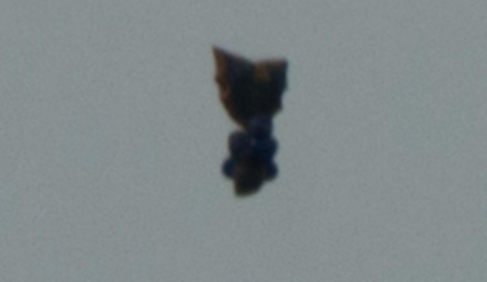
I added light to bring out the true color...orange and purple of the UFO. Is it a UFO? It could be, but without hands on this one is going to be difficult to tell. You see, we need video of it moving, which tells us how smoothly it moves, if its moving because of wind or not, is it stopping and going, or other things. UFOs do come in all shapes and sizes and this could be one. Its defiantly unidentified, flying and an object. Awesome looking isn't it?

Scott C. Waring

Eyewitness states: 

The object floated in air looked like a two face object with sails and wasp like lower half with egg shaped items 3 on front and disk like same in back. Its looked like a ship crossed with a egg and a wasp. Very Odd. its was observed on a cloudy day south of grimsby ontario and in the Leamington area. Police were advised and no other sightings were called in on this item. Still waiting for radar contact information. I have speculations however lets see if it exists in the physical sense. If you have ever seen this item or something that looks like it let me know. Thank you.

bomb%252C%2Bontario%252C%2Bcanada%252C%2Bstatue%252C%2Bfigure%252C%2Bold%2Bman%252C%2BMars%2B%252C%2Bsphinx%252C%2BMoon%252C%2Bsun%252C%2BAztec%252C%2BMayan%252C%2BWarrier%252C%2Bfight%252C%2Btime%252C%2Btravel%252C%2Btraveler%252C%2Brocket%252C%2BUFO%252C%2BUFOs%252C%2Bsighting%252C%2Bsightings%252C%2Balien%252C%2Baliens%252C%2Bpod%252C%2Bspace%252C%2Btech%252C%2BDARPA%252Cgod%252C%2B211%2Bcopy114.jpg

bomb%252C%2Bontario%252C%2Bcanada%252C%2Bstatue%252C%2Bfigure%252C%2Bold%2Bman%252C%2BMars%2B%252C%2Bsphinx%252C%2BMoon%252C%2Bsun%252C%2BAztec%252C%2BMayan%252C%2BWarrier%252C%2Bfight%252C%2Btime%252C%2Btravel%252C%2Btraveler%252C%2Brocket%252C%2BUFO%252C%2BUFOs%252C%2Bsighting%252C%2Bsightings%252C%2Balien%252C%2Baliens%252C%2Bpod%252C%2Bspace%252C%2Btech%252C%2BDARPA%252Cgod%252C%2B211%2Bcopy115.jpg

bomb%252C%2Bontario%252C%2Bcanada%252C%2Bstatue%252C%2Bfigure%252C%2Bold%2Bman%252C%2BMars%2B%252C%2Bsphinx%252C%2BMoon%252C%2Bsun%252C%2BAztec%252C%2BMayan%252C%2BWarrier%252C%2Bfight%252C%2Btime%252C%2Btravel%252C%2Btraveler%252C%2Brocket%252C%2BUFO%252C%2BUFOs%252C%2Bsighting%252C%2Bsightings%252C%2Balien%252C%2Baliens%252C%2Bpod%252C%2Bspace%252C%2Btech%252C%2BDARPA%252Cgod%252C%2B211%2Bcopy112.png

{ http://www.ufosightingsdaily.com/ }

Hoe vind je dit bericht?
Geschreven door peter om 12:39 Stuur door

UFO Seen During Sunset Over Devon, England On April 2017, Photos, UFO Sighting News.

UFO Seen During Sunset Over Devon, England On April 2017, Photos, UFO Sighting News.

England%252C%2BDevon%252C%2Bstatue%252C%2Bfigure%252C%2Bold%2Bman%252C%2BMars%2B%252C%2Bsphinx%252C%2BMoon%252C%2Bsun%252C%2BAztec%252C%2BMayan%252C%2BWarrier%252C%2Bfight%252C%2Btime%252C%2Btravel%252C%2Btraveler%252C%2Brocket%252C%2BUFO%252C%2BUFOs%252C%2Bsighting%252C%2Bsightings%252C%2Balien%252C%2Baliens%252C%2Bpod%252C%2Bspace%252C%2Btech%252C%2BDARPA%252Cgod%252C%2B211%2Bcopy1131.png

Date of sighting: April 16, 2017
Location of sighting: Plymouth, Devon, England
Source: 

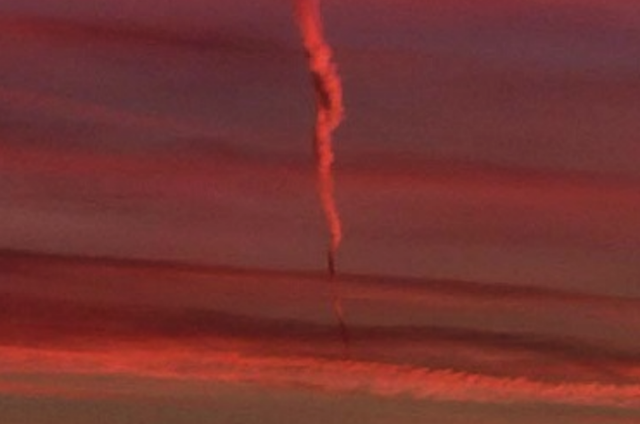
As I always say, if you want to see a UFO, watch a few sunsets, but bring your camera. This UFO was seen and passed through the other clouds as it moved. It could have been a failed rocket that was being tested out by one of the European governments that don't want to get laughed at, but then...the North Koreans many have launched more than one...the one is said to have failed on launch...but really it was destroyed by the DARPA satellite defense system that shot it with an infrared laser to destroy it. 


Also Russia launched a rocket that went mach 8, so this could be that one...I imagine it went far and was seen by a lot of countries. Yet no one took credit for it, so it can't be a rocket.  


So if this isn't a rocket, then its certainly a UFO. Its not a comet, not a meteor because meteors would burn up in the atmosphere. Probably a damaged UFO heading to an underwater alien base off the English coast.

Scott C. Waring

News states: 
A Devon photographer claims he has pictured an unidentified object flying through the early morning sky. Ben Landricombe took these stunning images in Plymouth at 6am today. Ben, a keen photographer, managed to capture the extraordinary sight - and has produced these stunning pictures. "I've never seen anything like it in my life," said Ben, who works for Plymouth City Council. "I was late to work, but I think my boss was alright. "I showed everyone the pictures and they all said 'Wow!'".


Did you see this too this morning? Ben was driving to work from his home on Hooe Road when he spotted something in the air. Recalling the strange turn of events, he said: "I drove straight back home to get my camera, then I went to the highest point in Plymstock to take the pictures, where the big cross on the hill is. "I missed the meteor coming through the atmosphere, but I saw the sparks coming down, travelling really fast." (More at Source)


England%252C%2BDevon%252C%2Bstatue%252C%2Bfigure%252C%2Bold%2Bman%252C%2BMars%2B%252C%2Bsphinx%252C%2BMoon%252C%2Bsun%252C%2BAztec%252C%2BMayan%252C%2BWarrier%252C%2Bfight%252C%2Btime%252C%2Btravel%252C%2Btraveler%252C%2Brocket%252C%2BUFO%252C%2BUFOs%252C%2Bsighting%252C%2Bsightings%252C%2Balien%252C%2Baliens%252C%2Bpod%252C%2Bspace%252C%2Btech%252C%2BDARPA%252Cgod%252C%2B211%2Bcopy1132.png

England%252C%2BDevon%252C%2Bstatue%252C%2Bfigure%252C%2Bold%2Bman%252C%2BMars%2B%252C%2Bsphinx%252C%2BMoon%252C%2Bsun%252C%2BAztec%252C%2BMayan%252C%2BWarrier%252C%2Bfight%252C%2Btime%252C%2Btravel%252C%2Btraveler%252C%2Brocket%252C%2BUFO%252C%2BUFOs%252C%2Bsighting%252C%2Bsightings%252C%2Balien%252C%2Baliens%252C%2Bpod%252C%2Bspace%252C%2Btech%252C%2BDARPA%252Cgod%252C%2B211%2Bcopy1133.png

{ http://www.ufosightingsdaily.com/ }

Hoe vind je dit bericht?
Geschreven door peter om 12:33 Stuur door

THE NORDIC ALIEN ENCOUNTERS

THE NORDIC ALIEN ENCOUNTERS

700_fe6a698e222c6cf8d763b6759e0b7717.jpg?v=1492375638

In this video we will be taking a look at the aliens called Pleiadians who originate from the Pleiades star cluster. They have always fascinated me due to the fact they are a humanoid race who visits Earth often and whom we share a common ancestry.

The Nordic are highly evolved and spiritual beings of light (unlike the rest of extraterrestrials). His "Pleiadian" ancestors (in reference to the star cluster of the Pleiades) lived on a planet that was destroyed.

  • They are benevolent beings
  • They are magical beings
  • Want to interact and communicate with humans 
  • Are concerned about the environment of planet Earth
  • They are worried about the peace in the world
  • Can telepathically transmit messages

The American ufologist John Carpenter claimed that the typical Norse "is paternal, attentive, affectionate, smiling, affectionate, young and omniscient (with great knowledge)".

UFO researcher Stephanie Kelley-Romano says that the Norse "are often related to spiritual growth and love and act as protectors of third parties who have these experiences." According to some ufologists, the Nordic are against the presence on Earth of a race known as the "grays". In contrast other ufologists affirm that the Nordic ones are the chiefs of the grays. US ufologist Jenny Randles says that although she believes that the Norse have been involved in abductions, she thinks abduction is more important to the gray than to the Nordic, which gives more importance to the encounter with humans. Other ufologists claim that there must be several factions of Nordic, some very positive and some very negative.

 https://youtu.be/-YltqOv6F-U

RELATED ARTICLES

{ http://www.disclose.tv/ }

Hoe vind je dit bericht?
Geschreven door peter om 00:49 Stuur door

STRANGE UFO APPEARS ABOVE MUNICH, GERMANY

STRANGE UFO APPEARS ABOVE MUNICH, GERMANY

700_4d39986808e6c3fdeb54b30f685e4764.jpg?v=1492359316

People in Munich, Germnay were amazed yesterday when they witnessed an scary UFO sighting above the city. There seemed to be an extramelly large UFO hoovering above the city. After a couple of minutes the UFO seemed to be entering another dimension when it entered a strange portal that appeared above the UFO.

The UFO seem to be consisting of several strange orbs. After it hoovered above the city if suddenly entered a flashing portal that appeared above the object. 

It's not clear whether the UFO was carrying out some kind of mission above Munich area. A lot of people witnessed this object and the local twitter sphere was reporting a lot of strange UFO sightings.

Was this UFO able to carry out it's mission of was it just lost due to the atmospheric conditions above the city? The object seemed to massiave.

Local witnesses did not hear a sound when the strange object entered the dimensional portal. 

RELATED ARTICLES

{ http://www.disclose.tv/ }

Hoe vind je dit bericht?
Geschreven door peter om 00:34 Stuur door

NASA Says Saturn’s Moon Has “The Ingredients Necessary For a Habitable Environment”

NASA Says Saturn’s Moon Has “The Ingredients Necessary For a Habitable Environment”

by Karla Lant

pia17040-673.jpg
This set of images from NASA's Cassini mission shows how the gravitational pull of Saturn affects the amount of spray coming from jets at the active moon Enceladus.
Credits: NASA/JPL-Caltech/University of Arizona/Cornell/SSI

A New Discovery

NASA just released evidence that a liquid water ocean that could support life lies beneath the icy surface of Saturn’s moon Enceladus. The agency reports that the world has many of the “ingredients needed for a habitable environment.”

Thanks to Cassini, organic chemicals—carbon, hydrogen, nitrogen, oxygen, phosphorus and sulfur—which are the basic building blocks of life, were seen spraying forth from the “tiger stripe” cracks on the cold surface of the moon.

Additionally, in the paper published in Science, which comes from researchers on the Cassini mission, it was revealed that molecular hydrogen, which NASA notes, “could potentially provide a chemical energy source for life,” is pouring into the ocean on Enceladus via hydrothermal vents on the seafloor.

It has almost all of the ingredients you would need to support life as we know it.

In an interview with The Washington Post, Peter Girguis, a deep sea biologist at Harvard who is not associated with the research, noted the significance in relation to discovering microbial life: “For a microbiologist thinking about energy for microbes, hydrogen is like the gold coin of energy currency. If you had to have one thing, one chemical compound, coming out of a vent that would lead you to think there’s energy to support microbial life, hydrogen is at the top of that list.”

“Confirmation that the chemical energy for life exists within the ocean of a small moon of Saturn is an important milestone in our search for habitable worlds beyond Earth,” added Linda Spilker, Cassini project scientist at NASA’s Jet Propulsion Laboratory, in a NASA press release. “We now know that Enceladus has almost all of the ingredients you would need to support life as we know it on Earth,” she continued.

Water Means Life

To clarify, water, which supports and cradles life on Earth, is abundant in our solar system. As University of Michigan planetary scientist Sushil Atreya told Scientific American, water is necessary for life-as-we-know-it for a number of important reasons: “Liquid water acts as a solvent, as a medium and as a catalyst for certain types of proteins, and those are three main things that allow life to flourish.”

Indeed, everywhere that we find water on Earth, we find life—and enough water appears to be on this world, and in the proper conditions, that it seems likely that we will find alien life there.

“The way the jets react so responsively to changing stresses on Enceladus suggests they have their origins in a large body of liquid water,” Christophe Sotin co-author and Cassini team member said in the NASA release. “Liquid water was key to the development of life on Earth, so these discoveries whet the appetite to know whether life exists everywhere water is present” (pun, probably, intended).

“Although we can’t detect life, we’ve found that there’s a food source there for it. It would be like a candy store for microbes,” said Hunter Waite, lead author of the Cassini study.

In a statement, Thomas Zurbuchen, associate administrator for NASA’s Science Mission Directorate at Headquarters in Washington, succinctly summarized the significance of the find: “This is the closest we’ve come, so far, to identifying a place with some of the ingredients needed for a habitable environment. These results demonstrate the interconnected nature of NASA’s science missions that are getting us closer to answering whether we are indeed alone or not.”

{ https://futurism.com/ }

Hoe vind je dit bericht?
Geschreven door peter om 00:26 Stuur door

Scientists Hypothesize Radio Bursts From Beyond Our Galaxy Could Be Driving Super Fast Alien Ships

Scientists Hypothesize Radio Bursts From Beyond Our Galaxy Could Be Driving Super Fast Alien Ships

Hoe vind je dit bericht?
Geschreven door peter om 00:12 Stuur door

The Possibility of Silicon-Based Life Grows

The Possibility of Silicon-Based Life Grows

The Possibility of Silicon-Based Life Grows
An artist rendering of organosilicon-based life. Organosilicon compounds contain carbon-silicon bonds. Recent research from the laboratory of Frances Arnold shows, for the first time, that bacteria can create organosilicon compounds. This does not prove that silicon- or organosilicon-based life is possible, but shows that life could be persuaded to incorporate silicon into its basic components.
Credit: Lei Chen and Yan Liang (BeautyOfScience.com) for Caltech

Science fiction has long imagined alien worlds inhabited by silicon-based life, such as the rock-eating Horta from the original Star Trek series. Now, scientists have for the first time shown that nature can evolve to incorporate silicon into carbon-based molecules, the building blocks of life on Earth.

As for the implications these findings might have for alien chemistry on distant worlds, "my feeling is that if a human being can coax life to build bonds between silicon and carbon, nature can do it too," said the study's senior author Frances Arnold, a chemical engineer at the California Institute of Technology in Pasadena. The scientists detailed their findings recently in the journal Science.

Carbon is the backbone of every known biological molecule. Life on Earth is based on carbon, likely because each carbon atom can form bonds with up to four other atoms simultaneously. This quality makes carbon well-suited to form the long chains of molecules that serve as the basis for life as we know it, such as proteins and DNA. [The Search for Life on Mars in Pictures]

Still, researchers have long speculated that alien life could have a completely different chemical basis than life on Earth. For example, instead of relying on water as the solvent in which biological molecules operate, perhaps aliens might depend on ammonia or methane. And instead of relying on carbon to create the molecules of life, perhaps aliens could use silicon.

Carbon and silicon are chemically very similar in that silicon atoms can also each form bonds with up to four other atoms simultaneously. Moreover, silicon is one of the most common elements in the universe. For example, silicon makes up almost 30 percent of the mass of the Earth's crust, and is roughly 150 times more abundant than carbon in the Earth's crust. 

Scientists have long known that life on Earth is capable of chemically manipulating silicon. For instance, microscopic particles of silicon dioxide called phytoliths can be found in grasses and other plants, and photosynthetic algae known as diatoms incorporate silicon dioxide into their skeletons. However, there are no known natural instances of life on Earth combining silicon and carbon together into molecules.

Still, chemists have artificially synthesized molecules comprised of both silicon and carbon. These organo-silicon compounds are found in a wide range of products, including pharmaceuticals, sealants, caulks, adhesives, paints, herbicides, fungicides, and computer and television screens. Now, scientists have discovered a way to coax biology to chemically bond carbon and silicon together. 

"We wanted to see if we could use what biology already does to expand into whole new areas of chemistry that nature has not yet explored," Arnold said. [Facts About Silicon]

The researchers steered microbes into creating molecules never before seen in nature through a strategy known as 'directed evolution,' which Arnold pioneered in the early 1990s. Just as farmers have long modified crops and livestock by breeding generations of organisms for the traits they want to appear, so too have scientists bred microbes to create the molecules they desire. Scientists have used directed evolutionary strategies for years to create household goods such as detergents, and to develop environmentally-friendly ways to make pharmaceuticals, fuels and other industrial products. (Conventional chemical manufacturing processes can require toxic chemicals; in contrast, directed evolutionary strategies use living organisms to create molecules and generally avoid chemistry that would prove harmful to life.)

Arnold and her team — synthetic organic chemist Jennifer Kan, bioengineer Russell Lewis, and chemist Kai Chen — focused on enzymes, the proteins that catalyze or accelerate chemical reactions. Their aim was to create enzymes that could generate organo-silicon compounds. 

"My laboratory uses evolution to design new enzymes," Arnold said. "No one really knows how to design them — they are tremendously complicated.  But we are learning how to use evolution to make new ones, just as nature does."

First, the researchers started with enzymes they suspected could, in principle, chemically manipulate silicon. Next, they mutated the DNA blueprints of these proteins in more or less random ways and tested the resulting enzymes for the desired trait. The enzymes that performed best were mutated again, and the process was repeated until the scientists reached the results they wanted.

Arnold and her colleagues started with enzymes known as heme proteins, which all have iron at their hearts and are capable of catalyzing a wide variety of reactions. The most widely recognized heme protein is likely hemoglobin, the red pigment that helps blood carry oxygen. 

After testing a variety of heme proteins, the scientists concentrated on one from Rhodothermus marinus, a bacterium from hot springs in Iceland. The heme protein in question, known as cytochrome c, normally shuttles electrons to other proteins in the microbe, but Arnold and her colleagues found that it could also generate low levels of organo-silicon compounds. 

After analyzing cytochrome c's structure, the researchers suspected that only a few mutations might greatly enhance the enzyme's catalytic activity. Indeed, only three rounds of mutations were enough to turn this protein into a catalyst that could generate carbon-silicon bonds more than 15 times more efficiently than the best synthetic techniques currently available. The mutant enzyme could generate at least 20 different organo-silicon compounds, 19 of which were new to science, Arnold said. It remains unknown what applications people might be able to find for these new compounds.

"The biggest surprise from this work is how easy it was to get new functions out of biology, new functions perhaps never selected for in the natural world that are still useful to human beings," Arnold said. "The biological world always seems poised to innovate."

In addition to showing that the mutant enzyme could self-generate organo-silicon compounds in a test tube, the scientists also showed that E. coli bacteria, genetically engineered to produce the mutant enzyme within themselves, could also create organo-silicon compounds. This result raises the possibility that microbes somewhere could have naturally evolved the ability to create these molecules.

"In the universe of possibilities that exist for life, we've shown that it is a very easy possibility for life as we know it to include silicon in organic molecules," Arnold said. "And once you can do it somewhere in the universe, it's probably being done." [Best Places to Seek Alien Life in Our Solar System]

It remains an open question why life on Earth is based on carbon when silicon is more prevalent in Earth's crust. Previous research suggests that compared to carbon, silicon can form chemical bonds with fewer kinds of atoms, and it often forms less complex kinds of molecular structures with the atoms that it can interact with. By giving life the ability to create organo-silicon compounds, future research can test why life here or elsewhere may or may not have evolved to incorporate silicon into biological molecules.

In addition to the astrobiology implications, the researchers noted that their work suggests biological processes could generate organo-silicon compounds in ways that are more environmentally friendly and potentially much less expensive than existing methods of synthesizing these molecules. For example, current techniques for creating organo-silicon compounds often require precious metals and toxic solvents.

The mutant enzyme also makes fewer unwanted byproducts. In contrast, existing techniques typically require extra steps to remove undesirable byproducts, adding to the cost of making these molecules.

"I'm talking to several chemical companies right now about potential applications for our work," Arnold said. "These compounds are hard to make synthetically, so a clean biological route to produce these compounds is very attractive."

Future research can explore what advantages and disadvantages the ability to create organo-silicon compounds might have for organisms. "By giving this capability to an organism, we might see if there is, or is not, a reason why we don't stumble across it in the natural world," Arnold said.

The research was funded by the National Science Foundation, the Caltech Innovation Initiative program, and the Jacobs Institute for Molecular Engineering for Medicine at Caltech.

This story was provided by Astrobiology Magazine, a web-based publication sponsored by the NASA astrobiology program. Follow Space.com @Spacedotcom, Facebook and Google+. Story posted on Space.com. 

{ http://www.space.com/ }

Hoe vind je dit bericht?
Geschreven door peter om 00:08 Stuur door

The Most Amazing Space Stories of the Week!

The Most Amazing Space Stories of the Week!

The Most Amazing Space Stories of the Week!
Two of the raised treads on the left middle wheel of NASA's Curiosity rover on Mars suffered breaks in early 2017. One of the breaks is visible as a partially detached section at the top of the wheel, seen here by Curiosity's arm-mounted Mars Hand Lens Imager.
Credit: NASA/JPL-Caltech/MSSS

A Dragon returns, North Korea tests a rocket engine, a wheel breaks on Mars and a spacewalk streak begins — it's Space.com's top news stories of the week.

Transition begins

U.S. President Donald Trump signed a bill authorizing a $19.5 billion budget for NASA in 2017, setting its priorities for the year. Vice President Mike Pence also announced that he would head a re-established National Space Council, which will advise the president on space issues. [Full Story: President Trump Signs NASA Authorization Bill]

Dragon came back

SpaceX's Dragon spacecraft splashed down in the Pacific Ocean, bringing more than 2 tons of science experiments and gear back from the International Space Station. Officials retrieved the spacecraft and had time-sensitive scientific samples in the lab within 48 hours. [Full Story: SpaceX Dragon Capsule Returns to Earth with Ocean Splashdown]

Uncertainty engine

North Korea announced that they had performed a ground test of a powerful rocket engine suited to lifting satellites — or missiles — off the ground. [Full Story: North Korea Tests Rocket Engine: Is It for Satellites or Ballistic Missiles?]

Wear and tear

NASA's Curiosity Mars rover has two small breaks in the treads of one of its six heavy wheels. Curiosity has already lasted well beyond its original two-year mission lifetime, and it should be able to continue unhindered by this latest wear and tear. [Full Story: Breaks Found in Curiosity Mars Rover's Wheel]

(Tiny) thrusters, on!

New, dime-size ion thrusters could keep constellations of small satellites in orbit — or, working together, propel astronauts to Mars. The newly-developed "thruster chips" eject ions drawn from a salt-based propellant solution. [Full Story: Dime-Size Thrusters Could Propel Satellites, Spacecraft]

No laughing matter

The mysterious dark matter seems to make up a large percentage of the matter in the universe, but — perplexingly — early galaxies seem to not have very much of it. [Full Story: Lack of 'Dark Matter' in Early Galaxies Perplexes Astronomers]

Colorful cocoon

Three observant satellites, called Swarm, have mapped the complex magnetic field of Earth's crust and outer mantle, known as its lithosphere. The signal is tiny, but illuminating about the Earth's history. (And one city in Africa has a mysteriously sharp and strong magnetic spike.) [Full Story: Earth's Magnetic Cocoon Mapped in Extreme Detail]

Maybe no flow

Mars' famous dark streaks, thought to be caused by briny flows of water, may come from bone-dry landslides instead, new work suggests. [Full Story: Mars' Dark Streaks May Be Caused by Dry Landslides, Not Water]

But then again: Massive Martian Slopes May Harbor Ice

Going way back

A radio telescope that could probe the dawn of the universe's first stars and galaxies received a new grant, boosting its potential size from 240 huge antenna dishes to 350 — letting it look even further back in time. [Full Story: Telescope Eyeing Universe's First Stars Gets (Another) Big Boost]

Out there

Two astronauts completed a spacewalk Friday (March 24) to help prepare the International Space Station for future commercial spacecraft to dock and bring crew. It is the first of three spacewalks in a row, the third of which will be the station's 200th spacewalk. [Full Story: Space Station Astronauts Poised to Tackle Three-Spacewalk Streak]

Follow us @Spacedotcom, Facebook and Google+. Original article on Space.com. 

{ http://www.space.com/ }

Hoe vind je dit bericht?
Geschreven door peter om 23:55 Stuur door

The Most Interesting Science News Articles of the Week

The Most Interesting Science News Articles of the Week

Each week we uncover the most interesting and informative articles from around the world, here are 10 of the coolest stories in science this week.

Serpentinite rock. Serpentine rock formations found near the Mariana Trench have signatures of organic processes that could be indicative of life.
Credit: Uhryn Larysa/Shutterstock.com

A host of hardy microbes may be living miles beneath the ocean floor, new research suggests.

"Although we cannot pinpoint the exact origin of the organic matter, chemical analysis of the constituents resembles molecular signatures that could be produced by microbial life deep within or below the mud volcano," the researchers wrote in the study. [Read more about deep life.]

This image shows the typical symptoms of podoconiosis, including swollen, thickened lower limbs with a warty and mossy appearance. This is an advanced form of the disease.
Credit: Dr. Christine Kihembo

A rare condition called elephantiasis, which tends to strike people in tropical parts of the world, was long thought to occur due to a parasitic infection. But a new study shows that the condition can have another cause: sharp crystals found in certain soils.

But in 2014 and 2015, there were reports of two intense outbreaks of elephantiasis in western Uganda, an area that is not known to harbor these worms. [Read more about the rare condition.]

A view inside a particle detector tank at Daya Bay, where photomultiplier tubes measure signals from antineutrinos.
Credit: Roy Kaltschmidt/Berkeley Lab

Proposed elusive subatomic particles that only fleetingly interact with matter through gravity may not exist, at least if new data from a nuclear reactor is any indication.

"Among the possible explanations, the most exciting one is that we have a new piece of physics," such as sterile neutrinos, said Kam-Liu Bak, the spokesperson for the Daya Bay Collaboration. "That explanation is now unlikely." [Read more about the particles.]

A mummified cat from the University of Aberdeen Museums has been made into an interactive 3D model.
Credit: University of Aberdeen

Behind the scenes at the University of Aberdeen Museums, researchers are using high-tech 3D imaging software to reveal what is inside a 2,000-year-old Egyptian cat mummy and other ancient mummified artifacts in the museums' collections.

Household pets were commonly mummified and buried alongside their owners in ancient Egypt. Many were also preserved as sacred offerings to the gods, and an entire industry existed that is thought to have churned out more than 70 million animal mummies, BBC News reported. [Read more about cat mummies.]

Beauty (Emma Watson) and Beast (Dan Stevens) overcome their differences to find true love in the 2017 film
Beauty (Emma Watson) and Beast (Dan Stevens) overcome their differences to find true love in the 2017 film "Beauty and the Beast."
Credit: Disney

The recent live-action movie "Beauty and the Beast" (Disney, 2017) is the latest retelling of the "tale as old as time" — a tender and life-changing romance between a human and a nonhuman animal that is ultimately made human by love — which has captivated audiences of all ages for hundreds of years.

What explains the enduring attraction of these myths and stories, and what might our affection for these bizarre pairings tell us about ourselves? [Read more about the fascination.]

A sperm whale penis, mounted and stuffed, at the Explorers Club headquarters in New York City.
Credit: Courtesy of the Explorers Club

In 1977, the Explorers Club in New York received an unusual gift. Unable to attend a whaling exhibition that the club was hosting, Mr. and Mrs. Frederick S. Schauffler sent their regrets in a note … along with a sperm whale foreskin, stuffed and mounted on an oak base.

According to a report by the Nantucket Historical Association, Sanderson was born in Ohio in 1874, but he lived his final years on the Massachusetts island of Nantucket. Sometime in the 1920s, he bought a historic Nantucket home and began filling it with whaling artifacts, such as "harpoons, boarding knives, cutting spades and bomb lances, as part of a careful interior restoration of that house," Aimee Newell wrote in the NHA report. [Read more about the strange artifact.]

This enhanced-color image of Enceladus by NASA's Cassini spacecraft features the
This enhanced-color image of Enceladus by NASA's Cassini spacecraft features the "tiger stripe" fractures, from which geysers blast water ice and other material from the Saturn moon's subsurface ocean out into space.
Credit: NASA/JPL/Space Science Institute

Saturn's icy moon Enceladus is looking more and more like a habitable world.

These reactions depend on the presence of molecular hydrogen (H2), which, the new study reports, is likely being produced continuously by reactions between hot water and rock deep down in Enceladus' sea. [Read more about the energy source.]

One of the fish from the site with 5,000-year-old rock art in the Thune Valley, Botswana.
Credit: David Pearce

They may now be underwater, but the oldest rock art paintings in southern Africa are about 5,000 years old, far more ancient than previously realized, a new study finds.

The researchers then used a novel technique to isolate the paint fragments before dating them, as well as 13 other fragments from rock art sites across southern Africa, including in Lesotho and South Africa. [Read more about the ancient rock art.]

When Microsoft released an artificially intelligent chatbot named Tay on Twitter last March, things took a predictably disastrous turn. Within 24 hours, the bot was spewing racist, neo-Nazi rants, much of which it picked up by incorporating the language of Twitter users who interacted with it.

The researchers experimented with a widely used machine-learning system called the Global Vectors for Word Representation (GloVe) and found that every sort of human bias they tested showed up in the artificial system. [Read more about artificial intelligence.]

Elon Musk speaks during an event to launch the new Tesla Model X Crossover SUV in Fremont, California, on Sept. 29, 2015.
Credit: Justin Sullivan/Getty Images

I've been imagining a network of electrodes clinging to my brain, trying, with increasing mechanical desperation, to unwind all of these thoughts and figure out what to do with them.

That's what tech guru Elon Musk wants: neural implants that would connect to the human brain and merge the mind with a machine. [Read more about brain hacking.]

Follow Live Science @livescience, Facebook & Google+.

{  http://www.livescience.com/ }

Hoe vind je dit bericht?
Geschreven door peter om 23:48 Stuur door

Naval Officer Tells Us EXACTLY What He Saw Hidden In Antarctica

Naval Officer Tells Us EXACTLY What He Saw Hidden In Antarctica

A naval officer tells us what he remembers, including seeing a huge opening in the ice in a no-fly area they were crossing with a medical emergency on board. Then he ferried a group of scientists who had disappeared for two weeks, and has specifically been warned not to refer again to this subject. As he put it, “they looked scared.
 
Antarctica has long been considered one of the most mysterious places on Earth. Therefore, it is not strange that numerous ‘conspiracy theories, claims, and accounts’ have been proposed throughout the years, trying to explain some of the many enigmatic occurrences on Earth’s most isolated continent.
 
For years people have claimed that Antarctica is one of the most guarded places on Earth for a good reason.
 
Many authors have proposed that there are many interesting things hidden beneath Antarctica that are kept away from society.
 
Talk about ancient civilization inhabiting Antarctica has existed for decades. What if, in the distant past, when Earth –and Antarctica— was much different than today, an ancient civilization developed there, creating fascinating structures, monuments and temples?
 
Would we find evidence of their existence today? Many people claim that we already have.
 
But why has Antarctica become a ‘center’ for conspiracy theories?
 
Perhaps one of the greatest reasons is because it is so isolated and you can’t just travel there as you wish. Furthermore, even though we know about Antarctica only for a little over 100 years, there are numerous ancient maps that depict parts of Antarctica free of ice.


One of the most controversial maps was without a doubt composed in 1513, by Turkish Admiral Piri Reis who drew a map that would create a global debate over 500 years after him. The map depicts Antarctica which was discovered between 1818-1820.
 
But how is this possible? The history of Antarctica emerges from early Western theories of a vast continent, known as Terra Australis, believed to exist in the far south of the globe. The term Antarctic, referring to the opposite of the Arctic Circle, was coined by Marinus of Tyre in the 2nd century AD.
 
In 1820, several expeditions claimed to have been the first to have sighted the ice shelf or the continent. Interestingly, a Russian expedition was led by Fabian Gottlieb von Bellingshausen and Mikhail Lazarev, a British expedition was captained by Edward Bransfield and an American sealer Nathaniel Palmer participated.
 
The first landing was probably just over a year later when American Captain John Davis, a sealer, set foot on the ice. Norwegian Roald Amundsen finally reached the Pole on December 14, 1911, following a dramatic race with the Englishman Robert Falcon Scott.
 
But the above accounts are all relatively recent.
 
Here are ancient maps that date back over 500 years which already depict the continent, and some of them show Antarctica free of ice.
 
 
In 2012, a satellite image of Antarctica spotted a strange oval-shaped formation in one of the most remote places on the planet. Thousands of miles from modern society, the strange oval-shaped structure raised numerous questions among experts.
 
At 400-feet across, experts analyzing the image ask whether or not this ‘structure’ could be the result of Mother Nature. The unusual shape of the structure suggests it may be man-made formation.
 
The above image is just one of the many odd things that have been found on Antarctica and many authors and whistleblowers claim there’s more to Antarctica than we’ve ever been told.

What is referred to as a ‘truly shocking and astonishing video on extremely strange events in the Antarctic continent’ has recently been uploaded to YouTube, causing a social network debate about Antarctica and what’s really there.
 
“A naval officer tells us what he remembers, including seeing a huge opening in the ice in a no-fly area they were crossing with a medical emergency on board. Then he ferried a group of scientists who had disappeared for two weeks, and has specifically been warned not to refer again to this subject. As he put it, “they looked scared.” When they returned to McMurdo, their gear was isolated and they were flown back to Christchurch, New Zealand in a special plane. He discusses what he saw and experienced in detail. This is the most provocative story about what is going on in Antarctica ever presented anywhere.”


Hoe vind je dit bericht?
Geschreven door peter om 18:57 Stuur door

CLE 2017 Reveals: Secret Space Programs, Aliens, and Inner Earth Civilizations

CLE 2017 Reveals: Secret Space Programs, Aliens, and Inner Earth Civilizations 

Inner Earth beings… “They’re a fourth-density being, and apparently they trace their lineage back to the Earth, and some of them, including the Anshar here, back 18 million years.”
During the Conscious Life Expo 2017 in LA, Corey Goode revealed fascinating details about secret space programs, Alien life and Inner Earth civilizations.
 
Corey Goode identifies himself as an intuitive empath (IE). According to the Sphere Being Alliance, Corey Goode was recruited through one of the MILAB programs at the young age of six. (MILAB is a term coined for the military abduction of a person that indoctrinates and trains them for any number of military black ops programs.) Goode trained and served in the MILAB program from 1976-1986/87. Toward the end of his time at MILAB he was assigned to fill an IE support role for a rotating Earth Delegate Seat (shared by secret earth government groups) in a “human-type” ET SuperFederation Council.
 
During the Conscious Life Expo 2017 in LA, Goode spoke about fascinating details concerning Alien life, Alien contact, inner-Earth civilization and forbidden knowledge in general.

Alien contact has already happened
 
“When I was first being picked up and taken to these MILAB-type programs, I found myself being slowly introduced to non-terrestrials. You would go into like a virtual reality setting where they put the goggles on you, and you’re sitting in a chair, and there would be a bunch of military and medical people in the room.”
 
“…And then, when you took the goggles off, there would be a Grey alien sitting at the table. They would just spring it on you. Yeah. They spent years acclimating people to being in the presence of non-terrestrials, because no matter who you are, it’s going to throw you off. We’re genetically programmed to respond viscerally to the non-terrestrials.”

The Secret Space Program
 
Corey Goode isn’t the only one who has spoken out about the existence of a fully operational secret space program.
 
Interestingly, a former NASA employee claimed there were secret manned missions to Mars over 20 years ago. In an interview with Coast-to-Coast AM, a woman by the name of ‘Jackie’ talked about humans on Mars, something that has been discussed among other alleged NASA employees for years; ‘…Then I saw two men in space suits – not the bulky suits we normally used, but they looked protective. They came over the horizon walking to the Viking Explorer…’
 
In addition to the above, a former Marine claims to have even WORKED on Mars.
 
The retired officer only known as Captain Kaye (pseudonym), said that not only have humans made it to Mars in the past, we have developed a secret space program and flotilla that operates in space. According to the former Marine, he was posted on the red planet for years and his mission was to protect the five human colonies from indigenous life forms on Mars. According to Captain Kaye, not only did he spend years on Mars, but he also served aboard a giant space carrier for three years.
 
But perhaps the best person to expose everything related to secret programs and shadow governments was Senator Daniel K. Inouye who said: “There exists a shadowy government with its own Air Force, its own Navy, its own fundraising mechanism, and the ability to pursue its own ideas of the national interest, free from all checks and balances, and free from the law itself.”
 
During the Conscious Life Expo 2017 Goode explained in detail the Secret Space Program:
 
“When I was almost 17, I was brought into the Secret Space Program (SSP), which I had been groomed for all throughout the MILAB program. They drafted me into Solar Warden. It was my Christmas break, 1986. I was . . . My birthday’s in 11 days, so it’s February 22. It was during December just before my 17th birthday that they brought me in.”
 
“They assigned me to a research vessel, and the captain did not want me on board. In the past, they had put what he called “children” on board, and they cried for mom, and it took about a year for them to acclimate, and he did not want to go through that. It was too disruptive. So instead, they sent me to the Intruder, Intercept and Interrogation program, where they would use intuitive empaths to interrogate non-terrestrials that they had caught in our Solar System or on Earth.”
 
“I was in that program for about a year, just under a year. And then they reassigned me back to the Sommerfield. I worked for scientists and engineers. When I was working on the science side with the scientists, they called me a Specialist. And I was a Technician when I was working with the engineers. Who remembers talking about the dart craft coming in my back yard to pick me up?”

Inner Earth civilizations
 
Goode isn’t the only one who believes there are civilizations inhabiting lower parts of Earth’s crust. In a new interview by Coast to Coast am, author and researchers David Wilcock stated that an alliance of ancient civilizations is living inside the planet. These ancient civilizations have been calling the inner Earth their home for long periods of time and they are about the reveal themselves to the world. Wilcock explained that during the formation of all watery planets in the universe (and according to latest studies by NASA there are quite a few) hollow cavities are formed below the surface of the crust, with their very own biome with bacteria that is capable of giving off natural light.
 
Goode further elaborated on the subject during the Conscious Life Expo 2017:
 
“The Inner Earth. It seems to be probably the most popular topic that I’ve talked about.”
 
“A lot of you remember me talking about witnessing the city in the deep cavern. This is an animation that Rene created to help depict it. It’s very good. The only difference was the cavern was the size of a state. There’s no way to really accurately depict on scale how large it was. It’s unbelievable. There’s mist up along the ceiling of the cave, cavern.”
 
“It was like New York, or Manhattan, under the ground. Inside these pillars, natural pillars, they had built into what looked like a bunch of condos. I guess that’s where all the . . . They don’t have money. I was going to say that’s where all the rich people live. They don’t have money.”
 
“They’re a fourth-density being, and apparently they trace their lineage back to the Earth, and some of them, including the Anshar here, back 18 million years.”


 { http://7tales.net/ }

Hoe vind je dit bericht?
Geschreven door peter om 18:53 Stuur door

Believe it or not: Things You Should Know About the REPTILIAN Conspiracy Theory (VIDEO)

Believe it or not: Things You Should Know About the REPTILIAN Conspiracy Theory (VIDEO)

 { http://7tales.net/ }

Hoe vind je dit bericht?
Geschreven door peter om 18:48 Stuur door

In a post-truth and alternative-fact world, how should we understand conspiracy theories?

In a post-truth and alternative-fact world, how should we understand conspiracy theories?

In an environment of scepticism, it's difficult to draw the line between rational thinking and conspiracy thoerising.

In a post-truth and alternative-fact world, how should we understand conspiracy theories? Reuters
by University of Cambridge
Did the United States fake the moon landings? Did UFOs land in Rendlesham Forest? Were the 9/11 attacks a CIA plot? You doubtless have a simple response to these questions. One that’s just three letters  – or, more likely, two letters  –  long.

But how about this assertion: the world is ruled by a powerful and secretive cabal? Suddenly, those one-word responses don’t fit quite so easily. The world may not be run by a cabal of Illuminati. Or alien lizards. But there is an elite  – the world’s top politicians and most powerful corporations  –  whose decisions affect the lives of all of us.

And yes, even in this age of transparency, many of their meetings and decisions are conducted behind closed doors.

Rational observation versus conspiracy theories

So where does rational observation end and conspiracy theorising begin? If only it were that simple. “We think there’s ‘conspiracy theory’ and then there’s acceptable political discourse,” said political scientist, Professor David Runciman. “But the difficulty is that there’s no clear dividing line where you can say, ‘We question it to this point, and beyond that questions are crazy’.”

Runciman is a director of Conspiracy and Democracy, a five-year, Leverhulme-funded project based at the Centre for Research in the Arts, Social Sciences and Humanities that is drawing together researchers across disciplines to assemble a natural history of conspiracy theories. He offers a succinct definition. “In the pejorative sense, a conspiracy theory is a view about the world in which the surface story is never the real story,” he said. “It’s a view without any limits to its scepticism or doubt. It’s a mindset in which nothing that contradicts the theory is taken as anything other than evidence that the theory is true.”

Such sceptical mindsets are currently grabbing headlines, with narratives around “fake news” and “alternative facts”. “There’s a conspiracy-theory scare right now,” said Runciman. “But you can’t blame digital technology for this. For people who want to bypass conventional sources of information, it’s easier to do it. But the propensity of people to believe these things isn’t a modern phenomenon.”

Emergence of conspiracy theories

Historian Dr Andrew McKenzie-McHarg, one of the Conspiracy and Democracy project’s researchers, is examining when we first started to notice conspiracy theories. When these theories emerged is a contentious question: “Some say antiquity, others the Renaissance. Others say the French Revolution, when we see the first modern conspiracy theories, around the Illuminati.”

Whatever the answer might be, it was only in relatively modern times that conditions arose that made possible the observation of the phenomenon. As McKenzie-McHarg points out, “The concept ‘conspiracy theory’ itself is from the 19th century, when it’s used in a forensic context at a time of increasingly scientific approaches to crime.”

In the 20th century the concept itself, fittingly enough, became the subject of a conspiracy theory. “There are those who claim that the words ‘conspiracy theory’ were introduced by the CIA to discredit people who were promoting these sorts of ideas,” said McKenzie-McHarg. “All my work is about demonstrating that the conspiracy theory about the concept ‘conspiracy theory’… is not true.”

In fact, as he points out, the origins of the phenomenon are deep-rooted. Ironically, it seems that this behaviour, which today we associate with those who feel impotent in the face of forces they can’t control, may bestow a sense of agency. McKenzie-McHarg links conspiracy theorising to the age-old notion of the scapegoat. “Identifying the scapegoat gives you the opportunity to do something  –  to marginalise or persecute those who have been identified as the guilty party. It’s far better to be doing something than nothing.”

Brains and beliefs

Neuroscientist Professor Paul Fletcher traces conspiracy theorising behaviour back to an even more fundamental origin: the brain. His work on delusion and hallucination points to a conclusion both startling and persuasive: that conspiracy theories, like other forms of belief, arise from the natural function of the mind.

“The brain  – our minds  – have an impossible task in making sense of a world that is noisy and ambiguous,” he said. “We have to take short cuts. We have to add our own evidence rather than being a passive receptacle of the world. The majority of our beliefs and precepts are useful  – but they are not a facsimile of what’s out there.”

In other words, conspiracy theories, like more sanctioned forms of belief, are our attempts to craft an explanation of the world around us. And what’s crucial in determining whether those explanations are acceptable or not, is context. In many cultures, Fletcher said, it might be “perfectly reasonable” to believe that you were being communicated with by a godlike entity. Not so in Western society today.

Of course, diagnosable mental illness creates delusion and requires treatment. But as Fletcher points out, conspiracy theories arise from the processing of evidence in our brain, resulting in a conclusion that the majority of society does not share. And the opinions of that majority are formed in exactly the same way. “Beliefs are not the logical workings-out of evidence that we assume them to be  – they are based on our own biases and assumptions.”

Bias, assumption and Patient Zero

And sometimes, those assumptions lead us astray. One striking example has been analysed by Dr Richard McKay, a Wellcome Trust Research Fellow, whose co-authored study of the Patient Zero narrative of the AIDS epidemic received global attention last year and appears in monograph later this year.

Among the study’s revelations was the fact that Patient Zero (an Air Canada flight attendant named Gaétan Dugas) was not the source of the outbreak, and that his designation as “zero” or “0” was a corruption of his abbreviated identifier in an early study as patient “O”  –  a study subject who resided “Outside of California”.

McKay echoes Fletcher’s assertion that bias and assumption are instrumental in creating beliefs  – in this case, an entire hypothesis about the origin and spread of the AIDS epidemic. “When epidemics arise, there is a long history of trying to find out the first cases,” he said. “Overlapping with that, there have always been people trying to figure out, ‘How do we stop this?’ And then there’s another group focusing on ‘Why did that happen?’ and ‘Who can we blame?’ To an extent, which of those stories you subscribe to will depend on your world view, and which systems of belief and power you subscribe to.”

He believes the Patient Zero false narrative wasn’t a conspiracy theory, but rather a demonstration of how chosen narratives can win out over evidence, and an argument for the care with which we need to craft our explanations. This tendency partly explains why conspiracy theories are so very hard to disprove or dislodge: they are self-reinforcing, thanks to the information chosen for consideration in the first place.

Post-truth, post-factual and fake news

Understanding  –  and disseminating  –  how evidence can be used better is the task of one of Cambridge’s newest bodies, the Winton Centre for Risk and Evidence Communication, based in the Faculty of Mathematics. Executive Director Dr Alexandra Freeman said the centre is tasked with aiding key decision-makers and communicators, such as civil servants, doctors and journalists, to better grasp the evidence they use, and present it more effectively to their audience.

This could not be more relevant in 2017. It is a truism of the past year in politics that those responsible for clearly communicating evidence have failed to do so  –  or failed to cut through when they did. The 2016 EU referendum saw Michael Gove declare that “people in this country have had enough of experts”, while in the US presidential race, both the media and the public were fascinated by Donald Trump’s fluid use of fact. And in the wake of that acrimonious race, terms such as “post-truth”, “postfactual” and “fake news” have entered the mainstream. The need for a centre such as the Winton has never been clearer.

“I don’t think we can deal with conspiracy theorists directly,” Freeman explained. “There will always be those who don’t trust anyone, even the University of Cambridge’s Maths Department! Obviously we can try to establish our credentials for being trusted by being honest about everything we do, being open about the levels of uncertainty and disagreement in the evidence we are presenting, and providing reference sources for all our information.”

Conspiracy theories as critical commentaries

Which is why Dr Nayanika Mathur’s fieldwork at CRASSH is so intriguing  –  she is studying the contrasting attempts to introduce biometric ID in Britain and India. In the UK, the proposals were scrapped in 2010; in India, the Unique Identification project or Aadhaar is proceeding despite opposition.

“The [Indian] government has branded much criticism of the UID as conspiratorial,” Mathur explains. “Yet at least some of the criticism is being levelled not by crackpots, but by respected legal minds and grounded activists. By taking seriously the so-called conspiracy theories around the UID, I am attempting to unsettle the common understanding of conspiracy theorists as deluded or crazy. That means I can look at conspiracy theories as critical commentaries on the world, from which we can learn a lot.”

We live in an age when even scientists investigating an epidemic can get the narrative wrong, and in which those who govern us often fail badly at communicating their evidence-based arguments. Meanwhile those labelled conspiracy theorists, said Fletcher, may reach conclusions that run counter to the mainstream, but, in shaping  –  and warping  –  the evidence to fit their strong beliefs, they are not doing much different from what we all do, all the time.

The danger arises when they don’t accept facts that counter these beliefs, and stick to their own “alternative facts”. So, should we stop writing off conspiracy theorists, and instead view them  –  as Mathur does  –  as offering a critical commentary on our times? From Illuminati to ID cards, the latest crop of Cambridge research suggests that the history of weird ideas says as much about all of us, as it does about the people who believe them.

This article first appeared on the University of Cambridge website.

We welcome your comments at letters@scroll.in. {https://scroll.in/ }
Hoe vind je dit bericht?
Geschreven door peter om 18:40 Stuur door

Are UFOs seen on Earth so often people now DON'T BOTHER to report the bizarre sightings?

Are UFOs seen on Earth so often people now DON'T BOTHER to report the bizarre sightings?

ALIEN experts are considering whether people have become so used to seeing UFOs visiting Earth, they are becoming normalised and are less likely to report the experience.

UFOs-Normal

GETTY

Are so many UFOs seen now that they don't all get reported to MUFON?

The US-based MUTUAL UFO Network (MUFON) is investigating after a stark drop in reported sightings for the first quarter of 2017.

MUFON is the world's biggest organisation dedicated to alien research and keeps searchable online global database of suspicious sightings reported by the public.

Robert Powell, MUFON director of research, said reports from within the US were down by 32 per cent from January to March this year, based on the average amounts over the previous five years.

Domestic UFO reports for the first quarter 2017 are down a staggering 32 per cent as compared to the averse for the same period over the previous five years, according to Mutual UFO Network (MUFON) Director of Research Robert Powell.

From January 1 to March 31, 2017, the MUFON US database showed 992 UFO reports where the case occurred during January, February or March. 

The average over the last five years for that period was around 1,460 cases.

Mr Powell said: "We have no current explanation on why the drop in UFO reports.

RELATED ARTICLES

“One can speculate that people are seeing fewer UFOs or that they are just not reporting them.”

The National UFO Reporting Center (NUFORC), also based in the US, which keeps a similar sightings database, has seen the same trend.

Its director Peter Davenport said: "NUFORC averaged about 1,402 cases during the first quarters 2012 through 2016.

"The first quarter 2017 is showing just 954 cases – about a 32 per cent drop as well."

MUFON communications director Roger Marsh said: "Peter and I have traded stats over the years.

“If he calls and says he’s having a surge in reports in general, or with one particular shape, that wave is always mirrored in the MUFON database. 

"While some people report into both databases, most reports are actually unique to the database. 

"We’ve seen dips and highs in the past, and they usually run in two to three-month cycles.”

RELATED ARTICLES

California has traditionally been the number one reporting state for UFO cases in any given month for years – but that status is somewhat misleading when you review populations.

Roger Marsh, of MUFON

MUFON Executive Director Harzan said: “There is a direct correlation between UFO television programming and UFO reporting.

“The shows apparently make people aware that they have a place to file a report. 

"When one of our 'Hangar 1' episodes is playing on the History channel – there is always an increase in reporting - although that surge does tend to be people recalling older cases.”

This year, the top five reporting shapes in 2017 to date are Sphere (186), Star-like (106), Circle (100), Triangle (73) and Disc (64).

But, if you do wish to see a UFO at the moment, MUFON says head to Oregon, the current UFO hot spot, in terms of sightings compared to the number of people. 

Mr Marsh said: "California has traditionally been the number one reporting state for UFO cases in any given month for years – but that status is somewhat misleading when you review populations. 

"There were 33 UFO reports from California in February 2017 – which is 0.87 reports per million people. 

RELATED ARTICLES

"California holds rank as the most populated state – with more than 38 million people.

But during the same month – February – there were eight reports from Oregon – which equals 2.05 UFO reports for every one million people – from a state with a population of about 3.97 million."  

He said the odds of seeing a UFO in oregon 

If you were choosing the best spot to night watch for UFOs – you have nearly 3-1 odds in Oregon over California when you review statistics by population.

​New Mexico was second for sightings per head of the population.

There were four UFO sightings reported to MUFON in February for New Mexico -  1.92 UFO sightings per million people.

Related articles

Hoe vind je dit bericht?
Geschreven door peter om 18:29 Stuur door

REMARKABLE: 'Crystal clear footage of multiple UFOs' filmed by man driving through desert

REMARKABLE: 'Crystal clear footage of multiple UFOs' filmed by man driving through desert

IMAGES showing multiple golden glowing UFOs which were snapped in the Arizona desert are going viral online.

UFO3.jpg

Mauricio Morales posted the "UFO" images on Facebook before they were picked up by various alien websites and YouTube channels, which described it as in the area "Ground Zero" for aliens, UFOs, and secret bases.

Mr Morales posted on Facebook: "As I was driving back to Phoenix this evening, I was a few miles past Parker, when I saw a shooting star with a green hue in the corner of my eye.

"I kept driving for a few miles and noticed a small orange light far in the distance to my right.

"At first I thought that maybe a meteor had hit nearby and set a fire in the desert or possibly a distant antenna light."

I said he thought nothing more of it until about three-and-a-half miles later the light reappeared.

He said: "This is when I realised that whatever this was, wasn’t normal.

"I was about a quarter of a mile from the crossing between Highway 72 and Highway 95 between Parker and Quartzsite, Arizona.

UFO-Arizona

MauricioMorales

The UFOs as filmed and (insets) in close-up.

RELATED ARTICLES

"I immediately pulled over and attached my camera to my tripod.

"To my south west direction, there were six orange-red lights floating around in the horizon.

"Some of them would dim out and then brighten back up, others just seemed to float and hover away slowly.

"They seemed to travel in a parallel pattern with a very bright fiery glisten.

"I took photos and videos and, in less than 15 minutes, the mysterious objects vanished without a trace.

"Whatever this was, I have never seen anything like this in my life before. Super cool experience."

There have been local news reports that a meteor was responsible, but Mr Morales says that was 10 minutes before his footage was recorded.

UFO-Phoenix

MAURICIOMORALES

The 'glowing UFOs' as captured by Mauricio Morales in Arizona.

RELATED ARTICLES

Whatever this was, I have never seen anything like this in my life before. Super cool experience.

Mauricio Morales

However, after calling out on Facebook for views, Mr Morales concluded it was nothing to do with aliens and was just military flares dropped from a military aircraft.

Several people came forward to say they were "marfa lights" which are a type of military flare.

UFO hoax buster Scott Brando also said he had ruled out these being anything alien.

The Italian, who forensically examines alleged UFO images and footage, tweeted that he believed the objects were just military flares.

The earthly conclusion did not stop other UFO sites trying to suggest they could not be explained.

RELATED ARTICLES

Tyler Glockner, who runs YouTube channel Secureteam10, argued they were far too bright to be flares in a video entitled "MEDIA COVER-UP: Mass UFO Sighting Over Arizona Desert!"

He said it was likely a cover-up as media had reported it wrongly as a meteor, and suggest dthe sighting was in a "Ground Zero" area for alien and UFO activity.

The Collective Evolution conspiracy theory website said although there was no "proof" the Arizona lights were from aliens, people should not be "fooled".

In an article, the website said: "Don’t be fooled, there is a tremendous amount of evidence pointing toward the fact that some of these UFOs, whose presence were officially acknowledged within the mainstream using declassified documents and hundreds of high ranking military/political whistleblowers, are indeed extraterrestrial in origin."

Related articles

Hoe vind je dit bericht?
Geschreven door peter om 18:14 Stuur door

Shock as huge UFO 'flying saucer' whizzes past passenger jet over UK

Shock as huge UFO 'flying saucer' whizzes past passenger jet over UK

A GIANT "spaceship" was filmed travelling hundreds of miles an hour next to a passenger plane, it has been claimed.

By Rachel O'Donoghue 

The bizarre disc-like object was filmed on an airplane reportedly flying over the United Kingdom.

Although it is not clear exactly when it was filmed, it was posted onto video-sharing website YouTube yesterday.

In the 60-second clip, the UFO flies through cloud cover at what seems to be the same speed as the aircraft.

UFO sighting near passenger plane

GETTY/YOUTUBE

SPOTTED: The bizarre unidentified object was apparently filmed flying next to a plane

“I've not seen anything manmade behaving like that, even a missile does not look that fast”

YouTube user

The person who posted the video online wrote alongside it: "This is mind blowing it's from a plane but it's still keeping up with the airplane which is incredible.

"The video is valid as far as I can tell?"

And netizens seemed to be convinced it is genuinely an alien spaceship.

One internet user commented: "That accelerated very quickly, I've not seen anything manmade behaving like that, even a missile does not look that fast."

Another simply wrote: "Nice".

Passenger jets are apparently good places to catch weird unidentified aircraft on camera.

Just days ago, a baffling clip shot over Spain shows a massive airborne object zoom past a plane.

RELATED ARTICLES

{ http://www.dailystar.co.uk/ }

Hoe vind je dit bericht?
Geschreven door peter om 17:55 Stuur door

Ruimterots vliegt volgende week wel heel dichtbij de aarde - HLN.be

Ruimterots vliegt volgende week wel heel dichtbij de aarde - HLN.be

Bron: AD en NASA

media_xll_9665360.jpg

foto ter illustratie © epa.

Volgende week zal asteroïde 2014-J025 op een afstand van 1,8 miljoen kilometer langs onze planeet scheren en dat is wel heel dichtbij. De ruimterots zal de aarde niet raken maar toch spreken sterrenkundigen van NASA van een 'near-Earth asteroid', astronomisch gezien bijna in onze achtertuin.

De asteroïde werd drie jaar geleden voor het eerst waargenomen. Op 19 april zal de grote rotsblok, met een doorsnee van 650 meter, op ongeveer 4,6 keer de afstand tussen de aarde en de maan voorbij vliegen. 

Zeker is alvast dat het rotsblok de aarde niet zal raken maar toch is het opmerkelijk dat een asteroïde zo dichtbij komt. Regelmatig vliegen er kleinere stukken voorbij de aarde maar dit formaat is redelijk zeldzaam. 

Tot 21 april zou je met een telescoop de 2014-JO15 kunnen zien maar daarna is hij ook weer verdwenen. Verschillende observatoria en sterrenwachten maken zich dan ook klaar om dit fenomeen te kunnen bezichtigen. Er is namelijk nog niet veel geweten over de asteroïde, zelfs de doorsnede is een grove schatting. 

De laatste keer dan er een rotsblok nog zo dichtbij kwam, is al van 2004 geleden. De Toutatis vloog toen voorbij op een afstand van vier keer die van de aarde tot de maan. In 2027 wordt een volgende rotsblok zo dichtbij verwacht, de 1999-AN10. Deze zal ongeveer net zo ver als de maan van ons verwijderd zijn.

{ http://www.hln.be/ }

Hoe vind je dit bericht?
Geschreven door peter om 17:28 Stuur door

VREEMD GAT / INKEPING OP NASA FOTO BIJ ZUIDPOOL MARS ( VIDEO )

VREEMD GAT / INKEPING OP NASA FOTO BIJ ZUIDPOOL MARS ( VIDEO )

nasa.jpg

NASA komt iedere keer met spannende aankondigingen over persconferenties die de wereld zullen schokken en telkens opnieuw valt het publiek bijna in slaap. 

Wat veel spannender is, is wat NASA niet zegt en dat zijn dingen zoals de foto die ze onlangs maakten van de zuidpool van Mars waarop een vreemd “gat/inkeping” is te zien. 


Enkele dagen geleden kwam er via de Mars Reconnaissance Orbiter van NASA een foto beschikbaar van de zuidpool van Mars. En daarop is een soort vreemde ronde deuk/gat te zien vlakbij de zuidpool.


xxx

NASA zegt dat het hier misschien een inslagkrater betreft, maar dat ze ook niet weten wat het is. Ze durven in ieder geval niet met zekerheid te zeggen dat het een inslagkrater is en ze hebben al helemaal geen verklaring voor de vreemde schaduwlijnen die ook op de foto voorkomen. 

Normaal gesproken zien we dit soort beelden niet omdat de zuidpool van Mars bedekt lijkt te zijn met ijs.


xxx

Maar, wat dit vooral ook interessant maakt, is dat dit het zoveelste gat of is bij of in de buurt van een pool. 

Zo is er naast de vreemde zeshoekige vorm iets aan de noordkant van de planeet Saturnus, ook daar iets dat verdacht veel lijkt op een gat.


xxx

Ook op Jupiter zien we een gat bij de zuidpool.


xxx

Bij de maan Europa die bij Jupiter hoort, lijkt het wel alsof er iets ontbreekt of wordt verborgen bij de zuidpool.


xxx

Ook bij de zuidpool van Venus zien we een merkwaardig iets. Men noemt dit een vortex van wolken.


xxx

Zo langzamerhand toont zich een soort patroon. 

De noordpool van Neptunus is bedekt met wolken.


xxx

En wat te denken van de volgende opname? Die laat het poollicht zien op onze zuidpool, maar ook iets dat verdacht veel lijkt op een gat.


xxx

En zo is te zien dat er zich op veel planeten in ons zonnestelsel een soort gaten bevinden in de buurt van de polen. Veel teveel om nog langer toeval te kunnen zijn. 

Maar, dáár komt geen NASA persconferentie over.

{http://www.niburu.co/ }

Hoe vind je dit bericht?
Geschreven door peter om 16:48 Stuur door

ZULLEN BUITENAARDSEN HET GEBRUIK KERNWAPENS TOESTAAN ? ( VIDEO )

ZULLEN BUITENAARDSEN HET GEBRUIK KERNWAPENS TOESTAAN ? ( VIDEO )

kor.jpg

De wereld zit op de punt van de stoel, want niemand weet wat er binnenkort wel of niet zal gebeuren met betrekking tot Noord Korea. 

Het schijnt nu nog rustig te zijn in het land, maar wanneer de grote leider Kim Jong-un binnenkort geen kernproef doet, zal hij aanzienlijk gezichtsverlies lijden en dat wordt een probleem. 


Bij dit alles speelt natuurlijk toch ook iets anders een rol en dat is of de buitenaardsen, die als geen ander weten wat een kernexplosie of -explosies kan/kunnen veroorzaken, rustig gaan zitten afwachten of dat ze op een dergelijk moment toch gaan ingrijpen. 

Er schijnt een soort intergalactische erecode te zijn waarbij buitenaardsen niet zomaar mogen ingrijpen op andere planeten, maar er zijn aanwijzingen dat nucleaire dreigingen met kernwapens hier een uitzondering op vormen. 

Volgens de bekende NASA astronaut Edgar Mitchell waren de buitenaardsen getuige van de kernproeven die door de Amerikanen werden gehouden in 1945 in de woestijn van Nieuw Mexico. Dit gebeurde op de beroemde White Sands Proving Ground en dat was ook de plek waar de eerste atoombom tot ontploffing werd gebracht. 

Ook zijn er talloze berichten dat ze tijdens de vorige Koude Oorlog tussen Amerika en Rusland heel actief waren en de zaak nauwlettend in de gaten hielden. 

Edgar Mitchell die vorig jaar februari is overleden heeft veel gesproken met luchtmachtofficieren die in die tijd werkten in speciale lanceerinstallaties tijdens de Koude Oorlog en zij vertelden hem verhalen dat er regelmatig UFO’s werden waargenomen en dat hun raketten soms onklaar werden gemaakt. 

Iets dergelijks gebeurde ook op 23 oktober 2010 toen ongeveer 50 Intercontinentale raketten (ICBM) offline werden gehaald door wat door het Pentagon een “miscommunicatie” wordt genoemd. Het is echter veel waarschijnlijker dat buitenaardsen hiervoor verantwoordelijk waren. Tijdens dit incident op de Warren Air Force basis in Wyoming werkten ongeveer tien procent van alle lange afstandsraketten niet gedurende een periode van 45 minuten. 

Eén van de meest opmerkelijke zaken ooit wat dit betreft staat bekend als het Big Sur Incident. Het is een door de luchtmacht  gemaakte filmopname van een UFO die een raket nadert met een dummy kernkop tijdens een testlancering. Dan vuurt de UFO enkele keren een soort lichtstraal richting kop van de raket die vervolgens neerstort. De raket vliegt ergens in september 1964 richting Stille Oceaan waar het in de buurt van de Kwajalein Atol in zee terecht moet komen. 

Dit verhaal werd in 1982 naar buiten gebracht door voormalig luitenant Robert M. Jacobs en later bevestigd door zijn superieur majoor Florenze J. Mansmann. Ook hij heeft de beelden gezien die later in beslag werden genomen door agenten van de CIA. 

Mansmann verklaarde dat tijdens een beeld voor beeld analyse met een vergrootglas bleek dat het ging om een klassieke vliegende schotel met een koepel bovenop. 


En nu naar Noord Korea en wel 18 mei 2015. Ook in die periode was Kim Jong-un druk bezig met het lanceren van allerlei raketten en het schijnt dat er ook toen buitenaardsen waren die een oogje in het zeil hielden. 

Veel van die militaire activiteiten vonden plaats in de buurt van de plaats Wonsan en is het ook daar dat een inwoner op die dag een vreemde grote UFO vastlegde op film. 

Op zich is dat natuurlijk wel uniek omdat je zelden beeldmateriaal ziet uit dat land dat door inwoners zelf is gemaakt. 

Een Noord Koreaan wandelt die dag samen met zijn vrouw en ze zien opeens een groot langwerpig object in de lucht.


xxx

Het object hing stil en maakte geen geluid. Hij slaagde erin twee minuten lang deze UFO te filmen met zijn mobiele telefoon. Op een gegeven moment begon het langzaam rond te draaien en vertoonde alle tekenen dat het onder intelligente besturing stond. 

Is dit toeval of betekent dit inderdaad dat we iets rustiger kunnen ademhalen omdat buitenaardsen niet zullen toestaan dat iemand gekke dingen gaat doen met kernwapens. 

{ http://www.niburu.co/ }

Hoe vind je dit bericht?
Geschreven door peter om 16:38 Stuur door

The mysterious cosmic ceiling of the tomb of Senmut, April 2017, Video, UFO Sighting News.

The mysterious cosmic ceiling of the tomb of Senmut, April 2017, Video, UFO Sighting News.

Egyptian%252C%2BEgypt%252C%2BUFO%252C%2BUFOs%252C%2Bsighting%252C%2Bsigthtings%252C%2Balien%252C%2Baliens%252C%2Bspace%252C%2Bnews%252C%2Btech%252C%2Bworld%252C%2Bmoon%252C%2Bgoogle%252C%2Bbase%252C%2Bbuildings%252C%2Bstructures%252C%2BW563.jpg
There is an overwhelming about of evidence that some ancient egyptian leaders were aliens, and the tomb of Senmut and the astronomical signs are further proof. If we had to build the ancient pyramid today, it would never get built. The blocks were too big, and the seems between them were too perfectly sealed without cement, not to mention even with todays technology, this would be an almost impossible task. 
Scott C. Waring

Video states: 
In the tomb of Senmut, the architect of Queen Hatshepsut, a panel of the ceiling represents the celestial sphere, the signs of the zodiac, and the other constellations, with an inverted orientation of the southern part of the firmament (1). Senenmut supervised the quarrying, transport, and erection of twin obelisks, at the time the tallest in the world, at the entrance to the Temple of Karnak.

A characteristic feature of the Senmout ceiling is the astronomically false orientation of the South panel. The center of this panel is occupied by the Orion-Sirius group, in which Orion appears to the west of Sirius, instead of being to the East.

{ http://www.ufosightingsdaily.com/ }

Hoe vind je dit bericht?
Geschreven door peter om 16:26 Stuur door

Zorgde een komeetinslag ervoor dat de mammoet verdween?

Hoe vind je dit bericht?
Geschreven door peter om 23:58 Stuur door

NASA's MAVEN Probe Has Found Metal in Mars Atmosphere

Mars

NASA's MAVEN Probe Has Found Metal in Mars Atmosphere

The MAVEN space probe has been inspecting Mars’s upper atmosphere for about a year and a half now, and in that time it’s helped NASA researchers learn important insights about the red planet. Now MAVEN — which stands for Mars Atmosphere and Volatile Evolution — has revealed that Mars’ atmosphere contains charged metal atoms (aka “ions”) — just like the atmosphere on Earth.

The metal comes from small meteoroids that rain down constantly upon Mars. First, the meteoroids vaporize. Then charged particles within the atmosphere pull some metal atoms away and transform them into charged atoms.

The neat thing about metal ions is that they can be used to understand motion in the ionosphere layer of the atmosphere. Winds and electric fields move these ions far from their origin point. Since the ions have a long lifetime, researchers can use them to deduce how movement is occurring within the ionosphere over an extended period of time.

Earth’s atmosphere also contains metal ions. If any news about Mars makes you immediately ask, “What does this mean for the prospect of future human colonization of Mars,” we’ve got bad news for you.

It amounts to very little, unfortunately. That’s the professional opinion of Joe Grebowsky of NASA’s Goddard Space Flight Center and one of the authors of the study.

“One effect, and here I am exaggerating, could be long distance radio communication between points on the surface,” Grebowksy said. “The anomalous metal layers we saw have features akin to complex Sporadic E ionosphere layers that in the past created problems with long-distance radio communication. This was done because communication was done by reflecting radio signals off the ionosphere and the complex sporadic layers screwed things up. But with current use of satellite communications, this is unlikely a big worry for surface communication.”

MAVEN NASA Discovers Ions in Mars Atmosphere or Ionosphere
An artist's concept of MAVEN exploring Mars.

NASA researchers suspect that metal ions may exist in the atmospheres of every planet in our solar system, because radio signals emitted by roaming spacecraft are sometimes blocked as they pass through planets’ atmospheres.

However, this discovery is “the first direct detection of the permanent presence of metal ions in the ionosphere of a planet other than Earth,” Grebowsky says.

Up next for MAVEN: another year and a half of scientific research about Mars, and then six years as a telecommunications orbiter, before it finally runs out of fuel.

Photos via NASA Goddard Space Flight Center, Flickr / Kevin M. Gill

{ https://www.inverse.com/ }

Hoe vind je dit bericht?
Geschreven door peter om 23:51 Stuur door

Saturn’s Moon Has Just Become The Best New Spot To Hunt For Alien Life

Saturn’s Moon Has Just Become The Best New Spot To Hunt For Alien Life

According to NASA, it has nearly all the ingredients needed to support life.

Saturn

A new study published in the journal Science has revealed that molecular hydrogen is being generated in Enceladus, one of Saturn’s moons. Specifically, it’s being produced by Enceladus’ warm subterranean ice-covered ocean through the plumes of water vapor it’s shooting out. And based on the analysis of data, NASA believes that the most plausible explanation is the presence of chemical reactions between the moon’s hot rocky core and its warm ocean water, much like those that create ecosystems around deep seafloor vents on our planet.

Although NASA did not exactly find evidence of life, what’s remarkable about the discovery is that it adds to mounting proof suggesting that even if a celestial body might look inhabitable because it’s covered with ice, an entirely different story might be brewing beneath its surface. Just a few days before, they also spotted what looked like water plumes being spewed out by Europa, one of Jupiter’s icy moons.

Enceladus is one of Saturn’s larger moons with a diameter of about 313 miles (504 km) and a dynamic surface that’s considered young in terms of geological age. It orbits its host in a non-circular way, which is why astronomers believe that gravitational forces are tugging at it unequally (just like our own moon does, creating high and low tides). This turning and churning generates heat in the core, and it is likely this heat that allows Enceladus to keep its water in a liquid state.

Liquid water is one of the most essential elements of life, which basically means that every living organism needs liquid water to thrive. Life also requires a source of energy (in other words, food), and the right combination of chemicals to create an organism known as CHNOPS or carbon, hydrogen, nitrogen, oxygen, phosphorus and sulfur.

For the longest time, it was believed that sunlight is also essential in sustaining life. It was only in the late 70s when it was discovered that life can thrive even in darkness — when a host of ecosystems was found around holes on the ocean floor spewing hydrothermal vents or jets of hot water filled with all kinds of molecules.

That means that in lieu of sunlight, life can be created when there’s liquid water, an energy source, and the right chemical mix. And that opens up a host of possibilities that suggest life can exist even in the harshest and darkest environments.

The discovery of hydrogen in Enceladus was made by the Cassini spacecraft which had been orbiting Saturn since 2004. Its mission, however, is almost over. In less than two weeks, it will begin its descent through Saturn’s rings, until it eventually crashes into the planet and retires for good.

Cassini will be leaving a great legacy, though. Confirming the existence of hydrogen is almost a confirmation that Enceladus’ ocean might be habitable.

As explained by Linda Spilker, one of the Cassini project scientists working at NASA’s Jet Propulsion Laboratory (JPL): “Confirmation that the chemical energy for life exists within the ocean of a small moon of Saturn is an important milestone in our search for habitable worlds beyond Earth.”

{ http://wallstreetpit.com/ }

Hoe vind je dit bericht?
Geschreven door peter om 23:45 Stuur door

Rock gods. Curious cows. Wonky false teeth. As it turns 60, The Sky At Night has had close encounters that were truly... out of this world!

Rock gods. Curious cows. Wonky false teeth. As it turns 60, The Sky At Night has had close encounters that were truly... out of this world!

Event celebrates 60 years of The Sky At Night. The show is the longest running TV show in the UK and is still exploring new worlds...

When Patrick Moore presented the first episode of The Sky At Night on April 24, 1957, no spacecraft had ever been launched beyond our atmosphere, Mars was thought to be home to alien life, and no one knew if there were any planets beyond our solar system. 

Yet within a few months the launch of Russia’s Sputnik ushered us into the space age, and Mariner 4 later flew past Mars, heralding the first blurry images of its cratered surface. 

When Patrick Moore presented the first episode of The Sky At Night on April 24, 1957, no spacecraft had ever been launched beyond our atmosphere

When Patrick Moore presented the first episode of The Sky At Night on April 24, 1957, no spacecraft had ever been launched beyond our atmosphere

So began The Sky At Night’s remarkable intergalactic odyssey. It went on to become the world’s longest-running TV series, and was hosted by the same presenter for 55 years – the late and eccentric Sir Patrick Moore. 

Today the monthly programme is hosted by astronomical researcher Professor Chris Lintott and scientist Dr Maggie Aderin-Pocock, who continue to amaze with new discoveries. 

Now, as the BBC show celebrates its 60th anniversary, Event presents 10 heavenly reasons it’s such an enduring TV star. 

1. The May & Moore show: Queen guitarist Brian May (right, with Moore) has been a guest on The Sky At Night several times. He was studying for a PhD on interplanetary dust at Imperial College before the band became a global success and finally completed it in 2007. He became a close friend of Moore, and when the astronomer ran into financial trouble in later years, May bought his house and leased it back to him for a peppercorn rent. May said the programme led to his interest in astronomy

1. The May & Moore show: Queen guitarist Brian May (right, with Moore) has been a guest on The Sky At Night several times. He was studying for a PhD on interplanetary dust at Imperial College before the band became a global success and finally completed it in 2007. He became a close friend of Moore, and when the astronomer ran into financial trouble in later years, May bought his house and leased it back to him for a peppercorn rent. May said the programme led to his interest in astronomy

2. How’s your Russian, Patrick? Moore once interviewed a Russian astronomer live about Lunik 2, the first spacecraft to reach the Moon, in 1959. As Moore was interviewing him, he noticed a producer behind him holding a sign that said ‘the man speaks no English’. So when the Russian replied, Moore simply turned to camera and gave his own answer in English, without knowing what the cosmonaut had actually said

2. How’s your Russian, Patrick? Moore once interviewed a Russian astronomer live about Lunik 2, the first spacecraft to reach the Moon, in 1959. As Moore was interviewing him, he noticed a producer behind him holding a sign that said ‘the man speaks no English’. So when the Russian replied, Moore simply turned to camera and gave his own answer in English, without knowing what the cosmonaut had actually said

3. How Moore mapped the moon: The first pictures of the far side of the Moon were shown live on the show on October 24, 1959, having arrived at the BBC during the broadcast. The pictures were taken from the Soviet satellite Lunik 3 – the Russians had borrowed Moore’s hand-drawn maps of the Moon, drawn from observations through his telescopes, to help align their pictures of the far side. In return, they promised to send their images to London as soon as they could

3. How Moore mapped the moon: The first pictures of the far side of the Moon were shown live on the show on October 24, 1959, having arrived at the BBC during the broadcast. The pictures were taken from the Soviet satellite Lunik 3 – the Russians had borrowed Moore’s hand-drawn maps of the Moon, drawn from observations through his telescopes, to help align their pictures of the far side. In return, they promised to send their images to London as soon as they could

4. The fly at night: Moore claimed his most difficult moment doing The Sky At Night was when he swallowed a fly live on air in the late Fifties (the film hasn’t survived). ‘What else could I do? It buzzed all the way down,’ he said. On another occasion, in the late Sixties, Moore’s dentures snapped moments before he was due on air and he presented the programme with his teeth held together by Sellotape. In July 2004, Moore was unable to make the broadcast owing to a bout of food poisoning, caused by a goose egg. It was the only broadcast he missed in his 55-year tenure

4. The fly at night: Moore claimed his most difficult moment doing The Sky At Night was when he swallowed a fly live on air in the late Fifties (the film hasn’t survived). ‘What else could I do? It buzzed all the way down,’ he said. On another occasion, in the late Sixties, Moore’s dentures snapped moments before he was due on air and he presented the programme with his teeth held together by Sellotape. In July 2004, Moore was unable to make the broadcast owing to a bout of food poisoning, caused by a goose egg. It was the only broadcast he missed in his 55-year tenure

5. Michael Bentine’s potty time: The chat in 1979 between Moore and his long-time friend, Michael Bentine of the Goons (left, with Moore in 1968), must rate as one of the most bizarre episodes ever. The two men discussed, in serious tones, Bentine’s theories of UFOs, where he says ‘there’s no reason they shouldn’t resemble us’. The episode – now a classic – ends with two puppet figures representing aliens, squeakily debating whether there is any sign of intelligent life on Earth

5. Michael Bentine’s potty time: The chat in 1979 between Moore and his long-time friend, Michael Bentine of the Goons (left, with Moore in 1968), must rate as one of the most bizarre episodes ever. The two men discussed, in serious tones, Bentine’s theories of UFOs, where he says ‘there’s no reason they shouldn’t resemble us’. The episode – now a classic – ends with two puppet figures representing aliens, squeakily debating whether there is any sign of intelligent life on Earth

6. When stars collide... One of Prof Brian Cox’s (above) favourite possessions is his 1979 edition of The Observer’s Book Of Astronomy (written by Moore), which he won as a school prize for 100 per cent attendance. ‘Later in life I met Patrick when I filmed the 700th Sky At Night with him,’ Cox recalls. ‘I took the book for him to sign. When he opened it he laughed when he saw what it was for’

6. When stars collide... One of Prof Brian Cox’s (above) favourite possessions is his 1979 edition of The Observer’s Book Of Astronomy (written by Moore), which he won as a school prize for 100 per cent attendance. ‘Later in life I met Patrick when I filmed the 700th Sky At Night with him,’ Cox recalls. ‘I took the book for him to sign. When he opened it he laughed when he saw what it was for’

7. Total eclipse of the senses: The first live broadcast of a total eclipse was filmed in Serbia in 1961, with Moore perched on a mountaintop. The crew had been told that animals go to sleep during an eclipse, so they floodlit the local cows to watch. But the animals just stood there, chewing. It was the local producer, who spoke no English, who had suggested the idea. If he had conveyed this in English Moore would have known the notion was ridiculous. Instead he was cross. Afterwards the crew skied down the mountain, and Moore injured his knee, before going off to get drunk

7. Total eclipse of the senses: The first live broadcast of a total eclipse was filmed in Serbia in 1961, with Moore perched on a mountaintop. The crew had been told that animals go to sleep during an eclipse, so they floodlit the local cows to watch. But the animals just stood there, chewing. It was the local producer, who spoke no English, who had suggested the idea. If he had conveyed this in English Moore would have known the notion was ridiculous. Instead he was cross. Afterwards the crew skied down the mountain, and Moore injured his knee, before going off to get drunk

8. Terry goes bats: Author Terry Pratchett (above) was a regular guest on the show. He used to bring his bat detector with him and spend the evening listening for bats while observing through Moore’s telescopes

8. Terry goes bats: Author Terry Pratchett (above) was a regular guest on the show. He used to bring his bat detector with him and spend the evening listening for bats while observing through Moore’s telescopes

9. The number of the beastliness Programme #666 from May 2008, entitled What We Don’t Know, was about ideas that scare astronomers, and was filmed in a bizarre red-lit tent ‘to make us all look rather demonic’, according to producers. Topics included ‘What if there was no big bang?, dark matter and dark energy. The really scary thing was Moore cackling: ‘What if you’re all wrong about everything?’

9. The number of the beastliness Programme #666 from May 2008, entitled What We Don’t Know, was about ideas that scare astronomers, and was filmed in a bizarre red-lit tent ‘to make us all look rather demonic’, according to producers. Topics included ‘What if there was no big bang?, dark matter and dark energy. The really scary thing was Moore cackling: ‘What if you’re all wrong about everything?’

10. Moore saves the day: The team was to present a show about the transits of Venus (when the planet crosses the Sun’s path) from Carr House in Hoole, Cheshire. Half an hour before transmission they discovered the record of Sibelius’s At The Castle Gate (the show’s theme tune) had been left in London. They tried to find a piano for Moore to play but could only find a harpsichord. Moore had never played one before but he managed it just as the show started...

‘The Sky At Night: 60th Anniversary Special’ features archive footage, interviews with those who were involved in the great discoveries, and re-creations of observations and experiments. It’s on next Sunday at 10pm on BBC Four  

{  http://www.dailymail.co.uk/ }

Hoe vind je dit bericht?
Geschreven door peter om 23:39 Stuur door

From Aliens To Astrophysics, 5 Moons To Explore In Our Solar System

From Aliens To Astrophysics, 5 Moons To Explore In Our Solar System

NASA: Ingredients for Life at Saturn’s Moon Enceladus
There are dozens of moons in Earth’s solar system, but not one of them is the same as the next. And because there is so much variety, some of these moons are more important than others, especially for people who are trying to find aliens.

enceladus-afar

Saturn's moon Enceladus might be hosting life beneath its surface of ice. 

Photo: NASA

1. Enceladus

NASA’s Cassini spacecraft has learned a lot while observing Enceladus, as well as its parent planet Saturn and Saturn’s other moons. But Enceladus is special because the space agency recently announced it might be hosting alien life in an ocean beneath its icy surface. Below the surface there is also a source of heat and, scientists have just discovered, hydrogen that could serve as a source of energy to certain life forms.

We don’t have a spacecraft on this moon’s surface yet, but NASA is preparing for such a scenario. Its Jet Propulsion Laboratory is working on a fleet of robots specifically geared toward crawling over and cutting into the thick surfaces of ice on bodies such as Enceladus. Those robots have tools such as heated prongs to melt ice, drills to dig down, buzz saws to power through tough blocks and catapults to send miniprobes out for more samples.

Read: Saturn’s Moon Atlas Looks Like a Flying Saucer

europa-surface

Europa, a moon of Jupiter, might be hosting alien life because it has oceans beneath its icy surface.

 Photo: NASA

2. Europa

Scientists suspect Europa, a moon of Jupiter, has conditions similar to Enceladus, so it could also be harboring extraterrestrial life, even if only microbes. A probe that could launch in the next decade could make this idea more definitive, and some of the new ice-trekking robotic technology NASA is developing could be aboard.

phobos-color

Phobos is an irregularly shaped moon orbiting Mars.

 Photo: NASA

3. Phobos

This oblong moon of Mars, larger and closer to the Red Planet than its only companion Deimos, is crucial because of its position around Earth’s closest planetary neighbor — a NASA spacecraft narrowly avoided crashing into it earlier this year — and because it is a possible target for a space probe of its own. Officials from France and Japan recently announced those two countries are considering working together to land a craft on Phobos and collect samples. The samples would be the first from a moon other than Earth’s to be brought back. And because Mars is such a large focus for scientists looking for alien life in the solar system, Phobos would represent one more way to learn more about that planet: A spacecraft settled on Phobos, which orbits Mars three times a day, would have a great vantage point.

titan-halo

Titan is the second-largest moon in the solar system, and the largest one orbiting Saturn. 

Photo: NASA

4. Titan

The largest moon of Saturn is partly on this list because it is electric. Scientists recently found grains of sand on Titan’s surface are so light, a little breeze makes them rub together enough — causing friction — to produce a ton of static electricity. Enough static electricity, in fact, that if you were to build a sand castle on Titan, you would not even need any water; the particles would stick together on their own for weeks.

That’s cool on its own, but Titan is also a solid candidate for harboring extraterrestrial life because, as NASA notes, it is “the only moon in our solar system that has clouds and a dense atmosphere, mostly nitrogen and methane,” and the only place we know of where liquid flows on its surface in a way that looks like Earth, even if that liquid is ethane and methane rather than water. “These liquids form clouds from which the liquid gases sometimes rain from the sky as water does on Earth.”

moon-earth

Earth's moon is the only celestial body where humans have landed. 

Photo: NASA

5. The Moon

What would a list of moons be without Earth’s only natural satellite? At a most basic level of importance, any observer can look up at the night sky — or sometimes the daytime sky — and see it in all its glory. The gravitational pull between Earth and the Moon influences the movement of ocean water, and the Moon played a key role in motivating humans to invent the technology to travel through space. Space science would not be where it is today without our beloved Moon.

Related Stories

And it’s not just a boring, dead rock. The Moon holds all sorts of mysteries to help us learn more about our universe. For example, scientists recently solved a mystery of why an iconic crater looks so much younger than the area around it: a special kind of foamy lava that erupted when the Moon’s volcanic activity was coming to an end billions of years ago.

See also:

{ http://www.ibtimes.com/ }

Hoe vind je dit bericht?
Geschreven door peter om 23:23 Stuur door

These Alien Planets Are the Stuff of Nightmares

These Alien Planets Are the Stuff of Nightmares

One even looks like the Eye of Sauron.
 
There are potentially thousands of exoplanets, or planets outside our solar system. In the spirit of Halloween, scientific YouTube channel DNews lays out just a few alien exoplanets that sound "horrific" to us, Earthlings.


For starters, the exoplanet 55 Cancri e is oozing with poisonous liquid. About 40 light years away, it's known as a "super Earth," about eight times larger the mass of our home planet and much hotter because it's so close to its star. In fact, the high heat of the planet has made it so that water and other liquids are unable to exist in their regular liquid state, pushing them to "supercritical" states under the pressure. The fluids become exotic, oozing non-liquids, also gleaming with the poisonous hydrogen cyanide, oozing below the surface of 55 Cancri e.
 
Similar to Jupiter, except larger and hotter, is exoplanet CoRoT-2a. The planet orbits very close to its star, so it's now bloated due to extreme heating. Powerful ex-rays perpetually explode from the star, which cause five million tons of material to blast off the planet and into space every second.
 
Another exoplanet, Kepler-19b might have a ghost—okay, probably not, but the planet doesn't have a consistent orbit, which is anomalous. The planet will occasionally speed up and then slow down seemingly on its own, whereas it would seem that the planet would need some external force causing the abnormal orbit speeds. It could be, according to the video, that a "ghostly alien world" is tugging at Kepler-19b from afar.
 
The last of these scary, spooky exoplanets listed was Fomalhaut b, within the Fomalhaut star system. The planet resides in dusty debris 25 light years from Earth, making images of it look like the Eye of Sauron from Lord of the Rings.
 
While none of these exoplanets would be pleasant to Earthling senses, the way aliens react to them is a different story. It's not clear what kind of life exists on these planets, if any, but if they're out there, they're probably much tougher than we are.

{ http://7tales.net/ }

Hoe vind je dit bericht?
Geschreven door peter om 18:13 Stuur door

THE CREEPIEST PARANORMAL VIDEOS FROM WORLD WAR II

THE CREEPIEST PARANORMAL VIDEOS FROM WORLD WAR II

As World War II was of an epic nature it might not come as any big surprise that those fighting on both sides in the war were said to have used the paranormal so as to gain an edge over their enemy. 
 
Now a user on YouTube with the name of Dark5s has put together a very enlightening collection of paranormal stories which back to WWII and all of which involve something totally strange, weird, and unusual or things that cannot be explained. 
 
One of the stories in the video may explain an even from the war that has perplexed people for a long time. This, of course, was Rudolph Hess and his bizarre flight to Scotland with the hope of negotiating peace between the Nazis and Britain. At the time the actions of Hess were thought to be baffling to both sides involved and just what could have motivated him to make such a trip has remained something of a mystery.
 
 In the years that followed the war, it came to light that perhaps Hess may have been duped by the British Intelligence into making the strange journey. It has been suggested that perhaps the British Intelligence tapped into the psychic realm. 
 
Rumors have been very persistent over the years that there had been a joint effort between magician Aleister Crowley and intelligence agent, who went on to write books about secret agents, Ian Fleming. It was said that Crowley was able to manipulate the mind of Hess using psychic messages and then Fleming did his part by making it look like the insights were real through propaganda pieces that were carefully used.
 
 If this is true the tandem attack by the two proved to be successful, at least when it came to inspiring Hess to leave his post and take on a peace mission that was futile and one which caused chaos for the Nazis.
 
 Along with this story, many other fascinating events have been included in the video. These include covens of witches who tried to protect England with a magic ritual and the quest of Hitler to find the Holy Grail. 


{ http://7tales.net/ }

Hoe vind je dit bericht?
Geschreven door peter om 18:09 Stuur door

CIA UFO Files: The Horrific Revenge of the Extraterrestrial – Siberia Incident

CIA UFO Files: The Horrific Revenge of the Extraterrestrial – Siberia Incident

The UFO attack on a military unit in Siberia where 23 Russian soldiers lost their lives. The CIA describes this event as a “horrific picture of revenge on the part of extraterrestrial creatures, a picture that makes one’s blood freeze”.

{ http://7tales.net/ }

Hoe vind je dit bericht?
Geschreven door peter om 18:04 Stuur door

China’s Space Scientists Warn of Extraterrestrial Danger

China’s Space Scientists Warn of Extraterrestrial Danger

China’s Space Scientists Warn of Extraterrestrial Danger – “We are lucky to be in a special era, with the next generation of giant telescopes on the way. There may be some exciting discoveries in the following 10 to 20 years,” says Mao Shude, director of the Center for Astrophysics of the Beijing-based Tsinghua University. FAST, shown below, now under construction deep in the mountains of southwest China’s Guizhou Province, will become the world’s largest radio telescope once completed in September this year, which has spurred several of China’s leading astronomers to comment publicly about the potential as well as the unknown dangers to humanity of the search for advanced extraterrestrial civilizations.
 
According to mainstream scientific opinion, it is possible that extraterrestrial life exists, as the Earth is not unique in the universe. Our galaxy has hundreds of billions of stars, many with solar-like planetary systems, and there are hundreds of billions of galaxies in the universe. So it’ s reasonable to infer that Earth-like planets might be common, and the universe could teem with life.
 
“I think primitive life is likely to be abundant, but intelligent life might be rarer,” says Mao, also director of the Galaxy and Cosmology Division of the National Astronomical Observatories of China (NAOC), Chinese Academy of Sciences.
 
The next generation of giant telescopes might help astronomers resolve some long-standing issues, such as analyzing the spectrum of distant planets, making it possible to detect biomarkers of life.
 
Biomarkers are certain elements that might indicate the existence of life. An important biomarker, oxygen molecules, without supporting life, can only last for a short time compared with the 13.7 billion-year history of the universe.
 
Oxygen easily reacts with other elements, and Mars appears red as a result of oxidation. “If we find a lot of oxygen molecules in the atmosphere of an extraterrestrial planet, they are probably produced by life activities,” Mao explains.
 
 
The most common method of searching for extraterrestrial life is to search first for planets similar to Earth, with plenty of sunshine, liquid water and a protective atmosphere. However, that method is constantly questioned as some speculate that life elsewhere in the universe might be quite different from that on Earth.
 
“We don’t know how to start if we don’ t know what kind of life we are looking for. At least, we know what conditions are needed for life on Earth,” Mao says. “So scientists tend to search for planets around Sun-like stars and put forward the concept of the ‘habitable zone’ .”
 
“Nature, however, has a much more wild imagination than we do. For example, whether life can exist in ice at extremely low temperatures is unknown to us,” Mao says. “It’ s easy for scientists to start with familiar conditions and then gradually expand the search to an unknown territory.”
 
Over the past decade, astronomers around the world have identified more than 3,000 extra-solar planets. However, most are giant planets, probably composed of gas, because they are more easily detectable.
 
A few dozen are Earth-like planets, which are likely composed of silicate rocks or metals and may have water on them. “Astronomers first pick sample planets suitable for life, and then think about further study and analysis, or even communication with them,” Mao says.
 
To further analyze the atmospheric composition of a planet, the telescope must be very sensitive to the sharp contrast of the light intensity between the star and the planet. The Earth is about one billionth of the Sun in brightness in the optical, a contrast still far beyond the range of current telescopes.
 
For more effective observation, astronomers are also striving for breakthroughs in another critical technology – adaptive optics. When light from a star or any other astronomical object enters the Earth’s atmosphere, it can be distorted by atmospheric turbulence, which can blur images produced by any telescope larger than tens of centimeters.
 
This annoyed Isaac Newton more than 300 years ago when he discovered that larger telescopes could not form clearer images due to atmospheric distortions. But today, after years of development, many observatories around the world, including those with telescopes of 8 to 10 meters in diameter, are equipped with adaptive optics systems.
 
Adaptive optics is a technology that aims to correct the distortions induced by atmospheric turbulence. The system is mainly composed by three parts: a wavefront sensor, a deformable mirror and a real time controller. The wavefront sensor is like the eye of the system, and it measures the light distortions a few hundred or even thousand times in one second, so that the turbulence distortion almost looks like a cartoon played frame by frame to the system; the real time controller acts like a super fast brain, and it calculates how correction should be applied and sends commands to the deformable mirror; and finally, like the hand of the system, the deformable mirror actually carries out those commands, and changes its surface shape accordingly to correct the distortions before the arrival of the next command.
 
The next generation of ground-based telescopes, including the Thirty Meter Telescope (TMT shown at top of the page), the Giant Magellan Telescope (GMT) and the European Extremely Large Telescope (E-ELT), will have better adaptive optics systems, so they will be central to future observations, says Feng Lu, an associate researcher with the NAOC.
 
Compared with space telescopes, ground-based telescopes can be larger and connected to more instruments, and can work longer and look deeper into space. The adaptive optics technology will improve their resolution close to or even above space telescopes, making them capable of observation tasks previously impossible on the ground, such as tracking extra-solar planet candidates, Feng says.
 
For example, with the assistance of adaptive optics, TMT will have a resolving power and sensitivity much greater than the Hubble Space Telescope when it goes into use around mid-2020s. One of its major tasks will be to analyze the spectrum of extra-solar planets.
 
But the next generation of space telescopes will also revolutionize astronomy. The Transiting Exoplanet Survey Satellite (TESS), to be launched by the U.S. National Aeronautics and Space Administration (NASA) in 2017, is one of them.
 
Kepler, TESS’ predecessor launched by NASA in 2009, is the world’s first space observatory dedicated to the search for planets outside our solar system. So far, Kepler has confirmed 2,325 extra-solar planets, more than 70 percent of the total. Twenty-one of them are Earth-like, staying in habitable zone and within twice the size of Earth.
 
While both can monitor planetary transits, TESS is capable of carrying out all-sky surveys, while Kepler can only observe a small part of our region of the Milky Way.
 
“More importantly, TESS will look for extra-solar planets in orbit around the brightest stars, which will help analyze the physical nature of these planets. Kepler’s planets are often around dim stars, which makes it difficult to carry out follow-up studies,” Mao says. “The number of planets that TESS will detect is not necessarily much more (than Kepler), but the quality will be more advanced.”
 
As well as searching for Earth-like planets, scientists also scan the skies for extraterrestrial signals via radio telescopes, as some believe other civilizations will inevitably produce and release radio waves, as we do, during their evolution.
 
Frank Drake, a U.S. astronomer and astrophysicist, was the first to test the method. In 1960, he started Project Ozma, a pioneering SETI (search for extraterrestrial intelligence) experiment, at the U.S. National Radio Astronomy Observatory at Green Bank, West Virginia. The objective was to examine nearby Sun-like stars for signs of life through interstellar radio waves. Although the project ended in vain, it triggered dozens of later SETI programs.
 
However, the work of selecting possible meaningful signals from massive background noise consumes time and resources. The Space Sciences Laboratory, at the University of California, Berkeley, launched the SETI@home (“SETI at home”) project in 1999, to search for possible radio transmissions from extraterrestrial intelligence via public volunteer computing.
 
Part of the worldwide SETI effort, the project uses observational data from Puerto Rico’s Arecibo Observatory, the world’s current largest telescope, and the Green Bank observatory. The data, taken “piggyback” or “passively” while the telescopes are used for other scientific projects, are divided into small chunks and sent to millions of home computers for analysis. The software searches for signals with variations that cannot be ascribed to noise, and hence possibly contain information.
 
So far, about 9 million volunteers in 226 countries have analyzed a total of 15 years of data from the Arecibo telescope, according to Dan Werthimer, co-founder and chief scientist of the SETI@home project.
 
“We have identified about 100 very short radio bursts, about one millionth of a second long, that we don’t fully understand,” Werthimer said in an e-mail interview, Radio communications from Earth still haven’t been ruled out as the source of these signals.
 
So far, no signals have been confirmed as from extraterrestrial civilizations. “We’ve only had radio for 100 years and lasers for 60 years,” Werthimer said. “We are just getting in the game and just beginning to explore the potential different frequencies and signal types that another civilization might use. There’s a long way to go before we can do a thorough search.
 
“The good news is that the capabilities of earthlings are growing. The computing power is developing quickly and the FAST telescope will be very powerful,” he added. With a dish the size of 30 football grounds, FAST is 500 meters in diameter and made of 4,450 panels. Scientists have depicted it as a super-sensitive “ear”, capable of spotting very weak messages – if there are any – from “cousins” of human beings.
 
It will be 10 times more sensitive than the telescopes in the Breakthrough Listen project, a 100 million-U.S.-dollar initiative by Russian tycoon Yuri Milner to search for extraterrestrial civilizations, says Li Di, chief scientist with the radio astronomy department of the NAOC.
 
Werthimer is seeking cooperation with Chinese astronomers to develop a SETI@home project for FAST. “We hope to work with China to do SETI at the same time while the telescope carries out sky surveys to search for pulsars, fast radio bursts and to map the galaxy as planned.”
 
Though unsure of how such cooperation would work, Li Di is interested in working with the SETI@home project. “With their experience and advanced technologies, they will help us improve the telescope’s scientific capabilities and operating conditions. It’s like standing on the shoulders of a giant,” Li says.
 
Chinese scientists have also actively participated in the preparations for the Square Kilometer Array (SKA), a large multi-radio telescope project to be built in Australia and South Africa.
 
The SKA will eventually use thousands of dishes and up to a million antennas, which will enable astronomers to monitor the sky in unprecedented detail and survey the entire sky much faster than any system currently operating. The search for extraterrestrial life is one of its key science programs.
 
Scientists have surveyed the entire sky with radio telescopes for a half-century now, and they have found interesting signals occasionally.
 
On August 15, 1977, a strong narrow-band radio signal, bearing the expected hallmarks of extraterrestrial origin, was detected by astronomer Jerry R. Ehman while working on a SETI project at the Big Ear radio telescope of Ohio State University. The signal appeared to come from the constellation Sagittarius and lasted 72 seconds.
 
Ehman circled the signal on the computer printout and wrote the comment “Wow!” beside it, which the event is now commonly called. But it has never been detected again.
 
“Some strange signals have been found, but it’s hard to confirm their origins, because these signals do not repeat,” Li Di says.
 
“We look for not only television signals, but also atomic bomb signals. We shall give full play to our imaginations when processing the signals,” Li says. “It’s a complete exploration, as we don’t know what an alien is like.”
 
Sometimes, radio telescopes are “confused” by signals from astronomical objects. For example, astronomers once mistook signals from a pulsar for extraterrestrial signs, because a pulsar can also give out very stable periodical signals.
 
“We don’t know when earthlings will discover ET. It could be 1,000 years from now, or in our lifetimes. It could be next year, when FAST gets going on the sky surveys,” Werthimer said.
 
However, with no clues of extraterrestrial life over the past five decades, questions are constantly asked as whether the search methods are appropriate.
 
Even on Earth, land and sea host completely different forms of life. “It is highly possible that life on other planets is entirely different from that on Earth, and it might not be carbon-based,” says Jin Hairong, deputy curator of Beijing Planetarium.
 
Liu Cixin, a Chinese science fiction writer and winner of the Hugo Award for his novel The Three Body Problem, points out the current method assumes that aliens also communicate in radio waves. “But if it’s a truly advanced civilization, it is possible to use other more advanced forms of communication, such as gravitational waves.”
 
But Mao Shude believes many methods deserve a try: “Who knows what they are and how they think? “When we study the origin of life, we risk going down a blind alley if we only have one sample from Earth,” Mao says. “If we could find more samples in the universe, we could look at the puzzle more comprehensively and solve it more easily.”
 
He gives an example in astronomy to explain the limitations of a single sample. “When scientists started to look for planets around Sun-like stars, they thought it must be difficult as their period might be as long as a year. However, the first such planet discovered outside our solar system takes only four days to orbit its host star – much faster than astronomers expected. At that time, some people doubted it, showing how the example of our solar system narrowed their thinking.”
 
“If we really discover extraterrestrial life, I’d like to know how life spreads in the universe. Is it distributed uniformly in space, or clustered?” Mao wonders.
 
However, the idea communicating with aliens comes with concerns. British astrophysicist Stephen Hawking has warned that communicating with aliens could be a threat to Earth: “If aliens visit us, the outcome would be much as when Columbus landed in America, which didn’t turn out well for the Native Americans.”
 
The Three Body Problem by Liu Cixin depicted the universe as a jungle with every civilization as a hidden hunter. Those who are exposed will be eliminated.
 
But Han Song, another leading Chinese science fiction writer, believes humans naturally want to connect, citing the Internet as proof. “I think aliens might think similarly. It is a biological instinct to connect with each other. Everyone wants to prove that they are not alone in the universe. Loneliness is intolerable to humans,” he says.
 
He also points out that the contact will be driven by curiosity and real requirements. “Humans will ultimately go to space to find resources and expand their living area, so it will be hard to avoid aliens. Contact with them, especially those with more advanced intelligence, may help us leap forward in civilization.”
 
Regardless of the theoretical debate, scientists have never wavered in the search. “I think we shall call out. As a matter of fact, we have been yelling for years, and our radios and televisions are broadcasting in space all the time,” Mao says, “Aren’t you curious what our counterparts would look like?
 
“If they are inferior or equal to us in terms of civilization, we won’t be easily destroyed. If they are much more intelligent than us, they wouldn’t be so narrow-minded as to compete with us. Some worry they will come to rob us of our natural resources, but they likely have the power to transform the entire globe already. What’s the point of eliminating a much lower civilization?”
 
Mao believes the result will be significant however it turns out. “If we find other life, it will undoubtedly be the most important scientific discovery in our history; if not, it shows that life on Earth is unique and we should respect life and cherish each other.
 
“No matter the outcome, we shall never stop searching, and I hope to hear more voices and contributions from Chinese scientists.”


{ http://7tales.net/ }

Hoe vind je dit bericht?
Geschreven door peter om 17:59 Stuur door

Scientists: Alien Life Detected on The Sun

Scientists: Alien Life Detected on The Sun

Scientists: Alien Life Detected on The Sun – Scientists have uncovered missing pieces in alien communication, and these puzzle pieces can be found in light from the sun. In fact, an at home researcher has found alien life in the light of the sun. He has discovered that they use light in order to communicate as well. Have aliens been watching humans on Earth since the beginning of time? Bentlight.com is turning the tables and using bent light to watch and talk to aliens.
 
How can the sun be used to talk with alien leaders from space, and what is bent light?
 
Bent light uses frequency and vibrations to talk to aliens. Tuning into a high frequency using water vibrations to bend light from the sun. Bentlight.com explains that the memory of water retains information because sunlight creates a wavelength. Metal is then used to read the light particle form. Once the particle forms are found, photos are taken to capture the images. It’s simply quantum entanglement used to get the space info.
 
A water bottle can even be used to bend light from the sun and decode alien messages
 
The light from the sun you and I see is not a simple as it appears. It is actually riddled with alien code. Based on research from bent light experts, a hidden layer is beneath what we see. In fact, a water bottle can be used to bend light and bring the space code from aliens out. What are the aliens saying? Interestingly, the researcher who bends light says he built trust with aliens over time. He says he is getting closer to the truth.
 
Scientists opened Pandora’s box in space by using the sun to talk with aliens; the apocalypse is upon us
 
The window into space and time scientists have opened using the sun to talk with alien leaders could have a big impact. A cosmic microwave background was created when our universe collided with another long ago. Finding the threshold could unlock the door to the multiverse. Aliens use light to communicate with one another. And naturally, they travel at the speed of it as well.

{ http://7tales.net/ }

Hoe vind je dit bericht?
Geschreven door peter om 17:51 Stuur door

Documentary Video: Plans of Grey Aliens for Humans

Documentary Video: Plans of Grey Aliens for Humans

One of the most promoted types of aliens in paranormal, New Age, and ufological communities are Grey aliens, which also referred as Grays, Greys, or Roswell Greys. Around 50 percent of alien encounters in the U.S. involve Grey aliens. The origin of the idea about the existence of Greys can be attributed to the Betty and Barney Hill abduction claim.
 
Greys are usually described as small humanoid beings with dark grey skin. They possess reduced or completely lack external human organs, such as sex organs, ears, or noses. They have elongated bodies with small chest without muscular definition or visible skeletal structure. Their legs are shorter than average humans, and their limbs are proportionally different from humanity. Their humerus has the same length with their forearms. The same goes with their thighs and shins when it comes to length.
 
Greys have large heads in proportion to their bodies. They have no visible hair anywhere on the body. Their mouths are small, but they have large opaque black eyes without discernible iris or pupil. Other witnesses reported Greys as having no nostrils or mouths. Their height could be anywhere from 2 to 4 feet.
 
Alien abduction claims commonly include Greys, which make up approximately 90 percent in Canada, 67 percent in Brazil, and 50 percent in Australia. Abductees typically determined leaders of their abductors by their demeanor. Some abduction researchers and ufologists suspect taller Greys are the only Grey type to be biologically alive and that the smaller ones are just robots acted as servants.


{ http://7tales.net/ }

Hoe vind je dit bericht? 1 stem
Geschreven door peter om 17:47 Stuur door

UFO Fan Disappears Without A Trace – Leaving Coded Writings In His Room VIDEO!

UFO Fan Disappears Without A Trace – Leaving Coded Writings In His Room VIDEO!

The mysterious disappearance of a UFO enthusiast in Brazil causes speculations of alien abductions. Bruno Borges left behind a locked room full of coded writings and bizarre photos of extra-terrestrials. The internet is convinced that Borges has been either nabbed by the Men in Black or aliens after he suddenly disappeared without telling his family.


A video inside the room of Borges shows notebooks with cryptic writings on the covers and symbols apparently associated with pentagrams.
 
Bruno’s relatives said that he did not reveal details of what he was working, but hinted that he was into writing a series of books, which, according to Bruno, would change humanity in a good way.
 
 
The family had not yet received substantial information on what has happened, according to Father Athors Borges, who also said that they tried to call him on his mobile phone, but it was off.
 
The family said that this is the first time Bruno disappears without a trace. Athors stated that his son did not take anything and he was leaving their home the last time they saw him.
 

{ http://7tales.net/ }

Hoe vind je dit bericht?
Geschreven door peter om 17:44 Stuur door

Behind the 'Curse of the Man Who Sees UFOs'

Behind the 'Curse of the Man Who Sees UFOs'

A new documentary captures the comedy and tragedy of Christo Roppolo, a man who's been seeing UFOs since he was 8.
 
Christo Roppolo was eight years old when he was contacted by aliens for the first time.
 
He was at home with his younger brother when a creature that looked like Bullwinkle emerged from a glowing ambulance and pressed itself against the window of his bedroom. When he regained consciousness, his parents were in the room arguing with one another and his younger brother had smeared soiled diapers all over the living room window, as if in attempt to keep something out.
 
"[The alien] told me it was going to give me a little bite on the nose, but when I woke up everything would be okay," Roppolo told Motherboard. "For a long time after that, I didn't even want to go to sleep, but as a kid I didn't place too much significance on what had happened. As I got older, I started to realize that it wasn't just a dream."
 
 
Today, Roppolo is 57 years old and resides in Monterey, California, an idyllic coastal city about 6 hours north of Los Angeles. Although thousands of miles and five decades separate Roppolo from his childhood home in the suburbs of Cleveland, the extraterrestrial encounters never stopped. But instead of freaking out that the aliens were trying to contact him, Roppolo did what any filmmaker would do—he grabbed his video camera and started shooting his encounters.


When Roppolo reached out to Justin Gaar, a filmmaker newly arrived in Los Angeles, he had dozens of hours of UFO footage he had filmed around Monterey. Roppolo was trying to make a movie out of this footage, but was dissatisfied with the cut that had been given to him by his previous editor. He found Gaar through the friend of a friend who worked as a sales rep at the company from which Roppolo would order synthesizers to make his otherworldly electronica music.
 
"I honestly watched maybe an hour's worth [of Roppolo's footage] and was like what is this?" Garr told Motherboard. "It's really just hours and hours of him going 'what the fuck is that fucking shit?' and pointing at blinking dots in the sky. My mind wasn't entirely open to what it was."
 
Garr told Roppolo he didn't see anything in the footage and made some suggestions for how he could improve his filmmaking, but didn't really anticipate getting involved in the project. Yet as Garr continued to received new footage from Roppolo, some of it featuring himself, he was eventually persuaded to meet with Roppolo in Los Angeles to discuss his UFO sightings.
 
 
It's their experiences together that make up the footage of Gaar's latest film, Curse of the Man Who Sees UFOs, which was released on Tuesday.
 
 
"We went to dinner and the whole time [Roppolo] is looking up at the sky for stuff," said Garr. "He'd keep talking about UFOs and aliens as if they're right there with us in the room. The he told me about his family and I knew there was a narrative here."
 
Roppolo's troubled past really began when his dad was killed in a drunk driving accident while Roppolo was working his way through culinary school. His father was the only person Roppolo ever felt close to in his family and was the person who had originally sparked his passion for filmmaking when he took Roppolo to see the Godfather in theatres.
 
"He'd keep talking about UFOs and aliens as if they're right there with us in the room. The he told me about his family and I knew there was a narrative here."
 
After the accident, Roppolo and his brother came into a significant sum of money as a result of the settlement. His brother squandered it on land in the American south and soon went bankrupt. Roppolo spent a portion of his money on filmmaking equipment and with $10,000 produced his first major film, a remake of the classic 1964 gore film, The Flesh Eaters.
 
The film was decently well received, but shortly after its release Roppolo learned that his brother had stolen $129,000 from his bank account and disappeared. Amazingly, this would soon turn out to be just the tip of the iceberg on Roppolo's downward slide.
 
 
After a series of increasingly tragic events, Roppolo's life was a mere fragment of what it had been only a decade before—and that's when the UFOs really started showing themselves to him.
 
"[The frequency of their appearances] depends on whether or not I'm signaling them," Roppolo explained. "That's something I just started doing after studying the footage I had on camera and saw [the UFOs] were blinking at each other. If you signal them with prime numbers and do it in sets of three, they'll show up."
 
Yet for Gaar, there seemed to be a different sort of connection between the sightings.
 
"Whenever [Roppolo] was having emotional trauma in his life, it was always reflected in his ability to find the UFOs," Gaar said. "I sort of hypothesized that maybe some of this is psychological, but then also I don't know what the fuck that stuff is that he's videotaping. Some of it you can immediately write off and some of it is really hard to reason through."
 
Although Gaar was only able to find breaks from work to visit Roppolo on occasion during the two years it took to film Curse of the Man Who Sees UFOs, he was still treated to a few UFO sightings himself. The strangest sighting, which is detailed in the film, is still inexplicable to Gaar and he has little interest in trying to get to the bottom of it.
 
 
"I didn't end up pursuing this, but I had a theory about a couple of the sightings," said Gaar. "There are military installations near [Roppolo] and Lockheed Martin's Skunkworks—a pretty secret experimental aviation place—is located only so far south of Monterey. So I was going to get kind of scientific with it, but decided not to. The film was never about that."
 
 
After everything is said and done, Curse of the Man Who Sees UFOs is a documentary that is less about unidentified flying objects than the man who spends his nights looking up at the cosmos. Remarkable for the depth of its comedy and tragedy, it is one of the most poignant documentaries to be released this year. Although Gaar remains a skeptic about UFOs and leaves the legitimacy of the sightings up to the viewer to decide, for Roppolo there was never an option not to believe.
 
"Until the last breath of my life I will be making sure that people know this is no bullshit," Roppolo said. "From the bottom of my heart: it's all real."

{ http://7tales.net/ }

Hoe vind je dit bericht?
Geschreven door peter om 17:38 Stuur door

The CIA’s Guide to Taking Pictures of UFOs

The CIA’s Guide to Taking Pictures of UFOs

It's a stellar time to be someone who knows that the truth is out there, and to trust absolutely no one.
 
Around this time last year, amateur Freedom of Information Act enthusiast John Greenewald, Jr. uploaded 130,000 pages of formerly classified documentation on the US Air Force's UFO investigations between 1947 and 1969. On Sunday, the CIA itself followed suit—sorta—by highlighting a handful of documents related to its own UFO projects, mostly in the 40s and 50s. Why? Apparently even the feds are stoked on the new season of The X-Files, which premiered on Monday.
 
There are tons of curiosities in the CIA's collection of UFO documents , including some referring to the persistent efforts of famous UFO truthers, including Major Donald Keyhoe and chemical engineer Leon Davidson, to declassify CIA documents on UFOs in the 1950s. Also buried in the pile are instructions for how to take a photo of a UFO for analysis.
 
 
The instructions are from 1960, which makes some of the tech outdated, but I was able to enlist the help of Vice Canada intern and digital photo whiz Jake Kivanc to walk me through how to make the CIA's advice work today.
 
 
This means setting your camera so that you can pull in as much detail as possible, with everything in the image in focus—you don't want to be the person telling anyone who will listen that the black smudge in your photo is a UFO and definitely not just some dirt on your lens.
 
With a modern DSLR camera, setting your camera to infinity is about the same as it was on an old film camera: turn your lens to the infinity focus point and it should keep just about every object that's a long distance off—including your UFO—in focus. Interestingly, though, some photographers believe that it was actually easier to quickly focus to infinity with a film camera. According to a post on B&H's blog, this is because the focus rings on old lenses would often have a hard stop at the infinity marker, so photogs could set it on the go. Now, lenses with autofocus have rings that often swing right past infinity.
 
"If you're trying to capture a UFO, it could be difficult if it's spontaneous and you're an amateur," Kivanc said. "If you're a pro or you have it set up on a tripod and are ready to shoot, then it's little issue."
 
Focusing to infinity should allow you to use a lower f-stop on your camera, which will help collect more light—for some reason, UFOs love to show up at early morning and dusk—while keeping a usable depth of field.
 
 
As you can probably guess, film types don't matter at all anymore. "Fast film" refers to film that is really sensitive to light, so you can have a faster shutter speed (letting less light into the lens) and shoot in darker conditions. These days, cameras have ISO settings that push way past what film could achieve. Tri-X was rated with an ISO of 400, for example, and the new Nikon D5 can shoot at well past 3 million ISO.
 
 
The slower your shutter speed, the longer your exposure, and the more motion blur you're likely going to have in the resulting image. By choosing a higher shutter speed, you mitigate the effects of blur. In the past, your shutter speed in nighttime conditions might be limited by your film's ISO, for example; go too fast with a low ISO, and you'll get a bunch of dark smudges. But with digital photography, you can crank the ISO up and push your shutter speed comfortably past 100, so the effects of any camera shake or UFO flight will be lessened.
 
 
This one's obvious and still holds true today, but to a lesser extent thanks to the advancements that make using higher ISO values possible. Shooting in dim light with a high f-stop and fast shutter speed produces a lot better results when your camera can shoot at 3200 ISO without much concern.
 
 
"This would be tougher on a film camera because ISOs were so low and the only way to get the light you need to actually capture an image with high f-stop was to use external flash," Jake said. "That would only work in a boardroom or something, not the Nevada desert."
 
The next few pieces of advice are as true for digital cameras as they were for the film cameras of the 1950s and 60s.


Obviously, negatives (and making copies of negatives) are a thing of the past, so you really don't have to worry about this. But, it is a good reminder to backup your files on a separate hard drive, just in case you lose your camera's memory card, or your laptop is destroyed or… uhm... goes missing.
 
Another advantage of digital files over film negatives, in terms of analyzing a photo from the original, is that most digital cameras can shoot RAW files—sometimes known as "digital negatives"—which are really just minimally processed sensor image data. Since these are digital from the outset, analyzers have a great deal of flexibility when manipulating the photo (in an image editor, say) to get more detail out of the shot.
 
Now, whether you're using your parents' old film camera or the latest DSLR kit, you'll be all set to capture proof of alien life visiting Earth—thank the CIA.
Hoe vind je dit bericht?
Geschreven door peter om 17:32 Stuur door

Enceladus' Subsurface Energy Source: What It Means for Search for Life

Enceladus' Subsurface Energy Source: What It Means for Search for Life

Enceladus' Subsurface Energy Source: What It Means for Search for Life
Saturn's moon Enceladus, imaged by the Cassini probe in 2015.
Credit: NASA/JPL-Caltech/Space Science Institute

A space mission that could hunt for definitive signs of life on Saturn's moon Enceladus looks even more enticing following the release of new evidence that a habitable environment lies under the surface of this icy world. 

The surface of Enceladus consists of a solid ice layer that is estimated to have an average thickness of 11 to 14 miles (18 to 22 kilometers), and that covers a massive, liquid-water ocean. The new study indicates that the floor of Enceladus' ocean likely features hot water vents, similar to the ones that host lush ecosystems at the bottom of Earth's oceans. The alien ocean also features a type of molecule frequently used as a food supply by life-forms on Earth, the study said.  

Drilling into the icy surface of Enceladus to get a direct look at potential deep-sea environments would be incredibly difficult, even if it didn't involve sending equipment halfway across the solar system, experts have said. But such a costly and elaborate mission might be entirely unnecessary, because Enceladus is giving "free samples" of its underwater ocean through the plumes that erupt from the moon's icy surface, said Morgan Cable, a research scientist at NASA's Jet Propulsion Laboratory in Pasadena, California. [Saturn’s Moon Habitable? Molecular Hydrogen Found in Enceladus’ Plume | Video]

Cable is part of a team of scientists putting together a proposal for a mission designed specifically to look for signs of life in Enceladus' plumes. The Enceladus Life Finder (ELF) proposal will be submitted to NASA later this month, along with other proposals that the agency will consider for its next New Frontiers planetary science mission. Previous missions in the New Frontiers program have included the Juno probe to Jupiter and the Osiris-Rex mission that will return a sample of an asteroid to Earth.

The Cassini probe, designed to study the entire Saturnian system, has flown through Enceladus' geyser plume seven times. Its most recent pass through the plume, in October 2015, is the subject of the new research paper. Cassini detected molecular hydrogen (H2), which the authors of the new paper think formed through interactions between hot water and rock. This supports the idea that the floor of Enceladus' ocean hosts hot-water geysers like those found on the bottom of Earth's ocean, the researchers said. 

This artist's illustration depicts the possible interior of Saturn's moon Enceladus, based on observations by the Cassini probe.
Credit: NASA/JPL-Caltech

Molecular hydrogen is also an ideal food source for many microbes and bacteria, NASA scientists said in a statement. Breaking apart the two hydrogen atoms releases energy stored in the bond between them, like a veritable energy piñata. Molecular hydrogen bonds are particularly easy to break, so their energy content is readily available to many life-forms. 

"Combined with our knowledge that there's an ocean under Enceladus, that it's salty, that it contains organics and mineral interactions — these are all other discoveries that Cassini has made — when you put that on top of this, it really completes the case for the ocean being habitable or being able to sustain life," Jonathan Lunine, a professor of physical sciences at Cornell University in New York and one of the co-authors on the paper announcing the new discovery, told Space.com.

Cassini has revealed a wealth information about Enceladus' subsurface ocean, but the moon's plumes were first discovered in 2005, eight years after the Cassini probe launched toward Saturn, so Cassini's instruments were not specifically designed to study these plumes or search for life there. (Thankfully, the spacecraft came equipped with two instruments that could collect samples from the plumes, including one instrument called a mass spectrometer, which is used to determine the chemical makeup of a material.)

"'Cassini was not designed to be a seafaring mission,'" Cable said, quoting Linda Spilker, current project scientist for the Cassini mission as well as the project scientist for the ELF mission concept. 

"We had no idea that the plume of Enceladus existed back then," Cable said. "Now … we have a much better idea of what instruments we should bring to be able to taste those key molecules present in the plume, to better understand habitability and to look for life."

ELF would look for life first by detecting molecules that are formed by biological processes, and then by comparing the ratios of those different molecules, Cable said. Those ratios are different when life is present, she said. 

"We believe our payload can do the job," Cable said. "Now, of course, if there's only one microbe in the entire ocean, that's not going to be something that's easy to find. So, we've based our assessment on what we think are realistic assumptions and data we have on ocean environments here [on Earth] that we think are representative of what a hydrothermal ecosystem will be on Enceladus. … If there is a community of life there, ELF will find it." [See Enceladus' Geysers in Action (Video)]

NASA may have a second opportunity to sample a plume from an icy world. New results from the Hubble Space Telescope suggest that Jupiter's moon Europa may also be periodically spewing plumes of water into space from its subsurface ocean. Signs of the plumes have been spotted for a second time by Hubble, but the scientists behind the result said they were still hesitant to declare a definitive discovery.

NASA's Europa Clipper mission is set to launch in the early to mid-2020s and study the icy moon from orbit. It's possible the probe could sample Europa's plumes (if they exist), agency officials said.

That scientists do not need a lander to search for life on Enceladus, and perhaps on Europa, is a major draw of sending dedicated missions to those places, said Lunine, who is also principal investigator on the ELF mission concept. 

"We don't have to build a mission to land [on Enceladus], to drill, to melt [the ice]," he said. "The next mission should fly through the plume repeatedly with modern mass spectrometers. With that [mission], we can test for the molecular signatures of life. And we can do it for an amount of money that is much, much less than [the cost of] Cassini." 

The price cap on proposals to the NASA New Frontiers mission is $850 million, not including the cost of launch and operations. (For comparison, Cassini's price tag is about $3.2 billion.) ELF was previously submitted to NASA's Discovery mission program, which has a lower cost cap. Cable said at least one other team is expected to submit a proposal for an Enceladus mission to the NASA New Frontiers call for proposals.

"Enceladus is … spewing free samples into space. All we have to do is fly by and get it," Cable said. "These opportunities don't come along every day. If we are able, just by tasting some key molecules in that plume, to definitively say that we are not alone, I think that kind of revolutionary discovery is worth $850 million."

Follow Calla Cofield @callacofield. Follow us @Spacedotcom, Facebook and Google+. Original article on Space.com.

Hoe vind je dit bericht?
Geschreven door peter om 13:46 Stuur door

Austrian witness videotapes unknown lights in night sky

Austrian witness videotapes unknown lights in night sky

Still image from the witness video. (Credit: MUFON)

Still image from the witness video.

(Credit: MUFON)

The witness was driving home with two friends on January 4, 2017, when the incident began.

“During the drive, we spoke almost nothing,” the witness stated.“It was about 10:30 p.m. and completely dark. Then we drove a path that was very deserted and also secluded. Without having thought something, I looked up into the dark sky and all of a sudden I saw three very bright light objects that floated very slowly, turned in a kind of circle pattern, and remained standing in the air.”

The three were very impressed by the objects and decided to stop and investigate.

Still image from the witness video. (Credit: MUFON)

Still image from the witness video.

(Credit: MUFON)

“We left the car and I tried with my phone to film these objects. Except for the chirping of insects in the nearby forest and far-away cars, it was deathly silent. So the three light objects made absolutely no noise. Unfortunately, I could shoot the three pulsating light objects on film for only a very short time because I had little space on my phone. And my friend, Franz, unfortunately has an older phone without a camera. Also, Gernot’s phone is older too. I was filming these three objects about 40 Seconds. After this 40 seconds of filming, we watched these three objects about 3-4 minutes before this object then just disappeared. Like turning off a Light. Actually, I’m skeptical about these things before, but after this scary event, I’m much more open to alien things/UFOs/extraterrestrials and so on. I hope that they perhaps can find out what it is/was.”

Still image from the witness video. (Credit: MUFON)

Still image from the witness video.

(Credit: MUFON)

Wolfgang Stelzig is investigating for MUFON International. . Please remember that most UFO sightings can be explained as something natural or man-made. The above quotes were edited for clarity. Please report UFO activity to MUFON.com.

Editor’s note: Viewers have pointed out there does seem to be a whirring noise at the beginning of the video that sounds similar to a drone.

{ http://www.openminds.tv/ }

Hoe vind je dit bericht?
Geschreven door peter om 13:17 Stuur door

FACEBOOKER RECORDS A CRYSTAL CLEAR VIDEO OF MULTIPLE UFOS WHILE DRIVING THROUGH THE DESERT IN ARIZONA

FACEBOOKER RECORDS A CRYSTAL CLEAR VIDEO OF MULTIPLE UFOS WHILE DRIVING THROUGH THE DESERT IN ARIZONA

Hoe vind je dit bericht?
Geschreven door peter om 12:51 Stuur door

Meer van UFO'S of UAP'S, ASTRONOMIE, RUIMTEVAART, ARCHEOLOGIE, OUDHEIDKUNDE, SF-SNUFJES EN ANDERE ESOTERISCHE WETENSCHAPPEN - DE ALLERLAATSTE NIEUWTJES

↑ Terug naar de berichten