Naar de inhoud

UFO'S of UAP'S, ASTRONOMIE, RUIMTEVAART, ARCHEOLOGIE, OUDHEIDKUNDE, SF-SNUFJES EN ANDERE ESOTERISCHE WETENSCHAPPEN - DE ALLERLAATSTE NIEUWTJES

UFO's of UAP'S in België en de rest van de wereld
akke.beakke.be
Ontdek de Fascinerende Wereld van UFO's en UAP's: Jouw Bron voor Onthullende Informatie! Ben jij ook gefascineerd door het onbekende? Wil je meer weten over UFO's en UAP's, niet alleen in België, maar over de hele wereld? Dan ben je op de juiste plek! België: Het Kloppend Hart van UFO-onderzoek In België is BUFON (Belgisch UFO-Netwerk) dé autoriteit op het gebied van UFO-onderzoek. Voor betrouwbare en objectieve informatie over deze intrigerende fenomenen, bezoek je zeker onze Facebook-pagina en deze blog. Maar dat is nog niet alles! Ontdek ook het Belgisch UFO-meldpunt en Caelestia, twee organisaties die diepgaand onderzoek verrichten, al zijn ze soms kritisch of sceptisch. Nederland: Een Schat aan Informatie Voor onze Nederlandse buren is er de schitterende website www.ufowijzer.nl, beheerd door Paul Harmans. Deze site biedt een schat aan informatie en artikelen die je niet wilt missen! Internationaal: MUFON - De Wereldwijde Autoriteit Neem ook een kijkje bij MUFON (Mutual UFO Network Inc.), een gerenommeerde Amerikaanse UFO-vereniging met afdelingen in de VS en wereldwijd. MUFON is toegewijd aan de wetenschappelijke en analytische studie van het UFO-fenomeen, en hun maandelijkse tijdschrift, The MUFON UFO-Journal, is een must-read voor elke UFO-enthousiasteling. Bezoek hun website op www.mufon.com voor meer informatie. Samenwerking en Toekomstvisie Sinds 1 februari 2020 is Pieter niet alleen ex-president van BUFON, maar ook de voormalige nationale directeur van MUFON in Vlaanderen en Nederland. Dit creëert een sterke samenwerking met de Franse MUFON Reseau MUFON/EUROP, wat ons in staat stelt om nog meer waardevolle inzichten te delen. Let op: Nepprofielen en Nieuwe Groeperingen Pas op voor een nieuwe groepering die zich ook BUFON noemt, maar geen enkele connectie heeft met onze gevestigde organisatie. Hoewel zij de naam geregistreerd hebben, kunnen ze het rijke verleden en de expertise van onze groep niet evenaren. We wensen hen veel succes, maar we blijven de autoriteit in UFO-onderzoek! Blijf Op De Hoogte! Wil jij de laatste nieuwtjes over UFO's, ruimtevaart, archeologie, en meer? Volg ons dan en duik samen met ons in de fascinerende wereld van het onbekende! Sluit je aan bij de gemeenschap van nieuwsgierige geesten die net als jij verlangen naar antwoorden en avonturen in de sterren! Heb je vragen of wil je meer weten? Aarzel dan niet om contact met ons op te nemen! Samen ontrafelen we het mysterie van de lucht en daarbuiten.

Berichten van 1 augustus 2017 tot 31 augustus 2017

Mysterious Object Comes Out From What Seems To Be A Portal

Mysterious Object Comes Out From What Seems To Be A Portal

ufo-portal

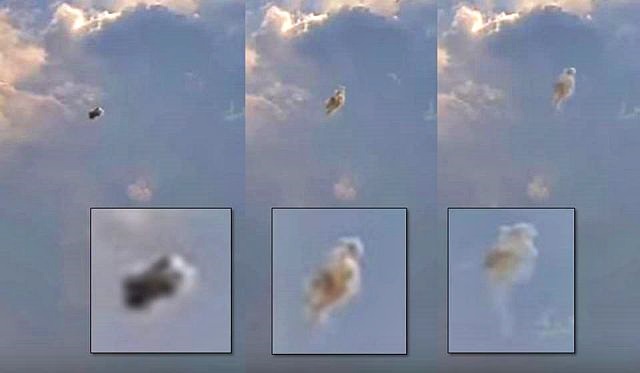
A strange object was allegedly observed coming out of a portal in the sky. While driving home, a couple from Alexandria, Louisiana claimed to have spotted a UFO appearing from a funnel below a circular cloud.

Popular conspiracy theory channel SecureTeam10 uploaded the video online. The narrator says the couple contacted them and described their experience.

According to the report, one of the pair stated that they were driving home when a white doughnut shaped cloud materialised in the sky.

The couple had got a photo of it before it got too dark. Moments later, they pulled into their driveway and got out of the vehicle. They saw the sky had gotten dark brown and noticed the vapour like funnel around the doughnut shaped cloud had started to come down from the centre. At the same time, an oval shaped translucent object that was surrounded by lights appeared at the bottom.

According to the witness, the UFO hovered long enough in the sky for them to take pictures before it disappeared.

{ http://www.latest-ufo-sightings.net/ }

Hoe vind je dit bericht?
Geschreven door peter om 22:12 Stuur door

Texas-Based Conspiracy Theorist and Famous Author Jim Marrs Dies

Texas-Based Conspiracy Theorist and Famous Author Jim Marrs Dies

Jim-Marrs

Favorite researcher and author Jim Marrs has died at the age of 73 this week. He is known for his research on theories surrounding the assassination of JFK and UFOs. According to the official Facebook page, he had been put on dialysis recently and died of a heart attack on Wednesday.

In late June, the Fort Worth-native posted a note on his official website that he needed to rest from work to address his health issues.

Marrs worked as a Forth Worth Star-Telegram staffer and a police and general assignmen reporter. The conspiracy theorist also had a stint in the Army in Vietnam. When he came back home, he started writing about military and aerospace technology.

Marrs worked as a chief consultant for the Oliver Stone film “JFK” in 1991. His book “Crossfire: The Plot That Killed Kennedy” became the basis for the movie. The 1989 book was a New York Times Paperback Non-Fiction Best Seller.

Starting in 1976, he had taught a course on the killing of the president in 1963 at the University of Texas at Arlington.

Every November 22, the anniversary of the assassination, Marrs had been the usual visitor in Dealey Plaza in Dallas talking to fans and the media in front of the so-called Grassy Knoll.

RIP

{ http://www.latest-ufo-sightings.net/ }

Hoe vind je dit bericht?
Geschreven door peter om 22:09 Stuur door

Close Encounters: About 5 Percent of UFO Sightings Are Real

UFO

Close Encounters: About 5 Percent of UFO Sightings Are Real

© Photo: Pixabay
 

UFOs – are they real? Do aliens exist? Sputnik discussed this with Austrian-based ufologist and radio host Tarek Al-Ubaidi who has interviewed many experts on the elusive creatures from other planets.

NATO Fighters Chased UFOs in Belgian Skies

“Rejecting the UFO phenomenon outright makes no sense. There are a lot of well-documented sightings during the so-called 'Belgian UFO Wave' of 1989-1992 including by military men, police officers and civilian and military pilots,” Tarek said.

In March 1990, Belgian Air Force radar operators at a NATO air surveillance center at Glons saw on their screens three unusual flying objects that had entered the country’s airspace.

A pair of F-16 fighter jets from nearby Beauvechain air base was scrambled to check out what was happening.

However, before the planes were able to close in on the unknown intruders, the UFOs suddenly disappeared from sight at a speed that the pilots said was much faster than what their combat aircraft could muster.

“According to an official statement by Belgian General Wilfried de Brouwer, one of the UFOs increased its speed from 240 kilometers an hour to 1,770 in a matter of just two seconds,” Tarek noted.

UFO Sightings: 95 Percent “False Alarm,” the Rest — “Mindboggling”

“Only about 5 percent of all UFO sightings worldwide can be termed UFO sightings because these flying objects are never identified. The remaining 95 percent turn out to be planes, satellites, meteorites or space junk,” Tarek explained.

“However, the remaining 5 percent are unidentified, and this is really fascinating,” he noted, adding that Britain and France now have documented cases of UFO sightings which have never been explained.

Eyewitnesses and Radar Screenshots “Are Not Always Informative Enough”

“I like interviewing people who have personally observed UFOs or are studying this phenomenon,” said Tarek, who is a certified telecommunications engineers and computer programmer.

He said that radar screenshots are not always reliable because there are ways to “spoof” radars by simulating and sending back reflections of objects, which are not really there.

“Only when I see an UFO optically, as an eyewitness, and also have a radar screen shot can I say that this object really existed,” Tarek said.

“Stories About Aliens” Are Just Part of the UFO Theory

“The mere fact that you have seen a UFO does not mean that those were aliens, or travelers in time. On the one hand we have cases of UFO sightings. On the other, I guess there are hundreds of thousands of theories about UFOs none of which has been proved,” Tarek continued.

He said that some ufologists explain such sightings as paranormal phenomena, something people have encountered for thousands of years, “not only since the 1947 Roswell incident when something fell in a New Mexico desert and we still don’t know what it was.”

Tarek hopes that he will live long enough to get the answer to this question. In the meantime, he keeps working and is preparing a new series of programs on this fascinating subject.

{ https://sputniknews.com/ }

Hoe vind je dit bericht?
Geschreven door peter om 01:04 Stuur door

That Allegheny magic: Where sightings of Bigfoot and UFOs abound

The Keystone Bigfoot Project, a Bigfoot sighting database, has recorded 43 reports of the creature in Allegheny County.story-portrait-layout-background.jpg
That Allegheny magic: Where sightings of Bigfoot and UFOs abound

On “The X-Files,” getting to the bottom of paranormal activity is easier said than done. When FBI agents Dana Scully and Fox Mulder stumble across phenomena that are difficult to explain, they fall back on the mantra that opens every show: “The truth is out there.”

But what if you live in Allegheny County, the region that leads Pennsylvania in reports of UFOs, Bigfoot and other weird sightings? Is the truth “here” instead of “out there”?

According to the National UFO Reporting Center and the Bigfoot Field Researchers Organization, our little corner of Western Pennsylvania is abuzz with unexplained paranormal phenomena. Allegheny County has had 315 UFO sightings compared with Bucks County, a suburb of our cross-state rival Philadelphia, at 216 sightings over the years.

As for Bigfoot, there have been six sightings of the primordial beast in Mercer, Cambria and Clearfield counties over several decades, according to the Bigfoot Field Researchers Organization.

That may not sound like much, but the rival Keystone Bigfoot Project charts neighboring Westmoreland County ahead of Allegheny County with 113 Bigfoot sightings compared with Allegheny County’s 43.

Fayette County rounds out the region with 36 Bigfoot sightings according to the KBP. Explaining the discrepancy in reported sightings by two Bigfoot organizations is to delve into the even deeper mystery of how reports of mythical creatures are gathered in the first place.

Given the ubiquity of smartphones, the greatest mystery of all is why it remains so difficult to get clear, indisputable images of UFOs, Bigfoot or any other unexplained phenomena. The truth could very well be out there, but it would make every skeptic’s life a lot easier if proof were somewhere out there, too.

{ http://www.post-gazette.com/ }

Hoe vind je dit bericht?
Geschreven door peter om 00:43 Stuur door

FORT WORTH - JFK conspiracy theorist and UFO author Jim Marrs has died

Jim Marrs was an author, collor and journalist. Family photo

FORT WORTH - JFK conspiracy theorist and UFO author Jim Marrs has died

In a 2003 Star-Telegram article, Marrs said lawyers, teachers, even an official with the Nuclear Regulatory Commission had taken his classes

“They, like myself, have a natural and, I think healthy, questioning attitude about all this,” Marrs said. “What I tell people is, ‘Don’t come here expecting me to have all the answers.’ ”

But Marrs left no doubt that he believed that humans weren’t the only intelligent life in the universe.

“There’s definitely something out there in the air,” he said. “But I don’t think there’s anything to fear here.”

Marrs was born Dec. 5, 1943, in Fort Worth. He earned a degree in journalism from North Texas State (now the University of North Texas) and attended graduate school at Texas Tech University in Lubbock. In recent years, he had been a fixture on the overnight talk show Coast to Coast, and he also appeared on Alex Jones’ Infowars.

His wife, Carol, said they met on a blind date while going to college in Denton. They have been inseparable since that first date.

“I just remember how funny he was,” Carol Marrs said. “I don’t think about the conspiracy part, although he was an excellent teacher. His mission in life was to pursue the truth.”

While he was known for all of his publications, Marrs was also an avid Civil War re-enactor and a World War II history buff.

“He had his own cannon and, on the Fourth of July, we would fire it off,” Carol Marrs said. “You can do that when you live in the country. But he was almost a pacifist. He didn’t believe we should be in a war unless you were defending your home.”

Among his books were “Crossfire: The Plot That Killed Kennedy,” which reached The New York Times paperback nonfiction bestseller list. Other titles include: “Alien Agenda” (1997); “Rule by Secrecy” (2000); “The Terror Conspiracy Revisited” (2007); “The Rise of the Fourth Reich” (2008); “The Trillion-Dollar Conspiracy” (2010); “Our Occulted History” (2013); “Population Control” (2015); and his last book, “The Illuminati” (2017).

Survivors include two daughters, Cathryn Lafitte and Jayme Castle, as well as three grandchildren.

A private service is planned, according to Alexander’s Midway Funeral Home in Springtown, but Carol Marrs said the family is planning a gathering at their Wise County home next month.

Bill Hanna: 817-390-7698, @fwhanna

Hoe vind je dit bericht? 1 stem
Geschreven door peter om 00:32 Stuur door

People in These Regions Will Face 'Unsurvivable' Heat by 2100

Spatial distribution of highest daily maximum wet-bulb temperature, TWmax (°C), in modern record (1979–2015). Global distribution of TWmax is computedusing ERA-Interim 3-hourly data with 0.75° × 0.75° horizontal resolution. The enlarged domain highlights three distinguishable regions with higher TWmax: southwest Asiaaround the Persian/Arabian Gulf and Red Sea, South Asia in the Indus and Ganges river valleys, and eastern China. TWmax values below 27°C are not shown.

In the future, parts of the world will become so hot and humid that healthy adults sitting in the shade will die within a matter of hours. It’s hard to imagine, and yet that’s where Earth’s climate is headed, perhaps sooner than expected.

New research, published Wednesday in Science Advances, found that 75 percent of the population of South Asia will experience extremely dangerous heat waves by 2100 if no action is taken to fight climate change. Four percent will experience unsurvivable heat — that’s 69 million people at today’s population level.

The Indus and Ganges river valleys, spanning southeast Pakistan, northern India, and Bangladesh, have a disastrous combination of a densely populated, vulnerable population and extreme, humid heat. In these parts of the world, extreme heat is already frequent and deadly. A 2015 heat wave that covered large parts of India and Pakistan killed an estimated 3,500 people.

Spatial distribution of highest daily maximum wet-bulb temperature, TWmax (°C), in modern record (1979–2015). Global distribution of TWmax is computedusing ERA-Interim 3-hourly data with 0.75° × 0.75° horizontal resolution. The enlarged domain highlights three distinguishable regions with higher TWmax: southwest Asiaaround the Persian/Arabian Gulf and Red Sea, South Asia in the Indus and Ganges river valleys, and eastern China. TWmax values below 27°C are not shown. These are the highest recorded wet-bulb temperatures through 2015 in degrees Celsius. 

While most climate change studies look only at temperature, this one uses a different measure that accounts for the impact of humidity on the ability of humans to cool themselves off through sweating. It’s called wet-bulb temperature, and it measures how hot the air would be if cooled through the evaporation of water until it reaches 100 percent humidity.

When humans sweat, that moisture evaporates into the air, which transfers heat energy away from the skin. However, when the wet-bulb temperature reaches the temperature of the skin, at about 95 degrees Fahrenheit, it becomes impossible for heat to move away from the body in this way. Even if enough sweat could be produced to bring the surrounding air to 100 percent humidity, the air would still be hotter than the skin, and no energy would leave the body. Previous research has estimated that a healthy human could survive a maximum of six hours in these conditions — which means find a cooler spot, or die.

A wet-bulb temperature of 95 degrees has never been recorded, but parts of the world have hit 89 degrees, which is already extremely dangerous to any human who is exposed to it for more than a short period of time. The hottest wet-bulb temperatures in the world are found in the Persian/Arabian Gulf, in the northern parts of South Asia, and in Eastern China.

This study focused on South Asia — defined as the countries of Pakistan, Indian, Bangladesh, Nepal, and Sri Lanka — because here there is a coincidence of very high wet-bulb temperatures and a dense population of relatively poor, rural people. That makes this the most vulnerable part of the world to future deadly heat waves.

The spatial distributions of bias-corrected ensemble averaged 30-year TWmax for eachGHG scenario: HIST (1976–2005) (B), RCP4.5 (2071–2100) (C), and RCP8.5 (2071–2100) (D). Maps show wet-bulb temperature maximums in Celsius in the historical record (B); and projected to 2100 under aggressive climate change action (C); and limited climate action (D). At 35 degrees, humans can only survive a few hours.

If there’s a glimmer of hope, it’s that the researchers found a very significant difference in outcome if the world bands together to aggressively fight climate change. With concerted action to limit greenhouse gas emissions, none of South Asia would surpass the unsurvivable threshold by 2100, although 55 percent of the population would still be exposed to extreme wet-bulb temperatures of 88 degrees or higher.

In any case, humans living in very hot and humid parts of the world will be forced to adapt. That will mean air conditioners for those who can afford it and, likely, communal cool spaces for emergencies. At the most extreme, we may see mass migrations of climate change refugees away from regions of the world that have become literally unsurvivable.


Abstract

The risk associated with any climate change impact reflects intensity of natural hazard and level of human vulnerability. Previous work has shown that a wet-bulb temperature of 35°C can be considered an upper limit on human survivability. On the basis of an ensemble of high-resolution climate change simulations, we project that extremes of wet-bulb temperature in South Asia are likely to approach and, in a few locations, exceed this critical threshold by the late 21st century under the business-as-usual scenario of future greenhouse gas emissions. The most intense hazard from extreme future heat waves is concentrated around densely populated agricultural regions of the Ganges and Indus river basins. Climate change, without mitigation, presents a serious and unique risk in South Asia, a region inhabited by about one-fifth of the global human population, due to an unprecedented combination of severe natural hazard and acute vulnerability.

Photos via Science Advances

{  https://www.inverse.com/science }

Hoe vind je dit bericht?
Geschreven door peter om 23:52 Stuur door

Antieke bouwstenen van ons zonnestelsel gevonden in de asteroïdengordel

{ https://www.scientias.nl/ }

Hoe vind je dit bericht?
Geschreven door peter om 23:39 Stuur door

Spectaculaire storm ontdekt op de evenaar van Neptunus

{ https://www.scientias.nl/ }

Hoe vind je dit bericht?
Geschreven door peter om 23:32 Stuur door

Venus had in een ver verleden mogelijk een oceaan

Hoe vind je dit bericht?
Geschreven door peter om 23:19 Stuur door

Gloeiendhete stratosfeer ontdekt rond een enorme exoplaneet

{ https://www.scientias.nl/ }

Hoe vind je dit bericht?
Geschreven door peter om 22:57 Stuur door

Eindelijk een animatie die klimaatverandering écht duidelijk in beeld brengt

{ https://www.scientias.nl/ }

Hoe vind je dit bericht?
Geschreven door peter om 22:44 Stuur door

Onderzoekers staan op het punt geheime kamer te vinden in Grote Piramide. Wat gaan ze aantreffen?

Onderzoekers staan op het punt geheime kamer te vinden in Grote Piramide. Wat gaan ze aantreffen?

Onderzoekers staan op het punt geheime kamer te vinden in Grote Piramide. Wat gaan ze aantreffen?

Experts denken op het punt te staan een verborgen ruimte te ontdekken in de Grote Piramide van Gizeh. Dat schrijft de Daily Mail.

Met behulp van infrarood thermografie zoeken archeologen van het project ScanPyramids naar verborgen kamers in de piramide.

De Grote Piramide is 146 meter hoog en was duizenden jaren lang het grootste door mensen gemaakte bouwwerk.

Exacte locatie

“Alle apparaten die we gebruiken zijn ontworpen om de locatie van de ruimte te vinden,” zei Mehdi Tayoubi van ScanPyramids.

“We weten dat er tenminste één is, maar we proberen de exacte locatie te achterhalen,” voegde hij toe.

Sommige archeologen hopen de geavanceerde technieken te gebruiken om de begraafplaats van de legendarische koningin Nefertiti te vinden.

Op zoek

Een Britse egyptoloog, Nicholas Reeves, gelooft namelijk dat haar resten verborgen zijn in een geheime kamer in de tombe van Toentanchamon.

Een team van de Polytechnische Universiteit van Turijn is nu van plan op zoek te gaan naar de resten van Nefertiti. Het onderzoeksteam wil echter niet veel kwijt over de zoektocht.

Vorig jaar zei de Egyptische minister van Oudheden Mamduh al-Damati dat de kans dat zich achter de graftombe van farao Toetanchamon twee geheime kamers bevinden 90 procent is.

Big bang

Hij baseerde zijn uitspraak op nieuw radaronderzoek dat was uitgevoerd door Japanse experts.

De Egyptische minister van Toerisme Hisham Zaazou liet zich toen al enthousiast uit over de mogelijke ontdekking van een geheime kamer achter de tombe van Toetanchamon.

Hij sprak van ‘de ontdekking van de 21e eeuw’ die ‘voor een big bang zal zorgen’.

[Daily Mail] 

Hoe vind je dit bericht?
Geschreven door peter om 22:20 Stuur door

SPECTACULAIRE TOENAME VREEMDE FENOMENEN IN DE LUCHT ( VIDEO )

SPECTACULAIRE TOENAME VREEMDE FENOMENEN IN DE LUCHT ( VIDEO )

at3.jpg

Tot niet zo lang geleden kwam het wel eens voor dat iemand iets vreemds aan de lucht waarnam. 

Het lijkt echter alsof dit de laatste weken in een stroomversnelling gaat met steeds meer mensen die een zon in het oosten zien ondergaan. 


Net zoals bij ons de lucht wordt vol gesproeid met chemtrails, zo gebeurt dat natuurlijk ook in Amerika. En net zoals bij ons is dit verschijnsel de ene dag heftiger dan de andere. 

Enkele dagen geleden merkten bewoners op dat er die dag wel heel erg intensief gesprayd werd, zoals te zien op de volgende foto uit Atlanta die rond drie uur ’s middags is genomen.


xxx

Enkele uren later wordt in de staat Pennsylvania een vreemd regenboogkleurig verschijnsel waargenomen in de lucht. Iets wat we ook de laatste steeds vaker hebben zien.

xxx

Dan wat later, tegen de tijd dat de zon ondergaat wordt er een enorme straal in de lucht gezien die niet afkomstig lijkt van de zon.

xxx


xxx

Wat trouwens niemand opgemerkt schijnt te hebben tot nu toe, is dat er op bovenstaande foto duidelijk een UFO te zien is.

xxx

Een ander fenomeen dat wel wat overeenkomsten heeft met bovenstaande werd waargenomen op diverse plekken in Amerika. Wanneer ergens een regenboog verschijnt, lijkt het alsof er een soort donkere banen/stralen deze regenbogen kruizen.

xxx

Op dezelfde dag, maar iets eerder vanwege het tijdsverschil, werden boven Europa enorme sprites waargenomen.

xxx

Sprites of Red Sprites zijn een soort stratosfeerontlading. Het zijn elektrische ontladingen boven cumulonimbus-wolken en kunnen een hoogte bereiken van 95 kilometer. Ze zijn zichtbaar als rood-oranje, zwakke, lichtgevende flitsen die zeer kort duren en weliswaar voor het blote oog zichtbaar zijn, maar die men niet kan volgen. 


Het is sowieso een zeldzaam verschijnsel, maar deze boven Europa waren ook nog eens enorm groot. 

Regelmatig komen er nu berichten van mensen de een soort angstaanjagende kleur rood in de lucht waarnemen zoals te zien op de volgende afbeelding.


xxx

Ook steeds vaker wordt er wereldwijd melding gemaakt van een tweede lichtbron zoals te zien op de volgende foto die in februari is genomen in Engeland. 

Links een lichtbron en een stuk verder naar rechts eveneens een lichtbron.

xxx

Ieder week neemt het aantal mensen toe die een zonsondergang zien in het westen, maar tegelijkertijd ook in het oosten. 

Zoals deze eergisteren. 


Of deze, enkele dagen geleden. 

 
Of deze, ook enkele dagen geleden. 


Deze van ongeveer een week geleden spreekt van non solar rays in the east, oftwel het ziet eruit als zonnestralen in het oosten, maar ze zijn niet afkomstig van de zon. 


De laatste maanden zijn dit soort beelden vaker te zien geweest, maar incidenteel. Nu kom je ze bijna iedere dag tegen, zoals deze enkele dagen geleden. 


Van een lezer uit Friesland (dank!) ontvingen wij het volgende bericht:

Vanavond, 4 augustus omstreeks kwart over 9 keek ik door het raam naar buiten en zag ik een rare lucht. Voor me zag ik een hele paarse wolk terwijl de lucht verderop normale zonsondergang vertoonde. Later trok de wolk normaal bij. Ik dacht eerst dat er een flinke bui aan kwam, maar op Weeronline was helemaal niets te zien. Later was de lucht normaal en donker bewolk

xxx

En dan kan het nog altijd vreemder zoals blijkt uit een ander bericht dat wij ontvingen (dank!).

Ik had gisteren een vriend op bezoek uit Senegal. 

Hij liet mij een foto zien die in Senegal is gemaakt op 28 juli JL. van een groot aantal vissen die uit de lucht vielen. 

Ik zei nog tegen hem is het geen grapje. Hij vertelde nog dat de mensen massaal stopten langs de autobaan om te kijken. En tot nu toe is ook daar niemand met een verklaring gekomen.

xxx

{

Hoe vind je dit bericht?
Geschreven door peter om 21:44 Stuur door

RED ALERT: EUROPE IS HOT AS HELL AMID LUCIFER HEATWAVE

RED ALERT: EUROPE IS HOT AS HELL AMID LUCIFER HEATWAVE

700_8637e36c10fa5676da26f27977d4836e.jpg?v=1501956573

Heatwave Lucifer strikes Europe as scientists warn it could get much worse.

Ten countries in south and central Europe have declared a red alert after a heatwave referred to as ‘Lucifer’ has covered the continent and caused temperatures to skyrocket to around 40 degrees Celsius. 

UP TO 150,000 PEOPLE A YEAR COULD DIE

Unfortunately, scientists have warned that this trend could continue in the future and may well last for at least a hundred years. If something is not done to stop the trend, scientists warn, 152,000 people a year could die from the effects of the extreme heat. 

According to the European forecast network Meteoalarm, Italy, Switzerland, Hungary, Poland, Romania, Bosnia-Herzegovina, Montenegro, Croatia, Slovenia, and Serbia have all be placed on a red alert. In addition to that, Greece, Spain, Bulgaria, France, Macedonia, Slovakia, and Moldova have all been placed on orange alert, and people have been warned that the weather situation has the potential to become much worse. The recent spate of heatwaves across the continent has caused the deaths of two people, one in Romania and one in Poland, and many others have been sent to hospital suffering from the effects of sunstroke. The public in Serbia, Bosnia, Macedonia, and Croatia have been advised to stay inside to avoid the heat which is expected to stay at intense levels for the rest of the following week.

According to the Lancet Planetary Health Journal, heatwaves, which are the most potentially dangerous of all weather phenomena are bound to increase in frequency and intensity over the coming century. The scientists warn that by the year 2100, the incidence of heatwaves was likely to increase fifty-fold. In addition to that, Europe is likely to see an increase in cold waves, wildfires, droughts, river and coastal floods and windstorms. It is also believed that the problem will spread and that two thirds of the continent could be facing the problems caused by extreme weather by the end of the twenty first century.

The researchers say that the only way to avoid this potentially catastrophic situation is to take urgent and decisive action to stem the rise of global warming in the western world.

It's another day in southern & eastern Europe - temps into the low 40s in parts of , around 6C above average

RELATED ARTICLES

{ http://www.disclose.tv/ }

Hoe vind je dit bericht?
Geschreven door peter om 21:24 Stuur door

STEPHEN HAWKING: ARTIFICIAL INTELLIGENCE AND ROBOTS WILL DECIMATE MIDDLE CLASS JOBS

STEPHEN HAWKING: ARTIFICIAL INTELLIGENCE AND ROBOTS WILL DECIMATE MIDDLE CLASS JOBS

700_89798d37b64502ad10d5df034fec04c3.jpg?v=1501949500

Anyone remember the movie I Robot where artificial intelligence was being used by man to do various jobs such a construction, and household work. Than things got ugly as the robots started to take over, now believing they were better than man kind, so before long became violent and revolted.

This is just a movie right, but what if something like this were to really happen. Turns out that  

STEPHEN HAWKING VOICE WARNING ON AI TECHNOLOGY

Alright, a science fiction movie, and what does this have to do with Artificial Intelligence as we now know it? Well, it turns out there there is a major concern that sometime in the future artificial intelligence will start taking over those jobs now handled by man. For businesses this is a great solution, no longer having to pay a wage to people dealing with the personal issues of individuals, perhaps giving out benefits such a health care or vacation time. Great solution, right for the business but not for the economy or individuals themselves.

RELATED ARTICLES

Let's face it the job market is already competitive, and there are already so many jobs to go around. So, imagine if those jobs that the middle class and lower middle class filled even to try to make ends meat each month were now being taken by robots. What do these individuals now do, how do they pay their bills how do they support their families, this isn't a pretty picture and certainly cause for alarm.

So, it any wonder that some experts including fame author and physicist Stephen Hawking have come out against such a thing happening. In an interview with the guardian, Professor Hawking voiced great concern over Artificial Intelligence taking over jobs that human now does, in one spot he was quoted as saying:

“The automation of factories has already decimated jobs in traditional manufacturing, and the rise of artificial intelligence is likely to extend this job destruction deep into the middle classes, with only the most caring, creative or supervisory roles remaining.”

The frightening thing is that again the Professor has been proven right there are jobs that have already become more or less obsolete the more technology takes over. In another part, Hawking was quoted as saying something even more disturbing and cause to think.

"“We are living in a world of widening, not diminishing, financial inequality, in which many people can see not just their standard of living, but their ability to earn a living at all, disappearing. "

For years now Stephen Hawking has been someone who has spoken the truth. His insights on the world are something we have grown to respect, and no doubt he should again be respected here. After all, we our technology, but how much of our lives do we plan to turn over to it? It's one thing when we are in control when we are allowed to continue to lead our lives; it's another when we turn our lives completely over to the technology at hand. So, it's wise to again listen to the words of Stephen Hawking, again he knows what he is talking about.

RELATED ARTICLES

{ http://www.disclose.tv/ }

Hoe vind je dit bericht?
Geschreven door peter om 20:38 Stuur door

GOOGLE NOW TARGETS 'CONSPIRACY THEORY WEBSITES' AND UFOS IN LATEST UPDATE

GOOGLE NOW TARGETS 'CONSPIRACY THEORY WEBSITES' AND UFOS IN LATEST UPDATE

700_de7d01c934a121703834da2c372e033c.jpg?v=1501953339

Google is again stepping up their censorship regime on the Internet. The quality raters guidelines of Google have been updated July 27, 2017.

This latest update brings many changes, but the biggest is conspiracy theory websites and results in non-English language.

QUALITY RATERS GUIDELINES OF GOOGLE UPDATED TO SHOW CONSPIRACY THEORIES

The change to the quality raters guidelines means that "conspiracy theories" that are unsubstantiated are shown as if the information in them is a fact.  

CONSPIRACY THEORIES INCLUDE VATICAN KNOWING ABOUT ALIEN EXISTENCE

For instance, there is a page that shows theories that are not supported which are about the Vatican, knowing about the existence of Nibiru, world events that have not occurred yet and even the existence of aliens. It goes as far as quoting officials from the Vatican, along with scientists, but the quotes do not seem to give support to the claim of the article, and sometimes the quotes are not from the person who it was said to be.

RELATED ARTICLES

The Nibiru cataclysm along with events related to it have always been "debunked" by sources in authority. The content that is shown on the page, therefore, shows information that is inaccurate and which misinforms those reading. So, no more UFO related stories to be found on Google soon!

GOOGLE IS TURNING INTO A GIANT 'CENSORSHIP ENGINE'  

PAGES CONTRADICT FACTS THAT ARE HISTORICAL

Pages contradicting historical facts that have been well established, for instance, conspiracy theories that are unsubstantiated, unless of course, the query has indicated that the person is looking for a viewpoint that is alternative. So websites are posting conspiracy theories that have unsubstantiated, and they are being shown as if that information is fact.

Ratings are more difficult if the query being searched for has English words and names in it or if it is not clear on whether any English results would seem to be satisfying for a query. Therefore people might want to show judgment and rely on their knowledge of a particular location when it comes to determining the appropriate rating.

People should also bear in mind that each locale is going to have considerations that are unique in regards to the variety of languages and the numbers; these could be local dialects, languages that are regional and official. Also factoring in are the keyboard input language that is in use and the writing systems.

The guideline might not show examples of your particular locale. However, it is important users in the same task location along with culture are represented so that queries can be interpreted and the results rated. If there is any doubt, then it was said that it should be assumed that the user would want to see results that are in the task language, unless it has been stated otherwise.

YOUTUBE HAS ALSO STEPPED UP THE CENSORSHIP OF SO-CALLED "CONTROVERSIAL CONTENT" LAST WEEK: 

GOOGLE ALTERNATIVE: DUCKGOGO

DuckDuckGo is the search engine that doesn't track you. They protect your search history from everyone – even from them. In addition, the DO NOT censor any content like Google does, the best results are shown to you.

Give it a try at: https://duckduckgo.com/

RELATED ARTICLES

{ http://www.disclose.tv/ }

Hoe vind je dit bericht?
Geschreven door peter om 20:19 Stuur door

Be Aware! Earth's Resonance Frequency is accelerating as fast as 40 Hertz!

Be Aware! Earth's Resonance Frequency is accelerating as fast as 40 Hertz!

The Schumann resonances (SR) are a set of spectrum peaks in the extremely low frequency (ELF) portion of the Earth's electromagnetic field spectrum. Schumann resonances are global electromagnetic resonances, generated and excited by lightning discharges in the cavity formed by the Earth's surface and the ionosphere.

Earth%2527s%2BResonance%2BFrequency%2BSchumann%2BResonance.jpg

For many years this resonance frequency has hovered at a steady 7.83 Hz with only slight variations. In June 2014 that apparently changed. Monitors at the Russian Space Observing System showed a sudden spike in activity to around 8.5 Hz. Since then, they have recorded days where the Schumann accelerated as fast as 16.5 Hz.

But now Earth's harmonic OHM or vibration is at unprecedented levels today. The Schumann Resonance accelerated as fast as 40 hertz which is a major frequency rise, but nobody understands why!

This frequency does affect every living creature on the earth. Science has proven our brainwaves strongly respond to this energy, this frequency. Sometimes this can come with anxiousness, along with many other feelings and emotions. Try not to be too eager to over react to situations, sit back for a minute and think things through completely, be rational and you know the drill...be wise.

You are aware of why this is happening and use this knowledge to help others that may not know what the Schumann Resonance is, try and explain to them what this frequency shift is and how it affects them, all of us. Be safe out there...

  
Hoe vind je dit bericht?
Geschreven door peter om 18:38 Stuur door

The never-ending search for UFOs and extraterrestrial intelligence

The never-ending search for UFOs and extraterrestrial intelligence

AP_6603250199.jpg?uuid=gLevaHYoEeeIOexI7EyuJQ
J. Allen Hynek was hired as an Air Force astronomer to debunk the myth of UFOs but later on became a UFO believer.
(Alvin Quinn/AP/AP)

Sarah Kaplan is a science reporter for The Washington Post.

Back in 1950, during a lunch break at the Los Alamos National Laboratory, several scientists were trading wisecracks about a recent spate of UFO reports when Nobel Prize-winning physicist Enrico Fermi offered an observation that has echoed through the decades. Given the number of places where life could exist in the vast universe, and the length of time it has had to evolve, the skies ought to be teeming with beings from advanced, space-faring civilizations — but nothing incontrovertible has shown up. You have to wonder, as Fermi did, “Where is everybody?”

His colleagues chuckled, but the “Fermi paradox” perfectly frames the profound absurdity of the search for life beyond Earth. Humans have beamed beacons into space, robotically visited every world in the solar system and discovered thousands of planets circling stars far from our own. Yet all we’ve encountered is a chilly void.

Still, the possibility that something is out there calls to us.

“The Close Encounters Man: How One Man Made the World Believe in UFOs,” by Mark O'Connell (Dey Street)

Three new books approach the mystery from distinctly different perspectives: the unlikely believer in UFOs, the visionary dedicated to rigorous investigation and the cadre of scientists who still plug away at the problem, probing the universe for an answer.

In “The Close Encounters Man: How One Man Made the World Believe in UFOs,” screenwriter Mark O’Connell recounts the gradual evolution of J. Allen Hynek, an Air Force astronomer, from UFO debunker to believer. Hynek’s tale unfolds a few years before Fermi posed his question, when aliens were much on the minds of Americans. In the summer of 1947, a Boise businessman piloting a small plane across the Cascade Mountains spotted a chain of unidentified flying objects weaving among the peaks. Shortly after, Alabamians reported that brilliant lights appeared over an airfield in Montgomery. Then a swarm of wingless machines was spotted in Maine.

Baffled by these bizarre accounts, the Air Force decided that someone had to sort through all the sightings — if only to prove that they weren’t really extraterrestrials.

So they hired Hynek, an alum of the University of Chicago and a former civilian scientist for the Navy who previously was best known for studying the evolution of stars. Methodical and undogmatic, Hynek could not have been further from the kooky, paranoid stereotype of a UFO enthusiast. He seemed to be exactly the man who could be counted on to dismiss the phenomenon.

Instead, he became its biggest advocate.

“I was somewhat like the proverbial ‘innocent bystander who got shot,’ ” Hynek would later say.

After researching thousands of UFO reports, many from apparently credible witnesses, Hynek became convinced that a significant fraction of sightings could not be explained by current science.

The Air Force, however, disagreed. In 1970 it discontinued its UFO investigations, having concluded that the phenomenon was largely a result of pranksters, psychological experiences and tricks of light.

Undeterred, Hynek established his own Center for UFO Studies and developed a system for classifying these “close encounters” that inspired the 1977 film “Close Encounters of the Third Kind.” Hynek died in 1986 still convinced that UFOs were something “exotic.”

It’s clear that O’Connell, who maintains a UFO blog of his own, wants readers to come away from his book agreeing with Hynek. He derides mainstream astronomers who mock UFOlogy as pseudoscience and reserves special venom for Carl Sagan, who spoke so eloquently about the potential for life in the universe but was unwilling to believe that extraterrestrials might have visited Earth.

I’m inclined to side with Sagan — the human mind is far too easily deceived for this science reporter to believe that rogue aliens offer the most persuasive explanation for strange apparitions in the skies. If there really are advanced beings out there, traversing the universe at the speed of light, it seems unlikely that scaring suburbanites and confusing livestock are the best uses of their time.

But reading “The Close Encounters Man” does engender respect for its subject. “Hynek was a rational person looking at an irrational subject,” James Oberg, a science journalist, NASA engineer and longtime UFO doubter, tells O’Connell. He approached the UFO problem as a scientist would. And although aliens didn’t actually invade America, Hynek — with a little help from Steven Spielberg — helped them invade the American psyche. He got us thinking about encounters with ET, paving the way for a more scientific approach to the search for extraterrestrial intelligence, or SETI.

Shortly after the Air Force gave up on UFOs, NASA commissioned a study of the best methods for seeking out alien life. The resulting report argued for using radio telescopes to listen for the kinds of electromagnetic signals that would emanate from an advanced civilization in space. If we still haven’t seen aliens in person, the thinking went, perhaps we might be able to hear them.

That report landed in the lap of a young astronomer named Jill Tarter, who, like Hynek, had started her career observing distant stars.

In “Making Contact: Jill Tarter and the Search for Extraterrestrial Intelligence,” science journalist Sarah Scoles writes that the astronomer was instantly “converted.” As Tarter told Scoles, “I just knew I’d found the right place, never having thought about it before.” Whereas her work on stars had felt distant and abstruse, SETI gave Tarter a sense of purpose. She went on to direct the first targeted effort to detect extraterrestrial signals and helped found the SETI Institute — now an authority on the search for alien life.

“There was a feeling of connectedness,” Tarter said of this research. “I was doing something that could impact people’s lives profoundly in a short time.”

It’s a noble motivation, and Scoles — who narrates her story in a warm, chatty tone — clearly thinks Tarter is a hero. But the SETI pioneer’s biggest enemies are decidedly prosaic: narrow-minded, sexist male colleagues who try to tell Tarter she doesn’t belong in science; sneering politicians who deny SETI funding to make a political point; seemingly exotic radio signals that turn out to come from ordinary satellites.

Tarter is now celebrated as a pioneer and a feminist icon; she was the inspiration for Jodie Foster’s character in the movie “Contact.” But her story lacks a triumphant ending. She retired in 2012, never having heard the signal she spent her life listening for.

SETI research is a far cry from UFOlogy. But it’s impossible to ignore the similarities between Tarter and Hynek. Both were ordinary astronomers who happened upon the alien question and never let go, regardless of the indifference, derision and outright hostility they encountered. Both devoted their lives to the idea that, as the saying goes, absence of evidence isn’t evidence of absence. Even though absence is all either ever found.

Which brings us back to Fermi’s paradox. More than a half century of sustained scientific research has uncovered neither hide nor hair — or whatever — of extraterrestrial life. Does that mean there’s nothing to be found?

“Aliens: The World’s Leading Scientists on the Search for Extraterrestrial Life” lays out the case for optimism in a collection of essays. The world in which this book was published is one that Hynek and Tarter helped make. Chris French, the head of anomalistic psychology research at Goldsmiths, University of London, uses Hynek’s “close encounters” scale to discuss psychological phenomena that can explain such experiences. Two of the essays were written by scientists at Tarter’s SETI Institute.

The other contributors include experts from astronomy, cosmology, planetary science and genetics, as well as fields that didn’t even exist when Hynek and Tarter began their work — astrobiology and exoplanet research. Together, they provide an overview of where the search for alien life now stands.

Advances in biology on Earth have expanded our notion of where and how life can thrive. Meanwhile, exploration of space has identified places in our solar system and beyond that could be (or once were) hospitable to alien organisms. Mars used to boast an atmosphere and flowing water; the moons of Jupiter and Saturn harbor hidden subsurface oceans and liquid methane lakes. Our growing catalogue of exoplanets suggests that most stars in the galaxy host planets on which life could conceivably form. When the James Webb Space Telescope launches in 2018, scientists will be able to probe the atmospheres of those planets in pursuit of “biosignatures” — molecules that are thought to signal the presence of life.

No one has an answer to the question: “Where is everybody?” But scientists do have plenty of places to look. Perhaps, someday in the not-too-distant future, they’ll receive that long-awaited radio beacon from a distant galaxy. Or look through a microscope at a water sample from an ocean moon and find microbes swimming around. Or detect a haze of “biosignatures” in the atmosphere of an alien world.

Or, hey, maybe an unidentified flying object will appear suddenly in the sky one day when we least expect it. A crowd will gather, a hatch will open and, finally, a little green man will step out to reassure us we’re not alone.

{ https://www.washingtonpost.com/ }

Hoe vind je dit bericht?
Geschreven door peter om 01:25 Stuur door

Where our Curiosity took us

Five years of roaming on the surface of Mars.


It has been five years since NASA’s Curiosity rover touched down on Mars, lowered to the surface of the planet by a rocket-powered crane in a sequence scientists dubbed the “seven minutes of terror”.

Terror, because of the risk of it all going wrong when you drop a $2.5 billion rover on an alien planet.

And seven minutes, because that is how long it would take a signal to reach Earth telling the scientists whether or not the car-sized Curiosity had survived the landing.

After approaching the planet at 21,000 kilometres per hour, the heat shield separated and a parachute — then reverse rockets — fired in succession, slowing the craft down until it hovered metres from the ground.

Then using a mothership called the Sky Crane, suspended in the air by rocket thrusters, Curiosity was slowly brought down to the surface using a never-before tested tethered crane system.

On August 6, 2012, the world waited…

Success came seven minutes later and soon Curiosity began sending its first data and photos back to Earth from its new home.

Location: Gale Crater, base of Mt Sharp

Temperature: -60 degrees Celsius (average)

Atmosphere: 100 times thinner than Earth’s

Length of day: 24hr 37min

The real mission begins

“We spent so many years being so nervous about whether the choice of Gale Crater was right, and whether the mission would land successfully, and whether it would find anything related to habitability,” chief scientist for the mission Ashwin Vasavada said.

Curiosity’s task: determine Mars’ habitability using its 11 different scientific instruments, including three cameras to take detailed images of the landscape, and sensors to analyse rock samples, sniff the atmosphere for organic molecules and detect radiation levels on the planet’s surface.

Since August 2012, the rover has been exploring what lies above and below the surface of the red planet, looking for evidence of the chemical building blocks needed for life, including traces left behind by water.

Travelling at a glacial speed of about 30 metres per hour, Curiosity has ventured 17 kilometres from its landing site in its search.

Dr Vasavada said so much of what NASA had hoped for had come to fruition.

From the flat landing site, Curiosity began its meandering trip past landmarks on a trek towards Mount Sharp, where the layers of rocks and material change with altitude

Mount Sharp rises 5.5 kilometres high from the centre of the crater. The mountain’s base was formed from sedimentary layers rich in clay and sulphur that were deposited there long ago by flowing water.

The water may be long gone, but evidence of the three-billion-year-old lake bed remains.

Drilling into the past

It did not take long for the rover to mine scientific gold.

Methane and elements such as nitrogen, hydrogen and carbon — all crucial to the creation of simple microbes — were found after the rover drilled into rocks and sniffed the planet’s atmosphere.

Samples also revealed that Yellowknife Bay, near the landing site, was once part of an ancient river system.

In the years since, Curiosity has collected key evidence from 3.5 billion-year-old rocks that life may have once existed on Mars.

These sediment samples are also reshaping our understanding of how long liquid water persisted on Mars.

The lakes and streams could have existed on the planet’s surface for millions of years, Dr Vasavada said.

“The mountain itself, the base of the mountain, is lake sediment, layer after layer after layer for about 200 vertical metres,” he said.

“[It would take] about a million years or more for lakes to be able to deposit that much sediment.”

That timescale is key to the viability of the environment for supporting life.

The sediment layers show habitability was present not for an instant, but at a timescale where you can start to imagine life originating and evolving, Dr Vasavada said.

“The timescale of the habitability and water is the most ground-breaking new result for Mars.”

But finding out that Mars had flowing water for such a long time has upturned what we used to think about the red planet’s climate. Had Mars actually been warm?

Climate debate

A common theory had been that Mars was cold, and any liquid water on the planet’s surface only flowed when a meteorite struck or a volcano erupted.

However, Curiosity’s evidence about the length of time water existed on the surface of Mars “throws a wrench” in that theory, Dr Vasavada said.

“The evidence from Curiosity … suggests the lakes were present and open to the atmosphere, they weren’t protected by an ice cover for millions of years,” he said.

But if the planet used to be wet that presents scientists with another conundrum.

For there to be flowing water, you would expect the atmosphere was once much thicker than it is today and had large amounts of carbon dioxide to trap heat and warm the planet.

Analysis of gases in Mars’ atmosphere by Curiosity and another spacecraft called MAVEN indicate much of the carbon dioxide was blown away by the solar wind.

However, rock samples have not turned up much in the way of carbonate minerals, which you would expect to find if that was the case.

Dr Vasavada said it was an ongoing area of investigation for NASA.

“Curiosity’s data really re-opens the idea that we haven’t figured out how yet, but Mars maybe actually was warm in its climate,” he said.

Curiosity’s nuclear power source will eventually wear down, but Dr Vasavada hopes the rover will continue talking to him for at least another five years, likely longer.

The rover is currently about 250 metres up Mount Sharp, but making it to the top was never the goal.

“Most of the really good stuff is in the bottom several hundred metres,” Dr Vasavada said.

It has still got a trek ahead to reach the endgame of its mission — a “treasure trove of ancient habitability” in a layer of clay minerals a few hundred metres farther up.

2020 and beyond

Despite its achievements, Curiosity is only the middle chapter of NASA’s Mars exploration program.

It started with orbiters mapping the planet, then twin rovers Spirit and Opportunity arriving to search for evidence of sustained water.

Curiosity has built on their work in showing that Mars could have been habitable at some stage of its life.

And next? Scientists want to look for more sophisticated evidence that ancient life once existed, such as finding amino acids — the building blocks of proteins.

That will be the task of the 2020 rover.

In that way, each subsequent mission builds off the findings of the one before it, Dr Vasavada said.

“If Curiosity hadn’t discovered that Mars was habitable, that would have been a real problem for 2020,” he said.

But it did. And it found traces of organic molecules that once existed on Mars.

“It makes us confident other more complex ancient evidence of life, that 2020 could discover, would also survive 3 to 4 billion years and not be lost,” he said.

Topics: space-exploration, science-and-technology, astronomy-space,planets-and-asteroids, spacecraft, australia, united-states

{ http://www.abc.net.au/news/ }

Hoe vind je dit bericht?
Geschreven door peter om 00:44 Stuur door

Aliens in our midst - The ctenophore’s brain suggests that, if evolution began again, intelligence would re-emerge because nature repeats itself

Aliens in our midst - The ctenophore’s brain suggests that, if evolution began again, intelligence would re-emerge because nature repeats itself

Image result for photo of ; ctenophore
A beautiful mind; ctenophore Beroe cucumis. Photo by Bill Curtsinger/National Geographic

Douglas Fox

Leonid Moroz has spent two decades trying to wrap his head around a mind-boggling idea: even as scientists start to look for alien life in other planets, there might already be aliens, with surprisingly different biology and brains, right here on Earth. Those aliens have hidden in plain sight for millennia. They have plenty to teach us about the nature of evolution, and what to expect when we finally discover life on other worlds.

Moroz, a neuroscientist, saw the first hint of his discovery back in the summer of 1995, not long after arriving in the United States from his native Russia. He spent that summer at the Friday Harbor marine laboratory in Washington. The lab sat amid an archipelago of forested islands in Puget Sound – a crossroads of opposing tides and currents that carried hundreds of animal species past the rocky shore: swarms of jellyfish, amphipod crustaceans, undulating sea lilies, nudibranch slugs, flatworms, and the larvae of fish, sea stars and countless other animals. These creatures represented not just the far reaches of Puget Sound, but also the farthest branches of the animal tree of life. Moroz spent hours out on the pier behind the lab, collecting animals so he could study their nerves. He had devoted years to studying nervous systems across the animal kingdom, in hopes of understanding the evolutionary origin of brains and intelligence. But he came to Friday Harbor to find one animal in particular.

He trained his eyes to recognise its bulbous, transparent body in the sunlit water: an iridescent glint and fleeting shards of rainbow light, scattered by the rhythmic beating of thousands of hair-like cilia, propelling it through the water. This type of animal, called a ctenophore (pronounced ‘ten-o-for’ or ‘teen-o-for’), was long considered just another kind of jellyfish. But that summer at Friday Harbor, Moroz made a startling discovery: beneath this animal’s humdrum exterior was a monumental case of mistaken identity. From his very first experiments, he could see that these animals were unrelated to jellyfish. In fact, they were profoundly different from any other animal on Earth.

Moroz reached this conclusion by testing the nerve cells of ctenophores for the neurotransmitters serotonin, dopamine and nitric oxide, chemical messengers considered the universal neural language of all animals. But try as he might, he could not find these molecules. The implications were profound.

The ctenophore was already known for having a relatively advanced nervous system; but these first experiments by Moroz showed that its nerves were constructed from a different set of molecular building blocks – different from any other animal – using ‘a different chemical language’, says Moroz: these animals are ‘aliens of the sea’.

If Moroz is right, then the ctenophore represents an evolutionary experiment of stunning proportions, one that has been running for more than half a billion years. This separate pathway of evolution – a sort of Evolution 2.0 – has invented neurons, muscles and other specialised tissues, independently from the rest of the animal kingdom, using different starting materials.

This animal, the ctenophore, provides clues to how evolution might have gone if not for the advent of vertebrates, mammals and humans, who came to dominate the ecosystems of Earth. It sheds light on a profound debate that has raged for decades: when it comes to the present-day face of life on Earth, how much of it happened by pure accident, and how much was inevitable from the start?

If evolution were re-run here on Earth, would intelligence arise a second time? And if it did, might it just as easily turn up in some other, far-flung branch of the animal tree? The ctenophore offers some tantalising hints by showing just how different from one another brains can be. Brains are the crowning case of convergent evolution – the process by which unrelated species evolve similar traits to navigate the same kind of world. Humans might have evolved an unprecedented intellect, but the ctenophore suggests that we might not be alone. The tendency of complex nervous systems to evolve is probably universal – not just on Earth, but also in other worlds.

Sign up for Aeon’s Newsletter
DailyWeekly

As major animal groups go, the ctenophore is poorly understood. Its body superficially resembles that of a jellyfish – gelatinous, oblong or spherical, with a circular mouth at one end. Ctenophores are abundant in the oceans, but long-neglected by scientists. Well into the 20th century, drawings in textbooks often showed the animal upside down, its mouth hanging toward the seafloor, in jellyfish fashion, whereas in real life, it drifts with its mouth pointed upward.

Unlike the jellyfish, which uses muscles to flap its body and swim, the ctenophore uses thousands of cilia to swim. And unlike the jellyfish with its stinging tentacles, the ctenophore hunts using two sticky tentacles that secrete glue, an adaptation with no parallel in the rest of the animal kingdom. The ctenophore is a voracious predator, known for its ambush tactics. It hunts by spreading its branched, sticky tentacles to form something like a spiderweb, and catches its prey meticulously, one by one.

When scientists began examining the ctenophore nervous system in the late 1800s, what they saw through their microscopes seemed ordinary. A thick tangle of neurons sat near the animal’s south pole, a diffuse network of nerves spread throughout its body, and a handful of thick nerve bundles extended to each tentacle and to each of its eight bands of cilia. Electron microscope studies in the 1960s showed what seemed to be synapses between these neurons, with bubble-like compartments poised to release neurotransmitters that would stimulate the neighbouring cell.

Scientists injected the neurons of living ctenophores with calcium – causing them to fire electric pulses, just as happens in the nerves of rats, worms, flies, snails and every other animal. By stimulating the right nerves, researchers could even prompt its cilia to rotate in different patterns – causing it to swim forward or back.

In short, the ctenophore’s nerves seemed to look and act just like those of any other animal. So biologists assumed that they were the same. This view of ctenophores played into a larger narrative on the evolution of all animals – one that would also turn out to be wrong.

The story of the sponge supported the convenient view that the nervous system had evolved gradually, toward greater complexity

By the 1990s, scientists had placed ctenophores low on the animal tree of life, on a branch next to cnidarians, the group that includes jellyfish, sea anemones and coral. Jellyfish and ctenophores both have muscles, and both have diffuse nervous systems that haven’t fully condensed into a brain. And, of course, both have bodies that are famously soft, jiggly and often transparent.

Below ctenophores and jellyfish on the evolutionary tree sat two other branches of animals that were clearly more primitive: placozoans and sea sponges, which both lacked nerve cells of any kind. The sponge in particular had seemed just barely on the cusp of animalhood: not until 1866 did the English biologist Henry James Clark demonstrate that the sponge was, indeed, an animal.

This helped to enshrine the sponge as our closest living link to an ancient, pre-animal world of single-celled protists, akin to modern-day amoeba and paramecium. Researchers reasoned that sponges had evolved when ancient protists gathered into high-rise colonies, with each cell using its flagella – threadlike structures akin to cilia – for feeding instead of swimming.

This narrative supported the convenient view that the nervous system had evolved gradually, toward greater complexity with each successive branch of the animal tree. All animals were sons and daughters of a single moment of evolutionary creation: the birth of the nerve cell. And only once, in subsequent evolution, had those neurons crossed a second momentous threshold – aggregating into a centralised brain. This view was bolstered by another line of evidence: striking similarities in the way that individual nerve cells were arranged in insects and humans, into neural circuits underlying episodic memory, spatial navigation and overall behaviour. In fact, scientists held, the first brain must have appeared quite early, before the ancestors of insects and vertebrates parted evolutionary ways. If this was true, then the 550 to 650 million years elapsing since that event would represent a single storyline, with multiple animal lineages elaborating on the same, basic brain blueprint up and down the chain.

This picture of brain evolution made sense, but observing the scene at Friday Harbor in 1995, Moroz began to suspect that it was profoundly wrong. To demonstrate his hunch, he collected several species of ctenophores. He sliced their neural tissue into thin slivers and treated them with chemical stains indicating the presence of dopamine, serotonin or nitric oxide – three neurotransmitters that were widespread across the animal kingdom. Again and again, he looked into the microscope and saw no trace of the yellow, red or green stains.

Once you repeat the experiments, says Moroz: ‘You start to realise it’s a really different animal.’ He surmised that the ctenophore was not just different from its supposed sister group, the jellyfish. It was also vastly different from any other nervous system on Earth.

The ctenophore seemed to follow an entirely different evolutionary pathway, but Moroz couldn’t be sure. And if he published his results now, after looking at just a few important molecules, people would utterly dismiss them. ‘Extraordinary claims require extraordinary evidence,’ says Moroz. And so he embarked on a long, slow road, one even longer than even he suspected at the time.

He applied for funding to study ctenophores using other techniques – for example, looking at their genes – but gave up after being turned down multiple times. He was still young at that point, had left the Soviet Union only a few years before, and had only just started publishing his work in English-language journals where it would generate broader interest. So Moroz put ctenophores on a back burner and returned to his primary work, studying neural signalling in snails, clams, octopuses and other molluscs. It was only by chance, 12 years later, that he returned to his passion project.

In 2007, he briefly visited Friday Harbor for a scientific conference. One evening, he strolled out onto the same docks where he had spent so much time in 1995. There, by chance, he glimpsed the iridescent sparkles of ctenophores drifting under the light of a lantern. Scientific tools had advanced by then, making it possible to sequence an entire genome in days rather than years. And Moroz was now established, with his own lab at the University of Florida. He could finally afford to dabble in curiosities.

So he fetched a net and fished a dozen or so ctenophores, a species called Pleurobrachia bachei, from the water. He froze them and shipped them to his lab in Florida. Within three weeks, he had a partial ‘transcriptome’ of the ctenophore – some 5,000 or 6,000 gene sequences that were actively turned on in the animal’s nerve cells. The results were startling.

First, they showed that Pleurobrachia lacked the genes and enzymes required to manufacture a long list of neurotransmitters widely seen in other animals. These missing neurotransmitters included not just the ones that Moroz had noted back in 1995 – serotonin, dopamine and nitric oxide – but also acetylcholine, octopamine, noradrenaline and others. The ctenophore also lacked genes for the receptors that allow a neuron to capture these neurotransmitters and respond to them.

This confirmed what Moroz had waited years to find out: that when he failed to find common neurotransmitters in ctenophore nerves back in 1995, it wasn’t simply that his tests weren’t working; rather, it was because the animal wasn’t using them in any way. This, says Moroz, was ‘a big surprise’.

‘We all use neurotransmitters,’ he says. ‘From jellyfish to worms, to molluscs, to humans, to sea urchins, you will see a very consistent set of signalling molecules.’ But, somehow, the ctenophore had evolved a nervous system in which these roles were filled by a different, as-yet unknown set of molecules.

The ctenophore had evolved from the ground up, using a different set of molecules and genes than any other animal known on Earth

Moroz’s transcriptome and genomic DNA sequences showed that the ctenophore also lacked many other genes, known from the rest of the animal kingdom, that are crucial for building and operating nervous systems. Pleurobrachia was missing many common proteins called ion channels that generate electric signals that travel rapidly down a nerve. It was missing genes that guide embryonic cells through the complex transformation into mature nerve cells. And it was missing well-known genes that orchestrate the stepwise connection of those neurons into mature, functioning circuits. ‘It was much more than just the presence or absence of just a few genes,’ he says. ‘It was really a grand design.’

It meant that the nervous system of the ctenophore had evolved from the ground up, using a different set of molecules and genes than any other animal known on Earth. It was a classic case of convergence: the lineage of ctenophores had evolved a nervous system using whatever genetic starting materials were available. In a sense, it was an alien nervous system – evolved separately from the rest of the animal kingdom.

But the surprises didn’t stop there. The ctenophore was turning out to be unique from other animals in far more than just its nervous system. The genes involved in development and function of its muscles were also entirely different. And the ctenophore lacked several classes of general body-patterning genes that were thought to be universal to all animals. These included so-called micro-RNA genes, which help to form specialised cell types in organs, and HOX genes, which divide bodies into separate parts, be it the segmented body of a worm or lobster, or the segmented spine and finger bones of a human.  These gene classes were present in simpleton sponges and placozoa – yet absent in ctenophores. 

All of this pointed to a stunning conclusion: despite being more complex than sponges and placozoans – which lacked nerve cells and muscles and virtually every other specialised cell type – ctenophores were actually the earliest, oldest branch on the animal tree of life. Somehow over the subsequent 550 to 750 million years, the ctenophore had managed to evolve a nervous system and muscles similar in complexity to those of jellyfish, anemones, sea stars and many types of worms and shellfish, cobbled together from an alternative set of genes.

Moroz tried to publish his results in 2009. The paper was rejected. And so he continued doing more experiments.

Even as Moroz firmed up his results through the late 2000s, other research teams were beginning to piece together bits of what he already knew – raising the worrying prospect that, after so many years, someone else might arrive at his conclusions before he had a chance to publish them himself.

First, a study in Nature in 2008 called into question the basic structure of the animal tree of life, undermining the long-held assumption that sponges were the first, most primitive branch. That study compared the DNA sequences of 150 genes in order to reconstruct the evolutionary relationships of 77 different animal species – including two species of ctenophores. For the first time ever, this paper publicly suggested that intricate ctenophores – and not simple sponges – might actually be the earliest branch.  The mere suggestion of this created ‘a firestorm’ in the scientific community, says Steven Haddock, a biologist with the Monterey Bay Aquarium Research Institute who co-authored that study.

In December 2013, another team published the first-ever genome of a ctenophore – a species called Mnemiopsis leidyi, separate from the one that Moroz has studied the most. That paper, published in Science, also concluded that ctenophores, not sponges, were the evolutionary branch closest to the origin of all animals.

Despite being more complex than sponges, ctenophores seemed to be closest to the origin of all animals

Over the next few months, the deeply rooted narrative that sponges were the earliest animals continued to fall apart in other ways. In January 2014, Sally Leys, one of the world’s leading sponge biologists, based at the University of Alberta in Edmonton, called into question the 150-year-old narrative that sponges were more or less just a colonial version of single-celled organisms thought to be ancestors of all animals. Detailed studies showed that the sponge and the cells of a protist called a choanoflagellate used a different set of genes and proteins to build similar-looking structures. Therefore, sponges could not have evolved from anything resembling a choanoflagellate. Their similarity under a microscope was yet another deceptive example of convergent evolution: two unrelated organisms evolving similar structures to perform similar functions – but using different genes as starting materials.

These studies blew apart the circumstantial evidence that sponges were the earliest branch of the animal tree of life. What had seemed like a strong argument was simply a case of mistaken identity. Despite being far more complex than sponges, with nervous systems, muscles and other organs, ctenophores now seemed to be the earliest branch, closest to the origin of all animals.

But none of those studies had looked at nerve cells in any detail. So the broader world still didn’t know the core of Moroz’s discovery: the separately invented nervous system.

Moroz spent the intervening years filling the gaps in his evidence. His team slowly sequenced the last several percent of his own Pleurobrachia ctenophore genome, slogging through difficult stretches of DNA that gummed up even modern technologies. Moroz hired three dozen students to do detailed studies of what genes were expressed in the individual nerve cells of the ctenophores, and how these cells wired themselves into circuits as the animal developed from an embryo.

Moroz finally published his genome of the ctenophore Pleurobrachia in Nature, in June 2014. His work, seven years in the making, firmly established that the ctenophore’s nerve cells and nervous system had evolved separately from those of all other animals. To him, the ctenophore represented the closest thing to an alien brain, or mind, on Earth.

Ctenophores provide an extreme, striking example of what is probably a general pattern: just as eyes, wings and fins evolved many times over the course of animal evolution, so too have nerve cells. Moroz now counts nine to 12 independent evolutionary origins of the nervous system – including at least one in cnidaria (the group that includes jellyfish and anemones), three in echinoderms (the group that includes sea stars, sea lilies, urchins and sand dollars), one in arthropods (the group that includes insects, spiders and crustaceans), one in molluscs (the group that includes clams, snails, squid and octopuses), one in vertebrates – and now, at least one in ctenophores.

‘There is more than one way to make a neuron, more than one way to make a brain,’ says Moroz. In each of these evolutionary branches, a different subset of genes, proteins and molecules was blindly chosen, through random gene duplication and mutation, to take part in building a nervous system.

What’s fascinating is how these different pathways of evolution arrived at nervous systems that look so similar across the animal tree of life. Take for example the work of Nicholas Strausfeld, a neuro-anatomist at the University of Arizona in Tucson. He and others have found that the neural circuits underlying smell, episodic memory, spatial navigation, behaviour choice and vision in insects are nearly identical to those performing the same functions in mammals – despite the fact that different, though overlapping, sets of genes were harnessed to build each one.

These similarities reflect two key principles of evolution, factors that are probably important on any world where life has emerged. The first is convergence: these far-flung branches of the evolutionary tree arrived at common designs for a nervous system because they each had to solve the same fundamental problems. The second is shared history: the idea that all of these differently built nervous systems shared at least some element of common origin. On our world, they each evolved from molecular building blocks that were forged in the physical and chemical environments of early Earth.

In fact, much of the basic signalling machinery of all nervous systems might have evolved from a life-or-death adaptation that arose in the first cells on Earth, four billion years ago. Early cells probably inhabited aquatic environments, such as hot springs or brine pools, that contained a mixture of dissolved minerals including some, like calcium, that threatened life. (Important biological molecules such as DNA, RNA and ATP are known to coalesce into refractory goo when exposed to calcium – similar to the scum that forms in bathtubs.) So biologists surmise that early life must have evolved ways to keep all but the lowest levels of calcium outside its cells. This protective machinery might include proteins that pump calcium atoms out of a cell, and an alarm system that goes off when calcium levels rise. Evolution later harnessed this exquisite responsiveness to calcium to signal within and between cells – to control the beating of cilia and flagella that microbes use to move, or to control the contraction of muscle cells or trigger the electric firing of neurons in organisms such as ours. By the time nervous systems began to emerge, roughly half a billion years ago, many of the critical building blocks were already set.

If the history of Earth was rewound, evolution might not arrive at 2017 with the same animal groups we see today

These principles have huge implications for understanding evolution, and understanding the forms that life might take on Earth or in other worlds. They shed light on the relative importance of accident and destiny in shaping the trajectory of evolution over billions of years.

The late Harvard palaeontologist Stephen Jay Gould argued in his book Wonderful Life (1989) that accidents matter: that the evolutionary history of animals has been shaped by decimation as much as by innovation. He pointed out that the Cambrian world 570 million years ago contained more groups of animals, called phyla, than exist today. Those diverse branches in the early animal tree were steadily pruned by mass extinctions. Those extinctions fuelled evolution by opening ecological niches that surviving animal groups could diversify into – providing opportunity for innovation.

At the same time, Simon Conway Morris, a palaeontologist at the University of Cambridge, has stressed the importance of evolutionary convergence: that evolution tends to arrive at the same solutions over and over again, even in distant branches of the animal tree, and even when the proteins or genes used to build a similar structure are not themselves related.

Take these two ideas to their logical ends, and one arrives at a startling conclusion. If the history of Earth was rewound and played back, evolution might not arrive at this present year with the same assortment of animal groups that we see today. Mammals or birds, perhaps even all vertebrates, might be absent. But evolution might still arrive at most, or even all, of the same innovations that permitted the emergence of sophisticated brains: those innovations might simply emerge on other branches of the animal tree.

As scientists speculate what kind of life might exist on other worlds, a provocative idea is taking hold: that alien life, unlike anything we know, might already exist here on Earth. The idea is that life might have arisen two or more times on our planet – not just once, as long assumed. Our form of life came to dominate, while other forms receded into the corners. This ‘shadow biosphere’ would be difficult to detect, since it might not contain DNA, proteins or the other molecules that we rely on to detect life.

The phylum of ctenophores isn’t quite that exotic. It is based on the same basic chemistry that we share, but it still represents a shadow biology for animals. Ctenophores are a long-lost cousin that we didn’t even know we had.

Because the ctenophore invented brains and muscles using a set of proteins and genes so different from any other animal that has ever been studied, it provides a unique opportunity to explore some enormous questions: how divergent can nervous systems be? Do we truly understand how life senses its surroundings and behaves?

The ctenophore could even provide useful insights for predicting how nervous systems might evolve in other worlds, in more exotic life forms not based on DNA or proteins. Evolutionary biologists believe that even life based on exotic biochemistry will still tend to be built along similar lines of organisation. Nick Lane, a biochemist at University College London, has written that extraterrestrial life probably compartmentalises itself within some sort of cell membrane, and powers itself using electrochemical differences in the pH or ion concentrations from one side of the membrane to the other, just like cells on Earth. Chemicals extracted from ancient meteorites can readily form membranes – even if those membranes aren’t composed of the exact same molecules. And once cell membranes become fixed in the biology of another world, the process of evolving a nervous system will likely unfold in a manner similar to that seen on Earth.

Moroz is still trying to learn what he can from the ctenophores. These animals were neglected for so long by scientists, in part, because they were so fragile and difficult to keep alive in the lab. Moroz is circumventing this by outfitting a ship with modern research equipment for sequencing genomes, growing embryos, and stimulating neurons in living animals on site. He hopes that by teasing apart the neural circuits of the ctenophore, he can learn more about the design principles of brains in general – and test whether those principles really are universal, or not. 

Just getting to this point has been a long process. In order to realise that ctenophores really were so alien, Moroz first had to reject much of what he had learned from researchers who came before. Because his ‘initial hypothesis was exactly what was in the textbooks’, he explains, moving to a new way of thinking took him 20 years.

{ https://aeon.co/ }

Hoe vind je dit bericht?
Geschreven door peter om 23:55 Stuur door

Everything You Need To Know About Stan Romanek, The Subject Of Netflix’s UFO Documentary

Everything You Need To Know About Stan Romanek, The Subject Of Netflix’s UFO Documentary

ORCHARD FILM / NETFLIX

Back in July, Netflix quietly released the documentary Extraordinary: The Stan Romanek Story, about a UFO enthusiast who claims to have been the subject of alien contact and abduction for over 15 years. The film features the testimony of Romanek himself, who believes that he has even fathered several human-alien hybrid children, as well as his wife Lisa, another woman claiming to be the mother of his alleged alien babies, and several friends and professionals who corroborate his claims.

Unfortunately (or fortunately, depending how you want to look at it), the documentary also features LOL-inducing evidence Romanek has collected over the years, such as drawings of big-breasted alien women, photos and video of supposed extraterrestrials peeking their heads in windows, around corners, and in the background of photos, recorded blips of light, mysterious-sounding phone recordings, and poorly made crop circles.

ORCHARD FILM / NETFLIX

It would be a moderately entertaining, yet ultimately forgettable watch, if not for the film’s epilogue which states that on February 13, 2014 (shortly after the documentary was produced in November of 2013), Romanek was arrested on child pornography charges, which he vehemently denies, claiming to be a victim of a nefarious government cover-up. Likewise, several times throughout the film Romanek alleges that he believes government agencies have been trying to silence him throughout the years, attempting to intervene and remove evidence of his alien visitors. (In one instance, he claims agents posing as contractors came and removed siding on his house that had been damaged in an encounter.)

Romanek’s criminal trial finally started this week, after several delays, which helps explain the timing of Netflix releasing the documentary as interest has once again been revived in the case. The UFO enthusiast is being charged with felony allegations of possessing and distributing child pornography, after hundreds of images and videos recovered from devices seized during a 2013 search of his Loveland, Colorado home were found depicting children posing nude or engaged in sex acts.

The case is unusual in that Romanek’s credibility as a UFO expert and abductee is as much on the line as his innocence (or lack thereof), as the entire crux of his defense rests on whether or not he was, indeed, framed by a covert government agency. But complicating matters is that Romanek himself has at times undermined his own credibility, admitting in a 2015 radio interview to faking moving objects in his own videos (which he later apparently claimed he had done so due to intimidation by authorities).

Adding another layer to an already bizarre case is that the lead detective investigating Romanek, Brian Koopman — who initially received a 2013 tip about Romanek from the Department of Homeland Security (which had first investigated Romanek back in 2008 when an agent found images traced to Romanek’s IP address via a a file-sharing network) — has had his judgement called into question on several occasions. Koopman was sued in a civil trial by another former Loveland police officer, Tammy Fisher, after accusing her of tipping off the Romaneks and interfering with the investigation, resulting in the couple allegedly wiping a hard drive containing evidence.

Fisher had apparently become friends with the couple over the course of an unrelated investigation before she left the police force in 2012, and Koopman had unsuccessfully applied for a warrant to search her phone records. Her case was later dismissed by a district court. On the stand Thursday, Fisher told the jury of Koopman, “I have reached an opinion that he’s a liar, he’s dishonest. […] He lied in this case and tried to charge me with a crime.” Her statements were later struck from evidence by the judge after an objection from the prosecution.

The eight-day trial is expected to wrap next week, and will likely only get more bizarre as it continues to play out, given that following his 2014 arrest, Romanek’s wife Lisa — who ardently stands by her husband — promised that they would be “taking UFOlogy into the courtroom.”

You can watch the trailer for Extraordinary: The Stan Romanek Story below.

(Via Loveland Reporter-Herald, The Coloradoan, Snopes, Wikipedia)

Hoe vind je dit bericht?
Geschreven door peter om 23:24 Stuur door

Supersoldaten, robots en slimme wapens: NAVO krijgt hulp sciencefictionauteurs om zich voor te bereiden op oorlog van morgen - HLN.be

Supersoldaten, robots en slimme wapens: NAVO krijgt hulp sciencefictionauteurs om zich voor te bereiden op oorlog van morgen - HLN.be

Bron: The Mirror

media_xll_9910670.jpg

© SciFutures .

Militairen die genetische verbeterd zijn en moordende raids uitvoeren voor een beweging die de mensheid wil uitroeien, terroristen die een slim wapen hacken en herprogrammeren zodat het mensen van een bepaalde etnische groep uitschakelt en een kind dat vanachter een computer met een drone soldaten opjaagt in een bos: het zijn maar enkele van de scenario's die sciencefictionschrijvers van het bedrijf SciFutures bedachten zodat overheden en organisaties zich kunnen voorbereiden op de wereld - en de oorlog - van de toekomst. En daar is ook de NAVO bij.

Oorlogsvoering zal er over 10, 50 en 100 jaar vermoedelijk helemaal anders uitzien dan vandaag en SciFutures helpt klanten met zijn apocalyptische verhalen om plannen en technologieën te bedenken die daarop anticiperen. Of het nu gaat om robots met artificiële intelligentie, soldaten die een hormoon verspreiden dat angst opwekt of oorlogstuigen die het verschil kunnen zien tussen vijanden en bondgenoten: niets is te gek.

Lees ook

"Het is een compleet andere benadering dan het gebruik van statistieken om na te denken over de toekomst", geeft bedrijfsleider Ari Popper toe in de Britse krant The Mirror. "We reflecteren over wat er zou gebeuren als de vijand gevaarlijke technologieën in handen zou krijgen. Daardoor doen we onze klanten op een andere manier naar de toekomst kijken." 

Dromen
Voor de NAVO maakte SciFutures een collectie van dertien verhalen over hoe oorlog er over 20 jaar zal uitzien: Visions of Warfare 2036. "De samenwerking met de NAVO was een van die momenten dat je in je arm moet knijpen om te zien of je toch niet aan het dromen bent", aldus Popper. "Opeens zat ik in Brussel in een kamer met allemaal opperbevelhebbers van over de hele wereld. Dan voel je opeens dat het werk dat je doet verantwoordelijkheid met zich meebrengt. Ze hadden zelf veel studiewerk verricht rond nieuwe technologieën en met dat ruwe materiaal gingen we aan de slag."

media_xll_9910676.jpg © SciFutures .

Een van de verhalen heet 'Taskmasters', over kinderen die aan de slag gaan als cybersoldaten. Ze sturen vanop een afstand drones aan die over een bos vliegen en soldaten zoeken en vernietigen. Hoe meer - echte - doden ze maken, hoe meer punten ze verdienen. 

PokemonGo
Maar de techniek van SciFutures kan ook voor andere doeleinden gebruikt worden dan het ontwikkelen van nieuwe technologieën, zoals je voorbereiden op de gevolgen van iets. "Neem nu PokemonGo", vertelt hij. "Het spelletje was bijzonder populair vorig jaar, maar had ook tot gevolg dat mensen gepest werden en op plaatsen kwamen die ze beter hadden gemeden. Door onze verhalen hadden we enkele van die ongewenste gevolgen mogelijks kunnen voorzien en erop kunnen anticiperen."

media_xll_9910679.jpg Ari Popper.  © SciFutures .

SciFutures bestaat nog maar vijf jaar en is gevestigd in Californië. Naast de NAVO en de Amerikaanse marine hebben ze ook bekende bedrijven als klant, zoals Visa en Ford. "De meeste bedrijven komen naar ons toe omdat ze niet achterop willen raken. Ze zijn geïnteresseerd in projecties voor de volgende 10 tot 15 jaar, maar hoe verder je gaat hoe leuker het wordt. We interviewen telkens de CEO, die ons vertelt waar het bedrijf mee bezig is. Dan vragen we naar ruw materiaal over hun huidige technologieën en werkmethodes. Dat gaat vervolgens naar ons team van meer dan 100 sciencefictionschrijvers, die er verhalen rond maken." 


Popper begon met zijn bedrijf omdat hij het gevoel had dat de toekomst in sneltreinvaart op ons afkwam en we die niet serieus namen. "De mensen hielden geen rekening met de gevolgen van technologieën op de mensheid. Dat doet SciFutures wel. En voor de critici: Jules Verne schreef in 1865 al een verhaal over drie mensen die de ruimte in werden geschoten, honderd jaar voor de eerste man op de maan. En iets dichterbij: de virtuele realiteit die verkend werd in de filmreeks van de Matrix, is nu de allerlaatste musthave in de vorm van VR-hoofdsets voor gamers."

{ http://www.hln.be/ }

Hoe vind je dit bericht?
Geschreven door peter om 23:00 Stuur door

NASA zoekt goedbetaalde 'planeetbeschermer' - HLN.be

NASA zoekt goedbetaalde 'planeetbeschermer' - HLN.be

Bron: NASA

media_xll_9910054.jpg

© NASA.

Onze planeet beschermen tegen buitenaards leven én vice versa. Het lijkt een sciencefiction-job, maar de vacature bestaat écht. De officiële functietitel luidt 'planetary protection officer'. Kandidaten moeten bij de NASA zijn, die er een jaarloon tot 158.000 euro voor veil heeft.

Het ambt bestaat al een halve eeuw, maar vandaag zoekt de NASA een opvolger voor Catharine Conley, die de taak sinds 2014 helemaal alleen op zich nam. De job kwam er door het zogenaamde Ruimteverdrag uit 1967. Dat stelde als doel om biologische besmettingen buiten de aarde te voorkomen en, omgekeerd, om onze eigen planeet te beschermen tegen buitenaardse microben en organismen. 

Een voorbeeldje van Conleys opdracht. NASA kreeg groen licht om een van Jupiters manen, Europa, te onderzoeken. Tijdens die missie - met een kostenplaatje van 2,7 miljard dollar - mag de Europa Clipper normaal niet op de maan zelf landen. Maar er is altijd een kans dat de robot op Europa crasht. En dán is er Conley: zij moet dat risico zoveel mogelijk zien in te perken. Omgekeerd moet zij onder meer proberen te voorkomen dat er besmettingen plaatsvinden in aardse laboratoria door objecten die bijvoorbeeld afkomstig zijn van Mars. 

Verder hoort ruimtemissies van dichtbij opvolgen bij het takenpakket van Conley en moet ze ook geregeld tussen de verschillende ruimtevaartcentra in de wereld pendelen. 

Aantoonbare ervaring
De 'planetary protection officer' blijft na zijn of haar aanstelling drie jaar in functie, met een mogelijkheid tot verlenging met twee jaar. Het is niet duidelijk of Conley al dan niet voor die verlenging zal gaan. Ze gaf zelf al aan dat een gewone werkdag niet altijd even spannend is. Ze moet doorgaans heel wat e-mails, wetenschappelijke studies en ander leesvoer doorploegen.

De job is hoe dan ook weggelegd voor een Amerikaanse staatsburger. Die moet minstens een jaar ervaring hebben als topambtenaar en beschikken over "geavanceerde kennis" van planeetbescherming en alles wat dat inhoudt. Aantoonbare ervaring met ruimteprogramma's is eveneens een vereiste. En dan is er nog het juiste diploma van vergevorderde fysicus, ingenieur of wiskundige.

Wereldwijd bestaat alleen bij de ESA een gelijkaardige functie in voltijds dienstverband.

media_xll_9910042.jpg Catherine Conley vult de unieke functie sinds 2014 in.  © NASA.

{ http://www.hln.be/ }

Hoe vind je dit bericht?
Geschreven door peter om 22:45 Stuur door

Gigantische lichtbol vastgelegd in Canada. Weet jij wat dit is?

Gigantische lichtbol vastgelegd in Canada. Weet jij wat dit is?

Gigantische lichtbol vastgelegd in Canada. Weet jij wat dit is?

Onderzoekers die een bezoek brachten aan een heilige plek in Brits-Columbia, hebben een enorme lichtbol in de lucht vastgelegd.

De opmerkelijke beelden zijn tijdens een expeditie in het Canadese Squamish gemaakt door filmmakers Rob Freeman en Marcus McNabb.

De bergachtige locatie wordt vereerd door de inheemse Squamish, die geloven dat er iets speciaals is aan deze plek.

Schouwspel

Door de jaren heen hebben diverse getuigen melding gemaakt van mysterieuze lichten in de regio.

Freeman en McNabb besloten zelf op onderzoek uit te gaan en werden getrakteerd op een schouwspel. Ze wisten één van de raadselachtige lichtbollen op de gevoelige plaat vast te leggen.

In de video is te zien hoe een reusachtige lichtbol geruisloos door de lucht zweeft en uiteindelijk achter de bomen verdwijnt.

Geen vliegtuig

“We dachten eerst dat het een vliegtuig was,” vertelde Freeman aan de krant Squamish Chief. “Er was alleen helemaal geen geluid. Toen wisten we zeker dat het geen vliegtuig was.”

Freeman merkte op dat soortgelijke lichten ook worden gezien op historische plekken in Peru of Noorwegen.

“De meeste mensen hebben geen idee wat er allemaal gebeurt op aarde,” zei hij.

Ze riepen de hulp in van een lokale expert, Charles Lamoureux, die na het bekijken van de beelden concludeerde dat het licht niet afkomstig kon zijn van een drone, meteoor of satelliet.

Ongelooflijk

Sommigen hebben gesuggereerd dat het fenomeen doet denken aan de mysterieuze Brown Mountain Lights in North Carolina, terwijl anderen voor een raadsel staan.

Het Mutual UFO Network (MUFON) zei in een reactie dat de beelden ongelooflijk zijn. “Dit is de duidelijkste lichtbol tot nu toe dit jaar,” aldus een woordvoerder.

Bekijk de beelden hieronder:

[Squamish Chief] 

Hoe vind je dit bericht?
Geschreven door peter om 22:27 Stuur door

Helderste sterrenregen in de menselijke geschiedenis nu te zien. Dit is de kans van je leven

Helderste sterrenregen in de menselijke geschiedenis nu te zien. Dit is de kans van je leven

Helderste sterrenregen in de menselijke geschiedenis nu te zien. Dit is de kans van je leven

Vanaf 11 augustus neemt het aantal zichtbare meteoren flink toe. Op 13 augustus is het hoogtepunt en kunnen we een heuse sterrenregen van de Perseïden verwachten met 44 vallende sterren per uur.

De jaarlijkse sterrenregen van de Perseïden is de bekendste in Nederland, vanwege het hoge aantal vallende sterren en het feit dat veel mensen vakantie hebben.

De afgelopen jaren was het aantal meteoren nog veel groter met zo’n 70 vallende sterren per uur.

Unieke gebeurtenis

Dit jaar kan het maanlicht roet in het eten gooien, aangezien de maan op 13 augustus rond middernacht opkomt. Het beste kijkmoment is dan aan het einde van de avond.

Volgens astronomen zal dit de helderste meteorenzwerm in de menselijke geschiedenis zijn, schrijft Physics-Astronomy.

Er wordt gesproken van een unieke gebeurtenis, aangezien de volgende soortgelijke sterrenregen pas over 96 jaar te zien zal zijn.

Elektrisch geladen

Hoewel de naam vallende ster anders doet vermoeden komen er geen sterren op ons af. Het gaat om meteoroïden; ruimtepuin dat is afgebrokkeld van een komeet.

Wanneer meteoroïden de dampkring binnendringen, verbranden ze met als gevolg een waarneembaar lichtspoor.

Het pad van de vallende ster wordt door de hoge valsnelheid elektrisch geladen en bij het opheffen van het ladingsverschil komt licht vrij.

Verschillende

De aarde beweegt zich jaarlijks door verschillende zwermen van meteoroïden. Daarnaast komen er ook nog losse meteoroïden voor.

De Perseïden zijn ieder jaar te zien tussen 17 juli en 24 augustus. Het hoogtepunt is meestal tussen 9 en 13 augustus.

[Physics-Astronomy, Weeronline] 
Hoe vind je dit bericht?
Geschreven door peter om 22:19 Stuur door

WORDEN VREEMDE KRATERS IN SIBERIË GEMAAKT DOOR LASERWAPENS ?

WORDEN VREEMDE KRATERS IN SIBERIË GEMAAKT DOOR LASERWAPENS ?

sib.jpg

Een aantal jaren geleden werden er voor het eerst enorme kraters in een verlaten deel van Siberië ontdekt waarvan niemand wist hoe ze waren ontstaan. 

Omdat men toch iets moest zeggen, is de verklaring “smeltende permafrost”, maar dankzij lokale getuigen lijkt het toch op iets totaal anders te wijzen. 


Ongeveer drie jaar geleden schreven wij een artikel over de mysterieuze gaten die waren ontstaan in Siberië en daarin stond onder andere het volgende: 

Sinds eerder dit jaar drie mysterieuze gaten zijn ontdekt in Siberië zijn er al heel wat discussies losgebarsten over wat de oorzaak van deze vreemde gaten zou kunnen zijn.

Een wetenschappelijk team dat ondertussen ter plekke onderzoek heeft verricht zegt dat de gaten zijn veroorzaakt door de opbouw van methaangas. Dit zou dan weer veroorzaakt zijn door enkele warme zomers in Siberië waardoor de permafrost begon te smelten en er ondergronds grote hoeveelheden methaangas vrijkwamen die een uitweg zochten naar boven.

ont 1

Sinds die tijd zijn er echter toch wel een aantal dingen gebeurd waardoor de permafrost theorie, in ieder geval voor een aantal van die gaten, minder waarschijnlijk wordt. 

Sinds 2014 zijn er een flink aantal van die vreemde kraters bij gekomen en ondanks alle onderzoek heeft de wetenschap eigenlijk nog geen idee hoe die kraters ontstaan. 

Wat opvalt is dat deze gaten of kraters ontstaan in de meest afgelegen gebieden van Siberië en dat gedurende jaren. Satellietbeelden hebben aangetoond dat er vorig jaar vier grote kraters zijn bijgekomen en daarnaast talloze anderen. 

Het vreemde van deze gaten is dat het er letterlijk op lijkt dat de bodem onder de voeten van mensen wegvalt. Daarnaast is het bij sommigen onmogelijk om vast te stellen hoe diep ze precies zijn.

xxx

Wat ondertussen duidelijk lijkt is, is dat we hier met een ander soort gaten te maken hebben dan bij wat wij “normale” sinkholes, zinkgaten, noemen. Daarnaast is door spaarzame bewoners in het gebied melding gemaakt van explosies.

xxx

Er zijn natuurlijk talrijke theorieën die de ronde doen, afgezien van het officiële permafrost verhaal. 

De één denkt dat het te maken heeft met ondergrondse kernproeven, omdat dan naar het schijnt ook dit soort gaten tevoorschijn komen. Een ander denkt dat we hier te maken hebben met een ingang naar de holle aarde en een derde dat het iets te maken heeft met buitenaardsen. 

In ons artikel van drie jaar geleden werd ook een mogelijke theorie geopperd:

Echter, er is ook een hele andere theorie en die wordt toegelicht op de website Ufo Digest.

Daar wordt gesteld dat iedereen met een IQ minstens gelijkwaardig aan dat van een amoebe kan vaststellen dat deze gaten minstens tien jaar oud zijn. Dit is dan weer af te leiden uit de hoeveelheid erosie die zichtbaar is aan de muren van de kraters die de gaten omringen.

De gaten zouden kunstmatig geboord zijn, van boven naar beneden en niets andersom. Dat dit zo is, valt vast te stellen door te kijken naar de modder die om de gaten heen ligt. Als het gat van binnen naar buiten zou zijn ontstaan dan zouden er grote hopen modder moeten liggen op het punt waar het oppervlak van de aarde werd gebroken door wat het dan ook was dat dit gat veroorzaakte. Dat is niet het geval.

Dus, stelt men, is dit gat geboord net zoals er meerdere mysterieuze gaten op de wereld zijn die nog lang niet allemaal zijn ontdekt. De enige boor die dit zou kunnen maken is de zogenaamde TBM (Tunnel Boring Machine). Dit soort machines kan door praktisch ieder oppervlak heen boren, variërend van zand tot rotsen.

De reden dat dit soort gaten bestaan, is omdat er ondergronds veel meer plaatsvindt dan wij denken. Dat er overal op deze wereld overheden zijn die een compleet ondergronds netwerk van steden en tunnels hebben aangelegd. Dit is niet net begonnen, maar eigenlijk al vlak na de tweede wereldoorlog. Misschien ontstaan als vluchtplaats voor een toen dreigende nucleaire oorlog.

xxx

Maar, er is nog een theorie en dat is er één die wordt ondersteund door verklaringen van mensen die niet al te ver van deze enorme gaten wonen. 

Nadat ze langere tijd hun mond hebben gehouden, komen er nu een aantal naar voren die zeggen dat ze naast het horen van explosies ook grote lichtstalen hebben zien komen vanaf de hemel rond de tijd dat deze gaten ontstonden.

xxx

Zou het misschien kunnen zijn dat Rusland de afgelegen gebieden in Siberië gebruikt om hun ruimte laserwapens te testen? 

Het zou verklaren waarom deze gaten alleen in Rusland ontstaan en in afgelegen gebieden. Daarnaast dat het lijkt alsof ze letterlijk met een soort laserprecisie zijn gemaakt. 

Dat deze kraters zouden zijn ontstaan door de smeltende permafrost gelooft eigenlijk helemaal niemand.

{

Hoe vind je dit bericht?
Geschreven door peter om 22:09 Stuur door

Thermal Camera Captures Invisible V-shaped UFO Anomaly over Bucharest, Romania

Thermal Camera Captures Invisible V-shaped UFO Anomaly over Bucharest, Romania

An invisible V-shaped UFO anomaly flying over Bucharest, Romania on July 15, 2017 was captured by Mihai Daniel Dragu, while using a thermal camera.

UFO%2Blight%2Banomaly%2Bthermal%2Bcamera%2BBucharest.jpg
Credit image: Mihai Daniel Dragu.

Mihai Daniel Dragu: "This is the third attempt to film a disc shaped UFO which I saw it without having a recorder installed but I was very surprised that I got something quite different."

"This very strange V-shaped object, which is not asymmetric, could not be seen with the normal eye, and could be seen only after the heated water vapors from clouds left from some process used in flying technology."

"By the way, there was no giant plane flying over me that night."
  

{ http://ufosightingshotspot.blogspot.com/ }

Hoe vind je dit bericht?
Geschreven door peter om 20:15 Stuur door

Weird Thing Flying From Cloud Above The Popocatépetl Volcano, Mexico

Weird Thing Flying From Cloud Above The Popocatépetl Volcano, Mexico

On June 17, 2017 the Popocatépetl Volcano, Mexico started erupting on which Kat Martin decided to record the eruption in the event of a big eruption, if it happened.

weird%2Bthing%2Bangel%2Bspace%2Bcreature%2BPopocat%25C3%25A9petl%2BVolcano.jpg

Although a big eruption did not happened she recorded something very strange in the clouds above the volcano, as a weird thing emerged from a main cloud flying towards the camera.

At first glance she thought it was a small rogue cloud but after looking at the object again it appears to be solid when it first appeared before it changed into something with at the end what looked like a tail moving back and forth.

Kat Martin, who did not enhance the footage at all, said that she cannot explain the weird object and suggests if it could be an angel or something like a space creature?

Note: The fact that it comes out of that main cloud a different color and goes the opposite direction of the rest of the clouds which is against the wind, suggests that it is something different than just a small rogue cloud, but if it is a cloud then how does that happen?
  

{ http://ufosightingshotspot.blogspot.com/ }

Hoe vind je dit bericht?
Geschreven door peter om 20:11 Stuur door

Triangle UFO caught on tape over Ansonia, Connecticut

Triangle UFO caught on tape over Ansonia, Connecticut

triangle-ufo-2014

This is an older footage that was just filmed over Ansonia, Connecticut. It was recorded on 15th December 2013 and it was just submitted to MUFON.

Witness report:

 Friends and I were outside and we looked at the object for 2 minutes until I started filming. The night of December 15th, 2013, two friends and I were having a get together and having a few drinks. We go outside to smoke a cigarette then after about five minutes, we see two orbs floating and moving. So i took out my phone to record it and a third orb appeared. The lights had white/gold/green/blue hues to them, and pulsated only a tiny bit. The orbs then form into a triangle shape and then proceeded to go into one another until the the orbs vanished. There was sound emitted from the orbs. That is all I can remember 

Author (source: MUFON)

{ http://www.latest-ufo-sightings.net/ }

Hoe vind je dit bericht?
Geschreven door peter om 01:29 Stuur door

MUST SEE! Triangle-shaped UFO filmed over New York by two different witnesses 31-Jul-2017

MUST SEE! Triangle-shaped UFO filmed over New York by two different witnesses 31-Jul-2017

triangle-ufo

I just found these two UFO videos of a triangular formation that were both filmed over New York on 31st July 2017. The most interesting part is that they were captured by two different witnesses on a different location.

What do you think about it?

First video:

Here’s the witness report from the first video that was captured over Oceanside, NY3 lights forming a triangle traveled north to south (out to the ocean) above myself and 3 other witnesses who were sitting in my backyard at 9:14 pm on Saturday, July 29th. The 3 orbs were completely silent and one of the witnesses saw a 4th light following the 3 in triangle formation. In the video, you can see a plane so hopefully that gives a reference point to the speed and altitude of the lights. When I saved the video to my desktop, it came out sideways. I didn’t want MUFON or anyone else to think that I tampered with or manipulated the video in any way so I have uploaded the video as-is. Feel free to rotate the video. The original video was shot on my iphone.

Let me know what you think it is! I posted the video to facebook and some people thought it was either (a) drones or (b) Chinese lanterns. I had no way of calculating speed or altitude but if the lights are moving fast enough, that may rule out both a and b above. Feel free to reach out with any questions and I’ll try to be as helpful as I can.:

Second video:


{ http://www.latest-ufo-sightings.net/ }

Hoe vind je dit bericht?
Geschreven door peter om 01:23 Stuur door

Witness in Georgia claims to spot “massive” metallic triangular UFO

Map and UFO ftr

Witness in Georgia claims to spot “massive” metallic triangular UFO

A witness from Georgia claims to have seen a “massive” metallic “beautiful chrome-ish” triangular UFO. The witness says the object had no lights and although it was huge, it was moving very slowly. The witness reported the sighting today to the Mutual UFO Network’s (MUFON) online reporting system.

The witness says the object was spotted on June 1, 2008 while driving home from work with a friend. They were headed from Cartersville to Canton, Georgia on the I-20 highway. The object was so large and strange that the witness says they did not want to alert their friend who was driving for fear of sounding crazy.

The route the witness was taking from Cartersville to Canton on the I-20 can be seen in the upper left corner of this map, along with the area's proximity to Atlanta, Georgia. (Credit: Google Maps)

The route the witness was taking from Cartersville to Canton on the I-20 can be seen in the upper left corner of this map, along with the area’s proximity to Atlanta, Georgia.

(Credit: Google Maps)

Here is the witness testimony in its entirety, unedited:

An old friend and I were heading home from work in Cartersville GA heading towards Canton GA, my friend driving, down GA.20…I looked up and saw a perfect triangle. Appeared to be massive in size. It was the most beautiful chrome-ish metallic I had ever seen. So shocked I could not even tell my friend who was driving the truck we were in. Also I didn’t want to tell anyone for the simple fact they would think I was nuts. I know what I saw. It was real. No markings, no lights and extremely huge for such a slow pace…if it was even moving. 

We were heading northbound on 20 the craft was heading southbound as if it also were following the route in the opposite direction. 

In my life I have seen things that I could not explain…however I would find a way to explain them away in some fashion. This, craft that I saw I can not think of any way to explain it away unless it was a government craft. If it were, then the government is far far more advanced then I had given them credit for. There was a small airplane in the air at the time. I did not pay it any mind. Just know it was there. Did not appear to be following or evading. It was just there. My attention was completely drawn to this massive beautiful “thing”. 

Then we crossed over the next hill and I turned back towards facing the direction we were going and was quiet. Until now. I know what I saw was real. I wish someone would come forward and tell me it was for a parade or it was a silver blanket floating through the sky, tin foil, something. It was such a beautiful day that I would be willing to bet that everyone around was chatting on their way home, paying attention only to the road (as they should if driving) or just thinking about their day. 

I don’t know why I turned my head to the sky. Glad that I did. It was breathtaking. Literally. 

Thank you and I apologize for keeping it under my hat for all these years. 

Map of the area provided by the witness. (Credit: MUFON)

Map of the area provided by the witness.

(Credit: MUFON)

The witness included a computer generated image representing what was seen. The witness claims the graphic does not do the sighing justice, but it looks like a pretty good image to me. If indeed this is what the witness saw, it would have been quite the sight to behold.

Image provided by the witness of metallic triangular UFO. (Credit: MUFON)

Image provided by the witness of metallic triangular UFO.

(Credit: MUFON)

The vast majority of UFO sightings turn out to be mundane objects, but once in awhile there are sightings that are much more difficult to explain. MUFON conducts investigations on sightings submitted to their website, and if they share their conclusions, we will let you all know. Meanwhile, others will likely chime in and we will try to keep you up to date with any discoveries. Please feel free to share your thoughts on the object in the comments below.

{ http://www.openminds.tv/ }

Hoe vind je dit bericht?
Geschreven door peter om 01:14 Stuur door

Nearly Half of Americans Believe in Aliens, According to New Survey

Nearly Half of Americans Believe in Aliens, According to New Survey

Nearly half of Americans believe in aliens, and nearly as many think aliens are visiting Earth, according to a new survey. Fewer than 20% believe in alien abduction, and even fewer claim that they have seen a UFO.

20th Century Fox Home Entertainment commissioned the survey as part of its promotional campaign for the Blu-ray release of the movie “Phoenix Forgotten.” The film is a sci-fi thriller set during the mass UFO sighting in Phoenix in 1997 that is referred to as “The Phoenix Lights.” The film was produced by Ridley Scott, whose producer and director credits include “Alien” and “The Martian.”

Image from the Phoenix Incident movie website.

Image from the Phoenix Forgotten movie website.

“The Phoenix Lights phenomenon of March 13, 1997, led us to introduce a survey to find out what Americans believe about aliens,” a representative from 20th Century Fox Home Entertainment told OpenMinds.tv. “From our survey, we found that nearly half (47%) believe in aliens but less than a fifth think they’ve ever seen a UFO or alien themselves.”

More than 1,700 Americans took part in the survey that was conducted by communications and public relations firm Cohn and Wolfe.

Among the interesting findings in the survey was that about 39% “believe aliens have visited Earth before.” Only 18% believed in alien abduction.

Regarding UFOs, only 16.74% of those surveyed claimed to have seen one.

24/7 Wall St. posted a story in May on the states with the most UFO sightings, based on sightings per 100,000 in population.

To determine the states with the most UFO sightings, 24/7 Wall St. reviewed 2001 to 2015 sightings in data from Cheryl Costa’s “UFO Sightings Desk Reference: United States of America 2001-2015: Unidentified Flying Objects Frequency–Distribution–Shapes.”

Vermont had the most, with 80.7 sightings per 100,000 people. The five states with the most sightings per 100,000 people are in either the Pacific Northwest or New England, areas associated with thick forests and that are sparsely populated. Mississippi had the fewest, with 21.3 sightings per 100,000 people.

As for Arizona, the state was sixth on the list, with 68.2 sightings per 100,000 people.

Other recent polls have found most people believe intelligent life exists beyond Earth. Most Americans, British and Germans think that intelligent alien life exists. That poll, conducted by the market-research company YouGov two years ago, found the Germans are most likely to believe, at 56%, followed by Americans and British, at 54% and 52%, respectively.

{ http://247wallst.com/ }

Hoe vind je dit bericht?
Geschreven door peter om 01:05 Stuur door

Aliens or owls? The legend behind Kentucky's Kelly Little Green Men Days Festival

Aliens or owls? The legend behind Kentucky's Kelly Little Green Men Days Festival

Jeffrey Lee Puckett, @JLeePuckett
636372864132736051-Eclipse-07.JPG

On the night of Aug. 21, 1955, the temperature would have been pushing 90 and the old Sutton farmhouse in Kelly, Kentucky was filled with family and friends.

At dusk one of those friends, Billy Ray Taylor, went outside to get water from the well and saw a bright object shoot across the sky and into a nearby gully.

His breathless report was laughed off but then the aliens crashed the party, resulting in a one-sided battle where Taylor and various Suttons fired rifles and shotguns at what they described as short creatures with large heads and eyes, long arms, and claw-like hands.

Related: Can Hopkinsville handle the sea of humanity headed its way?

Lawmen from nearby Hopkinsville were recruited and they found no evidence beyond bullet holes in various window screens. After they left, however, the family later reported that the little men returned and poked around the farmhouse until near dawn.

The Kelly-Hopkinsville encounter is a favorite among UFOlogists and even played a role in the making of "E.T. the Extra-Terrestrial." It's also the inspiration for the Kelly Little Green Men Days Festival, held annually since 2011.

This year's festival, of course, has an added component: The full solar eclipse will arrive on the 62nd anniversary of the invasion and some wonder if the UFO will return under cover of darkness at 1:24 p.m.

Then again, some wonder if anything happened at all. 

"Well, that's a good question," said Frank Brown, president of the Kelly Community Organization, which stages the festival as a fundraiser for community improvements. "I think it's maybe 50-50. Fifty percent think something did happen and 50 percent just want to have fun."

The 'Little Green Men Festival' just north of Hopkinsville

The "Little Green Men Festival," just north of Hopkinsville in Kelly, Kentucky, will have major news outlets from across the world covering the event this year. The festival is Aug. 18-21. (Photo: Scott Utterback/CJ )

The Kelly Little Green Men Days Festival is Aug. 18-21, 10 minutes outside of Hopkinsville near where the family may or may not have fought space invaders –  some experts think the family was battling owls, others are convinced something extraordinary happened. 

The festival normallydraws 3,000 people, but this year Brown is counting on nearly four times that amount. The Hopkinsville area is expected to be flooded with between 100- and 200,000 eclipse chasers eager to experience the moment when the moon covers the sun more completely than at anywhere else on the planet.  

More on this: What you need to know about the 'Great American Eclipse' 

Eclipse tip: How to photograph the Great American Eclipse with your iPhone

Festival-goers will be treated to live music, stories about that fateful 1955 night, and a screening of "E.T.," which was based on a screenplay that "E.T." director Steven Spielberg had written specifically about the Kelly-Hopkinsville encounter. Extra food and drink vendors have been secured. 

"People have asked me if we're prepared and I don't think we can be fully prepared," Brown said.   

The only story that could knock the eclipse out of the world's headlines would be if the little green men return.

"Wouldn't it, though?" Brown said. 

Tipsy eclipse: Wanna sip moonshine while you watch the eclipse? Yep, you sure can

Reporter Jeffrey Lee Puckett can be reached at 502-582-4160 and jpuckett@courier-journal.com. 

Kelly Little Green Men Days Festival

WHEN: 5-10 p.m. Aug. 18; noon to 9 p.m. Aug. 19-20; 10 a.m. to 3 p.m. Aug. 21 

WHERE: Kelley Station Park, 7490 Old Madisonville Road

COST: Free

Hoe vind je dit bericht?
Geschreven door peter om 00:55 Stuur door

Large UFO caught on video in Squamish

Large UFO caught on video in Squamish

Visiting enthusiasts document atmospheric anomaly

MELANIE GREEN / SQUAMISH CHIEF

A large orb captured on video near the Stawamus Chief has excited a documentary and research crew from London, Ont. 

Rob Freeman and Marcus McNabb have travelled to 11 countries and 30 cities in the past three years determined to record what is out there, after being inspired from a childhood experience. 

Freeman, a senior field researcher for the Centre for the Scientific Study of Atmospheric Anomalies, said the sighting is the best footage they’ve recorded to date.

 “This is such a fascinating path that we are on,” Freeman said. “Most people have no idea what’s happening in the world.”

The pair initially started out to make a documentary but McNabb now describes it as a movement.

To collect data, the crew used night imaging technology spanning the electromagnetic spectrum to see the visible and invisible, as well as a camera fondly called the “weapon of mass detection.”

When the crew arrived in Squamish on July 22, a stranger at the Britannia Mine gift shop told them special things shine on the Chief trail. “It was breathtakingly majestic,” Freeman said of the rock face.

As night fell, they entered the forest. Soon after, he said, a giant sphere of light moved across the sky and descended into the woods. 

“At first we thought it was an airplane,” Freeman said. “There was absolutely no sound… then we absolutely knew it was no airplane.”

The sighting was brief, but Freeman recorded about 10 seconds after rummaging for gear. 

“The trees behind the orb were all lit up,” he explained. “That means it was in front of the trees.”

They planned the trip to B.C. specifically to meet Charles Lamoureux, a Vancouver-based online skywatcher featured in local news reports.

Lamoureux documents the inexplicable phenomena, often seeing them move over Cypress and toward Horseshoe Bay. He made his own film, Nocturnal Lights, and is currently working with SFU on a paranormal program.

Orbs can vary in size, known to blink amber or white light when zipping off, he explained. On July 20, the group tracked an orb with thermal gear from Vanier Park toward the mountains.

Lamoureux suggested going to Squamish, though didn’t head out that night due to rain. 

“People at the Chief have actually seen lighted orbs or spheres,” he says, citing Internet videos.

Lamoureux was disappointed to miss the sighting. He fact-checked the video the crew immediately sent, confirming it was not a plane, drone, satellite or meteor, after no such YVR documented routes were found.  

The Mutual UFO Network, an international organization originating in 1969 that collects and researches data specific to sky watching, said it is incredible footage. 

“This is the clearest orb video so far this year,” the spokesperson responded. 

“The Chief is a sacred mountain,” Freeman said. “Lights are found in ancient spots like Peru or Norway. Whatever it is, in every single country on every single expedition, we’ve got something.”


@ Copyright 2017 Squamish Chief

{ http://www.squamishchief.com/ }

Hoe vind je dit bericht?
Geschreven door peter om 00:38 Stuur door

First U.S. Human Embryo Gene Editing Experiment Successfully “Corrects” a Heart Condition

First U.S. Human Embryo Gene Editing Experiment Successfully “Corrects” a Heart Condition

IN BRIEF
A study published today in the journal Nature confirms earlier reports of the first-ever successful gene-editing of embryos in the U.S. Though controversial, the treatment could one day be used to address any of the 10,000 disorders linked to just a single genetic error.

CORRECTING MUTANT GENES

Last week, reports circulated  that doctors had successfully edited a gene in a human embryo — the first time such a thing had been done in the United States. The remarkable achievement confirmed the powerful potential of CRISPR, the world’s most efficient and effective gene-editing tool. Now, details of the research have been published in Nature.

The procedure involved “correcting” the DNA of one-cell embryos using CRISPR to remove the MYBPC3 gene. That gene is known to cause hypertrophic cardiomyopathy (HCM), a heart disease that affects 1 out of 500 people. HCM has no known cure or treatment as its symptoms don’t manifest until the disease causes sudden death through cardiac arrest.

crispr.jpg

The researchers started with human embryos created from 12 healthy female donors and sperm from a male volunteer who carried the MYBOC3 gene. The defective gene was cut out using CRISPR around the time the sperm was injected into the eggs.

As a result, as the embryos divided and grew, many repaired themselves using the non-edited genes from the genetic materials of the female donors, and in total, 72 percent of the cells that formed appeared to be corrected. The researchers didn’t notice any “off-target” effects on the DNA, either.

The researchers told The Washington Post that their work was fairly basic. “Really, we didn’t edit anything, neither did we modify anything,” explained Shoukhrat Mitalipov, lead author and a researcher at the Oregon Health and Science University. “Our program is toward correcting mutant genes.”

A [CONTROVERSIAL] NEW ERA?

Basic or not, the development is remarkable.“By using this technique, it’s possible to reduce the burden of this heritable disease on the family and eventually the human population,” Mitalipov said in an OHSU press release.

However, gene editing is a controversial area of study, and the researchers’ work included changes to the germ line, meaning the changes could be passed down to future generations. To be clear, though, the embryos were allowed to grow for only a few days and none were implanted into a womb (nor was that ever the researchers’ intention).

In fact, current legislation in the U.S. prohibits the implantation of edited embryos. The work conducted by these researchers was well within the guidelines set by the National Academies of Sciences, Engineering, and Medicine on the use of CRISPR to edit human genes.

University of Wisconsin-Madison bioethicist Alta Charo thinks that the benefits of this potential treatment outweigh all concerns. “What this represents is a fascinating, important, and rather impressive incremental step toward learning how to edit embryos safely and precisely,” she told The Washington Post. “[N]o matter what anybody says, this is not the dawn of the era of the designer baby.”

Before the technique could be truly beneficial, regulations must be developed that provide clearer guidelines, according to Mitalipov. If not, “this technology will be shifted to unregulated areas, which shouldn’t be happening,” he explained.

More than 10,000 disorders have been linked to just a single genetic error, and as the researchers continue with their work, their next target is BRCA, a gene associated with breast cancer growth.

Mitalipov hopes that their technique could one day be used to treat a wide-range of genetic diseases and save the lives of millions of people. After all, treating a single gene at the embryonic stage is far more efficient that changing a host of them in adults.

{ https://futurism.com/ }

Hoe vind je dit bericht?
Geschreven door peter om 00:24 Stuur door

Diamond Batteries Made of Nuclear Waste Can Generate Power For Thousands of Years

Diamond Batteries Made of Nuclear Waste Can Generate Power For Thousands of Years


Getty
IN BRIEF
  • Scientist have developed an ingenious means of converting nuclear power plant waste (76,430 metric tons in the US alone) into sustainable diamond batteries.
  • These long-lasting batteries could be a clean and safe way to power spacecraft, satellites, and even medical devices.

NUCLEAR DIAMONDS

Scientists from the University of Bristol Cabot Institute are hitting two birds with one stone, thanks to their lab-made diamond that can generate electricity and is made from upcycled radioactive waste.

In nuclear power plants, radioactive uranium is split in a process called nuclear fission. When the atoms are split, heat is generated, and that heat then vaporizes water into steam that turns electricity-generating turbines.

A severe downside of this process is the creation of dangerous radioactive waste, which ultimately deposits in the graphite core that it is housed in. Today, this nuclear contamination is safely stored away until it stops being radioactive…and with a half-life of 5,730 years, that takes quite a while.

The scientists found a way to heat the radioactive graphite to release most of the radioactivity in a gaseous form. The gas is subjected to high temperature and low pressures that turn it into a man-made diamond.

When these diamonds are placed near a radioactive field, they generate a small electrical current. The developers enclosed the diamond battery in another non-radioactive diamond to absorb the harmful emissions, which in turn allowed for the generation of even more electricity, making the battery nearly 100 percent efficient.

POWERING THE FUTURE

The nuclear diamond battery has an incredible lifetime, and will only be half used up by the year 7746. This makes it an ideal power solution for “situations where it is not feasible to charge or replace conventional batteries,” said Tom Scott, a materials science professor at Cabot Institute.

Flight times of planes, satellites, or spacecraft could increase with such a lasting battery. Medical devices like pacemakers and the artificial pancreas could become more reliable, empowering users to live their lives more fully.

The development also presents an incredibly efficient way to treat radioactive waste. Within the past 40 years, the US has amassed 76,430 metric tons (84,250 tons) of this waste.

Supplying the Earth with electricity is a daunting task even without a focus on sustainability. Now, it looks like experts are on the right track with this nuclear-powered diamond battery. It’s almost like the holy grail of electricity generation, or as Scott puts it, “no emissions generated and no maintenance required, just direct electricity generation.”

{ https://futurism.com/ }

Hoe vind je dit bericht?
Geschreven door peter om 00:09 Stuur door

How Automation is Going to Redefine What it Means to Work

How Automation is Going to Redefine What it Means to Work


IN BRIEF
The time for machines to take over most of humanity's work is rapidly approaching. The world is woefully unprepared to deal with the implications that automation will have over the coming decades. Universal basic income is just beginning to be discussed, and automation has the potential to displace much of the world's workforce. Many decisions have to be made, and quickly, if we hope to keep pace with innovation.

On December 2nd, 1942, a team of scientists led by Enrico Fermi came back from lunch and watched as humanity created the first self-sustaining nuclear reaction inside a pile of bricks and wood underneath a football field at the University of Chicago. Known to history as Chicago Pile-1, it was celebrated in silence with a single bottle of Chianti, for those who were there understood exactly what it meant for humankind, without any need for words.

Now, something new has occurred that, again, quietly changed the world forever. Like a whispered word in a foreign language, it was quiet in that you may have heard it, but its full meaning may not have been comprehended. However, it’s vital we understand this new language, and what it’s increasingly telling us, for the ramifications are set to alter everything we take for granted about the way our globalized economy functions, and the ways in which we as humans exist within it.

The language is a new class of machine learning known as deep learning, and the “whispered word” was a computer’s use of it to seemingly out of nowhere defeat three-time European Go champion Fan Hui, not once but five times in a row without defeat. Many who read this news, considered that as impressive, but in no way comparable to a match against Lee Se-dol instead, who many consider to be one of the world’s best living Go players, if not the best. Imagining such a grand duel of man versus machine, China’s top Go player predicted that Lee would not lose a single game, and Lee himself confidently expected to possibly lose one at the most.

What actually ended up happening when they faced off? Lee went on to lose all but one of their match’s five games. An AI named AlphaGo is now a better Go player than any human and has been granted the “divine” rank of 9 dan. In other words, its level of play borders on godlike. Go has officially fallen to machines, just as Jeopardy did before it to Watson, and chess before that to Deep Blue.

“AlphaGo’s historic victory is a clear signal that we’ve gone from linear to parabolic.”

So, what is Go? Very simply, think of Go as Super Ultra Mega Chess. This may still sound like a small accomplishment, another feather in the cap of machines as they continue to prove themselves superior in the fun games we play, but it is no small accomplishment, and what’s happening is no game.

AlphaGo’s historic victory is a clear signal that we’ve gone from linear to parabolic. Advances in technology are now so visibly exponential in nature that we can expect to see a lot more milestones being crossed long before we would otherwise expect. These exponential advances, most notably in forms of artificial intelligence limited to specific tasks, we are entirely unprepared for as long as we continue to insist upon employment as our primary source of income.

This may all sound like exaggeration, so let’s take a few decade steps back, and look at what computer technology has been actively doing to human employment so far:

1*yPLHq5HEBTIs0VCdpe7KYA.jpeg Source: St. Louis Fed

Let the above chart sink in. Do not be fooled into thinking this conversation about the automation of labor is set in the future. It’s already here. Computer technology is already eating jobs and has been since 1990.

ROUTINE WORK

All work can be divided into four types: routine and nonroutine, cognitive and manual. Routine work is the same stuff day in and day out, while nonroutine work varies. Within these two varieties, is the work that requires mostly our brains (cognitive) and the work that requires mostly our bodies (manual). Where once all four types saw growth, the stuff that is routine stagnated back in 1990. This happened because routine labor is easiest for technology to shoulder. Rules can be written for work that doesn’t change, and that work can be better handled by machines.

Distressingly, it’s exactly routine work that once formed the basis of the American middle class. It’s routine manual work that Henry Ford transformed by paying people middle class wages to perform, and it’s routine cognitive work that once filled US office spaces. Such jobs are now increasingly unavailable, leaving only two kinds of jobs with rosy outlooks: jobs that require so little thought, we pay people little to do them, and jobs that require so much thought, we pay people well to do them.

If we can now imagine our economy as a plane with four engines, where it can still fly on only two of them as long as they both keep roaring, we can avoid concerning ourselves with crashing. But what happens when our two remaining engines also fail? That’s what the advancing fields of robotics and AI represent to those final two engines, because for the first time, we are successfully teaching machines to learn.

NEURAL NETWORKS

I’m a writer at heart, but my educational background happens to be in psychology and physics. I’m fascinated by both of them so my undergraduate focus ended up being in the physics of the human brain, otherwise known as cognitive neuroscience. I think once you start to look into how the human brain works, how our mass of interconnected neurons somehow results in what we describe as the mind, everything changes. At least it did for me.

As a quick primer in the way our brains function, they’re a giant network of interconnected cells. Some of these connections are short, and some are long. Some cells are only connected to one other, and some are connected to many. Electrical signals then pass through these connections, at various rates, and subsequent neural firings happen in turn. It’s all kind of like falling dominoes, but far faster, larger, and more complex. The result amazingly is us, and what we’ve been learning about how we work, we’ve now begun applying to the way machines work.

One of these applications is the creation of deep neural networks – kind of like pared-down virtual brains. They provide an avenue to machine learning that’s made incredible leaps that were previously thought to be much further down the road, if even possible at all. How? It’s not just the obvious growing capability of our computers and our expanding knowledge in the neurosciences, but the vastly growing expanse of our collective data, aka big data.

BIG DATA

Big data isn’t just some buzzword. It’s information, and when it comes to information, we’re creating more and more of it every day. In fact we’re creating so much that a 2013 report by SINTEF estimated that 90% of all information in the world had been created in the prior two years. This incredible rate of data creation is even doubling every 1.5 years thanks to the Internet, where in 2015 every minute we were liking 4.2 million things on Facebook, uploading 300 hours of video to YouTube, and sending 350,000 tweets. Everything we do is generating data like never before, and lots of data is exactly what machines need in order to learn to learn. Why?

Imagine programming a computer to recognize a chair. You’d need to enter a ton of instructions, and the result would still be a program detecting chairs that aren’t, and not detecting chairs that are. So how did we learn to detect chairs? Our parents pointed at a chair and said, “chair.” Then we thought we had that whole chair thing all figured out, so we pointed at a table and said “chair”, which is when our parents told us that was “table.” This is called reinforcement learning. The label “chair” gets connected to every chair we see, such that certain neural pathways are weighted and others aren’t. For “chair” to fire in our brains, what we perceive has to be close enough to our previous chair encounters. Essentially, our lives are big data filtered through our brains.

DEEP LEARNING

The power of deep learning is that it’s a way of using massive amounts of data to get machines to operate more like we do without giving them explicit instructions. Instead of describing “chairness” to a computer, we instead just plug it into the Internet and feed it millions of pictures of chairs. It can then have a general idea of “chairness.” Next we test it with even more images. Where it’s wrong, we correct it, which further improves its “chairness” detection. Repetition of this process results in a computer that knows what a chair is when it sees it, for the most part as well as we can. The important difference though is that unlike us, it can then sort through millions of images within a matter of seconds.

This combination of deep learning and big data has resulted in astounding accomplishments just in the past year. Aside from the incredible accomplishment of AlphaGo, Google’s DeepMind AI learned how to read and comprehend what it read through hundreds of thousands of annotated news articles. DeepMind also taught itself to play dozens of Atari 2600 video games better than humans, just by looking at the screen and its score, and playing games repeatedly. An AI named Giraffe taught itself how to play chess in a similar manner using a dataset of 175 million chess positions, attaining International Master level status in just 72 hours by repeatedly playing itself. In 2015, an AI even passed a visual Turing test by learning to learn in a way that enabled it to be shown an unknown character in a fictional alphabet, then instantly reproduce that letter in a way that was entirely indistinguishable from a human given the same task. These are all major milestones in AI.

However, despite all these milestones, when asked to estimate when a computer would defeat a prominent Go player, the answer even just months prior to the announcement by Google of AlphaGo’s victory, was by experts essentially, “Maybe in another ten years.” A decade was considered a fair guess because Go is a game so complex I’ll just let Ken Jennings of Jeopardy fame, another former champion human defeated by AI, describe it:

Go is famously a more complex game than chess, with its larger board, longer games, and many more pieces. Google’s DeepMind artificial intelligence team likes to say that there are more possible Go boards than atoms in the known universe, but that vastly understates the computational problem. There are about 10¹⁷⁰ board positions in Go, and only 10⁸⁰ atoms in the universe. That means that if there were as many parallel universes as there are atoms in our universe (!), then the total number of atoms in all those universes combined would be close to the possibilities on a single Go board.

Such confounding complexity makes impossible any brute-force approach to scan every possible move to determine the next best move. But deep neural networks get around that barrier in the same way our own minds do, by learning to estimate what feels like the best move. We do this through observation and practice, and so did AlphaGo, by analyzing millions of professional games and playing itself millions of times. So the answer to when the game of Go would fall to machines wasn’t even close to ten years. The correct answer ended up being, “Any time now.”

NONROUTINE AUTOMATION

Any time now. That’s the new go-to response in the 21st century for any question involving something new machines can do better than humans, and we need to try to wrap our heads around it.

1*4hNt7iSp_JtWjxoFgllSkg.png

We need to recognize what it means for exponential technological change to be entering the labor market space for nonroutine jobs for the first time ever. Machines that can learn mean nothing humans do as a job is uniquely safe anymore. From hamburgers to healthcare, machines can be created to successfully perform such tasks with no need or less need for humans, and at lower costs than humans.

Amelia is just one AI out there currently being beta-tested in companies right now. Created by IPsoft over the past 16 years, she’s learned how to perform the work of call center employees. She can learn in seconds what takes us months, and she can do it in 20 languages. Because she’s able to learn, she’s able to do more over time. In one company putting her through the paces, she successfully handled one of every ten calls in the first week, and by the end of the second month, she could resolve six of ten calls. Because of this, it’s been estimated that she can put 250 million people out of a job, worldwide.

Viv is an AI coming soon from the creators of Siri who’ll be our own personal assistant. She’ll perform tasks online for us, and even function as a Facebook News Feed on steroids by suggesting we consume the media she’ll know we’ll like best. In doing all of this for us, we’ll see far fewer ads, and that means the entire advertising industry — that industry the entire Internet is built upon — stands to be hugely disrupted.

A world with Amelia and Viv — and the countless other AI counterparts coming online soon — in combination with robots like Boston Dynamics’ next generation Atlas portends, is a world where machines can do all four types of jobs and that means serious societal reconsiderations. If a machine can do a job instead of a human, should any human be forced at the threat of destitution to perform that job? Should income itself remain coupled to employment, such that having a job is the only way to obtain income, when jobs for many are entirely unobtainable? If machines are performing an increasing percentage of our jobs for us, and not getting paid to do them, where does that money go instead? And what does it no longer buy? Is it even possible that many of the jobs we’re creating don’t need to exist at all, and only do because of the incomes they provide? These are questions we need to start asking, and fast.

DECOUPLING INCOME FROM WORK

Fortunately, people are beginning to ask these questions, and there’s an answer that’s building up momentum. The idea is to put machines to work for us, but empower ourselves to seek out the forms of remaining work we as humans find most valuable, by simply providing everyone a monthly paycheck independent of work. This paycheck would be granted to all citizens unconditionally, and its name is universal basic income. By adopting UBI, aside from immunizing against the negative effects of automation, we’d also be decreasing the risks inherent in entrepreneurship, and the sizes of bureaucracies necessary to boost incomes. It’s for these reasons, it has cross-partisan support, and is even now in the beginning stages of possible implementation in countries like Switzerland, Finland, the Netherlands, and Canada.

The future is a place of accelerating changes. It seems unwise to continue looking at the future as if it were the past, where just because new jobs have historically appeared, they always will. The WEF started 2016 off by estimating the creation by 2020 of 2 million new jobs alongside the elimination of 7 million. That’s a net loss, not a net gain of 5 million jobs. In a frequently cited paper, an Oxford study estimated the automation of about half of all existing jobs by 2033. Meanwhile self-driving vehicles, again thanks to machine learning, have the capability of drastically impacting all economies — especially the US economy as I wrote last year about automating truck driving — by eliminating millions of jobs within a short span of time.

1*DmAswJfSRjbimEAA82s2eg.gif

And now even the White House, in a stunning report to Congress, has put the probability at 83 percent that a worker making less than $20 an hour in 2010 will eventually lose their job to a machine. Even workers making as much as $40 an hour face odds of 31 percent. To ignore odds like these is tantamount to our now laughable “duck and cover” strategies for avoiding nuclear blasts during the Cold War.

All of this is why it’s those most knowledgeable in the AI field who are now actively sounding the alarm for basic income. During a panel discussion at the end of 2015 at Singularity University, prominent data scientist Jeremy Howard asked “Do you want half of people to starve because they literally can’t add economic value, or not?” before going on to suggest, ”If the answer is not, then the smartest way to distribute the wealth is by implementing a universal basic income.”

AI pioneer Chris Eliasmith, director of the Centre for Theoretical Neuroscience, warned about the immediate impacts of AI on society in an interview with Futurism, “AI is already having a big impact on our economies… My suspicion is that more countries will have to follow Finland’s lead in exploring basic income guarantees for people.”

Moshe Vardi expressed the same sentiment after speaking at the 2016 annual meeting of the American Association for the Advancement of Science about the emergence of intelligent machines, “we need to rethink the very basic structure of our economic system… we may have to consider instituting a basic income guarantee.”

Even Baidu’s chief scientist and founder of Google’s “Google Brain” deep learning project, Andrew Ng, during an onstage interview at this year’s Deep Learning Summit, expressed the shared notion that basic income must be “seriously considered” by governments, citing “a high chance that AI will create massive labor displacement.”

When those building the tools begin warning about the implications of their use, shouldn’t those wishing to use those tools listen with the utmost attention, especially when it’s the very livelihoods of millions of people at stake? If not then, what about when Nobel prize winning economists begin agreeing with them in increasing numbers?

No nation is yet ready for the changes ahead. High labor force non-participation leads to social instability, and a lack of consumers within consumer economies leads to economic instability. So let’s ask ourselves, what’s the purpose of the technologies we’re creating? What’s the purpose of a car that can drive for us, or artificial intelligence that can shoulder 60% of our workload? Is it to allow us to work more hours for even less pay? Or is it to enable us to choose how we work, and to decline any pay/hours we deem insufficient because we’re already earning the incomes that machines aren’t?

What’s the big lesson to learn, in a century when machines can learn?

I offer it’s that jobs are for machines, and life is for people.

{ https://futurism.com/ }

Hoe vind je dit bericht?
Geschreven door peter om 23:58 Stuur door

“It looked like an alien invasion”: Dad captures stunning display of light pillars from the heavens

“It looked like an alien invasion”: Dad captures stunning display of light pillars from the heavens

PAY-SWNS_LIGHT_PILLARS_09.jpg?fit=758%2C504

A father captured these stunning images of multicolored pillars beaming up into to the sky after waking up at 1.30am and thinking ALIENS were invading.

Timothy Joseph Elzinga, 33, got out of bed when two-year-old son Gibson started crying – and he noticed the incredible light show outside.

p:nth-of-type(2)","sizes":[[8,8]],"hideOnSensitiveArticle":true,"relativePos":"after","additionalClass":"in-article","name":"div-gpt-ad-vip-slot","type":"VIP"}" data-response-start="1128.74" data-type="gpt" data-requested="1153.95" data-google-query-id="CMPvweGKu9UCFckQGwodrAQMOw" data-timer-slot-rendered="2319.1600000000003" data-rendered-width="8" data-rendered-height="8" data-response-end="2837.0950000000003" data-viewable="true" style="text-align: justify;">

He thought someone from Star Trek was “trying to beam people up” – and quickly ran outside to investigate the yellow, green, red and blue lights.

The amateur photographer captured the incredible light pillars – caused by crystals of moisture frozen in the air – reflecting light over Ontario, Canada, last Friday.

Timothy, who took the images on his phone camera, said: “It looked almost supernatural – like some kind of intergalactic wars, with beams shooting down from the sky.

They look like the Northern Lights, but are something quite different  (Image: Timmy Joe Elzinga / SWNS)

“It was very bright in person, like nothing I’ve even seen before. It seems like nobody has really seen this kind of thing, either.

“There were beams of light being shot out of the atmosphere down to the ground, all different colours shimmering and changing.

“It’s about the one time I’ll be glad to get waked up at 1.30am by my son crying. If not for that I would have missed it.”

The pillars are caused when artificial light passes through frozen water molecules  (Image: Timmy Joe Elzinga / SWNS)

Light pillars are caused when temperatures plummet so low that water molecules in the air freeze but can remain stationary in vertical shafts.

The light pillars captured by Timothy in -18C temperatures were particularly dazzling as they reflected artificial light from neon signs, homes – and even traffic lights changing from red to green.

The temperature was just -18C when these images were taken  (Image: Timmy Joe Elzinga / SWNS)

Unlike the natural northern lights, light pillars can be partly man-made and there are no magnetic fields involved.

Timothy added: “It was pretty amazing. I just happened to be in the right place at the right time.

“It was so cold that night that it froze the moisture in the air, creating crystals so small that are perfect for prisms of light to shoot out from.”

{ http://alien-ufo-sightings.com/ }

Hoe vind je dit bericht?
Geschreven door peter om 23:28 Stuur door

The Racism Behind Alien Mummy Hoaxes

A diagram of an
A diagram of an "ancient Peruvian skull" from Samuel George Morton's Crania AmericanaSamuel George Morton

The Racism Behind Alien Mummy Hoaxes

Pre-Columbian bodies are once again being used as evidence for extraterrestrial life.

CHRISTOPHER HEANEY 

Peruvian archaeologists are tired of debunking claims of extraterrestrial influence on human history. In 1968, Swiss author Erich von Däniken’s Chariots of the Gods? introduced the mainstream to the theory that the Nazca Lines, the massive geoglyphs in Southern Peru whose shapes are fully visible only from the air, were landing strips for “ancient astronauts.” Archaeologists calmly disagree, positing that they were astronomical designs that turned the desert itself into an observatory, or counter constellations matching the dark spaces in the Milky Way, or, more abstractly, cosmological figures meant to be seen by skyward deities, of which ancient Peru had many. 2008’s Indiana Jones and the Kingdom of the Crystal Skull put a new spin on this old tale, including, for good measure, the large-skulled aliens that pepper North American abduction stories.

Now, Peruvian scientists are furious at a new and possibly pernicious permutation of the “ancient astronaut” theory. A web series named Unearthing Nazca purports to depict the investigation of a pre-Columbian and “humanoid” mummy. Archaeologists, who have been denied access to the mummy, worry that it is as old as the series’ creators claim, but that it is actually indigenous and Andean—a real human individual that has been mutilated to look like an alien. They worry that Unearthing Nazca is an archaeological snuff film in disguise.

The series’ success is also of concern. Since the series’ launch in June by Gaia.com—a website specializing in “conscious media, yoga, and more”—the teaser episode of Unearthing Nazca has been viewed 2.35 million times on YouTube alone. It starts with what at first seems to be a typical seated Peruvian mummy, arms wrapped around its knees, like a child waiting for its parent. Its head is elongated like those of other pre-Columbian mummies, whose societies artificially shaped their children’s crania to achieve ideals of beauty or represent group belonging.

“Maria,” the “humanoid” mummy from the Gaia.com web series Unearthing Nazca (Screenshot from Gaia.com)

The resemblance ends there. A Hans Zimmer-esque score throbs, and a Russian-accented expert in “bioelectrography”—who elsewhere claims to have photographed the human soul escaping the body after death—declares the mummy “one of the most important discoveries of the 21st century.” The camera orbits the mummy, revealing that it has only three long fingers on each hand and three long toes on each foot. Its elongated head has no nose, no ears, and large, heavy-lidded eyes. And its skin is an eerie, powdery white.

The video’s experts stop short of the A-word, letting a series of vest-wearing and white coat-clad “experts” claim that x-rays, CT scans, and DNA and carbon-14 tests of the mummy’s flesh reveal that this new “humanoid” or “organic creature,” whom they have dubbed “Maria,” is no fraud. To learn more, viewers were initially encouraged to watch the rest of the investigation behind Gaia’s paywall.

The English- and Spanish-language tabloids and YouTube channels that cover the “discovery” reliably fill in the blanks, guarding journalistic integrity with scare quotes: “The ‘Alien’ Mummies of Nazca,” trumpeted The Sun in mid-July, when the mummy’s most prominent promoter, a Mexican “ufologist” and TV personality named Jaime Maussan, produced photographic and x-ray “proof” of at least four additional more “reptilian” “humanoid” bodies.

Because of course: What else could they be?

* * *

Human beings, and indigenous ones to boot.

In 2015, Maussan tried to promote a photographic slide from the late 1940s that, he hinted, depicted the corpse of an alien child found in the American Southwest. More skeptical ufologists applied de-blurring technology to the “Roswell Slide” when it was released, and found that a previously undecipherable placard next to the body revealed that it was actually the mummy of a two-year-old Puebloan boy removed from the cliff dwellings of Mesa Verde in 1894. Returned to a National Park museum in 1938, the boy was repatriated to a local tribe in 2015. Incredibly, Maussan then offered $10,000 for information that might permit the Puebloan boy’s “location and recuperation.”

This inclusion of pre-Columbian Peruvians in science’s supposed cover-up of extraterrestrials echoes the previous collection and study of the indigenous dead. In the 19th century, Anglo-American and European craniologists and scholars who came upon artificially molded skulls in Peruvian tombs hypothesized that they were either the undeformed remnants of a lost and civilized people they named the “Ancient Peruvians,” or artificial deformations of later peoples inspired by those Ancient Peruvians’ natural forms. Archaeologists came to realize that “deformed” Peruvian skulls were bound and shaped from infancy, when cranial bones weren’t yet fused—with no change to cranial capacity and, judging from the monumental societies their elites achieved, without handicap to cognitive ability. But ufology’s rise after the “Roswell incident” of 1947 has resurrected the search for secret ancestors—and its less responsible practitioners have re-enlisted ancient Peruvian skulls as evidence of the presence of large-skulled “Gray Aliens.” They speculate that Peru’s greatest pre-Columbian achievements—including Machu Picchu, according to a theory aired on the History channel program Ancient Aliens—are literally out of this world, the product of a superior, extraterrestrial “race” or their borrowed technology.

Illustration of a mummy collected and unwrapped in 1836 by John Harrison Blake (Peabody Museum of Archaeology and Ethnology)

The use of the word “race” is telling, as it suggests how the repurposing of older, European collections of non-European bodies and research upon them can reproduce old and debunked theories of racial deficiency: that indigenous Peruvians, in particular, could not have built such advanced, monumental societies on their own. (“Ancient astronaut” theorists claim evidence of extraterrestrial inspiration worldwide, but only indigenous Americans see their bodies and achievements remade as only explicable by alien presence.) From the 18th century on, Northern Europeans have accused the Spanish of exaggerating or misidentifying the origins of the Incas’ achievements. Alexander von Humboldt asserted that the first Incas were actually Chinese. Inca embalming of their dead was attributed instead to natural mummification by the elements or to the diffusion of Egyptian knowledge.

With the rise of specifically racialized science in the 19th and 20th centuries, evidence for Native American otherness was sought in the ancient Peruvians’ very bones. In the 1920s, one German scholar and future SS officer would seek confirmation that the Andes’ most megalithic cultures were actually Aryan or Atlantean, and that their elongated skulls were of a higher, Northern European race. More dismissively, earlier scholars took ancient Peruvian skulls’ distinctive size, shape, and possession of unique interparietal bones as evidence of a similarity to rodents and marsupials, a contradiction that undercut their attributed civilization. In his great assault on racial bias in the scientific estimation of intelligence, The Mismeasure of Man (1981), Stephen Jay Gould famously claimed that the Philadelphia craniologist Samuel George Morton had “plummeted” the average size of Indian skulls in his collection by including a “major overrepresentation of an extreme group—the small-brained Inca Peruvians.”

* * *

Archaeology and museums have come a long way in their study and portrayal of an indigenous past in which Peruvians are proud, and conversations about the repatriation or more ethical study of the indigenous American dead are ongoing. (Simultaneous to Unearthing Nazca’s release, there was massive attendance at a new and decidedly non-extraterrestrial show on the Nazca culture at the Lima Museum of Art.) Gould’s use of Morton as an illustration of racial bias in science has also been debated—Morton actually used a grouped mean of the groups included among his “Americans,” controlling for the Peruvians’ greater presence so that their inclusion would not plummet the average.

Nevertheless, Unearthing Nazca is support for Gould’s larger warning against describing non-European bodies as deficient, abnormal, or non-human. The Internet in particular has provided a platform for claims of Peruvian skulls’ alien or alt-hominid abnormality that rely on the repetition of old scholarship without grappling with the racist presumptions behind the very metrics they used. Proponents of the idea that elongated Peruvian skulls were naturally occurring, for example, have embraced the work of Morton and his cohort, such as the Swiss author who compared the ancient Peruvians to marsupials. It also shows how zombified racial science—even when it claims not to be about race—might abuse actual human bodies.

It was for this reason that Unearthing Nazca broke Peruvian archaeologists’ studious reserve. The trouble began late last year, when the Peruvian YouTuber Paul Ronceros got local media to cover an earlier “alien” or “reptilian” mummy and separated three-fingered hand from Nazca, which he claimed were discovered by interested parties other than himself. At some point Ronceros brought that hand and the first “mummy” to a series of museums, including the natural history museum at Lima’s University of San Marcos, the oldest university in the hemisphere. According to that museum’s head of vertebrate paleontology, Rodolfo Salas-Gismondi—who is also an investigator affiliated with the American Museum of Natural History in New York—Ronceros changed his story when challenged on the obvious fabrication, claiming that it instead was a pre-Columbian “representation” of alien life, made of a mixture of animal and human bones. Around this time, Maussan and fellow international UFO “experts” got involved, declaring that the mummies in question—they kept multiplying—were fabrications, possibly ancient, but that others were “genuine, non-human biological remains.”

That archaeological human bones may have been used to mount Ronceros’s “reptile” mini-mummy and its accompanying hand was bad enough. But Peruvian scientists held their fire in public until June, when Unearthing Nazca revealed the previously un-photographed “Maria,” whose dramatic resemblance to actual Peruvian mummies—down to an almost anatomically correct CT scan—suggested that she wasn’t a pastiche of animal and human bones, but an actual pre-Columbian Andean, looted and remade for the sake of a hoax.

From the x-rays of the mummified hands featured on Unearthing Nazca, Salas-Gismondi has proposed that they were part of a pre-Columbian mummy that was subsequently mutilated—two fingers or toes cut from each extremity and redeployed to augment the number of falanges in the remaining three digits to conform to our alien pop culture stereotypes. Its skeletal extremities, Salas-Gismondi observes, are otherwise identical to that of a human being with five fingers, which “makes no evolutionary sense.” To complete the package of “Maria,” her nose and ears may have been sliced away from what was either an unsurprisingly elongated head, or were left off of a recently fabricated one. Evidence of all alterations could easily be covered up with the white, plastery powder that the talking heads on Unearthing Nazca claim is a desiccant. The benefit of using an actual mummy is that the body may be probed for samples of actual pre-Columbian flesh, as some face-masked participants in Unearthing Nazca are seen to be doing in the name of “carbon-14 and DNA testing.” The “experts” later declare that those tests reveals that the mummy was a 1,600–1,800 year-old female “humanoid”—results that have not been verified by outside parties.

Pre-Columbian Peruvian mummy as depicted for the 1851 work Antigüedades Peruanas. (Mariano Eduardo de Rivero / Johann Jakob von Tschudi)

Maria’s guardians have not let her be examined by established mummy experts. In late June, Peru’s Ministry of Culture announced that it was investigating the possibility that the composition of the mummies were the product of looting. And in July, the organizers of last year’s World Congress on Mummy Studies in Lima—Peru’s actual experts on pre-Columbian remains—denounced Unearthing Nazca, calling upon Peruvian authorities to investigate, find, and prosecute the mummies’ apparent makers for violating Peru’s laws against trafficking in pre-Columbian human remains, which are considered Peruvian cultural patrimony. The Congress’s organizers were particularly galled by the possibility that this assault upon the dignity of an actual pre-Columbian mummy bolstered believers—even in Peru—that Andean culture and achievements owed to “outside help.”

These Peruvian archaeologists and bio-anthropologists have been careful not to say who they believe is responsible for the suspected fraud; the experts on Gaia.com are likewise careful to say that “Maria” was “discovered” by “Mario,” a pseudonymous third party. When reached for comment, Gaia.com’s media representatives say that the organization has only investigated and reported “on facts related to artifacts presented to us,” and “arranged for independent testing including carbon-14 and DNA sequencing.” The on-camera experts involved in the investigation have apparently not been paid, and Gaia.com has never been “in possession of any artifacts.” During this story’s reporting, the paywall for the rest of the episodes of Unearthing Nazca was lowered, releasing them to the open web and possibly helping Gaia answer the charge that it continues to profit from an unraveling story.

But Peru’s mummy experts remain frustrated. In mid-July, one of Peru’s most respected bio-anthropologists, Elsa Tomasto-Cagigao, agreed to debate Maussan and another member of his team—a Mexican naval surgeon whose claims to be a forensic anthropologist have not checked out—live on Peruvian TV.

Maussan took the opportunity to claim that he and his colleagues were being defamed; that they never said it was an ‘extraterrestrial’; that they only sought the truth on whether or not it was a “human being.” But Tomasto-Cagigao wasn’t having it. She laid out the case clearly, patiently, unflappably, observing that no one in Peru’s actual scientific community of mummy experts had been consulted or had seen “Maria” or the actual x-rays other than what was flashed on Unearthing Nazca or in Maussan’s “press conferences.”

“And if they present them tomorrow?” asks the host.

“I’ll eat a cockroach, live, with mayonnaise,” Tomasto-Cagigao replied. “It is not just grave-robbing … Peruvian law says that to extract, alter, or manipulate cultural patrimony without the permission of the state is a crime.”

The interviewer tries to break in.

“I’m not saying that they did it,” she adds, refusing to look at the Unearthing Nazca experts, whose latest episode investigates a mummified pre-Columbian infant whose tiny hands and feet have, or were made to have, three fingers.

“But there’s a crime here.”

{ https://www.theatlantic.com/ }

Hoe vind je dit bericht?
Geschreven door peter om 23:14 Stuur door

What Happens Next If We Find Proof of Space Aliens?

What Happens Next If We Find Proof of Space Aliens?

Protocols for responding to the discovery of extraterrestrial intelligence have been created, but they might not be followed.

A recent survey indicated that 55 percent of the population figure that the discovery of extraterrestrials would be squelched. 

Cosmin4000 / Getty Images

Seth Shostak

Dr. Seth Shostak is the senior astronomer at the SETI Institute in Mountain View, California and a noted expert on the search for extraterrestrial intelligence.

First came the suggestion that an “alien megastructure” had been observed around KIC 8462852, a.k.a. Tabby’s Star. Months later, people were talking about a signal seen by a Russian telescope that some thought was transmitted from the environs of a stellar cousin of the sun. And not long after that, the Cyclopean Arecibo antenna in Puerto Rico reported weird signals that seemed to come from the dwarf star Ross 128, a scant 11 light-years away.

This brisk cadence of celestial surprises might make it seem that we’re on the cusp of proving the existence of extraterrestrials. But just because the crow’s nest announces clouds on the horizon doesn’t mean you’re close to land.

These three claims purporting to show the existence of aliens haven’t panned out. But what happens if some future claim does? What preparations are in place to deal with the discovery of a radio signal or a laser flash that would prove beyond doubt that we have cosmic compeers? Does the government have a plan? Does anyone?

A lot of people think there is a plan. A secret one. A recent survey indicated that 55 percent of the population figure that the discovery of extraterrestrials would be squelched — deep-sixed to prevent widespread panic. Only 19 percent believe the feds would fess up to E.T.’s existence.

Related: Here's How We Might Talk with Space Aliens

Such a cover-up would be virtually impossible to pull off. There’s no policy of secrecy, and verifying the signal would involve teams of scientists around the world. But leaving that aside, the fact that so many folks believe it's in the works attests to a discouraging lack of trust in both science and the public’s ability to handle the news.

So what’s the truth about what would happen if we discovered intelligent aliens? Back in 1989, when a now-defunct NASA program to search for extraterrestrial intelligence was gaining steam, protocols were drafted to spell out best practices in case the search proved successful. These were later updated and streamlined by the International Academy of Astronautics SETI Permanent Committee. (Click here to see the revised protocols.)

There are really only three important components to this two-page text. First, the detection of alien life should be carefully verified by repeated observations. Second, the discovery should be publicized. Third, no response should be sent without international consultation.

All that sounds both tame and sane. But there’s an implicit assumption here: namely, that picking up signals from another world will be a Hollywood moment. We assume that it will play out the way it so often does in the movies: stuporous scientists, settling in for another decade or two of fruitless search, are suddenly jolted into wild-eyed excitement as a signal lights up their equipment. Then they spend about 10 minutes turning knobs and shouting at one another, after which they presumably reach into a desk drawer and pull out the protocols.

Actually, they never take this last step in the movies. And they wouldn’t do it in real life either. In the many years of SETI efforts, there have been numerous false alarms in addition to the three noted at the top of this article. And what happens every time is that the media immediately start reporting the story. There is almost always a bit of sensationalism and a few garbled facts, but the news is out there long before the researchers have managed to verify the signal, as specified by the protocols.

That’s the truth of the matter. Really, it is. Sure, speaking of “protocols” has a certain gravitas, but these would only work for a Hollywood-style discovery.

But there’s a deeper question here — one that’s much harder to answer: what would be the long-term effect of learning we’re not alone? Would we give up religion? Would we stop waging war? Would we cower in the face of possible interstellar aggression?

Related: Space Entrepreneur Thinks Aliens Are Here. Is He Right?

Facing such questions, social scientists tend to look for historical analogies. For example, what were the consequences when Columbus discovered the American continent (or if you prefer, when the Vikings or Ice Age Asians did)? One problem here is that the analogy isn’t terribly apt. These folks weren’t doing exploration for its own sake. They found something new by accident.

A better analogy might be the discovery of Antarctica or the source of the Nile. These really were exploration efforts. But even these are poor guides to how we should prepare for the discovery of intelligent aliens or anticipate its effects.

Nineteenth-century explorers had no protocols other than to write up their experiences. Furthermore, the eventual consequences of their discoveries were completely incalculable. Do you think Fabian von Bellingshausen, who first saw the Antarctic continent in 1820, could have anticipated that less than 200 years later there would be a research base at the South Pole, or that cruise ships would be taking tourists to these forlorn latitudes?

There is little certainty about what the consequences of finding aliens might be, but there is this: We’ll immediately know something very important. We’ll know that we are neither unique nor special. But if you ask what the legacy of such a discovery will be hundreds or thousands of years from now, there’s simply no way to arrive at an answer that’s either useful or accurate.

{ https://www.nbcnews.com/mach }

Hoe vind je dit bericht?
Geschreven door peter om 22:41 Stuur door

NASA has a job opening for someone to defend Earth from aliens — and it pays a 6-figure salary

NASA has a job opening for someone to defend Earth from aliens — and it pays a 6-figure salary

  • NASA is hiring a planetary protection officer with a salary of up to $187,000.
  • The job was created after the signing of the Outer Space Treaty of 1967.
  • Planetary protection officers are tasked with making sure humans don't contaminate planets, moons, and other objects in space.
  • They're also supposed to help prevent any alien microbes from spreading to Earth.

US government scientists work hard to protect the public.

Some study infectious diseases and effective treatments. Others ensure that drugs, food, vehicles, or consumer products live up to their claims and don't harm anyone.

But the concerns at NASA's headquarters are, quite literally, extraterrestrial — which is why the space agency now has a job opening for "planetary protection officer."

The gig? Help defend Earth from alien contamination, and help Earth avoid contaminating alien worlds it's trying to explore.

The pay? A six-figure salary, from $124,406 to $187,000 a year, plus benefits.

A rare and cosmically important position

While many space agencies hire planetary protection officers, they're often shared or part-time roles.

In fact, only two such full-time roles exist in the world: one at NASA and the other at the European Space Agency.

That's according to Catharine Conley, NASA's only planetary protection officer since 2014. Business Insider interviewed Conley most recently in March.

"This new job ad is a result of relocating the position I currently hold to the Office of Safety and Mission Assurance, which is an independent technical authority within NASA," Conley told Business Insider in an email on Tuesday. (She did not say whether she planned to reapply for the position, which is held for at least three years but may be extended to five years.)

catharine a conley planetary protection officer paul alers nasa

Catharine Conley, NASA's sole planetary protection officer.

 Paul E. Alers/NASA

The position was created after the US ratified the Outer Space Treaty of 1967, specifically to support Article IX of the document:

"States Parties to the Treaty shall pursue studies of outer space, including the moon and other celestial bodies, and conduct exploration of them so as to avoid their harmful contamination and also adverse changes in the environment of the Earth resulting from the introduction of extraterrestrial matter and, where necessary, shall adopt appropriate measures for this purpose."

Part of the international agreement is that any space mission must have a less than 1-in-10,000 chance of contaminating an alien world.

"It's a moderate level," Conley previously told Business Insider. "It's not extremely careful, but it's not extremely lax."

This is why NASA's planetary protection officer occasionally gets to travel to space centers around the world and analyze planet-bound robots. The officer helps ensure we don't accidentally contaminate a pristine world that a probe is landing on — or, more often, is zooming by and photographing.

Europa

Skye Gould/Business Insider

For example, Congress and the president have given NASA the green light to explore Europa, an icy, ocean-hiding, and potentially habitable moon of Jupiter. The goal of the initial $2.7 billion Europa Clipper mission is not to land on the moon, though, but to map its surface and look for clues about its hidden ocean and habitability.

Still, there's a chance the robot could crash-land — so someone like Conley comes in to mitigate risk.

Conversely, the officer helps ensure something from another world, most imminently Mars, doesn't contaminate Earth.

mars water

An illustration of Mars' ancient oceans. ESO/M. Kornmesser

The red planet is a frequent targetfor NASA because it's similar to Earth. It may have once been covered in water and able to support life, which is why many scientists are pushing hard for a Mars sample return mission, ostensibly to seek out signs of aliens.

While the expectation is not to scoop up freeze-dried Martian microbes — only ancient, microscopic fossils — there's always the chance of contamination once those samples are in earthbound labs.

Again, this is where the planetary protection officer and her team come in. They help establish the equipment, protocols, and procedures to reduce such risks.

"The phrase that we use is 'Break the chain of contact with Mars,'" Conley previously said.

No one ever said defending Earth had to be glorious all the time, though — Conley said a typical week mostly involved a lot of emails and reading studies, proposals, and other materials.

Who qualifies as a candidate

An out-of-this-world job like Conley's requires some equally extraordinary qualifications.

A candidate must have at least one year of experience as a top-level civilian governmentemployee, plus have "advanced knowledge" of planetary protection and all it entails.

europa

This artist's rendering shows a concept for a future NASA mission to Europa in which a spacecraft would make multiple close flybys of the icy Jovian moon, thought to contain a global subsurface ocean.NASA/JPL-Caltech

If you don't have "demonstrated experience planning, executing, or overseeing elements of space programs of national significance," you may be wasting your time by applying.

The job involves a lot of international coordination — space exploration is expensive, and the costs are frequently shared by multiple nations — so NASA needs someone with "demonstrated skills in diplomacy that resulted in win-win solutions during extremely difficult and complex multilateral discussions."

Did we mention the advanced degree in physical science, engineering, or mathematics? You should have that on your résumé, too.

The job comes with a "secret" security clearance, and noncitizens aren't technically eligible, thanks to an executive order signed by President Gerald Ford in 1976.

NASA is accepting applications at USAJobs.gov from July 13 through August 14.

This story was updated to include an emailed comment from NASA's Catharine Conley.

Kelly Dickerson contributed reporting to this story.

{ http://uk.businessinsider.com/ }

Hoe vind je dit bericht?
Geschreven door peter om 22:21 Stuur door

Spike In UFO Sightings Reported In Connecticut: Check Out The Full List

Spike In UFO Sightings Reported In Connecticut: Check Out The Full List

There have been 30 UFO sightings in Connecticut in 2017. Ten of those sightings were reported in July alone.

Hoe vind je dit bericht?
Geschreven door peter om 22:00 Stuur door

Recent UFO reports in the region

Recent UFO reports in the region


Michael Savage, 15-year-old son of prominent San Bernardino physician and surgeon, was practicing picture-taking with his new camera, when he saw motion out of the corner of his eye Thursday, July 24, 1956, San Bernardino, Calif. He quickly shot this picture, tried to shoot another and in his haste over-cranked the camera, drawing a blank with his second shot. The object disappeared in 30 seconds, he said, not over the horizon but quickly out of sight in the sky. (AP Photo/Michael Savage)

Andrew%20Ragali.png 

There have been several recent UFO sightings in the region, according to the National UFO Reporting Center, a non-government organization that tracks UFO reports in the country.

As of Tuesday, there have been 30 UFO sightings in Connecticut reported to the organization in 2017.

The organization notes on its homepage that some of the reports are edited to make them more understandable. In addition, the organization attempts to eliminate what appears to be hoax reports.

“Those reports that deserve special attention, we feel, are those from sources who elect to remain anonymous, and/or who elect to provide no contact information,” the organization states on its website. “Also, we suspect that some of the reports that address a single source of light, passing generally from the western sky to the east may be the result of a sighting of the International Space Station.”

About 8:30 p.m. on July 23, someone in Meriden reported an egg shaped UFO flying “extremely low overhead,” according to the database. The reported craft was silent with a single red/pink light. It moved from east to west before disappearing behind trees.

About 8:20 p.m. on July 17, someone in Plainville noticed two “saucer like disks” flying along a commercial plane, but much higher. The disk passed two planes “like they were traveling two times their speed,” the report states.

About 9 a.m. on May 6, three people in Southington reported seeing red and green lights in the sky for five minutes before the lights disappeared. The lights were moving in circles, unlike a plane, and wasn’t making noise like a helicopter, the report states.

{ http://www.myrecordjournal.com/ }

Hoe vind je dit bericht?
Geschreven door peter om 21:46 Stuur door

New survey shows nearly half of Americans believe in aliens

UFO-Survey-ftr

New survey shows nearly half of Americans believe in aliens

Nearly half of Americans believe in aliens, and almost as many believe aliens are visiting earth, according to a new survey. However, less than 20% believe in alien abduction, and a bit less than that claim to have seen a UFO.

20th Century Fox Home Entertainment commissioned the survey as part of their promotional campaign for the blu-ray release of the movie Phoenix Forgotten. More than 1700 Americans were surveyed.

Image from the Phoenix Incident movie website.

Image from the Phoenix Forgotten movie website.

Phoenix Forgotten is a found footage sci-fi thriller that is set during a famous mass UFO sighting in Phoenix, Arizona in 1997 that is referred to as “The Phoenix Lights.”

“The Phoenix Lights phenomenon of March 13, 1997 led us to introduce a survey to find out what Americans believe about aliens,” a rep from 20th Century Fox Home Entertainment told OpenMinds.tv. “From our survey, we found that nearly half (47%) believe in aliens but less than a fifth think they’ve ever seen a UFO or alien themselves.”

Other surveys have also found that around half the population believe in aliens, but perhaps a more interesting finding in this survey was that slight less than 39% of those surveyed “believe aliens have visited Earth before.”

Although many in the group believe aliens have visited Earth, less believe aliens are actually abducting people. 18% of the group said they believed in alien abduction.

As for UFOs, only 16.74% claimed to have seen one. However, 27% said the knew someone who had.

When it comes to the Phoenix Lights, surprisingly, 45.5% said they had heard of the event. I live in Arizona, and the topic is still hot in the news out here. In fact, I was part of several promotional interviews for Phoenix Forgotten in the local media, and people still love talking about it. Especially the fact that then governor Fife Symington claims to have seen the UFO, and believes it was an alien spacecraft. So it was not too surprising to see 80% of the Arizona survey participants had heard of the Phoenix Lights. In fact, I am not sure how the other 20% have not.

The survey went on to ask whether people felt the Phoenix Lights could have been cause by aliens. A whopping 67% said yes.

Phoenix Forgotten portrays aliens as pretty scary. Another found footage movie that premiered at the International UFO Congress in Phoenix, titled The Phoenix Incident, was also based on the Phoenix Lights event and also portrayed aliens as frightening monsters. However, these portrayals do not seem to have influenced everyone. When asked if they felt aliens would have friendly or hostile intentions, only 9% were sure they would be hostile, 25% believe aliens are friendly, while 66% say they are just not sure.

Here are a few of the other questions asked, some of which you can see are a bit tongue in cheek:

Why do you think abductions have taken place? (Credit: Cohn and Wolfe)

Why do you think abductions have taken place? (Credit: 20th Century Fox Home Entertainment)

Who would you volunteer to be abducted by aliens. (Credit: Cohn and Wolfe)

Who would you volunteer to be abducted by aliens. (Credit: 20th Century Fox Home Entertainmnet)

What do you think it would be like to be abducted? (Credit: Cohn and Wolfe)

What do you think it would be like to be abducted? (Credit: 20th Century Fox Home Entertainment)

What would you do if you found footage of an alien abduction? (Credit: Cohn and Wolfe)

What would you do if you found footage of an alien abduction? (Credit: 20th Century Fox Home Entertainment)

Although some of these questions were obviously asked for fun, this survey does give us some interested insight into the general public’s perception of the UFO phenomenon and the idea that aliens are visiting Earth. More and more people seem to be opening up to the idea of alien visitation. Should we be afraid?

If indeed the Phoenix Lights UFO sightings were caused by aliens, no one was actually harmed. Recently, Kurt Russell claimed to have witnessed the unidentified lights from his personal aircraft he was piloting. He and his son, who was also onboard, obviously lived to tell the story. So at least the aliens flying over Phoenix in 1997 were benevolent. I guess they could also have been testing our defenses for a future invasion force. Or it could have been a manmade object that was mis-identified. A pragmatic person would assume the later was the case, as this is the most logical answer. But, personally, I find it fascinating that so many people are open to the more exotic possibilities.

Phoenix Forgotten was produced by Ridley Scott, and the blu-ray was released August 1, 2018.

{ http://www.openminds.tv/ }

Hoe vind je dit bericht?
Geschreven door peter om 21:36 Stuur door

Scientists spy new evidence of water in the Moon’s interior

Watery mantleEvidence from ancient volcanic deposits suggests that lunar magma contained substantial amounts of water, bolstering the idea that the Moon's interior is water-rich. Olga Prilipko Huber

Scientists spy new evidence of water in the Moon’s interior

Using satellite data, Brown researchers have for the first time detected widespread water within ancient explosive volcanic deposits on the Moon, suggesting that its interior contains substantial amounts of indigenous water.

PROVIDENCE, R.I. [Brown University] — A new study of satellite data finds that numerous volcanic deposits distributed across the surface of the Moon contain unusually high amounts of trapped water compared with surrounding terrains. The finding of water in these ancient deposits, which are believed to consist of glass beads formed by the explosive eruption of magma coming from the deep lunar interior, bolsters the idea that the lunar mantle is surprisingly water-rich.

Scientists had assumed for years that the interior of the Moon had been largely depleted of water and other volatile compounds. That began to change in 2008, when a research team including Brown University geologist Alberto Saal detected trace amounts of water in some of the volcanic glass beads brought back to Earth from the Apollo 15 and 17 missions to the Moon. In 2011, further study of tiny crystalline formations within those beads revealed that they actually contain similar amounts of water as some basalts on Earth. That suggests that the Moon’s mantle — parts of it, at least — contain as much water as Earth’s.

“The key question is whether those Apollo samples represent the bulk conditions of the lunar interior or instead represent unusual or perhaps anomalous water-rich regions within an otherwise ‘dry’ mantle,” said Ralph Milliken, lead author of the new research and an associate professor in Brown’s Department of Earth, Environmental and Planetary Sciences. “By looking at the orbital data, we can examine the large pyroclastic deposits on the Moon that were never sampled by the Apollo or Luna missions. The fact that nearly all of them exhibit signatures of water suggests that the Apollo samples are not anomalous, so it may be that the bulk interior of the Moon is wet.”

The research, which Milliken co-authored with Shuai Li, a postdoctoral researcher at the University of Hawaii and a recent Brown Ph.D. graduate, is published in Nature Geoscience. The work was part of Li's Ph.D. thesis.

Detecting the water content of lunar volcanic deposits using orbital instruments is no easy task. Scientists use orbital spectrometers to measure the light that bounces off a planetary surface. By looking at which wavelengths of light are absorbed or reflected by the surface, scientists can get an idea of which minerals and other compounds are present.

The problem is that the lunar surface heats up over the course of a day, especially at the latitudes where these pyroclastic deposits are located. That means that in addition to the light reflected from the surface, the spectrometer also ends up measuring heat.

“That thermally emitted radiation happens at the same wavelengths that we need to use to look for water,” Milliken said. “So in order to say with any confidence that water is present, we first need to account for and remove the thermally emitted component.”

To do that, Li and Milliken used laboratory-based measurements of samples returned from the Apollo missions, combined with a detailed temperature profile of the areas of interest on the Moon’s surface. Using the new thermal correction, the researchers looked at data from the Moon Mineralogy Mapper, an imaging spectrometer that flew aboard India’s Chandrayaan-1 lunar orbiter.

The researchers found evidence of water in nearly all of the large pyroclastic deposits that had been previously mapped across the Moon’s surface, including deposits near the Apollo 15 and 17 landing sites where the water-bearing glass bead samples were collected.

Colored areas indicate elevated water content compared with surrounding terrains. Yellows and reds indicate the richest water content.  Milliken lab / Brown University

“The distribution of these water-rich deposits is the key thing,” Milliken said. “They’re spread across the surface, which tells us that the water found in the Apollo samples isn’t a one-off. Lunar pyroclastics seem to be universally water-rich, which suggests the same may be true of the mantle.”

The idea that the interior of the Moon is water-rich raises interesting questions about the Moon’s formation. Scientists think the Moon formed from debris left behind after an object about the size of Mars slammed into the Earth very early in solar system history. One of the reasons scientists had assumed the Moon’s interior should be dry is that it seems unlikely that any of the hydrogen needed to form water could have survived the heat of that impact.

“The growing evidence for water inside the Moon suggest that water did somehow survive, or that it was brought in shortly after the impact by asteroids or comets before the Moon had completely solidified,” Li said. “The exact origin of water in the lunar interior is still a big question.”

In addition to shedding light on the water story in the early solar system, the research could also have implications for future lunar exploration. The volcanic beads don’t contain a lot of water — about .05 percent by weight, the researchers say — but the deposits are large, and the water could potentially be extracted.

“Other studies have suggested the presence of water ice in shadowed regions at the lunar poles, but the pyroclastic deposits are at locations that may be easier to access,” Li said. “Anything that helps save future lunar explorers from having to bring lots of water from home is a big step forward, and our results suggest a new alternative.”

The research was funded by the NASA Lunar Advanced Science and Exploration Research Program (NNX12AO63G).

Note to Editors:

Editors: Brown University has a fiber link television studio available for domestic and international live and taped interviews, and maintains an ISDN line for radio interviews. For more information, call (401) 863-2476.

{ http://www.brown.edu/ }

Hoe vind je dit bericht?
Geschreven door peter om 21:24 Stuur door

Binnenste van de maan bevat enorme hoeveelheden water. Maar waar komt het vandaan?

Binnenste van de maan bevat enorme hoeveelheden water. Maar waar komt het vandaan?

Binnenste van de maan bevat enorme hoeveelheden water. Maar waar komt het vandaan?

Onderzoekers van de Brown University in de VS zijn tot de ontdekking gekomen dat de maan veel meer water bevat dan gedacht.

Ze troffen grote waterreserves aan onder het maanoppervlak. Het eerste bewijs voor water op de maan werd pas tien jaar geleden gevonden.

Na het bestuderen van satellietgegevens kwam het onderzoeksteam tot de conclusie dat de mantel van de maan rijk aan water is.

Veel natter

Uit meetgegevens van de Indiase maansonde Chandrayaan-1 blijkt dat vrijwel alle afzettingen van explosief vulkanisme op de maan relatief rijk zijn aan water.

Dat wijst erop dat de mantel van de maan veel natter is dan altijd is aangenomen.

Het is onduidelijk of het water altijd in het gesteente aanwezig is geweest of dat het kort na de vorming van de maan is aangeleverd door inslagen van planetoïden en kometen.

Grote vraag

“Het blijft een grote vraag waar het water in het binnenste van de maan precies vandaan komt,” zei coauteur Shuai Li.

In 2008 ontdekte geoloog Alberto Saal van de Brown University sporen van water in vulkanische glasbolletjes die waren meegenomen door astronauten van de Apollo 15- en Apollo 17-missies.

Net zoveel

Na onderzoek bleken die net zoveel water te bevatten als basalt op aarde. Dat suggereert dat de mantel van de maan tenminste net zoveel water bevat als die van de aarde.

Onlangs werden er nog ‘oceanen aan water’ ontdekt in het binnenste van de aarde.

Het onderzoek is gepubliceerd in het wetenschappelijke tijdschrift Nature Geoscience.

[Brown] 
Hoe vind je dit bericht?
Geschreven door peter om 21:14 Stuur door

UFO KOMT TEVOORSCHIJN UIT DIMENSIEPORTAAL ( VIDEO )

UFO KOMT TEVOORSCHIJN UIT DIMENSIEPORTAAL ( VIDEO )

portal1.jpg

In de Amerikaanse staat Louisiana rijdt een echtpaar naar huis, wanneer ze opeens in de lucht een vreemde wolk waarnemen. 

Ze maken foto’s en uit die vreemde wolk komt op een gegeven moment een soort trechter, met aan het uiteinde een UFO. 


De volgende gebeurtenis vond onlangs plaats in de stad Alexandria in de Amerikaanse staat Louisiana. Het betreft een echtpaar dat over straat rijdt en opeens een vreemde wolk ontdekt in de lucht. Een wolk die zij omschrijven qua vorm als een donut.


xxx

Ze hadden onderweg snel bovenstaande foto genomen omdat het donker begon te worden. Toen ze thuis waren aangekomen en hun auto hadden geparkeerd, keken ze nogmaals naar de vreemde donut-wolk. 

Het was een stuk donkerder geworden en de lucht om de vreemde wolk leek een soort donkerbruin te zijn en tot hun verbazing zagen ze een soort trechter van wat leek op een damp uit het midden van de wolk komen.

xxx

Onderaan deze trechter verscheen een object dat een ovale vorm had en doorzichtig was, omringd door lichten.

xxx

Dit soort vreemde wolken wordt vaker gesignaleerd zoals de volgende in Australië.

xxx

En dan is er natuurlijk CERN, waar ook diverse keren iets dergelijks gebeurde. Het volgende is wat wij vorig jaar schreven: 

Eind april waren de volgende berichten te lezen in de pers: 

De krachtigste deeltjesversneller ter wereld blijkt niet resistent te zijn tegen kleine scherpe tandjes. De Large Hadron Collider (LHC) van het Europees Centrum voor Nucleair Onderzoek CERN vlakbij Genève ligt sinds gisteravond stil nadat een wezel een stuk bekabeling doorbeet. 

De Large Hadron Collider, die een ondergrondse, 27 kilometer lange ring vormt, is een van de meest complexe machines ter wereld. De komende dagen zal het toestel echter stilliggen voor reparatiewerkzaamheden. 

Dat was dan waarschijnlijk wel een heel bijzondere marter, want het complex heeft wekenlang stil gelegen en werd rond 8 mei weer opgestart. 

Direct daarna gebeurde er iets merkwaardigs met een aantal radarsystemen die een perfecte cirkelvormige wolkenformatie weergaven boven CERN.

cern xxx

CERN heeft publiekelijk aangekondigd dat ze zich dit jaar bezig zullen houden met supersymmetrie en donkere materie. De energieniveaus die door CERN dit jaar gehanteerd zullen worden, zijn daarom dan ook hoger dan ooit tevoren. 

De wolken op de radar tonen een perfecte cirkel, maar er is geen bui gevallen. 

Zijn de wetenschappers bij CERN er misschien in geslaagd om een dimensieportaal te openen? Het is dan ook niet voor niets dat ze hebben gezegd dat dit jaar het jaar zal worden waarin ze echt resultaten zullen bereiken. 


Ook afgelopen december leek het er al op dat CERN erin was geslaagd om een dimensieportaal te openen, zoals wij schreven in het eerdere artikel: 

Enkele dagen geleden zijn er nogal bijzonder beelden opgedoken waarbij een UFO schijnt te verdwijnen in een soort spiraalwolk, pal boven het CERN terrein in Geneve.

ufo boven CERN

Ohja, CERN zegt dat de vorming van de cirkelvormige wolken niets met hen te maken heeft, maar dat het een probleem met de radar is. Tuurlijk.

En toch is er een verschil tussen de dimensieportalen zoals die door CERN worden gecreerd en het voorbeeld waarmee we dit artikel begonnen. In het geval van het echtpaar zien we een dimensieportaal waar via een soort trechter iets uit tevoorschijn komt wat lijkt op een UFO. Met andere woorden een daar op dat moment bewust gecreëerd portaal door entiteiten van buiten deze aarde om zo te kunnen reizen. 

Iets dat al heel lang gebeurt, want zoals te zien op het volgende oude schilderij uit Roemenië, kwamen er ook in het verleden al via een soort slurf UFO’s uit dimensieportalen.

xxx

{ http://www.niburu.co/ }

Hoe vind je dit bericht?
Geschreven door peter om 21:08 Stuur door

Nieuwe studie voorspelt hittegolven die mens niet kan overleven

Nieuwe studie voorspelt hittegolven die mens niet kan overleven

door mtm | Bron: The Guardian

Nieuwe studie voorspelt hittegolven die mens niet kan overleven (themabeeld) Foto: Shutterstock

Als er geen maatregelen genomen worden om de opwarming van de aarde tegen te gaan, zullen delen van de wereld getroffen worden door extreme hittegolven die zelfs gezonde mensen na enkele uren kunnen doden. Dat blijkt uit nieuw onderzoek dat gepubliceerd werd in het wetenschappelijk vakblad Science Advances.

De wetenschappers onderzochten de impact van de klimaatverandering op de dodelijke combinatie van hitte en vochtigheid - iets wat gemeten wordt met de zogeheten natteboltemperatuur (WBT). ‘Als je op een warme zomerdag buiten een oppervlakte natspuit, dan wordt het daar tijdelijk heerlijk koel. Dat komt omdat het verdampende water warmte nodig heeft. Die warmte wordt onttrokken aan de lucht en dus wordt de lucht boven het natte oppervlak kouder. De laagste temperatuur die we bekomen tijdens de verdampingsfase noemen we de natteboltemperatuur’, zo legt weerman Frank Deboosere het fenomeen uit op zijn website.

Zes uur in de schaduw

Als de natteboltemperatuur 35 graden Celsius bereikt, dan kan het menselijk lichaam niet meer afkoelen door te zweten. ‘Zelfs fitte mensen die in de schaduw zitten zullen dan binnen de zes uur sterven’, zegt professor Elfatih Eltahir van het Massachusetts Institute of Technology, hoofdauteur van de studie.

Vooral het zuiden van Azië zou volgens de onderzoekers worden getroffen. ‘Driekwart van de bevolking (ongeveer 1,7 miljard mensen, nvdr.) - en meer bepaald de landbouwers in de valleien van de Ganges en de Indus - zullen tegen het eind van de eeuw blootgesteld worden aan een vochtige hitte die extreem gevaarlijk is voor de gezondheid’, zo luidt het.

media_xll_9909655.jpg

Een Indiase man wandelt op de uitgedroogde bedding van het meer Ahmad Sar in Ahmedabad, in de Indiase deelstaat Gujarat. 

© getty.

Dilemma voor India

‘Dit is een echt dilemma voor een land als India. De overheid probeert voor een economische boost te zorgen en de bevolking uit de armoede te halen, maar daardoor wordt heel wat koolstof uitgestoten en fossiele brandstoffen verbrand. En laat dat net de meest schadelijke zaken zijn. Voor India is klimaatopwarming al lang geen abstract idee meer, maar eerder een zaak op leven en dood.’

Zelfs vandaag vormen hittegolven al een groot risico voor Zuid-Azië. Een ernstige ‘episode’ in 2015 veroorzaakte al 3.500 doden in de regio en vorig jaar werd de hoogste temperatuur ooit gemeten in India: in de stad Phalodi werd het liefst 51 graden. Een andere recent verschenen studie linkte de impact van de klimaatopwarming nog aan de zelfmoorden van ongeveer 60.000 Indiase landbouwers.

Als er niet ingegrepen wordt - het ‘business as usual’-scenario waarin de koolstofuitstoot niet aan banden gelegd wordt - zal minstens 4 procent van de bevolking ‘minstens één keer’ zo’n dodelijke hittegolf ondergaan tussen 2071 en 2100. En maar liefst 75 procent van de bevolking zal getroffen worden door een hittegolf met een WBT van 31 graden Celsius. Ook die worden als ‘extreem gevaarlijk’ voor de volksgezondheid beschouwd.

‘Maar als de richtlijnen van het klimaatakkoord van Parijs opgevolgd worden, dan zullen de ergste hittegolven uitblijven en zal het percentage van de bevolking die getroffen wordt door de extreme hittegolven teruggedrongen worden tot 55 procent’, aldus Eltahir. Vandaag ligt dat laatste percentage trouwens op 15 procent.

{ http://www.standaard.be/ }

Hoe vind je dit bericht?
Geschreven door peter om 20:46 Stuur door

E.T. CONTACT AND MESSAGES FROM THE SPIRIT WORLD OFFER PROFOUND INSIGHT INTO REVELATIONS PROPHECY

E.T. CONTACT AND MESSAGES FROM THE SPIRIT WORLD OFFER PROFOUND INSIGHT INTO REVELATIONS PROPHECY

700_97a78bf6ca6dd8954332b956bba09b17.jpg?v=1501716540

We are fascinated with prophecy, the end times, the second coming, the great awakening, Nostradamus, the list goes on, and there are few who can say they are generally not intrigued by the idea that our future can be foreseen or foretold. Even if the prophecy is surrounding a religion we might not necessarily believe in, it is still something that fascinates us.  

Why? because in any great story, such as the story of humanity, we want to know how it ends. We all love a good spoiler, or would love to know that we are going in the right direction. There seems to be an engrained need within our nature to need to know that it is going to be alright in the end, no matter how dark things get.

Some seek to prepare for it, embrace it or fight against it and though there have been many prophecies that have failed to come to pass, it has not quenched our collective thirst for what is to come, only one of the many prophecies has to come true.

RELATED ARTICLES

But what much of these prophecies have in common is the signal of a great change in direction for mankind, a path into darkness, war and despair that eventually leads to great change for the better. Whether brought about by the second coming of a religious deity, an event of some significant spiritual magnitude or a realisation on behalf of humanity that we have a responsibility to treat others equal to how we would want to be treated ourselves.

All point to a similar pattern.

One of the craziest things regarding prophecy is that many of them from different sources all point to a time around now, or from now in the future, and could not possibly be fulfilled until at least 100 years ago, as a lot of the pre-requisites simply did not exist until such time. It has only been since the advent of nuclear proliferation that mankind has been capable of self annihilation, only since the radio, television and now the internet have we had mass communication, we are now living in a time where the realisation of such prophecy is more possible than ever before.

Every day, more and more people are awakening to the truth, that religion is a control mechanism, our governments lie to us, our food and water is poisoned, and disease spreads suffering across the planet, caused only by the selfish need through greed to withhold cures, opting more for treatments, that keep those inflicted financially dependent on big corporations, for treatment through drugs with significantly damaging side effects. There is a battle raging throughout our race at this time, between good and evil, which is steadily but surely revealing the vary truth of our nature, our origins, our connection to our ancestors, and the truth about the nature of reality itself.

With all that being said, there are few prophecies more captivating to many than those written in the book of Revelations. There is just something about what is said in those texts that can captivate even the most anti religious people, even if it is by passive association, or vague knowledge of the meaning of the number 666,

So this is why during one of our Paranormal experiments we decided to ask, about the Second Coming. Not because we wanted to validate a religious doctrine but because we wanted to know that if there is any truth to the prophecy, how would it play out in a real world scenario?

The responses we have will blow your mind. 

So who are we communicating with?

This is the interesting question, as being Paranormal Investigators we were expecting to communicate with loved ones in the spirit world.

In this session we are using a ghost box device known as the SCD2, and have communicated with spirits yes, but also beings claiming to be of both an extraterrestrial and inter-dimensional nature as the videos below will evidence, all on the same night, all live on YouTube.

With evidence even to suggest that these entities are communicating with each other, and we always remain cautious in what we take on board, but during this session, the responses seem to be from those who have a profound love of humanity, and can see our highest potential and capacity for amazing things.  

Humanities amazing Potential

“All get the idea, sure they do, grief for life is turning them, guide them the way we see them, so the blind may see only good.”

I am not religious in any way shape or form, but I understand the power of story, it is a defining element of what it is to be human in my opinion, and what I can agree with is the fact that we are living in a time where more and more people are asking the big questions, “Why am I here” “What is it all about” we are becoming more open, willing to wonder and daring to dream, to seek and find higher forms of consciousness and better ways of living our lives, even in many cases we don’t even realise we are doing it.

We have become more fascinated with the Paranormal, ghosts, spirits, psychics and mystics, conspiracies and UFOs even the more sceptical of us are having experiences they cannot explain, and the more religious among us are having their faith tested by experiences such as the Mandela Effect.

So what if the meaning of these responses is this, that in amongst this great awakening, humanity both individually and collectively is gradually accessing a great consciousness, an understanding of the impossible of which each and every one of us is capable. Something that has been hidden from us for eons that is now being revealed, as the literal translation of the word Apocalypse would suggest.

And what if, in amongst this potential, this awakening, felt by millions worldwide, one of us has the understanding, and the means to spread a message, so unique and profound that it transcends the barriers we place between one another, to offer us a choice, shall we explore this frontier together, or keep fighting amongst ourselves. Not to follow that person, or group of people or belief system, but to find that spark of light within ourselves, to fulfil our dreams and rediscover ourselves together?

Would that not be the miracle of miracles? A message, that could come from any one of us, that inspires us to realise that being human, is something to be cherished, something sacred, that no person can take away, once we step into our personal power, our ability to awaken and see the magnificence and beauty within ourselves reflected in each other, and through that we can do the most impossible things. This personally for me is what I believe these messages we have been receiving are trying to tell us, that when we speak our truth, and trust that higher voice within ourselves, there is no limit to the possibilities of where that may lead.

RELATED ARTICLES

{ http://www.disclose.tv/ }

Hoe vind je dit bericht?
Geschreven door peter om 19:59 Stuur door

Meer van UFO'S of UAP'S, ASTRONOMIE, RUIMTEVAART, ARCHEOLOGIE, OUDHEIDKUNDE, SF-SNUFJES EN ANDERE ESOTERISCHE WETENSCHAPPEN - DE ALLERLAATSTE NIEUWTJES

↑ Terug naar de berichten