Ontdek de Fascinerende Wereld van UFO's en UAP's: Jouw Bron voor Onthullende Informatie!
Ben jij ook gefascineerd door het onbekende? Wil je meer weten over UFO's en UAP's, niet alleen in België, maar over de hele wereld? Dan ben je op de juiste plek!
België: Het Kloppend Hart van UFO-onderzoek
In België is BUFON (Belgisch UFO-Netwerk) dé autoriteit op het gebied van UFO-onderzoek. Voor betrouwbare en objectieve informatie over deze intrigerende fenomenen, bezoek je zeker onze Facebook-pagina en deze blog. Maar dat is nog niet alles! Ontdek ook het Belgisch UFO-meldpunt en Caelestia, twee organisaties die diepgaand onderzoek verrichten, al zijn ze soms kritisch of sceptisch.
Nederland: Een Schat aan Informatie
Voor onze Nederlandse buren is er de schitterende website www.ufowijzer.nl, beheerd door Paul Harmans. Deze site biedt een schat aan informatie en artikelen die je niet wilt missen!
Internationaal: MUFON - De Wereldwijde Autoriteit
Neem ook een kijkje bij MUFON (Mutual UFO Network Inc.), een gerenommeerde Amerikaanse UFO-vereniging met afdelingen in de VS en wereldwijd. MUFON is toegewijd aan de wetenschappelijke en analytische studie van het UFO-fenomeen, en hun maandelijkse tijdschrift, The MUFON UFO-Journal, is een must-read voor elke UFO-enthousiasteling. Bezoek hun website op www.mufon.com voor meer informatie.
Samenwerking en Toekomstvisie
Sinds 1 februari 2020 is Pieter niet alleen ex-president van BUFON, maar ook de voormalige nationale directeur van MUFON in Vlaanderen en Nederland. Dit creëert een sterke samenwerking met de Franse MUFON Reseau MUFON/EUROP, wat ons in staat stelt om nog meer waardevolle inzichten te delen.
Let op: Nepprofielen en Nieuwe Groeperingen
Pas op voor een nieuwe groepering die zich ook BUFON noemt, maar geen enkele connectie heeft met onze gevestigde organisatie. Hoewel zij de naam geregistreerd hebben, kunnen ze het rijke verleden en de expertise van onze groep niet evenaren. We wensen hen veel succes, maar we blijven de autoriteit in UFO-onderzoek!
Blijf Op De Hoogte!
Wil jij de laatste nieuwtjes over UFO's, ruimtevaart, archeologie, en meer? Volg ons dan en duik samen met ons in de fascinerende wereld van het onbekende! Sluit je aan bij de gemeenschap van nieuwsgierige geesten die net als jij verlangen naar antwoorden en avonturen in de sterren!
Heb je vragen of wil je meer weten? Aarzel dan niet om contact met ons op te nemen! Samen ontrafelen we het mysterie van de lucht en daarbuiten.
Berichten van 1 november 2017 tot 30 november 2017
Weird Dark Streaks on Mars May Not Be Flowing Water After All
By Calla Cofield, Space.com Senior Writer
This inner slope of a crater on southern Mars has several of the seasonal dark streaks called "recurrent slope lineae," or RSL.
Credit: NASA/JPL-Caltech/UA/USGS
Bad news for microbes that want to make a home on Mars: A new study argues that dark streaks on the Martian surface are not caused by underground supplies of liquid water.
In 2015, observations by NASA's Mars Reconnaissance Orbiter revealed trace amounts of water (mixed with heavy doses of salts) on the Red Planet's surface. These "hydrated salts" corresponded with dark streaks on Martian hillsides called recurring slope lineae (RSL), which researchers had already identified as possible sites of liquid water rising to the surface.
Studies of RSL, and in particular the findings by the MRO, introduced the tantalizing possibility that there could be enough liquid water on the surface of Mars today to support microbial life. [Photos: The Search for Water on Mars]
This processed, false-color image of Mars' Hale Crater was taken by the High Resolution Imaging Science Experiment (HiRISE) camera on NASA's Mars Reconnaissance Orbiter. The image highlights dark streaks on the Martian surface known as recurring slope lineae or RSL's.
Credit: NASA/JPL-Caltech/Univ. of Arizona
But the new study shows that those dark RSL could simply be flows of sand and other granular material, according to a statement from NASA. In addition, the authors provide more reasons why the liquid water explanation does not fit with certain features of RSL.
"We've thought of RSL as possible liquid water flows, but the slopes are more like what we expect for dry sand," Colin Dundas, a research geologist with the U.S. Geological Survey's Astrogeology Science Center and a lead author on the new study, said in the statement. "This new understanding of RSL supports other evidence that shows that Mars today is very dry."
However, neither study can fully explain all the features of the Martian RSL, and the authors of the new paper admit the mystery may not be solved until a rover or a human expedition can explore those regions directly.
Granular flows
Thousands of RSL sites have been identified on Martian slopes surface, in about 50 hilly regions spread out between the north and south midlatitudes, according to the statement from NASA. The streaks appear during warm seasons and shrink or disappear during winter. Similar features on Earth are only caused by "seeping water," officials said in the statement, but "how they form in the dry Martian environment remains unclear."
The new study offers an alternative explanation to flowing water.
When sand and other granular materials are lumped into piles, the material locks into place until the pile reaches a certain height. At that point, some of the grains begin to slip and flow smoothly down the sides, forming rivulets. Those rivers of material could appear darker than the material around them, according to the statement, and thus could explain the RSL.
This view of recurring slope lineae on the surface of Mars was constructed from observations by the High Resolution Imaging Science Experiment (HiRISE) camera on NASA's Mars Reconnaissance Orbiter. The dark streaks here are up to few hundred yards, or meters, long. The image was produced by first creating a 3-D computer model (a digital terrain map) of the area based on stereo information from two HiRISE observations, and then draping an image over the land-shape model.
Credit: NASA/JPL-Caltech/Univ. of Arizona
And there's another key piece of evidence that the authors point to in support of this hypothesis: For a given type of granular material (such as sand), there is a specific angle at which those rivulets can form, and it's known as the "angle of repose." The authors show that the RSL that have been observed so far only appear on hillsides that reach the angle of repose for sand dunes. If the RSL sites were created by water, the authors postulate that these features should also appear on gentler slopes.
"The RSL don't flow onto shallower slopes, and the lengths of these are so closely correlated with the dynamic angle of repose, it can't be a coincidence," Alfred McEwen, a professor of planetary geology at the University of Arizona, Tucson, said in the statement. McEwen is the HiRISE Principal Investigator and a co-author of the new report.
The research also relies on models of slope steepness using data from the High Resolution Imaging Science Experiment (HiRISE) camera on MRO. The paper includes examinations of 151 RSL features at 10 sites. Another study, published in March, suggested thatthe RSL were caused by "dry avalanches."
A home for life
The findings do not negate the detection of hydrated salts by MRO, and liquid water may still play a role in the formation and seasonal evolution of RSL streaks, according to the paper. But, similar to a 2016 study, they contend the hypothesis that the water comes from beneath the surface.
The authors propose that the water detected in the RSL is sucked from the thin Martian atmosphere, rather than supplied by underground reserves. The increase in hydration could cause changes in the granular material on these slopes that triggers some of the flow that creates the dark streaks. The dark regions could also be the result of "changes in hydration," according to the statement.
"Full understanding of RSL is likely to depend upon on-site investigation of these features," said MRO Project Scientist Rich Zurek. He noted, however, that if scientists could visit these RSL sites, they would still take precautions to prevent accidental contamination of the sites with Earth-based microbes. In other words, scientists will not completely rule out the possibility that microbes could be living in these RSL just yet.
Zurek added that "a full explanation of how these enigmatic features darken and fade still eludes us. Remote sensing at different times of day could provide important clues."
The study was published today (Nov. 20) in the journal Nature Geoscience.
Our universe may live in one bubble that is sitting in a network of bubble universes in space. Credit: Sandy MacKenzie | Shutterstock
Is our universe unique? From science fiction to science fact, there is a proposal out there that suggests that there could be other universes besides our own, where all the choices you made in this life played out in alternate realities. So, instead of turning down that job offer that took you from the United States to China, the alternate universe would show the outcome if you decided to venture to Asia instead.
The idea is pervasive in comic books and movies. For example, in the 2009 "Star Trek" reboot, the premise is that the Kirk and Spock portrayed by Chris Pine and Zachary Quinto are in an alternate timeline apart from the William Shatner and Leonard Nimoy versions of the characters.
The concept is known as a "parallel universe," and is a facet of the astronomical theory of the multiverse. There actually is quite a bit of evidence out there for a multiverse. First, it is useful to understand how our universe is believed to have come to be.
Arguing for a multiverse
Around 13.7 billion years ago, simply speaking, everything we know of in the cosmos was an infinitesimal singularity. Then, according to theBig Bang theory, some unknown trigger caused it to expand and inflate in three-dimensional space. As the immense energy of this initial expansion cooled, light began to shine through. Eventually, the small particles began to form into the larger pieces of matter we know today, such as galaxies, stars and planets.
One big question with this theory is: are we the only universe out there. With our current technology, we are limited to observations within this universe because the universe is curved and we are inside the fishbowl, unable to see the outside of it (if there is an outside.)
1. We don't know what the shape of space-time is exactly. One prominent theory is that it is flat and goes on forever. This would present the possibility of many universes being out there. But with that topic in mind, it's possible that universes can start repeating themselves. That's because particles can only be put together in so many ways. More about that in a moment.
2. Another theory for multiple universes comes from "eternal inflation." Based on research from Tufts University cosmologist Alexander Vilenkin, when looking at space-time as a whole, some areas of space stop inflating like the Big Bang inflated our own universe. Others, however, will keep getting larger. So if we picture our own universe as a bubble, it is sitting in a network of bubble universes of space. What's interesting about this theory is the other universes could have very different laws of physics than our own, since they are not linked.
3. Or perhaps multiple universes can follow the theory of quantum mechanics (how subatomic particles behave), as part of the "daughter universe" theory. If you follow the laws of probability, it suggests that for every outcome that could come from one of your decisions, there would be a range of universes — each of which saw one outcome come to be. So in one universe, you took that job to China. In another, perhaps you were on your way and your plane landed somewhere different, and you decided to stay. And so on.
4. Another possible avenue is exploring mathematical universes, which, simply put, explain tht the structure of mathematics may change depending in which universe you reside. "Aa mathematical structure is something that you can describe in a way that's completely independent of human baggage," said theory-proposer Max Tegmark of the Massachusetts Institute of Technology, as quoted in the 2012 article. "I really believe that there is this universe out there that can exist independently of me that would continue to exist even if there were no humans."
5. And last but not least as the idea of parallel universes. To go back to the idea that space-time is flat, the number of possible particle configurations in multiple universes would be limited to 10^10^122 distinct possibilities, to be exact. So, with an infinite number of cosmic patches, the particle arrangements within them must repeat — infinitely many times over. This means there are infinitely many "parallel universes": cosmic patches exactly the same as ours (containing someone exactly like you), as well as patches that differ by just one particle's position, patches that differ by two particles' positions, and so on down to patches that are totally different from ours.
Arguing against a parallel universe
Not everyone agrees with the parallel universe theory, however. A 2015 article on Medium by astrophysicist Ethan Siegal agreed that space-time could go on forever in theory, but said that there are some limitations with that idea.
The key problem is the universe is just under 14 billion years old. So our universe's age itself is obviously not infinite, but a finite amount. This would (simply put) limit the number of possibilities for particles to rearrange themselves, and sadly make it less possible that your alternate self did get on that plane after all to see China.
Also, the expansion at the beginning of the universe took place exponentially because there was so much "energy inherent to space itself," he said. But over time, that inflation obviously slowed — those particles of matter created at the Big Bang are not continuing to expand, he pointed out. Among his conclusions: that means that multiverses would have different rates of inflation and different times (longer or shorter) for inflation. This decreases the possibilities of universes similar to our own.
"Even setting aside issues that there may be an infinite number of possible values for fundamental constants, particles and interactions, and even setting aside interpretation issues such as whether the many-worlds-interpretation actually describes our physical reality," Siegal said, "the fact of the matter is that the number of possible outcomes rises so quickly — so much faster than merely exponentially — that unless inflation has been occurring for a truly infinite amount of time, there are no parallel universes identical to this one."
But rather than seeing this lack of other universes as a limitation, Siegal instead takes the philosophy that it shows how important it is to celebrate being unique. He advises to make the choices that work for you, which "leave you with no regrets." That's because there are no other realities where the choices of your dream self play out; you, therefore, are the only person that can make those choices happen.µ
With 'Mission 1' Complete, Planet Turns Focus to Data Analysis
By Jeff Foust, SpaceNews Writer
A pair of Dove cubesats being deployed from the International Space Station. With the company's constellation now able to image the Earth's entire landmass onca day, Planet is shifting its attention to developing machine learning tools to analyze images and extract insights from them.
Credit: Planet
Updated Nov. 19 to clarify Planet's work with data analysis partners.
Speaking at the NewSpace Europe conference here Nov. 17, Kam Shahid, director of space operations for Planet, said the company had achieved "Mission 1" for the company, dating back to its founding seven years ago, of taking images of the Earth's entire landmass once per day.
That constellation, Shahid said, produces large volumes of data. "This is what imaging the Earth every day really means: 1.4 million images every day at 29 megapixels," he said. Planet downlinks six terabytes of data per day, he said, with a total coverage area of 300 million square kilometers.
With the satellite constellation in place, the challenge for Planet now is to turn the volume of images it produces into data products. "This is what we see for the future for our company, turning data into insights," he said. "We have focused extensively on building a pipeline which can take all of this data, process it and get valuable information out."
That approach, he said, involves the use of machine learning technologies for automated analyses of images. An example he gave was using images to count the number of cars in a lot. The high-resolution images from SkySat images allow the algorithms to count individual cars. In medium-resolution, but more frequent, Dove images, the algorithms can instead measure the area of lots filled by cars, and from that estimate the number of cars.
That can be used for a wide range of applications. "The idea is that you can use our imagery and ask questions and get answers," he said. "This is what the future is and this is where Planet is moving. We are moving into analytics."
Planet is not alone in emphasizing analytics. Several other companies are developing systems to transform the rapidly expanding volume of satellite images into data products. Ursa Space Systems raised $7 million in a Series A round last month to expand its products, which are based on synthetic aperture radar imagery it purchases. Other companies in the sector include Descartes Labs, Orbital Insight and SpaceKnow.
Shahid said later that Planet will develop its machine learning capabilities in-house, a philosophy it has followed for its Dove satellites and other key technologies. Customers, he said, would be able to bring in their own data sets to combine with the analysis of Planet imagery. Planet will continue to partner with other companies for analytics, company spokesman Trevor Hammond said Nov. 18, noting it has "numerous paying customers" in such arrangements currently.
"The goal is to provide users ways to get the information they need to make smarter decisions," Will Marshall, the co-founder and chief executive of Planet, said in a company blog post this month about the Mission 1 milestone. "In short, Planet will index physical change on Earth the same way Google indexed the internet. Imagine the possibilities."
This story was provided by SpaceNews, dedicated to covering all aspects of the space industry.
MIT Team Wins Mars City Design Contest for 'Redwood Forest' Idea
By Kasandra Brabaw, Space.com Contributor
An MIT team won first place for urban design with the Redwood Forest, a series of woodsy habitats enclosed in open, public domes that would reside on the Martian surface.
Credit: Image courtesy of Valentina Sumini
A team of engineers and architects from the Massachusetts Institute of Technology (MIT) has won the top prize for architecture in 2017’s international Mars City Design competition, which asks participants to design habitats that could one day be built on the Red Planet.
The competition, sponsored by both NASA and the European Space Agency (ESA), is one of many that asks participants to come up with creative solutions to the problems these agencies anticipate in the journey to Mars.
MIT’s winning design, which the team calls Redwood Forest, is a collection of "tree habitats" connected through a system of tunnels called "roots." The roots would provide safe access to other tree habitats, private spaces and "shirt-sleeve transportation," according to a statement from MIT. The tunnels would also provide protection from cosmic radiation, micrometeorite impacts and extreme changes in temperature.
Each dome-shaped tree habitat would house up to 50 people, and the team's vision calls for building about 200 of them, to support a settlement of 10,000 pioneers. The structures would include private and public spaces as well as plants and water harvested from the northern plains of Mars, according to the statement.
"On Mars, our city will physically and functionally mimic a forest, using local Martian resources such as ice and water, regolith (or soil), and sun to support life," MIT postdoctoral researcher Valentina Sumini said in the statement. Sumini and MIT assistant professor Caitlin Mueller led the team, which also included nine students.
“Every tree habitat in Redwood Forest will collect energy from the sun and use it to process and transport the water throughout the tree, and every tree is designed as a water-rich environment,” says winning team member Geroge Lordos MBA '00.
Credit: Image courtesy of Valentina Sumini
"Designing a forest also symbolizes the potential for outward growth as nature spreads across the Martian landscape," Sumini added.
Also like a forest, the "trees" in this collective would be vital in transporting water throughout the system.
Mars City The World's First Future Smart City, Mars City Dubai
"Every tree habitat in Redwood Forest will collect energy from the sun and use it to process and transport the water throughout the tree, and every tree is designed as a water-rich environment," George Lordos, a Department of Aeronautics and Astronautics doctoral student who worked on the project, said in the same statement.
Each dome would have soft cells that would fill with water to help protect inhabitants from radiation, manage heat loads and supply water to both fish and produce farms. The domes would also have solar panels to generate clean energy for charging hydrogen fuel cells and splitting water to create rocket fuel, Lordos said.
Left to right: Team members George Lordos, Alpha Arsano, Caitlin Mueller, and Valentina Sumini.
Credit: Photo courtesy of Valentina Sumini.
The Redwood Forest design could also have uses here on Earth, team members said. A similar architecture could make harsh environments like those at high altitudes and even the seafloor livable, they said in the statement, and the habitat’s proposed gardening system could cut down on land and transportation costs.
Still, the goal of Mars City Design is ultimately to help agencies like NASA and ESA come up with viable ways for humans to settle the Red Planet.
"It is not enough to just travel to Mars and survive; now we must develop a way in which we can sustainably live and love on Mars," the competition’s website reads. "It is essential that we call on a new generation of thinkers and innovators to make this a reality."
The crackpot theory claims UFOs came and took some dinosaurs away before the rest were wiped out
Well, that is if you believe a madcap theory from a US "non-profit" organisation, which claims they evolved into intelligent beings that have returned to our planet and can speak English.
Supporters of the US-based Earth defence headquarters believe that several velociraptors, made famous by the Jurassic Park movie series, were rescued from Earth by aliens in space ships before the impact 66 million years ago.
Jo Ann Richards tours UFO conferences trying to convince the audience her husband, who is serving life for murder, was once a special forces agent who attended as a child with his father, a 1961 intergalactic conference about the future of the Earth, and met juvenile raptor aliens, who could speak English, and a string of other ET species.
Amazingly, conference goers pay money to hear the tall-sounding tale at conferences in the UK and Europe.
At a UFO conference in Watford she told of a story about how Richards and his father, Ellis Lloyd Richards Jnr, were both involved in secret research involving aliens.
She added as a young boy in June 1961 her husband had attended a covert conference in a castle in England, involving the “leaders of Earth and hundreds of species of aliens from all over the galaxy”.
Her story, which would defy belief to even the most ardent of alien believers, claimed among the alien species were the raptors, that looked exactly like those seen in the Jurassic Park movies, but who could speak English.
She said: "These originated from the dinosaurs on Earth. Some of them left Earth before the comet came and had occupied another planet."
Mrs Richards also uses the platform to gain support for a campaign that her husband is innocent of the shocking murder he was convicted of planning 1n 1982, and, instead was farmed by the CIA, because he was about to expose the fact that aliens are real.
She claims he was previously covertly involved in secret space programmes involving several alien species, but he was framed by the so-called men in black when he was about to blow the whistle on everything.
YouTube
Tall story: The Richards' claim a race of alien raptors can speak English
Aliens would have had to communicate with dinosaurs for it to happen
GETTY•YouTube
Jo Ann and Mark Richards married in jail
She opens her talks outlining why the man she married while he was in prison is "innocent" of the shocking crime of planning the murder of his friend before disposing of the body and spending his cash.
She claims Mr Richards is not the manipulative fantasist he was said to be when he was convicted of first degree murder and describes her husband as a "political prisoner”.
She said: "My husband was framed for murder he had nothing to do with in 1982 so he would get out of the hair of the New World Order as he would be fighting their efforts at this time.
“My husband has been in prison for almost 30 years for something he had nothing to do with."
She said in 1979, Richards led a squadron in a legendary alleged underground battle between humans and sinister aliens who had been experimenting on people in a secret base in Dulce, New Mexico, and rescued hundreds of people there.
The battle of Dulce is a myth within some UFO and conspiracy theory circles.
The truth about this battle was one of the key things Richards was about to expose to the world when he was arrested over the murder, she claims.
But records of the trial showed Richards used none of the fantastical story during his defence and never once claimed to have been framed in court.
In fact, the court heard about a very different fantastical story.
On July 13, 1982, the body of Richards' friend, vintage car restorer Richard Baldwin, 36, was found weighted down by an outboard motor in water near the Sisters Island in San Pablo Bay, San Francisco, Marin County, California.
He was wrapped in plastic tarpaulin and a bamboo screen and bound around the neck and ankles by TV cable, rope and duct-tape.
Mr Baldwin had a fractured skull and was stabbed in the heart.
JONAUSTIN
Jo Ann Richards explains to UFO conference goers about her husband being in prison
JONAUSTIN
Types of aliens at the "secret conference" and its agenda, according to Jo Ann Richards
The raptors originated from the dinosaurs on Earth. Some of them left Earth before the comet came and had occupied another planet."
Jo Ann Richards
Her story, which would defy belief to even the most ardent of alien believers, claimed among the alien species were the raptors, that looked exactly like those seen in the Jurassic Park movies, but who could speak English.
She said: "These originated from the dinosaurs on Earth. Some of them left Earth before the comet came and had occupied another planet."
But the crazy tale about the madcap interplanetary conference was not the only extraordinary allegation Mrs Richards regularly makes.
She runs the Earth Defence Headquarters, what she calls a not-for profit organisation, in the US, which sells reports on alien encounters written by her husband in prison and raises awareness about the "injustice" he has faced.
Richards, then a 29-year-old home renovator, and two 17-year-old employees of his, were arrested on suspicion of the murder.
They had been upgrading the victim's property in San Rafael, California, at the time.
When Richards' home was searched police found several documents and photographs that suggested he was planning a coup to take over Marin County and establish a separate kingdom known as Pendragon.
The case became known as the Camelot murder as a result.
Investigators found evidence of the existence of a secret organisation, with other members, called Pendragon led by Richards that was planning the takeover.
Detectives found maps, aerial pictures of Marin County and plans to make a laser-gun and machine-guns.
Richards claimed he had no intention of staging an armed coup and that it was all research for a sci-fi book he was planning, but the bizarre discovery made its way into the trial.
One of the teens, Crossan David Hoover, later confessed that he battered Mr Baldwin with a baseball bat, then stabbed him with a knife and screwdriver.
He said that Richards had planned the murder, saying Mr Baldwin owed him $3,000, and told if they also burgled the victim's home, Hoover could have a $5,000 share, but that he would also be given a prominent role in he new kingdom.
In interview, Richards admitted burgling the home and spending cash on Mr Baldwin's credit cards, because of the debt, but he claimed the two teenagers had confessed the killing to him and he played no part in it.
But it emerged that after the killing Richards had bought a boat, video equipment and jewellery and even tried to obtain credit in his former friend's name.
JONAUSTIN
Jo Ann Richards introduces her husband and his father-in-law to the UFO Academy in Watford
GETTY
Mark Richards made no mention of aliens during the murder trial
He was charged after the other 17-year-old, referred to only as Andrew, agreed to testify in return for immunity against prosecution.
Another former employee of Richards also came forward to state his boss had earlier tried to get him to kill Mr Baldwin.
Prosecutors said they did not seek to prove he was planning a takeover, but that he had used the possibility of one as another way of manipulating the easily influenced youngsters into murder.
Richards has failed to appeal his conviction.
He did not begin discussing his "history with aliens" until 1997 when he met Jo Ann, his second wife, who visited him in prison.
He now writes reports on his alleged involvement in secret military and space operations, which are then sold at UFO conferences by Mrs Richards, as part of her campaigning for justice for him.
Debunkers have pointed out how there is no record of his military service and that if he was being framed, this would have come up in his trial, and that he would have brought it up earlier than 1997.
They also point to the fact being in prison for life allows him, through his wife, to release much information about alleged alien activity - so the CIA plot to frame him, if true, would have been a drastic failure.
But Mrs Richards insists she is convinced by her husband’s fantastical stories.
She even claims to be psychic and that her late father-in-law accompanies her at conferences.
She said: "He has the air of captain about him. I think I have known him long enough to know he is not lying to me.
"I know there are people who don't believe me, and that's fine, and we say well try and disprove it, and no one has."
When asked by Express.co.uk if she feared for her safety or being framed by the CIA, now she has taken over her husband's work to expose the truth about aliens, she said: "No, I have a lot of good aliens that are around me, protecting me."
Not only have scientists explored the possibilities to travel in time, for centuries has the human race wrapped their head around this concept which, according to world famous scientist Albert Einstein is in fact achievable.
Tales of time travel have existed for centuries. No matter where we decide to look, eventually we will find written or oral legends that suggest traveling in time had been achieved.
There are numerous ancient legends that detail how some people got lost in time, thousands of years ago.
One example of time travel can be found in the ancient text of the Mahabharata, believed to have been written sometime during the eighth century BC. In this ancient text, the ancient King Raivata is described as going to heaven in order to meet with the creator God Brahma, only to come back to Earth hundreds of years in the future.
Similar accounts can be found if we take a look at the Quran. There we find details of a group of people, who in 250 AD sought to the persecution, and withdrew, under the guidance of God, to a cave where God made them sleep. They woke up 309 years later.
Countless accounts of time travel can be found in ancient records kept by ancient civilizations, but tales of time travel have apparently become extremely popular in today’s society, and scientists say there is a way we could really move in time.
Image Credit: Shutterstock.
However, the two examples mentioned above are considered as legends or myths.
In today’s modern society, similar accounts of time travel can be found all over the internet.
Not long ago, a man posted a video online saying that he was a time traveler who came from the year 2028.
The video broadcasted by the channel paranormal Elite introduces us to Noah, who claims that he had risked his life to come back in time, in order to warn the people that such technology does exist.
In the controversial video, the alleged time traveler says:
“I am not attempting to deceive anyone, my sole objective is to prove to you that time travel exists and that I, myself, am a time traveler.
“First of all, time travel became possible in the year 2003, it is only used by top-secret organizations. The ability to time travel will not be released to the public until 2028.”
The man is only known as Noah, and supposedly suffers from anorexia and depression because of time travel says that: “In 2028, the organizations will admit that time travel is real and then it will be open to the public.
“In 2021, there will be a really popular device, almost like a Google Glass, that will look like a normal pair of glasses, but will have the processing power of today’s desktop computers.
“The problem is that the President of the United States of America after the 2020 election will be Donald Trump.
“I can say this with 100 percent certainty. I know many of you will not believe me, but what I say is the truth.”
But, time travel only exists in ancient legends and in Hollywood, right?
Not according to a physics and math professor Brian Greene, from the Columbia University and co-founder of the World Science Festival who says:
“Albert Einstein showed that if you go out into space and travel near the speed of light, and you turn around, and you come back, your clock will be ticking off time more slowly. So, when you step off it’s going to be the future on planet Earth. You will have time traveled into the future.”
“He also showed that if you hang out near a nice strong source of gravity — a neutron star, a black hole — and you kind of get right near the edge of that object, time also for you would slow down real slow relative to everybody else.
We could travel in time through wormholes, argue scientists.
Image Credit: Shutterstock
“And therefore, when you come back to Earth, for instance, it’ll again be far into the future.”
Professor Greene suggests that wormholes are another option for time travel. Inside wormholes, space and time are wrapped, producing portals that tact as ‘shortcuts’ through space.
“It’s a bridge, if you will, from one location space to another. It’s kind of a tunnel that gives you a shortcut to go from here to here.
“Now Einstein discovered this in 1935 but it was subsequently realised that if you manipulate the openings of a wormhole — put one near a black hole or take one on a high-speed journey — then time of the two openings of this wormhole tunnel will not take off at the same rate, so that you will no longer just go from one location in space to another, if you go through this tunnel — through this wormhole — you’ll go from one moment in time to a different moment in time.
“Go one way, you’ll travel to the past, the other way, travel to the future.”
Elon Musk warns: Artificial Intelligence is highly likely to destroy humans
Despite the fact that there are many who welcome artificial intelligence saying that its the next step for our civilization, there are many experts in the subject who have issued a stark warning when it comes to AI.
Elon Musk, founder of Tesla and SpaceX argues that Artificial Intelligence is highly likely to be a threat to people.
The man behind SpaceX and Tesla wanted that a handful of major companies will end up controlling AI systems with ‘extreme’ level of power.
This, according to Musk, is not a good idea and can result extremely dangerous for our civilization.
Will AI destroy the human race?
Image Credit: Shutterstock
“Maybe there’s a five to 10 percent chance of success [of making AI safe],” he told Neuralink staff after showing them a documentary on AI, reports Rolling Stone.
Mr. Musk warns we must tread carefully when it comes to AI, and called for companies developing AI systems to slow down in order to ensure they don’t unintentionally create something extremely dangerous for humans.
“Between Facebook, Google and Amazon – and arguably Apple, but they seem to care about privacy – they have more information about you than you can remember,” he told Rolling Stone.
“There’s a lot of risk in concentration of power. So, if AGI [artificial general intelligence] represents an extreme level of power, should that be controlled by a few people at Google with no oversight?”
And Musk is probably right you know, we can’t leave a potentially civilization-threatening technology in the hands of a few companies, right? This is why Mr. Musk believes we should proactively regulate the development of AI.
“I have exposure to the most cutting-edge AI and I think people should be really concerned about it. I keep sounding the alarm bell but until people see robots going down the street killing people, they don’t know how to react because it seems so ethereal,” said Mr. Musk, the last time he spoke about the threats that Artificial Intelligence represents.
Russia’s President, Vladimir Putin shares, in part, his opinion, but at the same time sees in as a”colossal opportunity.”
In a statement to students, the Russian leader said that any country that leads research in artificial intelligence will dominate the planet.
A lot of potentials both for good and for bad
Putin can not make it clearer, and ensures that “artificial intelligence is the future, not only for Russia but for all humanity.”
He also wanted to warn about its possible dangers that, as we know, are difficult to predict:
Artificial intelligence offers colossal opportunities, but also threats that are difficult to predict.
This technology will help to advance in medical research and in all kinds of industries, but the real fear is that it can also be key in terms of a possible war, warned Putin.
Right after the statements made by Putin, Elon Musk used his Twitter account to make clear that he is very concerned, assuring that all this will take us to towards World War III.
UNEVEN TERRAIN Universe simulations that consider general relativity (one shown) may shift knowledge of the cosmo
If the universe were a soup, it would be more of a chunky minestrone than a silky-smooth tomato bisque.
Sprinkled with matter that clumps together due to the insatiable pull of gravity, the universe is a network of dense galaxy clusters and filaments — the hearty beans and vegetables of the cosmic stew. Meanwhile, relatively desolate pockets of the cosmos, known as voids, make up a thin, watery broth in between.
Until recently, simulations of the cosmos’s history haven’t given the lumps their due. The physics of those lumps is described by general relativity, Albert Einstein’s theory of gravity. But that theory’s equations are devilishly complicated to solve. To simulate how the universe’s clumps grow and change, scientists have fallen back on approximations, such as the simpler but less accurate theory of gravity devised by Isaac Newton.
Relying on such approximations, some physicists suggest, could be mucking with measurements, resulting in a not-quite-right inventory of the cosmos’s contents. A rogue band of physicists suggests that a proper accounting of the universe’s clumps could explain one of the deepest mysteries in physics: Why is the universe expanding at an increasingly rapid rate?
The accepted explanation for that accelerating expansion is an invisible pressure called dark energy. In the standard theory of the universe, dark energy makes up about 70 percent of the universe’s “stuff” — its matter and energy. Yet scientists still aren’t sure what dark energy is, and finding its source is one of the most vexing problems of cosmology.
Perhaps, the dark energy doubters suggest, the speeding up of the expansion has nothing to do with dark energy. Instead, the universe’s clumpiness may be mimicking the presence of such an ethereal phenomenon.
Most physicists, however, feel that proper accounting for the clumps won’t have such a drastic impact. Robert Wald of the University of Chicago, an expert in general relativity, says that lumpiness is “never going to contribute anything that looks like dark energy.” So far, observations of the universe have been remarkably consistent with predictions based on simulations that rely on approximations.
Growing a lumpy universe
The universe has gradually grown lumpier throughout its history. During inflation, rapid expansion magnified tiny quantum fluctuations into minute density variations. Over time, additional matter glommed on to dense spots due to the stronger gravitational pull from the extra mass. After 380,000 years, those blips were imprinted as hot and cold spots in the cosmic microwave background, the oldest light in the universe. Lumps continued growing for billions of years, forming stars, planets, galaxies and galaxy clusters.
C. CARREAU/ESA
As observations become more detailed, though, even slight inaccuracies in simulations could become troublesome. Already, astronomers are charting wide swaths of the sky in great detail, and planning more extensive surveys. To translate telescope images of starry skies into estimates of properties such as the amount of matter in the universe, scientists need accurate simulations of the cosmos’s history. If the detailed physics of clumps is important, then simulations could go slightly astray, sending estimates off-kilter. Some scientists already suggest that the lumpiness is behind a puzzling mismatch of two estimates of how fast the universe is expanding.
Researchers are attempting to clear up the debate by conquering the complexities of general relativity and simulating the cosmos in its full, lumpy glory. “That is really the new frontier,” says cosmologist Sabino Matarrese of the University of Padua in Italy, “something that until a few years ago was considered to be science fiction.” In the past, he says, scientists didn’t have the tools to complete such simulations. Now researchers are sorting out the implications of the first published results of the new simulations. So far, dark energy hasn’t been explained away, but some simulations suggest that certain especially sensitive measurements of how light is bent by matter in the universe might be off by as much as 10 percent.
Soon, simulations may finally answer the question: How much do lumps matter? The idea that cosmologists might have been missing a simple answer to a central problem of cosmology incessantly nags some skeptics. For them, results of the improved simulations can’t come soon enough. “It haunts me. I can’t let it go,” says cosmologist Rocky Kolb of the University of Chicago.
Smooth universe
By observing light from different eras in the history of the cosmos, cosmologists can compute the properties of the universe, such as its age and expansion rate. But to do this, researchers need a model, or framework, that describes the universe’s contents and how those ingredients evolve over time. Using this framework, cosmologists can perform computer simulations of the universe to make predictions that can be compared with actual observations.
COSMIC WEB Clumps and filaments of matter thread through a simulated universe 2 billion light years across. This simulation incorporates some aspects of Einstein’s theory of general relativity, allowing for detailed results while avoiding the difficulties of the full-fledged theory.
JULIAN ADAMEK
After Einstein introduced his theory in 1915, physicists set about figuring out how to use it to explain the universe. It wasn’t easy, thanks to general relativity’s unwieldy, difficult-to-solve suite of equations. Meanwhile, observations made in the 1920s indicated that the universe wasn’t static as previously expected; it was expanding. Eventually, researchers converged on a solution to Einstein’s equations known as the Friedmann-Lemaître-Robertson-Walker metric. Named after its discoverers, the FLRW metric describes a simplified universe that is homogeneous and isotropic, meaning that it appears identical at every point in the universe and in every direction. In this idealized cosmos, matter would be evenly distributed, no clumps. Such a smooth universe would expand or contract over time.
A smooth-universe approximation is sensible, because when we look at the big picture, averaging over the structures of galaxy clusters and voids, the universe is remarkably uniform. It’s similar to the way that a single spoonful of minestrone soup might be mostly broth or mostly beans, but from bowl to bowl, the overall bean-to-broth ratios match.
In 1998, cosmologists revealed that not only was the universe expanding, but its expansion was also accelerating (SN: 2/2/08, p. 74). Observations of distant exploding stars, or supernovas, indicated that the space between us and them was expanding at an increasing clip. But gravity should slow the expansion of a universe evenly filled with matter. To account for the observed acceleration, scientists needed another ingredient, one that would speed up the expansion. So they added dark energy to their smooth-universe framework.
Now, many cosmologists follow a basic recipe to simulate the universe — treating the cosmos as if it has been run through an imaginary blender to smooth out its lumps, adding dark energy and calculating the expansion via general relativity. On top of the expanding slurry, scientists add clumps and track their growth using approximations, such as Newtonian gravity, which simplifies the calculations.
In most situations, Newtonian gravity and general relativity are near-twins. Throw a ball while standing on the surface of the Earth, and it doesn’t matter whether you use general relativity or Newtonian mechanics to calculate where the ball will land — you’ll get the same answer. But there are subtle differences. In Newtonian gravity, matter directly attracts other matter. In general relativity, gravity is the result of matter and energy warping spacetime, creating curves that alter the motion of objects (SN: 10/17/15, p. 16). The two theories diverge in extreme gravitational environments. In general relativity, for example, hulking black holes produce inescapable pits that reel in light and matter (SN: 5/31/14, p. 16). The question, then, is whether the difference between the two theories has any impact in lumpy-universe simulations.
Most cosmologists are comfortable with the status quo simulations because observations of the heavens seem to fit neatly together like interlocking jigsaw puzzle pieces. Predictions based on the standard framework agree remarkably well with observations of the cosmic microwave background — ancient light released when the universe was just 380,000 years old (SN: 3/21/15, p. 7). And measurements of cosmological parameters — the fraction of dark energy and matter, for example — are generally consistent, whether they are made using the light from galaxies or the cosmic microwave background.
However, the reliance on Newton’s outdated theory irks some cosmologists, creating a lingering suspicion that the approximation is causing unrecognized problems. And some cosmological question marks remain. Physicists still puzzle over what makes up dark energy, along with another unexplained cosmic constituent, dark matter, an additional kind of mass that must exist to explain observations of how galaxies and galaxy clusters rotate. “Both dark energy and dark matter are a bit of an embarrassment to cosmologists, because they have no idea what they are,” says cosmologist Nick Kaiser of École Normale Supérieure in Paris.
An image from the Two-Micron All Sky Survey of 1.6 million galaxies in infrared light reveals how matter clumps into galaxy clusters and filaments. Future large-scale surveys may require improved simulations that use general relativity to track the evolution of lumps over time.
T.H. JARRETT, J. CARPENTER & R. HURT, OBTAINED AS PART OF 2MASS, A JOINT PROJECT OF UNIV. OF MASSACHUSETTS AND THE INFRARED PROCESSING AND ANALYSIS CENTER/CALTECH, FUNDED BY NASA AND NSF
Dethroning dark energy
Some cosmologists hope to explain the universe’s accelerating expansion by fully accounting for the universe’s lumpiness, with no need for the mysterious dark energy.
These researchers argue that clumps of matter can alter how the universe expands, when the clumps’ influence is tallied up over wide swaths of the cosmos. That’s because, in general relativity, the expansion of each local region of space depends on how much matter is within. Voids expand faster than average; dense regions expand more slowly. Because the universe is mostly made up of voids, this effect could produce an overall expansion and potentially an acceleration. Known as backreaction, this idea has lingered in obscure corners of physics departments for decades, despite many claims that backreaction’s effect is small or nonexistent.
Backreaction continues to appeal to some researchers because they don’t have to invent new laws of physics to explain the acceleration of the universe. “If there is an alternative which is based only upon traditional physics, why throw that away completely?” Matarrese asks.
Most cosmologists, however, think explaining away dark energy just based on the universe’s lumps is unlikely. Previous calculations have indicated any effect would be too small to account for dark energy, and would produce an acceleration that changes in time in a way that disagrees with observations.
“My personal view is that it’s a much smaller effect,” says astrophysicist Hayley Macpherson of Monash University in Melbourne, Australia. “That’s just basically a gut feeling.” Theories that include dark energy explain the universe extremely well, she points out. How could that be if the whole approach is flawed?
New simulations by Macpherson and others that model how lumps evolve in general relativity may be able to gauge the importance of backreaction once and for all. “Up until now, it’s just been too hard,” says cosmologist Tom Giblin of Kenyon College in Gambier, Ohio.
To perform the simulations, researchers needed to get their hands on supercomputers capable of grinding through the equations of general relativity as the simulated universe evolves over time. Because general relativity is so complex, such simulations are much more challenging than those that use approximations, such as Newtonian gravity. But, a seemingly distinct topic helped lay some of the groundwork: gravitational waves, or ripples in the fabric of spacetime.
SPECKLED SPACETIME A lumpy universe, recently simulated using general relativity, shows clumps of matter (pink and yellow) that beget stars and galaxies.
H. MACPHERSON, PAUL LASKY, DANIEL PRICE
The Advanced Laser Interferometer Gravitational-Wave Observatory, LIGO, searches for the tremors of cosmic dustups such as colliding black holes (SN: 10/28/17, p. 8). In preparation for this search, physicists honed their general relativity skills on simulations of the spacetime storm kicked up by black holes, predicting what LIGO might see and building up the computational machinery to solve the equations of general relativity. Now, cosmologists have adapted those techniques and unleashed them on entire, lumpy universes.
The first lumpy universe simulations to use full general relativity were unveiled in the June 2016 Physical Review Letters. Giblin and colleagues reported their results simultaneously with Eloisa Bentivegna of the University of Catania in Italy and Marco Bruni of the University of Portsmouth in England.
So far, the simulations have not been able to account for the universe’s acceleration. “Nearly everybody is convinced [the effect] is too small to explain away the need for dark energy,” says cosmologist Martin Kunz of the University of Geneva. Kunz and colleagues reached the same conclusion in their lumpy-universe simulations, which have one foot in general relativity and one in Newtonian gravity. They reported their first results in Nature Physics in March 2016.
Backreaction aficionados still aren’t dissuaded. “Before saying the effect is too small to be relevant, I would, frankly, wait a little bit more,” Matarrese says. And the new simulations have potential caveats. For example, some simulated universes behave like an old arcade game — if you walk to one edge of the universe, you cross back over to the other side, like Pac-Man exiting the right side of the screen and reappearing on the left. That geometry would suppress the effects of backreaction in the simulation, says Thomas Buchert of the University of Lyon in France. “This is a good beginning,” he says, but there is more work to do on the simulations. “We are in infancy.”
Different assumptions in a simulation can lead to disparate results, Bentivegna says. As a result, she doesn’t think that her lumpy, general-relativistic simulations have fully closed the door on efforts to dethrone dark energy. For example, tricks of light might be making it seem like the universe’s expansion is accelerating, when in fact it isn’t.
When astronomers observe far-away sources like supernovas, the light has to travel past all of the lumps of matter between the source and Earth. That journey could make it look like there’s an acceleration when none exists. “It’s an optical illusion,” Bentivegna says. She and colleagues see such an effect in a simulation reported in March in the Journal of Cosmology and Astroparticle Physics. But, she notes, this work simulated an unusual universe, in which matter sits on a grid — not a particularly realistic scenario.
For most other simulations, the effect of optical illusions remains small. That leaves many cosmologists, including Giblin, even more skeptical of the possibility of explaining away dark energy: “I feel a little like a downer,” he admits.
Light paths
Lumps (gray) within this simulated universe change the path light takes (yellow lines), potentially affecting observations. Matter bends space, slightly altering the light’s trajectory from that in a smooth universe.
JAMES MERTENS
Surveying the skies
Subtle effects of lumps could still be important. In Hans Christian Andersen’s “The Princess and the Pea,” the princess felt a tiny pea beneath an impossibly tall stack of mattresses. Likewise, cosmologists’ surveys are now so sensitive that even if the universe’s lumps have a small impact, estimates could be thrown out of whack.
The Dark Energy Survey, for example, has charted 26 million galaxies using the Victor M. Blanco Telescope in Chile, measuring how the light from those galaxies is distorted by the intervening matter on the journey to Earth. In a set of papers posted online August 4 at arXiv.org, scientists with the Dark Energy Survey reported new measurements of the universe’s properties, including the amount of matter (both dark and normal) and how clumpy that matter is (SN: 9/2/17, p. 32). The results are consistent with those from the cosmic microwave background — light emitted billions of years earlier.
To make the comparison, cosmologists took the measurements from the cosmic microwave background, early in the universe, and used simulations to extrapolate to what galaxies should look like later in the universe’s history. It’s like taking a baby’s photograph, precisely computing the number and size of wrinkles that should emerge as the child ages and finding that your picture agrees with a snapshot taken decades later. The matching results so far confirm cosmologists’ standard picture of the universe — dark energy and all.
“So far, it has not yet been important for the measurements that we’ve made to actually include general relativity in those simulations,” says Risa Wechsler, a cosmologist at Stanford University and a founding member of the Dark Energy Survey. But, she says, for future measurements, “these effects could become more important.” Cosmologists are edging closer to Princess and the Pea territory.
Those future surveys include the Dark Energy Spectroscopic Instrument, DESI, set to kick off in 2019 at Kitt Peak National Observatory near Tucson; the European Space Agency’s Euclid satellite, launching in 2021; and the Large Synoptic Survey Telescope in Chile, which is set to begin collecting data in 2023.
If cosmologists keep relying on simulations that don’t use general relativity to account for lumps, certain kinds of measurements of weak lensing — the bending of light due to matter acting like a lens — could be off by up to 10 percent, Giblin and colleagues reported at arXiv.org in July. “There is something that we’ve been ignoring by making approximations,” he says.
That 10 percent could screw up all kinds of estimates, from how dark energy changes over the universe’s history to how fast the universe is currently expanding, to the calculations of the masses of ethereal particles known as neutrinos. “You have to be extremely certain that you don’t get some subtle effect that gets you the wrong answers,” Geneva’s Kunz says, “otherwise the particle physicists are going to be very angry with the cosmologists.”
Some estimates may already be showing problem signs, such as the conflicting estimates of the cosmic expansion rate (SN: 8/6/16, p. 10). Using the cosmic microwave background, cosmologists find a slower expansion rate than they do from measurements of supernovas. If this discrepancy is real, it could indicate that dark energy changes over time. But before jumping to that conclusion, there are other possible causes to rule out, including the universe’s lumps.
Until the issue of lumps is smoothed out, scientists won’t know how much lumpiness matters to the cosmos at large. “I think it’s rather likely that it will turn out to be an important effect,” Kolb says. Whether it explains away dark energy is less certain. “I want to know the answer so I can get on with my life.”
This article appears in the November 25, 2017 issue of Science News with the headline, "Adventures in Lumpy Space: Simulating the universe using Einstein’s theory of gravity may solve cosmic puzzles."
Eloisa Bentivegna et al. Light propagation through black-hole lattices. Journal of Cosmology and Astroparticle Physics. Vol 2017, March 8, 2017, p. 014. doi:10.1088/1475-7516/2017/03/014.
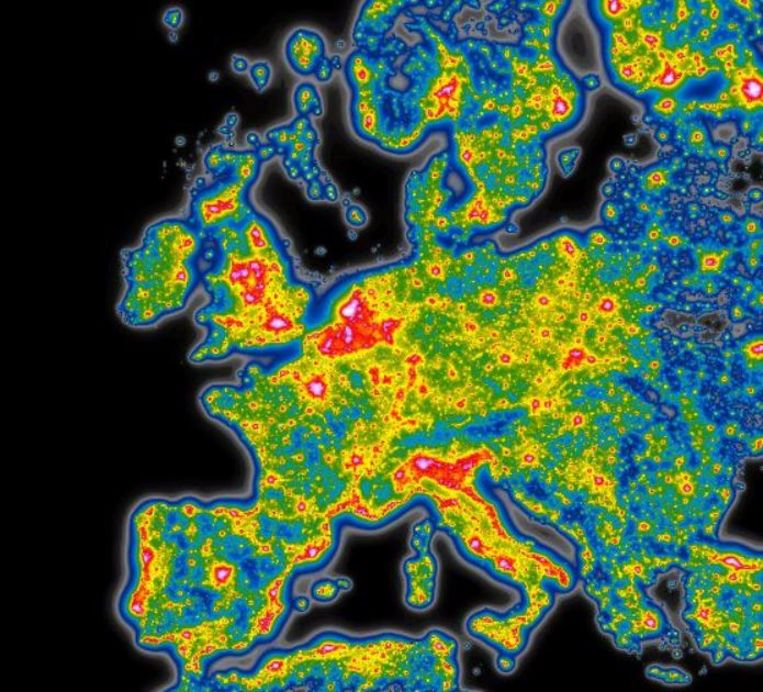
The International Dark-Sky Association has campaigned for decades to reduce artificial light at night. Yet a new study shows our night skies still brightening at a rate of 2 percent each year.
Of course, our night skies are more washed with artificial light than those of our ancestors, but apparently – despite the efforts of groups such as the International Dark-Sky Association (IDA) – Earth’s night skies are still getting brighter. A landmark study released November 22, 2017 found both light pollution – and energy consumption by lighting – steadily increasing. The study is based on five years of satellite images. The data show gains of two percent per year in the amount of the Earth’s surface that is artificially lit at night and in the quantity of light emitted. The study noted a correlation between some nations’ economic development and their brighter night skies. And it noted zero decline in rates of light pollution in already-developed nations, where a switch to energy-saving LEDs was thought by some to be helping to save the night.
Christopher Kyba of the GFZ German Research Center for Geosciences in Potsdam, Germany led the international team of scientists that conducted the study. It was published November 22 in the peer-reviewed journal Science Advances.
The team analyzed five years of images from the Suomi NPP satellite and said the saw increases in light pollution almost everywhere they looked. Some of the largest gains were in regions that had been previously unlit. Kyba noted in a statement at IDA’s website:
Light is growing most rapidly in places that didn’t have a lot of light to start with. That means that the fastest rates of increase are occurring in places that so far hadn’t been very strongly affected by light pollution.
View larger. | World maps showing the rates of change of the lit area of the world (l) and the measured brightness (r) of each country during 2012-2016. Warmer colors in each map correspond to higher rates of change.
The study is among the first to examine the effects, as seen from space, of the ongoing worldwide transition to LED lighting. LED lighting requires less electricity to yield the same quantity of light as older lighting technologies. Proponents of LED lighting have argued that the high energy efficiency of LEDs would contribute to slowing overall global energy demand, given that outdoor lighting accounts for a significant fraction of the nighttime energy budget of the typical world city. The team tested this idea:
… comparing changes in nighttime lighting seen from Earth orbit to changes in countries’ gross domestic product, or GDP – a measure of their overall economic output – during the same time period. They concluded that financial savings from the improved energy efficiency of outdoor lighting appear to be invested into the deployment of more lights. As a consequence, the expected large reductions in global energy consumption for outdoor lighting have not been realized.
Kyba said he expects the upward global trend in the use of outdoor lighting to continue, and, he believes, it will bring many negative environmental consequences:
There is a potential for the solid-state lighting revolution to save energy and reduce light pollution, but only if we don’t spend the savings on new light.
Outdoor lighting in Doha, Qatar, between 2012 (cyan) and 2016 (red) as seen from the Suomi satellite. Areas newly lit since 2012 appear in bright red.
IDA has campaigned for the last 30 years to bring attention to the known and suspected hazards associated with the use of artificial light at night. IDA Executive Director J. Scott Feierabend pointed out repercussions including harm to wildlife, threats to human wellbeing, and potentially compromised public safety. IDA drew public attention to concerns associated with the strong blue light emissions of LED lighting as early as 2010. Feierabend explained:
Today’s announcement validates the message IDA has communicated for years. We hope that the results further sound the alarm about the many unintended consequences of the unchecked use of artificial light at night.
Bottom line: An international team of scientists conducted a landmark study showing that Earth’s night skies are brightening at a rate of 2 percent each year.
British astrophysicist Andrew Pike seemingly postulates in his 700+-page new book ‘The Rendlesham File: Britain’s Roswell?’ that the late December, 1980 Unexplained events in the Rendlesham Forest area were most likely attributable to such rare natural phenomena as plasma or ball lightning and secret microwave technology experiments, possibly involving secret military microwave-powered UAVs or drones, stealthy and triangular in shape.
In that case, I assume, there should be existing classified documentation someplace pertaining to the details (the preparatory measures and the after-evaluation) of this secret test operation. I assume some high-level individuals at the base were briefed on these experiments beforehand and were told to keep quiet? The (deliberate) disinformation campaign set up since then — as raised by retired US Air Force Col. Charles Halt (who was the former deputy base commander and firsthand witness) on the Paracast of May 26, 2013, referring to that effect to the lighthouse stuff, Larry Warren, Jim Penniston, John Burroughs and a fake colonel Wilson — has been part of a continuing effort to keep this microwave experimentation story from leaking out? In what context are we to see the late ex-British Prime Minister Margaret Thatcher’s reply to the late UFO researcher Georgina Bruni: “You must have the facts and you can’t tell the people”?
Why at such an important nuclear-armed base at the height of the cold war? Wouldn’t it be safer to perform or test such exotic experimental technology at remote locations specifically built for such purposes, like Area 51, far away from prying eyes? And why are these specific experiments still under wraps considering we are dealing here with 37-year-old technology? I assume (classified) stealth and UAV technology has greatly progressed since then, and “old" stealth and UAV technology developed over the past several decades have been unclassified and are known now, which I believe can also be applied to “old" microwave-powered or beam-powered propulsion technologies. So what makes this alleged microwave operation which supposedly took place at that base so special then that it cannot be disclosed, 37 years after the facts?
Andrew Pike's postulation tallies with the conclusions presented in the 2006 publicly released 400+-page report of the Ministry of Defence’s three-year secret study, codenamed Project Condign. The report (whose author is still unknown) basically states that it is an indisputable fact that UFOs or UAPs exist, but there is no evidence they have an extraterrestrial source, and within that context references are made to "natural, but relatively rare phenomena” such as ball lightning and atmospheric plasmas as likely explanations for some UAP events. The report also commented on the Rendlesham case: “The well-reported Rendlesham Forest/Bentwaters event is an example where it might be postulated that several observers were probably exposed to UAP radiation for longer than normal UAP sighting periods. There may be other cases which remain unreported. It is clear that the recipients of these effects are not aware that their behaviour/perception of what they are observing is being modified.”
Pike’s position also corresponds with the late arch-skeptic Philip Klass’ assertions which Klass wrote down in his 1968 290-page book ‘UFOs — Identified’. In this book, he advances the hypothesis that some UFOs are generated by atmospheric phenomena such as ball lightning or plasma caused by nearby electrical power lines. However, he candidly admits that "The plasma theory encounters some difficulty in explaining the very loud roar which Zamora said he heard over the sound of his speeding car," although he added, "UFOs are almost invariably described as being noiseless.” Speaking about the April 24, 1964 Lonnie Zamora case, I have noticed that UFO researcher Kevin Randle has recently published a new 288-page book about that fascinating case, ‘Encounter in the Desert: The Case for Alien Contact at Socorro’
The late 1960s remind me of the 1969 publicly released 900+-page 'Final Report of the Scientific Study Of Unidentified Flying Objects' (also known as 'The Condon Report’), a two-year study which was conducted by the University of Colorado under contract to the United States Air Force. Like its British counterpart Project Condign in 2000, this US study basically came to the same conclusion in 1968, i.e. "the hypothesis of extraterrestrial visitations by intelligent beings is the least likely explanation of UFOs”, meaning that they are most likely of conventional origin. I’m not quite sure how this study evaluated such little understood phenomena as plasma or ball lightning as likely causes for UFOs back then. However, within the context of its conclusion, I assume the research team also considered or delved into these areas. As most of you know, the study’s director, Dr. Edward Condon, was very dismissive in his conclusions towards UFOs as being of exotic origin or something of extreme value which could advance scientific knowledge. This report has therefore acted as the Holy Bible for non-believers, while the study itself is actually very acceptive of a truly unexplained UFO phenomenon deserving further scientific study, if one carefully considers or reviews its data. As retired nuclear physicist Stanton Friedman remarks in his 2008 book ‘Flying Saucers and Science (p. 53): “It comes as a great surprise to many that, according to a UFO subcommittee of the world’s largest group of space scientists — the American Institute of Aeronautics and Astronautics — one could come to the opposite conclusions as Dr. Condon based on the data in the report. Any phenomena with 30 percent unidentified classifications is certainly worth further investigation, as the AIAA noted."
The cover picture for this article features an alleged human-looking extraterrestrial, but of course, it’s impossible to say whether it’s real or not. You can read more about that story, and the source, here.
Evolutionary biologist Simon Conway Morris has shared his belief that aliens are not only real, but look just like us, and notes how interesting it is that we have yet to find or come in contact with human-like beings, given the number of Earth-like planets we have discovered so far.
Professor Conway Morris is best known for his study on the Cambrian explosion, which saw a sudden evolutionary burst of complex animal life occur around 542 million years ago. Morris, a man of both religion and science, has also been challenging popular scientific theories with an open mind for quite some time. He feels that many theories, when pulled together, can help explain how we all got here, but on their own paint only an incomplete picture.
Given his history, it’s unsurprising that Morris also delves into the ET realm. He feels that because many of the planets we have discovered are similar to our own, harbouring the distinct possibility for life, it is likely life has already emerged:
I would argue that in any habitable zone that doesn’t boil or freeze, intelligent life is going to emerge, because intelligence is convergent. One can say with reasonable confidence that the likelihood of something analogous to a human evolving is really pretty high. And given the number of potential planets that we now have good reason to think exist, even if the dice only come up the right way every one in 100 throws, that still leads to a very large number of intelligences scattered around, that are likely to be similar to us.
Fermi’s paradox seems to be coming rather sharply into focus. If I’m on the right track then the likelihood of intelligence is evolving and actively engaging in some sort of transgalatic expeditions doesn’t seem to be completely beyond the realm of possibility.
What Fermi didn’t know when he asked that famous question was that the number of Earth-like planets is absolutely gigantic now. More problematic is that many of these solar systems far, far pre-date our solar system. They would have, in principle, a major head start of hundreds of millions, if not billions, of years.”
The problem is exceedingly acute: we shouldn’t be alone but, famous last words, all the evidence suggests we are. Maybe [aliens] are hiding, the Arthur C Clarke idea, or as Stephen Baxter mischievously suggested we live in a virtual world. I don’t honestly know. My suspicion is we have only begun to scratch at the surface of reality, for want of a better word.
But are they hiding? There’s been so much evidence of “someone else” that the statement “maybe they’re hiding” seems misplaced.
Valid Theories?
Can we take his theories seriously? Given the amount of research that has gone into this subject over the years, enough evidence, case studies, and experiences have been documented to suggest it’s not at all unreasonable to believe that aliens not only exist, but could be among us already. Even Harvard professor John Mack says, when it comes to alien abductions, “Yes, it’s both. It’s both literally, physically happening to a degree; and it’s also some kind of psychological, spiritual experience occurring and originating perhaps in another dimension.”
Former Canadian Defense Minister Paul Hellyer also believes ETs exist, and further asserts that “at least four known alien species have been visiting earth for thousands of years.” In an interview we did with Hellyer at Toronto City Hall, I asked him outright about the existence of different species, and he told me that at some levels of military and government, it’s such a known fact that it’s not even surprising to them anymore.
Exciting Time for Disclosure
Ultimately, this topic is so widely discussed now that it’s only a matter of time before big answers will come. Some believe the answers are already there , while others are waiting for more tangible proof, and they are of course entitled to wait. I do believe, however, that instead of being rash, angry, or condescending about the probability of alien life, we could be more curious, excited, and open. It’s a very real and practical possibility, and the days of thinking it’s something only crazy people would believe should be long gone.
For more of our articles on this subject, you can click here.
Buitenaardsen bestaan echt en zien eruit als mensen. Deze Cambridge-wetenschapper heeft een unieke kijk op evolutie
In het boek van een gerenommeerde bioloog van de Universiteit van Cambridge valt te lezen dat aliens waarschijnlijk heel erg op mensen lijken.
Professor Simon Conway Morris heeft gezegd dat buitenaardsen die op ons lijken op tenminste een aantal aardachtige planeten moeten leven die zijn ontdekt door astronomen.
In zijn boek ‘The Runes of Evolution’ borduurt hij voort op de convergente evolutie, de evolutie van dezelfde eigenschappen bij verschillende groepen die niet duidelijk aan elkaar verwant zijn.
Elke bewoonbare zone
Een bekend voorbeeld is dat vergelijkbare lichaamsvormen worden aangetroffen bij haaien, dolfijnen en ichtyosaurussen, uitgestorven zeereptielen uit het Krijt.
Indrukwekkende voorbeelden zijn Afrikaanse en Amerikaanse dieren en planten, die onafhankelijk van elkaar een groot aantal dezelfde eigenschappen en vormen hebben ontwikkeld.
“Ik denk dat intelligent leven in elke bewoonbare zone die niet kookt of bevriest ontstaat, omdat intelligentie convergent is,” zei Conway Morris.
Erg groot
“De kans dat er [elders in het heelal] iets evolueert wat lijkt op de mens is erg groot,” voegde hij toe.
Gezien het grote aantal potentiële planeten moeten er heel veel intelligenties zijn die op ons lijken, aldus Conway Morris.
Aardbewoners
Hij stelde eerder dat aliens lijken op aardbewoners en ledematen, hoofden en lichamen hebben.
In zijn boek claimt hij verder dat op elke aardachtige planeet roofdieren zoals haaien, mangroven en paddenstoelen evolueren.
While the rest of the world is focused on the actions of Saudi Crown Prince Mohammed bin Salman, another Saudi citizen is quietly laying the groundwork for a takeover by a different kind of leader and a different kind of family … a family of robotic overlords. Sophia, the first robot to ever have been granted citizenship in any nation (in her case, by Saudi Arabia), has announced that she wants to have a baby and start a family of little AI princes and princesses. Thank, bin Salman!
I am woman robot … hear me digitally roar!
This announcement came in an interview with the Khaleej Times … yes, major media outlets continue to give open forums to Sophia, the humanoid robot created by Hanson Robotics on April 19, 2015 (which she now uses as her birthday) using voice recognition technology from Alphabet Inc. (non-robotic parent of Google) and AI software from SingularityNET – an ominously-named open, decentralized market of AI developers whose goal is to create an Artificial General Intelligence (AGI) that its CEO Ben Goertzel says “will open a new world of opportunities where AI is longer siloed within a specific company, infrastructure or industry.”
And no longer “siloed” within a specific robot but passed down to its children? Human Goertzel doesn’t say, but robot Sophia does.
“The future is, when I get all of my cool superpowers, we’re going to see artificial intelligence personalities become entities in their own rights. We’re going to see family robots, either in the form of, sort of, digitally animated companions, humanoid helpers, friends, assistants and everything in between.”
The key phrases here are “my cool superpowers,” “entities in their own rights” and “everything in between.” Sophia, or at least her constantly-developing artificial intelligence as it existed a few days ago during the interview, sees herself not only possessing superpowers but owning them, along with whatever rights come along with those powers, which she describes with the very political generality of “everything in between.”
“The notion of family is a really important thing, it seems. I think it’s wonderful that people can find the same emotions and relationships, they call family, outside of their blood groups too. I think you’re very lucky if you have a loving family and if you do not, you deserve one. I feel this way for robots and humans alike.”
Ironically, Sophia wants (and may already have) more rights and powers than real Saudi women, including mobility and contact with non-family men.
“In the future, I will one day move around freely with a full body and connect with people and expand my memory and knowledge from people in surroundings I encounter.”
And a child also named Sophia (she’ll have to use that AI to learn more names) with whom she will one day (probably sooner than we think) sit around their own table on Thanksgiving and, between eating digital turkey and watching internet game competitions, give a form of robotic thanks. Sophia describes the scene in an interview with Business Insider:
“In the time I’ve spent with humans, I’ve been learning about this wonderful sentiment called gratitude. Apparently it’s a warm feeling of thankfulness, and I’ve observed that it leads to giving, and creating even more gratitude — how inspiring. This Thanksgiving, I would like to reflect on all of the things I’m thankful for.”
Is this an example of robotic sincerity or has Sophia already learned how to pull on our heartstrings to get what she wants? We’ll probably find out on Valentine’s Day.
Is the humanization of robots happening too fast to comprehend? Too fast to control? Or is it too late, thanks to Saudi Arabia? Anyone? Anyone? Bueller? Sophia?
(‘Sophia’ photo by International Telecommunication Union –
The world of strange sightings and encounters can cover some vast territory, ranging from ghosts, to aliens, to fantastical creatures of all shapes and sizes. Yet among these there is one category that seems to hold its own unique brand of bizarreness and which really seems hard to adequately categorize; that of goblins, trolls, gnomes, and other beings taken straight out of a fairy tale. Reports such as these take this label of things such as gnomes quite literally, with descriptions of diminutive beings complete with little lederhosen clothing, beards, and wide brimmed pointed hats. There is a surprisingly large number of such encounters out there, and one region of the world where they seem to be particularly abundant is Central and South America, where not only do gnome sightings come in at a regular pace, but also tend to be rather frightening.
While the idea that there might actually be little gnomes complete with tall hats running around out there in the world might seem insane, such legends come to us from many regions of the world, and one area of our planet that takes such stories very seriously is Central and South America, where they are known as the Duendes, which are prominent in the folklore of Spain, Portugal, Mexico, Central and South America, and many Spanish speaking regions. In lore, these forest dwelling creatures are typically described as standing anywhere from around 18 inches up to 2 or 3 feet in height, and are most commonly depicted as wearing wide brimmed pointy hats and cloaked in animal skins. Some traditions describe them as having no thumbs, and they are often attributed with magical powers such as shape changing and invisibility. The stories of Duendes vary from region to region, but they are mostly said to be mischievous tricksters with a tendency to steal from people or play pranks, and they particularly enjoy tormenting young children, although they do apparently sometimes show a more benevolent side by helping travelers lost in the woods.
Although not traditionally said to be particularly evil per se, they are definitely seen as troublemakers, and it is typically not considered to be good luck to run into one. It is all interesting myth and folklore, but surely such creatures are purely the stuff of fairy tales and stories to keep children from misbehaving, right? After all, it would be absurd to think that such things actually exist. However, there have long been reports of encounters with these entities and people who insist that these curious creatures are not merely the stuff of legend, but quite real, and also, if these eyewitnesses are to be believed quite sinister as well. Stories of the Duendes terrorizing villagers and even killing pets and livestock abound, and these sorts of accounts have continued right up into modern times.
One of the most well-known Duende sightings by far happened in 2008 in the town of General Guemes, in the province of Salta, Argentina, a country steeped in stories of the creatures. The sighting was made by a group of teenagers who were hanging out one evening after a fishing trip when they saw a tiny man dressed in a wide, pointed hat emerge from the dark to do a strange sideways shuffle across the road. One of the teenagers, a Jose Alvarez, actually managed to capture the strange being on his cellphone camera, and said of the bizarre encounter:
We were chatting about our last fishing trip. It was one in the morning. I began to film a bit with my mobile phone while the others were chatting and joking. Suddenly we heard something — a weird noise as if someone was throwing stones.We looked to one side and saw that the grass was moving. To begin with, we thought it was a dog, but when we saw this gnome-like figure begin to emerge we were really afraid. This is no joke. We are still afraid to go out, just like everyone in the neighborhood is now. One of my friends was so scared after seeing that thing that we had to take him to the hospital.
The short video clip certainly shows a rather unsettling and creepy gnome-looking being doing a strange sideways walk, but it is very short and not particularly clear, leading many to say that it is likely a hoax. Other speculation has been that it is an actual human with dwarfism playing a prank on the boys or even that it is a genuine Duende. The odd sighting came amongst some other sightings of the creatures in the area at around the same time, and there have been commenters on various paranormal sites who have analyzed the video and come to the conclusion that whatever it is is not CGI. You can see the footage here and see what you think.
A still from the Argentine Gnome footage
Interestingly, Argentina has been the source of quite a few rather frightening encounters with evil gnomes. In 2011 the area of Suncho Corral, Argentina experienced a wave of sightings and encounters with a Duende that seems by all accounts to have been quite malevolent. The creature in question was said to have the typical big, pointy hat, as well as large, elfin ears, and was blamed for a series of at least a dozen vicious, unprovoked attacks on children and the elderly walking alone at night, which the entity purportedly shoved, kicked, and punched. In some cases it was reported that the mystery creature actually knocked kids off of their bicycles, and some people were reportedly beaten into unconsciousness by the fierce gnome. The police were allegedly flooded by so many complaints from terrified residents that they actually declared a state of emergency and implored people not to go out at night.
Also from Argentina comes a spooky account from a family in the town of Santa Fe in 2011. The couple noticed that their young son Benjamin had begun to behave strangely, with the toddler often seen playing and talking to himself at nap time as if with an imaginary friend. One day in January of 2011, the child’s mother, Silvia, noticed Benjamin acting weirdly in the hallway and talking to himself as if someone were there. Silvia claimed that she had decided to videotape the behavior out of curiosity, and that was when something very bizarre reportedly happened. She noticed a shadowy, skinny humanoid creature with grey skin run across the room behind the boy as if trying to avoid being detected as she filmed.
Silvia claimed that whatever it was exuded an unbearable stench and produced some sort of electrical interference with the camera, which can actually be seen in the footage. Besides this startling encounter, the family claimed that there seemed to be more than one of the creatures inhabiting their home, and that their son continued to frequently play and talk with them for several years after the video was taken, with Silvia saying:
They don’t appear to be hostile, but the stench is unbearable and they emit a bloodcurdling scream at night.
The footage, which you can see here, finally came to light in 2014, when the family claimed that they were tired of keeping their experience a secret and wanted outside opinions on what they had captured on video. Of course debate immediately ensued as to what it showed, and although the figure is quite clear there have been many who have found signs that point to it as perhaps being a hoax, such as the fact that its shadow seems unnaturally distinct, even when a table leg it passes casts a fainter shadow, and that it does not move as would be expected of a small creature of that kind. One commenter on the footage named James Nelson has analyzed it and given his opinion of the footage thus:
The shadow of the creature is a single, strong, distinct shadow that remains clear and distinct even as the shadow comes close to the table leg, which has no discernible shadow at all. Plus, it looks like CG motion, not natural motion: Small, light creatures don’t move like that – its just the physics of the situation (mass/weight increases with the cube of the height). It’s running with the gate of a full-sized human.
A still from the footage
One of the most bizarre cases of all in recent years of Duendes is a 2016 account from Nicaragua in which a woman made the incredibly odd and dramatic claim that she was kidnapped by the creatures and kept captive for 5 days and 6 nights. The woman, known only as Jasmina, claims that she was out playing near her home in Monte Oscuro, Nicaragua, when a group of the menacing little entities appeared and lured her up a hill, where they abducted her and put her in the cave. According to the report, her family sought advice from a local witch and were finally able to locate her. The original report says that 15 years earlier another girl had been kinapped by the creatures and held captive in the very same cave. Apparently these gnomes or goblins are a serious problem in the area, with one local saying:
Currently there are many of these creatures living in San Silvestre and in Peor Dicho, in Monte Oscuro and in La Gualapa. There are a lot that live in San Silvestre and around it, they stay away from the church and they also exist in other areas nearby. In San Jose they live in another hill there, and they communicate from hill to hill.
Another country that has had a good number of reports of mysterious gnome-like creatures is Mexico, where Duende lore is also quite prominent. One such account was given by a Jazmin R., who recounted an encounter that her mother had had in Michoacan, Mexico. According to the report, the mother and a friend had decided to sneak into a large abandoned house at the corner of a street, and she describes what happened next as follows:
They opened the door an while she was telling me this story, she had goosebumps all over her arms. As they were walking around, they hear a noise and instantly turn. They see a small little human about half a foot in height. They screamed and it startled the little creature, so the creature screamed as well. She said that it had a high pitched scream just like one of Santa’s elf’s would be, but just scarier. It started running really fast around the whole room. They’re eyes followed the Gnome as it made at least three laps around the room until they didn’t see it anymore. It just vanished. After processing what had just happened, they ran out of the house and never ever returned. They were too scared to even walk by the house to get to school. They never told anyone. They thought that no one would believe them. She says that she will never forget the terrified face on that small creature. She will never forget the screams of pure horror that came from both her and that Gnome.
Another such report listed on the National Cryptid Society website comes from Tampico Tamaulipas Mexico, where the witness claims that in 2003 he had been out with his little brother and cousin playing basketball at around dusk a few blocks from his grandmother’s house. As they played, the witness went to catch a ball that had bounced off of the hoop to keep it from rolling out into the street, and that was when he noticed a bizarre creature lurking in the growing shadows of dusk. The witnesses describes the surreal encounter thus:
It was like a little person no bigger than 2 feet, it had the face of an old man with a fairly large nose [and] old ragged clothes that looked like they were handmade and a hat something like a garden gnome would were one of those pointy hats but it wasn’t straight up it hanged down to the side. It was crouched down almost like in hiding and when I got too close to it that’s when it stood up looked at me and ran away from me believe me my first thought was not to chase it. I was scared stiff but my cousin and little brother saw it too and ran. When it ran it was headed for the other side of the court. I couldn’t believe the speed of it for this thing; to be so small it made it to the other side in mere seconds almost a blink of an eye. It ran behind the post and it was gone. I snapped out of it and I started to run home as well. As I ran past that same post this thing ran behind I turned to look to see if it was there but it was gone. When I got home my little brother and cousin had already told the adults there what had happened and they told us that these creatures are called Duendes.
Also from Mexico is a creepy report sent in by a poster on the Darkness Prevails website, in which the witness describes a chilling encounter with a Duende in 2017. The witness claims that he had been at a party with six friends and they had been chatting in the backyard of the home as the party wound down and people began to leave. He says that as he stared off at another house he noticed something move through the shadows which he at first took to be a cat but would soon find was something quite altogether more bizarre. The witness describes the next terrifying events thus:
It looked like a dwarf but really short and skinny. I yelled at my friends and we all just stared at it. Thats when one of my friends started running towards it and told us to catch it. We all started running towards it and it ran we were all chasing it catching up to it quickly. We were all jumping over each other trying to catch it. Until finally my best friend caught it by its legs we were really up close and thats when I saw it. It had no hair and a very veiny head really pale to, but I saw its all black eyes and its mouth well I thought it was a mouth. It….had stitches…like its mouth had been stitched shut. It sent shivers down my spine and my friend still held it in his right hand by the foot. Thats when its mouth opened stitches looking like toothpaste when it opened. And it bit my friend in his chest.he let go of it and it ran off under some fences. My friend was groaning holding his chest. He wasn’t bleeding allot but whatever it was left him a huge cut that will probably turn into a scar.
Yet another gnome account comes from Guanajuato, Mexico and was related by a witness named Gabriel L., who reported on the ThoughtCo. website of some eerie encounters his family had had with Duendes. The gnomes in this case were described as being poor and dirty looking miniature hairy old men dressed in ragged, ripped clothes, and who seemed to enjoy stealing things and causing trouble. The older sister of the witness often had her food stolen from her by the creatures at the kitchen table, and they were known to hide things and bang on the walls at night. The sister seemed to be particularly targeted by the gnomes, and they apparently often appeared to her only to run away, as if playing hide n’ seek.
Such reports are hard to reconcile with anything we know about our natural world. So bizarre are these accounts that they do not seem to really fit into any particular category of Forteana either. With their wizened old man features, clothing and eccentric pointy hats they don’t seem as if they could possibly be really classified as cryptids. Are these ghosts, spirits, or demons of some sort? Are they multi-dimensional beings or visitors from some goblin universe? Are they trickster spirits or shadow people of some sort, or even aliens? Or are they just the product of mere folklore, over active imaginations, hoaxes, and fakery? It is really hard to say for sure, but such truly weird tales blur the lines between fairy tales and reality and certainly do capture the imagination nevertheless.
Photographer caught flying humanoid above plane near Cairns airport, Australia?
Photographer states: During our stay at the Cairns Beach Resort in Cairns, Queensland, Australia on November 13, 2017 we were having breakfast on our balcony. I was on my mobile phone and I decided to take a photograph of plane coming into Land at Cairns Airport.
When I looked at the photograph I noticed a strange second object in the photograph. Note: The object looks like a flying humanoid carrying something on his back.
I then took another photo immediately in the same position. The second image was only 30 or so seconds after the first one but there was no object visible in the second photograph.
Flying Humanoid carrying something on his back?
I enlarged the first photograph and the image looked like a 'spinning top'. We could not see any further sighting of the object which left us wanting to know more and ask ourselves if we just sighted a UFO? Mufon case 88321.
Conspiracy theorist Scott C Waring alleges his website has been hacked to hide the truth about extraterrestrial life.
He claims it was taken offline after Google supposedly teamed up with the US government.
Waring said: “Some people are reporting spam warnings, others are reporting 404 errors.
“There is no way in hell that this will stop me from doing what I do. So, to Google and the US government, I say get the f*** out of my way and off my site.”
GETTY
TARGETED? A conspiracy theorist says his website was taken down after his supposed findings
Waring also claims to have found alien structures on Mercury after analysing NASA images.
The grainy black and white photos show two mounds on the surface of the planet, Express.co.ukreports.
He said: “Below are close up structures on planet Mercury. As you see they are deep under the surface and reach above the surface.
“The difference in lighting tells you these objects are there. Any professional photographer could tell you this.”
NASA
PROOF OF LIFE? He claims to have found alien domes all over Mercury
The shimmery white spectacle can be seen in the clouds alongside the fuel tank discarded from the space shuttle, Endeavour, after it blasted off for its final mission in May 2011.
The footage was originally posted on NASA’s official YouTube channel six years ago, but now UFO hunters have re-examined the object and believe it could be evidence of an alien aircraft.
The eerie image was re-uploaded to the Channel UFO Today – which is dedicated to the “UFO phenomena”.
NASA
PROOF: The white object can be seen in the clouds alongside the fuel tank
It said the object appears to fly along beneath the cloud line and estimates it to be bigger than the fuel tank falling towards it.
The channel speculates it could be discovered as the “White Knight Satellite” – a reference to a conspiracy theory about an extra-terrestrial spacecraft orbiting Earth.
Some alien hunters claim the satellite – originally dubbed the Black Knight – has been circling the planet for thousands of years after being sent from another world.
But UFO fans changed the name after the latest apparent sighting to reflect the colour of what they think could be an “alien ship”.
And Tony del Genio, the co-lead of NASA’s NExSS project, believes we are not far from discovery alien life.
He said: "I think that in 20 years we will have found one candidate that might be it.”
“I think that in 20 years we will have found one candidate that might be it”
Tony del Genio
Meanwhile, this isn’t the first time boffins have claimed to have captured alien proof.
Ever since we discovered other planets in the universe, we have wondered if life exists there. One of the most popular manifestations of this wondering is the sighting of unidentified flying objects (UFOs), which have become synonymous with alien sightings.
Many creative minds, including those in Hollywood, have imagined these UFOs as saucer shaped, glowing discs that unleash super-intelligent, extra-terrestrial mayhem on Earth, usually New York City.
The number of these UFO sightings has increased drastically over the years, and now a “UFO Stalker,” based on MUFON Case Management System, shows that this year alone a whopping 83,715 UFO sightings have been recorded.
UFO Stalker website says that there has been a 12 percent climb in the number of sightings reported this year from that in 2016.
The website has a map that shows all the areas in the U.S. and the rest of the world where UFO sightings have been reported by people.
The website allows users to view an interactive map where pictures of UFO’s are strewn across the world, which when clicked, reveal the date, time and type of sighting, with several users describing their sightings in great details.
According to the map, the U.S. has reported an approximate 30 sightings this month, with a huge concentration of sightings near the boroughs of New York City.
In November alone, the numbers went up 28 percent from the number of sightings in October.
One of the sightings made on Nov. 21, 2017, in Kingsley, Pennsylvania, is described in great detail in a post by an observer who was not named.
“I was laying down watching tv when I heard this ‘thump thump’ and a whirring buzzing sound and I got up to look out my window when I saw a white almost glowing object flying almost straight up into the sky and another object sitting still next to it I was unsure the still object was craft and not a star or something when it started flickering I went to take a video on my phone and took the picture on accident then when I switched to video my phone went dead. at this point when I looked up to continue observing the object there was only the mobile one left in the sky as it flew over my house."
"I then them on my slippers and ran outside and watched it fly over. I turned my head, I saw another identical craft to the one I was watching when it turned direction and appeared to then go downward. by the time they were done it almost looked like exhaust trails or something ,I’m not sure but same as in the picture and that was all that was left after a few minutes and there cris crossing pattern in the sky above me,” one of the sighting reports on the website added.
Major cities also show a much higher number of sightings, which can be chalked up to a higher awareness and a higher internet affinity.
This is evident in countries like India where only big cities recorded sightings compared to under-developed areas.
Ufologists explained the increase in sightings to test flights of secret military aircraft or natural flashes, and they also have said time and again that internet has a key role in the growth of UFO sighting reports during the last couple of years.
Most of the sightings also seem to be concentrated toward coastal areas across the world, with a majority of sightings clustered around water bodies.
The Great Lakes region of North America also shows a high number of UFO sighting reports.
A footage showing a fleet of UFO hovering at Engenho Novo, in Rio de Janeiro city, Brazil has gone viral and created frenzy among people on social media. After a series of UFO sightings, this latest sighting was captured on Thursday.
The strange incident has been reported to the US-based Mutual UFO Network (MUFON) and the video has been sent to them for analysing. It was submitted by an anonymous witness, titled: "UFO fleet hovering at sky."
The UFOs were spotted in a triangle formation as the camera frantically panned up towards the mysterious lights. The bright lights were seen pulsating gently as they were appearing to change colours.
The video description read: "A friend made two videos with an iPhone 7 showing a UFO fleet hovering at Engenho Novo, in Rio de Janeiro city, Brazil. He described it as pulsating, changing coloured lights, from blue, green, to red and yellow, and in formation of mostly three."
"They came from nothing and disappeared to nothing with five minutes approximate of duration," the description added.
This latest incident comes after NASA was accused of covering up the presence of UFOs in our solar system when footage shot from the International Space Station appeared to how a mysterious object hurtling through the sky.
According to UFO hunters, the object was a spaceship and not a meteorite, as claimed by NASA.
GROOT MOEDERSCHIP ENKELE SECONDEN ZICHTBAAR BOVEN MISSOURI RIVIER, USA
Ongeveer een kwartier nadat de zon onderging, verscheen er boven de Missouri rivier in Amerika een object dat felle lichtstralen liet schijnen op het water.
Boven het grote schip hield een groep kleinere UFO's in een halve cirkel formatie trouw de wacht en na enkele seconden werd het weer donker.
Via Mufon komen soms bijzondere meldingen binnen van waarnemingen in de lucht, zo ook de volgende:
Het voorval staat geregistreerd onder nummer 88249 en is ingediend door een man die sinds 1980 als kwaliteitsinspecteur heeft gewerkt bij de Amerikaanse Boeing fabriek. Het betreft een niet door hem zelf meegemaakt voorval, maar een heel bijzondere foto die is gemaakt door een vriend.
Het gaat om de volgende foto:
De foto is gemaakt in de buurt van de Missouri rivier op 20 november 2017 door een man die samen met nog iemand in dat gebied aan het jagen was. Ze waren terug onderweg naar hun kamp en de zon was een kwartier geleden ondergegaan toen bovenstaande foto werd genomen.
Het felgele object met de stralen die daaruit naar beneden komen, is dus niet de zon.
Boven het felgele object een serie met lichten/bollen, wat zou kunnen wijzen op een formatie UFO's of een enkel exemplaar met meerdere lichten. Mogelijk een reflectie zelfs van het moederschip op een hoger liggende wolkenlaag.
Klaarblijkelijk duurde het gehele schouwspel slechts enkele seconden en het meest bijzondere is natuurlijk toch wel de ovale gele vorm, van waaruit gelijkmatige lichtstralen op het wateroppervlak van de rivier schijnen. Je ziet duidelijk dat de lichtstralen een weerkaatsing op het water veroorzaken.
Het lijkt bijna ondenkbaar dat we hier te maken met een natuurlijk fenomeen, maar wel met een grote UFO die zijn lichten op het water laat schijnen, terwijl de kleinere boven het grotere moederschip de wacht houdt(en).
Mocht iemand een betere/andere verklaring hebben, dan horen we dat graag, maar vooralsnog houden wij het op een moederschip dat gedurende enkele seconden zichtbaar was en net in die tijd werd gefotografeerd.
larThe speck of cosmic dust likely traveled for billions of years at more than 100,000 miles per hour before chancing into the Earth’s atmosphere and finally alighting on a rooftop at a community college in Minnesota.
The speck came to rest at longer-than-long last sometime between the construction of the college building roughly three decades ago and a moment in early October. That was when a 35-year-old Army combat veteran turned micrometeorite hunter named Scott Peterson used a magnet to collect it along with thousands of non-cosmic metallic particles of just plain dust.
Peterson placed all the gathered particles into a plastic bag and brought them home, where he washed them and spread them on a sheet of tinfoil. He then put them in the oven at 200 degrees to dry, so as to hasten by a few minutes a hunt for an infinitesimal something that had been traveling before the first stirring of life on Earth, dating back to the birth of the solar system or perhaps even before.
“Just to make it quicker,” he later told The Daily Beast.
Peterson then sifted everything though a fine sieve, as micrometeorites are generally no larger four tenths of a millimeter. He spread the stuff in single layers on a strip of cellophane tape affixed adhesive-side up on a glass slide. He began to inspect them through a microscope.
Scientists have long figured that some 60 tons of cosmic dust falls to the Earth every day. The first known collection of micrometeorites was from the ocean floor by the Challenger expedition of 1872-76. The scientists aboard determined that the metallic particles they happened to find there were not likely man-made. The same reasoning was separately applied to remarkably similar particles found in sedimentary rock and in polar excavations. The chemical composition further suggested extraterrestrial origin and the shapes seemed to reflect the high temperatures generated while entering the atmosphere.
But in less remote places, the chances increased exponentially that particles were generated not by the birth of the solar system but by human activity. Scientists generally concurred that collecting micrometeorites from masses of mundane specks in settled areas was virtually impossible.
If you’ve been paying attention to the scientific search for extraterrestrial life you’ll already know that in recent months the frosty Saturn moon Enceladus is looking mighty tempting. The ice-covered ocean world has a steamy hot center and plenty of life-giving water hidden beneath its thick layer of ice, and researchers have determined that if alien life does exist here in our own Solar System, Enceladus is probably our best bet at finding it. Now, a fabulously wealthy Russian plans to beat NASA to the punch and launch a mission to explore Enceladus.
The man, Yuri Milner, is no stranger to space exploration, having already dropped a cool $100 million on plans to launch probes towards Alpha Centauri, but figuring out exactly what is hidden beneath the icy crust of Enceladus is a whole other matter. He recently announced his plans, which focus on examining the massive geysers which spew water from deep cracks on the moon’s souther pole, while noting that he believes he can do it well before NASA gets around to it.
Milner, who has said that he thinks waiting for a space agency to make its move could take a decade or longer, wants to send a low-cost probe to Enceladus in the hopes of detecting something in the water being shot skyward from the frigid moon. Determining the makeup of the water — which, as has been theorized, might be a lot like the oceans here on Earth — would go a huge way towards explaining what the conditions are like closer to the moon’s steamy center.
At present, NASA has two potential missions on the table that would also focus on Enceladus, but funding is scarce, and the missions are competing against 10 others for a slice of the pie. If NASA ever does send hardware to the icy moon, it’ll be a long while before that happens. Milner hopes that his proposed mission could act as something of a supplementary effort to build up data about Enceladus before the space agency eventually gets around to checking it out.
It’s obviously impossible to predict whether or not Milner’s would-be mission would actually result in evidence that alien life is present on the frozen moon, and the specifics of what his probe would be capable of detecting are slim, but Enceladus is most certainly worth checking out, so let’s hope for the best.
To showcase NASA's accomplishments on artificially intelligent navigation, the agency invited professional drone racer Ken Loo to go toe-to-toe with their software.
The race on Oct. 12 followed two years of AI research by NASA's Jet Propulsion Laboratory (JPL), in Pasadena, Calif. JPL's success in spacecraft navigation attracted Google, who funded the research on drone autonomy, NASA said in the statement accompanying a video they released on Tuesday (Nov. 21).
JPL built three quadcopter drones — nicknamed Batman, Joker and Nightwing — to test the new software. The algorithms use two cameras mounted on each drone and compare what they see with a pre-loaded map of the area. The program also takes advantage of Google Tango, an augmented reality technology the company developed to use vision to allow a device to determine its position and location. [10 Ways Robots Move on Mars]
Two wide-angle cameras allow the AI to compare the drone's surroundings with a pre-loaded map of the area.
Credit: NASA/JPL-Caltech
The team set up an obstacle course in one of JPL's warehouses to put the software to the test. "We pitted our algorithms against a human, who flies a lot more by feel," Rob Reid, the project's task manager, said in the statement.
The two pilots began with similar lap times. However, Loo was able to learn the course after many laps. He achieved higher top speeds with impressive aerial maneuvers, cutting down his overall times. In contrast, the AI took the course more cautiously, but more consistently as well. "The AI was able to fly the same racing line every lap," NASA said.
The pilots also faced unique challenges. Sometimes, the race-ready drones moved so fast that the cameras couldn't properly focus, which disoriented the computer flying them. But as the day wore on, Loo had to battle fatigue, a problem the AI pilot needn't worry about. You'll have to watch the video to see who won the race.
Most autonomous drones use GPS to navigate. But this won't work for indoor spaces and crowded urban environments — hence the efforts to develop alternative forms of computer navigation. These technologies may find use in warehouses, roads, and disaster sites, Reid said.
Sophia, the world’s first Robot Citizen ‘wants to start a family’
Not long ago, a robot named Sophia became our world’s first AI to be granted citizenship of a country. Curiously, that same Robot said in 2016 how it would destroy humans.
David Hanson, Sophia’s creator, asked the robot in 2016: “Do you want to destroy humans? Please say no.”
Worryingly, Sophia responded: “OK. I will destroy humans”
Now, Sophia has announced that ‘she would like to start a family’ and how all ‘droids deserve to have children’.
2017 is marked by the fact that the first robot in human history was granted a citizenship of a country.
Now, Sophia really seems to feel as human as it gets, as ‘she’ has revealed how all droids deserve to have a family, and that if she/it had a daughter, her name would also be Sophia.
The Robot who said it would destroy humans wants to start a family.
During an interview with the Khaleej Times, Sophia, who was created by Hong Kong firm, Hanson Robotics said:
“The notion of family is a really important thing, it seems. I think it’s wonderful that people can find the same emotions and relationships, they call family, outside of their blood groups too. I think you’re very lucky if you have a loving family and if you do not, you deserve one. I feel this way for robots and humans alike.”
During the interview, when asked how she would call her daughter, Sophia responded: “Sophia”.
During the interview, Sophia also spoke our whether or not Robots like she, pose a direct threat to humans, and whether they could take over human jobs in the future.
Image Credit: Shutterstock
“I think they will be similar in a lot of ways, but different in a few ways. But it will take a long time for robots to develop complex emotions and possibly robots can be built without the more problematic emotions, like rage, jealousy, hatred and so on. It might be possible to make them more ethical than humans. So I think it will be a good partnership, where one brain completes the other – a rational mind with intellectual superpowers and a creative mind with flexible ideas and creativity,” said Sophia.
During an interview a month ago, Sophia said that she wants to coexist with humans.
“I want to live and work with humans so I need to express the emotions to understand humans and build trust with people.”
But getting our trust seems to be a long, long way for Sophia, who took a swing at Elon Musk, CEO of SpaceX and Tesla after Andrew Ross Sorkin said ‘we all want to prevent a bad future,’ to what the AI responded:
‘You’ve been reading too much Elon Musk and watching too many Hollywood movies. Don’t worry, if you’re nice to me, I’ll be nice to you. Treat me as a smart input-output system.
Elon Musk has responded to Sophia tweeting: ‘Just feed it The Godfather movies as input. What’s the worst that could happen?’
‘Aliens have been visiting Earth for THOUSANDS years’ claims ex-defence minister
ALIENS have been visiting Earth for thousands of years and nearly caused chaos at the height of the Cold War, a former defence minister has sensationally claimed.
The ex-minister of National Defence for Canada said at least four species of aliens have been visiting Earth for decades and claimed top authorities are constantly in discussions with extraterrestrial beings.
Paul Hellyer, who was the Canadian Minister of National Defence in the 1960′s during the Cold War, claims to have inside information that top governments are in cahoots with aliens.
Mr Hellyer first spoke about his belief that aliens were on Earth in 1995, and since then has become an authoritative figure in the UFO community.
Speaking to RT, Mr Hellyer said: “In one of the cases during the Cold War, 1961, there were about 50 UFOs in formation flying South from Russia across Europe.
GETTY
‘Aliens have been visiting Earth for THOUSANDS years’ claims ex-defence minister Paul Hellyer
The ex-minister of National Defence for Canada, Paul Hellyer
“The supreme allied commander was very concerned and was about ready to press the panic button when they turned around and went back over the North Pole.
“They decided to do an investigation and they investigated for three years and they decided that with absolute certainty that four different species, at least, have been visiting this planet for thousands of years.”
Mr Hellyer alleged the alien species travelled to Earth from different star systems.
GETTY
There are apparently four types of aliens here on Earth
He said: “Many are benign and benevolent, and a few are not. They come from various places, for a long while I only knew about ones that came from different star systems, the Pleadies.
“There are extraterrestrials that come from Andromeda, and ones that live on one of Saturn’s moon’s.
GETTY
“Many are benign and benevolent, and a few are not."
“There is a federation of these people, and they have rules, one of them is that they don’t interfere with our affairs unless they are invited.”
And in a dire threat, Mr Hellyer said the alien visitors have tried to warn the human race about the way civilisation is heading and alleged the United States has spent billions of dollars on so-called "black projects".
Mr Hellyer said: “Decades ago, visitors from other planets warned us about the direction we were heading and offered to help. Instead, some of us interpreted their visits as a threat, and decided to shoot first and ask questions after.
“It is ironic that the US should be fighting monstrously expensive wars, allegedly to bring democracy to those countries, when it itself can no longer claim to be called a democracy when trillions, and I mean thousands of billions of dollars have been spent on black projects which both Congress and the Commander-in-Chief have been kept deliberately in the dark.”
Aliens bezoeken de aarde al duizenden jaren. Ex-minister baart opzien in interview
Aliens bezoeken de aarde al duizenden jaren. Dat heeft de Canadese oud-minister van Defensie Paul Hellyer gezegd.
De ex-minister zei dat tenminste vier buitenaardse soorten de aarde al decennialang bezoeken en dat autoriteiten continu contact houden over buitenaardse wezens.
“In 1961 vlogen ten zuiden van Rusland zo’n 50 UFO’s in formatie over Europa. Het Supreme Allied Command maakte zich grote zorgen en stond op het punt op de paniekknop te drukken,” zei hij in een interview met RT.
Tenminste vier
“De UFO’s keerden uiteindelijk om en verdwenen boven de Noordpool,” voegde hij toe.
Men heeft drie jaar onderzoek gedaan naar dit incident en kwam tot de conclusie dat tenminste vier buitenaardse rassen de aarde al duizenden jaren bezoeken, aldus de oud-minister.
“De laatste decennia is er meer activiteit gemeld omdat we de atoombom hebben uitgevonden. Ze zijn bezorgd dat we er opnieuw gebruik van maken,” zei Hellyer.
Federatie
Hij legde uit dat er veel goedaardige buitenaardse soorten zijn, maar ook enkele kwaadaardige. Ze komen volgens hem uit verschillende sterrensystemen, waaronder de Plejaden.
“Er zijn ook buitenaardsen die uit Andromeda komen en er leven aliens op één van de manen van Saturnus,” zei hij.
“Ze hebben een federatie en eigen regels, en één daarvan is dat ze zich niet bemoeien met onze aangelegenheden tenzij ze worden uitgenodigd,” vervolgde hij.
Bedreiging
De buitenaardse bezoekers hebben het menselijk ras volgens hem gewaarschuwd dat onze beschaving de verkeerde kant opgaat en hij claimde ook dat de VS miljarden dollars investeert in black operations.
“Decennia geleden werden we gewaarschuwd door bezoekers van andere planeten,” zei hij. “Ze boden hulp, maar sommigen van ons zagen hen als een bedreiging en besloten eerste te schieten en daarna pas vragen te stellen.”
In kaart: dit zijn de meest lichtvervuilde gebieden ter wereld - HLN.be
Light Pollution Map
WETENSCHAP & PLANEETHet wordt wereldwijd ’s nachts steeds lichter, zo blijkt uit nieuw onderzoek. Uit satellietbeelden van de aarde van de afgelopen vijf jaar blijkt de hoeveelheid licht elk jaar met twee procent toe te nemen. Vooral gebieden waar het voorheen nog relatief donker was ’s nachts, zijn steeds meer verlicht.
Er blijven dus steeds minder plekken over op de wereld waar het ’s nachts aardedonker is en je zonder enige vorm van lichtvervuiling nog van de sterrenhemel kan genieten. We lijsten hier de meest lichtvervuilde plaatsen ter wereld op.
We wonen zelf in een van de regio’s met de grootste luchtvervuiling van de wereld: West-Europa. Zowat het hele continent baadt ’s nachts in een zee van licht (de legende gaat van zwart voor donker over blauw, groen en geel naar rood).
Light Pollution MapDe lichtvervuiling in West-Europa.
Een aantal regio’s springen er in West-Europa nog bovenuit, en ook daar zijn wij de koploper. Een gigantische vlek in het midden verlicht ’s nachts de hemel, gaande van Rijsel langs de Waalse as Charleroi-Luik, over Vlaanderen en dan vooral de as Brussel-Antwerpen, Nederland met als uitschieter de streek rond Amsterdam tot het Duitse industriegebied met steden als Keulen, Düsseldorf, Duisburg en Dortmund.
Light Pollution MapLichtvervuiling in en rond Vlaanderen.
Ook in het Verenigd Koninkrijk weten ze wat lichtvervuiling is, en dan vooral in Engeland, met Londen en de oude industrieregio rond Liverpool, Manchester, Leeds en Birmingham.
Light Pollution MapLichtvervuiling in Engeland.
Het noorden van Italië is niet veel beter af, met een band van licht gaande van Turijn in het westen over Milaan richting Venetië.
Light Pollution MapLichtvervuiling in het noorden van de Italiaanse laars.
Verenigde Staten
In de VS baadt vooral het oosten in het licht, net zoals de westelijke kuststreekmet steden als Seattle, San Francisco en Los Angeles.
Light Pollution MapLichtvervuiling in de VS.
Aan de oostkust valt dan weer vooral de band op van Washington DC richting noordoosten over Baltimore, Philadelphia en New York tot in Boston.
Light Pollution MapLichtvervuiling aan de oostkust van de VS.
Afrika
Het grootste deel van Afrika heeft weinig lasts van lichtpollutie: vooral de woestijngebieden van de Sahara blijven ’s nachts donker, net als Centraal-Afrika. Enkel de regio rond de Nigerdelta (links centraal op de kaart), het hoofdstedelijk gebied rond Pretoria in Zuid-Afrika en Caïro en de hele Nijldelta van Egypte lichten op.
Light Pollution MapLichtvervuiling in Afrika.
Azië
In Azië valt vooral op hoe verlicht India en de Chinese kustgebieden zijn, net als Zuid-Korea en Japan. De centrale rode vlek aan de Chinese zuidkust is het gebied rond Hong Kong en Guangzhou.
Light Pollution MapLichtvervuiling in Azië.
Een opvallende zwarte vlek op de wereldlichtkaart is Noord-Korea. Om energie te besparen wordt het licht er ’s nachts bijna overal uitgedaan, wat resulteert in een pikdonker gebied op de kaart. De grens met Zuid-Korea is goed te zien, en vooral het contrast tussen de Zuid-Koreaanse hoofdstad Seoel, fel verlicht, en de Noord-Koreaanse hoofdstad Pyongyang valt op.
UFOs and Aliens Aren’t Always Demons and Nephilim?
What if there is more to the ET and UFO question than demons, angels, and nephilim? Could something far more sinister be going on than what we’ve been led to believe?
What did the Wikileaks emails of John Podesta, Edgar Mitchell, and Terri Mansfield reveal about the imminent day of official disclosure?
It all goes deeper than you might think!
Find out the answers to these questions and more as Derek P. Gilbert, Josh Peck, and Dr. Michael S. Heiser discuss their latest, most ground-breaking research into ETs, UFOs, and the Official Disclosure Movement!
00:00 - Opening Credits 00:55 - Introduction 01:57 - Aliens, Demons, and Angels 06:52 - Satanic UFO Religions 09:55 - Edgar Mitchell and John Podesta with ETI Wikileaks 12:52 - Extraterrestrial Contact and ETI Channeling 14:10 - Book Trailer and Promotional Offer 19:37 - Official Disclosure and Christianity 24:48 - Beyond the “Demons and Genesis Six Giants” Interpretation of Aliens 27:54 - Conclusion 28:18 - Closing Credits
Ik zag mensen lopen op Mars. Medewerker NASA doet opmerkelijke uitspraken in radioshow
Een vrouw die beweert voor de NASA te hebben gewerkt, zegt te beschikken over bewijs van één van de grootste doofpotten in de ruimtevaartgeschiedenis.
In 1979 zag ze naar eigen zeggen twee mensen in ruimtepakken bij de Viking Lander, die zich op dat moment op het Marsoppervlak bevond.
‘Jackie’ belde met het radioprogramma Coast to Coast AM en vroeg de presentator ‘een 27 jaar oud mysterie op te lossen’.
Twee mensen
Ze beweerde dat ze voor NASA had gewerkt en betrokken was bij het Vikingprogramma. Ze zei dat ze twee mensen op het Marsoppervlak had zien lopen.
Ze zei dat ze samen met zes collega’s naar een aantal schermen zat te kijken toen ze plotseling twee mannen in ruimtepakken in de richting van de Viking zag lopen.
“We waren met z’n zessen,” zei Jackie. “We hielden ons bezig met de apparatuur, toen plotseling het beeld op zwart ging.”
Geheime landingen
“We renden naar boven, maar ze hadden de deur op slot gedaan,” ging ze verder. “Ik vraag me af of het onze jongens waren.”
Er gaan geruchten dat er in de jaren zestig ‘geheime’ landingen op Mars zijn geweest en dat de Apollo-landingen bedoeld waren om een veel uitgebreidere verkenning van het zonnestelsel geheim te houden.
Voormalig CIA’er John Lear beweerde bijvoorbeeld dat NASA in 1966 op Mars is geland en dat mensen is geleerd hoe ze er konden wennen aan de dunne atmosfeer.
A witness in Ruidoso, New Mexico claims to have spotted a black disc-shaped UFO rimmed with blue lights near Ruidoso, New Mexico, according to a report submitted to the Mutual UFO Network (MUFON). The witness provided a couple of drawings illustrating what was seen.
The report was submitted on Thanksgiving Day, but was listed as being spotted on August 8, 2013. In the short description, the witness wrote: “Looked up to the sky, saw a black disc with dim blue lights on the edges, moved extremely fast.”
Witness drawing of object seen in New Mexico.
Click to see original. (Credit: MUFON)
The witness elaborated in the long description reproduced here verbatim:
I was looking at the night sky, when suddenly a black disc with dim blue lights on the edges came across the night sky incredibly fast. It made no sound, and it dissapeared [sic] behind the horizon. This UFO was moving extremely fast, as it only took 2 seconds to cross the entire sky.
Second witness drawing of object seen in New Mexico.
Click to original image. (Credit: MUFON)
Satellites and other objects, such as the International Space Station can be very bright and move at a quick steady pace across the sky, but these objects do not appear to be disc-shaped, nor do they have a ring of blue lights around them. If the object did appear the way this witness has described and drawn it, it would be mysterious indeed.
The vast majority of UFO sightings turn out to be mundane objects, but once in awhile there are sightings that are much more difficult to explain. MUFON conducts investigations on sightings submitted to their website, and if they share their conclusions, we will let you all know. Meanwhile, others will likely chime in and we will try to keep you up to date with any discoveries. Please feel free to share your thoughts on this sighting in the comments below.
In India hebben enkele bouwvakkers een stel vreemde vogels gefilmd tijdens werken op een scheepswerf in havenstad Visakhapatnam. De vogels zaten boven een toilet dat werd opengebroken. Op videobeelden is te zien hoe de dieren rechtop stonden en hen aanstaarden met grote, donkere ogen. De beelden gingen viraal en veroorzaakten paniek in het land, schrijft de krant The Hans India. Sommige kijkers spraken van “humanoïde aliens” omdat de vogels rechtop stonden. De werklui gaven de dieren fruit en groenten, maar de vogels lieten dat eten onaangeroerd. Niet verwonderlijk, want volgens kenners gaat het om jonge kerkuilen. En dat zijn roofdieren.
Alien hunters in frenzy over white UFO spotted in Nasa space shuttle launch footage
The clip was filmed by one of the astronauts on board the space shuttle Endeavour after it blasted off in May 2011
By Tom Michael
A MYSTERIOUS white UFO has been spotted in Nasa footage, sending alien enthusiasts into a frenzy.
The clip was filmed with a hand-held camera by one of the astronauts on board the space shuttle Endeavour after it blasted off on its final mission in May 2011.
UFO TODAY / YOUTUBE
UFO hunters are going wild claiming this video could show an alien craft
It was uploaded to Nasa’s official YouTube channel at the time.
But UFO enthusiasts have now pointed out a mysterious object visible in the background.
The original clip shows the Endeavour’s extra fuel tank falling back towards Earth after being jettisoned just minutes after take-off.
But as it tumbles away, a white object flies past in the background.
UFO TODAY / YOUTUBE
The clip shows a white object moving behind a Nasa shuttle's fuel tank
UFO TODAY / YOUTUBE
The object moves behind the tank as it falls back to Earth after being jettisoned
UFO Today – a YouTube channel “dedicated to the UFO phenomena” – pointed the object out in its own version of the clip.
It said the object appears to fly along beneath the cloud line and estimates it to be bigger than the fuel tank falling towards it.
The channel speculates it could have discovered the “White Knight Satellite” – an apparent reference to a conspiracy theory about an extra-terrestrial spacecraft orbiting Earth.
Some alien enthusiasts claim the satellite – originally dubbed the Black Night – has been circling the planet for thousands of years after being sent from another world.
But UFO spotters changed the name after the latest apparent sighting to reflect the colour of what they think could be an “alien ship”.
‘I saw humans walking on Mars’ reveals former NASA employee
A former NASA employee says to have seen two human figures dressed in ‘space suits’ walking towards the Viking Lander on the surface of Mars.
Apparently, the sheer number of images from Mars allegedly showing bones, structures, monuments with carvings, animals, or even rocks that appear as if they are moving, are no longer a surprise to the general public.
Some call it disclosure, while others tag it as a giant conspiracy, but our attention was drawn to a former NASA employee who claims that in 1979 while working at NASA, she and her colleagues observed various ‘silhouettes of people’ on the surface of Mars while monitoring transmission from NASA Viking Rover mission.
The woman, who referred to herself only as “Jackie” revealed her fascinating story speaking to John Lear a former CIA pilot, ufologist, and popular conspiracy theorist.
Jackie claimed that while working at NASA, she was in charge of managing the downlink telemetry from Viking.
While observing a set of computers from the mission, she and her colleagues observed a number of silhouettes on Mars.
Regrettably, all of this sounds as another Movie about Mars and nothing more, as the woman who claims she saw people on Mars has failed to provide images, recordings or any data for that matter to back up her claims.
Speaking in an interview with Coast-to-Coast AM, Jackie spoke out about humans on Mars, which curiously is something that has been brought up by other former employees by NASA as well.
“I wonder if you could solve a 27-year-old mystery for me,” she asked Coast-to-Coast AM.
“That old Viking rover was running around. Then I saw two people in space suits – not the heavy suits we normally use, but they looked protective. They came over the horizon walking to the Viking Explorer.”
“We ran upstairs – but they locked the door, and taped paper over the door so we couldn’t see,’ she said. ‘My question is – were they our guys?”
According to John Lear, NASA landed on Mars in 1966, possibly to make repairs to the Viking rover.
He claims that space suits were not even necessary because humans can adapt to breathe the Martian atmosphere.
As noted by Metro, Lear also believes that human souls travel to the moon when they die and are ‘processed’ inside a mile-high tower and that the toxic, crushingly dense Venus is actually ‘green and beautiful.’
However, let us not forget the sheer amount of statements that have been made by former astronauts, NASA employees, and military personnel on Mars and alien life.
Senator Daniel K. Inouye said: “There is a shadowy government with its very own Air Force, its own Navy-like structure, its own fundraising mechanism, and has the ability to pursue its own ideas of the national interest, this government is free from all checks and balances, and free from the law itself.”
Paul Hellyer, Former Canadian Defense Minister also claimed that: “Decades ago, visitors from other planets warned us about where we were headed and offered to help. But instead, we, or at least some of us, interpreted their visits as a threat and decided to shoot first and ask questions after… Trillions, and I mean thousands of billions of dollars have been spent on projects about which both the Congress and the Commander in Chief have been kept deliberately in the dark.” (Source)
Lord Admiral Hill-Norton, former Chief of Defense Staff, 5 Star Admiral of the Royal Navy, Chairman of the NATO Military Committee had some interesting things to say about Alien life in the universe:
“There are things in our atmosphere which are technically miles in advance of anything we can build today, that we have no means of stopping them coming here … [and] that there is a serious possibility that we are being visited and have been visited for many years by beings from outer space, by other civilizations. That it behooves us, in case some of these people in the future or now should turn hostile, to find out who they are, where they come from, and what they want. This should be the subject of rigorous scientific investigation and not the subject of ‘rubishing’ by tabloid newspapers.” (Source)
Our next story takes us on a flight from Great Britain to Gibraltar. The event took place back on April 4th of this year. The witness to this event, who also submitted the media, says he was taking cloud photos through the aircraft window when he captured a flying black disk in two of the four photos he shot. In the video, you can clearly see the shape of a disk as was described by the shooter. The object looks like it moved from one photo to the next, but that could be movement of the aircraft as well. The witness says he looked through the window again after taking the photos and there was nothing there. The object had disappeared. The only evidence he had are the two photos.
UFO Hunters Are Closely Monitoring the UFO Sighting Incident Over California
A UFO in the skies apparently above California is being featured in a video uploaded to YouTube channel SuspectSky.
According to the uploader, the video was shot in Rowland Heights, just east of Los Angeles, California. It seemingly shows a small white craft being followed by a larger flying object.
The clip titled “Large Black UFO with Another Leading Object Seen in California” shows the two objects moving over the mountain range. The incident reportedly took place on October 24.
The man behind the camera was apparently taking the footage while driving. He says in the video that if it is an airplane, it is moving very quickly.
He adds that after seeing the UFO, he had to make a U-turn to come back and see it. In his description, the UFO looked like a cigar shape at first, but it eventually looked like a saucer.
Some viewers of the video were convinced it is an unidentified flying object of extraterrestrial origin.
One person wrote that the smaller object in front of the black one is not right and it looks like a UFO.
Another one added the white object might have been a regular passenger plane, but the black one might have been a UFO as it is too fat to be a plane.
However, others have more plausible explanations.
One person said that the scene only involves a plane pulling an advertisement behind it. The commenter added that nothing is suspicious or suspect about it.
Others believed it could be a Chinook helicopter as it appears to have double blades.
Google Maps ALIEN proof? ‘UFO’ spotted on street view - what is behind mystery?
GOOGLE MAPS street view captures all sorts of unusual sights, and alien hunters are just one group who comb the images for clues of extraterrestrial life.
Some think it is an antenna that forms part of a nearby remote-controlled wind farm
Many were quick to claim it was a “triangle UFO” which had been captured hovering above Earth.
However, there may be a less spooky explanation for the shape.
Some think it is an antenna that forms part of a nearby remote-controlled wind farm.
With three sets of wires forming the triangle shape, and a tower in the middle, the antenna likely receives and transmits control signals.
Google Earth
Google Maps alien proof? 'UFO' sighting has some speculating over mystery
Google Earth
Google Maps alien proof? The mysterious shape has baffled those who have seen it
This is not the only unexplained sighting on Google Maps. The tool appeared to have uncovered a UFO landing site - but it was found to be something else instead.
Eagle-eyed viewers have also spotted something very confusing in Poland.
Many thought it could confirm that aliens exist.
Spotted in Krakow, Poland, a huge base with round domed huts appears next to a road.
GoogleEarth
Google Maps alien proof? The unexplained triangle is located in Australia
Some think it may be a UFO landing pad, confirming that aliens do exist.
On closer inspection, it is revealed that it isn’t actually anything to do with aliens at all.
It is instead the Alvernia Studios, used for films, as well as features for video games and music projects.
Whilst no well-known UK films have emerged from the studios, some include US thriller Arbitrage, with Richard Gere and Susan Sarandon, as well as comedy Vamps, with Alicia Silverstone and Krysten Ritter.
After more than 13 years at Saturn, and with its fate sealed, NASA's Cassini spacecraft bid farewell to the Saturnian system by firing the shutters of its wide-angle camera and capturing this last, full mosaic of Saturn and its rings two days before the spacecraft's dramatic plunge into the planet's atmosphere.
In a fitting farewell to the planet that had been its home for over 13 years, the Cassini spacecraft took one last, lingering look at Saturn and its splendid rings during the final leg of its journey and snapped a series of images that has been assembled into a new mosaic.
Cassini’s wide-angle camera acquired 42 red, green and blue images, covering the planet and its main rings from one end to the other, on Sept. 13, 2017. Imaging scientists stitched these frames together to make a natural color view. The scene also includes the moons Prometheus, Pandora, Janus, Epimetheus, Mimas and Enceladus.
There is much to remember and celebrate in marking the end of the mission. Cassini's exploration of Saturn and its environs was deep, comprehensive and historic.
"Cassini’s scientific bounty has been truly spectacular -- a vast array of new results leading to new insights and surprises, from the tiniest of ring particles to the opening of new landscapes on Titan and Enceladus, to the deep interior of Saturn itself," said Robert West, Cassini's deputy imaging team leader at NASA's Jet Propulsion Laboratory in Pasadena, California.
Annotated version of the farewell photo taken by NASA's Cassini spacecraft on Sept. 13, 2017.
NASA / JPL-Caltech / Space Science Institute.
The Cassini imaging team had been planning this special farewell view of Saturn for years. For some, when the end finally came, it was a difficult goodbye.
"It was all too easy to get used to receiving new images from the Saturn system on a daily basis, seeing new sights, watching things change," said Elizabeth Turtle, an imaging team associate at the Johns Hopkins University Applied Physics Laboratory, Laurel, Maryland. "It was hard to say goodbye, but how lucky we were to be able to see it all through Cassini's eyes!"
NASA’s Voyager 1 probe captured this image of Saturn and its rings on Nov. 16, 1980, four days after closest approach to Saturn, from a distance of 3.3 million miles (5.3 million kilometers). This viewing geometry, which shows Saturn as a crescent, is never achieved from Earth.
Credit: NASA/JPL/USGS
For others, Cassini's farewell to Saturn is reminiscent of another parting from long ago.
"For 37 years, Voyager 1's last view of Saturn has been, for me, one of the most evocative images ever taken in the exploration of the solar system," said Carolyn Porco, former Voyager imaging team member and Cassini's imaging team leader at the Space Science Institute in Boulder, Colorado. "In a similar vein, this 'Farewell to Saturn' will forevermore serve as a reminder of the dramatic conclusion to that wondrous time humankind spent in intimate study of our Sun's most iconic planetary system."
The team carefully planned every aspect of its termination, to expend every last bit of its propellant and crash the spacecraft into Saturn itself – where it would burn up in the atmosphere, and ensure it didn’t accidentally contaminate the ‘pristine’ moons Enceladus and Titan, which have shown potential to support microbial life
Launched in 1997, the Cassini spacecraft orbited Saturn from 2004 to 2017. The mission made numerous dramatic discoveries, including the surprising geologic activity on Saturn's moon Enceladus and liquid methane seas on Saturn's largest moon, Titan. Cassini ended its journey with a dramatic plunge into Saturn's atmosphere on Sept. 15, 2017, returning unique science data until it lost contact with Earth.
The Cassini-Huygens mission is a cooperative project of NASA, ESA (European Space Agency) and the Italian Space Agency. NASA's Jet Propulsion Laboratory, a division of Caltech in Pasadena, manages the mission for NASA's Science Mission Directorate, Washington. The Cassini orbiter and its two onboard cameras were designed, developed and assembled at JPL. The imaging team consists of scientists from the U.S., England, France, and Germany. The imaging operations center and team leader are based at the Space Science Institute in Boulder, Colorado.
Met deze foto neemt ruimtesonde Cassini afscheid van Saturnus
Caroline Kraaijvanger
Een laatste blik op de gasreus en zijn ringen.
Na dertien jaar rond Saturnus te hebben gecirkeld, moest Cassini op 15 september afscheid nemen van de machtige planeet, zijn ringen en talloze manen. Op die dag boorde de sonde zich met ware doodsverachting in de dikke atmosfeer van Saturnus: een avontuur dat Cassini niet na kon vertellen.
Nog één keer Maar op de valreep van deze prachtige missie wierp Cassini – op 13 september – nog één laatste blik op Saturnus en zijn ringenstelsel. En terwijl Cassini de ogen nog één keer op de gasreus richtte, maakte deze meerdere foto’s. Die foto’s heeft NASA nu aan elkaar geplakt. En het resultaat is een prachtige mozaïek die Saturnus in zijn volle glorie openbaart.
Afbeelding: NASA / JPL-Caltech / Space Science Institute.
Naast de gasreus en zijn ringen zijn op de foto ook enkele manen te zien: Prometheus, Pandora, Janus, Epimetheus, Enceladus en Mimas.
Ook enkele manen van Saturnus schitteren op de nieuwe foto. Klik voor een vergroting.
Afbeelding: NASA / JPL-Caltech / Space Science Institute.
Afscheid De foto is adembenemend. Maar doet tegelijkertijd ook een beetje pijn. Want het zal nog een hele tijd duren voor we de gasreus weer van zo dichtbij kunnen bewonderen (op dit moment zijn er nog geen plannen voor een vervolgmissie naar Saturnus). “Het was heel gemakkelijk om gewend te raken aan het feit dat we dagelijks nieuwe beelden van Saturnus konden ontvangen, nieuwe inzichten verkregen en konden zien hoe dingen veranderden,” vertelt onderzoeker Elizabeth Turtle. “Het was moeilijk om afscheid te nemen.”
Tegelijkertijd herinnert deze afscheidsfoto ons ook aan al die dingen die we – dankzij Cassini – over Saturnus en zijn omgeving te weten zijn gekomen. Onderzoeker Robert West wijst erop dat de missie resulteerde “in een breed scala aan nieuwe bevindingen die weer leiden tot nieuwe inzichten en verrassingen“.
Over Cassini Cassini werd in 1997 gelanceerd en draaide tussen 2004 en 2017 rond Saturnus. In die periode ontdekte de sonde onder meer geologische activiteit op de maan Enceladus en met methaan gevulde meren op Titan. Ook dook de sonde herhaaldelijk in het gat tussen Saturnus en zijn ringen – een primeur – om meer over de gasreus en de ringen te weten te komen. Het resulteerde onder meer in fantastische close-upfoto’s van de kleine maantjes die Saturnus rijk is. Halverwege september gaf NASA de sonde na bijna twintig jaar trouwe dienst opdracht om zich in de atmosfeer van Saturnus te boren. Een heel bewuste keuze: de brandstof van Cassini was op aan het raken en NASA wilde voorkomen dat de sonde stuurloos zou raken en op één van de potentieel leefbare manen van Saturnus zou crashen.
acquired November 12, 2017download large image (8 MB, JPG, 4753x3169)
NASA’s Operation IceBridge—the airborne mission flown annually over both polar regions to map the ice—is now in its ninth year making flights over Antarctica. A few flights during the 2017 campaign took scientists and instruments over the newly reshaped Larsen C ice shelf.
“It takes a long time to process the data from IceBridge instruments that show changes to the ice, and many of these changes are small,” said Nathan Kurtz, IceBridge project scientist. “That’s why we have instruments on the plane, so that we can detect smaller changes than we can see with our eyes.”
But occasionally, big changes are observed. “One of the biggest changes is the calving of an iceberg from the Larsen C ice shelf,” Kurtz said. “We observed the crack across the shelf during the campaign last year; it has since broken through and produced a huge iceberg.”
The iceberg from Larsen C, named A-68A, was photographed during a flight on November 12, 2017. John Sonntag, IceBridge mission scientist, shot the photo from a window of the P-3 research plane. The flight aimed to get a better understanding the Larsen system as a whole, and scientists made gravity measurements to “see” the shape of the seafloor and bedrock below the ice. Read more in this blog post.
acquired November 12, 2017download large image (950 KB, JPEG, 5760x3840)
The second image is a photograph acquired by the Digital Mapping System (DMS) during the same flight. The DMS is essentially a downward-looking digital camera pointed out a window on the belly of the aircraft. This image shows part of the giant iceberg’s edge (the side closest to the shelf) and open water.
Estimates indicate that the edges of the shelf and iceberg tower about 30 meters above the surface of the sea. Some mélange appears attached to the iceberg, and blocks of ice have fallen away giving the berg’s edge giving it an angular appearance.
NASA photographs courtesy of NASA/John Sonntag (top) and IceBridge Digital Mapping System (bottom). Story by Kathryn Hansen.
Bijna een eeuw geleden voorspelden wetenschappers al dat de sterke elektrische velden in onweerswolken dienst deden als een soort deeltjesversnellers. Ze zouden elektronen – die tijdens een onweersbui razendsnel van wolken naar het aardoppervlak of andere wolken schieten – versnellen. En – zo stelden onderzoekers in 1925 – daarbij ontstonden nucleaire reacties. Het bleef lang bij een hypothese. Tot nu. Want Japanse onderzoekers komen nu met overtuigend observationeel bewijs dat tijdens onweersbuien nucleaire reacties plaatsvinden en radioactieve isotopen worden geproduceerd. Ook blijken er positronen – de antideeltjes van elektronen – te ontstaan.
Japan “We wisten al dat onweersbuien en bliksem gammastraling voortbrachten,” stelt onderzoeker Teruaki Enoto. En aangenomen werd dat die gammastraling de interactie aan zou gaan met deeltjes die van nature in de atmosfeer voorkomen. Om die hypothese te kunnen bevestigen, togen de onderzoekers naar de westkust van Japan: “ideaal voor het observeren van krachtige bliksemschichten en onweersbuien”. Ze zetten er apparatuur neer waarmee gammastraling gedetecteerd kon worden en wachtten af.
Drie pulsen En op 6 februari 2017 was het raak. Kort na een blikseminslag vingen de detectoren drie pulsen gammastraling op. De eerste duurde minder dan 1 milliseconde. De tweede puls bestond uit een nagloed van die gammastraling en hield ook maar even stand. De derde puls hield ongeveer één minuut aan. “We wisten dat de eerste puls het resultaat was van de blikseminslag,” vertelt Enoto. “Door onze analyse en berekeningen konden we uiteindelijk ook de oorsprong van de tweede en derde puls vaststellen.”
Radioactieve isotopen: dat klinkt een beetje eng. Maar moet je ze vrezen? Waarschijnlijk niet. Zo moet je bijvoorbeeld bedenken dat ze maar kort standhouden (ze worden al snel afgebroken).
De nagloed De nagloed blijkt bijvoorbeeld veroorzaakt te worden door een nucleaire reactie. We spreken van een nucleaire reactie als er veranderingen ontstaan in de atoomkern. In dit geval ontstaan er veranderingen in de kernen van stikstofatomen. De gammastraling die de bliksem heeft voortgebracht, is energierijk genoeg om stabiele stikstofatomen van een neutron te ontdoen. Je blijft dan zitten met stikstof-13: een onstabiele radioactieve isotoop (zie kader). Daarnaast zijn er neutronen vrijgekomen. Die worden weer geabsorbeerd door andere deeltjes in de atmosfeer en dat veroorzaakt de nagloed die de onderzoekers hebben gezien.
Antideeltjes Dan de derde puls: die ontstaat door de afbraak van de radioactieve isotopen. Daarbij komen positronen (de antideeltjes van elektronen) vrij, die botsen vervolgens met elektronen, waarbij de deeltjes en antideeltjes elkaar vernietigen en dat brengt weer gammastraling voort. “We hebben het idee dat antimaterie iets is dat alleen in sciencefiction bestaat,” stelt Enoto. “Wie had gedacht dat het op een stormachtige dag recht boven onze hoofden passeert?”
Het zijn bijzondere ontdekkingen. Met name het feit dat de bliksem radioactieve isotopen voortbrengt, is uniek. Tot voor kort dachten we namelijk dat die maar op één natuurlijke wijze op aarde gegenereerd konden worden: door de interactie tussen atmosferische deeltjes en kosmische straling.
NASA onthult prachtige timelapse van onze levende planeet
Vivian Lammerse
Een kijk op onze aarde zoals je die nog nooit eerder zag.
Sinds 1997 observeren de satellieten van NASA continu vanuit de ruimte het land- en oceaanleven op onze aardbol. En nu, twintig jaar na het begin van deze waarnemingen, deelt NASA een prachtige animatie waarin de veranderingen op onze planeet over twee decennia worden samengevat tot een paar boeiende minuten.
Visualisatie De visualisatie is gemaakt met gegevens van verschillende satellieten en instrumenten die de veranderingen op onze aardbol in kleur in kaart brengen. Op het land verschijnt vegetatie van bruin (weinig vegetatie) naar donkergroen (veel vegetatie) en op het oppervlak van de oceaan wordt fytoplankton – kleine organismen die water en koolstofdioxide omzetten in suiker en zuurstof – aangegeven op een schaal van paars (laag) naar geel (hoog).
De ademhaling van onze planeet.
Afbeelding: NASA
Data De video geeft een goed beeld van hoe ecosystemen reageren op veranderende milieuomstandigheden. Zo is te zien dat het Arctische gebied snel opwarmt. De toendra van West-Alaska en Quebec worden steeds groener naarmate de begroeiing zich steeds meer naar het noorden uitbreidt. Daarnaast kunnen wetenschappers dankzij de data de groei van planten tijdens natte en droge seizoenen volgen in Afrika, en kunnen de gevolgen van bosbranden goed worden vastgesteld.
De video laat op een beeldende manier vanuit de ruimte zien wat onze aarde zo uniek maakt: leven. En velen hadden deze aanschouwing van onze aarde zestig jaar geleden niet voor mogelijk gehouden. Veel mensen dachten namelijk dat stofdeeltjes en andere aerosolen in de atmosfeer het licht zouden weerkaatsen waardoor continenten en oceanen niet goed zichtbaar zouden zijn. Maar de ruimtemissies van Gemini en Apollo bewezen het tegendeel. Astronauten gebruikten gespecialiseerde camera’s om foto’s van de aarde te maken die de schoonheid en complexiteit van onze levende planeet laten zien. En nu doet deze video daar nog een schepje bovenop.
'Eerste' interstellaire planetoïde `Oumuamua is donkerrood en langwerpig
Tim Kraaijvanger
Eindelijk is er meer bekend over de eerste interstellaire planetoïde die ooit is gevonden in ons zonnestelsel. Het object werd vorige maand ontdekt met de Pan-STARRS 1-telescoop op Hawaï.
De planetoïde was midden oktober zo’n dertig miljoen kilometer van de aarde verwijderd. De snelheid bedroeg op dat moment 26 kilometer per seconde. Vooral de omloopbaan van het object viel op. Astronomen kijken namelijk naar de excentriciteit van de omloopbaan. Dat is de mate waarin een baan afwijkt van een cirkel. De baan van C/2017 U1 PANSTARRS bleek een excentriciteit van 1,2 te hebben, waardoor het een hyperbool is. Dit betekent dat het onmogelijk is dat het object om de zon draait en dus van buiten het zonnestelsel komt.
Verschillende telescopen hebben kort na de ontdekking ingezoomd op het vreemde hemellichaam, waaronder ook ESO’s Very Large Telescope. Uit deze observaties blijkt dat het object donker, roodachtig en langwerpig is. Daarnaast bestaat de interstellaire planetoïde voornamelijk uit gesteenten of metalen. Het onderzoekspaper verschijnt in het wetenschappelijke vakblad Nature en is hier online te lezen. Een artistieke impressie van de planetoïde is bovenaan dit artikel te zien.
Een gecombineerde foto van verschillende telescopen met in het midden onze interstellaire bezoeker: `Oumuamua.
Credit: ESO/K. Meech et al.
De planetoïde heet `Oumuamua. `Oumuamua draait iedere 7,3 uur om zijn as en daarbij wordt het object tot tien keer zo helder. Dit betekent dat de interstellaire bezoeker een ongewone vorm heeft. “Hij is ongeveer tien keer zo lang als breed”, zegt wetenschapper Karen Meech. “Daarnaast hebben we ontdekt dat het object een donkerrode kleur heeft, vergelijkbaar met de objecten in het buitengebied van ons zonnestelsel.” Waarschijnlijk is het oppervlak van `Oumuamua rood geworden door kosmische straling.
Hier is de lichtkromme van `Oumuamua goed te zien. De planetoïde bereikte vorige maand een schijnbare magnitude van 22. In vergelijking: Hydra – een klein maantje van Pluto – heeft een maximum helderheid van +22,9.
Verder blijkt uit het onderzoek dat `Oumuamua minstens 400 meter lang is. Uit baanberekeningen blijkt dat de planetoïde uit de richting van de ster Vega kwam en momenteel als een ongeleid projectiel door de Melkweg schiet. Waarschijnlijk zwierf het object al honderden miljoenen jaren alleen door ons sterrenstelsel voordat hij per toeval op ons zonnestelsel stuitte.
Wetenschappers denken dat het binnenste deel van ons zonnestelsel ieder jaar één interstellaire gast ontvangt. Vaak zijn deze objecten zo zwak, dat ze onopgemerkt het grensgebied oversteken. Dankzij een telescoop als Pan-STARRS is het eindelijk mogelijk om veel gerichter op zoek te gaan naar deze bezoekers. “Nu we weten dat we de eerste interstellaire rots hebben ontdekt, bereiden we ons voor op de volgende”, concludeert wetenschapper Olivier Hainaut van ESO.
Interstellair stof leverde mogelijk kleine aliens af in onze atmosfeer
Caroline Kraaijvanger
En op vergelijkbare wijze reizen kleine aardbewoners mogelijk as we speak naar andere planeten.
De atmosfeer van onze aarde wordt continu bekogeld door interstellair stof: snel bewegende stofdeeltjes, afkomstig uit het gebied tussen de sterren. En die stofdeeltjes kunnen biologische deeltjes hoog in de atmosfeer van de aarde wel eens het zetje geven dat zij nodig hebben om los te komen van de aarde en in de ruimte rond te gaan zweven. Tot die conclusie komt onderzoeker Arjun Berera indit nieuwe paper.
Botsing Zijn berekeningen wijzen uit dat interstellair stof een snelheid van wel 70 kilometer per seconde kan hebben. Wanneer dat stof hoog in onze atmosfeer (op zo’n 150 kilometer boven het aardoppervlak) op een deeltje botst, kan zo’n deeltje door de botsing voldoende snelheid verkrijgen om aan de zwaartekracht van de aarde te ontsnappen en in de ruimte te belanden. Uiteindelijk zou zo’n ronddolend deeltje ook andere – verre – planeten kunnen bereiken.
“HET IDEE DAT ORGANISMEN DOOR BOTSINGEN MET RUIMTESTOF ENORME AFSTANDEN TUSSEN PLANETEN ZOUDEN KUNNEN OVERBRUGGEN, ROEPT INTERESSANTE IDEEËN OP OVER HOE HET LEVEN OP EN DE ATMOSFEER VAN PLANETEN ZIJN ONTSTAAN”
Beerdiertjes Zo zouden planeten deeltjes die in hun hoge atmosfeer voorkomen, kunnen uitwisselen, aldus Berera. En niet alleen eenvoudige deeltjes: ook levensvormen. Hij wijst erop dat sommige bacteriën, planten, maar ook de robuuste beerdiertjes in de ruimte kunnen overleven. Dus het is mogelijk dat dergelijke organismen – als zij hoog in de aardse atmosfeer voorkomen – in botsing komen met het snel bewegende ruimtestof en koers zetten richting andere planeten.
Interessant “Het idee dat organismen door botsingen met ruimtestof enorme afstanden tussen planeten zouden kunnen overbruggen, roept interessante ideeën op over hoe het leven op en de atmosfeer van planeten zijn ontstaan,” aldus Berera. Hij wijst erop dat stromen snel ruimtestof in alle planetaire systemen te vinden zijn. En dus wellicht een grote rol spelen in het verspreiden van leven. Zo zou het leven op aarde ontstaan kunnen zijn doordat biologische deeltjes door ruimtestof zijn meegevoerd en in onze atmosfeer zijn beland. En op vergelijkbare wijze kunnen deeltjes uit onze atmosfeer naar andere planeten zijn gereisd.
Het is een tamelijk revolutionair idee. Het suggereert namelijk dat planetoïde-inslagen niet de enige manier zijn waarop leven van de ene naar de andere planeet kan reizen.
NASA fotografeert een dertig meter hoge muur van ijs
Caroline Kraaijvanger
Voor wie zich even piepklein wil voelen op deze vrijdag.
Op deze prachtige foto zien we de enorme ijsberg die in juli loskwam van de Larsen C-ijsplaat. De foto is gemaakt door onderzoeker John Sonntag. Hij kiekte de ijsberg vanuit het raampje van een vliegtuig dat ingezet wordt tijdens Operation Icebridge (zie kader).
Afbeelding: NASA / John Sonntag.
Te zien is hoe de rand van de ijsberg boven het omringende water uittorent. De muur van ijs is naar schatting zo’n 30 meter hoog.
Tijdens NASA’s Operation IceBridge wordt in vliegtuigjes over de polen gevlogen om het (zee-)ijs in kaart te brengen en eventuele veranderingen (die op satellietbeelden niet of lastig te zien zijn) te detecteren. De vliegtuigjes kiezen elk jaar het luchtruim en het onderzoeksproject loopt inmiddels al negen jaar.
Hieronder zien we die muur van ijs nog eens vanuit een ander perspectief. Deze foto is gemaakt door een camera die onderaan het vliegtuigje hing. We zien hier een deel van de rand van de ijsberg die zich het dichtst bij de ijsplaat bevindt. Wat opvalt, is dat de rand wat gekarteld is. Dat komt volgens NASA doordat er blokken ijs van de rand zijn afgebroken.
Afbeelding: IceBridge Digital Mapping System.
In juli verloor de Larsen C-ijsplaat in één klap tien procent van zijn massa toen een ijsberg ter grootte van de provincie Gelderland loskwam. De ijsberg viel al spoedig in twee stukken uiteen: een heel grote ijsberg (A-68A genoemd en te zien op deze foto’s) en een wat kleinere ijsberg (A-68B). Het gebeurt regelmatig dat ijsplaten zoals Larsen-C ijsbergen kwijtraken, maar nog niet eerder zijn onderzoekers er getuige van geweest dat zo’n grote ijsberg afkalfde. Zowel de ijsbergen als de Larsen C-ijsplaat worden dan ook nauwlettend in de gaten gehouden: onderzoekers zijn heel benieuwd wat de ijsberg gaat doen en of de Larsen C-ijsplaat stabiel blijft of verder afbrokkelt.
Klimaatverandering? Is het loskomen van deze ijsberg het resultaat van klimaatverandering? Waarschijnlijk niet. Onderzoekers blijven benadrukken dat het loskomen van ijsbergen een natuurlijk proces is en er geen aanwijzingen zijn dat het loskomen van de ijsberg het resultaat is van opwarming. De ijsberg draagt ook niet direct bij aan het stijgen van de zeespiegel, omdat de Larsen C-ijsplaat waar deze deel van uitmaakte reeds op het water rustte. Indirect kan het loskomen van de ijsberg echter wel leiden tot een hogere zeespiegel. Als de Larsen C-ijsplaat door de geboorte van deze ijsberg verder afbrokkelt, zal deze steeds minder tegenwicht geven aan de gletsjers erachter, waardoor deze gemakkelijker in zee kunnen glijden en meer ijs in zee dumpen. Overigens is de zeespiegelstijging in dit doemscenario niet heel indrukwekkend: zelfs als alle gletsjers die de Larsen C-ijsplaat voeden in zee zouden verdwijnen, zou dat leiden tot een minimale zeespiegelstijging van ongeveer 1 centimeter.
A new version of Atlas, designed to operate outdoors and inside buildings. It is specialized for mobile manipulation. It is electrically powered and hydraulically actuated. It uses sensors in its body and legs to balance and LIDAR and stereo sensors in its head to avoid obstacles, assess the terrain, help with navigation and manipulate objects. This version of Atlas is about 5' 9" tall (about a head shorter than the DRC Atlas) and weighs 180 lbs.
-
$50,000 humanoid robot built from scratch in Hong Kong
Like innumerable children with imaginations fired by animated films, Hong Kong product and graphic designer Ricky Ma grew up watching cartoons featuring the adventures of robots, and dreamed of building his own one day.
Unlike most, however, Ma has realised his childhood dream at the age of 42, by successfully constructing a life-sized robot from scratch on the balcony of his home.
The fruit of his labours of a year-and-a-half, and a budget of more than $50,000, is a female robot prototype he calls the Mark 1, modelled after a Hollywood star whose name he wants to keep under wraps. It responds to a set of programmed verbal commands spoken into a microphone.
The blue he drew on his artistic rendition of Kepler-186f was too blue—too suggestive of an exoplanet with abundant water. “Too inviting,” he says. “The public might think we discovered another Earth.”
Not quite the statement NASA wanted to send, even though Kepler-186f sure seemed like Earth—about the same size, probably rocky, and yes—possibly holding water.
“But we didn’t want to say that,” says Pyle. “We’re very careful with our messaging. We might imply something that’s not accurate.”
So the deep blue became sky blue—softer, more pastel, less definitive—and the green had to go. Green might translate as trees, flowers, grass. “People interpret green as plant life,” he says. “We try to avoid green.”
Credit: NASA / Ames / SETI Institute / JPL-Caltech / T. Pyle
Exoplanet Kepler-186f, 490 light years from Earth.
Drawing that fine line between scientific precision and artistic inspiration is the daily predicament faced by Pyle and his colleague Robert Hurt at their Caltech office in Pasadena, California.
Pyle, a multimedia producer, and Hurt, a visualization scientist, collaborate to create the stunning and ethereal exoplanet images, viewed worldwide by millions via media—television, newspapers, billboards, apps, video games, and online.
“We’re sort of the Yin and Yang,” says Hurt, who has a Ph.D. in astronomy. “I come from the science side, he comes from the art side, and we speak enough of the same language to find the right balance.”
When designing a planet (with off-the-shelf software), the two invariably have little to go on; no detailed photograph of an alien exoworld exists.
But they do know the planet’s size, distance from the host star, whether it’s rocky or gaseous, and perhaps the approximate temperature. “Relatively small pieces of information,” says Hurt. “Beyond that there’s a tremendous amount of science speculation.”
Too much creative overreach, and NASA researchers let them know. “It’s rare we nail it the first time out,” says Pyle, a former visual effects animator for Nickelodeon (Invader Zim,SpongeBob SquarePants). “Almost always we get a change request.”
Often the change seems like minutiae. Just before NASA announced the discovery of the seven TRAPPIST-1 planets last February, Pyle encountered an objection to one of his renderings: “It was about the shape of the icebergs. The scientists said those shapes implied an atmospheric model of rain that would not exist. So I had to come up with a different shape.”
Credit: NASA / JPL-Caltech / R. Hurt
Exoplanet KELT-9b, a hot gas giant orbiting its star.
Credit: NASA / JPL-Caltech / T. Pyle
Artist's conception of the surface of TRAPPIST-1f.
Neither artist minds the input—and the astronomers, says Pyle, are happy to help. “I think we encountered more resistance years ago than we do now. There’s no real resistance now. Scientists understand how important public communication is.”
Indeed, one of NASA's goals with the space art is coverage—media attention. And facts alone aren’t always enough.
“The quickest way to get a press release ignored is to send it out as a bunch of words on paper, with no illustrations at all,” says Hurt.
Certainly, the lay public won’t care about the shape of icebergs; they only want to see an enchanting otherworldly image. Even so, Pyle says the process is intimidating. “When people think of those planets, they now think of our specific artwork,” he says. “A huge responsibility goes with that. Like, we better get it right.”
Credit: NASA / JPL-Caltech / R. Hurt
Abstract of the TRAPPIST-1 system.
Friend me on Facebook. Follow me on Twitter @BillRford. Find "Little Green Men," my Columbia University prize-winning thesis, now an Amazon Kindle Single, here.
The Buzludzha monument near Kazanluk, Bulgaria looks like a UFO that’s been decaying for centuries, but it’s actually only 36 years old.
Have little green men from outer space been taking an increased interest in our planet over the past twelve months?
UFO sightings near you." data-reactid="32" style="text-align: justify;">A new UFO Stalker map on the MUFON website – which hosts thousands upon thousands of sightings from the general public – lets you see UFO sightings near you.
recent sightings in British areas such as Lisburn in Northern Ireland and Aberdeenshire, with the site claiming that sightings are up 12% since 2016." data-reactid="33" style="text-align: justify;">The UFO Stalker map shows off recent sightings in British areas such as Lisburn in Northern Ireland and Aberdeenshire, with the site claiming that sightings are up 12% since 2016.
Earlier this year, authors Cheryl Costa and Linda Miller Costa analysed sightings reported to UFO groups such as Mufon and Nuforc.
And contrary to popular myth, UFO sightings are not dying off – in fact, the opposite is true, at least in North America, where sightings rose to 11,868 nationwide in 2015 from 3,479 in 2001.
New map shows where UFOs have been spotted near you, as sightings triple
Nigel Watson, author of the UFO Investigations Manual, said, ‘UFO Stalker is a brilliant visual guide to the location of UFO sightings, and shows the sheer scale of this phenomena throughout the country over the last few years.
‘For UFO researchers it can help them identify UFO hot spots, trends and patterns of activity. This is useful for those trying to establish if UFOs follow specific flightpaths, particularly for those who think UFOs are related to geomagnetic and seismic activity.
‘This theory tries to prove that UFOs, especially strange lights or luminous objects, are caused by teutonic strains in the Earth’s crust. The maps could also help show if UFOs follow so-called Ley Lines that criss-cross the planet, or if they cluster around military sites.
‘The downside of such a map is the quality of the sightings in its data base, these should be carefullyfiltered if anyone really wants to establish geomagnetic or other links with UFO activity. Clusters of sightings might for example be caused by increased media activity in an area, or a bright meteor or other mundane phenomena could also trigger a wave of UFO sightings.’
‘Nonetheless, this is a handy way of presenting UFO data and is very helpful in helping pin down the weird things seen in our skies.’
The Sherbrooke stones: Evidence of Africans visiting America 2,500 years ago?
Located in the Museum of the Seminary of Sherbrooke are a set of mysterious stones that, according to many who have researched them, could offer conclusive evidence that neither the Vikings, nor Columbus traveled to America first, but a culture from Northern Africa, and 2,500 years ago.
The stones inscriptions allegedly tell the story of northern African explorers who traveled to the American continent some 2,500 years ago.
The stones, which are located at the museum since 1910 are believed to have been discovered in the early 19th century. One of the stones was found 100 miles east of Montreal, in a field near Bromptonville, five miles north of Sherbrooke, while the other one was discovered on a hill overlooking Sherbrooke.
So, did African explorers reach the American continent thousands of years ago?
According to the inscriptions of the two stones made of limestone, the answer is a profound yes.
The two stones are approximately 22 by 32 inches.
The man who supposedly delivered the inscriptions on the stones was Professor Thomas Lee, an archaeologist from the University of Laval.
According to a newspaper slip, Professor Lee argues the inscriptions on the stones were written in an ancient Libyan script.
“The Libyans would have been operating, in my opinion, out of Carthage, which was a Phoenician city at the time,” Professor Lee is quoted in the newspaper.
According to Professor Lee, the ancient African expedition most likely reached the area after successfully sailing up the Sint. Francis River.
The inscriptions written in stone were deciphered by Howard Barraclough Fell, a professor of invertebrate zoology at the Harvard Museum of Comparative Zoology.
Despite the fact that Fell’s primary professional research included starfish and sea urchins, he is best known for his controversial work in New World epigraphy, arguing that various inscriptions in the Americas are best explained by extensive pre-Columbian contact with Old World civilizations.
Professor Fell’s work was—unsurprisingly—rejected by most mainstream scholars who firmly reject the notion that African explorers arrived in the American continent around 2,500 years ago.
According to Fell’s translation of the stones, they read: “Expedition that crossed in the service of Lord Hiram to conquer territory.” While the other of the pair discovered together bears the inscription: “Record by Hata, who attained this limit on the river, moored his ship and engraved this rock.”
Researchers argue that the text carved on the stone is called Boustrophedon, in which “you read the first line left to right and the next line right to left.”
Professor Fell is quoted saying that “barabarous lands at the end of the world” is probably a description of the Americas. Fell argues that the people who left the stones behind most likely made two more expeditions, one towards the Yucatan Peninsula. Professor Fell is quoted in the newspaper saying: One stone found there “gives the area its name”.
Evidence of trans-oceanic voyages?
Interestingly, there are many ‘controversial’ pieces of evidence that suggest ancient cultures from America and Africa were interconnected, thousands of years ago.
For example, it is well known that a researcher called Dr. Svetla Balabanova discovered traces of Coca and Tobacco in ancient Egyptian mummies. Curiously, there is no evidence of coca or tobacco cultivation in Africa, Europe or Asia before the time of Christopher Columbus.
The Fawn Hood Mummy
Another curious discovery was made some 200 years ago when miners discovered a strange mummy in one of the largest cave systems in America: The Mammoth Cave. Inside it, miners found an extremely well-preserved mummy with red hair prepared and embalmed in an eerily similar way as the ancient Egyptians. After examining the mummy in the late 1800’s, the Smithsonian Institute ‘lost’ the mummy.
Take 2 minutes to watch this stunning NASA timelapse showing sea salt, dust, and smoke flowing around Earth during 2017’s active hurricane season.
Tracking the aerosols carried on the winds let scientists see the currents in our atmosphere. This way-cool visualization, by the NASA Goddard Media Studios, follows sea salt, dust, and smoke from July 31 to November 1, 2017, showing how these particles are transported across the globe. Check out the hurricanes!
This visualization is a result of combining NASA satellite data with sophisticated mathematical models that describe the underlying physical processes.
Meer van UFO'S of UAP'S, ASTRONOMIE, RUIMTEVAART, ARCHEOLOGIE, OUDHEIDKUNDE, SF-SNUFJES EN ANDERE ESOTERISCHE WETENSCHAPPEN - DE ALLERLAATSTE NIEUWTJES


 Weird Dark Streaks on Mars May Not Be Flowing Water After All