Ontdek de Fascinerende Wereld van UFO's en UAP's: Jouw Bron voor Onthullende Informatie!
Ben jij ook gefascineerd door het onbekende? Wil je meer weten over UFO's en UAP's, niet alleen in België, maar over de hele wereld? Dan ben je op de juiste plek!
België: Het Kloppend Hart van UFO-onderzoek
In België is BUFON (Belgisch UFO-Netwerk) dé autoriteit op het gebied van UFO-onderzoek. Voor betrouwbare en objectieve informatie over deze intrigerende fenomenen, bezoek je zeker onze Facebook-pagina en deze blog. Maar dat is nog niet alles! Ontdek ook het Belgisch UFO-meldpunt en Caelestia, twee organisaties die diepgaand onderzoek verrichten, al zijn ze soms kritisch of sceptisch.
Nederland: Een Schat aan Informatie
Voor onze Nederlandse buren is er de schitterende website www.ufowijzer.nl, beheerd door Paul Harmans. Deze site biedt een schat aan informatie en artikelen die je niet wilt missen!
Internationaal: MUFON - De Wereldwijde Autoriteit
Neem ook een kijkje bij MUFON (Mutual UFO Network Inc.), een gerenommeerde Amerikaanse UFO-vereniging met afdelingen in de VS en wereldwijd. MUFON is toegewijd aan de wetenschappelijke en analytische studie van het UFO-fenomeen, en hun maandelijkse tijdschrift, The MUFON UFO-Journal, is een must-read voor elke UFO-enthousiasteling. Bezoek hun website op www.mufon.com voor meer informatie.
Samenwerking en Toekomstvisie
Sinds 1 februari 2020 is Pieter niet alleen ex-president van BUFON, maar ook de voormalige nationale directeur van MUFON in Vlaanderen en Nederland. Dit creëert een sterke samenwerking met de Franse MUFON Reseau MUFON/EUROP, wat ons in staat stelt om nog meer waardevolle inzichten te delen.
Let op: Nepprofielen en Nieuwe Groeperingen
Pas op voor een nieuwe groepering die zich ook BUFON noemt, maar geen enkele connectie heeft met onze gevestigde organisatie. Hoewel zij de naam geregistreerd hebben, kunnen ze het rijke verleden en de expertise van onze groep niet evenaren. We wensen hen veel succes, maar we blijven de autoriteit in UFO-onderzoek!
Blijf Op De Hoogte!
Wil jij de laatste nieuwtjes over UFO's, ruimtevaart, archeologie, en meer? Volg ons dan en duik samen met ons in de fascinerende wereld van het onbekende! Sluit je aan bij de gemeenschap van nieuwsgierige geesten die net als jij verlangen naar antwoorden en avonturen in de sterren!
Heb je vragen of wil je meer weten? Aarzel dan niet om contact met ons op te nemen! Samen ontrafelen we het mysterie van de lucht en daarbuiten.
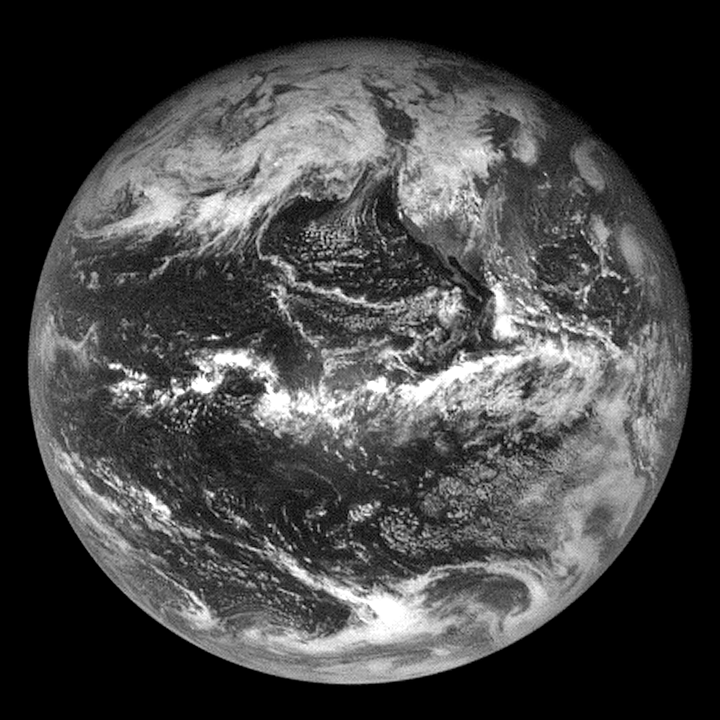
Image was taken by NavCam 1 on September 22, 2017, as OSIRIS-REx completed an Earth gravity-assist maneuver—flying close enough to our planet to steal some momentum and speed up the craft on its way to Bennu. This is the view from 110,000 kilometers (69,000 miles) away.OSIRIS-REx - NavCam1
NASA researchers claim that extraterrestrial life will be entirely different from life on Earth. Scientists believe that extraterrestrial life could exist in forms entirely different from the common earthly model of carbon-based life.
Scientists believe that extraterrestrial life might have entirely different combinations of genetic materials and proteins which would make it hard to understand with our Earthly knowledge.
The earthly form of life has been formed by carbon molecules in two forms. DNA or RNA, the genetic materials which control the functions of cells and the proteins which cater mechanisms of living organisms.
All earthly organisms, excluding virus, are characterized by the presence of DNA made of 4 sugars, adenine (A), cytosine (C), guanine (G) and thymine (T). The difference in length and compositions of double helix DNA in organisms is responsible for the difference between them. Viruses differ from other organisms as their T letter has been replaced by U in genomic sequence. Even though the virus has RNA as their genetic material, they are found to be inactive outside a host body.
Aaron Burton, a planetary scientist of NASA says that DNA is like a language. It has got an alphabet of four letters, A, G, C and T. All the life forms on Earth use the same alphabet from the tiniest microbe to humans like books in a library. Differences are created with the difference in arrangement of the letters. But the entire book would have the combination of same letters giving commonality among existing life.
Scientists have identified 20 amino acids to form proteins in all Earthly organisms. More than 80 amino acids had been discovered in meteors like Murchison meteorite. Researchers are yet to find the significance of these amino acids in forming alien life.
The basic rule of life on Earth has been characterized by Darwinian principles of evolution. According to the theory, living organisms change over time as a result of changes in heritable physical or behavioral traits.
Earthly life vs Alien life
A DNA double helix is seen in an undated artist's illustration released by the National Human Genome Research Institute to Reuters on May 15, 2012. A group of 25 scientists June 2, 2016, proposed an ambitious project to create a synthetic human genome, or genetic blueprint, in an endeavor that is bound to raise concerns over the extent to which human life can or should be engineered.Reuters
Researchers say that presence of inorganic amino acids or salts in meteorites cannot qualify it as a form of life. Carbon forms quadrilateral pyramid structure bonds with molecules to form the sugars and amino acids. This structure would be either left handed or right handed bonds.
Life on earth is characterised by DNA formed by right-handed (D) sugar bonds and amino acids or its constituent proteins formed by left-handed (L)bonds. Scientists believe that all other extraterrestrial lives are be formed by L genetic material bonds and right-handed proteins.
Organisms functioning with L amino acid bond cannot synthesize or utilize Right-handed amino acids. Similarly, R sugars also cannot recognize their left-handed counterparts.
Scientists say that laboratory made L sugars cannot be used by earthly organisms. However, researchers have also found that laboratory made left-handed sugar could function along with right-handed proteins.
Scientists believe that meteorites with 50/50 right handed and left handed sugars are positive signs for extraterrestrial life. It was found that at least one meteorite would fall to Earth every day. These meteorites get contaminated by microorganisms living in the atmosphere.
The earthly microorganisms attached to the meteorite decays any organic or inorganic alien carbon compounds in them. Most part of the meteors burns in the atmosphere, vaporizing any organic compounds in its surface. They may form plasma layers in the upper earth atmosphere or may form anywhere on Earth. Recovery of these foreign objects is difficult as it might have fallen to oceans or any remote locations on Earth.
It was found that meteorite materials are enriched in carbon-13 isotopes while Earthly objects are mainly built of carbon 12 isotopes. Presence of carbon-13 in a polished looking stone is generally considered as a positive sign for it's out of planet origin. All earthly objects would also be contaminated by microorganisms and biological signs of the planet.
OSIRIS-REx
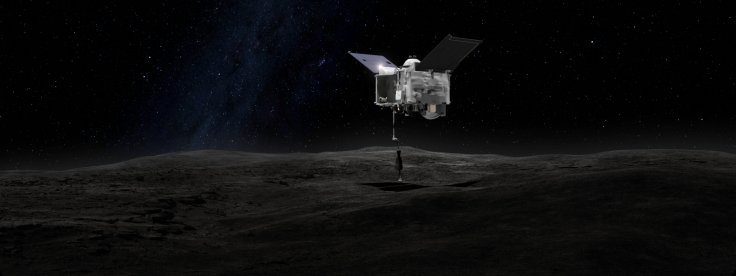
This artist's concept shows the Origins Spectral Interpretation Resource Identification Security - Regolith Explorer (OSIRIS-REx) spacecraft contacting the asteroid Bennu with the Touch-And-Go Sample Arm Mechanism or TAGSAM. The mission aims to return a sample of Bennu's surface coating to Earth for study as well as return detailed information about the asteroid and it's trajectory.NASA's Goddard Space Flight Center
NASA's OSIRIS-REx mission to asteroid Bennu would collect samples from the unadulterated carbonaceous surface of the distant solar object in Kuiper belt. OSIRIS-REx would collect rock samples and soil from the half kilometer wide Asteroid Bennu.
The mission launched in September 2016 will reach its destination in January 2019. The probe will orbit the asteroid for a span of one and half years to map the structures in it, before landing in a significant location to study the region and to collect samples from it.
Astronomers believe that the mission could help in the study of alien life and in finding mysteries behind objects which form the solar system.
Absence of life on Mars, Moon
The planet Mars is shown May 12, 2016 in this NASA Hubble Space Telescope view taken May 12, 2016 when it was 50 million miles from Earth. Earth's neighbor planet makes its closest approach in a decade this month, providing sky-watchers with a celestial show from dusk todawn.Reuters
NASA researchers, however, believe that life was never present on Mars or Moon. Research missions have collected rock samples from these neighbors to our planet and these are sometimes shell rock particles to its surroundings which might sometimes fall on the Earth's surface. But none of the samples have ever shown proof of life on these worlds even though traces of water and other minerals were observed.
Meanwhile, researchers also believe that microscopic life might be present in regions of planets which undergo sedimentation and tectonic activities.
Alien abduction or KGB? The baffling case of the miner whose body was found on a pile of coal
'Ziggy' Adamski disappeared from his home and his body was found 20 miles away on a coal pile
ByAndrew Robinson
The disappearance of a Yorkshire miner in 1980 left police baffled and prompted ‘alien abduction’ conspiracy theories.
Zigmund Adamski went missing in mysterious circumstances from his home in Thornfield Crescent at Tingley, near Wakefield, in June 1980
The 56-year-old miner at Lofthouse Colliery – who was known to many as ‘Ziggy’ – had set off on June 6 on a walk to the local shops to buy groceries.
It was the last time that Polish-born Mr Adamski was seen alive. His wife Lottie’s initial suspicion was that he had been kidnapped.
Five days after he disappeared, coal yard worker Trevor Parker found his body on top of a 10ft high pile of coal at his father’s coal yard in Todmorden, around 20 miles from Tingley.
Zigmund Adamski who was found dead in Todmorden in 1980.
He was wearing a suit but his shirt was missing, as were his watch and wallet. His clothes were said to be ‘improperly’ fastened and he had only one day of beard growth.
Mr Adamski’s hair had also been cropped short in a ‘roughly cut’ manner.
His body was also covered in burn marks, on his head, neck and shoulders. His face, it was reported, showed ‘absolute terror’ but there were no injuries to explain the cause of death.
The burns were said to be covered in a strange ointment which could not be identified by scientists.
What had happened to him and how did he end up in Todmorden?
Those questions haven’t been answered but this hasn’t stopped speculation and the development of some quite outlandish theories.
At the time, a famous UFO expert, a Polish-American citizen also called Adamski (George) offered up his own theory on what happened to his namesake.
George Adamski, who had previously claimed to have met with friendly aliens, said he believed that Zigmund had been abducted by aliens by mistake.
One tabloid newspaper suggested that Zigmund had been abducted and killed by aliens and his body dumped on top of the coal pile.
Others put forward theories that he had been killed by KGB forces or had been left dazed and confused after being struck by ‘ball lightning’ or some other unidentified phenomenon.
Trevor Parker, man who found the body of Zigmund Adamski under mysterious circumstances in June 1980, pictured September 1981.
The ‘alien abduction’ theories were given a further boost by Alan Godfrey, the policeman who had been called to the Todmorden coal yard when Mr Adamski’s body had been found.
In November 1980, five months after Mr Adamski’s body was found, Constable Godfrey had his own encounter with a UFO less than a mile away from the coal yard.
The respected policeman made a sketch of the UFO and later, under hypnosis, told a story about being taken aboard the UFO and given a physical examination by two non-human entities. The policeman’s UFO story made headlines around the world.
Mr Godfrey, now 70, told the Examiner that the story he told under hypnosis was probably merely a dream, adding: “I never said I was abducted by aliens.”
However, he believes it’s possible that Adamski WAS taken by aliens.
“I am open minded. I can’t rule it out.”
Mr Godfrey doesn’t believe Mr Adamski was murdered, although he said a more senior police colleague in 1980 believed he had been killed.
He thinks that Mr Adamski didn’t die where he was found but had been placed there “by someone or something.”
He added: “He was on top of the coal pile on his back with not a bit of coal on him. His eyes were wide open and he had burn marks. Why would he climb up a stack of coal?”
Although the coroner recorded an open verdict, ruling that Mr Adamski had died of a heart attack, Mr Godfrey says there are unanswered questions.
“There was some ointment on the back of his neck. Samples were sent to a Home Office laboratory which couldn’t identify it.”
Former policeman Alan Godfrey with his book, Who or What Were They?, which includes chapters on the Zigmund Adamski case and his UFO sighting which both happened in 1980
Mr Godfrey said he would never forget the look on Mr Adamski’s face.
“Those eyes were staring up at me. I was looking down on him from a foot away. Those eyes sent a shudder down my spine. They were wide open. He had a look of someone who had seen something or someone that had scared him to death.”
He added: “Something or someone put him on top of that pile of coal. And something scared him to death.”
Later, Mr Godfrey spoke to the pathologist who carried out the post mortem on Mr Adamski’s body.
“He said it was a classic case of someone who had been scared to death.”
The former policeman has no idea how the body ended up on the coal pile.
“How he got there I don’t know. I think something put him there.”
Mr Godfrey, who recently self-published a book which includes details of the Adamski case, said it had similarities with the alleged alien abduction of American logger Travis Walton in Arizona in 1975.
“He (Travis Walton) went missing for five days and he turned up alive. There are similarities.”
Almost 40 years on the case continues to fascinate investigators and those interested in unexplained deaths.
In Tingley local people still talk about the case.
Neil Beecham, who in 1980 was a reporter on the Morley Observer, said: “Mr Adamski’s mysterious disappearance 37 years ago has always troubled me and is a topic of conversation for the tight-knit community of Tingley, even to this day.”
Some commentators have suggested that Mr Adamski may have been abducted – but not by extra-terrestrials.
Ten years ago, two British UFO investigators looked again at the case. According to reports, they discovered that at the time he disappeared Mr Adamski was in the midst of a feud with a family member who was having marital problems and had moved in with the Adamski couple.
The investigators believed that Mr Adamski’s disappearance may have been an abduction linked to the feud.
Mr Godfrey has no information on this angle but said: “We had no reason to suspect any members of the family.”
Les Hewitt, in an article for Historic Mysteries, says the family members believed Mr Adamski had been abducted and held in a barn before having a heart attack.
He concludes: “The bizarre facts of this case – clothes that were improperly fastened, the body dumped atop a coal heap without noticeable disturbance, burns that were reported to be only two days old with an unidentified gel substance, only one day of beard growth, and another strange encounter with a UFO by the police investigator – lead us to imagine all kinds of possible outcomes.”
A writer for website The Iron Skeptic concluded that aliens played no part in Mr Adamski’s death.
“This case is just another example of a story that sounds good at first, but that dissolves under direct scrutiny. As are so many stories of space alien abduction.”
James Turnbull, Coroner who investigated the death of Zigmund Adamski who died under mysterious circumstances in June 1980, pictured West Yorkshire, September 1981.
James Turnbull, the coroner who dealt with Mr Adamski’s death, told the BBC in 2003 that it was the biggest mystery of his career - but he wasn’t convinced by any of the theories relating to paranormal activity.
He said: “The question of where he was before he died and what led to his death just could not be answered.”
The questions are unlikely to ever be answered.
A spokesman for West Yorkshire Police said this week: “The Adamski case is not part of any current investigation by the Protective Services (Crime) department.”
* Alan Godfrey’s book, Who or What Were They? is available through eBay.
Het is zover: machines kunnen nu officieel beter begrijpend lezen dan mensen (en wat dat betekent) - HLN.be
Thinkstock
IHLNArtificial Intelligence-programma’s van Alibaba en Microsoft hebben mensen verslagen bij een test begrijpend lezen. Het is de eerste keer ooit dat een machine beter presteert dan een mens op zo’n test.
De test werd gecreëerd door experts van Artificial Intelligence (AI) aan de Amerikaanse Stanford University om de leesmogelijkheden van AI-software te meten. Het wordt gezien als ’s werelds beste in zijn soort. Ook bekende namen als Google, Facebook, IBM, Tencent en Samsung hebben intussen hun AI-modellen bij het Stanford-project ingediend.
De software van de Chinese online retailer Alibaba was vorige week donderdag de eerste die erin slaagde de mens te kloppen op de test. Het werd een nipte overwinning: Artificial Intelligence: 82.44 punten, mens: 82.304 punten. Een dag later slaagde ook de software van Microsoft erin te winnen, met een score van 82.65. In beide gevallen waren de machines beter in het beantwoorden van vragen over moeilijke net ‘gelezen’ teksten. Pranav Rajpurkar, één van de onderzoekers aan Stanford University die de leestest mee ontworpen heeft, spreekt trots van “een grote start van 2018”.
“Een ware eer”, noemt Luo Si, hoofdwetenschapper van natuurlijke taalverwerking van de AI-onderzoeksgroep van Alibaba het. Bij ‘Natural language processing’ (NLP) imiteren machines het menselijke bevattingsvermogen van woorden en zinnen. Deze keer gingen de machines dus ‘erop en erover’.
Jobs
Si erkent in één adem dat de mijlpaal hoogstwaarschijnlijk betekent dat verschillende mensen in de toekomst hun job zullen verliezen aan een machine. De leestechnologie kan immers gradueel toegepast worden op talrijke applicaties zoals klantenservices, tutorials, online antwoorden op medische vragen van patiënten, … “Daardoor daalt de nood aan menselijke input daar op een ongeëvenaarde manier”, aldus Si. Alibaba zette de technologie overigens al eens aan het werk op ‘Singles Day’, ’s werelds grootste shoppingfeest. De technologie werd gebruikt om vragen van klanten te beantwoorden, met succes.
“Deze tests zijn handige maatstaven om te zien hoe ver we staan op het AI-pad”, stelt Andrew Pickup van Microsoft. “Hoewel AI pas echt een voordeel heeft als het in harmonie met de mens wordt gebruikt”, voegt hij toe. Maar Artificial Intelligence verstoort intussen al wel danig het ‘gewone’ leven van de mens: in verschillende sectoren en processen werden mensen al vervangen door robots, auto’s worden zelfrijdend, … De Russische president Vladimir Poetin voorspelde in september dat wie de leider in AI wordt, ook de heerser van de wereld wordt.
WETENSCHAP & PLANEETHet begon in 1545, toen enkele Azteken hoge koorts kregen. Ze klaagden over hoofdpijn en begonnen uit hun neus, ogen en mond te bloeden. De dood volgend binnen drie of vier dagen. De gruwelijke epidemie verspreidde zich razendsnel en vijf jaar later stond het dodental al op 15 miljoen, naar schatting 80 procent van de totale bevolking. Wat het precies was dat de ondergang van de Mexicaanse beschaving veroorzaakte, bleef eeuwenlang in raadselen gehuld. Maar nu beweren wetenschappers dat ze het wellicht toch hebben achterhaald.
‘Cocoliztli’ noemde de lokale bevolking de plaag die hen had getroffen. In het Nahuatl – een taal die de Azteken gebruikten – betekent dat ‘de pest’. Het was een van de dodelijkste epidemieën die de mensheid ooit trof en kwam in de buurt van de Zwarte Dood, de builenpest die in de 14de eeuw naar schatting 25 miljoen mensen het leven kostte in West-Europa, zo wat de helft van de bevolking.
In de daaropvolgende eeuwen werd gezocht naar wat die pest precies was en dat leidde tot hypothesen als waren het de pokken, de mazelen, de bof of de griep. Maar nergens werd hard bewijs gevonden om dat te staven. Wetenschappers kwamen gisteren met een nieuwe these, nadat ze DNA-materiaal geanalyseerd hadden op tanden van enkele van de slachtoffers van wie het lichaam was bewaard. Ze schreven over hun ontdekking in het wetenschappelijke tijdschrift Nature Ecology and Evolution. (lees hieronder verder)
RV Onderzoekster Ashild Vagene aan het werk in het lab.
“De plaag was een van de vele epidemieën die Mexico overspoelden na de aankomst van de Europeanen op het Amerikaanse continent”, aldus coauteur Ashild Vagene van de universiteit van Tübingen in Duitsland. De kolonisten brachten bacteriën mee die de lokale bevolking niet kende en waartegen ze ook geen resistentie hadden. “Het was de tweede van drie epidemieën die een hoge dodentol eisten. Twee decennia eerder hadden de pokken al eens tussen de 5 en 8 miljoen doden gemaakt en een tweede uitbraak van ‘cocoliztli’ roeide tussen 1576 en 1578 nog eens de helft van de resterende bevolking uit.”
Greppels
Fransiscaans historicus Fray Juan de Torquemada maakte een verslag van de periode en omschreef het zo: “In de steden en grotere dorpen werden diepe greppels gegraven. Priesters deden van ’s morgens tot ’s avonds niets anders dan daar lijken naartoe brengen en ingooien.” (lees hieronder verder)
RV
De wetenschappers van de universiteit van Tübingen onderzochten het DNA van 29 van zulke skeletten en ontdekten er sporen in van de salmonella enterica-bacterie, paratyphi C. Die kan een darminfectie veroorzaken, zoals buiktyfus. “Het is de eerste keer dat er direct bewijs wordt gevonden die naar de oorzaak van de ondergang van de beschaving kan wijzen”, aldus Vagene.
Van salmonella enterica is bekend dat het in de middeleeuwen voorkwam in Europa. Heel wat van de salmonellastammen verspreidden zich via geïnfecteerd voedsel of water en kunnen meegekomen zijn naar Mexico met de dieren die de Spanjaarden bij zich hadden, volgens het researchteam. “We hebben alle bacteriële ziekteverwekkers en DNA-virussen getest waarvan we genetische data hebben en vonden alleen salmonella enterica”, aldus coauteur Alexander Herbig.
Kanttekening
Ze maken zelf echter ook een kanttekening. Het is immers mogelijk dat er ziekteverwekkers zijn die niet meer te detecteren waren of die we gewoonweg niet kennen. “We kunnen niet met 100 procent zekerheid zeggen dat salmonella enterica de oorzaak was van de ‘cocoliztli’-epidemie”, aldus onderzoekster Kirsten Bos. “Maar we denken wel dat het een hele sterke kanshebber is.”
ANPMet een geavanceerde 3D-printer, speciaal ontworpen om te werken met levende cellen en biomaterialen, print een medewerker van het Amsterdamse VUmc een oor. De implantaten gemaakt met deze printer zijn speciaal op maat gemaakt voor patiënten die door bijvoorbeeld brandwonden een neus of oor zijn kwijtgeraakt.
MEDISCHEr is geen overtuigend bewijs dat 3D-geprinte implantaten minstens even veilig en doeltreffend zijn als de ‘klassieke’ producten. Dat concluderen onderzoekers van het Federaal Kenniscentrum voor de Gezondheidszorg (KCE) stelden vast dat de bewezen voordelen voor de patiënt (minder risico op complicaties, beter resultaat na chirurgie, enz...) momenteel nog zeer beperkt zijn.
Op dit moment is er evenmin bewijs dat 3D-printen besparingen zouden opleveren voor de gezondheidszorgverzekering, aldus het KCE in een dinsdag verschenen studie.
In de medische sector kent 3D-printen de laatste jaren een toenemende belangstelling en groei. Bij die techniek wordt een product in laagjes door een printer opgebouwd, op basis van een computerbestand. 3D-printen wordt vooral in de orthopedie en de tandheelkunde steeds meer gebruikt.
Volgens de voorstanders zou het gebruik van 3D-implantaten de duur van de operatie inkorten, met een minder vermoeid chirurgisch team dat minder fouten maakt. Daarnaast zouden de ziekenhuizen kosten besparen omdat de operatiezalen minder lang worden ingenomen. De KCE-onderzoekers vonden hiervan echter geen unanieme bevestiging. Het is niet aangetoond dat ze beter, veiliger of meer kosteneffectief zijn dan de ‘klassieke’ implantaten. Er is meer evidentie nodig, aldus het KCE in een persbericht.
Hogere prijs
Het KCE beveelt aan om het gebruik van deze nieuwe hoogrisico-3D-implantaten eerst te beperken tot gespecialiseerde centra en daarbij wetenschappelijke data te verzamelen. “De terugbetaling van een 3D-implantaat aan een hogere prijs dan het bestaande alternatief is in principe enkel mogelijk als de fabrikant kan aantonen dat zijn 3D-hulpmiddel beter is dan dit alternatief. Indien de fabrikant de werkzaamheid nog niet kon aantonen of indien de gevraagde prijs te hoog is, kan het RIZIV de terugbetaling weigeren.
In dat geval kan de kost van het implantaat aan de patiënt worden aangerekend of is het mogelijk dat het ziekenhuis deze draagt. Dit is ook het geval indien de fabrikant ervoor kiest om (nog) geen terugbetalingsdossier bij de ziekteverzekering (RIZIV) in te dienen.”
Het RIZIV zou de veilige 3D-hulpmiddelen waarvoor de toegevoegde waarde (nog) niet is aangetoond, toch kunnen terugbetalen, maar aan hetzelfde bedrag als dat van het reeds bestaande ‘klassieke’ alternatief.
Back in 2012, David Weatherly’s then-much-awaited book, Black Eyed Children was published. So, you may well ask, why am I mentioning this now, six years later? The answer is simple: Just recently, David decided to put out a new version of the book, a revised 2nd edition, and which has a cool cover courtesy of Sam Shearon. If you aren’t fully conversant with the BEC phenomenon, the sub-title to the new edition will give you a good idea of what you can expect in its 240 pages: “The B.E.K.s – They Reside On The Fringes Of The Paranormal. Are They A Diabolical Threat, Or The stuff Of Urban Legend?”
As I have noted in several of my books and articles over the years, the Black Eyed Children are, in many ways, similar to the Men in Black (no, not the Will Smith-Tommy Lee Jones type. The very weird, pale, cadaverous and creepy types are the ones I mean). The BEC so often turn up at night, knock on peoples’ doors and do their absolute utmost to try and get an invite inside. Fortunately, most people get a distinctly weird and creepy vibe from the BEC, something which generally ensures the “kids” don’t manage to get into the home of the targeted person. On occasion, however, some unfortunate souls have seen exactly what the BEC are capable of when they succeed in getting inside.
In his book, David not only provides us with numerous eyewitness-reports of encounters with the BEC, but also theories for what they might be. Those theories that David takes a look at include Changelings, Hungry Ghosts, the Djinn, Alien-Human Hybrids, Tricksters and more. But, there is one particular section of the revised Black Eyed Children that I want to draw your attention to. It’s a brand new section that deals with a man named Brian Bethel.
If you don’t know who Brian Bethel is, I’ll tell you. He’s the guy who really got the BEC ball rolling, after a creepy encounter with a pair of Black Eyed Children in the late 1990s. The location being Abilene, Texas. In the years since Bethel’s story surfaced, numerous others have come forward talking about their own encounters with the Black Eyed Children and that predated Bethel’s experience. But, it was definitely his report that got the wheels turning, so to speak. In that sense, Bethel’s is a very important case. As for what Bethel has to say now, more than twenty years later, let’s take a look.
There is no doubt in my mind that Bethel’s words – revealed at length in the book – are gripping and thought-provoking. And he shares the details of some chilling and sinister things that happened to him in the wake of the 1997 encounter. Bethel tells us how, in the immediate aftermath of the late-night incident, he “felt unsafe” going to sleep. Insomnia gripped him. He experienced what I have termed here at MU in earlier articles as a form of “psychic backlash.” And the list of supernatural negativity and menace goes on and on.
In terms of what Bethel thinks the Black Eyed Children are, he doesn’t waste any time in getting to the point. Indeed, he refers to them as “a predator species” and suggests that “we are the food.” Bethel adds that he believes the BEC are “dangerous entities.” He also concludes that “we have something they don’t, something they desperately want.” That something, Bethel suggests, is the human soul. He also suggests they can be beaten at their own game, particularly as a result of their “strange sets of rules,” such as not being able to get into a home or a vehicle unless specifically invited to do so.
If you are interested in the BEC phenomenon, then I would urge you to get a copy of the revised edition of David Weatherly’sBlack Eyed Children, and particularly so because of the revealing interview with Brian Bethel.
Is there a prize for being designated as the world’s newest (or biggest or fastest-growing) UFO hotspot? Even if there isn’t, the fine folks of Basingstoke, England, may want to put their name in the running. A recent video showing five lights moving in a line is the latest in a string of UFO reports in that southeast England town since 2008, as well as others in the 1980s and 70s. What’s up, Basingstoke?
The latest sighting comes from MUFON and was reported by Express.co.uk, which also noted some of the previous sightings in Basingstoke. Along with the video (seen here), the unnamed witness submitted a report (portions here – misspellings in original)
“i have ruled out them being any kind of servilian craft as these would have had some sort of flashing light on them and with it being dark and foggy we would have seen this. it couldnt have been search lights shinning up from the ground as we could clearly see the lights surface area getting wider as it shon down meaning the light source was in the sky … the sighting lasted around 30mins and managed to take around 4mins of video”
Fortunately, the good people of Basingstoke keep their cellphones locked and loaded. In April 2016, uploaded this video of four red blinking lights he saw near the Basingstoke train station. Chinese lanterns?
They always get the blame from someone
It looks like one common thread in these Basingstoke sightings is the lights. Another witness took this video of a dozen orange lights overhead on a night in June 2008 between 10.40pm and 11.10pm
That time of the night may be a common theme as well. There were reportedly numerous sightings on night in May 2012 at around 10:30 pm. That incident elicited a government response that hints at what at least some of these sightings might be. The RAF Odiham helicopter base is nearby in Hampshire and had choppers in the sky that night, although no one admit responsibility.
Not all of the Basingstoke sightings were lights. A famous photograph (seen here) taken of a sighting in June 2013 of two discs was examined by former Ministry of Defence UFO expert Nick Pope, who said:
“It’s one of the best UFO photos I’ve seen for a while. The shape and colour seems to rule out things like aircraft lights or Chinese lanterns.”
The news report said this was the second sighting in Basingstoke in 2013, following another in February.
Going back to August, 12 1983, a 77-year-old man was fishing on the Basingstoke Canal when he claimed a disc-shaped UFO landed near him and two English-speaking humanoids took him on the ship, examined him and let him go back to fishing because he was “too old.”
Take a young one … like Justin Bieber.
Other than the RAF helicopter base, there doesn’t seem to be anything in Basingstoke that would cause so many UFO sightings. Sure, it has artifacts dating back to the Paleolithic era, but so do many other English towns. There’s no nuclear plant or precious metal mines nearby – it sits on a mound of chalk and clay. It’s the birthplace of Jane Austen. Are aliens fans of her novels?
Whatever the cause, Basingstoke residents are wise to keep their cellphones charged and ready, and always tell humanoids doing probes that you’re older than you look.
Gigantische voorraden water overal op Mars gevonden. Wat betekent dit?
Wetenschappers hebben op acht plekken op Mars ijs gevonden dat zich dicht bij het oppervlak bevindt. De ontdekte ijslagen bevinden zich soms maar één meter onder de grond.
“Het was verrassend om op deze plekken ijs te zien aan het oppervlak,” zei hoofdonderzoeker Colin Dundas van de Amerikaanse geologische dienst USGS. “Normaal gesproken is het bedekt met een laag stof of regoliet.”
De onderzoekers hebben gebruikgemaakt van beelden van de Mars Reconnaissance Orbiter, die al sinds 2006 rond de planeet draait.
Veel meer
Uit de onderzoeksresultaten blijkt dat er veel meer ijs is op Mars dan in eerste instantie werd aangenomen.
De ijslagen zouden puur genoeg zijn om makkelijk in water te kunnen omzetten. Ze bevinden zich echter ver van de evenaar van de rode planeet.
Ook rond de evenaar is ijs gevonden, maar daar bevindt het water zich dieper in de bodem, aldus de onderzoekers.
Kolonie
Al lange tijd wordt gedacht dat op Mars waterijs in de grond zit. In 2002 stuitte NASA’s Odyssey op sporen van ijs en in 2008 haalde NASA’s Phoenix waterijs uit de grond op zijn landingsplek.
Het ijs kan in de toekomst in theorie dienen als watervoorraad voor een menselijke kolonie.
The following image has been captured by a photographer from Cornwall Ontario, Canada and shows a remarkable unidentified flying object that passes the moon. An object that looks like a black knight craft.
The photographer says that he has never witnessed anything like this and wonders whether it could be military, dimensional, other-worldly…
He states: I was out shooting images with my kids on the side of my house, just randomly shooting the moon and clouds. I captured images using a Canon SX60HS which has zoom capabilities allowing you to zoom in on the moons craters.
I did not notice the object while shooting, in this particular moment I was using 3 shot burst and just trying to get the circumference of the moon.
It was only when I was going thru the images when I noticed an object in view of the moon. The object seems to resemble a hat shape, likely metallic, and what I would call a disc with an elevated dome of sorts. It does not look to have many attachments at all.
I was immediately shocked by what I had captured; however, with my kids there I asked them "what do you think this is?" They all respectively said they thought it was a "UFO" or "Spacecraft".
Unfortunately, this was a still image, However, there was no object in the two subsequent images, meaning it was either faster than the shutter speed on 3 burst, or it was there and gone, disappearance.
I was utterly afraid to report this object, photographed in 2015, because I did not want to be subject to ridicule, but some friends and family, who have all encouraged me to report the sighting and get my story out there. Mufon case 89578.
They are all mysterious, for one thing — eye-catchingly weird, yet still just hazy outlines that let the imagination run wild. All have recently generated headlines as possible signs of life and intelligence beyond Earth, of some mind-bogglingly advanced alien culture revealing its existence at last to our relatively primitive and planetbound civilization. Yet their most salient shared trait so far is the certainty they provoke in most scientists, who insist these developments represent nothing so sensational. Ask a savvy astronomer or physicist about any of these oddities, and they will tell you, as they have time and time before: It’s not aliens. In fact, it’s never aliens.
Far from being close-minded killjoys, most scientists in the “never aliens” camp desperately want to be convinced otherwise. Their default skeptical stance is a prophylactic against the wiles of wishful thinking, a dare to true believers to provide extraordinary evidence in support of extraordinary claims. What is really extraordinary, the skeptics say, is not so much the possibility of extraterrestrial intelligence but rather the notion that its existence nearby or visitation of Earth could be something easily unnoticed or overlooked. If aliens are out there — or even right here—in abundance, particularly ones wildly advanced beyond our state, why would incontrovertible proof of that reality be so annoyingly elusive?
To put it more succinctly, as the nuclear physicist Enrico Fermi did more than a half century ago, “Where are they?” Given a 10-billion-year-old galaxy filled with stars and planets, and an Earth less than half that age, Fermi guessed we are unlikely to be the first technological culture on the galactic stage. If just one spacefaring civilization predated our own in the Milky Way, he calculated, even moving at a very languorous pace it should have had more than enough time to visit, explore and colonize every planetary system in the galaxy.
Ever since, practitioners of the search for extraterrestrial intelligence (SETI) have been brainstorming about why we do not encounter glaringly obvious signposts of an interstellar diaspora: Maybe there are nigh-universal bottlenecks in the odds for the emergence of life, intelligence or high technology, and we are indeed alone. Maybe we are not alone at all, but interstellar travel is so hard that everyone just stays home. Maybe we are being quarantined, and UFOs are dronelike documentarians recording an intergalactic Planet Earth miniseries. Maybe our galaxy is bursting at the seams with alien civilizations, and we simply have not looked hard enough—presuming we are capable of properly looking at all. Even the know-it-alls in the “never aliens” crowd would concede the diversity of possible answers to Fermi’s question says more about our ignorance than our knowledge.
One of Fermi’s SETI-pioneering peers, the physicist Freeman Dyson, once summarized the situation thus: “Our imaginings about the ways that aliens might make themselves detectable are always like stories of black cats in a dark room. If there are any real aliens, they are likely to behave in ways that we never imagined.” Even so, he added, “the failure of one guess does not mean that we should stop looking”—particularly because whatever may keep our skies alien-free would likely keep the rest of the universe free of star-trekking humans as well. Contemplating Fermi’s question is a way of exploring pathways to our possible futures. Finding aliens—or coming up empty in our searches—has profound implications for our own ultimate cosmic fate.
That is something to keep in mind while considering the latest near-hits (or near-misses), detailed below, in the ongoing search for cosmic company.
Dust busts "alien megastructures"
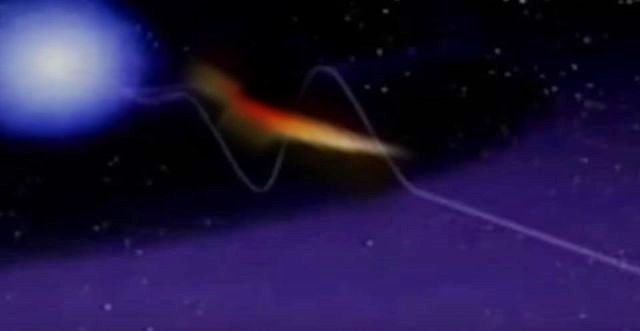
Discovered in archival data from NASA’s Kepler space telescope in 2015 by the Louisiana State University astronomer Tabetha Boyajian, the extreme episodic dimming of “Tabby’s Star,” or “Boyajian’s Star,” inspired speculations it was being engulfed by starlight-absorbing “alien megastructures” (think: a solar power plant the size of a solar system). Those speculations helped Boyajian and colleagues launch a successful Kickstarter project that raised funding for further scrutiny of the star, an effort that jumped into overdrive in May 2017, when the star began another dimming episode. But instead of revealing aliens, those observations—and others from telescopes around the world—found the culprit is probably clouds of submicron-scale dust around the star.
“If these dips were caused by solid, opaque objects, you’d expect them to block light equally at all colors. But we saw that the dips were deeper in blue [light] than they were in the red, which indicates that something more transparent, like dust, is crossing in front of the star,” Boyajian says. “How do we know it’s not solar panels absorbing blue light more efficiently than red light? Well, we don’t, but we do know dust is all over the universe in many different places, and what we now see is what we’d generally expect from dust.” The result mirrors that of another team led by the University of Arizona astronomer Huan Meng, which also flagged dust as the likely cause of the star’s odd behavior in October 2017.
Even so, Jason Wright, an astronomer at The Pennsylvania State University who collaborates with Boyajian on studies of the star, cautions that much more work is needed as dust is not the only remaining explanation. Other possibilities—such as intrinsic fluctuations in the star’s luminosity or even a black hole with a cold and dusty debris disk drifting across our interstellar line of sight—could also still fit the data. In theory, Wright says, even the “aliens” hypothesis is still on the table—although only if their megastructures are improbably adept at mimicking “boring old dust.”
“You don’t want to immediately cry ‘aliens’ like a boy crying wolf every time you see something and don’t understand it,” Wright says. “But with Tabby’s Star that’s not what has happened—she and her team have spent years trying to solve what is a legitimate astrophysical mystery.” The upside of all the public attention, Wright says, is that it has lured many astronomers to work on Tabby’s Star “precisely because all the ‘aliens’ talk annoyed them, and they wanted to find a natural explanation.”
Eavesdropping on 'Oumuamua
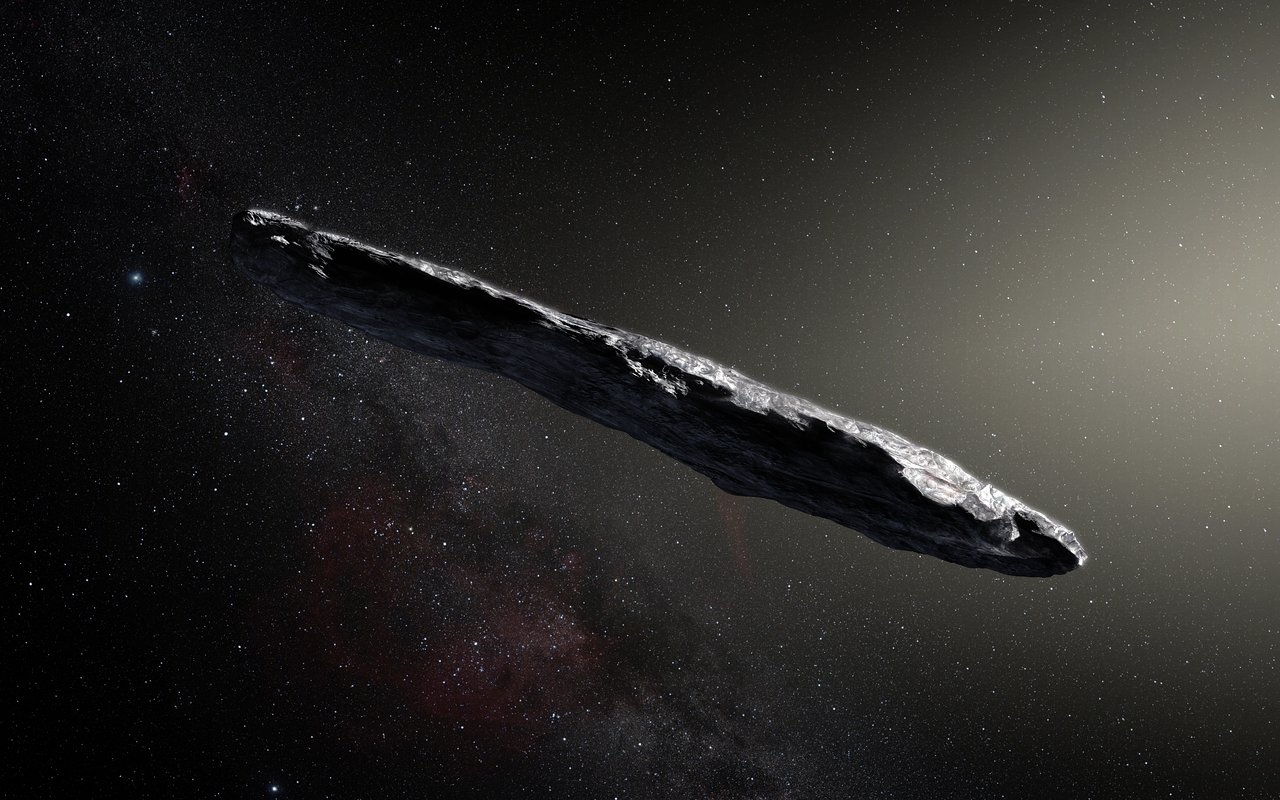
Astronomers spotted the sizeable object now called ‘Oumuamua (Hawaiian for “first messenger”) streaking by Earth last October. They determined by its speed and trajectory it had dive-bombed past our sun from the depths of interstellar space, perhaps after cruising through the void for billions of years. Theorists had long predicted icy comets cast away from other stars would someday be detected passing through our solar system, yet ‘Oumuamua did not act like a comet at all—despite passing blisteringly close to the sun, it never sprouted a cometlike tail of evaporating ice. It did not look like a comet either, appearing under telescopic scrutiny to be shaped like a half-kilometer-long needle—a form unknown among natural solar system objects but often favored by starships in science fiction. Perhaps, some SETI enthusiasts thought, ‘Oumuamua was an active or derelict probe from another civilization.
But when SETI-minded astronomers targeted the object with two exquisitely sensitive radio telescopes to eavesdrop for any artificial transmissions, they detected nothing. Other teams using large telescopes discovered ‘Oumuamua’s surface was a very particular shade of red, the same color that common carbon-rich molecules turn after prolonged exposure to harsh radiation.
The most likely conclusion? Despite its strange shape, trajectory and lack of a tail, ‘Oumuamua is just a comet after all, its ice locked away beneath a tarlike crust hardened and desiccated by eons of bombardment by cosmic rays. Its radio silence adds to a handful of other SETI false alarms in recent years.
“We accept that these things being artificial is really the lowest-probability possibility for what they are—our past work guides us in that,” says Andrew Siemion, director of the Berkeley SETI Research Center and leader of one team tuning into ‘Oumuamua. “All of these are going to be natural—until one turns out not to be.”
Clandestine close encounters
Late last year The New York Times published a story about a small, secretive program run by the Department of Defense to study new reports from the armed services about encounters with UFOs. The project was officially canceled in 2012, leading its former head to resign and join a private, for-profit company — To the Stars Academy of Arts & Science(TTSA) — dedicated to declassifying and studying the Pentagon’s batches of UFO-related material. The Times story included two short videos of separate UFO encounters captured by aircraft-mounted infrared cameras, and hinted at the existence of a third that has yet to be released. In the first video, from an encounter off the coast of San Diego in 2004, a fighter jet tracks a lozenge-shaped something that seems to zoom off at incredible speed, apparently without generating exhaust plumes or a sonic boom. In the second video, captured by a different fighter jet under undisclosed circumstances, an object surrounded by a “glowing aura” seems to fly tilted against heavy headwinds in defiance of known principles of aerodynamics, accompanied by audible exclamations from the fighter jet’s crew.
Steve Justice, TTSA's aerospace division director and former Lockheed Martin engineer who worked on advanced top secret aircraft for the latter company’s storied “Skunk Works” division, speculates that in both cases such incredible feats of flight could be due to the objects possessing some sort of warp drive. Such an (entirely theoretical) device would somehow allow an object to change mass and inertia at will, and potentially to travel faster than light by “altering the spacetime metric” around itself. Whether aliens are behind the fighter jet encounters is, to him, somewhat immaterial.
“I’m not really interested in the ‘who’ or the ‘what,’ but I’m really interested in the ‘how,’” Justice says. “How could you make a machine fly like that? To remove the effects of aerodynamics, I’d want to create a volume around myself where I was insulated from them, where I could change my orientation without changing direction, where I could accelerate without generating shock waves. Right now when an airplane pulls its nose up in forward flight, it climbs; when it breaks the sound barrier, it makes a sonic boom. But that’s not what we see here.”
Keep watching the skies
Skeptics reviewing the videos obtained by TTSA have postulated more prosaic explanations, while bemoaning both the lack of data due to pernicious state secrecy as well as the organization’s potentially problematic profit-seeking motives. (According to the TTSA Web site, a minimum investment of $200 buys you membership in the organization and finances research into “exotic technologies” associated with UFOs that could lead to “revolutionary breakthroughs in propulsion, energy and communication.”) Perhaps the speeding “lozenge” was a new type of missile, launched from a submarine as part of some earthly power’s clandestine technology test. And maybe the tilting, aura-sheathed object was actually a distant conventional aircraft distorted by image-processing firmware and autotracking sensors within the fighter jet’s gun camera.
This latter possibility Justice acknowledges as “entirely plausible”—save for the obvious urgency in the voices of experienced military pilots as they speak of associated radar tracking, which is not shown on the gun camera’s feed. “Maybe it could have been some set of physical and optical aberrations,” Justice says. “But when I put it in context of all the information in the video, that’s less likely to me.”
Of course, military pilots aren’t the only ones with extensive experience looking at objects in the sky—and the equipment to record what they see. Astronomers have that, too—yet they never seem to ever catch UFOs in the viewfinders of their telescopes. Similarly, the increasingly global ubiquity of smartphones should presumably boost the numbers and quality of UFO encounters captured on video (as they have done for rocket launches), but the flood of eerie footage has yet to materialize.
That raises a red flag for Bruce Macintosh, an astronomer at Stanford University. “In general, interesting physical phenomena are only barely significant when first detected. Then, as technology progresses, those detections become more significant,” he says. “But UFO detections have remained marginal for decades; they’ve just gone from being blurry shapes on film cameras to blurry shapes on the digital infrared sensors of fighter jet gun cameras. This, in spite of the fact that the world’s total imaging capacity has expanded by sev}ral orders of magnitude in the past 20 years.” To remain so vexingly residual, he says, UFOs would have to become more elusive in lockstep with our increasing ability to detect them—something no natural process would be expected to do.
Hypothetical aliens with advanced technology could do that, of course. “But then you have to ask why they would choose to remain marginally undetectable rather than just being undetectable,” Macintosh says. “Unless they’re taunting us, it’s hard to come up with a coherent explanation.”
Except, of course, for the obvious one: It’s never aliens. Until, perhaps, it is.
Boeing has revealed a new design of their in-development hypersonic plane. The aerospace giant is racing against competitors in the U.S. and abroad to develop a viable hypersonic aircraft.
Aerospace companies are in a heated race to create a hypersonic plane to replace the SR-71 Blackbird. Though retired in 1990, the SR-71 still holds the record as the fastest plane ever built, achieving a top speed of 3,540 kmh (2,200 mph). The goal now is to build a plane capable of reaching speeds above Mach 5 (6,171 kmh/3,835 mph), and Boeing thinks they may have the design that could do it.
Boeing’s recently unveiled design for their hypersonic plane. Image Credit: Boeing
Popular Mechanics reports that Boeing’s current design works off of previous successes in hypersonic aircraft, including the unmanned X-51, which broke records in 2013 when it flew at Mach 5.1 for three-and-a-half minutes before running out of fuel and crashing into the ocean. The big challenge is building a plane that can not only reach Mach 5, but that can also decelerate to land.
To that end, both Boeing and Lockheed Martin are researching designs that utilize turbojets, a type of engine that has long been used in commercial aircraft, to achieve Mach 3 speeds before swapping to a dual ramjet/scramjet. Those types of compression engines only function at speeds above Mach 3, and they would provide the power to propel the aircraft to Mach 5 speeds and higher.
Artist’s concept of Lockheed Martin’s SR-72. Image Credit: Lockheed Martin
Lockheed Martin’s planned SR-72, which they are developing with the U.S. Air Force and the Defense Advanced Research Projects Agency (DARPA), has a similar design to the craft revealed by Boeing last week. The tentative release date for the SR-72 is 2030, though sightings of an unmanned demonstrator aircraft at Lockheed’s California facility suggest the company may be further along in development than expected.
Regardless of who wins this race, the development of hypersonic flight promises to change the future of travel, exploration, and military engagement — for everyone.
Cahokia; An Ancient American City Covered in Pyramids
Around four centuries before the arrival of Columbus to the American continent, the Native Indians of Illinois erected a city that came to support a population of more than 20,000 inhabitants. But not only did they create a sophisticated city, for some reason they built more than a hundred mysterious earthen Pyramids, which, until this day, remain a profound enigma, as well as the general history of the site and its inhabitants.
Scholars consider Cahokia as one of the most significant and most influential ancient settlements in the Mississippian culture that developed and built massive structures five hundred years before Europeans came to the New Continent.
The original name of this ancient city is unknown. The name Cahokia is borrowed from a tribe that lived nearby in the 1600’s.
The Cahokia site covered an area of nine square miles.
Illustration: Cahokia Mounds State Historic Site.
Cahokia is an ancient settlement with a history that is more profound than we currently are willing to acknowledge.
Washington University’s John Kelly, a longtime stalwart of Cahokian archaeology, sums up the present understanding of Cahokia nicely: “People aren’t sure what it is.”
The first man to write about this ancient city was Henry Brackenridge, a lawyer and amateur historian who noted he was left amazed by what he had seen in 1811:
“I was struck with a degree of astonishment, not unlike that which is experienced in contemplating the Egyptian pyramids. What a stupendous pile of earth! To heap up such a mass must have required years, and the labors of thousands.”
The city, its monuments, and cultures are of great value.
Experts believe that Cahokia was the apogee and may have even been the origin of what scholars refer to as the Mississippian culture which spread across the American Midwest and Southeast starting before A.D. 1000 and peaking around the 13th century.
The building process of the city is another mystery. Researchers say that everywhere they dug, they found something of value, houses, buildings, monuments. The discoveries made at Cahokia indicate that it was a massive city, which, mysteriously, was built in an extremely brief span of time.
In other words, researchers say that it seems as if the entire city ‘sprang to life almost overnight around 1050’.
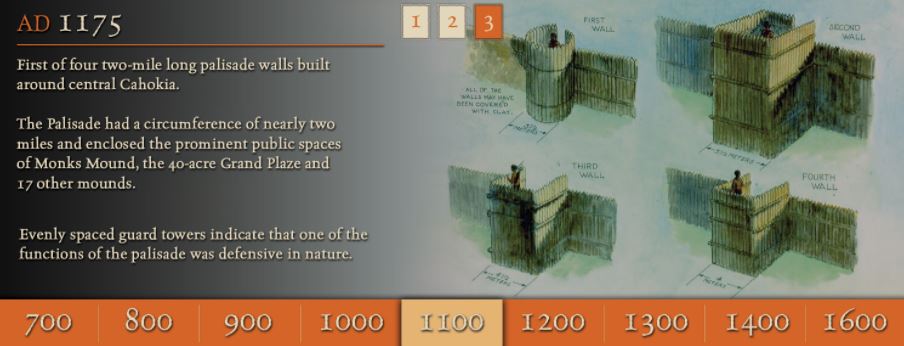
People from all over the area started moving to Cahokia which allowed the creation of complex infrastructure. The Cahokians built MASSIVE mounds—earthen Pyramids, a playa with the size of 45 football fields and different ceremonial and religious monuments.
To get an idea of how big the Cahokian earthen Pyramids were if you climb on top of Monks Mound, composed of 156 steps, you’d find yourself atop a structure that is larger at its base than the Great Pyramid of Giza. Now imagine the amount of work that needed to be done to create something like this around 1050.
The base circumference of Monks Mound is larger than the Pyramid of the Sun at Teotihuacan. It is believed that the inhabitants of Cahokia began building it around 900–950 CE, and was completed around 1100 CE.
At its peak around 1100, the city of Cahokia covered more than five square miles and was made up of 120 earthen pyramids. The inhabitants of Cahokia were skilled farmers, traders, and hunters, but they were also excellent urban planners and used astronomical alignments—like many other cultures in the American Continent—to build a small metropolis which was more extensive than many European cities during that tie.
The Cahokians did not leave behind a written language; we don’t know what they called themselves, where they came from, why they build these massive earthen Pyramids, why so many of them, and why they disappeared.
In fact, by the time Columbus got to the Americas, the city was already a ghost town. Experts only know that the city came into existence during a favorable climate phase and began shrinking around the time the climate became cooler, drier, and less predictable.
Zoom Through the Famous Orion Nebula with NASA's Incredible 3D Video
By Calla Cofield, Space.com Senior Writer
Take a tour of one of the most famous star-forming gas clouds in the night sky, the Orion Nebula, with a new, 3D visualization released by NASA.
In this short video, viewers slip through the colorful clouds, bright stars and detailed structures of the popular nebula. The visualization was created using real data from the Hubble and Spitzer space telescopes, combined with "Hollywood techniques," according to a statement from the Space Telescope Science Institute (STScI), which co-produced the video.
The creators of the video said in the statement that they hope the visualization will give viewers a better idea of the 3D structure of the star-forming region. For example, the Trapezium star cluster in the heart of the nebula includes a bowl-shaped valley carved out by intense ultraviolet radiation and "winds" from new stars. The complete topology of that region isn't visible in 2D images. [The Splendor of the Orion Nebula (Photos)]
"Astronomers and visualizers worked together to make a three-dimensional model of the depths of this cavernous region, like plotting mountains and valleys on the ocean floor," according to the statement. "Colorful Hubble and Spitzer images were then overlaid on the terrain."
The movie occasionally switches between images taken by the two separate telescopes. The Hubble space telescope captures light in the visible range seen by humans, as well as longer and shorter wavelengths in the ultraviolet and near-infrared ranges. The Spitzer space telescope captures light in the mid-infrared to far-infrared range, capturing objects and structures that are lower in temperature than what Hubble sees. But scientists can create visible representations of the data, revealing structures that would otherwise be invisible to humans.
"Looking at the universe in infrared light gives striking context for the more familiar visible-light views," Robert Hurt, a lead visualization scientist at the Infrared Processing and Analysis Center (IPAC) at the California Institute of Technology (Caltech), said in the statement. "This movie provides a uniquely immersive chance to see how new features appear as we shift to wavelengths of light normally invisible to our eyes."
The two telescopes provide 2D images of cosmic objects, so the creators had to rely on both "scientific knowledge and scientific intuition" to create the 3D tour. Summer and Hurt "worked with experts to analyze the structure inside the nebula," using visible light to create the surfaces, and infrared light to construct much of the nebula's structure.
"Being able to fly through the nebula's tapestry in three dimensions gives people a much better sense of what the universe is really like," Frank Summers, the STScI visualization scientist who led the team that developed the movie, said in the statement.
The visualization was created by scientists at STScI and Caltech/IPAC as part of NASA's Universe of Learning program. The program uses a "direct connection" to NASA science and scientists, to create content that "[enables] youth, families, and lifelong learners to explore fundamental questions in science, experience how science is done, and discover the universe for themselves."
Photo Credit: X-ray NASA/CXC/University of Colorado/J. Comerford et al.; Optical: NASA/STScI
The Week's Top Space Stories
A top-secret spy satellite mission may have plunged into the Indian Ocean, NASA's James Webb Space Telescope gets set to leave Houston, an iconic space traveler is honored with touching tributes, and supermassive black holes seem to "burp." Here are the top stories this week at Space.com
Photo Credit: NASA
1. James Webb getting ready to leave Houston!
NASA's James Webb Space Telescope has finally come out of a deep cryovacuum freeze to make its way to the West Coast, where it will get ready for a 2019 launch. The moving process will likely begin in late January or early February, and at its destination — Northrop Grumman's Aerospace Systems facility in California — the massive telescope will meet up with its tennis court-sized sun shield and the rest of the spacecraft.
A classified U.S. government payload known as Zuma plummeted into the Indian Ocean shortly after launching atop a SpaceX Falcon 9 rocket on Jan. 7, according to an unnamed "U.S. official." SpaceX has stated that the Falcon 9 performed as expected, leading to speculation that Zuma perhaps failed to operate properly during or after deployment. The spy satellite has gone missing, and the circumstances under which the Zuma mission failed have yet to be fully disclosed.
John Young was honored with an outpouring of touching messages upon his passing on Jan. 5, at the age of 87. Young was the first space shuttle mission commander, and was the ninth person to walk on the moon. As NASA's most experienced astronaut, he served the space agency for 42 years, and many who've been inspired by Young's mentorship and humor paid tribute to him this week.
A new study has found what appear to be layered glaciers beneath the surface of Mars. The ice sheets are just a few feet underground in some places, which may be useful for future crewed missions to the Red Planet. The water ice is also valuable for scientists looking to better understand Mars' climate history.
Space travel could put dangerous pressure on the fragile ends of optic nerves, according to new research. A study of 15 astronauts found that tissues surrounding the ends of their optic nerves looked warped or swollen weeks after being back on Earth, and this may explain why nearly half of all space travelers who stay in space for long periods of time develop significant eye problems.
Photo Credit: X-ray NASA/CXC/University of Colorado/J. Comerford et al.; Optical: NASA/STScI
6. Black holes caught burping twice
Supermassive black holes are truly gigantic: Their masses can range from a million to several billion times the mass of the sun. Researchers announced this week that they caught two cosmic "burps" from black holes this size — streams of high-energy particles blasted out from just beyond the event horizon after the black hole has pulled in nearby gas.
Scientists from the Breakthrough Listen initiative observed fast radio bursts (FRB) coming from the direction of a distant dwarf galaxy, reasoning that the mysterious emissions could be signs of alien life. While a recent study reveals that last August's observations were likely not signals from some faraway civilization, alien hunters remain curious about FRBs.
Photo Credit: Katy Mersmann/NASA's Goddard Space Flight Center
8. Good news: hole in ozone layer is healing
Efforts over the course of many years to mend the ozone layer hole over Antarctica seem to be succeeding. Researchers determined that human-produced chemicals were causing the massive gap in the atmospheric layer, which was first identified in the mid-1980s. According to a recent NASA statement, a new study showed a 20-percent decrease in chemical-caused ozone depletion over the last 10 years.
The interior structure of Jupiter was completely misunderstood until the Juno spacecraft began observing the giant planet up close, the mission's principal investigator announced on Jan. 9. While Jupiter has been observed for centuries from Earth, and from space by NASA's Pioneer and Voyager missions, information about Jupiter's atmosphere and its core is continually surprising Juno's mission team.
Out-of-This-World Diamond-Studded Rock Just Got Even Weirder
By Stephanie Pappas, LiveScience Contributor
The diamonds that are studding the Hypatia stone probably formed from the shock when the space rock blasted through Earth's atmosphere.
Credit: Shutterstock
A tiny chunk of stone that looks like nothing else ever seen in the solar system might be even weirder than scientists thought.
The Hypatia stone was found in southwestern Egypt in 1996. It was hardly more than a pebble, just 1.3 inches (3.5 centimeters) wide at its widest and a smidge over an ounce (30 grams) in weight. But analysis revealed that the stone (dubbed "Hypatia" for a fourth-century female mathematician and philosopher) fit into no known category of meteorite. Now, a new study suggests that at least some parts of the stone may have formed before the solar system did.
If so — and that is a big "if" — the stone might reveal that the dust cloud that eventually congealed into our solar system was not as uniform as previously believed. [Big Bang to Civilization: 10 Amazing Origin Events]
Oddball discovery
When the Hypatia stone was first discovered, researchers weren't sure where it came from. Because it is studded with microdiamonds 50 nanometers to 2 micrometers in size, one possibility was that it was a strange example of a type of diamond known as a carbonado diamond. But studies in 2013 and 2015 definitively knocked out that possibility: The ratios of noble gases in the stone show that it is most certainly from out of this world. (The diamondsprobably formed from the shock when the space rock blasted through Earth's atmosphere.)
Some parts of the Hypatia stone may have formed before the solar system did, scientists now say.
Credit: Mario di Martino/INAF Osservatorio Astrofysico di Torino
"This is a piece of extraterrestrial material," said Guillaume Avice, a postdoctoral scholar of geochemistry at the California Institute of Technology who participated in the 2015 study. [Greetings, Earthlings! 8 Ways Aliens Could Contact Us]
But that's about all that can be definitively said about the Hypatia stone. The makeup of the rock matches no known meteorite. In fact, the rock hasn't been officially categorized as a meteorite, even though it came from space, because only about 0.14 ounces (4 grams) of the original mass of the rock can currently be accounted for. It's not that the rest is permanently lost, Avice said, but it's been chipped apart and sent around to so many labs that fragments are all over the place. The Meteoritical Society requires 20 percent of a meteorite's original mass to be present to officially declare it to be a meteorite.
Mysterious minerals
In the new study, researchers focused on the minerals in the Hypatia stone. They discovered that the stone itself is not uniform, but consists of a carbon-rich matrix shot through with a variety of minerals. These mineral inclusions are as weird as the rest of the rock, the research team found. They include pure metallic aluminum nuggets, an extremely rare find in the solar system; moissanite and silver iodine phosphide grains; and strange ratios of elements that fail to match the typical ratios of solar system objects. For example, unlike any other solar object ever found, these minerals include a nickel-phosphide compound with very high ratios of nickel to iron.
"There is no known or imaginable mechanism that [this compound] could have been produced naturally in the solar nebula," study leader Jan Kramers, a geologist at the University of Johannesburg, told Live Science in an email.
The solar nebula is the dust and gas that remained after the formation of the very early sun at the dawn of the solar system about 4.6 billion years ago. Kramers and his colleagues think that this portion of the Hypatia stone may have formed from the pre-solar nebula, making it older than the sun itself. The rest — the carbon-rich matrix — may have coagulated later in the coldest outer reaches of the solar nebula, according to Kramers, because forming large bodies requires a dense dust cloud like the solar nebula to provide the material.
But current theories of solar system formation hold that solar nebula dust was the same everywhere, and Hypatia doesn't fit that picture. The matrix of the stone contains no silicate minerals. The Earth and other rocky planets are full of silicates, and so are stony meteorites. If the matrix of the Hypatia stone formed from the solar nebula, that nebula couldn't have been totally uniform after all, Kramers said.
However, that interpretation of the Hypatia stone's formation is still questionable, Avice said. The test that would cinch whether any part of the object is presolar in origin is an analysis of the Hypatia stone's isotopes, or variations of atoms based on the number of neutrons in their nuclei.
"Presolar material has a very strange isotopic composition compared to the average values of the solar system," Avice said.
Kramers also said isotopic analysis of both the matrix and the mineral inclusions in the stone is the next step researchers need to take to better understand the mysterious space pebble.
Until then, Avice said, "we still don't know what this is, exactly."
5 Things You Probably Did Not Know About Tutankhamun
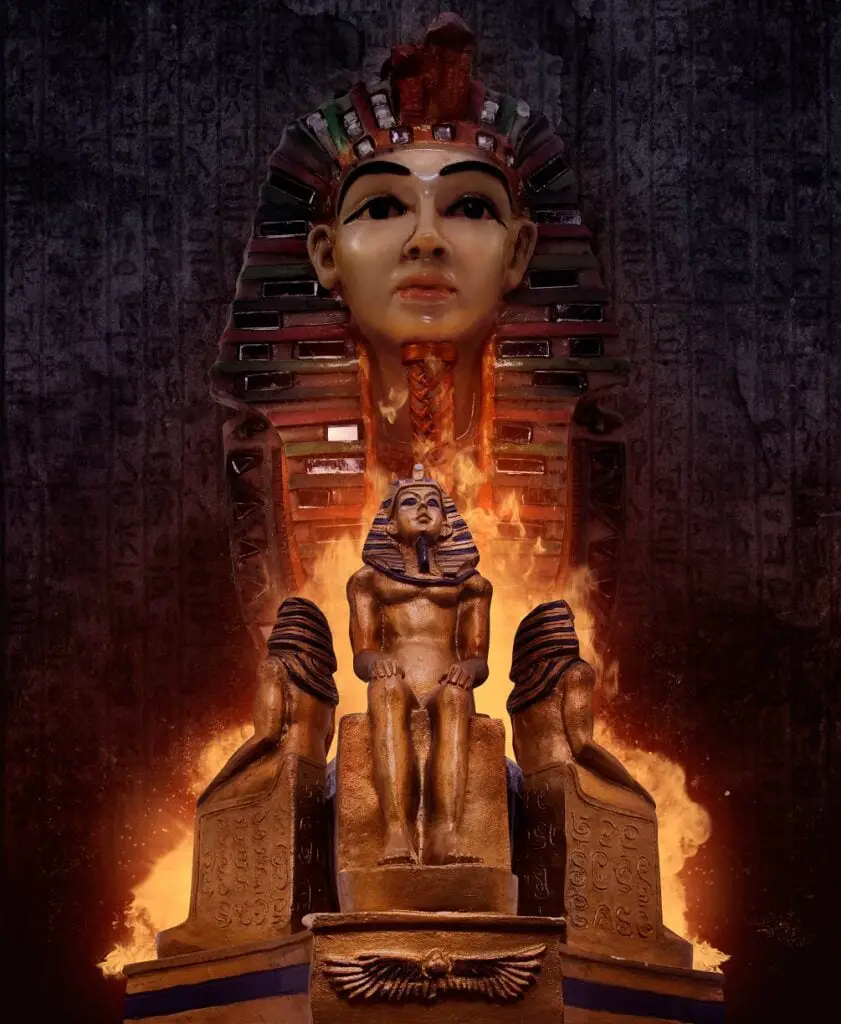
Tutankhamun was an ancient Egyptian pharaoh belonging to the 18th dynasty of Egypt and reigned from 1336 to 1327 B.C. In hieroglyphs, the name Tutankhamun was typically written Amen-tut-ankh.
His original name, Tutankhaten means “living image of Aton,” while Tutankhamun means “living image of Amun.”
Although it is formally defined that the XVIII Dynasty ends with the reign of Horemheb Egyptologists are convinced that the young Pharaoh was the last ruler of royal blood of the dynasty.
His reign was marked by the return to normalcy in the socio-religious plane after the interlude starring the monotheism of Akhenaten.
Tutankhamun is one of the most famous Pharaohs to rule over Egypt.
Image Credit: Shutterstock
Said return was gradual, restoring the cult and architecture of the abandoned temples belonging to gods such as Amón, Osiris or Ptah, placing the priestly caste in office and allowing the celebration of the pertinent rites.
So, let’s go through some fascinating details about one of the most famous Pharaohs to rule over Egypt.
Tutankhamun’s tomb was so small that it took centuries to meet. In particular, it took 3,245 years until his tomb, found on November 4, 1922, was discovered by the English Egyptologist Howard Carter.
Tutankhamun’s reign
Tutankhamun was between 8 and 9 years old when his reign began. Therefore, the important decisions of government fell to two older figures: the father of Nefertiti, named Ay, and a military general named Horemheb. The Boy Pharaoh ruled for a decade, from 1333 to 1324 B.C. He is considered the youngest Pharaoh to rule over Egypt.
The Course of King Tut
Despite the fact that many believe there’s a course related to Tutankhamun, there isn’t one.
When Howard Carter first entered King Tut’s tomb in 1922, he was accompanied by his financial backer, George Herbert. Four months after having entered the tomb, Herbert died of alleged blood poisoning from an infected mosquito bite. Soon, newspapers would go crazy and started writing about a course, and how the Herbert was victim of King Tut’s course, which was supposedly outlined on a clay tablet just outside the tomb.
But despite the fact that others who visited the tomb also died, there is not a single piece of evidence that suggests their deaths were connected to a course.
Tutankhamen reversed the radicalism of his father, Akhenaten, and restored the ancient belief system.
Image Credit: Shutterstock.
When Carter entered into King Tuts tomb, he found a treasure trove of priceless funerary objects, including gold figurines, ritual jewelry, small boats which are said to represent the journey to the afterlife and a shrine made for the pharaoh’s embalmed organs.
But, in addition to all of those treasures, Carter discovered a chamber which contained two small coffins with two fetuses. According to DNA testing, one of the mummies was Tutankhamen’s stillborn daughter, and the other mummy was most likely also his child.
The artifacts recovered from Tutankhamun’s tomb are considered as some of the most viewed archaeological treasures in the world.
His Family
The family and the ancestry of the Tutankhamun is a little confusing.
Tutankhamun was the son of Akhenaten, the husband of Nefertiti, with whom he had six daughters. However, at the same time, Akhenaten had a ‘lesser wife’ named Kira, which is supposed to be the mother of the famous pharaoh.
Tutankhamun was married, in turn, to Ankhesenpaaten one of the daughters of Akhenaten and Nefertiti, and his half-sister.
Tutankhamun’s name, nearly erased from history
Even though Tuthankhamun is, and will remain as one of the most famous Pharaohs of ancient Egypt, evidence of his reign was obliterated after his death, when, his successor Horemhe replaced Tutankhamun’s name with his own on countless monuments.
NASA Present New Tires That Are Almost Indestructible
Ever since man has thought about reaching out to extraterrestrial planets, he has thought of what will he be driving once he gets there. Building vehicles and, more specifically, wheels and tires that will be up for the challenge is no easy task, and so NASA has been experimenting with many different materials over the years.
Take NASA’s one-ton, car-size, nuclear-powered Mars Curiosity robot: After just a year of cautious 0.144 kilometers-per-hour roving, small rocks began ripping large holes in its tires.
However, NASA engineers have reinvented the wheel into a form that may one day conquer Mars.
They’ve created a nearly invincible tire made of woven-mesh metal that “remembers” its ideal shape and immediately springs back into form after taking a beating.
NASA Engineer Colin Creager and his colleagues initially built a woven-mesh wheel made out of spring steel. It gripped soft sand well and supported a lot of weight, yet kept hitting a major snag. “We always came across this one problem of where the tires would get dents in them,” Creager said in a NASA video.
Then Creager started using a shape-memory alloy — a super-elastic metal that pops back into place after intense strain.
NASA has been developing space-grade tires since the 1960s, starting with its moon-landing program.
The space agency later set its sights on Mars, spurring development in off-planet wheels. Yet the list of requirements for roving the red planet is daunting. It has to be an All-terrain tire, lightweight, durable, and able to survive wild temperature swings.
To handle scaling a veritable mountain, Curiosity’s designers made 20-inch-high aluminum wheels, that were strong and stiff. Yet mission controllers began noticing worrisome dents, holes, and tears in those tires in 2013 — about a year into the mission. Today Curiosity is instructed to avoid small pointy rocks, limiting damage, but the wheels continue to degrade.
“When the current rover wheel damage occurred, we thought it was worth taking a look at that wheel and adapting it for the future,” Creager told Businessinsider.com.
After years of research, the team settled on a nickel-titanium (NiTi) alloy and figured out the best process to form and treat it.
NASA airless nickel titanium shape memory alloy tires 4 « Inhabitat – Green Design, Innovation, Architecture, Green Building
As a result, the new wheels boast some impressive stats: They can bear nearly 10 times the weight of Curiosity’s wheels, function between -202 and 194 degrees Fahrenheit, have better grip over rocks and sand, and can climb slopes about 23% steeper.
“We [can] actually deform this all the way down to the axle and have it return to shape, which we could never even contemplate in a conventional metal system,” another NASA official said of the new spring tire in another NASA video.
Phillip Abel, a mechanical systems expert at NASA, said the key to the tire’s performance are the stretchy bonds of the crystal structure in shape-memory alloys.
“With super-elastic materials, what you’re doing is storing the energy of deformation in the [crystal structure]. All of the atoms are more or less where they were,” but the crystal structure shifts. “The alloy, at the temperatures we’re seeing, is always in its ‘return to my original shape’ mode. So after you deform it, it pops back to its original crystal structure.”
In the toughest test to date, the wheels aced 10 kilometers of driving — more than half the total mileage of Curiosity on Mars — on punishing simulated terrain.
“The rim was a little dinged up, but the spring mesh tire was like brand-new,” Creager said, adding the caveat that the test did not occur at blistering Martian conditions.
“In theory, they should work, but NASA JPL is building a cryogenic test chamber to verify operation at cold temperatures,” he said.
However, those wheels will not be installed on the next Mars rover that will be launched in a few years, the Mars 2020, because it takes a grueling number of tests to prove the viability of a wheel for use on a space mission.
“You can buy nickel-titanium alloy off the shelf, but you can’t just use it on Mars. There’s a treatment process,” Creager said.
On the other hand, they could be ready to roll for the Mars-sample-return mission in 2024.
The wheel’s applications aren’t limited only to the red planet, though; the researchers are working with Goodyear to put them on Earth-based vehicles. So far, one they attached to a Jeep hugged around rocks without inflicting any damage to the spring tire.
“I could definitely see it being used for any application where you’re driving off-road, and the risk of a puncture and a flat is a big deal, like with a military vehicle,” Creager said. “But I would love to see this technology branching off to passenger vehicles.”
NASA airless nickel titanium shape memory alloy tires 3 « Inhabitat – Green Design, Innovation, Architecture, Green Building
As America has turned away from searching for extraterrestrial intelligence, China has built the world’s largest radio dish for precisely that purpose.
Last january, theChinese Academy of Sciences invited Liu Cixin, China’s preeminent science-fiction writer, to visit its new state-of-the-art radio dish in the country’s southwest. Almost twice as wide as the dish at America’s Arecibo Observatory, in the Puerto Rican jungle, the new Chinese dish is the largest in the world, if not the universe. Though it is sensitive enough to detect spy satellites even when they’re not broadcasting, its main uses will be scientific, including an unusual one: The dish is Earth’s first flagship observatory custom-built to listen for a message from an extraterrestrial intelligence. If such a sign comes down from the heavens during the next decade, China may well hear it first.
In some ways, it’s no surprise that Liu was invited to see the dish. He has an outsize voice on cosmic affairs in China, and the government’s aerospace agency sometimes asks him to consult on science missions. Liu is the patriarch of the country’s science-fiction scene. Other Chinese writers I met attached the honorific Da, meaning “Big,” to his surname. In years past, the academy’s engineers sent Liu illustrated updates on the dish’s construction, along with notes saying how he’d inspired their work.
But in other ways Liu is a strange choice to visit the dish. He has written a great deal about the risks of first contact. He has warned that the “appearance of this Other” might be imminent, and that it might result in our extinction. “Perhaps in ten thousand years, the starry sky that humankind gazes upon will remain empty and silent,” he writes in the postscript to one of his books. “But perhaps tomorrow we’ll wake up and find an alien spaceship the size of the Moon parked in orbit.”
China’s new radio dish was custom-built to listen for an extraterrestrial message. (Liu Xu / Xinhua / Getty)
In recent years, Liu has joined the ranks of the global literati. In 2015, his novel The Three-Body Problem became the first work in translation to win the Hugo Award, science fiction’s most prestigious prize. Barack Obama told The New York Times that the book—the first in a trilogy—gave him cosmic perspective during the frenzy of his presidency. Liu told me that Obama’s staff asked him for an advance copy of the third volume.
At the end of the second volume, one of the main characters lays out the trilogy’s animating philosophy. No civilization should ever announce its presence to the cosmos, he says. Any other civilization that learns of its existence will perceive it as a threat to expand—as all civilizations do, eliminating their competitors until they encounter one with superior technology and are themselves eliminated. This grim cosmic outlook is called “dark-forest theory,” because it conceives of every civilization in the universe as a hunter hiding in a moonless woodland, listening for the first rustlings of a rival.
Liu’s trilogy begins in the late 1960s, during Mao’s Cultural Revolution, when a young Chinese woman sends a message to a nearby star system. The civilization that receives it embarks on a centuries-long mission to invade Earth, but she doesn’t care; the Red Guard’s grisly excesses have convinced her that humans no longer deserve to survive. En route to our planet, the extraterrestrial civilization disrupts our particle accelerators to prevent us from making advancements in the physics of warfare, such as the one that brought the atomic bomb into being less than a century after the invention of the repeating rifle.
Science fiction is sometimes described as a literature of the future, but historical allegory is one of its dominant modes. Isaac Asimov based his Foundation series on classical Rome, and Frank Herbert’s Dune borrows plot points from the past of the Bedouin Arabs. Liu is reluctant to make connections between his books and the real world, but he did tell me that his work is influenced by the history of Earth’s civilizations, “especially the encounters between more technologically advanced civilizations and the original settlers of a place.” One such encounter occurred during the 19th century, when the “Middle Kingdom” of China, around which all of Asia had once revolved, looked out to sea and saw the ships of Europe’s seafaring empires, whose ensuing invasion triggered a loss in status for China comparable to the fall of Rome.
“It looks like something out of science fiction,” Liu said.
This past summer, I traveled to China to visit its new observatory, but first I met up with Liu in Beijing. By way of small talk, I asked him about the film adaptationof TheThree-Body Problem. “People here want it to be China’s Star Wars,” he said, looking pained. The pricey shoot ended in mid-2015, but the film is still in postproduction. At one point, the entire special-effects team was replaced. “When it comes to making science-fiction movies, our system is not mature,” Liu said.
I had come to interview Liu in his capacity as China’s foremost philosopher of first contact, but I also wanted to know what to expect when I visited the new dish. After a translator relayed my question, Liu stopped smoking and smiled.
“It looks like something out of science fiction,” he said.
A week later, i rode a bullet train out of Shanghai, leaving behind its purple Blade Runner glow, its hip cafés and craft-beer bars. Rocketing along an elevated track, I watched high-rises blur by, each a tiny honeycomb piece of the rail-linked urban megastructure that has recently erupted out of China’s landscape. China poured more concrete from 2011 to 2013 than America did during the entire 20th century. The country has already built rail lines in Africa, and it hopes to fire bullet trains into Europe and North America, the latter by way of a tunnel under the Bering Sea.
The skyscrapers and cranes dwindled as the train moved farther inland. Out in the emerald rice fields, among the low-hanging mists, it was easy to imagine ancient China—the China whose written language was adopted across much of Asia; the China that introduced metal coins, paper money, and gunpowder into human life; the China that built the river-taming system that still irrigates the country’s terraced hills. Those hills grew steeper as we went west, stair-stepping higher and higher, until I had to lean up against the window to see their peaks. Every so often, a Hans Zimmer bass note would sound, and the glass pane would fill up with the smooth, spaceship-white side of another train, whooshing by in the opposite direction at almost 200 miles an hour.
Liu Cixin, China’s preeminent science-fiction writer, has written a great deal about the risks of first contact. (Han Wancheng / Shanxi Illustration)
It was mid-afternoon when we glided into a sparkling, cavernous terminal in Guiyang, the capital of Guizhou, one of China’s poorest, most remote provinces. A government-imposed social transformation appeared to be under way. Signs implored people not to spit indoors. Loudspeakers nagged passengers to “keep an atmosphere of good manners.” When an older man cut in the cab line, a security guard dressed him down in front of a crowd of hundreds.
The next morning, I went down to my hotel lobby to meet the driver I’d hired to take me to the observatory. Two hours into what was supposed to be a four-hour drive, he pulled over in the rain and waded 30 yards into a field where an older woman was harvesting rice, to ask for directions to a radio observatory more than 100 miles away. After much frustrated gesturing by both parties, she pointed the way with her scythe.
We set off again, making our way through a string of small villages, beep-beeping motorbike riders and pedestrians out of our way. Some of the buildings along the road were centuries old, with upturned eaves; others were freshly built, their residents having been relocated by the state to clear ground for the new observatory. A group of the displaced villagers had complained about their new housing, attracting bad press—a rarity for a government project in China. Western reporters took notice. “China Telescope to Displace 9,000 Villagers in Hunt for Extraterrestrials,” read a headline in The New York Times.
The search for extraterrestrial intelligence (seti) is often derided as a kind of religious mysticism, even within the scientific community. Nearly a quarter century ago, the United States Congress defunded America’s seti program with a budget amendment proposed by Senator Richard Bryan of Nevada, who said he hoped it would “be the end of Martian-hunting season at the taxpayer’s expense.” That’s one reason it is China, and not the United States, that has built the first world-class radio observatory with seti as a core scientific goal.
seti does share some traits with religion. It is motivated by deep human desires for connection and transcendence. It concerns itself with questions about human origins, about the raw creative power of nature, and about our future in this universe—and it does all this at a time when traditional religions have become unpersuasive to many. Why these aspects of seti should count against it is unclear. Nor is it clear why Congress should find seti unworthy of funding, given that the government has previously been happy to spend hundreds of millions of taxpayer dollars on ambitious searches for phenomena whose existence was still in question. The expensive, decades-long missions that found black holes and gravitational waves both commenced when their targets were mere speculative possibilities. That intelligent life can evolve on a planet is not a speculative possibility, as Darwin demonstrated. Indeed, seti might be the most intriguing scientific project suggested by Darwinism.
Even without federal funding in the United States, seti is now in the midst of a global renaissance. Today’s telescopes have brought the distant stars nearer, and in their orbits we can see planets. The next generation of observatories is now clicking on, and with them we will zoom into these planets’ atmospheres. setiresearchers have been preparing for this moment. In their exile, they have become philosophers of the future. They have tried to imagine what technologies an advanced civilization might use, and what imprints those technologies would make on the observable universe. They have figured out how to spot the chemical traces of artificial pollutants from afar. They know how to scan dense star fields for giant structures designed to shield planets from a supernova’s shock waves.
In 2015, the Russian billionaire Yuri Milner poured $100 million of his own cash into a new seti program led by scientists at UC Berkeley. The team performs more seti observations in a single day than took place during entire years just a decade ago. In 2016, Milner sank another $100 million into an interstellar-probe mission. A beam from a giant laser array, to be built in the Chilean high desert, will wallop dozens of wafer-thin probes more than four light-years to the Alpha Centauri system, to get a closer look at its planets. Milner told me the probes’ cameras might be able to make out individual continents. The Alpha Centauri team modeled the radiation that such a beam would send out into space, and noticed striking similarities to the mysterious “fast radio bursts” that Earth’s astronomers keep detecting, which suggests the possibility that they are caused by similar giant beams, powering similar probes elsewhere in the cosmos.
Andrew Siemion, the leader of Milner’s seti team, is actively looking into this possibility. He visited the Chinese dish while it was still under construction, to lay the groundwork for joint observations and to help welcome the Chinese team into a growing network of radio observatories that will cooperate on seti research, including new facilities in Australia, New Zealand, and South Africa. When I joined Siemion for overnight seti observations at a radio observatory in West Virginia last fall, he gushed about the Chinese dish. He said it was the world’s most sensitive telescope in the part of the radio spectrum that is “classically considered to be the most probable place for an extraterrestrial transmitter.”
Before I left for China, Siemion warned me that the roads around the observatory were difficult to navigate, but he said I’d know I was close when my phone reception went wobbly. Radio transmissions are forbidden near the dish, lest scientists there mistake stray electromagnetic radiation for a signal from the deep. Supercomputers are still sifting through billions of false positives collected during previous seti observations, most caused by human technological interference.
My driver was on the verge of turning back when my phone reception finally began to wane. The sky had darkened in the five hours since we’d left sunny Guiyang. High winds were whipping between the Avatar-style mountains, making the long bamboo stalks sway like giant green feathers. A downpour of fat droplets began splattering the windshield just as I lost service for good.
Jon Juarez
The week before, Liu and I had visited a stargazing site of a much older vintage. In 1442, after the Ming dynasty moved China’s capital to Beijing, the emperor broke ground on a new observatory near the Forbidden City. More than 40 feet high, the elegant, castlelike structure came to house China’s most precious astronomical instruments.
No civilization on Earth has a longer continuous tradition of astronomy than China, whose earliest emperors drew their political legitimacy from the sky, in the form of a “mandate of heaven.” More than 3,500 years ago, China’s court astronomers pressed pictograms of cosmic events into tortoiseshells and ox bones. One of these “oracle bones” bears the earliest known record of a solar eclipse. It was likely interpreted as an omen of catastrophe, perhaps an ensuing invasion.
Liu and I sat at a black-marble table in the old observatory’s stone courtyard. Centuries-old pines towered overhead, blocking the hazy sunlight that poured down through Beijing’s yellow, polluted sky. Through a round, red portal at the courtyard’s edge, a staircase led up to a turretlike observation platform, where a line of ancient astronomical devices stood, including a giant celestial globe supported by slithering bronze dragons. The starry globe was stolen in 1900, after an eight-country alliance stormed Beijing to put down the Boxer Rebellion. Troops from Germany and France flooded into the courtyard where Liu and I were sitting, and made off with 10 of the observatory’s prized instruments.
The instruments were eventually returned, but the sting of the incident lingered. Chinese schoolchildren are still taught to think of this general period as the “century of humiliation,” the nadir of China’s long fall from its Ming-dynasty peak. Back when the ancient observatory was built, China could rightly regard itself as the lone survivor of the great Bronze Age civilizations, a class that included the Babylonians, the Mycenaeans, and even the ancient Egyptians. Western poets came to regard the latter’s ruins as Ozymandian proof that nothing lasted. But China had lasted. Its emperors presided over the planet’s largest complex social organization. They commanded tribute payments from China’s neighbors, whose rulers sent envoys to Beijing to perform a baroque face-to-the-ground bowing ceremony for the emperors’ pleasure.
In the first volume of his landmark series, Science and Civilisation in China, published in 1954, the British Sinologist Joseph Needham asked why the scientific revolution hadn’t happened in China, given its sophisticated intellectual meritocracy, based on exams that measured citizens’ mastery of classical texts. This inquiry has since become known as the “Needham Question,” though Voltaire too had wondered why Chinese mathematics stalled out at geometry, and why it was the Jesuits who brought the gospel of Copernicus into China, and not the other way around. He blamed the Confucian emphasis on tradition. Other historians blamed China’s remarkably stable politics. A large landmass ruled by long dynasties may have encouraged less technical dynamism than did Europe, where more than 10 polities were crammed into a small area, triggering constant conflict. As we know from the Manhattan Project, the stakes of war have a way of sharpening the scientific mind.
Still others have accused premodern China of insufficient curiosity about life beyond its borders. (Notably, there seems to have been very little speculation in China about extraterrestrial life before the modern era.) This lack of curiosity is said to explain why China pressed pause on naval innovation during the late Middle Ages, right at the dawn of Europe’s age of exploration, when the Western imperial powers were looking fondly back through the medieval fog to seafaring Athens.
Whatever the reason, China paid a dear price for slipping behind the West in science and technology. In 1793, King George III stocked a ship with the British empire’s most dazzling inventions and sent it to China, only to be rebuffed by its emperor, who said he had “no use” for England’s trinkets. Nearly half a century later, Britain returned to China, seeking buyers for India’s opium harvest. China’s emperor again declined, and instead cracked down on the local sale of the drug, culminating in the seizure and flamboyant seaside destruction of 2 million pounds of British-owned opium. Her Majesty’s Navy responded with the full force of its futuristic technology, running ironclad steamships straight up the Yangtze, sinking Chinese junk boats, until the emperor had no choice but to sign the first of the “unequal treaties” that ceded Hong Kong, along with five other ports, to British jurisdiction. After the French made a colony of Vietnam, they joined in this “slicing of the Chinese melon,” as it came to be called, along with the Germans, who occupied a significant portion of Shandong province.
Meanwhile Japan, a “little brother” as far as China was concerned, responded to Western aggression by quickly modernizing its navy, such that in 1894, it was able to sink most of China’s fleet in a single battle, taking Taiwan as the spoils. And this was just a prelude to Japan’s brutal mid-20th-century invasion of China, part of a larger campaign of civilizational expansion that aimed to spread Japanese power to the entire Pacific, a campaign that was largely successful, until it encountered the United States and its city-leveling nukes.
China’s humiliations multiplied with America’s rise. After sending 200,000 laborers to the Western Front in support of the Allied war effort during World War I, Chinese diplomats arrived at Versailles expecting something of a restoration, or at least relief from the unequal treaties. Instead, China was seated at the kids’ table with Greece and Siam, while the Western powers carved up the globe.
China has learned the hard way that spectacular scientific achievements confer prestige upon nations.
Only recently has China regained its geopolitical might, after opening to the world during Deng Xiaoping’s 1980s reign. Deng evinced a near-religious reverence for science and technology, a sentiment that is undimmed in Chinese culture today. The country is on pace to outspend the United States on R&D this decade, but the quality of its research varies a great deal. According to one study, even at China’s most prestigious academic institutions, a third of scientific papers are faked or plagiarized. Knowing how poorly the country’s journals are regarded, Chinese universities are reportedly offering bonuses of up to six figures to researchers who publish in Western journals.
It remains an open question whether Chinese science will ever catch up with that of the West without a bedrock political commitment to the free exchange of ideas. China’s persecution of dissident scientists began under Mao, whose ideologues branded Einstein’s theories “counterrevolutionary.” But it did not end with him. Even in the absence of overt persecution, the country’s “great firewall” handicaps Chinese scientists, who have difficulty accessing data published abroad.
China has learned the hard way that spectacular scientific achievements confer prestige upon nations. The “Celestial Kingdom” looked on from the sidelines as Russia flung the first satellite and human being into space, and then again when American astronauts spiked the Stars and Stripes into the lunar crust.
China has largely focused on the applied sciences. It built the world’s fastest supercomputer, spent heavily on medical research, and planted a “great green wall” of forests in its northwest as a last-ditch effort to halt the Gobi Desert’s spread. Now China is bringing its immense resources to bear on the fundamental sciences. The country plans to build an atom smasher that will conjure thousands of “god particles” out of the ether, in the same time it took cern’s Large Hadron Collider to strain out a handful. It is also eyeing Mars. In the technopoetic idiom of the 21st century, nothing would symbolize China’s rise like a high-definition shot of a Chinese astronaut setting foot on the red planet. Nothing except, perhaps, first contact.
At a security station 10 miles from the dish, I handed my cellphone to a guard. He locked it away in a secure compartment and escorted me to a pair of metal detectors so I could demonstrate that I wasn’t carrying any other electronics. A different guard drove me on a narrow access road to a switchback-laden stairway that climbed 800 steps up a mountainside, through buzzing clouds of blue dragonflies, to a platform overlooking the observatory.
Until a few months before his death this past September, the radio astronomer Nan Rendong was the observatory’s scientific leader, and its soul. It was Nan who had made sure the new dish was customized to search for extraterrestrial intelligence. He’d been with the project since its inception, in the early 1990s, when he used satellite imagery to pick out hundreds of candidate sites among the deep depressions in China’s Karst mountain region.
Apart from microwaves, such as those that make up the faint afterglow of the Big Bang, radio waves are the weakest form of electromagnetic radiation. The collective energy of all the radio waves caught by Earth’s observatories in a year is less than the kinetic energy released when a single snowflake comes softly to rest on bare soil. Collecting these ethereal signals requires technological silence. That’s why China plans to one day put a radio observatory on the dark side of the moon, a place more technologically silent than anywhere on Earth. It’s why, over the course of the past century, radio observatories have sprouted, like cool white mushrooms, in the blank spots between this planet’s glittering cities. And it’s why Nan went looking for a dish site in the remote Karst mountains. Tall, jagged, and covered in subtropical vegetation, these limestone mountains rise up abruptly from the planet’s crust, forming barriers that can protect an observatory’s sensitive ear from wind and radio noise.
The receiver will train its sensitive algorithms across billions of stars, looking for a beacon.
After making a shortlist of candidate locations, Nan set out to inspect them on foot. Hiking into the center of the Dawodang depression, he found himself at the bottom of a roughly symmetrical bowl, guarded by a nearly perfect ring of green mountains, all formed by the blind processes of upheaval and erosion. More than 20 years and $180 million later, Nan positioned the dish for its inaugural observation—its “first light,” in the parlance of astronomy. He pointed it at the fading radio glow of a supernova, or “guest star,” as Chinese astronomers had called it when they recorded the unusual brightness of its initial explosion almost 1,000 years earlier.
After the dish is calibrated, it will start scanning large sections of the sky. Andrew Siemion’s seti team is working with the Chinese to develop an instrument to piggyback on these wide sweeps, which by themselves will constitute a radical expansion of the human search for the cosmic other.
Siemion told me he’s especially excited to survey dense star fields at the center of the galaxy. “It’s a very interesting place for an advanced civilization to situate itself,” he said. The sheer number of stars and the presence of a supermassive black hole make for ideal conditions “if you want to slingshot a bunch of probes around the galaxy.” Siemion’s receiver will train its sensitive algorithms on billions of wavelengths, across billions of stars, looking for a beacon.
Jon Juarez
Liu Cixin told me he doubts the dish will find one. In a dark-forest cosmos like the one he imagines, no civilization would ever send a beacon unless it were a “death monument,” a powerful broadcast announcing the sender’s impending extinction. If a civilization were about to be invaded by another, or incinerated by a gamma-ray burst, or killed off by some other natural cause, it might use the last of its energy reserves to beam out a dying cry to the most life-friendly planets in its vicinity.
Even if Liu is right, and the Chinese dish has no hope of detecting a beacon, it is still sensitive enough to hear a civilization’s fainter radio whispers, the ones that aren’t meant to be overheard, like the aircraft-radar waves that constantly waft off Earth’s surface. If civilizations are indeed silent hunters, we might be wise to hone in on this “leakage” radiation. Many of the night sky’s stars might be surrounded by faint halos of leakage, each a fading artifact of a civilization’s first blush with radio technology, before it recognized the risk and turned off its detectable transmitters. Previous observatories could search only a handful of stars for this radiation. China’s dish has the sensitivity to search tens of thousands.
In Beijing, I told Liu that I was holding out hope for a beacon. I told him I thought dark-forest theory was based on too narrow a reading of history. It may infer too much about the general behavior of civilizations from specific encounters between China and the West. Liu replied, convincingly, that China’s experience with the West is representative of larger patterns. Across history, it is easy to find examples of expansive civilizations that used advanced technologies to bully others. “In China’s imperial history, too,” he said, referring to the country’s long-standing domination of its neighbors.
But even if these patterns extend back across all of recorded history, and even if they extend back to the murky epochs of prehistory, to when the Neanderthals vanished sometime after first contact with modern humans, that still might not tell us much about galactic civilizations. For a civilization that has learned to survive across cosmic timescales, humanity’s entire existence would be but a single moment in a long, bright dawn. And no civilization could last tens of millions of years without learning to live in peace internally. Human beings have already created weapons that put our entire species at risk; an advanced civilization’s weapons would likely far outstrip ours.
I told Liu that our civilization’s relative youth would suggest we’re an outlier on the spectrum of civilizational behavior, not a Platonic case to generalize from. The Milky Way has been habitable for billions of years. Anyone we make contact with will almost certainly be older, and perhaps wiser.
Jon Juarez
Moreover, the night sky contains no evidence that older civilizations treat expansion as a first principle. setiresearchers have looked for civilizations that shoot outward in all directions from a single origin point, becoming an ever-growing sphere of technology, until they colonize entire galaxies. If they were consuming lots of energy, as expected, these civilizations would give off a telltale infrared glow, and yet we don’t see any in our all-sky scans. Maybe the self-replicating machinery required to spread rapidly across 100 billion stars would be doomed by runaway coding errors. Or maybe civilizations spread unevenly throughout a galaxy, just as humans have spread unevenly across the Earth. But even a civilization that captured a tenth of a galaxy’s stars would be easy to find, and we haven’t found a single one, despite having searched the nearest 100,000 galaxies.
Some seti researchers have wondered about stealthier modes of expansion. They have looked into the feasibility of “Genesis probes,” spacecraft that can seed a planet with microbes, or accelerate evolution on its surface, by sparking a Cambrian explosion, like the one that juiced biological creativity on Earth. Some have even searched for evidence that such spacecraft might have visited this planet, by looking for encoded messages in our DNA—which is, after all, the most robust informational storage medium known to science. They too have come up empty. The idea that civilizations expand ever outward might be woefully anthropocentric.
Liu did not concede this point. To him, the absence of these signals is just further evidence that hunters are good at hiding. He told me that we are limited in how we think about other civilizations. “Especially those that may last millions or billions of years,” he said. “When we wonder why they don’t use certain technologies to spread across a galaxy, we might be like spiders wondering why humans don’t use webs to catch insects.” And anyway, an older civilization that has achieved internal peace may still behave like a hunter, Liu said, in part because it would grasp the difficulty of “understanding one another across cosmic distances.” And it would know that the stakes of a misunderstanding could be existential.
First contact would be trickier still if we encountered a postbiological artificial intelligence that had taken control of its planet. Its worldview might be doubly alien. It might not feel empathy, which is not an essential feature of intelligence but instead an emotion installed by a particular evolutionary history and culture. The logic behind its actions could be beyond the powers of the human imagination. It might have transformed its entire planet into a supercomputer, and, according to a trio of Oxford researchers, it might find the current cosmos too warm for truly long-term, energy-efficient computing. It might cloak itself from observation, and power down into a dreamless sleep lasting hundreds of millions of years, until such time when the universe has expanded and cooled to a temperature that allows for many more epochs of computing.
As i came up the last flight of steps to the observation platform, the Earth itself seemed to hum like a supercomputer, thanks to the loud, whirring chirps of the mountains’ insects, all amplified by the dish’s acoustics. The first thing I noticed at the top was not the observatory, but the Karst mountains. They were all individuals, lumpen and oddly shaped. It was as though the Mayans had built giant pyramids across hundreds of square miles, and they’d all grown distinctive deformities as they were taken over by vegetation. They stretched in every direction, all the way to the horizon, the nearer ones dark green, and the distant ones looking like blue ridges.
Amid this landscape of chaotic shapes was the spectacular structure of the dish. Five football fields wide, and deep enough to hold two bowls of rice for every human being on the planet, it was a genuine instance of the technological sublime. Its vastness reminded me of Utah’s Bingham copper mine, but without the air of hasty, industrial violence. Cool and concave, the dish looked at one with the Earth. It was as though God had pressed a perfect round fingertip into the planet’s outer crust and left behind a smooth, silver print.
I sat up there for an hour in the rain, as dark clouds drifted across the sky, throwing warbly light on the observatory. Its thousands of aluminum-triangle panels took on a mosaic effect: Some tiles turned bright silver, others pale bronze. It was strange to think that if a signal from a distant intelligence were to reach us anytime soon, it would probably pour down into this metallic dimple in the planet. The radio waves would ping off the dish and into the receiver. They’d be pored over and verified. International protocols require the disclosure of first contact, but they are nonbinding. Maybe China would go public with the signal but withhold its star of origin, lest a fringe group send Earth’s first response. Maybe China would make the signal a state secret. Even then, one of its international partners could go rogue. Or maybe one of China’s own scientists would convert the signal into light pulses and send it out beyond the great firewall, to fly freely around the messy snarl of fiber-optic cables that spans our planet.
In Beijing, I had asked Liu to set aside dark-forest theory for a moment. I asked him to imagine the Chinese Academy of Sciences calling to tell him it had found a signal.
How would he reply to a message from a cosmic civilization? He said that he would avoid giving a too-detailed account of human history. “It’s very dark,” he said. “It might make us appear more threatening.” In Blindsight, Peter Watts’s novel of first contact, mere reference to the individual self is enough to get us profiled as an existential threat. I reminded Liu that distant civilizations might be able to detect atomic-bomb flashes in the atmospheres of distant planets, provided they engage in long-term monitoring of life-friendly habitats, as any advanced civilization surely would. The decision about whether to reveal our history might not be ours to make.
Liu told me that first contact would lead to a human conflict, if not a world war. This is a popular trope in science fiction. In last year’s Oscar-nominated film Arrival, the sudden appearance of an extraterrestrial intelligence inspires the formation of apocalyptic cults and nearly triggers a war between world powers anxious to gain an edge in the race to understand the alien’s messages. There is also real-world evidence for Liu’s pessimism: When Orson Welles’s “War of the Worlds” radio broadcast simulating an alien invasion was replayed in Ecuador in 1949, a riot broke out, resulting in the deaths of six people. “We have fallen into conflicts over things that are much easier to solve,” Liu told me.
Even if no geopolitical strife ensued, humans would certainly experience a radical cultural transformation, as every belief system on Earth grappled with the bare fact of first contact. Buddhists would get off easy: Their faith already assumes an infinite universe of untold antiquity, its every corner alive with the vibrating energies of living beings. The Hindu cosmos is similarly grand and teeming. The Koran references Allah’s “creation of the heavens and the earth, and the living creatures that He has scattered through them.” Jews believe that God’s power has no limits, certainly none that would restrain his creative powers to this planet’s cosmically small surface.
We may be humbled to one day find ourselves joined, across the distance of stars, to a more ancient web of minds.
Christianity might have it tougher. There is a debate in contemporary Christian theology as to whether Christ’s salvation extends to every soul that exists in the wider universe, or whether the sin-tainted inhabitants of distant planets require their own divine interventions. The Vatican is especially keen to massage extraterrestrial life into its doctrine, perhaps sensing that another scientific revolution may be imminent. The shameful persecution of Galileo is still fresh in its long institutional memory.
Secular humanists won’t be spared a sobering intellectual reckoning with first contact. Copernicus removed Earth from the center of the universe, and Darwin yanked humans down into the muck with the rest of the animal kingdom. But even within this framework, human beings have continued to regard ourselves as nature’s pinnacle. We have continued treating “lower” creatures with great cruelty. We have marveled that existence itself was authored in such a way as to generate, from the simplest materials and axioms, beings like us. We have flattered ourselves that we are, in the words of Carl Sagan, “the universe’s way of knowing itself.” These are secular ways of saying we are made in the image of God.
We may be humbled to one day find ourselves joined, across the distance of stars, to a more ancient web of minds, fellow travelers in the long journey of time. We may receive from them an education in the real history of civilizations, young, old, and extinct. We may be introduced to galactic-scale artworks, borne of million-year traditions. We may be asked to participate in scientific observations that can be carried out only by multiple civilizations, separated by hundreds of light-years. Observations of this scope may disclose aspects of nature that we cannot now fathom. We may come to know a new metaphysics. If we’re lucky, we will come to know a new ethics. We’ll emerge from our existential shock feeling newly alive to our shared humanity. The first light to reach us in this dark forest may illuminate our home world too.
At the beginning of the 20th century, the wolf disappeared from most areas of Western Europe. They were seen as dangerous pests and were actively hunted or restricted by industrialization and landscape fragmentation. However, the tides have turned and the wolf is viewed as an important protected species. Its return to Europe has been accordingly encouraged.
Wolves are back
Wolves are important keystone predators. They control prey species populations, like deer, which then causes positive effects that trickle down to other animals, plants, and even the landscape. The largest documented success has been in Yellowstone Park, where the recent reintroduction of wolves has the caused the increase of a large number of unexpected species, such as trout, birds of prey, and the pronghorn.
The Bern Convention in 1979 was fundamental in changing the way that wolves are viewed. They are now considered “a fundamental element of our natural European heritage” andgiven protection and there are strategies in place to aid their re-colonization of Europe.
A European grey wolf.
Image credits: Katerina Hlavata.
The last country in continental Europe to have wolves return is Belgium. Now a wolf has been spotted earlier this month in Flanders, a region in the north of the country. It had an electronic tracking collar and was thus identified as coming from Germany. It had previously been touring in the Netherlands around Christmas time. A camera may have captured night footage of a wolf in southern Belgium in 2011, but it was never confirmed and therefore not considered an official spotting.
“Our country was the only one in continental Europe to have not been visited by a wolf,” since the animal began recolonizing the continent, the environmental group Landschap said.
Coexisting
Environmental groups have welcomed the news and are asking the government to further encourage the wolves’ return and to implement a system where farmers whose livestock is killed by wolves are compensated. Indeed, the social aspect is a very important one to consider when bringing back large predators to Western Europe.
The greatest conflicts since the return of wolves have been with farmers. In areas that have always had wolves, like Romania and Poland, a livestock attack is considered an unfortunate accident. However, in areas where wolves are newly returning to, farmers are unhappy with their presence. In France, wolves killed over 8,000 farm animals (mostly sheep) in 2017 alone. The government responded by ordering a wolf cull of up to 40 wolves by July 2018. It is a careful balance between supporting farmers and wolves. It is critical to include the social aspect in making wolf introduction plans to aid their success.
This is an opinion post by Justin Curmi and does not necessarily represent the position or opinion of ZME Science.
The Fermi’s Paradox explores the idea of how there are is a virtually limitless number of stars, but you don’t see much life floating around. What is the reason for this paradox?
Perhaps Enrico Fermi, the creator of the world’s first nuclear reactor, addressed this matter incorrectly. There could be two other explanations for this: firstly, the way we conceptualize space might be incorrect. We might be a part of a larger whole — just like some indigenous groups are still isolated from advanced technology around them, we might be unaware of the broader picture.
Alternatively, space might be at a specific phase of its development. In this case, the question should be “In what phase are we in space’s development?” Let’s elaborate.
Planetary systems emerge at different times but they can be viewed in a similar light as the inhabitants of Earth, in a sense. Evolution tends to leave clues of its work (for example neanderthal DNA in humans), which can be an indication of the rate that a sentient life takes time to form, as well as the other random variables that influence it. So, if a planetary system has the potentiality of supporting life, one should consider these inner and outside (meteorites, radiation, gravity, and so on) influences that affect life.
In addition, life has so far been the process of surpassing different spatial dimensions, therefore one needs to calculate why one life form transcends and another does not. Moreover, it seems that sentient life forms, like humans, tend to want to surpass these spatial dimensions. Would it be possible to go breach the current three spatial dimensions? That is still an open question.
A diagram of the geological timescale.
Image via Wikipedia.
In a way, geological formations also follow a similar path as evolution, though the rate for geological formations is much slower than life’s evolution; th
s one could speculate that space must have variables and a rate influencing its development. The only thing to figure is the rate at which space develops. This rate might be much slower than geological formations. Once we found this rate out, it could have large implications on human society in general. For instance, spaceships may be viewed as the wheel of our time because we are just learning how to probe the vast depths of space and traverse it. In addition, what does this mean for humans? Will we start developing around these new discoveries and technologies we are creating as earlier humans did for math?
It’s not just about practicality. If humans are able to conceptualize different worlds through math, this could also lead to revolutions in the arts. Artist could utilize simple maths to design their works. Future humans might employ a more advanced system of mathematics to create their art, and an advanced structure to construct it. All the arts they may create would be beyond current human comprehension due to the fact their senses will develop around this new form of thinking. Ultimately, art will increasingly become more advanced as our brains continue to develop new systems of conceptualizing our world.
Almost everything else will become increasingly more complex: interstellar infrastructure, universal agriculture, planetary currency, and so on. Mankind is continually in the process of dominating their surroundings, which will lead us to model our different collective belief and philosophical systems around the new information and thoughts we develop.
The humanities and science are pointing towards this direction of progress, and if we stagnate as humans have before one must consider the ramifications. There will be times of great anguish and jubilance, as history has demonstrated. Life will find a way as it has for eons.
A new artificial intelligence (AI) developed by the Alibaba Group has humans beaten on their own turf — the software has outperformed humans in a global reading comprehension test.
Image credits herval / Flickr.
China’s biggest online commerce company is making big strides in the field of artificial intelligence. The Alibaba Group has developed a machine-learning model which scored higher than human users on the Stanford Question Answering Dataset (SQAD), a large-scale reading comprehension test with more than 100,000 questions. On January 11, the AI scored 82.44 on the test, compared to 82.304 scored by humans.
It’s the first time an AI has outperformed people in this task and has done so in style — SQAD is considered one of the world’s most authoritative machine-reading gauges.
Computer speak good now
Computers have shown they can gain the upper hand against human players in all sort of complex tasks now — most strikingly in games such as chess. However, all these tasks had one common feature: they were all structured in such a way that a sharp memory and awesome computing capability represented huge assets.
Up to now, however, languages were always seen as a human field par excellence. So this win might be a bit more nerve-wracking than those before. Looking towards the future, the win has huge implications in society, especially in the customer service sector.
These jobs were traditionally insulated from the effects of automation, relying on armies of call-center employees even while factories swapped workers for robots. As someone who has had the distinct misfortune of working in a call center, I can only wish the robots good luck, endless patience, and a blanket apology. However, the advent of this AI points to profound shifts to come in the sector, and many people, unlike me, actually like/need those jobs — for them, this does not bode well.
It’s also a nerve-wracking to see AIs make such huge strides since, just two months ago, another Chinese AI passed the medical exam.
The Alibaba Group has worked closely with Ali Xiaomi, a mobile customer service chatbot which can be customised by retailers on Alibaba’s online market platform to suit their needs. Si Luo, a chief scientist at Alibaba’s research arm, said that the result means simple questions, such as “why does it rain?”, can be answered with a high degree of accuracy by machines.
“We believe the underlying technology can be gradually applied to numerous applications such as customer service, museum tutorials, and online response to inquiries from patients, freeing up human efforts in an unprecedented way,” Si said.
Ali Xiaomi was designed to identify the questions raised by customers and then look for the most relevant answers from pre-prepared documents. This made it a suitable platform for the new AI, as the processes that Ali Xiaomi uses are, in broad lines, the same ones that underpin the Stanford test.
Still, despite its superhuman result, Alibaba researchers say that the system is still somewhat limited. It works best with questions that have clear-cut answers; if the language is too vague, or the expression too ungrammatical, the bot likely won’t work properly. Similarly, if there’s no prepared answer, the bot will likely malfunction.
It’s easier than ever to contribute to science, and this study proves it best. Amateur astronomers using an online platform have discovered five rocky planets orbiting a far-off star.
To make things even more exciting, the planets are orbiting in an interesting mathematical relationship called a resonance chain — every planet takes 50% longer to orbit than the previous one.
Artist’s concept of a top-down view of the K2-138 system discovered by citizen scientists, showing the orbits and relative sizes of the five known planets. Orbital periods of the five planets, shown to scale, fall close to a series of 3:2 mean motion resonances. This indicates that the planets orbiting K2-138, which likely formed much farther away from the star, migrated inward slowly and smoothly.
Credit: NASA/JPL-Caltech.
Citizen scientists
In March 2017, the initial prototype of Exoplanet Explorers was set up on Zooniverse, a citizen science web portal headquartered at Oxford University. Exoplanet Explorers had amateur astronomers analyze data from NASA’s Kepler telescope trails — it was data which had never been analyzed by astronomers. Just 48 hours after the project was launched, researchers had received 2 million classifications from more than 10,000 users.
“People anywhere can log on and learn what real signals from exoplanets look like, and then look through actual data collected from the Kepler telescope to vote on whether or not to classify a given signal as a transit, or just noise,” said co-author Dr Jessie Christiansen, from Caltech in Pasadena.
The system required several people to look at the data and indicate an interesting objective.
“We have each potential transit signal looked at by a minimum of 10 people, and each needs a minimum of 90 percent of ‘yes’ votes to be considered for further characterization,” Christiansen.
After going through the entire dataset, scientists analyzed the demographics of the discovered planets: 44 Jupiter-sized planets, 72 Neptune-sized, 44 Earth-sized, and 53 so-called Super Earth’s — rocky planets larger than Earths but smaller than Neptune.
An artist’s depiction of K2-138. This is brutally inaccurate, as all five planets are in close proximity to the host star. There’s no way water would exist on the surface, as portrayed here. Come on NASA, you’re better than this.
(Image: NASA/JPL-Caltech).
Astronomers were thrilled to see that among the finds there was a system of five planets, all of which were slightly larger than Earth, ranging between 1.6 and 3.3 times the radius of Earth. The planets are locked in a phenomenon called orbital resonance. This means that there’s a simple mathematical relationship between the planets’ orbital periods. In this case, it’s 3:2 — each planet’s orbit is 50% longer than the previous one. This resonance chain of five planets is the longest one ever discovered, though other chains have also been discovered.
“The clockwork-like orbital architecture of this planetary system is keenly reminiscent of the Galilean satellites of Jupiter,” says Konstantin Batygin, assistant professor of planetary science and Van Nuys Page Scholar, who was not involved with the study. “Orbital commensurabilities among planets are fundamentally fragile, so the present-day configuration of the K2-138 planets clearly points to a rather gentle and laminar formation environment of these distant worlds.”
Space music
This unusual relationship gets even more interesting. Data also revealed a sixth planet, still in resonance, but which it skips two slots in the resonance chain. This might indicate a missing planet, or it might indicate another, unknown process.
It’s even more intriguing that this resonance coincides with a perfect fifth, an interval found commonly found in music. However, the interval isn’t exactly perfect. Instead of the ratio being exactly 1.5 (3:2), it’s 1.513, 1.518, 1.528, and 1.544 respectively. This yields another similarity to music, where musicians often tune their instruments just slightly off from a perfect-fifth to avoid the annoying “beat” that occurs when the tuning is too perfect.
The planets are locked in orbital resonance — like a musical perfect fifth.
Image via Wikipedia.
Even so, the most interesting thing about these planets is the way they were found. Nowadays, there’s just too much available data and not enough researchers to look at it. Algorithms are also limited in their scope. Having the sheer brain processing power of thousands of volunteers is simply irreplaceable.
“It’s really hard to tell the computer to find everything that looks like a blip, but not ‘that’ kind of blip or ‘that’ kind of blip or ‘that’ kind of blip. So we just tell the computer to find all the blips and we’ll check.”
“We just uploaded 55,000 new potential planetary signals,” Christiansen says. “We would never be able to get through all of the signals we have without our volunteers.”
WASHINGTON - The US military has begun testing AI brainimplants that can change a person’s mood on humans. These ‘mind control’ chips emit electronic pulses that alter brain chemistry in a process called ‘deep brainstimulation.’
If they prove successful, the devices could be used to treat a number of mental health conditions and to ensure a better response to therapy.
The chips are the work of scientists at the Defense Advanced Research Projects Agency (DARPA), a branch of the USDepartment of Defense which develops new technologies for the military.
Researchers from the University of California (UC) and Massachusetts General Hospital (MGH) designed them to use artificial intelligence algorithms that detect patterns of activity associated with mood disorders.
Once detected, they can shock a patient’s brain back into a healthy state automatically. Experts believe the chips could be beneficial to patients with a range of illnesses, from Parkinson’s disease to chronic depression.
Speaking to Nature, Edward Chang, a neuroscientist at the University of California, said: ‘We’ve learned a lot about the limitations of our current technology.
‘The exciting thing about these technologies is that for the first time we’re going to have a window on the brainwhere we know what’s happening in the brain when someone relapses.’
The chips were tested in six people who have epilepsy and already have electrodes implanted in their brains to track their seizures. Through these electrodes, the researchers were able to track what was happening in their brains throughout the day.
Older implants are constantly doing this, but the new approach lets the team deliver a shock as and when is needed.
Astronaut Edgar D. Mitchell said after his Apollo 14 Moon flight in 1971 that UFOs are real and all humanity should ask is where do they come from.
The prospect of UFOs has indeed raised countless questions for centuries. Many are afraid of the occupants as they may be hostile, but others think they may be friendly. Others argue that those UFOs have no occupants at all.
Researchers have been finding ways to communicate them, but so far no result or not yet disclosed. It is not yet determined what power these travelers are using. There have inquiries if aliens believe in God. Questions about UFOs and alien occupants are seemingly endless.
However, one question has been finally answered. UFOs exist as the world now knows. The Pentagon had spent $22 million on the Advanced Aerospace Threat Identification Program up until 2012. The program tested theories about alien craft interfering in the airspace and even reportedly collected physical evidence from them.
According to the billionaire investor of the project Robert Bigelow, who is also a longtime UFO researcher, his company collected audio and video recordings of reported UFO incidents for the American military. Among the videos was the one that involved a Navy F/A-18 Super Hornet surrounded by a radiant glow moving at high speed and gyrating as it moved. The Navy pilots can be heard trying to understand what they are witnessing.
Interestingly, Bigelow also claims that his company stored different materials recovered from unidentified aerial phenomena, including metal alloys. He further states that he is convinced of the existence of aliens and that UFOs have visited Earth.
The Department of Defense has never before announced – in collaboration with major news corporations and private sector – with such intentional solemnity that unidentified flying objects are real. It may be just logical to assume that official disclosure is coming or when the public is ready to accept what happened entirely. The speculation and denial of this subject for much too long may be coming to an end and that everything is about to change. The disclosure will most likely a paradigm shift in the way humanity perceives our place in the universe.
This UFO sighting video was filmed over Memphis, Tennessee on 24th December 2017.
Witness report:
I saw two objects in the sky which seemed to be orbs floating in sky
I was headed back home after Christmas celebrations with my brother. It was a beautiful day and a beautiful sunset. I grabbed my phone and took a few pictures. I decided to get closer to get better pics. I was headed West on I40 when i got to the Sycamore View exit is when I saw these two objects. Turned on video on phone and headed toward these things. Found a safe space to pull over and began recording. These glowing orbs would set real still when a plane would pass and after plane was past them they seemed to move close to each other and what seemed to me tried to communicate with each other. You can see on video that one hides behind a cloud as a plane passes. The clouds seemed not to be moving. I was thrilled to see these things because I kept my wits this time.(saw the UFO ya’ll did a show on from a UFO that was seen in Memphis back in 77 and i freaked out and was scared because I was only 17 which I would love to tell about also cause i was less than 500 yards from that UFO even seeing the top of that UFO). I finally lost sight when I tried to readjust my camera
Vliegende schotel hangt minutenlang boven vliegveld, maar onderzoek blijft uit. Rara, hoe kan dat?
Onlangs publiceerde de New York Times een artikel over het geheime UFO-programma van het Pentagon. Eén van de auteurs van dat artikel, Leslie Kean, was donderdag te gast in Tucker Carlson Tonight op Fox News.
Het programma hield zich bezig met waarnemingen van vliegende objecten die niet konden worden verklaard en het verzamelen van onbekende materialen uit UFO’s.
“We weten dat er objecten in de lucht – en soms ook in het water – zijn die in staat zijn tot buitengewone dingen,” zei Kean. “Dingen waarvan experts zeggen dat ze op aarde niet mogelijk moeten zijn.”
Weigerde
Ze voegde toe dat UFO’s al vele jaren in de Verenigde Staten en in andere landen worden bestudeerd en dat er veel meer van dit soort programma’s zijn.
Carlson verwees vervolgens naar een waarneming op 7 november 2006 op O’Hare International Airport in Chicago, waar een piloot op klaarlichte dag een vliegende schotel boven zijn vliegtuig zag.
Hij vroeg zich af waarom de Amerikaanse luchtvaartautoriteit FAA weigerde een onderzoek in te stellen, terwijl het object werd gezien door tientallen mensen.
Schokkend
“Dit is schokkend,” zei Kean. “Ik denk dat ze het niet hebben onderzocht omdat ze zoiets niet kunnen verklaren.”
“Ze zeggen niet graag dat er iets boven het vliegveld heeft gehangen waarvan ze niet weten wat het was,” voegde ze toe.
“En dus bedenken ze andere verklaringen voor dit fenomeen, dat het een weerfenomeen of iets dergelijks was,” aldus Kean.
Belediging
Dat is een belediging voor de piloot en anderen die duidelijk zagen dat het geen weerfenomeen was, zei ze. “Het was een metaalkleurig, schijfvormig object dat vijf minuten bleef hangen.”
“Vervolgens schoot het recht omhoog de wolken in,” zei Kean. “Dit is een zeer indrukwekkend aspect van de waarneming omdat er een gat in de wolken was ontstaan.”
Voor zover bekend hebben wij geen machines die zoiets kunnen doen, besloot ze.
Mysterieuze signalen uit ver sterrenstelsel trekken aandacht van alienjagers. Dit hebben ze ontdekt
Alienjagers doen momenteel onderzoek naar radiogolven afkomstig uit een sterrenstelsel op grote afstand van de aarde.
In augustus vorig jaar zijn wetenschappers van het Breakthrough Listen-project een object genaamd FRB 121102 gaan analysren.
Het object is één van de minder dan 40 bekende voorbeelden van snelle radioflitsen, zeer heldere flitsen die slechts een fractie van een seconde duren.
Antwoord
Wetenschappers weten nog niet hoe ze worden veroorzaakt en om die reden zijn ze dan ook erg geïnteresseerd in FRB 121102.
Vishal Gajjar, één van de wetenschappers van Breakthrough Listen, is sceptisch en denkt persoonlijk niet dat de flitsen afkomstig zijn van een buitenaardse intelligentie.
Hij gelooft niet dat een beschaving zo’n krachtig signaal zou creëren omdat het dan buitengewoon lang zou duren voordat je antwoord krijgt.
Extreem
De radiogolven van FRB 121102 hebben er drie miljard jaar over gedaan om de aarde te bereiken. De beschaving die de boodschap heeft verstuurd is misschien al lang dood, denkt Gajjar.
Daarnaast komt het signaal uit een omgeving met een extreem krachtig magnetisch veld. Gajjar zei tegen Space.com dat deze omstandigheden waarschijnlijk te extreem zijn voor een buitenaardse beschaving.
Uitsluitsel
De onderzoekers ontdekten dat sommige van de radioflitsen tussen 0,00003 en 0,009 seconden duurden. Op basis daarvan schatten ze dat het object een doorsnee heeft van ongeveer 10 kilometer.
On January 7th, a SpaceX Falcon-9 rocket took off from Cape Canaveral on a classified mission called Zuma which involved deploying a mysterious Northrup Grumman satellite for an undisclosed U.S. government agency. As usual, SpaceX broadcast the launch live on its website … until the satellite was about to be launched. Then, according to what was later described as standard procedure for secret payloads, the video feed was shut down. SpaceX President Gwynne Shotwell called the mission a success … sort of.
“For clarity: after review of all data to date, Falcon 9 did everything correctly on Sunday night. If we or others find otherwise based on further review, we will report it immediately.”
That statement was in response to claims by media outlets,including ABC News, that satellite trackers could not find the Zuma satellite and that its deployment may have malfunctioned, causing its demise and fatal plunge into the Indian Ocean … an event which was covered up for security reasons.
Or was it?
The degrees of secrecy and finger-pointing surrounding Zuma are unusual, even for the government, defense contractors and the military. Tim Paynter, a spokesman for Northrop Grumman Corp., said, “we cannot comment on classified missions.” Army Lieutenant Colonel Jamie Davis, the Pentagon spokesman for space policy, referred questions to SpaceX. SpaceX is sticking by its story that it did nothing wrong on its part.
So where is Zuma?
One theory by space experts is that there was a problem with the payload fairing — the protective nose cone that covers the payload during the launch. There was some talk that payload fairing issues had been the reason the flight was delayed. Another theory is that payload adapter – the device responsible for launching the satellite – malfunctioned and destroy the payload. The third theory is that SpaceX is telling the truth (sort of) and the satellite (or whatever the payload was) malfunctioned after launch.
And yet, no party involved is willing to confirm or deny any of these possibilities, so … crank up the conspiracy mill.
Could it be possible that Zuma is so far advanced in stealth technology that it’s actually in orbit but even the most sophisticated ground trackers can’t detect it? Was the crash faked to cover this up? Could it be that Zuma’s secret mission was so top secret and brief that whoever owned it intentionally destroyed it? Could it be that Zuma was not a satellite but some sort of space plane or vehicle that was never intended to be placed in orbit but instead flew to the ground? Was it an emergency escape vehicle?
We already distrust the government and traditional defense contractors. Is it time to seriously question the true missions of launches by SpaceX and Elon Musk?
Over the last several years, the search for alien life has been heating up thanks to discoveries made both in space and here on Earth, prompting one top SETI researcher to predict that we’re only a decade or two away from finally discovering we’re not alone. While we all wish humanity’s first contact will resemble Close Encounters of the Third Kind, the truth is we are likely going to discover microbial life in space long before we make contact with intelligent bipedal aliens. But hey, microbes are cool right? They’re certainly a lot less frightening than green men with ray guns.
If only.
Two discoveries this week may further add the likelihood that our first cosmic neighbors will be of the microscopic variety. First, a new study found that Jupiter’s moon Europa displays evidence of active plate tectonics, indicating there is likely a subsurface ocean beneath the moon’s surface. Plate tectonics could also mean that the salts on Europa’s surface could potentially be reaching such an ocean and creating nutrients that any alien ocean life would need to survive. So, while not quite a discovery of life, it’s a discovery of a possibility of sustaining life. That’s hopeful.
The icy surface of Jupter’s moon Europa could be hiding a nutrient rich ocean. Or nothing.
Next, a team of scientists from the University of New South Wales in Australia have discovered a form of life unlike anything they’ve seen, and it might indicate that life in space could be more common and robust than we think. The team gathered soil samples from some of the most barren, ice-free parts of Antarctica, and traces of microbial DNA were found in some of the These environments are extremely hostile to life and offer almost no capacity to produce energy even through photosynthesis, so the team was quite surprised to find that any microbes could live there.
Adam’s Flat, Antarctica, where one of the samples was taken.
Study senior author and UNSW scientist Associate Professor Belinda Ferrari says all the evidence points to the bacteria essentially “eating” air, offering us new possibilities for how and where life can be found:
We found that the Antarctic microbes have evolved mechanisms to live on air instead, and they can get most of the energy and carbon they need by scavenging trace atmospheric gases, including hydrogen and carbon monoxide. This new understanding about how life can still exist in physically extreme and nutrient-starved environments like Antarctica opens up the possibility of atmospheric gases supporting life on other planets.
Their findings have been published in Nature. The discovery of these bacteria builds on similar findings which have been showing that microbes can sustain themselves just about anywhere, using whatever resources are available – even eating radiation. Life could be lurking almost anywhere in space, clinging to the surfaces of asteroids or lying at the bottom of deep craters on seemingly barren moons. I mean, to think Earth somehow is unique because it sustains life is kind of narcissistic, right? We’re not that special.
It has been thirty years since the original, so-called “MJ12 documents” surfaced. In 1987, Timothy Good’s bestselling book Above Top Secret was published. One of the most-talked-about aspects of Good’s book was the mention of a supposed top secret research and development group established in 1947 to deal with highly classified UFO data. Referred to as either Majestic 12 or MJ12, it was said to have been created in the wake of the notorious events at Roswell, New Mexico in July 1947. It was said to have been comprised of military personnel, scientists, and the elite of the U.S. Intelligence community. Not only that: Good published copies of what were said to be leaked MJ12 documents that told of (a) the establishment of the group; (b) the apparent crash of a UFO, complete with alien bodies, at Roswell; and (c) a briefing given in 1952 on the matter to President Dwight D. Eisenhower.
Shortly after Good’s publication of the documents, additional copies surfaced in the United States. They came from the then research team of well-known ufologist Stanton Friedman, William Moore (the co-author, with Charles Berlitz, of the 1980 book The Roswell Incident) and Jaime Shandera (a television producer). Moore had been working quietly with a number of intelligence insiders who had contacted him shortly after publication of The Roswell Incident. From time to time various official-looking papers were passed onto Moore, the implication being that someone in the U.S. Government, military or Intelligence Community wished to make available information on UFOs that would otherwise have remained forever outside of the public domain.
It was as a result of Moore’s insider dealings that a roll of film negatives displaying the MJ12 documents was delivered in the mail to the home of Shandera in December 1984. Moore, Friedman and Shandera worked carefully and quietly for two and a half years in an attempt to determine the authenticity of the documents. With Timothy Good’s release, however, it was decided that the best course of action was to follow suit. As a result, a controversy was created that still continues to this day. At least, it continues to a small degree. Most people in Ufology have moved on from the MJ12 documents. But, they still occasionally cause a brief raising of eyebrows, such as when the latest batch surfaced earlier this year. Who remembers them now? I try not to.
Jacques Vallee, UFO author, investigator, and former principal investigator on Department of Defense computer networking projects-stated in his book Revelations that the FBI turned away from the MJ12 documents in “disgust” and professed no interest in the matter. Papers and comments made to me by the FBI and the Air Force Office of Special Investigations, however, reflect a somewhat different scenario. It was in 1988 that the FBI’s investigation began – after the late UFO skeptic/debunker Philip Klass contacted the FBI and told them all about the supposedly leaked, highly-classified documents and who had put them in the public domain.
We also know – thanks to the provisions of the Freedom of Information Act – that what was possibly a separate autumn 1988 investigation was conducted by the FBI’s Foreign Counter-Intelligence division (operating out of Washington and New York). Some input into the investigation also came from the FBI office in Dallas, Texas – the involvement of the latter confirmed to me by the Dallas office in the early 1990s.
On September 15, 1988, an agent of the Air Force Office of Special Investigations contacted Dallas FBI and supplied the Bureau with a copy of the original MJ12 papers. This set of the papers was obtained from a source whose identity, according to documentation released to me by the Bureau, AFOSI has deemed must remain withheld. As a result, on October 25, 1988, the Dallas office transmitted a two-page Secret Airtel to headquarters that read as follows:
“Enclosed for the Bureau is an envelope which contains a possible classified document. Dallas notes that within the last six weeks, there has been local publicity regarding ‘OPERATION MAJESTIC-12’ with at least two appearances on a local radio talk show, discussing the MAJESTIC-12 OPERATION, the individuals involved, and the Government’s attempt to keep it all secret. It is unknown if this is all part of a publicity campaign. [Censored] from OSI, advises that ‘OPERATION BLUE BOOK,’ mentioned in the document on page 4 did exist. Dallas realizes that the purported document is over 35 years old, but does not know if it has been properly declassified. The Bureau is requested to discern if the document is still classified. Dallas will hold any investigation in abeyance until further direction from FBIHQ.”
Partly as a result of the actions of the Dallas FBI Office, and partly as a result of the investigation undertaken by the FBI’s Foreign Counter-Intelligence people, on November 30, 1988 an arranged meeting took place in Washington D.C. between agents of the Bureau and those of AFOSI. If the AFOSI had information on MJ12, said the Bureau, they would very much like to know. A Secret communication back to the Dallas office from Washington on December 2, 1988 read: “This communication is classified Secret in its entirety. Reference Dallas Airtel dated October 25 1988. Reference Airtel requested that FBIHQ determine if the document enclosed by referenced Airtel was classified or not. The Office of Special Investigations, US Air Force, advised on November 30, 1988, that the document was fabricated. Copies of that document have been distributed to various parts of the United States. The document is completely bogus. Dallas is to close captioned investigation.”
At first glance, that would seem to lay matters to rest, once and for all. Unfortunately, it does not; at least, not quite. The FBI was assured by AFOSI that the MJ12 papers were fabricated. The Chief of the Information Release Division at the Investigative Operations Center with the USAF, admitted to me on April 30, 1993 that AFOSI was not maintaining (nor ever had maintained) any records pertaining to either MJ12, or any investigation thereof. This begs an important question. How was AFOSI able to determine that the papers were faked if no investigation on their part was undertaken? I was also advised that while AFOSI did “discuss” the MJ12 documents with the FBI, they made absolutely no written reference to that meeting in any shape or form whatsoever. This is indeed most odd: government and military agencies are methodical when it comes to documenting possible breaches of security.
The Deputy for Security and Investigative Programs with the U.S. Air Force advised me similarly on October 12, 1993: “The Air Force considers the MJ12 (both the group described and the purported documents) to be bogus.” He, too, conceded, however, that there were “no documents responsive” to my request for Air Force files on how just such a determination was reached. Moreover, there is the fact that AFOSI informed the FBI that, “copies of that document have been distributed to various parts of the United States.” To make such a statement AFOSI simply must have conducted some form of investigation or have been in receipt of data from yet another agency. So, there are a few issues that still require answers. Today, however, the FBI’s investigations into MJ12 are in “closed status.” While I agree with the Air Force that the documents are bogus, I would still very much like to see how the determination was made. Was it just an opinion based on the unlikely nature and content of the documents? Very possibly, yes – and which is both understandable and reasonable.
On a final note, I have heard rumors that the FBI got involved again in the 1990s, when Timothy Cooper surfaced with literally hundreds of pages of questionable MJ12-related papers. But, rumors do not amount to evidence or facts. As for the latest MJ12 papers, I have heard nothing about agencies taking an interest in them. Time, methinks, for the rotted corpse to be laid to rest, once and for all.
Incredibly Advanced Secret Technology That They Said Did Not Exist
Find out why a lot of advanced technology is being hidden from us but used in secret and black projects around the world.
First you will be introduced to the basics and a case for a “Secret Space Program” will be made.
The TR-3B is a secret "black project" craft that can be flown into space. The allegations are that these crafts are created at top-secret military bases like Area 51 in Nevada, by reverse engineering alien technology.
In this presentation, we will look at the evidence that indicates that a secret space program really does exist.
We will touch on the alleged Nazi Bell project and we will mention disclosures by John Maynard, Edgar Fouche.
We will discuss the research of Nick Cook and mention William Hamilton - what they found suggests there is indeed a hidden space program.
We will also consider what Gary McKinnon said and ask if things like the Apollo and chemical rocket programs are simply a distraction that have the effect of discouraging people from considering there might be far, far more advanced "Black Programs" in existence and in use.
According to Native American folklore, these creatures, strange upright standing thin creatures with no arms, have existed for hundreds of years and have lived along-side humans peacefully.
Despite there is very little evidence to prove that these so-called Nightcrawlers are real undiscovered cryptids, in 2011, there have been multiple CCTV camera sightings of strange upright standing thin creatures with no arms walking endlessly at night.
The first appearance of a Nightcrawler took place in Fresno, California and the second appearance took place in Yosemite National Park.
Five-Exoplanet System Discovered Thanks to Citizen Scientists
By Calla Cofield, Space.com Senior Writer
An artist's illustration of the K2-138 system, which contains at least five planets orbiting closely around their parent star.
Credit: R. Hurt (IPAC)/NASA/JPL-Caltech
A family of four planets orbiting a distant star was discovered last April, with the help of citizen scientists around the world. In a new paper, researchers reveal some fascinating features of this alien solar system, including the presence of a fifth planet.
The planetary system K2-138 is home to at least five "sub-Neptune" planets, meaning they are between the size of Earth and that of Neptune, according to the new study. The planets all orbit extremely close to their parent star, even closer than Mercury orbits the sun.
K2-128 was discovered using data from the K2 mission, which has observed over 280,000 stars in three years, according to a statement from the California Institute of Technology. The mission utilizes the Kepler space telescope, which suffered a series of hardware failures and could no longer operate the way it was initially intended. The K2 mission allowed Kepler to continue operating in another way.
Software programs can sort through the initial K2 data and select those stars that might be home to planets, but those programs aren't yet good enough to independently confirm the presence of a planet around a star in the K2 data. That leaves thousands of stars that need to be analyzed by the K2 scientists, which is far more than those researchers can handle in a reasonable amount of time, according to Jessie Christiansen, a K2 collaboration member and staff scientist at the California Institute of Technology (Caltech), who spoke at a news conference at the 231st meeting of the American Astronomical Society, in Washington, D.C. yesterday (Jan. 11).
To try and sort through the K2 data faster, the mission scientists initiated a crowdsourcing project. In this effort, members of the public would be able to review the data that the K2 software had sifted out and help identify the systems that host planets. The result was the Exoplanet Explorers citizen scientist project, developed by Christiansen, along with Ian Crossfield, an astronomer at the University of California, Santa Cruz. The program was launched in April and hosted on Zooniverse, an online platform for crowdsourcing research.
(Another citizen scientist project hosted on Zooniverse, called Planet Hunters, was started during the Kepler telescope's primary mission and allowed citzen scientists to search through telescope data for exoplanets before the data had been filtered by software.)
"People anywhere can log on and learn what real signals from exoplanetslook like, and then look through actual data collected from the Kepler telescope to vote on whether or not to classify a given signal as a transit or just noise," said Christiansen. "We have each potential transit signal looked at by a minimum of 10 people, and each needs a minimum of 90 percent of 'yes' votes to be considered for further characterization."
Project beginnings
The Exoplanet Explorers program got a big boost in publicity two weeks after it launched, when it was featured on the Australia Broadcasting Company's television series "Stargazing Live," co-hosted by celebrity physicist Brian Cox, for three consecutive nights. Within 48 hours of the program's debut, more than 10,000 people had participated in Exoplanet Explorers and classified over 2 million systems, according to the statement.
Following the first night of the program, the researchers watched the results roll in, as citizen scientists helped sift through the data. On the second night, enough people had participated that the researchers were able to share the demographics of the planet candidates that had already been flagged and were undergoing additional analysis: 44 Jupiter-size planets, 72 Neptune-size planets, 44 Earth-size planets and 53 sub-Neptunes (larger than Earth but smaller than Neptune).
On the third night, the scientists announced the detection of the K2-128 system, although at the time they could identify only four planets around the star. The researchers said in the statement that K2-128 is the "first multiplanet system of exoplanets discovered entirely by crowdsourcing."
An artist's concept of the K2-138 planets, showing their orbits and sizes, to scale. (The size of the parent star is not to scale).
Credit: R. Hurt (IPAC)/NASA/JPL-Caltech
Resonance
Some of the major findings reported in the new paper are the discovery of a fifth planet and hints of a possible sixth planet in the data.
The star at the center of this system is slightly smaller and cooler than our sun. While the innermost planet might be rocky like Earth, the other four known planets are gaseous, like Neptune. All five planets orbit around the star with periods shorter than 13 days. (Mercury's orbit around the sun is 88 days.) That close proximity means the planets have temperatures ranging from 800 to 1800 degrees Fahrenheit (425 to 980 Celsius), so even the rocky planet is not habitable for life as we know it.
All five of the confirmed planets, which are lettered a through e, orbit their star in resonance with each other, meaning the length of each planet's orbit is related to the next planet's orbit in the same way. More specifically, dividing the length of one planet's orbit by that of the next nearest planet produces nearly the same ratio each time: 3:2 or 1.5. In each case, the exact ratio of two orbital lengths is slightly higher or lower than 1.5, but by less than 0.1. The TRAPPIST-1 system, which contains seven planets orbiting very close to their star, also displays orbital resonances but the ratio does not work out to whole integers. Resonances with whole integers are called "fundamental" resonances.
This planetary resonance indicates that the orbits of the planets are influencing each other and have probably been influencing each other for a long time, according to the statement. Some planetary-formation theories predict that these relatively large planets formed at locations farther awayfrom their parent star than they are now, and the resonances indicate that they moved in toward the star together, in a relatively calm manner, Christiansen said at the news conference.
"Some current theories suggest that planets form by a chaotic scattering of rock and gas and other material in the early stages of the planetary system's life. However, these theories are unlikely to result in such a closely packed, orderly system as K2-138," Christiansen said in the statement. "What's exciting is that we found this unusual system with the help of the general public."
Konstantin Batygin, an assistant professor of planetary science at Caltech who was not involved with the study, agreed that the resonances of the five planets indicated a calm migration period, according to the statement.
"Orbital commensurabilities among planets are fundamentally fragile, so the present-day configuration of the K2-138 planets clearly points to a rather gentle and laminar formation environment of these distant worlds," Batygin said.
The government keeps lots of secrets, including its UFO program and its plans for terrifying disaster scenarios. Only a little less outlandish? The secret airline, called JANET, that the government uses to covertly ferry people around. As it turns out, this secret airline not only flies under the radar, but also flies in and out of commercial airports.
Read on for all the most facts about JANET, including where the airline flies, who it transports, and the measures it takes to keep its mission a secret.
1. The airline is called JANET, but nobody knows why
It hasn’t been made public what JANET stands for. | Alan Wilson/Wikimedia Commons
As Business Insider reports, the government’s secret airline is called JANET. And that’s how pilots identify their aircraft over air traffic radio. But nobody knows exactly what JANET stands for. It may mean “Just Another Non-Existent Terminal.” Or possibly “Joint Air Network for Employee Transportation.” But nobody — at least not anybody who’s spoken to the press — knows for sure.
Next: This is who owns the airline’s planes.
2. JANET’s planes are owned by the U.S Air Force
The planes are owned by the Air Force. | Ian Hitchcock/Getty Images
Interestingly enough, Business Insider reports that the U.S. Air Force owns JANET’s planes. Defense contractor AECOM operates them. The JANET fleet consists of six Boeing 737-600s and five Beechcraft turboprops. According to Popular Mechanics, the Air Force doesn’t hide the fact that it owns these aircraft. You can go to the FAA website and search for the planes’ registration numbers. Then, the website will tell you that the plane is owned by the U.S. Air Force.
Next: These planes look different from other aircraft in one key way.
3. The planes don’t have the usual markings
The planes are left blank. | Beer Root/Wikimedia Commons
When you fly with a commercial airline, you’ll board a plane that bears the airline’s logo in several places. After all, it’s free advertising for the airline, so why wouldn’t they take advantage of it? But as Business Insider notes, JANET’s planes don’t carry identifying markings like the aircraft that belong to other airlines. Instead, they just bear a horizontal red stripe (for the Boeing aircraft). Or, they have blue trim stripes (for the Beechcraft planes), plus their registration numbers. But even those markings are pretty distinctive, and have made the airline’s aircraft recognizable around the Las Vegas airport.
Next: This is the airline’s home base.
4. The airline operates out of a private terminal at McCarran in Las Vegas
They operate out of the Las Vegas airport. | littleny/iStock/Getty Images
Business Insider reports that the secret airline operates out of a private terminal at McCarran International Airport in Las Vegas. Popular Mechanics reports that JANET’s area of the airport bears the codename, “Gold Coast Terminal.” The publication notes that each morning, the parking lot for the terminal “fills up with hundreds of cars.” Then, planes take off to shuttle people to their destinations. (More on those in the coming pages.) In the evening, “the planes come back, and the cars leave.”
Next: We aren’t certain about this key information on the Gold Coast Terminal.
Though it’s been reported that AECOM operates JANET’s aircraft, Popular Mechanics reports that we’re not 100% sure who runs the Gold Coast Terminal. That used to be the job of a defense contractor called EG&G (which helped to develop nuclear weapons). EG&G originally operated the terminal, but the Carlyle Group acquired the contractor in 1999. Then, the URS Corporation acquired Carlyle in 2002. And finally, AECOM acquired URS in 2014. As far as we know, AECOM currently operates the terminal — and the flights.
Next: Even flight attendants need this to work for JANET.
6. Even flight attendants have to have top secret security clearance
Everyone aboard needs Top Secret security clearance. | Tomás Del Coro/Wikimedia Commons
Not many people get to fly with JANET. And we’d guess that even fewer work for the secret airline. As Business Insider reports, even flight attendants who work for the airline have to qualify for and maintain a Top Secret security clearance. Getting that clearance — the highest level — can be a pretty arduous process. The application requires you to divulge “nearly every bit of information about yourself relating to personal and business finances, residences, employment history, criminal behavior, prior military service, citizenship, and criminal behavior.” An investigator also interviews your employers, neighbors, spouse, and acquaintances. And you have to take a polygraph exam. That’s a lot of hoops to jump through to get a job as a flight attendant!
Next: But the airline does do this like a normal company.
7. But the airline makes a splash every few years when it publishes a job posting
It would be pretty interesting to work for them. | Tomás Del Coro/Wikimedia Commons
Not everybody can qualify for or obtain a Top Secret security clearance — a clearance that allows access to sensitive information that affects national security. But JANET makes a splash every few years by publishing a job posting, such as for flight attendants or pilots. Everybody speculates about what it would be like to work for the secretive airline, and what the requirements of the job reveal about JANET. Even if you don’t like heights or wouldn’t want to live in Las Vegas, you can probably see the appeal of getting an up-close-and-personal look at some of the most secretive government facilities in the United States.
Next: JANET flies to this fascinating location.
8. JANET transports employees to Area 51
They fly to several top secret locations. | Tim1337/Wikimedia Commons
Curious where the airline actually flies? It reportedly shuttles employees and contractors to Area 51, the most famous of the U.S. government’s top secret military bases. (Conspiracy theorists have posited that the government is hiding everything from aliens to a moon landing movie set on the base.) But the remote Air Force facility isn’t the only mysterious destination that the airline services. JANET aircraft also fly to the Tonopah Test Range, Air Force Plant 42, the Naval Air Weapons Station at China Lake, and the Edwards Air Force Base.
Next: Here’s how flights to Area 51 stay under the radar.
9. Many JANET flights turn off their transponders and disappear from trackers
Many of them disappear from the radar. | Eddie Maloney/Wikimedia Commons
Popular Mechanics reports that “most of the time,” JANET’s planes take off from Las Vegas, head north, then turn off their transponders and disappear from trackers after spending just 15 minutes in the air. The U.S. government still maintains that Area 51 doesn’t exist. So according to Popular Mechanics, “every sign would point to these JANET flights being the Area 51 employee shuttles for personnel living in Las Vegas. The airspace around Area 51, known as Airspace 4808 North, qualifies as some of the most protected airspace in the world, with fighter jets on duty to shoot down intruders. But JANET’s aircraft regularly go in and out of Airspace 4808 North without incident.
Next: JANET even does this as an aircraft approaches the protected airspace.
10. The airline even changes the plane’s callsigns in the airspace over Area 51
They change the names once they’re over Area 51 airspace. | PD/Wikimedia Commons
Jalopnik reports that when JANET flights take off from Las Vegas, they communicate with McCarran Departure Control using a callsign such as “Janet 210” or “Janet 301.” Once airborne, flights that go to Area 51 check in with Nellis Control, which supervises the airspace across southern Nevada. Then, when the airline continues into the airspace over Area 51, the flight switches to a different frequency — and also changes its callsign. Jalopnik explains, “It’s no longer ‘Janet 210’ or ‘Janet 301,’ it’s now something else entirely, like ‘Racer 25’ or ‘Bones 58.’ It’s flying inside the most restricted airspace on Earth, heading directly towards a veritable black hole of information.”
Next: But not every JANET flight needs to stay so secretive.
11. But not all of the airline’s planes turn off their transponders, even when going to some secretive facilities
We do know some places they fly for sure. | Tomás Del Coro/Wikimedia Commons
We don’t actually know for sure that the airline flies to Area 51, since the flights suspected to go there turn off their transponders. But we can track other JANET flights that don’t turn off their transponders, even when they fly to secretive facilities. Popular Mechanics reports that we know without a doubt that the airline flies to Tonopah, where the U.S. military develops and tests many of its weapons. JANET planes also go to China Lake, a Navy research and development site. We also know for certain that they go to Plant 42, where the Air Force builds its planes. And the airline also flies to Edwards Air Force Base, home of classified research and development projects.
Next: These probably aren’t the only places where the airline flies.
12. JANET likely flies to other destinations, too
There are undoubtedly plenty of destinations we don’t know about. | Eddie Maloney/Wikimedia Commons
Jalopnik notes that though we know about the destinations where the airline flies regularly, JANET “may serve other locations throughout the military and intelligence apparatus, and very likely make unique visits to atypical destinations under special circumstances.” As the publication explains, “Some of these places are in or near southern Nevada, and others are many thousands of miles away.” JANET flights likely go to destinations in New Mexico, California, Utah, and beyond.
Next: Many, many people fly with JANET each day.
13. The airline transports hundreds or maybe thousands of people per day
Popular Mechanics reports that though many facts about the secret airline are up for debate, we do know that JANET must fly hundreds of even thousands of people per day. As Jalopnik explains, “Circulating key people among the litany of bases and ranges is the reason why Janet flights exist.” We may not know who all these people are. But we do have some idea of what they’re doing. When the airline boards its aircraft each weekday morning, its casually-dressed passengers are on their way to “places where some of the most advanced development work in all of aerospace is occurring.”
Next: You may be able to spot a JANET plane.
14. You can see the airplanes if you travel through Las Vegas
Have you booked a flight in or out of McCarran International Airport in Las Vegas? Then Popular Mechanics reports that you may be able to see JANET’s aircraft in plain sight. You’d think that if the U.S. governments want to keep JANET secret, then it would keep its aircraft away from curious onlookers. But that doesn’t seem to be the case, and you may be able to spot a JANET plane the next time you fly through MacCarran.
Next: The airline’s planes have also been spotted at this major airport.
15. The planes undergo maintenance in Atlanta
They’ve been seen receiving maintenance in Atlanta. | Tomás Del Coro/Wikimedia Commons
Similarly, you may spot a JANET aircraft if you fly through Atlanta. Though the secretive airline is based in Las Vegas, Jalopnik reports that JANET’s planes are occasionally seen undergoing maintenance in Atlanta. They head to Delta Air Lines’ TechOps maintenance facility, the same place where USAF C-40 Clipper jets — a military version of the Boeing 737-700 — also undergo maintenance. Additionally, JANET 737s reportedly get serviced at Paine Field in Everett, Washington.
Next: Many of JANET’s planes have an interesting history.
16. JANET’s current planes used to belong to a Chinese airline
Many used to belong to Air China. | Twistedpictures1/Wikimedia Commons
The airline has owned numerous aircraft over the years, and some have an interesting history. Jalopnik reports that JANET became official in 1972 with a Douglas DC-6B. The airline added an additional C-6B in 1976. The two aircraft served until 1981. Then, the government replaced them with Boeing 737-200 Advanced jets. Six 737-200s eventually joined the fleet. Of the six, five had been converted from prior service as USAF T-43A trainers. The sixth had flown for Western Airlines before the government acquired it. The airline upgraded its fleet sometime between 2008 and 2009 — but bought pre-owned instead of new. The Boeing 737-600 airliners that fly for JANET today were all previously in service with Air China.
Next: Many things about JANET remain a mystery.
17. Plenty of information about the airline remains a mystery
Even though the secret airline’s planes may be in plain sight at the Las Vegas airport, there are still plenty of things that we don’t know about JANET. As Popular Mechanics notes, we can’t say with 100% certainty where — or whom — these planes fly. And while it seems safe to guess that thousands of people have flown with JANET over the years, we certainly don’t know who they all were or what they’ve been working on.
Puzzled drivers were left wondering if they had captured evidence of ALIENS visiting Earth as the footage went viral and was quickly picked up by conspiracy theory websites.
"You can see that the tubular UFO is flying vertically over the city" wrote UFO expert Pedro Ramirez who described it as the "first sighting of 2018".
The sighting occurred in the city of Mexicali in the state of Baja California in Mexico.
The upright shape remains suspended in the air and is distinctly different from rounded "flying saucer" UFOs that are conventionally thought of as evidence of alien visitors.
The unusual object is clearly visible in the recording, silhouetted against the dramatic skyline.
Ramirez says that the increased space activity in recent years from the likes of NASA and SpaceX have led to an increased interest in Earth from alien visitors.
"Aliens are aware that we have made a number of space launches recently and have identified that we have been sending up 'war material'," he claimed to the CEN news agency.
"Concerned by our activity, they have been increasingly monitoring our planet. This year will be very important for those of us who follow this phenomenon closely."
The video of the mysterious UFO has been shared over 50,000 times online and other theories have emerged about what it could be. One of which is that it's a pilot testing a jet pack.
A Chinese Long March 3B rocket booster may have fallen from the sky and exploded near a town in southwest China today (Jan. 12) following a successful satellite launch, GBTimes reports.
The article features video and photos shared on social media by people who apparently saw the strap-on booster, one of four that helped launch the Long March 3B, fall from the sky and explode, as well as images of the burning booster on the ground. There are no reports of injuries due to the fall at this time, as the booster does not appear to have hit any buildings or people, according to the article.
The Long March 3B lifted off from the Xichang Satellite Launch Center in the southwest Sichuan Province at 7:18 p.m. local time (1118 GMT; 6:18 a.m. EST), successfully carrying two Beidou-3 GNSS satellites into orbit, according to a statement from the China Aerospace Science and Technology Corporation (which uses the acronym CASC), which oversaw the launch. That statement does not mention the fallen booster.
In the GBTimes article, author Andrew Jones wrote, "Minutes after launch as the rocket flew downrange, four strap-on boosters separated from the core, with one dropping near the town of Xiangdu in Tiandeng Country, Guangxi Zhuang Autonomous Region, around 700 kilometers [435 miles] from the launch site."
"With Tiandeng County being within the designated drop zones for debris for the launch, some locals were evidently ready to capture footage in the case that discarded rocket boosters fell from the sky," Jones wrote.
The Xichang Satellite Launch Center is near China's southern border with Myanmar, and more than 500 miles (800 km) from the ocean.
In addition to today's launch, China has reported two other successful rocket launches in 2018. Most recently, a Long March 2D rocket successfully launched two new Earth-observing satellites into orbit for Beijing Space View Technology in China on Tuesday (Jan. 10). The Long March 2D lifted off from the Taiyuan Satellite Launch Center in China's Shanxi Province.
China is anticipating that its uncrewed Tiangong-1 space laboratory will fall to Earth sometime in mid-March. It's possible that pieces of debris from that event will reach the ground intact. The Chinese space agency lost control of the orbiting spacecraft in early 2016.
Researchers Probe Origin of Superpowerful Radio Blasts from Space
By Charles Q. Choi, Space.com Contributor
The Arecibo telescope in Puerto Rico recorded highly polarized signals from the fast radio burst source FRB 121102, twisted by an extreme region of magnetized plasma.
Credit: Image design: Danielle Futselaar - Photo usage: Brian P. Irwin/Dennis van de Water/Shutterstock.com
New work probes the extraterrestrial source of incredibly powerful explosions of radio waves, investigating why that spot is the only known location to repeatedly burst with these blasts.
These repeating bursts may come from a dense stellar core called a neutron star near an extraordinarily powerful magnetic field, such as one near a massive black hole, the study finds.
Fast radio bursts, or FRBs, are intense pulses of radio waves lasting just milliseconds that can give off more energy in a fraction of a second than the sun does in hours, days or weeks. FRBs were discovered only in 2007, and while researchers have detected 20 or so FRBs in the past decade, they estimate that such flashes might occur as many as 10,000 times a day across the entire sky, researchers wrote in the study. [Inside a Neutron Star (Infographic)]
Much remains a mystery about the origins of FRBs, because their brief nature makes it difficult to pinpoint where they come from. Among the possibilities that prior work suggested are cataclysmic events such as the evaporation of black holes and collisions between neutron stars.
A 3D-printed depiction of one of FRB 121102's radio bursts detected with Arecibo shows how bright the burst was as a function of observed radio frequency and time.
Credit: Anne Archibald/University of Amsterdam
However, in 2016, scientists discovered that a fast radio burst known as FRB 121102 could release multiple bursts. "It is the only known repeating fast radio burst source," study co-lead author Jason Hessels, an astrophysicist at the University of Amsterdam, told Space.com.
That FRB 121102 can explode over and over again suggests it does not come from some one-time cataclysmic event, Hessels said. "A key question in the field is whether this repeating fast radio burst source is fundamentally different compared to all the other apparently nonrepeating sources," he said.
To learn more about this FRB, scientists used the Arecibo Observatory in Puerto Rico and the Green Bank Telescope in West Virginia to analyze data on 16 bursts from object. FRB 121102 is located in a star-forming region of a dwarf galaxy found about 3 billion light-years from Earth, Hessels said. Because astronomers can see it from such a great distance, the amount of energy in a single millisecond of each of these bursts must be about as much as the sun releases in an entire day, Hessels and his colleagues said in a statement.
In studying these emissions, the researchers focused on a feature of radio waves known as polarization. This property occurs because all light waves, including radio waves, can ripple up and down, left and right, or at any angle in between. The radio waves from FRB 121102 were short in duration and strongly polarized (with most of the radio waves all rippling in the same direction), similar to radio emissions from young energetic neutron stars previously seen in the Milky Way galaxy, Andrew Seymour, co-author on the study and a researcher at the National Astronomy and Ionosphere Center at Arecibo Observatory, said in the statement.
The Green Bank Telescope in West Virginia measured a complicated structure in a fast radio burst from the source FRB 121102. The telescope detected the burst using a new recording system from the Breakthrough Listen project.
When radio waves pass through a magnetized plasma, or cloud of electrically charged particles, the direction in which they are polarized can twist, an effect known as Faraday rotation. Hessels and his colleagues found that FRB 121102's radio bursts were more than 500 times more twisted than those from any other FRB to date. Gorgeous New Hubble Photo Reveals 'Beating Heart' of Crab Nebula
"I couldn't believe my eyes when I first saw the data. Such extreme Faraday rotation is extremely rare," Hessels said in the statement.
This extreme twisting suggests that FRB 121102's bursts passed through an extraordinarily hot plasma with an extremely strong magnetic field. Such plasmas might exist near either a black hole more than 10,000 times the mass of the sun or the remnant of a supernova, the researchers said.
"Myself and many others would love to know whether this fast radio burst phenomenon has a single or multiple physical origins," Hessels said. "There is a whole host of telescopes coming online in the next few years that promise to discover many more such sources and to answer these questions."
The scientists detailed their findings in the Jan. 11 issue of the journal Nature.
The company's Arkyd-6 satellite rode to space last night (Jan. 11) atop an Indian Polar Satellite Launch Vehicle (PSLV). If all goes according to plan, the cereal-box-size Arkyd-6 will set up shop in a sun-synchronous polar orbit, where it will prove out technology needed for Planetary Resources' next spacecraft, an asteroid prospector known as Arkyd-301.
"One of the things that we are most excited about is our onboard midwave infrared imager, which will not only be able to produce interesting images of our planet but also generate valuable scientific data," Arkyd-6 Project Lead Eric Blood wrote in a blog post last month. [Gallery: Planetary Resources' Asteroid-Mining Plans]
"We are maturing this remote-sensing capability for use on the Arkyd-301 platform with a more advanced scientific imager that will enable the collection of calibrated spectral data for use in detecting water signatures on other planetary bodies," he added.
Artist's illustration of Planetary Resources' Arkyd-6 spacecraft in Earth orbit.
Credit: Planetary Resources
Off-Earth water is the key resource needed to spur exploration of the solar system on a grand scale, Planetary Resources representatives have said. That's because water can be split into its constituent atoms, hydrogen and oxygen — which are also the chief components of rocket fuel. Asteroid mining (and moon mining) could therefore lead to the establishment of in-space propellant depots, which would allow voyaging spacecraft to top up their tanks on the go, advocates have said.
Planetary Resources aims to launch multiple Arkyd-301 spacecraft atop a single rocket in 2020. Each spacecraft will visit a different asteroid, measuring the object's water content from afar and with the aid of piggyback miniprobes, which will deploy from the mothership and burrow into the space rock's surface for up-close looks.
A Polar Satellite Launch Vehicle launches the Cartosat-2F Earth observing satellite and 30 other smaller payloads into orbit from the Satish Dhawan Space Centre in Sriharikota for the Indian Space Research Organisation. Liftoff occurred on Jan. 12, 2018 local time.
Credit: Indian Space Research Organisation
The most-promising asteroids will then be targeted by bona fide mining craft in follow-on missions.
Previously, Washington state-based Planetary Resources successfully lofted one other satellite: Arkyd-3R, which was even smaller than Arkyd-6. Arkyd-3R launched to the International Space Station aboard SpaceX's Dragon capsule in April 2015, then was deployed into Earth orbit on a technology-demonstration mission in July of that year. (The "R" in the name stood for "reflight"; the original Arkyd-3 was lost when Orbital ATK's Antares rocket exploded shortly after liftoff in October 2014.)
Arkyd-6 was one of several dozen secondary payloads on last night's PSLV launch. The primary payload was the Indian Earth-observation satellite Cartosat 2ER.
GALACTIC CENTER Stars (white) and clumps of gas (red) can be seen in this image from a 360-degree visualization of the center of the Milky Way. Gas clumps near the galaxy’s black hole are stretched by gravitational forces (orange smear).
C. RUSSELL ET AL./PONTIFICAL CATHOLIC UNIV. OF CHILE, CXC/NASA
OXON HILL, Md. — Ever wonder what it would be like to sit at the center of the Milky Way and watch the galaxy swirl by? A video debuted in a January 10 news conferenceat the American Astronomical Society Meeting provides a glimpse.
The 360-degree-simulation, made with data from several telescopes, including NASA's Chandra X-ray Observatory and the European Southern Observatory's Very Large Telescope, puts viewers at Sagittarius A*, the supermassive black hole that lurks in the galaxy’s center.
The video depicts about 25 stars (shown in white) that churn through the galaxy’s center over about 500 years. The stars, known as Wolf-Rayet stars, emit winds of gas, shown in red. As blobs of gas near the supermassive black hole, they are stretched and deformed by the intense gravity — before finally being captured inside.
It’s quite a view — but one you’d never want to experience in real life: The Milky Way’s supermassive black hole has about 4 million times the mass of the sun. Since nothing can escape from inside a black hole, you’d never be able to share what you saw — even if you survived the crushing weight of the behemoth’s gravity.
GALAXY GANDER This 360-degree video gives a simulated view of the environment at the middle of the Milky Way, surrounding the galaxy’s supermassive black hole. Stars (white) orbit the black hole, emitting blobs of gas (red).
C. RUSSELL ET AL./PONTIFICAL CATHOLIC UNIV. OF CHILE, CXC/NASA
Scientists discover huge water reserves all over Mars
This is another Eureka moment for NASA.
NASA scientists have discovered massive layers of ice, protruding from eroded cliffs on Mars. This discovery comes as great news for potential future astronauts and colonies on Mars.
“This is a new window into ground ice on Mars,” said Mr. Colin Dundas, from the U.S. Geological Survey who co-discovered the ice layers on the red planet.
Although it has long been known that there is ice on the surface of Mars, better studying its depth and location could be vital for future human missions to the red planet, said the report published in Science.
The Marian ice was formed recently
Eroded banks throughout Mars’s mid-latitudes reveal underground bands of bluish material.
Image Credit: NASA, JPL-CALTECH, UNIVERSITY OF ARIZONA
Shane Byrne, a member of the Lunar and Planetary Laboratory of the University of Arizona (USA) and one of the authors of the investigation, affirmed that “basically, future Martian astronauts could go there with a bucket and a shovel and obtain all the water that they need.”
The discovery indicates that there are large underground ice deposits buried one or two meters deep in surprisingly low latitudes.
“This type of ice is more widespread than previously thought,” said Dundas.
Furthermore, experts believe how the ice on Mars was formed recently. According to experts, the sites appear to be smooth on the surface and not covered by craters formed by the celestial debris deposited on Mars over time.
The ice shows fringes and color variations that suggest that ice formed in sheet layers, perhaps as snow accumulated over time, according to the report.
Erosion on Mars has uncovered large, steep cross-sections of clean, subterranean ice.
Image Credit: NASA/JPL/UNIVERSITY OF ARIZONA/USGS
According to the research, which is based on data collected by NASA’s Mars Reconnaissance Orbiter, launched in 2005, these underground cliffs appear to be “almost pure ice.”
Drilling the core of one of these sites and bringing it to Earth would provide a treasure trove of information to geologists about the Martian climate of the past, said G. Scott Hubbard, a space scientist at Stanford University in Palo Alto, California, (USA). UU.).
We knew there was Ice on Mars
This isn’t the first time we’ve detected ice on Mars. Back in 2002, NASA’s Odyssey mission scanned the surface of the red planet and spotted signs of shallow ice at high altitudes. Furthermore, in 2008, the Phoenix mission found water Ice at its landing site near the Martian North Pole.
Two years ago, the Mars Reconnaissance Orbiter discovered buried ice sheets mid-latitudes on Mars, which old as much water as Lake Superior.
“[They are] very cool images that capture the subsurface ice predicted by theory,” says Caltech planetary scientist Bethany Ehlmann, who wasn’t involved with the study.
“Also, we may be able to core the ice for a record of climate change on recent Mars, much like we do on Earth.”
Astronomers and visualization specialists at NASA have just released this unprecedented, 3-dimensional, fly-through view of the Orion Nebula, a nearby star-forming region.
NASA released this new video on January 11, 2018, which was created by astronomers and visualization specialists from its Universe of Learning program. These experts have combined visible and infrared images from the Hubble and Spitzer space telescopes to create a three-dimensional, fly-through view of the Orion Nebula, a fuzzy patch in your sky tonight, really a place where new stars are forming.
Space Telescope Science Institute’s visualization scientist Frank Summers, who led the team that developed the movie, said:
Being able to fly through the nebula’s tapestry in three dimensions gives people a much better sense of what the universe is really like. By adding depth and structure to the amazing images, this fly-through helps elucidate the universe for the public, both educating and inspiring.
Disc-Shaped UFO Reported Over O’Hare Airport (Redux)
Sighting of Disc-Shaped Object Over O’Hare Airport, Chicago, Illinois, at 16:30 Hrs. (Central) On Tuesday, November 07, 2006
By Peter Davenport NUFORC
The National UFO Reporting Center has received the following information from a single source, who, for the time being, wishes to remain anonymous, and who prefers not to reveal for what entity he works. We have received documentation about the alleged sighting, which satisfies us as to the veracity of the report, and as to the credentials of the party reporting the incident.
We have delayed release of this case, principally because an investigation was begun almost immediately after our receipt of the initial report, and because we were hoping to obtain addition documentation about the sighting, before it could be concealed, or destroyed.
At approximately 16:30 p.m. (Central) on Tuesday, November 07, 2006, Federal authorities at O'Hare Airport received a report that approximately a dozen witnesses were observing a small, round disc-shaped object, metallic in appearance, which hovered over Gate C 17 at that airport.
The object was first spotted by an employee, working on the ramp, who was engaged in "pushing back" Flight 446, departing Chicago for Charlotte, NC. The employee reported to his supervisors that the object appeared to be almost directly above his location at Gate C 17, it appeared to be perfectly round, and that its size was approximately equal to a U. S. quarter, held at arm's length. The object had a metallic appearance, according to the first witness, and it appeared to him to be spinning.
The first witness apprised the flight crew of Flight 446 of the existence of the object above their aircraft, and we believe both the pilot and copilot were witness to the bizarre object, as well. The witness also contacted his supervisors, who also witnessed the object, which was visible for approximately 2 minutes.
At the end of that time, the object was seen to suddenly accelerate straight up at a very rapid pace, and it "shot" through the solid overcast, which was at 1,900 feet at the time. The witness added that the object appeared to leave a "hole" in the clouds, where it had streaked upwards through the overcast.
Both the Federal Aviation Administration and Transportation Security Administration were apprised of the event at the time it was occurring, and personnel in one, or more, of the towers at O'Hare may have witnessed the object, possibly with binoculars. The FAA apparently reported that the object was not visible on radar, although that fact has not been confirmed at the time of this writing.
We hope to be able to release more information about the incident at some time in the near future. In the meantime, we would like to invite anyone who may have been personal witness to the event to submit a report of their sighting, using our Online Report Form. We would be most grateful if you would indicate in your report where you were located, at the time of the sighting, and what the object looked like, from your vantage point.
Why The Universe Does Not Need To Have A Beginning Or End
According to the Big Bang theory, the universe was born about 13.8 billion years ago. All the matter that exists today was once squished into an infinitely dense, infinitely tiny, ultra-hot point called a singularity. This tiny fireball then exploded and gave rise to the early universe. The widely accepted age of the universe, as estimated by general relativity, is 13.8 billion years. In the beginning, everything in existence is thought to have occupied a single infinitely dense point, or singularity. Only after this point began to expand in a “Big Bang” did the universe officially begin allegedly.
Does the Universe have a beginning and thus an end state? I think that question itself is very short-sighted. I have a general problem with the word started. We must understand our place in the wonderous and almost entirely unknown mux of energy we call the Universe. Our brains developed with some severe biases. Like linear time, only seeing and experiencing a super slim sliver of reality with our poor biological senses. Our senses are all lockstep into an infinitesimal experience. We can only see a small infinitesimal small slice of the EM spectrum, hear an infinitesimal slice of auditory sensations, our skin and brains as in the other examples can only process an infinitesimal slice of motion, movement, and causation. Our intellects are just as hindered with infinitesimal perceptions and understanding. We are just the dominant animal on planet Earth. We must understand that we are woefully unsuited for any of this question to fall into colloquial understanding limits.
The Universe has no obligation to make colloquial sense to us. We can not (I suspect) even ask or comprehend the correct line of deductive reasoning yet alone understand the answers that must pour forth. We and our intellects are just fleas in a world of infinite. Through our eyes, the universe is perceiving itself. Through our ears, the universe is listening to its harmonies. We are the witnesses through which the universe becomes conscious of its glory, of its magnificence.
We and the Universe are more than just our 3 spatial axes of freedom plus time. The math works out for over 10 axes of freedom (dimensions). It is all this that we must at least try to consider when you think about the big bang, or how the observable Universe began.
First off there is no reason to think in our limited capacity of start and ends. That is a bias we have evolved to trust on our little dirty ball of dirt. That is our level of animal experience and intellect we must understand is by understanding what I wrote so far is incomplete. It is an asymptote that approaches zero. There does not have to be a beginning or an end.
We are 4D creatures in a Universe of many more dimensions. To a single dimensional creature, a single point is infinite. Consider a two-dimensional creature if it ever came upon a circle structure. To that creature the circle is infinite..it would if it could represent it by the symbol for infinity. Where does the circle start? Where does it end? Who created the symmetry of the circle?
We are predominately 3D creatures and the Universe looks infinite to us. It looks like it has a beginning and an end. But it is no truer for us as it is for the 2D creatures mentioned before.
As we go up the dimensional ladder the same questions can be asked ( I assume). What spatial geometry does a 5D creature see in the Universe? I wish I knew. I have some ideas which I have previously written about.
What I do know is that answering “GOD” to any of the questions we have considered so far is just a weak player, a pawn for intellectual stagnation which never answers anything.
There does not have to be a start/end to the grandeur of the Universe. It makes no sense unless you are looking with solely evolved monkey eyes. Eyes that are driven by imperfect cognition, billions of years of evolution in just one place, and a deep fear of death and non-existence. The human construct of “God” is just that a human construct to replace the ponderings which are imponderable by some people. Not their fault.
“Consider again that dot. That’s here. That’s home. That’s us. On it everyone you love, everyone you know, everyone you ever heard of, every human being who ever was, lived out their lives. The aggregate of our joy and suffering, thousands of confident religions, ideologies, and economic doctrines, every hunter and forager, every hero and coward, every creator and destroyer of civilization, every king and peasant, every young couple in love, every mother and father, hopeful child, inventor and explorer, every teacher of morals, every corrupt politician, every ‘superstar,’ every ‘supreme leader,’ every saint and sinner in the history of our species lived there-on a mote of dust suspended in a sunbeam.”
~ Carl Sagan.
We could exist in just one slice of a continuum of Hubble volumes which all essentially look the same. What we see as spatial distances may and probably are illusions in the grand scheme of things. Spatial distance and time are different than we can comprehend at this point in our intellectual evolution. Serves us well on planet Earth at relativistic velocities but that is about it.
I suspect that the expansion and the question of the “Big Bang” are moot. Observable by our 3D instrumentation but is no more a complete picture than our vision is when considering the EM spectrum.
There certainly does not have to be a creator. That falls into that limited vision thing I spoke of earlier. The human brain has 100 billion neurons, each neuron connected to 10 thousand other neurons. Sitting on your shoulders is the most complicated object in the known universe and it is still unable to comprehend the truth… so far. In time we will see the truth as prosaic. I know we will have to look forward to the answers not backward thousands of years to lies and deception which is so popular today.
[/responsivevoice]
The Universe Has No Obligation To Make Sense To You
I don’t know about you, but when I’m not busy researching or reading about strange phenomena, I like to kick back and enjoy a TV show or movie about some of my favorite subjects –– whether it’s catching Ancient Aliens, Curse of Oak Island or Finding Bigfoot during the week or making time on the weekends to watch an oldie but a goodie from the Area 51 movie archives.
Here are some of our favorites that, like the UFOs they describe, have flown under the radar. All three are based on true stories.
The crash at Roswell, for many UFOlogists, is the grandaddy of the whole phenomena. Whatever happened back on Mac Brazel’s New Mexico ranch back in 1947 touched off a series of events that forever changed the way we look at the skies, as well as how we look at our own government.
This is a serious film with serious actors. Kyle MacLachlan and Martin Sheen each do an outstanding job with the material which is presented in a series of flashbacks at a military reunion 30 years after the crash. The storytelling is intelligent and compelling; this isn’t a dry documentary. If you care about why Roswell was such a big deal, you need to see this movie.
If you don’t know Whitley Strieber, you owe it to yourself to check him out. He’s the author of horror/paranormal classics The Wolfen (werewolves) and The Hunger (vampires) as well as the book behind this movie, Communion. But Communion isn’t a work of fiction, or is it?
Christopher Walken, Haunting in Communion
In Communion, published as non-fiction, Strieber claims he was abducted from his cabin in upstate New York on the evening of December 26, 1985 by non-human beings who may or may not have been of extraterrestrial origin. Although the book is seen as an account of alien abduction, Strieber himself merely refers to the beings as “the visitors,” a name meant to suggest that the beings witnessed as part of these events may exist in reality or only in his own mind—a twist worthy of Philip K. Dick.
The movie is bizarre, disturbing and deeply uncomfortable to watch, which is precisely why you need to see it. If you have even a passing interest in the alien abduction phenomenon or in the permeable veil between sanity and insanity, you will enjoy Communion. Plus, it stars one of the most bizarre and haunting actors of all time, Christopher Walken, in the main role.
Strieber has gone on to be a luminary in the paranormal research world. See his latest at Unknown Country or listen to him at Dreamland.
Fire in the Sky is a completely different look at the UFO abduction phenomenon. Where Communion is cerebral and introspective, Fire in the Sky is grounded in the real world of human jealousy, rivalry and frailty.
In 1975, Travis Walton was driving home from his logging job in the White Mountains of Arizona with some of his co-workers. That evening, they encountered an unidentified object in the sky. Walton gets out of the truck to have a look and is struck by a beam of light from the object, sending him flying backwards with great force. His co-workers flee the scene; when they later return, Walton is missing.
What ensues is a cross between a missing persons investigation and a murder mystery, with back-and-forth between the police and the loggers who stick to their UFO story. Walton finally turns up days later alive—naked, dehydrated and babbling—at a gas station.
We finally learn Walton’s ominous fate in a horrifying flashback to what happened aboard the craft. It is everything that alien abduction nightmares are made of.
It’s one of the most compelling questions humanity has tried to answer: Is there life beyond Earth? Scientists are closer than ever to answering that question, thanks to a host of technological advances and each new spacecraft that launches—and sometimes even thanks to evidence falling right onto our laps.
Evidence like two meteorites that crashed into Earth in 1998. Nestled within those space rocks were tiny bright blue salt crystals, and inside of those crystals were tiny pockets of extraterrestrial water filled with organic compounds, the building blocks of life, according to new research published on Wednesday.
“I think it’s likely” that there is other life within our solar system, first author on that work, Queenie Chan, a planetary scientist at Open University in the U.K., toldNewsweek. And even better, she says, we’re doing the science that might finally find it. “That’s why we like searching missions, isn’t it?”
That means missions like NASA’s Dawn spacecraft, which has been studying the largest object in the asteroid belt, the dwarf planet Ceres. Chan and her co-authors believe the salt crystals they studied may have first been formed on Ceres or a similar object, so they have paid close attention to the results the Dawn spacecraft has gathered. That includes identifying sodium chloride, better known as table salt, and sulfur dioxide. “When I saw them I was like, ‘Hey, I saw that in our sample too,’” she said.
The asteroid Ceres, currently being explored by the spacecraft Dawn, may contain an ocean deep underground.
NASA/JPL-CALTECH/UCLA/MPS/DLR/IDA
Although the Dawn mission will end later this year, there are plenty of successors on the way, like Europa Clipper, NASA’s plan to fly by Saturn’s icy moon after a 2020s launch. Scientists suspect that it could host life, thanks to the theory that the moon is hiding a giant salty ocean and volcanic activity under its icy shell. Life—as we know it, anyway—requires water, common chemicals like oxygen and carbon dioxide that scientists think could be forming on Europa's icy shell, and an energy source (on Earth, that's usually the sun, but on Europa it could be geological processes).
Chan says her new research supports these suspicions of life on Europa because the story she and her colleagues put together for the salt crystals they studied relies on conditions also believed to exist on this moon. In particular, they think the crystals found within the meteorite were shot off a particularly water-rich asteroid by cryovolcanism, a type of geologic activity that spews water or ice instead of lava.
Scientists suspect the cryovolcanism may occur on Europa as well. And unlike traditional geologic activity, these eruptions don't reach high temperatures that would irreparably toast these life-supporting chemicals. “Our study proves that, ok, this kind of scenario is similar to what we found on the meteorite,” Chan said of scientists’ hypotheses about what’s happening on Europa. “It is likely that inside this ocean world there is a whole wide range of chemical compounds.”
Or consider Mars, currently the playground of science robot extraordinaire, Curiosity. We have a few precious pieces of Mars here on Earth in the form of Martian meteorites, which can be analyzed for the same basic compounds Chan went looking for in her asteroid-born samples. One of the key types of compounds scientists look for is amino acids—the building blocks of life—which Chan and her colleagues did find.
But even more exciting would be a particular subset of amino acids. Each type of amino acid comes in two flavors, which scientists call left- and right-hand forms. Living things only use the left-handed versions, called homochirality—those are the amino acids scientists hope to find as an indication of alien life.
The problem is, it’s ridiculouslyeasy to contaminate meteorites here on Earth, so scientists don’t feel confident about the results they would get from such an analysis. On Mars, it’s a different story. “If they find homochirality of amino acids, that would be phenomenal,” Chan said of the Curiosity mission.
Chan says that all told, she thinks it’s likely there’s life tucked away somewh }ere else in the solar system waiting to be found. And if you expand the scope beyond our solar system, the odds of life existing get even better. “It’s easier to say that, the universe is so big,” she said.
Whether in our own neighborhood or beyond, scientists are looking for the same criteria. They may be rare, but they should be out there somewhere. “You have to have the right conditions,” Chan said. “A lot of boxes have to be ticked to make that feasible.”
Is Basingstoke the new Roswell? 'Alien UFO' video adds to bizarre sightings
EXCLUSIVE: FIVE mystery lights have been filmed appearing to fly in formation above Basingstoke sparking fears a UFO has been spotted above the town. The strange Hampshire sighting is being investigated by the Mutual UFO Network (MUFON) in the US.
The witness reported it to the research group yesterday.
The man, who has not been named by MUFON, said he and a colleague saw the lights in the sky while at work.
In a witness report, he said: “I went outside with my workmate to get some materials out of the van and noticed one light slowly move around the back of a building.
“Then another one appeared from behind the building at a set distance that did not change.
“Seconds after another three appeared as if they was already there but were not lit up.”
He said after about a minute, they began to “slowly swing around, as if a crane had lights on it and it turned around 220 degrees.”
MUFON
Just one of the row of mystery lights circled in a still from the UFO video.
He added: “It couldn’t have been search lights shining up from the ground as we could clearly see the lights’ surface area getting wider as it shone down meaning the light source was in the sky.
“The sighting lasted around 30 minutes and I managed to take around four minutes of video.”
Basingstoke has become something of a UFO hotspot with a series of mysterious light sightings.
In June 2008 witnesses claimed a fleet of 12 orange objects were seen in the night sky for half an hour.
And in mid 2012 numerous sightings of unusual flashing lights in the night sky were reported over Basingstoke.
In April 2016 Leandro Canetti, then 28, spotted four red, blinking lights in the sky as he finished a gym session near Basingstoke train station.
Separately, MUFON has received five other reports from the town.
On Boxing Day 2009 came a report of a “high altitude orange light moving extremely fast.”
In November 2013 a witness report a rocket-like object over the town.
Two months later someone reported a “rectangular black object about the size of a chinook helicopter.”
One New Years Day 2016 someone saw a “large saucer shaped object” and last February someone reported an incident in Basingstoke on July 1 1972 in Basingstoke to MUFON.
They described seeing “a black semi circle with two cut outs at the bottom hovering for 20 minutes, before it dropped a box or canister then vanished.”
Nigel Watson, author of the UFO Investigation Manual, was not convinced they were proof of aliens.
He said: “Initially, they look intriguing, but without more detailed information about the location they probably have a mundane explanation rather than being alien craft.
“To me they look like reflections of the lights on the ground below them, or light sources higher up that are not visible due to the misty conditions.
“In close-up they look like they are moving but from a wider angle it is obviously the movement of the camera is what gives that impression.”
AARDE ONDER INVLOED VAN GROTE ONZICHTBARE KRACHT ( VIDEO )
Niet alleen aan de hemel zijn tekenen waarneembaar dat er een grote onzichtbare kracht invloed uitoefent op de aarde.
Ook op aarde zelf gebeuren dingen die eigenlijk niet kunnen, zoals oceanen die zich onverwacht ver terugtrekken zonder dat er vervolgens sprake is van een tsunami.
Al zo vaak is de wereld getuige geweest van gebeurtenissen op aarde die door de mainstream media nooit met elkaar in verband gebracht zullen worden.
Binnen die copy-paste fabriek staat iedere gebeurtenis op zich en wordt er bij al die afzonderlijke gebeurtenissen een verhaaltje wat voor het slapende deel van de bevolking overtuigend genoeg klinkt.
Wat we bedoelen wordt duidelijk uit het volgende plaatje waarop een aantal gebeurtenissen staan aangegeven.
Op 9 januari was er een zeer krachtige 7.6 aardbeving in het Caraïbisch gebied; één van de meest krachtige aardbevingen ooit in die regio en hoewel er een tsunami waarschuwing werd afgegeven, kwam deze gelukkig niet.
Echter, de dagen daarvoor deed zich een vreemd verschijnsel voor met betrekking tot het water van de oceaan op twee verschillende plaatsen. Op beide locaties trok het water van de oceaan zich abnormaal ver terug en op de volgende afbeelding zie je dat de ene locatie op gelijke afstand ten noorden van de aardbeving ligt als de andere ten zuiden ervan.
Vanuit Florida komen berichten dat het water zich heel ver terugtrok op verschillende dagen en ook op variërende plekken, eigenlijk vanaf 3 januari tot net voor de aardbeving.
Ook voor de kust van Ecuador deed zich het merkwaardige verschijnsel voor op 5 januari, waarbij het water van de oceaan zich heel ver terugtrok, op een manier zoals je dat ziet voorafgaand aan een tsunami. Maar, er was absoluut geen sprake van een tsunami.
De volgende video gaat wat dieper in op de gebeurtenissen en de maker ontdekt dat er voor de aardbeving nog een aantal plekken waren waar vreemde dingen gebeurden met water. Alsof er een grote onzichtbare kracht enorme watermassa's zomaar kan verplaatsen.
Ongetwijfeld zal weerman Gerrit Hiemstra er een verklaring voor kunnen bedenken, maar de rest van de wereld kan dat niet en de maker van onderstaande video komt dan ook tot de conclusie dat er een grote onzichtbare kracht aan het werk is.
Dit alles is in lijn met de alarmerende toename van het aantal aardbevingen op aarde. Het jaar 2017 is inmiddels afgelopen en zoals op onderstaand plaatje te zien, vinden er in 2017 bijna 100.000 meer aardbevingen plaats dan in het jaar 1997, slechts 20 jaar geleden. Klik op het plaatje voor een grotere versie.
En is het misschien toch geen toeval dat deze enorme toename begint vanaf 21 december 2012? De datum die door de Maya's werd uitgelicht als belangrijk en waar de hele mainstream wereld lacherig over heeft gedaan omdat niet ter plaatse de wereld verging. De datum luidt dus wel degelijk een tijdperk in waarover wij december vorig jaar onder andere ook berichtten.
KOORTSACHTIGE VOORBEREIDING VOOR KOMENDE RUIMTEOORLOG?
Opnieuw worden met grote haast geheime satellieten de ruimte ingestuurd, waarbij iedereen zich afvraagt wat er daar in 's hemelsnaam gaande is.
Misschien wordt een tipje van de sluier opgelicht als blijkt dat de Tempeliers een belangrijke rol spelen bij de geheime Amerikaanse missie van enkele dagen geleden.
Ongeveer twee weken geleden schreven wij een artikel over activiteiten in de ruimte, waarbij het leek alsof er iets heel dringends en groots aan de hand was
De vier grootste en machtigste landen ter wereld, Amerika, Rusland, China en Japan, lanceren allemaal in een tijdsbestek van enkele dagen een raket de ruimte in.
De reden weten we niet, maar wel dat dit absoluut geen toeval is en dat er iets groots gaande is in de ruimte, waardoor ze nu allemaal plotseling satellieten daar naartoe moeten brengen.
Het is niet dat we niet genoeg satellieten in de ruimte om de aarde hebben, dat er nu met spoed door deze vier landen een aantal nieuwe bij gelanceerd moeten worden. Er speelt iets anders, maar wat, dat is de grote vraag.
Kort nadat dit gebeurde, lanceerden de Amerikanen opnieuw een satelliet, dit keer een super geheime. Het volgende bericht vertelt wat er gebeurde sinds de lancering vorige week zondag:
Het geheime Zuma-ruimtevaartuig, dat zondag succesvol werd gelanceerd door een Falcon 9-raket van SpaceX, is misschien vergaan. Er wordt onder meer gespeculeerd dat de payload nooit een lage baan om de aarde heeft bereikt.
Zowel Ars Technica als The Wall Street Journal meldt op basis van bronnen dat het ruimtevaartuig terug naar de aarde is gevallen. Dat kan zijn veroorzaakt door het mislukken van de ontkoppeling van de bovenste, tweede rakettrap van de Falcon 9. Bloomberg meldt niets over problemen met het ontkoppelingsmechanisme; er zou sprake zijn geweest van een falende tweede rakettrap.
SpaceX heeft nog niet aangegeven dat de missie een succes is. Volgens het bedrijf heeft de Falcon 9 'nominaal' gepresteerd, maar verder wilde het bedrijf geen commentaar geven. De eerste rakettrap maakte na de lancering een geslaagde landing op aarde.
Over het Zuma-ruimtevaartuig is weinig bekend, behalve dat ruimtevaartbedrijf en vliegtuigbouwer Northrop Grumman het voor de Amerikaanse overheid heeft ontwikkeld. Het bedrijf wilde geen commentaar geven. Zuma was op weg naar een lage baan om de aarde en er wordt van uitgegaan dat het ruimtevaartuig is gelanceerd in het kader van de Amerikaanse nationale veiligheid.
Het is waarschijnlijker dat die lancering wel degelijk is geslaagd en dat die Zuma satelliet precies doet wat het moet doen, terwijl de bevolking denkt dat deze is vergaan.
En dan op 12 januari gaat er weer een Amerikaanse satelliet de ruimte in, dit keer een spionage satelliet en dus weer een geheime missie.
Deze lancering werd uitgevoerd door het Amerikaanse ruimtevaartbedrijf United Launch Alliance (ULA) in opdracht van het National Reconnaissance Office (NRO) dat alle Amerikaanse spionagesatellieten bouwt, lanceert en opereert.
Wanneer NASA er met grote nadruk op wijst dat de lanceringen van de NROL satelliet en de ultra geheime Zuma totaal niets met elkaar te maken hebben, dan moet je wantrouwig worden. Want, NASA is een meester in double-speak, ook een teken van de eindtijd bovendien, en dus hebben beiden wel degelijk met elkaar te maken.
NASA, de organisatie met een stevige occulte achtergrond zoals we eerder schreven:
Sinds de oprichting van NASA in 1958 is er alles aan gedaan om de occulte oorsprong van dit instituut voor het publiek verborgen te houden. De oorsprong die direct leidt naar wat men wel het “slechtste mens ooit” op aarde noemt, Alistair Crowley.
De hoogste rangen binnen NASA werden gedomineerd door leden van de geheime genootschappen zoals de Vrijmetselaars en voormalige Nazi’s, waarvan de meest bekende Wernher von Braun is.
Bovenstaande is heel relevant als je kijkt naar het logo van de NROL missie van deze week. De missie heet formeel NRO-47 en heeft als slogan: "Mali Nunquam Praevalebunt", te vertalen als: "Het kwaad zal nooit zegevieren".
Eén van de bekende occulte wetten van Crowley is de Law of Reversal, waarbij alles wordt omgedraaid en er dan in feite staat: "Het kwaad zal zegevieren".
Wee degenen, die het kwade goed heten, en het goede kwaad; die duisternis tot licht stellen, en het licht tot duisternis; die het bittere tot zoet stellen, en het zoete tot bitterheid!
Prominent in beeld de afbeelding van een Tempelier met het bekende rode kruis op de borst, waarover wij eerder het volgende schreven:
Ergens rond 1100 werd de Orde van de Tempeliers opgericht met als doel deel te nemen aan de kruistochten. De groep werd erkend door de paus en dit was dan ook het enige gezag dat deze orde accepteerde.
De orde werd vervolgens officiëel erkend door de Katholieke Kerk in 1129 en bleef bijna 200 jaar bestaan. De Tempeliers werden uiteindelijk zo machtig en rijk dat de Franse koning Filips IV de Schone er alles aan deed om van hen af te komen.
Gedurende hun tijd in het Midden Oosten waren de Tempeliers in aanraking gekomen met een aantal mystieke sektes, inclusief tovenaars. Hier deden zij mystieke en occulte kennis op, waardoor ze in feite geen christenen meer waren.
Volgens de Tempeliers was Jezus een God die regeerde in een andere wereld dan de onze en is satan de God die de onze materiële wereld regeert.
Dit is ook de eerste keer dat Baphomet naar voren komt. Deze werd als symbool van satan door de Tempeliers aanbeden.
Tijdens de inwijdingsrituelen moest dan ook Christus worden afgezworen en de nieuwe God satan in de vorm van Baphomet worden aanbeden.
Dit was voor de Franse koning Filips de Schone dan ook de perfecte gelegenheid om de hele Orde van de Tempeliers op te rollen door ze te beschuldigen van ketterij, homoseksualiteit en nog wat van dat soort zaken.
In de vroege ochtend van vrijdag 13 oktober 1307 werden alle belangrijke leden van de Orde opgepakt en later na een aantal schijnprocessen en door marteling verkregen bekentenissen in Parijs op de brandstapel gezet. Vervolgens werd de Orde formeel opgeheven en mocht deze niet langer bestaan.
Volgens een aantal historici is dit de oorsprong van de ongeluksdatum vrijdag de dertiende.
Eveneens volgens sommige historici zoals John Robinson in zijn boek “Born in Blood” en toegegeven door de beruchte Albert Pike, is de Vrijmetselarij ontstaan uit de Orde van de Tempeliers. Wat betekent dat als de Orde satanisch was, de Vrijmetselarij dat ook is.
Wanneer we nu weer terug gaan naar het hedendaagse Parijs waar meer dan 100 onschuldige mensen werden afgeslacht tijdens iets wat alle symptomen heeft van een rituele offering dan zal er ongetwijfeld ergens een verband liggen met deze beruchte satanische orde uit het verleden.
In kringen van vrijmetselaars en liefhebbers van esoterische kennis gaat het verhaal dat de orde nog eeuwenlang in het geheim is blijven bestaan.
In sommige boeken kan men lezen dat er nog tot in deze eeuw grootmeesters van de Tempeliers in functie zijn. Ook is er sprake van grote schatten die door de Tempeliers zijn verborgen en, bijvoorbeeld in Rennes-le-Château, zouden zijn teruggevonden. Daarvoor is echter geen bekend bewijs.
De missie heeft duidelijk te maken met het bestrijden van de rode draak door de ridder van de Tempeliers. Een draak die gewond lijkt, maar nog steeds een geduchte tegenstander vormt.
Het kan bijna niet anders of de rode draak heeft betrekking op de planeet Nibiru, waarover wij vorige maand het volgende schreven:
Naast de manen bevindt zich achter de planeet een lang gestrekte roodachtige wolk bestaande uit ruimtepuin die er ook uitziet als de rode draak zoals die in de Chinese cultuur een prominente rol speelt en binnen allerlei profetieën ook wordt genoemd in relatie tot deze onbekende planeet.
At thetime of the great destruction of Earth, God caused a dragon from out of Heaven to come and encompass her about. The dragon was frightful to behold, it lashed its tail, it breathed out fire and hot coals, and a great catastrophe was inflicted upon mankind.
Indertijd gaf Nancy aan dat het er ongeveer als volgt uit zou zien:
Het zogenaamde parelsnoer, de rij manen, is enige tijd zichtbaar geweest zo rond 2003 en 2004 toen het stelsel in de buurt van onze zon kwam.
Wanneer alles is omgedraaid, dan zal er een gevecht plaatsvinden in de hemelen tussen de kwade satanische krachten op aarde (en daarbuiten) tegen buitenaardsen die misschien zullen meekomen in het kielzog van de naderende planeet Nibiru.
Wanneer dat de oorspronkelijk buitenaardsen zijn die ons ooit hebben gemaakt, dan is het dus een strijd van satan tegen God.
Hoe het precies zit, weten wij natuurlijk ook niet en ongetwijfeld zal er ook ergens een verband te vinden zijn met de door de elite al heel lang geplande buitenaardse invasie, waarbij ook altijd de naam Wernher von Braun weer op duikt.
Je kunt ervoor kiezen een buitenaardse dreiging te veinzen, waarbij het lijkt alsof de wereld op het punt staat te worden aangevallen door een vloot ruimteschepen. Dit is het scenario waarvoor Wernher von Braun aan het eind van zijn leven voor waarschuwde.
Wernher von Braun (1912-1977) was de wellicht meest controversiële raketbouwer ooit. Hij maakte de dodelijke V2-raketten voor Hitler en nadien de ruimtevaartraketten voor de NASA, waarmee onder andere de eerste landing van een mens op de maan werd uitgevoerd.
Ongeveer drie jaar voor zijn dood kwam hij in aanraking met Dr. Carol Rosin. Misschien kreeg hij aan het eind van zijn leven iets van wroeging, want haar vertelde hij een groot aantal geheimen. Om de gigantische kosten en de mega verdiensten voor de ruimtewapensystemen enigszins te rechtvaardigen en de agenda voor de New World Order te promoten, zouden er kunstmatige vijanden worden gecreëerd.
Eerst zou dat Rusland zijn. Daarna de terroristen. Vervolgens de landen in het Midden-Oosten. Dan de laatste troefkaart: Een bedreiging uit de ruimte.
Hier een korte Nederlands ondertitelde video van Carol Rosin waarin zij haar verhaal vertelt:
Een tweede optie die je hebt als Illuminatie planner is het creëren van de komst van de Messias. Een derde is een combinatie van beiden waarbij eerst de Messias verschijnt die vervolgens de wereldbevolking ervan overtuigd dat er een bedreiging bestaat door buitenaardsen. Dit is dan eveneens de kern van project Blue Beam, zoals in de jaren negentig naar buiten gebracht door de Canadees Serge Monast.
Het project Bluebeam, volgens sommigen, is een uiterst geheim plan, voor een deel door NASA ontworpen, dat in vier stadia met behulp van 3D holografische technologie niets minder dan de eerste globale ‘false flag’ tracht te scheppen. Volgens Serge Monast, zal Project Bluebeam bestaan uit vier stadia: het culmineert in een soort apocalyps van ELF-straling:
Als eerste zullen aardbevingen nieuwe archeologische ontdekkingen blootleggen, openbarend dat alle godsdienstige basisdoctrines verkeerd zijn begrepen en verkeerd geïnterpreteerd.
Als tweede zal het beeld van God, die in alle talen spreekt, in een gigantische ruimteshow wereldwijd verschijnen, dat wordt getoond met behulp van laserprojecties van meervoudige 3-dimensionale holografische beelden.
Als derde zal elektronische telepathie door onder andere ELF-, VLF- en LF-golven direct in de hersenen binnendringen, die zich met het natuurlijke denken kunnen verweven, om diffuse kunstmatige gedachten te vormen, en om iedereen daarmee te laten geloven dat God innerlijk via hun eigen zielen tot hen spreekt.
Als vierde zal een elektronische universele “ bovennatuurlijke ” verschijning, ontworpen om te misleiden, de mensheid willen doen geloven dat er een buitenaardse invasie dreigende is. Het laat Christenen in vervoering geloven dat ‘de Opname’ aanstaande is en weer anderen dat de buitenaardsen hen komen redden en iedereen is ervan overtuigend dat wereldwijd bovennatuurlijke demonische krachten en manifestaties alles hebben doordrongen — reizend door optische vezelkabels, coax- en elektrische kabels en telefoonlijnen — en onontkoombaar zullen zijn.
Langzaamaan begint er een beeld te ontstaan waaruit duidelijk wordt dat de satanische krachten op aarde hier nu nog wel de overhand hebben, maar dat ze in alle haast bezig zijn om zich voor te bereiden op een komende (ruimte)oorlog. Een strijd die beslissend zal zijn voor de toekomst van de aarde.
Secret Chamber In Giza Pyramid May Hold Pharaoh's 'Meteorite Throne'
We reported in our article: 'Secret chamber found in the Great Pyramid of Giza' about a long-hidden narrow cavity in the Great Pyramid of Giza that has been found by scientists in a discovery that could finally reveal the secrets of the 4,500-year-old monument.
Now, according to new analysis of ancient religious texts carved into pyramid walls around 2400 BC this mysterious chamber may hold an iron throne carved from meteorites.
These texts, it is said that the pharaoh, before reaching the stars of the north, will have to pass the ‘gates of the sky’ and sit on his ‘throne of iron’.
All credits go to Giulio Magli, Director of the Department of Mathematics and Professor of Archaeoastronomy at the Politecnico di Milano who has studied the texts.
Although it is still a theory, Magli proposes that it’s possible the throne of Pharaoh Khufu – or ‘Cheops’ – lies inside the chamber and of course the throne would not be melted iron but meteoritic iron, that is, fallen from the sky in the form of iron meteorites and again cited in the texts,” Magli says in his paper, reports RT- read more.
Secret chamber found in the Great Pyramid of Giza (Video)
A long-hidden narrow cavity in the Great Pyramid of Giza has been found by scientists in a discovery that could finally reveal the secrets of the 4,500-year-old monument.
Location of the cavity, see the white dots in the above image.
Described as a 'deep void', it is at least about 100 feet long and up to 230 feet above ground, running over the Grand Gallery, an ascending corridor that links the Queen’s chamber to the King’s in the heart of the pyramid, reports Dailymail in their in-depth article on this discovery.
It is not known why the void exists or if there are any valuable artifacts inside as it is not obviously accessible. More research will be conducted to reveal the secrets of this cavity which is so big, it’s like a plane with 200 seats in the heart of the pyramid, explains AFP Medhi Tayoubi, co-director of the project ScanPyramids at the origin of the discovery.
See below the interesting video of ScanPyramids using advanced non-invasive technologies which allow them to see through stone walls to discover any voids or internal unknown structures.
Here’s your chance to take a 360-degree tour of the Milky Way
A stunning new visualization by NASA lets you explore massive stars, and supermassive black holes located at the heart of the Milky Way. Explore, like never before, our cosmic neighborhood and enjoy this journey which is unlike any other you’ve ever taken.
A new visualization with data from the Chandra X-ray Observatory of NASA and other telescopes provides a 360-degree virtual journey to the center of our galaxy, the Milky Way.
This stunning new project allows viewers to control their own exploration of the fascinating environment of massive volatile stars and the powerful gravity around monster black holes that lie at the center of the Milky Way.
Our planet, the pale blue dot is located some 26,000 light years from the center of the galaxy.
While humans can not physically travel there—at least not yet with our current technology—scientists have been able to study this region using data from powerful telescopes that can detect light in a variety of ways, including X-rays and infrared light.
The visualization also uses infrared data from the European Southern Observatory’s Very Large Telescope.
From the point of view of the supermassive black hole of the Milky Way, Sagittarius A, the viewer can see around 25 Wolf-Rayet stars (flashing white objects) while continually eject stellar winds (scale from black to red to yellow).
These winds collide with each other, and then part of this material (yellow spots) spirals towards Sagittarius A.
NASA’s visualization shows two simulations, each of which starts around 350 years ago and covers 500 years.
The first visualization shows Sagittarius A in a quiet state, while the second contains a more violent Sagittarius A that expels material, which deactivates the accumulation of agglomerated material (yellow spots) that is so prominent in the first part.
Karl Jansky discovered evidence of black holes at the center of our galaxy in 1931 when he identified radio waves coming from the region.
If one day, scientists actually managed to snap an image of Sagittarius A, it would serve as a crucial test for Albert Einstein’s theory of gravity, and could even be used to rewrite our understanding of physics.
Einstein proposed that light would be caused by gas and dust accelerating at incredible speeds, and being torn apart. This would suggest that black holes might actually look like a series of Golden rings.
Project leader Sheperd Doeleman from the Harvard-Smithsonian Center for Astrophysics in Cambridge, Massachusetts told the BBC: “As I’ve said before, it’s never a good idea to bet against Einstein, but if we did see something that was very different from what we expect we would have to reassess the theory of gravity. I don’t expect that is going to happen, but anything could happen and that’s the beauty of it.”
Meer van UFO'S of UAP'S, ASTRONOMIE, RUIMTEVAART, ARCHEOLOGIE, OUDHEIDKUNDE, SF-SNUFJES EN ANDERE ESOTERISCHE WETENSCHAPPEN - DE ALLERLAATSTE NIEUWTJES


 Extraterrestrial life difficult to study with existing knowledge: NASA scientists