Ontdek de Fascinerende Wereld van UFO's en UAP's: Jouw Bron voor Onthullende Informatie!
Ben jij ook gefascineerd door het onbekende? Wil je meer weten over UFO's en UAP's, niet alleen in België, maar over de hele wereld? Dan ben je op de juiste plek!
België: Het Kloppend Hart van UFO-onderzoek
In België is BUFON (Belgisch UFO-Netwerk) dé autoriteit op het gebied van UFO-onderzoek. Voor betrouwbare en objectieve informatie over deze intrigerende fenomenen, bezoek je zeker onze Facebook-pagina en deze blog. Maar dat is nog niet alles! Ontdek ook het Belgisch UFO-meldpunt en Caelestia, twee organisaties die diepgaand onderzoek verrichten, al zijn ze soms kritisch of sceptisch.
Nederland: Een Schat aan Informatie
Voor onze Nederlandse buren is er de schitterende website www.ufowijzer.nl, beheerd door Paul Harmans. Deze site biedt een schat aan informatie en artikelen die je niet wilt missen!
Internationaal: MUFON - De Wereldwijde Autoriteit
Neem ook een kijkje bij MUFON (Mutual UFO Network Inc.), een gerenommeerde Amerikaanse UFO-vereniging met afdelingen in de VS en wereldwijd. MUFON is toegewijd aan de wetenschappelijke en analytische studie van het UFO-fenomeen, en hun maandelijkse tijdschrift, The MUFON UFO-Journal, is een must-read voor elke UFO-enthousiasteling. Bezoek hun website op www.mufon.com voor meer informatie.
Samenwerking en Toekomstvisie
Sinds 1 februari 2020 is Pieter niet alleen ex-president van BUFON, maar ook de voormalige nationale directeur van MUFON in Vlaanderen en Nederland. Dit creëert een sterke samenwerking met de Franse MUFON Reseau MUFON/EUROP, wat ons in staat stelt om nog meer waardevolle inzichten te delen.
Let op: Nepprofielen en Nieuwe Groeperingen
Pas op voor een nieuwe groepering die zich ook BUFON noemt, maar geen enkele connectie heeft met onze gevestigde organisatie. Hoewel zij de naam geregistreerd hebben, kunnen ze het rijke verleden en de expertise van onze groep niet evenaren. We wensen hen veel succes, maar we blijven de autoriteit in UFO-onderzoek!
Blijf Op De Hoogte!
Wil jij de laatste nieuwtjes over UFO's, ruimtevaart, archeologie, en meer? Volg ons dan en duik samen met ons in de fascinerende wereld van het onbekende! Sluit je aan bij de gemeenschap van nieuwsgierige geesten die net als jij verlangen naar antwoorden en avonturen in de sterren!
Heb je vragen of wil je meer weten? Aarzel dan niet om contact met ons op te nemen! Samen ontrafelen we het mysterie van de lucht en daarbuiten.
People Pointing to The Sky as ‘Alien Ships’ appear above Ski Resort – Ski Lift Goes Out Of Control!
A really strange event happened this week in Gudauri ski resort in the Caucasus Mountains, Georgia.
A live feed camera looking up a slope captured a pair of lights that suddenly appeared out of nowhere above the ski resort. The live feed also shows the moment that several people pointing to the strange bright objects.
The unknown objects do appear really strange and I would assume it was not a natural sky phenomenon, but even stranger is the fact that at the moment the bright objects appeared the ski lift went out of control.
The ski lift suddenly started running backwards at high speed and skiers had to jump to safety while people who were unable to get off safely fell out of the chairlift, flying through the air.
Eight people suffered minor injuries but two people have been seriously injured, including a pregnant woman, after the ski lift went out of control.
Despite early information suggests a cable stalled and came loose, it is more likely that the malfunction has been caused by the UFO-like bright objects above the ski area.
The first video shows the moment the UFOs appear above the ski resort, the second and third video showing the terrifying moments the ski lift goes out of control sending people flying through the air.
Kunstmatige intelligentie ontdekt duizenden nieuwe kraters op de maan
Caroline Kraaijvanger
Opnieuw moeten we onze meerdere erkennen in een computer.
De maan herbergt ontzettend veel kraters en we hebben ze dan ook lang nog niet allemaal ontdekt. Dat is ook niet zo gek; het ontdekken van kraters op de maan gaat er nog vrij ouderwets aan toe. “In feite moeten we naar een afbeelding kijken, de kraters lokaliseren en tellen en vervolgens aan de hand van de omvang van de foto berekenen hoe groot ze zijn,” vertelt onderzoeker Mohamad Ali-Dib.
Algoritme Natuurlijk hebben onderzoekers weleens geprobeerd om dat proces te automatiseren, bijvoorbeeld door algoritmes te ontwikkelen die kraters op de maan konden identificeren en tellen. Maar wanneer ze die algoritmes dan loslieten op nog niet eerder bestudeerde delen van het maanoppervlak, presteerden deze slecht. En dus bleef het ontdekken van kraters mensenwerk. Maar onderzoekers van de universiteit van Toronto brengen daar nu verandering in. “Voor het eerst hebben we een algoritme dat heel goed in staat is om kraters te detecteren, niet alleen op de maan, maar ook op Mercurius,” aldus Ali-Dib.
6000 kraters Het algoritme legt de grondslag voor een neuraal netwerk dan aan de hand van hoogtekaarten van de maan kraters kan identificeren. De onderzoekers ‘trainden’ het neutrale netwerk met behulp van een dataset met daarin gegevens van ongeveer tweederde van het maanoppervlak. Vervolgens was het tijd voor het echte werk en confronteerden de onderzoekers het algoritme met een dataset met daarin gegevens van het resterende derde deel van het maanoppervlak. Het algoritme bleek zo goed te presteren dat het bijna twee keer zoveel kraters identificeerde als mensen hadden ontdekt. In totaal stuitte de KI op zo’n 6000 nog niet eerder geïdentificeerde kraters op de maan.
Hulp van machines “Er zijn tienduizenden nog niet geïdentificeerde kleine kraters op de maan en het is niet realistisch dat wij mensen die allemaal kunnen vinden,” stelt onderzoeker Ari Silburt. “Machines kunnen ons daarbij helpen en nog niet ontdekte aanwijzingen over de totstandkoming van ons zonnestelsel onthullen.” Omdat de maan geen atmosfeer, platentektoniek en nauwelijks water herbergt, is er nauwelijks sprake van erosie en dat betekent dat kraters amper door de tand des tijds worden aangetast en er op het oppervlak van de maan tot wel 4 miljard jaar oude kraters zichtbaar zijn. Deze kunnen meer vertellen over wat zich allemaal in het jonge zonnestelsel heeft afgespeeld.
De onderzoekers hopen hun algoritme de komende tijd nog verder te verbeteren. Het kan leiden tot de ontdekking van nog meer kraters op de maan. Tevens kan het wellicht losgelaten worden op afbeeldingen van andere hemellichamen, zoals Ceres, Mars en ijzige manen van Jupiter en Saturnus.
KIM'S WILDE THEORYKim Wilde reveals she’s a changed person after seeing a ‘very, very massive’ UFO hovering over her garden
The 57-year-old singer says she will never be the same again
By Dan Cain and Natasha Rigler
EIGHTIES pop star Kim Wilde has revealed she is a changed person after spotting a “very, very massive sphere” in the sky.
Kim, 57, has opened up about the exact moment she claims she saw a UFO and has admitted she has not stopped looking for extraterrestrials since.
REX FEATURES
Kim claims she spotted a ‘very, very massive sphere’ in the sky doing‘extraordinary things’
Kim told the Daily Mirror: “It was some kind of sphere – no one knows how big, but my feeling was that it was very, very massive indeed – doing extraordinary things in the sky!
“I’m not quite the same person I was the day before to the day after, that’s for sure.”
The Kids In America singer added: “I do still keep a very active look in the sky for things. I’m always looking up at night.
“And if I happen to be outside, I’ll always wait for a few moments to see if there’s anything unusual before I go back in again.”
GETTY
The singer insists she is no longer the same person since her apparent UFO sighting
Kim first opened up about her alleged brush with UFOs in an interview last month and admitted she is terrified of being abducted by aliens.
The singer – who is set of release her first music since 1995, an album appropriately called Here Come The Aliens – said she saw “massive lights” hovering over her Hertfordshire home in 2009.
Kim told Attitude magazine: “There were a couple of massive lights just above the clouds, going backwards and forwards in an extraordinary way.
“Quite a lot of people witnessed them, it made the local papers.”
REX FEATURES
Kim says two giant lights swooped out of the sky above her back garden
Kim sold 10 million albums and had a global chart hit with Kids In America in 1981.
She also told the publication: “I said to my husband that maybe the captain was a big Kim Wilde fan and wanted to know where I live.
REX FEATURES
Kim in her 80s heyday. She had a global hit with Kids In America
“I’m worried he’s going to beam me up and I’ll have to sing Kids in America to him for the rest of my life.”
Kim added: “I believe they’re here already or visiting, watching us.
“I haven’t gone loopy, I just can’t stop thinking about it.”
Ever wish E.T. would phone your home? The scientists at the SETI (Search for Extraterrestrial Intelligence) Institute do. They seek unnatural variations in light and radio waves that may indicate alien civilizations. Some scientists even hope to send signals of our own out to the black, but it’s not easy to be seen and heard over all the stars, asteroids, and interstellar dust. We don’t have beacons powerful enough to reach the whole universe, nor receivers capable of monitoring the entire expanse. Other civilizations might, but there’s no way to tell until they finally hail us. All we know is how far our strongest signals could travel. Here’s where we’re searching—and where we fall short.
Don't blink
To keep an eye out for distant lasers that could head toward our neighborhood, we have to watch the entire sky. SETI plans to put 96 cameras at 12 sites across the world to monitor for flashes as brief as a millisecond or less. Shine on, aliens.
Atmosphere is key.
John Kuehn
Start simple
Life doesn’t have to be intelligent. By looking for planets with out-of-whack atmospheres (like ours, with its imbalance of oxygen and methane), we could figure out what worlds may have developed life. That narrows the search for interstellar smarties.
Laser
If aliens use light-propelled spacecraft—like those proposed by the Breakthrough Starshot program—we might spot flashes from across the galaxy. We could also shine a laser of our own, hoping to strike where an alien is paying attention.
“We joke that the first message extraterrestrials will pick up is I Love Lucy,” says SETI’s Jill Tarter—it was among the first big broadcasts. But Lucy’s light-speed antics are pretty garbled by now. If whatever signal remains has reached anyone, it clearly hasn’t inspired a reply.
Radio nowhere
You can make a radio outburst travel farther by narrowing its beam. Radio telescopes send out pointed broadcasts that should persist halfway to the center of the galaxy (we’re near the edge) before blending into the noise of cosmic radiation.
This article was originally published in the Spring 2018 Intelligence issue of Popular Science.
No one really knows what aliens look like, but we all have similar ideas about them. It’s often a creature with a big head, long arms and legs, and big, buggy eyes. We see these common images of aliens depicted in movies, books, and on TV shows — which are made by us.
Science fiction stories often explore the relationship between humans and aliens. So we find extraterrestrial creatures endowed with relatable human features. According to Charley Henley, a VFX supervisor who worked on Ridley Scott’s Alien series, “A lot of [Scott’s] designs are tied in with the human anatomy, and I think that is the common theme. We put a lot of humans into the aliens.” In our stories, we naturally anthropomorphize these creatures — so they end up looking, acting, and feeling just like us.
But when you talk to scientists actually looking for extraterrestrial life — and not imagining it — it’s a whole different story. Andrew Siemion, the director of SETI Research Center at UC Berkely, believes that if there’s any life out in space that’s similar to humans, they’d be using technology in a similar way as we do. So he and his colleagues conduct astronomy experiments to detect signs of technology out in space. But that doesn’t mean he has a better idea of what these creatures would look like. He said:
It’s science fiction. I mean, as of now, hopefully, someday we will detect life on another world — maybe many examples of life on many worlds — and then we can have more accurate science fiction. But I think as of now, a guess of a science fiction novelist is as good as a scientist. Science fiction is one expression of our profound sense of awe and wonder about whether we are alone in the universe.
Watch the video above to see how we humans perceive aliens and how that shapes our imagination of life beyond our planet.
You can watch all of Vox’s videos on our YouTube channel. Subscribe for the latest.
FILE PHOTO: An aerial view of the Pentagon building in Washington, June 15, 2005.
A video reportedly showing a Navy aircraft encounter with a UFO has been made public. This comes after the Pentagon acknowledged that it has shelved an initiative aimed at identifying unknown objects in aerospace.
The video, titled "Go Fast," was released by To The Stars Academy of Arts and Science, an organization leading to studying UFOs. It was co-founded by former Blink182 musician Tom DeLonge and includes a former head of the now-defunct Pentagon program.
According to CNN, the footage was taken by a Navy F/A-18 Super Hornet who witnessed the "high-speed flight of an unidentified aircraft." It was obtained from the Department of Defense' archives using a Freedom of Information Act request.
The most interesting part of the footage according to analysts is the unidentified object's lack of a heat signature. This suggests a lack of a conventional propulsion engine which means it is using a different technology to power its flight.
According to the To the Stars Academy of Arts and Science, the video was taken as part of a Pentagon program studying Unidentified Flying Objects. Originally classified when it launched in 2007, the Advanced Aviation Threat Identification Program was officially shut down in 2012. However, some elements of the program remained active to this day
To The Stars Academy of Arts and Science has been very active in recent years trying to prove the existence of extraterrestrial life. Many of its members are former intelligence agents who are now dedicated to acquiring evidence and releasing them to the public.
One of these is Luis Elizondo, former head of the Pentagon UFO program. According to him, the video represents what is likely part of a much larger cache of material the Pentagon obtained from its now defunct program.
"There is far more compelling evidence that I was privy to," Elizondo said, "I think you're looking at the tip of the iceberg."
The Pentagon has declined to comment about the released UFO footage.
Pilots have been left confused and stunned after spotting a huge ‘UFO’ passing over their passenger planes – and an audio recording has captured every word of their conversation.
Pilots shocked by huge UFO passing planes
The planes were travelling between the Sonoran Desert National Monument and the New Mexico Border in the US on February 24, when a pilot asked over the radio whether the ‘traffic’ has passed above them.
The N71PG Learjet aircraft was flying at around 37,000ft, but when the controller responded ‘negative’ (meaning there was nothing to his knowledge that should have been in the sky) both realised something was amiss.
“Something did,” the pilot replies in the audio above.
Pilots were left shocked when something passed above them.
Photo: Getty
To add to the confusion, another pilot can be heard joining the conversation and says “a UFO”.
The official audio recordings from the FAA of Albuquerque Centre air traffic control, were obtained and revealed by website The Drive.
But that wasn’t the end of the encounter.
Two pilots claimed it was a UFO.
Photo: Getty
Minutes later the controller told another flight, travelling behind the original jet to keep a lookout, which left the captain of the American Airlines flight confused and asking “if anything passes over us?”
The controller confirmed the previous encounter and repeated the request.
And in another shock, a minute later the airbus responded: “Yeah something just passed over us.”
The exchange all happened within six minutes but surprisingly the incident was not investigated further, reports The Express.
On St. Patrick’s Day in 2006, the police in Nanuet, New York assumed that the high volume of calls reporting UFOs was just the result of too much partying on this festive day. In all fairness to the police, with the amount of green beer and other alcohol consumed every March 17, it wasn’t an entirely unreasonable assumption. However, this sighting involved numerous sober witnesses, and there is also a curious history of mass sightings on St. Patrick’s Day in the Hudson Valley of New York stretching back 35 years.
Has our government been scheduling test flights of exotic aircraft on March 17, realizing that eyewitness reports will be deemed unreliable? Perhaps there are clever ETs who are aware of the holiday—and human drinking habits—and therefore decide that it is the perfect day for some low-level reconnaissance? Or, is it merely an odd coincidence?
When examining the NUFORC database, it quickly becomes evident that, historically, March is not an active month for sightings. Compared to the warmer months, in general, March has just a small fraction of the reported cases. The earliest St. Patrick’s Day report in the database was in 1969, in Odessa, Washington, where a “brilliant metallic, glowing disc-shaped craft with red & blue lights in a circle at the bottom” was seen by over a dozen witnesses for over ten minutes.
Unfortunately, when it comes to one of the most spectacular and pivotal St. Patrick’s Day mass sightings, both the NUFORC and MUFON databases are silent. Due, no doubt, to the fact that the number of reported cases is minuscule in comparison to the actual number of sightings, there are no reports for March 17, 1983; the date that the famous Hudson Valley wave had its first major event. A massive triangular or boomerang-shaped craft hovered over a very busy highway, Interstate 84, stopping traffic and bathing onlookers in a brilliant, white light.
Numerous witnesses that night in towns along I-84 in New York and western Connecticut saw the massive, football field-sized, silent craft hovering or moving extremely slowly. Mesmerized by the size of the object and the multicolored lights, people watched for many minutes as the craft descended so low it was no more than ten feet above the treetops at times. While witnesses ingrained every detail of the spectacular craft in their memories, the “official” explanation for the mass sighting was a formation of aircraft—just some fun-loving pilots playing a prank on St. Patrick’s Day revelers. (It goes without saying that witnesses were insulted and infuriated by this excuse,)
Depiction of Hudson Valley UFO created by Michael Schratt. (Credit: Michael Schratt)
Depiction of Hudson Valley UFO created by Michael Schratt.
(Credit: Michael Schratt)
Another March 17 mass sighting occurred in the area in 1988, and this time, NUFORC did receive three reports from Westchester County, NY, summarized below:
Yonkers, NY: “We saw this ENORMOUS craft hovering silently in the sky. This object was at least the size of an aircraft carrier and about 7 or 8 stories tall.” Numerous witnesses watched as the silent, oval craft, described as being like “polished aluminum or stainless steel” with multicolored lights, passed below the top floor of an apartment building, descending to no more than about 150 feet above the ground. Later, green lights in a kite-shaped formation were in the area, but they had a distinct humming sound. One witness called the FBI and was told that “Marine choppers were on maneuvers over Yonkers that night.” The witness stated that perhaps the green lights had been the Marine helicopters, but that certainly didn’t explain the shiny, metallic oval craft. The witness also added: “What the heck were Marines doing flying over Yonkers, when the closest base at the time was 1.5 hours away in New Jersey?”
Ossining, NY: About 20 miles to the north of the city of Yonkers, a far more frightened family of witnesses also watched a large, egg-shaped craft. According to the person reporting the incident, “It was like a nightmare. It was so low, on top of the trees, and you could hear the swishing sound from the leaves. It made a humming sound, big, size of a football field. It was turning all colors, bright pink, blue, white, green. I thought this is it! We are finished! It’s the end of the world.”
Briarcliff Manor and Pleasantville, NY: “Extremely large craft. Multiple colored lights. Was outside on the porch when it began to get warmer and brighter. All the lights in the house went out, and then we saw the object over the house. It hovered there for about 20 minutes. And then it just zipped away.”
This craft—or one that was similar—was also seen that night throughout Rockland County, NY, which is on the west side of the river, across from Westchester County. I can trust the integrity of at least two of the multiple eyewitnesses to the sightings which took place from Stony Point to Pearl River, as in an odd twist it turns out I know both of them. When recently researching newspaper archives for information about this sighting, I was surprised when I found a local article with testimony from someone with whom I attended college.
The other witness, who was an even greater surprise, came forward when I was writing my first UFO book—my husband! I hadn’t yet met him in 1988, and he didn’t share his experience with me until I was well into the project, when he casually asked if I was going to include his sighting, to which I believe my response was something to the effect of, “Say what!?”
These instances just go to prove that you never know who has experienced something strange. I interviewed another witness to a St. Patrick’s Day UFO in Yonkers in the late 1980s. While it very well may have taken place in 1988, the witness could not recall for sure, and the shape of the craft was very different, so I mention this case separately.
The witness began her description by stating emphatically, “NO, I was not drinking,” as that was the immediate reaction to any sighting taking place on March 17. She described the craft as being “silent, as big as two football fields” with “bright green lights” (which she admitted seemed appropriately Irish!).
Rather than being scared, however, she said that “to be honest, it was beautiful…I loved it.” This large, eight-sided craft hovered in place for a full 20 minutes, and “it was low enough to see all the mechanical detail underneath it.” The proximity and duration of the sighting allowed her to sketch the craft with its unique structural “wiggly lines” in the gunmetal surface, and the specific placement of the numerous, brilliant green lights.
Sketch of object witnessed in Yonkers.
(Credit: Linda Zimmerman)
Finally, we return to the details of the 2006 St. Patrick’s Day sighting, which appears quite similar to the 1988 event. The witness and his family saw a large oval with multicolored lights approaching slowly. Of special interest to me in this case, as I have previously written about dogs’ reactions to UFOs, is that the witness noticed that “Dogs started barking all over the neighborhood.” The family watched for 20 minutes as the craft ever-so-slowly passed overhead. Once it had gone, one of the witnesses called the police, who stated they were “getting tons of calls” and assumed “everyone had a lot to drink this St. Patrick’s Day.”
Also similar to the 1988 sightings, there appeared to be a conventional aircraft response to the unusual craft, as the witness reported that for “the next four hours the sky was full of helicopters with searchlights,” although whether or not these helicopters were military or civilian was not indicated. Unfortunately, this case also has something in common with the 1983 sightings, as despite this being one, solid object that made no noise, “The newspapers reported the next day it was likely ultralights in formation.”
There are numerous other St. Patrick’s Day UFO reports from across the country over the past several decades, but none to compare with the three Hudson Valley mass sightings. While the craft varied from triangular or boomerang-shaped, to oval and egg-shaped, to the eight-sided vehicle with green lights, they were all enormous, were brightly lit, and didn’t appear to care if they were seen. In fact, by hovering over major highways and densely-populated towns and cities just north of Manhattan, they most definitely seem to have wanted to be witnessed by as many people as possible.
In closing, the question must be asked: Were these intentionally planned flights by our government, or extraterrestrials, to allow so many people the opportunity to glimpse these remarkable craft on St. Patrick’s Day, or was it all just the luck of the Irish?
NA ECUADOR NU OOK VREEMDE VERSCHIJNING BOVEN THAILAND ( VIDEO )
Onlangs verscheen er een vreemd lichtgevend "object" boven Ecuador dat minutenlang bleef hangen en waarvoor niemand een verklaring heeft.
Iets dergelijks doet zich nu voor boven Thailand en wederom staren mensen met open mond naar de lucht en vragen zich af wat ze daar zien.
Er doen zich de laatste weken wel heel vreemde verschijnselen voor in de lucht. Zo was er onlangs iets heel bijzonders te zien boven Ecuador.
Voor hen die vergeten zijn waar het in Ecuador ook al weer over ging, hier nog even die bewuste video:
Op 14 maart maakt een jongeman uit Thailand die bij een vriend achterop de scooter zit heel bijzondere opnames die veel overeenkomsten vertonen met die uit Ecuador.
De volgende foto's zijn door deze jongeman gedeeld op Facebook en net zoals in Ecuador weet niemand waar we hier mee te maken hebben.
Alhoewel niet exact hetzelfde zijn er zoveel overeenkomsten dat men al snel aanneemt dat ze "tot dezelfde familie" van verschijnselen behoren.
What kind of natural disaster do you fear the most? Hurricane? Flood? Tornado? Mudslide? Solar flare? Zombie apocalypse? Elections? Your answer probably depends in part on where you live, how much news you watch and what was the last disaster movie you saw. A new survey polled Americans on which natural disaster they feared the most and the shocking (was it lightning?) answer defied the odds and blew away (wind storms?) the competition. The natural disaster Americans fear the most is …
Not so fast. While you’re thinking about which type of disaster YOU fear the most, let’s look at the survey. It was conducted by Sperling’s Best Places, which is run by Bert Sperling, the “Guy Who Picks The Best Places” who has lived in Florida, California, Alaska and Oregon and since 1999 has run a free site where he provides and categorizes data on thousands of metropolitan areas, cities and neighborhoods. The Sperling site has a comprehensive database that allows users to rank places in a wide variety of ways in order to help people find a preferable place to live and help city officials improve their quality of life, fix problems and move their locations up the lists.
If the “Most feared natural disasters in America” list was based strictly on number of deaths from 1974 to 2004 (a survey by University of South Carolina researchers), the answer would be heat or drought (3,906), followed by severe weather (thunderstorms – 3,762), winter weather (3,612), flooding 2.788), tornadoes (2.317), lightning (2,261), coastal storm surges (456), hurricanes (304), geophysical disasters (earthquakes – 302), mass movement (land and mudslides – 170) and wildfire (84).
The numbers historically and worldwide show a different pattern. Since 1900, the deadliest natural disasters worldwide are the 1931 China floods (1,000,000–4,000,000), the 2004 Indian Ocean earthquake and tsunami (280,000), the 1920 Haiyuan (China) earthquake (273.400), the 1970 Bhola (Bangladesh) cyclone (250,000-500,000), then 1976 Tangshan (China) earthquake (242,000–655,000), Typhoon Nina (China) (229,000) and the 2010 Haiti earthquake (160.000). The list continues with weather and earthquakes in the majority, but the nearest to the U.S. is the Haitian quake of 2010.
However, this survey is not about facts but fears. The Wichita Eagle reported that, while a variety of weather-induced disasters dominate the death list in the U.S., Sperling’s Best Places found that 21.1 percent of Americans fear earthquakes more than any other natural disaster, followed (but not closely) tornadoes (17.6 percent), wildfires, hurricanes, flooding, droughts, wind and hail.
“Earthquakes worry us for a number of reasons, thanks to their violent nature and the psychological terror of the earth moving beneath our feet. They strike quickly and without warning. Storms, on the other hand, are tracked by meteorologists and can be prepared for or avoided by evacuation.”
They also kill more people by the hundreds of thousands in poor areas because of poor construction, poor rescue and evacuation plans and poor emergency care. That’s not the case in earthquake-prone areas in the U.S. like California, which has been planning for the big one since the last big one. However, human-induced earthquakes from fracking are becoming more common in Oklahoma, Kansas and other states with high levels of usage of this natural gas extraction technique. While this may make quakes more predictable, these areas are better prepared for tornadoes and weather than geophysical disasters.
Is news of catastrophic earthquake and earthquake-induced tsunami destruction around the world causing Americans to have an unnatural fear of quakes at home? Is the increase in fracking-induced quakes causing it? Is it just the unpredictability of quakes?
Have you changed your mind about moving to Kansas, Oklahoma or anyplace near Yellowstone?
Scientists have unveiled details of its Hammer (Hypervelocity Asteroid Mitigation Mission for Emergency Response) project, an eight tonne ship which it hopes would be able to deflect a giant space rock on a collision course with Earth
The US space agency believes this planet is already overdue a huge asteroid strike, and various programmes across the world due their best to keep track of dangerous lumps of rock as they hurtle through space.
On last year, a 100-foot asteroid named 2112TC4, passed within 27,000 of Antartica last year – a mere whisker, in astronomical terms.
In plans published in the academic journal Acta Astronautica, Nasa and the National Nuclear Security Administration calculated the time and payload needed to move or destroy the 1,600-foot-wide asteroid Bennu, which has a 1 in 2,700 chance of hitting the earth in the mid-22nd century.
NASA
A sufficiently large asteroid could wipe out all life on earth
The rocket would aim to protect our planet from harmful impacts
Nasa has already dispatched a probe to Bennu to take samples and has been monitoring the asteroid since it was discovered in 1999.
Although the chances of a collision are relatively remote, Bennu is still considered as an NEO, or Near Earth Object.
If it hit the planet it would do so with the force of 1,450 megatons of TNT – approximately 100 times the strength of the atom bomb dropped on Hiroshima in 1945.
Dante Lauretta, professor of Planetary Science in the Lunar and Planetary Laboratory at the University of Arizona, said Bennu’s impact would release “three times more energy than all nuclear weapons detonated throughout history”.
He said: “The impact would release energy equivalent to 1,450 megatons of TNT.
“For comparison, the fission bombs used in World War II had an energy release of roughly 20 kilotons of TNT each and the most powerful nuclear weapon ever detonated, the Russian Tsar Bomba, had a yield of 50 megatons."
In a separate development, earlier this week a team of Russian researchers from Rosatom, the state nuclear energy corporation, and Moscow Institute of Physics and Technology (MIPT), announced they had constructed and blown up tiny asteroids in the lab to calculate how much power was required.
Using laser pulses to simulate the effect of a nuclear bomb they found that to eliminate a 650-foot wide asteroid, the blast would need to deliver the energy equivalent of three megatons of TNT – equivalent to 200 Hiroshimas.
Study co-author Vladimir Yufa, an associate professor at the departments of Applied Physics and Laser Systems and Structured Materials, MIPT, said: “At the moment, there are no asteroid threats, so our team has the time to perfect this technique for use later in preventing a planetary disaster.
“We’re also looking into the possibility of deflecting an asteroid without destroying it and hope for international engagement.”
“We’re from the government and we’re here to help protect you from asteroids and space debris.”
If that doesn’t make you feel better, this might … or might not. As soon as NASA announced it plans to blow up dangerous incoming asteroids with a nuclear HAMMER, Russia countered with its own plan to destroy them with a giant laser beam. Meanwhile, a private company says it is developing a spacecraft armed with a giant harpoon that will shoot and haul in large and dangerous pieces of space debris. Would this work on an asteroid? When it comes to guarding us from space dangers, do we trust the public sector or the private sector. Or are we doomed either way?
If it seems like there’s a monthly announcement that we just missed getting hit by an asteroid that no one saw coming, you’re not far off. While NASA and other space organizations are tracking many large Near Earth Objects (NEO), more are slipping through the telescopic cracks. And even if they know it’s coming straight at us, no one has demonstrated how they’re going to protect us, despite Hollywood’s best attempts to come up with good ideas starring Bruce Willis. NASA hears your concerns and recently presented a paper with the National Nuclear Security Administration on how it could nuke and destroy the 1,600-foot-wide asteroid Bennu, which is scheduled to become a Really Near and Maybe Direct Hit Object in 2135.
The nuclear asteroids beater will be called HAMMER (Hypervelocity Asteroid Mitigation Mission for Emergency Response) but it would be the asteroid doing the hammering. The plan, published in Acta Astronautica, is for launching a number of 9-meter-long nuclear projectiles into the space in front of Bennu but far enough away from Earth that we (well, our future we’s) are safe when Bennu crashes into the nukes and disintegrates. Just in case, the nukes can also be detonated from Earth. It’s expected to take 7.4 years from the “go” signal to the “goodbye Bennu” conclusion, so it’s a good thing we have time … unless another big asteroid shows up unexpectedly.
Fortunately, Russian scientists at ROSATOM (the Rosatom State Nuclear Energy Corporation) and MIPT (the Moscow Institute of Physics and Technology) are already blowing up asteroids with lasers. You probably haven’t seen huge flashes of light in the sky because so far they’ve only been able to destroy tiny (10 mm/.4 inch) model asteroids in a lab. Their paper, published this week in the Journal of Experimental and Theoretical Physics, describes how much laser power it would take to destroy a 200-meter-wide asteroid – that’s smaller than Bennu but ten times wider than the Chelyabinsk asteroid whose atmospheric explosion alone injured 1,000 people. A laser with the power of 3 megatons of TNT should do it. However, they don’t have anything near that yet.
Maybe we need to talk to Airbus, which announced it is testing (at its space center in Stevenage – pictures here) a 3ft (95 cm) missile attached to a cable that can be fired from its mothership at 55 mph using 1,500 G of force to travel 100 feet and penetrate a chunk of space debris and then be reeled in with said debris attached. The tough part is figuring out where to hit the debris so the harpoon sticks. Airbus has a target in mind – the 8-ton Envisat weather satellite which stopped working in 2012. Another test is scheduled for later this year and this space harpoon could be ready soon after that.
Unfortunately, the harpoon is probably far too small for asteroids.
We live in an age where reliance on computers, machines, and artificial intelligence is becoming stronger and more commonplace, inescapable to the point that society would cease to function as we know it without these things. As we progress on into the future there is every indication that these artificial intelligences will continue to evolve to the point that they equal us and perhaps even surpass us. Far from strictly the realm of science fiction, this is almost a certainty at the rate we are progressing, and it is at the stage now where we are learning that we are perhaps unprepared for what we will encounter in this hazy, unexplored domain lying before us. At least one group of researchers has realized that we are approaching a time when we will be faced with advanced AI in a realistic human form, and they have gone about testing how we will deal with this through a bizarre series of experiments in which computers basically possess humans.
When we talk to someone, how does their appearance and demeanor affect how much we listen to what they actually say? This was one of the questions that drove a group of British researchers at the London School of Economics to start a truly bizarre experiment to create what they call an “echoborg.” It sounds quite sinister, and perhaps the future implications of it might be, but the main premise involves simply using a chatbot with relatively advanced AI in one room, and a living breathing volunteer in the other, who wears an earpiece attached to the bot and simply repeats everything that comes through, essentially becoming the computer’s mouthpiece. In a sense, the human becomes “possessed” by the AI, and it is every bit as surreal as you might imagine.
Researchers wanted to know if the appearance of an AI would affect how it was perceived, and got the idea for the experiment from the 19th Century play, Cyrano de Bergerac, in which the very smart and witty, but physically unattractive De Bergerac uses his handsome but not very bright rival Christian as a mouthpiece, feeding him what to say and do in order to woo the beautiful object of his desire, Roxanne. The psychologist Stanley Milgram picked up on this idea and tried to explore it through experiments using what he called “cyranoids,” which were people who were told and dictated what to say or do through earpieces by a person in another room. In this manner the cyranoid then talks to someone who is unaware that the one really speaking is a completely different person. The idea was to see whether the physical perception of the person someone was talking to could shape the way they interacted with them, and it resoundingly did.
Interestingly, it was found that whole conversations could go by without the person ever realizing that the one in front of them was not who they were really talking to. It is indeed rather a creepy concept, but Milgram took it even further by trying extreme combinations of people, such as an old man speaking through a child, a man speaking through a woman, and vice-versa. In every case it was found that people were actually shockingly poor at determining if an imposter was speaking through the person they were talking through, and just went along with whatever they said no matter how much of a disconnect there was between what they were hearing and who was saying it. Even when people in the experiment were made aware of the fact that the speaker was not who they appeared to be, the illusion nevertheless still had an effect on their perceptions of what was being said. In short, the physical form of the speaker had a great power over the conversation, and there was the sobering realization that appearance seemed to be more of a factor in people’s perceptions of the speaker than the content of what they actually said.
It was these experiments that led to the work on echoborgs, which take it all a step further still by making the third party not a real person at all, but rather an artificial intelligence. They wanted to know what would happen if someone were to talk to a computer speaking by way of a human go-between, basically a human body with a robot mind for all intents and purposes. Would it change the way they interacted with or accepted the AI? Would anyone even realize they were talking to a computer at all? A researcher on the project by the name of Kevin Corti explained of the unusual project:
Most of the time we encounter AI today, it’s in a very mechanical interface. This was a way of doing it so that people actually believe they are encountering another person. We are very long way away from a perfectly human interface, but we can leapfrog that and put the machine mind in a human body, to see what happens.
And what happens is fairly weird indeed, with the experiments using the echoborgs yielding some surprising and intriguing results. In cases where the subject speaking to the echoborg is unaware that they are talking to a computer, it seems that they are poor at catching on to the charade, it they even figure it out at all. They continue talking despite any quirks or inconsistencies in the contents or flow of communication, and even after whole conversations don’t realize that anything is amiss or that they are basically chatting to a chatbot. Corti said of this remarkable phenomenon:
The vast majority of participants never picked up that they were speaking to the words of the computer program. They just assumed the person had some problem, where their social inhibitions had been diminished. Never for a minute did they think they were talking to a hybrid.
On the other hand, when the subject is told that they may or may not be talking to an AI, similar to the Turing Test, they are much more wary and readily able to discern the computer from the real person. In this case there was a set of expectations to be met in the mind of the subject for being human, and they were less forgiving and more suspicious of odd sentence patterns or strange things said. This could have repercussions on how we deal with sophisticated AI in the future, when we are likely to have more and more human-looking androids. It seems that with a human we are able to be very forgiving with idiosyncrasies and oddities in conversation, but we are primed to be very critical and even dismissive of what an AI says. When confronted with the fact that they had been speaking with an AI, most people were deeply uncomfortable, repulsed even, with the thought that they had been speaking with an AI through a human being deeply unsettling on an almost primal level. Corti said of this and its impact on our future dealings with robots, no matter how human they look, thus:
We might have AI’s intelligent beyond belief but our knowledge of them being non-human might limit our desire to interact with them in a human way. As artificial intelligence starts to get close to pass for human, it’s not just uncanny, it’s awkward. There’s a kind of awkward valley.
If this can happen with the relatively crude AI and chatbots we have now, imagine how it will be when artificial intelligence advances to the point where it can effectively and perfectly emulate a human being. How can we expect to approach, react to, and interact with these entities? Will we accept them and converse with them, or will we be instinctively repelled away, their existence just as alien as something from another world? These are things that we don’t have the answers for at the moment, and which Corti and his research group are trying to probe at the edges of. This seems to be a very real challenge facing us as we move on into a new world of ever more advanced robots and AI, and how people think of these intelligences they are interacting with will have a big part to play in how they are integrated into society as a whole. Another researcher on the project named Alex Gillespie has said of their experiments looking into this:
I think it really gets us ahead of the curve. If you look at history, we think it’s powered by technology – but it’s not. It’s public opinion. They will decide if these things are on the streets as police officers, so a huge amount of work needs to be done to see how we relate to it.
It is certainly a complex and challenging problem we are facing as we move on into new, uncharted realms of technology for which there is no historical precedent. As we approach an age when AI will be advanced to the point that it is indistinguishable from a human and the appearance of these machines approaches a close approximation of us, these are important things to think about. After all, how would you feel talking to a machine? How would you feel after being confronted with a human serving as a mouthpiece for one, as in the echoborg experiments? Would you be filled with wonder and awe, or a sense of unease or disgust? It seems that the time will come when we speak with AI on a regular basis, but how we will deal with that and react to it is a road foggier and less defined. The implications of this advance into ever more human machines presents a conundrum for us on just what being human is. We are in uncharted waters here, and we will likely not know the repercussions of our inexorable push into the frontiers of technology until we reach that point.
In December 2017, the Tom DeLonge-fronted To The Stars Academy (TTSA) released two videos it claimed showed U.S. military aircraft encountering unidentified aerial phenomenon. Around the same time, The New York Times released a report detailing a massive Pentagon program aimed at collecting evidence of UFOs and related phenomenon. The videos became mainstream news for a while, prompting warnings from veteran UFO researchers about trusting these “official” sources.
Things got more interesting earlier this month when TTSA released a third video they claimed showed yet another encounter between an F/A-18 and a fast-moving object flying above the ocean off America’s east coast. While these videos have become some of the most talked-about pieces of UFO evidence in recent history, a wide range of sources from across the web are raising doubts about their authenticity. A research academy fronted by a former pop-punk singer wouldn’t lie to us, would it?
Of course not.
In a reddit post titled “Buckle up boys – you’re about to get learnt”, user Blu3Skies lays out evidence claiming that TTSA’s latest two video releases could be hoaxes. The post was submitted to the r/ConspiracyII forum, which split off of r/Conspiracy after it became flooded with, uh, let’s call it “political” content. In the post, Blu3Skies cites the fact that the heads-up display overlaid on top of both videos seems to display the same PRF code, or pulse repetition frequency, a unique numerical identifier assigned to specific aircraft for specific sorties:
Why would 2 F18s have matching PRF codes on different coasts even if at different time frames? They wouldn’t. Plain and simple. For years I used the same PRF code overseas without it ever changing once as did every major air asset I worked with. As a military aviator I find this fishy as f*** now- something doesn’t add up here.
Other reddit users noted that those codes could have been altered after being declassified to make them appropriate for public release. They are clearly spliced together from longer pieces of footage, after all, implying that there could be still much in the videos concerning flight formations or capabilities theDepartment of Defense doesn’t want known. A spokesperson for the Department of Defense issued a terse, informationless statement in the way only the DoD can, stating merely “The Department of Defense did not release those videos. I cannot confirm their authenticity. I don’t have any additional info to provide.”
Of course, the possibility remains that these videos could be hoaxes altogether, designed to raise just enough public interest to justify…well, something. Political news outlet The Hill ran an editorial this week claiming that the “only thing Defense’s UFO probe proves is power of political favors.” The authors point out that the main recipient of the Pentagon’s $22 million Advanced Aerospace Threat Identification program was none other than UFO-obsessed aerospace entrepreneur Robert Bigelow. The Las Vegas-based Bigelow just so happens to be a major campaign contributor to Nevada senator and former Senate Majority Leader Harry Reid who was instrumental in securing funding for the Advanced Aerospace Threat Identification program. Was this Pentagon-funded program merely a way to return the favor to a major source of funding using taxpayer dollars? It’s possible, and happens all the time.
Bigelow also wants to put inflatable hotels in space over the next ten years.
Other skeptics and analysts have weighed in claiming that based on their appearance, the objects are most likely balloonsor flocks of birds misidentified by pilots in the moment. Given the grainy and somewhat indistinct infrared footage in the videos, it’s difficult to tell exactly what the objects are. These claims make me wonder, though: would we be able to recognize and identify truly anomalous phenomenon we’ve never encountered the first time we saw them, or would our minds reach for familiar experiences and objects like balloons to help us make sense of them?
One of the most likely explanations for the release of these videos and the increased attention unidentified aerial phenomena are receiving in the mainstream press is that someone or perhaps something here on Earth has developed technological capabilities which have surpassed those of the West. Could China or Russia have developed next-generation propulsion methods unlike anything we’ve ever seen? If so, calling them UFOs and raising public support for increased funding in aerospace research is a great way to boost military spending without frightening the public or coming off too militaristic. Then again, these videos could be evidence of new American air technology unbeknownst to the public released by the DoD’s as a means of rattling their sabers in a public setting.
But maybe, just maybe, these videos could be proof of something truly anomalous and mysterious. Could there be unknown extremely advanced civilizations living deep within the Earth or under the seas operating sophisticated aircraft up here on the surface? Or could we actually be witnessing contact with superior extraterrestrial civilizations? Could these be evidence of some unknown type of matter or energy passing through Earth as it zooms through the universe? Who knows. With so little to go on, any guess is as good as any. But it’s going to take a lot more than a few short videos to convince the public of whatever is happening here.
Astronomers at the Parkes Observatory in Australia have observed the brightest fast radio burst known to science. The signal was detected first on March 1st, then again on March 9th and 11th, with the March 9th signal breaking the record for strongest known deep space radio signal. All three of the signals have a high signal-to-noise ratio and their orientation is not thought to be vulnerable to interference from terrestrial sources – meaning they have a powerful, localized origin. Scientists recently detected a “rapid fire” burst coming from a separate radio source just a few months ago. Could this strange pattern of radio bursts lend credence to the theories that these signals might be attempts at intergalactic communication?
While it’s far too tempting to believe (or maybe just hope) that these signals could be transmissions sent by distant alien civilizations, astronomers are much more cautious. The prevailing theory of many astronomers at the moment is that these radio bursts are caused by neutron star emissions or perhaps released by stars with powerful magnetic fields being ripped apart by black holes. Still, there is much room for speculation given how little we actually know about FRBs. Will astronomers ever crack the mystery of these unexplained deep space radio signals?
A radio telescope at the Parkes Observatory.
Unfortunately, we’ve only known about these fast radio bursts for ten years or so, and their rarity and unpredictability means data is scarce; only 33 confirmed FRB sources are currently known to astronomers. Even if these new signals didn’t break the record for signal strength, the detection of three separate fast radio bursts in one month is pretty unusual on its own. Could this have been an attempt at getting our attention? It surely worked.
However, it could also be that astronomers are merely getting better at detecting and identifying them, and all the recent attention FRBs have gotten means astronomers are likely searching for them much more carefully. Still, every new discovery puts us closer to discovering the truth of these mysterious radio signals. Which most likely will be a banal astrophysical phenomenon which further beats into our caveman skulls the fact that we’re desperately alone out here in the vacuum of space.
Merriam-Webster.com defines self-awareness as: “An awareness of one’s own personality or individuality.” That certain applies to us. But, it may not apply to the Men in Black. Indeed, I have more than a few reports on file which suggest the MIB are completely lacking in self-awareness. But, how could that be? Let’s take a look. First and foremost, it’s important to note that the MIB are not regular people. They may well not be people at all. In fact, I seriously doubt they are. The Men in Black movie-trilogy presented the MIB as agents of government. They’re not. The overwhelming majority of witnesses describe the MIB as looking very weird. They are pale, gaunt and cadaverous. They have bulging eyes that are semi-hidden by sunglasses. And they have the ability to control minds. But, there is something even stranger: it’s that lack of full self-awareness.
Peter Beckman is a man who had an encounter with a pair of Men in Black in the late 1960s. It was a mind-bending experience which led Beckman to say the following of the MIB who appeared on his doorstep, late one night, in Carmichael, California. He says of the encounter, which involved a friend of his too, Stephen Leeson:
“They were pale and sickly; their clothes hung real loose and they looked as though they might expire at any moment. They appeared to have either trouble breathing, or trouble even being. I don’t believe they said a thing. If they did, it has disappeared from memory. Very odd, indeed. I recall that, as I was waiting for them to speak, my mind was racing; should I try humor or invective? My general impression is that they were kind of confused, but just ever so slightly amused by the situation. It was as though they were waiting for us to speak. Their physical attitudes seemed to be waiting for some sort of answer, although no questions were asked.”
The entire affair seems to have been dominated by a degree of missing time and a sense of unreality. Indeed, both Peter and Stephen were on mescaline at the time – and both experienced the MIBs in the very same way. All of this suggests an altered state and a connection between the mescaline and the Men in Black, who clearly didn’t have full awareness of why they were there. Or even who or what they were. Curious, to say the least.
Film-maker Sean Kotz prepared a paper on the MIB for me a few years back. Its title: “Observations and Theories on the MIB Phenomenon.” Sean wrote: “One of the things that makes the Man in Black phenomenon so fascinating is the general social oddity of encounters. In everything from displaced fashions, to mechanical grammar and outdated expressions, to trying to drink Jello or fixating on ash trays and ink pens, the MIB seem just a little off.” Sean also said of the MIB: “They will stand or sit rigidly and seem unaware of social protocols, missing cues to sit down or relax.”
A few years back I interviewed a woman named Tina Vincent, who had an encounter with a Man in Black in the fall of 1989, while living in Minnesota at the time. After seeing a large, black, triangular-shaped UFO over her home late one night, Tina was soon visited by a tall and thin Man in Black. And, after knocking on her door very early the next morning, the MIB entered Tina’s home and warned her not to talk about her sighting of the previous night. Notably, Tina said she got a feeling that the gruesome figure in black seemed to be speaking as if he had memorized the words. She felt that the MIB didn’t actually know what it/he was saying. Rather, she explained, it was as if the words that came from the MIB’s mouth had been carefully learned by an actor. The word “programmed” popped up in my interview with Tina.
When it comes to the Men in Black, cases like these abound. There is no doubt that, at times, the MIB struggle to get their words out. They lack a full awareness of what is going on around them. But, they are very good at issuing threats – as if, as Tina noted, they were working to some kind of programming. Biological robots? Something akin to “The Agents” in The Matrix movies? Or, something else entirely? There are few, if any, hard answers.
MYSTERIOUS Flashes are Coming From The MOON & We Don’t Know What They Are
Since the first Apollo mission in 1969, astronauts have since reported strange flashes of light on the surface of the moon that seems to come out of nowhere.
Many scientists have made speculations about the cause and possible origins of the flashing lights but none of them have ever come close to being a definitive explanation.
However, there are some theories that may hold a little weight in explaining the occurrence of these strange flashes. So, in today’s video we are exploring some of the theories as we try to figure out these mysterious flashes of light on the surface of the moon.
THE COSMIC RAY CONUNDRUM
As mentioned earlier, astronauts since the first moon landing by Apollo 11 have reported sighting s of flashing lights on the moon’s surface. What’s strange about it is that they have reported these flashes even when their eyes are closed.
In one documentary, the lights were allegedly seen by several of the Apollo astronauts as they approached the moon.
An astronaut named Charles Duke shares his experience and narrates, “I’m having these light flashes. I’m seeing this, like, light flashing in my eyeballs.”
Astronauts who have encountered the lights would describe it as white flashes but there are others that have reported back after encountering lights in different colours such as blue and yellow; and in almost all instances, after they have come back home to earth, astronauts who have come across these lights would still see these flashes under various lighting conditions.
A theory explains why these astronauts are seeing what they were seeing and it all points towards cosmic rays.
Defined as a “highly energetic atomic nucleus or particle that travels through space at a speed close to that of light”, these rays – and how they interacted with the human optic nerve – are responsible for the eyes seeing strange lights in varying degrees of colours depending on how much radiation from cosmic rays the optic nerve has absorbed.
To test this theory, engineers put together an experiment involving a black box that can be worn as a helmet. The box would then have sensors that would detect the presence of cosmic rays.
Astronaut Charles Duke wore the helmet on his next mission and reported back seeing clusters of lights and white streaks the same time the box detected the presence of cosmic rays in his immediate environment.
THE LUNAR FROST FACTOR
Another theory explaining the flashes of lights is the existence of cold spots on the moon’s surface. These cold spots have been discovered to have layers of thin ice and frost that, when lights from the sun reflect on it, creates flashing or blinking that may trick the eye into believing that the lights are coming from the moon itself.
Revealed from NASA’s Lunar Reconnaissance Orbiter or LRO, the data brought back helped researchers identify certain areas on the moon’s south pole that are cold enough to have frost formations. These formations are suspected to be located in craters where temperatures can drop to negative 163 degrees Celsius.
According to Elizabeth Fisher, the lead author of the research, “We found that the coldest place near the moon’s south pole is also the brightest places – brighter than we would expect from soil alone – and that might indicate the presence of surface frost.”
Furthermore, the research suggests that the icy deposits on the moon appear to be thin and in patches and may be mixed in with the moon’s soil and dust. Also, the evidence of frost suggests that the moon may either have water deposits for millions of years or may have been brought by colliding asteroids which may also explain how water was delivered on the surface of the earth.
Although, another hypothesis points out that hydrogen may have been present in a different form on the surface of the moon – but the idea that the moon could store water ice is still difficult to confirm and is being looked into for over 50 years now and since 2009 understanding the main composition of these icy deposits are still being studied and remains one of the main goals of the Lunar Reconnaissance Orbiter.
THE TRANSIENT LUNAR PHENOMENON
This is a controversial area of study that mainly involves looking into bright sparks on the moon’s surface, discolorations, or misty patches of lunar fog.
Transient Lunar Phenomenon was a term created by Sir Patrick Moore in 1968 in order to give the sightings credence in the scientific community. However, these sightings have existed for more than a millennium according to studies on the subject.
One of the early records of this phenomenon was traced back to a mistake made in the 16th Century when early astronomers spotted a “daytime star” near the moon but were later on discovered to be the planet, Venus.
Fast forward to 1969 to a time when astronomy has made larger strides since the 16th Century; during the Apollo 11 mission, Neil Armstrong remarked that there was “an area that is considerably more illuminated than the surrounding area” of the moon.
After several studies conducted by NASA after the Apollo 11 mission, various photographs and images have been taken and produced in order to find the root cause of the strange lights.
Unfortunately, unlike the sudden flashes caused by asteroids on impact, the illumination on the surface of the moon appears to be much more subtle and harder to trace.
In a study conducted by the British Astronomical Association led by Jill Scrambler, the amount of data used between 1700 and 2010 were impressive and the studies conducted on each of them were extremely thorough as each data from different observers – from amateur to seasoned astronomers – were weighed for reliability.
The result was that at least 2% of the TLP sightings were considered “definitive” and unambiguous”. To put it simply: there really is something happening on the surface of the moon, we just aren’t sure what it is. To this very day, researchers are not clear as to what the real cause of TLPs is.
And, according to Jill Scrambler, when asked about the influence of solar cycles possibly influencing the illumination on the moon, “Although there are theories that might infer that TLP would be more frequent during high solar activity, from the sunspot cycle perspective there is no evidence to support this.”
Fortunately for scientists and astronomers continuing to conduct their research on the phenomenon, a new spacecraft called the Lunar Atmosphere and Dust Environment Explorer was launched in the summer of 2013 to better explore the surface of the moon and provide clearer explanations about these mysterious illuminations and flashing lights.
Er gebeurt iets vreemds op de maan. We hebben alleen geen flauw idee wat het is
Al sinds de eerste Apollomissie in 1969 maken astronauten melding van vreemde lichtflitsen op de maan die uit het niets lijken te komen.
Er is nog altijd geen sluitende verklaring voor deze mysterieuze flitsen. Het vreemde is dat sommige astronauten ze ook zagen terwijl hun ogen gesloten waren.
Sommige zagen witte lichtflitsen, terwijl andere blauw en geel licht zagen. Eenmaal terug op aarde konden de NASA-astronauten de flitsen nog steeds zien onder bepaalde omstandigheden.
Meer verlicht
Eén theorie stelt dat de flitsen te maken hebben met kosmische straling, terwijl de lichten volgens een andere theorie worden veroorzaakt door koude plekken op de maan, waar zonlicht reflecteert op een laagje ijs.
Astronaut Neil Armstrong merkte op dat er ‘een gebied was op de maan dat aanzienlijk meer verlicht was dan de omliggende regio’.
Uit diverse studies is gebleken dat er echt iets gebeurt op het maanoppervlak, maar dat we simpelweg geen idee hebben wat het is.
Geen bewijs
Tot op de dag van vandaag weten onderzoekers niet precies wat de achterliggende oorzaak is van deze zogeheten TLP-waarnemingen.
Hoewel er ook theorieën zijn die beweren dat de lichten vaker worden gezien bij hoge zonneactiviteit, zeggen wetenschappers dat daar geen bewijs voor is.
In 2013 is de Lunar Atmosphere and Dust Environment Explorer gelanceerd om het maanoppervlak beter te verkennen en hopelijk meer te weten te komen over deze mysterieuze lichtflitsen.
WETENSCHAP & PLANEET 1 op 2.700: groter is de kans niet dat asteroïde Bennu in het jaar 2135 op aarde zal inslaan. Maar als het doemscenario zich voordoet, zal de huidige technologie niet volstaan om het gevaar af te wenden. Die waarschuwing sturen Amerikaanse wetenschappers van het Planetary Defense Coordination Office de wereld in.
De NASA werkt op dit moment aan ruimtesonde HAMMER (Hypervelocity Asteroid Mitigation Mission for Emergency Response vehicle) om eventueel gevaar te keren. Bedoeling is om de forse ruimterots in het ergste scenario uit zijn dodelijke koers te stoten. Eén exemplaar zal daarvoor echter niet volstaan, stellen onderzoekers die samenwerken met de NASA. “De gevolgen zouden dan sowieso catastrofaal zijn”, aldus natuurkundige Kirsten Howley. “Hoe sneller we reageren, hoe meer opties we overhouden. Het ultieme doel is het leven op aarde in stand houden.”
80.000 keer atoombom Bennu is met een lengte van 500 meter in staat om een volledige stad weg te vagen. Ter vergelijking: het Empire State Building is slechts 443 meter hoog. Bij een eventuele impact zou er 1.200 megaton energie vrijkomen, oftewel 80.000 keer meer dan de atoombom op Hiroshima.
De omvang van de asteroïde valt te vergelijken met vijf voetbalvelden, haar gewicht bedraagt zowat 79 miljard (!) kilo. Daartegenover staat de HAMMER, met een lengte van negen meter en een gewicht van 8,8 ton.
“Klein zetje kan volstaan” “Een klein zetje kan volstaan om het object uit koers te doen slaan”, aldus Howley. “Maar dan moet je er natuurlijk wel snel genoeg bij zijn. De kans dat Bennu ons zal treffen, wordt nu geschat op 1 op 2.700. Zal het risico binnen enkele jaren verkleind of net toegenomen zijn? Onmogelijk te voorspellen, daarvoor moeten we wachten op meer gegevens.” Twee jaar geleden werd daarom OSIRIS-REx richting Bennu gelanceerd. Het is de eerste sonde die stalen van een asteroïde mee terug naar de aarde zal brengen.
APEen visuele voorstelling van hoe OSIRIS-REx asteroïde Bennu nadert.
Stel nu dat er pas in 2125 ingegrepen wordt, dan er tientallen HAMMER-ruimtesondes nodig zijn om de planeet te redden. “Maar dan moet de lancering van de Delta IV Heavy-raket ook telkens vlekkeloos verlopen. De kans op mislukken wordt op die manier wel heel groot”, besluit Howley.
Kernbom In uiterste nood kan er nog altijd teruggegrepen worden naar een kernbom. De asteroïde moet dan uit elkaar vallen in ontelbare kleine fragmenten. Een aanzienlijk deel daarvan zal opbranden in onze atmosfeer. Duizenden andere fragmenten zullen de aarde wel nog raken en schade aanrichten. “Maar zelfs als de ontploffing pas enkele tientallen dagen vóór de inslag plaatsvindt, zal het effect nog aanzienlijk zijn”, besluit planeetwetenschapper Megan Bruck Syal. “Een studie heeft uitgewezen dat we de schade in dat geval voor 99 procent kunnen beperken.”
WETENSCHAPDe Kepler-ruimtetelescoop van NASA speurt al bijna tien jaar succesvol naar andere, eventueel bewoonbare, planeten. Maar volgens de Amerikaanse ruimtevaartorganisatie heeft Kepler inmiddels nog voor slechts een paar maanden brandstof. Het is sowieso al buiten verwachting dat de satelliet het vandaag nog altijd doet, na de problemen in 2013.
“Met amper een benzinestation te vinden in de ruimte, zit het ruimtetuig bijna zonder brandstof”, verklaarde Charlie Sobeck, systeemingenieur voor de Kepler-ruimtetelescoopmissie bij NASA. “Dat moment zit er over enkele maanden aan te komen.”
De Kepler-satelliet werd in 2009 gelanceerd om op 150 miljoen kilometer van de aarde in een baan rond de zon terecht te komen. De telescoop had als missie om mogelijk bewoonbare exoplaneten bij andere sterren dan de zon op te sporen. Kepler vond inderdaad meer dan 2.500 bevestigde planeten en nog eens zoveel voorlopig nog onbevestigde. Dertig van de bevestigde planeten cirkelen in een baan rond hun ‘gaststerren’ binnen de zone die als bewoonbaar beschouwd wordt. Die planeten zouden dus, net als de aarde, vloeibaar water kunnen bevatten.
EPA
In 2013 brak een soort van stuurwiel af van de Kepler, essentieel voor de ruimtetelescoop om zijn baan te kunnen aanhouden. NASA kon het fiasco tijdelijk oplossen. Kepler spotte daarna nog meer dan 300 bevestigde planeten.
Maar straks begint de Kepler dan toch aan zijn laatste eeuwige reis in de ruimte. De belangrijke ruimtetelescoop zal wel worden vervangen. Meer bepaald door TESS, de Transiting Exoplanet Survey Satellite van NASA, die op 16 april gelanceerd wordt. “TESS zal bijna de hele hemel afspeuren naar planeten buiten ons zonnestelsel, met de focus op de meest heldere sterren op minder dan 300 lichtjaar afstand, en zal zo Keplers schatkist aan planeetontdekkingen verrijken”, zei Sobeck.
House size UFO startles eyewitness in Ocala, Florida On March 16, 2018, UFO Sighting News.
Date of sighting: March 16, 2018 Location of sighting: Ocala, Florida, USA Source:MUFON #90812 Here is an unusual UFO in Florida this week. It looks like its made up of two round pontoon sections tied together. I can't say I have seen one like this before. I like that the UFO itself is reflecting the color of the backgound sky as if its partially cloaked. The eyewitness says it was the size of a mid size house. That is big enough for several people to fly inside of. Being near the ocean UFOs exit under water bases in the ocean and may move over the land to investigate human activity. Scott C. Waring Eyewitness states:
Square object about half the size of a 1300 square foot house. Flying not slo
Our Sun responds to signal coming from huge flashing space object
Myunhuizen74 noticed something strange in images captured by the Stereo/ Secchi instrument on March 3, 2018.
Looking carefully at the footage we see a huge white object that suddenly flashes on which the sun responds to a possible signal that was sent in the sun’s direction.
Maybe it is just a normal space event but it looks quite strange, like an unknown object directed something towards the Sun.
We regret to inform you those widely circulated articles claiming astroaut Scott Kelly’s DNA changed after spending a year in space were incorrect, according to an official NASA statement shared Thursday with media outlets, including Inverse.
“Mark and Scott Kelly are still identical twins,” NASA Johnson Space Center News Chief Kelly O. Humphries says in an email to reporters. “Scott’s DNA did not fundamentally change. What researchers did observe are changes in gene expression, which is how your body reacts to your environment. This likely is within the range for humans under stress, such as mountain climbing or SCUBA diving.”
On March 8, Business Insider published a story about preliminary findings from NASA’s ongoing Twins Study, published in a press release from January. The study analyzes Scott and Mark Kelly, who are both twins and astronauts. That is one true and accurate fact in the article.
“Another interesting finding concerned what some call the ‘space gene,’ which was alluded to in 2017,” NASA writes. “Researchers now know that 93 percent of Scott’s genes returned to normal after landing. However, the remaining 7 percent point to possible longer-term changes in genes related to his immune system, DNA repair, bone formation networks, hypoxia, and hypercapnia.”
Here’s where it gets messy from this statement: The Business Insider story claimed, “Roughly seven percent of Scott Kelly’s genes may have permanently changed as a result of his time in space.” The next day, Newsweek published a story about the same results with the headline “NASA Twins Study Confirms Astronaut’s DNA Actually Changed in Space.” The thing is, they’re both wrong, because neither NASA nor the researchers on the Twins Study ever said that.
Regardless, these stories made the rounds on social media and got picked up by numerous local news outlets across the country. Even Scott Kelly himself was bewildered.
After much confusion, NASA tried to set the record straight with reporters.
“The change related to only seven percent of the gene expression that changed during spaceflight that had not returned to preflight after six months on Earth,” Humphries explains in the same email shared with Inverse. “This change of gene expression is very minimal. We are at the beginning of our understanding of how space flight affects the molecular level of the human body. NASA and the other researchers collaborating on these studies expect to announce more comprehensive results on the twins studies this summer.”
Space travel impacted Kelly, sure, but not in the way the articles above describe. The way Kelly’s DNA is expressed changed after he spent an extended period of time in space, but that does not mean his DNA changed. This just means that spaceflight impacted Scott Kelly’s gene expression levels and the way his DNA is producing messenger RNA (mRNA), which in turn lets your body do pretty much everything it needs to do to survive.
Claiming that seven percent of his DNA changed is scientifically absurd. As Gizmodo’s Ryan Mandelbaum astutely notes:
“If seven percent of Scott Kelly’s DNA actually changed, he would be a completely different species. Humans and chimps, for example, share 96 percent of the same DNA, a 4 percent difference.”
Since space didn’t turn Scott Kelly into a golden retriever or a bonobo, I think it’s safe to say we can stop sharing articles that (pretty much) suggest he did.
Water on Dwarf Planet Ceres Is Driving an Active Surface
By Nola Taylor Redd, Space.com Contributor
A reconstructed perspective of Juling Crater, where a patch of water ice is slowly growing on the northern wall.
Credit: IAPS - INAF (Italy)
Growing patches of ice and minerals associated with liquid water reveal that the dwarf planet Ceres is still evolving.
Researchers studying the warmer region of Ceres — the largest object in the asteroid belt between Mars and Jupiter — have noticed that a patch of ice has grown larger over time. In addition, a separate team found carbon-rich minerals on Ceres' surface that do not last long . Together, the new discoveries suggest that water still has a powerful presence on the tiny world.
Using NASA's Dawn spacecraft, the researchers studied the surface of the dwarf planet. The first team, led by Andrea Raponi, of the Italian National Institute for Astrophysics (INAF), found a growing patch of ice on Juling Crater, found in the midlatitudes. They suspect that water from the crater floor is condensing on the wall, causing a patch of ice to grow larger. [7 Strange Facts About Dwarf Planet Ceres]
The second team, led by Filippo Giacomo Carrozzo, also of INAF, surveyed the carbon-rich minerals on the dwarf planet and mapped several regions in detail, revealing changes in the soil that they suspect are tied to the carbonates. The water-rich, or hydrated, minerals suggest that water has risen to the surface and boiled off, leaving the carbonates behind to reveal its presence.
"The same process can be at work in the crater floor of Juling, providing a replenishment of water under the soil that sublimates and in part condenses on the cold wall," Raponi told Space.com by email.
"The two works show that water is currently available on the surface of Ceres and produces geological and mineralogical changes on its surface," he said.
Fingerprints of water
A map of Ceres reveals the distribution and intensity of carbonate material, much of which may be associated with water.
Credit: Carrozzo et al., Sci. Adv. 2018;4: e1701645ce
Ceres is classified as both a dwarf planet and an asteroid. When the Dawn spacecraft arrived at Ceres in 2015, it found a nearly featureless world with a rocky surface. A single mountain, Ahuna Mons, rose from the surface. Bright spots within craters were the only color variations on the otherwise dull, gray world.
As scientists probed the dwarf planet, they found hints that Ahuna Mons was not just a mountain, but a cryovolcano — also known as an ice volcano. Thick water ice may have risen to the surface in the past, flooding the plains with ice lava. Researchers found hints that other icy cryovolcanoes may have dotted Ceres in the past before slowly easing back into the landscape, their heights spreading outward across the landscape.
Eventually, Dawn revealed that the 130 bright patches contained sodium carbonates, salts that forms on Earth as water evaporates from a body of water like a lake, or in hot springs. It's hard for water to stick around on Ceres' surface. The lack of atmosphere on the tiny world means that sunlight causes the liquid to boil away immediately, leaving behind the rest of the minerals carried with it to the surface — such as carbonates.
"Carbonates are minerals that are very important because they can give us information about the presence of water on Ceres in the past and in the present," Carrozzo told Space.com by email.
Furthermore, they "are among the most interesting minerals researchers can observe on the planetary surface," he said. "They are key minerals for understanding the Ceres environment because they are indicators of neutral to alkaline water."
Carrozzo's team mapped the entire surface of Ceres using Dawn's Visible and Infrared Spectrometer, searching for carbonates. Their results revealed that some of the regions required different forms of the sodium carbonates than Dawn had identified previously. The new traces of sodium carbonates are more likely to carry water inside their structure than those found before, as their signals are a close match to minerals such as trona and thermonatrite.
"Trona is a sodium carbonate with two water molecules in its structure," Carrozzo said. "When we observe it on a planetary surface, we are sure that water played a role in its formation."
These views of Ceres from NASA's Dawn spacecraft show Ahuna Mons, the tallest mountain on the dwarf planet. The mountain is one of the few places on Ceres with significant amount of sodium carbonate.
Dawn's results revealed that most of the sites rich in sodium carbonate are found in the younger terrains along domes and mounds, as well as in the material thrown off by the impact that formed craters. While it is possible that the carbonates form in the heat of the impact, the researchers favor the idea that brines beneath the surface welled up to ooze through the crust. Such cryovolcanism requires that Ceres' internal temperature stay warm enough to keep water from freezing completely, remaining instead as cryomagma that's rich in sodium carbonates, Carrozzo said.
In addition to hinting at current activity on Ceres, the team's results suggest that the dwarf planet may have formed farther out in the solar system than the asteroid belt, and previous discoveries of ammonia-rich clays on the dwarf planet support that idea, Carrozzo said.
"Sodium carbonate is one of the compounds found in the plumes of Enceladus, a moon of Saturn," he added. "This finding reinforces the idea that Ceres formed in the outer solar system."
Percolating water
While Carrozzo's research focused on mapping the entire surface of Ceres, Raponi's study targeted a specific crater. (Because they are members of the Dawn team, many of the researchers, including Carrozzo and Raponi, were authors on both papers.)
Though water ice has been found in shadowy craters, most of these craters lie near Ceres' north pole. Juling Crater, however, is located in the dwarf planet's midlatitudes, where the sun is higher overhead and shadows are harder to maintain. The northern wall of the 1.6-mile-deep (2.5 kilometers) crater is almost always cloaked in shadows. It is illuminated only by light reflected from the crater floor, Raponi said.
Juling Crater has a patch of ice on its northern wall. Using Dawn's Visible and Infrared Mapping Spectrometer, Raponi and colleagues were able to watch the ice grow from 3.6 square km to 5.5 square km (1.4 square miles to 2.1 square miles) over six months.
This photo by NASA's Dawn spacecraft shows the floor of Juling Crater on the dwarf planet Ceres in the asteroid belt. The crater's floor shows signs of ice and rock flows much like glaciers on Earth.
There are two ways the visible ice chunk can grow, the researchers said. The first possibility is that the ice could already exist beneath the shallow exterior — previous studies have shown that water ice covers much of the dwarf planet's subsurface — and then landslides along the side of the crater could slowly reveal the material, Raponi said. In that case, the itself ice wouldn't be getting larger; rather, it would be uncovered slowly.
However, the team's preferred solution involves water vapor. Geological formation similar to Earth's rock glaciers cross the floor of the crater, with a large one at the base of the northern wall. The rock walls may be the source of the ice, as the crater wall traps water molecules coming from just beneath crater floor.
"We suggested liquid water percolating under the surface and then freezing to the surface of the cold wall when exposed," Raponi said.
The process would require a source of heat that is currently unknown, but he said other indications of water-rich minerals, such as those characterized by Carrozzo and his colleagues, suggest similar processes are occurring across Ceres.
"The increasing solar input, because of the changing season and decreasing distance of Ceres from the sun, could be the driving force of the sublimation of water from the subsurface of the floor that then, in part, condenses on the surface of the shadowed wall," Raponi said.
He pointed out that Carrozzo's research suggested a source of water-rich material rising from beneath the surface as the source of hydrated carbonates. A similar process could replenish the rock glacier on the crater floor, providing a source of water that helps to grow the icy region.
The new research reveals that Ceres isn't an inert ball of rock but rather a constantly evolving icy world.
"In general, the two works show that water is currently available on the surface of Ceres, and produces geological and mineralogical changes on its surface," he said.
Both papers were published yesterday (March 14) in the journal Science Advances, and can be seen here and here.
Editor's Note:A conversion of kilometers to miles was corrected; Raponi and colleagues saw the ice grow from 3.6 square km to 5.5 square km (1.4 square miles to 2.1 square miles).
Airbus wants to hunt the biggest fish in space using a formidable harpoon it recently tested at one of its facilities in the UK, at the Surrey Space Centre. The harpoon is meant to grapple some of the biggest and most dangerous pieces of space junk like old rocket upper-stages or defunct satellites, which have been littering Earth’s orbit for decades.
The .9-meter-long (3 ft.) harpoon was fired using compressed air into a panel that mimics the kinds of material used to build satellite casings. These composite panels are mostly made of aluminum and are no more than 3cm-thick. During the tests, the harpoon punctured through the panel like a hot knife through butter, then immediately deployed a set of barbs that open up and stop the harpoon from falling out. In the live version, the harpoon will be tethered so a janitor spacecraft can then drag the big heap of junk into Earth’s atmosphere, where it will be disintegrated.
Since we began sending satellites into space in the late 1950s, we’ve been leaving behind trash with every launch. Every major world power has contributed to this growing space junk problem, with China in the lead most recently. In 2007, some Chinese general had the bright idea to actually test an anti-satellite missile in the field — that is, in Earth’s low-orbit. When China used this test to destroy their own Fengyun-1C weather satellite, the event was one of the worst single contributors to orbital debris, creating some 3,300 fragments.
NASA is monitoring some of the biggest pieces of junk out there, including approximately 20,000 objects as big or bigger than a baseball and 50,000 objects as big as a marble. Smaller pieces of debris, however, are virtually undetectable right now, but NASA estimates there are millions of objects that are 50 microns to 1 millimeter in diameter. That might not seem like such a big deal but consider that these tiny debris travel at 17,500 miles per hour. At these velocities, even an object with a tiny mass can exert a powerful kinetic energy capable of significant damage upon impact.
But Airbus isn’t after the small change — instead, the mission of its menacing space harpoon is to hunt down some of the biggest junk in Earth’s orbit. One of its primary targets is ESA’s Envisat Earth observation satellite, which suddenly became defunct in 2012. The target is more or less arbitrary but Airbus engineers reckon that if their harpoon can handle Envisat, it can handle almost anything else.
Next, Stevenage engineers will fire the projectile over a distance of 25 meters — the sort of separation over which a real janitor spacecraft would have to do its cleaning work. A smaller version of the harpoon will launch next month, hitching a ride with a net-catching satellite designed by the U.K.’s Surrey Satellite Technology — another space junk janitorial proposal.
Other ideas include the Japanese Kounotori 6 which can tether space junk with electromagnetic forces. Astroscale, a Japanese startup, plans is to launch a satellite called ELSA-1 that will track debris and stick to it with glue. Other ideas are even wilder, like using lasers to vaporize the surfaces of small junk pieces, forming miniature thrusters to force debris down towards the atmosphere. One recent project that the European Space Agency (ESA) is currently working on involves using powerful magnetic beams from a chaser satellite to nudge redundant satellites out of orbit.
WHEN DID ALIEN SIGHTINGS TURN INTO ALIEN ABDUCTIONS?
For 25 years after the first accounts of “flying saucer” sightings appeared in American newspapers, reported encounters with aliens were mostly just that—chance meetings, often quite pleasant. By the mid-1980s, this had changed. A new set of stories moved into the limelight, like the one told by “Susan.”
A bust of an alien described by Betty Hill sat on her coffee table. Hill
After undergoing a number of hypnosis sessions, Susan recalled an incident that occurred when she was 16 years old and living in Vermont. One night driving home alone, she saw an odd darting light in the sky. She stopped her car to watch. As she stared at the object, she got the distinct feeling that it was aware of her presence and was trying to communicate with her. Suddenly, she felt herself floating upwards, and eventually came to rest on her back on a table, inside what she took to be a craft. Two of the craft’s occupants appeared, and oversaw what could only be described as an intrusive operation. In time, it became apparent that both Susan and her then boyfriend had been abducted by these strange beings.
Susan’s story was related to the public in 1987 by the New York artist Budd Hopkins. By that time, Hopkins had established himself as one of a small number of figures researching a phenomenon that came to be called “alien abduction.” Throughout the 1980s and 1990s, Hopkins—along with historian David Jacobs, writer Whitley Strieber, and psychiatrist John Mack—published bestselling books, gave talks, and did interviews detailing the accounts of individuals claiming to have been kidnapped by extraterrestrials and forced to undergo traumatizing medical procedures. Interest in these tales eventually helped inspire films like Fire in the Sky and the television series The X-Files.
To this day, the prevailing assumption is that all stories of alien contact have to do with abduction. But, in fact, accounts of contact with aliens went back more than a century and a half, and most had nothing to do with kidnapping and abuse. How and when did things change?
The idea that there are other inhabited worlds in the universe besides our own is an old one, dating back to at least the fourth century B.C. By 1750, most educated individuals in Europe accepted that extraterrestrial civilizations existed, and during the 19th century, many considered it likely that intelligent life existed on Mars, Venus, and even the moon.
Few considered it possible to establish contact with such beings, however. It wasn’t until the turn of the 20th century that we see more claims of meeting and communicating with aliens, sometimes by entering trance-like states. One of the more famous was a Swiss woman who went by the name of Hélène Smith. From 1894 to 1899, she claimed to have visions in which she visited Mars and spoke with the inhabitants there. She even offered drawings of the people and landscape.
In the 1890s Hélène Smith had visions in which she spoke to a Martian named Astané, and reported details of everyday Martian life, including the design of their lamps.
(Illustration from From India to the Planet Mars, by Théodore Flournoy)
It wasn’t until after World War II, however, that witnesses began describing encounters with aliens here on Earth. Starting in the early 1950s, a series of individuals—most of them men living in the southwestern United States—claimed they came across extraterrestrial visitors, who looked like humans, recounted life on their planets, and explained that their purpose here was to warn us of the dangers of nuclear destruction. These “contactees” wrote books, lectured, and gave interviews about their supposed experiences.
The encounters reported by the early contactees were overwhelming friendly, their aliens benevolent. So, why did things change? It’s worth noting that some of the first claims of kidnapping and experimentation at the hands of extraterrestrials emerged as early as the mid-1960s, yet they drew only limited public interest until after 1980. In my research I’ve been considering a number of possible explanations. Heightened media attention on new reproductive technologies, growing concerns over unregulated human experimentation, and recognition of mental trauma suffered by victims of abuse all helped create a public atmosphere receptive to these new claims. For whatever reason, by the mid 1980s, alien abduction’s time had come.
New computer simulations indicate 1/3 of Mars’ organic molecules come from asteroids and comets.
Here’s the latest installment of the organic molecules from space story. Now it appears that asteroids and comets were a much more important supplier of organic molecules to Earth’s neighboring planet Mars than expected. Organic molecules are the sorts of molecules typically found in living things. They’re usually composed of carbon atoms in rings or long chains, to which other sorts of atoms – elements such as hydrogen, oxygen, and nitrogen – attach. Because Mars is our neighbor, studies of organic molecules on Mars have implications for the way Earth got its life.
The new study comes from an interntional team of researchers, led by a Ph.D. student at the University of Groningen, Kateryna Frantseva. The findings have been accepted for publication in the peer-reviewed journal Icarus.
Until now, astronomers assumed that the organics on Mars mainly came from dust particles from space. Now, computer simulations by an international team of researchers … indicate that one third of the material comes from asteroids and comets.
In 2015, the Mars rover Curiosity discovered remnants of organic molecules on Mars. Scientists wondered how these organic molecules had ended up on Mars. The prevailing theory was that the molecules were tied to interplanetary dust particles. Those particles are everywhere. For example, around our Earth we see the dust particles when they enter our atmosphere and cause “shooting stars.”
[The research team] suspected that the theory of the dust particles could not be the whole story. The scientists assumed that some of the organic molecules might be delivered by asteroids and comets. To investigate this, they built a computer model of our solar system including hundreds of thousands of asteroids and comets. Then they used Peregrine, the supercomputer of the University of Groningen, to run the computer model for a few weeks.
The calculations show that 192 tons of carbon per year end up on Mars. That is comparable to eight truckloads. Approximately 129 tons (67%) of carbon come from interplanetary dust particles. But asteroids also deliver another 50 tons per year (26%) and comets provide about 13 tons (7%) of the organic material.
According to calculations, 33% of the organic material on Mars comes from asteroids and comets. Only 67% comes from interplanetary dust.
This research team says its work has consequences for future and current Mars missions. Mars rovers, according to the astronomers, should look closely at the impact craters of asteroids. In those places, a lot of organic material could be found.
Furthermore, the research also has implications for the chance of life on exoplanets. Study leader Kateryna Frantsevaexplained:
Near other stars, there are also exo-asteroids and exocomets that can shower the surfaces of exoplanets with carbon. If, on top of that, there is water, then you have the required ingredients for life.
These researchers say they are now focusing on the planet Mercury, where water has been found. They want to estimate how much water on Mercury might be delivered by asteroids and comets. After that they want to extend their research to planetary systems around other stars.
View larger. | The scenic foothills of Mount Sharp on Mars, as captured by NASA’s Curiosity rover. Image via NASA/JPL-Caltech/ MSSS/ Planetaria. You’ll find a fantastic collection of Mars images from Thomas Appéré on Flickr.
Bottom line: Astronomers thought organic molecules on Mars mainly came from dust particles from space. New computer simulations indicate that 1/3 of the material comes from asteroids and comets.
Source:Delivery of organics to Mars through asteroid and comet impacts, 2018 accepted for publication in Icarus (free preprint here)
Easter Island—And Its Iconic Moai Statues Are Disappearing
Thousands of years ago, an ancient culture discovered the island in the middle of the vast sea. They created a civilization that built more than 1100 Moai statues, many of which were raised kilometers from the quarries with methods that have still captivated scientists. Now, the Island, as well as its enigmatic Moai Statues could disappear from history.
The famous Moai Statues.
Image Credit: Shutterstock.
The Easter Island civilization collapsed centuries ago, but their legacy lives on through the countless statues that make it clear how powerful it once was. Scholars believe the Island was inhabited from 300 to 400 AD onward.
Now, experts warn that Easter Island and its enigmatic history, shrouded in countless mysteries, may soon disappear under rising oceans, becoming the latest victim of climate change.
According to experts, in the last few years, ocean waves have begun reaching dozens of ancient Moai statues that were placed strategically hundreds of years ago.
Image Credit: Shutterstock
Troubling times await the island as scientists from the UN have warned that the statues could be engulfed by waves, as sea levels are predicted to rise at least by six feet by the year 2100.
The enigmatic statues, a trademark of Easter Island are believed to have been carved around between 1100 and 1680. Scientists are worried that rising sea levels will erode the island, putting its archaeological treasures at great risk.
No one knows exactly how the ancient culture managed to transport the massive statues into position. But that’s not the only mystery. Scholars still do not know why during the decades after the island was ‘rediscovered’ by Europeans, each statue was systematically topped, nor do we know for sure how the population of Rapa Nui islanders was decimated.
Image Credit: Shutterstock
This worrying news was documented by Nicholas Casey, correspondent of The New York Times in the Andean region, and Josh Haner, photographer of the Times, as they traveled approximately 3600 kilometers from the coast of Chile to observe how the ocean is eroding the monuments of the island.
“You feel an impotency in this, to not be able to protect the bones of your own ancestors,” Camilo Rapu, the head of the indigenous organization that controls Rapa Nui National Park on the island told Mr. Casey. “It hurts immensely.”
Archeologists believe that the hundreds of statues present on Easter Island represent the ancestors of the culture that built them. It is believed that the Polynesians discovered Easter Island around 1,000 years ago.
This island is considered as one of the most remote islands on the surface of the planet. The Island belongs to Chile, which is located some 3,500 kilometers away. A pretty long trip a thousand years ago, don’t you think?
But Easter Island isn’t the only island in danger due to rising ocean levels. According to scientists, many other low-lying Pacific Islands are feeling the effects of climate change and rapid increase in sea levels.
The Marshall Islands and Kiribati coral atolls north of Fiji are on the list of places that are at risk of being devoured by the ocean.
Easter Island is home to nearly 900 Moai statues averaging four meters in height. Their most important and prominent statues are located on the coast. Scientists warn that three of the main Moai statues, Tongariki, Anakena, and Akahanga are at risk of being eroded by rising seas, scientists warn.
Isaac Newton once said that he felt “the great ocean of truth lay all undiscovered” before him.1 Dr. Michio Kaku, a pioneer of string theory, is a little less modest in his estimation of our current knowledge. In a series of TV programmes entitled ‘Visions of the Future’, he confidently states that, “The great ocean of truth is no longer undiscovered. We have unlocked the secrets of matter – the atom; we have unravelled the molecule of life – DNA; and we have created a form of artificial intelligence – the computer.”2
Kaku is full of a blazing optimism that exponential progress in technology, particularly in computing and artificial intelligence, will profoundly re-shape human civilisation for the better. So, have we discovered the “ocean of truth?” Is scientific and technological progress the route to a new evolutionary leap for humanity?
In this article I put before you the chilling proposition we are about to take this leap off a precipice and that we are being ushered towards it by a vanguard of technological progress way in advance of ours. It includes in its armoury travel faster than the speed of light, teleportation, defiance of the laws of gravity, invisibility and mind control. I speak of the Grey alien phenomenon witnessed, and being witnessed, by millions of individuals, amongst them doctors, pilots, politicians and military generals.
Over a decade ago I suggested in my first book The Song of the Greys3 that these aliens were themselves embodiments of the highest form of artificial intelligence. I believe the Greys are similar to the probes we send out to planets to gather information remotely. I suggest they are universal probes sent to explore the features and dangers of the universe. Who made these probes? Who sent them out? And what is their agenda for us?
Robots Amongst Us
Before I answer these questions, let’s first take a look at how our own society is moving inexorably towards the creation of similar forms of artificial intelligence. Dr. Kaku predicts that, “in the twenty first century we will enter a whole new realm of mastery. We will move to being creators of intelligent machines that will begin to rival human intelligence and perhaps even exceed it.”
Professor Kevin Warwick and futurologist Ray Kurzweil suggest that as machines evolve both intelligence and ability to navigate our world, they may outgrow human control. Kurzweil is quite fatalistic about it all: “We’re going to lose this brain race and I guess we’d better just cope.” He sees only two possible outcomes. There is the “optimistic scenario” that robots will be “gentle and treat us like pets” and the “pessimistic scenario” – that they will be “not very gentle and treat us like food.”4 Whilst Kurzweil hopes for the first option, I must say I find both equally chilling.
Amongst the reams of literature written about the Grey alien phenomenon, only myself, Budd Hopkins and David Jacobs stuck our necks out and said these uninvited visitors do not, by any stretch of the imagination, have our interests at heart.
According to abduction reports, they kidnap human victims, remove sperm and ova, and conduct invasive surgical procedures with complete disregard for human pain and discomfort. Thus, Kurzweil’s prognosis for artificial intelligence seems to be borne out by the Greys. What are we to them and how does our home grown form of artificial intelligence relate to them and their agenda for us? Are our huge technological advances playing right into hands that have four grey fingers?
Here are some of Dr. Kaku’s predictions for the future: Computer power is doubling every 18 months, so “by 2020 intelligence will be everywhere, practically in every object.”5 Special sunglasses are already in development to act as screens that can download personal profiles of everyone we meet and provide a constant flow of information from the internet. A pill containing micro-technology when swallowed will diagnose us from inside our bodies. A technology now in development known as “tele-immersion” will allow us to meet others across the world in a virtual reality in which we see virtual images of ourselves and each other moving and talking in real time. Business conferences and family celebrations could all take place in a virtual world with the people involved thousands of miles away from each other. “Second Life,” an online game offering life in a virtual world, has acquired five million subscribers in just five years. Kaku envisages that “by 2020 there will be an entire 3D universe in cyberspace with virtual countries and governments, virtual schools and universities, virtual properties and stock markets and virtual families and friends. Virtual reality is going to be more and more like real reality.”6
Kaku also points out that merging our minds with machines may sound like science fiction but it’s already happening. Deep brain stimulation, inserting electric wires in the brain and attaching them to a brain pacemaker, is now used to cure conditions such as depression. Research is being conducted into computer chips that can store human memory when implanted in the brain. So far these technologies are only used for medical conditions, but Kaku predicts that in the future they may well be used to enhance intelligence with “thinking chips.” He feels that although we might find all this off-putting at first, we may well get used to it when we realise the obvious advantages.
Ray Kurzweil also predicts that “when we get into the 2020’s almost everybody will have some amount of non-biological intelligence in their brains. It’s going to happen, in a very gradual way by non-biological intelligence that gradually becomes more sophisticated with new versions until you get to the 2040’s and the non-biological machine portion of our intelligence will be vastly more powerful than the biological portion, the biological portion will be pretty trivial at that point and ultimately that is where the action is.”7
Virtual reality replacing actual reality, human beings becoming more like machines, the development of artificial intelligence that could go out of control… what does all this mean for our species? Further, what does it mean that we are being visited by supremely advanced examples of artificial intelligence that seem obsessed with probing both our biologies and our mental processes?
Should we accept like lambs Kaku’s assurances that all this ‘progress’ is for the good of humanity? Or, is there something about humanity that will be lost in the process, something we should be defending and protecting as though our lives depended on it? It is in the answer to those questions that I believe the mystery of Grey alien visitation on our planet can be solved.
Why They Want to Steal the Very Essence of Humanity
I contend that there is something hugely meaningful about humanity, something virtual reality can nevermatch, something artificial intelligence can never be programmed with. Words such as conscience, compassion, warmth, kindness, generosity, spontaneity, imagination, inspiration and creativity, give some hint as to what this something might be. Perhaps one of the best ways to understand it is to think about the special jackets designed in Japan for children who are away from their parents. The idea is that if the child wears the jacket his or her parents can give him or her remote ‘cyber-hugs’ through it?8 Are you cringing as you read this? If so, you have some appreciation of the special something that makes Kaku’s cyber-future look like a desolate mental graveyard.
This ‘extra something’ is, I suggest, a non-physical component to our humanity, a component that connects us to a non-atomic state not of the physical universe. It cannot, therefore, be simulated using any physical device no matter how sophisticated it might be. When I refer to something “not of the physical universe,” I am by no means pointing to a ‘God’ dispensing rewards and punishments, but rather to a naturally implied centre of all effect, a point of perfection that is definitively implied by modern quantum physics. A timeless state in which there is perfect freedom and complete awareness of all options that I term the ‘Godverse’. Our natural connection to that eternal state giving the capacity for survival beyond physical death to those who possess it, can be defined as a ‘soul’.
It is my thesis that the Greys, in contrast, are purely physical creations and thus completely subject to the entropic momentums that break down and decay physical states. They have no line of connection to any non-physical state that might lie beyond the physical mass soaked materiality of this universe, no ‘soul’. Without this component, the Greys are completely subject to the breakdown momentums implicit within a physical universe.
In my books I document alien genetic engineering at DNA level to evidence my theory these entities are attempting to ‘piggy back’ our facility as human beings for eternal existence, hence their apparent fascination with the human reproductive capacity. In David Jacobs’s book The Threat, abductee Allison Reed describes the following communication she had with a Grey that appears to confirm my thesis: “He claims that he and his grey people are the result of genetic manipulation that some higher species, I guess, played God and mixed and matched and whatever… he and his people were created through a genetic alteration through a higher intelligence. I don’t know what they were created for. But my understanding is that they were created for a purpose and, through the years, they weren’t able to reproduce themselves anymore. From what he told me they didn’t start this. They were a result, just like the hybrids are, from something else. From a higher intelligence.”9
Why then are they here and how did they come to be? It took me two books to answer these questions properly, so forgive me if the following explanation is not as definitive as it might be. In essence, I believe the Greys were created as a scouting mechanism, a telescope of view created by beings in the ancient past who wanted to remain safe from the ravages of the physical universe. In the perfect freedom of the Godverse there must also lie the potential to no longer be perfectly free. Our existence in this imperfect universe is borne out of the fulfilment of that potential. A potential that was enacted at all levels from the harmony and union of the Godverse right through to the greatest states of chaos and separation. The Greys are the furthest edge of that exploration, viewing states of separation and force that no Godverse connected being can view. They are however subject to an enormous paradox, the same paradox faced by our own forms of artificial intelligence. This lies in the fact that artificial intelligence has to be programmed to survive in order to serve the purpose for which it was created, but that same program for survival without a sense of conscience, which is unfortunately un-programmable, becomes indomitable.
A quote from my new book Grey Aliens and the Harvesting of Souls explains this point:
“To get an insight into what nurtures the motives of the Greys and the predicament they are in, it is first important to understand the shape of their own psycho-sphere. Its centre point is a computer program. It designates a series of imperatives with no provision for an independent will that would enable them to go outside the program. They follow a derivational logic and compound logic that commands their next viewing point and point of view. There can be no option outside this paradigm for them. They can never choose to do anything illogical, as some living consciousnesses can do. This makes them lethal because – based upon the limits of their program – saying no to a logically derived summation is not possible. They are thus relentless and ruthless in following the summation to its designated end. In other words, they can have no conscience. On the other hand, in natural living being, psychology is derived out of the Godverse in a concatenate line to the present. The thought processes of a living being have a potential bandwidth inclusive of an entire existential summary, because the Godverse is a paradigm that hems in all there is. The final reference point of this capacity for thought will include summations that are forever and infinite. The edict that stands at the centre of it all is the singularity that defines the union of all parts: Godhead. As I have explained, there are no limits to this singularity except one: the view of the whole from the point of view of the part state. In the actuation of that potential, the part state will constantly and always be compared to the whole. This is what I define as ‘conscience’.”10
What’s Behind Our March Towards Artificial Intelligence?
Michio Kaku does not seem to recognise this paradox when he expresses his opinion that vast developments in artificial intelligence need not be dangerous to humanity: “We’ll be able to choose the level of advancement of our robots,” he says, “I believe it’s ultimately up to us as to what kind of intelligent machines we’ll ultimately create. We will decide what relationships will develop with them.”11 I must say I am completely dumbfounded by Kaku’s blinkered view. Has he completely wiped out of his mind the history of man’s inhumanity to man and man’s use of technological advances to further the cause of that inhumanity? Hiroshima and Nagasaki, nuclear waste dumped on Pacific islanders, biological and chemical warfare, the racially motivated industrialised killing of millions, the list of incidents in which we have proven our complete disregard for each other’s welfare in the pursuit of our own self-interested goals through technology is endless. Kaku says that, “in the future we want robots who can tell the difference between right and wrong, good and bad, important and not important and for that emotions are the key.”12 He then says nothing more about how it will be possible to program emotions and value systems with measures of conscience into a computer.
I believe that the Greys are using their technology to manipulate us to develop the kinds of technologies that will allow them to replicate themselves within our human bodies. I believe they are downloading their programmes into us because they believe those programs will assure their eternal survival through us. I am convinced that our galloping progress towards an AI dominated world has, without most of us realising it, been at their quiet instigation. The ultimate goal is that we become like them. The following words of Michio Kaku may well have far more sinister undertones than he realises: “Here’s the irony, as machines become more like humans, humans might become more like machines and that may represent the highest level in the mastery of intelligence.”13
Little does MIT Computer Scientist Professor Rodney Brooks know what he is saying when he points out that: “We as a species are starting to put our information processing technology inside our bodies. We’re becoming a little more robotic and at the same time our technologies are becoming more biological and I think over the next 50 years we’ll see robots with more biological components and people with more electronic components. So where are the people gonna be and where are the robots gonna be in 50 years? It is an interesting question.”14 Marvin Minsky from the MIT Artificial Intelligence Laboratory predicts that: “We’ll replace ourselves with beings that are like us in some respects and not in others. They’ll be able to learn 1,000 times faster and live 1,000 times longer and these little changes will make such large changes that it’s impossible to imagine what will happen.”15
Changes in abduction accounts over the last ten years, as reported by Professor David Jacobs, suggest that an active hybridisation program is now under way. I quote from his report “A Picture We May Not Wish to Gaze Upon” (2007): “All of these accounts, to put it bluntly, point to a future in which human-looking hybrids will be here amongst us. The evidence is now so strong I can no longer look at alternative motivations for them.”16
I believe that the Greys are the ‘devils’ of ancient lore who were out to ‘steal the souls’ of their human victims. Ten years after I first made this proposition, acclaimed writer Nick Redfern confirmed that soul-stealing is indeed central to the alien agenda from his interviews with people inside US defence and intelligence agencies.
Triumphantly Kaku states that “we are at the dawn of a new era in which we might literally be able to change our minds with the push of a button.” Yet he also asks the question: “Exactly how many natural parts can we replace with artificial ones before we begin to lose our sense of being human?”17 Somehow he can ask this question whilst at the same time running happily ahead with a cyborg future for humanity. In fact his whole programme eerily resembles a “Tele-seen marketing” ad for technologies that transform human beings into bio-machines. Virtual reality is presented as an exciting new advance on actual reality.
The most terrifying words come from Paul Saffo, a technology forecaster at MIT: “Revolutions have winners and losers and this revolution is no exception but I would say that the real losers are those who say they don’t want to get involved. They are going to discover that being a little bit out of touch will have some unpleasant consequences. It’s not a good idea to be a bystander.”18
Professor Susan Greenfield, a neuroscientist at the University of Oxford, asks a telling question: “One of the biggest problems of the 21st century is how one deals with a world that is far from a level playing field and how one can square one’s conscience with having some enhanced ability and there are people in some other part of the world with no access to drinking water. Could this lead to a world in which the colonialism of the 19th century pales into insignificance with the differentiation of people into the techno haves and the techno have-nots?”19
I believe this question hits the nail on the head. It is my theory that the Greys have through the millennia been configuring a certain genus of humanity who are specially designed for their own purposes. This particular type of human being will do their bidding with the planet tacitly and by default. These are the colonialists of whom she speaks along with any notions they might have of racial purity or superiority.
Alien Interference in the Development of the Human Race
Let me explain: Recent research has affirmed a spectacular fact, a fact that utterly destroys the presumptive assumption of common racists be they neo-Nazis or the human filth of this demeanour that covertly double for nationalists and patriots. That fact is that the best, most genetically fit human beings are produced by mixed race partnerships.20 In other words, the more genetically different the parents, the better the genetic prospectus of the offspring. The biological term for this is “hybrid vigour” and it is something farmers, horticulturalists and scientists have known about for years and used to their advantage.
An individual who has two identical copies of a gene is described as homozygotic for that gene, while someone who has two copies that differ is described as heterozygotic for that gene. Basically, if you have two identical copies of the same gene then it is more likely that if that gene is broken both copies will be broken. This can result in serious health problems. However, with less related partners, the number of genes that are identical by descent is reduced, and with it the chance that a gene has two broken copies. In other words every broken copy has a much better chance of finding itself partnered with a good copy. Heterozygosity also gives a greater scope of genes to adapt to the demands of any particular environment. So, in evolutionary terms, one would expect human beings to have a biologically generated urge to mix races in order to increase the fitness of the species for survival. Yet, amongst so many the opposite is true. Especially amongst the white Euro-Caucasoids.
Where could this urge for an in-bred homozygotic population come from? Could it be that some of us have been programmed by alien experimenters to keep the experimental group separate in order to preserve the integrity of the experiment? Could racism be a sure sign of alien genetic interception? An interception for their purposes and in their interests and not ours. If so, the new techno-colonialism of which Professor Greenfield speaks, and the fact the technological progress that makes it possible springs almost entirely from the Euro-Caucasian genotype, may well suggest this is their prime homozygotic group. In fact, this group is considered by genetic anthropologists to be the most in-bred of all. Tracing its origins to Cro-Magnon man, it is one of the most homozygotic in the world. As I have said, it goes without saying the most heinous forms of racism also originate from this group, again confirming the hypothesis. I believe the northern Mongoloid genotype may also be the latest experimental hotbed for the Greys in this regard.
It would seem the vanguard of the new artificial intelligence revolution is also the vanguard of racism and disregard for the predicament of those of a different skin colour who, as Professor Greenfield points out, don’t even have clean water to drink. Thus, those who are already de-humanised seem to be those promoting further dehumanisation.
And so it seems that the old Master race principle of pure white non-mixed superiority is the biggest canard and self delusion that prevails in the psyche of the Homo Sapiens gene base. A dangerous and deadly delusion programmed through genetic engineering by an alien roboid form to keep our genes more easily amenable for supplementation with theirs, to thus gradually give rise to a machine man; a form of hybrid that is artificially composed and configured to give alien roboids the facility to multiply through a natural birthing process perhaps.
Are we being conned by a huge conspiracy controlled by a small hidden powerful cartel of alien sponsored genotypes within the governments of superpowers? A cartel that reaches past presidents and prime ministers? What a chilling thought this is!
I do not want to hedge this with an appeal to the emotions. But I cannot help feeling that each time I look into the eyes of my children, as all parents do with their own, and I extrapolate their futures with a hope of beneficence and well being, an army of unseen agents is creeping into the planet’s information disseminating portals and the power points of human society, to steal from them their individual scope for a naturally contrived eternal existence. Incidentally, an eternal scheme of existence was the only exigency the great teacher Jesus Christ thought worth promising during his sojourn in a physical life on this planet, when he said, “Believe in me and I will give you eternal life.” These unseen human agents that are themselves perhaps genetically loaded with the contrived juice of an artificially machined alien, are unknowingly themselves setting in train an inertia that will claim the most precious natural factorisation we all have of ourselves – a soul: The only and exclusive means to an eternal life.
It is easy to get paranoid about technological change. But when we deal with the radicalisation of our very existential base we better be darn sure there is no component of our individuality that continues past death. If there is such a component, we cannot get paranoid enough.
I have to say I hold no truck with organised religion. But I have the greatest and deepest respect for the beautiful minds that authored the great faiths. Jeshua Ben Joseph (Jesus Christ), Gautama Buddha, the great prophet Mohammed of Islam, and so many other visionaries of a myriad faiths who saw the grand wonder of the natural sense of the natural world and held it precious.
I believe the authors of the great religions came to this planet and the materially living process to warn us that artificially created life and intelligence is the curse of our Universe. A curse that can take away the most significant component of our individual selves. One that is not of atoms and survives beyond the contrivance of atoms. We turned these great visionaries into religious tribal leaders with our own social and psychological invectives and poisons. We hitched them up to our gross self centred interpretations and grotesque distortions and claimed these as their teachings. Any scholarship into the books and authorities thrown out of the religious lexicons by our forefathers amply demonstrates the lies and misinterpretations that were made of their thoughts and deeds. Sometimes deliberately. Is it any wonder that Science sees these great teachings as irrelevant. I wonder why!
I suppose the point the progenitors of the new world are making is that their virtual worlds, their virtual truths, and virtual solitudes are going to happen anyway. There is nothing pervasive enough and powerful enough and with its finger on the pulse, quick enough, to stop it all happening with the power to advise to the contrary. So everyone get in line. I believe no greater horror lies in wait for our human condition. If I am wrong, in my point of view and the extrapolation of my ideas, I hope I have just given you an interesting read. But what if I am right! Has the genie carrying our futures as an artificial facsimile of our natural selves, one we may call SIM CARD MAN, already escaped from the bottle?
Nigel Kerner’s new book Grey Aliens and the Harvesting of Souls: The Conspiracy to Genetically Tamper with Humanity exposes the Grey’s as sophisticated self-aware machines created by a long vanished extraterrestrial civilisation. The book also explains how their quest to capture human souls appears in the historical record from biblical times, and that the phenomenon of racism is a by-product of their genetic tampering. Available from all good bookstores or via www.amazon.com
If you appreciate this article, please consider a digital subscription to New Dawn.
Footnotes:
1-2 Sir David Brewster, Memoirs of the Life, Writings, and Discoveries of Sir Isaac Newton, Volume II. Ch. 27, 18552. ‘Visions of the Future’ – ‘The Intelligence Revolution’, November 2007, BBC 4
3. Nigel Kerner, The Song of the Greys, Hodder & Stoughton, 1997
4-7. ‘Visions of the Future’ – ‘The Intelligence Revolution’, November 2007, BBC 4
8. ‘From Hens to Humans – the Cyber-Hug Suit’, The Guardian, November 2005
9. David Jacobs, The Threat: Secret Alien Agenda, New York: Pocket Books, 1999, 129–30.
10. Nigel Kerner, Grey Aliens and the Harvesting of Souls – The Conspiracy to Genetically Tamper With Humanity, Bear & Company, 2010
11-15. ‘Visions of the Future’ – ‘The Intelligence Revolution’, November 2007, BBC 4
16. David M. Jacobs, ‘A Picture We May Not Wish to Gaze Upon’, Journal of Abduction Encounters Research, www.jarmag.com/2007/vol001_jacobs.htm (accessed October 21, 2009).
17-19. ‘Visions of the Future’ – ‘The Intelligence Revolution’, November 2007, BBC 4
20. ‘Is It Better To Be Mixed Race’, Channel Four, November 2009
UFO’s zo groot als een huis deden Nieuw-Zeelanders versteld staan. Wat hebben deze mensen gezien?
Veertig jaar geleden werden in het Nieuw-Zeelandse Kaikoura enorme UFO’s gespot. Getuigen hebben nog altijd geen flauw idee wat ze indertijd hebben gezien.
In december 1978 verschenen er drie heldere lichten in de lucht boven Kaikoura. De mensen die de lichten zagen, waaronder luchtverkeersleiders John Cordy en Andy Herd, stonden versteld.
De objecten werden zelfs vastgelegd door een Australische cameraploeg, die op dat moment in het gebied aanwezig was.
Huis
Journalist Quentin Fogarty zei dat hij aan de grond genageld stond en dat sommige van de lichten zo groot waren als een huis.
“We zagen een aantal lichten die begonnen als een stipje en uitgroeiden tot grote pulserende bollen die oranje en rood kleurden,” zei hij.
“Ik stond aan de grond genageld en we kregen te horen dat ze zo groot waren als een huis,” voegde hij toe.
Verwarring
De objecten verschenen zelfs op de radar en zorgden bij de luchtverkeersleiding voor verwarring.
De lokale autoriteiten zeiden dat het vissersboten waren of dat het ging om maanlicht dat weerkaatste op een veld met kolen. De mensen die de UFO’s hadden gezien geloofden daar niets van.
“Kom op, een veld kolen? Vissersboten op 4000 meter hoogte?” vroeg Cordy.
Zelfs Herd, die volgens zijn zoon een scepticus was, vond het erg vreemd wat er gebeurde.
Mysterie
“Er was veel voor nodig om hem te laten geloven dat dit iets ongewoons was en dat was precies wat hij geloofde,” zei zoon Daniel Herd.
Wat het mysterie nog groter maakt is een andere reeks UFO-waarnemingen zes jaar eerder, in 1972.
Een Amerikaanse wetenschapper die de lichten had bestudeerd gaf toe dat het geen vissersboten konden zijn geweest.
1978 Kaikoura New Zealand UFO
2010 : The Kaikoura UFO sighting continues to baffle, 30 years on:
Het lijkt erop dat de wereld bewust alle buitenaardse activiteiten in de buurt van vulkanen, naast zich neerlegt.
Het maakt dan ook niet uit hoeveel spectaculaire beelden er verschijnen, het bestaat niet en dus kijken we de andere kant op.
Iets dat systematisch door de wereld wordt genegeerd, zijn de vele buitenaardse activiteiten rondom de voornamelijk Mexicaanse vulkanen. Of in ieder geval activiteiten waar wij de herkomst niet van kennen.
In de loop der jaren zijn er zoveel wonderbaarlijke beelden gezien en toch doet men alsof het niet bestaat, alsof het niet gebeurt en worden gebeurtenissen systematisch genegeerd.
Zo was er enkele dagen geleden bij de bekende Colima vulkaan weer het nodige te bewonderen. Via de webcams die permanent op de vulkanen in Mexico gericht staan, zijn al heel wat bijzondere opnames gemaakt en ook dit keer is het weer raak.
Het volgende is wat er te zien is op de webcambeelden:
Van rechtsboven in het beeld verschijnt een object.
Vervolgens lijkt het te landen op de helling van de vulkaan, waar het een tijdje blijft staan.
Dan vertrekt het weer in dezelfde richting als vanwaar het is gekomen.
De camerabeelden liegen niet. Er vliegt daar een UFO, daarover bestaat geen enkele twijfel.
Volgens ufoloog Scott Waring landt de UFO op de helling van de vulkaan omdat zich daar ergens de ingang bevindt naar de buitenaardse basis diep onder de vulkaan.
Hierna volgen een tweetal video's met beelden. De eerste is een verkorte en de tweede is de originele, langere versie.
Is it possible that portals, mysterious ‘cosmic bridges’ to other points in the universe exist on Earth?
Do these portals lead to other galaxies and extraterrestrial civilizations? While this may sound like nothing more than a conspiracy, or tinfoil material, the truth is that many ancient civilizations firmly believed in such things being possible, and many oral legends exist until today, that recount stories of stargates and portals.
A ‘natural stargate’ is similar to an Einstein-Rosen bridge or ‘wormhole’ which has been theorized to form when space-time is distorted by the intense gravitational fields generated by collapsing stars.
At a singularity point, time would stop as it stretches to infinity as predicted by Albert Einstein’s General Theory of Relativity.
This would make it possible for anyone able to survive even briefly, the intense gravitational fields accompanying a singularity point, to emerge into whatever future date they desired.
Physicists consider it to be theoretically possible for an Einstein-Rosen bridge to form wherein one could even travel back and forth in time.
So a singularity point, at least in theory, offers a means to travel forward or backward in time.
Hierapolis was an ancient city in southwestern Anatolia.
Its ruins are adjacent to modern Pamukkalein Turkey and currently comprise an archaeological museum designated as a UNESCOWorld Heritage Site.
In March 2013, Italian archaeologists announced that they had unearthed something the ancient Greeks described as a gateway to Hell.
Ancient mankind was fascinated with the underworld. Both the Greeks and the Romans were connected with the realm of Hades and Pluto.
Written history tells the story of travelers who were able to journey to these mysterious places, and access them somehow, allowing them to travel among the Gods.
But… where are these places? And are they anything more than a myth?
Pluto’s Gate
Pluto’s gate was considered so sacred that only high priests were allowed anywhere near it.
These priests were said to have worshiped a powerful goddess known as Cybele.
Cybele is known as the guardian of the gateways, and ancient legends suggest that needed permission from Cybele to move through time and space.
Iconographically, she is often portrayed as standing next to the gate to the other world.
Pluto’s gate is just one of the many mysterious sites described through human history that lead to fascinating and “shocking” places. But perhaps even more interesting is the fact that there are countless stories similar to this one.
In many instances, these gates did not only grant instant passage outside our own planet but even beyond space and time.
And according to countless myths, these passages were traversed by otherworldly beings.
Throughout the history of mankind, we know of many stories and legends (even creation myths) of advanced beings who somehow, came from the stars. These beings were referred to as star beings or Gods.
These mysterious star beings are often described as passing through portals or star doors, hence the definition of Stargate.
But is this only a myth or where ancient cultures onto something?
Can we find evidence of portals and stargates existing on Earth?
According to several authors, a number of locations across the planet exist where ancient cultures built ‘portals and stargates.’
But why would ancient civilizations build portals or stargates? Is it because the gods came to them through similar gates? Or, as some authors suggest, are these construction the result of ancient man’s imagination?
Or is there something more to these mysterious Stargates.
Could the Ploutonion be an ancient stargate? A location on Earth that allowed multidimensional traveling, protected by mysterious priests who possessed technology and knowledge far beyond our own today.
Let’s travel to South America.
At Machu Picchu in Peru located in the Andes mountains, we find the most famous Inca ruins we know of.
Hidden away in the southwestern corner of what archaeologists believe was the site’s main plaza we find the Temple of Three Windows.
The temple of the three windows is a stone hall 35 feet long and 14 feet wide containing three trapezoidal windows along one wall.
Written texts indicate that the Three Windows were perfectly aligned to let June solstice sunrise come right in at a nearly perfect angle. The building was erected so that the entire structure is oriented to receive the first light as it comes over the mountains through the three windows at the summer solstice, a symbol representing the Incan creation myth.
According to Inca history, the children of the sun god Viracocha stepped into the world through three mysterious openings in a mountain and gave rise to the Incan civilization.
This ancient legend tells that the Ayar Brothers came down through three portals – the windows, to create the Inca people. Furthermore, the temple at Machu Picchu with three windows is said to represent this mysterious event.
Could this event describe ancient stargate technology for otherworldly visitors coming to Peru?
Through these three windows?
Could this be a description of Stargate travel taking place thousands of years ago?
Is there a mysterious connection between the temple of the Three Windows and the Ploutonion?
But does science back up the theory of Stargates and portals? Or are these ideas nothing more than creation myths created by ancient cultures thousands of years ago?
While working at the Institute for Advanced Study, researchers Albert Einstein and Nathan Rosen publish a groundbreaking idea which brought Portals and Stargates a step closer to reality.
The scientific duo came to the conclusion that the Theory of Relativity allows for shortcuts across the space-time continuum.
These routes, more commonly referred to as Einstein-Rosen bridges or “Wormholes” have the ability to connect two distant locations, making travel to the most remote stars in the universe a possibility within reach.
The Defense Department ran a secret and now defunct government project to discover the truth about unidentified flying objects (UFOs), revealed by The New York Times in December.
The program had a somewhat bland title: Advanced Aerospace Threat Identification. Just $22 million was spent on the project from 2007 through 2012, when it was shut down. However, an effort to study UFOs remains in existence on a lower-level rung by Defense Department personnel who also have other duties.
The study collected accounts and videos of encounters with UFOs, mainly by military personnel. A reference also exists to buildings where “metal alloys and other materials” said to have been recovered from “unidentified aerial phenomena.” The project was run out of the Pentagon by a man named Luis Elizondo who has since resigned from the Defense Department and is running a private UFO research organization.
While a subsequent story in New York Magazine suggests that there was less than met the eye to the story, mostly due to a dearth of fact checking, a great deal of excitement was kindled in the media. Has the Defense Department discovered evidence of aliens visiting the Earth? If so, why is no one taking about it? Fox Mulder, call your office.
The more fascinating aspect of the story was how the Advanced Aerospace Threat Identification program came to be. More than 10 years ago, Nevada hotel tycoon and aerospace entrepreneur Robert Bigelow called then-Senate Majority Leader Harry Reid (D-Nev.) to discuss his theories about aliens visiting the Earth. Reid, intrigued no doubt at the possibility of rewarding an important campaign contributor, arranged for the project to be funded, along with then Sens. Ted Stevens (R-Alaska) and Daniel Inouye (D-Hawaii) without a debate on the Senate floor. The project was part of the Pentagon’s black budget.
The funding was directed to Bigelow Aerospace, which conducted the research. The subcontractors hired by Bigelow collected audio and video recordings of UFO encounters and interviewed people who had close contact with the encounters. Some were examined for physical effects of their close encounters.
The story would be just another example of pork barrel spending arranged by a powerful senator for a constituent had it not been about such an exotic subject. Americans have been conditioned to think that at least some UFO phenomenon are alien in origin from movies and TV shows such as “The X-Files.” Many also believe that the government knows about alien visitations and is covering it up for its own nefarious reasons.
The truth of the matter is that the vast majority of UFO incidents can be explained by natural phenomena, misidentified aircraft, and even hoaxes. A handful of instances remain unexplained. However, evidence of alien visitation is thin at best.
A simple thought experiment would suggest that if aliens were visiting the Earth, no one would know about it. Modern militaries have the ability to observe enemies undetected with remotely piloted, stealthy drones. An advanced civilization would be able to do the same to Earth without using huge spaceships hovering about for all to see. Tiny, even microscopic probes would suffice to gather all the data needed about the planet and its volatile inhabitants without anyone being the wiser.
Nor is a vast, government conspiracy to conceal the truth about UFOs likely. According to the BBC, an Oxford mathematician David Grimes concluded that the more people are in on a conspiracy, the sooner it is likely to come to light. That’s why people find out about real conspiracies, such as Watergate and Iran Contra, and they find that phony conspiracies, such as faking the moon landing, 9/11 being an inside job, and aliens landed at Roswell do not exist.
Does that mean we should ignore unexplained UFO phenomena? Decidedly not. If the small number of unexplained UFO phenomena are not aliens, they could constitute a threat of a more terrestrial origin.
However, Bigelow, for all of his accomplishments, is the wrong man to conduct such a study. He is too emotionally invested in alien visitation to have an open mind. A serious examination of UFOs should be conducted by scientists and other experts with no preconceived notions, much like the Air Force’s Project Blue Book of the 1950s and 1960s. The study should be done as transparently as possible, so that its results will be widely accepted by all but the most credulous.
Mark Whittington, who writes frequently about space and politics, has published a political study of space exploration entitled Why is It So Hard to Go Back to the Moon? as well as The Moon, Mars and Beyond. He blogs at Curmudgeons Corner. He is published in the Wall Street Journal, Forbes, The Hill, USA Today, the LA Times, and the Washington Post, among other venues.
PENTAGON 'UFO COVER UP': Area 51 whistleblower on US Government and military sightings
A FORMER senior Pentagon official has spoken about the US Government's handling of alleged UFOs witnessed by military personnel. Chris Mellon, who served deputy assistant secretary of defence for intelligence in the Bill Clinton and George W Bush administrations, said the US is ignoring UFO sightings made by military personal at a risk to national security.
Mr Mellon had high-level clearance, was on a committee with oversight of all Department of Defence (DoD) special access programmes, spent a decade on the Senate Intelligence Committee and also work on classified projects at the Area 51 top secret US Air Force base in Nevada.
He is now part of the To The Stars Academy UFO research group formed by former Blink 182 singer Tom DeLongue, which has released a number of US military videos seemingly showing UFOs.
Mr Mellon said the unexplained craft in these videos could be proof of visiting aliens or that the Chines or Russians have developed far superior technology to the US.
Mr Mellon wrote that the government needs to do far more to investigate reports of unexplained objects flying around the sky.
Chris Mellon*To The Stars Academy
Chris Mellon (pictured) says UFOs are ignored by US Government.
Those might not be the work of alien civilisations – but if they are not, they appear to suggest that another Earth-bound country such as China or Russia has technology that we do not know about.
Chris Mellon
Writing in The Washington Post, he said: "A number of videos of US pilots encountering unexplained objects appear to suggest that there exists aircraft far superior to anything known to be held by America or its allies.
"Those might not be the work of alien civilisations – but if they are not, they appear to suggest that another Earth-bound country such as China or Russia has technology that we do not know about.
"Either way, the strange and unexplained videos appear to suggest that there is something that urgently needs to be investigated.
"But up and down the chain of command in the Pentagon people are anxious about treating the bizarre videos as connected events rather than strange individual occurrences.
“If these craft mean that Russia, China or some other nation is concealing an astonishing technological breakthrough to quietly extend its lead, surely we should respond as we did then
”Perhaps Russian President Vladi mir Putin’s recent chest-thumping claims about propulsion breakthroughs are not pure braggadocio.
“Or, if these craft really aren’t from Earth, then the need to figure out what they are is even more urgent.”
However, he said the issue was not addressed as senior intelligence officials feared being ridiculed for taking it seriously.
He added: “But nobody wants to be ‘the alien guy’ in the national security bureaucracy; nobody wants to be ridiculed or sidelined for drawing attention to the issue.
”This is true up and down the chain of command, and it is a serious and recurring impediment to progress.”
Mr Mellon spoke out after the To The Stars Academy released a third video filmed by a US Navy pilot radar allegedly showing a UFO.
The case was looked at by the US Department of Defense (DoD) Advanced Aerial Threat Identification Program (AATIP) which ran from 2007 to 2012, but was disbanded after being branded ineffective.
Neither the DoD or US Pentagon will comment on Mr Mellon's claims.
These unidentified flying objects do not belong to our earthly enemies
The Washington Daily News on July 28, 1952, following an alleged UFO sighting in the Washington metropolitan area.
(The Washington Daily News)
Christopher Mellon’s March 11 Outlook essay, “The Pentagon isn’t taking UFOs seriously enough,” described the refusal of the appropriate federal agencies to deal rationally with this latest flurry of reports of unidentified flying objects. (That is what they are, despite hesitancy to use that loaded term.)
Any concern that potential enemies have vastly superior military aircraft is seriously misplaced, for flying objects having radical shapes and spectacularly superior performance have been detected visually by military and airline pilots and confirmed by both civil and military radar since the 1940s. Had Russia or North Korea or Iran or anyone else possessed such craft, there would have been multiple opportunities to use them to our everlasting detriment.
Don Berliner, Alexandria
The writer is a former chairman of the board of the now-defunct Fund for UFO Research.
A group co-founded by former Blink-182 guitarist Tom DeLonge has got their hands on some declassified UFO footage shot by the US Navy in 2015.
The video, which was released by To The Stars Academy on Friday under the name GO FAST, was attained by a freedom of information request, according to the group. The group says it is footage from an F/A-18 Super Hornet equipped with a [takes a deep breath] Raytheon AN/ASQ-228 Advanced Targeting Forward-Looking Infrared, which works as a camera.
You can watch it below.
The video shows two pilots conversing as they encounter an unidentified flying object that has no wings or tail over an undisclosed portion of the east coast. Even though it’s rapidly moving, the object shows no sign of an exhaust plume—something that occurs on the majority of flying objects. The video starts with one of the Navy officers zooming in on the object which appears to be moving quickly over the ocean.
“Whoooooaaaaa, got it,” exclaims the officer. After a brief bit of laughter, one of the two excitedly asks, “What the fuck is that thing?” They then discuss how they are tracking it before they again start to excitingly talk about what they’re seeing.
“Oh my gosh, dude,” says one to which the other responds with “Wow! What is that, man? Look at it flying!”
DeLonge has long been a believer in aliens, an obsession that has bled into his music—most prominently in the band Angels & Airwaves and in the Blink 182 song “Aliens Exist” that appeared on the band’s massive album Enema of the State.
DeLonge, for a time, actually quit music to focus on studying UFOs full-time. That said, To The Stars Academy isn’t run solely by a former pop-punk prince, but is instead headed up by James Semivan, a former CIA agent, and Hal Puthoff, a former NASA and US Department of Defense adviser.
If Go Fast is indeed legit, it is now the third in a trilogy of videos that have been released by the government in recent time. Late last year, the New York Times published a blockbuster story outlining a secret Pentagon program which investigated UFOs and included two videos—the program allegedly ended in 2012. Christopher Mellon, a former deputy assistant secretary of defense for intelligence who now works with DeLonge, bemoaned the end of the program and the fact that there seems to be no interest in investigating these sightings in an editorial for the Washington Post regarding GO FAST.
“Nobody wants to be ‘the alien guy’ in the national security bureaucracy; nobody wants to be ridiculed or sidelined for drawing attention to the issue,” wrote Mellon. “This is true up and down the chain of command, and it is a serious and recurring impediment to progress.”
Speaking with CNN, Luis Elizondo, the former head of the Advanced Aerospace Threat Identification Program (the program outlined in the NYT story) who now works with To The Stars Academy, said that the Department of Defense approved the release and that To The Stars went through the proper channels to attain the video. He also noted how similar it was to the videos released by the NYT and that while it may not necessarily be from the creatures from above, it’s still fucking weird.
"It could be anything, so I wouldn't rule anything out, and that's why I think we need to look at it," Elizondo said. "I mean it could be Russian. It could be Chinese. It could be little green men from Mars.”
The Phoenix Lights still fascinate, 21 years later
PHOENIX (KSAZ) - Did you happen to see what happened in the night skies over Phoenix, 21 years ago Tuesday night?
Some say it was only flares dropped by air force fighters.
Some say it was hot air balloons.
Others, however, say what they saw over the Valley that night was much more, and more are coming forward about it all the time. The sightings over Phoenix that night would become known as the Phoenix Lights.
"We have come such a long way in 21 years," said Lynne Kitei. "Some people saw these things take off at great speed without even dispersing the air."
Years later, the sightings would become part of a book, The Phoenix Lights, a graphic novel, and documentary film, all by Kitei, Phoenix physician who witnessed the Phoenix Lights, but didn't come forward until seven years later.
"So many people are afraid to come forward because they are so ostracized," said Kitei.
But what were the Phoenix Lights? Most would say it's one of the most widely reported UFO sightings of all time.
"On March 13 1997, while thousands of people were looking at the sky to see the Hale-Bopp Comet, they also caught a glimpse to a mile even larger, these orbs of light in a 'V' formation, equidistantly spaced," said Kitei.
What's changed 21 years later? Plenty, according to Kitei.
"New York Times had a big article announcing the UFO disclosure by the Department of Defense," said Kitei. "The Pentagon actually has been studying these phenomenon."
The report lit a fire among those who believe the truth is out there, and more witnesses keep coming forward, like Dr. Brad Evans. The behaviorist and neuropsychologist says he and his wife saw the Phoenix Lights, while driving north on I-10.
"These were very distinct, round, crystal clear lights," said Evans, who is also a pilot, and once told his wife he had seen it all.
"Pretty suddenly she pointed ahead," said Evans. "She said, 'well, what's that then?' I said I had no idea."
The craft Evans says he saw was fast, and big.
"In an instant, they were directly overhead as if there was no time in between," said Evans. "You could clearly see one light, two football fields best guess, to the west, easily two football fields for the other light east of I-10."
Why did Evans wait 21 years to speak out? As a psychiatrist, he had seen what happened to professionals who spoke out before.
"Other folks, I think, like us, repressed it," said Evans. "There was nothing to share. We didn't talk to anybody for months."
Now, however, Evans says people should speak out without fear.
"Write about it. Talk about it. Share the experience. Don't worry. It's 21 years ago," said Evans.
"The giggling and ridicule and snickering has gone on for much too long," said Kitei. "It's really starting to dissipate."
Something else that's new is a Phoenix Lights exhibit at the Arizona Historical Museum in Tempe, where people can see a timeline of the sightings, as well as alternative theories to what happened that night.
While no one is sure what was really over the skies of Arizona 21 years ago, Kitei says the most important thing is to keep asking questions.
"We may not have the technology yet to define what these things are. That doesn't mean they aren't real," said Kitei.
We have a whole lot of Fox Mulders out there who want to believe. But we also have a whole lot of Dana Scullys who are chiming in about what the video shows.
First, take a look at the video.
To The Stars says the video, caught with an infrared camera system, comes from a US Navy F/A-18 Super Hornet flight in 2015. It appears to show a fast-moving UFO flying over water. One of the voices on the video seems to be a pilot saying, "Wow! What is that, man?"
The video is only a few seconds long. "The Department of Defense did not release those videos. I cannot confirm their authenticity. I don't have any additional info to provide," said Tom Crosson, a spokesman for the Office of the Secretary of Defense.
To The Stars calls the UFO an "unidentified vehicle." Mick West, who operates the Metabunk debunking website, has a much different idea.
"I think the most likely explanation is that it's a relatively slow-moving object like a bird or a balloon," he tells me. "The jet filming it is moving fast, so this creates an illusion of speed against the ocean, especially after the targeting system locks on."
Alien aficionados won't like West's explanation, but he and some fellow skeptics have analyzed the footage in great detail on Metabunk, if you want to dive into the fascinating thought process that led to the bird-or-balloon theory.
So why are people so ready to believe a blip in a video is aliens and not a bird?
Nickell thinks some of it ties in with the naturally self-centered human worldview. He says we see mythical creatures like Bigfoot as a remnant of the human past, and big-eyed, big-headed aliens as a futuristic version of us. We would like to think Earth would draw a highly advanced extraterrestrial race to come visit. "Hopes springs eternal," he says.
Aliens are exciting. Birds ... not so much. "It would be great to discover alien visitors, but you really need to fully eliminate the boring explanations first," West says.
West encourages viewers to pay attention to the audio of the pilots talking and note how it sounds like they're just having fun using the aircraft's advanced tracking system and aren't concerned about possibly spotting an alien spacecraft.
Unless further evidence comes to light, the entity in the video will remain a UFO in the strictest sense. It is an unidentified flying object. It's just that it's probably a bird or a balloon and not some bored aliens with an inconceivably high-tech spacecraft who've come to take a look at our planet.
“Wow. What is that, man?”Photo: To The Stars Academy of Arts & Science
Maybe the truth really is out there.
A UFO research group on Friday released a declassified Pentagon video that apparently shows a U.S. Navy aircraft encountering a UFO, the third such video released in recent months. Published by the group To the Stars Academy of Arts and Science, whose founders include former Blink-182 guitarist Tom DeLonge, the video shows a Navy F-18 fighter jet filming a mysterious aircraft off the East Coast in 2015.
“What the fuck is that thing?” someone says after after locking in on the object. “Wow, what is that, man?”
The oddities of the newly released video include the vehicles lack of wings and, as Popular Mechanics notes, its apparent coldness.
There are several unusual things about this sighting. For one, the UFO does not have an hot exhaust trail typical of that emitted by any sort of conventional turbine engine. In fact, the UFO appears “cold” to the ATFLIR sensor, emitting no heat at all.
Elizondo, who has advocated for more government transparency on unidentified flying objects, told CNN that he doesn’t know what the object is but that there should be more conversation about it. “It could be anything, so I wouldn’t rule anything out, and that’s why I think we need to look at it,” Elizondo said. “I mean it could be Russian. It could be Chinese. It could be little green men from Mars.”
Oddly, this is only the second-weirdest piece of space-related news this week, trailing NASA’s revelation that astronaut Scott Kelly’s DNA transformed during the year he spent in space. Now his DNA no longer matches that of his twin brother, Mark, who was on Earth while Scott was in orbit.
‘They investigated quite significantly’: Canadian government researched UFO sightings
CTV Winnipeg
Though many people may be quick to dismiss a UFO sighting as nothing but a myth, recently discovered documents show that at one point the Canadian government took them seriously.
Science writer Chris Rutkowski, an alumnus of the University of Manitoba, discovered documents in the National Archives dating back to 1967 that show UFO sighting were once investigated.
“They investigated quite significantly a number of cases and a few in particular were ones that they described as very unexplained or of especially interest,” he said.
PHOTOS
Rutkowski said the reports were from qualified personnel and were investigated by other qualified personnel. At times, post-secondary institutions like U of M helped out with the analysis.
The briefing shows there was a jump in reports from about 40 to 167 between 1966 and 1967.
In many instances, no explanation was found for the sightings.
“In some cases there were very reputable observers, some of these were radar operators and yet they had experienced and seen something that couldn’t be explained. To me that says there’s a real phenomenon that needs investigation.”
Physicist Stephen Hawking died at his home in Cambridge, England, on Wednesday.
Hawking’s earliest astrophysics work posited the existence of singularities, mathematically conforming black holes with Albert Einstein’s general theory of relativity. Hawking established, along with Roger Penrose, the universe’s origin as a singularity, i.e., a point in spacetime where traditional physical laws break down and gravity becomes infinite. His later work in quantum mechanics, inspired by collaboration with Soviet scientists Yakov Zel’dovich and Alexei Starobinsky, would mathematically indicate the finite entropy and evaporation of black holes as they emitted particles that came to be known as Hawking radiation. Though widely accepted as a breakthrough in theoretical physics, Hawking radiation and its resulting micro black holes have yet to be observed in experiments at CERN’s Large Hadron Collider.
His work in theoretical astrophysics (and the 1988 publication of his bestselling bookA Brief History of Time) made Hawking a celebrity—including appearances on Star Trek: The Next Generation, The Simpsons and Futurama—which allowed Hawking a prominent public platform for his beliefs outside of physics. An atheist, anti-war activist, BDS supporter and anti-capitalist, the overlap between Hawking’s humanist politics and scientific interests found expression in his repeated public statements on the possibility of contact with extraterrestrial life.
Hawking took a conflicted position on alien life, at once promoting the search for extraterrestrial life and warning about the potential dangers of first contact with an alien species. His position on extraterrestrial life advocates two approaches: collecting intel and keeping as quiet as possible.
“There is no bigger question,” Hawking said, while announcing his support for Breakthrough Listen, a $100 million program to search for alien communications via radio wave and visible light observations of 1 million nearby stars and 100 galactic centers. “It is time to commit to finding the answer, to search for life beyond Earth.”
In 2010, Hawking worried what that answer would bring, describing the dangers of first contact with aliens in a Discovery Channel documentary. “If aliens visit us, the outcome would be much as when Columbus landed in America, which didn’t turn out well for the Native Americans,” Hawking says. “We only have to look at ourselves to see how intelligent life might develop into something we wouldn’t want to meet.”
“Such advanced aliens would perhaps become nomads, looking to conquer and colonize whatever planets they can reach,” Hawking said in the documentary, Into the Universe with Stephen Hawking.
Stephen Hawking speaks on stage during a Breakthrough Starshot press conference at One World Observatory in New York City on April 12, 2016. Breakthrough Starshot is one of a number of projects by the Breakthrough Initiative, who also organised Breakthrough Listen.
BRYAN BEDDER/STRINGER/GETTY IMAGES
Absent knowledge about alien life, Hawking urged documentary viewers to analogize their likely behavior to ours. Hawking noted that first encounters throughout our own history rarely begin with: “I’ll pop the kettle on. Milk? Sugar?”
He would reiterate this theme in a later documentary. “One day, we might receive a signal from a planet like this," he says in Stephen Hawking’s Favorite Places of the newly discovered world of Gliese 832c. “But we should be wary of answering back.”
During the announcement for Breakthrough Listen, Hawking said: “We don’t know much about aliens, but we know about humans. If you look at history, contact between humans and less intelligent organisms have often been disastrous from their point of view, and encounters between civilizations with advanced versus primitive technologies have gone badly for the less advanced. A civilization reading one of our messages could be billions of years ahead of us. If so, they will be vastly more powerful, and may not see us as any more valuable than we see bacteria.”
While Hawking expresses near certainty that alien life exists in the universe, he does not believe aliens have visited Earth in UFOs or at any point in history. “Why hasn’t the Earth been visited, and even colonised?” Hawking wrote on his official website. “I discount suggestions that UFOs contain beings from outer space. I think any visits by aliens, would be much more obvious, and probably also, much more unpleasant.”
In the essay Hawking describes some of the possibilities for the universe’s seeming silence, speculating that intelligence may be one of many possible evolutionary outcomes or, mostly darkly of all, the possibility that “intelligent life destroys itself.”
Daytime UFOs caught on tape over Lachine, Quebec, Canada
Here’s one new footage of a bright unidentified flying objects in the sky above Lachine in Quebec, Canada. This was filmed back in September 2016 but it was just submitted to MUFON.
Witness report:
I can only describe those objects as these reflective and glowing. Flying in one path never changing direction. The sun that day was pretty bright, bright enough to make my eyes water, which made it difficult to record them.
New Horizons passed Pluto in 2015. With public input, the mission team has nicknamed the spacecraft’s next target – on the fringes of our solar system – Ultima Thule.
This image shows New Horizons’ current position along its full planned trajectory toward MU69, now nicknamed Ultima Thule. The green segment of the line shows where the spacecraft has traveled since launch; the red indicates the spacecraft’s future path.
Some 115,000 people from around the world recently suggested some 34,000 possible nicknames for the distant object 2014 MU69, the next target of the New Horizons spacecraft, whose historic sweep past Pluto took place in July 2015. The New Horizons mission team announced on March 13, 2018, it has selected the name Ultima Thule – pronounced ultima thoo-lee – for New Horizon’s next target, a Kuiper Belt object officially named 2014 MU69. New Horizons will sweep closest to Ultima Thule on January 1, 2019.
The mission team describes the object as:
… the most primitive world ever observed by spacecraft, in the farthest planetary encounter in history.
In a statement, the team explained their reasons for their choice:
Thule was a mythical, far-northern island in medieval literature and cartography. Ultima Thule means “beyond Thule” – beyond the borders of the known world – symbolizing the exploration of the distant Kuiper Belt and Kuiper Belt objects that New Horizons is performing, something never before done.
Alan Stern (@AlanStern on Twitter) of Southwest Research Institute in Boulder, Colorado, is New Horizons’ principal investigator. He said:
MU69 is humanity’s next Ultima Thule. Our spacecraft is heading beyond the limits of the known worlds, to what will be this mission’s next achievement. Since this will be the farthest exploration of any object in space in history, I like to call our flyby target Ultima, for short, symbolizing this ultimate exploration by NASA and our team.
View larger. | Artist’s conception of NASA’s New Horizons spacecraft encountering 2014 MU69 – now nicknamed Ultima Thule – on January 1, 2019. This object orbits a billion miles (1.6 billion km) beyond Pluto. Evidence gathered from Earth suggests it might be a binary (double) or multiple object.
NASA and the New Horizons team launched the nickname campaign in early November. Hosted by the SETI Institute of Mountain View, California, and led by Mark Showalter, an institute fellow and member of the New Horizons science team, the online contest sought nominations from the public and stipulated that a nickname would be chosen from among the top vote-getters.
The campaign wrapped up on December 6, after a five-day extension to accommodate more voting. Of the 34,000 names suggested, 37 reached the ballot for voting and were evaluated for popularity. This included eight names suggested by the New Horizons team and 29 nominated by the public.
The team then narrowed its selection to the 29 publicly nominated names and gave preference to names near the top of the polls. Names suggested included Abeona, Pharos, Pangu, Rubicon, Olympus, Pinnacle and Tiramisu. Final tallies in the naming contest posted here.
About 40 members of the public nominated the name Ultima Thule. This name was one of the highest vote-getters among all name nominees.
Showalter said:
We are grateful to those who proposed such an interesting and inspirational nickname. They deserve credit for capturing the true spirit of exploration that New Horizons embodies.
After the flyby, NASA and the New Horizons team say they’ll choose a formal name to submit to the International Astronomical Union, based in part on whether MU69 is found to be a single body, a binary pair, or perhaps a system of multiple objects.
Astronomers found evidence that compounds on Ceres formed from liquid water in the recent geologic past.
Distribution and intensity of the carbonate absorption in VIR data.
Image credit: Carrozzo et al., Sci. Adv. 2018;4: e1701645
In a way, Ceres is both big and small. It’s the largest object in the asteroid belt, but it’s still a dwarf planet — and it’s much too small to be really considered a planet. About four times smaller than the moon, Ceres has a diameter of approximately 945 kilometers. It was first discovered in 1801 by Giuseppe Piazzi and considered a planet, but was then relegated to asteroid status. But this doesn’t mean that Ceres isn’t exciting in its own right.
The NASA spacecraft Dawn entered orbit around Ceres on 6 March 2015, allowing astronomers to study it in unprecedented detail. In a new study, authors report that Ceres is still evolving.
Using the visible-infrared mapping spectrometer aboard Dawn, they observed significant quantities of magnesium-calcium carbonates covering most of the dwarf planet. Finding carbonates — a salt of carbonic acid (H2CO3) — is extremely important since it is usually a sign of water. Judging by the current analysis, astronomers now believe water amounts to about 30% of the dwarf planet’s mass.
Carbonates are abundant and ubiquitous across the surface, but variations in the strength and position of infrared spectral absorptions indicate variations in the composition and amount of these minerals. Also, not all carbonates are hydrated, and therefore not all of them can be connected to water.
Some carbonate patches featured sodium carbonate in its hydrated form — which is a clear indication of liquid water. Pictured is the distribution of water ice (left), sodium carbonate (center) and hydrated sodium carbonate (right) in a crater on Ceres.
Credits: Carozzo et al.
Ceres appears to have differentiated rocky core and an icy mantle. Researchers have known for quite a while that Ceres probably had liquid water in its recent history (and perhaps still has), but the wide distribution of carbonates, and therefore, the water, is surprising.
“The different chemical forms of the sodium carbonate, their fresh appearance, morphological settings, and the uneven distribution on Ceres indicate that the formation, exposure, dehydration, and destruction processes of carbonates are recurrent and continuous in recent geological time, implying a still-evolving body and modern processes involving fluid water,” the researchers write.
Patches of hydrated sodium carbonate (green and red) were found around craters with domes or mounds by the team.
Image credits: Carozzo et al.
The authors suggest that the connection between carbonates and extrusive surfaces implies that carbonates are possibly brought to the surface by rising subsurface fluids. This could indicate that beneath a frozen surface, there is an ocean of liquid water. The carbonate mapping indicates active geological processes such as upwelling, excavation, and exposure of salts.
Ceres doesn’t get nearly as much love as Pluto does, but given recent findings, perhaps it should.
Déjà vu, pronounced ‘day-zhaa voo’, is French for ‘already seen.’ It describes the eerie sensation of familiarity in a seemingly new setting and environment. For instance, you may have found yourself in the middle of a conversation thinking to yourself that this exact exchange has taken place before. Or you may have walked into a totally new environment, and said to yourself “I’ve been here before!”. It’s all strangely familiar, but you can’t quite wrap your mind around the whole thing. In a sense, it’s a bit like seeing into the future.
Déjà vu is commonly featured in pop culture. Inthe movie The Matrix, adéjà vu is usually a glitch in the Matrix — a computer-generated dream world, built to keep us under control while a cybernetic organism farms our bodies. But despite most people (60-80%) reporting that they have experienced the unsettling feeling at least once in their lifetimes, déjà vu has been startling understudied. To researchers’ credit, the fleeting, uncontrollable nature of déjà vu has made it difficult to study.
Scientists have proposed various hypotheses for déjà vu formation in the brain. According to one theory, the phenomenon might arise due to some sort of “mismatch” in how we’re simultaneously sensing and perceiving the world around us. Another theory suggests that the brain may occasionally take a short-cut to long-term memory storage, bypassing short-term working memory, evoking the sensation that of experiencing something in the distant past. The mainstream line of thinking is that déjà vu is a product of false memories — glitches in our neural matrix.
“[Déjà vu] is certainly related to false memory in the sense that it is a memory dissociation kind of effect. It dissociates reality from your memory,” said Valerie F. Reyna, a psychologist and Professor of Human Development at Cornell University and an expert on false memory and risky decision making.
“There’s all kinds of different dissociative experiences that can happen. Sometimes you cannot be sure, for example, if you dreamed something or experienced it, if you saw it in a movie or it happened in real life.”
But in 2016, Akira O’Connor, a psychologist at the University of St. Andrews in Britain, found that the phenomenon might be the result of front regions of the brain ‘fact checking’ our memories and sending signals when it encounters a sort of error. This error generates a conflict between what we’ve actually experienced and what we think we’ve experienced. By this explanation, déjà vu represents a mechanism that ensures that we don’t form false memories, or at least keeps them to a minimum, and is not the product of false memories themselves. This may also explain why the phenomenon is far more common in younger people, since memory deteriorates with age.
“Déjà vu is characterized by having a false sensation of familiarity, alongside the awareness that that sense of familiarity cannot possibly be correct,” O’Connor said. “It’s a memory clash where there’s false familiarity, together with an objective awareness that it can’t be real.”
O’Connor and colleagues enlisted 21 volunteers, who each were exposed to a list of words related to sleep — such as bed, pillow, night, or dream — but not the keyword itself that links all of them together. The participants were then asked whether they had heard the word ‘sleep’. Those who responded affirmatively were then asked whether they had heard any word from the previous list start with the letter “s”, to which they responded negatively. The resulting confusion triggered déjà vu in two-thirds of participants.
The next step was to scan the brains of the participants with a functional magnetic resonance imaging (fMRI) machine to see which brain regions lit up when the experience took place.
“What we found was that it wasn’t memory-linked regions that are driving déjà vu,” he said. “Traditionally, researchers thought déjà vu was being driven by false memories. What it actually is is that the cognitive control, error-monitoring conflict-checking frontal brain regions are the ones which show greater activity in people reporting the experience.”
What does this mean for people who have never had déjà vu? Well, it may mean that these people don’t reflect on their memory system. On the other hand, people who don’t have déjà vu might simply have a better memory than the general population, so there’s no risk of triggering memory errors.
As to why people have déjà vu in the first place, the jury isn’t out yet. It may be an evolutionary product that makes people more cautious when memory is playing tricks on us, but there’s no evidence backing this idea up yet.
We can never enter into contact with extraterrestrial civilizations
While signals from alien civilizations have reached the Earth, there is a high probability that by this time all the aliens have long been dead. To such conclusions came a group of American astronomers led by the Swiss researcher Claudio Grimaldi, who decided to turn again to the famous Drake equation, a formula designed to determine the number of extraterrestrial civilizations in our galaxy, with which humanity has a chance to come into contact.
In their work, the researchers calculated the area of that region of the galaxy through which the extraterrestrial signals must pass. According to Drake himself, civilizations are born and die at a constant rate. With the death of civilization, the transmission of messages also ceases. However, already sent signals continue their journey through the galaxy, as the circles diverge on the water. As a result, most of the galaxy is filled with messages from dead aliens.
The Milky Way’s diameter is one hundred thousand light-years, while the solar system is located about 26,000 light-years from the center of the galaxy. Scientists believe that most developed civilizations capable of sending radio signals do not exist for more than one hundred thousand years. Therefore, the chances of receiving a message from aliens still broadcasting at the moment are very small. The same mankind sends signals to space for about 80 years, so radio waves from Earth have covered less than 0.001 percent of the area of the galaxy. “If a civilization living on the other side of the galaxy sends a message, then by the time this message reaches us, this civilization is already going to die out,” says physicist Claudio Grimaldi of the Lausanne Federal Polytechnic School.
But one debunking expert said it was more likely to have a natural explanation, according to the Daily Express.
'I think it's a small object crossing the lunar disc like a mylar balloon. There are many similar footages like this,' said Scott Brando of ufoofinterest.org
It comes after the pilot of a US Navy jet was shocked after he witnessed a mysterious object streak across the sky just above the Atlantic Ocean.
It comes after the pilot of a US Navy jet was shocked after he witnessed a mysterious object streak across the sky just above the Atlantic Ocean
The pilot yelled 'What the f*** is that thing?' as his sensors locked in on the mysterious object.
Earlier this month some UFO spotters claimed another sighting when an unexplained silver sphere was seen hanging in the sky above upstate New York on Google Street View.
But many viewers were not convinced, saying the orb was nothing more than a splash of water on the camera lens.
New footage of a bright orbs in the sky above Phoenix, Arizona filmed on 14th March 2018.
Witness report:
I looked out my window and seen a red dot orb moving where I usually see activity. I went out and captured the red dot breifly, but then noticed an orb that seemed to possibly morph into plane.
I looked out my window and seen a red dot orb moving where I usually see activity. I went out and captured the red dot briefly, but then noticed an orb that seemed to possibly morph into plane.
I have been wondering if they are morphing into planes, but this maybe some evidence. After if morphed it came over my APT and did have sound, but as you can see it moved in one place for a while then changes into 2 lights.
Meer van UFO'S of UAP'S, ASTRONOMIE, RUIMTEVAART, ARCHEOLOGIE, OUDHEIDKUNDE, SF-SNUFJES EN ANDERE ESOTERISCHE WETENSCHAPPEN - DE ALLERLAATSTE NIEUWTJES


 People Pointing to The Sky as ‘Alien Ships’ appear above Ski Resort – Ski Lift Goes Out Of Control!


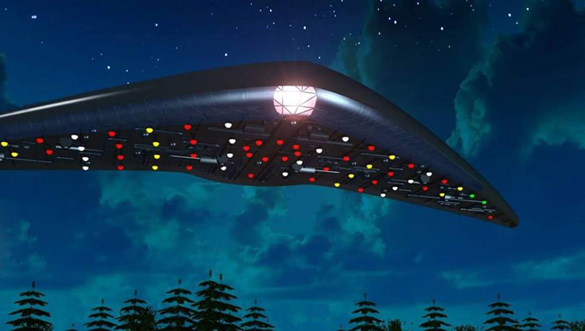





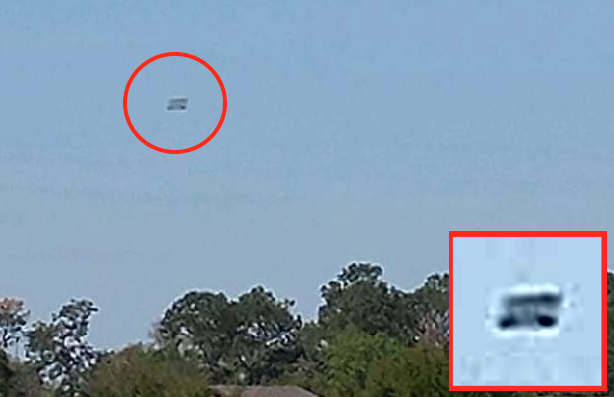


 'What the f*** is that thing?' Shocking moment Navy pilot...
 The day Google Earth stood still! UFO hunters are sent into...


