Ontdek de Fascinerende Wereld van UFO's en UAP's: Jouw Bron voor Onthullende Informatie!
Ben jij ook gefascineerd door het onbekende? Wil je meer weten over UFO's en UAP's, niet alleen in België, maar over de hele wereld? Dan ben je op de juiste plek!
België: Het Kloppend Hart van UFO-onderzoek
In België is BUFON (Belgisch UFO-Netwerk) dé autoriteit op het gebied van UFO-onderzoek. Voor betrouwbare en objectieve informatie over deze intrigerende fenomenen, bezoek je zeker onze Facebook-pagina en deze blog. Maar dat is nog niet alles! Ontdek ook het Belgisch UFO-meldpunt en Caelestia, twee organisaties die diepgaand onderzoek verrichten, al zijn ze soms kritisch of sceptisch.
Nederland: Een Schat aan Informatie
Voor onze Nederlandse buren is er de schitterende website www.ufowijzer.nl, beheerd door Paul Harmans. Deze site biedt een schat aan informatie en artikelen die je niet wilt missen!
Internationaal: MUFON - De Wereldwijde Autoriteit
Neem ook een kijkje bij MUFON (Mutual UFO Network Inc.), een gerenommeerde Amerikaanse UFO-vereniging met afdelingen in de VS en wereldwijd. MUFON is toegewijd aan de wetenschappelijke en analytische studie van het UFO-fenomeen, en hun maandelijkse tijdschrift, The MUFON UFO-Journal, is een must-read voor elke UFO-enthousiasteling. Bezoek hun website op www.mufon.com voor meer informatie.
Samenwerking en Toekomstvisie
Sinds 1 februari 2020 is Pieter niet alleen ex-president van BUFON, maar ook de voormalige nationale directeur van MUFON in Vlaanderen en Nederland. Dit creëert een sterke samenwerking met de Franse MUFON Reseau MUFON/EUROP, wat ons in staat stelt om nog meer waardevolle inzichten te delen.
Let op: Nepprofielen en Nieuwe Groeperingen
Pas op voor een nieuwe groepering die zich ook BUFON noemt, maar geen enkele connectie heeft met onze gevestigde organisatie. Hoewel zij de naam geregistreerd hebben, kunnen ze het rijke verleden en de expertise van onze groep niet evenaren. We wensen hen veel succes, maar we blijven de autoriteit in UFO-onderzoek!
Blijf Op De Hoogte!
Wil jij de laatste nieuwtjes over UFO's, ruimtevaart, archeologie, en meer? Volg ons dan en duik samen met ons in de fascinerende wereld van het onbekende! Sluit je aan bij de gemeenschap van nieuwsgierige geesten die net als jij verlangen naar antwoorden en avonturen in de sterren!
Heb je vragen of wil je meer weten? Aarzel dan niet om contact met ons op te nemen! Samen ontrafelen we het mysterie van de lucht en daarbuiten.
The video displays the vehicle zooming through the sky at pace, leaving a thick contrail behind it.
But another object emerges from behind the cloud-like stream, sparking wild speculation online.
It then proceeds to follow the jet, before eventually overtaking it.
The footage then zooms in to show the subject as a round, peculiar-shaped craft.
NOWYOUKNOW
UFO? Bizarre footage shows the object following a plane
It was captured in the US in 2016, but has only been shared now.
A witness said: "I am told that military pilots train in the mountains around where I live and I’ve always enjoyed seeing them fly through.
"This happens all the time. jets and helicopters are a common sighting. So I naturally saw the jet and did a double take, because there was something following it.”
The clip was uploaded to YouTube channel NowYouKnow on Saturday and has already racked up over 16,000 hits.
And some users were convinced it is proof of alien life.
One comment read: “I am actually baffled. This looks legit, as to why — who knows.”
And another added: “No s*** the UFO is following a jet that's leaving a stream of chemtrail.”
The chemtrail theory is a conspiracy that aims to prove the condensation trails left in the sky are deliberately sprayed with harmful chemicals in order to control weather modification, radiation management and a number of other claims.
But other viewers believed there was a more reasonable explanation for the activity.
“This looks like an air refuelling plane,” someone claimed.
And others passed the video off for a number of other reasons, such as CGI or a possible military exercise.
Researchers Find ‘Advanced’ 320,000-Year-Old Human Tools In Kenya
This evidence of early innovation pushes back the human evolutionary timeline, effectively rewriting history and everything we knew about our ancestors. This also means that complex human cultures are much older than previously thought.
An international group of scientists has discovered that more than 320,000 years ago, humans were much more developed than initially thought.
The new discovery proves how ancient people developed impressive social structures and technological innovations used color pigments and manufactured more sophisticated tools than previously thought.
Image Credit: Human Origins Program, Smithsonian
As noted by the Smithsonian, these newly discovered activities approximately date to the oldest known fossil record of Homo sapiens and occur tens of thousands of years earlier than previous evidence has shown in eastern Africa.
Evidence for mankind’s ancient milestones originates from the Olorgesailie Basin in southern Kenya, where experts have excavated an archaeological site that offers an unprecedented record of early human life spanning more than a million years.
Archeologists say that many of the tools discovered on the site were crafted from obsidian – a hard, dark, glass-like volcanic rock.
In addition to the numerous tools, experts also found that ancient cultures used color pigments much sooner than previously thought.
The new findings are reported in three different studies published in the journal Science. The papers suggest that trading of different artifacts emerged during a period of tremendous environmental upheaval in the region when earthquakes ravaged the area and temperatures, and the climate, in general, fluctuated between wet and dry periods.
The Excavation site in Kenya.
Image credit: Human Origins Program, Smithsonian
“This change to a very sophisticated set of behaviors that involved greater mental abilities and more complex social lives may have been the leading edge that distinguished our lineage from other early humans,” said Dr Rick Potts, director of the Smithsonian’s National Museum of Natural History’s human origins program in the United States, and author of one of the three studies.
Experts say that trading networks, early communication, and technological innovation helped ancient people survive by obtaining all necessary resources they needed through crafting or trading.
Dr. Potts notes that first evidence of human life in the Olorgesailie Basin dates back to around 1.2 million years ago.
There, for hundreds of thousands of years, people living in the region used large stone-cutting tools called handaxes. In addition to being used as tools, researchers have found evidence that some were also used as projectile weapons, while others were shaped into tools to craft and sculpt wood.
Then, in 2002, researchers discovered smaller, more carefully shaped tools in the Olorgesailie Basin.
Using isotopic dating, researchers found that the tools were incredibly old; between 320,000 and 305,000 years ago. These tools, researchers note, were carefully crafted and were more specialized than the all-purpose handaxes.
Furthermore, experts found that the smaller, more sophisticated handaxes were crafted from a wide range of obsidian, not found locally, but up to 90 kilometers away.
The Smithsonian team found small stone points (above) made of non-local obsidian at their Middle Stone Age sites.
Image credit: Human Origins Program, Smithsonian
In addition, experts discovered black and red rocks, evidence that the rocks had been ‘processed’ for use as a coloring material.
“We don’t know what the coloring was used on, but the coloring is often taken by archaeologists as the root of complex symbolic communication. Just as color is used today in clothing or flags to express identity, these pigments may have helped people communicate membership in alliances and maintain ties with distant groups.”
After integrating data from a variety of sources, researchers wanted to understand what may have driven such changes in early human behavior. Their findings suggest that the period when these changes appeared was one of changing landscapes and climate, and resources would have been extremely scarce.
Scientists discovered that geological, geochemical, paleobotanical and faunal evidence indicates that an extended period of climate instability affected the region, beginning approximately 360,000 years ago.
Here Are Five Ways Stephen Hawking Predicted The World Could End
Not long ago, the great Stephen Hawking left us to travel among the stars.
The last great scientists on Earth died aged 76, and the news shocked the scientific world. But before leaving on his eternal trip, professor Hawking left us a lot to think about.
The Earth will disappear and become a massive ball of fire. By that time, 600 years from now, humanity must have colonized another planet. These warnings would not be given credit were it not because they came from famous astrophysicist Stephen Hawking, one of the voices that have spoken the most about the end of the world.
Hawking argued that the Alpha Centauri star system could be the most viable option for humanity, reason why he worked on the Breakthrough Starshot project, so future spacecraft could travel to this planet in the next 20 years using small spaceship that could travel at the speed of light.
Resumed, professor Hawking was THE scientist who made science more appealing and exciting to the general public. He Loved science, and science loved him back.
Dubbed as one of the most important physicists of the twentieth century, professor Hawking had become famous not only for his intelligence but also for his status as a celebrity, being one of the few people who had survived amyotrophic lateral sclerosis for so many years.
From the Big Bang theory to studies on black holes, his contributions to these fields will forever remain in the analogs of science, and his legacy will live on.
However, the British physicist was not only a great scientist, but he was also very concerned about our planet, our civilization, and the future that awaits us.
In this article, we take a look at five of the most worrying future predictions made by Hawking.
1. A deadly Virus destroying mankind
In 2001 Stephen Hawking warned that a virus would end the human race in this millennium. According to the researcher, “it will be a virus and not an atomic bomb” that will bring Earth’s population to its knees. However, the scientist offered a solution to the problem; establishing colonies in space.
2. Nuclear war and climate change
Stephen Hawking and other scientists announced in 2007 that Doomsday Clock was set at five minutes before midnight. Since 1947, the board of directors of the Bulletin of Atomic Scientists of the University of Chicago, of which Hawking is a member, manage to Doomsday clock as a symbol that represents how close we are to the end of civilization because of a nuclear war. In 2018 the clock was set two minutes to midnight. The failure of world leaders to deal with looming threats of nuclear war and climate change. This is the clock’s closest approach to midnight, matching that of 1953.
On the effects of climate change, Hawking has warned that “the worst scenario for the Earth would be to become something like its sister planet, Venus, with a temperature of 250 degrees and rain of sulfuric acid.”
3. Alien Invasion
Like many other scientists, Professor Hawking was convinced there’s life elsewhere in the universe. However, Professor Hawking believed that these beings might have exhausted resources and become space nomads in search of new planets and resources. “If aliens visited us, the result would be similar to when Columbus arrived in America, which was not very good for Native Americans.”
4. Artificial Intelligence
Like many other futurists and researchers, professor Stephen Hawking too warned of the dangers of Artificial Intelligence.
“Unless we learn to prepare for the potential risks and avoid them, Artificial Intelligence could be the worst event in the history of our civilization” the astrophysicist has stated on more than one occasion.
For Hawking, humans must be aware of the dangers posed by robots, identify them and prepare for their consequences in advance. In addition to Hawking, Elon Musk also spoke out about the potential dangers Artificial Intelligence poses for humans.
5. Humans, and our need for another world
The constant increase in the world population and the abusive consumption of resources and energy are too much for our planet to handle. Our civilization seems to be losing its grip on reality, and we are abusing our planet, bringing it to the limit.
Professor Hawking has warned that if we are to survive as a species, we must look for other planets other than Earth, and colonize them as soon as possible.
Hawking argued that the best option, perhaps, is the Alpha Centauri star system, which is the closest to our solar system.
The Breakthrough Starshot project, in which the physicist was involved, is precisely looking for the way to reach this system in 20 years through the development of spacecraft capable of traveling at the speed of light.
Check Out These Amazing Images Snapped By NASA’s $1 Billion Spacecraft Orbiting Jupiter
Jupiter is, without a doubt, one of the most fascinating planets in our solar system.
Jupiter is huge. Mysterious. Colorful. Hypnotizing. And did I say it so big it doesn’t actually ‘orbit’ the sun?
Anyway, the gas giant has remained one of the most studied and revered planets since ancient times.
After the Sun, Jupiter is the largest celestial body in the solar system, with a mass almost two and a half times that of the other planets together (with a mass 318 times greater than that of Earth and three times greater than Saturn), besides being in terms of volume, 1317 times larger than Earth).
It is also the oldest planet in the solar system, being even older than the sun; this discovery was made by researchers from the University of Münster in Germany.
The Gas Giant has been explored on several occasions by spacecraft, most notably during the early Pioneer and Voyager flyby missions and later by the Galileo orbiter. In late February 2007, Jupiter was visited by the New Horizons probe, which used Jupiter’s gravity to increase its speed and bend its trajectory en route to Pluto. The latest probe to visit the planet is Juno, which entered into orbit around Jupiter on July 4, 2016.
Jupiter is the planet with the largest mass in the solar system: it is about 2.48 times the sum of the masses of all the other planets together.
Despite this, it is not the most massive planet known: more than a hundred extrasolar planets that have been discovered have masses similar or superior to Jupiter.
Jupiter also has the fastest rotation speed of the planets of the solar system: it rotates in less than ten hours on its axis.
Altogether, it is one heck of a planet.
The main satellites of Jupiter were discovered by Galileo Galilei on January 7, 1610, which is why they are called Galilean satellites.
They receive their names from Greek mythology although, in Galileo’s time, they were referred to by Roman numerals depending on their order of proximity to the planet.
The discovery of these satellites constituted a point of inflection in the already long dispute between those who supported the idea of a geocentric system, that is, with the Earth at the center of the universe, and the Copernican (or heliocentric system, that is, with the Sun at the center of the solar system), in which it was much easier to explain the movement and the very existence of Jupiter’s natural satellites.
And while I can continue writing about Jupiter the rest of the day, words can’t describe just how beautiful the largest planet in our solar system is.
Thankfully, images speak a thousand words so here we bring you some of the most fascinating images of Jupiter taken by the Juno Spacecraft.
Jupiter you SEXY beast! Image Credit: NASA/SwRI/MSSS/Uriel
Image Credit: NASA/SwRI/MSSS/Roman Tkachenko
This image shows Jupiter’s south pole, as seen by NASA’s Juno spacecraft from an altitude of 32,000 miles (52,000 kilometers). Image Credits: NASA/JPL-Caltech/SwRI/MSSS/Betsy Asher Hall/Gervasio Robles
A swirling white spot captured by Juno. Image Credit: NASA / MSSS / JPL / SwRI / Bjorn Jonsson
Bizarre footage appears to have captured the moment a UFO appears to chase a passenger jet through the sky. The incident was caught on camera by a baffled resident in the US who has recently uploaded the footage in a bid to get some answers.
The witness told the Mutual UFO Network : “I am told that military pilots train in the mountains around where I live and I’ve always enjoyed seeing them fly through. “This happens all the time. Jets and helicopters are a common sighting. So I naturally saw the jet and did a double take, because there was something following it.”
Deep-Space Radiation May Be Getting More Dangerous for Future Astronauts
By Mike Wall, Space.com Senior Writer
Photo of a coronal mass ejection, along with part of a solar filament, fired off by the sun on Feb. 24, 2015. When the sun is active, its magnetic field gains strength and extends farther out into space, helping deflect energetic cosmic rays away from the inner solar system.
Credit: Solar Dynamics Observatory, NASA
Space radiation may be a bigger worry for voyaging astronauts than scientists had thought, at least in the near future, a new study suggests.
"The radiation dose rates from measurements obtained over the last four years exceeded trends from previous solar cycles by at least 30 percent, showing that the radiation environment is getting far more intense," study lead author Nathan Schwadron, a professor of physics at the University of New Hampshire's Space Science Center, said in a statement.
"These particle radiation conditions present important environmental factors for space travel and space weather, and must be carefully studied and accounted for in the planning and design of future missions to the moon, Mars, asteroids and beyond," Schwadron added. [How Radiation in Space Poses a Threat to Human Exploration (Infographic)]
Schwadron and his colleagues studied observations made by NASA'sLunar Reconnaissance Orbiter(LRO), which has been circling the moon since 2009. Specifically, they looked at dose rates of galactic cosmic rays measured over the past four years by LRO's Cosmic Ray Telescope for the Effects of Radiation (CRATER).
Galactic cosmic rays (GCRs) are super-energetic particles — mostly protons and atomic nuclei — that have been accelerated to tremendous speeds by distant and dramatic events, such as supernova explosions. GCRs can do damage to spacecraft electronics and, in large enough doses, can cause radiation sickness in astronauts, or longer-term problems such as cancer.
"We now know that the radiation environment of deep space that we could send human crews into at this point is quite different compared to that of previous crewed missions to the moon," Schwadron said, referring to NASA's Apollo missions, which landed six crews on the lunar surface between July 1969 and December 1972.
The rise in GCR levels is related to a prolonged stretch of low solar activity, which ebbs and flows on an 11-year cycle. During active phases, the sun's magnetic field spreads throughout the solar system more extensively (by the flow of charged particles known as the solar wind), and it deflects more incoming GCRs.
But an active sun poses its own problems. Solar flares and coronal mass ejections — powerful blasts that send huge clouds of superheated plasma rocketing out into space at millions of miles per hour — can also raise radiation levels significantly.
And big solar outbursts aren't limited to active periods in the solar cycle. Indeed, a series of solar outbursts in September 2017 raised deep-space radiation levels significantly, the researchers said.
The new study has been accepted for publication in the journal Space Weather.
The putative oceans on Mars may have been aided by an unlikely ally: volcanoes.
A depiction of how oceans on Mars might have looked like.
Image credits: Kevin McGill / Flickr.
The saga of Martian oceans — and if they truly existed or not — continues with a new episode. A team of geophysicists at the University of California, Berkeley, suggests that volcanoes may have helped pave the way for liquid water, by raising temperatures.
“Volcanoes may be important in creating the conditions for Mars to be wet,” said Michael Manga, a UC Berkeley professor of earth and planetary science and senior author of a paper appearing in Nature this week and posted online March 19.
While there is significant evidence that Mars once had oceans of liquid water, not everybody is convinced of their existence. The main argument against this existence is that… we don’t see them today. The estimated mass of the oceans just doesn’t fit with the how much water could be hidden today as permafrost underground and how much could have escaped into space. In other words, if Mars once had oceans, we should still see some water.
But Manga and his colleagues developed a new model which would help explain this disparity. They propose that the first ocean on the Red Planet (called Arabia) formed at about the same time as the planet’s largest volcanic feature, Tharsis, or even a bit sooner — instead of after it, as previous models suggested.
“The assumption was that Tharsis formed quickly and early, rather than gradually, and that the oceans came later,” Manga said. “We’re saying that the oceans predate and accompany the lava outpourings that made Tharsis.”
In particular, because Tharsis was smaller in its earlier days, it didn’t distort the seabed as much, meaning that the oceans were much shallower than previously assumed. This theory can also explain another counterargument to Martian oceans: the seashore problem. The proposed seashores are highly irregular, varying in height by up to 1 kilometer (0.6 miles), whereas on Earth seashores are largely at the same level (sea level).
If oceans were formed in the initial stages of Tharsis’ development, the volcano would have significantly depressed the land and deformed the shoreline, which would help explain the irregularity.
“These shorelines could have been emplaced by a large body of liquid water that existed before and during the emplacement of Tharsis, instead of afterwards,” said first author Robert Citron, a UC Berkeley graduate student.
Lastly, this model also proposes that Tharsis spewed gases into the atmosphere that created a global warming or greenhouse effect, which favored the formation of liquid water. However, more studies will be needed to confirm this theory.
The study has not been peer-reviewed, but Citron will present a paper about the new analysis on March 20 at the annual Lunar and Planetary Science conference in Texas.
Without an atmosphere to protect it, the Moon is under constant assault from meteorites and asteroids, hitting the satellite and leaving behind a horde of craters. Using a novel AI-based technique, a team of researchers has developed a new way to identify and count these craters.
An artificially colored mosaic constructed from a series of 53 images taken by the Galileo Spacecraft. Can you see the craters?
“When it comes to counting craters on the moon, it’s a pretty archaic method,” says Mohamad Ali-Dib, a postdoctoral fellow in the Centre for Planetary Sciences (CPS).
Indeed, while astronomy has benefitted from the automation of many processes, crater counting had lagged behind — but not anymore.
“Basically we need to manually look at an image, locate and count the craters and then calculate how large they are based off the size of the image. Here we’ve developed a technique from artificial intelligence that can automate this entire process that saves significant time and effort.”
Ali-Dib wasn’t the first to come up with this idea. Several projects have attempted to develop algorithms for the detection of lunar craters, but they performed rather poorly. However, the new algorithm, which was trained on a large dataset covering two-thirds of the moon, performed much better. It was so good at understanding the general shape and characteristics of a crater that it was even able to detect craters on other bodies, such as Mercury.
“It’s the first time we have an algorithm that can detect craters really well for not only parts of the moon, but also areas of Mercury,” says Ali-Dib, who developed the technique along with Ari Silburt, Chenchong Charles Zhu, and a group of researchers at CPS and the Canadian Institute for Theoretical Astrophysics (CITA).
They fed 90,000 images of the moon’s surface into an artificial neural network (ANN). ANNs mimic the vast network of neurons in a brain, simulating the biological learning process. After the learning process, the neural network was able to not only identify but also categorize craters larger than five kilometers. The team believes that with further “training” it will also be able to zoom in on smaller craters.
Some lunar craters last for billions of years.
Image credits: NASA.
Since the moon also doesn’t have tectonics or strong erosion, the craters can remain visible for extremely long periods of time, with Ali-Dib’s team finding craters as old as four billion years. However, this is also the main drawback of the algorithm: it requires an atmosphere-less body, without erosion, and clearly visible craters.
Journal Reference: Ari Silburt et al. Lunar Crater Identification via Deep Learning. arxiv.org/abs/1803.02192
It was 53 years ago when a man walked in space for the first time, and he wasn’t American.
On March 18, 1965, the USSR took a big lead in the space race against the U.S. when cosmonaut Alexey Leonov left his spacecraft, the Voskhod 2, to enter into history as taking the first-ever spacewalk. Moments later, his life was in danger.
“My suit was becoming deformed, my hands had slipped out of the gloves, my feet came out of the boots,” Leonov told the BBC in 2014. “The suit felt loose around my body. I had to do something.”
The problem was the lack of atmospheric pressure in space causing his suit to inflate. Tethered to the spacecraft and with a suit too big to make it through the hatch, Leonov acted quickly by releasing oxygen from his suit to relieve the pressure.
He did make his way back into the capsule but the small explosive that opened the hatch had now caused it to rotate. This also caused a rise in oxygen making the cabin flammable.
It didn’t stop there for Leonov. He and his pilot, Pavel Belyayev, had to wait several hours before they could fire the retro-rockets to return to Earth. They found out quickly that the automated rockets did not work so they had to control the rockets manually. A miscalculation of how long to fire the rockets could either bounce them right back into space or crash into the ground.
The cosmonaunts did end up landing safely in Siberia.
The U.S. and NASA also ramped up the space program with multiple spaceflights in 1965. The Apollo and Gemini flights continued to make progress leading to the moon landing on Nov. 19, 1969.
Still, as the first person to see the Earth from 500km above, Leonov made an impact on history. What he saw on his trip also made an impact on him.
“My feeling was that I was a grain of sand,” he said. “You just can’t comprehend it. Only out there can you feel the greatness, the huge size of all that surrounds us.”
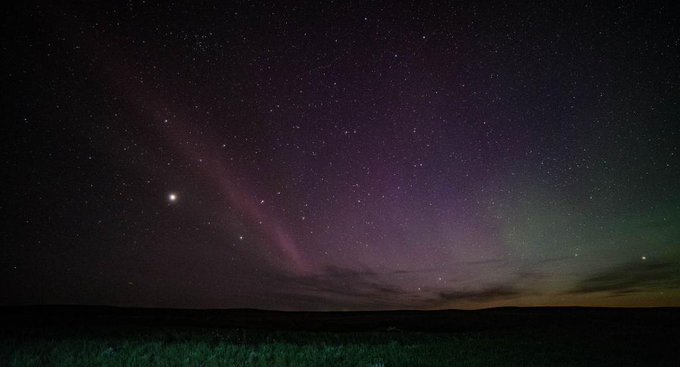
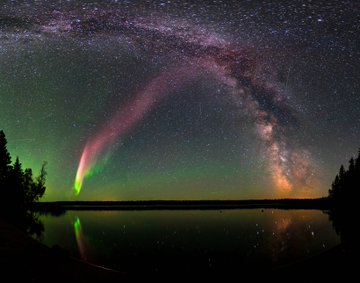
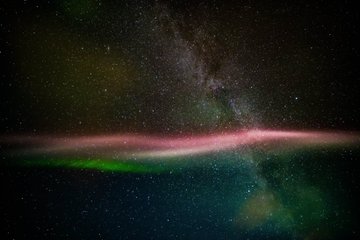
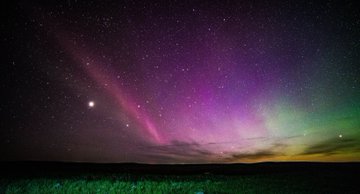
Steve looks like a neon purplish or green strip across the night sky, and it’s visible in Canada, though it’s not a streak of the aurora borealis. When Steve appears, it’s moving from east to West, and might be visible anywhere from Ontario to Alaska. It travels at about 4 miles per second, but appears static from the ground, and is routinely spotted at latitudes far further south than traditional northern lights.
Scientists identified the arc-shaped ribbon as an extremely hot (up to 10,000 degrees F), 16-mile thick river of ionized gas, about 200 miles above the earth’s surface. But much about Steve remains mysterious, even following the publication of the new study led by Elizabeth MacDonald, a space physicist at NASA. The researchers know that Steve is similar to a subauroral ion drift (SAID), except they are normally invisible to the naked eye.
We see you, Steve.(Courtesy Paul Zizka)
The Alberta Aurora Chasers, a group of photographers who trade tips and images of the famed northern lights, had been capturing images of the gorgeous arc for years. According to the New York Times, the group initially thought the sightings of what would become Steve, which is whitish to the naked eye, might be condensation trails from planes. After manipulating the settings on their cameras, however, they realized that the streaks were self-illuminated and multihued.
There he goes again. (Courtesy Catalin Tapardel)
In 2016, they met up with some astronomy professors at the University of Calgary at a bar and shared their photos, hoping to find out what caused the mysterious stroke of light. No one had an certain answer, but Eric Donovan, a professor of physics and astronomy, took an interest in the question. He turned to the European Space Agency and their Swarm satellites to begin collecting data.
In the meantime, the arc needed to be called something. Chris Ratzlaff, who runs the Alberta Aurora Chasers’ Facebook page, chose “Steve,” a name pulled from a 2006 children’s movie, Over the Hedge, in which a gang of animals give the random name to an unknown, slightly frightening being they can’t see.
The nickname was far humbler than the titles of most atmospheric optical phenomena, which have titles like Rayleigh scattering, crepuscular ray, or lunar corona, but “Steve” was meant to be temporary. And yet, it stuck. In honor of its origins, scientists have decided to keep the name, but have retroactively made it an acronym for Strong Thermal Emission Velocity Enhancement.
A double Steve night?(Courtesy Paul Zizka)
At a talk last year in Banff, Alberta, Donovan told the audience that he still occasionally turned to Ratzlaff’s team of citizen scientists for input as he investigated Steve. Once, when one of Donovan’s colleagues saw something unusual in his data, Donovan explained, “I did something right then and there that I never thought I’d do as part of my professional work.” He logged onto Facebook and typed in: “Did anyone see Steve last night?”
Pretty in pink.
(Courtesy Paul Zizka)
Subtle.
(Courtesy Philip Granrud)
NASA also asked the Chasers and other amateurs for assistance, and named them as co-authors of the new paper. Now NASA has opened their call for images to the general public:
Seen STEVE? Glowing in purple & green colors, a new celestial phenomenon, known as STEVE, is caused by charged particles from the Sun colliding with Earth's magnetic field. Discover how you can help us study these dancing lights by sending your pictures: http://go.nasa.gov/2phTVT5
Capturing Steve in an image is said to be easier than shooting the lights of the aurora borealis, which are more active. Steve will sit still for up to 20 minutes, a local photographer in Banff, Alberta, told the Canadian Broadcasting Corporation.
A Strong Thermal Emission Velocity Enhancement (STEVE) photographed near Regina on the night of July 24, 2016 (Notanee Bourassa)
Notanee Bourassa was a teenager in a run-down part of Regina. His father was dying of lung cancer. School and home were trouble alike. Then he tilted back his neck.
“The Northern Lights allowed me to escape all of that and to realize there’s more to life than where you are right now, and to survive,” he says, 30 years later. In his first sighting, he says bands of light on both sides of the sky appeared to meet in a continuous arc. “The aurora ribbons had actually joined, and I was underneath the ribbons in a back alley because it’s the darkest place I could find. I was hooked.”
Bourassa is an everyday citizen who helped NASA and other scientists identify for the first time a light display in thesky, on which they published a journal article in Science Advances. The purple and green streaks resemble an aurora borealis, but scientists say it’s a different phenomenon that “may be an extraordinary puzzle piece” in understanding Earth’s magnetic fields. Bourassa photographed the light and says he called it “Steve,” a name from an animated movie, for which scientists later matched an acronym: Strong Thermal Emission Velocity Enhancement.
Researchers across North America and in the United Kingdom are now studying STEVEs; NASA has called for more citizens to help collect data on them; the discovery could be important for future aircrafts, and one of the catalysts behind the research was a 45-year-old father with a camera and a celestial coping mechanism.
For the first time, we have a better understanding of a mysterious phenomenon in the sky called STEVE, thanks to citizen scientist and satellite views. These new findings help us learn how Earth interacts with charged particles in space: https://go.nasa.gov/2FA0Elm
“The great magician out in the cosmos is making Northern Lights for us,” says Bourassa, who now works as a technical assistant for Sask Tel and, in recent years, has sought out the Lights one to four times per week. “That’s what keeps me going out there—just to get a feeling of, there’s something more to our lives than going to work and going to Walmart.”
On July 24, 2016, around 11 p.m., Bourassa drove to a wheat field 21 km from Regina to photograph the sky, bringing his five- and seven-year-old children because it was not a school night. From other “aurora chasers,” he had heard rumours of an unidentifiable glow, which they inaccurately called a proton arc, and which can last from 20 minutes to one hour.
“As it started to rain a little bit, out of the corner of my peripheral vision on the left, I had noticed there was a streak in the sky,” Bourassa recalls of the summer night. He rushed to change the settings on his camera and reposition it on his tripod on the gravel road. “I was thrilled and a lit bit panicked because I wanted to get good data.”
Bourassa had seen the Dreamworks movie, Over the Hedge, in which a group of animals one day discovers a man-made formation of shrubbery. Lacking a word for the hedge, a squirrel proposes they call it “Steve,” and thus his friends start worshipping “oh great and powerful Steve.” When Bourassa started talking about his sighting with other aurora enthusiasts on Facebook, he applied the name to what scientists later identified as a subauroral ion drift.
Bourassa tweeted about the light he’d seen, which was also captured by imaging equipment of the University of Calgary and the University of California, Berkeley, and later by other institutions including Athabasca University. Bourassa says he connected on Twitter with a heliophysicist, and soon, a scientist named Elizabeth MacDonald from the NASA Goddard Space Flight Centre in Greenbelt, Maryland, became the lead author on the paper published in March, along with 15 other authors based in Canada, the United States and Britain.
“Steve” stuck, as one American scientist realized the name could appropriately stand for: Strong Thermal Emission Velocity Enhancement (since the initials came before the words, they call it a “back-ronym”).
A traditional aurora borealis is a product of electrically-charged particles interacting with oxygen that get discharged as light,with green and red colours occurring depending on the pressure and violet caused by nitrogen. A STEVE is a similar process but travels on different magnetic field lines, closer to Earth.
The children of photographer Notanee Bourassa gaze at a STEVE, or “Strong Thermal Emission Velocity Enhancement” near Regina on the night of July 24, 2016. (Notanee Bourassa)
“It seems to be a channel of very hot air, very high up, that gets hot enough that it starts to glow,” explains Martin Connors, a physics professor at Athabasca University and an author of the recent journal article on STEVEs. “When you find a channel of gas as hot as the surface as the sun, and it’s 100 km above our heads, you kind of want to know why.”
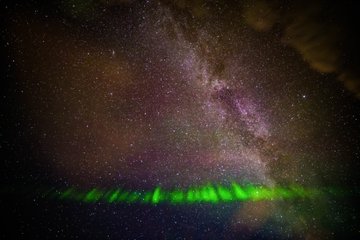
An aurora borealis appears in broad bands of light sometimes called “curtains,” but a STEVE comes with skinny off-shoots. “It seems to have these green fingers associated with it,” says Connors. “To me those are very mysterious.”
Understanding this phenomenon could be still more important if future aircrafts fly at altitudes where STEVEs appear, Connors says. “If you’re suddenly in a channel of really hot gas, you’d want to be prepared for that.”
Climate change is highly unlikely to be a cause of STEVEs, Connors says. Rather, he suspects they are being seen every few weeks because technology is improving, enabling even iPhones to capture them—“less climate change than camera change,” he says.
Bourassa’s sightings reinforce the value of citizen science and also reinforce memories of his father, who he watched wither from a 230-pound man to a skeletal figure with a tube draining his lung. He died after two and a half years of severe illness when Bourassa was 15.
“I hadn’t really told him that I was watching the Northern Lights in the alleyway,” Bourassa admits. The Lights are miraculous, he says, for when a person is grieving, “it doesn’t make sense to a rational-thinking person, but it seems like they, for you, are dancing.”
Pendant plusieurs minutes, un objet, laissant derrière lui une longue traînée brune, a été visible dans le ciel au-dessus de Littau, dans le canton de Lucerne, en Suisse. Un habitant local a a pu le filmer.
Cet OVNI a été observé le mercredi 14 mars 2018 par une jeune femme. C'était juste avant 19h00. Elle se trouvait dans sa cuisine et regardait par la fenêtre quand elle a vu un objet étrange dans le ciel. Immédiatement, elle a pris son appareil photo Sony, elle a zoomé et a photographié ce spectacle inhabituel.
Elle raconte : « L'objet avec cette longue traînée se trouvait dans le ciel. Il n'a pas bougé pendant deux ou trois minutes.»
Puis l'objet s'est soudainement « retourné vers la droite et a disparu », se souvient le témoin.
Quelques minutes plus tard, le spectacle s'est répété. Encore une fois, elle a vu cet objet inconnu dans le ciel, toujours avec cette traînée. « Mais cette fois le phénomène n'a pas duré aussi longtemps que la première fois. »
Le témoin vit au Benneneggstrasse à Littau. L'objet inconnu qu'elle avait vu allait en direction de Neuenkirch. « Je n'ai aucune idée de la distance. »
La femme veut maintenant savoir ce qu'elle a vu dans le ciel. Cependant, elle précise qu'elle ne croit pas aux OVNI pilotés par des extraterrestres. « Ma première pensée était que ça aurait pu être une météorite. » Seulement, pourquoi cette chose est-elle restée immobile dans le ciel ?
Sur demande, la société Skyguide a été interrogé sur l'origine de cet OVNI. Le porte-parole Vladi Barrosa, qui a vu les images, s'est exprimé : « Le terme technique est OVNI. Donc jusqu'à ce que nous en savons plus, on peut dire que c'est un objet volant non identifié. »
Skyguide continue d'investiguer pour clarifier ce qui s'est passé.
« Nous recevons toujours de telles photos. En général, nous pouvons répondre à ce qu'il y a dessus. Si nous avons la date et l'heure de la journée, nous pouvons le trouver sur des images radar. »
En règle générale, il s'agit simplement d'avions normaux.
« Même dans ce cas, nous allons probablement découvrir de quoi il s'agissait», conclut Barrosa.
Newly declassified video and audio show U.S. Navy pilots’ apparent sighting of alien craft near East Coast. #Tucker
FOX News Channel (FNC) is a 24-hour all-encompassing news service dedicated to delivering breaking news as well as political and business news. The number one network in cable, FNC has been the most watched television news channel for more than 15 years and according to a Suffolk University/USA Today poll, is the most trusted television news source in the country. Owned by 21st Century Fox, FNC is available in more than 90 million homes and dominates the cable news landscape, routinely notching the top ten programs in the genre.
Leaked WikiLeaks Cable Confirms Alien Life On Other Planets
“…He asserted the existence of life on other planets, caveating this by noting that we should focus on solving our problems on Earth. End Summary…”
A cable released by Wikileaks seems to have confirmed what millions of people around the globe believe for decades: we are not the only “intelligent” lifeforms in the universe.
WikiLeaks is an international non-profit media organization, which publishes anonymous reports and leaked documents with sensitive content of public interest on its website, preserving the anonymity of its sources.
The site was launched in December 2006, although its activity began in July 2007-2008.
Since then its database has grown steadily to accumulate 1.2 million documents.
Its creator is Julian Assange and is managed by The Sunshine Press.
The website itself is a treasure-trove of ‘secret’ or better said sensitive information, and unsurprisingly, among the 1.2 million leaked documents posted on Wikileaks, we find a couple for them that directly speak about extraterrestrial life.
A document titled: “MAYOR MEETS AMBASSADOR, CONFIRMS EXTRATERRESTRIAL LIFE” seems to confirm what many of us have known for decades, there is life on other planets in the universe.
The leaked document was posted in January of 2010 and was originally classified as ‘Confidential’ according to Wikileaks.
The document reads:
REASON: 1.4 (b), (d)
(C) Summary: In a platitude-ridden meeting, Dushanbe Mayor Mahmadsaid Ubaidulloev said upcoming elections would be free and fair, that contributions to the Roghun Dam were voluntary, and that the losses suffered by the United States in Afghanistan were felt by Tajiks as their own. Ubaidulloev asked for help in getting Tajik students admitted to Harvard University but effectively declined to help find a new location for an American Corner in Dushanbe. He asserted the existence of life on other planets, caveating this by noting that we should focus on solving our problems on Earth. End Summary.
AFGHANISTAN
(SBU) On January 13 Ambassador called on Dushanbe Mayor and Chairman of the upper house of Parliament Mahmadsaid Ubaidulloev at his parliamentary office. The Mayor began the meeting with a lengthy discourse on Afghanistan, thanking the United States for its contributions and sacrifices there, and saying that U.S. activities there were very important “as we enter the third millennium and the 21st century.” Ubaidulloev thought the main task there was to build a sense of national identity among ethnically disparate groups, and said the United States was an example for this. He noted that “war is very dangerous”, and said, “we know there is life on other planets, but we must make peace here first.”
China plans to develop a multipurpose, reusable space plane
by Staff Writers Beijing (XNA)
illustration only
China is developing its homegrown reusable space plane, which observers said could be used to attack foreign aircraft, space stations and even intercept missiles if used for military purposes.
The reusable spacecraft can transport people or payloads in orbit from any airport and return to earth, CCTV reported.
Unlike rockets which have to be recycled, the space plane will revolutionize space transportation, Zhang Hongwen, president of the Third Academy of China Aerospace Science and Industry Corporation (CASIC) and a member of the 13th National Committee of the Chinese People's Political Consultative Conference (CPPCC), told CCTV.
Although still at an early stage of research, the space plane will be capable of sending tourists to space, launching satellites and supplying the space station, providing emergency space rescue and offering cheap and timely space launching services, Zhang said.
China will launch a reusable spaceplane in 2020
"It could also be used as a military space plane equipped with detection and attack devices against foreign spacecraft, satellites and space stations," Song Zhongping, a military expert and TV commentator, told the Global Times.
Song said that the plane could also intercept ballistic missiles and conduct precision strikes on ground targets.
The CCTV report showed that the space plane is composed of two planes, with the larger aircraft acting as a carrier aircraft.
A military expert who requested anonymity told the Global Times that the core technology of the larger aircraft is an air-breathing rocket engine using hydrogen fuel.
Such an engine could liquefy oxygen, and then fuel the aircraft with liquid hydrogen and liquid oxygen while flying in the atmosphere. The liquid fuel could accelerate the flight in space, with speeds potentially reaching 22 times the speed of sound, the expert said.
The larger aircraft, once used as a military aircraft, will be difficult to be intercepted by current anti-missile systems, he added.
The project, codenamed "Tengyun Project," was first revealed in 2016, and according to the plan, the plane will conduct its first test flight in 2030, said Liu Shiquan, vice president of CASIC, the Science and Technology Daily reported in December 2016.
China has made “significant progress” in building a spacecraft that can take off and land using an airstrip the way planes do, a development that one expert ...
In the CCTV report, Zhang also said that China is currently testing a near-space solar drone capable of providing a network and communications not subjected to regional restrictions, and assist in remote sensing images and meteorological observation.
"The solar drone is closer to the ground compared with satellites, which could better offer monitoring and communications services," Zhang was quoted as saying.
The solar drone will be put into use as early as the end of this year, CCTV reported.
The evidence that aliens exist has been slowly mounting for decades and 2017 marks the most convincing year yet for the belief that life must exist beyond our planet.
And believing in the extraterrestrial is no longer reserved for conspiracy theorists in tinfoil hats. Nearly half of humanity believes aliens are out there, according to a recent study, and in June, the European Space Agency signed off on a $668 million mission that will hunt for other life forms 932,000 miles into space. Meanwhile, scientists continue to be baffled by a bunch of mysterious signals that keep emanating from faraway galaxies.
Here are five stories that prove it’s only a matter of time before we meet our celestial neighbors.
Scientists have long presumed that if we’re going to find life on other planets, we’re going to find them in the “Goldilocks zone” — spots throughout the universe where conditions are just right for water to exist.
The intergalactic search for our neighbors grew more promising in 2017 with dozens more “super-Earth” discoveries.
And even though we don’t yet have the technology to reach these planets, 2017’s “super-Earths” have included:
Wolf 1061c: Discovered in January, located 14 light years away
LHS 1140b: Discovered in April, located 40 light years away
Ross 128b: Discovered in November, located 11 light years away
K2-18b: Discovered in December, located 111 light years away
In June, NASA’s Kepler telescope found 10 “Goldilocks-zone” planets and in October, the telescope found 20 more “hiding in plain sight.”
“Are we alone?” Kepler scientist Mario Perez asked at a news conference following NASA’s June discovery. “Maybe Kepler today has told us indirectly, although we need confirmation, that we are probably not alone.”
2. Reported UFO sightings are at their highest ever
Sam Manafort, who’s studying Human Factors and Applied Cognition at George Mason University, crunched numbers from the National UFO Reporting Center. In his report, he found that since the first recorded UFO flew over Portugal in 1905, there have been at least 104,947 sightings.
But the number of yearly sightings has spiked dramatically from about 5,000 in 1980 to about 45,000 in 2010. In the US alone, there are 2,500 sightings per 10 million people — something Manafort attributes to the fact that most of the US has access to the internet.
Most of the sightings have come from the West and Northwest, an area that lines up with America’s “UFO highway” — a latitude line across the US that a pair of sibling alien hunters believes is an entrance for extraterrestrial spacecraft.
The duo, whose book “37th Parallel” is being made into a movie, state that during years-long travels across the US, the most bizarre paranormal phenomenon took place along the 37th latitude line.
This line stretches from California through Nevada, Colorado, Kansas, Missouri, Illinois, Kentucky and across to Virginia.
3. Life may already be hanging out in our own solar system
Dubbed Trans-Neptunian objects, these celestial bodies might benefit from tidal heating. This means that these icy planets have moons with enough gravitational pull to create energy beneath the planet’s surface — which generates heat and allows a sub-surface ocean to exist. The findings were published in Icarus.
“These objects need to be considered as potential reservoirs of water and life,” Prabal Saxena of NASA’s Goddard Space Flight Center said in a press release. “If our study is correct, we now may have more places in our solar system that possess some of the critical elements for extraterrestrial life.”
The space agency was looking to hire a planetary protection officer — someone in charge of making sure that spacecraft and astronauts don’t contaminate other worlds and don’t bring back anything that could contaminate our own.
“NASA maintains policies for planetary protection applicable to all space flight missions that may intentionally or unintentionally carry Earth organisms and organic constituents to the planets or other solar system bodies and any mission employing spacecraft, which are intended to return to Earth and its biosphere with samples from extraterrestrial targets of exploration,” the job description stated.
The job, which pays between $124,406 and $187,000, is only one of two full-time posts in the world. It became available after Catherine Conley, the former planetary protection officer, accepted a different position inside NASA.
NASA first created the position following the signing of the Outer Space Treaty of 1967 — a UN-approved agreement that outlines international space law.
The application closed Aug. 14 and there’s been no update on who landed the extraterrestrial gig.
In November, a NASA scientist at Goddard Institute For Space Studies said he believes we’ll find alien life within the next 20 years.
In December, the Pentagon released footage of Navy pilots seemingly coming into contact with UFOs. The eerie clip from 2004 shows a glowing white orb rotating while the F/A-18F fighter jet pilots try to figure out if what they’re looking at is a drone or something more… universal.
The footage, which was taken off the coast of California, was released after the Pentagon acknowledged the existence of the Defense Department’s Advanced Aerospace Threat Identification Program. This program, which costs $22 millionbetween 2008 and 2012, was set up to investigate reports of unidentified flying objects. Some officials have said that parts of the program have continued.
“It was a real object, it exists and I saw it,” Cmdr. David Fravor, one of the pilots who saw the UFO, told the Washington Post. Fravor said the object resembled a white Tic Tac and was “something not from the earth.”
Phoenix Lights: What caused one of the world's largest UFO sightings?
ByMatthew Dunn| news.com.au
( Credit: Fox 10 Phoenix )
It has been 21 years to the day since a mass UFO sighting occurred in Phoenix, Arizona, with the mystery still unsolved.
On March 13, 1997, thousands of people reported a string of bright lights in a triangular formation flying in the sky like a UFO.
Dr. Lynne Kitei witnessed the event and said she still doesn’t know what she saw that day.
“It was a mile-wide formation of these orbs and I caught them head-on turning into a V,” she told 12 News.
The US air force identified the lights as flares dropped by an A-10 Warthog aircraft performing training exercises at the Barry Goldwater Range in southwest Arizona.
It’s a nice theory, but Dr Kitei doesn’t feel so sure it’s true.
“How can flares keep a formation, traverse the entire state and beyond for hours in a rock-solid V?” she said.
Another person who claims to have seen the lights was Hollywood actor Kurt Russell.
The Escape from LA star said he was traveling in a private plane into Phoenix when he spotted the phenomenon, quickly reporting it to the control tower at the airport.
“I’m going to declare it’s unidentified, it’s flying and it’s six objects,” he recounted during an appearance on The One Show.
Despite the many witnesses claiming the lights were from a UFO, aviation experts said the flare explanation does hold merit.
Former F-16 pilot Ty Groh said flares in the sky act like hot-air balloons and go where the breeze takes them, with a strong gust able to propel all of the flares at the same time at a uniform distance.
He added that extremely bright objects, like flares, can appear closer than they are in reality when dropped at a distance.
“You’ll be looking at airliners that look like they’re 10 miles (16km) away and they’re 400 miles (643) away,” he told 12 News.
Despite the air force’s explanation, the Phoenix Lights are still a mystery.
Aliens Can Destroy Us All With An Email, According To Scientists
So far as we can tell at the moment, we’re alone in the galaxy. Or at least far enough away from other civilizations that we can’t find them. Apparently, they can’t find us, either… yet. That’s not to say alien’s don’t exist. It’s just that interstellar travel is a very, very difficult problem to defeat, so, practically speaking, if aliens wanted to show up to invade, it would be expensive. Aliens probably have budgets, too, after all.
Fortunately for science fiction writers who don’t want to get quagmired in interplanetary numbers crunching, two scientists have pointed out that there are much cheaper and more effective ways for aliens to kill us all, either by accident or design. John Learned, professor of physics and astronomy at the University of Hawaii, and Michael Hippke, a self-described gentleman scientist, have a not-entirely-serious, but still pretty serious, paper about how even aliens making contact with us could wipe out humanity. To start with, any message aliens sent us would necessarily be in some form of computer code, and that computer code could be anything, including a virus that spreads across the world before we can stop it and, say, launches all our nuclear missiles, or just shuts down every computer it finds, grinding the entire planet to a halt. It might not even be intentional, they point out, as aliens have no way of knowing what our computer systems are like.
If that weren’t enough, they point out that any message from aliens would necessarily need a computer to understand it, and that there is no “perfect prison” for locking down computer code. Some well-meaning Search for Extra-Terrestrial Institute (SETI) guy could just be doing his job. He might not even have time to realize he’s opened an alien code and we’re all boned.
The good news is the scientists do agree that the risk of a malicious contact is extremely low, they’re just pointing out that it’s not zero, and that we should think about this before firing up those radio telescopes.
Astronomers have spotted a strange mess of objects whirling around a distant star. Scientists who search for extraterrestrial civilizations are scrambling to get a closer look.
In the Northern hemisphere’s sky, hovering above the Milky Way, there are two constellations—Cygnus the swan, her wings outstretched in full flight, and Lyra, the harp that accompanied poetry in ancient Greece, from which we take our word “lyric.”
Between these constellations sits an unusual star, invisible to the naked eye, but visible to the Kepler Space Telescope, which stared at it for more than four years, beginning in 2009.
“We’d never seen anything like this star,” says Tabetha Boyajian, a postdoc at Yale. “It was really weird. We thought it might be bad data or movement on the spacecraft, but everything checked out.”
Kepler was looking for tiny dips in the light emitted by this star. Indeed, it was looking for these dips in more than 150,000 stars, simultaneously, because these dips are often shadows cast by transiting planets. Especially when they repeat, periodically, as you’d expect if they were caused by orbiting objects.
The Kepler Space Telescope collected a great deal of light from all of those stars it watched. So much light that Kepler’s science team couldn’t process it all with algorithms. They needed the human eye, and human cognition, which remains unsurpassed in certain sorts of pattern recognition. Kepler’s astronomers decided to found Planet Hunters, a program that asked “citizen scientists” to examine light patterns emitted by the stars, from the comfort of their own homes.
In 2011, several citizen scientists flagged one particular star as “interesting” and “bizarre.” The star was emitting a light pattern that looked stranger than any of the others Kepler was watching.
The light pattern suggests there is a big mess of matter circling the star, in tight formation. That would be expected if the star were young. When our solar system first formed, four and a half billion years ago, a messy disk of dust and debris surrounded the sun, before gravity organized it into planets, and rings of rock and ice.
But this unusual star isn’t young. If it were young, it would be surrounded by dust that would give off extra infrared light. There doesn’t seem to be an excess of infrared light around this star.
It appears to be mature.
And yet, there is this mess of objects circling it. A mess big enough to block a substantial number of photons that would have otherwise beamed into the tube of the Kepler Space Telescope. If blind nature deposited this mess around the star, it must have done so recently. Otherwise, it would be gone by now. Gravity would have consolidated it, or it would have been sucked into the star and swallowed, after a brief fiery splash.
“It looked like the kind of thing you might expect an alien civilization to build.”
Boyajian, the Yale Postdoc who oversees Planet Hunters, recently published a paper describing the star’s bizarre light pattern. Several of the citizen scientists are named as co-authors. The paper explores a number of scenarios that might explain the pattern—instrument defects; the shrapnel from an asteroid belt pileup; an impact of planetary scale, like the one that created our moon.
The paper finds each explanation wanting, save for one. If another star had passed through the unusual star’s system, it could have yanked a sea of comets inward. Provided there were enough of them, the comets could have made the dimming pattern.
But that would be an extraordinary coincidence, if that happened so recently, only a few millennia before humans developed the tech to loft a telescope into space. That’s a narrow band of time, cosmically speaking.
And yet, the explanation has to be rare or coincidental. After all, this light pattern doesn’t show up anywhere else, across 150,000 stars. We know that somethingstrange is going on out there.
When I spoke to Boyajian on the phone, she explained that her recent paper only reviews “natural” scenarios. “But,” she said, there were “other scenarios” she was considering.
Jason Wright, an astronomer from Penn State University, is set to publish an alternative interpretation of the light pattern. SETI researchers have long suggested that we might be able to detect distant extraterrestrial civilizations, by looking for enormous technological artifacts orbiting other stars. Wright and his co-authors say the unusual star’s light pattern is consistent with a “swarm of megastructures,” perhaps stellar-light collectors, technology designed to catch energy from the star.
“When [Boyajian] showed me the data, I was fascinated by how crazy it looked,” Wright told me. “Aliens should always be the very last hypothesis you consider, but this looked like something you would expect an alien civilization to build.”
Boyajian is now working with Wright and Andrew Siemion, the Director of the SETI Research Center at the University of California, Berkeley. The three of them are writing up a proposal. They want to point a massive radio dish at the unusual star, to see if it emits radio waves at frequencies associated with technological activity.
If they see a sizable amount of radio waves, they’ll follow up with the Very Large Array (VLA) in New Mexico, which may be able to say whether the radio waves were emitted by a technological source, like those that waft out into the universe from Earth’s network of radio stations.
Assuming all goes well, the first observation would take place in January, with the follow-up coming next fall. If things go really well, the follow-up could happen sooner. “If we saw something exciting, we could ask the director for special allotted time on the VLA,” Wright told me. “And in that case, we’d be asking to go on right away.”
In the meantime, Boyajian, Siemion, Wright, the citizen scientists, and the rest of us, will have to content ourselves with longing looks at the sky, aimed between the swan and the lyre, where maybe, just maybe, someone is looking back, and seeing the sun dim ever so slightly, every 365 days.
Mysterieuze ijscirkels ontdekt in Slovenië. Lokale bewoners staan voor een raadsel
Op het Meer van Bled in Slovenië zijn mysterieuze ijscirkels ontstaan. Schrijver en fotograaf Ian Middleton laat weten dat hij zoiets nog nooit eerder had gezien.
Ook veel andere Slovenen die hij sprak hadden de perfect concentrische cirkels nog nooit gezien. Bijna niemand had er een verklaring voor.
IJscirkels beperken zich niet alleen tot het Meer van Bled. In 2009 werden namelijk vanuit het internationale ruimtestation ISS reusachtige ijscirkels gespot op het Baikalmeer in Siberië.
Methaan
IJscirkels (Ian Middleton)
De Russische overheid heeft door de jaren heen vele gevallen van ijscirkels gedocumenteerd.
Experts claimen dat ze het gevolg zijn van de uitstoot van methaan, maar bevindt zich methaan in de bodem onder het Meer van Bled?
De priester van de kerk op het Meer van Bled zei dat de cirkels te maken hebben met de manier waarop het meer bevriest. Als het water bevriest ontstaan er eerst kleine cirkels, legde hij uit.
Buitenaards bezoek
Er zijn ook mensen die beweren dat het fenomeen te maken heeft met buitenaards bezoek. In Engeland verschijnen graacirkels vaak bij oude en mysterieuze monumenten zoals Stonehenge of Avebury.
Velen suggereren dat deze cirkels zijn achtergelaten als boodschap aan andere bezoekers uit de ruimte.
Het Meer van Bled kan volgens Middleton ook worden gezien als mysterieuze plek omdat het een rijke folkloristische geschiedenis kent.
UFO'S VEROORZAKEN ONGELUK SKILIFT IN GEORGIE( VIDEO ) - UPDATE
Afgelopen vrijdag vond er een bizar ongeluk plaats met een skilift in het wintersportgebied Gudauri in Georgië.
De beelden gingen de wereld rond, maar wat bijna niemand zag, is dat er net voor het ongeluk enkele grote UFO's boven de piste verschenen.
Update: 19 maart 2018
In het originele artikel staan twee video's die beiden afkomstig zijn uit het bronartikel waar dit verhaal wordt verteld. Wij hebben er dan ook eigenlijk geen seconde bij stil gestaan dat die beide video's misschien niet over hetzelfde skigebied gaan.
Een lezer (dank!) stuurt dan ook het volgende bericht:
Goedenavond ik wilde even reageren, op het nieuws bericht van het ski ongeluk in Georgie.
Om nog enigszins geloofwaardig over te komen, moet je geen 2 verschillende ski gebieden laten zien. Je ziet duidelijk bij het ene filmpje rijen met bomen staan en dat er bewolking is. En dat de 2 zogenaamde ufo’s de weerkaatsing is van de zon op de camera glazen behuizing.
En inderdaad lijkt hier sprake te zijn van twee verschillende gebieden. De livecam-beelden waar de UFO's op verschijnen zijn niet opgenomen in het skigebied in Georgïë zoals in het bronartikel staat, maar zijn ergens in Amerika opgenomen. Op de livecam komt de naam Boyne Resort voor en die skigebieden zijn niet in Georgië, maar in Amerika.
De UFO's zijn nog steeds een merkwaardige verschijning, maar ze hebben in dit geval niet het ongeluk in Georgië veroorzaakt.
Origineel artikel: 18 maart 2018
Hoe vaak komt het voor dat een skilift, in plaats van vooruit, ineens met een grote snelheid achteruit gaat draaien?
Bij een noodstop van een skilift in het wintersportgebied Gudauri, in Georgië, zijn zeker tien mensen gewond geraakt. Op videobeelden is te zien hoe de stoeltjes van lift op skipiste Sadzele achteruit glijden als de baan abrupt tot stilstand wordt gebracht. Skiërs springen uit de lift, of worden er hardhandig uit geslingerd.
Medewerkers van de lift slaagden er niet in de achteruit glijdende gondeltjes tegen te houden, meldt Jam-News. Sommige skiërs sprongen zelf uit de stoeltjes, maar anderen werden ruw uit hun zitjes gegooid. Omstanders schoten de gewonden direct te hulp.
Echter wat niet wordt vermeld in de berichten is dat net voor het ongeluk er twee vreemde UFO's verschenen boven de piste. Ze kwamen uit het niets en op de baan zie je verschillende mensen naar de lucht wijzen.
Het is een bekend feit dat UFO's elektrische verstoringen kunnen veroorzaken en zo zullen deze UFO's er ongetwijfeld (per ongeluk?) voor hebben gezorgd dat er iets "omdraaide" in het mechanisme dat de skilift aandrijft.
Hieronder volgen de webcambeelden waarop de twee UFO's plotseling verschijnen. Jammer dat in de mainstream media maar zo weinig van het werkelijke verhaal wordt verteld.
My recent article on the Men in Black asked the question: Are the MIB self-aware? It’s a question that many might not have given much thought to. But, it’s certainly a valid question. After all, you only have to read a handful of stories of the Men in Black to realize that (a) they are not human; (b) they come across almost as if they are “programmed;” and (c) at times they even have a distinct “going through the motions”-type approach to their often-less-than-efficient intimidation and threats. There’s another group of creepy entities that fall into this very same category of not appearing completely self-aware (if at all, even). It’s the Black Eyed Children.
Although, today, I have accounts from people who claim to have seen the BEC as far back as the 1930s, the first reported cases didn’t surface until around two decades ago. We’ll focus on one case which occurred in the 1990s. The location was the Lone Star State, specifically the city of Abilene. The story revolves around a man named Brian Bethel, a journalist with the Abilene Reporter News. It was late one night when Bethel’s life was changed and he came to realize that there are dangerous, supernatural entities in our midst.
It was close to 10:00 p.m. when Bethel had the kind of encounter that never gets forgotten. He had pulled up at a mall not too far from his home, to deposit a check in a mail-box. All was quiet and dark. Bethel, using the lights of the mall to illuminate the interior of his vehicle, was writing the check when he was suddenly interrupted. He jumped with surprise at the sight of a couple of kids who were standing next to the car, on the driver’s side. But, there was something about these kids that rang alarm bells in Bethel’s head. In fact, as Bethel would imminently learn, things were wrong in the extreme.
Bethel stared at the pair and couldn’t fail to see just how incredibly pale the face of one of the boys was. The other had what Bethel described as olive-colored skin. Both boys were around ten to fourteen years of age, Bethel estimated, and both were dressed in pullovers. Only one of the two boys spoke – he claimed that they wanted to see a movie at the local cinema. But, there was a problem: they had left their money at home. Could Bethel take them to their homes to get some cash? Bethel near-instantly realized that this whole situation had an air of dark and disturbing theater about it. There was an undeniably unsettling agenda at work, and it had absolutely zero to do with movies. Feeling almost mind-controlled by the pair, and seeing their strange, completely black eyes, Bethel hit the road. And quickly, too. It was a wise move.
The BEC act as weird as the Men in Black. They knock on doors late at night, or ring doorbells, and then deliver one of several variations designed to allow them to get into the home of the poor soul they targeted. “We’re lost. Can we use the phone?” “We’re hungry. Can we please come in and have some food?” “We’re homeless. Can you give us some money?” The primary reason why people don’t fall for their ruses (most of the time, at least) is because of the undeniably weird, surreal and creepy situations. And, of course, the weird appearances of the Black Eyed Children hardly helps.
Indeed, the BEC don’t seem to realize – at all – that their odd antics are almost guaranteed to ensure that people won’t let them in. The questions they ask, while standing on the doorstep, do nothing but terrify their targets. The result: the BEC often have doors slammed in their faces. In my MIB article I referenced the story of a woman named Tina Vincent. In the late 1980s, Tina had an eerie experience with a Man in Black, something which led her to suspect that her MIB was “programmed,” rather than acting on its own volition. Are the BEC self-aware? In light of all the above, I would say not just no, but hell no.
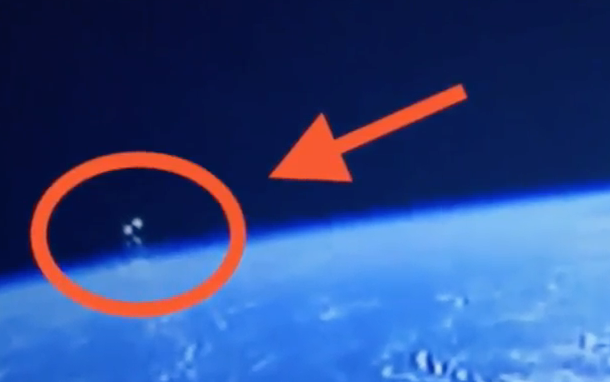
Floating Objects Seen In Earths Orbit On Live Video Feed, March 17, 2018, UFO Sighting News.
Date of sighting: March 17, 2018 Location of sighting: Earths Orbit Source: Live space station cam
These strange UFOs appeared on live came the other day and were recorded by MrMBB333 of Youtube. They seem to hover in place and make no movement. UFOs appear on the live Internet cam several times daily, so keep your eyes out and you will be the next to catch one. Scott C. Waring
MrMBB333 of Youtube states:
March 17, 2018: A very obvious group of some sort of ships or crafts were visible from the ISS March 17, 2018 holding steading high above the earth. As the ISS moved closer in the direction of these ships they disappeared. ISS Live Feed.
Film crew records me all day for their UFO mystery TV show, March 18, 2018
Did my first ever interview for a Japanese film crew that wanted to make an entire show about me. Started at 10am Sun and finished about 7PM that night. They covered my job, my family, my life in general, living here in Taiwan, at my work place, home, street, restaurant, the full package. Anyways, here is a small clip of them in my classroom only. Kids had a lot of fun. Its cool when people appreciate the work you do. Scott C. Waring
FastWalkers is a code name created by the North American Aerospace Defense Command to classify Unidentified Flying Objects which moving and changing directions at high speed and enter or leave the atmosphere at a great velocity.
Sometimes FastWalkers have been captured on the Defense Support Program satellite system as happened on May 5, 1984 when a DSP satellite captured a FastWalker while it was traveling a 22,000 mph.
In the summer of 1947, a rancher discovered unidentifiable debris in his sheep pasture outside Roswell, New Mexico. Although officials from the local Air Force base asserted that it was a crashed weather balloon, many people believed it was the remains of an extraterrestrial flying saucer; a series of secret “dummy drops” in New Mexico during the 1950s heightened their suspicions. Nearly 50 years after the story of the mysterious debris broke, the U.S. military issued a report linking the incident to a top-secret atomic espionage project called Project Mogul. Still, many people continue to embrace the UFO theory, and hundreds of curiosity seekers visit Roswell and the crash site every year.
THE ROSWELL “UFO” INCIDENT
One morning around Independence Day 1947, about 75 miles from the town of Roswell, New Mexico, a rancher named Mac Brazel found something unusual in his sheep pasture: a mess of metallic sticks held together with tape; chunks of plastic and foil reflectors; and scraps of a heavy, glossy, paper-like material. Unable to identify the strange objects, Brazel called Roswell’s sheriff. The sheriff, in turn, called officials at the nearby Roswell Army Air Force base. Soldiers fanned out across Brazel’s field, gathering the mysterious debris and whisking it away in armored trucks.
Did You Know?
The Project Mogul team invented a number of high-tech materials for its balloons and other equipment, including ultra-lightweight and ultra-strong metals, fiber-optic cables and fireproof fabrics. This is part of the reason why some people who saw the debris thought it came from outer space: It didn’t look or behave like anything they’d ever seen. Many of these materials are still in use today.
On July 8, “RAAF Captures Flying Saucer on Ranch in Roswell Region” was the top story in the Roswell Daily Record. But was it true? On July 9, an Air Force official clarified the paper’s report: The alleged “flying saucer,” he said, was only a crashed weather balloon. However, to anyone who had seen the debris (or the newspaper photographs of it), it was clear that whatever this thing was, it was no weather balloon. Some people believed–and still believe–that the crashed vehicle had not come from Earth at all. They argued that the debris in Brazel’s field must have come from an alien spaceship.
DUMMY DROPS AND UFOS
These skeptics grew more numerous during the 1950s, when the Air Force conducted a series of secret “dummy drops” over air bases, test ranges and unoccupied fields across New Mexico. These experiments, meant to test ways for pilots to survive falls from high altitudes, sent bandaged, featureless dummies with latex “skin” and aluminum “bones”–dummies that looked an awful lot like space aliens were supposed to–falling from the sky onto the ground, whereupon military vehicles would descend on the landing site to retrieve the “bodies” as quickly as possible. To people who believed the government was covering up the truth about the Roswell landing, these dummy drops seemed just as suspicious. They were convinced that the dummies were actually extraterrestrial creatures who were being kidnapped and experimented on by government scientists.
ROSWELL AND THE MYSTERIOUS PROJECT MOGUL
It turned out that the Army knew more about Brazel’s “flying saucer” than it let on. Since World War II, a group of geophysicists and oceanographers from Columbia University, New York University and the Woods Hole Oceanographic Institution on Cape Cod had been working on a top-secret atomic espionage project at New Mexico’s Alamogordo Air Field that they called Project Mogul. Project Mogul used sturdy high-altitude balloons to carry low-frequency sound sensors into the tropopause, a faraway part of the Earth’s atmosphere that acts as a sound channel. In this part of the atmosphere, sound waves can travel for thousands of miles without interference, much like under the ocean. The scientists believed that if they sent microphones into this sound channel, they would be able to eavesdrop on nuclear tests as far away as the Soviet Union.
According to the U.S. military, the debris in Brazel’s field outside Roswell actually belonged to Project Mogul. It was the remains of a 700-foot-long string of neoprene balloons, radar reflectors (for tracking) and sonic equipment that the scientists had launched from the Alamogordo base in June and that had, evidently, crashed in early July 1947. Because the project was highly classified, no one at the Roswell Army Air Field even knew that it existed, and they had no idea what to make of the objects Brazel had found. (In fact, some officials on the base were worried that the wreckage had come from a Russian spy plane or satellite–information that they were understandably reluctant to share with the public.) The “weather balloon” story, flimsy though it was, was the simplest and most plausible explanation they could come up with on short notice. Meanwhile, to protect the scientists’ secret project, no one at Alamogordo could step in and clear up the confusion.
ROSWELL AND “FLYING-SAUCERISM” TODAY
Today, many people continue to believe that the government and the military are covering up the truth about alien landings at and around Roswell. In 1994, the Pentagon declassified most of its files on Project Mogul and the dummy drops, and the federal General Accounting Office produced a report (“Report of Air Force Research Regarding the Roswell Incident”) designed to debunk these rumors. Nevertheless, there are still people who subscribe to the UFO theory, and hundreds of thousands of curiosity seekers visit Roswell and the crash site every year, hoping to find out the truth for themselves.
NASA May Not Manage To Save Us From Massive Asteroid That Could Wipe Out Life On Earth
There’s a chance that on Sept 21, 2135, a massive space rock impacts Earth.Researchers found that it might be impossible to stop a 500-meter wide asteroid from impacting our planet. It has been warned that even NASA’s most advanced technology could prove futile against such a threat. However, in order to deal with the problem, scientists have detailed a plan called HAMMER. In the proposal scientists from NASA and the National Nuclear Security Administration say a spacecraft could be used as an ‘impactor’ to deflect an object. However, experts warn that if there isn’t enough time, it would be better to nuke it.
According to a chilling scientific report, NASA won’t be able to stop a massive 500-meter wide asteroid that could impact Earth, bringing an end to civilization.
Researchers have discovered that it could be impossible to stop the massive comic rock, which is the size of the Empire State building, from impacting Earth in 2135, reports Daily Mail.
There’s a 1-in-2,700 chance that this will indeed happen, on Sept. 21, 2135, BuzzFeed News reported.
As noted by experts, even out most advanced technology would prove useless for deflecting a space rock of such size.
The rock, dubbed ‘Bennu’ is a carbonaceous asteroid in the Apollo group that was discovered by the LINEAR Project on September 11, 1999.
A scientific study performed in 2015 has shown that the highest impact probability for a planet is with Venus (26%), followed by the Earth (10%) and Mercury (3%). The odds of Bennu striking Mars are only 0.8% and there is a 0.2% chance that Bennu will eventually collide with Jupiter.
Scientists say that if such a rock would impact Earth, it would have terrible consequences for our planet, and the asteroid and its collision course have sparked fears it could wipe out civilization on Earth.
Scientists have calculated if an impact were to occur, the expected kinetic energy associated with the collision would be 1200 megatons in TNT equivalent
In order to avoid a civilization-ending scenario on Earth, experts are looking for ideas that could help them stop such a massive space rock from impacting our planet. So far, scientists are looking into the possibility of using a special spacecraft to ‘nuke’ asteroids such as Bennu, in hope that it could deflect the asteroid, altering its collision course.
HAMMER seems to be the best bet.
This 2013 plot by NASA JPL shows the orbits of potentially hazardous (more than 140 meters in diameter) near-Earth objects that pass within 4.7 million miles of Earth’s orbit. Earth’s orbit is represented by the darker black circle.
Scientists from NASA and the National Nuclear Security Administration have come up with a plan called HAMMER; Hypervelocity Asteroid Mitigation Mission for Emergency Response. Using a spacecraft that would act as an ‘imapctor’ NASA would slam an object into the oncoming space rock hoping to deflect it.
HAMMER is a nine-meter, 8.8-ton spacecraft that could be used to approach an asteroid and blow it up using a nuclear device, notes BuzzFeed.
Currently, the massive space rock is about 84 million kilometers from Earth and is moving slowly around the orbit of the sun, but since the orbits of the planets are not round, there is a point where it would pass relatively close to Earth.
NASA wants to take this opportunity to study the asteroid and possibly discover information about the origin of the universe, the formation of the planets and, if possible, determine where we come from.
Will the remains of an ancient Prometheus type civilization be buried there? Probably not, but we can still learn a lot about the universe.
Anyway. NASA has devised a plan around a potential impact with the 500-meter asteroid, which is currently the destination for NASA’s Osiris-Rex sample return mission.
The OSIRIS-REx spacecraft captured this image of the Earth and Moon system using its NavCam1 imager on January 17 from a distance of 39.5 million miles (63.6 million km). Earth is the largest, brightest spot in the center of the image, with the smaller, dimmer Moon appearing to the right.
Credit: NASA/Goddard/University of Arizona/Lockheed Martin
Despite the fact that Earth isn’t in direct threat by Bannu, and it isn’t expected to impact Earth anytime soon, scientists say here’s a 1 in 2,700 chance it will slam into our planet sometime next century.
Luckily, Bennu happens to be the best-studied asteroids of all Near Earth Objects (NEOs).
‘The two realistic responses considered are the use of a spacecraft functioning as either a kinetic impactor or a nuclear explosive carrier to deflect the approaching NEO,’ the authors wrote in the study, published to the journal Acta Astronautica.
But there’s always a ‘but’.
“Whenever practical, the kinetic impactor is the preferred approach, but various factors, such as large uncertainties or short available response time, reduce the kinetic impactor’s suitability and, ultimately, eliminate its sufficiency,” the authors wrote.
As for HAMMER, mankind’s savior spacecraft does not yet exist, and at the moment it’s just a theory, but NASA knows it’s something they have to consider in the future, and hopefully, it will be ready before Bennu gets too close.
UFO flew over TWO US passenger jets - pilots' shock caught on audio
US passenger jet pilots were left stunned after a huge UFO passed over two planes - with every word of their shock recorded on audio. The series of bizarre events is revealed by air traffic control audio recordings involving the American passenger jets at high altitudes.
And another pilot chimes in on the frequency saying "a UFO" to which the Learjet pilot replies “yeah”.
A few minutes later, the controller asked another flight behind to look out for anything passing over “in the next 15 miles”
An American Airlines captain exclaims in a puzzled manner "if anything passes over us?"
The controller hits back: ”Affirmative, we had an aircraft in front of you that reported something pass over him and we didn't have any [radar] targets, so just let me know if you see anything pass over you."
And sure enough, a minute later American 1095 airbus calls back to confirm he has spotted the UFO.
“I don't know what it was, but it was at least two or three thousand feet above us.
“Yeah it passed right over the top of us."
Baffled by the report, the controller asks the navigator: ”Could you tell if it was in motion or if it was just hovering?"
The navigator quickly replies: "I couldn't make it out if it was a balloon or whatnot, but it was just really beaming light or had a big reflection and several thousand feet above us going the opposite direction."
And according to an FAA representative the incident was not written up and noted or investigated further..
The sightings join the ranks of many recent US Navy pilot radar video releases said to show inexplicable UFOs.
There was also an encounter with a mystery unidentified craft by pilots over Denver.
Thousands of people believe UFOs are the craft of aliens visiting Earth, however, as yet there is no firm proof to back this up.
However, even the Mutual UFO Network (MUFON),m based in the US, which investigates and logs such sightings, says more than 90 percent are down to natural or man made phenomena.
Google Maps: Alien UFO ‘flying saucer’ spotted HIDING under a mountain in shock footage
GOOGLE MAPS shows an alien UFO flying saucer style craft pictured peeking out from between two mountains in the remote Antarctica area. The sighting points to the possibility of extra terrestrial life elsewhere in the world.
Google Maps is a brilliant platform for alien and UFO hunters who dedicate themselves to finding extra terrestrial activity on our planet.
This is all thanks the cameras and their incredible coverage of the hidden and remote parts of our planet.
While aliens and their UFO crafts are believed to keep a low profile when they visit planet Earth, perhaps they didn’t count on the all seeing nature of the Google Maps street view cameras.
This certainly seems to be the case with the latest UFO sighting in the South Pole in the Antarctica, one of the remotest areas of the world.
Google Maps
Google Maps: Alien UFO hiding beneath snowy mountain
Google Maps has caught the alien UFO on camera in the Antarctica
Google Maps UFO proof
Where is this latest sighting? It was found at location 66°16'24.1"S 100°59'04.8"E on the Google Maps platform.
With its snowy mountains, sub zero temperatures and mysterious rising mists, the South Pole might seem like a safe hiding place for something as top secret as a spacecraft.
However, it’s bad luck for the suspected aliens, whose UFO may have been caught on camera, according to YouTube channel Secure Team.
The channel owners, who are devoted to alien hunting, have suggested this circle spotted peeking out of the mountains is a “flying saucer” style UFO.
Google Maps
Google Maps: This is the site of the suspected UFO
With its defined glowing white outer rim and circular shape, the footage certainly resembles previous images of suspected UFOs.
Thanks to its dark colour, the UFO blends in with the dark coloured mountain it is hiding underneath.
It might have even succeeded in its mission to hide if not for a slim passage of snow which has accumulated below the mountain, giving its hiding place away.
Instead, it forms a striking contrast with the snow underneath, creating a tell tale light and dark effect.
Google Maps
Google Maps: Alien UFO evidence can be found using these coordinates
This isn’t the first time Google Maps has discovered UFO evidence in the Antartica area.
Found at location 80°34'08.4"S 30°05'19.3”W, a small dent can be seen in the snow with no other tracks around it.
Spotted by Russian UFO-enthusiast Valentin Degterev, he believes that the spot is the marking of alien lifeforms.
It measures at 65 feet wide and 230 feet long, making it large enough for a vessel to have created.
And now, Dr Richard Waller, senior lecturer of physical geography at Keele University, has now told Daily Star Online what they could really be.
Cave’s reveal 'Nazi base'
A long-standing conspiracy theory around Antarctica is that it was the site of a secret base used by the Nazis during World War Two.
The Germans did visit the continent to set up a whaling base during the period and also scouted for a place to set up a naval base, but nothing came of it.
Conspiracist MrMBB333 is one of those who believes there is a secret Nazi base and posted a clip to YouTube in a bid to prove it.
It appeared to show a huge “man-made” entrance into a mountain, in the New Swabia area of Antarctica, but Dr Waller rubbished the theory.
“This just looks like a lake basin on the mountainside where the lake ice and surrounding snow has partially melted and been saturated with meltwater – hence the darker colour,” he said.
GETTY/DS
REVEALED: Antarctica's biggest mysteries may have finally been solved
Pyramids 'clue to ancient civilisation'
Images of what appeared to be gigantic pyramids – with an uncanny resemblance to the pyramids of Giza in Egypt – sparked claims they were proof of ancient civilisations in 2016.
But the sight isn’t actually uncommon, according to Dr Waller.
“The mountain depicted is certainly very regular in terms of shape,” he told Daily Star Online.
“There are plenty of examples of very regular shapes being produced in natural environments and glaciers tend to produce features like this, called ‘pyramidal peaks’.
“It is one of the classic glacial landforms.”
Heat map uncovers 'secret government base'
Renowned conspiracy theorist Tyler Glockner – of YouTube channel secureteam10 – claimed he had found a top-secret multi-level government base last month.
He used the Global Heat Map to highlight heat signatures from an isolated location, yet when he switched to Google Earth of the same area, nothing was seen.
Dr Waller’s theory is completely unexpected.
He suggested that the Strava signatures were actually from a Marathon event at the time that was run in Antarctica, named Ice Marathon.
UFO 'crash site'
Tyler went viral for a second time earlier this month for claiming to have found a crash-landed spaceship on South Georgia Island, a remote British Overseas territory.
Using Google Earth, he pointed to an unknown mass that appeared to have skidded “1,000 metres” before grinding to a halt.
But Dr Waller suggested it was simply part of a glacier that had collapsed after an avalanche at the nearby Mount Paget.
The Alien Planets of TRAPPIST-1 May Be Too Wet for Life
By Mike Wall, Space.com Senior Writer
An artist's illustration of the view from one of the seven planets orbiting the red dwarf TRAPPIST-1, with several other worlds visible closer to the small, dim star.
Credit: N. Bartmann/spaceengine.org/ESO
The seven rocky planets circling the nearby star TRAPPIST-1 have lots of water, a new study suggests — perhaps too much to make them good bets for life.
All of the TRAPPIST-1 worlds likely harbor hundreds of Earth oceans' worth of water on their surfaces, and the wettest ones may have over 1,000 times more of the stuff than our planet does, according to the study.
"Too much water can be a bad thing," lead author Cayman Unterborn, a postdoctoral fellow in the School of Earth and Space Exploration at Arizona State University, told Space.com. "The TRAPPIST-1s are interesting, but maybe not for life."
TRAPPIST-1 is a dim red dwarf star that lies about 39 light-years from Earth. Astronomers discovered three planets circling the star in 2016, and four more were announced a year later. Each of the seven worlds — which are known as TRAPPIST-1b, c, d, e, f, g and h — is about the same size as Earth. And three of the alien worlds (e, f and g) are thought to lie in TRAPPIST-1's "habitable zone" — that just-right range of distances where liquid water could likely exist on a planet's surface.
TRAPPIST-1 is about 2,000 times dimmer than the sun, so the red dwarf's habitable zone is very close-in. Indeed, all seven TRAPPIST-1 planets lie closer to their star than Mercury does to the sun.
This diagram shows illustrations of the seven TRAPPIST-1 planets and compares some of their key characteristics with those of the rocky planets in our own solar system.
Credit: NASA/JPL-Caltech
All of the TRAPPIST-1 planets were discovered via the "transit method"; several different instruments noticed the tiny brightness dips that resulted when the worlds crossed their host star's face. The magnitude of these dips revealed the sizes of the worlds. And astronomers have been able to estimate the planets' masses, though not nearly as precisely, by studying how their transits have varied over time. (These variations occur as neighboring planets tug on one another gravitationally.)
With this mass and volume information in hand, Unterborn and his team used computer models to get a better idea of the composition of six of the TRAPPIST-1 worlds. (They didn't deal with TRAPPIST-1h, the outermost planet, because not enough is known about it.)
This modeling work suggested that there's a wetness gradient in the TRAPPIST-1 system. The innermost planets, b and c, are probably about 10 percent water by mass, whereas the wet stuff makes up at least 50 percent of the more distant f and g. The middle planets d and e fall somewhere in between.
All of these worlds are sopping wet, even at the low end of the gradient. For comparison, Earth is just 0.2 percent water by mass. Indeed, the TRAPPIST-1 planets are probably "water worlds," with no land to break the monotony of wind and wave, Unterborn said.
If that is indeed the case, the odds of finding life in the system may not be great.
"With no exposed land, key geochemical cycles including the drawdown of carbon and phosphorus into oceanic reservoirs from continental weathering will be muted, thus limiting the size of the biosphere," the researchers wrote in the new study, which was published online today (March 19) in the journal Nature Astronomy. "As such, although these planets may be habitable in the classical definition of the presence of surface water, any biosignature observed from this system may not be fully distinguishable from abiotic, purely geochemical sources."
And all that water might shut down some key geological processes that could help life get a foothold, Unterborn said. For example, rocks in Earth's mantle often become liquid after moving upward to a zone of lower pressure, where their melting point is lower. But such "decompression melting" may occur rarely, if at all, on the TRAPPIST-1 worlds, because the huge weight of the overlying global oceans jacks up mantle pressures so much.
Without molten rock near the surface, there can be no volcanoes (at least not the kind we're used to here on Earth). And without volcanoes, heat-trapping gases, such as carbon dioxide, may have a hard time reaching the atmosphere — which means the TRAPPIST-1 planets may have been subjected to a "runaway snowball" effect, Unterborn said. [Gallery: The Strangest Alien Planets]
Planets orbiting red dwarfs face other habitability challenges, many researchers have stressed. For example, if these worlds orbit tightly enough to be in the habitable zone, they're almost certainly "tidally locked," meaning they always show the same face to their parent star. So, one side of such planets may be boiling hot while the other is frigid. This problem could be mitigated by the presence of a thick atmosphere, which would circulate heat. But red dwarfs fire off lots of powerful flares, which may quickly strip away the atmospheres of habitable-zone worlds.
Such issues are heavily debated and studied, which isn't surprising given the prevalence of red dwarfs: About 75 percent of the Milky Way's stars are red dwarfs, so they likely harbor most of the galaxy's real estate, habitable or otherwise.
The new study also sheds light on the formation and evolution of the TRAPPIST-1 system. For example, all seven planets currently lie inside the primordial "snow line" — the point beyond which it was cold enough for water to remain frozen when the worlds were taking shape. But the team's results suggest that planets f, g and h actually formed beyond this boundary and migrated inward over time. Planets b and c, on the other hand, coalesced inside the primordial snow line. (It's not clear where TRAPPIST-1d and e were born in relation to this line, which the researchers said was likely located somewhere between the newborn worlds c and f.)
Overall, the study indicates that red dwarf systems such as TRAPPIST-1 shouldn't be thought of as just miniature versions of our own solar system, Unterborn said; their planets may form in slightly different ways, and/or on slightly different timescales.
"Understanding it from a planetary formation and evolution perspective, I think, is — for the public especially — a much more powerful way of selling TRAPPIST-1 than life," he said. "No one likes being the wet blanket who says, 'Well, actually, they're not that great for life.' But they're really interesting, and we need to know these things in order to understand the planets that are likely to have life."
Enceladus, one of Saturn's moons, is currently a leading candidate for scientists searching for the ingredients for extraterrestrial life. One new study shows how microorganisms could survive there, living off of methane.
ASTROBIOLOGICAL FINDINGS
Enceladus, one of Saturn’s moons, is a leading candidate in the search for extraterrestrial life in our solar system. One new study improves the moon’s likelihood of holding life. Scientists have found that, under Enceladus-like conditions, certain microbes known as methanogenic archaea can grow and produce methane from carbon dioxide and hydrogen gases.
These researchers suggest that the geochemical reactions in Enceladus’ rocky core could produce enough methane to support such microbes — pointing a hypothetical ecosystem for such life.
To reach these conclusions, the research team, led by Simon Rittmann of the University of Vienna, used unique gas compositions and pressures in the lab to mimic the environment that is predicted to exist on Enceladus. They then cultured three different microscopic organism species in this environment. They found that, among the species cultivated, Methanothermococcus okinawensis was able to produce methane and thrive despite the presence of growth-inhibiting compounds. The resulting study was published in the journal Nature.
LOOKING TO ENCELADUS
Enceladus’ icy crust hides a global ocean, and its southern pole is rife with hydrothermal activity. This Saturnian satellite also cultivates heat from friction with Saturn, and is home to a variety of compounds that are also common on Earth — molecular hydrogen, methane, carbon dioxide.
Future missions to observe the moon could use research on its potential inhabitants to guide and inform their goals, allowing them to gather the most pertinent data. Many entities, including NASA, are considering the possibility of reaching Enceladus to complete direct observations. Geoffrey Marcy, a retired professor of astronomy at the University of California, Berkeley, even told Astrowatch that such missions wouldn’t even need to land to collect the information they need; a spacecraft flying through the moon’s many vapor plumes might be able to collect enough samples to make the link.
As we learn more about the icy water worlds in our own backyard, it seems more likely that Enceladus and its fellow ice moons may play host to life as we do not yet know it. We might not know for sure until a mission departs, but until then, research like this will give such missions the tools they will need to succeed.
China Outlines Two-Phase Chang'e 4 Moon Lander Mission
By Leonard David, Space.com's Space Insider Columnist
Credit: CNSA
Later this year, the moon's far side will welcome its first robotic visitor — China's Chang'e 4 lander.
Zhao Xiaojin, a senior official at the China Aerospace Science and Technology (CAST), explained that the nation's two-phase Chang'e 4 missionis being readied for launch this year.
"In the first half of 2018, we will first launch a relay satellite to Lagrange L2 Point, where the satellite can keep communication with both the far side of the moon and the Earth," Zhao told China Central Television (CCTV) earlier this month. (The L2 Point is a gravitationally stable spot beyond the moon's far side.) [China's Moon Missions Explained (Infographic)]
"Therefore, we can control the lunar probe for data transmission using this relay satellite," Zhao added.
Launch of the Chang'e 4 lander is slated for the second half of 2018. After performing a soft touchdown on the lunar far side, the craft will "conduct in-situ and patrol exploration at the landing site," Zhao said.
Moon exploration program
China's Chang'e lunar exploration program takes its name from a Chinese moon goddess. The program's first phase consisted of the successful Chang'e 1 and Chang'e 2 missions, which lifted off in 2007 and 2010, respectively.
Chang'e 3 marked the beginning of the second phase, which includes orbiting the moon, landing and returning lunar samples to Earth. In 2013, Chang'e 3 performed the nation's first-ever soft landing on the moon; the lander also deployed a rover known as Yutu ("Jade Rabbit").
Chang'e 4 was built as the backup to China's Chang'e 3 probe. But Zhao told CCTV that Chang'e 4's mission profile differs in key ways from that of Chang'e 3
"Chang'e 3 lunar probe used a slow and arc-shaped landing, while as for Chang'e 4 lunar probe, we have to adopt a steep and almost vertical landing," Zhao explained. "Chang'e 4 lunar probe will have huge improvements on its capabilities, because we have adopted new technologies and new products. For example, Chang'e 3 lunar probe could not work during the night, but Chang'e 4 lunar probe can do some measurement work at night."
Polar exploration
Last year, Pei Zhaoyu, deputy director of the Lunar Exploration and Space Program Center with the China National Space Administration (CNSA), told attendees at the 7th CSA-IAA Conference on Advanced Space Technology that China will implement three missions in the polar regions of the moon and set up scientific research stations there to offer a platform for future lunar probes.
"We will carry out three missions at the moon's polar regions to research the geological structure and mineral composition of its south pole, and we will take samples back from the moon during one of these missions," Pei told CCTV. "By building scientific research stations on the moon, we want to provide a platform for larger-scale and more rich lunar probe activities in the future."
China's blossoming robotic moon-exploration agenda suffered a setback last year, however: the July launch failure of the country's most powerful rocket, the Long March 5, on its second flight. That heavy-lifter is needed to launch China's planned lunar sample-return mission, Chinese officials have said.
This story has more information about the repercussions of the Long March 5 failure. And to learn more about Chang'e 4, check out this Gallery Military video.
Leonard David is author of "Mars: Our Future on the Red Planet," published by National Geographic. The book is a companion to the National Geographic Channel series "Mars." A longtime writer for Space.com, David has been reporting on the space industry for more than five decades. Follow us @Spacedotcom, Facebook or Google+. This version of the story published on Space.com.
Russian President Vladimir Putin says Russia will launch a mission to search for extraterrestrial life on Mars in 2019 – beating NASA’s planned mission scheduled for 2020.
Putin revealed his country’s ambitious space plans during a documentary about his presidency which was widely shared on Russian social media.
Newsweek.com reports: He said: “We are planning unmanned and later manned launches, into deep space, as part of a lunar program and for Mars exploration. The closest mission is very soon, we are planning to launch a mission to Mars in 2019.”
The revelation during a documentary on the president hosted by Andrey Kondrashov comes on the heels of NASA’s announcement it would attempt to explore the red planet in a Mars 2020 mission in which it would investigate the potential for life.
Putin, who is expected to be re-elected as president in the country’s election on Sunday, said that Russia would also launch a mission to the polar regions of the Moon, adding that its lunar program would differ to the one his country undertook in Soviet times.
“Our specialists will try to make landings on the poles, because there is reason to believe that there can be water there. There, there is progress to be made, studies of other planets, distant space can be started from there,” he said in the film uploaded to Russian social media site vkontakte.
Putin did not specify when in 2019 the Mars mission would happen. The NASA mission is expected to take place around July and August 2020 when the positions between Earth and Mars are best placed for a landing.
The race to the red planet is hotting up, with billionnaire entrepreneur Elon Musk telling the South by Southwest Conference on Sunday that his SpaceX Mars rocket may be ready for test flights next year. He had previously stated his ambition was to launch cargo flights by 2022.
So far, Russia’s attempts at a Mars mission have ended in failure. In 2011, the ill-fated Phobos-Grunt probe was unable to be fired toward the orbit of the red planet after launch. Its mission was designed to bring back samples from the planet’s moon Phobos.
The Russian space program Roscosmos worked with the European Space Agency in the Schiaparelli EDM lander mission, in which a Russian rocket was used.
If you haven’t seen the strange UFO sightings featured in a Fox News live report in Milwaukee, then you definitely want to watch this video.
Strange lights over the city seem to move randomly over downtown Milwaukee. The news anchors giving the morning news update were at a complete loss of words with one of them offering up a suggestion that it was fireworks making this display, while the other anchor hesitantly mentions “aliens?”
Fox News later reported that the lights came from flying seagulls and the slow shutter speed on the camera. I don’t know about you, but I’ve been around a lot of sea gulls in various light and weather conditions without ever witnessing anything quite like this!
So what do you think? Could this just be a weird camera effect of light bouncing off the seagulls as they fly through the air or possibly another unexplained UFO sighting? Let us know in the comments section below.
The following video analyses a series of five photos taken in a remote area of Orlando, Florida by my anonymous source, JP, on March 16, 2018. The photos show a craft estimated by JP to be flying/hovering at an altitude 2000-5000 feet high, and the size of two jumbo jets.
JP says that he had a missing time experience of approximately 30 minutes before taking the photo. On previous occasions where he has had missing time, he has been able to subsequently recall being taken on board the craft of a U.S. Air Force run secret space program, or cylindrical craft of alleged Nordic extraterrestrials.
The video shows close ups of the craft in the photos and how similar it is to a 2004 patent design for a triangle shaped spacecraft.
The symmetrical geometry of the craft in JP’s photos, the smooth edges, the apparent width of the craft, and some kind of large hemisphere generator in the center, is all very similar to the 2004 patent design for a Triangle Spacecraft as the following side by side comparison shows.
Coincidentally, the photos in the video were taken only three days after President Donald Trump gave a speech calling for the creation of a Space Force, which I discussed in my previous articleas a step towards disclosure of the US Air Force run secret space program. This raises the possibility that JP’s sightings are part of a USAF backed disclosure initiative that is being supported by the Trump administration.
I have known JP since 2008 and believe him to be a credible source who has had numerous experiences with both craft belonging to a US Air Force run secret space, and alleged Nordic extraterrestrials. Please review the further reading section for some of these articles that include his photos of craft he has witnessed, and/or been taken aboard, which help corroborate his experiences.
What follows are the originals of the first and fourth photos used in my video analysis of the March 16 photos for those wishing to conduct further photographic analysis.
Michael E. Salla, Ph.D. Feel free to share this article with original links.
Research fellow, Dr Barry DiGregorio, mentioned photos launched by NASA’s Curiosity rover have been hint fossils exhibiting indicators of life.
He accused them of protecting up the reality so it will not hurt funding for its mission in little over a decade’s time.
Now the University of Buckingham professional has warned they want to up efforts of their seek for aliens or its astronauts face dying.
The floor of Mars: may these photos show LIFE exists on the Red Planet?
These photos launched by NASA present the floor of Mars. They have been pored over by boffins and truthseekers in search of telltale indicators that water as soon as flowed on the Red Planet, which might imply that alien life may as soon as have flourish there
Four geological layers to be examined by the mission, and greater reaches of Mount Sharp past the deliberate research space
“Astronauts could be exposed to unknown pathogenic microbes and viruses that we have no idea how to control”
Dr DiGregorio
Dr Dr Grigio instructed Daily Star Online: “Astronauts might be uncovered to unknown pathogenic microbes and viruses that we do not know how to management.
“That is why it’s so necessary to fly extra life detection devices to Mars – to make certain it’s secure to ship human beings or to return samples to Earth.”
He added: “Look on the eventualities that Elon Musk is presenting, he is speaking about sending folks to Mars regularly which is totally absurd.
“He’s completely ignoring the truth that there might be microbial life on Mars, and so far as being a scientist goes, the one factor you need to make certain of is that your folks have a level of confidence that the floor of Mars is sterile.
GETTYWARNING: An professional warns astronauts might be killed on Mars
“If you despatched astronauts to Mars and they die of pathogenic ailments from indigenous microbes, you are not going to have one other mission return there, the publicity can be horrible.”
The hint fossils discovered by Curiosity, Dr DiGregorio claims, characterize sings of “gentle bodied creatures” who as soon as roamed the planet.
NASA mentioned it believes the figures could also be crystals, and is contemplating “a number of prospects” on the area snaps.
But Dr DiGregorio has urged NASA to look at findings additional to stop astronaut fatalities.
Shutterstock / Leo Blanchette
More than 40,000 Americans have taken out insurance coverage towards being kidnapped by aliens.
He instructed us: “They are telling folks they’re in search of life however they don’t seem to be actually doing it, as a result of as soon as they do it in the event that they announce that to the general public, what number of missions do you assume are going to go and search for life?
“It’s a matter of ethics as properly as a result of I might assume that NASA desires to ship life detection experiments to Mars to make certain it is secure to ship people to Mars.
“What type of publicity would you will have if the primary people to set foot on Mars die of pathogenic ailments from indigenous microbes?
If We Discover Alien Life, Will Humanity Keep Its Cool?
By Carl Engelking
Mars has long been the best candidate to find extraterrestrial life?
(Credit: NASA)
For well over 1,500 years, humanity accepted that Earth was the center of the solar system. After all, the Bible—which was the scientific authority at the time—said this was so.
Then along came Nicolaus Copernicus, who in the 16th century dared to challenge the church and mathematically described a solar system with the sun at its center. After his death, Galileo Galilei’s observations of heavenly bodies further supported the Copernican model. The Catholic Church, fearing such a finding undermined the supreme authority of the Bible, charged him with heresy. Galileo would be sentenced to life imprisonment, but was allowed to serve his sentence at home due to his declining health.
So often, institutions that wield incredible power loathe major paradigm shifts that could undermine their authority and ability to monopolize the truth. Informing the masses that everything they’ve been told is wrong, after all, could result in a social upheaval that tears society apart, at least the thinking goes.
Today, the world is still grappling with a haunting question: Are we alone in this infinite universe, or is life infinitely diverse throughout the universe? To date, we are still alone, but discovering extraterrestrial life would tie a definitive bow on that existential question. In other words, it would be a major paradigm shift. So if we finally determine that we are indeed not alone, will the very fabric of society tear apart?
Probably not.
In fact, humanity might embrace the news with open arms. That’s the conclusion from Michael Varnum, a psychology professor at Arizona State University who is also part of the university’s Interplanetary Initiative, a research group aimed at building a social framework for a future extraterrestrial society. Varnum took on one of the group’s pilot projects, which was to empirically answer one question: How will humankind react to the discovery of life off Earth?
It’s a question that few researchers have sought to study, but Varnum was up for the task.
“I’m a person who has been into science and sci-fi for some time,” he said.
A Few Case Studies
The Robertson Panel in 1953 warned of mass hysteria if alien life were confirmed. Twenty-five percent of Americans in a recent survey expected people to panic when we discover alien life. Orson Welles certainly didn’t supply any evidence that humanity would keep its cool (news of the subsequent panic may have been grossly exaggerated, however). But Varnum’s study indicates this all hyperbole. Reality would probably be far more mundane.
First off, it’s far more likely that we’ll discover microbes or “non-intelligent” alien life before we meet sentient otherworldly beings. So Varnum limited the scope of the study to human reactions to news that scientists confirmed microbial alien life exists.
They started with a preliminary contextual analysis, measuring the reactions to news that extraterrestrial life might exist. They included five primary “discovery” events: the 1967 discovery of pulsars, the 1977 “Wow!” signal, the 1996 discovery of fossilized microbes on Mars, the 2015 discovery of Tabby’s star, and the 2017 discovery of exoplanets in the habitable zone of a star.
They analyzed news coverage, government memos and press releases of the event to determine the percentage of words in each article that were positive, negative, reward or risk. Words describing positive affect were more prevalent that those describing negative affect. Their preliminary findings suggested that society’s overall reaction to news about alien life was positive, and more reward oriented.
They then turned to Amazon’s Mechanical Turk and asked 504 people to respond to a hypothetical situation: Imagine scientists just discovered microbial life outside of Earth. They were told to describe their reactions, as well as the reactions of other people. Again, people tended to be more positive. They repeated the experiment with a more concrete example: New York Times coverage of Bill Clinton’s 1996 announcement about Martian life, or Craig Venter’s 2010 announcement about synthetic life. Once again, alien life was viewed in a positive light.
“Positivity bias was stronger about extraterrestrial microbial life than synthetic life. There seems to be something especially positive about alien life,” says Varnum. He published results from the study this week in the journal Frontiers in Psychology.
We’re Cool With Alien Life
Of course, contextual analysis of hypothetical situations and past events can’t necessarily predict what will actually happen if we confirm life off the planet. But Varnum said Clinton’s announcement 22 years ago is about as good of a test case as any, and its ultimate effect on the world was a real shoulder-shrug.
“It didn’t cause a radical shift in the way people lived their lives. It didn’t cause people to abandon anything,” Varnum says. “Human beings have been through pretty powerful paradigm shifts, from not being in the center of the universe to Darwin’s evolution. In the past, people would be afraid of them. But the notion that a discovery like this will destabilize anything, as it turns out, is kind of silly.”
Varnum thinks that confirming life exists throughout the universe might be viewed positively because it provides some comfort for lonely Earthlings.
“At least for me, it makes me feel that if we were to confirm alien life, I would feel like the universe is a warmer place; that we aren’t out here all alone,” says Varnum.
HERE’S THE MIND-BOGGLING REASON WE PROBABLY WON’T MEET ALIENS WHILE THEY’RE STILL ALIVE
Space empires could rise and fall without us knowing.
The search for alien life goes on, but our chances of hearing from extraterrestrial beings that are still alive are very slim, according to new research.
The problem is that civilisations likely don’t last as long as signals travelling through space.
These latest calculations are an update of the legendary Drake equation, first proposed in 1961 by Frank Drake at the National Radio Astronomy Observatory in West Virginia, as a shorthand way of calculating how much alien life could be out there.
Using variables such as the number of stars born each year, the number of potentially habitable planets they have, and the chances of organic life developing, the equation gives us some idea of the likelihood of receiving signals from beyond Earth.
A model of signal spread.
(arXiv.org)
And according to the newly updated numbers, it’s not looking promising.
“If the civilisation emitted from the other side of the galaxy, when the signal arrives here, the civilisation will already be gone,” one of the team, Claudio Grimaldi from the Federal Polytechnical School of Lausanne in Switzerland, told Lisa Grossman at Science News.
The research team also includes Frank Drake himself, now professor emeritus at the University of California, Santa Cruz.
Each of the variables in the Drake equation are open to debate, but the scientists assumed a civilisation lifespan of 100,000 years as a marker, which is how long it takes light to cross the galaxy. Even an alien empire that lasted that long would only fill “a small fraction” of the galaxy with signals, the study determines.
For reference, we’ve been sending signals out into space for 80 years now, and those rippling signals will only have covered under 0.001 percent of the Milky Way.
What’s more, given the frequency of the signals we send out into space, an alien civilisation would need to be within 50 light-years for us to have heard back from them at this point, the researchers found.
While a hardy group of aliens who survived longer than 100,000 years could fill the galaxy with bouncing signals, there could again be gaps if new civilisations don’t spring up often enough to fill them, the data shows.
Another interesting finding was that the number of extraterrestrial signals crossing Earth at any one time should correspond to the number of civilisations currently broadcasting, whether or not the signals we’re hearing are from past or current civilisations. The researchers are still writing up their thoughts on that one.
The aim of all these calculations is to get a better perspective on our lack of contact with alien lifeforms so far. Is it because no one else is out there? Or is it because we just have a very low chance of hearing anything?
Eventually the researchers hope that the revised Drake equation can help us improve our chances of finding radio signals in space, perhaps through an improved understanding of where to point our telescopes.
This is still all preliminary though – the paper produced by the team has yet to be peer-reviewed by other scientists, though it is available online.
For now though, we shouldn’t expect to be hearing signals from alien lifeforms that are still around – at least not with an assumed civilisation lifespan of 100,000 years.
“The transmissions arriving at Earth may come from distant civilisations long extinct, while civilisations still alive are sending signals yet to arrive,” write the researchers.
You can read the research paper on the pre-print server arXiv.org.
TOO BIG, TOO SOON Supermassive black holes that are actively feeding on gas and dust, like the one shown in this artist’s rendition, have been spotted in the early universe — before they should have had time to grow.
NAOJ
The existence of supermassive black holes in the early universe has never made much sense to astronomers. Sightings since 2006 have shown that gargantuan monsters with masses of at least a billion suns were already in place when the universe was less than a billion years old – far too early for them to have formed by conventional means.
One or two of these old massive objects could be dismissed as freaks, says theoretical astrophysicist Priyamvada Natarajan of Yale University. But to date, astronomers have spotted more than 100 supermassive black holes that existed before the universe was 950 million years old. “They’re too numerous to be freaks now,” she says. “You have to have a natural explanation for how these things came to be.”
The usual hypotheses are that these black holes were either born unexpectedly big, or grew up fast. But recent finds are challenging even those theories and may force astronomers to rethink how these black holes grow.
In the modern universe, black holes typically form from massive stars that collapse under their own gravity at the ends of their lives. They usually start out smaller than 100 solar masses and can grow either by merging with another black hole (SN: 3/19/16, p. 10) or by accreting gas from their environment (SN Online: 12/6/17).
That gas often organizes itself into a disk that spirals into the black hole, with friction heating the disk to white-hot temperatures that create a brilliant glow visible across billions of light-years. These black holes feeding on gas are called quasars. The faster a quasar eats, the brighter its disk glows.
But the glow from that gas also limits the black hole’s growth: The bright disk’s photons push away fresh material. That sets a physical limit on how fast black holes of a given mass can grow. Astronomers express how fast a black hole is eating with a term called the Eddington ratio, measuring the black hole’s actual brightness in relation to the brightness it would have if it were eating as fast as it possibly could.
Finicky feeders
Astronomers have measured Eddington ratios for only about 20 supermassive black holes in the early universe. Most seem to be eating at the limit, in contrast to quasars in the present-day universe that feed at about a tenth that speed. Those furious feeding rates still seem to defy the black holes’ supermassive size: A 100-solar-mass black hole accreting at the limit should take about 800 million years to reach a billion solar masses, even taking into account that it would eat faster as it grew. And that 800 million years doesn’t include the time it took the initial black hole seed to form.
But physicist Myungshin Im of Seoul National University in South Korea and colleagues worried that previous observations were missing pickier eaters because fast eaters are brighter and easier to spot. If some early massive black holes were lazy eaters, their super sizes become even more puzzling — and may rule out some theories for how they grew.
So the team deliberately sought out dimmer distant quasars in a September 2015 observing run at the Las Campanas Observatory in Chile.
The researchers found IMS J2204+0112, a billion-solar-mass black hole eating at a tenth of its speed limit and hailing from when the universe was about 940 million years old. But at its feeding rate, the black hole shouldn’t have fully matured until the universe was 8 billion years old, the team reported on arXiv.org February 9.
“We show for the first time that quasars with low Eddington ratio exist in the early universe,” Im says.
IMS J2204+0112 is the dimmest slow-eating quasar spotted yet, but it’s not alone. Physicist Chiara Mazzucchelli of the Max Planck Institute for Astronomy in Germany and colleagues reported 11 fussy supermassive black holes that existed when the universe was less than 800 million years old, in the Astrophysical Journal last November.
On average, those quasars weigh in at around 1.62 billion solar masses but eat at about 40 percent of the speed limit, the team reported. Strangely, the largest black hole in that group, HSC J1205-0000, had the lowest feeding rate: The black hole is 4.7 billion solar masses yet eats at only 6 percent of its limit.
It was strange enough to find supermassive black holes with gluttonous appetites in the early universe, but these picky eaters are even harder to explain.
Astronomers hope peering farther back in time will help find the “seed” black holes that may grow into behemoths. If some black holes started out huge, from 10,000 to a million solar masses, they could grow even larger either by merging with each other or accreting at the Eddington limit.
“If you start with such a very massive seed, you have a jump-start,” says astrophysicist Avi Loeb of Harvard University. “Then you don’t need as much time to grow to a billion solar masses.”
But theorists have been trying for 15 years to figure out how such huge black holes could form in the first place. One idea is that massive gas clouds or supermassive stars collapsed directly into a massive black hole.
Supermassive seeds
More recent work suggests it wouldn’t be that simple. Theoretical studies show it’s hard to prevent those gas clouds from fragmenting to form a cluster of small stars, rather than collapsing into one large star, says physicist Dominik Schleicher of the University of Concepción in Chile.
In the May 2018 Monthly Notices of the Royal Astronomical Society, Schleicher and colleagues show that such clusters also could create massive black hole seeds, as newly formed stars accrete gas left over in the cluster. Such stars could swell to 100 to 1,000 times the radius of the sun. Their inflated sizes and close proximity to one another would make these stars collide, triggering a domino effect that eventually collects all the stars in the cluster into a single supermassive star 10,000 times the mass of the sun. That supermassive star could then collapse to form a relatively massive seed black hole.
The other possibility is that early supermassive black holes simply broke the Eddington limit. They may have gone through periods of eating more quickly than was thought possible and grew to near-supermassive proportions before calming down.
Loeb points out that there are situations in the present-day universe where black holes eat faster than the Eddington limit, such as when they rip apart and devour a star(SN: 4/1/17, p. 5). There are also situations where radiation can be trapped near the surface of the black hole, preventing it from pushing material away. “In that case you can feed the black hole as fast as you want,” Loeb says.
Or, Natarajan and colleagues suggest, the answer could be both: Black holes that are born big get bigger faster. “Evidence is mounting slowly that we need to consider more than one way,” Natarajan says.
In a December 2017 study in the Astrophysical Journal Letters, she and her colleagues ran computer simulations showing that some environments can boost a black hole’s growth, allowing the black hole to consume a continuous stream of gas.
The rich get richer
Simulations show that a small black hole seed will never grow fast enough to become supermassive before the universe is a billion years old. But a black hole that was born large will grow faster and faster.
F. PACUCCI ET AL/ASTROPHYSICAL JOURNAL LETTERS 2017
Still, only black holes born with masses at least 10,000 times that of the sun can grow to a billion solar masses within a billion years. But the most massive seeds are more likely to be born in a gas-rich environment.
“The environment around and the birth conditions for these black holes actually puts them on a track either for rapid growth spurts, or for rather slow growth,” Natarajan says. “The massive black hole seeds are the ones that won the birth lottery and got the best start in life.”
Zijn dood beroerde de hele wereld: Stephen Hawking stierf begin deze week. Amper twee weken voor zijn dood diende de wetenschapper nog een laatste baanbrekende onderzoekspaper in, waarin hij uitlegt hoe we bewijzen van een ‘multiversum’ kunnen vinden en waarin hij het einde van ons bestaan voorspelt.
De ‘multiversum’-theorie gaat ervan uit dat er naast ons universum nog andere universums zijn. Ons universum is slechts een van de vele anderen, veroorzaakt door de oerknal. En zo’n ander universum kunnen we detecteren en meten via een detector op een ruimteschip. Dat staat te lezen in de allerlaatste paper van wereldberoemd fysicus Stephen Hawking, die begin deze week stierf. Hij schreef de paper vanop zijn sterfbed, samen met Belgisch natuurkundige Thomas Hertog.
In de paper staat hoe de mensheid zo’n andere universums zouden kunnen vinden. De wiskundige berekeningen die nodig zijn om dat te kunnen bereiken, staan allemaal in die laatste, baanbrekende paper.
De kwestie van ‘multiversum’ hield Hawking al lang bezig. Ook al in 1983 schreef Hawking, samen met James Hartle, een onderzoekspaper waarin hij uitlegt hoe het universum is ontstaan, maar ook dat de oerknal oneindig veel andere oerknallen creëerde, die elk hun eigen universum hebben doen ontstaan.
De paper van Hawking suggereert ook dat het bestaan op Aarde uiteindelijk zal vervagen in de duisternis wanneer de energie van de sterren op is. Dat wordt in de kosmologie als een controversieel idee beschouwd, want het betekent meteen het einde van ons bestaan op Aarde, maar veel wetenschappers zien hierin ook een mogelijke doorbraak in de kosmologie.
Citizen-scientists Matt Brealey and Gustavo B C processed this color-enhanced image of a Jupiter storm using data captured on Feb. 7, 2018, by the JunoCam imager aboard NASA's Juno spacecraft.
Credit: Matt Brealey/Gustavo B C/NASA/JPL-Caltech/SwRI/MSSS
A new photo shows a swirling maelstrom on Jupiter through rose-colored glasses.
NASA's Juno spacecraft snapped the original picture on Feb. 7, during its 11th close flyby of the gas giant. At the time, Juno was 7,578 miles (12,195 kilometers) above Jupiter's cloud tops, at a latitude of 49.2 degrees north, NASA officials said.
"Citizen scientist Matt Brealey processed the image using data from the JunoCam imager," NASA officials wrote in a photo description Friday (March 16). "Citizen scientist Gustavo B C then adjusted colors and embossed Matt Brealey's processing of this storm."
NASA and the Juno mission team encourage such image-processing efforts. To learn more or try your own hand, go to theJunoCam site.
The $1.1 billion Juno mission launched in August 2011 and arrived at Jupiter in July 2016. Juno loops around the solar system's largest planet in a highly elliptical orbit, zooming close once every 53 Earth days. It's during these close approaches — such as the Feb. 7 encounter — that the probe collects most of its science data.
That information consists largely of measurements of Jupiter's gravitational and magnetic fields, as well as details about the planet's structure and composition. Juno's observations should help scientists better understand how Jupiter — and, by extension, the solar system — formed and evolved, mission team members have said.
UFO caught on tape over Las Vegas, Nevada 11-Mar-2018
This bright object was hovering above Summerlin area of Las Vegas, Nevada.
Witness report:
I shot this video tonight using both the digital and night vision cameras and both are HD. The night vision camera does not record audio so that explains the music. The easiest way to publish them was to show one in front and one at the back of the video. Of course, both are showing the same event. Airplanes and helicopters are easy to spot in any video because they are always coming or going and are very predictable. UFOs aren’t really predictable at all and that is one of the ways to spot them. They also glow brightly, fade out and turn on and off again which any aircraft would never do at night. This is for my friend Christian who has seen them from much closer up along with many others.
On Wednesday, Stephen Hawking’s family announced the legendary physicisthad died at age 76. It’s an enormous loss for space enthusiasts of all ages, but physicists tell Inverse there’s an additional layer of sadness for them.
Inverse asked physicists across the world to explain Hawking’s greatest scientific achievement, and it’s clear the Brief History of Time author challenged the community to think differently about the universe while touching millions of lives along the way.
Stephen Hawking floating
Leo Stein, Postdoctoral Researcher at Caltech
“His greatest accomplishment was his discovery that black holes radiate. This has led to now more than four decades of head-scratching — more than four decades later, we still don’t understand how to cope with this fact,” Stein tells Inverse. “But it highlights one of the crucial thought experiments for constructing a consistent theory of quantum gravity — how do you keep black holes from destroying information as they evaporate and disappear? Hawking’s calculation led to thousands of publications trying to make sense of the puzzle.”
“Socially: His popular writing excited generations of science enthusiasts. I bet if you did a survey of scientists my age, a good chunk of them would’ve read A Brief History of Time or one of his other popular books when they were kids.”
Chanda Prescod-Weinstein, Astrophysicist
“Hawking’s belief that spending time sharing science with the public was a good is the reason I am a physicist,” tells Inverse. “My entire career he has been an example, especially when I became physically disabled and was for some time bedridden and realizing I would likely be in chronic pain for life.”
Seán Bartz, Visiting Assistant Professor at Macalester College
“Hawking’s greatest scientific contributions were in advancing our understanding of black holes,” tells Inverse. “He was instrumental in taking black holes from a nebulous idea to objects that could be studied with precision. Black hole thermodynamics is something that I use in my research as a means of studying nuclear physics. Hawking radiation tells us about the fate of black holes and possibly our entire universe.”
Robert McNees, Physicist
“It is difficult to single out one result, or even a group of closely related results, and call it ‘Stephen Hawking’s greatest scientific achievement.’ There were so many profound accomplishments across general relativity, quantum field theory, and cosmology that picking just one feels like an act of neglect. But if I had to choose one area, it would be his work transitioning from the classical laws of black hole mechanics to the quantum mechanical picture of black holes as fully thermodynamical objects. In 1973, Hawking, Bardeen, and Carter developed an elegant set of four laws governing the “mechanics” of all black holes — basic rules that explained how quantities like the mass, area of the event horizon, or surface gravity of a black hole change throughout very general physical processes. The rules bore a striking resemblance to the familiar laws of thermodynamics.
But if you’d asked me for his greatest achievement, and hadn’t specified ‘scientific,’ I think 13-year-old me would probably push adult me out of the way and say, ‘He makes me want to understand the universe.’”
Sabine Hossenfelder, Physicist
“I think his greatest achievement was to inspire huge numbers of people to think about space, time, and the origin of the universe — knowledge that before him was stuck in obscure corners of academia,” tells Inverse.
“He worked on many vital things in his career, but Stephen Hawking’s most significant and alarming scientific achievement is definitely the calculation that black holes can radiate and thus shrink and die,” he tells Inverse. “It’s a wonderful example of how, by simply and elegantly following through with the set of equations governing theories of nature — in this case quantum mechanics and general relativity — one arrives at a totally bizarre but mathematically sound conclusion. In the case of Hawking-Bekenstein radiation this concept is taken to its extreme, because the math part is pretty mundane and almost trivial, and the conclusion is bonkers. Just by doing a certain type of coordinate transformation near a black hole — that is, just by choosing a different set of coordinates to describe the physics going on, of which there are always many choices in physics, but they should all, at the end of the day, describe the same physics — you end up with the conclusion that particles are being emitted from the event horizon of the black hole! But nothing is supposed to be able to escape from a black hole!
This is a very odd but inescapable, inevitable conclusion of the math, and we love that in physics.”
On March 16, 2018, a witness was looking to the sky when he saw a bright UFO stationaryplusing white, orange-red and green.
Eyewitness statement:
“I live on the 5th floor of an apt. building which is on a high hill. I stepped outside onto my balcony around 7 p.m. and first noticed the sky was clear and blue but noticed an odd looking cloud shelf low in the horizon going left to right and I noticed a boom-arang shaped "cloud" just above the cloud shelf - I looked at it through the binoculars and it seemed to be made up of tiny horizontal dashes - not normal cloud material. It didn't move throughout this sighting.
Then I began noticing pitch black "worm-like" lines - some coming up from this cloud shelf then more descending from the middle of the blue sky (it's getting dusk at this point) then I began seeing more worm-like black lines starting at the top of the cloud shelf and going up and to the left as if drawing lines in the sky. I've never seen anything like this in my life (I'm 58). Then I called my sister and while I had her on the phone describing these bizarre black lines in the sky suddenly to the west what looked like a very bright star just appeared (clear sky) and it was pulsing white, red/orange and green and getting brighter then 4 more smaller orange/red pulsing lights appeared at the same time around this larger pulsing thing.
Then suddenly all 5 objects disappeared - went dark. They didn't move around at all while they were visible. It's now night time - dark out and I haven't seen anything else unusual. This is crazy. I took the pictures attached but they're hard to see - I was shaking watching these black worm things in the sky so the pictures are blurry and not all worm like things showed up. I think the picture with the vertical red lights are from a tv tower. You can barely make out the black worm things and I didn't capture the pulsing star-like objects - it was too dark outside at that point. I only got pictures of the boomarang cloud and black worm things.”
Photo Credit: L Jaramillo and O Macias, Virginia Tech
The Week's Top Space Stories
People around the world remember the life of Stephen Hawking, the Great Red Spot on Jupiter is shrinking and turning orange and NASA's twin study with Scott and Mark Kelly confirm some fascinating findings. These are just some of this week's top stories on Space.com..
Photo Credit: The World in HDR/Shutterstock
1. Stephen Hawking, brilliant theoretical physicist, has died
Stephen Hawking, the iconic theoretical physicist, cosmologist and science communicator, died early Wednesday morning (Mar. 14) at the age of 76. Hawking was diagnosed with the degenerative nerve disease amyotrophic lateral sclerosis (ALS) as a 21 year old student at the University of Cambridge. Hawking persevered, and went on to make incredible contributions to modern understandings of physics and astronomy.
On Monday (Mar. 12) NASA Acting Chief Robert Lightfoot revealed he would retire from the agency at the end of April. The Senate has not taken measures to confirm the current nominee for the administrator position, Rep. Jim Bridenstine (R-Okla.), and it is largely believed by the space industry that it's because he lacks to votes to win the nomination. Bridenstine has been criticized for his lack of a science background, in addition to comments he's made denying climate change and towards the LGBTQ community.
Plans to build an outpost near the moon for astronauts to live, learn and work on the lunar surface are underway. NASA is moving forward with its Lunar Orbital Platform-Gateway project, whose first component might launch into space as early as 2022. The complex would include airlock capabilities, and would be significantly smaller than the International Space Station.
Photo Credit: A. Simon (Goddard Space Flight Center)/NASA/ESA
4. Orange is the new color of Jupiter's Great Red Spot
A new study reveals that the iconic Great Red Spot in Jupiter's atmosphere is growing taller as it shrinks. The storm system may also be funneling up particles that make it red, and scientists theorize that the spot is turning orange as a result of this upward movement, when this material gets hit by the sun's ultraviolet radiation and changes into the brighter color.
5. Twin study on space station has results confirmed
Scott Kelly's milestone flight aboard the International Space Station lasted 340 days, and the long-term investigation into human health changes under microgravity conditions recently confirmed findings from 2017. The mission compared space-faring Scott Kelly's health and gene expression with that of his twin brother Mark. The ends of chromosomes typically grow shorter as humans age, but Scott's were confirmed to have extended slightly longer. The NASA Twin Study also revealed long-term changes to Scott's gene expression and a decrease in his cognitive speed upon returning to Earth.
Photo Credit: L Jaramillo and O Macias, Virginia Tech
6. Faraway signal is not coming from dark matter
Ancient stars are actually the source of a mysterious cosmic signal radiating from the center of the Milky Way galaxy, not dark matter. According to a new study, the gamma-rays that make up the signal are emanating from a multitude of rapidly spinning neutron stars that are thought to be 10 billion years old, and were interpreted as dark matter because the thousands of signal sources are so far away, the signals seem to come from one spot.
7. Short up-and-down flights may be first BFR tests
At the South By Southwest (SXSW) festival in Austin, Texas, SpaceX CEO Elon Musk announced that the spaceflight company's new project, the Big Falcon Rocket (BFR), could begin testing its components as early as next year. On March 11, Musk spoke in an on-stage interview, sharing that the upper-stage "spaceship" of the rocket is currently being built. The tests would include short up-and-down flights that may happen in the first half of 2019.
8. Lunar birth story supports watery moon findings
Some evidence suggests that water may exist on the moon, and scientists decided to model the creation of the moon and the Earth to see if hydrogen, a component of water, could have survived the temperatures created by the origin event. The team found that the impact theory of lunar creation, in which a massive rock hit proto-Earth and caused material to jet out and eventually collect again as the moon, does support recent findings of higher water content in lunar samples.
Photo Credit: Township of Hamilton Police Department
9. Fireball shoots across Washington
A minivan-sized object zoomed into Earth's atmosphere on Mar. 7, and, after lighting the night sky over the Pacific Northwest, the fireball broke up and crashed into the Pacific Ocean, according to a NASA official. Seismographs and satellites detected this meteor from the Canadian province of Manitoba as well.
10. Researchers model how to blast a dangerous asteroid
A Russian team of researchers found that to successfully obliterate a 650-foot-wide (200 meters) asteroid bound for a collision with Earth, a missile would need the power of a 3-megaton nuclear bomb. They modeled this doomsday scenario with tiny asteroid replicas and laser blasts in order to mimic what a nuclear warhead might do. By detonating inside a crater or a cavity on the asteroid, the destructive power would increase, according to the researchers.
Meer van UFO'S of UAP'S, ASTRONOMIE, RUIMTEVAART, ARCHEOLOGIE, OUDHEIDKUNDE, SF-SNUFJES EN ANDERE ESOTERISCHE WETENSCHAPPEN - DE ALLERLAATSTE NIEUWTJES


 UFO filmed ‘chasing’ passenger jet as witnesses watch on in HORROR