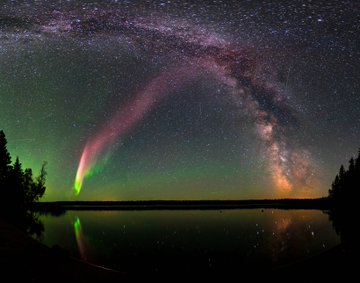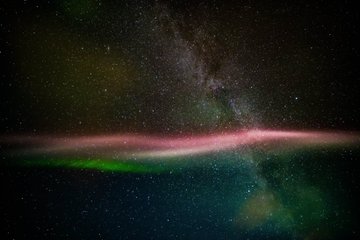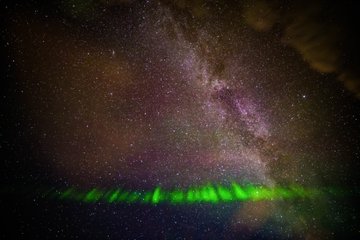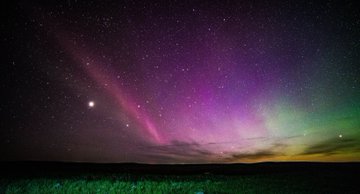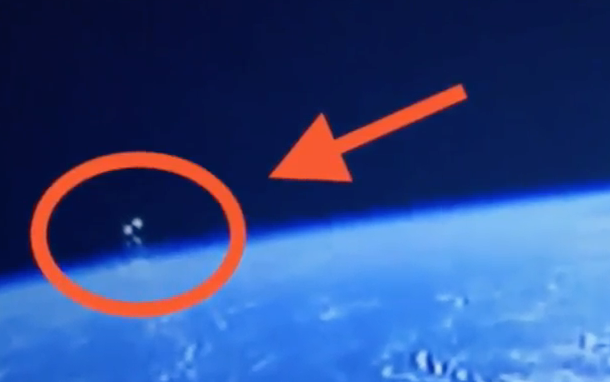


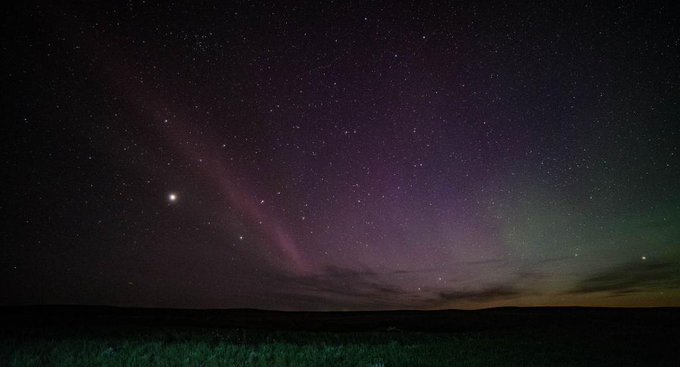

Seen STEVE? Glowing in purple & green colors, a new celestial phenomenon, known as STEVE, is caused by charged particles from the Sun colliding with Earth's magnetic field. Discover how you can help us study these dancing lights by sending your pictures: http://go.nasa.gov/2phTVT5
Maandag 19 maart 2018
 Martian oceans may have been aided by massive volcanoes, research suggests

Martian oceans may have been aided by massive volcanoes, research suggests
The putative oceans on Mars may have been aided by an unlikely ally: volcanoes.
A depiction of how oceans on Mars might have looked like.
Image credits: Kevin McGill / Flickr.
The saga of Martian oceans — and if they truly existed or not — continues with a new episode. A team of geophysicists at the University of California, Berkeley, suggests that volcanoes may have helped pave the way for liquid water, by raising temperatures.
“Volcanoes may be important in creating the conditions for Mars to be wet,” said Michael Manga, a UC Berkeley professor of earth and planetary science and senior author of a paper appearing in Nature this week and posted online March 19.
While there is significant evidence that Mars once had oceans of liquid water, not everybody is convinced of their existence. The main argument against this existence is that… we don’t see them today. The estimated mass of the oceans just doesn’t fit with the how much water could be hidden today as permafrost underground and how much could have escaped into space. In other words, if Mars once had oceans, we should still see some water.
But Manga and his colleagues developed a new model which would help explain this disparity. They propose that the first ocean on the Red Planet (called Arabia) formed at about the same time as the planet’s largest volcanic feature, Tharsis, or even a bit sooner — instead of after it, as previous models suggested.
“The assumption was that Tharsis formed quickly and early, rather than gradually, and that the oceans came later,” Manga said. “We’re saying that the oceans predate and accompany the lava outpourings that made Tharsis.”
In particular, because Tharsis was smaller in its earlier days, it didn’t distort the seabed as much, meaning that the oceans were much shallower than previously assumed. This theory can also explain another counterargument to Martian oceans: the seashore problem. The proposed seashores are highly irregular, varying in height by up to 1 kilometer (0.6 miles), whereas on Earth seashores are largely at the same level (sea level).
If oceans were formed in the initial stages of Tharsis’ development, the volcano would have significantly depressed the land and deformed the shoreline, which would help explain the irregularity.
“These shorelines could have been emplaced by a large body of liquid water that existed before and during the emplacement of Tharsis, instead of afterwards,” said first author Robert Citron, a UC Berkeley graduate student.
Lastly, this model also proposes that Tharsis spewed gases into the atmosphere that created a global warming or greenhouse effect, which favored the formation of liquid water. However, more studies will be needed to confirm this theory.
The study has not been peer-reviewed, but Citron will present a paper about the new analysis on March 20 at the annual Lunar and Planetary Science conference in Texas.
Geschreven door peter om 23:45
Stuur door