Ontdek de Fascinerende Wereld van UFO's en UAP's: Jouw Bron voor Onthullende Informatie!
Ben jij ook gefascineerd door het onbekende? Wil je meer weten over UFO's en UAP's, niet alleen in België, maar over de hele wereld? Dan ben je op de juiste plek!
België: Het Kloppend Hart van UFO-onderzoek
In België is BUFON (Belgisch UFO-Netwerk) dé autoriteit op het gebied van UFO-onderzoek. Voor betrouwbare en objectieve informatie over deze intrigerende fenomenen, bezoek je zeker onze Facebook-pagina en deze blog. Maar dat is nog niet alles! Ontdek ook het Belgisch UFO-meldpunt en Caelestia, twee organisaties die diepgaand onderzoek verrichten, al zijn ze soms kritisch of sceptisch.
Nederland: Een Schat aan Informatie
Voor onze Nederlandse buren is er de schitterende website www.ufowijzer.nl, beheerd door Paul Harmans. Deze site biedt een schat aan informatie en artikelen die je niet wilt missen!
Internationaal: MUFON - De Wereldwijde Autoriteit
Neem ook een kijkje bij MUFON (Mutual UFO Network Inc.), een gerenommeerde Amerikaanse UFO-vereniging met afdelingen in de VS en wereldwijd. MUFON is toegewijd aan de wetenschappelijke en analytische studie van het UFO-fenomeen, en hun maandelijkse tijdschrift, The MUFON UFO-Journal, is een must-read voor elke UFO-enthousiasteling. Bezoek hun website op www.mufon.com voor meer informatie.
Samenwerking en Toekomstvisie
Sinds 1 februari 2020 is Pieter niet alleen ex-president van BUFON, maar ook de voormalige nationale directeur van MUFON in Vlaanderen en Nederland. Dit creëert een sterke samenwerking met de Franse MUFON Reseau MUFON/EUROP, wat ons in staat stelt om nog meer waardevolle inzichten te delen.
Let op: Nepprofielen en Nieuwe Groeperingen
Pas op voor een nieuwe groepering die zich ook BUFON noemt, maar geen enkele connectie heeft met onze gevestigde organisatie. Hoewel zij de naam geregistreerd hebben, kunnen ze het rijke verleden en de expertise van onze groep niet evenaren. We wensen hen veel succes, maar we blijven de autoriteit in UFO-onderzoek!
Blijf Op De Hoogte!
Wil jij de laatste nieuwtjes over UFO's, ruimtevaart, archeologie, en meer? Volg ons dan en duik samen met ons in de fascinerende wereld van het onbekende! Sluit je aan bij de gemeenschap van nieuwsgierige geesten die net als jij verlangen naar antwoorden en avonturen in de sterren!
Heb je vragen of wil je meer weten? Aarzel dan niet om contact met ons op te nemen! Samen ontrafelen we het mysterie van de lucht en daarbuiten.
Security Unit Of PM Narendra Modi Receives Report About UFO Sighting Near His Residence
A senior security official said that a report about a sighting of a round UFO hovering over the residence of the Prime Minister on Lok Kalyan Marg in New Delhi briefly fazed security personnel in the VIP area but put their suspicions to rest after the immediate search discovered nothing.
The Perimeter Security Officer gave an “OK Report” to Delhi Police after the search ended.
Dependra Pathak, a Delhi police spokesperson and special commissioner of police, affirmed the sighting but said the inside information of the event could not be disclosed. Pathak explained the sighting was reported but not alarming, and keeping security reasons in mind; more details cannot be shared.
An unnamed officer cited in the first instance said that Special Protection Group (SPG) sent information about the sighting to PM’s security unit of Delhi Police and the Delhi airport operations control centre, which received the report around 7:30 pm. The Delhi airport operations control centre comprises staff from the Delhi International Airport Ltd, Central Industrial Security Force, and the air force.
Immediately, the alert was communicated to the National Security Guards and the Intelligence Bureau. Also, put on high alert was the Delhi Air Traffic Control (ATC).
According to the officer cited above, the Delhi Police was also roped in, which assured a temporary extra deployment on the fringe of the PM’s residence, while other security agencies performed the drill to hunt down the suspected menace.
Such an incident taken place is not the first time. Around 10 pm, on September 17, 2017, the Delhi police security control room received a report about a drone-like object sighting around the Parliament area. However, an ACT’s radar, which cannot capture small flying objects in any case, caught no object.
In the same month, ATC was informed by the Delhi Police control room about the drone-like flying object sighting above a hospital in a southern suburb. However, authorities found nothing.
In November, draft regulations for the use of drones in the country were unveiled. The guidelines for the use of drones will be finalised when the Directorate General of Civil Aviation receives a response from the ministry of home affairs and the ministry of defence.
On Jun 14, 2018 a high speed horseshoe-like UFO has been filmed over France.
The footage shows the UFO speeding through the clouds where it looks like the UFO changes to a horsehoe-like shape but that can be an optical illusion.
Besides the possibility that the witness has caught a UFO, the object could be a drone or a fighter jet and the white shape is the air stream over the wings as it travels super sonic.
Scientists discover over 100 planets that may host habitable life
Tristram Clayton interviews Grant Christie, Astronomer at Auckland Observatory, about the discovery of a new solar system just 39 light years from Earth.Daily Mail
Researchers have identified over 100 planets beyond our solar system that may have moons capable of supporting life.
Using data from the Kepler space telescope, scientists identified 121 planets that orbit within the habitable zone of their star.
Each are estimated to be more than three times the width of Earth, and likely all host several large moons, according to the Daily Mail.
This is an artist's illustration of a potentially habitable exomoon orbiting a giant planet in a distant solar system. Photo / NASA GSFC: Jay Friedlander and Britt Griswold
The new research is a collaboration between scientists at the University of California, Riverside and the University of Southern Queensland.
"There are currently 175 known moons orbiting the eight planets in our solar system," says Stephen Kane, an associate professor of planetary astrophysics and a member of the UCR's Alternative Earths Astrobiology Center.
"While most of these moons orbit Saturn and Jupiter, which are outside the sun's habitable zone, that may not be the case in other solar systems.
"Including rocky exomoons in our search for life in space will greatly expand the places we can look."
Kepler launched back in 2009 and has since detected thousands of worlds outside of our solar system.
While scientists are primarily looking for terrestrial – or rocky – planets, Jupiter-like planets that sit in the habitable zone are also considered to be promising, as they may host habitable moons.
According to the researchers, exomoons may even be more favorable for life than Earth, as they receive energy from both the star and radiation reflected off the planet.
But, scientists have yet to confirm the existence of an exomoon.
Using data from the Kepler space telescope, scientists identified 121 planets that orbit within the habitable zone of their star. Illustration / NASA GSFC: Jay Friedlander and Britt Griswold
The new work could help to narrow the search down, with 121 giant planets that may contain such moons.
"Now that we have created a database of the known giant planets in the habitable zone of their star, observations of the best candidates for hosting potential exomoons will be made to help refine the expected exomoon properties,' said Michelle Hill, an undergraduate student at the University of Southern Queensland who is working with Kane and will join UCR's graduate program in the fall.
"Our follow-up studies will help inform future telescope design so that we can detect these moons, study their properties, and look for signs of life."
WHAT IS THE GOLDILOCKS ZONE?
The habitable zone is the range of orbits around a star in which a planet can support liquid water.
This habitable zone is also known as the "Goldilocks" zone, taken from the children's fairy tale.
The temperature from the star needs to be "just right" so that liquid water can exist on the surface.
The boundaries of the habitable zone are critical.
If a planet is too close to its star, it will experience a runaway greenhouse gas effect, like Venus.
But if it's too far, any water will freeze, as is seen on Mars.
Since the concept was first presented in 1953, many stars have been shown to have a Goldilocks area, and some of them have one or several planets in this zone, like "Kepler-186f", discovered in 2014.
Heel wat mensen keken zaterdag iets na 23.00 uur vreemd op. Aan de hemel was een heldere vuurbol was te zien. Ook dinsdagnacht was dat al het geval. ‘Uitzonderlijk zijn vuurbollen niet, zeldzamer is dat ze worden waargenomen’, klinkt het bij volkssterrenwacht Mira.
De vuurbol of heel heldere meteoor werd waargenomen in grote delen van Europa, maar toch vooral in België en Nederland. Onder meer tijdens een optreden van de Amerikaanse rockgroep Foo Fighters tijdens het Nederlandse muziekfestival Pinkpop was de vuurbol te zien. Een van de toeschouwers die het optreden filmde, kon het fenomeen vastleggen op video.
Volgens Philippe Mollet van de volkssterrenwacht Mira zijn vuurbollen heel heldere meteoren of vallende sterren. Het zijn stofdeeltjes van een paar centimeter groot van kometen of planetoïden die in de dampkring terechtkomen en de lucht daarrond laten oplichten. Volgens de eerste schattingen zou de vuurbol de atmosfeer zijn binnengekomen in de regio van Luik en de Hoge Venen, klinkt het bij de volkssterrenwacht.
Zeldzaam zijn zo’n vuurbollen niet. ‘Meestal worden ze niet waargenomen. Maar tijdens de zomer, als mensen buiten zitten, worden ze soms wel waargenomen’, aldus Mollet. Wie een vuurbol wil melden, kan dat op de website van de Vereniging voor Sterrenkunde. Daar hebben ze negentig meldingen binnengekregen over de vuurbal van zaterdag.
Kurz nach dem Foto im letzten Tweet gelang mir um 23:11 Uhr MESZ dieser Schnappschuss: #Mond#Venus#Feuerkugel. Canon EOS 6D, f=180mm, ISO 4000, Bl. 10, t=1,6sec; mit Bildbearbeitung etwas aufgehellt.
Interest in the World Cup may stretch beyond the stars, it has turned out - after reports of a UFO arrival in Russia.
Footage has emerged of a "giant stingray" lighting up the skies over northern Russia.
A nervous woman who spotted the mystery lights in the city of Kirov wrote: “What the hell was that? It doesn’t look like anything I’ve previously seen."
The satellite was safely delivered to target orbit by a Fregat upper stage rocket, said military officials.
While the Ministry of Defence reported a successful launch, some people on Russian social media went into a panic mode after seeing the spectacular visual display.
It sent some people into a panic(Image: east2west news)
“I’ve seen alien life and it looks like a stingray,” said one.
As it developed, it morphed into a jellyfish in the night sky, said another.
“What an mazing display.”
Glonass is Russia’s own global satellite navigation system.
One said: 'The aliens have arrived for the World Cup,' said one.
'Is that a rocket, a fireball or a UFO over Nizhny Novgorod? Talk to me comrades, I'm worried!' posted Andrey.
Another commented: 'I've seen alien life and it looks like a stingray.'
Others observed that as the aircraft developed, it morphed into a jellyfish in the night sky.
Since uploading the short video of the rocket flight, a number of people suggest that an extraterrestrial phenomenon could have been flying over Russia
The clip shows the UFO, which was spotted in Houston, Texas, yesterday by a man named Shaun.
He revealed how he looked up to the skies to spot something hovering thousands of feet up, even higher than passenger jets passing above.
Shaun said: “I’m not sure what it is, it was hard to get a good shot of it.
“It definitely wasn’t close. I recorded it from my driveway and I live in Jersey Village in Texas.
“We actually have an airport really close which is not an international airport – its out in the woods and I think there is some strange stuff going on up there.”
YOUTUBE
UFO? The bizarre scenes were spotted in Texas
“I’m not sure what it is, it was hard to get a good shot of it”
Skywatcher
Ellington Field Joint Reserve Base is shared facility between the US military and NASA located on the southeast of the city.
The video was originally uploaded to Shaun’s YouTube account, but has gained popularity after being shared on popular conspiracy channel Thirdphaseofmoon.
Since it shared yesterday, it has racked up more than 7,000 hits.
And viewers were quick to share their opinions.
“That is definitely some kind of drone,” one comment read.
Before another claimed: “A secret NASA operation."
The most likely cradles for life inside our solar system
Scientists still believe it possible that extraterrestrial life could flourish in our own neighbourhood
Georgia Simcox
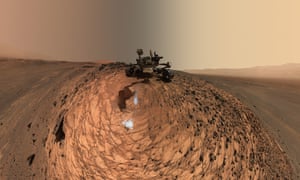
Portrait of Nasa’s Curiosity Mars rover. Photograph: Nasa
1. Mars
This week, Nasa’s veteran Curiosity rover discovered complex organic matterthat had been buried and preserved for more than 3bn years in sediments forming a lake bed. This means that if microbial life did land on Mars, it would be nourished.
Photograph: JPL-Caltech/Nasa
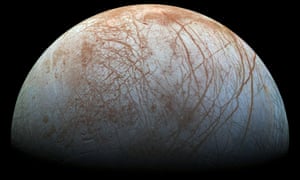
2. Europa
One of Jupiter’s four Galilean moons, Europa is the sixth-largest moon in the solar system. It is thought to have water oceans beneath the surface and, like Earth, an internal energy source from radioactive decay. This has led to the hypothesis that life may exist in conditions similar to that of Earth’s hydrothermal vents.
Photograph: Nasa/JPL-Caltech/Space Science Institute
3. Enceladus
Saturn’s sixth-largest moon is mainly covered by ice, and ejects geyser-like plumes of water that contain nitrogen and trace amounts of carbon-bearing molecules. Robotic missions have been proposed to further investigate the moon’s potential to support microbial extraterrestrial life.
Photograph: AP
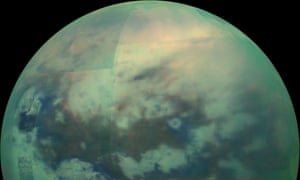
4. Titan
Titan, Saturn’s largest moon, is thought to have an environment similar to that on primordial Earth. It has a dense atmosphere and liquid methane on its surface. Although methane-based life forms are hypothetical, scientists have modelled conditions under which they may exist. Some experts have said that although life on Titan is extremely unlikely studying the planet could give us valuable insights into how life began on Earth.
Photograph: Alamy Stock Photo
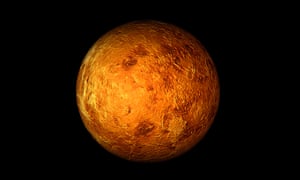
5. Venus
Although the mean surface temperature of this planet is a not very habitable 462C, scientists have suggested that its upper atmosphere could tolerate life in the form of floating microbes that could feed off the carbon 30 miles (50km) up from the planet’s surface. One Nasa scientist has suggested that humans could colonise Venus’s atmosphere using lighter-than-air balloons but considerable engineering challenges – including clouds of sulphuric acid – would have to be overcome.
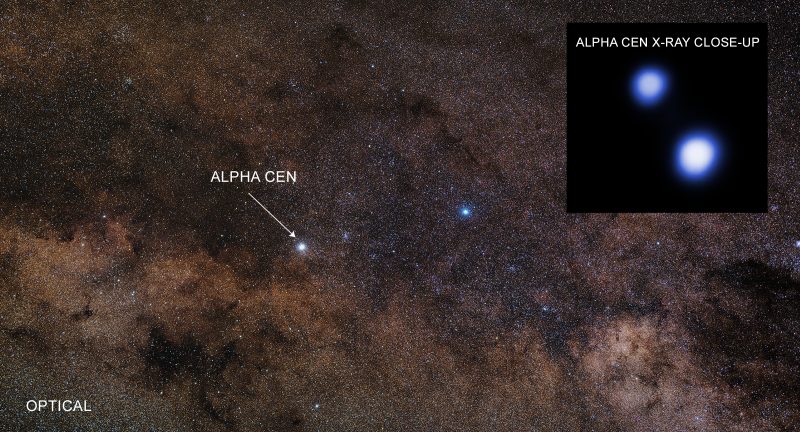
Could life exist on planets in the star system closest to ours, Alpha Centauri? Dangerous X-ray radiation makes it unlikely for the single exoplanet found so far. But new data suggest better odds for any new planets yet to be discovered.
Alpha Centauri is the closest star system to our sun. Chandra data from May 2, 2017 are shown in the inset, in context of a visible-light image of the Alpha Centauri system taken from the ground.
Image via Optical: Zdenek Bardon; X-ray: NASA/CXC/Univ. of Colorado/T. Ayres et al.
With the discovery of thousands of exoplanets orbiting other stars, the search for life elsewhere has entered an exciting new phase. So far, most of these worlds have been found many light-years away (largely due to the fact that the Kepler Space Telescope, which has discovered the majority of them so far, has focused on a specific patch of sky which contains very distant stars). But what about closer stars? Including, of course, Alpha Centauri, the closest star system to our sun, only just over four light-years away. According to Tom Ayres of the University of Colorado Boulder:
Because it is relatively close, the Alpha Centauri system is seen by many as the best candidate to explore for signs of life. The question is, will we find planets in an environment conducive to life as we know it?
Scientists had thought that there was too much X-ray radiation from the stars in the system for life on any planets to be likely. But now, as announced by NASA on June 6, 2018, there is new evidence from NASA’s Chandra X-ray Observatory, that, perhaps, conditions could be more life-friendly than previously assumed.
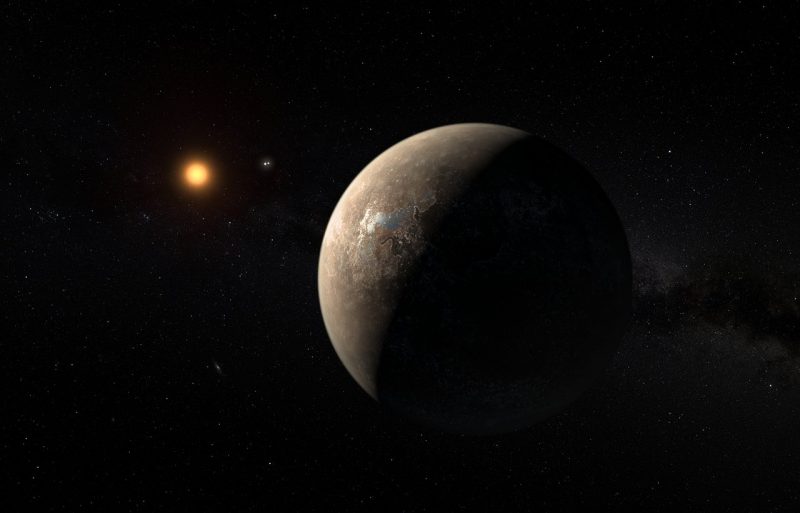
Artist’s concept of the exoplanet Proxima b orbiting the red dwarf star Proxima Centauri, the closest star to the solar system.
Image via ESO/M. Kornmesser.
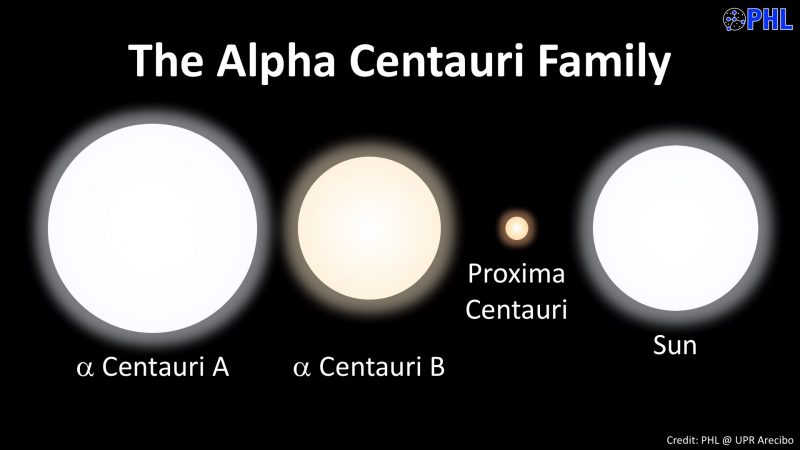
While the other two stars, Alpha Centauri A and B, are both similar to our sun, Proxima Centauri is a red dwarf, which emits much more deadly X-ray radiation. That is bad news for its one known Earth-sized planet, Proxima b. However, observations from Chandra since 2005 show that conditions around the other two stars are about the same or even better than around our own sun. In terms of the radiation, the prospects for life are actually better for habitable zoneplanets around Alpha Centauri A than our own sun, with lower doses of X-rays than similar planets in our solar system, and only slightly worse around Alpha Centauri B, by a factor of five. As Ayres noted:
This is very good news for Alpha Cen AB in terms of the ability of possible life on any of their planets to survive radiation bouts from the stars. Chandra shows us that life should have a fighting chance on planets around either of these stars.
Artist’s concept of super-Earth exoplanet Kepler-22b, which may be habitable. It is not known yet if any other planets orbit the two larger sun-like stars in the Alpha Centauri system, but if there are, some may have conditions suitable for life.
Image via NASA.
It is not known yet if there are any rocky planets orbiting Alpha Centauri A or B, but if so, then there is an increased chance of habitable conditions, although other factors come into play as well, such as temperature, liquid water or lack of it, composition of any atmosphere, etc. One problem with searching for planets there is that both stars are bright and currently closer together because of their orbits, making detection more difficult.
For Proxima b however, the situation is different. It receives an average dose of X-rays about 500 times greater than Earth, and up to 50,000 times stronger during a large solar flare. Not exactly ideal conditions for life.
Comparison of the three stars in the Alpha Centauri system and the sun.
With so many exoplanets being discovered now, it is natural of course to wonder about the star system closest to us. Could life exist there? For the one planet known to exist there so far, the results are not encouraging. But if there are others, and most planetary systems appear to have more than one planet, then the odds are a bit more in life’s favor. We won’t know for sure until/if we find additional planets in the Alpha Centauri system. But even if we don’t, many other worlds are being discovered on a regular basis now, and a growing number appear to have conditions at least suitable for habitability, if not life itself.
Bottom line: The closest star system to our sun, Alpha Centauri, has at least one Earth-sized planet orbiting one of its three stars. Dangerous x-rays from that red dwarf star make life unlikely there, but the prospects may be much better for the other two sun-like stars, if any as-yet undiscovered planets orbit them.
The year was 1967 and the Canadian government was super into aliens.
A collection of documents from 1967 found in the national archives give us a hint into just how seriously the government used to take UFO sightings.
The documents outline how the government investigated UFOs—a process that most likely lasted for years afterwards—and breaks down six cases that are “of interest” to the government in detail. The investigations include a man burned by a UFO in Manitoba, some incredibly weird radar sightings by the Department of Defence, an RCMP officer in Nova Scotia who watched a UFO dive below the water and disappear, and a crop circle found in Alberta that was the first investigated by a government.
The documents were found in the national archive by Chris Rutkowski—a man that could probably be best described as Canada’s Fox Mulder—and recently posted to his Ufology blog. Rutowski routinely goes through Canada’s national archives looking for things like this and described the find as “a gem.”
"What we do have in here is rather interesting reports from qualified personnel and qualified sources and investigated by qualified investigators and still there is no explanation," Rutkowski told VICE. "What that tells me is that the UFO phenomena was taking quite seriously by them indeed."
The intro to the document.
Photo via screenshot.
While the government has some of tUFO research readily available online in a database it is still relatively unknown—especially among the general public—how they actually investigated cases and what the bureaucracy was like. This, Rutkowski says, might be “our best snapshot” into this process.
"This is certainly an interesting snapshot because it does show what was happening before and how it was going to move forward and I think it set the stage for how the Canadian military and government were looking at UFOs from that point onward,” said Rutkowski.
The 27 page set of documents—which Rutkowski was kind enough to direct VICE towards—was prepared by Wing Commander Douglas Robertson (a Canadian Forces officer well-known in the UFO community) for someone we do not know in November of 1967. Rutkowski speculates it could’ve been for a newly-appointed Minister of Defence as “the infamous Paul Hellyer [one of the world’s highest ranking alien believers] had left the position a few months earlier.” At the time, as Robertson writes, the National Department of Defence was the body in charge of investigating UFO reports.
The briefing breaks down the seven military categories of UFOs which include hoaxes, mass hysteria, misinterpretations of natural events, advanced military technology, and psychological conditions. However, the seventh and final category is “unusual sightings which the viewer is unable to identify or explain, namely, UFOs.” Hell yeah.
The documents show that the investigation into UFOs was a little bit of a hot potato in Canada as in it was frequently handed off between departments. When a new report came in, researchers would first decide if the object was a meteor or fireball—if so it would be directed to the NRC. If it was something else it would then be put in one of three categories Class A: worthy of investigation Class B: interesting but you don’t need to look into it; and Class C: boring.
Photo via screenshot.
The investigations varied and could be as simple as an interview or as a complicated as getting several other agencies including the RCMP, NRC, Defence Research Board (DRB) or (weirdly) the Department of National Health and Welfare on board. In many of the cases, you can see that post-secondary institutions like the University of Toronto and the University of Manitoba would help out with analysis. The government would also send professionals to investigate the sites in-depth and if the case was intense enough, partner with the United States.
The document was written during an interesting time for UFOs in Canada. As Rutkowski puts it, 1967 was a high water mark for this type of activity in the Great White North. The briefing indicates there was a jump in reports from 1966 to 1967—from about 40 to 167. The case files showcase A) just how strange these occurrences were and B) just how seriously the government was taking the investigations.
Here are breakdowns of the case studies Robertson concludes “may be of interest” to whoever the intended reader of the briefing may be:
1. Falcon Lake
The first one outlines perhaps Canada’s most infamous “UFO encounter,” the Falcon Lake case. The case revolved around Steven Michalak, a Manitoba man, who says he encountered two UFOs 90 miles east of Winnipeg. While Michalak was analyzing a rock formation he said two flying saucers appeared before him. One flew off at high speed while other landed about 100 feet in front of him. When he reached out and touched the object with his gloved hand, it burned him immediately. The object took off and the exhaust fumes reportedly burned him as well. Michalak was hospitalized for several days as a result.
In the briefing, Robertson writes that soil samples at the site were “analyzed and found to be radioactive to a degree that the samples had to be safely disposed of.” In the briefing, Robertson admits that “neither the DND nor the RCMP investigative teams were able to provide evidence which could dispute Mr Michalak’s story.” Furthermore, the radiologist dispatched to the area was unable to explain why the area was contaminated with radiation. The section ends with “although the investigation has been completed, a satisfactory ending or conclusion is still lacking.”
Many, many things have been written about the Falcon Lake case, including a book Rutkowski wrote with Michalak's son.
2. Calgary UFO Photo
The second case, again made in 1967, revolves around a famous Canadian photograph taken of a UFO near Calgary. It tells the story of Warren Smith who was out for a hike near Nanton, Alberta.
“A UFO suddenly appeared outside of an area of trees a few hundred feet above the observers,” reads the briefing which goes on to explain how Smith was able to snap two photos of the objects. Smith made prints of these shots, which were then sent to the DND. “The prints were subjected to a detailed analysis by the Photo Intelligence Interpretation Centre. The Centre concluded its investigation by stating, assuming the photos by Mr Smith to be genuine, the UFO fit the description of the objects by Mr Smith.”
3. Clear Water Bay
The next case outlined in the briefing is focused on a family that was returning to their home in Clear Water Bay by boat when they encountered a UFO. According to the briefing the object appeared about 50 feet away from “Mr. Green” (how he is referred to in the document) and Green decided to investigate it. When he approached the object ripped towards Green and he “immediately retreated using maximum power.” Then the object returned to its original spot.
Green and his family docked the boat and ran to a nearby home to wake all the occupants so they could come and look at the object. They were able to do so for about 15 minutes until it took off. In a nearby home, a neighbour that was interviewed by the government said that while he didn’t see the object he was “listening to his radio at the time the UFO was sighted and received so much static he was forced to turn it off.”
A “detailed investigation conducted by the DND in cooperation with the RCMP” found that Green was a “reliable, competent, and sincere witness with no indulgence tendencies.” They also checked to see if alcohol was consumed at the time, found none, and tested Green’s eyes. Wilted leaves were found at the top of the trees near where the object was allegedly hovering and some were sent to the University of Manitoba for lab testing. The Department of Forestry also checked and found “that they are unable to explain the reason for the wilting.”
The section ends with “the investigation has been concluded without any fixed conclusions or findings being made.”
4. The RCMP’s Diving UFO
The next sighting was seen by an RCMP corporal out near Barrington Passage, Nova Scotia. The RCMP officer describes seeing an object about 60 feet in length with white lights flying over the water at a low altitude. The object started making a high pitched whistling sound and slammed into the water leaving only one white light visible. RCMP Cpl Wereisky approached the light by boat and it rapidly sank underneath him as he got close. The area was then searched by the Canadian Coast Guard and other boats but nothing was found.
The government conducted a rigorous investigation into this sighting which included an underwater search and wasn’t able to find anything. The government investigation ended, once again, “without finding any fixed findings.”
5. Department of Transportation Radar Sighting
The next investigation outlined in the briefing is one Rutkowski described as being “very unique.” In July of 1967, the Department of Transportation reported that “an unidentified radar target was tracked through seven sweeps of their radar, witnessed by three controllers, and two technicians some 70 miles east of Winnipeg.”
The target was ripping at intense rate. As outlined in the briefing, it increased from a speed of “720 knots [1,333 km per hour] to 3,600 knots [6,667 km per hour] in one minute and ten seconds.” The briefing explains that the five people who witnessed the radar object are “certain it was a radar target and not something associated with mechanical, electrical, or equipment faults.” On the same day in Kenora, Ontario, a similar object was picked up on the radar.
“The unknown object was under the positive radar for 29 minutes,” reads the briefing about the Kenora sighting. “The object followed Air Canada Flight 405 for a period before disappearing from scope. It reappeared and followed Air Canada Flight 927 for a period of time. DOT are unable to explain these radar returns.”
The DND again did an investigation into this and again were unable to find any conclusions.
Camrose Crop Circle
The final case outlined in the briefing is one in Alberta and, according to Rutowski, contrary to popular belief shows that it was in Canada, not Britain, where a government first investigated crop circles. It occurred outside of Camrose Alberta in August of 1967 when “several deep impressions were made in an unknown object in a pasture.”
The Department of Defence sent out a man who is referred to as “Dr. Jones” in the document to investigate and he found “no physical evidence of any damage to trees or shrubs in the field and no evidence to suggest a deliberate interference or involvement by a person.” Rutowski was able to find further documentation of Dr. Jones investigation and again was kind enough to share them with VICE. In the documents, you can see just how in depth the government got with their investigation.
In the documents, Jones said that he believed it could be a “deliberate hoax” but the hoaxers would “require some equipment and a great deal of determination.” He estimates that in order to do such spherical circles the hoaxers would need two wheels on a 30-foot axle that put pressure of three-quarters of a ton on a pasture. Next Jones has us “consider the UFO possibility” and he breaks down the math behind what size a flying vehicle would need to be in order to produce such marks and comes upon 135 tons.
“This load of 135 tons would be in the right ballpark for a large aircraft, or presumably, small space craft,” ends this section of Jones’ report.
Epilogue
After the case studies, Robertson uses the briefing to discuss possible future plans regarding UFO research in Canada and give several recommendations to our unknown reader. He proposes that the DND hands off the responsibility of investigating UFOs to the National Research Council and that the Director of Operations works as the coordinating agency between the DND units providing field investigations and the NRC.
“It is evident that from investigations conducted by the DND, and from the findings made by prominent and highly qualified personnel, that the primary interest of UFOs lies in the field of science, and to a lesser degree, to one that is associated with national security,” writes Robertson.
Robertson writes that the workload in 1967 regarding UFOs was so large that it was actually becoming detrimental to government workers as it took up so much time. He also writes that the government should be more open with the public about their work in UFOs. This is something Rutkowski—even over 51 years removed—still admittedly agrees with.
"By not being able to comment it made it look like there was something to hide. Of course, this document does show there was some very interesting conclusions, some unexplained cases that should have been made more public,” said Rutkowski. “But when a public relations officer just keeps saying no comment, no comment, it shows that perhaps there is something that is being hidden.
"My reading from this document is that the Canadian Forces didn't really know what to do with UFOs either. It's not that they were hiding everything they just didn't have the expertise in the field and the scientific community didn't want anything to do with it so they were kinda hung out to dry."
New results modeling the co-evolution of technological civilizations and their planetary climates suggest that aliens could, much like the Easter Island culture from Earth’s history, suffer self-inflicted collapses due to rapid environmental degradation.Credit: Michael Osadciw, University of Rochester Illustration
Much has been written about the Anthropocene—a proposed new division of geologic time in which humans are a dominant force for planetary change: When did it begin? How might it unfold? And can we, the supposed masters of Earth, actually use our powers to make our planet a better place? Understandably, most of the Anthropocene’s literature to date both in the popular press and peer-reviewed publications has been decidedly Earth-centric. But in a recent series of papers and a new book, Light of the Stars: Alien Worlds and the Fate of the Earth, the astrophysicist Adam Frank argues the Anthropocene’s origins and implications are best understood in the context of astrobiology, the study of life in the universe. The climate change and other environmental effects associated with humankind’s global ascendance, he says, are likely to be universal phenomena manifest for any and every technological civilization that emerges somewhere in the cosmos. Which means the most crucial insights governing the Anthropocene may come less from studying the ground beneath our feet and more from turning our gaze to the heavens.
Scientific American spoke with Frank, a professor at the University of Rochester, about the lessons to be learned from speculations about alien civilizations battling climate change.
What motivated you to write this book?
The book was inspired by some frightening conversations I ended up having with climate change denialists in response to my pieces on that topic for National Public Radio and The New York Times. It was terrifying, really, to see how locked into their perspective these people are and to realize there’s this false narrative about climate change, which we’re stuck in. So this was motivated, in part, by my thinking about how to change the discussion.
Over the years what I’ve come to understand is that human-driven climate change is really an astrobiology problem. It’s not a problem of politics. It’s not a problem of businessmen versus environmentalists. We are talking about something much bigger—a planetary transition, which some scientists label as the Anthropocene. Climate change is just one aspect of this new human-dominated period. My argument is that Anthropocenes may be generic from an astrobiological perspective; what we’re experiencing now may be the sort of transition that everybody goes through, throughout the universe. And there are probably some common features to long-lived civilizations and the planets they inhabit.
I really started exploring this in 2014, when I co-authored a paper with Woody Sullivan of the University of Washington that proposed using dynamical systems theory to model some of these planetary transitions. We argued that it’s possible to identify the basic paths that “exocivilizations” might follow and the feedbacks that might occur when they begin altering their planetary climates. In my latest paper, just published with several colleagues, we went ahead and actually did some of that modeling.
Why would you have any faith in models examining the behaviors of exocivilizations—something no one has ever seen?
I like to draw a parallel to the Higgs boson. This is a fundamental particle that was “discovered” in 2012, but really you could say it was discovered in 1964. That was when three papers appeared extrapolating from well-understood physics to propose this particle that would wait nearly a half century before actually being seen. The details obviously would have to be filled in by actual data, but in that intervening time physicists went quite far in thoroughly extrapolating the particle’s nature.
So, when it comes to thinking about the interactions between an advanced technological civilization and its planet, well, we actually know a lot more about that today than people knew about the Higgs boson 50 years ago. We have lots of examples of planetary climates that we’ve studied right here in the solar system—Venus, Mars, Titan, Jupiter and so on. And we’ve got computer models that can nicely forecast, for instance, the weather on Mars! So we really do understand climate pretty well. And a civilization, to some degree, is just a mechanism for transforming energy on a planetary surface. This gets us into the realms of thermodynamics on global scales, which is super cool.
So as long as we ask the right sort of question—“What is a planet’s response to having this energy dumped into it?”—we have reasonably good “guardrails” that allow us to address it.
But that’s mostly planetary science. What about the social or biological aspects here? How are you modeling that?
Well, just as we understand planetary climates pretty well, we can use the basic, fundamental tenets of life to guide us, too. Organisms are born, some of them reproduce and they die. Living things consume energy and they excrete waste. That should be true even if they’re made of silicon, or whatever.
So the next step is to incorporate principles of population biology, in which the idea of “carrying capacity”—the number of organisms that can be sustainably supported by the local environment—is very important. This approach can be mathematically applied to the state of a planet, too. So in our latest modeling work we’ve got an equation for how the planet is changing and an equation for how the population is changing. What ties them together is the predictable result that as environmental conditions on a planet get worse, the total carrying capacity goes down. A civilization with a population of n will use the resources of their planet to increase n, but at the same time by using those resources they tend to degrade the planet’s environment.
In our study we used these basic ideas to address the question of if, and how, exocivilizations can get through their own versions of the Anthropocene. Our first models were pretty simple but gave us a pretty rich view of the possible trajectories for exocivilizations.
What were the results of your modeling? And do they make you feel optimistic or pessimistic about our own prospects?
In the models we saw these three classes of behaviors, three trajectories: A “die-off,” where the population overshoots the carrying capacity and then dwindles; a “steady state,” where the population growth slows and ends up within the bounds of carrying capacity; and then a “collapse,” where the population and the carrying capacity both just drop like a stone.
It’s important to remember we aren’t trying to say any particular history is bound to play out on any particular planet. We are looking at the average properties of “successful” versus “unsuccessful” trajectories for civilizations reaching this Anthropocene-like planetary transition.
The results actually made me feel both optimistic and pessimistic. I was happy to see we did find sustainable steady states—it could’ve turned out that they didn’t exist. So our models predicted that long-term civilization/planet co-evolution is possible. Hooray!
But we also found trajectories where equilibrium could only be reached after 90 percent of your population died off. It’s not even clear that a complex technological civilization could survive losing nine out of every 10 individuals. It might well just descend into chaos.
And, there was also a fourth and really chilling trajectory we found. It popped up when we looked at how a civilization might switch from high-impact to low-impact energy sources—such as switching from fossil fuels to solar power, for instance. In some of those scenarios, where the population is soaring and the planet is heating up, the civilization shifts to the low-impact energy resource and everything seems to get better at first—but then a collapse occurs anyway. This fourth trajectory is really scary, because it suggests you can make all the right choices and still have things not work out.
Four scenarios for the fate of technological civilizations and their planets, based on mathematical models developed by Adam Frank and his collaborators. The black line plots the trajectory of the civilization's population and the red line shows the co-evolving trajectory of the planet's temperature (a proxy for climate). Credit: Michael Osadciw, University of Rochester Illustration
Why would that happen?
Because planets are complex systems that exhibit nonlinear dynamics. Messing around with a planet’s climate can be like rolling a big rock down a hill. Once the rock really gets going there’s no turning back, and maybe it just shoots right off a cliff.
The climate is basically a giant planet-sized machine with lots of moving parts—the atmosphere, the lithosphere, the cryosphere, the biosphere—and the interactions between those moving parts may be quite sensitive. So if you push it hard enough, even if you stop pushing it shortly after, there isn’t always a way to recover. That’s one of the big messages of the book. We have to start thinking like a planet. Our view of climate change—the faux political debate—is so narrow because we think we’re the first time this has ever happened. We’re kind of like cosmic teenagers who are stuck in our own immaturity.
So where do you think the Earth is in this spectrum of possibilities?
I don’t know the answer yet. I don’t think anyone knows. There needs to be more work done—better models with more realistic climates. There has certainly been a lot of discussion in the Earth science literature about planetary “tipping points,” the idea that you push too far and, woops, now you’re tipped over to another state. People worry about this a lot, that’s clear. But it’s unclear as to where and what exactly the tipping points are, and where we may be relative to them.
Right, but back to the idea of “changing the discussion”—your motivation for writing the book. Surely we could do more with these ideas than just discuss them. Don’t they recommend some action?
Of course they do—but most of those actions are indistinguishable from ones that follow from lots of other work in climate science and policy.
I really do think, though, that the route to our making it through the Anthropocene runs through other planets. We aren’t going to become a sustainable planetary civilization by only dealing with the Earth. I give lots of examples in the book, but one of the best is the fact that the climate models that revealed the possibility of “nuclear winter”—a global cooling caused by the atmospheric effects of a nuclear war—relied heavily on data about Martian dust storms. Talk about cross-fertilization! Those nuclear winter models totally changed the debate about nuclear weapons, and they came from understanding another world.
So we can’t just sit here studying tipping points on Earth at the expense of going out and exploring other worlds and looking for life and intelligence elsewhere, because the knowledge we gain from that is probably essential for our own future. Think of it this way: If you’re sick and you go to the doctor to be cured, the doctor will have pretty limited abilities if he only has ever studied [just] you. If he has studied you and lots of other people, [however,] he’ll have a much clearer picture of what ails you. It’s probably like that with planets and civilizations, too.
Lee Billings
Lee Billings is an associate editor for Scientific American. He covers space and physics.
Astronomers have been searching for a Planet Nine – a world about 10 times Earth’s mass – for about 2 years and have yet to spot it. Maybe there’s another explanation?
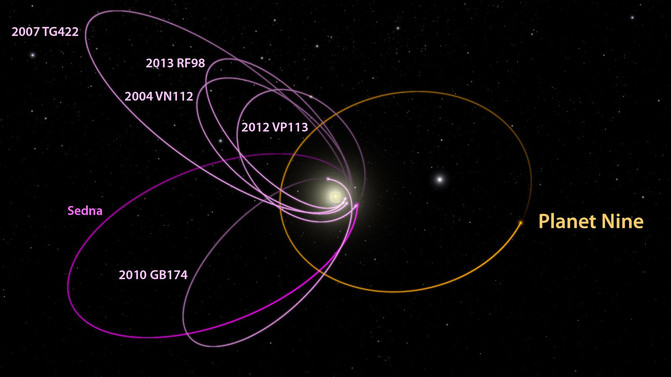
Caltech astronomers suggested in 2016 that orbits of these 6 extreme trans-Neptunian objects (in magenta) – all mysteriously aligned in one direction – might be explained by the presence of a Planet Nine (in orange) in our solar system. Despite searches, no Planet Nine has yet been found.
Image via Caltech/R. Hurt (IPAC).
As recently as late May, an international team of researchers presented new evidence for an unknown Planet Nine at the fringes of our solar system. The evidence came from analysis of an oddball object in the outer solar system – 2015 BP519 (aka Caju) – whose unusual orbit had been predicted by computer models used by astronomers who’ve been searching for Planet Nine since 2016. Last week, however, other astronomers – members of the Eccentric Dynamics group at University of Colorado, Boulder – presented evidence that Planet Nine might not need to exist, after all. Ann-Marie Madigan, who leads the group, presented the group’s findings at last week’s American Astronomical Society meeting, which ran from June 3-7, 2018 in Denver. Her team’s statement said:
Bumper car-like interactions at the edges of our solar system — and not a mysterious ninth planet — may explain the the dynamics of strange bodies called “detached objects” …
In the new study, Madigan and colleagues Jacob Fleisig and Alexander Zderic, also of CU Boulder, looked carefully at the orbits of some of these objects. For example, they looked at the small outer solar system body 90377 Sedna, which orbits our sun at a distance of nearly 8 billion miles (13 billion km). The orbits of Sedna and a handful of other bodies at that distance look separated – or detached – from the rest of the solar system. These strange orbits are what led Caltech astronomers Mike Brown and Konstanin Batygin to propose a Planet Nine in the first place.
Brown and Batygin had suggested that an as-yet-unseen ninth planet – four times the size of Earth and 10 times Earth’s mass – may be lurking beyond Neptune. They suggested the unknown planet’s gravity was influencing the orbits of the “detached objects.” Since 2016, astronomers around the world have been searching for Planet Nine, but no one has found it yet.
Does Planet 9 exist? Collective gravity theory DISPROVES mysterious ninth planet in system
Meanwhile, Madigan, Fleisig and Zderic have explored a new idea about the orbits of these outer solar system bodies. The new calculations show the orbits might be the result of these bodies jostling against each other and debris in that part of space. In that case, no Planet Nine would be needed. Madigan said:
There are so many of these bodies out there. What does their collective gravity do? We can solve a lot of these problems by just taking into account that question.
Ann-Marie Madigan, Jacob Fleisig and Alexander Zderic of the Eccentric Dynamics group at CU Boulder.
Madigan pointed out that the outer solar system is:
… an unusual place, gravitationally speaking.
Once you get further away from Neptune, things don’t make any sense, which is really exciting.
Her team’s statement explained:
Among the things that don’t make sense: Sedna. This minor planet takes more than 11,000 years to circumnavigate Earth’s sun and is a little smaller than Pluto … Sedna and other detached objects complete humongous, circle-shaped orbits that bring them nowhere close to big planets like Jupiter or Neptune. How they got out there on their own remains an ongoing mystery.
Madigan’s team didn’t originally intend to look for an alternate explanation for the orbits of detached bodies. Instead, Jacob Fleisig, an undergraduate studying astrophysics at CU Boulder, was engaged in developing computer simulations to explore the dynamics of orbits. Madigan said:
He came into my office one day and said, “I’m seeing some really cool stuff here.”
Fleisig had calculated that the orbits of icy objects beyond Neptune circle the sun like the hands of a clock. Some of those orbits, such as those belonging to asteroids, move like the minute hand, or relatively fast and in tandem. Others, the orbits of bigger objects like Sedna, move more slowly. They’re the hour hand. Eventually, those hands meet. Fleisig said:
You see a pileup of the orbits of smaller objects to one side of the sun. These orbits crash into the bigger body, and what happens is those interactions will change its orbit from an oval shape to a more circular shape.
In other words, Sedna’s orbit goes from normal to detached, entirely because of those small-scale interactions. The team’s findings also fall in line with recent observations. Research from 2012 noted that the bigger a detached object gets, the farther away its orbit becomes from the sun — exactly as Fleisig’s calculations show.
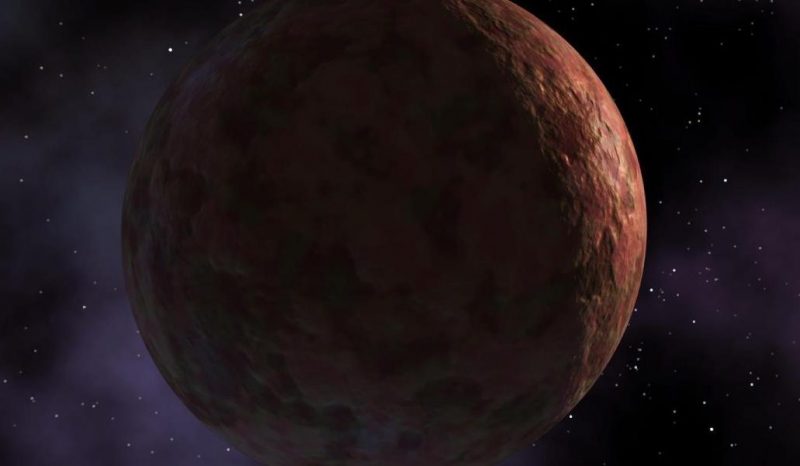
An artist’s rendering of Sedna, which looks reddish in color in telescope images.
These astronomers say their findings may provide clues about another phenomenon: the extinction of the dinosaurs. As space debris interacts in the outer solar system, the orbits of these objects tighten and widen in a repeating cycle. This cycle could wind up shooting comets toward the inner solar system on a predictable timescale. Fleisig said:
While we’re not able to say that this pattern killed the dinosaurs, it’s tantalizing.
Madigan added that the orbit of Sedna is one more example of just how interesting the outer solar system has become. She said:
The picture we draw of the outer solar system in textbooks may have to change. There’s a lot more stuff out there than we once thought, which is really cool.
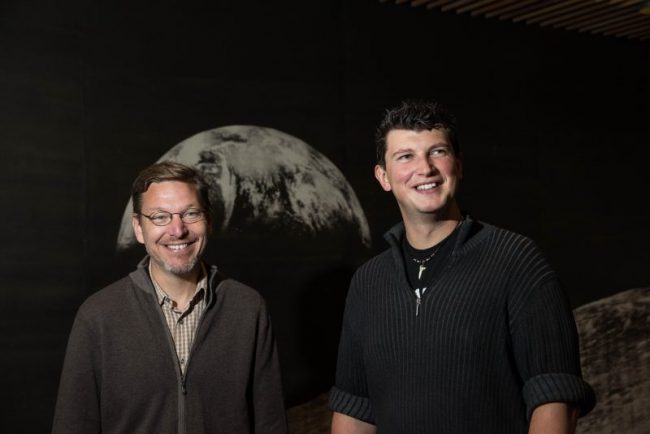
Astronomers Mike Brown and Konstanin Batygin (@KBatygin on Twitter), both of Caltech, proposed Planet Nine in 2016 and are still trying to investigate it.
Bottom line: Astronomers at Caltech proposed a Planet Nine in 2016, and other astronomers around the world have been searching for it. Yet no one has spotted it. Meanwhile, there’s research suggesting we might not need a Planet Nine to explain the strange orbits of small bodies in the outer solar system.
It’s awesome to be back on the site and bringing new and fresh knowledge for you all to feast on.
I took a long hiatus to contemplate, meditate, and investigate. The knowledge that I have been given to in turn give to humanity is vastly extensive and threads throughout the very thing we all know as reality. You could call me a translator. I somehow know how to explain this very difficult and fantastic revelation to a population that has been subdued and limited.
In a nutshell, I have discovered Ancient Aliens, where they are, where they have been hiding, and the evolution they are now experiencing in harmony with the consciousness evolution of the Human specie.
I did not need a telescope, nor did I need a microscope, although I can show you the existence of Ancient Aliens with either. There is one thing wrong with the mind, once it decides something does not exist, it will try its hardest to keep it that way.
The mind and the brain must become one, trusting each other to provide pure knowledge and insight into what IS, and not so much what is not.
I am here to provide answers to questions that have been pondered for centuries.
I am here to connect dots for researchers that have hit wall after wall by limiting their research to only what is already known.
I can provide an extensive amount of assistance to organizations researching space, searching for extraterrestrials and analyzing the latest changes on the planet.
Humans, in this day and age, tend to think they know everything, and even more-so, that everything is known. This is a limiting factor in the revelation of these Ancient Aliens.
I am the conduit, the ambassador to Ancient Aliens, the one who has been bestowed the sacred ancient knowledge. I am humbled to be the holder of such a delicate and unraveling ball of wisdom. And although I feel humbled, I also feel empowered to spread this knowledge amongst the people of Earth before it is once again locked up.
The true curse of this realm called 3D is the illusion of “reality”.
The Webster Phenomena, the realization of this illusion will actually break the illusion, or the curse of not knowing the truth.
A foolish world is one that does not heed the wisdom of Nature.
Knowledge is the ultimate power.
Check back often as I am reigniting the website and The Webster Phenomena with tons of new images, new fresh blogs, new research and the release of new discoveries, and coming soon a NEW PRODUCTS PAGE!!!
Make sure to show some love on the support page!!!
The Webster Phenomena Ancient Aliens
The Webster Phenomena Part 2 - Seeing Aliens?
Most Incredible Webster Phenomena ET Video Yet
The Webster Phenomena with Patrick Small - Pareidolia or Higher Consciousness?
En décembre 2017, le New York Times dévoilait tout : Le Pentagone a investi plus de 100 millions de dollars dans la recherche sur les ovnis, entre 2007 et 2012. Cette révélation s’accompagnait de la déclassification de documents, et surtout d’une vidéo montrant, en 2004, de pilotes de chasse américains à la poursuite d’un étrange objet ovale blanc, aujourd’hui surnommé le « Tic Tac volant ». Celui-ci avançait à une vitesse folle sans pour autant visiblement posséder de moyen de propulsion.
Ovni : la vérité est au Pentagone - 28 minutes - ARTE
Aujourd’hui, une équipe de chercheurs de Las Vegas, menée par le journaliste George Knapp, a mis la main sur un document officiel de 13 pages contenant l’analyse militaire des événements qui se sont déroulés ce jour-là, rapportait Motherboard le 24 mai.
D’après le rapport, l’ovni vu par les deux pilotes aurait réalisé un piqué, passant de « 60 000 pieds à environ 50 pieds d’altitude en quelques secondes ». Qui plus est, aussitôt repéré par le radar, celui-ci a disparu à une vitesse incroyable, grâce à une « capacité d’accélération, d’aérodynamique et de propulsion avancée ». L’un des deux pilotes a également signalé avoir observé une « perturbation » à la surface autrement calme de l’océan « d’un diamètre de 50 à 100 mètres, quasiment circulaire ». Elle lui a fait penser « aux images d’un appareil plongeant rapidement sous la surface comme un sous-marin ou un navire en train de couler».
Le fichier contient également le témoignage d’un membre expérimenté du porte-avion à l’origine de la découverte. Selon lui, l’ovni ressemblait à un missile balistique. Et la raison pour laquelle il a échappé aux radars est simple : il était réglé de sorte à surveiller les avions conventionnels et non pas les missiles. Si cela peut rassurer ceux que les extraterrestres effraient, l’hypothèse de voir un missile inconnu flotter dans les airs avant de disparaître n’est guère plus rassurante ou logique.
What’s worse than having your city battered and broken by a violent storm? Getting smacked in the head by a flying octopus while it’s happening, adding insult to injury or, depending on the size of the sky-surfing cephalopod, just more injury. While there are no reports of anyone being hurt by an octopus-turned-missile, a recent storm in the Chinese city of Qingdao bring a mass of octopus, starfish, squid and other sea creatures falling from the sky in the most recent case of bizarre “fish rain.”
Apocalypse Octopus Rain Sea creatures fall from the sky
The storm on Wednesday, June 13 fizzled out before pushing far inland but it did hit the coastal city of Qindao, and the Chinese Meteorological Administration confirmed that the photos of starfish, shrimp, mollusks, and octopus gripped on to cars and homes were, in fact, real. The photos out of Qingdao also included fake images of robots and “monsters” amidst the damage. Aren’t flying octopus enough? Do you really need to add robots to the mix?
The likely cause of the “seafood rain” (as it’s infuriatingly being referred to on social media) is believed to be waterspouts in the Yellow Sea which presumably sucked the animals out of the water and dropped them on Qingdao.
The phenomenon of “fish rain” or “animal rain” is a rare, but very real, weather phenomenon which has been documented for centuries. Reports of thousands of falling fish, frogs, and other animals that have no business in the sky have occurred since the Roman empire. Pliny The Elder wrote about storms dumping frogs and fish into the streets as early as the first century CE. Since then, fish rain has been seen all over the world.
In the rural town of Yoro, Honduras, residents say that a fish rain happens every year, coinciding with the first major rainfall of May or June and has been occurring for centuries. In 1998, Yoro began a yearly festival to mark the fish rain, called the lluvia de peces, complete with a carnival and parade, much to the chagrin of the fish.
While waterspouts are widely believed to be responsible for the phenomenon, the process of waterspouts sucking animals out of the sea has never been directly observed. This explanation certainly makes sense for Qingdao, China. It’s a coastal city, and this fish rain was accompanied by a large and powerful storm system. There’s probably a causal effect happening there.
Yet, with the yearly lluvia de peces in Honduras, that explanation doesn’t quite hold up. Yoro is not close enough to the ocean for a waterspout to carry a mass of fish all the way to the town every single year. Some believe that when the heavy rains fall, fish migrating through subterranean waterways and caves are drawn up to the surface by the overflowing water and left stranded when the water recedes. If that’s true then it’s sort of the opposite of a fish ran, come to think about it.
Perhaps there’s an alternate explanation. It could be—hear me out—that the scarily intelligent (and possibly alien) octopus is planning an invasion and subsequent takeover of humanity, using fish and frogs as the initial foot soldiers (the vanguard, if you will) before bringing out the big guns. Don’t say I didn’t warn you when a giant squid lands on your house and starts bossing you around.
Gemstones & Octopus Fall from the Sky, Glaciers Grow in Africa (635)
WILD! Octopus, Starfish and Shrimp Fall from the Sky During Intense Storm In China
If you’ve driven anywhere on the U.S. East Coast from Maine to Florida, you’ve probably traveled on some portion of Interstate 95. While your concerns while driving (assuming you’re not texting – stop it if you are) likely focus on things on the surface – traffic, potholes, rest stops, etc. – a new study has issued a warning that the biggest dangers encountered while traveling on that freeway are deep underground and on the surface of the sun. Wait, what?
“It’s an active problem that a lot of people are trying to solve and understand.”
“It” — according to space scientist Christopher Balch at the Space Weather Prediction Center in Boulder, Colorado — is a geoelectric field running along I-95 from Richmond, Virginia, to Portland, Maine. Geoelectric fields are created during intense magnetic solar storms and can cause severe damage to the electrical power grid infrastructure. Concern for these storms was heightened on March 13, 1989, when a geomagnetic storm caused by a coronal mass ejection four days prior resulted in a nine-hour power outage for 6 million people served by Hydro-Québec’s electricity transmission system. Quebec was hit the hardest because it sits on a rock shield that reflected the current back up to the surface instead of letting it pass harmlessly into the earth.
Guess what lies underneath I-95?
According to an article in Bloomberg, the U.S. Geological Survey has been looking for other geological insulators like Quebec’s 300-million-year-old Paleozoic-era rock layer in order to pinpoint areas in danger of being affected in a similar manner during the next 100-year solar storm, which they fear will be happening far more often than once-a-century. Jeffrey Love, a research geophysicist with the Geological Survey and author of an upcoming report, has been mapping the geoelectric fields in the U.S. and found the rock insulation under I-95 and the electrical power grids serving Washington, Boston, New York and other major eastern cities.
Now that they know they’re in danger of a major outage during the next massive solar storm, what are power companies doing to prepare for and prevent problems? Anyone? Bueller?
“We only really have roughly 35 years of digital data. Earth conductivity is something that is just beginning to be available in more realistic types of models.”
Christopher Balch delivers the bad news that the best anyone can do right know is model the areas that would be affected and simulate the catastrophic aftermath. Digging up the rock layer is not an option.
What should you do if you’re driving on I-95 and notice the street light flickering and a lot of cars taking the next exit west? Get in line!
Vuurbal verlicht de hemel, zelfs op Pinkpop - HLN.be
Marcia Nieuwenhuis
Uwe Reichert op TwitterUwe Reichert is één van de weinige mensen die de vuurbal heeft gezien én op de gevoelige plaat vastlegde.
WETENSCHAPIn ons land, Nederland, Duitsland én Frankrijk hebben mensen gisteravond een enorme vuurbal gespot. Ook tijdens het optreden van de Foo Fighters op Pinkpop verscheen de lichtflits aan de hemel.
In totaal zijn er al negentig meldingen binnengekomen over de zogenoemde ‘fireball’, zo blijkt uit een inventarisatie van de Internationale Meteorieten Organisatie. Het ging om een lichtblauwe en lichtgroene lichtflits die in ons land werd gespot in onder meer Haasrode, Beveren en Scherpenheuvel-Zichem.
Pascal@Orionxt12
#vuurbal boven #averbode zeer helder met verschillende brokken richting zuiden
Een bezoeker van Pinkpop zag de flits in zijn ooghoeken en legde hem vast op video tijdens een optreden van de Amerikaanse rockband Foo Fighters, blijkt uit een filmpje op Dumpert.
“Gisteren een #vuurbal gespot tijdens Foo Fighters op #Pinkpop, dat is toch een stuk meer rock ’n roll dan een regenboog #pp18", constateert Ruben den Boer op Twitter droogjes.
Ruben den Boer@zwartomrand
Gisteren een #vuurbal gespot tijdens Foo Fighters op #Pinkpop, dat is toch een stuk meer rock ‘n roll dan een regenboog #pp18
De Duitser Uwe Reichert is één van de weinigen die de vuurbal zag én op de foto wist vast te leggen. Met zijn Canon EOS met 180 millimeterlens wist hij de vuurbal in beeld te brengen. “Met beeldbewerking iets opgelicht”, geeft Reichter wel toe op Twitter.
Dag en nacht
De Duitser is wetenschapsredacteur en ‘bedrijft dag en nacht astronomie’, zoals hij zelf zegt. Op Twitter kreeg hij zoveel reacties dat hij er niet in slaagt om iedereen persoonlijk te bedanken. Zijn tweet met de bewuste foto werd meer dan honderd keer gedeeld en honderden keren leuk bevonden.
Kurz nach dem Foto im letzten Tweet gelang mir um 23:11 Uhr MESZ dieser Schnappschuss: #Mond#Venus#Feuerkugel. Canon EOS 6D, f=180mm, ISO 4000, Bl. 10, t=1,6sec; mit Bildbearbeitung etwas aufgehellt. pic.twitter.com/16RGhWZk6s
WEERNIEUWSEen tsunami, maar dan vanuit de lucht. Zo omschrijft bergbeklimmer Peter Maier (27) het opmerkelijke weerfenomeen dat hij kon vastleggen aan de Millstätter See in Oostenrijk. Het gaat om een zogenaamde downburst of microburst.
Bij een downburst of microburst is er een zeer lokale, plotselinge verandering in de wind, waarbij de lucht plots heel fel versnelt op weg naar het aardoppervlak. In dit geval lijkt het wel alsof iemand plots een emmer water in het bergmeer giet. Dat heeft een lengte van 12 kilometer en is tot 1,5 kilometer breed, en ligt op een hoogte van ongeveer 600 meter. “Een lucky shot”, zegt de fervente bergbeklimmer die toch altijd verschillende camera’s bij zich heeft om de wonderen der natuur vast te leggen. “Zo’n beelden, dat kan je niet plannen.” Op Facebook werd de timelapse al 1,6 miljoen keer bekeken.
Het weerfenomeen zelf is overigens een van de grote gevaren voor de luchtvaart. De meeste vliegtuigen zijn wel uitgerust met veiligheidssystemen om piloten te waarschuwen voor windschering.
Spotting a UFO might be a source of wonder and curiosity for most of us, but for those individuals tasked with upholding security, spotting anomalous objects whizzing around in the sky can be incredibly stressful. UFOs have been known to penetrate restricted airspace or stalk military vehicles, leading to all sorts of alarms and tense situations. While the skeptic in me tends to think that these sightings are the result of adversarial nations spying on sensitive locations, some might claim that these events demonstrate unknown beings’ interest in our defensive capabilities.
Whatever the explanation for these sightings is, security forces in India recently responded to an unidentified aerial object seen hovering above Prime Minister Narendra Modi’s residence in New Delhi. On the evening of June 7th, security forces spotted a round object directly above the residence, causing a mild panic and sending personnel scrambling to locate and identify the orb. According to the Hindustan Times, the Prime Minister’s own security forces searched the area with the assistance of the Indian Air Force, Central Industrial Security Forces, and Delhi International Airport, but nothing was found.
Delhi police chief spokesperson Dependra Pathak confirmedthat some type of object was indeed seen above the PM’s residence but refused to give any more information:
The Delhi Police was also roped in, which ensured a temporary additional deployment on the outer periphery of the PM’s residence, while other security agencies performed the drill to hunt the suspected threat down. The sighting was reported but nothing threatening was found. More details cannot be shared keeping security reasons in mind.
While many Indian Twitter users have taken to mocking this breach of security, breaches of airspace are no laughing matter – especially given that Modi was recently the subject of a foiled assassination plot. In all likelihood, the UFO was likely a drone. Could it have been related to the assassination attempt? As the recent violence in Gaza demonstrates, however, even small drones can be fitted with explosive or incendiary devices powerful enough to cause personal injury. What can be done about this growing threat?
In December 2015, the U.S. edition of The Guardian stated: “Cultural analyst Sherry Turkle warns we’re rapidly approaching a point where: ‘We may actually prefer the kinship of machines to relationships with real people and animals.’ Certainly we have long had a fascination with these half-women, from The Bionic Woman in the 1970s to Her in 2013, where Joaquin Phoenix fell in love with his computer’s operating system…”
The late Mac Tonnies, who wrote three books – The Cryptoterrestrials, After the Martian Apocalypse, and Illumined Black – had a particular interest in this field. More than a decade ago I interviewed Mac about his growing interest in the field of sex with robots (he died in 2009). And, while going through a box of old files yesterday I stumbled on the Word document of the Q&A for the first time in years. So, I thought I would share it with you today.
It was, Mac told me, Blade Runner that caught his attention and led him to start digging into the world of robot-human sex: “”I saw that movie for the first time in high-school. It had Darryl Hannah playing a robot called Pris, who is described as a ‘pleasure model.’ She’s all punked-out: big-hair, eye-liner, and looks like your typical genetically-engineered hooker. But she’s essentially human: she’s an individual. So, the whole idea of having intimate relations with machines began to interest me.”
Mac continued: “As things stand now, we’re in the infant stage of development, and the closest things we have to full-on human-robot sex are, effectively, high-tech dildos. But in 20 years we’re liable to see sex-oriented technology transformed and revolutionized; many will choose robotic partners. My interest in robot-sex is actually kind of clinical. I would probably do it out of sheer interest and curiosity. She would have to pass for human though; right down to the pores on her skin. I wouldn’t make a habit out of it; but as a curiosity, I’d try it.”
He added: “Most people think of robots as being something clunky and mechanical – something we’re not attracted to on the sexual level. But if we get to the point where science is now heading – where we have very realistic human-like robots – they would bear very little resemblance to the sci-fi image that people have from Star Wars, Star Trek, etc. If you look at the robots in Blade Runner, you’ll see they actually aren’t mechanical at all: they’re genetically engineered. So, in the future we might grow an artificial embryo in a vat and then plug in a computerized brain, into which we’ll download sex-based software.”
He speculated on how the phenomenon of human-robot sex might progress: “I think shallow relationships, closed-minded ones, would be the first to suffer if one of the people in the relationship brought a robot home. However, more robust relationships might thrive. It will be the underground, alternative couples that embrace this. The people who might be swingers, who go to sex clubs, or who have three-ways; these would probably be the ones more likely to experiment with robot-sex and make it a part of their sexual lifestyle.”
Mac had more to say, too: “I can easily foresee companies selling themed robots. You’ll have just as many themed robots as there are sexual kinks. Robotic lovers, perhaps complimented by virtual reality, will allow people to live out whatever fantasies they want with surprising realism. Even further ahead, I also think that this sexual revolution will blur the lines of sexuality: gay, lesbian, bi or whatever may become somewhat outdated as people start to experiment with future-sex.
“Some sex-robots might even be reproductions of celebrities: for example, you could go online and have delivered to your front-door a life-like Pamela Anderson robot. And, maybe, for people who are nervous about bringing a real girl into the bedroom, but who are also really curious about trying it, a machine just might work. We’ll probably be able to download different personalities into our sex-robots, too: kind of like switching avatars in an online chat-room.”
Mac also addressed the matter of our sex-machines becoming intelligent. He said: “Right now, we program our machines to work for us. They don’t have intelligence. But it’s only a matter of time before we develop robots that think for themselves and become individual, living beings. The only difference is that whereas we are carbon-based, they will be synthetic: grown instead of born. When that happens, everything changes. We might even see the robots refusing to have sex with us, and just wanting to have sex with each other. But on the other hand, knowing that we are having sex with a machine that has intelligence – rather than just with a mindless, blow-up doll – might be a turn-on for both us and them.”
Mac concluded: “Religious groups will probably see this as an affront to humanity. But there are people out there who will pay handsomely to have sex with machines, if they are sufficiently human-like. I don’t think it denigrates the human condition. After all, we’re lusty creatures. And it’s not terribly offensive. At first, it might be seen as being that way. But when they begin to look and act like us, it will be no big deal to say: ‘My girlfriend’s a robot.'”
As someone who used to regularly write features for Penthouse, who promoted (for the now-defunct DFW Nites) strip-clubs in the Dallas-Fort Worth area, and who doesn’t have any hang-ups, I don’t see any harm in this at all. But, personally, I’ll stick to real women. Of course, fifty years from now, my preference might very well be seen as outmoded. Completely redundant, even!
We’ve all heard about the search for life on other planets, but what about looking on other moons?
Europa a watery moon
(May harbor Life)
In a paper published June 13 in The Astrophysical Journal, researchers at the University of California, Riverside and the University of Southern Queensland have identified more than 100 giant planets that potentially host moons capable of supporting life. Their work will guide the design of future telescopes that can detect these potential moons and look for tell-tale signs of life, called biosignatures, in their atmospheres.
A view of Europa created from images taken by NASA’s Galileo spacecraft. Pic: NASA
Since the 2009 launch of NASA’s Kepler telescope, scientists have identified thousands of planets outside our solar system, which are called exoplanets. A primary goal of the Kepler mission is to identify planets that are in the habitable zones of their stars, meaning it’s neither too hot nor too cold for liquid water — and potentially life — to exist.
Terrestrial (rocky) planets are prime targets in the quest to find life because some of them might be geologically and atmospherically similar to Earth. Another place to look is the many gas giants identified during the Kepler mission. While not a candidate for life themselves, Jupiter-like planets in the habitable zone may harbor rocky moons, called exomoons, that could sustain life.
“There are currently 175 known moons orbiting the eight planets in our solar system. While most of these moons orbit Saturn and Jupiter, which are outside the Sun’s habitable zone, that may not be the case in other solar systems,” said Stephen Kane, an associate professor of planetary astrophysics and a member of the UCR’s Alternative Earths Astrobiology Center. “Including rocky exomoons in our search for life in space will greatly expand the places we can look.”
An artist’s illustration of a habitable exomoon.
Pic: NASA
The researchers identified 121 giant planets that have orbits within the habitable zones of their stars. At more than three times the radii of the Earth, these gaseous planets are less common than terrestrial planets, but each is expected to host several large moons.
Scientists have speculated that exomoons might provide a favorable environment for life, perhaps even better than Earth. That’s because they receive energy not only from their star, but also from radiation reflected from their planet. Until now, no exomoons have been confirmed.
“Now that we have created a database of the known giant planets in the habitable zone of their star, observations of the best candidates for hosting potential exomoons will be made to help refine the expected exomoon properties. Our follow-up studies will help inform future telescope design so that we can detect these moons, study their properties, and look for signs of life,” said Michelle Hill, an undergraduate student at the University of Southern Queensland who is working with Kane and will join UCR’s graduate program in the fall.
Video – Very rare footage of the Belgium UFO Wave of 1989
This clip of a flying triangular object in the Belgian skies is one of the best and rarest UFO video footage out there.
This video footage is so rare that it is hard to find on the Internet. The UFO with the 3 light was filmed during the popular UFO flap in 1989.
It is only the footage of the object with the three triangular lights that is interesting. Even the military did not know what this was. There was radar confirmation by multiple sources of these objects and outmaneuvered any human-made airplane at that time.
Understanding Grays is an enigma to contactees and ufologists.
There are those times when you know that something is clicking, it’s working. We received a voicemail from Dr. Jeffrey Mishlove regarding his most recent interview with Dr. Jorjani. It was surprising to say the least. Dr. Mishlove has discussed many things on his show New Thinking Allowed, with some attention paid to extraterrestrial races occasionally.
High strangeness and strange encounters have evolved our experience beyond the fearful impressions that the unknown often evokes in humans. Still, we tend to view things only from a human-centric perspective. How could we not? But, can we move beyond it?
Conversations That Matter
The conversation covers much more than you might expect and goes deeper into the history of many well-known explorers of associated events with various types of what we’ve called extraterrestrials. Perhaps they are interdimensional, ultradimensional or extradimensional and we just don’t have a reference point for which to determine an appropriate label.
There are a number of races interacting with us. A quick Google search might even reveal names of star systems from which they may come. Are they us in the future or, more likely, are they reaching out to us because all planetary civilizations go through certain process in their evolution toward higher types of civilizations, as in the Kardashev scale. They have been through the process already and seek to share with us the wisdom garnered.
The aspect of fearing ‘what is,’ that which is beyond our experience or understanding, is crucial to our ability to withstand the confrontation of a new experience beyond human. The transformation is, in essence, recognizing the consciousness we carry in these bodies. The aspects of self-actualization and self-realization may indeed be the process of becoming aware of the fact. It can be said that we are cosmic consciousness condensed into form.
The Business of Beings
Perhaps the beings, whether physical or pure energy, hold the key to understanding and just want to share, helping us to emerge into a more evolved form, not necessarily from out of the future but in the present with an expanded awareness we have yet to understand.
Linear thinking has limited us, kept us in the human-centric point of view. We are more. Perhaps non-linear thinking might allow us to consider the interesting fact that in the table of elements, there is only one element that does not have a proton, electron and neutron configuration of some sort, indicating the potential of the ‘trinity’ from the macro being present in the micro. Hydrogen is both the bonding agent for our DNA and it powers our sun. There is a potential correlation there, perhaps.
The idea of being able to ‘take’ the gift being offered us, as Jason refers to the message given by the Grays, is to withstand the fear while embracing the love or new living conditions that appear to be the prudent path to a new world order of harmony among people and planet. The Grays understand the necessity to be in harmony with the universe, a step beyond people and planet. It would seem, from historical accounts and the conversation with Jeffrey and Jason, that moving beyond the human-centric view is essential.
Seeing Clearly
Imagery presented during experiences are relative to our ability to perceive the message as it is intended. Jason mentions that Whitley’s understanding of the Wolfen was they were precursors to the appearance of the Grays. How many subtle, or not so subtle, hints are we offered in our own experiences as precursors to something else because we wouldn’t be able to handle the direct approach? I’d imagine that most contactees and even preverts would acknowledge that they’ve experienced similar paths to understanding.
Being gifted a new world if we can take it, for me, has nothing to do with stealing. The polarity of either giving or taking is, again, human-centric. What if it just ‘IS’? The gift alludes to the progression of human consciousness beyond our current constraints, fear-based models. Can we handle it? Can we drop the fear of the unknown so embedded in our mental processing?
So far there is no definitive answer for the ‘missing link’ and perhaps the form needed to evolve in order to house a larger brain with the capacity for self-awareness and more. Like many species on Earth that have experienced ‘evo-leaps’ or mutations into different forms more capable of handling the environment they are in is consistent with this possibility. No genetic manipulation, from outside, was or is necessary let alone actually done. It was a natural thing.
We’re All the Same
Carbon is both life-giving and and life-taking in certain forms. We are carbon-based beings. Nanostring technology offer next-level computing. Too much carbon in our air destroys life. Not that I’m a religious person, but like Jason I look for patterns and similarities in historical accounts. It occurred to me that the number of man, 666, is perhaps the carbon atom. It is a number of knowledge and wisdom, or so we are informed just prior. There is a perfected human, perhaps the imago Jason notes. Perhaps the next missing link we are discovering is the evo-leap of consciousness beyond fear, beyond the constraints of human-centric perception.
Tricksters have always been present in the evolution of our lives, like the Archons of old, who are really benign or benevolent, but because of their teasing and testing of our faith we often see them as malevolent. Any time we are confronted and forces to think or have faith, we project a sense of evil on the one presenting the challenge. They aren’t really, but we sure think so. It is the surrender of will to the Divine (something greater than our personal will), the release to unconditional love or where perfect love eliminates all fear that we seek to reside.
The idea of these visitors being refugees seems logical from Jason’s point of view, but I’ve never encountered the idea of any kind of refugee program. I do, however, agree they are attempting to nurture us into something greater than we are currently. A long time from now we may be able to visit other worlds as easily as they do, but we have to learn to get along here first. Everything hinges on that activity, which is a ‘gift’ – poison to the dominant culture.
In conclusion,
the interview was excellent in cross-referencing material and people who’ve sought to understand the nature and purpose of these encounters. The open-minded approach to possibilities was engaging, yet fell short of the greater view I thought was possible. Human-centrism is a challenge we are being asked to overcome in order to understand a much bigger picture, imho. Perhaps further discussions like this will help pave the way.
The Metaphysical Implications of Free Will with Jason Reza Jorjani
Dharma and Tantra with Jason Reza Jorjani
Jason Reza Jorjani
Jason Reza Jorjani is a philosopher and author of Prometheus and Atlas, World State of Emergency, Lovers of Sophia, and Novel Folklore: The Blind Owl of Sadegh Hedayat.
Here he reviews the history of tantric practices and distinguishes tantra from conventional forms of Sanatana Dharma (Hinduism) and Buddhism. He notes that a major thrust of tantra is to challenge the conventional mores of society. Therefore, today's tantric practitioners will, necessarily, have different challenges than in earlier generations. He relates tantric practice to modern philosophical traditions, particularly Friedrich Nietzsche's Will to Power.
New Thinking Allowed host, Jeffrey Mishlove, PhD, hosted and co-produced the original Thinking Allowed public television series. He is a past vice-president of the Association for Humanistic Psychology; and is the recipient of the Pathfinder Award from that Association for his contributions to the field of human consciousness exploration.
Superfast Horseshoe UFO Performing High-Speed Maneuvers, June 2018
An Orb of Light/UFO was filmed 6/14/2018 in France. On the video, you can see it perform high-speed aerial maneuvers and execute intelligent control and then phase out of our reality perhaps into a higher dimension. This is awesome footage.
Luis Elizondo On The UFO Phenomenon: 'What is mankind? What if it's mankinds?'
Luis is back out in public - this is from late May 2018.
Halfway in he drops the idea that this has to do with what we call paranormal and fringe physics that maybe isn't so fringe.
"What is mankind? What if it's mankinds?"
This is clearly referring to the breakaway civilization "conspiracy theory".
Here's a TLDR with timestamps:
1:12 What does it mean to be human? Elizondo talks about what it means to be human and poses questions as well.
3:32 Explains that for the past decade he's been pondering that question due to working at AATIP. Starting with a small scope of "What was it? How does it work?"
4:43 Explains how they approached studying the phenomenon.
6:11 Explains 5 Observables of the Phenomenon:
Sudden & Instantaneous Acceleration
Hypersonic Velocities Without Signatures
Low Observability
Trans-Medium Travel
Positive Lift
7:13 They have mathematical formulas, scientific models, and observations coming together. As to "What they are?”, Elizondo says were probably not much closer. Elizondo is excited because they just about figured out "how do they work?" in their opinion. There is a better understanding now than two and half years. They are able to replicate some of the physics in a laboratory.
8:41 Explains challenges that exist through a test and explains how paranormal is paranormal until it becomes normal. 12:27 Why did [Elizondo] decide to leave the department? Old saying, "Sometimes if you like an organization, you stay with it. If you love an organization you leave it" Short answer: Bureaucracy
13:51 Does [Elizondo] believe in extraterrestrial life?Believes it's possible, but needs more data.
15:07 Does [Elizondo] believe we're close to how they work?Yes, really close. Elizondo guesses technology is 20 years out. They are currently replicating some of it at a small level. Issue is scalability from small to large.
16:19 What was the largest single credit of success for AATIP?The people. Hard working people without credit most of the time.
17:04 How important is Latin America is helping understand the phenomenon?Absolute critical. Can't do it without Latin America for many reasons. One reason, many Latin American countries have openly acknowledged they have a UAP program. Reason two, there seems to be a lot of incidents down there.
18:44 They are in the process of creating a community of interest electronically. Powerful, complicated, and expensive tool. It is going to be done in phases. As things are happening, you might get an alert. One will be able to provide information in, take information out, and tailor the tool to their personal curiosities.
This massive looking, multi-colored UFO was filmed over Houston Texas and submitted to the MUFON UFO network. This footage gives an incredibly detailed at the craft that was in the sky that night. Some of the best UFO footage comes out of Texas.
Texas oil worker escapes abduction by UFO – and has pictures to ‘prove it’
A Texas oil worker escaped the clutches of alleged alien abductors – and has pictures showing an extraterrestrial with an alarmingly large horn on its forehead, which may or may not double as an anal probe.
Ronny Dawson, an oil tanker driver, said, ‘This thing came right in from outer space, and flew right over me.
‘I was standing on top of these petrol tanks and taking photographs. I hid between the tanks, because it scared the Hell out of me.’
Sadly, as is so often the case, Dawson seemed only to have a really low-resolution flip-phone camera with him, so the pictures are a little blurred.
He says, they show, ‘an actual UFO, an alien in the UFO, and an alien mothership,’ – but you’ll have to take his word for it.
‘It was a ship that was travelling above the trees, and the lights went out,’ he says, in a video on Disclose TV.
‘He either has a horn on his head or a helmet. He isn’t a little green man, is he?’
Mercifully, Dawson escaped his clutches without discovering the uses of the horn.
Nigel Watson, author of the UFO Investigator’s Manual, says, ‘It is not often we get pictures of aliens and UFOs and here the witness seems sincere – and is not an anonymous YouTuber. The frustrating thing is that the images are, as he admits, fuzzy, and it certainly helps that he describes what they represent in more detail.’
‘From his testimony he clearly saw these things but whatever they were is as hard to say, are they evidence of an alien visitation or something more mundane?’
Want to Take a 10-Day Trip to the Space Station? It'll Cost You $55 Million
By Mike Wall, Space.com Senior Writer
Want to Take a 10-Day Trip to the Space Station? It'll Cost You $55 Million
You can now sign up for a 10-day mission aboard the International Space Station (ISS) — if you've got $55 million to spare.
That's the price just announced by Axiom Space, a Houston-based company that's organizing expeditions to the ISS and working to build the first commercial space station. The $55 million covers the orbital stay, transportation to and from the ISS, and a 15-week astronaut-training program.
"It is an honor to continue the work that NASA and its partners have begun, to bring awareness to the profound benefits of human space exploration and to involve more countries and private citizens in these endeavors," Axiom Space CEO and President Michael Suffredini, who managed NASA's ISS program for a decade, said in a statement.
Artist's illustration of Axiom commercial modules attached to the International Space Station.
Credit: Axiom Space
Axiom Space is also developing its own station, the modules of which will launch toward, and link up with, the ISS. The Axiom station will be ready to accommodate paying passengers by 2022 if all goes according to plan, company representatives have said.
The commercial outpost will still be attached to the ISS at that point. When the huge, $100 billion orbital outpost is ready to be deorbited, the Axiom station will detach and begin flying freely. (Exactly when this will happen is unclear; the ISS is currently funded through 2024, but it's possible that operations could be extended beyond that date.)
The commercial station's interiors are being designed in partnership with French architect Philippe Starck, so they'll be quite a bit different from the utilitarian spaces of the ISS.
"This is a dream project for a creator like me with a genuine fascination for aviation and space exploration," Starck said in the same statement. "The greatest human intelligence in the world focuses on space research. My vision for the habitation module on Axiom Station is to create a comfortable egg that is inviting, with soft walls and a design perfectly in harmony with the values and movements of the human body in zero gravity."
Artist's illustration of Axiom Space's commercial outpost flying independently in Earth orbit.
Credit: Axiom Space
Tourists have visited the ISS before. Seven folks took a total of eight trips to the orbiting lab from 2001 through 2009, paying an estimated $20 million to $40 million each time.
And Axiom Space isn't the only company working to develop a commercial space station. For example, in April, a startup called Orion Span announced that it aims to have a "luxury space hotel" operating in Earth orbit by 2022.
Artist's illustration of Axiom Space's commercial outpost flying independently in Earth orbit.
Credit: Axiom Space
Tourists have visited the ISS before. Seven folks took a total of eight trips to the orbiting lab from 2001 through 2009, paying an estimated $20 million to $40 million each time.
OTD in Space – April 28: World's 1st Space Tourist Launches to Space Station
And Axiom Space isn't the only company working to develop a commercial space station. For example, in April, a startup called Orion Span announced that it aims to have a "luxury space hotel" operating in Earth orbit by 2022.
Bigelow Aerospace, a company that makes expandable space habitats, has also expressed a desire to set up outposts in Earth orbit, as well as in other locales, such as the surface of the moon.
NASA is hiding something.Just think about it — if they have the power to zoom around outer space, surely they are capable of much more. I don’t trust these so-called astronauts one bit. If you ask me, all this space travel is nothing but a cover-up for their ulterior motives.
Have I finally driven myself insane by researching every conspiracy I can find? Maybe. Is this going to stop me? Absolutely not. This week’s theory is definitely one for the books, so let’s get right to it.
In 1994, Quebec journalist and conspiracy theorist Serge Monast alleged NASA had plans to implement a New Age religion with a technologically simulated Second Coming of the Antichrist, kick-starting the New World Order.
In his book “NASA Blue Beam Project,” Monast outlines this process in four simple steps.
Step One
Monast said he believes the first step will be the breakdown of all archaeological knowledge. Using artificially created earthquakes in precise locations on earth, falsified discoveries will show the people the errors of all the fundamental religious doctrines, thus convincing them that they have misunderstood these doctrines all along.
“Psychological preparations for that first step have already been implemented with the film, ‘2001: A Space Odyssey’ the Star Trek series, and ‘Star Wars;’ all of which deal with invasions from space and the coming together of all nations to repel the invaders,” Monast said. “The last films, ‘Jurassic Park,’ deals with the theories of evolution, and claim God’s words are lies.”
Monast states these science fiction films were produced in an attempt to brainwash and prepare humans for the ways of the New World Order.
In short, the first step is meant to “destroy the beliefs of all Christians and Muslims on the planet.”
Step Two
“The second step involves a gigantic ‘space show’ with three-dimensional optical holograms and sounds, laser projection of multiple holographic images to different parts of the world, each receiving a different image according to predominating regional national religious faith,” Monast explained.
The space show will ultimately show people the new messiah, Maitreya, calling for the immediate implementation of this new world religion.
The appearance of the messiah, Monast said, will result in holy wars and an insurmountable loss of human life. With various forms of mind control, Monast said even the most learned humans will be fooled.
Step Three
The third step in the Blue Beam Project is called Telepathic Two-Way Communication. This is also the part where I began to wonder why I even started reading this nonsense.
Anyway, the third step outlines the possibility that artificial knowledge can be transferred through satellite, resulting in the complete mind control of the planet.
“If people do not believe this kind of technology is possible, or that it is science fiction, those people put themselves in great jeopardy,” Monast said, “during the night when the new messiah will be presented to the world, they will not be prepared and will have no time to prepare to save themselves against that kind of technology.”
Honestly, where is he getting this stuff?
Step Four
The fourth and final step concerns the supernatural manifestation by electronic means and contains three orientations.
First, the United Nations will stage an alien invasion, provoking countries with nuclear weapons to use them in defense. The second orientation is to convince the Christian population the rapture is coming, explaining aliens will invade to save them from the savage demons among them.
The last orientation will use a combination of electronic and supernatural forces in order to drive the population into mass hysteria, suicide, murder and permanent psychological disorders.
After these four steps are completed, the world as we know it will no longer exist. Mankind will be forced into a totalitarian regime; those who object to the implementation of this police state will be subjected to medical experiments, slave labor or worse.
In 1996, just two years after he published his allegations, Monast and another Canadian journalist both died of heart attacks. Neither had a history of heart disease.
Also, proponents of his theory allege that the Canadian government kidnapped Monast’s daughter in an attempt to deter him from researching Project Blue Beam. His daughter was never found.
Wow, talk about a wild ride. I am not saying I believe in Project Blue Beam, but I am not saying I don’t. It all seems a little too far-fetched. I guess we’ll just have to wait and see.
If we one day find ourselves victims to mind control, an alien invasion or the Antichrist, don’t say I didn’t warn you.
Chandra Space Telescope: Revealing the Invisible Universe
By Elizabeth Howell, Space.com Contributo
Red represents low-energy X-rays, the medium range is green, and the most energetic ones are colored blue. The blue hand-like structure was created by energy emanating from the nebula around they dying star PSR B1509-58. The red areas are from a neighboring gas cloud called RCW 89.
Credit: NASA/CXC/SAO/P.Slane, et al.
The Chandra X-Ray Observatory is a NASA telescope that looks at black holes, quasars, supernovas, and the like – all sources of high energy in the universe. It shows a side of the cosmos that is invisible to the human eye.
After more than a decade in service, the observatory has helped scientists glimpse the universe in action. It has watched galaxies collide, observed a black hole with cosmic hurricane winds, and glimpsed a supernova turning itself inside out after an explosion.
Our World: Chandra - Exploring the Invisible Universe
X-ray astronomy is especially challenging because you need to leave the Earth's atmosphere behind to observe the rays. The first X-ray observations were fleeting, taking place in minutes-long sounding rocket flights, or perhaps for a few hours in a stratospheric balloon.
NASA's Chandra X-ray Observatory floats in space in this artist's concept. Image released August 15, 2012.
Credit: NASA/CXC
In 1962, Italian-American astronomer Riccardo Giacconi and his team sent a rocket with an X-ray detector aloft, and discovered the first source of stellar X-rays. Giacconi was naturally eager to do more research.
Based on his design, NASA launched the first X-ray telescope: Uhuru, which was also known as the Small Astronomical Satellite-1. It remained in orbit for more than two years and discovered the first signs of a black hole. Another of his team's ideas – the Einstein Observatory – flew from 1978 to 1981. This was the first X-ray telescope that could take pictures.
Giacconi, now an established authority in X-ray astronomy, teamed up with the Smithsonian's Harvey Tananbaum to propose a more powerful observatory. Dubbed the Advanced X-ray Astrophysics Facility, its goal was to take "high-resolution images and spectra of X-ray sources," according to Harvard University.
The telescope was first proposed in 1976. Work proceeded in the 1980s, and the telescope was reconfigured in 1992 (by reducing mirrors and instruments) to save money and to make it suitable to launch by shuttle. Shortly before launch, the telescope was renamed "Chandra" after Nobel laureate and astrophysicist Subrahmanyan Chandrasekhar.
Chandra launched July 23, 1999, from the payload bay of space shuttle Columbia, the largest satellite the shuttle ever launched. Just eight hours after Columbia reached space, Chandra left the shuttle's shelter and rocketed away. Controllers made several adjustments to Chandra's orbit in the coming days.
When finalized, Chandra was in an elliptical orbit around Earth ranging anywhere from about 9,940 miles (16,000 kilometers) to 82,650 miles (133,000 kilometers) from Earth. At its zenith, Chandra is about a third as far as the distance from the Earth to the moon. This allows it to make observations for as long as 52 hours before losing sight of its target.
As for Giacconi, the long-standing champion of Chandra? He shared a Nobel Prize for his pioneering work in X-ray astronomy in 2002. His colleague, Tananbaum, became director of the Chandra X-ray Center in 1991, a position he still holds today.
Chandra X-ray Observatory - Episode 1
The Chandra X-ray Observatory Celebrates 15 Years of Science
Targets after first light
"First light," or the first time Chandra opened its telescopic eyes to space, took place in mid-August 1999. One of its first pictures was of Cassiopeia A, the remnants of a star that exploded in a supernova witnessed by Tycho Brahe in 1572.
The picture was pretty, but more importantly, Chandra was already probing into Cassiopeia A's history. "Scientists can see evidence of what may be a neutron star or black hole near the center," NASA wrote in an August 1999 press release.
Later that year, astronomers released a paper in Astrophysical Journal Lettersdiscussing the elements Chandra found in the gas surrounding the star. The findings included sulfur, silicon and iron that blasted out from the star's interior.
Stars tend to burn off their hydrogen and helium earlier in their lifetimes; by the time these elements were fusing, temperatures in the star reached many billions of degrees Fahrenheit before the explosion.
Another of Chandra's early targets was the Crab Nebula, which showed – for the first time – a ring circling a pulsar star in the center of the nebula. Previously, Hubble spied wisps of matter surrounding the neutron, but the ring was something entirely new.
"It should tell us a lot about how the energy from the pulsar gets into the nebula," stated Jeff Hester, a professor at Arizona State University, in a September press release. "It's like finding the transmission lines between the power plant and the light bulb."
The telescope also began a series of discoveries concerning black holes. It spotted evidence of a Type 2 quasar black hole emanating X-rays behind a thick sheet of material that previously hid the black hole's existence.
Later, scientists announced a possible new kind of black hole in the galaxy M82. From eight months of observations, the scientists said the black hole could represent an evolutionary stage between small black holes formed from stars, and the much more massive ones lurking in the centers of galaxies.
"The black hole in M82 packs the mass of at least 500 suns into a region about the size of the moon," NASA wrote in September 2000.
"Such a black hole would require extreme conditions for its creation, such as the collapse of a 'hyperstar' or the merger of scores of black holes."
X-ray Vision Reveals the Insides of Stars
Possible dark matter and other findings
Astronomers are on a continual hunt for "dark" matter, which is believed to be practically invisible stuff that makes most of the universe. So far, we can only detect it through its gravity.
In 2006, a team of astronomers spent more than 100 hours using Chandra to watch the galaxy cluster 1E0657-56, which contains gas from a galaxy cluster collision. Chandra's observations were combined with that of several other observatories.
Researchers examined the effect the galaxy cluster had on gravitational lensing, which is a known way that gravity distorts the light from background galaxies. Their observations of the gravity showed that normal matter and dark matter ripped apart during the galaxy collision.
While the dark matter search continues, Chandra has been used to find other missing matter. In 2010, researchers used Chandra and the European Space Agency's XMM-Newton observatory, probing a reservoir of gas resting along a wall of galaxies about 400 million light-years away from Earth.
Scientists found evidence of baryons, which are electrons, protons and other particles that compose matter found through much of our universe. The researchers suspected the gas would contain a significant amount of this matter.
While scientists continue to probe the nature of matter, Chandra continues to produce stunning pictures that also reveal the structure of the universe. These pictures include a survey of planetary nebulas and a fast-growing galaxy cluster, as well as a "superbubble" found in the Large Magellanic Cloud.
In 2013, Chandra detected a record-breaking outburst from the Milky Way's supermassive black hole, an object known as Sagittarius A*, or Sgr A*. At the time, astronomers were observing how Sgr A* would react to what was then suspected to be a cloud of gas but later determined to be a cloud surrounding a compact object. While G2 didn't produce the fireworks scientists hoped for, scientists did spot a megaflare that was 400 times brighter than the black hole's normal quiescent state, three times brighter than the previous record holder.
"If an asteroid was torn apart, it would go around the black hole for a couple of hours – like water circling an open drain – before falling in," Fred Baganoff of the Massachusetts Institute of Technology in Cambridge, Massachusetts, said in a statement. "That's just how long we saw the brightest X-ray flare last, so that is an intriguing clue for us to consider."
Another theory suggests that the magnetic field lines within G2 became tangled as they flowed toward Sgr A*. The occasional reconfiguration of the field lines produces a bright x-ray outburst similar to magnetic flares seen on the sun.
In 2017, Chandra was one of several instruments that picked up a pulse of high-energy light from the powerful explosion caused by two merging neutron stars. Observations with the National Science Foundation's Laser Interferometer Gravitational-wave Observatory (LIGO) had spotted gravitational waves tied to the collision, encouraging scientists to hunt for signs of the explosion's aftermath.
"This is extremely exciting science," Paul Hertz, director of NASA's Astrophysics Division, said in a statement. "Now, for the first time, we've seen light and gravitational waves produced by the same event. The detection of a gravitational-wave source's light has revealed details of the event that cannot be determined from gravitational waves alone. The multiplier effect of study with many observatories is incredible."
Chandra is even helping prepare humans for voyages to other star systems. In 2018, Chandra announced the results of a decade-long study of Alpha Centauri, the closest star system to the sun. The triple star system lies just over four light-years from Earth and is the target for projects like Breakthrough Starshot, which aims to send a swarm of nanocrafts to the system in search of potential life. After observing the system, Chandra data revealed that X-ray bombardment around Alpha Centauri A is slightly better than the sun, and only slightly worse around Alpha Centauri B.
"This is very good news for Alpha Cen AB in terms of the ability of possible life on any of their planets to survive radiation bouts from the stars," Tom Ayres, a researcher at the University of Colorado Boulder, said in a statement. "Chandra shows us that life should have a fighting chance on planets around either of these stars."
Chandra's mission, originally expected to last five years and then extended to at least 10, is still going strong after more than 18 years of operations. In a 2010 interview with Space.com, Roger Brissenden, Chandra's manager and flight director, said that the instrument had enough power and propulsion systems reserves to last until "at least 2018."
"There's enough fuel for many tens of years," Brissenden said. "The 20-year mission would be within reach."
Graphic showing the cloud of space debris that currently surrounds the Earth. (NASA’s Goddard Space Flight Center/JSC)
Astronomers Are Proposing a Wild New Target in Our Search For Aliens
Taking inspiration from one of the greatest sci-fi writers of all time.
MATT WILLIAMS, THE UNIVERSE TODAY
When it comes to the search for extra-terrestrial intelligence (SETI) in the Universe, there is the complicated matter of what to be on the lookout for.
Beyond the age-old question of whether or not intelligent life exists elsewhere in the Universe (statistically speaking, it is very likely that it does), there's also the question of whether or not we would be able to recognize it if and when we saw it.
Given that humanity is only familiar with one form of civilization (our own), we tend to look for indications of technologies we know or which seem feasible.
In a recent study, a researcher from the Instituto de Astrofísica de Canarias (IAC) proposed looking for large bands of satellites in distant star systems – a concept that was proposed by the late and great Arthur C. Clarke (known as a Clarke Belt).
In it, he advocates using next-generation telescopes to look for signs of massive belts of geostationary communication satellites in distant star systems.
This proposal is based in part on a paper written by Arthur C. Clarke in 1945 (titled "Peacetime Uses for V2"), in which he proposed sending "artificial satellites" into geostationary orbit around Earth to create a global communications network.
At present, there are about 400 such satellites in the "Clarke Belt" – a region named in honor of him that is located 36,000km above the Earth.
This network forms the backbone of modern telecommunications and in the future, many more satellites are expected to be deployed – which will form the backbone of the global internet.
Given the practicality of satellites and the fact that humanity has come to rely on them so much, Socas-Navarro considers that a belt of artificial satellites could naturally be considered "technomarkers" (the analogues of "biomarkers", which indicate the presence of life).
A new brain experiment just got closer to the origins of consciousness
As Socas-Navarro explained to Universe Today via email:
"Essentially, a technomarker is anything that we could potentially observe which would reveal the presence of technology elsewhere in the Universe. It's the ultimate clue to find intelligent life out there.
Unfortunately, interstellar distances are so great that, with our current technology, we can only hope to detect very large objects or structures, something comparable to the size of a planet."
In this respect, a Clarke Exobelt is not dissimilar from a Dyson Sphere or other forms of megastructures that have been proposed by scientists in the past. But unlike these theoretical structures, a Clarke Exobelt is entirely feasible using present-day technology.
"Other existing technomarkers are based on science fiction technology of which we know very little," said Socas-Navarro.
"We don't know if such technologies are possible or if other alien species might be using them. The Clarke Exobelt, on the other hand, is a technomarker based on real, currently existing technology. We know we can make satellites and, if we make them, it's reasonable to assume that other civilizations will make them too."
However, there is some "science fiction" when it comes to Clarke Exobelts that would actually be detectable using these instruments. As noted, humanity has about 400 operational satellites occupying Earth's "Clarke Belt", which is roughly 0.01 percent of the belt area.
This is about one-third of the Earth's existing satellites, whereas the rest are at an altitude of 2000 km (1200 mi) or less from the surface – the region known as Low Earth Orbit (LEO).
This essentially means that aliens would need to have billions more satellites within their Clarke Belt in order for it to be detectable. As for humanity, we are not yet to the point where our own Belt would be detectable by an extra-terrestrial intelligence (ETI).
However, this should not take long given that the number of satellites in orbit has been growing exponentially over the past 15 years.
Based on simulations conducted by Socas-Navarro, humanity will reach the threshold where its satellite band will be detectable by ETIs by 2200.
Knowing that humanity will reach this threshold in the not-too-distant future makes the Clarke Belt a viable option for SETI. As Socas-Navarro explained:
"In this sense, the Clarke Exobelt is interesting because it's the first technomarker that looks for currently existing technology. And it goes both ways too. Humanity's Clarke Belt is probably too sparsely populated to be detectable from other stars right now (at least with technology like ours).
But in the last decades we have been populating it at an exponential rate. If this trend were to continue, our Clarke Belt would be detectable from other stars by the year 2200. Do we want to be detectable? This is an interesting debate that humanity will have to resolve soon.
As for when we might be able to start looking for Exobelts, Socas-Navarro indicates that this will be possible within the next decade.
As for how these belts would be detected, that would come down to the most popular and effective means for finding exoplanets to date – the Transit Method(aka. Transit Photometry).
For this method, astronomers monitor distant stars for periodic dips in brightness, which are indications of an exoplanet passing in front of the star. Using next-generation telescopes, astronomers may also be able to detect reflected light from a dense band of satellites in orbit.
"However, before we point our supertelescopes to a planet we need to identify good candidates," said Socas-Navarro.
"There are too many stars to check and we can't go one by one. We need to rely on exoplanet search projects, such as the recently launched satellite TESS, to spot interesting candidates. Then we can do follow-up observations with supertelescopes to confirm or refute those candidates."
Whereas the former telescope is due to retire soon, the latter is scheduled to launch in 2018.
While these space-telescopes would search for rocky planets that are located within the habitable zones of thousands of stars, next-generation telescopes could search for signs of Clarke Exobelts and other technomarkers that would be otherwise hard to spot.
However, as Socas-Navarro indicated, astronomers could also find evidence of Exobands by sifting through existing data as well.
"In doing SETI, we have no idea what we are looking for because we don't know what the aliens are doing," he said.
"So we have to investigate all the possibilities that we can think of. Looking for Clarke Exobelts is a new way of searching, it seems at least reasonably plausible and, most importantly, it's free."
"We can look for signatures of Clarke Exobelts in currently existing missions that search for exoplanets, exorings or exomoons. We don't need to build costly new telescopes or satellites.
We simply need to keep our eyes open to see if we can spot the signatures presented in the simulation in the flow of data from all of those projects."
Humanity has been actively searching for signs of extra-terrestrial intelligence for decades. To know that our technology and methods are becoming more refined, and that more sophisticated searches could begin within a decade, is certainly encouraging.
Knowing that we won't be visible to any ETIs that are out there for another two centuries, that's also encouraging!
And be sure to check out this cool video by our friend, Jean Michael Godier, where he explains the concept of a Clarke Exobelt:
Colony of cyanobacteria where the different colours represent photosynthesis driven by chlorophyll-a (magenta) and chlorophyll-f (yellow)( Dennis Nuernberg )
The discovery of a new method that bacteria can use to harvest infrared light and turn it into energy has boosted scientific understanding of the limits of life on Earth and beyond.
Plants and some bacteria use a process called photosynthesis to create sugars from carbon dioxide and water, which they use as a power source.
Bacteria that can grow in space could help humans breathe on Mars
Most life forms that use photosynthesis are driven by red light, but the new form discovered by an Imperial College London-led team is used by some organisms to power themselves using the infrared spectrum.
Bacteria ‘signatures’ could be used to trace burglars, scientists say
This “textbook-changing” revelation has the potential to expand scientists’ search for creatures on other planets, which often relies on the presence of life-promoting light.
“The new form of photosynthesis made us rethink what we thought was possible,” said Professor Bill Rutherford, a biochemist at Imperial College London.
“It also changes how we understand the key events at the heart of standard photosynthesis. This is textbook-changing stuff.”
The photosynthesis recognisable to many from current textbooks involves the green pigment chlorophyll-a, which gives plants their distinctive hue.
This pigment absorbs red light while reflecting away greens, blues and purples.
Discovering life on Mars is less likely as researchers find toxic chemicals on its surface
The Echus Chasma, one of the largest water source regions on Mars
Getty Images
Chlorophyll-a is present in all plants, as well as algae and photosynthetic bacteria, and scientists long assumed that there was a “red limit” on photosynthesis.
Astrobiologists have used this supposed limit to gauge whether complex life could be evolving on distant planets in other solar systems.
However, some photosynthetic bacteria known as cyanobacteria have another trick up their microscopic sleeves.
Researchers found another form of chlorophyll working in communities of these creatures growing in shaded conditions in “bacterial mats” in Yellowstone National Park and inside rocks found on Australian beaches.
In near-infrared light, the chlorophyll-a systems of these bacteria shut down and a different variety – chlorophyll-f – begins operating in lower energy conditions “beyond the red limit”.
Professor Rutherford and his team tested these abilities by placing cyanobacteria communities into cupboards fitted with infrared LEDs.
“Finding a type of photosynthesis that works beyond the red limit changes our understanding of the energy requirements of photosynthesis,” said Dr Andrea Fantuzzi, co-author of the study that was published in the journal Science.
“This provides insights into light energy use and into mechanisms that protect the systems against damage by light.”
Besides broadening the search for aliens, the discovery could help scientists genetically engineer crops that can survive in a wider range of light conditions.
Dr Dennis Nurnberg, the first author of the study, said: “I did not expect that my interest in cyanobacteria and their diverse lifestyles would snowball into a major change in how we understand photosynthesis.
“It is amazing what is still out there in nature waiting to be discovered.”
On June 7, 2018, the National Aeronautics and Space Administration (NASA) revealed that they had found traces of organic compounds and methane on Mars. Just a few days after this pathbreaking disclosure, Tyler Glockner, a UFO researcher who runs the YouTube channel 'Secureteam10' has claimed that he has spotted the proof of life on the red planet.
To substantiate his views, Tyler Glockner posted a series of images taken by NASA's Curiosity rover. When these snaps are put together, it shows a bizarre body moving across the Martian surface. Interestingly, when the object's image is zoomed, it shows a shadow which rules out the possibility of lens flare or a camera problem.
As the video went viral, conspiracy theorists claimed that the object in the image might be an alien being living on Mars. The video racked up more than 240,000 views within 24 hours of being uploaded, and viewers were quick to speculate what it could be.
A YouTube user named 'The Humble Horse' commented that NASA had never reached Mars, and he claimed that the object that was captured in the video could have been one shot on Devon Island.
"That's because it's not MARS!!!! It's Devon Island... EARTH!! NASA lies...," commented The Humble Horse.
Joddy Grant, another YouTuber argued that the object spotted in the red planet has a face, and it suggests that a spirit might be roaming across the Martian surface.
"If you look at the image on Mars it looks like a face, could the Mars rover have captured a spirit???," commented Joddy Grant.
In a previous video, Tyler Glockner had claimed that aliens might be living underground in Mars. As per Glockner, the recent admission of NASA regarding the presence of methane and organic compounds in Mars is an indication that there are some anomalies going on under the surface of Mars.
Un OVNI triangulaire noir observé près de la frontière nord-coréenne
Le gouvernement américain aurait espionné la Corée du Nord pendant trois semaines grâce à des engins ultra secrets développés dans le cadre d’un « Black Project » …
Récemment, des images vidéo étonnantes ont émergé sur les réseaux sociaux. Celles-ci nous montrent un étrange OVNI de forme triangulaire qui survole le ciel au-dessus de Séoul, en Corée du Sud, à environ une heure de route de la frontière.
«Un OVNI nucléaire des extraterrestres venus de Corée du Nord»
L’engin mystérieux semble avoir une lumière sur chacune de ses extrémités qui clignotent continuellement.
Cette vidéo a été prise par David Marler, qui a indiqué qu’il avait repéré plusieurs fois cet OVNI au cours des trois dernières semaines. Il a spéculé qu’il s’agissait d’un projet secret du gouvernement américain.
Il explique : « Il m’est arrivé de regarder le ciel pour regarder les étoiles et puis, de nulle part, j’ai fini par remarquer un objet volant qui clignotait. Il venait de l’endroit d’où je me tenais, c’est-à-dire du sud-ouest. »
« Au début, je pensais que c’était peut-être un hélicoptère ou quelque chose comme ça. Mais, à ma grande surprise, ça ne faisait pas de bruit, même quand il volait juste au-dessus de ma tête.»
North Korea: Is the USAF spying on border? 'Supersonic jet' sparks frenzy | Daily Star
« Je pouvais à peine entendre un son de ventilation électrique. Puis, j’ai vu qu’il y avait trois lumières clignotantes à chaque coin avec une petite lumière rouge au centre. »
« Je peux confirmer que c’est un OVNI Triangulaire de couleur noire. »
« Depuis que je l’ai repéré, je l’ai filmé plusieurs fois avec mon téléphone portable et je l’ai vu presque chaque nuit dès que le ciel est dégagé. »
Si cela est vrai, les affirmations de David pourraient avoir des répercussions cataclysmiques.
Hier encore, le président américain Donald Trump a rencontré le dirigeant nord-coréen Kim Jong-un lors d’un sommet inédit où ils ont affirmé que « le monde est sur le point de changer ».
Le terme « Black Triangle UFO » est le surnom donné à un engin supersonique baptisé TR-3B. Il est considéré comme étant le fruit d’un projet top secret conçu par l’United States Air Force et utilisé pendant la guerre du Golfe comme un avion espion.
Arborant un design d’aile volante, l’engin pourrait se déplacer à des vitesses supersoniques, en faisant un minimum de bruit.
Et ce n’est pas la première fois que ce genre d’OVNI est observé ou filmé.
Plus tôt ce mois-ci, des ufologues ont affirmé avoir filmé la preuve de l’existence d’une force spatiale secrète après qu’un objet similaire ait été découvert sur la lune.
An artist's impression of NASA's X-43A Hypersonic Experimental Vehicle aka 'Hyper-X
Organics On Ceres May Be More Abundant Than Originally Thought
Press Release - Source: Brown University
Last year, scientists with NASA's Dawn mission announced the detection of organic material -- carbon-based compounds that are necessary components for life -- exposed in patches on the surface of the dwarf planet Ceres.
Organic Matter Just Found On Dwarf Planet Ceres! Could Alien Life Be Next?
Now, a new analysis of the Dawn data by Brown University researchers suggests those patches may contain a much higher abundance of organics than originally thought.
The findings, published recently in Geophysical Research Letters, raise intriguing questions about how those organics got to the surface of Ceres, and the methods used in the new study could also provide a template for interpreting data for future missions, the researchers say.
"What this paper shows is that you can get really different results depending upon the type of organic material you use to compare with and interpret the Ceres data," said Hannah Kaplan, a postdoctoral researcher at the Southwest Research Institute who led the research while completing her Ph.D. at Brown. "That's important not only for Ceres, but also for missions that will soon explore asteroids that may also contain organic material."
Organic molecules are the chemical building blocks for life. Their detection on Ceres doesn't mean life exists there or ever existed there; non-biological processes can give rise to organic molecules as well. But because life as we know it can't exist without organic material, scientists are interested in how it's distributed through the solar system. The presence of organic material on Ceres raises intriguing possibilities, particularly because the dwarf planet is also rich in water ice, and water is another necessary component for life.
The original discovery of organics on Ceres was made using the Visible and Infrared (VIR) Spectrometer on the Dawn spacecraft, which went into orbit around the dwarf planet in 2015. By analyzing the patterns in which sunlight interacts with the surface -- looking carefully at which wavelengths are reflected and which are absorbed -- scientists can get an idea of what compounds are present on Ceres. The VIR instrument picked up a signal consistent with organic molecules in the region of Ernutet Crater on Ceres' northern hemisphere.
To get an initial idea of how abundant those compounds might be, the original research team compared the VIR data from Ceres with laboratory reflectance spectra of organic material formed on Earth. Based on that standard, the researchers concluded that between six and 10 percent of the spectral signature they detected on Ceres could be explained by organic matter.
But for this new research, Kaplan and her colleagues wanted to re-examine those data using a different standard. Instead of relying on Earth rocks to interpret the data, the team turned to an extraterrestrial source: meteorites. Some meteorites -- chunks of carbonaceous chondrite that have fallen to Earth after being ejected from primitive asteroids -- have been shown to contain organic material that's slightly different from what's commonly found on our own planet. And Kaplan's work shows that the spectral reflectance of the extraterrestrial organics is distinct from that of terrestrial counterparts.
"What we find is that if we model the Ceres data using extraterrestrial organics, which may be a more appropriate analog than those found on Earth, then we need a lot more organic matter on Ceres to explain the strength of the spectral absorption that we see there," Kaplan said. "We estimate that as much as 40 to 50 percent of the spectral signal we see on Ceres is explained by organics. That's a huge difference compared to the six to 10 percent previously reported based on terrestrial organic compounds."
If the concentration of organics on Ceres is indeed that high, it raises a host of new questions about the source of that material. There are two competing possibilities for where Ceres' organics may have come from. They could have been produced internally on Ceres and then exposed on the surface, or they could have been delivered to the surface by an impact from an organic-rich comet or asteroid.
This new study suggests that if the organics were delivered, then the potential high concentrations of the organics would be more consistent with impact by a comet rather than an asteroid. Comets are known to have significantly higher internal abundances of organics compared with primitive asteroids, potentially similar to the 40 to 50 percent figure this study suggests for these locations on Ceres. However, the heat of an impact would likely destroy a substantial amount of a comet's organics, so whether or not such high abundances could even be explained by a cometary impact remains unclear, the researchers say.
The alternative explanation, that the organics formed directly on Ceres, raises questions too. The detection of organics has so far been limited to small patches on Ceres' northern hemisphere. Such high concentrations in such small areas require an explanation.
"If the organics are made on Ceres, then you likely still need a mechanism to concentrate it in these specific locations or at least to preserve it in these spots," said Ralph Milliken, an associate professor in Brown's Department of Earth, Environmental and Planetary Sciences and a study co-author. "It's not clear what that mechanism might be. Ceres is clearly a fascinating object, and understanding the story and origin of organics in these spots and elsewhere on Ceres will likely require future missions that can analyze or return samples."
For now the researchers hope this study will be helpful in informing upcoming sample return missions to near-Earth asteroids that are also thought to host water-bearing minerals and organic compounds. The Japanese spacecraft Hayabusa2 is expected to arrive at the asteroid Ryugu in several weeks, and NASA's OSIRIS-REx mission is due to reach the asteroid Bennu in August. Kaplan is currently a science team member with the OSIRIS-REx mission.
"I think the work that went into this study, which included new laboratory measurements of important components of primitive meteorites, can provide a framework of how to better interpret data of asteroids and make links between spacecraft observations and samples in our meteorite collection," Kaplan said. "As a new member to the OSIRIS-REx team, I'm particularly interested in how this might apply to our mission."
UFO Disclosure is Here: The REAL Reason The CIA Needs Tom Delonge
WARNING: If you have a sensitive mind that shatters at the thought of changes in your belief system, do not continue.
High level officials within the CIA/NSA and the DOD have zeroed in on Tom Delonge and his company To The Stars Academy, a public benefit corporation. But why? Does Tom actually know classified information about the U.S. governments UFO programs? Do those programs actually exist? Is Tom’s new team of advisers being honest about their plan for a slow implantation of UFO disclosure?
There is an incredible amount of information circulating right on the Net about UFOs. It’s quite a change from eight years ago when UFOs were still looked at with skepticism. Disclosure, as it’s called in ufology, is here. The US government is just doing it sideways by getting the CIA to enroll DeLonge to give us the information that aliens are here. They have been here for a long time. Many of us have witnessed them. Many others , millions, claim to have been abducted by them.
Personally, I have seen those strange orbs of light in the night sky on at least three occasions over many years.It kind of modifies your mind somehow. We know we are not alone. Duh! Does anyone really believe that we are the only intelligent sentient species in the whole universe?
Governments do not want populations to panic, but the time is here, the cat is out of the bag. Might as well use a rock star to start the spread of the news. Clever.
Top UFO Researcher talks Tom DeLonge, Steven Greer and evil aliens
There have been hundreds of UFO sightings reported on Long Island over the past decade, and Suffolk County recently made a list of UFO hotspots around the country.
Cheryl Costa, one of the authors of UFO Sightings Desk Reference, is a retired aerospace security engineer and a military veteran. While she was going through the data for the book, she says she eliminated any ambiguous reports that could have been fighter jets or blimps or simply lights in the sky.
What she was left with were reports of flying cubes, floating lightbulb-like objects and other oddball shapes.
“We’ve been led to believe for the last 20 years, these things were always just an illusion, they were mistakes in identification, they’ve been declining. We set out to prove they were not declining. What we set out to prove is guys this thing is real, it’s happening, it’s happening a lot.”
UFO investigators research sightings from across the country, to separate the hoaxes from the potentially real reports.
Organizations like the National UFO Reporting Center and the Mutual UFO Network have hotlines, where people can call in UFO sightings to add to a growing database.
Peter Davenport, director of the National UFO Reporting Center, receives thousands of calls every year.
“Most hoaxes are fairly overt, and easily detected. There are several categories of reports we receive: sincere reports, hoaxes, frivolous reports, cases of mistaken identity.”
Long Island residents reported more than 800 UFO sightings between 2001 and 2015.
Areas with temperate weather and a lack of severe light pollution tend to have more reports.
Michael Shermer, editor-in-chief of Skeptic, a science magazine that explores pseudoscience and irrational beliefs, doesn’t doubt people are seeing things in the sky, but he doubts they’re UFOs.
“Wherever there is a lot of air traffic, you know that’s where you get these little clusters of UFO sightings because people are describing things that they do see in the air. ”
Volunteer organizations began collect their own data and start investigations after the government stopped researching UFOs in 1968. This was after the government had commissioned a report that said UFO research didn’t contribute to scientific knowledge.
In 1957 an unidentified object called Silpho was found, this strange and bizarre flying saucer is kept in a science museum. In 2018 a team of scientists wanted to analyze these strange remains to begin to see clearly on the issue, so it was discovered that the strange object is composed of pieces of copper where there are engraved hieroglyphics very similar to those found on the remains of the mystery of roswell in 1947.
Once the object was opened, 17 thin sheets of copper came to light and each of them contained hieroglyphs. Philip Longbottom has said that these hieroglyphics would be translated into a message containing 2000 words sent by an alien called “ullo“…. The message in summary was “improve or disappear“. The remains of the UFO were sent to the London science museum to be examined by experts.
To note that in 1963 “the unidentified object” that had a diameter of 45 centimeters and a weight of 15 kilograms was originally found by three men at Silpho Moor, near Scarborough in November 1957, from this it takes its name in “SILPHO“.
More theories about the Silpho “saucer”
After the remains of the unidentified object were sent to London to be analyzed, they were later examined by Gordon Claringbull, a scholar who specializes in extraterrestrial objects such as meteorites, Gordon says he did not find anything unusual in the samples studied so much of the skeptics “Obviously” confirmed that it was just a “flying saucer” built specifically to make news, in a nutshell a real joke.
Later other tests were carried out at the University of Manchester and it was revealed that the shell of the unidentified object contained lead and the copper parts were of a purity never before seen, having said that it was concluded that Silpho did not arrive from space because there was no evidence that the object had been exposed to high temperatures, this obviously occurs when an object comes into contact with the earth’s atmosphere.
The remains of this mysterious object have remained hidden for over 60 years, maybe a future we could understand if it is a hoax or a real message came from an alien civilization.. who knows…
5 famous UFO & alien sightings caught by NASA on the moon
From 1969 48 years have passed almost half a century ago, we had the audacity to embark on missions that led us out of our world, precisely because it has passed so long since the first missions, many have begun to doubt the truthfulness of these journeys Moons, others believe that NASA has continued its lunar missions but secretly, revealing to no one the discoveries made, ufo & alien sightings nowadays still a mystery.
N5. CLEMENTINE PROBE
1994 NASA launchesthe Clementine probe into space to map the lunar surface. One of the images released to the public depicts a part of the dark side of the moon, but they did not matter to a strange detail. In the picture you could notice a strange V formation seems to be made up of two files that look like they are composed of 7 lights, something too symmetrical to be a natural formation, the strange structure seems to measure 150 meters x 150 and is localized In the center of a crater, oddly convenient and profound to shelter from radiation. NASA immediately stated that it was only a digital anomaly, but in many people it was hypothesized that it could be a landing platform or an entry for a lunar base, the idea of a lunar base is not to be considered impossible As already in 1959 NASA was working on this possibility under the name code of “project horizon“.
N4. THE ALIEN SHADOW
UFO & alien sightings never stops, when Google released lunar navigation, some users were shocked when they noticed a strange figure wandering on the surface, in the shape of the long shadow it would be said to be a humanoid, many have hypothesized that it could be an alien, or else a researcher Of the lunar base, after other analyzes it was determined that the creature would have to be 45 feet tall to create such a shadow, according to NASA instead it would only be a problem with the satellite camera.
N3. APOLLO 16
During the landing on the lunar surface in April 1972, astronauts from Apollo 16 filmed a strange object from their command module, this strange object appeared on the moon and remained visible for about 4 seconds, the astronauts described the object as a Plate species with a dome on it, extremely similar to the various sightings that will take place in the future, only in 2004 NASA tried to explain that it could only be a reflection of strange light, but in very few are convinced.
N2. ANOTHER SIGHTINGS IN APOLLO MISSIONS
The sightings of flying objects were not the only mysterious things to be resumed aboard the apollo missions, one of the most intriguing photos showing a powerful electric beam or some sort of electric discharge appearing on the dark side of the moon, some scholars have hypothesized Being proof that there are alien or human bases hidden beneath the surface, NASA has defended itself by saying that it was a camera anomaly.
N1. KAMIKAZE MISSION ON THE MOON 9 OCTOBER 2009
Few know that NASA conducted a missile attack on the moon, launched a missile to bomb it, a missile with heavy explosive power over 2.2 tons, headed toward the Cabeus crater in the southern moon pole, according to NASA’s version Official was to crash against the moon to collect data at the base of scientific studies, but according to some external observers in the Cabeus crater there was no explosion.
However, a strange picture of a NASA engineer has revealed that the missile was not directed at the Cabeus crater and was probably directed against a construction. Below we can see a large structure protruding from the lunar surface into the center of the image. NASA wanted to destroy part of their lunar base? An out-of-control experiment? Or simply an attempt to hide their presence on the moon.
These are just 5 of the episodes that could depict alien or human activity on the moon we are not yet aware of or could simply be a problem with the cameras as NASA says.
Do you believe on UFO & alien sightings? If you liked my article, you can comment and share it, write your own opinion! Thank you!
The arguments over what the perfect human body should look like have probably been going on since Adam and Eve noticed they were naked (for creationists) or since the first human ancestor realized that monster in the lake was actually a reflection (for evolutionists). Regardless of your belief, you most likely would describe the perfect human body as one that looks close to yours – minus a few pounds and plus a few muscles … unless you’re an anatomist, osteoarchaeologist, physical anthropologist and palaeopathologist who is obviously not happy with her swimsuit shape. That person thinks the ideal human body looks like an extraterrestrial … complete with pointed ears, emu legs and a baby’s head emerging from her navel. Really!
We’re not supposed to look like this?
Alice Roberts is, in addition to all of those other jobs, a professor of public engagement in science at the University of Birmingham and the star of a recent BBC4 documentary called Can Science Make Me Perfect? If “perfect” is the star of a sci-fi movie, then Roberts accomplished her goal. She put together a team that included virtual sculptor Scott Eaton and SFX model maker Sangeet Prabhaker and generously donated her already fine body as the model to be made perfect.
Roberts and her team obviously took into account many of the imperfections all human bodies share – a spine designed for moving on four limbs, not two; a pelvis no longer wide enough for easy childbirth; feet with far too many bones for easy walking; skin that’s not made for all seasons; eyes and ear that don’t last until the warranty runs out on the rest of the body; and so on. The team looked at ways to improve on these problems by observing animals who are perfect in each of those areas and built a Roberts 2.0 with those features.
Close, but not the winner
Roberts didn’t see her new “perfect” self until it was unveiled at the London Science Museum for the show and, while said that “I screamed when I saw the final 3D model of my creation,” she tried her best to put a positive spin on a face that looked a little like hers on top of a body that would have caused even Darwin to say, “Whoa!”
“Inspired by dogs, cats, cephalopods, fish, swans and chimps, my model has a better heart with more arteries than a human being, lungs that are more efficient, eyes with no blindspots, ears that pick up sound better, legs that are more efficient, and reptilian skin which reacts fast to block damaging ultraviolet rays.”
(Front and back pictures here. Closeup next to the real Alice here.)
The pointy ears came from a bat and the giant three-toed emu legs are built for speed, not looks, but the thing that drags one’s eyes away from any sexy parts that were left (there weren’t) is the kangaroo pouch in her belly with a baby’s head poking out. Again, her public engagement side kicked in and Roberts tried to make it sound like a benefit.
“On reflection, I don’t like the look of the bird-like legs. But having given birth to two children, I’m a big fan of having the kangaroo’s pouch.”
Works for me
On reflection, it’s a pretty scary reflection. Is this the way humans should look? Will we eventually evolve to this form … or are plastic surgeons and tattoo artists already transforming people (with a lot of money to spend) into it?
Sorry, Alice. Put that photo on a dating site and the only guys who will respond are Ridley Scott and James Cameron.
It’s curious: UFOs and aliens seem to elude being conclusively proved, yet they have an odd habit of announcing their presence in grand displays of lights and sounds. That’s the same type of display that one Alabama man says he filmed last week. During a violent yet seemingly rain-less thunderstorm, a man driving down a road in Gulf Shores, Alabama captured what he says is “one of the wildest things he’s ever seen.” Purportedly filmed at night, the video shows a strange, pure blue light between two thunder cloud ringed with flashing purple and orange lightning, while a dark, vaguely triangular UFO hovers nearby before disappearing.
The video was uploaded by YouTube user MrMBB333, who says that the video, filmed on June 8, was sent to him by a man named Nicholas. MrMB333 is quick to call the wild looking sight a “portal looking thing” and says hes’s never seen anything like it. It’s definitely thing to behold. The colors are vibrant and changing, alternating between orange and purple, the hole of blue light stands out against the dark sky and streets.
The UFO is less impressive. It’s a dark spot that hovers and doesn’t move. It’s not a spot on the windshield, as it is still there after Nicholas pulls his truck over and exits to get a better view. When he moves the camera to film a different part of the sky and brings it back to the “portal” the UFO is gone. Cue the music.
Small, dark clouds are common during thunderstorms.
So what’s going on here? What is this “portal,” and what is this UFO? Well, the UFO may just be a spot of dark clouds. When you have thunderstorms you get layers of clouds that contrast each other. In the video you can clearly see other small dark clouds in different parts of the sky, though admittedly there are none that stand out quite as much and it is kind of strange that the the object does disappear so fast when there isn’t any motion previously seen in the video. Why can’t aliens just throw us a bone from time to time and do a cool barrel roll or other flight trick?
Now, about that portal. Is it possible that it’s just the sky? I mean, of all the colors one can see in the sky, “sky-blue” is definitely the least concerning. According to MrMB333, the video was filmed just after dark, and you can see that the scene is entirely dark and the street lights are on—it looks like night time. Here’s the rub though (there’s always a rub, isn’t there?), the video mentions that Nicholas was driving west. For those of you keeping score at home, that’s the cardinal direction in which the sun sets.
The western sky is the last direction to lose its blue color. Yes, it is a bright blue, brighter than you would expect to see even at dusk, let alone after dark. Again, it’s probably a matter of contrast. Against dark clouds, a dim blue sky would look brighter than it would normally. Also, Nicholas is using a cell phone camera. When a cell phone is filming at night in automatic mode, it adjusts either its aperture or ISO to let in more light. Because the camera is calibrated for the average light level of the shot, the residual light between the storm clouds from the recently set sun would appear brighter than normal.
The street lights are on, yet the sky is blue. Pretty spooky, if you ask me.
Of course, I can’t say for sure that it’s not a portal. The truth is that no matter what this video shows, it is incredibly cool looking. If it takes a belief that this is an alien portal to keep people filming these wild light shows in the sky, then so be it. I’d rather have seen this video than not.
Daytime UFO caught on tape over Scottsdale, Arizona 12-Jun-2018
Bright UFO flying over Scottsdale a few days ago.
Witness report:
Observed bright object descend then hover. Object moved and stopped several times before speeding off to the north. Near air force base so planes are common. None of the jets observed looked like a glowing ball as this object did. Video attached.
From recently declassified government footage of UFO sightings to real video captured by US military aircraft, we take a look at 8 declassified UFO sightings with real footage.
Nieuwe aanwijzing dat er veel meer water op de maan is dan gedacht
Caroline Kraaijvanger
Goed nieuws voor toekomstige maankolonisten!
Japanse onderzoekers hebben in een van de maan afkomstige meteoriet het mineraal moganiet ontdekt. Het is een belangrijke ontdekking; het mineraal kan namelijk alleen ontstaan in de aanwezigheid van water.
Lagere breedtes We weten al een tijdje dat de maan water of in ieder geval ijs herbergt. Dat water bevindt zich echter nabij de polen, op plekken waar zonlicht er niet bij kan komen (in kraters, bijvoorbeeld). De meteoriet die Japanse onderzoekers nu onder de loep hebben genomen, komt echter niet uit het poolgebied. En suggereert dus dat er ook op lagere breedtes water te vinden is op de maan.
Inslagen Dat water zou daar zijn beland door toedoen van een inslag: een water bevattend hemellichaam sloeg waarschijnlijk op de maan in. Daarbij verdampte een deel van het water. Maar het overgebleven water sijpelde de maanbodem in, waar het uiteindelijk het mineraal moganiet vormde. Een tweede inslag zorgde er vervolgens voor stukjes van het maanoppervlak – met daarin het moganiet – wegvlogen. En één van die stukjes is de meteoriet die de onderzoekers onder de loep hebben genomen.
Waterijskristallen De onderzoekers sluiten uit dat het moganiet in de maanmeteoriet ontstaan is nadat deze op aarde is geland. Als dat het geval zou zijn, zou je immers verwachten dat je het mineraal in alle maanmeteorieten die op aarde zijn beland, aantreft. En dat is niet het geval. De onderzoekers gaan er dan ook vanuit dat het mineraal op de maan – in aanwezigheid van water – is ontstaan.
Voor nu denken de onderzoekers dan ook dat er op lagere breedtes, onder het maanoppervlak waterijskristallen te vinden zijn. Het is goed nieuws voor mensen die dromen van langdurige bemande missies naar de maan, omdat het water net onder het oppervlak wellicht gemakkelijker te verzamelen is dan dat in donkere hoekjes nabij de polen.
Astronomen zien hoe zwart gat een ster in stukken scheurt
Caroline Kraaijvanger
Een primeur!
Het gebeurde allemaal op bijna 150 miljoen lichtjaar van de aarde. Daar vinden we twee botsende sterrenstelsels die samen aangeduid worden als Arp 299. In het hart van één van deze sterrenstelsels bevindt zich een zwart gat dat 20 miljoen keer zwaarder is dan de zon. En dat zwarte gat heeft een ster verscheurd die iets meer dan twee keer zwaarder is dan onze zon. Het leidde tot het ontstaan van een snel groeiende en snel bewegende straalstroom (zie kader). En die hebben onderzoekers gespot. “Nog niet eerder zijn we in staat geweest om de vorming en evolutie van een straalstroom die uit zo’n gebeurtenis voorkwam, direct waar te nemen,” vertelt onderzoeker Miguel Perez-Torres.
Straalstroom Een zwart gat heeft een enorme aantrekkingskracht. Wanneer materie – zoals een ster – te dicht bij het zwarte gat in de buurt komt, kan het dan ook niet aan de zwaartekracht van het zwarte gat ontsnappen. Het zwarte gat trekt het materiaal naar zich toe, waarna het een roterende schijf rond het zwarte gat vormt. Die schijf brengt intense röntgenstraling voort, maar genereert ook uit materie opgebouwde straalstromen die met hoge snelheden wegschieten.
Hoe het begon De onderzoekers kwamen de heftige gebeurtenis in 2005 op het spoor. Met behulp van de William Herschel Telescoop op de Canarische Eilanden ontdekten ze een heldere puls infrarood straling die afkomstig was van de kern van één van de Arp 299-stelsels. En een half jaar later spotten onderzoekers weer net iets andere straling, afkomstig van dezelfde plek. “Terwijl de tijd voortschreed, bleef het nieuwe object helder op infrarode- en radiogolflengten, maar niet in zichtbaar licht en röntgenstraling,” legt onderzoeker Seppo Mattila uit. “De meest waarschijnlijke verklaring daarvoor is dat dik interstellair gas en stof nabij het centrum van het sterrenstelsel de röntgenstraling en het zichtbare licht absorbeerde en weer uitzond als infrarode straling.”
Een artistieke impressie van het zwarte gat in Arp 299. Te zien is hoe het zwarte gat een ster verscheurt en materiaal van de ster in een schijf om zich heen trekt, waarna een straalstroom ontstaat. Afbeelding:
Straalstroom De onderzoekers bleven de stralingsbron gedurende maar liefst tien jaar observeren. In eerste instantie dachten ze nog een supernova op het spoor te zijn. Maar door de jaren heen werd de voor een actief zwart gat zo kenmerkende straalstroom steeds duidelijker.
Bijzonder In feite namen onderzoekers de gevolgen van een door een zwart gat veroorzaakte stellaire dood (ook wel een Tidal Disruption Event (TDE) genoemd) waar. Het is best bijzonder. “Het grootste deel van de tijd zijn supermassieve zwarte gaten niet actief aan het eten, oftewel stil,” vertelt Perez-Torres. “Tidal disruption events bieden ons een unieke mogelijkheid om ons begrip van de vorming en evolutie van straalstromen in de nabijheid van deze krachtige objecten te vergroten.”
De onderzoekers hebben goede hoop dat ze in de nabije toekomst nog veel meer van dit soort dingen gaan zien én herkennen. “Door het stof dat al het zichtbare licht absorbeerde kan dit Tidal Disruption Event wel eens het topje van de ijsberg zijn van een – tot voor kort – verborgen populatie,” denkt Mattila. “Door naar deze gebeurtenissen te kijken met infrarood- en radiotelescopen zijn we wellicht in staat om er veel meer te ontdekken en daar ook van te leren.”
Astronauten zorgden ervoor dat de maan in de jaren zeventig opwarmde
Caroline Kraaijvanger
Het gaat om een lokale opwarming van zo’n 1 tot 2 graden Celsius.
Het was jarenlang een raadsel: waarom steeg de temperatuur aan het oppervlak van de maan in december 1974 plotseling? Onderzoekers konden het maar niet verklaren. Tot nu. In het blad Journal of Geophysical Research Planets schrijven onderzoekers dat mensen de boosdoeners zijn.
Apollo 15 en 17 De temperatuurverandering werd voor het eerst opgemerkt in de jaren zeventig. Tijdens de Apollo 15- en 17-missies werd er apparatuur op de maan gezet die de temperatuur aan en net onder het oppervlak monitorde. Die apparatuur mat de temperatuur tussen 1971 en 1977. En toen wetenschappers zich over de data bogen, ontdekten ze dat de oppervlaktetemperatuur in december 1974 geleidelijk toenam. Maar de onderzoekers konden dat niet goed verklaren. Ze werden daarin namelijk gehinderd door het feit dat een groot deel van de de data die tijdens het zogenoemde Apollo Heat Flow Experiment (HFE) verzameld was, niet netjes was gearchiveerd en dus niet bestudeerd kon worden. De onderzoekers moesten het in die tijd dan ook doen met de data die in de eerste jaren (tot december 1974) van het experiment verzameld waren. En daarmee konden ze weinig.
Tijdens de Apollo 15-, 16- en 17-missies werd er niet alleen op de maan gewandeld, maar ook gereden, in een speciaal ontwikkelde maanrover.
Afbeelding: NASA / David Scott.
Verloren data Genoeg reden voor de Amerikaanse onderzoeker Seiichi Nagihara en collega’s om op jacht te gaan naar die verloren gewaande data. En met succes. Zo bleek NASA nog wat data uit 1975 op de plank te hebben liggen en bleek het Lunar and Planetary Institute nog te beschikken over logbestanden met daarin de metingen die tussen 1973 en 1977 waren gedaan.
Donkere sporen Een analyse van de gegevens gaf meer inzicht in de oorzaken van de temperatuurverandering. Zo ontdekten de onderzoekers dat de opwarming tot in 1977 duurde. En ze stelden vast dat de opwarming het grootst was aan het oppervlak en afnam naarmate men dieper onder het oppervlak keek. Dat laatste wees erop dat de bron van de opwarming zich aan het oppervlak bevond. In een poging die bron op te sporen, pakten de onderzoekers er beelden van het maanoppervlak bij die gemaakt waren door de Lunar Reconnaissance Orbiter. Op die beelden vielen direct de donkere sporen op die astronauten nabij de Apollo-landingsplaatsen hadden achtergelaten. En die donkere sporen zijn waarschijnlijk de oorzaak van de opwarming, aldus de onderzoekers.
Absorptie Terwijl de astronomen aan het eind van de jaren zestig en begin van de jaren zeventig over de maan liepen, schopten ze het stof weg, waardoor het onderliggende, donkerdere regoliet bloot kwam te leggen. En dat donkere materiaal absorbeert meer zonlicht dan het lichtere stof. “Wij suggereren dat de zonnewarmte die het regoliet opnam door de activiteiten van de astronauten iets steeg en dat dat resulteerde in de waargenomen opwarming,” zo schrijven de onderzoekers.
Het onderzoek heeft ook implicaties voor toekomstig onderzoek op de maan. Zo weten we nu dat je niet de meest betrouwbare warmtemetingen op de maan krijgt als je rond je instrumenten gaat lopen stampen.
Zo angstaanjagend donker is de hemel boven Marsrover Opportunity nu
Caroline Kraaijvanger
Zelfs overdag is het – door een gigantische stofstorm op de rode planeet – heel donker.
NASA heeft een serie afbeeldingen vrijgegeven die onthult hoe het uitzicht van Marsrover Opportunity de afgelopen weken rap is verslechterd. Het zijn simulaties – de foto’s zijn dus niet echt door Opportunity gemaakt – maar ze laten wel goed zien hoe intens deze stofstorm is en waarom Opportunity er op dit moment niet in slaagt om zonne-energie op te wekken..
Helemaal links zie je wat Opportunity een paar weken geleden zag als deze omhoog keek. De heldere vlek is natuurlijk onze zon: de energieleverancier van Opportunity. Helemaal rechts zie je dat de rover nu ziet als deze – overdag(!) – omhoog kijkt.
Afbeelding: NASA / JPL-Caltech / TAMU.
Donker Zelfs overdag is het donker in de Perseverance Valley waar Opportunity zich momenteel bevindt. Het is te wijten aan een gigantische stofstorm die op dit moment ongeveer een kwart van de rode planeet, oftewel een oppervlak van zo’n 35 miljoen vierkante kilometer beslaat. En in het hart van die – nog steeds groeiende – storm bevindt zich Opportunity. Er is al een paar dagen geen contact mogelijk; de rover moet zuinig met zijn acculadingen omgaan om te voorkomen dat hij doodvriest.
Goed voor de wetenschap Natuurlijk maakt NASA zich zorgen over de al 15 jaar oude Marsrover. Maar tegelijkertijd zijn astronomen stiekem dolblij met deze stofstorm, zo blijkt uit een persconferentie die NASA gisterenavond op poten zette. “Dit is de ideale storm,” vindt onderzoeker Jim Watzin. “We hebben een historisch aantal ruimtevaartuigen dat actief is op de rode planeet. En elk ruimtevaartuig geeft weer een uniek inkijkje in hoe stofstormen ontstaan en zich gedragen: kennis die van essentieel belang is voor toekomstige robotische en bemande missies.” Onderzoeker Rich Zurek is het daar helemaal mee eens. “Elke observatie van deze grote stormen brengt ons dichter bij het modelleren ervan en misschien zullen we op een dag zelfs in staat zijn om ze te voorspellen.”
Wat gaat ‘ie doen? Zover zijn we nu zeker nog niet. Onderzoekers durven in dit stadium zelfs nog niet te voorspellen wat de stofstorm die we nu op Mars zien, gaat doen. Zal de storm stoppen met groeien en vervolgens beginnen te krimpen? Of groeit deze nog even door en beslaat deze uiteindelijk bijna het complete oppervlak van Mars? Niemand die het weet. Eerder hebben we flinke stofstormen gezien die na enkele weken de geest gaven. Anderen bleven maandenlang hangen. Het laatste scenario zou vanzelfsprekend heel slecht nieuws zijn voor Opportunity.
Hier zie je hoe de stofwolk tussen 31 mei en 11 juni gegroeid is.
Afbeelding: NASA / JPL-Caltech / MSSS.
Curiosity Beelden van de groeiende stofstorm (zie hierboven) laten zien dat deze ook steeds dichter in de buurt komt van Marsrover Curiosity. En inderdaad: het uitzicht van deze rover is de laatste dagen ook wel wat verslechterd (zie de foto’s hieronder). Maar Curiosity loopt niet dezelfde risico’s als Opportunity; de rover is namelijk uitgerust met een nucleaire batterij.
Marsrover Curiosity bevindt zich in de Gale-krater en fotografeerde de rand van de krater op 7 juni (links) en 10 juni (rechts).
Afbeelding: NASA / JPL-Caltech / MSSS.
Natuurlijk blijft NASA de situatie op Mars goed monitoren. Niet alleen omwille van Opportunity, maar ook zeker omwille van de wetenschap.
TURN, TURN, TURN Curiosity took this selfie on Mars in February. The rover has found what appears to be a seasonal cycle of methane in the Martian atmosphere and more signs of organic molecules in the soil.
JPL-CALTECH/NASA, MSSS
To Martian methane, there is a season.
NASA’s Curiosity rover has found evidence that methane in Mars’ thin atmosphere varies during the year. Higher concentrations appear in late summer and early autumn in the northern hemisphere and lower concentrations in the winter and spring, researchers report in the June 8 Science.
Curiosity Rover Finds Organic Matter And Methane On Mars
What’s more, Curiosity also spotted organic molecules previously unseen on Mars preserved in mudstone, some of the same researchers report in another study in the same issue of Science. Although neither methane nor organics alone are signs of life, the implications for astrobiology are “potentially huge,” says planetary scientist Michael Mumma of NASA’s Goddard Space Flight Center in Greenbelt, Md., who was not involved in the studies.
In 2004, Mumma and colleagues reported the first observation of huge plumes of methane spewing into Mars’ atmosphere (SN: 2/14/09, p. 10). These plumes, detected with Earth-based telescopes, had methane concentrations as high as 45 parts per billion.
That finding was exciting, because methane doesn’t last long in the Martian atmosphere before ultraviolet radiation from the sun destroys it. Something must have been creating or releasing the gas as astronomers watched. On Earth, most methane is produced by living creatures, so the plumes raised hopes that Mars supports life.
When Curiosity landed on the Red Planet in 2012, however, the rover initially found no methane to speak of (SN: 10/19/13, p. 7). “A lot of people were disappointed and upset,” says Christopher Webster, a planetary scientist at NASA’s Jet Propulsion Laboratory in Pasadena, Calif., and a coauthor of the new methane study. But in 2014, after more searching, the Curiosity team found traces of methane, though much less than what was expected based on the earlier results (SN: 1/10/15, p. 11).
Now after two full Martian years (five Earth years) of observing, the team reports that the annual average concentration of methane in Mars’ atmosphere is 0.41 ppb. But methane levels seem to rise and fall with the seasons, ranging from 0.24 ppb in winter to 0.65 ppb in summer. The researchers also saw relatively large methane spikes, up to about 7 ppb, at apparently random intervals.
Up and down
Methane levels in Mars’ atmosphere seem to peak in summer and autumn and slump in winter and spring, measurements from the Curiosity rover suggest. Scientists suspect the gas seeps out of the Martian surface periodically from an underground reservoir, and may be taken up again at times, too.
JPL-CALTECH/NASA
Slow seepage from an underground reservoir could explain both the seasonal cycle and the spikes, Webster says. Surface rocks could mostly hold on to the methane in winter and release it when warmed by the summer sun. Occasionally, something in the rocks could break loose, releasing larger spurts. Similar scenarios are found on Earth.
Scientists can’t say what produced the stored methane in the first place. “The existence and behavior of methane on Mars remains puzzling,” Webster says. “While we think it likely that it’s produced abiologically [by a geologic process], we cannot rule out the possibility of a biological or microbial source.”
Though lower, the concentrations of methane in the spikes that Curiosity sees are still consistent with the huge plumes seen from Earth, Mumma says, if Curiosity is located at the edge of a plume. But he’s not sure if a seasonal cycle is the only explanation for the data. A flat, constant methane level could fit within the errors of the measurements, too, he argues.
Webster disagrees. "Even to the untrained eye," he says of the results, "there is a clear, repeatable rise in the summertime…. The seasonal cycle is real.”
In the other new paper, astrobiologist Jennifer Eigenbrode of NASA Goddard and colleagues analyzed samples collected from 3.5-billion-year-old mudstone that was once part of an ancient lake and found chemical evidence that plenty of organic molecules had been preserved in the lake bed.
In 2014, Curiosity had detected organic molecules in rocks from one location in Gale crater. The new finding, from samples drilled at the base of a mountain in the crater’s center, shows signs of larger and more complex organic molecules than had been seen before, including some that are similar to coal and black shale found on Earth.
“There were a lot of people who didn’t think we were going to find organic matter using the drill on the Curiosity rover, because it only goes down five centimeters,” Eigenbrode says. The Martian surface is bombarded with radiation that can break up organic molecules. The fact that organics survive on the surface means digging deeper may yield even more.
The European Space Agency’s ExoMars rover, slated to launch in 2020, will drill two meters into the surface. “This opens up the prospect that [the rover] might find better preserved organic material, and maybe find biosignatures” of life, Eigenbrode says.
Curiosity isn’t done drilling yet, though. The rover’s drill broke in 2016. But engineers successfully hacked the drill, which dug out a sample on May 20.
NASA's Rover Found Atmospheric Methane At Low Altitudes
Japanese Spacecraft Approaches Dumpling-Shaped Asteroid (Photo)
By Mike Wall, Space.com Senior Writer
Japan's Hayabusa2 spacecraft took this photo of the asteroid Ryugu using its Optical Navigation Camera-Telescopic instrument at about 12:50 a.m. EDT on June 13, 2018 (0450 GMT), from a distance of about 570 miles (920 kilometers).
Credit: Ground observation team: JAXA, Kyoto University, Japan Spaceguard Association, Seoul National University. ONC Team: JAXA, University of Tokyo, Kochi University, Rikkyo University, Nagoya University, Chiba Institute of Technology, Meiji University, Univers
Saturn has a ravioli moon, so why shouldn't there be a dumpling asteroid?
A new photo of the near-Earth asteroid Ryugu snapped by Japan's approaching Hayabusa2 spacecraft calls to mind a particular tasty treat, the probe's handlers said.
From Earth To Asteroid 1999 JU3 - Japanese Space Probe Launch
"Hayabusa2 has imaged Ryugu from 920 km [570 miles], and we're starting to see the shape. It looks like … a dango-type asteroid! (Actually, that's a Japanese sweet dumpling. But the shape seems to be similar so far…)," Hayabusa2 team members wrote via Twitter Thursday (June 14). [Photos: Japan's Hayabusa2 Asteroid Mission in Pictures]
The probe captured the newly released image early Wednesday morning (June 13) as part of an effort to take Ryugu's measure ahead of a planned arrival at the 3,000-foot-wide (900 meters) asteroid on June 27 or thereabouts. Hayabusa2 has snapped other photos of Ryugu recently from greater distances, in which the asteroid's shape is less clear.
If all goes according to plan, Hayabusa2 will study Ryugu in depth from orbit for about a year, dropping three rovers and a lander onto the asteroid's surface. The orbiting probe will also create a fresh crater on Ryugu using an explosives-laden impactor, then spiral down to snag samples of newly unearthed material. This asteroid sample will be sent to Earth, touching down in a special capsule in late 2020.
Hayabusa2 has imaged Ryugu from 920km and we’re starting to see the shape. It looks like… a dango-type asteroid! (Actually, that’s a Japanese sweet dumpling. But the shape seems to be similar so far…)µ
Hayabusa2 is following in the footsteps of the original Hayabusa probe, which made history in June 2010 by returning a small sample from the stony asteroid Itokawa. Ryugu is a different type of asteroid: a carbonaceous one, the type thought to have delivered lots of water and carbon-containing organic molecules to Earth via impacts long ago.
NASA has its own asteroid-sampling mission, with another carbonaceous space rock in its sights. The agency's OSIRIS-REx probe is scheduled to arrive at the 1,650-foot-wide (500 m) asteroid Bennu later this summer and return samples to Earth in September 2023.
Oh, and that ravioli moon — the 22-mile-wide (35 km) Pan — is just one of many fantastically shaped Saturn satellites. For example, one of the ringed planet's moons looks like a giant space walnut (Iapetus), and another resembles the Death Stars from the "Star Wars" films (Mimas).
Meer van UFO'S of UAP'S, ASTRONOMIE, RUIMTEVAART, ARCHEOLOGIE, OUDHEIDKUNDE, SF-SNUFJES EN ANDERE ESOTERISCHE WETENSCHAPPEN - DE ALLERLAATSTE NIEUWTJES


 Security Unit Of PM Narendra Modi Receives Report About UFO Sighting Near His Residence


 What is the mysterious object caught on video above a...
 US aircraft carrier was stalked for days by a UFO travelling...