Naar de inhoud

UFO'S of UAP'S, ASTRONOMIE, RUIMTEVAART, ARCHEOLOGIE, OUDHEIDKUNDE, SF-SNUFJES EN ANDERE ESOTERISCHE WETENSCHAPPEN - DE ALLERLAATSTE NIEUWTJES

UFO's of UAP'S in België en de rest van de wereld
akke.beakke.be
Ontdek de Fascinerende Wereld van UFO's en UAP's: Jouw Bron voor Onthullende Informatie! Ben jij ook gefascineerd door het onbekende? Wil je meer weten over UFO's en UAP's, niet alleen in België, maar over de hele wereld? Dan ben je op de juiste plek! België: Het Kloppend Hart van UFO-onderzoek In België is BUFON (Belgisch UFO-Netwerk) dé autoriteit op het gebied van UFO-onderzoek. Voor betrouwbare en objectieve informatie over deze intrigerende fenomenen, bezoek je zeker onze Facebook-pagina en deze blog. Maar dat is nog niet alles! Ontdek ook het Belgisch UFO-meldpunt en Caelestia, twee organisaties die diepgaand onderzoek verrichten, al zijn ze soms kritisch of sceptisch. Nederland: Een Schat aan Informatie Voor onze Nederlandse buren is er de schitterende website www.ufowijzer.nl, beheerd door Paul Harmans. Deze site biedt een schat aan informatie en artikelen die je niet wilt missen! Internationaal: MUFON - De Wereldwijde Autoriteit Neem ook een kijkje bij MUFON (Mutual UFO Network Inc.), een gerenommeerde Amerikaanse UFO-vereniging met afdelingen in de VS en wereldwijd. MUFON is toegewijd aan de wetenschappelijke en analytische studie van het UFO-fenomeen, en hun maandelijkse tijdschrift, The MUFON UFO-Journal, is een must-read voor elke UFO-enthousiasteling. Bezoek hun website op www.mufon.com voor meer informatie. Samenwerking en Toekomstvisie Sinds 1 februari 2020 is Pieter niet alleen ex-president van BUFON, maar ook de voormalige nationale directeur van MUFON in Vlaanderen en Nederland. Dit creëert een sterke samenwerking met de Franse MUFON Reseau MUFON/EUROP, wat ons in staat stelt om nog meer waardevolle inzichten te delen. Let op: Nepprofielen en Nieuwe Groeperingen Pas op voor een nieuwe groepering die zich ook BUFON noemt, maar geen enkele connectie heeft met onze gevestigde organisatie. Hoewel zij de naam geregistreerd hebben, kunnen ze het rijke verleden en de expertise van onze groep niet evenaren. We wensen hen veel succes, maar we blijven de autoriteit in UFO-onderzoek! Blijf Op De Hoogte! Wil jij de laatste nieuwtjes over UFO's, ruimtevaart, archeologie, en meer? Volg ons dan en duik samen met ons in de fascinerende wereld van het onbekende! Sluit je aan bij de gemeenschap van nieuwsgierige geesten die net als jij verlangen naar antwoorden en avonturen in de sterren! Heb je vragen of wil je meer weten? Aarzel dan niet om contact met ons op te nemen! Samen ontrafelen we het mysterie van de lucht en daarbuiten.

Berichten van 1 juni 2018 tot 30 juni 2018

Mysterious Mars rock formation explained - and it doesn't involve UFOs

Mysterious Mars rock formation explained - and it doesn't involve UFOs

Hoe vind je dit bericht?
Geschreven door peter om 01:26 Stuur door

U.S. Navy Had a UFO Encounter According to Leaked Military Report

U.S. Navy Had a UFO Encounter According to Leaked Military Report

The reported UFO disturbance was said to descend rapidly from approximately 60,000 feet down to approximately 50 feet in seconds.

uss_nimitz.jpg?itok=i1cLWZMw

A recently leaked alleged military report details an incredible encounter between the USS Nimitz Carrier Strike Group (CSG) and an unidentified aircraft. U.S. Navy F-18 jet fighter pilots described the object as looking like a giant, white Tic Tac, and say it moved to evade them by shooting off at “supersonic” speeds. The USS Nimitz CSG encountered the objects over several days in 2004 off the coast of California. The most shocking parts of the report speculate that the UFO could have had the ability to “‘cloak’ or become invisible to the human eye” and “possibly… operate undersea completely undetectable by our most advanced sensors.”

Den of Geek contacted several individuals close to the case to confirm the document’s legitimacy.

Last December, The New York Times posted an article revealing a Pentagon project called the Advanced Aerospace Threat Identification Program (AATIP) that was secretly investigating credible UFO cases. The world was tipped off to the existence of the project by the man who was recently in charge of the project, Luis Elizondo. Elizondo retired in Oct. 2017 because the government did not take the UFO situation seriously enough. He says there are “many accounts from the Navy and other services of unusual aerial systems interfering with military weapon platforms and displaying beyond-next-generation capabilities,” and that “there remains a vital need to ascertain capability and intent of these phenomena for the benefit of the armed forces and the nation.”

The New York Times article included two videos allegedly representing cases of UFOs caught on video by military aircraft. Little information about the videos is available. However, the other was said to be from an encounter between an unknown object and the USS Nimitz CSG off of the coast of San Diego in 2004.

Soon after the New York Times article was released, there was a worldwide storm of press on the secretive UFO program. Elizondo and Commander David Fravor, one of the U.S. Navy jet fighter pilots who encountered the unidentified object, participated in several interviews. However, no official documents were released.

On May 18, 2018, Las Vegas KLAS Channel 8’s I-Team posted an articleabout a leaked report they had obtained. The I-Team claims the report was “prepared by and for the military.” They obtained the report during “a whirlwind trip to Washington for a debriefing arranged by former Senator Harry Reid.” Reid had been instrumental in securing funding for the creation of AATIP.

According to the I-Team, the leaked report was put together in 2009 “with input from multiple agencies.” The report begins with an executive summary, makes several key assessments, describes the technology involved in the incident, and then describes the accounts of the personnel involved.

The executive summary reveals encounters with what they call Anomalous Aerial Vehicles (AAVs) occurred over several days, from Nov. 10 to 16, 2004 off the west coast, just before the USS Nimitz CSG left for the Arabian Sea. According to the report, “The USS Princeton on several occasions detected multiple Anomalous Aerial Vehicles (AAVs) operating in and around the vicinity of the CSG.”

“The AAVs would descend ‘very rapidly’ from approximately 60,000 feet down to approximately 50 feet in a matter of seconds,” the report continues. “They would hover or stay stationary on the radar for a short time and depart at high velocities and turn rates.”

According to the report, on Nov. 14, 2004, they got a closer look at one of these AAVs. It was a bright day with “blue skies, no clouds, and unlimited visibility.” After completing their training mission, two F-18s, call signs FASTEAGLE 01 and 02, were directed by the USS Princeton, a guided missile cruiser in the USS Nimitz CSG, to an unknown target. The USS Princeton also asked what weapons they had onboard, which was unusual. 

One of the pilots, U.S. Navy Commander David ‘Sex’ Fravor in FASTEAGLE01, says the first thing he noticed at the location of the AAV was a “disturbance of water” in the sea. He scanned the area and noticed the AAV was just above the disturbance, which he said: “looked like frothy waves and foam almost as if the water was boiling.”

A U.S. Marine Lieutenant Colonel piloting an F-18 was also sent in to take a look. He was asked to stay above 10,000 feet as other planes were coming in lower. He also spotted the disturbance in the water.

“The disturbance appeared to be 50 to 100 meters in diameter and close to round,” according to the report. “It was the only area and type of whitewater activity that could be seen and reminded him of images of something rapidly submerging from the surface like a submarine or ship sinking. It also looked like a possible area of shoal water where the swell was breaking over a barely submerged reef or island.”

EXCLUSIVE REPORT: Can Humans Survive in Space Long Term?

At around the same time, FASTEAGLE01 descended to about 12,000 to 16,000 feet to get a closer look. FASTEAGLE02 stayed back and maintained an altitude of approximately 20,000 feet. Fravor said the object hovered in place. He described the object as looking “like an elongated egg or a ‘Tic Tac’ and had a discernible midline horizontal axis. However, the object was uniformly white across the entire body. It was approximately 46 feet in length.”

The name of the pilot in FASTEAGLE02 was redacted from the report, but he had a similar description. He said the AAV was “solid white, smooth, with no edges. It was uniformly colored with no nacelles, pylons, or wings.” He said it did not glow or reflect sunlight, and “it looked like it had a white candy-coated shell, almost like a whiteboard.” His report did differ slightly from Fravor in that he says the object did appear to be moving.

Fravor decided to make a close pass of the object to try and identify it. He says as he approached, the AAV seemed to “recognize us.” He said the object realigned itself and “pointed” in his direction. The disturbance on the water also stopped. As Fravor continued his approach, the object suddenly shot up at “a supersonic speed.”

Fravor asked if the USS Princeton still had the AAV on the radar, and at first was told “no.” Soon after, the USS Princeton told Fravor, “you’re not going to believe this, it's at your CAP.” The CAP was the area Fravor had been training in earlier in the day. The USS Princeton added, the AAV “had climbed to approximately 24,000 feet.” They tried to locate the object, but it and the disturbance in the ocean were gone.

Although the AAV was not seen by Fravor again, this was not the last of the anomalous activity for the day. During training exercises, the USS Nimitz CSG acquired a weak radar target. The pilot of the F-18 attempting to track the object said, it “just appeared the radar couldn’t hack it.” However, he was able to spot the object using his Forward Looking Infrared (FLIR) camera. The pilot was at 20,000 feet traveling at 300 knots, and estimated the object was at about the same altitude or a “few thousand feet below.”

The object appeared to be stationary on the FLIR camera, then moved out of the camera’s field of view and contact with the object was lost. A portion of this video was released in the New York Times article, although the pilot said he was not sure if it was the same object Fravor saw earlier in the day. He also said he only caught it on camera and never saw it with his own eyes. After he lost contact with the object, the pilot returned to his training mission.

The USS Nimitz CSG included the USS Louisville Los Angeles-class fast attack submarine. Researchers asked a USS Louisville officer if their sonar caught any of the disturbance reported. The officer replied they had received “no unidentified sonar contacts in the vicinity of the aerial sightings or at any time during operations off the coast of California.”

Thus the report concluded, “Based on the lack of detection of any unidentified sonar contacts it is highly unlikely that an AAV operated below the surface of the ocean.”

Then the report continued with some shocking speculation. 

“It is possible the AAV demonstrated the ability to be cloaked or invisible to the human eye based on pilot reporting of the water disturbance with no visible craft,” the report explains. “Based on the assessment of Mr. [withheld] if the AAV did operate underwater undetected it would represent a highly advanced capability given the advanced capability of our sensors.”

EXCLUSIVE REPORT: Scott Kelly Saw The Unexplainable in Space

The report also made note of a significant amount of ridicule the pilots involved with the AAV incident received once back on the carrier. Fravor said when he was back onboard he reported to the Carrier Intelligence Center (CVIC). Once he got there, he says, “CVIC had donned tin-foil caps and wanted to know about the ‘UFO flight.’”

CVIC completed a mission report (MISREP) on the incident, but the Carrier Air Wing Intelligence Officer was not taking the situation seriously. Out of respect for Fravor, who is described as “a very experienced and highly respected squadron commanding officer,” the report was sent up to the Commander of the Air Wing, who also did not take the incident seriously.


According to the report, “When asked what [the Commander of the Air Wing] thought the AAV was he replied that he believed it was part of a counter drug operation based on the area of operations.”

The author of the leaked report disagreed and wrote these “key assessments.”

  • The Anomalous Aerial Vehicle (AAV) was no known aircraft or air vehicle currently in the inventory of the United States or any foreign nation.

  • The AAV exhibited advanced aerodynamic performance with no visible control surfaces and no visible means to generate lift.

  • The AAV exhibited advanced propulsion capability by demonstrating the ability to remain stationary with little to no variation in altitude transitioning to horizontal and/or vertical velocities far greater than any know aerial vehicle with little to no visible signature.

  • The AAV possibly demonstrated the ability to ‘cloak’ or become invisible to the human eye or human observations.

  • The AAV possibly demonstrated a highly advanced capability to operate undersea completely undetectable by our most advanced sensors.

Since KLAS leaked this report, there have been some doubts as to whether the military wrote it. Doubters have claimed the report does not follow the correct format, is speculative, and lists Wikipedia as sources in a couple of instances.

I-Team member George Knapp, who wrote the article releasing the report, said he was not able to share more information about his sources at the time we contacted him. However, Leslie Kean, one of the authors of the December New York Times article, tweeted the report and wrote, “This was provided to us at the NY Times by a source in 2017. It was not classified; I can confirm that it's legit.”

When we contacted Kean, she said she doesn't know for sure, but she thinks the group contracted by AATIP, Bigelow Aerospace Advanced Space Studies (BAASS), put it together. She is probably right.

The New York Times article reported Bigelow Aerospace was contracted to perform UFO investigations for AATIP.  Robert Bigelow, a Las Vegas businessman and owner of the hotel chain Budget Suites of America, founded Bigelow Aerospace. Bigelow has had a lifelong interest in UFOs and the paranormal. 

He is also interested in space. He founded Bigelow Aerospace in 1995 and it has become a significant player in the commercial space industry. BAASS is the division in Bigelow Aerospace dedicated to exploring the unknown.

Dr. Eric Davis is an astrophysicist who has worked with BAASS and he recently responded to comments on social media that were criticising the format of the leaked Nimitz report. 

“The 2009 Nimitz Tic-Tac UFO report is a typical sensitive-but-unclassified Navy component agency field investigation report, and I know the investigators/authors,” Davis wrote on Facebook. “The report followed the investigators’ own document/report format as there was no requirement for them to use any specific [Department of Defense] or [U.S. Navy] component agency document format.”

Further confirmation came from documentary filmmaker Jeremy Corbell. Corbell is currently working on a project with Knapp regarding BAASS investigations and has been researching the Nimitz UFO event for several years. Corbell has been in contact with Fravor and he told Den of Geekthat, according to Fravor, the report leaked by Knapp and KLAS is the most accurate account of the events he has seen.

Corbell also says he has spoken with military sources who say the Tic Tac object actively jammed the F-18s radars. There was a large round object spotted under the water at the disturbance that some believe the Tic Tac object docked with, and that the large round object was seen leaving the water.

Corbell says he will be releasing more information on his investigation sometime in the future, but even without Corbell’s claims, the Nimitz report is mind-boggling, and according to Elizondo, there are more UFO cases in the Pentagon files just as juicy.

"There are many, many Nimitz incidences that are equally compelling, that are told from the eyes of people like Commander Dave Fravor," Elizondo told KLAS.

According to KLAS, “Another highly classified version [of the Nimitz report] was also written but is unlikely to ever be released.” When contacted by Den of Geek, Elizondo said he had seen a military report on the Nimitz incident but had not yet seen the report released by KLAS, so he is not sure if it was the same report. However, Elizondo said Knapp is a professional journalist, and he is sure Knapp would use credible sources.

When we commented to Elizondo on the shocking nature of the Nimitz report, he replied, “You ain't seen nothing yet, baby!”

{ http://www.denofgeek.com/ }

Hoe vind je dit bericht?
Geschreven door peter om 01:18 Stuur door

Now You Can See Every Comet Photo (& More) from Europe's Rosetta Probe. Enjoy!

Now You Can See Every Comet Photo (& More) from Europe's Rosetta Probe. Enjoy!

Hoe vind je dit bericht?
Geschreven door peter om 23:46 Stuur door

Was Our Solar System Designed to Produce Humans?

Was Our Solar System Designed to Produce Humans?

More than a decade has passed since we joined forces to try and find out if there was any reality to a claim that highly accurate units of length had been in used during the British Neolithic. We found that these supposedly primitive people were using a highly developed science that connected them to the rhythms of the Earth.

But our biggest personal challenge has been to face up to the consequences of our own findings because they have brought us to the point where we have found compelling evidence that our planet and its environment has been carefully designed for us. Stranger still, there appears to be a message built into the very fabric of the solar system itself.

This was not a finding that we had looked for or even care for. We are very pragmatic people working in an area of ancient research that is specialised and very sober.

In early 2009 we decided to revisit all of our findings that had resulted in three joint books plus one still in draft manuscript form (now published). We were troubled because despite one of us being an agnostic and an atheist, we could not escape the conclusion we were looking at a message from what we called the UCA (Unknown Creative Agency) that had designed our solar system and all life on Earth.

Then in late November 2009 we were contacted by David Cumming, an expert in AI (artificial intelligence) who had studied our evidence in great detail and independently come to the same conclusion. He claimed that it formed an equation with a very clear message from the creator. The equation and the mathematics of our discoveries is discussed later in this article.

The Origin of the Megalithic Yard (MY)

A BASIC PENDULUM IS A VERY ACCURATE TOOL TO MEASURE TIME.

The starting point of our joint research was simply to consider whether Alexander Thom had been right or wrong in his identification of a prehistoric unit he called the Megalithic Yard (MY). He was a professor of engineering at Oxford University who surveyed hundreds of Megalithic sites over the course of half a century to 1985. Thom concluded the planners and builders must have been highly skilled engineers. He deduced the builders had all been working to a common set of units based on the Megalithic Yard that was 2.722 +/- 0.002 feet (829.7 +/- 0.5 mm). Thom was viewed as an unwelcome outsider by nearly all archaeologists.

Our starting hypothesis was that if the Megalithic Yard were real, then it is highly probable that its apparent accuracy can best be explained as being derived from nature. If we could identify a natural origin, then Thom was probably right.

It did not take too long for us to realise there is only one aspect of nature that delivers up a near perfect means of creating measures – the revolving of the Earth on its axis. This provides the potential for creating a unit of time that can then be used to make units of length, weight and capacity – and potentially everything else from frequency to temperature.

The most obvious way to observe the turning of the Earth is to watch the stars, which appear to pass overhead once for each rotation. They also move across the sky in an annual rotation due to the Earth’s orbit of the Sun. Megalithic astronomers could not help but notice there where 366 of the daily star movements to one annual one.

We know that ancient peoples from across time liked to create patterns where the same values work upwards and downwards. And we had good reason to believe that early stargazers had used a 366 day calendar and a 366 degree circle. These astronomers knew there are 366 star rises (any star such as Sirius) over one circle of the Sun, so it was logical to divide the horizon into 366 parts to measure time in 1/366th part of a day.

They measured time in the same way that all clocks did until recent times – with a pendulum. A hand-held ball of clay on a string is a perfect instrument. When stationary it is a plumb line to gauge verticals and when swinging its beats measure time with great accuracy. The only factors that have any significant effect on the beat are the length of the pendulum from fulcrum to the centreline of the weight and the mass of the Earth (gravity). The energy put into the swing by the user has no effect – if the swing is made more vigorous it just swings faster in a wider arc but the rate of beat remains exactly the same.

Our first and most obvious assumption was that Megalithic people had divided the horizon up into 366 equal parts and then used a pendulum length that beat 366 times.

A FRAME 1/366TH OF THE HORIZON ANGLED TO TIME A STAR.

We found that a pendulum that beat 366 times during one 366th of the Earth’s turn was, much to our joy and amazement, half a Megalithic Yard in length! A circle scribed by such a pendulum would have a diameter of one Megalithic Yard. Archie Roy, emeritus professor of astronomy at Glasgow University (and a friend of the late Alexander Thom) joined us to give a public demonstration of how the Megalithic Yard is a product of measured observational astronomy.

We later refined the timing method, having realised that the Megalithic astronomers had improved their own accuracy by using the movement of the planet Venus at certain times rather than a star. Gordon Freeman, a distinguished professor of chemical physics and a much-published amateur archaeologist specialising in the Megalithic structures, was impressed with this saying; “Tying the MY to Venus path arcsecond is a major discovery. I’m an admirer of Thom, but was neutral about the MY. Now I’m a convert.”

Alexander Thom had been right all along because the chances of this technique producing a perfect fit for his unit could not be a coincidence. But there was more – much more to this system. Given that the builders of these Megalithic sites some 5,000 years ago used a 366 degree circle caused us to look at the Earth itself. Taking the polar circumference as the textbook 40,000,000 metres, we turned it into Megalithic units and found this:

Earth’s polar circumference   =   40,000,000 metres

1 Megalithic degree (1/366th)   =   109290 metres

1 Megalithic minute of arc (1/60th)  =   1822 metres

1 Megalithic second of arc (1/6th)   =   303.6 metres

Now, 303.6 metres for a second of arc may look a little boring but it is exactly 366 Megalithic Yards!

The Megalithic second of arc appears to have been adopted later by the Minoan culture of Create some 4,000 years ago. The palaces of Crete were carefully surveyed by Canadian archaeologist J.W. Graham who identified a standard unit he called “the Minoan foot” of 30.36cm. It follows that 1,000 of these feet make precisely one Megalithic second of arc.

Even earlier, the ancient Egyptian culture had adopted units driven by the same thinking. They took the Megalithic Yard and made it the circumference of a circle. The diameter of that circle was called a royal cubit and the hypotenuse of a square from that diameter was called a remen.

Artefact Based Evidence

When we wrote Civilization One, we stated that the people who created the Megalithic Yard must have built very large circles and divided the circumference into 366 parts to be sure they were viewing 1/366th part of the night sky. We suggested they may well have understood a quick method to do this by making a circle with a diameter 233 units (any length would do if they didn’t already have a Megalithic Yard). They then knew they would have a circle of 732 units – which is twice 366, so they could take every other pole on the circumference. This is a 99.999% accurate means of using Pi in a practical manner. For all engineering purposes, this means is perfect.

THE THORNBOROUGH HENGES, A PERFECT COPY OF THE STARS OF ORION’S BELT. A TO B IS 366 MEGALITHIC RODS, B TO C IS 360 MEGALITHIC RODS AND THE TRUE NORTH/SOUTH LATITUDINAL DISTANCE (BLACK LINE) IS 3 MEGALITHIC SECONDS OF ARC.

Several years later we found that structures even older than Megalithic monuments demonstrated the use of the 233/732 circles – exactly as we had predicted. These are henges – large circular mounds such as the group near Thornborough in North Yorkshire, England. They were built around 3500 BCE, well before the Megalithic builders began their stonework phase. What is more, they were using the Megalithic Yard. At Thornborough there are three interlinked henges that are 233 MY across and 732 MY around their outer perimeter. These structures are measurable with units and ratios being 366 Megalithic Rods between the centres of the first two and 360 between the second. The trio, which are also exactly 3 Megalithic seconds of arc apart by latitude, have also been identified as being laid out as a copy of the stars of Orion’s Belt – exactly like the Giza pyramids. The difference is that these are a thousand years older. We explain in our book Before the Pyramids how Khufu’s pyramid builders came to this location in England to get instructions on how to plan this star pattern on the ground!

Weights and Measures

Having established that the people of the British Neolithic had units of lengths and time, we wondered if they had other units such as capacity and weight. We knew (or so we thought) that the Metric system was devised by the French in the late 18th century when they used a pendulum that beat at the rate of one second to create a unit they called the metre (meaning to beat out time). They later made a very small adjustment so their metre was one 10,000,000th of the distance from the equator to the north pole. To create a unit of capacity they took a 1/10th part of the metre (10cm) and made a cube. Filled with distilled water, this cube’s capacity was called a litre and its weight was designated a kilogram.

We applied the same logic to the Megalithic Yard, (which has 40 Megalithic Inches). We calculated what a 4 Megalithic Inch cube would contain. The answer is one pint – to an accuracy of one part in 5,000 as defined by the British government in 1601. And when carefully filled with any unpolished grain, such as barley, it weighed just one Imperial pound.

This was odd in the extreme but it appears that (unknown to history) Imperial units were indeed based on cubes because by doubling the sides of the cube to 8 Megalithic Inches holds one Imperial gallon and doubling again produced a unit equivalent to a bushel, which was used as a dry weight until recent times.

Next, we found some truly bizarre connections. We thought for thoroughness that we ought to consider the volumes of spheres with Megalithic dimensions in addition to the cubes: a 6 Megalithic Inch sphere held a litre and a 1.5 MY wide sphere of water weighs a metric tonne. The level of accuracy was not spot on, but at a level of 99% we were surprised to put it mildly.

We are used to modern measurements that are ad hoc, but the 366 system works in depth. Take just two examples:

1. Earth mass

One Megalithic degree (366th) slice of the Earth = 360 x 1020 pounds

One Megalithic minute slice of the Earth = 6 x 10²⁰ pounds

One Megalithic second slice of the Earth = 1020 pounds

2. Temperature (hypothetical scale)

Water freezes     @  0 degrees

Water boils         @  366 degrees

Absolute zero     @  – 1,000 degrees

The Jefferson Paradox

Thomas Jefferson, one of the Founding Fathers of the United States, was an amazing polymath. He set out to create a new system of units which were never adopted. He started by looking at what means nature provided for producing a repeatable unit and, like us, he quickly identified the spinning of the Earth and he used a pendulum that beat at the rate of once per second as his starting point.

Thomas Jefferson had unknowingly connected back into the system from prehistory. The following is true:

1,000 Jefferson Feet  = 360 Megalithic Yards

366 Jefferson Furlongs  = 1 Megalithic degree of arc of the Earth

3662 Jefferson Furlongs  = The exact circumference of the Earth

This is a case-winning piece of evidence!

The Sun and the Moon

It is strange that the disc of the Moon should appear to be exactly the same size as the Sun. The Moon is obviously tiny compared to the Sun, and is much closer to Earth, but they still appear as equal discs. To be precise, the Moon is 400 times smaller than the Sun but is 400 times closer to the Earth. Strange!

The odds against this happening at all are huge – but how bizarre that both values are the same, round number. Isaac Asimov, the respected scientist and science-fiction guru, described this perfect visual alignment as being, “the most unlikely coincidence imaginable.”

This perfect fit only works at this point in time because it was very different in the distant past and it will change again.

The strangeness of the Moon continues because it is either hollow or made up of extremely low density material. It centres of mass are just below its surface. Odd!

Applying the Megalithic 366 system of geometry and MYs to the Moon and the Sun produces an astonishing result:

One Megalithic second on Moon  =  100 Megalithic Yards

One Megalithic second on Sun  =  40,000 Megalithic Yards

It is almost as though we are looking at the blueprint of the solar system.

The Rhythm of the Solar System

Looking closely at every aspect, the following values also stand out:

  • 366
    The number of complete rotations of the Earth in a year

    The number of MY in a Megalithic second of arc on the Earth
    The percentage size of the Earth compared to the Moon
  • 100
    The number of MY in a lunar Megalithic second of arc

    The number of times the Earth rotates faster than the Moon
  • 400
    The Sun is larger than the Moon

    The number of kilometres the Moon turns on its axis in a day
    The number of times the Moon is closer to the Earth than the Sun
  • 10,000
    The number of times faster that light travels in a vacuum compared to Earth’s speed of orbit around the Sun

    The number of Earth turns in an orbit of the Sun x the number of Earth turns in one lunar orbit of the Earth
  • 40,000
    The number of kilometres to Earth’s polar circumference

    The number of MY in a solar second of arc
  • 1,000,000
    The number of times faster that light travels in a vacuum compared to the Moon’s speed of orbit around the Earth
  • 109.25
    The number of Earth diameters to the Sun’s

    The number of solar diameters across the maximum diameter of the Earth’s orbit around the Sun
  • 27.322
    The number times the Earth turns in one turn of the Moon

    The percentage size of the Moon to the Earth

The Message

Are we looking at ‘God’s blueprint’? These integer numbers could not possible fall out of the Earth – Moon – Sun relationship by accident when every other solar system body appears to have no rules whatsoever.

The Search for Extraterrestrial Intelligence (SETI), originally set up by NASA, spends a vast amount of energy searching for radio messages from a non-human origin based on the belief that we are probably not alone. Professor Christopher Rose and Dr. Gregory Wright have suggested:

“Rather than transmitting radio messages, extraterrestrial civilisations would find it far more efficient to send us a ‘message in a bottle’, some kind of physical message inscribed on matter. And it could be waiting for us in our own backyard.”

Could the Moon have been constructed as a message by integrating ratios and values of both the Sun and the Moon?

Could humans have been ‘seeded’ on a planet that would sustain us? The Moon is an ‘incubator’ to nurture life. No Moon would mean no humans.

Which brings us to David Cumming’s idea that all of this can be expressed as an ‘equation’ that formally identifies there is a message.

The Equation

The equation describes a relationship between the hydrogen fine transition line, the ratio between the circumference and diameter of a circle, and the speed of light in a vacuum.

The top line of the equation, Hlf.π is the hydrogen line – a universal value used as the search frequency by SETI (the Search for Extra-Terrestrial Intelligence).

Omega is the number 0.0123456789 – all the characters of the base 10 number system. Standard physics says that the frequency of a wave, multiplied by the wavelength of that wave, is equal to the speed of the wave. In the case of the equation, when you divide out π/Ω, the answer must be equal to the wavelength of the hydrogen line, because the hydrogen line frequency multiplied by the hydrogen line wavelength must equal the speed of light.

When we look at the overall equation, we know in advance that the equation will give the value for the speed of light very accurately because what we’re doing is multiplying the frequency of the hydrogen line by the wavelength of the hydrogen line. But remember, we’ve divided π (3.141592653) by Ω (0.0123456790) to get a result for the hydrogen line wavelength expressed in MYs, so the fact that we get a highly accurate answer appears to be nothing short of a miracle.

The speed of light calculated using the equation is 1420,405,751 cycles per sec (frequency [Hz]) multiplied by 0.2544690072 MY (wavelength). This works out at 361,449,241.3 MY per second – the speed of light in Stone Age units!

Amongst the many surprises of the last few years, there is one we came across in early 2009 that stumped us. As we explain in Before the Pyramids, there can be no doubt that the Founding Fathers of the USA secretly designed Washington DC using Megalithic seconds of arc for every detail of the City plan. It is still happening. The Pentagon is a perfect and inspirational exposition of Stone Age knowledge – using the 366 system with as much perfection as Stonehenge or Thornborough.

And this was driven by the 33rd degree of the Ancient Scottish Rite of Freemasonry. Presidents and people unknown have been driven to build a city using God’s own values – a city fit for God’s great purpose.

Do the powers that be in the USA already understand this message? Are they preparing to respond? Is there a new dawn ahead?

  • Illustrations courtesy of the authors. Much more on the above is available in Christopher Knight and Alan Butler’s book Before the Pyramids: Cracking Archaeology’s Greatest Mystery (Watkins, 2009), available from all good bookstores.

{ https://www.newdawnmagazine.com/ }

Hoe vind je dit bericht?
Geschreven door peter om 23:27 Stuur door

Scientists Learn More About Jupiter’s Elusive Rocky Core and It’s as Weird as Ever

Image result for Scientists Learn More About Jupiter’s Elusive Rocky Core and It’s as Weird as Ever

For something called a “gas giant,” Jupiter stops being an airy mass of vapor and clouds pretty early in. Just 10 percent of the distance down, along Jupiter’s radius toward its interior, the large volume of mostly hydrogen gas that makes up the planet’s atmosphere is compressed by gravity into a quantum fluid: liquid metal hydrogen.

Bear in mind that nobody has actually ever witnessed metallic hydrogen before — except allegedly these two guys at the the Max Planck Institute for Chemistry — but scientists are using its theoretical properties to teach NASA’s Juno probe how to read Jupiter’s atmosphere.

The complex interrelationships between these layers, according to a new study, could help prove the existence and size of Jupiter’s elusive rocky core.

Image result for Scientists Learn More About Jupiter’s Elusive Rocky Core and It’s as Weird as Ever

Scientists Learn More About Jupiter's Elusive Rocky Core and It's as Weird as Ever

Jupiter’s clearly banded stripes of cream-colored jet streams and eddies, the ones visible from space, are the by-product of oscillating wave that “exists from the surface down to the core” as Gary A. Glatzmaier a physicist at the University of California, Santa Cruz, tells Inverse.

“The restoring force, which drives the wave,” he says, “is the Coriolis force, which is really part of the fluid’s acceleration but acts like a force when viewed in the rotating frame of reference of the planet.” (Think of the gases molecules on Jupiter like marbles rolling around on a spinning carousel, in other words.)

Jupiter is rotating (like Earth) as it orbits the sun, and those forces along with thermal convection from solar rays and heat from the planet’s core — along with highly conductive electromagnetic behavior from that thick layer of metallic hydrogen liquid — are all exerting complicated effects on the Jovian weather patterns visible from space.

Some of Jupiter’s weird weather patterns will only exist if there’s a rocky core to Jupiter for these convective waves to bounce off. And the location of those weather patterns should have a relationship to the core’s size. Junocam will be picking up images of those weather patterns, but also other data that should help elucidate what’s going inside, like “banded patterns of magnetic field and gravity field,” Glatzmaier says.

Glatzmaier has been creating three-dimensional computer models simulating the behavior inside planets and stars since the 1980s — and his new modelling work on Jupiter, published Monday in the Proceedings of the National Academy of Sciences, takes three different stabs at how exactly the electromagnetic effects of Jupiter large “quantum liquid” middle might be conducting heat, and bending the gas giant’s magnetosphere, and generally contrubuting to weird phenomena.

Image result for Scientists Learn More About Jupiter’s Elusive Rocky Core and It’s as Weird as Ever

After 39 Years, NASA Finally Solves the Mystery of Jupiter's Lightning

Just to give you a strong visual sense of what weird means here: If Jupiter has a rocky core, it’s estimated to be a little bit larger than Earth. That’s surrounded by this turbulent pool of liquid metal hydrogen tens of thousands of miles in radius, and then a comparatively much thinner layer of gaseous atmosphere.

Here’s what the calculated magnetic fields around Jupiter come out to in one of Glatzmaier’s simulations (left) as compared to a Los Alamos simulation of Earth’s magnetosphere (right):

Juno Jupiter Earth Magnetospheres Simulations

Simulations illustrating Jupiter's magentic field (left) and Earth's (right)

“There are so many properties we don’t know about in Jupiter’s deep interior,” Glatzmaier says. “Even this relatively simple model requires so much supercomputer resources to simulate just a few years of time.”

Image result for The Origin of the Gross Name 'Worm Moon'
The Origin of the Gross Name 'Worm Moon'

One of Glatzmaier’s three recent simulations of Jupiter showed an interesting oscillating jet stream, sometimes flowing eastward, sometimes, flowing westward, for two consistent years of the computer model’s 20-some-odd-years of simulated Jupiter time.

“The oscillating jet stream,” he says, “is something never suggested or detected before.” Confirmation of its existence from Juno would allow the Jupiter’s rocky core to be extrapolated from Glatzmaier’s simulations, but he’s recognizes that it might be a long shot. “Although it would be exciting to see.”

Image result for Scientists Learn More About Jupiter’s Elusive Rocky Core and It’s as Weird as Ever

enhanced color view of Jupiter's south pole was created by citizen scientist Gabriel Fiset using data

Photos via Dr. Gary A. Glatzmaier PNAS / Los Alamos National Laboratory / U.S. Department of Energy., NASA/Cassini Imaging Team

{ https://www.inverse.com/ }

Hoe vind je dit bericht?
Geschreven door peter om 22:54 Stuur door

WORDT BINNENKORT LEVEN OP MARS BEKEND GEMAAKT? ( VIDEO)

WORDT BINNENKORT LEVEN  OP MARS BEKEND GEMAAKT? ( VIDEO)

mars.jpg

Onlangs kwam NASA met de mededeling dat men organisch materiaal had ontdekt op Mars en dat dit een aanwijzing zou kunnen zijn dat er ooit leven is geweest. 

Er was en er is volop leven op/rond Mars zoals deze week maar weer eens werd aangetoond door een UFO die met hoge snelheid de planeet passeerde. 

Er zijn door de jaren heen zo ontzettend veel aanwijzingen geweest die allen aantonen dat er absoluut leven is geweest op Mars en nooit is daar door bijvoorbeeld NASA op gereageerd. Alleen al op deze website is zo langzamerhand een halve bibliotheek opgenomen over vondsten en bewijzen van leven op Mars.

Nu hebben we Trump die met zijn SpaceForce een volgende fase inluidt. Een fase die verband houdt met het witwassen van de geheime ruimtevloot en wie weet het toch uiteindelijk wel bekennen dat er al heel lang leven is geweest op Mars. 

In dat kader is het ook interessant dat er nu vanuit NASA de eerste stappen worden gezet en men enkele weken geleden trots aankondigde dat er organische leven was aangetroffen op Mars. 

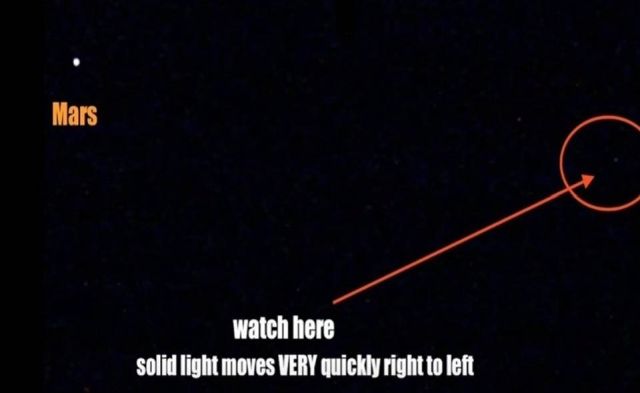
De bij ons inmiddels bekende Mr. MB333 staat op een ochtend heel vroeg in de tuin en via een telescoop observeert hij de planeet Mars. Hij maakt wat foto’s en een korte video en tot zijn verbazing staat er nog iets anders op de video. 

Een heel snel licht oftewel een UFO die met hoge snelheid van rechts naar links over het scherm gaat. 


Om nog eens aan te tonen op wat voor manier NASA rotzooit met foto’s, hierna nog een klein stukje uit een eerder artikel. 

Mensen die nog steeds geloven dat instanties zoals NASA ons echt wel de waarheid vertellen en dat die aluhoedjes iedere keer dingen zien die er niet zijn, willen wij graag het volgende voorleggen: 

Wat als er nu een foto is van NASA uit 2013, genomen door één van de NASA rovers op Mars, waarop duidelijk een gebouw is te zien? 

Het gaat om een zwart/wit foto die is genomen op 6 september 2013 en waarop je in de verte duidelijk een soort (flat)gebouw ziet staan, achter de heuvels.


xxx

Wanneer je wat verder inzoomt, dan wordt duidelijk dat daar iets staat wat niet anders omschreven kan worden dan als een constructie, een gebouw.

xxx

Wie de originele foto wil bekijken, kan dat hier doen. Dan wordt er enkele jaren later opnieuw een foto gemaakt van hetzelfde gebied op Mars en de datum op de foto is dan 11 februari 2017. 

Dit keer is het een kleurenfoto en ziet er als volgt uit.

xxx

En wanneer we hier wat inzoomen, dan blijkt opeens het gebouw uit de foto van enkele jaren geleden te zijn verdwenen.


xxx

Dan terug naar het heden en iemand die ook veel onderzoek heeft gedaan naar de planeet Mars, Tyler van Secureteam. 

Hier volgt zijn video over Mars en zijn gedachten, waarbij het er steeds meer op begint te lijken dat we misschien binnenkort nog veel meer spannend nieuws over Mars kunnen verwachten. 

{ http://niburu.co/ }

Hoe vind je dit bericht?
Geschreven door peter om 22:30 Stuur door

Climbing the ladder to life detection

Climbing the ladder to life detection

 by Tricia Talbert, NASA

Climbing the ladder to life detection

On our quest to find life beyond Earth, scientists first must have to ask themselves: what signs would be the most compelling evidence? Credit: M. Neveu/NASA Astrobiology Program/NASA/JPL-Caltech/UCLA

In the past two decades, NASA spacecraft have identified potentially habitable environments throughout the solar system and beyond. Spacecraft on Mars have found evidence that lakes and streams once covered the planet, protected by a long-gone thick atmosphere. At Saturn's moon Enceladus, the Cassini spacecraft sniffed plumes of water jetting out of Enceladus's icy shell—detecting chemistry akin to that occurring in certain places on Earth's seafloor, where seawater chemically reacts with rock (and where living creatures thrive). The upcoming Europa Clipper mission could do the same at Jupiter's moon Europa, where scientists have spotted more plumes. Even beyond the solar system, some of the thousands of planets now known to orbit other stars may harbor surface oceans.

The next step in exploring these environments is to find out whether they're actually habitable—and then search for life. Unfortunately, no simple life-detection instrument currently exists. Unless a camera captures a growing mat of bacteria on a Martian rock or alien plankton swimming under Enceladus's ice, scientists must use a suite of instruments and diverse sets of data to look for biosigatures—or signs of life.

But what are those signs? To help answer this question, a team from NASA's Astrobiology Program has developed the "Ladder of Life Detection," a guide for researchers where each rung represents a key attribute of life. The Ladder was published in the journal Astrobiology on June 4, 2018.

The Ladder's Biosignatures

"The Ladder of Life Detection lists 15 features that the astrobiology community proposed to represent indicators of life," said Marc Neveu, a postdoctoral fellow at NASA Headquarters in Washington, DC and lead author of the paper. The Ladder also describes how scientists might measure these features and determine whether they really are evidence of life.

For instance, all life that we know of requires complex organic molecules and uses amino acids—two features in the Ladder.

But just finding these molecules doesn't mean they arose from life. "Many of the molecules that are used by life can be formed without life," said Mary Voytek, Senior Scientist for Astrobiology at NASA Headquarters and paper coauthor. For example, chemical reactions on a planet or comet can form amino acids and other organic molecules.

Scientists have to "figure out, with those caveats, how you can say that what you're looking at was produced by life," Voytek said.

An indication would be target molecules found in unique proportions compared to expected levels in the surrounding environment. "The presence of something that's not predicted in the environment is evidence of life," Voytek said. "Life pushes things out of equilibrium."

For instance, organic molecules of a certain complexity (think a Lego car versus individual bricks clicked together) could only have been made by life, Voytek continued. "Chemical complexity is a result of biology—it requires energy or enzymes to make it happen."

Other biosignatures include pigments, indications of metabolism (e.g., waste heat or compounds breathed out by life), or even evidence of Darwinian evolution. The latter can't currently be detected within the timescales of a space mission, but would be the golden ticket to identifying life.

Understanding the Environmental Context

Whether scientists can measure these biosignatures, either remotely or in place, is the next question, Voytek said. It's not just about instrument performance or avoiding the contamination of samples with molecules brought from Earth. Scientists will also need to consider the environmental context. How fragile is the sample? Can our analysis destroy the sample? Does the environment chemically change the sample? Can life tolerate the conditions where the sample came from (like the radiation-exposed surface of Mars or the cold depths of an ocean under ice)?

The Ladder lists answers for each biosignature, based on experience gained by looking for life on Mars and in Earth's oldest rocks and most extreme environments. As it turns out, easier measurements to make (the bottom rungs) might be harder to interpret than rungs further up the Ladder. Climbing the Ladder toward life will require challenging measurements.

Neveu stressed that the rungs on the Ladder aren't set in stone—with more research and discussion, each step of the Ladder can be moved around, and more can be added. He and his coauthors encourage input from the astrobiology community to improve the Ladder.

 Explore further: NASA finds ancient organic material, mysterious methane o  n Mars

More information: 

Journal reference: Astrobiology search and more info website

Provided by: NASA  website

{ https://phys.org/ }

Hoe vind je dit bericht?
Geschreven door peter om 18:17 Stuur door

Water May Not Be the Only Sign of Alien Life

Water May Not Be the Only Sign of Alien Life

A new study suggests also looking for "bioessential" elements when searching for alien life.

Saturn's moon Enceladus in infrared, green and ultraviolet light. 

Image credits: Kevin Gill via Flickr

SPACE

Charles Q. Choi, Contributor

(Inside Science) – When it comes to looking for alien life, scientists mostly focus on where there is water. Now researchers suggest that looking at "bioessential" elements such as phosphorus and molybdenum could help judge a world's potential for life.

There is life virtually wherever there is water on Earth, from clouds high above the surface to the deepest layer of Earth's crust. As such, the search for life outside Earth typically concentrates on worlds that are "habitable," possessing temperatures conducive to hosting liquid water on its surface.

For example, although the surface of Venus is currently hot enough to melt lead, a 2016 study suggested it may have been habitable until as recently as 715 million years ago. Scientists have even conjectured that if life once existed on Venus, it still might survive within its clouds.

However, "there are of course other ingredients needed for life as we know it," said study senior author Avi Loeb, chair of astronomy at Harvard University in Cambridge. For example, on Earth, elements that are key to how much life oceans hold may include nitrogen and phosphorus. Nitrogen is needed to create proteins, and both nitrogen and phosphorus are key ingredients of DNA and RNA. Several recent studies suggest the increased availability of phosphorus in the oceans about 635 million to 800 million years ago may have even helped support the evolution of animals on Earth, the researchers noted.

To see what roles such bioessential elements might play in the evolution of alien life, the researchers focused on how accessible they might be on worlds with liquid oceans underneath their frozen surfaces, much like Jupiter's moon Europa and Saturn's moon Enceladus. "People suspect there may be life in liquid water under the ice in Europa and Enceladus, and both NASA and ESA [the European Space Agency] have plans to visit them with missions such as Europa Clipper 1," Loeb said.

On Earth, a major source of phosphorus in oceans is via the weathering of so-called felsic rock by mildly acidic rainwater. Phosphorus is in turn removed from Earth's seas by hydrothermal activity; prior work suggests hydrothermal activity exists on Enceladus and presumably Europa as well, the researchers said.

Radiation from Jupiter constantly bathes Europa's surface, generating molecules known as oxidants, and as Europa's icy surface churns, these oxidants can enter Europa's hidden seas, where they can react with sulfides and make the water highly acidic. As such, Europa may possess enough phosphorus to support life, although highly acidic oceans might stifle chances for life, the researchers said.

In contrast, previous research suggested the underground oceans of Enceladus may be strongly alkaline. In the new study, the scientists calculated that if a world's oceans are either neutral or alkaline and possess hydrothermal activity, "phosphorus may be entirely removed from the subsurface ocean world in a very short timescale compared to the age of the solar system -- millions of years," said study lead author Manasvi Lingam, an astrophysicist at Harvard.

The scientists also suggested trace metals such as molybdenum, manganese and cobalt might prove bioessential as well. "Molybdenum plays a crucial role in several enzymes, most notably in fixing nitrogen" -- that is, breaking apart the powerful chemical bonds that hold nitrogen atoms in pairs in the atmosphere and "fixing" the resulting single nitrogen atoms into vital organic molecules, Lingam said. In addition, molybdenum "affects protein synthesis as well as metabolism and growth in many organisms," he explained.

Furthermore, "manganese plays an important role in the context of generating oxygen via photosynthesis in chloroplasts," Lingam said. "Cobalt has a variety of biological roles in metabolism -- most notably, it forms a component of the vitamin B-12."

"The idea of a habitable zone goes back to the 1950s, and since that time we've learned a lot, such as the existence of subsurface oceans, so it's important to move our thinking about habitability being just about water to specific elements and chemicals that might be essential for life," said astrophysicist Adam Frank at the University of Rochester in New York, who did not participate in this study.

One way to remotely see if alien worlds outside of our solar system might have bioessential elements is to look at their stars, which might shed light on the compositions of their planets and moons. The presence of an element in a star would generate a unique spectrum of colors visible in its starlight, and "could thereby provide us with some information regarding the habitability of any planets orbiting them," Lingam said.

If a world's levels of bioessential elements are low, that may limit their potential for life as we know it. Although the new study suggested that future missions to Europa and Enceladus only had a slim chance of detecting life, they are "an excellent opportunity to falsify our model, and therefore we are in favor of such missions," Lingam said

Planetary scientist Jonathan Lunine at Cornell University in Ithaca, New York, who did not take part in this research, cautioned "these are calculations based on simple assumptions, and we must always remember that planets and moons are more complex than we expect -- that is one of the lessons of the discoveries made by planetary exploration. So we should not take the results as definitive, but as a way of pointing toward some of the observations that ought to be made by future missions."

The researchers cautioned that although bioessential elements might prove rare on average across a world, patches could exist on a world where levels of these elements, and the chances for life, are higher, Lingam said. And of course, the researchers only accounted for life as we know it -- "life as we do not know it might follow different chemical routes than on Earth, which would be a more exciting finding than finding life as we do know it," Loeb said.

Lingam and Loeb detailed their findings online May 31.

{ https://www.insidescience.org/physics }

Hoe vind je dit bericht?
Geschreven door peter om 18:04 Stuur door

NASA ontdekt mysterieus blauw zand op Mars - HLN.be

NASA ontdekt mysterieus blauw zand op Mars - HLN.be

Bron: NASA

.

NASA .
 De Amerikaanse ruimtevaartorganisatie NASA heeft een even mysterieuze als indrukwekkende foto genomen van een blauwe zandduin op Mars. “De duin bestaat uit fijner materiaal en hebben een andere samenstelling dan de omliggende duinen”, luidt het.

De MRO (Mars Reconnaissance Orbiter) van NASA nam al in januari een foto van de blauwe zandduin op Mars, maar NASA maakt die vandaag pas publiek. De duin ligt in de buurt van de Lyotkrater, waar wel meer zandduinen liggen. Maar wetenschappers hebben vastgesteld dat de opvallende blauwe duin een andere samenstelling heeft dan de andere duinen.

Lees ook

Grijs zand

Eigenlijk is het zand op de duin grijs, maar omdat de foto bewerkt is om het contrast te vergroten, valt de duin blauw uit. Dat zegt planetair geoloog Alfred McEwen. Waarom het zand een andere samenstelling heeft, is voorlopig onduidelijk.

{ https://www.hln.be/ }

Hoe vind je dit bericht?
Geschreven door peter om 16:52 Stuur door

About Those Winged Chupacabras

bats-164210_1280-999x540.jpg

About Those Winged Chupacabras

Mention the word “Chupacabra” to most people and it will almost certainly provoke imagery of strange, hairless dog-like animals mainly seen in the southwest area of the United States. They are actually coyotes with a few genuinely odd issues that go beyond just mange. It should be noted, however, that what passes for the Chupacabra today is very different to the original Chupacabra that surfaced on Puerto Rico in the mid-1990s. One of the most striking things about the Puerto Rican creature is that in more than a few cases it has been described as having wings. This is, of course, nothing like what has been seen in Texas, Arizona, New Mexico and Oklahoma. I’ll share with you a few examples from my own files.

In 2004, I headed out to Puerto Rico with a team from the SyFy Channel to make a show on the Chupacabra. The show was titled Proof Positive. One of the witnesses was a woman named Norka, whose encounter occurred midway through 1975, twenty years before the Chupacabra phenomenon began. It was dusk, on a stiflingly hot, weekday night and the atmosphere – as day began to surrender to nightfall – was as normal and tranquil as it had ever been. It wasn’t long, however, before normality and tranquility gave way to something hideous. As Norka drove carefully and slowly along the twisting, climbing road, something suddenly surfaced from the huge, dense trees that stood proud and tall, like gigantic green curtains, and which dominated each side of the road.

Doing barely twenty miles an hour to begin with, Norka was easily able to slow down as a curious beast loomed into view. Norka, looking into the cameras of the SyFy Channel, said that only about twenty feet in front of her was the strangest, most terrifying animal it had ever been her misfortune to encounter. For all intents and purposes, it looked very much like a bat. Except, that is, for one astonishing thing: the abomination was around four to five feet in height.

Not surprisingly, Norka could scarcely believe her eyes as the monster shuffled slowly across the road, its muscular legs taking slow but deliberate strides across the hot tarmac. With her eyes transfixed on the beast, Norka could see that its body was dark brown in color. Two large wings were folded tight against its back. The clawed fingers on its hands – that drooped in curious, limp fashion from its bony wrists – were of a distinct, white-yellow hue. Of a near-identical color were two enormous fangs that protruded from its gaping, almost slack-jawed, mouth. Most frightening of all to Norka were the eyes of the creature: focused intently on Norka herself, they were almost blazing, like red hot coals. It was soon gone from sight.

While I was on Puerto Rico in the summer of 2004, I gave my phone number to all of the Puerto Rico-based crew-members on the Proof Positive shoot, just in case any of them got any leads of the chupacabra variety. As a result, and late one morning not long after I returned home, I received a phone call from a woman I’ll call Rosa. I listened both carefully and intently as Rosa told me how, on a Friday night, around thirteen years previously, she was having a night on the town, in Old San Juan, with one of her girlfriends. The evening was normal, fun and just like any Friday night anywhere on the planet. At least, it was until they decided to head home.

For reasons which neither Rosa nor her friend could ever fathom, both developed a sudden and overpowering urge to drive to El Yunque. It was, said Rosa, as if the pair was in a kind of hypnotic haze. Around 1.00 a.m. they arrived at the base of the rain forest and took a long and winding road – one that I know very well – into its depths. They had driven along the compact, coiling road for around fifteen minutes when they encountered something that was as remarkable as it was terrifying: a very strange animal making its slow way across the road.

Whatever the creature was, it was certainly no regular resident of Puerto Rico. Somewhere in the region of four and a half feet in height, its color was gray, it moved across the road in a curious, tentative fashion (as if, said Rosa, it wasn’t even used to walking), and sported a pair of what were undeniably wings on its hunched back. The wings, she added, were so long, they dragged on the ground for a couple of feet behind the beast. There was one more thing: the animal had a pair of self-illuminating red eyes. That much was apparent when it stopped in its tracks and gave the friends an icy stare, after which it continued on its odd, clumsy, penguin-like walk to the left side of the road and vanished into the trees.

Then there was my 2005 trek around Puerto Rico with Paul Kimball’s Redstar Films team from Canada.  A resident of a small village that was home to a cool-looking church, one which rather reminded me of an old English castle, our source had an encounter in early 2005 with…well…something. It clearly wasn’t your average chupacabra, but it did end with multiple animal mutilations; so, in that sense, the story has relevance. The month, the man thought, was February, and the time, definitely late evening. He was walking past the old church when an ear-splitting roar filled the air. It came from an area dominated by tall, thick trees and barely fifty feet away. Frozen rigid in his tracks, he stared intently at the woods.

Suddenly, something terrifying happened: a huge, feathery beast burst through the trees and took to the skies. Whatever the creature was, it was no ordinary bird; the incredible size of it, somewhere in the region of a man, made that abundantly clear. The man could only stare in awe as the infernal thing flapped its mighty wings and vanished into the distance.

To keep matters balanced, it’s very important to read the words of Ben Radford on the matter of the Puerto Rican Chupacabra. He said that: “…the origin of the mysterious vampire beast el chupacabra can be traced back to a Puerto Rican eyewitness who saw the 1995 film Species, which featured a nearly identical monster. Though both vampire legends and ‘mysterious’ animal predation date back many centuries, there seems to be no evidence of any blood-sucking ‘chupacabra’ before the 1990s.”

Ben also says: “The chupacabra has two origin stories invoked to help explain its sudden appearance: the first is that the creature is an extraterrestrial brought here by visiting aliens; the second is that the chupacabra is an escaped entity created in a top-secret U.S. government genetics laboratory experiment gone wrong—essentially a classic conspiracy-laden Frankenstein scenario. Not coincidentally, these two origin stories are identical to those of Sil, a chupacabra-like monster in the film Species.”

Ben notes too that in some cases wings have been reported, as have feathers on the backs of the animals. Ben, however, is strongly of the opinion that Species played a major role in the development of the phenomenon. I’m not so sure, primarily because (a) there are cases that predate the 1990s by not just years but by decades; and (b) during the course of my now-eleven trips to Puerto Rico I have had the good fortune to speak to a lot of witnesses to the Chupacabra, and who come across as very credible.  What’s important, though, is that whatever your opinion on the undeniably controversial matter of winged-things versus odd-looking coyotes, the Puerto Rican beast is nothing like the one that roams the southwest. And it never has been.

{ http://mysteriousuniverse.org/  }

Hoe vind je dit bericht?
Geschreven door peter om 16:35 Stuur door

UFO Death Cult Movie Favors Subtlety Over Spectacle

endlesstry-999x540.png

UFO Death Cult Movie Favors Subtlety Over Spectacle

Movies about UFO death cults are few and far between. So those who are in to that sort of thing (UFO death cults), will no doubt be excited at the impending release of The Endless, a critically-acclaimed sci-fi horror from directors Justin Benson and Aaron Moorhead. The directors also star in the movie; they play brothers who find themselves drawn back to Camp Arcadia, a secretive community from which they’d escaped as young men. Hoping their return will bring them some closure, they’re instead confounded by inexplicable phenomena occurring around the camp. Meanwhile, the cult members ominously prepare for a mysterious “event”…

The micro-budget movie has received rave reviews from critics; its vérité aesthetic enhancing the fantastical elements of its plot. The Endless also apparently shares the same creative universe as the directors’ first movie—the genre-defying Resolution (2013). The Endless received a limited US theatrical release back in April this year, but, at this point, very few people will have seen the movie. It arrives on DVD and Blu-ray on this week in the US and will soon available in Europe on VOD.

It’s refreshing to see filmmakers thoughtfully engage with alien themes outside the narrative constraints and popular expectations that come with a mega-budget. There have, of course, been a number of UFO movies over the years that have quietly eschewed traditional approaches to the subgenre (among them The Stranger Within and The Arrival of Wang), though most of them fail to find an audience upon release. Still, I’m firmly of the opinion that less is often more; what is suggested or implied can be so much more effective than what is shown; a whisper can be louder than a scream. This stripped-back approach was successfully embraced earlier this year in A Quiet Place, in which Earth is invaded by sightless aliens with hypersensitive hearing, sending the remaining human population into silent hiding. The movie cost in the region of $17 million (very modest for Hollywood) and grossed in excess of $326 worldwide. Unsurprisingly, a sequel is now in development.

Perhaps movies like A Quiet Place and The Endless are signalling a new approach to the alien/UFO subgenre of science-fiction, one not reliant upon epic spectacle, the American military, and cheesy one-liners. Roland Emmerich, take note…

{ http://mysteriousuniverse.org/ }

Hoe vind je dit bericht?
Geschreven door peter om 16:16 Stuur door

Footage Of Live UFOs On The Moon

Footage Of Live UFOs On The Moon

This video of ‘Bruce Sees al’ consists of live moon footage of UFOs on the lunar surface.

Live%2BUFOs%2BMoon.jpg

The recordings of the recent UFO activities have been taken with a CGXL 1400 High Definition Telescope.

All moving objects above the surface of the moon have been zoomed in and analyzed by ‘Bruce Sees al’ and it shows that there is much more UFO activity on the moon than we know.


{ http://ufosightingshotspot.blogspot.com/ }

Hoe vind je dit bericht?
Geschreven door peter om 16:06 Stuur door

Mars Had a Seriously Crazy Volcanic Past, New Study of 'UFO' Rocks Reveals

Mars Had a Seriously Crazy Volcanic Past, New Study of 'UFO' Rocks Reveals

Hoe vind je dit bericht?
Geschreven door peter om 01:10 Stuur door

After Theft: Crop Circle Exhibition 2018 looks for Supporters


After Theft: Crop Circle Exhibition 2018 looks for Supporters

Launched in 2014 as the world’s first exhibition on the phenomenon and research of crop circles in a natural science museum – the “Crop Circle Exhibition & Information Centre” – has found its home this year in the new spacious Honeystreet Mill Café, near Alton Barnes in Wiltshire. After a burglary into the winter storage of the exhibition and the theft of essential parts of the display and technical equipment, the exhibition organizers ask crop circle enthusiasts now via crowdfunding for support for the coming summer.

“Crop Circle Exhibition & Information Centre 2018” from July 1st to August 12, 2018 at the Honeystreet Mill Café, neat Alton Barnes, Wiltshire (UK).
Copyright: http://www.cropcircleaccess.com


The exhibition’s organizer Monique Klinkenberg who also curated the exhibition together with Andreas Müller.

Copyright: A. Müller, grenzwissenschaft-aktuell.de

The burglary (read more about it here) of the winter storage rooms was discovered a few weeks ago when the exhibition was to be transported to their new home. High-quality exhibits and panels as well as technical equipment such as digital photo and video frames, cameras, headphones and video projector were stolen. “The total loss was in excess of 5.000 British Pounds (about 6.700 US-Dollar),” reports Monique Klinkenbergh, who had curated and designed the exhibition together with crop circle researcher Andreas Müller originally for the cultural-historical “Wiltshire Museum” in Devizes, GreWi reported. Since then they expanded and supplemented the annual summer exhibition in Wiltshire.

“The exhibition itself was always meant as a self-financed and self-sustained non-profit information and educational project,“ explains Müller. “While previous exhibitions have been a visitor’s success and had already set a visitor’s record in 2014 for the Wiltshire Museum, otherwise known for its original archaeological finds from ancient Stonehenge they always left a financial four-figure loss every year to compensate. Therefore the current theft caused a painful gap.”

Some compiled thumbnails of the “digital version of the crop circle exhibition”, which supporters receive as a small thank-you-gift.

Copyright: http://www.cropcircleaccess.com

For this reason, the exhibition organizers and their numerous volunteers now turn to all crop circle friends who would like to support the exhibition with a private crowdfunding campaign financially: “On the website of the exhibition, there is a donation-button, and if you donate 10 GBP (about 13 US-Dollar) or more, you will receive a copy of the ‘Exhibition at Home’ – your digital edition of the Crop Circle Exhibition, featuring all the (updated) information panels of our previous exhibitions.“

“Every little support is a great help to us” conclude Klinkenbergh and Müller and thank all supporters in advance.

– If you want to support the “Crop Circle Exhibition & Information Center” please visit its website HERE.

{ http://www.openminds.tv }

Hoe vind je dit bericht?
Geschreven door peter om 00:41 Stuur door

WORLD UFO DAY 2017: 9 ALIEN ENCOUNTERS THAT WILL MAKE YOU BELIEVE

WORLD UFO DAY 2017: 9 ALIEN ENCOUNTERS THAT WILL MAKE YOU BELIEVE

Alien encounters, the type that involve UFOs and blinding lights and extraterrestrial hands probing you, often defy all scientific and logical explanation and are often the same kind of hoaxes baring huge fangs on the cover of The Sun ...

... until they're not.

While infinite faux encounters have been crawling all over the media even before War of the Worlds was taken way more seriously than the dramatization it was supposed to be, actual aliens do lurk among the sensational clickbait of the Internet. Except these accounts expose the real terrors that some Earthlings went through when they saw something they shouldn't have. Or ended up somewhere they shouldn't have. Or ended up with a passenger that shouldn't have been riding shotgun in their car.

However bizarre it might seem to encounter an extraterrestrial light show thousands of feet in the air or to just vanish and show up in your backyard months later thinking it was only a couple of hours (presumably because you were on board something that traveled into the far reaches of space at the speed of light), these experiences that may not be as famous as Roswell and other Area 51's are even more chilling on account of them haunting the memories of people who never worked for the FBI or CIA or even SETI. You might expect a bizarre flash of something when you've been searching for it since the Clinton era. Not so when you're just trying to drive home after dark without your engine breaking down.

Probe these 9 alien encounters that are almost (operative word here) beyond belief and even nonbelievers will find it impossible to stay in the cynic bubble.

01. Those aren't Christmas lights
An amateur astronomer observed something beyond imagination after eyeing a bizarre white  flash that was definitely not of this planet.

Heat lightning would have been the assumption, but the night was clear and cloudless with no forecasted storms. Whatever it was briefly lit up the entire night sky with an otherworldly blaze. It tinged the surrounding air, which somehow felt heavier, with a mysterious metallic taste. Then an unexpected flash of red exploded in the darkness. When it seemed things couldn't get much weirder, the light show began.

Alternating white and red flashes appeared, and someone out there must have been having fun twisting human brains because a third flash soon joined the production. It was almost as if they were being beamed into the sky as some sort of mysterious communication mode.

Then came the noise that silenced everything. Frogs stopped croaking, crickets ceased their chirping and the night went deathly silent at the sinister whirring until every dog in the neighborhood started barking like it was the apocalypse. This whirring kept rising in volume as the flashes ascended.

The alien fireworks have never been explained, but the astronomer and a legion of canine witnesses remain forever spooked.

02. The perfect storm (for abduction)

Storms sometimes bring other things down to Earth besides rain.

Thunder and lightning probably aren’t how you'd want to spend your birthday, but Jason Andrews of Kent, England got much more than cake when he turned four in July 1987. He began muttering complex mathematical equations as the sky exploded with lightning. Even Einstein probably hadn't been able to understand math of this level at that age, but Jason kept spewing numbers as if he was on the brink of developing an unprecedented theorem. Then the windows began to tremble when Jason turned to his parents in a trancelike state and said "They are waiting for me! I have to go!" His father struggled to pull him back from the doorway, and as he did so it was as if someone took a tranquilizer to the storm. The windows stopped rattling. The trance broke.

Jason was being drawn towards something — an alien starship? A makeshift lab for probing human specimens? — and probably would have followed the invisible force that had him in its claws if it weren't for his altered state being shattered.

Years later, Jason revealed that he had been getting nightly visits from something definitely not human. The controversial theory behind his experience is that he has some sort of remote viewing capabilities that attracted aliens to him.

Whether or not science thinks this phenomenon is real, there is at least one person on this planet who certainly does.

03. Nobody knows but it's green

Sometimes the monsters aren't under your bed but outside your window. The monsters became real in 2009 for one anonymous witness who only wanted to relax with headphones on when an unearthly sound cut through the edgy guitars and haunting vocals of Tool. It was the type of high-pitched electric sound that assaults your ears — except this wasn't caused by a scratch on the CD. Whatever the source of the noise (which kept getting louder) was bathed the entire room in an ectoplasmic green glow.

Now this is the part when that sinking feeling that warns you not to look out the window, but you do anyway. Because you feel a presence. That presence was an enormous airborne vessel, a triangular metal thing that doesn’t typically take off from any human airport. It was pulsing with orbs of that same eerie green radiation.

As if the fear factor wasn’t enough, the thing then shook the house violently before floating off into the dark unknown. At least it didn't end up hurtling through the sky and crashing in the land of Oz.

This event occurred in northeast Ohio, known to be a hotbed of paranormal activity. Why everything freaky comes out to play there is still beyond science.

04. Roadside attractions

The obstacle that Wisconsin resident William Bosak encountered on the road in 1974 while driving home after dark was no pothole.

Foggy nights can be deceptive, especially when it comes to separating those murky tendrils from something supernatural, but what Bosak saw as he slowed down towards a strange roadside object defies explanation. While the brightness of his headlights seemed to vaporize the bottom half of ... whatever it was ... that which he was able to see would have sent anybody into the middle of the road screaming.

Staring through an enormous glass dome was Chewbacca in spandex ... or, at least it would've made a killer backup for Chewie. This hairy humanoid in a skintight bodysuit had ears protruding from the top of its head and terrified eyes that bulged from a face that could have been a mashup of human and bovine DNA. It looked as if it had thrown its arms above its head in surrender. Just one eyeful of this ten-foot monster was enough to make Bosak frantically step on the accelerator, but to his horror, the lights inside his car went dark and a suspicious noise suggested the engine was missing.

That the former UFO skeptic now believes is an understatement.

05. Morphing on the fly

In 1989, an airline pilot taking off from Kansas City International Airport flew into something unexpected when he encountered an alien white disc among the clouds.

Almost an illusion at first, the disc appeared dim to pilot Andrew Danziger until the plane began to descend. Hovering above the clouds where the disc had been, an immense red orb not unlike a blood moon or blazing sunset sent the pilot and his copilot into a psychological tailspin (they somehow managed not to spook the passengers). It also started playing a deranged game at 13,000 feet.

As the aircraft lost altitude, so did the orb. There was a moment of relief when it seemed to vanish into a cloud — only to re-manifest within the clouds as hundreds of flashing lights that would rival anyone's electric holiday display. Even more mind-blowing, the cloud this thing had descended into was now pulling itself apart like galactic goo.

The second it succeeded in tearing itself apart, everything that had been materializing for the last 40 minutes disappeared. Danziger filed a UFO report stat after landing. Even creepier is that he was just one of many to report the phenomenon involving this unidentified flying whatever.

Nothing was ever identified by air traffic controllers.

06. Garden gnomes from outer space

The peculiar figures that appeared at one Wisconsin couple's door one night were mistaken for trick-or-treaters who had forgotten Halloween was over — until they floated.

Whoever (or whatever) rang the doorbell was a wrinkled life-form that looked like a cross between a scarecrow and a garden gnome that could have been a horror movie extra. Obscuring its face was a floppy hat from which stray tufts of hair stuck out and its chin was unnaturally sharp. It was either nonverbal or refused to speak -- what must have been its mouth was a puckered toothless void.

The creature was also clutching a strange white staff that the couple soon realized wasn't made of anything earthly when the creature reacted to human hands reaching out to touch it and make sure it wasn't a teenage prank. When it raised the staff and struck the sidewalk, it floated backwards. Its four companions were standing silently in the grass and on the asphalt like lawn ornaments. They were all clutching their staffs, thought to be energy rods powered by an unknown force, levitating several inches above ground. By morning, they disappeared as mysteriously as they had arrived.

Whatever these things were, they were anything but costumed humans.

07. Glow-in-the-dark hitchhikers

Orbs of unexplained origin seem to be a common thread in UFO sightings, but this one just takes that otherworldly glow to a whole new level.

When a security officer was driving home on a South Dakota highway in 2011, hundreds of mysterious red lights started to appear and circle the moving car like some sort of alien halo. Though the driver thought he was still doing 60, the car was decelerating with absolutely no explanation. Then the lights vanished and the car sped up ...

Just as unexplained as the vanishing light halo was what appeared in its absence. The officer noticed something strange — beyond strange — at the side of the road. Then the thing was on the car. It was a glowing, translucent life-form with gangly arms that stretched right through the roof of the officer's vehicle. Spindly fingers ran down his back and left a burning sensation.

But there was more where that came from. By the curb was another glowing creature that could only be described as the evil version of Hoggle from Labyrinth.

The translucent thing made itself a passenger until it sensed more humans. Then it vanished, but the horror never did.

08. Monolithic madness

When Lee Parish was driving home in the dark back in 1977, the road was surprisingly well-lit — but not by a streetlight.

What Parish remembered under hypnosis later on was that a huge rectangular UFO floating above his Jeep was lighting the way. Of course, it wasn't just there to function as a superpowered flashlight. His car then came to a sudden stop directly beneath the strange spacecraft. While alien forces messing with auto innards isn't exactly unknown, what supposedly happened next was almost unbelievable. The hypnotized Parish recalled that his car was somehow being levitated by the UFO. He then found himself standing inside it.

The spacecraft’s inner chamber was circular with white walls that emitted an otherworldly glow. (Everything apparently has to glow in alien starships.) He was surrounded by three blocky beings (which also glowed from within). The black entity was the nightmare version of a 20-foot-tall suitcase, while the red one was like a walking one-armed Coke machine. The white one, the obvious leader, was two-armed and square-headed.

The creatures examined Parish with an unnervingly freezing touch that sung wherever their limbs and half-limbs went exploring. Then, with no explanation, they merged into each other and vanished.

Parish might have gotten away, but the unfortunate Jeep's electrical systems soon failed.

09. When the dead aren't dead

Sometime in the 1960s, somewhere in Ethiopia, a boy named Gabriel was running around the backyard with his friend when he just disappeared. Just like that. Then he materialized six months later. Just like that.

After everyone who thought Gabriel was dead could be assured they were not seeing a ghost, he recounted a story that wouldn't have been out of place on The Twilight Zone ...

Gabriel had been led into a glowing, windowless white room by benevolent humanoid creatures. Inside were child abductees from all over planet Earth. (How they and the 'men' who had abducted them could understand each other was a mystery.) With the press a button on the wall, a bed instantly appeared — which makes you wonder how long some of those kids had been on board.

Before Gabriel knew it, he found himself standing in a sparkling city, surrounded by supernatural skyscrapers and flying cars. Beings that appeared both human and alien walked streets that almost shone. The boy was then taken to an impossibly tall building by one of his captors and shown to a room in which he could push any button and be transported to any number of places. When he was told he needed to stay a while, he had no idea exactly how long "a while" would be. He claimed it felt like a mere couple of hours.

This is why you never, ever go off with strangers.

{ http://www.syfy.com/ }

Hoe vind je dit bericht?
Geschreven door peter om 00:21 Stuur door

ARE WE ALONE IN THE UNIVERSE? SCIENTISTS SLASH THE CHANCES OF INTELLIGENT ALIEN LIFE

ARE WE ALONE IN THE UNIVERSE? SCIENTISTS SLASH THE CHANCES OF INTELLIGENT ALIEN LIFE

Hoe vind je dit bericht?
Geschreven door peter om 00:00 Stuur door

Japan’s Hayabusa 2 closes in on diamond-shaped asteroid Ryugu

Japan’s Hayabusa 2 closes in on diamond-shaped asteroid Ryugu

20180621_fig20180621-2-15_f840-800x800.png

The closest view of Ryugu released so far, from a distance of only 62 miles (100 kilometers), on June 20, 2018, showing a rough diamond shape, craters and boulders, as well as a bright spot bear the top point of the diamond.

Image via JAXA/University of Tokyo/Kochi University/Rikkyo University/Nagoya University/Chiba Institute of Technology/Meiji University/University of Aizu/AIST.

Japan’s Hayabusa 2 spacecraft is now rapidly approaching asteroid Ryugu, providing the first-ever close-up views of this near-Earth object. According to The Mainichi, a news source covering the encounter from Japan, the Japan Aerospace Exploration Agency (JAXA) said on June 24, 2018, that the Hayabusa 2 space probe has successfully completed a course adjustment and entered the final leg of its 4.5-year journey to the asteroid. Its planned arrival will be on June 27. Meanwhile, JAXA has also released a new set of images, showing a roughly diamond-shaped body – also being compared to a spinning top – with boulders and craters.

As of June 24, the most recently released images are from a distance of 136-62 miles (220-100 km). A bright spot can be seen near the top point of the diamond (shades of Ceres?) and what may be an equatorial ridge, something seen elsewhere in the solar system as well, such as on Saturn’s moon Iapetus and several other Saturn moons (Atlas, Pan, Daphnis).

The images are already showing quite a bit of detail, and of course, they will only get better as the spacecraft gets even closer!

Ryugu is small, with a diameter of about 2,788-2,887 feet (850 to 880 meters), and has an appearance similar to the asteroid Bennu, which the U.S. spacecraft OSIRIS-REx will encounter in 2020. Hayabusa 2 will attempt to send both a small lander and rovers to the surface of the asteroid, as well as bring samples back to Earth for study.

Additional images from Hayabusa 2’s approach, from June 18-20.

Image via JAXA/University of Tokyo/Kochi University/Rikkyo University/Nagoya University/Chiba Institute of Technology/Meiji University/University of Aizu/AIST.

On June 19, Makoto Yoshikawa, the Hayabusa 2 mission manager for JAXA, said in a statement:

When I saw these images, I was surprised that Ryugu is very similar in shape to both the destination of the U.S. OSIRIS-REx mission, asteroid Bennu, and also the target of the previously proposed MarcoPolo-R mission by Europe, asteroid 2008 EV5. Bennu and 2008 EV5 are about half the diameter (and 1/8 the volume) of Ryugu, with rotation periods about half as long. In other words, these celestial bodies are small and rotating fast compared to Ryugu. On the other hand, Bennu is a B-type asteroid, which is very similar to C-type asteroids such as 2009 EV5 and Ryugu. Therefore there should also be common properties due to the asteroid type. So we have both differences and similarities that have combined to produce very similar shapes … why is that? I think this is very interesting. So far, the asteroids we have explored have been different in shape, so Ryugu and Bennu could be the first time two similar-shaped asteroids have been examined. It will be interesting to clarify exactly what this similarity means scientifically.

Images from Hayabusa 2’s approach to Ryugu, from between June 17-18, 2018.

Image via JAXA/University of Tokyo/Kochi University/Rikkyo University/Nagoya University/Chiba Institute of Technology/Meiji University/University of Aizu/AIST.

After Hayabusa 2 arrives at Ryugu, it will be only 12.5 miles (20 km) above the asteroid’s surface. Between this coming September and July of next year, one small lander (called MASCOT-1) and three small rovers (called MINERVA-II) will be deployed to the surface. Before then, however, the spacecraft will need to study the asteroid to find the best landing locations. As Yoshikawa noted:

If the axis of rotation for Ryugu is close to the vertical direction in this image, there is a big advantage as it will be possible to know almost the entire appearance of Ryugu at an early stage after arrival. This makes the project planning easier. However, it is also possible that potential landing sites may be limited to the equator of Ryugu. I hope we can find a suitable place to set down the lander and rovers.

Ryugu is already proving to be an interesting body, as described by optical navigation camera principal investigator Seiji Sugita:

As we approached Ryugu and were able to distinguish individual features in the asteroid’s topology, it became clear that Ryugu has a land of rich terrain. Numerous clusters of rock roll on the surface. Among these, a large rocky mass (about 150m across) stands out on the upper part of Ryugu due to its brighter color (higher reflectivity). The belt-shaped ring of peaks that surround the equator are also slightly brighter than their surroundings. This color difference may reflect a difference in material composition and the size of the particles that form the rock. We can also see many sunken regions that look like craters. These depressions may have been made in collisions with other celestial bodies. A structure that looks like a grove is also visible.

The existence of such varied topographies is an indication that Ryugu has undergone a complex evolutionary history. It is generally believed that small asteroids that are less than .6 miles (1 km), such as Ryugu, were created fairly recently in the solar system’s history (within several hundred million years) during the fragmentation of a larger parent body. Ryugu’s terrain will tell us about the division from the parent body and the asteroid’s subsequent evolution.

Artist’s concep of Hayabusa 2 at Ryugu. Image via JAXA.

Hayabusa 2 is the second asteroid sample-return mission by JAXA. The first, Hayabusa, was launched in 2003 and arrived at the asteroid Itokawa in 2005. Despite some problems, 1,500 grains of rock from the asteroid were successfully returned to Earth in June 2010. Hayabusa 2 is scheduled to return its samples back to Earth in 2020.

Want more details? Check out Scott Manley’s video, below:

Bottom line: We are now getting our first close-up look at a near-Earth asteroid called Ryugu, thanks to the Japanese spacecraft Hayabusa 2. Its “diamond” or “spinning top” shape might seem peculiar, but its shape is similar to that of another asteroid, Bennu, which will also receive its first earthly visitor, the U.S. spacecraft OSIRIS-REx, in 2020.

Via JAXA

{ http://earthsky.org/ }

Hoe vind je dit bericht?
Geschreven door peter om 23:58 Stuur door

The Pharaohs of Ancient Egypt Were ALIEN-HUMAN Hybrids

The Pharaohs of Ancient Egypt Were ALIEN-HUMAN Hybrids

Pharaohs of Ancient Egypt

The pharaohs of historical Egypt might have been alien-human hybrids, based on a new strange conspiracy theory going around on the internet.

Believers have created mocked-up images from the gods alongside extraterrestrials. This is to demonstrate how they might have been human beings along with elongated brains.

Pyramids

The reviews state that Egyptian stories date their own origins returning to the Zep Tepi. That explicates as the actual “first time”, a “golden age” whenever legend states gods originated from the atmosphere in eggs or vessels.

The hypotheses advise that superior lifeforms transferred their information or came up with the monuments prior to civilisations surfaced.

One conspiracy theory website assigns a whole area to the discussion that “aliens built the actual pyramids.” The early Egyptians could hardly have the knowledge of creating the pyramids.

It takes the large leap through the mystery to state it must be aliens.

The theory states: “The ones that they apparently built as a residence to the remains of lifeless pharaohs?

“Everyone believed that ancient Egyptians built them! However, that is incorrect.

“ALIENS built them!”

“Let’s glimpse at some incontrovertible proof.”

This states: “Here’s what truly happened: A few aliens, travelling high enough on the Earth in order to see the location where the Nile Delta’s origin is actually, easily noticed what direction the pyramid should be so as to have its diagonals lie upon those 2 lines.”

“These aliens, rich in their expertise and with all that technology, arrived and taking advantage of their compasses. They got on Earth and located the actual North as well as South Poles. Then they constructed the pyramids.”

The Sun, sets within the exact centre of the 2 pyramids.

During the time, the Egyptians didn’t understand the precise duration of a year, or even when the summertime solstice.

Pyramids

It states aliens might, nevertheless, happen to be able to determine the lengthiest day in a year.

Sunlight also goes up and remnants the head from the Sphinx within the winter solstice, the website highlights.

The website says: “The extraterrestrials, with their variety of knowledge, came straight down in the year ten, 500 BC and constructed the Pyramids as well as the Sphinx.

“They made it using a head of the lion to complement the Belt of Orion, and the groundation of Leo.

The site indicates that in case humans could hardly have done this, then exceptional aliens probably were included.

However, on the other hand, ancient aliens debunked. com is as similarly excited about evidence that people could have constructed the pyramids when historical past tells us these were constructed.

Within an article concerning the pyramids, the site claims the alleged unfinished obelisk, is 1.000 tones. It is made out of granite. However, was forgotten midway due to the fact a split created.

This said: “The stone, as it is not finished, provides us immediate insight into how they trim and formed granite, along with other stones.

“Right after they shaped the stones, working with pounding stones, Egyptians would start to polish the stones with grinders.

“There were various kinds of stone mills, or polishers, in historic Egypt.

“Around 85% of the rock used in the development of the pyramids was fairly soft sandstone. It was quarried right on the spot.”

{http://notfromearth.co/ }

Hoe vind je dit bericht?
Geschreven door peter om 23:39 Stuur door

Juno images Jupiter’s dreamy clouds à la Van Gogh

Juno images Jupiter’s dreamy clouds à la Van Gogh

BY TIBI PUIU

This swirling pattern of color isn’t some long-lost Van Gogh oil painting — it’s Jupiter and its tumultuous vortices that dot the gas giant’s northern hemisphere.

Credit: NASA/JPL-Caltech/SwRI/MSSS/Gerald Eichstädt /Seán Doran.

Credit: NASA/JPL-Caltech/SwRI/MSSS/Gerald Eichstädt /Seán Doran.

The picture was snapped by the Juno spacecraft on May 23, 2018, during the spacecraft’s 13th close flyby of Jupiter. At the time, Juno was about 9,600 miles from the planet’s cloud tops.

Behold the dreamy beauty of Jupiter's clouds

According to NASA, the darker clouds are found deeper in the Jovian planet’s atmosphere while the bright clouds are found higher up into the atmosphere. These bright clouds are likely made of ammonia or ammonia and water, mixed with some yet unknown chemical ingredients. The bright oval at the bottom center of the picture which resembles a cosmic eye appears uniformly white to ground-based telescopes. From very close, however, we can resolve fine-scale features within the weather system. Just like in the case of Jupiter’s Great Red Spot, winds probably slow down greatly toward the center, where there doesn’t seem to be that much motion compared to the exterior of the eye.

Remarkably, the image was not processed by NASA. Citizen scientists Gerald Eichstädt and Seán Doran were responsible for the final image, who used data from the spacecraft’s JunoCam imager. Check out more pictures like this but also unprocessed data that anyone can use at the Juno Mission homepage.

This month, Juno was supposed to reach the climax of its mission by diving into the gas giant. NASA, however, decided to offer a three-year extension to the mission which means more opportunities for both science and eye candy such as the view feature here. Juno’s end of prime operations is now expected in July 2021, with data analysis and mission close-out activities continuing into 2022.

“This is great news for planetary exploration as well as for the Juno team,” said Scott Bolton, principal investigator of Juno, from the Southwest Research Institute in San Antonio. “These updated plans for Juno will allow it to complete its primary science goals. As a bonus, the larger orbits allow us to further explore the far reaches of the Jovian magnetosphere — the region of space dominated by Jupiter’s magnetic field — including the far magnetotail, the southern magnetosphere, and the magnetospheric boundary region called the magnetopause.”

“We have also found Jupiter’s radiation environment in this orbit to be less extreme than expected, which has been beneficial to not only our spacecraft, but our instruments and the continued quality of science data collected.”

What has NASA's Juno discovered around Jupiter so far?

{ https://www.zmescience.com/ }

Hoe vind je dit bericht?
Geschreven door peter om 23:06 Stuur door

Here's the Story Behind the Mesmerizing Blue Sand Dune NASA Snapped on Mars

blue dune mars

Neither of NASA’s two Mars-based rovers nor the Reconnaissance Orbiter has sent back any especially compelling photos of the Red Planet lately, thanks to a “planet-encircling” dust storm that’s made photography hard over the last couple of weeks. To remind us that, hey, there’s more to Mars than clouds of red dust, NASA recently released a stunning photo of an unexpectedly turquoise sand dune, shot in January. Alfred McEwen, Ph.D., one of the scientists who run the High Resolution Imaging Science Experiment — HiRISE — camera that took this photo, explained to Inverse how this strange image came to be.

Mars: Once in a Blue Dune

The photo, posted by NASA on June 20, was taken by the HiRISE on the Mars Reconnaissance Orbiter on January 24. It zooms in on the floor of Lyot Crater, where a bunch of regular sand dunes is overlaid by one huge blue sand dune, sprawling over the landscape like a giant turquoise slug. The smaller dunes are classic barchan dunes — the technical term for a crescent-shaped dune formed by gusts of wind. The big blue one, however, “appearing like turquoise blue in enhanced color, is made of finer material and/or has a different composition than the surrounding,” said NASA in a press release. McEwen, a planetary geologist and director of the Planetary Image Research Laboratory at the University of Arizona, explained the extent to which photo enhancement created the striking blue color in an email to Inverse.

“The images are given min-max stretches in each individual color image to increase contrast,” he says. “The dunes are actually grey, but appear relatively blue after such a stretch because most of Mars is red.”

mars turquoise dune

The dune is grey, not blue, but it appears turquoise relative to the red hue that colors most of Mars.

The reason HiRISE photos have to undergo so much editing is because, to the naked eye (or camera lens), the surface of Mars actually looks quite bland and blurry because all you really see from above is light reflecting off the dust in the atmosphere. Even the HiRISE, with its unprecedented resolution (it can image objects on Mars as small as three feet tall), can’t get around the dust. So, to see images in fine detail, the team has to turn up the contrast — which often leads to a dramatic shift in color. The photos below, of Mars’s Nili Patera region, shows what a difference some editing can make.

viewing mars with the naked eye

Images of the Nili Patera region of Mars -- a proposed landing site for future missions.

In an article for the HiRISE website written in 2016, McEwan explained how the color enhancement process created the above photos.

At the top is an apprximation of the natural color as seen by people with normal color vision—almost no surface detail is visible. In the middle is the standard HiRISE IRB color product, consisting of the infrared, red, and blue-green images displayed as red, green, and blue, respectively, and with a min-max stretch applied to each color. In other words, the darkest pixel in the entire image is set to black, the brightest pixel is set to white, and all others are linearly interpolated. At bottom is an enhanced color product, in which each bandpass is given a linear stretch for the local subimage, sometimes saturating a small percentage of data to black or white to give the rest of the scene more contrast, followed by color saturation enhancement. Now we can see a diversity of colors that distinguish different surface units: dust, sand, and rocks with different minerals.

The same process produced the now-iconic blue dune, shown in a color-enhanced version below.

Communicating with Aliens Through Dance Music

turquoise dune

The blue dune appears turquoise in the color-enhanced version of the image.

In short, the blue dune isn’t actually blue, but if it wasn’t edited to look blue, it wouldn’t be nearly as impressive. Mars purists can rest assured: Its reputation as the Red Planet is intact for now.

Photos via NASA/JPL-Caltech/Univ. of Arizona, NASA/HiRISE,  NASA/JPL-Caltech/Univ. of Arizona, NASA

{ https://www.inverse.com/ }

Hoe vind je dit bericht?
Geschreven door peter om 22:47 Stuur door

Camera detects high speed unknown object near Mars

Camera detects high speed unknown object near Mars

On June 24, 2018 a sky watcher while recording Mars in the SSW sky he noticed something else that was moving at a very high rate of speed.

High%2BSpeed%2BObject%2BMars.jpg

Despite that the object is probably at a distance from Mars, it is not likely that it would be a satellite since it moves too fast and it not follows a straight flight path like satellites do.

If you look carefully at the unknown object it rotates and it changes colors too.


{ http://ufosightingshotspot.blogspot.com/ }

Hoe vind je dit bericht?
Geschreven door peter om 22:11 Stuur door

THE 3 GREAT UFO MOVIES YOU HAVEN’T HEARD OF

Hoe vind je dit bericht?
Geschreven door peter om 01:02 Stuur door

Here's the scientific explanation for that 'alien spaceship' on Mars

Here's the scientific explanation for that 'alien spaceship' on Mars

Mars has lengthy been everybody’s hands-down favourite within the seek for extraterrestrial lifestyles. It has got rocky landscapes, Nationwide Park-worthy canyons, and a basic look that resembles Arizona stripped of crops and comfort retail outlets.

It is no marvel then that newbie explorers have spent years in entrance in their laptops scrutinizing this international for clues to lifestyles. The net footage they find out about — taken via a medley of rovers and orbiters — make up a wealthy corpus of images for those extremely motivated sleuths. However few of them are on the lookout for fungi or different back-burner biology. They hope to search out proof of suave beings that both visited Mars or have been as soon as Pink Planet natives.

Crashed alien spacecraft?

It is a beautiful and intriguing thought. Additionally it is not likely to pan out. Certainly, those homebody detectives simply suffered every other setback. In a paper printed lately within the “Magazine of Geophysical Analysis: Planets,” scientists at Johns Hopkins College be offering a easy reason behind the bizarre topography of an artifact that some mistook for a crashed alien spaceship. They are saying the purported spacecraft is if truth be told one thing just a geologist may love — the handiwork of historic volcanism, no longer Vulcans.

The artifact is situated in a area of Mars referred to as the Medusae Fossae Formation. It is a strange-looking geologic deposit the dimensions of Alaska and Texas mixed. Additionally it is notable for the truth that radar alerts aimed its manner are simplest weakly mirrored, a “stealth” characteristic that some believe to be most likely unnatural. In the end, stealth airplane are engineered to be arduous to peer on radar. Had one thing or any person controlled to do the similar with the terrain of the Medusae Fossae?

The Medusae Fossae Formation is one of the largest sedimentary deposits on Mars. This is an infrared image mosaic generated using Thermal Emission Imaging System (THEMIS) images from NASA’s Mars Odyssey orbiter mission; the small colored globe based on the Mars Orbiter Laser Altimeter (MOLA). Image credit: NASA.

Image right: Geologic map of the MC-23 NW quadrangle on Mars, highlighting MFF units in solid colors. The landing site targeted for the Mars Science Laboratory (Curiosity) rover is shown inside Gale crater, at center left. The new mapping reveals MFF materials much closer to Gale crater than had been previously recognized. (Credit: James R. Zimbelman and Stephen P. Scheidt, Smithsonian)

Geologic map of the MC-23 NW quadrangle on Mars, highlighting MFF units in solid colors. The landing site targeted for the Mars Science Laboratory (Curiosity) rover is shown inside Gale crater, at center left. The new mapping reveals MFF materials much closer to Gale crater than had been previously recognized.

(Credit: James R. Zimbelman and Stephen P. Scheidt, Smithsonian)

Image left: Uniformly bedded materials visible within western MFF (left) and near the top of the large central mound in Gale crater (right). Portions of two HiRISE (High Resolution Imaging Science Experiment) frames. (NASA/JPL-Caltech/University of Arizona)

Uniformly bedded materials visible within western MFF (left) and near the top of the large central mound in Gale crater (right). Portions of two HiRISE (High Resolution Imaging Science Experiment) frames.

(NASA/JPL-Caltech/University of Arizona)

The purported spaceship is huge in comparison to our personal rockets — concerning the measurement of the Notre Dame soccer stadium. Even so, it is just about misplaced within the corrugated expanse of the Medusae Fossae Formation. But when you’ll be able to in finding it, and if you happen to screw up your eyes, it looks as if a saucer-shaped craft that bungled its touchdown and slid into the Martian filth. Extraterrestrial passengers — assuming there have been any — both phoned house and have been rescued way back or disappeared into the adverse landscapes of the Pink Planet.

Essential, if true. Certainly, it will be as nice a discovery as that of Columbus. However as soon as once more, the eyes and brains of people that wish to imagine that is visible proof for extraterrestrial beings have proven themselves to be at risk of deception. The evidence of that comes from the paintings of the Johns Hopkins researchers, who moderately decided the homes of the “touchdown website online.” They measured the common density of the fabric in Medusae Fossae, and it seems to be low — just one.7 occasions the density of water. That is light-weight in comparison to the common density of Earth’s crust, which is three.zero occasions that of water.

No Klingon cloaking tool

Conclusion? Medusae Fossae isn’t cast rock, however layers of particles — volcanic ash that was once spewed into the Martian skies way back. Its low radar reflectance isn’t some manifestation of Klingon cloaking generation however what you would be expecting from a pile of grainy, volcanic ejecta.

What does this say concerning the saucer artifact? In keeping with Ross Beyer, a analysis scientist on the SETI Institute, the meant spacecraft is “only a hill.” It is some increased topography that was once swamped billions of years in the past via all that volcanic particles, he mentioned, a “lone small hill or knob that existed prior to the ash blanketed numerous actual property. This can be the top of a taller hill that was once buried, and there is also different hills on this area that weren’t as tall and are buried utterly, leaving simplest this one status above the particles.”

In different phrases, similar to an iceberg, lots of the suspected saucer’s bulk is invisible — hidden via a sea of unfastened crud. It is ash, no longer a crash.

However take a look at the intense aspect. You might want to know that Mars isn’t any such bad extraterrestrial vacation spot finally. In all probability we will have to alert the extraterrestrial beings that, somewhat than heading for New Mexico and a crack-up within the wilderness, they will have to steer as an alternative towards the fourth rock from the solar.

And for me and my colleagues — sure, it will be transformational to search out evidence of extraterrestrials, and albeit, attempting to find artifacts is a technique to try this. Simply no longer this one!

  • Dr. Seth Shostak is senior astronomer on the SETI Institute in Mountain View, California and host of the “Giant Image Science” podcast.

{ https://thenewsarticles.com/  }

Hoe vind je dit bericht?
Geschreven door peter om 00:39 Stuur door

But, Seriously, Where Are the Aliens?

But, Seriously, Where Are the Aliens?

Black-and-white illustration of a flying saucer

BETTMANN / GETTY

Enrico Fermi was an architect of the atomic bomb, a father of radioactivity research, and a Nobel Prize–winning scientist who contributed to breakthroughs in quantum mechanics and theoretical physics. But in the popular imagination, his name is most commonly associated with one simple, three-word question, originally meant as a throwaway joke to amuse a group of scientists discussing UFOs at the Los Alamos lab in 1950: Where is everybody?

Fermi wasn’t the first person to ask a variant of this question about alien intelligence. But he owns it. The query is known around the world as the Fermi paradox. It’s typically summarized like this: If the universe is unfathomably large, the probability of intelligent alien life seems almost certain. But since the universe is also 14 billion years old, it would seem to afford plenty of time for these beings to make themselves known to humanity. So, well, where is everybody?

In the seventh episode of Crazy/Genius, a new podcast from The Atlantic on tech, science, and culture, we put the question to several experts, including Ellen Stofan, the former chief scientist of nasa and current director of the Smithsonian National Air and Space Museum; Adam Frank, a writer and astrophysicist at the University of Rochester; Anders Sandberg, a scientist and futurist at the University of Oxford; and Tim Urban, the science essayist at Wait But Why.

Proposed solutions to Fermi’s Paradox fit into three broad categories.

One: They’re nowhere—and no-when.

 Aliens don’t exist, and they never have. This scenario might have seemed more likely in the universe imagined by Aristotle and Ptolemy—a small assortment of celestial orbs spinning around a singular Earth. But that isn’t the universe anybody lives in. After searching the skies for Earthlike planets for centuries, cosmologists have, in the last two decades, broken open the cosmic piñata. Today they estimate as many as 500 billion billion sunlike stars, with 100 billion billion Earthlike planets. The more we learn about the universe, the more absurd it would seem if all but one of those bodies were bereft of life. To my mind, this is both the least likely answer to Fermi’s Paradox and the only one that fits all the evidence currently available to astrophysicists.

Two: Life is out there—but intelligence isn’t. 

Ellen Stofan predicts that we’ll find evidence of simple life on Mars or a faraway moon within the next 10 to 30 years. But she’s imagining something more like microbes or algae, not underwater cities in the liquid-methane lakes of Titan. This shifts the question from “Where is everybody?” to a more sophisticated query: What precisely is keeping an infinitude of dumb molecules from assembling to form an abundance of intelligent life?

Think about all the factors that add up to the creation of a human. First the spark of life, followed by the creation of simple cells, then complex multicellular organisms, then the formation of organs like brains. If humanlike intelligence is rare, one of these steps must be quite insurmountable. For example, it’s notable that Earth has several million species of life, but only one has produced a civilization—that we know of. The relative silence of the universe suggests some kind of “Great Filter” that is restricting the creation of more intelligent beings. More ominously, some scientists think it’s possible that this Great Filter isn’t in our distant past, but rather in our future; so, it’s not that intelligent life is rare, but rather that it pops into existence for a few thousand years before getting wiped out of existence for mysterious reasons.

Three: Intelligent life is abundant—but quiet. 

This possibility, known as the zoo hypothesis, invites some of the strangest speculation. Maybe humanity is still so basic and primitive that advanced civilizations don’t think we’re worth talking to. Or maybe those other civilizations have learned that broadcasting their existence leads to extermination at the hands of violent, intergalactic colonizers. Or maybe our solar system just happens to be located in a quiet, exurban cul-de-sac of the universe, an accident of cosmic geography. But none of these theories hold a candle to my favorite conjecture of all: slumbering digital aliens. To understand why intelligent life might prefer to be based in a computer or cat-napping through the Anthropocene, check out the episode.

{ https://www.theatlantic.com/ }

Hoe vind je dit bericht?
Geschreven door peter om 23:52 Stuur door

«On dirait un ovni»: la chute d’un bolide lumineux filmée à Voronej

«On dirait un ovni»: la chute d’un bolide lumineux filmée à Voronej

Un bolide est passé au-dessus de plusieurs régions du centre-ouest russe, provoquant l’émoi de ses habitants qui partagent les images de l’évènement sur la Toile.

Des habitants de la ville russe de Voronej (centre-ouest) ont eu la chance d’assister à la chute d’un astéroïde. Des vidéos du rare phénomène ont été diffusées sur le réseau social VKontakte:

«Je pensais qu’il y aurait une onde de choc, comme à Tcheliabinsk, et j’ai commencé à filmer, mais il n’y a pas eu d’explosion», écrit un témoin oculaire.

Un autre habitant avoue avoir cru qu’un ovni passait au-dessus de la ville:

«On dirait un ovni, et j’ai eu peur. Ce truc était si lumineux», confie-t-il.

La chute du corps céleste a été également observée dans les régions voisines de Lipetsk, Orel et Toula. Selon la chercheuse Liana Leonova de l’Université d’État de Voronej, il s’agirait d’un météore ou d’un débris spatial qui a brûlé dans l’atmosphère à l’approche de la Terre.

«Il pourrait s’agir de tout ce que vous voulez: par exemple, d’un déchet spatial. Il est pourtant peu probable que ce soit une météorite d’origine naturelle», estime Mme Leonova.

En février 2013, un météore d’un diamètre de 15 à 17 mètres et d’une masse estimée à entre 7.000 et 10.000 tonnes s’est fragmenté au-dessus de Tcheliabinsk (Oural du sud), créant une onde de choc qui a détruit des milliers de vitres et fait plus de 1.600 blessés dans la ville. Source

«On dirait un ovni»: la chute d'un bolide lumineux filmée à Voronej (vidéos)

{ https://lesavoirperdudesanciens.com/}

Hoe vind je dit bericht?
Geschreven door peter om 23:22 Stuur door

An asteroid exploded over Russia this week

An asteroid exploded over Russia this week

Images and video of the daylight meteor seen over Russia on June 21. The small asteroid exploded in the air; fragments may have reached Earth. Plus … why are so many large meteors seen over Russia?

A bright meteor was seen in near daylight on June 21, 2018, over several Russian cities, including Lipetsk, which is located southeast of Moscow. The fast fireball produced an amazing smoke trail that remained visible during several minutes. NASA’s fireball records indicate the event occurred on June 21 at 01:16:20 UTC. Sensors detected that the space rock produced an explosion equivalent to 2.8 kilotons. That explosion size corresponds to the disintegration of a small asteroid of about 13 feet (4 meters) in diameter. That size is in contrast to the estimated 65-foot (20-meter) asteroid that exploded in the air over Chelyabinsk, Russia, in February 2013.

Infrasound sensor detectors registered the low frequencies produced by the explosion of the space rock as it entered Earth’s atmosphere. And some caught the meteor on dashboard cameras, as was the case, apparently, in the video at the top of this page by Alexander Dundin.

Although intense friction with the air would have caused most of the space rock to disintegrate, it is possible that small fragments may have reached Earth’s surface.

Location of Lipetsk, Russia, one of several cities over which the June 21 daylight meteor was seen.

Image via World Atlas.

Why so many meteor events over Russia? Russia is the largest country in the world, thus its large territorial extension makes it the target with most probability for a space rock to hit, after the seas. About 70 percent of our planet’s surface is covered by water, which means that most meteorites do fall into the sea.

Science centers and museums around the world will celebrate Asteroid Day on June 30, an event to create awareness and educate our communities about asteroids.

Bright twilight meteor seen over several Russian cities on June 21, 2018. Image is a screen shot from the video above.

Twilight meteor over Russia, June 21, 2018.

Bottom line: Images and video of the 13-foot (4-meter) asteroid seen in near daylight on June 21, 2018, over various Russian cities. It exploded in the air, but some fragments may have reached the ground. Plus … why so many large meteors are seen over Russia.

Via NASA

{  http://earthsky.org/ }

Hoe vind je dit bericht?
Geschreven door peter om 23:01 Stuur door

White House Releases Latest Plan to Save Earth from Asteroids

White House Releases Latest Plan to Save Earth from Asteroids

Ok, let’s go ahead and get it out of the way: SPACE FORCE!

Breaking: "NASA New Plan To Save Earth From Asteroids" Just Released

Yes, 45th President of the United States Donald J. Trump announced this month the creation of the United States Space Force which pretty much already existed in the form of the Air Force Space Command and was almost universally opposed by military leadership, but hey, who cares? Yell it with me now while waving ol’ glory in front of a montage of exploding bald eagles: SPACE FORCE! SPACE FORCE! SPACE FORCE!

World War III might be Space War I.

“GET SOME, ASTEROIDS!”

While the creation of the USSF (SPACE FOOOOOOOORCE!!) has been controversial and fodder for late-night comics the world over, it does highlight the fact that space is playing an increasingly important role in military operations. All of the major superpowers operate some form of space-based weaponry or ‘killer’ satellites, while US intelligence agencies have been warning for months now that like winter, war in space is coming. While these man-made spaceborne threats are indeed terrifying, the fact remains that the most pressing threats from outer space are the hundreds of thousands of potentially deadly near-Earth objects (NEOs) circling the solar system biding their time.

Were pretty much surrounded.

Were pretty much surrounded.

NASA and the Federal Emergency Management Agency (FEMA) have been conducting ‘wargame’ simulations over the last few years to test their preparedness ahead of any future asteroid impact events (Remember: it’s a question of when and where, not if). The result of those simulations is the White House’s latest National Near-Earth Object Preparedness Strategy and Action Plan released earlier this week. The 23-page documentoutlines how various agencies of the U.S. government plan to increase their preparedness over the next decade and develop strategies for both mitigating the risks of NEO impacts and planning what to do in the event of the inevitable next strike.

The White House lists five main goals for the NEO plan: enhance NEO detection, tracking, and characterization capabilities; enhance NEO modeling, prediction, and information integration; develop technologies for NEO deflection and disruption missions; increase international cooperation for NEO preparation; and strengthen and routinely exercise NEO impact emergency procedures and action protocols. Not exactly light nighttime reading for those of us who know it could happen anywhere and at anytime. 

Remember the Chelyabinsk meteor strike in 2013 that injured over 1,000 people? It was a total surprise.

The document is mostly background information on NEOs and acronym-heavy bureaucratic language laying out which agencies will be tasked with which tasks (my favorite is “terrestrial migration”). Above all, the big takeaway is that NEOs are indeed a major threat, one for which we’re still terrifyingly unprepared despite the fact that we’ve known for decades or longer that the Earth bears the scars of past cataclysmic strikes.

Not to worry, though: the Space Force will save us. SPACE FORCE! SPACE FORCE! SPACE FORCE!

{ https://mysteriousuniverse.org/ }

Hoe vind je dit bericht?
Geschreven door peter om 22:12 Stuur door

Massive Explosion of Unknown Origin Rips Through Neighboring Galaxy at ‘Incredible Speed’

Massive Explosion of Unknown Origin Rips Through Neighboring Galaxy at ‘Incredible Speed’

It’s always thoughtful of the universe to remind us that, despite our earthly problems and concerns that seem so very important, it can just end us, instantly in a flash of cosmic fire. Astronomers at the Keck Observatory, located on the dormant volcano Mauna Kea in Hawaii, have recently observed a massive explosion 100 times brighter than a supernova ripping through a neighboring galaxy—and they have no idea what caused it.

The event—or object—is referred to as “The Cow,” which seems a distinctly boring name for a violent, galaxy destroying explosion of unknown origin. It was detected as far brighter than an average supernova, and moving at an anomalously fast speed. The team of astronomers working the ATLAS telescopeat the Keck Observatory reported the event in the Astronomer’s Telegram, where it sparked international curiosity and where the automated naming and cataloging system of the Telegram listed the report as “AT2018cow.” This is why we shouldn’t let computers name things.

Cow

“I am become death, destroyer of worlds.”

While the brightness of the explosion is unusual, the speed at which it reached peak brightness is even more strange. Usually, large deep space explosions take weeks to reach their maximum brightness. The cow reached its peak brightness in two days. Scientists say that the explosion is made up of high-energy particles traveling at a rate of 12,000 miles per second and has a temperature of 16,000 degrees Fahrenheit. Speaking to New Scientist, Dr Kate McGuire of the ATLAS team, described the deep space explosion:

“It really just appeared out of nowhere. There are other objects that have been discovered that are as fast, but the fastness and the brightness, that’s quite unusual. There hasn’t really been another object like this.”

Initially, the explosion was thought to have occurred in our own galaxy. Due to the incredible brightness of the exploding cow, astronomers assumed that it was far closer than it actually is. A team of Chinese astronomers who trained their telescopes at the event calculated that “The Cow” is actually a whopping 200-million light years away, which would put it in a different galaxy entirely. So, if this thing keeps going, we’ll be alright for a good while. There’s a lot things you can do with 200 million years.

Supernova

The explosion is up to 100 times brighter than a supernova.

Scientists don’t have any idea what caused this event, however. According to Dr McGuire:

“We’re not sure yet what it is, but the normal powering mechanism for a supernova is radioactive decay of nickel, and this event is too bright and too fast for that.”

The event currently has 18 telescopes from around the world pointed at it, which is the largest number of concurrent observations of any celestial event reported to the Astronomer’s Telegram, according to the site’s editor-in-chief. Scientists say that they should have more information about the cosmic cow in the next few days. If you never hear about it again, that’s probably the time to start worrying.

SUPERNOVA: Explosion of a Massive Star

{ https://mysteriousuniverse.org/ }

Hoe vind je dit bericht?
Geschreven door peter om 22:03 Stuur door

White UFO Following Shuttle Atlantis Rocket, STS115, Sept 9, 2006, UFO Sighting News.

White UFO Following Shuttle Atlantis Rocket, STS115, Sept 9, 2006, UFO Sighting News.

sts115%252C%2BReiner%252C%2Bcrater%252C%2Bcity%252C%2Brocket%252C%2BUFO%252C%2Bspace%2Bstation%252C%2Bsighting%252C%2Bscott%2Bwaring%252C%2Bnobel%2Bpeace%2Bprize%252C%2BUFOs%252C%2Bsightings%252C%2BET%252C%2Balien%252C%2Baliens%252C%2Bstation%252C%2BISS%252C%2BTR3B%252C%2BUSAF%252C%2Bsecret%252C%2B%2Blunar%252C%2Bbase%252C%2Bcnbc%252C%2Bcnn%252C%2Bfox%2Bnews.png

Date of sighting: Sept 9, 2006
Mission: STS-115
Source Video: 
http://spaceflight.nasa.gov/gallery/video/shuttle/sts-115/net56/sts115_fd01_03_56.asf

I found this UFO in an old Shuttle Atlantis video on a NASA website today. The UFO is white and triangle shaped, following the dropped rocket that helped the shuttle take off. 


If you remember the Shuttle Atlantis, you will also remember how CNN aired news declaring a UFO was preventing the Shuttle Atlantis from landing on time, and it was delayed in orbit being followed by several small objects. Here is one of those objects close up. 

Scott C. Waring 


Screen%2BShot%2B2018-06-24%2Bat%2B2.05.31%2BPM.png

{ http://www.ufosightingsdaily.com/ }

Hoe vind je dit bericht?
Geschreven door peter om 20:48 Stuur door

UFO Cloaked In Clouds Seen Observing Neighbourhood In UK, June 18, 2018, UFO Sighting News.

UFO Cloaked In Clouds Seen Observing Neighbourhood In UK, June 18, 2018, UFO Sighting News.

England%252C%2BUK%252C%2Bclouds%252C%2Bdisk%252C%2Bcrater%252C%2Bcity%252C%2Brocket%252C%2BUFO%252C%2Bspace%2Bstation%252C%2Bsighting%252C%2Bscott%2Bwaring%252C%2Bnobel%2Bpeace%2Bprize%252C%2BUFOs%252C%2Bsightings%252C%2BET%252C%2Balien%252C%2Baliens%252C%2Bstation%252C%2BISS%252C%2BTR3B%252C%2BUSAF%252C%2Bsecret%252C1.png

Date of sighting: June 18, 2018
Location of sighting: UK
Source: MUFON
Photo:
https://www.mufoncms.com/files_jeud8334j/92772_submitter_file1__C3683A113B8F4C7397B8B6073AA24289.jpeg


The person left his home in the UK to smoke a cigarette and to his astonishment he saw this ship partially hidden in the clouds. The UFO had a very sharp edge going around it, but the front and back were hidden by the clouds around it.

Remember, the easiest way to hide and observe humans is to fly a UFO low to the ground where you can observe them below. 

Scott C. Waring

mountains%252C%2BEngland%252C%2BUK%252C%2Bclouds%252C%2Bdisk%252C%2Bcrater%252C%2Bcity%252C%2Brocket%252C%2BUFO%252C%2Bspace%2Bstation%252C%2Bsighting%252C%2Bscott%2Bwaring%252C%2Bnobel%2Bpeace%2Bprize%252C%2BUFOs%252C%2Bsightings%252C%2BET%252C%2Balien%252C%2Baliens%252C%2Bstation%252C%2BISS%252C%2BTR3B%252C%2BUSAF%252C%2Bsecret%252C2.jpeg
Below is negative colors. 

sky%252C%2Bweather%252C%2BEngland%252C%2BUK%252C%2Bclouds%252C%2Bdisk%252C%2Bcrater%252C%2Bcity%252C%2Brocket%252C%2BUFO%252C%2Bspace%2Bstation%252C%2Bsighting%252C%2Bscott%2Bwaring%252C%2Bnobel%2Bpeace%2Bprize%252C%2BUFOs%252C%2Bsightings%252C%2BET%252C%2Balien%252C%2Baliens%252C%2Bstation%252C%2BISS%252C%2BTR3B%252C%2BUSAF%252C%2Bsecret%252C3.png

{ http://www.ufosightingsdaily.com/ }

Hoe vind je dit bericht?
Geschreven door peter om 20:42 Stuur door

Physicists Just Found the Last Missing Protons and Neutrons In the Universe

Physicists Just Found the Last Missing Protons and Neutrons In the Universe

Hoe vind je dit bericht?
Geschreven door peter om 01:22 Stuur door

Purple Sky Phenomenom Turns Off Like A Light Switch, Phillipines 2018

Purple Sky Phenomenom Turns Off Like A Light Switch, Phillipines 2018

... mysterious purple light was seen emanating from the skies above the Philippines. End-of-World

Interesting! the most startling part to me is how it just 'turns off' like a switch was flipped- wow!

The original poster of the video said it was here:

"Taken Mon-El Subd. Sucat Paranaque City near SMBF. The lights where near the Airport area Pasay City."

READ NEXT

Bizarre Sky Phenomenon Purple Light Fills Philippines Sky

?Purple Lights in Philippines Skies that "shuts" off Feb 11, 2018

{ https://www.disclose.tv/ }

Hoe vind je dit bericht?
Geschreven door peter om 00:40 Stuur door

A UFO appears in the form of a boomerang at high speed over France

A UFO appears in the form of a boomerang at high speed over France

ovni-bumeran.jpg?resize=678%2C381

Many people forget that the term UFO serves to define an unidentified flying object, which means that no one really knows what it is. While many UFO sightings have been documented over the years and on all continents, the only thing that unites these encounters is that many of these mysterious objects that appear out of nowhere in our skies can not be identified.

Of course, ufologists and conspiracy theorists suggest all sorts of theories, ranging from advanced military aircraft to visits in the form of extraterrestrial life. However, skeptics dismiss these theories claiming that they are simply strange weather patterns, commercial aircraft or misidentified birds. But this has not prevented more and more people from believing in conspiracy theories. There is even a day of the year dedicated to lovers of the UFO theme, World UFO Day, whose goal is to force governments to declassify any information they have about strange flying objects in our skies. But to date, all we know is that UFOs in the form of twinkling lights, rotating objects, luminous spheres and black dots continue to appear.

And the reality is that there are UFO sightings around the world, and some areas of our planet seem to be more prone to this type of activity. And there are not only UFO sightings in the United States and England. As in France, where a person has recorded what appears to be an unidentified flying object in the form of a boomerang. The video has become a subject of debate between the believers of the UFO subject and the conspiracy theorists.

UFO sighting over France

The video, uploaded to YouTube on the Now You Know channel, was recorded on June 14 and shows a mysterious object in the form of a very bright boomerang moving across the sky in broad daylight over Midi-Pyrénées (in French: Midi-Pyrénées), an administrative region of France.

“A disc-shaped silver object was recorded flying off the southwest coast of France,” reads the video description. “The UFO was recorded on June 14, 2018 in France, possibly near the interior region of Midi Pyrenees. In the video you can see that he performs high-speed aerial maneuvers and moves as smart. “

Although what has most struck is that curiously, the UFO that can be seen in the images has a very similar shape to the alien ship of the science fiction film directed by Ridley Scott ‘Prometheus’. But the controversy that has arisen has not been precisely by the UFO, but rather because originally the video was published by the YouTube channel ‘ZealotInAll Black3’ , which was eliminated after having increased the sighting for allegedly violating the Rules of the Community.
This has provoked all kinds of reactions among the conspiracy theorists, who believe that the elimination of the channel is due to the fact that it is clearly a real UFO of extraterrestrial origin . Even the controversial ufologist Tyler Glockner, responsible for the YouTube channel ‘secureteam10’, has investigated the video, speculating with the possibility that it was an object similar to the ships of the Star Wars saga.

As the video went viral, some experts in the field suggest that these UFO sightings are clear evidence that the government is executing the infamous Blue Beam Project , also known as the false alien invasion or the Second Coming of Jesus Christ. Others said that this new sighting could be related to the new Donald Trump Space Force as they could be doing secret military maneuvers in our skies.

UFO France - A UFO appears in the form of a boomerang at high speed over France

UFO France - A UFO appears in the form of a boomerang at high speed over France

Although popular theory says that these sightings are irrefutable proof of the existence of extraterrestrial activity on our planet. It is well known that certain civilizations from other worlds have been visiting Earth for hundreds of thousands of years, and now they could be preparing for the great revelation.

And although the skeptics consider that this object is an unmanned aircraft, it must be said that a drone is not capable of performing such aerial maneuvers at such a high speed . No doubt this new material has everything to become a great conspiracy plot, a video that is published by a YouTube channel that is eliminated within a few hours.

{ http://mysteriousthing.com/ }

Hoe vind je dit bericht?
Geschreven door peter om 00:19 Stuur door

The Air Force Wants Its B-52s To Carry Mysterious 20,000lb Weapons Under Their Wings

The Air Force Wants Its B-52s To Carry Mysterious 20,000lb Weapons Under Their Wings

The service says the bombers need new underwing pylons for particularly heavy bombs or missiles, but hasn't identified any specific types.

Hoe vind je dit bericht?
Geschreven door peter om 23:52 Stuur door

BUITENAARDSE BOODSCHAPPEN OF IETS ANDERS ? ( VIDEO )

BUITENAARDSE BOODSCHAPPEN OF IETS ANDERS ? ( VIDEO )

Het fenomeen UFO is vrij bekend, maar daarnasst bestaat ook een vreemd soort lichtbollen die vaak orbs worden genoemd. 

Soms is het moeilijk om het verschil tussen die twee te ontdekken en nu zijn er beelden opgedoken van mensen die zelfs die orbs schijnen aan te raken. 

Er zijn zoveel mysterieuze dingen om ons heen, dat het soms moeilijk is om onderscheid tussen bepaalde dingen te maken.

Eéntje is het verschil tussen wat wij normaal gesproken een UFO noemen en een soort lichtbol of orb. Vaak worden kleinere UFO’s ook weer orbs genoemd, dus kan het soms verwarrend zijn. 

Bij een UFO wordt in het algemeen meer aan een soort solide iets gedacht een object gemaakt van metalen of stoffen die buitenaardsen wellicht gebruiken die daarop lijken. Bij lichtbollen of orbs denken we meer aan bepaalde vormen van energie die als het ware door de lucht zweven. 

Uit een eerder artikel: 

Een spirituele website geeft er de volgende verklaring voor: 

Orbs zijn witte energiebollen, ook wel een geestbal genoemd. Entiteiten (geesten) kunnen zich in deze vorm laten zien, in de vorm van een witte energiebol. Deze bollen kunnen ook gefotografeerd worden. 

Meestal zijn dit soort bollen zichtbaar op plekken waar veel energieën zitten. Op begraafplaatsen, kerken, in huizen en op plekken waar bijvoorbeeld veel is gebeurd. Iedereen kan zo'n orb op de foto krijgen, het liefste met flits. 

Orbs kunnen ook gefilmd worden. Meestal gebeurd dit onverwachts, maar er zijn ook echter mensen die een camera neerzetten en orb op de film kunnen zien. Dit is heel mooi! Zelf heb ik ook een orb op de film, die behoorlijk snel door het beeld vliegt. Als je inzoomt op en orb kan het zijn dat je er diverse gezichten in kunt zien. Dit zijn de gezichten van de overleden persoo(ne)n. Er kunnen meerdere gezichten waargenomen worden in de energiebol.

Met bovenstaande in het achterhoofd, het volgende bericht van een lezer: 

Ik stuitte per ongeluk op de volgende video. 

Het betreft een paar enorme lichtbollen, en daar staan 2 man pal onder, en volgens mij raken ze hem zelfs aan. 

Als je kijkt naar het licht, en de reflectie ervan, dan kan ik niet anders zeggen als dat de opname wel echt moet zijn. 

Misschien dat jullie dit met lezers willen delen. 

Bij deze: 


Het ziet er inderdaad echt uit en ook als je de commentaren onder de video bekijkt, dan zijn veel mensen er wel van overtuigd dat die beelden niet  nep zijn. 

Dat betekent niet dat het ook zo is; ze zouden ook nog wel degelijk nep kunnen zijn want je kunt tegenwoordig bijna geen enkele video meer vertrouwen. Zeker niet die waarvan verder erg weinig bekend is. 

Het is niet bekend waar dit is opgenomen, noch wie die mensen zijn. 

Dit soort vreemde lichtbollen bestaan en in de onderstaande video zijn daar nog een aantal overtuigende voorbeelden van. 

Maar, wat ze nu precies zijn, blijft vooralsnog toch nog steeds een raadsel. 

{ http://niburu.co/ }

Hoe vind je dit bericht?
Geschreven door peter om 22:27 Stuur door

Alien made base found on moon Triton, orbiting Neptune, June 2018, photos, UFO Sighting News.

Alien made base found on moon Triton, orbiting Neptune, June 2018, photos, UFO Sighting News.

Triton%252C%2Bsaturn%252C%2Bmoon%252C%2Bio%252C%2Bcrater%252C%2Bcity%252C%2Brocket%252C%2BUFO%252C%2Bspace%2Bstation%252C%2Bsighting%252C%2Bscott%2Bwaring%252C%2Bnobel%2Bpeace%2Bprize%252C%2BUFOs%252C%2Bsightings%252C%2BET%252C%2Balien%252C%2Baliens%252C%2Bstation%252C%2BISS%252C%2BTR3B%252C%2BUSAF%252C%2Bsecret%252C%2B.png
Date of discovery: June 23, 2018
Location of discovery: Triton, moon of Neptune
 
Guys, I found this structure on the moon Triton. Its in orbit around the planet Neptune. The structure shows many right angles and looks to have been made recently. I also noticed that NASA failed to blur out this building, but did notice that others of similar size in the same photo were covered in a blur spot, even though the other areas around it were focused. That indicates that NASA did blur it out so the public would not find it. If NASA is hiding these structures, then it only confirms that these are structures created by intelligent beings. 
Scott C. Waring

Triton%252C%2Bsaturn%252C%2Bmoon%252C%2Bio%252C%2Bcrater%252C%2Bcity%252C%2Brocket%252C%2BUFO%252C%2Bspace%2Bstation%252C%2Bsighting%252C%2Bscott%2Bwaring%252C%2Bnobel%2Bpeace%2Bprize%252C%2BUFOs%252C%2Bsightings%252C%2BET%252C%2Balien%252C%2Baliens%252C%2Bstation%252C%2BISS%252C%2BTR3B%252C%2BUSAF%252C%2Bsecret%252C%2Bbase%252C%2Bbuilding%252C%2Bstructure%2B.png

{ http://www.ufosightingsdaily.com/ }

Hoe vind je dit bericht? 1 stem
Geschreven door peter om 22:02 Stuur door

Swedish Town Residents Capture A UFO Apparently Pumping Water From Lake Malaren

Swedish Town Residents Capture A UFO Apparently Pumping Water From Lake Malaren

sweden-ufo

The Swedish town of Strangas residents Karina Lindquist and her friend Mike claimed to have witnessed a remarkable phenomenon.

The witnesses were reportedly walking to Lake Malaren after midnight when a surprise came. They saw a large, glowing yellow saucer-shaped object floating above the pond that emitted a mysterious beam.

They later realised that the flying saucer pumped from the lake water. They then captured it on camera phones. Immediately after they got home, they posted a clip of their sighting on the Internet.

The video has relatively low quality, but an apparent glowing plate can be seen above the night lake.

The video seems to depict a scene from a sci-fi movie. The UFO appears to pump water from the lake. Conspiracy theorists say that unidentified flying objects tend to take not only people and animals on Earth but also the planet’s resources, such as fresh water.

Sceptics say that the video was intentionally blurred to hide the obvious. They say it is impossible nowadays to have a phone with a camera less than 3 megapixels. They say that these Swedes must have been so poor that they cannot have a modern smartphone with a decent camera.

{ http://www.latest-ufo-sightings.net/ }

Hoe vind je dit bericht?
Geschreven door peter om 01:55 Stuur door

Roswell crash site debris may be confiscated by BLM, says researcher

Roswell crash site debris may be confiscated by BLM, says researcher

A researcher who discovered peculiar material at the site where many believe an alien spacecraft crashed is saying the Bureau of Land Management (BLM) may be confiscating the material next week. He says he is on the brink of proving the material is of extraterrestrial origins and is seeking help to keep the BLM from stopping his research.

Frank Kimbler (Credit: Alejandro Rojas)

Frank Kimbler teaches Geology and other earth sciences at the high school and college level at the New Mexico Military Institute in Roswell. When he first arrived in Roswell to begin work at the Institute, he says he thought it would be fun to look into the local UFO legend. Roswell is famous for the alleged crash of an extraterrestrial spacecraft in 1947 in the nearby desert. Kimbler examined satellite photos of the area and found areas where it appeared the ground had been burnt. He has searched these areas and has found fragments of material he feels are unusual.

An initial isotopic ratio test done in conjunction with the Roswell International UFO Museum and Research Center was inconclusive, but suggested the material may be of unearthly origins. Kimbler has continued research on the material and says he is close to proving the “ET origins of Roswell.”

A piece of the material found by Kimbler.

(Credit: Frank Kimbler)

However, now the BLM is inquiring about the materials and Kimbler is terrified that they may want to take it from him. Kimbler was recently contacted by them and asked to bring the materials in on Monday, June 25. This news comes less than two weeks before the annual Roswell UFO festival.

Kimbler says the BLM was told about his work when the BLM was looking into plans by festival organizers to take people out the site. However, Kimbler says according to a BLM pamphlet, he is not breaking any of their rules. Indeed the booklet does say it is OK to take a “reasonable” amount of material, barring that it is not historically or culturally significant. The material Kimbler collected would not fit either of these specifications, unless he proves otherwise, which he has not done yet, and will not be able to do if the material is taken from him.

Field where the “real” Roswell debris is said to have been found.

(Credit: OpenMinds.tv)

In an email sent to me after a conversation about Kimbler’s concerns, he writes (edited for clarity):

The Bureau of Land Management contacted me today and requested that I bring the artifacts that I found down to their office in Roswell. They want their enforcement officer to look at the material and see if I’m in violation of US laws. [Their] own published document clearly says that anything less than 100 years old is not an artifact. It also says of human origin in all US laws. This a prelude to confiscation or fines or both. Seriously, folks, I’m one scientific test away from proving the ET origins of Roswell.

The meeting with the BLM is Monday morning 10:15 AM in the Roswell District office. Contact your friends especially the ones in high places, send me a good free lawyer and contact as many media people as you can. I want CBS, NBC, ABC, Fox, CNN. I’m serious; the government is attempting to take the material that was found at the crash site. They are trying to stop the research. 

This kind of government control needs to stop, and we as Americans have the power to do it. I can’t do by myself. I NEED HELP!

BLM may just be doing their due diligence to make sure Kimbler is in compliance, but Kimbler’s concern is understandable. It would be tragic if he could not continue his work, especially when it does not appear he is breaking any BLM regulations.

For more information on Kimbler’s material read Test determines Roswell debris is not from Earth.

{ http://www.openminds.tv/ }

Hoe vind je dit bericht?
Geschreven door peter om 00:00 Stuur door

Einstein's Theory of Relativity Explained (Infographic)

Einstein's Theory of Relativity Explained (Infographic)

Hoe vind je dit bericht?
Geschreven door peter om 21:19 Stuur door

NASA updates its plan to deflect dangerous asteroids

NASA updates its plan to deflect dangerous asteroids

A new 10-year plan authored by NASA describes a number of steps that we need to undertake in order to prepare for an incoming asteroid, including some ways to deflect them.

Credit: MaxPixel.

Credit: MaxPixel.

An impact with an asteroid isn’t the likeliest thing to happen in the universe. However, despite its low probability, such a scenario is a high-consequence event which requires “some degree of preparedness,” according to the authors of the new 18-page document titled the “National near-Earth Object Preparedness Strategy and Action Plan”.

NASA has so far cataloged about 18,310 objects of all sizes, of which just over 800 are 140 meters or bigger. A 2005 congressional mandate tasked the agency with tracking 90 percent of the near-Earth objects larger than 140 meters. NASA is just one-third of the way there, however.

But while big asteroids, such as the kind that wiped out the dinosaurs 65 million years ago, are absolutely brutal, that doesn’t mean that we shouldn’t be worried by anything smaller. For instance, a 40- to 60-meter asteroid that exploded over Tunguska, Russia, leveled 2,000 square kilometers of forest. If the same were to happen over New York City, it would cause millions of casualties. Today, an asteroid of this size can’t be detected with more than a couple weeks of warning — this is why the new NASA master plan is so important.

This year, an asteroid the size of a football field came mighty close to Earth, whizzing past our planet at about half the distance from here to the moon. The really scary part is that the asteroid was detected a mere couple of hours before the flyby.

The new document establishes five strategic goals to reduce the risk of an asteroid strike. The first is improving capabilities for detecting and tracking asteroids by investing in new telescopes and computers. Secondly, NASA would like to see better modeling and simulation of impacts in order to assess potential risks. This kind of information would then be disseminated to able government bodies in order to form contingency plans and quick-response missions. Increased international cooperation is also outlined as an important strategic step in improving the planet’s security in the face of an asteroid threat.

The document also lists some potential deflection plans in the event that NASA does, in fact, detect a dangerous asteroid on a collision course with Earth. It’s worth noting that were this to happen today, there wouldn’t be much we could do.

According to the authors of the new plan, it would take as much as ten years to deflect a killer asteroid — a couple of years to design and build a spacecraft specifically designed to rendezvous with the asteroid, and another couple of years for the spacecraft to reach the cosmic body.

To deflect an asteroid or comet, a powerful robotic spacecraft would be put on a collision course with the object in the hope of changing its path. Another option is launching a nuclear device — not to blow it up but rather to superheat it enough so that the blown-off material is enough to divert the asteroid.

Meanwhile, scientists hope to learn about asteroids with some upcoming very important missions. NASA’s Osiris-Rex spacecraft is expected to travel to the asteroid Bennu later this year and return samples in 2023, while Japan’s Hyabusa 2 is close to asteroid Ryugu, with samples to be returned in 2020.

{ https://www.zmescience.com/ }

Hoe vind je dit bericht?
Geschreven door peter om 21:00 Stuur door

Cosmologist Claims Aliens May Be Hoarding Stars for Power

landscape-1112911_1920-999x540.jpg

Cosmologist Claims Aliens May Be Hoarding Stars for Power

“We also discuss the observable signatures of a civilization elsewhere in the universe that is currently in this state of stellar harvesting.”

Stellar harvesting! If this were a movie, the opening would show a scientist played by Jeff Goldblum peering into a telescope, then looking up, rubbing his eyes, peering in again, then looking up again with a suitably concerned face, turning to a scientist played by Jodie Foster and saying, “You need to take a look at this!” In the real-life version, “this” is a Dyson sphere – one of those alien-built megastructures imagined to be large enough to surround a star and harvest its energy – except “this” is actually “these” … and it may not be your imagination.

Are Aliens Harvesting The Energy Of Stars?

Theoretical astrophysicist Dan Hooper from the Fermi National Accelerator Laboratory has written a new study entitled “Life Versus Dark Energy: How An Advanced Civilization Could Resist the Accelerating Expansion of the Universe” in which he lays out the scenario of how and why …

“… a sufficiently advanced civilization would chose to expand rapidly outward, build Dyson Spheres or similar structures around encountered stars, and use the energy that is harnessed to accelerate those stars away from the approaching horizon and toward the center of the civilization.”

“A sufficiently advanced civilization” – well, Hopper isn’t talking about us. But … is he talking about a civilization that already exists and is collecting star power to navigate the galaxies, potentially conquer the universe and possibly save themselves? The “saving” part is what he focuses on in the paper. Hooper points out that the universe is expanding and that growth is accelerating, which means civilizations, us included, will start seeing stars disappear over the horizon of the universe (a great name for a progressive rock album) like ships on the ocean.

Hopper sees this as a big problem and he sees Dyson spheres as the energy harvesting tool of choice for advanced civilizations. It makes sense. We have to wait a whole eight minutes for solar energy to reach Earth. Just think how much power we’d have with a Dyson sphere around the Sun? Sure, it would block the light (see Tabby’s star) but it would provide power for plenty of lamps, not to mention ships to find more stars to suck the energy out of.

Dyson sphere cut-away

If this is already happening, Hopper says we would know it because there would be unexplained holes in the sky where there should be stars. Or stars inexplicably moving across the sky because they’re being propelled by their Dyson sphere spaceship to the star of the advanced civilization. The fact that we haven’t seen any yet doesn’t necessarily mean they don’t exist. The process may just be too complex for our less-advanced civilization to detect.

Yes, this is very sci-fi. Or is it? Anyone? Bueller? Tabby?

Are We An Alien Experiment?

{ https://mysteriousuniverse.org/ }

Hoe vind je dit bericht?
Geschreven door peter om 20:46 Stuur door

Fantastic Documentary Reveals How Ancient Aliens Built The Pyramids of Ancient Egypt

Fantastic Documentary Reveals How Ancient Aliens Built The Pyramids of Ancient Egypt

Ancient Aliens

If there are two things that are perplexing to the human being then those are most likely Ancient Egypt and its amazing structures and the extraterrestrial beings. What if we tell you they both are somehow interconnected?

From the mysterious history of ancient Egypt emerge so many unanswered questions. Mainstream scholars are completely clueless and that’s probably because of their traditional beliefs. But what if the truth hides beyond our imagination?

When it comes to Ancient Egypt, probably, the most remarkable attribute is the Pyramids. Theconstruction of these megalithic structures thousands of years ago develops lots of mysteries.

The Ancient Alien Theory implies that otherworldly beings – guests on Earth, lend a hand on the building of the Pyramids at the Giza Plateau.

This theory asserts that our ancestors, with the technology they had thousands of years ago, couldn’t create not only the pyramids but other amazing structures within our world.

Going further from this point, the theory claims it was the intelligent alien beings who actually did it.

When it comes to pyramids, the most baffling one is clearly the Great Pyramid of Giza. This pyramid is precisely lined up and faces straight north with an only 3/60th range of error.

North Pole’s position changes with the time. This pyramid was exactly aligned at one time.

The centers of the four sides are calculated with an amazing precision bringing into existence this extraordinary eight-sided pyramid.

Namely, this result is not noticeable when you stand on the ground or from a larger distance. However, above in the air, under suitable brightness, this phenomenon glows into our perception.

In addition, these proper lights require being dawn or sunset in the spring and autumn equinoxes when the sun spreads shadow on the pyramid.

The Great Pyramid of Giza is the oldest and the largest pyramid of Ancient Egypt. It measures fascinating 481 feet in height. Moreover, the shape carved into the faces of the pyramid accurately suits the radius of the Earth.

Given these facts, a few questions are inevitable: How exactly did ancient Egyptians succeed to create this world wonder of the ancient world? Did they do everything by themselves? Or did they have a helping hand from someone from the other world?

The subsequent documentary gives another, different insight into the construction of the Great Pyramid of Giza. Its intriguing yet provocative content proposes another possible choice that explains the history of Ancient Egypt.

Watch it and leave us your comment and thoughts on the pyramids’ construction. Do you think aliens helped to build such vast structures that no doubt deserved their place in the world wonders’ list?

Another video

{ http://notfromearth.co/ }

Hoe vind je dit bericht?
Geschreven door peter om 18:27 Stuur door

"'Enormous petrified mulberries': a new dimension on carved stone balls" -

"'Enormous petrified mulberries': a new dimension on carved stone balls" 

By Dr Hugo Anderson-Whymark
Curator of Early Prehistory, Scottish History and Archaeology

Carved stone balls are one of Scotland’s most enigmatic prehistoric artefacts. Created some 5000 years ago in the Late Neolithic, their distinctive knobbed forms were carefully pecked and ground to shape by communities across the north east of Scotland. A small number, such as the Towie Ball, were elaborately incised with circles and spirals and represent some of the finest examples of Neolithic ‘passage grave’ art in Europe.

Yet we still don’t know how carved stone balls were used; in the words of archaeologists Stuart Piggott and Glyn Daniel (1951) ‘their use is wholly unknown’. It has long been postulated that they were weapons – mounted as maceheads or bound with sinew or twine and thrown like South American bolas. But other authors have suggested they were used as weights, measures, mnemonic devices or symbols of power; some mathematicians have even viewed them as representations of platonic solids. It’s easy to see why these artefacts have captured the imagination for more than two centuries.

Around 525 carved stone balls are known, the vast majority being from Scotland, with rare finds from England, Ireland and one example from Norway. National Museums Scotland holds the largest collection of carved stone balls in the world, with some 140 originals and casts of a further 60 examples from other collections. Some of our finest carved stone balls are on display in the Early People gallery, but as these artefacts are so popular we have decided to bring 60 of our carved stone balls to you as 3d models via our Sketchfab account. These examples represent a broad cross-section of the different known forms and raw materials in our collections; from three to six knobbed stones in granite, to sandstone examples covered in numerous rounded projections. The latter infamously described by Sir John Evans in his book Ancient Stone Implements (1897) as resembling ‘enormous petrified mulberries’.

Strange Prehistoric Carved Stone Balls - Atom

Carved ball from Towie, Aberdeenshire ©NMS 'Special' stone artefacts (e. carved stone balls and maceheads). Find this Pin and more on Scottish prehistoric ...

Carved stone balls are probably Scotland’s most enigmatic ancient artefacts.

These models were made using photogrammetry, which uses around 150-200 images of each artefact to produce an exceptionally high-resolution 3D model. The resolution allows you to examine and appreciate these artefacts in unprecedented detail. Indeed, the model of one carved stone ball (X.AS 91) revealed traces of fine concentric circles on one projecting knob that had never been recorded before, despite the artefact having been in the museum for more than 100 years and examined by dozens of scholars. Traces of decoration and working are particularly clear in ‘matcap’ mode, which makes the artefact look like shiny metal, emphasising any irregularities in the surface.

Sharing these models on Sketchfab allows you explore these wonderful artefacts in 3d and Virtual Reality from the comfort of your own home, anywhere in the world. Enjoy!

{ https://blog.nms.ac.uk/ }

Hoe vind je dit bericht?
Geschreven door peter om 18:18 Stuur door

Chinese satellite could link world to Moon's far side: space expert

A rendering of the Queqiao satellite performing its communications relay beyond the moon. Photo: Chinese Academy of Sciences

A rendering of the Queqiao satellite performing its communications relay beyond the moon. Satellite set to communicate with far side of the moon
Photo: Chinese Academy of Sciences

Chinese satellite could link world to Moon's far side: space expert

China Launches Relay Satellite to Explore Moon's Far Side
A satellite with a huge golden umbrella-shaped antenna is in an orbit more than 400,000 km from Earth, waiting for Chang'e-4, which is set to be the first ever probe to land softly on the Moon's far side. The relay satellite for Chang'e-4 will establish a communication link between the Earth and the far side of the Moon, and might serve probes from other countries, contributing to international scientific exploration, said Ye Peijian, an academician of the Chinese Academy of Sciences and one of China's leading space experts. The satellite, named Queqiao, or Magpie Bridge, was launched on May 21 and has entered the Halo orbit around the second Lagrangian (L2) point of the Earth-Moon system, where it can "see" both the Earth and the Moon's far side. The Chang'e-4 probe, including a lander and a rover, is expected to be launched later this year. Its mission to explore the far side of the Moon was proposed by Ye, who has worked in China's lunar exploration program since Chang'e-1 more than 10 years ago. Chang'e-4 follows on from Chang'e-3, which was launched at the end of 2013 and became the first Chinese spacecraft to soft-land on and explore an extraterrestrial object.
change-4-relay-satellite-lander-hg.jpg
After Chang'e-3 accomplished its mission, China's space sector debated Chang'e-4's destination. Some were in favor of landing on the near side of the Moon again, because it's safer.

"I disagreed with that. Why should Chang'e-4 repeat what Chang'e-3 had done? We should not be afraid of failure in scientific exploration. We need innovation," Ye said.

He suggested sending the Chang'e-4 to the Moon's far side. This would be unprecedented and innovative.

He believed the United States and Soviet Union had wanted to do that in their lunar programs, but hadn't because of technological restrictions at the time.

Since the Moon's revolution cycle is the same as its rotation cycle, the same side always faces the Earth, and most of the other side is never seen from Earth. Landing and roving on the far side of the Moon require a relay satellite to transmit signals.


A rendering of the Queqiao satellite performing its communications relay. Photo: Chinese Academy of Sciences
The first ever satellite operating on the Halo orbit around the L2 point, Queqiao used relatively small amounts of fuel during its journey to the planned orbit as it was under precise control. Its designed life is three years, but Ye said it might work for seven or eight years.

That means it could also provide communications for probes from other countries if they intend to explore the Moon's far side in the near future.

"That's the significance of going to the far side of the Moon. China will not only be the first to go there, but will also contribute to world scientific exploration," Ye said.

A reliable long-distance data transmission link is a key technological goal for space experts around the world. Queqiao carries an umbrella-shaped antenna with a diameter of 4.2 meters, the largest communication antenna ever used in deep space exploration.

The antenna was the central difficulty of the relay satellite, and took engineers a long time to develop, according to Ye.
20180518_image1
Profile of the communication links among the Chang’e-4 relay satellite Queqiao, the Earth ground station, and the lunar lander and rover.

Its name, Queqiao, was selected from more than 100 candidate names in a public naming contest.

In a Chinese folktale, magpies form a bridge to enable Zhi Nyu, a daughter of the Goddess of Heaven, to meet her beloved husband, cowherd Niu Lang, after they were separated by the Milky Way.

"We think the name is easy to understand, and it signifies the establishment of a bridge of communication," Ye said.

{ http://spaceworldsnews.blogspot.com/ }

Hoe vind je dit bericht?
Geschreven door peter om 18:16 Stuur door

Ryugu seen from 330-240km

Ryugu seen from 330-240km

mainv_hayabusa2.png

The ONC-T (Optical Navigation Camera - Telescopic) captured images of Ryugu on June 17, 2018 at around 15:00 JST and June 18 at around 06:00 JST. At 15:00 JST on June 17, the distance to Ryugu was approximately 330 km, which had decreased to 240 km by June 18 at 06:00 JST.

Ryugu seen from between 220 ~ 100 km. Are we seeing the history of the asteroid etched on its surface?

The following figures show the original images taken by the ONC-T, without any pixel smoothing. The order of the photographs is not chronological, but show the sequential rotation of the asteroid. The change in distance is compensated by keeping the size of the asteroid constant through the image set.

[Enlargement]Figure 1: Images of Ryugu taken with the ONC-T. These photographs were taken on June 17, 2018 at around 15:00 and June 18 at around 06:00 JST. They are arranged in order of rotation; a, b, c, d. 
ONC team: JAXA, University of Tokyo, Koichi University, Rikkyo University, Nagoya University, Chiba Institute of Technology, Meiji University, University of Aizu and AIST.

This next image set is the same as the previous photographs, but with the pixels smoothed and the image processing applied which emphasizes light and dark regions.

[Enlargement]Figure 2: Images of Ryugu taken with the ONC-T. Image interpolation was performed during enlargement and the light and dark regions emphasized (brightness squared). The photographs were taken on June 17, 2018 at around 15:00 JST and June 18 at around 06:00 JST. They are arranged in order of rotation: a, b, c, d.
ONC team: JAXA, University of Tokyo, Koichi University, Rikkyo University, Nagoya University, Chiba Institute of Technology, Meiji University, University of Aizu and AIST.

Comment by Project Scientist, Sei-ichiro Watanbe

The vertical direction in these images is tilted by 10 degrees counterclockwise compared to the vertical direction of the orbital plane of Ryugu. From looking between the multiple images in this set, you can see that the vertical direction is nearly perpendicular to the plane of revolution of the asteroid. We call this direction the asteroid's axis of rotation. The direction of the rotation is reversed compared to the Earth, with a rotation period of about 7.5 hours.

The diameter of Ryugu is about 900m, which is consistent with the prediction from ground observations. However, since the distance between the spacecraft and Ryugu is not precisely determined, there is still some uncertainty in the exact diameter at this time.

The shape of the asteroid looks like a spinning top (called a "Coma" in Japanese), with the equatorial part wider than the poles. This form is seen in many small asteroids that are rotating at high speed. Observed by radar from the ground, asteroid Bennu (the destination of the US mission, OSIRIS-REx), asteroid Didymous (the target of the US DART project), and asteroid 2008 EV5 that is approaching the Earth, all have a similar shape.

On the surface of asteroid Ryugu, you can see a number of crater-like round recessed landforms. In the first image, one large example can be seen with a diameter exceeding 200m. This moves to the left and darkens as the asteroid rotates and the lower part becomes cast in shadows.

The bulge at the equator forms a ridge around the asteroid like a mountain range. Outside this, the surface topology appears very ridge-shaped and rock-like bulges are also seen. These details should become clearer as the resolution increases in the future.

Comment by Mission Manager, Makoto Yoshikawa

When I saw these images, I was surprised that Ryugu is very similar in shape to both the destination of the US OSIRIS-REx mission, asteroid Bennu, and also the target of the previously proposed MarcoPolo-R mission by Europe, asteroid 2008 EV5. Bennu and 2008 EV5 are about half the diameter (and 1/8 the volume) of Ryugu, with rotation periods about half as long. In other words, these celestial bodies are small and rotating fast compared to Ryugu. On the other hand, Bennu is a B-type asteroid, which is very similar to C-type asteroids such as 2009 EV5 and Ryugu. Therefore there should also be common properties due to the asteroid type. So we have both differences and similarities that have combined to produce very similar shapes... why is that? I think this is very interesting. So far, the asteroids we have explored have been different in shape, so Ryugu and Bennu could be the first time two similar-shaped asteroids have been examined. It will be interesting to clarify exactly what this similarity means scientifically.

If the axis of rotation for Ryugu is close to the vertical direction in this image, there is a big advantage as it will be possible to know almost the entire appearance of Ryugu at an early stage after arrival. This makes the project planning easier. However, it is also possible that potential landing sites may be limited to the equator of Ryugu. I hope we can find a suitable place to set down the lander and rovers.

Hayabusa2 project
2018.06.19

{ http://www.hayabusa2.jaxa.jp/ }

Hoe vind je dit bericht?
Geschreven door peter om 17:41 Stuur door

Japanse sonde ontdekt kraters en gebergte op planetoïde Ryugu

{ https://www.scientias.nl/ }

Hoe vind je dit bericht?
Geschreven door peter om 17:29 Stuur door

Schotten maken prachtige 3D-modellen van de meest mysterieuze ballen op aarde

Hoe vind je dit bericht?
Geschreven door peter om 15:56 Stuur door

Meer van UFO'S of UAP'S, ASTRONOMIE, RUIMTEVAART, ARCHEOLOGIE, OUDHEIDKUNDE, SF-SNUFJES EN ANDERE ESOTERISCHE WETENSCHAPPEN - DE ALLERLAATSTE NIEUWTJES

↑ Terug naar de berichten