Ontdek de Fascinerende Wereld van UFO's en UAP's: Jouw Bron voor Onthullende Informatie!
Ben jij ook gefascineerd door het onbekende? Wil je meer weten over UFO's en UAP's, niet alleen in België, maar over de hele wereld? Dan ben je op de juiste plek!
België: Het Kloppend Hart van UFO-onderzoek
In België is BUFON (Belgisch UFO-Netwerk) dé autoriteit op het gebied van UFO-onderzoek. Voor betrouwbare en objectieve informatie over deze intrigerende fenomenen, bezoek je zeker onze Facebook-pagina en deze blog. Maar dat is nog niet alles! Ontdek ook het Belgisch UFO-meldpunt en Caelestia, twee organisaties die diepgaand onderzoek verrichten, al zijn ze soms kritisch of sceptisch.
Nederland: Een Schat aan Informatie
Voor onze Nederlandse buren is er de schitterende website www.ufowijzer.nl, beheerd door Paul Harmans. Deze site biedt een schat aan informatie en artikelen die je niet wilt missen!
Internationaal: MUFON - De Wereldwijde Autoriteit
Neem ook een kijkje bij MUFON (Mutual UFO Network Inc.), een gerenommeerde Amerikaanse UFO-vereniging met afdelingen in de VS en wereldwijd. MUFON is toegewijd aan de wetenschappelijke en analytische studie van het UFO-fenomeen, en hun maandelijkse tijdschrift, The MUFON UFO-Journal, is een must-read voor elke UFO-enthousiasteling. Bezoek hun website op www.mufon.com voor meer informatie.
Samenwerking en Toekomstvisie
Sinds 1 februari 2020 is Pieter niet alleen ex-president van BUFON, maar ook de voormalige nationale directeur van MUFON in Vlaanderen en Nederland. Dit creëert een sterke samenwerking met de Franse MUFON Reseau MUFON/EUROP, wat ons in staat stelt om nog meer waardevolle inzichten te delen.
Let op: Nepprofielen en Nieuwe Groeperingen
Pas op voor een nieuwe groepering die zich ook BUFON noemt, maar geen enkele connectie heeft met onze gevestigde organisatie. Hoewel zij de naam geregistreerd hebben, kunnen ze het rijke verleden en de expertise van onze groep niet evenaren. We wensen hen veel succes, maar we blijven de autoriteit in UFO-onderzoek!
Blijf Op De Hoogte!
Wil jij de laatste nieuwtjes over UFO's, ruimtevaart, archeologie, en meer? Volg ons dan en duik samen met ons in de fascinerende wereld van het onbekende! Sluit je aan bij de gemeenschap van nieuwsgierige geesten die net als jij verlangen naar antwoorden en avonturen in de sterren!
Heb je vragen of wil je meer weten? Aarzel dan niet om contact met ons op te nemen! Samen ontrafelen we het mysterie van de lucht en daarbuiten.
Canada – Les OVNI sont majoritairement observés au Québec
L’organisme manitobain UFO Research a compilé des données sur les observations d’OVNI survenues au Canada au cours de l’année 2017. Il s’avère que le Québec est la province où ce genre de phénomène est le plus souvent rapporté.
En 2017, 1101 observations d’OVNI ont été rapportées au Canada. Le Québec en regroupe, à lui seul, 518, ce qui constitue un véritable record ! Ce nombre est en nette augmentation depuis 2016 où « seulement » 430 objets volants non identifiés avaient été signalés.
La province de l’Ontario, qui est la plus peuplée du pays, ne compte que 241 observations d’OVNI, tandis que 128 ont été rapportées en Colombie-Britannique.
Parmi les grandes métropoles du pays, c’est à Montréal que la population a observé le plus d’OVNI avec 74 signalements. En seconde position, on retrouve Toronto avec 57 observations.
Les récits d’OVNI sont très différents et les témoins ont vécu des expériences parfois étonnantes. Ainsi, un objet gris en forme de beignet a été vu en train de tourner sur lui-même à Rimouski. À Saint-Jean-Baptiste, un engin de couleur rouge s’est approché de 10 campeurs avec de s’éloigner dans la stupeur générale.
Selon cet organisme, 8 % des cas recensés demeurent complètement inexpliqué, alors que 43 % ne sont que de simples « lumières dans le ciel ».
Les durées de ces observations sont d’environ 15 minutes après quoi les OVNI disparaissent à la vue des témoins.
Depuis 1989, année à partir de laquelle Ufology Research a commencé à collecter ses données, le nombre de signalements n’a cessé de croître. Au tournant des années 2000, la tendance s’est accrue de manière surprenante. 2012 fut une année exceptionnelle puisque près de 2000 OVNI ont été observés.
A senior SETI (Search for ExtraTerrestrial Intelligence) astronomer recently posted an essay on UFOs inside the Huffington Post where he first said: "Allow me to first be aware that that is a phenomenon worth of interest. If aliens are honestly striking out in our 'hood, it is difficult to assume every other truth extra worth of observe." Then he concludes with: "The truth is, in case you're positive that our planet is website hosting alien visitors, the way to advantage popularity for your point of view is to prove it, now not insist that the hassle lies with 1/3 parties. The blame sport is a cop-out."
WTF is that this man announcing? UFOs are critical however it is up to others to do all of the hard yards and show that UFOs and aliens are associated. You can pretty much hear the author scream out WE REQUIRE PROOF so long as the weight is on others to provide you with the smoking gun!
WE REQUIRE PROOF! That's all first-class, well and suitable in principle, an in a perfect global, besides the common member of the awesome unwashed does not have the call-logo, instructional bona-fides or assets required. No depend what 'proof" the exquisite unwashed provide up, the WE REQUIRE PROOF demands of the numerous (scientists) outweigh the skills of the few (the super unwashed) to proved the required goods. If I ring up a pinnacle scientist at a pinnacle college and say I actually have a bit of an alien spaceship, do you without a doubt suppose they'll pay attention to me or slam down the cellphone uttering "every other bloody wacko losing my time"! So the 'blame sport' is perhaps greater a plea for people with the medical bona-fides, and the resources and the credibility and revered home institutions to take the fantastic unwashed a tad more significantly with regards to UFO reviews and get their hands grimy analyzing the problem.
I play the blame game. I placed blame on individuals who may want to, but may not get their hands dirty. It's highbrow cowardice pure and simple. The fairly apparent if unstated message is I'm interested by ET, I'm a SETI scientist via career, however I'm now not interested in UFOs except someone else provides the proof that there may be an actual alien connection. I'm now not interested in UFOs due to the fact I might not get outside investment to look at them. That's because I've were given an excessive amount of on my plate already. That's due to the fact I'd instead sit on my ass and allow the top notch unwashed do the dirty work. That's due to the fact a person may make amusing of me, like my expert colleagues. The sociology (workplace politics) of the technological know-how community normally runs some thing alongside the strains of don't stray beyond the mainstream; do not think out of the box; don't rock the boat or you may become like Jonah and tossed overboard with out a whale in sight.
So holier than thou essays like that published by using 'Mr. SETI' aren't absolutely beneficial; relevant scientists need to place up a few reputable technology or shut up considering the fact that if they are truely not a part of the answer, they're part of the problem status within the way of an answer!
Let's forget about the super unwashed for the instant; allow's talk nerdy speak and cope with proof, no longer proof, just evidence, that some thing atypical is afoot thru observations from astronomers, expert colleagues of SETI scientists, and their reported anomalous observations which can be in the scientific literature. Now albeit it's 'colleagues' from several generations ago and way before cutting-edge SETI instances, but that doesn't regulate their educational bona-fides nor what they said inside the professional literature.
I talk to the numerous ancient sightings of Neith (suggested satellite tv for pc of Venus) and the intra-Mercurial planet Vulcan in conjunction with severa different sightings of alleged planets inside the orbit of Mercury. Not one, or but multi-dozens of reports are in the scientific literature for each. That's similarly to those multi-dozens of sightings of unexpected by uncharted and unknown items that made unexpected transits of the Sun and Moon. So, expert astronomers are on file as having seen, for all sensible functions, unidentified 'aerial' phenomena. Now we recognise there may be no Neith and there's no Vulcan, and many others. So exactly what did scientists in the astronomical career take a look at? A UFO with the aid of some other name remains a UFO. Okay, it is simply proof, not proof. Still, UFO observations are not completely the property of the exquisite unwashed.
WE REQUIRE PROOF! Okay, even though scientists do not need to actively take part, their demand WE REQUIRE PROOF (lay it at the slab in my lab) sounds affordable, till you realise that the ones identical scientists receive the reality of many other things that they similarly can not study on a slab inside the lab, matters that simplest may be visible or photographed.
An obvious working example is the ones stars inside the night time sky. You see them; you can picture them, however so far you can't observe the bodily object within the laboratory! You cannot placed a celebrity on the slab. So, if stars are ideal, why now not UFOs? Well, stars may be consequently they're; UFOs cannot be therefore they are not*.
Scientists have a readymade excuse for now not being able to verify the bona-fides of stars as laboratory specimens; they're out of attain - way too remote to grab keep of. But they nevertheless argue that stars aren't illusions or misidentifications or all-in-the-thoughts or hoaxes due to the fact astrophysical concept supports stars being what scientists consider they may be. Of direction in a manner of speakme starlight may be 'captured' and analysed in the lab, and at least stars have the decency of making their appearance on agenda. Still, you can't have a look at up close and private the physical megastar itself.
So as a generality, in defence to an anti-UFO stance, scientists will say there are theoretical reasons for accepting the reality of factors they can not positioned their mitts on, implying that there are no theoretical motives supporting the UFO ETH (ExtraTerrestrial Hypothesis). Alas and alack, as an extra counterattack, as stars (and rainbows - see beneath) are supported with the aid of astrophysics' idea, there is also an actual theoretical situation that almost demands that there be UFOs and that UFOs be extraterrestrial spacecraft - it is called the Fermi Paradox. That simply essentially says that even supposing there may be handiest one superior technological civilization 'available' with the ability to "boldly go", then the time it would take to discover (even at low sub mild velocities - say 1% to 10% the speed of light) and colonize end-to-cease our galaxy is however a tiny, tiny fraction of the age of our galaxy. So where is each person? They need to, in the event that they exist in any respect, through rights be right here. Why would they pay unique interest to the 0.33 rock from the Sun? While stars and planets are dimes-a-dozen, abodes with biospheres are likely as uncommon as chook's tooth - that is why. Planet Earth is a hen's tooth! Alas, even as astrophysical theory passes their muster, the Fermi Paradox does not reduce their mustard apparently.
Okay, for terrestrial scientists, physical famous person-stuff cannot be placed at the lab's slab. But there are parallels a lot in the direction of home wherein that excuse of extreme distance falls far brief. Now here is a parallel. The rainbow is the case in point. If scientists can play UFO skeptic, I can play the position of rainbow skeptic.
If you are saying you've got seen a rainbow, you cannot prove that to me since you can't convey the rainbow, or any part of it (like say the related pot-of-gold), into my lab and region it on the slab for me to hammer away at or placed underneath the microscope. You obviously trust inside the truth of rainbows, but you can't put the only you see inside the sky to your lab's slab either. Okay, you understand and I recognise that rainbows exist, but the important factor is that you can't show to me (or anybody) that you saw a rainbow. We all understand eyewitness testimony, ain't really worth the fee of spit in a bucket. As for snap shots, being the grand skeptic I am, absolute confidence your photos of rainbows are fakes, pure and easy. I REQUIRE PROOF of rainbows and you cannot provide it.
Can you capture and put an real rainbow within the sky right into a laboratory surroundings and situation it to merciless and unusual punishments? You can artificially create one in the lab, but it is not quite the identical thing - it is not the real McCoy. And what approximately that associated physical trace - the pot-of-gold at the quit of the rainbow? I've but to examine of any laboratory evaluation of that pot and that gold. How can we are aware of it's honestly gold with out slab-in-the-lab analysis? Maybe its idiot's gold! And much like Pandora's 'box' is truly a jar and not a container, maybe the 'pot' is in reality a bowl! Of path the scientists can't quite get at the pot-of-gold since it is guarded with the aid of a leprechaun, and no scientist is going to admit being thwarted with the aid of a little inexperienced guy (or kidnapped by way of a bit grey one both for that count).
Okay, I could be foolish not to agree with your commentary and to disclaim the fact of rainbows, but its k for clinical skeptics to ignore the rainbow parallel when it comes to UFOs. Eyewitness testimony regarding UFO sightings isn't always really worth the fee of the paper it is published on; images of UFOs are indeed pure Photoshop fakery.
But in reality, UFOs offer up way extra physical proof than the rainbow. Despite that pot-of-gold on the cease of a rainbow legend, rainbows leave at the back of no physical strains; no physiological consequences, and no electromagnetic results; they make no sounds, and so forth. UFOs aren't so hampered. So, if crunch-comes-crunch, the truth of UFOs have plenty greater going for them in terms of bodily evidence than the truth of rainbows. Of course no scientist in their proper mind might show off scepticism of the existence of rainbows even with none bodily evidence backing them up, however with regards to UFOs, it is a different horse of some other coloration - but is it certainly a one-of-a-kind horse, and is it truely of a special hue?
Of route one motive physical scientists receive the fact of the rainbow is that they have got seen one themselves (many maximum probable) and seeing is believing as lengthy because it's they who are doing the seeing. If they themselves had witnessed a UFO event they (and their colleagues) couldn't pick out then I'm certain they would be a good deal greater open and willing to simply accept some other's eyewitness testimony. A bit of a double wellknown there of direction however this is human nature and scientists aren't exempt from that weakness. Unfortunately, UFOs tend to be a rarer commodity than rainbows and therefore witnessed way much less regularly, together with viewings via scientists.
While UFOs have a better bodily evidence quota than rainbows, they also have a better strangeness quota too, which is not to say that rainbows do not have a unusual mythological air of mystery approximately them. I wonder if the scientist who accepts the fact of the rainbow additionally accepts that the rainbow is a bridge to heaven (Asgard) consistent with Norse mythology and made famous within the conclusion to Richard Wagner's first "Ring Cycle" opera "Das Rheingold". Christian mythology has the rainbow as a sign that as a minimum the subsequent time God lays waste to the sector it may not be thru the Big Wet, although I doubt you will discover that in any textbook on optical and atmospheric phenomena. And if you're into cryptozoology, the Australian aborigines have a Rainbow Serpent (which doubles as a writer deity), however alternatively, scientists are not referred to for his or her curiosity into the real life of unknown mega-fauna or polytheistic creator deities** either for that count. In reality, you name the subculture; you will discover a rainbow mythology contained within. Rainbows are related to spirits and demons and all way of omens from the good, to the bad and the ugly that scientists will reject as component and parcel of their notion machine.
So, in which do scientists draw the road? Rainbows - sure; rainbow serpents and rainbow bridges - no. And this distinction is rightly so, IMHO. But when they reject out of hand a phenomenon that genuinely has extra and better evidence than say rainbows (auroras and sprites might be other cases in point) then eyebrows must be raised and questions requested - like please give an explanation for your good judgment.
While on the problem of things mythological, allow's move reminiscent of the celebrities and planets and other celestial objects. There's a huge mythology from many historical cultures that generally is going hand-in-hand with how those celestial items and night time sky patterns came to be. Astronomers do not aid those tall tales both considering they have got different greater scientific theories that explain the origins of stars and constellations. Still, its competing theories of a way to account for say, the Pleiades famous person cluster. Once upon a time it turned into Zeus. Today it is astrophysics. Who's to say considering that neither scenario may be subjected to a definitive WE REQUIRE PROOF slab-in-the-lab test.
By the way, as a very last counterattack, I have not but visible any SETI scientist provide you with proof high quality on ET, so IMHO it is nevertheless a tied ball game. But rather than have opposing groups, SETI scientists might also as properly take a look at UFOs as properly when you consider that SETI to this point has a batting common of zero. Perhaps that's what comes from scientists setting all their ET eggs in only the SETI basket.
*And the Sun can't have sunspots due to the fact all of us understand that the Sun is best; meteorites cannot exist seeing that we all know stones can't fall from the sky;
**Though faith inside the reality of God is hardly ever unknown to exist in some bodily scientists, even though like stars and rainbows, they can't placed God at the slab of their lab either. Somehow the WE REQUIRE PROOF standards don't remember in this case.
Cancer survival rates could be greatly improved if scientists are successful in developing microscopic medical weapons that obliterate cancerous cells.
Nanomachines may be tiny – 50,000 of them would fit across the diameter of a human hair – but they have the potential to pack a mighty punch in the fight against cancer.
A graphic showing the tiny nanomachine
Image: TOUR GROUP/RICE UNIVERSITY
Researchers at Durham University in the UK have used nanobots to drill into cancer cells, killing them in just 60 seconds.
They are now experimenting on micro-organisms and small fish, before moving on to rodents. Clinical trials in humans are expected to follow and it is hoped that the results may have the potential to save millions of lives.
The number of cancer cases is predicted to rise by 2035
Image: World Health Organization (WHO) GloboCan, BBC
The mechanics of nanobots
These minute molecules have components that enable them to identify and attach themselves to a cancer cell.
When activated by light, the nanobots’ rota-like chain of atoms begin to spin at an incredible rate – around two to three million times per second. This causes the nanobot to drill into the cancer cell, blasting it open.
The study is still in its early stages, but researchers are optimistic it has the potential to lead to new types of cancer treatment.
Dr Robert Pal, of Durham University, said: “Once developed, this approach could provide a potential step change in noninvasive cancer treatment and greatly improve survival rates and patient welfare globally.”
The spinning nanobots burrow into cancer cells to destroy them
Image: Tour Group/Rice University
Nanobots in our veins
The destructive properties of the nanobots make them perfect for killing cancer cells. But the technology can also be used to repair damaged or diseased tissues at a molecular level.
In the future, these nanomachines could essentially patrol the circulatory system of the human body. They could be used to detect specific chemicals or toxins and give early warnings of organ failure or tissue rejection.
Another potential function may involve taking biometric measurements to monitor a person’s general health.
A computer-generated image of a nanobot
Image: Tour Group/Rice University
Searching for oil
The medicinal advantages of nanobots are clear to see, but industry might also benefit from the technology.
Oil and gas is one example. The idea is that nanobots could be injected into geologic formations thousands of feet into the earth. Changes to the chemical make-up of the machines would point to the location of reservoirs.
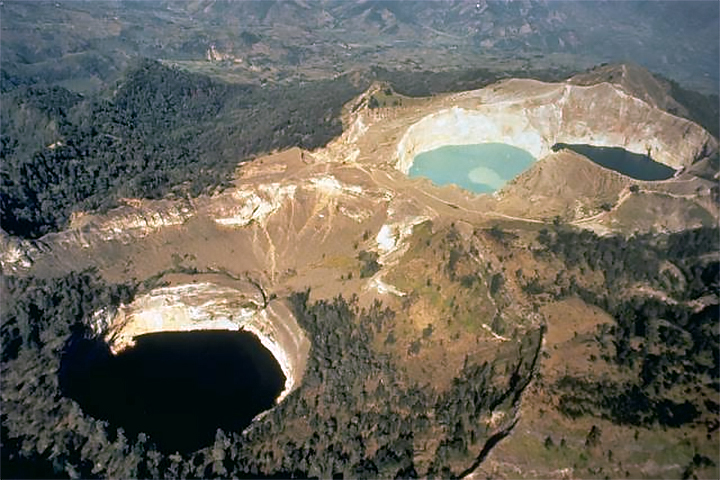
The crater lakes at the summit of Kelimutu volcano in Indonesia change colors from day to day. The colors can change from white, green, blue and brown to black.
Landsat 8 views from space of the 3 lakes at the summit of the Kelimutu volcano in Indonesia, known to change color unpredictably, via NASA Earth Observatory.
This composite image of Kelimutu volcano in Indonesia was the NASA Earth Observatory Image of the Day for July 6, 2018. It called them volcanic mood rings and explained:
From milky white to vibrant turquoise to blood red, the three lakes at the summit of the Kelimutu volcano are known to unpredictably change color – a phenomenon unique to this volcano on the Indonesian island of Flores.
These images, acquired by the Operational Land Imager on Landsat 8, show the various colors of the crater lakes on three different days. All three crater lakes appear on the crest of the volcano with the eastern two lakes sharing a common crater wall … Depending on when you visit, the colors can range from white, green, blue, brown or black. In 2016, the lakes changed colors six times.
Local folklore contends the lakes are the resting place for the dead, and that a person’s good or bad deeds in life determine which of the three lakes becomes his or her resting place.
Science says the changing colors of Kelimutu’s summit lakes are caused by fumaroles, or volcanic vents that release steam and gases, producing upwelling in the lakes and bringing denser, mineral-rich water from their bottoms to their surfaces. NASA Earth Observatory explained:
All of the lakes contain relatively high concentrations of zinc and lead.
While minerals play a part in the coloring, another key factor is the amount of oxygen present in the water. Like your blood, these lake waters appear bluer (or greener) when low in oxygen. When they are oxygen-rich, they appear blood red or even cola black.
Bottom line: NASA Earth Observatory Image of the Day for July 6, 2018, showing the three variously colored lakes at the summit of Kelimutu volcano in Indonesia.
Whether you find flocks of birds terrifying or mystifying, you can objectively say that they’re pretty skilled at not ramming into each other mid-flight.
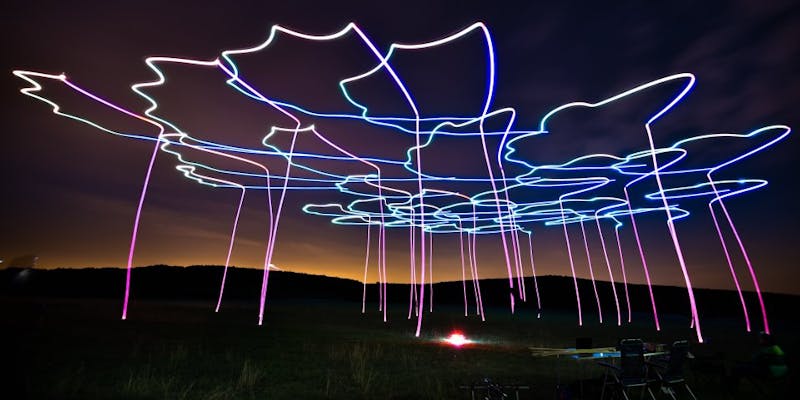
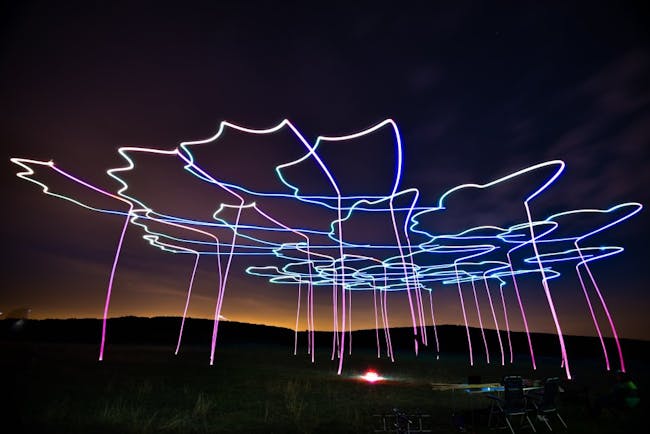
Looking to the success of birds, group of European researchers has successfully enabled a group of 30 quadcopters to fly in sync after programming the drones to mimic the flight of a flock of birds.
Dr. Gábor Vásárhelyi, the first author of this new research published on Wednesday in the Science Robotics journal, tells Inverse he believes collective bird movement holds the answer to solving an issue we’ll soon be faced with: Keeping thousands of drones from colliding over our heads. Dr. Agoston E. Eiben, a co-author of the new study, describes their development of drone technology that mimics how birds flock together as “natural computing.”
Here’s how they did it: Researchers spent six years observing pigeons with GPS devices to determine if they could reproduce these aerial formations of the birds with autonomous drones. For drones, mastering synchronized flight may be a crucial first step to mastering real-world delivery routes.
Flight simulation of 30 autonomous drones moving in a confined area at 6 m/s (13.4 mph) using the method developer by Vásárhelyi and his colleagues.
“When the first cars appeared on the streets people were walking in front of them and ringing a bell that cars were coming, but soon there we a diversity of cars moving in coordinated ways throughout cities, something similar is going on with drones,” Vásárhelyi says. “Now, every drone has a single pilot, soon these drones will have such a density in the air that we need to make them able to communicate with each other.”
Realistic simulations of 30-1000 drones flocking in confined environments
Why Drone Delivery Could Be Big Business
This in-air communication is crucial, because of the intense interest in drone delivery as a business. Multi-national companies and startups alike are working to make these services a reality.
The best-known player in the competition to develop delivery drones is probably Amazon: The e-commerce giant makes 1.6 million daily deliveries in the United States, according to one estimate. Even if its future Prime Air service would take care of a quarter of those deliveries, that would be thousands of autonomous drones that would some system to make sure they don’t slam into each other, or anything else.
30 drones light up the night sky.
Drone Delivery Faces Regulatory Obstacles
In March 2016, the Federal Aviation Administration announced that drone registration outnumbered that of airplanes. Standard planes use control centers to coordinate their flights but with so many drones in the sky, it would be impossible to develop a drone-ports to manage them all. Eiben tells Inverse that each drone will need to have the capability of managing itself.
There needs to be underlying, decentralized software to make sure [drones] don’t collide.”
“We have a massive e-commerce industry. If drone delivery gets big than urban environments will be a major hurdle for various drones sharing the same airspace,” says Eiben, a professor of computer science at VU University Amsterdam. “There needs to be underlying, decentralized software to make sure they don’t collide, it’s core to this advancement.”
Flying Drone Taxis Are Coming To Dubai
Eiben explained drone delivery has been held back by the “reality gap” — or the rift between what works in simulation and what works in real life. Previous studies found that even though solutions seemed promising on the computer screen, testing them on hardware would yield disappointing results. But not this time.
Vásárhelyi and his other colleagues built their own custom drones, implemented their bird-inspired models, which were refined by Eiben’s software expertise and dunked on prior research. They managed to get 30 quadcopters to self-organize themselves using GPS modules, just like our feathery, avian friends. They managed to pull this off by not only determining the distance to the closest drone but also calculate the speed and acceleration of their fellow robots.
But don’t worry, this isn’t the beginning of some futuristic version of Alfred Hitchcock’s The Birds. Vásárhelyi sees great potential for this type of technology to be used for search and rescue missions, as well as enabling drone deliveries.
So if the day comes where quadcopters are delivering parcels right to your window sill, remember to thank the birds. The OG drones.
Researchers have discovered what appears to be a cache of diamonds hidden in the Earth’s mantle. This suggests that, at a geological scale, diamond might not be the exotic mineral we once thought it to be — they may be quite common, though not easily accessible.
Diamond embedded in a rock matrix.
Image credits: Rob Lavinsky.
Earthquakes and diamonds
The world’s deepest borehole goes down 12.262 kilometers (40,230 ft). How is it then that we know so much about the depths of the Earth, which boasts an average radius of over 6,300 km? As is so often the case, scientists have gathered a trove of data which enabled them to infer many things beyond sight — in this case, of the Earth’s interior properties.
Seismometers record the ground movement on a seismograph. Based on the wiggles of the seismograph, certain pieces of information can be drawn, particularly about the nature of the ground the wave has passed through. Of course, this is a great simplification and the seismogram analysis process is much more intricate, often involving a great deal of complexity and mathematical algorithms. You can pick up simpler things, like where the earthquake epicenter was and how much energy the earthquake had, or use the data for complex things — like constructing an image of what the Earth’s interior might look like.
A simplified “slice” of the Earth, showing its major components (not to scale).
Image credits: Siyavula Education.
For decades, agencies such as the USGS, universities, and research groups have been keeping track of this seismic activity. Among many other things, scientists have noticed an intriguing anomaly: the velocity of some seismic waves in some areas could not be explained with our existing knowledge of the Earth’s structure.
In this particular case, an MIT team aimed to identify the composition of so-called cratonic roots that might explain the spikes in seismic speeds. They concluded that the reason for this anomaly is diamonds.
“This shows that diamond is not perhaps this exotic mineral, but on the [geological] scale of things, it’s relatively common,” says Ulrich Faul, a research scientist in MIT’s Department of Earth, Atmospheric, and Planetary Sciences. “We can’t get at them, but still, there is much more diamond there than we have ever thought before.”
Cratons
Cratons whose ancient rocks are widely exposed at the surface are typically called shields. If the ancient rocks are largely overlain by a cover of younger rocks, the craton is generally referred to as a platform.
Image credits: USGS.
The Earth’s crust made out of mobile, dynamic tectonic plates. We don’t see that because the movement is essentially unnoticeable at a human scale, but at a geological scale, tectonic plates move about quite a lot. Most tectonic plates’ movement is on the scale of a few centimeters per year.
Cratons are very old and stable parts of the Earth’s tectonic crust. Most cratons on Earth have survived cycles of merging and rifting of continents, and are typically located at the interior of tectonic plates. They have a thick crust and deep lithospheric “roots” that can extend several hundred kilometers into the Earth’s mantle.
Cratons are also colder and less dense than the surrounding mantle, which means that they would yield slightly faster seismic waves — but this alone can’t entirely account for the speed anomaly. So there must be something else.
“The velocities that are measured are faster than what we think we can reproduce with reasonable assumptions about what is there,” Faul says. “Then we have to say, ‘There is a problem.’ That’s how this project started.”
In order to solve this conundrum, Faul and colleagues started assembling virtual rocks which could theoretically exist at the temperature and pressure conditions in those parts of the mantle. They then calculated how fast seismic waves would pass through these structures, to see if this would fit the observed seismic data.
They found that the data would be best explained by a craton rock composition of 1 to 2 percent diamond. This would translate to about quadrillion tons of diamond.
In a way, this makes a lot of sense. We know that diamonds are forged deep in the bowels of the Earth, in high-pressure, high-temperature environments. The only reason why we’re able to find diamonds is that they’re brought closer to the surface by volcanic eruptions which act like “pipes” — bringing them to the surface, where we at least have a chance of finding them.
Of course, it’s important to note that Faul and colleagues found no direct evidence that the craton roots do contain diamonds, it’s just that this explanation seems to fit best. But this line of thinking has brought us so far, so at least for now, it seems convincing enough.
“It’s circumstantial evidence, but we’ve pieced it all together,” Faul says. “We went through all the different possibilities, from every angle, and this is the only one that’s left as a reasonable explanation.”
Journal Reference: Joshua M. Garber et al. Multidisciplinary “Constraints on the Abundance of Diamond and Eclogite in the Cratonic Lithosphere”, Geochemistry, Geophysics, Geosystems (2018). DOI: 10.1029/2018GC007534.
Ever had a moment when you feel like you’re important and what you do matters? Here’s the antidote.
Infrared view of a section within the North Galactic Pole, a region near the constellation Coma Berenices. Every point of light in this image represents anentire galaxy.
Image: ESA/Herschel/SPIRE; M. W. L. Smith et al 2017.
At a first glance, not much is going on in this image — just some yellowish noise on a blue-green background. But this photo from ESA’s Herschel Space Observatory shows much more than you’d think: every yellowish speck is a galaxy.
This is the North Galactic Pole, an area which covers some 180 square degrees of the sky and features a galaxy-rich cluster known as the Coma Cluster, which contains at least 1,000 points of light (read: galaxies).
Visual depiction of the spherical coordinate system for a point P.The polar angle is in blue, the azimuthal angle in red.
Just like on Earth, astronomers define observations using a coordinate system — but unlike the XYZ coordinate systems you might be more familiar with, they use a spherical coordinate system. In the former, a point is described by its X, Y, and Z coordinates.
A visual depiction of the spherical coordinate system for a point P. The polar angle is in blue, the azimuthal angle in red.
In a spherical system, a point is also described by three coordinates but, in this case, it’s the radial distance of that point from a fixed origin, the polar angle, and the azimuth angle. It can be a bit weird to wrap your head around, but it can be much easier to navigate astronomical observations.
So here, we have the North Galactic Pole, which lies far from the cluttered disc of the Milky Way and offers a good view of the distant Universe beyond our home galaxy.
Zoomed-in view showing about 8 percent of the entire photo width. How many galaxies can you count? Image: ESA/Herschel/SPIRE; M. W. L. Smith et al 2017. via Gizmodo.
The image above was taken at a wavelength of 250 μm, in the infrared range (the human visible range is generally within 0.4 – 0.7 μm). It was taken using the Herschel Astrophysical Terahertz Large Area Survey (H-ATLAS). Unfortunately, Herschel isn’t active anymore — it functioned from 2009 to 2013, using its instruments to study the sky in the far infrared range.
Aside from making us feel incredibly small and showing us just how puny our struggles really are, these pictures also help astronomers to estimate how many galaxies there are in the Universe. Recent surveys have estimated that number to be around 20 trillion, which is 20 times more than previous estimates gathered using the Hubble telescope. All these galaxies are packed with billions of stars, which can also host planets just like Earth.
Jupiter is definitely the most popular planet in the Solar System — at least as far as moons are concerned.
Image credits NASA / JPL-Caltech / JunoCam.
In Roman mythology, Jupiter (Zeus for the Greek) is quite the player. Never content to let a pretty mortal get by without his (usually unwanted) affections, the mythos abounds with the thunder god’s, um, transgressions. Which, quite understandably, gets everyone in deep trouble with his wife Juno (Hera in Greek mythology).
New research shows that the planet Jupiter is also quite happy to collect consorts. Twelve new moons have been discovered orbiting it, bringing the gas giant’s total collection to an impressive 79 moons — more than any other planet in the Solar System. One of these moons, according to the researchers who made the discovery, is an “oddball” that might help explain how the ochre giant got all of its moons. In a twist of mythological foreshadowing, it likely wasn’t a peaceful process.
The team from the Carnegie Institution for Science (story source) first spotted the moons in the spring of 2017. They weren’t looking for the moons per se — the team was actually looking for very distant objects in the Solar System as part of the hunt for Planet X, nestled somewhere far beyond Pluto. Some of the members involved in this research were actually part of the team that proposed the existence of this planet in the first place.
But back to the moons. As luck would have it, the researchers were simply looking in the right place at the right time to spot the gas giant — so they decided to have a look.
“Jupiter just happened to be in the sky near the search fields where we were looking for extremely distant Solar System objects, so we were serendipitously able to look for new moons around Jupiter while at the same time looking for planets at the fringes of our Solar System,” said team leader Scott Sheppard.
Based on these observations, members of the International Astronomical Union (IAU) calculated the orbits of the recorded bodies — and were surprised to see that they didn’t match any of Jupiter’s known moons.
“It takes several observations to confirm an object actually orbits around Jupiter,” said Gareth Williams, from the IAU’s Minor Planet Center, who was involved in the orbit calulations. “So, the whole process took a year.”
Various groupings of Jovian moons with the newly discovered ones shown in bold. Image credits Roberto Molar-Candanosa / Carnegie Institution for Science.
Nine of these bodies are more distant relative to other Jovian moons, and orbit in retrograde — the opposite direction of the planet’s spin. These distant moons form at least three distinct orbital groups; the team believes they’re the remnants of larger bodies that broke apart during past collisions with asteroids, comets, or other moons. They generally take about two years to orbit their host planet.
Two others form a closer group that orbits in the prograde — the same direction as Jupiter’s rotation. Since they both have similar orbital distances and inclinations relative to Jupiter, they’re also likely remnants from a larger moon that since broke apart. They take just shy of a year to orbit Jupiter.
The most surprising moon, however, is the runt of the litter.
“Our other discovery is a real oddball and has an orbit like no other known Jovian moon,” Sheppard explained. “It’s also likely Jupiter’s smallest known moon, being less than one kilometer in diameter.”
This tiny moon has a more inclined orbit and keeps a wider berth to the planet that the prograde group. Its orbit crosses that of the outer, retrograde group, making head-on collisions much more likely between itself and this latter group.
This situation could explain how Jupiter got so many moons. Today, head-on collision would break any of the bodies “down to dust”, Shepard says, and could shatter a larger body into the tiny moons of today. It’s possible then that the current various moon groupings were formed in the distant past through such collisions.
The oddball itself could be all that remains of a much larger prograde moon that impacted with other bodies to create the retrograde group identified by the team. It has yet to be christened, but the name Valetudo (the Roman goddess of health and hygiene and Jupiter’s great-granddaughter) has been suggested.
WETENSCHAP & PLANEETDe wetenschap schenkt ons meestal klare antwoorden, maar roept soms ook extra vragen op. Volgende ontdekkingen doen je waarschijnlijk bedenkelijk met de wenkbrauwen fronsen.
Onderzoekers houden zich normaal zoet met de grote levensvragen. Zo riep Archimedes luidkeels eureka uit eenmaal hij zijn beroemde natuurkundewet neerschreef die verklaart waarom een schip blijft drijven. Newton testte met behulp van een appel uit hoe de zwaartekracht werkt en Thomas Edison gaf ons meer dan enkel kaarslicht: de gloeilamp.
Natuurlijk is het vandaag de dag wat moeilijker om een belangrijk onopgelost vraagstuk te vinden. Dus houden wetenschappers zich bezig met bedenkelijke experimenten met even bizarre resultaten. Nieuwsgierigheid is toch de motor van de wetenschap?
1. Één kilogram veren
“Wat weegt meer? Een kilogram lood of een kilogram veren?” Het is een klassieke instinker. Logischerwijs zouden beide opties evenveel wegen. Het hoopje pluimen is waarschijnlijk wel een pak groter.
Toch bewees een proef het tegendeel. Onderzoekers blinddoekten enkele personen waarna ze een doos gevuld met lood en een doos gevuld met hetzelfde gewicht aan veren moesten optillen. Wanneer men hen vroeg om de zwaarste doos aan te duiden, selecteerden de meeste proefpersonen de doos met veren.
2. Van vetberg naar biodiesel
In 2017 werd Londen geteisterd door een gigantische blokkade van de rioleringen. Bijna 250.000 kilogram samengekoekt vet, luiers, toiletdoekjes en ander afval had zich opgehoopt en verhinderde de goede werking het rioolbeheer.
Eenmaal de bevoegde instanties de reusachtige berg afval verwijderden, gingen de beelden de wereld rond. Het prikkelde niet enkel de nieuwsgierige kijker maar ook enkele wetenschappers. Ze beweerden dat ze de vetberg voor andere doeleinden konden gebruiken. Ze besloten de berg in kleinere stukken te hakken en het afval van het vet te scheiden. Dat vet zetten ze uiteindelijk om in biodiesel, een milieuvriendelijkere brandstof dan diesel en benzine. Zo’n 350-tal bussen konden een dag rondrijden met het resultaat van het experiment.
3. De kracht van pinguïnuitwerpselen
Wanneer pinguïns poepen, doen ze dat gewoon vanuit hun nest. Dat lijkt misschien niet zo netjes. Toch bevuilen de zeevogels hun slaapplaats niet. Ze bewegen hun achterste simpelweg naar de rand van het nest waarna ze met enorm veel druk hun uitwerpselen naar achter spuiten. De druk die daarbij komt kijken is veel groter dan die bij de menselijke ontlasting. Je zou er als ongelukkige pinguïn maar net achter staan.
In 1994, toen de anticonceptiepil een beetje beter in de markt lag, onderzochten wetenschappers wat voor ’n zichtbaar effect het pilletje had op vrouwen. Zo ondervonden ze dat vrouwen die de pil innamen feller blonken dan vrouwen die dat niet deden.
Al lijkt het niet meteen geloofwaardig, recenter onderzoek bewijst dat een anticonceptiepil een invloed uitoefent op 150 verschillende biologische functies. Eentje daarvan is waarschijnlijk verantwoordelijk voor een vettere en glimmende huid.
5. Een vinger in de poep tegen het hikken
In de jaren ’90 kon een zestigjarige man maar niet stoppen met hikken. Een vervelend kwaaltje vond hij. Dus bezocht hij zijn dokter. Die dacht dat het misschien te wijten was aan de neussonde die zijn patiënt moest dragen. Maar ook na het verwijderen van de sonde stopte het hikken niet. Vervolgens schreef hij de oude man enkele medicijnen voor. Tevergeefs.
Tenslotte zocht de wanhopige dokter zijn antwoord bij een eerder gerapporteerd geval. Daar werd de patiënt van zijn lijden verlost met behulp van een prostaatmassage. Kortom, de dokter stak zijn vinger in de poep van zijn patiënt en vreemd genoeg kon dat soelaas bieden.
6. De gevaren van een grasmaaier
Heb je jezelf al eens ooit pijn gedaan tijdens het grasmaaien? Dan ben je niet alleen. In 1988 ondervonden enkele onderzoekers dat maar liefst 70.000 van de verwondingen in de Verenigde Staten te wijten waren aan grasmaaiers. Daarvan ging het bij vijf procent om een pijnlijke wonde aan het oog.
Al denk je dat het er misschien op vooruit ging omdat grasmaaiers heel wat hipper zijn, nieuwe studies bewijzen het tegendeel. Intussen blijkt de grasmaaier verantwoordelijk te zijn voor 75 doden per jaar. Ook het aantal gewonden wordt alleen maar groter. Meestal gaat het om verwonde vingers of handen.
7. Kleur van medicatie doet er toe
Nog voordat we een pilletje innemen, vraagt ons brein zich al of het zal werken of niet. De kleur en vorm ervan beïnvloeden het verdict. Blauwe medicatie wordt als kalmerend waargenomen. Pillen met een rode en oranje kleur hebben een tegengesteld effect. Van zulke pillen verwacht men een stimulerend effect en die verwachting wordt meestal ingelost, zelfs bij placebo’s. Gele varianten hebben dan weer een antidepressieve werking en heldere kleuren blijken over het algemeen een beter effect te hebben dan neutrale kleurtjes.
8. Viagra verlost hamsters van hun jetlag
Hoe ze in godsnaam op het idee kwamen, weet niemand. In 2007 vermoedden enkele vernuftige onderzoekers dat Viagra een handje kon helpen bij het verwerken van hamsters hun jetlag. Ze wijzigden de tijdzone en simuleerden een verschil van zes uur. Na het toedienen van Viagra bleken de hamsters tot vijftig procent sneller te herstellen van het tijdsverschil dan de hamsters die geen hulp kregen. Of de sekspil eenzelfde invloed heeft op de mens moet nog onderzocht worden.
wiggenraadJe hond kiest weloverwogen hoe en waar hij zijn uitwerpselen achterlaat.
9. Honden poepen enkel noord of zuid
Let eens op de manier waarop je hond poept. Tenslotte toont onderzoek aan dat de dieren steevast naar het noorden of het zuiden kijken wanneer ze hun uitwerpselen lozen. Blijkbaar doen ze dat omdat ze zich bewust zijn van het magnetisch veld van onze aarde. En ze zijn niet alleen. Ook koeien en herten houden er rekening mee. Leg gerust een kompas naast je trouwe viervoeter wanneer hij nog eens hurkt.
Water-bearing minerals reveal that Earth’s mantle could hold more water than all its oceans. Researchers now ask: Where did it all come from?
A couple hundred pebble-size diamonds, plucked from Brazilian mud, sit inside a safe at Northwestern University. To some, they might be worthless. “They’re battered,” said Steve Jacobsen, a mineralogist at Northwestern. “They look like they’ve been through a washing machine.” Many are dark or yellow, far from the pristine gems of jewelers’ dreams.
Yet, for researchers like Jacobsen, these fragments of crystalline carbon are every bit as precious — not for the diamond itself, but for what is locked inside: specks of minerals forged hundreds of kilometers underground, deep in Earth’s mantle.
These mineral flecks — some too small to see even under a microscope — offer a peek into Earth’s otherwise unreachable interior. In 2014, researchers glimpsed something embedded in these minerals that, if not for its deep origins, would’ve been unremarkable: water.
Not actual drops of water, or even molecules of H20, but its ingredients, atoms of hydrogen and oxygen embedded in the crystal structure of the mineral itself. This hydrous mineral isn’t wet. But when it melts, out spills water. The discovery was the first direct proof that water-rich minerals exist this deep, between 410 and 660 kilometers down, in a region called the transition zone, sandwiched between the upper and lower mantles.
This diamond from Juína, Brazil, originally formed deep inside Earth. It contains an inclusion of ringwoodite, a water-bearing mineral.
University of Alberta
Since then, scientists have found more tantalizing evidence of water. In March, a team announced that they had discovered diamonds from Earth’s mantle that have actual water encased inside. Seismic data has also mapped water-friendly minerals across a large portion of Earth’s interior. Some scientists now argue that a huge reservoir of water could be lurking far beneath our feet. If we consider all of the planet’s surface water as one ocean, and there turn out to be even a few oceans underground, it would change how scientists think of Earth’s interior. But it also raises another question: Where could it have all come from?
Water World
Without water, life as we know it would not exist. Neither would the living, dynamic planet we’re familiar with today. Water plays an integral role in plate tectonics, triggering volcanoes and helping parts of the upper mantle flow more freely. Still, most of the mantle is relatively dry. The upper mantle, for instance, is primarily made of a mineral called olivine, which can’t store much water.
But below 410 kilometers, in the transition zone, high temperatures and pressures squeeze the olivine into a new crystal configuration called wadsleyite. In 1987, Joe Smyth, a mineralogist at the University of Colorado, realized that wadsleyite’s crystal structure would be afflicted with gaps. These gaps turn out to be perfect fits for hydrogen atoms, which could snuggle into these defects and bond with the adjacent oxygen atoms already in the mineral. Wadsleyite, Smyth found, can potentially grab onto lots of hydrogen, turning it into a hydrous mineral that produces water when it melts. For scientists like Smyth, hydrogen means water.
Deeper in the transition zone, wadsleyite becomes ringwoodite. And in the lab, Jacobsen (who was Smyth’s graduate student in the 1990s) would squeeze and heat bits of ringwoodite to mimic the extreme conditions of the transition zone. Researchers doing similar experiments with both wadsleyite and ringwoodite found that in the transition zone, these minerals could hold 1 to 3 percent of their weight in water. Considering that the transition zone is a roughly 250-kilometer-thick shell that accounts for about 7 percent of Earth’s mass (by comparison, the crust is only 1 percent), it could contain several times the water of Earth’s oceans.
Lucy Reading-Ikkanda/Quanta Magazine
These experiments, however, only gauge water capacity. “It’s not a measurement of how wet the sponge is, it’s a measurement of how much the sponge can hold,” said Wendy Panero, a geophysicist at Ohio State University.
Neither were the experiments necessarily realistic, since researchers could only test lab-grown ringwoodite. Apart from a few meteorites, no one had ever seen ringwoodite in nature. That is, until 2014.
Tantalizing Clues
While soccer fans converged on Brazil for the 2014 World Cup, a small group of geologists headed to the farmlands around Juína, a city almost 2,000 kilometers west of Brasilia. They were on the hunt for diamonds that had been panned from local rivers.
As diamonds form in the heat and high pressure of the mantle, they can trap bits of minerals. Because diamonds are so tough and rigid, they preserve these mantle minerals as they’re blasted to the surface via volcanic eruptions.
The researchers bought more than a thousand of the most speckled, mineral-filled crystals. One of the scientists, Graham Pearson, took several hundred back to his lab at the University of Alberta, where, inside one particular diamond, he and his colleagues discoveredringwoodite from the transition zone. Not only that, but it was hydrous ringwoodite, which meant it contained water — about 1 percent by weight.
Graham Pearson, a geochemist at the University of Alberta, led the team that discovered hydrous minerals from the mantle.
Natasha Barrett
“It’s an important discovery in terms of plausibility,” said Brandon Schmandt, a seismologist at the University of New Mexico. For the first time, scientists had a sample of the transition zone — and it was hydrated. “It’s definitely not crazy, then, to think other parts of the transition zone are also hydrated.”
But, he added, “it would also be a little crazy to think that one crystal represents the average of the entire transition zone.” Diamonds, after all, form only in certain conditions, and this sample might come from a uniquely watery place.
To see how widespread hydrous ringwoodite could be, Schmandt teamed with Jacobsen and others to map it using seismic waves. Due to convection, hydrous ringwoodite can sink, and as it drops below the transition zone, the rising pressure wrings water out, causing the mineral to melt. Just beneath the transition zone where mantle material is descending, these pools of molten minerals can abruptly slow seismic waves. By measuring seismic speeds under North America, the researchers found that, indeed, such pools appear common below the transition zone. Another studymeasuring the seismic waves under the European Alps found a similar pattern.
Abundant mantle water got yet another boost in March when a team led by Oliver Tschauner, a mineralogist at the University of Nevada, Las Vegas, discovered diamonds that contain actual pieces of water ice — the first observation of freely existing H2O from the mantle. The samples might say more about the wet conditions that formed the diamond than the existence of any ubiquitous reservoir. But because this water — a high-pressure form called ice-VII — was found in a variety of locations across southern Africa and China, it could turn out to be relatively widespread.
“A couple years from now, we’ll find ice-VII is much more common,” said Steve Shirey, a geologist at the Carnegie Institution for Science. “It’s telling us we have the same story that hydrous ringwoodite is telling us.”
But if the story is that the mantle is brimming with water, the cliffhanger leaves us wondering how it all got there.
Watery Origins
According to the standard tale, Earth’s water was imported. The region around the sun where the planet formed was too hot for volatile compounds like water to condense. So the nascent Earth started out dry, getting wet only after water-rich bodies from the distant solar system crashed into the planet, delivering water to the surface. Most of these were likely not comets but rather asteroids called carbonaceous chondrites, which can be up to 20 percent water by weight, storing it in a form of hydrogen like ringwoodite.
But if there’s a huge stockpile of water in the transition zone, this story of water’s origin would have to change. If the transition zone could store 1 percent of its weight in water — a moderate estimate, Jacobsen said — it would contain twice the world’s oceans. The lower mantle is much drier but also voluminous. It could amount to all the world’s oceans (again). There’s water in the crust, too. For subduction to incorporate that much water from the surface at the current rate, it would take much longer than the age of the planet, Jacobsen said.
Steve Jacobsen, a mineralogist at Northwestern University, argues that the mantle holds more water than Earth’s oceans.
J.R. Smyth
If that’s the case, at least some of Earth’s interior water must have always been here. Despite the heat in the early solar system, water molecules could have stuck to the dust particles that coalesced to form Earth, according to some theories.
Yet the total amount of water in the mantle is a highly uncertain figure. At the low end, the mantle might hold only half as much water as in the world’s oceans, according to Schmandt and others.
On the high end, the mantle could hold two or three times the amount of water in the oceans. If there were much more than that, the additional heat of the younger Earth would have made the mantle too watery and runny to fracture the continental plates, and today’s plate tectonics may never have gotten started. “If you have a bunch of water in the surface, it’s great,” said Jun Korenaga, a geophysicist at Yale University. “If you have a bunch of water in the mantle, it’s not great.”
But many uncertainties remain. One big question mark is the lower mantle, where extreme pressures turn ringwoodite into bridgmanite, which can’t hold much water at all. Recent studies, however, suggest the presence of new water-bearing minerals dubbed phase D and phase H. Exactly what these minerals are like and how much water they might store remains an open question, Panero said. “Because it is a wide-open question, I think that the water content in the mantle remains open for debate — wide open.”
Measuring Earth’s interior water storage isn’t easy. One promising way is to measure the electrical conductivity of the mantle, Korenaga said. But those techniques aren’t yet as advanced as, say, using seismic waves. And while seismic waves offer a global view of Earth’s interior, the picture isn’t always clear. The signals are subtle, and researchers need more precise data and a better understanding of the properties of more realistic mantle material, instead of just ringwoodite and wadsleyite. Those two minerals constitute about 60 percent of the transition zone, the rest being a complex mix of other minerals and compounds.
Finding more diamonds with hydrous minerals would help, too. In Jacobsen’s lab, that job falls to graduate student Michelle Wenz. For each diamond, she uses powerful X-rays at Argonne National Laboratory to map the location of every mineral speck, of which there may be half a dozen. Then, to identify the minerals, she blasts X-rays onto each bit and measures how the rays scatter off its crystal structure. Of the hundreds of diamonds in the lab, all from Brazil, she’s gone through about 60. No water yet.
Water or not, she said, these capsules from the deep are still amazing. “Each one is so unique,” she said. “They’re a lot like snowflakes.”
Correction:This article was revised on July 11, 2018, to correct a typographical error; it is the mantle, not the ocean, that could hold two or three times the amount of water in the oceans.
De zoektocht naar verborgen oceanen in het onbereikbare binnenste van de aarde. Waar komt dit water vandaan?
Diamanten uit het onbereikbare binnenste van de aarde blijken water te bevatten. Dat lees je goed: water.
Als de mineralen worden gesmolten, komt er water uit tevoorschijn. Deze waterrijke mineralen bevinden zich op een diepte van 410 tot 660 kilometer in de mantel en mogelijk nog veel dieper.
Sommige wetenschappers stellen dat zich ver onder onze voeten een gigantische watervoorraad bevindt.
Belangrijke rol
Als je al het oppervlaktewater op aarde als één oceaan ziet, dan kunnen zich onder de grond met gemak enkele oceanen bevinden. De vraag is nu waar al dit water vandaan komt.
Water speelt een belangrijke rol bij platentektoniek, vulkaanuitbarstingen en zorgt ervoor dat delen van de mantel zich vrijer kunnen bewegen.
Het bovenste gedeelte van de mantel bestaat vooral uit olivijn, een mineraal dat weinig water kan opslaan.
Maar vanaf een diepte van 410 kilometer verandert olivijn als gevolg van hoge temperaturen en druk in wadsleyiet, dat veel gemakkelijker water opslaat.
Meerdere keren
Op nog grotere diepte wordt wadsleyiet ringwoodiet. Deze mineralen bestaan voor zo’n één tot drie procent uit water.
Aangezien het gebied waarin ze voorkomen zeven procent van de massa van de aarde uitmaakt, kan het meerdere keren de totale hoeveelheid van al het water op aarde bevatten.
In maart ontdekte Oliver Tschauner van de Universiteit van Nevada in Las Vegas diamanten uit de mantel die stukjes waterijs bevatten. Het was de eerste aanwijzing dat H2O voorkomt in de mantel.
Sneeuwvlokken
Als de mantel vol water zit, is water van de aarde niet van buitenaf naar onze planeet gekomen. Dat water moet er dan altijd al zijn geweest.
Studente Michelle Wenz doet in het laboratorium onderzoek naar de diamanten. “Ze zijn allemaal zo uniek,” zei ze. “Ze lijken erg op sneeuwvlokken.”
At first, ancient Egyptians buried all of their dead, regardless of social status, in pits in the sand that covers much of their country. The dry air quickly and naturally preserved these bodies, giving Egyptian religions support for their beliefs in the afterlife. Unfortunately, animals had no such respect for the human dead, so the bodies were later placed in coffins or sarcophagi, which protected them from beasts but not from decomposition. Somewhere around 2800 BCE, a type of artificial mummification began to be developed and tested, using oils and minerals and techniques that have mystified and baffled those trying to duplicate them.
Until now.
At a press conference in Cairo, Egypt’s Ministry of Antiquities announced that German and Egyptian archeologists led by Ramadan Badry Hussein have uncovered an ancient laboratory or workshop dating back to the Saite-Persian period (664-404 BCE) which contains fragments of mummy cartonnages (funeral masks), canopic jars (used for storing human organs removed before mummification) and clay and glazed ceramic cups (pictures here). Even more exciting to Hussein was the discovery of the ingredients and possible measurements for making the secret embalming fluids.
“This [discovery] is so important as it’s extensive. We have oils and measuring cups – all of them are labelled … from this we can find the chemical composition of the oils and discover what they are.”
Set of canopic jars
The laboratory was located next to a 30 meter (98 foot) shaft filled with the end results – mummies. On one of these mummies they found something nearly as significant as the workshop – a gilded silver mask belonging to a priest. Only a handful of these masks covered with precious metals have been found due to looting.
That brings us to how the mummy lab was found in the first place. The Saqqara necropolis of Memphis was last excavated in 1900 but was looted in 2011 during Egyptian protests. It was reopened in 2016 as part of Egypt’s push to use archeology to increase tourism. Artifacts from the discovery of the mummy lab are already on display at the Grand Egyptian Museum, which is still under construction.
Is this push to increase Egyptian tourism through mummies the new looting? Despite warnings, archeologists plan to open a giant mysterious sarcophagus discovered in Alexandria. Researchers are also going back to previously-investigated tombs and sites to search again. Is archeology and history being pushed aside in the name of money? Peru seems to be making an attempt to protect its mummies – real or otherwise – and the World Congress on Mummy Studies is pushing for the same in other countries. Can the mummy workshop at least be protected until its secrets are studied by scholars?
Or is this just another example of why we can’t have nice things?
I founds some mind-blowing alien structures in this large moon photo from the Univ of Arizona index controlled by the USGS and NASA. The most remarkable thing I found was an emerald green dome over a crater. Reminds me of the Emerald City from the Wizard of Oz. There were also two large black shiny domes over craters not far away. I'm not sure how astronomers around the world have ignored such discoverers, but from my research I have learned that NASA has donated a lot of money to observatories around the world, probably to control their research and their released findings. Its up to us, the public to release the truth about the existence of aliens. The truth is...every planet and moon in our solar system has had alien life upon it or within it. Scott C. Waring
Large “Mythological” Fire Bird Spotted Near Yellowstone
A strange colorful bird has been spotted on the Grand Teton National Park live webcam just days after a highly popular area near Jenny Lake in Grand Teton National Park located near the Yellowstone National Park has been closed to the public for the immediate future due to concerns over expanding cracks and fissures in a large rock formation.
While Yellowstone seems to be in a perpetual state of unrest with its Steamboat geyser that has erupted for the 11th time since March and now the expanding cracks and fissures at the Grand Teton National Park the appearance of this colorful bird that resembles the mythological fire bird is at least odd.
The fire bird also called as a phoenix is a sacred fire bird found in the mythologies of many cultures and described as a large magical glowing bird with majestic plumage that glows brightly emitting red, orange, and yellow light, like a bonfire that is just past the turbulent flame.
The fire bird can be seen at around the 2.08 mark in the video and according to the ancient legend the fire bird comes from a faraway land which is both a blessing and a bringer of doom.
Roads have always seemed to attract about them tales of the strange and unusual. They push out, further and further ahead of us, their destinations not visible, mysterious, as the landscape rushes by us, sometimes bringing with it bizarreness. It is perhaps this almost primal sense of oddness that has spawned countless tales of haunted roads, inhabited by all manner of strange entities and apparitions. One feature of some spooky haunted roads are ghost lights, also called spook lights, dancing and twirling in the dark to baffle and amaze, and sometimes they seem to be far from harmless.
Some malevolent spook lights seem to be linked to some sort of phantom motorists, and perhaps one of the more well-known of these is said to prowl a rural road in Switzerland, in St. Johns County, Florida, in the United States. Here there is a modest little road called Greenbriar Road, which runs just east of the main town, and there have for years been tales of a rather aggressive spook light that stalks vehicles that dare to drive along here at night. The enigmatic light is typically said to look just like a motorcycle headlight, which will pull up behind cars and steadily catch up no matter how fast one goes, growing ever larger in the rear view mirrors of the startled drivers.
The light of Greenbriar Road will then either chase the car until it is gone, or bizarrely perch itself atop the vehicle, sort of piggybacking the car for some distance before blinking out of existence as if it were never there at all. In some cases the mysterious light has even been blamed for causing crashes along this lonely stretch of road. The most common origin story for this mysterious light is that it is the wraith of a doomed motorcyclist who died along the road when he was decapitated after running into a telephone pole wire, and that he now terrorizes the stretch upon which he met his fate, with only the headlight of his phantom bike visible. One witness named Todd M. gave an account on the site Weird U.S. thus:
A few years ago I went to see Greenbriar Road at night with three of my friends. We had heard the stories about that light that people see and we wanted to see it. We drove up and down the road for like forty-minutes trying to see something but never saw anything until we got ready to leave. My friend Tom was driving and he looked in the rear view mirror and said what is that? We looked behind us and there was the headlight of a motorcycle coming up fast. We slowed down a little and thought that the biker would pass us but then just as it got right behind us about a hundred feet the light went out. There was no motorcycle or anything. We turned around and went back but didn’t see anything. I really think we saw a ghost biker of that guy that was killed on his motorcycle on that road.
The malignant Greenbriar ghost light is so well-known in the area that it has been the target of paranormal investigations and even scientific studies and police investigations trying to find a rational explanation for what people are seeing, but no explanation has ever been found. Speaking of phantom motorcyclists, there is another similar spook said to haunt a remote stretch of road winding through the rural farming community of Exeter, in Tulare County, California, which is supposedly the stomping ground of a similar ghost.
In this case, in the 1950s a group of friends allegedly decided to play a prank on one of their friends by stretching out some rope across a narrow road called Bardsley road, in the Fresno Valley, after which they lied in wait for their motorcycle riding pal to come cruising by on his way home from work. The plan was for the rope to just hit him in the chest and knock him off his bike, which was pretty mean but they certainly didn’t intend to seriously hurt him, certainly not kill him.
The story goes that the rider came along the darkened road as expected and hit the rope just as expected. What wasn’t expected was that the rope would be too high and lop his head clean off to go rolling across the pavement. In the aftermath of the gruesome accident, people started occasionally claiming to see a bright light shooting up and down the road, sometimes accompanied by the sound of a motorcycle engine, and with the full apparition of a headless rider visible as well. Motorists and people walking along the road at night have also told of being followed or even chased by the phantasm motorcyclist, and it is believed that if you encounter the rider you will be cursed to be in an accident yourself.
Adding to these a is headless rider is said to prowl Creek Road of Ojai, California, apparently riding a vintage 1940s motorcycle and appearing as a glowing light at first, often pulling up next to motorists to bang on their vehicles or chasing them. Interestingly, Creek Road is ground zero for all manner of ghostly phenomena and high strangeness, including at least two phantom horse riders, numerous apparitions, a smoking, horribly burned and disfigured entity called the Char Man, and even a supposed vampire, making a headless motorcycle rider actually one of the less bizarre tales from this place. For more on phantom motorcyclists, you can read my article on this phenomenon here.
Other sinister spook lights seem to be malevolent spirits or even possibly demons. Located out just northeast of Jacksonville, Florida, is St. George Island, which is home to a historic sugar cane, cotton, and corn plantation from the slave days called Kingsley Plantation, established by a Zephaniah Kingsley in 1813. The original plantation would quickly grow until Kingsley owned around a total of 32,000 acres of land and employed about 200 slaves. Despite having so many slaves, Kingsley was known for being a very lax and kind master, allowing his workforce to basically do whatever they wanted when they were off duty, and they were allowed to sell any crafts they made on their own time. Kingsley even married one of his slaves, Ana Madgigine Jai, who would go on to take a prominent management role on the plantation, own her own land, and end up being one of the richest women in the state.
Although conditions were much better for slaves on the Kingsley plantation than they were elsewhere, there was some amount of tragedy on the plantation nevertheless. At some point one of the slaves allegedly took to beating and raping other female slaves, even according to the stories murdering a few and hiding their bodies in the wilderness. When the other slaves got wind of this grim behavior they are said to have gathered a lynch mob to hunt the perpetrator down and hanged on a massive, spooky looking oak tree right in front of the plantation along the main road to the premises, leaving his lifeless body to swing there in the wind. Although Kingsley would move to Haiti along with all of his slaves in 1837, it seems that at least some of them remained, in a macabre sense.
Over the years the Kingsley plantation has come to gather quite a reputation for being intensely haunted, supposedly by the ghosts of those murdered here. One is a woman in white that is frequently spotted roaming around, and has a habit of photo-bombing pictures taken at the locale, while another is an unearthly screaming or wailing that supposedly emanates from the old abandoned well on the property, said to be from a victim of the crime spree whose body was unceremoniously dumped down there in the darkness.
Kingsley Plantation
However, one of the most frightening of the spirits of the old Kingsley Plantation is supposedly the vindictive spirit of the slave murderer himself, who terrorizes the plantation’s creepy and rugged unpaved road. This particularly malicious spirit typically takes the form of two malevolent, angry looking red lights, said to be his glowing eyes, earning the phantom the name “Old Red Eyes.” These lights will supposedly appear behind cars right about at the old oak tree and chase them, in some reports even relentlessly attacking them. One report of an encounter with Old Red Eyes was described by a witness thus:
I’ve saw Old Red Eye several years ago. I have a friend that lives just off that road and had taken him home from Jacksonville one night. It was about midnight and after dropping him off, I was driving back down that road to the hard road and looked in the side mirror on my car and saw two red lights. At first I thought it was the tail lights of another car but they were too close together. I slowed down a little and watched them in the mirror and it looked like they were coming closer. I knew that I had not passed another car and it did not seem like a car would be coming down that dark road backwards. I stopped and stuck my head out the window and looked back and there was nothing there. Then I looked in the mirror again and there they were and they were right behind my car. I gunned it and got the hell out of there. What I saw wasn’t a car.
Just as ominous is the appropriately named “Demon’s Road” in Huntsville, Texas, which is already spooky enough, as it meanders through groves of twisted trees and darkened woods and ends up at the desolate Martha’s Chapel Cemetery. The real name is Bowden Road, but it has earned its nickname in the decidedly frightening phenomena that have been reported from here, such as shadow people, a ghostly child on a tricycle, a hulking faceless beast, a strange hooded figure, and arms reaching out from graves. There are many spirits said to lurk along the murky stretches of this road and in the cemetery, but one of the creepiest is a ghost light that seems to be quite malicious indeed.
Motorists venturing down the Demon’s Road have often reported mysterious red lights hovering about in the dark, the number of which seems to depend on how many people are in the vehicle at the time. These spook lights will supposedly aggressively pursue cars, and spookiest of all, will leave unexplained handprints on the outside. Indeed these lights have plagued many who have travelled down the road, often leaving those handprints and always hostile, sometimes even clawing or grabbing at cars to leave scratches and dents behind. What could this diabolical force be and why does it want to attack vehicles? Who knows?
Another case in Texas of an aggressive ghost light is that said to roam a road in Hardin County leading from Bragg to Saratoga, which actually at one point was a part of the Santa Fe Railroad back in the early 1900s before being paved over to be turned into a road. In an area called Big Thicket there have long been reports of a multicolored spook light hovering about at night along the road and in the surrounding wilderness, with many of them pointing at the light being quite evil.
Even from beginning the reports of the Big Thicket ghost light, also called the Saratoga ghost light, were far from friendly. Hunters reported being chased by the lights and it was not uncommon to here of them rushing amongst horses to send the animals into a panicked frenzy, to the point that on at least one occasion a horse drawn wagon was forced to go crashing into a ditch because of the lights. At the time the lights became a pretty widespread rumor, attracting all sorts of curiosity seekers, and author F.E. Abernethy would explain of the phenomenon in his book Tales from the Big Thicket thus:
Light-seers poured onto the road by the hundreds. People of all ages and intellects came to see and test their belief in the supernatural. They shot at it, they chased it, and they tested it with litmus paper and geiger counters. A preacher harangued the road’s multitudes from the top of his car, making the Light as an ill omen of the world’s impending doom. There were some nights the light didn’t show at all, but for the most part it was there to inspire stories that could be passed on, to change and grow at the will and imagination of the story teller.
The Big Thicket Ghost Light road
In later years the light did not stop its antics in the slightest bit, with reports of it chasing people or even attacking them common, such as cases in which the light stopped car engines, burned people’s hands, or even violently knocked them down. There have been reports of cars being dinged, dented, or smashed by the ghost light, and it is generally not something one wants to encounter while driving down the already eerie rural road. As usual there have been many attempts to rationally explain the Big Thicket Light, such as that it is some sort of illusion, swamp gas, or merely headlights, and there have been a fair number of more paranormal explanations as well, including that it is the spirit of a hunter or Civil War soldier, or even that it is a curse placed over a lost Spanish treasure. Whatever the case may be, the stories of the evil ghost light of Saratoga persist.
Texas seems to be a haven for such spook lights, because there is another road in this state that has its own scary stories of such entities. In the area of the Mitchell Flat, east of Marfa, Texas, there have long been reports of mystery lights floating out over the desert landscape since at least the 1800s. The phenomena are usually described as dancing orbs of light that zip and zoom low to the ground over the parched desert scrub, and they have collectively been coined the “Marfa Lights.” While the phenomenon is puzzling but usually harmless, there have been some reports that show these lights can be rather frightening on occasion.
In one report from Weird Texas, one man named Tim Stevens gave an account of a very bizarre experience witnesses by a friend of his father’s named Roy while traveling down Route 90 in the 1970s. According to the report, Roy had been driving for hours out from San Antonio after sunset and just before dark, and there had been no other cars out on this remote stretch of the highway that evening. Suddenly, he noticed what he took to be headlights in his rear view mirror. For some time the lights remained a comfortable distance away, but at some point the lights quickly closed the distance to follow right behind him. The report explained the follwing sequence of events:
My dad said that Roy had been driving with the lights a comfortable distance behind him for several minutes when the vehicle sped and up and approached his truck rapidly. For a few seconds, he honestly thought he was about to be rear-ended. Before an impact occurred, however, the lights stopped a few feet short of hitting his truck. At 60 MPH, in the middle of an otherwise deserted highway, it probably wasn’t too much to ask for the courtesy of a little breathing room. So Roy tapped the brakes. The driver of the vehicle behind him maintained his distance. Roy again tapped his brakes––no response. Finally, very annoyed, Roy jammed hard on his brakes for a fraction of a second. To his amazement, the vehicle behind him stayed the exact distance from his rear bumper as it had been.
Roy decided to try a different approach. He said he floored the gas pedal making his small truck shudder and lurch ahead. The speed crept up to 80 MPH. The lights behind him reacted in perfect unison, staying several feet behind his truck, as it approached speeds Roy was sure he’d never pushed it to before. At nearly 100 MPH, the truck was beginning to vibrate badly, but the lights did not waiver.
Enough was enough. Roy eased off the gas and let the truck coast down to a sane speed, and then he stood on the brakes. The tires screeched and smoked, and the truck pitched and slid slightly to the side––but the whole time, Roy watched the lights in the mirror. They stayed in exactly the same spot until the truck came to a stop. Roy then saw something completely unexpected––the lights shot out, off the road to the right, and fired across the desert like missiles. He craned his neck around to try and follow them visually, impressed by the driver’s driving on what was sure to be very rough road. He smiled and was about to drive on when a thought occurred to him.
He frowned, and, making sure that he wasn’t about to be run over by a big rig or other traffic, put his truck in reverse and slowly backed up maybe a couple of hundred feet. He checked the barbed wire fence line for a road, a gate, or other break of some kind where his pursuer might have slipped through––but there was none. Roy said he was pretty spooked, alright. Off in the distance he could see lights moved swiftly across the horizon.
Whatever this was, whether it was connected to the Marfa Lights or not, it certainly seems hard to explain away as a trick of light or headlight reflections from the distance. Ghost lights have been a persistent phenomenon within the world of the weird, and there have been countless theories to try and explain them. Yet, none seem to touch on those lights that seem to reach out from the merely mysterious to lash out at those who encounter them. Is there some explanation for this or is this hoaxes and tall tales? If it is indeed real, then why do these particular spook lights cling to these locations, and why do they seem so hostile and threatening? It seems to be beyond our ability to comprehend at this point, and these lights may flit about the periphery of our understanding prowling their haunting grounds without ever being satisfactorily explained.
Which is more shocking: the fact that Jupiter has at least 12 more moons than once thought or the fact that they were discovered by real astronomers who were looking for the mythical Planet Nine? Planetary scientists announced that the discovery of the tiny and somewhat erratic moons brings Jupiter’s total to 79, but are they just bragging to cover up the time they spent searching for an allegedly apocalyptic yet unproven giant planet?
12 new moons discovered around Jupiter
“Jupiter just happened to be in the sky near the search fields where we were looking for extremely distant Solar System objects, so we were serendipitously able to look for new moons around Jupiter while at the same time looking for planets at the fringes of our Solar System.”
In a press release by The Carnegie Institution for Science, part of the Carnegie Institution of Washington, astronomer Scott S. Sheppard admitted publicly that he and his team were looking for Planet Nine or Planet X in 2017 when Jupiter passed into the field of vision of their telescopes and they spotted the 12 tiny new moons. “Tiny” is an overstatement – most the moons range from just one to three miles in diameter. It required waiting a year for them to appear a few more times before the team was confident enough to announce the find.
Jupiter and its four biggest moons
12 new moons discovered around Jupiter
Nine of the newly discovered moons are in three groups making distant retrograde orbits (opposite Jupiter’s rotation) and the researchers speculate they may be what’s left of three larger moons that suffered collisions with each other, other moons, asteroids or comets. Two more moons are closer to Jupiter and follow its spin. Their matching orbits and tilts indicate they were probably once a single moon.
Then there’s the tiny eccentric satellite.
“Our other discovery is a real oddball and has an orbit like no other known Jovian moon. It’s also likely Jupiter’s smallest known moon, being less than one kilometer in diameter. This is an unstable situation.”
According to Sheppard, this moon’s orbit is prograde despite being far enough from Jupiter that it should be retrograde or at least off-kilter due to collisions. The abundance of these tiny moons suggests that they formed after the solar system’s planetary creation had settled down, allowing them to survive rather than be knocked down by Jupiter’s formational gas and dust.
While Sheppard seemed excited about the discovery of this odd and minute moon, its chosen moniker suggests otherwise. The astronomers named it Valetudo after the Roman goddess of health and hygiene. Really? There’s a goddess of hygiene? How far down the line of succession is she?
Valetudo
And what about Planet Nine? The announcement seems to overplay the discovery of moons around a planet that already had five dozen of them and doesn’t mention much about the Planet Nine search. Is it being phased out due to lack of success? Did the discovery of Valetudo and her friends save some jobs?
Is there a god of hygiene or did the Romans figure men wouldn’t listen to one anyways?
A giant black sarcophagus the likes of which have never been seen before has been found deep within the ground in Egypt, and a whole lot of scientists want to open it – despite having neither one earthly nor one unearthly idea what might lie waiting possibly maliciously inside. Say it with me now: “What! Could! Go! Wrong?” [cue applause and intro music]
Today’s episode of What The Hell Are They Thinking? comes to you straight from the ancient city of Alexandria in Egypt, one of the cradles of Western civilization as we know it. Earlier this month, construction crews there unearthed a true archaeological mystery the likes of which can only be found in Egypt. A massive alabaster head was found in the ground, the identity of which still remains a mystery. Even stranger (and scarier), a massive black sarcophagus was discovered nearby, measuring two meters by three meters, weighing over 30 metric tons, and carved entirely from black marble. Sounds like the perfect way to entomb an immortal evil wizard if you ask me.
How would you feel if some science nerds a few thousand years from now cracked open your coffin to look at your embarrassingly shriveled remains? How are they supposed to know you’re a grower and not a shower?
But they didn’t ask me. Instead, a team of archaeologists and scientists from Egypt’s money hungry Ministry of Antiquities will crack the menacing-looking thing open despite the entirety of the internet knowing that it’s a terrible idea. “We are hoping this tomb may belong to one of the high dignitaries of the period,” Ayman Ashmawy, the head of Egypt’s Ministry of Antiquities said in a statement, his pupils turning into dollar signs as he eyes the sarcophagus and licks his lips. “The alabaster head is likely that of a nobleman in Alexandria. When we open the sarcophagus, we hope to find objects inside that are intact, which will help us to identify this person and their position.”
Let’s take a step back for a second, though: why would you take the time and resources to bury something underneath a 15-ton slab of black marble unless you really, really want it to stay there? But no, fetch the crowbars and let’s get crackin’ boys! There’s museums to stock and tours to plan!
“Why did you release me!? I wasn’t finished with my cleanse yet!”
While in all likelihood the tomb contains nothing more than the stinking remains of some poor inbred aristocrat and all of his junk, there does in fact seem to be a precedent for a real-life pharaoh’s curse – although it seems the “curse” is more like a lifetime of disappointment and waning fame living in the shadow of your greatest discovery than a persistent haunting from a vengeful ancient ghost. But who knows? Maybe vengeful ancient ghosts work in mysterious ways. Maybe evil wizards don’t like being buried for 2,000 years in a musty black marble box. Maybe some things are better left in the ground where one of the most advanced civilizations in human history clearly wanted it to stay.
I’ll be in the bunker tonight, honey; no dinner for me. I’ve got talismans to enchant and salt circles to pour.
Diamonds are not rare at all on Earth- Representational imagePixabay
Diamonds are famously known to be both rare and "forever". Both of those supposedly well-known facts are, as it turns out, not true at all.
New research by a team from MIT, Harvard, and Berkeley has found that there is a lot more diamond in the planet than once believed. A quadrillion tonnes, or about a 1,000 trillion tonnes of diamond is buried below the Earth, but it is out of reach to humans. At about 120 to 150 km below the surface, it is out of reach of even the best drills available right now.
That means there are more diamonds than gold on the planet. According to a BBC report, there is only 2.5 million tonnes of the shiny metal in the world.
"This shows that diamond is not perhaps this exotic mineral, but on the [geological] scale of things, it's relatively common," said Ulrich Faul, of MIT's Department of Earth, Atmospheric, and Planetary Sciences.
"We can't get at them, but still, there is much more diamond there than we have ever thought before."
Astronomers Spot ‘Celestial Diamond Ring’ Nebula - Diamonds are surprisingly common in outer space
European Southern Observatory
This massive stash of diamonds are stored in rock formations called cratons. Cratons form as a result of tectonic plate movement. Similar to the way mountains happen as a result of tectonic movement and are pushed up, cratons are pushed down. They can be likened to inverted mountains and can go as deep as 200 miles, says MIT. At the very bottom of these cratons lie the diamond "roots". The study found that diamonds likely make up about 1 to 2 percent of croton roots.
As to how this find was made, the tech is similar to what is used to detect and measure seismic activity, or earthquakes. Seismic data can also be used to effectively see inside Earth, similar to an ultrasound scan.
Sound travels faster in more dense material than light materials, so its speeds vary according to the composition, temperature, and density of rocks below the surface. By comparing the way sound travels and bounces back, scientists can accurately find what rock lies beneath the surface and at what depth they lie.
The study was published by the American Geophysical Union.
Jupiter has been found to have a dozen more moons orbiting it and they have been idenrified for the first time. Of the 12, 11 moons are "normal" outer moons, and one "oddball" moon. That makes Jupiter the planet with the highest number of moons with a grand total of 79 natural satellites—the highest of any planet in the solar system.
The team of astronomers were led by Scott S. Sheppard, of Carnegie. The moons were first spotted in the spring of 2017, says a release put out by the researchers. This discovery was made while on the lookout for distant solar system objects far beyond Pluto. They were looking for the mysterious Planet 9, which is believed to be a massive object that is actually affecting Pluto's orbit and even possibly firing comets at Earth.
12 new moons have been seen and identified for the first time ever
Roberto Molar Candanosa via Carnegie Institution for Science
A few years back in 2014, this same team found an object with the most-distant orbit in the solar system. They were also the first to realise that there just might be a massive planet out there in the outer reaches of the solar system. This "Planet 9" is also sometimes called Planet X.
"Jupiter just happened to be in the sky near the search fields where we were looking for extremely distant solar system objects," said Sheppard.
So we were serendipitously able to look for new moons around Jupiter while at the same time looking for planets at the fringes of our solar system," he added.
Using the team's observations, Gareth Williams at the International Astronomical Union's Minor Planet Center was able to measure out the orbits for these newly found moons each about one to three kilometres in size.
The newly discovered Moons include one oddball moon that could collide with the outer Moons of Jupiter
Carnegie Institution for Science
As to why the announcement comes so long after it was first observed since the spring of 2017, Williams said that, "It takes several observations to confirm an object actually orbits around Jupiter."
"So, the whole process took a year."
Nine of the 12 newly discovered moons are reported to be a part of Jupiter's distant outer swarm of moons that orbit it in the retrograde—opposite direction of the planet's spin. These distant retrograde moons are now grouped into at least groups that are thought to be the remnants of three once-larger parent bodies that broke apart because of collisions with asteroids, comets, and other moons near Jupiter. The retrograde moons take nearly two years to completely orbit Jupiter.
Of the remaining 3, 2 moons are part of a close, inner group that orbit in Jupiter's prograde--same direction as planet rotation. They also have similar orbital distances from the gas giant and their angles of inclination around Jupiter point out them also once being part of a much larger boody that has since broken down. These two moons, being a lot closer to the planet take less than a year to travel around Jupiter, say the researchers.
"Our other discovery is a real oddball and has an orbit like no other known Jovian moon," Sheppard explained. "It's also likely Jupiter's smallest known moon, being less than one kilometer in diameter."
The one "oddball" moon lies between the two groups of moons and its orbit is more inclined than the prograde group. This one takes about one and a half years to orbit Jupiter, say the researchers. This moon also has a prograde orbit, but its path crosses the outer retrograde moons. Chances of the oddball moon crashing into the outer retrograde moons moving in the opposite direction are very real, say the astronomers, who have proposed the oddball be named "Valetudo" after the Roman god Jupiter's great-granddaughter, the goddess of health and hygiene.
Sheppard called this situation unstable and explained that, "Head-on collisions would quickly break apart and grind the objects down to dust."
Nick Pope, a British media commentator who worked with the British Government's Ministry of Defence (MoD) from 1985 to 2006 has claimed that unidentified flying objects (UFO) are real. In an exclusive story written for the Sun, Pope revealed that most of the UFO sightings could be explained, but around five percent remain mysterious.
UFOs are real
As per Nick Pope, the cases which perplexed his MoD team during the investigation were the near misses between UFOs and commercial aircraft. The former MoD insider argued that many pilots have reported mysterious UFO encounters which still remain unanswered.
"The bottom line was that we knew UFOs were real, but we didn't know what they were. What was much more fun was the other weird stuff that came our way simply because there was nowhere else in government to send it: crop circles, claims that people had been abducted by aliens, ghost sightings and people who claimed to be psychic and volunteered their services to British intelligence," wrote Nick Pope on the Sun.
Nick Pope also made it clear that Russians and Chinese had conducted tremendous probe to unravel the mystery behind UFO sightings. As per Pope, Russians had also researched and investigated about parapsychology, telekinesis, and various other psychic phenomena.
US government's clever move
The former Directorate of Defence Security also talked about Pentagon's secret UFO search program 'Advanced Aerospace Threat Identification Program (AATIP)'. He wrote that the US government did a very clever move by not mentioning the word UFO in the name of the investigation program.
"We still don't know much about AATIP, and it may take Congressional hearings to resolve the issue. Either way, if anyone was laughing about UFOs before, they're not laughing now," added Pope.
He also revealed that the UFOs spotted in the gun camera footage of the Royal Air Force were very similar to that of the flying objects featured in the declassified videos released by Pentagon.
Unidentified flying objects (UFOs) are real, according to British media commentator Nick Pope. While conceding the fact that most of the UFO sightings could be explained, Pope stressed that five per cent remain mysterious. Pope, who worked with the Ministry of Defence (MoD) from 1985 to 2006, stated that near-misses between commercial aircraft and UFOs perplexed his MoD team during the investigation. He said that several pilots had reported unexplained UFO encounters, which remain mysterious.
Pope said that they knew UFOs were real, but no idea what they were. He revealed that other weird stuff also came their way because there was nowhere else in the government where people could send it. They also met people who claimed to be psychic and volunteered to be part of the British intelligence.
Nick Pope also disclosed that China and Russia had conducted serious investigations to shed light to reported UFO sightings. As per Pope, Russia had also researched about parapsychology, telekinesis and several other psychic phenomena.
Pope also made mentioned about the Pentagon’s secret UFO search program “Advanced Aerospace Threat Identification Program” (AATIP). He noted the smart move of the American government not to mention the word UFO in the name of the investigation program.
He said that they do not know much about the program and it might need Congressional hearings to resolve the issue.
He further revealed that the UFOs recorded in the gun camera of the Royal Air Force had similarity to the flying objects in the Pentagon’s declassified videos.
‘Alien arachnids’: Spider-like mounds captured by NASA on Martian surface (PHOTO)
Incredible spider-like mounds have been captured ‘crawling’ across the surface of Mars as winter drew to a close on the Red Planet.
An image, taken by NASA's Mars Reconnaissance Orbiter in May as the South Pole of Mars edged towards spring, shows patterns etched across the surface, freakishly similar in appearance to Earth’s eight-legged creatures.
“But these aren't actual spiders,”NASA clarifies in a post explaining the scientific process behind the distinct features.
So where are the spiders? On Mars! Our Mars orbiter took this image of "araneiform terrain," spider-like radiating mounds that form when Martian carbon dioxide ice below the surface heats up and releases each spring in a process not seen on Earth: https://go.nasa.gov/2KYSRAn
The spider-like radiating mounds are known as “araneiform terrain,” and form when carbon dioxide ice below the surface heats up and releases. This is an active seasonal process not seen on Earth, according to the space agency.
The carbon dioxide ice on Mars changes from solid to gas as it warms, causing the gas to become trapped below the surface. Over time this trapped gas builds in pressure and breaks through the ice as a jet that emits dust.
The result is veiny spider-like ‘formations’ spread across the planet accompanied by dark spots formed by dust deposited around vents during the CO2 eruption.
Southern bull kelp can drift huge distances before washing ashore.
Ceridwen Fraser, Author provided
How an alien seaweed invasion spawned an Antarctic mystery
Two small pieces of seaweed found by a Chilean scientist on an Antarctic beach set in train research that may transform our understanding of ocean drift and reveal what the future holds for Antarctic ecosystems affected by climate change.
It all started in January 2017, when sharp-eyed marine biologist Erasmo Macaya spotted two clumps of southern bull kelp washed up on the tide line of an Antarctic beach.
Most of us would have walked right on by, but it stopped Macaya in his tracks. To him it was as if an alien had just landed – and in many ways that was exactly what had happened.
The kelp that washed up on Antarctica’s Prince George Island.Erasmo Macaya, Author provided
Every piece of science he knew said that this species of kelp should never have ended up in Antarctica. Its home was the regions around New Zealand, Chile and the sub-Antarctic islands. Indeed, a genetic test later confirmed that the pieces he found had travelled tens of thousands of kilometres from the Kerguelen and South Georgia islands.
So how did the kelp get to Antarctica?
The ocean barrier
Many scientists considered such a journey impossible, because of the fierce barrier of winds and currents that encircle Antarctica. These winds – known to sailors as the Roaring Forties – combine with the world’s strongest ocean current, the Antarctic Circumpolar Current, and the Coriolis force generated by Earth’s rotation.
Together, these forces push floating objects east and north, away from Antarctica. Before Macaya’s discovery, this barrier was thought to be impenetrable to floating debris.
Ocean currents in the Southern Ocean push floating objects east and north away from Antarctica.Author provided
But if kelp and other organisms could make it to Antarctica, this would have profound consequences for Antarctic ecosystems. So was there a way for the kelp to drift through that barrier?
We took up the challenge, using our ocean models. The mystery deepened when our first modelling attempts suggested that the Southern Ocean was indeed uncrossable by floating kelp. Even ocean eddies – the “weather” of the ocean – were not able to push floating objects southward away from the main ocean currents.
Yet the kelp had undeniably made the crossing. This led us to think about other influences on ocean drift that could play a role. We decided to add a very small effect known as Stokes drift to our models.
You can think of Stokes drift as deep ocean surfing. Waves can push floating objects in unusual directions. In the kelp’s case, each time a wave passes, the kelp will move a short distance with the wave. This drift is slow when waves are small, but in regions with large waves (such as the Southern Ocean) it can be much faster.
During storms around Antarctica, waves are typically 10-15m high. The largest wave ever recorded in the Southern Hemisphere, more than 23m, was in the Southern Ocean off New Zealand. Stokes drift must be large here.
When we added this factor to our ocean models, the change was instant. The massive waves generated by Antarctic storms pushed a small proportion of floating objects southwards. As we report in Nature Climate Change today, this conceivably explains the kelp’s voyage to Antarctica.
Modelling virtual kelp pathways with surface ocean currents and wave motion.
We calculated that the kelp specimens must have drifted at least 20,000km to reach Antarctica – the longest biological rafting events ever recorded.
Our results will also change the way that drift pathways for floating objects – such as plastics, aeroplane crash debris, pumice from volcanoes, driftwood, seaweeds, and messages in bottles – will be calculated, particularly in stormy oceans.
What this means for Antarctica
The implications don’t stop there. Until now, Antarctica was thought to be an isolated ecosystem, largely insulated from environmental change. This is not in fact true.
Southern bull kelp can carry many other species of plants and animals when it detaches and floats out to sea. The discovery that this kelp can raft to Antarctica means we could see major ecological changes in Antarctic marine ecosystems as the climate warms.
So far there is almost no evidence of natural colonisations of Antarctica from northern regions in the past few tens of thousands of years. Many Antarctic plants and animals are distinct from those found on other continents and sub-Antarctic islands.
In fact, the kelp strands Macaya found are the first recorded foreign organisms to have drifted across the Southern Ocean. But our models suggest these are unlikely to be the only ones to have made the trip.
This means that Antarctica’s ecological differences are not really due to physical isolation. It is more likely that the harsh Antarctic climate prevents new plants and animals from establishing themselves.
But Antarctica is changing. Parts of the frozen continent are among the fastest-warming regions on Earth. As Antarctica and the ocean around it warms, the kelp rafts – and other floating organisms, including invertebrates hanging onto the kelp, seeds, driftwood that could harbour insects, and larvae – may one day be able to colonise.
By the end of this century, when parts of Antarctica are expected to be similar to current sub-Antarctic environments, we might see many new species colonising Antarctica, bringing dramatic ecosystem change.
Other human-caused influences may also be felt. If kelp can break through the barrier, then floating plastic debris from the large garbage patches in the South Atlantic and South Pacific, just north of the Southern Ocean, could conceivably make a similar journey.
Plastic litter is still very rare in the waters around Antarctica. But with ever-growing amounts of plastic entering our oceans and the new drift pathways we have discovered, more plastic will likely find its way south to pollute one of our last near-pristine environments.
And all of this has been revealed through the discovery of two small pieces of kelp on a distant beach, and the application of a relatively insignificant piece of ocean physics. From these small beginnings we now know that one of the world’s last great wildernesses might not escape our influence.
SpaceX’s component-catching ship has got an upgrade. Mr Steven, the vessel designed to catch the fairing from the Falcon 9 as it returns to Earth after launch, has been demonstrating its larger net around the port of Los Angeles. New images on Tuesday and a video earlier this week show the ship conducting sea trials at speeds of up to 20 knots, or 20 mph.
Images captured by Teslarati and video captured by YouTuber “Drone Dronester” show the ship conducting tests between July 12 and 15, with the crew and recovery technicians sending the ship out after a multi-week installation of the new net. The ship is what’s known as a “fast supply vessel,” meaning it’s ranked to move 400 metric tons of cargo at regular speeds of 23 knots, or 27 mph. The ship itself weighs almost 200,000 pounds and is around 200 feet long. The crew focused on sharp corners at high speed less than half an hour after setting sail, testing the stability with a net that’s four times bigger than its predecessor with an area of 0.9 acres.
The upgrade was much needed, as its predecessor first deployed in February never caught a fairing. The component protects the satellite on its way to orbit, normally discarded at the end of the mission. SpaceX is aiming to reuse as much of its rockets as possible to reclaim some of the $62 million construction costs. CEO Elon Muskdescribed the fairing as “a pallet of cash worth $6 million dollars falling through the sky” at around eight times the speed of sound, so capturing the component is highly lucrative.
On the fairing side, SpaceX has made some key changes to make Mr Steven’s job a bit easier. Modifications like onboard thrusters and a guidance system are aimed at positioning the fairing for a landing before the parafoil deploys to assist with the final landing on the ship’s netting. Those weren’t enough to catch the component, so SpaceX changes the ship’s net. Musk joked on Twitter that the new netting “looked smaller on paper.”
Mr Steven is expected to make its debut at the Falcon 9 launch scheduled for July 25 at 7:39 a.m. Eastern time from the Vandenberg Air Force Base in California.
Another Volcano? Jupiter Probe Sees Hotspot on Roiling Moon Io (Photo)
By Mike Wall, Space.com Senior Writer
This annotated image highlights the location of a new heat source close to the south pole of the Jupiter moon Io. The image was generated from data collected on Dec. 16, 2017, by the Jovian Infrared Auroral Mapper instrument aboard NASA's Juno probe when the spacecraft was about 290,000 miles (470,000 kilometers) from Io. Higher temperatures are characterized in brighter colors; lower temperatures in darker ones.
Credit: NASA/JPL-Caltech/SwRI/ASI/INAF/JIRAM
NASA's Jupiter-orbiting Juno spacecraft may have just boosted the already-impressive volcano tally on the gas giant's lava-spewing moon Io.
Juno's Jovian InfraRed Auroral Mapper instrument, or JIRAM, detected a sizable "hotspot" near Io's south pole on Dec. 16, 2017, during one of the probe's close Jupiter flybys. Juno was about 290,000 miles (470,000 kilometers) away from Io at the time, NASA officials said.
"The new Io hotspot JIRAM picked up is about 200 miles (300 kilometers) from the nearest previously mapped hotspot," Alessandro Mura, a Juno co-investigator from the National Institute for Astrophysics in Rome, said in a statement. [Amazing Photos: Jupiter's Volcanic Moon Io]
"We are not ruling out movement or modification of a previously discovered hotspot, but it is difficult to imagine one could travel such a distance and still be considered the same feature," Mura added.
Io is the most volcanically active body in the solar system, with its insides roiled and churned by Jupiter's powerful gravity and the tugs of its fellow Galilean satellites, Callisto, Ganymede and Europa. Thanks to the efforts of ground-based telescopes and NASA probes such as the Jupiter-orbiting Galileo and the Saturn-studying Cassini, astronomers have already mapped about 150 volcanoes on the moon, some of which blast lava 250 miles (400 km) out into space.
So, confirming a new Io volcano wouldn't come as much of a shock. Indeed, according to NASA officials, about 250 additional volcanoes likely await discovery on Io, which is the fourth-largest moon in the solar system. (With a diameter of about 2,260 miles, or 3,640 km, Io is slightly larger than Earth's moon.)
Space SCIENCE As the Juno spacecraft orbits Jupiter, new discoveries about the giant planet continue to be made.
The $1.1 billion Juno mission arrived in orbit around Jupiter on July 4, 2016. The spacecraft loops around the gas giant on a highly elliptical path, making close flybys like the Dec. 16 encounter every 53 days. During these passes, Juno studies Jupiter's composition, structure, and gravitational and magnetic fields, looking for clues about the huge planet's formation and evolution (and also collecting a wealth of other data, as the Io observations show).
Juno's next close science flyby of Jupiter occurs today (July 16).
The mission is scheduled to run through July 2021.
How Engineers Are Practicing for the BepiColombo Mission to Mercury (Video)
By Meghan Bartels, Space.com Senior Writer
Within just six months, the European Space Agency (ESA) and the Japan Aerospace Exploration Agency are planning to launch a new mission to Mercury called BepiColombo — but they're already acting like the mission has launched.
That's because the team is simulating a whole range of conditions to make sure that once the spacecraft leaves Earth, everything will go as smoothly as possible, no matter what happens, as they explain in a new video released by ESA.
It may seem odd to practice fora missionthat will become reality soon enough, particularly when the two space agencies have plenty of other projects in the works. But because so many things can go wrong during a space mission, preparation is crucial.
An artist's depiction of the BepiColombo spacecraft approaching Mercury. The mission is due to launch in 2018.
Credit: ESA/ATG medialab/NASA/JPL
"The failures can be anything," Elsa Montagnon, BepiColombo's operations manager, said in the video. "The failures can be a problem on the spacecraft, a problem on the ground, it can be a problem with computers, a problem with ground software, communication lines, ground stations, control rooms here, it can even be a problem with the operators themselves."
So, until August, ESA scientists and engineers are using a replica of the spacecraft and its computer to practice for perilous situations on the long flight, like instruments getting overheated as it flies closer to the sun.
Then, all the practice will become reality once BepiColombo launches between Oct. 5 and Nov. 29 of this year. The spacecraft will take seven years to reach its destination: orbit around Mercury. After the long journey, it will separate into two orbiters peeling off to study the tiny planet's geology, atmosphere and magnetosphere.
BEPICOLOMBO Face aux Mystères de Mercure – LDDE
Email Meghan Bartels at mbartels@space.com or follow her @meghanbartels.
Astronomers created this all-sky map of the cosmos using data collected by the Fermi Gamma-ray Space Telescope. The map shows gamma-rays detected by the telescope from 2008 to 2017.
Credit: NASA/DOE/Fermi LAT Collaboration
The Fermi Gamma-Ray Telescope is a space observatory designed to study the universe in highly energetic frequencies known as gamma-rays. It includes participation from NASA, the U.S. Department of Energy, and several partners both in the United States and internationally. The mission was launched in 2008 and remained operational as of mid-2018.
Development and timeline
In 2000, the National Academies of Sciences' Decadal Survey, which identifies the scientific community's top priorities for research in the coming years, a mission studying energetic gamma-rays was the top priority for a mid-sized project, according to NASA.
Scientists saw Fermi as a successor to NASA's Compton-Gamma-ray Observatory, which operated between 1991 and 1999. NASA said that Fermi's field of view and sky survey capabilities were twice as large as one of Compton's instruments, and 30 times as sensitive. Fermi was also designed as a complement to the Neil Gehrels Swift Observatory; Swift is optimized to look at the locations of gamma-ray bursts, as well as their afterglows.
NASA described Fermi as "an astrophysics and particle physics partnership," which included development by NASA in collaboration with the U.S. Department of Energy. International partners from France, Germany, Italy, Japan and Sweden also contributed, as well as other institutions in the United States. The mission cost $690 million (with a U.S. contribution of $600 million and an international contribution of $90 million).
Fermi, which was called the Gamma-ray Large Area Space Telescope (GLAST) until it reached its operational orbit, launched on June 11, 2008, from Cape Canaveral Air Force Station aboard a Delta II Heavy rocket. It was placed into a circular orbit around Earth with an altitude of about 350 miles (560 kilometers). It circles the planet every 90 minutes. "This orbit is chosen to minimize the effects of charged particles that surround Earth, and which would create additional unwanted background signals in the detectors, while still ensuring the full mission lifetime," NASA stated.
Fermi was designed to last five to 10 years. The mission passed its 10th anniversary in June 2018 and was still operational as of mid-2018, although it is expected to end operations in fall 2018.
Fermi is designed to examine gamma-ray radiation, the most energetic form of light that there is. Like the visible light that humans can see, gamma-rays are on the spectrum of electromagnetic radiation. Gamma-rays, however, have billions of times more energy than visible light.
In gamma-rays, several types of exotic objects shine brightly. Researchers have seen gamma-ray bursts, which are the most energetic types of explosions in the universe and may have caused a large extinction on Earth. Solar flares – eruptions from our sun – are bright both in visible light and in gamma-rays. Rapidly rotating and ultra-dense stars known as pulsars are also sources of gamma-rays.
Researchers also want to examine gamma-rays to better understand a substance known as dark matter. (Initially, scientists thought that "excess" gamma-rays might be a signal of dark matter, but later research put this hypothesis into doubt.) Dark matter probably makes up most of the known universe, but dark matter can't be "seen" by conventional telescopes. The only way it's visible to us right now is through its effect on other objects, such as gravitational influences. Better understanding dark matter will help researchers make better predictions about things such as star movements and the fate of the universe.
In NASA's words, these are the main mission objectives for Fermi:
Explore the most extreme environments in the universe, where nature harnesses energies far beyond anything possible on Earth.
Search for signs of new laws of physics and what composes the mysterious dark matter.
Explain how black holes accelerate immense jets of material to nearly light speed.
Help crack the mysteries of the stupendously powerful explosions known as gamma-ray bursts.
Answer long-standing questions across a broad range of topics, including solar flares, pulsars and the origin of cosmic rays.
To perform its investigations, Fermi carries two instruments: its primary instrument that is called the Large Area Telescope (LAT), and a complementary instrument known as the Gamma-ray Burst Monitor (GBM), according to NASA's Goddard Space Flight Center.
To best understand what energy frequencies they see, here's a quick explanation of an electronvolt (eV). An electronvolt is defined as how much energy a single electron gains when its electric potential increases by one volt, according to Encyclopedia Britannica. (Electric potential is the amount of work to move a unit charge from one spot to another against an electric field.)
Visible light has a photon energy of between 1.6 eV and 3.4 eV. The scale for electronvolts continues as follows: kilo-electron volt (keV, one thousand eV), mega-electron volt (MeV, one million eV), giga-electron volt (GeV, one thousand million eV), etc. For a quick idea of how much energy we're talking about, a single nuclear fission event is measured at about 200 MeV, according to the Lawrence Berkeley National Laboratory. Fermi can view objects at a wide range of scales – anywhere between 8 keV to 300 GeV.
The GBM can view the entire sky and is designed to spot about 200 gamma-ray bursts every year, as well as events such as solar flares. It detects X-rays and gamma-rays that have an energy range between 8 keV and 30 meV, Goddard says.
The LAT can view 20 percent of the sky at once, and if it is left in its default "sky-survey" mode, it will move around the entire sky once every three hours. Researchers can also choose to swing the LAT to view interesting objects. The telescope is also designed to move itself when either the LAT or the GRB sees a gamma-ray burst. LAT is supposed to see photons with energies of between 30 MeV to at least 300 GeV, Goddard says.
Fermi discovered two massive bubbles of material emanating from the Milky Way's center in 2010. Follow-up observations have been performed in X-rays and radio wavelengths, including a Hubble Space Telescope study released in 2015 that clocked these bubbles moving at 2 million mph (3.2 million km/h).
In April 2013, NASA said Fermi had "dodged a 1.5-ton bullet" just over a year before, in March 2012. An automatic report showed that Fermi was only a week away from a potentially devastating collision with Cosmos 1805, a dead Soviet-era spy satellite that used to be operational during the Cold War in the 1960s. The two satellites were forecast to pass each other by only a few hundred feet, which is a very small margin of error when calculating spacecraft trajectories. Engineers commanded Fermi to fire its thrusters for one second, avoiding the possibility of disaster.
That August, NASA announced it would extend the Fermi mission into 2018 to allow investigators more time to search for links between gamma-rays and dark matter.
A 2014 story on Space.com sister site LiveScience examined the phenomenon of terrestrial gamma-ray flashes, which are gamma-rays that originate from the Earth during intense storms. Fermi can view these Earthly sources of gamma-rays, as well as those originating further out in the universe. The same year, Fermi spotted a gamma-ray's light being focused by a gravitational lens, which occurs when the gravity of a massive object distorts the light of a more distant object.
In 2015, research from Fermi suggested that gamma-rays it found could indicate a magnetic field that originated only a few nanoseconds after the Big Bang that formed the universe. At the time, however, the researchers said the detected signal was weak and required more follow-up observations to be sure.
Solar energy is a contributor to gamma-rays as well, as a 2017 study showed. Hidden solar eruptions were linked to gamma-ray bursts observed by Fermi.
In March 2018, Fermi had an issue with one of its solar array drives, which put the telescope into an automatic "safe hold." With the solar array stuck, engineers moved Fermi into a fixed angle relative to its orbit. "This direction put the most sunlight on a solar panel that stopped moving," NASA stated. By May 2018, Fermi was back to science operations; NASA was still studying the cause of the failure.
TR-3B Black Triangle ∇ Code Name: ASTRA | Magnetic Field Disruptor Plane
TR-3B Black Triangle ∇ In recent years, countless people have reported seeing flying objects of strange shapes (including triangular) and spectacular trajectories. Without ever challenging the existence of UFOs of alien origin, we must make it clear that some of such aircraft are in fact owned and used in the greatest secrecy by the US government.
TR-3B Black Triangle | Code Name: ASTRA
Only with the tremendous courage of some people who worked in different military bases, the truth about these aircraft’s was able to come to light, which is likely to hurry their future use in civil society for the benefit of all mankind.
This is not just about the use of the aircraft itself but primarily about the technology behind its propulsion system – a technology that is also called “black technology” and which, as Steven Greer mentions in his Hidden Truth,
Prohibited information is about 10,000 years more advanced than space-based space technology currently used globally.
The TR-3B vehicle’s outer coating is reactive to electrical stimulation and can change color, reflectiveness, and radar absorptiveness.
In this regard, it is very interesting, the account of an American specialist who worked on a secret military base near Groom Lake City, about an unimaginable aviation technology for the general public, which the Americans already have.
Since this report, originally published online at http://www.darkgovernment.com/news/tr-3b/, is no longer accessible at that address, we offer it below:
“A friend told me at some point he would never forget the image of the TR-3B aircraft in the Papoose Base, which looks exactly like an alien ship.
Black as triangular pitch, TR-3B was rarely mentioned (and only whispering) in Groom Lake, where he worked.
At one point, the aircraft flew over the Groom Lake track in complete silence, and as if by surprise, it suddenly stopped above the S-4. Floated silently in the same position for about 10 minutes, after which he left softly on the asphalt of the track.
Sometimes a bright blue-silver crown surrounds the massive circumference of the TR-3B.
The operational model is approximately 183 meters in diameter.
The TR-3B aircraft also has the ASTRA code name.
The first operational reconnaissance flight took place in the early 1990s.
The triangular nuclear platform of the aircraft was built in the highest secret of the AURORA Program, funded with money from the “black budget” (at least $ 3 billion invested in this project).
“Aurora” is now the most secretive US aerospace program and TR-3B is the most “exotic” vehicle that was created under the Aurora Program, funded and coordinated by the NSA (National Security Agency), the NRO National Recognition) and the CIA (Central Intelligence Agency).
The functionality of TR-3B is not a fiction, it was built with technology already available in the mid-1980s. So, not every UFO spotted is necessary of alien origin.
The material covered by the TR-3B aircraft is a radar-reactive polymer, which can change its reflectivity, radar absorption, and color.
This polymer, when used in conjunction with some internal TR-3B electronic systems, can give the vehicle such a look that it looks like a small ship or a flying cylinder on the radar screen.
TR3B Astra is at the same time a strategic vehicle of recognition and a combat vehicle.
A circular ring, filled with acceleration plasma, called the Magnetic Field Disruptor (MFD), surrounds the crew’s rotating compartment and outperforms any currently known technology.
The Sandia and Livermore laboratories have developed this secret technology, and the [American] government will do everything to protect it.
The plasma generated by bringing mercury to 250,000 atmospheres and at a temperature of -123 degrees Celsius, if accelerated to 50,000 rpm, becomes a superconducting plasma, the ultimate result of this process being the cancellation of gravity (levitation).
More specifically, by generating this rotating magnetic field, the effect of gravitational attraction on the ship is neutralized to 89%.
In other words, the weight of the circular accelerator, as well as all the weight of the accelerator – crew cap, avionics (navigation and operation devices and appliances), fuels, crew environment systems and a nuclear reactor, etc. – are reduced by 89%.
This makes the vehicle extremely easy and has the ability to far exceed the performance and manoeuvrability of an aircraft built so far (except, of course, UFOs).
The TR-3B aircraft evolve at high altitudes in an undetectable way (using STEALTHtechnology), thus providing an undetermined flight time recognition platform.
Once it reaches (at a high speed) at that altitude, it needs only very little propulsion to maintain its altitude.
In addition, I remember that at the Groom Lake secret base there were rumours about a new element that would act as a plasma catalyst.
Having the weight reduced by 89%, the vehicle can travel at a speed of 9 Mach [9 times the sound speed: approx. 10,000 km / h], both vertically and horizontally.
Sources say that performance is limited only by the biological limitations of pilots – which are many, given that the gravitational force is reduced by 89%.
The propulsion of the TR-3B is provided by three multimodal propellers mounted in each corner at the bottom of the triangular platform (see Fig. …). TR-3B moves at a speed of up to 9 Mach (Mach is a unit of measurement used in aerodynamics to express the speed of a body moving in a fluid: projectile, aeroplane, rocket, etc.
The Mach 1 speed is equal to the sound velocity in that fluid; Under standard conditions, Mach 1 is equal to 1224 km / h (or 340 m / s) until it rises to 120,000 meters (120 Km), then God knows how fast it can move.
The three multimode rocket engines that are mounted on each corner of the platform use hydrogen or methane and oxygen for propulsion.
In a rocket system that uses hydrogen and liquid oxygen, 85% of the propulsion provides oxygen.
The rocket nuclear engine uses a liquid hydrogen and oxygen boost for additional power.
The reactor heats liquid hydrogen and injects liquid oxygen through supersonic nozzles so that hydrogen combusts at the same time with liquid oxygen.
The multimodal propulsion system can operate in the atmosphere with the propulsion offered by the nuclear reactor in the upper atmosphere with hydrogen propulsion and in the combined orbit (hydrogen/oxygen) circumferential orbit.
What you need to keep in mind is that the three rocket engines actually propel only 11% of the mass of the Top Secret TR-3B aircraft. Engines are built by Rockwell.
Therefore, when triangular UFOs are recorded, it does not necessarily mean they are of extraterrestrial origin, and may also be ultra-sensitive flight apparatus, such as the TR-3B.
The TR-3B Craft
The National Security Agency (NSA), the National Recognition Office (NRO), the CIA and the United States Air Force (USAF) intentionally created a certain ambiguity about the names of these aircraft: they created the TR-3, which was modified in TR-3A, TR3-B, plus 2, 3, or 4 suffixes that actually mean completely different aircraft.
Thus, the TR3-B model is just as different from TR3-A as banana grapes. Some of these are designed to have a human crew, others are designed to operate unmanned. ”
Independent journalists who courageously reveal all this secret information hope that their emergence on more and more media channels will greatly help to “wake up” people in the face of these occult realities and thus lead them to their use for the good of the whole mankind.
On the other hand, disclosure in the press of this information will prevent and completely dismantle the various manipulations of an eventual alien invasion or other similar rumours that are being made to escape the “black operations” of the satanic “elite” of so-called “enlightened”.
Robot orbiters circling Mars have acquired images of ghost dunes. They’re pits where, scientists believe, tall crescent-shaped sand dunes once existed on this red desert world.
Ghost dunes in the Noctis Labyrinthus region on Mars, west of the more famous Valles Marineris. The crescent-shaped pits are the remains of active barchan-type dunes from billions of years ago.
Mars is a desert planet, a lot like some deserts on Earth, but much colder. Also just like Earth, the Martian deserts have vast dunes, ranging from small sand ripples (technically not dunes) to towering, cliff-like true dunes of fine sand. But – while various types of dunes have been seen from orbit and up close by Mars rovers, currently still active and gradually making their way across the landscape – now another kind of dune has been found on Mars as well. Scientists call these ghost dunes, and they are very ancient. They reported the finding in GeoSpace on July 10, 2018. The new research paper was just published in the Journal of Geophysical Research: Planets.
These ghost dunes are not active dunes today. Rather, they are the remains of previous ancient dunes that left pit-like depressions in the ground after they eroded away. Hundreds of these crescent-shaped pits have been discovered, each about the size of the U.S. Capitol building. As Mackenzie Day, a planetary geomorphologist at the University of Washington in Seattle and an author of the new study, explained:
Any one of these pits is not enough to tell you that it’s a dune, or from an ancient dune field, but when you put them all together, they have so many commonalities with dunes on Mars and on Earth that you have to employ some kind of fantastic explanation to explain them as anything other than dunes.
Current and active crescent-shaped sand dunes in the Hellespontus region on Mars, west of the Hellas basin.
How do ghost dunes form? On Earth, ghost dunes may have been partially buried by lava or water-borne sediments. For these Martian ghost dunes, when the lava or sediments hardened, they preserved the contours of the dunes. The remaining top portions of the dunes were then eroded away by winds, which scoured them out, leaving only the “mold” outlines of the former dunes. Now they look like pits with hardened edges.
These dunes’ existence on Mars provide more clues as to what conditions were like billions of years ago, in particular, winds. As Day noted:
One of the cool things about the ghost dunes is that they tell us, for sure, that the wind on Mars was different in the ancient past, when they formed. The fact that the wind was different [when the ghost dunes formed] tells us that the environmental conditions on Mars aren’t static over long time scales, they have changed over the past couple billion years, something we need to know to interpret the geology on Mars.
Crescent-shaped barchan dunes in Egypt’s Western Desert.
The Martian ghost dunes were found in orbital images of Hellas Planitia basin and Noctis Labyrinthus. They are similar to ones discovered in the Snake River Plain in eastern Idaho in 2016. More than 480 potential dune molds were discovered in orbital images of Noctis Labyrinthus alone, and more than 300 in Hellas Planitia, by Day and co-author David Catling. Noctis Labyrinthus is a region of jumbled plateaus just west of Valles Marineris, the largest-known canyon in the solar system. Hellas Planitia is a massive 4-billion-year-old impact crater over 1,678 miles (2,700 km) across in the southern hemisphere.
The shapes of the ghost dunes on Mars are crescents, just like barchan dunes on Earth, meaning that the original dunes would have been very similar to barchan dunes, the most common type on both Mars and Earth. The “horns” or tips of the crescents point in the direction of the prevailing wind. This type of dunes tends to form on flat terrain where there is little or no vegetation. The fact that there are so many of these pits in each location points to them being the remains of once-active dune fields. As Day noted:
They are all going the same way, which you would expect for dunes because they are all migrating and forming in the same wind regime. So just the shape and size tell us that these are features that are coming from an ancient dune system.
Ghost dunes on Idaho’s eastern Snake River plain. Image via Google Earth.
Analysis of the ghost dunes on Mars indicates that the original dunes were quite large – about 130 feet (40 meters) tall at Noctis Labyrinthus and 246 feet (75 meters) tall at Hellas basin. By comparison, the Curiosity rover has studied a series of dunes near the base of Mount Sharp in Gale Crater. The striking Namib Dune is about 16 feet (5 meters) tall.
As well as providing fascinating clues about ancient environmental conditions on Mars, these ghost dunes may also be a good place to search for evidence of past life. As mentioned in the summary in the new paper:
Ancient dunes in two places on Mars were partially buried and then eroded away, leaving behind dune-shaped pits that preserve information about the ancient environment. These pits may contain ancient dune sandstones around the edges of the pits and could be a good place to look for evidence of ancient life. The shapes of the pits also tell us how the winds behaved in the past.
Namib Dune in Gale Crater on Mars, as seen by the Curiosity rover. It is about 16 feet (5 meters) tall.
We know that dunes on Earth can support life, and dunes on Earth are very similar to dunes on Mars. One problem that Mars has that Earth doesn’t is the surface radiation. If you are inside a dune, or at the bottom of a dune, and you are microbial life, the dune is protecting you from a lot of that radiation. There is probably nothing living there now. But if there ever was anything on Mars, this is a better place than average to look.
Bottom line: As well as being common on Earth, dunes have also been found on Mars, Venus, Titan and even comet 67P. Now another type of dune has been discovered on Mars – “ghost dunes,” the pit-like remains of ancient, once-active dunes which have mostly eroded away. They bear a strong similarity to present-day dunes and may even hold clues to past life on the red planet.
This Is The Center Of The Milky Way In Its Clearest View Yet... Breathtaking
A mega-telescope gives the clearest breath-taking view of the center of the milky way.
The MeerKAT radio mega-telescope has given us a glimpse of the center of the Milky Way that is stunning. The image reveals the red center in all its glory, showing in clear detail the region around the black hole, some 25,000 light years away.
Galactic Center of the Milky Way Galaxy in the Infrared
The MeerKAT Telescope with 64 Dishes is More Sensitive than Any Telescope Before
The telescope is a combination of 64 individual dishes with all of them being able to detect radio waves. The MeerKAT radio telescope is situated in South Africa in the Karoo region with it being more sensitive than any other telescope according to Sciencealert. com.
The starling red colors in the image reveal just how bright the radio waves are when the telescope picks them up. They range in color, with the faintest emissions being red, while the stronger of the emissions vary orange, yellow and white. The whole image looks like a photograph from hell with a fiery swirling mass. The telescope has managed to give us a never before seen glimpse of the features in the center of the Milky Way. It also gives a view that is clearer than those offered by other telescopes of the remnants of the supernova along with the star-forming regions.
The line at lower left is 240 light years
Long Narrow Filaments Have Been a Riddle For Three Decades
The filaments, which are narrow and long, were first seen during the 1980s, but scientists did not know the origin of them. They lie close to the middle of the black hole, however, they are not found in any other location in the Milky Way. Farhad Yusef-Zadeh from the Northwestern University in Evanston in Illinois said, "This image is remarkable", Farhad is an expert on filaments such as these. He went on to say, "It could provide the key to cracking the code and solve this three-decade riddle."
Because the Milky Way is 25,000 light years away, it has been very difficult to capture images of it in the past. Along with this, the Milky Way lies behind Sagittarius constellation, which means it is obscured by gas clouds along with dust. The telescopes used on Earth have not been able to pick it up before the MeerKAT telescope was used. The MeerKAT telescope makes use of x-ray, infrared and radio wavelengths, which penetrate the dust, giving a unique view of the region. It is also ideally located in South Africa as for 12 hours each day there is a visible view of the Milky Way.
The MeerKAT Telescope Shows Science Capabilities Never Before Seen
Fernando Camilo, the chief scientist of the South African Radio Astronomy Observatory who was responsible for the building along with the operation of the MeerKAT telescope, said:
"We wanted to show the science capabilities of this new instrument. The center of the galaxy was an obvious target: unique, visually striking and full of unexplained phenomena – but also notoriously hard to image using radio telescopes. Although it's early days with MeerKAT, there is a lot that remains to be optimized, we decided to go for it – and were stunned by the results."
Scientists are not the only ones who are stunned by the results of the telescope. People alike are amazed at the clarity of the image along with the breath-taking views of the center of the Milky Way.
Milky Way Galaxy Center in Infrared (2006.01.10) [720p]
Chinese Airports Shut Down After Mass UFO Sighting
The thing that struck me about that incident was that it was a mass sighting with photographs from independent people taken from different angles in different areas of the city. Each of the photos depicts the same elongated structure, none resembling a helicopter.
Sure, you could fake photos from the same angle taken from the same camera, but you'd have to enlist the help of many confederates from all over the city to photograph the object with long exposures, then also convince the myriad of eyewitnesses to change their stories from helicopter to UFO to perpetuate the deception.
I don't think it was ever adequately explained. It happened, then nobody really talked about it after.
UPS AND DOWNS This view shows Pluto’s highest mountains, which rise 3 to 6 kilometers above the smooth nitrogen-ice plains of Sputnik Planitia. New maps of Pluto’s topography show more details of familiar landscapes like this one.
PAUL SCHENK/LUNAR AND PLANETARY INSTITUTE
The first global maps of Pluto and its moon Charon are now available, putting a bookend on NASA’s New Horizons mission.
“From a completionist’s point of view, they are all the good data we have, stitched together into a coherent, complete mosaic,” says planetary scientist Ross Beyer of NASA’s Ames Research Center in Moffett Field, Calif.
The charts focus on the 42 percent of Pluto and 45 percent of Charon where New Horizons snapped images from at least two angles during its 2015 flyby, revealing the landscapes’ height and depth (SN: 6/27/15, p. 16).
These measurements add topographic detail to already familiar features. For instance, the smooth plains of Pluto’s distinctive, heart-shaped ice sheet, known as Sputnik Planitia, lie two to three kilometers below the region’s rim.
The biggest surprise on Pluto is a 3,200-kilometer-long system of ridges and troughs that traces a single, long line across the dwarf planet. That streak may stretch all the way around the globe, Beyer and colleagues report online June 11 in Icarus. This feature was only visible with all the data put together, Beyer says. The team doesn’t have a good explanation for its formation yet.
LONG AND LEAN This subset of the new Pluto map (bottom) shows part of a long series of ridges and troughs that extends over at least 3,200 kilometers. Astronomers aren’t sure how it formed. The digital elevation model (top) shows the same area. White arrows highlight the edge of Sputnik Planitia, the planet's heart-shaped plains of nitrogen ice.
P.M. SCHENK ET AL/ICARUS 2018
Charon’s map confirmed that the moon is made up of two large zones: smooth plains in the southern hemisphere and fractured blocks and canyons in the north, Beyer and colleagues report online July 3 in another paper in Icarus (SN: 4/2/16, p. 20). Initially, scientists thought both terrains were at the same elevation, but the new map shows that the plains are situated a kilometer or two lower than the northern terrain.
“We don’t know quite why that is yet, but it sure is interesting,” Beyer says.
Other planetary scientists will use these charts to continue unearthing Pluto and Charon’s secrets. “These maps really form the basis, the cartographic foundation, for anything any other scientist will do,” Beyer says.
On Saturn’s small moon Enceladus, perpetual fountains of alien seawater launch all sorts of curious stuff into space: water, salt, silica, and even simple carbon-containing compounds fly into the void—many of which are ingredients for life as we know it.
Now, scientists working with data from a dead spacecraft have discovered something even more potentially intriguing: heavy organic compounds containing hundreds of atoms arranged in rings and chains. These are the most complex organic molecules uncovered so far at Enceladus, and—sorry, Europa—they may make the moon the most promising place in our solar system to search for life beyond Earth.
“What we know today is telling us that Enceladus is an outstanding target to go look for life, and there may be microbes living in that ocean today,” says Cornell University’s Jonathan Lunine.
SATURN 101
How did the rings around Saturn form? How many moons does the planet have? See stunning NASA images of the gas giant studied by Christian Huygens and Giovanni Cassini.
Discovered by the Saturn-exploring Cassini spacecraft in late 2005, icy jets erupting from Enceladus were a surprise to most scientists. Blasting through fissures in the south polar region, the jets contain seawater from a global ocean locked beneath the moon’s icy shell. Over the years, scientists have been able to study those jets and calculate the salinity and acidity of the ocean, identify ejected organic compounds such as methane, and determine that hydrothermal vents in the seafloor are providing heat and energy.
But these newly detected complex molecules spin that story forward and raise questions about whether they’re the work of lifeless chemistry or a sign pointing toward alien life.
“We cannot decide this hundred-million-dollar question, but it certainly shows that something is going on there, that complex organic chemistry is happening and that we can probe it from space,” says Frank Postberg of the University of Heidelberg, lead author on the paper describing the results today in the journal Nature.
“The moon freely delivers its organic inventory at high concentrations to the Cassini spacecraft. That’s just an amazing finding.”
Saturn's icy moon Enceladus sinks behind the planet in a farewell portrait from NASA's Cassini spacecraft, which destroyed itself by diving into the ringed giant on September 15, 2017.
PHOTOGRAPH BY NASA, JPL- CALTECH, SPACE SCIENCE INSTITUTE
That includes information Cassini gathered while flying near the planet’s E ring. Thin and diaphanous, this ribbon is formed by dust and ice ejected by Enceladus. As Cassini skirted the E ring’s edge, some of its particles collided with an onboard instrument designed specifically to study cosmic dust and return information about its ingredients.
Postberg and his colleagues decided to look at data gathered during E ring flybys between 2004 and 2008, when the instrument was least contaminated by interplanetary dust from elsewhere in the solar system. Over 15 separate intervals, the spacecraft collected and studied about ten thousand dust particles. And in roughly one percent of those, Postberg and his colleagues identified the signatures of complex organic compounds.
“It was kind of a needle in a haystack problem,” he says.
Clinging to grains of water ice ejected by Enceladus, these heavy, carbon-containing molecules had been launched into space, just waiting for Cassini to come by and collect them upon impact. What’s more, the large compounds are likely fragments of even larger parent molecules that could weigh thousands of atomic mass units, Postberg says.
Floating Film
It’s the first time such heavy organics have been identified at Enceladus. Previously, Cassini detected lighter, gassy molecules such as methane and ethane, which contain one or two carbon atoms and a smattering of hydrogens; these molecules weigh in at around 15 atomic mass units.
But the newly detected molecules are as heavy as 200 atomic mass units and comprise anywhere between seven and 15 carbon atoms, handfuls of hydrogens, as well as nitrogen and oxygen.
“While we have found large molecules outside of Earth before, this is the first time they have been detected emerging from a liquid water ocean,” says Morgan Cable of NASA’s Jet Propulsion Laboratory, who looks for life in improbable places on Earth. (Recently, scientists also found complex organics on cold, dry Mars.)
“Many large organic molecules are not stable in liquid water for extended periods of time, so one of the next questions to ask is, where are these organic molecules coming from?”
Postberg and his colleagues think it’s likely that newly formed heavy organics rise to the top of the moon’s buried ocean and end up floating in a layer near areas where water erupts from fissures at the south pole. There, they stick to ice grains that are carried into space by bubbles rising from the seafloor to the surface.
“Our oceans have a thin film of organic molecules floating on top—think 'oil slick' but made up of life and its byproducts—that covers the ocean to a significant extent,” Cable says. “Now it seems that Enceladus has this too. But is it also made by life?”
Lying in Wait
Though tantalizing, this soup of carbon-containing riches is not an indication of life yet. Many processes could have crafted such structures in the absence of extraterrestrial metabolisms.
“Are they being made by abiotic processing at the bottom of the ocean, where the rock and water meet, or are they the waste products of microbes? That’s the question, with a capital Q,” Lunine says.
Fundamentally, the molecular soup tells scientists that the environment beneath Enceladus’s icy shell is capable of extremely complex chemistries. Whether those reactions are completely independent of life and fueled simply by chemistry and geology, are part of a prebiotic mix from which life could one day emerge, are currently building alien microbes, or are perhaps the waste products of extraterrestrial lifeforms already living in the Enceladian sea is still unknown.
Fractures in the icy shell snake along the south polar region of Enceladus in this Cassini picture.
PHOTOGRAPH BY NASA, JPL-CALTECH/SPACE SCIENCE INSTITUTE
“We should try to go back to Enceladus as soon as we can,” Lunine says. “It’s waiting for us. It’s not going anywhere, and think of all that microbial poo that could be spewed out into space and analyzed today.”
The instruments needed to answer these questions already exist—all it takes is a return trip. One such mission, designed by Lunine and his colleagues and called the Enceladus Life Finder, could have flown in the near future. But NASA declined to fund the project.
Soon, though, a fleet of spacecraft will be sent to explore another icy ocean world: Europa, which orbits Jupiter. Scientists don’t yet know what kinds of chemistry take place in that alien sea, or if the ingredients needed for life as we know it are similarly abundant.
For now, Enceladus will have to wait. And so will scientists, who will continue hoping that maybe someday soon, they won’t need to mine archival data to answer one of humanity’s most pressing questions, and instead coax this promising astrobiological target into revealing its secrets in real time.
CASSINI'S FATAL CRASH
A three billion dollar spacecraft is hurtling towards destruction, and it's no accident.
Un OVNI a été aperçu dans le ciel australien le mois dernier et la scène a été immortalisée par un habitant de la région. Elle a beaucoup tourné sur YouTube et les réseaux sociaux depuis, alimentant d’innombrables théories complotistes sur fond de vaisseaux extraterrestres. La réalité est cependant beaucoup moins excitante.
L’affaire remonte donc au mois dernier. Junelyn Bitalac venait de dép.oser sa mère au travail et elle était en train de se promener à Hastings lorsqu’elle a aperçu une étrange forme ronde filer à travers le ciel
Intriguée, elle a immédiatement sorti son téléphone pour filmer la scène. La séquence a ensuite été partagée sur les réseaux sociaux.
Un OVNI a été aperçu dans le ciel australien en juin
Très vite, la vidéo a commencé à être massivement relayée par les internautes sur la toile. Le lendemain, elle a été reprise par plusieurs chaînes spécialisées dans le domaine de l’ufologie avant de se retrouver en une d’un certain nombre de médias anglo-saxons.
En tout, la vidéo a été vu plusieurs centaines de milliers de fois en moins d’une semaine.
Certains ufologues se sont alors lancés dans une véritable enquête en ligne et de nombreuses théories fantaisistes ont commencé à voir le jour.
Pour certains, la soucoupe volante immortalisée en vidéo était un vaisseau extraterrestre venant d’un monde lointain. Pour d’autres, il s’agissait d’un drone ou d’un appareil testé par l’armée australienne. Il faut dire aussi que la scène s’est produite à quelques kilomètres à peine de HMAS Cerberus, une base appartenant à la Royal Australian Navy à Victoria.
Une soucoupe volante… sans le moindre alien à son bord
Mais voilà, dans les faits, il ne s’agissait ni d’un vaisseau alien ni même d’un nouvel aéronef militaire… mais plutôt d’un avion construit par un amateur.
Si vous vous intéressez un peu à l’aéronautique, alors vous avez peut-être entendu parler de David Rowe. C’est tout à fait logique, car cet ingénieur travaille depuis plusieurs années sur un prototype de soucoupe volante.
En 2016, il a même été assez loin en faisant une démonstration de son quatrième prototype, un prototype parfaitement fonctionnel et capable de voler comme n’importe quel avion. La performance avait été assez relayée à l’époque avant de tomber dans l’oubli.
Toutefois, depuis, David Rowe a multiplié les essais et ce étrange OVNI aperçu dans le ciel australien n’était en réalité rien d’autre que l’un de ses derniers prototypes.
Disk-shaped UFO goes in and out the water of Lake Michigan
The witness has taken several photographs of a disk-shaped UFO with port holes that according to the photographer goes in and out the water of Lake Michigan known for its many mysterious UFO sightings.
Below the statement of the witness:
On the night of March 31st 2018, about 10:20pm, it was a very clear, calm night with a bright full moon. I was driving along the coastline from Kewaunee to Algoma when I noticed a very long, brightly lit ship.
I initially thought it was a cargo ship. But the more I watched it, the more erratic the movements and lights became.
I decided to park at a local wayside right before entering Algoma, that overlooks the water of Lake Michigan where this UFO is.
I can now see it flashes different patterns of lights all long it's structure. The shape seemed to shift between a long rectangular object to a disc shape object.
The colors would vary from bright white, red, green, white blue, lights. It made a couple sharp turns than would correct itself on what seemed to be a Northeastern path.
It would sporadically hover over the water than seem to land on the water all the while gradually going northeast.
Then, when it seemed to have been completely aligned with my vehicle (maintaining a good mile out or less distance in front of me), all the electronics, my vehicle radio, dashboard lights, headlights, cell phone turned on by themselves bright and loud. After about 3 seconds they all suddenly turned off at once.
I took that as my sign to take off. I sat there another few minutes, trying to calm myself and locked my vehicle doors (out of instinct). After I got my wits about me, I left with the UFO still just meandering on it's way over the water going northeasterly.
The witness has submitted the sighting including the images to Mufon , case 93368
UFO Over Mountains of Sierra Cabrera, Spain June 28, 2018, UFO Sighting News.
Date of sighting: June 28, 2018 Location of sighting: Mountains of Sierra Cabrera, Spain This UFO was recorded and sent into us at UFO Sightings Daily by Twitter user@RoyGibbo. This is a awesome sighting of a cigar UFO. Its very long and looks like a disk viewed from the side. He says it looks big and boy is he right. This is one big UFO! It looks like its rotating and almost has the appearance of a submarine from the side. A rare sighting indeed. Scott C. Waring Eyewitness states:
I was taking my dogs for a walk in the evening before going to bed, I enjoy looking at the sky while walking but I hadn't looked up until I was at the end of my driveway on this occasion so when I did look up I was so shocked to see this craft. It was absolutely enormous! I could tell where it was in the distance as it was over some local mountains around Mojacar in southern Spain, I could tell that the size of the thing was like the Empire State building on its side and it wasn't moving at all, it stayed very very still. I ran back to my house in flip flops as fast as I could with my dogs behind thinking what's up.
Well I captured this video and I was still in shock at the size off the thing, it slowly faded out slowly in a seemingly controlled manner so it wasn't bright at all so my phone that I took the video on couldn't see it but I could still see it a very little bit for a few more seconds and then it was totally gone, it didn't fly off or move, it just disappeared. It was so strange!!
Two Black Triangle UFOs Seen Over Bay Area, California On July 2018, Video, UFO Sighting News.
Date of sighting: June 24, 2018 Location of sighting: Bay Area, California, USA This UFO report was sent into us from Twitter user @IsaacShapil. He caught two dark triangle UFO shooting across the sky. They appear to be very high up. Although these could be stealth fighters being flown from a nearby USAF base. Hard to tell for sure, but still awesome catch. They don't move like jets. Lots of dark UFOs have been seen around the world, so this can't be dismissed so easily. If you live in the Bay Area and have seen these UFOs, please let us know on Twitter at @UFO_Sightings_X Scott C. Waring Eyewitness states:
June 24th 2018, Bay Area, California. I saw two triangular objects in the sky, I reached for my phone to take a video and a few seconds later the objects made a strange noise and then they disappeared.
As members of both the ufology community and mainstream media (whatever that means) still work to make sense of the disclosures of the Pentagon’s UFO research program and alleged declassified footage of truly anomalous flying objects stalking military vessels, more and more voices are being raised in support of taking the study of UFO phenomena seriously.
The latest voice to join that chorus is Dr. Kevin Knuth, a former NASA research scientist who is currently a professor of physics at the University of Albany and the director of both the Knuth Information Physics Laboratory and the Knuth Cyberphysics Laboratory. Writing on The Conversation, Knuth argues that “blanket skepticism about extraterrestrial craft is not sustainable” in light of recent developments. Is this yet another sign of the beginning of a major step towards disclosure and discovery?
I sure hope so. In his wide-ranging article, Knuth touches upon such topics as the Fermi paradox, the recently disclosed Advanced Aviation Threat Identification Program, and international agencies devoted to studying UFOs. Knuth admits that he’s always been interested in UFOs and the possibility of interstellar travel, and that after years of skepticism, he now believes “we need to face the possibility that some of the strange flying objects that outperform the best aircraft in our inventory and defy explanation may indeed be visitors from afar.”
Knuth points out that despite the growing evidence that militaries and government agencies worldwide have taken the UFO phenomenon seriously for some time, the study of anomalous aerial phenomena remains taboo among professional scientists:
Essentially, we are told that the topic is nonsense. UFOs are off-limits to serious scientific study and rational discussion, which unfortunately leaves the topic in the domain of fringe and pseudoscientists, many of whom litter the field with conspiracy theories and wild speculation.
It’s not only the scientific community that’s to blame for this perception, Knuth adds, noting that popular culture and mass media have played right into this narrative as well:
The media amplifies the skepticism by publishing information about UFOs when it is exciting, but always with a mocking or whimsical tone and reassuring the public that it can’t possibly be true. But there are credible witnesses and encounters.
Despite this widespread skepticism, Knuth is confident that “many of these encounters – still a very small percentage of the total – defy conventional explanation.” Knuth also points the fact that UFO sightings are fairly common among astronomers, more than half of whom feel that the UFO phenomenon deserves serious scientific study.
What will it take to remove the stigma surrounding the study of UFOs? A mothership landing on the 50-yard line during the Super Bowl halftime show and unleashing a cybernetic hive mind? A little green woman using the Voyager 2 probe to take an intergalactic selfie? Or could the support of enough credible scientists turn the tide in favor of ufology as a legitimate science? On that note, Knuth closes with the observation that “while there is no single case for which there exists evidence that would stand up to scientific rigour, there are cases with simultaneous observations by multiple reliable witnesses, along with radar returns and photographic evidence revealing patterns of activity that are compelling.”
And then there’s stuff like this.
Science is based on replicability, testable explanations, and empirical evidence; since UFOs don’t typically fit this model, they’re excluded from most scientific study. As history has shown, however, scientific paradigms can change as we discover or invent new methods of studying the phenomena around us. What will be the tipping point that brings ufology into the realm of the hard sciences?
The YouTube channel A51:S published a video clip that prompted debates among conspiracy theorists online. The clip shows a mysterious spherical UFO moving across deep space. The alleged imprinted drawings on its body add to the mystery. According to the YouTube channel, they found the strange object while researching the website of NASA’s stereo mission.
The video did not gain much attention after it was uploaded, but that has been changed after conspiracy theory channel UFOmania shared it online. On the video description, UFOmania wrote that the UFO has a planetarium and appears to have a force field around it.
The uploader described the UFO to be so massive, which approximately the same size as a planet. Many conspiracy theorists commented that the mysterious, gigantic object might be an alien mega-ship from deep space.
Some other commenters suggested the object could be an alien space station.
One user believed that Trump knew about it and that he formed a space force to prepare for something big.
Another user revealed that the massive thing had been out there moving around for at least a year and NASA won’t comment on it. The same user wrote that it could look bizarre sometimes like it is shooting a missile.
Some other commenters on the video argued that it could be planet Nibiru, which could collide with Earth.
If you think the world is strange right now, wait until you watch HISTORY's new series, Project Blue Book.
Blue Book chronicles actual U.S. Air Force-sponsored investigations into the reported sightings of Unidentified Flying Objects (UFOs) in America during the 1950s and '60s. Some 12,000+ cases were reported, and close to 10 percent of those cases remain unexplained today. And they're fodder for some great television: documented government investigations on UFO sightings makes it a real-life X-Files, complete with conspiracy theories, Russian spies, and military coverups.
Game of Thrones alum Aidan Gillen plays the main character in the series, Dr. J. Allen Hynek. He's an astrophysicist, family man and UFO skeptic who is appointed as the Chief Scientific Advisor to Project Blue Book.
Hynek encounters a variety of Air Force Generals, who each have their own agenda including his partner, decorated World War II hero, Captain Michael Quinn, played by The Vampire Diaries' Michael Malarkey. Quinn's instincts and impulsive behavior clash with Hynek's scientific mind.
SYFY WIRE visited the set of Project Blue Book in Vancouver for a close-up look at the production and to learn about the series with creator David O'Leary. We are also revealing one of the first images used to promote the series, an image of Hynek and Quinn, that's going to wrap one of the walls of Petco Park by San Diego Comic-Con. We've also got one of the early looks at Gillen as Hynek below.
Project Blue Book Petco Wrap
Setting the stage:
The government began looking into UFO studies under Project Sign at the end of 1947. A year later, it launched Project Grudge, which was more of a debunking operation. But to the dissatisfaction of United States Air Force generals, Project Blue Book replaced Grudge in March 1952 and ran through 1969. History's Project Blue Book begins in the fall of 1951.
"The conception of the show was always like Mad Men, beginning in the 1950s and ending in the late 1960s and every season we would move forward in time a little bit," O'Leary told SYFY WIRE. "All the cases we explore (this season) happened in 1953 and before. By the 10th episode, the Season 1 finale, we're definitely planting seeds for future story, we're closing some loops while opening and expanding other loops."
X-Files came up again as a way to describe the series, but during this earlier era, there was still an innocence to the idea of UFOs. Fortunately, Project Blue Book doesn't have to fill 22 episodes and do odd one-off episodes, like the long-running Fox series. It can stay focused. "Blue Book could go deeper, and not be forced to do vampires. Don't get me wrong, I was a big X-Files fan, but I always thought it was at its best when it felt real and plausible," he said "I love that we're doing 10 episodes in this first season, because we're able to craft one large mystery. Then there's a dark undercurrent of something mysterious, like a David Lynch-ian, tweaky X-Files thing happening underneath. It's like a grounded sci-fi noir."
Real people, real stakes
The historical aspect of the series sets the show apart. These are real people, or amalgamations of many real people, living real lives with real consequences; scientific minds trying their hardest figure things out but finding things beyond the limits of human knowledge. Members of the military acting on morals, others following orders. There are plenty of gray areas explored in Blue Book, where the government wanted to define it as black or white.
Nearly 1,000 cases were left officially unexplained, and even that number is hard to verify as there was pressure to explain cases, whether or not facts could actually do so. O'Leary tells me that the official explanations of many cases never sat right with those investigating it. They didn't sit right with Hynek, who would eventually conclude two things over the course of his time working on the project:
"One, that Bluebook became a misinformation campaign, a government front used to control the public perception to UFOs. And two, something of intelligence of an unknown origin — and he never said 'alien' definitively — but something unearthly, something that is not mankind is flying in our skies."
Aidan Gillen as Dr. J. Allen Hynek encounters alien subject.
Photo by Eduardo Araquel / HISTORY.
The work of Dr. J. Allen Hynek
Hynek was also the father of the close encounter classification system, creating the terms, creating the first, second and third kind rating. Appropriately, he was the consultant on Steven Spielberg's Close Encounters of the Third Kind and made a cameo in the film. One of his five children, Joel, grew up to become a special effects supervisor and was part of the Oscar-nominated team that created the camouflage effect in Predator.
"Hynek was born amidst Haley's Comet in 1910 and died when it returned in 1986," O'Leary shared. "So there's this cool cosmic something with him, which we touch upon a little bit, like he was destined to do this work. He was the father of what we know as the language of UFOs. If you look at his books, he's a detail-oriented guy. He's meticulous, with just endless sightings and pages of data, looking for patterns."
Hynek wrote five books after Project Blue Book closed, delving into his studies on UFOs that he pursued on his own. The scope of Blue Book, should it continue to run, is vast considering how long the actual project ran, the number of historical and legendary UFO sightings, as well as Hynek's gradual change in belief.
"We were pretty good about sticking with history," O'Leary explained. "For example, there would be a case that we would love, but it happened in 1956. Fortunately, there were so many great cases that it wasn't hard to find some really good ones in that little slice. If we were to get a second season, maybe we advance our scope to cases from 1953-1957. As a writer, you then just have to figure out how to take that framework and build the spookiest thing, inside of what was reported, known, and documented."
Living History
There's a natural curiosity from viewers, who want to know how much of what they just saw was real and seek out more knowledge. HISTORY has taken this approach first with Vikings, Six, Knightfall, and now Blue Book. The title of each episode will be named after an actual case, so viewers can go back and look these cases up. There is also potential for HISTORY to track down people who are still connected to these cases for new specials.
Another influence on the series is FX's The Americans, in the way that series had multiple layers. It was a family drama, a contained spy drama, with the backdrop of the government and military, and an attention to detail from the set design to prop generation. "That sense of paranoia, conspiracy, that sense of, 'can I trust my neighbor?' – all of those elements we try to layer into Blue Book," O'Leary said. "My hope is that people feel like it's real. Our production team has made authentic, accurate, and time-appropriate sets and props."
Other supporting cast members include Laura Mennell (Alphas, Man in the High Castle) who will play Mimi Hynek, Allen's wife who goes from being a stay-at-home wife and mother to something much more; Ksenia Solo (Lost Girl, Orphan Black) is Susie Miller, Mimi's friend; Michael Harney (Orange is the New Black) is General Hugh Valentine and Neal McDonough (Justified, Minority Report) is General James Harding who may or may not be allies to Captain Quinn.
Changing minds
Besides creating the show, O'Leary co-executive produces with Sean Jablonski (Suits, Nip/Tuck) the showrunner, and with Robert Zemeckis(Contact, Back to the Future) and his partners Jack Rapke and Jackie Levine of Compari Entertainment. The first two episodes are directed by Robert Strongberg (Maleficent) and the last two are directed by Alex Graves (Game of Thrones).
"The biggest goal of the show is that people take a real hard look at America's history with UFOs as much as I did and many other people before me, when researching the show," he said. "That's when I realized that there's something here. I believe. We're dramatizing it as a piece of entertainment but it is also this weird, strange era of American history that if half of this stuff is for real, it changes the nature of the reality we live in. It could be a huge story."
In this current era of "fake news" and the government trying to control the narrative of truth and misinformation, Project Blue Book is a study into a moment of time when the control of information was as relevant as it is today. Even though UFOs are not making headlines in sheer quantity like they once did in the 50s and 60s, new sightings are still being reported and hastily recorded on cellphone cameras. The curiosity about our place in the vast universe remains healthy, and whether or not we are alone is intrinsic to our very nature.
Stay tuned to SYFY WIRE for more exclusive stories about Project Blue Book and the series in the near future.
The central portion of Osuga Valles on Mars resembles features found in the arid deserts of Arizona, rather than those formed by emerging groundwater in Florida.
Credit: ESA/DLR/FU Berlin, CC BY-SA 3.0 IGO
The Martian surface is crisscrossed with what looks like the scars of running water cut into its dusty dry surface. For years, researchers have argued over the source of this water, whether it was fed by rainwater falling from the sky or from ice melting beneath the surface. By taking a statistical approach to the features, a trio of researchers now argue for rivers of rainwater.
The team studied all the mapped river valleys on Mars, measuring the angles where they divided from one another. These angles are determined by how dry an area is and whether water has emerged from the ground, among other things. They found that the angles are comparatively low, allowing them to rule out the influence of groundwater as a major formation process for the channels.
The narrow angles of the valleys bear a stronger resemblance to those found in Earth's arid landscapes, such as in the deserts of Arizona. In Florida, where groundwater re-emerges, the river networks have much wider angles between their tributaries. [Amazing Mars Rover Curiosity's Latest Photos]
The emergence of groundwater and the dryness of a region both play a role in determining the angle between the branches of a river.
Credit: Seybold 2018, Science Adv
According to lead author Hansjörg Seybold, this implies there must have been a similar hydrological environment with sporadic heavy rainfall on Mars over a prolonged period. The rainwater would have quickly run off over the surface, shaping the network of valleys.
Seybold, a physicist at ETH Zurich, worked with terrestrial geologist James Kirchner, also at ETH Zurich. Edwin Kite, a planetary specialist at the University of Chicago, was the third team member. Their research was published June 27 in the journal Science Advances.
Although Mars is dry today, scientists think it once held an ocean of water in much of its northern hemisphere nearly 4 billion years ago. The thicker atmosphere it used to have kept the liquid on the surface. As water evaporated, it would have condensed around the volcanoes in the highlands south of the ocean, then rained down, carving out the river valleys.
The Colorado River from space on March 12, 2013.
Credit: NASA Earth Observatory
"Recent research shows that there must have been more water on Mars [in the past] than previously assumed," Seybold said in a statement.
But the Red Planet's wet period was short-lived, lasting only a few hundreds of millions of years. The atmosphere was lost to space, and any liquid on the surface quickly disappeared, leaving scientists to ponder where the water went.
"It's likely that most of it evaporated into space," Seybold said. "But it could still be in the vicinity of Mars."
"This is a question for a future space mission," he said.
The base of Mars' Mount Sharp - the rover's eventual science destination - is pictured in this August 27, 2012 NASA handout photo taken by the Curiosity rover ( REUTERS/NASA/Handout )
FALSE REPORTS CLAIM NASA DESTROYED PROOF OF ALIEN LIFE ON MARS
There almost certainly wasn't any such proof to destroy
Nasa has been falsely accused of destroying proof of alien life on Mars.
But despite a huge number of reports to the contrary, there was no proof of aliens, and Nasa might not even have destroyed anything relevant.
In truth, the report was looking at why organic molecules – an important building block of life – were only found recently when the space agency had explored the surface of the planet decades ago. It revealed that might have been the result of a slip-up by Nasa, when it burnt away those molecules during the testing process.
But there is no truth to the claim that Nasa destroyed proof of alien life – because the agency did not have it in the first place. Those organic molecules are important parts of the building blocks of life, but they are not aliens themselves.
And the molecules themselves might not even have been there. In fact, the report speculated that the reason Nasa's Viking mission failed to find the molecules – despite searching for things that we now know are there – was because they were burnt away during the testing process.
Despite all of that number of reports claimed that Nasa had found evidence of aliens on Mars and then accidentally destroyed it.
"Life on Mars? NASA may have accidentally BURNED evidence of aliens on the red planet almost 50 years ago," read one headline. "NASA may have 'accidentally BURNED' evidence of life on Mars 40 years ago, says study," another said.
The controversy arrived because of a new report that study that looked to explain the mystery of why the Viking mission's on-board Gas Chromatograph Mass Spectrometer, which was intended to look for proof of organic molecules, failed to actually find them. The twin Viking spacecraft's primary goal was to test whether life could survive on Mars, and their results were surprisingly pessimistic.
To solve the mystery of why it failed to find those organic molecules, or building blocks of life, the new study published in the Journal of Geophysical Research suggested that it could be the result of a mistake in the testing process that burnt them away.
It is important to note, however, that the building blocks of life are entirely distinct from the life itself. Even now, Nasa has never reported evidence of life anywhere else in the universe – despite having found those building blocks in a range of different places.
Hawaiian Asteroid-Warning Telescope Passes Key Test
By Mike Wall, Space.com Senior Writer
Impact time and location predictions for asteroid 2018 LA. The long blue bar shows the predictions prior to ATLAS data being obtained. The much shorter red bar shows the prediction including ATLAS data, while the yellow star marks the actual location.
If you're someone who worries about death from above, this should make you sleep a little easier.
A telescope that's part of the Asteroid Terrestrial-impact Last Alert System (ATLAS) in Hawaii showed its chops on June 2, spotting an incoming space rock about 5 hours before the interloper smashed into Earth's atmosphere.
The asteroid, called 2018 LA, was tiny — on the order of 6 feet (1.8 meters) across or so — and the ATLAS scope picked it up as part of an automated survey, not a directed search, researchers said. (ATLAS didn't discover 2018 LA, however; the Catalina Sky Survey in Arizona did, a few hours earlier that same day.) [Asteroid Threat: Potentially Dangerous Space Rocks in Pictures]
"This is a great test of the system," ATLAS principal investigator Larry Denneau, of the University of Hawaii's Institute for Astronomy (IfA), said in a statement. "We've confirmed that ATLAS can find impactors. If 2018 LA had been big enough to cause a dangerous explosion, like the asteroid that hit Russia in 2013, we'd have had enough warning that people could evacuate the impact zone."
Almost all of 2018 LA burned up over southern Africa on June 2. ATLAS' observations allowed scientists to pinpoint the rock's entry point and tie it to a fireball spotted that day by observers in Botswana. Researchers later journeyed to the fall zone and nabbed a few bits of the asteroid that managed to survive the trip to Earth's surface.
A fragment of the asteroid 2018 LA, which a team of experts found in Botswana on June 23, 2018, three weeks after the space rock fell to Earth.
Credit: Peter Jenniskens
"This is only the second time in history that fragments have been found from an asteroid whose orbit was known prior to its impact with Earth — and when they have been chemically analyzed, we'll know what kind of asteroid 2018 LA was," officials with the IfA, which operates ATLAS, wrote in the same statement.
ATLAS consists of two 1.6-foot (0.5 m) telescopes about 100 miles (160 kilometers) apart — one on the Big Island's Mauna Loa volcano and the other on the Maui mountain Haleakala. The two-scope system became fully operational in June 2017.
The ATLAS telescopes scan the sky autonomously several times every night, looking for potentially hazardous asteroids and other objects of interest. Together, they find about 100 space rocks that are 100 feet (30 m) wide or bigger per year, IfA representatives said.
Asteroids of that size have the potential to wipe out a city. And that's where ATLAS comes in: It's designed to spot such rocks with enough lead time to allow folks in the projected impact zone to scurry to safety.
Actually steering a big, incoming asteroid away from Earth would require much more warning time — likely several years at the minimum, experts have said.
Adorning an ear or encircling a finger, a natural diamond is synonymous with luxury. The average cost of a diamond engagement ring is about $6,000, which is a lot of cash for a tightly bound piece of carbon. A new study in Geochemistry, Geophysics, Geosystems, however, points out that the value of diamonds would be very different if humans had better access to the subterranean world.
“Diamond is not a particularly rare mineral,” Roberta Rudnick, Ph.D., an earth science professor an earth science professor at the University of California, Santa Barbara, tells Inverse. Rudnick is part of the international team behind the new study.
She and her colleagues, brought together by the Cooperative Institute for Dynamic Earth Research (CIDER), discovered that there may be more than a quadrillion tons of diamonds scattered throughout the Earth, buried within ultra-deep slabs of rocks stretching between the planet’s crust and mantle. These ancient, immovable rocks are known as cratonic roots, and the diamonds stuck there lie 90 to 150 miles below the Earth’s surface.
Co-author and Harvard University postdoctoral fellow Li Zeng, Ph.D. explains to Inverse that during the 2016 CIDER workshop, the seismologists in the collaboration revealed evidence of a strange anomaly deep within the Earth. Seismologists study sound waves, or seismic activity, to study ground-shaking events like earthquakes, but that data also can help explain the contents of Earth’s interior. This team picked up on sound waves that were moving unusually quickly as they passed through cratons.
There may be more than a quadrillion tons of diamond hidden in the Earth's interior.
Originally, says Zeng, there were several possible explanations for this anomaly in seismic data, which led the team to build a three-dimensional model of the velocities of the seismic waves moving through the Earth’s major cratons. Introducing various virtual rocks into the model, they calculated how fast sound waves would move through these rocks.
Of all the original explanations, says Zeng, “the most fascinating one was the possibility of diamonds — that there exists a sweet spot in terms of pressure, temperature, and redox conditions for the growth and retainment of diamonds at that depth.” Sure enough, the data revealed that might be the case.
“When the experimental results in hand, I began calculating sound speeds expected for continental cratons,” MIT research scientist Ulrich Faul, Ph.D. tells Inverse. He compared the experimental results to measurements made on actual rocks in continents, and, through process of elimination, “ended up with diamonds as the only plausible and reasonable explanation as a solution to this puzzle.”
It turns out that only one type of rock can produce the same velocity that the seismologists measured: One that contains minor amounts of a coarse-grained rock called peridotite, includes a little bit of oceanic crust, and is one to two percent diamond. This means that there is at least 1,000 times more diamond in the cratons than scientists had previously estimated.
Diamonds aren't as rare as you might think.
Faul says that this discovery may affect our understanding of how continental cratons were assembled and stabilized, which is an important step in understanding some of the oldest parts of Earth. But generally, the findings add support to older theories about Earth’s treasure trove of diamonds. While the finding may alter our view about diamond resources, says Rudnick, it doesn’t significantly alter our understanding of the planet. The idea that cratonic roots may contain 2 percent diamond is within predictions based on global carbon estimates.
“While it is a higher concentration of diamonds than we would have expected based on the rocks that have come up from those depths, it is not more than the Earth can handle,” study co-author and geochemist Megan Duncan, Ph.D. tells Inverse. “We’re not adding lots of extra carbon to the Earth’s overall budget. It doest have some interesting implications for ancient Earth processes, like subduction, and how it may or may not changed with time.”
Generalized diagram of a kimberlite pipe.
Unfortunately, we’re probably not going to get access to these diamonds with a drill anytime soon. The deepest hole ever drilled is about 7.5 miles deep — and these diamonds are more than 10 times deeper. “We’ll have to wait for them to come up the old-fashioned way,” says Duncan. “In kimberlites.”
Kimberlite pipes — igneous rock formed from the cooling of molten magma after deep-source volcanic eruptions — act as conveyor belts that move deep-rooted diamonds closer to the Earth’s surface. They are often found at the edges of cratonic roots, and most diamonds on the market come from kimberlite pipes that sample these regions of the mantle. Finding these pipes is what’s rare — not the diamonds themselves — so if a miner finds a pipe, then they can do business.
Despite SpaceX, Blue Origin, and Virgin Galactic racing to be the first to bring tourists to Mars, NASA’s latest photos depict a volatile Martian landscape that might not be ready for a tourist season. Such is the case with the latest photo from the Reconnaissance Orbiter, which reveals a region in the red planet’s south pole that looks to be covered with spiders.
On ThursdayNASAreleased photos captures by the Reconnaissance Orbiter on May 13 of spider formations in the normally ice-capped region of Mars’ south pole. This photo was released just weeks after the Orbiter captured the planet’smesmerizing blue sand dunesas part of its mission to understand Mars’ geological diversity. The cobalt blue sand dunes could make someone rethink the “red planet” moniker, but the south pole spider fleet is enough to make someone rethinkElon Musk’s proposed colony.
Spider formations on Mars' landscape
Luckily, these “spiders” aren’t actually organic lifeforms, but are called “araneiform terrain.” It’s a radiating mound that forms when carbon dioxide ice heats up below the surface, causing to change from a solid to gas, much like dry ice here on Earth. Thanks to the sun’s warmth each spring, the carbon dioxide gas trapped below the surface before it builds enough pressure to break through the ice.
Once the gas is released into the atmosphere, darker dust can be deposited around the vent or transported by winds to produce streaks. The loss of the sublimated carbon dioxide leaves behind heaps of dust mounds that look like giant arachnids crawling along the landscape. And there’s nothing like a warm spring day on Mars to help the spider-mounds bloom.
The Martian spiders were captured on film thanks to the Orbiter’s High-Resolution Imaging Science Experiment, or HiRISE. The camera, which is operated by University of Arizona, Tucson, has helped NASA decrease the noise and bad pixelation of earlier images by employing a longer warm-up time and is expected to continue returning images that help scientists understand Mars’ diverse and divergent geological properties.
With the commercial race to Mars still on, it’s important to know what to expect before tourist board a spacecraft from Blue Origin, Virgin Galactic, or SpaceX, all of which promise to offer trips to the red planet in the near future. Between its blue dunes, violent dust storms, and now blooming spiders, even if the planet cannot sustain organic life, it can at least sustain trippy nightmares.
Laguna Negra in the Chilean Andes is a glacial lake that contains the remains of ancient life and is exposed to ultraviolet light.
Credit: Wamba Wambez/Wikimedia Commons
Detecting biomarkers in glacial lakes on Earth could pave the way for astrobiologists to detect evidence for life on other worlds, and also unravel the properties of the environments in which that life lived.
High in the Andes Mountains in Chile, unrelenting ultraviolet (UV) radiation blasts the nutrient-poor waters of Laguna Negra and Lo Encañado, two lakes fed by rapidly melting glaciers. In this hostile and remote environment, researchers are trialling life-detection technology to see if we can use it on other planets.
Understanding these lake systems will help scientists to interpret biomarkers in ancient lakes both on Earth or other planets. Although the organisms themselves are long dead, the traces and history of their deaths are encoded in the biomolecules that litter the lakes' sediments.
The implications of these biomolecules extend far beyond the boundaries of these lakes: they could help scientists to recreate the evolutionary history of extraterrestrial life. The scientists' findings were described in a recent article in Astrobiology.
"Once a microbe dies, different physiochemical factors – such as humidity, temperature, oxygen, or the presence of metals – affect the degradation or chemical alteration of its structures and molecular components," says lead author Victor Parro, based at the Centro de Astrobiología, in Madrid, Spain.
Certain biomarkers are characteristic of certain groups of microbes and even particular metabolisms, he says. "From this information it is possible to infer what the environment where they developed was like."
Crater lakes
In the Andes, this can tell us about the paleoclimate of the mountains and their rapidly thawing glaciers. But it could possibly unravel the geochemical and atmospheric histories of other worlds, such as Mars and Saturn's moon Titan.
"These high-altitude lakes in the Andes mountains are interesting for astrobiology because they are exposed to high levels of ultraviolet radiation," says Lewis Dartnell, an astrobiologist at the University of Westminster, in London, who was not involved in the research. "Understanding how microbial life in the lake copes with these UV levels is important for the search for life beyond Earth – on Mars, for example, where there are believed to have once been crater lakes but also very high UV levels. "
The researchers used a Life Detector Chip (LDChip) to hunt for these fragments of life. An LDChip is a biosensor that can detect the presence of life (recent or ancient) from protein fragments and other biomolecules.
"An LDChip doesn't need entire living microbes, it just needs biological material, whether it is alive or dead, recent or ancient, free or as part of large polymers or even organo-mineral particles [which are mineral by-products of life]," Parro says. The chip needs between four and ten amino acids to identify the protein or family of proteins that the amino acids came from.
Gale Crater on Mars, which NASA’s Curiosity rover is exploring, used to contain a lake that was exposed to the ultraviolet radiation incident on the surface of the red planet, and which may contain evidence for past life. Credit: NASA/JPL–Caltech
Testing for life in situ
The LDChip is the core of the Spanish Signs Of LIfe Detector (SOLID), an instrument that can liquidize up to two grams of solid rock, soil or ice, which can then be screened for biopolymers.
Importantly, especially when viewed through the lens of astrobiology, it can test for life in situ.
Researchers can treat these extreme environments as proxies for the remote and harsh conditions on other planets, allowing them to test their theories and technologies on Earth. Astrobiologists often view Laguna Negra as a stand-in for the lakes of Titan.
Understanding water, glaciers and ice is a fundamental part of astrobiology. "Ice and glaciers were and are common in other planetary bodies, such as Mars, and they must have played a critical role in the hydrogeology of those planets, the formation and behavior of ancient lakes, as well as in the development and evolution of potential Martian microbiology," says Parro.
In their study, Parro's team investigated the shallow sediments of the lakes. They reported the presence of sulphate-reducing bacteria, methanogenic (methane producing) archaea, and exopolymeric substances (polymers, such as biofilms, secreted by organisms) from Gammaproteobacteria.
Proof of life
Don Cowan, a professor of microbial ecology at the University of Pretoria, in South Africa, says that their presence is unsurprising and "just what one would expect in a glacial lake sediment".
Asked if they were significant biomarkers, he says that "All are important, in a general sense, in that identification of any of these biomarkers (which are examples of many possible biomarkers) in an 'astrobiological' sample, such as from Mars, would be definitive evidence of life."
A library of biomarkers is the next step in Parro's research. "We need further studies and understanding of what biomarkers we can expect to find in different planetary environments," he says. This involves identifying the most universal ones, discovering how they are preserved and how they respond to radiation and other environmental conditions, and then using that information to hone their tests for the presence of life.
The end game is to see the SOLID instrument with its LDChip on extraplanetary missions to test for biomarkers or assist astronauts in biohazard detection. Until then, the researchers plan to deploy it in as many terrestrial environments as they can, from extreme environments to the veterinary sector, Parro says.
More information: Víctor Parro et al. Biomarkers and Metabolic Patterns in the Sediments of Evolving Glacial Lakes as a Proxy for Planetary Lake Exploration, Astrobiology (2016). DOI: 10.1089/ast.2015.1342
The object known as 1I/2017 U1 (and nicknamed ‘Oumuamua) was traveling too fast (196,000 miles per hour, that’s 54 miles per second or 87.3 kilometers per second) to have originated in our solar system. Comets and asteroids from within our solar system move at a slower speed, typically an average of 12 miles per second (19 km per second) . In non-technical terms, ‘Oumuamua is an interstellar vagabond.
Artist’s concept of the interstellar object ‘Oumuamua.
Image via ESA/Hubble, NASA, ESO, M. Kornmesser.
2. We’re not sure where it came from.
‘Oumuamua entered our solar system from the rough direction of the constellation Lyra, but it’s impossible to tell where it originally came from. Thousands of years ago, when ‘Oumuamua started to wander from its parent planetary system, the stars were in a different position so it’s impossible to pinpoint its point of origin. It could have been wandering the galaxy for billions of years.
3. We know it’s out of here.
‘Oumuamua is headed back out of our solar system and won’t be coming back. It’s rapidly headed in the direction of the constellation Pegasus and will cross the orbit of Neptune in about four years and cover one light year’s distance in about 11,000 years.
4. We don’t really know what it looks like.
We’ve only seen it as a speck of light through a telescope (it is far away and less than half a mile in length), but its unique rotation leads us to believe that it’s elongated like a cigar, about 10 times longer than it is wide. We can’t see it anymore. Artist’s concepts are the best guesses at what it might look like.
5. We know it got a little speed boost.
A rapid response observing campaign allowed us to watch as ‘Oumuamua got an unexpected boost in speed. The acceleration slightly changed its course from earlier predictions. Davide Farnocchia, of the Center for Near Earth Object Studies (CNEOS) at NASA’s Jet Propulsion Laboratory, said:
This additional subtle force on ‘Oumuamua likely is caused by jets of gaseous material expelled from its surface. This same kind of outgassing affects the motion of many comets in our solar system.
6. We know it’s tumbling.
Unusual variations in the comet’s brightness suggest it is rotating on more than one axis.
This illustration shows ‘Oumuamua racing toward the outskirts of our solar system. As the complex rotation of the object makes it difficult to determine the exact shape, there are many models of what it could look like.
Image via NASA/ESA/STScI.
7. We don’t know what it’s made of.
Comets in our solar system kick off lots of dust and gas when they get close to the sun, but ‘Oumuamua did not, which led observers to consider defining it as an asteroid.
Karen Meech, an astronomer at the University of Hawaii’s Institute of Astronomy, said small dust grains, present on the surface of most comets, may have eroded away during ‘Oumuamua’s long journey through interstellar space. She said:
The more we study ‘Oumuamua, the more exciting it gets.
It could be giving off gases that are harder to see than dust, but it’s impossible to know at this point.
8. We knew to expect it.
Just not when. The discovery of an interstellar object has been anticipated for decades. The space between the stars probably has billions and billions of asteroids and comets roaming around independently. Scientists understood that, inevitably, some of these small bodies would enter our own solar system. This interstellar visit by ‘Oumuamua reinforces our models of how planetary systems form.
9. We don’t know what it’s doing now.
After January 2018, ‘Oumuamua was no longer visible to telescopes, even in space. But scientists continue to analyze the data gathered during the international observing campaign and crack open more mysteries about this unique interstellar visitor.
10. We know there’s a good chance we’ll see another one … eventually.
Because ‘Oumuamua is the first interstellar object ever observed in our solar system, researchers caution that it’s difficult to draw general conclusions about this newly-discovered class of celestial bodies. Observations point to the possibility that other star systems regularly eject small comet-like objects and there should be more of them drifting among the stars. Future ground- and space-based surveys could detect more of these interstellar vagabonds, providing a larger sample for scientists to analyze. Meech said:
I can hardly wait for the next interstellar object!
Bottom line: What science knows and doesn’t know about ‘Oumuamua, the first confirmed interstellar object to pass through our solar system.
Three Bright UFOs Filmed Over France in Broad Daylight
This footage captured by Sebastien Monnetver in Lyon, France shows 3 bright UFOs hovering in the daytime. The brights ufos were seen for several minutes before fading away. Good daytime UFO footage can be hard to find! For recent news about UFO sightings visit our YouTube channel!
Checkout This Dynamic New Crop Circle That Was Just Reported in the UK
This impressive crop circle was just discovered in the UK on July 14th. The details in this one are pretty remarkable. To us it looks like 24 star systems circling the core of the galaxy!
Meer van UFO'S of UAP'S, ASTRONOMIE, RUIMTEVAART, ARCHEOLOGIE, OUDHEIDKUNDE, SF-SNUFJES EN ANDERE ESOTERISCHE WETENSCHAPPEN - DE ALLERLAATSTE NIEUWTJES