Ontdek de Fascinerende Wereld van UFO's en UAP's: Jouw Bron voor Onthullende Informatie!
Ben jij ook gefascineerd door het onbekende? Wil je meer weten over UFO's en UAP's, niet alleen in België, maar over de hele wereld? Dan ben je op de juiste plek!
België: Het Kloppend Hart van UFO-onderzoek
In België is BUFON (Belgisch UFO-Netwerk) dé autoriteit op het gebied van UFO-onderzoek. Voor betrouwbare en objectieve informatie over deze intrigerende fenomenen, bezoek je zeker onze Facebook-pagina en deze blog. Maar dat is nog niet alles! Ontdek ook het Belgisch UFO-meldpunt en Caelestia, twee organisaties die diepgaand onderzoek verrichten, al zijn ze soms kritisch of sceptisch.
Nederland: Een Schat aan Informatie
Voor onze Nederlandse buren is er de schitterende website www.ufowijzer.nl, beheerd door Paul Harmans. Deze site biedt een schat aan informatie en artikelen die je niet wilt missen!
Internationaal: MUFON - De Wereldwijde Autoriteit
Neem ook een kijkje bij MUFON (Mutual UFO Network Inc.), een gerenommeerde Amerikaanse UFO-vereniging met afdelingen in de VS en wereldwijd. MUFON is toegewijd aan de wetenschappelijke en analytische studie van het UFO-fenomeen, en hun maandelijkse tijdschrift, The MUFON UFO-Journal, is een must-read voor elke UFO-enthousiasteling. Bezoek hun website op www.mufon.com voor meer informatie.
Samenwerking en Toekomstvisie
Sinds 1 februari 2020 is Pieter niet alleen ex-president van BUFON, maar ook de voormalige nationale directeur van MUFON in Vlaanderen en Nederland. Dit creëert een sterke samenwerking met de Franse MUFON Reseau MUFON/EUROP, wat ons in staat stelt om nog meer waardevolle inzichten te delen.
Let op: Nepprofielen en Nieuwe Groeperingen
Pas op voor een nieuwe groepering die zich ook BUFON noemt, maar geen enkele connectie heeft met onze gevestigde organisatie. Hoewel zij de naam geregistreerd hebben, kunnen ze het rijke verleden en de expertise van onze groep niet evenaren. We wensen hen veel succes, maar we blijven de autoriteit in UFO-onderzoek!
Blijf Op De Hoogte!
Wil jij de laatste nieuwtjes over UFO's, ruimtevaart, archeologie, en meer? Volg ons dan en duik samen met ons in de fascinerende wereld van het onbekende! Sluit je aan bij de gemeenschap van nieuwsgierige geesten die net als jij verlangen naar antwoorden en avonturen in de sterren!
Heb je vragen of wil je meer weten? Aarzel dan niet om contact met ons op te nemen! Samen ontrafelen we het mysterie van de lucht en daarbuiten.
Are the ‘Hessdalen Lights‘, strange luminous aerial phenomena (some might even say the word ‘UFOs’…) observed for many years in the Hessdalen Valley of Norway, the equivalent of sparks created by a natural geological battery? That’s one of the theories suggested in a story in this week’s issue of New Scientist, in which reporter Caroline Williams spoke to some of the researchers who have returned year after year to study the anomaly:
Sometimes the lights are as big as cars and can float around for up to 2 hours. Other times they zip down the valley before suddenly fading away. Then therea re the blue and white flashes that come and go in the blink of an eye, and daytime sightings that look like metallic objects in the sky. It is little wonder that when they started appearing up to 20 times a week in the early 1980s, UFOlogists hailed the Hessdalen valley as a portal to other worlds and flocked there to celebrate.
But for an international team that has been studying the mysterious lights since then, the valley harbours something much more exciting than flying saucers. If they can work out what it is about the place that powers such incredible light displays, it may not only help explain mysterious lights in other parts of the world, but also open up the possibility of storing energy in a radical way. It is a big if, but the team will be heading back to Hessdalen in the summer to test out a bunch of theoires on what is generating the lights. Armed with clues from recent lab studies, plus a bank of new instruments and sensors, they could find that this is the year it all starts to make sense.
The small group of Italian, Norwegian and French researchers who have been working together (part-time) on the mystery for the last 14 years have have noticed a few curious things about the Hessdalen Lights: while they make no sound and don’t seem to be overly hot (no evidence of burn marks where they contact trees and the ground), they do seem to sterilise the ground where they land, as there is an absence of soil microbes at areas of contact. Furthermore, the researchers have found that they sometimes get strong radar echoes “from unseen entities” even when no lights are visible.
The combination of all these clues has researchers thinking that the Hessdalen Lights are a kind of plasma, formed from ionised gas. When the gas ionises, it forms “a cloud of ions and electrons which release energy in the form of light when they recombine”. This light is not always in the visible spectrum though, and plasmas can be cool enough to touch. Even more interesting, plasmas are known to kill bacteria. And a plasma cloud would also account for the strange daytime sightings of ‘metallic objects’ flying through the sky – such objects would in fact be very dense plasma clouds beginning to emit light.
However, to ionise gas usually requires temperatures around the 10,000°C mark…something like a lightning strike. Therein lies the problem: in Hessdalen the lights aren’t linked to thunderstorms, and appear on sunny days and clear nights. This has researchers mystified. “There must be an energy source somewhere that has the power of a lighting strike,” electrical engineer Bjorn Gitle Hauge says. “What can electrify and drive a ball of light as big as a car for several hours?”
There are a number of theories. One is that strong winds whipping through the valley might create static electricity on the mountains. Another theory is they are powered by radioactivity – specifically, decay of radon in the atmosphere (though radioactivity tests have failed to find any evidence for this). One other theory is that the valley acts as a giant battery, due to its unique geology: it is literally a “valley of two halves”, as the rocks on one side of the river are rich in zinc and iron, while those on the other side are rich in copper. With the possibility that the river water between has sulphur in it, researchers have asked whether the natural geology of the valley make it “a perfect battery”.
“To test the idea, Jader Monari (of the Institute of Radio Astronomy in Medicina, Italy) and Romano Serra (from the University of Bologna, Italy) set up a pair of rocks from opposite sides of the valley as electrodes, and dunked them in river sediment to mimic a battery. They found that a current flowed between the two. “It was possible to light a lamp,” says Monari.
Monari suggests that this unique geology contributes to the lights in two ways. First, it supplies the bubbles of ionised gas, formed when sulphurous fumes react with the humid air of the valley. Second, it forms electromagnetic field lines in the valley that could move the bubble around. “This electrical field creates a path that could be the ‘main raod’ of the lights inside the valley,” he says.
The amount of theories has some researchers worried though. Computer engineer Erling Strand, who began the scientific study of the lights some three decades ago with ‘Project Hessdalen’, says he thinks “the theories we have now are based on too few hard facts. It can damage the research.” Nevertheless, the idea that the phenomena have some basis in electrical charges is supported by other observations, such as a connection between the aurora and the Hessdalen lights – witnesses have found that they are particularly impressive during auroral displays.
For those that would like to know more about the Hessdalen Lights, watch the documentary below. And of course, check out the feature in the latest issue of New Scientist.
Blood Moon 2018: Longest Total Lunar Eclipse of Century Occurs July 27
By Elizabeth Howell, Space.com Contributor
Skywatcher Giuseppe Petricca took this image of a "supermoon" total lunar eclipse on Sept. 27, 2015, from Pisa, Italy, about 2 minutes prior to the beginning of the totality phase.
The longest total lunar eclipse of the 21st century is less than two weeks away.
The total phase of the "blood moon" eclipse of July 27 will last 1 hour and 43 minutes, during which Earth's natural satellite will turn a spectacular red or ruddy-brown color. From start to finish, the entire celestial event will last nearly 4 hours.
The eclipse won't be visible to viewers in North America, except via webcasts. But observers in much of Africa, the Middle East, southern Asia and the Indian Ocean region will get an eyeful, given cooperative weather, according to lunar scientist Noah Petro, of NASA's Goddard Space Flight Center in Greenbelt, Maryland. [In Photos: The Rare Super Blue Blood Moon Eclipse of 2018]
July's total lunar eclipse occurs on the same day the planet Mars reaches its opposition, when it will shine at its best in the night sky. This month, Mars will be at its closest to Earth since 2003. After opposition, when Mars will be brightest, it will reach that closest point on July 31. You can learn more about that event in our dedicated guide here: Mars at Opposition 2018: How to See It and What to Expect
Unlike with solar eclipses, you need no special equipment to observe lunar eclipses. These latter events, which occur when the moon passes into Earth's shadow, are safe to view directly with the naked eye, telescopes or binoculars.
The moon turns deep red or reddish brown during eclipses, instead of going completely dark. That's because some of the sunlight going through Earth's atmosphere is bent around the edge of our planet and falls onto the moon's surface. Earth's air also scatters more shorter-wavelength light (in colors such as green or blue); what's left is the longer-wavelength, redder end of the spectrum.
Where and when will it be visible?
The timing if this total lunar eclipse means it won't be visible from North America, though much of the Eastern Hemisphere of Earth will see part or all of the eclipse. The entire eclipse will be visible from Africa, the Middle East and countries in central Asia. The eclipse will be visible from eastern South America as it is ending, and from Australia as it is beginning.
The time of greatest eclipse will be 4:21 p.m. EDT (2021 GMT) on July 27, according to EarthSky.org. The total eclipse will last from 3:30 p.m. to 5:13 p.m. EDT (1930 to 2113 GMT). There will also be some time before and after when the moon is in the lighter part of Earth's shadow, which is called the penumbra. Including that penumbral time, the eclipse will last for 3 hours and 55 minutes.
In July 27, 2018, a total lunar eclipse will be visible from South America, Europe, Africa, Asia and Australia. This NASA chart by eclipse expert Fred Espenak shows details and visibility projections for this “blood moon” eclipse.
Credit: Fred Espenak/NASA GSFC
Why is it the longest of the century?
"What controls the duration of the lunar eclipse is the position of the moon as it passes through the Earth's shadow," Petro told Space.com. The darkest part of Earth's shadow is called the umbra. You can picture the umbra as a cone extending from Earth in the opposite direction to the sun, Petro explained.
"The moon can either graze through the cone, or go right through the middle. That [the middle] gets a longer-duration eclipse," he said. "This time, the moon is passing closer to the center of that cone, and it's therefore a little bit longer than the eclipse we had back in January."
Additionally, the moon will be at a farther point from Earth along its orbit, EarthSky pointed out. That means the moon will appear slightly smaller in the sky and will take a little bit longer to go through Earth's shadow.
Petro is also the project scientist for NASA's Lunar Reconnaissance Orbiter(LRO), which has been orbiting the moon for nine years. It is best-known for obtaining detailed information on water ice and taking high-resolution pictures of spacecraft on the lunar surface. Because LRO is an older probe, most of its components (except for battery warmers and the like) will be turned off during the eclipse, to preserve the solar-powered spacecraft's battery and keep it safe during the greatest part of the eclipse, Petro said.
When is the next lunar eclipse?
The next total lunar eclipse visible from North America will occur on Jan. 21, 2019. Totality on that day will last 1 hour and 2 minutes, and the eclipse will especially favor viewers on the West Coast. That year will also see a partial eclipse, on July 16, 2019 — the 50th anniversary of the launch of the first moon landing mission, Apollo 11. LRO will likely still be operating then, having passed its 10th anniversary of arriving at the moon on June 23, 2019.
Editor's note: If you capture an amazing photo or video of the total lunar eclipse or any other night-sky sight and would like to share it with Space.com for a story or gallery, send images and comments to spacephotos@space.com.
Nog nooit waargenomen structuren ontdekt in de zonne-atmosfeer
Caroline Kraaijvanger
Opgepoetste beelden van de zogenoemde corona onthullen dat deze veel complexer en dynamischer is dan gedacht.
De atmosfeer van de zon kun je onderverdelen in verschillende lagen. En de buitenste laag wordt ook wel de corona genoemd. Hier ontspringt de zonnewind: een stroom van geladen deeltjes die zich in alle richtingen van de zon vandaan haast. Met behulp van NASA’s Solar Terrestraial Relations Observatory-A(STEREO-A) hebben onderzoekers de corona al goed in beeld weten te brengen. Maar wetenschappers hebben de kwaliteit van de beelden nu verder opgekrikt, waardoor er nog meer details zichtbaar worden. En dat heeft verstrekkende gevolgen voor ons begrip van de corona. “Elke structuur waarvan we dachten dat we deze begrepen, blijkt te bestaan uit kleinere structuren en veel dynamischer te zijn dan we dachten,” aldus onderzoeker Craig DeForest.
Lussen Een mooi voorbeeld daarvan zijn de magnetische lussen die op de zon ontstaan en coronale massa ejecties voort kunnen brengen (dit zijn gigantische plasmawolken die doorspekt zijn met magnetische veldlijnen). Aangenomen werd dat deze lussen vrij eenvoudig waren. Maar niets is minder waar. “Wat wij ontdekten, is dat het niet één lus is,” stelt DeForest. “De lussen zijn opgebouwd uit een groot aantal fijne strengen.”
Alfvén-oppervlak En de beelden halen ook het idee van een Alfvén-oppervlak onderuit. Een Alfvén-oppervlak is een soort grens in de zonne-atmosfeer en ter hoogte van die grens zou de versnellende zonnewind een “kritieke snelheid” bereiken. Maar de beelden onthullen dus dat het anders zit. “Wat wij ontdekten, was dat er geen duidelijk Alfvén-oppervlak is,” stelt DeForest. “Er is in plaats van één duidelijke grens een breed ‘niemandsland’ of ‘brede Alfvén-zone waar de zonnewind geleidelijk aan loskomt van de zon.”
Iets nieuws Daarnaast hebben de onderzoekers ook compleet nieuwe structuren ontdekt in de corona. Zo ontdekten ze dat het karakter van de zonnewind op een afstand van ongeveer 10 keer de straal van de zon – je bevindt je dan nog steeds in de corona – plotsklaps veranderd. “Hier vindt interessante natuurkunde plaats,” aldus DeForest. “We weten nog niet wat het is, maar we weten wel dat het interessant gaat zijn.”
Naar verwachting zullen we op vrij korte termijn een nog veel beter beeld krijgen van de corona; binnenkort wordt namelijk een ruimtesonde gelanceerd die – en dat is een primeur – metingen in de corona zelf moet gaan uitvoeren. De sonde heeft de naam Parker Solar Probe gekregen.
Deze stofstorm welde in april van dit jaar nabij de noordpool op.
De foto is gemaakt door ESA’s Mars Express en laat maar weer eens zien dat het nooit saai is op de rode planeet.
Opportunity Marsrover Opportunity kan daarover meepraten; de rover bevindt zich al weken in een winterslaap, omdat een stofstorm het de rover onmogelijk maakt om zonne-energie op te wekken en er dus zuinig met de acculadingen moet worden omgesprongen. Die gewraakte stofstorm – die inmiddels vrijwel het hele oppervlak van Mars beslaat – ontstond eind mei, iets ten zuidwesten van de stofstorm die je op de foto van ESA ziet.
Zomer Op de foto van ESA zien we een zogenoemde ‘lokale, kleinschalige stofstorm’. Dergelijke stofstormen ontstaan – met name tijdens de zomer op Mars – regelmatig. Gedurende de zomer is de afstand tussen Mars en de zon kleiner, waardoor deze meer zonlicht opvangt en er op het oppervlak grotere temperatuurverschillen ontstaan. Hierdoor kan ook de lucht op Mars in beweging komen en stofdeeltjes van het oppervlak tillen en meevoeren.
Afbeelding: ESA / DLR / FU Berlin.
Zwak De stofstormen die zo kunnen ontstaan, zijn vaak veel zwakker dan orkanen op aarde. Dat komt doordat Mars een veel dunnere atmosfeer heeft (waardoor de luchtdruk veel beperkter is) en de stormen veel minder snelheid hebben dan op aarde. Tegelijkertijd kunnen de stofstormen echter wel veel langer standhouden op Mars dan op aarde.
Onderzoek Wetenschappers zijn dol op stofstormen en zeker op de vrij zeldzame exemplaren die vrijwel het hele oppervlak bedekken. Onderzoek naar deze stofstormen kan onthullen hoe ze precies ontstaan. En onderzoekers uiteindelijk mogelijk zelfs in staat stellen om het ontstaan van zulke stormen te voorspellen. Dat is met name handig wanneer er in de nabije toekomst mensen naar Mars gaan.
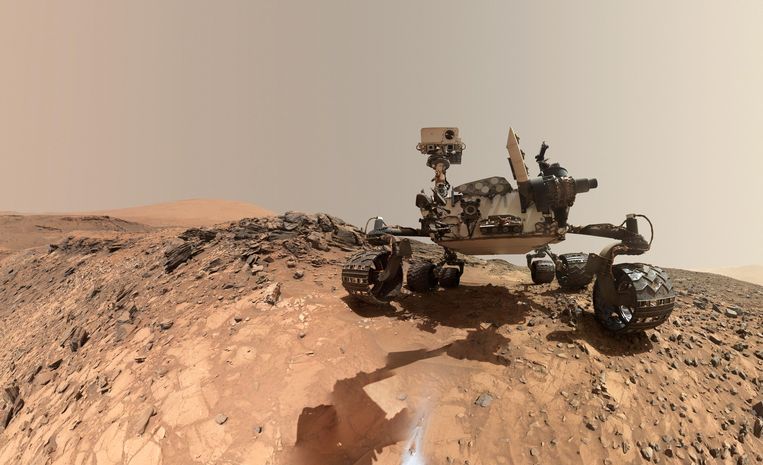
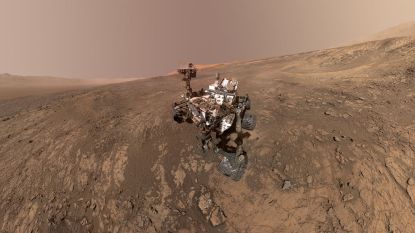
Als het gaat om het onderzoek naar stofstormen kunnen onderzoekers nu dus hun hart ophalen. Het is een maand geleden dat de stofstorm die in mei op Mars ontstond tot een wereldwijde stofstorm werd uitgeroepen. En nog altijd onttrekt deze storm vrijwel het gehele Martiaanse oppervlak aan het zicht. Onderzoekers monitoren de storm met behulp van vijf orbiters en één rover: de niet van zonne-energie afhankelijke Marsrover Curiosity.
Mogelijk voor het eerst gespot: een jonge ster die 1 of zelfs 2 planeten 'opeet'
Caroline Kraaijvanger
De ster RW Aur A zou as we speak bezig zijn om de resten van enkele van zijn planeten te nuttigen.
Dat suggereren waarnemingen van röntgenobservatorium Chandra. “Computersimulaties hebben lang voorspeld dat planeten in een jonge ster kunnen vallen, maar we hebben dat nog niet eerder geobserveerd,” stelt onderzoeker Hans Moritz Guenther. “Als onze interpretatie van de data klopt, zou het de eerste keer zijn dat we direct waarnemen hoe een jonge ster een planeet of planeten verorbert.”
OVER RW AUR A
RW Aur A bevindt zich op 450 lichtjaar afstand van de aarde en is nog maar een paar miljoen jaar oud. De ster wordt nog steeds omringd door een gas- en stofschijf. RW Aur A maakt verder deel uit van een dubbelstersysteem: beide sterren hebben ongeveer dezelfde massa als onze zon.
Chandra De jonge ster RW Aur A houdt de gemoederen eigenlijk al sinds 1937 bezig en wel doordat de helderheid van de ster om de paar decennia kort afneemt, om vervolgens weer toe te nemen. En de laatste jaren zijn de onderzoekers er getuige van geweest dat de helderheid van de ster nog frequenter en gedurende langere perioden afneemt. En dat konden ze maar niet verklaren. Tot ze de ster met behulp van röntgenobservatorium Chandra bestudeerden.
IJzer Chandra bestudeerde de ster in 2013, toen deze heel helder was. Maar ook in 2015 en 2017, in perioden waarin de helderheid afnam. Chandra stelde vast dat niet alleen de optische helderheid van de ster afnam; ook de röntgenstraling afkomstig van de ster liep in deze perioden terug. Het suggereert dat iets het licht én de röntgenstraling van de ster tegenhoudt. Maar wat? Om daar achter te komen, bestudeerden de wetenschappers het röntgenspectrum: de intensiteit van de röntgenstraling gemeten op verschillende golflengtes. Op basis van die data – verzameld in perioden waarin de ster heel helder en juist minder helder was – konden de onderzoekers de dichtheid en de samenstelling van het licht en röntgenstraling absorberende materiaal rond de ster afleiden. Het onderzoek wijst uit dat de afnames in röntgenstraling en optisch licht veroorzaakt worden door de aanwezigheid van een dicht gas. Observaties uit 2017 laten bovendien zien dat de gasschijf rond de ster zeker 10 keer meer ijzer herbergde dan in 2013, toen de ster heel helder scheen.
Afbeelding: NASA / CXC / M. Weiss; X-ray spectrum: NASA / CXC / MIT / H. M.Günther.
Planetesimalen Langzaam begonnen de puzzelstukjes op hun plaats te vallen. Volgens de onderzoekers is het overvloedig aanwezige ijzer in de schijf afkomstig van twee planetesimalen – planeten in wording – die met elkaar in botsing zijn gekomen. Zeker één van deze planetesimalen zou reeds de omvang van een planeet hebben gehad. De botsing zou geresulteerd hebben in een enorme hoeveelheid ijzerrijk puin dat vervolgens in de ster is gevallen en een dikke sluier van gas en stof rond de ster heeft gevormd, waar het sterlicht tijdelijk deels door werd tegengehouden.
Alternatief
Een andere mogelijke – maar minder waarschijnlijke – verklaring voor de afnames in helderheid is dat deeltjes, zoals ijzer, in bepaalde delen van de schijf rond RW Aur A gevangen zitten. Wanneer de structuur van de schijf verstoord wordt – bijvoorbeeld doordat de andere ster in het dubbelstersysteem dichtbij komt – zouden die deeltjes vrijkomen, waardoor opeens een overvloed aan ijzer in de ster kan vallen.
Onderzoekers blijven de ster in de gaten houden om te kijken met welke snelheid de hoeveelheid ijzer in de gas- en stofschijf rond de jonge ster afneemt. Als die hoeveelheid ijzer over een paar jaar nog vrijwel even groot is, wijst dat erop dat het afkomstig is van een relatief grote bron. “Op dit moment wordt er veel onderzoek gedaan naar exoplaneten en hoe zij tot stand komen,” stelt Guenther. “Dus het is overduidelijk heel belangrijk om te zien hoe jonge planeten vernietigd kunnen worden door de interactie met hun moederster en andere jonge planeten en welke factoren bepalen of zij in leven blijven.”
Newly Discovered Crop Circle Has A Message For Humanity (July 2018)
(Alanna Ketler) A new crop circle was recently discovered on July 8th in Coneybury Hill, Nr Stonehenge, Wiltshire. This circle is the exact same as the chemical weapons warning symbol.
Interestingly this crop circle was found shortly after the death of Dawn Sturgess who had come into contact with a deadly nerve agent.
While we can’t know for sure, this crop circle certainly appears to be a message to humanity about the dangers of chemical weapons and the catastrophic damage they can cause, regardless of who you believe made it. Perhaps this circle symbolizes the fact that these weapons have no place in our world, and it’s time we got rid of them, for good.
Check out some amazing drone footage of this newly discovered crop circle below.
ET Intervention?
It is not all that surprising to see this message show up in a crop circle, as in the past we have seen deliberate ET intervention when nuclear weapons would have otherwise been used. We have covered this topic before, and the following is an excerpt from an older article,
One of many previously classified reports -out of the thousands in existence -that is now available in the public domain is the intrusion at Minot Air Force Base in North Dakota, on August 24, 1966. Air Force personnel were concerned about a light in the sky. A team went to check it out and confirmed the object, then saw a second white object while doing so. The object was tracked on radar and moved vertical several times; each time it descended, an air force officer in charge of a missile crew found his radio transmission interrupted by static. The object eventually descended to ground level, and the Air Force sent a team to check it out. They saw the object either on the ground or hovering very low. According to the official report:
“When the team was about ten miles from the landing site, static disrupted radio contact with them. Five to eight minutes later, the glow diminished, and the UFO took off. Another UFO was visually sighted and confirmed by radar. The one that was first sighted passed beneath the second. Radar also confirmed this. The first made for altitude toward the north, and the second seemed to disappear with the glow of red.”
It seems that these extraterrestrials know just how damaging nuclear weapons can be to our planet, and possibly to our entire solar system. There is information that says that UFO’s have been deactivating nuclear weapons since we created them and started to show up a lot more often when we were testing the atomic bomb. Thankfully, someone or something has our back and is helping to stop us, humanity from making a huge mistake.
MUFON Case 92671 Date of event: June 9, 2018 Location of sighting: Dublin, Ireland
Long description of sighting report:
''On Saturday 9th of June 2018 at 18:00 hours I was having a family barbecue. It was a crystal clear sky. This object caught my eye, it was stationery and very high in the sky, it was turning and pulsating, it seem to have three lights at the bottom of it. I observed this object carefully through my binoculars at this stage. My partner and my daughter also witnessed this and my daughter took a video of this. The family next door also came out to witness this as I was observing this object for 45 minutes when I witnessed a smaller orb come out from the side of it. It darted up and down a few times before disappearing again. I then lost sight of the object.
After a while when myself and my partner went to the front of the house the object reappeared in the sky. I showed my partner the object through the binoculars when my partner asked what where the objects beside it. When I looked through the binoculars myself I witnessed 9 orbs in formation of which two were moving. I watched this some time and then returned to the main object, I then saw a small orb around the main object again which appeared and disappeared again. I return outside after a short while and the object was no longer there.''
Milky Way Galaxy Is 'Disturbed' and More Revealed in ESA Gaia Mission Data (Video)
ByElizabeth Howell, Space.com Contributor
The European Gaia spacecraft recently released a catalog of the positions of 1.7 billion stars, mapping our stellar neighbors around the Milky Way with unprecedented precision. The star map not only looks stunning but also includes a wealth of information about the evolution of our galaxy, the European Space Agency (ESA) said in a recent video.
The video, posted to YouTube in May, took place at the Paris Observatory. There, in 1887, astronomers attempted to map hundreds of thousands of stars in an effort called the Carte du Ciel (the Map of the Sky). Gaia is therefore part of a long line of star mappers, both on the ground and in space. But for all of our efforts, astronomers said in the video, we still have much to learn about the Milky Way — such as why certain stars' motion is "disturbed," and how the arms were formed.
ESA Euronews: Gaia’s revolution in astronomy
Finnish astronomer Timo Prusti, Gaia project scientist, gestured toward Gaia's new map of the Milky Way and told video viewers what the spacecraft is revealing: "We see a flattened structure," he said. "That's the Milky Way; that's our Milky Way disk. We see some dark patches on top of it. What does it mean? It means that there, we see less stars. There are more stars [in that location], but there is dust in front of them, and that's why we don't see the stars." [Europe's Billion-Star Mapping Spacecraft Snaps 1st Photo (Image)]
The orbits of four globular clusters (NGC 104, NGC 288, NGC 362 and NGC 1851), shown in blue, and three dwarf galaxies (Carina, Bootes I and Draco), shown in red, around the Milky Way, as imaged by the Gaia spacecraft.
Credit: ESA/Gaia/DPAC
But the spacecraft is also revealing some mysteries that will require further investigation. Previously, astronomers thought that the stars rotating around the Milky Way's center did so in an orderly fashion, no matter how far they were from our sun. Gaia, however, shows that some of these stars' motions are "disturbed," particularly for those that are far from the sun, Prusti said. Why that happens is a complete mystery.
Astronomers are also uncertain about how the arms of the Milky Way came to be, added François Mignard, one of the founders of Gaia and an emeritus director of research at French space agency CNRS.
"Were the arms born at the same time?" he asked in French, translated in voiceover to English. "Do the arms have a unique history? Are the arms a result of a merger with an external galaxy? It's these questions that people are going to try to answer, and the Gaia data is absolutely fundamental for this kind of study."
Gaia's April data release mapped 10,000 times more stars than its predecessor mission, Hipparcos. Frédéric Arenou, a senior research engineer at CNRS, said the new Gaia information includes the stars' luminosity, or how much light they produce. With that information in hand, astronomers will be able to learn more about the stars' physical properties, he added.
Gaia's position in space is a huge asset in allowing it to map the sky. It is located 1.5 million kilometers (0.93 million miles) from Earth in the opposite direction to the sun. The spacecraft rotates around itself every 6 hours, and over time it can generate a complete map of the sky. Its three major instruments include an astrometric instrument to measure star positions, a photometer to map star colors and a spectrometer that shows stars' radial velocity — or the speed at which the stars move toward or away from Earth.
Gaia continues to send down measurements 11 hours a day, ESA officials said in the video, and several more data releases are expected in the next decade to address some of these outstanding scientific questions.
Tiny Satellite Begins Hunt for Missing Milky-Way Matter
By Meghan Bartels, Space.com Senior Writer
The International Space Station deployed HaloSat, a tiny satellite that will study the Milky Way's halo, on July 13, 2018.
Credit: NanoRacks/NASA
A tiny satellite has set out to investigate the halo of incredibly hot gas surrounding the Milky Way — and it could help scientists track down the huge amount of missing matter in the universe.
NASA deployed the 26-lb. (12 kilograms) satellite, called HaloSat, on July 13 from the International Space Station.
Scientists can't find a whopping one-third of all the matter that should exist in the universe. It's not dark matter; it's just … missing. They've calculated how much matter was in the universe 400,000 years after the Big Bang based on information encoded in the cosmic microwave background. And they've calculated how much mass they see now in galaxies, stars, planets, dust and gas. But the numbers do not add up. [Our Milky Way Galaxy Has Cosmic Halo 11.4 Billion Years Old]
Tiny Satellite Begins Hunt for Missing Milky Way Matter
"We should have all the matter today that we had back when the universe was 400,000 years old," said Philip Kaaret, HaloSat's principal investigator and an astronomer at the University of Iowa, said in a NASA statement. "Where did it go?"
Scientists have made some progress in tracking down chunks of the missing matter, and they've narrowed it down to two hiding places: within galaxies themselves, or spread out in the space between them. So scientists are starting close to home, by searching for the matter that's missing from the Milky Way.
HaloSat will try to find the missing matter by mapping the galaxy's halo of superhot gas, which can reach 3.6 million degrees Fahrenheit (2 million degrees Celsius), according to NASA. That's hot enough for oxygen gas to produce X-rays, which HaloSat will measure across the sky to figure out the shape of the halo and determine whether it's spread evenly around the Milky Way or in a flattened disk, like a fried egg.
"If you think of the galactic halo in the fried egg model, it will have a different distribution of brightness when you look straight up out of it from Earth than when you look at wider angles," Keith Jahoda, a HaloSat co-investigator and a NASA astrophysicist, said in the statement. "If it's in some quasi-spherical shape, compared to the dimensions of the galaxy, then you expect it to be more nearly the same brightness in all directions."
Once scientists know how the halo is arranged, they can estimate its mass and determine whether it's hiding all that missing matter.
But to make those measurements, HaloSat needs to be careful not to fall for an imposter signal. That signal is caused by the solar wind, the constant stream of highly charged particles produced by the sun, which produces X-ray signatures that mimic that of the galactic halo.
To avoid being tricked, HaloSat will switch tasks according to where it is in its orbit around Earth: When it's over the night side, it will gather data, and when it's over the daylight side, it will charge up and send that information home. That should make HaloSat's data much cleaner than other X-ray observations, the researchers think.
Dazzling Views Show Saturn Moon Titan's Surface Like Never Before
By Mike Wall, Space.com Senior Writer
These mosaics of the Saturn moon Titan's surface were constructed using data gathered over 13 years by the Visual and Infrared Mapping Spectrometer instrument aboard NASA's Cassini spacecraft.
Credit: NASA/JPL-Caltech/University of Nantes/University of Arizona
The mysterious surface of Saturn's huge moon Titan comes into gloriously sharp focus in newly released photos captured by NASA's Cassini spacecraft.
Cassini team members created the six-image set using data collected over 13 years by the Saturn-orbiting probe's Visual and Infrared Mapping Spectrometer (VIMS). As its name suggests, VIMS deals in long-wavelength infrared light, allowing the instrument to see through the thick Titanic haze that obscures visible-light views of the moon's frigid surface.
Cassini scientists have created VIMS mosaics before, but those previous efforts generally had prominent seams, NASA officials said. Such seams naturally result from the stitching together of images snapped during different Titan encounters, which featured different lighting conditions and flyby angles. [Amazing Photos: Titan, Saturn's Largest Moon]
But the new mosaics are pretty much seamless — a breakthrough made possible by a reanalysis of the VIMS data and laborious hand processing of the resulting mosaics, mission team members said.
"With the seams now gone, this new collection of images is by far the best representation of how the globe of Titan might appear to the casual observer if it weren't for the moon's hazy atmosphere, and it likely will not be superseded for some time to come," NASA officials wrote in a statement Wednesday (July 18).
Indeed, the photos give viewers a new appreciation for Titan's complex and varied surface, which boasts dunes of carbon-containing organic compounds, icy deposits and vast seas of liquid hydrocarbons. (Titan is the only extraterrestrial object known to harbor stable bodies of liquid on its surface.)
In visible-light images captured from above Titan's thick, nitrogen-dominated atmosphere, none of this diversity comes through; the 3,200-mile-wide (5,150 kilometers) moon looks like a fuzzy, orange-brown ball.
Titan as it appears from space in visible light. NASA's Cassini spacecraft captured this view in January 2013, when it was about 895,000 miles (1.44 million kilometers) from the big moon.
Credit: NASA/JPL-Caltech/Space Science Institute
Scientists might get some sharp, up-close looks at the Titan landscape in the not-too-distant future, however: A mission called Dragonfly would explore the huge moon's surface, and assess its potential to host life, using a robotic minihelicopter. Dragonfly is one of two finalists, along with a comet sample-return effort, for NASA's next New Frontiers mission slot. The agency aims to announce a winner in 2019 and launch the mission by 2025.
The $3.2 billion Cassini mission — a joint effort of NASA, the European Space Agency and the Italian Space Agency — launched in 1997 and reached Saturn in the summer of 2004. Cassini zoomed through the gas-giant system for more than 13 years, gathering a wealth of data about the planet, its iconic rings and its many moons. The Cassini mother ship also carried a lander called Huygens, which touched down on Titan in January 2005.
The groundbreaking mission came to an end in September 2017 with an intentional death dive into Saturn — a move designed to ensure that Cassini would not contaminate Titan or the fellow potentially life-supporting satellite Enceladus with microbes from Earth.
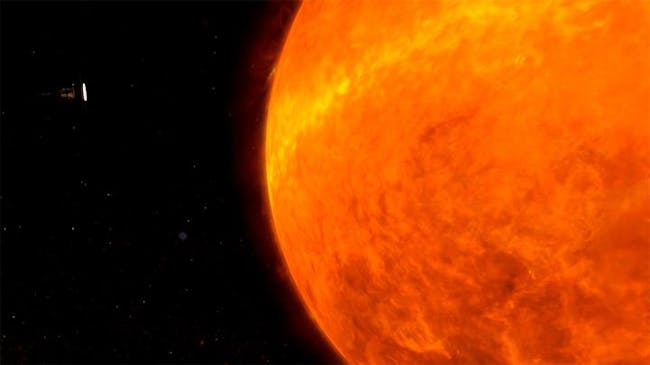
The Parker Solar Probe is not only one of NASA’s most ambitious missions, but it seems to defy logic. The spacecraft slated to launch this summer will enter the sun’s corona and travel through material with temperatures greater than a million degrees Fahrenheit. So, why won’t it melt?
Parker Solar Probe will embark August 4 on what NASA calls “a mission 60 years in the making,” coming within four million miles of the surface to collect unprecedented data about the sun’s corona, or outer atmosphere. If successful, it will become the first spacecraft to enter the sun’s corona and enjoy a balmy inside temperature of just 85 degrees while its outer shell is surrounding in the sun’s blaze. The probe will essentially be the embodiment of “this is fine” dog.
Illustration of Parker Solar Probe circling the Sun.
NASA revealed the science behind why this space dog will not melt in such an extreme environment on Thursday. To understand why the Parker Solar Probe won’t melt, the space agency explained key concepts of heat versus temperature, its custom heat shield, and the spacecraft’s unique innovation.
Parker Solar Probe’s Temperature vs. Heat
The difference between heat and temperature will help in making the Parker Solar Probe’s mission seem a little more (but not much more) feasible. Temperature is a measurement of how fast particles are moving, while heat refers to how much of that energy is transferred. Thus, in a place that is mostly empty like space, high temperatures don’t always mean high heat. Particles could be moving fast and creating high temperature, but since there are so few of them, they won’t transfer that much heat towards the spacecraft.
While Parker Solar Probe will be traveling through a space with temperatures of several million degrees, it won’t feel most of that heat, and the surface of the heat shield will only reach 2,500 degrees Fahrenheit.
Parker Solar Probe’s Heat Shield
That’s still pretty hot, though. Experiencing 2,500 degrees Fahrenheit is nothing to scoff at, and ensuring an unmelted Parker Solar Probe may have caused some delays in scheduling the launch. To withstand the heat, NASA installed a shield known as the Thermal Protection System, or TPS.
Designed by the Johns Hopkins Applied Physics Laboratory, TPS is made of a lightweight carbon foam core that is flanked by two carbon-carbon composite panels. The sun-facing panel is sprayed with a white coating that will reflect as much of the sun’s energy away from the spacecraft as possible. It’s just 4.5 inches thick, and yet it’s expected to keep almost all instrumentation safe.
Parker Solar Probe’s Measuring Cup
Not every instrument will be protected by TPS, however. The Faraday cup is a sensor that will poke out over the heat shield to measure the solar wind, and in order to get an accurate read, it could not be sheltered by TPS.
So, why doesn’t Faraday melt?
“Due to the intensity of the solar atmosphere, unique technologies had to be engineered to make sure that not only can the instrument survive, but also the electronics aboard can send back accurate readings,” NASA’s Susannah Darling explained. The cup is made from sheets of Titanium-Zirconium-Molybdenum, an alloy of molybdenum, giving it a melting point of about 4,260 degrees Fahrenheit. The chips that produce an electric field for the Faraday cup are made from tungsten, the metal with the highest known melting point. With a threshold of 6,192 degrees Fahrenheit before melting, Faraday has the wiggle room to collect the solar wind data it needs.
After launching on August 4, Parker Solar Probe will use Venus’ gravitational pull to shrink its orbit around the sun. These flybys will take roughly seven years, eventually bringing the probe as close as 3.7 million miles from the center of the solar system. Its final loop within the sun’s corona is expected in late 2024. But thanks to this slew of innovative technologies, it should keep cool the whole time.
When the Apollo astronauts returned from the moon, the dust that clung to their spacesuits made their throats sore and their eyes water. Lunar dust is made of sharp, abrasive particles, but how toxic is it for humans?
When the Apollo astronauts returned from the moon, the dust that clung to their spacesuits made their throats sore and their eyes water. Lunar dust is made of sharp, abrasive and nasty particles, but how toxic is it for humans?
The “lunar hay fever,” as NASA astronaut Harrison Schmitt described it during 1972’s Apollo 17 mission, created symptoms in all 12 people who have stepped on the moon. From sneezing to nasal congestion, in some cases it took days for the reactions to fade. Inside the spacecraft, the dust smelled like burnt gunpowder.
The moon missions left an unanswered question of lunar exploration – one that could affect humanity’s next steps in the solar system: can lunar dust jeopardize human health?
An ambitious European Space Agency (ESA) research program with experts from around the planet is now addressing the issues related to lunar dust.
Kim Prisk, a pulmonary physiologist from the University of California with over 20 years of experience in human spaceflight, is one of the 12 scientists taking part in ESA’s research. Prisk said:
We don’t know how bad this dust is. It all comes down to an effort to estimate the degree of risk involved.
Nasty dust
Lunar dust has silicate in it, a material commonly found on planetary bodies with volcanic activity. Miners on Earth suffer from inflamed and scarred lungs from inhaling silicate. On the moon, the dust is so abrasive that it ate away layers of spacesuit boots and destroyed the vacuum seals of Apollo sample containers.
Fine like powder, but sharp like glass. The low gravity of the moon, one sixth of what we have on Earth, allows tiny particles to stay suspended for longer and penetrate more deeply into the lung. Prisk explained:
Particles 50 times smaller than a human hair can hang around for months inside your lungs. The longer the particle stays, the greater the chance for toxic effects.
The potential damage from inhaling this dust is unknown but research shows that lunar soil simulants can destroy lung and brain cells after long-term exposure.
Down to the particle
On Earth, fine particles tend to smoothen over years of erosion by wind and water; lunar dust, however, is not round, but sharp and spiky.
In addition, the moon has no atmosphere and is constantly bombarded by radiation from the sun that causes the soil to become electrostatically charged.
This charge can be so strong that the dust levitates above the lunar surface, making it even more likely to get inside equipment and people’s lungs.
Dusty workplace
To test equipment and the behavior of lunar dust, ESA will be working with simulated moon dust mined from a volcanic region in Germany.
Working with the simulant is no easy feat. Erin Tranfield, biologist and expert in dust toxicity, said:
The rarity of the lunar glass-like material makes it a special kind of dust. We need to grind the source material but that means removing the sharp edges.
The lunar soil does have a bright side, explained science advisor Aidan Cowley.
You can heat it to produce bricks that can offer shelter for astronauts. Oxygen can be extracted from the soil to sustain human missions on the moon.
Bottom line: Can lunar dust jeopardize human health?
Extraterrestres : 8 théories pour expliquer le silence
Extraterrestres : 8 théories pour expliquer le silence - Aliens : 8 theories to explain silence
Pourquoi les extraterrestres ne se montrent-ils pas ? Plusieurs théories peuvent expliquer le silence des extraterrestres. Futura vous en présente ici 8. Rentrez dans le secret...
Si la vie est fréquente dans l'univers, alors de nombreuses planètes de notre galaxie, la Voie lactée, devraient porter ou avoir porté des civilisations extraterrestres. Or, mis à part de témoignages douteux et jamais vérifiés d'incursions très brèves (et aux objectifs mystérieux), force est de constater qu'aucune observation, sur Terre ou dans le ciel, ne vient prouver l'existence de grandes sociétés technologiquement avancées.
Pourquoi ? La question alimente facilement les discussions entre amis, préférentiellement le soir, idéalement sous un ciel étoilé. On l'appelle le « paradoxe de Fermi », du nom d'Enrico Fermi. Ce spécialiste de physique nucléaire aurait évoqué cette question dans les années 1930, lui aussi au cours d'un dîner. Elle a ensuite été popularisée par Carl Sagan, astronome éclectique, qui a lancé le programme Seti.
Les civilisations E. T. : un très bon sujet de discussion
De multiples réponses sont possibles devant le silence des autres intelligences. Les huit principales sont posées ici mais il en existe d'autres. Lors des discussions, l'impression vient vite que chacun arrive avec ses propres convictions et tente de les imposer aux autres. Cette étape passée, il devient bien plus intéressant de lister, objectivement, toutes les réponses auxquelles on peut penser. L'exercice devient alors un jeu.
Une bonne idée est d'explorer les nombreuses observations réalisées depuis quelques décennies dans le domaine que l'on peut appeler exobiologie ou astrobiologie. De la composition chimique des nébuleuses (où se formeront les étoiles et leurs planètes) jusqu'aux idées sur l'apparition de la vie sur Terre en passant par les océans cachés des satellites de Jupiter et de Saturne sans oublier les exoplanètes, la réalité, souvent, dépasse nos imaginations...
Régulièrement, les caméras de la Station spatiale internationale (ISS) filment des objets volants non identifiés, alias ovnis. Satellites, débris ou étages de lanceurs, quand ce ne sont pas de simples reflets dans les vitres : ces images font le bonheur des ufologues. Ici, on voit un objet allant dans le même sens que l'ISS, un peu plus bas et (logiquement) un peu plus rapide. Rêvons un peu.
Non, l'espace n'est pas rigoureusement vide. Juste au-dessus de l'atmosphère, il est même assez fréquenté, surtout par des objets créés de main d'Homme. Ce peut être des satellites ou des débris spatiaux mais aussi des étages de lanceurs en train de retomber dans l'atmosphère. Ces apparitions plus ou moins fugaces sont aussi, parfois, des phénomènes lumineux dans la haute atmosphère et il est arrivé qu'il ne s'agisse que de reflets sur un hublot ou dans l'optique de la caméra.
Qu'importe. Chaque évènement de ce genre fait le bonheur des amateurs de l'étude des ovnis, qui y voient facilement la preuve de l'existence de vaisseaux extraterrestres patrouillant dans le secteur. Mieux, la molle réaction de la Nasa, qui est le plus souvent « bon eh bien c'est un débris, comme d'habitude ; on va tâcher de voir ce que c'est, comme d'habitude », conforte les convictions de ces passionnés, qui pensent fréquemment que l'agence spatiale dissimule des preuves de tourisme d'extraterrestres. La Nasa est même régulièrement accusée de couper le flux vidéo au moment crucial.
Débris, satellite, ombre ou Surfeur d'argent
L'exercice d'identification est tout de même amusant, voire intéressant. Ici, on voit un objet, de dimension inconnue, filant à peu près dans la même direction que l'ISS et un peu plus rapidement. Il ne peut donc s'agir d'un avion. Sa distance est impossible à déterminer mais l'objet évolue au-dessus de la couverture nuageuse. Celui-ci est clairement en orbite, sur une altitude plus faible que celle de l'ISS. Sa vitesse plus élevée est donc logique. En effet, plus l'orbite est éloignée de la Terreplus la vitesse de satellisation est faible : elle est d'environ 8 km/s au niveau de l'ISS et de 1 km/s à la distance de la Lune (laquelle, bonne connaisseuse des lois de Newton, a d'ailleurs adopté cette vitesse).
Il reste en lice trois hypothèses :
un satellite en orbite très basse ;
un débris ;
l'ombre d'un satellite (l'éclairage des nuages indique que la lumière solaire vient d'en haut à droite, ce qui exclut qu'il s'agisse de l'ombre de l'ISS elle-même).
Une quatrième hypothèse, bien sûr, est qu'un vaisseau spatial d'exploration venu d'une autre planète soit en train d'étudier la météorologie terrestre, qui serait encore mystérieuse pour les concepteurs de cet engin. Une cinquième est celle, tout simplement, du passage de Norrin Radd, le Surfeur d'argent, profitant des vagues atmosphériques au-dessus d'une formation cyclonique...
Legendary Ship With 5,500 Boxes Of Gold Worth $133 Billion Discovered
A legendary ship carrying cargo of $133 billion found off a South Korean island.
The Dmitrii Donskoi, a Russian ship that was scuttled in 1905 and is believed to be carrying more than 5,500 boxes of gold bullion and coins estimated to be worth $133 billion has been recovered by divers off the South Korean island of Ulleungdo.
The incredible discovery came off the back of many years of work by the maritime salvage company, the Shinil Group, who have long been after the prize. In order to uncover the ship a team of experts from South Korea, China, Britain, and Canada have worked tirelessly trawling the area. Now they have seen the fruits of their labors with the discovery of the legendary ship which they positively identified by the Cyrillic letters on its stern.
The Dmitrii Donskoi was never intended to be a battleship but was designed to be a commerce raider. It set sail for the first time in the late nineteenth century and would go on to spend most of its operational career on missions in the Mediterranean Sea and the Pacific theatre.
During the Russo-Japanese War of 1904-1905, the Russians suffered major losses at sea as the superior Japanese destroyed the vast majority of the Russian ships in the vicinity of the Asian country. To bulk up the depleted forces, the Dmitrii Donskoi was one of a number of ships deployed to fight on the frontlines of the short-lived but vicious war.
Built in St Petersburg and launched in August 1883
Photograph of the legendary ship: Dmitrii Donskoi
The Dmitrii Donskoi formed part of the ill-fated squadron that met the Japanese fleet at the Battle of Tsushima. The ship had been assigned to protect the transport ships sailing at the rear of the formation and managed to slip away and flee when it became clear that the Japanese were about to deal the Russian forces a crushing defeat. The captain, Ivan Levedev, evaded Japanese forces for some time but was discovered by the enemy steaming towards the Russian port town of Vladivostok.
The extensive damage the international team discovered on the wreckage of the ship tells the story of the violence of the Japanese onslaught. The ship endured major damage from shell fire and was eventually scuttled.
According to records from the time, sixty of the five hundred and a ninety-one strong crew were killed in the assault, and more than a hundred others suffered injuries. The rest were saved by the capable actions of Captain Lebedev who managed to get the men to shore. The crew would eventually be taken prisoner by the Japanese landing parties on the South Korean island of Ulleungdo. The brave captain died of the injuries he incurred in the course of the battle.
After the ship was lost and the crew was captured, rumors began circulating about the incident. It was strongly suggested that the Dmitrii Donskoi had been tasked with carrying a massive amount of money which was to be used to pay for fuel, port fees and the crews of the ships in the ill-starred squadron. This money amounted to the equivalent of more than a hundred billion US dollars. It is believed that the captain chose to scuttle the ship rather than let such an extraordinary amount of money fall into enemy hands.
More than a hundred years later, Russia and Japan are at peace, and the sunken war chest is destined to be spent on more peaceful projects. Half of the gold will be returned to the Russian government, approximately 10% of that which remains will be spent on tourism projects on the island of Ulleungdo which will include a museum dedicated to the legendary vessel. The rest of the money will be scattered among a number of joint projects promoting development in northeast Asian such as a railway link which will improve travel connections between Russia, South Korea, and North Korea.
Mysterious black granite sarcophagus is finally OPENED
A mysterious ten foot (three-metre) long black sarcophagus has been opened in Alexandria, found on the northern coast of Egypt and founded by the legendary leader of the same name.
The 6.5ft (two metre) high coffin was first discovered earlier this month and unearthed in recent days.
The 30-ton (27,000 kg) tomb was found buried 16ft (five metres) beneath the ground of the city.
Egyptologists pried open the black granite sarcophagus earlier today to reveal three decomposed bodies.
The stone coffin was also filled with sewage water, which is believed to have increased the rate of decomposition.
Giant Stone Spheres Discovered On Artic Island Baffle Scientists
The appearance of perfectly spherical rocks baffles the scientific community.
Bizarre, perfectly rounded rocks described by some observers as the ‘footballs of God’ have been discovered on the uninhabited Champ island which lies above the polar circle in the Franz Josef archipelago.
At first glance, it would appear that these perfectly spherical objects had been scattered on the island quite deliberately. However, the small island is completely barren and there is no evidence to suggest that human beings have ever settled there meaning that scientists studying the area do not believe that it is feasible that they were artificially created by humans.
To compound the mystery, similar spherical balls have been found on Heiss Island in the same archipelago as well as in more distant locations such as Volgograd, New Zealand, China, Bosnia and South Africa. According to the Russian polar researcher, Viktor Boyarsky, the spheres are made from a soft sandstone.
The material that the spheres are comprised of is about the only thing that geologists can agree on when it comes to these mysterious stones. According to Konstantin Zaikov of the Arctic Federal University, these fascinating stones were formed thousands of years ago by processes of crystallization of the sandstone followed by the subsequent magnetization of the grains of sand on the created crystals. Over time, the sand grains hardened and created a dense spherical stone.
However, this conclusion is contradicted by the Austrian geologist Sepp Fridhubera who has put forward a rival theory. Fridhubera claims that the rounded shape of the stones suggests that it was formed under the water and it is likely that an organic core at the center of the stones has contributed to its spherical shape.
These theories are merely the most popular in geological circles. There are dozens of theories circulating about what processes might have caused this astonishing natural phenomenon and no sign that agreement will be reached at any point in the near future.
Interestingly, all of these scientists presume that the stones must have been made naturally. However, the bizarre shape of the stones does open up the possibility that they were created by intelligent hands. If this theory is thrown into the mix, then there could be hundreds of more questions to answer about the stunning footballs of God.
Look! Up in the sky! It isn't a bird or a plane. It's probably a UFO, at least if you're watching History's upcoming Project Blue Book drama series.
The series, which was inspired by real UFO studies conducted by the US Air Force starting in the early 1950s, debuts on the History channel this winter. But a first-look trailer shows off its cast, which includes Game of Thrones' Aidan Gillen as Dr. Allen Hynek and Neal McDonough, who plays Damien Darhk in Legends of Tomorrow, as Gen. James Harding. Hynek, a real historical figure, was a scientific adviser for the Air Force's UFO work.
The trailer doesn't leave much to the imagination. We see lights moving in the sky, mysterious crop circles and a bizarrely elongated skull. It seems like it will be stocked with plenty of action, alien intrigue and stylish camera work.
Don't mistake this for a documentary series. History says it will blend "UFO theories with authentic historical events from one of the most mysterious eras in United States history."
You can delve deeper into the real history behind the television show on your own. The Project Blue Book files are available for anyone to peruse through the online Project Blue Book Archive.
Voor wat betreft de maan lijkt de wereld verdeeld in twee kampen, de ene die gelooft dat de maanlandingen nep waren en de andere dat er wel degelijk mensen op de maan waren.
Uit een recente ontdekking van ufoloog Scott Waring en verborgen conversaties van astronauten komt er nu misschien toch iets meer duidelijkheid.
We kunnen natuurlijk beginnen met te stellen dat alles op onze wereld nep is en niets meer dan een illusie. Dat is de waarheid, alleen maakt dat het een beetje lastig om over dingen te praten.
Binnen die beperking hebben we nog andere illusies en dat zijn die dingen die bewust anders worden voorgespiegeld dan hoe ze in werkelijkheid zijn gebeurd. En dan hebben we het in dit geval over de maanlandingen.
Ook op deze website zijn artikelen te vinden die met overtuigend bewijs komen dat de maanlandingen nooit plaatsgevonden kunnen hebben, zoals dit artikel.
Anderzijds zijn er dan toch weer dingen die erop lijken te wijzen dat er wel degelijk mensen op de maan zijn geweest en daar willen we vandaag iets verder op in gaan.
Iemand die nog steeds iedere dag onvermoeibaar in de weer is met het bestuderen van allerlei foto’s is ufoloog Scott Waring. Nu ziet Scott heel vaak UFO’s vliegen die er soms helemaal niet zijn, maar vaak heeft hij ook wel bijzonder dingen, zoals het volgende.
Bij de bestudering van een foto van de maan die afkomstig is uit de verzameling van de Universiteit van Arizona, vond hij een aantal bijzondere koepels boven kraters. Het zijn behoorlijk grote glimmende objecten en Scott vraagt zich dan ook af hoe het mogelijk is dat astronomen dit soort dingen volkomen over het hoofd hebben gezien.
Ze zien er als volgt uit:
Tijdens de Apolloreizen naar de maan kon het publiek af en toe de gesprekken volgen tussen de astronauten en de verkeersleiding in Houston. Echter, dit was een zorgvuldig uitgewerkt script, want wat de astronauten echt hadden te melden werd ver van het publiek weggehouden.
Jaren later zijn er een aantal gesprekken vrijgegeven tussen de astronauten onderling, waar op zijn zachtst gezegd een aantal zeer merkwaardige dingen in voor komen.
Zoals de volgende, waarbij astronauten praten over een snelweg op de maan en dat “ze” waarschijnlijk geen geld meer hadden om die weg af te maken.
En dan de volgende die heel interessant is in het kader van de ontdekking van Scott Waring. Astronauten die praten over driehoekige wegen in de buurt van de Moltke krater waarbij ze het hebben over een tijd voordat de koepels werden gebouwd.
En als laatste, een gesprek dat een Amerikaanse professor had met Neil Armstrong. Waarin Armstrong duidelijk maakt dat de reden dat wij nooit meer op de maan zijn geweest is omdat we in feite door de buitenaardsen zijn weggejaagd met de mededeling daar niet meer terug te komen.
Dus, zijn we nu wel of niet op de maan geweest? Wie het weet mag het zeggen.
Trailer New UFO Series “Project Blue Book” Based On Actual Cases
History Channel’s upcoming new UFO series 'Project Blue Book' is based on the true, top-secret investigations into Unidentified Flying Objects (UFOs) and related phenomena conducted by the United States Air Force from 1952 to 1969.
The series that starts at end of this year revolves around secret U.S. Air Force investigations into supposed UFO encounters and unexplained phenomenon, undertaken by astrophysicist, and eventual ufologist, Josef Allen Hynek in the 1950s and 1960s.
The incidents that are shown in this 10 episode series are based on actual cases that were investigated by the USAF.
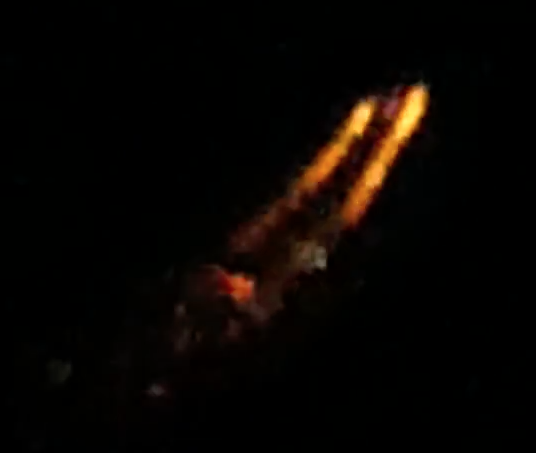
Blazing UFO reported flying over Suffolk, England 14/07/2018 Video, UFO Sighting News.
Date of sighting: 7-14-2018 Location of sighting: Suffolk, England This blazing UFO was seen a few days ago over England. The object shoots out flames like a meteor, but does acrobatics. UFOs do sometimes perform for people when they are notices, usually the light ships (pure energy beings) get excited when someone notices them and they do acrobatics, loops, zig zags, which I and my family personally witnessed one night here in Taiwan at midnight. However, this is fiery, which may be fireworks attached to a drone. Maybe a remote control plane with sparklers attached is my thought. Scott C. Waring Eyewitness states:
Saw strange flying object in distance whilst sitting in our back garden at dusk. Watched it for at least 5 mins. No idea what it was and have seen no media coverage. Viewed S.E. direction from Moats Tye, Stowmarket towards Ipswich, Suffolk, England. Curious if anyone else saw it?!
In early 2005, the late Rob Riggs – the author of the book In the Big Thicket, and who I had first met in the summer of 2003 – telephoned me and asked if I would be interested in speaking at a conference he was planning on soon holding in the city of Austin, Texas. The subject was “ghost lights,” and the links between that same phenomenon and sacred sites, stone circles, and Bigfoot-like entities. I replied that, yes, I would definitely be interested. And thus was born the Texas Ghost Lights Conference. It was held at Austin’s First Unitarian Universalist Church on Saturday, June 11. Precisely what the God-fearing folk of the Church thought about a group of Bigfoot-hunting, ghost-light-seeking adventurers descending upon their property, I never learned. But, they didn’t seem to mind at all.
In addition to Rob and me, the other lecturers were James Bunnell and Paul Devereux. James has an interesting background: the author of two books on the famous “Marfa Lights,” namely Night Orbs and Seeing Marfa Lights. he was an aeronautical and mechanical engineer by profession, and retired in 2000 from BAE Systems as Director of Mission Solutions for various U.S. Air Force programs. Like me, Paul is a Brit. He’s a longstanding, prestigious figure in the field of ghost-light style phenomena.
Big Thicket National Preserve
In addition to organizing the conference, Rob had also put into place something that he termed the Bragg Road Project. Essentially, it was a road-trip to the Texas-based Big Thicket (a hotbed for “ghost lights”)that he had planned for the day after the Austin gig. The idea was to travel down to the woods of east Texas and hang out in the area for two nights, in the event that something – be it a ghost light or a Bigfoot, or both if we were that lucky – decided to make an appearance.
Early on what turned out to be a bright and sunny Sunday morning, me, Rob, James, Paul, S. Miles Lewis of the Austin-based Scientific Anomaly Institute, and two conference attendees, Renee and Nancy, met at a prearranged location for our journey into the unknown. I can hardly say that the trip was one of proportions that would have made Jack Kerouac proud. But nevertheless, we were on a mission and everyone was fired up about what we might uncover, and so our convoy set off in earnest. It was late afternoon when we finally arrived in the town of Kountze, where all of us had reservations at the local Super 8. And, after a shower and a Mexican dinner, we were forest-bound. And this was where, as was so often the case, things got very strange.
Bragg Road can be an eerie location during daylight – as I had found to be so when I ventured deep into the Big Thicket with Rob in the summer of 2003. At night and under the spotlight of a full moon, however, it was truly spooky. Not in a scary sense, as I always relish the opportunity to check out such places, but just from the perspective of believing that quite possibly anything could happen here. Of course, it’s important to note that more than a few people have mistaken distant car headlights for the legendary lights (as Andy Collins notes at this link). But, given that some sightings have occurred within just a feet of eyewitnesses demonstrates that not all cases can be written off so easily.
With flashlights in hand, we began a walk through the darkened woods, with Rob pointing out to us various locations where wild men, Bigfoot, and, of course, ghost lights had been seen and reported for decades. For twenty minutes or so, we walked around, seemingly forever trying to avoid the overwhelming mass of mosquitoes that surrounded us, while at the same time negotiating the thick blanket of ancient and mighty trees that dominated the area. And then, suddenly, it happened. We were on our way back to the vehicles to grab a bite to eat and some drinks when, as we entered a clearing in the trees, a basketball-sized bright light floated over us at a height of about thirty-five feet. It was moving from right to left, and sailed slowly yet purposefully on its journey. The ghost light was present for barely a handful of seconds, but it was definitely there.
Due to work, I was unable to stay for the second night, but when I got back to Dallas and turned on the computer, I read an email from Rob that was of true jaw-dropping quality. The odd experiences of the first night in the Big Thicket were apparently not isolated. As Rob said: “Renee had a frightening experience Monday night. We split up into teams of two and spread out about a mile apart. Renee was paired with Nancy. Nancy walked down the road briefly away from Renee. Renee said she then heard something walking in the woods off the road directly behind her that sounded large. She said whatever it was, was large enough to snap twigs, and she said that it seemed to be moving stealthily, as if it were trying to sneak up on her. She panicked, locked herself into her van and drove off, leaving Nancy to fend for herself.”
Rob continued: “Several hours later she was still shaken and still had goose bumps. Such irrational panic is not characteristic of Renee. She is a ghost hunter and has many times been in creepier situations than being on Bragg Road. She has even gone to cemeteries alone just to test her mettle. There are theories that the creatures deliberately provoke such panic reactions through chemicals in their scent or by mental projection of energy.”
He concluded: “Renee, Nancy and I also saw a peculiar light. It looked somewhat like a firefly but actually left a solid streak 10 – 15 feet in length that was brilliant bluish-white in color. It happened near a power line, and it was suggested that it might have been some kind of surge on the power line itself. But what could cause such a surge? That, in itself would be suggestive of a electromagnetic anomaly.”
Rob’s research into the matter of Texas’ ghost lights continued until his death in 2015.
Well, it happened and we’re all still here. Egyptian archaeologists have opened the giant, mysterious black marble sarcophagus recently unearthed in Alexandria, and…
A whole lot of stinking sewage water fell out. No curse, no vengeful mummy, no evil necromancer. No hieracosphinx, no serpopard, no Ammit, damnit. Not one Nazi’s face melted off. I guess we can’t be too disappointed, though – the world is still here and only somewhat doomed, as opposed to covered in locusts and horrible man-eating beasts out of Egyptian mythology. So what exactly was found in this once-in-a-lifetime archaeological find?
The usual. Just some old dead people.
According to initial reports, three skeletons and a whole lot of “red-brown sewage water” which filled observers’ nostrils with what the BBC describes as “an unbearable stench” that sent researchers fleeing from the inspection scene entirely. At least that much was awesome.
The sarcophagus was opened by a specially-appointed committee of specialists on behalf of the Egyptian Ministry of Antiquities. Mostafa Waziri, secretary-general of the Supreme Council of Antiquities, says that while the find is unique, it’s ultimately a little disappointing:
We found the bones of three people, in what looks like a family burial… Unfortunately the mummies inside were not in the best condition and only the bones remain. We’ve opened it and, thank God, the world has not fallen into darkness. I was the first to put my whole head inside the sarcophagus… and here I stand before you. I am fine.
Yeah, fine so far, Mostafa. Sometimes ancient Egyptian curses can take a few decades to catch up with you. Come back to me when you develop prostate cancer in 16 years.
It took 16 years for the Curse of the Pharaohs to catch up with Howard Carter.
Actually, don’t; I don’t wish that upon anyone. I’m just bitter and a little disappointed. Like most of us, I was hoping something truly marvelous would have been inside of this mysterious, imposing sarcophagus. Instead, it appears that this was some type of ritual burial for three soldiers who served during the time of the Pharaohs. It’s unknown who they were, but one of the skulls bears an arrow injury, suggesting a warrior. Still, given the nature of their burial, it’s likely they have an interesting story to tell.
I guess it’s great and all that the world is still here, but deep down I was hoping for an evil wizard. Just once before I die, I want to witness the awe-inspiring, spacetime-bending power of an ancient undead necromancer. Is that too much to ask?
Mysterious radio signals have long been a mainstay of science fiction tales, but lately they’ve also been the subject of serious scientific scrutiny. Radio bursts originating from deep spacehave become a hot topic in the astronomy world, and while most of these appear to be naturally occurring, you never know when one of them turns out to be something far stranger. At least, we can hope one of them will. Here on boring planet Earth, mysterious radio signals often pop up in the form of pirated transmissions broadcasting strange, cryptic messages. While most of these turn out to be merely hoaxes or pranks, many of them also remain unexplained.
A radio telescope at the Parkes Observatory.
Just this week, physicists studying cosmic rays in Antarctica have uncovered a strange radio signal that appears to have a mysterious origin. The physicists are part of the Antarctic Impulsive Transient Antenna (ANITA) program, a project which uses balloons to locate and identify signals produced by strange particles travelling from deep space as they collide with the Earth. However, this latest signal appears to originate from deep within the Earth itself. Is this a lost race of molemen and molewomen’s attempt at communication with us surface dwellers?
Unfortunately, it doesn’t appear so. Or maybe fortunately, those things look like they could eat a human brain or two. According to a press release issued by Physics World, the strange radio signal is likely the product of neutrinos colluding with atomic nuclei deep within Antarctic ice sheets. These collisions produce explosions of charged particles which emit radio waves that then bounce through 7,000 kilometers of ice and the Earth’s crust and into the air where ANITA balloons detect them. Neutrinos are a little-understood cousin of the other subatomic particles which don’t seem to interact with other particles and fields as much as other elementary particles do. Scientists believe neutrinos might someday be used in deep space communications, as they are capable of travelling through matter and across long distances unscathed.
Peter Gorham of the University of Hawaii is one of the ANITA researchers behind this discovery. Gorham notes that while it’s possible human activity created these anomalous radio signals, the data more likely point to this extremely rare interaction between deep space neutrinos and Antarctic ice sheets. “It’s still possible that the events are due to two isolated people, each transmitting a single radio pulse very far from the nearest Antarctic base, Gorham says. “But that seems very unlikely at this stage.”
The Sudbury Neutrino Observatory located 2100m underground in a mine in Canada.
It’s pretty amazing to think about: strange, exotic particles flying through unimaginably vast reaches of space only to penetrate deep within the Earth and explode into a shower of radio waves which are then detected by a weather balloon. I consider myself a proponent of science and scientific explanation, but the history of science and scientific knowledge proves that each explanation isn’t necessarily the definitive answer, but only the best answer we have at the time given current methods, instruments, and data. Could there be an even more exotic explanation for these anomalous radio signals originating from deep within the Earth that we haven’t even considered yet?
REAL X-FILES - Secret files reveal MI5 spent 50 YEARS hunting UFOs in bid to steal alien tech to make super-weapons – and feared Russia already had flying saucers
Alien experts claim there have been more than 100,000 recorded UFO sightings worldwide in the past 100-plus years
By Sofia Petkar
A SECRET dossier has revealed that British spies spent at least 50 years hunting UFOs in the hope of stealing alien technology.
The declassified files confirm that British spies were desperate to build their own super-weapons amid fears either China or the Soviet Union had already impounded a UFO.
GETTY - CONTRIBUTOR
British spies worries that the Soviet Union or China had already managed to capture a UFO
The other worked in the background and did the “real work” of sending spies to investigate these claims.
These ‘UFO desks’ ran until 1997, until Whitehall expressed concern that security services “investigating X files stuff such as alien abductions” had started becoming diverted from their main duties.
While the desks were shut down with immediate effect, officials wanted to know if anything had been learned over the past half century that could be useful for military purposes.
GETTY - CONTRIBUTOR
British spies were desperate to build their own super-weapons using alien technology
A report entitled “UAPs” (Unidentified Aerial Phenomena) in the UK Air Defence Region set to be released after being declassified.
The report makes up a part of three files running to more than 1,000 pages which were held back from the UFO records earmarked for transfer to the National Archives as part of the Open Government project from 2008 to 2013.
Earlier this year, complete set of redacted copies was released to investigative journalist and university lecturer Dr David Clarke, ahead of their imminent release to the National Archives.
Dr Clarke was also the curator for The National Archives UFO project from 2008–13, and regularly comments in national and international media on UFOs.
These documents revealed how the RAF expressed great interest in finding UFOs to help come up with new and innovative ways of being their enemies during the Cold War.
They also reveal how spies were given tips on what to look out for when identifying foreign objects.
GETTY - CONTRIBUTOR
During that time, intelligence services had two desks revolving around aliens and UFOs
According to one unnamed commander documented in the dossier, particular attention needed be paid to any aircraft behaving “like a UFO”.
He said: “Look out for high velocities, sharp manoeuvre, stationary 'flight', and few radar returns.”
Dr Clarke said: “The MoD have been desperately trying to delay the release of these formerly secret and highly sensitive papers for more than a decade.
“Even though they have been partly censored they can't conceal the fact the UK military were interested in capturing UFO technology - or what they coyly refer to as 'novel weapon technology'.
“And the files reveal they were desperate to capture this technology - wherever it came from - before the Russians or the Chinese got hold of it first.
“Although this was 1997, Russia was still regarded as undefeated enemy with a weapons programme regarded as a threat to the West.”
Alien experts claim there have been more than 100,000 recorded UFO sightings worldwide in the past 100-plus years.
Secret Documents Reveal MI5 Used To Hunt For Alien UFO Technology To Make Super Weapons
Alien enthusiasts claim there have been over 100,000 recorded UFO sightings around the world in the past 100-plus years.
A secret collection of papers containing detailed information has reportedly revealed that British investigators spent at least 50 years searching for UFOs in the hope of stealing alien technology. They were looking to build their super-weapons amid fears that either the Soviet Union or China had already impounded a UFO.
Dated between 1947 and 1997, the cache suggests intelligence services had not only one but two desks based around the idea of space alien visitors to Earth.
While one desk has been known to the public for taking calls from concerned citizens about possible UFO sightings, the other one worked in the background. The alleged secret office did the real work of sending spies to look into UFO claims.
Both UFO desks ran until 1997 when Whitehall expressed concern that services had begun becoming diverted from their primary duties. After the shutdown, officials wanted to know what had been learned out of the two desks that could be useful for military purposes.
A report titled Unidentified Aerial Phenomena (UAPs) in the Air Defence Region of UK is set to be released after being declassified.
The report includes three files containing more than a thousand pages that were kept secret from the UFO records, which are scheduled for transfer to the National Archives as part of the Open Government project from 2008 to 2013.
The complete set of redacted copies was released ahead earlier this year to investigative journalist and Dr David Clarke, a university lecturer and curator for The National Archives UFO project from 2008 to 2013.
These documents revealed that the RAF expressed great interest in discovering UFOs to help come up with innovative ways to gain military advantage. Also disclosed is how spies were provided with tips about what to look out when identifying unknown objects.
Documented in the dossier is particular attention to be paid to any aircraft suspected to be a UFO.
One unnamed commander instructed to look out for high velocities, few radar returns, stationary flight and sharp manoeuvre.
Dr Clarke accused the MoD of desperately trying to delay the release of these formerly secret papers for over a decade.
He said that the documents had been partly censored but the fact the UK military was interested in getting UFO technology can’t be concealed.
New UFO Drama Series “Project Blue Book”: First Look Trailer
First Look Trailer – HISTORY’s new UFO drama series “Project Blue Book” starring Aidan Gillen (“Game of Thrones”) and Michael Malarkey (“The Vampire Diaries”). Coming this Winter.
The USS Nimitz Carrier Strike Group tracked UFOs not just one but many occasions that lasted for several days off the coast of San Diego in 2004. A secret group investigating UFOs within the Pentagon turned out to be the investigative team of the event.
The existence of this UFO project caught the attention of media organizations worldwide, including the New York Times that published an article on the subject in December 2017.
Many articles worldwide mentioned this case and included video of one of the UFOs from a jet fighter’s infrared camera. However, the government shared very little official information beyond the video.
Former head of the UFO program Luis Elizondo and one of the fighter pilots in the incident David Fravor have come forward in media interviews.
Unfortunately, no documents have been made public. Recently, Las Vegas’8 News Now’s I-Team released an alleged leaked report they got from the incident and it was shocking.
Below are recent interviews with David Fravor by filmmaker Jeremy Corbel and with Luis Elizondo from Las Vegas 8 News Now.
Antarctica’s Pine Island Glacier is melting, thanks to warming waters from below. What’s more, a recent study has discovered a volcano beneath the glacier.
This article is republished with permission from GlacierHub. This post was written by Andrew Angle.
West Antarctica’s Pine Island Glacier (PIG) is the fastest-melting glacier in Antarctica, making it the single biggestcontributor to global sea-level rise. The main driver of this rapid loss of ice is the thinning of the PIG from below by warming ocean waters due to climate change. However, a study, published June 22, 2018, in Nature Communications, discovered a volcanic heat source beneath the PIG that is another possible driver of the PIG’s melting.
On the icebreaker RSS James Clark Ross looking toward the Pine Island Glacier on the 2014 expedition
Study lead author Brice Loose spoke to GlacierHub about the research. He said that the study was a result of a larger project funded by the National Science Foundation and the U.K. National Environmental Research Council to
… examine the stability of the Pine Island Glacier from the terrestrial and the ocean side.
The West Antarctic Ice Sheet (WAIS), which includes the PIG, sits on top of the West Antarctic Rift System that includes 138 known volcanoes. It is difficult, however, for scientists to pinpoint the exact location of these volcanoes or the extent of the rift system, because most of the volcanic activity occurs below kilometers of ice.
The Pine Island Glacier from above taken by Landsat Image via NASA.
Warming ocean temperatures due to climate change have long been identified as the primary contributor to the extensive melting of the PIG and other glaciers that transport ice from the WAIS. This melting is largely driven by Circumpolar Deep Water (CDW), which melts the PIG from below and leads to the retreat of its grounding line, the place where the ice meets the bedrock.
To trace CDW around coastal Antarctica, the scientists used helium isotopes, specifically He-3, because CDW is widely recognized as the principal source of He-3 in the waters near the continent. For this study, the scientists used historical data of helium measurements from the Weddell, Ross and Amundsen seas around Antarctica. They looked at the three seas, all of which have CDW, and examined differences in He-3, which could have come from volcanic activity.
By tracing the glacial meltwater produced by the CDW, the researchers discovered a volcanic signal that stood out in their data. The helium measurements utilized were expressed by the percent deviation of the observed data from the atmospheric ratio. For the observed CDW in the Weddell Sea, this deviation was 10.2 percent. In the Ross and Amundsen Seas, it was 10.9 percent. However, HE-3 values gathered by the team during expeditions to the Pine Island Bay in 2007 and 2014 differed from the historical data.
For this data, the percent deviation was considerably higher at 12.3 percent, with the highest values being near the strongest meltwater outflow from the PIG’s front. Additionally, these high helium values coincided with raised neon concentrations, which are usually an indication of melted glacial ice. The helium was also not uniformly distributed. This suggests it originated from a distinct meltwater source and not from across the PIG’s entire front.
With this knowledge in hand, the team of scientists endeavored to identify the source of the HE-3 production. The Earth’s mantle is the largest source of HE-3, although it is also produced in the atmosphere and during past atmospheric tests of nuclear weapons through tritium decay. These two sources, however, could only account for 0.2 percent of the 2014 data.
Another potential source was a fissure in the earth’s crust directly below the PIG, where He-3 could rise from the mantle. However, this source was ruled out as it would have a strong thermal signature, something that was not discovered by mapping expeditions.
Map of He-3 samples around Antartica (yellow = 2007, red = 2014)
The researchers then considered another source: a volcano beneath the PIG itself, where He-3 escapes from the mantle in a process known as magma degassing. The He-3 could be transported by glacial meltwater to the PIG’s grounding line, where the ice meets the underlying bedrock. At this line, the ice shifts due to the ocean tides, allowing the meltwater and the He-3 to be discharged into the ocean.
After identifying a subglacial volcano as the most likely source of the elevated He-3 levels near the PIG’s front, the scientists next calculated the heat released by the volcano in joules per kilogram of sea water at the front of the glacier. It turned out that the heat given off by the volcano constitutes a very small fraction of the overall mass loss of the PIG compared to the CDW, according to Loose.
In total, the volcanic heat was 32 ± 12 joules kg-1, while the heat content of the CDW was much larger at 12 kilojoules kg-1. Nevertheless, if the volcanic heat is intermittent and/or concentrated over a small surface area, it could still have an impact on the overall stability of the PIG by changing its subsurface conditions, said Loose. There is also the possibility that the continued melting of the PIG could lessen the pressure and weight on the volcano, spurring more volcanism and subsequent melting.
The presence of an active volcanic heat source beneath the world’s fastest-melting glacier is a disturbing discovery that threatens to accelerate the PIG’s contribution to future sea-level rise. To develop a better understanding of how the volcano might impact the PIG, Loose stated that future studies should examine how the volcanic signal varies from year to year and attempt to pinpoint the likely location of the volcano itself beneath the ice.
Active volcano discovered beneath Antarctic ice sheet
Bottom line: A recent study discovered a volcano beneath Antarctica’s Pine Island Glacier.
Scientists Just Discovered 12 New Jupiter Moons - One Of Them Is On A Collision Course
Scientists have discovered 12 new moons that orbit Jupiter, but it appears there is an issue: one moon is on a suicide mission!
Researchers came across the new discovery during a search for the mysterious Planet X said to be hiding outside of Neptune`s orbit. If found it would make it the most distant planet out there.
The researchers found the moons back in March of last year thanks to the Cerro Tololo Inter-American Observatory in Chile. However, they did not want to report them and kept them quiet for more than a year so they could get confirmation that they were in orbit around Jupiter.
These are images of one of the new moons, named Valetudo. The moon can be seen moving relative to the steady state background of distant stars.
The Discovery of the New Moons Mean Jupiter Now Has 79 in Total
Jupiter, of course, is known for its big amount of moons, but the addition of twelve more means that in total there are 79 moons in orbit around the planet.
Nine of these moons are in an outer group orbiting around Jupiter in retrograde, which means they are traveling in the total opposite direction to the spin of the planet. Scientists believe they are what is left over of the bigger parent bodies probably broke up with they collided with comets, asteroids, and moons.
In prograde orbit around Jupiter, there are two moons, and they are traveling in line with the spin of Jupiter. These are pieces of a bigger moon that were broken in orbit, and these take about one year to go around the planet.
The 12th new moon that scientists discovered has been called the oddball moon as it is less than one kilometer in width with the body circling Jupiter at a distance crossing path with the other new moons found.
The new moon Valetudo was given the name from the great-granddaughter of the Roman god Jupiter, goddess of health and hygiene. Valetudo is on a collision course that could end in destruction the name Vale Tudo is appropriate when using the Portuguese translation, which means “anything goes”, which is a form of full-contact martial arts.
Sheppard said:
“Valetudo is like driving down the highway on the wrong side of the road. It is moving prograde while all the other objects at a similar distance from Jupiter are moving retrograde. Thus head-on collisions are likely.”
NEW MOON, I SAW YOU ORBIT ALONE Of 12 recently discovered Jovian moons (illustrated in bold orange, blue and green), one orbits in the opposite direction of its neighbors (arrows show orbit direction). Four moons discovered by Galileo are also shown (purple).
ROBERTO MOLAR CANDANOSA/CARNEGIE INSTITUTION FOR SCIENCE
Astronomers have found 12 more moons around Jupiter, and one is really weird. While 11 orbit in the same direction as their nearest neighbors, one doesn’t, potentially putting it on a fatal collision course.
“It’s driving down the highway on the wrong side of the road,” says planetary scientist Scott Sheppard of the Carnegie Institution for Science in Washington, D.C.
Astronomers Just Discovered 12 NEW Moons Around Jupiter
Sheppard and colleagues found the moons while looking for something else entirely: a putative planet that could exist beyond the orbit of Neptune, known colloquially as Planet Nine (SN: 7/23/16, p. 7). During a survey in 2017 of the most distant objects in the solar system using the Victor Blanco 4-meter telescope in Chile, Jupiter happened to be visible in the same area of sky that the team was searching during one of its observing runs. “Might as well kill two birds with one stone,” Sheppard thought.
The researchers found a dozen objects moving around the sun at the same rate as Jupiter. Follow-up observations confirmed the moons’ existence and orbits: two inner moons that orbit in the same direction that Jupiter spins, nine outer moons that orbit the planet in the opposite direction and one oddball traveler. The researchers announced two of the moons in 2017 and the remaining 10 on July 16.
The motions of all but the oddball are normal for Jovian moons, which now number a whopping 79. Scientists think that’s because the inner moons formed from a disk of gas and dust that orbited the giant planet in the solar system’s early days, similar to how the planets formed around the sun (SN: 5/12/18, p. 28). The outer moons were probably free-floating space rocks captured when they came too close, and their opposite orbit was set by the direction that they approached Jupiter from.
But one moon broke the mold. This rock, which the team calls Valetudo for the Roman goddess of health and hygiene, is tiny, only about a kilometer across. It orbits in the same direction as Jupiter’s spin, but alongside the farther-out retrograde moons. As a result, Valetudo is probably doomed to collide with one or more of the other moons someday. The researchers are still calculating when, but they expect it to occur sometime between 100 million and a billion years from now.
Valetudo may be the last remnant of a bigger object that has already withstood several collisions, or of a family of moons that has since been smashed to smithereens. “It’s probably the largest surviving member, if not the only one,” Sheppard says.
Such nonconformist satellites are not rare, notes planetary scientist David Jewitt of UCLA, who was not involved in the new work. “But they are very interesting, because we know that they have been captured by their host planets, but we don't know how, or from where,” he says. Figuring out what oddballs like Valetudo are made of could help nail those details down.
Editor's note: This story was updated July 18, 2018, to clarify that of the 12 newfound moons, two were announced in 2017 and the remaining 10 on July 16.
Ce que la science actuelle sait des extraterrestres
Plus que jamais, la quête d’une vie extraterrestre passionne les chercheurs. Succès en Angleterre, «Aliens», publié pour la première fois en français cet été, fait le point sur ce que l’on sait de nos potentiels voisins de galaxie
Virginie Nussbaum
Depuis près de soixante ans, la science a les yeux rivés sur les étoiles. En 1959, le SETI, institut dédié à la recherche d’intelligence extraterrestre, voyait le jour et, depuis, des millions de kilomètres de cosmos ont été scannés et inondés d’émissions radio.
Mais où en est-on aujourd’hui? L’Univers est-il désespérément vide, ou y a-t-il des raisons de croire que nous ne sommes pas seuls? Pour faire le point, Jim Al-Khalili, professeur britannique de physique théorique à l’Université de Surrey, s’est entouré d’une douzaine de scientifiques de tous bords.
Dans Aliens, vendu à plus de 50 000 exemplaires en Grande-Bretagne et publié cet été dans sa version française, ils décortiquent les quelques certitudes et nombreuses inconnues qui subsistent quant à nos potentiels voisins de galaxie.
Le Temps: Sommes-nous à un tournant dans notre exploration de l’espace?
Jim Al-Khalili: On peut dire ça, oui! Ces dernières années, des avancées dans le domaine de l’astronomie ont rendu la recherche de vie dans l’espace… faisable, tout simplement. Au lieu de nous contenter de pointer un radiotélescope en espérant capter quelque chose d’intéressant, les technologies actuelles nous permettent d’identifier des planètes semblables à la Terre, à l’image de Proxima b, découverte en 2016 à quelques années-lumière d’ici. En 2020, un nouveau télescope, nommé James-Webb, promet d'étudier encore plus précisément la lumière venue d'autres systèmes stellaires. Des recherches pour le moins respectables, alors que les scientifiques, qui les associaient aux théories du complot et aux petits hommes verts hollywoodiens, les ont longtemps dédaignées.
Le cinéma, comme la littérature, s’empare en effet inlassablement du sujet. Pourquoi cette fascination pour la figure de l’alien?
Parce qu’elle nous renvoie à une question fondamentale: sommes-nous seuls dans l’Univers? Et d’où venons-nous? Pour les croyants c’est simple, Dieu a créé cette planète et nous avec. Mais, scientifiquement, nous aimerions comprendre pourquoi, dans un espace que l’on sait immense, nous ferions office d’exception.
Au contraire, on entend souvent que, au vu de l’immensité de l’Univers, nous devrions avoir un alter ego quelque part…
Ce qui est vrai, c’est que les planètes réunissant tous les ingrédients favorables à la vie – l’eau, l’énergie et le carbone – sont bien plus nombreuses qu’on l’imaginait. On pense même que, sous leurs couches de glace, les lunes de Saturne et Jupiter pourraient être des candidates! Mais ça ne signifie pas pour autant que la vie y soit née comme sur la Terre, ou ait jamais dépassé le stade de cellule microbienne unique.
Car notre propre évolution est le résultat d’une longue chaîne de coïncidences.
Exactement. Et puisque nous n’avons que notre exemple sous la main, nous ne pouvons pas encore chiffrer statistiquement la mince probabilité que ce cas se reproduise. Personnellement, j’ai la conviction que nous observerons des signes de vie microbienne extraterrestre de mon vivant encore.
Et si nous détectons effectivement des voisins, à quoi pourraient-ils ressembler?
Nous avons tendance à tout antropomorpher: notre alien typique est un E.T., avec deux bras, tout au plus quelques doigts en moins… alors que notre apparence est totalement accidentelle! Le filmPremier contact, sorti en 2016, est intéressant à ce niveau car il représente les extraterrestres sous la forme de pieuvres immenses, dont l’intelligence se révèle très éloignée de la nôtre. En réalité, il y a plus de chances que les extraterrestres ne nous ressemblent pas du tout.
Ou qu’ils prennent la forme de machines, comme le suggère votre livre?
En effet. Pensez à l’humanité: nous utilisons déjà des robots alors que nous en sommes au tout début de nos explorations. Il y a fort à parier que, d’ici à quelques centaines d’années, l’intelligence artificielle voyagera pour nous, car elle survit dans des conditions extrêmes. Logiquement, ceux qui nous rendraient visite aujourd’hui devraient être en avance sur nous technologiquement parlant. Il est donc probable qu’ils nous apparaissent sous la forme de machines en silicone plutôt que d’êtres biologiques.
Il se pourrait que les aliens nous aient devancés au point d’avoir déjà disparu…
C’est possible. Sur l’échelle temporelle du cosmos, notre fenêtre de recherche est plus qu’étroite. Peut-être que des civilisations se sont formées puis éteintes il y a des milliards d’années, et que nous avons tout bonnement manqué la fête.
Votre livre pose une autre question intéressante: s’ils existent, pourquoi les aliens entreraient-ils en contact avec nous?
Dans les scénarios hollywoodiens, on les imagine nous attaquer, nous manger ou encore nous utiliser à des fins de procréation. Pourtant, rien ne peut nous assurer que cette forme de vie serait elle aussi basée sur l’ADN, et donc que ces interactions auraient un sens. Et que pourrait-on posséder que cette civilisation avancée n’ait pas déjà? Non, je pense que sa motivation serait avant tout la curiosité. Vouloir savoir et comprendre n’est pas un trait humain, mais un trait d’intelligence.
Pour résumer, nous investissons du temps et des sommes folles à chercher quelque chose d'hautement improbable...
Cet argument revient régulièrement, dans toutes les branches scientifiques: pourquoi rechercher le boson de Higgs au Cern plutôt qu'une cure contre le cancer? Mais comprendre le monde et comment il fonctionne est ce qui nous rend humain. Et nous continuerons à le faire.
Aliens: ce que la science sait de la vie dans l’Univers, sous la direction de Jim Al-Khalili, Quanto, 2018, 320p.
Alien Planets Without Oxygen Could Still Be Home To Extraterrestrial Life
Scientists should not quickly rule out planets without oxygen in the quest for alien life. Researchers said these no-oxygen worlds could in fact be filled with microbial life. ( NASA/JPL )
The search for extraterrestrial life should not disregard planets with zero oxygen, as these other worlds may just be teeming with microbial life.
A team of researchers has found huge fluctuations in oxygen levels of ancient Earth that took place before the Great Oxidation Event.
They believe the same fluctuations could be happening in other planets, which means it is possible that planets with undetectable oxygen could be home to simple microorganisms that dominated the Earth a few billion years ago.
The Great Oxidation Event
Researchers at the University of Washington have found that, for hundreds of millions of years before the Great Oxidation Event, oxygen levels varied tremendously.
Around 3.5 billion years ago, the only life forms on the planet were one-celled microorganisms, such as the blue-green algae called cyanobacteria.
These simple microbes evolved a way to make their own food by using sunlight to create sugar out of water and carbon dioxide. The process, called photosynthesis, created oxygen as a waste product, which the bacteria released into the atmosphere.
Over a billion years, some experts believe the one-celled cyanobacteria became multicellular, allowing it to pump more oxygen into the atmosphere in an event that changed the course of the planet.
A Minor Whiff Before The Major Event
The Great Oxidation Event, which is believed to have happened between 3 and 1 billion years ago, is one of the defining moments in Earth's history. Without the rise of oxygen levels, plant and animal species seen today, including humans, would not be around.
However, the researchers say they have found an instance of rising oxygen levels before the Great Oxidation Event took place. This ancient "whiff" shows that oxygenation did not happen in a single geological breath. It was a complex process characterized by ebbs and flows in oxygen levels.
"The production and destruction of oxygen in the ocean and atmosphere over time was a war with no evidence of a clear winner, until the Great Oxidation Event," says lead author Matt Koehler, PhD student in Earth and space sciences.
Implications For The Search For Alien Life
The findings, published in the Proceedings of the National Academy of Sciences, could keep researchers involved in the search for alien life from discounting false negatives, such as planets that may not have detectable oxygen levels.
When searching for signs of life in other planets, experts look for biosignatures that increase the possibility of success. One of these is the presence of oxygen. However, just because a planet does not have oxygen does not mean life cannot exist on it.
Ancient Earth, after all, was teeming with bacteria at least a billion years before the planet's oxygen levels rose. The researchers believe it is entirely possible that a planet with no oxygen may just be in the ebb phase of its own oxygenation event.
"One of the strongest atmospheric biosignatures is thought to be oxygen," says coauthor Roger Buick, "but this study confirms that during a planet's transition to becoming permanently oxygenated, its surface environments may be oxic for intervals of only a few million years and then slip back into anoxia."
Rock Samples Show Signs Of Oxygen
By analyzing sediment samples collected at the Jeerinah Formation in Western Australia, Koehler's team found rising oxygen levels that took place 2.66 billion years ago.
The minor oxygenation event lasted 50 million years, which is hardly a blink in geological time, and spanned hundreds of miles across a wide body of water.
The researchers looked for traces of nitrogen isotopes and selenium in the rock layers. Both are indications of the presence of oxygen.
They found a gradual rise in nitrogen isotopes ended by an abrupt disappearance, leading the researchers to believe that oxygen levels gradually rose before immediately dropping off.
They also found traces of selenium in a shallow part of the marine basin, which means the selenium must have come from the land. When oxygen levels are high, more selenium gets drained into the sea through the rusting of rocks and is deposited into ocean sediments.
The samples collected by the researchers show high selenium levels in the sediments, suggesting that there was an oxygen spike in the atmosphere at the time.
In 2007, an international team of researchers also discovered a similar whiff that took place 50 to 100 million years before the Great Oxidation Event.
The asteroid Ryugu as seen by Hayabusa 2 from 40 km away.
JAXA, University of Tokyo, Kochi University, Rikkyo University, Nagoya University, Chiba Institute of Technology, Meiji University, University of Aizu and AIST
It’s been nearly four years since the Japanese spacecraft Hayabusa-2 blasted off, heading for a small asteroid that was then known only as 1999 JU3.
Back then, we didn't have many details about 1999 JU3—not even a good picture of the object. But JAXA, the Japanese space agency, still planned to visit it with Hayabusa-2, use explosives to blast debris off its surface, scoop up the fresh asteroid dust and return its cargo back to Earth, after depositing a few mini-rovers on the surface of the asteroid, of course.
The asteroid needed a better name. Eventually it was reborn as Ryugu, the name of the underwater palace of the Dragon God in Japanese mythology. The hero in one Japanese legend visits Ryugu and returns with precious cargo, a trajectory that Hayabusa-2’s creators hope to emulate with more success than the original Hayabusa mission. While that sample-return mission to an asteroid did succeed in bringing back a very small sample of asteroid dust in 2010, the mission encountered a host of obstacles and malfunctions.
Hayabusa-2 started its final approach towards Ryugu on June 3, and the asteroid is starting to come into focus. But it takes time to get a clear picture. In this image, taken on June 10 from 1,500 miles away, Ryugu is a blob just 5 or 6 pixels across.
Ryugu as seen from 1500 km away.
JAXA, University of Tokyo, Kochi University, Rikkyo University, Nagoya University, Chiba Institute of Technology, Meiji University, University of Aizu and AIST
By June 14, Hayabusa-2 was 700 km away, and JAXA researchers were finally able to see the asteroid’s rotation, which is in retrograde—rotating in the opposite direction in relation to the orbit of planets around the Sun. It was also rotating around its vertical axis.
A gif of the asteroid Ryugu as seen from 700 km away.
JAXA, University of Tokyo, Kochi University, Rikkyo University, Nagoya University, Chiba Institute of Technology, Meiji University, University of Aizu and AIST
As the spacecraft gets closer, more details emerge. Researchers found that Ryugu makes a full rotation every 7.5 hours, and found that it’s tapered shape resembled a spinning top. Mission Manager, Makoto Yoshikawa wrote “When I saw these images, I was surprised that Ryugu is very similar in shape to both the destination of the US OSIRIS-REx mission, asteroid Bennu, and also the target of the previously proposed MarcoPolo-R mission by Europe, asteroid 2008 EV5.” Yoshikawa writes. “So far, the asteroids we have explored have been different in shape, so Ryugu and Bennu could be the first time two similar-shaped asteroids have been examined. It will be interesting to clarify exactly what this similarity means scientifically.”
NASA’s OSIRIS-REx mission is scheduled to begin its approach to the asteroid Bennu in August of this year. Though they are on two separate timelines (OSIRIS-REx launched in 2016, and will spend a year surveying the asteroid), a main goal of both missions is to return a sample of an asteroid to Earth, a project scientists from each mission have been working closely together on to share information.
Images taken by Hayabusa-2 of Ryugu at distances between 220 km and 100 km.
In the most recent photo (seen at the top of this post) an even more detailed image comes into focus, an angular spinning shape pocketed with craters. Project Manager, Yuichi Tsuda compares the shape to the crystalline shape of fluorite, which he says in Japanese is known as the “firefly stone.” The resemblance is pretty uncanny.
Fluorite crystals can bear a striking resemblance to the asteroid Ryugu.
Ryugu is technically classified as a Potentially Hazardous Asteroid, but this does not mean you need to worry about it. As Ryan Mandelbaum points out at Gizmodo the ‘potentially hazardous’ designation does not mean that an asteroid is likely to hit Earth any time soon. It could, maybe at some point in the distant future, but it’s being tracked and closely monitored, so we’d have plenty of warning should its path eventually cross our own.
Researchers are interested in Ryugu because it is a C-class asteroid, one of the most common types of asteroids. By analyzing material from the space rock, scientists hope to get a better understanding of how bodies in the solar system, from asteroids to planets, developed.
Hayabusa-2 is scheduled to arrive at Ryugu on June 27, staying about 20 km above the asteroid’s surface. If all goes well, it will gather its first sample sometime between September and October.
Why this blind, catlike robot could transform search and rescue
No vision, no problem.
by Sarah Cahlan
MIT's Cheetah 3 robot can climb stairs and step over obstacles without the help of cameras or visual sensors.
Massachusetts Institute of Technology
Scientists at MIT have created a four-legged robot that can climb debris-ridden stairs and leap almost three feet into the air, but the ominous-looking catlike bot — dubbed "Cheetah 3" — is intended not to hasten the robot apocalypse but to help bring about a new generation of first-responder robots.
As seen in a video released by the university, the 90-pound, retriever-sized robot navigates with touch sensors rather than cameras — a bit like the way humans feel their way when it's too dark to see.
“Cheetah 3 is designed to do versatile tasks such as power plant inspection, which involves various terrain conditions including stairs, curbs and obstacles on the ground,” Sangbae Kim, an associate professor of mechanical engineering at MIT and one of the robot's developers, said in a statement.
Kim plans to give Cheetah sight, but for early tests he wanted to keep the robot in the dark. "In order to be as agile as animals, including humans, we need to have a great blind controller first before relying on vision," he told NBC News MACH in an email.
Growing concern over fire risk involving Kia vehicles
Robin Murphy, a professor of computer science and engineering at Texas A&M University, sees big potential for search-and-rescue robots that maneuver with touch technology. Such bots could navigate in areas shrouded in darkness or obscured by airborne dust, said Murphy, who is not involved in the Cheetah project.
“It would be so great when that technology that they're showing matures and could be added to the robots that are the size of a shoebox,” she said of the MIT researchers' work. Small bots, of course, are able to get inside nooks and crannies too confined for humans — and relay information that human rescuers can then use to extricate victims of building collapses, for example.
“If you just start excavating, you could possibly trigger a secondary collapse that would kill the survivor or another survivor that you haven't found yet,” she said.
Search-and-rescue robots aren't new, but Cheetah 3 is one of many new bots now in development. Last fall, Honda unveiled a five-foot-tall robotthat can rotate its torso 180 degrees in order to climb steep stairs. Last February, the Italian Institute of Technology released a video showing its WALK-MAN humanoid bot wielding a fire extinguisher.
Next year, Kim and his team plan to equip Cheetah 3 with robotic arms that can be controlled by a human operator. They aim to have a commercial version of their bot ready in five years.
Lots of unidentified flying objects turn out to be weather balloons, clouds, or planes, but there are definitely sightings that can’t be explained away so easily.
Most UFOs don’t stay unidentified
Christoff/Shutterstock
UFO sightings often turn out to have very simple explanations, such as “aircraft, astronomical objects, rocket launches, balloons (escaped party balloons at sunset are particularly effective!), birds, insects, intensely bright squid lights used by Japanese fishermen, and so forth,” saysSeth Shostak, senior astronomer and fellow at theSETI Institute, which is dedicated to exploring the origins of life and intelligence in the universe. In 1973, before he became president, Jimmy Carter reported seeing a UFO, but it’s widely believed to have been the planet Venus. The debris found at Roswell Army Airfield in New Mexico in 1947 turns out to have been from a top-secret experimental spy balloon project that wasn’t declassified for almost half a century.
But not all can be explained away
Ivan Cholakov/Shutterstock
In December 2017, the U.S. Department of Defense acknowledged to The New York Times that it had been running a program focused on investigating unidentified flying objects, or UFOs. The Advanced Aerospace Threat Identification Program (AATIP) received about $22 million in funding between 2007 and when it was shut down in 2012, according to the Pentagon. Two infrared videos were released with the articles that showed an encounter between Navy fighter jets and a UFO off the coast of California in 2004. Commander David Fravor, who was piloting one of the jets, told the paper that after a radio operator asked him to check out a mysterious aircraft, he flew to the specified location and saw the seawater churning below him. A whitish, oval-shaped aircraft was hovering above the water. “It accelerated like nothing I’ve ever seen,” Fravor told the Times, admitting that it made him feel “pretty weirded out.” Here are more science mysteries no one has figured out.
Unidentified, but not necessarily alien
Natural Earth Imagery/Shutterstock
Of course, just because there’s no explanation for an event does not mean it was a visit from extraterrestrial intelligence. There are plenty of phenomena that scientists don’t understand—they’re not even sure why ice is slippery. Shostak says he doesn’t know exactly what the AATIP videos show (though he has some ideas), but he’s not convinced that they indicate cosmic visitors: “There’s no explanation for about one-third of the murders in New York City,” he says. “Nonetheless, that doesn’t mean that they weren’t committed by people!”
Still, humans have been spotting mysterious objects in the sky for centuries, with cases increasing dramatically in the middle of the twentieth century, when aviation and the Cold War presumably made people extra wary of unexplained lights in the sky. Here are a few of the most notable examples of encounters that haven’t been solved yet.
China, 11th century
Humannet/Shutterstock
Around the year 1088, Shen Kuo, a well-respected poet and military tactician, wrote a book called Dream Pool Essays (named after his garden estate) that covered his scholarship in astronomy, mathematics, geology, zoology, botany and more. In the book, he describes what might be the first recorded UFO sighting; an object nicknamed “the Pearl” regularly appeared in the sky over Yangzhou province. Its door would open and very bright light would pour out. “The spectacle was like the rising sun, lighting up the distant sky and woods in red,” according to the text.
Mount Rainier, Washington, 1947
Jeff Zenner Photography/Shutterstock
The flying-saucer era can be traced back to a sighting of a UFO that didn’t even look like a saucer. Amateur pilot Kenneth Arnold was flying over Washington on a clear June night when he spotted a flash of bluish light near Mount Rainier. Then he saw more—nine flashes in total. He said the lights moved around, like “the tail of a Chinese kite,” according to a 1967 book about the incident by Ted Bloecher. Arnold at first thought they were jets, then maybe geese, and then he ruled both of those out and did not know what he was looking at. Later, when he described the sight to reporters, he said something about how the lights moved “like a saucer if you skip it across the water.”
Socorro, New Mexico, 1964
jo Crebbin/Shutterstock
By the mid-1960s, UFOs were being investigated by the U.S. government through Project Blue Book, and space alien plots were common in movies and TV shows; TheOuter Limits series started in 1963. When Socorro, New Mexico, police officer Lonnie Zamora heard a loud roaring sound and saw a flame in the sky, he abandoned the speeding car he’d been chasing to check it out. He found a round object in a canyon and saw two figures in white near it, but as he got closer, the object flew away. Investigators from Project Blue Book apparently believed Zamora wasn’t making up the story and weren’t able to come up with a clear explanation (despite the event’s proximity to the White Sands Missile Range). They classified the case as “unidentified.” Find out all the secrets about Area 51 the US government won’t tell you.
Finland, 1969
Jani Riekkinen/Shutterstock
A group of fighter pilots on a navigation flight saw seven objects shaped like disks or balloons hovering about 5,000 feet in the air over a field. As the jets approached, the objects flew off at what the air force pilots called astonishing speed, according to an article in the Finnish Defense Forces’ magazine, Ruotuväki. The incident is the only UFO encounter acknowledged by the country’s air force.
France, 1981
csp/Shutterstock
When the French UFO investigation division (called GEIPAN) released its records to the public in 2007, its website crashed from too many users. One of its most famous unexplained cases happened near the southern village of Trans-en-Provence, where a resident said an 8-foot oval-shaped craft landed on his property and then quickly took off again. It left behind marks, which GEIPAN confirmed appeared to have been made by a heavy object.
New Jersey Turnpike, 2001
T photography/Shutterstock
Several drivers actually pulled off the highway to get a better look at what they described as a group of golden-orange lights moving quietly overhead near the Arthur Kill Waterway. One of the witnesses was a lieutenant from the nearby Carteret Police Department. Air traffic controllers couldn’t come up with any explanations, and the National Weather Service didn’t have any ideas either. Here are more everyday mysteries scientists can’t explain.
Chicago O’Hare International Airport, 2006
Thomas Barrat/Shutterstock
On a cold November afternoon, pilots, ramp workers, mechanics, and United Airlines employees working at or near Concourse C at O’Hare saw what looked like a very unusual aircraft hovering above the airport. All described it as a shiny gray disc, according to the Chicago Tribune, and some thought it was spinning. After several minutes, it shot silently upward and punched a hole in the cloud above. Unfortunately, nobody got a photo or video, and the Federal Aviation Administration said it hadn’t caught anything on its radar systems.
Arizona, 2018
Kenneth Keifer/Shutterstock
Two commercial pilots—one in a Learjet and the other flying an American Airlines plane—both reported seeing an object pass two or three thousand feet over them in Arizona airspace in February. The Federal Aviation Administration released the radio exchanges between the pilots and the air traffic controller and confirmed that it did not know of any other aircraft that was supposed to be in the area at the time, according to Fortune. You’ll also want to check out the 13 weirdest things archaeologists have ever found.
Civilian reports
Andrey Armyagov/Shutterstock
The SETI Institute’s Seth Shostak says he’s received thousands of reports of sightings that witnesses can’t explain. “I hear from members of the public every day who have seen or experienced something they attribute to alien presence,” he says. But he’s not convinced that aliens are invading, and he doesn’t think we should worry. “Keep in mind that there are more than 3,000 satellites in orbit making images of the Earth—many at very high resolution. If we were really being buzzed by extraterrestrial craft, they would be seen by satellites all the time.” Read more about the UFO myths scientists want you to stop believing.
WETENSCHAP & PLANEETHet was groot nieuws toen de Marsrover Curiosity van de NASA vorige maand meldde dat hij organische moleculen op Mars gevonden had. In de late jaren 70 had de ruimtevaartorganisatie al gezocht naar sporen van leven op de rode planeet, maar zonder resultaat. Een nieuwe studie zegt nu dat de NASA de organische moleculen ook toen in handen had, maar ze verbrandde. Per ongeluk.
Het was begin vorige maand dat de ontdekking van Curiosity wereldnieuws was. De rover – die al zes jaar rondzwerft op Mars – had organische moleculen gevonden in afzettingsgesteenten van 3 miljard jaar oud. En dat kon erop wijzen dat er ooit leven was op Mars.
Curiosity was niet de eerste rover van de NASA die er op zoek ging naar sporen van leven. In de late jaren 70 stuurde de ruimtevaartorganisatie al eens twee Vikingrobots naar Mars om organische (lees: uit koolstof opgebouwde) moleculen te vinden. De missie moest een makkie worden, want de oppervlakte van de rode planeet werd constant onder vuur genomen door kleine koolstofrijke meteorieten. Sporen van koolstof vinden kon toch geen probleem zijn?
EPAEen foto vn het landschap op Mars, zoals hij genomen werd door Curiosity.
Dat was het wél. Na vijf jaar zoeken had geen van beide Vikings ook maar iets bovengehaald. Een nieuwe studie – die gepubliceerd werd in het wetenschappelijke tijdschrift Journal of Geophysical Research: Planets – zou daar nu een verklaring voor hebben. De koolstof was er de hele tijd, maar de Vikings zouden alle bewijsmateriaal per ongeluk verbrand hebben.
“Er werden in totaal vier stalen geanalyseerd, elk verschillende keren, door ze snel op te warmen tot een van vier temperaturen”, aldus wetenschappers van het Ames Research Center van NASA en het Atmosphere, Media, Spatial Observations Laboratory in Frankrijk die het onderzoek uitvoerden.
500 graden Celsius
De Vikings verhitten hun bodemstalen tot een maximumtemperatuur van 500 graden Celsius om vluchtige organische componenten die er mogelijk in zaten, vrij te laten komen. Die moesten dan waarneembaar zijn in de verdampte bodem. Maar waarom werd er niets gevonden?
NASADe planeet Mars werd midden jaren 70 prachtig gefotografeerd door marssonde Viking 1.
Volgens de onderzoekers van de nieuwe studie kan er nog iets anders gespeeld hebben. Er zou immers nog iets anders in de bodem gezeten hebben, waarop de NASA niet gerekend had. In 2008 ontdekte de Marsrover Phoenix een ongewone stof toen hij door de bodem ging aan de noordpool van de planeet: perchloraat. Dat is een extreem brandbare stof, die op Aarde gebruikt wordt om raketbrandstof te maken en vuurwerk sneller te doen branden. Als die stof op Mars aanwezig was, zou de verhitting in de oven van de Vikings het perchloraat hebben doen ontbranden, waardoor elk spoor van mogelijke organische moleculen meteen vernietigd was.
Bewijs
Als die these klopte, moest er bewijs zijn in de as. Als koolstof en perchloraat samen branden, ontstaat de molecule chloorbenzeen. Toeval wilde dat Curiosity daar sporen van vond tijdens een missie in 2013. Om zeker te zijn, gingen de onderzoekers ook terug naar de Vikings zelf.
Ze doorzochten de data van de robots naar sporen van chloorbenzeen en vonden die. Ze zaten in stalen die door Viking 2 waren genomen en daarop kwamen de onderzoekers tot de conclusie dat de robot ooit organisch materiaal in zijn hand moet hebben gehad, maar het per ongeluk zelf vernietigde.
NASA zou voor het eerst glimp opgevangen kunnen hebben van ster die planeet verslindt - HLN.be
Koen Van De Sype
APEen illustratie die RW Aur A voorstelt, op 450 lichtjaar van de Aarde.
WETENSCHAP & PLANEET De NASA zou wel eens voor de allereerste keer een glimp opgevangen kunnen hebben van een jonge ster die een babyplaneet verslindt. De ster in kwestie – RW Aur A – is een paar miljoen jaar oud en bevindt zich op 450 lichtjaar van onze Aarde. Als de waarneming bevestigd wordt, zou het om een buitengewone observatie gaan. Ze kan astronomen meer inzicht geven in de processen rond de ontwikkeling, de vernietiging en het overleven van planeten.
De waarneming werd gedaan door het Chandra X-Ray Observatory van ruimtevaartorganisatie NASA. RW Aur A – dat zich in ruimtevaarttermen met zijn 4.275 biljoen kilometer niet zo heel ver van onze Aarde bevindt – wordt al sinds de jaren 30 van vorige eeuw bestudeerd en astronomen braken er zich het hoofd over waarom het optische licht van de ster zo wisselt met de tijd. Om de paar decennia neemt het licht ongeveer een maand af, waarna het terugkeert.
In 2011 veranderde er echter iets. De ster dimde vaker en voor langere periodes: de eerste keer voor 6 maanden, in 2014 zelfs voor 2 jaar en in januari vorig jaar werd het opnieuw donkerder.
Om een tip van de sluier op te lichten werd Chandra ingeschakeld. Meer bepaald tijdens een optisch heldere periode in 2013 en duistere periodes in 2015 en 2017, toen ook een vermindering van X-stralen werd vastgesteld. Omdat die X-stralen uit de hete buitenste atmosfeer van de ster afkomstig zijn, konden schommelingen in de intensiteit iets meer zeggen over de dichtheid en de samenstellingen van het absorberende materiaal rond de ster.
Het team ontdekte dat de donkere periodes veroorzaakt werden door een dicht gas dat het licht van de ster verduisterde. In 2017 werden er heel veel ijzeratomen uitgestoten, wat aangaf dat de ster minstens 10 keer meer ijzer bevatte dan in de heldere periode in 2013.
Dat ijzer zou ontstaan zijn door een botsing van twee jonge planetaire lichamen, waarvan er zeker eentje groot genoeg was om een planeet te zijn. Puin – met daarin ijzer – van de lichamen viel op de ster, wat een dikke sluier van stof en gas veroorzaakte, dat het licht van de ster tijdelijk dimde.
Interpretatie
“Computersimulaties voorspellen al langer dat planeten op een jonge ster kunnen botsen, maar we hebben dat nog nooit kunnen observeren”, aldus Hans Moritz Guenther van het Kavli Institute for Astrophysics and Space Research van het Massachusetts Institute of Technology (MIT). Hij leidde de studie. “Als onze interpretatie van de data correct is, zou dit de eerste keer zijn dat we een directe waarneming kunnen doen van een jonge ster die een of meerder planeten verslindt.”
De vorige keren dat het licht van de ster – die ongeveer dezelfde massa heeft als onze relatief oude zon – gedimd werd, zou er iets soortgelijks gebeurd kunnen zijn: botsingen van twee planetaire lichamen of grote resten van eerdere botsingen die tegen elkaar aan knalden en nog verder in kleine stukken gebroken werden.
De resultaten van het onderzoek werden gepubliceerd in het wetenschappelijke tijdschrift Astronomical Journal.
Complotdenkers zijn niet gek. Socioloog legt uit waarom we nog veel van hen kunnen leren
Het merendeel van de complotdenkers is niet gek. En als we hen serieus nemen, kunnen we veel van hen leren. Dat stelt socioloog Jaron Harambam, die zijn proefschrift schreef over complottheorieën.
Hij kwam via de films van Zeitgeist in aanraking met de wereld van de samenzweringstheorieën.
“Daar ging mijn wereld echt van op zijn kop staan,” vertelt hij aan De Correspondent. “Hier werd verteld hoe ons geldsysteem werkt, hoe geld eigenlijk uit het niets wordt gecreëerd.”
“Ik las daar niets over in de reguliere media,” vervolgt hij.
Gelijk
Harambam stoort zich aan het dominante denken van veel wetenschappers en media over complotdenkers.
“Ze pikken een paar figuren uit die complot-scene die het meest extreem zijn en gaan er vervolgens van uit dat alle complotdenkers zo zijn,” zegt hij.
Hij wijst erop dat er complotdenkers zijn die gedegen onderzoek doen en veel dieper graven dan sommige wetenschappers.
“En soms hebben complotdenkers gewoon gelijk, maar krijgen ze dat gelijk pas later,” klinkt het.
Genoeg vragen
Er zijn rond 9/11 bijvoorbeeld nog genoeg vragen over de toedracht en de officiële lezing die nog niet beantwoord zijn.
“Deze complotdenker heeft zijn verhaal niet dichtgetimmerd, maar doet open onderzoek naar die vragen,” zegt hij.
“Hij doet alleen beweringen die hij kan staven en documenteert zijn bevindingen heel secuur,” voegt hij toe.
Totaal onduidelijk
Volgens hem zijn complotdenkers niet de enigen die worstelen met de waarheid. Over de recente gifgasaanval in het Syrische Douma zegt hij: “Wat daar werkelijk gebeurd is, is door allerlei propaganda van verschillende partijen totaal onduidelijk.”
Sommige wetenschappers, politici en media willen ons doen geloven dat er maar één waarheid is, maar die bestaat niet, aldus Harambam.
Mysterious sarcophagus to be opened in two days, Egypt’s MOA says
Egypt’s Ministry of Antiquities (MOA) has finally decided to open a mysterious sarcophagus uncovered in Alexandria within the next two days, according to Waad Allah Abu al-Ela, head of the MOA’s project sector.
On July 1 a large black granite sarcophagus was accidentally unearthed in an Alexandrian construction site. It was found at a depth of 5 meters and dates well over 2,000 years ago, likely at the Ptolemaic era between 305 BC and 30 BC.
A man’s head sculpted from Alabaster was also found, likely belonging to the owner of the tomb.
Abu al-Ela said that they will use thick pipes to raise the sarcophagus lid until they can see inside. Once something was found, a specialized restoration team will immediately take over, transferring the contents into an Alexandria museum storage to quickly start restoration procedures.
“If nothing was found inside the sarcophagus and we did not find any inscriptions on the coffin’s body, we will keep it in place until it can be lifted later,” he said.
Speculation ran wild across the globe following the discovery as the unique specifications of the tomb has prompted some experts to conclude the sarcophagus belongs to none other than Alexander the Great, who’s tomb has yet to be uncovered. Born in 356 BC and living until 323 BC, Alexander was one of the world’s greatest conquerors and ruled the ancient Greek kingdom of Macedon.
The MOA considers this the biggest coffin unearthed yet from Alexandria, as it weights around 20 to 30 tons, with dimensions that are 185 cm tall, 265 cm long and 165 cm wide.
As if that wasn’t enough, Ayman Ashmawy, an MOA official stated that to their surprise the layer of mortar between the coffin’s lid and the body was undamaged, meaning it had not been opened since it was buried 2000 years ago, an incredible rare occasion.
However Abu al-Ela denounced the speculation, stating that the tomb is far too poor and weak to belong to someone like Alexander the Great. He also stated that the weight of the sarcophagus is not abnormal, as coffins weighting more than 90 tons have been found in the past.
Mustafa Waziri, Secretary General of the Supreme Council of Antiquities supported Abu Ela’s doubt, and stated that while the coffin might not be suitable for Alexander, it could still belong to an ancient Egyptian noble.
Mysterieuze zwarte sarcofaag uit Alexandrië wordt na 2000 jaar opengemaakt. Wat gaan archeologen aantreffen?
De mysterieuze sarcofaag die onlangs in Alexandrië is ontdekt, wordt vandaag of morgen geopend. Dat heeft het Egyptische ministerie van Oudheden besloten.
Begin deze maand werd bij toeval een gigantische zwarte sarcofaag gevonden in een bouwput in Alexandrië.
De graftombe bevond zich op een diepte van vijf meter en is ruim 2000 jaar oud. Er werd ook een albasten hoofd van een man gevonden, waarschijnlijk van de eigenaar van de tombe.
Alexander de Grote
Met behulp van zware pijpen zal het deksel van de sarcofaag worden gehaald. De eventuele inhoud van de tombe wordt vervolgens overgebracht naar een museum in Alexandrië.
Na de ontdekking werd op internet druk gespeculeerd over de vondst. Sommige experts claimden dat de sarcofaag toebehoort aan niemand minder dan Alexander de Grote, wiens tombe nog altijd niet is ontdekt.
Het gaat om de grootste grafkist die ooit in Alexandrië is opgegraven. De tombe weegt 20 tot 30 ton en is ruim 2,5 meter lang.
Extreem zeldzaam
Opvallend genoeg is de laag cement tussen het deksel en de grafkist onbeschadigd, wat betekent dat de tombe in ruim 2000 jaar niet geopend is. Dat is extreem zeldzaam.
Volgens het ministerie gaat het niet om de tombe van Alexander de Grote. In het verleden zijn grafkisten van meer dan 90 ton gevonden.
Are we alone in the universe? Could alien life exist, and if so, is there a reasonable explanation for why—scientifically speaking—we’ve never seen any evidence for it?
This is a question many have asked over time, although it is most famously attributed to physicist Enrico Fermi, for whom the so-called “Fermi Paradox” is named. The general premise has to do with what appears to be the contradictory nature of high probability for the existence of alien life, versus the paltry evidence to support it.
As the name suggests, the idea is famously attributed to Enrico Fermi, and was suggested under circumstances of such fame in the scientific literature that they border the mythical. As the story goes, Fermi was on his lunch break with fellow Los Alamos employees Emil Konopinski, Edward Teller, and Herbert York in 1950, when discussion about a funny little cartoon depicting dumpster-diving aliens returning from a visit to New York caught their imagination. Musing more broadly on the subject of aliens, Fermi is said to have asked, “where is everybody?”
Los Alamos National Laboratory (Public Domain)
It was a decidedly scientific question, despite its simplicity: where is the evidence of aliens, if it otherwise seems so likely that we aren’t alone in the universe?
Taking a stab at this famous conundrum, a recent paper published by a team of Oxford researchers with the University’s Future of Humanity Institute argues that the absence of evidence may, in fact, actually be evidence of absence: we may be alone after all.
The problem, researchers Anders Sandberg, Eric Drexler and Toby Ord argue, has a lot to do with human expectations, which build on earlier models for the likelihood of whether life exists elsewhere; namely the Drake equation, which supposes a decent probability that alien civilizations exist, which are technologically advanced to the degree they would be potentially observable to us.
As stated in a portion of the paper’s abstract:
We show that this conflict arises from the use of Drake-like equations, which implicitly assume certainty regarding highly uncertain parameters. We examine these parameters, incorporating models of chemical and genetic transitions on paths to the origin of life, and show that extant scientific knowledge corresponds to uncertainties that span multiple orders of magnitude. This makes a stark difference. When the model is recast to represent realistic distributions of uncertainty, we find a substantial ex-ante probability of there being no other intelligent life in our observable universe, and thus that there should be little surprise when we fail to detect any signs of it. This result dissolves the Fermi paradox, and in doing so removes any need to invoke speculative mechanisms by which civilizations would inevitably fail to have observable effects upon the universe.
As Vox reports, “the paper’s authors do not appear to be making any definitive claim about whether or not aliens exist; simply, our current knowledge across the seven parameters suggests a high likelihood of us being alone,” noting that with new forthcoming information, the Oxford team “would update that likelihood accordingly.”
Naturally, criticisms will arise from such a claim. To consider just a few of them here, it seems difficult (even in probabilistic terms) to suggest the unlikelihood of alien life elsewhere given the expansiveness of the universe, let alone the fact that so little of it has been explored by humans. Also, this isn’t the only solution to Fermi’s paradox that has appeared recently; there are constantly a variety of contrasting viewsabout what might, or might not, explain it.
Sure, Frank Drake’s famous aforementioned equation also focused on the question of alien life, and more specifically, those civilizations which would be sophisticated enough that any evidence for their existence would be detectable by us. While we might expect that a significantly advanced alien civilization would leave an easily discernible cosmic footprint, it may just the opposite: what if our cosmic neighbors have advanced to the point that they employ what we might call “cleaner,” energy sources and other sustainable technologies… and thus, maybe they’re less easily detected, as well?
Bottom line, it’s nearly impossible to conceive of what alien life and their technology would be like without anthropomorphizing the argument (that is, projecting our own ideas, values, and expectations onto things). However, there are at least a few other problems with the Oxford study, one of which has to do with what Fermi actually said about aliens in the first place.
Fermi’s ID photo from his years at Los Alamos (Public Domain).
The paper leads off, naturally, with the famous story of the Fermi lunch at Los Alamos. “While working at the Los Alamos National Laboratory in 1950,” the paper reads, “Enrico Fermi famously asked his colleagues: ‘Where are they?’ ” Although it’s a famous and often-cited story, some have questioned whether it’s entirely true and accurate. Robert H. Gray, writing for Scientific Americanin 2016, noted that Fermi’s fellow diners at the famous lunchtime discussion had a pretty clear memory of the conversation when asked about it years later, and noted that Fermi hadn’t been merely discussing where all the aliens were. More specifically, they had been talking about interstellartravel, and why there was so little evidence in the specific form of alien spacecraft:
Both York and Teller seemed to think Fermi was questioning the feasibility of interstellar travel—nobody thought he was questioning the possible existence of extraterrestrial civilizations. So the so-called Fermi paradox—which does question the existence of E.T.—misrepresents Fermi’s views. Fermi’s skepticism about interstellar travel is not surprising, because in 1950 rockets had not yet reached orbit, much less another planet or star.
All discussion of UFOs aside (since, to date, there is nothing that conclusively proves that these objects are in any way related to alien spacecraft), the minor detail of what Fermi actually meant may not be enough to change the outcome of the Oxford study’s findings, which purportedly employed “millions” of logarithmic simulations to arrive at the mathematical conclusion that we’re 53 to 99.6 percent likely to be the only civilization in the galaxy. Further, we run a 39 to 85 percent chance of being the only intelligent life in the entire observable region of the universe.
However, if we consider that the basic averages of the Oxford study boil down to there being roughly a 50% chance that we’re alone in the universe, our potential desolation still amounts to a coin flip: either we’ve got some interstellar neighbors out there somewhere, or we do not. We simply don’t know yet.
So maybe it’s a little too soon to be cashing in on whether aliens exist or not; we still have an awful lot of the universe we’ve yet to explore, and innumerable scientific advances that will be required before we can embark on our ultimate journey. For the time being, maybe it’s best to keep an open mind, and see what the innovations of the coming years have to say about what may await us out in that great and final frontier.
Our planet continues to change due to the various forcesfalling under the blanket term of climate change. While this obviously poses challenges and threats the likes of which humanity hasn’t seen since perhaps the last Ice Age, there are a few positive effects that help lessen the blow of witnessing the beginning of a new, hot and decidedly wet era of human history.
Remember that awesome Kevin Costner movie? Yeah, it’s going to be like that.
As Earth changes around us, strange animal sightings are becoming more common in populated areas likely thanks to loss of habitat and food sources. Along those same lines, the melting Arctic and Antarctic sea ices are revealing new, untouched areas of the Earth possibly containing entirely new forms of life.
In the archaeological world, a rapidly changing Earth has meant that many ancient mysteries have begun to reveal themselves from below the ground or the bottom of the seas. The latest case comes out of Ireland’s Boyne Valley where a harsh drought has meant a sharp decline in native grass and scrub plants. With that ground-covering vegetation out of the way, historians conducting aerial drone photography in the area have been able to discover a mysterious ancient ringed structure lying literally right under their feet.
The Boyne Valley
The structure appears to be composed of concentric rings, the largest of which is about 200 meters in diameter. Like other ancient henges, the rings are composed of post holes, implying that this was once some sort of walled enclosure. Anthony Murphy, founder of Mythical Ireland, says the discovery was a complete surprise to even the most seasoned local researchers:
We couldn’t believe it to be honest. It soon became apparent that were looking at something very very exciting. I was aware of the possibility that previously unrecorded things might show up, but I didn’t think they’d show up in the Boyne Valley because it’s been under intense scrutiny for the past few decades by archaeologists. Only because of the drought has it become visible.
The discovery was made not farm from Brú na Bóinne, or Boyne Valley tombs. The tombs are a UNESCO World Heritage site and date back some five or six thousand years.
The Newgrange burial mound at Boyne Valley was constructed with a network chambers and passages.
Like other Neolithic monuments, the Boyne Valley site consists of burial mounds, henges, and earthworks. Its overall purpose or use remains a mystery, though many of the structures are believed to have been used for archaeoastronomical rituals or timekeeping.
Dozens of Long White Structures On Moons Surface Found, Video, UFO Sighting News.
Date of discovery: March 2014 , but revisiting today. Coordinates of discovery: 3°53'18.47"S 17°34'20.73"W Method used: Google Moon map I wanted to take a look at the structures I discovered back in 2014, because many of the buildings and discoveries have been deleted or the URLs don't exist any more. These buildings are still there on Google Moon which is a free program to download and use from your desktop. The structures measure about 100-150 meters long and 10-15 meters wide. I don't think they are structures to live in, but probably have a purpose like air or breathing filtration or collecting of energy or even as a transmitting antenna. Glad to see they are still there. Scott C. Waring
65 million years ago, a monster asteroid wiped out 2/3 of all life on Earth, including the dinosaurs. But an astrophysicist explains why it’s the smaller near-Earth objects (NEOs) that pose a greater imminent threat.
Sixty-five million years ago, a 15 kilometer [9 mile] sized asteroid wiped out two-thirds of all life on Earth, including the dinosaurs. But it’s probably not this kind of monster asteroid that we should be worried about. It’s actually the smaller NEOs that pose a greater imminent threat, like the asteroid that struck Earth on June 2 that scientists only saw coming a day in advance.
Internationally renowned astronomers, astrophysicists and space researchers gathered for a conference in Garching near Munich, Germany, from May 14-June 8, 2018, for the to develop new strategies for the improved detection, scientific and commercial exploitation of and defense against NEOs.
Flyeye-telescope planned by ESA as part of the global effort to hunt out risky celestial objects such as asteroids and comets.
Image via A. Baker/ESA.
Detlef Koschny, head of the Near Earth Objects team at the European Space Agency (ESA) and a lecturer with the Technical University of Munich Chair for Astronautics, explains why scientists are increasing their research focus on smaller NEOs.
Let’s start with a basic question: How is an asteroid different from a meteorite?
Detlef Koschny: Asteroids are objects larger than one meter – for example the object that exploded over Botswana earlier this month. Meteoroids are objects smaller than one meter. If they enter and pass through a planet’s atmosphere [and hit the ground], they are called meteorites. Comets are asteroids with large amounts of volatile compounds such as water ice. If they come close to the sun, these compounds vaporize, creating their distinctive tails.
Hollywood disaster films like Armageddon always feature colossal asteroids on a direct collision course with Earth. So why should we be worried about smaller NEOs?
Detlef Koschny: NEOs that might potentially come close to or hit our planet range in size from a few millimeters to about 50 to 60 kilometers [30 to 37 miles] in diameter. We’ve detected the majority of the larger NEOs and computed their trajectories and the statistical risk for collision with Earth 100 years into the future.
We’ve mapped 90 percent of the asteroids that are a kilometer in size or larger. We know precisely where the big ones are and that they won’t pose a threat. In the “mid-size” region, the situation is completely different: We have only detected and mapped less than one percent of NEOs smaller than a kilometer.
If a 100-meter (328 feet) asteroid hit Earth, it would cause significant damage in an area the size of Germany, and even affect the surrounding region. But asteroids of this size don’t strike Earth very often. Maybe every 10,000 years on average.
Going from 100 meters down to 50 meters (164 feet), the statistical frequency of strikes increases to once every 1,000 years. Exactly a century ago in 1908, a 40-meter object struck the Earth over Tunguska, Siberia, destroying an area of forest the size of the Munich metro area.
And then if we go down to asteroid sizes around 20 meters (66 feet) – like the asteroid that exploded over Chelyabinsk in Russia in 2013, which ended up injuring 1,500 people – these occur on average once every 10 to 100 years. We will definitely see something like that again in our lifetime.
Nobody saw the Chelyabinsk asteroid coming before it hit. And scientists only spotted the one that hit Botswana a few hours in advance. What is the current state of NEO detection technology?
Detlef Koschny: Right now, there are two main survey programs running on Earth, both funded by our American colleagues. They utilize optical telescopes that cover a large field of view and can continually scan the night sky to detect any objects that are bright enough.
When it comes to detecting larger objects, this strategy works quite well, as these are visible even when they’re still far away from the Earth. But to detect smaller objects down to a size of 20 meters (66 feet) is very difficult. They are not bright enough to be detected until they are at least as close as the Moon.
If you only have two of these telescopes on the planet and it takes each telescope three weeks or so to cover the complete sky, you have to be really lucky that a small asteroid crosses your field of view just when you’re looking in the right direction.
That’s why we are currently developing extremely wide-field telescopes that will have the ability to scan the entire sky in just 48 hours. Additionally, within the ESA Space Situational Awareness (SSA) program, in which I work, we mobilize observatories and astronomers worldwide through the NEO Coordination Centre at the Agency’s European Space Research Institute (ESRIN) facility in Italy.
Dr. Detlef Koschny, lecturer with the TUM Chair for Astronautics and head of the Near Earth Objects team at the European Space Agency (ESA).
Image via A. Battenberg/TUM.
So what are your recommendations for improving detection and tracking capabilities, and what new detection technologies are being deployed either currently or in the near future?
Detlef Koschny: There’s a system called Asteroid Terrestrial-impact Last Alert System (ATLAS) that just went online in the U.S. It consists of small telescopes which, while they don’t see very faint objects, cover almost the complete night sky once per night. Here in Europe, we are building the Flyeye telescope, with a one-meter effective aperture. It provides us with a big field of view that is more than 100 times the size of the full moon in the night sky. In one night, with one telescope, we can cover about half the sky. The strategy to achieve this was developed by one of our master’s students here at TUM.
Our conclusion as the conference wraps up and one of the recommendations we’ll be making in the post-conference whitepaper: There’s an urgent need for more telescopes that can scan the sky for these NEOs, and a global network of telescopes that are working in concert, so that we can truly cover the smaller size range of asteroids in near-earth orbit. We definitively need to FIND these objects first before we can take any concrete action to defend ourselves against them.
Bottom line: An astrophysicist explains why it’s the smaller near-Earth objects (NEOs) that pose a greater imminent threat.
Zeewier reist 20.000 kilometer en meert aan op Antarctica
Caroline Kraaijvanger
Dit is de langst bekende biologische drijftocht ooit.
Onderzoekers hebben langs de kust van Antarctica zeewier ontdekt dat daar niet thuishoort. DNA-onderzoek wijst uit dat een deel ervan afkomstig is van de Kerguelen-eilanden in de zuidelijke Indische Oceaan. En een ander deel komt helemaal uit de Zuid-Georgia-eilanden in de zuidelijke Atlantische Oceaan. Het betekent dat dit zeewier tienduizenden kilometers heeft afgelegd alvorens het bij Antarctica aanmeerde.
Onmogelijke reis Het is volgens onderzoekers de langste bekende biologische drijftocht ooit. En dat niet alleen: het is een reis die tevens onmogelijk werd geacht. Zo wist het zeewier polaire winden en stromingen die ondoordringbaar werden geacht, te trotseren en Antarctica – dat altijd gezien wordt als een geïsoleerd gelegen continent – te bereiken (zie kader). “Dit onderzoek laat zien dat levende planten en dieren Antarctica over de oceaan kunnen bereiken, en dat de Antarctische kustlijnen waarschijnlijk constant gebombardeerd worden met allerlei plant- en diersoorten,” aldus onderzoeker Crid Fraser. “Wij dachten altijd dat het Antarctische ecosysteem zo uniek was vanwege de geïsoleerde omgeving, maar dit onderzoek laat zien dat deze verschillen bijna volledig te wijten zijn aan extreme omgevingsfactoren, niet isolatie.”
Sterke westenwinden en oppervlaktestromingen zorgen er in principe voor dat drijvende objecten van Antarctica vandaan bewegen. Tot stormen de boel verstoren, zo stellen de onderzoekers. Hun nieuwste modellen laten zien dat hoge golven die tijdens deze stormen ontstaan grote ‘vlotten’ zeewier helpen om naar Antarctica te reizen.
Andere dieren Als zeewier op deze wijze bij Antarctica kan komen, dan kunnen nog veel meer organismen Antarctica bereiken, zo redeneren de onderzoekers. “Dit zeewier groeit niet op Antarctica, maar kan als vlot dienen voor andere planten en dieren” stelt onderzoeker Erasmo Macaya. “Als die vlotten van zeewier naar Antarctica drijven, kunnen we binnenkort enorme veranderingen zien in de ecosystemen daar.” Antarctica warmt namelijk razendsnel op. “Als planten en dieren vrij vaak over zee naar Antarctica reizen, zullen ze zich kunnen vestigen zodra de lokale omgeving voldoende gastvrij is,” aldus Fraser.
Het onderzoek heeft ook implicaties voor niet-levende drijvende objecten, zoals plastic. “Het zou goed kunnen dat de stormen en zeestromingen die dit zeewier hebben vervoerd, ook plastic naar Antarctica kunnen transporteren, waardoor het kwetsbare ecosysteem daar extra onder druk komt te staan,” vertelt onderzoeker Erik van Sebille. “We moeten er zo snel mogelijk achter komen of dat zo is.”
Dat blijkt uit nieuw onderzoek. Klein minpuntje: we kunnen er onmogelijk bij.
Het onderzoek onthult dat de aarde veel meer diamanten herbergt dan gedacht. Maar de meeste van die diamanten zitten ontzettend diep: tussen 140 en 240 kilometer onder het oppervlak.
Kratons De diamanten zitten opgesloten in de ‘wortels’ van rompgebergtes (ook wel kratons genoemd). Dit zijn een soort omgekeerde gebergten die je kunt vinden onder het centrum van de meeste aardplaten. Ze reiken tot wel 240 kilometer diep en zijn al lange tijd ‘tektonisch stabiel’. Dat betekent dat ze al zeker 1 miljard jaar geen grootschalige deformatie of metamorfose hebben ondergaan. De diepste secties van deze kratons worden ook wel aangeduid als ‘wortels’ en dringen tot in de aardmantel door. En het nieuwe onderzoek onthult nu dat deze ‘wortels’ voor wel 1 tot 2 procent uit diamanten bestaan. Als je dan het volume van de wortel van een kraton in ogenschouw neemt, moet je concluderen dat deze meer dan 1 biljard (10^15) ton diamanten herbergt. En aangezien er zo’n 10 van deze wortels zijn, zou het in totaal zelfs om 10^16 ton diamanten gaan.
Niet zo exotisch “Dit laat zien dat diamant misschien niet zo’n exotisch mineraal is, maar op de geologische schaal vrij veel voorkomt,” aldus onderzoeker Ulrich Faul. “We kunnen er niet bij, maar toch, er zijn daar veel meer diamanten dan we eerder dachten.”
Seismische activiteit De onderzoekers kwamen deze enorme voorraad op het spoor nadat ze zich bogen over een anomalie in seismische data. Al decennialang houden onderzoekers de seismische activiteit – in feite niets anders dan geluidsgolven die door de aarde reizen en ontstaan door bijvoorbeeld aardbevingen, tsunami’s en explosies – wereldwijd in de gaten. Aan de hand van deze seismische data kunnen onderzoekers zich een beeld vormen van hoe de aarde er van binnen uitziet; de snelheid waarmee de geluidsgolven door de aarde bewegen, wordt immers bepaald door de temperatuur, dichtheid en temperatuur van het gesteente waar deze doorheen moeten reizen. En zo onthult seismische data bijvoorbeeld dat geluidsgolven significant versnellen wanneer ze door de ‘wortels’ van oude kratons bewegen. En dat is vreemd (zie kader).
Kratons zijn kouder dan de omringende mantel, ook is hun dichtheid kleiner dan die van de omringende mantel. Je zou dus verwachten dat geluidsgolven wanneer ze door de diepste secties van deze rompgebergten bewegen iets versnellen. Maar de versnelling die we zien, is veel groter dan onderzoekers kunnen verklaren.
Virtuele gesteenten Die anomalie vormt het uitgangspunt van dit nieuwe onderzoek. Faul en collega’s gingen in het laboratorium na hoe geluidsgolven door verschillende mineralen bewegen. Vervolgens maakten ze ‘virtuele gesteenten’ die uit verschillende combinaties van die mineralen waren samengesteld en berekenden hoe snel geluidsgolven door deze virtuele gesteenten bewogen. Er bleek slechts één type gesteente te zijn dat geluidsgolven net zo sterk versnelde als de kratons en dat was een gesteente dat voor 1 tot 2 procent uit diamant bestond. In dit scenario bevatte het gesteente zeker 1000 keer meer diamant dan eerder werd gedacht. Maar dat had verder geen impact op de dichtheid van de kraton (die dus kleiner is dan die van de omringende mantel). “Het zijn een soort stukjes hout, drijvend op water,” legt Faul uit. “Kratons hebben een iets kleinere dichtheid dan hun omgeving, dus ze duiken niet terug de aarde in, maar blijven aan het oppervlak drijven. Dat is hoe de oudste gesteenten bewaard blijven. En wij ontdekten dat je slechts 1 tot 2 procent diamant nodig hebt voor stabiele kratons die niet zinken.”
Dat kratons zoveel diamanten herbergen, is achteraf gezien trouwens best logisch. Diamanten ontstaan namelijk diep in de aarde, onder hoge druk, bij hoge temperaturen en komen aan het oppervlak door vulkaanuitbarstingen. Deze uitbarstingen zorgen ervoor dat er geologische kanalen ontstaan die opgebouwd zijn uit een gesteente dat kimberliet wordt genoemd. Diamanten reizen door deze kanalen – samen met magma dat diep uit de aarde komt – naar boven. De meeste van deze kimberlieten kanalen zijn gevonden aan de rand van de ‘wortels’ van kratons. Het lijkt dan ook niet meer dan logisch dat deze wortels voor een deel uit diamant bestaat. “Het is indirect bewijs, maar het komt allemaal samen,” aldus Faul. “We hebben alle verschillende mogelijkheden vanuit elke hoek bekijken en dit is de enige redelijke verklaring.”
This mosaic of Cerealia Facula inside the dwarf planet Ceres' Occator Crater is based on images obtained by NASA's Dawn spacecraft in its second extended mission, from an altitude as low as about 21 miles (34 kilometers).
Credit: NASA/JPL-Caltech/UCLA/MPS/DLR/IDA
You may have seen the bizarre bright spots speckling the dwarf planet Ceres — but not like this.
NASA's Ceres-orbiting Dawn spacecraft has captured jaw-dropping new photos of several of the bright-white features, formally known as faculae, that lie at the bottom of the dwarf planet's 57-mile-wide (92 kilometers) Occator Crater.
"The new images of Occator Crater and the surrounding areas have exceeded expectations, revealing beautiful, alien landscapes," Dawn principal investigator Carol Raymond, of NASA's Jet Propulsion Laboratory (JPL) in Pasadena, California, said in a statement yesterday (July 16).
The $467 million Dawn mission launched in September 2007 with a bold goal: to orbit and study the two largest bodies in the asteroid belt: Vesta and Ceres. Both objects are considered leftovers from the solar system's planet-formation period (hence the mission's name).
Dawn reached Vesta in July 2011 and eyed the object up close for more than a year, finally leaving for Ceres in September 2012.
Dawn discovered the Occator Crater bright spots during its approach to Ceres in early 2015, and later found a number of other crater-associated faculae around the dwarf planet. The probe's observations have since revealed that the bright spots are salty deposits, composed primarily of sodium carbonate and ammonium chloride.
Scientists think this material was left behind when briny water boiled away into space, but they're not sure where, exactly, those brines came from — specifically, how deep underground the reservoirs were.
This close-up photo of the Vinalia Faculae in Ceres' Occator Crater was captured by NASA's Dawn spacecraft in its second extended mission, from an altitude as low as 21 miles (34 kilometers).
Credit: NASA/JPL-Caltech/UCLA/MPS/DLR/IDA
Dawn team members are using the probe's observations to tackle this and other questions about the 590-mile-wide (950 km) Ceres. Some of the most intriguing data and eye-popping photos come from Dawn's most recent mission phase, during which the probe has circled above Ceres at an altitude of just 21 miles or so.
Dawn spiraled down to this superlow orbit early last month and will remain there through the end of its operational life, which is expected to come in a few months. The spacecraft is nearly out of hydrazine, the fuel that powers Dawn's small orientation-controlling thrusters. When the hydrazine is gone, Dawn will be unable to point its science instruments at Ceres, or its communications gear at Earth.
The Dawn team is presenting the results from the latest (low-orbit) mission phase this week at the Committee on Space Research conference in Pasadena.
Meer van UFO'S of UAP'S, ASTRONOMIE, RUIMTEVAART, ARCHEOLOGIE, OUDHEIDKUNDE, SF-SNUFJES EN ANDERE ESOTERISCHE WETENSCHAPPEN - DE ALLERLAATSTE NIEUWTJES


 UFOS IN NORWAY: ARE THE ‘HESSDALEN LIGHTS’ SPARKS FROM A GIANT GEOLOGICAL BATTERY?