Ontdek de Fascinerende Wereld van UFO's en UAP's: Jouw Bron voor Onthullende Informatie!
Ben jij ook gefascineerd door het onbekende? Wil je meer weten over UFO's en UAP's, niet alleen in België, maar over de hele wereld? Dan ben je op de juiste plek!
België: Het Kloppend Hart van UFO-onderzoek
In België is BUFON (Belgisch UFO-Netwerk) dé autoriteit op het gebied van UFO-onderzoek. Voor betrouwbare en objectieve informatie over deze intrigerende fenomenen, bezoek je zeker onze Facebook-pagina en deze blog. Maar dat is nog niet alles! Ontdek ook het Belgisch UFO-meldpunt en Caelestia, twee organisaties die diepgaand onderzoek verrichten, al zijn ze soms kritisch of sceptisch.
Nederland: Een Schat aan Informatie
Voor onze Nederlandse buren is er de schitterende website www.ufowijzer.nl, beheerd door Paul Harmans. Deze site biedt een schat aan informatie en artikelen die je niet wilt missen!
Internationaal: MUFON - De Wereldwijde Autoriteit
Neem ook een kijkje bij MUFON (Mutual UFO Network Inc.), een gerenommeerde Amerikaanse UFO-vereniging met afdelingen in de VS en wereldwijd. MUFON is toegewijd aan de wetenschappelijke en analytische studie van het UFO-fenomeen, en hun maandelijkse tijdschrift, The MUFON UFO-Journal, is een must-read voor elke UFO-enthousiasteling. Bezoek hun website op www.mufon.com voor meer informatie.
Samenwerking en Toekomstvisie
Sinds 1 februari 2020 is Pieter niet alleen ex-president van BUFON, maar ook de voormalige nationale directeur van MUFON in Vlaanderen en Nederland. Dit creëert een sterke samenwerking met de Franse MUFON Reseau MUFON/EUROP, wat ons in staat stelt om nog meer waardevolle inzichten te delen.
Let op: Nepprofielen en Nieuwe Groeperingen
Pas op voor een nieuwe groepering die zich ook BUFON noemt, maar geen enkele connectie heeft met onze gevestigde organisatie. Hoewel zij de naam geregistreerd hebben, kunnen ze het rijke verleden en de expertise van onze groep niet evenaren. We wensen hen veel succes, maar we blijven de autoriteit in UFO-onderzoek!
Blijf Op De Hoogte!
Wil jij de laatste nieuwtjes over UFO's, ruimtevaart, archeologie, en meer? Volg ons dan en duik samen met ons in de fascinerende wereld van het onbekende! Sluit je aan bij de gemeenschap van nieuwsgierige geesten die net als jij verlangen naar antwoorden en avonturen in de sterren!
Heb je vragen of wil je meer weten? Aarzel dan niet om contact met ons op te nemen! Samen ontrafelen we het mysterie van de lucht en daarbuiten.
Grand Discovery In Mexico Shows Strong Link Between Mayans And Extraterrestrials
The Maya civilization was a peaceful society that lived in Mesoamerica, somewhere before the 16th century. Their legacy is huge so as their popularity of their aim to foretell the end of time. However, the newest discovery links the Mayans and extraterrestrials.
The calendar of the Mayans scared the large public because it allegedly predicted the world will end in 2012. Since nothing happened, people declared the whole ‘prophecy’ is a hoax.
However, according to Mayan scholars, there is no proof that the Mayans themselves foreseen catastrophic event to happen once the calendar has ended.
They are one of the most breathtaking civilizations. The newest evidence just supports that fact and builds another, wider perspective over this group.
In the historically rich country of Mexico, researchers found a rock that is believed to be a humanoid with a creature that has a large head. This thing allegedly represents a Mayan being, most likely companion to an extraterrestrial.
The connection between the Mayans and the extraterrestrial this evidence alleges stuck theories about the truthfulness of alien existence.
So many statues, carvings, and artifacts from the Mayans allegedly show what appear to be aliens. It’s hard to state truly if all of them have rational explanations or are really extraterrestrial based.
The new rock found in the Mexican cave was acknowledged as accurate an artifact, which means the Mayans might have had contact with aliens.
The Mayans mysteriously disappeared without leaving a trace but leaving all their legacy untouched.
This raises many questions, such as if extraterrestrials lent hand in creating their famous calendar? Or the aliens weren’t their benevolent friends, but enemies that extinguished them?
It is also possible that the Mayans were space travelers and that, when they disappeared, they simply went back to their home planet?
In 2012, the Mexican government uncovered some Mayan artifacts documents found in the inside space of a temple in Mexico.
They claimed that the Mayans had had contact with extraterrestrials.
‘We believe for certain that aliens worked with the Mayans,’ said Luis Augusto Garcia Rosado, the minister of tourism for the Mexican state of Campeche.
Whatever these artifacts represent, if proved right, they sure are able to rewrite the whole Mexican history.
ESAEen conceptfoto van ExoMars, die volgens ESA een meer aantrekkelijke naam verdient.
WETENSCHAP & PLANEET Wie mee Europese ruimtegeschiedenis wil schrijven, heeft nu de kans. Ruimtevaartorganisatie ESA is op zoek naar een naam voor de marsrobot die in 2020 naar de rode planeet vertrekt, en roept de hulp van het grote publiek in.
De robot op zes wielen heet voorlopig nog ExoMars, maar ESA zoekt een meer aantrekkelijke en inspirerende naam voor wanneer de robot in 2021 op Mars landt. Alle ideeën kunnen ingediend worden via een speciale website.
Grapjassen die hopen de robot, in navolging van Boaty McBoatface en vele afgeleiden, op te zadelen met een creatieve naam als Spacey McSpaceface of Marsy McMarsface, kunnen dat idee alvast opbergen. Alle ideeën zullen immers voorgelegd worden aan een jury, die de uiteindelijke keuze maakt.
Het toestel wordt op dit moment gebouwd in een fabriek van Airbus in het Engelse Stevenage. Zijn taak op Mars zal bestaan uit het zoeken naar tekenen van leven – nu of in een ver verleden. De robot krijgt daarvoor een breed scala aan werktuigen mee, waaronder een boor om tot twee meter diep in de grond te gaan zoeken naar microben.
Net daarom heeft de robot een treffende naam nodig, vindt astronaut Tim Peake, die de namenzoektocht leidt. “De vraag of er leven is buiten de aarde, is een fundamentele vraag”, zegt hij aan de BBC. “En deze robot gaat die vraag proberen te beantwoorden.”
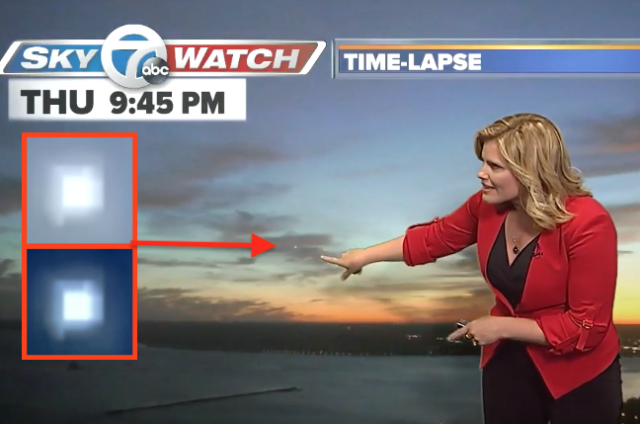
WEERVROUW ZIET UFO TIJDENS LIVE - TV UITZENDING ( VIDEO )
Soms kom je in een live televisie uitzending hele leuke dingen tegen, zoals een UFO verborgen in een wolk tijdens het weerbericht.
Wanneer dit object even later met een onvoorstelbaar hoge snelheid weg vliegt weet de weervrouw even niet wat ze moet zeggen.
Het volgende gebeurde tijdens een live uitzending van het weerbericht in de Amerikaanse staat New York.
Het televisiestation WKBW TV uit de stad Buffalo zond eind juni een weerbericht uit, waar de vrouwelijke presentator iets vreemds opmerkte in een wolk.
Ze wees het dan ook prompt aan tijdens de uitzending terwijl ze zich afvroeg wat het nu eigenlijk kon zijn.
Het vreemde object dat tevoorschijn kwam afkomstig van of achter een wolk bleef daar niet gewoon hangen, maar maakte zich los en schiet met een grote snelheid op de camera af.
Nu kan de snelheid een behoorlijke vertekening zijn omdat WKBW de opname laat zien als een timelapse, maar los daarvan is het overduidelijk een UFO.
De weervrouw probeert ook wanhopig met een verklaring te komen en omdat ze waarschijnlijk het woord UFO niet mag gebruiken in de uitzending, bombardeert ze het object maar tot drone.
De reden dat wij denken dat wij hier absoluut met een UFO te maken hebben is omdat de stad Buffalo aan de rand van het Eriemeer ligt. En dat is niet zomaar een meer, maar één met geweldig UFO verleden.
Hierna een deel uit een eerder artikel over de bijzondere dingen die er gebeuren rondom het Eriemeer.
Je hebt van die plaatsen op deze wereld waar meer UFO’s worden waargenomen dan op andere.
Lake Erie op de grens van Amerika en Canada is absluut één van die “hotspots”.
Lake Erie is één van de Great Lakes of Grote Meren op de grens tussen Amerika en Canada. Door de jaren heen zijn daar vele UFO’s gesignaleerd.
Veelal betreft het hier de witte of rood/oranje bollen zoals wij die ook op andere plaatsen regelmatig waarnemen en vaak veranderen ze van kleur, pulseren, vliegen in formatie of er verschijnen kleinere UFO’s vanuit de grotere.
Het is niet door één iemand waargenomen, talloze getuigen zijn er in geslaagd om beeldopnames te maken. Ook hier verschijnt er niets op de radarschermen. Ondertussen is er al zoveel beeldmateriaal onderzocht dat zaken zoals vliegtuigen, Thaise ballonen en dergelijken uitgesloten kunnen worden.
Inmiddels is het fenomeen zo bekend dat er ook al een aantal televisieprogramma’s aan gewijd zijn.
Een andere reden dat vliegtuigen kunnen worden uitgesloten is omdat dit gebied sinds de gebeurtenissen op 9/11 een no fly zone is omdat er een kerncentrale op één van de oevers staat. Misschien dan ook geen toeval dat veel van die UFO’s worden waargenomen in de buurt van die kerncentrale.
De onderstaande video laat bijna een uur lang beeldmateriaal zien en een aantal fragmenten uit televisieprogramma’s. Opnamen gemaakt op verschillende dagen en een verscheidenheid aan mensen.
Dat daar vreemde objecten rondvliegen, zoveel is zeker. Maar ook hier blijft men het antwoord schuldig betreffende wie, wat en waarom. Voor diegenen die nog weinig ervaring hebben met UFO waarnemingen of die denken dat het Thaise ballonnen zijn, is de onderstaande video een aanrader. Het laat de UFO’s zien in verschillende vormen en kleuren. Er zijn zelfs UFO’s die in het meer schijnen te verdwijnen en vervolgens weer vanuit het water opstijgen.
Lake Erie is eigenlijk één van de eerste plekken waar dit soort UFO’s massaal zijn waargenomen. Vooral ook het laatste jaar zijn ze massaal opgedoken in andere delen van de wereld, waaronder ons land.
Voorlopig blijft het raadsel nog even voortduren, maar vroeg of laat zal er ongetwijfeld een antwoord komen op wie of wat als het gaat over deze vliegende nu nog ongeïdentificeerde objecten.
Decades ago, scavengers rummaging through an abandoned church in a long-forgotten derelict mining town in Chile’s Atacama desert came across a gruesome and bizarre find: a tiny, seemingly anomalous skeleton. The entire skeleton can fit in a human hand, and is topped by an oversized skull with conspicuously large eye sockets. Naturally, the skeleton was accused of belonging to an extraterrestrial or ET-human hybrid and has since been the subject of speculation, rumor, and mystery.
Earlier this year, however, geneticists and immunologists from Stanford University obtained permission to perform genetic testing on the anomalous skeleton to conclusively identify who or what it may have once belonged to. According to their analysis, the skeleton is merely an unfortunate example of how there are both winners and losers in the gene pool lottery. Their study concluded that the Atacama skeleton belongs to either a six-to-eight year-old child who suffered from a host of rare and deformative genetic disorders, or to an unborn fetus with an advanced aging disorder. It’s never aliens.
Now, a new paper is calling that study into question – but not because there is evidence to suggest the Atacama skeleton might be anything more than it has already been determined to be. Instead, both the Chilean government and an international group of scientists and medical researchers are slamming the study for two reasons: one, an improper use of genomic testing; and two, ethics violations. Nerd fight!
On one hand, this new paper accuses the genetic testing of the Atacama skeleton, or Ata, of being improperly carried out:
Unfortunately, there was no scientific rationale to undertake genomic analyses of Ata because the skeleton is normal, the identified genetic mutations are possibly coincidental, and none of them are known to be strongly associated with skeletal dysplasias that would affect the phenotype at this young age.
These scientists believe “it is most likely a coincidence that the authors found this individual [the Atacama skeleton] had some mutations in genes” because the type of mutations found typically don’t have an effect on physiological until much later in fetal development.
More worryingly, the authors of this new paper accuse the analysis of Ata to be unethical. Once it was deemed that the skeleton belonged to a human and that the relatives or parents of the individual were likely still living, the authors write, the skeleton should have been immediately returned to Chile:
We caution DNA researchers about getting involved in cases that lack clear context and legality, or where the remains have resided in private collections. […] Had these researchers involved, from the beginning, a biological anthropologist who specialises in human remains, we are certain that ethical concerns would have been raised regarding the potentially living relatives of Ata.
This case, even though it deals with a recent specimenindividual, highlights one of the gruesome and dehumanizing side of archaeology. Think about it: all of those mummies and skeletons we dig up were once people who were carefully interred with intention and the belief that they would remain undisturbed in the ground. Who are we to dig up the bones of those who came before us in the name of “progress” or advancing knowledge? Is nothing – or no one – sacred? While it’s important to know where we came from, it’s just as important to hold some degree of reverence for the dead. At what point in history do we draw the line?
A common theme in science fiction is that of the portal through space, time, alternate dimensions, or all three. These strange doorways open up into realms unknown, providing a passage to the outer fringes of our reality and our understanding. Yet, by some accounts these openings through space and time are not merely the domain of science fiction, but actually do exist. One place where such outlandish portals seem to materialize quite often is up in the sky above our heads, and here in the heavens above we can find all manner of reports and even photographic evidence of what appears to be something straight out of a science fiction story.
Among the types of portals said to have opened up in the sky are those that seem to be undeniably linked to the UFO phenomenon, with these mysterious craft apparently utilizing these doorways for their own inscrutable purposes. One very interesting report of what is claimed to some sort of alien portal in the sky occurred in May of 2015, when an amateur nature photographer snapped a pic of something very strange in the skies over the province of Groningen in the Netherlands during a storm. As he was taking pictures of the ominous dark clouds gathering above he claims that he saw a bright flash in the sky, which he managed to capture on film, yet when the photo was developed it was found to show what appeared to be some sort of doorway up in the sky emitting vapor or disgorging something else. Is this just a camera trick? What is it?
An image of the strange portal
The following year, on October 1, 2016, a very unusual aerial phenomenon was observed over Bridge City, Texas. According to UFO investigation investigators SecureTeam 10, on this evening at around 11PM a point of white light appeared in the sky, which then steadily formed a streak across the sky, growing larger and brighter, as well as taking on an orange hue. Witnesses reported that it eventually took the form of a bright orange slit in the sky, which seemed to pulse in cycles, and looked like “some sort of portal.” One witness was able to catch footage of the strange sight on a cell phone, which you can see here.
The weird brightening and dimming portal reportedly stayed stationary for around 10 minutes before fading away to leave witnesses baffled. According to the reports, during this time numerous cars at nearby Port Arthur purportedly inexplicably died on the road, their engines stalling for no apparent reason, and SecureTeam 10’s Tyler Glockner claims that hundreds of motorists were effected by this anomaly, their cars stopping dead in their tracks while still in motion and in some cases causing them to careen right off the road. Many of the witnesses also reported hearing a high-pitched whine spew forth from their radios before the cars and all electrical equipment ceased to function, and it has been speculated this was all caused by some sort of electromagnetic pulse connected to the strange object in the sky. Glockner would say of the odd incident:
Now that seems to me like an EMP (electromagnetic) wave, something like that. Something was knocking out power systems along this area very close to where the mysterious streak of light was sighted.
Was this caused by a UFO utilizing some sort of ultra-dimensional portal or is there some rational explanation? Also in 2016 was a video that heavily made the rounds that was originally posted on You Tube by a user called “Myserio Canal.” In the footage can be seen some odd clouds that begin to swirl about to form some kind of vortex in the sky, and just when it seems things can’t get any odder a bright streak of light flies straight at the portal and enters it, much to the shock of those observing it. Shortly after this UFO speeds into this mass of rotating clouds the whole thing vanishes as if it was never there at all. The video, entitled Dimensional portal in the sky absorbs a UFO, was heavily viewed and discussed and debated. While there are those who truly embrace it as genuine, it has been widely denounced by many as a hoax, and it does not help that there is no time or location for the footage given. Alien portal or hot air? You can see it here and decide for yourself.
Yet another YouTube video purportedly showing a UFO using a mysterious portal has proven to be just as controversial and was released in 2018 by channel “MRMB333.” The footage was apparently taken in the skies of Alabama during an eerie looking storm, by a witness known simply as “Nicholas.” The video shows what looks like some kind of anomalous glow flickering in the clouds as a UFO hovers nearby. The video quickly racked up over 100,000 views and stirred up plenty of debate as to what it could be, with many suggesting it was an inter-dimensional portal that may have even caused the storm, and with of course many also crying “Fake!” Real or not, it certainly is a spooky sight either way. You can see it here.
A still from the Alabama portal footage
In 2018 another video came forward, this time from the country of Scotland. In this case there can be seen a bright circular blue light hovering in the sky over Midlothian, located near Edinburgh, which looks very much like a portal of some type. An unidentified object can then be seen passing very close to this “portal” before it blinks out of existence. Again, this video became a viral sensation at the time, and has been speculated as being everything from an inter-dimensional portal, to just a spotlight or the moon behind the clouds. What do you think it is? There are countless other very similar videos out there, and it all makes one wonder just what is going on.
Besides inter-dimensional portals apparently created by extraterrestrial intelligences, there are also plenty of reports of such doorways conjured up by secret government projects right here on Earth. By far the most notorious of these come from that wellspring of conspiracy theories, the Large Hadron Collider (LHC), operated by The European Organization for Nuclear Research, or CERN. The largest and most powerful particle accelerator in the world, the LHC is located 300 feet underground directly below the the CERN Control Centre in Geneva, Switzerland, and is comprised of a vast loop stretching 27 kilometers (about 17 miles).
This loop is more or less used to hurl subatomic particles at extreme speeds in order to smash them into each other to test what will happen for the purpose of unlocking some of the secrets of our universe, including recreating the conditions of the Big Bang, to find out how our universe was create, and find dark matter, among others. Perhaps one of the most famous discoveries linked to the various experiments at the LHC was the observation of Higgs Boson particles, which give matter mass and up until then had been purely theoretical. In addition to the official explanation of this facility, there are many, many conspiracy theories about what “really goes on down there.”
The Large Hadron Collider
Indeed, the very presence of such a large scientific facility located deep underground, its innately somewhat scary-sounding premise of smashing particles together at the speed of light, and its being manned by scientists working on strange experiments down in the subterranean darkness, have all perhaps not surprisingly at all given the location a somewhat ominous reputation, causing quite a bit of concern among the public and spawning all sorts of wild theories about what is really going on there. In additions to alarm and fears that the LHC will create miniature black holes or undo reality itself are various ideas and rumors that CERN is up to all kinds of top-secret experiments and no goodery down there in the bowels of the earth. One of the more popular conspiracy theories is that the facility is actively engaged in opening rifts between dimensions in order to enable teleportation, form doorways to alternate realities, and facilitate travel through time and space.
Evidence for this sort of inter-dimensional activity is often offered in the form of the various strange things that have allegedly been photographed or filmed in the skies over CERN over the years, including UFOS, strange vortices, and other unexplained aerial phenomena. For instance, in December of 2015 footage was taken by some tourists of what seems to be an orb of some sort entering what appears to be some kind of portal or vortex, which vanishes as soon as the unidentified object enters it. Another similar video from May of 2016 supposedly shows some sort of portal in the clouds that appeared right after the power went out at CERN, an incident they claimed was caused by a weasel getting into some of the sensitive machinery.
Strange vortex over CERN
It is interesting to note that a lot of the anomalous events that have purportedly occurred at CERN seem to coincide with blackouts, such as an alleged ripple that was sent out from the facility in 2009 that purportedly disrupted the Earth’s magnetic field and distorted space and time, also right at the time of a blackout at the facility. A report from Russia claimed that this very same “time wave” had instantaneously teleported an Airbus on its way to Bolivia thousands of miles away to the Canary Islands, along with its 170 passengers. This time the blackout was blamed on a piece of bread that had fallen into the device after being dropped by a bird. One would hope that such an advanced scientific facility deep underground would be able to keep out all of the weasels, birds and bread that’ve seemingly been jamming their equipment.
One of the more recent such series of photographic oddness came in the wake of another ambitious project undertaken in recent years by CERN, which itself has already drawn a fair amount of conspiracy theories. The project is what CERN calls the Advanced Proton Driven Plasma Wakefield Acceleration Experiment, or AWAKE, which has the aim of accelerating super-charged particles by way of “plasma wakefields driven by a proton beam.” It is not necessary to really understand what all of that means, only that it sounds rather ominous, scary even, and this may be why it has been singled out as one of the experiments focused on opening portals between worlds.
On June 24, 2016, photographs of alarming, portal-shaped cloud formations were taken in the skies above CERN not long after the AWAKE project was off the ground and on the same day that an experiment was scheduled. The story was big news at the time, and in a video on the phenomenon entitled What Portal did CERN open now?, the narrator says of the strange sight:
This insane ball of energy was directly over the LHC. Some people reported seeing faces in it. It is amazing they keep messing with nature and denying it. What is in the cloud – some say it is lightning or a massive ball of energy. The amount of energy pulling from nature into the collider itself, you can actually see it. What portals are doors being opened in this cloud? Is it a coincidence they had just started the Awake experiment?
Photograph from the June, 2016 event taken by witness Dean Gill
While photographs and videos such as these could have a rational explanation in known phenomena or even be cleverly crafted CGI hoaxes, there are a fairly large number of people who insist that these are the result of CERN experiments pursuing the opening of inter-dimensional doorways. It is unclear whether the LHC is being used to open these portals, intentionally or otherwise, or not, but it does seem certain that conspiracy theories and fears will continue to swirl around it as long as it is in operation.
Here we have looked at just a selection of weird portals that seem to have opened up in the heavens for reasons that remain unknown and perhaps always will be. Are these hoaxes, misidentifications, or little understood natural phenomena in action? Or could it be that rifts in space and time have actually been created. If so, then where they lead or what purpose they serve no one really knows, but whether real or not, accounts such as we will look at here truly stir up the imagination for some time to come.
Time is weird. It’s a concept notoriously impossible define without circular logic. The operating definition of time in physics is simply “what a clock reads.” That’s it. Yet, we have ideas about time that are held as fundamental truths. The arrow of time is one, that’s the idea that time only moves in one direction. Simple enough right? Here’s another one: cause and effect, thing’s cause things to happen. Also pretty simple and just kind of self evident. Causality is one of the first concepts that infants learn, and it’s baked into everything we do. But for how basic and integral to our whole reality time is, we don’t really understand it or have a better definition than “what a clock reads.” Sometimes, discoveries are made that seem to fly in the face of our supposed understanding of time. That’s what happened this week, when a paper titled Cause and Effect in a Quantum World was published in the journal Physical Review X. According to the paper, quantum computers can ignore cause and effect when modeling systems, a discovery which may fundamentally alter our understanding and relationship with time itself.
OK, so two things need to be addressed before this makes sense. Just kidding, we’re talking about time and quantum physics. It’s not going to make sense, but we’re going to try anyway.
The first is cause and effect. Due to our ability to understand cause and effect we can predict things and model possible futures. If you see a person walking around with their shoes untied, you might make a prediction that they’re going to fall on their face. You could very well be right. Untied shoelaces cause a person to trip which causes the person to fall on their face. Computers can make these predictions too. However, it doesn’t work the other way. It’s exponentially harder and requires a great deal more memory and processing power, for both humans and computers, to model systems based on information interpreted in the wrong order. If you’re given the statement: “a person has fallen on their face” it’s a lot harder to figure out why. Another way to say it is: it’s easier to understand a movie if you watch it from beginning to end than if you watch it in reverse. This is called causal asymmetry and it seems like a basic idea.
The second is that the physical laws of nature don’t actually require time to move in one direction. We just sort of assume the arrow of time moves in one direction does because of our experience and perception. Addressing the question of why it takes so much more processing power and memory to figure out a cause from an effect than it does the other way around, paper co-author Mile Gu asks:
“When the physics does not impose any direction on time, where does causal asymmetry — the memory overhead needed to reverse cause and effect — come from?”
This guy thinks he’s late, but time is an illusion so he should probably just go home and take a nap.
To try to answer that question, scientists decided to force quantum computers to model systems backwards, essentially making them watch a movie in reverse and figure out how it all fits together. What they found is pretty ridiculous: quantum computers entirely ignore causal asymmetry when reading data in reverse. Cause and effect has no bearing on their ability to figure out systems. In fact, quantum computers model systems in reverse-time more efficiently than classical computers model systems in forward-time. Jayne Thompson, one of the co-authors of the paper explains the “profound implications” of this discovery:
“The most exciting thing for us is the possible connection with the arrow of time. If causal asymmetry is only found in classical models, it suggests our perception of cause and effect, and thus time, can emerge from enforcing a classical explanation on events in a fundamentally quantum world.”
So basically, we keep getting stumped by our need to make the universe conform to our preconceived notions of how things work, and time is still weird.
Just a couple of nights ago – while I was promoting my latest book, The Black Diary – I was asked by a caller to the radio show why I “insist” on stating that the Men in Black are supernatural in nature, rather than “accepting” that they are the secret agents of a clandestine agency within government. The answer to that question is very simple: it’s the witness testimony which makes me come to the supernatural conclusion. I have always said that the most important people in the collective field of Forteana are not the writers, the researchers, the radio-hosts, or the TV producers. It’s the witnesses who are the most important. Time and time again I am approached by people who have been terrorized by the MIB. On only a small number of occasions do the witnesses describe the MIB as looking human. For the most part, they look anything but human.
I know all too well why so many people assume that the MIB are agents of governments, of military agencies, and / or of clandestine projects buried deep within the world of officialdom. It largely comes from the Men in Black movies, starring Will Smith and Tommy Lee Jones. Yes, the trilogy makes for fun viewing. But, by presenting the MIB as the agents of a classified organization, the makers of the movies instilled in the minds of many the image of the Men in Black being “secret agents.” But, the Hollywood portrayal is actually very different to what the witnesses tell us – and that’s a very important issue to be aware of.
It’s worth noting that the man who largely began the whole MIB phenomenon in the early 1950s – Albert Bender, of Bridgeport, Connecticut – was confronted not by agents of the FBI, CIA, etc., but by grim-faced, shadow-like characters with shining eyes and who left behind them an odor of brimstone when they quite literally vanished. Bender’s strange story – which comes across like something akin to H.P. Lovecraft meets The X-Files– is told in Gray Barker’s 1956 book, They Knew Too Much About Flying Saucers and in Bender’s own book, Flying Saucers and the Three Men.
When, from 1966 to 1967, John Keel immersed himself in the wave of sightings of what became known as “Mothman” in the town of Point Pleasant, West Virginia, he was flooded with accounts of local encounters with both MIB and Women in Black. They were often described as looking not quite human. Their skin resembled plastic. They wore wraparound sunglasses that often only partially masked their huge, oversized eyes. They were clearly unaware of our customs and manners. Some of them didn’t even know how to eat food or drink water – as bizarre as it certainly sounds.
Things get even more disturbing: people who have encountered the MIB have fallen sick – and quickly, too. A kind of paranormal infection, we might say. The MIB are able to place people under some form of mind-control, something which compels the targeted person to open the door and let them in, regardless of the time of day or night. Witnesses to UFO activity who have been visited by the MIB talk of poltergeist activity occurring in the home – and in the immediate aftermaths of the MIBs’ vanishing acts.
There are reports of people encountering the MIB while in altered states. In the late 1960s, voice-over actor Peter Beckman and a friend had a very sinister encounter with a pair of MIB while on mescaline – and while listening to the soundtrack to the movie, Rosemary’s Baby. Peter said of the MIB who quickly turned up and managed to get into the house: “They were dressed in square, Eisenhower-era cop-clothing, or FBI clothing – which in 1969, 1970 was not that unusual. They came in and sat on the couch. They were pale and sickly; their clothes hung real loose and they looked as though they might expire at any moment. They appeared to have either trouble breathing, or trouble even being. I don’t believe they said a thing. If they did, it has disappeared from memory. Very odd, indeed.”
Similarly, I have three cases where people encountered the MIB while on DMT. In one such case, the witness described how both MIB seemed “surprised” that the witness could see them. Not only that, the MIB seemingly have the ability to invade peoples’ dreams and turn them into definitive nightmares. The old black cars of the MIB vanish in the blink of an eye. There are even a few, very strange, stories of the MIB shapeshifting into the form of a large, black dog with glowing, red eyes.
So, that’s why I “insist” the Men in Black are not human: because the vast majority of all the witnesses to the MIB describe them as being non-human.
Fox News: UFOs frequently come close to hitting airliners
Britain's real-life 'Fox Mulder' says in recent years, governments have been taking UFOs more seriously and they need to become a national security issue.
Mulder interviews Nick Pope on this issue as well as they talk about that UFOs coming closer to hitting airliners.
The latest strange incident happened a few days ago when an Antonov aircraft flying over Siberia was hit by an unknown object with such a force that it caused a hole in the nose of the plane.
The plane flew through 'unfavorable weather conditions' en route from Olenyok to Yakutsk in the Sakha Republic - also known as Yakutia when something hit the An-24 twin turboprop. The pilot handed in regional capital Yakutsk without incident following the 1,070 km (665 mile) flight reports siberiantimes.
Polar Airlines has denied a lightning strike was responsible. Air safety watchdog Rosaviation has set up a commission to investigate the incident but it is far from clear what happened.
Rainbow UFO Recorded During Sunset In Dearborn Heights, MI Awesome Photos, UFO Sighting News.
Date of sighting: Jan 26, 2018
Location of sighting: Dearborn Heights, MI, USA
Source: MUFON #93560
What we see before us is an alien craft that is cloaked, however during sunset, the angle of the sun and the eyewitness were at a 90 degree angle from the UFO. When this happens, any UFO in the area will be visible from a few seconds to a few minutes. Yes a cloak is just technology...and tech always has its flaws. If you look at the photo above where I added contrast only, you will notice the front part of a disk is visible.
Scott C. Waring
Eyewitness states:
Photo taken in the sky, I did not encounter anything, beautiful rainbow looking thing.
Former NASA Scientist Says UFOs Are Real And Many Governments Cover Up Alien Life Existence
There has been no concrete scientific evidence of aliens, but a physics professor and former NASA scientist believes the truth is out there and it should be studied scientifically.
A former NASA scientist published an article on June 28 calling for the scientific community to seriously look at evidence of the presence of UFOs on Earth. The article was posted a few days before World UFO Day on July 2.
A State University of New York physics professor Kevin Knuth describes two personal stories on the speculation of aliens. The first one came at NASA conference in 2002.
A participant said, “You have no idea what is out there!”
The second story took place in 1988 when Knuth was a graduate student. His physics professor back then said that UFOs were shooting down nuclear missiles from the Air Force. Knuth did not believe it, but he saw a recording of a press conference with officials from the Air Force describing events just like that years later.
Knuth believes there’s evidence to support the theory of the existence of aliens. He estimates that there could be tens of thousands of intelligent civilisations in the galaxy. He thinks many governments have been covering up the information and that there are pieces of evidence enough to open a scientific study.
Oumuamua arrived from out of our solar system, now there is a second object of this class
The gas cloud around the comet's nucleus is about 4 arc minutes wide," says Jäger. That means the comet's atmosphere is 260,000 km in diameter, almost twice as wide as the planet Jupiter. Barely a week later, the comet fizzled, dimming almost as much as it had brightened. Then it exploded again, its green atmosphere ballooned in size, large enough to swallow Jupiter twice.
Brandweerman claimt engelen en aliens te hebben gezien. Dit maakte hij nog meer mee
Een brandweerman van de FDNY, de New Yorkse brandweer, zegt dat hij geregeld contact heeft met buitenaardsen, UFO’s, overleden mensen en engelen, zelfs in de kazerne in Brooklyn.
“Ik heb engelen aan het werk gezien,” zei Andrew Radziewicz (38) in de radioshow Sacred Matrix. Hij zei ook vaak kleurrijke lichtbollen te zien.
Nadat hij in juni een ‘enorm’ schip had gezien, vroeg Radziewicz op Facebook om erkenning van onze sterrenfamilie.
Moederschip
De brandweerman begon zijn waarnemingen afgelopen zomer te documenteren. Hij deelde op Facebook allerlei foto’s en videobeelden, schrijft de New York Post.
De brandweerveteraan zegt ook beelden te hebben gemaakt van vier ‘lichtwezens’ die hem op 11 september vorig jaar wakker maakten.
Radziewicz claimt verder dat hij wordt gevolgd door een enorm ‘moederschip’ en dat de ziel van zijn overleden hond Odi hem vaak bezoekt aan boord van een ‘lichtschip’.
Onmogelijk
Hij heeft in interviews gezegd dat hij in 1999, toen hij als 19-jarige voor de Amerikaanse kustwacht werkte, voor het eerst een alien heeft gezien.
Hij zag naar eigen zeggen twee zilverkleurige objecten die dicht bij elkaar bleven. Zo’n 20 matrozen en anderen aan boord van het schip zagen de objecten, die niet op de radar verschenen.
“Toen ze elkaar aanraakten en versmolten, verdwenen ze,” zei hij. “Het is onmogelijk dat in zo’n soort vaartuig een mens zat.”
Telepathisch
Hij zei dat mensen hem plagen en belachelijke maken vanwege zijn berichten op internet, maar dat hij daar maling aan heeft.
“Er zijn andere mensen die zo bang zijn om hierover te praten omdat ze niet belachelijk gemaakt willen worden,” zei hij.
“We hebben gecommuniceerd met wezens van Sirius tot Andromeda en allerlei andere sterrenstelsels,” besloot Radziewicz. “Het is vooral telepathisch.”
The Gault site, located just outside of Austin, Texas, has been known to archaeologists for the better part of the last century. Discovered by Henry Gault, a landowner who worked as an archaeological informant in the early 1900s, the site was officially excavated for a period beginning in 1929, under the supervision of J.E. Pearce with the University of Texas. It was reportedly looted a number of times over the ensuing years, prior to new ownership of the property that led official test excavations that began in 1991. By the end of the decade, formal excavations that would continue well into the new millennium were underway.
Over the course of several dig seasons in recent years, Gault has become recognized by archaeologists as a site of particular significance, due to the number of complete lithic assemblages recovered there.
However, the number of artifacts found at the site is just one of the reasons it has American archaeologists so excited. Among the most recent discoveries at the site, new evidence of early occupation is pushing back the timescale on human arrivals in North America, lending further evidence toward the idea of earlier migrations into the western hemisphere than once believed.
Specifically, the Gault site has yielded intricate projectile points from its deepest strata that are well in advance of the Clovis culture. These artifacts not only count among several existing pre-Clovis discoveries in the Americas, but are accompanied by dates obtained via optically stimulated luminescence that suggest an age of 20,000 years or more, effectively placing them among the oldest of their kind found in North America to date.
Excavations at Gault over the years turned up numerous unique discoveries even before the discovery of its pre-Clovis assemblages. The site’s Clovis horizon, for instance, produced a number of fluted projectile points similar to those seen in the image at the top of this page (note that the points featured in the top image are associated with the Rummells-Maske Site in Cedar County, Iowa, rather than Gault, and are used here only for illustrative purposes).
Alongside these points was a fragmentary basal portion of a Clovis-like projectile, similar to what are identified as “Redstone” points in the Southeast (these are similar enough to a preexisting type of projectile point, called Gainey, that many experts consider the two types one and the same). Prior to its discovery amidst the Clovis assemblage at Gault, little data had been obtained for in situ discoveries of Redstone points; additionally, few–if any–had ever been documented in association with a site as far west as Gault. In total, more than 600,000 artifacts identified with the Clovis culture were recovered from the site.
Area 15 at the Gault site, as it appeared between 2007–2014 excavations
(Credit: Jillabus, Wikimedia Commons).
Subsequent dig seasons at Gault continued to produce surprises, and the latest paper published in Science Advances gives full details of the pre-Clovis discoveries, in addition to the dating methods used to determine their provenance.
Luminescence dating, a technique which relies on stimulation of minerals in various ways in order to discern when they were last exposed to sunlight or significant amounts of heat, was among the methods employed to date the pre-Clovis strata at Gault. Among the earliest dates recorded in association with artifacts was 21,700 years, with a standard deviation of ± 1.4 ka. “Significantly, this assemblage exhibits a previously unknown, early projectile point technology unrelated to Clovis,” the study’s authors wrote. “Within a wider context, this evidence suggests that Clovis technology spread across an already regionalized, indigenous population.”
As I noted recently in an article about the Gault discoveries, this is by no means the first time that evidence of a pre-Clovis presence, possibly dating as far back as 20,000 years, has been found in the Americas:
The Topper site in Allendale County, South Carolina, produced similar lithic evidence which dates back at least 20,000 years, though some artifacts recovered from deeper stratigraphic layers there are estimated to be as much as 50,000 years old. Similarly, radiocarbon dates in association with human artifacts at Meadowcroft Rockshelter in Washington County, Pennsylvania, are reliably dated to earlier than 16,000 BC, with one instance of carbonized bark-like material (possible basketry) with evidence of cutting marks dating to 21,070 BP ± 2400. Charcoal recovered elsewhere from Meadowcroft shows 14C dates in excess of 30,000 years (similar to dates retrieved from Monte Verde, Chile, during excavations by Tom Dillehay). According to J.M. Adovasio, who led excavations at Meadowcroft for a number of decades, the earlier dates are intriguing, but he and others generally work with the more likely nearer dates of around 16,000 years, which are still well in advance of Clovis.
The Science Advances paper can be read online here, which features a wealth of technical data and illustrations depicting the earliest artifacts recovered at the site. For more on the technical significance of these Gault pre-Clovis discoveries, along with an analysis of its impact in the context of advances in American archaeology, see my article “Gault Site in Texas Offers New Evidence of Human Habitation 16 to 20 Thousand Years Ago.”
As an addendum, I’ll note that many these days, in light of ongoing archaeological discoveries like those discussed here, have commented on how “things keep getting older.” That is to say, of course, that archaeologists continue to find more and more evidence for earlier occupations in the New World, as well as advanced behaviors and engineering among early cultures, and refinement of processes that include such things as crafting pottery, agriculture, fermentation, and a wealth of other innovations.
In equal measure to the idea that we’re constantly finding broad evidence for things that, at one time, might have seemed historically out of place, it is also important to make the observation that part of what has led to these new discoveries in the first place has been a fundamental change in thinking.
On a number of occasions at American dig sites I’ve visited where pre-Clovis artifacts ended up being recovered, archaeologists have expressed to me that while such discoveries had been there all along, they were essentially kept hidden for as long as they were by one simple fact: that there had been an expectation nothing would be found below the Clovis horizon. Once archaeologists began pressing on and exploring deeper strata, many were shocked to find evidence of much earlier occupations than previously expected; and inevitably, many were also criticized for presenting these discoveries, even when reliable scientific evidence to account for their provenance was offered.
People are often slow to accept new ideas, although that’s certainly not always a bad thing. Science relies on having waterproof arguments, and skepticism is the best defense against unintended leaks. However, with evidence forthcoming that is strongly in support of an idea that might have once seemed impossible, the necessity for acceptance of new data becomes paramount. Rather than to say that things “keep getting older,” I think it is important to recognize that we are learning–through science–things like how much earlier humans were traversing areas of the globe, utilizing certain technological innovations, and accomplishing things we simply hadn’t conceived they were capable of as recently as a few years ago.
Science is the ultimate tool of discovery, and as it has continued to show us new things about the ancient past, it underscores the same timeless ingenuity of the human spirit at work, both then and now.
Humanity has long wondered if life exists elsewhere beyond Earth. With the universe being so mind-numbingly vast, the very idea that our tiny, waterlogged rock should alone harbor life seems so…wasteful.
To sate our curiosity, NASA catalogs exoplanets orbiting Milky Way stars to look for potential cradles of extraterrestrial life, such as Kepler-186f, the first validated Earth-size planet orbiting in its star’s habitable zone. And the SETI (Search for Extraterrestrial Intelligence) Institute searches space for clues of alien civilizations by, for example, scanning for the residuals of communication technology like narrow-band radio transmissions.
But is it possible we’ve set our gaze too far to the horizon? Perhaps the greatest chance we have of finding life beyond Earth isn’t orbiting some distant star but can be found in our own solar backyard.
Independence Day, 1996, 20th Century Fox.
What we look for
When looking for suitable habitats for life, astrobiologists search first and foremost for water. Water is the cornerstone of life on Earth. Life needs solvents to perform biochemical processes, and water’s title as the universal solvent means that even the simplest of organisms can use it for their molecular interactions.1
Astrobiologists also look for ways energy may enter a system for metabolic processes. On Earth, this form of energy is typically the Sun; however, recent discoveries have led astrobiologists to search for alternative forms, such as geothermal energy.
Finally, they look for other environmental conditions that make life more or less likely: climate, pressure, temperature, atmospheric makeup, and so on.
We should take this moment to make an important distinction. While our solar system may harbor several havens for life, this life will likely not be the intelligent life that SETI searches for. Any neighborly E.T.s we encounter won’t be little grey men or green-skinned vixens so much as a small, microscopic, organisms. Think strange, exotic tardigrades. Well, stranger tardigrades.
Mars Attacks!, 1998, Warner Bros.
Mars
Ever since Percival Lowel mapped the “canals” of Mars, our ruddy neighbor has been the go-to planet for science fiction writers imagining extraterrestrial life — from H.G. Wells’s colonizing Martians to Ray Bradbury’s mystical natives3. The canals proved a trick of the eye, and theMars Science Laboratory Mission’s Curiosity rover has yet to find signs of civilization, but that doesn’t mean Mars is out of the extraterrestrial running.
Scientists have discovered dark, narrow streaks on the landscape most likely caused by flowing water. These streaks showed traces of hydrated salt, like what occurs after salt contacts water before it evaporates.
Given Mars’ dry, barren landscape and lack of atmosphere, how water got there remains a mystery, but the phenomenon points to the possibility of liquid water not trapped in the planet’s polar ice caps, providing a potential habitat for microbial life. Should water flow under the planet’s surface, any life could even be shielded from the sun’s radiation.
Adding to the intrigue, scientists think that water once covered roughly 20 percent of the surface before Mars’s atmospheric gases were stripped away, and the water evaporated into space. Scientists have also discoveredmeteorites from Mars that contained the remnants of organic material — suggesting the rusted planet once contained the ingredients for life.
The surface of Venus, c/o NASA
Venus
Like Mars, Venus likely enjoyed Earth-like conditions back in the day. Computer simulations of its early environment suggest the possibility of primordial oceans, moderate temperatures, and a habitable climate.
As David Grinspoon, of the Planetary Science Institute, told New Scientist: “Both planets probably enjoyed warm liquid water oceans in contact with rock and with organic molecules undergoing chemical evolutions in those oceans. As far as we understand at present, those are the requirements for the origin of life.”
If early life did form on Venus, most of it probably vanished 715 million years ago, along with those oceans. Today’s Venus sports an infernal landscape of volcanic activity, surface temperatures approaching 750 Kelvin, and a thick, noxious atmosphere of carbon dioxide with clouds of sulfuric acid.4,5
But it is that very toxic atmosphere that may have saved Venusian life. According to a paper in the journal Astrobiology, the atmosphere could provide a safe haven for microbial life. Using spectroscopic observations, researchers found “dark patches” in the atmosphere composed of “concentrated sulfuric acid and other unknown light-absorbing particles.”
While it is unknown if these patches are organic or not, they do have the same dimension as some Earth bacteria, and researchers think they could be the Venusian equivalent of algae blooms (like those that appear in our lakes and oceans).
The jets of Enceladus, c/o NAS
Enceladus and Europa
Moving away from Earth’s rocky neighbors, astrobiologists are also considering the possibility that life may exist on the moons of Saturn and Jupiter.
When the Cassini-Huygens spacecraft flew past Saturn’s sixth moon, Enceladus, it discovered hydrogen gas in an erupting plume of water.6 The eruption suggested hydrothermal activity may be taking place beneath Enceladus’ icy surface. If so, the moon would offer two important ingredients for life — water and energy for metabolic processes.
Europa’s surface is similarly covered in ice, with long streaks of “brown gunk.” But beneath that surface, scientist estimate that there could be twice as much water as on Earth. If this Jovian moon also produced hydrothermal activity within that ocean, it too could be a harbor for life.8 A study using computer models has even suggested that Europa may have hydrogen and oxygen in amounts comparable to Earth, even if the moon is lacking in volcanic activity.
NASA is planning to launch a Europa flyby mission in the early 2020s, and the agency’s SUBSEA project will be studying hydrothermal environments in the Lō`ihi seamount, off the coast of Hawaii’s Big Island, to learn how life can thrive on Earth in conditions similar to those possible on Enceladus and Europa.
This false-color rendering highlights differences in surface materials at Ceres. c/o NASA
Ceres
Our final candidate is Ceres, a dwarf planet and the largest object orbiting in the asteroid belt between Mars and Jupiter. A spherical clump of rock and ice, Ceres would be an unlikely contender for this list until last year, whenNASA’s Dawn mission detected organic material on its surface.
Originally, it was thought this organic material covered 6–10 percent of the spectral signature, but a recent analysis of the data suggests the amount of could be as high as 40–50 percent. Since carbon-based compounds are necessary for life, it makes for an exciting discovery that could change how we view objects in the asteroid belt.
With that said, this is a recent discovery and much remains unclear. It is possible the organics weren’t created on Ceres but planted there by comets, and even if they are native, organic compounds can come about from non-biological processes.
As Ralph Milliken, a professor at Brown University and one of the study’s co-authors said in a press release: “Ceres is clearly a fascinating object, and understanding the story and origin of organics in these spots and elsewhere on Ceres will likely require future missions that can analyze or return samples.”
The Fifth Wave, Columbia Pictures, 2016.
The end of life as we know it
So far, our solar search has focused on the conditions for life as we know it. But what about life as we don’t know it?
Bacteria recently discovered in Antarctica can survive off just the hydrogen, carbon monoxide, and carbon dioxide they get from the air. These guys make breatharians look gluttonous by comparison and could lead the way to remove water as a prerequisite in our search for extraterrestrial life.
Additionally, Sara Seager, MIT physics professor, considered that alien life may evolve around different chemical combinations than life on Earth and used computer-generated models to devise a list of those possible combinations.
“The theory ended up being, we should maybe consider all potential molecules that would be in gas form,” Seager said. “Why not consider all of them? I just combined them in any way possible, like just taking letters in the alphabet and combining them in all ways.”
Could life possibly exist in Titan’s methane sea? Or could the seeds of life be floating on some yet undiscovered asteroid? The more we learn about life on Earth, the more we learn about the myriad of paths it has taken to thrive, opening avenues for us to find it in our solar system and beyond.
They’re real and contain hidden messages, scientist says
IT all started with a UFO sighting.
Dr Horace Drew, 61, was just 10 years old when he allegedly saw an unidentified, silver, windowless craft hovering in the sky near his suburban home, in Jacksonville, Florida. The encounter lasted only moments but led to a lifelong fascination with the extraterrestrial.
“I saw a UFO, so I knew they were real from an early age,” Dr Drew told news.com.au.
The scientist, who holds a PhD in Chemistry from Caltech, the California Institute of Technology, and worked for CSIRO as a molecular biologist, has been researching crop circles and aliens for 20 years. Dr Drew relocated to Australia in the 1980s but most of his work has taken him overseas, predominantly to Europe.
“They’re quite rare in Australia,” he said.
He, along with many conspiracy theorists, believe crop circles are the work of aliens or human time travellers. Sceptics say most are probably man-made.
A crop circle is typically defined by standing wheat stems that have been flattened in the shape of a circle or more complex pattern. They tend to appear mainly in developed Western or secularised countries — including Japan.
The cause of many of the circles is unknown despite various natural and unorthodox explanations having been put forward. Some crop circles have been proven to be hoaxes.
But according to Dr Drew, a number are legitimate and contain puzzles that can be decoded and linked to time travel and alien life.
He told news.com.au he had visited about “two dozen crop circles” around the globe in his career. Typically, they were between 50-500m in length, he said.
“This has led to at least one major breakthrough the discovery of a more advanced binary code than our computers currently use.”
Dr Drew claimed that aliens or human time travellers have been leaving the crop circles on Earth as messages to “us or themselves”.
WHY ARE THERE CROP CIRCLES?
Dr Drew said he was one of a handful of scientists around the world who had worked to successfully decode some of the messages in crop circles.
According to him, some crop circles provide general descriptions of the future.
“Other crop (circles) show schematic images of the future for astronomical or human events,” he said.
He said some of the decoded messages read: ‘Much pain but still time. Believe. There is good out there’; ‘Beware the bearers of false gifts and their broken promises’; ‘We oppose deception. Conduit closing’.
Dr Drew has developed at least two theories as to the purpose of the circles by reading their “advanced (version of) binary codes”.
“One theory is that they are trying to introduce themselves to us peacefully, like we do using bubbles with dolphins,” he said.
“When (humans) want to talk with dolphins we put little bubble circles under the ocean with a generator. We watch the dolphins come up and play and investigate, and we study them.
“This is called the ‘dolphin communication project’.”
He said the dynamic between the way humans interact with dolphins and whales was likely comparable to how extraterrestrials communicate with us.
“Barack or Trump have never said to a dolphin: ‘take me to your leader I want to sign a treaty with you’,” he said.
“And (the extraterrestrials are) not interested in making a treaty with us.
“They are ahead of us like we are ahead of the dolphins and the whales.”
His second theory was that the messages “are not even for us”.
Dr Drew said human time travellers from the distant future could be creating the circles as directional markers, to help them navigate “in their distant past, which is our present”.
“There are definitely humans living there in about 5000 years with time travel capability,” he said.
“They’re coming back and flying all over Earth.
“They seem to just say ‘this is a certain day’ and mark it.
“So the trouble is we don’t know space time physics enough to understand what’s happening. It’s beyond our knowledge.
HOW ARE THEY MADE?
Dr Drew said the circles appeared to be created by an “unknown energy that heats the crops up”.
“It’s like microwave energy but is something beyond earth’s science,” he said.
“It can pattern the wheat.
“No one sees or hears anything and that's why its so hard to prove. If there’s a craft, it’s silent, noiseless.”
But there’s nothing to fear, according to him.
“Don’t be afraid,” he said.
REAL OR A HOAX?
Telling the difference between a real crop circle and a hoax is like differentiating between an original painting and a fake, according to Dr Drew.
“There are some things to look for,” he said.
Crops that are bent “halfway up” their stems, rather than on the ground ,is one telltale sign “cereologists”, or someone that advocates paranormal explanations of crop circles, look for to determine that it’s not a hoax.
“You can’t absolutely prove a crop circle wasn’t a hoax but you can give a high probability and judgment,” he said.
“If there’s a hoax the word of it gets around very fast, people are aware, people are not that easily fooled.”
In 1991, English pranksters Doug Bower and Dave Chorley took credit for most of the crop circles across southern England made since 1978. They were inspired by the Tully “saucer nest” case in Australia, where a farmer found a flattened circle of swamp reeds after observing a UFO.
Using basic tools including a plank of wood, rope, and a baseball cap fitted with a loop of wire to help them walk in a straight line, they said they made complex crop circles in England — which others then copied all over the world into the 1980s.
They made a circle for journalists, which was later declared authentic by a cereologist. They then revealed their hoax to the world, spurring on even more copycats.
Dr Drew said there was a lot of scientific evidence to show that some crop circles were made by human time travellers or extraterrestrial beings. “Laboratory results on plant or soil samples taken from a crop circle in Brazil in October of 2016 show that it was formed by unknown sterilising images,” he said.
The earliest mention of a crop circle dates back to the 1500s. A woodcut from the time showed a “mowing devil” making the pattern.µ
GOVERNMENT SECRETS?
Earlier this month, US TV host Jimmy Kimmel asked former US President George Bush if he went through “secret files, the UFO documents” when he was in office.
But instead of laughing off the question, the former commander in chief replied: “Maybe.”
Mr Kimmel then asked him if there were “any great secrets you know that you can’t share with people?”
“Yeah, there are,” Mr Bush said. “But I’m not telling you.”
Many conspiracy theorists and some scientists, including Dr Drew, argued that Mr Bush’s comments indicated the US government knows much more about extraterrestrial life than it has publicly revealed.
“The politicians are scared they'll lose votes if they talk about it,” Dr Drew said.
He said international media had also played a part in causing the public to doubt the legitimacy of crop circles and aliens.
But according to him, its important for humans to keep seeking answers.
“The ET visitors have technologies which would benefit us greatly, for example, how to make safe, clean energy without burning oil, coal or gas,” Dr Drew said.
“Ultra-fast propulsion systems, based on gravity and inertia, could carry us safely to distant planets or stars.
“We may also need to upgrade our planetary defences soon, to protect against ET’s who may not be friendly.”
There’s still a lot more to be understood but Dr Drew’s hope is that he one day gets a closer look at what was inside the UFO he believes he saw as a child.
“I’d like to meet (the extraterrestrials or human time travellers) in person,” he said.
“But I don’t think they're going to do that.
“Whichever scientific team is doing this I don’t think we’re supposed to have full knowledge of it because it will interrupt their program, whatever they're doing.”
Chandra May Have First Evidence of a Young Star Devouring a Planet
Chandra data indicates that a young star has likely destroyed and consumed an infant planet.
If confirmed, this would be the first time that astronomers have witnessed such an event.
The star, known as RW Aur A, is a few million years old and is located about 450 light years from Earth.
Studying this may help astronomers gain insight into the processes affecting the early stages of planet development.
This artist's illustration depicts the destruction of a young planet or planets, which scientists may have witnessed for the first time using data from NASA's Chandra X-ray Observatory, as described in our latest press release. If this discovery is confirmed, it would give insight into the processes affecting the survival of infant planets.
RW Aur A is a star about 450 light years from Earth, making it relatively nearby. Since the 1930s, astronomers have studied RW Aur A and been curious about why the optical light from this star changes over time. In recent years, scientists have observed that this variability has increased, with the star dimming even more and for longer periods of time.
To investigate this mystery, a team of astronomers used Chandra to get information in the X-ray band of the electromagnetic spectrum. X-rays are generally emitted by more energetic and hotter phenomena than their optical light counterparts and can reveal information about different elements, including iron.
The Chandra data suggest that the most recent dimming event from RW Aur A was caused by the collision of two "planetesimals" (that is, infant planetary bodies still in the process of formation), including at least one object large enough to be a planet.
Because the X-rays come from the hot outer atmosphere of the star, changes in the X-ray spectrum — the intensity of X-rays measured at different energies — over these three observations were used to probe the density and composition of the absorbing material around the star.
The team found that the dips in both optical and X-ray light are caused by dense gas obscuring the star's light. Also, a Chandra observation in 2017 showed strong emission from iron atoms, indicating that the disk contained at least 10 times more iron than in the 2013 observation during a bright period.
The Chandra spectra from the 2013 and 2017 observations are shown in an inset in the graphic. The sharp peak on the right side of the 2017 spectrum is a signature of a large amount of iron.
The researchers propose the excess iron was created when the two planetesimals collided. If one or both planetary bodies are made partly of iron, their smash-up could release a large amount of iron into the star's disk and temporarily obscure its light as the material falls into the star.
A paper describing these results led by Hans Moritz Guenther (MIT's Kavli Institute for Astrophysics) appears in the most recent issue of The Astrophysical Journal and is available online. The other authors on the paper are Til Birnstiel (Ludwig-Maximillians-University Munich), David Huenemoerder (MIT), David Principe (MIT), Christian Schneider (Hamburger Sternwarte), Scott Wolk (Harvard-Smithsonian Center for Astrophysics), Franky Dubois (Astrolab IRIS), Ludwig Logiie (Astrolab IRIS), Steve Rau (Astrolab IRIS), and Siegfried Vanaverbeke (Astrolab IRIS). NASA's Marshall Space Flight Center in Huntsville, Alabama, manages the Chandra program for NASA's Science Mission Directorate in Washington. The Smithsonian Astrophysical Observatory in Cambridge, Massachusetts, controls Chandra's science and flight operations.
Un militaire sur l'USS Carl Vinson communique avec l'USS Princeton, en octobre 2001 (image d'illustration)
Selon un rapport du Pentagone cité par la presse américaine, un ovni de la taille d'un avion de ligne mais de la forme d'un «œuf allongé», est apparu à proximité d'un porte-avion américain, plusieurs jours durant en 2004.
Un rapport du Pentagone révélé par la chaîne de télévision américaine KLAS fin mai et amplement cité par la presse anglo-saxonne, livre de nouveaux détails sur un objet volant non identifié (ovni) qu'ont observé, plusieurs jours durant en 2004, des militaires américains au large de la côte californienne. Le New York Times avait publié une vidéo de l'incident en question en décembre dernier, dans un article traitant du programme d'étude des ovnis financé aux Etats-Unis par le Pentagone.
Selon ce rapport, l'objet, de la taille d'un avion de ligne et de forme ovale, a été repéré une première fois par le radar de l'USS Princeton, un porte-avion américain, alors qu'il volait à 60 000 pieds (plus de 18 000 mètres). Il a alors subitement plongé vers la surface de l'océan, pour l'atteindre en quelques secondes seulement. Peu après, l'ovni s'est éloigné à une vitesse si impressionnante que les membres d'équipage ont pensé qu'ils s'agissait d'un missile balistique.
Deux jours plus tard, toujours selon le rapport du Pentagone, l'objet est à nouveau apparu près de l'USS Princeton et a cette fois été pris en chasse par deux F-18. Mais les pilotes ont expliqué qu'ils avaient été incapables de l'intercepter, l'ovni s'étant brusquement rendu invisible. Il pouvait cependant toujours être détecté, à cause de l'onde visible à la surface de l'eau créée sous lui, «d'environ 50 à 100 mètres de diamètre».
L'engin a été décrit par un des pilotes comme étant «blanc uni, lisse, sans bords, uniformément coloré, sans nacelles, pylônes ou ailes» et ressemblant à «un œuf allongé ou un Tic Tac». D'après le rapport du Pentagone, un avion de surveillance E-2C Hawkeye a réussi à détecter l'objet mais sans pouvoir le «verrouiller», ce qui laisse penser qu'il était capable d'esquiver le radar.
Le rapport se conclut en confirmant que l'engin ne correspondait à «aucun avion ou véhicule aérien actuellement connu dans l'inventaire des Etats-Unis ou de toute autre nation étrangère».
Photo Credit: Roberto Molar-Candanosa, courtesy of Carnegie Institution for Science
2. 79 moons … wow
12 new moons have been discovered around Jupiter, bringing the grand total of known moons around the planet to 79. Of these 12 newly found moons, 1 is an "oddball."
NASA deployed a tiny, 26-lb (12-kg) satellite called HaloSat from the International Space Station. It will explore the halo of hot gas around the Milky Way.
Photo Credit: Retro Space Images/NASA via collectSPACE.com
4. 49 years from moonshot
50 years ago Friday (July 20), the first moon landing with Apollo 11 was still four months from being announced. Look back at where things stood on July 20,1968, and how NASA got from there to the next year's moonshot.
Researchers think that two different types of stars, pulsars and magnetars, might actually be the same type of star, just at different points in its life.
Two newfound "twin" exoplanets, discovered by direct imaging, look and act very similarly. But researchers think that they were created in very different ways.
Raging, planet-wide dust storms – like the one going on now – happen only every 6 to 8 years on Mars. Here’s how NASA spacecraft are studying it, plus a cool before-and-after video!
Side-by-side movies shows how dust has enveloped the red planet, courtesy of the Mars Color Imager (MARCI) camera onboard NASA’s Mars Reconnaissance Orbiter (MRO). The view from May shows Valles Marineris chasms (left), Meridiani center, an autumn dust storm in Acidalia (top) and the early spring south polar cap (bottom). The view from July shows the same regions, but most of the surface was obscured by the planet-encircling dust cloud and haze.
Over the past month, Mars has put on a spectacular show in our night sky. The show culminates on July 27, 2018, when Earth will pass between Mars and the sun, bringing Mars to opposition on the same night that Mars will be near a totally eclipsed moon! All of that is wonderful for skywatchers, but space scientists are having a field day with Mars now, too. The same event that’s making Mars extra bright for us – that is, Mars’ September 16, 2018, perihelion or closest point to the sun – has also created conditions for a planet-wide dust storm, which has been raging now for over a month.
For scientists watching the red planet from data gathered by NASA’s orbiters, the past month has been a windfall. Global dust storms, where a runaway series of storms creates a dust cloud so large it envelops the planet, only appear every six to eight years (that’s three to four Mars years). Scientists still don’t understand why or how exactly these storms form and evolve.
Side-by-side movies shows how dust has enveloped the red planet, courtesy of the Mars Color Imager (MARCI) wide-angle camera onboard NASA’s Mars Reconnaissance Orbiter (MRO).
Image via NASA/JPL-Caltech/MSSS.
For NASA’s Opportunity rover, the dust storm has not been good news. NASA said it meant:
… a sudden drop in visibility from a clear, sunny day to that of an overcast one. Because Opportunity runs on solar energy, scientists had to suspend science activities to preserve the rover’s batteries. As of July 18, no response has been received from the rover.
But other NASA spacecraft – both on the ground and in orbit – are observing the dust storm. In fact, NASA said:
The Mars Reconnaissance Orbiter, Mars Odyssey, and Mars Atmosphere and Volatile EvolutioN (MAVEN) orbiters are all tailoring their observations of the red planet to study this global storm and learn more about Mars’ weather patterns. Meanwhile, the Curiosity rover is studying the dust storm from the Martian surface.
The Mars Reconnaissance Orbiter has two instruments studying the dust storm. Each day, its Mars Color Imager maps the entire planet in mid-afternoon to track the evolution of the storm. Meanwhile, its Mars Climate Sounder instrument measures how the atmosphere’s temperature changes with altitude. Rich Zurek of NASA’s Jet Propulsion Laboratory, Pasadena, California, is the project scientist for the Mars Reconnaissance Orbiter.
Zurak said:
The very fact that you can start with something that’s a local storm, no bigger than a small [U.S.] state, and then trigger something that raises more dust and produces a haze that covers almost the entire planet is remarkable,
The MAVEN orbiter has been circling Mars since 2014. Since it entered Mars’ orbit, said Bruce Jakosky, the orbiter’s principle investigator,
… one of the things we’ve been waiting for is a global dust storm.
NASA said MAVEN isn’t studying the dust storm itself. Instead:
… the MAVEN team wants to study how the dust storm affects Mars’ upper atmosphere, about 62 miles (more than 100 km) above the surface — where the dust doesn’t even reach. MAVEN’s mission is to figure out what happened to Mars’ early atmosphere. We know that at some point billions of years ago, liquid water pooled and ran along Mars’ surface, which means that its atmosphere must have been thicker and more insulating, similar to Earth’s.
Since MAVEN arrived at Mars in 2014, its investigations have found that this atmosphere may have been stripped away by a torrent of solar wind over several hundred million years, between 3.5 and 4.0 billion years ago.
But there are still nuances to figure out, such as how dust storms like the current one affect how atmospheric molecules escape into space … For instance, the dust storm acts as an atmospheric insulator, trapping heat from the sun. Does this heating change the way molecules escape the atmosphere?
Most of NASA’s spacecraft are studying the dust storm from above. And the Opportunity rover is currently inoperable. But the Curiosity rover – designed to explore Gale Crater on Mars – isn’t suffering the same fate as Opportunity. That’s because Curiosity doesn’t run on solar power. It is a nuclear-powered science machine – and therefore largely immune to Mars’ dust-darkened skies – still collecting science data as the dust flies all around it.
We’re working double-duty right now. Our newly recommissioned drill is acquiring a fresh rock sample. But we are also using instruments to study how the dust storm evolves.
NASA said:
Curiosity has a number of “eyes” that can determine the abundance and size of dust particles based on how they scatter and absorb light. That includes its Mastcam, ChemCam … its suite of weather instruments [called the Rover Environmental Monitoring Station, or REMS]. REMS can also help study atmospheric tides – shifts in pressure that move as waves across the entire planet’s thin air. These tides change drastically based on where the dust is globally, not just inside Gale crater.
The global storm may also reveal secrets about Martian dust devils and winds. Dust devils can occur when the planet’s surface is hotter than the air above it. Heating generates whirls of air, some of which pick up dust and become dust devils. During a dust storm, there’s less direct sunlight and lower daytime temperatures; this might mean fewer devils swirling across the surface.
Even new drilling can advance dust storm science: watching the small piles of loose material created by Curiosity’s drill is the best way of monitoring winds.
Scientists expect the Mars dust storm to last several more months. Expect some new science results from this grand opportunity to study nature on another world!
Physics professor unveiled: "Face on Mars" clearly has a mouth full of teeth
Several studies and scientists have argued on the basis of strictly scientific criteria that the "face of Mars" was indeed built by a very highly developed Mars civilization from the past of Mars. An exact analysis also reveals a mouth full of "teeth".
Why do we ignore such important discoveries and fail to report on them and highlight their importance simply because they contradict established science?
The anomalous features of the so-called "Mars Face" feature, as seen in the 1976 Viking image, were refuted 20 years ago with reference to a 1998 Mars Global Surveyor image. Ten years later, in 2008, however, a much higher-quality image was achieved with details that were identical to the original from 1976.
By means of comparisons, we show how this 2008 picture can better identify the identified anomalous details.
The following picture was taken by NASA in 1976
Among them an image of Mark Carlotto, an image scientist with 30 years of experience in satellite remote sensing and digital image processing, who studied optics, signal and image processing at Carnegie-Mellon University from 1972-1981 and received his doctorate in electrical engineering there. He has held several positions in science and industry. Here are some of the peer-reviewed essays he wrote and co-authored before this one.
Below is a screenshot of a section of the study describing what happened to the picture that was published in 1998.
NASA released the image on April 5, 1998, with low contrast to make the feature look flat, faceless and without three-dimensional depth. The lack of tonal value details is surprising.
The study then continues to compare a decade later with a picture that seems very strange because they look so different.
What's really going on here? Is NASA changing its images?
Below you can see the MRO CTX image: B01_010143_2216, received on 24 September 2008, from a distance of just over 311 km. This image has not been edited and is shown here as it was received from the MRO HiRise website.
According to the authors, the following picture shows "clearly an 'eyeball' in the eye socket and 'teeth' in the mouth area".
Comparison of Viking single image 70A13 with 2008 MRO CTX image B01_010143_2216
It seems that there are a lot of people who are firmly convinced that we are visited by ETs and that this is hushed up. People aren't stupid, and all these people just don't believe that for no reason.
The truth is out there, and it has enormous effects on perception, consciousness, spirituality, historiography, and science.
This matter really does not leave any aspect of humanity untouched.
NASA Scientists Claim the Face & Pyramid on Mars is Real "NASA is Covering Them Up"
1. The real perspective of Cydonya Face. Fill the void (mirror) and you have the real Cydonya Lord
2. Half of the face, from Mars Global Surveyor, then the half flipped and put side by side, to create a whole face. This is what it would have looked like a million years or so ago. Can you say, planet of the apes?
3. Not well studied but this is pretty hard to deny...
New Look Inside Sun's Atmosphere Yields Clues About Mysterious Solar Wind
By Meghan Bartels, Space.com Senior Writer
Heavy data cleaning allowed scientists to study the sun's corona, or outer atmosphere, in stunning detail.
Credit: Craig DeForest, SwRI
Our sun is surrounded by a deep, million-degree atmosphere that affects everything in the solar system — but how, precisely, it does so is a mystery.
The atmosphere, called the corona, produces the solar wind — a flood of charged particles that stream out of the sun and across the solar system. As the solar wind travels to Earth, it brings threats of radiation and magnetic interference.
Now, in a new study, researchers have finally managed to watch it being born in the sun's outer corona. The images provide enough detail for researchers to be able to start piecing together why it flows in such complex ways. They have concluded that one likely explanation is that the turbulence is a legacy of where it comes from. [During Eclipses, Astronomers Try to Reveal the Secrets of the Solar Wind]
"Previous images showed the outer corona as a smooth structure, but in deep space, the solar wind is turbulent and gusty," co-author Craig DeForest, a solar physicist at the Southwest Research Institute in Texas,said in a university statement. "Using new techniques to improve image fidelity, we realized that the corona is not smooth, but structured and dynamic. Every structure that we thought we understood turns out to be made of smaller ones, and to be more dynamic than we thought."
The research relied on data from STEREO, a NASA mission that has been orbiting the sun since 2006. It carries an instrument called a coronagraph, which uses a black disk to block out the bright surface of the sun. That lets scientists see what's happening in the corona, which is much fainter than the surface and would otherwise be washed out by its light.
But that data hasn't been detailed enough to let scientists see what's really happening inside the corona, according to NASA. To tackle that problem, the researchers first asked for a specific type of data from the STEREO team: long-exposure images that would capture fainter signals. Then, they set to work laboriously cleaning up the data to remove confusing factors like the light of background stars or false signals from the instrument itself.
The cleanup involved piecing together the images in a particularly careful way that considered how quickly the solar wind was flowing out and shifting the images accordingly. To do so, they matched up images over time, according to their place in the flow of solar wind, rather than their specific location in space — like tracking individual patches of solar wind as they streamed out of the sun.
The process is the equivalent of aligning sequential images of a log drifting in a current so that the log, rather than the trees along the riverbank, stacks up in every image — offering a more detailed image of the log.
The solar wind, as seen before (left) and after (right) serious imaging processing. While the processed image may look fuzzier, it's actually a better view of the solar wind, with background stars and dust eliminated from view.
Credit: Craig DeForest, SwRI/NASA's Goddard Space Flight Center
The result is a much clearer picture of the flow of solar wind, showing the smaller structures that make up the seemingly disorganized whole. That structure, hidden below the smooth surface, helps explain why the solar wind flows so turbulently as it travels farther away from the sun.
The research is described in a paper published in The Astrophysical Journal on July 18.
The new imaging also highlighted a region where things got particularly interesting, about 4.3 million miles (7 million kilometers) above the sun's surface. Before and after this point, the solar wind was relatively easy to track, but in this region, the flow seemed to hit a bump in the road. The team isn't sure what's happening there.
Conveniently enough, NASA is due to launch a new mission that will bring scientists even more data about the sun's corona. The Parker Solar Probe, scheduled for launch in early August with data collection beginning later this year, will eventually fly directly through this region of our star, dipping below the bumpy section — and hopefully deciphering still more mysteries about the solar wind and its birthplace.
Chinese residents claimed to have sighted UFOs after several mysterious lights were seen flashing in the sky of Chongqing.
The strange bright dots appeared to move in a line as one disappeared and another one emerged in front of it. The eerie scenes from Wednesday have been captured in videos, which are trending on Chinese social media platforms.
While the rumours of extra-terrestrial activities were circulating among Chinese web users, a leading UFO expert claimed that the footage could be of 'a rocket zooming into the atmosphere'.
Video emerged online shows mysterious lights moving in a linear motion in the sky in Chongqing, China (left). It disappeared and reappeared in front of one another (right)
The series of baffling videos were posted yesterday on Weibo, a Twitter-like social media platform.
They showed several orange-red lights following each other in a linear motion.
Some web users claimed the scene looked like a cell splitting in the sky, whilst others said aliens were visiting China.
Weibo user 'wangshuashuadishua' said the phenomenon resembled 'a person making smoke rings while walking'; while 'BIM' gushed 'the aliens finally made their visit to China, they used to go to America only'.
There were also web users claiming to have seen the same mysterious pattern appearing above other cities, including Shanghai in east China and Xinjiang Autonomous Region in north-west China.
Residents of Chongqing wondered if aliens were visiting the city after sighting the unusual lights on Wednesday night (left). Web users claimed it was also seen in other cities (right)
One influential science blogger, known as 'Steed's scarf' on Weibo, has another theory.
'Steed's scarf', who has more than 4.5 million Weibo followers, believed that the lights came from a moving plane and they were the aircraft's navigation lights.
In a post on July 19, he wrote: 'If you watch the footage carefully, the lights actually appeared in pairs. It came from a dark-coloured aircraft, so it was difficult to spot.
'The lights appeared a few seconds on the camera but as the plane kept moving, another pair of lights appeared. So it looks like one following each other.'
Leading British UFO expert Nigal Watson, the author of Haynes UFO Investigations Manual, told MailOnline that the footage 'could be of a rocket zooming into the atmosphere'.
'The pulses of light are either blasts from its engines or reflections. Similar lights were filmed elsewhere in China, suggesting it was something of this nature,' he said.
Chinese authorities are yet to comment on the matter.
Chinese stad in rep en roer na verschijnen mysterieuze vliegende lichten. Zijn dit UFO’s?
De Chinese stad Chongqing is in rep en roer nadat mysterieuze vliegende lichten boven de stad zijn verschenen.
Beelden van het tafereel verschenen op Chinese social mediaplatforms, waar ze enige tijd trending topic waren.
Terwijl Chinese internetgebruikers dachten aan buitenaardse activiteiten, claimde een UFO-expert dat de beelden mogelijk een raket in de atmosfeer toonden.
Andere steden
De filmpjes werden op Weibo geplaatst, een Twitter-achtig social mediaplatform. In de filmpjes zijn meerdere oranjerode lichten te zien.
Sommigen zeiden dat het deed denken aan cellen die zich deelden in de lucht, terwijl anderen zeiden dat China werd bezocht door aliens.
Meerdere mensen claimden dat hetzelfde mysterieuze patroon ook boven andere steden is verschenen, waaronder Shanghai in het oosten van China en de autonome regio Xinjiang in het noord-westen.
Nog niet gereageerd
Een invloedrijke blogger op Weibo dacht dat de lichten afkomstig waren van een vliegtuig.
“Als je goed naar de beelden kijkt zie je dat de lichten in paren verschijnen,” zei de blogger, die meer dan 4,5 miljoen volgers heeft. “Ze waren afkomstig van een donker vliegtuig en dus moeilijk te spotten.”
UFO-expert Nigel Watson zei tegen de Daily Mail dat het een raket in de atmosfeer zou kunnen zijn geweest.
De Chinese autoriteiten hebben nog niet gereageerd op de waarnemingen.
ONTVOERDE PROFESSOR HEEFT FOTO'S VAN BUITENAARDSEN ( VIDEO )
Er zijn genoeg verhalen van mensen die zeggen ontvoerd te zijn door buitenaardsen, maar nooit zie je eigenlijk foto’s van die wezens.
Dat ligt anders bij de oud professor Maurizio Cavallo uit Italië, want hij heeft wel degelijk opnames van de buitenaardsen die hem hebben ontvoerd.
De nu 63-jarige Maurizio Cavallo heeft een wel heel bijzonder verhaal en hij heeft foto’s waarvan hij zegt dat het de buitenaardsen afbeeldt die hem ontvoerden.
Vroeger was Maurizio Cavallo professor aan de Volksuniversiteit in Vercelli in Italië, maar tegenwoordig is hij meer auteur en journalist.
Het leven van Cavallo veranderde compleet toen hij naar eigen zeggen in september 1981 werd ontvoerd door buitenaardsen afkomstig van een planeet met de naam Clarion. Deze planeet bevindt zich in een sterrenstelsel met de naam Adelaar op een afstand van 150.000 lichtjaren van onze aarde.
Op aarde hebben de buitenaardsen die hem ontvoerden een ondergrondse basis in het Amazone gebied en dat is ook de plek waar ze hem naartoe brachten en aan het werk gingen met het verruimen van het bewustzijn van Cavallo.
Tijdens zijn verblijf aldaar slaagde Cavallo erin om de nodige foto’s te maken van de buitenaardse wezens.
Niet alleen waren daar de originele buitenaardsen, maar ook de zogenaamde hybriden, een kruising tussen mensen en buitenaardsen.
De nu 63-jarige Cavallo geeft hoog op over de buitenaardsen en noemt ze sterk geëvolueerde tijdloze wezens die afkomstig zijn uit dat deel van de kosmos waar eeuwigheid wordt geschapen.
Verder zegt Cavallo dat onze opvattingen over de ruimte niet kloppen, dat er nooit een big bang is geweest en dat buitenaardsen veel sneller kunnen reizen dan de snelheid van het licht. Daarnaast dat er 12 planeten in ons zonnestelsel zijn en geen acht of negen.
Verder zegt hij dat er wel degelijk zuurstof en water op de maan aanwezig is.
Iemand die veel contact heeft gehad met Maurizio Cavallo is de Italiaanse journaliste Paola Harris.
Zij heeft hem persoonlijk geïnterviewd en in de volgende video vertelt zij onder andere het vreemde, maar ook fascinerende verhaal van Maurizio Cavallo. Het deel over Cavallo begint rond minuut 53.
If you thought that Roswell was/is the most controversial of all alleged crashed UFO cases, you would be wrong. There is also the matter of the much-debated claims of a UFO crash at Aztec, New Mexico in March 1948. It’s a story which was made famous in Frank Scully’s 1950 book, Behind the Flying Saucers, a book which turned out to be a huge seller. Many researchers of the UFO phenomenon (although certainly not all, such as Scott and Suzanne Ramsey) dismiss Aztec as nothing but a hoax, one perpetrated by a shady businessman / conman named Silas Newton.
There is an interesting aspect to the Newton / Aztec story, which is worth noting. By his own admittance, and after the Aztec story surfaced, Newton was clandestinely visited by two representatives of “a highly secret U.S. Government entity,” as the late UFO researcher (and CIA employee) Karl Pflock worded it. Those same representatives told Newton, in no uncertain terms, that they knew his Aztec story was complete bullshit. Incredibly, though, they wanted him to keep telling the tale to just about anyone and everyone who would listen.
This led Pflock to wonder: “Did the U.S. Government or someone associated with it use Newton to discredit the idea of crashed flying saucers so a real captured saucer or saucers could be more easily kept under wraps?” Far more intriguing, though, is the next question that Karl posed: “Was this actually nothing to do with real saucers but instead some sort of psychological warfare operation [italics mine]?”
Pflock – a CIA intelligence officer, and a Deputy Assistant Secretary of Defense in the Reagan Administration – was not just fascinated by the Aztec saga of 1948, per se. He was also fascinated by the possibility that someone in the government, the intelligence community, or the military – and maybe even a combination of all three – had created the story to hide something else. Or, at the very least, had encouraged the telling and retelling of the Aztec story for psy-op-basedreasons.
I know just how fascinated Karl was when it came to Aztec and the claims of Newton and that “highly secret U.S. Government entity.” I first met Karl in 2003 – at a UFO gig in the small town of Aztec, New Mexico. For a number of years, the conference was a yearly event. But, no more. Karl and I were in touch by landline and fax (how quaint) as far back as the mid-1990s. When Karl and I finally met, he near-immediately suggested that we should write an Aztec-themed book. Karl’s reasoning was that he knew the story very well, and, via the provisions of the Freedom of Information Act, I had uncovered hundreds and hundreds of pages of material – chiefly from the FBI – on the Aztec controversy. He thought we would make a good team, and particularly so now that I lived in the U.S. – and specifically in Texas, which is, of course, not at all far from New Mexico, where Karl resided and where the 1948 crash supposedly happened.
As I listened, Karl told me that his idea was, essentially, to make the book a biography on Newton, but with the Aztec affair being the main thrust. I thought it was a good idea and Karl suggested we prepare a synopsis. Which is exactly what he did. The book was going to be called Silas the Magnificent: A True Tale of Greed, Credulity, and (Maybe) Government Chicanery and Cover-up in 1950s America. Note that the book makes no mention of UFOs in its title and sub-title.
Unfortunately, the project was permanently derailed when Karl fell sick with Amyotrophic Lateral Sclerosis, also referred to as Lou Gehrig’s disease. He unfortunately died from the effects of ALS on June 5, 2006, at the age of just sixty-three. Karl is gone, but the synopsis still exists. It would have made a good book. And, very possibly, it just might have revealed more of the psy-op/disinformation aspect of Aztec and of other crashed UFO yarns of bygone decades.
Comet PANSTARRS C/2017 S3 in Outburst - Its Atmosphere is Twice as Wide as the Planet Jupiter
Oumuamua actually is a comet or eventually a spaceship” that arrived from out of our solar system then we may now be looking at the second object of this class.
Comet C/2017 S3 has an eccentricity of 1.0000787, which makes its orbit hyperbolic. Its inclination is about 99 degrees to the plane of the solar system. This makes it very unlikely that it a comet from our own solar system, kicked into a hyperbolic, sun-escaping orbit by a close encounter with Jupiter.
This strange comet suddenly flashed on July 2, 2018.
Michael Jäger took the above picture of the comet's expanding green atmosphere shortly after the outburst.
The gas cloud around the comet's nucleus is about 4 arc minutes wide," says Jäger. That means the comet's atmosphere is 260,000 km in diameter, almost twice as wide as the planet Jupiter.
Barely a week later, the comet fizzled, dimming almost as much as it had brightened. Then it exploded again, its green atmosphere ballooned in size, large enough to swallow Jupiter twice.
Michael Jaeger captured the comet's newly-formed tail on July 20, 2018 see GIF animation below.
Why is Comet PanSTARRS so unpredictable? Is it really a comet or is it something like Oumuamua?
They suggest that probably it has never felt the heat of the sun before. The comet is arriving from the Oort cloud, a vast reservoir of fresh comets in the outermost solar system.
And this is its first time among the inner planets. Unfamiliar warmth is making veins of fresh ice pop and fizz as the comet approaches.
It is expected to brighten many-fold as it approaches the sun inside the orbit of Mercury in August, a narrow open-ended path that will ultimately fling it back to the outer solar system, reports spaceweather.
Black UFOs Size Of Car Shoot Past SpaceX Falcon Heavy Rocket Launch, July 2018, UFO Sighting News
Date of sighting: July 2018
Location of sighting: SpaceX Launch site
I was watching the SpaceX launch of the Falcon Heavy when I noticed that some dark black objects shot past the rocket at incredible speed. The object were 1000X faster than birds and 20X faster than a jet, so what the heck could it be other than alien craft that are investigating and observing the progress of Elon Musk. The UFO was the size of a minivan and there were several of them. Now my estimate of its size is very conservative. Being about 5+ meters long, the UFO could be as large as 8 meters in comparison with the width of the rocket. Why were they moving so fast? So they wouldn't be noticed by the human eye. Well, most human eyes, but apparently not fast enough.
Glowing White UFOs At International Space Station During Space Walk, July 10, 2018, UFO Sighting News
Date of sighting: July 10, 2018 Location of sighting: Earths orbit at Space Station Source: MUFON #93505 This video is part of a MUFON report that came in today. In the video we see several white UFOs that move past the space station during a space walk this week. The UFOs are there to observe how humans do things on the outside of the space station and in stressful environments. Watching humans under stress teaches aliens a lot about us, including how we may react to meeting a real alien. Scott C. Waring
This article was produced in partnership with the History Channel's Project Blue Book, who sponsor IFLScience. Learn more here.
In recent months, leaked military intelligence has been attracting international attention, yet again prompting the question: Is there something – or someone – else out there?
Of course, the question of intelligent life beyond our planet is nothing new. A top-secret United States program, made available online in 2015, even shows the lengths governments have gone to in order to investigate that very question. The program, called Project Blue Book, is the longest-running UFO investigation conducted by the US government.
It all started in 1947 when the government began conducting investigations into unidentified flying objects (UFOs) and related phenomena under the name Project Sign, which later evolved into Project Grudge. From 1952 to 1969, the United States Air Force worked under Project Blue Book to scientifically analyze data related to UFOs and determine if they were a threat to national security.
Of the 12,618 UFO sightings recorded during Project Blue Book, 701 remain "unidentified" to this day.µFBI
In the short amount of time the program was in operation, there were 12,618 sightings researched and investigated – 701 of which remain “unidentified” to this day. More than half a century later, about 130,000 pages of files from the project were made available to the public online.
Outlined in the heavily marked pages are some of the project’s most famous cases, including the 27-minute “dogfight” between a UFO and a North Dakota Air National Guard lieutenant in 1948 as well as the formation of lights seen over a small Texas town for two months in 1951 known as the Lubbock Lights. There's even the case of the Flatwoods Monster that tormented a small West Virginia town and terrified a nation in 1952, which remains unsolved to this day.
In just a few months, these cases will be investigated in a new scripted drama series called Project Blue Book coming to cable network HISTORY this winter. The all-star cast in each episode draws from actual case files and methodically blends UFO theories with authentic historical accounts.
Whether you have your own personal out-of-this-world extraterrestrial experience or you’re a total skeptic, you can check it all out for yourself at Comic-Con in San Diego this weekend. Here, you can take time to investigate past UFO cases for yourself and have a professional sketch artist bring your own UFO experience to life (if you have one, of course).
In addition, a collaboration between HISTORY and SpaceSpeak is teaming up to try to answer one of humanity’s greatest burning questions: Is there life beyond Earth? To help find out, you can now beam a text message made up of radio waves billions of miles into space using a transmitter attached to a parabolic dish. Developed by SpaceSpeak, the technology allows these messages to travel through space for millions of years. Senders can program their message to automatically rebroadcast each year and track how far the message has traveled.
From top-secret programs to curious citizens, it seems the quest for alien life continues to capture the attention of both believers and skeptics alike.
Blood Moon 2018: Longest Total Lunar Eclipse of Century Occurs July 27
By Elizabeth Howell, Space.com Contributor
Skywatcher Giuseppe Petricca took this image of a "supermoon" total lunar eclipse on Sept. 27, 2015, from Pisa, Italy, about 2 minutes prior to the beginning of the totality phase.
The longest total lunar eclipse of the 21st century is less than two weeks away.
The total phase of the "blood moon" eclipse of July 27 will last 1 hour and 43 minutes, during which Earth's natural satellite will turn a spectacular red or ruddy-brown color. From start to finish, the entire celestial event will last nearly 4 hours.
The eclipse won't be visible to viewers in North America, except via webcasts. But observers in much of Africa, the Middle East, southern Asia and the Indian Ocean region will get an eyeful, given cooperative weather, according to lunar scientist Noah Petro, of NASA's Goddard Space Flight Center in Greenbelt, Maryland. [In Photos: The Rare Super Blue Blood Moon Eclipse of 2018]
July's total lunar eclipse occurs on the same day the planet Mars reaches its opposition, when it will shine at its best in the night sky. This month, Mars will be at its closest to Earth since 2003. After opposition, when Mars will be brightest, it will reach that closest point on July 31. You can learn more about that event in our dedicated guide here: Mars at Opposition 2018: How to See It and What to Expect
Unlike with solar eclipses, you need no special equipment to observe lunar eclipses. These latter events, which occur when the moon passes into Earth's shadow, are safe to view directly with the naked eye, telescopes or binoculars.
The moon turns deep red or reddish brown during eclipses, instead of going completely dark. That's because some of the sunlight going through Earth's atmosphere is bent around the edge of our planet and falls onto the moon's surface. Earth's air also scatters more shorter-wavelength light (in colors such as green or blue); what's left is the longer-wavelength, redder end of the spectrum.
Where and when will it be visible?
The timing if this total lunar eclipse means it won't be visible from North America, though much of the Eastern Hemisphere of Earth will see part or all of the eclipse. The entire eclipse will be visible from Africa, the Middle East and countries in central Asia. The eclipse will be visible from eastern South America as it is ending, and from Australia as it is beginning.
The time of greatest eclipse will be 4:21 p.m. EDT (2021 GMT) on July 27, according to EarthSky.org. The total eclipse will last from 3:30 p.m. to 5:13 p.m. EDT (1930 to 2113 GMT). There will also be some time before and after when the moon is in the lighter part of Earth's shadow, which is called the penumbra. Including that penumbral time, the eclipse will last for 3 hours and 55 minutes.
In July 27, 2018, a total lunar eclipse will be visible from South America, Europe, Africa, Asia and Australia. This NASA chart by eclipse expert Fred Espenak shows details and visibility projections for this “blood moon” eclipse.
Credit: Fred Espenak/NASA GSFC
Why is it the longest of the century?
"What controls the duration of the lunar eclipse is the position of the moon as it passes through the Earth's shadow," Petro told Space.com. The darkest part of Earth's shadow is called the umbra. You can picture the umbra as a cone extending from Earth in the opposite direction to the sun, Petro explained.
"The moon can either graze through the cone, or go right through the middle. That [the middle] gets a longer-duration eclipse," he said. "This time, the moon is passing closer to the center of that cone, and it's therefore a little bit longer than the eclipse we had back in January."
Additionally, the moon will be at a farther point from Earth along its orbit, EarthSky pointed out. That means the moon will appear slightly smaller in the sky and will take a little bit longer to go through Earth's shadow.
Petro is also the project scientist for NASA's Lunar Reconnaissance Orbiter(LRO), which has been orbiting the moon for nine years. It is best-known for obtaining detailed information on water ice and taking high-resolution pictures of spacecraft on the lunar surface. Because LRO is an older probe, most of its components (except for battery warmers and the like) will be turned off during the eclipse, to preserve the solar-powered spacecraft's battery and keep it safe during the greatest part of the eclipse, Petro said.
When is the next lunar eclipse?
The next total lunar eclipse visible from North America will occur on Jan. 21, 2019. Totality on that day will last 1 hour and 2 minutes, and the eclipse will especially favor viewers on the West Coast. That year will also see a partial eclipse, on July 16, 2019 — the 50th anniversary of the launch of the first moon landing mission, Apollo 11. LRO will likely still be operating then, having passed its 10th anniversary of arriving at the moon on June 23, 2019.
Editor's note: If you capture an amazing photo or video of the total lunar eclipse or any other night-sky sight and would like to share it with Space.com for a story or gallery, send images and comments to spacephotos@space.com.
Wandering Star May Have Disrupted Outer Solar System's Order
By Meghan Bartels, Space.com Senior Writer
An artist's depiction of Sedna, hidden in the outer reaches of the solar system.
Credit: NASA/JPL-Caltech
There's something strange about the outer solar system — and that could be the signature of a long-ago visit to our neighborhood, according to a new study that looked to simulate how the outer solar system might have ended up so oddly arranged.
Astronomers have been wrestling with a few puzzles about the neighborhood for a while now. First, there's just not nearly as much stuff out there, all told, as they would expect. Also, it's odd that Neptune is more massive than the closer-in Uranus. And many of the small objects in the outer swath — like Sedna, a strange dwarf planet — follow extreme, stretched orbits at stark angles to the rest of the solar system's more orderly inhabitants.
Those quirks suggest that something must have stirred up the pot after the planets and large moons clumped together and formed out of the cloud of dust surrounding our sun early in its life. One possible culprit is a star that might have slipped next to our solar system and tugged objects off their original paths, throwing some out of the solar system entirely and skewing the orbits of others. [Planet 10? Another Earth-Size World May Lurk in the Outer Solar System]
That's not a new idea, but astronomers had thought that it was a pretty unlikely scenario. They expected that a close stellar flyby would have been pretty rare, starting about 10 million years after the birth of the Milky Way, when they thought objects would still be busy forming in the outer solar system.
But recently, scientists have been able to study many more young solar systems, and they've realized that, early in their lives, their outer edges can be more developed than expected. That means that an early flyby could still do the trick when it comes to explaining our solar system's oddities.
So, the team behind the new research ran a set of simulations to see how likely it was that a neighboring star might have snuck past our solar system in just such a way that it explains what we see today.
That calculation is pretty promising, and the researchers claim such a model may explain all the weird qualities of the outer solar system. The research is described in a recent paper posted to the preprint server arXiv.org.
Next, the team wants to keep testing the hypothesis, making their models more detailed and exploring more details of how the region could have responded to such a close approach.
Previously unseen documents reveal how officials at the U.K.'s Ministry of Defence handled the 'UFO mania' of the late 1990s.
The truth is out there … and it’s not from another planet. Previously unseen documents reveal how officials at the U.K.’s Ministry of Defence handled the “UFO mania” of the late 1990s.
In 1997, there was massive spike in interest around UFOs, fueled by the 50th anniversary of the purported UFO incident in Roswell, NM. and the global popularity of the “X-Files” TV series.
Set against this backdrop, over-worked officials at the Ministry of Defence sought to cut their commitment to investigating UFO reports, the Guardian reports.
The documents were obtained from the MoD by Dr. David Clarke, a principal research fellow at the U.K’s Sheffield Hallam University. “The new papers show the UFO desk head in 1997 ‘wanted to get rid of’ an issue they considered a ‘diversion from their main duties’,” Clarke wrote in a blog post. “Within the files civil servants, intelligence officers and military staff debate how the British Government should respond to growing public interest in the phenomena and what they called ‘the media’s obsession with UFOs’.”
The UFO documents
(Dr David Clarke/Sheffield Hallam University)
The files run to more than 2,500 pages and some of the more sensitive papers, declassified from “secret,” are heavily redacted, according to Clarke. “What has survived the censor’s pen paints a fascinating picture of the arguments that raged behind closed doors in Whitehall around the 50th anniversary of the UFO mystery in 1997,” he wrote.
One RAF Wing Commander, for example, urged caution on shifting focus away from UFOs. “He argued that as MoD had not carried out any study of the UFO data they had collected since the 1970s it was not credible – and also politically risky – to continue to claim UFOs posed no ‘threat to the realm’,” Clarke explained.
In 1996, the MoD commissioned a defense contractor to produce a comprehensive report on UFO sightings, which were carefully described as Unidentified Aerial Phenomena (UAP).
The report, which analyzed a database of sightings between 1987 and 1997, was delivered in 2000. The study duly found that sightings could be explained by a variety of known phenomena, both man-made and natural. The incidence of relatively rare natural phenomena was also noted.
This opened the door for the MoD to start scaling back its UFO-related operations. The DI55 department, which had secretly collected data on potential UFO sightings since 1967, closed at the end of 2000. The MoD’s UFO Desk closed in 2009.
It appears, however, that the writing was already on the wall for the MoD’s UFO operations long before the report was finished. In a document dated April 16 1998, the report’s author writes: “I am particularly looking ahead to my expected recommendation, that DI55 should no longer be involved in UAP monitoring.”
“It was the end-game,” Clarke told Fox News. “They created a definitive study that would draw a line under their involvement in the subject.”
The academic notes that in 1997 MoD officials were clearly swamped with reports of UFO sightings. At that time, the Ministry even had a UFO hotline that members of the public could call. “The workload on the subject had trebled as a result of what was going on in popular culture,” he said.
“All our historic files which refer to UFOs have either been released, or are in the process of being released to The National Archives,” explained the MoD, in a statement emailed to Fox News. “The MoD continues to have no opinion on the existence, or otherwise, of extra-terrestrial life and does not investigate reported unidentified flying object sightings.”
Asked by Reddit to name the creepiest thing he’s ever dealt with in space, former astronaut and retired US Navy captain Scott Kelly didn’t hold back. In the video, posted Wednesday, he revealed it was a huge floating orb of sulfuric acid and astronaut pee.
“I had to clean up a gallon-sized ball of urine mixed with acid,” Kelly told Biography.com in a video interview produced with Reddit. “Essentially, the sulfuric acid that is mixed with the urine basically keeps the toilet from clogging up.”
“If you could imagine, something like Drano.”
The specific piece of hardware that Kelly’s referring to here is the International Space Station’s E-K pre-treatment toilet tank. The E-K introduces astronaut urine to a mixture of water, sulfuric acid, and chromium oxide — the latter of which helps to prevent oxidation and gives the solution an alien-like (but also, maybe, less gross) purple color. The top photo on this article doesn’t actually depict the urine-acid ball but approximates what it might look like; the green orb is actually an experiment Kelly once ran on the ISS using water, green food coloring and an antacid tablet designed to visualize water’s complex physics in zero gravity.
Nearly all varieties of stainless steel contain at least 10.5 percent chromium, and it is the invisible surface layer of chromium oxide created by these oxidation reactions that helps to keep that steel from rusting (that is, oxidizing). You can imagine how important adding more of that chemical might be for restroom facilities inside of a hermetically sealed can of human beings orbiting the Earth.
Astronaut Akihiko Hoshide with a space toilet on the ISS.
While you’re here thinking about it: the ISS had a major overhaul to its bathroom system in 2008, installing a system that actually harvests all wastewater and recycles it into potable drinking water. This wastewater includes: all of the astronauts’ urine, the water used to brush their teeth and conduct other personal hygiene activities, and even the excess moisture in the air.
During the so-called Year-Long Mission (Ron Howard voice: “It was 11 months.”), NASA estimates that Kelly consumed somewhere around 193 gallons (730 liters) of water recycled from the team’s urine and sweat (as well as his own).
Kelly is, of course, only one in a long line of space plumbers. This lucrative, high-demand trade job has also been performed by Japan Aerospace Exploration Agency astronaut Aki Hoshide; cosmonaut Oleg Kononenko; and Italian European Space Agency astronaut and Italian Air Force pilot, Samantha Cristoforetti.
Samantha Cristoforetti✔@AstroSamantha
In space-plumber mode, replacing the pre-treat tank in our toilet. In modalita' "idraulica spaziale".
While the urine-acid orb might be the creepiest or grossest thing that Kelly has ever experienced in space, it’s very likely not the nastiest thing anyone has ever dealt with up there. That distinction would have to go one of the innumerable horror stories to come out of the Soviet space station Mir — which was plagued by hidden orbs of watery mold, fires, porthole-damaging fungal infections, and the occasional power failure. (Mir was like an RV driven by a touring 80s hardcore band. It was gross and it ruled.)
If you think you can handle it, you can watch the rest of Kelly’s admittedly less scatological AMA answers here.
Mysterious lights over China spark rumours of extra-terrestrial activities
Chinese residents saw UFOs after several mysterious moving lights were seen flashing in the sky over Chongqing.
The strange bright orbs appeared to move in a line as one vanished and another one emerged strangely in front of it. The weird scenes from Wednesday have been recorded in multiple videos, which went viral on Chinese social media platforms.
'The lights appeared a few seconds on the camera but as the plane kept moving, another pair of lights appeared. So it looks like one following each other.'
While the rumors of alien activities were circulating among Chinese Internet users, a leading UFO expert claimed that the videos could be of 'a rocket zooming into the atmosphere'.
The series of the astonishing video footage was posted yesterday on Weibo, a Twitter-like platform in China.
It is quite common for intelligent, sober-minded astronomers to believe in the possible existence of Little Green Men (LGM) – that is, extraterrestrial life. The problem is, there’s absolutely no hard evidence for such a belief. In fact, a new Oxford University analysis of the best and latest scientific evidence concludes that believing in LGM is on a par with believing in the Tooth Fairy.
In 1950 the Nobel Prize-winning physicist Enrico Fermi reportedly mused, “Where are they??” Where are all the LGM? Given there are roughly 100 - 400 billion suns in our Milky Way galaxy alone, it seemed reasonable to suppose at least one of them had a planet with intelligent life on it.
Fermi further reckoned that any intelligent civilization would be technologically savvy enough to colonize the galaxy within 10 million years. Given the Milky Way has been around for more than 10 billion years, such a thing would have long-since happened, making the LGM’s presence obvious to us. Yet, our strongest telescopes – and that includes the vaunted, space-based Hubble telescope – see no such thing in our galaxy or any of the other 100 - 200 billion galaxies in the cosmos.
That cosmic-sized quandary – now known as the Fermi Paradox – still dogs us today. We look up at the night sky, marvel at the vast canopy of stars and galaxies, and naturally think, “There’s got to be oodles of civilizations out there. But, if so, where is everybody??
During my graduate studies at Cornell, I took a course from Frank Drake and the late Carl Sagan in exobiology, the study of possible life forms on other planets. Sagan is well-known to the public, of course, but Drake is the true pioneer in the search for extraterrestrial life (SETI).
Among astronomers, Frank is especially famous for the Drake Equation, which attempts to estimate the number of intelligent civilizations that, by all rights, should be out there colonizing our galaxy. The equation multiplies together seven factors:
R* = How frequently are suns born whose light could conceivably sustain intelligent life?
fp = What fraction of those stars have planets?
ne = How many of those planets, per solar system, have environments suitable for life?
fl = What fraction of those planets actually host life?
fi = What fraction of those life-bearing planets have intelligent life?
fc = What fraction of those intelligent civilizations broadcast detectable signals into space?
L = How long do those civilizations broadcast detectable signals into space?
Drake first scribbled out his equation in 1961, during a scientific conference in Green Bank, West Virginia. He and his colleagues guesstimated values for all seven factors and calculated there should be about 1,000 – 100,000,000 intelligent civilizations in the Milky Way alone. That meant about 100 trillion – 20 quintillion intelligent civilizations should exist in the visible universe! A veritable urban explosion of technologically advanced LGM.
And yet – notwithstanding today’s hype about possible Martian life and the discovery of exoplanets (worlds circling other suns) – when we look and listen into deep space with our finest, most exquisite instruments, we see no hard evidence for LGM and hear only crickets. Why?
According to a team of researchers at Oxford University’s Future of Humanity Institute, it’s because we’ve been using the wrong factors in the Drake Equation. We – including usually hard-nosed scientists – want so badly for there to be LGM, we’ve been grossly overestimating the values of Drake’s factors, resulting in a flagrant overestimation of the number of civilizations that should exist out there.
When the Oxford folks assign realistic numerical values to the seven factors – based on an honest evaluation of the uncertainties in our very best chemical, biological, physical, and astronomical knowledge – Frank’s famous equation predicts a much, much, much smaller number than 1,000 – 100,000,000 intelligent civilizations per galaxy. The median number plummets to something as low as 0.00000000000000000000000000000000008 (that’s an eight preceded by thirty-four zeroes).
In plain English, explain the authors in a paper submitted to the Proceedings of the Royal Society of London, “we find a substantial probability that we are alone in our galaxy, and perhaps even in our observable universe.” If any LGM do exist out there somewhere, the researchers conclude, it is somewhere over the rainbow, so to speak – “quite possibly beyond the cosmological horizon and forever unreachable.”
So, next time you look up at the night sky and say to yourself, “There has to be someone out there!” think again. Even though it sounds like a possibility more fantastic than the Tooth Fairy, science itself is presently telling us we are very likely it – the only intelligent creatures inhabiting this immense and incredible universe.
Artist's illustration of NASA's Juno spacecraft at Jupiter. The probe entered orbit around the solar system's largest planet on July 4, 2016.
Credit: NASA/JPL-Caltech
NASA's Juno spacecraft, which arrived at Jupiter on July 4, 2016, is studying the planet in detail to give scientists a better idea of the gas giant's weather, magnetic environment and formation history.
Juno is only the second long-term mission at Jupiter after the Galileo spacecraft, which orbited the planet from 1995 to 2003. Juno's mission is planned to last for five years, with its current end date (and impact in Jupiter) set for 2021.
Juno is one of NASA's three New Frontiers probes. The others are New Horizons, which flew by Pluto in 2015, and OSIRIS-REx, which is expected to fly to asteroid 101955 Bennu in 2020 to collect a sample and return it to Earth
New Frontiers was a program NASA created in 2003 for medium-sized missions that are capped at $1 billion in development and launch costs each. (The Curiosity rover, by contrast, cost about $2.5 billion.) Two finalists are in the running for the fourth New Frontiers mission — a Titan probe and a sample return probe for Comet 67P/Churyumov-Gerasimenko (the target for Europe's past Rosetta mission.)
Does Jupiter have a central core, which will help narrow down how the planet was formed?
How much water is in its atmosphere, which helps researchers understand how big planets were created?
How it is possible that giant weather systems remain so stable?
What is the nature of the magnetic field and plasma surrounding Jupiter?
Juno was selected in 2005 and was originally expected to launch in June 2009, but was delayed until August 2011 due to NASA budgetary restrictions.
The team decided to take advantage of the "unusually long Phase B" (a planning phase) to find and reduce the risks to the spacecraft's development. With three years to work with instead of the usual one, they hoped to avoid design changes late in the game, communication gaps and other matters.
Launch and in-flight maneuvers
Juno launched from Cape Canaveral Air Force Station on Aug. 5, 2011. While eight other spacecraft have flown in Jupiter's neighborhood in decades past, part of what makes Juno stand apart is its ability to generate solar power from Jupiter's neighborhood. The other spacecraft relied on nuclear power, but the reserves for plutonium generation have dwindled for NASA in recent decades.
"Solar power is possible on Juno due to improved solar-cell performance, energy-efficient instruments and spacecraft, a mission design that can avoid Jupiter's shadow, and a polar orbit that minimizes the total radiation," wrote NASA in 2016, when Juno broke a solar distance record for all spacecraft. (The previous record-holder was Rosetta, which arrived at Comet 67P — beyond the orbit of Mars — in 2014.)
Before setting out for Jupiter for good, Juno earned a speed boost of more than 8,800 mph (3.9 kilometers per second) when it flew by Earth on Oct. 9, 2013. The spacecraft took images of our planet (it reminded principal investigator Scott Bolton of Star Trek imagery) and also listened in on amateur radio signals as part of an outreach effort with ham radio operators.
In February 2016, the Juno spacecraft did a maneuver to put in on course for the gas giant for a July 4, 2016, arrival. Independence Day has been an auspicious date for NASA spacecraft arrival in the past. Examples include the Mars Pathfinder and Sojourner mission arrival at the Red Planet (1997) and Deep Impact's planned collision with Comet Tempel 1 (2005).
Viking 1, NASA's first lander on Mars, was also supposed to touch down on July 4, 1976, but when the spacecraft got closer, pictures revealed the landing site was too rough for a landing. Viking 1 successfully landed at an alternate site on July 20, 1976, seven years to the day after the first human moon landing.
Several spacecraft have flown by Jupiter en route to other locations in the solar system (such as Pioneer 10 and 11, Voyager 1 and 2, and New Horizons). Even during the brief flybys, they have been able to glimpse interesting information about Jupiter and its moons. For example, New Horizons caught a large outburst on the volcanic moon Io.
To date, however, only one mission stayed for the long term: Galileo. After being launched from space shuttle Atlantis in October 1989, Galileo arrived at Jupiter in 1995 and spent eight years studying the planet and its moons.
Galileo's discoveries include finding potential salt-water oceans under the crusts of Europa, Callisto and Ganymede. It also sent a descent probe into Jupiter's atmosphere. Much of the mission's value also came from spending nearly a decade in Jupiter's system, allowing scientists the rare chance to do up-close, lengthy observations of the largest planet in the solar system.
Juno focuses solely on Jupiter and is trying to answer at least some of the following questions, according to NASA:
How much water does Jupiter have in its atmosphere? This is important to figure out if our formation theories of the solar system are correct, or if they need some work.
What is Jupiter's atmosphere like? Specifically, what are the properties at every layer such as gas composition, temperature and cloud motions? Figuring out the weather on Jupiter will help us learn more about gas giant weather generally. (It's important for planets in our solar system, as well as exoplanets.)
What are the magnetic and gravity fields of Jupiter? This will give scientists some hints of what the interior structure of Jupiter looks like.
How does the magnetic environment of Jupiter affect its atmosphere? Part of that study will come through looking at auroras.
In February 2017, NASA announced that Juno would remain in its current, 53-day orbit throughout the rest of the mission. Managers initially had planned to alter the orbit so that Juno came closer to the planet, but indicated they were concerned that – given the spacecraft had trouble with helium valves in its engine – firing the main engine may result in a "less than desirable orbit."
A view from Juno in May 2017 showed the rings as never glimpsed before. Jupiter, like all the gas giants in the solar system, has rings – but they are much less spectacular than those at Saturn. Juno's picture was the first to show Jupiter's rings from an inside point of view.
The team also revealed that particles powering Jupiter's auroras appear to be different than those that make Earth's auroras glow. Also, the poles feature gigantic cyclones, and none of the zones and belts that are visible at more equatorial latitudes. High-altitude clouds appear to be snowing material in the upper atmosphere. Even more weirdly, the core appears larger and more diffuse than scientists previously anticipated, which has implications for our understanding of how Jupiter formed.
Juno took many images of Jupiter's iconic Great Red Spot — a gigantic storm — in July 2017. Scientists are interested in why the storm persisted for so long, and why it has been shrinking for the past several decades.
Meanwhile, citizen scientists continue participating through the JunoCam instrument, which takes pictures for people to process on their own time. Some examples of collaborations include a picture of moons Io and Europa in October 2017 and a stunning view of Jupiter's clouds released in September that year.
Moving into an extended mission
In June 2018, NASA announced it would extend the Juno mission until at least July 2021 to allow scientists to do more data analysis. At the time, the extension was billed as allowing scientists to follow up on some of the interesting questions Juno had raised so far.
The announcement also discussed several intriguing Juno findings pointing to trends in Jupiter's long-term weather and atmospheric features. Earlier that year, around the same time the Juno team released several new picturesshowing colorful atmospheric bands stretching across the planet, Bolton told reporters that scientists had been "totally wrong" about Jupiter before Juno arrived. "Our ideas were totally wrong about the interior structure, about the atmosphere, [and] even about the magnetosphere," said Bolton at the 231st meeting of the American Astronomical Society on Jan. 9, 2018.
In late 2017, Juno also revealed that the Great Red Spot are at least 50 times deeper than the Earth's oceans. "Juno found that the Great Red Spot's roots go 50 to 100 times deeper than Earth's oceans and are warmer at the base than they are at the top," said Andy Ingersoll, a professor of planetary science at Caltech and a Juno co-investigator, at the time. "Winds are associated with differences in temperature, and the warmth of the spot's base explains the ferocious winds we see at the top of the atmosphere."
Hybrids Of Human And Alien Really Do Exist On Earth!
A scientist, who is an alien expert, swears that he has proofs that aliens have been implanting DNA in pregnant humans in secret for years! He believes that the hybrids of human and alien really do exist and he shares a lot of facts that are very convincing.
His name is Miguel Mendoca and he believes that this newly formed hybrid community would be vital for the human race in the future. He says that these alien help us human evolve into higher beings. As for himself, he admits that he suffers from a very rare condition that causes neurological problems and muscle pains and yet when near and in contact with these hybrids he admits he feels better and relieved but not all cured.
Miguel even had a publication called “Meet the Hybrids” In which he interviews people who claim that they grew up with an implanted DNA in their bodies. Every one of these people believes that they have a mission to improve the mankind.
After listening to every one of their stories Miguel was fully convinced that these people really are human and alien hybrids. However, he states that after all this time he realized the true reason of why aliens exist or why they come on Earth. He truly believes that aliens want to help us improve on many levels. As for the hybrids, he states that they are here in order to awake the human race. They raise the vibration as well as the energy flow. For the people implanted with alien DNA, they say that is the best thing that ever happened to them.
You may wonder how did Miguel figure all this out and if it is really true? Because of that, he explained to the public the process of how he interviewed all the hybrids and he exposed all the facts that lead to the undeniable truth that there really are human and alien hybrids.
First, he said that he prepared a list of questions he asked and made sure to ask every single one of them the same. After he interviewed most of them he came to a fascinating realization that all of them answer the same when it came to questions such as: Why are you here? What is your mission? Do you feel different and how?
What is even more interesting is the fact that most of them are even aware of them being implanted with an alien DNA and they believe that it is a blessing. They are convinced that their task is to help the human race evolve and lift the energy up. They believe that such thing of creating hybrids is very normal.
It is up to us if we believe in this very interesting theory of the existence of hybrids whose purpose on this Earth is to better the frequency and lift the energy up through vibrations in order to upgrade the human race and help mankind evolve. Just amazing!
George Gorman, left, discusses his flight over the skies of North Dakota Air National Guard Base at Hector Field with Dan Oxley and Duane Lund on October 2, 1948.
(Credit: Image Bank/Alamy)
In the words of Captain Edward J. Ruppelt, the man who investigated unidentified-flying-object reports for the U.S. Air Force in the early 1950s, the Gorman Dogfight remains one of the “classics” among UFO sightings.
The incident, which still lacks an airtight explanation, involved a 27-minute air encounter between a veteran World War II fighter pilot named George F. Gorman and a mysterious white orb at high altitude above Fargo, North Dakota. “I’ve never seen anything like it,” Gorman told a local newspaper following the October 1, 1948 event. “If anyone else had reported such a thing I would have thought they were crazy.”
Captain Ruppelt operated Project Blue Book, which continued the work of Project Sign and Project Grudge, a series of hush-hush studies conducted by the U.S. Air Force between 1947 and 1969. His mission: to determine if UFOs were a threat to national security and to scientifically analyze UFO-related data.
What makes the Gorman Dogfight unique in the now-declassified pages of Project Blue Book is not only the length of the encounter, but that it was recorded both on the ground and in the sky by numerous reputable sources.
George Gorman’s depictions of his UFO encounter.
(Credit: The Project Blue Book Archive)
Chasing—and being chased by—a light
At the time of the incident, Gorman, a 25-year-old former fighter pilot, served as a second lieutenant in the North Dakota Air National Guard. It was this role that placed him behind the flight controls of a P-51 Mustang on Oct. 1, 1948, taking part in a cross-country flight alongside other National Guard airmen.
While the other pilots landed at Fargo’s Hector Airport, on that fateful evening Gorman stayed in the air in order to get in some night-flying time in the cloudless conditions. Having circled his P-51 over a lighted football stadium, he was preparing to land at about 9 P.M. Advised by the control tower that the only other plane in the vicinity was a Piper Cub (which Gorman could see about 500 feet below him), he witnessed what he believed to be the taillight of another craft passing on the right, though the tower had no other object on the radar.
Deciding to take a closer look at the unidentified object, Gorman pulled his plane up and closed to within about 1,000 yards. “It was about six to eight inches in diameter, clear white and completely without fuzz at the edges,” he said of the object in his report. “It was blinking on and off. As I approached, however, the light suddenly became steady and pulled into a sharp left bank. I thought it was making a pass at the tower.”
Deciding to follow, Gorman tried in vain to catch up with the object, reporting that he finally got behind it at around 7,000 feet, where it made a sharp turn and headed straight for the P-51. Almost at the point of collision Gorman dived and said the light passed over his canopy at about 500 feet before cutting sharply once more and heading back in his direction. Just as collision seemed imminent once again, Gorman said the object shot straight up in the air in a steep climb—so steep that when he tried to intercept, his plane stalled at about 14,000 feet. The object was not seen again, but according to Gorman he had been engaged in aerial maneuvers with it for 27 minutes by the time he brought his plane in to land.
‘Definitive thought behind its maneuvers’
Shaken by the encounter, the pilot went on to report he noticed no sound, exhaust trail or odor from the object. And while he had reached speeds of up to 400 m.p.h. while in pursuit—he couldn’t keep up with whatever it was.
“I am convinced that there was definite thought behind its maneuvers,” Gorman said in a sworn statement to his commander. “I am further convinced that the object was governed by the laws of inertia because its acceleration was rapid but not immediate; and although it was able to turn fairly tight at considerable speed, it still followed a natural curve.”
Gorman reported blacking out temporariliy due to the excessive speed he reached in attempting to turn with the object. “I am in fairly good physical condition and I do not believe that there are many, if any, pilots who could withstand the turn and speed effected by the object, and remain conscious,” he wrote. “The object was not only able to out-turn and out-speed my aircraft… but was able to attain a far steeper climb and was able to maintain a constant rate of climb far in excess of my aircraft.”
Three P-51 Mustangs circa 1945, the same aircraft George Gorman was flying during his UFO encounter.
(Credit: Toni Frissell/Interim Archives/Getty Images)
Other witnesses
Gorman wasn’t the only one to see the mysterious object that night. It was also witnessed by air-traffic controllers Lloyd D. Jensen and H.E. Johnson, who were manning the Hector Airport tower. According to Johnson, who reported seeing the Piper Cub and the UFO at the same time, the object was “travelling at a high rate of speed” and was “fast enough to increase the spacing between itself and [Gorman’s] fighter.” Johnson described the object as appearing to be “only a round light, perfectly formed, with no fuzzy edges or rays leaving its body.”
Dr. A. E. Cannon, the pilot of the Piper Cub, and his passenger also viewed the object—both in the sky and upon their return to the airport, where they immediately joined the traffic controllers in the tower. Cannon described the light as moving “very swiftly, much faster than the 51.” Two Civil Aeronautics Authority employees on the ground also reported seeing the object.
Exploring the options
Could it have simply been another aircraft? Taking the technology of the time into account, Dr Travis S. Taylor, aerospace engineer and author of Introduction to Rocket Science and Engineering, believes any other aircraft would have been apparent to Gorman.
Earlier that year, he points out, Chuck Yeager made his famous flight in the Bell X1 at record-breaking speed, in which he broke the sound barrier. “A craft like that would have been very obvious to a pilot in a P-51. [Gorman] would have known what he was looking at—the X1 looked like an airplane,” says Taylor. “If he was chasing something that didn’t look like a standard aircraft and he couldn’t keep up with it, either it was too far away, and he didn’t realize how far away it was, or it was moving faster than a P-51 could move.”
U.S. Air Force investigators from Project Sign (later to become Project Grudge and ultimately Project Blue Book) soon arrived in Fargo, where Geiger counter measurements of Gorman’s plane revealed heightened radioactivity, though this was later explained away as a side effect of the high-altitude flying that took place.
Was Gorman a kook, or maybe touched in the head by his war experiences? Government investigators found him to be a credible witness, noting that he “did not make the impression of being a dreamer. He reads little, and only serious literature. He spends 90 percent of his time hunting and fishing; drinks less than moderately; smokes normally; and does not do drugs. He appears to be a sincere and serious individual who was considerably puzzled by his experience and made no attempt to blow his story up.”
A model of a R-1, the first Soviet guided missile.
(Credit: Mikhail Dyuryagin/TASS/Getty Images)
What about Cold War testing?
One conspiracy theory speculated that Gorman’s encounter may have been with a top-secret test craft. With World War II a very recent memory, tensions in 1948 were heightened both in military and civilian circles. And as the Cold War tightened its grip on the American psyche, the U.S government sought to boost its scientific firepower with a clandestine initiative called Operation Paperclip, through which it recruited former Nazi scientists, engineers and technicians (including Wernher von Braun and his V-2 rocket team) to America, to boost the nation’s chances in the Cold War and looming space race.
Further afield, the Soviets had begun testing the R-1 Rocket (a Soviet version of the German V-2 of WWII) the same year as Gorman’s encounter, raising questions of whether the object he and the others saw could have been a Soviet craft or weapon. “The R-1 didn’t have the range to go from wherever their launch capability was in the Soviet Union to Fargo,” says Taylor. “It was a dumb rocket. All the rockets at that time were projectiles. They used aerodynamics mostly to guide them. They could do slow maneuvers, but if they did a fast maneuver they’d start tumbling apart.”
The weather-balloon theory
Back in Fargo, after the Air Weather Service revealed it had released a lighted weather balloon 10 minutes before Gorman first saw the object, investigators pounced, proclaiming the balloon the likeliest explanation for the object seen.
As for the seemingly incredible movements witnessed, the report said those were due to Gorman’s own maneuvers as he tried to chase the bright object. Essentially, investigators wrote, his high speed gave the balloon the appearance of moving in opposite directions as he passed by. Added to that theory, investigators noted the bright appearance of Jupiter on that date, hypothesizing that Gorman had been attempting to chase the bright dot of the planet at the same time the weather balloon was in range.
The lighted weather balloon would become the official cause of the encounter in the Project Blue Book file.
“We were doing Project Mogul at the time, which was high-altitude balloons [fitted with high-powered microphones] that we were trying to listen to see if the Soviets were doing above-ground nuclear testing,” says Taylor, who points out that the famous Roswell, New Mexico UFO sighting was explained away as a Project Mogul balloon.
Whether Gorman was happy with the official outcome remains unknown. Maintaining his silence, he returned to the Air Force full-time, eventually retiring at the rank of lieutenant colonel in 1969. He never spoke publicly about the encounter again, though according to The Bismarck Tribune, he did tell friends “he was never convinced that he had been dueling with a lighted balloon for 27 minutes.” Gorman died in 1982.
Taylor has his own theory: “Possibly somebody was playing around with rocketry.” But, he notes, there were no known test facilities or scientists in the Fargo area when the encounter took place. All the [Operation Paperclip] Germans were at the missile grounds in White Sands, New Mexico, while rocket guru Robert H. Goddard, had died in 1945. “It makes no sense,” says Taylor, “that there was anything there that was manmade that they were chasing.”
VIDEO: Comic-Con Trailer: Project Blue Book Watch an exclusive clip of the new series Project Blue Book, coming soon on HISTORY.
Ik heb nog nooit zoiets gezien. Mysterieuze bolvormige UFO gaf deze Amerikaanse piloot het nakijken
De Amerikaanse piloot George F. Gorman kwam op 1 oktober 1948 boven de staat North Dakota oog in oog met een mysterieuze witte bol.
Uit documenten die nu zijn vrijgegeven blijkt dat de UFO en de piloot 27 minuten lang een kat-en-muisspel hebben gespeeld en dat het object zowel op de grond als in de lucht door meerdere gerespecteerde bronnen is waargenomen.
“Ik heb nog nooit zoiets gezien,” zei de piloot na zijn waarneming tegen een lokale krant.
De 25-jarige gevechtspiloot vloog die dag in een P-51 Mustang en wilde rond 21.00 uur lokale tijd de landing inzetten, toen hij een ander vliegtuig meende te zien.
Niets op de radar
De luchtverkeersleiding zag echter niets op de radar. Gorman besloot op onderzoek uit te gaan en stuurde zijn vliegtuig richting het object.
“Het was helderwit en had gladde randen,” zei hij. “Toen ik naderde maakte het een scherpe bocht naar links. Ik dacht dat het over de toren zou vliegen.”
Gorman probeerde tevergeefs de witte bol bij te houden. Ineens maakte het object nog een scherpe bocht en vloog het recht op zijn P-51 af.
Om een botsing te voorkomen dook Gorman met zijn toestel omlaag. Hierna schoot het object recht omhoog.
Geen geluid
De UFO steeg zo snel dat de motoren van Gormans vliegtuig stilvielen toen hij de achtervolging inzette. Daarna heeft hij het object nooit meer gezien.
De piloot zei dat het geen geluid voortbracht en geen sporen achterliet. “Ik ben ervan overtuigd dat het door iets werd aangestuurd,” zei hij in een verklaring.
Vanwege de hoge snelheden die hij bereikte tijdens de achtervolging, verloor Gorman een paar keer kort het bewustzijn.
Er waren die avond nog meer mensen die het mysterieuze object zagen, waaronder luchtverkeersleiders Lloyd D. Jensen en H.E. Johnson.
Perfect gevormd
Johnson zei dat de P-51 van Gorman niet in staat was het object bij te houden en dat ‘het een rond licht was, perfect gevormd, met gladde randen’.
Een andere piloot, dr. A.E. Cannon, zag het object in de lucht en bij terugkeer op het vliegveld. Het licht bewoog volgens Cannon ‘zeer snel, veel sneller dan de 51’.
Daarnaast zagen twee luchthavenmedewerkers het object vanaf de grond.
Topgeheim testvliegtuig
Volgens één theorie werd Gorman geconfronteerd met een topgeheim testvliegtuig. Anderen claimden dat hij een weerballon had gezien.
Maar de piloot zei dat hij niet 27 minuten lang met een verlichte ballon had geduelleerd. Wat heeft hij die dag gezien?
a) a giant planet b) a cluster of asteroids c) a myth d) none of the above e) all of the above
If you said “none of the above,” Germany’s Max Planck Institute of Radio Astronomy thanks you for your support. This week it issued a paper supporting the idea that a violent restructuring of our solar system some time soon after its formation may have been caused by something completely different.
“The study presented shows that a close fly-by of a neighbouring star can simultaneously lead to the observed lower mass density outside [the solar system] and excite trans Neptune objects onto eccentric, inclined orbits.”
New Scientist announced the study with an interview of Max Planck astronomer Susanne Pfalzner. She led a team investigating the strange orbits of trans-Neptunian objects, particularly the dwarf planet Sedna, one of the most distant object to orbit our Sun, completing the huge oblong loop once every 11,400 Earth years. Sedna is the largest of at least 20 trans-Neptunian objects with these long, misshapen orbits that have puzzled astronomers since their discovery. Adding to the confusion is the Kuiper Belt, a region also beyond Neptune made of tiny, icy comets, asteroids and other small bodies.
Artist’s conception of Sedna
With no visible cause of this trans-Neptunian chaos, astronomers turn to models to speculate on possible causes. That – not the warnings of Planet X or Nibiru doomsday predictors – is how the idea of a large ten-times-the-mass-of-Earth Planet 9 developed in 2015. Besides the fact that it doesn’t explain everything, including how a planet that big could travel so far away from the Sun that we can’t find it, prompted Pfalzner’s team to try modeling a close encounter with a rogue star.
The simulations showed a one-in-four chance of a rogue star passing close by during a billion year period early in the life of the solar system. And by “close, they mean really close – 80 to 100 astronomical units (80 to 100 times the distance between Earth and the Sun). Sedna, the result of this possible brush-by, is 86 AU away from the Sun at its closest point. A star that close to the Sun would “excite” any and all things nearby, pulling tiny objects into the Kuiper Belt and knocking larger ones like Sedna into strange orbits.
Orbits of Sedna, other objects and a possible orbit of Planet X
Then there’s Planet 9. Pfalzner’s models do not refute the existence of Planet 9 but they change its size. The simulations worked best when Planet 9 was the size of the Earth. That would allow it to be in a long oblong orbit and keep it small enough that it’s still a needle in the galactic haystack to detect.
So, does the probability of a rogue star stirring up the solar system also answer the question of what is Planet X? Of course not. It doesn’t even answer the question of what to call it. Instead, it keeps the mystery planet in play, albeit a fraction of its former size.
Black UFO Recorded Flying Over Prohibited Airspace Manhattan, New York
On July 18, 2018 an unknown black object appears from behind a tower flying straight towards the camera of the person who has filmed the object.
The videographer: “Can someone explain what I just recorded? It's that a UFO?”
Manhattan is prohibited airspace. Within 2,000 feet horizontal in a built-up area, you will not be able to fly in that area. No aircraft may operate over Manhattan without valid Air Defence Clearance.
With the 9/11 attack still in mind, how is it possible that this very low flying black object, UFO or perhaps a drone can fly in prohibited airspace without detection and intervention by Air Defence.
Huge Fireball Captured Over Campinas, Brazil. July 17, 2018, Video, UFO Sighting News.
Date of sighting: July 2, 2018
Location of sighting: Sao Goncalo, Rio de Janeiro, Brazil
The object in this video is not a meteor. I have seen many meteors, but this travels too slow. Also meteors don't fly low and horizontal to the planet. Meteors fall downward in a diagonal, but this is cruising though our atmosphere with no fear of falling. That is 100% proof its not a meteor. Obviously its a intelligently made craft with a high probability of being alien.
Scott C. Waring
Eyewitness states:
The UFO Institute took a look at this video filmed by my family in São Gonçalo - Rio de Janeiro. About 15 days ago. It's the size of about 8 houses and it went up and down. Discard the possibility of balloon or drone.
The UFO Institute I sent this to was in Campinas. They said that the UFO was turning. Discarding the possibility of it being a meteor.
UFO Shocks Newscaster On TV News Show, June 21, 2018, Video, UFO Sighting News.
Date of sighting: June 21, 2018 Location of sighting: Buffalo, New York, USA The newscaster caught a UFO on the sky cam and as you can see, it shoots right past the weather cam. The UFO actually zig zags and then shoots off. I moves too fast to be drone and too fast to be a helicopter. The close up screenshot you see above clearly shows a huge square light. No wings, no blades, no aircraft lights or red lights as some drones have. All signs point to this being an alien craft. I believe that aliens are drop feeding the public daily around the world evidence of their existence in hopes to one day prepare humanity for interaction with them. Scott C. Waring
I recorded a UFO last night during sunset over the Taipei 101 building, Taiwan, July 20, 2018, UFO Sighting News.
Date of sighting: July 20, 2018 Location of sighting: Taipei, Taiwan
Guys I recorded this video myself (Scott C. Waring) from my 16 floor window of my Taipei apartment. It was sunset about 6:15pm and I took a photo for Instagram...then a few minutes later I noticed a bright glowing light flying lower and lower towards the top of the Taipei 101 building. The object moved closer for about 3 minutes and then disappeared. I took the video with my iPhone 7 plus. Below is the Instagram photo I took with no UFO in it, then the UFO just appeared about 5 min later. Thats when I recorded a video of it. Please follow me on Instagram. I'm UFOSIGHTINGSDAILY. Scott C. Waring-Taiwan
One of the most fascinating and curious aspects of the UFO phenomena is the way in which, over the course of the last century, the appearance of both our alleged extraterrestrial visitors and their craft have changed dramatically. For example, in the latter part of the 19th century and early years of the 20thcentury, the skies of the United States (and, to a lesser degree, Britain) were filled with strange-looking flying machines known within ufological circles as “phantom airships.” As their name suggests, many of the aerial devices in question closely resembled the huge Zeppelin airships of the First World War. Essentially, the 19th century UFO invasion mirrored either what was on the drawing-boards, or what had been envisaged within the minds of both the military war-machine and skilled inventors of the time.
Then, in the 1930s, as aviation technology progressed, reports began to surface of so-called Ghost Planes – aircraft that no-one could seemingly identify. A decade later, at the height of the Second World War, the skies of war-torn Europe and the Pacific theater were home to strange invaders known as Foo Fighters: small, glowing balls of light that furiously pursued both Allied- and Axis-aircraft.
By 1946, when rocketry was seen as likely playing a dominant role in the future of warfare and eventually space-travel too, the Foo Fighters had given way to the Ghost-Rockets: missile-like vehicles that were the opening act for the era of the Flying Saucer that was ushered in during the summer of 1947. The true irony, however, is the fact that the one man who can lay claim to having brought the Flying Saucer into being – American pilot Kenneth Arnold – never saw saucer-shaped craft.
Rather, while flying over Washington State on June 24, 1947, Arnold described seeing a fleet of objects that were of a distinctly wedge- or delta-shape. However, when Arnold specifically likened their movements – rather than their shape – to how a saucer would fly if it were skipped, like a pebble, across a body of water – the term Flying Saucer became commonplace; as did, interestingly enough, countless sightings of specifically saucer-shaped craft. In other words, people were seeing objects of a shape that was based around media-hyped terminology, rather than what Arnold actually witnessed. Today, the Flying Saucers of yesteryear are largely gone and have been firmly replaced by the ominous-looking, so-called Flying Triangles: huge, black, triangular-shaped aircraft that might accurately be described as next-generation Stealth aircraft.
Our reported alien visitors have also changed over the decades – and dramatically so. In the 1950s, numerous people all across the world claimed face-to-face contact with eerily human-like extraterrestrials, who generally sported long blonde hair, and who suggested that we should lay down our nuclear weapons and live in peace and harmony with one another. And thus was born the cult of the Contactee.
The most famous of the Contactees was undoubtedly George Adamski, whose book with Desmond Leslie, Flying Saucers Have Landed, forever made his mark in the world of Ufology. Like nearly all of the Contactees, Adamski maintained that his alien friends came from planets within our own solar system, with Venus being a particular favorite.
As science, space-travel and astronomy progressed, however, two things became apparent:
(a) Venus, Mars and the several various other planets in our solar system that the Contactees maintained were inhabited, were in all likelihood – or at least to a highly significant degree – barren and inhospitable wastelands;
and (b) if aliens really did exist, the idea that they would resemble us to such a significant degree was highly unlikely. And, as belief systems changed concerning alien life, and as it became more and apparent that the Earth was probably the only inhabited world in our solar system, lo and behold the aliens and their points of origin changed, too.
The long-haired kindly aliens of the 1950s were kicked into large-scale oblivion by the now-ubiquitous black-eyed dwarfs known as the Greys: emotionless creatures whose points of origin are claimed to be light-years away, and who are motivated by nothing less than the large-scale abduction of human-beings as part of an attempt to create a hybrid species that will ensure the survival of the declining Gray race. The dire warnings of the aliens have changed too: at the height of the Cold War, the long-haired blondes spoke of the perils of atomic weaponry. In today’s world, however, it is global-warming and environmental destruction that the Grays seem so concerned about – something that mirrors exactly our own concerns on such matters.
Only the most hardened skeptic, or those whose belief in literal aliens is driven by an X-Files-like “I want to believe” approach that borders upon religious mania, could deny that there is a distinct pattern at work here. And it’s a pattern that suggests much of the genuinely unexplained facets inherent in the UFO puzzle might well be explainable in a very strange fashion.
It is quite clear from all the above that as our technology changes, and as our knowledge of the universe advances and our beliefs are modified or altered, so our aliens and their craft change too. And why is it that from 1947 onward people were seeing Flying Saucers, when the term actually related to their method of movement rather than their apparent design?
In view of the observations and questions above, I have to seriously consider the very real possibility that humankind’s fascination with the idea of extraterrestrial life and UFOs has – whether consciously, unconsciously or subconsciously – led to the creation of belief-systems of such intensity among the masses that they may well have given birth to literal Tulpas of the alien and Flying Saucer kind. And what might Tulpas be? Well, that depends on your perspective.
In my 2018 book, The Slenderman Mysteries, I addressed the possibility that the Slenderman is a Tulpa. I said: “The phenomenon of the Tulpa has its origins in the ancient teachings of Buddhism and is a Tibetan term that roughly translates into English as ‘manifestation’. It’s a highly appropriate piece of terminology for the Slenderman. In essence, it is the process by which the human mind can allegedly bring some degree of alternative, physical existence to an entity that is created solely within the depths of the imagination – and from within the dream state, too. In other words, and as incredible as it may sound, each and every one of us may well possess the ability to give ‘life’ to certain ‘things’ that don’t exist in the same way that we do.”
It’s very important, too, to note the words of magician and exorcist, Ian Vincent, who told me: “I ended up writing a scholarly paper on the fact that the Western version of the Tulpa has absolutely nothing to do with the actual meaning of the word in Tibet. In the original, the thought-form is just the thing you picture in your head when you are meditating as an offering to the gods, like an apple, as an example. The Tulpa is the visualization of the apple in your mind when you pray; that’s all it has ever been. But, it’s mutated so much to a point where it’s now just this go-to idea of if enough people believe in it becomes a thing.”
Perhaps we really are all alone in the universe. But, maybe our desire to think there is something more out there has inadvertently led us to give various phenomena life. And, now, with belief firmly instilled, it has escaped from the moorings of its creators – that’s us – to terrorize and mystify drivers on lonely stretches of road late at night, or to invade people’s bedrooms after darkness has fallen.
Ghosts, Tulpas, Shades, Shadow People and Phantoms
Ons weer is vreemd geworden, want van natte koele zomers zijn we ineens beland in een lange en vooral ook heel droge zomer.
Dit heeft niets te maken met de door de mens veroorzaakte opwarming, maar is wel een teken dat de mini ijstijd nu echt is begonnen.
De zomer in ons land is misschien net op de helft en nu al dreigen alle droogterecords te worden verbroken, vertonen sommige bomen al herfstkleuren en is alle gras wat niet regelmatig wordt besproeid totaal verdord.
Wat er nu gebeurt is natuurlijk koren op de molen van de klimaatprofeten die nu om het hardst roepen dat de door de mens veroorzaakte klimaatopwarming van de aarde zo langzamerhand desastreuze vormen begint aan te nemen.
Dit alles vormt dan weer een reden om de angstige burgers nog veel meer geld uit de zak te kloppen omdat alles en iedereen zich moet onderwerpen aan de religie van het afgrijselijke woord duurzaam.
Het laatste wat je dan in een dergelijk scenario verwacht is een bericht dat de nieuwe en door ons vijf jaar geleden al voorspelde mini ijstijd is begonnen. Een mini ijstijd houdt niet in dat het land het hele jaar door met ijs is bedekt, maar refereert aan de periodes van enkele honderden jaren geleden dat vooral de winters in ons land en de rest van West Europa extreem koud waren.
De temperatuur op aarde wordt niet door de mens bepaald, maar door de zon. Hoe actiever de zon, des te warmer wordt het op aarde. De activiteit van de zon wordt gemeten door het registreren van het aantal zonnevlekken en wanneer er in een bepaalde cyclus weinig of geen zonnevlekken zijn, dan spreekt men van een Minimum, zoals we vroeger het Dalton en het Maunder Minimum hadden.
De verwachting is dat de komende decennia de activiteit van de zon steeds verder gaat afnemen, zodanig dat er waardes worden bereikt zoals we die hadden rond de eerder genoemde periodes.
Onlangs schreven wij een artikel met daarin het vermoeden dat onze streken wel eens slachtoffer konden zijn van weermanipulatie, simpelweg omdat de jetstream ons land nauwelijks meer bereikt, maar wordt afgebogen naar het noorden, waardoor landen als IJsland en Groenland geen zomer hebben dit jaar en wij eigenlijk permanent wind uit noordelijke streken hebben, soms variërend naar noordwest of noordoost. Terwijl wij eigenlijk hier gewend zijn aan voornamelijk gematigde en vochtige westelijke winden.
En dan stuiten we eigenlijk bij toeval op een heel belangrijk wetenschappelijk onderzoek, uitgevoerd door de Universiteit van Cardiff en dat begin 2014 werd gepubliceerd in het blad Nature Geoscience. Een onderzoek dat waarschijnlijk door de klimaatprofeten zoveel mogelijk wordt genegeerd, want er staan opzienbarende dingen in.
Het onderzoek richtte zich op een periode van 1.000 jaar en de effecten die de zonneactiviteit heeft op ons weer. De wetenschappers komen daarbij tot de conclusie dat zelfs de kleinste verandering in zonneactiviteit een aanzienlijk gevolg op aarde kan hebben en dan met name op de dynamiek tussen oceaan en atmosferische veranderingen in het noorden van de Atlantische Oceaan, hetgeen dan weer een effect heeft op het regionale klimaat.
De onderzoekers kwamen tot de conclusie dat ten tijde van lage of geen zonneactiviteit er heel regelmatig blokkades ontstaan van de jetstream, waardoor je de zogenaamde “polar vortex” verschijnselen krijgt.
In de praktijk betekent dit dat de jetstream wordt afgebogen naar het noorden, waarbij wij dan niet langer onder invloed staan van de relatief zachte en vochtige lucht uit het westen zoals we gewend zijn, maar te maken krijgen met lucht die via de poolstreken naar ons land stroomt. Met andere woorden, langere periodes met wind uit een noordelijke of noordoostelijke richting.
Eind februari dit jaar hebben we een dergelijke periode meegemaakt, waarbij het bij ons ongekend koud werd.
Op dit moment hebben we weer een dergelijk periode, maar dit keer veel langer en zorgt het niet voor vrieskou, maar voor heldere droge lucht en wanneer de wind iets meer richting oosten draait, warm tot heel warme lucht. Deze lucht is niet geschikt voor cloud seeding omdat er te weinig luchtvochtigheid is en daarom zie je hier momenteel ook veel minder chemtrails. Deze geo engineering is weer een ander onderwerp en we zullen daar hier niet verder op in gaan. Via de voorgaande link is er meer over te vinden.
Wanneer ditzelfde verschijnsel van oostelijke of noord oostelijke wind zich de komende winter voordoet, dan krijgen we een winter vergelijkbaar met de periode eind februari dit jaar.
De onderzoekers van Cardiff ontdekten dat hoe minder zonneactiviteit, des te meer kans er ook is op langdurige blokkades in de winter van de jetstream, hetgeen dan zorgt voor wat men noemt de mini ijstijd.
Deze blokkades van de jetstream worden veroorzaakt door permanent hoge druk gebieden in de buurt van Engeland. Soms iets ten westen, soms boven Engeland en soms iets ten oosten van Engeland zoals nu het geval is.
Het onderzoek dat door Cardiff in samenwerking met de Universiteit van Bern werd uitgevoerd zegt dat ze door de voornoemde atmosferische blokkade van de jetstream tijdens periode van lage zonneactiviteit het antwoord hebben op de vraag waarom er zich in het verleden een mini ijstijd voordeed, waarbij alles ’s winters bevroor en mensen honger leden omdat oogsten mislukten. Ook nu dreigen oogsten te mislukken door het extreem droge weer en ook nu eten de koeien op stal al het voer dat eigenlijk bedoeld is voor de winter.
We hebben even gekeken of de zon misschien ondertussen wat actiever is geworden, maar het resultaat wijst op nog veel meer atmosferische blokkades van de jetstream en in de winter een polar vortex.
Wel een heel slim idee om tijdens de komende mini ijstijd iedereen af te sluiten van het gas, waardoor de machthebbers dan zeker weten dat wanneer ze met één druk op de knop de elektriciteit afsluiten, de bevolking absoluut zal doodvriezen of desgevraagd (nog) een stuk gehoorzamer.
One new image from the European Southern Observatory’s Very Large Telescope (ESO’s VLT) shows just how far our star-gazing ability has come.
Image credits: ESO/P. Weilbacher.
The image was snapped using a new adaptive optics mode called laser tomography — a technique which has shown promise in astronomy as well as in medical research. The technology was made possible by the Multi Unit Spectroscopic Explorer (MUSE), which works with an adaptive optics unit and can correct for the effects of atmospheric turbulence up to one kilometer above the telescope. Using laser tomography, MUSE is able to compensate for almost all of the atmospheric turbulence (which bends incoming light and so distorts images) above the telescope to create much sharper pictures — with the caveat that it does so over a smaller region of the sky than comparable telescopes.
With this approach, astronomers were able to bypass the biggest downside of Earth-based imaging — dealing with the atmospheric disturbances and noise. This is the main reason why we send telescopes like Hubble out in space. However, if we can do that just as well (or almost as well) from Earth, it could be a game changer for future observations.
The image of Neptune on the left was obtained during the testing of the Narrow-Field adaptive optics mode of the MUSE instrument on ESO’s Very Large Telescope. The image on the right is a comparable image taken by the NASA/ESA Hubble Space Telescope. The two images were not taken at the same time so they do not show identical surface features.
Image Credits: ESO/P. Weilbacher (AIP)/NASA, ESA, and M.H. Wong and J. Tollefson (UC Berkeley).
Compared to pictures taken from the same telescope without the adaptive optics technique, the difference is even more striking:
These images of the planet Neptune were obtained during the testing of the Narrow-Field adaptive optics mode. The image on the right is without the adaptive optics system in operation and the one on the left after the adaptive optics are switched on.
Image Credits: ESO/P. Weilbacher (AIP).
The combination of exquisite image sharpness and the spectroscopic capabilities of MUSE will enable astronomers to study the properties of astronomical objects in much greater detail than they ever could before. Of course, having sharp images of objects allows you to study them in better detail, and gives astronomers a better chance to understand what they look like and how they were formed.
“It will enable astronomers to study in unprecedented detail fascinating objects such as supermassive black holes at the centers of distant galaxies, jets from young stars, globular clusters, supernovae, planets and their satellites in the solar system and much more,” says the ESO.
The ESO will continuously update with more photos as their instruments capture better and better resolution images. We can only imagine what these next images will look like, but for now, color me impressed.
Protocols Exist to Communicate With Extraterrestrials
By Greg O’Shalae
• With the October 2017 discovery of the cigar-shaped “asteroid” from another star named Oumuamua, cruising through our solar system, and the December 2017 release by the US Navy video of a “tic tac” shaped UFO off of San Diego and similar videos released in March of 2018, it appears that extraterrestrials are already here. An episode of The History Channel’s Ancient Aliens (S13 E3, aired May 11, 2018) addresses the question of how we should attempt to communicate with them.
• The International Academy of Aeronautics, an informal “study group” endorsed by SETI (the Search for Extraterrestrial Intelligence) has adopted a written set of communications protocols called the “Declaration of Principles Concerning the Conduct of the Search for Extraterrestrial Intelligence”. This non-binding set of guidelines for extraterrestrial communication emphasizes process transparency, third party verification, full media disclosure, and submission of findings made to the International Astronomical Union.
• Ancient Aliens suggests that we avoid welcoming parties, international squabbles over who will represent the Earth, and wholesale integration of alien beings into our society.
• The Brookings Report (as usual) advocates releasing information slowly to culturally acclimate the population and avoid widespread paranoia.
• In 1977, the Voyager 1 probe contained “the golden record” which set forth the story of humanity in glowing terms for any extraterrestrial with a golden record player.
• [Editor’s Note] – It is apparent that there is no official representative body or protocol for communicating with extraterrestrial beings. When the time comes, might I suggest that the world turn to Dr Michael Salla and the thirteen years’ worth of study on the subject by the distinguished members of the Exopolitics Institute to form an initial delegation to represent the interests of humanity on Earth in negotiations with extraterrestrial civilizations.
What if aliens visit Earth? Indeed, what if they have already visited? Ancient Aliens explores this concept and links multiple data sources to the conclusion.
Additionally, Ancient Aliens discusses multiple possibilities for future contact. Theoretically, how should humanity interact with aliens? As space exploration continues, this is a subject humanity will have to discuss.
If you’re a frequent watcher of Ancient Aliens, you know the answer to visitation is the same as the age old “Does a bear defecate in the woods”-question. A discovery less than a year ago has propagated this belief.
On October 19, 2017, at the Haleakala Observatory in Maui, a mysterious cigar-shaped object traveling at high speed was detected with a massive telescope and technology that takes a astrophysics Ph.D. to figure out. The object had a unique hyperbolic trajectory like none other, seemingly moving too fast for gravity to force the typical circular or elliptical orbit. It was determined that, for the first time ever, an asteroid entered our solar system from a different star system. It was named Oumuamua, which is Hawaiian for “scout.”
Some leaders in the field – like Avi Loeb, theoretical physicist and Professor of Science at Harvard University – have suggested the ideal shape/environment for an extraterrestrial vessel would be an elongated cylinder not unlike Oumuamua. The classification (i.e. asteroid or comet) of the object, however, has since been debated. Of course, many of the Ancient Aliens crew suggest a third alternative:
The good folks at SETI were very interested in Oumuamua, and have reignited the conversation about how humans should communicate with aliens when we are contacted. Furthermore, the International Academy of Aeronautics, an informal collection of people who deliberated in 1989 on a response to alien visitation, published the “Declaration of Principles Concerning the Conduct of the Search for Extraterrestrial Intelligence.”
Since the aforementioned document is not legally binding, which government or scientific community should communicate with aliens? Ancient Aliens suggests the decision and plans have already been made, and they exist deep in the bowels of government obstruction and obfuscation.
Meer van UFO'S of UAP'S, ASTRONOMIE, RUIMTEVAART, ARCHEOLOGIE, OUDHEIDKUNDE, SF-SNUFJES EN ANDERE ESOTERISCHE WETENSCHAPPEN - DE ALLERLAATSTE NIEUWTJES


 Grand Discovery In Mexico Shows Strong Link Between Mayans And Extraterrestrials


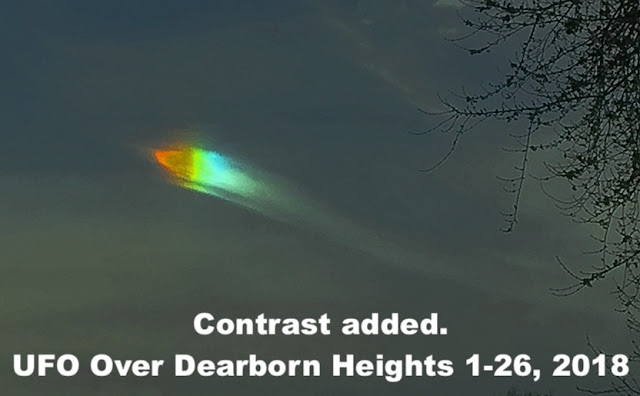




 Company staff put food in a urinal before taking it out and...
 Scorned wife jumps onto her cheating husband's car and...
 Furious father hits his son more than 100 times after the...