Ontdek de Fascinerende Wereld van UFO's en UAP's: Jouw Bron voor Onthullende Informatie!
Ben jij ook gefascineerd door het onbekende? Wil je meer weten over UFO's en UAP's, niet alleen in België, maar over de hele wereld? Dan ben je op de juiste plek!
België: Het Kloppend Hart van UFO-onderzoek
In België is BUFON (Belgisch UFO-Netwerk) dé autoriteit op het gebied van UFO-onderzoek. Voor betrouwbare en objectieve informatie over deze intrigerende fenomenen, bezoek je zeker onze Facebook-pagina en deze blog. Maar dat is nog niet alles! Ontdek ook het Belgisch UFO-meldpunt en Caelestia, twee organisaties die diepgaand onderzoek verrichten, al zijn ze soms kritisch of sceptisch.
Nederland: Een Schat aan Informatie
Voor onze Nederlandse buren is er de schitterende website www.ufowijzer.nl, beheerd door Paul Harmans. Deze site biedt een schat aan informatie en artikelen die je niet wilt missen!
Internationaal: MUFON - De Wereldwijde Autoriteit
Neem ook een kijkje bij MUFON (Mutual UFO Network Inc.), een gerenommeerde Amerikaanse UFO-vereniging met afdelingen in de VS en wereldwijd. MUFON is toegewijd aan de wetenschappelijke en analytische studie van het UFO-fenomeen, en hun maandelijkse tijdschrift, The MUFON UFO-Journal, is een must-read voor elke UFO-enthousiasteling. Bezoek hun website op www.mufon.com voor meer informatie.
Samenwerking en Toekomstvisie
Sinds 1 februari 2020 is Pieter niet alleen ex-president van BUFON, maar ook de voormalige nationale directeur van MUFON in Vlaanderen en Nederland. Dit creëert een sterke samenwerking met de Franse MUFON Reseau MUFON/EUROP, wat ons in staat stelt om nog meer waardevolle inzichten te delen.
Let op: Nepprofielen en Nieuwe Groeperingen
Pas op voor een nieuwe groepering die zich ook BUFON noemt, maar geen enkele connectie heeft met onze gevestigde organisatie. Hoewel zij de naam geregistreerd hebben, kunnen ze het rijke verleden en de expertise van onze groep niet evenaren. We wensen hen veel succes, maar we blijven de autoriteit in UFO-onderzoek!
Blijf Op De Hoogte!
Wil jij de laatste nieuwtjes over UFO's, ruimtevaart, archeologie, en meer? Volg ons dan en duik samen met ons in de fascinerende wereld van het onbekende! Sluit je aan bij de gemeenschap van nieuwsgierige geesten die net als jij verlangen naar antwoorden en avonturen in de sterren!
Heb je vragen of wil je meer weten? Aarzel dan niet om contact met ons op te nemen! Samen ontrafelen we het mysterie van de lucht en daarbuiten.
Maandag 23 juli 2018
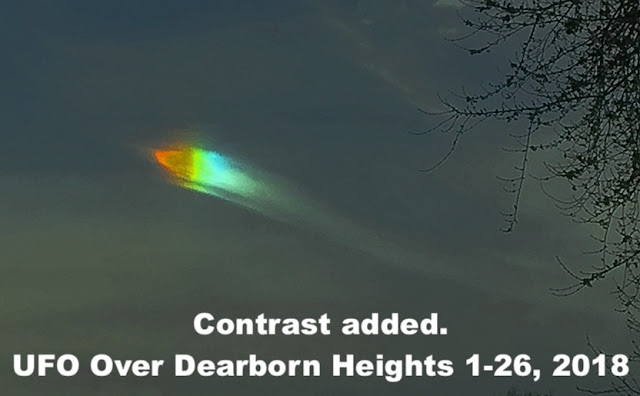
Rainbow UFO Recorded During Sunset In Dearborn Heights, MI Awesome Photos, UFO Sighting News.
Rainbow UFO Recorded During Sunset In Dearborn Heights, MI Awesome Photos, UFO Sighting News.
Date of sighting: Jan 26, 2018
Location of sighting: Dearborn Heights, MI, USA
Source: MUFON #93560
What we see before us is an alien craft that is cloaked, however during sunset, the angle of the sun and the eyewitness were at a 90 degree angle from the UFO. When this happens, any UFO in the area will be visible from a few seconds to a few minutes. Yes a cloak is just technology...and tech always has its flaws. If you look at the photo above where I added contrast only, you will notice the front part of a disk is visible.
Scott C. Waring
Eyewitness states:
Photo taken in the sky, I did not encounter anything, beautiful rainbow looking thing.
Former NASA Scientist Says UFOs Are Real And Many Governments Cover Up Alien Life Existence
There has been no concrete scientific evidence of aliens, but a physics professor and former NASA scientist believes the truth is out there and it should be studied scientifically.
A former NASA scientist published an article on June 28 calling for the scientific community to seriously look at evidence of the presence of UFOs on Earth. The article was posted a few days before World UFO Day on July 2.
A State University of New York physics professor Kevin Knuth describes two personal stories on the speculation of aliens. The first one came at NASA conference in 2002.
A participant said, “You have no idea what is out there!”
The second story took place in 1988 when Knuth was a graduate student. His physics professor back then said that UFOs were shooting down nuclear missiles from the Air Force. Knuth did not believe it, but he saw a recording of a press conference with officials from the Air Force describing events just like that years later.
Knuth believes there’s evidence to support the theory of the existence of aliens. He estimates that there could be tens of thousands of intelligent civilisations in the galaxy. He thinks many governments have been covering up the information and that there are pieces of evidence enough to open a scientific study.
Oumuamua arrived from out of our solar system, now there is a second object of this class
The gas cloud around the comet's nucleus is about 4 arc minutes wide," says Jäger. That means the comet's atmosphere is 260,000 km in diameter, almost twice as wide as the planet Jupiter. Barely a week later, the comet fizzled, dimming almost as much as it had brightened. Then it exploded again, its green atmosphere ballooned in size, large enough to swallow Jupiter twice.
Brandweerman claimt engelen en aliens te hebben gezien. Dit maakte hij nog meer mee
Een brandweerman van de FDNY, de New Yorkse brandweer, zegt dat hij geregeld contact heeft met buitenaardsen, UFO’s, overleden mensen en engelen, zelfs in de kazerne in Brooklyn.
“Ik heb engelen aan het werk gezien,” zei Andrew Radziewicz (38) in de radioshow Sacred Matrix. Hij zei ook vaak kleurrijke lichtbollen te zien.
Nadat hij in juni een ‘enorm’ schip had gezien, vroeg Radziewicz op Facebook om erkenning van onze sterrenfamilie.
Moederschip
De brandweerman begon zijn waarnemingen afgelopen zomer te documenteren. Hij deelde op Facebook allerlei foto’s en videobeelden, schrijft de New York Post.
De brandweerveteraan zegt ook beelden te hebben gemaakt van vier ‘lichtwezens’ die hem op 11 september vorig jaar wakker maakten.
Radziewicz claimt verder dat hij wordt gevolgd door een enorm ‘moederschip’ en dat de ziel van zijn overleden hond Odi hem vaak bezoekt aan boord van een ‘lichtschip’.
Onmogelijk
Hij heeft in interviews gezegd dat hij in 1999, toen hij als 19-jarige voor de Amerikaanse kustwacht werkte, voor het eerst een alien heeft gezien.
Hij zag naar eigen zeggen twee zilverkleurige objecten die dicht bij elkaar bleven. Zo’n 20 matrozen en anderen aan boord van het schip zagen de objecten, die niet op de radar verschenen.
“Toen ze elkaar aanraakten en versmolten, verdwenen ze,” zei hij. “Het is onmogelijk dat in zo’n soort vaartuig een mens zat.”
Telepathisch
Hij zei dat mensen hem plagen en belachelijke maken vanwege zijn berichten op internet, maar dat hij daar maling aan heeft.
“Er zijn andere mensen die zo bang zijn om hierover te praten omdat ze niet belachelijk gemaakt willen worden,” zei hij.
“We hebben gecommuniceerd met wezens van Sirius tot Andromeda en allerlei andere sterrenstelsels,” besloot Radziewicz. “Het is vooral telepathisch.”
The Gault site, located just outside of Austin, Texas, has been known to archaeologists for the better part of the last century. Discovered by Henry Gault, a landowner who worked as an archaeological informant in the early 1900s, the site was officially excavated for a period beginning in 1929, under the supervision of J.E. Pearce with the University of Texas. It was reportedly looted a number of times over the ensuing years, prior to new ownership of the property that led official test excavations that began in 1991. By the end of the decade, formal excavations that would continue well into the new millennium were underway.
Over the course of several dig seasons in recent years, Gault has become recognized by archaeologists as a site of particular significance, due to the number of complete lithic assemblages recovered there.
However, the number of artifacts found at the site is just one of the reasons it has American archaeologists so excited. Among the most recent discoveries at the site, new evidence of early occupation is pushing back the timescale on human arrivals in North America, lending further evidence toward the idea of earlier migrations into the western hemisphere than once believed.
Specifically, the Gault site has yielded intricate projectile points from its deepest strata that are well in advance of the Clovis culture. These artifacts not only count among several existing pre-Clovis discoveries in the Americas, but are accompanied by dates obtained via optically stimulated luminescence that suggest an age of 20,000 years or more, effectively placing them among the oldest of their kind found in North America to date.
Excavations at Gault over the years turned up numerous unique discoveries even before the discovery of its pre-Clovis assemblages. The site’s Clovis horizon, for instance, produced a number of fluted projectile points similar to those seen in the image at the top of this page (note that the points featured in the top image are associated with the Rummells-Maske Site in Cedar County, Iowa, rather than Gault, and are used here only for illustrative purposes).
Alongside these points was a fragmentary basal portion of a Clovis-like projectile, similar to what are identified as “Redstone” points in the Southeast (these are similar enough to a preexisting type of projectile point, called Gainey, that many experts consider the two types one and the same). Prior to its discovery amidst the Clovis assemblage at Gault, little data had been obtained for in situ discoveries of Redstone points; additionally, few–if any–had ever been documented in association with a site as far west as Gault. In total, more than 600,000 artifacts identified with the Clovis culture were recovered from the site.
Area 15 at the Gault site, as it appeared between 2007–2014 excavations
(Credit: Jillabus, Wikimedia Commons).
Subsequent dig seasons at Gault continued to produce surprises, and the latest paper published in Science Advances gives full details of the pre-Clovis discoveries, in addition to the dating methods used to determine their provenance.
Luminescence dating, a technique which relies on stimulation of minerals in various ways in order to discern when they were last exposed to sunlight or significant amounts of heat, was among the methods employed to date the pre-Clovis strata at Gault. Among the earliest dates recorded in association with artifacts was 21,700 years, with a standard deviation of ± 1.4 ka. “Significantly, this assemblage exhibits a previously unknown, early projectile point technology unrelated to Clovis,” the study’s authors wrote. “Within a wider context, this evidence suggests that Clovis technology spread across an already regionalized, indigenous population.”
As I noted recently in an article about the Gault discoveries, this is by no means the first time that evidence of a pre-Clovis presence, possibly dating as far back as 20,000 years, has been found in the Americas:
The Topper site in Allendale County, South Carolina, produced similar lithic evidence which dates back at least 20,000 years, though some artifacts recovered from deeper stratigraphic layers there are estimated to be as much as 50,000 years old. Similarly, radiocarbon dates in association with human artifacts at Meadowcroft Rockshelter in Washington County, Pennsylvania, are reliably dated to earlier than 16,000 BC, with one instance of carbonized bark-like material (possible basketry) with evidence of cutting marks dating to 21,070 BP ± 2400. Charcoal recovered elsewhere from Meadowcroft shows 14C dates in excess of 30,000 years (similar to dates retrieved from Monte Verde, Chile, during excavations by Tom Dillehay). According to J.M. Adovasio, who led excavations at Meadowcroft for a number of decades, the earlier dates are intriguing, but he and others generally work with the more likely nearer dates of around 16,000 years, which are still well in advance of Clovis.
The Science Advances paper can be read online here, which features a wealth of technical data and illustrations depicting the earliest artifacts recovered at the site. For more on the technical significance of these Gault pre-Clovis discoveries, along with an analysis of its impact in the context of advances in American archaeology, see my article “Gault Site in Texas Offers New Evidence of Human Habitation 16 to 20 Thousand Years Ago.”
As an addendum, I’ll note that many these days, in light of ongoing archaeological discoveries like those discussed here, have commented on how “things keep getting older.” That is to say, of course, that archaeologists continue to find more and more evidence for earlier occupations in the New World, as well as advanced behaviors and engineering among early cultures, and refinement of processes that include such things as crafting pottery, agriculture, fermentation, and a wealth of other innovations.
In equal measure to the idea that we’re constantly finding broad evidence for things that, at one time, might have seemed historically out of place, it is also important to make the observation that part of what has led to these new discoveries in the first place has been a fundamental change in thinking.
On a number of occasions at American dig sites I’ve visited where pre-Clovis artifacts ended up being recovered, archaeologists have expressed to me that while such discoveries had been there all along, they were essentially kept hidden for as long as they were by one simple fact: that there had been an expectation nothing would be found below the Clovis horizon. Once archaeologists began pressing on and exploring deeper strata, many were shocked to find evidence of much earlier occupations than previously expected; and inevitably, many were also criticized for presenting these discoveries, even when reliable scientific evidence to account for their provenance was offered.
People are often slow to accept new ideas, although that’s certainly not always a bad thing. Science relies on having waterproof arguments, and skepticism is the best defense against unintended leaks. However, with evidence forthcoming that is strongly in support of an idea that might have once seemed impossible, the necessity for acceptance of new data becomes paramount. Rather than to say that things “keep getting older,” I think it is important to recognize that we are learning–through science–things like how much earlier humans were traversing areas of the globe, utilizing certain technological innovations, and accomplishing things we simply hadn’t conceived they were capable of as recently as a few years ago.
Science is the ultimate tool of discovery, and as it has continued to show us new things about the ancient past, it underscores the same timeless ingenuity of the human spirit at work, both then and now.
Humanity has long wondered if life exists elsewhere beyond Earth. With the universe being so mind-numbingly vast, the very idea that our tiny, waterlogged rock should alone harbor life seems so…wasteful.
To sate our curiosity, NASA catalogs exoplanets orbiting Milky Way stars to look for potential cradles of extraterrestrial life, such as Kepler-186f, the first validated Earth-size planet orbiting in its star’s habitable zone. And the SETI (Search for Extraterrestrial Intelligence) Institute searches space for clues of alien civilizations by, for example, scanning for the residuals of communication technology like narrow-band radio transmissions.
But is it possible we’ve set our gaze too far to the horizon? Perhaps the greatest chance we have of finding life beyond Earth isn’t orbiting some distant star but can be found in our own solar backyard.
Independence Day, 1996, 20th Century Fox.
What we look for
When looking for suitable habitats for life, astrobiologists search first and foremost for water. Water is the cornerstone of life on Earth. Life needs solvents to perform biochemical processes, and water’s title as the universal solvent means that even the simplest of organisms can use it for their molecular interactions.1
Astrobiologists also look for ways energy may enter a system for metabolic processes. On Earth, this form of energy is typically the Sun; however, recent discoveries have led astrobiologists to search for alternative forms, such as geothermal energy.
Finally, they look for other environmental conditions that make life more or less likely: climate, pressure, temperature, atmospheric makeup, and so on.
We should take this moment to make an important distinction. While our solar system may harbor several havens for life, this life will likely not be the intelligent life that SETI searches for. Any neighborly E.T.s we encounter won’t be little grey men or green-skinned vixens so much as a small, microscopic, organisms. Think strange, exotic tardigrades. Well, stranger tardigrades.
Mars Attacks!, 1998, Warner Bros.
Mars
Ever since Percival Lowel mapped the “canals” of Mars, our ruddy neighbor has been the go-to planet for science fiction writers imagining extraterrestrial life — from H.G. Wells’s colonizing Martians to Ray Bradbury’s mystical natives3. The canals proved a trick of the eye, and theMars Science Laboratory Mission’s Curiosity rover has yet to find signs of civilization, but that doesn’t mean Mars is out of the extraterrestrial running.
Scientists have discovered dark, narrow streaks on the landscape most likely caused by flowing water. These streaks showed traces of hydrated salt, like what occurs after salt contacts water before it evaporates.
Given Mars’ dry, barren landscape and lack of atmosphere, how water got there remains a mystery, but the phenomenon points to the possibility of liquid water not trapped in the planet’s polar ice caps, providing a potential habitat for microbial life. Should water flow under the planet’s surface, any life could even be shielded from the sun’s radiation.
Adding to the intrigue, scientists think that water once covered roughly 20 percent of the surface before Mars’s atmospheric gases were stripped away, and the water evaporated into space. Scientists have also discoveredmeteorites from Mars that contained the remnants of organic material — suggesting the rusted planet once contained the ingredients for life.
The surface of Venus, c/o NASA
Venus
Like Mars, Venus likely enjoyed Earth-like conditions back in the day. Computer simulations of its early environment suggest the possibility of primordial oceans, moderate temperatures, and a habitable climate.
As David Grinspoon, of the Planetary Science Institute, told New Scientist: “Both planets probably enjoyed warm liquid water oceans in contact with rock and with organic molecules undergoing chemical evolutions in those oceans. As far as we understand at present, those are the requirements for the origin of life.”
If early life did form on Venus, most of it probably vanished 715 million years ago, along with those oceans. Today’s Venus sports an infernal landscape of volcanic activity, surface temperatures approaching 750 Kelvin, and a thick, noxious atmosphere of carbon dioxide with clouds of sulfuric acid.4,5
But it is that very toxic atmosphere that may have saved Venusian life. According to a paper in the journal Astrobiology, the atmosphere could provide a safe haven for microbial life. Using spectroscopic observations, researchers found “dark patches” in the atmosphere composed of “concentrated sulfuric acid and other unknown light-absorbing particles.”
While it is unknown if these patches are organic or not, they do have the same dimension as some Earth bacteria, and researchers think they could be the Venusian equivalent of algae blooms (like those that appear in our lakes and oceans).
The jets of Enceladus, c/o NAS
Enceladus and Europa
Moving away from Earth’s rocky neighbors, astrobiologists are also considering the possibility that life may exist on the moons of Saturn and Jupiter.
When the Cassini-Huygens spacecraft flew past Saturn’s sixth moon, Enceladus, it discovered hydrogen gas in an erupting plume of water.6 The eruption suggested hydrothermal activity may be taking place beneath Enceladus’ icy surface. If so, the moon would offer two important ingredients for life — water and energy for metabolic processes.
Europa’s surface is similarly covered in ice, with long streaks of “brown gunk.” But beneath that surface, scientist estimate that there could be twice as much water as on Earth. If this Jovian moon also produced hydrothermal activity within that ocean, it too could be a harbor for life.8 A study using computer models has even suggested that Europa may have hydrogen and oxygen in amounts comparable to Earth, even if the moon is lacking in volcanic activity.
NASA is planning to launch a Europa flyby mission in the early 2020s, and the agency’s SUBSEA project will be studying hydrothermal environments in the Lō`ihi seamount, off the coast of Hawaii’s Big Island, to learn how life can thrive on Earth in conditions similar to those possible on Enceladus and Europa.
This false-color rendering highlights differences in surface materials at Ceres. c/o NASA
Ceres
Our final candidate is Ceres, a dwarf planet and the largest object orbiting in the asteroid belt between Mars and Jupiter. A spherical clump of rock and ice, Ceres would be an unlikely contender for this list until last year, whenNASA’s Dawn mission detected organic material on its surface.
Originally, it was thought this organic material covered 6–10 percent of the spectral signature, but a recent analysis of the data suggests the amount of could be as high as 40–50 percent. Since carbon-based compounds are necessary for life, it makes for an exciting discovery that could change how we view objects in the asteroid belt.
With that said, this is a recent discovery and much remains unclear. It is possible the organics weren’t created on Ceres but planted there by comets, and even if they are native, organic compounds can come about from non-biological processes.
As Ralph Milliken, a professor at Brown University and one of the study’s co-authors said in a press release: “Ceres is clearly a fascinating object, and understanding the story and origin of organics in these spots and elsewhere on Ceres will likely require future missions that can analyze or return samples.”
The Fifth Wave, Columbia Pictures, 2016.
The end of life as we know it
So far, our solar search has focused on the conditions for life as we know it. But what about life as we don’t know it?
Bacteria recently discovered in Antarctica can survive off just the hydrogen, carbon monoxide, and carbon dioxide they get from the air. These guys make breatharians look gluttonous by comparison and could lead the way to remove water as a prerequisite in our search for extraterrestrial life.
Additionally, Sara Seager, MIT physics professor, considered that alien life may evolve around different chemical combinations than life on Earth and used computer-generated models to devise a list of those possible combinations.
“The theory ended up being, we should maybe consider all potential molecules that would be in gas form,” Seager said. “Why not consider all of them? I just combined them in any way possible, like just taking letters in the alphabet and combining them in all ways.”
Could life possibly exist in Titan’s methane sea? Or could the seeds of life be floating on some yet undiscovered asteroid? The more we learn about life on Earth, the more we learn about the myriad of paths it has taken to thrive, opening avenues for us to find it in our solar system and beyond.
They’re real and contain hidden messages, scientist says
IT all started with a UFO sighting.
Dr Horace Drew, 61, was just 10 years old when he allegedly saw an unidentified, silver, windowless craft hovering in the sky near his suburban home, in Jacksonville, Florida. The encounter lasted only moments but led to a lifelong fascination with the extraterrestrial.
“I saw a UFO, so I knew they were real from an early age,” Dr Drew told news.com.au.
The scientist, who holds a PhD in Chemistry from Caltech, the California Institute of Technology, and worked for CSIRO as a molecular biologist, has been researching crop circles and aliens for 20 years. Dr Drew relocated to Australia in the 1980s but most of his work has taken him overseas, predominantly to Europe.
“They’re quite rare in Australia,” he said.
He, along with many conspiracy theorists, believe crop circles are the work of aliens or human time travellers. Sceptics say most are probably man-made.
A crop circle is typically defined by standing wheat stems that have been flattened in the shape of a circle or more complex pattern. They tend to appear mainly in developed Western or secularised countries — including Japan.
The cause of many of the circles is unknown despite various natural and unorthodox explanations having been put forward. Some crop circles have been proven to be hoaxes.
But according to Dr Drew, a number are legitimate and contain puzzles that can be decoded and linked to time travel and alien life.
He told news.com.au he had visited about “two dozen crop circles” around the globe in his career. Typically, they were between 50-500m in length, he said.
“This has led to at least one major breakthrough the discovery of a more advanced binary code than our computers currently use.”
Dr Drew claimed that aliens or human time travellers have been leaving the crop circles on Earth as messages to “us or themselves”.
WHY ARE THERE CROP CIRCLES?
Dr Drew said he was one of a handful of scientists around the world who had worked to successfully decode some of the messages in crop circles.
According to him, some crop circles provide general descriptions of the future.
“Other crop (circles) show schematic images of the future for astronomical or human events,” he said.
He said some of the decoded messages read: ‘Much pain but still time. Believe. There is good out there’; ‘Beware the bearers of false gifts and their broken promises’; ‘We oppose deception. Conduit closing’.
Dr Drew has developed at least two theories as to the purpose of the circles by reading their “advanced (version of) binary codes”.
“One theory is that they are trying to introduce themselves to us peacefully, like we do using bubbles with dolphins,” he said.
“When (humans) want to talk with dolphins we put little bubble circles under the ocean with a generator. We watch the dolphins come up and play and investigate, and we study them.
“This is called the ‘dolphin communication project’.”
He said the dynamic between the way humans interact with dolphins and whales was likely comparable to how extraterrestrials communicate with us.
“Barack or Trump have never said to a dolphin: ‘take me to your leader I want to sign a treaty with you’,” he said.
“And (the extraterrestrials are) not interested in making a treaty with us.
“They are ahead of us like we are ahead of the dolphins and the whales.”
His second theory was that the messages “are not even for us”.
Dr Drew said human time travellers from the distant future could be creating the circles as directional markers, to help them navigate “in their distant past, which is our present”.
“There are definitely humans living there in about 5000 years with time travel capability,” he said.
“They’re coming back and flying all over Earth.
“They seem to just say ‘this is a certain day’ and mark it.
“So the trouble is we don’t know space time physics enough to understand what’s happening. It’s beyond our knowledge.
HOW ARE THEY MADE?
Dr Drew said the circles appeared to be created by an “unknown energy that heats the crops up”.
“It’s like microwave energy but is something beyond earth’s science,” he said.
“It can pattern the wheat.
“No one sees or hears anything and that's why its so hard to prove. If there’s a craft, it’s silent, noiseless.”
But there’s nothing to fear, according to him.
“Don’t be afraid,” he said.
REAL OR A HOAX?
Telling the difference between a real crop circle and a hoax is like differentiating between an original painting and a fake, according to Dr Drew.
“There are some things to look for,” he said.
Crops that are bent “halfway up” their stems, rather than on the ground ,is one telltale sign “cereologists”, or someone that advocates paranormal explanations of crop circles, look for to determine that it’s not a hoax.
“You can’t absolutely prove a crop circle wasn’t a hoax but you can give a high probability and judgment,” he said.
“If there’s a hoax the word of it gets around very fast, people are aware, people are not that easily fooled.”
In 1991, English pranksters Doug Bower and Dave Chorley took credit for most of the crop circles across southern England made since 1978. They were inspired by the Tully “saucer nest” case in Australia, where a farmer found a flattened circle of swamp reeds after observing a UFO.
Using basic tools including a plank of wood, rope, and a baseball cap fitted with a loop of wire to help them walk in a straight line, they said they made complex crop circles in England — which others then copied all over the world into the 1980s.
They made a circle for journalists, which was later declared authentic by a cereologist. They then revealed their hoax to the world, spurring on even more copycats.
Dr Drew said there was a lot of scientific evidence to show that some crop circles were made by human time travellers or extraterrestrial beings. “Laboratory results on plant or soil samples taken from a crop circle in Brazil in October of 2016 show that it was formed by unknown sterilising images,” he said.
The earliest mention of a crop circle dates back to the 1500s. A woodcut from the time showed a “mowing devil” making the pattern.µ
GOVERNMENT SECRETS?
Earlier this month, US TV host Jimmy Kimmel asked former US President George Bush if he went through “secret files, the UFO documents” when he was in office.
But instead of laughing off the question, the former commander in chief replied: “Maybe.”
Mr Kimmel then asked him if there were “any great secrets you know that you can’t share with people?”
“Yeah, there are,” Mr Bush said. “But I’m not telling you.”
Many conspiracy theorists and some scientists, including Dr Drew, argued that Mr Bush’s comments indicated the US government knows much more about extraterrestrial life than it has publicly revealed.
“The politicians are scared they'll lose votes if they talk about it,” Dr Drew said.
He said international media had also played a part in causing the public to doubt the legitimacy of crop circles and aliens.
But according to him, its important for humans to keep seeking answers.
“The ET visitors have technologies which would benefit us greatly, for example, how to make safe, clean energy without burning oil, coal or gas,” Dr Drew said.
“Ultra-fast propulsion systems, based on gravity and inertia, could carry us safely to distant planets or stars.
“We may also need to upgrade our planetary defences soon, to protect against ET’s who may not be friendly.”
There’s still a lot more to be understood but Dr Drew’s hope is that he one day gets a closer look at what was inside the UFO he believes he saw as a child.
“I’d like to meet (the extraterrestrials or human time travellers) in person,” he said.
“But I don’t think they're going to do that.
“Whichever scientific team is doing this I don’t think we’re supposed to have full knowledge of it because it will interrupt their program, whatever they're doing.”
Chandra May Have First Evidence of a Young Star Devouring a Planet
Chandra data indicates that a young star has likely destroyed and consumed an infant planet.
If confirmed, this would be the first time that astronomers have witnessed such an event.
The star, known as RW Aur A, is a few million years old and is located about 450 light years from Earth.
Studying this may help astronomers gain insight into the processes affecting the early stages of planet development.
This artist's illustration depicts the destruction of a young planet or planets, which scientists may have witnessed for the first time using data from NASA's Chandra X-ray Observatory, as described in our latest press release. If this discovery is confirmed, it would give insight into the processes affecting the survival of infant planets.
RW Aur A is a star about 450 light years from Earth, making it relatively nearby. Since the 1930s, astronomers have studied RW Aur A and been curious about why the optical light from this star changes over time. In recent years, scientists have observed that this variability has increased, with the star dimming even more and for longer periods of time.
To investigate this mystery, a team of astronomers used Chandra to get information in the X-ray band of the electromagnetic spectrum. X-rays are generally emitted by more energetic and hotter phenomena than their optical light counterparts and can reveal information about different elements, including iron.
The Chandra data suggest that the most recent dimming event from RW Aur A was caused by the collision of two "planetesimals" (that is, infant planetary bodies still in the process of formation), including at least one object large enough to be a planet.
Because the X-rays come from the hot outer atmosphere of the star, changes in the X-ray spectrum — the intensity of X-rays measured at different energies — over these three observations were used to probe the density and composition of the absorbing material around the star.
The team found that the dips in both optical and X-ray light are caused by dense gas obscuring the star's light. Also, a Chandra observation in 2017 showed strong emission from iron atoms, indicating that the disk contained at least 10 times more iron than in the 2013 observation during a bright period.
The Chandra spectra from the 2013 and 2017 observations are shown in an inset in the graphic. The sharp peak on the right side of the 2017 spectrum is a signature of a large amount of iron.
The researchers propose the excess iron was created when the two planetesimals collided. If one or both planetary bodies are made partly of iron, their smash-up could release a large amount of iron into the star's disk and temporarily obscure its light as the material falls into the star.
A paper describing these results led by Hans Moritz Guenther (MIT's Kavli Institute for Astrophysics) appears in the most recent issue of The Astrophysical Journal and is available online. The other authors on the paper are Til Birnstiel (Ludwig-Maximillians-University Munich), David Huenemoerder (MIT), David Principe (MIT), Christian Schneider (Hamburger Sternwarte), Scott Wolk (Harvard-Smithsonian Center for Astrophysics), Franky Dubois (Astrolab IRIS), Ludwig Logiie (Astrolab IRIS), Steve Rau (Astrolab IRIS), and Siegfried Vanaverbeke (Astrolab IRIS). NASA's Marshall Space Flight Center in Huntsville, Alabama, manages the Chandra program for NASA's Science Mission Directorate in Washington. The Smithsonian Astrophysical Observatory in Cambridge, Massachusetts, controls Chandra's science and flight operations.
Un militaire sur l'USS Carl Vinson communique avec l'USS Princeton, en octobre 2001 (image d'illustration)
Selon un rapport du Pentagone cité par la presse américaine, un ovni de la taille d'un avion de ligne mais de la forme d'un «œuf allongé», est apparu à proximité d'un porte-avion américain, plusieurs jours durant en 2004.
Un rapport du Pentagone révélé par la chaîne de télévision américaine KLAS fin mai et amplement cité par la presse anglo-saxonne, livre de nouveaux détails sur un objet volant non identifié (ovni) qu'ont observé, plusieurs jours durant en 2004, des militaires américains au large de la côte californienne. Le New York Times avait publié une vidéo de l'incident en question en décembre dernier, dans un article traitant du programme d'étude des ovnis financé aux Etats-Unis par le Pentagone.
Selon ce rapport, l'objet, de la taille d'un avion de ligne et de forme ovale, a été repéré une première fois par le radar de l'USS Princeton, un porte-avion américain, alors qu'il volait à 60 000 pieds (plus de 18 000 mètres). Il a alors subitement plongé vers la surface de l'océan, pour l'atteindre en quelques secondes seulement. Peu après, l'ovni s'est éloigné à une vitesse si impressionnante que les membres d'équipage ont pensé qu'ils s'agissait d'un missile balistique.
Deux jours plus tard, toujours selon le rapport du Pentagone, l'objet est à nouveau apparu près de l'USS Princeton et a cette fois été pris en chasse par deux F-18. Mais les pilotes ont expliqué qu'ils avaient été incapables de l'intercepter, l'ovni s'étant brusquement rendu invisible. Il pouvait cependant toujours être détecté, à cause de l'onde visible à la surface de l'eau créée sous lui, «d'environ 50 à 100 mètres de diamètre».
L'engin a été décrit par un des pilotes comme étant «blanc uni, lisse, sans bords, uniformément coloré, sans nacelles, pylônes ou ailes» et ressemblant à «un œuf allongé ou un Tic Tac». D'après le rapport du Pentagone, un avion de surveillance E-2C Hawkeye a réussi à détecter l'objet mais sans pouvoir le «verrouiller», ce qui laisse penser qu'il était capable d'esquiver le radar.
Le rapport se conclut en confirmant que l'engin ne correspondait à «aucun avion ou véhicule aérien actuellement connu dans l'inventaire des Etats-Unis ou de toute autre nation étrangère».
Photo Credit: Roberto Molar-Candanosa, courtesy of Carnegie Institution for Science
2. 79 moons … wow
12 new moons have been discovered around Jupiter, bringing the grand total of known moons around the planet to 79. Of these 12 newly found moons, 1 is an "oddball."
NASA deployed a tiny, 26-lb (12-kg) satellite called HaloSat from the International Space Station. It will explore the halo of hot gas around the Milky Way.
Photo Credit: Retro Space Images/NASA via collectSPACE.com
4. 49 years from moonshot
50 years ago Friday (July 20), the first moon landing with Apollo 11 was still four months from being announced. Look back at where things stood on July 20,1968, and how NASA got from there to the next year's moonshot.
Researchers think that two different types of stars, pulsars and magnetars, might actually be the same type of star, just at different points in its life.
Two newfound "twin" exoplanets, discovered by direct imaging, look and act very similarly. But researchers think that they were created in very different ways.
Raging, planet-wide dust storms – like the one going on now – happen only every 6 to 8 years on Mars. Here’s how NASA spacecraft are studying it, plus a cool before-and-after video!
Side-by-side movies shows how dust has enveloped the red planet, courtesy of the Mars Color Imager (MARCI) camera onboard NASA’s Mars Reconnaissance Orbiter (MRO). The view from May shows Valles Marineris chasms (left), Meridiani center, an autumn dust storm in Acidalia (top) and the early spring south polar cap (bottom). The view from July shows the same regions, but most of the surface was obscured by the planet-encircling dust cloud and haze.
Over the past month, Mars has put on a spectacular show in our night sky. The show culminates on July 27, 2018, when Earth will pass between Mars and the sun, bringing Mars to opposition on the same night that Mars will be near a totally eclipsed moon! All of that is wonderful for skywatchers, but space scientists are having a field day with Mars now, too. The same event that’s making Mars extra bright for us – that is, Mars’ September 16, 2018, perihelion or closest point to the sun – has also created conditions for a planet-wide dust storm, which has been raging now for over a month.
For scientists watching the red planet from data gathered by NASA’s orbiters, the past month has been a windfall. Global dust storms, where a runaway series of storms creates a dust cloud so large it envelops the planet, only appear every six to eight years (that’s three to four Mars years). Scientists still don’t understand why or how exactly these storms form and evolve.
Side-by-side movies shows how dust has enveloped the red planet, courtesy of the Mars Color Imager (MARCI) wide-angle camera onboard NASA’s Mars Reconnaissance Orbiter (MRO).
Image via NASA/JPL-Caltech/MSSS.
For NASA’s Opportunity rover, the dust storm has not been good news. NASA said it meant:
… a sudden drop in visibility from a clear, sunny day to that of an overcast one. Because Opportunity runs on solar energy, scientists had to suspend science activities to preserve the rover’s batteries. As of July 18, no response has been received from the rover.
But other NASA spacecraft – both on the ground and in orbit – are observing the dust storm. In fact, NASA said:
The Mars Reconnaissance Orbiter, Mars Odyssey, and Mars Atmosphere and Volatile EvolutioN (MAVEN) orbiters are all tailoring their observations of the red planet to study this global storm and learn more about Mars’ weather patterns. Meanwhile, the Curiosity rover is studying the dust storm from the Martian surface.
The Mars Reconnaissance Orbiter has two instruments studying the dust storm. Each day, its Mars Color Imager maps the entire planet in mid-afternoon to track the evolution of the storm. Meanwhile, its Mars Climate Sounder instrument measures how the atmosphere’s temperature changes with altitude. Rich Zurek of NASA’s Jet Propulsion Laboratory, Pasadena, California, is the project scientist for the Mars Reconnaissance Orbiter.
Zurak said:
The very fact that you can start with something that’s a local storm, no bigger than a small [U.S.] state, and then trigger something that raises more dust and produces a haze that covers almost the entire planet is remarkable,
The MAVEN orbiter has been circling Mars since 2014. Since it entered Mars’ orbit, said Bruce Jakosky, the orbiter’s principle investigator,
… one of the things we’ve been waiting for is a global dust storm.
NASA said MAVEN isn’t studying the dust storm itself. Instead:
… the MAVEN team wants to study how the dust storm affects Mars’ upper atmosphere, about 62 miles (more than 100 km) above the surface — where the dust doesn’t even reach. MAVEN’s mission is to figure out what happened to Mars’ early atmosphere. We know that at some point billions of years ago, liquid water pooled and ran along Mars’ surface, which means that its atmosphere must have been thicker and more insulating, similar to Earth’s.
Since MAVEN arrived at Mars in 2014, its investigations have found that this atmosphere may have been stripped away by a torrent of solar wind over several hundred million years, between 3.5 and 4.0 billion years ago.
But there are still nuances to figure out, such as how dust storms like the current one affect how atmospheric molecules escape into space … For instance, the dust storm acts as an atmospheric insulator, trapping heat from the sun. Does this heating change the way molecules escape the atmosphere?
Most of NASA’s spacecraft are studying the dust storm from above. And the Opportunity rover is currently inoperable. But the Curiosity rover – designed to explore Gale Crater on Mars – isn’t suffering the same fate as Opportunity. That’s because Curiosity doesn’t run on solar power. It is a nuclear-powered science machine – and therefore largely immune to Mars’ dust-darkened skies – still collecting science data as the dust flies all around it.
We’re working double-duty right now. Our newly recommissioned drill is acquiring a fresh rock sample. But we are also using instruments to study how the dust storm evolves.
NASA said:
Curiosity has a number of “eyes” that can determine the abundance and size of dust particles based on how they scatter and absorb light. That includes its Mastcam, ChemCam … its suite of weather instruments [called the Rover Environmental Monitoring Station, or REMS]. REMS can also help study atmospheric tides – shifts in pressure that move as waves across the entire planet’s thin air. These tides change drastically based on where the dust is globally, not just inside Gale crater.
The global storm may also reveal secrets about Martian dust devils and winds. Dust devils can occur when the planet’s surface is hotter than the air above it. Heating generates whirls of air, some of which pick up dust and become dust devils. During a dust storm, there’s less direct sunlight and lower daytime temperatures; this might mean fewer devils swirling across the surface.
Even new drilling can advance dust storm science: watching the small piles of loose material created by Curiosity’s drill is the best way of monitoring winds.
Scientists expect the Mars dust storm to last several more months. Expect some new science results from this grand opportunity to study nature on another world!
Physics professor unveiled: "Face on Mars" clearly has a mouth full of teeth
Several studies and scientists have argued on the basis of strictly scientific criteria that the "face of Mars" was indeed built by a very highly developed Mars civilization from the past of Mars. An exact analysis also reveals a mouth full of "teeth".
Why do we ignore such important discoveries and fail to report on them and highlight their importance simply because they contradict established science?
The anomalous features of the so-called "Mars Face" feature, as seen in the 1976 Viking image, were refuted 20 years ago with reference to a 1998 Mars Global Surveyor image. Ten years later, in 2008, however, a much higher-quality image was achieved with details that were identical to the original from 1976.
By means of comparisons, we show how this 2008 picture can better identify the identified anomalous details.
The following picture was taken by NASA in 1976
Among them an image of Mark Carlotto, an image scientist with 30 years of experience in satellite remote sensing and digital image processing, who studied optics, signal and image processing at Carnegie-Mellon University from 1972-1981 and received his doctorate in electrical engineering there. He has held several positions in science and industry. Here are some of the peer-reviewed essays he wrote and co-authored before this one.
Below is a screenshot of a section of the study describing what happened to the picture that was published in 1998.
NASA released the image on April 5, 1998, with low contrast to make the feature look flat, faceless and without three-dimensional depth. The lack of tonal value details is surprising.
The study then continues to compare a decade later with a picture that seems very strange because they look so different.
What's really going on here? Is NASA changing its images?
Below you can see the MRO CTX image: B01_010143_2216, received on 24 September 2008, from a distance of just over 311 km. This image has not been edited and is shown here as it was received from the MRO HiRise website.
According to the authors, the following picture shows "clearly an 'eyeball' in the eye socket and 'teeth' in the mouth area".
Comparison of Viking single image 70A13 with 2008 MRO CTX image B01_010143_2216
It seems that there are a lot of people who are firmly convinced that we are visited by ETs and that this is hushed up. People aren't stupid, and all these people just don't believe that for no reason.
The truth is out there, and it has enormous effects on perception, consciousness, spirituality, historiography, and science.
This matter really does not leave any aspect of humanity untouched.
NASA Scientists Claim the Face & Pyramid on Mars is Real "NASA is Covering Them Up"
1. The real perspective of Cydonya Face. Fill the void (mirror) and you have the real Cydonya Lord
2. Half of the face, from Mars Global Surveyor, then the half flipped and put side by side, to create a whole face. This is what it would have looked like a million years or so ago. Can you say, planet of the apes?
3. Not well studied but this is pretty hard to deny...
New Look Inside Sun's Atmosphere Yields Clues About Mysterious Solar Wind
By Meghan Bartels, Space.com Senior Writer
Heavy data cleaning allowed scientists to study the sun's corona, or outer atmosphere, in stunning detail.
Credit: Craig DeForest, SwRI
Our sun is surrounded by a deep, million-degree atmosphere that affects everything in the solar system — but how, precisely, it does so is a mystery.
The atmosphere, called the corona, produces the solar wind — a flood of charged particles that stream out of the sun and across the solar system. As the solar wind travels to Earth, it brings threats of radiation and magnetic interference.
Now, in a new study, researchers have finally managed to watch it being born in the sun's outer corona. The images provide enough detail for researchers to be able to start piecing together why it flows in such complex ways. They have concluded that one likely explanation is that the turbulence is a legacy of where it comes from. [During Eclipses, Astronomers Try to Reveal the Secrets of the Solar Wind]
"Previous images showed the outer corona as a smooth structure, but in deep space, the solar wind is turbulent and gusty," co-author Craig DeForest, a solar physicist at the Southwest Research Institute in Texas,said in a university statement. "Using new techniques to improve image fidelity, we realized that the corona is not smooth, but structured and dynamic. Every structure that we thought we understood turns out to be made of smaller ones, and to be more dynamic than we thought."
The research relied on data from STEREO, a NASA mission that has been orbiting the sun since 2006. It carries an instrument called a coronagraph, which uses a black disk to block out the bright surface of the sun. That lets scientists see what's happening in the corona, which is much fainter than the surface and would otherwise be washed out by its light.
But that data hasn't been detailed enough to let scientists see what's really happening inside the corona, according to NASA. To tackle that problem, the researchers first asked for a specific type of data from the STEREO team: long-exposure images that would capture fainter signals. Then, they set to work laboriously cleaning up the data to remove confusing factors like the light of background stars or false signals from the instrument itself.
The cleanup involved piecing together the images in a particularly careful way that considered how quickly the solar wind was flowing out and shifting the images accordingly. To do so, they matched up images over time, according to their place in the flow of solar wind, rather than their specific location in space — like tracking individual patches of solar wind as they streamed out of the sun.
The process is the equivalent of aligning sequential images of a log drifting in a current so that the log, rather than the trees along the riverbank, stacks up in every image — offering a more detailed image of the log.
The solar wind, as seen before (left) and after (right) serious imaging processing. While the processed image may look fuzzier, it's actually a better view of the solar wind, with background stars and dust eliminated from view.
Credit: Craig DeForest, SwRI/NASA's Goddard Space Flight Center
The result is a much clearer picture of the flow of solar wind, showing the smaller structures that make up the seemingly disorganized whole. That structure, hidden below the smooth surface, helps explain why the solar wind flows so turbulently as it travels farther away from the sun.
The research is described in a paper published in The Astrophysical Journal on July 18.
The new imaging also highlighted a region where things got particularly interesting, about 4.3 million miles (7 million kilometers) above the sun's surface. Before and after this point, the solar wind was relatively easy to track, but in this region, the flow seemed to hit a bump in the road. The team isn't sure what's happening there.
Conveniently enough, NASA is due to launch a new mission that will bring scientists even more data about the sun's corona. The Parker Solar Probe, scheduled for launch in early August with data collection beginning later this year, will eventually fly directly through this region of our star, dipping below the bumpy section — and hopefully deciphering still more mysteries about the solar wind and its birthplace.
Chinese residents claimed to have sighted UFOs after several mysterious lights were seen flashing in the sky of Chongqing.
The strange bright dots appeared to move in a line as one disappeared and another one emerged in front of it. The eerie scenes from Wednesday have been captured in videos, which are trending on Chinese social media platforms.
While the rumours of extra-terrestrial activities were circulating among Chinese web users, a leading UFO expert claimed that the footage could be of 'a rocket zooming into the atmosphere'.
Video emerged online shows mysterious lights moving in a linear motion in the sky in Chongqing, China (left). It disappeared and reappeared in front of one another (right)
The series of baffling videos were posted yesterday on Weibo, a Twitter-like social media platform.
They showed several orange-red lights following each other in a linear motion.
Some web users claimed the scene looked like a cell splitting in the sky, whilst others said aliens were visiting China.
Weibo user 'wangshuashuadishua' said the phenomenon resembled 'a person making smoke rings while walking'; while 'BIM' gushed 'the aliens finally made their visit to China, they used to go to America only'.
There were also web users claiming to have seen the same mysterious pattern appearing above other cities, including Shanghai in east China and Xinjiang Autonomous Region in north-west China.
Residents of Chongqing wondered if aliens were visiting the city after sighting the unusual lights on Wednesday night (left). Web users claimed it was also seen in other cities (right)
One influential science blogger, known as 'Steed's scarf' on Weibo, has another theory.
'Steed's scarf', who has more than 4.5 million Weibo followers, believed that the lights came from a moving plane and they were the aircraft's navigation lights.
In a post on July 19, he wrote: 'If you watch the footage carefully, the lights actually appeared in pairs. It came from a dark-coloured aircraft, so it was difficult to spot.
'The lights appeared a few seconds on the camera but as the plane kept moving, another pair of lights appeared. So it looks like one following each other.'
Leading British UFO expert Nigal Watson, the author of Haynes UFO Investigations Manual, told MailOnline that the footage 'could be of a rocket zooming into the atmosphere'.
'The pulses of light are either blasts from its engines or reflections. Similar lights were filmed elsewhere in China, suggesting it was something of this nature,' he said.
Chinese authorities are yet to comment on the matter.
Chinese stad in rep en roer na verschijnen mysterieuze vliegende lichten. Zijn dit UFO’s?
De Chinese stad Chongqing is in rep en roer nadat mysterieuze vliegende lichten boven de stad zijn verschenen.
Beelden van het tafereel verschenen op Chinese social mediaplatforms, waar ze enige tijd trending topic waren.
Terwijl Chinese internetgebruikers dachten aan buitenaardse activiteiten, claimde een UFO-expert dat de beelden mogelijk een raket in de atmosfeer toonden.
Andere steden
De filmpjes werden op Weibo geplaatst, een Twitter-achtig social mediaplatform. In de filmpjes zijn meerdere oranjerode lichten te zien.
Sommigen zeiden dat het deed denken aan cellen die zich deelden in de lucht, terwijl anderen zeiden dat China werd bezocht door aliens.
Meerdere mensen claimden dat hetzelfde mysterieuze patroon ook boven andere steden is verschenen, waaronder Shanghai in het oosten van China en de autonome regio Xinjiang in het noord-westen.
Nog niet gereageerd
Een invloedrijke blogger op Weibo dacht dat de lichten afkomstig waren van een vliegtuig.
“Als je goed naar de beelden kijkt zie je dat de lichten in paren verschijnen,” zei de blogger, die meer dan 4,5 miljoen volgers heeft. “Ze waren afkomstig van een donker vliegtuig en dus moeilijk te spotten.”
UFO-expert Nigel Watson zei tegen de Daily Mail dat het een raket in de atmosfeer zou kunnen zijn geweest.
De Chinese autoriteiten hebben nog niet gereageerd op de waarnemingen.
ONTVOERDE PROFESSOR HEEFT FOTO'S VAN BUITENAARDSEN ( VIDEO )
Er zijn genoeg verhalen van mensen die zeggen ontvoerd te zijn door buitenaardsen, maar nooit zie je eigenlijk foto’s van die wezens.
Dat ligt anders bij de oud professor Maurizio Cavallo uit Italië, want hij heeft wel degelijk opnames van de buitenaardsen die hem hebben ontvoerd.
De nu 63-jarige Maurizio Cavallo heeft een wel heel bijzonder verhaal en hij heeft foto’s waarvan hij zegt dat het de buitenaardsen afbeeldt die hem ontvoerden.
Vroeger was Maurizio Cavallo professor aan de Volksuniversiteit in Vercelli in Italië, maar tegenwoordig is hij meer auteur en journalist.
Het leven van Cavallo veranderde compleet toen hij naar eigen zeggen in september 1981 werd ontvoerd door buitenaardsen afkomstig van een planeet met de naam Clarion. Deze planeet bevindt zich in een sterrenstelsel met de naam Adelaar op een afstand van 150.000 lichtjaren van onze aarde.
Op aarde hebben de buitenaardsen die hem ontvoerden een ondergrondse basis in het Amazone gebied en dat is ook de plek waar ze hem naartoe brachten en aan het werk gingen met het verruimen van het bewustzijn van Cavallo.
Tijdens zijn verblijf aldaar slaagde Cavallo erin om de nodige foto’s te maken van de buitenaardse wezens.
Niet alleen waren daar de originele buitenaardsen, maar ook de zogenaamde hybriden, een kruising tussen mensen en buitenaardsen.
De nu 63-jarige Cavallo geeft hoog op over de buitenaardsen en noemt ze sterk geëvolueerde tijdloze wezens die afkomstig zijn uit dat deel van de kosmos waar eeuwigheid wordt geschapen.
Verder zegt Cavallo dat onze opvattingen over de ruimte niet kloppen, dat er nooit een big bang is geweest en dat buitenaardsen veel sneller kunnen reizen dan de snelheid van het licht. Daarnaast dat er 12 planeten in ons zonnestelsel zijn en geen acht of negen.
Verder zegt hij dat er wel degelijk zuurstof en water op de maan aanwezig is.
Iemand die veel contact heeft gehad met Maurizio Cavallo is de Italiaanse journaliste Paola Harris.
Zij heeft hem persoonlijk geïnterviewd en in de volgende video vertelt zij onder andere het vreemde, maar ook fascinerende verhaal van Maurizio Cavallo. Het deel over Cavallo begint rond minuut 53.
If you thought that Roswell was/is the most controversial of all alleged crashed UFO cases, you would be wrong. There is also the matter of the much-debated claims of a UFO crash at Aztec, New Mexico in March 1948. It’s a story which was made famous in Frank Scully’s 1950 book, Behind the Flying Saucers, a book which turned out to be a huge seller. Many researchers of the UFO phenomenon (although certainly not all, such as Scott and Suzanne Ramsey) dismiss Aztec as nothing but a hoax, one perpetrated by a shady businessman / conman named Silas Newton.
There is an interesting aspect to the Newton / Aztec story, which is worth noting. By his own admittance, and after the Aztec story surfaced, Newton was clandestinely visited by two representatives of “a highly secret U.S. Government entity,” as the late UFO researcher (and CIA employee) Karl Pflock worded it. Those same representatives told Newton, in no uncertain terms, that they knew his Aztec story was complete bullshit. Incredibly, though, they wanted him to keep telling the tale to just about anyone and everyone who would listen.
This led Pflock to wonder: “Did the U.S. Government or someone associated with it use Newton to discredit the idea of crashed flying saucers so a real captured saucer or saucers could be more easily kept under wraps?” Far more intriguing, though, is the next question that Karl posed: “Was this actually nothing to do with real saucers but instead some sort of psychological warfare operation [italics mine]?”
Pflock – a CIA intelligence officer, and a Deputy Assistant Secretary of Defense in the Reagan Administration – was not just fascinated by the Aztec saga of 1948, per se. He was also fascinated by the possibility that someone in the government, the intelligence community, or the military – and maybe even a combination of all three – had created the story to hide something else. Or, at the very least, had encouraged the telling and retelling of the Aztec story for psy-op-basedreasons.
I know just how fascinated Karl was when it came to Aztec and the claims of Newton and that “highly secret U.S. Government entity.” I first met Karl in 2003 – at a UFO gig in the small town of Aztec, New Mexico. For a number of years, the conference was a yearly event. But, no more. Karl and I were in touch by landline and fax (how quaint) as far back as the mid-1990s. When Karl and I finally met, he near-immediately suggested that we should write an Aztec-themed book. Karl’s reasoning was that he knew the story very well, and, via the provisions of the Freedom of Information Act, I had uncovered hundreds and hundreds of pages of material – chiefly from the FBI – on the Aztec controversy. He thought we would make a good team, and particularly so now that I lived in the U.S. – and specifically in Texas, which is, of course, not at all far from New Mexico, where Karl resided and where the 1948 crash supposedly happened.
As I listened, Karl told me that his idea was, essentially, to make the book a biography on Newton, but with the Aztec affair being the main thrust. I thought it was a good idea and Karl suggested we prepare a synopsis. Which is exactly what he did. The book was going to be called Silas the Magnificent: A True Tale of Greed, Credulity, and (Maybe) Government Chicanery and Cover-up in 1950s America. Note that the book makes no mention of UFOs in its title and sub-title.
Unfortunately, the project was permanently derailed when Karl fell sick with Amyotrophic Lateral Sclerosis, also referred to as Lou Gehrig’s disease. He unfortunately died from the effects of ALS on June 5, 2006, at the age of just sixty-three. Karl is gone, but the synopsis still exists. It would have made a good book. And, very possibly, it just might have revealed more of the psy-op/disinformation aspect of Aztec and of other crashed UFO yarns of bygone decades.
Comet PANSTARRS C/2017 S3 in Outburst - Its Atmosphere is Twice as Wide as the Planet Jupiter
Oumuamua actually is a comet or eventually a spaceship” that arrived from out of our solar system then we may now be looking at the second object of this class.
Comet C/2017 S3 has an eccentricity of 1.0000787, which makes its orbit hyperbolic. Its inclination is about 99 degrees to the plane of the solar system. This makes it very unlikely that it a comet from our own solar system, kicked into a hyperbolic, sun-escaping orbit by a close encounter with Jupiter.
This strange comet suddenly flashed on July 2, 2018.
Michael Jäger took the above picture of the comet's expanding green atmosphere shortly after the outburst.
The gas cloud around the comet's nucleus is about 4 arc minutes wide," says Jäger. That means the comet's atmosphere is 260,000 km in diameter, almost twice as wide as the planet Jupiter.
Barely a week later, the comet fizzled, dimming almost as much as it had brightened. Then it exploded again, its green atmosphere ballooned in size, large enough to swallow Jupiter twice.
Michael Jaeger captured the comet's newly-formed tail on July 20, 2018 see GIF animation below.
Why is Comet PanSTARRS so unpredictable? Is it really a comet or is it something like Oumuamua?
They suggest that probably it has never felt the heat of the sun before. The comet is arriving from the Oort cloud, a vast reservoir of fresh comets in the outermost solar system.
And this is its first time among the inner planets. Unfamiliar warmth is making veins of fresh ice pop and fizz as the comet approaches.
It is expected to brighten many-fold as it approaches the sun inside the orbit of Mercury in August, a narrow open-ended path that will ultimately fling it back to the outer solar system, reports spaceweather.
Meer van UFO'S of UAP'S, ASTRONOMIE, RUIMTEVAART, ARCHEOLOGIE, OUDHEIDKUNDE, SF-SNUFJES EN ANDERE ESOTERISCHE WETENSCHAPPEN - DE ALLERLAATSTE NIEUWTJES


 Rainbow UFO Recorded During Sunset In Dearborn Heights, MI Awesome Photos, UFO Sighting News.




 Company staff put food in a urinal before taking it out and...
 Scorned wife jumps onto her cheating husband's car and...
 Furious father hits his son more than 100 times after the...


