They’re real and contain hidden messages, scientist says


Chandra May Have First Evidence of a Young Star Devouring a Planet

This artist's illustration depicts the destruction of a young planet or planets, which scientists may have witnessed for the first time using data from NASA's Chandra X-ray Observatory, as described in our latest press release. If this discovery is confirmed, it would give insight into the processes affecting the survival of infant planets.
RW Aur A is a star about 450 light years from Earth, making it relatively nearby. Since the 1930s, astronomers have studied RW Aur A and been curious about why the optical light from this star changes over time. In recent years, scientists have observed that this variability has increased, with the star dimming even more and for longer periods of time.
To investigate this mystery, a team of astronomers used Chandra to get information in the X-ray band of the electromagnetic spectrum. X-rays are generally emitted by more energetic and hotter phenomena than their optical light counterparts and can reveal information about different elements, including iron.
The Chandra data suggest that the most recent dimming event from RW Aur A was caused by the collision of two "planetesimals" (that is, infant planetary bodies still in the process of formation), including at least one object large enough to be a planet.
Because the X-rays come from the hot outer atmosphere of the star, changes in the X-ray spectrum — the intensity of X-rays measured at different energies — over these three observations were used to probe the density and composition of the absorbing material around the star.
The team found that the dips in both optical and X-ray light are caused by dense gas obscuring the star's light. Also, a Chandra observation in 2017 showed strong emission from iron atoms, indicating that the disk contained at least 10 times more iron than in the 2013 observation during a bright period.
The Chandra spectra from the 2013 and 2017 observations are shown in an inset in the graphic. The sharp peak on the right side of the 2017 spectrum is a signature of a large amount of iron.
The researchers propose the excess iron was created when the two planetesimals collided. If one or both planetary bodies are made partly of iron, their smash-up could release a large amount of iron into the star's disk and temporarily obscure its light as the material falls into the star.
A paper describing these results led by Hans Moritz Guenther (MIT's Kavli Institute for Astrophysics) appears in the most recent issue of The Astrophysical Journal and is available online. The other authors on the paper are Til Birnstiel (Ludwig-Maximillians-University Munich), David Huenemoerder (MIT), David Principe (MIT), Christian Schneider (Hamburger Sternwarte), Scott Wolk (Harvard-Smithsonian Center for Astrophysics), Franky Dubois (Astrolab IRIS), Ludwig Logiie (Astrolab IRIS), Steve Rau (Astrolab IRIS), and Siegfried Vanaverbeke (Astrolab IRIS). NASA's Marshall Space Flight Center in Huntsville, Alabama, manages the Chandra program for NASA's Science Mission Directorate in Washington. The Smithsonian Astrophysical Observatory in Cambridge, Massachusetts, controls Chandra's science and flight operations.
|
|||||||||||||||||||||||||
Un porte-avion américain suivi pendant des jours par un ovni, selon un rapport du Pentagone

Selon un rapport du Pentagone cité par la presse américaine, un ovni de la taille d'un avion de ligne mais de la forme d'un «œuf allongé», est apparu à proximité d'un porte-avion américain, plusieurs jours durant en 2004.
Un rapport du Pentagone révélé par la chaîne de télévision américaine KLAS fin mai et amplement cité par la presse anglo-saxonne, livre de nouveaux détails sur un objet volant non identifié (ovni) qu'ont observé, plusieurs jours durant en 2004, des militaires américains au large de la côte californienne. Le New York Times avait publié une vidéo de l'incident en question en décembre dernier, dans un article traitant du programme d'étude des ovnis financé aux Etats-Unis par le Pentagone.
Selon ce rapport, l'objet, de la taille d'un avion de ligne et de forme ovale, a été repéré une première fois par le radar de l'USS Princeton, un porte-avion américain, alors qu'il volait à 60 000 pieds (plus de 18 000 mètres). Il a alors subitement plongé vers la surface de l'océan, pour l'atteindre en quelques secondes seulement. Peu après, l'ovni s'est éloigné à une vitesse si impressionnante que les membres d'équipage ont pensé qu'ils s'agissait d'un missile balistique.
Deux jours plus tard, toujours selon le rapport du Pentagone, l'objet est à nouveau apparu près de l'USS Princeton et a cette fois été pris en chasse par deux F-18. Mais les pilotes ont expliqué qu'ils avaient été incapables de l'intercepter, l'ovni s'étant brusquement rendu invisible. Il pouvait cependant toujours être détecté, à cause de l'onde visible à la surface de l'eau créée sous lui, «d'environ 50 à 100 mètres de diamètre».
L'engin a été décrit par un des pilotes comme étant «blanc uni, lisse, sans bords, uniformément coloré, sans nacelles, pylônes ou ailes» et ressemblant à «un œuf allongé ou un Tic Tac». D'après le rapport du Pentagone, un avion de surveillance E-2C Hawkeye a réussi à détecter l'objet mais sans pouvoir le «verrouiller», ce qui laisse penser qu'il était capable d'esquiver le radar.
Le rapport se conclut en confirmant que l'engin ne correspondait à «aucun avion ou véhicule aérien actuellement connu dans l'inventaire des Etats-Unis ou de toute autre nation étrangère».
This Week's Top Space Stories!
These spacecraft are studying Mars dust
Raging, planet-wide dust storms – like the one going on now – happen only every 6 to 8 years on Mars. Here’s how NASA spacecraft are studying it, plus a cool before-and-after video!
Side-by-side movies shows how dust has enveloped the red planet, courtesy of the Mars Color Imager (MARCI) camera onboard NASA’s Mars Reconnaissance Orbiter (MRO). The view from May shows Valles Marineris chasms (left), Meridiani center, an autumn dust storm in Acidalia (top) and the early spring south polar cap (bottom). The view from July shows the same regions, but most of the surface was obscured by the planet-encircling dust cloud and haze.
Over the past month, Mars has put on a spectacular show in our night sky. The show culminates on July 27, 2018, when Earth will pass between Mars and the sun, bringing Mars to opposition on the same night that Mars will be near a totally eclipsed moon! All of that is wonderful for skywatchers, but space scientists are having a field day with Mars now, too. The same event that’s making Mars extra bright for us – that is, Mars’ September 16, 2018, perihelion or closest point to the sun – has also created conditions for a planet-wide dust storm, which has been raging now for over a month.
NASA said:
For scientists watching the red planet from data gathered by NASA’s orbiters, the past month has been a windfall. Global dust storms, where a runaway series of storms creates a dust cloud so large it envelops the planet, only appear every six to eight years (that’s three to four Mars years). Scientists still don’t understand why or how exactly these storms form and evolve.
Side-by-side movies shows how dust has enveloped the red planet, courtesy of the Mars Color Imager (MARCI) wide-angle camera onboard NASA’s Mars Reconnaissance Orbiter (MRO).
Image via NASA/JPL-Caltech/MSSS.
For NASA’s Opportunity rover, the dust storm has not been good news. NASA said it meant:
… a sudden drop in visibility from a clear, sunny day to that of an overcast one. Because Opportunity runs on solar energy, scientists had to suspend science activities to preserve the rover’s batteries. As of July 18, no response has been received from the rover.
Read more about Opportunity’s possible fate from NASA
But other NASA spacecraft – both on the ground and in orbit – are observing the dust storm. In fact, NASA said:
The Mars Reconnaissance Orbiter, Mars Odyssey, and Mars Atmosphere and Volatile EvolutioN (MAVEN) orbiters are all tailoring their observations of the red planet to study this global storm and learn more about Mars’ weather patterns. Meanwhile, the Curiosity rover is studying the dust storm from the Martian surface.
The Mars Reconnaissance Orbiter has two instruments studying the dust storm. Each day, its Mars Color Imager maps the entire planet in mid-afternoon to track the evolution of the storm. Meanwhile, its Mars Climate Sounder instrument measures how the atmosphere’s temperature changes with altitude. Rich Zurek of NASA’s Jet Propulsion Laboratory, Pasadena, California, is the project scientist for the Mars Reconnaissance Orbiter.
Zurak said:
The very fact that you can start with something that’s a local storm, no bigger than a small [U.S.] state, and then trigger something that raises more dust and produces a haze that covers almost the entire planet is remarkable,
The MAVEN orbiter has been circling Mars since 2014. Since it entered Mars’ orbit, said Bruce Jakosky, the orbiter’s principle investigator,
… one of the things we’ve been waiting for is a global dust storm.
NASA said MAVEN isn’t studying the dust storm itself. Instead:
… the MAVEN team wants to study how the dust storm affects Mars’ upper atmosphere, about 62 miles (more than 100 km) above the surface — where the dust doesn’t even reach. MAVEN’s mission is to figure out what happened to Mars’ early atmosphere. We know that at some point billions of years ago, liquid water pooled and ran along Mars’ surface, which means that its atmosphere must have been thicker and more insulating, similar to Earth’s.
Since MAVEN arrived at Mars in 2014, its investigations have found that this atmosphere may have been stripped away by a torrent of solar wind over several hundred million years, between 3.5 and 4.0 billion years ago.
But there are still nuances to figure out, such as how dust storms like the current one affect how atmospheric molecules escape into space … For instance, the dust storm acts as an atmospheric insulator, trapping heat from the sun. Does this heating change the way molecules escape the atmosphere?
Most of NASA’s spacecraft are studying the dust storm from above. And the Opportunity rover is currently inoperable. But the Curiosity rover – designed to explore Gale Crater on Mars – isn’t suffering the same fate as Opportunity. That’s because Curiosity doesn’t run on solar power. It is a nuclear-powered science machine – and therefore largely immune to Mars’ dust-darkened skies – still collecting science data as the dust flies all around it.
JPL’s Ashwin Vasavada, Curiosity’s project scientist, said:
We’re working double-duty right now. Our newly recommissioned drill is acquiring a fresh rock sample. But we are also using instruments to study how the dust storm evolves.
NASA said:
Curiosity has a number of “eyes” that can determine the abundance and size of dust particles based on how they scatter and absorb light. That includes its Mastcam, ChemCam … its suite of weather instruments [called the Rover Environmental Monitoring Station, or REMS]. REMS can also help study atmospheric tides – shifts in pressure that move as waves across the entire planet’s thin air. These tides change drastically based on where the dust is globally, not just inside Gale crater.
The global storm may also reveal secrets about Martian dust devils and winds. Dust devils can occur when the planet’s surface is hotter than the air above it. Heating generates whirls of air, some of which pick up dust and become dust devils. During a dust storm, there’s less direct sunlight and lower daytime temperatures; this might mean fewer devils swirling across the surface.
Even new drilling can advance dust storm science: watching the small piles of loose material created by Curiosity’s drill is the best way of monitoring winds.
Scientists expect the Mars dust storm to last several more months. Expect some new science results from this grand opportunity to study nature on another world!
NASA Mars dust storm in pictures: Storm blots out sky and consumes Red Planet
Bottom line: How various NASA spacecraft are studying the ongoing dust storm on Mars.
Physics professor unveiled: "Face on Mars" clearly has a mouth full of teeth

Several studies and scientists have argued on the basis of strictly scientific criteria that the "face of Mars" was indeed built by a very highly developed Mars civilization from the past of Mars. An exact analysis also reveals a mouth full of "teeth".
Why do we ignore such important discoveries and fail to report on them and highlight their importance simply because they contradict established science?
The anomalous features of the so-called "Mars Face" feature, as seen in the 1976 Viking image, were refuted 20 years ago with reference to a 1998 Mars Global Surveyor image. Ten years later, in 2008, however, a much higher-quality image was achieved with details that were identical to the original from 1976.
By means of comparisons, we show how this 2008 picture can better identify the identified anomalous details.

Among them an image of Mark Carlotto, an image scientist with 30 years of experience in satellite remote sensing and digital image processing, who studied optics, signal and image processing at Carnegie-Mellon University from 1972-1981 and received his doctorate in electrical engineering there. He has held several positions in science and industry. Here are some of the peer-reviewed essays he wrote and co-authored before this one.

Below is a screenshot of a section of the study describing what happened to the picture that was published in 1998.

NASA released the image on April 5, 1998, with low contrast to make the feature look flat, faceless and without three-dimensional depth. The lack of tonal value details is surprising.
The study then continues to compare a decade later with a picture that seems very strange because they look so different.

Below you can see the MRO CTX image: B01_010143_2216, received on 24 September 2008, from a distance of just over 311 km. This image has not been edited and is shown here as it was received from the MRO HiRise website.
According to the authors, the following picture shows "clearly an 'eyeball' in the eye socket and 'teeth' in the mouth area".

Comparison of Viking single image 70A13 with 2008 MRO CTX image B01_010143_2216

It seems that there are a lot of people who are firmly convinced that we are visited by ETs and that this is hushed up. People aren't stupid, and all these people just don't believe that for no reason.
The truth is out there, and it has enormous effects on perception, consciousness, spirituality, historiography, and science.
This matter really does not leave any aspect of humanity untouched.
reactions
1. The real perspective of Cydonya Face. Fill the void (mirror) and you have the real Cydonya Lord


New Look Inside Sun's Atmosphere Yields Clues About Mysterious Solar Wind
Tucker Carlson Tonight July 20, 2018 - Nick Pope on UFOs ans risks to Air travelTucker Carlson Tonight July 20, 2018 - Nick Pope on UFOs ans risks to Air travel
{ https://www.youtube.com/ }
Are these UFOs? Eerie videos showing mysterious lights over China spark rumours of extra-terrestrial activities
Chinese residents claimed to have sighted UFOs after several mysterious lights were seen flashing in the sky of Chongqing.
The strange bright dots appeared to move in a line as one disappeared and another one emerged in front of it. The eerie scenes from Wednesday have been captured in videos, which are trending on Chinese social media platforms.
While the rumours of extra-terrestrial activities were circulating among Chinese web users, a leading UFO expert claimed that the footage could be of 'a rocket zooming into the atmosphere'.

Video emerged online shows mysterious lights moving in a linear motion in the sky in Chongqing, China (left). It disappeared and reappeared in front of one another (right)
The series of baffling videos were posted yesterday on Weibo, a Twitter-like social media platform.
They showed several orange-red lights following each other in a linear motion.
Some web users claimed the scene looked like a cell splitting in the sky, whilst others said aliens were visiting China.
Weibo user 'wangshuashuadishua' said the phenomenon resembled 'a person making smoke rings while walking'; while 'BIM' gushed 'the aliens finally made their visit to China, they used to go to America only'.
There were also web users claiming to have seen the same mysterious pattern appearing above other cities, including Shanghai in east China and Xinjiang Autonomous Region in north-west China.

Residents of Chongqing wondered if aliens were visiting the city after sighting the unusual lights on Wednesday night (left). Web users claimed it was also seen in other cities (right)
One influential science blogger, known as 'Steed's scarf' on Weibo, has another theory.
'Steed's scarf', who has more than 4.5 million Weibo followers, believed that the lights came from a moving plane and they were the aircraft's navigation lights.
In a post on July 19, he wrote: 'If you watch the footage carefully, the lights actually appeared in pairs. It came from a dark-coloured aircraft, so it was difficult to spot.
'The lights appeared a few seconds on the camera but as the plane kept moving, another pair of lights appeared. So it looks like one following each other.'
Leading British UFO expert Nigal Watson, the author of Haynes UFO Investigations Manual, told MailOnline that the footage 'could be of a rocket zooming into the atmosphere'.
'The pulses of light are either blasts from its engines or reflections. Similar lights were filmed elsewhere in China, suggesting it was something of this nature,' he said.
Chinese authorities are yet to comment on the matter.
Chinese stad in rep en roer na verschijnen mysterieuze vliegende lichten. Zijn dit UFO’s?

De Chinese stad Chongqing is in rep en roer nadat mysterieuze vliegende lichten boven de stad zijn verschenen.
Beelden van het tafereel verschenen op Chinese social mediaplatforms, waar ze enige tijd trending topic waren.
Terwijl Chinese internetgebruikers dachten aan buitenaardse activiteiten, claimde een UFO-expert dat de beelden mogelijk een raket in de atmosfeer toonden.
De filmpjes werden op Weibo geplaatst, een Twitter-achtig social mediaplatform. In de filmpjes zijn meerdere oranjerode lichten te zien.
Sommigen zeiden dat het deed denken aan cellen die zich deelden in de lucht, terwijl anderen zeiden dat China werd bezocht door aliens.
Meerdere mensen claimden dat hetzelfde mysterieuze patroon ook boven andere steden is verschenen, waaronder Shanghai in het oosten van China en de autonome regio Xinjiang in het noord-westen.
Een invloedrijke blogger op Weibo dacht dat de lichten afkomstig waren van een vliegtuig.
“Als je goed naar de beelden kijkt zie je dat de lichten in paren verschijnen,” zei de blogger, die meer dan 4,5 miljoen volgers heeft. “Ze waren afkomstig van een donker vliegtuig en dus moeilijk te spotten.”
UFO-expert Nigel Watson zei tegen de Daily Mail dat het een raket in de atmosfeer zou kunnen zijn geweest.
De Chinese autoriteiten hebben nog niet gereageerd op de waarnemingen.
[Daily Mail, Telegraaf]
ONTVOERDE PROFESSOR HEEFT FOTO'S VAN BUITENAARDSEN ( VIDEO )

Er zijn genoeg verhalen van mensen die zeggen ontvoerd te zijn door buitenaardsen, maar nooit zie je eigenlijk foto’s van die wezens.
Dat ligt anders bij de oud professor Maurizio Cavallo uit Italië, want hij heeft wel degelijk opnames van de buitenaardsen die hem hebben ontvoerd.

Niet alleen waren daar de originele buitenaardsen, maar ook de zogenaamde hybriden, een kruising tussen mensen en buitenaardsen.
De nu 63-jarige Cavallo geeft hoog op over de buitenaardsen en noemt ze sterk geëvolueerde tijdloze wezens die afkomstig zijn uit dat deel van de kosmos waar eeuwigheid wordt geschapen.
Verder zegt Cavallo dat onze opvattingen over de ruimte niet kloppen, dat er nooit een big bang is geweest en dat buitenaardsen veel sneller kunnen reizen dan de snelheid van het licht. Daarnaast dat er 12 planeten in ons zonnestelsel zijn en geen acht of negen.
Verder zegt hij dat er wel degelijk zuurstof en water op de maan aanwezig is.
Iemand die veel contact heeft gehad met Maurizio Cavallo is de Italiaanse journaliste Paola Harris.
Zij heeft hem persoonlijk geïnterviewd en in de volgende video vertelt zij onder andere het vreemde, maar ook fascinerende verhaal van Maurizio Cavallo. Het deel over Cavallo begint rond minuut 53.
Aliens Among Us - The Maurizio Cavallo Story: How do we prepare for Contact? from Joseph Jordan on Vimeo.
Aztec: The Most Controversial “Crashed UFO” Of All?

If you thought that Roswell was/is the most controversial of all alleged crashed UFO cases, you would be wrong. There is also the matter of the much-debated claims of a UFO crash at Aztec, New Mexico in March 1948. It’s a story which was made famous in Frank Scully’s 1950 book, Behind the Flying Saucers, a book which turned out to be a huge seller. Many researchers of the UFO phenomenon (although certainly not all, such as Scott and Suzanne Ramsey) dismiss Aztec as nothing but a hoax, one perpetrated by a shady businessman / conman named Silas Newton.

There is an interesting aspect to the Newton / Aztec story, which is worth noting. By his own admittance, and after the Aztec story surfaced, Newton was clandestinely visited by two representatives of “a highly secret U.S. Government entity,” as the late UFO researcher (and CIA employee) Karl Pflock worded it. Those same representatives told Newton, in no uncertain terms, that they knew his Aztec story was complete bullshit. Incredibly, though, they wanted him to keep telling the tale to just about anyone and everyone who would listen.
This led Pflock to wonder: “Did the U.S. Government or someone associated with it use Newton to discredit the idea of crashed flying saucers so a real captured saucer or saucers could be more easily kept under wraps?” Far more intriguing, though, is the next question that Karl posed: “Was this actually nothing to do with real saucers but instead some sort of psychological warfare operation [italics mine]?”
Pflock – a CIA intelligence officer, and a Deputy Assistant Secretary of Defense in the Reagan Administration – was not just fascinated by the Aztec saga of 1948, per se. He was also fascinated by the possibility that someone in the government, the intelligence community, or the military – and maybe even a combination of all three – had created the story to hide something else. Or, at the very least, had encouraged the telling and retelling of the Aztec story for psy-op-basedreasons.
I know just how fascinated Karl was when it came to Aztec and the claims of Newton and that “highly secret U.S. Government entity.” I first met Karl in 2003 – at a UFO gig in the small town of Aztec, New Mexico. For a number of years, the conference was a yearly event. But, no more. Karl and I were in touch by landline and fax (how quaint) as far back as the mid-1990s. When Karl and I finally met, he near-immediately suggested that we should write an Aztec-themed book. Karl’s reasoning was that he knew the story very well, and, via the provisions of the Freedom of Information Act, I had uncovered hundreds and hundreds of pages of material – chiefly from the FBI – on the Aztec controversy. He thought we would make a good team, and particularly so now that I lived in the U.S. – and specifically in Texas, which is, of course, not at all far from New Mexico, where Karl resided and where the 1948 crash supposedly happened.
As I listened, Karl told me that his idea was, essentially, to make the book a biography on Newton, but with the Aztec affair being the main thrust. I thought it was a good idea and Karl suggested we prepare a synopsis. Which is exactly what he did. The book was going to be called Silas the Magnificent: A True Tale of Greed, Credulity, and (Maybe) Government Chicanery and Cover-up in 1950s America. Note that the book makes no mention of UFOs in its title and sub-title.
Unfortunately, the project was permanently derailed when Karl fell sick with Amyotrophic Lateral Sclerosis, also referred to as Lou Gehrig’s disease. He unfortunately died from the effects of ALS on June 5, 2006, at the age of just sixty-three. Karl is gone, but the synopsis still exists. It would have made a good book. And, very possibly, it just might have revealed more of the psy-op/disinformation aspect of Aztec and of other crashed UFO yarns of bygone decades.
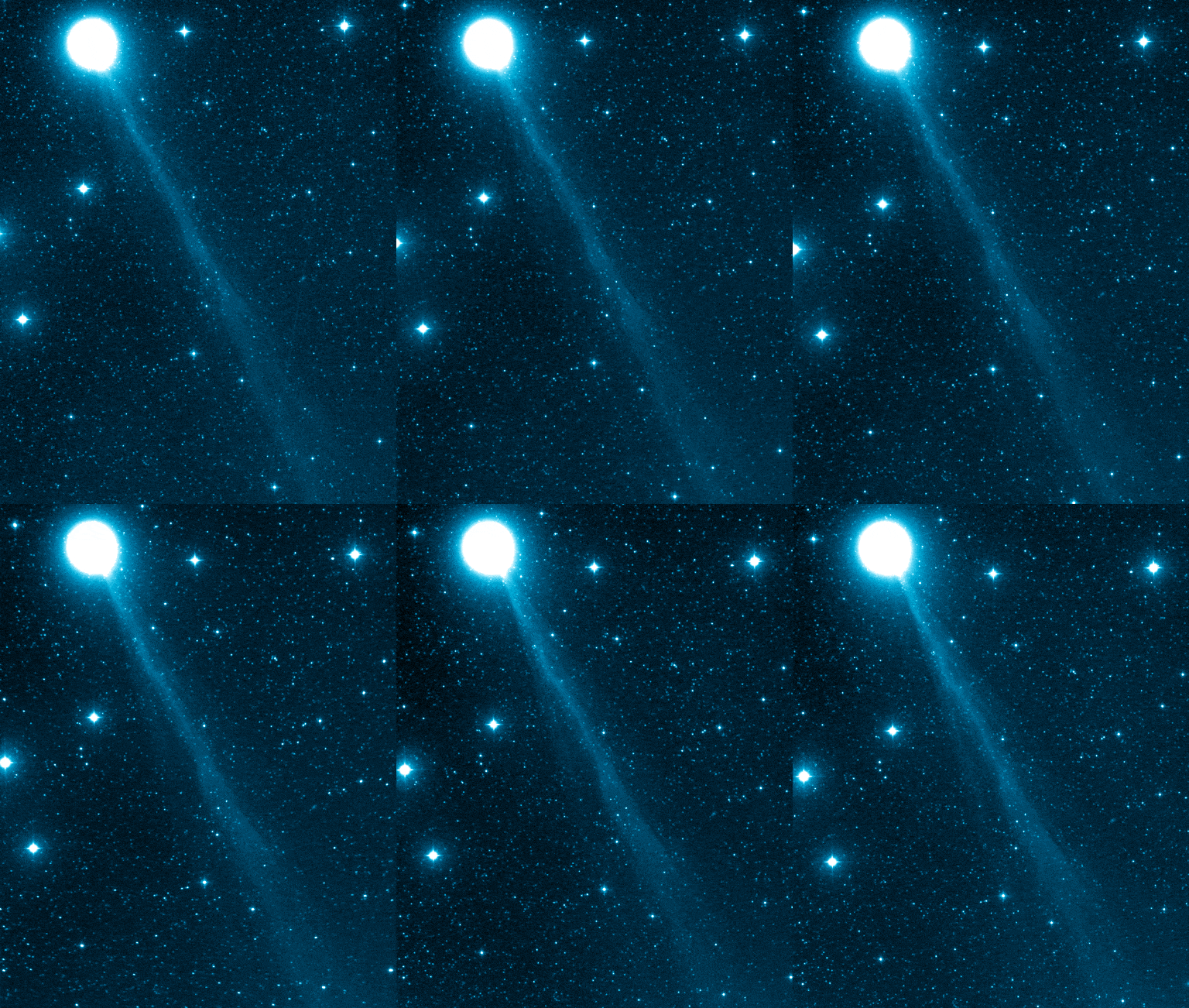
Unpredictable Green Comet Behaves Like Oumuamua
Comet PANSTARRS (C/2017 S3) Exploded Again! Stay Tuned for the Unexpected
Comet PANSTARRS Brightens 16X in 24 Hours on it's August Approach (650)
Black UFOs Size Of Car Shoot Past SpaceX Falcon Heavy Rocket Launch, July 2018, UFO Sighting News
Glowing White UFOs At International Space Station During Space Walk, July 10, 2018, UFO Sighting News
Project Blue Book: The Longest-Running Top-Secret Government UFO Program You've Never Heard OfIn recent months, leaked military intelligence has been attracting international attention, yet again prompting the question: Is there something – or someone – else out there?
Of course, the question of intelligent life beyond our planet is nothing new. A top-secret United States program, made available online in 2015, even shows the lengths governments have gone to in order to investigate that very question. The program, called Project Blue Book, is the longest-running UFO investigation conducted by the US government.
It all started in 1947 when the government began conducting investigations into unidentified flying objects (UFOs) and related phenomena under the name Project Sign, which later evolved into Project Grudge. From 1952 to 1969, the United States Air Force worked under Project Blue Book to scientifically analyze data related to UFOs and determine if they were a threat to national security.

In the short amount of time the program was in operation, there were 12,618 sightings researched and investigated – 701 of which remain “unidentified” to this day. More than half a century later, about 130,000 pages of files from the project were made available to the public online.
Outlined in the heavily marked pages are some of the project’s most famous cases, including the 27-minute “dogfight” between a UFO and a North Dakota Air National Guard lieutenant in 1948 as well as the formation of lights seen over a small Texas town for two months in 1951 known as the Lubbock Lights. There's even the case of the Flatwoods Monster that tormented a small West Virginia town and terrified a nation in 1952, which remains unsolved to this day.
In just a few months, these cases will be investigated in a new scripted drama series called Project Blue Book coming to cable network HISTORY this winter. The all-star cast in each episode draws from actual case files and methodically blends UFO theories with authentic historical accounts.
Whether you have your own personal out-of-this-world extraterrestrial experience or you’re a total skeptic, you can check it all out for yourself at Comic-Con in San Diego this weekend. Here, you can take time to investigate past UFO cases for yourself and have a professional sketch artist bring your own UFO experience to life (if you have one, of course).
In addition, a collaboration between HISTORY and SpaceSpeak is teaming up to try to answer one of humanity’s greatest burning questions: Is there life beyond Earth? To help find out, you can now beam a text message made up of radio waves billions of miles into space using a transmitter attached to a parabolic dish. Developed by SpaceSpeak, the technology allows these messages to travel through space for millions of years. Senders can program their message to automatically rebroadcast each year and track how far the message has traveled.
From top-secret programs to curious citizens, it seems the quest for alien life continues to capture the attention of both believers and skeptics alike.
Project Blue Book! All UFO Files Declassified
Project Blue Book An Insider Speaks Brigadier General Stephen Lovekin, Esq
Blood Moon 2018: Longest Total Lunar Eclipse of Century Occurs July 27
Wandering Star May Have Disrupted Outer Solar System's Order
UFO intrigue: How the UK dealt with 'real-life X-Files'

Astronaut Scott Kelly Battled a Gallon-Sized Ball of Urine and Acid on ISS
Asked by Reddit to name the creepiest thing he’s ever dealt with in space, former astronaut and retired US Navy captain Scott Kelly didn’t hold back. In the video, posted Wednesday, he revealed it was a huge floating orb of sulfuric acid and astronaut pee.
“I had to clean up a gallon-sized ball of urine mixed with acid,” Kelly told Biography.com in a video interview produced with Reddit. “Essentially, the sulfuric acid that is mixed with the urine basically keeps the toilet from clogging up.”
“If you could imagine, something like Drano.”
The specific piece of hardware that Kelly’s referring to here is the International Space Station’s E-K pre-treatment toilet tank. The E-K introduces astronaut urine to a mixture of water, sulfuric acid, and chromium oxide — the latter of which helps to prevent oxidation and gives the solution an alien-like (but also, maybe, less gross) purple color. The top photo on this article doesn’t actually depict the urine-acid ball but approximates what it might look like; the green orb is actually an experiment Kelly once ran on the ISS using water, green food coloring and an antacid tablet designed to visualize water’s complex physics in zero gravity.
Nearly all varieties of stainless steel contain at least 10.5 percent chromium, and it is the invisible surface layer of chromium oxide created by these oxidation reactions that helps to keep that steel from rusting (that is, oxidizing). You can imagine how important adding more of that chemical might be for restroom facilities inside of a hermetically sealed can of human beings orbiting the Earth.

While you’re here thinking about it: the ISS had a major overhaul to its bathroom system in 2008, installing a system that actually harvests all wastewater and recycles it into potable drinking water. This wastewater includes: all of the astronauts’ urine, the water used to brush their teeth and conduct other personal hygiene activities, and even the excess moisture in the air.
During the so-called Year-Long Mission (Ron Howard voice: “It was 11 months.”), NASA estimates that Kelly consumed somewhere around 193 gallons (730 liters) of water recycled from the team’s urine and sweat (as well as his own).

Kelly is, of course, only one in a long line of space plumbers. This lucrative, high-demand trade job has also been performed by Japan Aerospace Exploration Agency astronaut Aki Hoshide; cosmonaut Oleg Kononenko; and Italian European Space Agency astronaut and Italian Air Force pilot, Samantha Cristoforetti.
While the urine-acid orb might be the creepiest or grossest thing that Kelly has ever experienced in space, it’s very likely not the nastiest thing anyone has ever dealt with up there. That distinction would have to go one of the innumerable horror stories to come out of the Soviet space station Mir — which was plagued by hidden orbs of watery mold, fires, porthole-damaging fungal infections, and the occasional power failure. (Mir was like an RV driven by a touring 80s hardcore band. It was gross and it ruled.)
If you think you can handle it, you can watch the rest of Kelly’s admittedly less scatological AMA answers here.
Photos via Wikimedia, Scott Kelly / NASA