Ontdek de Fascinerende Wereld van UFO's en UAP's: Jouw Bron voor Onthullende Informatie!
Ben jij ook gefascineerd door het onbekende? Wil je meer weten over UFO's en UAP's, niet alleen in België, maar over de hele wereld? Dan ben je op de juiste plek!
België: Het Kloppend Hart van UFO-onderzoek
In België is BUFON (Belgisch UFO-Netwerk) dé autoriteit op het gebied van UFO-onderzoek. Voor betrouwbare en objectieve informatie over deze intrigerende fenomenen, bezoek je zeker onze Facebook-pagina en deze blog. Maar dat is nog niet alles! Ontdek ook het Belgisch UFO-meldpunt en Caelestia, twee organisaties die diepgaand onderzoek verrichten, al zijn ze soms kritisch of sceptisch.
Nederland: Een Schat aan Informatie
Voor onze Nederlandse buren is er de schitterende website www.ufowijzer.nl, beheerd door Paul Harmans. Deze site biedt een schat aan informatie en artikelen die je niet wilt missen!
Internationaal: MUFON - De Wereldwijde Autoriteit
Neem ook een kijkje bij MUFON (Mutual UFO Network Inc.), een gerenommeerde Amerikaanse UFO-vereniging met afdelingen in de VS en wereldwijd. MUFON is toegewijd aan de wetenschappelijke en analytische studie van het UFO-fenomeen, en hun maandelijkse tijdschrift, The MUFON UFO-Journal, is een must-read voor elke UFO-enthousiasteling. Bezoek hun website op www.mufon.com voor meer informatie.
Samenwerking en Toekomstvisie
Sinds 1 februari 2020 is Pieter niet alleen ex-president van BUFON, maar ook de voormalige nationale directeur van MUFON in Vlaanderen en Nederland. Dit creëert een sterke samenwerking met de Franse MUFON Reseau MUFON/EUROP, wat ons in staat stelt om nog meer waardevolle inzichten te delen.
Let op: Nepprofielen en Nieuwe Groeperingen
Pas op voor een nieuwe groepering die zich ook BUFON noemt, maar geen enkele connectie heeft met onze gevestigde organisatie. Hoewel zij de naam geregistreerd hebben, kunnen ze het rijke verleden en de expertise van onze groep niet evenaren. We wensen hen veel succes, maar we blijven de autoriteit in UFO-onderzoek!
Blijf Op De Hoogte!
Wil jij de laatste nieuwtjes over UFO's, ruimtevaart, archeologie, en meer? Volg ons dan en duik samen met ons in de fascinerende wereld van het onbekende! Sluit je aan bij de gemeenschap van nieuwsgierige geesten die net als jij verlangen naar antwoorden en avonturen in de sterren!
Heb je vragen of wil je meer weten? Aarzel dan niet om contact met ons op te nemen! Samen ontrafelen we het mysterie van de lucht en daarbuiten.
Berichten van 1 augustus 2018 tot 31 augustus 2018
Credit: Catalin Tapardel, Alberta Aurora Chasers.
In 2016, odd ribbons of purple and white light were brought to the attention of scientists, who classed it as a new type of aurora. In reality, the beautiful beam of light (called STEVE) may be far more interesting, after physicists concluded in a new study that it may actually be an entirely new celestial phenomenon.
Aurora chasers and star enthusiasts have been sighting STEVE for decades but it was only recently that scientists were called in to make sense of it. Initially, physicists classed STEVE as a ‘proton arc’ — another rare type of aurora, which isn’t caused by electrons hitting Earth’s magnetic field but by more massive proton outbursts following a solar flare. Later, with the help of NASA –which sent a swarm of satellites right through a STEVE event — scientists found that accelerated and heated charged particles may have been interacting with a particular part of the Earth’s magnetic field in the ionosphere.
The data suggested that STEVE is a “subauroral ion drift.”
Researchers at the University of Calgary in Canada weren’t convinced, though. STEVE shines in thin ribbons of purple, rather than in red, green, or yellow curtains, as is the case of typical auroras. This suggested that the light show is cut of a different cloth from an aurora. Another clue was that STEVE is only visible a few times per year while auroras are visible every night if viewing conditions are right.
The researchers decided to focus on a STEVE event in March 2008, which was recorded using both ground-based cameras designed to track auroras but also NOAA’s Polar Orbiting Environmental Satellite 17, which was directly overhead at the time. The analysis showed that STEVE’s light isn’t produced by particles raining down into the ionosphere, as typically happens with the aurora. This means that STEVE is an entirely new phenomenon distinct from typical auroras.
“Our main conclusion is that STEVE is not an aurora,” said Bea Gallardo-Lacourt, a space physicist at the University of Calgary in Canada and lead author of the new study.
“So right now, we know very little about it. And that’s the cool thing, because this has been known by photographers for decades. But for the scientists, it’s completely unknown.”
Credit: Dave Markel Photography.
The new kind of optical phenomenon is called “skyglow”, the authors wrote in the journal Geophysical Research Letters. In the future, the researchers plan to determine whether streams of fast ions and hot electrons in the ionosphere are creating STEVE’s light, or if the light is produced higher up in the atmosphere. In the process, scientists will gain a better understanding of the upper atmosphere and the light-generating processes in the sky.
“This is really interesting because we haven’t figured it out and when you get a new problem, it’s always exciting,” said Joe Borovsky, a space physicist at the Space Science Institute in Los Alamos, New Mexico who was not connected to the new study. “It’s like you think you know everything and it turns out you don’t.”
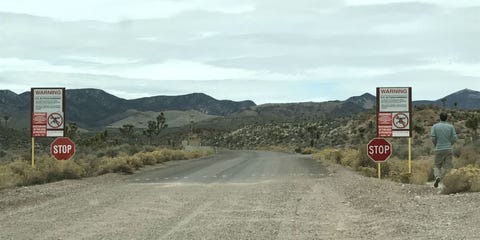
In the middle of the barren Nevada desert, there's a dusty unmarked road that leads to the front gate of Area 51. It's protected by little more than a chain link fence, a boom gate, and intimidating trespassing signs. One would think that America's much mythicized top secret military base would be under closer guard, but make no mistake. They are watching.
Beyond the gate, cameras see every angle. On the distant hilltop, there's a white pickup truck with a tinted windshield peering down on everything below. Locals says the base knows every desert tortoise and jackrabbit that hops the fence. Others claim there are embedded sensors in the approaching road.
What exactly goes on inside of Area 51 has led to decades of wild speculation. There are, of course, the alien conspiracies that galactic visitors are tucked away somewhere inside. One of the more colorful rumors insists the infamous 1947 Roswell crash was actually a Soviet aircraft piloted by mutated midgets and the wreckage remains on the grounds of Area 51. Some even believe that the U.S. government filmed the 1969 moon landing in one of the base's hangars.
For all the myths and legends, what's true is that Area 51 is real and still very active. There may not be aliens or a moon landing movie set inside those fences, but something is going on and only a select few are privy to what's happening further down that closely-monitored wind-swept Nevada road. "The forbidden aspect of Area 51 is what makes people want to know what's there," says aerospace historian and author Peter Merlin who's been researching Area 51 for more than three decades.
"And there sure is still a lot going on there."
The U-2 high altitude reconnaissance aircraft, in the late 1950s.
GETTY IMAGESU.S. AIR FORCE
The Origins of a Mystery
The beginning of Area 51 is directly related to the development of the U-2 reconnaissance aircraft. After World War II, the Soviet Union lowered the Iron Curtain around themselves and the rest of the Eastern bloc, creating a near intelligence blackout to the rest of the world. When the Soviets backed North Korea's invasion of South Korea in June 1950, it became increasingly clear that the Kremlin would aggressively expand its influence. America worried about the USSR's technology, intentions, and ability to launch a surprise attack—only a decade removed from the Japanese attack on Pearl Harbor.
In the early 1950s, U.S. Navy and Air Force sent low-flying aircraft on reconnaissance missions over the USSR, but they were at constant risk of being shot down. In November 1954, President Eisenhower approved the secret development of a high-altitude reconnaissance aircraft called the U-2 program. One of the first orders of business was to track down a remote, covert location for training and testing. They found it in the southern Nevada desert near a salt flat known as Groom Lake, which had once been a World War II aerial gunnery range for Army Air Corps pilots.
Known by its map designation as Area 51, this middle-of-nowhere site became a new top-secret military base. To convince workers to come, Kelly Johnson, one of the leading engineers of the U-2 project, gave it a more enticing name: Paradise Ranch.
Many of these sightings were observed by commercial airline pilots who had never seen an aircraft fly at such high altitudes as the U-2. Whereas today's airliners can soar as high as 45,000 feet, in the mid-1950s airlines flew at altitudes between 10,000 and 20,000 feet. Known military aircraft could get to 40,000 feet, and some believed manned flight couldn't go any higher than that. The U-2, flying at altitudes in excess of 60,000 feet, would've looked completely alien.
Kelly Johnson, left, and Francis Gary Powers with U-2 aircraft behind. Powers was eventually shot down in the USSR in 1960.
U.S. AIR FORCE
Naturally, Air Force officials knew the majority of these unexplained sightings were U-2 tests, but they were not allowed to reveal these details to the public. So, "natural phenomena" or "high-altitude weather research" became go-to explanations for UFO sightings, including in 1960 when Gary Powers' U-2 was shot down over Russia.
What's also interesting about the most recent 2013 report is that it confirms Area 51's existence. While the 1998 version does have significant redactions when referencing the name and location of the U-2 test site, the nearly un-redacted version from 2013 reveals much more, including multiple references to Area 51, Groom Lake, and even a map of the area.
"This Is Earth Technology"
U-2 operations halted in the late 1950s, but other top secret military aircrafts continued tests at Area 51. Over the years, the A-12 and numerous stealth aircrafts like Bird of Prey, F-117A, and TACIT BLUE have all been developed and tested in the Nevada desert. More declassified documents reveal Area 51's role in "Project Have Doughnut,"a 1970s attempt to study covertly obtained Soviet MiGs.
"THIS IS EARTH TECHNOLOGY. YOU GOT FOLKS CLAIMING IT'S EXTRATERRESTRIAL WHEN IT'S REALLY GOOD OLD AMERICAN KNOW-HOW."
"They flew them [over Area 51]..and pitted our own fighters against them to develop tactics," says Merlin, "They learned that you can't out-turn it, but you can outrun it. And it's still going on today.... Now, instead of seeing MiG-17s and 21s, there's MiG-29s and SU-27s."
The flights are ongoing. In September 2017, an Air Force Lt. Col. was killed under mysterious circumstances when his plane crashed in Nevada and the Pentagon would not immediately ID the aircraft. It seems he was most likely flying a foreign jet obtained by the United States.
Even so, the alien conspiracies gained ground in 1989 when Bob Lazar claimed in an interview on Las Vegas local news that he'd seen aliens and had helped to reverse-engineer alien spacecrafts while working at the base. Many have disregarded this as fiction and are even offended at the notion, including Merlin, who has spent years talking with former Area 51 engineers and employees angered by all the fuss about E.T.
"Some are even mad because they worked on these things and built these amazing planes," Merlin says. "This is Earth technology. You got folks claiming it's extraterrestrial when it's really good old American know-how."
Area 51 on July 20, 2016.
GETTY IMAGES
The Truth Is Out There
Today, Area 51 is still very much in use. According to Google Earth, new construction and expansions are continuously happening. On most early mornings, eagle-eyed visitors can spot strange lights in the sky moving up and down. No, it's not a UFO. It's actually the semi-secret contract commuter airline using the call-sign "Janet" that transports workers from Las Vegas's McCarran Airport to the base.
As for what's happening these days in America's most secretive military base, few know for sure. Merlin has some educated guesses, including improved stealth technology, advanced weapons, electronic warfare systems and, in particular, unmanned aerial vehicles. Chris Pocock, noted U-2 historian and author of several books about the matter, told Popular Mechanics he thinks classified aircraft, more exotic forms of radio communication, directed energy weapons, and lasers are currently under development at the base.
While the lore around Area 51 may be nothing more than imaginative fiction, that won't stop people from gawking just beyond those chain link fences. "At the most basic level, anytime you have something secret or forbidden, it's human nature," says Merlin. "You want to find out what it is."
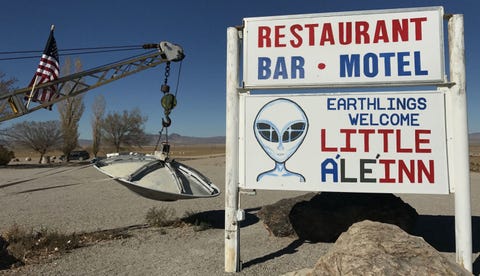
To Area 51's west, there's the Alien Cathouse which is advertised as the only alien-themed brothel in the world. Geocaching also attracts visitors here since the highway is considered a "mega-trial" with over 2,000 geocaches hidden in the area.
Then there's the actual base. While getting inside is not in the cards for most, curious civilians can actually drive up to front and back gates. Locals will direct you, and the website Dreamland Resort is a great resource full of maps, driving directions, and first-hand accounts.
However, one should be careful when planning a trek to Area 51. It's the desert, after all, so bring plenty of water, snacks, and have proper weather gear—for the hot days and the cold nights. Phone service and GPS probably won't work, so have printouts and actual maps. Gas stations are few and far in between, so carry spare fuel and tires.
Also, remember the government doesn't really want you peering into Area 51. Both Merlin and Pocock confirmed that they have been closely observed or even intimidated by guards and security (including an F-16 fly-by). Do not trespass under any circumstances or arrests and heavy fines await you.
WETENSCHAP & PLANEET NASA heeft bewijs dat de donkerste, koudste plekken op de maan bedekt zijn met een laagje ijs. Dat werd al langer vermoed, maar is nu ook definitief bevestigd door de bevindingen van NASA’s Moon Mineralogy Mapper (M3).
Wetenschappers geloofden al langer dat er zich ijs bevond op de beide polen van de maan. Bepaalde plekken worden er immers nooit belicht, waardoor ze in permanente duisternis gehuld en de temperatuur er ver onder het vriespunt ligt. Echt sluitend bewijs was er echter nog niet. Tot nu.
Om de aanwezigheid van ijs voor eens en altijd te bevestigen, deden wetenschappers een beroep op data van de M3, een spectrometer die sinds 2008 het maanoppervlak bestudeert. Door onder andere de reflectie van het ijs te analyseren, kon de M3 alle twijfel wegnemen: er werd ijs gevonden op beide polen. Op de zuidpool zou het ijs vooral geconcentreerd zijn in kraters, terwijl het eerder wijdverspreid is op de noordpool.
De ontdekking kan weleens nuttig zijn voor toekomstige maanlandingen. Het ijs aan de oppervlakte is makkelijker te bereiken dan dieper gelegen waterbronnen en kan misschien worden gebruikt bij een volgende missie op de maan, zo meldt NASA in een persbericht.
De hemel lichtte vrijdagochtend op boven de Amerikaanse staat Alabama. Met een snelheid van 86.422 km/u suisde een meteoor van 1,8 meter diameter naar de aarde. De kleine asteroïde werd het eerst gezien op ongeveer 93 kilometer hoogte, en spatte zo’n 29 kilometer boven Oak Grove uit elkaar. Op een bepaald moment was de vuurbal 40 keer helderder dan de maan, meldt de NASA. Verscheidene deur- en andere camera’s legden het natuurfenomeen vast.
If you had “India” in the office pool picking which country’s space probe would be the first to provide definitive evidence of water on the surface of the Moon, get ready to collect your prize and head on down to your favorite curry house to celebrate a discovery that will certainly give a boost to moon expeditions – take that, Elon Musk!
“These ice deposits might be utilized as an in-situ resource in future exploration of the moon.”
A new report published this week in the Proceedings of the National Academy of Sciences (PNAS) revealed that a team of scientists found three distinct signatures of water on the lunar surface using NASA’s Moon Mineralogy Mapper (M3) instrument which was delivered there in 2008 by the Indian Space Research Organization’s (ISRO) Chandrayaan-1 spacecraft. That was India’s first lunar probe, entering lunar orbit on November 8, 2008. It also released the Moon Impact Probe which crashed into the Moon’s south pole and first detected water in the lunar soil below the surface. M3 also detected what could be indications of water on the surface, but scientists at that time could not agree on its validity.
Fortunately, NASA never throws anything away. Ten years later, Shuai Li of the University of Hawaii and Brown University and Richard Elphic from NASA’s Ames Research Center in California took another look at the M3 data. This time they noticed that reflective areas on the surface in the barely lit shadows of craters at the lunar south pole absorbed infrared light in the same way that solid ice does. That was the first proof of ice on the lunar surface. Additional studies of the data from the lunar north pole showed similar surface ice, but in much lower quantities.
This is truly big news for future lunar astronauts who will now be able to obtain water without having to use radar or dowsing instruments to find it underground and then drill for it. Sure, they’ll still have to deal with the -250 degrees Fahrenheit temperatures at the poles where the water is, but what’s a little cold when you’ll soon be making hot lunar water coffee?
Chandrayaan-1 continues to be an interesting little spacecraft. While it was supposed to operate for two years, it mysteriously shut down and went dead after just 10 months. Fortunately, it had completed 95% of its mission. While most scientists figured it would soon leave orbit and crash into the lunar surface, curious NASA scientists extrapolated its orbit and, in 2016, found the little probe still circling the Moon – an exercise that will help locate lost satellites and equipment in the future.
Did you just hear a squishing sound?
While NASA and the Russian and Chinese space programs get all of the publicity, India’s little Chandrayaan-1 has managed to confirm one of the greatest discoveries in human history. What has Elon Musk’s space traveling Tesla done for us lately?
It may seem as if the wastelands of the deserts are completely devoid of life. With their never-ending expanses of bleak scrub and sand dunes this all appears as if it must be a barren realm that might as well be on another planet. Yet not only does life thrum here behind the scenes, eking out a living in these badlands, but there are also quite a few reports of mysterious creatures from here of a surprisingly humanoid nature. Here are some of the strangest.
One of the most bizarre and unsolved cases of a desert humanoid creature of some sort is an enormous beast that has come to be known as the Yucca Man. The tales seem to originate in the 1960s, in the vicinity of the of the Twentynine Palms military base, located in the Mojave Desert of southeastern California and southern Nevada. Here in this remote, desolate location there would be a series events that has remained unexplained for decades, and which hints at some sort of desert-roaming humanoid entity. The first sighting that really put the phenomenon on the map allegedly occurred in 1971, when a Marine from the base whose was on guard duty reported hearing something out in the desert scrub, which sounded like heavy breathing from some very large creature, as well as grunts and growls seemingly circling his guard station. When he warily went out to investigate, expecting to see some wild animal, he claimed to have been confronted with a gigantic, 8-foot-tall hairy ape-like creature with glowing red eyes. In some versions of this account the Marine is knocked down by the beast, only to awaken hours later and find his rifle twisted and bent like a pretzel.
The Mojave Desert
This would be far from the last anyone would here of the strange creature, with frequent reports of dogs going haywire, and of hikers encountering a fetid stench beginning to come in at a steady rate in the following years, and there was a spate of such odd occurrences at Joshua Tree National Park throughout the early 70s, with numerous campers telling of a large beast rummaging through their campsites and even attempting to open their tents, as well as park employees telling of sighting monstrous man-like forms prowling the desert that were estimated as being up to 12 feet tall. There were also massive footprints found and several indistinct, predictably blurry pictures of the creature or creatures taken. Such sighting made their way into several Southern California news publications at the time, and one June, 1973 report from the Antelope Valley Daily Ledger-Gazette described the creature and some reports thus:
The creature likes to run around houses and leaving footprints. That is its MO in the East Lancaster area where footprints were found around several houses recently. One woman reported that the creature ran around her house and scratched at the door. A small boy sent to tell his father supper was ready was found hours later crying near the corral. When asked what happened to him, he answered that a big, furry man would not let him pass.
In that year, 1973, there were many sightings of the creature in the area of Lancaster, in the western Mojave Desert in California, such as a sighting made by three separate Marines and other disparate witnesses as well. It got to the point where in this year there was a near tragedy when two search parties were out Bigfoot hunting in the wake of the mysterious reports and almost opened fire on each other. Sightings continued, and in 1979 there was an account given by an elderly couple, who claimed that the beast stepped right out in front of their car to tower over the vehicle, before lumbering off into the night, leaving enormous tracks behind. In that same year there were two additional sightings from Hemet, California, of a massive 10 foot tall creature that left behind footprints a foot and a half long.
Road through the Mojave Desert
Around this time there was a string of sightings of all sorts of strange phenomena near the Edward’s Air Force Base, about 22 miles (35 km) northeast of Lancaster. Here there were numerous reports of base personnel sighting hulking humanoid figures in the dark, which allegedly used a series of underground tunnels to move about. Oddly, there were many purported UFO sightings in the area at the same time, but whether or not this has any connection is unknown. One of the more far-out reports from the base was collected by Bigfoot researcher Edwards Bobbie Ann Slate, and concerned of one of the creatures that apparently had bright blue eyes. The report was given by a base policeman, who said:
Heading back to the main base, I noticed maybe 200-300 yards to my left, these large blue eyes. I do a lot of night hunting and it was strange — they were larger than anything I’d ever seen before. The [blue eyes] had to be about four inches apart and seven feet off the ground. I stopped the truck and sat there watching them. It was too dark to see any body shape to the thing. The blue glows proceeded toward my truck at a right angle for about 100 yards and then stopped. The movement of the eyes was extremely fast. Another thing that bothered me was that they didn’t bob up and down. It was like two lights on a wire moving from one point to another.
This particular creature, nicknamed “Blue Eyes,” has apparently been regularly seen by base police and was widely discussed amongst them right up into the present. Several other personnel at the remote desert base at the time also came forward to anonymously report that large, Bigfoot-like creatures has been routinely spotted through night-vision equipment skirting the perimeter of the base, often with red glowing eyes, walking through it, or even venturing into the many underground tunnels in the area. The witnesses explained that the presence of the creatures was officially classified, and that they had been specifically told not to fire upon them. There had allegedly been several instances of catching the creatures on surveillance cameras at the base, but this footage was labeled as classified and never released to the public.
It is not even necessarily Bigfoot-like creatures that have been seen, as there are reports of indistinct shadow men and even shape-changing entities from the base, as well as what seem to be just disembodies glowing eyes. What is going on here? Also from Southern California are more modern reports of some sort of hair-covered, semi-bipedal creature with glowing red eyes that has ben seen loping or running along at high speeds along the Highway 14, and which has come to be called the “Sierra Highway Devil.”
Another odd, red-eyed humanoid monstrosity from the same area is what has come to be called “The Cement Monster,” named for its appearance at a concrete mine near Big Bear Lake owned by the Mitsubishi Cement Corporation. In 1988 the beast was seen by two U.S. Marines who were on their way home from a skiing trip to the area when they saw the creature looming over an abandoned strip mine in the area. One of the witnesses, a Ken Cross, would tell researcher Douglas E. Trapp thus:
From the left side of the road something very large seemed to stand up on two legs and run across the road. The bottom half looked human, covered with hair. The top half wasn’t very visible, but appeared monsterish, scary in other words. The headlights only got the bottom half, and the damn thing ran out about 150 feet in front of us. It made it across the road in three strides. I distinctively remember seeing the arms pumping back and forth just like any of us would do if sprinting across the road in front of a car. It appeared to be 8 feet tall.
In the sun scorched, burning wilderness of a place called Borrego Sink, 45 mi SE of Borrego Springs, California, there have been reported terrifying encounters between man and mystery beast. The desert may seem to be a strange place to find Bigfoot, but not only have they been reported in this savage wasteland, but they seem to be of a rather aggressive variety, especially the ones that have come to be known as the Borrego Sasquatch. One such incident occurred in 1939, when a man was camping alone in one of the many dry gulches of the area. The man was awoken in the middle of the night by a band of two-legged hairy creatures stalking about his camp on the fringes of the campfire’s light. The beats were described as having white or silver fur and possessed piercing red eyes that glowed in the dark. The pack of creatures circled the camp menacingly for some time but seemed to be somewhat afraid of the fire and kept their distance until they finally slunk off back into the desert.
The Anza-Borrego wastelands
Thirty years later in the same region, a man by the name of Harold Lancaster had his own frightening encounter as he was camping in the Sink. Lancaster described how an enormous, hair covered, bipedal creature stalked out of the wilderness and lumbered straight towards him in an intimidating manner. The man, fearing that he was about to be attacked, fired his revolver into the air in an effort to scare the monster away. Whatever the creature was, the gunshots did the trick and the thing reportedly jumped around 3 feet into the air before glaring at Lancaster and running off into the brush.
Borrego Sink is not the only place in the desert with its share of ominous man-beasts. In a place called Deadman’s Hole, located 7 miles from Warner Springs on Hwy 79, a string of vicious, unsolved murders occurred back in the 19th century that have long been blamed on a malicious, marauding Sasquatch. In 1858 the first victim was killed under mysterious circumstances, followed by more slayings over the years; a Frenchman who was slaughtered in his cabin, a prospector named David Blair who was killed by what looked like a knife attack, and a woman named Belinda who was strangled and mutilated. The story may have just been chalked up to an insane killer on the rampage had it not been for a curious story that surfaced in 1888. Two hunters were out hunting in an area known as Dark Canyon when they came across a cave full of the scattered remains of various mutilated animals.
As they investigated the cave, the hunters reported being attacked by a huge, man-like beast covered in matted black hair and with huge hands and feet. According to the hunters, they opened fire on the beast and killed it, after which its body was apparently moved to San Diego and shown to police. At the time, a paper called the San Diego Union ran the story and claimed that the rampaging mystery creature had been the one responsible for the murders, causing quite a public stir in the process. Oddly, the paper ran a story the following day dismissing the article as a mere April Fool’s joke. It is unknown if there was ever really a body or if the creature really existed, but what is known is that the mysterious murders remain unsolved.
Another strange case involving some sort of humanoid creature comes from the deserts of the Mexican State of Chihuahua. At the end of 1989 and the beginning of 1990, a group of teenagers were on a mission to explore the caves of a place called Cerro Pajarito when they came across something that would haunt them for the rest of their lives. As the group was exploring one of the caves, they came upon the discovery of a dead deer and a doe that were freshly killed and exhibited three odd perforations on their necks that formed a triangular pattern. In the surrounding area, there were footprints that looked like those of a puma, but it soon became apparent that no puma had done this.
The group suddenly heard blood curdling squealing sounds and the air became pervaded by a stench described as smelling like burning wood. The terrified group of teenagers looked and saw a hunched over, humanoid figure crouched upon a rock outcropping about 15 meters away from them. The creature apparently started bounding towards them and one of the groups emptied his pistol at it, although the bullets seemed to have no effect. As the panicked group turned tail and ran for dear life, they reported passing yet another humanoid creature that was described as being metallic green in color and standing only 80 cm high. What could this have possibly been? Who knows?
The desert is indeed a very isolated domain of intense natural beauty and solitude. Anyone who has been there can attest to that. There is just something about these places that holds to it a certain mystique and allure that it is hard to pinpoint, and there are vast mysteries lurking here. What are these humanoid entities that we have looked at here, and how or why do they manage to remain in this forbidding landscape? Are these caryatids, some sort of desert Sasquatch? Are they ghosts, demons, interdimensional travelers, or something else? No one knows, and they serve to add to the allure of these oft-forgotten and avoided places.
If you’re still waiting for a glass of sarcophagus sewer waterfrom the big black mysterious marble coffin opened in Alexandria, Egypt, recently, keep holding your breath (a smart thing to do around that vile liquid anyway). On the other hand, if you were hoping for confirmation of your theory that the soaked skeletons swimming in said sarcophagus sewage were not soldiers but something else, you were right about at least one of them. And fear not, water waiters — no one has poured the sewer water back into the sewer … yet.
When the mysterious stone sarcophagus was opened recently, three skeletons were found, along with the water indicating that this coffin had been unsealed before. According to an announcement by Dr. Mostafa Waziri, Secretary- General of the Supreme Council of Antiquities, all of the contents were turned over to Dr. Zeinab Hasheesh, Director of the Department of the Skeleton Remains Studies at the Ministry of Antiquities. The analysis of the skeletons was performed by Dr. Nadia Kheider, Head of the Central Department of Antiquities of Lower Egypt (Those Egyptians are serious about their antiquities!)
According to Dr. Kheider, pelvic size showed that one skeleton belonged to a woman between the age of 20 to 25 years old, with a height around 160 to 164 cm (around 5 foot 4 inches). The second one belonged to a man between the age of 35 to 39 years old, with a height ranging between 160 to 165.5 cm while the third skeleton was a man between the age of 40 and 44 years old and its height was between 179 to 184.5 cm (almost 6 foot). It’s doubtful that the woman was a soldier, so the original theory that the three skeletons were in the military is now questionable.
Tell us more!
Anther interesting find by the researchers was a hole in one skull that the owner appeared to have lived with for a while, indicating it was probably the result of trepanation surgery, where a hole is bored or chipped to relieve pressure, drain fluid or just poke around. While trepanation was common elsewhere, it was not in Egypt. Even more interesting was the presence of gold flakes or sheets inside the bones. There was no speculation in the report how this happened. Finally, the remains were found stacked on top of each other, indicating the sarcophagus had been opened multiple times.
One poor unnamed researcher was tasked with studying the infamous sewage water which over 20,000 people had petitioned to drink. They may change their minds when they find out it was a mix of water, decomposed human remains and decomposed burial wrappings. Just to be sure (or perhaps as punishment for some work infraction), the researcher will be conducting further tests on the sewage water. DNA tests will also be done on the bones to determine if they were related.
An example of trepanation
Who were the people in the mysterious black sarcophagus? What was wrong with the person who had their skull drilled? Why was there gold in the bones? Why was such a large sarcophagus in an elaborate tomb used so many different times? The research will continue.
It’s a good thing Egypt has so many antiquities experts.
What if you were a prisoner in your own world and daily life? Imagine if, despite the seeming appearance of a normal, modern lifestyle around you, you were actually being held captive by certain powers that be; an inmate within invisible walls possessing no iron bars or chains, but which relied instead on surveillance and sentries to corral and confine its detainees?
Imagine now that you no longer wished to remain here. As you seek ways to escape, what if the powers in control effectively worked stifle your every attempt… perhaps even presenting a ruse when necessary to help you think you were closer to freedom than you actually were?
In such a circumstance, one might surmise that the careful control of people’s actions—perhaps through things like punishment, or even deadly force—could serve as a far stronger form of imprisonment than an actual fortified location with thick walls and barred windows.
It’s an interesting thought experiment: the idea that imprisonment can take many forms, or even that imprisonment could occur with or without one even knowing it. Here, of course, the question arises as to whether we today, living in a free society as we do, are nonetheless effectively “prisoners” in some fashion or another.
This was the premise of what is arguably among the most well-regarded science fiction series of classic television, The Prisoner, harkening back to the late-1960s era where, thanks largely to Ian Fleming’s immortal character, spy dramas were very much en vogue.
The Prisoner starred Patrick McGoohan in the role of a stoic and at times tempestuous former secret agent who, upon angrily quitting his job, finds himself a captive within a small coastal community somewhere in Europe. In this new place, known colloquially as “The Village,” each person is known by a number rather than by a name; here, the lyrics of the 1948 American country music song by Jimmy Skinner, “Doin’ My Time,” come to mind, where Skinner sang, “Lord, they call me by a number, not a name.”
Beginning in September 1967, this most unusual program appeared on televisions in Britain and Canada, combining elements of a James Bond-like spy thriller with science fiction by employing advanced surveillance technologies and balloon-like robotic sentries which helped enforce authority in the “Village.” Over the course of 17 episodes, the program saw McGoohan’s character—known to other Villagers as “Number Six”—engaged in repeated and increasingly elaborate attempts to escape from his strange prison with no walls. His primary antagonists are a variety of characters who take the role of “Number Two” over time, engaging in efforts to psychologically “break” Number Six with the intended goal of finding out why he resigned.
Patrick McGoohan in his role as “Number Six” on The Prisoner (fair use).
Number Six, in essence, represents the Individualist; he is a free-thinker that has been thrust into a collectivist world, where good behavior and complacency is rewarded. Add to that the obviously Orwellian elements of surveillance and control, and what we now find in The Prisoner is a sharp cultural commentary that is designed to make us think as much as it was intended to entertain.
Plenty of commentaries have been offered about the series and its influence, perhaps most notably in books like Chris Gregory’s Be Seeing You…: Decoding The Prisoner (University of Luton Press, 1997). Gregory analyzes the series on almost every level conceivable, from the mythological to the political and sociological, arguing fundamentally that like Orwell’s 1984, the inevitable encroachments of civil liberties that occur as government grows has, over time, made The Prisoner all the more relevant, and hence its lasting appeal.
As human beings, we think of things in terms of matters relevant to us, and which are of existential importance to our wellbeing. However, if we were to expand on the themes incorporated in The Prisoner and carry them further into the realm of science fiction, we might entertain the notion that living on planet Earth is, in its own way a sort of benign “imprisonment.” What if, for instance, we were to eventually learn that alien beings existed that were well aware of humankind’s aspirations to colonize planets like Mars, and explore distant worlds not only with remote probes… but eventually in person as well?
The idea that there could be cosmic forces at work which make it difficult for us to get off-planet may not be entirely science fiction, nor does it have to include alien oppressors in order to make sense. Last year, a video by Kurzgesagt – In a Nutshell on YouTube called, “Why Earth Is A Prison and How To Escape It” makes some fascinating arguments for why humans are, essentially, imprisoned here.
It’s because we owe the universe a debt… a 4.5 billion-year-old debt:
As the video explains, every atom in our being as individuals was once a part of some greater event in the formation of the cosmos. Planetary formation is no small task, and for humans to ever be able to leave this world, the energetic requirements for doing so are essentially the same as that which formed the Earth. Hence, we build machines which have energetic potential that is great enough, at very least, to overcome gravity (rockets, in other words), which aid us in escaping our world and exploring space.
In The Prisoner, Number Six commits a great deal of energy (although perhaps not quite as much as a rocket produces) in an effort to escape his confinement at a coastal resort. It’s not a bad place to live, altogether, and while his captors are bent on interrogating him by various means in order to learn why he resigned from his previous work in espionage in the first place, his complacency is encouraged along the way, which would ensure that he would live well in The Village, so long as he cooperates.
The idea that humanity is similarly “imprisoned” here on Earth by cosmic forces like gravity is an interesting one, in the sense that we share a potential for having a good life here, which may not necessarily require getting off-world in order to ensure humanity’s survival. To the contrary, the late Stephen Hawking and others have argued that, in fact, space exploration might actually become requisite for human survival at some point, even if that’s not the case in the immediate sense. They argue this because of the finite nature of resources on a planet where, as science improves the quality of life for many, as well as the length of time humans spend here, there is an ever-increasing necessity for greater resources; at some point, population growth and lifespan could meet well exceed production levels, and beyond this “point of diminishing returns” one might speculate that inevitable problems would arise. Whether this would constitute war, famine, or other perils resulting from scarcity is anyone’s guess, although it’s beyond the scope of the present argument.
On the other hand, some might see the above views as being alarmist to an extent, and while there are obvious untapped resources that outer space might afford us, this doesn’t necessarily mean that we are running completely out of resources here on Earth. In fact, pushes toward the implementation of renewable energy sources on Earth, and more resourceful ways of managing commodities (in addition to finding new, as-yet-untapped sources for them altogether) might prove very beneficial for future humans. Getting along with the other villagers and staying where we are, in other words, might actually require less energy than the trouble we can expect to meet while trying to escape.
Of course, the amount of energy it took for our ancestors to push outward from habitable regions in the ancient past, which led to the exploration and eventual settlement of distant lands also required tremendous energy and hardship. Maybe the acceptance of a stable environment (barring instances where natural disasters or other hardships might have forced ancient humans toward migrations) simply isn’t as appealing as the quest for adventure, and the fulfillment of indulging our curiosities.
It seems likely, then, that humans will follow in the footsteps of our ancestors, and eventually escape our earthly “prison.” And much like Number Six with his repeated failed attempts to liberate himself from The Village, we’ll probably do so at whatever cost is necessary, despite the hardships or the amount of energy required.
And we do this because to face such hardships is the greatest expression of our freedom: our ability to act in accordance with our own will, and to proclaim loudly that we are not merely things or simple bundles of cosmic stardust, helplessly watching our fate play out before us. Or, to put it as McGoohan’s character famously retorted to his captors, I am not a number… I am a free man!
We are humans, after all, and going great lengths to achieve the seemingly impossible appears to be in our nature.
When we think of UFOs, we can’t help but think of America: birthplace of the “flying saucer,” home to Roswell, Area 51, and, of course, Hollywood, which is responsible for some of the most iconic UFO-related imagery in the history of cinema. However, anyone who’s ever opened a book on the UFO topic will know that the phenomenon is not restricted to the United States of America, nor can America stake a geographic claim on all of history’s most dramatic UFO events. The UFO phenomenon is truly global in scope. With this in mind, over the next several weeks, I’ll be conducting interviews with leading UFO researchers from countries all around the world in an effort to paint a clearer picture of global UFOlogy today.
Chris Rutkowski and friends.
Our global UFO trek starts in Canada with Chris Rutkowski, a Canadian science writer and educator with degrees in astronomy and education. Since the mid-1970s, Rutkowski has been studying reports of UFOs and writing about his investigations and research. He has eight published books on UFOs and related issues, including Unnatural History (1993), Abductions and Aliens (1999), A World of UFOs (2008), I Saw It Too! (2009) and The Big Book of UFOs (2010). He has appeared on numerous radio programs, podcasts and documentary TV series, including Unsolved Mysteries, UFO Hunters, Sightings, Eye2thesky, The Paracast, Discovery’s Close Encounters and A&E’s The Unexplained. He is past president of both the Winnipeg Science Fiction Society and the Winnipeg Centre of the Royal Astronomical Society of Canada.
RG: Who have been the defining figures in Canadian UFOlogy over the past 70 years (for better or for worse), and why?
CR: There are a lot to choose from. In an entry on Canadian ufology for Jerome Clark’s UFO Encyclopedia, Volume 1, published in 1990, I noted such people as Wilbert B. Smith and Omand Solandt, who were diametrically opposed individuals associated with Canada’s version of Project Blue Book, namely Project Magnet and Project Second Storey. Paul Bissky was a lead in the Canadian military UFO investigation team in the 1960s. Peter Millman and Ian Halliday were astronomers with the National Research Council who handled UFO reports, usually by debunking them.
In a section of my entry on Canadian ufologists, I noted: Stanton Friedman, John Magor, John Brent Musgrave, Douglas Curran, Grant Cameron, Larry Fenwick, Harry Tokarz, and Ed Barker.
Influential Canadian UFO researchers, Wilbert B. Smith and Stanton T. Friedman.
Historically, there were other notable individuals such as (the great and highly influential) Errol Bruce-Knapp, Jim Moroney, Michael Strainic, Brian Vike, Fern Belzil, and Pat de la Franier. In Quebec, Claude Macduff, Henry McKay, and Francois Bourbeau had been active.
I would today note both John Robert Columbo and David A. Gotlib in Toronto, as well as Gene Duplantier and Bonnie Wheeler. Also, Christian Page, Yann Vadnais, Donald Cyr, Jean Casault, Gilles Milot, and Michelle McKay. And we can’t forget Claude Vorhilon “Rael!” Further east, I would have to note Don Ledger, Noah Morritt, and Chris Styles.
Others who have made significant impacts would be Palmiro Campagna, Michael Persinger (who just passed away), Yurko Bondarchuk, Sue Demeter-St. Clair, Gord Kijek, Martin Jasek, Michel Deschamps, Charles Lamoureaux, Don Dondieri, Paul Kingsbury, Geoff Dittman, Roy Bauer, MJ Banias, and Paul Kimball. (I hope I didn’t leave anyone truly significant out of this list.)
RG: What do you consider to be the most compelling Canadian UFO incident on record, and why?
CR: Ah, that’s a good question. The word “compelling” is not one I’d use for most UFO cases. One could argue that the Falcon Lake case of 1967 is the most compelling, because it has elements of everything that a good UFO case should have: detailed witness testimony; physical effects on the environment, including radiation; physiological effects on the witness; a site that has been located and is accessible today; voluminous documentation by government and military investigators; a physical artefact that has been tested by several independent laboratories; recognition by a government that the incident is of historical value; literally hundreds of pages of official documents from two different countries that have been located, retrieved, and made available by researchers, attesting to the incident actually occurring and having been taken seriously by various agencies; queries about the incident in a parliamentary assembly made fully public; plus official statements by police and military investigators that the incident cannot be satisfactorily explained.
Artistic rendering of the Falcon Lake UFO, based on the witness’ original sketch.
Name one other case like that anywhere in the world. Sure, it’s a single-witness case, but it has a lot of probative evidence. Having said that, I’m sure investigators of the Shag Harbour case would say that was the most compelling, and Palmiro Campagna suggests the most compelling is actually Falconbridge. (NB: “Charlie Red Star” and the Carman, Manitoba, flap of 1975-76, currently proclaimed by some as “One of North America’s Biggest UFO Sightings,” isn’t really in the same ballpark.)
RG: What is the Canadian government’s official stance on UFOs? When was the last time it issued a statement on the subject?
CR: Like most large democratic countries and governments, Canada remains officially disinterested in UFOs. This has not changed significantly over the years. An official memo of the Department of National Defence in 1961 stated:
“The Canadian Government is concerned with any report which might affect national security and, undoubtedly, this would be the attitude of the United States Government also. However, to date, UFO reports which have been investigated by various departments of the Canadian Government have not revealed positive evidence of anything which might affect national welfare and which could not be attributed to possibly natural phenomena or mistaken identity.”
In the late 1960s, responsibility for UFO reports was transferred to the National Research Council of Canada (NRC). In 1976, a spokesman for the NRC stated: “Our responsibility was that the NRC would take over the maintenance of a file of UFO reports and conduct any investigations determined by the scientific merit they appeared to have. There was no commitment to do anything specific.”
RG: Does the Canadian Department of National Defence have an official UFO investigations unit?
CR: Short answer: yes. Long answer: sort of. At one time (in the 1960s), there were a few individuals within the Canadian military who seemed to be involved in many UFO investigations. One in particular was Squadron Leader Paul Bissky, whose name appears in a number of case files, including one that suggests he was part of an investigation “team,” greatly predating the X-Files. But into the 1970s, the attitude seemed to have changed, and the Canadian posture mirrored that of the USA. As noted above, the NRC investigated UFO reports, but only because astronomers within the NRC were interested in meteorites, and they looked at UFO reports as largely being due to misidentifications of meteors. The NRC managed to get the RCMP to agree to investigate UFO reports for them with this in mind. When the NRC stopped being interested in meteoritics in the mid-1990s, the “Non-Meteoric Sightings File” was closed, and the RCMP was no longer obligated to investigate and send in reports.
However, UFO reports are still collected by the Department of Defence. Evidence of this is a current policy on “MERINT” reports as defined by the Canadian Coast Guard in its annual directive to mariners. The policy states:
“In order to extend the early warning coverage for the defence of the North American continent a plan is now in existence for the reporting of vital intelligence sightings during peacetime… All Canadian vessels should originate MERINT reports as and when applicable… MERINT reports should be made under the following circumstances… (a) Immediately upon a vital intelligence sighting, except when the vessel is within territorial waters of a country other than Canada, the U.S.A. or Greenland.”
It is important to note that MERINT instructions apply to all ships, both civilian and military. And what kinds of things need to be reported? The Coast Guard is very explicit that “All airborne and waterborne objects which appear to be hostile, suspicious or unidentified should be reported,” including:
“(i) Guided missiles. (ii) Unidentified flying objects. (iii) Submarines. (iv) Surface warship positively identified as not Canadian or U.S. (v)Aircraft or contrails (vapour trails made by high flying aircraft) which appear to be directed against Canada, the U.S., their territories or possessions.”
RG: Has the Canadian government shown more or less transparency on the UFO subject than the US government?
CR: Canada is much more transparent than USA in this regard. Despite the much-ballyhooed demands for “Disclosure” by UFO zealots, official documents about UFOs in Canada have always been available in the National Archives, regularly added to every year. And this isn’t “gradual” or “soft” disclosure; it’s simply standard procedure for yearly reviews of documents as they come up for release. Several Canadian ufologists have been filing AI (the Canadian version of FOIA) requests regularly for decades, receiving documents as part of their research.
Chris Rutkowski in his office.
RG: Does Canada have a national UFO investigations organisation today, and how many smaller Canadian UFO groups are you aware of?
CR: Nothing national, but there is a Canadian chapter of MUFON which has representatives in several provinces. As for smaller groups, a few provinces have them: UFOBC, Ufology Research, PSICAN, AQU, GARPAN, and perhaps a few others. There were dozens in the 1970s and 1980s. (I could claim that Ufology Research is national, in the sense that we compile the annual national Canadian UFO Survey with data obtained from all groups and organizations across the country.)
RG: What are the most active regions of Canada for UFO sighting reports?
CR: The Canadian UFO Survey has shown that the number of UFO reports is related to population, so that the most UFO reports originate from the largest population centres. Having said that, in 2017, Quebec had about half the total number of UFO reports in the country. Not completely sure why. There are a few places where UFO reports seem slightly high, despite demographics: Surrey, BC; St. Catharines, Ontario; and perhaps even Laval, Quebec.
RG: Have you personally had any UFO sightings?
CR: No, although in 1977, I saw a distant moving red light in the sky and reported it to the NRC. I found my own report on file in the National Archives! (And no, it was never investigated by them. I suspect it was an aircraft.)
RG: How long have you been involved in the UFO subject; roughly how many cases have you personally investigated; and what conclusions, if any, have you drawn about the underlying nature of UFO phenomena?
CR: I started investigating UFO sightings in 1974. I can’t count the number of cases I have investigated since then. Hundreds? Thousands? Even 50 per year for 40 years or so works out to more than 2,000.
I first had an article published about UFOs in 1976. My first book was published in 1989. My conclusions? In 1991, I stated:
“As with the 1989 Survey of Canadian UFO Reports, the 1990 Survey does not offer any positive proof of the physical reality of UFOs. However, it does show that some phenomenon which is called a UFO is continually being observed by witnesses. The typical UFO sighting is that of two people observing a moving, distant white or red light for a period of over 15 minutes. In most cases, the UFO is likely to be eventually identified as a conventional object such as an astronomical object. However, in a small percentage of cases, some UFOs do not appear to have an easy explanation and they may be given the label of ‘unknown’.”
“Statistical studies of UFO report data have often been subject to criticism from both hardcore UFO believers and debunkers. The former insist the small number of high quality unexplained cases does not reflect the true abundance of alien craft in our skies, while the latter note that UFO data is not at all convincing that a real phenomenon exists… The reality is that UFO reports are the foundation of ufology and are the basis for belief in extraterrestrial visitation by ETH adherents. But in short, UFO report data does not prove that aliens are visiting Earth. In fact, if anything, the UFO report data show that most often, the average witness is misidentifying conventional objects or ordinary phenomena… It should be emphasized the classification of Unknown does not imply alien visitation. Each case may still have an explanation following further investigation. And of those that remain unexplained, some may remain unexplained, but still are not incontrovertible proof of extraterrestrial intervention or some mysterious natural phenomenon. In short, witnesses are seeing real things, and the challenge remains to identify the conventional astronomical objects, aircraft, and other terrestrial objects in order to winnow out the truly unexplained UFOs, if any.”
RG: How can Canadian UFOlogy better itself?
CR: More beer. No, wait. Through better cooperation between organizations and individuals. It’s still a challenge every year to compile data on all Canadian UFO sightings when some groups and ufologists are parochial in their approach and don’t freely share information. It’s the same in the USA and other countries, of course. There’s also no agreed-upon standard when it comes to recording and presenting UFO data.
But the good news is that Canadian ufology is ahead of other countries in that we do have access to official UFO reports as well as civilian cases, and that the Canadian UFO Survey remains a good and useful tool for understanding some basic information about UFOs.
Long UFO Sighted Over Florida August 18, 2018, UFO Sighting News.
Date of sighting: Aug 18, 2018
Location of sighting: Florida, USA
This long black UFO was seen this week in Florida. The UFO blends in and out of the overcast cloudy sky. The darkness along the edges of the UFO give it away. The UFO shows up at 38 seconds into the video. The shape of this UFO is unlike anything I have seen before. I don't think the pilots of the craft knew it was visible, but perhaps the static electricity in the air or some other phenomenon caused to to be visible for a little while. Notice that the lighter parts of the UFO appear invisible at times in the video. Amazing footage of a real UFO.
Scott C. Waring
Eyewitness states:
Raw unedited footage of Cigar Shape UFO over Florida 8.18.18, or Arial Banner (you decide) captured on a Galaxy Note 8 at 12:20 pm EST. I uploaded this directly from my phone onto YouTube without putting it through an editing program first to adjust the screen perspective. I am going to do this now, but it may reduce the resolution in the process – we shall see! Peace.
LE PENTAGONE A ÉTUDIÉ LA "TECHNOLOGIE DES OVNIS EXOTIQUES". CONFIRMATION DANS UNE LETTRE D'UN SÉNATEUR ET DU SOUS-SECRÉTAIRE AMÉRICAIN À LA DÉFENSE.
Le programme secret du Pentagone sur les OVNIS a mené une série d'enquêtes sur les "technologies futuristes exotiques", révèle une lettre d'un sénateur et du secrétaire adjoint à la défense des Etats-Unis.
Les documents relatifs aux enquêtes du Programme d’identification aérospatiale avancée (AATIP) confirment que les États-Unis ont étudié en secret des technologies leur permettant d’exercer un plus grand contrôle militaire sur d’autres pays au cours des prochaines décennies. Ce programme, principalement consacré à l'exploration des anomalies des phénomènes aériens, a été dévoilé à la fin de l'année dernière, lorsqu'une vidéo a été publiée sur la rencontre rapprochée entre un chasseur FA-18 Super Hornet et un ovni de forme ovale. Ils voyageaient à grande vitesse.
Maintenant, un échange de fonds entre le sénateur Harry Mason Reid et William Lynn III, sous-secrétaire à la Défense, a révélé les détails juteux sur l'intérêt du Pentagone pour l'étude des objets volants non identifiés et des progrès de la technologie aérospatiale. Et bien que la correspondance ne mentionne pas spécifiquement les OVNIS, cela semble confirmer que le sénateur a ordonné l’évaluation du degré de "menaces étrangères" de l’espace.
De plus, nous parlons de concepts extrêmement sophistiqués tels que la mécanique quantique, la science nucléaire, l'électromagnétisme, l'antigravité et la thermodynamique. "Ces technologies ont le potentiel d'être utilisées par nos adversaires avec des effets catastrophiques", prévient le sénateur Reid dans la lettre, qui a été obtenue de Las Vegas.
En fait, les progrès réalisés grâce aux technologies étudiées dans le programme AATIP sont si « sensibles » que le sénateur suggère un contrôle plus rigoureux de la part du ministère de la Défense et établisse les références « niveau SAP » (programmes d'accès spéciaux) qu'il s'agit d'informations classées au-dessus du TOP SECRET (Ultra Top Secret). La lettre indique également que "l'identification de différents résultats aérospatiaux non conventionnels a beaucoup progressé". "Enfin, les résultats de l'AATIP ne profiteront pas seulement au gouvernement américain, mais également au ministère de la Défense d'une manière qui ne soit pas imaginée", écrit le sénateur. "Les connaissances et les compétences technologiques que nous avons obtenues donneront à notre pays un avantage sur toute menace étrangère et nous permettront de maintenir notre suprématie en tant que leader mondial".
Bien sûr, les menaces et les développements spatiaux d'autres pays, tels que la Russie et la Chine, constituent probablement des menaces. Cependant, il semble y avoir une allusion claire que l'étude de l'AIPIP sur les ovnis a aidé à améliorer la technologie aérospatiale américaine ... peut-être avec l'ingénierie inverse, c'est-à-dire la rétro-ingénierie ? Ce dernier peut être déduit des déclarations faites l’année dernière par l’ancien directeur de l’AIPIP, Luis Elizondo, après que le secret ait été révoqué sur l’existence de ce programme du Pentagone, a déclaré M. Elizondo. Nous ne sommes pas seuls »et a laissé entendre que le gouvernement avait accès à des « métamatériaux » obtenus à partir de vaisseaux spatiaux extraterrestres récupérés et stockés dans des structures spécialement modifiées situées quelque part dans le désert de Las Vegas.
Nick Pope, ancien chercheur sur les OVNIS au ministère britannique de la Défense, estime que cette lettre "est une bombe" et "révèle plus que ce que nous pensions savoir sur le programme AATIP". "Ces révélations choquantes montrent à quel point le problème des OVNIS est grave pour le gouvernement américain, au-delà de ce qu’ils croient être la véritable nature du phénomène. La lettre exprime les véritables raisons pour lesquelles le Pentagone étudie le sujet - la technologie des ovnis - et la dichotomie entre la considérer comme une menace et une opportunité ", conclut avec ces mots Nick Pope dans une interview avec le tabloïd britannique The Metro. Le programme AATIP a été achevé en 2012, même si les journalistes du New York Times qui l'ont exposé au public croient qu'il fonctionne toujours à un certain niveau.
You must be one with the rock. - Spock to Kirk in Star Trek V.
As with any good science fiction, part of our fascination with Star Trek comes from the combination of real science and fantastic possibilities. When you think of science in the show, disciplines like spaceship engineering, astronomy, physics and biology probably spring to mind first. However, the show actually features a lot of geology.
Captain Kirk fights a Gorn - you can see Vasquez Rocks in the background. (CBS via Getty Images)
In TOS, geology can often be observed simply in the background of an alien planet, like in the episode "Arena", filmed at the famous, stratified Vasquez Rocks in California. Sometimes rocks and geological formations are only mentioned, for example when the sensors of the starship Enterprise scan the surface of a strange, new world. Other times, however, crystals and minerals are essential plot devices.
In many episodes, the crew of the Enterprise visits mining colonies or is on a mission to search for valuable minerals and crystals. There exists even a geological tricorder for prospecting resources, designed for analyzing rock samples and comparing them to the records memorized in the mineralogical database of the federation. By convention, the names of terrestrial minerals (a crystalline combination of one or various elements) end with the suffix "-ite", the denominations of elements with the suffix "- ium", "-um", "-on", "-gen" or "-ine". Unfortunately it seems that this nomenclature is not always applied with the necessary scientific accuracy in the 23th century. But to be fair, many of the minerals are unknown to the present day. And that's accurate, as there are indeed elements found only in stars and outer space, like Technetium, that don't form naturally on Earth.
Could such non-terrestrial elements form also extraterrestrial minerals? We have found some very promising samples just in the last years. In meteorites, rock samples from the moon and chemical analysis done by space probes on the other planets of our solar-system, we have found almost 300 different minerals, composed of already known elements. However, because many of those minerals were formed under conditions that don't exist on Earth, such as low gravity, or the complete absence of liquid water, many are indeed unknown in the Earth's environments.
More than 125 minerals are mentioned in the Star Trek universe. Of these, however, only 23 are actual terrestrial minerals and only one mineral, the silicate olivine, has been found in extraterrestrial rocks. Curiously quartz, one of the most common minerals on Earth, is almost never mentioned. Perhaps because quartz is often used as a prop stand-in for dilithium crystals.
Quartz crystals from the Alps
(planet Earth)
In the Star Trek universe "dilithium" is not only a rare and valued gemstone, known also as radan, but its chief use is in the show's matter-antimatter reactors, standard equipment on board of every Federation spaceship. As its (supposedly) cubic crystal structure can somehow transform energy (a physical property mentioned in the episode “Pen Pals” of Star Trek: The Next Generation) and control the flow of antimatter (mentioned in the TOS episode “Elaan of Troyius") This sci-fi property of the crystalline dilithium may be not so far-fetched: some real crystals, such as Iceland spar, can filter or distort certain wavelengths of light (a form of energy)
Futuristic minerals and metals play also an important role in other Star Trek technology, such as "transparent aluminum," which is used for the construction of spaceships and a beryllium-titanium alloy is used in the highly advanced androids encountered in the TOS episode "I, Mudd".
But even very simple minerals play an important role in some Star Trek episodes. Halite, better known as common table salt, plays an important role in "The Man Trap," the first episode of Star Trek ever broadcast. In this episode a remote outpost is infiltrated by a mysterious shape-shifting creature that requires salt to survive, by any means necessary. The originally unaired Star Trek pilot "The Cage," also featured a geologist.
Sulfur, saltpeter and carbon, in two crystalline modifications, as coal and as diamond, saved Captain Kirk´s life in the already mentioned episode "Arena". Kirk, transported to a desolate planetoid, is forced into a battle against the reptile-like Gorn, which is protected by an almost indestructible armored skin. Using the sulfur, saltpeter and coal to make gunpowder and pointy diamond-crystals (here the writers made quite a mineralogical blooper, as such a crystal-shape is not to be found in real diamonds) as high-impact projectiles, he finally puts down his adversary.
Sometimes, though minerals are shown to be deadly. During negotiations for the rare, but important (and also non-existing) mineral topaline, a red-shirt is killed in the episode “Friday's Child” on the surface of Capella IV just 32 seconds after beaming down.
The everyday tools of geologists today, hand lens and geological hammer, are of no real use in the 23rd or 24th centuries. In the episode "Obsession," Spock analyzes on the surface of planet Argus X a rock composed of the mineral "tritanium" with his geological tricorder. Tritanium is said to be 21.4 times harder than diamond (despite Kirk's comment in "Arena" that diamonds are the hardest substance known in the Star Trek universe). That makes it quite useful for the construction of starships. The rock itself was shown to sampled by phasering off a piece, as it was too hard to be cut with common tools.
But even the most sophisticated technology can´t replace geological intuition. That may not be logical, but is often true. In the episode "The Apple" Spock immediately notes the lush vegetation of the planet Gamma Trianguli VI. From that, he correctly deduces that soil-nutrients (and therefore geology) plays a role in supporting this peculiar paradise-like world. With his sharp geological eye Spock identifies also hornblende and quartz in a collected rock (according to this petrological composition maybe an igneous rock?) that is easily erodible (even explosive!) and so may be the source of all the sediments and soils.
Kirk and Spock encounter the silicon-based Horta.
(Paramount/Courtesy Everett Collection)
Perhaps the most fascinating use of geology in the Star Trek universe is the discovery of life, but not as we know it.
"Life, as we know it, is universally based on some combination of carbon compounds," remarked Mister Spock at the beginning of the episode "The Devil in the Dark." However when the crew of the Enterprise is contacted by the miners on Janus VI, who are supposedly under attack by an unstoppable "monster" that can't be tracked by the ship's sensors. By the end of the episode, Spock soon changes his mind - "But what if life exists, based on another element. For instance, silicon."
This may not be far-fetched. In 1891, German astrophysicist Julius Schreiner speculated that silicon could replace carbon in molecules supporting the complex chemical reactions needed for the metabolism of any life-form. Three years later, H.G. Wells wrote in a popular science article:
One is startled towards fantastic imaginings by such a suggestion: visions of silicon-aluminium organisms – why not silicon-aluminium men at once? – wandering through an atmosphere of gaseous sulphur, let us say, by the shores of a sea of liquid iron some thousand degrees or so above the temperature of a blast furnace.
In 1934, chemist and author Stanley Weinbaum published his short story titled "A Martian Odyssey," where he introduced the first silicon-based life forms in popular culture. The story actually went into some detail about its metabolism:
Those bricks were its waste matter… We’re carbon, and our waste is carbon dioxide, and this thing is silicon, and its waste is silicon dioxide-silica. But silica is a solid, hence the bricks. And it builds itself in, and when it is covered, it moves over to a fresh place to start over.
Silicon can indeed form polymers and complex compounds together with metals or elements like boron, nitrogen, phosphorus and sulfur. Such molecules can also work in liquid nitrogen, methane, ammonium, various alcohols and even acids.
However, using silicon as replacement element for carbon has some disadvantages. Complex silicon compounds are unstable and ineffective under terrestrial surface conditions. McCoy notes this in the episode, stating that silicon life would not survive in the artificial, human environment created on Janus VI. The episode later reveals that the alien life-form, named "Horta", comes from within the planet, where suitable conditions for silicon-based life might exist. Such an environment would likely need to be a dry, cold and oxygen-free environment, because free oxygen would react with the silicon to form silicates. That would in turn destroy the complex and fragile silicon-molecules a life-form would need to support itself.
Human-required conditions would also reduce the metabolism and reproduction rate of this hypothetical organism. In the episode, the Horta is the last of it´s kind, guarding thousands of eggs, which appeared to the crew and miners as inanimate silicon-concretions. It was the destruction of those eggs that led the Horta to attack the miners, and once its nature was understood, Kirk and Spock were able to negotiate peace between the Horta and the miners.
Could such life really exist? We don't know. One of the great achievements of Star Trek has been to pose both intriguing ethical and scientific questions. Hopefully, some of those questions will be answered by the coming generations.
I find that fascinating!
Interested in reading more? Try:
PICKOVER, C.A.(1999): The Science Of Aliens. Basic Books: 240
SHOSTAK, B. (2012): Life in the Universe. Addison-Wesley Publisher: 544
SCHULZ-MAKUCH, D. & IRWIN, L.N. (2006): "The prospect of alien life in exotic forms on other worlds." Naturwissenschaften. Vol.93: 155-172
Flying Saucers to Mind Control: 22 Declassified Military & CIA Secrets - PART I
By Denise Chow and Elizabeth Peterson, Live Science
Credit: U.S. Air Force
A secret history
Government and military secrets can range from terrifying to amusing to downright absurd, but most are nothing short of intriguing. From a secret U.S. Air Force project to build a supersonic flying saucer to a now-famous World War II-era research program that produced the first atomic bombs to a plan to train domesticated cats to spy on the Soviet Union, here are 22 declassified military and CIA secrets.
Credit: National Archives
1. Project 1794
In late 2012, the U.S. Air Force declassified a trove of documents, including records of a secret program to build a flying saucer-type aircraft designed to shoot down Soviet bombers. The ambitious program, called Project 1794, was initiated in the 1950s, and a team of engineers was tasked with building a disc-shape vehicle capable of traveling at supersonic speeds at high altitudes.
The declassified documents reveal plans for the plane to reach a top speed of Mach 4 (four times the speed of sound), and reach an altitude of 100,000 feet (30,480 meters). The project's estimated cost was more than $3 million, which in today's dollars would be more than $26 million.
Project 1794 was canceled in December 1961 after tests suggested the flying saucer design was aerodynamically unstable and would likely be uncontrollable at high speeds (let alone supersonic speeds).
In the 1960s, the U.S. Army embarked on a secret mission to build a series of mobile nuclear missile launch sites under the Greenland ice sheet. The objective was to house medium-range missiles close enough to strike targets within the Soviet Union.
The program was codenamed Project Iceworm, but to test its feasibility, the Army launched a cover research project called "Camp Century" in 1960. Under this guise, engineers built a network of underground buildings and tunnels, including living quarters, a kitchen, a recreation hall, infirmary, laboratories, supply rooms, a communications center and a nuclear power plant.
The base, which was kept secret from the Danish government, operated for seven years. The program was canceled in 1966 after shifting ice created unstable conditions. Today, the crushed remains of Project Iceworm are buried beneath Arctic snow.
During the Cold War, the CIA initiated Project MK-ULTRA, a secret and illegal human research program to investigate potential mind-control systems. The program's operators examined the effects of hypnosis, biological agents and drugs, such as LSD and barbiturates, on human subjects. Some historians suggest the program was designed to develop a mind-control system that could be used to "program" the brains of potential assassins. [The 10 Craziest Military Experiments]
In 1973, then-CIA director Richard Helms ordered that all documents from Project MK-ULTRA be destroyed, but a formal investigation into the program was launched several years later. The project became the basis for several movies, such as "The Manchurian Candidate" and "The Men Who Stare at Goats."
Credit: Public domain
4. Area 51
Almost no other site has garnered as much attention from conspiracy theorists and UFO-enthusiasts as Area 51, a remote desert tract near Groom Lake in Nevada, roughly 83 miles (134 kilometers) northwest of Las Vegas. The intense secrecy surrounding the base sparked peoples' imaginations, and Area 51 was commonly linked to paranormal activities, including pervasive theories that suggested Area 51 hid aliens and UFOs.
In July 2013, declassified documents from the CIA acknowledged the existence of Area 51 for the first time, and confirmed that the top-secret site was used to test a variety of spy planes, including the well-known U-2 reconnaissance aircraft.
While Area 51, which operates as a detachment of Edwards Air Force Base in neighboring California, has never been declared a covert base, the research and activities conducted there were some of the nation's most closely guarded secrets.
While Area 51 was not a top-secret base designed to study extraterrestrials, the U.S. Air Force did study the existence of UFOs. Project Grudge was a short-lived program launched in 1949 to study unidentified flying objects. The mission followed an earlier program, known as Project Sign, which published a report in early 1949 stating that while some UFOs seemed to be actual aircraft, there was not enough data to determine their origins. [Top 10 States for UFO Sightings]
Critics of Project Grudge said the program solely set out to debunk UFO reports, and very little actual research was conducted. In his book on the topic, Edward J. Ruppelt, Air Force Captain and director of Project Grudge, wrote: "[I]t doesn't take a great deal of study of the old UFO files to see that standard intelligence procedures were not being followed by Project Grudge. Everything was being evaluated on the premise that UFOs couldn't exist. No matter what you see or hear, don't believe it."
Credit: NASA
6. Operation Paperclip
In September 1946, President Harry Truman authorized a program called Operation Paperclip, which aimed to lure scientists from Nazi Germany to the United States following World War II. Officials at the Office of Strategic Services (the predecessor to the CIA) recruited German scientists to America to aid the country's postwar efforts, which would also ensure that valuable scientific knowledge would not end up in the hands of the Soviet Union or the divided East and West Germany.
The tense relationship between the United States and Cuba during the Cold War led the Central Intelligence Agency (CIA) to hatch a slew of bizarre schemes aimed at taking down the Castro regime. While the goal of most of these covert operations (such as Operation Mongoose) was to assassinate Fidel Castro himself, other plans aimed to incite an all-out war between the U.S. and Cuba, experts have said.
In 1998, the National Security Archive (NSA) — a non-governmental organization that publishes information made available through the Freedom of Information Act — posted declassified documents related to Operation Northwoods. The scheme, dreamed up in 1962 by the Joint Chiefs of Staff (uniformed members of the U.S. Department of Defense who advise the president and others), involved committing acts of violence against U.S. and Cuban civilians and then blaming those acts on the Cuban government, according to the NSA documents. These acts, which included faked terrorist attacks in U.S. cities, the hijacking of planes and the sinking of boats full of Cuban émigrés en route to the U.S., would then be used to justify a war with Cuba, according to the documents.
The Kennedy administration recognized the folly of Operation Northwoods and rejected it, according to news reports.
Credit: Jack Aeby
8. Manhattan Project
One of the most well-known secret research programs is the Manhattan Project, which eventually produced the world's first atomic bombs. The project began in 1939, and was cloaked in secrecy as physicists investigated the potential power of atomic weapons. From 1942 to 1946, Major General Leslie Groves of the U.S. Army Corps of Engineers led the Manhattan Project.
The first nuclear bomb was detonated at 5:30 a.m. on July 16, 1945, during the so-called Trinity test at the Alamogordo Air Base, 120 miles (193 km) south of Albuquerque, N.M. The explosion created a mushroom cloud that stretched 40,000 feet (12,200 m), and the bomb's explosive power was equivalent to more than 15,000 tons of TNT.
A month after the Trinity test, two atomic bombs were dropped on Hiroshima and Nagasaki in Japan in the waning stages of World War II. To date, the bombings of Hiroshima and Nagasaki remain the only uses of nuclear weapons in war.
Credit: National Archives and Records Administration
9. Operation Gladio
During the Cold War, the North Atlantic Treaty Organization, or NATO, developed a classified plan for keeping Europe "safe" in the event of a Soviet invasion. The plan, known as Operation Gladio, called for the formation of secret armies or "stay-behind" organizations in many NATO countries, including Italy, Belgium and France, according to declassified documents.
The mission of the secret armies was simple: Prepare for a potential communist takeover and lead an armed resistance should such a takeover occur. In some countries, "preparing" for Soviet invasion included espionage and the hoarding of ammunitions.
And these clandestine armies weren't just kept secret from the Soviet Union. High-ranking government officials in countries where the military forces operated were sometimes not aware of the armies' existence. Italian Prime Minister at the time, the late Giulio Andreotti divulged information about Italy's secret Cold War army (known as Gladio) in 1990, becoming the first leader of a NATO country to publicly acknowledge one of these forces. Declassified documents related to NATO's stay-behind armies are accessible via The Black Vault, a website that makes declassified documents available to the public.
Credit: Public Domain
10. My Lai Massacre
In March 1968, American soldiers murdered hundreds of unarmed civilians in the South Vietnamese hamlet of My Lai, according to accounts of the massacre that describe harrowing killings of at least 300 women, children and elderly people.
Army officials managed to cover up the massacre for a year before an investigative journalist with the Associated Press (AP) brought the atrocity to the attention of the American people in November 1969. In light of news reports, an official inquiry was made into the events at My Lai and was concluded in March 1970. The inquiry resulted in criminal charges against 14 U.S. Army officers, all but one of whom were acquitted for their crimes. Declassified documents associated with the inquiry are available from the Library of Congress.
In the wake of the My Lai massacre, the Pentagon established a task force known as the Vietnam War Crimes Working Group, which investigated incidents similar to the killings at My Lai. That group compiled more than 9,000 pages of documents detailing crimes by U.S. troops during the Vietnam War, many of which were declassified during the 1990s. These and other declassified documents regarding Vietnam War crimes can be accessed through the National Archives.
Credit: M. Cornelius/Shutterstock.com
11. Operation Washtub
Secret armies also existed in the United States during the Cold War. In 2014, declassified documents from the U.S. Air Force and the Federal Bureau of Investigation (FBI) revealed a plan dreamed up in 1950 for a "covert intelligence and evasion and escape operation in Alaska."
Nicknamed "Operation Washtub," the plan called for the training of ordinary Alaskans in coding, decoding and other espionage techniques so that they could spy on the enemy in the event of a Soviet invasion of Alaska. While such an invasion never occurred, a total of 89 "agents" were trained for this purpose, according to news reports.
Flying Saucers to Mind Control: 22 Declassified Military & CIA Secrets -PART II
Credit: Central Intelligence Agency
12. Oleg Penkovsky
Oleg Penkovsky was a high-ranking Soviet military intelligence officer who worked as a spy for the United States and Great Britain during the Cold War. Best known for his role in the Cuban Missile Crisis of 1962, Penkovsky supplied the U.S. government with valuable details about the capabilities of Soviet missiles that had been installed in Cuba.
The spy was eventually sniffed out by his fellow Soviet intelligence officers, charged with treason and executed in 1963. However, there are some people who believe that Penkovsky was just a decoy who may have relayed false information about Soviet arms capabilities to U.S. intelligence agents. Some point to declassified documents outlining the intelligence provided by Penkovsky as proof that the spy's loyalty was really to the Soviet Union.
Credit: Central Intelligence Agency
13. Acoustic Kitty
A report from 1967 shows that the CIA spent millions of dollars in an attempt to train domesticated cats to spy on the Soviet Union. Yes, you read that correctly. Nicknamed Acoustic Kitty, the program involved implanting electronic spying equipment into live cats and then training them to "eavesdrop" on unsuspecting Cold War rivals.
If you don't believe this ridiculous program existed, you can read more about it in this memorandum published by the National Security Archive.
Credit: U.S. Air Force
14. Greenland's Lost Bomb
In 1968, a U.S. B-52 bomber carrying four hydrogen bombs on a routine (but secret) mission crashed near Thule Air Base in Greenland. In the aftermath of the crash, American and Danish officials launched a project to clean up radioactive debris and collect the scattered pieces of the nuclear bombs. However, for years later, news reports out of Denmark and the U.S. questioned whether all four bombs had really been located. [Photos: Top-Secret, Cold War-Era Military Base in Greenland]
In 2008, the BBC published an article based on declassified documents regarding the Thule accident, asserting that one of the four hydrogen bombs was never recovered from the crash site. This claim by a respected publication led the Danish prime minister to request a new investigation of the declassified documents used for the BBC report. That investigation, led by Danish scholar Svend Aage Christensen, found that the BBC's report was not based on any new declassified information (it drew from information that had previously been declassified) and that all four weapons had, in fact, been destroyed during the crash in 1968, according to the National Security Archive.
Credit: U.S. Army
15. Project Horizon
Before the civilian space organization NASA put the first astronaut on the moon in 1969, at least two U.S. military organizations drew up plans for establishing strategic lunar military outposts. In 1959, the U.S. Army drew up a proposal for a "manned military" base on the moon. That proposal, which was submitted by the Army's chief of research and development, was dubbed Project Horizon and would "develop and protect potential United States interest on the moon," according to declassified documents.
Another program, this one developed by the U.S. Air Force, sought to establish a "Lunar Based Earth Bombardment System" that met specific military requirements. Another Air Force study, this one submitted in 1959, involved detonating a nuclear weapon on the moon. The study was spearheaded by Leonard Reiffel, then a physicist at the Illinois Institute of Technology, and also included contributions from the astrophysicist Carl Sagan. In a 2010 interview with The New York Times, Reifell said that the "foremost intent [of the nuclear detonation] was to impress the world with the prowess of the United States."
Credit: Creative Commons license
16. Mapimi Silent Zone
A declassified document could help clear up some urban legends at one of Mexico's most bizarre tourist traps. The so-called Mapimí Silent Zone is a small stretch of desert in Durango, Mexico, where, according to local legend, radio waves cannot be transmitted. Often compared to the Bermuda Triangle, Mapimí is frequented by tourists looking for a paranormal adventure.
But the real reason that Mapimí is an interesting location has nothing to do with aliens or paranormal energy — it has to do with a big mistake by the U.S. Air Force. In 1970, an ATHENA V-123-D rocket carrying two small vials of cobalt 57 (a radioactive isotope that is sometimes used in salted bombs) crashed in the Durango desert. The rocket was supposed to land in New Mexico, according to documents declassified in 2013. Local legends may have sprung up as a result of this Air Force flop.
Credit: U.S. Navy
17. Iran Flight 655
In 1988, a U.S. warship in the Persian Gulf shot down an Iranian civilian aircraft en route to Dubai, killing all 290 passengers on board. Navy personnel incorrectly identified the civilian plane as an Iranian fighter jet before launching the missile that took down the flight, according to declassified documents.
The U.S. reached a settlement with Iran in 1996 in which it agreed to pay $61.8 million to compensate families of the Iranian victims. However, the U.S. government never issued an apology. The Pentagon conducted a now-declassified official investigation into the incident in 1988 and did not find fault with the naval officers who brought down Flight 655.
However, in the wake of the investigation by the Department of Defense, several journalists pointed out discrepancies between the official report and later accounts of what occurred. For example, the flight was originally said to have deviated from its standard route, but this was later found to be false. The report also states that the warship was operating in international waters at the time of the missile launch, when it was in fact operating in Iranian territorial waters.
Credit: CIA
18. Kidnapping of the Lunik
Sometimes, declassified documents read like a scene out of a James Bond film. That's the case with this document, titled "The Kidnapping of the Lunik." It tells the story of a CIA-led mission to "borrow" a Soviet lunar satellite for just one night.
The so-called kidnapping occurred in the early 1960s, at the height of the U.S.-Soviet space race. To make it clear that they were winning this race, the Soviets launched a multinational exhibition of their Lunik satellite, the first spacecraft to reach the vicinity of the Earth's moon. [Top 10 Soviet and Russian Space Missions]
One night, undercover CIA agents convinced the truck driver who transported the satellite from city to city to get some rest at a nearby hotel and leave the satellite in their care, the documents revealed. They then "borrowed" the Soviet orbiter — taking it apart and photographing its components before putting it back on the truck. There was no indication that the Soviets knew what had happened that fateful night, according to the declassified documents.
Credit: U.S. Navy
19. USS Liberty
In 1967, in the midst of the Six-Day War (a conflict between Israel and its neighboring Arab states), Israeli aircraft attacked the USS Liberty, a ship gathering intelligence for the U.S. National Security Agency (NSA). Thirty-four Americans were killed in the attack and 171 more were injured. But was the attack intentional?
Many people believe that the Israeli government meant to open fire on the so-called "spy ship" to prevent it from intercepting sensitive information about upcoming battles, according to the declassified NSA report. But official investigations by both U.S. and Israeli agencies concluded that the attack was not deliberate, with pilots confirming that they believed the USS Liberty to be an enemy ship. This declassified NSA reportexplains the agency's position on the contentious issue.
Credit: SF photo | Shutterstock.com
20. FBI Surveillance Planes
In 2015, the AP broke the news of an FBI surveillance program that uses small aircraft to spy on suspects on the ground. The planes carry video and cellphone surveillance technology and are registered to fictitious companies. When the AP released its report in June 2015, the planes had been observed above more than 30 cities in 11 U.S. states in a 30-day period.
While the FBI told the AP that its aerial surveillance program is not a secret, details about what information the planes collect is highly censored in publicly available documents, according to the AP. The report also states that the FBI operates these planes without judicial approval. One document, obtained by the National Security Archive, shows the names and addresses of the fictitious companies that operate the planes. NSA expert and historian Matthew M. Aid also created a list of the aircraft that are used in this FBI "air force."
Credit: Public Domain
21. Operation Crossroads
In July 2016, the National Security Archive posted declassified documents, films and photographs that show U.S. tests of atomic bombs in the Bikini Atoll in 1946. Dubbed Operation Crossroads, the tests marked the first atomic explosions since the bombings of Japan during World War II in August 1945. [In Photos: Dive to USS Independence Wreck]
While much is publicly known about the tests, the declassified documents shed new light on how the tests affected people of Bikini Atoll, who were forced to relocate. They also offer a view of the objections raised by scientists and military officials before the bombings, as well as the rationale behind the decision to carry out the tests despite these objections.
Credit: Central Intelligence Agency
22. Doctor Zhivago
During the Cold War, the CIA played a role in distributing the book "Doctor Zhivago" throughout the Soviet Union. The book by Russian writer Boris Pasternak was banned by the Soviets, according to a Washington Post article, because it displayed an open-minded view of the Bolshevik Revolution and its protagonist, a doctor-poet, was staunchly individualistic.
Seeing the book's potential as a propaganda tool, the CIA worked with its allies in Dutch Intelligence to deliver about 1,000 copies of the book into Soviet hands, according to documents declassified in 2014. The books were distributed to visiting Soviets at the World's Fair in Brussels in 1958 with help from the Vatican, according to the National Security Archive.
Bound in unmarked blue linen and wrapped in brown paper, the books made their way into the Soviet Union, where the CIA hoped they would stir up anti-communist sentiment among disgruntled citizens. The CIA also smuggled other banned books into the Soviet Union, including James Joyce's "A Portrait of the Artist as a Young Man" and Vladimir Nabokov's "Pnin."
Seeing a dragon in a patch of clouds, or a face in the moon, are examples of what’s called pareidolia. Look here for photos to test your own ability to see things that aren’t there.
Maybe you’ve seen the proverbial bunny in a patch of clouds, or a clown’s face in a mud splatter on the side of your car? Seeing recognizable objects or patterns in otherwise random or unrelated objects or patterns is called pareidolia. It’s a form of apophenia, which is a more general term for the human tendency to seek patterns in random information. Everyone experiences it from time to time. Seeing the famous man in the moon is a classic example from astronomy. The ability to experience pareidolia is more developed in some people and less in others. Look at the photos below to learn more and test your own ability to see things that aren’t there.
A woman’s face in the clouds, floating above the sea, as captured from Saquarema, Brazil, by Helio C. Vital.
Can you see a bird in flight in this photo? It is a a photo of the aurora borealis taken near Fairbanks, Alaska. by Dave Bachrach. Used with permission.
Erwan Mirabeau shot this rock formation in Ebihens, France. It’s reminiscent of a green haired man, known in the area as an Apache.
The “face of Jesus” in this photo is actually a child with a bonnet, and the hair is vegetation in the background. Anonymous Swedish photograph from the late nineteenth century via Wikimedia Commons.
Sometimes the ability to see objects in photos, where no such objects exist, has results that are not simply beautiful or intriguing, but downright bizarre. For example, consider the old photo above from an anonymous Swedish photographer of the 19th century.
In the image above, many viewers will immediately see the image of a bearded man with wavy hair, which could be interpreted as Jesus, near the left center of the image. In fact, however, the face is just a phenomenon of light, shadow and placement. The “face of Jesus” is actually a child with a bonnet, and the hair is vegetation in the background.
You have probably have seen claims of images of Jesus in a piece of toast, or the Madonna in the misshapen form of a gourd. Although intrinsically meaningless, such images are sometimes striking. More often, though, the similarity to known persons, animals or objects is a bit more subtle.
Pareidolia of dog on closet door by Chad Johns. Photo used with permission.
Ty Lawrence in Las Vegas, Nevada contributed this photo. We posted it at EarthSky Facebook and asked people what it looked like to them. We got many answers. Puppy. Dragon. Dog. Map of the Mediterranean Sea. But most people said “bird.” Thanks, Ty!
What can you see in the folds of this tissue? Many people will not see anything. It depends, in part, on the innate ability to see patterns, and in part on the natural inclinations and interests of the viewer. In some cases the image will immediately pop out, while for some folks it will come after a little close examination, and others may not be able to see it at all.
Here’s a close-up. Do you see the head of a Dachshund? Don’t worry if you cannot, but for many the ears, eyes and snout will seem obvious.
To a certain extent, the definition of pareidolia can be used to describe how the ancients connected the dots and came up with the patterns we know as constellations. It does not take a great deal of imagination to see a lion in Leo, a scorpion in Scorpius, or a mighty hunter in Orion. To be honest, many other constellations, such as Cancer the Crab or Capricornus the Sea Goat, stretch the pattern recognition idea a bit far, making the naming process more one of contrivance than of pareidolia.
Staying in the realm of astronomy for a bit, many have seen a face or a rabbit in the moon or any of a variety of other figures on the face of the moon for ages. Nowadays, technology has given us close-ups of other planets that serve as fodder for the pareidolia monster.
Here is the so-called “face on Mars” as originally captured in a 1976 image from the Viking 1 orbiter. Click here to see how subsequent spacecraft revealed the “face” to be simply a play of light and shadows.
Glass tunnels or “ice worms” on Mars? In fact, these Martian canyons contain crescent-shaped sand dunes, which are formed when the wind is predominantly from one direction.
For example, some self-appointed experts have stated that the image above – which is an enlargement of a small section of image M0400291 from the Mars Global Surveyor – shows large glass tunnels on Mars, or even evidence for ice worms on the red planet. What the image above really shows is a convergence of deep canyons on the planet Mars. At the bottom of these canyons are crescent-shaped sand dunes, which are formed when the wind is predominantly from one direction. Such dunes are common in desert areas of the Earth and are known as barchans.
People have found many imaginary images in this photo of the atomic cloud over Nagasaki – August 9, 1945 – from Koyagi-jima by Hiromichi Matsuda.
Although deliberately manipulated (“photoshopped”) photos are very easily made today and cannot be ruled out for many pareidolia images, hoaxes are considerably less likely in older images. Consider the old Swedish image above in which the “face” of Jesus is actually a baby with a bonnet. Or consider the image above from the Nagasaki Atomic Bomb Museum, shot by Hiromichi Matsuda, showing the mushroom cloud over the city just 20 minutes after detonation.
With just a casual glance, most people will notice nothing in the bomb cloud other than the expected shape. But for someone with an eye for pareidolic images, several things can pop out. Let’s consider just one, that the head of an apparently sleeping woman with 1940s-style hair, facing the right from just left of the top center area of the cloud.
Go ahead, try to see the lady’s face before you look farther down. Truth be told, there are a number of things to be seen in this image, but the point to make is that these are all purely coincidental. There is absolutely no reason to believe that any of the images have any meaning whatsoever except the meaning that an active and creative mind may give them. They are not symbols or signs from the spirit world. They are not warnings about the future or indications of the waywardness of our ways. They are simply the result of coincidental patterns that the human mind chooses to interpret in particular ways.
It goes without saying, I hope, that this just happens to be a photo from the tragic bombing of Nagasaki, but has nothing else to do with Nagasaki or even with the atomic bomb. Similar patterns can be found in many many other images and natural formations.
In some ways, the pareidolic images we discover tend to indicate things about which we are most interested, whether they be people, puppies or planes. Finding such “embedded” images can fun and interesting, almost a hobby for some. But for some they can also fuel obsessiveness and paranoia. Enjoy finding your own pareidolic images, but keep in mind that what you are seeing is not really there, but in your mind.
Nagasaki image annotated.
Now, if you did not successfully see the lady in the Nagasaki image, see the annotated image, above. (Can you also see the puppy in her hair?)
Bottom line: Seeing recognizable objects or phenomena in otherwise random or unrelated objects or patterns is called pareidolia. It’s a form of apophenia, which is a more general terms for seeing apparently meaningful connections between unrelated patterns, data or phenomena.
THE MYSTERIOUS MAGNETIC ANOMALIES AT PUMA PUNKU, PROOF OF ANCIENT TECHNOLOGIES ?
High up the Bolivian altiplano,’ south of Lake Titicaca and the ancient complex of Tiahuanaco, we find the ancient ruins of Puma Punku.
Believed to have been erected by the ancient Tiwanaku culture in the bronze age, between 1,000 and 2,000 years ago, the ancient site is home to some of the most fascinating ancient stone structures on the surface of the planet.
Shrouded in mystery, the archaeological site of Puma Punku is one of the biggest headaches for mainstream archaeologists who are unable to explain how ancient cultures cut and shaped granite stone to an incredible precision, transported blocks of stones that weigh more than 50 tons, and placed them in position like a puzzle, so that not a single sheet of paper can fit between them.
But if that wasn’t enough of a mystery, there’s some strange magnetic anomaly present at Puma Punku.
The stones at Puma Punku were believed to have been quarried by the Tiwanaku culture at Cerro Khapia, located some 70 kilometers away.
The question that arises here is… how on Earth did the ancients transport these massive blocks of stone, tens of tons in weight across 70 kilometers from their quarry to Puma Punku?
Puma Punku: reconstruction
The Magnetic Anomaly
This mysterious feature which makes Puma Punku even stranger was spotted by researcher and author Brien Foerster.
In a video uploaded onto his YouTube account, Brien Foerster takes us on a trip to the Bolivian Altiplano where he tours through Puma Punku and shows us how certain rocks at the site – Puma Punku’s Grey Stones – display magnetic anomalies.
These curious features have been completely ignored and left unattended by scholars who have studied Puma Punku in the past.
Here is another video where we can see the curious magnetic anomaly present on the grey stones of Puma Punku.
Pseudo-Satellite Drone Flies for 25 Days Straight, Sets Endurance +
By Tom Metcalfe, Live Science Contributor
The Airbus Zephyr drone launches for its record-setting flight on July 11.
Credit: Airbus
A solar-powered drone designed to take on the multimillion-dollar market for satellites in space has set a record by staying in flight at high altitude for nearly 26 days. Airbus has plenty of plans for its so-called pseudo-satellite, including possible military reconnaissance and monitoring the spread of wildfires, among other activities.
The European aerospace consortium Airbus announced that the latest model of its Zephyr drone had landed near Yuma, Arizona, late last week, after staying on the wing continuously for 25 days, 23 hours and 57 minutes, and breaking a world record for long-endurance flight.
The drone was driven by electric power from solar panels on its wings during daylight, when it flew at altitudes above 70,000 feet (21,300 meters), Airbus spokesman Alain Dupiech told Live Science.
At night, the drone used stored battery power, dropping to around 50,000 feet (15,240 meters) by morning — well above any clouds and bad weather, and higher than regular air traffic, except military spy planes, Dupiech said. [Supersonic! The 11 Fastest Military Airplanes]
Previously, the endurance record was held by an older prototype of the Zephyr drone, which stayed airborne 14 days in 2014.
Airbus hopes the drone can be used to carry out some tasks currently carried out by satellite.
Credit: Airbus
Airbus hopes the latest Zephyr drone will take on some of the commercial market for satellite launches into Earth orbit, by carrying out tasks like high-altitude photography and environmental monitoring for weeks or months at a time.
"It's pretty encouraging," Dupiech said. "We're demonstrating that the first production series unit is a lot better than the prototype."
High-altitude pseudo-satellite
Airbus calls its Zephyr drone a HAPS, or high-altitude pseudo-satellite.
A typical rocket launch to put satellites into Earth orbitcan cost tens or hundreds of millions of dollars, and Airbus thinks that high-flying long-endurance drones like the Zephyr can do a better job at many tasks than satellites, and at much lower costs.
HAPS can also be refitted on the ground and redeployed on different missions – but satellites are usually committed to only one task, such as communications or environmental monitoring, and typically carry out the same task for many years.
The Zephyr project manager for the Airbus consortium, Sophie Thomas, told Live Science in an email that one of the key applications for the drone would be in providing internet connectivity to users on the ground.
Airbus faces competition in that potential market, from high-altitude balloon-based internet experiments like Project Loon from the X lab at Alphabet (formerly Google).
Thomas said high-flying drones like Zephyr could be much more maneuverable and flexible in Earth orbit than either high-altitude balloons or satellites.
"[Zephyr] can be re-tasked instantly to operate over a different location," she said. "We can land and swap out the payload to undertake different missions, or to take immediate advantage of technology upgrades for the payload."
The altitudes that the Zephyr drone can fly at also made it more suitable than satellites in a geostationary Earth orbit (GEO) — which orbit Earth much higher up — for many applications, Thomas said.
"It operates at around 20 kilometers [12 miles] from the Earth, compared to GEO satellites at around 36,000 km [22,000 miles]," she said. "This means we can capture much higher-resolution imagery and video for applications such as disaster management. It also means we have a lower latency for communications."
Although it has a wingspan of more than 80 feet (25 m), the Zephyr weighs only about 150 pounds (75 kilograms), including a 15-pound [7.5 kg] payload, and it is light enough to be launched by hand.
The new batteries on the latest Zephyr means it could stay in flight for more than 100 days; it also has a more efficient solar array and a more efficient propulsion system than the 2014 prototype, Thomas said.
"We have secured improvements across the whole design, and it is the combined effect which gives us such a capable system," Thomas said.
Airbus has already put the latest model of the Zephyr drone into production in the U.K., and its first customer is the British Ministry of Defence [MOD], which runs the country's armed forces.
The Defense News website reported in July that the MOD was paying around 13 million pounds ($17 million) for the first three Zephyr drones, which will be operated on their behalf by Airbus.
Although the military won't say what their Zephyrs will be used for, their capabilities for reconnaissance and communications have been noted by the news media.
Thomas said that while the military market for Zephyr drones was very important, "we see civilian applications as the largest potential market for Zephyr."
They include civilian tasks that might be unaffordable using satellites in orbit, or impractical with other high-altitude technologies, she said, such as monitoring the spread of wildfires and oil spills or recording the world's changing environmental landscape.
It wasn’t alien life or severe temperatures that shut down NASA’s Mars Opportunity Rover, but rather ahuge dust storm. The rover continues to sleepdue to the dust blocking out the sun that Opportunity needs for power. It’s been two months and NASA has an update of what it has planned to get in contact with the rover.
In a blog post on the agency’s website, NASA explained Opportunity is currently in “low-power fault” mode, or in hibernation, and conserving its battery until it can recharge from the sun. If it stays off for too long or does not receive a signal from Earth within a certain period, it can begin the process of trying to communicate with Earth. If it does begin communication with NASA, it may take multiple sessions before it will get up and start roving again. Even if it does power-up, Opportunity is “not out of the woods yet.”
Images from the Hubble Space Telescope showing the dust storm covering the planet.
Due to its prolonged hibernation, Opportunity may not have the same battery capacity it had before, which means it can store less energy. Having less power available not only limits Opportunity’s regular functions, but it can also be a big problem when it needs to turn on its heaters during the winter and causing a brownout due to insufficient power, which could be disastrous for the rover.
The dust storm responsible for Opportunity’s hibernation started on June 10 and was big enough to encircle all of Mars. The amount of sunlight reaching the surface is called “tau,” and to begin charging up again, the rover needs a tau of less than 2.0. Normally, the tau is at 0.5, but at the time of the storm, it jumped to 10.8. The latest update from NASA showed tau went as low as 2.1 last week, but then jumped back up to 2.5.
NASA’s Opportunity Rover team will continue to try communicating with it as the dust around the planet begins to settle. They’re optimistic that the rover will be up and running again to hopefully make its 15th anniversary on Mars in January.
Mars will receive another visitor later this year when the InSight lander makes its way to the red planet later this year.
Stanford’s Most Successful Remote Viewer Reveals Location Of 4 Alien Bases On Earth
IN BRIEF
The Facts:
The U.S. had a program called STARGATE. It ran for 25 years, where remote viewing was highly successful. Many of the 'viewers' have since been speaking about their ET encounters. One of them identified the location of 4 ET bases here on Earth.
Reflect On:
Why are so many people from within this program sharing such information? Is remote viewing something military has used quietly for some time? It was extremely successful and credible practice, but why wasn't this part of the declassification?
What is remote viewing? It’s an ability that allows the ‘viewer’ to be able to describe a remote geographical location up to several hundred thousand kilometres away (even more) from their physical location — one that they have never been to.
This skill was taught to soldiers in multiple countries around the world, and from what I understand, still is. In the United States, the Remote Viewing program ran for 25 years at Stanford Research Institute before 70 percent of it was declassified, it was run in conjunction with the CIA and other intelligence agencies.
After its declassification in 1995, or at least, partial declassification, the Department of Defense and those involved revealed an exceptionally high success rate.
To summarize, over the years, the back-and-forth criticism of protocols, refinement of methods, and successful replication of this type of remote viewing in independent laboratories has yielded considerable scientific evidence for the reality of the [remote viewing] phenomenon. Adding to the strength of these results was the discovery that a growing number of individuals could be found to demonstrate high-quality remote viewing, often to their own surprise. . . . The development of this capability at SRI has evolved to the point where visiting CIA personnel with no previous exposure to such concepts have performed well under controlled laboratory conditions.”
Multiple examples were used, from locating a lost spy plane in Africa, viewing future events, as well as past events. Remote viewing is not limited to time, it’s a quantum phenomenon, like most parapsychological phenomena. In the declassified literature, there are many shocking examples where remote viewing was successfully used for intelligence purposes, which makes sense given the fact the government decided to fund it for 25 years.
It was also used to discover the Rings around Jupiter, a man by the name of Ingo Swann, one of the programs best remote viewers was able to describe and view a ring around Jupiter, which at the time, scientists had no idea even existed. This happened before NASA’s Pioneer 10 spacecraft flew by the planet, confirming that the ring did actually exist.
This is amazing because at the time there was no way to even perceive rings existing around planets…
To determine whether it was necessary to have a ‘beacon’ individual at the target site, Swann suggested carrying out an experiment to remote view the planet Jupiter before the upcoming NASA Pioneer 10 flyby. In that case, much to his chagrin (and ours) he found a ring around Jupiter, and wondered if perhaps he had remote viewed Saturn by mistake. Our colleagues in astronomy were quite unimpressed as well, until the flyby revealed that an unanticipated ring did in fact exist
Here is a great brief timeline of government Remote Viewing.
The Common Theme Among Remote Views Is: Extraterrestrial
Since the declassification of the program, many people from within it, remote viewers, as well as army personnel and academics have come out and spoken about the program. The most popular viewer within the program, Ingo Swann, as mentioned above, wrote a book called “penetration” where he provided more details about the program that we didn’t get from the government files. He described viewing humanoid bodies on the moon, working on something (back side of the moon), as well as tall structures, buildings and more. He was very outspoken about the extraterrestrial presence that was apparently known about within these programs.
Joseph Mcmoneagle was another one, who also had experiences remote viewing an extraterrestrial presence, this time it came from Mars. Many of them have been outspoken about the extraterrestrial presence.
On a side note, while mentioning Mars and remote viewings, it’s noteworthy to bring awareness to the fact that six former U.S. Army remote viewers were commissioned by officials within the Russian space program to study the cause of Phobos II’s disappearance. The viewers issued a final report titled, “Enigma Penetration: Soviet Phobos II Space Craft Images Anomaly.”
As Jim Marrs points out, in his novel, Our Occulted History,
The report stated that a disc-shaped object rose from the Martian surface towards Phobos II while a second object moved into even closer proximity and scanned the probe with a penetrating particle beam device, which disrupted the communication and guidance equipment. The out-of-control Soviet craft was then struck by a “micrometeorite” that delivered the coupe de grace. The remote viewers said this may have been no accident, as it seems that all of the technology put into space from Earth is scrutinized closely by nonhumans….After being struck, Phobos II spiraled down, crashing onto the Martian surface.
The 4 Alien Bases
Then, there is Pat Price, who, along with Ingo Swann, is described as one of SRI’s most successful viewers, his sessions were extremely accurate. Within the remote viewing community, among the declassified literature, he is best known for his sketches of gantries and cranes which matched CIA intelligence photographs he had never seen, this was during the cold war.
Russel Targ, the co-founder of the program at RSI has also recently given lectures on “everything” he “knows about ESP.” In fact, his TED talk about it was cancelled, you can watch that here.
According to Atwater, Pricer had successfully remote viewed 4 extraterrestrial ‘bases’ stationed on Earth. One was located underneath Mount Ziel, another under Mount Perdido in Spain, as well as Mount Inyangani in Zimbabwe, and in Alaska, underneath Mount Hayes.
This comes from a plethora of sources, including one of the leading researchers in the field, Timothy Good, from his book, Unearthly Disclosure.
What’s also interesting to note is the lore associated with these mountains, take Inaynagi, for example. There are no shortages of strange disappearances of those who go wandering in this region, it’s well-known in the region and the mountain has been surrounded by mysterious lore for a long time.
Credo Mutwa
One interesting story comes from Credo Mutwa, born in 1921, he’s a Zulu Sangoma, a traditional healer, from southern Africa. He has done tremendous humanitarian work in Africa and is extremely knowledgeable in Zulu tradition and lore.
Now, there are uncountable amounts of stories pertaining to extraterrestrial contact, if even one of them true, it’s fascinating. Many of these stories corroborate with each other and coupled with proof for the extraterrestrial hypothesis regarding UFOs, and all of the testimony from people with ‘credibility, it’s not ridiculous at all to contemplate.
In the bushes of the mountain, while Mutwa was a Sangoma apprentice, he was searching for a herb which he planned to use as medicine. Something he did quite often to bring health back to his people, specifically with regards to the HIV pandemic in Africa, a disease he says was created to destroy the African population.
While he was doing so, he was covered by a bright blue mist, which, he said “was swirling all around me, getting between me and the eastern landscape.” Later, he found himself in what he described as underground, underneath the mountain. This is interesting because it’s exactly what the remote viewer Pat Price describes.
The next thing he knew, he was lying on a table of some sort. His boots and trousers were missing. He was approached by a group of grey skinned humanoid creatures, with Very large heads, very thing arms, and very thing legs.
A lot of this information also comes from several interviews Mutwa did with David Icke.
Price described the occupants of these bases as ‘looking like Homo Sapiens, except for the lungs, heart, blood, and eyes.”
Mutawa wanted to flee, but couldn’t move and was Paralyzed,
I just lay there like a goat on a sacrificial altar
Mutwa was then subjected to some kind of operation on his left thigh, which caused him to scream out in agony. An abundance of blood flowed from the wound. Next, one of the creatures stuck a silver, pen-like object up his right nasal passage; then yanked it out. “The pain,” he says, “was out of this world.”…The pain subsided, however, when one of the creatures – who was bigger and taller than the others, and who possessed an air of authority – placed its hand on Mutwa’s forehead. Mutwa could ‘sense’ that the creature was female, despite the fact that ‘she’ lacked breasts and other feminine characteristics. Staring at Mutwa intently, it projected visions of destruction into his mind. He saw cities being destroyed by floods, fires and other natural disasters.(source)
He speaks at length of these experiences in his interviews with David Icke.
Cred Mutwa
He goes on to describe an instrument being inserted into his penis, and as soon as it was taken out, his bladder opened and he urinated hard. Another creature came in and had pink skin, blue eyes, high cheekbones and looked almost human. The creature then “mounted Mutwa like “a crazy Zulu girl” and proceeded to have sex with him.
This is another common theme among many supposed extraterrestrial contactees. He said during this encounter, a device was used to make Mutwa ejaculate “too much,” and after the ordeal, he was in tremendous amounts of pain.
It’s important to mention that numerous extraterrestrial encounters have been described, both of what as we perceive as “friendly” and “unfriendly” contact, as well as ‘unfriendly procedures’ being performed, with the strange beings sometimes comforting the human through the process, and sometimes not…
It’s strange, to say the least, but as far as underground alien bases, it’s a possibility.
An Interesting Encounter of Mine
I used to teach on a First Nations reserve, in a place called North Spirit Lake. I came home for the holidays, and when I arrived in Toronto I was waiting for the train, and next to me was a gentleman in uniform. Anytime I see what appears to be a senior officer in uniform, I always ask questions… This one was a veteran, having served overseas in the Middle East for 5 years, and was now with the Coast Guard. Instantaneously, I thought of the ocean, and underwater military bases, having studies them in-depth. I knew he would most like be aware of their existence being with the Coast Guard. This was always 10 years ago, when it was taboo to talk about ‘strange’ things, that no longer seem so taboo anymore…
I asked him about HAARP, his eyes lit up wide, he was shocked and surprised and told me he couldn’t talk about it. I asked him about in-bottom and under-ocean military bases, the same thing happened… I asked him about extraterrestrials and what was going on with that, he told me to “come work for us and ask them yourself.”
If you want to learn more about the ET/UFO phenomena, and all of the evidence behind it, you can sift through our articles in the disclosure section of our website. You will find a variety of articles there to quench you’re interested!
Tijdens dit succesvolle Amerikaanse overheidsexperiment werden 4 buitenaardse bases op aarde ontdekt. Dit zijn de locaties
Vijfentwintig jaar experimenteerde de Amerikaanse overheid met remote viewing, waarbij getrainde individuen met behulp van buitenzintuiglijke waarneming locaties verkenden. Dit programma, Stargate geheten, was zeer succesvol, blijkt uit vrijgegeven overheidsdocumenten.
Soldaten uit meerdere landen kregen les in remote viewing. In de VS werd het programma uitgevoerd door het Stanford Research Institute (SRI) en overzien door de CIA.
Tijdens het programma werd onder meer een verloren gewaand spionagevliegtuig opgespoord in Afrika. Het werd ook gebruikt om ringen rond Jupiter te verkennen, nog voordat het bestaan ervan werd bevestigd door ruimtesonde Pioneer 10.
Buitenaardse bases
Russel Targ, die aan de basis van het SRI-programma stond, gaf enige tijd geleden een TED-lezing over onder andere buitenzintuiglijke waarneming, die – niet geheel verrassend – werd verwijderd.
Tijdens de experimenten zouden ook buitenaardse bases op aarde zijn ontdekt, zo schreef Timothy Good, een voormalig adviseur van het Pentagon: onder Mount Zeil in Australië, Monte Perdido in Spanje, Mount Nyangani in Zimbabwe en Mount Hayes in Alaska.
In de buurt van deze bergen, met name Nyangani, zijn in het verleden vreemde verdwijningen gemeld.
Homo sapiens
De basis onder Mount Zeil zou worden gebruikt om ‘nieuwe rekruten te transporteren’ en processen op aarde te ‘monitoren’.
Het personeel dat was gestationeerd op de bases leek volgens de remote viewers op de ‘homo sapiens, behalve de longen, ogen, het hart en bloed’.
In 1965 schrijft het hoofd van de Britste Antarctica vestiging een brief aan het Ministerie van Defensie waarin hij schrijft dat diverse landen die actief zijn op Antarctica UFO’s waarnemen.
UFO’s die vrijwel zeker niet toebehoren aan buitenaardsen, hoewel de technologie wel van hen afkomstig is.
Op 22 oktober 1965 schreef Sir Vivian Fuchs, hoofd van de British Antarctic Survey, een brief aan het Britse Ministerie van Defensie. Daarin maakte hij melding van mensen op de Antarctica basis van Chili en Argentinië die op verschillende dagen een UFO hadden waargenomen boven hun basis.
Het object was omringd door flikkerende rode, groene en gele lichten, vloog snel in westelijke richting, kwam weer terug en bleef vervolgens 20 minuten lang stil in de lucht hangen.
Bovenstaand is afkomstig uit vrijgegeven documenten en laat zien dat er regelmatig UFO’s worden waargenomen op Antarctica.
UFO’s die hoogstwaarschijnlijk geen buitenaardse oorsprong hebben, maar alles te maken hebben met Duitsland.
It is necessary to go back, before the outbreak of the Second World War, to an isolated section of the Bavarian Alps, It was there, in the summer of 1938, that an Unidentified Flying Object, crewed by a distinctly human, and Aryan appearing race, made a forced landing, very similar to the one which was to occur, some ten years later, in the desert, near Roswell, New Mexico, in the United States.
Door deze ontdekking was Duitsland in staat om door middel van wat men noemt reverse engineering iedereen voor te zijn op het gebied van wat we voor het gemak vliegende schotels zullen noemen.
De Duitsers waren al heel lang gebiologeerd door de Holle Aarde. Dit dateert al uit de negentiende eeuw toen de Duitse wetenschapper Johann Carl Friedrich Gauss beweerde dat de geschiedenis van de aarde, haar natuurkundige eigenschappen en haar geologische situatie, alleen kon worden verklaard door een holle planeet, waarbij er dan twee ingangen zouden zijn, zowel bij de Noordpool als de Zuidpool.
Al in het begin van de twintigste eeuw, tussen 1901 en 1903, organiseerde Duitsland de eerste expedities naar Antarctica, die ze toen de Gauss expeditie noemden en waarbij ze voor zichzelf grote stukken land claimden op dit bevroren continent. Naar aanleiding van deze expeditie en ontdekkingen vertrok in 1909 ook de bekende Amerikaanse onderzoeker Admiraal Robert Edwin Peary Sr. die kant op. Hij was de eerste man die de Noordpool bereikte.
Door de ontdekkingen die door zowel de Gauss Expeditie als door Admiraal Peary waren gedaan, schreef de bekende Amerikaanse wetenschapper Marshall B. Gardner in 1920 een boek dat heette: “Een reis naar de binnenkant van de aarde of Zijn de polen werkelijk ontdekt?”. In dat boek stonden hele interessante passages, zoals:
“Hoe kan de wetenschap verklaren dat wanneer je naar het noorden gaat het kouder wordt tot op een bepaald punt, en dat het daarna weer warmer begint te worden? Hoe kunnen zij verder uitleggen dat deze warmtebron niet uit het zuiden afkomstig is, maar dat het een aantal stromingen van warm water zijn uit het noorden, het gebied wat geacht wordt volkomen bevroren te zijn. Waar komen deze stromingen vandaan?”
En zo roept dit boek nog meer vragen op omdat er door ontdekkingsreizigers vreemde dingen zijn geconstateerd zoals: Hoe kunnen ijsschotsen in het hoge noorden bedekt zijn door de rode pollen van een onbekende plant? Hoe kan het dat ze zaden hebben gevonden van tropische planten in het water? Hoe kunnen ze in die wateren boomstammen en takken vinden, soms met de (verse) bladeren er nog aan? Al deze dingen worden door stromingen vanuit het noorden naar het zuiden gevoerd en niet andersom, wat men wel zou verwachten.
In het boek stelt hij vragen over hoe het mogelijk is dat in het uiterste noorden van Groenland het grootste leefgebied ter wereld is van de mug (terwijl die eigenlijk in de tropen het meest voorkomt)? Waar gaan al de vossen en hazen naartoe die gezien zijn in het noorden van Groenland? Kortom, in die tijd zijn er allerlei zaken gerapporteerd door ontdekkingsreizigers die erop wijzen dat hoe verder je het koude gebied ingaat, hoe warmer het wordt.
Tegen 1938, toen de Nazi’s al de volledige controle hadden over Duitsland, waren er nog niet één van al de vragen die Gardner had gesteld, beantwoord. Dit was misschien ook één van de redenen dat Hitler opdracht gaf tot een nieuwe expeditie naar Antarctica die tot 1939 duurde. Wat de Duitsers daar toen ontdekten blijft tot nu toe één van de best bewaarde geheimen ter wereld.
Dan gaan we een stuk vooruit in de tijd en in juli 1947 vindt de best gedocumenteerde UFO crash ooit plaats in Rosswel, New Mexico.
Waar of niet, feit is dat niet lang na de crash bij Roswell er weer iets heel uitzonderlijks gebeurt. Aan het eind van datzelfde jaar sturen de Amerikanen, onder het mom van geologisch onderzoek, een grote vloot naar Antarctica.
Er wordt gespeculeerd dat de Tweede Wereldoorlog is geëindigd door een overeenkomst tussen de Amerikanen en de Duitser, waarbij de Amerikanen alle Duitse geheimen kregen op het gebied van technologie zoals atoombommen, raket technologie en jetmotoren technologie. Dit zou in ruil zijn geweest voor het laten gaan van de top Nazi leiders van Duitsland, inclusief Adolf Hitler, naar hun grote geheime bases die ze in en onder het continent van Antarctica hadden gebouwd. Klaarblijkelijk zijn de Amerikanen later teruggekomen op die afspraak en hebben in 1946 via Operation Highjump, onder leiding van admiraal Byrd, geprobeerd Antarctica weer van de Duitsers af te pakken. Dit is één van de grootste nederlagen ooit geworden voor de Amerikanen. Onder het mom van een wetenschappelijke expeditie werd onder leiding van Admiraal Byrd een complete oorlogsvloot naar Antarctica gestuurd. Het verlies van de Amerikanen was enorm. Heel veel materiële schade en meer dan 1500 mensen die het leven verloren. Voordat Byrd teruggefloten werd door Washington gaf hij op de terugweg een persconferentie in Zuid Amerika waar hij onder meer vertelde: ”De grootste dreiging komt nu van de Zuidpool want we hebben vliegende machines gezien die met ongelooflijke snelheid kunnen verplaatsen en die zelfs in staat zijn om snel van pool naar pool te vliegen”.
En zo zijn er nog veel meer dingen die er toch echt op wijzen dat de Duitsers erin geslaagd zijn om een permanente basis op Antarctica of in de Holle Aarde te vestigen.
Feit is dat er aan het eind van de oorlog 250.000 Duitsers zijn verdwenen van wie nooit een spoor is teruggevonden. Feit is ook dat talloze Duitse U-boten spoorloos zijn verdwenen en feit is tevens dat de kapiteins van deze onderzeeërs beschikten over kaarten waarop precies stond aangegeven hoe ze onder het ijs van Antarctica door moesten varen.
Feit is ook dat de verdwenen U-boten voor het grootste deel bestonden uit de later gebouwde types die door middel van een ingenieus snorkelsysteem in staat waren om de gehele reis van Duitsland naar Antarctica onder water uit te voeren, zonder de noodzaak aan de oppervlakte te komen om de batterijen opnieuw op te laden.
Het feit dat wetenschappelijke expedities in 1965 melding maken van UFO's met flikkerende lichten toont aan dat er zich daar in ieder geval iets bevindt.
TURKSE LUCHTMACHT SCHIET UFO UIT DE LUCHT ( UPDATE )
Er is weer de nodige commotie binnen de UFO gemeenschap omdat er beelden zijn opgedoken van een UFO die uit de lucht wordt geschoten.
Het gebeurde in Turkije en de beelden lijken behoorlijk overtuigend, hoewel dat tegenwoordig ook weer niet alles zegt.
Update: 20 augustus 2018
Via twee lezers (dank!) kregen wij een bericht dat onderstaande video niet is opgenomen in Turkije, maar in Israël.
Bericht 1:
De beelden van de neergeschoten ufo, zijn niet gemaakt in Turkije maar in Israël en het betreft hier om raketten 1 is reeds ingeslagen en de ander wordt neergeschoten.
Bericht 2:
De video die u bij dit artikel publiceert is eerder deze maand al breed in het nieuws geweest als een raket aanval van de nazi-islamitische hamas op een zuid-israelisch dorp. U kunt deze beelden googelen.
Al met al zijn we niet veel wijzer, maar als twee verschillende mensen zeggen dat het Israël is, dan zou het kunnen dat dit klopt. Blijft natuurlijk de vraag wat het is dat daar vliegt. Het ziet er, zoals Scott Waring aangeeft, niet uit als een raket, maar misschien is het dat wel en is datgene wat we zien een soort optische illusie.
Origineel arrtikel: 17 augustus 2018
Via een aantal grote UFO kanalen zijn beelden te zien die toch wel heel spectaculair zijn.
Het is een korte video die klaarblijkelijk is opgenomen boven Turkije en het beeld is zo te zien van een druk bezochte plek in een stad op een zomeravond.
Opeens verschijnt er een snel vliegend rond object in beeld en hoor je ook het gebrul van staalmotoren van één of meerdere militaire jets.
Vervolgens explodeert de UFO, komt er ook een deel op de grond terecht, zie je een zwarte wolk en mensen die krijsend alle kanten op vluchten.
Wanneer de explosie plaatsvindt, wordt ook de filmer bijna ondersteboven geblazen en wat het ook is wat daar gebeurt, de beelden en de opname lijken echt.
Ook het kanaal waar deze video op is gepubliceerd is er niet één waar normaal gesproken zaken over UFO’s verschijnen, maar gewone alledaagse huis tuin en keuken dingen.
Volgens ufoloog Scott Waring is hier absoluut sprake van een UFO en niet van een raket of iets dergelijks omdat er anders een spoor van rook te zien zou zijn. Ook wijst hij op het feit dat het type UFO dat we hier zien er één is die veel wordt gesignaleerd op diverse plekken.
En als laatste geeft hij een waarschuwing dat als de Turken hier inderdaad een UFO uit de lucht hebben geknald ze heel gevaarlijk bezig zijn, omdat je op deze manier heel gemakkelijk een oorlog met buitenaardsen kunt uitlokken.
Is hier inderdaad sprake van een UFO die uit de lucht wordt geknald of toch iets anders?
AMERIKANEN BESCHULDIGEN RUSSEN VAN LANCEREN GEHEIME RUIMTEWAPENS ( VIDEO )
Vroeger was het leven in zoverre overzichtelijk dat wanneer er oorlog werd gevoerd, je er vanuit kon gaan dat dit gewoon op aarde gebeurde.
Tegenwoordig is er een waanzinnige bewapeningswedloop gaande in de ruimte en wij mensen op de grond lopen misschien veel meer gevaar dan we denken.
Waar tot nu toe de oorlogen altijd beperkt bleven tot de aarde, voor zover bekend, komen er steeds meer aanwijzingen dat de ruimte de volgende plek is waar grote oorlogen waar wij bij betrokken zijn worden gevoerd en/of gevoerd zullen worden.
Opnieuw worden met grote haast geheime satellieten de ruimte ingestuurd, waarbij iedereen zich afvraagt wat er daar in 's hemelsnaam gaande is.
Ongeveer twee weken geleden schreven wij een artikel over activiteiten in de ruimte, waarbij het leek alsof er iets heel dringends en groots aan de hand was
De vier grootste en machtigste landen ter wereld, Amerika, Rusland, China en Japan, lanceren allemaal in een tijdsbestek van enkele dagen een raket de ruimte in.
De reden weten we niet, maar wel dat dit absoluut geen toeval is en dat er iets groots gaande is in de ruimte, waardoor ze nu allemaal plotseling satellieten daar naartoe moeten brengen.
Het is niet dat we niet genoeg satellieten in de ruimte om de aarde hebben, dat er nu met spoed door deze vier landen een aantal nieuwe bij gelanceerd moeten worden. Er speelt iets anders, maar wat, dat is de grote vraag.
Tegelijkertijd vindt er een andere ontwikkeling plaats en dat is de lancering door Donald Trump van de nieuwe Amerikaanse Spaceforce.
Tijdens een toespraak afgelopen dinsdag zei Trump dat zijn nieuwe veiligheidsstrategie onderkent dat de ruimte een oorlogsslagveld is en lanceerde hij het idee dat er naast de bestaande legeronderdelen een nieuwe moet komen die de naam Space Force gaat krijgen. Een volledig zelfstandige militaire tak die buiten de atmosfeer van de aarde zal opereren.
"De ruimte is het terrein voor oorlogsvoering, net zoals het land, de lucht en de zee", vertelde Trump aan zijn toehoorders bij de Marine Corps Air Station Miramar. "We may even have a Space Force, develop another one, Space Force. We have the Air Force, we'll have the Space Force."
Deze nieuwe Spaceforce is sowieso dé manier voor Amerika om nu in sneltreinvaart de geheime ruimtevloot wit te wassen en te doen voorkomen alsof dit allemaal nieuwe razendsnelle technologische ontwikkelingen zijn, terwijl dit in werkelijkheid al vele jaren lang geheime projecten zijn geweest, gefinancierd met gestolen belastinggeld.
Het verhaal dat wij schreven wordt in het volgende interview bevestigd door de voormalige Amerikaanse staatssecretaris en Wall Street bankier Catherine Austin Fitts. In een gesprek met Dark Journalist Daniel Liszt legt ook zij uit dat het gezocht moet worden in de letterlijk biljoenen dollars die vanuit het Pentagon zijn verdwenen naar het geheime ruimteprogramma.
Daarnaast vindt er nu nog een interessante ontwikkeling plaats en dat is dat Amerika nu ook begint met het demoniseren van Rusland in de ruimte.
Zo komt er via de BBC een bericht naar buiten over een eind vorig jaar gelanceerde Russische raket die zich heel vreemd en hoogst verdacht zou hebben gedragen. Tijdens een persconferentie van het Amerikaanse Ministerie van Buitenlandse Zaken in Zwitserland op 14 augustus jongstleden werd dit bekendgemaakt.
Omdat deze satelliet zich klaarblijkelijk anders gedraagt dan normaal gesproken het geval is, zeiden de Amerikanen dat ze vermoeden hier te maken te hebben met een nieuw wapen.
Rusland reageerde onmiddellijk fel door te zeggen dat dit alles ongefundeerd is en bovendien een erg lasterlijke beschuldiging.
Amerika kan het niet uitstaan dat ze niet precies weten wat de bedoeling is van deze satelliet, ze zeggen dat althans niet te weten, temeer omdat ook de commandant van de Russische Space Force bekendmaakte dat ze bezig zijn met nieuwe prototype ruimtewapens.
Dit is de reden dat Amerika nu zegt heel erg bezorgd te zijn omdat ze hier misschien te maken hebben met een antisatelliet wapen. Iets wat dan gebruik zou maken van lasers of microgolven om andere satellieten uit te schakelen.
We schreven afgelopen december dat het erop lijkt alsof er iets groots gaande is in de ruimte en dat vermoeden wordt alleen maar bevestigd door bovenstaande berichten.
Tyler van Secureteam besteed ook aandacht aan dit onderwerp en gaat vrolijk mee in het “wat zijn de Russen van plan” verhaal, maar daarnaast heeft hij ook een interessante theorie.
En dat is dat diezelfde satellieten met hun lasers en microgolven natuurlijk ook gebruikt kunnen worden om in te werken op de bevolking. Hij noemt dan als voorbeeld de recente voorvallen waarbij Amerikaans ambassadepersoneel in landen zoals Cuba plotseling allemaal vreemde klachten meldden die overeenkomen met symptomen als gevolg van aanvallen met microgolven.
Wellicht komt daar één van de grootste gevaren voor ons gewone volk vandaan, ongeacht wie het doet. Wij hebben geen enkele inzage in wat er precies in die ruimte gebeurt en zonder dat wij het weten kunnen we blootgesteld zijn aan allerlei geheimzinnige invloeden door middel van lasers en microgolven.
Denk daarbij bijvoorbeeld ook aan de vele bosbranden in Californië waar wij eerder een artikel over schreven en die in ieder geval voor een deel zijn aangestoken door laserstralen.
Het worden gevaarlijke tijden voor ons mensen. Naarmate er meer en meer oorlog-achtige activiteiten in de ruimte zullen worden ontplooid, wordt het risico voor ons hier op de grond met de dag groter. En hoe het werkelijk zit zullen we misschien nooit weten.
The movie “Independence Day” highlighted the importance of countries have a plan for dealing with the arrival of alien spacecrafts. While the talk of a “Space Force” in the U.S. indicates that we’re at least talking about it (and likely have something already in place behind the scenes), what about other countries? While the Swiss are always ready with their knives, what about their neighbors in Germany? Germans may be getting a little nervous after a question asked of a lawmaker about their country’s space alien preparedness program generated the wrong answer.
“Not the German Federal Government. It confirms in writing (pdf document) that on the part of the Federal Government and its subordinate authorities there are no plans or protocols for a possible first contact with extraterrestrial life, because they “on the territory of the Federal Republic of Germany according to current scientific knowledge for extreme unlikely holds “.”
Uh-oh.
Dieter Janecek, Green Party leader and a member of the German Parliament since 2013, revealed that answer to his questions to the government about its plans for close encounters of any kind with an alien species.
“Aliens so far obviously have no role in international diplomacy.”
Of course, the government is referring to “space” aliens and points out that climate change and other problems on Earth deserve more of its and other world organizations’ attention. But … no plans at all in this era when some polls indicate that half of all Americans and Western Europeans believe Earth has already been visited by alien species?
Perhaps this is a distraction. After all, Germany has a rich history of stories of Nazi flying saucers, secret UFO bases, foo fighters, rocketry development and the rumors that all of these technologies came from reverse-engineering crashed alien spaceships.
Does Germany already have a Space Force? Is the U.S. playing catch up? Or is this one of those areas where there is secret cooperation behind the scenes to avoid international panic over a possible alien encounter – friendly or worse than any Independence Day sequel?
When will fictional alien encounters become reality? The Little Prince, one of the most famous fictional alien contacts, has just been translated into Klingon. For whom?
A YouTube video posted earlier this year has gained international attention after it was picked up and reposted last week on UFO and British tabloid websites, said The Charlotte Observer.
The footage, recorded May 29 by “Jason Swing,” shows a long tubular object hovering for more than two minutes over North Carolina’s Lake Norman, north of Charlotte.
Swing called the object “a spacecraft” at the beginning of his video.
“It had been raining all morning. Rain finally stopped so we went (to) pick up a boat from Lake Norman,” Swing wrote in the about section of the video. “When (I) came around the corner I saw this thing sitting still very close.”
Swing’s extremely shaky cellphone video went unnoticed for weeks and even months on end but gained international attention after being featured in two British tabloids and Russia’s Sputnik News.
Comments on Swing’s video have ranged from mockery to support for the UFO theory.
According to a Goodyear tweet, the Goodyear blimp was reportedly circling the region on May 29, for NASCAR’s Coca-Cola 600 race.
Goodyear Blimp✔@GoodyearBlimp
Wanna see - and hear - what it’s really like to watch the green flag drop from the Goodyear Blimp? This is how our pilots saw the #CocaCola600 start!
Since the video went viral, social media trolls have not been kind to Swing, with many criticizing his amateurish video work. One user even said it looked like Swing was recording the object “while jumping on a Pogostick.”
“So annoying that people can’t film properly. I get that they are scared, but this is a once in a lifetime opportunity,” user Tom Brown wrote.
“A line in the sky can’t be that scary. [It] wasn’t moving or flashing lights [and] there was no indication that it was alien and not some kind of craft made by humans. Who knows. Wish people would film things properly these days. It’s 2018 and we can’t even get a good UFO video. Ah well until we get true disclosure nothing will ever change.”
Here are some comments from the YouTube video (unedited):
“Yes, we have many of them here. Among other things we’ve seen here. There is more going on than you know.”
“How difficult it is to stand on an empty road and hold the freakin’ phone right?”
“Also known as the Goodyear blimp. Real common to that area — like most anytime there is a game or race at the speedway about thirty miles south of Lake Norman. I, myself, have spoken to blimp aliens. They are an impressive life form, but for some odd reason they refused to take me aboard their mother ship.”
“So irritating when someone is incapable of keeping their phone the least bit still. Wish I had the last two minutes of my life back.”
“I suspect hoax and a scam due to the SHORT nature of the video and the OVERLY SHAKY cam that can only be intentional.”
“It was terrifying. His shaking made me want to call 911 for him.”
“Just a passenger jet coming out of Charlotte Douglas Airport. Flying low (below the cloud deck) on northbound track from airport. See this all the time up there. Look at the tops of the trees and bushes each time the video shows the plane and you see that it is steadily moving left to right. Going to look like hovering and slow movement since it is about 4 miles away.”
North Carolina Man Films ‘UFO’ Hovering Over Lake, Then Goodyear Makes Astonishing Announcement
by GIOVANNA BOLDRINI
It’s a bird! It’s a plane! It’s a… wait, what is that thing?
“It was like nothing that I’d ever seen before,” says Jason Swing, the man who spotted the mysterious object floating in the sky.
Did Man Film a UFO Hovering Over North Carolina Lake?
Jason shot the viral video on a cellphone. In the distance, you can see a large object seeming to hold perfectly still in the sky. You can even hear Jason commenting in the background as he films, clearly emotional and stunned by the sight.
Conspiracy theorists and alien fanatics around the world quickly dubbed it a UFO. Which was technically true — until anyone figured out what the thing was, it was an unidentified flying object.
Problem is, it didn’t take long at all to figure out what Jason saw.
Locals in the area quickly put two and two together and realized that the UFO was actually a blimp. A very famous blimp, one that just about everyone in the country has seen at one point or another.
“We don’t want to get in the way of a good story,” said a representative for the Goodyear blimp, “but that’s definitely us.”
The iconic aircraft was covering a local NASCAR race. Meaning that, unless Goodyear has begun hiring extraterrestrials, this does not count as an alien sighting.
But one man still isn’t convinced. “I never seen a blimp that looked like that,” claims Jason.
If you’ve got loads of experience in top-secret missions and an affinity for UFOs, then a job opportunity has arrived that may be impossible to pass up.
“Janet Airlines,” the unofficial name of the classified fleet for the US Air Force, is looking for a pilot to join their secretive ranks at McCarran International Airport in Las Vegas.
The planes, which don’t carry any company logos and are painted white with a horizontal red band along the side, transport military and contract employees to restricted sites, including the infamous Area 51 and the TonoPah Test Range in Nevada.
They are referred to as “Janet” because that is the call sign they use while flying over civilian airspace — it’s believed to stand for “Just Another Non-Existent Terminal.”
A job opening has been posted on the website of private defense contractor AECOM for a First Officer based in Vegas. Although it doesn’t go into specifics about where they will be flying, the demands for those applying are high.
The posting calls for the applicants to “have a minimum of 3,000 fixed wing flying hours in-seat with 300 in-seat hours within the last 5 years.” The advert also says applicants “must qualify for and maintain a TS government security clearance and associated work location access.”
In January, AECOM also posted a job opportunity for flight attendants.
Founded in 1972, the “Janet” fleet as of 2015 consisted of six Boeing 737-600s, as well as five smaller executive turboprops, according to Jalopnik.
The CIA only acknowledged the existence of Area 51 back in 2013 thanks to declassified documents.
George Washington University’s National Security Archive obtained a CIA history of the U-2 spy plane program through a public records request and released it five years ago.
A Look Back: Charles Hickson talks of his abduction by a UFO in Pascagoula
Billy Watkins Mississippi Clarion Ledger
One of two men who claimed to have been abducted by a UFO in Pascagoula in 1973, Calvin Parker, has finally explained what he remembers about that night 45 years ago in a new book, "Pascagoula — The Closest Encounter, My Story"
The other man, Charles Hickson, told Clarion Ledger columnist Billy Watkins his account of the event in great detail 16 years ago at his home on the Gulf Coast. Hickson died Sept. 9, 2011, at the age of 80. During that interview, he revealed something he had never talked about publicly.
GAUTIER — Charles Hickson has no proof. No photograph he can pull from his wallet, no papers certifying his story.
Just his word that 29 years ago this month he and a fishing buddy were abducted by a UFO, examined by a machine resembling a giant eyeball, then released physically unharmed.
He has told his story under hypnosis, told it to Johnny Carson on national TV. Recently, while sipping coffee in his modest home in Gautier, he told the story to a Clarion-Ledger reporter. His account of that night never changes. He has passed numerous lie-detector tests.
What Hickson hasn't talked about publicly, until now, is that he believes whatever - or whoever - was on that craft has kept track of him.
"I think they know where I am at all times," he says. "Too many strange things have happened."
Hickson, a retired shipyard foreman with five children and a no-nonsense demeanor, is 71 and spends most of his time caring for Blanche, his wife of 48 years who suffers from rheumatoid arthritis. He is fighting health problems of his own, including clogged arteries in his neck.
Hickson says he is a God-fearing man who "believes Jesus Christ died for my sins." Whether people believe his UFO story doesn't seem to be a big deal to him. "If you were in my place right now, I'm not sure I'd believe you or not," he said.
But others saw something that night, too.
Several people later reported strange lights in the Gulf Coast sky just after sunset on Oct. 11, 1973 - about the time Hickson and then 19-year-old Calvin Parker say they were abducted.
Mike Cataldo, a retired Navy chief petty officer now living in Rotonda West, Fla., says he saw "a very strange object on the horizon" late that afternoon while driving on U.S. 90, between Pascagoula and Ocean Springs.
"Puddin' Broadus, a Pascagoula detective back then, told me he saw something streak through the air," says Glenn Ryder, a former captain with the Jackson County Sheriff's department who was the first to interrogate Hickson and Parker. "Puddin's dead now, but he was a fine man. He wouldn't make up something like that.
"A guard at Ingalls (Shipbuilding) saw it. Another guy was in his back yard and said he saw something streak above his house.
"When we studied it, all those reports were in a straight line. And I'll tell you this: After talking with (Hickson and Parker) that night, I'm convinced they had some kind of experience. I don't know exactly what, but something happened to them. They were both shook up, especially that boy.”
Parker, now 48, has avoided the media in recent years.
In this Oct. 9, 2013 file photo, Calvin Parker, Jr., stands in the area where he and fellow Mississippian Charles Hickson were allegedly abducted by aliens on Oct. 11, 1973, on th+e banks of the Pascagoula River in Pascagoula Miss. The incident made headlines, sparked UFO sightings nationwide and became one of the most widely examined cases on record.
File/AP
"This thing really messed Calvin up," Hickson says. "He was so young ... he just couldn't handle it."
In a 1993 interview with The Commercial Appeal in Memphis, Parker said he was convinced it was demons, sent directly from Satan, who visited them that night.
Beverly Parker, Calvin's stepmother who lives with his father in Kiln, says they haven't heard from him "in a couple of months." Last she knew, Calvin was working construction in North Carolina and "doing pretty good."
The UFO incident is "something he won't talk about anymore," she says.
'Looked like they had elephant skin'
It is late on a Saturday night, and Blanche Hickson has gone to bed. The house is quiet and dark, except for a single lamp softly illuminating the den.
"I don't mind talking about it," Charles Hickson says, settling his 5-foot-8, 172-pound body into an easy chair. "I don't seek folks out to tell it, but it's something I feel like people deserve to know if they ask."
Hickson begins his story:
"Calvin was working for me at Walker's Shipyard, and doing a dadgum good job. Calvin and his brother had sorta grown up with my oldest boy, Eddie. Some evenings after work, we'd go fishing.
"We got off about 4 o'clock that day and came by my house to get the fishing tackle, then we went and got some shrimp for bait. We tried several places and hadn't caught anything. I said, 'Calvin, there's one more place I want to try. If they don't bite there, we'll give it up and go on home.'
"So we went down toward Ingalls and started fishing off a pier. We sat there for a while, and I finally got a bite. I was reeling in and started hearing this hissing sound. Like steam coming out of a pipe.
"I looked around, and it just startled me. Something was hovering two or three feet above the ground, probably no more than 10 or 15 yards from us. There were two blue flashing lights on the top part of the end that was toward us. I couldn't tell if it was round or oblong. I could see a little dome on top, but I couldn't see all the way around the thing so I couldn't tell for sure how big it was.
"I jumped to my feet, looked over at Calvin, and he looked plumb strange. Then a door opened and this brilliant light came out of it. I couldn't figure what in the world was happening. I've known fear. I fought 20 months in hand-to-hand combat in Korea. The only thing I'm scared of is a snake. I'll run from a snake. But this wasn't normal.
"All of a sudden, these three things began coming out of that door. They looked like they had elephant skin. Wrinkled. Real wrinkled. And triangle shaped ears that had to be some sort of antennas.
"These things were robots. They seemed to come right out of that beam of light. They never touched the ground. They moved right out there beside me and Calvin. I couldn't move, and neither could he. Two of ''em came around behind me, took me under each arm. When they grabbed me, I seemed to rise to their height. They weren't as tall as me, but they sorta had me in a leaning position.
"One took hold of Calvin, and I saw him go limp. He told me later that he fainted. They took us through that doorway, in the middle of a room, and I couldn't see Calvin anymore. There was nothing in there ... just a real bright glow. I couldn't move anything but my eyes.
"They let go of me. I still wasn't touching nothing, just kinda floating. All I could think was, 'What are they gonna do with us?' I figured they'd take us off, and we'd never see our families again.
"I didn't see (the robots) for a while. Then an eyeball, about the size of a football, came out of the wall. It moved right in front of my face. I saw dials and gadgets moving around. It went behind me, then came back over me. Then it disappeared back into the wall.
"I was just about out of my mind. I thought they were gonna kill me. Folks would think we fell off in the river and drowned, and nobody would ever know about this.
"It seemed like a long time, but it couldn't have been more than a few minutes. (The robots) came and carried me back outside. They didn't throw me down, they eased me down. And when they did, I fell to the ground. My legs were real weak.
"I saw Calvin standing there, staring out at the water. He was in shock. I've seen men in shock, and if you don't do something pretty quick, they'll die. I started going over to where he was, and I saw the craft leave. The blue lights were on again, I remember that.
"When I got to Calvin, I had to slap him a time or two. I finally got him to where he could say something. He said, 'Charlie, what in the world was that?' I said 'Son, I don't know. But they didn't kill us.' “
'What if it's a threat to our country?'
As they drove away in Parker's Plymouth, Hickson and Parker agreed not to tell anyone about the incident.
"I knew people would call us crazy and everything else," Hickson says. "But I thought about it some more and said, 'What if it's a threat to our country?' That's when I decided to call Keesler (Air Force Base in Biloxi)."
The person who answered the phone at Keesler said they didn't investigate UFOs and suggested Hickson call the sheriff's department.
That's when Hickson spoke with Glenn Ryder from a convenience store pay phone.
"He said, 'I want to tell you something, but you've got to promise not to laugh,' " recalls Ryder, now 63 and retired. "I was about to get off work, so it kinda aggravated me. I said, 'If you want to tell me something, then tell me.' He asked me again to promise not to laugh, so I promised.
"He said, 'I just got picked up by a UFO.' And, of course, I busted out laughing. He got real upset, so I apologized and told him to go ahead with his story. I could tell he was serious."
Ryder convinced Hickson and Parker to drive to the sheriff's office. He called Jackson County sheriff Fred Diamond, now deceased, to join him for the questioning.
Ryder remembers: "When they walked in, Charlie said, 'I just want to tell you up front, I've had a drink. I had to do something to try and settle my nerves.'
"The young boy was real fidgety. He was about to crawl the walls."
Hickson and Parker told the officers what had happened. Ryder says it was a struggle to keep a straight face.
Then he and Diamond plotted to find out the truth. "We kept a tape recorder in the top drawer of the desk," Ryder says. "It was a small office, so it would pick up everything said in there. We let them go to the bathroom and decided to turn the recorder on, then leave them alone for a while.
"We did that, and when we listened to the tape later, we expected to hear them saying, 'Boy, we sure fooled them' or something like that."
But they didn't. Here is the transcript from the hidden recorder.
Parker: "I got to get home and get to bed or get some nerve pills or see the doctor or something. I can't stand it. I'm about to go half crazy."
Hickson: "I tell you, when we're through, I'll get you something to settle you down so you can get some damn sleep."
Parker: "I can't sleep yet like it is. I'm just damn near crazy."
Hickson: "Calvin, when they brought you out - when they brought me out of that thing - (expletive) I like to never in hell got you straightened out."
Parker: "My damn arms, my arms. I remember they just froze up and I couldn't move. Just like I stepped on a damn rattlesnake."
Hickson: "They didn't do me that way."
Parker: "I passed out. I expect I never passed out in my whole life."
Hickson: "I've never seen nothing like that before in my life. You can't make people believe ..."
Parker: "I don't want to keep sitting here. I want to see a doctor."
Hickson: "They better wake up and start believing."
Parker: "You see how that damn door come right up?"
Hickson: "I don't know how it opened, son. I don't know."
Parker: "I just laid up, and just like that, those (expletive) come out."
Hickson: "I know. You can't believe it. You can't make people believe it."
Parker: "I paralyzed right then. I couldn't move."
Hickson: "They won't believe it. They gonna believe it one of these days. Might be too late. I knew all along they was people from other worlds up there. I knew all along. I never thought it would happen to me."
Parker: "You know yourself I don't drink."
Hickson: "I know that, son. When I get to the house, I'm gonna get me another drink, make me sleep. Look, what we sitting around for? I got to go tell Blanche ... what we waiting for?"
Parker: "I gotta go to the house. I'm getting sick. I gotta get out of here."
Hickson leaves the room, and Parker is left alone.
Parker: "It's hard to believe ... Oh, God, it's awful. I know there's a God up there."
Parker begins to pray. His words become inaudible.
'There were people on that spaceship'
*When he got home, Hickson told his wife what had happened and where he had been.
"I was like everybody else ... I had a hard time believing it," Blanche Hickson says. "But three or four hours later, I knew something was wrong. I was up all night, wiping sweat off of him. He'd jump straight up in the bed. He was scared to death."
Hickson went to work the next morning. "I had to get my men going," he says. "But as soon as I got back to my office, the phone rang. It was a reporter from Jackson, asking what had happened the night before. I just slung the phone down."
Diamond called minutes later. He said word had leaked out and that his office was flooded with reporters.
He asked me to come over and talk to them, and I told him I wasn't going no damn where," Hickson says.
Hickson took off work for two weeks, hoping things would die down. They didn't.
Officials at Keesler interviewed him and Parker. Reporters and astronomers were coming to Hickson's house, begging for details.
"It got to the point where I was like, 'They know about it. I might as well tell them what happened.' And I told Calvin that," he says.
Hickson and Parker were all over the national news and made the talk-show circuit: The Dick Cavett Show, The Mike Douglas Show, The Tonight Show.
Something surprised Hickson: "Nobody was laughing at us, at least not to our face. I never took any ridicule. My children at school never took any ridicule. It surprised me."
Hickson became friends with Allen Hynek, an astronomer at Northwestern University and one of the world's leading UFO investigators at the time. Hynek is now deceased.
"He convinced me to undergo hypnosis," Hickson says. "I wasn't sure about it at first, but I did it several times."
His story was basically the same during each session.
"But under deep hypnosis once, I discovered something that still gives me chills," Hickson says. "There were people on that spaceship— living beings in another compartment. They never came in there where we were. And I'm telling you, they looked almost like us.
"Only thing I can figure is that they couldn't live in our atmosphere, so they let the robots come out there and carry us inside."
The Pascagoula incident was not the first — nor the last — reported abduction. The first documented case involved Barney and Betty Hill, who said they were taken aboard an alien craft in 1961 while driving in New Hampshire.
Hickson visited Betty Hill in Boston a few months after his encounter. "Her husband had died, but she wanted to try and find out if it could've been the same craft," he says. "From what she described to me, I told her I didn't think so."
Peter Davenport, director of the National UFO Reporting Center in Seattle, has studied both cases extensively.
"It was the Pascagoula case that played a crucial role in convincing my predecessor (Robert J. Gribble) to set up this center," says Davenport, a graduate of Stanford University with degrees in Russian and biology.
"He said cases like Mr. Hickson's and Mr. Parker's made him realize the need for a centralized place where people could call and report things they had seen."
Davenport realizes many people believe UFOs are about as real as the Tooth Fairy.
He is not one of them. When he was 6, Davenport witnessed a bright red object, the size of a full moon, hovering like a traffic signal in the night sky above a drive-in theater in St. Louis. "People were getting out of their cars and pointing and actually running toward it," he says. "In a matter of seconds, it accelerated and was gone over the horizon.
"My father had seen it with binoculars from the airport tower where he worked. I always thought it was strange he didn't care to talk about it."
Davenport can cite numerous inexplicable cases, including the Phoenix Lights of 1997. "Tens of thousands of people witnessed objects acting in an utterly bizarre fashion over Arizona," he says. "The objects hovered, then flew at supersonic speed through the air space of at least three major airports."
He says five years ago, "prestigious people" with the U.S. government requested a meeting with him in Washington.
"They asked not to be identified," Davenport says, "and they were 32 minutes late to the meeting. But when they got there, they said, 'As a courtesy to you, we'd first like to tell you our position on UFOs. One, we know they're real. Two, they appear to be sophisticated crafts under intelligent control. And, three, we're worried about them.'
"That confirmed everything I had suspected up to that time. I don't think I'm crazy. I don't think I'm dumb. And I believe the UFO phenomenon is real."
So does John Podesta, President Clinton's former White House chief of staff. Just last week, Podesta said he will be leading a group to gain access to secret governmental records about UFOs.
"It's time to provide scientists with data that will assist in determining the real nature of this phenomenon," he said.
'See if that light ain't following us'
On Mother's Day, May 1974, Hickson was riding back from a family get-together in Jones County with his wife, their youngest son (Curtis), their daughter (Sheila) and the man she was married to at the time.
"It was almost midnight," Hickson says, "and I kept noticing a light back behind us. I nudged Sheila, who was sitting on the front seat beside me, and said, 'Look out that window and see if that light ain't following us.'
She looked out the window and just froze. Blanche saw it and started screaming."
Seconds later, a saucer-shaped craft was hovering 150 feet above, and to the right, of their car.
"I saw it with my own eyes," says Sheila Hynum of Vicksburg, who was 18 at the time. "Mama was so scared, she was screaming."
"It was a terrifying thing to see," Blanche Hickson says. "It affected me bad. Tore me up. We stopped the car and Charles wanted to get out, but I wouldn't let him. We were all grabbing him and holding him.
"It hovered there a while, then just disappeared."
Charles Hickson, whose 1983 book UFO: Contact at Pascagoula will be re-issued in November, says that wasn't the first sighting he'd had since the initial encounter.
While squirrel hunting in February 1974, he knelt down beside a tree to eat a sandwich. Through the brush, he says, part of a craft was visible. Suddenly, he heard a voice.
"It was like a radio signal or something inside my head," he says. "They said, 'Tell people we mean you no harm. You have endured. You have been chosen. There is no need for fear. Your world needs help. We will help before it is too late. You are not prepared to understand. We will return again soon.'
"I picked up my gun and came straight home."
The same voice, with the same message, came to him again a month later in his backyard. Since then, he says, all the fear has left him.
"I want to go to that world - wherever it is they came from," he says. "I don't think they'd carry me if they couldn't bring me back. And if they ever decide to destroy this world, they might save a few of the people. I'd like to think I'd be one of those."
Well past midnight now, Hickson gets up from his chair, leaves the den, and returns with a large brown envelope. He pulls out several X-rays and shows them to the visiting reporter.
"See that little mole-looking thing behind my (right) eye?" he says, holding the image over the lamp. "I think they implanted something in there. I've been to the VA hospital in New Orleans twice. Been to a cancer doctor at Tulane University. Nobody can figure out what it is.
"Me, I think it's maybe how they keep track of me. It doesn't hurt. Doesn't affect my vision. It just showed up when they were taking pictures of the arteries in my neck.
There a few things that bring us more joy than a grainy video of a UFO sighting that is more than likely just a bird or a plane.
Though this footage from North Carolina native Jason Swing is somewhat convincing.
On 29 May, he spotted what appears to be a large object hovering about Lake Norman.
It had been raining in the area all morning but once the skies had cleared he could see an object floating in mid-air, according to Swing.
In the clip, Swing claims that the object is a 'spacecraft' before adding:
It had been raining all morning. Rain finally stopped so went (to) pick up a boat from Lake Norman.
When (I) came around the corner I saw this thing sitting still very close.
Although the video is very shaky and almost never gets a clear shot of the object, it hasn't stopped the video from becoming a hit on YouTube from being viewed over 250,000 times.
Speculation immediately began to circulate as what the object was with some commenters claiming that it could be some sort of secret military aircraft.
One user said:
I believe there are advanced Military Aircraft, in our skies.
It's amazing people don't know how to use the vide, and focus on their camera's.
They are pre-programming the masses, EVERYTHING lately is about Aliens and UFO's.
However, the truth behind the object has already been revealed and be prepared for some major disappointment.
After a few users suggested that it could be the famous Goodyear Blimp which would have been in the Charlotte area on that date, appearing at NASCAR'S Coca-Cola 600 race.
This was later confirmed by the tyre manufacture themselves. The Daily Mail quotes them as saying:
We don’t want to get in the way of a good story, but that’s definitely us.
We left the Charlotte area 5/29 after covering the Coke 600.
Weirdly this isn't the first time the blimp has been mistaken for a UFO. It happened previously at the opening ceremony of the 2012 Olympic Games in London and was once again debunked by the company.
That being said North Carolina is a notorious location for UFO sightings and is in the top 10 states for extraterrestrial activity, which could be blamed on the multiple military bases that reside there.
Three transparent Spheres with figures inside caught over Lake Okanagan, Canada
A photographer has captured three transparent spheres over Lake Okanagan. The spheres are exactly the same and inside every sphere is a similar figure visible, something what is characteristic of other comparable spheres with figures inside spheres.
At first glance it looks like a camera reflection, but these spheres look quite different in comparing with the typical full greenish and bluish dots in the sky caused by camera reflection.
These types of spheres are not yet fully understood, but it is said that intelligent life uses these types of spheres as a means of transportation.
Photographer says: On July 10, 2018, on the way back from a motorcycle trip in the North Okanagan, British Columbia, Canada, we stopped one last time in the late afternoon at Okanagan Centre, Lake Country, to watch the sun hovering above the westerly mountains over Lake Okanagan.
I took several pictures overlooking the lake, in a westerly direction, of Okanagan Centre Road.
At this particular time, my fiancee and I did not saw or heard anything flying in the air. However, after viewing the pictures on our computer screen, we noticed what appears to be "3 orbs".
On closer observation however, the "objects" seem to be of perfect round shapes. They seem transparent with some reflection from the inside. One can see what appears to be some greenish light.
The other pictures we took, we haven't found anything out of the ordinary. Several pictures were taken within several minutes. Photographer has submitted the image to Mufon case 94181.
Huge cylinder UFO filmed in New York identical to UFO filmed over Lake Norman
On Aug 19, 2018 a huge cylinder shaped UFO has been filmed in New York. The witness stated that something strange happened on a sunny day when he noticed a huge UFO in the sky upon he started to film the object that slowly moved forwards.
The appearance of this UFO comes shortly after a similar UFO appeared above Mooreesville NC, Lake Norman.
The witness who recorded a shaky footage of the UFO above Lake Norman said: “I was at work and it had been raining all morning. Rain finally stopped so we went to pick up a boat from Lake Norman. When came around the corner I saw this thing sitting still very close.”
Arecibo Observatory: Watching for Asteroids, Waiting for E.T.
By Elizabeth Howell, Space.com Contributor
Astronomers use the huge Arecibo Observatory, a radio telescope in Puerto Rico, to study the close flyby of Earth by asteroids.
Credit: Arecibo Observatory/NSF
Arecibo Observatory, which is in Puerto Rico, is the location of the world's second-largest single-dish radio telescope. Because radio telescopes can work at all times of day and in all kinds of weather, the observatory operates 24 hours a day.
While the observatory does a lot of astronomy work, it is perhaps most famous for being the site of the huge Search for Extra Terrestrial Intelligence (SETI) message directed at the globular cluster M13 in 1974.
Besides its scientific work, Arecibo is known for being the location of a climactic fight in "Goldeneye," a 1995 James Bond film starring Pierce Brosnan.
The telescope is part of the National Astronomy and Ionosphere Center. The National Science Foundation has a co-operative agreement with the three entities that operate it: SRI International, the Universities Space Research Association and Puerto Rico's Metropolitan University (UMET).
In February 2018, the National Science Foundation — which has provided most of the observatory's funding since the 1970s — announced that it will cut its annual contribution from $8 million to $2 million by FY2023. In April 2018, the University of Central Florida in Orlando took over management and operations of the observatory.
Construction
Five decades ago, scientists sought a radio telescope that was close to the equator, according to Arecibo's website. This location would allow the telescope to track planets passing overhead, while also probing the nature of the ionosphere — the layer of the atmosphere in which charged particles produce the northern lights.
Cornell University's William Gordon, who pursued atmospheric studies, was one of the main forces behind Arecibo's construction, and its first director. The telescope was built in an area of limestone sinkholes that "provided a natural geometry."
The reflective dish is 1,000 feet (305 meters) in diameter, 167 feet (51 m) deep, and covers an area of about 20 acres (81,000 square meters). A triangular platform is suspended 450 feet (137 m) above the dish by three concrete towers. The platform holds the azimuth arm, a dome containing two subreflectors, and a set of antennae that can be tuned to a narrow band of frequencies.
On Sept. 20, 2017, Hurricane Maria ravaged the island of Puerto Rico, damaging the Arecibo Observatory. The Category 4 storm killed hundreds of people and caused widespread power outages that lasted for months. Power to the observatory was restored on Dec. 9, 2017.
The most significant damage was to the 96-foot (29 meters) "line feed" antenna, which was suspended above the radio dish. It broke off during the hurricane and punctured the dish below when it fell. A federal spending bill passed in February 2018 to provide relief to Puerto Rico allocated $16.3 million to repairing the Arecibo Observatory.
"Emergency repairs that needed immediate attention, such as patching roofs and repairing electrical feeds, have been underway since May after the site received hurricane-relief funding," the University of Central Florida said in a statement issued in August 2018. "Additional repairs that will require more time and expertise will be completed as soon as possible."
Arecibo message
Arecibo broadcast a pictorial message into space in 1974, aiming for M13 — a globular cluster of stars. It will take some time for the message to get there, as M13 is about 21,000 light-years away.
Asteroid 2012 LZ1 is roughly spherical and rotates once around every 10 to15 hours. This detailed image was taken on July 19, 2012 by researchers at the Arecibo Observatory in Puerto Rico, when the asteroid was 6 million miles (10 million kilometers) away. The resolution is 25 feet (7.5 meters), equivalent to seeing a basketball in New York City from Puerto Rico.
Credit: USRA
According to SETI, the broadcast is roughly the same as a 20-trillion-watt omnidirectional broadcast. In simple terms, the broadcast would be visible by just about any receiver in the galaxy that is about the same size as the antenna at Arecibo.
"We translated the radio-frequency message into a warbling audio tone that was broadcast over speakers at the ceremony. When [the tone] started, much of the audience spontaneously got up and walked out of the tent and gazed up at the telescope," recalled past Arecibo director Harold Craft in a 1999 Cornell University press release marking the 25th anniversary.
In the decades following, SETI has trumpeted the message as a significant step to helping understand the challenges of communicating with aliens. "Although it's unlikely that this short inquiry will ever prompt a reply, the experiment was useful in getting us to think a bit about the difficulties of communicating across space, time, and a presumably wide culture gap," SETI wrote on its website.
Tracking asteroids, exoplanets
These days, Arecibo is frequently used for finding asteroids that are swinging close to Earth. The observatory focuses on those that could pose a danger to the planet, making an effort to accurately measure their sizes to gauge the potential impact it could have.
In 2013, for example, the observatory watched the arrival of asteroid 2012 DA14, which passed within 17,200 miles (27,000 kilometers) of Earth. It was a close flyby, but NASA emphasized the asteroid passed by at a safe distance.
Besides asteroid research, Arecibo is also the site of the Planetary Habitability Laboratory at the University of Puerto Rico at Arecibo. The group has a habitable planets catalog that tracks the number of alien worlds in other solar systems that could be in the Goldilocks zone, or area that is not too hot or cold for life, of their respective stars.
This article is about consideration of the possible effects on humanity of potential future extraterrestrial contact. For the fictional treatment of the subject, see First contact (science fiction). For the search for intelligent life beyond Earth, see Search for extraterrestrial intelligence.
The cultural impact of extraterrestrial contact is the corpus of changes to terrestrial science, technology, religion, politics, and ecosystems resulting from contact with an extraterrestrialcivilization. It is closely related to the search for extraterrestrial intelligence (SETI), which attempts to locate intelligent life as opposed to analyzing the implications of contact with that life.
The potential changes from extraterrestrial contact could vary greatly in magnitude and type, based on the extraterrestrial civilization's level of technological advancement, degree of benevolence or malevolence, and level of mutual comprehension between itself and humanity.[1] The medium through which humanity is contacted, be it electromagnetic radiation, direct physical interaction, extraterrestrial artefact, or otherwise, may also influence the results of contact. Incorporating these factors, various systems have been created to assess the implications of extraterrestrial contact.
The implications of extraterrestrial contact, particularly with a technologically superior civilization, have often been likened to the meeting of two vastly different human cultures on Earth, a historical precedent being the Columbian Exchange. Such meetings have generally led to the destruction of the civilization receiving contact (as opposed to the "contactor", which initiates contact), and therefore destruction of human civilization is a possible outcome.[2]Extraterrestrial contact is also analogous to the numerous encounters between non-human native and invasive species occupying the same ecological niche.[3] However, the absence of verified public contact to date means tragic consequences are still largely speculative.
BACKGROUND
Search for extraterrestrial intelligence
The Arecibo message, sent to globular cluster M13after the recommendations of Project Cyclops were not implemented[4]
To detect extraterrestrial civilizations with radio telescopes, one must identify an artificial, coherent signal against a background of various natural phenomena that also produce radio waves. Telescopes capable of this include the Arecibo Observatory in Puerto Rico, the Allen Telescope Array[5] in Hat Creek, California and the new Five hundred meter Aperture Spherical Telescope in China. Various programs to detect extraterrestrial intelligence have had government funding in the past. Project Cyclops was commissioned by NASA in the 1970s to investigate the most effective way to search for signals from intelligent extraterrestrial sources,[4] but the report's recommendations were set aside in favor of the much more modest approach of Messaging to Extra-Terrestrial Intelligence (METI), the sending of messages that intelligent extraterrestrial beings might intercept. NASA then drastically reduced funding for SETI programs, which have since turned to private donations to continue their search.[6]
With the discovery in the late 20th and early 21st centuries of numerous extrasolar planets, some of which may be habitable, governments have once more become interested in funding new programs. In 2006 the European Space Agency launched COROT, the first spacecraft dedicated to the search for exoplanets,[7] and in 2009 NASA launched the Kepler space observatory for the same purpose.[8]By February 2013 Kepler had detected 105[9] of the 3,815 confirmed exoplanets,[10] and one of them, Kepler-22b, is potentially habitable.[11] After it was discovered, the SETI Institute resumed the search for an intelligent extraterrestrial civilization, focusing on Kepler's candidate planets,[12] with funding from the United States Air Force.[13]
Newly discovered planets, particularly ones that are potentially habitable, have enabled SETI and METI programs to refocus projects for communication with extraterrestrial intelligence. In 2009 A Message From Earth (AMFE) was sent toward the Gliese 581 planetary system, which contains two potentially habitable planets, the confirmed Gliese 581d and the more habitable but unconfirmed Gliese 581g.[14] In the SETILive project, which began in 2012, human volunteers analyze data from the Allen Telescope Array to search for possible alien signals that computers might miss because of terrestrial radio interference.[15] The data for the study is obtained by observing Kepler target stars with the radio telescope.[12]
In addition to radio-based methods, some projects, such as SEVENDIP(Search for Extraterrestrial Visible Emissions from Nearby Developed Intelligent Populations) at the University of California, Berkeley, are using other regions of the electromagnetic spectrum to search for extraterrestrial signals.[16] Various other projects are not searching for coherent signals, but want to rather use electromagnetic radiation to find other evidence of extraterrestrial intelligence, such as megascaleastroengineering projects.[17]
Several signals, such as the Wow! signal, have been detected in the history of the search for extraterrestrial intelligence, but none have yet been confirmed as being of intelligent origin.[18]
Impact assessment
The implications of extraterrestrial contact depend on the method of discovery, the nature of the extraterrestrial beings, and their location relative to the Earth.[19] Considering these factors, the Rio Scale has been devised in order to provide a more quantitative picture of the results of extraterrestrial contact.[19] More specifically, the scale gauges whether communication was conducted through radio, the information content of any messages, and whether discovery arose from a deliberately beamed message (and if so, whether the detection was the result of a specialized SETI effort or through general astronomical observations) or by the detection of occurrences such as radiation leakage from astroengineering installations.[20] The question of whether or not a purported extraterrestrial signal has been confirmed as authentic, and with what degree of confidence, will also influence the impact of the contact.[20] The Rio Scale was modified in 2011 to include a consideration of whether contact was achieved through an interstellar message or through a physical extraterrestrial artifact, with a suggestion that the definition of artifact be expanded to include "technosignatures", including all indications of intelligent extraterrestrial life other than the interstellar radio messages sought by traditional SETI programs.[21]
A study by astronomer Steven J. Dick at the United States Naval Observatory considered the cultural impact of extraterrestrial contact by analyzing events of similar significance in the history of science.[22]The study argues that the impact would be most strongly influenced by the information content of the message received, if any.[22] It distinguishes short-term and long-term impact.[22] Seeing radio-based contact as a more plausible scenario than a visit from extraterrestrial spacecraft, the study rejects the commonly stated analogy of European colonization of the Americas as an accurate model for information-only contact, preferring events of profound scientific significance, such as the Copernican and Darwinian revolutions, as more predictive of how humanity might be impacted by extraterrestrial contact.[22]
The physical distance between the two civilizations has also been used to assess the cultural impact of extraterrestrial contact. Historical examples show that the greater the distance, the less the contacted civilization perceives a threat to itself and its culture.[23] Therefore, contact occurring within the Solar System, and especially in the immediate vicinity of Earth, is likely to be the most disruptive and negative for humanity.[23] On a smaller scale, people close to the epicenter of contact would experience a greater effect than would those living farther away, and a contact having multiple epicenters would cause a greater shock than one with a single epicenter.[23] Space scientists Martin Dominik and John Zarnecki state that in the absence of any data on the nature of extraterrestrial intelligence, one must predict the cultural impact of extraterrestrial contact on the basis of generalizations encompassing all life and of analogies with history.[24]
The beliefs of the general public about the effect of extraterrestrial contact have also been studied. A poll of United States and Chinese university students in 2000 provides factor analysis of responses to questions about, inter alia, the participants' belief that extraterrestrial life exists in the Universe, that such life may be intelligent, and that humans will eventually make contact with it.[25] The study shows significant weighted correlations between participants' belief that extraterrestrial contact may either conflict with or enrich their personal religious beliefs and how conservative such religious beliefs are. The more conservative the respondents, the more harmful they considered extraterrestrial contact to be. Other significant correlation patterns indicate that participants[which?] took the view that the search for extraterrestrial intelligence may be futile or even harmful.[25]
Psychologists Douglas Vakoch and Yuh-shiow Lee conducted a survey to assess people's reactions to receiving a message from extraterrestrials, including their judgments about likelihood that extraterrestrials would be malevolent.[26] "People who view the world as a hostile place are more likely to think extraterrestrials will be hostile," Vakoch told USA Today.[27]
Post-detection protocols
Various protocols have been drawn up detailing a course of action for scientists and governments after extraterrestrial contact. Post-detection protocols must address three issues: what to do in the first weeks after receiving a message from an extraterrestrial source; whether or not to send a reply; and analyzing the long-term consequences of the message received.[28] No post-detection protocol, however, is binding under national or international law,[24] and Dominik and Zarnecki consider the protocols likely to be ignored if contact occurs.[24]
One of the first post-detection protocols, the "Declaration of Principles for Activities Following the Detection of Extraterrestrial Intelligence", was created by the SETI Permanent Committee of the International Academy of Astronautics (IAA).[28] It was later approved by the Board of Trustees of the IAA and by the International Institute of Space Law,[28] and still later by the International Astronomical Union (IAU), the Committee on Space Research, the International Union of Radio Science, and others.[28] It was subsequently endorsed by most researchers involved in the search for extraterrestrial intelligence,[29]including the SETI Institute.[30]
The Declaration of Principles contains the following broad provisions:[31]
Any person or organization detecting a signal should try to verify that it is likely to be of intelligent origin before announcing it.
The discoverer of a signal should, for the purposes of independent verification, communicate with other signatories of the Declaration before making a public announcement, and should also inform their national authorities.
Once a given astronomical observation has been determined to be a credible extraterrestrial signal, the astronomical community should be informed through the Central Bureau for Astronomical Telegrams of the IAU. The Secretary-General of the United Nations and various other global scientific unions should also be informed.
Following confirmation of an observation's extraterrestrial origin, news of the discovery should be made public. The discoverer has the right to make the first public announcement.
All data confirming the discovery should be published to the international scientific community and stored in an accessible form as permanently as possible.
Should evidence for extraterrestrial intelligence take the form of electromagnetic signals, the Secretary-General of the International Telecommunications Union (ITU) should be contacted, and may request in the next ITU Weekly Circular to minimize terrestrial use of the electromagnetic frequency bandsin which the signal was detected.
Neither the discoverer nor anyone else should respond to an observed extraterrestrial intelligence; doing so requires international agreement under separate procedures.
The SETI Permanent Committee of the IAA and Commission 51 of the IAU should continually review procedures regarding detection of extraterrestrial intelligence and management of data related to such discoveries. A committee comprising members from various international scientific unions, and other bodies designated by the committee, should regulate continued SETI research.
A separate "Proposed Agreement on the Sending of Communications to Extraterrestrial Intelligence" was subsequently created.[32] It proposes an international commission, membership of which would be open to all interested nations, to be constituted on detection of extraterrestrial intelligence.[32] This commission would decide whether to send a message to the extraterrestrial intelligence, and if so, would determine the contents of the message on the basis of principles such as justice, respect for cultural diversity, honesty, and respect for property and territory.[32] The draft proposes to forbid the sending of any message by an individual nation or organization without the permission of the commission, and suggests that, if the detected intelligence poses a danger to human civilization, the United Nations Security Councilshould authorize any message to extraterrestrial intelligence.[32]However, this proposal, like all others, has not been incorporated into national or international law.[32]
Paul Davies, a member of the SETI Post-Detection Taskgroup, has stated that post-detection protocols, calling for international consultation before taking any major steps regarding the detection, are unlikely to be followed by astronomers, who would put the advancement of their careers over the word of a protocol that is not part of national or international law.[33]
CONTACT SCENARIOS AND CONSIDERATIONS
Scientific literature and science fiction have put forward various models of the ways in which extraterrestrial and human civilizations might interact. Their predictions range widely, from sophisticated civilizations that could advance human civilization in many areas to imperial powers that might draw upon the forces necessary to subjugate humanity.[1] Some theories suggest that an extraterrestrial civilization could be advanced enough to dispense with biology, living instead inside of advanced computers.[1]
The implications of discovery depend very much on the level of aggressiveness of the civilization interacting with humanity,[34] its ethics,[35] and how much human and extraterrestrial biologies have in common.[36] These factors will govern the quantity and type of dialogue that can take place.[36] The question of whether contact is physical or through electromagnetic signals will also govern the magnitude of the long-term implications of contact.[37] In the case of communication using electromagnetic signals, the long silence between the reception of one message and another would mean that the content of any message would particularly affect the consequences of contact,[38] as would the extent of mutual comprehension.[39]
Friendly civilizations
Many writers have speculated on the ways in which a friendly civilization might interact with humankind. Albert Harrison, a professor emeritus of psychology at the University of California, Davis,[40] thought that a highly advanced civilization might teach humanity such things as a physical theory of everything, how to use zero-point energy, or how to travel faster than light.[41] They suggest that collaboration with such a civilization could initially be in the arts and humanities before moving to the hard sciences, and even that artists may spearhead collaboration.[42] Seth D. Baum, of the Global Catastrophic Risk Institute, and others consider that the greater longevity of cooperative civilizations in comparison to uncooperative and aggressive ones might render extraterrestrial civilizations in general more likely to aid humanity.[43] In contrast to these views, however, Paolo Musso, a member of the SETI Permanent Study Group of the International Academy of Astronautics (IAA) and the Pontifical Academy of Sciences, took the view that extraterrestrial civilizations possess, like humans, a morality driven not entirely by altruism but for individual benefit as well, thus leaving open the possibility that at least some extraterrestrial civilizations are hostile.[44]
An advanced, friendly extraterrestrial civilization might help humanity to eliminate risks that could destroy its fledgling civilization.
Futurist Allen Tough suggests that an extremely advanced extraterrestrial civilization, recalling its own past of war and plunder and knowing that it possesses superweapons that could destroy it, would be likely to try to help humans rather than to destroy them.[45]He identifies three approaches that a friendly civilization might take to help humanity:[45]
Intervention only to avert catastrophe: this would involve occasional limited intervention to stop events that could destroy human civilization completely, such as nuclear war or asteroid impact.[45]
Advice and action with consent: under this approach, the extraterrestrials would be more closely involved in terrestrial affairs, advising world leaders and acting with their consent to protect against danger.[45]
Forcible corrective action: the extraterrestrials could require humanity to reduce major risks against its will, intending to help humans advance to the next stage of civilization.[45]
Tough considers advising and acting only with consent to be a more likely choice than the forceful option. While coercive aid may be possible, and advanced extraterrestrials would recognize their own practices as superior to those of humanity, it may be unlikely that this method would be used in cultural cooperation.[45] Lemarchand suggests that instruction of a civilization in its "technological adolescence", such as humanity, would probably focus on morality and ethics rather than on science and technology, to ensure that the civilization did not destroy itself with technology it was not yet ready to use.[46]
According to Tough, it is unlikely that the avoidance of immediate dangers and prevention of future catastrophes would be conducted through radio, as these tasks would demand constant surveillance and quick action.[45] However, cultural cooperation might take place through radio or a space probe in the Solar System, as radio waves could be used to communicate information about advanced technologies and cultures to humanity.[45]
Even if an ancient and advanced extraterrestrial civilization wished to help humanity, humans could suffer from a loss of identity and confidence due to the technological and cultural prowess of the extraterrestrial civilization.[47] However, a friendly civilization may calibrate its contact with humanity in such a way as to minimize unintended consequences.[34] Michael A. G. Michaud suggests that a friendly and advanced extraterrestrial civilization may even avoid all contact with an emerging intelligent species like humanity, to ensure that the less advanced civilization can develop naturally at its own pace;[48] this is known as the zoo hypothesis.
Hostile civilizations
Science fiction films often depict humans successfully repelling alien invasions, but scientists more often take the view that an extraterrestrial civilization with sufficient power to reach the Earth would be able to destroy human civilization with minimal effort.[49][4][50] Operations that are enormous on a human scale, such as destroying all major population centers on a planet, bombarding a planet with deadly neutron radiation, or even traveling to another planetary system in order to lay waste to it, may be important tools for a hostile and totalitarian civilization.[51]
Deardorff speculates that a small proportion of the intelligent life forms in the galaxy may be aggressive, but the actual aggressiveness or benevolence of the civilizations would cover a wide spectrum, with some civilizations "policing" others.[34] According to Harrison and Dick, hostile extraterrestrial life may indeed be rare in the Universe, just as belligerent and autocratic nations on Earth have been the ones that lasted for the shortest periods of time, and humanity is seeing a shift away from these characteristics in its own sociopolitical systems.[41] In addition, the causes of war may be diminished greatly for a civilization with access to the galaxy, as there are prodigious quantities of natural resources in space accessible without resort to violence.[4][52]
SETI researcher Carl Sagan believed that a civilization with the technological prowess needed to reach the stars and come to Earth must have transcended war to be able to avoid self-destruction. Representatives of such a civilization would treat humanity with dignity and respect, and humanity, with its relatively backward technology, would have no choice but to reciprocate.[53]Seth Shostak, an astronomer at the SETI Institute, disagrees, stating that the finite quantity of resources in the galaxy would cultivate aggression in any intelligent species, and that an explorer civilization that would want to contact humanity would be aggressive.[54] Similarly, Ragbir Bhathalclaims that since the laws of evolution would be the same on another habitable planet as they are on Earth, an extremely advanced extraterrestrial civilization may have the motivation to colonize humanity, much as British colonists did to Aboriginal Australians.[55]
Disputing these analyses, David Brin states that while an extraterrestrial civilization may have an imperative to act for no benefit to itself, it would be naïve to suggest that such a trait would be prevalent throughout the galaxy.[56] Brin points to the fact that in many moral systems on Earth, such as the Aztec or Carthaginian one, non-military killing has been accepted and even "exalted" by society, and further mentions that such acts are not confined to humans but can be found throughout the animal kingdom.[56]
Baum et al. speculate that highly advanced civilizations are unlikely to come to Earth to enslave humans, as the achievement of their level of advancement would have required them to solve the problems of labor and resources by other means, such as creating a sustainable environment and using mechanized labor.[43] Moreover, humans may be an unsuitable food source for extraterrestrials because of marked differences in biochemistry.[4] For example, the chirality of molecules used by terrestrial biota may differ from those used by extraterrestrial beings.[43] Douglas Vakoch argues that transmitting intentional signals does not increase the risk of an alien invasion, contrary to concerns raised by British cosmologist Stephen Hawking,[57][58] because "any civilization that has the ability to travel between the stars can already pick up our accidental radio and TV leakage.”[59][60]
Politicians have also commented on the likely human reaction to contact with hostile species. In his 1987 speech to the United Nations General Assembly, Ronald Reagan said, "I occasionally think how quickly our differences worldwide would vanish if we were facing an alien threat from outside this world."[61]
Potential cultural impact of extraterrestrial contact - PART II
Equally advanced and more advanced civilizations
It is suggested that technologically advanced extraterrestrial civilization would probably be ethically advanced as well and would not attempt projects with severe ecological implications for other species, like the construction of a Dyson sphere.
Robert Freitas speculated in 1978 that the technological advancement and energy usage of a civilization, measured either relative to another civilization or in absolute terms by its rating on the Kardashev scale, may play an important role in the result of extraterrestrial contact.[62]Given the infeasibility of interstellar space flight for civilizations at a technological level similar to that of humanity, interactions between such civilizations would have to take place by radio. Because of the long transit times of radio waves between stars, such interactions would not lead to the establishment of diplomatic relations, nor any significant future interaction at all, between the two civilizations.[62]
According to Freitas, direct contact with civilizations significantly more advanced than humanity would have to take place within the Solar System, as only the more advanced society would have the resources and technology to cross interstellar space.[63] Consequently, such contact could only be with civilizations rated as Type II or higher on the Kardashev scale, as Type I civilizations would be incapable of regular interstellar travel.[63] Freitas expected that such interactions would be carefully planned by the more advanced civilization to avoid mass societal shock for humanity.[63]
However much planning an extraterrestrial civilization may do before contacting humanity, the humans may experience great shock and terror on their arrival, especially as they would lack any understanding of the contacting civilization. Ben Finney compares the situation to that of the tribespeople of New Guinea, an island that was settled fifty thousand years ago during the last glacial period but saw little contact with the outside world until the arrival of European colonial powers in the late 19th and early 20th centuries. The huge difference between the indigenous stone-age society and the Europeans' technical civilization caused unexpected behaviors among the native populations known as cargo cults: to coax the gods into bringing them the technology that the Europeans possessed, the natives created wooden "radio stations" and "airstrips" as a form of sympathetic magic. Finney argues that humanity may misunderstand the true meaning of an extraterrestrial transmission to Earth, much as the people of New Guinea could not understand the source of modern goods and technologies. He concludes that the results of extraterrestrial contact will become known over the long term with rigorous study, rather than as fast, sharp events briefly making newspaper headlines.[39]
Billingham has suggested that a civilization which is far more technologically advanced than humanity is also likely to be culturally and ethically advanced, and would therefore be unlikely to conduct astroengineering projects that would harm human civilization. Such projects could include Dyson spheres, which completely enclose stars and capture all energy coming from them. Even if well within the capability of an advanced civilization and providing an enormous amount of energy, such a project would not be undertaken.[64] For similar reasons, such civilizations would not readily give humanity the knowledge required to build such devices.[64] Nevertheless, the existence of such capabilities would at least show that civilizations have survived "technological adolescence".[64] Despite the caution that such an advanced civilization would exercise in dealing with the less mature human civilization, Sagan imagined that an advanced civilization might send those on Earth an Encyclopædia Galactica describing the sciences and cultures of many extraterrestrial societies.[65]
Whether an advanced extraterrestrial civilization would send humanity a decipherable message is a matter of debate in itself. Sagan argued that a highly advanced extraterrestrial civilization would bear in mind that they were communicating with a relatively primitive one and therefore would try to ensure that the receiving civilization would be able to understand the message.[66] Arguing against this view, astronomer Guillermo Lemarchand stated that an advanced civilization would probably encrypt a message with high information content, such as an Encyclopædia Galactica, in order to ensure that only other ethically advanced civilizations would be able to understand it.[66]Douglas Vakoch assumes it may take some time to decode any message, telling ABC News that "I don't think we're going to understand immediately what they have to say."[67] “There’s going to be a lot of guesswork in trying to interpret another civilization," he told Science Friday, adding that "in some ways, any message we get from an extraterrestrial will be like a cosmic Rorschach ink blot test.”[68]
Interstellar groups of civilizations
Given the age of the galaxy, Harrison surmises that there exist several "galactic clubs", groupings of multiple civilizations from across the galaxy.[52] Such clubs could begin as loose confederations or alliances, eventually developing into powerful unions of many civilizations.[52] If humanity could enter into a dialogue with one extraterrestrial civilization, it might be able to join such a galactic club. As more extraterrestrial civilizations, or unions thereof, are found, these could also become assimilated into such a club.[52] Sebastian von Hoerner has suggested that entry into a galactic club may be a way for humanity to handle the culture shock arising from contact with an advanced extraterrestrial civilization.[69]
Whether a broad spectrum of civilizations from many places in the galaxy would even be able to cooperate is disputed by Michaud, who states that civilizations with huge differences in the technologies and resources at their command "may not consider themselves even remotely equal".[70] It is unlikely that humanity would meet the basic requirements for membership at its current low level of technological advancement.[43] A galactic club may, William Hamilton speculates, set extremely high entrance requirements that are unlikely to be met by less advanced civilizations.[70]
When two Canadian astronomers argued that they potentially discovered 234 extraterrestrial civilizations through analysis of the Sloan Digital Sky Survey database, Douglas Vakoch doubted their explanation for their findings, noting that it would be unusual for all of these stars to pulse at exactly the same frequency unless they were part a coordinated network: “If you take a step back,” he said, “that would mean you have 234 independent stars that all decided to transmit the exact same way.”[71]
Michaud suggests that an interstellar grouping of civilizations might take the form of an empire, which need not necessarily be a force for evil, but may provide for peace and security throughout its jurisdiction.[72] Owing to the distances between the stars, such an empire would not necessarily maintain control solely by military force, but may rather tolerate local cultures and institutions to the extent that these would not pose a threat to the central imperial authority.[72] Such tolerance may, as has happened historically on Earth, extend to allowing nominal self-rule of specific regions by existing institutions, while maintaining that area as a puppet or client state to accomplish the aims of the imperial power.[72] However, particularly advanced powers may use methods, including faster-than-light travel, to make centralized administration more effective.[72]
In contrast to the belief that an extraterrestrial civilization would want to establish an empire, Ćirković proposes that an extraterrestrial civilization would maintain equilibrium rather than expand outward.[73] In such an equilibrium, a civilization would only colonize a small number of stars, aiming to maximize efficiency rather than to expand massive and unsustainable imperial structures.[73] This contrasts with the classic Kardashev Type III civilization, which has access to the energy output of an entire galaxy and is not subject to any limits on its future expansion.[73] According to this view, advanced civilizations may not resemble the classic examples in science fiction, but might more closely reflect the small, independent Greek city-states, with an emphasis on cultural rather than territorial growth.[73]
Extraterrestrial artifacts
Robotic probes may be preferable to radio waves or microwaves as a means of interstellar communication.
An extraterrestrial civilization may choose to communicate with humanity by means of artifacts or probes rather than by radio, for various reasons. While probes may take a long time to reach the Solar System, once there they would be able to hold a sustained dialogue that would be impossible using radio from hundreds or thousands of light-years away.[74] Radio would be completely unsuitable for surveillance and continued monitoring of a civilization, and should an extraterrestrial civilization wish to perform these activities on humanity, artifacts may be the only option other than to send large, crewed spacecraft to the Solar System.[74]
Although faster-than-light travel has been seriously considered by physicists such as Miguel Alcubierre,[75] Tough speculates that the enormous amount of energy required to achieve such speeds under currently proposed mechanisms means that robotic probes traveling at conventional speeds will still have an advantage for various applications.[74] 2013 research at NASA's Johnson Space Center, however, shows that faster-than-light travel with the Alcubierre driverequires dramatically less energy than previously thought,[76] needing only about 1 metric ton of exotic mass-energy[77] to move a spacecraft at 10 times the speed of light, in contrast to previous estimates that stated that only a Jupiter-mass object would contain sufficient energy to power a faster-than-light spacecraft.[note 1]
According to Tough, an extraterrestrial civilization might want to send various types of information to humanity by means of artifacts, such as an Encyclopædia Galactica, containing the wisdom of countless extraterrestrial cultures, or perhaps an invitation to engage in diplomacy with them.[74] A civilization that sees itself on the brink of decline might use the abilities it still possesses to send probes throughout the galaxy, with its cultures, values, religions, sciences, technologies, and laws, so that these may not die along with the civilization itself.[74]
Freitas finds numerous reasons why interstellar probes may be a preferred method of communication among extraterrestrial civilizations wishing to make contact with Earth. A civilization aiming to learn more about the distribution of life within the galaxy might, he speculates, send probes to a large number of star systems, rather than using radio, as one cannot ensure a response by radio but can (he says) ensure that probes will return to their sender with data on the star systems they survey.[78] Furthermore, probes would enable the surveying of non-intelligent populations, or those not yet capable of space navigation (like humans before the 20th century), as well as intelligent populations that might not wish to provide information about themselves and their planets to extraterrestrial civilizations.[78]In addition, the greater energy required to send living beings rather than a robotic probe would, according to Michaud, be only used for purposes such as a one-way migration.[79]
Freitas points out that probes, unlike the interstellar radio waves commonly targeted by SETI searches, could store information for long, perhaps geological, timescales,[78] and could emit strong radio signals unambiguously recognizable as being of intelligent origin, rather than being dismissed as a UFO or a natural phenomenon.[78] Probes could also modify any signal they send to suit the system they were in, which would be impossible for a radio transmission originating from outside the target star system.[78] Moreover, the use of small robotic probes with widely distributed beacons in individual systems, rather than a small number of powerful, centralized beacons, would provide a security advantage to the civilization using them.[78] Rather than revealing the location of a radio beacon powerful enough to signal the whole galaxy and risk such a powerful device being compromised, decentralized beacons installed on robotic probes need not reveal any information that an extraterrestrial civilization prefers others not to have.[78]
Given the age of the Milky Way galaxy, an ancient extraterrestrial civilization may have existed and sent probes to the Solar System millions or even billions of years before the evolution of Homo sapiens.[79] Thus, a probe sent may have been nonfunctional for millions of years before humans learn of its existence.[79] Such a "dead" probe would not pose an imminent threat to humanity, but would prove that interstellar flight is possible.[79] However, if an active probe were to be discovered, humans would react much more strongly than they would to the discovery of a probe that has long since ceased to function.[79]
FURTHER IMPLICATIONS OF CONTACT
Theological
The confirmation of extraterrestrial intelligence could have a profound impact on religious doctrines, potentially causing theologians to reinterpret scriptures to accommodate the new discoveries.[80]However, a survey of people with many different religious beliefsindicated that their faith would not be affected by the discovery of extraterrestrial intelligence,[80] and another study, conducted by Ted Peters of the Pacific Lutheran Theological Seminary, shows that most people would not consider their religious beliefs superseded by it.[81]Surveys of religious leaders indicate that only a small percentage are concerned that the existence of extraterrestrial intelligence might fundamentally contradict the views of the adherents of their religion.[82] Gabriel Funes, the chief astronomer of the Vatican Observatoryand a papal adviser on science, has stated that the Catholic Churchwould be likely to welcome extraterrestrial visitors warmly.[83]
Contact with extraterrestrial intelligence would not be completely inconsequential for religion. The Peters study showed that most non-religious people, and a significant minority of religious people, believe that the world could face a religious crisis, even if their own beliefs were unaffected.[81] Contact with extraterrestrial intelligence would be most likely to cause a problem for western religions, in particular traditionalist Christianity, because of the geocentric nature of western faiths.[84] The discovery of extraterrestrial life would not contradict basic conceptions of God, however, and seeing that science has challenged established dogma in the past, for example with the theory of evolution, it is likely that existing religions will adapt similarly to the new circumstances.[85] Douglas Vakoch argues that it is not likely that the discovery of extraterrestrial life will impact religious beliefs.[86] In the view of Musso, a global religious crisis would be unlikely even for Abrahamic faiths, as the studies of himself and others on Christianity, the most "anthropocentric" religion, see no conflict between that religion and the existence of extraterrestrial intelligence.[44] In addition, the cultural and religious values of extraterrestrial species would likely be shared over centuries if contact is to occur by radio, meaning that rather than causing a huge shock to humanity, such information would be viewed much as archaeologists and historians view ancient artifacts and texts.[44]
Funes speculates that a decipherable message from extraterrestrial intelligence could initiate an interstellar exchange of knowledge in various disciplines, including whatever religions an extraterrestrial civilization may host.[87] Billingham further suggests that an extremely advanced and friendly extraterrestrial civilization might put an end to present-day religious conflicts and lead to greater religious toleration worldwide.[88] On the other hand, Jill Tarter puts forward the view that contact with extraterrestrial intelligence might eliminate religion as we know it and introduce humanity to an all-encompassing faith.[2]Vakoch doubts that humans would be inclined to adopt extraterrestrial religions,[89] telling ABC News "I think religion meets very human needs, and unless extraterrestrials can provide a replacement for it, I don't think religion is going to go away," and adding, "if there are incredibly advanced civilizations with a belief in God, I don't think Richard Dawkins will start believing."[90]
Political
Tim Folger speculates that news of radio contact with an extraterrestrial civilization would prove impossible to suppress and would travel rapidly,[65] though Cold War scientific literature on the subject contradicts this.[34] Media coverage of the discovery would probably die down quickly, though, as scientists began to decipher the message and learn its true impact.[65] Different branches of government (for example legislative, executive, and judiciary) may pursue their own policies, potentially giving rise to power struggles.[91]Even in the event of a single contact with no follow-up, radio contact may prompt fierce disagreements as to which bodies have the authority to represent humanity as a whole.[43] Michaud hypothesizes that the fear arising from direct contact may cause nation-states to put aside their conflicts and work together for the common defense of humanity.[92]
Apart from the question of who would represent the Earth as a whole, contact could create other international problems, such as the degree of involvement of governments foreign to the one whose radio astronomers received the signal.[93] The United Nations discussed various issues of foreign relations immediately before the launch of the Voyager probes,[94] which in 2012 left the Solar System carrying a golden record in case they are found by extraterrestrial intelligence.[95]Among the issues discussed were what messages would best represent humanity, what format they should take, how to convey the cultural history of the Earth, and what international groups should be formed to study extraterrestrial intelligence in greater detail.[94]
According to Luca Codignola of the University of Genoa, contact with a powerful extraterrestrial civilization is comparable to occasions where one powerful civilization destroyed another, such as the arrival of Christopher Columbus and Hernán Cortés into the Americas and the subsequent destruction of the indigenous civilizations and their ways of life.[2] However, the applicability of such a model to contact with extraterrestrial civilizations, and that specific interpretation of the arrival of the European colonists to the Americas, have been disputed.[96] Even so, any large difference between the power of an extraterrestrial civilization and our own could be demoralizing and potentially cause or accelerate the collapse of human society.[43] Being discovered by a "superior" extraterrestrial civilization, and continued contact with it, might have psychological effects that could destroy a civilization, as is claimed to have happened in the past on Earth.[23]
Even in the absence of close contact between humanity and extraterrestrials, high-information messages from an extraterrestrial civilization to humanity have the potential to cause a great cultural shock.[69] Sociologist Donald Tarter has conjectured that knowledge of extraterrestrial culture and theology has the potential to compromise human allegiance to existing organizational structures and institutions.[69] The cultural shock of meeting an extraterrestrial civilization may be spread over decades or even centuries if an extraterrestrial message to humanity is extremely difficult to decipher.[69]
Legal
Contact with extraterrestrial civilizations would raise legal questions, such as the rights of the extraterrestrial beings. An extraterrestrial arriving on Earth might only have the protection of animal cruelty statutes.[97] Much as various classes of human being, such as women, children, and indigenous people, were initially denied human rights, so might extraterrestrial beings, who could therefore be legally owned and killed.[98] If such a species were not to be treated as a legal animal, there would arise the challenge of defining the boundary between a legal person and a legal animal, considering the numerous factors that constitute intelligence.[99]
Freitas considers that even if an extraterrestrial being were to be afforded legal personhood, problems of nationality and immigration would arise. An extraterrestrial being would not have a legally recognized earthly citizenship, and drastic legal measures might be required in order to account for the technically illegal immigration of extraterrestrial individuals.[100]
If contact were to take place through electromagnetic signals, these issues would not arise. Rather, issues relating to patent and copyright law regarding who, if anyone, has rights to the information from the extraterrestrial civilization would be the primary legal problem.[97]
Scientific and technological
The scientific and technological impact of extraterrestrial contact through electromagnetic waves would probably be quite small, especially at first.[101] However, if the message contains a large amount of information, deciphering it could give humans access to a galactic heritage perhaps predating the formation of the Solar System, which may greatly advance our technology and science.[101] A possible negative effect could be to demoralize research scientists as they come to know that what they are researching may already be known to another civilization.[101]
On the other hand, extraterrestrial civilizations with malicious intent could send information that could enable human civilization to destroy itself,[101] such as powerful computer viruses or information on how to make extremely potent weapons that humans would not yet be able to use responsibly.[43] While the motives for such an action are unknown, it would require minimal energy use on the part of the extraterrestrials.[101] According to Musso, however, computer viruses in particular will be nearly impossible unless extraterrestrials possess detailed knowledge of human computer architectures, which would only happen if a human message sent to the stars were protected with little thought to security.[44] Even a virtual machine on which extraterrestrials could run computer programs could be designed specifically for the purpose, bearing little relation to computer systems commonly used on Earth.[44] In addition, humans could send messages to extraterrestrials detailing that they do not want access to the Encyclopædia Galacticauntil they have reached a suitable level of technological advancement, thus mitigating harmful impacts of extraterrestrial technology.[44]
Extraterrestrial technology could have profound impacts on the nature of human culture and civilization. Just as television provided a new outlet for a wide variety of political, religious, and social groups, and as the printing press made the Bible available to the common people of Europe, allowing them to interpret it for themselves, so an extraterrestrial technology might change humanity in ways not immediately apparent.[102] Harrison speculates that a knowledge of extraterrestrial technologies could increase the gap between scientific and cultural progress, leading to societal shock and an inability to compensate for negative effects of technology.[102] He gives the example of improvements in agricultural technology during the Industrial Revolution, which displaced thousands of farm laborers until society could retrain them for jobs suited to the new social order.[102] Contact with an extraterrestrial civilization far more advanced than humanity could cause a much greater shock than the Industrial Revolution, or anything previously experienced by humanity.[102]
Michaud suggests that humanity could be impacted by an influx of extraterrestrial science and technology in the same way that medieval European scholars were impacted by the knowledge of Arab scientists.[103] Humanity might at first revere the knowledge as having the potential to advance the human species, and might even feel inferior to the extraterrestrial species, but would gradually grow in arrogance as it gained more and more intimate knowledge of the science, technology, and other cultural developments of an advanced extraterrestrial civilization.[103]
The discovery of extraterrestrial intelligence would have various impacts on biology and astrobiology. The discovery of extraterrestrial life in any form, intelligent or non-intelligent, would give humanity greater insight into the nature of life on Earth and would improve the conception of how the tree of life is organized.[104] Human biologists could learn about extraterrestrial biochemistry and observe how it differs from that found on Earth.[104] This knowledge could help human civilization to learn which aspects of life are common throughout the universe and which are specific to Earth.[104]
Ecological and biological-warfare impacts
An extraterrestrial civilization might bring to Earth pathogens or invasive life forms that do not harm its own biosphere.[43] Alien pathogens could decimate the human population, which would have no immunity to them, or they might use terrestrial livestock or plants as hosts, causing indirect harm to humans.[43] Invasive organisms brought by extraterrestrial civilizations could cause great ecological harm because of the terrestrial biosphere's lack of defenses against them.[43] On the other hand, pathogens and invasive species of extraterrestrial origin might differ enough from terrestrial organisms in their biology to have no adverse effects.[43] Furthermore, pathogens and parasites on Earth are generally suited to only a small and exclusive set of environments,[105] to which extraterrestrial pathogens would have had no opportunity to adapt. If an extraterrestrial civilization bearing malice towards humanity gained sufficient knowledge of terrestrial biology and weaknesses in the immune systems of terrestrial biota, it might be able to create extremely potent biological weapons.[43] Even a civilization without malicious intent could inadvertently cause harm to humanity by not taking account of all the risks of their actions.[43]
According to Baum, even if an extraterrestrial civilization were to communicate using electromagnetic signals alone, it could send humanity information with which humans themselves could create lethal biological weapons.
UFO speculation surges after North Carolina lake video goes viral
A video of a UFO flying over a North Carolina lake has gone viral, prompting speculation that the object in the video may not be of this world.
The exceptionally shaky video, posted by Jason Swing on May 29, was taken over Lake Norman in North Carolina. It has gone viral, having been viewed more than 250,000 times, as viewers scratch their heads trying to make sense of what they are seeing.
In the video's description, Swing says that he was at work at 10:30 a.m. on a rainy day. "Rain finally stopped so we went [to] pick up a boat from Lake Norman," Swing wrote. "When [I] came around the corner, I saw this thing sitting still, very close."
Naturally, the talk immediately turned to an extraterrestrial craft, though many commenters believed Swing's video is likely a hoax, due to the shaky footage and the fact Swing cuts off the video rather promptly.
"Next time you try and film a UFO, please try to jump around a little more. Also, adding a degree of blur would be a good touch. Geez.," one viewer wrote.
"I'm videoing a UFO. But I've got something more important to do. Later," another commenter wrote.
"Aliens always reveal themselves to people who shake uncontrollably and have no idea how to operate a zoom," another commenter wrote. "Classic alien jerk move."
Others, however, were more forgiving of Swing's shaky camera work, believing that Swing actually saw a UFO and not a toy drone or a blimp, as many in the comments have accused him of showing.
"Hello, this a great catch and I was hoping to show it on my channel with full credits and links back to yourself," wrote one commenter known as The Hidden Underbelly 2.0. "Please let me know if this would be okay with yourself. Thanks and god bless."
Others believe that the sighting was indeed the GoodYear Blimp, which was in the Charlotte area on May 29 for a NASCAR race.
The GoodYear Blimp account, however, seemed to put the kibosh on the notion that the craft was extraterrestrial in nature.
"We don’t want to get in the way of a good story, but that’s definitely us," the GoodYear Blimp account wrote, according to the Daily Mail. "We left the Charlotte area 5/29 after covering the Coke 600."
Un immense ovni triangulaire prés de l’aéroport de Genève
Publié le 16/08/2018
Un article de Daniel Robin, Responsable du Réseau Ovni Investigation
Dimanche 12 aout 2018 à Viry près de Genève. Il est 23h30. M. Frédéric K. et sa compagne regardent le ciel qui était dégagé.
Soudain, le couple aperçoit un immense ovni de forme triangulaire, d’un noir profond, qui est en position stationnaire pas très loin au-dessus d’eux. Puis, après quelques secondes, le triangle noir se déplace très lentement en direction de Genève. L’un des deux témoins est formel, l’engin était aussi grand que plusieurs avions de ligne !
Depuis quelques jours, le site Ovnis-Direct enregistre (grâce à son formulaire en ligne qui permet de signaler une observation) un certain nombre de témoignages impliquant des ovnis de forme triangulaire et de couleur noire.
Nous vous tiendrons régulièrement informé de la situation et des témoignages que nous recevons concernant ces engins. Il semblerait, en effet, qu’il se produise une recrudescence des observations impliquant d’immenses structures triangulaires noires. Les questions sont toujours les mêmes : d’où viennent-elles et que quelles sont leurs intentions à notre égard ? Le plus spectaculaire de ces témoignages est arrivé ce matin à 10h45 (13 juillet 2018). Voici le récit du témoin tel qu’il a été posté sur le site Ovnis-Direct :
« Voulant observer les étoiles filantes mon amie et moi, nous sommes sortis sur la terrasse. En levant les yeux vers le ciel, nous avons distinctement discerné un triangle noir avec des sortes de « feux de position » allumés à chaque pointe (angle). L’engin était pratiquement immobile, mais il a commencé une légère rotation sur lui-même. Pas de bruit à l’extérieur. J’ai couru chercher mon téléphone portable pour prendre une photo, mais à mon retour l’engin avait disparu. Ce n’était pas un avion. Nous avons clairement distingué les rebords de ce triangle gigantesque. Nous habitons proches de l’aéroport de Genève, à Viry (74580) » (Viry fait partie de l’agglomération du Grand Genève). Dès que j’ai pris connaissance de ce témoignage (je peux consulter en temps réel sur mon téléphone portable les témoignages qui sont postés sur Ovnis-Direct), j’ai immédiatement pris contact avec le témoin (M. Frédéric K.) par téléphone. Ce dernier m’a confirmé la taille imposante du triangle : plusieurs fois celle d’un avion de ligne (Airbus A320 par exemple). Il ne pouvait pas se tromper et confondre le triangle avec un avion, car étant proche de l’aéroport de Genève il a l’habitude de voir décoller et atterrir les avions de ligne. La trajectoire du triangle semblait prendre la direction de Genève.
Ci-dessus : La position de la commune de Viry, la flèche en bas à gauche, et celle de l’aéroport international de Genève, la flèche en haut. M. Frédéric K. estime à environ 15 km la distance entre son domicile et l’aéroport de Genève.
Ci-dessus : Reconstitution artistique du triangle noir observé à Viry par deux témoins le dimanche 12 aout 2018 à 23h30. A noter que selon l’un des témoins, les feux à chaque angle étaient moins lumineux et d’un diamètre plus petit.
APPEL À TÉMOINS :
Si vous avez été témoin d’une observation semblable à celle de Viry, contactez-nous immédiatement et déposez votre témoignage sur le site Ovnis Direct, nous vous répondrons dans les 24h.
NASA Has Just Released 2,540 Stunning New Photos of Mars
If it’s quiet solitude and beauty you seek, there is no better place than the surface of Mars. Mars has earned its moniker as the red planet, but the HiRISE camera aboard NASA’s Mars Reconnaissance Orbiter (MRO) can transform the subtle differences of soils into a rainbow of colours.
For 10 years, HiRISE has recorded gorgeous – and scientifically valuable – images of Mars. Its photos are so detailed that scientists can examine the planet’s features at the scale of just a few feet, including the recent crash site of Europe’s Schiaparelli Mars lander.
We combed through 2,054 of the camera’s latest pictures, released in August, September, and October, to bring you some of the best – and hopefully help you temporarily escape Earth.
NASA/JPL/University of Arizona
A large chasm:
NASA/JPL/University of Arizona
Some dark, rust-colored dunes in Russell Crater:
NASA/JPL/University of Arizona
NASA might land its next nuclear-powered Mars 2020 rover mission here.
NASA/JPL/University of Arizona
The black splotch is where the European Space Agency’s Schiaparelli Mars lander crashed. The white specks, pointed out with arrows, are pieces of the lander.
NASA/JPL-Caltech/University of Arizona; Business Insider
Zebra skin. Just kidding, this is a dune field that’s speckled with oval-shaped mineral deposits:
NASA/JPL/University of Arizona
False-coloring this image makes a giant dune and its gullies look blue.
NASA/JPL/University of Arizona
A possible landing site for the ExoMars 2020 mission, which the European Space Agency is running.
NASA/JPL/University of Arizona
A North Pole dune field nicknamed “Kolhar,” after Frank Herbert’s fictional world.
NASA/JPL/University of Arizona
Carbon dioxide that turns from solid to gas carves out these strange shapes at Mars’ south pole:
NASA/JPL/University of Arizona
A recent impact crater on Mars. (We’re pretty sure no one put out a giant cigarette here.)
NASA/JPL/University of Arizona
‘Spiders’ are eruptions of dust caused by the way the Martian surface warms and cools:
NASA/JPL/University of Arizona
Cerberus Palus crater showing off layered sediments:
NASA/JPL/University of Arizona
NASA keeps an eye of gullies like this for small landslides – and any water that melts in the warm sun to form darker-colored mud.
NASA/JPL/University of Arizona
Another gully scientists are having HiRISE monitor:
NASA/JPL/University of Arizona
Glacial terrain looks strangely iridescent:
NASA/JPL/University of Arizona
A steep slope in Eastern Noctis Labyrinthus:
NASA/JPL/University of Arizona
Dunes in a Martian crater. The red bar is an artifact of NASA’s image processing:
NASA/JPL/University of Arizona
The creation of ‘fans’ around dunes may help scientists understand seasonal changes on Mars:
NASA/JPL/University of Arizona
Another possible landing site for the Mars 2020 mission:
NASA/JPL/University of Arizona
Terrain near the Martian equator:
NASA/JPL/University of Arizona
Ceraunius Fossae is a region dominated by volcanic flows and large cracks:
NASA/JPL/University of Arizona
Beautiful texture in the region called North Sinus Meridiani:
NASA/JPL/University of Arizona
False colours assigned to certain minerals make Syria Planum an inky blue that’s speckled with gold:
NASA/JPL/University of Arizona
A crater on Arcadia Planitia, a large flat region of Mars:
NASA/JPL/University of Arizona
Layers in Martian buttes found in a region called West Arabia:
NASA/JPL/University of Arizona
A picture of Utopia Planitia, a large plain on Mars:
NASA/JPL/University of Arizona
A bright speckle of minerals stands out on Galle (not Gale) Crater:
NASA/JPL/University of Arizona
A small but recent impact crater:
NASA/JPL/University of Arizona
Blowing sand eats through the rims of older craters:
NASA/JPL/University of Arizona
Mars in all its two-toned glory:
NASA/JPL/University of Arizona
Seasonal dunes on Mars nicknamed ‘Buzzel’.
NASA/JPL/University of Arizona
Ridges cross the Nepenthes Mensae region, which is often referred to as a river delta for the striking pattern:
NASA/JPL/University of Arizona
The edges of a debris apron, where cliff material eroded away.
NASA/JPL/University of Arizona
This article was originally published by Business Insider.
Things have gotten so bad for the far left CNN that they are now being beaten in prime time by the History Channel’s Ancient Aliens show. People would rather hear theories about aliens creating the human race than listen to Anderson Cooper talk. That’s got to sting.
History Channel’s ‘Ancient Aliens’ Outperforms CNN in Primetime
CNN tanked in the cable ratings between August 6 and August 12, losing out to Fox News, MSNBC, and even the History Channel show Ancient Aliens, according to the latest data from Nielsen Media Research.
CNN’s competitors, Fox News and MSNBC, defeated CNN handily in the ratings war this week. Fox News took the number one slot for primetime viewership at 2.18 million viewers, and MSNBC came in second with 1.75 million viewers…
CAPE CANAVERAL, Fla. — Tucked inside a former space shuttle parking garage is Boeing's CST-100 Starliner capsule. It's one of two new private space taxis that NASA has commissioned to ferry astronauts to and from the International Space Station (ISS).
On Aug. 9, Boeing invited members of the media into the company's facilities here at NASA's Kennedy Space Center for a behind-the-scenes tour and a chance to meet the astronauts who will be flying the spacecraft as early as next year.
Boeing's CST-100 Starliner, the first to carry a human crew, is seen under construction inside the Boeing Starliner Facility at NASA's Kennedy Space Center in Cape Canaveral, Florida. The spacecraft is scheduled to launch NASA astronauts Eric Boe, Nicole Aunapu Mann and Boeing astronaut Chris Ferguson in 2019.
Credit: Space.com/Amy Thompson
Before Starliner becomes operational, it must go through a series of uncrewed and crewed test flights. During each of these, Starliner will launch and dock with the space station. While the capsule is in orbit, crews will evaluate the vehicle's systems, ensuring that everything is working as planned. The first of those tests, an uncrewed mission, could be carried out as soon as the end of this year, NASA officials have said.
Following that flight will be the first crewed test mission. Boeing's Chris Ferguson will join NASA astronauts Nicole Aunapu Mann and Eric Boe in the Starliner capsule as it ferries its first set of people to the space station.
This test flight, scheduled for mid-2019, could mark the first time astronauts will have launched into space from U.S. soil since the end of the shuttle program, in 2011. (However, SpaceX's Crew Dragon capsule — the other private astronaut taxi — is currently slated to fly its first crewed test mission in April 2019.) Ferguson, now a private astronaut working for Boeing, also flew on that last shuttle mission. "It's a really exciting time," Ferguson told reporters during the Aug. 9 event.
"What's cool is this is our ride right here behind us," added Boe, who flew on two shuttle missions. "Nicole and Chris and myself have a chance to go fly this thing sometime in the near future."
That mission will be the first spaceflight for Mann. "I'm the rookie of the team, and today I got to climb inside my first spacecraft," she told Space.com. "I thought it would be pretty exciting, but I tell you, the feeling was really overwhelming." [Boeing’s CST-100 Starliner: A 21st Century Space Capsule in Photos]
NASA astronauts Eric Boe and Nicole Aunapu Mann and Boeing astronaut Chris Ferguson will be the crew that flies on the first crewed test mission of the Starliner spacecraft.
Credit: Amy Thompson/Space.com
All the astronauts were excited to meet the people working diligently to construct their ride to space. "I think the most rewarding part is working with the people who are making this happen," explained NASA astronaut Sunita Williams, who will be flying on the first official crewed mission with crewmate Josh Cassada.
Mann said she was thrilled to see engineers bolting in the avionics system on the spacecraft she will be flying on next year. She described the crew's visit to the launchpad, saying there are about 300 steps they'll have to climb to get to the crew access arm and the "white room" — the last stop before boarding their spacecraft.
"I can imagine the rocket [on the pad] with the Starliner stacked on top, and I look forward to the day we launch from Florida," Mann said.
When Starliner takes off, it will be perched atop a United Launch Alliance Atlas V rocket. Ferguson explained that the last time an American launched to space aboard an Atlas was 55 years ago. That astronaut was Gordon Cooper, one of the original Mercury Seven. "To know that the last person that flew an Atlas was one of your heroes — that's pretty cool," Ferguson said.
According to Boe, it will take about 10 minutes to get to orbit aboard the Atlas V/Starliner, and the ride will be much smoother than the ones astronauts experienced on the shuttle. [NASA's Space Shuttle Program in Pictures: A Tribute]
Orbital flight testing
NASA astronaut Eric Boe (top foreground), Boeing astronaut Chris Ferguson (top background) and NASA astronaut Nicole Aunapu Mann sit inside a mockup of a Boeing CST-100 Starliner spacecraft. The three astronauts form the test flight crew for Boeing's first crewed Starliner flight in 2019.
Credit: NASA
Ferguson said the uncrewed test mission will have about 220 flight-test objectives. For example, does the vehicle get to the proper orbit? Does it navigate itself like it should, and does the propellant system work? Can it dock with the space station? Boeing hopes to check off at least 80 percent of those objectives, Ferguson said.
The crewed flight tests will have different objectives, he said. The goal is to make sure the vehicle's systems work so that when people climb aboard, they will just be testing the human element of the vehicle — answering questions like how loud the jets are, whether the hygiene and environmental control systems work, and what the noise levels are like inside the capsulen. "We want to verify that it accommodates humans," he explained.
Ferguson also revealed that during the uncrewed test flight, crews on the ground will take over during part of the flight to ensure that the craft can be controlled from the ground as expected.
Williams said she is really looking forward to the test campaign. "This is really a test pilot's dream," she told Space.com. The veteran Williams, who will fly with rookie astronaut Josh Cassada, said she was ready to hang up her space shoes, but then this opportunity came along and she could not pass it up. "[Josh and I] can't wait to see how the vehicle docks to the space station," she explained. "It's going to do it by itself, and we're excited to see the software really work."
"I wasn't sure the [astronaut] office called the right number," Josh said when asked how he felt about being chosen. "But this is what we've been training for, and I can't possibly imagine a better opportunity in spaceflight."
Both Williams and Cassada described the generalized training astronauts receive at NASA, which includes points like what the spacecraft is supposed to do and where it's supposed to go. But coming out to the cape to train with the crew at Boeing and the actual spacecraft is an incredible opportunity, Williams said. "It's different than shuttle and [Russia's] Soyuz, because everything's already been mapped out," Williams said. "Here, it's still being created and is brand-new."
According to Williams, the big difference between Starliner and the other spacecraft she has flown is the novelty. She and the rest of the crew are essentially writing the instruction manuals that future astronauts will use to fly Starliner.
"There's definitely going to be a learning curve," she said. "Our job is to learn this spacecraft, focus on this vehicle specifically, so that it will be easier for future astronauts."
Safety first
This Boeing CST-100 Starliner space capsule will be used for an uncrewed pad abort test to check the spacecraft's emergency escape system.
Credit: Space.com/Amy Thompson
Another major difference between past vehicles and Starliner is the new craft's launch escape system: an ejection system for the crew that will whisk them away to safety in an emergency.
"We hope to never [have to] use this system," Ferguson said. "This vehicle has a full capability to abort anywhere in the ascent trajectory." The space shuttle did not have that capability.
Williams said that even though Starliner is a new vehicle, she feels it is safer than previous ones, because past lessons are being incorporated into the new craft's design. The astronauts have been lucky enough to work with the folks in Houston in simulators, making sure things get better and better, she added.
"We bring our experience from the past, and these guys are answering the call," she said. "This vehicle is better, safer and smarter than previous ones."
But "we can't eliminate all risk. We'll never get down to zero," Cassada added. "If we needed and demanded zero risk, then no one would ever leave their home."
AREA 51: THE MOST FREQUENTLY ASKED QUESTIONS (FAQ)
A website called Area51.org naturally receives a lot of questions about Area 51, the world’s most famous secret base. Here are the answers to the most popular and interesting queries we’ve received. This is a work in progress, and we’ll refresh and repost as new intel arrives.
WHAT IS AREA 51?
It’s a top secret US government research and test facility—in other words, it’s where the US Air Force keeps its biggest secrets. For years, the base did not appear on maps and the government flat-out denied that it even existed. Even today, security around the base is extremely high, and much of the facility is said to actually be underground.
WHY IS IT CALLED AREA 51?
AEC Map with Area 51 on the Right-Hand Side
The US Atomic Energy Commission, now part of the Department of Energy, used to test atomic bombs in a huge area of desert in Nevada, originally called the Nevada Proving Ground. The test range was divided up into numbered “areas” in no particular order—the numbers seem to have been picked at random. When the CIA took over one area to make a secret base, it chose Area 51, mainly because it’s completely surrounded by mountain ranges—a natural hiding place.
Today, the name Area 51 is no longer used by government and military officials; the site has had a lot of nicknames (“Dreamland”, “The Ranch”, “The Box”), but its official name is now “Detachment 3 of the Air Force Flight Test Center”—so catchy.
WHERE IS AREA 51?
It’s as far out in the Nevada desert as you can possibly imagine. The base is intentionally in the middle of nowhere; it is, after all, where the government goes when it wants to be alone.
Area 51 is 85 miles northwest of Las Vegas, far into the high desert. The nearest highway, 375, is about 25 miles from the base’s borders—and the borders are another 20 miles from the base itself.
WHEN WAS IT BUILT?
Area 51 began its life as part of a large swath of land taken in 1951 by the Atomic Energy Commission to test atomic bombs—they needed a safe place for gigantic explosions. The “Nevada Proving Ground” was the place where the very first atomic bomb exploded, and the flash was so bright that it was seen as far away as San Francisco.
In 1954, when the government decided it needed a safe place to work on secret projects, one chunk of land in the Nevada Proving Ground was identified as the perfect place.
WHAT SECRET PROJECTS HAVE BEEN HIDDEN THERE?
The most famous secret project developed at this super-secret base is the U-2 spy plane, which was used to spy on the Soviet Union from 70,000 feet (far out of range of radar).
The SR-71 Blackbird, Developed at Area 51
Another well-known project: the SR-71 Blackbird, a fighter jet that holds the world’s record as the fastest air-breathing manned aircraft.
The missile defense system sometimes called “Star Wars” or “SDI” (Strategic Defense Initiative) was also developed there.
What about all the alien technology? It may well be hidden out there, too, but the government isn’t talking about it. Yet.
WHY IS AREA 51 SO FAMOUS?
Physicist Bob Lazar Says He Was Employed at Area 51, Where He Worked on UFOs
In 1989, a physicist named Bob Lazar appeared on a Las Vegas news program to tell his story: he’d been an engineer at Area 51, and his job was to figure out how UFO technology worked. Needless to say, that got some attention—it’s an extraordinary claim, especially because Lazar was more than willing to provide extensive details about his work, how he got the job, and what he saw at the base. Although some of his background is difficult to verify, it is now considered to be a fact that Lazar was employed at the base when he said he was, as journalist Annie Jacobsen confirmed in her book Area 51: an Uncensored History of America’s Top Secret Military Base.
Lazar’s revelations helped make Area 51 a household name. Everyone loves a mystery, and we love it even more when some of its secrets are revealed.
In the years since the initial publicity, Lazar’s story has been scrutinized and criticized by cynics, skeptics, and critics. Still, he has been consistent about what he said happened in every detail, and in the UFO community, Lazar’s name has become synonymous with Area 51 itself.
CAN I GET A JOB AT AREA 51?
If you have the right background, quite possibly! The employees of Area 51 (ahem, Detachment 3 of the Air Force Flight Test Center) are mostly civilian contractors who work for huge companies like Raytheon and EG&G Technical Services. The employee organization for Area 51 employees is called JT3, and its website has a Careers section with job openings. (“It takes special people to work for JT3,” the page sas.We bet!)
WHO GUARDS AREA 51? (OR: WHO ARE THESE “CAMO DUDES” YOU SPEAK OF?)
The Land Surrounding Area 51 is Filled with Sensors and Monitoring Equipment
Surprisingly, the large buffer zone around the Area 51 base is not guarded by military police but by private security personnel who are employees of large government contracting companies. They’re called “Camo Dudes” by Area 51 enthusiasts because they wear camouflage military-style clothing. The Camo Dudes patrol the desolate land while tooling around the desert in Chevy trucks.
The land around Area 51 is also littered with sensors and monitoring equipment to detect intruders and over-zealous adventurers. In the 1990s, an Area 51 researcher discovered that there were also monitors hidden in the public land outside the borders of the base—so even before you get anywhere near the restricted zone, they know you’re coming.
HAS ANYONE EVER CROSSED THE BORDER INTO THE RESTRICTED AREA?
Absolutely. And every last one of them was arrested by the Camo Dudes (see “Who Guards Area 51?”) and handed over to the Lincoln County Sheriff. Usually, trespassers spend the night in jail and are issued a healthy fine. Although the signs around the base warn that lethal force is authorized, we are unaware of anyone actually being shot or killed by a Camo Dude, although the dudes have reportedly harassed base viewers on occasion.
Lethal force is truly is within the dudes’ options, though; as former Area 51 guard Fred Dunham said, “If they (trespassers) demonstrate[d] they were going to try to penetrate, they (management) gave me the all-clear to waste them.”
HAS ANYONE EVER SNEAKED INTO THE BASE ITSELF?
Nope. And there is really no way to pull it off; security is far too tight, and the government has had more than half a century to perfect it. You would have to get past sensors, cameras, monitors, and Camo Dudes for some 15–20 miles, only to face formidable security at the base itself. In other words, everything you saw in that found-footage movie called Area 51 is just plain fantasy.
HOW CLOSE CAN I GET TO THE BASE WITHOUT GETTING IN TROUBLE?
The View from Tikaboo Peak, with Area 51 Distantly Visible Some 25 Miles Away
The land surrounding the Area 51 restricted zone is actually public land—not only can you walk freely on it, but you can camp there, too, and some people do just that. (With caution! This is the desolate high desert, with few public services, and few people, for that matter. Running out of water or even gasoline can mean death.)
That public land has quite a few unpaved sandy, bumpy roads, and some of them, like Groom Lake Road, lead across the border into base territory. Warning signs on the border are spaced about 50 yards (roughly 50 meters) apart—you do not dare cross. The guards already know you’re there (because the public land’s roads are lined with sensors), and you’ll be arrested if you venture past the border indicated by the signs.
Can you see anything from Groom Lake Road? Not really—maybe a Camo Dude or a sensor.
Your alternative, if you really want to see the base for yourself, is to do a grueling hike to Tikaboo Peak, which is actually the closest possible vantage point to Area 51 for those of us who don’t work there.
WHAT IS THE BLACK MAILBOX AND WHAT DOES IT HAVE TO DO WITH AREA 51?
The Black Mailbox near Area 51 (photo by Rod Ramsey)
Way back before Area 51 was the most famous secret base in the world, rancher Steve Medlin had a black mailbox on Highway 375 in Nevada. It’s desolate out there; there was nothing around it for miles, so it stood out.
Later, it became a really obvious place to meet if you were a UFO hunter or an adventurer trying to get to the border of Area 51. Meet me at the Black Mailbox, dude! Its location and its ominous-sounding name made it a legend. People started putting mail in it, addressed to the aliens who live at Area 51—when they weren’t shooting it with guns or writing graffiti on it.
WHY IS IT CALLED THE BLACK MAILBOX WHEN IT’S ACTUALLY WHITE?
Rancher Steve Medlin got sick of dealing with the vandalism that comes with owning the only mailbox in proximity to Area 51. His mailbox stood on Highway 375, the only notable landmark for miles. So, when the state of Nevada decided to re-christen the road as the “Nevada’s Extraterrestrial Highway” in a ceremony that also promoted the film Independence Day, he saw opportunity. The original black mailbox was sold at auction for $1000 as part of the festivities, right after the part where Jeff Goldblum and other stars of the movie helped bury a time capsule. (After the auction, everyone retired to the Little A’Le’Inn for an Alien Burger. At least, I did.)
The White Mailbox, Removed in 2015
Later, a new mailbox appeared, this one painted white and made of bullet-proof materials. Under it was a second mailbox marked “Alien” to keep letters to extraterrestrials from being mixed up with Medlin’s own bills and junk mail. The white mailbox—still popularly called “the Black Mailbox”—stood for years, still a signpost and landmark associated with Area 51.
Eventually, Medlin got fed up completely; people were still vandalizing his new, tougher, bulletproof mailbox. After it was nearly destroyed in January of 2015, Medlin took the whole thing out. We’re not sure how he’s getting his mail now; maybe the Little A’Le’Inn has P.O. boxes?
WHAT IS THE LITTLE A’LE’INN AND WHAT DOES IT HAVE TO DO WITH AREA 51?
The Little A’Le’Inn Has Been Featured in Movies, Books, and Yes, in Tabloids
If you stumbled into this small diner with attached motel rooms and didn’t know anything about Area 51 lore, you probably wouldn’t be much impressed. There’s a bar, a gift shop, an old Pac-Man arcade console from the ’80s.
What makes the Little A’Le’Inn (a-lee-in, “alien”, get it?) such a must-see for Area 51 adventurers is a fascinating combination of kitsch and mystery. Located in tiny Rachel, Nevada, it’s the only restaurant that’s anywhere near Area 51, and the owners (Pat Travis and her daughter Connie) are absolutely dedicated to taking advantage of that. Want an Alien Burger? You betcha. Maybe buy some Area 51 merchandise? They’ve got it for sale—actually, some of it is pretty cool; I’ve still got some of the stuff I bought there in 1996.
You don’t go to the Little A’Le’Inn for the food or the gifts, though; it’s the whole experience: you’re in a diner/bar frequented by UFO enthusiasts and Area 51 employees (seriously). It doesn’t seem like some cheesy diner. It seems otherworldly.
(Fun note: the single most surreal moment of my life was watching an Elvis impersonator [or possibly the real Elvis] sing “Viva Las Vegas” while I chomped down an Alien Burger there at the Little A’Le’Inn.)
IF I GO UFO-WATCHING NEAR AREA 51, WILL I SEE ANYTHING?
You might see something, yes. Area 51 is a test facility, so they often conduct flight tests of experimental aircraft, almost always at night. If you’re into military testing, you might very well be lucky enough to see some aircraft lights.
Of course, you may be more interested in catching a UFO in flight. Most ufologists don’t necessarily think aliens are routinely flying around or landing at Area 51; more likely, the government may be experimenting with aircraft built with UFO technology. Before you cynics start chortling, keep in mind that more than a few sky-watchers viewing from vantage points like the Black Mailbox have seen lights zooming across the sky at impossible speeds—nearly instantaneous jumps across miles of sky.
Author David Darlington, who wrote the excellent Area 51: the Dreamland Chronicles, says that though he saw many lights in the sky while researching his book, most were easily explained, but not all. “By the time I went home,” he writes, “I could explain every sighting … except one: dots that jumped through space a quarter of a mile at a time.” (Emphasis mine.)
Nevada’s Extraterrestrial Highway near Area 51, from an Area 51 documentary
Area 51 is really a lot of things: a secret base, sure, but also a legendary road trip in the desert southwest of the US, a magnet for paranormal claims, a UFO hotspot, and let’s not forget the rumors about alien technology. Most of all, Area 51 is a story: how it came to be, how it got to be famous, and of all the fun things that cropped up around it. Reading about it is awesome, but nothing can replace seeing it for yourself—say, in an Area 51 documentary.
Here are five movies that tell that story, revealing mysteries and unearthing even more strange questions.
1. THE ALIEN HIGHWAY
Alien Highway is not at all a typical Area 51 documentary. A fun romp through the heyday of Area 51 in the 1990s, this indie film features interviews with the late Ambassador Merlyn Merlin II (from the planet Draconis), Pat Travis of the Little A’le’inn, Glenn Campbell (of the fabled Area 51 Research Center) and a host of UFO and Area 51 enthusiasts. The film includes a drive to the border of Area 51, and a visit to the Little A’le’inn. Glenn Campbell takes us on a trip to the Area 51 vantage point known as Freedom Ridge (later made off-limits by the US government), and reporter George Knapp (who first broke the Bob Lazar story) weighs in as well. Pat Travis tells us about how they turned the little dive that was the Rachel Bar and Grill into the UFO-hunting landmark that is the Little A’le’inn.
2. AREA 51—THE CIA’S SECRET FILES
This film is the other side of the Area 51 coin: the history of the most famous secret base in the world. Here’s an Area 51 documentary that doesn’t even give a nod to the words “aliens” or “UFOs”. This is a straight-up military history story, starting with the creation of the U2 spy plane in the 1950s, and the need for a secret place to test it. We get good coverage of every declassified aircraft that has come out of Area 51, and interviews with people who worked on them. Former camo dudes also make appearances. This show is not at all dry or boring; it just doesn’t talk about aliens.
3. AREA 51 AND THE HIDDEN SECRETS OF GROOM LAKE
This Area 51 documentary starts out sober and compelling, then veers unexpectedly into the weird and unexplained. Hosted by Nick Cook, editor of the English magazine Jane’s Defence Weekly, this is an interesting blend of declassified Area 51 history with bizarre claims and suggestions that might be unbelievable if it wasn’t presented with such high journalistic standards. It’s one long road trip, taking Nick to stops that are significant to Area 51 history and bigtime government secrets. He visits the Skunkworks in Burbank, California, talks to conspiracy author Jim Marrs, interviews an Air Force officer involved with top secret projects, and chats with someone once involved with the CIA’s remote viewing program. Area 51 activist Glenn Campbell makes several appearances. And yes, finally, Nick makes his way to the border of the secret base itself.
4. BEHIND AREA 51
This short and succinct Area 51 documentary covers nearly all the most interesting things about Area 51 (its mysteries) as any longer film. It clocks in at less than 10 minutes, but still manages to work in cattle mutilation, the E.T. highway (Nevada 375), the “black” mailbox (later white), and a visit to the Little A’le’inn. The requisite trip to both gates of the secret base results in narrowly avoiding a camo dude encounter. We also get to see something we haven’t seen often: a plain white commuter bus full of Area 51 employees leaving the base. The video quality is gorgeous. We’d recommend this film for Area 51 newbies, sure. But, since it has such beautiful shots of the Area 51 environment, you should watch it—even if you’ve actually been there.
5. SECRET UFO BASE: AREA 51
If you’ve heard of Area 51, you can thank Robert Lazar.
Lazar made the secret base famous by publicly claiming that he was employed there as a scientist whose job it was to reverse-engineer alien spacecraft. You know, the kind that come from other planets and hover silently and move faster than the speed of light. His job, he says, was to figure out how that all worked.
Secret UFO Base: Area 51 covers the Lazar story in-depth—his claims, his friends, the reporter (George Knapp) who made his story public, and the industry of Area 51 that grew up around his tale. Movies have been made, books written, video games created, even a state highway was renamed, all based on what he said happened on the base. (Heck, even our very domain name owes Bob Lazar a beer.)
Whether or not you believe Lazar’s story, you’ll want to check out this Area 51 documentary. It’s entertaining, and it’ll get you asking yourself: what if Lazar is actually telling the truth?
Ongoing extraterrestrial battle to protect the Earth
We were already waiting to receive a new report from our contact, the Informer. And as always it has not disappointed us in the least since in the previous dossier he informed us that he had more information on the way about recent events.
The worry reaches such an extreme that it is necessary to dose well the content exposed by this person since some points are very delicate and it is necessary to clear the mind to understand them. As we have written in previous articles, a space warfare had been developing in what is called the Kuiper Belt and near the orbits of Jupiter. This battle was being waged between Omuaomua and the Black Knights, whose purpose was and is to expel from the Earth the Gray, High Gray and also Reptilian beings.
No farther from reality at this time and without having the perception of what is happening that battle is already being fought on Earth, it will surely be a key point for the survival of humanity but it will also be a great loss of humans what is coming in the next months. Naturally, this battle that is being waged on Earth is directed and commanded by the federation, we remember that as we told you, a month ago, the safe entry of some ships of the Star Federation, of which we did not know their location, but that was later revealed the sites where these ships were and their role today, we remember that they were and are in many places on our planet.
Although it does not seem real, all this is happening, and evidently remains silent, we can not assure that some type of official communiqué is made by the large international organizations. The situation is very small as we have said, perhaps the war situation that was so much talked about at the time in various media was diverted for what was really about to happen and that today we can confirm that it is underway …
There is a very important war in which not only are fighting for humanity the stellar federation against the reptilians and grays, but the United States Navy is involved in it since the government of this country collaborates with these entities. At this point it is necessary to reload on the part of the Informant that this is a silent war, which is carried to a high level so that the rest of humanity is not involved, discarding the US Marines since they do they are involved and immersed in the deep dark mind of these races.
A few days ago a signal was received coming from the depths of the Earth and it is the fact that this race although this infiltrated between humanity, its point of control is really the interior of the Earth and these signals are possible communications with these entities that They wait in space for your intervention at any time. An intervention that we would not want to happen because if that happened it would be an open and uncontrolled war …
Proof Of Extraterrestrial Life In North Of England
Mutual UFO Network UK has logged 18 incidents of UFO sightings in North East since January 2015. They range from white glowing object to silent rocket and teleporting man. UFO Investigative Researcher in Hartlepool, Glen Richardson, is very much convinced these sightings prove we’re not alone.
Richardson claimed that he received approximately five messages and pictures about UFOs from the North East and UK weekly while investigating incidents for around 20 years already. While he admitted that nine out of ten reported sightings have a scientific explanation, he said that some things just can’t be explained.
Richardson firmly believes that there’s life out there and sightings such as these back that up. Many of the sightings are supported with videos and pictures. On June 27, a circle-shaped bright orange light was caught on the video above County Durham. The witness first spotted the mysterious object from their living room window. He ran through their backdoor to get a video footage before it vanished.
Another encounter happened on December 1 in Sunderland, and the witness documented it on video. The object apparently has defined lights within a square.
On May 14, snapped a picture of a plane from A1. When the witness reviewed the image and zoomed it, a strange object above the aircraft can be seen.
Mr Richardson said that some people fear to be ridiculed, but it is important for them to report incidents. He believed more investigations and more evidence would give people encouragement to report their UFO encounters.
MUFON.com listed 476 sightings across the UK between January 1, 2015, and the middle of February 2016.
Mr Richardson concluded there are substantial proofs for extraterrestrial life and predicted that there will be a known fact in the next 30 years.
People have a lot of conflicting feelings about hitchhikers. Some strange person hanging out on the side of the highway, trying to get a ride in the car that you paid good money for. Who do they think they are? Then of course there are tons of urban legends—and probably a few actual cases—of unsuspecting motorists being terrorized by psychotic hitchhikers. On the other hand, it’s a nice thing to do for someone and in return you get the most valuable currency of all: ridiculous stories. Both of those possibilities are most likely ratcheted up to the extreme when it’s an extraterrestrial hitchhiker. That might be the case with some dashcam footage out of Texas this week, which shows a short, humanoid figure looking as generically like a “grey” alien as possible standing by the side of a highway in Texas. The alien in question has green-grey skin, a classic thin E.T. or man-in-black looking face, and, yep, it’s got the pointy ears too.
Here’s the clip. You can see this short little figure off to the right of the roadway with its arms outstretched in a very unnatural position. It’s got a green hue and looks equally like a lazy depiction of an extraterrestrial and a lazy depiction of an elf. Which, if this thing is actually one of those two creatures, would make a strong case for reality itself being pretty lazy. The driver was on a highway in Corsicana, Texas when they noticed the strange figure by the side of the road. The video was sent to MUFON for further analysis and investigation. According to the witness:
“Witnessed “person” walking, dressed strangely. When I passed and looked at my mirror, it was gone.”
Actually a pretty decent depiction of the thing in the video.
So this alien fellow vanishes too. If this is an actual reptilian alien humanoid, a few questions arise. Where’s the ship? Why are you standing on the side of the road looking like you just want a hug? If you need a hug, or a ride, why’d you vanish? Are you just messing with this one guy in particular?
If it’s not an alien, and just a person dressed like they’re gunning for the “least creative” cosplay prize at ComicCon, a few questions still arise. Amazingly, they’re mostly the same questions.
Also a pretty decent depiction of the “alien” in the video, which is kind of weird, honestly.
Likely this is one of those “sightings” that we’ll never get anymore information on, unless there’s an actual invasion of little green men sometime in the near future, but something tells me I shouldn’t bet on that outcome. This is probably just a person in costume for one of the six trillion different reasons people like to put on costumes, and the person who filmed this will be haunted by it for the rest of their days.
Regardless, whether you’re an alien, an elf, a hitchhiking nerd, or just someone with too much time on your hands, I hope you get where you’re going, buddy.
Liquid water may still flow on Mars, but that doesn't mean it's easy to spot. The search for water on the Red Planet has taken more than 15 years to turn up definitive signs that liquid flows on the surface today. In the past, however, rivers and oceans may have covered the land. Where did all of the liquid water go? Why? How much of it still remains?
Observations of the Red Planet indicate that rivers and oceans may have been prominent features in its early history. Billions of years ago, Mars was a warm and wet world that could have supported microbial life in some regions. But the planet is smaller than Earth, with less gravity and a thinner atmosphere. Over time, as liquid water evaporated, more and more of it escaped into space, allowing less to fall back to the surface of the planet.
Liquid water appears to flow from some steep, relatively warm slopes on the Martian surface. Features known as recurring slope lineae (RSL) were first identified in 2011in images taken by the High Resolution Imaging Science Experiment (HiRISE) camera aboard the Mars Reconnaissance Orbiter (MRO). The dark streaks, which appear seasonally, were confirmed to be signs of salty water running on the surface of the planet.
"If this is correct, then RSL on Mars may represent the surface expression of a far more significant ongoing drainage system on steep slopes in the mid-latitudes," a research team member told Space.com in 2012.
"The detection of hydrated salts on these slopes means that water plays a vital role in the formation of these streaks," the study's lead author, Lujendra Ojha, of the Georgia Institute of Technology in Atlanta, said in a statement. Vast deposits of water appear to be trapped within the ice caps at the north and south poles of the planet. Each summer, as temperatures increase, the caps shrink slightly as their contents skip straight from solid to gas form, but in the winter, cooler temperatures cause them to grow to latitudes as low as 45 degrees, or halfway to the equator. The caps are an average of 2 miles (3 kilometers) thick and, if completely melted, could cover the Martian surface with about 18 feet (5.6 meters) of water.
Frozen water also lies beneath the surface. Scientists discovered a slab of ice as large as California and Texas combined in the region between the equator and north pole of the Red Planet. The presence of subsurface water has long been suspected but required the appearance of strange layered craters to confirm. Other regions of the planet may contain frozen water, as well. Some high-latitude regions seem to boast patterned ground-shapes that may have formed as permafrost in the soil freezes and thaws over time.
The European Space Agency's Mars Express spacecraft captured images of sheets of ice in the cooler, shadowed bottoms of craters, which suggests that liquid water can pool under appropriate conditions. Other craters identified by NASA's Mars Reconnaissance Orbiter show similar pooling.
Evidence for water on Mars first came to light in 2000, with the appearance of gullies that suggested a liquid origin. Their formation has been hotly debated over the ensuing years.
But not everyone thinks that Mars contains water today. New research reveals that RSL may actually have formed by granular flows formed by the movement of sand and dust.
"We've thought of RSL as possible liquid water flows, but the slopes are more like what we expect for dry sand," lead author Colin Dundas said in a statement. "This new understanding of RLS supports other evidence that shows that Mars today is very dry."
That idea may have been washed away by the recent discovery of a possible subsurface lake near the Martian South Pole.
An underground lake?
Researchers made a big splash when they announced that Mars might be hiding a lake beneath its southern pole. The European Mars Express spacecraft used its Mars Advanced Radar for Subsurface and Ionosphere Sounding (MARSIS) to detect the proposed water. Ground-penetrating radar sent radar pulses to the surface, then timed how long it took for them to be reflected. The properties of the subsurface layers affect how long it takes for the beams to return.
MARSIS' investigation revealed that the Martian south pole is composed of multiple layers of ice and dust to a depth of about nearly 1 mile (1.5 kilometers) spread over a 124-mile-wide (200 km) region.
"This subsurface anomaly on Mars has radar properties matching water or water-rich sediments," Roberto Orosei, principal investigator of the MARSIS experiment and lead author of the new research, said in a statement.
MARSIS also revealed the presence of a subsurface lake among the pockets. According to the radar echoes, the lake is no more than 12.5 miles (20 km) across, buried nearly a mile beneath the surface. The scientists aren't certain of the lake's depth, but they have confirmed that it is at least 3 feet (1 meter) deep. According to the researchers, the lake must have salt to keep from freezing.
"This is just one small study area; it is an exciting prospect to think there could be more of these underground pockets of water elsewhere, yet to be discovered," Orosei said.
Not all researchers are as certain about the presence of liquid water.
"I think it's a very, very persuasive argument, but it's not a conclusive or definitive argument," Steve Clifford, a Mars researcher at the Planetary Science Institute in Arizona, told Space.com. "There's always the possibility that conditions that we haven't foreseen exist at the base of the cap and are responsible for this bright reflection."
More than three decades ago, Clifford proposed that Mars could harbor liquid water beneath its polar caps in the same way that Earth does. On Earth, lakes beneath the Antarctic and Greenland ice sheets are created when heat from within the planets melt the glaciers in patches. Clifford told Space.com that a similar scenario could happen beneath the Martian polar ice caps.
"The bright spot seen in the MARSIS data is an unusual feature and extremely intriguing," Jim Green, NASA's chief scientist, said in a statement. "It definitely warrants further study. Additional lines of evidence should be pursued to test the interpretation."
"We hope to use other instruments to study it further in the future," Green said.
At the center of this view of an area of mid-latitude northern Mars, a fresh crater about 6 meters (20 feet) in diameter holds an exposure of bright material, blue in this false-color image.
Credit: NASA/JPL-Caltech/University of Arizona [Full Story]
Searching for an oasis
When Mariner 9 became the first craft to orbit another planet in 1971, the photographs it returned of dry river beds and canyons seemed to indicate that water had once existed on the Martian surface. Images from the Viking orbiters only strengthened the idea that many of the landforms may have been created by running water. Data from the Viking landers pointed to the presence of water beneath the surface, but the experiments were deemed inconclusive. [Mars Explored: Landers and Rovers Since 1971 (Infographic)]
The early '90s kicked off a slew of Mars missions. Scientists were flooded with a wealth of information about Mars. Three NASA orbiters and one sent by the European Space Agency studied the planet from above, mapping the surface and analyzing the minerals below. Some detected the presence of minerals, indicating the presence of water. Other data measured enough subsurface ice to fill Lake Michigan twice. They found evidence that ancient hot springs once existed on the surface and sustained precipitation once fell in some areas. And they found patches of ice within some of the deeper craters.
Impact craters offer a view of the interior of the red planet. Using the ESA's Mars Express and NASA's Mars Reconnaissance Orbiter, scientists were able to study rocks ejected from the planet's interior, finding minerals that suggested the presence of water.
"Water circulation occurred several kilometers deep in the crust some 3.7 billion years ago," Nicolas Mangold, of the University of Nantes in France, said in a statement.
But orbiters weren't the only objects launched toward Mars. NASA's Curiosity rover is the fifth robot to land on the surface of the Red Planet in the last 15 years. Pathfinder, Phoenix, Spirit and Opportunity all took detailed measurements of the planet; all but Phoenix traveled across the surface collecting a treasure trove of information.
Images of one of Phoenix's struts taken by the lander's robotic arm camera on Sols (or Martian days) 8, 31 and 44 of th emission. The two spheroids enclosed by the circle appear to merge with each other, which some Phoenix scientists argue is a sign that the globs are liquid water.
Credit: Renno, et al., NASA
The probes dug into the ground, examining rocks and performing experiments. In 2008, Phoenix turned up small chunks of bright material that disappeared after four days, leading scientists to surmise that they were pieces of water ice. The lander went on to detect water vapor in a sample it collected and analyzed, confirming the presence of frozen water on the red planet.
Spirit and Opportunity, the twin rovers, found traces of water enclosed in rock. In a shining example of a problem becoming a solution, a broken wheel on Spirit scraped into the top of the Martian surface, revealing a layer beneath rich in silica that had most likely formed in the presence of water.
Curiosity has found yet more evidence of water flowing on ancient Mars. The 1-ton rover rolled through an ancient stream bed shortly after touching down in August 2012, and it has examined a number of rocks that were exposed to liquid water billions of years ago.
Mars missions aren't the only way to search for water on Mars. Scientists studying rocks ejected from the Red Planet found signs that water lay beneath the surface in the past.
"While robotic missions to Mars continue to shed light on the planet's history, the only samples from Mars available for study on Earth are Martian meteorites," lead author Lauren White, of the JPL, said in a statement.
"On Earth, we can utilize multiple analytical techniques to take a more in-depth look at meteorites and shed light on the history of Mars."
Historical landforms
In addition to examining the relatively recent (geologically speaking) presence of water, the various missions have also studied the surface of the planet in a historical context. The river beds of Mars don't run wet today, but scientists can study them to learn more about the evolution of the planet. [Photos: The Search for Water on Mars]
The flatter northern plains of Mars may once have hosted an ocean, or possibly, as the planet cycled through dry periods, two. The more recent body of water would likely have only been temporary, seeping into the ground, evaporating, or freezing in less than a million years, scientists say.
Riverbeds and gullies indicate that water ran, at least briefly, across the surface of Mars. A hundred times more water may have flowed annually through a large channel system known as Marte Vallis than passes through the Mississippi River each year, according to estimates. The gullies themselves are smaller, likely forming during brief torrential rainstorms when fast-moving water could have carved them across the land.
Curiosity found indications that at least one region of Mars, Mount Sharp, was built by sediments deposited in a lake bed millions of years ago, suggesting large pools existed on the planet for significant time periods.
"If our hypothesis for Mount Sharp holds up, it challenges the notion that warm and wet conditions were transient, local, or only underground on Mars," Curiosity deputy project scientist Ashwin Vasavada of NASA's Jet Propulsion Laboratory (JPL) said in a statement.
On Earth, the land around rivers and lakes is wetter, made up of mud and clays. Such deposits exist on Mars as well, trapping water and indicating where larger bodies may have once existed.
Water on Mars may be doing something more than sitting pretty. A new study reveals that when the liquid boils, thanks to low pressures, it can make the sand levitate.
"Sediment levitation must therefore be considered when evaluating the formation of recent and present-day Martian mass wasting features, as much less water may be required to form such features than previously thought," the researchers wrote in their study, which was published in the journal Nature Communications.
Liquid gold
Water may seem like a very common element to those of us stuck on Earth, but it has great value. In addition to understanding how Mars may have changed and developed over time, scientists hope that finding water will help them to find something even more valuable — life, either past or present.
Only Earth is known to host life, and life on our planet requires water. Though life could conceivably evolve without relying on this precious liquid, scientists can only work with what they know. Thus they hope that locating water on celestial bodies such as Mars will lead to finding evidence for life.
With this in mind, NASA developed a strategy for exploring the Red Planet that takes as its mantra "follow the water." Recent orbiters, landers and rovers sent to Mars were designed to search for water, rather than life, in the hopes of finding environments where life could have thrived.
That has changed, however, with the flood of evidence these robots have returned. Curiosity determined that Mars could indeed have supported microbial life in the ancient past, and the next NASA rover — a car-size robot based heavily on Curiosity's basic design — will blast off in 2020 to look for evidence of past Red Planet life.
Extraterrestrial Cycloid Curves – Why Are They On Europa?
This video is about the cycloid curves on Jupiter’s moon Europa – they’re ridges or valleys in the icy surface that formed due to some sort of geological or tectonic-esque phenomenon. The answer involves ping pong balls, the pacific ring of fire, subduction, tidal bulges, and tailcracking,
Get The Timeless Reading eBook in PDF
Get the entire 10-part series on Timeless Reading in PDF. Save it to your desktop, read it on your tablet, or email to your colleagues.
AlexAntropov86 / Pixabay
Extraterrestrial Cycloids - Why Are They on Europa?
Transcript
This is an image of Jupiter's moon Europa taken by the Galileo spacecraft in 1998. You probably noticed that Europa's surface which is made of ice has tons and tons of cracks. But I want to direct your attention to this weird repeating arc pattern. Each segment of ARC is roughly 100 kilometers long and there are a lots of these arc patterns. Most of them are ridges raised up above the surrounding surface though a few are troughs after they were discovered. Their shape reminded scientists of a mathematical curve called a cycloid. So the Europa curves are called cycloid curves though technically they're not Cyclades. These curves are weird geological and astrophysical processes are really good at making round features more straight features or wavy features. But what causes repeated markings cycloids. Well we think that the Europan surface is made of frozen water at least several miles thick which we believe is floating on of an ocean of liquid water. This means its surface kind of works the way tectonic plates do here on Earth spreading apart and generating new ice crashing together and being subducted and so on. And here on Earth Plate Tectonics has caused cycloid curves all around the Pacific Ring of Fire. Our best guess for how the Pacific arcs form here on earth is based on the geometry of what happens when the ocean plates get pushed under continental plates because the Earth's surface is curved. You get a similar effects to what happens when you dent a ping pong ball. You might get a signal or if you press harder multiple circular arcs Cyclopes curves.
However this doesn't appear to be the answer on Europa because there are so many cycloid curves and they overlap in tons of places and none of them really show signs of one piece of the surface being pushed under another. The current best theory for the origin of the Europan cycloids has to do with Europas weird tides Jupiter which it's orbiting causes tides on Europa but they're not from daily rotation beneath a tidal bulge the way tides happen here on Earth because the same side of Europa always faces Jupiter. No Europa has tides because its orbit isn't a perfect circle it's ever so slightly elliptical. So as Europa moves closer or farther from Jupiter the nature of Jupiter's gravitational pole changes on the scale of the whole moon. These tides manifest as a kind of squeezing and stretching which due to the interaction of geometry and physics results in any given point on the icy surface being pressed together at one time in the orbits and then stretched at a later point and the aspect of tides. Key to understanding the cycloid curves is that the direction of the compression and stretching changes over the course of each orbit rotating around like the hand on a clock. Specifically the compression tension direction rotates clockwise in the southern hemisphere and counterclockwise in the northern hemisphere and it takes one orbit to complete a full rotation so when there's enough stretching tension to form a crack in the ice the crack will start propagating perpendicular to the tension. But remember the direction of tension is changing.
If say the crack is growing to the east in the northern hemisphere the counter-clockwise changing tension will curve it up away from the equator as Europa continues orbiting. The tension will eventually turn to compression so the crack will stop growing the compression angle will continue turning though and by the time the pressing turns back to pulling the direction will have rotated back around enough that the crack will make a sharp turn when it starts cracking again after which it resumes its upward curving trajectory. There's probably a little more subtlety due to a stress strain process called Tail cracking that helps the sharp corners form for each new segment. But this is basically the best current theory explaining the Europan cycloid cracks grow because the tides from Jupiter create tension in the ice and that tension direction changes over time curving the crack. Then the process repeats again starting the crack off in the original direction curving again and so on. And that's how waves form on a frozen world. This video was supported by NASA's James Webb Space Telescope Project at the Space Telescope Science Institute. There's still a ton we don't know about Europa for example the Hubble telescope has detected what we think are plumes jetting from Europe as icy surface perhaps water sprouting up through cracks and if so the plumes could give us insights into the oceans beneath the James Webb telescope will use its powerful thermal imaging and spectroscopy to investigate Europa's plumes and to study the geologic activity tides and tectonics of Europa and other outer solar system planets and moons hopefully answering questions about how they formed how they continue to behave and whether they have conditions amenable to life.
Pascagoula native finally tells the tale of amazing close encounter
For 45 years, Calvin Parker kept his mouth shut about the Pascagoula alien abduction that captured America’s attention. But now he’s ready to tell his story.
Parker, who claims he was abducted and examined by alien beings while fishing on the Pascagoula River with Charles Hickson in 1973, will hold a book signing event at Main Street Pascagoula on Oct. 11, 2018, on the 45th anniversary of the alleged abduction.
“I never really told my story,” Parker said. “Nobody has ever talked to my family about it, never talked to my friends about it. I’ve always kept it quiet.”
A few months ago, however, Parker decided to share his story through a book titled Pascagoula – The Closest Encounter: My Story.
The idea came to him after attending a funeral. Visitors saw his name on the registry and began asking questions.
“They was coming up asking a lot of questions, wanting pictures,” he said. “We left the funeral because it was taking attention away from the family, but on the way home (me and my wife) talked about writing a book.”
As fate would have it, when they returned home a publisher had left a message about a book deal.
“He told me, ‘It’s your legacy. People need to know. People want to know,’” Parker said. “He said the media always changes things. They make it a little spicier. I wanted to document this and put it in a book where it can’t be changed.”
Parker said he’s eager to kick off his book signings in Pascagoula because he owes the people of Jackson County an explanation of what happened.
“I don’t know if they believe it or not,” he said. “It don’t matter to me if you believe it or not (because) I know it happened.”
The book, should help readers make up their minds, he said.
“At least read the book and get the facts, like the polygraph test, the voice stress test, the eye witnesses, the hypnosis sessions,” he said.
The book is available for purchase for $30 through Main Street Pascagoula by emailing mainstreetpascagoula@gmail.com. The book will be available for pick-up at the book signing event.
The book signing will be held at 618 Delmas Ave. from 5-8 p.m. on Oct. 11.
The book reveals all, Parker said.
“I remember everything about it,” Parker said, recounting that night in 1973.
He and Hickson, who has since died, were fishing on private property on the east bank of the Pascagoula River.
“We had seen some blue, hazy lights, and I had figured that maybe the law was coming,” he said. “We stood up and turned around, and then a real bright light appeared about the time we stood up. It was really blinding for a minute.”
He believes the blinding light was the craft’s door opening.
“We saw three figures coming toward us,” Parker recounted. “You couldn’t make it out much because of the lights, but when they got closer, you could kinda make out that they weren’t human. They were more like robotic looking.”
Two of them approached Hickson, he said, and one grabbed Parker.
“When they got a hold of me, it was like an injection,” he said. “It just took the fear and life right out of you. You couldn’t do nothing. You couldn’t talk; you couldn’t do anything but look. I couldn’t turn my head to see what was going on.”
Parker said once on board, he was put on an examination table at about a 45-degree angle.
That’s when something resembling a deck of cards with a silver bottom came out if the ceiling, he said.
“It came and hovered around my head just little bit (and) clicked four times,” he said. “I figure it was something close to an MRI.”
Then the “big ugly one” left the room, he said, and “the little feminine looking one” came inside to examine Parker.
“She pulled at my skin,” he said. “She put her fingers in my throat, nose and ears and just gave me an examination. She left the room, and the big ugly one came back in, the one I call the soldier. He came back and set us back at the river.”
Parker said he and Hickson sat on the riverbank and talked about what happened for a few minutes.
“I didn’t want to tell anyone,” he said. “But the next day, it was a media frenzy. It was national news and it still is.”
Parker believes social media has kept the abduction story alive and helped fan the flames of its popularity.
He’s been contacted by television stations and has a forthcoming radio broadcast, he said, and he wouldn’t be surprised if some movie deals come out of the book’s release.
“We’re just taking it slow and easy, not jumping into anything,” he said. “It’s been 45 years and I’ve kept my mouth shut. I kinda want to lift the cloud and lift the doubt. I just want to bring everybody together on the real facts of what happened.”
U.S. Secretary of Commerce Wilbur Ross discusses the future of intergalactic business, trade and regulation in space. / CNBC
news.com.au
By:Jamie Seidel
It's small. It's nimble. It's doing strange things over our heads. And Russia's new Kosmos 2521 satellite has the potential to bring the world's economy to its knees.
"We don't know for certain what it is and there is no way to verify it," State Department assistant secretary Yleem Poblete told a conference this week. "But Russian intentions with respect to this satellite are unclear and are obviously a very troubling development — particularly, when considered in concert with statements by Russia's Space Force Commander."
She said its manoeuvres indicated it could be an anti-satellite weapon.
And this has dire implications: Vital services such as the internet, television, telephone and GPS all rely on satellites. As does a swath of other services — such as weather forecasting and firefighting.
"In October of last year the Russian Ministry of Defense deployed a space object they claimed was a 'space apparatus inspector.' But its behaviour on-orbit was inconsistent with anything seen before from on-orbit inspection or space situational awareness capabilities, including other Russian inspection satellite activities," Poblete told a conference on disarmament in Switzerland.
Moscow immediately dismissed her comments.
US Vice-President Mike Pence speaks about the creation of a United States Space Force. Photo / AP file
The State Department's fears were "the same unfounded, slanderous accusations based on suspicions, on suppositions and so on," Russian diplomat Alexander Deynko told Reuters.
But Russia's Space Force Commander has already stated publicly it is developing "new prototypes" of space weapons.
Is this one of them?
Whatever the case, the Pentagon is clearly rattled.
"Although US space systems have historically maintained a technological advantage over those of potential adversaries, those potential adversaries are now actively developing way to deny our use of space in a crisis," a US Department of Defence report released earlier this month reads.
BATTLING IN ORBIT
While Poblete did not specify which Russian satellite she was talking about, military analysts believe it was one of a set launched on June 23. A month later, the Russian Ministry of Defence announced it had launched "a small-sized spacecraft has separated from a space platform in order to inspect condition of the Russian satellite."
Kosmos 2521 was believed deployed from another satellite, Kosmos 2519. Close by is another satellite, Kosmos 2523.
Exactly what these Russian satellites have been doing that is "very troubling" is unknown.
But Moscow has reportedly been investing heavily in obtaining the ability for a satellite to move around in orbit and interact with other satellites. This could give it the ability to attach spy equipment to an opponent's satellite, push it out of alignment, distort its signals, damage it, destroy it — or even potentially capture it.
Destroying a satellite, however, poses immense risks for all space flight activities. Fragments can cannon about above the Earth's atmosphere for centuries — striking other satellites, and adding their wreckage to the deadly debris fields.
For this reason, the world's militaries have been looking at 'non-kinetic' methods of putting satellites out of service.
This can involve the use of lasers or microwave guns to fry delicate electronics, or jam its signals. And the testing of any such technology would be difficult to discern from simple mechanical failures from the ground.
WEAPONISING SPACE
Russia is working on more than just space-based satellite warfare. It has also deployed, for the first time, ground-based laser batteries aimed at taking the down prying eyes above.
"The Russian Ministry of Defense recently announced that its Space Troops have received a mobile laser system which Vladimir Putin announced to the world on March 1 of this year. Russia's leader himself alluded to space weapons being 'more acceptable in the political and military respect'," Poblete said.
This refers to the Peresvet system President Vladimir Putin referred to when he announced six new 'super weapons' to the world earlier this year. The laser is mobile, networking generators, sensors and command-and-control systems packed on the back of trucks.
The laser is claimed to have the ability to shoot-down ballistic missiles in their orbital phase, as well as satellites.
Russia's space agency Roscosmos is also attempting to 'weaponise' a telescope. It wants "an optic detection system which includes a solid-state laser and a transmit/receive adaptive optical system."
It argues the laser cannon would be able to locate and identify space junk before slagging it.
It argues that there are already 22,000 dead satellites and large pieces of debris being tracked in orbit. In total, estimates place the amount of objects floating around up there at 170 million pieces.
Chinese researchers have also been exploring the use of lasers in space, with the potential of a space-based system being investigated earlier this year.
“Last night, at 12:19 a.m. Central Daylight Time, numerous eyewitnesses in the Southeast reported seeing a very bright fireball, which was also detected by all six NASA meteor cameras in the region. Analysis of the data indicates that the meteor was first seen at an altitude of 58 miles above Turkeytown, Alabama (northeast of Gadsden), moving west of north at 53,700 miles per hour. It fragmented some 18 miles above the small town of Grove Oak. Early results indicate the fireball, which was at least 40 times as bright as the full moon, was caused by a small asteroid 6 feet (2 meters) in diameter. We are still assessing the probability of the fireball producing meteorites on the ground – whether it did or not, it was an extremely bright event, seen through partly cloudy skies and triggering every camera and sensor operated by the Meteoroid Environment Office in the region.”
The Mars Curiosity rover captured images of this strange object on the planet’s surface on Monday. What is it? NASA scientists have figured it out.
Image via NASA/JPL-Caltech/MSSS.
This small object got the attention of Mars Curiosity mission scientists this past week. NASA scientists say they were finally able to figure out what the strange fragment is.
Images captured on Monday (August 13, 2018) by the Curiosity rover’s camera show an object that looks perhaps like masking tape or a piece of peeled-off paint. Scientists initially speculated that the mysterious chunk, which they referred to as Pettegrove Point Foreign Object Debris, was a piece of spacecraft debris, or part of Curiosity itself. But now they’ve determined that it’s of natural origin.
It was analyzed by Curiosity’s ChemCam, an instrument that uses a laser and spectrometer. Results showed the object is a very thin flake of rock. “False Alarm,” said the mission team, who had initially though they’d found some kind of interesting object on the surface of Mars.
Although it turns out that this object isn’t related to the search of past or present life on Mars, Curiosity has made significant discoveries recently. For example, the rover found evidence on Martian rocks which suggests the neighbor planet could have supported ancient life. The rover’s data reveal a water lake inside Gale Crater held all the ingredients necessary for life, including chemical building blocks and energy sources.
Curiosity is also observing the Martian atmosphere to monitor the current dust storm on Mars, which is now abating. The plutonium-fueled rover has been exploring the Mars surface since August 2012.
Bottom line: A strange-looking object photographed by the Mars Curiosity rover has turned out to be a piece of rock.
Meer van UFO'S of UAP'S, ASTRONOMIE, RUIMTEVAART, ARCHEOLOGIE, OUDHEIDKUNDE, SF-SNUFJES EN ANDERE ESOTERISCHE WETENSCHAPPEN - DE ALLERLAATSTE NIEUWTJES


 STEVE, the ‘ribbon aurora’, is actually a new kind of celestial phenomenon