Ontdek de Fascinerende Wereld van UFO's en UAP's: Jouw Bron voor Onthullende Informatie!
Ben jij ook gefascineerd door het onbekende? Wil je meer weten over UFO's en UAP's, niet alleen in België, maar over de hele wereld? Dan ben je op de juiste plek!
België: Het Kloppend Hart van UFO-onderzoek
In België is BUFON (Belgisch UFO-Netwerk) dé autoriteit op het gebied van UFO-onderzoek. Voor betrouwbare en objectieve informatie over deze intrigerende fenomenen, bezoek je zeker onze Facebook-pagina en deze blog. Maar dat is nog niet alles! Ontdek ook het Belgisch UFO-meldpunt en Caelestia, twee organisaties die diepgaand onderzoek verrichten, al zijn ze soms kritisch of sceptisch.
Nederland: Een Schat aan Informatie
Voor onze Nederlandse buren is er de schitterende website www.ufowijzer.nl, beheerd door Paul Harmans. Deze site biedt een schat aan informatie en artikelen die je niet wilt missen!
Internationaal: MUFON - De Wereldwijde Autoriteit
Neem ook een kijkje bij MUFON (Mutual UFO Network Inc.), een gerenommeerde Amerikaanse UFO-vereniging met afdelingen in de VS en wereldwijd. MUFON is toegewijd aan de wetenschappelijke en analytische studie van het UFO-fenomeen, en hun maandelijkse tijdschrift, The MUFON UFO-Journal, is een must-read voor elke UFO-enthousiasteling. Bezoek hun website op www.mufon.com voor meer informatie.
Samenwerking en Toekomstvisie
Sinds 1 februari 2020 is Pieter niet alleen ex-president van BUFON, maar ook de voormalige nationale directeur van MUFON in Vlaanderen en Nederland. Dit creëert een sterke samenwerking met de Franse MUFON Reseau MUFON/EUROP, wat ons in staat stelt om nog meer waardevolle inzichten te delen.
Let op: Nepprofielen en Nieuwe Groeperingen
Pas op voor een nieuwe groepering die zich ook BUFON noemt, maar geen enkele connectie heeft met onze gevestigde organisatie. Hoewel zij de naam geregistreerd hebben, kunnen ze het rijke verleden en de expertise van onze groep niet evenaren. We wensen hen veel succes, maar we blijven de autoriteit in UFO-onderzoek!
Blijf Op De Hoogte!
Wil jij de laatste nieuwtjes over UFO's, ruimtevaart, archeologie, en meer? Volg ons dan en duik samen met ons in de fascinerende wereld van het onbekende! Sluit je aan bij de gemeenschap van nieuwsgierige geesten die net als jij verlangen naar antwoorden en avonturen in de sterren!
Heb je vragen of wil je meer weten? Aarzel dan niet om contact met ons op te nemen! Samen ontrafelen we het mysterie van de lucht en daarbuiten.
Berichten van 1 augustus 2018 tot 31 augustus 2018
Anew study has finally offered an explanation for Jupiter’s trippy colors and unusual swirls. These gaseous swirls have become the most recognizable aspect of the giant planet but also one of its most puzzling features. A team of scientists says they now understand what causes the planet’s distinctive color bands and why these swirls behave the way they do.
Astrophysicists Navid Constantinou and Jeffrey Parker have put forward a new theory that Jupiter’s jet streams, which control the flow of gasses around the planet’s outer atmosphere, are actually cut off and shaped by magnetized gasses from below Jupiter’s surface. Their findings were published in The Astrophysical Journal on Thursday.
Jupiter
Scientists have known that the colorful stripes of ammonia clouds that shape Jupiter’s look are guided by jet streams, or strong wind bands that sweep the gaseous planet. On the surface, these jet streams behave similarly to those on Earth’s atmosphere, but take on a different functionality below Jupiter’s atmospheric clouds. Thanks to the latest measurements from NASA’s Juno mission, which arrived at Jupiter on July 2016, scientists discovered these jet streams extend 3,000 kilometers (roughly 1,800 miles) deep before stopping abruptly, leaving Constantinou and Parker to wonder what causes such an exact end.
To get to the bottom of these jet streams, Constantinou and Parker created a mathematical model based on what is known about Earth’s own jet streams and weather patterns. Jupiter, which mostly consists of hydrogen and helium, experiences intense gas pressure below its surface which can force the electrons loose from hydrogen and helium molecules. Once these molecules are free to move around, they create electric and magnetic fields. And it just so happens that Jupiter doesn’t experience that level of pressure until the gas reaches 3,000 below the surface, precisely where the jet streams stop.
The team found that these jet streams flow to dictate the trippy patterns on Jupiter’s surface and end precisely at 3,000 kilometers due to pressurized magnetic fields. These magnetic fluctuations then influence the patterns and movements seen from space.
Constantinou and Parker say these calculatio
ns bring scientists one step closer to unraveling the mysterious interior of the gas giant. They plan to continue studying Jupiter’s magnetic fields and hope to one day see the planet as a space laboratory and example of how atmospheric flows can work on other planets.
Wake Up, Opportunity! Engineers Have an Awesome Playlist for NASA's Sleeping Mars Rover
By Meghan Bartels, Space.com Senior Writer
An artist's depiction of one of the twin Mars Exploration Rovers, nicknamed Spirit and Opportunity. Opportunity has been offline for weeks due to low power caused by a massive dust storm. Engineers have a rockin' playlist of wake-up songs for the rover.
Credit: NASA/JPL-Caltech
Engineers with NASA's Mars Exploration Rover program have been left hanging on like a yo-yo for 61 days now, after the space agency's Opportunity rover lost power during a Martian dust storm — but they've started greeting each new Martian day the rover may call with a themed song.
On Aug. 4 — Opportunity's 5,165th day on Mars — the rover was still asleep. But mission staff at NASA's Jet Propulsion Laboratory (JPL) in Pasadena, California, hoped to inspire the robot to turn back on by playing Wham!'s "Wake Me Up Before You Go-Go" in the control room, beginning of a new tradition to wait out the storm.
"Morale has been a little shaky," Michael Staab, an engineer for the program at JPL who helped initiate the themed daily wake-up song for the humans waiting for Opportunity's long and nerve-wracking nap to end, told Space.com. "This is the first time she [Opportunity] has stopped talking to us and not resumed communication when we expected." [The Epic Mars Dust Storm of 2018 Explained]
The musical initiative in the control room isn't entirely new: Mission team members celebrated a daily wake-up song when Opportunity first landed on Mars nearly 15 years ago, in January 2004, Staab said. The rover's mission was originally planned to last just 90 days, but once it became clear that Opportunity would be staying in business on the Red Planet, the tradition faded.
Then, in May, came a dust storm to end all dust storms, which roiled around the entire planet and blotted out the sun — an awfully hazardous situation for a solar-powered robot. Opportunity hasn't produced so much as a chord, much less more substantive data, since June 10, according to NASA. (NASA's Curiosity Mars rover, by contrast, is nuclear-powered and thus has not suffered the same ill effects from the dust storm as the Opportunity rover.)
"That's a long time to not hear from your rover, and we don't know what it's doing," Staab said. And the engineers are feeling the change. "We still have things to do; we still have work to get done. But it's definitely slowed down a bit."
So mission team members have seized a few opportunities to keep their spirits up, Staab said. An informal betting pool is tracking guesses of when the rover will finally call home — dates range from early July to mid-September.
And they've started building a themed playlist to mark each new Martian day in the control room. For instance, Opportunity didn't respond as the team listened to Kansas' "Dust in the Wind" — although the band itself did. "The band actually reached out and was really excited that we were using one of their songs to wake up a Mars rover," Staab said. (We've gathered all the songs the team has already listened to while waiting for the rover, plus future options they're considering, in a Spotify playlist in case you'd like to listen along.)
Opportunity didn't chime in as its controllers listened to The Beatles' "Here Comes the Sun" or Elton John's "Rocket Man," either, but the engineers aren't out of songs yet. "We'll just keep playing until she decides to talk to us," Staab said.
Maybe in the coming days the opening line "Hello, I've waited here for you everlong" will be the magic charm that revives (robotic) "Life on Mars," music fans on the team hope.
Although the dust storm has been clearing for about two weeks, NASA can't tell how long it might take Opportunity's batteries to charge up enough for the rover to finally call its humans — or whether Opportunity will sleep forever, for that matter.
"It could take weeks — hopefully not months," Staab said. "I wish we had something to share; I wish we had good news. But we keep listening every day."
And, fingers crossed, the rover will take to heart another upcoming suggestion: Gloria Gaynor's "I Will Survive."
High-Energy Whodunit: The Origins of the 'OMG Particle'
By Paul Sutter, Astrophysicist
Gamma-ray bursts from distant stars, as shown in this artist's illustration, are one possible source of the ultra-powerful "OMG particles" that occasionally hit scientists' detectors on Earth.
Right now, as you read this very text, your DNA is getting sliced up by tiny, invisible bullets. The damage-dealers are known as cosmic rays, even though they are absolutely not rays — but the name stuck from a historical misunderstanding. Instead, they're particles: electrons and protons, mostly, but occasionally heavier things like helium or even iron nuclei.
These cosmic particles are trouble, because a) they're fast, and so have a lot of kinetic energy to toss around and b) they're electrically charged. This means they can ionize our poor DNA nucleotides, ripping them apart and occasionally leading to uncontrollable replication errors (aka, cancer). ['Superstar' Eta Carinae Acts Like a Ginormous Cosmic-Ray Gun, But Why?]
As if this wasn't bad enough, every once in a while, roughly once per square kilometer per year, a particle comes screaming into our upper atmosphere at truly monstrous speed, knocking against a hapless nitrogen or oxygen molecule and cascading into a shower of lower-energy (but still deadly, of course) secondary particles.
There's only one appropriate response when confronted with a particle of such preposterous potential: "OMG."
Fastballs
"OMG" was the nickname given to the first example of what are now known as ultra-high-energy cosmic rays, detected in 1991 by the University of Utah's Fly's Eye cosmic ray detector. That single proton slammed into our atmosphere going roughly 99.99999999999999999999951 percent the speed of light. And no, all those nines aren't just for dramatic effect to make the number look impressive — it really was that fast. This particle had the same amount of kinetic energy as a decently thrown baseball … compressed down into an object the size of a proton.
That means this particle had over 10 million times more energy than what our most powerful particle collider, the LHC, can produce. Due to relativistic time dilation, at that speed, the OMG particle could travel to our nearest neighbor star, Proxima Centauri, in 0.43 milliseconds of the particle's own time. It could continue on to our galactic core by the time you've finished reading this sentence (from its own perspective).
OMG, indeed.
Since that particle's detection, we've continued to watch the skies for these extreme events using specialized telescopes and detectors across the world. All told, we've recorded around a hundred of the OMG-class particles in the past few decades.
Those few dozen examples both elucidate and deepen the mysteries of their origins. More data is always good, but what the heck in our universe is powerful enough to give a proton a good enough crack that it could almost — almost — challenge light itself to a race?
Knuckleballs
To accelerate a charged particle to insane velocities, you need two key ingredients: a lot of energy and a magnetic field. The magnetic field does the work of transferring to the particle whatever energies are in your event (say, the explosive kinetic energy of a supernova blast or the swirling gravitational pull as matter falls toward a black hole). The detailed physics are, naturally, incredibly complicated and not very well-understood. The birthplaces of cosmic rays are frightfully complicated and located in extreme regions of our universe, so a complete physical picture is going to be hard to come by.
But we can still make some educated guesses as to where extreme examples like our friend the OMG particle come from. Our first guess might be supernovas, the titanic deaths of massive stars. Magnetic fields? Check. A lot of energy? Check. But not quite enough energy to do the trick. Your garden-variety stellar detonation just doesn't have enough raw oomph to spit out particles at the speeds we're considering.
What's next? Active galactic nuclei are strong contenders. These nuclei are created as matter swirls to its doom around a supermassive black hole situated in the center of a galaxy; that material compresses and heats up, forming an accretion disk in its final moments. That twisting inferno generates intense magnetic fields from dynamo actions, forming the potent mixture of ingredients necessary to add some serious horsepower to ejected particles.
Except (and you knew there was going to be an "except"), the active galactic nuclei are too far away to produce cosmic rays that reach Earth. At the ludicrous speeds of an ultra-high-energy cosmic ray, cruising through the cosmos is more like trying to plow through a blizzard. That's because at those speeds the cosmic microwave background — the flood of low-energy photons left over from the very early universe — appears highly blueshifted toward higher energies. So, that high-intensity light smacks and swats at the traveling cosmic ray, slowing and eventually stopping it.
Thus, we shouldn't expect the most powerful cosmic rays to travel any farther than a hundred million light-years or so — and most of the active galactic nuclei are much, much farther from us than that.
Curveballs
For quite a while, a prime suspect for OMG generation was Centaurus A, a relatively nearby active galactic nucleus that sits somewhere between 10 million and 16 million light-years away. Powerful, magnetic and close — the perfect combo. But while some surveys have hinted that cosmic rays may come from its general direction, there's never been a clear enough correlation to tmove that galaxy from suspect to convict. [A Deep Look at the Strange Galaxy Centaurus A]
Part of the problem is that the Milky Way’s own magnetic field subtly alters the trajectory of incoming cosmic rays, disguising their original directions. So, to reconstruct the source of a cosmic ray, you also need models for the strength and directions of our galaxy's magnetic field — something we don't exactly have a full handle on.
If the OMG generator is not Centaurus A by itself, then perhaps it's the Seyfert galaxies, a certain galactic subclass of generally closer, generally weaker (but still insanely bright and strong) active galactic nuclei. But again, with not even a hundred samples to draw on, it's hard to make a rigorous statistical determination.
Perhaps it's gamma-ray bursts, thought to emanate from the peculiar cataclysmic end to some of the most extreme stars. But our understanding of the physics of that situation is (can you believe it?) kinda sketchy.
Perhaps it's something more exotic, like topological defects from the earliest moments of the Big Bang or some funky interactions within dark matter. Maybe we're getting physics wrong and our distance-limit calculations aren't accurate. Maybe, maybe, maybe…
The true origins of these ultra-high-energy "OMG" particles are tough to pin down, and despite almost 30 years of detection history, we don't have a lot of firm answers. Which is fine — it's good to have at least some mysteries left in the universe. Astrophysicists could use some job security, too.
In the Pacific Ocean, an island can be found that has an unusual tribute left by the earlier dweller. The statues of creatures that look out of this world. Is this an embodiment of alien visitors from the ancient time?
Positively, the original meaning of a great deal of ancient artistry has been beaten by time. It began as a hypothetical depiction in the mind of an ancient craftsman might be treated as an actual portrayal of an actual historical event to this day.
A perfect example for this case are the statues of Temehea Tohua in the island of Nuku Hiva of the Marquesas Archipelago in French Polynesia. At first look, there is a strong similarity between the carvings in the stones and the modern descriptions of aliens.
The statues were found when the Europeans entered the Marquesas during the final decade of the 16th century but the islands were believed to have been occupied by the Polynesians before 100 AD. Interestingly, the island is dubbed "Te Fenua 'Enata" in the South Marquesan dialect meaning "The land of men." Perhaps as Alien creations?
A few of the ancient statues on the Nuku Hiva island has a striking similarity to alien beings, which makes it possible that a point in time, the inhabitant of the islands met these aliens face to face.
Could this bizarre art be just a misrepresentation of an artist's imagination? Did they serve any ceremonial purpose? Could they be a memento that is carved in stone of an occurrence involving ancient aliens from another planet?
Some of the chunks show beings with excessively large and elongated heads, gaping mouth and wide eyes. Other carvings show creatures with an odd mix of human and alien features. Some analysts think that the statues depict 2 alien race, the Reptilians, and the Greys
Though they seem not to be like the modern descriptions of these species.
The reptilians or the lizard people are from the constellation of Draco are always in a number of conspiracy theories. They are described to be evil and deceiving, this alien race is told to be ruling the mankind from the shadows. Did they plummet upon the Marquesas Island thousands of years ago, dominating the ignorant islander into adoring them as gods?
Such hypothesis doesn't look too far off if we examine the big amount of water around the islands. From an alien's perspective, this is perhaps the best place to hide a ship while also examining the human samples on the neighboring islands.
Reports of the Greys describe them to be 3 to 4 feet tall humanoid with big heads and large elliptic eyes. Some of the carvings and statues on the island fit this description very well.
Could these stone carvings be nothing but "Tikis' that belonged to the Polynesian culture or is there some hidden truth on them? One thing looks clear that the beings they are depicting don't look human at all.
CERTAINS UFOLOGUES VOIENT UN OVNI SUR CETTE IMAGE, ET VOUS ?
Dernièrement, Scott C Waring a trouvé qu’une photo, des plus banales, cachait un OVNI. Nous tenons à rappeler que ce personnage est un hoaxer connu et ses affirmations sont parfois prises au sérieux. Ainsi, le théoricien du complot a longuement analysé une photo qui a été prise depuis le ciel, juste au-dessus de General Santos, aux Philippines.
La photo montre des nuages où se reflète un exceptionnel coucher de soleil. L’image présente également une sorte de halo qui a éveillé les soupçons de Waring. Il affirme que c’est un Objet Volant Non Identifié qui était pratiquement invisible à l’œil nu.
Un vaisseau spatial de 500 mètres de diamètre aurait donc pu se trouver au-dessus de General Santos
Scott C Waring est un hoaxer connu
Scott C Waring est un théoricien de la conspiration qui écume le web depuis plusieurs années maintenant. Il a créé un site axé sur les phénomènes inexplicables, un site sur lequel il évoque très souvent des guerres martiennes ou encore des visites impromptues de créatures venues de mondes lointains.
Contrairement à ce que l’on pourrait penser, le site n’a rien de parodique.
Scott C. Waring prétend en effet éduquer les internautes et leur ouvrir les yeux sur les phénomènes les plus étranges. Une tâche dont il s’acquitte depuis près de sept ans.
L’objectif du blog est d’éduquer et non de divertir les internautes. Durant 7 années, Scott C Waring y a présenté les théories les plus farfelues et les plus étranges. Il a d’ailleurs assuré à de multiples reprises qu’il n’arrêtera pas de surveiller l’espace ainsi que les OVNIS qui s’aventurent un peu trop de la Terre. Selon lui, les phénomènes qu’il décrit sont des plus sérieux et que des enquêtes plus poussées doivent être réalisées.
Un OVNI au-dessus des Philippines ?
À première vue, la photo qui inquiète Waring montre des nuages et un halo de lumière qui forme un arc. En revanche, le hoaxer y voit un objet volant qui a la forme d’un disque circulaire. Il affirme même que le diamètre du fameux vaisseau avoisine le demi-kilomètre.
Nigel Watson qui a écrit un manuel sur les OVNI a pourtant déclaré que les rayons du coucher du soleil ont juste crée un halo. Il a en outre ajouté qu’il est impossible d’estimer les dimensions d l’arc en se basant sur une simple photo. Il faut tenir compte de la distance ainsi que de la taille du nuage.
Le radiotélescope Alma, perché à 5.000 m dans le désert de l'Atacama, au Chili, épie les signaux radio venus de très loin, émis il y a des milliards d'années par les premières galaxies du jeune univers. Car regarder loin, c'est regarder dans le passé...
La lumière ayant une vitesse finie (environ 300.000 km/s), elle met un certain temps à nous parvenir. Ainsi, nos yeux ne voient donc jamais le monde tel qu'il est mais tel qu'il était dans le passé. Pour notre environnement immédiat, ce délai n'a pas de conséquences, si ce n'est sur le plan philosophique. Le décalage de temps n'est alors mesurable qu'avec des instruments de très grande précision.
Il en va tout autrement en astronomie. Ainsi la Lune est en moyenne à 380.000 km de nous et la lumière qu'elle nous renvoie met donc un peu plus d'une seconde pour nous parvenir. On dira que la Lune est à environ 1 seconde-lumière. Le Soleil, lui, se trouve à 8 minutes-lumière : nous le voyons tel qu'il était 8 minutes auparavant.
Alma observe les premières galaxies de l'univers
Les étoiles, elles, se trouvent bien plus loin, à des années-lumière, et les autres galaxies sont plus éloignées encore. La plus proche de notre Voie lactée, dite d'Andromède, se trouve à 2,55 millions d'années-lumière. Pour les plus lointaines, les distances se mesurent en milliards d'années-lumière. Les observer revient donc à regarder très loin dans le passé. L'univers étant âgé de 13,7 milliards d'années, nous voyons donc les galaxies les plus lointaines telles qu'elles étaient au début de l'histoire de notre monde : ce sont les premières à s'être formées, ce qui nous renseigne sur la jeunesse de l'univers.
Cependant, le signal qui nous en parvient est très faible. De plus, par effet Doppler-Fizeau, ce rayonnement est décalé vers les grandes longueurs d'onde et c'est dans le domaine radio que l'on obtient les plus fortes émissions. Voilà pourquoi les astronomes ont réalisé des « radiotélescopes » et les ont voulus de plus en plus grands, à l'instar d'Alma (Atacama Large Millimeter/submillimeter Array), de l'ESO. Ce vaste ensemble de 66 antennes paraboliques de 12 m de diamètre, installé à environ 5.000 m d'altitude, sur le haut plateau du désert de l'Atacama, au Chili, est si sensible qu'il peut recueillir des signaux venus des premiers âges de l'univers.
En lisant cet article, vous êtes déjà en train de voyager dans le temps. Vous êtes 40 secondes dans le futur depuis le début de cet article. Nous sommes tous en train de voyager dans le temps, tout le temps. Mais je vous l’accorde, ce type de voyage dans le temps est aussi peu impressionnant qu’ennuyeux. J’imagine que vous voulez voyager dans le temps par rapport à d’autres personnes.
Voyage temporel n°2 : marcher
On sait depuis plus d’un siècle que le temps et l’espace sont juste deux composants d’un seul temps spatial. Plus on se dé place vite, et plus le temps passe lentement. Si vous faite le tour de votre pâté de maison (100 mètres de côté), vous serez 3 femtosecondes plus jeune que votre ami resté à la maison ! Et ça c’est déjà la classe !
Voyage temporel n°3 : se lever
On sait également depuis plus d’un siècle, que plus la gravité est forte et plus le temps passe lentement. En vous levant, vous êtes plus éloigné du centre de la Terre. Ainsi la gravité est plus faible au niveau de votre tête qu’au niveau de vos pieds. En vous tenant debout pendant une minute, vos pieds sont plus vieux de 10 femtosecondes que votre tête ! Les satellites GPS subissent encore moins de gravité et ils voyagent vraiment plus vite dans le temps que nous. C’est pourquoi leur horloge sont calibrées pour fonctionner plus lentement.
Evidence Suggests the Moon Isn’t What We Think – Someone Might Have Put It There
"It is not out of the question that artifacts of these visits still exist, or even that some kind of base is maintained (possibly automatically) within the solar system to provide continuity for successive expeditions.
"Because of weathering and the possibility of detection and interference by the inhabitants of the Earth, it would be preferable not to erect such a base on the Earth’s surface. The Moon seems one reasonable alternative. Forthcoming high resolution photographic reconnaissance of the Moon from space vehicles – particularly of the back side – might bear these possibilities in mind."
Controversy has surrounded the Moon for a very long time, we have leaks, research and information from some very credible sources who have, over a span of decades, been relaying to the public that our Moon is not what we think it is, and that there’s also some type of extraterrestrial presence on the Moon.
One example would be the testimony of Colonel Ross Dedrickson, who was responsible for maintaining the inventory of the nuclear weapon stockpile for the United States, he had a long stint with the US Atomic Energy Commission, you can view his obituary here.
These were some interesting comments because he is one of the hundreds of high ranking military people who have alluded to such things, and we also have a declassified report by the Air Force Nuclear Weapons Center from June 1959 that shows how seriously they were considering the plan, called Project A119.
We know for a fact that they wanted to investigate the capability of weapons in space, and if they did, we also know that we would never be told, similar to the testing that goes on here on planet Earth.
Then, we have remote viewers from the STAR GATE program who have ‘seen’ strange structures and humanoid creatures on the Moon, like Ingo Swann (from his book, titled Penetration), for example.
He wasn’t the only one from the program who did, I have personally had conversations with Dr. Paul Smith, a retired army veteran who spent a decade in that program, he also relayed to me that something strange is happening on the Moon. Many from within that program have been very outspoken about an extraterrestrial presence.
You can read more about the remote viewing program here. We’ve published numerous articles about it.
Multiple whistleblowers have also spoken of strange structures on the Moon, and it’s become so obvious that some academicians are trying to do what they can to bring attention to it.
For example, a recently published a paper in the Journal of Space Exploration about certain features on the far side of the Moon that appear in the crater Paracelsus C. Titled “Image Analysis of Unusual Structures on the Far Side of the Moon in the Crater Paracelsus C,” it argues that these features might be artificial in origin, meaning someone other than a human being built them and put them there.
It’s not just the Moon, a physicist from the University of Tennessee Space Institute, Dr. Horace Crater, recently published a paper in The Journal of Space Exploration that, along with the NASA Viking images, hints “strongly at artificial surface interventions.”
The list is long, and the idea that somebody else is on the moon is nothing new, even the Deputy Manager for the Clementine Mission to the moon in 1995 said it was really a photo reconnaissance mission to check out structures on the far side of the Moon that wasn’t put there by humans…
But this article is not about what’s on the moon, it’s about what exactly the Moon is.
It’s also noteworthy to mention that the United States has been criticized by Russia for concealing artifacts they collected from the Moon.
Moon Made by Giant Impact with Earth - New Evidence | Video
What is the Moon?
"Perhaps strangest of all the anomalies are the many indications that the moon may be hollow. Studies of moon rocks indicate that the moon’s interoior differs from the Earth’s mantle in ways suggesting a very small core or none at all. A 1962 study found the interior of the moon to be less dense that the exterior."
Is the moon hollow? Many intellectual minds seem to think so, but despite what’s really being talked about, these theories are still considered unconventional by the mainstream, who like to push their own theories and teach them as fact.
Perhaps the reason why the US has not disclosed their artefacts from the moon, including all of the rocks, is because from what we do have, studies of moon rocks have shown that the Moon’s interior is far different from the Earth’s mantle which suggests a very small core, or, no core at all.
In 1962 Gordon MacDonald, a NASA scientist, published a study that stated, “Indeed, it would seem that the Moon is more like a hollow than a homogeneous sphere.”
According to MIT’s Sean C. Solomon, “The Lunar Orbiter experiments vastly improved our knowledge of the Moon’s gravitational field…indicating the frightening possibility that the Moon might be hollow.”
"The most startling evidence that the moon could be hollow came on November 20, 1969, when the Apollo 12 crew, after returning to their command ship, sent the lunar module (LM) ascent stage crashing back onto the moon, creating an artificial moon quake.
"The LM struck the surface about forty miles from the Apollo 12 landing site, where super sensitive seismic equipment recorded something both unexpected and astounding – the moon reverberated like a bell for more than an hour."
Frank Press of MIT stated, "…none of us have seen anything like this on Earth. In all our experience, it is quite an extraordinary event. That this rather small impact…produced a signal which lasted 30 minutes is quite beyond the range of our experience."
How Did The Moon Get To Where It Is?
Conventional wisdom tells us that yes, the Moon may have originated elsewhere and at some point came to orbit our planet. It tells us that it was formed from debris after a space object smashed into Earth, while another theory states that Earth captured the Moon via its gravitational pull when it was wandering through the solar system…
Despite that our current theories are accepted as fact, there is absolutely no evidence for the conventional hypothesis. According to Russian scientist Isaac Asimov, an American writer and professor of biochemistry at Boston University,
"It’s too big to have been captured by the Earth. The chances of such a capture having been effected and the Moon then having taken up nearly circular orbit around our Earth are too small to make such an eventuality credible."
Asimov also emphasized that,
"We cannot help but come to the conclusion that the Moon, by rights, ought not to be there. The fact that it is, is one of those strokes of luck almost too good to accept."
This article offered another explanation for how the Moon may have been created. This seems to be a better hypothesis because there is actually a considerable amount of evidence that points towards something suspicious happening on the Moon.
"It’s easier to explain the non-existence for the Moon, than it’s existence."
– NASA scientist Robin Brett
"The best explanation for the Moon is observational error – the Moon doesn’t exist."
– Irwin Shapiro, Harvard Astrophysicist
Think about it… The Moon is in a nearly perfect circle, when it comes to its origin, all the while being synchronized with its period of revolution, so one side always faces the Earth.
As Mars points out,
"This circular orbit is especially odd, considering that the moon’s center of mass lies more than a mile closer to the Earth than its geometric center. This fact alone should produce an unstable, wobbly orbit, much as a ball with its mass off-center will not roll in a straight line."
Were The Sumerians On To Something?
Many within this field are really into ancient Greek, and ancient Sumerian lore. Take Apollo 12 astronaut, Al Worden, for example, who made some very interesting comments about the Sumerians as well as extraterrestrial life in a live interview you can watch here.
In the late 1960’s, a senior scientist from the Planetary Science Institute, William Kenneth Harmann, stated he believes that the Moon results from a collision between Earth and another body at least the size of mars. This became known at the Big Whack theory, and it correlated to the story told in ancient Sumerian tablets…
According to several interpretations of Sumerian tablets, most notably from Zecharia Sitchin, more than 4 billion years ago, a large watery world called Tiamat was in orbit between Mars and Jupiter.
Nibiru, a planet that supposedly enters into our solar system once every 3,600 years, caused Tiamat to crack under gravitational stress. Tiamat was cracked in half when one of Nibiru’s moon’s knocked into it, which also knocked a large portion of mars.
This is very interesting because recently scientists have confirmed that Mars used to be a very watery world, an Earth-like planet. There is even large amounts of evidence for ancient life on Mars before what appears to be a dramatic climate shift. Scientists hypothesize that the climate shift was a result of a large collision… The larger chunk of Tiamat became planet Earth.
So, it’s interesting to make that connection.
Back to the Moon!
"It’s important to remember that something had to put the moon at or near its present circular pattern around the Earth. Just as an Apollo space-craft circling the Earth every 90 minutes while 100 miles high has to have a velocity of roughly 18,000 miles per hour to stay in orbit, so something had to give the moon the precisely required velocity for its weight and altitude…
"The point – and it is one seldom noted in considering the origin of the moon – is that it is extremely unlikely that any object would just stumble into the right combination of factors required to stay in orbit. ‘Something’ had to put the moon at its altitude, on its course and at its speed. The question is: what was that ‘something?"
– Mars
It’s hard to believe that the precise and stationary orbit of the moon is simply a coincidence …
"Is it also a coincidence that the moon is at just the right distance from Earth to completely cover the sun during an eclipse? While the diameter of the moon is a mere 2,160, miles against the sun’s gigantic 864,000 miles, it is nevertheless in just the proper position to block out all but the sun’s flaming corona when it moves between the sun and Earth."
– Mars
According to Asimov,
"There is no astronomical reason why the Moon and the sun should fit so well. It is the sheerest of coincidences, and only the Earth among all the planets is blessed in this fashion."
With all of the evidence that has surfaced showing an extraterrestrial presence on the Moon, to me, the spaceship theory proposed by Michael Vasin and Alexander Scherbakov (mentioned above) makes the most sense.
According to Mars,
"The spaceship-moon theory may come closer than any other in reconciling the contradictions inherent in the origin and amazing orbit of the moon. However, such a consideration is supposed to be outside the discussion of educated and rational people.
"The circular logic of conventional science regarding the origins of the moon runs something like this: We know that extraterrestrials don’t exist, but we do know that the moon exists and has been mentioned throughout human history. We humans did not create it nor place it in orbit around Earth, it must have been done by extraterrestrials. But because we know they don’t exists, we will simply call it an anomaly and will not publicly say any more about."
Computer modeling suggests that – billions of years ago, when our solar system was young – a star swept near, stealing some of our sun’s material and creating the odd orbits of Kuiper Belt objects.
Artist’s concept of a new solar system forming from a disk of gas and dust. Image via NASA JPL-Caltech/Max Planck Institute.
How do we know how our solar system was born? Astronomers look outward to see other solar systems in the process of formation. They also use the tools of modern astronomy – physics and high-powered computers – to create possible scenarios of the formation of our sun, Earth and other nearby planets. And then they look closer to home, trying to see if their computer models match what’s observed in our solar system. In this way, over decades, astronomers have built up the scenario of our solar system evolving from a disk of gas and dust in space. But the models, of course, never match the reality precisely.
One mystery has been that the cumulative mass of all objects beyond Neptune – in what is known as the Kuiper Belt – is much smaller than expected. Plus, the bodies there have mostly inclined, eccentric orbits in contrast to the orbits of the major planets, which are all more or less in a single plane, and more nearly circular. This month, Susanne Pfalzner from the Max Planck Institute for Radio Astronomy in Bonn, Germany, and her colleagues presented a new study – based on computer modeling – showing that a close fly-by of a neighboring star – which, according to this model, might have happened billions of years ago, when our solar system was forming – can explain some of these mysteries. It can explain both the observed paucity of objects in the outer part of the solar system and the eccentric, inclined orbits of those objects.
What’s more, this new work shows that many additional bodies at high inclinations still await discovery, perhaps including a sometimes postulated Planet X.
The peer-reviewedAstrophysical Journal published these findings on August 9, 2018.
Our group has been looking for years at what fly-bys can do to other planetary systems, never considering that we actually might live right in such a system. The beauty of this model lies in its simplicity.
The basic scenario of the formation of the solar system has long been known: our sun was born from a collapsing cloud of gas and dust. In the process a flat disk was formed where not only large planets grew but also smaller objects like the asteroids, dwarf planets etc. Due to the flatness of the disk one would expect that the planets orbit in a single plane unless something dramatic happened afterwards. Looking at the solar system right to the orbit of Neptune everything seems fine: most planets move on fairly circular orbits and their orbital inclinations vary only slightly. However, beyond Neptune things become very messy. The biggest puzzle is the dwarf planet Sedna, which moves on an inclined, highly eccentric orbit and is so far outside, that it could not have been scattered by the planets there.
Just outside Neptune’s orbit another strange thing happens. The cumulative mass of all the objects dramatically drops by almost three orders of magnitude. This happens at approximately the same distance where everything becomes messy. It might be coincidental, but such conincidences are rare in Nature.
Susanne Pfalzner and her co-workers suggest that a star was approaching the sun at an early stage, ‘stealing’ most of the outer material from the sun’s protoplanetary disk and throwing what was left over into inclined and eccentric orbits. Performing thousands of computer simulations, they checked what would happen when a star passes very close by and perturbs the once-larger disk. It turned out that the best fit for today’s outer solar systems comes from a perturbing star which had the same mass as the sun or somewhat lighter (0.5-1 solar masses) and flew past at approximately three times the distance of Neptune.
These astronomers point out that, nowadays, fly-bys of two stars in our region of the Milky Way galaxy are exceedingly rare. However, the statement continues:
… stars like our sun are typically born in large groups of stars which are much more densely packed. Therefore, close fly-bys were significantly more common in the distant past. Performing another type of simulations, the team found that there was a 20 to 30 percent chance of experiencing a fly-by over the first billion years of the sun’s life.
This graphic shows a simulation scenario for a 0.5-solar-mass star – which came as close to the early sun as 100 astronomical units – 100 times Earth’s distance, or 3 times the distance between the sun and Neptune.
Bottom line: Computer modeling led by Susanne Pfalzner of the Max Planck Institute for Radio Astronomy in Bonn, Germany, suggests that – billions of years ago – a star swept near, stealing some of our sun’s material and creating the odd orbits of Kuiper Belt objects.
The view of Earth from orbit is never the same – from minute to minute, day to day, year to year.
In December of 1999 NASA launched a satellite that opened up a new era in our ability to see, measure and understand Earth. The satellite called Terra rocketed to space on Dec. 18, 1999. (And while it was designed for a five-year mission life – Terra is still up there, collecting invaluable data on Earth’s land, atmosphere and oceans.) In 2002 and 2004, satellites named Aqua and Aura followed. These are often called the three flagship satellites of NASA’s Earth Observing System -- which began in earnest with Terra and now comprises a fleet of 18 Earth-observing satellites that have revolutionized our ability to observe our home planet from space.
NASA and other space agencies had launched satellites to study Earth before. But the past 15 years have produced a more comprehensive look at Earth from space than any other period in history. At a time when our planet is undergoing critically important changes, this global view offers not only stunning imagery but also vitally important information about how Earth is changing.
To celebrate 15 successful years of the Earth Observing System, we’ve collected 15 impressive, awe-inducing or simply just plain interesting images gathered by NASA’s three flagship Earth orbiters since the Terra launch.
Enjoy. And here’s to the next 15.
1. Blue Marble 2002
Taking a full photograph of Earth from space takes some doing. In 1972 the crew of Apollo 17 took a camera to the moon to get far enough away to bring the full sphere into view. In 2002, NASA scientists and visualizers stitched together strips of brand new data, in natural color, collected over four months from the Moderate Resolution Imaging Spectroradiometer, or MODIS, instrument aboard Terra. They added a layer of clouds to create this composite Blue Marble that became one of the most iconic Earth images of the new century when Apple selected it as their default background for the iPhone in 2007. A version of the MODIS Blue Marble is now used as the base layer in many visualizations of NASA Earth science data.
The western hemisphere of the Blue Marble, created in 2002.
Credits: Image Credit: NASA's Earth Observatory
2. Collapse of An Ice Shelf
A mountain range runs up the spine of the Antarctic Peninsula, while ice shelves flank it on either side. Over a period of several months in early 2002, the MODIS instrument on Terra observed one of these ice shelves collapse and disappear, giving scientists and the world a birds-eye view to “see” this dramatic phenomenon. In January, the surface of the Larsen B Ice Shelf – a mass of ice measuring 1,250 square miles, larger than New Hampshire and Vermont combined -- appeared pockmarked with ponds of water from melting ice. In mid-February, the front edge of the ice shelf had retreated by about six miles, and large icebergs were splintering off and floating away to sea. By March 7 the shelf had collapsed.
Collapse of the Larsen B Ice Shelf in Antarctica, imaged Jan 31 through April 13, 2002.
Credits: NASA's Earth Observatory
3. Ozone Measurements Out on a Limb
Detecting gas molecules where they occur at different heights in the atmosphere requires going out on a limb – Earth's limb. From orbit, Earth's limb is the fuzzy blue halo that appears above the surface. Instruments like the Microwave Limb Sounder on the Aura satellite observe the limb to get a side view of the atmosphere from the ground to where it thins out into space. This perspective allows scientists to measure atmospheric chemistry layer by layer – essential for monitoring the gases that contribute to the hole in the ozone layer and for evaluating the impact of clouds on climate change. The Microwave Limb Sounder was the first to measure, from space, all the gases that are part of the ozone depletion cycle, giving scientists the first observations that revealed the full chemical process of ozone depletion as it occurs.
MLS measures lower stratospheric temperature and concentrations of H2O, O3, ClO, BrO, HCl, OH, HO2, HNO3, HCN and N2O, for their effects on (and diagnoses of) ozone depletion, transformations of greenhouse gases, and radiative forcing of climate change.
Credits: NASA Goddard's Scientific Visualization Studio
4. Global Vegetation Cycle
The view of Earth from a satellite can give us pictures of where plants and trees grow. But the data from satellite instruments can tell us even more – including how much carbon dioxide plants are absorbing from the atmosphere during photosynthesis. The MODIS instruments on Aqua and Terra measure this carbon absorption, allowing scientists to compare plant productivity around the world. This animation shows what that cycle looks like over the course of the year – the darker green colors show higher rates of carbon absorption, somewhat mimicking the seasonal growth and decline of green vegetation across the planet.
One year of the global vegetation cycle show seasonal variations in different parts of the world.
Credits: NASA Goddard's Scientific Visualization Studio
5. Arctic Heating
One of the key concerns about the decrease of summer sea ice in the Arctic is the loss of a white, reflective surface that repels the sun’s energy back to space. Instead, as ice melts and exposes darker ocean waters, which absorb the sun’s energy, potentially enhancing the warming pattern in the Arctic – where temperatures are rising two to three times faster in recent decades than anywhere else on the planet. The Clouds and the Earth’s Radiant Energy Systems, or CERES, instruments on Terra and Aqua have now been measuring the amount of solar radiation absorbed by the Earth since the year 2000. And in the Arctic this absorption has increased by 5 percent in that time – a number that may not seem like much, except when you consider that the absorption rate has been essentially flat across the rest of the globe, and no other region on Earth shows a pattern of change.
The image shows change in sea ice and solar absorption in the summer months in the Arctic between 2000 and 2014. Blue shows where sea ice has decreased, and red shows where solar radiation absorption has increased over the last 15 years.
Credits: NASA Goddard's Scientific Visualization Studio
6. Breathing Cleaner in the U.S.
It may come as a surprise, but in many parts of the United States, the quality of the air we breathe has been improving in recent years. As new cars with stricter emissions regulations hit the roads, and as power plants and industry also adhere to tighter pollution limits, some of the key pollutants that can cause health problems have declined significantly in the past 15 years. In more recent years, NASA scientists have figured out how to measure the concentrations of one pollutant – nitrogen dioxide – using the OMI instrument on the Aura satellite. Watch the visualization to see how air quality in the U.S. improved from 2005 to 2011.
Nitrogen dioxide pollution, averaged yearly from 2005-2011, has decreased across the United States.
Credits: NASA Goddard's Scientific Visualization Studio/T. Schindler
7. Burning Planet
Each year about one third of Earth's land surface is touched by fire. We didn't know this fact until the Moderate Resolution Imaging Spectroradiometer, or MODIS, instrument aboard the Terra and Aqua satellites together began scanning Earth four times a day to pinpoint every active fire on the planet. In the fifteen years since they began creating this global fire map, they have observed more than 40 million actively burning fires and revolutionized scientists' understanding of where fires occur and how they affect ecosystems, carbon released into the atmosphere that contributes to climate change, and air quality that affects human health. The real-time fire map is one of the most in demand products for fighting wildfires in the United States and across the globe.
One year of African fires are shown in red over the course of 2006.
Credits: NASA Goddard's Scientific Visualization Studio
8. Smoke Plumes From Space
The sensors on the flagship satellites can not only detect the heat given off by wildfires, and “count” the number of active fires around the globe at any given time. They also have provided a decade and a half of imagery of active fires and measurements of their smoke plumes. These views of wildfire from space have now become commonplace, but the sensors have provided scientists with real data on how far smoke travels from its source and how high into the atmosphere. The MISR instrument (Multi-angle Imaging Spectroradiometer) on Terra has been instrumental in learning more about how wildfire smoke plumes get “injected” high into the atmosphere and how the plumes mix with clouds.
Smoke plume from California's Rim Fire, Aug. 23, 2013.
Credits: NASA/Goddard/Langley/JPL, MISR Team
9. Sea Ice Moves
The Aqua satellite was by no means the first to observe sea ice from space. But it was the first to give us such high-resolution data that we could see how something like the Arctic ice cap – a floating layer of sea ice larger than the continental U.S. – moves and changes on a daily basis. Sea ice shrinks in summer and expands in winter – and every day during this cycle it takes on a slightly different shape. The AMSR-E instrument – Advanced Microwave Scanning Radiometer for EOS – showed us how beautiful a sight this could be. It has also measured the continued decline in summer sea ice in the Arctic.
Sea ice is frozen seawater floating on the surface of the ocean that grows and shrinks with the seasons, shown here from Sep. 4, 2009-Jan. 30, 2011. Satellite observations show overall sea ice has declined over the last 15 years due to climate change.
Credits: NASA Goddard's Scientific Visualization Studio
10. Carbon Dioxide Waxes and Wanes
Ground-based sensors told us that carbon dioxide in the atmosphere rises and falls in sync with winter and summer in the Northern Hemisphere. This cycle is linked to the photosynthetic activity of plants, trees and phytoplankton. But without a global view from a satellite, we’d never seen a picture of what these fluctuations would look like. The AIRS – Atmospheric Infrared Sounder – instrument on Aqua measured carbon dioxide a few thousand feet above the surface. And a visualization of that data gave us a glimpse of exactly how the greenhouse gas is distributed around the globe and how its concentrations change with the seasons.
Average yearly AIRS CO2 data shown in yellow is laid over MODIS vegetation data in green. CO2 accumulates in the Northern Hemisphere winter and spring, then the vegetation's photosynthesis absorbs it in summer.
Credits: NASA Goddard's Scientific Visualization Studio
11. The Mysteries of Clouds and Aerosols
The two variables that still create the most uncertainty about how future climate change will unfold are clouds and tiny airborne particles called aerosols. Some clouds reflect the sun’s rays while others trap outgoing heat that would otherwise be emitted to space. Likewise, some aerosols scatter light and cause a cooling effect while others absorb light and cause a heating effect. Aerosols can also seed clouds, further complicating the picture. Scientists have used the MODIS instruments on Terra and Aqua to begin a continuous, long-term record of clouds and aerosols that will ultimately help the science community better understand their mysterious ways. In more recent years, other NASA satellites have been launched to fly in tight formations with Terra and Aqua – providing complementary views of clouds and aerosols from different types of instruments.
Dust plumes from Iran, Afghanistan and Pakistan blow southward over the Arabian Sea, Dec. 28, 2012.
Credits: NASA/Goddard/MODIS Land Rapid Response
12. Top that Topo Map
Explorers have long gone forth and mapped the terrain of unknown territory, producing detailed topographic maps of mountains, rivers, hills, and plains. The Global Digital Elevation Models produced by the Advanced Spaceborne Thermal Emission and Reflection Radiometer, or ASTER, instrument aboard Terra, however, takes it to a whole new level. Among its capabilities, ASTER collects pairs of slightly offset images of Earth's surface. The image pairs work like our eyes – the slightly offset images give information about depth and allow scientists to visualize the Earth's terrain in 3D. The first Global Digital Elevation Model was released in 2009, stitched together from of 1.3 million scenes of the land surface. No more piecing together maps made by different people in different eras, it was the highest resolution topographic map, which covered 90 percent of Earth's surface consistently from nearly pole to pole. Scientists use elevation data to understand how the land changes over time, especially from natural disasters like landslides, earthquakes, floods, and tsunamis.
NASA and Japan's Ministry of Economy, Trade and industry (METI) released the Global Digital Elevation Model to the public on June 29, 2009.
Credits: NASA/JPL/METI, ASTER Team
Los Angeles Basin bordered on the north by the San Gabriel Mountians. ASTER's simulated natural color image, collected Aug 15, 2006, is draped over the ASTER Global Digital Elevation Model.
Credits: NASA/JPL/METI, ASTER Team 14
13. Dance of the Plankton
When tiny plants in the ocean bloom, they bloom for hundreds of miles. Phytoplankton, the base of the marine food chain, explode in population when cold, nutrient-rich waters from rivers or the deep ocean rise and mix with sun-lit surface waters. Globally, phytoplankton blooms account for about half of the net photosynthesis on Earth and are major players in taking carbon out of the atmosphere and transferring it to the ocean. With the bloom comes a feeding frenzy, as fish and marine mammals flock to the microscopic feast that supports their populations that in turn support the human demand for fish. Daily ocean color measurements from the MODIS instruments aboard the Terra and Aqua satellites have dramatically changed scientists' understanding of the complex biological and physical relationships between phytoplankton, marine ecosystems, and the global carbon budget.
North Atlantic phytoplankton bloom off the coast of Iceland, June 24, 2010.
Credits: NASA's Earth Observatory
Mapping Carbon Monoxide
Carbon monoxide is a colorless, odorless pollutant that emerges from wildfires, vehicle tailpipes and other human sources. Once in the atmosphere it is one of the ingredients for ground-level ozone, a harmful pollutant that contributes to smog – sometimes thousands of miles from where the carbon monoxide originated. An instrument on Terra called Measurements of Pollutants in the Troposphere, or MOPITT, was the first dedicated to tracking sources of carbon monoxide and following the gas across the globe. And the news is good. With MOPITT data, combined with data from the Atmospheric Infrared Sounder, or AIRS, on Aqua and the Tropospheric Emissions Spectrometer, or Tes, on Aura, as well as European satellite data, scientists have found that carbon monoxide emissions have declined at a rate of one percent per year since 2000.
MOPITT's monthly average of global concentrations of tropospheric carbon monoxide at an altitude of about 12,000 feet, in April 2000 (left) and April 2014.
Credits: NASA's Earth Observatory
15. Repairing the Ozone Hole
The 1987 Montreal Protocol banned the use of ozone-depleting chemicals and was a landmark moment for the international community to come together and tackle a serious environmental threat. The ozone layer, high in the atmosphere, acts like sunscreen for Earth, protecting every living thing on the surface from the sun's harmful radiation. Satellite measurements of stratospheric ozone have been essential for monitoring the seasonal appearance of the ozone hole over Antarctica. Continuing measurements begun by NOAA satellites, the Ozone Monitoring Instrument on the Aura satellite has witnessed the stabilization and earliest signs of shrinking that signal the hole in the ozone is on the road to recovery.
The minimum concentration of ozone above Antarctica from 1979 to 2013.
Credits: NASA Goddard's Scientific Visualization Studio
There are plenty of giant pyramids in Egypt, but there’s only one Great Sphinx of Giza … or anywhere else for that matter. While there have been rumors of a second Sphinx buried near the Great One, possibly facing in the traditional opposite direction as seen in statues or depictions of smaller sphinxes, none have ever been found to match the size of the original. Now, the Ministry of Antiquities has announced that a second giant sphinx was accidentally discovered by workers digging a road and, while it hasn’t been removed from the ground, there’s enough showing to confirm its existence and potential greatness.
While the discovery was heralded by Egypt Today and other media sites and Minister of Antiquities Khaled al-Anani is encouraging tourists to come and see it, not much is known about this sphinx and few pictures seem to be available. As with the recent giant sarcophagus filled with sewage water discovery, Egypt seems to be catering to tourism over archeology.
Would the Ministry be disappointed if the new sphinx looked like this one?
What we do know is that the sphinx was discovered on Al Kabbash Road by workers on the Al Kabbash Project, whose goal is to connect the Luxor Temple with the Karnak Temple by the end of 2018, allowing tourists easier and quicker access to both while facilitating electricity and water for both visitors and residents. The site is just six miles from the Valley of the Kings burial site, home of the tomb of King Tut among others. Perhaps the most exciting and unusual part of the discovery is that this sphinx is of the “classic” style like the Giant Sphinx – the head is of a lion rather than a ram or something else.
Despite the uniqueness of this sphinx and the excitement of Minister of Antiquities Khaled al-Anani and local plastic sphinx vendors, director-general of Antiquities Muhammad Abdul Aziz is slowing things down. He has stopped all road construction and is urging archeologists to proceed cautiously out of fears that the statue will crumble when exposed to new above-ground climate conditions … does anyone remember seeing the nose on the Great Sphinx?
Before you get too excited and plunk down your hard-earned cash on a trip to see the next big sphinx, keep in mind that the same Ministry of Antiquities which is promoting it as a tourist attraction also prohibited any photos being taken. That may be a sign this new sphinx is not the same as the old Sphinx and may not be 240 feet long, 66 feet high and date back to 2500 BCE. Sure, it could be bigger and older, but it’s probably not. There’s also a big road project being held up by its discovery – a project that’s nearly complete and can’t easily be diverted … although a roundabout with a sphinx in the middle might be an even greater tourist attraction that the Great One.
Perhaps it’s time to turn the entire country into a tourist attraction – nothing else seems to put an end to Egypt’s many other problems.
The year was 1876, and Charles Conrad Abbott was not only well-known among his colleagues in the anthropological community: he also believed he was poised to initiate a paradigm shift, as far as our ideas about the first people to arrive in North America.
Abbott, a naturalist and career surgeon from New Jersey, was one of the first anthropologists to engage in well-documented archaeological fieldwork anywhere in the Delaware Valley. He had been inspired by the controversial discoveries in France’s Somme Valley, where artifacts found in a gravel pit suggested an earlier arrival of humans in Europe than once thought; at least by several thousands of years. Abbott himself had found stone artifacts that were similar to these, produced from a gravel bed he had worked near Trenton, New Jersey. Although the insinuation here hadn’t necessarily been that there were connections to Europe, he nonetheless believed that the artifacts he had discovered might be evidence of humans in North America before the end of the last ice age.
Abbott, as depicted in Popular Science Monthly, circa 1887
(public domain).
It was not a popular idea at the time, and while the anthropological community didn’t overlook Abbott’s claims entirely, they were readily dismissed. Leading the charge against Abbot were famed geologist William Henry Holmes and John Wesley Powell, the director of the Smithsonian Institution’s Bureau of Ethnology. Aleš Hrdlička, who later became curator of physical anthropology at the Smithsonian Institution National Museum of Natural History, eventually joined his colleagues in their criticism, based on three well-thought criteria he proposed at the time.
First, Hrdlička argued, Abbot’s discoveries failed to provide indisputable evidence of human remains, or human-made artifacts (Holmes had suggested that Abbot’s “artifacts” were actually natural formations instead). Hrdlička further argued that no stratigraphic sequence was discernible at the place of Abbot’s discovery, which reliably told their age. Finally, as with the discoveries at the Somme Valley, plant or animal remains must be found alongside any proposed artifacts to help indicate the era from which they hailed; Abbot’s discoveries met none of these criteria.
At the time they were proposed by Hrdlička, they weren’t bad rules for anthropologists to follow. All of these things helped provide important information about the temporal and spatial relationships between any proposed artifacts, the people who made them, and the era in which they were created. So it wasn’t unreasonable for Hrdlička and his colleagues to offer critiques of discoveries by the likes of Abbot. The lacking evidence for claims of “Glacial Man” in the Americas had further fueled the notion at that time that Humans had not existed on the North American continent much longer than 3000 years.
As time has shown, the problem had been that the status quo that these men upheld had been right in principle, based on the criteria they had established, but factually wrong based on information they simply hadn’t managed to find yet. While Abbot’s discoveries may not have been reliable proof for the idea he espoused, better examples that would challenge the existing archaeological paradigms would soon follow.
Enter Folsom, New Mexico, and the discoveries made there by an African American cowboy named George McJunkin in 1908. McJunkin found not only whitewashed bones of megafaunal bison protruding from a bank near Wild Horse Arroyo, but also flint clippings that were consistent with ancient human stone tool manufacture. It wasn’t until 1926 that these discoveries came to the attention Jesse Figgins at the Museum of Natural History, but the ensuing excavations at Folsom clearly established the presence of humans that hunted megafauna in North America at least 9000 years ago, possibly even earlier.
It wasn’t long before similar discoveries made by James Whiteman, a boy of Native American heritage attending college and studying archaeology in New Mexico, found what he called “Warheads” at Black Water Draw near Clovis. Like Folsom had done just a few years beforehand, discoveries at Clovis pushed back the timescales on human occupation of the Americas even further, to as much as 13,000 years.
During the early part of the Twentieth Century, archaeology was still fairly new in North America, and the lack of both resources and manpower often slowed the pace of what otherwise might have been a continuing boom in such archaeological discoveries. More Clovis sites would turn up over the ensuing decades, and on occasion, certain archaeological sites would also produce curiosities: things which didn’t seem to fit the known “paradigm,” and could possibly suggest even earlier heritage for America’s first inhabitants.
Such ideas were no more popular by the 1970s than they had been for men like Charles Abbot a century earlier, and were met with the same customary resistance that past generations of American antiquarians had once seen. Even when reliable radiocarbon dating at sites like Monte Verde, Chile, and Meadowcroft Rockshelter in Pennsylvania began to shatter the widely accepted “Clovis First” paradigm, many in American archaeology were still resistant to the idea of change.
Meadowcroft Rockshelter in Washington County, Pennsylvannia
(photo by the author)
With the arrival of the new millennium, the evidence for “Pre-Clovis” was nearly impossible to ignore, and now it is widely accepted that people were indeed here earlier than 13,000 years ago. Recent discoveries at locales like the Gault site in Texas have continued to push the existing timescales back to arrivals in North America by people at least 16,000 years ago, although there are cultural remains that are now turning up in reliably-dated strata as old as 21,000 years.
The aforementioned dates that were determined in relation to artifacts from the Gault site would have seemed impossible only a few years ago. However, the accumulation of evidence is now showing us that people were in the Americas much earlier than previously thought, and seemingly by several thousands of years. Nonetheless, as with many similar “paradigm shifts” that have occurred over the last century or so, today there appear to be limitations to how far modern archaeologists are willing to go with their reconsiderations about the past.
The Topper site in Allendale County, South Carolina is one such site which, despite reliable archaeology that has been done there over the years, has been treated cautiously by the archaeological community. In the video below, my own visit to the Topper site in early 2018 is documented; in it, my colleagues and I were joined by Dr. Albert Goodyear, who led the excavations there over several seasons that produced discoveries that, in our opinion, are truly remarkable in the context of modern archaeology: possible evidence for people in North America between 25,000 and 50,000 years ago.
These discoveries may seem dubious, if not impossible in the context of modern archaeology… perhaps even when giving consideration to the recent discoveries at Gault (at least for the most skeptical among us). Granted, less than a century ago it would also have seemed unlikely that humans were in North America before the end of the last ice age, and only in the last two decades has the broader archaeological community finally warmed up to the reality that there were people here before Clovis. Now, sites like Gault in Texas are showing us that digging deeper often does reveal evidence of much earlier habitation than once believed.
Perhaps it’s time we acknowledge that having a mindset to “dig deeper” would have yielded such results much sooner, had people been doing like Albert Goodyear was already doing as far back as the 1990s. As I noted in 2016 about media coverage of the Topper Site, archaeologist Michael Collins with the University of Texas at Austin told CNN in 2004 that, “[Goodyear] has a very old geologic formation, but I can’t agree with his interpretation of those stones being man-made.” Collins is now a Research Professor at Texas State University in San Marcos and Chairman of the Gault School of Archaeological Research and co-authored the recent paper in Science Advances which detailed the 16,000 to 21,000-year-old discoveries in Texas.
Obviously, there would have to be an eventual boundary beyond which any similar “paradigm shifting” discoveries could be made in American archaeology. However, history has already shown that the tendency to place caps on the earliest arrivals in the Ancient Americas has been premature in every instance. Every attempt to set boundaries for how far back we can push the timetables on early human occupations has been met with new, even earlier discoveries, which challenge our attitudes about who was here, and how long ago they arrived.
Until we can reliably establish when the very earliest arrivals in the New World occurred, it might be best for the anthropological community to adopt a new, and resoundingly simple mantra for future field work: Dig Deeper!
Alien Entity Recorded Over Island In Australia On Aug 12, 2018, UFO Sighting News.
Date of sighting: August 12, 2018 Location of sighting: Russell Island, Australia Source: MUFON #94063 This is fantastic and very, very rare. A light being. Yes I said it right. How do I know...I and my family once witnessed a dozen of them circling above us a few years ago at midnight here in Taiwan. Light beings are very intelligent, and curious creatures. They cannot be recorded on video so well and are extremely hard to get on photos...which I too have tried. They are 90% transparent and change shape...they are long looking when they are flying...bigger in the front and smaller at the tail area. No head, no arms are visible, but if you happen to look up and see them...a few might turn around, come back over you and circle you...maybe out of curiosity that you saw them, or maybe they can read your thoughts and are trying to see themselves how you see them. Either way, this is an incredible photo. It came with two videos, however the alien entity was not visible...which is the same as the video I took when I saw them. If I myself had not witnessed such and event with my own family as witness...I might not believe it either. Your day will come. You will see...if you look up from your phone at the night sky. Want to see my video of my experience...its so-so, because they are light beings, hard to record on video. I will include my video below. Scott C. Waring- Taiwan Eyewitness states:
Glowing object obscured by smoke/ clouds? Much larger than brightest largest stars but smaller than moon which was only fingernail waxing crecent and not visible at that time.
Below is my video, please jump to 1:38 to see light entity.
UFOs Near Sun Recorded In SOHO NASA Images, Aug 11, 2018, Video, UFO Sighting News.
Date of sighting: Aug 11, 2018
Location of sighting: Earths sun
Source: NASA/SOHO images
Here is an extraordinary video of UFOs near our sun. A triangle UFO and several others that are mind boggling.
Long ago about in 2005, Russian scientists reported hundreds of moon size UFOs moving at impossible speed around our sun, making hard right turns and sudden direction changes. That evidence has been purged from the Internet, but I still remember it, and so do many others. Since then, I and other have been reporting UFOs...hundreds of which still visit our sun daily, but NASA will never report this so that they will not cause a panic.
The U.S. Space Force takes a step forward, the Parker Solar Probe to "touch the sun" is ready to launch, and Captain Jean-Luc Picard will return to television — it's Space.com's best news stories of the week.
Photo Credit: White House/DoD News
1. US to Launch Space Force Military Branch in 2020, VP Mike Pence Says
In a speech at the Pentagon, Vice President Mike Pence revealed and explained the current plan for Space Force and what it might look like, if it is approved. He also stated plans to launch Space Force in 2020.
Scientists suspect that there is a "hydrogen wall" at the edge of our solar system. They also think that they will be able to observe the wall with the New Horizons spacecraft.
3. The Planet Is Dangerously Close to the Tipping Point for a 'Hothouse Earth'
A new study suggests that our planet could easily fall in to a "Hothouse Earth" situation, where high temperatures and extreme weather follow a cascade of climate events.
Electric and magnetic fields around objects like planets can create waves in the plasma near those objects. Scientists found that these waves near Ganymede are extremely powerful. [Full Story:Jupiter's Largest Moon Ganymede Produces Powerful Plasma Waves]
Photo Credit: APL/NASA GSFC
5. "Touching" the sun
NASA plans to launch the Parker Solar Probe in the very early morning on Saturday, Aug. 10. This mission will get closer to the sun than we've ever been before.
According to China's state-run news site China Daily, the country just tested a weapon that could one day launch nukes around the planet at hypersonic speeds.
Lawmakers have introduced a bill to honor NASA's legendary 'Hidden Figures,' Katherine Johnson, Dorothy Vaughan, Mary Jackson and Christine Darden, with the Congressional Gold Medal.
In an experiment aboard the International Space Station, a cloud of rubidium atoms have cooled to ten-millionth of a degree above absolute zero. This created an exotic state of matter and is the coldest known object in space.
SECURITY: Armed guards patrol the headquarters of Bigelow Aeropace in Las Vegas
The Pentagon’s top-secret Advanced Aerospace Threat Identification Program (AATIP) investigated flying saucers for four years from 2008.
This groundbreaking programme, which had a budget of £16.5million, was launched after former Nevada Democrat Senator Harry Reid pushed for its creation.
Bigelow Aerospace, founded by entrepreneur and UFOlogist Robert Bigelow, 73, worked alongside government workers to study the strange reports which are known as “unidentified aerial phenomena”.
When news of the X-Files type project emerged late last year, it was reported that materials and alloys from crashed UFOs was being stored at Bigelow Aerospace’s 50-acre headquarters on the northern edge of Las Vegas.
The Sunday Times reports this week how the site is now fortified with razor wire, concrete barriers and patrolled by armed guards.
Conspiracy theorists claim that debris from alien spaceships is kept there.
The New York Times reported last year that “Under Mr Bigelow’s direction, the company modified buildings in Las Vegas for the storage of metal alloys and other materials that Mr Elizondo and program contractors said had been recovered from unidentified aerial phenomena.
“Researchers also studied people who said they experienced physical effects from encounters with the objects and examined them for physiological changes.”
Officially the US government said AATIP was closed five years ago.
DS
X-FILES: Ex-Pentagon worker Luis Elizondo ran the UFO investigation project
But Luis Elizondo, who ran the highly-sensitive project, claimed it ran until October last year when he resigned over “excessive secrecy”.
Elizondo told the Sunday Times that the objects stored are not alloys but “metamaterials” with composite structures that can not be found naturally.
“To engineer these materials with that degree of precision is something we do not believe we have the technical capability to reproduce,” said Elizondo.
Asked where the materials came from, Elizondo replied: “I can’t answer that question.”
GETTY
LAS VEGAS: The headquarters of Bigelow Aerospace where some claim UFO materials are kept
The former Pentagon investigator praised Bigelow as an a “extremely intelligent patriot” who has put his “own reputation on the line”.
Elizondo, whose impeccable credentials have been confirmed by US media, told the publication that most of the sightings were easily explainable – but not all of them.
He said: “There are absolutely cases that defy anything we can definitely look at and say, that is an aircraft, that is a drone, that is a missile, because the performance parameters are way off the chart.”
Jaw-dropping footage emerged last year of a sighting involving the battleship USS Nimitz in 2004 in the Pacific off the San Diego coast.
Two US navy pilots, Commander David Fravor and Lieutenant Commander Jim Slaight, watched in awe as an object appeared suddenly at 80,000 feet before hurtling towards the sea and stopping at 20,000 ft.
He said: "We do believe all these observables we've been seeing, sudden and extreme acceleration, hypersonic velocities, low observability, trans medium travel, and last but not least, positive lift, anti-gravity – is really the manifestation of a single technology.
"So it's not five exotic technologies we're trying to figure out, it's one. and we think we know that one too.
"We believe it has to do with a high amount of energy and the ability to warp space-time, not by a lot, but by a little.”
So-called Ediacaran organisms have puzzled biologists for decades. To the untrained eye they look like fossilized plants, in tube or frond shapes up to 2 meters long. These strange life forms dominated Earth’s seas half a billion years ago, and scientists have long struggled to figure out whether they’re algae, fungi, or even an entirely different kingdom of life that failed to survive. Now, two paleontologists think they have finally established the identity of the mysterious creatures: They were animals, some of which could move around, but they were unlike any living on Earth today.
Scientists first discovered the Ediacaran organisms in 1946 in South Australia’s Ediacara Hills. To date, researchers have identified about 200 different types in ancient rocks across the world. Almost all appear to have died out by 541 million years ago, just before fossils of familiar animals like sponges and the ancestors of crabs and lobsters appeared in an event dubbed the Cambrian explosion. One reason these creatures have proved so tricky to place in the tree of life is that some of them had an anatomy unique in nature. Their bodies were made up of branched fronds with a strange fractal architecture, in which the frond subunits resembled small versions of the whole frond.
Jennifer Hoyal Cuthill at the Tokyo Institute of Technology and the University of Cambridge in the United Kingdom and Jian Han at Northwest University in Xi’an, China, have now found key evidence that the Ediacaran organisms were animals. They analyzed more than 200 fossils of a 518-million-year-old marine species named Stromatoverispsygmoglena. Paleontologists had previously concluded that the 10-centimeter-tall species was some sort of animal—in part, says Hoyal Cuthill, because it was found alongside other known animals, and all of the fossils are preserved in a similar way. Hoyal Cuthill and Han argue S. psygmoglena was also an Ediacaran organism, a rare “survivor” that somehow clung on through the Cambrian explosion.
The Stromatoveris fossils, which were all unearthed in Yunnan province in southwestern China, are beautifully preserved, Hoyal Cuthill says. As she examined specimen after specimen she became increasingly excited. “I began thinking: My goodness, I’ve seen these features before.” Like some of the strange Ediacaran organisms, Stromatoveris was made up of several radially repeated, branched fronds with a fractal internal architecture.
A fossil of one of the 200 or so types of Stromatoveris
J. HOYAL CUTHILL
To find out what sort of animals Stromatoveris and the other Ediacaran organisms were, Hoyal Cuthill and Han ran a computer analysis that uses anatomical features to reconstruct evolutionary relationships. They found that Stromatoveris and the other Ediacaran organisms don’t belong to any living animal group or “phylum.” Instead, they cluster on their own branch in the animal evolutionary tree, between the sponges and complex animals with a digestive cavity like worms, mollusks, and vertebrates, the team reports today in Palaeontology. “This branch, the Petalonamae, could well be its own phylum, and it apparently lacks any living descendants,” Hoyal Cuthill says.
“It looks very likely [the Ediacaran organisms] are animals,” says Simon Conway Morris, a paleontologist at the University of Cambridge, who worked with Han on the first description of Stromatoveris in 2006, but who was not involved in the current study. At that point there were just a handful of known Stromatoveris fossils. The researchers argued that they were similar to some Ediacaran organisms, although others later questioned that link. Conway Morris says the new study “extends the story very nicely” by exploring the Ediacaran nature of Stromatoveris in more detail.
Geobiologist Simon Darroch at Vanderbilt University in Nashville is also comfortable with the idea that the Ediacaran organisms were animals and that a few survived into the Cambrian. But on a first look he is not convinced that Stromatoveris was one such survivor; he thinks the evidence that it had the fractal architecture of an Ediacaran organism isn’t strong—yet he’s open to persuasion.
If the new conclusion settles one mystery, though, it introduces another. The Ediacaran organisms represent the first major explosion of complex life on Earth, and they thrived for 30 million years. Their demise has been linked to the appearance of animals in the Cambrian Explosion, Hoyal Cuthill says. But that simple explanation doesn’t work as well if Ediacaran organisms were animals themselves, and some were still alive tens of millions of years later. “It’s not quite so neat anymore,” she says. “As to what led to their eventual extinction I think it’s very hard to say.”
Figure 1 — Major events during the Ediacaran period, and the main palaeontological Ediacaran field localities. A, Key tectonic, geochemical and extraterrestrial events during the Ediacaran period (635 million to 541 million years ago), and the approximate ranges of the Avalon, White Sea and Nama biotic assemblages of soft-bodied Ediacaran macrofossils. The Shuram excursion is the largest recorded change in the carbon-isotope record in Earth history, and indicates a substantial shift in the global carbon cycle. However, the precise timing of this event is unclear. B, Notable Ediacaran fossil localities. All are macrofossil sites, except Weng’an, which houses the well-known Doushantuo microfossil assemblages. Credit: F. Dunn and A. Liu.
Figure 2 — Fossils discovered between 1840 and 1957 in rocks of ‘Azoic’ age. A, Charnia masoni, discovered by schoolchildren in Charnwood Forest, Leicestershire, UK, in the 1950s. This specimen is the holotype (type specimen) of Charnia masoni, and is housed at the New Walk Museum, Leicester. B, Aspidella terranovica, from St John’s in Newfoundland, Canada. C, ‘Ring fossils’ from the ‘ring pit’, Charnwood Forest, first documented in the 1840s. These disc-shaped fossils are now recognized to be the anchoring holdfasts of frond-like organisms. Scale bars, 10 mm (A–B) and 50 mm (C).
Credit: F. Dunn and A. Liu.
Figure 3 — Ediacaran fossils from the Ediacara Member, South Australia. All specimens reside at the South Australia Museum. A, Dickinsonia, SAM P40135. B, Parvancorina, SAM P40695. C, Two specimens of Spriggina, SAM P29802 and P29803. D, Kimberella, SAM P48935. Scale bars, 10 mm.
Credit: F. Dunn and A. Liu.
Figure 4 — Further soft-bodied Ediacaran organisms from the Ediacara Member, South Australia. All specimens reside at the South Australia Museum. A, Funisia, SAM P40726. B, Tribrachidium, SAM P12898 (holotype). C, Palaeophragmodictya, SAM P48140. D, Eoandromeda, SAM P44349. E, Arkarua, SAM P49266. F, Palaeopascichnus, SAM P36854d. G, Nemiana, SAM P49342. Scale bars, 10 mm.
This meteorite from Siberia contains tiny, so far completely unknown crystals
The extremely rare quasicrystal has been found in the Siberian Khatyrka meteorite.
Luca Bindi et al
Created under extreme heat and almost as hard as a diamond: A meteorite from Siberia contains tiny, so far completely unknown crystals.
A previously unknown mineral that does not occur on Earth was found in a meteorite by a Russian team led by Viktor Sharygin from Novosibirsk State University.
The new material "uakitite" is a nitride, forms cube-shaped crystals and consists of vanadium, nitrogen and small amounts of iron and chromium. According to the Russian working group, the crystals form only tiny inclusions of a few micrometers in diameter in the Uakite meteorite found in Siberia in 2016, which consists of an iron-nickel alloy. Because the particles are so small, the team was only able to directly determine the composition and structure of the mineral; the researchers have deduced other physical properties from comparisons with vanadium nitride. Thus Uakitite together with other nitrides is one of the hardest known minerals, only surpassed by diamond.
The composition of the meteorite shows that uakitite must have formed under extreme conditions - many of the minerals found there only form at well over 1000 degrees Celsius.
A grain of the Khatyrka meteorite, in which the quasicrystal was found
The newly discovered mineral is surrounded by a slightly larger mass of iron and chromium sulphides, which separated from the original iron-nickel melt at such high temperatures. The mostly undisturbed form of the Uakitite crystals indicates that the material crystallized out of the melt very early and is an independent mineral - other nitrides with similar composition are far and wide nothing to be seen. Because of its extreme formation conditions, uakitite can only occur in space in iron-nickel asteroids that once melted at high temperatures.
With one exception, however: The earth's core probably also consists predominantly of iron and nickel - but we will probably never know whether the rare mineral is hidden there.
This vertically exaggerated view shows scalloped depressions in a part of Mars where such textures prompted researchers to check for buried ice, using ground-penetrating radar aboard NASA's Mars Reconnaissance Orbiter.
Credit: NASA/JPL-Caltech/Univ. of Arizona
NASA’s Mars Reconnaissance Orbiter (MRO) has discovered an impressive underground ice deposit beneath Utopia Planitia on the Red Planet that is estimated to contain as much water as Lake Superior, the largest of the Great Lakes of North America.
These two images show Shallow Radar (SHARAD) instrument data from two tracks in a part of Mars' Utopia Planitia region where the orbiting, ground-penetrating radar on NASA's Mars Reconnaissance Orbiter detected subsurface deposits rich in water ice.
Credit: NASA/JPL-Caltech/Univ. of Rome/ASI/PSI
By using the Italian-built SHARAD (Shallow Radar) instrument, the team was able to estimate that the deposit is between 80 and 170 meters (260 and 560 feet) thick, and it lies under a layer of soil up to 10 meters (33 feet) deep. The results are published in Geophysical Research Letters.
The deposit is believed to be less than 1 percent of all the water present on Mars, but its impressive features and relative abundance in a single location at mid-latitudes makes it an ideal target for exploration.
"This deposit is probably more accessible than most water ice on Mars, because it is at a relatively low latitude and it lies in a flat, smooth area where landing a spacecraft would be easier than at some of the other areas with buried ice," said co-author Jack Holt, from the University of Texas, Austin, in a statement.
Utopia Planitia is a basin bigger than New Mexico, with a diameter of about 3,300 kilometers (2,050 miles). The formation of such a large reservoir at this relatively low latitude is due to the erratic behavior of the Martian axis.
"This deposit probably formed as snowfall accumulating into an ice sheet mixed with dust during a period in Mars history when the planet's axis was more tilted than it is today," added lead author Cassie Stuurman, also from the University of Texas.
The axial tilt is currently at 25 degrees, close to Earth’s own 23.5 degrees. But unlike our planet’s axis, the Martian axis varies between zero and 60 degrees over cycles 120,000 years long. During the Red Planet's mysterious past, Utopia Planitia might have been where the current North Pole is.
Altitude map of Utopia Planitia with the ice deposit marked by oblique lines.
NASA/JPL-Caltech/Univ. of Rome/ASI/PSI
“We know early Mars had enough liquid water on the surface for rivers and lakes. Where did it go? Much of it left the planet from the top of the atmosphere,” said Leslie Tamppari, from NASA’s Jet Propulsion Laboratory (JPL). “But there's also a large quantity that is now underground ice, and we want to keep learning more about that."
NASA Announces Plans To Send Astronauts To Mars In Mid-2030s
NASA’s Orion spacecraft will launch Thursday morning, performing an unmanned test flight for the machinery that will eventually bring humans to asteroids, before ultimately transporting them to Mars. While “eventually” has always been sort of a given, NASA has finally announced projected dates.
During a press conference today on NASA TV, it was announced that Orion will bring four astronauts at a time to asteroids between Earth and Mars by 2025, and the first humans will reach the red planet in the mid-2030s. This venture into deep space will be the farthest humans have gone since Apollo 17 went to the moon in 1972. (David Paliwoda and Jesse Williams have made a fantastic website that illustrates Earth’s relative distance from the Moon and from Mars. Spoiler: it’s a heck of a lot further than you’d think)
With the first goal date only about 10 years away, the importance of Thursday’s test flight has been heightened. The Orion spacecraft will be unmanned, but the cabin will be filled with 1,200 sensors to collect information about radiation and heat, as well as testing different systems, including the launch abort system. At the time of this writing, the launch is still currently a ‘go’. Assuming no problems, Orion will launch on Thursday at 7:05 am EST from Kennedy Space Center. It will orbit the Earth at a distance 15 times greater than that of the International Space Station, and deploy 11 parachutes upon reentry, splashing down in the Pacific Ocean right around 11:30 am EST.
Following the announcement, Mark Geyer, Todd May, and Mike Bolger—program managers of the Orion spacecraft, Space Launch System, and Ground System Development, respectively— participated in an AMA session on reddit. It’s a pretty good read about what the future of this mission and space exploration in general holds, as well as how young scientists can get involved.
The press briefing will be replaying at 10 pm EST on NASA TV, and you can tune in right here:
By all accounts, Guardians of the Galaxy is well-positioned to become the next generation’s Star Wars. It features a beautiful green-skinned Zoe Saldana, a hulking red-and-blue-skinned Dave Bautista, an ominous blue-skinned/purple-eyed Lee Pace, and so on—all hailing from different planets, and all of them looking much more like human beings than our closest extant relatives within this ecosystem, the chimpanzees and bonobos. How could this happen? How could our bodies naturally evolve on another planet when they have so precipitously evolved on ours?
Noted skeptic Michael Shermer has famously argued this point, and exceptionally well. In his reply to Shermer, Richard Dawkins (to my surprise, and I believe to his credit) cites Simon Conway Morris as an example of a credible evolutionary biologist who sees a strong possibility that if they are intelligent, extraterrestrials may converge along a similar bipedal humanoid trajectory:
“As any biologist will tell you, the hummingbird is a close relative of the dinosaur and the moth of a shrimp, yet the degree of convergence in not only body shape but also vital components such as energy budgets is startlingly similar. If this convergence occurred on Earth, then why not on Threga IX? Now consider convergence at the molecular level, specifically the enzyme carbonic anhydrase. It is a pretty impressive catalyst, serving to accelerate the hydration of carbon dioxide by more than a million times. On Earth it plays a key role in processes as disparate as photosynthesis, respiration and biomineralization: could, indeed, any biosphere manage without such an enzyme? Yet carbonic anhydrase is patently convergent, having evolved independently at least three times.”
I would be remiss if I didn’t mention that Morris has become known as something of an eccentric over the past few years for unrelated reasons (namely in suggesting that “a rational Mind,” and not pure natural selection, guides the evolutionary process), but he’s no crank, and his basic point regarding convergence as a product of natural selection has merit. We would expect, for instance, that any intelligent species has a large brain, or something we would recognize as equivalent to a large brain; how do we know that bipedalism, bicameral vision, opposable thumbs, and so forth are not equally likely to prove advantageous adaptations among intelligent species, at least those that develop on land? We don’t—because when it comes to technologically advanced intelligent species, we’ve only been given one example to consider.
Le dimanche 5 août 2018, à 22h30, une famille en vacances a observé un objet volant non identifié dans le ciel, au-dessus de la ville de Carqueiranne, dans le sud de la France.
Les témoins étaient en train de terminer leur repas en extérieur quand ils ont remarqué la présence d’un étrange objet lumineux au-dessus de la presqu’île de Giens.
Lamia, une parisienne âgée de 34 ans, raconte :
« C’était plus gros qu’une étoile, mais bien moins grand que la Lune. Ça changeait de couleur, du rouge à l’orange, mais aussi de forme comme le ferait une méduse. Et ça bougeait légèrement, mais en restant dans le même endroit du ciel. »
La totalité des témoins ont confirmé les dires de la jeune femme. Impressionnée par ce mystérieux engin, Lamia et sa belle-mère se sont rendues au jardin Beaurivage de Carqueiranne afin de mieux pouvoir l’observer.
Au final, l’observation a duré une quarantaine de minutes et s’est terminée à 23h10. Lamia a réussi à le filmer et à le photographier grâce à son smartphone.
« À l’œil nu, on voyait une grosse étoile, mais en zoomant au maximum, on pouvait observer deux cercles rouges et une traînée. Il y avait aussi un petit point lumineux qui accompagnait la forme principale. »
A la suite de cette expérience traumatisante, elle avoue avoir perdu le sommeil.
Le journal Var-Matin a soumis les différents éléments au MUFON, dont l’antenne française se trouve à Valensole. Pour Pascal Fechner, l’explication la plus plausible est qu’il s’agissait de la planète Mars.
Il pense qu’il pourrait aussi s’agir du vol TDR558 Perpignan – Rome qui a survolé Hyères à 22h53.
« Les smartphones ont des objectifs inadaptés à l’astronomie. Ils ne sont tout simplement pas faits pour ça. L’effet de surbrillance, le point qui essaie de se faire sans y arriver, peuvent générer les cercles et traînées que l’on voit sur les photos. », poursuit Pascal Fechner.
« Je ne suis pas catégorique, mais pour moi, c’est Mars. »
Il conclut :
« Regardez une lumière fixe dans le ciel. Au bout d’un moment, vous la verrez bouger par effet d’optique. Sans compter que, sur une demi-heure d’observation, Mars aussi évolue dans le ciel. »
Whatever occurred at 2:45 a.m. on the morning of July 24, 1948 in the skies over southwest Alabama not only shocked and stymied the witnesses. It jolted the U.S. government into a top-secret investigation—the results of which were ultimately destroyed.
The skies were mostly clear and the moon was bright in the pre-dawn hours as pilot Clarence S. Chiles and co-pilot John B. Whitted flew their Eastern Air Lines DC-3, a twin-engine propeller plane, at 5,000 feet, en route from Houston to Atlanta. The aircraft had 20 passengers on board, 19 of them asleep at that hour. It was a routine domestic flight, one of many in the skies that early morning.
Until suddenly, it wasn’t. What the two pilots and their wide-awake passenger saw in the skies about 20 miles southwest of Montgomery, Alabama, did more than startle them. It would reportedly become the catalyst for a highly classified Air Force document suggesting that some unidentified flying objects were spaceships from other worlds—a tipping point in UFO history.
Chiles described what he saw in an official statement about a week later: “It was clear there were no wings present, that it was powered by some jet or other type of power, shooting flame from the rear some 50 feet. There were two rows of windows, which indicated an upper and lower deck, [and] from inside these windows a very bright light was glowing. Underneath the ship there was a blue glow of light.” He estimated that he’d watched the ship for about 10 seconds before it disappeared into some light clouds and was lost from view.
Whitted offered a similar description in his official statement: “The object was cigar shaped and seemed to be about a hundred feet in length. The fuselage appeared to be about three times the circumference of a B-29 fuselage. It had two rows of windows, an upper and a lower. The windows were very large and seemed square. They were white with light which seemed to be caused by some type of combustion…. I asked Capt. Chiles what we had just seen and he said that he didn’t know.”
The passenger who was awake at the time, Clarence L. McKelvie of Columbus, Ohio, corroborated the pilots’ account that an unusually bright object had streaked past his window, but he wasn’t able to describe it beyond that.
Chiles’ interpretation of what he saw on the night of July 24, 1948.
(Credit: The Project Blue Book Archive)
Both pilots also made drawings of the craft they believed they had seen and provided further details in newspaper and radio interviews, some just hours after the sighting. The Atlanta Constitution headlined its July 25 account, “Atlanta Pilots Report Wingless Sky Monster.” In that article, Chiles described what sounded like an uncomfortably close encounter, as the object appeared to be coming at them. “We veered to the left and it veered to its left, and passed us about 700 feet to our right and about 700 feet above us. Then, as if the pilot had seen us and wanted to avoid us, it pulled up with a tremendous burst of flame out of its rear and zoomed up into the clouds.”
Chiles and Whitted weren’t the only ones baffled by what they’d seen.
Asked for comment, William M. Allen, the president of Boeing Aircraft told the United Press he was “pretty sure” it was “not one of our planes,” adding that he knew of nothing being built in the U.S. that matched the description. General George C. Kenney, the chief of the Strategic Air Command, which was responsible for most of America’s nuclear strike forces during the Cold War, told the Associated Press: “The Army hasn’t anything like that. I wish we did.”
Whatever Chiles and Whitted witnessed, theirs was far from an isolated incident. There had been scores of reported UFO sightings in the years just previous. But Air Force investigators took this one more seriously than most. For one thing, both men were highly regarded pilots who had served as Air Force officers during World War II. (McKelvie was also a solid citizen and an Air Force veteran, as well.) For another, the pilots had gotten what seemed to be an unusually close look at the strange object they described.
For all of those reasons, the Chiles-Whitted encounter, as it came to be known, reportedly caused the Air Technical Intelligence Center to draft a top-secret document with the deceptively bland title “Estimate of the Situation.”Edward J. Ruppelt, an Air Force officer and the first head of its famous Project Blue Bookstudy of UFO phenomena, claimed to have seen a copy. “The ‘situation’ was the UFOs,” he wrote, “the ‘estimate’ was that they were interplanetary!”
According to Ruppelt, the report traveled up the Air Force chain of command all the way to General Hoyt S. Vandenberg, the chief of staff. “The general wouldn’t buy interplanetary vehicles,” Ruppelt wrote. “A group from ATIC went to the Pentagon to bolster their position but had no luck, the Chief of Staff couldn’t be convinced.”
Ruppelt continued, “The estimate died a quick death. Some months later it was completely declassified and relegated to the incinerator.”
Whitted’s interpretation of what he saw on the night of July 24, 1948.
(Credit: The Project Blue Book Archive)
One reason for Vandenberg’s skepticism, apparently, was that another faction within the Air Force had a competing theory: UFOs weren’t interplanetary at all, but the handiwork of America’s Cold War nemesis, the Soviet Union. In another top-secret report dated December 1948, the Air Force suggested a variety of reasons the Soviets might be behind such a scheme, including photographic reconnaissance, testing U.S. air defenses and undermining U.S. and European ally confidence in the atom bomb as the ultimate weapon. The Soviets wouldn’t have their own atom bomb until late August 1949.
The suppression of the “Estimate of the Situation” and the rejection of any extraterrestrial explanation was the start of “a long period of unfortunate, amateurish public relations” on the part of the Air Force, astronomer J. Allen Hynek claimed in his 1972 book, The UFO Experience. Hynek, who had worked at the Smithsonian Astrophysical Observatory tracking space satellites and later became a professor at Northwestern University, was the official astronomical consultant to Project Blue Book as well as the man who developed the UFO-sighting classification system that originated the phrase “Close Encounters of Third Kind.”
“The insistence on official secrecy and frequent ‘classification’ of documents was hardly needed since the Pentagon had declared that the problem really didn’t exist,” Hynek wrote.
Ruppelt maintained that bureaucratic bungling rather than deliberate deception was the Air Force’s main problem. “But had the Air Force tried to throw up a screen of confusion, they couldn’t have done a better job,” he added.
In part because of this lack of transparency, the Chiles-Whitted incident remains one of the most controversial UFO sightings—and a favorite of conspiracy theorists even now.
So, what did Chiles and Whitted actually see? Some suggested a weather balloon, others a mirage. Hynek believed it was a fireball, or very bright meteor, an opinion that eventually became the official Air Force verdict. As to the lighted windows both pilots claim to have seen, some experts suggest that might have been a phenomenon called the “airship effect,” where observers who see a group of unrelated lights in the sky are fooled into thinking they’re part of the same object.
But Chiles and Whitted stuck to their story. James E. McDonald, a University of Arizona physicist and UFO expert, said he interviewed them in 1968, some 20 years after the event. The two were now jet pilots for Eastern Air Lines, and they continued to believe that what they had seen was some sort of airborne vehicle, McDonald reported.
What’s more, Whitted added a new and puzzling detail to the story. Although reports at the time said the object had disappeared into the clouds or simply out of their view, he supposedly told McDonald that wasn’t what really happened. Instead, the object had vanished instantaneously, right before their eyes.
No wonder the Chiles-Whitted case continues to baffle and intrigue, even 70 years later.
Space Rock in the Crosshairs! Japanese Probe Snaps Close-Up Images of Asteroid Ryugu
ByElizabeth Howell, Space.com Contributor
An image of asteroid Ryugu taken from about 1 km away by the Hayabusa2 spacecraft's Optical Navigation Camera – Wide Angle on Aug. 7, 2018. The red frame shows the range imaged by the telescopic camera (the image below in this story).
Credit: JAXA, University of Tokyo, Koichi University, Rikkyo University, Nagoya University, Chiba Institute of Technology, Meiji University, University of Aizu, AIST.
A Japanese sample-return spacecraft just gave its destination asteroid a special close-up. As Hayabusa2 swept to only 1 kilometer (0.6 miles) above the surface of 162173 Ryugu, it spotted boulders, dust and surface features only a few meters or feet across. It's by far the best view of Ryugu since the spacecraft arrived there about six weeks ago.
Several images from Ryugu show the surface of this space rock, which occasionally crosses the orbit of Earth, as it dipped down toward the asteroid. (Scientists classify Ryugu as a potentially hazardous asteroid, but there is no imminent threat to our planet.) In general, studying the surface of small worlds helps scientists better understand solar system history. Engineers can also use the composition information so that, if Earth is threatened by a large asteroid, they can better pick a deflection or destruction method.
This time around, though, the pictures were not the main reason Hayabusa2 swept so low. Instead, Japanese controllers were interested in better understanding the gravity of Ryugu. To do so, they put the spacecraft into a temporary free fall.
"By monitoring the exact movement of the Hayabusa2, we can see how strong the gravitational attraction is from Ryugu," officials with the Japan Aerospace Exploration Agency (JAXA)said in a statementtoday (Aug. 7).
Using its Optical Navigation Camera – Telescopic, the Hayabusa2 spacecraft captured this view of the asteroid Ryugu from about 1 kilometer (0.6 miles) away on Aug. 7, 2018.
Credit: JAXA, University of Tokyo, Koichi University, Rikkyo University, Nagoya University, Chiba Institute of Technology, Meiji University, University of Aizu, AIST.
The spacecraft started its descent at 10 p.m. EDT on Aug. 5 (0200 GMT on Aug. 6). From an altitude of 12.5 miles (20 kilometers), Hayabusa2 spent the next 21 hours in free fall, getting within 2,792 feet (851 meters) of the space rock, JAXA officials said. The spacecraft also took several images shortly before reaching that minimum altitude. Then, Hayabusa2 fired its thrusters and climbed back up again to a target altitude of about 3.1 miles (5 km).
These maneuvers will also be valuable practice for spacecraft controllers as they prepare to bring Hayabusa2 down for a sample return. The spacecraft is expected to scoop up a bit of Ryugu's regolith (soil) before scooting back to Earth in 2020. In the coming months, Hayabusa2 will also drop off a lander and three rovers to explore Ryugu's surface.
Hayabusa2, which launched in 2014, is the second sample-return mission Japan launched to an asteroid. The first spacecraft, Hayabusa, overcame numerous technical difficulties on its mission and safely returned bits of 25143 Itokawa in 2010.
Jupiter's Largest Moon Ganymede Produces Powerful Plasma Waves
By Chelsea Gohd, Space.com Staff Write
Jupiter's moon Ganymede. A new study shows that the electromagnetic waves near Ganymede are extremely powerful.
Credit: NASA/JPL
There are some wild waves flowing around Jupiter's largest moon, but don't break out your surfboard just yet, because these powerful waves are made of plasma.
Around planets like Earth, there is plasma, one of the four types of matter. Plasma is created when an ionized gas becomes electrically conductive and can be shaped and controlled by electric and magnetic fields, which also exist around Earth. Earth's plasmasphere is a region that contains dense, cold plasma. When Earth's electric and magnetic fields fluctuate, they push and pull at the particles in this plasma, creating waves. Just like a strong wind can create waves in a body of water, fluctuating electric and magnetic fields can cause chorus waves in the plasma near objects like Earth.
By moving plasma particles around, these waves help to balance the number of energetic particles near Earth, as particles come in and are lost from the near-Earth environment. These waves, known as plasma waves, aren't unique to Earth, either. Other planets and objects with surrounding plasma and magnetic and electric fields have plasma waves as well. One type of plasma wave, known as a chorus wave, causes electrons in plasma to accelerate. Chorus waves got their name because, when converted to sound, listeners likened it to a chorus of birds chirping. [Photos of Ganymede, Jupiter's Largest Moon]
Different types of plasma waves can be found in different regions around planets like Earth.
Credit: NASA's Goddard Space Flight Center/Mary Pat Hrybyk-Keith
In a new study, a team of scientists led by Yuri Shpritsof the German Research Centre for Geosciences and the University of Potsdamexplored the chorus waves around other planets in our solar system, and even some of their moons. They found that the chorus waves around Jupiter's moon Ganymede are a million times more powerful than the average around the planets they studied. The team also explored powerful chorus waves near Jupiter's moon Europa, according to a statement.
"It's a really surprising and puzzling observation showing that a moon with a magnetic field can create such a tremendous intensification in the power of waves," Shprits said in the statement.
"Chorus waves have been detected in space around the Earth, but they are nowhere near as strong as the waves at Jupiter," Richard Horne, a researcher at the British Antarctic Survey and a co-author on the study, said in the statement. "Even if [a] small portion of these waves escapes the immediate vicinity of Ganymede, they will be capable of accelerating particles to very high energies and ultimately producing very fast electrons inside Jupiter's magnetic field."
Understanding these waves can significantly help scientists to understand how particles are accelerated and lost in space, according to the study.
The impact of chorus waves on Earth can be seen easily, depending where you are, because they are responsible for the famous northern (and southern) lights, the auroras predominantly seen from the Arctic and Antarctic.
Studying these plasma waves could be especially useful for maintaining and protecting spacecraft, as chorus waves aren't just responsible for the northern lights, they also help to create high-energy "killer'" electrons around Earth, researchers said in the statement. These killer electrons can damage spacecraft, and researchers are concerned about what effect they may have on spacecraft traveling to Jupiter.
Whenever something strange appears in the airspace over and around Area 51, it’s a cause for questioning, possible concern, potential alarm and occasional panic. What does one make of the appearance of two long-retired F-117 Nighthawk stealth jets, with their distinctive triangular shapes, making both day and night flights, including refueling, over the Nevada desert? Is the military merely exercising them as part of a regular maintenance schedule it claims it puts all old aircraft stored on the base through? Why is it keeping old planes in mission-ready condition? Air shows? Gulf War re-enactments? Tom Cruise movies? Something else?
On July 26, 2018, Youtube user “pdgls” uploaded a video of two F-117 flying from Tonopah Test Range, the first testing grounds for the Lockheed F-117A Nighthawks in 1981 and the major operations center for the top secret aircrafts until it became the major “retirement” storage center for them starting in 2008. The video shows the jets – call signs Night (or Knight) 17 and 19. After what seem to be normal maneuvers. David Cenciotti at the Aviationist blog notes that Night 17 returns to the base while Night 19 changes its callsign to Dagger 17, making some long, low approaches before finally landing.
The Aviationist and other aviation and military blogs reporting on the sighting of the F-117s all seem to agree that the purpose of their flights is a mystery. A previous sighting in 2017 showed a suspicious hump behind the cockpit which some suspected was equipment to convert the jet to an autonomous pilot-less drone. Another theory is they’re testing new stealth gear or stealth sensors for current aircraft. That seems strange – why not test it on the aircraft it’s designed for? A more sinister theory is that the F-117s are pretending to be enemy aircraft to test simulators or perhaps even real response systems, although no other planes were seen in this particular operation.
In our continuing quests to find alien ships or super-secret futuristic military aircraft at Area 51, are we ignoring what’s actually happening there? Is it a good sign or a bad sign that 40-year-old jets are still being maintained and tested there? Are these operations merely a smokescreen? If so, what are they hiding – new technology or the fact that we have no new technology?
Is this the real reason why we’re getting a Space Force?
What’s the best way to get the inside scoop on Area 51, that most mysterious of military bases and cultural touchstone for people bad at parties the world over? It’s not 12 hour stretches spent staring at Google Earth, convincing yourself that some dirty old RV parked on the side of a desert highway is advanced alien tech or secret mind-controlling super weapon powered by children’s tears and the frozen heart of Lyndon B. Johnson. That way lies madness, friend. Here’s what you have to do if you want to know what’s really going on: get a job you lazy bum, this is America! What would Henry Ford say if he saw you right now? Get out there, pound the pavement, and go tell the secret shadow government that you’re just the person they’ve been looking for. You’re in luck too, because they’re hiring.
If you’re a licensed pilot in the Las Vegas area without too many skeletons stuffed in your closet to prevent you from getting Top Secret clearance, you might just have a shot at working at Area 51. Defense contractor AECOM is looking for a First Officer/Co-Pilot to join the so-called “Janet airlines,” the secretive service operated by the US Air Force to ferry employees from McCarran International Airport in Las Vegas to Area 51 and other military bases. Qualifications include having 3,000 hours flying fixed wing aircraft, ability to qualify for and maintain Top Secret security clearance, and be willing to live in Las Vegas. Although not stated, further qualifications are assumed to include a character relatively unwilling to promise potential one-night-stands that you’ll “show them some aliens” when you’re ripped on scotch at the Bellagio at 4 AM.
Las Vegas: where no one ever says anything stupid.
Assuming you’re not me and you can land this gig, you’ll be flying unmarked red and white passenger jets from a private terminal at McCarran International Airport. The unofficial name for this air transport service is Janet airlines, which refers to the callsign used by these planes when they’re flying in civilian space. As soon as the planes enter into military space, the callsigns change from Janet to names far more fitting like Maple, Colt, Racer, and Bones. If there’s one thing we’ve learned about our secret shadow government, they have an impeccable sense of cool.
Pictured: probably not the runway at Area 51.
If you’re a pilot and you think you’ve got what it takes, you can apply on AECOM’s website. Of course, if you’re reading this you’re probably already disqualified, but hey it’s worth a shot, right? Just don’t forget who gave you the tip-off when you get that sweet, sweet inside scoop.
If you happen to be AECOM’s hiring manager and you’re reading this: I do not envy you right about now, and I’m sorry, but you knew what you signed up for.
Huge “Cloaked” Triangle Craft captured over Kansas City, Missouri
On Aug 8, 2018 the witness was driving south (east) on I-35 just outside of Kansas City, Missouri at 6 pm. It was a cloudy day so he was checking out the formations when he noticed a darker triangular shape, just, hanging out.
So he pulled out his phone and recorded what he could. The triangle stayed there from what he observed to be at least 3 minutes. That time span being from when he noticed it until he eventually got off the highway and headed north to then be obscured by the tree lines.
The witness states: What do I think it is? Well ether some sort of physical vessel that is "cloaked" and is interacting with the atmosphere to still show form. Or something that was big triangle shape that had passed through the clouds leaving a "trail" Or "foot print".
The witness has submitted a video and images to Mufon, case 94009. Credit to the photographer cloaked UFO/Mufon. Video link:
BRUSSEL -Het Belgisch UFO-meldpunt heeft vorig jaar 132 meldingen van UFO’s (Unidentified Flying Objects) ontvangen, 16 minder dan in 2016. Dat meldt het meldpunt woensdag. Een UFO is een licht, een verschijnsel of een voorwerp in de lucht, dat ook na onderzoek niet geïdentificeerd kan worden. 2017 was een relatief “kalm” UFO-jaar, klinkt het, met naar jaarlijkse gewoonte vooral tijdens de zomermaanden een stijging van het aantal meldingen.
Het grootste aantal meldingen kwam uit de provincie Antwerpen (36), gevolgd door Oost-Vlaanderen (23) en West-Vlaanderen (22). Drie meldingen bleken vals en in 48 gevallen waren er onvoldoende gegevens. Er was in 2017 een uitzonderlijk hoog aantal UFO-waarnemingen die door een meteoor of ruimteschroot verklaard konden worden. Er waren dit jaar echter geen meldingen in de categorie ‘onverklaard’, ook is volgens het meldpunt “de vreemdheid en kwaliteit van het beeldmateriaal” gedaald in vergelijking met vorig jaar.
In 20187 werd een lichte daling genoteerd van om en bij de 10%FOTO: UFO MELDPUNT.
Opvallend meteoriet
Het meldpunt ontving vorig jaar naar eigen zeggen wel veel foto- en filmmateriaal. Zo kreeg een video uit de Vlaams-Brabantse gemeente Weerde, gemaakt op 11 januari, in Nederland veel aandacht.
Op de beelden is het vurige spoor van een meteoorsteen te zien die teruggevonden werd, nadat hij een gat door het dak van een schuur in het Nederlandse Broek in Waterland had geboord. Hiermee was de zesde meteoriet die ooit op Nederlandse bodem kon worden gerecupereerd een feit.
De meteoriet in kwestie is zo’n 10 cm groot en weegt 500 gramFOTO: ASTROBLOGS/BELGISCH UFO-MELDPUNT
Een getuigenis met verwondingen
Een primeur voor het meldpunt is een melding waar een getuige lichte verwondingen opliep. Op 8 augustus 2017 stond een man in Tessenderlo omstreeks 2.30 uur buiten een sigaretje te roken. Plots zag de man “ iets oplichten achter de houten omheining”.
“Ik en mijn neef gingen snel kijken want er werd regelmatig ingebroken in de buurt. Toen we door het poortje op de veld uit kwamen zagen we iets verderop een rood/oranje-achtig object. We dachten eerst dat het een laserpen was, maar eena dichterbij zagen we dat nergens iets was wat dit kon creëren. We durfde niet echt dichterbij gaan maar waren wel nieuwsgierig. Ik was daarna dichterbij gegaan en wou het proberen te pakken, maar naarmate ik dichter kwam voelde ik een enorme hitte. Ik heb hier trouwens 2 brandwonden aan over gehouden. Na een aantal seconden begon het ongeveer op een hoogte van 2-4 meter naar links en rechts te bewegen en schoot het toen tegen enorme snelheid omhoog en was het weg. Er kwam geen geluid vanaf. De lucht was licht bewolkt en er was praktisch geen wind. Ik heb vaker dingen gezien die niet echt in het plaatje paste van wat echt kon zijn, maar liet mijn sceptische gedachte hieroverheen gaan, maar dit kon ik gewoon niet anders ala geloven. Dit was te werkelijk en ik zoek een verklaring voor dit.”
Volgens het meldpunt zijn getuigenissen met gewonden uiterst zeldzaam. De dag zelf hebben ze de melder om meer informatie en foto’s gevraagd.
Foto’s van de vermeende brandwonden.FOTO: UFO MELDPUNT
Bolbliksem?
Een mogelijke verklaring is dat het een bolbliksem betrof. Het was op het moment van de melding niet onweerachtig, maar dat is geen absolute voorwaarde. Volgens de melder “schoot het object omhoog”, als iets of iemand met een bolbliksem in contact komt (en dus ‘ontlaadt’), kan deze omhoogschieten.
Een schets gemaakt door de melder.FOTO: UFO MELDPUNT.
Sinds de oprichting in 2007 zijn door het meldpunt meer dan 2.000 meldingen verzameld, met als topjaar 2011 (342 waarnemingen). Voor de meeste werd een verklaring gevonden, maar er blijft volgens het meldpunt een handvol goed gedocumenteerde waarnemingen over waarvoor geen uitleg werd gevonden.
Een sigaret?
Het probleem is echter dat de melder niet bijster communicatief bleek achteraf. “Zo is het vreemd dat iemand die bij het zien van een hem onbekend verschijnsel angstig wordt (‘We durfden niet echt dichterbij gaan...’) maar even later toch naar het fenomeen gaat en het zelfs probeert vast te grijpen. Bovendien is er geen zekerheid of de verwondingen wel tijdens de waarneming werden veroorzaakt. De lichte brandwonden kunnen evengoed zijn veroorzaakt door bijvoorbeeld het aanraken van een hete metalen staaf of zelfverwonding met een brandende sigaret. Het feit dat de getuige niet meer reageerde en ook de tweede getuige nooit van zich liet horen, maakt deze melding niet erg betrouwbaar. Een valse melding kan dan ook niet uitgesloten worden”, klinkt het nog.
Totaal aantal waarnemingen
Sinds de oprichting in 2007 zijn door het meldpunt meer dan 2.000 meldingen verzameld, met als topjaar 2011 (342 waarnemingen). Voor de meeste werd een verklaring gevonden, maar er blijft volgens het meldpunt een handvol goed gedocumenteerde waarnemingen over waarvoor geen uitleg werd gevonden.
Vlaams-Brabantse burgemeester met de handen in het haar: “Het was geen weerballon, het was een UFO
Bron: DH, EIGEN BERICHTGEVING
Frédéric PetitFOTO: IF
De burgemeester van Wezembeek-Oppem, Frédéric Petit (MR), heeft naar eigen zeggen een UFO gezien én gefotografeerd. “De foto’s zijn al vier maanden oud, maar mijn onderzoek sleept aan. Ik heb alle betrokken instanties gecontacteerd, maar niemand kon me een bevredigend antwoord geven.” Vier maanden later is de burgemeester nog steeds in de ban: wat hing daar boven zijn gemeente?
De burgemeester nam zijn foto’s intussen al vier maanden geleden, maar Frédéric Petit komt nu pas naar buiten met zijn verhaal. “Het was een stralende dag, geen wolkje aan de lucht. Ik zat in de tuin, samen met mijn vrouw naar de vliegtuigen te kijken. De vliegroutes waren net gewijzigd en ik volg die dingen graag op. Bref. Plots roept mijn vrouw: ‘Dat is geen vliegtuig.’ Ik keek meteen op en inderdaad: het was iets raars. Het was duidelijk geen vogel, maar wel een vreemde driehoek, met drie zwarte punten. Het bewoog ook op een zonderlinge manier.”
Prompt nam de burgemeester zijn smartphone om het object te fotograferen. “Het verplaatste zich niet in een rechte lijn, maar in een lichte boog. Ik heb dan snel een aantal foto’s genomen. Vervolgens wilde ik op een andere plek gaan staan om betere foto’s te maken, maar tegen dan was het ding verdwenen. Mijn vrouw heeft het ook gezien, er bestaat dus geen twijfel over het feit dat daar iets in de lucht hing. Bovendien heb ik de foto’s als bewijs.”
Aangezien Wezenbeek-Oppem vlakbij de luchthaven van Zaventem ligt, heeft de burgemeester goede contacten met Belgocontrol. “Ik heb hen daarom gevraagd of ze iets gezien hadden op hun radars, maar ze namen mijn vraag niet echt au sérieux. Ze stuurden me met een kluitje in het riet. ‘Vermoedelijk een drone’, klonk het.”
Een weerballon is doorgaans witFOTO: IF
Ballonnen?
“Maar ik ben wetenschappelijk ingesteld. Ik word gek van zulke mysteries. Vervolgens heb ik de FOD mobiliteit gecontacteerd.” Daar kreeg Petit te horen dat de scouts van Louvain-la-Neuve die dag toelating hadden om een stratosferische ballon op te laten. “Maar een ballon vliegt toch in een rechte lijn naar boven? Bovendien, Louvain-la-Neuve is 25 kilometer hiervandaan.” Zulke weerballonnen zijn trouwens doorgaans ook wit.
Volgens Frederick Delaere van het Belgisch UFO-meldpunt is 25 kilometer inderdaad wat ver voor een weerballon. “Het object lijkt wat op een tros gewone ballonnen. Het is echter moeilijk in te schatten hoe hoog dit is. Op de foto is enkel het object en lucht te zien, zonder horizon is het moeilijk om afstand en richting in te schatten.”
Nog een mogelijke verklaring voor de foto’s van de burgemeester zijn zogenaamde ‘zonneballonnen’. “Die kan je zelf maken met zwart plastic”, aldus Delaer van het UFO-meldpunt nog. “Je maakt eigenlijk luchtzakken in zwarte plastic. Door de straling van de zon warmt de lucht op en gaan ze vliegen. Maar ze werken wel enkel als het mooi weer is.”
De TR3B is een populair fenomeen bij complotdenkersFOTO: PINTEREST
Amerikaans geheim project
Ook de burgemeester heeft nog een mogelijke verklaring voor wat hij zelf omschrijft als “een zonderling fenomeen”. “Ik ben nieuwsgierig van aard, dus heb ik wat zitten zoeken op internet. Mogelijk was het een TR3B-Astra, een geheim project van het Amerikaanse leger.” De TR3B is een populair onderwerp onder UFO-fanatici en complotdenkers. Het vermeende toestel lijkt wat op een driehoekig ruimteschip met antizwaartekracht-motoren. “Maar toegegeven, dat is écht wel ver gezochte onzin (lacht).”
Kortom: het zelfbenoemde “mysterie” van de UFO boven Wezembeek-Oppem blijft.
Engineers in the U.K. unveil the world’s first graphene-skinned airplane
Graphene, the versatile miracle material that can be used for everything from creating better speakers for hearing aids to body armor that’s stronger than diamonds, has another application to add to its résumé. In the U.K., engineers at the University of Central Lancashire (UCLan) recently unveiled the world’s first graphene-skinned plane at the “Futures Day” event at Farnborough Air Show 2018. Called Juno, the 11.5-feet wide unmanned airplane also boasts graphene batteries and 3D-printed parts. The combination adds up to a pretty darn impressive whole.
“This project is a genuine world’s first,” Billy Beggs, UCLan’s Engineering Innovation manager, told Digital Trends. “It represents the latest stage of an ongoing collaborative program between academia and industry to build on innovative research, and exploit graphene applications in aerospace. We are establishing a lead in the industrial application of graphene.”
While the 3D-printed elements and graphene batteries are certainly exciting, the graphene-skinned wings are the most promising part of the project. Specifically, it is hoped that the use of graphene can help reduce the overall weight of the aircraft to increase its range and potential payload. This is made possible because the graphene carbon used in Juno is around 17 percent lighter than standard carbon fiber. Other properties of the graphene can help it counter the effects of potentially dangerous lightning strikes, due to its extreme conductivity, and protect the aircraft against ice buildup during flight.
Working with UCLan on the project is the Sheffield Advanced Manufacturing Research Center, University of Manchester’s National Graphene Institute, Haydale Graphene Industries, and assorted other businesses and research institutes.
“The U.K. Industrial Strategy highlights graphene as an example of a scientific discovery that needs to translate into industrial applications,” Peter Thomas, head of Innovation and Partnership at UCLan, told us. “Post-Brexit, the U.K. needs to continue to develop competitive advantage in aerospace through innovation.”
With Juno having made its stunning public demonstration, the next phase of the operation will include further tests to be carried out over the next two months. Should all go according to plan, airplanes such as this may well turn out to a particularly promising line of inquiry for graphene-related initiatives.
Your Brain Contains Magnetic Particles, and Scientists Want to Know Why
By Yasemin Saplakoglu, Staff Writer
Credit: Shutterstock
This article was updated Aug. 9 at 3:30 pm E.T.
In a remote forest laboratory in Germany, free from the widespread pollution found in cities, scientists are studying slices of human brains.
The lab's isolated location, 50 miles (80 kilometers) from Munich, gives the researchers the opportunity to examine a bizarre quirk of the brain: the presence of magnetic particles deep within the organ's tissues.
Scientists have known since the 1990s that the human brain contains these particles, but researchers didn't know why. Some experts proposed that these particles served some biological purpose, while other researchers suggested that the magnets came from environmental pollution. [Inside the Brain: A Photo Journey Through Time]
Now, the German scientists have evidence for the former explanation. In a new, small study that included data on seven postmortem brains, researchers found that some parts of the brains were more magnetic than others. That is, these areas contained more magnetic particles. What's more, all seven brains in the study had very similar distributions of magnetic particles throughout, suggesting that the particles are not a result of environmental absorption but rather serve some biological function, the team wrote in the study, published July 27 in the journal Scientific Reports.
Joseph Kirschvink, a professor of geobiology at Caltech who was not part of the study, said that the new research is "a very important advance, as it rules out obvious sources of external contamination" from pollution. Contamination is always possible, "but would not be the same in multiple individuals," he told Live Science in an email.
In the study, the researchers looked at slices of brain from seven people who had died in the early 1990s at ages 54 to 87. In the remote forest lab, far from widespread sources of magnetic pollution including car exhaust and cigarette ashes, and shielded by leaves known to absorb magnetic particles, the scientists placed their slices under a device that measures magnetic forces.
After taking a control reading, the researchers placed the brain slices next to very strong magnets to magnetize the samples and then took another reading. If the slice contained magnetic particles, those particles would then show up as a reading in the magnetometer.
(Don't worry about your brain particles magnetizing in day-to-day life, though: The kind of magnet used in the experiment is way stronger than anything you would come across in nature, said lead author Stuart Gilder, a professor of geophysics at the Ludwig-Maximilian University of Munich. The magnet in the study was 1 tesla strong, or 20,000 times stronger than the Earth's magnetic field, which is about 50 microteslas strong. An MRI, at 1 to 3 teslas strong, however, could magnetize the particles, Kirschvink said. But "to do damage you need to pull on those [particles] hard enough to break the cell membranes," Kirschvink said, and added that he is unaware of "any studies showing damage from the strong, static magnetic fields of an MRI.")
The scientists found that most parts of the brain could be magnetized; in other words, these areas all contained magnetic particles. But in all seven brains, the brain stem and the cerebellum had greater magnetism than the higher-up cerebral cortex. Both the brain stem and the cerebellum are in the lower back portions in the brain, and both are more evolutionarily ancient than the cerebral cortex.
It's still unclear why the particles appear in this pattern of concentrations, the scientists said. But because the researchers spotted the pattern in all of the brains examined, "it probably has, or had, some kind of biological significance," Gilder said.
For example, because these particles were more concentrated lower down in the brain and then tapered off higher up, they likely play a role in helping electrical signals travel from the spine up and into the brain, Gilder told Live Science. However, he stressed that the finding remains fully open to interpretation.
Furthermore, because the particles weren't found specifically at higher concentrations near the olfactory bulb — which is what would happen if the particles were absorbed from the environment — Gilder said he doesn't think the particles are the result of exposure to pollution. (Here, the idea is that the particles would be inhaled through the nose and then pass into the brain's olfactory bulb.)
The researchers hypothesized that the type of magnetic particle found in these brain regions is a compound called magnetite (Fe3O4), based on previous studies that found this particle in human brains. It's possible, however, that other kinds of magnetic particles exist in the brain besides magnetite, Gilder noted.
Many animals also have magnetic particles in their brains. Some past research has suggested that animals such as eels or sea turtles use these particles to help navigate. But Gilder said that only one group of creatures are definitely known to use particles of magnetite for orienting themselves in space: magnetotactic bacteria. These bacteria migrate along magnetic field lines of the Earth's magnetic field.
Humans, on the other hand, probably don't do that, Gilder said.
Editor's note:This article was updated on Aug. 9 to include information about the effects of MRIs on magnetic particles in the brain.
Egypt's long-rumoured second sphinx may have been unearthed by construction workers building a new road.
According to local reports, a sphinx-like statue was found on Al-Kabbash Road, which connects the two temples of Karnak and Luxor built around 1400BC.
Officials have confirmed the statue has a 'lion's body with a human head'.
The 'second sphinx' has not yet been lifted from the ground, however, officials said tourists are welcome to visit the construction site to view the ancient statute.
No photographs of the structure have been published, the Director General of Antiquities has confirmed.
The Great Sphinx of Giza was discovered by the Great Pyramids on the west bank of the river Nile. It is the oldest and largest known monumental sculpture in the world.
Scroll down for video
Reports suggest a sphinx-like statue (stock image) has been discovered between the ancient temples of Karnak and Luxor which date to around 1400BC
Excavations first started on the Karnak and Luxor temple complexes, located within the ancient city of Thebes, back in 1884, according to RT.
This led to a flurry of significant archaeological discoveries until around 1960, when excavation work at the sites ceased.
Construction workers uncovered the 'second sphinx' during a roadworks project between the temples of Karnak and Luxor.
The Egyptian infrastructure project has been halted while the statue is examined.
According to the area's Director General of Antiquities, Mohamed Abdel Aziz, the statue can not yet be lifted 'due to the nature of the environment it is in'.
Aziz has confirmed tourists are able to visit the road to see the statue for themselves, however, he confirmed no images of the statue have been released.
The Al-Kabbash Road project to excavate and restore the road first began in 2005 and is scheduled to be finished by the end of this year at a cost of $12.7 million (£10m).
The Al-Kabbash Road project in Luxor is due to be finished by the end of this year at a cost of $12.7 million (£10m)
The Great Sphinx of Giza was found by the Great Pyramids on the west bank of the river Nile and is the oldest and largest known monumental sculpture in the world
With the body of a lion and the head of a human, Great Sphinx of Giza measures a grand 239ft (73 metres) long and 65ft (20 metres) high.
Literally translating to 'Father of Dread,' this mythical creature is believed to resemble Pharaoh Khafre, who was the ruler at the time of construction.
It is believed that Djadefre, the elder brother of Khafra, built the Sphinx to honour his father Khufu.
With the body of a lion and the head of a human, Great Sphinx of Giza measures a grand 239ft (73 metres) long and 65ft (20 metres) high
It is just next to the Great Pyramid of Giza which was built as a tomb and a symbol of eternity for the Pharaoh Khufu
This would place the time of construction somewhere between 2550 BC and 2450 BC.
However the limited evidence linking the Sphinx to Khafra is circumstantial and somewhat ambiguous.
It was constructed around during the reign of Pharaoh Khafra, and it is thought that the face of the statue was modelled on his.
Over time it gradually became buried up to its neck in sand, which helped to preserve it before it was finally excavated in 1925.
It is just next to the Great Pyramid of Giza which was built as a tomb and a symbol of eternity for the Pharaoh Khufu.
It stands 456ft (139 metres) high – just over nine double decker buses stacked on top of one another.
It was the tallest man-made structure on Earth for 3,800 years and is accompanied by the smaller pyramids of Khafre and Menkaure
WHAT IS THE VALLEY OF THE KINGS?
The Valley of the Kings in upper Egypt is one of the country's main tourist attractions, situated next to the Giza pyramid complex.
The majority of the pharaohs of the 18th to 20th dynasties, who ruled from 1550 to 1069 BC, rested in the tombs which were cut into the local rock.
The royal tombs are decorated with scenes from Egyptian mythology and give clues as to the beliefs and funerary rituals of the period.
Almost all of the tombs were opened and looted centuries ago, but the sites still give an idea of the opulence and power of the Pharaohs.
The majority of the pharaohs of the 18th to 20th dynasties, who ruled from 1550 to 1069 BC, rested in the tombs which were cut into the local rock. Pictured are godess statues in the valley
The most famous pharaoh at the site is Tutankhamen, whose tomb was discovered in 1922.
Preserved to this day, in the tomb are original decorations of sacred imagery from, among others, the Book of Gates or the Book of Caverns.
These are among the most important funeral texts found on the walls of ancient Egyptian tombs.
The Valley of the Kings in upper Egypt is one of the country's main tourist attractions, situated next to the Giza pyramid complex
NASA wants to create a robot for visual search for extraterrestrial life
Until now, NASA has been creating tools to search for biosignals that could only indicate the possibility of life, but not life itself, no matter how primitive it is. As part of the new project, NASA wants to create an automated planetary robot that will simulate what biologists spend every day in terrestrial laboratories: look through microscopes to visually identify the microbial life living in the samples, the official website of the aerospace agency reports.
The project is led by Melissa Floyd, a scientist from NASA’s Goddard Space Flight Center in Greenbelt, USA. She created a 3D print prototype of the FISHbot device and promotes it as a tool for searching for bacterial life on Mars and other objects of the solar system.
“Life exists everywhere on Earth, even in places not suitable for people’s lives. I constantly thought about it. So I had an idea: what if life on Mars could develop just like on Earth? Mars in its past was definitely subjected to the same bombardment with “chemical soup” as the Earth, “- says Melissa Floyd.
The scientist adds that this is not just an assumption. The idea has a scientific justification. Nucleotides – molecules that form deoxyribonucleic acid and ribonucleic acid – have already been found in comets. These molecules, more commonly known as DNA and RNA, store and transmit genetic information at the cellular level in all living organisms on Earth.
To search for life on another planet, Floyd’s robotic instrument would focus on identifying bacteria and archaea. They are representatives of a large group of unicellular microorganisms that thrive in different conditions and are considered the first organisms appearing on Earth about 4 billion years ago. On Earth, one gram of soil can contain about 40 million bacterial cells, and in a milliliter of fresh water an average of up to one million of these cells.
The concept, which, in her opinion, can be embodied in the form of a separate robotic device or in the form of several rover tools, is based on a very popular method of chemical analysis – fluorescence in situ hybridization. Fluorescent in situ or FISH hybridization is intended for detecting RNA, as well as detecting and locating a specific DNA sequence on metaphase chromosomes or in interphase nuclei in situ. These filamentous structures are present in the nuclei of most living cells and contain genetic information in the form of genes. The FISH method is widely used in preimplantation, prenatal and postnatal genetic diagnosis, in the diagnosis of cancer, in retrospective biological dosimetry.
In fluorescence hybridization in situ, DNA probes are used that bind to complementary targets in the sample. The DNA probes include nucleosides labeled with fluorophores (a fragment of the molecule that gives it fluorescent properties). In direct labeling, the DNA probe connected to the target can be observed with the help of a fluorescent microscope immediately after the hybridization is completed.
“I’m trying to figure out if all this can be done with a robotic tool,” says Floyd and adds that it would be great if the system could carry up to 10 probes to identify a wide range of unicellular organisms.
“Even if there are fragments of highly conserved genetic sequences that are found anywhere on Earth, FISH would be able to identify them,” the expert explains.
The main difficulty, the scientist notes, is to simplify and automate the process so that the samples can be prepared in separate substrates, heated, and also autonomously turned over for a more detailed microscopic survey, which is most likely to be done many times for a deeper analysis.
Artist’s depiction of the Parker Solar Probe near the Sun.Illustration: NASA
A human-made spacecraft is finally heading to the center of the Solar System. NASA’s first launch window for the Parker Solar Probe begins at 3:33 a.m. ET this Saturday, and if all goes well, the ship will then begin its journey to the Sun.
Graphic on the Parker Solar Probe, which is set to become the first spacecraft to fly directly into the sun's atmosphere
Not directly into the Sun, of course. It will pass Venus seven times, eventually arriving within 3.8 million miles of the solar surface, a little more than four times the Sun’s diameter. But despite 2,500 degree temperatures, the ship’s instrumentation will remain at just 85 degrees Fahrenheit, which seems positively chilly, given the circumstances.
“It’s the first time that we have flown any kind of instrument like this close to the Sun, and it’s also the first time we’ve had the technology available to do it,” NASA solar physicist Mitzi Adams told Gizmodo. “It’s a combination of those two things that make it exciting to me.”
The key technology is a thermal protection system that shields the ship, alongside a water-powered cooling system, according to a Johns Hopkins Applied Physics Lab press release.
Diagram of the probe’s heat shield
Graphic: Greg Stanley/Johns Hopkins University
That thermal protection system took 10 years to develop. It’s got two layers of carbon-fiber-reinforced carbon, which retains its structural properties in high heat. In between those layers is carbon foam, a material that’s mostly air and thus doesn’t transfer much heat. On top of that is an outer layer of aluminum oxide, a white material that reflects light. A layer of tungsten sits between the carbon and aluminum oxide so the two don’t react and turn the outer layer grey.
Here’s the Parker Solar Probe’s lead heat shield engineer, Betsy Congdon, demonstrating the heat shield’s thermal properties:
But the environment around the Sun is formidably intense. The corona contains temperatures of millions of degrees Fahrenheit, and scientists are trying to understand why it’s so much hotter than the Sun itself, whose surface is more like 10,000 degrees.
“We know it’s due to the magnetic field that connects the Sun’s surface to its outer atmosphere, but we’re still learning about how [energy] gets out of the magnetic field into the corona,” NASA solar physicist Alphonse Sterling told Gizmodo. “It’s one of the key mysteries of the Sun and solar physics.”
In the 1950s, scientist Eugene Parker, for whom the solar probe is named, helped explain how the solar wind originates from the corona. The Parker Solar Probe will be able to probe directly the questions surrounding that process, Sterling explained.
The Parker Solar Probe will fly through the outer corona, but particles are sparse enough that they don’t transfer much heat to the ship, according to NASA. It’s kind of like reaching your hand into an oven—if it’s in there just briefly, it doesn’t hurt unless you touch the metal.
A rendering of NASA's Parker Solar Probe, the spacecraft that will fly through the Sun's corona to trace how energy and heat move through the star's atmosphere
Although we’re all extremely excited for the launch, it will be a while before we get to enjoy scientific discoveries from this mission. The probe won’t make its closest approaches to the Sun until 2024. Until then, it will make successively tighter orbits, passing Venus seven times to accelerate via the gravitational slingshot maneuver.
Once the probe arrives, hopefully it will answer some of humanity’s burning questions about the Sun—but surely it will spawn new mysteries, too.
What would it feel like to fall into a black hole? This fanciful question has pit real physicists against each other for decades — and new research from Ohio State has opened up some old wounds.
“There’s a lot of people writing a lot of stuff about black holes and black hole information,” string theorist Nicholas Warner, Ph.D., a professor of physics and astronomy at the University of Southern California, tells Inverse. (Warner was not involved with the new study, by the way.)
“Some of it’s brilliant and wonderful and some of it is crap.”
If you go by the theory of general relativity, nothing escapes a black hole. Not even light travels fast enough to free itself from a black hole’s gravitational pull. It’s in the freaking name: A black hole is a spherical maw, floating in the void of space. It is a borg-like agglomeration of matter so dense that it assimilates everything that passes through its event horizon.
Unfortunately, none of this makes any sense from a quantum mechanical perspective. According to the rules, information simply can’t be destroyed, and yet that’s what black holes seem to do. This paradox has birthed a long-simmering intellectual war and, with the publication of the new study in the Journal of High Energy Physics, Ohio State physicists have recently turned up the heat.
“There was no simple fix in physics for this.”
The math at the core of quantum mechanics states that information cannot be obliterated, only converted into new forms: matter consumed into energy, energy forging new combinations of matter, and so on. But every time a complex, information-rich object is crushed into the uniform, impossibly compacted space of a black hole, all of its defining characteristics are lost — either flattened out or stretched into an infinitesimal spaghetti, depending on which theoretical model you choose. But no matter how you wish to think about it, the defining information encoded in that matter would appear to be totally obliterated.
For about a decade and change, Samir Mathur, Ph.D., a professor of physics at Ohio State, has been attempting to apply the higher-order, more multidimensional physical equations of string theory to this, the black hole information problem.
“In 2009, Samir Mathur proved a result about the black hole information paradox that showed it was much worse than we thought,” Warner recalls. “There was no simple fix in physics for this. It was going to require a large-scale rethinking of the physics of the event horizon.”
Mathur is an author on the new paper, an attempt to clarify his team’s string theory-based “fuzzball” resolution to the paradox. The only new problem is that it does so by throwing the controversial rival “firewall” theory under the bus.
In the wake of Mathur’s earlier research, four physicists at the University of California, Santa Barbara posited in 2012 that the seeming loss of information around an event horizon (as it does when, say, a genetically unique tree is burned into uniform gray ash) must come with the release of an incredible amount of energy. They proposed that, just underneath the surface of a black hole’s event horizon, there is a spherical “firewall” of energy ready to annihilate anything that dares to enter.
While it provided a working hypothesis for what might happen to all that supposedly lost information inside a black hole, more than a few scientists were unconvinced.
“I can tell you right now: the firewall idea is and always has been preposterous,” Chris Adami, Ph.D., a professor of microbiology, molecular genetics, physics, and astronomy at Michigan State University, tells Inverse.
Adami has been involved in this debate for a while. With a grant from the Army Research Office in 2003, he made an ambitious attempt to resolve the black hole information problem by testing it against some of the emerging principles of quantum communication theory.
Donald Marolf, Ph.D., one of the physicists that first proposed the firewall, waves off the criticisms. He does not believe that Adami’s research is even applicable to the debate because he thinks it misses the real issue at the heart of the black hole paradox: how to account for the “spontaneous emissions” proposed by none other than Stephen Hawking.
“Adami’s work discussed ‘stimulated emission’ by black holes,” Marolf tells Inverse. “But — despite common misconceptions — this has essentially nothing to do with the black hole info problem, which instead concerns the growth of [quantum] entanglement due to ‘spontaneous emission.’”
“I can tell you right now: the firewall idea is and always has been preposterous.”
Stephen Hawking, a professor of mathematics at the University of Cambridge, lecturing at an event honoring NASA's 50th Anniversary in 2008.
The paradox at the heart of the black hole information problem stems from Hawking radiation, an alleged spontaneous emission from black holes that Hawking justified theoretically in 1974.
The realization that a black hole would eventually die out after all these emissions, and the seemingly information-free quality of the Hawking radiation emissions, first indicated how fiercely black holes would bring relativity and quantum mechanics into conflict. Inside Hawking’s version of a black hole, it really looked like information was being destroyed.
Adami’s solution to the paradox addresses stimulated emissions — which contain more information than spontaneous emissions — but if you ask Marolf, that’s not enough to account for the information required to resolve the paradox. Word is still out, however, on Mathur’s theory.
In the classic interpretation of a black hole put forward by general relativity (top diagram), all of the black hole matter is constrained to a hyper-dense singularity at the center. In Mathur's string theory version, complex multidimensional geometries, the 'fuzzball,' emerge throughout the full volume of the black hole and approach tightly underneath the event horizon (bottom diagram).
There wasn’t always beef between these scientists.
In fact, for a while, Mathur’s fuzzball argument was wholly compatible with the firewall theory. He had shown through string theory that the interior of a black hole was not one, incredibly small, hyper-dense singularity surrounded by a powerful sucking void between it and the event horizon, but rather a volume filled with wiggling, multidimensional strings and branes — a “fuzzball” of information-rich materials vibrating out in dimensions beyond the three spatial dimensions, and time, that we experience as humans.
To string theorists like Mathur and Warner, the firewall theory addressed only the parts of the fuzzball that are very hot — in other words, it was not all-encompassing or mathematically rigorous, but it also wasn’t wrong.
“I would not say that the firewall argument was completely preposterous,” Mathur tells Inverse, “but the press did not report it accurately, so people were confused.”
Mathur’s new paper, however, takes a less accommodating approach to the firewall argument. At least, it’s no longer compatible with the idea that a person falling into a black hole would get burnt up in some kind of firewall, if it exists. Their explanation — due to some unique features of string theory — um, well, it’s deeply weird.
“This is the crucial part of the new physics,” Mathur says, “In the fuzzball theory, the inside of the black hole is not empty space; it is actually filled with a tangle of strings, branes, et cetera. When something falls into the hole, the hole gets bigger.”
“The question is: when exactly does it expand to its new size? We showed that new strings begin to form when the infalling object is still some distance from the surface of the original fuzzball. So, the infalling object never gets close enough to the original fuzzball surface to feel its heat — the newly formed strings change his infall behavior.”
Think of it as a hand approaching a mirror. Just as your hand can never touch a part of the mirror that isn’t a reflection of it, Mathur says, “similarly, the fuzzball surface moves up to meet the infaller, rather than wait for the infaller to reach near the surface and get burnt.”
Rather than feeling a burning sensation, or a shattering or crushing sensation, Mathur predicts that an ‘infaller’ would feel as though they were falling through a form of gently curved spacetime called “anti-de Sitter space.”
“This is the idea of ‘complementarity’,” Mathur says, “which the firewall people were trying to shoot down.” Understanding this is key to answering the inevitable question: What happens when you get sucked into a black hole?
Multiple images of the 'real monster black hole' at the heart of the colliding galaxies Arp 299. At top, NASA's Nuclear Spectroscopic Telescope Array has recorded X-ray data projected out by the system. At middle, the NuSTAR high-energy X-ray data has been overlaid on a visible-light image from NASA's Hubble Space Telescope. The bottom panel shows Hubble's visible-light image alone.
The answer relies on the assumption that, in quantum mechanics, everything can be described by a set of frequencies. “If two systems have the same frequencies, then we cannot tell them apart. For example, if a piano and a keyboard emitted the same frequencies, you could not hear them and tell that they were really very different internally.”
Likewise, a person can be described by a set of frequencies. If that person falls into a black hole, Mathur explains, “he hits the fuzzball and sets the fuzzball into vibrations. But suppose the fuzzball vibrates with the same frequencies. Then the infaller has been absorbed, but in a sense he continues to live on in terms of the vibrations of the fuzzball. Thus he will not feel that he has been absorbed.”
(For a rough, maybe irresponsible, approximation, feel free to just imagine a person going through a black hole and then entering some psychedelic interstellar phantasia from an old Jack Kirby Marvel comic. Let’s say Doctor Strange..ubble's visible-light image alone
Though Mathur’s explanation is satisfying (albeit complicated), it’s unclear whether it will put an end to the black hole paradox problem anytime soon. Neither Adami nor Marolf felt comfortable commenting on the new research from Mathur and his team, each for his own reasons. Warner would not either, but admits he feels very confident that Mathur is on the right track by applying string theory to the internal dynamics of black holes.
String theory has been notoriously airy and abstracted. It has been accused of being non-falsifiable, its adherents like religious zealots in their commitment to a series of mathematical equations that have, thus far, strongly suggested the existence of many dimensions outside the four we all deal with regularly — without a single physical experiment to confirm them.
But if we want to solve the black hole paradox once and for all, we may very well have to take their giant leap of faith.
“If I had to bet one the place where you might get some indication of string theory in the next decade or two,” Warner says, “it might just be in black hole physics.”
WETENSCHAPOp Cape Canaveral in het Amerikaanse Florida is zondag om 03.31 uur lokale tijd (09.31 uur Belgische tijd) met succes de zonnesonde Parker gelanceerd. De lancering gebeurde een dag later dan oorspronkelijk voorzien vanwege een technisch probleem op het allerlaatste moment.
De Parker Solar Probe-missie is de eerste die de zonnecorona zal betreden. De sonde zal in een periode van 7 jaar 24 banen rond de zon afleggen. Verschillende keren zal ze zich op een afstand van minder dan 7 miljoen kilometer van de oppervlakte van de zon bevinden, en daar temperaturen tot 1.127 graden Celsius tegenkomen. Geen enkel ander ruimtetuig kwam ooit dichter bij de zon.
De missie heeft ook een Belgisch kantje. Het ruimtevaartcentrum van de universiteit van Luik ontwikkelde namelijk één van de vier instrumenten aan boord: de WISPR of Wide-Field Imager For Solar Probe Plus. Dat zijn twee telescopen die opnames maken van de corona en de zonnewind.
Uitgesteld
Normaal zou de sonde gisteren al gelanceerd worden, maar NASA moest dat tot twee keer toe uitstellen. Er was een probleem met de druk van het heliumgas, dat gebruikt wordt als koelstof.
AP
AP
Parker Solar Probe Mission Launches to Touch the Sun
Alejandro Rojas with UFO Updates, repeat guest Calvin Parker has his own book on the incident just released: "Pascagoula, The Closest Encounter" Calvin reveals some interesting details, unknown previously, and how he now reflects on the incident that took place on the evening of October 11, 1973, with co-worker Charles Hickson.
On October 11th, 1973 nineteen year old Calvin Parker and his friend forty two year old Charles Hickson were spending a frustrating evening fishing on the Pascagoula River in Mississippi. Both men loved to fish but tonight’s fishing trip would turn out to be one they would never forget. In the early evening both men were startled when a strange craft descended and hovered a few feet above the ground and just a few yards from their location.
Before they had any chance to run an opening appeared in this craft and out ‘floated’ three humanoid creatures. Both men were absolutely terrified when these creatures grabbed them and took them aboard the craft. On the craft both men were subjected to an examination and at one point they were so terrified as they believed they were about to die.
Minutes later both Calvin Parker and Charles Hickson were deposited back on the riverbank and the craft departed. Taking off in their car the two terrified witnesses eventually located a public telephone box and phoned the local sheriff. A short time later they were being interviewed at their local sheriff’s office. These two disorientated witnesses told their story of their close encounter and abduction by these strange creatures.
The next day all hell was let loose as the press descended on this unsuspecting Mississippi town. Calvin Parker, seriously disturbed by these events, has largely remained in the background without ever detailing the full account of what happened that night, how it affected him and his life, and other close encounters he has experienced down the years.
Now, for the first time, Calvin Parker tells his story in full. This book, Pascagoula – The Closest Encounter, tells the story of one of the classic close encounters currently on record. This book features for the first time the full transcript of Calvin Parker’s hypnotic regression session with the late Budd Hopkins, one of the world’s foremost researchers of this phenomena. The manuscript is also packed full of documents, newspaper cuttings and photographs old and new.
British conspiracy theorist who died suddenly at 39 in Poland after vomiting black liquid 'had his laptop wiped by authorities before they returned it to his family'
Friend found Max Spiers dead as the UFO expert was attending a conference
The conspiracy theorist had messaged his mother to tell her he was 'in trouble'
UK hospital unable to find death cause, Polish authorities cited 'natural causes'
Pre-inquest review today told that contents of his SIM card of particular interest
Max Spiers (pictured) vomited two litres of black blood before he died suddenly
A conspiracy theorist's laptop and mobile will be analysed at an inquest into his death after the UFO expert vomited two litres of black fluid and died aged 39.
Max Spiers's laptop was wiped when authorities returned it after his death more than two years ago during a trip to Poland to attend a conference.
Today a pre-inquest review at Guildhall in Sandwich, Kent, heard how the contents of his SIM card were also of particular interest.
Before he died Mr Spiers messaged his mother, Vanessa Bates, saying: 'You're boy's in trouble, if anything happens to me, investigate.'
An initial inquest opened in December 2016 when the court heard he vomited two litres of black blood, but the inquest was adjourned last year.
The father of two allegedly made many 'enemies' in his investigations. His inquest will now be held over four days from January 7, 2019.
Authorities in Poland, where Mr Spiers was attending a conference, initially concluded the sudden death was due to natural causes.
At the pre-inquest review today at the Guildhall in Sandwich, Kent, the court heard the barrister for Max's mother, Adam Taylor, call for members of the Polish emergency services to appear as witnesses at the inquest.
Vanessa Bates (pictured) received a message from her son in which he claimed to be 'in trouble' before he died in Poland
Sections from a 700-page docket of statements and evidence assembled will be translated from Polish for next year's inquest.
Possible evidence over whether disciplinary proceedings were brought against police officers in Poland over Mr Spiers's death should also be heard at the inquest, the court heard.
Mr Taylor said that Mr Spiers's laptop was wiped but that it was not empty at the time of his death.
Mr Spiers (pictured, left) was in Poland for a conference (right) when he died suddenly and a friend found his body
He confirmed analysis of a laptop and a mobile phone that belonged to him should also be presented at the inquest.
'The way in which they were returned and what was done to them is clearly one of the big mysteries,' he said. 'The family has no knowledge whatsoever of what the results of that analysis were.
'The issue is the Sim card and what was on it. Without sight of the report the family has no answer to these questions.'
There were also a 'number of discrepancies' in emergency services accounts about Max's death, the court heard.
Monika Duvall, a friend who Mr Bates had reportedly been living with, was also asked to attend the inquest.
Speaking afterwards, Vanessa expressed concerns about being able to bring the Polish witnesses to the inquest.
Polish authorities concluded Mr Spiers (pictured) died of natural causes but a UK hospital couldn't find a cause of death
'Today felt very positive. It's just over two years now. I did not expect him to go to Poland and not come back.
'We've got hundreds of pages we are working our way through which are all in Polish. It's been difficult but gradually we've worked our way through. There certainly was some mention of that from the Polish side.
'We've still got stuff that are not translated and I think when we get to the inquest we will know more about whether police procedures were or were not followed. He should be here. He was very fit and healthy when I said goodbye to him.
'Everything that we have in terms of health records before he went were that he was in great health. This was an enormous blow. I miss him dreadfully.'
After Mr Spiers's body was repatriated to the UK, doctors at a Margate hospital were unable to determine the cause of his death.
Kent Police then launched a joint investigation with Polish police into the conspiracy theorist's death.
At an inquest opening in Canterbury in December 2016, the court heard how the 39-year-old had been visiting Poland to speak at a conference after holidaying with a friend in Cyprus.
Shortly before his death, Mr Spiers was said to have been probing into the lives of well-known figures in politics, business and entertainment. At the time his mum Vanessa said she feared the worst.
'I think Max had been digging in some dark places and somebody wanted him dead.'
She is hopeful the investigation will shed light on the mysterious death.
'It's been a long time coming, but I'm just relieved that at last something is happening and there is a proper investigation and inquest,' she added.
Her theory was shared by many online, with other conspiracy theorists, UFO investigators and bloggers calling the circumstances of Mr Spiers' death suspicious.
At the time, Coroner Alan Blunsdon told the court he was still awaiting a report from Polish authorities, adding that the workload of Kent Police may delay forensic analysis of Mr Spiers' phone and computer.
Coroner Christopher Sutton Mattocks set the date of January 7 for the four-day inquest, which will be heard at the Archbishops Palace in Maidstone.
He said: 'It is extremely important that when we start everybody is completely ready for this and we have all the information available.'
Mysterie Britse complottheoreticus die stierf na opbraken zwarte vloeistof nog groter. Zullen we ooit weten wat er op zijn laptop stond?
Complottheoreticus en UFO-expert Max Spiers stierf op 39-jarige leeftijd nadat hij na een bijeenkomst in Polen twee liter zwarte vloeistof had opgebraakt. Na zijn dood haalden de autoriteiten zijn laptop leeg.
Voor zijn dood stuurde Spiers een onheilspellend berichtje naar zijn moeder Vanessa Bates: “Jouw jongen zit in de problemen. Als er iets met me gebeurt, ga dan op onderzoek uit.”
Begin volgend jaar zal er opnieuw onderzoek worden gedaan naar zijn dood. De Poolse autoriteiten concludeerden in eerste instantie dat Spiers een natuurlijke dood was gestorven.
Groot mysterie
De advocaat van Vanessa, Adam Taylor, zei dat zijn laptop was leeggehaald en dat er op het moment van zijn dood nog veel gegevens op stonden.
Taylor wil tijdens het onderzoek boven water halen wat er met de laptop en mobiele telefoon van Spiers is gebeurd.
“Wat ermee is gedaan is een groot mysterie,” zei hij. “De familie heeft geen idee wat er uit de analyse is gekomen.”
Kerngezond
Hij merkte verder op dat de Poolse hulpdiensten elkaar tegenspraken.
“Hij zou nu hier moeten zijn,” zei Vanessa. “Hij was kerngezond toen ik afscheid van hem nam. Ik mis hem enorm.”
Verkeerde zaken
Kort voor zijn dood zou Spiers zich hebben verdiept in het leven van bekende politici, zakenmagnaten en artiesten.
“Ik denk dat Max zijn neus in verkeerde zaken heeft gestoken en dat iemand hem dood wilde hebben,” zei Vanessa.
Massive Alien Spaceship Reportedly Spotted Above The Philippines
An apparent massive UFO was spotted hovering around the clouds in the skies over the Philippines. A sector of UFO conspiracy theorists posted online an alleged alien spaceship that was seemingly camouflaging itself in the clouds.
The photo shows faint clouds with a scattered rainbow light through the atmosphere.
Conspiracy theorists are pointing to a massive, circular translucent object in the clouds, which they think a UFO using a cloaking device.
They said the image was taken in General Santos, Philippines. The sector described the image as an awesome UFO hiding over a cloud during sunset. The UFO was reportedly visible to the naked eye for a few minutes.
They point out the beautiful colors and notice the round disk edge of the craft, which is estimated to be at least 500 meters across.
The unnamed videographer, who took the image and passed it to UFO hunters, said that the colors were much more intense.
However, creator of the UFO Investigations Handbook Nigel Watson said that the light was a trick of the eye. He explained that the fantastic video of sunset gave a halo impact that looked like a flying saucer. It could be attributed to apophenia wherein the brain recognizes specific patterns in things.
In September of 2017, a highly decorated F-18 pilot and expert in military aviation walked into a restaurant just across the Potomac River from Washington DC to attend a meeting that was supposed to be held in the strictest confidence. They were there to provide details for a document which eventually would become known as the 2004 USS Nimitz Pilot Report. On November 14th, 2004, off the coast of San Diego, this individual, along with a handful of other expert Navy pilots, engaged a 30 to 40 foot white elongated object that resembled a ‘Tic-tac’ mint. Uniform, smooth, with no wings or visible propulsion, the object made incredible and impossible maneuvers. It was, for lack of a better term, an unidentified flying object.
Days ago, a copy of the original unredacted 2004 Nimitz Pilot Report was leaked. It reveals the names and contact information of pilots involved in that incident, as well as the name of the unknown source who told their story in that restaurant.
This event, known as the 2004 Nimitz Incident, has made headlines around the world. Tom DeLonge’s To the Stars has significantly promoted this UFO case. A redacted version of the report was posted on their website in December 2017. It was featured on History Channel’s “Ancient Aliens” and in a 2017 New York Times article.
Last week, on August 7th, Twitter user @Jay09784691 posted several tweets concerning documents he found on a website belonging to To the Star’s National Security Affairs Advisor Christopher Mellon. Mellon was the former Deputy Assistant Secretary of Defence for Intelligence in the Clinton and Bush Administrations and has served 20 years in the American federal government, primarily in counterintelligence, special operations, and security.
Christopher Mellon (image courtesy of To the Stars Academy)
On August 9th, Australian archivist and researcher Keith Basterfield posted a summary of the items found on Mellon’s website. The contents included; an Advanced Aerospace Threat Identification Program (AATIP) briefing, a photograph of labeled compact discs, a photograph of a shipping package with the names of three individuals, three videos, Luis Elizondo’s resignation letter, and the original unredacted report of the Nimitz incident.
Mellon’s website, at the time of publication, is no longer accessible.
While much of the documentation leaked on Mellon’s website was relatively underwhelming, the release of the unredacted Nimitz report is inexcusable. Regardless of one’s personal position towards Mellon or To the Stars, confidential information, such as the names of pilots, their call signs, personal telephone numbers and even home addresses are now loose on the internet. Two of the names in the report, Cmdr. David Fravor and Cmdr. Jim Slaight, have already come out publicly stating that they were piloting F-18’s during the Nimitz incident. However, the main source and the other four Navy officers have not yet done so.
There is significant speculation regarding why these documents were posted. It is unknown at this time if Mellon posted these files purposefully, by accident, if there was a technical glitch, or if his website was hacked. At the time of publication, both Mellon and To the Stars have not responded to requests for comment.
At time of publication, the unredacted Nimitz document has only surfaced in a few private Facebook groups and private forums. Fortunately, most of those in possession of the document have respectfully redacted the names of those pilots who wish to remain anonymous. In situations such as this, privacy and anonymity are paramount. It must be respected, and we can only hope that everyone who possesses these files now will protect the rights of those individuals named in the report. As the UFO community, it seems to be our job to keep secrets now, because those who do possess them, clearly have trouble doing so.
The Black Eyed Children, Women in Black, MIB, and more: what do they all have in common? Well, on more than a few occasions the witnesses are in distinctly altered states when something unearthly and unknown enters their environments. We’ll begin with the Black Eyed Children. I have enough cases on file to allow me to conclude that many incidents involving the BEC don’t occur in what we would call a normal state of awareness.
In my forthcoming book, Paranormal Parasites (available in just a few weeks from now), I refer to the case of a man named Martin, who I had the good fortune to meet. As I note in the book: “Martin got the shock of his life when he was confronted by a boy and a girl – both around eleven or twelve years of age and with large, black, eerie-looking eyes. The girl was dressed in jeans and a long-sleeved black top, while the boy had the almost-ubiquitous black hoodie. Both looked sickly and scrawny and is if they needed a hearty meal in them. Little did Martin know that this was exactly what they were there for…
“…Martin said that when the girl said they were homeless and needed something to eat, it all seemed very much like a ruse – as if they had spoken the words time and time again. It was like a carefully-crafted scheme on their part. Most disturbing of all, for a few moments Martin felt transfixed – almost hypnotized – by those large, black eyes. Indeed, he told me that he could not understand why he did not quickly shut the door at the sight of those terrible eyes. Martin could only say that it was if he was somehow being prevented from shutting the door on the pair. One might be justified in saying Martin had been placed in a state of full-blown mind-control…”
A careful look at the experiences of Albert Bender – the man who largely began the MIB phenomenon – demonstrates that some of his encounters clearly occurred when he was in a state of hypnagogia. Or, sleep paralysis, as it’s also known. In 1956, Gray Barker (writer, publisher, teller of tall tales, and a promoter of often-skewed facts) wrote a book on Bender’s experiences. Its title: They Knew Too Much About Flying Saucers. Six years later, Barker published Bender’s very own book on his confrontations with the Men in Black: Flying Saucers and the Three Men. A strange story, it told of Bender’s alleged encounters with hot, alien space babes, the sinister MIB, and a trip to Antarctica. While Barker was known for bending the truth, he made a statement in 1980 that suggests Barker knew that Bender’s encounters were not just weird, but really weird. He told ufologist Jerry Clark: “If I’d been there in his room while he was in ‘Antarctica,’ maybe I would have seen him lying in his bed in a trance [italics mine].”
Then, there is a certain experience that the late Terence McKenna described. While in the Amazon Jungle in the 1960s, McKenna took a trip of a very weird kind. One of his contacts in the area suggested that he – McKenna – should “watch a portion of the sky where, reportedly, a UFO might appear.” McKenna soon saw a weird-looking cloud appeared on the horizon, and which quickly mutated into a classic 1950s-era Flying Saucer. McKenna later said of the experience: “I recognized this thing. It looked like the end cap of a Hoover vacuum cleaner; exactly the same fake saucer as in George Adamski’s photos. This thing flew right over my head, and it was as phony as a three-dollar bill. I knew it was a fake.”
Micah Hanks says: “Many of the shamanic cultures around the world who use DMT-rich snuffs and teas in their rituals describe entities they meet while taking the stuff. Similarly, test subjects in various DMT studies, including those of Rich Strassman, report meeting similar ‘beings.’ And common to both groups are haunting consistencies between descriptions of these entities. In fact, some believe these beings could even be ‘inter-dimensional ambassadors’ which come to meet pyschonauts in the sub-space realm that lingers between reality and whatever people experiencing a DMT trip tend to end up visiting.”
On top of that, there is the case of Peter Beckman, who had an encounter with two grim-looking MIB – around fifty years ago – while he was on mescalin. In the 1970s Shirely Cromartie, who worked in the Nixon administration, had her very own encounter with a Woman in Black, but when she was clearly not in a normal state of mind and when she had been clandestinely dosed with something by the WIB. You can find the Cromartie story here, and the Beckman one here.
Finally, it’s worth mentioning that I have reports on file that involved people who had encounters with the MIB and the BEC, and which had one, almost-identical aspect attached to all of them. It’s this: the supernatural entities appeared to be verysurprised that the witnesses could see them. It was as if being in an altered state gave the people the ability to access a bizarre realm and its equally bizarre creatures; something they would not normally see. And the entities themselves, in some cases, it seems, were not prepared for the face-to-face encounter, either. This has led more than a few people to suggest to me that all of these things chiefly exist in a very strange state of reality to that in which we exist. But, that on occasion, psychedelic drugs, altered states of minds, DMT, the sleep state, and more, may well give us an occasional, amazing insight into a world beyond ours and which is largely inaccessible. But, not always inaccessible…
Anyone who has ever watched the night sky has probably seen at least a few shooting stars from time to time. These bits of stellar debris begin to burn as they are met with the friction of our atmosphere, becoming balls of colorful fire once they reach a distance of around 15 to 55 miles above our planet.
Meteors can possess a variety of colors, ranging from blue and green to bright yellow, pink, and red. But what actually causes these colors when we see meteors streaking through the sky?
The darker colors in the spectrum are generally the result of metals present within the meteor; the same is the case for yellowish hues that appear as they burn, although reddish colors are generally a result of the air around the meteor itself. The resulting combinations can result in quite a light show during peak times of the year when meteor showers occur.
The famous Esquell meteorite, which features yellowish crystals of olivine encased in and outer matrix of iron-nickel (Wikimedia Commons).
We know, of course, that meteors contain a variety of metals and other minerals, including a few that are fairly rare here on Earth (more on that a bit later). However, one meteor that was recently discovered in Russia has actually yielded an entirely new kind of mineral, which some experts are rightly calling an “alien” material from space.
Dubbed ‘Uakitite,’ the mineral was found in an iron meteorite discovered in 2016 called Uakit, recovered from the Baunt Evenk district, Republic of Buryatia, in Russia. The discovery was formally acknowledged the following year on June 28, 2017 by the Meteorite Nomenclature Committee.
According to a paper published by the 81st Annual Meeting of The Meteoritical Society 2018, Kamacite is the main mineral found within the meteorite, although minor and accessory minerals include a cavalcade of seldom-discussed varieties such as schreibersite (rhabdite), nickelphosphide, taenite, plessite, cohenite, tetrataenite, daubreelite, kalininite, troilite, carlsbergite, sphalerite, among others.
The Uakitite was found in small amounts, and “was observed in small troilite-daubreelite inclusions.” The mineral is described as grayish in color, and reflecting a pinkish color under light. It is nearly as hard as diamond (possessing a 9-10 ration on the Mohs’ scale).
A variety of elements that are rarely seen here on Earth are commonly found in meteors. Examples of such rare-earth elements include iridium, platinum, neodymium, and many others, which have practical applications that include an array of industrial uses (magnets made of neodymium can be purchased, for instance, which are renowned for their strength).
When geologists find a prevalence of a particular rare-earth element along a widespread geological boundary, one thing that it may often indicate is an extraterrestrial impact that occurred during the period in history associated with the strata in question. The presence of a so-called “iridium anomaly” such as this was what helped physicist Luis Alvarez and his son, geologist Walter Alvarez, determine that an extraterrestrial impact occurred in the Cretaceous period, which is associated with the widespread extinction of the dinosaurs.
A similar controversial theory has been proposed for a platinum anomaly discovered at around 12,700 BCE, which coincides with a period of abrupt climate change in Paleoindian times known as the Younger Dryas.
While there are no “anomalies” present in relation to the Russian meteor discussed earlier, it is certainly a novel discovery to have found traces of an “alien” mineral within it. The discovery marks the first instance where, to our knowledge, the newly-dubbed Uakitite mineral has ever appeared on our world.
A recent scientific study reveals that life may exist in places we haven’t even considered before, possibly opening new possibilities in our search for life outside of Earth. According to new research published in PLOS One, garnets found in Thailand may be evidence of unknown forms of microbial life which are capable of living inside of the gemstones themselves, possibly representing an entirely new habitat for life.
For years, geologists have observed strange systems of microscopic channels or tunnels in the centers of garnets. It was previously assumed that these were the product of some unknown geological process, perhaps the grains of another mineral working their way through the garnets. That would be difficult to prove however, because the only minerals capable of cutting through garnets are diamonds or sapphires.
Channels within the garnets.
Credit: Ivarsson et al, 2018
With that mystery in mind, the University of Southern Denmark’s Dr. Magnus Ivarsson travelled to Thailand where garnets are commonly found in river sediments in order to find specimens of these channeled garnets and find out what might be creating the tunnels. After cracking a few open and searching for clues inside, Ivarsson and his team discovered evidence of lipids and fatty acids in the tunnels – evidence of life.
Credit: Ivarsson et al, 2018
According to their publication, the presence of these molecules and the lack of them on the outside of the garnets can likely only be caused by some type of unknown microbes living inside the stones themselves:
The organic content of the garnet interior detected by [mass spectrometry] and the complex nature of these organic molecules indicate microbial presence within the tunnel system of the garnets. […] The lack of organic compounds on the garnet surfaces, the relative complex nature of the organic compounds and their abundance throughout the tunnels indicate that they likely represent remnants of endolithic communities once living in the network of tunnels in the garnets.
The exact processes through which microbes can eat garnet and create these tunnels remain unknown. There are organisms known as endoliths which can live inside of rocks or minerals, but these are typically found in softer, more porous minerals or rocks such as sandstone.
While on one hand this is merely the discovery of some weird germs inside pretty rocks found here on Earth, this study could have far-reaching ramifications for our search for extraterrestrial life. If life can be found inside of a relatively hard mineral on Earth, who knows in what other overlooked or seemingly far-fetched places else it might be hiding?
NASA spot enorme mysterieuze ‘muur’ rond ons zonnestelsel. Ontdek er hier alles over
NASA-wetenschappers zeggen bewijs te hebben gevonden voor een mysterieuze ‘muur’ rond ons zonnestelsel. De Amerikaanse sonde New Horizons zou deze muur van waterstof hebben gespot.
De muur vormt de grens van ons zonnestelsel, de plek waar de ‘bubbel’ rond de zon ophoudt en een massa interstellaire materie begint.
De NASA-onderzoekers zijn er vrij zeker van dat New Horizons, de sonde die in 2015 langs Pluto scheerde, die grens kan waarnemen.
Voyager-sondes
In het tijdschrift Geophysical Research Letters schrijven ze dat de sonde extra ultraviolet licht heeft waargenomen, precies wat je zou verwachten als je een muur van waterstof tegenkomt.
De twee Voyager-sondes, die eind jaren zeventig werden gelanceerd, pikten in 1992 een soortgelijk ultraviolet signaal op.
De wetenschappers houden nog een slag om de arm. Ze zeggen dat nog niet definitief is bewezen dat de sondes op een muur van waterstof zijn gestuit; het zou ook kunnen gaan om een andere bron die dieper in het sterrenstelsel gelegen is.
Veel gevoeliger
Ze merkten wel op dat Alice, het instrument waarmee de ontdekking is gedaan, veel gevoeliger is dan de apparatuur aan boord van de Voyager-sondes.
New Horizons gaat nu twee keer per jaar zoeken naar ultraviolet licht en vervolgens de gegevens terugsturen naar de aarde.
Dieper
“Als er op een bepaald moment geen ultraviolet licht meer wordt gemeten, heeft New Horizons de muur mogelijk achter zich gelaten,” zeiden de onderzoekers in een verklaring.
“Maar als het licht niet zwakker wordt moet de bron dieper in het heelal liggen,” klonk het.
MYSTERY: Seven cows were mutilated with body parts missing in Santa Fe, Argentina
The maimed cattle were discovered in Santa Fe, Argentina and no-one can explain what caused the horrific injuries.
According to local farmers, the animals were mutilated following the appearance of "strange lights" in the sky, which they say were not stars.
Agricultural workers claim the phenomenon was caused by aliens or the legendary 'chupacabra' (goat-sucker), a folklore creature which feeds on animals' blood.
Norberto Bieri, who owns one of the seven cows, said: "They did not have tongues or flesh around the jaw, but they did not take any animals away or remove their bones."
He added: "It seems as though the clean incisions were done with a laser as there is no trace of a knife being used.
“The cows did not have signs of blood and nothing had appeared to eat them."
Samples have so far proven inconclusive but confirmed the cows were not poisoned or shocked.
Bieri said: "Some people say chupacabra or aliens did it.
CEN
HORROR FIND: Locals believe either a mythical creature, rodents or aliens were responsible
CEN
TESTS: It is reported the cows were not poisoned
"Others believe it was rodents.
“The truth is, the cows are dead and there are no answers as to why."
The farmer also claimed that there have been other recent cases of mutilated animals locally.
The Santa Fe cow mutilation match a hugely bizarre series of cases spanning decades in the USA which were featured in a book the 37th Parallel: The Secret Truth Behind America’s UFO Highway – written by Ben Mezrich.
CEN
BIZARRE: The cattle were found with tongues and genitals missing
CEN
CATTLE MUTILATION: The incident in Argentina is similar to disturbing cases in the USA
Thousands of mutilated cows and horses, drained of blood and missing surgically-removed organs such as tongues and ears have been discovered along the 37th Parallel, a fixed geographical location based on a point’s distance from the equator, which runs through America.
In the majority of cases, there were reports of unexplained lights before and after the mutilations.
Authorities have looked into the disturbing crimewave and some people have theorised that the horrific acts were carried out by secret military personnel or by satanic cults.
Local media in Argentina said the hocicudos (Oxymycterus), rat-like animals endemic to South America, are responsible for mutilating the livestock.
They also suggested scavenger birds could also have eaten the cow's flesh, as they like to feast on the softer parts.
Animal health expert Juan Calla Fontana said animals often die at this time of year "due to exposure and lack of food and therefore there is nothing mysterious here".
A Wall At The Edge Of Our Solar System Has Been Spotted By New Horizons Spacecraft
The New Horizons Spacecraft team have announced that they may well have found the exact region of Space when the influence of the Sun begins to wane in the form of an ultraviolet wall of hydrogen.
The team has been searching for this elusive wall of hydrogen particles long before their much-vaunted by-pass of Pluto back in 2015. The hydrogen wall was first spotted by the Voyager spacecraft more than thirty years ago leading scientists to believe that they may have stumbled upon the border between this solar neighborhood and interstellar space. As Leslie Young of the Southwest Research Institute in Boulder, Colorado explains, “We’re seeing the threshold between being in the solar neighborhood and being in the galaxy.”
New Horizons craft will continue to examine the wall
The discovery of the wall of hydrogen particles which do not appear to be classically affected by the power of the sun could have huge implications for our understanding of mapping the solar system. David McComas of Princeton University who was not involved in this research has explained that the discovery and subsequent mapping of the wall could be instrumental for astronomers when it comes to discerning the exact shape and variability of the boundary of the solar system.
NASA's New Horizons Probe
The boundary of this solar system
Considering how vastly important the research could eventually turn out to be, the New Horizons team are leaving nothing to chance. Mapping out the hydrogen has been a long and meticulous process and will not culminate for more than a decade. Randy Gladstone, who is currently working on the project, has explained that the New Horizons craft will continue to examine the wall about twice a year from 2019 onwards and that this will continue for between ten and fifteen years.
New Horizons Probe's path to the edge of the solar system
Wayne Pryor, a team member based at Central Arizona College in Coolidge explains that this extraordinarily prolonged attention to detail is to ensure that the wall of hydrogen particles really does signal the boundary of this solar system and is not being caused by a source of light from deep in interstellar space.
Scientists Want To Put These Spider-Like Microbots Under Your Skin
If anyone suggests having micro spider-like robots, living under the skin people might think them insane. However, people may actually want them to get under their skin, as they might be able to help fix the body when it begins to stop working, as it should.
The robots in question are spider-like microbots researchers are developing that might one day be able to crawl around the body of humans. The robots are soft, they are squishy and flexible, plus they look a lot like spiders. While they are not yet ready to go around mending the bodies of humans just yet, future versions of them might be able to undertake tasks that humans would not be able to achieve.
A team of roboticists working at the Harvard University Wyss Institute for Biologically Inspired Engineering, Boston University and Harvard John A. Paulson School of Engineering and Applied Sciences have created such robots.
New Fabrication Process Means Robots Can Be Just Millimeters
The team got together to create microrobots based on a new fabrication process allowing them to make machines that are millimeters in scale while having features that are micrometer. This is not the first time that robots of this size have been created. However, robots in the past of equal size have not been as dynamic. The team made a spider bot that is transparent, which they based around the Australian peacock spider, to show off the robot.
Assistant professor, RommasoRanzani, from Boston University said:
"The idea of designing along with fabricating a soft robot inspired by the peacock spider comes from the fact that this small insect embodies a large number of unsolved challenges in soft robotics.” He went on to say, “Indeed it is less than a centimeter wide, has features down to the micron scale, a well-defined three-dimensional structure, and a large number of independently controllable degrees of freedom in only a couple of centimeters width. In addition, it is characterized by beautiful color patterns. We saw here an opportunity to advance the manufacturing capabilities in small-scale soft robotics and to demonstrate the capabilities of our process."
The team came up with an approach to fabrication called "Morph" also known as Microfluidic Origami for Reconfigurable Pneumatic/Hydraulic. To make the robot the researchers put 12 layers of elastic silicone together to make up the legs, the abdomen, and torso of the spider robot. They then used processes including laser-micro-machining in order to ensure the measurements were precise.
The Process Leads to Robots That Mimic Real Life Spiders
The resulting micro-spider can flex its joints along with moving its legs. It is even capable of raising its abdomen just as the real Peacock spider does in real life. The spider works by injecting micro fluids into hollow channels that run from the abdomen on the spider down into the legs.
The team believes that the robotic spiders manufacturing process might lead to Microbots with soft and dynamic bodies one day being able to undertake medical tasks that are extremely delicate inside the bodies of human beings. The robots may also be capable of undertaking search along with rescue missions, which are too dangerous for humans.
Air Force Camera films UFO over Nellis Air Force Base including audio
An interesting footage filmed by an Air Force camera within a highly secure range of tests on May 30, 1995 shows the erratic movements, changing shape and disappearing 1:53 and then reappears at 2:03 of a UFO, including the live audio conversation between the pilot and tower.
This footage is one of the most important pieces of uncensored UFO material that has appeared in recent years.
Unlike the censored Navy / Pentagon UFO videos from Tom deLonge, the images from this video are uncensored.
Meer van UFO'S of UAP'S, ASTRONOMIE, RUIMTEVAART, ARCHEOLOGIE, OUDHEIDKUNDE, SF-SNUFJES EN ANDERE ESOTERISCHE WETENSCHAPPEN - DE ALLERLAATSTE NIEUWTJES


 The Mystery of Jupiter’s Swirling Colors Is Finally Solved, Scientists Say



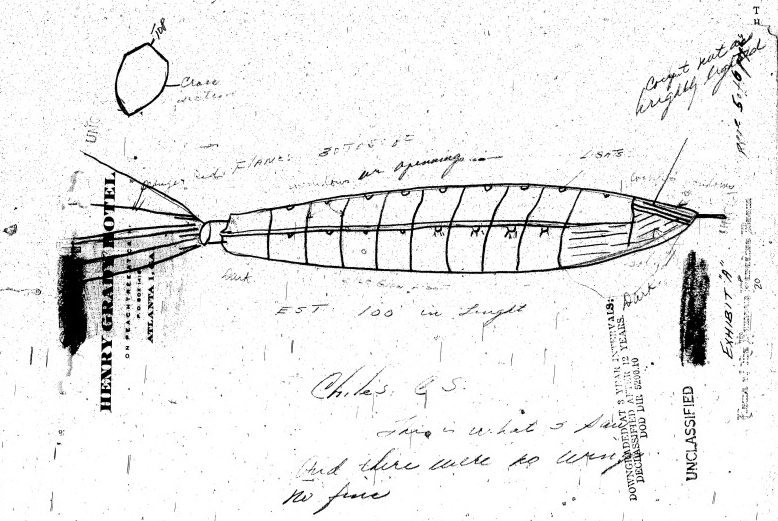
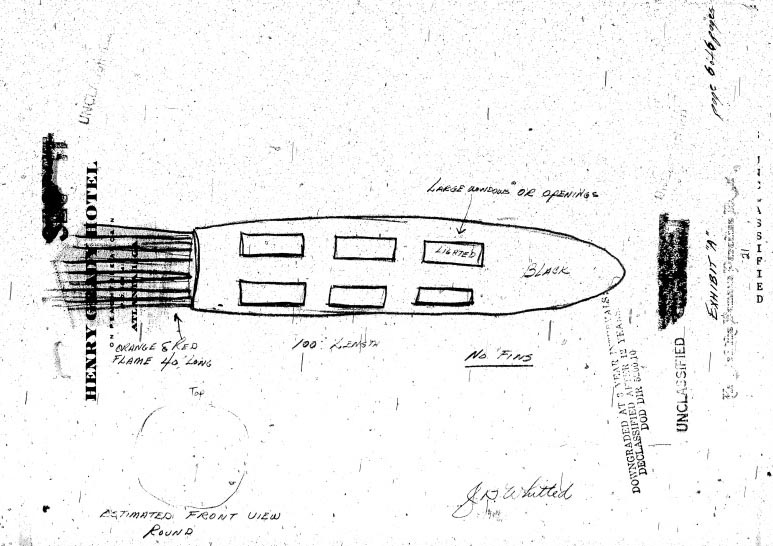


 Never waste money on makeup again: L'Oreal teams up with...
 Mary G. Ross: Google Doodle celebrates the first American...
 Could we finally treat pessimism? Neuroscientists pinpoint...
 ‘We need to rethink evolution’: Animal kingdom is OLDER than...






 Bizarre conspiracy theory suggests celebrities including the...
 Labour councillor who sits on equality panel shared racist...


